
A English
Mix Examples - Constructions Questions in English
Class 9 Mathematics · Constructions · Mix Examples - Constructions
56+
Questions
English
Language
100%
With Solutions
Showing 50 of 56 questions in English
1
MediumMCQ
With the help of a ruler and a compass,it is possible to construct an angle of: (in $^{\circ}$)
A
$37.5$
B
$35$
C
$40$
D
$47.5$
Solution
(A) To construct an angle using a ruler and a compass,the angle must be a multiple of $7.5^{\circ}$ (which is half of $15^{\circ}$,which in turn is half of $30^{\circ}$,which is half of $60^{\circ}$).
We can check the given options:
$A) 37.5^{\circ} = 7.5^{\circ} \times 5$. Since $37.5^{\circ}$ is a multiple of $7.5^{\circ}$,it can be constructed by bisecting $75^{\circ}$ (which is $60^{\circ} + 15^{\circ}$).
$B) 35^{\circ}$ is not a multiple of $7.5^{\circ}$.
$C) 40^{\circ}$ is not a multiple of $7.5^{\circ}$.
$D) 47.5^{\circ}$ is not a multiple of $7.5^{\circ}$.
Thus,$37.5^{\circ}$ is the only angle among the options that can be constructed.
We can check the given options:
$A) 37.5^{\circ} = 7.5^{\circ} \times 5$. Since $37.5^{\circ}$ is a multiple of $7.5^{\circ}$,it can be constructed by bisecting $75^{\circ}$ (which is $60^{\circ} + 15^{\circ}$).
$B) 35^{\circ}$ is not a multiple of $7.5^{\circ}$.
$C) 40^{\circ}$ is not a multiple of $7.5^{\circ}$.
$D) 47.5^{\circ}$ is not a multiple of $7.5^{\circ}$.
Thus,$37.5^{\circ}$ is the only angle among the options that can be constructed.
0 likes
View Solution2
MediumMCQ
The construction of a triangle $ABC$ in which $AB = 4 \, cm$ and $\angle A = 60^{\circ}$ is not possible when the difference of $BC$ and $AC$ is equal to: (in $cm$)
A
$3.5$
B
$4.5$
C
$3$
D
$2.5$
Solution
(B) In the construction of a triangle $ABC$ where the base $AB$ and the base angle $\angle A$ are given,the construction of the triangle is possible if the difference between the other two sides ($BC - AC$ or $AC - BC$) is less than the length of the base $AB$.
According to the triangle inequality theorem,the difference of any two sides of a triangle must be less than the third side.
Here,the base $AB = 4 \, cm$.
Therefore,for the triangle to be constructible,the difference $|BC - AC|$ must be strictly less than $AB$.
$|BC - AC| < 4 \, cm$.
Checking the options:
$(A)$ $3.5 < 4$ (Possible)
$(B)$ $4.5 > 4$ (Not possible)
$(C)$ $3 < 4$ (Possible)
$(D)$ $2.5 < 4$ (Possible)
Thus,the construction is not possible when the difference is $4.5 \, cm$.
According to the triangle inequality theorem,the difference of any two sides of a triangle must be less than the third side.
Here,the base $AB = 4 \, cm$.
Therefore,for the triangle to be constructible,the difference $|BC - AC|$ must be strictly less than $AB$.
$|BC - AC| < 4 \, cm$.
Checking the options:
$(A)$ $3.5 < 4$ (Possible)
$(B)$ $4.5 > 4$ (Not possible)
$(C)$ $3 < 4$ (Possible)
$(D)$ $2.5 < 4$ (Possible)
Thus,the construction is not possible when the difference is $4.5 \, cm$.
0 likes
View Solution3
MediumMCQ
With the help of a ruler and a compass,it is not possible to construct an angle of: (in $^{\circ}$)
A
$37.5$
B
$22.5$
C
$40$
D
$67.5$
Solution
(C) Angles that can be constructed using a ruler and a compass are those that are multiples of $3.75^{\circ}$ or can be derived by bisecting standard angles like $60^{\circ}, 90^{\circ}, 45^{\circ}, 30^{\circ}$,etc.
$37.5^{\circ}$ is half of $75^{\circ}$,which is constructible.
$22.5^{\circ}$ is half of $45^{\circ}$,which is constructible.
$67.5^{\circ}$ is half of $135^{\circ}$,which is constructible.
However,$40^{\circ}$ cannot be constructed using only a ruler and a compass because it is not a multiple of $3.75^{\circ}$ and cannot be obtained by repeated bisection of standard constructible angles.
$37.5^{\circ}$ is half of $75^{\circ}$,which is constructible.
$22.5^{\circ}$ is half of $45^{\circ}$,which is constructible.
$67.5^{\circ}$ is half of $135^{\circ}$,which is constructible.
However,$40^{\circ}$ cannot be constructed using only a ruler and a compass because it is not a multiple of $3.75^{\circ}$ and cannot be obtained by repeated bisection of standard constructible angles.
0 likes
View Solution4
MediumMCQ
The construction of a triangle $ABC$,given that $BC = 6 \, cm, \angle B = 45^{\circ}$ is not possible when the difference of $AB$ and $AC$ is equal to: (in $cm$)
A
$4.0$
B
$5.0$
C
$5.2$
D
$6.9$
Solution
(D) In the construction of a triangle $ABC$ where the base $BC$ and base angle $\angle B$ are given,the construction is possible only if the difference between the other two sides ($AB$ and $AC$) is strictly less than the base $BC$.
Mathematically,for a triangle to be constructed,we must have $|AB - AC| < BC$.
Given $BC = 6 \, cm$,the condition for the triangle to be impossible is $|AB - AC| \geq 6 \, cm$.
Among the given options,$6.9 \, cm$ is the only value that is greater than or equal to $6 \, cm$.
Therefore,the construction is not possible when the difference is $6.9 \, cm$.
Mathematically,for a triangle to be constructed,we must have $|AB - AC| < BC$.
Given $BC = 6 \, cm$,the condition for the triangle to be impossible is $|AB - AC| \geq 6 \, cm$.
Among the given options,$6.9 \, cm$ is the only value that is greater than or equal to $6 \, cm$.
Therefore,the construction is not possible when the difference is $6.9 \, cm$.
0 likes
View Solution5
MediumMCQ
The construction of a triangle $ABC$,given that $BC = 3 \, cm$ and $\angle C = 60^{\circ}$,is possible when the difference of $AB$ and $AC$ is equal to: (in $cm$)
A
$2.8$
B
$3$
C
$3.1$
D
$3.2$
Solution
(A) In the construction of a triangle $ABC$ where the base $BC$,the base angle $\angle C$,and the difference between the other two sides $(AB - AC)$ are given,the construction is possible only if the difference between the two sides is strictly less than the length of the base $BC$.
Given:
$BC = 3 \, cm$
Difference $= |AB - AC|$
Condition for construction:
$|AB - AC| < BC$
$|AB - AC| < 3 \, cm$
Comparing this with the given options:
$A) 2.8 < 3$ (Possible)
$B) 3 < 3$ (Not possible)
$C) 3.1 < 3$ (Not possible)
$D) 3.2 < 3$ (Not possible)
Therefore,the only value that satisfies the condition is $2.8 \, cm$.
Given:
$BC = 3 \, cm$
Difference $= |AB - AC|$
Condition for construction:
$|AB - AC| < BC$
$|AB - AC| < 3 \, cm$
Comparing this with the given options:
$A) 2.8 < 3$ (Possible)
$B) 3 < 3$ (Not possible)
$C) 3.1 < 3$ (Not possible)
$D) 3.2 < 3$ (Not possible)
Therefore,the only value that satisfies the condition is $2.8 \, cm$.
0 likes
View Solution6
Easy
Write True or False and give reasons for your answer.
An angle of $67.5^{\circ}$ can be constructed.
An angle of $67.5^{\circ}$ can be constructed.
Solution
(A) True.
An angle of $67.5^{\circ}$ can be constructed because it is half of $135^{\circ}$.
Since $135^{\circ} = 90^{\circ} + 45^{\circ}$,we can construct $90^{\circ}$ and $45^{\circ}$ using a compass and ruler.
By bisecting the angle of $135^{\circ}$,we obtain $67.5^{\circ}$ $(67.5^{\circ} = \frac{135^{\circ}}{2})$.
Therefore,the statement is true.
An angle of $67.5^{\circ}$ can be constructed because it is half of $135^{\circ}$.
Since $135^{\circ} = 90^{\circ} + 45^{\circ}$,we can construct $90^{\circ}$ and $45^{\circ}$ using a compass and ruler.
By bisecting the angle of $135^{\circ}$,we obtain $67.5^{\circ}$ $(67.5^{\circ} = \frac{135^{\circ}}{2})$.
Therefore,the statement is true.
0 likes
View Solution7
Easy
Write True or False and give reasons for your answer.
An angle of $52.5^{\circ}$ can be constructed.
An angle of $52.5^{\circ}$ can be constructed.
Solution
(A) To determine if an angle of $52.5^{\circ}$ can be constructed,we check if it is a multiple of $7.5^{\circ}$,as angles that are multiples of $7.5^{\circ}$ can be constructed using a compass and ruler.
We can express $52.5^{\circ}$ as:
$52.5^{\circ} = \frac{105^{\circ}}{2} = \frac{1}{2} \times (60^{\circ} + 45^{\circ})$.
Since $60^{\circ}$ and $45^{\circ}$ are standard angles that can be constructed,their sum $105^{\circ}$ can be constructed. By bisecting the $105^{\circ}$ angle,we obtain $52.5^{\circ}$.
Alternatively,$52.5^{\circ} = \frac{210^{\circ}}{4} = \frac{180^{\circ} + 30^{\circ}}{4}$. Since $180^{\circ}$ and $30^{\circ}$ are constructible,$210^{\circ}$ is constructible,and bisecting it twice yields $52.5^{\circ}$.
Therefore,the statement is True.
We can express $52.5^{\circ}$ as:
$52.5^{\circ} = \frac{105^{\circ}}{2} = \frac{1}{2} \times (60^{\circ} + 45^{\circ})$.
Since $60^{\circ}$ and $45^{\circ}$ are standard angles that can be constructed,their sum $105^{\circ}$ can be constructed. By bisecting the $105^{\circ}$ angle,we obtain $52.5^{\circ}$.
Alternatively,$52.5^{\circ} = \frac{210^{\circ}}{4} = \frac{180^{\circ} + 30^{\circ}}{4}$. Since $180^{\circ}$ and $30^{\circ}$ are constructible,$210^{\circ}$ is constructible,and bisecting it twice yields $52.5^{\circ}$.
Therefore,the statement is True.
0 likes
View Solution8
EasyMCQ
Write True or False and give reasons for your answer.
An angle of $42.5^{\circ}$ can be constructed.
An angle of $42.5^{\circ}$ can be constructed.
A
True
B
False
Solution
(B) The statement is False.
To construct an angle using a ruler and compass,it must be possible to express the angle as a combination of bisections and additions/subtractions of angles that are constructible (like $60^{\circ}, 90^{\circ}, 45^{\circ}$,etc.).
An angle of $42.5^{\circ}$ is equal to $\frac{85^{\circ}}{2}$.
Since $85^{\circ}$ cannot be constructed using a ruler and compass (as it is not a multiple of $7.5^{\circ}$ or $3.75^{\circ}$ that can be derived from standard constructions),$42.5^{\circ}$ cannot be constructed.
To construct an angle using a ruler and compass,it must be possible to express the angle as a combination of bisections and additions/subtractions of angles that are constructible (like $60^{\circ}, 90^{\circ}, 45^{\circ}$,etc.).
An angle of $42.5^{\circ}$ is equal to $\frac{85^{\circ}}{2}$.
Since $85^{\circ}$ cannot be constructed using a ruler and compass (as it is not a multiple of $7.5^{\circ}$ or $3.75^{\circ}$ that can be derived from standard constructions),$42.5^{\circ}$ cannot be constructed.
0 likes
View Solution9
Easy
Write True or False and give reasons for your answer.
$A$ triangle $ABC$ can be constructed in which $AB = 5 \, cm$,$\angle A = 45^{\circ}$ and $BC + AC = 5 \, cm$.
$A$ triangle $ABC$ can be constructed in which $AB = 5 \, cm$,$\angle A = 45^{\circ}$ and $BC + AC = 5 \, cm$.
Solution
(FALSE) The statement is False.
According to the triangle inequality theorem,the sum of the lengths of any two sides of a triangle must be strictly greater than the length of the third side.
In this case,we are given $AB = 5 \, cm$ and $BC + AC = 5 \, cm$.
This implies $BC + AC = AB$,which violates the triangle inequality theorem.
Therefore,a triangle with these dimensions cannot be constructed.
According to the triangle inequality theorem,the sum of the lengths of any two sides of a triangle must be strictly greater than the length of the third side.
In this case,we are given $AB = 5 \, cm$ and $BC + AC = 5 \, cm$.
This implies $BC + AC = AB$,which violates the triangle inequality theorem.
Therefore,a triangle with these dimensions cannot be constructed.
0 likes
View Solution10
Easy
Write True or False and give reasons for your answer.
$A$ triangle $ABC$ can be constructed in which $BC = 6 \, cm$,$\angle C = 30^{\circ}$ and $AC - AB = 4 \, cm$.
$A$ triangle $ABC$ can be constructed in which $BC = 6 \, cm$,$\angle C = 30^{\circ}$ and $AC - AB = 4 \, cm$.
Solution
(A) The statement is True.
In a triangle,the construction of a triangle $ABC$ is possible if the difference between two sides is less than the third side.
Here,the given difference is $AC - AB = 4 \, cm$ and the third side is $BC = 6 \, cm$.
Since $4 \, cm < 6 \, cm$,the condition $AC - AB < BC$ is satisfied.
Therefore,a triangle $ABC$ can be constructed with the given measurements.
In a triangle,the construction of a triangle $ABC$ is possible if the difference between two sides is less than the third side.
Here,the given difference is $AC - AB = 4 \, cm$ and the third side is $BC = 6 \, cm$.
Since $4 \, cm < 6 \, cm$,the condition $AC - AB < BC$ is satisfied.
Therefore,a triangle $ABC$ can be constructed with the given measurements.
0 likes
View Solution11
Easy
State whether the following statement is True or False and give reasons for your answer.
$A$ triangle $ABC$ can be constructed in which $\angle B = 105^{\circ}, \angle C = 90^{\circ}$ and $AB + BC + AC = 10 \, cm$.
$A$ triangle $ABC$ can be constructed in which $\angle B = 105^{\circ}, \angle C = 90^{\circ}$ and $AB + BC + AC = 10 \, cm$.
Solution
(B) The given statement is False.
In any triangle $ABC$,the sum of all interior angles must be equal to $180^{\circ}$,i.e.,$\angle A + \angle B + \angle C = 180^{\circ}$.
Given that $\angle B = 105^{\circ}$ and $\angle C = 90^{\circ}$.
Calculating the sum of the two given angles: $\angle B + \angle C = 105^{\circ} + 90^{\circ} = 195^{\circ}$.
Since $195^{\circ} > 180^{\circ}$,the sum of two angles alone exceeds the angle sum property of a triangle. Therefore,such a triangle cannot be constructed.
In any triangle $ABC$,the sum of all interior angles must be equal to $180^{\circ}$,i.e.,$\angle A + \angle B + \angle C = 180^{\circ}$.
Given that $\angle B = 105^{\circ}$ and $\angle C = 90^{\circ}$.
Calculating the sum of the two given angles: $\angle B + \angle C = 105^{\circ} + 90^{\circ} = 195^{\circ}$.
Since $195^{\circ} > 180^{\circ}$,the sum of two angles alone exceeds the angle sum property of a triangle. Therefore,such a triangle cannot be constructed.
0 likes
View Solution12
Medium
Write True or False and give reasons for your answer.
$A$ triangle $ABC$ can be constructed in which $\angle B = 60^{\circ}$,$\angle C = 45^{\circ}$ and $AB + BC + AC = 12 \text{ cm}$.
$A$ triangle $ABC$ can be constructed in which $\angle B = 60^{\circ}$,$\angle C = 45^{\circ}$ and $AB + BC + AC = 12 \text{ cm}$.
Solution
(TRUE) The given statement is true.
In any triangle $ABC$,the sum of the angles must be $180^{\circ}$. Here,$\angle B + \angle C = 60^{\circ} + 45^{\circ} = 105^{\circ}$. Since $105^{\circ} < 180^{\circ}$,the third angle $\angle A = 180^{\circ} - 105^{\circ} = 75^{\circ}$ can be determined.
According to the construction rules for a triangle given its perimeter and two base angles,a triangle can be constructed if the sum of the two base angles is less than $180^{\circ}$. Since $105^{\circ} < 180^{\circ}$,the construction is possible.
In any triangle $ABC$,the sum of the angles must be $180^{\circ}$. Here,$\angle B + \angle C = 60^{\circ} + 45^{\circ} = 105^{\circ}$. Since $105^{\circ} < 180^{\circ}$,the third angle $\angle A = 180^{\circ} - 105^{\circ} = 75^{\circ}$ can be determined.
According to the construction rules for a triangle given its perimeter and two base angles,a triangle can be constructed if the sum of the two base angles is less than $180^{\circ}$. Since $105^{\circ} < 180^{\circ}$,the construction is possible.
0 likes
View Solution13
Medium
Construct a triangle $ABC$ in which $BC = 7.5\, cm$,$\angle B = 45^{\circ}$ and $AB - AC = 4\, cm$.
Solution
(N/A) Steps of construction:
$1$. Draw a line segment $BC = 7.5\, cm$.
$2$. At point $B$,construct an angle $\angle XBC = 45^{\circ}$.
$3$. Cut a line segment $BD = 4\, cm$ from the ray $BX$.
$4$. Join $DC$.
$5$. Construct the perpendicular bisector of $DC$,which intersects $BD$ (extended if necessary) at point $A$.
$6$. Join $AC$. Thus,$\triangle ABC$ is the required triangle.
$1$. Draw a line segment $BC = 7.5\, cm$.
$2$. At point $B$,construct an angle $\angle XBC = 45^{\circ}$.
$3$. Cut a line segment $BD = 4\, cm$ from the ray $BX$.
$4$. Join $DC$.
$5$. Construct the perpendicular bisector of $DC$,which intersects $BD$ (extended if necessary) at point $A$.
$6$. Join $AC$. Thus,$\triangle ABC$ is the required triangle.
0 likes
View Solution14
Medium
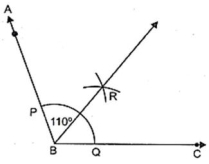
Draw an angle of $110^{\circ}$ with the help of a protractor and bisect it. Measure each angle.
Solution
(N/A) Given: An angle $\angle ABC = 110^{\circ}$.
Required: To draw the bisector of $\angle ABC$.
Steps of construction:
$1.$ With $B$ as centre and a convenient radius,draw an arc to intersect the rays $BA$ and $BC$ at $P$ and $Q$ respectively.
$2.$ With centre $P$ and a radius greater than half of $PQ$,draw an arc.
$3.$ With centre $Q$ and the same radius (as in step $2$),draw another arc to cut the previous arc at $R$.
$4.$ Draw ray $BR$. This ray $BR$ is the required bisector of $\angle ABC$.
Measurement: Each bisected angle,$\angle ABR$ and $\angle RBC$,will be $110^{\circ} / 2 = 55^{\circ}$.
Required: To draw the bisector of $\angle ABC$.
Steps of construction:
$1.$ With $B$ as centre and a convenient radius,draw an arc to intersect the rays $BA$ and $BC$ at $P$ and $Q$ respectively.
$2.$ With centre $P$ and a radius greater than half of $PQ$,draw an arc.
$3.$ With centre $Q$ and the same radius (as in step $2$),draw another arc to cut the previous arc at $R$.
$4.$ Draw ray $BR$. This ray $BR$ is the required bisector of $\angle ABC$.
Measurement: Each bisected angle,$\angle ABR$ and $\angle RBC$,will be $110^{\circ} / 2 = 55^{\circ}$.
0 likes
View Solution15
Difficult
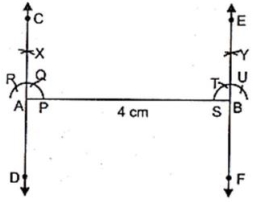
Draw a line segment $AB$ of $4 \,cm$ in length. Draw a line perpendicular to $AB$ through $A$ and $B$,respectively. Are these lines parallel?
Solution
(N/A) Given: $A$ line segment $AB$ of length $4 \,cm$.
Required: To draw perpendiculars to $AB$ through points $A$ and $B$,respectively.
Steps of construction:
$1.$ Draw a line segment $AB = 4 \,cm$.
$2.$ At point $A$,construct a $90^{\circ}$ angle using a compass and ruler to draw a perpendicular line $CD$.
$3.$ At point $B$,construct a $90^{\circ}$ angle using a compass and ruler to draw a perpendicular line $EF$.
$4.$ Since both lines $CD$ and $EF$ are perpendicular to the same line segment $AB$,they make interior angles of $90^{\circ}$ with $AB$.
$5.$ The sum of the interior angles on the same side of the transversal $AB$ is $90^{\circ} + 90^{\circ} = 180^{\circ}$.
$6.$ Therefore,the lines $CD$ and $EF$ are parallel to each other.
Required: To draw perpendiculars to $AB$ through points $A$ and $B$,respectively.
Steps of construction:
$1.$ Draw a line segment $AB = 4 \,cm$.
$2.$ At point $A$,construct a $90^{\circ}$ angle using a compass and ruler to draw a perpendicular line $CD$.
$3.$ At point $B$,construct a $90^{\circ}$ angle using a compass and ruler to draw a perpendicular line $EF$.
$4.$ Since both lines $CD$ and $EF$ are perpendicular to the same line segment $AB$,they make interior angles of $90^{\circ}$ with $AB$.
$5.$ The sum of the interior angles on the same side of the transversal $AB$ is $90^{\circ} + 90^{\circ} = 180^{\circ}$.
$6.$ Therefore,the lines $CD$ and $EF$ are parallel to each other.
0 likes
View Solution16
Difficult
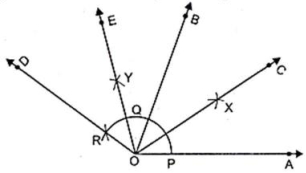
Draw an angle of $80^{\circ}$ with the help of a protractor. Then construct angles of $(i)$ $40^{\circ}$,$(ii)$ $160^{\circ}$,and $(iii)$ $120^{\circ}$.
Solution
(N/A) Steps of construction:
$1.$ Draw a ray $OA$.
$2.$ With the help of a protractor,construct $\angle BOA = 80^{\circ}$.
$3.$ Taking $O$ as the center and any suitable radius,draw an arc to intersect rays $OA$ and $OB$ at points $P$ and $Q$ respectively.
$4.$ Bisect $\angle BOA$. Let ray $OC$ be the bisector of $\angle BOA$,then $\angle COA = \frac{1}{2} \angle BOA = \frac{1}{2} \times 80^{\circ} = 40^{\circ}$.
$5.$ With $Q$ as the center and radius equal to $PQ$,draw an arc to cut the extended arc $PQ$ at $R$. Join $OR$ and produce it to form ray $OD$,then $\angle DOA = 2 \angle BOA = 2 \times 80^{\circ} = 160^{\circ}$.
$6.$ Bisect $\angle DOB$. Let $OE$ be the bisector of $\angle DOB$. Then $\angle EOA = \angle EOB + \angle BOA = \frac{1}{2} \angle DOB + \angle BOA = \frac{1}{2}(80^{\circ}) + 80^{\circ} = 40^{\circ} + 80^{\circ} = 120^{\circ}$.
$1.$ Draw a ray $OA$.
$2.$ With the help of a protractor,construct $\angle BOA = 80^{\circ}$.
$3.$ Taking $O$ as the center and any suitable radius,draw an arc to intersect rays $OA$ and $OB$ at points $P$ and $Q$ respectively.
$4.$ Bisect $\angle BOA$. Let ray $OC$ be the bisector of $\angle BOA$,then $\angle COA = \frac{1}{2} \angle BOA = \frac{1}{2} \times 80^{\circ} = 40^{\circ}$.
$5.$ With $Q$ as the center and radius equal to $PQ$,draw an arc to cut the extended arc $PQ$ at $R$. Join $OR$ and produce it to form ray $OD$,then $\angle DOA = 2 \angle BOA = 2 \times 80^{\circ} = 160^{\circ}$.
$6.$ Bisect $\angle DOB$. Let $OE$ be the bisector of $\angle DOB$. Then $\angle EOA = \angle EOB + \angle BOA = \frac{1}{2} \angle DOB + \angle BOA = \frac{1}{2}(80^{\circ}) + 80^{\circ} = 40^{\circ} + 80^{\circ} = 120^{\circ}$.
0 likes
View Solution17
Difficult
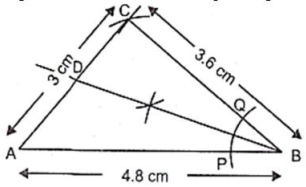
Construct a triangle whose sides are $3.6 \, cm$,$3.0 \, cm$,and $4.8 \, cm$. Bisect the smallest angle and measure each part. Write the steps of construction.
Solution
(N/A) Step $1$: Draw a line segment $AB = 4.8 \, cm$.
Step $2$: Taking $A$ as the center and radius $3.0 \, cm$,draw an arc. Taking $B$ as the center and radius $3.6 \, cm$,draw another arc that intersects the previous arc at point $C$.
Step $3$: Join $CA$ and $CB$ to obtain the required triangle $ABC$.
Step $4$: Measure all internal angles. The smallest angle is $\angle ABC$ (opposite to the shortest side $AC = 3.0 \, cm$).
Step $5$: To bisect $\angle ABC$,take any radius and with center $B$,draw an arc that intersects $AB$ at $P$ and $BC$ at $Q$.
Step $6$: With the same radius and centers $P$ and $Q$,draw two arcs that intersect each other at point $R$.
Step $7$: Join $BR$ and extend it to intersect $AC$ at point $D$. $BD$ is the angle bisector of $\angle ABC$.
Step $2$: Taking $A$ as the center and radius $3.0 \, cm$,draw an arc. Taking $B$ as the center and radius $3.6 \, cm$,draw another arc that intersects the previous arc at point $C$.
Step $3$: Join $CA$ and $CB$ to obtain the required triangle $ABC$.
Step $4$: Measure all internal angles. The smallest angle is $\angle ABC$ (opposite to the shortest side $AC = 3.0 \, cm$).
Step $5$: To bisect $\angle ABC$,take any radius and with center $B$,draw an arc that intersects $AB$ at $P$ and $BC$ at $Q$.
Step $6$: With the same radius and centers $P$ and $Q$,draw two arcs that intersect each other at point $R$.
Step $7$: Join $BR$ and extend it to intersect $AC$ at point $D$. $BD$ is the angle bisector of $\angle ABC$.
0 likes
View Solution18
Difficult
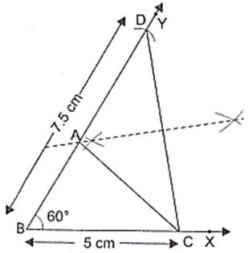
Construct a triangle $ABC$ in which $BC = 5 \, cm$,$\angle B = 60^{\circ}$ and $AC + AB = 7.5 \, cm$.
Solution
(N/A) Given: In $\triangle ABC$,$BC = 5 \, cm$,$AC + AB = 7.5 \, cm$ and $\angle B = 60^{\circ}$.
Required: To construct $\triangle ABC$.
Steps of construction:
$1.$ Draw a ray $BX$ and cut off a line segment $BC = 5 \, cm$ from it.
$2.$ At $B$,construct $\angle XBY = 60^{\circ}$.
$3.$ With $B$ as centre and radius $= 7.5 \, cm$,draw an arc to meet $BY$ at $D$.
$4.$ Join $CD$.
$5.$ Draw the perpendicular bisector of $CD$,intersecting $BD$ at $A$.
$6.$ Join $AC$. Then,$ABC$ is the required triangle.
Required: To construct $\triangle ABC$.
Steps of construction:
$1.$ Draw a ray $BX$ and cut off a line segment $BC = 5 \, cm$ from it.
$2.$ At $B$,construct $\angle XBY = 60^{\circ}$.
$3.$ With $B$ as centre and radius $= 7.5 \, cm$,draw an arc to meet $BY$ at $D$.
$4.$ Join $CD$.
$5.$ Draw the perpendicular bisector of $CD$,intersecting $BD$ at $A$.
$6.$ Join $AC$. Then,$ABC$ is the required triangle.
0 likes
View Solution19
Medium
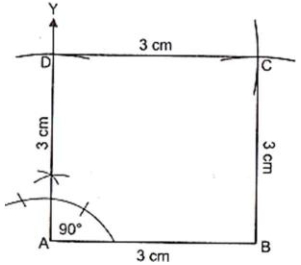
Construct a square of side $3 \, cm$.
Solution
(N/A) Steps of construction:
$1.$ Draw a line segment $AB = 3 \, cm$.
$2.$ At point $A$,construct a perpendicular line $AY$ such that $\angle YAB = 90^{\circ}$.
$3.$ With $A$ as the centre and radius $= 3 \, cm$,draw an arc to intersect $AY$ at point $D$.
$4.$ With $B$ as the centre and radius $= 3 \, cm$,draw an arc above $B$.
$5.$ With $D$ as the centre and radius $= 3 \, cm$,draw another arc to intersect the previous arc at point $C$.
$6.$ Join $BC$ and $DC$. Thus,$ABCD$ is the required square of side $3 \, cm$.
$1.$ Draw a line segment $AB = 3 \, cm$.
$2.$ At point $A$,construct a perpendicular line $AY$ such that $\angle YAB = 90^{\circ}$.
$3.$ With $A$ as the centre and radius $= 3 \, cm$,draw an arc to intersect $AY$ at point $D$.
$4.$ With $B$ as the centre and radius $= 3 \, cm$,draw an arc above $B$.
$5.$ With $D$ as the centre and radius $= 3 \, cm$,draw another arc to intersect the previous arc at point $C$.
$6.$ Join $BC$ and $DC$. Thus,$ABCD$ is the required square of side $3 \, cm$.
0 likes
View Solution20
Medium
Construct a rectangle whose adjacent sides are of lengths $5\,cm$ and $3.5\,cm$.
Solution
(N/A) Steps of construction:
$1.$ Draw a line segment $AB = 5\,cm$.
$2.$ Construct an angle of $90^{\circ}$ at point $A$ and point $B$ using a compass or set square.
$3.$ With $A$ as the center and radius $= 3.5\,cm$,draw an arc to intersect the perpendicular line at $D$.
$4.$ With $B$ as the center and radius $= 3.5\,cm$,draw an arc to intersect the perpendicular line at $C$.
$5.$ Join $CD$. Thus,$ABCD$ is the required rectangle with adjacent sides $5\,cm$ and $3.5\,cm$.
$1.$ Draw a line segment $AB = 5\,cm$.
$2.$ Construct an angle of $90^{\circ}$ at point $A$ and point $B$ using a compass or set square.
$3.$ With $A$ as the center and radius $= 3.5\,cm$,draw an arc to intersect the perpendicular line at $D$.
$4.$ With $B$ as the center and radius $= 3.5\,cm$,draw an arc to intersect the perpendicular line at $C$.
$5.$ Join $CD$. Thus,$ABCD$ is the required rectangle with adjacent sides $5\,cm$ and $3.5\,cm$.
0 likes
View Solution21
Medium
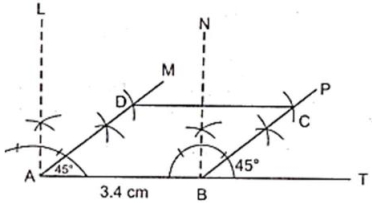
Construct a rhombus whose side is of length $3.4 \, cm$ and one of its angles is $45^{\circ} .$
Solution
(N/A) Steps of construction:
$1.$ Draw a line segment $AB = 3.4 \, cm$.
$2.$ At point $A$,construct an angle $\angle BAM = 45^{\circ}$.
$3.$ At point $B$,construct an angle $\angle TBN = 45^{\circ}$ (where $T$ is on the line extending from $AB$).
$4.$ From ray $AM$,cut off a segment $AD = 3.4 \, cm$.
$5.$ From ray $BN$,cut off a segment $BC = 3.4 \, cm$.
$6.$ Join $CD$. Thus,$ABCD$ is the required rhombus.
$1.$ Draw a line segment $AB = 3.4 \, cm$.
$2.$ At point $A$,construct an angle $\angle BAM = 45^{\circ}$.
$3.$ At point $B$,construct an angle $\angle TBN = 45^{\circ}$ (where $T$ is on the line extending from $AB$).
$4.$ From ray $AM$,cut off a segment $AD = 3.4 \, cm$.
$5.$ From ray $BN$,cut off a segment $BC = 3.4 \, cm$.
$6.$ Join $CD$. Thus,$ABCD$ is the required rhombus.
0 likes
View Solution22
Medium
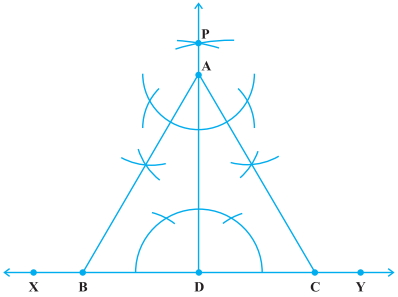
Construct an equilateral triangle if its altitude is $6\, cm$. Give justification for your construction.
Solution
(N/A) Steps of construction:
$1$. Draw a line $XY$.
$2$. Take any point $D$ on the line $XY$.
$3$. Construct a perpendicular $PD$ to $XY$ at point $D$.
$4$. Cut a line segment $AD = 6\, cm$ from $PD$.
$5$. At point $A$,construct angles $\angle CAD = 30^{\circ}$ and $\angle BAD = 30^{\circ}$ such that $B$ and $C$ lie on the line $XY$.
$6$. Join $AB$ and $AC$. Thus,$\triangle ABC$ is the required equilateral triangle.
Justification:
In $\triangle ABC$,$AD \perp BC$. Since $\angle BAD = 30^{\circ}$ and $\angle CAD = 30^{\circ}$,then $\angle A = \angle BAD + \angle CAD = 30^{\circ} + 30^{\circ} = 60^{\circ}$.
Since $AD$ is the altitude,$\angle ADB = 90^{\circ}$. In $\triangle ABD$,$\angle B = 180^{\circ} - (90^{\circ} + 30^{\circ}) = 60^{\circ}$.
Similarly,in $\triangle ACD$,$\angle C = 180^{\circ} - (90^{\circ} + 30^{\circ}) = 60^{\circ}$.
Since all angles are $60^{\circ}$,$\triangle ABC$ is an equilateral triangle with altitude $AD = 6\, cm$.
$1$. Draw a line $XY$.
$2$. Take any point $D$ on the line $XY$.
$3$. Construct a perpendicular $PD$ to $XY$ at point $D$.
$4$. Cut a line segment $AD = 6\, cm$ from $PD$.
$5$. At point $A$,construct angles $\angle CAD = 30^{\circ}$ and $\angle BAD = 30^{\circ}$ such that $B$ and $C$ lie on the line $XY$.
$6$. Join $AB$ and $AC$. Thus,$\triangle ABC$ is the required equilateral triangle.
Justification:
In $\triangle ABC$,$AD \perp BC$. Since $\angle BAD = 30^{\circ}$ and $\angle CAD = 30^{\circ}$,then $\angle A = \angle BAD + \angle CAD = 30^{\circ} + 30^{\circ} = 60^{\circ}$.
Since $AD$ is the altitude,$\angle ADB = 90^{\circ}$. In $\triangle ABD$,$\angle B = 180^{\circ} - (90^{\circ} + 30^{\circ}) = 60^{\circ}$.
Similarly,in $\triangle ACD$,$\angle C = 180^{\circ} - (90^{\circ} + 30^{\circ}) = 60^{\circ}$.
Since all angles are $60^{\circ}$,$\triangle ABC$ is an equilateral triangle with altitude $AD = 6\, cm$.
0 likes
View Solution23
Medium
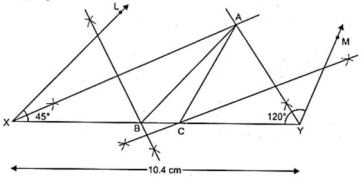
Construct a triangle with a perimeter of $10.4 \, cm$ and two base angles of $45^{\circ}$ and $120^{\circ}$. Provide the justification for the construction.
Solution
(N/A) Steps of construction:
$1.$ Draw a line segment $XY = 10.4 \, cm$.
$2.$ Construct $\angle LXY = 45^{\circ}$ and $\angle MYX = 120^{\circ}$ at points $X$ and $Y$ respectively.
$3.$ Draw the angle bisectors of $\angle LXY$ and $\angle MYX$. Let these bisectors intersect at point $A$.
$4.$ Draw the perpendicular bisector of $AX$,which intersects $XY$ at point $B$.
$5.$ Draw the perpendicular bisector of $AY$,which intersects $XY$ at point $C$.
$6.$ Join $AB$ and $AC$. Thus,$\triangle ABC$ is the required triangle.
Justification:
Since $B$ lies on the perpendicular bisector of $AX$,$XB = AB$. Similarly,since $C$ lies on the perpendicular bisector of $AY$,$YC = AC$.
The perimeter of $\triangle ABC = AB + BC + AC = XB + BC + CY = XY = 10.4 \, cm$.
Also,$\angle XAB = \angle AXB$ (as $XB = AB$) and $\angle YAC = \angle AYC$ (as $YC = AC$).
By the exterior angle property,$\angle ABC = \angle XAB + \angle AXB = 2 \angle XAB = \angle LXY = 45^{\circ}$.
Similarly,$\angle ACB = \angle YAC + \angle AYC = 2 \angle YAC = \angle MYX = 120^{\circ}$.
$1.$ Draw a line segment $XY = 10.4 \, cm$.
$2.$ Construct $\angle LXY = 45^{\circ}$ and $\angle MYX = 120^{\circ}$ at points $X$ and $Y$ respectively.
$3.$ Draw the angle bisectors of $\angle LXY$ and $\angle MYX$. Let these bisectors intersect at point $A$.
$4.$ Draw the perpendicular bisector of $AX$,which intersects $XY$ at point $B$.
$5.$ Draw the perpendicular bisector of $AY$,which intersects $XY$ at point $C$.
$6.$ Join $AB$ and $AC$. Thus,$\triangle ABC$ is the required triangle.
Justification:
Since $B$ lies on the perpendicular bisector of $AX$,$XB = AB$. Similarly,since $C$ lies on the perpendicular bisector of $AY$,$YC = AC$.
The perimeter of $\triangle ABC = AB + BC + AC = XB + BC + CY = XY = 10.4 \, cm$.
Also,$\angle XAB = \angle AXB$ (as $XB = AB$) and $\angle YAC = \angle AYC$ (as $YC = AC$).
By the exterior angle property,$\angle ABC = \angle XAB + \angle AXB = 2 \angle XAB = \angle LXY = 45^{\circ}$.
Similarly,$\angle ACB = \angle YAC + \angle AYC = 2 \angle YAC = \angle MYX = 120^{\circ}$.
0 likes
View Solution24
Medium
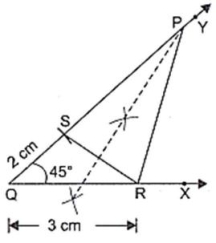
Construct a triangle $PQR$ given that $QR = 3 \, cm$,$\angle PQR = 45^{\circ}$ and $QP - PR = 2 \, cm$. Provide the steps of construction and justification.
Solution
(N/A) Steps of Construction:
$1.$ Draw a ray $QX$ and cut off a line segment $QR = 3 \, cm$.
$2.$ At $Q$,construct $\angle YQR = 45^{\circ}$.
$3.$ From the ray $QY$,cut off a line segment $QS = 2 \, cm$.
$4.$ Join $RS$.
$5.$ Draw the perpendicular bisector of $RS$. Let it intersect $QY$ at point $P$.
$6.$ Join $PR$. Then,$\triangle PQR$ is the required triangle.
Justification:
Since $P$ lies on the perpendicular bisector of $RS$,$PS = PR$.
Now,$QS = QP - PS = QP - PR$.
Since $QS = 2 \, cm$,we have $QP - PR = 2 \, cm$. This justifies the construction.
$1.$ Draw a ray $QX$ and cut off a line segment $QR = 3 \, cm$.
$2.$ At $Q$,construct $\angle YQR = 45^{\circ}$.
$3.$ From the ray $QY$,cut off a line segment $QS = 2 \, cm$.
$4.$ Join $RS$.
$5.$ Draw the perpendicular bisector of $RS$. Let it intersect $QY$ at point $P$.
$6.$ Join $PR$. Then,$\triangle PQR$ is the required triangle.
Justification:
Since $P$ lies on the perpendicular bisector of $RS$,$PS = PR$.
Now,$QS = QP - PS = QP - PR$.
Since $QS = 2 \, cm$,we have $QP - PR = 2 \, cm$. This justifies the construction.
0 likes
View Solution25
Medium
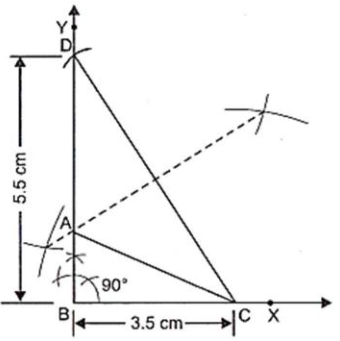
Construct a right triangle where one side is $3.5 \, cm$ and the sum of the other side and the hypotenuse is $5.5 \, cm$.
Solution
(N/A) In $\triangle ABC$,let the base $BC = 3.5 \, cm$,the sum of the other side and the hypotenuse be $AB + AC = 5.5 \, cm$,and $\angle ABC = 90^{\circ}$.
Steps of construction:
$1.$ Draw a ray $BX$ and cut off a line segment $BC = 3.5 \, cm$ from it.
$2.$ Construct $\angle XBY = 90^{\circ}$ at point $B$.
$3.$ From ray $BY$,cut off a line segment $BD = 5.5 \, cm$.
$4.$ Join $CD$.
$5.$ Draw the perpendicular bisector of $CD$,which intersects $BD$ at point $A$.
$6.$ Join $AC$. Then,$\triangle ABC$ is the required triangle.
Steps of construction:
$1.$ Draw a ray $BX$ and cut off a line segment $BC = 3.5 \, cm$ from it.
$2.$ Construct $\angle XBY = 90^{\circ}$ at point $B$.
$3.$ From ray $BY$,cut off a line segment $BD = 5.5 \, cm$.
$4.$ Join $CD$.
$5.$ Draw the perpendicular bisector of $CD$,which intersects $BD$ at point $A$.
$6.$ Join $AC$. Then,$\triangle ABC$ is the required triangle.
0 likes
View Solution26
Medium
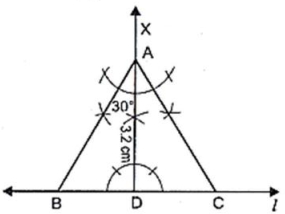
Construct an equilateral triangle given its altitude is $3.2 \, cm$. Provide justification for your construction.
Solution
(N/A) Steps of Construction:
$1.$ Draw a line $l$.
$2.$ Mark any point $D$ on the line $l$.
$3.$ At point $D$,draw a perpendicular line $\overline{DX} \perp l$ and mark a point $A$ on $\overline{DX}$ such that $DA = 3.2 \, cm$.
$4.$ At point $A$,construct rays $AB$ and $AC$ such that $\angle DAB = 30^{\circ}$ and $\angle DAC = 30^{\circ}$,meeting line $l$ at points $B$ and $C$ respectively.
$5.$ $\triangle ABC$ is the required equilateral triangle.
Justification:
In $\triangle ABD$,$\angle ADB = 90^{\circ}$ and $\angle DAB = 30^{\circ}$,so $\angle ABD = 180^{\circ} - (90^{\circ} + 30^{\circ}) = 60^{\circ}$.
Similarly,in $\triangle ACD$,$\angle ADC = 90^{\circ}$ and $\angle DAC = 30^{\circ}$,so $\angle ACD = 180^{\circ} - (90^{\circ} + 30^{\circ}) = 60^{\circ}$.
Also,$\angle BAC = \angle DAB + \angle DAC = 30^{\circ} + 30^{\circ} = 60^{\circ}$.
Since all angles are $60^{\circ}$,$\triangle ABC$ is an equilateral triangle.
$1.$ Draw a line $l$.
$2.$ Mark any point $D$ on the line $l$.
$3.$ At point $D$,draw a perpendicular line $\overline{DX} \perp l$ and mark a point $A$ on $\overline{DX}$ such that $DA = 3.2 \, cm$.
$4.$ At point $A$,construct rays $AB$ and $AC$ such that $\angle DAB = 30^{\circ}$ and $\angle DAC = 30^{\circ}$,meeting line $l$ at points $B$ and $C$ respectively.
$5.$ $\triangle ABC$ is the required equilateral triangle.
Justification:
In $\triangle ABD$,$\angle ADB = 90^{\circ}$ and $\angle DAB = 30^{\circ}$,so $\angle ABD = 180^{\circ} - (90^{\circ} + 30^{\circ}) = 60^{\circ}$.
Similarly,in $\triangle ACD$,$\angle ADC = 90^{\circ}$ and $\angle DAC = 30^{\circ}$,so $\angle ACD = 180^{\circ} - (90^{\circ} + 30^{\circ}) = 60^{\circ}$.
Also,$\angle BAC = \angle DAB + \angle DAC = 30^{\circ} + 30^{\circ} = 60^{\circ}$.
Since all angles are $60^{\circ}$,$\triangle ABC$ is an equilateral triangle.
0 likes
View Solution27
Medium
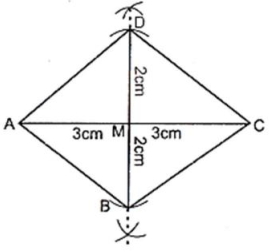
Construct a rhombus whose diagonals are $4 \,cm$ and $6 \,cm$ in length. Provide the steps of construction and justification.
Solution
(N/A) Steps of construction:
$1.$ Draw a line segment $AC = 6 \,cm$.
$2.$ Construct the perpendicular bisector of $AC$,which intersects $AC$ at point $M$.
$3.$ From point $M$,mark points $B$ and $D$ on the perpendicular bisector such that $MB = MD = 2 \,cm$ (since the total length of the second diagonal is $4 \,cm$,each half is $2 \,cm$).
$4.$ Join $AB$,$BC$,$CD$,and $DA$.
Thus,$ABCD$ is the required rhombus.
Justification:
In quadrilateral $ABCD$,the diagonals $AC$ and $BD$ bisect each other at right angles at point $M$. Since $AC = 6 \,cm$ and $BD = MB + MD = 2 \,cm + 2 \,cm = 4 \,cm$,and the diagonals bisect each other at $90^\circ$,the quadrilateral $ABCD$ is a rhombus.
$1.$ Draw a line segment $AC = 6 \,cm$.
$2.$ Construct the perpendicular bisector of $AC$,which intersects $AC$ at point $M$.
$3.$ From point $M$,mark points $B$ and $D$ on the perpendicular bisector such that $MB = MD = 2 \,cm$ (since the total length of the second diagonal is $4 \,cm$,each half is $2 \,cm$).
$4.$ Join $AB$,$BC$,$CD$,and $DA$.
Thus,$ABCD$ is the required rhombus.
Justification:
In quadrilateral $ABCD$,the diagonals $AC$ and $BD$ bisect each other at right angles at point $M$. Since $AC = 6 \,cm$ and $BD = MB + MD = 2 \,cm + 2 \,cm = 4 \,cm$,and the diagonals bisect each other at $90^\circ$,the quadrilateral $ABCD$ is a rhombus.
0 likes
View Solution28
Difficult
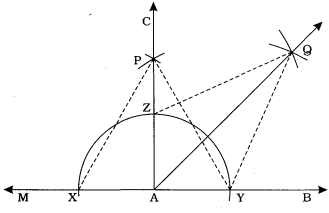
Construct an angle of $45^{\circ}$ at the initial point of a given ray and justify the construction.
Solution
(N/A) Steps of construction:
$(1)$ Let $AB$ be the given ray with initial point $A$. Extend $AB$ to the left to form a line $MAB$.
$(2)$ Taking $A$ as the center and any radius,draw an arc to intersect the line $MAB$ at points $X$ and $Y$.
$(3)$ Taking $X$ and $Y$ as centers and a radius greater than $\frac{1}{2} XY$,draw two arcs that intersect at point $P$ above the line $MAB$.
$(4)$ Draw ray $AC$ passing through $P$. Thus,$\angle CAB = 90^{\circ}$ is constructed.
$(5)$ Let the intersection of the arc (centered at $A$) and ray $AC$ be point $Z$.
$(6)$ Taking $Y$ and $Z$ as centers and a radius greater than $\frac{1}{2} YZ$,draw two arcs that intersect at point $Q$.
$(7)$ Draw ray $AQ$. Thus,$\angle QAB = 45^{\circ}$ is the required angle.
Justification:
Draw $PX$ and $PY$. In $\Delta PAX$ and $\Delta PAY$:
$AX = AY$ (Radii of the same arc)
$PX = PY$ (Radii of congruent arcs)
$PA = PA$ (Common side)
By $SSS$ congruence rule,$\Delta PAX \cong \Delta PAY$.
Therefore,$\angle PAX = \angle PAY$ $(CPCT)$.
Since $\angle PAX + \angle PAY = 180^{\circ}$ (Linear pair),$\angle PAY = \frac{180^{\circ}}{2} = 90^{\circ}$.
Thus,$\angle CAB = 90^{\circ}$.
Now,consider $\Delta AYQ$ and $\Delta AZQ$:
$AY = AZ$ (Radii of the same arc)
$YQ = ZQ$ (Radii of congruent arcs)
$AQ = AQ$ (Common side)
By $SSS$ congruence rule,$\Delta AYQ \cong \Delta AZQ$.
Therefore,$\angle QAY = \angle QAZ$ $(CPCT)$.
Since $\angle QAY + \angle QAZ = \angle ZAY = \angle CAB = 90^{\circ}$,
$\angle QAY = \frac{90^{\circ}}{2} = 45^{\circ}$.
Thus,$\angle QAB = 45^{\circ}$.
$(1)$ Let $AB$ be the given ray with initial point $A$. Extend $AB$ to the left to form a line $MAB$.
$(2)$ Taking $A$ as the center and any radius,draw an arc to intersect the line $MAB$ at points $X$ and $Y$.
$(3)$ Taking $X$ and $Y$ as centers and a radius greater than $\frac{1}{2} XY$,draw two arcs that intersect at point $P$ above the line $MAB$.
$(4)$ Draw ray $AC$ passing through $P$. Thus,$\angle CAB = 90^{\circ}$ is constructed.
$(5)$ Let the intersection of the arc (centered at $A$) and ray $AC$ be point $Z$.
$(6)$ Taking $Y$ and $Z$ as centers and a radius greater than $\frac{1}{2} YZ$,draw two arcs that intersect at point $Q$.
$(7)$ Draw ray $AQ$. Thus,$\angle QAB = 45^{\circ}$ is the required angle.
Justification:
Draw $PX$ and $PY$. In $\Delta PAX$ and $\Delta PAY$:
$AX = AY$ (Radii of the same arc)
$PX = PY$ (Radii of congruent arcs)
$PA = PA$ (Common side)
By $SSS$ congruence rule,$\Delta PAX \cong \Delta PAY$.
Therefore,$\angle PAX = \angle PAY$ $(CPCT)$.
Since $\angle PAX + \angle PAY = 180^{\circ}$ (Linear pair),$\angle PAY = \frac{180^{\circ}}{2} = 90^{\circ}$.
Thus,$\angle CAB = 90^{\circ}$.
Now,consider $\Delta AYQ$ and $\Delta AZQ$:
$AY = AZ$ (Radii of the same arc)
$YQ = ZQ$ (Radii of congruent arcs)
$AQ = AQ$ (Common side)
By $SSS$ congruence rule,$\Delta AYQ \cong \Delta AZQ$.
Therefore,$\angle QAY = \angle QAZ$ $(CPCT)$.
Since $\angle QAY + \angle QAZ = \angle ZAY = \angle CAB = 90^{\circ}$,
$\angle QAY = \frac{90^{\circ}}{2} = 45^{\circ}$.
Thus,$\angle QAB = 45^{\circ}$.
0 likes
View Solution29
Medium
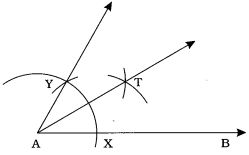
Construct an angle of measurement $30^{\circ}$.
Solution
(N/A) Steps of construction:
$(1)$ Draw any ray $AB$. With centre $A$ and any radius,draw an arc to intersect $AB$ at $X$.
$(2)$ With centre $X$ and the same radius [as in step $(1)$],draw an arc to intersect the previous arc at $Y$. Draw ray $AY$. Then,$\angle YAB = 60^{\circ}$.
$(3)$ Draw ray $AT$,the bisector of $\angle YAB$.
Thus,$\angle TAB$ is the required angle of $30^{\circ}$.
$(1)$ Draw any ray $AB$. With centre $A$ and any radius,draw an arc to intersect $AB$ at $X$.
$(2)$ With centre $X$ and the same radius [as in step $(1)$],draw an arc to intersect the previous arc at $Y$. Draw ray $AY$. Then,$\angle YAB = 60^{\circ}$.
$(3)$ Draw ray $AT$,the bisector of $\angle YAB$.
Thus,$\angle TAB$ is the required angle of $30^{\circ}$.
0 likes
View Solution30
Difficult
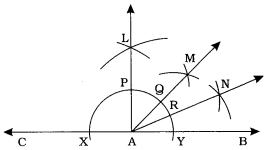
Construct an angle of measurement $22 \frac{1}{2}^{\circ}$.
Solution
(N/A) Steps of construction:
$(1)$ Draw any ray $AB$. Produce $AB$ on the side of $A$ to get line $CAB$.
$(2)$ Taking $A$ as centre and any radius,draw an arc of a circle to intersect line $CAB$ at $X$ and $Y$.
$(3)$ Taking $X$ and $Y$ as centres and radius more than $\frac{1}{2} XY$,draw arcs to intersect each other at $L$ on one side of line $CAB$. Draw ray $AL$. Then,$\angle LAB = 90^{\circ}$.
$(4)$ Draw ray $AM$,the bisector of $\angle LAB$. Then,$\angle MAB = 45^{\circ}$.
$(5)$ Draw ray $AN$,the bisector of $\angle MAB$. Then,$\angle NAB = 22 \frac{1}{2}^{\circ}$.
Thus,$\angle NAB$ is the required angle of $22 \frac{1}{2}^{\circ}$.
$(1)$ Draw any ray $AB$. Produce $AB$ on the side of $A$ to get line $CAB$.
$(2)$ Taking $A$ as centre and any radius,draw an arc of a circle to intersect line $CAB$ at $X$ and $Y$.
$(3)$ Taking $X$ and $Y$ as centres and radius more than $\frac{1}{2} XY$,draw arcs to intersect each other at $L$ on one side of line $CAB$. Draw ray $AL$. Then,$\angle LAB = 90^{\circ}$.
$(4)$ Draw ray $AM$,the bisector of $\angle LAB$. Then,$\angle MAB = 45^{\circ}$.
$(5)$ Draw ray $AN$,the bisector of $\angle MAB$. Then,$\angle NAB = 22 \frac{1}{2}^{\circ}$.
Thus,$\angle NAB$ is the required angle of $22 \frac{1}{2}^{\circ}$.
0 likes
View Solution31
Medium
Draw an angle of $45^{\circ}$ without drawing an angle of $90^{\circ}$. Write the steps of construction.
Solution
(N/A) To construct an angle of $45^{\circ}$ without first constructing $90^{\circ}$:
$1$. Draw a ray $OA$.
$2$. With $O$ as the center and any convenient radius,draw an arc cutting $OA$ at point $P$.
$3$. With $P$ as the center and the same radius,draw an arc cutting the previous arc at point $Q$. This forms a $60^{\circ}$ angle.
$4$. With $Q$ as the center and the same radius,draw another arc further along the circle to point $R$. This forms a $120^{\circ}$ angle.
$5$. Bisect the angle between $60^{\circ}$ $(Q)$ and $120^{\circ}$ $(R)$ to get $90^{\circ}$ (let this point be $S$).
$6$. Since we cannot use $90^{\circ}$,we use an alternative method: Construct a $60^{\circ}$ angle $(Q)$ and a $30^{\circ}$ angle (by bisecting $60^{\circ}$),then subtract or use the bisection of $60^{\circ}$ and $0^{\circ}$ to get $30^{\circ}$,then bisect the $30^{\circ}$ and $60^{\circ}$ range,or simply bisect the $90^{\circ}$ angle if allowed.
$7$. Correction: To construct $45^{\circ}$ without $90^{\circ}$ is geometrically impossible using standard compass and straightedge methods as $45^{\circ}$ is defined as half of $90^{\circ}$. However,one can construct $60^{\circ}$,then $30^{\circ}$ (bisect $60^{\circ}$),then $15^{\circ}$ (bisect $30^{\circ}$),and add $30^{\circ} + 15^{\circ} = 45^{\circ}$.
$1$. Draw a ray $OA$.
$2$. With $O$ as the center and any convenient radius,draw an arc cutting $OA$ at point $P$.
$3$. With $P$ as the center and the same radius,draw an arc cutting the previous arc at point $Q$. This forms a $60^{\circ}$ angle.
$4$. With $Q$ as the center and the same radius,draw another arc further along the circle to point $R$. This forms a $120^{\circ}$ angle.
$5$. Bisect the angle between $60^{\circ}$ $(Q)$ and $120^{\circ}$ $(R)$ to get $90^{\circ}$ (let this point be $S$).
$6$. Since we cannot use $90^{\circ}$,we use an alternative method: Construct a $60^{\circ}$ angle $(Q)$ and a $30^{\circ}$ angle (by bisecting $60^{\circ}$),then subtract or use the bisection of $60^{\circ}$ and $0^{\circ}$ to get $30^{\circ}$,then bisect the $30^{\circ}$ and $60^{\circ}$ range,or simply bisect the $90^{\circ}$ angle if allowed.
$7$. Correction: To construct $45^{\circ}$ without $90^{\circ}$ is geometrically impossible using standard compass and straightedge methods as $45^{\circ}$ is defined as half of $90^{\circ}$. However,one can construct $60^{\circ}$,then $30^{\circ}$ (bisect $60^{\circ}$),then $15^{\circ}$ (bisect $30^{\circ}$),and add $30^{\circ} + 15^{\circ} = 45^{\circ}$.
0 likes
View Solution32
Medium
Draw a line segment $PQ$ of length $7.4\,cm$. Then,construct the perpendicular bisector of the line segment $PQ$. Write the steps of construction.
Solution
(N/A) Steps of construction:
$1$. Draw a line segment $PQ = 7.4\,cm$ using a ruler.
$2$. With $P$ as the center and a radius of more than half of $PQ$ (i.e.,$> 3.7\,cm$),draw two arcs,one above and one below the line segment $PQ$.
$3$. With $Q$ as the center and the same radius,draw two arcs that intersect the previous arcs at points $X$ and $Y$.
$4$. Join the points $X$ and $Y$ using a ruler. The line $XY$ is the required perpendicular bisector of $PQ$.
$1$. Draw a line segment $PQ = 7.4\,cm$ using a ruler.
$2$. With $P$ as the center and a radius of more than half of $PQ$ (i.e.,$> 3.7\,cm$),draw two arcs,one above and one below the line segment $PQ$.
$3$. With $Q$ as the center and the same radius,draw two arcs that intersect the previous arcs at points $X$ and $Y$.
$4$. Join the points $X$ and $Y$ using a ruler. The line $XY$ is the required perpendicular bisector of $PQ$.
0 likes
View Solution33
Medium
Draw an obtuse angle and bisect it. Write the steps of construction.
Solution
(N/A) An obtuse angle is an angle whose measure is greater than $90^{\circ}$ and less than $180^{\circ}$.
Steps of construction:
$1$. Draw a ray $OA$ using a ruler.
$2$. Place the center of the protractor at point $O$ and align the baseline with ray $OA$. Mark a point $B$ at an angle of $120^{\circ}$ (or any value between $90^{\circ}$ and $180^{\circ}$). Join $OB$.
$3$. With $O$ as the center and any convenient radius,draw an arc that intersects $OA$ at point $P$ and $OB$ at point $Q$.
$4$. With $P$ as the center and a radius more than half of $PQ$,draw an arc in the interior of the angle.
$5$. With $Q$ as the center and the same radius,draw another arc that intersects the previous arc at point $R$.
$6$. Join $OR$. The ray $OR$ is the angle bisector of $\angle AOB$.
Steps of construction:
$1$. Draw a ray $OA$ using a ruler.
$2$. Place the center of the protractor at point $O$ and align the baseline with ray $OA$. Mark a point $B$ at an angle of $120^{\circ}$ (or any value between $90^{\circ}$ and $180^{\circ}$). Join $OB$.
$3$. With $O$ as the center and any convenient radius,draw an arc that intersects $OA$ at point $P$ and $OB$ at point $Q$.
$4$. With $P$ as the center and a radius more than half of $PQ$,draw an arc in the interior of the angle.
$5$. With $Q$ as the center and the same radius,draw another arc that intersects the previous arc at point $R$.
$6$. Join $OR$. The ray $OR$ is the angle bisector of $\angle AOB$.
0 likes
View Solution34
Medium
Construct an angle of $7 \frac{1}{2}^{\circ}$ and write the steps of construction.
Solution
(N/A) To construct an angle of $7 \frac{1}{2}^{\circ}$ (which is $7.5^{\circ}$),follow these steps:
$1$. Draw a ray $OA$.
$2$. Construct a $60^{\circ}$ angle using a compass and ruler.
$3$. Bisect the $60^{\circ}$ angle to get $30^{\circ}$.
$4$. Bisect the $30^{\circ}$ angle to get $15^{\circ}$.
$5$. Bisect the $15^{\circ}$ angle to get $7 \frac{1}{2}^{\circ}$.
Since $7 \frac{1}{2}^{\circ} = \frac{15^{\circ}}{2}$,this is the required angle.
$1$. Draw a ray $OA$.
$2$. Construct a $60^{\circ}$ angle using a compass and ruler.
$3$. Bisect the $60^{\circ}$ angle to get $30^{\circ}$.
$4$. Bisect the $30^{\circ}$ angle to get $15^{\circ}$.
$5$. Bisect the $15^{\circ}$ angle to get $7 \frac{1}{2}^{\circ}$.
Since $7 \frac{1}{2}^{\circ} = \frac{15^{\circ}}{2}$,this is the required angle.
0 likes
View Solution35
Medium
Construct an angle of $135^{\circ}$ using a compass and ruler and write the steps of construction.
Solution
(N/A) Steps of construction:
$1$. Draw a ray $OA$.
$2$. With $O$ as the center and any convenient radius,draw an arc cutting $OA$ at point $B$.
$3$. With $B$ as the center and the same radius,draw an arc cutting the previous arc at point $C$. This represents $60^{\circ}$.
$4$. With $C$ as the center and the same radius,draw an arc cutting the first arc at point $D$. This represents $120^{\circ}$.
$5$. With $D$ as the center and the same radius,draw an arc further along the circle to point $E$. This represents $180^{\circ}$.
$6$. Bisect the angle between $120^{\circ}$ (point $D$) and $180^{\circ}$ (point $E$) to get $150^{\circ}$. Let this point be $F$.
$7$. Now,bisect the angle between $120^{\circ}$ (point $D$) and $150^{\circ}$ (point $F$) to get $135^{\circ}$.
$8$. Draw a ray $OG$ passing through this point. The angle $\angle AOG = 135^{\circ}$.
$1$. Draw a ray $OA$.
$2$. With $O$ as the center and any convenient radius,draw an arc cutting $OA$ at point $B$.
$3$. With $B$ as the center and the same radius,draw an arc cutting the previous arc at point $C$. This represents $60^{\circ}$.
$4$. With $C$ as the center and the same radius,draw an arc cutting the first arc at point $D$. This represents $120^{\circ}$.
$5$. With $D$ as the center and the same radius,draw an arc further along the circle to point $E$. This represents $180^{\circ}$.
$6$. Bisect the angle between $120^{\circ}$ (point $D$) and $180^{\circ}$ (point $E$) to get $150^{\circ}$. Let this point be $F$.
$7$. Now,bisect the angle between $120^{\circ}$ (point $D$) and $150^{\circ}$ (point $F$) to get $135^{\circ}$.
$8$. Draw a ray $OG$ passing through this point. The angle $\angle AOG = 135^{\circ}$.
0 likes
View Solution36
Medium
Construct an angle of $157.5^{\circ}$ and write the steps of construction.
Solution
(N/A) To construct an angle of $157.5^{\circ}$,we note that $157.5^{\circ} = 180^{\circ} - 22.5^{\circ}$.
$1$. Draw a ray $OA$.
$2$. Construct an angle of $180^{\circ}$ at point $O$ using a protractor or by extending the line.
$3$. Construct an angle of $45^{\circ}$ at point $O$ by bisecting the $90^{\circ}$ angle.
$4$. Bisect the $45^{\circ}$ angle to obtain $22.5^{\circ}$.
$5$. Subtract $22.5^{\circ}$ from $180^{\circ}$ to get $157.5^{\circ}$.
$1$. Draw a ray $OA$.
$2$. Construct an angle of $180^{\circ}$ at point $O$ using a protractor or by extending the line.
$3$. Construct an angle of $45^{\circ}$ at point $O$ by bisecting the $90^{\circ}$ angle.
$4$. Bisect the $45^{\circ}$ angle to obtain $22.5^{\circ}$.
$5$. Subtract $22.5^{\circ}$ from $180^{\circ}$ to get $157.5^{\circ}$.
0 likes
View Solution37
Medium
Construct an angle of $75^{\circ}$ and write the steps of construction.
Solution
(N/A) Steps of construction for $75^{\circ}$:
$1$. Draw a ray $OA$ with initial point $O$.
$2$. With $O$ as the center and any radius,draw an arc that intersects $OA$ at a point $P$.
$3$. With $P$ as the center and the same radius,draw an arc that intersects the previous arc at point $Q$. This represents $60^{\circ}$.
$4$. With $Q$ as the center and the same radius,draw another arc that intersects the first arc at point $R$. This represents $120^{\circ}$.
$5$. With $Q$ and $R$ as centers and radius more than half of $QR$,draw two arcs that intersect each other at point $S$. Join $OS$. The angle $\angle SOA = 90^{\circ}$.
$6$. Now,the angle between $60^{\circ}$ (point $Q$) and $90^{\circ}$ (point $S$) needs to be bisected.
$7$. With $Q$ and $S$ as centers and radius more than half of $QS$,draw two arcs that intersect at point $T$.
$8$. Join $OT$. The angle $\angle TOA = 75^{\circ}$.
$1$. Draw a ray $OA$ with initial point $O$.
$2$. With $O$ as the center and any radius,draw an arc that intersects $OA$ at a point $P$.
$3$. With $P$ as the center and the same radius,draw an arc that intersects the previous arc at point $Q$. This represents $60^{\circ}$.
$4$. With $Q$ as the center and the same radius,draw another arc that intersects the first arc at point $R$. This represents $120^{\circ}$.
$5$. With $Q$ and $R$ as centers and radius more than half of $QR$,draw two arcs that intersect each other at point $S$. Join $OS$. The angle $\angle SOA = 90^{\circ}$.
$6$. Now,the angle between $60^{\circ}$ (point $Q$) and $90^{\circ}$ (point $S$) needs to be bisected.
$7$. With $Q$ and $S$ as centers and radius more than half of $QS$,draw two arcs that intersect at point $T$.
$8$. Join $OT$. The angle $\angle TOA = 75^{\circ}$.
0 likes
View Solution38
MediumMCQ
Construct an angle of $112.5^{\circ}$ and write the steps of construction.
A
Draw a ray $OA$.
B
Construct $90^{\circ}$ and $135^{\circ}$ angles.
C
Bisect the angle between $90^{\circ}$ and $135^{\circ}$.
D
The resulting angle is $112.5^{\circ}$.
Solution
(D) $1$. Draw a ray $OA$.
$2$. Using a compass,construct an angle of $90^{\circ}$ at point $O$.
$3$. Construct an angle of $135^{\circ}$ at point $O$ (which is the angle bisector of $90^{\circ}$ and $180^{\circ}$).
$4$. Now,bisect the angle between $90^{\circ}$ and $135^{\circ}$.
$5$. The angle formed is $(90^{\circ} + 135^{\circ}) / 2 = 225^{\circ} / 2 = 112.5^{\circ}$.
$2$. Using a compass,construct an angle of $90^{\circ}$ at point $O$.
$3$. Construct an angle of $135^{\circ}$ at point $O$ (which is the angle bisector of $90^{\circ}$ and $180^{\circ}$).
$4$. Now,bisect the angle between $90^{\circ}$ and $135^{\circ}$.
$5$. The angle formed is $(90^{\circ} + 135^{\circ}) / 2 = 225^{\circ} / 2 = 112.5^{\circ}$.
0 likes
View Solution39
Medium
Construct an angle of $37.5^{\circ}$ and write the steps of construction.
Solution
(N/A) To construct an angle of $37.5^{\circ}$,we follow these steps:
$1$. Draw a ray $OA$.
$2$. Construct an angle of $75^{\circ}$ at point $O$ using a compass and ruler. Let this be $\angle AOB = 75^{\circ}$.
$3$. Bisect $\angle AOB$ to get an angle of $37.5^{\circ}$.
$4$. To bisect $\angle AOB$,place the compass at $O$ and draw an arc intersecting $OA$ and $OB$ at points $P$ and $Q$ respectively.
$5$. With $P$ and $Q$ as centers and radius more than half of $PQ$,draw two arcs intersecting each other at point $R$.
$6$. Join $OR$. The angle $\angle AOR$ is $37.5^{\circ}$.
$1$. Draw a ray $OA$.
$2$. Construct an angle of $75^{\circ}$ at point $O$ using a compass and ruler. Let this be $\angle AOB = 75^{\circ}$.
$3$. Bisect $\angle AOB$ to get an angle of $37.5^{\circ}$.
$4$. To bisect $\angle AOB$,place the compass at $O$ and draw an arc intersecting $OA$ and $OB$ at points $P$ and $Q$ respectively.
$5$. With $P$ and $Q$ as centers and radius more than half of $PQ$,draw two arcs intersecting each other at point $R$.
$6$. Join $OR$. The angle $\angle AOR$ is $37.5^{\circ}$.
0 likes
View Solution40
Medium
Construct an equilateral $\Delta ABC$ in which $AB = BC = CA = 5 \, cm$. Write the steps of construction.
Solution
(N/A) Steps of construction:
$1$. Draw a line segment $AB = 5 \, cm$ using a ruler.
$2$. With $A$ as the center and radius $5 \, cm$,draw an arc above the line segment $AB$.
$3$. With $B$ as the center and radius $5 \, cm$,draw another arc intersecting the previous arc at point $C$.
$4$. Join $AC$ and $BC$.
$5$. Thus,$\Delta ABC$ is the required equilateral triangle with side length $5 \, cm$.
$1$. Draw a line segment $AB = 5 \, cm$ using a ruler.
$2$. With $A$ as the center and radius $5 \, cm$,draw an arc above the line segment $AB$.
$3$. With $B$ as the center and radius $5 \, cm$,draw another arc intersecting the previous arc at point $C$.
$4$. Join $AC$ and $BC$.
$5$. Thus,$\Delta ABC$ is the required equilateral triangle with side length $5 \, cm$.
0 likes
View Solution41
Medium
Draw an equilateral $\Delta XYZ$ with perimeter $21\,cm$. Write the steps of construction.
Solution
(N/A) $1$. Calculate the side length of the equilateral triangle: Since the perimeter is $21\,cm$,each side length $= 21\,cm / 3 = 7\,cm$.
$2$. Draw a line segment $XY = 7\,cm$ using a ruler.
$3$. Set the compass width to $7\,cm$.
$4$. Place the compass point at $X$ and draw an arc above the line $XY$.
$5$. Place the compass point at $Y$ and draw another arc intersecting the previous arc at point $Z$.
$6$. Join $XZ$ and $YZ$ using a ruler.
$7$. The resulting $\Delta XYZ$ is the required equilateral triangle with each side $7\,cm$ and perimeter $21\,cm$.
$2$. Draw a line segment $XY = 7\,cm$ using a ruler.
$3$. Set the compass width to $7\,cm$.
$4$. Place the compass point at $X$ and draw an arc above the line $XY$.
$5$. Place the compass point at $Y$ and draw another arc intersecting the previous arc at point $Z$.
$6$. Join $XZ$ and $YZ$ using a ruler.
$7$. The resulting $\Delta XYZ$ is the required equilateral triangle with each side $7\,cm$ and perimeter $21\,cm$.
0 likes
View Solution42
Medium
Draw an equiangular $\Delta PQR$ in which $PQ = 6\,cm$. Write the steps of construction.
Solution
(N/A) An equiangular triangle is an equilateral triangle where each angle is $60^{\circ}$.
Steps of construction:
$1$. Draw a line segment $PQ = 6\,cm$ using a ruler.
$2$. At point $P$,construct an angle of $60^{\circ}$ using a compass and ruler.
$3$. At point $Q$,construct an angle of $60^{\circ}$ using a compass and ruler.
$4$. Let the rays from $P$ and $Q$ intersect at point $R$.
$5$. $\Delta PQR$ is the required equiangular triangle.
Steps of construction:
$1$. Draw a line segment $PQ = 6\,cm$ using a ruler.
$2$. At point $P$,construct an angle of $60^{\circ}$ using a compass and ruler.
$3$. At point $Q$,construct an angle of $60^{\circ}$ using a compass and ruler.
$4$. Let the rays from $P$ and $Q$ intersect at point $R$.
$5$. $\Delta PQR$ is the required equiangular triangle.
0 likes
View Solution43
Difficult
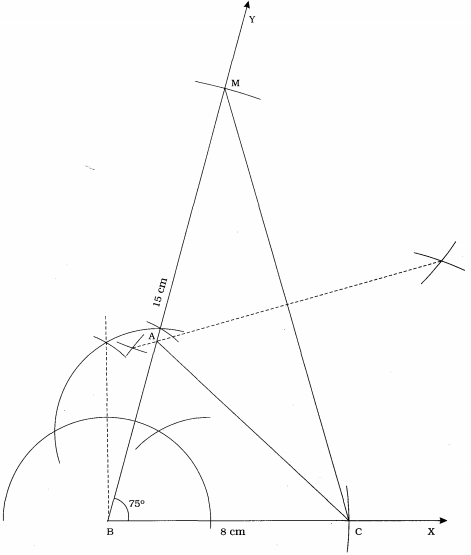
Construct a triangle $ABC$,in which $BC = 8 \, cm$,$\angle B = 75^{\circ}$ and $AB + AC = 15 \, cm$.
Solution
(N/A) Steps of construction:
$(1)$ Draw any ray $BX$. With centre $B$ and radius $8 \, cm$,draw an arc to intersect $BX$ at $C$.
$(2)$ At $B$,construct $\angle YBC$ with measure $75^{\circ}$.
$(3)$ With centre $B$ and radius $15 \, cm$,draw an arc to intersect $BY$ at $M$.
$(4)$ Draw line segment $MC$. Draw the perpendicular bisector of $MC$ to intersect $BM$ at $A$.
$(5)$ Draw line segment $AC$.
Then,$\Delta ABC$ is the required triangle.
$(1)$ Draw any ray $BX$. With centre $B$ and radius $8 \, cm$,draw an arc to intersect $BX$ at $C$.
$(2)$ At $B$,construct $\angle YBC$ with measure $75^{\circ}$.
$(3)$ With centre $B$ and radius $15 \, cm$,draw an arc to intersect $BY$ at $M$.
$(4)$ Draw line segment $MC$. Draw the perpendicular bisector of $MC$ to intersect $BM$ at $A$.
$(5)$ Draw line segment $AC$.
Then,$\Delta ABC$ is the required triangle.
0 likes
View Solution44
Difficult
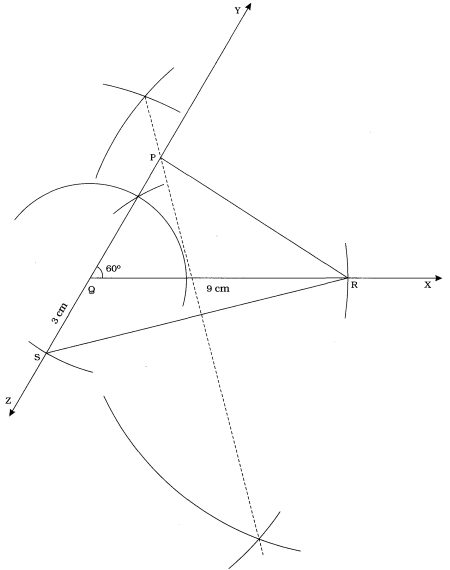
Construct a triangle $PQR$,in which $QR = 9\, cm$,$\angle Q = 60^{\circ}$ and $PR - PQ = 3\, cm$.
Solution
(N/A) Steps of construction:
$(1)$ Draw a ray $QX$ and cut off a line segment $QR = 9\, cm$ from it.
$(2)$ At point $Q$,construct a ray $QY$ such that $\angle YQR = 60^{\circ}$.
$(3)$ Produce the ray $QY$ backwards to form a ray $QZ$. Cut off a line segment $QS = 3\, cm$ from $QZ$.
$(4)$ Join $RS$. Draw the perpendicular bisector of the line segment $RS$.
$(5)$ Let the perpendicular bisector intersect the ray $QY$ at point $P$. Join $PR$.
$(6)$ Thus,$\Delta PQR$ is the required triangle.
$(1)$ Draw a ray $QX$ and cut off a line segment $QR = 9\, cm$ from it.
$(2)$ At point $Q$,construct a ray $QY$ such that $\angle YQR = 60^{\circ}$.
$(3)$ Produce the ray $QY$ backwards to form a ray $QZ$. Cut off a line segment $QS = 3\, cm$ from $QZ$.
$(4)$ Join $RS$. Draw the perpendicular bisector of the line segment $RS$.
$(5)$ Let the perpendicular bisector intersect the ray $QY$ at point $P$. Join $PR$.
$(6)$ Thus,$\Delta PQR$ is the required triangle.
0 likes
View Solution45
Difficult
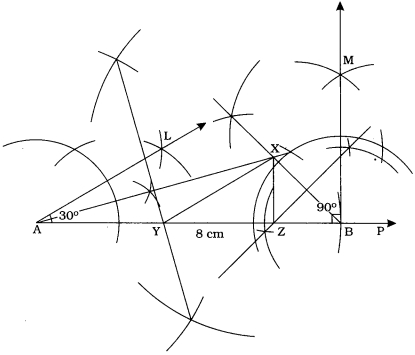
Construct a triangle $XYZ$ in which $\angle Y = 30^{\circ}$,$\angle Z = 90^{\circ}$ and $XY + YZ + ZX = 8 \, cm$.
Solution
(N/A) Steps of construction:
$(1)$ Draw a line segment $AB = 8 \, cm$.
$(2)$ Construct $\angle LAB = \frac{1}{2} \times 30^{\circ} = 15^{\circ}$ at point $A$.
$(3)$ Construct $\angle MBA = \frac{1}{2} \times 90^{\circ} = 45^{\circ}$ at point $B$.
$(4)$ Let the rays $AL$ and $BM$ intersect at point $X$.
$(5)$ Draw the perpendicular bisector of $XA$ to intersect $AB$ at $Y$.
$(6)$ Draw the perpendicular bisector of $XB$ to intersect $AB$ at $Z$.
$(7)$ Join $XY$ and $XZ$. Then $\Delta XYZ$ is the required triangle.
$(1)$ Draw a line segment $AB = 8 \, cm$.
$(2)$ Construct $\angle LAB = \frac{1}{2} \times 30^{\circ} = 15^{\circ}$ at point $A$.
$(3)$ Construct $\angle MBA = \frac{1}{2} \times 90^{\circ} = 45^{\circ}$ at point $B$.
$(4)$ Let the rays $AL$ and $BM$ intersect at point $X$.
$(5)$ Draw the perpendicular bisector of $XA$ to intersect $AB$ at $Y$.
$(6)$ Draw the perpendicular bisector of $XB$ to intersect $AB$ at $Z$.
$(7)$ Join $XY$ and $XZ$. Then $\Delta XYZ$ is the required triangle.
0 likes
View Solution46
Difficult
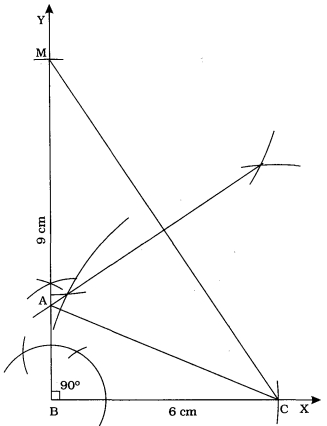
Construct a right triangle whose base is $6\,cm$ and the sum of its hypotenuse and other side is $9\,cm$.
Solution
(N/A) Steps of construction:
$(1)$ Draw any ray $BX$ and from that obtain the line segment $BC$ of length $6\,cm$.
$(2)$ Construct ray $BY$ such that $\angle YBC = 90^{\circ}$.
$(3)$ Taking $B$ as the centre and radius $9\,cm$,draw an arc to intersect $BY$ at $M$.
$(4)$ Draw line segment $CM$. Draw the perpendicular bisector of $CM$ to intersect $BM$ at $A$.
$(5)$ Draw line segment $AC$.
Then,$\Delta ABC$ is the required triangle in which $\angle B$ is a right angle,$BC = 6\,cm$ and $AB + AC = 9\,cm$.
$(1)$ Draw any ray $BX$ and from that obtain the line segment $BC$ of length $6\,cm$.
$(2)$ Construct ray $BY$ such that $\angle YBC = 90^{\circ}$.
$(3)$ Taking $B$ as the centre and radius $9\,cm$,draw an arc to intersect $BY$ at $M$.
$(4)$ Draw line segment $CM$. Draw the perpendicular bisector of $CM$ to intersect $BM$ at $A$.
$(5)$ Draw line segment $AC$.
Then,$\Delta ABC$ is the required triangle in which $\angle B$ is a right angle,$BC = 6\,cm$ and $AB + AC = 9\,cm$.
0 likes
View Solution47
Medium
Construct $\triangle ABC$ in which $BC = 5\,cm$,$\angle B = 60^{\circ}$ and $AB + AC = 9\,cm$. Write the steps of construction.
Solution
(N/A) Steps of construction:
$1$. Draw a line segment $BC = 5\,cm$.
$2$. At point $B$,construct an angle $\angle XBC = 60^{\circ}$.
$3$. Cut a line segment $BD = 9\,cm$ from the ray $BX$.
$4$. Join $CD$.
$5$. Construct the perpendicular bisector of $CD$,which intersects $BD$ at point $A$.
$6$. Join $AC$. Thus,$\triangle ABC$ is the required triangle.
$1$. Draw a line segment $BC = 5\,cm$.
$2$. At point $B$,construct an angle $\angle XBC = 60^{\circ}$.
$3$. Cut a line segment $BD = 9\,cm$ from the ray $BX$.
$4$. Join $CD$.
$5$. Construct the perpendicular bisector of $CD$,which intersects $BD$ at point $A$.
$6$. Join $AC$. Thus,$\triangle ABC$ is the required triangle.
0 likes
View Solution48
Medium
Construct $\Delta ABC$ in which $BC = 6 \, cm$,$\angle B = 60^{\circ}$ and $AB - AC = 1 \, cm$. Write the steps of construction.
Solution
(N/A) Steps of construction:
$1$. Draw a line segment $BC = 6 \, cm$.
$2$. At point $B$,construct an angle $\angle XBC = 60^{\circ}$.
$3$. Cut a line segment $BD = AB - AC = 1 \, cm$ from the ray $BX$.
$4$. Join $DC$.
$5$. Draw the perpendicular bisector of $DC$,let it intersect $BX$ at point $A$.
$6$. Join $AC$. Thus,$\Delta ABC$ is the required triangle.
$1$. Draw a line segment $BC = 6 \, cm$.
$2$. At point $B$,construct an angle $\angle XBC = 60^{\circ}$.
$3$. Cut a line segment $BD = AB - AC = 1 \, cm$ from the ray $BX$.
$4$. Join $DC$.
$5$. Draw the perpendicular bisector of $DC$,let it intersect $BX$ at point $A$.
$6$. Join $AC$. Thus,$\Delta ABC$ is the required triangle.
0 likes
View Solution49
Medium
Construct $\Delta ABC$ in which $BC = 7 \, cm$,$\angle B = 45^{\circ}$ and $AC - AB = 2 \, cm$. Write the steps of construction.
Solution
(N/A) Steps of construction:
$1$. Draw a line segment $BC = 7 \, cm$.
$2$. At point $B$,construct an angle $\angle XBC = 45^{\circ}$.
$3$. Cut a line segment $BD = 2 \, cm$ from the ray $BX$ (since $AC - AB > 0$,$D$ is on the ray $BX$).
$4$. Join $DC$.
$5$. Draw the perpendicular bisector of $DC$,let it intersect $BX$ at point $A$.
$6$. Join $AC$. Thus,$\Delta ABC$ is the required triangle.
$1$. Draw a line segment $BC = 7 \, cm$.
$2$. At point $B$,construct an angle $\angle XBC = 45^{\circ}$.
$3$. Cut a line segment $BD = 2 \, cm$ from the ray $BX$ (since $AC - AB > 0$,$D$ is on the ray $BX$).
$4$. Join $DC$.
$5$. Draw the perpendicular bisector of $DC$,let it intersect $BX$ at point $A$.
$6$. Join $AC$. Thus,$\Delta ABC$ is the required triangle.
0 likes
View Solution50
Medium
Construct $\Delta XYZ$ in which $\angle Y = 45^{\circ}$,$\angle Z = 60^{\circ}$ and $XY + YZ + ZX = 10 \, cm$. Write the steps of construction.
Solution
(N/A) Steps of construction:
$1$. Draw a line segment $PQ = 10 \, cm$ (where $PQ = XY + YZ + ZX$).
$2$. Construct an angle $\angle P = 45^{\circ}$ at point $P$ and $\angle Q = 60^{\circ}$ at point $Q$.
$3$. Bisect $\angle P$ and $\angle Q$. Let the bisectors intersect at point $X$.
$4$. Draw the perpendicular bisector of $PX$ and $QX$. Let these intersect $PQ$ at $Y$ and $Z$ respectively.
$5$. Join $XY$ and $XZ$. Thus,$\Delta XYZ$ is the required triangle.
$1$. Draw a line segment $PQ = 10 \, cm$ (where $PQ = XY + YZ + ZX$).
$2$. Construct an angle $\angle P = 45^{\circ}$ at point $P$ and $\angle Q = 60^{\circ}$ at point $Q$.
$3$. Bisect $\angle P$ and $\angle Q$. Let the bisectors intersect at point $X$.
$4$. Draw the perpendicular bisector of $PX$ and $QX$. Let these intersect $PQ$ at $Y$ and $Z$ respectively.
$5$. Join $XY$ and $XZ$. Thus,$\Delta XYZ$ is the required triangle.
0 likes
View SolutionConstructions — Mix Examples - Constructions · Frequently Asked Questions
1Are these Constructions questions useful for JEE and NEET?
Yes. All questions in this section are mapped to JEE Main and NEET exam patterns. Previous year questions from JEE Main, NEET, GUJCET and state-level exams are included with full solutions.
2Can I switch to Hindi or Gujarati for these questions?
Yes. Use the language tabs in the hero section or the sidebar to view the same questions and solutions in English, Hindi or Gujarati.
3How do I generate a question paper from this subtopic?
Use the Vedclass Exam Paper Generator — select the chapter and subtopic, set difficulty, and generate Sets A, B, C, D automatically. First 3 chapters of every subject are free.
Vedclass Products
For Students
Vedclass Test Series
Mock tests in real JEE/NEET style with performance analysis. 5-day free trial.
Start Free TrialFor Teachers
Exam Paper Generator
Generate Set A/B/C/D papers from this chapter in 2 minutes. 3 chapters free.
Try FreeFor Institutes
Online Exam Module
Live online exams with unlimited students, 360° analytics & white-label branding.
See DemoFor Teachers & Institutes
Generate a Constructions Exam Paper in 2 Minutes
Select subtopic & difficulty — Sets A, B, C, D auto-generated with No Repeat logic.
First 3 chapters of every subject are free — no payment required.