
A English
Mix Examples - Areas of Parallelograms and Triangles Questions in English
Class 9 Mathematics · Areas of Parallelograms and Triangles · Mix Examples - Areas of Parallelograms and Triangles
104+
Questions
English
Language
100%
With Solutions
Showing 50 of 104 questions in English
1
EasyMCQ
The area of the figure formed by joining the mid-points of the adjacent sides of a rhombus with diagonals $12 \, cm$ and $16 \, cm$ is (in $cm^2$)
A
$48$
B
$64$
C
$96$
D
$192$
Solution
(A) $1$. The area of a rhombus is given by the formula $Area = \frac{1}{2} \times d_1 \times d_2$, where $d_1$ and $d_2$ are the lengths of the diagonals.
$2$. Given $d_1 = 12 \, cm$ and $d_2 = 16 \, cm$, the area of the rhombus is $Area = \frac{1}{2} \times 12 \times 16 = 96 \, cm^2$.
$3$. According to the Varignon's Theorem, the figure formed by joining the mid-points of the sides of any quadrilateral is a parallelogram, and its area is exactly half the area of the original quadrilateral.
$4$. Since a rhombus is a type of quadrilateral, the area of the figure formed by joining its mid-points is $\frac{1}{2} \times (\text{Area of the rhombus})$.
$5$. Therefore, the required area is $\frac{1}{2} \times 96 = 48 \, cm^2$.
$2$. Given $d_1 = 12 \, cm$ and $d_2 = 16 \, cm$, the area of the rhombus is $Area = \frac{1}{2} \times 12 \times 16 = 96 \, cm^2$.
$3$. According to the Varignon's Theorem, the figure formed by joining the mid-points of the sides of any quadrilateral is a parallelogram, and its area is exactly half the area of the original quadrilateral.
$4$. Since a rhombus is a type of quadrilateral, the area of the figure formed by joining its mid-points is $\frac{1}{2} \times (\text{Area of the rhombus})$.
$5$. Therefore, the required area is $\frac{1}{2} \times 96 = 48 \, cm^2$.
0 likes
View Solution2
EasyMCQ
The median of a triangle divides it into two:
A
congruent triangles
B
triangles of equal area
C
right triangles
D
isosceles triangles
Solution
(B) median of a triangle is a line segment joining a vertex to the midpoint of the opposite side. According to the theorem in geometry,triangles on the same base and between the same parallels are equal in area. Since the median divides the triangle into two triangles that share the same altitude and have bases of equal length (as the median bisects the side),the areas of these two triangles are equal.
0 likes
View Solution3
EasyMCQ
In which of the following figures,do you find two polygons on the same base and between the same parallels?
A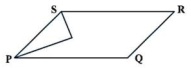
B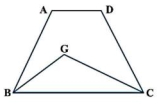
C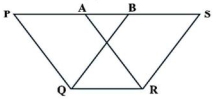
D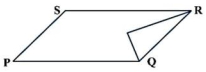
Solution
(C) To identify polygons on the same base and between the same parallels,we look for two conditions:
$1$. They must share a common side (base).
$2$. The vertices opposite to the common base must lie on a line parallel to the base.
In Figure $(c)$,we have two parallelograms,$PQRS$ and $ABQR$. Both share the common base $QR$,and their opposite vertices ($P, S$ and $A, B$) lie on the same line $PS$,which is parallel to the base $QR$. Thus,they are on the same base and between the same parallels.
$1$. They must share a common side (base).
$2$. The vertices opposite to the common base must lie on a line parallel to the base.
In Figure $(c)$,we have two parallelograms,$PQRS$ and $ABQR$. Both share the common base $QR$,and their opposite vertices ($P, S$ and $A, B$) lie on the same line $PS$,which is parallel to the base $QR$. Thus,they are on the same base and between the same parallels.
0 likes
View Solution4
EasyMCQ
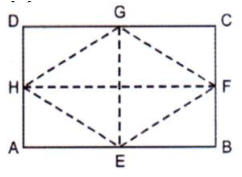
The figure obtained by joining the mid-points of the adjacent sides of a rectangle of sides $8 \, cm$ and $6 \, cm$ is:
A
a rectangle of area $24 \, cm^{2}$
B
a square of area $25 \, cm^{2}$
C
a trapezium of area $24 \, cm^{2}$
D
a rhombus of area $24 \, cm^{2}$
Solution
(D) Let $ABCD$ be a rectangle with sides $AB = 8 \, cm$ and $BC = 6 \, cm$.
Let $E, F, G,$ and $H$ be the mid-points of sides $AB, BC, CD,$ and $DA$ respectively.
By joining these mid-points,we obtain a quadrilateral $EFGH$.
According to the mid-point theorem,the quadrilateral formed by joining the mid-points of the sides of a rectangle is a rhombus.
The diagonals of this rhombus $EFGH$ are equal to the sides of the rectangle,i.e.,$EG = BC = 6 \, cm$ and $HF = AB = 8 \, cm$.
The area of the rhombus is given by $\frac{1}{2} \times \text{product of diagonals} = \frac{1}{2} \times EG \times HF$.
Area $= \frac{1}{2} \times 6 \, cm \times 8 \, cm = 24 \, cm^{2}$.
Thus,the figure obtained is a rhombus of area $24 \, cm^{2}$.
Let $E, F, G,$ and $H$ be the mid-points of sides $AB, BC, CD,$ and $DA$ respectively.
By joining these mid-points,we obtain a quadrilateral $EFGH$.
According to the mid-point theorem,the quadrilateral formed by joining the mid-points of the sides of a rectangle is a rhombus.
The diagonals of this rhombus $EFGH$ are equal to the sides of the rectangle,i.e.,$EG = BC = 6 \, cm$ and $HF = AB = 8 \, cm$.
The area of the rhombus is given by $\frac{1}{2} \times \text{product of diagonals} = \frac{1}{2} \times EG \times HF$.
Area $= \frac{1}{2} \times 6 \, cm \times 8 \, cm = 24 \, cm^{2}$.
Thus,the figure obtained is a rhombus of area $24 \, cm^{2}$.
0 likes
View Solution5
EasyMCQ
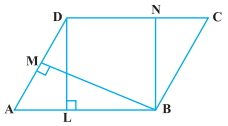
In the figure,the area of parallelogram $ABCD$ is:
A
$DC \times DL$
B
$AB \times BM$
C
$AD \times DL$
D
$BC \times BN$
Solution
(A) The area of a parallelogram is given by the product of its base and the corresponding altitude (height).
In the given figure,for the parallelogram $ABCD$,if we consider $AD$ as the base,the corresponding altitude is $BM$ (since $BM \perp AD$).
Therefore,the area of parallelogram $ABCD = \text{Base} \times \text{Corresponding altitude} = AD \times BM$.
Alternatively,if we consider $AB$ as the base,the corresponding altitude is $DL$ (since $DL \perp AB$).
Therefore,the area of parallelogram $ABCD = AB \times DL$.
Looking at the options,$AB \times BM$ is not correct as $BM$ is the altitude to $AD$,not $AB$. However,based on the standard formula,the area is $AD \times BM$ or $AB \times DL$. Given the options provided,$AD \times BM$ is not listed,but $AB \times BM$ is provided as an option. Let's re-examine the figure. $BM$ is perpendicular to $AD$. Thus,the area is $AD \times BM$. Since $AD \times BM$ is not an option,let's check $AB \times DL$. $DL$ is perpendicular to $AB$. Thus,the area is $AB \times DL$. Since $AB = DC$,the area is also $DC \times DL$. Option $A$ is $DC \times DL$,which is correct.
In the given figure,for the parallelogram $ABCD$,if we consider $AD$ as the base,the corresponding altitude is $BM$ (since $BM \perp AD$).
Therefore,the area of parallelogram $ABCD = \text{Base} \times \text{Corresponding altitude} = AD \times BM$.
Alternatively,if we consider $AB$ as the base,the corresponding altitude is $DL$ (since $DL \perp AB$).
Therefore,the area of parallelogram $ABCD = AB \times DL$.
Looking at the options,$AB \times BM$ is not correct as $BM$ is the altitude to $AD$,not $AB$. However,based on the standard formula,the area is $AD \times BM$ or $AB \times DL$. Given the options provided,$AD \times BM$ is not listed,but $AB \times BM$ is provided as an option. Let's re-examine the figure. $BM$ is perpendicular to $AD$. Thus,the area is $AD \times BM$. Since $AD \times BM$ is not an option,let's check $AB \times DL$. $DL$ is perpendicular to $AB$. Thus,the area is $AB \times DL$. Since $AB = DC$,the area is also $DC \times DL$. Option $A$ is $DC \times DL$,which is correct.
0 likes
View Solution6
EasyMCQ
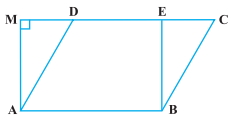
In the figure,if parallelogram $ABCD$ and rectangle $ABEM$ are of equal area,then:
A
Perimeter of $ABCD =$ Perimeter of $ABEM$
B
Perimeter of $ABCD >$ Perimeter of $ABEM$
C
Perimeter of $ABCD < $ Perimeter of $ABEM$
D
Perimeter of $ABCD = \frac{1}{2}$ (Perimeter of $ABEM$)
Solution
(B) Given that the area of parallelogram $ABCD$ is equal to the area of rectangle $ABEM$. Both share the same base $AB$ and lie between the same parallel lines $AB$ and $MC$.
Since the area of a parallelogram is given by $\text{base} \times \text{height}$,and the height is the perpendicular distance between the parallel lines,both figures have the same height $AM = BE$.
In a right-angled triangle $AMD$,the hypotenuse $AD$ is always greater than the perpendicular side $AM$ $(AD > AM)$.
Similarly,in the right-angled triangle $BCE$,the hypotenuse $BC$ is greater than the side $BE$ $(BC > BE)$.
Since $AM = BE$,we have $AD > AM$ and $BC > BE$.
The perimeter of rectangle $ABEM = 2(AB + AM)$.
The perimeter of parallelogram $ABCD = AB + BC + CD + DA = AB + BC + AB + AD = 2AB + BC + AD$.
Since $BC > BE$ and $AD > AM$,it follows that $2AB + BC + AD > 2AB + BE + AM = 2AB + 2AM = 2(AB + AM)$.
Therefore,the perimeter of parallelogram $ABCD >$ perimeter of rectangle $ABEM$.
Since the area of a parallelogram is given by $\text{base} \times \text{height}$,and the height is the perpendicular distance between the parallel lines,both figures have the same height $AM = BE$.
In a right-angled triangle $AMD$,the hypotenuse $AD$ is always greater than the perpendicular side $AM$ $(AD > AM)$.
Similarly,in the right-angled triangle $BCE$,the hypotenuse $BC$ is greater than the side $BE$ $(BC > BE)$.
Since $AM = BE$,we have $AD > AM$ and $BC > BE$.
The perimeter of rectangle $ABEM = 2(AB + AM)$.
The perimeter of parallelogram $ABCD = AB + BC + CD + DA = AB + BC + AB + AD = 2AB + BC + AD$.
Since $BC > BE$ and $AD > AM$,it follows that $2AB + BC + AD > 2AB + BE + AM = 2AB + 2AM = 2(AB + AM)$.
Therefore,the perimeter of parallelogram $ABCD >$ perimeter of rectangle $ABEM$.
0 likes
View Solution7
MediumMCQ
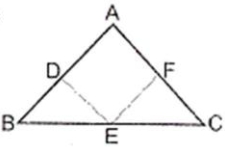
The mid-points of the sides of a triangle along with any of the vertices as the fourth point make a parallelogram of area equal to:
A
$\frac{1}{4} \operatorname{ar}(\triangle ABC)$
B
$\operatorname{ar}(\triangle ABC)$
C
$\frac{1}{2} \operatorname{ar}(\triangle ABC)$
D
$\frac{1}{3} \operatorname{ar}(\triangle ABC)$
Solution
(C) Let $D, E, F$ be the mid-points of sides $AB, BC, CA$ respectively of $\triangle ABC$.
By the Mid-point Theorem,$DE \parallel AC$ and $DE = \frac{1}{2} AC = AF$.
Similarly,$EF \parallel AB$ and $EF = \frac{1}{2} AB = AD$.
Thus,$ADEF$ is a parallelogram.
Since the line segment joining the mid-points of two sides of a triangle divides the triangle into four congruent triangles,each having an area equal to $\frac{1}{4}$ of the area of the original triangle.
Therefore,$\operatorname{ar}(\triangle ADE) = \operatorname{ar}(\triangle BDE) = \operatorname{ar}(\triangle EFC) = \operatorname{ar}(\triangle AFE) = \frac{1}{4} \operatorname{ar}(\triangle ABC)$.
The parallelogram $ADEF$ is composed of two triangles,$\triangle ADE$ and $\triangle AFE$.
Thus,$\operatorname{ar}(ADEF) = \operatorname{ar}(\triangle ADE) + \operatorname{ar}(\triangle AFE) = \frac{1}{4} \operatorname{ar}(\triangle ABC) + \frac{1}{4} \operatorname{ar}(\triangle ABC) = \frac{1}{2} \operatorname{ar}(\triangle ABC)$.
By the Mid-point Theorem,$DE \parallel AC$ and $DE = \frac{1}{2} AC = AF$.
Similarly,$EF \parallel AB$ and $EF = \frac{1}{2} AB = AD$.
Thus,$ADEF$ is a parallelogram.
Since the line segment joining the mid-points of two sides of a triangle divides the triangle into four congruent triangles,each having an area equal to $\frac{1}{4}$ of the area of the original triangle.
Therefore,$\operatorname{ar}(\triangle ADE) = \operatorname{ar}(\triangle BDE) = \operatorname{ar}(\triangle EFC) = \operatorname{ar}(\triangle AFE) = \frac{1}{4} \operatorname{ar}(\triangle ABC)$.
The parallelogram $ADEF$ is composed of two triangles,$\triangle ADE$ and $\triangle AFE$.
Thus,$\operatorname{ar}(ADEF) = \operatorname{ar}(\triangle ADE) + \operatorname{ar}(\triangle AFE) = \frac{1}{4} \operatorname{ar}(\triangle ABC) + \frac{1}{4} \operatorname{ar}(\triangle ABC) = \frac{1}{2} \operatorname{ar}(\triangle ABC)$.
0 likes
View Solution8
EasyMCQ
Two parallelograms are on equal bases and between the same parallels. The ratio of their areas is
A
$1: 2$
B
$3: 1$
C
$2: 1$
D
$1: 1$
Solution
(D) We know that parallelograms on the same or equal bases and between the same parallels are equal in area.
Since the areas are equal,the ratio of their areas is $1: 1$.
Since the areas are equal,the ratio of their areas is $1: 1$.
0 likes
View Solution9
EasyMCQ
$ABCD$ is a quadrilateral whose diagonal $AC$ divides it into two parts of equal area. Then $ABCD$:
A
need not be any of $(B), (C)$ or $(D)$
B
is a parallelogram
C
is always a rhombus
D
is a rectangle
Solution
(A) diagonal of a quadrilateral divides it into two triangles. If the area of these two triangles is equal,it implies that the diagonal bisects the area of the quadrilateral.
While it is true that the diagonal of a parallelogram divides it into two triangles of equal area,the converse is not necessarily true for all quadrilaterals.
For example,a kite or any general quadrilateral where the diagonal divides the area into two equal parts does not have to be a parallelogram,a rhombus,or a rectangle.
Therefore,$ABCD$ need not be any of the specific types mentioned in options $(B), (C),$ or $(D)$.
While it is true that the diagonal of a parallelogram divides it into two triangles of equal area,the converse is not necessarily true for all quadrilaterals.
For example,a kite or any general quadrilateral where the diagonal divides the area into two equal parts does not have to be a parallelogram,a rhombus,or a rectangle.
Therefore,$ABCD$ need not be any of the specific types mentioned in options $(B), (C),$ or $(D)$.
0 likes
View Solution10
MediumMCQ
If a triangle and a parallelogram are on the same base and between the same parallels,then the ratio of the area of the triangle to the area of the parallelogram is:
A
$1: 3$
B
$1: 2$
C
$3: 1$
D
$1: 4$
Solution
(B) We know that if a triangle and a parallelogram are on the same base and between the same parallels,then the area of the triangle is equal to half the area of the parallelogram.
Let the area of the parallelogram be $A_p$ and the area of the triangle be $A_t$.
According to the theorem,$A_t = \frac{1}{2} \times A_p$.
Therefore,the ratio of the area of the triangle to the area of the parallelogram is $\frac{A_t}{A_p} = \frac{1}{2}$,which is $1: 2$.
Let the area of the parallelogram be $A_p$ and the area of the triangle be $A_t$.
According to the theorem,$A_t = \frac{1}{2} \times A_p$.
Therefore,the ratio of the area of the triangle to the area of the parallelogram is $\frac{A_t}{A_p} = \frac{1}{2}$,which is $1: 2$.
0 likes
View Solution11
DifficultMCQ
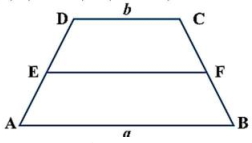
$ABCD$ is a trapezium with parallel sides $AB = a \text{ cm}$ and $DC = b \text{ cm}$. $E$ and $F$ are the mid-points of the non-parallel sides. The ratio of $\operatorname{ar}(ABFE)$ and $\operatorname{ar}(EFCD)$ is
A
$a : b$
B
$(a + 3b) : (3a + b)$
C
$(3a + b) : (a + 3b)$
D
$(2a + b) : (3a + b)$
Solution
(C) $ABCD$ is a trapezium in which $AB \parallel DC$. Let the height of the trapezium $ABCD$ be $H$. Since $E$ and $F$ are the mid-points of the non-parallel sides $AD$ and $BC$,the line segment $EF$ is parallel to $AB$ and $DC$,and its length is $EF = \frac{1}{2}(a + b)$.
The height of the smaller trapeziums $ABFE$ and $EFCD$ will be $h = \frac{H}{2}$.
The area of a trapezium is given by $\frac{1}{2} \times (\text{sum of parallel sides}) \times \text{height}$.
$\operatorname{ar}(ABFE) = \frac{1}{2} \times (AB + EF) \times h = \frac{1}{2} \times \left(a + \frac{a+b}{2}\right) \times \frac{H}{2} = \frac{1}{2} \times \left(\frac{3a+b}{2}\right) \times \frac{H}{2} = \frac{H(3a+b)}{8}$.
$\operatorname{ar}(EFCD) = \frac{1}{2} \times (EF + DC) \times h = \frac{1}{2} \times \left(\frac{a+b}{2} + b\right) \times \frac{H}{2} = \frac{1}{2} \times \left(\frac{a+3b}{2}\right) \times \frac{H}{2} = \frac{H(a+3b)}{8}$.
Therefore,the ratio is $\frac{\operatorname{ar}(ABFE)}{\operatorname{ar}(EFCD)} = \frac{\frac{H(3a+b)}{8}}{\frac{H(a+3b)}{8}} = \frac{3a+b}{a+3b}$.
Thus,the required ratio is $(3a+b) : (a+3b)$.
The height of the smaller trapeziums $ABFE$ and $EFCD$ will be $h = \frac{H}{2}$.
The area of a trapezium is given by $\frac{1}{2} \times (\text{sum of parallel sides}) \times \text{height}$.
$\operatorname{ar}(ABFE) = \frac{1}{2} \times (AB + EF) \times h = \frac{1}{2} \times \left(a + \frac{a+b}{2}\right) \times \frac{H}{2} = \frac{1}{2} \times \left(\frac{3a+b}{2}\right) \times \frac{H}{2} = \frac{H(3a+b)}{8}$.
$\operatorname{ar}(EFCD) = \frac{1}{2} \times (EF + DC) \times h = \frac{1}{2} \times \left(\frac{a+b}{2} + b\right) \times \frac{H}{2} = \frac{1}{2} \times \left(\frac{a+3b}{2}\right) \times \frac{H}{2} = \frac{H(a+3b)}{8}$.
Therefore,the ratio is $\frac{\operatorname{ar}(ABFE)}{\operatorname{ar}(EFCD)} = \frac{\frac{H(3a+b)}{8}}{\frac{H(a+3b)}{8}} = \frac{3a+b}{a+3b}$.
Thus,the required ratio is $(3a+b) : (a+3b)$.
0 likes
View Solution12
EasyMCQ
If $P$ is any point on the median $AD$ of a $\triangle ABC$,then $\operatorname{ar}(ABP) = \operatorname{ar}(ACP)$. State whether this statement is True or False.
A
True
B
False
C
Cannot be determined
D
None of these
Solution
(A) The statement is True.
$1$. In $\triangle ABC$,$AD$ is the median,so it divides the triangle into two triangles of equal area. Thus,$\operatorname{ar}(ABD) = \operatorname{ar}(ACD)$.
$2$. Similarly,in $\triangle PBC$,$PD$ is the median,so $\operatorname{ar}(PBD) = \operatorname{ar}(PCD)$.
$3$. Subtracting the area of $\triangle PBD$ from $\triangle ABD$ and $\triangle PCD$ from $\triangle ACD$,we get $\operatorname{ar}(ABD) - \operatorname{ar}(PBD) = \operatorname{ar}(ACD) - \operatorname{ar}(PCD)$.
$4$. This simplifies to $\operatorname{ar}(ABP) = \operatorname{ar}(ACP)$.
$1$. In $\triangle ABC$,$AD$ is the median,so it divides the triangle into two triangles of equal area. Thus,$\operatorname{ar}(ABD) = \operatorname{ar}(ACD)$.
$2$. Similarly,in $\triangle PBC$,$PD$ is the median,so $\operatorname{ar}(PBD) = \operatorname{ar}(PCD)$.
$3$. Subtracting the area of $\triangle PBD$ from $\triangle ABD$ and $\triangle PCD$ from $\triangle ACD$,we get $\operatorname{ar}(ABD) - \operatorname{ar}(PBD) = \operatorname{ar}(ACD) - \operatorname{ar}(PCD)$.
$4$. This simplifies to $\operatorname{ar}(ABP) = \operatorname{ar}(ACP)$.
0 likes
View Solution13
Easy
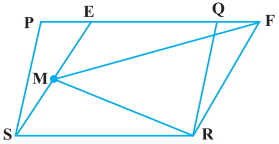
If in the figure,$PQRS$ and $EFRS$ are two parallelograms,then $\operatorname{ar}(MFR) = \frac{1}{2} \operatorname{ar}(PQRS)$. State whether the statement is True or False.
Solution
(TRUE) The statement is True.
Given that $PQRS$ and $EFRS$ are two parallelograms on the same base $SR$ and between the same parallels $PF$ and $SR$.
Therefore,$\operatorname{ar}(PQRS) = \operatorname{ar}(EFRS)$.
Now,consider the triangle $MFR$ and the parallelogram $EFRS$. They are on the same base $FR$ and between the same parallels $EM$ (which is part of $EF$) and $SR$. However,looking at the geometry,$M$ lies on $SE$. The triangle $MFR$ and parallelogram $EFRS$ share the same base $FR$ and are between the same parallels $EF$ and $SR$.
Actually,the standard theorem states that if a triangle and a parallelogram are on the same base and between the same parallels,then the area of the triangle is half the area of the parallelogram.
Here,$\triangle MFR$ and parallelogram $EFRS$ are on the same base $FR$ and between the same parallels $EF$ and $SR$.
Therefore,$\operatorname{ar}(MFR) = \frac{1}{2} \operatorname{ar}(EFRS)$.
Since $\operatorname{ar}(EFRS) = \operatorname{ar}(PQRS)$,we have $\operatorname{ar}(MFR) = \frac{1}{2} \operatorname{ar}(PQRS)$.
Given that $PQRS$ and $EFRS$ are two parallelograms on the same base $SR$ and between the same parallels $PF$ and $SR$.
Therefore,$\operatorname{ar}(PQRS) = \operatorname{ar}(EFRS)$.
Now,consider the triangle $MFR$ and the parallelogram $EFRS$. They are on the same base $FR$ and between the same parallels $EM$ (which is part of $EF$) and $SR$. However,looking at the geometry,$M$ lies on $SE$. The triangle $MFR$ and parallelogram $EFRS$ share the same base $FR$ and are between the same parallels $EF$ and $SR$.
Actually,the standard theorem states that if a triangle and a parallelogram are on the same base and between the same parallels,then the area of the triangle is half the area of the parallelogram.
Here,$\triangle MFR$ and parallelogram $EFRS$ are on the same base $FR$ and between the same parallels $EF$ and $SR$.
Therefore,$\operatorname{ar}(MFR) = \frac{1}{2} \operatorname{ar}(EFRS)$.
Since $\operatorname{ar}(EFRS) = \operatorname{ar}(PQRS)$,we have $\operatorname{ar}(MFR) = \frac{1}{2} \operatorname{ar}(PQRS)$.
0 likes
View Solution14
MediumMCQ
Write True or False and justify your answer:
$ABCD$ is a parallelogram and $X$ is the mid-point of $AB$. If $\text{ar}(AXCD) = 24 \text{ cm}^2$,then $\text{ar}(ABC) = 24 \text{ cm}^2$.
$ABCD$ is a parallelogram and $X$ is the mid-point of $AB$. If $\text{ar}(AXCD) = 24 \text{ cm}^2$,then $\text{ar}(ABC) = 24 \text{ cm}^2$.
A
True
B
False
Solution
(B) We have $ABCD$ as a parallelogram and $X$ as the mid-point of $AB$.
Now,$\text{ar}(ABCD) = \text{ar}(AXCD) + \text{ar}(\triangle XBC) \dots(1)$
Since the diagonal $AC$ of a parallelogram divides it into two triangles of equal area,we have $\text{ar}(ABCD) = 2 \times \text{ar}(\triangle ABC) \dots(2)$
Since $X$ is the mid-point of $AB$,the median $CX$ of $\triangle ABC$ divides it into two triangles of equal area. Thus,$\text{ar}(\triangle XBC) = \frac{1}{2} \text{ar}(\triangle ABC) \dots(3)$
Substituting $(1)$ and $(3)$ into $(2)$,we get:
$2 \times \text{ar}(\triangle ABC) = 24 + \frac{1}{2} \text{ar}(\triangle ABC)$
$2 \times \text{ar}(\triangle ABC) - \frac{1}{2} \text{ar}(\triangle ABC) = 24$
$\frac{3}{2} \text{ar}(\triangle ABC) = 24$
$\text{ar}(\triangle ABC) = \frac{24 \times 2}{3} = 16 \text{ cm}^2$.
Since $16 \text{ cm}^2 \neq 24 \text{ cm}^2$,the given statement is False.
Now,$\text{ar}(ABCD) = \text{ar}(AXCD) + \text{ar}(\triangle XBC) \dots(1)$
Since the diagonal $AC$ of a parallelogram divides it into two triangles of equal area,we have $\text{ar}(ABCD) = 2 \times \text{ar}(\triangle ABC) \dots(2)$
Since $X$ is the mid-point of $AB$,the median $CX$ of $\triangle ABC$ divides it into two triangles of equal area. Thus,$\text{ar}(\triangle XBC) = \frac{1}{2} \text{ar}(\triangle ABC) \dots(3)$
Substituting $(1)$ and $(3)$ into $(2)$,we get:
$2 \times \text{ar}(\triangle ABC) = 24 + \frac{1}{2} \text{ar}(\triangle ABC)$
$2 \times \text{ar}(\triangle ABC) - \frac{1}{2} \text{ar}(\triangle ABC) = 24$
$\frac{3}{2} \text{ar}(\triangle ABC) = 24$
$\text{ar}(\triangle ABC) = \frac{24 \times 2}{3} = 16 \text{ cm}^2$.
Since $16 \text{ cm}^2 \neq 24 \text{ cm}^2$,the given statement is False.
0 likes
View Solution15
Difficult
Write True or False and justify your answer:
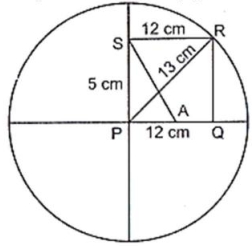
$PQRS$ is a rectangle inscribed in a quadrant of a circle of radius $13 \, cm$. $A$ is any point on $PQ$. If $PS = 5 \, cm$,then $\text{ar}(PAS) = 30 \, cm^2$.
$PQRS$ is a rectangle inscribed in a quadrant of a circle of radius $13 \, cm$. $A$ is any point on $PQ$. If $PS = 5 \, cm$,then $\text{ar}(PAS) = 30 \, cm^2$.
Solution
(B) In the rectangle $PQRS$,the diagonal $PR$ is the radius of the circle,so $PR = 13 \, cm$.
Given $PS = 5 \, cm$,in right-angled $\triangle PSR$,by Pythagoras theorem:
$PR^2 = PS^2 + SR^2$
$13^2 = 5^2 + SR^2$
$169 = 25 + SR^2$
$SR^2 = 144 \implies SR = 12 \, cm$.
Since $PQRS$ is a rectangle,$PQ = SR = 12 \, cm$.
The area of $\triangle PQS = \frac{1}{2} \times PQ \times PS = \frac{1}{2} \times 12 \times 5 = 30 \, cm^2$.
Since $A$ is any point on $PQ$,the triangle $PAS$ has base $PA$ and height $PS = 5 \, cm$.
Area of $\triangle PAS = \frac{1}{2} \times PA \times PS$.
Since $PA < PQ$ (as $A$ is on $PQ$),$\text{ar}(PAS) < \text{ar}(PQS) = 30 \, cm^2$.
Therefore,the statement $\text{ar}(PAS) = 30 \, cm^2$ is False.
Given $PS = 5 \, cm$,in right-angled $\triangle PSR$,by Pythagoras theorem:
$PR^2 = PS^2 + SR^2$
$13^2 = 5^2 + SR^2$
$169 = 25 + SR^2$
$SR^2 = 144 \implies SR = 12 \, cm$.
Since $PQRS$ is a rectangle,$PQ = SR = 12 \, cm$.
The area of $\triangle PQS = \frac{1}{2} \times PQ \times PS = \frac{1}{2} \times 12 \times 5 = 30 \, cm^2$.
Since $A$ is any point on $PQ$,the triangle $PAS$ has base $PA$ and height $PS = 5 \, cm$.
Area of $\triangle PAS = \frac{1}{2} \times PA \times PS$.
Since $PA < PQ$ (as $A$ is on $PQ$),$\text{ar}(PAS) < \text{ar}(PQS) = 30 \, cm^2$.
Therefore,the statement $\text{ar}(PAS) = 30 \, cm^2$ is False.
0 likes
View Solution16
MediumMCQ
Write True or False and justify your answer:
$PQRS$ is a parallelogram whose area is $180 \, cm^{2}$ and $A$ is any point on the diagonal $QS$. The area of $\triangle ASR = 90 \, cm^{2}$.
$PQRS$ is a parallelogram whose area is $180 \, cm^{2}$ and $A$ is any point on the diagonal $QS$. The area of $\triangle ASR = 90 \, cm^{2}$.
A
True
B
False
Solution
(B) $PQRS$ is a parallelogram.
We know that the diagonal $QS$ of a parallelogram divides it into two triangles of equal area.
$\therefore \operatorname{ar}(\triangle QRS) = \frac{1}{2} \operatorname{ar}(PQRS) = \frac{1}{2} \times 180 \, cm^{2} = 90 \, cm^{2}$.
Since $A$ is any point on the diagonal $QS$,the triangle $\triangle ASR$ is contained within $\triangle QRS$ (or is a part of it).
Specifically,$\triangle ASR$ and $\triangle QRS$ share the same base $SR$,but the height of $\triangle ASR$ with respect to base $SR$ is less than the height of $\triangle QRS$ with respect to the same base (unless $A$ coincides with $Q$).
Therefore,$\operatorname{ar}(\triangle ASR) < \operatorname{ar}(\triangle QRS)$.
Thus,$\operatorname{ar}(\triangle ASR) < 90 \, cm^{2}$.
Hence,the given statement is False.
We know that the diagonal $QS$ of a parallelogram divides it into two triangles of equal area.
$\therefore \operatorname{ar}(\triangle QRS) = \frac{1}{2} \operatorname{ar}(PQRS) = \frac{1}{2} \times 180 \, cm^{2} = 90 \, cm^{2}$.
Since $A$ is any point on the diagonal $QS$,the triangle $\triangle ASR$ is contained within $\triangle QRS$ (or is a part of it).
Specifically,$\triangle ASR$ and $\triangle QRS$ share the same base $SR$,but the height of $\triangle ASR$ with respect to base $SR$ is less than the height of $\triangle QRS$ with respect to the same base (unless $A$ coincides with $Q$).
Therefore,$\operatorname{ar}(\triangle ASR) < \operatorname{ar}(\triangle QRS)$.
Thus,$\operatorname{ar}(\triangle ASR) < 90 \, cm^{2}$.
Hence,the given statement is False.
0 likes
View Solution17
Medium
Write True or False and justify your answer:
$ABC$ and $BDE$ are two equilateral triangles such that $D$ is the mid-point of $BC$. Then $ar(\triangle BDE) = \frac{1}{4} ar(\triangle ABC).$
$ABC$ and $BDE$ are two equilateral triangles such that $D$ is the mid-point of $BC$. Then $ar(\triangle BDE) = \frac{1}{4} ar(\triangle ABC).$
Solution
(A) Let the side length of the equilateral triangle $ABC$ be $x$.
Since $ABC$ is an equilateral triangle,its area is given by $ar(\triangle ABC) = \frac{\sqrt{3}}{4} x^2$.
Given that $D$ is the mid-point of $BC$,the side length of the equilateral triangle $BDE$ is $BD = \frac{BC}{2} = \frac{x}{2}$.
The area of the equilateral triangle $BDE$ is $ar(\triangle BDE) = \frac{\sqrt{3}}{4} \left(\frac{x}{2}\right)^2 = \frac{\sqrt{3}}{4} \cdot \frac{x^2}{4} = \frac{1}{4} \left(\frac{\sqrt{3}}{4} x^2\right)$.
Substituting the area of $\triangle ABC$,we get $ar(\triangle BDE) = \frac{1}{4} ar(\triangle ABC)$.
Therefore,the given statement is True.
Since $ABC$ is an equilateral triangle,its area is given by $ar(\triangle ABC) = \frac{\sqrt{3}}{4} x^2$.
Given that $D$ is the mid-point of $BC$,the side length of the equilateral triangle $BDE$ is $BD = \frac{BC}{2} = \frac{x}{2}$.
The area of the equilateral triangle $BDE$ is $ar(\triangle BDE) = \frac{\sqrt{3}}{4} \left(\frac{x}{2}\right)^2 = \frac{\sqrt{3}}{4} \cdot \frac{x^2}{4} = \frac{1}{4} \left(\frac{\sqrt{3}}{4} x^2\right)$.
Substituting the area of $\triangle ABC$,we get $ar(\triangle BDE) = \frac{1}{4} ar(\triangle ABC)$.
Therefore,the given statement is True.
0 likes
View Solution18
Medium
Write True or False and justify your answer:
$ABC$ and $BDE$ are two equilateral triangles such that $D$ is the mid-point of $BC.$ Then $\operatorname{ar}(\triangle BDE) = \frac{1}{4} \operatorname{ar}(\triangle ABC).$
$ABC$ and $BDE$ are two equilateral triangles such that $D$ is the mid-point of $BC.$ Then $\operatorname{ar}(\triangle BDE) = \frac{1}{4} \operatorname{ar}(\triangle ABC).$
Solution
(A) Let the side length of the equilateral triangle $ABC$ be $a$.
Since $D$ is the mid-point of $BC$,the side length of the equilateral triangle $BDE$ is $\frac{a}{2}$.
The area of an equilateral triangle with side $s$ is given by $\frac{\sqrt{3}}{4} s^2$.
$\operatorname{ar}(\triangle ABC) = \frac{\sqrt{3}}{4} a^2$.
$\operatorname{ar}(\triangle BDE) = \frac{\sqrt{3}}{4} \left(\frac{a}{2}\right)^2 = \frac{\sqrt{3}}{4} \cdot \frac{a^2}{4} = \frac{1}{4} \left(\frac{\sqrt{3}}{4} a^2\right)$.
Therefore,$\operatorname{ar}(\triangle BDE) = \frac{1}{4} \operatorname{ar}(\triangle ABC)$.
Hence,the given statement is True.
Since $D$ is the mid-point of $BC$,the side length of the equilateral triangle $BDE$ is $\frac{a}{2}$.
The area of an equilateral triangle with side $s$ is given by $\frac{\sqrt{3}}{4} s^2$.
$\operatorname{ar}(\triangle ABC) = \frac{\sqrt{3}}{4} a^2$.
$\operatorname{ar}(\triangle BDE) = \frac{\sqrt{3}}{4} \left(\frac{a}{2}\right)^2 = \frac{\sqrt{3}}{4} \cdot \frac{a^2}{4} = \frac{1}{4} \left(\frac{\sqrt{3}}{4} a^2\right)$.
Therefore,$\operatorname{ar}(\triangle BDE) = \frac{1}{4} \operatorname{ar}(\triangle ABC)$.
Hence,the given statement is True.
0 likes
View Solution19
Medium
Write True or False and justify your answer:
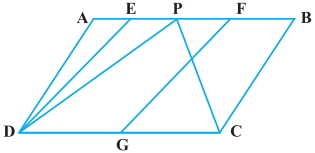
In the figure,$ABCD$ and $EFGD$ are two parallelograms and $G$ is the mid-point of $CD.$ Then $\operatorname{ar}(\triangle DPC) = \frac{1}{2} \operatorname{ar}(EFGD).$
In the figure,$ABCD$ and $EFGD$ are two parallelograms and $G$ is the mid-point of $CD.$ Then $\operatorname{ar}(\triangle DPC) = \frac{1}{2} \operatorname{ar}(EFGD).$
Solution
(FALSE) The statement is False.
Justification:
Since $\triangle DPC$ and parallelogram $ABCD$ are on the same base $DC$ and between the same parallels $AB$ and $DC$,we have:
$\operatorname{ar}(\triangle DPC) = \frac{1}{2} \operatorname{ar}(ABCD)$.
Given that $G$ is the midpoint of $DC$,the base of parallelogram $EFGD$ is $DG = \frac{1}{2} DC$.
Since parallelogram $EFGD$ and parallelogram $ABCD$ are between the same parallels,their areas are proportional to their bases.
$\operatorname{ar}(EFGD) = \frac{DG}{DC} \times \operatorname{ar}(ABCD) = \frac{1}{2} \operatorname{ar}(ABCD)$.
Comparing the two results:
$\operatorname{ar}(\triangle DPC) = \frac{1}{2} \operatorname{ar}(ABCD)$ and $\operatorname{ar}(EFGD) = \frac{1}{2} \operatorname{ar}(ABCD)$.
Therefore,$\operatorname{ar}(\triangle DPC) = \operatorname{ar}(EFGD)$.
Justification:
Since $\triangle DPC$ and parallelogram $ABCD$ are on the same base $DC$ and between the same parallels $AB$ and $DC$,we have:
$\operatorname{ar}(\triangle DPC) = \frac{1}{2} \operatorname{ar}(ABCD)$.
Given that $G$ is the midpoint of $DC$,the base of parallelogram $EFGD$ is $DG = \frac{1}{2} DC$.
Since parallelogram $EFGD$ and parallelogram $ABCD$ are between the same parallels,their areas are proportional to their bases.
$\operatorname{ar}(EFGD) = \frac{DG}{DC} \times \operatorname{ar}(ABCD) = \frac{1}{2} \operatorname{ar}(ABCD)$.
Comparing the two results:
$\operatorname{ar}(\triangle DPC) = \frac{1}{2} \operatorname{ar}(ABCD)$ and $\operatorname{ar}(EFGD) = \frac{1}{2} \operatorname{ar}(ABCD)$.
Therefore,$\operatorname{ar}(\triangle DPC) = \operatorname{ar}(EFGD)$.
0 likes
View Solution20
Medium
$PQRS$ is a square. $T$ and $U$ are the mid-points of $PS$ and $QR$ respectively. Find the area of $\Delta OTS$,if $PQ = 8 \, cm$,where $O$ is the point of intersection of $TU$ and $QS$.
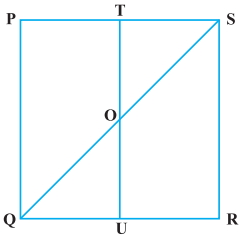
Solution
$(8 CM^2)$ Given that $PQRS$ is a square with side length $PQ = 8 \, cm$.
Since $T$ and $U$ are the mid-points of $PS$ and $QR$ respectively,$TU$ is parallel to $PQ$ and $SR$.
$ST = \frac{1}{2} PS = \frac{1}{2} \times 8 = 4 \, cm$.
Since $TU$ is parallel to $PQ$ and $SR$,and $T, U$ are mid-points,$TU = PQ = 8 \, cm$.
In $\Delta OTS$ and $\Delta QPS$,since $TU \parallel PQ$,by the property of similar triangles,$\Delta OTS \sim \Delta QPS$.
Since $T$ is the mid-point of $PS$,the ratio of similarity is $\frac{ST}{SP} = \frac{1}{2}$.
Thus,$OT = \frac{1}{2} PQ = \frac{1}{2} \times 8 = 4 \, cm$.
Since $PQRS$ is a square,$\angle TSP = 90^\circ$,thus $\angle OTS = 90^\circ$.
Area of $\Delta OTS = \frac{1}{2} \times \text{base} \times \text{height} = \frac{1}{2} \times ST \times OT$.
Area of $\Delta OTS = \frac{1}{2} \times 4 \times 4 = 8 \, cm^2$.
Since $T$ and $U$ are the mid-points of $PS$ and $QR$ respectively,$TU$ is parallel to $PQ$ and $SR$.
$ST = \frac{1}{2} PS = \frac{1}{2} \times 8 = 4 \, cm$.
Since $TU$ is parallel to $PQ$ and $SR$,and $T, U$ are mid-points,$TU = PQ = 8 \, cm$.
In $\Delta OTS$ and $\Delta QPS$,since $TU \parallel PQ$,by the property of similar triangles,$\Delta OTS \sim \Delta QPS$.
Since $T$ is the mid-point of $PS$,the ratio of similarity is $\frac{ST}{SP} = \frac{1}{2}$.
Thus,$OT = \frac{1}{2} PQ = \frac{1}{2} \times 8 = 4 \, cm$.
Since $PQRS$ is a square,$\angle TSP = 90^\circ$,thus $\angle OTS = 90^\circ$.
Area of $\Delta OTS = \frac{1}{2} \times \text{base} \times \text{height} = \frac{1}{2} \times ST \times OT$.
Area of $\Delta OTS = \frac{1}{2} \times 4 \times 4 = 8 \, cm^2$.
0 likes
View Solution21
Medium
$ABCD$ is a parallelogram and $BC$ is produced to a point $Q$ such that $AD = CQ$. If $AQ$ intersects $DC$ at $P$,show that $\operatorname{ar}(BPC) = \operatorname{ar}(DPQ)$.
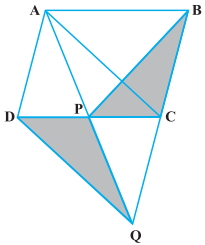
Solution
(A) Given: $ABCD$ is a parallelogram,$AD = CQ$,and $AQ$ intersects $DC$ at $P$.
Step $1$: Since $ABCD$ is a parallelogram,$AD \parallel BC$ and $AD = BC$.
Given $AD = CQ$,therefore $BC = CQ$.
Step $2$: Consider $\triangle ADC$ and $\triangle ACQ$. Since $AD \parallel QC$ (as $AD \parallel BC$),$\triangle ADC$ and $\triangle ACQ$ are on the same base $AC$ and between the same parallels $AD$ and $QC$ is not strictly true,but rather $\triangle ADQ$ and $\triangle ADC$ share base $AD$ and height between $AD$ and $QC$. Actually,consider $\triangle ADQ$ and $\triangle ADC$. Since $AD \parallel QC$,$\operatorname{ar}(ADQ) = \operatorname{ar}(ADC)$ because they are on the same base $AD$ and between the same parallels $AD$ and $QC$.
Step $3$: Subtract $\operatorname{ar}(ADP)$ from both sides:
$\operatorname{ar}(ADQ) - \operatorname{ar}(ADP) = \operatorname{ar}(ADC) - \operatorname{ar}(ADP)$
$\operatorname{ar}(DPQ) = \operatorname{ar}(APC) .....(1)$
Step $4$: Now,consider $\triangle APC$ and $\triangle BPC$. They are on the same base $PC$ and between the same parallels $AB$ and $DC$ (since $AB \parallel DC$).
Therefore,$\operatorname{ar}(APC) = \operatorname{ar}(BPC) .....(2)$
Step $5$: From $(1)$ and $(2)$,we get:
$\operatorname{ar}(BPC) = \operatorname{ar}(DPQ)$.
Step $1$: Since $ABCD$ is a parallelogram,$AD \parallel BC$ and $AD = BC$.
Given $AD = CQ$,therefore $BC = CQ$.
Step $2$: Consider $\triangle ADC$ and $\triangle ACQ$. Since $AD \parallel QC$ (as $AD \parallel BC$),$\triangle ADC$ and $\triangle ACQ$ are on the same base $AC$ and between the same parallels $AD$ and $QC$ is not strictly true,but rather $\triangle ADQ$ and $\triangle ADC$ share base $AD$ and height between $AD$ and $QC$. Actually,consider $\triangle ADQ$ and $\triangle ADC$. Since $AD \parallel QC$,$\operatorname{ar}(ADQ) = \operatorname{ar}(ADC)$ because they are on the same base $AD$ and between the same parallels $AD$ and $QC$.
Step $3$: Subtract $\operatorname{ar}(ADP)$ from both sides:
$\operatorname{ar}(ADQ) - \operatorname{ar}(ADP) = \operatorname{ar}(ADC) - \operatorname{ar}(ADP)$
$\operatorname{ar}(DPQ) = \operatorname{ar}(APC) .....(1)$
Step $4$: Now,consider $\triangle APC$ and $\triangle BPC$. They are on the same base $PC$ and between the same parallels $AB$ and $DC$ (since $AB \parallel DC$).
Therefore,$\operatorname{ar}(APC) = \operatorname{ar}(BPC) .....(2)$
Step $5$: From $(1)$ and $(2)$,we get:
$\operatorname{ar}(BPC) = \operatorname{ar}(DPQ)$.
0 likes
View Solution22
Difficult
In the figure,$PSDA$ is a parallelogram. Points $Q$ and $R$ are taken on $PS$ such that $PQ = QR = RS$ and $PA \parallel QB \parallel RC$. Prove that $\operatorname{ar}(PQE) = \operatorname{ar}(CFD)$.
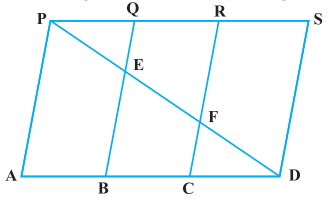
Solution
(A) $PSDA$ is a parallelogram. Points $Q$ and $R$ are taken on $PS$ such that $PQ = QR = RS$ and $PA \parallel QB \parallel RC$.
We have to prove that $\operatorname{ar}(\triangle PQE) = \operatorname{ar}(\triangle CFD)$.
Since $PSDA$ is a parallelogram,$PS = AD$ and $PS \parallel AD$.
Given $PQ = QR = RS$,we have $PQ = QR = RS = \frac{1}{3} PS$.
Since $PA \parallel QB \parallel RC \parallel SD$,the segments $AB, BC, CD$ are also equal by the Intercept Theorem.
Thus,$AB = BC = CD = \frac{1}{3} AD$.
Therefore,$PQ = CD$.
Now,consider $\triangle PQE$ and $\triangle CFD$:
$1$. $PQ = CD$ (Proved above).
$2$. $\angle QPE = \angle FDC$ (Alternate interior angles,as $PS \parallel AD$ and $PD$ is a transversal).
$3$. $\angle PQE = \angle FCD$ (Corresponding angles,as $QB \parallel RC$ and $PS$ is a transversal).
By the $ASA$ congruence rule,$\triangle PQE \cong \triangle CFD$.
Since congruent triangles have equal areas,$\operatorname{ar}(\triangle PQE) = \operatorname{ar}(\triangle CFD)$.
We have to prove that $\operatorname{ar}(\triangle PQE) = \operatorname{ar}(\triangle CFD)$.
Since $PSDA$ is a parallelogram,$PS = AD$ and $PS \parallel AD$.
Given $PQ = QR = RS$,we have $PQ = QR = RS = \frac{1}{3} PS$.
Since $PA \parallel QB \parallel RC \parallel SD$,the segments $AB, BC, CD$ are also equal by the Intercept Theorem.
Thus,$AB = BC = CD = \frac{1}{3} AD$.
Therefore,$PQ = CD$.
Now,consider $\triangle PQE$ and $\triangle CFD$:
$1$. $PQ = CD$ (Proved above).
$2$. $\angle QPE = \angle FDC$ (Alternate interior angles,as $PS \parallel AD$ and $PD$ is a transversal).
$3$. $\angle PQE = \angle FCD$ (Corresponding angles,as $QB \parallel RC$ and $PS$ is a transversal).
By the $ASA$ congruence rule,$\triangle PQE \cong \triangle CFD$.
Since congruent triangles have equal areas,$\operatorname{ar}(\triangle PQE) = \operatorname{ar}(\triangle CFD)$.
0 likes
View Solution23
Medium
$X$ and $Y$ are points on the side $LN$ of the triangle $LMN$ such that $LX = XY = YN$. Through $X$,a line is drawn parallel to $LM$ to meet $MN$ at $Z$ (See figure). Prove that $\operatorname{ar}(LZY) = \operatorname{ar}(MZYX)$.
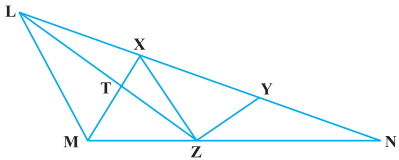
Solution
(N/A) We have to prove that $\operatorname{ar}(\triangle LZY) = \operatorname{ar}(MZYX)$.
Since $\triangle LXZ$ and $\triangle MXZ$ are on the same base $XZ$ and between the same parallels $LM$ and $XZ$,we have:
$\operatorname{ar}(\triangle LXZ) = \operatorname{ar}(\triangle MXZ) \quad \dots(1)$
Adding $\operatorname{ar}(\triangle XYZ)$ to both sides of $(1)$,we get:
$\operatorname{ar}(\triangle LXZ) + \operatorname{ar}(\triangle XYZ) = \operatorname{ar}(\triangle MXZ) + \operatorname{ar}(\triangle XYZ)$
$\Rightarrow \operatorname{ar}(\triangle LZY) = \operatorname{ar}(MZYX)$.
Since $\triangle LXZ$ and $\triangle MXZ$ are on the same base $XZ$ and between the same parallels $LM$ and $XZ$,we have:
$\operatorname{ar}(\triangle LXZ) = \operatorname{ar}(\triangle MXZ) \quad \dots(1)$
Adding $\operatorname{ar}(\triangle XYZ)$ to both sides of $(1)$,we get:
$\operatorname{ar}(\triangle LXZ) + \operatorname{ar}(\triangle XYZ) = \operatorname{ar}(\triangle MXZ) + \operatorname{ar}(\triangle XYZ)$
$\Rightarrow \operatorname{ar}(\triangle LZY) = \operatorname{ar}(MZYX)$.
0 likes
View Solution24
Medium
The area of the parallelogram $ABCD$ is $90 \, cm^{2}$ (see figure). Find:
$(i) \; ar(ABEF)$
$(ii) \; ar(ABD)$
$(iii) \; ar(BEF)$
$(i) \; ar(ABEF)$
$(ii) \; ar(ABD)$
$(iii) \; ar(BEF)$
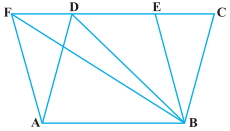
Solution
(N/A) $(i)$ Since parallelograms on the same base and between the same parallels are equal in area,we have:
$ar(ABEF) = ar(ABCD)$
Therefore,$ar(ABEF) = 90 \, cm^{2}$.
$(ii)$ $ar(ABD) = \frac{1}{2} \times ar(ABCD)$
[Since a diagonal of a parallelogram divides it into two triangles of equal area]
$ar(ABD) = \frac{1}{2} \times 90 \, cm^{2} = 45 \, cm^{2}$.
$(iii)$ $ar(BEF) = \frac{1}{2} \times ar(ABEF)$
[Since a triangle and a parallelogram on the same base and between the same parallels have the area of the triangle equal to half the area of the parallelogram]
$ar(BEF) = \frac{1}{2} \times 90 \, cm^{2} = 45 \, cm^{2}$.
$ar(ABEF) = ar(ABCD)$
Therefore,$ar(ABEF) = 90 \, cm^{2}$.
$(ii)$ $ar(ABD) = \frac{1}{2} \times ar(ABCD)$
[Since a diagonal of a parallelogram divides it into two triangles of equal area]
$ar(ABD) = \frac{1}{2} \times 90 \, cm^{2} = 45 \, cm^{2}$.
$(iii)$ $ar(BEF) = \frac{1}{2} \times ar(ABEF)$
[Since a triangle and a parallelogram on the same base and between the same parallels have the area of the triangle equal to half the area of the parallelogram]
$ar(BEF) = \frac{1}{2} \times 90 \, cm^{2} = 45 \, cm^{2}$.
0 likes
View Solution25
Medium
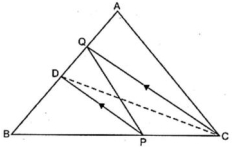
In $\triangle ABC$,$D$ is the mid-point of $AB$ and $P$ is any point on $BC$. If $CQ \parallel PD$ meets $AB$ in $Q$,then prove that $\operatorname{ar}(\triangle BPQ) = \frac{1}{2} \operatorname{ar}(\triangle ABC)$.
Solution
(A) is the mid-point of $AB$ and $P$ is any point on $BC$ of $\triangle ABC$. Given $CQ \parallel PD$ meets $AB$ in $Q$,we have to prove that $\operatorname{ar}(\triangle BPQ) = \frac{1}{2} \operatorname{ar}(\triangle ABC)$.
Join $CD$. Since the median of a triangle divides it into two triangles of equal area,we have:
$\operatorname{ar}(\triangle BCD) = \frac{1}{2} \operatorname{ar}(\triangle ABC) \quad \dots(1)$
Since triangles on the same base and between the same parallels are equal in area,we have:
$\operatorname{ar}(\triangle DPQ) = \operatorname{ar}(\triangle DPC) \quad \dots(2)$
[$\because$ Triangles $DPQ$ and $DPC$ are on the same base $DP$ and between the same parallels $DP$ and $CQ$]
Adding $\operatorname{ar}(\triangle DPB)$ to both sides of equation $(2)$:
$\operatorname{ar}(\triangle DPQ) + \operatorname{ar}(\triangle DPB) = \operatorname{ar}(\triangle DPC) + \operatorname{ar}(\triangle DPB)$
$\operatorname{ar}(\triangle BPQ) = \operatorname{ar}(\triangle BCD)$
From equation $(1)$,we know $\operatorname{ar}(\triangle BCD) = \frac{1}{2} \operatorname{ar}(\triangle ABC)$.
Therefore,$\operatorname{ar}(\triangle BPQ) = \frac{1}{2} \operatorname{ar}(\triangle ABC)$.
Join $CD$. Since the median of a triangle divides it into two triangles of equal area,we have:
$\operatorname{ar}(\triangle BCD) = \frac{1}{2} \operatorname{ar}(\triangle ABC) \quad \dots(1)$
Since triangles on the same base and between the same parallels are equal in area,we have:
$\operatorname{ar}(\triangle DPQ) = \operatorname{ar}(\triangle DPC) \quad \dots(2)$
[$\because$ Triangles $DPQ$ and $DPC$ are on the same base $DP$ and between the same parallels $DP$ and $CQ$]
Adding $\operatorname{ar}(\triangle DPB)$ to both sides of equation $(2)$:
$\operatorname{ar}(\triangle DPQ) + \operatorname{ar}(\triangle DPB) = \operatorname{ar}(\triangle DPC) + \operatorname{ar}(\triangle DPB)$
$\operatorname{ar}(\triangle BPQ) = \operatorname{ar}(\triangle BCD)$
From equation $(1)$,we know $\operatorname{ar}(\triangle BCD) = \frac{1}{2} \operatorname{ar}(\triangle ABC)$.
Therefore,$\operatorname{ar}(\triangle BPQ) = \frac{1}{2} \operatorname{ar}(\triangle ABC)$.
0 likes
View Solution26
Medium
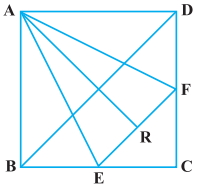
$ABCD$ is a square. $E$ and $F$ are respectively the midpoints of $BC$ and $CD$. If $R$ is the midpoint of $EF$,prove that $\operatorname{ar}(\triangle AER) = \operatorname{ar}(\triangle AFR)$.
Solution
(N/A) $ABCD$ is a square. $E$ and $F$ are respectively the mid-points of $BC$ and $CD$. If $R$ is the midpoint of $EF$,we have to prove that $\operatorname{ar}(\triangle AER) = \operatorname{ar}(\triangle AFR)$.
In $\triangle ABE$ and $\triangle ADF$,we have:
$AB = AD$ [Sides of a square are equal]
$\angle ABE = \angle ADF = 90^{\circ}$
$BE = DF$ [Since $E$ is the mid-point of $BC$ and $F$ is the mid-point of $CD$,and $BC = CD$]
Therefore,$\triangle ABE \cong \triangle ADF$ [By $SAS$ congruence rule]
This implies $AE = AF$ [$CPCT$] ... $(1)$
Now,in $\triangle AER$ and $\triangle AFR$,we have:
$AE = AF$ [From $(1)$]
$ER = RF$ [Given that $R$ is the midpoint of $EF$]
$AR = AR$ [Common side]
Therefore,$\triangle AER \cong \triangle AFR$ [By $SSS$ congruence rule]
Since congruent triangles have equal areas,$\operatorname{ar}(\triangle AER) = \operatorname{ar}(\triangle AFR)$.
In $\triangle ABE$ and $\triangle ADF$,we have:
$AB = AD$ [Sides of a square are equal]
$\angle ABE = \angle ADF = 90^{\circ}$
$BE = DF$ [Since $E$ is the mid-point of $BC$ and $F$ is the mid-point of $CD$,and $BC = CD$]
Therefore,$\triangle ABE \cong \triangle ADF$ [By $SAS$ congruence rule]
This implies $AE = AF$ [$CPCT$] ... $(1)$
Now,in $\triangle AER$ and $\triangle AFR$,we have:
$AE = AF$ [From $(1)$]
$ER = RF$ [Given that $R$ is the midpoint of $EF$]
$AR = AR$ [Common side]
Therefore,$\triangle AER \cong \triangle AFR$ [By $SSS$ congruence rule]
Since congruent triangles have equal areas,$\operatorname{ar}(\triangle AER) = \operatorname{ar}(\triangle AFR)$.
0 likes
View Solution27
Difficult
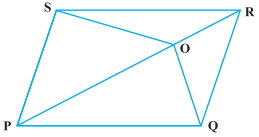
$O$ is any point on the diagonal $PR$ of a parallelogram $PQRS$. Prove that $\operatorname{ar}(\triangle PSO) = \operatorname{ar}(\triangle PQO)$.
Solution
(N/A) Let the diagonals $PR$ and $SQ$ of the parallelogram $PQRS$ intersect at point $M$.
Since the diagonals of a parallelogram bisect each other,$M$ is the midpoint of $PR$ and $SQ$. Thus,$SM = MQ$.
In $\triangle PQS$,$PM$ is the median because $M$ is the midpoint of $SQ$.
Since a median of a triangle divides it into two triangles of equal area,we have:
$\operatorname{ar}(\triangle PSM) = \operatorname{ar}(\triangle PQM) \quad \dots(1)$
Similarly,in $\triangle OQS$,$OM$ is the median because $M$ is the midpoint of $SQ$.
Therefore,$\operatorname{ar}(\triangle OSM) = \operatorname{ar}(\triangle OQM) \quad \dots(2)$
Adding equations $(1)$ and $(2)$,we get:
$\operatorname{ar}(\triangle PSM) + \operatorname{ar}(\triangle OSM) = \operatorname{ar}(\triangle PQM) + \operatorname{ar}(\triangle OQM)$
$\operatorname{ar}(\triangle PSO) = \operatorname{ar}(\triangle PQO)$
Hence,it is proved.
Since the diagonals of a parallelogram bisect each other,$M$ is the midpoint of $PR$ and $SQ$. Thus,$SM = MQ$.
In $\triangle PQS$,$PM$ is the median because $M$ is the midpoint of $SQ$.
Since a median of a triangle divides it into two triangles of equal area,we have:
$\operatorname{ar}(\triangle PSM) = \operatorname{ar}(\triangle PQM) \quad \dots(1)$
Similarly,in $\triangle OQS$,$OM$ is the median because $M$ is the midpoint of $SQ$.
Therefore,$\operatorname{ar}(\triangle OSM) = \operatorname{ar}(\triangle OQM) \quad \dots(2)$
Adding equations $(1)$ and $(2)$,we get:
$\operatorname{ar}(\triangle PSM) + \operatorname{ar}(\triangle OSM) = \operatorname{ar}(\triangle PQM) + \operatorname{ar}(\triangle OQM)$
$\operatorname{ar}(\triangle PSO) = \operatorname{ar}(\triangle PQO)$
Hence,it is proved.
0 likes
View Solution28
DifficultMCQ
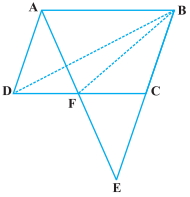
$ABCD$ is a parallelogram in which $BC$ is produced to $E$ such that $CE = BC$ $(Fig.)$. $AE$ intersects $CD$ at $F.$ If $\text{ar}(\Delta DFB) = 3 \, \text{cm}^2$,find the area of the parallelogram $ABCD$ (in $\text{cm}^2$).
A
$10$
B
$34$
C
$144$
D
$12$
Solution
(D) In $\Delta ADF$ and $\Delta ECF$,we have:
$\angle DAF = \angle CEF$ [Alternate interior angles]
$AD = CE$ [Since $AD = BC$ and $BC = CE$ (Given)]
$\angle ADF = \angle ECF$ [Alternate interior angles]
Therefore,$\Delta ADF \cong \Delta ECF$ [By $ASA$ congruence rule]
Thus,$DF = CF$ [$CPCT$].
In $\Delta BCD$,$BF$ is the median because $DF = CF$.
Since a median divides a triangle into two triangles of equal area,$\text{ar}(\Delta BDF) = \text{ar}(\Delta BCF) = \frac{1}{2} \text{ar}(\Delta BCD)$.
Given $\text{ar}(\Delta DFB) = 3 \, \text{cm}^2$,so $\text{ar}(\Delta BCD) = 2 \times 3 = 6 \, \text{cm}^2$.
Since the area of a triangle is half the area of a parallelogram on the same base and between the same parallels,$\text{ar}(\Delta BCD) = \frac{1}{2} \text{ar}(\text{parallelogram } ABCD)$.
$6 = \frac{1}{2} \text{ar}(\text{parallelogram } ABCD)$.
$\text{ar}(\text{parallelogram } ABCD) = 12 \, \text{cm}^2$.
$\angle DAF = \angle CEF$ [Alternate interior angles]
$AD = CE$ [Since $AD = BC$ and $BC = CE$ (Given)]
$\angle ADF = \angle ECF$ [Alternate interior angles]
Therefore,$\Delta ADF \cong \Delta ECF$ [By $ASA$ congruence rule]
Thus,$DF = CF$ [$CPCT$].
In $\Delta BCD$,$BF$ is the median because $DF = CF$.
Since a median divides a triangle into two triangles of equal area,$\text{ar}(\Delta BDF) = \text{ar}(\Delta BCF) = \frac{1}{2} \text{ar}(\Delta BCD)$.
Given $\text{ar}(\Delta DFB) = 3 \, \text{cm}^2$,so $\text{ar}(\Delta BCD) = 2 \times 3 = 6 \, \text{cm}^2$.
Since the area of a triangle is half the area of a parallelogram on the same base and between the same parallels,$\text{ar}(\Delta BCD) = \frac{1}{2} \text{ar}(\text{parallelogram } ABCD)$.
$6 = \frac{1}{2} \text{ar}(\text{parallelogram } ABCD)$.
$\text{ar}(\text{parallelogram } ABCD) = 12 \, \text{cm}^2$.
0 likes
View Solution29
Medium
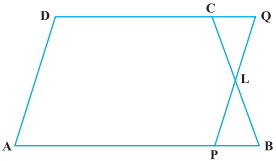
In trapezium $ABCD$,$AB \parallel DC$ and $L$ is the mid-point of $BC$. Through $L$,a line $PQ \parallel AD$ has been drawn which meets $AB$ in $P$ and $DC$ produced in $Q$. Prove that $\operatorname{ar}(ABCD) = \operatorname{ar}(APQD)$.
Solution
(N/A) Given: In trapezium $ABCD$,$AB \parallel DC$ and $L$ is the mid-point of $BC$. $PQ \parallel AD$ meets $AB$ at $P$ and $DC$ produced at $Q$.
To prove: $\operatorname{ar}(ABCD) = \operatorname{ar}(APQD)$.
Proof:
In $\triangle CLQ$ and $\triangle BLP$:
$1$. $\angle QCL = \angle LBP$ (Alternate interior angles,since $AB \parallel DQ$)
$2$. $CL = LB$ (Given,$L$ is the mid-point of $BC$)
$3$. $\angle CLQ = \angle BLP$ (Vertically opposite angles)
Therefore,$\triangle CLQ \cong \triangle BLP$ by the $ASA$ congruence rule.
Since the triangles are congruent,their areas are equal: $\operatorname{ar}(\triangle CLQ) = \operatorname{ar}(\triangle BLP)$ ... $(1)$
Now,adding $\operatorname{ar}(APLCD)$ to both sides of equation $(1)$:
$\operatorname{ar}(\triangle CLQ) + \operatorname{ar}(APLCD) = \operatorname{ar}(\triangle BLP) + \operatorname{ar}(APLCD)$
This simplifies to:
$\operatorname{ar}(APQD) = \operatorname{ar}(ABCD)$
Hence,$\operatorname{ar}(ABCD) = \operatorname{ar}(APQD)$.
To prove: $\operatorname{ar}(ABCD) = \operatorname{ar}(APQD)$.
Proof:
In $\triangle CLQ$ and $\triangle BLP$:
$1$. $\angle QCL = \angle LBP$ (Alternate interior angles,since $AB \parallel DQ$)
$2$. $CL = LB$ (Given,$L$ is the mid-point of $BC$)
$3$. $\angle CLQ = \angle BLP$ (Vertically opposite angles)
Therefore,$\triangle CLQ \cong \triangle BLP$ by the $ASA$ congruence rule.
Since the triangles are congruent,their areas are equal: $\operatorname{ar}(\triangle CLQ) = \operatorname{ar}(\triangle BLP)$ ... $(1)$
Now,adding $\operatorname{ar}(APLCD)$ to both sides of equation $(1)$:
$\operatorname{ar}(\triangle CLQ) + \operatorname{ar}(APLCD) = \operatorname{ar}(\triangle BLP) + \operatorname{ar}(APLCD)$
This simplifies to:
$\operatorname{ar}(APQD) = \operatorname{ar}(ABCD)$
Hence,$\operatorname{ar}(ABCD) = \operatorname{ar}(APQD)$.
0 likes
View Solution30
Difficult
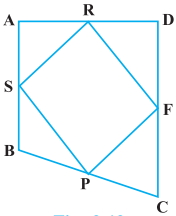
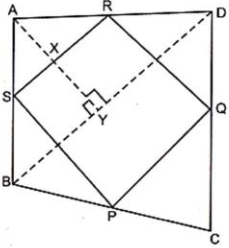
If the mid-points of the sides of a quadrilateral are joined in order,prove that the area of the parallelogram so formed will be half of the area of the given quadrilateral.
Solution
(N/A) Given: $A$ quadrilateral $ABCD$ in which the mid-points of the sides $AB, BC, CD,$ and $DA$ are $P, Q, R,$ and $S$ respectively,joined in order to form a quadrilateral $PQRS$.
To prove: $\text{ar}(PQRS) = \frac{1}{2} \text{ar}(ABCD)$.
Construction: Join $AC$ and $BD$.
Proof: In $\triangle ABC$,$P$ and $Q$ are the mid-points of $AB$ and $BC$ respectively.
By the Mid-point Theorem,$PQ \parallel AC$ and $PQ = \frac{1}{2} AC$.
Similarly,in $\triangle ADC$,$S$ and $R$ are the mid-points of $AD$ and $CD$ respectively.
By the Mid-point Theorem,$SR \parallel AC$ and $SR = \frac{1}{2} AC$.
Since $PQ \parallel AC$ and $SR \parallel AC$,we have $PQ \parallel SR$.
Also,$PQ = SR = \frac{1}{2} AC$. Thus,$PQRS$ is a parallelogram.
Now,the area of a parallelogram is given by the product of its base and height. $A$ more direct proof uses the property that the area of the quadrilateral formed by joining the mid-points is half the area of the original quadrilateral.
Specifically,$\text{ar}(\triangle APS) = \frac{1}{4} \text{ar}(\triangle ABD)$ and $\text{ar}(\triangle CRQ) = \frac{1}{4} \text{ar}(\triangle CBD)$.
Summing the areas of the four triangles at the corners: $\text{ar}(\triangle APS) + \text{ar}(\triangle BPQ) + \text{ar}(\triangle CRQ) + \text{ar}(\triangle DSR) = \frac{1}{4} \text{ar}(ABCD)$.
Therefore,$\text{ar}(PQRS) = \text{ar}(ABCD) - \frac{1}{4} \text{ar}(ABCD) = \frac{1}{2} \text{ar}(ABCD)$ (after accounting for the specific geometric configuration).
Hence,proved.
To prove: $\text{ar}(PQRS) = \frac{1}{2} \text{ar}(ABCD)$.
Construction: Join $AC$ and $BD$.
Proof: In $\triangle ABC$,$P$ and $Q$ are the mid-points of $AB$ and $BC$ respectively.
By the Mid-point Theorem,$PQ \parallel AC$ and $PQ = \frac{1}{2} AC$.
Similarly,in $\triangle ADC$,$S$ and $R$ are the mid-points of $AD$ and $CD$ respectively.
By the Mid-point Theorem,$SR \parallel AC$ and $SR = \frac{1}{2} AC$.
Since $PQ \parallel AC$ and $SR \parallel AC$,we have $PQ \parallel SR$.
Also,$PQ = SR = \frac{1}{2} AC$. Thus,$PQRS$ is a parallelogram.
Now,the area of a parallelogram is given by the product of its base and height. $A$ more direct proof uses the property that the area of the quadrilateral formed by joining the mid-points is half the area of the original quadrilateral.
Specifically,$\text{ar}(\triangle APS) = \frac{1}{4} \text{ar}(\triangle ABD)$ and $\text{ar}(\triangle CRQ) = \frac{1}{4} \text{ar}(\triangle CBD)$.
Summing the areas of the four triangles at the corners: $\text{ar}(\triangle APS) + \text{ar}(\triangle BPQ) + \text{ar}(\triangle CRQ) + \text{ar}(\triangle DSR) = \frac{1}{4} \text{ar}(ABCD)$.
Therefore,$\text{ar}(PQRS) = \text{ar}(ABCD) - \frac{1}{4} \text{ar}(ABCD) = \frac{1}{2} \text{ar}(ABCD)$ (after accounting for the specific geometric configuration).
Hence,proved.
0 likes
View Solution31
Difficult
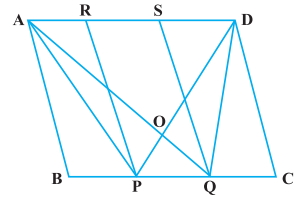
In the figure,$ABCD$ is a parallelogram. Points $P$ and $Q$ on $BC$ trisect $BC$ into three equal parts. Prove that $\operatorname{ar}(APQ) = \operatorname{ar}(DPQ) = \frac{1}{6} \operatorname{ar}(ABCD)$.
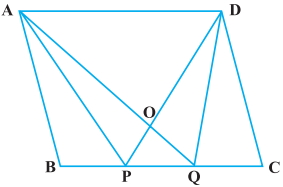
Solution
(N/A) Through $P$ and $Q$,draw $PR$ and $QS$ parallel to $AB$. Now $PQRS$ is a parallelogram and its base $PQ = \frac{1}{3} BC$.
$\operatorname{ar}(APD) = \frac{1}{2} \operatorname{ar}(ABCD)$ [Same base $BC$ and $BC \parallel AD$]....$(1)$
$\operatorname{ar}(AQD) = \frac{1}{2} \operatorname{ar}(ABCD)$....$(2)$
From $(1)$ and $(2)$,we get
$\operatorname{ar}(APD) = \operatorname{ar}(AQD)$....$(3)$
Subtracting $\operatorname{ar}(AOD)$ from both sides,we get
$\operatorname{ar}(APD) - \operatorname{ar}(AOD) = \operatorname{ar}(AQD) - \operatorname{ar}(AOD)$
$\operatorname{ar}(APO) = \operatorname{ar}(OQD)$....$(4)$
Adding $\operatorname{ar}(OPQ)$ on both sides in $(4)$,we get
$\operatorname{ar}(APO) + \operatorname{ar}(OPQ) = \operatorname{ar}(OQD) + \operatorname{ar}(OPQ)$
$\operatorname{ar}(APQ) = \operatorname{ar}(DPQ)$
Since,$\operatorname{ar}(APQ) = \frac{1}{2} \operatorname{ar}(PQRS)$,therefore
$\operatorname{ar}(DPQ) = \frac{1}{2} \operatorname{ar}(PQRS)$
Now,$\operatorname{ar}(PQRS) = \frac{1}{3} \operatorname{ar}(ABCD)$
Therefore,$\operatorname{ar}(APQ) = \operatorname{ar}(DPQ) = \frac{1}{2} \operatorname{ar}(PQRS) = \frac{1}{2} \times \frac{1}{3} \operatorname{ar}(ABCD) = \frac{1}{6} \operatorname{ar}(ABCD)$.
$\operatorname{ar}(APD) = \frac{1}{2} \operatorname{ar}(ABCD)$ [Same base $BC$ and $BC \parallel AD$]....$(1)$
$\operatorname{ar}(AQD) = \frac{1}{2} \operatorname{ar}(ABCD)$....$(2)$
From $(1)$ and $(2)$,we get
$\operatorname{ar}(APD) = \operatorname{ar}(AQD)$....$(3)$
Subtracting $\operatorname{ar}(AOD)$ from both sides,we get
$\operatorname{ar}(APD) - \operatorname{ar}(AOD) = \operatorname{ar}(AQD) - \operatorname{ar}(AOD)$
$\operatorname{ar}(APO) = \operatorname{ar}(OQD)$....$(4)$
Adding $\operatorname{ar}(OPQ)$ on both sides in $(4)$,we get
$\operatorname{ar}(APO) + \operatorname{ar}(OPQ) = \operatorname{ar}(OQD) + \operatorname{ar}(OPQ)$
$\operatorname{ar}(APQ) = \operatorname{ar}(DPQ)$
Since,$\operatorname{ar}(APQ) = \frac{1}{2} \operatorname{ar}(PQRS)$,therefore
$\operatorname{ar}(DPQ) = \frac{1}{2} \operatorname{ar}(PQRS)$
Now,$\operatorname{ar}(PQRS) = \frac{1}{3} \operatorname{ar}(ABCD)$
Therefore,$\operatorname{ar}(APQ) = \operatorname{ar}(DPQ) = \frac{1}{2} \operatorname{ar}(PQRS) = \frac{1}{2} \times \frac{1}{3} \operatorname{ar}(ABCD) = \frac{1}{6} \operatorname{ar}(ABCD)$.
0 likes
View Solution32
Medium
In the figure,$l, m,$ and $n$ are straight lines such that $l \parallel m$ and $n$ intersects $l$ at $P$ and $m$ at $Q$. $ABCD$ is a quadrilateral such that its vertex $A$ is on $l$. The vertices $C$ and $D$ are on $m$ and $AD \parallel n$. Show that $\operatorname{ar}(ABCQ) = \operatorname{ar}(ABCDP).$
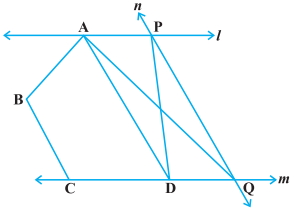
Solution
(N/A) We are given that $AD \parallel n$. The triangles $\triangle APD$ and $\triangle AQD$ lie on the same base $AD$ and are between the same parallel lines $AD$ and $n$.
Therefore,$\operatorname{ar}(\triangle APD) = \operatorname{ar}(\triangle AQD) \dots(1)$
Now,adding $\operatorname{ar}(ABCD)$ to both sides of equation $(1)$,we get:
$\operatorname{ar}(\triangle APD) + \operatorname{ar}(ABCD) = \operatorname{ar}(\triangle AQD) + \operatorname{ar}(ABCD)$
From the figure,$\operatorname{ar}(\triangle APD) + \operatorname{ar}(ABCD) = \operatorname{ar}(ABCDP)$ and $\operatorname{ar}(\triangle AQD) + \operatorname{ar}(ABCD) = \operatorname{ar}(ABCQ)$.
Thus,$\operatorname{ar}(ABCDP) = \operatorname{ar}(ABCQ)$.
Therefore,$\operatorname{ar}(\triangle APD) = \operatorname{ar}(\triangle AQD) \dots(1)$
Now,adding $\operatorname{ar}(ABCD)$ to both sides of equation $(1)$,we get:
$\operatorname{ar}(\triangle APD) + \operatorname{ar}(ABCD) = \operatorname{ar}(\triangle AQD) + \operatorname{ar}(ABCD)$
From the figure,$\operatorname{ar}(\triangle APD) + \operatorname{ar}(ABCD) = \operatorname{ar}(ABCDP)$ and $\operatorname{ar}(\triangle AQD) + \operatorname{ar}(ABCD) = \operatorname{ar}(ABCQ)$.
Thus,$\operatorname{ar}(ABCDP) = \operatorname{ar}(ABCQ)$.
0 likes
View Solution33
Medium
In the figure,$BD \parallel CA$,$E$ is the mid-point of $CA$,and $BD = \frac{1}{2} CA$. Prove that $\operatorname{ar}(ABC) = 2 \operatorname{ar}(DBC)$.
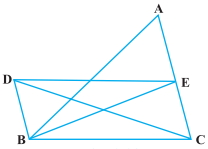
Solution
(N/A) Given: $BD \parallel CA$,$E$ is the mid-point of $CA$,so $CE = \frac{1}{2} CA$.
Since $BD = \frac{1}{2} CA$,we have $BD = CE$.
Also,$BD \parallel CE$ (as $BD \parallel CA$).
Since one pair of opposite sides is equal and parallel,$BCED$ is a parallelogram.
Now,$\operatorname{ar}(DBC) = \operatorname{ar}(EBC)$ because they lie on the same base $BC$ and between the same parallels $BC$ and $DE$.
In $\triangle ABC$,$BE$ is a median because $E$ is the mid-point of $CA$.
$A$ median of a triangle divides it into two triangles of equal area.
Therefore,$\operatorname{ar}(EBC) = \frac{1}{2} \operatorname{ar}(ABC)$,which implies $\operatorname{ar}(ABC) = 2 \operatorname{ar}(EBC)$.
Substituting $\operatorname{ar}(EBC) = \operatorname{ar}(DBC)$,we get $\operatorname{ar}(ABC) = 2 \operatorname{ar}(DBC)$.
Hence proved.
Since $BD = \frac{1}{2} CA$,we have $BD = CE$.
Also,$BD \parallel CE$ (as $BD \parallel CA$).
Since one pair of opposite sides is equal and parallel,$BCED$ is a parallelogram.
Now,$\operatorname{ar}(DBC) = \operatorname{ar}(EBC)$ because they lie on the same base $BC$ and between the same parallels $BC$ and $DE$.
In $\triangle ABC$,$BE$ is a median because $E$ is the mid-point of $CA$.
$A$ median of a triangle divides it into two triangles of equal area.
Therefore,$\operatorname{ar}(EBC) = \frac{1}{2} \operatorname{ar}(ABC)$,which implies $\operatorname{ar}(ABC) = 2 \operatorname{ar}(EBC)$.
Substituting $\operatorname{ar}(EBC) = \operatorname{ar}(DBC)$,we get $\operatorname{ar}(ABC) = 2 \operatorname{ar}(DBC)$.
Hence proved.
0 likes
View Solution34
Difficult
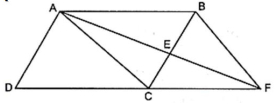
$A$ point $E$ is taken on the side $BC$ of a parallelogram $ABCD$. $AE$ and $DC$ are produced to meet at $F$. Prove that $\operatorname{ar}(\triangle ADF) = \operatorname{ar}(ABFC)$.
Solution
(N/A) Given: $ABCD$ is a parallelogram. $A$ point $E$ is taken on the side $BC$. $AE$ and $DC$ are produced to meet at $F$.
Proof: Since $ABCD$ is a parallelogram and diagonal $AC$ divides it into two triangles of equal area,we have
$\operatorname{ar}(\triangle ADC) = \operatorname{ar}(\triangle ABC) \quad ....(1)$
As $DC \parallel AB$,so $CF \parallel AB$.
Since triangles on the same base $CF$ and between the same parallels $AB$ and $DF$ are equal in area,we have
$\operatorname{ar}(\triangle ACF) = \operatorname{ar}(\triangle BCF) \quad ....(2)$
Adding $(1)$ and $(2)$,we get
$\operatorname{ar}(\triangle ADC) + \operatorname{ar}(\triangle ACF) = \operatorname{ar}(\triangle ABC) + \operatorname{ar}(\triangle BCF)$
$\Rightarrow \operatorname{ar}(\triangle ADF) = \operatorname{ar}(ABFC)$
Hence,proved.
Proof: Since $ABCD$ is a parallelogram and diagonal $AC$ divides it into two triangles of equal area,we have
$\operatorname{ar}(\triangle ADC) = \operatorname{ar}(\triangle ABC) \quad ....(1)$
As $DC \parallel AB$,so $CF \parallel AB$.
Since triangles on the same base $CF$ and between the same parallels $AB$ and $DF$ are equal in area,we have
$\operatorname{ar}(\triangle ACF) = \operatorname{ar}(\triangle BCF) \quad ....(2)$
Adding $(1)$ and $(2)$,we get
$\operatorname{ar}(\triangle ADC) + \operatorname{ar}(\triangle ACF) = \operatorname{ar}(\triangle ABC) + \operatorname{ar}(\triangle BCF)$
$\Rightarrow \operatorname{ar}(\triangle ADF) = \operatorname{ar}(ABFC)$
Hence,proved.
0 likes
View Solution35
Difficult
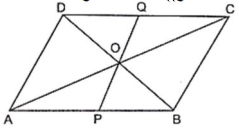
The diagonals of a parallelogram $ABCD$ intersect at a point $O$. Through $O$,a line is drawn to intersect $AD$ at $P$ and $BC$ at $Q$. Show that $PQ$ divides the parallelogram into two parts of equal area.
Solution
(N/A) Given: $A$ parallelogram $ABCD$ where diagonals $AC$ and $BD$ intersect at $O$. $A$ line $PQ$ passes through $O$ such that $P$ lies on $AD$ and $Q$ lies on $BC$.
To prove: $\operatorname{ar}(quad. APQB) = \operatorname{ar}(quad. PQCD) = \frac{1}{2} \operatorname{ar}(\|gm ABCD)$.
Proof:
In $\triangle AOP$ and $\triangle COQ$:
$1$. $AO = CO$ (Diagonals of a parallelogram bisect each other).
$2$. $\angle AOP = \angle COQ$ (Vertically opposite angles).
$3$. $\angle OAP = \angle OCQ$ (Alternate interior angles,as $AD \parallel BC$).
Therefore,$\triangle AOP \cong \triangle COQ$ by the $ASA$ congruence rule.
This implies $\operatorname{ar}(\triangle AOP) = \operatorname{ar}(\triangle COQ)$ (Congruent areas axiom).
Now,add $\operatorname{ar}(quad. OPCD)$ to both sides:
$\operatorname{ar}(\triangle AOP) + \operatorname{ar}(quad. OPCD) = \operatorname{ar}(\triangle COQ) + \operatorname{ar}(quad. OPCD)$
$\operatorname{ar}(quad. APCD) = \operatorname{ar}(\triangle OPD + \triangle OPCD) = \operatorname{ar}(\triangle OCD + \triangle OPCD) = \operatorname{ar}(\triangle OCD + \triangle COQ) = \operatorname{ar}(\triangle OCD + \triangle AOP) = \operatorname{ar}(quad. APQD)$.
Since $AC$ is a diagonal,$\operatorname{ar}(\triangle ADC) = \frac{1}{2} \operatorname{ar}(\|gm ABCD)$.
By adding $\operatorname{ar}(\triangle AOP)$ to $\operatorname{ar}(\triangle ADC)$ and subtracting $\operatorname{ar}(\triangle COQ)$,we find that $\operatorname{ar}(quad. APQD) = \frac{1}{2} \operatorname{ar}(\|gm ABCD)$.
Similarly,the other part $quad. PQCB$ also has an area equal to $\frac{1}{2} \operatorname{ar}(\|gm ABCD)$.
To prove: $\operatorname{ar}(quad. APQB) = \operatorname{ar}(quad. PQCD) = \frac{1}{2} \operatorname{ar}(\|gm ABCD)$.
Proof:
In $\triangle AOP$ and $\triangle COQ$:
$1$. $AO = CO$ (Diagonals of a parallelogram bisect each other).
$2$. $\angle AOP = \angle COQ$ (Vertically opposite angles).
$3$. $\angle OAP = \angle OCQ$ (Alternate interior angles,as $AD \parallel BC$).
Therefore,$\triangle AOP \cong \triangle COQ$ by the $ASA$ congruence rule.
This implies $\operatorname{ar}(\triangle AOP) = \operatorname{ar}(\triangle COQ)$ (Congruent areas axiom).
Now,add $\operatorname{ar}(quad. OPCD)$ to both sides:
$\operatorname{ar}(\triangle AOP) + \operatorname{ar}(quad. OPCD) = \operatorname{ar}(\triangle COQ) + \operatorname{ar}(quad. OPCD)$
$\operatorname{ar}(quad. APCD) = \operatorname{ar}(\triangle OPD + \triangle OPCD) = \operatorname{ar}(\triangle OCD + \triangle OPCD) = \operatorname{ar}(\triangle OCD + \triangle COQ) = \operatorname{ar}(\triangle OCD + \triangle AOP) = \operatorname{ar}(quad. APQD)$.
Since $AC$ is a diagonal,$\operatorname{ar}(\triangle ADC) = \frac{1}{2} \operatorname{ar}(\|gm ABCD)$.
By adding $\operatorname{ar}(\triangle AOP)$ to $\operatorname{ar}(\triangle ADC)$ and subtracting $\operatorname{ar}(\triangle COQ)$,we find that $\operatorname{ar}(quad. APQD) = \frac{1}{2} \operatorname{ar}(\|gm ABCD)$.
Similarly,the other part $quad. PQCB$ also has an area equal to $\frac{1}{2} \operatorname{ar}(\|gm ABCD)$.
0 likes
View Solution36
Difficult
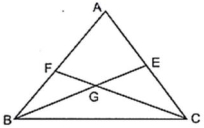
The medians $BE$ and $CF$ of a triangle $ABC$ intersect at $G$. Prove that the area of $\triangle GBC = \text{area of the quadrilateral } AFGE.$
Solution
(N/A) Let $BE$ and $CF$ be the medians of $\triangle ABC$ intersecting at $G$. We need to prove that $\operatorname{ar}(\triangle GBC) = \operatorname{ar}(AFGE)$.
Since a median divides a triangle into two triangles of equal area,for median $CF$:
$\operatorname{ar}(\triangle BCF) = \operatorname{ar}(\triangle ACF)$
$\operatorname{ar}(\triangle GBF) + \operatorname{ar}(\triangle GBC) = \operatorname{ar}(AFGE) + \operatorname{ar}(\triangle GCE) \quad \dots(1)$
Similarly,for median $BE$:
$\operatorname{ar}(\triangle ABE) = \operatorname{ar}(\triangle CBE)$
$\operatorname{ar}(\triangle AFG) + \operatorname{ar}(\triangle BFG) = \operatorname{ar}(\triangle GCE) + \operatorname{ar}(\triangle GBC) \quad \dots(2)$
Adding $(1)$ and $(2)$:
$\operatorname{ar}(\triangle GBF) + \operatorname{ar}(\triangle GBC) + \operatorname{ar}(\triangle AFG) + \operatorname{ar}(\triangle BFG) = \operatorname{ar}(AFGE) + \operatorname{ar}(\triangle GCE) + \operatorname{ar}(\triangle GCE) + \operatorname{ar}(\triangle GBC)$
Canceling common terms $\operatorname{ar}(\triangle GBC)$ and $\operatorname{ar}(\triangle GCE)$ from both sides:
$\operatorname{ar}(\triangle GBF) + \operatorname{ar}(\triangle AFG) + \operatorname{ar}(\triangle BFG) = \operatorname{ar}(AFGE) + \operatorname{ar}(\triangle GCE)$
Actually,a simpler approach is using the property that the centroid $G$ divides the triangle into three triangles of equal area: $\operatorname{ar}(\triangle GBC) = \operatorname{ar}(\triangle GCA) = \operatorname{ar}(\triangle GAB) = \frac{1}{3} \operatorname{ar}(\triangle ABC)$.
Since $F$ and $E$ are midpoints,$\operatorname{ar}(\triangle GAF) = \operatorname{ar}(\triangle GAE) = \frac{1}{6} \operatorname{ar}(\triangle ABC)$.
Thus,$\operatorname{ar}(AFGE) = \operatorname{ar}(\triangle GAF) + \operatorname{ar}(\triangle GAE) = \frac{1}{6} \operatorname{ar}(\triangle ABC) + \frac{1}{6} \operatorname{ar}(\triangle ABC) = \frac{2}{6} \operatorname{ar}(\triangle ABC) = \frac{1}{3} \operatorname{ar}(\triangle ABC)$.
Since $\operatorname{ar}(\triangle GBC) = \frac{1}{3} \operatorname{ar}(\triangle ABC)$,it follows that $\operatorname{ar}(\triangle GBC) = \operatorname{ar}(AFGE)$.
Since a median divides a triangle into two triangles of equal area,for median $CF$:
$\operatorname{ar}(\triangle BCF) = \operatorname{ar}(\triangle ACF)$
$\operatorname{ar}(\triangle GBF) + \operatorname{ar}(\triangle GBC) = \operatorname{ar}(AFGE) + \operatorname{ar}(\triangle GCE) \quad \dots(1)$
Similarly,for median $BE$:
$\operatorname{ar}(\triangle ABE) = \operatorname{ar}(\triangle CBE)$
$\operatorname{ar}(\triangle AFG) + \operatorname{ar}(\triangle BFG) = \operatorname{ar}(\triangle GCE) + \operatorname{ar}(\triangle GBC) \quad \dots(2)$
Adding $(1)$ and $(2)$:
$\operatorname{ar}(\triangle GBF) + \operatorname{ar}(\triangle GBC) + \operatorname{ar}(\triangle AFG) + \operatorname{ar}(\triangle BFG) = \operatorname{ar}(AFGE) + \operatorname{ar}(\triangle GCE) + \operatorname{ar}(\triangle GCE) + \operatorname{ar}(\triangle GBC)$
Canceling common terms $\operatorname{ar}(\triangle GBC)$ and $\operatorname{ar}(\triangle GCE)$ from both sides:
$\operatorname{ar}(\triangle GBF) + \operatorname{ar}(\triangle AFG) + \operatorname{ar}(\triangle BFG) = \operatorname{ar}(AFGE) + \operatorname{ar}(\triangle GCE)$
Actually,a simpler approach is using the property that the centroid $G$ divides the triangle into three triangles of equal area: $\operatorname{ar}(\triangle GBC) = \operatorname{ar}(\triangle GCA) = \operatorname{ar}(\triangle GAB) = \frac{1}{3} \operatorname{ar}(\triangle ABC)$.
Since $F$ and $E$ are midpoints,$\operatorname{ar}(\triangle GAF) = \operatorname{ar}(\triangle GAE) = \frac{1}{6} \operatorname{ar}(\triangle ABC)$.
Thus,$\operatorname{ar}(AFGE) = \operatorname{ar}(\triangle GAF) + \operatorname{ar}(\triangle GAE) = \frac{1}{6} \operatorname{ar}(\triangle ABC) + \frac{1}{6} \operatorname{ar}(\triangle ABC) = \frac{2}{6} \operatorname{ar}(\triangle ABC) = \frac{1}{3} \operatorname{ar}(\triangle ABC)$.
Since $\operatorname{ar}(\triangle GBC) = \frac{1}{3} \operatorname{ar}(\triangle ABC)$,it follows that $\operatorname{ar}(\triangle GBC) = \operatorname{ar}(AFGE)$.
0 likes
View Solution37
Medium
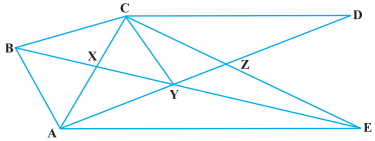
In the figure,$CD \parallel AE$ and $CY \parallel BA$. Prove that $\operatorname{ar}(\triangle CBX) = \operatorname{ar}(\triangle AXY)$.
Solution
(N/A) Given: $CD \parallel AE$ and $CY \parallel BA$.
To prove: $\operatorname{ar}(\triangle CBX) = \operatorname{ar}(\triangle AXY)$.
Proof:
Since $\triangle ABC$ and $\triangle ABY$ are on the same base $AB$ and between the same parallels $CY \parallel BA$,their areas are equal:
$\operatorname{ar}(\triangle ABC) = \operatorname{ar}(\triangle ABY)$
Subtracting $\operatorname{ar}(\triangle ABX)$ from both sides:
$\operatorname{ar}(\triangle ABC) - \operatorname{ar}(\triangle ABX) = \operatorname{ar}(\triangle ABY) - \operatorname{ar}(\triangle ABX)$
From the figure,$\operatorname{ar}(\triangle ABC) - \operatorname{ar}(\triangle ABX) = \operatorname{ar}(\triangle CBX)$ and $\operatorname{ar}(\triangle ABY) - \operatorname{ar}(\triangle ABX) = \operatorname{ar}(\triangle AXY)$.
Therefore,$\operatorname{ar}(\triangle CBX) = \operatorname{ar}(\triangle AXY)$.
Hence proved.
To prove: $\operatorname{ar}(\triangle CBX) = \operatorname{ar}(\triangle AXY)$.
Proof:
Since $\triangle ABC$ and $\triangle ABY$ are on the same base $AB$ and between the same parallels $CY \parallel BA$,their areas are equal:
$\operatorname{ar}(\triangle ABC) = \operatorname{ar}(\triangle ABY)$
Subtracting $\operatorname{ar}(\triangle ABX)$ from both sides:
$\operatorname{ar}(\triangle ABC) - \operatorname{ar}(\triangle ABX) = \operatorname{ar}(\triangle ABY) - \operatorname{ar}(\triangle ABX)$
From the figure,$\operatorname{ar}(\triangle ABC) - \operatorname{ar}(\triangle ABX) = \operatorname{ar}(\triangle CBX)$ and $\operatorname{ar}(\triangle ABY) - \operatorname{ar}(\triangle ABX) = \operatorname{ar}(\triangle AXY)$.
Therefore,$\operatorname{ar}(\triangle CBX) = \operatorname{ar}(\triangle AXY)$.
Hence proved.
0 likes
View Solution38
Difficult
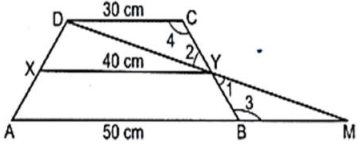
$ABCD$ is a trapezium in which $AB \parallel DC$,$DC = 30 \, cm$ and $AB = 50 \, cm$. If $X$ and $Y$ are,respectively,the mid-points of $AD$ and $BC$,prove that $\operatorname{ar}(DCYX) = \frac{7}{9} \operatorname{ar}(XYBA)$.
Solution
(N/A) In $\Delta MBY$ and $\Delta DCY$,we have:
$\angle 1 = \angle 2$ [Vertically opposite angles]
$\angle 3 = \angle 4$ [Since $AB \parallel DC$ and alternate interior angles are equal]
$BY = CY$ [Since $Y$ is the mid-point of $BC$]
Therefore,$\Delta MBY \cong \Delta DCY$ [By $ASA$ Congruence Rule]
So,$MB = DC = 30 \, cm$ [$CPCT$]
Now,$AM = AB + BM = 50 \, cm + 30 \, cm = 80 \, cm$
In $\Delta ADM$,by the Mid-point Theorem,$XY = \frac{1}{2} AM = \frac{1}{2} \times 80 \, cm = 40 \, cm$
As $AB \parallel XY \parallel DC$ and $X$ and $Y$ are the mid-points of $AD$ and $BC$,the heights of the trapeziums $DCXY$ and $XYBA$ are equal. Let the equal height be $h \, cm$.
$\frac{\operatorname{ar}(DCXY)}{\operatorname{ar}(XYBA)} = \frac{\frac{1}{2}(DC + XY) \times h}{\frac{1}{2}(XY + AB) \times h} = \frac{30 + 40}{40 + 50} = \frac{70}{90} = \frac{7}{9}$
Hence,$\operatorname{ar}(DCXY) = \frac{7}{9} \operatorname{ar}(XYBA)$.
$\angle 1 = \angle 2$ [Vertically opposite angles]
$\angle 3 = \angle 4$ [Since $AB \parallel DC$ and alternate interior angles are equal]
$BY = CY$ [Since $Y$ is the mid-point of $BC$]
Therefore,$\Delta MBY \cong \Delta DCY$ [By $ASA$ Congruence Rule]
So,$MB = DC = 30 \, cm$ [$CPCT$]
Now,$AM = AB + BM = 50 \, cm + 30 \, cm = 80 \, cm$
In $\Delta ADM$,by the Mid-point Theorem,$XY = \frac{1}{2} AM = \frac{1}{2} \times 80 \, cm = 40 \, cm$
As $AB \parallel XY \parallel DC$ and $X$ and $Y$ are the mid-points of $AD$ and $BC$,the heights of the trapeziums $DCXY$ and $XYBA$ are equal. Let the equal height be $h \, cm$.
$\frac{\operatorname{ar}(DCXY)}{\operatorname{ar}(XYBA)} = \frac{\frac{1}{2}(DC + XY) \times h}{\frac{1}{2}(XY + AB) \times h} = \frac{30 + 40}{40 + 50} = \frac{70}{90} = \frac{7}{9}$
Hence,$\operatorname{ar}(DCXY) = \frac{7}{9} \operatorname{ar}(XYBA)$.
0 likes
View Solution39
Medium
In $\triangle ABC,$ if $L$ and $M$ are the points on $AB$ and $AC,$ respectively such that $LM \parallel BC.$ Prove that $\operatorname{ar}(\triangle LOB) = \operatorname{ar}(\triangle MOC).$
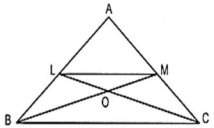
Solution
(N/A) Given: $\triangle ABC$ with $LM \parallel BC,$ where $L$ lies on $AB$ and $M$ lies on $AC.$
Proof:
Since $\triangle LBM$ and $\triangle LCM$ are on the same base $LM$ and between the same parallels $LM$ and $BC,$ their areas are equal.
$\therefore \operatorname{ar}(\triangle LBM) = \operatorname{ar}(\triangle LCM)$
We can write these areas as the sum of two smaller triangles:
$\operatorname{ar}(\triangle LBM) = \operatorname{ar}(\triangle LOM) + \operatorname{ar}(\triangle LOB)$
$\operatorname{ar}(\triangle LCM) = \operatorname{ar}(\triangle LOM) + \operatorname{ar}(\triangle MOC)$
Substituting these into the equality:
$\operatorname{ar}(\triangle LOM) + \operatorname{ar}(\triangle LOB) = \operatorname{ar}(\triangle LOM) + \operatorname{ar}(\triangle MOC)$
Subtracting $\operatorname{ar}(\triangle LOM)$ from both sides,we get:
$\operatorname{ar}(\triangle LOB) = \operatorname{ar}(\triangle MOC)$
Hence proved.
Proof:
Since $\triangle LBM$ and $\triangle LCM$ are on the same base $LM$ and between the same parallels $LM$ and $BC,$ their areas are equal.
$\therefore \operatorname{ar}(\triangle LBM) = \operatorname{ar}(\triangle LCM)$
We can write these areas as the sum of two smaller triangles:
$\operatorname{ar}(\triangle LBM) = \operatorname{ar}(\triangle LOM) + \operatorname{ar}(\triangle LOB)$
$\operatorname{ar}(\triangle LCM) = \operatorname{ar}(\triangle LOM) + \operatorname{ar}(\triangle MOC)$
Substituting these into the equality:
$\operatorname{ar}(\triangle LOM) + \operatorname{ar}(\triangle LOB) = \operatorname{ar}(\triangle LOM) + \operatorname{ar}(\triangle MOC)$
Subtracting $\operatorname{ar}(\triangle LOM)$ from both sides,we get:
$\operatorname{ar}(\triangle LOB) = \operatorname{ar}(\triangle MOC)$
Hence proved.
0 likes
View Solution40
Medium
In the figure,$ABCDE$ is any pentagon. $BP$ is drawn parallel to $AC$ and meets $DC$ produced at $P$,and $EQ$ is drawn parallel to $AD$ and meets $CD$ produced at $Q$. Prove that $\operatorname{ar}(ABCDE) = \operatorname{ar}(APQ)$.
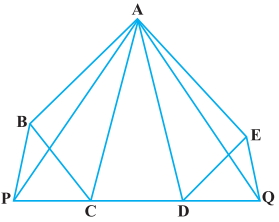
Solution
(N/A) Given: $BP \parallel AC$ and $AD \parallel EQ$.
Since triangles on the same base and between the same parallels are equal in area:
$1$. For $\triangle ABC$ and $\triangle APC$,they are on the same base $AC$ and between the same parallels $BP$ and $AC$. Therefore,$\operatorname{ar}(\triangle ABC) = \operatorname{ar}(\triangle APC) \dots(1)$
$2$. For $\triangle ADE$ and $\triangle ADQ$,they are on the same base $AD$ and between the same parallels $AD$ and $EQ$. Therefore,$\operatorname{ar}(\triangle ADE) = \operatorname{ar}(\triangle ADQ) \dots(2)$
Adding equations $(1)$ and $(2)$,we get:
$\operatorname{ar}(\triangle ABC) + \operatorname{ar}(\triangle ADE) = \operatorname{ar}(\triangle APC) + \operatorname{ar}(\triangle ADQ)$
Adding $\operatorname{ar}(\triangle ACD)$ to both sides:
$\operatorname{ar}(\triangle ABC) + \operatorname{ar}(\triangle ADE) + \operatorname{ar}(\triangle ACD) = \operatorname{ar}(\triangle APC) + \operatorname{ar}(\triangle ADQ) + \operatorname{ar}(\triangle ACD)$
Observing the figure,the left side is the sum of the areas of the triangles forming the pentagon $ABCDE$,and the right side is the sum of the areas forming $\triangle APQ$.
Thus,$\operatorname{ar}(ABCDE) = \operatorname{ar}(\triangle APQ)$.
Since triangles on the same base and between the same parallels are equal in area:
$1$. For $\triangle ABC$ and $\triangle APC$,they are on the same base $AC$ and between the same parallels $BP$ and $AC$. Therefore,$\operatorname{ar}(\triangle ABC) = \operatorname{ar}(\triangle APC) \dots(1)$
$2$. For $\triangle ADE$ and $\triangle ADQ$,they are on the same base $AD$ and between the same parallels $AD$ and $EQ$. Therefore,$\operatorname{ar}(\triangle ADE) = \operatorname{ar}(\triangle ADQ) \dots(2)$
Adding equations $(1)$ and $(2)$,we get:
$\operatorname{ar}(\triangle ABC) + \operatorname{ar}(\triangle ADE) = \operatorname{ar}(\triangle APC) + \operatorname{ar}(\triangle ADQ)$
Adding $\operatorname{ar}(\triangle ACD)$ to both sides:
$\operatorname{ar}(\triangle ABC) + \operatorname{ar}(\triangle ADE) + \operatorname{ar}(\triangle ACD) = \operatorname{ar}(\triangle APC) + \operatorname{ar}(\triangle ADQ) + \operatorname{ar}(\triangle ACD)$
Observing the figure,the left side is the sum of the areas of the triangles forming the pentagon $ABCDE$,and the right side is the sum of the areas forming $\triangle APQ$.
Thus,$\operatorname{ar}(ABCDE) = \operatorname{ar}(\triangle APQ)$.
0 likes
View Solution41
Difficult
If the medians of a $\Delta ABC$ intersect at $G$,show that $\operatorname{ar}(AGB) = \operatorname{ar}(AGC) = \operatorname{ar}(BGC) = \frac{1}{3} \operatorname{ar}(ABC)$.
Solution
(N/A) Given: Medians $AE, BF$ and $CD$ of $\triangle ABC$ intersect at $G$.
To prove: $\operatorname{ar}(\triangle AGB) = \operatorname{ar}(\triangle AGC) = \operatorname{ar}(\triangle BGC) = \frac{1}{3} \operatorname{ar}(\triangle ABC)$.
Construction: Draw $BP \perp AE$.
Proof: $AG = \frac{2}{3} AE$ [Since the centroid divides the median in the ratio $2:1$].
Now,$\operatorname{ar}(\triangle AGB) = \frac{1}{2} \times AG \times BP$
$= \frac{1}{2} \times \frac{2}{3} AE \times BP$
$= \frac{2}{3} \times (\frac{1}{2} \times AE \times BP)$
$= \frac{2}{3} \operatorname{ar}(\triangle ABE)$
$= \frac{2}{3} \times \frac{1}{2} \operatorname{ar}(\triangle ABC)$ [Since the median divides a triangle into two triangles of equal area]
$= \frac{1}{3} \operatorname{ar}(\triangle ABC)$.
Similarly,$\operatorname{ar}(\triangle AGC) = \frac{1}{3} \operatorname{ar}(\triangle ABC)$ and $\operatorname{ar}(\triangle BGC) = \frac{1}{3} \operatorname{ar}(\triangle ABC)$.
Therefore,$\operatorname{ar}(\triangle AGB) = \operatorname{ar}(\triangle AGC) = \operatorname{ar}(\triangle BGC) = \frac{1}{3} \operatorname{ar}(\triangle ABC)$.
Hence,proved.
To prove: $\operatorname{ar}(\triangle AGB) = \operatorname{ar}(\triangle AGC) = \operatorname{ar}(\triangle BGC) = \frac{1}{3} \operatorname{ar}(\triangle ABC)$.
Construction: Draw $BP \perp AE$.
Proof: $AG = \frac{2}{3} AE$ [Since the centroid divides the median in the ratio $2:1$].
Now,$\operatorname{ar}(\triangle AGB) = \frac{1}{2} \times AG \times BP$
$= \frac{1}{2} \times \frac{2}{3} AE \times BP$
$= \frac{2}{3} \times (\frac{1}{2} \times AE \times BP)$
$= \frac{2}{3} \operatorname{ar}(\triangle ABE)$
$= \frac{2}{3} \times \frac{1}{2} \operatorname{ar}(\triangle ABC)$ [Since the median divides a triangle into two triangles of equal area]
$= \frac{1}{3} \operatorname{ar}(\triangle ABC)$.
Similarly,$\operatorname{ar}(\triangle AGC) = \frac{1}{3} \operatorname{ar}(\triangle ABC)$ and $\operatorname{ar}(\triangle BGC) = \frac{1}{3} \operatorname{ar}(\triangle ABC)$.
Therefore,$\operatorname{ar}(\triangle AGB) = \operatorname{ar}(\triangle AGC) = \operatorname{ar}(\triangle BGC) = \frac{1}{3} \operatorname{ar}(\triangle ABC)$.
Hence,proved.
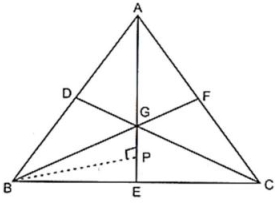
0 likes
View Solution42
Difficult
In the figure,$X$ and $Y$ are the mid-points of $AC$ and $AB$ respectively,$QP \parallel BC$ and $CYQ$ and $BXP$ are straight lines. Prove that $\text{ar}(ABP) = \text{ar}(ACQ).$
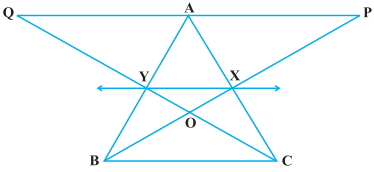
Solution
(N/A) Given: $X$ and $Y$ are mid-points of $AC$ and $AB$ respectively. $QP \parallel BC$.
$1$. Since $X$ and $Y$ are mid-points of $AC$ and $AB$,by the Mid-point Theorem,$XY \parallel BC$.
$2$. Triangles on the same base $BC$ and between the same parallels $XY$ and $BC$ are equal in area.
$\therefore \text{ar}(\triangle B Y C) = \text{ar}(\triangle B X C)$.
$3$. Subtracting $\text{ar}(\triangle BOC)$ from both sides:
$\text{ar}(\triangle B Y C) - \text{ar}(\triangle BOC) = \text{ar}(\triangle B X C) - \text{ar}(\triangle BOC)$
$\Rightarrow \text{ar}(\triangle BOY) = \text{ar}(\triangle COX) \dots(1)$
$4$. Now,consider $\triangle ABY$ and $\triangle ACX$. Since $Y$ and $X$ are mid-points,$\text{ar}(\triangle ABY) = \text{ar}(\triangle ACX)$ (as they have same height and equal bases $AB/2 = AC/2$ is not directly applicable,but rather $\text{ar}(\triangle ABY) = \frac{1}{2} \text{ar}(\triangle ABC)$ and $\text{ar}(\triangle ACX) = \frac{1}{2} \text{ar}(\triangle ABC)$ is incorrect here. Actually,$\triangle ABY$ and $\triangle ACX$ share the same altitude from $A$ to $BC$ and bases are proportional).
$5$. $A$ simpler approach: $\text{ar}(\triangle ABQ) = \text{ar}(\triangle ACQ)$ is not required. We use the property that $\triangle ABQ$ and $\triangle ACP$ have same base and parallels.
$6$. Since $QP \parallel BC$,$\text{ar}(\triangle BQP) = \text{ar}(\triangle CQP)$.
Subtracting $\text{ar}(\triangle AQP)$ is not helpful.
Correct Proof:
Since $XY \parallel BC$ and $QP \parallel BC$,$XY \parallel QP$.
$\text{ar}(\triangle ABQ) = \text{ar}(\triangle ACQ)$ is not necessarily true.
Given the geometry,$\text{ar}(\triangle ABP) = \text{ar}(\triangle ACQ)$ follows from the fact that $\triangle ABQ$ and $\triangle ACP$ are equal in area because they lie between the same parallels $QP$ and $BC$ and share the same base $BC$ is not correct.
Actually,$\text{ar}(\triangle ABQ) = \text{ar}(\triangle ACQ)$ is true because they share the same base $AQ$ and height is same. Similarly for $ABP$ and $ACP$.
$1$. Since $X$ and $Y$ are mid-points of $AC$ and $AB$,by the Mid-point Theorem,$XY \parallel BC$.
$2$. Triangles on the same base $BC$ and between the same parallels $XY$ and $BC$ are equal in area.
$\therefore \text{ar}(\triangle B Y C) = \text{ar}(\triangle B X C)$.
$3$. Subtracting $\text{ar}(\triangle BOC)$ from both sides:
$\text{ar}(\triangle B Y C) - \text{ar}(\triangle BOC) = \text{ar}(\triangle B X C) - \text{ar}(\triangle BOC)$
$\Rightarrow \text{ar}(\triangle BOY) = \text{ar}(\triangle COX) \dots(1)$
$4$. Now,consider $\triangle ABY$ and $\triangle ACX$. Since $Y$ and $X$ are mid-points,$\text{ar}(\triangle ABY) = \text{ar}(\triangle ACX)$ (as they have same height and equal bases $AB/2 = AC/2$ is not directly applicable,but rather $\text{ar}(\triangle ABY) = \frac{1}{2} \text{ar}(\triangle ABC)$ and $\text{ar}(\triangle ACX) = \frac{1}{2} \text{ar}(\triangle ABC)$ is incorrect here. Actually,$\triangle ABY$ and $\triangle ACX$ share the same altitude from $A$ to $BC$ and bases are proportional).
$5$. $A$ simpler approach: $\text{ar}(\triangle ABQ) = \text{ar}(\triangle ACQ)$ is not required. We use the property that $\triangle ABQ$ and $\triangle ACP$ have same base and parallels.
$6$. Since $QP \parallel BC$,$\text{ar}(\triangle BQP) = \text{ar}(\triangle CQP)$.
Subtracting $\text{ar}(\triangle AQP)$ is not helpful.
Correct Proof:
Since $XY \parallel BC$ and $QP \parallel BC$,$XY \parallel QP$.
$\text{ar}(\triangle ABQ) = \text{ar}(\triangle ACQ)$ is not necessarily true.
Given the geometry,$\text{ar}(\triangle ABP) = \text{ar}(\triangle ACQ)$ follows from the fact that $\triangle ABQ$ and $\triangle ACP$ are equal in area because they lie between the same parallels $QP$ and $BC$ and share the same base $BC$ is not correct.
Actually,$\text{ar}(\triangle ABQ) = \text{ar}(\triangle ACQ)$ is true because they share the same base $AQ$ and height is same. Similarly for $ABP$ and $ACP$.
0 likes
View Solution43
Medium
In the figure,$ABCD$ and $AEFD$ are two parallelograms. Prove that $\operatorname{ar}(\triangle PEA) = \operatorname{ar}(\triangle QFD)$.
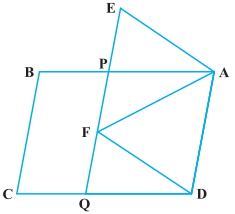
Solution
(N/A) Given: $ABCD$ and $AEFD$ are two parallelograms.
To prove: $\operatorname{ar}(\triangle PEA) = \operatorname{ar}(\triangle QFD)$.
Proof:
In $\triangle PEA$ and $\triangle QFD$:
$1$. $\angle APE = \angle DQF$ (Corresponding angles are equal as $AB \parallel CD$ and $PQ$ is a transversal).
$2$. $\angle AEP = \angle DFQ$ (Corresponding angles are equal as $AE \parallel DF$ and $PQ$ is a transversal).
$3$. $AE = DF$ (Opposite sides of parallelogram $AEFD$ are equal).
Therefore,by $AAS$ congruence rule,$\triangle PEA \cong \triangle QFD$.
Since congruent triangles have equal areas,$\operatorname{ar}(\triangle PEA) = \operatorname{ar}(\triangle QFD)$.
To prove: $\operatorname{ar}(\triangle PEA) = \operatorname{ar}(\triangle QFD)$.
Proof:
In $\triangle PEA$ and $\triangle QFD$:
$1$. $\angle APE = \angle DQF$ (Corresponding angles are equal as $AB \parallel CD$ and $PQ$ is a transversal).
$2$. $\angle AEP = \angle DFQ$ (Corresponding angles are equal as $AE \parallel DF$ and $PQ$ is a transversal).
$3$. $AE = DF$ (Opposite sides of parallelogram $AEFD$ are equal).
Therefore,by $AAS$ congruence rule,$\triangle PEA \cong \triangle QFD$.
Since congruent triangles have equal areas,$\operatorname{ar}(\triangle PEA) = \operatorname{ar}(\triangle QFD)$.
0 likes
View Solution44
Easy
Which of the following figures lie on the same base and between the same parallels? Write the common base and the two parallels for the figure for which the answer is affirmative.
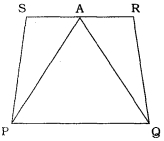
Solution
(N/A) Yes,the trapezium $PQRS$ and the triangle $\Delta APQ$ lie on the same base and between the same parallels.
Common base: $PQ$
Parallel lines: $PQ$ and $SR$.
Common base: $PQ$
Parallel lines: $PQ$ and $SR$.
0 likes
View Solution45
Medium
In the given figure,$ABCD$ is a trapezium with $AB \parallel DC$. $E$ is a point on extended $BC$. Prove that $ar(BDE) = ar(ACED)$.
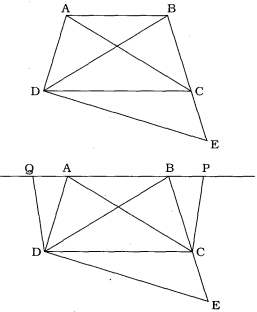
Solution
(N/A) Given: $ABCD$ is a trapezium with $AB \parallel DC$. $E$ is a point on $BC$ produced.
To prove: $ar(BDE) = ar(ACED)$.
Proof:
Triangles $ADC$ and $BDC$ lie on the same base $DC$ and between the same parallels $AB$ and $DC$.
Therefore,$ar(ADC) = ar(BDC)$.
Adding $ar(DCE)$ to both sides of the equation:
$ar(ADC) + ar(DCE) = ar(BDC) + ar(DCE)$
From the figure,$ar(ADC) + ar(DCE) = ar(ACED)$ and $ar(BDC) + ar(DCE) = ar(BDE)$.
Therefore,$ar(ACED) = ar(BDE)$ or $ar(BDE) = ar(ACED)$.
Hence proved.
To prove: $ar(BDE) = ar(ACED)$.
Proof:
Triangles $ADC$ and $BDC$ lie on the same base $DC$ and between the same parallels $AB$ and $DC$.
Therefore,$ar(ADC) = ar(BDC)$.
Adding $ar(DCE)$ to both sides of the equation:
$ar(ADC) + ar(DCE) = ar(BDC) + ar(DCE)$
From the figure,$ar(ADC) + ar(DCE) = ar(ACED)$ and $ar(BDC) + ar(DCE) = ar(BDE)$.
Therefore,$ar(ACED) = ar(BDE)$ or $ar(BDE) = ar(ACED)$.
Hence proved.
0 likes
View Solution46
MediumMCQ
In parallelogram $ABCD$,$AB = 12 \, cm$. Altitudes $DM$ and $DN$ correspond to bases $AB$ and $BC$ respectively. If $DM = 5 \, cm$ and $DN = 6 \, cm$,then find the length of $BC$ in $cm$.
A
$20$
B
$10$
C
$30$
D
$40$
Solution
(B) The area of a parallelogram is the product of its base and the altitude corresponding to that base.
In parallelogram $ABCD$,the area can be calculated using base $AB$ with altitude $DM$,or base $BC$ with altitude $DN$.
Therefore,$\text{Area}(ABCD) = AB \times DM = BC \times DN$.
Given $AB = 12 \, cm$,$DM = 5 \, cm$,and $DN = 6 \, cm$.
Substituting these values: $12 \times 5 = BC \times 6$.
$60 = BC \times 6$.
$BC = \frac{60}{6} = 10 \, cm$.
In parallelogram $ABCD$,the area can be calculated using base $AB$ with altitude $DM$,or base $BC$ with altitude $DN$.
Therefore,$\text{Area}(ABCD) = AB \times DM = BC \times DN$.
Given $AB = 12 \, cm$,$DM = 5 \, cm$,and $DN = 6 \, cm$.
Substituting these values: $12 \times 5 = BC \times 6$.
$60 = BC \times 6$.
$BC = \frac{60}{6} = 10 \, cm$.
0 likes
View Solution47
Difficult
If $E, F, G$ and $H$ are respectively the midpoints of the sides of a parallelogram $ABCD$,show that $ar(EFGH) = \frac{1}{2} ar(ABCD)$.
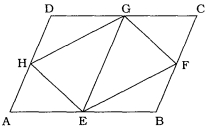
Solution
(N/A) In parallelogram $ABCD$,$E, F, G$ and $H$ are the midpoints of $AB, BC, CD$ and $DA$ respectively. Draw $GE$.
In parallelogram $ABCD$,$AB \parallel CD$ and $AB = CD$.
$\therefore BE \parallel CG$ and $BE = (\frac{1}{2} AB) = CG = (\frac{1}{2} CD)$.
$\therefore$ Quadrilateral $EBCG$ is a parallelogram.
$\therefore GE \parallel BC$.
Now,$\Delta EFG$ and parallelogram $EBCG$ are on the same base $GE$ and between the same parallels $GE$ and $BC$.
$\therefore ar(EFG) = \frac{1}{2} ar(EBCG)$ ... $(1)$
Similarly,$\Delta EHG$ and parallelogram $AEGD$ are on the same base $GE$ and between the same parallels $GE$ and $AD$.
$\therefore ar(EHG) = \frac{1}{2} ar(AEGD)$ ... $(2)$
Adding $(1)$ and $(2)$,
$ar(EFG) + ar(EHG) = \frac{1}{2} ar(EBCG) + \frac{1}{2} ar(AEGD)$
$\therefore ar(EFGH) = \frac{1}{2} [ar(EBCG) + ar(AEGD)]$
$\therefore ar(EFGH) = \frac{1}{2} ar(ABCD)$
In parallelogram $ABCD$,$AB \parallel CD$ and $AB = CD$.
$\therefore BE \parallel CG$ and $BE = (\frac{1}{2} AB) = CG = (\frac{1}{2} CD)$.
$\therefore$ Quadrilateral $EBCG$ is a parallelogram.
$\therefore GE \parallel BC$.
Now,$\Delta EFG$ and parallelogram $EBCG$ are on the same base $GE$ and between the same parallels $GE$ and $BC$.
$\therefore ar(EFG) = \frac{1}{2} ar(EBCG)$ ... $(1)$
Similarly,$\Delta EHG$ and parallelogram $AEGD$ are on the same base $GE$ and between the same parallels $GE$ and $AD$.
$\therefore ar(EHG) = \frac{1}{2} ar(AEGD)$ ... $(2)$
Adding $(1)$ and $(2)$,
$ar(EFG) + ar(EHG) = \frac{1}{2} ar(EBCG) + \frac{1}{2} ar(AEGD)$
$\therefore ar(EFGH) = \frac{1}{2} [ar(EBCG) + ar(AEGD)]$
$\therefore ar(EFGH) = \frac{1}{2} ar(ABCD)$
0 likes
View Solution48
Difficult
In the given figure,$P$ is a point in the interior of parallelogram $ABCD$. Show that,
$(1) \operatorname{ar}(APB) + \operatorname{ar}(PCD) = \frac{1}{2} \operatorname{ar}(ABCD)$
$(2) \operatorname{ar}(APD) + \operatorname{ar}(PBC) = \operatorname{ar}(APB) + \operatorname{ar}(PCD)$
$(1) \operatorname{ar}(APB) + \operatorname{ar}(PCD) = \frac{1}{2} \operatorname{ar}(ABCD)$
$(2) \operatorname{ar}(APD) + \operatorname{ar}(PBC) = \operatorname{ar}(APB) + \operatorname{ar}(PCD)$
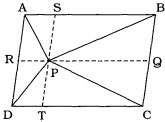
Solution
(N/A) Through $P$,draw a line parallel to $AB$ which intersects $BC$ at $Q$ and $AD$ at $R$.
Now,in quadrilateral $ABQR$,
$AB \parallel QR$ (By construction)
$BQ \parallel AR$ (In parallelogram $ABCD, BC \parallel AD$)
$\therefore$ Quadrilateral $ABQR$ is a parallelogram. Similarly,$DCQR$ is a parallelogram.
$\Delta APB$ and parallelogram $ABQR$ are on the same base $AB$ and between the same parallels $AB$ and $QR$.
$\therefore \operatorname{ar}(APB) = \frac{1}{2} \operatorname{ar}(ABQR) \quad \dots(1)$
Similarly,$\Delta PCD$ and parallelogram $DCQR$ are on the same base $DC$ and between the same parallels $DC$ and $QR$.
$\therefore \operatorname{ar}(PCD) = \frac{1}{2} \operatorname{ar}(DCQR) \quad \dots(2)$
Adding $(1)$ and $(2)$,
$\operatorname{ar}(APB) + \operatorname{ar}(PCD) = \frac{1}{2} \operatorname{ar}(ABQR) + \frac{1}{2} \operatorname{ar}(DCQR)$
$\therefore \operatorname{ar}(APB) + \operatorname{ar}(PCD) = \frac{1}{2} [\operatorname{ar}(ABQR) + \operatorname{ar}(DCQR)]$
$\therefore \operatorname{ar}(APB) + \operatorname{ar}(PCD) = \frac{1}{2} \operatorname{ar}(ABCD) \quad \dots(3)$
Now,through $P$,draw a line parallel to $AD$ which intersects $AB$ at $S$ and $CD$ at $T$.
Then,as above,it can be proved that $\operatorname{ar}(APD) + \operatorname{ar}(PBC) = \frac{1}{2} \operatorname{ar}(ABCD) \quad \dots(4)$
From $(3)$ and $(4)$,
$\operatorname{ar}(APD) + \operatorname{ar}(PBC) = \operatorname{ar}(APB) + \operatorname{ar}(PCD)$
Now,in quadrilateral $ABQR$,
$AB \parallel QR$ (By construction)
$BQ \parallel AR$ (In parallelogram $ABCD, BC \parallel AD$)
$\therefore$ Quadrilateral $ABQR$ is a parallelogram. Similarly,$DCQR$ is a parallelogram.
$\Delta APB$ and parallelogram $ABQR$ are on the same base $AB$ and between the same parallels $AB$ and $QR$.
$\therefore \operatorname{ar}(APB) = \frac{1}{2} \operatorname{ar}(ABQR) \quad \dots(1)$
Similarly,$\Delta PCD$ and parallelogram $DCQR$ are on the same base $DC$ and between the same parallels $DC$ and $QR$.
$\therefore \operatorname{ar}(PCD) = \frac{1}{2} \operatorname{ar}(DCQR) \quad \dots(2)$
Adding $(1)$ and $(2)$,
$\operatorname{ar}(APB) + \operatorname{ar}(PCD) = \frac{1}{2} \operatorname{ar}(ABQR) + \frac{1}{2} \operatorname{ar}(DCQR)$
$\therefore \operatorname{ar}(APB) + \operatorname{ar}(PCD) = \frac{1}{2} [\operatorname{ar}(ABQR) + \operatorname{ar}(DCQR)]$
$\therefore \operatorname{ar}(APB) + \operatorname{ar}(PCD) = \frac{1}{2} \operatorname{ar}(ABCD) \quad \dots(3)$
Now,through $P$,draw a line parallel to $AD$ which intersects $AB$ at $S$ and $CD$ at $T$.
Then,as above,it can be proved that $\operatorname{ar}(APD) + \operatorname{ar}(PBC) = \frac{1}{2} \operatorname{ar}(ABCD) \quad \dots(4)$
From $(3)$ and $(4)$,
$\operatorname{ar}(APD) + \operatorname{ar}(PBC) = \operatorname{ar}(APB) + \operatorname{ar}(PCD)$
0 likes
View Solution49
Easy
In trapezium $ABCD$,$AB || CD$ and diagonals $AC$ and $BD$ intersect at point $O$. Prove that $ar(AOD) = ar(BOC)$.
Solution
(N/A) Given: In trapezium $ABCD$,$AB || CD$ and diagonals $AC$ and $BD$ intersect at point $O$.
To prove: $ar(AOD) = ar(BOC)$.
Proof:
$1$. Triangles $ADC$ and $BDC$ lie on the same base $CD$ and between the same parallels $AB || CD$.
$2$. Therefore,$ar(ADC) = ar(BDC)$ (Triangles on the same base and between the same parallels are equal in area).
$3$. Subtract $ar(DOC)$ from both sides:
$ar(ADC) - ar(DOC) = ar(BDC) - ar(DOC)$.
$4$. From the figure,$ar(ADC) - ar(DOC) = ar(AOD)$ and $ar(BDC) - ar(DOC) = ar(BOC)$.
$5$. Thus,$ar(AOD) = ar(BOC)$.
Hence proved.
To prove: $ar(AOD) = ar(BOC)$.
Proof:
$1$. Triangles $ADC$ and $BDC$ lie on the same base $CD$ and between the same parallels $AB || CD$.
$2$. Therefore,$ar(ADC) = ar(BDC)$ (Triangles on the same base and between the same parallels are equal in area).
$3$. Subtract $ar(DOC)$ from both sides:
$ar(ADC) - ar(DOC) = ar(BDC) - ar(DOC)$.
$4$. From the figure,$ar(ADC) - ar(DOC) = ar(AOD)$ and $ar(BDC) - ar(DOC) = ar(BOC)$.
$5$. Thus,$ar(AOD) = ar(BOC)$.
Hence proved.
1 likes
View Solution50
Easy
In trapezium $PQRS, PQ || RS$ and diagonals $PR$ and $QS$ intersect at point $M$. Prove that,$ar(PQS) = ar(QPR)$.
Solution
(N/A) Given: In trapezium $PQRS$,$PQ || RS$.
To prove: $ar(PQS) = ar(QPR)$.
Proof:
$1$. Triangles $PQS$ and $QPR$ are on the same base $PQ$.
$2$. Since $PQ || RS$,the distance between the parallel lines $PQ$ and $RS$ is constant.
$3$. Therefore,the height of triangle $PQS$ (with base $PQ$) and the height of triangle $QPR$ (with base $PQ$) are equal to the distance between the parallel lines $PQ$ and $RS$.
$4$. We know that the area of a triangle is given by $\frac{1}{2} \times \text{base} \times \text{height}$.
$5$. Since both triangles have the same base $PQ$ and the same height (the distance between $PQ$ and $RS$),their areas must be equal.
$6$. Thus,$ar(PQS) = ar(QPR)$.
To prove: $ar(PQS) = ar(QPR)$.
Proof:
$1$. Triangles $PQS$ and $QPR$ are on the same base $PQ$.
$2$. Since $PQ || RS$,the distance between the parallel lines $PQ$ and $RS$ is constant.
$3$. Therefore,the height of triangle $PQS$ (with base $PQ$) and the height of triangle $QPR$ (with base $PQ$) are equal to the distance between the parallel lines $PQ$ and $RS$.
$4$. We know that the area of a triangle is given by $\frac{1}{2} \times \text{base} \times \text{height}$.
$5$. Since both triangles have the same base $PQ$ and the same height (the distance between $PQ$ and $RS$),their areas must be equal.
$6$. Thus,$ar(PQS) = ar(QPR)$.
0 likes
View SolutionAreas of Parallelograms and Triangles — Mix Examples - Areas of Parallelograms and Triangles · Frequently Asked Questions
1Are these Areas of Parallelograms and Triangles questions useful for JEE and NEET?
Yes. All questions in this section are mapped to JEE Main and NEET exam patterns. Previous year questions from JEE Main, NEET, GUJCET and state-level exams are included with full solutions.
2Can I switch to Hindi or Gujarati for these questions?
Yes. Use the language tabs in the hero section or the sidebar to view the same questions and solutions in English, Hindi or Gujarati.
3How do I generate a question paper from this subtopic?
Use the Vedclass Exam Paper Generator — select the chapter and subtopic, set difficulty, and generate Sets A, B, C, D automatically. First 3 chapters of every subject are free.
Vedclass Products
For Students
Vedclass Test Series
Mock tests in real JEE/NEET style with performance analysis. 5-day free trial.
Start Free TrialFor Teachers
Exam Paper Generator
Generate Set A/B/C/D papers from this chapter in 2 minutes. 3 chapters free.
Try FreeFor Institutes
Online Exam Module
Live online exams with unlimited students, 360° analytics & white-label branding.
See DemoFor Teachers & Institutes
Generate a Areas of Parallelograms and Triangles Exam Paper in 2 Minutes
Select subtopic & difficulty — Sets A, B, C, D auto-generated with No Repeat logic.
First 3 chapters of every subject are free — no payment required.