
A English
Nuclear Fission, Fusion and Nuclear Reactor Questions in English
Class 12 Physics · Nuclei · Nuclear Fission, Fusion and Nuclear Reactor
345+
Questions
English
Language
100%
With Solutions
Showing 50 of 345 questions in English
51
MediumMCQ
Energy released in the fusion of $1\, kg$ of deuterium nuclei is:
A
$8 \times 10^{13}\,J$
B
$6 \times 10^{27}\,J$
C
$2 \times 10^7\,kWh$
D
$8 \times 10^{23}\,MeV$
Solution
(A) The fusion reaction of deuterium is given by: $_1H^2 + _1H^2 \to _2He^3 + _0n^1 + 3.27\,MeV$.
In $1\, kg$ of deuterium $(^2H)$,the number of atoms is $N = \frac{1000}{2} \times 6.022 \times 10^{23} = 3.011 \times 10^{26}$ atoms.
Since each fusion reaction involves two deuterium nuclei,the number of fusion events is $N_{fusion} = \frac{N}{2} = 1.5055 \times 10^{26}$.
The energy released per reaction is $3.27\,MeV = 3.27 \times 1.602 \times 10^{-13}\,J \approx 5.238 \times 10^{-13}\,J$.
Total energy $E = N_{fusion} \times 5.238 \times 10^{-13}\,J = 1.5055 \times 10^{26} \times 5.238 \times 10^{-13} \approx 7.88 \times 10^{13}\,J$.
Rounding this gives approximately $8 \times 10^{13}\,J$.
In $1\, kg$ of deuterium $(^2H)$,the number of atoms is $N = \frac{1000}{2} \times 6.022 \times 10^{23} = 3.011 \times 10^{26}$ atoms.
Since each fusion reaction involves two deuterium nuclei,the number of fusion events is $N_{fusion} = \frac{N}{2} = 1.5055 \times 10^{26}$.
The energy released per reaction is $3.27\,MeV = 3.27 \times 1.602 \times 10^{-13}\,J \approx 5.238 \times 10^{-13}\,J$.
Total energy $E = N_{fusion} \times 5.238 \times 10^{-13}\,J = 1.5055 \times 10^{26} \times 5.238 \times 10^{-13} \approx 7.88 \times 10^{13}\,J$.
Rounding this gives approximately $8 \times 10^{13}\,J$.
0 likes
View Solution52
EasyMCQ
The best neutron moderator is:
A
Beryllium oxide
B
Pure water
C
Heavy water
D
Graphite
Solution
(C) neutron moderator is a medium that reduces the speed of fast neutrons,typically emitted from nuclear fission,so they can sustain a chain reaction.
Heavy water $(D_2O)$ is considered the best neutron moderator because it has a very low neutron absorption cross-section compared to ordinary water,while its deuterium atoms are effective at slowing down neutrons through elastic collisions.
Therefore,heavy water is the most efficient moderator for nuclear reactors.
Heavy water $(D_2O)$ is considered the best neutron moderator because it has a very low neutron absorption cross-section compared to ordinary water,while its deuterium atoms are effective at slowing down neutrons through elastic collisions.
Therefore,heavy water is the most efficient moderator for nuclear reactors.
0 likes
View Solution53
EasyMCQ
Nuclear fission was discovered by
A
Otto Hahn and $F$. Strassmann
B
Fermi
C
Bethe
D
Rutherford
Solution
(A) Nuclear fission was discovered in $1938$ by the German chemists Otto Hahn and Fritz Strassmann. They observed that when uranium was bombarded with neutrons,it split into lighter elements like barium. This discovery was later explained by Lise Meitner and Otto Frisch. Therefore,the correct option is $A$.
0 likes
View Solution54
EasyMCQ
Boron rods in a nuclear reactor are used as a
A
Moderator
B
Control rods
C
Coolants
D
Protective shield
Solution
(B) Control rods are used in nuclear reactors to control the fission rate of uranium and plutonium.
This is achieved by absorbing the excess neutrons from the reactor core.
The process relies on materials that possess a strong neutron absorption capacity.
Boron is one such element.
By regulating the insertion of boron rods into the reactor core during the fission process,the excess neutrons produced during the chain reaction are absorbed,thereby regulating the availability of neutrons and maintaining a steady reaction rate.
This is achieved by absorbing the excess neutrons from the reactor core.
The process relies on materials that possess a strong neutron absorption capacity.
Boron is one such element.
By regulating the insertion of boron rods into the reactor core during the fission process,the excess neutrons produced during the chain reaction are absorbed,thereby regulating the availability of neutrons and maintaining a steady reaction rate.
0 likes
View Solution55
MediumMCQ
If the energy released in the fission of one nucleus is $200 \, MeV$, then the number of nuclei required per second in a power plant of $16 \, kW$ will be:
A
$0.5 \times 10^{14}$
B
$0.5 \times 10^{12}$
C
$5 \times 10^{12}$
D
$5 \times 10^{14}$
Solution
(D) Energy released in the fission of one nucleus $E = 200 \, MeV$.
Converting this into Joules: $E = 200 \times 10^6 \times 1.6 \times 10^{-19} \, J = 3.2 \times 10^{-11} \, J$.
The power of the plant is $P = 16 \, kW = 16 \times 10^3 \, W$.
The number of nuclei required per second $n$ is given by the ratio of power to the energy released per nucleus:
$n = \frac{P}{E} = \frac{16 \times 10^3}{3.2 \times 10^{-11}} = 5 \times 10^{14} \, \text{nuclei/s}$.
Converting this into Joules: $E = 200 \times 10^6 \times 1.6 \times 10^{-19} \, J = 3.2 \times 10^{-11} \, J$.
The power of the plant is $P = 16 \, kW = 16 \times 10^3 \, W$.
The number of nuclei required per second $n$ is given by the ratio of power to the energy released per nucleus:
$n = \frac{P}{E} = \frac{16 \times 10^3}{3.2 \times 10^{-11}} = 5 \times 10^{14} \, \text{nuclei/s}$.
0 likes
View Solution56
MediumMCQ
To generate a power of $3.2 \text{ MW}$,the number of fissions of $^{235}\text{U}$ per minute is (Energy released per fission $= 200 \text{ MeV}$,$1 \text{ eV} = 1.6 \times 10^{-19} \text{ J}$)
A
$6 \times 10^{18}$
B
$6 \times 10^{17}$
C
$10^{17}$
D
$6 \times 10^{16}$
Solution
(A) Given: Power $P = 3.2 \text{ MW} = 3.2 \times 10^6 \text{ J/s}$.
Energy released per fission $E = 200 \text{ MeV} = 200 \times 10^6 \times 1.6 \times 10^{-19} \text{ J} = 3.2 \times 10^{-11} \text{ J}$.
Number of fissions per second $n = \frac{P}{E} = \frac{3.2 \times 10^6}{3.2 \times 10^{-11}} = 10^{17} \text{ fissions/s}$.
Number of fissions per minute $= n \times 60 = 10^{17} \times 60 = 6 \times 10^{18} \text{ fissions/min}$.
Energy released per fission $E = 200 \text{ MeV} = 200 \times 10^6 \times 1.6 \times 10^{-19} \text{ J} = 3.2 \times 10^{-11} \text{ J}$.
Number of fissions per second $n = \frac{P}{E} = \frac{3.2 \times 10^6}{3.2 \times 10^{-11}} = 10^{17} \text{ fissions/s}$.
Number of fissions per minute $= n \times 60 = 10^{17} \times 60 = 6 \times 10^{18} \text{ fissions/min}$.
0 likes
View Solution57
EasyMCQ
The average number of prompt neutrons produced per fission of ${U^{235}}$ is
A
More than $5$
B
$3$ to $5$
C
$2$ to $3$
D
$1$ to $2$
Solution
(C) In the process of nuclear fission of ${U^{235}}$ induced by thermal neutrons,the nucleus splits into two lighter fragments and releases energy along with several neutrons.
Experimental measurements show that the average number of neutrons produced per fission of ${U^{235}}$ is approximately $2.4$ to $2.5$.
Therefore,the value lies in the range of $2$ to $3$.
Thus,the correct option is $C$.
Experimental measurements show that the average number of neutrons produced per fission of ${U^{235}}$ is approximately $2.4$ to $2.5$.
Therefore,the value lies in the range of $2$ to $3$.
Thus,the correct option is $C$.
0 likes
View Solution58
EasyMCQ
In an atomic bomb,the energy is released due to
A
Chain reaction of neutrons and $_{92}U^{235}$
B
Chain reaction of neutrons and $_{92}U^{238}$
C
Chain reaction of neutrons and $_{92}Pu^{240}$
D
Chain reaction of neutrons and $_{92}U^{236}$
Solution
(A) In an atomic bomb,the energy is released due to the uncontrolled chain reaction of neutrons and $_{92}U^{235}$.
The nuclear fission reaction taking place is as follows:
$_{92}U^{235} + _{0}n^{1} \rightarrow _{56}Ba^{141} + _{36}Kr^{92} + 3_{0}n^{1} + Q \text{ (approx. } 200 \text{ MeV energy)}$.
The three neutrons generated in each fission event can react with three other $_{92}U^{235}$ nuclei,which leads to a self-sustaining chain reaction,releasing a massive amount of energy in a very short time.
The nuclear fission reaction taking place is as follows:
$_{92}U^{235} + _{0}n^{1} \rightarrow _{56}Ba^{141} + _{36}Kr^{92} + 3_{0}n^{1} + Q \text{ (approx. } 200 \text{ MeV energy)}$.
The three neutrons generated in each fission event can react with three other $_{92}U^{235}$ nuclei,which leads to a self-sustaining chain reaction,releasing a massive amount of energy in a very short time.
0 likes
View Solution59
MediumMCQ
The binding energy per nucleon for ${}_1^2H$ and ${}_2^4He$ are $1.1 \; MeV$ and $7.1 \; MeV$ respectively. The energy released in $MeV$ when two ${}_1^2H$ nuclei fuse to form one ${}_2^4He$ nucleus is:
A
$4.4$
B
$24$
C
$8.2$
D
$13.9$
Solution
(B) The nuclear fusion reaction is given by: ${}_1^2H + {}_1^2H \to {}_2^4He + Q$.
Total binding energy of the reactants: $2 \times (2 \times 1.1 \; MeV) = 4.4 \; MeV$.
Total binding energy of the product: $4 \times 7.1 \; MeV = 28.4 \; MeV$.
The energy released $Q$ is the difference between the total binding energy of the product and the reactants:
$Q = 28.4 \; MeV - 4.4 \; MeV = 24 \; MeV$.
Total binding energy of the reactants: $2 \times (2 \times 1.1 \; MeV) = 4.4 \; MeV$.
Total binding energy of the product: $4 \times 7.1 \; MeV = 28.4 \; MeV$.
The energy released $Q$ is the difference between the total binding energy of the product and the reactants:
$Q = 28.4 \; MeV - 4.4 \; MeV = 24 \; MeV$.
0 likes
View Solution60
DifficultMCQ
The energy liberated on complete fission of $1\, kg$ of $_{92}{U^{235}}$ is (Assume $200\, MeV$ energy is liberated on fission of $1$ nucleus).
A
$8.2 \times 10^{10}\, J$
B
$8.2 \times 10^{9}\, J$
C
$8.2 \times 10^{13}\, J$
D
$8.2 \times 10^{16}\, J$
Solution
(C) The number of nuclei in $1\, kg$ of $_{92}{U^{235}}$ is calculated using Avogadro's number $(N_A = 6.023 \times 10^{23}\, \text{atoms/mol})$.
Number of nuclei $N = \frac{\text{mass}}{\text{molar mass}} \times N_A = \frac{1000\, g}{235\, g/mol} \times 6.023 \times 10^{23}\, \text{nuclei/mol}$.
$N \approx 2.563 \times 10^{24}\, \text{nuclei}$.
Energy released per nucleus is $200\, MeV$.
Total energy $E = N \times 200\, MeV = 2.563 \times 10^{24} \times 200 \times 1.602 \times 10^{-13}\, J$.
$E \approx 8.21 \times 10^{13}\, J$.
Thus, the correct option is $C$.
Number of nuclei $N = \frac{\text{mass}}{\text{molar mass}} \times N_A = \frac{1000\, g}{235\, g/mol} \times 6.023 \times 10^{23}\, \text{nuclei/mol}$.
$N \approx 2.563 \times 10^{24}\, \text{nuclei}$.
Energy released per nucleus is $200\, MeV$.
Total energy $E = N \times 200\, MeV = 2.563 \times 10^{24} \times 200 \times 1.602 \times 10^{-13}\, J$.
$E \approx 8.21 \times 10^{13}\, J$.
Thus, the correct option is $C$.
0 likes
View Solution61
EasyMCQ
Which one of the following statements about uranium is correct?
A
$^{235}U$ is fissionable by thermal neutrons.
B
Fast neutrons trigger the fission process in $^{235}U$.
C
$^{238}U$ breaks up into fragments when bombarded by slow neutrons.
D
$^{235}U$ is an unstable isotope and undergoes spontaneous fission.
Solution
(A) $^{235}U$ is a fissile isotope,meaning it can undergo nuclear fission when it captures a thermal (slow) neutron. This process releases energy and additional neutrons,which can sustain a chain reaction. In contrast,$^{238}U$ is fertile but not fissile with thermal neutrons; it requires fast neutrons to undergo fission,and even then,it is much less likely to fission compared to $^{235}U$. Spontaneous fission is a rare decay mode for $^{235}U$ compared to alpha decay. Therefore,the statement that $^{235}U$ is fissionable by thermal neutrons is correct.
0 likes
View Solution62
EasyMCQ
In nuclear fission,the percentage of mass converted into energy is about: (in $\%$)
A
$10$
B
$0.01$
C
$0.1$
D
$1$
Solution
(C) The binding energy per nucleon of fission products is approximately $8.5 \text{ MeV}$.
The binding energy per nucleon of the reactants (heavy nuclei like Uranium) is approximately $7.6 \text{ MeV}$.
The increase in binding energy per nucleon is $8.5 \text{ MeV} - 7.6 \text{ MeV} = 0.9 \text{ MeV}$.
The energy released per nucleon in fission is $0.9 \text{ MeV}$.
The fractional energy released is given by the ratio of energy released to the rest mass energy per nucleon,which is approximately $\frac{0.9 \text{ MeV}}{931 \text{ MeV}} \approx \frac{1}{1000} = 0.001$.
Therefore,the percentage of mass converted into energy during fission is $0.001 \times 100 = 0.1\%$.
The binding energy per nucleon of the reactants (heavy nuclei like Uranium) is approximately $7.6 \text{ MeV}$.
The increase in binding energy per nucleon is $8.5 \text{ MeV} - 7.6 \text{ MeV} = 0.9 \text{ MeV}$.
The energy released per nucleon in fission is $0.9 \text{ MeV}$.
The fractional energy released is given by the ratio of energy released to the rest mass energy per nucleon,which is approximately $\frac{0.9 \text{ MeV}}{931 \text{ MeV}} \approx \frac{1}{1000} = 0.001$.
Therefore,the percentage of mass converted into energy during fission is $0.001 \times 100 = 0.1\%$.
0 likes
View Solution63
EasyMCQ
In a material medium,when a positron meets an electron,both particles annihilate,leading to the emission of two gamma-ray photons. This process forms the basis of an important diagnostic procedure called:
A
$MRI$
B
$PET$
C
$CAT$
D
$SPECT$
Solution
(B) When a positron $(e^+)$ encounters an electron $(e^-)$,they annihilate each other because they are particle-antiparticle pairs.
This annihilation process results in the conversion of their mass-energy into two gamma-ray photons,typically emitted in opposite directions to conserve momentum.
This physical phenomenon is the fundamental principle behind Positron Emission Tomography,commonly abbreviated as $PET$ scan,which is used in medical diagnostics to image metabolic processes in the body.
This annihilation process results in the conversion of their mass-energy into two gamma-ray photons,typically emitted in opposite directions to conserve momentum.
This physical phenomenon is the fundamental principle behind Positron Emission Tomography,commonly abbreviated as $PET$ scan,which is used in medical diagnostics to image metabolic processes in the body.
0 likes
View Solution64
MediumMCQ
The nuclear reaction $^2H + ^2H \to ^4He$ (mass of deuteron $= 2.0141 \,amu$ and mass of $He = 4.0024 \,amu$) is
A
Fusion reaction releasing $24 \,MeV$ energy
B
Fusion reaction absorbing $24 \,MeV$ energy
C
Fission reaction releasing $0.0258 \,MeV$ energy
D
Fission reaction absorbing $0.0258 \,MeV$ energy
Solution
(A) The reaction $^2H + ^2H \to ^4He$ involves the combination of two light nuclei to form a heavier nucleus,which is a nuclear fusion reaction.
Total mass of reactants $= 2 \times 2.0141 \,amu = 4.0282 \,amu$.
Total mass of products $= 4.0024 \,amu$.
Mass defect $\Delta m = \text{Mass of reactants} - \text{Mass of products} = 4.0282 \,amu - 4.0024 \,amu = 0.0258 \,amu$.
Energy released $E = \Delta m \times 931 \,MeV/amu = 0.0258 \times 931 \approx 24 \,MeV$.
Since energy is released,it is an exothermic fusion reaction.
Total mass of reactants $= 2 \times 2.0141 \,amu = 4.0282 \,amu$.
Total mass of products $= 4.0024 \,amu$.
Mass defect $\Delta m = \text{Mass of reactants} - \text{Mass of products} = 4.0282 \,amu - 4.0024 \,amu = 0.0258 \,amu$.
Energy released $E = \Delta m \times 931 \,MeV/amu = 0.0258 \times 931 \approx 24 \,MeV$.
Since energy is released,it is an exothermic fusion reaction.
0 likes
View Solution65
EasyMCQ
$A$ $\pi^0$ meson at rest decays into $2$ $\gamma$ rays: $\pi^0 \to \gamma + \gamma$. Which of the following must happen?
A
The two $\gamma$ rays move in the same direction.
B
The two $\gamma$ rays move in opposite directions.
C
Both repel each other.
D
Both attract each other.
Solution
(B) Since the $\pi^0$ meson is initially at rest,its initial linear momentum is $0$.
According to the law of conservation of linear momentum,the total final momentum of the system must also be $0$.
Let the momenta of the two $\gamma$ rays be $\vec{p}_1$ and $\vec{p}_2$. Then,$\vec{p}_1 + \vec{p}_2 = 0$,which implies $\vec{p}_1 = -\vec{p}_2$.
This indicates that the two $\gamma$ rays must move in exactly opposite directions to ensure the total momentum remains $0$.
According to the law of conservation of linear momentum,the total final momentum of the system must also be $0$.
Let the momenta of the two $\gamma$ rays be $\vec{p}_1$ and $\vec{p}_2$. Then,$\vec{p}_1 + \vec{p}_2 = 0$,which implies $\vec{p}_1 = -\vec{p}_2$.
This indicates that the two $\gamma$ rays must move in exactly opposite directions to ensure the total momentum remains $0$.
0 likes
View Solution66
EasyMCQ
Which of the following are suitable for the fusion process?
A
Heavy nuclei
B
Light nuclei
C
Atom bomb
D
Radioactive decay
Solution
(B) The nuclei of light elements have a lower binding energy per nucleon than that for the elements of intermediate mass. They are therefore less stable. Consequently,the fusion of light elements results in a more stable nucleus with a higher binding energy per nucleon,releasing a large amount of energy.
0 likes
View Solution67
EasyMCQ
The function of a moderator in a nuclear reactor is:
A
To control the velocity of neutrons
B
To cool the reactor
C
To act as nuclear fuel
D
To provide safety
Solution
(A) In a nuclear reactor,fast neutrons produced during fission are difficult to capture by $U^{235}$ nuclei. $A$ moderator (such as heavy water or graphite) is used to slow down these fast neutrons to thermal energies (about $0.025 \ eV$),which increases the probability of further fission reactions. Therefore,the primary function of a moderator is to control the velocity of neutrons by slowing them down.
0 likes
View Solution68
EasyMCQ
Light energy emitted by stars is due to
A
Breaking of nuclei
B
Joining of nuclei
C
Burning of nuclei
D
Reflection of solar light
Solution
(B) The light energy emitted by stars is primarily due to the process of nuclear fusion.
In the core of stars,hydrogen nuclei (protons) undergo fusion to form helium nuclei.
This process of joining of nuclei releases a tremendous amount of energy in the form of light and heat,as the mass of the resulting nucleus is slightly less than the sum of the masses of the individual nuclei,with the mass defect being converted into energy according to Einstein's mass-energy equivalence principle,$E = \Delta mc^2$.
In the core of stars,hydrogen nuclei (protons) undergo fusion to form helium nuclei.
This process of joining of nuclei releases a tremendous amount of energy in the form of light and heat,as the mass of the resulting nucleus is slightly less than the sum of the masses of the individual nuclei,with the mass defect being converted into energy according to Einstein's mass-energy equivalence principle,$E = \Delta mc^2$.
0 likes
View Solution69
EasyMCQ
Solar energy is mainly caused due to
A
Fission of uranium present in the sun
B
Fusion of protons during synthesis of heavier elements
C
Gravitational contraction
D
Burning of hydrogen in the oxygen
Solution
(B) The primary source of solar energy is the nuclear fusion process occurring in the core of the sun.
In this process,hydrogen nuclei (protons) fuse together to form heavier elements like helium.
This fusion reaction releases an enormous amount of energy in the form of heat and light due to the mass defect between the reactants and the products.
In this process,hydrogen nuclei (protons) fuse together to form heavier elements like helium.
This fusion reaction releases an enormous amount of energy in the form of heat and light due to the mass defect between the reactants and the products.
0 likes
View Solution70
EasyMCQ
The nuclear reactor at Kaiga is a
A
Fusion reactor
B
Research reactor
C
Power reactor
D
Breeder reactor
Solution
(C) The Kaiga Generating Station is a nuclear power generating station located at Kaiga,near the Kali river,in the Uttar Kannada district of Karnataka,India. It is primarily used for the generation of electricity,making it a power reactor.
0 likes
View Solution71
EasyMCQ
Heavy water is
A
Water at $4^oC$
B
Compound of deuterium and oxygen
C
Compound of heavy oxygen and heavy hydrogen
D
Water,in which soap does not lather
Solution
(B) Heavy water is water that contains heavy hydrogen or deuterium.
Deuterium differs from the hydrogen usually found in water (protium) in that each atom of deuterium contains a proton and a neutron.
Heavy water is chemically represented as deuterium oxide,$D_2O$.
It occurs naturally in small quantities compared to regular water $(H_2O)$ and is commonly used as a moderator in nuclear reactors.
Deuterium differs from the hydrogen usually found in water (protium) in that each atom of deuterium contains a proton and a neutron.
Heavy water is chemically represented as deuterium oxide,$D_2O$.
It occurs naturally in small quantities compared to regular water $(H_2O)$ and is commonly used as a moderator in nuclear reactors.
0 likes
View Solution72
EasyMCQ
If in a nuclear fusion process the masses of the fusing nuclei are ${m_1}$ and ${m_2}$ and the mass of the resultant nucleus is ${m_3}$, then
A
${m_3} = {m_1} + {m_2}$
B
${m_3} = |{m_1} + {m_2}|$
C
${m_3} < ({m_1} + {m_2})$
D
${m_3} > ({m_1} + {m_2})$
Solution
(C) In a nuclear fusion process, the mass of the resultant nucleus is always less than the sum of the masses of the initial nuclei.
This difference in mass is known as the mass defect $(\Delta m)$, which is converted into energy according to Einstein's mass-energy equivalence principle, $E = \Delta m c^2$.
Therefore, the relationship is ${m_3} < ({m_1} + {m_2})$.
Here, ${m_3}$ is the mass of the resultant nucleus, and ${m_1}$ and ${m_2}$ are the masses of the initial fusing nuclei.
This difference in mass is known as the mass defect $(\Delta m)$, which is converted into energy according to Einstein's mass-energy equivalence principle, $E = \Delta m c^2$.
Therefore, the relationship is ${m_3} < ({m_1} + {m_2})$.
Here, ${m_3}$ is the mass of the resultant nucleus, and ${m_1}$ and ${m_2}$ are the masses of the initial fusing nuclei.
0 likes
View Solution73
EasyMCQ
Complete the reaction: $n + _{92}^{235}U \to _{56}^{144}Ba + .... + 3n$
A
$_{36}^{89}Kr$
B
$_{36}^{90}Kr$
C
$_{36}^{91}Kr$
D
$_{36}^{92}Kr$
Solution
(A) In a nuclear fission reaction, both the mass number and the atomic number must be conserved on both sides of the equation.
Let the missing nucleus be $_{Z}^{A}X$.
The reaction is: $_{0}^{1}n + _{92}^{235}U \to _{56}^{144}Ba + _{Z}^{A}X + 3(_{0}^{1}n)$.
Conservation of atomic number (charge): $0 + 92 = 56 + Z + 3(0) \implies 92 = 56 + Z \implies Z = 36$.
The element with atomic number $36$ is Krypton $(Kr)$.
Conservation of mass number: $1 + 235 = 144 + A + 3(1) \implies 236 = 147 + A \implies A = 89$.
Therefore, the missing nucleus is $_{36}^{89}Kr$.
Let the missing nucleus be $_{Z}^{A}X$.
The reaction is: $_{0}^{1}n + _{92}^{235}U \to _{56}^{144}Ba + _{Z}^{A}X + 3(_{0}^{1}n)$.
Conservation of atomic number (charge): $0 + 92 = 56 + Z + 3(0) \implies 92 = 56 + Z \implies Z = 36$.
The element with atomic number $36$ is Krypton $(Kr)$.
Conservation of mass number: $1 + 235 = 144 + A + 3(1) \implies 236 = 147 + A \implies A = 89$.
Therefore, the missing nucleus is $_{36}^{89}Kr$.
0 likes
View Solution74
EasyMCQ
The nucleus $_{92}U^{234}$ splits exactly in half in a fission reaction in which two neutrons are released. The resultant nuclei are
A
$_{46}Pd^{116}$
B
$_{45}Rh^{117}$
C
$_{45}Rh^{116}$
D
$_{46}Pd^{117}$
Solution
(A) The fission reaction is given by: $_{92}U^{234} \rightarrow 2(_{Z}X^{A}) + 2(_{0}n^{1})$.
Applying the law of conservation of mass number: $234 = 2A + 2(1) \Rightarrow 234 = 2A + 2 \Rightarrow 2A = 232 \Rightarrow A = 116$.
Applying the law of conservation of atomic number: $92 = 2Z + 2(0) \Rightarrow 92 = 2Z \Rightarrow Z = 46$.
The element with atomic number $Z = 46$ is Palladium $(Pd)$.
Thus,the resultant nuclei are $_{46}Pd^{116}$.
Applying the law of conservation of mass number: $234 = 2A + 2(1) \Rightarrow 234 = 2A + 2 \Rightarrow 2A = 232 \Rightarrow A = 116$.
Applying the law of conservation of atomic number: $92 = 2Z + 2(0) \Rightarrow 92 = 2Z \Rightarrow Z = 46$.
The element with atomic number $Z = 46$ is Palladium $(Pd)$.
Thus,the resultant nuclei are $_{46}Pd^{116}$.
0 likes
View Solution75
EasyMCQ
In a nuclear reactor,the fuel is consumed at the rate of $1 \, mg/s$. The power generated in kilowatt is
A
$9 \times 10^4$
B
$9 \times 10^7$
C
$9 \times 10^8$
D
$9 \times 10^{12}$
Solution
(B) The power $P$ generated is given by the rate of energy release,$P = \frac{E}{t}$.
Using Einstein's mass-energy equivalence,$E = mc^2$,where $m$ is the mass consumed per unit time.
Given: $m/t = 1 \, mg/s = 1 \times 10^{-6} \, kg/s$ and $c = 3 \times 10^8 \, m/s$.
Substituting the values:
$P = (m/t) \times c^2$
$P = (1 \times 10^{-6} \, kg/s) \times (3 \times 10^8 \, m/s)^2$
$P = 1 \times 10^{-6} \times 9 \times 10^{16} \, W$
$P = 9 \times 10^{10} \, W$
Since $1 \, kW = 10^3 \, W$,we convert the power to kilowatts:
$P = \frac{9 \times 10^{10}}{10^3} \, kW = 9 \times 10^7 \, kW$.
Using Einstein's mass-energy equivalence,$E = mc^2$,where $m$ is the mass consumed per unit time.
Given: $m/t = 1 \, mg/s = 1 \times 10^{-6} \, kg/s$ and $c = 3 \times 10^8 \, m/s$.
Substituting the values:
$P = (m/t) \times c^2$
$P = (1 \times 10^{-6} \, kg/s) \times (3 \times 10^8 \, m/s)^2$
$P = 1 \times 10^{-6} \times 9 \times 10^{16} \, W$
$P = 9 \times 10^{10} \, W$
Since $1 \, kW = 10^3 \, W$,we convert the power to kilowatts:
$P = \frac{9 \times 10^{10}}{10^3} \, kW = 9 \times 10^7 \, kW$.
0 likes
View Solution76
EasyMCQ
What is used as a moderator in a nuclear reactor?
A
Water
B
Graphite
C
Cadmium
D
Steel
Solution
(B) substance that is used in a nuclear reactor to slow down the fast-moving neutrons is called a moderator.
Moderators work by scattering neutrons,which reduces their kinetic energy through collisions.
Commonly used moderators include water,heavy water $(D_2O)$,beryllium,and graphite.
Cadmium is typically used as a control rod to absorb neutrons,not as a moderator.
Moderators work by scattering neutrons,which reduces their kinetic energy through collisions.
Commonly used moderators include water,heavy water $(D_2O)$,beryllium,and graphite.
Cadmium is typically used as a control rod to absorb neutrons,not as a moderator.
0 likes
View Solution77
EasyMCQ
$A$ nucleus is bombarded with a high-speed neutron so that the resulting nucleus is a radioactive one. This phenomenon is called:
A
Artificial radioactivity
B
Fusion
C
Fission
D
Radioactivity
Solution
(A) When a stable nucleus is bombarded with particles like neutrons,it can capture the neutron to become an unstable or radioactive isotope. This process of inducing radioactivity in a previously stable nucleus is known as artificial radioactivity or induced radioactivity. Therefore,the correct option is $A$.
0 likes
View Solution78
EasyMCQ
Which of the following cannot cause fission in a heavy nucleus?
A
$\alpha$-particle
B
Proton
C
Deuteron
D
Laser rays
Solution
(D) Nuclear fission is a process where a heavy nucleus splits into smaller nuclei after being struck by a particle. This process typically requires particles with sufficient energy and mass to overcome the Coulomb barrier or induce instability in the nucleus.
$1$. $\alpha$-particles,protons,and deuterons are charged particles that can interact with the nucleus through the strong nuclear force or by overcoming the electrostatic repulsion (Coulomb barrier) to induce fission.
$2$. Laser rays consist of photons. While high-energy gamma rays (photons) can cause photofission,standard laser rays (visible or infrared light) lack the energy required to overcome the binding energy of a heavy nucleus to induce fission.
Therefore,laser rays cannot cause fission in a heavy nucleus.
$1$. $\alpha$-particles,protons,and deuterons are charged particles that can interact with the nucleus through the strong nuclear force or by overcoming the electrostatic repulsion (Coulomb barrier) to induce fission.
$2$. Laser rays consist of photons. While high-energy gamma rays (photons) can cause photofission,standard laser rays (visible or infrared light) lack the energy required to overcome the binding energy of a heavy nucleus to induce fission.
Therefore,laser rays cannot cause fission in a heavy nucleus.
0 likes
View Solution79
MediumMCQ
If in a nuclear fission,a piece of uranium of mass $0.5\, g$ is lost,the energy obtained in $kWh$ is
A
$1.25 \times 10^7$
B
$2.25 \times 10^7$
C
$3.25 \times 10^7$
D
$0.25 \times 10^7$
Solution
(A) The energy released in a nuclear process is given by Einstein's mass-energy equivalence formula: $E = \Delta m c^2$.
Given mass loss $\Delta m = 0.5\, g = 0.5 \times 10^{-3}\, kg$.
The speed of light $c = 3 \times 10^8\, m/s$.
Substituting the values: $E = (0.5 \times 10^{-3}) \times (3 \times 10^8)^2 = 0.5 \times 10^{-3} \times 9 \times 10^{16} = 4.5 \times 10^{13}\, J$.
To convert energy from Joules $(J)$ to kilowatt-hours $(kWh)$,we divide by $3.6 \times 10^6\, J/kWh$:
$E = \frac{4.5 \times 10^{13}}{3.6 \times 10^6} = 1.25 \times 10^7\, kWh$.
Given mass loss $\Delta m = 0.5\, g = 0.5 \times 10^{-3}\, kg$.
The speed of light $c = 3 \times 10^8\, m/s$.
Substituting the values: $E = (0.5 \times 10^{-3}) \times (3 \times 10^8)^2 = 0.5 \times 10^{-3} \times 9 \times 10^{16} = 4.5 \times 10^{13}\, J$.
To convert energy from Joules $(J)$ to kilowatt-hours $(kWh)$,we divide by $3.6 \times 10^6\, J/kWh$:
$E = \frac{4.5 \times 10^{13}}{3.6 \times 10^6} = 1.25 \times 10^7\, kWh$.
0 likes
View Solution80
EasyMCQ
When $^{235}_{92}U$ is bombarded with one neutron,fission occurs and the products are three neutrons,$^{94}_{36}Kr$ and:
A
$^{142}_{53}I$
B
$^{139}_{56}Ba$
C
$^{139}_{58}Ce$
D
$^{139}_{54}Xe$
Solution
(B) The nuclear fission reaction is given by the conservation of mass number and atomic number.
The reaction is: $^1_0n + ^{235}_{92}U \rightarrow ^{94}_{36}Kr + X + 3(^1_0n)$.
Let the unknown product $X$ be $^{A}_{Z}Y$.
Equating the mass numbers: $1 + 235 = 94 + A + 3(1) \Rightarrow 236 = 97 + A \Rightarrow A = 139$.
Equating the atomic numbers: $0 + 92 = 36 + Z + 3(0) \Rightarrow 92 = 36 + Z \Rightarrow Z = 56$.
The element with atomic number $56$ is Barium $(Ba)$.
Thus,the product is $^{139}_{56}Ba$.
The reaction is: $^1_0n + ^{235}_{92}U \rightarrow ^{94}_{36}Kr + X + 3(^1_0n)$.
Let the unknown product $X$ be $^{A}_{Z}Y$.
Equating the mass numbers: $1 + 235 = 94 + A + 3(1) \Rightarrow 236 = 97 + A \Rightarrow A = 139$.
Equating the atomic numbers: $0 + 92 = 36 + Z + 3(0) \Rightarrow 92 = 36 + Z \Rightarrow Z = 56$.
The element with atomic number $56$ is Barium $(Ba)$.
Thus,the product is $^{139}_{56}Ba$.
0 likes
View Solution81
EasyMCQ
In any fission process,the ratio $\frac{\text{mass of fission products}}{\text{mass of parent nucleus}}$ is
A
Less than $1$
B
Greater than $1$
C
Equal to $1$
D
Depends on the mass of the parent nucleus
Solution
(A) In a nuclear fission process,a heavy nucleus splits into two or more lighter nuclei.
According to Einstein's mass-energy equivalence principle,$E = mc^2$,the energy released during the process is derived from the mass defect.
Since energy is released,the total mass of the fission products must be less than the mass of the parent nucleus.
Therefore,the ratio $\frac{\text{mass of fission products}}{\text{mass of parent nucleus}} < 1$.
According to Einstein's mass-energy equivalence principle,$E = mc^2$,the energy released during the process is derived from the mass defect.
Since energy is released,the total mass of the fission products must be less than the mass of the parent nucleus.
Therefore,the ratio $\frac{\text{mass of fission products}}{\text{mass of parent nucleus}} < 1$.
0 likes
View Solution82
EasyMCQ
The example of nuclear fusion is
A
Formation of $Ba$ and $Kr$ from $U^{235}$
B
Formation of $He$ from $H$
C
Formation of $Pu-235$ from $U-235$
D
Formation of water from hydrogen and oxygen
Solution
(B) Nuclear fusion is a process in which two or more light nuclei combine to form a single heavier nucleus,releasing a large amount of energy.
In the Sun and stars,$4$ hydrogen nuclei (protons) fuse together to form a single helium nucleus $(He)$.
Therefore,the formation of $He$ from $H$ is a classic example of nuclear fusion.
In the Sun and stars,$4$ hydrogen nuclei (protons) fuse together to form a single helium nucleus $(He)$.
Therefore,the formation of $He$ from $H$ is a classic example of nuclear fusion.
0 likes
View Solution83
EasyMCQ
Which of the following isotopes is used for the treatment of cancer?
A
$K^{40}$
B
$Co^{60}$
C
$Sr^{90}$
D
$I^{131}$
Solution
(B) The correct option is $B$.
Cobalt therapy or cobalt-$60$ therapy is the medical use of gamma rays emitted from the radioisotope cobalt-$60$ $(Co^{60})$ to treat various conditions,most notably cancer. The high-energy gamma radiation is used to damage the $DNA$ of cancer cells,thereby inhibiting their growth and division.
Cobalt therapy or cobalt-$60$ therapy is the medical use of gamma rays emitted from the radioisotope cobalt-$60$ $(Co^{60})$ to treat various conditions,most notably cancer. The high-energy gamma radiation is used to damage the $DNA$ of cancer cells,thereby inhibiting their growth and division.
0 likes
View Solution84
EasyMCQ
The large-scale destruction that would be caused due to the use of nuclear weapons is called:
A
Nuclear holocaust
B
Thermo-nuclear reaction
C
Neutron reproduction factor
D
None of these
Solution
(A) The term used to describe the catastrophic,large-scale destruction and loss of life resulting from the use of nuclear weapons is known as a $Nuclear$ $holocaust$. This event implies total devastation on a global or regional scale due to the immense energy release,radiation,and subsequent environmental impact of nuclear explosions.
0 likes
View Solution85
EasyMCQ
Nuclear fusion is common to the pair:
A
Thermonuclear reactor,uranium based nuclear reactor
B
Energy production in sun,uranium based nuclear reactor
C
Energy production in sun,hydrogen bomb
D
Disintegration of heavy nuclei,hydrogen bomb
Solution
(C) Nuclear fusion is a process where two light nuclei combine to form a heavier nucleus,releasing a large amount of energy.
In the Sun,hydrogen nuclei fuse to form helium,which is the primary source of its energy.
$A$ hydrogen bomb also operates on the principle of uncontrolled nuclear fusion of hydrogen isotopes.
Therefore,nuclear fusion is common to both the energy production in the Sun and the hydrogen bomb.
In the Sun,hydrogen nuclei fuse to form helium,which is the primary source of its energy.
$A$ hydrogen bomb also operates on the principle of uncontrolled nuclear fusion of hydrogen isotopes.
Therefore,nuclear fusion is common to both the energy production in the Sun and the hydrogen bomb.
0 likes
View Solution86
DifficultMCQ
$A$ star initially has $10^{40}$ deuterons. It produces energy via the processes:
$_1H^2 + _1H^2 \to _1H^3 + p$
$_1H^2 + _1H^3 \to _2He^4 + n$
The masses of the nuclei are as follows:
$M(H^2) = 2.014 \, amu; \, M(p) = 1.007 \, amu;$
$M(n) = 1.008 \, amu; \, M(He^4) = 4.001 \, amu$
If the average power radiated by the star is $10^{16} \, W$, the deuteron supply of the star is exhausted in a time of the order of:
$_1H^2 + _1H^2 \to _1H^3 + p$
$_1H^2 + _1H^3 \to _2He^4 + n$
The masses of the nuclei are as follows:
$M(H^2) = 2.014 \, amu; \, M(p) = 1.007 \, amu;$
$M(n) = 1.008 \, amu; \, M(He^4) = 4.001 \, amu$
If the average power radiated by the star is $10^{16} \, W$, the deuteron supply of the star is exhausted in a time of the order of:
A
$10^6 \, sec$
B
$10^8 \, sec$
C
$10^{12} \, sec$
D
$10^{16} \, sec$
Solution
(C) The net reaction is: $3(_1H^2) \to _2He^4 + p + n$.
Mass defect $\Delta m = 3 \times M(H^2) - [M(He^4) + M(p) + M(n)]$
$\Delta m = 3(2.014) - [4.001 + 1.007 + 1.008] = 6.042 - 6.016 = 0.026 \, amu$.
Energy released per reaction $Q = 0.026 \times 931.5 \, MeV \approx 24.22 \, MeV$.
$Q = 24.22 \times 10^6 \times 1.6 \times 10^{-19} \, J \approx 3.875 \times 10^{-12} \, J$.
Since $3$ deuterons are used to produce $Q$ energy, energy per deuteron is $E_d = Q/3 = 1.29 \times 10^{-12} \, J$.
Total energy available $E_{total} = N \times E_d = 10^{40} \times 1.29 \times 10^{-12} = 1.29 \times 10^{28} \, J$.
Time taken $t = E_{total} / P = (1.29 \times 10^{28}) / 10^{16} = 1.29 \times 10^{12} \, s$.
Thus, the time is of the order of $10^{12} \, s$.
Mass defect $\Delta m = 3 \times M(H^2) - [M(He^4) + M(p) + M(n)]$
$\Delta m = 3(2.014) - [4.001 + 1.007 + 1.008] = 6.042 - 6.016 = 0.026 \, amu$.
Energy released per reaction $Q = 0.026 \times 931.5 \, MeV \approx 24.22 \, MeV$.
$Q = 24.22 \times 10^6 \times 1.6 \times 10^{-19} \, J \approx 3.875 \times 10^{-12} \, J$.
Since $3$ deuterons are used to produce $Q$ energy, energy per deuteron is $E_d = Q/3 = 1.29 \times 10^{-12} \, J$.
Total energy available $E_{total} = N \times E_d = 10^{40} \times 1.29 \times 10^{-12} = 1.29 \times 10^{28} \, J$.
Time taken $t = E_{total} / P = (1.29 \times 10^{28}) / 10^{16} = 1.29 \times 10^{12} \, s$.
Thus, the time is of the order of $10^{12} \, s$.
0 likes
View Solution87
MediumMCQ
The rest mass of an electron as well as that of a positron is $0.51 \, MeV$. When an electron and a positron annihilate, they produce gamma-rays of wavelength(s):
A
$0.012 \, \mathring{A}$
B
$0.024 \, \mathring{A}$
C
$0.012 \, \mathring{A} \, \text{to} \, \infty$
D
$0.024 \, \mathring{A} \, \text{to} \, \infty$
Solution
(A) The rest mass energy of an electron is $E_e = 0.51 \, MeV$ and that of a positron is $E_p = 0.51 \, MeV$.
When they annihilate, the total energy released is $E_{total} = E_e + E_p = 0.51 \, MeV + 0.51 \, MeV = 1.02 \, MeV$.
Converting this energy to Joules: $E_{total} = 1.02 \times 10^6 \times 1.6 \times 10^{-19} \, J = 1.632 \times 10^{-13} \, J$.
The wavelength $\lambda$ of the produced gamma-rays is given by $\lambda = \frac{hc}{E_{total}}$.
Substituting the values: $\lambda = \frac{6.63 \times 10^{-34} \times 3 \times 10^8}{1.632 \times 10^{-13}} \, m$.
$\lambda \approx 1.218 \times 10^{-12} \, m = 0.01218 \times 10^{-10} \, m = 0.012 \, \mathring{A}$.
When they annihilate, the total energy released is $E_{total} = E_e + E_p = 0.51 \, MeV + 0.51 \, MeV = 1.02 \, MeV$.
Converting this energy to Joules: $E_{total} = 1.02 \times 10^6 \times 1.6 \times 10^{-19} \, J = 1.632 \times 10^{-13} \, J$.
The wavelength $\lambda$ of the produced gamma-rays is given by $\lambda = \frac{hc}{E_{total}}$.
Substituting the values: $\lambda = \frac{6.63 \times 10^{-34} \times 3 \times 10^8}{1.632 \times 10^{-13}} \, m$.
$\lambda \approx 1.218 \times 10^{-12} \, m = 0.01218 \times 10^{-10} \, m = 0.012 \, \mathring{A}$.
0 likes
View Solution88
MediumMCQ
In the nuclear fusion reaction $_1^2H + _1^3H \to _2^4He + n$,given that the repulsive potential energy between the two nuclei is $7.7 \times 10^{-14} \ J$,the temperature at which the gases must be heated to initiate the reaction is nearly? [Boltzmann's constant $k = 1.38 \times 10^{-23} \ J/K$]
A
$10^9 \ K$
B
$10^7 \ K$
C
$10^5 \ K$
D
$10^3 \ K$
Solution
(A) The average kinetic energy of the molecules of a gas at temperature $T$ is given by $E = \frac{3}{2}kT$.
To initiate the nuclear fusion reaction,the kinetic energy of the nuclei must be sufficient to overcome the repulsive potential energy barrier.
Equating the kinetic energy to the potential energy: $\frac{3}{2}kT = 7.7 \times 10^{-14} \ J$.
Substituting the value of Boltzmann's constant $k = 1.38 \times 10^{-23} \ J/K$:
$\frac{3}{2} \times (1.38 \times 10^{-23}) \times T = 7.7 \times 10^{-14}$.
$2.07 \times 10^{-23} \times T = 7.7 \times 10^{-14}$.
$T = \frac{7.7 \times 10^{-14}}{2.07 \times 10^{-23}} \approx 3.72 \times 10^9 \ K$.
Rounding to the nearest order of magnitude,the temperature is approximately $10^9 \ K$.
To initiate the nuclear fusion reaction,the kinetic energy of the nuclei must be sufficient to overcome the repulsive potential energy barrier.
Equating the kinetic energy to the potential energy: $\frac{3}{2}kT = 7.7 \times 10^{-14} \ J$.
Substituting the value of Boltzmann's constant $k = 1.38 \times 10^{-23} \ J/K$:
$\frac{3}{2} \times (1.38 \times 10^{-23}) \times T = 7.7 \times 10^{-14}$.
$2.07 \times 10^{-23} \times T = 7.7 \times 10^{-14}$.
$T = \frac{7.7 \times 10^{-14}}{2.07 \times 10^{-23}} \approx 3.72 \times 10^9 \ K$.
Rounding to the nearest order of magnitude,the temperature is approximately $10^9 \ K$.
0 likes
View Solution89
EasyMCQ
The source of the Sun's energy is
A
Burning of hydrogen
B
Fission reactions involving hydrogen
C
Fusion reactions involving hydrogen
D
Some other source
Solution
(C) The Sun's energy is generated through nuclear fusion reactions in its core.
In these reactions,hydrogen nuclei (protons) fuse together to form helium nuclei.
This process releases a tremendous amount of energy in the form of electromagnetic radiation,as the mass of the resulting helium nucleus is slightly less than the sum of the masses of the hydrogen nuclei that formed it,with the mass difference being converted into energy according to Einstein's mass-energy equivalence principle,$E = \Delta mc^2$.
In these reactions,hydrogen nuclei (protons) fuse together to form helium nuclei.
This process releases a tremendous amount of energy in the form of electromagnetic radiation,as the mass of the resulting helium nucleus is slightly less than the sum of the masses of the hydrogen nuclei that formed it,with the mass difference being converted into energy according to Einstein's mass-energy equivalence principle,$E = \Delta mc^2$.
0 likes
View Solution90
EasyMCQ
The Sun radiates energy continuously and maintains its brightness because:
A
Helium is converted into iron in its core
B
Of fusion of hydrogen nuclei into helium
C
Fusion of helium into hydrogen
D
Burning of carbon in its core
Solution
(B) The Sun generates energy through the process of nuclear fusion. In its core,hydrogen nuclei (protons) undergo fusion to form helium nuclei. This process releases a tremendous amount of energy in the form of electromagnetic radiation,which allows the Sun to shine continuously and maintain its brightness.
0 likes
View Solution91
EasyMCQ
Which of the following statements is correct?
A
Nuclei having the same number of neutrons are called isobars.
B
The rate of radioactive decay cannot be controlled,but nuclear fission can be controlled.
C
Nuclear forces are short-range,attractive,and charge-dependent.
D
The de Broglie wavelength formula applies to matter,but it cannot be applied to photons.
Solution
(B) $1$. Isobars are nuclei with the same mass number $(A)$ but different atomic numbers $(Z)$. Nuclei with the same number of neutrons are called isotones. Thus,option $A$ is incorrect.
$2$. Radioactive decay is a spontaneous process that cannot be influenced by external factors like temperature or pressure. Nuclear fission in a reactor is a controlled chain reaction. Thus,option $B$ is correct.
$3$. Nuclear forces are short-range,strongly attractive,and charge-independent (they act equally between proton-proton,neutron-neutron,and proton-neutron). Thus,option $C$ is incorrect.
$4$. The de Broglie wavelength $\lambda = h/p$ is applicable to both matter particles and photons (where $p = E/c$). Thus,option $D$ is incorrect.
$2$. Radioactive decay is a spontaneous process that cannot be influenced by external factors like temperature or pressure. Nuclear fission in a reactor is a controlled chain reaction. Thus,option $B$ is correct.
$3$. Nuclear forces are short-range,strongly attractive,and charge-independent (they act equally between proton-proton,neutron-neutron,and proton-neutron). Thus,option $C$ is incorrect.
$4$. The de Broglie wavelength $\lambda = h/p$ is applicable to both matter particles and photons (where $p = E/c$). Thus,option $D$ is incorrect.
0 likes
View Solution92
EasyMCQ
In the process of a nuclear explosion,in which form is the maximum energy released?
A
$\gamma$-rays
B
Kinetic energy of the products
C
Infrared region
D
Visible light
Solution
(B) In a nuclear explosion,the mass defect is converted into energy according to Einstein's mass-energy equivalence principle,$E = \Delta m c^2$.
Most of this energy is released as the kinetic energy of the fission fragments (the products of the reaction).
This kinetic energy is subsequently converted into heat and blast energy.
Most of this energy is released as the kinetic energy of the fission fragments (the products of the reaction).
This kinetic energy is subsequently converted into heat and blast energy.
0 likes
View Solution93
EasyMCQ
$A$ nuclear reactor process is said to be critical when the value of the multiplication factor is .......
A
$1$
B
$1.5$
C
$2.1$
D
$2.5$
Solution
(A) The multiplication factor,denoted by $k$,is defined as the ratio of the number of neutrons present at a specific generation to the number of neutrons present in the preceding generation.
When $k = 1$,the chain reaction is said to be in a 'critical' state,meaning the reaction rate is steady and self-sustaining.
If $k < 1$,the reaction is sub-critical and will die out.
If $k > 1$,the reaction is super-critical and will grow exponentially.
Therefore,for a critical state,the value of the multiplication factor must be $1$.
When $k = 1$,the chain reaction is said to be in a 'critical' state,meaning the reaction rate is steady and self-sustaining.
If $k < 1$,the reaction is sub-critical and will die out.
If $k > 1$,the reaction is super-critical and will grow exponentially.
Therefore,for a critical state,the value of the multiplication factor must be $1$.
0 likes
View Solution94
EasyMCQ
In a nuclear reactor,boron rods are used as ...... .
A
Moderator
B
Control rods
C
Coolant
D
Shielding
Solution
(B) Control rods are used in nuclear reactors to control the fission rate of uranium and plutonium.
This is achieved by absorbing excess neutrons from the reactor core.
Boron is an element with a high neutron absorption capacity.
By regulating the insertion of boron rods into the reactor core,the number of neutrons available for the chain reaction is controlled,thereby regulating the fission rate.
This is achieved by absorbing excess neutrons from the reactor core.
Boron is an element with a high neutron absorption capacity.
By regulating the insertion of boron rods into the reactor core,the number of neutrons available for the chain reaction is controlled,thereby regulating the fission rate.
0 likes
View Solution95
EasyMCQ
In a nuclear power station,uranium is used for the production of .......
A
Electrical energy
B
Mechanical energy
C
Heat energy
D
Magnetic energy
Solution
(A) In a nuclear power station,uranium undergoes nuclear fission,which releases a large amount of heat energy. This heat is used to produce steam,which drives a turbine connected to a generator. The generator then converts this mechanical energy into electrical energy. Therefore,the primary purpose of using uranium in a nuclear power station is the production of electrical energy.
0 likes
View Solution96
MediumMCQ
The graph of binding energy per nucleon $(BE/A)$ versus mass number $(A)$ is shown in the figure. Which of the following options is correct?
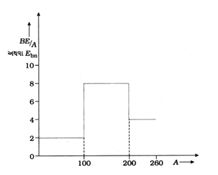
A
Energy is released when two nuclei with mass numbers between $1 < A < 50$ undergo fusion.
B
Energy is released when two nuclei with mass numbers between $51 < A < 100$ undergo fusion.
C
Energy is released when a heavy nucleus with mass number between $100 < A < 200$ undergoes fission into two equal fragments.
D
None of the above.
Solution
(B) In any nuclear process,if the binding energy per nucleon $(BE/A)$ of the product nuclei is greater than that of the reactant nuclei,energy is released.
From the given graph:
$1$. For $1 < A < 100$,$BE/A = 2 \text{ MeV}$.
$2$. For $100 < A < 200$,$BE/A = 8 \text{ MeV}$.
$3$. For $200 < A < 260$,$BE/A = 4 \text{ MeV}$.
Analyzing option $(B)$: If two nuclei with $A$ between $51$ and $100$ (where $BE/A = 2 \text{ MeV}$) fuse to form a nucleus with $A$ between $100$ and $200$ (where $BE/A = 8 \text{ MeV}$),the binding energy per nucleon increases. Therefore,energy is released.
From the given graph:
$1$. For $1 < A < 100$,$BE/A = 2 \text{ MeV}$.
$2$. For $100 < A < 200$,$BE/A = 8 \text{ MeV}$.
$3$. For $200 < A < 260$,$BE/A = 4 \text{ MeV}$.
Analyzing option $(B)$: If two nuclei with $A$ between $51$ and $100$ (where $BE/A = 2 \text{ MeV}$) fuse to form a nucleus with $A$ between $100$ and $200$ (where $BE/A = 8 \text{ MeV}$),the binding energy per nucleon increases. Therefore,energy is released.
0 likes
View Solution97
EasyMCQ
In an atomic reactor and an atomic bomb,the multiplication factor $(r)$ per fission is respectively:
A
$r = 1$ in an atomic reactor and $r > 1$ in an atomic bomb
B
$r > 1$ in an atomic reactor and $r = 1$ in an atomic bomb
C
$r < 1$ in an atomic reactor and $r > 1$ in an atomic bomb
D
$r = 1$ in an atomic reactor and $r < 1$ in an atomic bomb
Solution
(A) In a nuclear reactor,the chain reaction is controlled,meaning the multiplication factor $r$ is maintained at $r = 1$. This ensures a steady power output.
In an atomic bomb,the chain reaction is uncontrolled,meaning the multiplication factor $r$ is greater than $1$ $(r > 1)$,leading to an exponential release of energy.
In an atomic bomb,the chain reaction is uncontrolled,meaning the multiplication factor $r$ is greater than $1$ $(r > 1)$,leading to an exponential release of energy.
0 likes
View Solution98
EasyMCQ
In a fast breeder atomic reactor,.......
A
Fast neutrons cause fission of natural uranium,convert it into fuel,and release energy.
B
Thermal neutrons cause better fission of uranium.
C
Fast neutrons cause better fission of uranium and release more energy.
D
Thermal neutrons cause fission of natural uranium and produce energy.
Solution
(A) In a fast breeder reactor,fast neutrons are used to convert non-fissionable material (like $U^{238}$) into fissionable fuel (like $Pu^{239}$) while simultaneously releasing energy through the fission process. This process is highly efficient as it produces more fuel than it consumes.
0 likes
View Solution99
EasyMCQ
When four hydrogen nuclei combine to form a helium nucleus, then:
A
Energy is absorbed.
B
Energy is released.
C
Absorption or release of energy depends on the temperature.
D
Neither energy is absorbed nor released.
Solution
(B) In the process of nuclear fusion, four hydrogen nuclei $(_1H^1)$ fuse to form one helium nucleus $(_2He^4)$. The mass of the resulting helium nucleus is less than the sum of the masses of the four hydrogen nuclei. This mass defect $(\Delta m)$ is converted into energy according to Einstein's mass-energy equivalence principle, $E = \Delta m c^2$. Since the binding energy per nucleon for helium is higher than that of hydrogen, the process is exothermic, meaning energy is released.
0 likes
View Solution100
MediumMCQ
When a proton collides with a $_3Li^7$ nucleus and results in a $_4Be^8$ nucleus,the emitted particle is:
A
Neutron
B
$\alpha$-particle
C
$\beta$-particle
D
$\gamma$-photon
Solution
(D) The nuclear reaction is given by: $_3Li^7 + _1H^1 \to _4Be^8 + _ZX^A$.
Applying the law of conservation of charge (atomic number): $3 + 1 = 4 + Z$,which gives $Z = 0$.
Applying the law of conservation of mass number: $7 + 1 = 8 + A$,which gives $A = 0$.
$A$ particle with atomic number $Z = 0$ and mass number $A = 0$ is a $\gamma$-photon.
Applying the law of conservation of charge (atomic number): $3 + 1 = 4 + Z$,which gives $Z = 0$.
Applying the law of conservation of mass number: $7 + 1 = 8 + A$,which gives $A = 0$.
$A$ particle with atomic number $Z = 0$ and mass number $A = 0$ is a $\gamma$-photon.
0 likes
View SolutionNuclei — Nuclear Fission, Fusion and Nuclear Reactor · Frequently Asked Questions
1Are these Nuclei questions useful for JEE and NEET?
Yes. All questions in this section are mapped to JEE Main and NEET exam patterns. Previous year questions from JEE Main, NEET, GUJCET and state-level exams are included with full solutions.
2Can I switch to Hindi or Gujarati for these questions?
Yes. Use the language tabs in the hero section or the sidebar to view the same questions and solutions in English, Hindi or Gujarati.
3How do I generate a question paper from this subtopic?
Use the Vedclass Exam Paper Generator — select the chapter and subtopic, set difficulty, and generate Sets A, B, C, D automatically. First 3 chapters of every subject are free.
Vedclass Products
For Students
Vedclass Test Series
Mock tests in real JEE/NEET style with performance analysis. 5-day free trial.
Start Free TrialFor Teachers
Exam Paper Generator
Generate Set A/B/C/D papers from this chapter in 2 minutes. 3 chapters free.
Try FreeFor Institutes
Online Exam Module
Live online exams with unlimited students, 360° analytics & white-label branding.
See DemoFor Teachers & Institutes
Generate a Nuclei Exam Paper in 2 Minutes
Select subtopic & difficulty — Sets A, B, C, D auto-generated with No Repeat logic.
First 3 chapters of every subject are free — no payment required.