
A English
Electromagnetic Spectrum Questions in English
Class 12 Physics · Electromagnetic waves · Electromagnetic Spectrum
179+
Questions
English
Language
100%
With Solutions
Showing 29 of 179 questions in English
151
EasyMCQ
The frequencies of $X-$rays,$\gamma-$rays and ultraviolet rays are respectively $p, q$ and $r$. Then which of the following is correct?
A
$p < q, q > r$
B
$p > q, q > r$
C
$p < q, q < r$
D
$p > q, q < r$
Solution
(A) The electromagnetic spectrum in increasing order of frequency is: Radio waves < Microwaves < Infrared < Visible < Ultraviolet < $X-$rays < $\gamma-$rays.
Given frequencies are:
$p$ (frequency of $X-$rays)
$q$ (frequency of $\gamma-$rays)
$r$ (frequency of ultraviolet rays)
Comparing their positions in the spectrum:
$1$. $\gamma-$rays have the highest frequency,so $q > p$.
$2$. $X-$rays have a higher frequency than ultraviolet rays,so $p > r$.
Combining these,we get $q > p > r$.
Looking at the options provided,we evaluate the relations:
For $p < q$ and $q > r$,this is consistent with $q > p$ and $q > r$.
Thus,the correct relation is $p < q$ and $q > r$.
Given frequencies are:
$p$ (frequency of $X-$rays)
$q$ (frequency of $\gamma-$rays)
$r$ (frequency of ultraviolet rays)
Comparing their positions in the spectrum:
$1$. $\gamma-$rays have the highest frequency,so $q > p$.
$2$. $X-$rays have a higher frequency than ultraviolet rays,so $p > r$.
Combining these,we get $q > p > r$.
Looking at the options provided,we evaluate the relations:
For $p < q$ and $q > r$,this is consistent with $q > p$ and $q > r$.
Thus,the correct relation is $p < q$ and $q > r$.
0 likes
View Solution152
EasyMCQ
The wavelengths of short radio waves,$X$-rays,and ultraviolet waves are $\lambda_{1}$,$\lambda_{2}$,and $\lambda_{3}$ respectively. Arrange them in decreasing order.
A
$\lambda_{1} > \lambda_{3} > \lambda_{2}$
B
$\lambda_{1} > \lambda_{2} > \lambda_{3}$
C
$\lambda_{3} > \lambda_{2} > \lambda_{1}$
D
$\lambda_{2} > \lambda_{1} > \lambda_{3}$
Solution
(A) The electromagnetic spectrum in increasing order of frequency (or decreasing order of wavelength) is: Radio waves > Microwaves > Infrared > Visible > Ultraviolet > $X$-rays > Gamma rays.
Given:
$\lambda_{1}$ = Short radio waves
$\lambda_{2}$ = $X$-rays
$\lambda_{3}$ = Ultraviolet waves
Comparing their positions in the spectrum,the wavelength order is: $\lambda_{1} > \lambda_{3} > \lambda_{2}$.
Therefore,the correct decreasing order is $\lambda_{1}, \lambda_{3}, \lambda_{2}$.
Given:
$\lambda_{1}$ = Short radio waves
$\lambda_{2}$ = $X$-rays
$\lambda_{3}$ = Ultraviolet waves
Comparing their positions in the spectrum,the wavelength order is: $\lambda_{1} > \lambda_{3} > \lambda_{2}$.
Therefore,the correct decreasing order is $\lambda_{1}, \lambda_{3}, \lambda_{2}$.
0 likes
View Solution153
EasyMCQ
Which frequency of microwave is used by a microwave oven to cook food (in $GHz$)?
A
$0.5051$
B
$0.501$
C
$0.651$
D
$0.915$
Solution
(D) Microwave ovens operate by using electromagnetic waves to excite water molecules in food. The standard frequency commonly used for domestic microwave ovens is $2.45 \text{ GHz}$. However,among the provided options,$0.915 \text{ GHz}$ is a frequency also allocated for industrial,scientific,and medical $(ISM)$ applications,including specific types of microwave heating. Given the choices,$0.915 \text{ GHz}$ is the correct answer.
0 likes
View Solution154
EasyMCQ
$Ultraviolet$ radiations are used in $LASIK$ surgery.
A
Infrared
B
Ultraviolet
C
Radio
D
Gamma
Solution
(B) In $LASIK$ (Laser-Assisted In Situ Keratomileusis) eye surgery,an excimer laser is used to reshape the cornea. This laser emits $Ultraviolet$ radiation,specifically at a wavelength of $193 \ nm$. This high-energy radiation is capable of breaking molecular bonds in the corneal tissue,allowing for precise removal of tissue without causing thermal damage to surrounding areas.
0 likes
View Solution155
EasyMCQ
Which of the following waves is used in a speed gun to measure the speed of a ball in a cricket match?
A
Radio wave
B
Infrared waves
C
Microwave
D
Ultraviolet wave
Solution
(C) speed gun used in cricket matches operates on the principle of the Doppler effect. It emits electromagnetic waves,specifically microwaves,towards the moving ball. When these waves reflect off the ball,their frequency changes due to the motion of the ball. By measuring this frequency shift,the speed gun calculates the velocity of the ball. Therefore,microwaves are the correct type of electromagnetic wave used for this purpose.
0 likes
View Solution156
EasyMCQ
$TV$ waves range from . . . . . .
A
$24.5 GHz - 229.5 GHz$
B
$88 GHz - 108 MHz$
C
$54 MHz - 890 MHz$
D
$400 GHz - 600 GHz$
Solution
(C) $TV$ waves,which are a part of the radio wave spectrum used for television broadcasting,typically operate in the frequency range of $54 MHz$ to $890 MHz$. This range covers both Very High Frequency $(VHF)$ and Ultra High Frequency $(UHF)$ bands used for television signals. Therefore,the correct option is $C$.
0 likes
View Solution157
EasyMCQ
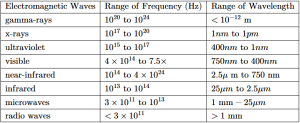
Match the following types of waves with their wavelength ranges:
| $i$. Microwave | $(a)$. $700 \ nm$ to $400 \ nm$ |
| $ii$. Visible light | $(b)$. $1 \ nm$ to $10^{-3} \ nm$ |
| $iii$. Ultraviolet | $(c)$. $0.1 \ m$ to $1 \ mm$ |
| $iv$. $X$-rays | $(d)$. $400 \ nm$ to $1 \ nm$ |
A
$i-c, ii-a, iii-d, iv-b$
B
$i-d, ii-b, iii-c, iv-a$
C
$i-b, ii-c, iii-a, iv-d$
D
$i-a, ii-d, iii-b, iv-c$
Solution
(A) To match the electromagnetic waves with their respective wavelength ranges,we refer to the standard electromagnetic spectrum:
$1$. Microwave: The wavelength range is approximately $0.1 \ m$ to $1 \ mm$ (corresponds to $c$).
$2$. Visible light: The wavelength range is approximately $700 \ nm$ to $400 \ nm$ (corresponds to $a$).
$3$. Ultraviolet: The wavelength range is approximately $400 \ nm$ to $1 \ nm$ (corresponds to $d$).
$4$. $X$-rays: The wavelength range is approximately $1 \ nm$ to $10^{-3} \ nm$ (corresponds to $b$).
Thus,the correct matching is $i-c, ii-a, iii-d, iv-b$.
$1$. Microwave: The wavelength range is approximately $0.1 \ m$ to $1 \ mm$ (corresponds to $c$).
$2$. Visible light: The wavelength range is approximately $700 \ nm$ to $400 \ nm$ (corresponds to $a$).
$3$. Ultraviolet: The wavelength range is approximately $400 \ nm$ to $1 \ nm$ (corresponds to $d$).
$4$. $X$-rays: The wavelength range is approximately $1 \ nm$ to $10^{-3} \ nm$ (corresponds to $b$).
Thus,the correct matching is $i-c, ii-a, iii-d, iv-b$.
0 likes
View Solution158
EasyMCQ
Which of the following radiations of electromagnetic waves has the highest wavelength?
A
$UV$-rays
B
$IR$-rays
C
Microwaves
D
$X$-rays
Solution
(C) The electromagnetic spectrum is ordered by wavelength. The increasing order of wavelength for the given radiations is:
$\lambda_{\text{X-rays}} < \lambda_{\text{UV-rays}} < \lambda_{\text{IR-rays}} < \lambda_{\text{microwaves}}$
Comparing the given options,microwaves have the longest wavelength among the listed radiations.
Therefore,the correct option is $C$.
$\lambda_{\text{X-rays}} < \lambda_{\text{UV-rays}} < \lambda_{\text{IR-rays}} < \lambda_{\text{microwaves}}$
Comparing the given options,microwaves have the longest wavelength among the listed radiations.
Therefore,the correct option is $C$.
0 likes
View Solution159
EasyMCQ
Electromagnetic radiation used to sterilise milk is
A
$X$-rays
B
$\gamma$-rays
C
$UV$ rays
D
Radiowaves
Solution
(C) Ultraviolet $(UV)$ rays are electromagnetic radiations with wavelengths shorter than visible light but longer than $X$-rays. Due to their high energy and ability to damage the $DNA$ of microorganisms, they are widely used in the food industry to sterilise milk and other liquids by killing bacteria and pathogens.
0 likes
View Solution160
EasyMCQ
Microwaves are used in the following:
A
$FM$ radio
B
Eye surgery
C
Cancer treatment
D
Radar system
Solution
(D) Microwaves have a short wavelength and travel in straight lines. They do not bend significantly around corners of obstacles in their path. Due to this property,they are highly effective for detection and tracking,which is why they are extensively used in radar systems for remote sensing and navigation.
0 likes
View Solution161
EasyMCQ
The waves having maximum wavelength among the following electromagnetic waves is
A
$X$-rays
B
Radio waves
C
$UV$ waves
D
Visible rays
Solution
(B) The electromagnetic spectrum is arranged in order of increasing frequency and decreasing wavelength.
Starting from the longest wavelength to the shortest,the order is:
$1$. Radio waves
$2$. Microwaves
$3$. Infrared rays
$4$. Visible light
$5$. Ultraviolet rays
$6$. $X$-rays
$7$. Gamma rays
Since radio waves appear at the beginning of this sequence,they possess the longest wavelength among the given options.
Starting from the longest wavelength to the shortest,the order is:
$1$. Radio waves
$2$. Microwaves
$3$. Infrared rays
$4$. Visible light
$5$. Ultraviolet rays
$6$. $X$-rays
$7$. Gamma rays
Since radio waves appear at the beginning of this sequence,they possess the longest wavelength among the given options.
0 likes
View Solution162
DifficultMCQ
The device used to detect infrared radiations is
A
tachometer
B
bolometer
C
photocell
D
point contact diode
Solution
(B) bolometer is a device used to measure the power of incident electromagnetic radiation via the heating of a material with a temperature-dependent electrical resistance. It is specifically used to detect infrared radiations.
0 likes
View Solution163
MediumMCQ
The correct order of electromagnetic waves with increasing frequency is
A
Infrared,$x$-rays,gamma rays
B
Gamma rays,visible light,$x$-rays
C
Visible light,infrared,ultraviolet
D
Visible light,ultraviolet,infrared
Solution
(A) The electromagnetic spectrum in order of increasing frequency is: Radio waves < Microwaves < Infrared < Visible light < Ultraviolet < $x$-rays < Gamma rays.
Comparing the given options:
Option $A$: Infrared < $x$-rays < Gamma rays. This follows the increasing order of frequency.
Option $B$: Gamma rays < Visible light < $x$-rays. This is incorrect as Gamma rays have the highest frequency.
Option $C$: Visible light < Infrared < Ultraviolet. This is incorrect as Infrared has a lower frequency than Visible light.
Option $D$: Visible light < Ultraviolet < Infrared. This is incorrect as Infrared has a lower frequency than Ultraviolet.
Therefore,the correct order is Infrared < $x$-rays < Gamma rays.
Comparing the given options:
Option $A$: Infrared < $x$-rays < Gamma rays. This follows the increasing order of frequency.
Option $B$: Gamma rays < Visible light < $x$-rays. This is incorrect as Gamma rays have the highest frequency.
Option $C$: Visible light < Infrared < Ultraviolet. This is incorrect as Infrared has a lower frequency than Visible light.
Option $D$: Visible light < Ultraviolet < Infrared. This is incorrect as Infrared has a lower frequency than Ultraviolet.
Therefore,the correct order is Infrared < $x$-rays < Gamma rays.
0 likes
View Solution164
EasyMCQ
Light of wavelength $1 \,nm$ belongs to the following class of waves:
A
Radiowaves
B
Microwaves
C
$X$-rays
D
Gamma rays
Solution
(C) The electromagnetic spectrum classifies waves based on their wavelength or frequency.
$X$-rays typically have a wavelength range from approximately $0.01 \,nm$ to $10 \,nm$.
Since $1 \,nm$ falls within this range, light of wavelength $1 \,nm$ belongs to the class of $X$-rays.
$X$-rays typically have a wavelength range from approximately $0.01 \,nm$ to $10 \,nm$.
Since $1 \,nm$ falls within this range, light of wavelength $1 \,nm$ belongs to the class of $X$-rays.
0 likes
View Solution165
EasyMCQ
The correct ascending order of the wavelengths of the following electromagnetic waves is: Ultraviolet,$X$-rays,infrared,gamma rays,and visible light.
A
$X$-ray,gamma ray,ultraviolet,infrared,visible light.
B
Gamma ray,$X$-ray,ultraviolet,visible light,infrared.
C
Gamma ray,$X$-ray,infrared,visible light,ultraviolet.
D
Gamma ray,$X$-ray,ultraviolet,infrared,visible light.
Solution
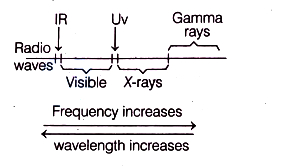
(B) The electromagnetic $(EM)$ spectrum is ordered by frequency and wavelength. As shown in the spectrum,frequency increases from left to right,while wavelength increases from right to left.
The order of increasing wavelength (ascending order) is:
Gamma rays < $X$-rays < Ultraviolet < Visible light < Infrared.
Therefore,the correct sequence is: Gamma ray,$X$-ray,ultraviolet,visible light,infrared.
The order of increasing wavelength (ascending order) is:
Gamma rays < $X$-rays < Ultraviolet < Visible light < Infrared.
Therefore,the correct sequence is: Gamma ray,$X$-ray,ultraviolet,visible light,infrared.
0 likes
View Solution166
EasyMCQ
An electromagnetic radiation has an energy of $14.4 \text{ keV}$. To which region of the electromagnetic spectrum does it belong?
A
Infrared
B
Visible
C
Ultraviolet
D
$X$-ray
Solution
(D) The energy of a photon is given by $E = h\nu = \frac{hc}{\lambda}$.
Given $E = 14.4 \text{ keV} = 14.4 \times 10^3 \times 1.6 \times 10^{-19} \text{ J} = 2.304 \times 10^{-15} \text{ J}$.
Using the relation $\lambda = \frac{hc}{E}$,where $hc \approx 1240 \text{ eV} \cdot \text{nm} = 1.24 \times 10^{-6} \text{ eV} \cdot \text{m}$.
$\lambda = \frac{1240 \text{ eV} \cdot \text{nm}}{14.4 \times 10^3 \text{ eV}} \approx 0.086 \text{ nm} = 0.86 \times 10^{-10} \text{ m}$.
Since the wavelength range for $X$-rays is approximately $10^{-8} \text{ m}$ to $10^{-13} \text{ m}$,this radiation falls into the $X$-ray region.
Given $E = 14.4 \text{ keV} = 14.4 \times 10^3 \times 1.6 \times 10^{-19} \text{ J} = 2.304 \times 10^{-15} \text{ J}$.
Using the relation $\lambda = \frac{hc}{E}$,where $hc \approx 1240 \text{ eV} \cdot \text{nm} = 1.24 \times 10^{-6} \text{ eV} \cdot \text{m}$.
$\lambda = \frac{1240 \text{ eV} \cdot \text{nm}}{14.4 \times 10^3 \text{ eV}} \approx 0.086 \text{ nm} = 0.86 \times 10^{-10} \text{ m}$.
Since the wavelength range for $X$-rays is approximately $10^{-8} \text{ m}$ to $10^{-13} \text{ m}$,this radiation falls into the $X$-ray region.
0 likes
View Solution167
EasyMCQ
Microwaves are used in
A
$TV$
B
radio transmission
C
Radar
D
atmospheric research
Solution
(C) Microwaves have a short wavelength,which allows them to be transmitted in straight lines with minimal diffraction. Due to this property,they are highly effective for detecting objects and determining their distance,speed,and direction. Therefore,microwaves are extensively used in $Radar$ (Radio Detection and Ranging) systems.
0 likes
View Solution168
EasyMCQ
Practically,the ozone layer absorbs radiations of wavelength:
A
less than $3 \times 10^{-7} \ m$
B
greater than $3 \times 10^{-7} \ m$
C
equal to $3 \times 10^{-7} \ m$
D
All of the above
Solution
(A) The ozone layer in the Earth's atmosphere plays a crucial role in protecting life by absorbing harmful ultraviolet $(UV)$ radiation from the Sun.
$UV$ radiation is characterized by wavelengths shorter than those of visible light.
Specifically,the ozone layer effectively absorbs $UV$ radiation with wavelengths less than $3 \times 10^{-7} \ m$ (or $300 \ nm$).
$UV$ radiation is characterized by wavelengths shorter than those of visible light.
Specifically,the ozone layer effectively absorbs $UV$ radiation with wavelengths less than $3 \times 10^{-7} \ m$ (or $300 \ nm$).
0 likes
View Solution169
EasyMCQ
Pick out the longest wavelength from the following types of radiations.
A
Visible blue light
B
Ultraviolet light
C
$X$-rays
D
Visible red light
Solution
(D) The electromagnetic spectrum is ordered by wavelength. $X$-rays have the shortest wavelength among the given options,followed by ultraviolet light,then visible blue light,and finally visible red light.
Comparing the wavelengths: $\lambda_{\text{red}} > \lambda_{\text{blue}} > \lambda_{\text{UV}} > \lambda_{\text{X-ray}}$.
Therefore,visible red light has the longest wavelength.
Comparing the wavelengths: $\lambda_{\text{red}} > \lambda_{\text{blue}} > \lambda_{\text{UV}} > \lambda_{\text{X-ray}}$.
Therefore,visible red light has the longest wavelength.
0 likes
View Solution170
EasyMCQ
Choose the correct sequence of the radiation sources in increasing order of the wavelength of electromagnetic waves produced by them.
A
$X$-ray tube, Magnetron valve, Radioactive source, Sodium lamp
B
Radioactive source, $X$-ray tube, Sodium lamp, Magnetron valve
C
$X$-ray tube, Magnetron valve, Sodium lamp, Radioactive source
D
Magnetron valve, Sodium lamp, $X$-ray tube, Radioactive source
Solution
(B) The electromagnetic spectrum in increasing order of wavelength is: Gamma rays < $X$-rays < Ultraviolet < Visible < Infrared < Microwaves < Radio waves.
$1$. Radioactive source produces Gamma rays $(\lambda \approx 10^{-12} \text{ m})$.
$2$. $X$-ray tube produces $X$-rays $(\lambda \approx 10^{-10} \text{ m})$.
$3$. Sodium lamp produces Visible light $(\lambda \approx 10^{-7} \text{ m})$.
$4$. Magnetron valve produces Microwaves $(\lambda \approx 10^{-3} \text{ m})$.
Therefore, the correct sequence in increasing order of wavelength is: Radioactive source $\rightarrow$ $X$-ray tube $\rightarrow$ Sodium lamp $\rightarrow$ Magnetron valve.
$1$. Radioactive source produces Gamma rays $(\lambda \approx 10^{-12} \text{ m})$.
$2$. $X$-ray tube produces $X$-rays $(\lambda \approx 10^{-10} \text{ m})$.
$3$. Sodium lamp produces Visible light $(\lambda \approx 10^{-7} \text{ m})$.
$4$. Magnetron valve produces Microwaves $(\lambda \approx 10^{-3} \text{ m})$.
Therefore, the correct sequence in increasing order of wavelength is: Radioactive source $\rightarrow$ $X$-ray tube $\rightarrow$ Sodium lamp $\rightarrow$ Magnetron valve.
0 likes
View Solution171
MediumMCQ
The electromagnetic waves of frequency $6 GHz$ are used in
A
$FM$ broadcast
B
$TV$ communication
C
satellite communication
D
cellular mobile radio
Solution
(C) Electromagnetic waves with a frequency of $6 GHz$ fall within the microwave frequency range ($1 GHz$ to $300 GHz$).
Due to their high frequency and ability to penetrate the ionosphere,these waves are primarily used for long-distance,line-of-sight communication.
Specifically,$6 GHz$ is a standard frequency band utilized in satellite communication systems for transponder operations.
Due to their high frequency and ability to penetrate the ionosphere,these waves are primarily used for long-distance,line-of-sight communication.
Specifically,$6 GHz$ is a standard frequency band utilized in satellite communication systems for transponder operations.
0 likes
View Solution172
EasyMCQ
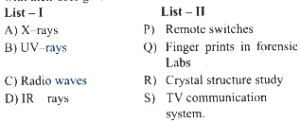
Match the electromagnetic radiations given in List-$I$ with their uses given in List-$II$.
| List-$I$ | List-$II$ |
| :--- | :--- |
| $A$) $X$-rays | $P$) Remote switches |
| $B$) $UV$-rays | $Q$) Finger prints in forensic labs |
| $C$) Radio waves | $R$) Crystal structure study |
| $D$) $IR$-rays | $S$) $TV$ communication system |
| List-$I$ | List-$II$ |
| :--- | :--- |
| $A$) $X$-rays | $P$) Remote switches |
| $B$) $UV$-rays | $Q$) Finger prints in forensic labs |
| $C$) Radio waves | $R$) Crystal structure study |
| $D$) $IR$-rays | $S$) $TV$ communication system |
A
$A \rightarrow Q, B \rightarrow R, C \rightarrow P, D \rightarrow S$
B
$A \rightarrow R, B \rightarrow Q, C \rightarrow S, D \rightarrow P$
C
$A \rightarrow R, B \rightarrow S, C \rightarrow Q, D \rightarrow P$
D
$A \rightarrow S, B \rightarrow R, C \rightarrow Q, D \rightarrow P$
Solution
(B) The correct matching is as follows:
$A$) $X$-rays are used for the study of crystal structure because their wavelength is comparable to the interatomic spacing in crystals. Thus,$A \rightarrow R$.
$B$) $UV$-rays are used in forensic laboratories for detecting finger prints and analyzing documents. Thus,$B \rightarrow Q$.
$C$) Radio waves are widely used in $TV$ and radio communication systems. Thus,$C \rightarrow S$.
$D$) $IR$-rays (Infrared rays) are used in remote switches for electronic devices like $TV$ remotes. Thus,$D \rightarrow P$.
Therefore,the correct sequence is $A \rightarrow R, B \rightarrow Q, C \rightarrow S, D \rightarrow P$.
$A$) $X$-rays are used for the study of crystal structure because their wavelength is comparable to the interatomic spacing in crystals. Thus,$A \rightarrow R$.
$B$) $UV$-rays are used in forensic laboratories for detecting finger prints and analyzing documents. Thus,$B \rightarrow Q$.
$C$) Radio waves are widely used in $TV$ and radio communication systems. Thus,$C \rightarrow S$.
$D$) $IR$-rays (Infrared rays) are used in remote switches for electronic devices like $TV$ remotes. Thus,$D \rightarrow P$.
Therefore,the correct sequence is $A \rightarrow R, B \rightarrow Q, C \rightarrow S, D \rightarrow P$.
0 likes
View Solution173
EasyMCQ
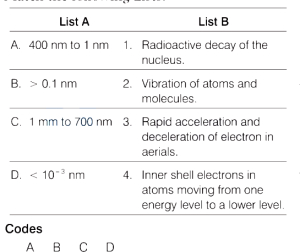
In the following,List $A$ consists of the wavelength range of different $EM$ waves and List $B$ consists of ways to produce them. Match the following lists.
| List $A$ | List $B$ |
| :--- | :--- |
| $A$. $400 \ nm$ to $1 \ nm$ | $1$. Radioactive decay of the nucleus. |
| $B$. $> 0.1 \ nm$ | $2$. Vibration of atoms and molecules. |
| $C$. $1 \ mm$ to $700 \ nm$ | $3$. Rapid acceleration and deceleration of electrons in aerials. |
| $D$. $< 10^{-3} \ nm$ | $4$. Inner shell electrons in atoms moving from one energy level to a lower level. |
| List $A$ | List $B$ |
| :--- | :--- |
| $A$. $400 \ nm$ to $1 \ nm$ | $1$. Radioactive decay of the nucleus. |
| $B$. $> 0.1 \ nm$ | $2$. Vibration of atoms and molecules. |
| $C$. $1 \ mm$ to $700 \ nm$ | $3$. Rapid acceleration and deceleration of electrons in aerials. |
| $D$. $< 10^{-3} \ nm$ | $4$. Inner shell electrons in atoms moving from one energy level to a lower level. |
A
$3, 2, 1, 4$
B
$2, 3, 4, 1$
C
$4, 3, 2, 1$
D
$1, 4, 3, 2$
Solution
(C) The correct matches are as follows:
$A$. The wavelength range $400 \ nm$ to $1 \ nm$ corresponds to $X$-rays,which are produced when inner shell electrons in atoms move from one energy level to a lower level. Thus,$A \rightarrow 4$.
$B$. The wavelength range $> 0.1 \ nm$ (covering radio waves and microwaves) is produced by the rapid acceleration and deceleration of electrons in aerials. Thus,$B \rightarrow 3$.
$C$. The wavelength range $1 \ mm$ to $700 \ nm$ (covering infrared radiation) is produced by the vibration of atoms and molecules in a substance. Thus,$C \rightarrow 2$.
$D$. The wavelength range $< 10^{-3} \ nm$ corresponds to gamma rays,which are produced by the radioactive decay of the nucleus. Thus,$D \rightarrow 1$.
Therefore,the correct match is $A \rightarrow 4, B \rightarrow 3, C \rightarrow 2, D \rightarrow 1$,which corresponds to option $C$.
$A$. The wavelength range $400 \ nm$ to $1 \ nm$ corresponds to $X$-rays,which are produced when inner shell electrons in atoms move from one energy level to a lower level. Thus,$A \rightarrow 4$.
$B$. The wavelength range $> 0.1 \ nm$ (covering radio waves and microwaves) is produced by the rapid acceleration and deceleration of electrons in aerials. Thus,$B \rightarrow 3$.
$C$. The wavelength range $1 \ mm$ to $700 \ nm$ (covering infrared radiation) is produced by the vibration of atoms and molecules in a substance. Thus,$C \rightarrow 2$.
$D$. The wavelength range $< 10^{-3} \ nm$ corresponds to gamma rays,which are produced by the radioactive decay of the nucleus. Thus,$D \rightarrow 1$.
Therefore,the correct match is $A \rightarrow 4, B \rightarrow 3, C \rightarrow 2, D \rightarrow 1$,which corresponds to option $C$.
0 likes
View Solution174
EasyMCQ
The energy of a gamma $(\gamma)$ ray photon is $E_{\gamma}$,and that of an $X$-ray photon is $E_{X}$. If the visible light photon has an energy of $E_{v}$,then we can say that:
A
$E_{X} > E_{\gamma} > E_{v}$
B
$E_{\gamma} > E_{v} > E_{X}$
C
$E_{\gamma} > E_{X} > E_{v}$
D
$E_{X} > E_{v} > E_{\gamma}$
Solution
(C) The energy of a photon is given by $E = h\nu = \frac{hc}{\lambda}$. Since the frequency $\nu$ of electromagnetic waves increases in the order: Visible light < $X$-rays < Gamma rays,the energy of the photons follows the same order.
$1$. For visible light,the energy range is approximately $1.6 \ eV$ to $3.2 \ eV$ $(E_{v} \approx 2.48 \ eV)$.
$2$. For $X$-rays,the energy range is approximately $100 \ eV$ to $100 \ keV$.
$3$. For gamma rays,the energy is typically greater than $100 \ keV$.
Comparing these ranges,we find that $E_{\gamma} > E_{X} > E_{v}$.
$1$. For visible light,the energy range is approximately $1.6 \ eV$ to $3.2 \ eV$ $(E_{v} \approx 2.48 \ eV)$.
$2$. For $X$-rays,the energy range is approximately $100 \ eV$ to $100 \ keV$.
$3$. For gamma rays,the energy is typically greater than $100 \ keV$.
Comparing these ranges,we find that $E_{\gamma} > E_{X} > E_{v}$.
0 likes
View Solution175
MediumMCQ
Match the List-$I$ with List-$II$. Choose the correct answer from the options given below:
| List-$I$ | List-$II$ |
|---|---|
| $A.$ Radio-wave | $I.$ Produced by Magnetron valve |
| $B.$ Micro-wave | $II.$ Due to change in the vibrational modes of atoms |
| $C.$ Infrared-wave | $III.$ Due to inner shell electrons moving from higher energy level to lower energy level |
| $D.$ $X$-ray | $IV.$ Due to rapid acceleration of electrons |
A
$A - II, B - IV, C - III, D - I$
B
$A - IV, B - III, C - I, D - II$
C
$A - IV, B - I, C - II, D - III$
D
$A - IV, B - II, C - I, D - III$
Solution
(C) Radio waves are produced by the rapid acceleration and deceleration of electrons in aerials.
Microwaves are produced by special vacuum tubes like klystrons, magnetrons, and Gunn diodes.
Infrared waves are produced by hot bodies and molecules due to changes in their vibrational and rotational modes.
$X$-rays are produced when high-energy electrons are suddenly stopped or when inner-shell electrons transition from a higher energy level to a lower energy level.
Therefore, the correct matching is: $A - IV, B - I, C - II, D - III$.
Microwaves are produced by special vacuum tubes like klystrons, magnetrons, and Gunn diodes.
Infrared waves are produced by hot bodies and molecules due to changes in their vibrational and rotational modes.
$X$-rays are produced when high-energy electrons are suddenly stopped or when inner-shell electrons transition from a higher energy level to a lower energy level.
Therefore, the correct matching is: $A - IV, B - I, C - II, D - III$.
0 likes
View Solution176
EasyMCQ
. . . . . . are used in medicine to destroy cancer cells.
A
Microwaves
B
Gamma rays
C
Ultraviolet rays
D
Visible rays
Solution
(B) Gamma rays possess high energy and high penetrating power. They are widely used in medical treatments such as radiotherapy to destroy or inhibit the growth of cancer cells by damaging their $DNA$.
0 likes
View Solution177
MediumMCQ
If wavelengths of visible rays,microwaves,and $X$-rays are $\lambda_v$,$\lambda_m$,and $\lambda_x$ respectively,then which of the following relations is correct?
A
$\lambda_m > \lambda_v > \lambda_x$
B
$\lambda_v > \lambda_m > \lambda_x$
C
$\lambda_m < \lambda_v < \lambda_x$
D
$\lambda_v = \lambda_m = \lambda_x$
Solution
(A) The electromagnetic spectrum is arranged in order of increasing frequency or decreasing wavelength.
The general order of wavelengths for these radiations is: $\lambda_{\text{microwave}} > \lambda_{\text{visible}} > \lambda_{\text{X-rays}}$.
Given that $\lambda_m$ represents the wavelength of microwaves,$\lambda_v$ represents the wavelength of visible rays,and $\lambda_x$ represents the wavelength of $X$-rays.
Therefore,the correct relation is $\lambda_m > \lambda_v > \lambda_x$.
Thus,the correct option is $A$.
The general order of wavelengths for these radiations is: $\lambda_{\text{microwave}} > \lambda_{\text{visible}} > \lambda_{\text{X-rays}}$.
Given that $\lambda_m$ represents the wavelength of microwaves,$\lambda_v$ represents the wavelength of visible rays,and $\lambda_x$ represents the wavelength of $X$-rays.
Therefore,the correct relation is $\lambda_m > \lambda_v > \lambda_x$.
Thus,the correct option is $A$.
0 likes
View Solution178
DifficultMCQ
$A$ monochromatic source of light operating at $15 \text{ kW}$ emits $2.5 \times 10^{22} \text{ photons/s}$. The region of an electromagnetic spectrum to which the emitted electromagnetic radiation belongs to . . . . . . . (Take $h = 6.6 \times 10^{-34} \text{ J}\cdot\text{s}$ and $c = 3 \times 10^8 \text{ m/s}$).
A
Microwave
B
Infrared
C
Visible
D
Ultraviolet
Solution
(D) The power $P$ is given by $P = n E_{photon} = n \frac{hc}{\lambda}$,where $n$ is the number of photons emitted per second.
Rearranging the formula to solve for wavelength $\lambda$,we get $\lambda = \frac{nhc}{P}$.
Substituting the given values: $n = 2.5 \times 10^{22} \text{ s}^{-1}$,$h = 6.6 \times 10^{-34} \text{ J}\cdot\text{s}$,$c = 3 \times 10^8 \text{ m/s}$,and $P = 15 \text{ kW} = 15 \times 10^3 \text{ W}$.
$\lambda = \frac{(2.5 \times 10^{22}) \times (6.6 \times 10^{-34}) \times (3 \times 10^8)}{15 \times 10^3} = \frac{49.5 \times 10^{-4}}{15 \times 10^3} = 3.3 \times 10^{-7} \text{ m}$.
Converting to nanometers: $3.3 \times 10^{-7} \text{ m} = 330 \text{ nm}$.
The wavelength range for the ultraviolet region is approximately $10 \text{ nm}$ to $400 \text{ nm}$.
Therefore,$330 \text{ nm}$ falls in the Ultraviolet region.
Rearranging the formula to solve for wavelength $\lambda$,we get $\lambda = \frac{nhc}{P}$.
Substituting the given values: $n = 2.5 \times 10^{22} \text{ s}^{-1}$,$h = 6.6 \times 10^{-34} \text{ J}\cdot\text{s}$,$c = 3 \times 10^8 \text{ m/s}$,and $P = 15 \text{ kW} = 15 \times 10^3 \text{ W}$.
$\lambda = \frac{(2.5 \times 10^{22}) \times (6.6 \times 10^{-34}) \times (3 \times 10^8)}{15 \times 10^3} = \frac{49.5 \times 10^{-4}}{15 \times 10^3} = 3.3 \times 10^{-7} \text{ m}$.
Converting to nanometers: $3.3 \times 10^{-7} \text{ m} = 330 \text{ nm}$.
The wavelength range for the ultraviolet region is approximately $10 \text{ nm}$ to $400 \text{ nm}$.
Therefore,$330 \text{ nm}$ falls in the Ultraviolet region.
0 likes
View Solution179
MediumMCQ
Match List-$I$ with List-$II$:
Choose the correct answer from the options given below:
| List-$I$ (Electromagnetic wave) | List-$II$ (Production) |
|---|---|
| $A$. Microwave | $I$. Electrons in atoms emit light when they move from a higher energy level to a lower energy level |
| $B$. Visible light | $II$. Radioactive decay of nucleus |
| $C$. Gamma rays | $III$. Vibration of atoms and molecules |
| $D$. Infra-red rays | $IV$. Klystron valve or magnetron valve |
Choose the correct answer from the options given below:
A
$A-IV, B-III, C-II, D-I$
B
$A-III, B-IV, C-I, D-II$
C
$A-III, B-I, C-II, D-IV$
D
$A-IV, B-I, C-II, D-III$
Solution
(D) The production mechanisms for electromagnetic waves are as follows:
$1$. Microwaves are produced by electronic devices like Klystron valves or magnetron valves $(A-IV)$.
$2$. Visible light is produced by the transition of electrons in atoms from a higher energy level to a lower energy level $(B-I)$.
$3$. Gamma rays are high-energy electromagnetic radiations produced during the radioactive decay of atomic nuclei $(C-II)$.
$4$. Infra-red rays are produced by the vibration of atoms and molecules $(D-III)$.
Therefore,the correct matching is $A-IV, B-I, C-II, D-III$.
$1$. Microwaves are produced by electronic devices like Klystron valves or magnetron valves $(A-IV)$.
$2$. Visible light is produced by the transition of electrons in atoms from a higher energy level to a lower energy level $(B-I)$.
$3$. Gamma rays are high-energy electromagnetic radiations produced during the radioactive decay of atomic nuclei $(C-II)$.
$4$. Infra-red rays are produced by the vibration of atoms and molecules $(D-III)$.
Therefore,the correct matching is $A-IV, B-I, C-II, D-III$.
0 likes
View SolutionElectromagnetic waves — Electromagnetic Spectrum · Frequently Asked Questions
1Are these Electromagnetic waves questions useful for JEE and NEET?
Yes. All questions in this section are mapped to JEE Main and NEET exam patterns. Previous year questions from JEE Main, NEET, GUJCET and state-level exams are included with full solutions.
2Can I switch to Hindi or Gujarati for these questions?
Yes. Use the language tabs in the hero section or the sidebar to view the same questions and solutions in English, Hindi or Gujarati.
3How do I generate a question paper from this subtopic?
Use the Vedclass Exam Paper Generator — select the chapter and subtopic, set difficulty, and generate Sets A, B, C, D automatically. First 3 chapters of every subject are free.
Vedclass Products
For Students
Vedclass Test Series
Mock tests in real JEE/NEET style with performance analysis. 5-day free trial.
Start Free TrialFor Teachers
Exam Paper Generator
Generate Set A/B/C/D papers from this chapter in 2 minutes. 3 chapters free.
Try FreeFor Institutes
Online Exam Module
Live online exams with unlimited students, 360° analytics & white-label branding.
See DemoFor Teachers & Institutes
Generate a Electromagnetic waves Exam Paper in 2 Minutes
Select subtopic & difficulty — Sets A, B, C, D auto-generated with No Repeat logic.
First 3 chapters of every subject are free — no payment required.