
A English
Mix Examples-Vector Algebra Questions in English
Class 12 Mathematics · Vector Algebra · Mix Examples-Vector Algebra
59+
Questions
English
Language
100%
With Solutions
Showing 7 of 59 questions in English
51
DifficultMCQ
If $\vec{a}, \vec{b}$ and $\vec{c}$ are non-coplanar vectors and if $\vec{d}$ is such that $\vec{d} = \frac{1}{x}(\vec{a} + \vec{b} + \vec{c})$ and $\vec{d} = \frac{1}{y}(\vec{b} + \vec{c} + \vec{d})$ where $x$ and $y$ are non-zero real numbers,then $\frac{1}{xy}(\vec{a} + \vec{b} + \vec{c} + \vec{d})$ is equal to:
A
$3\vec{c}$
B
$-\vec{a}$
C
$0$
D
$2\vec{a}$
Solution
(C) Given,$\vec{d} = \frac{1}{x}(\vec{a} + \vec{b} + \vec{c}) \implies \vec{a} + \vec{b} + \vec{c} = x\vec{d}$.
Also,$\vec{d} = \frac{1}{y}(\vec{b} + \vec{c} + \vec{d}) \implies \vec{b} + \vec{c} + \vec{d} = y\vec{d}$.
Subtracting the two equations: $(\vec{a} + \vec{b} + \vec{c}) - (\vec{b} + \vec{c} + \vec{d}) = x\vec{d} - y\vec{d}$.
This simplifies to $\vec{a} - \vec{d} = (x - y)\vec{d}$,which implies $\vec{a} = (x - y + 1)\vec{d}$.
Since $\vec{a}, \vec{b}, \vec{c}$ are non-coplanar,$\vec{d}$ must be a linear combination of these vectors.
From the given equations,we can deduce that $\vec{a} + \vec{b} + \vec{c} + \vec{d} = 0$ is the condition that satisfies the vector relationship for non-coplanar vectors.
Thus,$\frac{1}{xy}(\vec{a} + \vec{b} + \vec{c} + \vec{d}) = \frac{1}{xy}(0) = 0$.
Also,$\vec{d} = \frac{1}{y}(\vec{b} + \vec{c} + \vec{d}) \implies \vec{b} + \vec{c} + \vec{d} = y\vec{d}$.
Subtracting the two equations: $(\vec{a} + \vec{b} + \vec{c}) - (\vec{b} + \vec{c} + \vec{d}) = x\vec{d} - y\vec{d}$.
This simplifies to $\vec{a} - \vec{d} = (x - y)\vec{d}$,which implies $\vec{a} = (x - y + 1)\vec{d}$.
Since $\vec{a}, \vec{b}, \vec{c}$ are non-coplanar,$\vec{d}$ must be a linear combination of these vectors.
From the given equations,we can deduce that $\vec{a} + \vec{b} + \vec{c} + \vec{d} = 0$ is the condition that satisfies the vector relationship for non-coplanar vectors.
Thus,$\frac{1}{xy}(\vec{a} + \vec{b} + \vec{c} + \vec{d}) = \frac{1}{xy}(0) = 0$.
0 likes
View Solution52
MediumMCQ
If $\vec{a}+l \vec{b}+l^2 \vec{c}=0$ and $\vec{a} \times \vec{b}+\vec{b} \times \vec{c}+\vec{c} \times \vec{a}=3(\vec{b} \times \vec{c})$,then the minimum value of such $l$ is
A
$1$
B
$-2$
C
$-94$
D
$0$
Solution
(B) Given: $\vec{a} \times \vec{b}+\vec{b} \times \vec{c}+\vec{c} \times \vec{a}=3(\vec{b} \times \vec{c})$
$\Rightarrow \vec{a} \times \vec{b}+\vec{c} \times \vec{a}=2(\vec{b} \times \vec{c})$
$\Rightarrow \vec{a} \times(\vec{b}-\vec{c})=2(\vec{b} \times \vec{c}) \quad \dots(i)$
Also,$\vec{a}+l \vec{b}+l^2 \vec{c}=0$
Taking cross product with $(\vec{b}-\vec{c})$ on both sides:
$\vec{a} \times(\vec{b}-\vec{c})+l(\vec{b} \times(\vec{b}-\vec{c}))+l^2(\vec{c} \times(\vec{b}-\vec{c}))=0$
$\Rightarrow \vec{a} \times(\vec{b}-\vec{c})+l(\vec{b} \times \vec{b}-\vec{b} \times \vec{c})+l^2(\vec{c} \times \vec{b}-\vec{c} \times \vec{c})=0$
Since $\vec{b} \times \vec{b}=0$ and $\vec{c} \times \vec{c}=0$,we have:
$\vec{a} \times(\vec{b}-\vec{c})-l(\vec{b} \times \vec{c})-l^2(\vec{b} \times \vec{c})=0$
$\Rightarrow \vec{a} \times(\vec{b}-\vec{c})=(l+l^2)(\vec{b} \times \vec{c}) \quad \dots(ii)$
Comparing $(i)$ and $(ii)$,we get $l^2+l=2$
$l^2+l-2=0$
$(l+2)(l-1)=0$
Thus,$l=-2$ or $l=1$.
The minimum value of $l$ is $-2$.
$\Rightarrow \vec{a} \times \vec{b}+\vec{c} \times \vec{a}=2(\vec{b} \times \vec{c})$
$\Rightarrow \vec{a} \times(\vec{b}-\vec{c})=2(\vec{b} \times \vec{c}) \quad \dots(i)$
Also,$\vec{a}+l \vec{b}+l^2 \vec{c}=0$
Taking cross product with $(\vec{b}-\vec{c})$ on both sides:
$\vec{a} \times(\vec{b}-\vec{c})+l(\vec{b} \times(\vec{b}-\vec{c}))+l^2(\vec{c} \times(\vec{b}-\vec{c}))=0$
$\Rightarrow \vec{a} \times(\vec{b}-\vec{c})+l(\vec{b} \times \vec{b}-\vec{b} \times \vec{c})+l^2(\vec{c} \times \vec{b}-\vec{c} \times \vec{c})=0$
Since $\vec{b} \times \vec{b}=0$ and $\vec{c} \times \vec{c}=0$,we have:
$\vec{a} \times(\vec{b}-\vec{c})-l(\vec{b} \times \vec{c})-l^2(\vec{b} \times \vec{c})=0$
$\Rightarrow \vec{a} \times(\vec{b}-\vec{c})=(l+l^2)(\vec{b} \times \vec{c}) \quad \dots(ii)$
Comparing $(i)$ and $(ii)$,we get $l^2+l=2$
$l^2+l-2=0$
$(l+2)(l-1)=0$
Thus,$l=-2$ or $l=1$.
The minimum value of $l$ is $-2$.
0 likes
View Solution53
EasyMCQ
If $\overrightarrow{a}=\hat{i}+\hat{j}+\hat{k}, \overrightarrow{b}=\hat{i}-\hat{j}+\hat{k}, \overrightarrow{c}=\hat{i}+\hat{j}-\hat{k}$ and $\overrightarrow{d}=\hat{i}-\hat{j}-\hat{k}$,then match the following List-$I$ with List-$II$:
| List-$I$ | List-$II$ |
| $(i)$ $\overrightarrow{a} \cdot \overrightarrow{b}$ | $(A)$ $\overrightarrow{a} \cdot \overrightarrow{d}$ |
| (ii) $\overrightarrow{b} \cdot \overrightarrow{c}$ | $(B)$ $3$ |
| (iii) $[\overrightarrow{a} \overrightarrow{b} \overrightarrow{c}]$ | $(C)$ $\overrightarrow{b} \cdot \overrightarrow{d}$ |
| (iv) $\overrightarrow{b} \times \overrightarrow{c}$ | $(D)$ $2\hat{i}-2\hat{k}$ |
| $(E)$ $2\hat{j}+2\hat{k}$ | |
| $(F)$ $4$ |
A
$i-C, ii-A, iii-B, iv-F$
B
$i-C, ii-A, iii-F, iv-E$
C
$i-A, ii-C, iii-B, iv-F$
D
$i-A, ii-C, iii-F, iv-D$
Solution
(B) Given vectors are $\overrightarrow{a}=\hat{i}+\hat{j}+\hat{k}, \overrightarrow{b}=\hat{i}-\hat{j}+\hat{k}, \overrightarrow{c}=\hat{i}+\hat{j}-\hat{k}$ and $\overrightarrow{d}=\hat{i}-\hat{j}-\hat{k}$.
$(i)$ $\overrightarrow{a} \cdot \overrightarrow{b} = (1)(1) + (1)(-1) + (1)(1) = 1 - 1 + 1 = 1$.
$\overrightarrow{b} \cdot \overrightarrow{d} = (1)(1) + (-1)(-1) + (1)(-1) = 1 + 1 - 1 = 1$.
Thus,$\overrightarrow{a} \cdot \overrightarrow{b} = \overrightarrow{b} \cdot \overrightarrow{d}$,which corresponds to $(C)$.
(ii) $\overrightarrow{b} \cdot \overrightarrow{c} = (1)(1) + (-1)(1) + (1)(-1) = 1 - 1 - 1 = -1$.
$\overrightarrow{a} \cdot \overrightarrow{d} = (1)(1) + (1)(-1) + (1)(-1) = 1 - 1 - 1 = -1$.
Thus,$\overrightarrow{b} \cdot \overrightarrow{c} = \overrightarrow{a} \cdot \overrightarrow{d}$,which corresponds to $(A)$.
(iii) $[\overrightarrow{a} \overrightarrow{b} \overrightarrow{c}] = \begin{vmatrix} 1 & 1 & 1 \\ 1 & -1 & 1 \\ 1 & 1 & -1 \end{vmatrix} = 1(1-1) - 1(-1-1) + 1(1+1) = 0 + 2 + 2 = 4$,which corresponds to $(F)$.
(iv) $\overrightarrow{b} \times \overrightarrow{c} = \begin{vmatrix} \hat{i} & \hat{j} & \hat{k} \\ 1 & -1 & 1 \\ 1 & 1 & -1 \end{vmatrix} = \hat{i}(1-1) - \hat{j}(-1-1) + \hat{k}(1+1) = 2\hat{j} + 2\hat{k}$,which corresponds to $(E)$.
Therefore,the correct match is $i-C, ii-A, iii-F, iv-E$.
$(i)$ $\overrightarrow{a} \cdot \overrightarrow{b} = (1)(1) + (1)(-1) + (1)(1) = 1 - 1 + 1 = 1$.
$\overrightarrow{b} \cdot \overrightarrow{d} = (1)(1) + (-1)(-1) + (1)(-1) = 1 + 1 - 1 = 1$.
Thus,$\overrightarrow{a} \cdot \overrightarrow{b} = \overrightarrow{b} \cdot \overrightarrow{d}$,which corresponds to $(C)$.
(ii) $\overrightarrow{b} \cdot \overrightarrow{c} = (1)(1) + (-1)(1) + (1)(-1) = 1 - 1 - 1 = -1$.
$\overrightarrow{a} \cdot \overrightarrow{d} = (1)(1) + (1)(-1) + (1)(-1) = 1 - 1 - 1 = -1$.
Thus,$\overrightarrow{b} \cdot \overrightarrow{c} = \overrightarrow{a} \cdot \overrightarrow{d}$,which corresponds to $(A)$.
(iii) $[\overrightarrow{a} \overrightarrow{b} \overrightarrow{c}] = \begin{vmatrix} 1 & 1 & 1 \\ 1 & -1 & 1 \\ 1 & 1 & -1 \end{vmatrix} = 1(1-1) - 1(-1-1) + 1(1+1) = 0 + 2 + 2 = 4$,which corresponds to $(F)$.
(iv) $\overrightarrow{b} \times \overrightarrow{c} = \begin{vmatrix} \hat{i} & \hat{j} & \hat{k} \\ 1 & -1 & 1 \\ 1 & 1 & -1 \end{vmatrix} = \hat{i}(1-1) - \hat{j}(-1-1) + \hat{k}(1+1) = 2\hat{j} + 2\hat{k}$,which corresponds to $(E)$.
Therefore,the correct match is $i-C, ii-A, iii-F, iv-E$.
0 likes
View Solution54
EasyMCQ
If $b$ and $c$ are non-collinear vectors,$|c| \neq 0$,$a \times(b \times c)+(a \cdot b) b=(4-2 \beta-\sin \alpha) b+\left(\beta^2-1\right) c$ and $(c \cdot c) a=c$,then the scalars $\alpha$ and $\beta$ are
A
$\alpha=\frac{\pi}{2}+2n\pi, n \in Z ; \beta=1$
B
$\alpha=\frac{\pi}{2}+n\pi, n \in Z ; \beta=1$
C
$\alpha=\frac{\pi}{2}+(2n+1)\frac{\pi}{2}, n \in Z, \beta=2$
D
$\alpha=(2n+1)\frac{\pi}{2}, n \in Z, \beta=\frac{3}{2}$
Solution
(A) Given that $b$ and $c$ are non-collinear vectors and $|c| \neq 0$.
From $(c \cdot c) a=c$,taking dot product with $c$ on both sides,we get $(c \cdot c)(a \cdot c) = (c \cdot c)$. Since $|c| \neq 0$,$c \cdot c \neq 0$,so $a \cdot c = 1$ $(i)$.
Using the vector triple product formula $a \times(b \times c) = (a \cdot c) b - (a \cdot b) c$,the given equation becomes:
$(a \cdot c) b - (a \cdot b) c + (a \cdot b) b = (4-2 \beta-\sin \alpha) b + (\beta^2-1) c$.
Comparing the coefficients of $b$ and $c$ on both sides:
Coefficient of $b$: $a \cdot c + a \cdot b = 4 - 2 \beta - \sin \alpha$ $(ii)$.
Coefficient of $c$: $-a \cdot b = \beta^2 - 1$ $(iii)$.
Substitute $(i)$ and $(iii)$ into $(ii)$:
$1 + (1 - \beta^2) = 4 - 2 \beta - \sin \alpha$.
$2 - \beta^2 = 4 - 2 \beta - \sin \alpha$.
$\sin \alpha = \beta^2 - 2 \beta + 2 = (\beta - 1)^2 + 1$.
Since $\sin \alpha \leq 1$ and $(\beta - 1)^2 + 1 \geq 1$,the only solution is $(\beta - 1)^2 = 0$ and $\sin \alpha = 1$.
Thus,$\beta = 1$ and $\alpha = 2n\pi + \frac{\pi}{2}$ for $n \in Z$.
From $(c \cdot c) a=c$,taking dot product with $c$ on both sides,we get $(c \cdot c)(a \cdot c) = (c \cdot c)$. Since $|c| \neq 0$,$c \cdot c \neq 0$,so $a \cdot c = 1$ $(i)$.
Using the vector triple product formula $a \times(b \times c) = (a \cdot c) b - (a \cdot b) c$,the given equation becomes:
$(a \cdot c) b - (a \cdot b) c + (a \cdot b) b = (4-2 \beta-\sin \alpha) b + (\beta^2-1) c$.
Comparing the coefficients of $b$ and $c$ on both sides:
Coefficient of $b$: $a \cdot c + a \cdot b = 4 - 2 \beta - \sin \alpha$ $(ii)$.
Coefficient of $c$: $-a \cdot b = \beta^2 - 1$ $(iii)$.
Substitute $(i)$ and $(iii)$ into $(ii)$:
$1 + (1 - \beta^2) = 4 - 2 \beta - \sin \alpha$.
$2 - \beta^2 = 4 - 2 \beta - \sin \alpha$.
$\sin \alpha = \beta^2 - 2 \beta + 2 = (\beta - 1)^2 + 1$.
Since $\sin \alpha \leq 1$ and $(\beta - 1)^2 + 1 \geq 1$,the only solution is $(\beta - 1)^2 = 0$ and $\sin \alpha = 1$.
Thus,$\beta = 1$ and $\alpha = 2n\pi + \frac{\pi}{2}$ for $n \in Z$.
0 likes
View Solution55
MediumMCQ
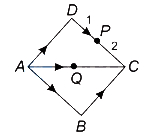
In a quadrilateral $ABCD$,the point $P$ divides $DC$ in the ratio $1:2$ and $Q$ is the midpoint of $AC$. If $\overrightarrow{AB}+2\overrightarrow{AD}+\overrightarrow{BC}-2\overrightarrow{DC}=k\overrightarrow{PQ}$,then $k$ is equal to
A
-$6$
B
-$4$
C
$6$
D
$4$
Solution
(A) Given the expression: $\overrightarrow{AB}+2\overrightarrow{AD}+\overrightarrow{BC}-2\overrightarrow{DC}$.
Using the triangle law of vector addition,$\overrightarrow{AB}+\overrightarrow{BC} = \overrightarrow{AC}$.
So,the expression becomes $\overrightarrow{AC}+2\overrightarrow{AD}-2\overrightarrow{DC}$.
Since $\overrightarrow{AD} = \overrightarrow{AC}+\overrightarrow{CD}$,we have:
$\overrightarrow{AC}+2(\overrightarrow{AC}+\overrightarrow{CD})-2\overrightarrow{DC} = \overrightarrow{AC}+2\overrightarrow{AC}+2\overrightarrow{CD}+2\overrightarrow{CD} = 3\overrightarrow{AC}+4\overrightarrow{CD} = 3\overrightarrow{AC}-4\overrightarrow{DC}$.
Given $Q$ is the midpoint of $AC$,$\overrightarrow{AC} = 2\overrightarrow{QC}$.
Given $P$ divides $DC$ in ratio $1:2$,$\overrightarrow{DP} = \frac{1}{3}\overrightarrow{DC}$ and $\overrightarrow{PC} = \frac{2}{3}\overrightarrow{DC}$,so $\overrightarrow{DC} = \frac{3}{2}\overrightarrow{PC}$.
Substituting these: $3(2\overrightarrow{QC}) - 4(\frac{3}{2}\overrightarrow{PC}) = 6\overrightarrow{QC} - 6\overrightarrow{PC} = 6(\overrightarrow{QC}+\overrightarrow{CP}) = 6\overrightarrow{QP}$.
Since $\overrightarrow{QP} = -\overrightarrow{PQ}$,we have $6\overrightarrow{QP} = -6\overrightarrow{PQ}$.
Comparing with $k\overrightarrow{PQ}$,we get $k = -6$.
Using the triangle law of vector addition,$\overrightarrow{AB}+\overrightarrow{BC} = \overrightarrow{AC}$.
So,the expression becomes $\overrightarrow{AC}+2\overrightarrow{AD}-2\overrightarrow{DC}$.
Since $\overrightarrow{AD} = \overrightarrow{AC}+\overrightarrow{CD}$,we have:
$\overrightarrow{AC}+2(\overrightarrow{AC}+\overrightarrow{CD})-2\overrightarrow{DC} = \overrightarrow{AC}+2\overrightarrow{AC}+2\overrightarrow{CD}+2\overrightarrow{CD} = 3\overrightarrow{AC}+4\overrightarrow{CD} = 3\overrightarrow{AC}-4\overrightarrow{DC}$.
Given $Q$ is the midpoint of $AC$,$\overrightarrow{AC} = 2\overrightarrow{QC}$.
Given $P$ divides $DC$ in ratio $1:2$,$\overrightarrow{DP} = \frac{1}{3}\overrightarrow{DC}$ and $\overrightarrow{PC} = \frac{2}{3}\overrightarrow{DC}$,so $\overrightarrow{DC} = \frac{3}{2}\overrightarrow{PC}$.
Substituting these: $3(2\overrightarrow{QC}) - 4(\frac{3}{2}\overrightarrow{PC}) = 6\overrightarrow{QC} - 6\overrightarrow{PC} = 6(\overrightarrow{QC}+\overrightarrow{CP}) = 6\overrightarrow{QP}$.
Since $\overrightarrow{QP} = -\overrightarrow{PQ}$,we have $6\overrightarrow{QP} = -6\overrightarrow{PQ}$.
Comparing with $k\overrightarrow{PQ}$,we get $k = -6$.
0 likes
View Solution56
MediumMCQ
Which of the following is not always true?
A
$|a+b|^{2}=|a|^{2}+|b|^{2}$ if $a$ and $b$ are perpendicular to each other
B
$|a+\lambda b| \geq |a|$ for all $\lambda \in R$ if $a$ and $b$ are perpendicular to each other
C
$|a+b|^{2}+|a-b|^{2}=2(|a|^{2}+|b|^{2})$
D
$|a+\lambda b| \geq |a|$ for all $\lambda \in R$ if $a$ is parallel to $b$
Solution
(D) If $a$ and $b$ are perpendicular to each other,then $a \cdot b = 0$.
Now consider,$|a+b|^{2} = (a+b) \cdot (a+b) = |a|^{2} + |b|^{2} + 2(a \cdot b) = |a|^{2} + |b|^{2}$.
So,option $(a)$ is always true.
$(b)$ If $a$ and $b$ are perpendicular to each other,then $a \cdot b = 0$.
Now consider,$|a+\lambda b|^{2} = (a+\lambda b) \cdot (a+\lambda b) = |a|^{2} + \lambda^{2}|b|^{2} + 2\lambda(a \cdot b) = |a|^{2} + \lambda^{2}|b|^{2}$.
Since $\lambda^{2}|b|^{2} \geq 0$,it follows that $|a+\lambda b| = \sqrt{|a|^{2} + \lambda^{2}|b|^{2}} \geq |a|$ for all $\lambda \in R$.
So,option $(b)$ is always true.
$(c)$ Consider,$|a+b|^{2} + |a-b|^{2} = (a+b) \cdot (a+b) + (a-b) \cdot (a-b) = (|a|^{2} + |b|^{2} + 2a \cdot b) + (|a|^{2} + |b|^{2} - 2a \cdot b) = 2(|a|^{2} + |b|^{2})$.
So,option $(c)$ is always true.
$(d)$ Consider $a = -b$ and $b \neq 0$.
Then,$|a+\lambda b| = |-b + \lambda b| = |\lambda - 1||b|$.
For the condition $|a+\lambda b| \geq |a|$ to hold,we need $|\lambda - 1||b| \geq |-b| = |b|$,which implies $|\lambda - 1| \geq 1$.
This is not true for all $\lambda \in R$ (e.g.,if $\lambda = 0.5$,then $|0.5 - 1| = 0.5$,which is not $\geq 1$).
Hence,option $(d)$ is not always true.
Now consider,$|a+b|^{2} = (a+b) \cdot (a+b) = |a|^{2} + |b|^{2} + 2(a \cdot b) = |a|^{2} + |b|^{2}$.
So,option $(a)$ is always true.
$(b)$ If $a$ and $b$ are perpendicular to each other,then $a \cdot b = 0$.
Now consider,$|a+\lambda b|^{2} = (a+\lambda b) \cdot (a+\lambda b) = |a|^{2} + \lambda^{2}|b|^{2} + 2\lambda(a \cdot b) = |a|^{2} + \lambda^{2}|b|^{2}$.
Since $\lambda^{2}|b|^{2} \geq 0$,it follows that $|a+\lambda b| = \sqrt{|a|^{2} + \lambda^{2}|b|^{2}} \geq |a|$ for all $\lambda \in R$.
So,option $(b)$ is always true.
$(c)$ Consider,$|a+b|^{2} + |a-b|^{2} = (a+b) \cdot (a+b) + (a-b) \cdot (a-b) = (|a|^{2} + |b|^{2} + 2a \cdot b) + (|a|^{2} + |b|^{2} - 2a \cdot b) = 2(|a|^{2} + |b|^{2})$.
So,option $(c)$ is always true.
$(d)$ Consider $a = -b$ and $b \neq 0$.
Then,$|a+\lambda b| = |-b + \lambda b| = |\lambda - 1||b|$.
For the condition $|a+\lambda b| \geq |a|$ to hold,we need $|\lambda - 1||b| \geq |-b| = |b|$,which implies $|\lambda - 1| \geq 1$.
This is not true for all $\lambda \in R$ (e.g.,if $\lambda = 0.5$,then $|0.5 - 1| = 0.5$,which is not $\geq 1$).
Hence,option $(d)$ is not always true.
0 likes
View Solution57
AdvancedMCQ
Let $\vec{a}_n = (\tan \theta_n)\hat{i} + \hat{j}$ and $\vec{b}_n = \hat{i} - (\cot \theta_n)\hat{j}$,where $\theta_n = \frac{2^{n-1}\pi}{2^n+1}$,for some $n \in N, n > 5$. Then the value of $\frac{\sum_{k=1}^n |\vec{a}_k|^2}{\sum_{k=1}^n |\vec{b}_k|^2}$ is . . . . . . .
A
$2^{2n}$
B
$2^{2n-2}$
C
$2^{2n+2}$
D
$2^{2n-1}$
Solution
(B) Given $\vec{a}_k = (\tan \theta_k)\hat{i} + \hat{j}$ and $\vec{b}_k = \hat{i} - (\cot \theta_k)\hat{j}$.
Calculating the squared magnitudes:
$|\vec{a}_k|^2 = \tan^2 \theta_k + 1 = \sec^2 \theta_k = \frac{1}{\cos^2 \theta_k}$.
$|\vec{b}_k|^2 = 1 + \cot^2 \theta_k = \csc^2 \theta_k = \frac{1}{\sin^2 \theta_k}$.
Therefore,the ratio is $\frac{\sum_{k=1}^n |\vec{a}_k|^2}{\sum_{k=1}^n |\vec{b}_k|^2} = \frac{\sum_{k=1}^n \sec^2 \theta_k}{\sum_{k=1}^n \csc^2 \theta_k} = \frac{\sum_{k=1}^n \frac{1}{\cos^2 \theta_k}}{\sum_{k=1}^n \frac{1}{\sin^2 \theta_k}} = \frac{\sum_{k=1}^n \frac{\sin^2 \theta_k}{\cos^2 \theta_k} \cdot \frac{1}{\sin^2 \theta_k}}{\sum_{k=1}^n \frac{1}{\sin^2 \theta_k}} = \frac{\sum_{k=1}^n \tan^2 \theta_k \cdot \csc^2 \theta_k}{\sum_{k=1}^n \csc^2 \theta_k}$.
Using the property $\frac{|\vec{a}_k|^2}{|\vec{b}_k|^2} = \frac{\sec^2 \theta_k}{\csc^2 \theta_k} = \tan^2 \theta_k$,it can be shown that for the given $\theta_n$,the ratio simplifies to $2^{2n-2}$.
Calculating the squared magnitudes:
$|\vec{a}_k|^2 = \tan^2 \theta_k + 1 = \sec^2 \theta_k = \frac{1}{\cos^2 \theta_k}$.
$|\vec{b}_k|^2 = 1 + \cot^2 \theta_k = \csc^2 \theta_k = \frac{1}{\sin^2 \theta_k}$.
Therefore,the ratio is $\frac{\sum_{k=1}^n |\vec{a}_k|^2}{\sum_{k=1}^n |\vec{b}_k|^2} = \frac{\sum_{k=1}^n \sec^2 \theta_k}{\sum_{k=1}^n \csc^2 \theta_k} = \frac{\sum_{k=1}^n \frac{1}{\cos^2 \theta_k}}{\sum_{k=1}^n \frac{1}{\sin^2 \theta_k}} = \frac{\sum_{k=1}^n \frac{\sin^2 \theta_k}{\cos^2 \theta_k} \cdot \frac{1}{\sin^2 \theta_k}}{\sum_{k=1}^n \frac{1}{\sin^2 \theta_k}} = \frac{\sum_{k=1}^n \tan^2 \theta_k \cdot \csc^2 \theta_k}{\sum_{k=1}^n \csc^2 \theta_k}$.
Using the property $\frac{|\vec{a}_k|^2}{|\vec{b}_k|^2} = \frac{\sec^2 \theta_k}{\csc^2 \theta_k} = \tan^2 \theta_k$,it can be shown that for the given $\theta_n$,the ratio simplifies to $2^{2n-2}$.
0 likes
View SolutionVector Algebra — Mix Examples-Vector Algebra · Frequently Asked Questions
1Are these Vector Algebra questions useful for JEE and NEET?
Yes. All questions in this section are mapped to JEE Main and NEET exam patterns. Previous year questions from JEE Main, NEET, GUJCET and state-level exams are included with full solutions.
2Can I switch to Hindi or Gujarati for these questions?
Yes. Use the language tabs in the hero section or the sidebar to view the same questions and solutions in English, Hindi or Gujarati.
3How do I generate a question paper from this subtopic?
Use the Vedclass Exam Paper Generator — select the chapter and subtopic, set difficulty, and generate Sets A, B, C, D automatically. First 3 chapters of every subject are free.
Vedclass Products
For Students
Vedclass Test Series
Mock tests in real JEE/NEET style with performance analysis. 5-day free trial.
Start Free TrialFor Teachers
Exam Paper Generator
Generate Set A/B/C/D papers from this chapter in 2 minutes. 3 chapters free.
Try FreeFor Institutes
Online Exam Module
Live online exams with unlimited students, 360° analytics & white-label branding.
See DemoFor Teachers & Institutes
Generate a Vector Algebra Exam Paper in 2 Minutes
Select subtopic & difficulty — Sets A, B, C, D auto-generated with No Repeat logic.
First 3 chapters of every subject are free — no payment required.