
A English
Plane Questions in English
Class 12 Mathematics · THREE DIMENSIONAL GEOMETRY · Plane
559+
Questions
English
Language
100%
With Solutions
Showing 9 of 559 questions in English
551
MediumMCQ
Let $6x - 3y + 2z - 6 = 0$ be the given plane. If $a, b, c$ are the intercepts made by the plane on $X, Y, Z$-axes respectively; $l, m, n$ are the direction cosines of a normal drawn to the plane and $p$ is the perpendicular distance from the origin to the plane,then $|al + bm + cn|=$
A
$p$
B
$2p$
C
$3p$
D
$4p$
Solution
(C) The equation of the plane is $6x - 3y + 2z = 6$. Dividing by $6$,we get $\frac{x}{1} + \frac{y}{-2} + \frac{z}{3} = 1$. Thus,the intercepts are $a = 1, b = -2, c = 3$.
The normal vector to the plane is $\vec{n} = 6\hat{i} - 3\hat{j} + 2\hat{k}$. The magnitude is $|\vec{n}| = \sqrt{6^2 + (-3)^2 + 2^2} = \sqrt{36 + 9 + 4} = \sqrt{49} = 7$.
The direction cosines are $l = \frac{6}{7}, m = -\frac{3}{7}, n = \frac{2}{7}$.
The perpendicular distance $p$ from the origin to the plane $Ax + By + Cz + D = 0$ is $p = \frac{|D|}{\sqrt{A^2 + B^2 + C^2}}$. Here $p = \frac{|-6|}{7} = \frac{6}{7}$.
Now,calculate $|al + bm + cn| = |(1)(\frac{6}{7}) + (-2)(-\frac{3}{7}) + (3)(\frac{2}{7})| = |\frac{6}{7} + \frac{6}{7} + \frac{6}{7}| = |\frac{18}{7}|$.
Since $p = \frac{6}{7}$,we have $|al + bm + cn| = 3 \times \frac{6}{7} = 3p$.
The normal vector to the plane is $\vec{n} = 6\hat{i} - 3\hat{j} + 2\hat{k}$. The magnitude is $|\vec{n}| = \sqrt{6^2 + (-3)^2 + 2^2} = \sqrt{36 + 9 + 4} = \sqrt{49} = 7$.
The direction cosines are $l = \frac{6}{7}, m = -\frac{3}{7}, n = \frac{2}{7}$.
The perpendicular distance $p$ from the origin to the plane $Ax + By + Cz + D = 0$ is $p = \frac{|D|}{\sqrt{A^2 + B^2 + C^2}}$. Here $p = \frac{|-6|}{7} = \frac{6}{7}$.
Now,calculate $|al + bm + cn| = |(1)(\frac{6}{7}) + (-2)(-\frac{3}{7}) + (3)(\frac{2}{7})| = |\frac{6}{7} + \frac{6}{7} + \frac{6}{7}| = |\frac{18}{7}|$.
Since $p = \frac{6}{7}$,we have $|al + bm + cn| = 3 \times \frac{6}{7} = 3p$.
0 likes
View Solution552
MediumMCQ
$A$ plane meets the coordinate axes at the points $A, B, C$ respectively in such a way that the centroid of $\triangle ABC$ is $(1, r, r^2)$ for some real $r$. If the plane passes through the point $(5, 5, -12)$,then $r=$
A
$\frac{3}{2}$
B
$4$
C
$-4$
D
$-\frac{3}{2}$
Solution
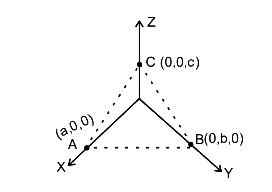
(A) Let the intercepts of the plane on the coordinate axes be $a, b, c$. Thus,the points are $A(a, 0, 0)$,$B(0, b, 0)$,and $C(0, 0, c)$.
The centroid of $\triangle ABC$ is given by $(\frac{a}{3}, \frac{b}{3}, \frac{c}{3})$.
Given that the centroid is $(1, r, r^2)$,we have:
$\frac{a}{3} = 1 \Rightarrow a = 3$
$\frac{b}{3} = r \Rightarrow b = 3r$
$\frac{c}{3} = r^2 \Rightarrow c = 3r^2$
The equation of the plane in intercept form is $\frac{x}{a} + \frac{y}{b} + \frac{z}{c} = 1$.
Substituting the values of $a, b, c$,we get $\frac{x}{3} + \frac{y}{3r} + \frac{z}{3r^2} = 1$.
Since the plane passes through $(5, 5, -12)$,we have:
$\frac{5}{3} + \frac{5}{3r} - \frac{12}{3r^2} = 1$
Multiplying by $3r^2$,we get $5r^2 + 5r - 12 = 3r^2$,which simplifies to $2r^2 + 5r - 12 = 0$.
Factoring the quadratic equation: $(2r - 3)(r + 4) = 0$.
Thus,$r = \frac{3}{2}$ or $r = -4$.
The centroid of $\triangle ABC$ is given by $(\frac{a}{3}, \frac{b}{3}, \frac{c}{3})$.
Given that the centroid is $(1, r, r^2)$,we have:
$\frac{a}{3} = 1 \Rightarrow a = 3$
$\frac{b}{3} = r \Rightarrow b = 3r$
$\frac{c}{3} = r^2 \Rightarrow c = 3r^2$
The equation of the plane in intercept form is $\frac{x}{a} + \frac{y}{b} + \frac{z}{c} = 1$.
Substituting the values of $a, b, c$,we get $\frac{x}{3} + \frac{y}{3r} + \frac{z}{3r^2} = 1$.
Since the plane passes through $(5, 5, -12)$,we have:
$\frac{5}{3} + \frac{5}{3r} - \frac{12}{3r^2} = 1$
Multiplying by $3r^2$,we get $5r^2 + 5r - 12 = 3r^2$,which simplifies to $2r^2 + 5r - 12 = 0$.
Factoring the quadratic equation: $(2r - 3)(r + 4) = 0$.
Thus,$r = \frac{3}{2}$ or $r = -4$.
0 likes
View Solution553
MediumMCQ
The equation of the plane passing through the point $(2, -1, -3)$ and parallel to the lines $\frac{x-1}{3} = \frac{y+2}{2} = \frac{z}{-4}$ and $\frac{x}{2} = \frac{y-1}{-3} = \frac{z-2}{2}$ is
A
$8x + 14y + 13z + 37 = 0$
B
$8x - 14y - 13z - 37 = 0$
C
$8x - 14y - 13z + 37 = 0$
D
None of the above
Solution
(A) The equation of a plane passing through the point $(x_1, y_1, z_1)$ is given by $a(x - x_1) + b(y - y_1) + c(z - z_1) = 0$. Substituting the point $(2, -1, -3)$,we get $a(x - 2) + b(y + 1) + c(z + 3) = 0$.
Since the plane is parallel to the lines with direction ratios $(3, 2, -4)$ and $(2, -3, 2)$,the normal vector $(a, b, c)$ must be perpendicular to these direction vectors.
Thus,$3a + 2b - 4c = 0$ and $2a - 3b + 2c = 0$.
Using the cross product to find the normal vector $(a, b, c) = (3, 2, -4) \times (2, -3, 2) = \begin{vmatrix} i & j & k \\ 3 & 2 & -4 \\ 2 & -3 & 2 \end{vmatrix} = i(4 - 12) - j(6 + 8) + k(-9 - 4) = -8i - 14j - 13k$.
Taking the normal vector as $(8, 14, 13)$,the equation of the plane is $8(x - 2) + 14(y + 1) + 13(z + 3) = 0$.
Expanding this,we get $8x - 16 + 14y + 14 + 13z + 39 = 0$,which simplifies to $8x + 14y + 13z + 37 = 0$.
Since the plane is parallel to the lines with direction ratios $(3, 2, -4)$ and $(2, -3, 2)$,the normal vector $(a, b, c)$ must be perpendicular to these direction vectors.
Thus,$3a + 2b - 4c = 0$ and $2a - 3b + 2c = 0$.
Using the cross product to find the normal vector $(a, b, c) = (3, 2, -4) \times (2, -3, 2) = \begin{vmatrix} i & j & k \\ 3 & 2 & -4 \\ 2 & -3 & 2 \end{vmatrix} = i(4 - 12) - j(6 + 8) + k(-9 - 4) = -8i - 14j - 13k$.
Taking the normal vector as $(8, 14, 13)$,the equation of the plane is $8(x - 2) + 14(y + 1) + 13(z + 3) = 0$.
Expanding this,we get $8x - 16 + 14y + 14 + 13z + 39 = 0$,which simplifies to $8x + 14y + 13z + 37 = 0$.
0 likes
View Solution554
EasyMCQ
If from a point $P(a, b, c)$,perpendiculars $PA$ and $PB$ are drawn to $YZ$ and $ZX$ planes respectively,then the equation of the plane $OAB$ is
A
$bcx + acy + abz = 0$
B
$bcx + acy - abz = 0$
C
$bcx - acy + abz = 0$
D
$bcx - acy - abz = 0$
Solution
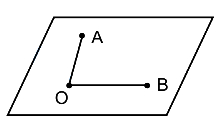
(B) Given point $P(a, b, c)$.
Perpendicular $PA$ is drawn to the $YZ$-plane. The coordinates of $A$ are $(0, b, c)$.
Perpendicular $PB$ is drawn to the $ZX$-plane. The coordinates of $B$ are $(a, 0, c)$.
The origin $O$ is $(0, 0, 0)$.
The plane passes through $O(0, 0, 0)$,$A(0, b, c)$,and $B(a, 0, c)$.
The normal vector $\vec{n}$ to the plane is given by $\vec{OA} \times \vec{OB}$.
$\vec{OA} = 0\hat{i} + b\hat{j} + c\hat{k}$
$\vec{OB} = a\hat{i} + 0\hat{j} + c\hat{k}$
$\vec{n} = \begin{vmatrix} \hat{i} & \hat{j} & \hat{k} \\ 0 & b & c \\ a & 0 & c \end{vmatrix} = \hat{i}(bc - 0) - \hat{j}(0 - ac) + \hat{k}(0 - ab) = bc\hat{i} + ac\hat{j} - ab\hat{k}$.
The equation of the plane passing through the origin is $bcx + acy - abz = 0$.
Perpendicular $PA$ is drawn to the $YZ$-plane. The coordinates of $A$ are $(0, b, c)$.
Perpendicular $PB$ is drawn to the $ZX$-plane. The coordinates of $B$ are $(a, 0, c)$.
The origin $O$ is $(0, 0, 0)$.
The plane passes through $O(0, 0, 0)$,$A(0, b, c)$,and $B(a, 0, c)$.
The normal vector $\vec{n}$ to the plane is given by $\vec{OA} \times \vec{OB}$.
$\vec{OA} = 0\hat{i} + b\hat{j} + c\hat{k}$
$\vec{OB} = a\hat{i} + 0\hat{j} + c\hat{k}$
$\vec{n} = \begin{vmatrix} \hat{i} & \hat{j} & \hat{k} \\ 0 & b & c \\ a & 0 & c \end{vmatrix} = \hat{i}(bc - 0) - \hat{j}(0 - ac) + \hat{k}(0 - ab) = bc\hat{i} + ac\hat{j} - ab\hat{k}$.
The equation of the plane passing through the origin is $bcx + acy - abz = 0$.
0 likes
View Solution555
DifficultMCQ
The plane $\ell x+my=0$ is rotated about its line of intersection with the plane $z=0$ through an angle $\alpha$. The equation of the new plane is
A
$\ell x+my \pm z \tan \alpha \sqrt{\ell^{2}+m^{2}}=0$
B
$\ell x+my \pm z \tan \alpha \sqrt{\ell^{2}+m^{2}+1}=0$
C
$\ell x+my \pm z \tan \alpha \sqrt{\ell^{2}+1}=0$
D
$\ell x+my \pm z \tan \alpha \sqrt{m^{2}+1}=0$
Solution
(A) Let the equation of the plane after rotation be $P_{3}: \ell x+my+nz=0$.
The line of intersection of the planes $P_{1}: \ell x+my=0$ and $P_{2}: z=0$ is the line where $\ell x+my=0$ and $z=0$.
The normal vectors are $\vec{n}_{1} = (\ell, m, 0)$ and $\vec{n}_{3} = (\ell, m, n)$.
The angle $\alpha$ between the planes $P_{1}$ and $P_{3}$ is given by $\cos \alpha = \frac{|\vec{n}_{1} \cdot \vec{n}_{3}|}{|\vec{n}_{1}| |\vec{n}_{3}|}$.
$\cos \alpha = \frac{|\ell^{2}+m^{2}|}{\sqrt{\ell^{2}+m^{2}} \sqrt{\ell^{2}+m^{2}+n^{2}}} = \sqrt{\frac{\ell^{2}+m^{2}}{\ell^{2}+m^{2}+n^{2}}}$.
Squaring both sides,$\cos^{2} \alpha = \frac{\ell^{2}+m^{2}}{\ell^{2}+m^{2}+n^{2}}$.
$\Rightarrow \cos^{2} \alpha (\ell^{2}+m^{2}+n^{2}) = \ell^{2}+m^{2}$.
$\Rightarrow n^{2} \cos^{2} \alpha = (\ell^{2}+m^{2})(1 - \cos^{2} \alpha) = (\ell^{2}+m^{2}) \sin^{2} \alpha$.
$\Rightarrow n^{2} = (\ell^{2}+m^{2}) \tan^{2} \alpha$.
$\Rightarrow n = \pm \sqrt{\ell^{2}+m^{2}} \tan \alpha$.
Substituting $n$ into the equation of $P_{3}$,we get $\ell x+my \pm z \sqrt{\ell^{2}+m^{2}} \tan \alpha = 0$.
The line of intersection of the planes $P_{1}: \ell x+my=0$ and $P_{2}: z=0$ is the line where $\ell x+my=0$ and $z=0$.
The normal vectors are $\vec{n}_{1} = (\ell, m, 0)$ and $\vec{n}_{3} = (\ell, m, n)$.
The angle $\alpha$ between the planes $P_{1}$ and $P_{3}$ is given by $\cos \alpha = \frac{|\vec{n}_{1} \cdot \vec{n}_{3}|}{|\vec{n}_{1}| |\vec{n}_{3}|}$.
$\cos \alpha = \frac{|\ell^{2}+m^{2}|}{\sqrt{\ell^{2}+m^{2}} \sqrt{\ell^{2}+m^{2}+n^{2}}} = \sqrt{\frac{\ell^{2}+m^{2}}{\ell^{2}+m^{2}+n^{2}}}$.
Squaring both sides,$\cos^{2} \alpha = \frac{\ell^{2}+m^{2}}{\ell^{2}+m^{2}+n^{2}}$.
$\Rightarrow \cos^{2} \alpha (\ell^{2}+m^{2}+n^{2}) = \ell^{2}+m^{2}$.
$\Rightarrow n^{2} \cos^{2} \alpha = (\ell^{2}+m^{2})(1 - \cos^{2} \alpha) = (\ell^{2}+m^{2}) \sin^{2} \alpha$.
$\Rightarrow n^{2} = (\ell^{2}+m^{2}) \tan^{2} \alpha$.
$\Rightarrow n = \pm \sqrt{\ell^{2}+m^{2}} \tan \alpha$.
Substituting $n$ into the equation of $P_{3}$,we get $\ell x+my \pm z \sqrt{\ell^{2}+m^{2}} \tan \alpha = 0$.
0 likes
View Solution556
MediumMCQ
The equation of the plane,which bisects the line joining the points $(1, 2, 3)$ and $(3, 4, 5)$ at right angles is
A
$x+y+z=0$
B
$x+y-z=9$
C
$x+y+z=9$
D
$x+y-z+9=0$
Solution
(C) Let the points be $A(1, 2, 3)$ and $B(3, 4, 5)$.
The midpoint $M$ of the line segment $AB$ is given by $M = \left(\frac{1+3}{2}, \frac{2+4}{2}, \frac{3+5}{2}\right) = (2, 3, 4)$.
The direction ratios of the line segment $AB$ are $(3-1, 4-2, 5-3) = (2, 2, 2)$.
Since the plane bisects $AB$ at right angles,the line $AB$ is normal to the plane. Thus,the normal vector is $\vec{n} = 2\hat{i} + 2\hat{j} + 2\hat{k}$,which can be simplified to $\vec{n} = \hat{i} + \hat{j} + \hat{k}$.
The equation of a plane passing through a point $\vec{a}$ with normal vector $\vec{n}$ is given by $(\vec{r} - \vec{a}) \cdot \vec{n} = 0$.
Here,$\vec{a} = 2\hat{i} + 3\hat{j} + 4\hat{k}$ and $\vec{n} = \hat{i} + \hat{j} + \hat{k}$.
Substituting these values,we get: $((x\hat{i} + y\hat{j} + z\hat{k}) - (2\hat{i} + 3\hat{j} + 4\hat{k})) \cdot (\hat{i} + \hat{j} + \hat{k}) = 0$.
$(x-2)\hat{i} + (y-3)\hat{j} + (z-4)\hat{k} \cdot (\hat{i} + \hat{j} + \hat{k}) = 0$.
$(x-2) + (y-3) + (z-4) = 0$.
$x + y + z - 9 = 0$,or $x + y + z = 9$.
The midpoint $M$ of the line segment $AB$ is given by $M = \left(\frac{1+3}{2}, \frac{2+4}{2}, \frac{3+5}{2}\right) = (2, 3, 4)$.
The direction ratios of the line segment $AB$ are $(3-1, 4-2, 5-3) = (2, 2, 2)$.
Since the plane bisects $AB$ at right angles,the line $AB$ is normal to the plane. Thus,the normal vector is $\vec{n} = 2\hat{i} + 2\hat{j} + 2\hat{k}$,which can be simplified to $\vec{n} = \hat{i} + \hat{j} + \hat{k}$.
The equation of a plane passing through a point $\vec{a}$ with normal vector $\vec{n}$ is given by $(\vec{r} - \vec{a}) \cdot \vec{n} = 0$.
Here,$\vec{a} = 2\hat{i} + 3\hat{j} + 4\hat{k}$ and $\vec{n} = \hat{i} + \hat{j} + \hat{k}$.
Substituting these values,we get: $((x\hat{i} + y\hat{j} + z\hat{k}) - (2\hat{i} + 3\hat{j} + 4\hat{k})) \cdot (\hat{i} + \hat{j} + \hat{k}) = 0$.
$(x-2)\hat{i} + (y-3)\hat{j} + (z-4)\hat{k} \cdot (\hat{i} + \hat{j} + \hat{k}) = 0$.
$(x-2) + (y-3) + (z-4) = 0$.
$x + y + z - 9 = 0$,or $x + y + z = 9$.
0 likes
View Solution557
EasyMCQ
The equation of the plane passing through the points $(1, 2, -3)$ and $(2, -2, 1)$ and parallel to the $X$-axis is:
A
$y - z + 1 = 0$
B
$y - z - 1 = 0$
C
$y + z - 1 = 0$
D
$y + z + 1 = 0$
Solution
(D) The plane passes through $(1, 2, -3)$ and $(2, -2, 1)$. The vector connecting these two points is $\vec{v} = (2-1)\hat{i} + (-2-2)\hat{j} + (1-(-3))\hat{k} = \hat{i} - 4\hat{j} + 4\hat{k}$.
Since the plane is parallel to the $X$-axis,its normal is perpendicular to the unit vector $\hat{i} = (1, 0, 0)$.
The normal vector $\vec{n}$ to the plane is given by the cross product of $\vec{v}$ and $\hat{i}$:
$\vec{n} = \vec{v} \times \hat{i} = \begin{vmatrix} \hat{i} & \hat{j} & \hat{k} \\ 1 & -4 & 4 \\ 1 & 0 & 0 \end{vmatrix} = \hat{i}(0) - \hat{j}(0-4) + \hat{k}(0-(-4)) = 4\hat{j} + 4\hat{k}$.
We can simplify the normal vector to $\vec{n}' = (0, 1, 1)$.
The equation of the plane passing through $(1, 2, -3)$ with normal $(0, 1, 1)$ is:
$0(x-1) + 1(y-2) + 1(z+3) = 0$
$y - 2 + z + 3 = 0$
$y + z + 1 = 0$.
Since the plane is parallel to the $X$-axis,its normal is perpendicular to the unit vector $\hat{i} = (1, 0, 0)$.
The normal vector $\vec{n}$ to the plane is given by the cross product of $\vec{v}$ and $\hat{i}$:
$\vec{n} = \vec{v} \times \hat{i} = \begin{vmatrix} \hat{i} & \hat{j} & \hat{k} \\ 1 & -4 & 4 \\ 1 & 0 & 0 \end{vmatrix} = \hat{i}(0) - \hat{j}(0-4) + \hat{k}(0-(-4)) = 4\hat{j} + 4\hat{k}$.
We can simplify the normal vector to $\vec{n}' = (0, 1, 1)$.
The equation of the plane passing through $(1, 2, -3)$ with normal $(0, 1, 1)$ is:
$0(x-1) + 1(y-2) + 1(z+3) = 0$
$y - 2 + z + 3 = 0$
$y + z + 1 = 0$.
0 likes
View Solution558
EasyMCQ
The angle between the planes $x+y+2z=6$ and $2x-y+z=9$ is:
A
$\frac{\pi}{4}$
B
$\frac{\pi}{6}$
C
$\frac{\pi}{3}$
D
$\frac{\pi}{2}$
Solution
(C) The equations of the given planes are $x+y+2z-6=0$ and $2x-y+z-9=0$.
Comparing these with the general form $a_1x+b_1y+c_1z+d_1=0$ and $a_2x+b_2y+c_2z+d_2=0$,we get the normal vectors $\vec{n_1} = (1, 1, 2)$ and $\vec{n_2} = (2, -1, 1)$.
The angle $\theta$ between the two planes is given by the formula:
$\cos \theta = \frac{|a_1a_2 + b_1b_2 + c_1c_2|}{\sqrt{a_1^2+b_1^2+c_1^2} \sqrt{a_2^2+b_2^2+c_2^2}}$.
Substituting the values:
$\cos \theta = \frac{|(1)(2) + (1)(-1) + (2)(1)|}{\sqrt{1^2+1^2+2^2} \sqrt{2^2+(-1)^2+1^2}}$.
$\cos \theta = \frac{|2 - 1 + 2|}{\sqrt{1+1+4} \sqrt{4+1+1}} = \frac{3}{\sqrt{6} \times \sqrt{6}} = \frac{3}{6} = \frac{1}{2}$.
Since $\cos \theta = \frac{1}{2}$,we have $\theta = \cos^{-1}(\frac{1}{2}) = \frac{\pi}{3}$.
Comparing these with the general form $a_1x+b_1y+c_1z+d_1=0$ and $a_2x+b_2y+c_2z+d_2=0$,we get the normal vectors $\vec{n_1} = (1, 1, 2)$ and $\vec{n_2} = (2, -1, 1)$.
The angle $\theta$ between the two planes is given by the formula:
$\cos \theta = \frac{|a_1a_2 + b_1b_2 + c_1c_2|}{\sqrt{a_1^2+b_1^2+c_1^2} \sqrt{a_2^2+b_2^2+c_2^2}}$.
Substituting the values:
$\cos \theta = \frac{|(1)(2) + (1)(-1) + (2)(1)|}{\sqrt{1^2+1^2+2^2} \sqrt{2^2+(-1)^2+1^2}}$.
$\cos \theta = \frac{|2 - 1 + 2|}{\sqrt{1+1+4} \sqrt{4+1+1}} = \frac{3}{\sqrt{6} \times \sqrt{6}} = \frac{3}{6} = \frac{1}{2}$.
Since $\cos \theta = \frac{1}{2}$,we have $\theta = \cos^{-1}(\frac{1}{2}) = \frac{\pi}{3}$.
0 likes
View Solution559
EasyMCQ
The angle between a normal to the plane $2x - y + 2z - 1 = 0$ and the $X$-axis is
A
$\cos^{-1} \frac{2}{3}$
B
$\cos^{-1} \frac{1}{5}$
C
$\cos^{-1} \frac{3}{4}$
D
$\cos^{-1} \frac{1}{3}$
Solution
(A) The equation of the plane is given by $2x - y + 2z - 1 = 0$.
The normal vector $\vec{n}$ to this plane is given by the coefficients of $x, y,$ and $z$,which is $\vec{n} = 2\hat{i} - \hat{j} + 2\hat{k}$.
The direction vector of the $X$-axis is $\vec{a} = 1\hat{i} + 0\hat{j} + 0\hat{k}$.
The angle $\theta$ between the normal vector $\vec{n}$ and the $X$-axis is given by the formula $\cos \theta = \frac{|\vec{n} \cdot \vec{a}|}{|\vec{n}| |\vec{a}|}$.
Calculating the dot product: $\vec{n} \cdot \vec{a} = (2)(1) + (-1)(0) + (2)(0) = 2$.
Calculating the magnitudes: $|\vec{n}| = \sqrt{2^2 + (-1)^2 + 2^2} = \sqrt{4 + 1 + 4} = \sqrt{9} = 3$ and $|\vec{a}| = \sqrt{1^2 + 0^2 + 0^2} = 1$.
Therefore,$\cos \theta = \frac{2}{3 \times 1} = \frac{2}{3}$.
Thus,$\theta = \cos^{-1} \frac{2}{3}$.
The normal vector $\vec{n}$ to this plane is given by the coefficients of $x, y,$ and $z$,which is $\vec{n} = 2\hat{i} - \hat{j} + 2\hat{k}$.
The direction vector of the $X$-axis is $\vec{a} = 1\hat{i} + 0\hat{j} + 0\hat{k}$.
The angle $\theta$ between the normal vector $\vec{n}$ and the $X$-axis is given by the formula $\cos \theta = \frac{|\vec{n} \cdot \vec{a}|}{|\vec{n}| |\vec{a}|}$.
Calculating the dot product: $\vec{n} \cdot \vec{a} = (2)(1) + (-1)(0) + (2)(0) = 2$.
Calculating the magnitudes: $|\vec{n}| = \sqrt{2^2 + (-1)^2 + 2^2} = \sqrt{4 + 1 + 4} = \sqrt{9} = 3$ and $|\vec{a}| = \sqrt{1^2 + 0^2 + 0^2} = 1$.
Therefore,$\cos \theta = \frac{2}{3 \times 1} = \frac{2}{3}$.
Thus,$\theta = \cos^{-1} \frac{2}{3}$.
0 likes
View SolutionTHREE DIMENSIONAL GEOMETRY — Plane · Frequently Asked Questions
1Are these THREE DIMENSIONAL GEOMETRY questions useful for JEE and NEET?
Yes. All questions in this section are mapped to JEE Main and NEET exam patterns. Previous year questions from JEE Main, NEET, GUJCET and state-level exams are included with full solutions.
2Can I switch to Hindi or Gujarati for these questions?
Yes. Use the language tabs in the hero section or the sidebar to view the same questions and solutions in English, Hindi or Gujarati.
3How do I generate a question paper from this subtopic?
Use the Vedclass Exam Paper Generator — select the chapter and subtopic, set difficulty, and generate Sets A, B, C, D automatically. First 3 chapters of every subject are free.
Vedclass Products
For Students
Vedclass Test Series
Mock tests in real JEE/NEET style with performance analysis. 5-day free trial.
Start Free TrialFor Teachers
Exam Paper Generator
Generate Set A/B/C/D papers from this chapter in 2 minutes. 3 chapters free.
Try FreeFor Institutes
Online Exam Module
Live online exams with unlimited students, 360° analytics & white-label branding.
See DemoFor Teachers & Institutes
Generate a THREE DIMENSIONAL GEOMETRY Exam Paper in 2 Minutes
Select subtopic & difficulty — Sets A, B, C, D auto-generated with No Repeat logic.
First 3 chapters of every subject are free — no payment required.