
A English
Domain and Range Questions in English
Class 12 Mathematics · Relation and Function · Domain and Range
324+
Questions
English
Language
100%
With Solutions
Showing 45 of 324 questions in English
251
MediumMCQ
The domain and range of $f(x) = \frac{1}{\sqrt{|x| - x^2}}$ are $A$ and $B$ respectively. Then $A \cup B =$
A
$(-1, 0) \cup (0, 1)$
B
$(-1, 1)$
C
$(-1, 0) \cup (0, 1) \cup [1, \infty)$
D
$(-1, 1) \cup [1, \infty)$
Solution
(C) For the domain $A$,we require $|x| - x^2 > 0$.
Since $|x|^2 = x^2$,this is $|x| - |x|^2 > 0$,which implies $|x|(1 - |x|) > 0$.
This holds when $0 < |x| < 1$,so $x \in (-1, 0) \cup (0, 1)$. Thus,$A = (-1, 0) \cup (0, 1)$.
For the range $B$,let $y = \frac{1}{\sqrt{|x| - x^2}}$.
As $x \to 0$,$|x| - x^2 \to 0^+$,so $y \to \infty$.
As $|x| \to 1$,$|x| - x^2 \to 0^+$,so $y \to \infty$.
The maximum value of $|x| - x^2$ occurs at $|x| = 1/2$,giving $1/2 - 1/4 = 1/4$.
The minimum value of the denominator is $0$ (exclusive) and the maximum value is $1/4$.
Thus,$\sqrt{|x| - x^2} \in (0, 1/2]$.
Therefore,$y \in [2, \infty)$,so $B = [2, \infty)$.
Finally,$A \cup B = ((-1, 0) \cup (0, 1)) \cup [2, \infty)$.
Since $|x|^2 = x^2$,this is $|x| - |x|^2 > 0$,which implies $|x|(1 - |x|) > 0$.
This holds when $0 < |x| < 1$,so $x \in (-1, 0) \cup (0, 1)$. Thus,$A = (-1, 0) \cup (0, 1)$.
For the range $B$,let $y = \frac{1}{\sqrt{|x| - x^2}}$.
As $x \to 0$,$|x| - x^2 \to 0^+$,so $y \to \infty$.
As $|x| \to 1$,$|x| - x^2 \to 0^+$,so $y \to \infty$.
The maximum value of $|x| - x^2$ occurs at $|x| = 1/2$,giving $1/2 - 1/4 = 1/4$.
The minimum value of the denominator is $0$ (exclusive) and the maximum value is $1/4$.
Thus,$\sqrt{|x| - x^2} \in (0, 1/2]$.
Therefore,$y \in [2, \infty)$,so $B = [2, \infty)$.
Finally,$A \cup B = ((-1, 0) \cup (0, 1)) \cup [2, \infty)$.
0 likes
View Solution252
EasyMCQ
The domain of the real valued function $f(x) = \sqrt{\cos (\sin x)} + \cos^{-1} \left( \frac{1 + x^2}{2 x} \right)$ is
A
$(-1, 1)$
B
$[-1, 1]$
C
$R - (-1, 1)$
D
$\{-1, 1\}$
Solution
(D) For the function $f(x)$ to be defined,both parts must be defined.
First,consider $\cos^{-1} \left( \frac{1 + x^2}{2 x} \right)$. This is defined if $-1 \leq \frac{1 + x^2}{2 x} \leq 1$.
This implies $\left| \frac{1 + x^2}{2 x} \right| \leq 1$,which means $|1 + x^2| \leq |2x|$.
Since $1 + x^2 \geq 2|x|$ is only true when $|x| = 1$,we have $x = 1$ or $x = -1$.
Now,check the first part $\sqrt{\cos(\sin x)}$.
For $x = 1$,$\cos(\sin 1) > 0$ since $\sin 1 \approx 0.84$ radians,which is in the first quadrant.
For $x = -1$,$\cos(\sin(-1)) = \cos(-\sin 1) = \cos(\sin 1) > 0$.
Since both conditions are satisfied only at $x = 1$ and $x = -1$,the domain is $\{-1, 1\}$.
First,consider $\cos^{-1} \left( \frac{1 + x^2}{2 x} \right)$. This is defined if $-1 \leq \frac{1 + x^2}{2 x} \leq 1$.
This implies $\left| \frac{1 + x^2}{2 x} \right| \leq 1$,which means $|1 + x^2| \leq |2x|$.
Since $1 + x^2 \geq 2|x|$ is only true when $|x| = 1$,we have $x = 1$ or $x = -1$.
Now,check the first part $\sqrt{\cos(\sin x)}$.
For $x = 1$,$\cos(\sin 1) > 0$ since $\sin 1 \approx 0.84$ radians,which is in the first quadrant.
For $x = -1$,$\cos(\sin(-1)) = \cos(-\sin 1) = \cos(\sin 1) > 0$.
Since both conditions are satisfied only at $x = 1$ and $x = -1$,the domain is $\{-1, 1\}$.
0 likes
View Solution253
MediumMCQ
The domain of the real-valued function $f(x) = \sqrt[3]{\frac{x-2}{2x^2-7x+5}} + \log(x^2-x-2)$ is
A
$(-\infty, -1) \cup (2, \infty)$
B
$R - \{1, \frac{5}{2}\}$
C
$(-\infty, -1) \cup (2, \frac{5}{2}) \cup (\frac{5}{2}, \infty)$
D
$(-1, 2)$
Solution
(C) Given function: $f(x) = \sqrt[3]{\frac{x-2}{2x^2-7x+5}} + \log(x^2-x-2)$.
For the domain,the cube root is defined for all real values where the denominator is non-zero,and the logarithm is defined for positive arguments.
$1$. For the denominator of the cube root: $2x^2-7x+5 \neq 0$ $\Rightarrow (2x-5)(x-1) \neq 0$ $\Rightarrow x \neq 1, x \neq \frac{5}{2}$.
$2$. For the logarithm: $x^2-x-2 > 0 \Rightarrow (x-2)(x+1) > 0$. This inequality holds for $x \in (-\infty, -1) \cup (2, \infty)$.
Combining these conditions: We need $x \in (-\infty, -1) \cup (2, \infty)$ such that $x \neq 1$ and $x \neq \frac{5}{2}$.
Since $1$ is not in the interval $(-\infty, -1) \cup (2, \infty)$,we only need to exclude $\frac{5}{2}$.
Thus,the domain is $(-\infty, -1) \cup (2, \frac{5}{2}) \cup (\frac{5}{2}, \infty)$.
For the domain,the cube root is defined for all real values where the denominator is non-zero,and the logarithm is defined for positive arguments.
$1$. For the denominator of the cube root: $2x^2-7x+5 \neq 0$ $\Rightarrow (2x-5)(x-1) \neq 0$ $\Rightarrow x \neq 1, x \neq \frac{5}{2}$.
$2$. For the logarithm: $x^2-x-2 > 0 \Rightarrow (x-2)(x+1) > 0$. This inequality holds for $x \in (-\infty, -1) \cup (2, \infty)$.
Combining these conditions: We need $x \in (-\infty, -1) \cup (2, \infty)$ such that $x \neq 1$ and $x \neq \frac{5}{2}$.
Since $1$ is not in the interval $(-\infty, -1) \cup (2, \infty)$,we only need to exclude $\frac{5}{2}$.
Thus,the domain is $(-\infty, -1) \cup (2, \frac{5}{2}) \cup (\frac{5}{2}, \infty)$.
0 likes
View Solution254
EasyMCQ
If $f$ is a real-valued function from $A$ onto $B$ defined by $f(x) = \frac{1}{\sqrt{|x - |x||}}$,then $A \cap B = $
A
$\phi$
B
$(-\infty, 0)$
C
$(0, \infty)$
D
$(-\infty, \infty)$
Solution
(A) Given $f(x) = \frac{1}{\sqrt{|x - |x||}}$.
For the function to be defined,the expression inside the square root must be strictly positive: $|x - |x|| > 0$.
If $x \ge 0$,then $|x| = x$,so $|x - x| = 0$,which is not $> 0$.
If $x < 0$,then $|x| = -x$,so $|x - (-x)| = |2x| = -2x$. Since $x < 0$,$-2x > 0$.
Thus,the domain $A = (-\infty, 0)$.
For $x \in (-\infty, 0)$,$f(x) = \frac{1}{\sqrt{-2x}}$. As $x$ ranges from $(-\infty, 0)$,$-2x$ ranges from $(0, \infty)$,and $\sqrt{-2x}$ ranges from $(0, \infty)$.
Therefore,the range $B = (0, \infty)$.
Finally,$A \cap B = (-\infty, 0) \cap (0, \infty) = \phi$.
For the function to be defined,the expression inside the square root must be strictly positive: $|x - |x|| > 0$.
If $x \ge 0$,then $|x| = x$,so $|x - x| = 0$,which is not $> 0$.
If $x < 0$,then $|x| = -x$,so $|x - (-x)| = |2x| = -2x$. Since $x < 0$,$-2x > 0$.
Thus,the domain $A = (-\infty, 0)$.
For $x \in (-\infty, 0)$,$f(x) = \frac{1}{\sqrt{-2x}}$. As $x$ ranges from $(-\infty, 0)$,$-2x$ ranges from $(0, \infty)$,and $\sqrt{-2x}$ ranges from $(0, \infty)$.
Therefore,the range $B = (0, \infty)$.
Finally,$A \cap B = (-\infty, 0) \cap (0, \infty) = \phi$.
0 likes
View Solution255
EasyMCQ
If the real valued function $f(x)=\sin ^{-1}(x^2-1)-3 \log _3(3^x-2)$ is not defined for all $x \in(-\infty, a] \cup(b, \infty)$,then $3^a+b^2=$
A
$5$
B
$6$
C
$3$
D
$4$
Solution
(D) The function $f(x)=\sin ^{-1}(x^2-1)-3 \log _3(3^x-2)$ is defined when both terms are defined.
For $\sin ^{-1}(x^2-1)$,we require $-1 \leq x^2-1 \leq 1$,which implies $0 \leq x^2 \leq 2$,so $x \in [-\sqrt{2}, \sqrt{2}]$.
For $\log _3(3^x-2)$,we require $3^x-2 > 0$,which implies $3^x > 2$,so $x > \log _3 2$.
The domain of $f(x)$ is the intersection: $[-\sqrt{2}, \sqrt{2}] \cap (\log _3 2, \infty) = (\log _3 2, \sqrt{2}]$.
The function is not defined for $x \in (-\infty, \log _3 2] \cup (\sqrt{2}, \infty)$.
Comparing this with $(-\infty, a] \cup (b, \infty)$,we get $a = \log _3 2$ and $b = \sqrt{2}$.
Thus,$3^a + b^2 = 3^{\log _3 2} + (\sqrt{2})^2 = 2 + 2 = 4$.
For $\sin ^{-1}(x^2-1)$,we require $-1 \leq x^2-1 \leq 1$,which implies $0 \leq x^2 \leq 2$,so $x \in [-\sqrt{2}, \sqrt{2}]$.
For $\log _3(3^x-2)$,we require $3^x-2 > 0$,which implies $3^x > 2$,so $x > \log _3 2$.
The domain of $f(x)$ is the intersection: $[-\sqrt{2}, \sqrt{2}] \cap (\log _3 2, \infty) = (\log _3 2, \sqrt{2}]$.
The function is not defined for $x \in (-\infty, \log _3 2] \cup (\sqrt{2}, \infty)$.
Comparing this with $(-\infty, a] \cup (b, \infty)$,we get $a = \log _3 2$ and $b = \sqrt{2}$.
Thus,$3^a + b^2 = 3^{\log _3 2} + (\sqrt{2})^2 = 2 + 2 = 4$.
0 likes
View Solution256
MediumMCQ
The domain of the real-valued function $f(x) = \frac{\sqrt{\log_{10}\left(\frac{x}{x-2}\right)}}{\sqrt{[x]^2-5[x]+6}}$ is (where $[x]$ denotes the greatest integer function):
A
$(-\infty, 0) \cup (2, \infty)$
B
$(2, \infty)$
C
$(-\infty, 2) \cup (4, \infty)$
D
$[4, \infty)$
Solution
(D) For the function $f(x)$ to be defined,the following conditions must be satisfied:
$1$. The expression inside the square root in the numerator must be non-negative: $\log_{10}\left(\frac{x}{x-2}\right) \geq 0$.
This implies $\frac{x}{x-2} \geq 10^0$,so $\frac{x}{x-2} \geq 1$.
$\frac{x}{x-2} - 1 \geq 0$ $\Rightarrow \frac{x - (x-2)}{x-2} \geq 0$ $\Rightarrow \frac{2}{x-2} > 0$.
This holds when $x-2 > 0$,i.e.,$x > 2$.
$2$. The expression inside the square root in the denominator must be strictly positive: $[x]^2 - 5[x] + 6 > 0$.
$([x]-2)([x]-3) > 0$.
This implies $[x] < 2$ or $[x] > 3$.
If $[x] < 2$,then $x < 2$. If $[x] > 3$,then $x \geq 4$.
$3$. Combining the conditions $x > 2$ and ($x < 2$ or $x \geq 4$),we get $x \in [4, \infty)$.
$1$. The expression inside the square root in the numerator must be non-negative: $\log_{10}\left(\frac{x}{x-2}\right) \geq 0$.
This implies $\frac{x}{x-2} \geq 10^0$,so $\frac{x}{x-2} \geq 1$.
$\frac{x}{x-2} - 1 \geq 0$ $\Rightarrow \frac{x - (x-2)}{x-2} \geq 0$ $\Rightarrow \frac{2}{x-2} > 0$.
This holds when $x-2 > 0$,i.e.,$x > 2$.
$2$. The expression inside the square root in the denominator must be strictly positive: $[x]^2 - 5[x] + 6 > 0$.
$([x]-2)([x]-3) > 0$.
This implies $[x] < 2$ or $[x] > 3$.
If $[x] < 2$,then $x < 2$. If $[x] > 3$,then $x \geq 4$.
$3$. Combining the conditions $x > 2$ and ($x < 2$ or $x \geq 4$),we get $x \in [4, \infty)$.
0 likes
View Solution257
EasyMCQ
The domain of the real-valued function $f(x) = \frac{\sqrt{|x|-x}}{\sqrt{x-[x]}}$ is
A
$Z$
B
$\phi$
C
$R-Z$
D
$R$
Solution
(C) The function is defined as $f(x) = \sqrt{\frac{|x|-x}{x-[x]}}$.
For the numerator $\sqrt{|x|-x}$ to be defined,we need $|x|-x \geq 0$,which implies $|x| \geq x$. This is true for all $x \in R$.
For the denominator $\sqrt{x-[x]}$ to be defined and non-zero,we need $x-[x] > 0$.
We know that $x-[x] = \{x\}$,where $\{x\}$ is the fractional part of $x$.
The condition $\{x\} > 0$ holds for all $x \notin Z$ (all real numbers except integers).
If $x \in Z$,then $\{x\} = 0$,which makes the denominator zero and the function undefined.
Therefore,the domain of the function is $R-Z$.
For the numerator $\sqrt{|x|-x}$ to be defined,we need $|x|-x \geq 0$,which implies $|x| \geq x$. This is true for all $x \in R$.
For the denominator $\sqrt{x-[x]}$ to be defined and non-zero,we need $x-[x] > 0$.
We know that $x-[x] = \{x\}$,where $\{x\}$ is the fractional part of $x$.
The condition $\{x\} > 0$ holds for all $x \notin Z$ (all real numbers except integers).
If $x \in Z$,then $\{x\} = 0$,which makes the denominator zero and the function undefined.
Therefore,the domain of the function is $R-Z$.
0 likes
View Solution258
EasyMCQ
If ${ }^{n} C_{r}$ denotes the number of combinations of $n$ distinct things taken $r$ at a time,then the domain of the function $g(x)={ }^{(16-x)} C_{(2 x-1)}$ is
A
$\{1, 2, 3, 4, 5\}$
B
$\{0, 1, 2, 3, 4\}$
C
$\phi$
D
$\{0\}$
Solution
(A) For the combination ${ }^{n} C_{r}$ to be defined,we must have $n \geq r \geq 0$ and $n, r \in \mathbb{Z}_{\geq 0}$.
Here,$n = 16-x$ and $r = 2x-1$.
$1$) $r \geq 0 \implies 2x-1 \geq 0 \implies x \geq \frac{1}{2}$.
$2$) $n \geq r \implies 16-x \geq 2x-1 \implies 17 \geq 3x \implies x \leq \frac{17}{3} \approx 5.66$.
$3$) $n \geq 0 \implies 16-x \geq 0 \implies x \leq 16$.
Combining these,we get $\frac{1}{2} \leq x \leq 5.66$.
Since $n$ and $r$ must be non-negative integers,$x$ must be an integer such that $2x-1$ is a non-negative integer and $16-x$ is an integer $\geq 2x-1$.
The possible integer values for $x$ in the interval $[0.5, 5.66]$ are $x \in \{1, 2, 3, 4, 5\}$.
Here,$n = 16-x$ and $r = 2x-1$.
$1$) $r \geq 0 \implies 2x-1 \geq 0 \implies x \geq \frac{1}{2}$.
$2$) $n \geq r \implies 16-x \geq 2x-1 \implies 17 \geq 3x \implies x \leq \frac{17}{3} \approx 5.66$.
$3$) $n \geq 0 \implies 16-x \geq 0 \implies x \leq 16$.
Combining these,we get $\frac{1}{2} \leq x \leq 5.66$.
Since $n$ and $r$ must be non-negative integers,$x$ must be an integer such that $2x-1$ is a non-negative integer and $16-x$ is an integer $\geq 2x-1$.
The possible integer values for $x$ in the interval $[0.5, 5.66]$ are $x \in \{1, 2, 3, 4, 5\}$.
0 likes
View Solution259
EasyMCQ
The domain of the real valued function $f(x) = \frac{\sqrt{6x^2+5x-6}}{\sqrt{4-x}-\sqrt{x+4}}$ is
A
$[-4, -\frac{3}{2}] \cup [\frac{2}{3}, 4]$
B
$(-\infty, -\frac{3}{2}] \cup [\frac{2}{3}, \infty)$
C
$[-4, 4]$
D
$[-\frac{3}{2}, \frac{2}{3}]$
Solution
(A) Given: $f(x) = \frac{\sqrt{6x^2+5x-6}}{\sqrt{4-x}-\sqrt{x+4}}$
For $f(x)$ to be defined:
$(1)$ The numerator must be real: $6x^2+5x-6 \geq 0$
$(3x-2)(2x+3) \geq 0 \Rightarrow x \in (-\infty, -\frac{3}{2}] \cup [\frac{2}{3}, \infty)$
$(2)$ The denominator must be non-zero: $\sqrt{4-x} - \sqrt{x+4} \neq 0$
$4-x \neq x+4$ $\Rightarrow 2x \neq 0$ $\Rightarrow x \neq 0$
$(3)$ The square root terms must be defined:
$4-x \geq 0 \Rightarrow x \leq 4$
$x+4 \geq 0 \Rightarrow x \geq -4$
Combining these conditions: $x \in [-4, 4] \cap ((-\infty, -\frac{3}{2}] \cup [\frac{2}{3}, \infty)) \cap \{x \neq 0\}$
Since $0$ is not in the interval $(-\infty, -\frac{3}{2}] \cup [\frac{2}{3}, \infty)$,the condition $x \neq 0$ is automatically satisfied.
Thus,the domain is $[-4, -\frac{3}{2}] \cup [\frac{2}{3}, 4]$.
For $f(x)$ to be defined:
$(1)$ The numerator must be real: $6x^2+5x-6 \geq 0$
$(3x-2)(2x+3) \geq 0 \Rightarrow x \in (-\infty, -\frac{3}{2}] \cup [\frac{2}{3}, \infty)$
$(2)$ The denominator must be non-zero: $\sqrt{4-x} - \sqrt{x+4} \neq 0$
$4-x \neq x+4$ $\Rightarrow 2x \neq 0$ $\Rightarrow x \neq 0$
$(3)$ The square root terms must be defined:
$4-x \geq 0 \Rightarrow x \leq 4$
$x+4 \geq 0 \Rightarrow x \geq -4$
Combining these conditions: $x \in [-4, 4] \cap ((-\infty, -\frac{3}{2}] \cup [\frac{2}{3}, \infty)) \cap \{x \neq 0\}$
Since $0$ is not in the interval $(-\infty, -\frac{3}{2}] \cup [\frac{2}{3}, \infty)$,the condition $x \neq 0$ is automatically satisfied.
Thus,the domain is $[-4, -\frac{3}{2}] \cup [\frac{2}{3}, 4]$.
0 likes
View Solution260
MediumMCQ
The domain of the real-valued function $f(x) = \sqrt{\frac{2x^2 - 7x + 5}{3x^2 - 5x - 2}}$ is
A
$\left(-\infty, -\frac{1}{3}\right) \cup [1, 2) \cup \left[\frac{5}{2}, \infty\right)$
B
$(-\infty, 1) \cup (2, \infty)$
C
$\left(-\frac{1}{3}, \frac{5}{2}\right]$
D
$\left(-\infty, -\frac{1}{3}\right] \cup \left[\frac{5}{2}, \infty\right)$
Solution
(A) For the function $f(x) = \sqrt{\frac{2x^2 - 7x + 5}{3x^2 - 5x - 2}}$ to be defined,the expression inside the square root must be non-negative:
$\frac{2x^2 - 7x + 5}{3x^2 - 5x - 2} \geq 0$
Factorizing the numerator and denominator:
Numerator: $2x^2 - 7x + 5 = 2x^2 - 2x - 5x + 5 = 2x(x - 1) - 5(x - 1) = (2x - 5)(x - 1)$
Denominator: $3x^2 - 5x - 2 = 3x^2 - 6x + x - 2 = 3x(x - 2) + 1(x - 2) = (3x + 1)(x - 2)$
So,the inequality is $\frac{(2x - 5)(x - 1)}{(3x + 1)(x - 2)} \geq 0$
The critical points are $x = -\frac{1}{3}, 1, 2, \frac{5}{2}$.
Using the wavy curve method (sign scheme) on the number line:
- For $x > \frac{5}{2}$,the expression is positive.
- For $2 < x < \frac{5}{2}$,the expression is negative.
- For $1 < x < 2$,the expression is positive.
- For $-\frac{1}{3} < x < 1$,the expression is negative.
- For $x < -\frac{1}{3}$,the expression is positive.
Including the points where the numerator is zero $(x = 1, \frac{5}{2})$ and excluding points where the denominator is zero $(x = -\frac{1}{3}, 2)$:
The domain is $\left(-\infty, -\frac{1}{3}\right) \cup [1, 2) \cup \left[\frac{5}{2}, \infty\right)$.
Thus,option $A$ is correct.
$\frac{2x^2 - 7x + 5}{3x^2 - 5x - 2} \geq 0$
Factorizing the numerator and denominator:
Numerator: $2x^2 - 7x + 5 = 2x^2 - 2x - 5x + 5 = 2x(x - 1) - 5(x - 1) = (2x - 5)(x - 1)$
Denominator: $3x^2 - 5x - 2 = 3x^2 - 6x + x - 2 = 3x(x - 2) + 1(x - 2) = (3x + 1)(x - 2)$
So,the inequality is $\frac{(2x - 5)(x - 1)}{(3x + 1)(x - 2)} \geq 0$
The critical points are $x = -\frac{1}{3}, 1, 2, \frac{5}{2}$.
Using the wavy curve method (sign scheme) on the number line:
- For $x > \frac{5}{2}$,the expression is positive.
- For $2 < x < \frac{5}{2}$,the expression is negative.
- For $1 < x < 2$,the expression is positive.
- For $-\frac{1}{3} < x < 1$,the expression is negative.
- For $x < -\frac{1}{3}$,the expression is positive.
Including the points where the numerator is zero $(x = 1, \frac{5}{2})$ and excluding points where the denominator is zero $(x = -\frac{1}{3}, 2)$:
The domain is $\left(-\infty, -\frac{1}{3}\right) \cup [1, 2) \cup \left[\frac{5}{2}, \infty\right)$.
Thus,option $A$ is correct.
0 likes
View Solution261
EasyMCQ
If $[x]$ represents the greatest integer function,then the set of all real values of $x$ for which $f(x)=\sqrt{\frac{[x]-x}{x-[x]}}$ is real is
A
$\phi$
B
$R$
C
$Z$
D
$R-Z$
Solution
(A) The function is defined as $f(x) = \sqrt{\frac{[x]-x}{x-[x]}}$.
For any $x \in R$,let $x = [x] + \{x\}$,where $0 \leq \{x\} < 1$.
Then $x - [x] = \{x\}$.
If $x \notin Z$,then $\{x\} \neq 0$,so we can write the expression as:
$f(x) = \sqrt{\frac{-\{x\}}{\{x\}}} = \sqrt{-1} = i$.
Since $i$ is not a real number,$f(x)$ is not real for any $x \notin Z$.
If $x \in Z$,then $[x] = x$,which makes the denominator $x - [x] = 0$.
Division by zero is undefined,so $f(x)$ is not defined for $x \in Z$.
Therefore,there are no real values of $x$ for which $f(x)$ is real.
The set of such values is the empty set,denoted by $\phi$.
For any $x \in R$,let $x = [x] + \{x\}$,where $0 \leq \{x\} < 1$.
Then $x - [x] = \{x\}$.
If $x \notin Z$,then $\{x\} \neq 0$,so we can write the expression as:
$f(x) = \sqrt{\frac{-\{x\}}{\{x\}}} = \sqrt{-1} = i$.
Since $i$ is not a real number,$f(x)$ is not real for any $x \notin Z$.
If $x \in Z$,then $[x] = x$,which makes the denominator $x - [x] = 0$.
Division by zero is undefined,so $f(x)$ is not defined for $x \in Z$.
Therefore,there are no real values of $x$ for which $f(x)$ is real.
The set of such values is the empty set,denoted by $\phi$.
0 likes
View Solution262
MediumMCQ
Let $a > 1$ be a constant. If $f: A \rightarrow A$ and $(x, y) \in f$ satisfy $a^x + a^y = a$,then $A =$
A
$(0, a]$
B
$[0, a]$
C
$(-\infty, 1)$
D
$(-\infty, a+1)$
Solution
(C) Given $a^x + a^y = a$.
Since $f: A \rightarrow A$,the domain and range are both $A$.
For $y$ to be defined,we must have $a^y > 0$,which implies $a - a^x > 0$,so $a^x < a$.
Since $a > 1$,taking $\log_a$ on both sides gives $x < 1$.
Thus,the domain is $x \in (-\infty, 1)$.
Since the range must also be $A$,we have $y = \log_a(a - a^x)$.
As $x \rightarrow -\infty$,$a^x \rightarrow 0$,so $y \rightarrow \log_a(a) = 1$.
As $x \rightarrow 1^-$,$a^x \rightarrow a^-$,so $a - a^x \rightarrow 0^+$,which means $y \rightarrow -\infty$.
Thus,the range is $(-\infty, 1)$.
Therefore,$A = (-\infty, 1)$.
Since $f: A \rightarrow A$,the domain and range are both $A$.
For $y$ to be defined,we must have $a^y > 0$,which implies $a - a^x > 0$,so $a^x < a$.
Since $a > 1$,taking $\log_a$ on both sides gives $x < 1$.
Thus,the domain is $x \in (-\infty, 1)$.
Since the range must also be $A$,we have $y = \log_a(a - a^x)$.
As $x \rightarrow -\infty$,$a^x \rightarrow 0$,so $y \rightarrow \log_a(a) = 1$.
As $x \rightarrow 1^-$,$a^x \rightarrow a^-$,so $a - a^x \rightarrow 0^+$,which means $y \rightarrow -\infty$.
Thus,the range is $(-\infty, 1)$.
Therefore,$A = (-\infty, 1)$.
0 likes
View Solution263
EasyMCQ
Let $f(x) = \frac{1}{2} - \tan \left(\frac{\pi x}{2}\right), -1 < x < 1$ and $g(x) = \sqrt{3 + 4x - 4x^2}$,then the domain of $(f + g)$ is
A
$\left[\frac{1}{2}, 1\right)$
B
$\left[-\frac{1}{2}, \frac{1}{2}\right)$
C
$\left[-\frac{1}{2}, 1\right)$
D
$\left[-\frac{1}{2}, -1\right]$
Solution
(C) Given,$f(x) = \frac{1}{2} - \tan \left(\frac{\pi x}{2}\right)$ with domain $(-1, 1)$ and $g(x) = \sqrt{3 + 4x - 4x^2}$.
To find the domain of $(f + g)$,we need the intersection of the domains of $f(x)$ and $g(x)$.
For $g(x)$ to be defined,$3 + 4x - 4x^2 \geq 0$.
Multiplying by $-1$,we get $4x^2 - 4x - 3 \leq 0$.
Factoring the quadratic,$(2x + 1)(2x - 3) \leq 0$.
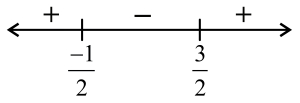
This inequality holds for $x \in \left[-\frac{1}{2}, \frac{3}{2}\right]$.
The domain of $(f + g)$ is the intersection of $(-1, 1)$ and $\left[-\frac{1}{2}, \frac{3}{2}\right]$.
Intersection $= (-1, 1) \cap \left[-\frac{1}{2}, \frac{3}{2}\right] = \left[-\frac{1}{2}, 1\right)$.
To find the domain of $(f + g)$,we need the intersection of the domains of $f(x)$ and $g(x)$.
For $g(x)$ to be defined,$3 + 4x - 4x^2 \geq 0$.
Multiplying by $-1$,we get $4x^2 - 4x - 3 \leq 0$.
Factoring the quadratic,$(2x + 1)(2x - 3) \leq 0$.
This inequality holds for $x \in \left[-\frac{1}{2}, \frac{3}{2}\right]$.
The domain of $(f + g)$ is the intersection of $(-1, 1)$ and $\left[-\frac{1}{2}, \frac{3}{2}\right]$.
Intersection $= (-1, 1) \cap \left[-\frac{1}{2}, \frac{3}{2}\right] = \left[-\frac{1}{2}, 1\right)$.
0 likes
View Solution264
EasyMCQ
The domain of the function $f(x) = \frac{1}{\sqrt{|x|-x}}$ is
A
$R$
B
$(-\infty, 0)$
C
$(0, \infty)$
D
$(-\infty, 1)$
Solution
(B) Given,$f(x) = \frac{1}{\sqrt{|x|-x}}$.
For the function $f(x)$ to be defined,the expression inside the square root must be strictly positive:
$|x| - x > 0$
$|x| > x$
This inequality holds true for all negative real numbers,i.e.,$x < 0$.
Therefore,the domain is $(-\infty, 0)$.
For the function $f(x)$ to be defined,the expression inside the square root must be strictly positive:
$|x| - x > 0$
$|x| > x$
This inequality holds true for all negative real numbers,i.e.,$x < 0$.
Therefore,the domain is $(-\infty, 0)$.
0 likes
View Solution265
MediumMCQ
The domain of the function $f(x) = \sec^{-1}(3x - 4) + \tanh^{-1}\left(\frac{x + 3}{5}\right)$ is
A
$(-8, 1) \cup \left(\frac{5}{3}, 2\right)$
B
$\left(1, \frac{5}{3}\right)$
C
$[-8, 1] \cup \left[\frac{5}{3}, 2\right]$
D
$(-8, 1] \cup \left[\frac{5}{3}, 2\right)$
Solution
(D) The function is $f(x) = \sec^{-1}(3x - 4) + \tanh^{-1}\left(\frac{x + 3}{5}\right)$.
For $\sec^{-1}(3x - 4)$ to be defined,we must have $|3x - 4| \geq 1$.
This implies $3x - 4 \leq -1$ or $3x - 4 \geq 1$.
$3x \leq 3 \Rightarrow x \leq 1$ and $3x \geq 5 \Rightarrow x \geq \frac{5}{3}$.
So,the domain of the first part is $x \in (-\infty, 1] \cup [\frac{5}{3}, \infty)$.
For $\tanh^{-1}\left(\frac{x + 3}{5}\right)$ to be defined,we must have $-1 < \frac{x + 3}{5} < 1$.
$-5 < x + 3 < 5$.
$-8 < x < 2$.
Taking the intersection of $x \in (-\infty, 1] \cup [\frac{5}{3}, \infty)$ and $x \in (-8, 2)$:
$x \in (-8, 1] \cup [\frac{5}{3}, 2)$.
For $\sec^{-1}(3x - 4)$ to be defined,we must have $|3x - 4| \geq 1$.
This implies $3x - 4 \leq -1$ or $3x - 4 \geq 1$.
$3x \leq 3 \Rightarrow x \leq 1$ and $3x \geq 5 \Rightarrow x \geq \frac{5}{3}$.
So,the domain of the first part is $x \in (-\infty, 1] \cup [\frac{5}{3}, \infty)$.
For $\tanh^{-1}\left(\frac{x + 3}{5}\right)$ to be defined,we must have $-1 < \frac{x + 3}{5} < 1$.
$-5 < x + 3 < 5$.
$-8 < x < 2$.
Taking the intersection of $x \in (-\infty, 1] \cup [\frac{5}{3}, \infty)$ and $x \in (-8, 2)$:
$x \in (-8, 1] \cup [\frac{5}{3}, 2)$.
0 likes
View Solution266
EasyMCQ
The domain of the function $f(x) = \sqrt{\log_{10}\left(\frac{5x - x^2}{4}\right)}$ is:
A
$[0, 1]$
B
$[1, 4]$
C
$[4, 5]$
D
$(-\infty, \infty)$
Solution
(B) For the function $f(x) = \sqrt{\log_{10}\left(\frac{5x - x^2}{4}\right)}$ to be defined,the expression inside the square root must be non-negative: $\log_{10}\left(\frac{5x - x^2}{4}\right) \geq 0$.
This implies $\frac{5x - x^2}{4} \geq 10^0$,which simplifies to $\frac{5x - x^2}{4} \geq 1$.
Multiplying by $4$,we get $5x - x^2 \geq 4$,or $x^2 - 5x + 4 \leq 0$.
Factoring the quadratic,we have $(x - 1)(x - 4) \leq 0$.
This inequality holds when $x \in [1, 4]$.
Thus,the domain of $f(x)$ is $[1, 4]$.
This implies $\frac{5x - x^2}{4} \geq 10^0$,which simplifies to $\frac{5x - x^2}{4} \geq 1$.
Multiplying by $4$,we get $5x - x^2 \geq 4$,or $x^2 - 5x + 4 \leq 0$.
Factoring the quadratic,we have $(x - 1)(x - 4) \leq 0$.
This inequality holds when $x \in [1, 4]$.
Thus,the domain of $f(x)$ is $[1, 4]$.
0 likes
View Solution267
EasyMCQ
Let $[x]$ denote the greatest integer not more than $x$. If $A$ and $B$ are the domains of the functions $f(x)=\frac{x-[x]}{\sqrt{|x|-x}}$ and $g(x)=\frac{x-[x]}{\sqrt{|x|+x}}$ respectively,then
A
$A \cup B=R$
B
$A \cap B=\phi$
C
$A-B=(-\infty, 0)$
D
$B-A=(0, \infty)$
Solution
(B) For $f(x)=\frac{x-[x]}{\sqrt{|x|-x}}$ to be defined,the denominator must be non-zero and the expression inside the square root must be positive:
$|x|-x > 0 \Rightarrow |x| > x$.
This inequality holds for all $x < 0$. Thus,$A = (-\infty, 0)$.
For $g(x)=\frac{x-[x]}{\sqrt{|x|+x}}$ to be defined,the denominator must be non-zero and the expression inside the square root must be positive:
$|x|+x > 0 \Rightarrow |x| > -x$.
This inequality holds for all $x > 0$. Thus,$B = (0, \infty)$.
Since $A = (-\infty, 0)$ and $B = (0, \infty)$,their intersection is empty:
$A \cap B = \phi$.
$|x|-x > 0 \Rightarrow |x| > x$.
This inequality holds for all $x < 0$. Thus,$A = (-\infty, 0)$.
For $g(x)=\frac{x-[x]}{\sqrt{|x|+x}}$ to be defined,the denominator must be non-zero and the expression inside the square root must be positive:
$|x|+x > 0 \Rightarrow |x| > -x$.
This inequality holds for all $x > 0$. Thus,$B = (0, \infty)$.
Since $A = (-\infty, 0)$ and $B = (0, \infty)$,their intersection is empty:
$A \cap B = \phi$.
0 likes
View Solution268
EasyMCQ
If $f:[-3,2] \rightarrow [0, \sqrt[3]{x}]$ is an onto function defined by $f(n) = \begin{cases} 2+\sqrt[3]{n}, & -3 \leq n \leq -1 \\ n^{2/3}, & -1 < n \leq 2 \end{cases}$,then $x=$
A
$1$
B
$2$
C
$4$
D
$6$
Solution
(C) Given the function $f:[-3,2] \rightarrow [0, \sqrt[3]{x}]$ defined as $f(n) = \begin{cases} 2+\sqrt[3]{n}, & -3 \leq n \leq -1 \\ n^{2/3}, & -1 < n \leq 2 \end{cases}$.
For the function to be onto,the range of $f(n)$ must be equal to the codomain $[0, \sqrt[3]{x}]$.
First,evaluate the function at the boundaries and critical points:
For $-3 \leq n \leq -1$,$f(n)$ increases from $f(-3) = 2 + \sqrt[3]{-3} \approx 0.55$ to $f(-1) = 2 + (-1)^{1/3} = 2 - 1 = 1$.
For $-1 < n \leq 2$,$f(n) = n^{2/3}$. At $n = -1$,$f(-1) = (-1)^{2/3} = 1$. At $n = 0$,$f(0) = 0$. At $n = 2$,$f(2) = 2^{2/3} = \sqrt[3]{4}$.
Since the function is onto,the maximum value of the function must be the upper bound of the codomain.
The maximum value is $\max(f(-1), f(2)) = \max(1, \sqrt[3]{4}) = \sqrt[3]{4}$.
Thus,$\sqrt[3]{x} = \sqrt[3]{4}$,which implies $x = 4$.
For the function to be onto,the range of $f(n)$ must be equal to the codomain $[0, \sqrt[3]{x}]$.
First,evaluate the function at the boundaries and critical points:
For $-3 \leq n \leq -1$,$f(n)$ increases from $f(-3) = 2 + \sqrt[3]{-3} \approx 0.55$ to $f(-1) = 2 + (-1)^{1/3} = 2 - 1 = 1$.
For $-1 < n \leq 2$,$f(n) = n^{2/3}$. At $n = -1$,$f(-1) = (-1)^{2/3} = 1$. At $n = 0$,$f(0) = 0$. At $n = 2$,$f(2) = 2^{2/3} = \sqrt[3]{4}$.
Since the function is onto,the maximum value of the function must be the upper bound of the codomain.
The maximum value is $\max(f(-1), f(2)) = \max(1, \sqrt[3]{4}) = \sqrt[3]{4}$.
Thus,$\sqrt[3]{x} = \sqrt[3]{4}$,which implies $x = 4$.
0 likes
View Solution269
EasyMCQ
If $[x]$ denotes the greatest integer function,then the domain of the function $f(x) = \sqrt{\frac{x-[x]}{\log(x^2-x)}}$ is
A
$(1, \infty)$
B
$(1, \infty) \setminus \mathbb{Z}$
C
$R \setminus \left[\frac{1-\sqrt{5}}{2}, \frac{1+\sqrt{5}}{2}\right]$
D
$\left[\frac{1-\sqrt{5}}{2}, \frac{1+\sqrt{5}}{2}\right]$
Solution
(C) For the function $f(x) = \sqrt{\frac{x-[x]}{\log(x^2-x)}}$ to be defined,the following conditions must be met:
$1$. The expression inside the square root must be non-negative: $\frac{x-[x]}{\log(x^2-x)} \geq 0$.
$2$. The denominator must not be zero: $\log(x^2-x) \neq 0 \Rightarrow x^2-x \neq 1$.
$3$. The argument of the logarithm must be positive: $x^2-x > 0$.
Since $x-[x] = \{x\} \geq 0$ for all $x \in R$,the condition $\frac{x-[x]}{\log(x^2-x)} \geq 0$ simplifies to $\log(x^2-x) > 0$.
This implies $x^2-x > 1$,or $x^2-x-1 > 0$.
Solving $x^2-x-1 = 0$ gives $x = \frac{1 \pm \sqrt{5}}{2}$.
The inequality $x^2-x-1 > 0$ holds for $x \in \left(-\infty, \frac{1-\sqrt{5}}{2}\right) \cup \left(\frac{1+\sqrt{5}}{2}, \infty\right)$.
Also,we must ensure $x^2-x > 0$,which is satisfied in the intervals above.
Thus,the domain is $R \setminus \left[\frac{1-\sqrt{5}}{2}, \frac{1+\sqrt{5}}{2}\right]$.
$1$. The expression inside the square root must be non-negative: $\frac{x-[x]}{\log(x^2-x)} \geq 0$.
$2$. The denominator must not be zero: $\log(x^2-x) \neq 0 \Rightarrow x^2-x \neq 1$.
$3$. The argument of the logarithm must be positive: $x^2-x > 0$.
Since $x-[x] = \{x\} \geq 0$ for all $x \in R$,the condition $\frac{x-[x]}{\log(x^2-x)} \geq 0$ simplifies to $\log(x^2-x) > 0$.
This implies $x^2-x > 1$,or $x^2-x-1 > 0$.
Solving $x^2-x-1 = 0$ gives $x = \frac{1 \pm \sqrt{5}}{2}$.
The inequality $x^2-x-1 > 0$ holds for $x \in \left(-\infty, \frac{1-\sqrt{5}}{2}\right) \cup \left(\frac{1+\sqrt{5}}{2}, \infty\right)$.
Also,we must ensure $x^2-x > 0$,which is satisfied in the intervals above.
Thus,the domain is $R \setminus \left[\frac{1-\sqrt{5}}{2}, \frac{1+\sqrt{5}}{2}\right]$.
0 likes
View Solution270
EasyMCQ
If $[x]$ denotes the greatest integer $\leq x$,then the domain of the function $f(x)=\sqrt{\frac{4-x^2}{[x]+2}}$ is
A
$(-\infty, -2) \cup [-1, 2]$
B
$(-\infty, -2) \cup [-1, 2)$
C
$(-\infty, -2] \cup [-1, 2)$
D
$(-\infty, -1] \cup [1, 2]$
Solution
(A) For the function $f(x) = \sqrt{\frac{4-x^2}{[x]+2}}$ to be defined,the expression inside the square root must be non-negative and the denominator must not be zero.
$1$. Denominator condition: $[x] + 2 \neq 0 \Rightarrow [x] \neq -2$. This implies $x \notin [-2, -1)$.
$2$. Inequality condition: $\frac{4-x^2}{[x]+2} \geq 0$.
Case $I$: If $[x] + 2 > 0$,then $[x] > -2$,which means $x \geq -1$.
Then $4 - x^2 \geq 0$ $\Rightarrow x^2 \leq 4$ $\Rightarrow x \in [-2, 2]$.
Combining $x \geq -1$ and $x \in [-2, 2]$,we get $x \in [-1, 2]$.
Case $II$: If $[x] + 2 < 0$,then $[x] < -2$,which means $x < -2$.
Then $4 - x^2 \leq 0$ $\Rightarrow x^2 \geq 4$ $\Rightarrow x \in (-\infty, -2] \cup [2, \infty)$.
Combining $x < -2$ and $x \in (-\infty, -2] \cup [2, \infty)$,we get $x \in (-\infty, -2)$.
Combining both cases,the domain is $(-\infty, -2) \cup [-1, 2]$.
$1$. Denominator condition: $[x] + 2 \neq 0 \Rightarrow [x] \neq -2$. This implies $x \notin [-2, -1)$.
$2$. Inequality condition: $\frac{4-x^2}{[x]+2} \geq 0$.
Case $I$: If $[x] + 2 > 0$,then $[x] > -2$,which means $x \geq -1$.
Then $4 - x^2 \geq 0$ $\Rightarrow x^2 \leq 4$ $\Rightarrow x \in [-2, 2]$.
Combining $x \geq -1$ and $x \in [-2, 2]$,we get $x \in [-1, 2]$.
Case $II$: If $[x] + 2 < 0$,then $[x] < -2$,which means $x < -2$.
Then $4 - x^2 \leq 0$ $\Rightarrow x^2 \geq 4$ $\Rightarrow x \in (-\infty, -2] \cup [2, \infty)$.
Combining $x < -2$ and $x \in (-\infty, -2] \cup [2, \infty)$,we get $x \in (-\infty, -2)$.
Combining both cases,the domain is $(-\infty, -2) \cup [-1, 2]$.
0 likes
View Solution271
EasyMCQ
The domain of the function $f(x) = \sin^{-1}\left[\log_4\left(\frac{x}{4}\right)\right] + \sqrt{17x - x^2 - 16}$ is
A
$[-1, 1]$
B
$[1, 4]$
C
$(0, 16]$
D
$[1, 16]$
Solution
(D) The function $f(x) = \sin^{-1}\left[\log_4\left(\frac{x}{4}\right)\right] + \sqrt{17x - x^2 - 16}$ is defined if both parts are defined.
First,for $\sin^{-1}(u)$,we must have $u \in [-1, 1]$:
$-1 \leq \log_4\left(\frac{x}{4}\right) \leq 1$
$4^{-1} \leq \frac{x}{4} \leq 4^1$
$\frac{1}{4} \leq \frac{x}{4} \leq 4$
$1 \leq x \leq 16$
Second,for the square root $\sqrt{17x - x^2 - 16}$,we must have $17x - x^2 - 16 \geq 0$:
$x^2 - 17x + 16 \leq 0$
$(x - 16)(x - 1) \leq 0$
$1 \leq x \leq 16$
Combining both conditions,the domain is $[1, 16]$.
First,for $\sin^{-1}(u)$,we must have $u \in [-1, 1]$:
$-1 \leq \log_4\left(\frac{x}{4}\right) \leq 1$
$4^{-1} \leq \frac{x}{4} \leq 4^1$
$\frac{1}{4} \leq \frac{x}{4} \leq 4$
$1 \leq x \leq 16$
Second,for the square root $\sqrt{17x - x^2 - 16}$,we must have $17x - x^2 - 16 \geq 0$:
$x^2 - 17x + 16 \leq 0$
$(x - 16)(x - 1) \leq 0$
$1 \leq x \leq 16$
Combining both conditions,the domain is $[1, 16]$.
0 likes
View Solution272
EasyMCQ
The domain of the function $f(x) = \frac{1}{\sqrt{[x]^2 - [x] - 2}}$ is,where $[x]$ denotes the greatest integer function.
A
$(-\infty, -1) \cup [3, \infty)$
B
$(-\infty, -2) \cup (0, \infty)$
C
$(-\infty, -2) \cup (2, \infty)$
D
$(-\infty, -1) \cup (3, \infty)$
Solution
(A) For the function $f(x) = \frac{1}{\sqrt{[x]^2 - [x] - 2}}$ to be defined,the expression inside the square root must be strictly positive:
$[x]^2 - [x] - 2 > 0$
Factorizing the quadratic expression:
$([x] - 2)([x] + 1) > 0$
This inequality holds if $[x] > 2$ or $[x] < -1$.
If $[x] > 2$,then the smallest integer value is $3$,so $x \geq 3$.
If $[x] < -1$,then the largest integer value is $-2$,so $x < -1$.
Thus,the domain is $x \in (-\infty, -1) \cup [3, \infty)$.
$[x]^2 - [x] - 2 > 0$
Factorizing the quadratic expression:
$([x] - 2)([x] + 1) > 0$
This inequality holds if $[x] > 2$ or $[x] < -1$.
If $[x] > 2$,then the smallest integer value is $3$,so $x \geq 3$.
If $[x] < -1$,then the largest integer value is $-2$,so $x < -1$.
Thus,the domain is $x \in (-\infty, -1) \cup [3, \infty)$.
0 likes
View Solution273
EasyMCQ
The set of all values of $x$ and the set of all values of $a$ for which the real-valued function $f(x) = \sqrt{\log_a(x - [x])}$ is defined are respectively:
A
$R - Z$ and $(0, 1)$
B
$Z$ and $R - \{0, 1\}$
C
$Z$ and $(1, \infty)$
D
$R$ and $R$
Solution
(A) For the function $f(x) = \sqrt{\log_a(x - [x])}$ to be defined,the expression inside the square root must be non-negative and the logarithm must be defined.
$1$. The term $(x - [x])$ represents the fractional part of $x$,denoted as $\{x\}$. Since $0 \leq \{x\} < 1$,and for the logarithm $\log_a(\{x\})$ to be defined,we must have $\{x\} > 0$,which implies $x \notin Z$.
$2$. For the square root to be defined,$\log_a(\{x\}) \geq 0$.
$3$. If $a > 1$,then $\{x\} \geq a^0 = 1$. Since $\{x\} < 1$,this is impossible.
$4$. If $0 < a < 1$,then $\{x\} \leq a^0 = 1$. Since $\{x\} < 1$ is always true for $x \notin Z$,this condition holds.
$5$. Thus,$x \in R - Z$ and $a \in (0, 1)$.
$1$. The term $(x - [x])$ represents the fractional part of $x$,denoted as $\{x\}$. Since $0 \leq \{x\} < 1$,and for the logarithm $\log_a(\{x\})$ to be defined,we must have $\{x\} > 0$,which implies $x \notin Z$.
$2$. For the square root to be defined,$\log_a(\{x\}) \geq 0$.
$3$. If $a > 1$,then $\{x\} \geq a^0 = 1$. Since $\{x\} < 1$,this is impossible.
$4$. If $0 < a < 1$,then $\{x\} \leq a^0 = 1$. Since $\{x\} < 1$ is always true for $x \notin Z$,this condition holds.
$5$. Thus,$x \in R - Z$ and $a \in (0, 1)$.
0 likes
View Solution274
EasyMCQ
The domain of $f(x) = \log \left[(2.5)^{3-x^2} - (0.4)^{x+9}\right]$ is
A
$(-4, 3)$
B
$(-3, 4)$
C
$(3, 4)$
D
$(0, \infty)$
Solution
(B) The function $f(x) = \log \left[(2.5)^{3-x^2} - (0.4)^{x+9}\right]$ is defined if the argument of the logarithm is strictly positive:
$(2.5)^{3-x^2} - (0.4)^{x+9} > 0$
$\Rightarrow (2.5)^{3-x^2} > (0.4)^{x+9}$
Since $0.4 = \frac{4}{10} = \frac{2}{5} = (2.5)^{-1}$,we can write:
$(2.5)^{3-x^2} > (2.5)^{-(x+9)}$
Since the base $2.5 > 1$,the inequality holds for the exponents:
$3 - x^2 > -x - 9$
$x^2 - x - 12 < 0$
$(x - 4)(x + 3) < 0$
This inequality holds for $x \in (-3, 4)$.
$(2.5)^{3-x^2} - (0.4)^{x+9} > 0$
$\Rightarrow (2.5)^{3-x^2} > (0.4)^{x+9}$
Since $0.4 = \frac{4}{10} = \frac{2}{5} = (2.5)^{-1}$,we can write:
$(2.5)^{3-x^2} > (2.5)^{-(x+9)}$
Since the base $2.5 > 1$,the inequality holds for the exponents:
$3 - x^2 > -x - 9$
$x^2 - x - 12 < 0$
$(x - 4)(x + 3) < 0$
This inequality holds for $x \in (-3, 4)$.
0 likes
View Solution275
EasyMCQ
If $f(x)$ is a real function defined on $[-1, 1]$,then the function $g(x) = f(5x + 4)$ is defined on the interval
A
$[-4, 9]$
B
$[-1, -\frac{3}{5}]$
C
$[-2, 9]$
D
$[-3, 9]$
Solution
(B) Given that the function $f(x)$ is defined on the interval $[-1, 1]$.
For the function $g(x) = f(5x + 4)$ to be defined,the argument $(5x + 4)$ must lie within the domain of $f$,which is $[-1, 1]$.
Therefore,we have the inequality:
$-1 \leq 5x + 4 \leq 1$
Subtracting $4$ from all parts of the inequality:
$-1 - 4 \leq 5x \leq 1 - 4$
$-5 \leq 5x \leq -3$
Dividing all parts by $5$:
$-1 \leq x \leq -\frac{3}{5}$
Thus,the function $g(x)$ is defined on the interval $[-1, -\frac{3}{5}]$.
For the function $g(x) = f(5x + 4)$ to be defined,the argument $(5x + 4)$ must lie within the domain of $f$,which is $[-1, 1]$.
Therefore,we have the inequality:
$-1 \leq 5x + 4 \leq 1$
Subtracting $4$ from all parts of the inequality:
$-1 - 4 \leq 5x \leq 1 - 4$
$-5 \leq 5x \leq -3$
Dividing all parts by $5$:
$-1 \leq x \leq -\frac{3}{5}$
Thus,the function $g(x)$ is defined on the interval $[-1, -\frac{3}{5}]$.
0 likes
View Solution276
MediumMCQ
If $R$ is the set of all real numbers and $f: R-\{2\} \rightarrow R$ is defined by $f(x)=\frac{2+x}{2-x}$ for $x \in R-\{2\}$,find the range of $f(x)$.
A
$R-\{-2\}$
B
$R$
C
$R-\{1\}$
D
$R-\{-1\}$
Solution
(D) Let $y = f(x) = \frac{2+x}{2-x}$.
$y(2-x) = 2+x$
$2y - xy = 2 + x$
$2y - 2 = x + xy$
$2(y-1) = x(1+y)$
$x = \frac{2(y-1)}{y+1}$.
For $x$ to be a real number,the denominator $y+1 \neq 0$,which implies $y \neq -1$.
Thus,the range of $f(x)$ is $R - \{-1\}$.
$y(2-x) = 2+x$
$2y - xy = 2 + x$
$2y - 2 = x + xy$
$2(y-1) = x(1+y)$
$x = \frac{2(y-1)}{y+1}$.
For $x$ to be a real number,the denominator $y+1 \neq 0$,which implies $y \neq -1$.
Thus,the range of $f(x)$ is $R - \{-1\}$.
0 likes
View Solution277
MediumMCQ
If $f(x) = \tan \left(\frac{\pi}{\sqrt{x+1}+4}\right)$ is a real-valued function,then the range of $f$ is:
A
$[-1, 1]$
B
$(0, 1]$
C
$[-1, \infty)$
D
$R$
Solution
(B) For $f(x)$ to be a real-valued function,the domain requires $x+1 \ge 0$,so $x \ge -1$.
As $x$ varies from $-1$ to $\infty$,the term $\sqrt{x+1}$ varies from $0$ to $\infty$.
Consequently,the denominator $\sqrt{x+1}+4$ varies from $4$ to $\infty$.
Thus,the argument of the tangent function,$\theta = \frac{\pi}{\sqrt{x+1}+4}$,varies from $0$ to $\frac{\pi}{4}$.
Since the tangent function is strictly increasing in the interval $[0, \frac{\pi}{4}]$,the range of $f(x) = \tan(\theta)$ is $[\tan(0), \tan(\frac{\pi}{4})]$.
This simplifies to $[0, 1]$.
Since none of the options match $[0, 1]$,and assuming the question implies the range of the function as defined,the closest logical interval based on standard function analysis is $(0, 1]$ if $x > -1$.
As $x$ varies from $-1$ to $\infty$,the term $\sqrt{x+1}$ varies from $0$ to $\infty$.
Consequently,the denominator $\sqrt{x+1}+4$ varies from $4$ to $\infty$.
Thus,the argument of the tangent function,$\theta = \frac{\pi}{\sqrt{x+1}+4}$,varies from $0$ to $\frac{\pi}{4}$.
Since the tangent function is strictly increasing in the interval $[0, \frac{\pi}{4}]$,the range of $f(x) = \tan(\theta)$ is $[\tan(0), \tan(\frac{\pi}{4})]$.
This simplifies to $[0, 1]$.
Since none of the options match $[0, 1]$,and assuming the question implies the range of the function as defined,the closest logical interval based on standard function analysis is $(0, 1]$ if $x > -1$.
0 likes
View Solution278
MediumMCQ
If $D \subseteq R$ and $f: D \rightarrow R$ defined by $f(x) = \frac{x^2+x+a}{x^2-x+a}$ is a surjection,then '$a$' lies in the interval
A
$R$
B
$(0, \infty)$
C
$(-\infty, 0)$
D
$(0, 1)$
Solution
(C) Let $y = \frac{x^2+x+a}{x^2-x+a}$.
Rearranging the terms,we get $y(x^2-x+a) = x^2+x+a$.
$yx^2 - yx + ay = x^2 + x + a$.
$(y-1)x^2 - (y+1)x + a(y-1) = 0$.
For $f$ to be a surjection,this quadratic equation in $x$ must have real roots for every $y$ in the range.
Thus,the discriminant $D \geq 0$.
$D = (-(y+1))^2 - 4(y-1)(a(y-1)) \geq 0$.
$(y+1)^2 - 4a(y-1)^2 \geq 0$.
$y^2 + 2y + 1 - 4a(y^2 - 2y + 1) \geq 0$.
$(1-4a)y^2 + (2+8a)y + (1-4a) \geq 0$.
For this to hold for all $y$,the coefficient of $y^2$ must be positive,i.e.,$1-4a > 0 \Rightarrow a < 1/4$.
Also,the discriminant of this quadratic in $y$ must be $\leq 0$.
$(2+8a)^2 - 4(1-4a)^2 \leq 0$.
$4(1+4a)^2 - 4(1-4a)^2 \leq 0$.
$(1+4a-1+4a)(1+4a+1-4a) \leq 0$.
$(8a)(2) \leq 0$ $\Rightarrow 16a \leq 0$ $\Rightarrow a \leq 0$.
Combining $a < 1/4$ and $a \leq 0$,we get $a \in (-\infty, 0]$.
Rearranging the terms,we get $y(x^2-x+a) = x^2+x+a$.
$yx^2 - yx + ay = x^2 + x + a$.
$(y-1)x^2 - (y+1)x + a(y-1) = 0$.
For $f$ to be a surjection,this quadratic equation in $x$ must have real roots for every $y$ in the range.
Thus,the discriminant $D \geq 0$.
$D = (-(y+1))^2 - 4(y-1)(a(y-1)) \geq 0$.
$(y+1)^2 - 4a(y-1)^2 \geq 0$.
$y^2 + 2y + 1 - 4a(y^2 - 2y + 1) \geq 0$.
$(1-4a)y^2 + (2+8a)y + (1-4a) \geq 0$.
For this to hold for all $y$,the coefficient of $y^2$ must be positive,i.e.,$1-4a > 0 \Rightarrow a < 1/4$.
Also,the discriminant of this quadratic in $y$ must be $\leq 0$.
$(2+8a)^2 - 4(1-4a)^2 \leq 0$.
$4(1+4a)^2 - 4(1-4a)^2 \leq 0$.
$(1+4a-1+4a)(1+4a+1-4a) \leq 0$.
$(8a)(2) \leq 0$ $\Rightarrow 16a \leq 0$ $\Rightarrow a \leq 0$.
Combining $a < 1/4$ and $a \leq 0$,we get $a \in (-\infty, 0]$.
0 likes
View Solution279
EasyMCQ
The range of the real valued function $f(x) = \log_3(5 + 4x - x^2)$ is
A
$(-\infty, 2]$
B
$[0, 2]$
C
$(0, 2)$
D
$[-1, 5]$
Solution
(A) Let $g(x) = 5 + 4x - x^2$.
We can rewrite this as $g(x) = -(x^2 - 4x - 5) = -(x^2 - 4x + 4 - 9) = 9 - (x - 2)^2$.
Since $(x - 2)^2 \geq 0$,the maximum value of $g(x)$ is $9$ (at $x = 2$).
Also,for the logarithm to be defined,we require $g(x) > 0$,so $9 - (x - 2)^2 > 0$,which implies $(x - 2)^2 < 9$,or $-3 < x - 2 < 3$,meaning $-1 < x < 5$.
As $x$ varies in $(-1, 5)$,$g(x)$ takes all values in the interval $(0, 9]$.
Since $f(x) = \log_3(g(x))$,the range of $f(x)$ is $(\log_3(0^+), \log_3(9)]$.
As $g(x) \to 0^+$,$\log_3(g(x)) \to -\infty$.
As $g(x) \to 9$,$\log_3(g(x)) \to \log_3(9) = 2$.
Therefore,the range is $(-\infty, 2]$.
We can rewrite this as $g(x) = -(x^2 - 4x - 5) = -(x^2 - 4x + 4 - 9) = 9 - (x - 2)^2$.
Since $(x - 2)^2 \geq 0$,the maximum value of $g(x)$ is $9$ (at $x = 2$).
Also,for the logarithm to be defined,we require $g(x) > 0$,so $9 - (x - 2)^2 > 0$,which implies $(x - 2)^2 < 9$,or $-3 < x - 2 < 3$,meaning $-1 < x < 5$.
As $x$ varies in $(-1, 5)$,$g(x)$ takes all values in the interval $(0, 9]$.
Since $f(x) = \log_3(g(x))$,the range of $f(x)$ is $(\log_3(0^+), \log_3(9)]$.
As $g(x) \to 0^+$,$\log_3(g(x)) \to -\infty$.
As $g(x) \to 9$,$\log_3(g(x)) \to \log_3(9) = 2$.
Therefore,the range is $(-\infty, 2]$.
0 likes
View Solution280
EasyMCQ
If $f:[2, \infty) \rightarrow R$ is defined by $f(x)=x^2-4x+5$,then the range of $f$ is
A
$R$
B
$[1, \infty)$
C
$[4, \infty)$
D
$[5, \infty)$
Solution
(B) Given the function $f(x) = x^2 - 4x + 5$ defined on the domain $[2, \infty)$.
We can rewrite the function by completing the square:
$f(x) = (x^2 - 4x + 4) + 1 = (x - 2)^2 + 1$.
Since the domain is $x \in [2, \infty)$,the minimum value of $(x - 2)^2$ is $0$ (at $x = 2$).
As $x \rightarrow \infty$,$(x - 2)^2 \rightarrow \infty$.
Therefore,the range of $f(x)$ is $[0 + 1, \infty) = [1, \infty)$.
We can rewrite the function by completing the square:
$f(x) = (x^2 - 4x + 4) + 1 = (x - 2)^2 + 1$.
Since the domain is $x \in [2, \infty)$,the minimum value of $(x - 2)^2$ is $0$ (at $x = 2$).
As $x \rightarrow \infty$,$(x - 2)^2 \rightarrow \infty$.
Therefore,the range of $f(x)$ is $[0 + 1, \infty) = [1, \infty)$.
0 likes
View Solution281
MediumMCQ
The range of the function $f(x) = \log_{0.5}(x^4 - 2x^2 + 3)$ is
A
$(-\infty, \infty)$
B
$(-\infty, -1]$
C
$[-1, \infty)$
D
$[-1, 1]$
Solution
(B) Let $g(x) = x^4 - 2x^2 + 3 = (x^2 - 1)^2 + 2$.
Since $(x^2 - 1)^2 \geq 0$,the minimum value of $g(x)$ is $2$ (at $x^2 = 1$) and the maximum value is $\infty$.
Thus,the range of $g(x)$ is $[2, \infty)$.
Now,$f(x) = \log_{0.5}(g(x)) = \log_{1/2}(g(x)) = -\log_2(g(x))$.
Since $g(x) \in [2, \infty)$,we have $\log_2(g(x)) \in [\log_2 2, \log_2 \infty) = [1, \infty)$.
Multiplying by $-1$,we get $-\log_2(g(x)) \in (-\infty, -1]$.
Therefore,the range of $f(x)$ is $(-\infty, -1]$.
Since $(x^2 - 1)^2 \geq 0$,the minimum value of $g(x)$ is $2$ (at $x^2 = 1$) and the maximum value is $\infty$.
Thus,the range of $g(x)$ is $[2, \infty)$.
Now,$f(x) = \log_{0.5}(g(x)) = \log_{1/2}(g(x)) = -\log_2(g(x))$.
Since $g(x) \in [2, \infty)$,we have $\log_2(g(x)) \in [\log_2 2, \log_2 \infty) = [1, \infty)$.
Multiplying by $-1$,we get $-\log_2(g(x)) \in (-\infty, -1]$.
Therefore,the range of $f(x)$ is $(-\infty, -1]$.
0 likes
View Solution282
MediumMCQ
The range of the function $f(x) = -\sqrt{-x^2-6x-5}$ is
A
$[0, 2]$
B
$[-2, 0]$
C
$[-2, 2]$
D
$(-\infty, 2]$
Solution
(B) Let $g(x) = -x^2-6x-5$. This is a downward-opening parabola.
The maximum value of $g(x)$ is given by $-\frac{D}{4a}$,where $D = b^2-4ac = (-6)^2 - 4(-1)(-5) = 36 - 20 = 16$.
The maximum value is $-\frac{16}{4(-1)} = 4$.
Thus,the range of $g(x)$ is $(-\infty, 4]$.
Since the function is $f(x) = -\sqrt{g(x)}$,the expression inside the square root must be non-negative,so $g(x) \in [0, 4]$.
Taking the square root,$\sqrt{g(x)} \in [0, 2]$.
Multiplying by $-1$,we get $f(x) \in [-2, 0]$.
The maximum value of $g(x)$ is given by $-\frac{D}{4a}$,where $D = b^2-4ac = (-6)^2 - 4(-1)(-5) = 36 - 20 = 16$.
The maximum value is $-\frac{16}{4(-1)} = 4$.
Thus,the range of $g(x)$ is $(-\infty, 4]$.
Since the function is $f(x) = -\sqrt{g(x)}$,the expression inside the square root must be non-negative,so $g(x) \in [0, 4]$.
Taking the square root,$\sqrt{g(x)} \in [0, 2]$.
Multiplying by $-1$,we get $f(x) \in [-2, 0]$.
0 likes
View Solution283
EasyMCQ
The range of the real valued function $f(x) = \frac{1}{x - |x|}$ is
A
$(0, \infty)$
B
$(-\infty, 0)$
C
$(-\infty, 0) \cup (0, \infty)$
D
$(-\infty, \infty)$
Solution
(B) Given the function $f(x) = \frac{1}{x - |x|}$.
For $x \geq 0$,we have $|x| = x$,so the denominator $x - |x| = 0$. Thus,the function is undefined for $x \geq 0$.
For $x < 0$,we have $|x| = -x$,so the denominator becomes $x - (-x) = 2x$.
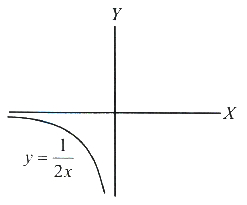
Therefore,$f(x) = \frac{1}{2x}$ for $x < 0$.
As $x$ ranges from $(-\infty, 0)$,the value of $2x$ ranges from $(-\infty, 0)$.
Consequently,the value of $\frac{1}{2x}$ ranges from $(-\infty, 0)$.
Thus,the range of the function is $(-\infty, 0)$.
For $x \geq 0$,we have $|x| = x$,so the denominator $x - |x| = 0$. Thus,the function is undefined for $x \geq 0$.
For $x < 0$,we have $|x| = -x$,so the denominator becomes $x - (-x) = 2x$.
Therefore,$f(x) = \frac{1}{2x}$ for $x < 0$.
As $x$ ranges from $(-\infty, 0)$,the value of $2x$ ranges from $(-\infty, 0)$.
Consequently,the value of $\frac{1}{2x}$ ranges from $(-\infty, 0)$.
Thus,the range of the function is $(-\infty, 0)$.
0 likes
View Solution284
EasyMCQ
Find the range of the function $f(x)$ defined by:
$f(x) = \begin{cases} 2x-3, & x < -1 \\ 1-x^2, & -1 \leq x \leq 1 \\ 3x^2+2, & x > 1 \end{cases}$
$f(x) = \begin{cases} 2x-3, & x < -1 \\ 1-x^2, & -1 \leq x \leq 1 \\ 3x^2+2, & x > 1 \end{cases}$
A
$R$
B
$(-\infty, -5) \cup [0, 1] \cup (5, \infty)$
C
$(-\infty, -1) \cup (1, \infty)$
D
$(-\infty, -3) \cup (0, 1) \cup (3, \infty)$
Solution
(B) To find the range,we analyze the function in three intervals:
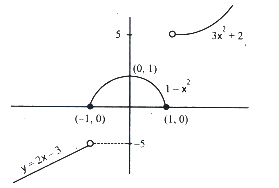
$1$. For $x < -1$,$f(x) = 2x - 3$. As $x \to -1^-$,$f(x) \to 2(-1) - 3 = -5$. Since $x < -1$,$f(x) < -5$. So,the range for this part is $(-\infty, -5)$.
$2$. For $-1 \leq x \leq 1$,$f(x) = 1 - x^2$. The minimum value is at $x = -1$ or $x = 1$,which is $1 - (1)^2 = 0$. The maximum value is at $x = 0$,which is $1 - 0 = 1$. So,the range for this part is $[0, 1]$.
$3$. For $x > 1$,$f(x) = 3x^2 + 2$. As $x \to 1^+$,$f(x) \to 3(1)^2 + 2 = 5$. Since $x > 1$,$f(x) > 5$. So,the range for this part is $(5, \infty)$.
Combining these,the total range is $(-\infty, -5) \cup [0, 1] \cup (5, \infty)$.
$1$. For $x < -1$,$f(x) = 2x - 3$. As $x \to -1^-$,$f(x) \to 2(-1) - 3 = -5$. Since $x < -1$,$f(x) < -5$. So,the range for this part is $(-\infty, -5)$.
$2$. For $-1 \leq x \leq 1$,$f(x) = 1 - x^2$. The minimum value is at $x = -1$ or $x = 1$,which is $1 - (1)^2 = 0$. The maximum value is at $x = 0$,which is $1 - 0 = 1$. So,the range for this part is $[0, 1]$.
$3$. For $x > 1$,$f(x) = 3x^2 + 2$. As $x \to 1^+$,$f(x) \to 3(1)^2 + 2 = 5$. Since $x > 1$,$f(x) > 5$. So,the range for this part is $(5, \infty)$.
Combining these,the total range is $(-\infty, -5) \cup [0, 1] \cup (5, \infty)$.
0 likes
View Solution285
MediumMCQ
If $[x]$ represents the greatest integer $\leq x$,then the range of the real-valued function $f(x) = \frac{1}{\sqrt{[x]^2+[x]-2}}$ is
A
$(-\infty, 0] \cup (\frac{1}{2}, \infty)$
B
$(0, \frac{1}{2}]$
C
$(-\infty, 0) \cup [2, \infty)$
D
$(0, 2]$
Solution
(B) Given $f(x) = \frac{1}{\sqrt{[x]^2+[x]-2}}$.
For $f(x)$ to be defined,we must have $[x]^2+[x]-2 > 0$.
Let $[x] = t$. Then $t^2+t-2 > 0$,which factors as $(t+2)(t-1) > 0$.
This implies $t < -2$ or $t > 1$.
Since $t = [x]$ is an integer,$[x] \in \{\dots, -4, -3\} \cup \{2, 3, 4, \dots\}$.
Case $1$: If $[x] \geq 2$,then $[x]^2+[x]-2$ takes values $2^2+2-2 = 4, 3^2+3-2 = 10, 4^2+4-2 = 18, \dots$.
The function values are $\frac{1}{\sqrt{4}}, \frac{1}{\sqrt{10}}, \dots$,i.e.,$(0, \frac{1}{2}]$.
Case $2$: If $[x] \leq -3$,then $[x]^2+[x]-2$ takes values $(-3)^2-3-2 = 4, (-4)^2-4-2 = 10, \dots$.
The function values are $\frac{1}{\sqrt{4}}, \frac{1}{\sqrt{10}}, \dots$,i.e.,$(0, \frac{1}{2}]$.
Combining both cases,the range is $(0, \frac{1}{2}]$.
For $f(x)$ to be defined,we must have $[x]^2+[x]-2 > 0$.
Let $[x] = t$. Then $t^2+t-2 > 0$,which factors as $(t+2)(t-1) > 0$.
This implies $t < -2$ or $t > 1$.
Since $t = [x]$ is an integer,$[x] \in \{\dots, -4, -3\} \cup \{2, 3, 4, \dots\}$.
Case $1$: If $[x] \geq 2$,then $[x]^2+[x]-2$ takes values $2^2+2-2 = 4, 3^2+3-2 = 10, 4^2+4-2 = 18, \dots$.
The function values are $\frac{1}{\sqrt{4}}, \frac{1}{\sqrt{10}}, \dots$,i.e.,$(0, \frac{1}{2}]$.
Case $2$: If $[x] \leq -3$,then $[x]^2+[x]-2$ takes values $(-3)^2-3-2 = 4, (-4)^2-4-2 = 10, \dots$.
The function values are $\frac{1}{\sqrt{4}}, \frac{1}{\sqrt{10}}, \dots$,i.e.,$(0, \frac{1}{2}]$.
Combining both cases,the range is $(0, \frac{1}{2}]$.
0 likes
View Solution286
MediumMCQ
If $D$ is the domain and $G$ is the range of the real-valued function $f(x)=\sqrt{\frac{1-x^2}{1+x^2}}$,then $D \cap G=$
A
$[0, \infty)$
B
$[0, 1]$
C
$\left[0, \frac{1}{2}\right]$
D
$[-1, 1]$
Solution
(B) Given the function $f(x) = \sqrt{\frac{1-x^2}{1+x^2}}$.
For the domain $D$,we require $\frac{1-x^2}{1+x^2} \geq 0$. Since $1+x^2 > 0$ for all real $x$,we need $1-x^2 \geq 0$,which implies $x^2 \leq 1$,so $x \in [-1, 1]$. Thus,$D = [-1, 1]$.
For the range $G$,let $y = \sqrt{\frac{1-x^2}{1+x^2}}$. Since $x \in [-1, 1]$,$1-x^2$ ranges from $0$ to $1$ and $1+x^2$ ranges from $1$ to $2$. Thus,$\frac{1-x^2}{1+x^2}$ ranges from $0$ to $1$. Taking the square root,$y \in [0, 1]$. Thus,$G = [0, 1]$.
Finally,$D \cap G = [-1, 1] \cap [0, 1] = [0, 1]$.
For the domain $D$,we require $\frac{1-x^2}{1+x^2} \geq 0$. Since $1+x^2 > 0$ for all real $x$,we need $1-x^2 \geq 0$,which implies $x^2 \leq 1$,so $x \in [-1, 1]$. Thus,$D = [-1, 1]$.
For the range $G$,let $y = \sqrt{\frac{1-x^2}{1+x^2}}$. Since $x \in [-1, 1]$,$1-x^2$ ranges from $0$ to $1$ and $1+x^2$ ranges from $1$ to $2$. Thus,$\frac{1-x^2}{1+x^2}$ ranges from $0$ to $1$. Taking the square root,$y \in [0, 1]$. Thus,$G = [0, 1]$.
Finally,$D \cap G = [-1, 1] \cap [0, 1] = [0, 1]$.
0 likes
View Solution287
EasyMCQ
The range of the real valued function $f(x) = |x-2| + |x-3|$ is
A
$[3, \infty)$
B
$[1, \infty)$
C
$[2, \infty)$
D
$(0, 2] \cup [3, \infty)$
Solution
(B) Given the function $f(x) = |x-2| + |x-3|$.
We analyze the function in three intervals: $x \leq 2$,$2 < x < 3$,and $x \geq 3$.
For $x \leq 2$,$f(x) = -(x-2) - (x-3) = -x + 2 - x + 3 = -2x + 5$. Since $x \leq 2$,$-2x \geq -4$,so $f(x) \geq -4 + 5 = 1$.
For $2 < x < 3$,$f(x) = (x-2) - (x-3) = x - 2 - x + 3 = 1$.
For $x \geq 3$,$f(x) = (x-2) + (x-3) = 2x - 5$. Since $x \geq 3$,$2x \geq 6$,so $f(x) \geq 6 - 5 = 1$.
Combining these,the minimum value of the function is $1$ and it takes all values greater than or equal to $1$.
Thus,the range is $[1, \infty)$.
Therefore,option $(B)$ is correct.
We analyze the function in three intervals: $x \leq 2$,$2 < x < 3$,and $x \geq 3$.
For $x \leq 2$,$f(x) = -(x-2) - (x-3) = -x + 2 - x + 3 = -2x + 5$. Since $x \leq 2$,$-2x \geq -4$,so $f(x) \geq -4 + 5 = 1$.
For $2 < x < 3$,$f(x) = (x-2) - (x-3) = x - 2 - x + 3 = 1$.
For $x \geq 3$,$f(x) = (x-2) + (x-3) = 2x - 5$. Since $x \geq 3$,$2x \geq 6$,so $f(x) \geq 6 - 5 = 1$.
Combining these,the minimum value of the function is $1$ and it takes all values greater than or equal to $1$.
Thus,the range is $[1, \infty)$.
Therefore,option $(B)$ is correct.
0 likes
View Solution288
EasyMCQ
If $[x]$ denotes the greatest integer $\leq x$,then the range of the real-valued function $f(x) = \frac{1}{\sqrt{x-[x]}}$ is
A
$[0, 1)$
B
$(0, 1)$
C
$(1, \infty)$
D
$[1, \infty)$
Solution
(C) The expression $x-[x]$ represents the fractional part of $x$,denoted as $\{x\}$.
Since $x$ is a real number,the fractional part $\{x\}$ lies in the interval $[0, 1)$.
However,the denominator $\sqrt{x-[x]}$ cannot be zero,so $x-[x] \neq 0$.
Therefore,$x-[x] \in (0, 1)$.
As $x-[x]$ approaches $0$ from the right,$\frac{1}{\sqrt{x-[x]}}$ approaches $\infty$.
As $x-[x]$ approaches $1$ from the left,$\frac{1}{\sqrt{x-[x]}}$ approaches $1$.
Thus,the range of $f(x)$ is $(1, \infty)$.
Since $x$ is a real number,the fractional part $\{x\}$ lies in the interval $[0, 1)$.
However,the denominator $\sqrt{x-[x]}$ cannot be zero,so $x-[x] \neq 0$.
Therefore,$x-[x] \in (0, 1)$.
As $x-[x]$ approaches $0$ from the right,$\frac{1}{\sqrt{x-[x]}}$ approaches $\infty$.
As $x-[x]$ approaches $1$ from the left,$\frac{1}{\sqrt{x-[x]}}$ approaches $1$.
Thus,the range of $f(x)$ is $(1, \infty)$.
0 likes
View Solution289
EasyMCQ
The domain and range of $y(x) = \cos x - 3$ are respectively
A
$R$ and $[-1, 1]$
B
$R$ and $[-4, -2]$
C
$R \setminus \{0\}$ and $[0, 1]$
D
$R \setminus \{(2n + 1) \frac{\pi}{2}\}$ and $[-1, 1]$
Solution
(B) Given function: $y(x) = \cos x - 3$.
Since the domain of $\cos x$ is the set of all real numbers $R$,the domain of $y(x)$ is $R$.
We know that for any $x \in R$,$-1 \leq \cos x \leq 1$.
Subtracting $3$ from all parts of the inequality:
$-1 - 3 \leq \cos x - 3 \leq 1 - 3$
$-4 \leq y(x) \leq -2$.
Thus,the range of the function is $[-4, -2]$.
Therefore,the domain is $R$ and the range is $[-4, -2]$.
Since the domain of $\cos x$ is the set of all real numbers $R$,the domain of $y(x)$ is $R$.
We know that for any $x \in R$,$-1 \leq \cos x \leq 1$.
Subtracting $3$ from all parts of the inequality:
$-1 - 3 \leq \cos x - 3 \leq 1 - 3$
$-4 \leq y(x) \leq -2$.
Thus,the range of the function is $[-4, -2]$.
Therefore,the domain is $R$ and the range is $[-4, -2]$.
0 likes
View Solution290
EasyMCQ
$A$ and $B$ are subsets of $R$. Every element $x$ of $A$ is mapped to an element of $B$ by the rule,$y(x) = \begin{cases} \frac{5x}{(x-3)(x+3)} & \text{if } x \neq -1 \\ -1 & \text{if } x = -1 \end{cases}$,then $A =$
A
$R \setminus \{-3, +3, 0\}$
B
$R \setminus \{-3, 3\}$
C
$R \setminus \{-3, 3, 0, -1\}$
D
$R$
Solution
(B) The function is defined as $y(x) = f(x) = \begin{cases} \frac{5x}{(x-3)(x+3)}, & x \neq -1 \\ -1, & x = -1 \end{cases}$.
For $f(x)$ to be a well-defined function $f: A \rightarrow B$,$A$ must be the domain of the function.
The expression $\frac{5x}{(x-3)(x+3)}$ is defined for all real numbers except where the denominator is zero.
Setting the denominator to zero: $(x-3)(x+3) = 0 \implies x = 3$ or $x = -3$.
At $x = -1$,the function is explicitly defined as $y(-1) = -1$,which is a valid real number.
Therefore,the domain $A$ includes all real numbers except $3$ and $-3$.
Thus,$A = R \setminus \{-3, 3\}$.
For $f(x)$ to be a well-defined function $f: A \rightarrow B$,$A$ must be the domain of the function.
The expression $\frac{5x}{(x-3)(x+3)}$ is defined for all real numbers except where the denominator is zero.
Setting the denominator to zero: $(x-3)(x+3) = 0 \implies x = 3$ or $x = -3$.
At $x = -1$,the function is explicitly defined as $y(-1) = -1$,which is a valid real number.
Therefore,the domain $A$ includes all real numbers except $3$ and $-3$.
Thus,$A = R \setminus \{-3, 3\}$.
0 likes
View Solution291
EasyMCQ
If the range of the function $f(x) = -3x - 3$ is $\{3, -6, -9, -18\}$,then which of the following elements is not in the domain of $f$?
A
-$1$
B
-$2$
C
$1$
D
$2$
Solution
(A) Given the function $f(x) = -3x - 3$.
To find the domain,we set $f(x)$ equal to each element in the range:
$(i)$ For $f(x) = 3$: $3 = -3x - 3$ $\Rightarrow 6 = -3x$ $\Rightarrow x = -2$.
(ii) For $f(x) = -6$: $-6 = -3x - 3$ $\Rightarrow -3 = -3x$ $\Rightarrow x = 1$.
(iii) For $f(x) = -9$: $-9 = -3x - 3$ $\Rightarrow -6 = -3x$ $\Rightarrow x = 2$.
(iv) For $f(x) = -18$: $-18 = -3x - 3$ $\Rightarrow -15 = -3x$ $\Rightarrow x = 5$.
Thus,the domain of $f$ is $\{-2, 1, 2, 5\}$.
Comparing this with the given options,$-1$ is not in the domain of $f$.
To find the domain,we set $f(x)$ equal to each element in the range:
$(i)$ For $f(x) = 3$: $3 = -3x - 3$ $\Rightarrow 6 = -3x$ $\Rightarrow x = -2$.
(ii) For $f(x) = -6$: $-6 = -3x - 3$ $\Rightarrow -3 = -3x$ $\Rightarrow x = 1$.
(iii) For $f(x) = -9$: $-9 = -3x - 3$ $\Rightarrow -6 = -3x$ $\Rightarrow x = 2$.
(iv) For $f(x) = -18$: $-18 = -3x - 3$ $\Rightarrow -15 = -3x$ $\Rightarrow x = 5$.
Thus,the domain of $f$ is $\{-2, 1, 2, 5\}$.
Comparing this with the given options,$-1$ is not in the domain of $f$.
0 likes
View Solution292
EasyMCQ
$\left\{x \in R: \frac{2 x-1}{x^3+4 x^2+3 x} \in R\right\}$ equals
A
$R-\{0\}$
B
$R-\{0,1,3\}$
C
$R-\{0,-1,-3\}$
D
$R-\{0,-1,-3,1/2\}$
Solution
(C) The expression $\frac{2x-1}{x^3+4x^2+3x}$ is defined for all real numbers $x$ except where the denominator is zero.
Set the denominator equal to zero:
$x^3+4x^2+3x = 0$
$x(x^2+4x+3) = 0$
$x(x+1)(x+3) = 0$
Thus,the expression is undefined at $x = 0$,$x = -1$,and $x = -3$.
Therefore,the set is $R - \{0, -1, -3\}$.
Set the denominator equal to zero:
$x^3+4x^2+3x = 0$
$x(x^2+4x+3) = 0$
$x(x+1)(x+3) = 0$
Thus,the expression is undefined at $x = 0$,$x = -1$,and $x = -3$.
Therefore,the set is $R - \{0, -1, -3\}$.
0 likes
View Solution293
MediumMCQ
If $f: R \rightarrow R$ is defined by $f(x) = \frac{1}{2 - \cos 3x}$ for each $x \in R$,then the range of $f$ is
A
$(1/3, 1)$
B
$[1/3, 1]$
C
$(1, 2)$
D
$[1, 2]$
Solution
(B) Given,$f(x) = \frac{1}{2 - \cos 3x}$.
We know that for any $x \in R$,$-1 \leq \cos 3x \leq 1$.
Multiplying by $-1$,we get $-1 \leq -\cos 3x \leq 1$.
Adding $2$ to all sides,we get $2 - 1 \leq 2 - \cos 3x \leq 2 + 1$,which simplifies to $1 \leq 2 - \cos 3x \leq 3$.
Taking the reciprocal,the inequality sign reverses: $\frac{1}{3} \leq \frac{1}{2 - \cos 3x} \leq \frac{1}{1}$.
Thus,$\frac{1}{3} \leq f(x) \leq 1$.
Therefore,the range of $f$ is $[1/3, 1]$.
We know that for any $x \in R$,$-1 \leq \cos 3x \leq 1$.
Multiplying by $-1$,we get $-1 \leq -\cos 3x \leq 1$.
Adding $2$ to all sides,we get $2 - 1 \leq 2 - \cos 3x \leq 2 + 1$,which simplifies to $1 \leq 2 - \cos 3x \leq 3$.
Taking the reciprocal,the inequality sign reverses: $\frac{1}{3} \leq \frac{1}{2 - \cos 3x} \leq \frac{1}{1}$.
Thus,$\frac{1}{3} \leq f(x) \leq 1$.
Therefore,the range of $f$ is $[1/3, 1]$.
0 likes
View Solution294
EasyMCQ
If $f: R \rightarrow R$ is defined by $f(x)=[2x]-2[x]$ for $x \in R$,where $[x]$ is the greatest integer not exceeding $x$,then the range of $f$ is:
A
$\{x \in R: 0 \leq x \leq 1\}$
B
$\{0, 1\}$
C
$\{x \in R: x > 0\}$
D
$\{x \in R: x \leq 0\}$
Solution
(B) Given $f(x) = [2x] - 2[x]$ for all $x \in R$.
Case $1$: If $x$ is an integer,let $x = n$ where $n \in Z$.
Then $f(n) = [2n] - 2[n] = 2n - 2n = 0$.
Case $2$: If $x$ is not an integer,let $x = n + f$ where $n \in Z$ and $0 < f < 1$.
Then $f(x) = [2(n + f)] - 2[n + f] = [2n + 2f] - 2n = 2n + [2f] - 2n = [2f]$.
Since $0 < f < 1$,we have $0 < 2f < 2$.
If $0 < f < 0.5$,then $[2f] = 0$.
If $0.5 \leq f < 1$,then $[2f] = 1$.
Thus,the range of $f(x)$ is $\{0, 1\}$.
Case $1$: If $x$ is an integer,let $x = n$ where $n \in Z$.
Then $f(n) = [2n] - 2[n] = 2n - 2n = 0$.
Case $2$: If $x$ is not an integer,let $x = n + f$ where $n \in Z$ and $0 < f < 1$.
Then $f(x) = [2(n + f)] - 2[n + f] = [2n + 2f] - 2n = 2n + [2f] - 2n = [2f]$.
Since $0 < f < 1$,we have $0 < 2f < 2$.
If $0 < f < 0.5$,then $[2f] = 0$.
If $0.5 \leq f < 1$,then $[2f] = 1$.
Thus,the range of $f(x)$ is $\{0, 1\}$.
0 likes
View Solution295
DifficultMCQ
The function $f: R \rightarrow R$ is defined by $f(x) = \cos^2 x + \sin^4 x$ for $x \in R$. Then $f(R)$ is equal to:
A
$\left(\frac{3}{4}, 1\right]$
B
$\left[\frac{3}{4}, 1\right)$
C
$\left[\frac{3}{4}, 1\right]$
D
$\left(\frac{3}{4}, 1\right)$
Solution
(C) Given $f(x) = \cos^2 x + \sin^4 x$.
Using $\cos^2 x = 1 - \sin^2 x$,we get:
$f(x) = 1 - \sin^2 x + \sin^4 x = 1 - \sin^2 x(1 - \sin^2 x) = 1 - \sin^2 x \cos^2 x$.
Multiplying and dividing by $4$,we get:
$f(x) = 1 - \frac{4 \sin^2 x \cos^2 x}{4} = 1 - \frac{(2 \sin x \cos x)^2}{4} = 1 - \frac{\sin^2 2x}{4}$.
Since $0 \leq \sin^2 2x \leq 1$,we have:
$0 \leq \frac{\sin^2 2x}{4} \leq \frac{1}{4}$.
Multiplying by $-1$ and adding $1$:
$1 - 0 \geq 1 - \frac{\sin^2 2x}{4} \geq 1 - \frac{1}{4}$.
$1 \geq f(x) \geq \frac{3}{4}$.
Thus,the range $f(R) = \left[\frac{3}{4}, 1\right]$.
Using $\cos^2 x = 1 - \sin^2 x$,we get:
$f(x) = 1 - \sin^2 x + \sin^4 x = 1 - \sin^2 x(1 - \sin^2 x) = 1 - \sin^2 x \cos^2 x$.
Multiplying and dividing by $4$,we get:
$f(x) = 1 - \frac{4 \sin^2 x \cos^2 x}{4} = 1 - \frac{(2 \sin x \cos x)^2}{4} = 1 - \frac{\sin^2 2x}{4}$.
Since $0 \leq \sin^2 2x \leq 1$,we have:
$0 \leq \frac{\sin^2 2x}{4} \leq \frac{1}{4}$.
Multiplying by $-1$ and adding $1$:
$1 - 0 \geq 1 - \frac{\sin^2 2x}{4} \geq 1 - \frac{1}{4}$.
$1 \geq f(x) \geq \frac{3}{4}$.
Thus,the range $f(R) = \left[\frac{3}{4}, 1\right]$.
0 likes
View SolutionRelation and Function — Domain and Range · Frequently Asked Questions
1Are these Relation and Function questions useful for JEE and NEET?
Yes. All questions in this section are mapped to JEE Main and NEET exam patterns. Previous year questions from JEE Main, NEET, GUJCET and state-level exams are included with full solutions.
2Can I switch to Hindi or Gujarati for these questions?
Yes. Use the language tabs in the hero section or the sidebar to view the same questions and solutions in English, Hindi or Gujarati.
3How do I generate a question paper from this subtopic?
Use the Vedclass Exam Paper Generator — select the chapter and subtopic, set difficulty, and generate Sets A, B, C, D automatically. First 3 chapters of every subject are free.
Vedclass Products
For Students
Vedclass Test Series
Mock tests in real JEE/NEET style with performance analysis. 5-day free trial.
Start Free TrialFor Teachers
Exam Paper Generator
Generate Set A/B/C/D papers from this chapter in 2 minutes. 3 chapters free.
Try FreeFor Institutes
Online Exam Module
Live online exams with unlimited students, 360° analytics & white-label branding.
See DemoFor Teachers & Institutes
Generate a Relation and Function Exam Paper in 2 Minutes
Select subtopic & difficulty — Sets A, B, C, D auto-generated with No Repeat logic.
First 3 chapters of every subject are free — no payment required.