
A English
Tangent and Normal Questions in English
Class 12 Mathematics · Applications of Derivatives · Tangent and Normal
502+
Questions
English
Language
100%
With Solutions
Showing 43 of 502 questions in English
401
MediumMCQ
The number of tangents to the curve $y^2(x-a)=x^2(x+a)$ $(a>0)$ that are parallel to the $X$-axis is
A
infinitely many
B
$0$
C
$1$
D
$2$
Solution
(D) The given curve is $y^2(x-a)=x^2(x+a)$.
For a tangent to be parallel to the $X$-axis,the slope $\frac{dy}{dx}$ must be $0$.
Differentiating $y^2(x-a)=x^2(x+a)$ with respect to $x$ using implicit differentiation:
$2y \frac{dy}{dx}(x-a) + y^2(1) = 2x(x+a) + x^2(1)$
Setting $\frac{dy}{dx} = 0$,we get:
$y^2 = 2x^2 + 2ax + x^2 = 3x^2 + 2ax$
Substitute $y^2 = \frac{x^2(x+a)}{x-a}$ into the equation:
$\frac{x^2(x+a)}{x-a} = 3x^2 + 2ax$
Since $x=0$ is a solution (giving $y=0$),we check for other solutions by dividing by $x$ $(x \neq 0)$:
$\frac{x(x+a)}{x-a} = 3x + 2a$
$x^2 + ax = (3x + 2a)(x - a)$
$x^2 + ax = 3x^2 - 3ax + 2ax - 2a^2$
$x^2 + ax = 3x^2 - ax - 2a^2$
$2x^2 - 2ax - 2a^2 = 0$
$x^2 - ax - a^2 = 0$
The roots are $x = \frac{a \pm \sqrt{a^2 - 4(1)(-a^2)}}{2} = \frac{a \pm a\sqrt{5}}{2}$.
For these values of $x$,$y^2 = 3x^2 + 2ax$. Since $x^2 - ax - a^2 = 0$,$x^2 = ax + a^2$.
$y^2 = 3(ax + a^2) + 2ax = 5ax + 3a^2$.
For $x = \frac{a(1+\sqrt{5})}{2}$,$y^2 = 5a(\frac{a(1+\sqrt{5})}{2}) + 3a^2 > 0$,giving two values of $y$.
For $x = \frac{a(1-\sqrt{5})}{2}$,$y^2 = 5a(\frac{a(1-\sqrt{5})}{2}) + 3a^2 = \frac{5a^2 - 5a^2\sqrt{5} + 6a^2}{2} = \frac{11-5\sqrt{5}}{2}a^2 < 0$,which is impossible.
Thus,there are $2$ tangents.
For a tangent to be parallel to the $X$-axis,the slope $\frac{dy}{dx}$ must be $0$.
Differentiating $y^2(x-a)=x^2(x+a)$ with respect to $x$ using implicit differentiation:
$2y \frac{dy}{dx}(x-a) + y^2(1) = 2x(x+a) + x^2(1)$
Setting $\frac{dy}{dx} = 0$,we get:
$y^2 = 2x^2 + 2ax + x^2 = 3x^2 + 2ax$
Substitute $y^2 = \frac{x^2(x+a)}{x-a}$ into the equation:
$\frac{x^2(x+a)}{x-a} = 3x^2 + 2ax$
Since $x=0$ is a solution (giving $y=0$),we check for other solutions by dividing by $x$ $(x \neq 0)$:
$\frac{x(x+a)}{x-a} = 3x + 2a$
$x^2 + ax = (3x + 2a)(x - a)$
$x^2 + ax = 3x^2 - 3ax + 2ax - 2a^2$
$x^2 + ax = 3x^2 - ax - 2a^2$
$2x^2 - 2ax - 2a^2 = 0$
$x^2 - ax - a^2 = 0$
The roots are $x = \frac{a \pm \sqrt{a^2 - 4(1)(-a^2)}}{2} = \frac{a \pm a\sqrt{5}}{2}$.
For these values of $x$,$y^2 = 3x^2 + 2ax$. Since $x^2 - ax - a^2 = 0$,$x^2 = ax + a^2$.
$y^2 = 3(ax + a^2) + 2ax = 5ax + 3a^2$.
For $x = \frac{a(1+\sqrt{5})}{2}$,$y^2 = 5a(\frac{a(1+\sqrt{5})}{2}) + 3a^2 > 0$,giving two values of $y$.
For $x = \frac{a(1-\sqrt{5})}{2}$,$y^2 = 5a(\frac{a(1-\sqrt{5})}{2}) + 3a^2 = \frac{5a^2 - 5a^2\sqrt{5} + 6a^2}{2} = \frac{11-5\sqrt{5}}{2}a^2 < 0$,which is impossible.
Thus,there are $2$ tangents.
0 likes
View Solution402
EasyMCQ
If $2y = 3x - 1$ is a tangent drawn to the curve $y^2 = ax^3 + b$ at $(1, 1)$,where $a$ and $b$ are constants,then $(a, b) = $
A
$(1, 0)$
B
$(0, 1)$
C
$(1, -1)$
D
$(-1, 1)$
Solution
(A) The equation of the tangent is $2y = 3x - 1$,which can be written as $y = \frac{3}{2}x - \frac{1}{2}$.
Comparing this with $y = mx + c$,the slope of the tangent is $m = \frac{3}{2}$.
Given the curve $y^2 = ax^3 + b$,we differentiate with respect to $x$:
$2y \frac{dy}{dx} = 3ax^2 \implies \frac{dy}{dx} = \frac{3ax^2}{2y}$.
At the point $(1, 1)$,the slope is $\frac{dy}{dx} = \frac{3a(1)^2}{2(1)} = \frac{3a}{2}$.
Equating the slopes: $\frac{3a}{2} = \frac{3}{2} \implies a = 1$.
Since the point $(1, 1)$ lies on the curve $y^2 = ax^3 + b$,we substitute $x=1, y=1, a=1$:
$1^2 = 1(1)^3 + b \implies 1 = 1 + b \implies b = 0$.
Thus,$(a, b) = (1, 0)$.
Comparing this with $y = mx + c$,the slope of the tangent is $m = \frac{3}{2}$.
Given the curve $y^2 = ax^3 + b$,we differentiate with respect to $x$:
$2y \frac{dy}{dx} = 3ax^2 \implies \frac{dy}{dx} = \frac{3ax^2}{2y}$.
At the point $(1, 1)$,the slope is $\frac{dy}{dx} = \frac{3a(1)^2}{2(1)} = \frac{3a}{2}$.
Equating the slopes: $\frac{3a}{2} = \frac{3}{2} \implies a = 1$.
Since the point $(1, 1)$ lies on the curve $y^2 = ax^3 + b$,we substitute $x=1, y=1, a=1$:
$1^2 = 1(1)^3 + b \implies 1 = 1 + b \implies b = 0$.
Thus,$(a, b) = (1, 0)$.
0 likes
View Solution403
EasyMCQ
Tangents are drawn to the curve $y = \sin x$ from the origin. The locus of the points of contact is
A
$xy = x + y$
B
$x^2 y^2 = x^2 - y^2$
C
$xy = x - y$
D
$x^2 y^2 = x^2 + y^2$
Solution
(B) Let the point of contact be $(h, k)$. Since $(h, k)$ lies on the curve $y = \sin x$,we have $k = \sin h$.
The slope of the tangent at $(h, k)$ is $\frac{dy}{dx} = \cos x$. At $(h, k)$,the slope is $\cos h$.
The equation of the tangent at $(h, k)$ is $y - k = \cos h(x - h)$.
Since the tangent passes through the origin $(0, 0)$,we substitute $x = 0$ and $y = 0$:
$0 - k = \cos h(0 - h) \Rightarrow -k = -h \cos h \Rightarrow k = h \cos h$.
From $k = \sin h$,we have $\cos h = \frac{k}{h}$.
Using the identity $\sin^2 h + \cos^2 h = 1$,we substitute $\sin h = k$ and $\cos h = \frac{k}{h}$:
$k^2 + \left(\frac{k}{h}\right)^2 = 1
k^2 + \frac{k^2}{h^2} = 1
h^2 k^2 + k^2 = h^2
h^2 - k^2 = h^2 k^2$.
Replacing $(h, k)$ with $(x, y)$,the locus is $x^2 - y^2 = x^2 y^2$.
The slope of the tangent at $(h, k)$ is $\frac{dy}{dx} = \cos x$. At $(h, k)$,the slope is $\cos h$.
The equation of the tangent at $(h, k)$ is $y - k = \cos h(x - h)$.
Since the tangent passes through the origin $(0, 0)$,we substitute $x = 0$ and $y = 0$:
$0 - k = \cos h(0 - h) \Rightarrow -k = -h \cos h \Rightarrow k = h \cos h$.
From $k = \sin h$,we have $\cos h = \frac{k}{h}$.
Using the identity $\sin^2 h + \cos^2 h = 1$,we substitute $\sin h = k$ and $\cos h = \frac{k}{h}$:
$k^2 + \left(\frac{k}{h}\right)^2 = 1
k^2 + \frac{k^2}{h^2} = 1
h^2 k^2 + k^2 = h^2
h^2 - k^2 = h^2 k^2$.
Replacing $(h, k)$ with $(x, y)$,the locus is $x^2 - y^2 = x^2 y^2$.
0 likes
View Solution404
MediumMCQ
If $T$ is the length of the subtangent drawn at any point on the curve $3 y^2 = 4 x^3$ and $N$ is the length of the subnormal at the same point,then $(\beta T)^2 =$
A
$4 N^2$
B
$4 N$
C
$2 N$
D
$8 N^2$
Solution
(C) The equation of the given curve is $3 y^2 = 4 x^3$ ...$(i)$
Let $P(h, k)$ be a point on the curve.
Differentiating equation $(i)$ with respect to $x$,we get $6 y \frac{dy}{dx} = 12 x^2$,which implies $\frac{dy}{dx} = \frac{2 x^2}{y}$.
At point $(h, k)$,the slope $m = \frac{2 h^2}{k}$.
The length of the subtangent $T = \left| \frac{k}{m} \right| = \left| \frac{k}{2 h^2 / k} \right| = \frac{k^2}{2 h^2}$.
Since $3 k^2 = 4 h^3$,we have $k^2 = \frac{4}{3} h^3$.
Substituting this into $T$,we get $T = \frac{4 h^3}{3(2 h^2)} = \frac{2}{3} h$.
The length of the subnormal $N = |k m| = \left| k \cdot \frac{2 h^2}{k} \right| = 2 h^2$.
We need to find the relation between $T$ and $N$.
From $N = 2 h^2$,we have $h^2 = \frac{N}{2}$,so $h = \sqrt{\frac{N}{2}}$.
Then $T = \frac{2}{3} \sqrt{\frac{N}{2}}$.
Squaring both sides,$T^2 = \frac{4}{9} \cdot \frac{N}{2} = \frac{2 N}{9}$.
Thus,$9 T^2 = 2 N$,which can be written as $(3 T)^2 = 2 N$.
Comparing this with $(\beta T)^2 = 2 N$,we find $\beta = 3$.
Therefore,the correct option is $C$.
Let $P(h, k)$ be a point on the curve.
Differentiating equation $(i)$ with respect to $x$,we get $6 y \frac{dy}{dx} = 12 x^2$,which implies $\frac{dy}{dx} = \frac{2 x^2}{y}$.
At point $(h, k)$,the slope $m = \frac{2 h^2}{k}$.
The length of the subtangent $T = \left| \frac{k}{m} \right| = \left| \frac{k}{2 h^2 / k} \right| = \frac{k^2}{2 h^2}$.
Since $3 k^2 = 4 h^3$,we have $k^2 = \frac{4}{3} h^3$.
Substituting this into $T$,we get $T = \frac{4 h^3}{3(2 h^2)} = \frac{2}{3} h$.
The length of the subnormal $N = |k m| = \left| k \cdot \frac{2 h^2}{k} \right| = 2 h^2$.
We need to find the relation between $T$ and $N$.
From $N = 2 h^2$,we have $h^2 = \frac{N}{2}$,so $h = \sqrt{\frac{N}{2}}$.
Then $T = \frac{2}{3} \sqrt{\frac{N}{2}}$.
Squaring both sides,$T^2 = \frac{4}{9} \cdot \frac{N}{2} = \frac{2 N}{9}$.
Thus,$9 T^2 = 2 N$,which can be written as $(3 T)^2 = 2 N$.
Comparing this with $(\beta T)^2 = 2 N$,we find $\beta = 3$.
Therefore,the correct option is $C$.
0 likes
View Solution405
EasyMCQ
On the curve $y=x^3$,the point at which the tangent line is parallel to the chord joining the points $(-1, -1)$ and $(2, 8)$ is
A
$(1, -1)$
B
$(2, 8)$
C
$(1, 1)$
D
$(3, 27)$
Solution
(C) Let $f(x) = x^3$. The slope of the chord joining the points $(-1, -1)$ and $(2, 8)$ is given by $m = \frac{f(2) - f(-1)}{2 - (-1)} = \frac{8 - (-1)}{3} = \frac{9}{3} = 3$.
Since the tangent line is parallel to this chord,the derivative $f'(x)$ at the point must be equal to the slope of the chord.
$f'(x) = \frac{d}{dx}(x^3) = 3x^2$.
Setting $f'(x) = 3$,we get $3x^2 = 3$,which implies $x^2 = 1$,so $x = 1$ or $x = -1$.
For $x = 1$,$y = (1)^3 = 1$,giving the point $(1, 1)$.
For $x = -1$,$y = (-1)^3 = -1$,giving the point $(-1, -1)$.
Since $(-1, -1)$ is one of the endpoints of the chord,the point on the curve between the given points is $(1, 1)$.
Since the tangent line is parallel to this chord,the derivative $f'(x)$ at the point must be equal to the slope of the chord.
$f'(x) = \frac{d}{dx}(x^3) = 3x^2$.
Setting $f'(x) = 3$,we get $3x^2 = 3$,which implies $x^2 = 1$,so $x = 1$ or $x = -1$.
For $x = 1$,$y = (1)^3 = 1$,giving the point $(1, 1)$.
For $x = -1$,$y = (-1)^3 = -1$,giving the point $(-1, -1)$.
Since $(-1, -1)$ is one of the endpoints of the chord,the point on the curve between the given points is $(1, 1)$.
0 likes
View Solution406
EasyMCQ
If $\theta$ is an angle between the curves $x^2+4y=0$ and $xy=2$,then $\tan \theta=$
A
-$1$
B
$\frac{1}{3}$
C
$\frac{1}{2}$
D
$3$
Solution
(D) To find the point of intersection of the curves $x^2+4y=0$ and $xy=2$:
Substitute $y = \frac{2}{x}$ into $x^2+4y=0$:
$x^2 + 4(\frac{2}{x}) = 0$
$x^2 + \frac{8}{x} = 0$
$x^3 + 8 = 0 \Rightarrow x^3 = -8 \Rightarrow x = -2$.
For $x = -2$,$y = \frac{2}{-2} = -1$. So,the point of intersection is $(-2, -1)$.
Slope of the first curve $x^2+4y=0$:
Differentiating with respect to $x$: $2x + 4\frac{dy}{dx} = 0 \Rightarrow \frac{dy}{dx} = -\frac{x}{2}$.
At $x = -2$,$m_1 = -\frac{-2}{2} = 1$.
Slope of the second curve $xy=2$:
Differentiating with respect to $x$: $y + x\frac{dy}{dx} = 0 \Rightarrow \frac{dy}{dx} = -\frac{y}{x}$.
At $(-2, -1)$,$m_2 = -\frac{-1}{-2} = -\frac{1}{2}$.
The angle $\theta$ between the curves is given by:
$\tan \theta = \left| \frac{m_1 - m_2}{1 + m_1 m_2} \right| = \left| \frac{1 - (-1/2)}{1 + (1)(-1/2)} \right| = \left| \frac{3/2}{1/2} \right| = 3$.
Substitute $y = \frac{2}{x}$ into $x^2+4y=0$:
$x^2 + 4(\frac{2}{x}) = 0$
$x^2 + \frac{8}{x} = 0$
$x^3 + 8 = 0 \Rightarrow x^3 = -8 \Rightarrow x = -2$.
For $x = -2$,$y = \frac{2}{-2} = -1$. So,the point of intersection is $(-2, -1)$.
Slope of the first curve $x^2+4y=0$:
Differentiating with respect to $x$: $2x + 4\frac{dy}{dx} = 0 \Rightarrow \frac{dy}{dx} = -\frac{x}{2}$.
At $x = -2$,$m_1 = -\frac{-2}{2} = 1$.
Slope of the second curve $xy=2$:
Differentiating with respect to $x$: $y + x\frac{dy}{dx} = 0 \Rightarrow \frac{dy}{dx} = -\frac{y}{x}$.
At $(-2, -1)$,$m_2 = -\frac{-1}{-2} = -\frac{1}{2}$.
The angle $\theta$ between the curves is given by:
$\tan \theta = \left| \frac{m_1 - m_2}{1 + m_1 m_2} \right| = \left| \frac{1 - (-1/2)}{1 + (1)(-1/2)} \right| = \left| \frac{3/2}{1/2} \right| = 3$.
0 likes
View Solution407
EasyMCQ
If $ab \neq 0$,then the equation of the tangent at $(a, b)$ to the curve $\left(\frac{x}{a}\right)^n + \left(\frac{y}{b}\right)^n = 2$ is
A
$\frac{x}{a} + \frac{y}{b} = 1$
B
$ax + by = 1$
C
$\frac{x}{a} + \frac{y}{b} = 2$
D
$ax + by = 2n$
Solution
(C) Given the curve equation is $\left(\frac{x}{a}\right)^n + \left(\frac{y}{b}\right)^n = 2$.
To find the slope of the tangent at $(a, b)$,we differentiate both sides with respect to $x$:
$n\left(\frac{x}{a}\right)^{n-1} \cdot \frac{1}{a} + n\left(\frac{y}{b}\right)^{n-1} \cdot \frac{1}{b} \cdot \frac{dy}{dx} = 0$.
At the point $(a, b)$,we substitute $x = a$ and $y = b$:
$n(1)^{n-1} \cdot \frac{1}{a} + n(1)^{n-1} \cdot \frac{1}{b} \cdot \frac{dy}{dx} = 0$.
$\frac{n}{a} + \frac{n}{b} \cdot \frac{dy}{dx} = 0$.
$\frac{n}{b} \cdot \frac{dy}{dx} = -\frac{n}{a} \implies \frac{dy}{dx} = -\frac{b}{a}$.
The equation of the tangent line at $(a, b)$ with slope $m = -\frac{b}{a}$ is given by $y - b = m(x - a)$.
$y - b = -\frac{b}{a}(x - a)$.
$a(y - b) = -b(x - a)$.
$ay - ab = -bx + ab$.
$bx + ay = 2ab$.
Dividing both sides by $ab$,we get $\frac{bx}{ab} + \frac{ay}{ab} = \frac{2ab}{ab}$.
$\frac{x}{a} + \frac{y}{b} = 2$.
Thus,the correct option is $C$.
To find the slope of the tangent at $(a, b)$,we differentiate both sides with respect to $x$:
$n\left(\frac{x}{a}\right)^{n-1} \cdot \frac{1}{a} + n\left(\frac{y}{b}\right)^{n-1} \cdot \frac{1}{b} \cdot \frac{dy}{dx} = 0$.
At the point $(a, b)$,we substitute $x = a$ and $y = b$:
$n(1)^{n-1} \cdot \frac{1}{a} + n(1)^{n-1} \cdot \frac{1}{b} \cdot \frac{dy}{dx} = 0$.
$\frac{n}{a} + \frac{n}{b} \cdot \frac{dy}{dx} = 0$.
$\frac{n}{b} \cdot \frac{dy}{dx} = -\frac{n}{a} \implies \frac{dy}{dx} = -\frac{b}{a}$.
The equation of the tangent line at $(a, b)$ with slope $m = -\frac{b}{a}$ is given by $y - b = m(x - a)$.
$y - b = -\frac{b}{a}(x - a)$.
$a(y - b) = -b(x - a)$.
$ay - ab = -bx + ab$.
$bx + ay = 2ab$.
Dividing both sides by $ab$,we get $\frac{bx}{ab} + \frac{ay}{ab} = \frac{2ab}{ab}$.
$\frac{x}{a} + \frac{y}{b} = 2$.
Thus,the correct option is $C$.
0 likes
View Solution408
DifficultMCQ
If the normal to the curve $x^{2/3} + y^{2/3} = a^{2/3}$ makes an angle $\phi$ with the $X$-axis,then the equation of that normal is
A
$y - a \sin^3 \phi = \tan \phi (x - a \cos^3 \phi)$
B
$y \cos \phi - x \sin \phi = a \cos 2 \phi$
C
$y \cos \phi - x \sin \phi = a \cos^2 \phi$
D
$y + a \sin^2 \phi = x \cos \phi - a \sin 2 \phi$
Solution
(B) The equation of the curve is $x^{2/3} + y^{2/3} = a^{2/3}$.
Parametric equations are $x = a \cos^3 \theta$ and $y = a \sin^3 \theta$.
The derivative $\frac{dy}{dx} = \frac{dy/d\theta}{dx/d\theta} = \frac{3a \sin^2 \theta \cos \theta}{-3a \cos^2 \theta \sin \theta} = -\tan \theta$.
The slope of the tangent is $m_T = -\tan \theta$.
The slope of the normal is $m_N = \frac{-1}{m_T} = \cot \theta$.
Given that the normal makes an angle $\phi$ with the $X$-axis,its slope is $\tan \phi$.
Thus,$\tan \phi = \cot \theta = \tan(\frac{\pi}{2} - \theta)$,which implies $\phi = \frac{\pi}{2} - \theta$,or $\theta = \frac{\pi}{2} - \phi$.
Substituting $\theta$ into the parametric coordinates: $x = a \cos^3(\frac{\pi}{2} - \phi) = a \sin^3 \phi$ and $y = a \sin^3(\frac{\pi}{2} - \phi) = a \cos^3 \phi$.
The equation of the normal at $(a \sin^3 \phi, a \cos^3 \phi)$ with slope $\tan \phi$ is:
$y - a \cos^3 \phi = \tan \phi (x - a \sin^3 \phi)$
$y \cos \phi - a \cos^4 \phi = x \sin \phi - a \sin^4 \phi$
$y \cos \phi - x \sin \phi = a (\cos^4 \phi - \sin^4 \phi)$
$y \cos \phi - x \sin \phi = a (\cos^2 \phi - \sin^2 \phi)(\cos^2 \phi + \sin^2 \phi)$
$y \cos \phi - x \sin \phi = a \cos 2 \phi$.
Parametric equations are $x = a \cos^3 \theta$ and $y = a \sin^3 \theta$.
The derivative $\frac{dy}{dx} = \frac{dy/d\theta}{dx/d\theta} = \frac{3a \sin^2 \theta \cos \theta}{-3a \cos^2 \theta \sin \theta} = -\tan \theta$.
The slope of the tangent is $m_T = -\tan \theta$.
The slope of the normal is $m_N = \frac{-1}{m_T} = \cot \theta$.
Given that the normal makes an angle $\phi$ with the $X$-axis,its slope is $\tan \phi$.
Thus,$\tan \phi = \cot \theta = \tan(\frac{\pi}{2} - \theta)$,which implies $\phi = \frac{\pi}{2} - \theta$,or $\theta = \frac{\pi}{2} - \phi$.
Substituting $\theta$ into the parametric coordinates: $x = a \cos^3(\frac{\pi}{2} - \phi) = a \sin^3 \phi$ and $y = a \sin^3(\frac{\pi}{2} - \phi) = a \cos^3 \phi$.
The equation of the normal at $(a \sin^3 \phi, a \cos^3 \phi)$ with slope $\tan \phi$ is:
$y - a \cos^3 \phi = \tan \phi (x - a \sin^3 \phi)$
$y \cos \phi - a \cos^4 \phi = x \sin \phi - a \sin^4 \phi$
$y \cos \phi - x \sin \phi = a (\cos^4 \phi - \sin^4 \phi)$
$y \cos \phi - x \sin \phi = a (\cos^2 \phi - \sin^2 \phi)(\cos^2 \phi + \sin^2 \phi)$
$y \cos \phi - x \sin \phi = a \cos 2 \phi$.
0 likes
View Solution409
MediumMCQ
An angle between the curves $x^2=3y$ and $x^2+y^2=4$ is
A
$\tan ^{-1} \frac{5}{\sqrt{3}}$
B
$\tan ^{-1} \sqrt{\frac{5}{3}}$
C
$\tan ^{-1} \frac{2}{\sqrt{3}}$
D
$\frac{\pi}{3}$
Solution
(A) Given curves are:
$x^2 = 3y \quad ...(i)$
$x^2 + y^2 = 4 \quad ...(ii)$
Substituting $x^2 = 3y$ into equation $(ii)$,we get:
$3y + y^2 = 4$
$y^2 + 3y - 4 = 0$
$(y + 4)(y - 1) = 0$
Since $x^2 = 3y$,$y$ must be non-negative,so $y = 1$.
Substituting $y = 1$ into $x^2 = 3y$,we get $x^2 = 3$,so $x = \pm \sqrt{3}$.
Thus,the points of intersection are $(\sqrt{3}, 1)$ and $(-\sqrt{3}, 1)$.
Now,differentiating the curves with respect to $x$:
For $(i)$,$2x = 3 \frac{dy}{dx} \implies \frac{dy}{dx} = \frac{2x}{3}$.
For $(ii)$,$2x + 2y \frac{dy}{dx} = 0 \implies \frac{dy}{dx} = -\frac{x}{y}$.
At the point $(\sqrt{3}, 1)$:
$m_1 = \frac{2\sqrt{3}}{3} = \frac{2}{\sqrt{3}}$
$m_2 = -\frac{\sqrt{3}}{1} = -\sqrt{3}$
The angle $\theta$ between the curves is given by:
$\tan \theta = \left| \frac{m_1 - m_2}{1 + m_1 m_2} \right| = \left| \frac{\frac{2}{\sqrt{3}} - (-\sqrt{3})}{1 + (\frac{2}{\sqrt{3}})(-\sqrt{3})} \right|$
$\tan \theta = \left| \frac{\frac{2 + 3}{\sqrt{3}}}{1 - 2} \right| = \left| \frac{5/\sqrt{3}}{-1} \right| = \frac{5}{\sqrt{3}}$
Therefore,$\theta = \tan^{-1} \left( \frac{5}{\sqrt{3}} \right)$.
$x^2 = 3y \quad ...(i)$
$x^2 + y^2 = 4 \quad ...(ii)$
Substituting $x^2 = 3y$ into equation $(ii)$,we get:
$3y + y^2 = 4$
$y^2 + 3y - 4 = 0$
$(y + 4)(y - 1) = 0$
Since $x^2 = 3y$,$y$ must be non-negative,so $y = 1$.
Substituting $y = 1$ into $x^2 = 3y$,we get $x^2 = 3$,so $x = \pm \sqrt{3}$.
Thus,the points of intersection are $(\sqrt{3}, 1)$ and $(-\sqrt{3}, 1)$.
Now,differentiating the curves with respect to $x$:
For $(i)$,$2x = 3 \frac{dy}{dx} \implies \frac{dy}{dx} = \frac{2x}{3}$.
For $(ii)$,$2x + 2y \frac{dy}{dx} = 0 \implies \frac{dy}{dx} = -\frac{x}{y}$.
At the point $(\sqrt{3}, 1)$:
$m_1 = \frac{2\sqrt{3}}{3} = \frac{2}{\sqrt{3}}$
$m_2 = -\frac{\sqrt{3}}{1} = -\sqrt{3}$
The angle $\theta$ between the curves is given by:
$\tan \theta = \left| \frac{m_1 - m_2}{1 + m_1 m_2} \right| = \left| \frac{\frac{2}{\sqrt{3}} - (-\sqrt{3})}{1 + (\frac{2}{\sqrt{3}})(-\sqrt{3})} \right|$
$\tan \theta = \left| \frac{\frac{2 + 3}{\sqrt{3}}}{1 - 2} \right| = \left| \frac{5/\sqrt{3}}{-1} \right| = \frac{5}{\sqrt{3}}$
Therefore,$\theta = \tan^{-1} \left( \frac{5}{\sqrt{3}} \right)$.
0 likes
View Solution410
MediumMCQ
An angle between the curves $x^2 y = 1$ and $y(x^2 + 1) = 2$ is
A
$\operatorname{Tan}^{-1} \frac{8}{9}$
B
$\operatorname{Tan}^{-1} 2$
C
$\operatorname{Tan}^{-1} \frac{1}{2}$
D
$\operatorname{Tan}^{-1} \frac{1}{3}$
Solution
(D) Given curves are $C_1: x^2 y = 1$ and $C_2: y(x^2 + 1) = 2$.
First,find the intersection points by substituting $y = 1/x^2$ into the second equation: $(1/x^2)(x^2 + 1) = 2 \implies 1 + 1/x^2 = 2 \implies 1/x^2 = 1 \implies x^2 = 1 \implies x = \pm 1$.
For $x = 1$,$y = 1$. For $x = -1$,$y = 1$. Intersection points are $(1, 1)$ and $(-1, 1)$.
For $C_1$,$y = x^{-2} \implies dy/dx = -2x^{-3} = -2/x^3$. At $(1, 1)$,$m_1 = -2$.
For $C_2$,$y = 2/(x^2 + 1) \implies dy/dx = -2(2x)/(x^2 + 1)^2 = -4x/(x^2 + 1)^2$. At $(1, 1)$,$m_2 = -4(1)/(1+1)^2 = -4/4 = -1$.
The angle $\theta$ between the curves is given by $\tan \theta = |(m_1 - m_2) / (1 + m_1 m_2)|$.
$\tan \theta = |(-2 - (-1)) / (1 + (-2)(-1))| = |-1 / (1 + 2)| = |-1/3| = 1/3$.
Thus,$\theta = \operatorname{Tan}^{-1}(1/3)$.
First,find the intersection points by substituting $y = 1/x^2$ into the second equation: $(1/x^2)(x^2 + 1) = 2 \implies 1 + 1/x^2 = 2 \implies 1/x^2 = 1 \implies x^2 = 1 \implies x = \pm 1$.
For $x = 1$,$y = 1$. For $x = -1$,$y = 1$. Intersection points are $(1, 1)$ and $(-1, 1)$.
For $C_1$,$y = x^{-2} \implies dy/dx = -2x^{-3} = -2/x^3$. At $(1, 1)$,$m_1 = -2$.
For $C_2$,$y = 2/(x^2 + 1) \implies dy/dx = -2(2x)/(x^2 + 1)^2 = -4x/(x^2 + 1)^2$. At $(1, 1)$,$m_2 = -4(1)/(1+1)^2 = -4/4 = -1$.
The angle $\theta$ between the curves is given by $\tan \theta = |(m_1 - m_2) / (1 + m_1 m_2)|$.
$\tan \theta = |(-2 - (-1)) / (1 + (-2)(-1))| = |-1 / (1 + 2)| = |-1/3| = 1/3$.
Thus,$\theta = \operatorname{Tan}^{-1}(1/3)$.
0 likes
View Solution411
DifficultMCQ
If the curves $x^2+p y^2=1$ and $q x^2+y^2=1$ are orthogonal to each other,then
A
$p-q=2$
B
$\frac{1}{p}-\frac{1}{q}=2$
C
$\frac{1}{p}+\frac{1}{q}=-2$
D
$\frac{1}{p}+\frac{1}{q}=2$
Solution
(D) Given curves are:
$x^2+p y^2=1$ $(i)$
$q x^2+y^2=1$ (ii)
Differentiating $(i)$ with respect to $x$:
$2x + 2py \frac{dy}{dx} = 0 \implies \frac{dy}{dx} = m_1 = -\frac{x}{py}$
Differentiating (ii) with respect to $x$:
$2qx + 2y \frac{dy}{dx} = 0 \implies \frac{dy}{dx} = m_2 = -\frac{qx}{y}$
Since the curves are orthogonal,$m_1 \cdot m_2 = -1$:
$(-\frac{x}{py}) \cdot (-\frac{qx}{y}) = -1$
$\frac{qx^2}{py^2} = -1 \implies qx^2 = -py^2$
From $(i)$,$x^2 = 1 - py^2$. Substituting this into the condition:
$q(1 - py^2) = -py^2$
$q - qpy^2 = -py^2$
$q = y^2(qp - p) \implies y^2 = \frac{q}{p(q-1)}$
Similarly,$x^2 = \frac{p(1-q)}{q-p}$. Substituting $x^2$ and $y^2$ into $q x^2 + y^2 = 1$:
$q(\frac{p(1-q)}{q-p}) + \frac{q}{p(q-1)} = 1$
After simplifying,we get $p+q = 2pq$,which implies $\frac{1}{p} + \frac{1}{q} = 2$.
$x^2+p y^2=1$ $(i)$
$q x^2+y^2=1$ (ii)
Differentiating $(i)$ with respect to $x$:
$2x + 2py \frac{dy}{dx} = 0 \implies \frac{dy}{dx} = m_1 = -\frac{x}{py}$
Differentiating (ii) with respect to $x$:
$2qx + 2y \frac{dy}{dx} = 0 \implies \frac{dy}{dx} = m_2 = -\frac{qx}{y}$
Since the curves are orthogonal,$m_1 \cdot m_2 = -1$:
$(-\frac{x}{py}) \cdot (-\frac{qx}{y}) = -1$
$\frac{qx^2}{py^2} = -1 \implies qx^2 = -py^2$
From $(i)$,$x^2 = 1 - py^2$. Substituting this into the condition:
$q(1 - py^2) = -py^2$
$q - qpy^2 = -py^2$
$q = y^2(qp - p) \implies y^2 = \frac{q}{p(q-1)}$
Similarly,$x^2 = \frac{p(1-q)}{q-p}$. Substituting $x^2$ and $y^2$ into $q x^2 + y^2 = 1$:
$q(\frac{p(1-q)}{q-p}) + \frac{q}{p(q-1)} = 1$
After simplifying,we get $p+q = 2pq$,which implies $\frac{1}{p} + \frac{1}{q} = 2$.
0 likes
View Solution412
DifficultMCQ
The equation of the normal to the curve $y^4=a x^3$ at $(a, a)$ is
A
$x+2 y=3 a$
B
$3 x-4 y+a=0$
C
$4 x+3 y=7 a$
D
$4 x-3 y=0$
Solution
(C) Given curve is $y^4=a x^3$.
On differentiating with respect to $x$,we get:
$4 y^3 \frac{d y}{d x} = 3 a x^2$.
At the point $(a, a)$,the slope of the tangent is:
$\left(\frac{d y}{d x}\right)_{(a, a)} = \frac{3 a(a)^2}{4(a)^3} = \frac{3 a^3}{4 a^3} = \frac{3}{4}$.
The slope of the normal is the negative reciprocal of the tangent slope:
$m_{\text{normal}} = -\frac{1}{3/4} = -\frac{4}{3}$.
The equation of the normal at point $(a, a)$ is given by $y - y_1 = m(x - x_1)$:
$y - a = -\frac{4}{3}(x - a)$.
Multiplying by $3$: $3y - 3a = -4x + 4a$.
Rearranging the terms: $4x + 3y = 7a$.
On differentiating with respect to $x$,we get:
$4 y^3 \frac{d y}{d x} = 3 a x^2$.
At the point $(a, a)$,the slope of the tangent is:
$\left(\frac{d y}{d x}\right)_{(a, a)} = \frac{3 a(a)^2}{4(a)^3} = \frac{3 a^3}{4 a^3} = \frac{3}{4}$.
The slope of the normal is the negative reciprocal of the tangent slope:
$m_{\text{normal}} = -\frac{1}{3/4} = -\frac{4}{3}$.
The equation of the normal at point $(a, a)$ is given by $y - y_1 = m(x - x_1)$:
$y - a = -\frac{4}{3}(x - a)$.
Multiplying by $3$: $3y - 3a = -4x + 4a$.
Rearranging the terms: $4x + 3y = 7a$.
0 likes
View Solution413
DifficultMCQ
The angle between the curves $y^2=4x+4$ and $y^2=36(9-x)$ is (in $^{\circ}$)
A
$30$
B
$45$
C
$60$
D
$90$
Solution
(D) Given curves are $y^2=4x+4$ $(i)$ and $y^2=36(9-x)$ (ii).
To find the intersection points,equate the two expressions for $y^2$:
$4x+4 = 324-36x$
$40x = 320 \Rightarrow x=8$.
Substituting $x=8$ into $(i)$,$y^2 = 4(8)+4 = 36 \Rightarrow y = \pm 6$.
So,the intersection points are $(8,6)$ and $(8,-6)$.
Differentiating $(i)$ with respect to $x$: $2y \frac{dy}{dx} = 4 \Rightarrow \frac{dy}{dx} = \frac{2}{y}$.
Differentiating (ii) with respect to $x$: $2y \frac{dy}{dx} = -36 \Rightarrow \frac{dy}{dx} = \frac{-18}{y}$.
At point $(8,6)$:
$m_1 = \frac{2}{6} = \frac{1}{3}$ and $m_2 = \frac{-18}{6} = -3$.
Since $m_1 \times m_2 = \frac{1}{3} \times (-3) = -1$,the tangents are perpendicular.
Thus,the angle between the curves is $90^{\circ}$ or $\frac{\pi}{2}$.
To find the intersection points,equate the two expressions for $y^2$:
$4x+4 = 324-36x$
$40x = 320 \Rightarrow x=8$.
Substituting $x=8$ into $(i)$,$y^2 = 4(8)+4 = 36 \Rightarrow y = \pm 6$.
So,the intersection points are $(8,6)$ and $(8,-6)$.
Differentiating $(i)$ with respect to $x$: $2y \frac{dy}{dx} = 4 \Rightarrow \frac{dy}{dx} = \frac{2}{y}$.
Differentiating (ii) with respect to $x$: $2y \frac{dy}{dx} = -36 \Rightarrow \frac{dy}{dx} = \frac{-18}{y}$.
At point $(8,6)$:
$m_1 = \frac{2}{6} = \frac{1}{3}$ and $m_2 = \frac{-18}{6} = -3$.
Since $m_1 \times m_2 = \frac{1}{3} \times (-3) = -1$,the tangents are perpendicular.
Thus,the angle between the curves is $90^{\circ}$ or $\frac{\pi}{2}$.
0 likes
View Solution414
DifficultMCQ
The length of the subtangent at $(2, 2)$ to the curve $x^5 = 2y^4$ is
A
$5/2$
B
$8/5$
C
$2/5$
D
$5/8$
Solution
(B) Given the curve equation: $2y^4 = x^5$.
On differentiating both sides with respect to $x$,we get:
$8y^3 \frac{dy}{dx} = 5x^4$.
Thus,the slope of the tangent at $(2, 2)$ is:
$\left(\frac{dy}{dx}\right)_{(2, 2)} = \frac{5(2)^4}{8(2)^3} = \frac{5 \times 16}{8 \times 8} = \frac{80}{64} = \frac{5}{4}$.
The formula for the length of the subtangent is given by $\left| \frac{y}{dy/dx} \right|$.
Substituting the values,we get:
Length of subtangent $= \frac{2}{5/4} = 2 \times \frac{4}{5} = \frac{8}{5}$.
On differentiating both sides with respect to $x$,we get:
$8y^3 \frac{dy}{dx} = 5x^4$.
Thus,the slope of the tangent at $(2, 2)$ is:
$\left(\frac{dy}{dx}\right)_{(2, 2)} = \frac{5(2)^4}{8(2)^3} = \frac{5 \times 16}{8 \times 8} = \frac{80}{64} = \frac{5}{4}$.
The formula for the length of the subtangent is given by $\left| \frac{y}{dy/dx} \right|$.
Substituting the values,we get:
Length of subtangent $= \frac{2}{5/4} = 2 \times \frac{4}{5} = \frac{8}{5}$.
0 likes
View Solution415
DifficultMCQ
If $\theta$ is the angle between the curves $xy=2$ and $x^2+4y=0$,then $\tan \theta$ is equal to:
A
$1$
B
$-1$
C
$2$
D
$3$
Solution
(D) The equations of the curves are $xy=2$ $\dots(i)$ and $x^2+4y=0$ $\dots(ii)$.
To find the point of intersection,substitute $y = -x^2/4$ from $(ii)$ into $(i)$:
$x(-x^2/4) = 2 \Rightarrow -x^3 = 8 \Rightarrow x = -2$.
Substituting $x = -2$ into $(ii)$,we get $4 + 4y = 0 \Rightarrow y = -1$.
So,the point of intersection is $(-2, -1)$.
For curve $(i)$,$y = 2/x$,so $dy/dx = -2/x^2$. At $x = -2$,$m_1 = -2/(-2)^2 = -2/4 = -1/2$.
For curve $(ii)$,$x^2 + 4y = 0$,so $2x + 4(dy/dx) = 0 \Rightarrow dy/dx = -x/2$. At $x = -2$,$m_2 = -(-2)/2 = 1$.
The angle $\theta$ between the curves is given by $\tan \theta = |(m_1 - m_2) / (1 + m_1 m_2)|$.
$\tan \theta = |(-1/2 - 1) / (1 + (-1/2)(1))| = |(-3/2) / (1/2)| = |-3| = 3$.
To find the point of intersection,substitute $y = -x^2/4$ from $(ii)$ into $(i)$:
$x(-x^2/4) = 2 \Rightarrow -x^3 = 8 \Rightarrow x = -2$.
Substituting $x = -2$ into $(ii)$,we get $4 + 4y = 0 \Rightarrow y = -1$.
So,the point of intersection is $(-2, -1)$.
For curve $(i)$,$y = 2/x$,so $dy/dx = -2/x^2$. At $x = -2$,$m_1 = -2/(-2)^2 = -2/4 = -1/2$.
For curve $(ii)$,$x^2 + 4y = 0$,so $2x + 4(dy/dx) = 0 \Rightarrow dy/dx = -x/2$. At $x = -2$,$m_2 = -(-2)/2 = 1$.
The angle $\theta$ between the curves is given by $\tan \theta = |(m_1 - m_2) / (1 + m_1 m_2)|$.
$\tan \theta = |(-1/2 - 1) / (1 + (-1/2)(1))| = |(-3/2) / (1/2)| = |-3| = 3$.
0 likes
View Solution416
DifficultMCQ
The two curves $x=y^2$ and $xy=a^3$ cut orthogonally at a point,then $a^2$ is equal to
A
$\frac{1}{3}$
B
$\frac{1}{2}$
C
$1$
D
$2$
Solution
(B) Given curves are $x=y^2$ $(i)$ and $xy=a^3$ (ii).
For curve $(i)$,differentiating with respect to $x$: $1 = 2y \frac{dy}{dx} \Rightarrow \frac{dy}{dx} = \frac{1}{2y}$.
For curve (ii),differentiating with respect to $x$: $x \frac{dy}{dx} + y = 0 \Rightarrow \frac{dy}{dx} = -\frac{y}{x}$.
To find the point of intersection,substitute $x=y^2$ into $xy=a^3$: $y^2 \cdot y = a^3 \Rightarrow y^3 = a^3 \Rightarrow y = a$.
Then $x = a^2$. So the point of intersection is $(a^2, a)$.
Let $m_1$ and $m_2$ be the slopes of the tangents at $(a^2, a)$.
$m_1 = \left(\frac{1}{2y}\right)_{(a^2, a)} = \frac{1}{2a}$.
$m_2 = \left(-\frac{y}{x}\right)_{(a^2, a)} = -\frac{a}{a^2} = -\frac{1}{a}$.
Since the curves cut orthogonally,$m_1 m_2 = -1$.
$\left(\frac{1}{2a}\right) \left(-\frac{1}{a}\right) = -1$.
$-\frac{1}{2a^2} = -1$.
$2a^2 = 1 \Rightarrow a^2 = \frac{1}{2}$.
For curve $(i)$,differentiating with respect to $x$: $1 = 2y \frac{dy}{dx} \Rightarrow \frac{dy}{dx} = \frac{1}{2y}$.
For curve (ii),differentiating with respect to $x$: $x \frac{dy}{dx} + y = 0 \Rightarrow \frac{dy}{dx} = -\frac{y}{x}$.
To find the point of intersection,substitute $x=y^2$ into $xy=a^3$: $y^2 \cdot y = a^3 \Rightarrow y^3 = a^3 \Rightarrow y = a$.
Then $x = a^2$. So the point of intersection is $(a^2, a)$.
Let $m_1$ and $m_2$ be the slopes of the tangents at $(a^2, a)$.
$m_1 = \left(\frac{1}{2y}\right)_{(a^2, a)} = \frac{1}{2a}$.
$m_2 = \left(-\frac{y}{x}\right)_{(a^2, a)} = -\frac{a}{a^2} = -\frac{1}{a}$.
Since the curves cut orthogonally,$m_1 m_2 = -1$.
$\left(\frac{1}{2a}\right) \left(-\frac{1}{a}\right) = -1$.
$-\frac{1}{2a^2} = -1$.
$2a^2 = 1 \Rightarrow a^2 = \frac{1}{2}$.
0 likes
View Solution417
MediumMCQ
If the points of contact of the tangents drawn from $(0,0)$ to the curve $y=x^2+3x+4$ are $(\alpha, \beta)$ and $(\gamma, \delta)$,then $\beta+\delta=$
A
$7$
B
$25$
C
$16$
D
$13$
Solution
(C) Let the point of contact be $(h, k)$. Since $(h, k)$ lies on the curve $y=x^2+3x+4$,we have $k=h^2+3h+4$ ... $(i)$.
The slope of the tangent at $(h, k)$ is $\frac{dy}{dx} = 2x+3$. At $(h, k)$,the slope is $m = 2h+3$.
The equation of the tangent at $(h, k)$ is $y-k = (2h+3)(x-h)$.
Since the tangent passes through $(0, 0)$,we substitute $x=0$ and $y=0$:
$0-k = (2h+3)(0-h) \Rightarrow -k = -2h^2-3h \Rightarrow k = 2h^2+3h$ ... $(ii)$.
Equating $(i)$ and $(ii)$:
$h^2+3h+4 = 2h^2+3h$
$h^2 = 4 \Rightarrow h = \pm 2$.
If $h = -2$,$k = (-2)^2+3(-2)+4 = 4-6+4 = 2$. So,$(\alpha, \beta) = (-2, 2)$.
If $h = 2$,$k = (2)^2+3(2)+4 = 4+6+4 = 14$. So,$(\gamma, \delta) = (2, 14)$.
Thus,$\beta+\delta = 2+14 = 16$.
The slope of the tangent at $(h, k)$ is $\frac{dy}{dx} = 2x+3$. At $(h, k)$,the slope is $m = 2h+3$.
The equation of the tangent at $(h, k)$ is $y-k = (2h+3)(x-h)$.
Since the tangent passes through $(0, 0)$,we substitute $x=0$ and $y=0$:
$0-k = (2h+3)(0-h) \Rightarrow -k = -2h^2-3h \Rightarrow k = 2h^2+3h$ ... $(ii)$.
Equating $(i)$ and $(ii)$:
$h^2+3h+4 = 2h^2+3h$
$h^2 = 4 \Rightarrow h = \pm 2$.
If $h = -2$,$k = (-2)^2+3(-2)+4 = 4-6+4 = 2$. So,$(\alpha, \beta) = (-2, 2)$.
If $h = 2$,$k = (2)^2+3(2)+4 = 4+6+4 = 14$. So,$(\gamma, \delta) = (2, 14)$.
Thus,$\beta+\delta = 2+14 = 16$.
0 likes
View Solution418
EasyMCQ
At any point for the curve $3y^2 = (x+5)^3$,if $ST$ represents the length of the subtangent and $SN$ represents the length of the subnormal,then $9(ST)^2 = $
A
$8 SN$
B
$\frac{8}{3} SN$
C
$27 SN$
D
$8(SN)^2$
Solution
(A) Given the curve $3y^2 = (x+5)^3$.
Differentiating with respect to $x$,we get $6y \frac{dy}{dx} = 3(x+5)^2$,which implies $\frac{dy}{dx} = \frac{(x+5)^2}{2y}$.
The length of the subtangent $ST = |\frac{y}{dy/dx}| = |\frac{y}{(x+5)^2 / 2y}| = |\frac{2y^2}{(x+5)^2}|$.
Substituting $y^2 = \frac{(x+5)^3}{3}$,we get $ST = |\frac{2(x+5)^3}{3(x+5)^2}| = |\frac{2(x+5)}{3}|$.
Thus,$(ST)^2 = \frac{4(x+5)^2}{9}$,so $9(ST)^2 = 4(x+5)^2$.
The length of the subnormal $SN = |y \frac{dy}{dx}| = |y \cdot \frac{(x+5)^2}{2y}| = |\frac{(x+5)^2}{2}|$.
Therefore,$8 SN = 8 \cdot \frac{(x+5)^2}{2} = 4(x+5)^2$.
Comparing the two results,we find $9(ST)^2 = 8 SN$.
Differentiating with respect to $x$,we get $6y \frac{dy}{dx} = 3(x+5)^2$,which implies $\frac{dy}{dx} = \frac{(x+5)^2}{2y}$.
The length of the subtangent $ST = |\frac{y}{dy/dx}| = |\frac{y}{(x+5)^2 / 2y}| = |\frac{2y^2}{(x+5)^2}|$.
Substituting $y^2 = \frac{(x+5)^3}{3}$,we get $ST = |\frac{2(x+5)^3}{3(x+5)^2}| = |\frac{2(x+5)}{3}|$.
Thus,$(ST)^2 = \frac{4(x+5)^2}{9}$,so $9(ST)^2 = 4(x+5)^2$.
The length of the subnormal $SN = |y \frac{dy}{dx}| = |y \cdot \frac{(x+5)^2}{2y}| = |\frac{(x+5)^2}{2}|$.
Therefore,$8 SN = 8 \cdot \frac{(x+5)^2}{2} = 4(x+5)^2$.
Comparing the two results,we find $9(ST)^2 = 8 SN$.
0 likes
View Solution419
EasyMCQ
The slope of the tangent to the curve $y = \int_0^x \frac{1}{1+t^3} dt$ at the point where $x = 1$ is
A
$\frac{1}{4}$
B
$\frac{1}{3}$
C
$\frac{1}{2}$
D
$1$
Solution
(C) Given the curve $y = \int_0^x \frac{1}{1+t^3} dt$.
By applying the Leibniz integral rule,we differentiate the function with respect to $x$:
$\frac{dy}{dx} = \frac{d}{dx} \left( \int_0^x \frac{1}{1+t^3} dt \right) = \frac{1}{1+x^3}$.
The slope of the tangent at $x = 1$ is given by the value of the derivative at that point:
$\left( \frac{dy}{dx} \right)_{x=1} = \frac{1}{1+(1)^3} = \frac{1}{1+1} = \frac{1}{2}$.
By applying the Leibniz integral rule,we differentiate the function with respect to $x$:
$\frac{dy}{dx} = \frac{d}{dx} \left( \int_0^x \frac{1}{1+t^3} dt \right) = \frac{1}{1+x^3}$.
The slope of the tangent at $x = 1$ is given by the value of the derivative at that point:
$\left( \frac{dy}{dx} \right)_{x=1} = \frac{1}{1+(1)^3} = \frac{1}{1+1} = \frac{1}{2}$.
0 likes
View Solution420
EasyMCQ
If the tangent at a point $P$ on the curve $y=4x^4+x$ is perpendicular to the tangent to the same curve at $(0,0)$,then the point $P$ is
A
$\left(\frac{-1}{2}, \frac{-1}{4}\right)$
B
$\left(\frac{1}{2}, \frac{3}{4}\right)$
C
$(1, 5)$
D
$(-1, 3)$
Solution
(A) Given the curve $y=4x^4+x$.
Differentiating with respect to $x$,we get $\frac{dy}{dx} = 16x^3+1$.
The slope of the tangent at $(0,0)$ is $m_1 = 16(0)^3+1 = 1$.
Let the point $P$ be $(a, b)$. The slope of the tangent at $P$ is $m_2 = 16a^3+1$.
Since the tangents are perpendicular,$m_1 \times m_2 = -1$.
$1 \times (16a^3+1) = -1$.
$16a^3 = -2$ $\Rightarrow a^3 = -\frac{1}{8}$ $\Rightarrow a = -\frac{1}{2}$.
Since $P$ lies on the curve,$b = 4(-\frac{1}{2})^4 + (-\frac{1}{2}) = 4(\frac{1}{16}) - \frac{1}{2} = \frac{1}{4} - \frac{1}{2} = -\frac{1}{4}$.
Thus,the point $P$ is $\left(-\frac{1}{2}, -\frac{1}{4}\right)$.
Differentiating with respect to $x$,we get $\frac{dy}{dx} = 16x^3+1$.
The slope of the tangent at $(0,0)$ is $m_1 = 16(0)^3+1 = 1$.
Let the point $P$ be $(a, b)$. The slope of the tangent at $P$ is $m_2 = 16a^3+1$.
Since the tangents are perpendicular,$m_1 \times m_2 = -1$.
$1 \times (16a^3+1) = -1$.
$16a^3 = -2$ $\Rightarrow a^3 = -\frac{1}{8}$ $\Rightarrow a = -\frac{1}{2}$.
Since $P$ lies on the curve,$b = 4(-\frac{1}{2})^4 + (-\frac{1}{2}) = 4(\frac{1}{16}) - \frac{1}{2} = \frac{1}{4} - \frac{1}{2} = -\frac{1}{4}$.
Thus,the point $P$ is $\left(-\frac{1}{2}, -\frac{1}{4}\right)$.
0 likes
View Solution421
MediumMCQ
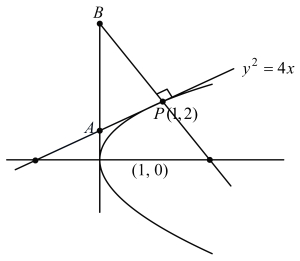
The area of the triangle formed by the tangent and the normal drawn to the curve $y^2=4x$ at $(1,2)$ with the $Y$-axis is (in square units):
A
$4$
B
$3$
C
$2$
D
$1$
Solution
(D) Given the curve $y^2=4x$ and the point $P(1,2)$.
The slope of the tangent at $(1,2)$ is found by differentiating $y^2=4x$: $2y \frac{dy}{dx} = 4 \Rightarrow \frac{dy}{dx} = \frac{2}{y}$. At $(1,2)$,the slope $m_t = \frac{2}{2} = 1$.
The equation of the tangent is $y-2 = 1(x-1) \Rightarrow y = x+1$.
The tangent intersects the $Y$-axis $(x=0)$ at $A(0,1)$.
The slope of the normal $m_n = -\frac{1}{m_t} = -1$.
The equation of the normal is $y-2 = -1(x-1) \Rightarrow y = -x+3$.
The normal intersects the $Y$-axis $(x=0)$ at $B(0,3)$.
The triangle is formed by vertices $P(1,2)$,$A(0,1)$,and $B(0,3)$.
The base of the triangle along the $Y$-axis is the distance between $A(0,1)$ and $B(0,3)$,which is $|3-1| = 2$ units.
The height of the triangle is the perpendicular distance from $P(1,2)$ to the $Y$-axis,which is the $x$-coordinate of $P$,i.e.,$1$ unit.
Area $= \frac{1}{2} \times \text{base} \times \text{height} = \frac{1}{2} \times 2 \times 1 = 1$ square unit.
The slope of the tangent at $(1,2)$ is found by differentiating $y^2=4x$: $2y \frac{dy}{dx} = 4 \Rightarrow \frac{dy}{dx} = \frac{2}{y}$. At $(1,2)$,the slope $m_t = \frac{2}{2} = 1$.
The equation of the tangent is $y-2 = 1(x-1) \Rightarrow y = x+1$.
The tangent intersects the $Y$-axis $(x=0)$ at $A(0,1)$.
The slope of the normal $m_n = -\frac{1}{m_t} = -1$.
The equation of the normal is $y-2 = -1(x-1) \Rightarrow y = -x+3$.
The normal intersects the $Y$-axis $(x=0)$ at $B(0,3)$.
The triangle is formed by vertices $P(1,2)$,$A(0,1)$,and $B(0,3)$.
The base of the triangle along the $Y$-axis is the distance between $A(0,1)$ and $B(0,3)$,which is $|3-1| = 2$ units.
The height of the triangle is the perpendicular distance from $P(1,2)$ to the $Y$-axis,which is the $x$-coordinate of $P$,i.e.,$1$ unit.
Area $= \frac{1}{2} \times \text{base} \times \text{height} = \frac{1}{2} \times 2 \times 1 = 1$ square unit.
0 likes
View Solution422
EasyMCQ
The coordinates of the point $P$ on the curve $x=a(\theta+\sin \theta), y=a(1-\cos \theta)$,where the tangent is inclined at an angle $\frac{\pi}{4}$ to the $x$-axis,are
A
$\left[a\left(\frac{\pi}{4}-1\right), a\right]$
B
$\left[a\left(\frac{\pi}{2}+1\right), a\right]$
C
$\left(a \frac{\pi}{2}, a\right)$
D
$(a, a)$
Solution
(B) Given the parametric equations of the curve are $x=a(\theta+\sin \theta)$ and $y=a(1-\cos \theta)$.
To find the slope of the tangent,we differentiate $x$ and $y$ with respect to $\theta$:
$\frac{dx}{d\theta} = a(1+\cos \theta)$ and $\frac{dy}{d\theta} = a\sin \theta$.
Thus,the slope of the tangent $\frac{dy}{dx}$ is given by:
$\frac{dy}{dx} = \frac{dy/d\theta}{dx/d\theta} = \frac{a\sin \theta}{a(1+\cos \theta)} = \frac{2\sin(\theta/2)\cos(\theta/2)}{2\cos^2(\theta/2)} = \tan(\theta/2)$.
Given that the tangent is inclined at an angle $\frac{\pi}{4}$ to the $x$-axis,the slope is $\tan(\frac{\pi}{4}) = 1$.
Equating the slopes: $\tan(\theta/2) = \tan(\frac{\pi}{4})$,which implies $\theta/2 = \frac{\pi}{4}$,so $\theta = \frac{\pi}{2}$.
Substituting $\theta = \frac{\pi}{2}$ into the expressions for $x$ and $y$:
$x = a(\frac{\pi}{2} + \sin(\frac{\pi}{2})) = a(\frac{\pi}{2} + 1)$.
$y = a(1 - \cos(\frac{\pi}{2})) = a(1 - 0) = a$.
Therefore,the coordinates of point $P$ are $\left[a\left(\frac{\pi}{2}+1\right), a\right]$.
To find the slope of the tangent,we differentiate $x$ and $y$ with respect to $\theta$:
$\frac{dx}{d\theta} = a(1+\cos \theta)$ and $\frac{dy}{d\theta} = a\sin \theta$.
Thus,the slope of the tangent $\frac{dy}{dx}$ is given by:
$\frac{dy}{dx} = \frac{dy/d\theta}{dx/d\theta} = \frac{a\sin \theta}{a(1+\cos \theta)} = \frac{2\sin(\theta/2)\cos(\theta/2)}{2\cos^2(\theta/2)} = \tan(\theta/2)$.
Given that the tangent is inclined at an angle $\frac{\pi}{4}$ to the $x$-axis,the slope is $\tan(\frac{\pi}{4}) = 1$.
Equating the slopes: $\tan(\theta/2) = \tan(\frac{\pi}{4})$,which implies $\theta/2 = \frac{\pi}{4}$,so $\theta = \frac{\pi}{2}$.
Substituting $\theta = \frac{\pi}{2}$ into the expressions for $x$ and $y$:
$x = a(\frac{\pi}{2} + \sin(\frac{\pi}{2})) = a(\frac{\pi}{2} + 1)$.
$y = a(1 - \cos(\frac{\pi}{2})) = a(1 - 0) = a$.
Therefore,the coordinates of point $P$ are $\left[a\left(\frac{\pi}{2}+1\right), a\right]$.
0 likes
View Solution423
MediumMCQ
The acute angle between the curves $y=3x^2-2x-1$ and $y=x^3-1$ at their point of intersection which lies in the first quadrant is
A
$\operatorname{Tan}^{-1}\left(\frac{2}{121}\right)$
B
$\operatorname{Tan}^{-1}(2)$
C
$\operatorname{Tan}^{-1}\left(\frac{1}{13}\right)$
D
$\frac{\pi}{2}$
Solution
(A) To find the point of intersection,set the equations equal: $3x^2-2x-1 = x^3-1$.
$x^3-3x^2+2x = 0$.
$x(x^2-3x+2) = 0$.
$x(x-1)(x-2) = 0$.
So,$x=0, 1, 2$.
For $x=0$,$y=-1$ (not in the first quadrant).
For $x=1$,$y=0$ (on the axis,not strictly in the first quadrant).
For $x=2$,$y=3(2)^2-2(2)-1 = 12-4-1 = 7$.
The point of intersection in the first quadrant is $(2, 7)$.
Now,find the slopes of the tangents at $(2, 7)$:
For $y=3x^2-2x-1$,$dy/dx = 6x-2$. At $x=2$,$m_1 = 6(2)-2 = 10$.
For $y=x^3-1$,$dy/dx = 3x^2$. At $x=2$,$m_2 = 3(2)^2 = 12$.
The angle $\theta$ between the curves is given by $\tan \theta = |(m_1-m_2)/(1+m_1m_2)|$.
$\tan \theta = |(10-12)/(1+10 \times 12)| = |-2/121| = 2/121$.
Thus,$\theta = \operatorname{Tan}^{-1}(2/121)$.
$x^3-3x^2+2x = 0$.
$x(x^2-3x+2) = 0$.
$x(x-1)(x-2) = 0$.
So,$x=0, 1, 2$.
For $x=0$,$y=-1$ (not in the first quadrant).
For $x=1$,$y=0$ (on the axis,not strictly in the first quadrant).
For $x=2$,$y=3(2)^2-2(2)-1 = 12-4-1 = 7$.
The point of intersection in the first quadrant is $(2, 7)$.
Now,find the slopes of the tangents at $(2, 7)$:
For $y=3x^2-2x-1$,$dy/dx = 6x-2$. At $x=2$,$m_1 = 6(2)-2 = 10$.
For $y=x^3-1$,$dy/dx = 3x^2$. At $x=2$,$m_2 = 3(2)^2 = 12$.
The angle $\theta$ between the curves is given by $\tan \theta = |(m_1-m_2)/(1+m_1m_2)|$.
$\tan \theta = |(10-12)/(1+10 \times 12)| = |-2/121| = 2/121$.
Thus,$\theta = \operatorname{Tan}^{-1}(2/121)$.
0 likes
View Solution424
MediumMCQ
$P(5,2)$ is a point on the curve $y=f(x)$ and $\frac{7}{2}$ is the slope of the tangent to the curve at $P$. The area of the triangle (in sq. units) formed by the tangent and the normal to the curve at $P$ with the $x$-axis is:
A
$35$
B
$\frac{35}{2}$
C
$\frac{53}{7}$
D
$\frac{53}{14}$
Solution
(C) Given point $P(5,2)$ and slope of the tangent $m_t = \frac{7}{2}$.
Equation of the tangent at $P(5,2)$ is $y - 2 = \frac{7}{2}(x - 5) \implies 2y - 4 = 7x - 35 \implies 7x - 2y = 31$.
The $x$-intercept of the tangent is found by setting $y=0$: $7x = 31 \implies x = \frac{31}{7}$. So,the tangent meets the $x$-axis at $A(\frac{31}{7}, 0)$.
The slope of the normal $m_n = -\frac{1}{m_t} = -\frac{2}{7}$.
Equation of the normal at $P(5,2)$ is $y - 2 = -\frac{2}{7}(x - 5) \implies 7y - 14 = -2x + 10 \implies 2x + 7y = 24$.
The $x$-intercept of the normal is found by setting $y=0$: $2x = 24 \implies x = 12$. So,the normal meets the $x$-axis at $B(12, 0)$.
The triangle is formed by points $P(5,2)$,$A(\frac{31}{7}, 0)$,and $B(12, 0)$.
The base of the triangle on the $x$-axis is $|12 - \frac{31}{7}| = |\frac{84 - 31}{7}| = \frac{53}{7}$.
The height of the triangle is the $y$-coordinate of $P$,which is $2$.
Area $= \frac{1}{2} \times \text{base} \times \text{height} = \frac{1}{2} \times \frac{53}{7} \times 2 = \frac{53}{7}$ sq. units.
Equation of the tangent at $P(5,2)$ is $y - 2 = \frac{7}{2}(x - 5) \implies 2y - 4 = 7x - 35 \implies 7x - 2y = 31$.
The $x$-intercept of the tangent is found by setting $y=0$: $7x = 31 \implies x = \frac{31}{7}$. So,the tangent meets the $x$-axis at $A(\frac{31}{7}, 0)$.
The slope of the normal $m_n = -\frac{1}{m_t} = -\frac{2}{7}$.
Equation of the normal at $P(5,2)$ is $y - 2 = -\frac{2}{7}(x - 5) \implies 7y - 14 = -2x + 10 \implies 2x + 7y = 24$.
The $x$-intercept of the normal is found by setting $y=0$: $2x = 24 \implies x = 12$. So,the normal meets the $x$-axis at $B(12, 0)$.
The triangle is formed by points $P(5,2)$,$A(\frac{31}{7}, 0)$,and $B(12, 0)$.
The base of the triangle on the $x$-axis is $|12 - \frac{31}{7}| = |\frac{84 - 31}{7}| = \frac{53}{7}$.
The height of the triangle is the $y$-coordinate of $P$,which is $2$.
Area $= \frac{1}{2} \times \text{base} \times \text{height} = \frac{1}{2} \times \frac{53}{7} \times 2 = \frac{53}{7}$ sq. units.
0 likes
View Solution425
MediumMCQ
If the normal drawn at the point $P$ on the curve $y^2 = x^3 - x + 1$ makes equal intercepts on the coordinate axes,then the equation of the tangent drawn to the curve at $P$ is
A
$x - y = 0$
B
$x - y = 4$
C
$x - y = 1$
D
$x - y = 2$
Solution
(A) Let the point $P$ be $(x_1, y_1)$. The curve is $y^2 = x^3 - x + 1$. Differentiating with respect to $x$,we get $2y \frac{dy}{dx} = 3x^2 - 1$,so $\frac{dy}{dx} = \frac{3x_1^2 - 1}{2y_1}$.
The slope of the normal at $P$ is $m_n = -\frac{1}{dy/dx} = -\frac{2y_1}{3x_1^2 - 1}$.
Since the normal makes equal intercepts on the axes,its slope must be $\pm 1$. Given the curve,we test $m_n = -1$ (as the normal equation $x+y=c$ or $x-y=c$ implies slope $\pm 1$).
If $m_n = -1$,then $\frac{2y_1}{3x_1^2 - 1} = 1 \implies 2y_1 = 3x_1^2 - 1$.
Substituting $y_1^2 = x_1^3 - x_1 + 1$ and $y_1 = \frac{3x_1^2 - 1}{2}$,we get $(\frac{3x_1^2 - 1}{2})^2 = x_1^3 - x_1 + 1$. Solving this,we find $x_1 = 1$,which gives $y_1 = 1$. Thus $P = (1, 1)$.
The slope of the tangent at $(1, 1)$ is $m_t = \frac{3(1)^2 - 1}{2(1)} = \frac{2}{2} = 1$.
The equation of the tangent is $y - 1 = 1(x - 1)$,which simplifies to $y = x$,or $x - y = 0$.
The slope of the normal at $P$ is $m_n = -\frac{1}{dy/dx} = -\frac{2y_1}{3x_1^2 - 1}$.
Since the normal makes equal intercepts on the axes,its slope must be $\pm 1$. Given the curve,we test $m_n = -1$ (as the normal equation $x+y=c$ or $x-y=c$ implies slope $\pm 1$).
If $m_n = -1$,then $\frac{2y_1}{3x_1^2 - 1} = 1 \implies 2y_1 = 3x_1^2 - 1$.
Substituting $y_1^2 = x_1^3 - x_1 + 1$ and $y_1 = \frac{3x_1^2 - 1}{2}$,we get $(\frac{3x_1^2 - 1}{2})^2 = x_1^3 - x_1 + 1$. Solving this,we find $x_1 = 1$,which gives $y_1 = 1$. Thus $P = (1, 1)$.
The slope of the tangent at $(1, 1)$ is $m_t = \frac{3(1)^2 - 1}{2(1)} = \frac{2}{2} = 1$.
The equation of the tangent is $y - 1 = 1(x - 1)$,which simplifies to $y = x$,or $x - y = 0$.
0 likes
View Solution426
MediumMCQ
If the tangent and the normal drawn to the curve $xy^2 + x^2y = 12$ at the point $(1, 3)$ meet the $X$-axis in $T$ and $N$ respectively,then $TN =$
A
$\frac{7}{5}$
B
$\frac{45}{7}$
C
$\frac{3\sqrt{274}}{7}$
D
$\frac{274}{35}$
Solution
(D) Given the curve $xy^2 + x^2y = 12$. Differentiating with respect to $x$:
$y^2 + 2xy \frac{dy}{dx} + 2xy + x^2 \frac{dy}{dx} = 0$.
At the point $(1, 3)$,we have $3^2 + 2(1)(3) \frac{dy}{dx} + 2(1)(3) + (1)^2 \frac{dy}{dx} = 0$.
$9 + 6 \frac{dy}{dx} + 6 + \frac{dy}{dx} = 0 \implies 7 \frac{dy}{dx} = -15 \implies \frac{dy}{dx} = -\frac{15}{7}$.
The equation of the tangent at $(1, 3)$ is $y - 3 = -\frac{15}{7}(x - 1)$.
For $T$,set $y = 0$: $-3 = -\frac{15}{7}(x - 1) \implies 21 = 15(x - 1) \implies x - 1 = \frac{21}{15} = \frac{7}{5} \implies x = 1 + \frac{7}{5} = \frac{12}{5}$. So $T = (\frac{12}{5}, 0)$.
The equation of the normal at $(1, 3)$ is $y - 3 = \frac{7}{15}(x - 1)$.
For $N$,set $y = 0$: $-3 = \frac{7}{15}(x - 1) \implies -45 = 7(x - 1) \implies x - 1 = -\frac{45}{7} \implies x = 1 - \frac{45}{7} = -\frac{38}{7}$. So $N = (-\frac{38}{7}, 0)$.
$TN = |\frac{12}{5} - (-\frac{38}{7})| = |\frac{12}{5} + \frac{38}{7}| = |\frac{84 + 190}{35}| = \frac{274}{35}$.
$y^2 + 2xy \frac{dy}{dx} + 2xy + x^2 \frac{dy}{dx} = 0$.
At the point $(1, 3)$,we have $3^2 + 2(1)(3) \frac{dy}{dx} + 2(1)(3) + (1)^2 \frac{dy}{dx} = 0$.
$9 + 6 \frac{dy}{dx} + 6 + \frac{dy}{dx} = 0 \implies 7 \frac{dy}{dx} = -15 \implies \frac{dy}{dx} = -\frac{15}{7}$.
The equation of the tangent at $(1, 3)$ is $y - 3 = -\frac{15}{7}(x - 1)$.
For $T$,set $y = 0$: $-3 = -\frac{15}{7}(x - 1) \implies 21 = 15(x - 1) \implies x - 1 = \frac{21}{15} = \frac{7}{5} \implies x = 1 + \frac{7}{5} = \frac{12}{5}$. So $T = (\frac{12}{5}, 0)$.
The equation of the normal at $(1, 3)$ is $y - 3 = \frac{7}{15}(x - 1)$.
For $N$,set $y = 0$: $-3 = \frac{7}{15}(x - 1) \implies -45 = 7(x - 1) \implies x - 1 = -\frac{45}{7} \implies x = 1 - \frac{45}{7} = -\frac{38}{7}$. So $N = (-\frac{38}{7}, 0)$.
$TN = |\frac{12}{5} - (-\frac{38}{7})| = |\frac{12}{5} + \frac{38}{7}| = |\frac{84 + 190}{35}| = \frac{274}{35}$.
0 likes
View Solution427
MediumMCQ
If the point $P(x_1, y_1)$ lying on the curve $y = x^2 - x + 1$ is the closest point to the line $y = x - 3$,then the perpendicular distance from $P$ to the line $3x + 4y - 2 = 0$ is
A
$\frac{16}{5}$
B
$4$
C
$1$
D
$\frac{7}{5}$
Solution
(C) The slope of the line $y = x - 3$ is $m = 1$.
Since $P(x_1, y_1)$ is the closest point on the curve $y = x^2 - x + 1$ to the line,the tangent at $P$ must be parallel to the given line.
Thus,the derivative $\frac{dy}{dx} = 2x - 1$ must equal $1$.
$2x_1 - 1 = 1 \implies 2x_1 = 2 \implies x_1 = 1$.
Substituting $x_1 = 1$ into the curve equation: $y_1 = (1)^2 - 1 + 1 = 1$.
So,the point $P$ is $(1, 1)$.
The perpendicular distance from $P(1, 1)$ to the line $3x + 4y - 2 = 0$ is given by the formula $d = \frac{|ax_1 + by_1 + c|}{\sqrt{a^2 + b^2}}$.
$d = \frac{|3(1) + 4(1) - 2|}{\sqrt{3^2 + 4^2}} = \frac{|3 + 4 - 2|}{\sqrt{9 + 16}} = \frac{5}{\sqrt{25}} = \frac{5}{5} = 1$.
Since $P(x_1, y_1)$ is the closest point on the curve $y = x^2 - x + 1$ to the line,the tangent at $P$ must be parallel to the given line.
Thus,the derivative $\frac{dy}{dx} = 2x - 1$ must equal $1$.
$2x_1 - 1 = 1 \implies 2x_1 = 2 \implies x_1 = 1$.
Substituting $x_1 = 1$ into the curve equation: $y_1 = (1)^2 - 1 + 1 = 1$.
So,the point $P$ is $(1, 1)$.
The perpendicular distance from $P(1, 1)$ to the line $3x + 4y - 2 = 0$ is given by the formula $d = \frac{|ax_1 + by_1 + c|}{\sqrt{a^2 + b^2}}$.
$d = \frac{|3(1) + 4(1) - 2|}{\sqrt{3^2 + 4^2}} = \frac{|3 + 4 - 2|}{\sqrt{9 + 16}} = \frac{5}{\sqrt{25}} = \frac{5}{5} = 1$.
0 likes
View Solution428
MediumMCQ
If the curves $y^2 = 12x - 3$ and $y^2 = 12 - kx$ cut each other orthogonally,then the length of the sub-tangent at $(1, b)$ on the curve $y^2 = 12 - kx$ is
A
$4$
B
$6$
C
$5$
D
$12$
Solution
(B) Given curves are $y^2 = 12x - 3$ and $y^2 = 12 - kx$.
Let the point of intersection be $(x_1, y_1)$.
For $y^2 = 12x - 3$,differentiating with respect to $x$,we get $2y \frac{dy}{dx} = 12 \implies \frac{dy}{dx} = \frac{6}{y}$. Let $m_1 = \frac{6}{y_1}$.
For $y^2 = 12 - kx$,differentiating with respect to $x$,we get $2y \frac{dy}{dx} = -k \implies \frac{dy}{dx} = -\frac{k}{2y}$. Let $m_2 = -\frac{k}{2y_1}$.
Since the curves cut orthogonally,$m_1 m_2 = -1 \implies (\frac{6}{y_1})(-\frac{k}{2y_1}) = -1 \implies \frac{3k}{y_1^2} = 1 \implies y_1^2 = 3k$.
At intersection point $(x_1, y_1)$,$12x_1 - 3 = 12 - kx_1 \implies x_1(12 + k) = 15 \implies x_1 = \frac{15}{12+k}$.
Also $y_1^2 = 12 - kx_1 = 3k \implies 12 - k(\frac{15}{12+k}) = 3k \implies 12(12+k) - 15k = 3k(12+k) \implies 144 + 12k - 15k = 36k + 3k^2 \implies 3k^2 + 39k - 144 = 0 \implies k^2 + 13k - 48 = 0 \implies (k+16)(k-3) = 0$.
Since $k > 0$,$k = 3$.
The curve is $y^2 = 12 - 3x$. At $x = 1$,$y^2 = 12 - 3(1) = 9 \implies y = 3$ (taking $b=3$).
The slope at $(1, 3)$ is $m = -\frac{3}{2(3)} = -\frac{1}{2}$.
The length of the sub-tangent is $|\frac{y}{dy/dx}| = |\frac{3}{-1/2}| = 6$.
Let the point of intersection be $(x_1, y_1)$.
For $y^2 = 12x - 3$,differentiating with respect to $x$,we get $2y \frac{dy}{dx} = 12 \implies \frac{dy}{dx} = \frac{6}{y}$. Let $m_1 = \frac{6}{y_1}$.
For $y^2 = 12 - kx$,differentiating with respect to $x$,we get $2y \frac{dy}{dx} = -k \implies \frac{dy}{dx} = -\frac{k}{2y}$. Let $m_2 = -\frac{k}{2y_1}$.
Since the curves cut orthogonally,$m_1 m_2 = -1 \implies (\frac{6}{y_1})(-\frac{k}{2y_1}) = -1 \implies \frac{3k}{y_1^2} = 1 \implies y_1^2 = 3k$.
At intersection point $(x_1, y_1)$,$12x_1 - 3 = 12 - kx_1 \implies x_1(12 + k) = 15 \implies x_1 = \frac{15}{12+k}$.
Also $y_1^2 = 12 - kx_1 = 3k \implies 12 - k(\frac{15}{12+k}) = 3k \implies 12(12+k) - 15k = 3k(12+k) \implies 144 + 12k - 15k = 36k + 3k^2 \implies 3k^2 + 39k - 144 = 0 \implies k^2 + 13k - 48 = 0 \implies (k+16)(k-3) = 0$.
Since $k > 0$,$k = 3$.
The curve is $y^2 = 12 - 3x$. At $x = 1$,$y^2 = 12 - 3(1) = 9 \implies y = 3$ (taking $b=3$).
The slope at $(1, 3)$ is $m = -\frac{3}{2(3)} = -\frac{1}{2}$.
The length of the sub-tangent is $|\frac{y}{dy/dx}| = |\frac{3}{-1/2}| = 6$.
0 likes
View Solution429
MediumMCQ
For the curve $\frac{x^n}{a^n}+\frac{y^n}{b^n}=2, (n \in N \text{ and } n > 1)$,the line $\frac{x}{a}+\frac{y}{b}=2$ is
A
a normal for all values of $n$
B
a normal for only values of $n$ more than $\operatorname{Max}\{a, b\}$
C
a tangent for all values of $n$
D
a tangent for only values of $n$ more than $\operatorname{Min}\{a, b\}$
Solution
(C) Given the curve $\frac{x^n}{a^n} + \frac{y^n}{b^n} = 2$.
At the point $(a, b)$,we check if it lies on the curve: $\frac{a^n}{a^n} + \frac{b^n}{b^n} = 1 + 1 = 2$. Thus,$(a, b)$ is on the curve.
Differentiating the equation with respect to $x$: $\frac{n x^{n-1}}{a^n} + \frac{n y^{n-1}}{b^n} \frac{dy}{dx} = 0$.
So,$\frac{dy}{dx} = -\frac{x^{n-1}}{a^n} \cdot \frac{b^n}{y^{n-1}} = -\frac{b^n x^{n-1}}{a^n y^{n-1}}$.
At the point $(a, b)$,the slope of the tangent $m = -\frac{b^n a^{n-1}}{a^n b^{n-1}} = -\frac{b}{a}$.
The equation of the tangent line at $(a, b)$ is $y - b = -\frac{b}{a}(x - a)$,which simplifies to $ay - ab = -bx + ab$,or $bx + ay = 2ab$.
Dividing by $ab$,we get $\frac{x}{a} + \frac{y}{b} = 2$.
Since this matches the given line,the line is a tangent for all values of $n > 1$.
At the point $(a, b)$,we check if it lies on the curve: $\frac{a^n}{a^n} + \frac{b^n}{b^n} = 1 + 1 = 2$. Thus,$(a, b)$ is on the curve.
Differentiating the equation with respect to $x$: $\frac{n x^{n-1}}{a^n} + \frac{n y^{n-1}}{b^n} \frac{dy}{dx} = 0$.
So,$\frac{dy}{dx} = -\frac{x^{n-1}}{a^n} \cdot \frac{b^n}{y^{n-1}} = -\frac{b^n x^{n-1}}{a^n y^{n-1}}$.
At the point $(a, b)$,the slope of the tangent $m = -\frac{b^n a^{n-1}}{a^n b^{n-1}} = -\frac{b}{a}$.
The equation of the tangent line at $(a, b)$ is $y - b = -\frac{b}{a}(x - a)$,which simplifies to $ay - ab = -bx + ab$,or $bx + ay = 2ab$.
Dividing by $ab$,we get $\frac{x}{a} + \frac{y}{b} = 2$.
Since this matches the given line,the line is a tangent for all values of $n > 1$.
0 likes
View Solution430
MediumMCQ
The curve $y=x^3-2x^2+3x-4$ intersects the horizontal line $y=-2$ at the point $P(h, k)$. If the tangent drawn to this curve at $P$ meets the $X$-axis at $(x_1, y_1)$,then $x_1=$
A
$1$
B
$2$
C
$3$
D
-$3$
Solution
(B) Given the curve $y=x^3-2x^2+3x-4$ and the line $y=-2$.
At the point of intersection $P(h, k)$,we have $x^3-2x^2+3x-4 = -2$.
$\Rightarrow x^3-2x^2+3x-2 = 0$.
By testing values,for $x=1$,$1-2+3-2 = 0$. Thus,the point $P$ is $(1, -2)$.
Now,find the slope of the tangent at $P(1, -2)$:
$\frac{dy}{dx} = 3x^2-4x+3$.
At $x=1$,$\frac{dy}{dx} = 3(1)^2-4(1)+3 = 3-4+3 = 2$.
The equation of the tangent at $(1, -2)$ is $y - (-2) = 2(x - 1)$.
$\Rightarrow y+2 = 2x-2
\Rightarrow y = 2x-4$.
This tangent meets the $X$-axis where $y=0$:
$0 = 2x_1 - 4
\Rightarrow 2x_1 = 4
\Rightarrow x_1 = 2$.
At the point of intersection $P(h, k)$,we have $x^3-2x^2+3x-4 = -2$.
$\Rightarrow x^3-2x^2+3x-2 = 0$.
By testing values,for $x=1$,$1-2+3-2 = 0$. Thus,the point $P$ is $(1, -2)$.
Now,find the slope of the tangent at $P(1, -2)$:
$\frac{dy}{dx} = 3x^2-4x+3$.
At $x=1$,$\frac{dy}{dx} = 3(1)^2-4(1)+3 = 3-4+3 = 2$.
The equation of the tangent at $(1, -2)$ is $y - (-2) = 2(x - 1)$.
$\Rightarrow y+2 = 2x-2
\Rightarrow y = 2x-4$.
This tangent meets the $X$-axis where $y=0$:
$0 = 2x_1 - 4
\Rightarrow 2x_1 = 4
\Rightarrow x_1 = 2$.
0 likes
View Solution431
EasyMCQ
The equation of the normal drawn to the curve $y^3=4 x^5$ at the point $(4,16)$ is
A
$20 x+3 y=128$
B
$20 x-3 y=32$
C
$3 x-20 y+308=0$
D
$3 x+20 y=332$
Solution
(D) Given the curve $y^3=4 x^5$.
Differentiating both sides with respect to $x$,we get $3 y^2 \frac{d y}{d x} = 20 x^4$.
Thus,$\frac{d y}{d x} = \frac{20 x^4}{3 y^2}$.
At the point $(4, 16)$,the slope of the tangent is $m_t = \frac{20(4)^4}{3(16)^2} = \frac{20 \times 256}{3 \times 256} = \frac{20}{3}$.
The slope of the normal $m_n$ is given by $-\frac{1}{m_t} = -\frac{3}{20}$.
The equation of the normal at $(4, 16)$ is $y - 16 = -\frac{3}{20}(x - 4)$.
Multiplying by $20$,we get $20y - 320 = -3x + 12$.
Rearranging the terms,we get $3x + 20y = 332$.
Differentiating both sides with respect to $x$,we get $3 y^2 \frac{d y}{d x} = 20 x^4$.
Thus,$\frac{d y}{d x} = \frac{20 x^4}{3 y^2}$.
At the point $(4, 16)$,the slope of the tangent is $m_t = \frac{20(4)^4}{3(16)^2} = \frac{20 \times 256}{3 \times 256} = \frac{20}{3}$.
The slope of the normal $m_n$ is given by $-\frac{1}{m_t} = -\frac{3}{20}$.
The equation of the normal at $(4, 16)$ is $y - 16 = -\frac{3}{20}(x - 4)$.
Multiplying by $20$,we get $20y - 320 = -3x + 12$.
Rearranging the terms,we get $3x + 20y = 332$.
0 likes
View Solution432
EasyMCQ
$y=f(x)$ and $x=g(y)$ are two curves and $P(x, y)$ is a common point of the two curves. If at $P$,on the curve $y=f(x)$,$\frac{dy}{dx}=Q(x)$ and at the same point $P$ on the curve $x=g(y)$,$\frac{dx}{dy}=-Q(x)$,then
A
the two curves have a common tangent
B
the angle between two curves is $45^{\circ}$
C
tangent drawn at $P$ to one curve is normal to the other curve at $P$
D
the two curves never intersect orthogonally
Solution
(C) Let $m_1$ be the slope of the tangent to the curve $y=f(x)$ at point $P$. Given $m_1 = \frac{dy}{dx} = Q(x)$.
Let $m_2$ be the slope of the tangent to the curve $x=g(y)$ at point $P$. Given $\frac{dx}{dy} = -Q(x)$,we know that $m_2 = \frac{dy}{dx} = \frac{1}{dx/dy} = \frac{1}{-Q(x)}$.
Since $m_1 \times m_2 = Q(x) \times \left(-\frac{1}{Q(x)}\right) = -1$,the product of the slopes of the tangents at the point of intersection is $-1$.
Therefore,the tangent drawn at $P$ to one curve is normal to the other curve at $P$.
Let $m_2$ be the slope of the tangent to the curve $x=g(y)$ at point $P$. Given $\frac{dx}{dy} = -Q(x)$,we know that $m_2 = \frac{dy}{dx} = \frac{1}{dx/dy} = \frac{1}{-Q(x)}$.
Since $m_1 \times m_2 = Q(x) \times \left(-\frac{1}{Q(x)}\right) = -1$,the product of the slopes of the tangents at the point of intersection is $-1$.
Therefore,the tangent drawn at $P$ to one curve is normal to the other curve at $P$.
0 likes
View Solution433
EasyMCQ
If $A = \{P(\alpha, \beta) \mid \text{the tangent drawn at } P \text{ to the curve } y^3 - 3xy + 2 = 0 \text{ is a horizontal line}\}$ and $B = \{Q(a, b) \mid \text{the tangent drawn at } Q \text{ to the curve } y^3 - 3xy + 2 = 0 \text{ is a vertical line}\}$,then $n(A) + n(B) = $
A
$12$
B
$1$
C
$0$
D
$4$
Solution
(B) Given curve: $y^3 - 3xy + 2 = 0$.
Differentiating with respect to $x$: $3y^2 \frac{dy}{dx} - 3y - 3x \frac{dy}{dx} = 0$.
$\frac{dy}{dx} (3y^2 - 3x) = 3y \implies \frac{dy}{dx} = \frac{y}{y^2 - x}$.
For a horizontal tangent,$\frac{dy}{dx} = 0 \implies y = 0$.
Substituting $y = 0$ into the curve equation: $0^3 - 3x(0) + 2 = 0 \implies 2 = 0$,which is impossible. Thus,$n(A) = 0$.
For a vertical tangent,$\frac{dy}{dx} = \infty \implies y^2 - x = 0 \implies x = y^2$.
Substituting $x = y^2$ into the curve equation: $y^3 - 3(y^2)y + 2 = 0 \implies y^3 - 3y^3 + 2 = 0 \implies -2y^3 = -2 \implies y^3 = 1 \implies y = 1$.
If $y = 1$,then $x = 1^2 = 1$. The point is $(1, 1)$. Thus,$n(B) = 1$.
Therefore,$n(A) + n(B) = 0 + 1 = 1$.
Differentiating with respect to $x$: $3y^2 \frac{dy}{dx} - 3y - 3x \frac{dy}{dx} = 0$.
$\frac{dy}{dx} (3y^2 - 3x) = 3y \implies \frac{dy}{dx} = \frac{y}{y^2 - x}$.
For a horizontal tangent,$\frac{dy}{dx} = 0 \implies y = 0$.
Substituting $y = 0$ into the curve equation: $0^3 - 3x(0) + 2 = 0 \implies 2 = 0$,which is impossible. Thus,$n(A) = 0$.
For a vertical tangent,$\frac{dy}{dx} = \infty \implies y^2 - x = 0 \implies x = y^2$.
Substituting $x = y^2$ into the curve equation: $y^3 - 3(y^2)y + 2 = 0 \implies y^3 - 3y^3 + 2 = 0 \implies -2y^3 = -2 \implies y^3 = 1 \implies y = 1$.
If $y = 1$,then $x = 1^2 = 1$. The point is $(1, 1)$. Thus,$n(B) = 1$.
Therefore,$n(A) + n(B) = 0 + 1 = 1$.
0 likes
View Solution434
EasyMCQ
The length of the normal drawn at $t=\frac{\pi}{4}$ on the curve $x=2(\cos 2t + t \sin 2t)$,$y=4(\sin 2t - t \cos 2t)$ is
A
$\frac{4}{\pi} \sqrt{1+\pi^2}$
B
$4 \sqrt{1+\pi^2}$
C
$4 \pi$
D
$\frac{4}{\pi}$
Solution
(B) Given the curve $x = 2(\cos 2t + t \sin 2t)$ and $y = 4(\sin 2t - t \cos 2t)$.
First,find the derivatives $\frac{dx}{dt}$ and $\frac{dy}{dt}$:
$\frac{dx}{dt} = 2(-2 \sin 2t + \sin 2t + 2t \cos 2t) = 2(2t \cos 2t - \sin 2t)$.
$\frac{dy}{dt} = 4(2 \cos 2t - \cos 2t + 2t \sin 2t) = 4(\cos 2t + 2t \sin 2t)$.
At $t = \frac{\pi}{4}$:
$\frac{dx}{dt} = 2(2(\frac{\pi}{4}) \cos \frac{\pi}{2} - \sin \frac{\pi}{2}) = 2(0 - 1) = -2$.
$\frac{dy}{dt} = 4(\cos \frac{\pi}{2} + 2(\frac{\pi}{4}) \sin \frac{\pi}{2}) = 4(0 + \frac{\pi}{2}) = 2\pi$.
Therefore,the slope of the tangent is $\frac{dy}{dx} = \frac{dy/dt}{dx/dt} = \frac{2\pi}{-2} = -\pi$.
The slope of the normal is $-\frac{1}{dy/dx} = \frac{1}{\pi}$.
At $t = \frac{\pi}{4}$,$y = 4(\sin \frac{\pi}{2} - \frac{\pi}{4} \cos \frac{\pi}{2}) = 4(1 - 0) = 4$.
The length of the normal is given by $|y| \sqrt{1 + (\frac{dy}{dx})^2} = |4| \sqrt{1 + (-\pi)^2} = 4 \sqrt{1 + \pi^2}$.
First,find the derivatives $\frac{dx}{dt}$ and $\frac{dy}{dt}$:
$\frac{dx}{dt} = 2(-2 \sin 2t + \sin 2t + 2t \cos 2t) = 2(2t \cos 2t - \sin 2t)$.
$\frac{dy}{dt} = 4(2 \cos 2t - \cos 2t + 2t \sin 2t) = 4(\cos 2t + 2t \sin 2t)$.
At $t = \frac{\pi}{4}$:
$\frac{dx}{dt} = 2(2(\frac{\pi}{4}) \cos \frac{\pi}{2} - \sin \frac{\pi}{2}) = 2(0 - 1) = -2$.
$\frac{dy}{dt} = 4(\cos \frac{\pi}{2} + 2(\frac{\pi}{4}) \sin \frac{\pi}{2}) = 4(0 + \frac{\pi}{2}) = 2\pi$.
Therefore,the slope of the tangent is $\frac{dy}{dx} = \frac{dy/dt}{dx/dt} = \frac{2\pi}{-2} = -\pi$.
The slope of the normal is $-\frac{1}{dy/dx} = \frac{1}{\pi}$.
At $t = \frac{\pi}{4}$,$y = 4(\sin \frac{\pi}{2} - \frac{\pi}{4} \cos \frac{\pi}{2}) = 4(1 - 0) = 4$.
The length of the normal is given by $|y| \sqrt{1 + (\frac{dy}{dx})^2} = |4| \sqrt{1 + (-\pi)^2} = 4 \sqrt{1 + \pi^2}$.
0 likes
View Solution435
DifficultMCQ
If the equation of a tangent drawn to the curve $y=\cos (x+y), -1 \leq x \leq 1+\pi$ is $x+2y=k$,then $k=$
A
$1$
B
$\frac{\pi}{4}$
C
$\frac{\pi}{2}$
D
$2$
Solution
(C) Given the curve $y = \cos(x+y)$.
Taking the derivative with respect to $x$:
$\frac{dy}{dx} = -\sin(x+y) \cdot (1 + \frac{dy}{dx})$
$\frac{dy}{dx} (1 + \sin(x+y)) = -\sin(x+y)$
$\frac{dy}{dx} = \frac{-\sin(x+y)}{1 + \sin(x+y)}$
The equation of the tangent is $x + 2y = k$,which can be written as $y = -\frac{1}{2}x + \frac{k}{2}$.
The slope of the tangent is $m = -\frac{1}{2}$.
Equating the slopes: $\frac{-\sin(x+y)}{1 + \sin(x+y)} = -\frac{1}{2}$
$2\sin(x+y) = 1 + \sin(x+y)$
$\sin(x+y) = 1$
Since $\sin(x+y) = 1$,we have $y = \cos(x+y) = \cos(\frac{\pi}{2} + 2n\pi) = 0$.
Substituting $y = 0$ into $\sin(x+y) = 1$,we get $\sin(x) = 1$,so $x = \frac{\pi}{2}$.
Now,substitute $x = \frac{\pi}{2}$ and $y = 0$ into the tangent equation $x + 2y = k$:
$\frac{\pi}{2} + 2(0) = k$
$k = \frac{\pi}{2}$.
Taking the derivative with respect to $x$:
$\frac{dy}{dx} = -\sin(x+y) \cdot (1 + \frac{dy}{dx})$
$\frac{dy}{dx} (1 + \sin(x+y)) = -\sin(x+y)$
$\frac{dy}{dx} = \frac{-\sin(x+y)}{1 + \sin(x+y)}$
The equation of the tangent is $x + 2y = k$,which can be written as $y = -\frac{1}{2}x + \frac{k}{2}$.
The slope of the tangent is $m = -\frac{1}{2}$.
Equating the slopes: $\frac{-\sin(x+y)}{1 + \sin(x+y)} = -\frac{1}{2}$
$2\sin(x+y) = 1 + \sin(x+y)$
$\sin(x+y) = 1$
Since $\sin(x+y) = 1$,we have $y = \cos(x+y) = \cos(\frac{\pi}{2} + 2n\pi) = 0$.
Substituting $y = 0$ into $\sin(x+y) = 1$,we get $\sin(x) = 1$,so $x = \frac{\pi}{2}$.
Now,substitute $x = \frac{\pi}{2}$ and $y = 0$ into the tangent equation $x + 2y = k$:
$\frac{\pi}{2} + 2(0) = k$
$k = \frac{\pi}{2}$.
0 likes
View Solution436
MediumMCQ
The slope of the normal drawn at a point $P$ to the curve $y = x^3 - 10x^2 + 31x - 30$ is $-\frac{1}{14}$. Find the $x$-intercept of the tangent at point $P$,given that the $x$-coordinate of $P$ is an integer.
A
$-\frac{11}{7}$
B
$22$
C
$\frac{11}{7}$
D
$-22$
Solution
(C) Given the curve $y = x^3 - 10x^2 + 31x - 30$.
First,find the derivative: $\frac{dy}{dx} = 3x^2 - 20x + 31$.
The slope of the normal is given by $-\frac{1}{\frac{dy}{dx}}$.
Setting this equal to $-\frac{1}{14}$:
$-\frac{1}{3x^2 - 20x + 31} = -\frac{1}{14} \implies 3x^2 - 20x + 31 = 14$.
$3x^2 - 20x + 17 = 0$.
Factoring the quadratic: $(3x - 17)(x - 1) = 0$.
This gives $x = 1$ or $x = \frac{17}{3}$.
Since the problem states $x$ is an integer,we take $x = 1$.
Substituting $x = 1$ into the curve equation: $y = (1)^3 - 10(1)^2 + 31(1) - 30 = 1 - 10 + 31 - 30 = -8$.
So,the point $P$ is $(1, -8)$.
The slope of the tangent at $x = 1$ is $\frac{dy}{dx} = 3(1)^2 - 20(1) + 31 = 14$.
The equation of the tangent line is $y - (-8) = 14(x - 1) \implies y + 8 = 14x - 14 \implies y = 14x - 22$.
For the $x$-intercept,set $y = 0$: $0 = 14x - 22 \implies 14x = 22 \implies x = \frac{22}{14} = \frac{11}{7}$.
First,find the derivative: $\frac{dy}{dx} = 3x^2 - 20x + 31$.
The slope of the normal is given by $-\frac{1}{\frac{dy}{dx}}$.
Setting this equal to $-\frac{1}{14}$:
$-\frac{1}{3x^2 - 20x + 31} = -\frac{1}{14} \implies 3x^2 - 20x + 31 = 14$.
$3x^2 - 20x + 17 = 0$.
Factoring the quadratic: $(3x - 17)(x - 1) = 0$.
This gives $x = 1$ or $x = \frac{17}{3}$.
Since the problem states $x$ is an integer,we take $x = 1$.
Substituting $x = 1$ into the curve equation: $y = (1)^3 - 10(1)^2 + 31(1) - 30 = 1 - 10 + 31 - 30 = -8$.
So,the point $P$ is $(1, -8)$.
The slope of the tangent at $x = 1$ is $\frac{dy}{dx} = 3(1)^2 - 20(1) + 31 = 14$.
The equation of the tangent line is $y - (-8) = 14(x - 1) \implies y + 8 = 14x - 14 \implies y = 14x - 22$.
For the $x$-intercept,set $y = 0$: $0 = 14x - 22 \implies 14x = 22 \implies x = \frac{22}{14} = \frac{11}{7}$.
0 likes
View Solution437
EasyMCQ
If the slope of the tangent drawn at any point $(x, y)$ to the curve $y=f(x)$ is $3x^2-5$ and $f(1)=2$,then the tangent at $(1, 2)$ to the curve $y=f(x)$ intersects the curve at the point
A
$(2, 0)$
B
$(-2, 8)$
C
$(3, -2)$
D
$(-1, 6)$
Solution
(B) Given $\frac{dy}{dx} = 3x^2 - 5$.
Integrating both sides,we get $y = \int (3x^2 - 5) dx = x^3 - 5x + C$.
Since $f(1) = 2$,we have $2 = 1^3 - 5(1) + C$,which gives $2 = 1 - 5 + C$,so $C = 6$.
Thus,the equation of the curve is $y = x^3 - 5x + 6$.
The slope of the tangent at $(1, 2)$ is $\left. \frac{dy}{dx} \right|_{(1, 2)} = 3(1)^2 - 5 = -2$.
The equation of the tangent at $(1, 2)$ is $y - 2 = -2(x - 1)$,which simplifies to $y = -2x + 4$.
To find the intersection point,set the curve equation equal to the tangent equation: $x^3 - 5x + 6 = -2x + 4$.
This simplifies to $x^3 - 3x + 2 = 0$.
Factoring the cubic equation,we get $(x - 1)^2(x + 2) = 0$.
The roots are $x = 1$ and $x = -2$.
For $x = 1$,$y = 2$ (the point of tangency).
For $x = -2$,$y = -2(-2) + 4 = 8$.
Therefore,the tangent intersects the curve at the point $(-2, 8)$.
Integrating both sides,we get $y = \int (3x^2 - 5) dx = x^3 - 5x + C$.
Since $f(1) = 2$,we have $2 = 1^3 - 5(1) + C$,which gives $2 = 1 - 5 + C$,so $C = 6$.
Thus,the equation of the curve is $y = x^3 - 5x + 6$.
The slope of the tangent at $(1, 2)$ is $\left. \frac{dy}{dx} \right|_{(1, 2)} = 3(1)^2 - 5 = -2$.
The equation of the tangent at $(1, 2)$ is $y - 2 = -2(x - 1)$,which simplifies to $y = -2x + 4$.
To find the intersection point,set the curve equation equal to the tangent equation: $x^3 - 5x + 6 = -2x + 4$.
This simplifies to $x^3 - 3x + 2 = 0$.
Factoring the cubic equation,we get $(x - 1)^2(x + 2) = 0$.
The roots are $x = 1$ and $x = -2$.
For $x = 1$,$y = 2$ (the point of tangency).
For $x = -2$,$y = -2(-2) + 4 = 8$.
Therefore,the tangent intersects the curve at the point $(-2, 8)$.
0 likes
View Solution438
EasyMCQ
For $h, k \in N$,let $P(h, k)$ be the point of intersection of the curves $x^2 y - x^3 = 8$ and $y^3 - x y^2 = 32$. If $\theta$ is the acute angle between these two curves at $P$,then $\tan \theta =$
A
$\frac{27}{11}$
B
$\frac{1}{3}$
C
$\frac{\pi}{2}$
D
$3$
Solution
(D) Given curves are $x^2 y - x^3 = 8$ $(1)$ and $y^3 - x y^2 = 32$ $(2)$.
Differentiating $(1)$ with respect to $x$: $x^2 \frac{dy}{dx} + 2xy - 3x^2 = 0 \Rightarrow \frac{dy}{dx} = \frac{3x^2 - 2xy}{x^2} = 3 - 2(\frac{y}{x}) = m_1$.
Differentiating $(2)$ with respect to $x$: $3y^2 \frac{dy}{dx} - (x \cdot 2y \frac{dy}{dx} + y^2) = 0 \Rightarrow \frac{dy}{dx}(3y^2 - 2xy) = y^2 \Rightarrow \frac{dy}{dx} = \frac{y^2}{3y^2 - 2xy} = \frac{y}{3y - 2x} = m_2$.
Dividing $(2)$ by $(1)$: $\frac{y^2(y - x)}{x^2(y - x)} = \frac{32}{8} = 4 \Rightarrow \frac{y^2}{x^2} = 4 \Rightarrow y = 2x$ (since $h, k \in N$).
Substituting $y = 2x$ into $(1)$: $x^2(2x) - x^3 = 8 \Rightarrow x^3 = 8 \Rightarrow x = 2$. Thus,$y = 4$.
At $P(2, 4)$,$m_1 = 3 - 2(\frac{4}{2}) = 3 - 4 = -1$.
At $P(2, 4)$,$m_2 = \frac{4}{3(4) - 2(2)} = \frac{4}{12 - 4} = \frac{4}{8} = \frac{1}{2}$.
The angle $\theta$ between the curves is given by $\tan \theta = |\frac{m_2 - m_1}{1 + m_1 m_2}| = |\frac{1/2 - (-1)}{1 + (-1)(1/2)}| = |\frac{3/2}{1/2}| = 3$.
Differentiating $(1)$ with respect to $x$: $x^2 \frac{dy}{dx} + 2xy - 3x^2 = 0 \Rightarrow \frac{dy}{dx} = \frac{3x^2 - 2xy}{x^2} = 3 - 2(\frac{y}{x}) = m_1$.
Differentiating $(2)$ with respect to $x$: $3y^2 \frac{dy}{dx} - (x \cdot 2y \frac{dy}{dx} + y^2) = 0 \Rightarrow \frac{dy}{dx}(3y^2 - 2xy) = y^2 \Rightarrow \frac{dy}{dx} = \frac{y^2}{3y^2 - 2xy} = \frac{y}{3y - 2x} = m_2$.
Dividing $(2)$ by $(1)$: $\frac{y^2(y - x)}{x^2(y - x)} = \frac{32}{8} = 4 \Rightarrow \frac{y^2}{x^2} = 4 \Rightarrow y = 2x$ (since $h, k \in N$).
Substituting $y = 2x$ into $(1)$: $x^2(2x) - x^3 = 8 \Rightarrow x^3 = 8 \Rightarrow x = 2$. Thus,$y = 4$.
At $P(2, 4)$,$m_1 = 3 - 2(\frac{4}{2}) = 3 - 4 = -1$.
At $P(2, 4)$,$m_2 = \frac{4}{3(4) - 2(2)} = \frac{4}{12 - 4} = \frac{4}{8} = \frac{1}{2}$.
The angle $\theta$ between the curves is given by $\tan \theta = |\frac{m_2 - m_1}{1 + m_1 m_2}| = |\frac{1/2 - (-1)}{1 + (-1)(1/2)}| = |\frac{3/2}{1/2}| = 3$.
0 likes
View Solution439
EasyMCQ
Let $m$ be the slope of the normal $L$ drawn at $(1, 2)$ to the curve $x = t^2 - 7t + 7, y = t^2 - 4t - 10$ and $ax + by + c = 0$ be the equation of the normal $L$. If the $G$.$C$.$D$. of $(a, b, c)$ is $1$,then $m(a + b + c) =$
A
$8$
B
$\frac{-64}{5}$
C
$-8$
D
$5$
Solution
(D) Given the curve $x = t^2 - 7t + 7$ and $y = t^2 - 4t - 10$.
First,find the derivative $\frac{dy}{dx}$:
$\frac{dx}{dt} = 2t - 7$ and $\frac{dy}{dt} = 2t - 4$.
Thus,$\frac{dy}{dx} = \frac{2t - 4}{2t - 7}$.
At the point $(1, 2)$,we have $t^2 - 7t + 7 = 1 \implies t^2 - 7t + 6 = 0 \implies (t-1)(t-6) = 0$,so $t = 1$ or $t = 6$.
Also,$t^2 - 4t - 10 = 2 \implies t^2 - 4t - 12 = 0 \implies (t-6)(t+2) = 0$,so $t = 6$ or $t = -2$.
The common value is $t = 6$.
The slope of the tangent at $t = 6$ is $\frac{2(6) - 4}{2(6) - 7} = \frac{8}{5}$.
The slope of the normal $m$ is $-\frac{1}{8/5} = -\frac{5}{8}$.
The equation of the normal at $(1, 2)$ is $y - 2 = -\frac{5}{8}(x - 1)$.
$8y - 16 = -5x + 5 \implies 5x + 8y - 21 = 0$.
Here $a = 5, b = 8, c = -21$. The $G$.$C$.$D$. of $(5, 8, -21)$ is $1$.
Then $a + b + c = 5 + 8 - 21 = -8$.
Finally,$m(a + b + c) = (-\frac{5}{8})(-8) = 5$.
First,find the derivative $\frac{dy}{dx}$:
$\frac{dx}{dt} = 2t - 7$ and $\frac{dy}{dt} = 2t - 4$.
Thus,$\frac{dy}{dx} = \frac{2t - 4}{2t - 7}$.
At the point $(1, 2)$,we have $t^2 - 7t + 7 = 1 \implies t^2 - 7t + 6 = 0 \implies (t-1)(t-6) = 0$,so $t = 1$ or $t = 6$.
Also,$t^2 - 4t - 10 = 2 \implies t^2 - 4t - 12 = 0 \implies (t-6)(t+2) = 0$,so $t = 6$ or $t = -2$.
The common value is $t = 6$.
The slope of the tangent at $t = 6$ is $\frac{2(6) - 4}{2(6) - 7} = \frac{8}{5}$.
The slope of the normal $m$ is $-\frac{1}{8/5} = -\frac{5}{8}$.
The equation of the normal at $(1, 2)$ is $y - 2 = -\frac{5}{8}(x - 1)$.
$8y - 16 = -5x + 5 \implies 5x + 8y - 21 = 0$.
Here $a = 5, b = 8, c = -21$. The $G$.$C$.$D$. of $(5, 8, -21)$ is $1$.
Then $a + b + c = 5 + 8 - 21 = -8$.
Finally,$m(a + b + c) = (-\frac{5}{8})(-8) = 5$.
0 likes
View Solution440
EasyMCQ
If a line having slope $2$ is a tangent to the curve $y=x^4-6x^3+13x^2-10x+5$ at points $P(x_1, y_1)$ and $Q(x_2, y_2)$,where $x_1, x_2 \in \mathbb{N}$,then $x_1x_2 - y_1y_2 =$
A
$17$
B
$3$
C
$-17$
D
$-13$
Solution
(D) Given the curve $y = x^4 - 6x^3 + 13x^2 - 10x + 5$.
The slope of the tangent is given by the derivative $\frac{dy}{dx} = 4x^3 - 18x^2 + 26x - 10$.
Since the slope of the tangent is $2$,we set $\frac{dy}{dx} = 2$:
$4x^3 - 18x^2 + 26x - 10 = 2$
$4x^3 - 18x^2 + 26x - 12 = 0$
Dividing by $2$,we get $2x^3 - 9x^2 + 13x - 6 = 0$.
By testing integer roots,we find $(x-1)$ and $(x-2)$ are factors. Factoring gives $(x-1)(x-2)(2x-3) = 0$.
The roots are $x = 1, x = 2, x = 1.5$.
Since $x_1, x_2 \in \mathbb{N}$,we choose $x_1 = 1$ and $x_2 = 2$.
For $x_1 = 1$,$y_1 = 1^4 - 6(1)^3 + 13(1)^2 - 10(1) + 5 = 1 - 6 + 13 - 10 + 5 = 3$.
For $x_2 = 2$,$y_2 = 2^4 - 6(2)^3 + 13(2)^2 - 10(2) + 5 = 16 - 48 + 52 - 20 + 5 = 5$.
Thus,$x_1x_2 - y_1y_2 = (1 \times 2) - (3 \times 5) = 2 - 15 = -13$.
The slope of the tangent is given by the derivative $\frac{dy}{dx} = 4x^3 - 18x^2 + 26x - 10$.
Since the slope of the tangent is $2$,we set $\frac{dy}{dx} = 2$:
$4x^3 - 18x^2 + 26x - 10 = 2$
$4x^3 - 18x^2 + 26x - 12 = 0$
Dividing by $2$,we get $2x^3 - 9x^2 + 13x - 6 = 0$.
By testing integer roots,we find $(x-1)$ and $(x-2)$ are factors. Factoring gives $(x-1)(x-2)(2x-3) = 0$.
The roots are $x = 1, x = 2, x = 1.5$.
Since $x_1, x_2 \in \mathbb{N}$,we choose $x_1 = 1$ and $x_2 = 2$.
For $x_1 = 1$,$y_1 = 1^4 - 6(1)^3 + 13(1)^2 - 10(1) + 5 = 1 - 6 + 13 - 10 + 5 = 3$.
For $x_2 = 2$,$y_2 = 2^4 - 6(2)^3 + 13(2)^2 - 10(2) + 5 = 16 - 48 + 52 - 20 + 5 = 5$.
Thus,$x_1x_2 - y_1y_2 = (1 \times 2) - (3 \times 5) = 2 - 15 = -13$.
0 likes
View Solution441
EasyMCQ
The equation of the normal to the curve $\sin y = \sqrt{3} x \sin \left(\frac{\pi}{6} + y\right)$ at $x = 0$ is:
A
$2x + \sqrt{3}y = 0$
B
$2x + y = 0$
C
$x + 2y = 0$
D
$\sqrt{3}x + 2y = 0$
Solution
(A) Given the equation of the curve is $\sin y = \sqrt{3} x \sin \left(\frac{\pi}{6} + y\right) \quad (i)$.
At $x = 0$,$\sin y = 0$,which implies $y = 0$.
Now,differentiating equation $(i)$ with respect to $x$ using the product rule:
$\cos y \frac{dy}{dx} = \sqrt{3} \sin \left(\frac{\pi}{6} + y\right) + \sqrt{3} x \cos \left(\frac{\pi}{6} + y\right) \frac{dy}{dx}$.
At the point $(0, 0)$,substituting $x = 0$ and $y = 0$:
$\cos(0) \frac{dy}{dx} = \sqrt{3} \sin \left(\frac{\pi}{6} + 0\right) + \sqrt{3}(0) \cos \left(\frac{\pi}{6} + 0\right) \frac{dy}{dx}$.
$1 \cdot \frac{dy}{dx} = \sqrt{3} \sin \left(\frac{\pi}{6}\right) = \sqrt{3} \cdot \frac{1}{2} = \frac{\sqrt{3}}{2}$.
Thus,the slope of the tangent $m_t = \frac{\sqrt{3}}{2}$.
The slope of the normal $m_n = -\frac{1}{m_t} = -\frac{1}{\frac{\sqrt{3}}{2}} = -\frac{2}{\sqrt{3}}$.
The equation of the normal at $(0, 0)$ is given by $y - y_1 = m_n(x - x_1)$:
$y - 0 = -\frac{2}{\sqrt{3}}(x - 0)$.
$\sqrt{3}y = -2x$,which simplifies to $2x + \sqrt{3}y = 0$.
At $x = 0$,$\sin y = 0$,which implies $y = 0$.
Now,differentiating equation $(i)$ with respect to $x$ using the product rule:
$\cos y \frac{dy}{dx} = \sqrt{3} \sin \left(\frac{\pi}{6} + y\right) + \sqrt{3} x \cos \left(\frac{\pi}{6} + y\right) \frac{dy}{dx}$.
At the point $(0, 0)$,substituting $x = 0$ and $y = 0$:
$\cos(0) \frac{dy}{dx} = \sqrt{3} \sin \left(\frac{\pi}{6} + 0\right) + \sqrt{3}(0) \cos \left(\frac{\pi}{6} + 0\right) \frac{dy}{dx}$.
$1 \cdot \frac{dy}{dx} = \sqrt{3} \sin \left(\frac{\pi}{6}\right) = \sqrt{3} \cdot \frac{1}{2} = \frac{\sqrt{3}}{2}$.
Thus,the slope of the tangent $m_t = \frac{\sqrt{3}}{2}$.
The slope of the normal $m_n = -\frac{1}{m_t} = -\frac{1}{\frac{\sqrt{3}}{2}} = -\frac{2}{\sqrt{3}}$.
The equation of the normal at $(0, 0)$ is given by $y - y_1 = m_n(x - x_1)$:
$y - 0 = -\frac{2}{\sqrt{3}}(x - 0)$.
$\sqrt{3}y = -2x$,which simplifies to $2x + \sqrt{3}y = 0$.
0 likes
View Solution442
MediumMCQ
$y=x^2$ is the given curve. Imagine that this curve is dragged along the positive $X$-axis to a distance of '$a$' units. If the acute angle between the curves at two positions is $\theta$,then
A
$\theta=\frac{\pi}{2}$
B
$\tan \theta=\frac{2|a|}{\left|1-a^2\right|}$
C
$\cos \theta=\frac{2|a|}{\left|1-a^2\right|}$
D
$\theta=0$
Solution
(B) The given curve is $y=x^2$. When it is shifted by '$a$' units along the positive $X$-axis,the new curve becomes $y=(x-a)^2$.
To find the intersection point,we set the equations equal:
$x^2 = (x-a)^2$
$x^2 = x^2 - 2ax + a^2$
$2ax = a^2$
Since $a \neq 0$,we get $x = \frac{a}{2}$.
Substituting $x = \frac{a}{2}$ into $y=x^2$,we get $y = \frac{a^2}{4}$.
The intersection point is $(\frac{a}{2}, \frac{a^2}{4})$.
Now,find the slopes of the tangents at this point:
For $y=x^2$,$\frac{dy}{dx} = 2x$. At $x=\frac{a}{2}$,$m_1 = 2(\frac{a}{2}) = a$.
For $y=(x-a)^2$,$\frac{dy}{dx} = 2(x-a)$. At $x=\frac{a}{2}$,$m_2 = 2(\frac{a}{2}-a) = -a$.
The angle $\theta$ between the curves is given by:
$\tan \theta = \left| \frac{m_1 - m_2}{1 + m_1 m_2} \right| = \left| \frac{a - (-a)}{1 + (a)(-a)} \right| = \left| \frac{2a}{1 - a^2} \right| = \frac{2|a|}{|1 - a^2|}$.
Thus,option $(b)$ is correct.
To find the intersection point,we set the equations equal:
$x^2 = (x-a)^2$
$x^2 = x^2 - 2ax + a^2$
$2ax = a^2$
Since $a \neq 0$,we get $x = \frac{a}{2}$.
Substituting $x = \frac{a}{2}$ into $y=x^2$,we get $y = \frac{a^2}{4}$.
The intersection point is $(\frac{a}{2}, \frac{a^2}{4})$.
Now,find the slopes of the tangents at this point:
For $y=x^2$,$\frac{dy}{dx} = 2x$. At $x=\frac{a}{2}$,$m_1 = 2(\frac{a}{2}) = a$.
For $y=(x-a)^2$,$\frac{dy}{dx} = 2(x-a)$. At $x=\frac{a}{2}$,$m_2 = 2(\frac{a}{2}-a) = -a$.
The angle $\theta$ between the curves is given by:
$\tan \theta = \left| \frac{m_1 - m_2}{1 + m_1 m_2} \right| = \left| \frac{a - (-a)}{1 + (a)(-a)} \right| = \left| \frac{2a}{1 - a^2} \right| = \frac{2|a|}{|1 - a^2|}$.
Thus,option $(b)$ is correct.
0 likes
View Solution443
MediumMCQ
If $\theta$ is the angle between the curves $x^2-y^2=4$ and $y^2=3x$,then $\tan \theta=$
A
$\frac{5}{3 \sqrt{3}}$
B
$\frac{5}{6 \sqrt{3}}$
C
$\frac{5}{18}$
D
$\frac{5}{6}$
Solution
(B) Given curves are $x^2-y^2=4$ and $y^2=3x$.
Substituting $y^2=3x$ into the first equation: $x^2-3x-4=0$.
$(x-4)(x+1)=0$. Since $y^2=3x$,$x$ must be positive,so $x=4$.
Then $y^2=12$,so $y=\pm 2\sqrt{3}$. Let the point of intersection be $(4, 2\sqrt{3})$.
For $x^2-y^2=4$,differentiating w.r.t $x$: $2x-2y \frac{dy}{dx}=0 \implies \frac{dy}{dx}=\frac{x}{y}$.
At $(4, 2\sqrt{3})$,$m_1 = \frac{4}{2\sqrt{3}} = \frac{2}{\sqrt{3}}$.
For $y^2=3x$,differentiating w.r.t $x$: $2y \frac{dy}{dx}=3 \implies \frac{dy}{dx}=\frac{3}{2y}$.
At $(4, 2\sqrt{3})$,$m_2 = \frac{3}{2(2\sqrt{3})} = \frac{3}{4\sqrt{3}} = \frac{\sqrt{3}}{4}$.
$\tan \theta = \left| \frac{m_1-m_2}{1+m_1 m_2} \right| = \left| \frac{\frac{2}{\sqrt{3}}-\frac{\sqrt{3}}{4}}{1+(\frac{2}{\sqrt{3}})(\frac{\sqrt{3}}{4})} \right| = \left| \frac{\frac{8-3}{4\sqrt{3}}}{1+\frac{1}{2}} \right| = \left| \frac{5}{4\sqrt{3}} \times \frac{2}{3} \right| = \frac{5}{6\sqrt{3}}$.
Substituting $y^2=3x$ into the first equation: $x^2-3x-4=0$.
$(x-4)(x+1)=0$. Since $y^2=3x$,$x$ must be positive,so $x=4$.
Then $y^2=12$,so $y=\pm 2\sqrt{3}$. Let the point of intersection be $(4, 2\sqrt{3})$.
For $x^2-y^2=4$,differentiating w.r.t $x$: $2x-2y \frac{dy}{dx}=0 \implies \frac{dy}{dx}=\frac{x}{y}$.
At $(4, 2\sqrt{3})$,$m_1 = \frac{4}{2\sqrt{3}} = \frac{2}{\sqrt{3}}$.
For $y^2=3x$,differentiating w.r.t $x$: $2y \frac{dy}{dx}=3 \implies \frac{dy}{dx}=\frac{3}{2y}$.
At $(4, 2\sqrt{3})$,$m_2 = \frac{3}{2(2\sqrt{3})} = \frac{3}{4\sqrt{3}} = \frac{\sqrt{3}}{4}$.
$\tan \theta = \left| \frac{m_1-m_2}{1+m_1 m_2} \right| = \left| \frac{\frac{2}{\sqrt{3}}-\frac{\sqrt{3}}{4}}{1+(\frac{2}{\sqrt{3}})(\frac{\sqrt{3}}{4})} \right| = \left| \frac{\frac{8-3}{4\sqrt{3}}}{1+\frac{1}{2}} \right| = \left| \frac{5}{4\sqrt{3}} \times \frac{2}{3} \right| = \frac{5}{6\sqrt{3}}$.
0 likes
View SolutionApplications of Derivatives — Tangent and Normal · Frequently Asked Questions
1Are these Applications of Derivatives questions useful for JEE and NEET?
Yes. All questions in this section are mapped to JEE Main and NEET exam patterns. Previous year questions from JEE Main, NEET, GUJCET and state-level exams are included with full solutions.
2Can I switch to Hindi or Gujarati for these questions?
Yes. Use the language tabs in the hero section or the sidebar to view the same questions and solutions in English, Hindi or Gujarati.
3How do I generate a question paper from this subtopic?
Use the Vedclass Exam Paper Generator — select the chapter and subtopic, set difficulty, and generate Sets A, B, C, D automatically. First 3 chapters of every subject are free.
Vedclass Products
For Students
Vedclass Test Series
Mock tests in real JEE/NEET style with performance analysis. 5-day free trial.
Start Free TrialFor Teachers
Exam Paper Generator
Generate Set A/B/C/D papers from this chapter in 2 minutes. 3 chapters free.
Try FreeFor Institutes
Online Exam Module
Live online exams with unlimited students, 360° analytics & white-label branding.
See DemoFor Teachers & Institutes
Generate a Applications of Derivatives Exam Paper in 2 Minutes
Select subtopic & difficulty — Sets A, B, C, D auto-generated with No Repeat logic.
First 3 chapters of every subject are free — no payment required.