
A English
Tangent and Normal Questions in English
Class 12 Mathematics · Applications of Derivatives · Tangent and Normal
502+
Questions
English
Language
100%
With Solutions
Showing 50 of 502 questions in English
151
AdvancedMCQ
The length of the subtangent to the curve $\sqrt{x} + \sqrt{y} = 3$ at the point $(4, 1)$ is
A
$1/2$
B
$1/3$
C
$3$
D
$2$
Solution
(D) Given the curve equation: $\sqrt{x} + \sqrt{y} = 3$.
Differentiating both sides with respect to $x$:
$\frac{1}{2\sqrt{x}} + \frac{1}{2\sqrt{y}} \cdot \frac{dy}{dx} = 0$.
Rearranging to find $\frac{dy}{dx}$:
$\frac{dy}{dx} = -\frac{\sqrt{y}}{\sqrt{x}}$.
At the point $(4, 1)$,the slope $m$ is:
$m = \left. \frac{dy}{dx} \right|_{(4, 1)} = -\frac{\sqrt{1}}{\sqrt{4}} = -\frac{1}{2}$.
The length of the subtangent is given by the formula $\left| \frac{y}{dy/dx} \right|$.
Substituting the values $y = 1$ and $\frac{dy}{dx} = -\frac{1}{2}$:
$\text{Length of subtangent} = \left| \frac{1}{-1/2} \right| = |-2| = 2$.
Differentiating both sides with respect to $x$:
$\frac{1}{2\sqrt{x}} + \frac{1}{2\sqrt{y}} \cdot \frac{dy}{dx} = 0$.
Rearranging to find $\frac{dy}{dx}$:
$\frac{dy}{dx} = -\frac{\sqrt{y}}{\sqrt{x}}$.
At the point $(4, 1)$,the slope $m$ is:
$m = \left. \frac{dy}{dx} \right|_{(4, 1)} = -\frac{\sqrt{1}}{\sqrt{4}} = -\frac{1}{2}$.
The length of the subtangent is given by the formula $\left| \frac{y}{dy/dx} \right|$.
Substituting the values $y = 1$ and $\frac{dy}{dx} = -\frac{1}{2}$:
$\text{Length of subtangent} = \left| \frac{1}{-1/2} \right| = |-2| = 2$.
0 likes
View Solution152
AdvancedMCQ
If the curves $y = \frac{\ln x}{x}$ and $y = \lambda x^2$ (where $\lambda$ is a constant) touch each other,then $\lambda$ is
A
$\frac{e}{3}$
B
$3e$
C
$\frac{1}{3e}$
D
$\frac{3}{e}$
Solution
(C) Let the curves touch at point $(x, y)$.
For the curves to touch,they must have the same value and the same derivative at the point of contact.
$1$. Equating the functions: $\frac{\ln x}{x} = \lambda x^2 \implies \ln x = \lambda x^3$.
$2$. Equating the derivatives: $\frac{d}{dx}(\frac{\ln x}{x}) = \frac{d}{dx}(\lambda x^2) \implies \frac{1 - \ln x}{x^2} = 2\lambda x \implies 1 - \ln x = 2\lambda x^3$.
Substitute $\ln x = \lambda x^3$ into the derivative equation:
$1 - (\lambda x^3) = 2\lambda x^3 \implies 1 = 3\lambda x^3 \implies \lambda x^3 = \frac{1}{3}$.
Since $\ln x = \lambda x^3$,we have $\ln x = \frac{1}{3}$,which implies $x = e^{1/3}$.
Now,substitute $x^3 = (e^{1/3})^3 = e$ into $\lambda x^3 = \frac{1}{3}$:
$\lambda e = \frac{1}{3} \implies \lambda = \frac{1}{3e}$.
For the curves to touch,they must have the same value and the same derivative at the point of contact.
$1$. Equating the functions: $\frac{\ln x}{x} = \lambda x^2 \implies \ln x = \lambda x^3$.
$2$. Equating the derivatives: $\frac{d}{dx}(\frac{\ln x}{x}) = \frac{d}{dx}(\lambda x^2) \implies \frac{1 - \ln x}{x^2} = 2\lambda x \implies 1 - \ln x = 2\lambda x^3$.
Substitute $\ln x = \lambda x^3$ into the derivative equation:
$1 - (\lambda x^3) = 2\lambda x^3 \implies 1 = 3\lambda x^3 \implies \lambda x^3 = \frac{1}{3}$.
Since $\ln x = \lambda x^3$,we have $\ln x = \frac{1}{3}$,which implies $x = e^{1/3}$.
Now,substitute $x^3 = (e^{1/3})^3 = e$ into $\lambda x^3 = \frac{1}{3}$:
$\lambda e = \frac{1}{3} \implies \lambda = \frac{1}{3e}$.
0 likes
View Solution153
AdvancedMCQ
$A$ straight line $L$ passing through the point $(2,3)$ bounds the minimum area with the curve $f(x) = x^2 - 4x + 6$. Find the equation of the tangent to the curve parallel to $L$.
A
$x = 2$
B
$y = 2$
C
$y = x + 1$
D
$2y = x$
Solution
(B) The curve is $f(x) = x^2 - 4x + 6 = (x-2)^2 + 2$. This is a parabola with vertex at $(2,2)$.
Let the line $L$ passing through $(2,3)$ have slope $m$. Its equation is $y - 3 = m(x - 2)$,or $y = mx - 2m + 3$.
The area bounded by the line and the parabola is minimized when the line is parallel to the tangent at the point where the chord is bisected. For a parabola,the chord passing through a point $(h, k)$ that bisects the area is the one where the slope of the chord is equal to the slope of the tangent at the point $(h, k)$ if the point lies on the curve,but here $(2,3)$ is inside the parabola.
Actually,for a parabola $y = ax^2 + bx + c$,the chord through a point $(x_0, y_0)$ that cuts off the minimum area is the one where the slope $m = f'(x_0)$.
Here $f'(x) = 2x - 4$. At $x = 2$,$f'(2) = 2(2) - 4 = 0$.
Thus,the slope of the line $L$ is $0$. The line $L$ is $y = 3$.
The tangent parallel to $L$ (slope $0$) is the horizontal tangent at the vertex $(2,2)$,which is $y = 2$.
Let the line $L$ passing through $(2,3)$ have slope $m$. Its equation is $y - 3 = m(x - 2)$,or $y = mx - 2m + 3$.
The area bounded by the line and the parabola is minimized when the line is parallel to the tangent at the point where the chord is bisected. For a parabola,the chord passing through a point $(h, k)$ that bisects the area is the one where the slope of the chord is equal to the slope of the tangent at the point $(h, k)$ if the point lies on the curve,but here $(2,3)$ is inside the parabola.
Actually,for a parabola $y = ax^2 + bx + c$,the chord through a point $(x_0, y_0)$ that cuts off the minimum area is the one where the slope $m = f'(x_0)$.
Here $f'(x) = 2x - 4$. At $x = 2$,$f'(2) = 2(2) - 4 = 0$.
Thus,the slope of the line $L$ is $0$. The line $L$ is $y = 3$.
The tangent parallel to $L$ (slope $0$) is the horizontal tangent at the vertex $(2,2)$,which is $y = 2$.
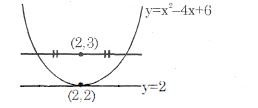
0 likes
View Solution154
AdvancedMCQ
The equations of straight lines which are both tangent and normal to the curve $27x^2 = 4y^3$ are
A
$x = \pm \sqrt{2}(y - 3)$
B
$x = \pm \sqrt{3}(y + 2)$
C
$x = \pm \sqrt{2}(y + 2)$
D
$x = \pm \sqrt{2}(y - 2)$
Solution
(D) Given curve: $27x^2 = 4y^3$.
Differentiating with respect to $x$: $54x = 12y^2 \frac{dy}{dx} \Rightarrow \frac{dy}{dx} = \frac{9x}{2y^2}$.
Let the point on the curve be $(2t^3, 3t^2)$.
Slope of the tangent at $t$: $m = \frac{9(2t^3)}{2(3t^2)^2} = \frac{18t^3}{18t^4} = \frac{1}{t}$.
Equation of the tangent at $t$: $y - 3t^2 = \frac{1}{t}(x - 2t^3) \Rightarrow x - ty = -t^3$ .......$(i)$.
Equation of the normal at $t_1$: $y - 3t_1^2 = -t_1(x - 2t_1^3) \Rightarrow t_1x + y = 3t_1^2 + 2t_1^4$ .......$(ii)$.
Since the line is both tangent and normal,comparing $(i)$ and $(ii)$ gives $\frac{1}{t_1} = -t = \frac{-t^3}{3t_1^2 + 2t_1^4}$.
From $\frac{1}{t_1} = -t$,we have $t_1 = -\frac{1}{t}$.
Substituting into $-t = \frac{-t^3}{3t_1^2 + 2t_1^4}$: $t = \frac{t^3}{3(\frac{1}{t^2}) + 2(\frac{1}{t^4})} = \frac{t^7}{3t^2 + 2}$.
$3t^2 + 2 = t^6 \Rightarrow t^6 - 3t^2 - 2 = 0$. Let $u = t^2$,then $u^3 - 3u - 2 = 0$.
$(u - 2)(u + 1)^2 = 0$. Since $u = t^2 > 0$,we have $t^2 = 2$,so $t = \pm \sqrt{2}$.
Substituting $t^2 = 2$ into the tangent equation $x = t(y - t^2)$: $x = \pm \sqrt{2}(y - 2)$.
Differentiating with respect to $x$: $54x = 12y^2 \frac{dy}{dx} \Rightarrow \frac{dy}{dx} = \frac{9x}{2y^2}$.
Let the point on the curve be $(2t^3, 3t^2)$.
Slope of the tangent at $t$: $m = \frac{9(2t^3)}{2(3t^2)^2} = \frac{18t^3}{18t^4} = \frac{1}{t}$.
Equation of the tangent at $t$: $y - 3t^2 = \frac{1}{t}(x - 2t^3) \Rightarrow x - ty = -t^3$ .......$(i)$.
Equation of the normal at $t_1$: $y - 3t_1^2 = -t_1(x - 2t_1^3) \Rightarrow t_1x + y = 3t_1^2 + 2t_1^4$ .......$(ii)$.
Since the line is both tangent and normal,comparing $(i)$ and $(ii)$ gives $\frac{1}{t_1} = -t = \frac{-t^3}{3t_1^2 + 2t_1^4}$.
From $\frac{1}{t_1} = -t$,we have $t_1 = -\frac{1}{t}$.
Substituting into $-t = \frac{-t^3}{3t_1^2 + 2t_1^4}$: $t = \frac{t^3}{3(\frac{1}{t^2}) + 2(\frac{1}{t^4})} = \frac{t^7}{3t^2 + 2}$.
$3t^2 + 2 = t^6 \Rightarrow t^6 - 3t^2 - 2 = 0$. Let $u = t^2$,then $u^3 - 3u - 2 = 0$.
$(u - 2)(u + 1)^2 = 0$. Since $u = t^2 > 0$,we have $t^2 = 2$,so $t = \pm \sqrt{2}$.
Substituting $t^2 = 2$ into the tangent equation $x = t(y - t^2)$: $x = \pm \sqrt{2}(y - 2)$.
0 likes
View Solution155
AdvancedMCQ
The equation of the tangent at $x = \frac{\pi}{2}$ to the curve $y = x \sin x$ is
A
$x + y = 0$
B
$x - y = 0$
C
$x + y = \pi$
D
$x - y = \pi$
Solution
(B) Given the curve $y = x \sin x$.
At $x = \frac{\pi}{2}$,$y = \frac{\pi}{2} \sin(\frac{\pi}{2}) = \frac{\pi}{2} \times 1 = \frac{\pi}{2}$.
So,the point of contact is $(\frac{\pi}{2}, \frac{\pi}{2})$.
Now,differentiate $y$ with respect to $x$:
$\frac{dy}{dx} = \frac{d}{dx}(x \sin x) = x \cos x + \sin x$.
Calculate the slope $m$ at $x = \frac{\pi}{2}$:
$m = \left. \frac{dy}{dx} \right|_{x = \frac{\pi}{2}} = \frac{\pi}{2} \cos(\frac{\pi}{2}) + \sin(\frac{\pi}{2}) = \frac{\pi}{2}(0) + 1 = 1$.
The equation of the tangent is given by $y - y_1 = m(x - x_1)$:
$y - \frac{\pi}{2} = 1(x - \frac{\pi}{2})$.
$y - \frac{\pi}{2} = x - \frac{\pi}{2}$.
$x - y = 0$.
At $x = \frac{\pi}{2}$,$y = \frac{\pi}{2} \sin(\frac{\pi}{2}) = \frac{\pi}{2} \times 1 = \frac{\pi}{2}$.
So,the point of contact is $(\frac{\pi}{2}, \frac{\pi}{2})$.
Now,differentiate $y$ with respect to $x$:
$\frac{dy}{dx} = \frac{d}{dx}(x \sin x) = x \cos x + \sin x$.
Calculate the slope $m$ at $x = \frac{\pi}{2}$:
$m = \left. \frac{dy}{dx} \right|_{x = \frac{\pi}{2}} = \frac{\pi}{2} \cos(\frac{\pi}{2}) + \sin(\frac{\pi}{2}) = \frac{\pi}{2}(0) + 1 = 1$.
The equation of the tangent is given by $y - y_1 = m(x - x_1)$:
$y - \frac{\pi}{2} = 1(x - \frac{\pi}{2})$.
$y - \frac{\pi}{2} = x - \frac{\pi}{2}$.
$x - y = 0$.
0 likes
View Solution156
DifficultMCQ
The equation of the normal to the curve $y^3 + 2xy + x^3 = (x - 1)^3$ at the point $(1, -1)$ is:
A
$5x + y = 4$
B
$5x - y = 6$
C
$x + 5y + 4 = 0$
D
$x - 5y = 6$
Solution
(B) Given the curve equation: $y^3 + 2xy + x^3 = (x - 1)^3$.
Differentiating both sides with respect to $x$:
$3y^2 \frac{dy}{dx} + 2y + 2x \frac{dy}{dx} + 3x^2 = 3(x - 1)^2$.
At the point $(1, -1)$,substitute $x = 1$ and $y = -1$:
$3(-1)^2 \frac{dy}{dx} + 2(-1) + 2(1) \frac{dy}{dx} + 3(1)^2 = 3(1 - 1)^2$.
$3 \frac{dy}{dx} - 2 + 2 \frac{dy}{dx} + 3 = 0$.
$5 \frac{dy}{dx} + 1 = 0 \implies \frac{dy}{dx} = -\frac{1}{5}$.
The slope of the tangent at $(1, -1)$ is $m = -\frac{1}{5}$.
The slope of the normal is $m_{\perp} = -\frac{1}{m} = 5$.
The equation of the normal at $(1, -1)$ is:
$y - (-1) = 5(x - 1)$.
$y + 1 = 5x - 5$.
$5x - y = 6$.
Differentiating both sides with respect to $x$:
$3y^2 \frac{dy}{dx} + 2y + 2x \frac{dy}{dx} + 3x^2 = 3(x - 1)^2$.
At the point $(1, -1)$,substitute $x = 1$ and $y = -1$:
$3(-1)^2 \frac{dy}{dx} + 2(-1) + 2(1) \frac{dy}{dx} + 3(1)^2 = 3(1 - 1)^2$.
$3 \frac{dy}{dx} - 2 + 2 \frac{dy}{dx} + 3 = 0$.
$5 \frac{dy}{dx} + 1 = 0 \implies \frac{dy}{dx} = -\frac{1}{5}$.
The slope of the tangent at $(1, -1)$ is $m = -\frac{1}{5}$.
The slope of the normal is $m_{\perp} = -\frac{1}{m} = 5$.
The equation of the normal at $(1, -1)$ is:
$y - (-1) = 5(x - 1)$.
$y + 1 = 5x - 5$.
$5x - y = 6$.
0 likes
View Solution157
AdvancedMCQ
If the slope of a tangent to the curve $e^y = 1 + x^2$ is $m$,then
A
$m < 1$
B
$|m| < 1$
C
$|m| \leq 1$
D
$|m| > 1$
Solution
(C) Given the curve equation is $e^y = 1 + x^2$.
Differentiating both sides with respect to $x$,we get:
$e^y \frac{dy}{dx} = 2x$
Thus,the slope of the tangent $m$ is given by:
$m = \frac{dy}{dx} = \frac{2x}{e^y} = \frac{2x}{1 + x^2}$
We need to find the range of $|m| = \left| \frac{2x}{1 + x^2} \right|$.
We know that for any real number $x$,$(|x| - 1)^2 \geq 0$.
$x^2 - 2|x| + 1 \geq 0$
$x^2 + 1 \geq 2|x|$
Dividing both sides by $x^2 + 1$ (which is always positive):
$1 \geq \frac{2|x|}{x^2 + 1}$
Therefore,$|m| = \left| \frac{2x}{1 + x^2} \right| \leq 1$.
Differentiating both sides with respect to $x$,we get:
$e^y \frac{dy}{dx} = 2x$
Thus,the slope of the tangent $m$ is given by:
$m = \frac{dy}{dx} = \frac{2x}{e^y} = \frac{2x}{1 + x^2}$
We need to find the range of $|m| = \left| \frac{2x}{1 + x^2} \right|$.
We know that for any real number $x$,$(|x| - 1)^2 \geq 0$.
$x^2 - 2|x| + 1 \geq 0$
$x^2 + 1 \geq 2|x|$
Dividing both sides by $x^2 + 1$ (which is always positive):
$1 \geq \frac{2|x|}{x^2 + 1}$
Therefore,$|m| = \left| \frac{2x}{1 + x^2} \right| \leq 1$.
0 likes
View Solution158
MediumMCQ
The equation of the tangent at $A(2, 3)$ to the curve $y = ax^3 + b$ is $y = 4x - 5$. Then $b =$
A
$\frac{1}{3}$
B
$\frac{-17}{3}$
C
$2$
D
None
Solution
(A) Given the curve $y = ax^3 + b$ and the point $A(2, 3)$ lies on the curve,we have:
$3 = a(2)^3 + b \implies 8a + b = 3$ (Equation $1$).
The slope of the tangent to the curve at any point $x$ is given by the derivative $\frac{dy}{dx} = 3ax^2$.
At $x = 2$,the slope is $m = 3a(2)^2 = 12a$.
The equation of the tangent is given as $y = 4x - 5$,which is in the form $y = mx + c$,so the slope $m = 4$.
Equating the slopes: $12a = 4 \implies a = \frac{4}{12} = \frac{1}{3}$.
Substitute $a = \frac{1}{3}$ into Equation $1$:
$8(\frac{1}{3}) + b = 3$
$\frac{8}{3} + b = 3$
$b = 3 - \frac{8}{3} = \frac{9 - 8}{3} = \frac{1}{3}$.
Thus,$b = \frac{1}{3}$.
$3 = a(2)^3 + b \implies 8a + b = 3$ (Equation $1$).
The slope of the tangent to the curve at any point $x$ is given by the derivative $\frac{dy}{dx} = 3ax^2$.
At $x = 2$,the slope is $m = 3a(2)^2 = 12a$.
The equation of the tangent is given as $y = 4x - 5$,which is in the form $y = mx + c$,so the slope $m = 4$.
Equating the slopes: $12a = 4 \implies a = \frac{4}{12} = \frac{1}{3}$.
Substitute $a = \frac{1}{3}$ into Equation $1$:
$8(\frac{1}{3}) + b = 3$
$\frac{8}{3} + b = 3$
$b = 3 - \frac{8}{3} = \frac{9 - 8}{3} = \frac{1}{3}$.
Thus,$b = \frac{1}{3}$.
0 likes
View Solution159
AdvancedMCQ
The length of the tangent to the curve $x = a(\cos t + \log \tan(t/2)), y = a \sin t$ is
A
$ax$
B
$ay$
C
$a$
D
$xy$
Solution
(C) Given the curve $x = a(\cos t + \log \tan(t/2))$ and $y = a \sin t$.
First,find the derivative $\frac{dy}{dx}$:
$\frac{dx}{dt} = a(-\sin t + \frac{1}{\tan(t/2)} \cdot \sec^2(t/2) \cdot \frac{1}{2}) = a(-\sin t + \frac{1}{2 \sin(t/2) \cos(t/2)}) = a(-\sin t + \frac{1}{\sin t}) = a(\frac{1-\sin^2 t}{\sin t}) = a \frac{\cos^2 t}{\sin t}$.
$\frac{dy}{dt} = a \cos t$.
Therefore,$\frac{dy}{dx} = \frac{dy/dt}{dx/dt} = \frac{a \cos t}{a \cos^2 t / \sin t} = \tan t$.
The slope of the tangent $m_T = \tan t$. Let the angle of inclination be $\theta$,so $\tan \theta = \tan t$,which implies $\theta = t$.
The length of the tangent $PC$ is given by the formula $PC = |y \csc \theta|$.
Substituting $y = a \sin t$ and $\theta = t$:
$PC = |a \sin t \cdot \csc t| = |a \sin t \cdot \frac{1}{\sin t}| = |a|$.
Since $a$ is a constant length,the length of the tangent is $a$.
First,find the derivative $\frac{dy}{dx}$:
$\frac{dx}{dt} = a(-\sin t + \frac{1}{\tan(t/2)} \cdot \sec^2(t/2) \cdot \frac{1}{2}) = a(-\sin t + \frac{1}{2 \sin(t/2) \cos(t/2)}) = a(-\sin t + \frac{1}{\sin t}) = a(\frac{1-\sin^2 t}{\sin t}) = a \frac{\cos^2 t}{\sin t}$.
$\frac{dy}{dt} = a \cos t$.
Therefore,$\frac{dy}{dx} = \frac{dy/dt}{dx/dt} = \frac{a \cos t}{a \cos^2 t / \sin t} = \tan t$.
The slope of the tangent $m_T = \tan t$. Let the angle of inclination be $\theta$,so $\tan \theta = \tan t$,which implies $\theta = t$.
The length of the tangent $PC$ is given by the formula $PC = |y \csc \theta|$.
Substituting $y = a \sin t$ and $\theta = t$:
$PC = |a \sin t \cdot \csc t| = |a \sin t \cdot \frac{1}{\sin t}| = |a|$.
Since $a$ is a constant length,the length of the tangent is $a$.
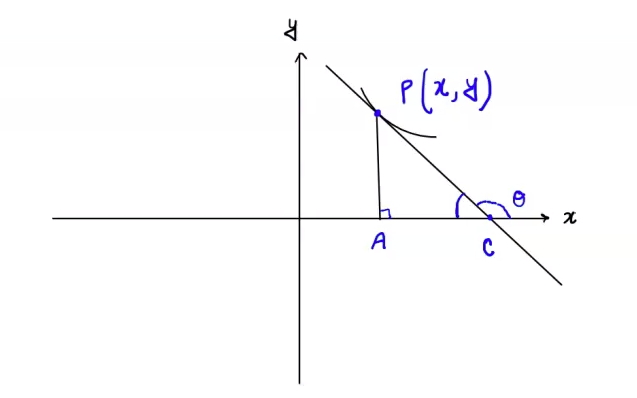
0 likes
View Solution160
AdvancedMCQ
If the tangent to the curve $xy + ax + by = 0$ at $(1, 1)$ makes an angle $\tan^{-1}(2)$ with the $x$-axis,then $\left( \frac{a + b}{ab} \right)$ is equal to:
A
$1/2$
B
$-1/2$
C
$1$
D
$-1$
Solution
(A) The point $(1, 1)$ lies on the curve $xy + ax + by = 0$,so $1(1) + a(1) + b(1) = 0$,which gives $a + b = -1$ .......$(1)$
The slope of the tangent at $(1, 1)$ is given by $\frac{dy}{dx} = \tan(\tan^{-1}(2)) = 2$.
Differentiating the equation $xy + ax + by = 0$ with respect to $x$,we get:
$x \frac{dy}{dx} + y + a + b \frac{dy}{dx} = 0$
Substituting $x = 1$,$y = 1$,and $\frac{dy}{dx} = 2$ into the derivative equation:
$1(2) + 1 + a + b(2) = 0$
$3 + a + 2b = 0 \Rightarrow a + 2b = -3$ ........$(2)$
Subtracting equation $(1)$ from equation $(2)$:
$(a + 2b) - (a + b) = -3 - (-1)$
$b = -2$
Substituting $b = -2$ into equation $(1)$:
$a - 2 = -1 \Rightarrow a = 1$
Finally,calculating the required value:
$\frac{a + b}{ab} = \frac{1 + (-2)}{1 \times (-2)} = \frac{-1}{-2} = \frac{1}{2}$
The slope of the tangent at $(1, 1)$ is given by $\frac{dy}{dx} = \tan(\tan^{-1}(2)) = 2$.
Differentiating the equation $xy + ax + by = 0$ with respect to $x$,we get:
$x \frac{dy}{dx} + y + a + b \frac{dy}{dx} = 0$
Substituting $x = 1$,$y = 1$,and $\frac{dy}{dx} = 2$ into the derivative equation:
$1(2) + 1 + a + b(2) = 0$
$3 + a + 2b = 0 \Rightarrow a + 2b = -3$ ........$(2)$
Subtracting equation $(1)$ from equation $(2)$:
$(a + 2b) - (a + b) = -3 - (-1)$
$b = -2$
Substituting $b = -2$ into equation $(1)$:
$a - 2 = -1 \Rightarrow a = 1$
Finally,calculating the required value:
$\frac{a + b}{ab} = \frac{1 + (-2)}{1 \times (-2)} = \frac{-1}{-2} = \frac{1}{2}$
0 likes
View Solution161
AdvancedMCQ
The line $bx + ay = ab$ will touch the curve $y = b \cdot e^{-x/a}$ at the point:
A
$(b, 0)$
B
$(a, 0)$
C
$(0, b)$
D
$(0, a)$
Solution
(C) The equation of the given line is $bx + ay = ab$,which can be rewritten as $y = -\frac{b}{a}x + b$. The slope of this line is $m = -\frac{b}{a}$.
The equation of the curve is $y = b \cdot e^{-x/a}$.
To find the slope of the tangent to the curve at any point $(x, y)$,we differentiate with respect to $x$:
$\frac{dy}{dx} = b \cdot e^{-x/a} \cdot \left(-\frac{1}{a}\right) = -\frac{b}{a} e^{-x/a}$.
Since the line touches the curve,the slope of the line must be equal to the slope of the tangent at the point of contact:
$-\frac{b}{a} = -\frac{b}{a} e^{-x/a}$.
Dividing both sides by $-\frac{b}{a}$ (assuming $a, b \neq 0$),we get:
$1 = e^{-x/a}$.
Since $e^0 = 1$,we have $-x/a = 0$,which implies $x = 0$.
Substituting $x = 0$ into the equation of the curve $y = b \cdot e^{-x/a}$:
$y = b \cdot e^0 = b \cdot 1 = b$.
Thus,the point of contact is $(0, b)$.
The equation of the curve is $y = b \cdot e^{-x/a}$.
To find the slope of the tangent to the curve at any point $(x, y)$,we differentiate with respect to $x$:
$\frac{dy}{dx} = b \cdot e^{-x/a} \cdot \left(-\frac{1}{a}\right) = -\frac{b}{a} e^{-x/a}$.
Since the line touches the curve,the slope of the line must be equal to the slope of the tangent at the point of contact:
$-\frac{b}{a} = -\frac{b}{a} e^{-x/a}$.
Dividing both sides by $-\frac{b}{a}$ (assuming $a, b \neq 0$),we get:
$1 = e^{-x/a}$.
Since $e^0 = 1$,we have $-x/a = 0$,which implies $x = 0$.
Substituting $x = 0$ into the equation of the curve $y = b \cdot e^{-x/a}$:
$y = b \cdot e^0 = b \cdot 1 = b$.
Thus,the point of contact is $(0, b)$.
0 likes
View Solution162
AdvancedMCQ
The normal to the curve $2x^2 + y^2 = 12$ at the point $(2, 2)$ meets the curve again at
A
$\left( \frac{22}{9}, \frac{-2}{9} \right)$
B
$\left( \frac{-22}{9}, \frac{-2}{9} \right)$
C
$\left( -2, -2 \right)$
D
None of these
Solution
(B) Given the curve equation $2x^2 + y^2 = 12$.
Differentiating with respect to $x$,we get $4x + 2yy' = 0$,which implies $y' = -\frac{2x}{y}$.
At the point $(2, 2)$,the slope of the tangent $m_t = -\frac{2(2)}{2} = -2$.
The slope of the normal $m_n = -\frac{1}{m_t} = \frac{1}{2}$.
The equation of the normal at $(2, 2)$ is $y - 2 = \frac{1}{2}(x - 2)$,which simplifies to $2y - 4 = x - 2$,or $x = 2y - 2$.
Substituting $x = 2y - 2$ into the curve equation $2x^2 + y^2 = 12$:
$2(2y - 2)^2 + y^2 = 12$
$2(4y^2 - 8y + 4) + y^2 = 12$
$8y^2 - 16y + 8 + y^2 = 12$
$9y^2 - 16y - 4 = 0$
$(9y + 2)(y - 2) = 0$.
Thus,$y = 2$ or $y = -\frac{2}{9}$.
For $y = 2$,$x = 2(2) - 2 = 2$ (the original point).
For $y = -\frac{2}{9}$,$x = 2(-\frac{2}{9}) - 2 = -\frac{4}{9} - \frac{18}{9} = -\frac{22}{9}$.
Therefore,the normal meets the curve again at $\left( -\frac{22}{9}, -\frac{2}{9} \right)$.
Differentiating with respect to $x$,we get $4x + 2yy' = 0$,which implies $y' = -\frac{2x}{y}$.
At the point $(2, 2)$,the slope of the tangent $m_t = -\frac{2(2)}{2} = -2$.
The slope of the normal $m_n = -\frac{1}{m_t} = \frac{1}{2}$.
The equation of the normal at $(2, 2)$ is $y - 2 = \frac{1}{2}(x - 2)$,which simplifies to $2y - 4 = x - 2$,or $x = 2y - 2$.
Substituting $x = 2y - 2$ into the curve equation $2x^2 + y^2 = 12$:
$2(2y - 2)^2 + y^2 = 12$
$2(4y^2 - 8y + 4) + y^2 = 12$
$8y^2 - 16y + 8 + y^2 = 12$
$9y^2 - 16y - 4 = 0$
$(9y + 2)(y - 2) = 0$.
Thus,$y = 2$ or $y = -\frac{2}{9}$.
For $y = 2$,$x = 2(2) - 2 = 2$ (the original point).
For $y = -\frac{2}{9}$,$x = 2(-\frac{2}{9}) - 2 = -\frac{4}{9} - \frac{18}{9} = -\frac{22}{9}$.
Therefore,the normal meets the curve again at $\left( -\frac{22}{9}, -\frac{2}{9} \right)$.
0 likes
View Solution163
AdvancedMCQ
If the length of the subnormal is equal to the length of the subtangent at any point on the curve $y = f(x)$ and the tangent at $(3, 4)$ to $y = f(x)$ meets the positive coordinate axes at $A$ and $B$,then the area of $\Delta OAB$,where $O$ is the origin,is
A
$\frac{25}{2}$
B
$\frac{9}{2}$
C
$\frac{1}{2}$
D
$\frac{49}{2}$
Solution
(D) The length of the subtangent is given by $|y / (dy/dx)|$ and the length of the subnormal is given by $|y \cdot (dy/dx)|$.
Given that the length of the subnormal equals the length of the subtangent,we have $|y \cdot (dy/dx)| = |y / (dy/dx)|$,which implies $(dy/dx)^2 = 1$,so $dy/dx = \pm 1$.
Case $1$: If $dy/dx = 1$,the tangent at $(3, 4)$ is $y - 4 = 1(x - 3)$,which simplifies to $y = x + 1$. This line intersects the axes at $(0, 1)$ and $(-1, 0)$. Since the problem specifies the positive coordinate axes,this case is rejected.
Case $2$: If $dy/dx = -1$,the tangent at $(3, 4)$ is $y - 4 = -1(x - 3)$,which simplifies to $x + y = 7$. This line intersects the positive coordinate axes at $A(7, 0)$ and $B(0, 7)$.
The area of $\Delta OAB$ is $\frac{1}{2} \times \text{base} \times \text{height} = \frac{1}{2} \times 7 \times 7 = \frac{49}{2}$.
Given that the length of the subnormal equals the length of the subtangent,we have $|y \cdot (dy/dx)| = |y / (dy/dx)|$,which implies $(dy/dx)^2 = 1$,so $dy/dx = \pm 1$.
Case $1$: If $dy/dx = 1$,the tangent at $(3, 4)$ is $y - 4 = 1(x - 3)$,which simplifies to $y = x + 1$. This line intersects the axes at $(0, 1)$ and $(-1, 0)$. Since the problem specifies the positive coordinate axes,this case is rejected.
Case $2$: If $dy/dx = -1$,the tangent at $(3, 4)$ is $y - 4 = -1(x - 3)$,which simplifies to $x + y = 7$. This line intersects the positive coordinate axes at $A(7, 0)$ and $B(0, 7)$.
The area of $\Delta OAB$ is $\frac{1}{2} \times \text{base} \times \text{height} = \frac{1}{2} \times 7 \times 7 = \frac{49}{2}$.
0 likes
View Solution164
AdvancedMCQ
$A$ curve is represented by the equations $x = \sec^2 t$ and $y = \cot t$,where $t$ is a parameter. If the tangent at the point $P$ on the curve where $t = \pi/4$ meets the curve again at the point $Q$,then the $x$-coordinate of $Q$ is equal to
A
$1$
B
$2$
C
$4$
D
$5$
Solution
(D) Given $x = \sec^2 t$ and $y = \cot t$.
Since $\sec^2 t = 1 + \tan^2 t = 1 + \frac{1}{\cot^2 t} = 1 + \frac{1}{y^2}$,we have $x - 1 = \frac{1}{y^2}$,which implies $y^2(x - 1) = 1$.
At $t = \pi/4$,$x = \sec^2(\pi/4) = 2$ and $y = \cot(\pi/4) = 1$. So,$P = (2, 1)$.
Differentiating $y^2(x - 1) = 1$ with respect to $x$,we get $2y \frac{dy}{dx}(x - 1) + y^2 = 0$.
At $(2, 1)$,$2(1) \frac{dy}{dx}(2 - 1) + 1^2 = 0 \Rightarrow 2 \frac{dy}{dx} + 1 = 0 \Rightarrow \frac{dy}{dx} = -1/2$.
The equation of the tangent at $P(2, 1)$ is $y - 1 = -\frac{1}{2}(x - 2) \Rightarrow 2y - 2 = -x + 2 \Rightarrow x + 2y = 4$.
Substituting $y = \frac{4-x}{2}$ into the curve equation $y^2(x - 1) = 1$:
$\left(\frac{4-x}{2}\right)^2(x - 1) = 1 \Rightarrow (4-x)^2(x - 1) = 4 \Rightarrow (16 - 8x + x^2)(x - 1) = 4$.
$16x - 16 - 8x^2 + 8x + x^3 - x^2 = 4 \Rightarrow x^3 - 9x^2 + 24x - 20 = 0$.
Since $P(2, 1)$ is on the curve,$(x - 2)^2$ must be a factor. Dividing by $(x - 2)^2 = x^2 - 4x + 4$,we get $(x - 2)^2(x - 5) = 0$.
The roots are $x = 2$ (twice) and $x = 5$. Thus,the $x$-coordinate of $Q$ is $5$.
Since $\sec^2 t = 1 + \tan^2 t = 1 + \frac{1}{\cot^2 t} = 1 + \frac{1}{y^2}$,we have $x - 1 = \frac{1}{y^2}$,which implies $y^2(x - 1) = 1$.
At $t = \pi/4$,$x = \sec^2(\pi/4) = 2$ and $y = \cot(\pi/4) = 1$. So,$P = (2, 1)$.
Differentiating $y^2(x - 1) = 1$ with respect to $x$,we get $2y \frac{dy}{dx}(x - 1) + y^2 = 0$.
At $(2, 1)$,$2(1) \frac{dy}{dx}(2 - 1) + 1^2 = 0 \Rightarrow 2 \frac{dy}{dx} + 1 = 0 \Rightarrow \frac{dy}{dx} = -1/2$.
The equation of the tangent at $P(2, 1)$ is $y - 1 = -\frac{1}{2}(x - 2) \Rightarrow 2y - 2 = -x + 2 \Rightarrow x + 2y = 4$.
Substituting $y = \frac{4-x}{2}$ into the curve equation $y^2(x - 1) = 1$:
$\left(\frac{4-x}{2}\right)^2(x - 1) = 1 \Rightarrow (4-x)^2(x - 1) = 4 \Rightarrow (16 - 8x + x^2)(x - 1) = 4$.
$16x - 16 - 8x^2 + 8x + x^3 - x^2 = 4 \Rightarrow x^3 - 9x^2 + 24x - 20 = 0$.
Since $P(2, 1)$ is on the curve,$(x - 2)^2$ must be a factor. Dividing by $(x - 2)^2 = x^2 - 4x + 4$,we get $(x - 2)^2(x - 5) = 0$.
The roots are $x = 2$ (twice) and $x = 5$. Thus,the $x$-coordinate of $Q$ is $5$.
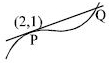
0 likes
View Solution165
DifficultMCQ
The length of the subtangent at any point of the curve $x^my^n = a^{m+n}$ is proportional to
A
Ordinate
B
Abscissa
C
(Ordinate)$^n$
D
(Abscissa)$^n$
Solution
(B) Given the curve equation: $x^m y^n = a^{m+n}$.
Taking the natural logarithm on both sides: $m \ln x + n \ln y = \ln(a^{m+n})$.
Differentiating with respect to $x$: $\frac{m}{x} + \frac{n}{y} \frac{dy}{dx} = 0$.
Thus,$\frac{dy}{dx} = -\frac{m}{n} \frac{y}{x}$.
The length of the subtangent is given by the formula: $LST = \left| \frac{y}{dy/dx} \right|$.
Substituting the value of $\frac{dy}{dx}$: $LST = \left| \frac{y}{(-\frac{m}{n} \frac{y}{x})} \right| = \left| -\frac{nx}{m} \right| = \frac{n}{m} |x|$.
Since $\frac{n}{m}$ is a constant,the length of the subtangent is proportional to the abscissa $x$.
Taking the natural logarithm on both sides: $m \ln x + n \ln y = \ln(a^{m+n})$.
Differentiating with respect to $x$: $\frac{m}{x} + \frac{n}{y} \frac{dy}{dx} = 0$.
Thus,$\frac{dy}{dx} = -\frac{m}{n} \frac{y}{x}$.
The length of the subtangent is given by the formula: $LST = \left| \frac{y}{dy/dx} \right|$.
Substituting the value of $\frac{dy}{dx}$: $LST = \left| \frac{y}{(-\frac{m}{n} \frac{y}{x})} \right| = \left| -\frac{nx}{m} \right| = \frac{n}{m} |x|$.
Since $\frac{n}{m}$ is a constant,the length of the subtangent is proportional to the abscissa $x$.
0 likes
View Solution166
DifficultMCQ
The tangent at the point $(2, -2)$ to the curve $x^2y^2 - 2x = 4(1 - y)$ does not pass through the point:
A
$\left( 4, \frac{1}{3} \right)$
B
$(8, 5)$
C
$(-4, -9)$
D
$(-2, -7)$
Solution
(D) Given curve: $x^2y^2 - 2x = 4 - 4y$.
Differentiating with respect to $x$:
$2xy^2 + 2x^2y \frac{dy}{dx} - 2 = -4 \frac{dy}{dx}$.
At point $(2, -2)$:
$2(2)(-2)^2 + 2(2)^2(-2) \frac{dy}{dx} - 2 = -4 \frac{dy}{dx}$.
$16 - 16 \frac{dy}{dx} - 2 = -4 \frac{dy}{dx}$.
$14 = 12 \frac{dy}{dx} \Rightarrow \frac{dy}{dx} = \frac{14}{12} = \frac{7}{6}$.
Equation of the tangent at $(2, -2)$:
$y - (-2) = \frac{7}{6}(x - 2)$.
$6(y + 2) = 7(x - 2) \Rightarrow 6y + 12 = 7x - 14 \Rightarrow 7x - 6y = 26$.
Checking the options:
For $(-2, -7)$: $7(-2) - 6(-7) = -14 + 42 = 28 \neq 26$.
Thus,the tangent does not pass through $(-2, -7)$.
Differentiating with respect to $x$:
$2xy^2 + 2x^2y \frac{dy}{dx} - 2 = -4 \frac{dy}{dx}$.
At point $(2, -2)$:
$2(2)(-2)^2 + 2(2)^2(-2) \frac{dy}{dx} - 2 = -4 \frac{dy}{dx}$.
$16 - 16 \frac{dy}{dx} - 2 = -4 \frac{dy}{dx}$.
$14 = 12 \frac{dy}{dx} \Rightarrow \frac{dy}{dx} = \frac{14}{12} = \frac{7}{6}$.
Equation of the tangent at $(2, -2)$:
$y - (-2) = \frac{7}{6}(x - 2)$.
$6(y + 2) = 7(x - 2) \Rightarrow 6y + 12 = 7x - 14 \Rightarrow 7x - 6y = 26$.
Checking the options:
For $(-2, -7)$: $7(-2) - 6(-7) = -14 + 42 = 28 \neq 26$.
Thus,the tangent does not pass through $(-2, -7)$.
0 likes
View Solution167
DifficultMCQ
The distance,from the origin,of the normal to the curve,$x = 2\cos t + 2t\sin t, y = 2\sin t - 2t\cos t$ at $t = \frac{\pi}{4}$,is
A
$2$
B
$4$
C
$\sqrt{2}$
D
$2\sqrt{2}$
Solution
(A) Given the parametric equations of the curve:
$x = 2\cos t + 2t\sin t$
$y = 2\sin t - 2t\cos t$
First,find the derivatives with respect to $t$:
$\frac{dx}{dt} = -2\sin t + 2(\sin t + t\cos t) = 2t\cos t$
$\frac{dy}{dt} = 2\cos t - 2(\cos t - t\sin t) = 2t\sin t$
Now,find the slope of the tangent $\frac{dy}{dx}$:
$\frac{dy}{dx} = \frac{dy/dt}{dx/dt} = \frac{2t\sin t}{2t\cos t} = \tan t$
At $t = \frac{\pi}{4}$,the slope of the tangent is $\tan(\frac{\pi}{4}) = 1$.
Therefore,the slope of the normal is $m = -\frac{1}{1} = -1$.
Find the point $(x, y)$ at $t = \frac{\pi}{4}$:
$x = 2\cos(\frac{\pi}{4}) + 2(\frac{\pi}{4})\sin(\frac{\pi}{4}) = 2(\frac{1}{\sqrt{2}}) + \frac{\pi}{2}(\frac{1}{\sqrt{2}}) = \sqrt{2} + \frac{\pi}{2\sqrt{2}}$
$y = 2\sin(\frac{\pi}{4}) - 2(\frac{\pi}{4})\cos(\frac{\pi}{4}) = 2(\frac{1}{\sqrt{2}}) - \frac{\pi}{2}(\frac{1}{\sqrt{2}}) = \sqrt{2} - \frac{\pi}{2\sqrt{2}}$
The equation of the normal is $y - y_1 = m(x - x_1)$:
$y - (\sqrt{2} - \frac{\pi}{2\sqrt{2}}) = -1(x - (\sqrt{2} + \frac{\pi}{2\sqrt{2}}))$
$y - \sqrt{2} + \frac{\pi}{2\sqrt{2}} = -x + \sqrt{2} + \frac{\pi}{2\sqrt{2}}$
$x + y = 2\sqrt{2}$
The distance of the line $Ax + By + C = 0$ from the origin $(0, 0)$ is given by $d = \frac{|C|}{\sqrt{A^2 + B^2}}$.
Here,$x + y - 2\sqrt{2} = 0$,so $A=1, B=1, C=-2\sqrt{2}$.
$d = \frac{|-2\sqrt{2}|}{\sqrt{1^2 + 1^2}} = \frac{2\sqrt{2}}{\sqrt{2}} = 2$.
$x = 2\cos t + 2t\sin t$
$y = 2\sin t - 2t\cos t$
First,find the derivatives with respect to $t$:
$\frac{dx}{dt} = -2\sin t + 2(\sin t + t\cos t) = 2t\cos t$
$\frac{dy}{dt} = 2\cos t - 2(\cos t - t\sin t) = 2t\sin t$
Now,find the slope of the tangent $\frac{dy}{dx}$:
$\frac{dy}{dx} = \frac{dy/dt}{dx/dt} = \frac{2t\sin t}{2t\cos t} = \tan t$
At $t = \frac{\pi}{4}$,the slope of the tangent is $\tan(\frac{\pi}{4}) = 1$.
Therefore,the slope of the normal is $m = -\frac{1}{1} = -1$.
Find the point $(x, y)$ at $t = \frac{\pi}{4}$:
$x = 2\cos(\frac{\pi}{4}) + 2(\frac{\pi}{4})\sin(\frac{\pi}{4}) = 2(\frac{1}{\sqrt{2}}) + \frac{\pi}{2}(\frac{1}{\sqrt{2}}) = \sqrt{2} + \frac{\pi}{2\sqrt{2}}$
$y = 2\sin(\frac{\pi}{4}) - 2(\frac{\pi}{4})\cos(\frac{\pi}{4}) = 2(\frac{1}{\sqrt{2}}) - \frac{\pi}{2}(\frac{1}{\sqrt{2}}) = \sqrt{2} - \frac{\pi}{2\sqrt{2}}$
The equation of the normal is $y - y_1 = m(x - x_1)$:
$y - (\sqrt{2} - \frac{\pi}{2\sqrt{2}}) = -1(x - (\sqrt{2} + \frac{\pi}{2\sqrt{2}}))$
$y - \sqrt{2} + \frac{\pi}{2\sqrt{2}} = -x + \sqrt{2} + \frac{\pi}{2\sqrt{2}}$
$x + y = 2\sqrt{2}$
The distance of the line $Ax + By + C = 0$ from the origin $(0, 0)$ is given by $d = \frac{|C|}{\sqrt{A^2 + B^2}}$.
Here,$x + y - 2\sqrt{2} = 0$,so $A=1, B=1, C=-2\sqrt{2}$.
$d = \frac{|-2\sqrt{2}|}{\sqrt{1^2 + 1^2}} = \frac{2\sqrt{2}}{\sqrt{2}} = 2$.
0 likes
View Solution168
DifficultMCQ
The equation of a normal to the curve $\sin y = x \sin \left( \frac{\pi}{3} + y \right)$ at $x = 0$ is:
A
$2x - \sqrt{3}y = 0$
B
$2x + \sqrt{3}y = 0$
C
$2y - \sqrt{3}x = 0$
D
$2y + \sqrt{3}x = 0$
Solution
(B) Given the curve $\sin y = x \sin \left( \frac{\pi}{3} + y \right)$.
At $x = 0$,$\sin y = 0 \implies y = 0$. So the point is $(0, 0)$.
Differentiating both sides with respect to $x$:
$\cos y \frac{dy}{dx} = \sin \left( \frac{\pi}{3} + y \right) + x \cos \left( \frac{\pi}{3} + y \right) \frac{dy}{dx}$.
At $(0, 0)$:
$\cos(0) \frac{dy}{dx} = \sin \left( \frac{\pi}{3} \right) + 0 \implies \frac{dy}{dx} = \frac{\sqrt{3}}{2}$.
The slope of the normal is $m_n = -\frac{1}{dy/dx} = -\frac{2}{\sqrt{3}}$.
The equation of the normal at $(0, 0)$ is $y - 0 = -\frac{2}{\sqrt{3}}(x - 0)$.
$\sqrt{3}y = -2x \implies 2x + \sqrt{3}y = 0$.
At $x = 0$,$\sin y = 0 \implies y = 0$. So the point is $(0, 0)$.
Differentiating both sides with respect to $x$:
$\cos y \frac{dy}{dx} = \sin \left( \frac{\pi}{3} + y \right) + x \cos \left( \frac{\pi}{3} + y \right) \frac{dy}{dx}$.
At $(0, 0)$:
$\cos(0) \frac{dy}{dx} = \sin \left( \frac{\pi}{3} \right) + 0 \implies \frac{dy}{dx} = \frac{\sqrt{3}}{2}$.
The slope of the normal is $m_n = -\frac{1}{dy/dx} = -\frac{2}{\sqrt{3}}$.
The equation of the normal at $(0, 0)$ is $y - 0 = -\frac{2}{\sqrt{3}}(x - 0)$.
$\sqrt{3}y = -2x \implies 2x + \sqrt{3}y = 0$.
0 likes
View Solution169
DifficultMCQ
If an equation of a tangent to the curve $y = \cos(x + y)$,where $-1 - \pi \le x \le 1 + \pi$,is $x + 2y = k$,then $k$ is equal to
A
$1$
B
$2$
C
$\frac{\pi}{4}$
D
$\frac{\pi}{2}$
Solution
(D) Given the curve equation is $y = \cos(x + y)$.
Differentiating both sides with respect to $x$,we get:
$\frac{dy}{dx} = -\sin(x + y) \left(1 + \frac{dy}{dx}\right) \dots (1)$
The equation of the tangent is $x + 2y = k$,which can be written as $y = -\frac{1}{2}x + \frac{k}{2}$.
The slope of the tangent is $m = -\frac{1}{2}$.
Substituting $\frac{dy}{dx} = -\frac{1}{2}$ into equation $(1)$:
$-\frac{1}{2} = -\sin(x + y) \left(1 - \frac{1}{2}\right)$
$-\frac{1}{2} = -\sin(x + y) \left(\frac{1}{2}\right)$
$\sin(x + y) = 1$
This implies $x + y = \frac{\pi}{2}$.
Substituting $x + y = \frac{\pi}{2}$ into the original curve equation $y = \cos(x + y)$:
$y = \cos\left(\frac{\pi}{2}\right) = 0$.
Since $y = 0$ and $x + y = \frac{\pi}{2}$,we have $x = \frac{\pi}{2}$.
Now,substitute the point $(\frac{\pi}{2}, 0)$ into the tangent equation $x + 2y = k$:
$\frac{\pi}{2} + 2(0) = k$
$k = \frac{\pi}{2}$.
Differentiating both sides with respect to $x$,we get:
$\frac{dy}{dx} = -\sin(x + y) \left(1 + \frac{dy}{dx}\right) \dots (1)$
The equation of the tangent is $x + 2y = k$,which can be written as $y = -\frac{1}{2}x + \frac{k}{2}$.
The slope of the tangent is $m = -\frac{1}{2}$.
Substituting $\frac{dy}{dx} = -\frac{1}{2}$ into equation $(1)$:
$-\frac{1}{2} = -\sin(x + y) \left(1 - \frac{1}{2}\right)$
$-\frac{1}{2} = -\sin(x + y) \left(\frac{1}{2}\right)$
$\sin(x + y) = 1$
This implies $x + y = \frac{\pi}{2}$.
Substituting $x + y = \frac{\pi}{2}$ into the original curve equation $y = \cos(x + y)$:
$y = \cos\left(\frac{\pi}{2}\right) = 0$.
Since $y = 0$ and $x + y = \frac{\pi}{2}$,we have $x = \frac{\pi}{2}$.
Now,substitute the point $(\frac{\pi}{2}, 0)$ into the tangent equation $x + 2y = k$:
$\frac{\pi}{2} + 2(0) = k$
$k = \frac{\pi}{2}$.
0 likes
View Solution170
DifficultMCQ
If $\theta$ denotes the acute angle between the curves $y = 10 - x^2$ and $y = 2 + x^2$ at a point of their intersection,then $|\tan \theta |$ is equal to
A
$\frac{4}{9}$
B
$\frac{8}{15}$
C
$\frac{7}{17}$
D
$\frac{8}{17}$
Solution
(B) To find the intersection points,set the equations equal: $10 - x^2 = 2 + x^2$.
$2x^2 = 8 \implies x^2 = 4 \implies x = \pm 2$.
For $x = 2$,$y = 2 + (2)^2 = 6$. So,the intersection point is $(2, 6)$.
Find the slopes of the tangents at $(2, 6)$:
For $y = 10 - x^2$,$\frac{dy}{dx} = -2x$. At $x = 2$,$m_1 = -2(2) = -4$.
For $y = 2 + x^2$,$\frac{dy}{dx} = 2x$. At $x = 2$,$m_2 = 2(2) = 4$.
The angle $\theta$ between the curves is given by $\tan \theta = |\frac{m_1 - m_2}{1 + m_1 m_2}|$.
$|\tan \theta | = |\frac{-4 - 4}{1 + (-4)(4)}| = |\frac{-8}{1 - 16}| = |\frac{-8}{-15}| = \frac{8}{15}$.
$2x^2 = 8 \implies x^2 = 4 \implies x = \pm 2$.
For $x = 2$,$y = 2 + (2)^2 = 6$. So,the intersection point is $(2, 6)$.
Find the slopes of the tangents at $(2, 6)$:
For $y = 10 - x^2$,$\frac{dy}{dx} = -2x$. At $x = 2$,$m_1 = -2(2) = -4$.
For $y = 2 + x^2$,$\frac{dy}{dx} = 2x$. At $x = 2$,$m_2 = 2(2) = 4$.
The angle $\theta$ between the curves is given by $\tan \theta = |\frac{m_1 - m_2}{1 + m_1 m_2}|$.
$|\tan \theta | = |\frac{-4 - 4}{1 + (-4)(4)}| = |\frac{-8}{1 - 16}| = |\frac{-8}{-15}| = \frac{8}{15}$.
0 likes
View Solution171
DifficultMCQ
The tangent to the curve $y = xe^{x^2}$ passing through the point $(1, e)$ also passes through the point
A
$(2, 3e)$
B
$(\frac{4}{3}, 2e)$
C
$(\frac{5}{3}, 2e)$
D
$(3, 6e)$
Solution
(B) Given the curve $y = xe^{x^2}$.
First,we find the derivative $\frac{dy}{dx}$ to determine the slope of the tangent:
$\frac{dy}{dx} = x \cdot e^{x^2} \cdot (2x) + e^{x^2} \cdot 1 = e^{x^2}(2x^2 + 1)$.
At the point $(1, e)$,the slope $m$ is:
$m = e^{1^2}(2(1)^2 + 1) = e(2 + 1) = 3e$.
The equation of the tangent line at $(1, e)$ is given by $y - y_1 = m(x - x_1)$:
$y - e = 3e(x - 1)$
$y - e = 3ex - 3e$
$y = 3ex - 2e$.
Now,we check which point satisfies this equation $y = 3ex - 2e$:
For option $B$ $(\frac{4}{3}, 2e)$:
$y = 3e(\frac{4}{3}) - 2e = 4e - 2e = 2e$.
Since the point $(\frac{4}{3}, 2e)$ satisfies the equation,the tangent passes through this point.
First,we find the derivative $\frac{dy}{dx}$ to determine the slope of the tangent:
$\frac{dy}{dx} = x \cdot e^{x^2} \cdot (2x) + e^{x^2} \cdot 1 = e^{x^2}(2x^2 + 1)$.
At the point $(1, e)$,the slope $m$ is:
$m = e^{1^2}(2(1)^2 + 1) = e(2 + 1) = 3e$.
The equation of the tangent line at $(1, e)$ is given by $y - y_1 = m(x - x_1)$:
$y - e = 3e(x - 1)$
$y - e = 3ex - 3e$
$y = 3ex - 2e$.
Now,we check which point satisfies this equation $y = 3ex - 2e$:
For option $B$ $(\frac{4}{3}, 2e)$:
$y = 3e(\frac{4}{3}) - 2e = 4e - 2e = 2e$.
Since the point $(\frac{4}{3}, 2e)$ satisfies the equation,the tangent passes through this point.
0 likes
View Solution172
DifficultMCQ
The tangent to the curve $y = x^2 - 5x + 5$ which is parallel to the line $2y = 4x + 1$ also passes through the point
A
$\left( \frac{7}{2}, \frac{1}{4} \right)$
B
$\left( \frac{1}{8}, -7 \right)$
C
$\left( -\frac{1}{8}, 7 \right)$
D
$\left( \frac{1}{4}, \frac{7}{2} \right)$
Solution
(B) Given curve is $y = x^2 - 5x + 5$.
The slope of the tangent is given by $\frac{dy}{dx} = 2x - 5$.
The given line is $2y = 4x + 1$,which can be written as $y = 2x + \frac{1}{2}$. The slope of this line is $2$.
Since the tangent is parallel to the line,their slopes are equal: $2x - 5 = 2 \implies 2x = 7 \implies x = \frac{7}{2}$.
Substituting $x = \frac{7}{2}$ into the curve equation: $y = \left( \frac{7}{2} \right)^2 - 5\left( \frac{7}{2} \right) + 5 = \frac{49}{4} - \frac{35}{2} + 5 = \frac{49 - 70 + 20}{4} = -\frac{1}{4}$.
The point of tangency is $\left( \frac{7}{2}, -\frac{1}{4} \right)$.
The equation of the tangent line is $y - y_1 = m(x - x_1)$,where $m = 2$: $y - (-\frac{1}{4}) = 2(x - \frac{7}{2}) \implies y + \frac{1}{4} = 2x - 7 \implies y = 2x - 7 - \frac{1}{4} \implies y = 2x - \frac{29}{4}$.
Now,we check which point satisfies this equation. For option $B$: $x = \frac{1}{8}$,$y = 2(\frac{1}{8}) - \frac{29}{4} = \frac{1}{4} - \frac{29}{4} = -\frac{28}{4} = -7$.
Thus,the tangent passes through the point $\left( \frac{1}{8}, -7 \right)$.
The slope of the tangent is given by $\frac{dy}{dx} = 2x - 5$.
The given line is $2y = 4x + 1$,which can be written as $y = 2x + \frac{1}{2}$. The slope of this line is $2$.
Since the tangent is parallel to the line,their slopes are equal: $2x - 5 = 2 \implies 2x = 7 \implies x = \frac{7}{2}$.
Substituting $x = \frac{7}{2}$ into the curve equation: $y = \left( \frac{7}{2} \right)^2 - 5\left( \frac{7}{2} \right) + 5 = \frac{49}{4} - \frac{35}{2} + 5 = \frac{49 - 70 + 20}{4} = -\frac{1}{4}$.
The point of tangency is $\left( \frac{7}{2}, -\frac{1}{4} \right)$.
The equation of the tangent line is $y - y_1 = m(x - x_1)$,where $m = 2$: $y - (-\frac{1}{4}) = 2(x - \frac{7}{2}) \implies y + \frac{1}{4} = 2x - 7 \implies y = 2x - 7 - \frac{1}{4} \implies y = 2x - \frac{29}{4}$.
Now,we check which point satisfies this equation. For option $B$: $x = \frac{1}{8}$,$y = 2(\frac{1}{8}) - \frac{29}{4} = \frac{1}{4} - \frac{29}{4} = -\frac{28}{4} = -7$.
Thus,the tangent passes through the point $\left( \frac{1}{8}, -7 \right)$.
0 likes
View Solution173
DifficultMCQ
If the tangent to the curve $y = x^3 + ax - b$ at the point $(1, -5)$ is perpendicular to the line $-x + y + 4 = 0$,then which one of the following points lies on the curve?
A
$(2, -2)$
B
$(-2, 2)$
C
$(-2, 1)$
D
$(2, -1)$
Solution
(A) Given the curve $y = x^3 + ax - b$.
Since the point $(1, -5)$ lies on the curve,we have:
$-5 = (1)^3 + a(1) - b$
$-5 = 1 + a - b$
$a - b = -6$ $\dots(i)$
The slope of the tangent to the curve at any point $(x, y)$ is given by $\frac{dy}{dx} = 3x^2 + a$.
At the point $(1, -5)$,the slope of the tangent is $m_1 = 3(1)^2 + a = 3 + a$.
The given line is $-x + y + 4 = 0$,which can be written as $y = x - 4$. The slope of this line is $m_2 = 1$.
Since the tangent is perpendicular to the line,the product of their slopes must be $-1$:
$m_1 \times m_2 = -1$
$(3 + a)(1) = -1$
$3 + a = -1$
$a = -4$.
Substituting $a = -4$ into equation $(i)$:
$-4 - b = -6$
$-b = -2$
$b = 2$.
Thus,the equation of the curve is $y = x^3 - 4x - 2$.
Now,we check the given options:
For $(2, -2)$: $y = (2)^3 - 4(2) - 2 = 8 - 8 - 2 = -2$.
Since the point $(2, -2)$ satisfies the equation,it lies on the curve.
Since the point $(1, -5)$ lies on the curve,we have:
$-5 = (1)^3 + a(1) - b$
$-5 = 1 + a - b$
$a - b = -6$ $\dots(i)$
The slope of the tangent to the curve at any point $(x, y)$ is given by $\frac{dy}{dx} = 3x^2 + a$.
At the point $(1, -5)$,the slope of the tangent is $m_1 = 3(1)^2 + a = 3 + a$.
The given line is $-x + y + 4 = 0$,which can be written as $y = x - 4$. The slope of this line is $m_2 = 1$.
Since the tangent is perpendicular to the line,the product of their slopes must be $-1$:
$m_1 \times m_2 = -1$
$(3 + a)(1) = -1$
$3 + a = -1$
$a = -4$.
Substituting $a = -4$ into equation $(i)$:
$-4 - b = -6$
$-b = -2$
$b = 2$.
Thus,the equation of the curve is $y = x^3 - 4x - 2$.
Now,we check the given options:
For $(2, -2)$: $y = (2)^3 - 4(2) - 2 = 8 - 8 - 2 = -2$.
Since the point $(2, -2)$ satisfies the equation,it lies on the curve.
0 likes
View Solution174
DifficultMCQ
Let $S$ be the set of all values of $x$ for which the tangent to the curve $y = f(x) = x^3 - x^2 - 2x$ at $(x, y)$ is parallel to the line segment joining the points $(1, f(1))$ and $(-1, f(-1))$. Then $S$ is equal to:
A
$\left\{ \frac{1}{3}, -1 \right\}$
B
$\left\{ -\frac{1}{3}, -1 \right\}$
C
$\left\{ \frac{1}{3}, 1 \right\}$
D
$\left\{ -\frac{1}{3}, 1 \right\}$
Solution
(D) First,calculate the coordinates of the points $(1, f(1))$ and $(-1, f(-1))$.
$f(1) = (1)^3 - (1)^2 - 2(1) = 1 - 1 - 2 = -2$.
$f(-1) = (-1)^3 - (-1)^2 - 2(-1) = -1 - 1 + 2 = 0$.
The slope $m$ of the line segment joining $(1, -2)$ and $(-1, 0)$ is given by:
$m = \frac{f(1) - f(-1)}{1 - (-1)} = \frac{-2 - 0}{2} = -1$.
The slope of the tangent to the curve $y = f(x)$ at any point $(x, y)$ is given by the derivative $\frac{dy}{dx}$.
$\frac{dy}{dx} = \frac{d}{dx}(x^3 - x^2 - 2x) = 3x^2 - 2x - 2$.
Since the tangent is parallel to the line segment,their slopes must be equal:
$3x^2 - 2x - 2 = -1$.
$3x^2 - 2x - 1 = 0$.
Factoring the quadratic equation:
$3x^2 - 3x + x - 1 = 0$.
$3x(x - 1) + 1(x - 1) = 0$.
$(3x + 1)(x - 1) = 0$.
Thus,$x = 1$ or $x = -\frac{1}{3}$.
Therefore,$S = \left\{ -\frac{1}{3}, 1 \right\}$.
$f(1) = (1)^3 - (1)^2 - 2(1) = 1 - 1 - 2 = -2$.
$f(-1) = (-1)^3 - (-1)^2 - 2(-1) = -1 - 1 + 2 = 0$.
The slope $m$ of the line segment joining $(1, -2)$ and $(-1, 0)$ is given by:
$m = \frac{f(1) - f(-1)}{1 - (-1)} = \frac{-2 - 0}{2} = -1$.
The slope of the tangent to the curve $y = f(x)$ at any point $(x, y)$ is given by the derivative $\frac{dy}{dx}$.
$\frac{dy}{dx} = \frac{d}{dx}(x^3 - x^2 - 2x) = 3x^2 - 2x - 2$.
Since the tangent is parallel to the line segment,their slopes must be equal:
$3x^2 - 2x - 2 = -1$.
$3x^2 - 2x - 1 = 0$.
Factoring the quadratic equation:
$3x^2 - 3x + x - 1 = 0$.
$3x(x - 1) + 1(x - 1) = 0$.
$(3x + 1)(x - 1) = 0$.
Thus,$x = 1$ or $x = -\frac{1}{3}$.
Therefore,$S = \left\{ -\frac{1}{3}, 1 \right\}$.
0 likes
View Solution175
DifficultMCQ
Let the normal at a point $P$ on the curve $y^{2}-3x^{2}+y+10=0$ intersect the $y$-axis at $(0, \frac{3}{2})$. If $m$ is the slope of the tangent at $P$ to the curve,then $|m|$ is equal to
A
$3$
B
$4$
C
$6$
D
$5$
Solution
(B) Let the point $P$ be $(\alpha, \beta)$. Since $P$ lies on the curve,we have $\beta^{2}-3\alpha^{2}+\beta+10=0 \dots(i)$.
Differentiating the equation of the curve with respect to $x$,we get $2yy' - 6x + y' = 0$,which implies $y'(2y+1) = 6x$,so $y' = \frac{6x}{2y+1}$.
The slope of the tangent $m$ at $P(\alpha, \beta)$ is $m = \frac{6\alpha}{2\beta+1} \dots(ii)$.
The slope of the normal at $P$ is $-\frac{1}{m} = -\frac{2\beta+1}{6\alpha}$.
The normal passes through $(0, \frac{3}{2})$ and $(\alpha, \beta)$,so its slope is $\frac{\beta - 3/2}{\alpha - 0} = \frac{2\beta-3}{2\alpha}$.
Equating the slopes: $\frac{2\beta-3}{2\alpha} = -\frac{2\beta+1}{6\alpha}$.
Assuming $\alpha \neq 0$,we have $3(2\beta-3) = -(2\beta+1) \Rightarrow 6\beta - 9 = -2\beta - 1 \Rightarrow 8\beta = 8 \Rightarrow \beta = 1$.
Substituting $\beta = 1$ into $(i)$: $1^{2} - 3\alpha^{2} + 1 + 10 = 0 \Rightarrow 3\alpha^{2} = 12 \Rightarrow \alpha^{2} = 4$.
From $(ii)$,$|m| = |\frac{6\alpha}{2(1)+1}| = |\frac{6\alpha}{3}| = |2\alpha|$.
Since $\alpha^{2} = 4$,$|\alpha| = 2$,thus $|m| = 2 \times 2 = 4$.
Differentiating the equation of the curve with respect to $x$,we get $2yy' - 6x + y' = 0$,which implies $y'(2y+1) = 6x$,so $y' = \frac{6x}{2y+1}$.
The slope of the tangent $m$ at $P(\alpha, \beta)$ is $m = \frac{6\alpha}{2\beta+1} \dots(ii)$.
The slope of the normal at $P$ is $-\frac{1}{m} = -\frac{2\beta+1}{6\alpha}$.
The normal passes through $(0, \frac{3}{2})$ and $(\alpha, \beta)$,so its slope is $\frac{\beta - 3/2}{\alpha - 0} = \frac{2\beta-3}{2\alpha}$.
Equating the slopes: $\frac{2\beta-3}{2\alpha} = -\frac{2\beta+1}{6\alpha}$.
Assuming $\alpha \neq 0$,we have $3(2\beta-3) = -(2\beta+1) \Rightarrow 6\beta - 9 = -2\beta - 1 \Rightarrow 8\beta = 8 \Rightarrow \beta = 1$.
Substituting $\beta = 1$ into $(i)$: $1^{2} - 3\alpha^{2} + 1 + 10 = 0 \Rightarrow 3\alpha^{2} = 12 \Rightarrow \alpha^{2} = 4$.
From $(ii)$,$|m| = |\frac{6\alpha}{2(1)+1}| = |\frac{6\alpha}{3}| = |2\alpha|$.
Since $\alpha^{2} = 4$,$|\alpha| = 2$,thus $|m| = 2 \times 2 = 4$.
0 likes
View Solution176
EasyMCQ
Find the slope of the tangent to the curve $y = x^{3} - x$ at $x = 2$.
A
$11$
B
$10$
C
$12$
D
$9$
Solution
(A) The slope of the tangent to the curve $y = f(x)$ at any point $x$ is given by the derivative $\frac{dy}{dx}$.
Given the curve $y = x^{3} - x$.
Differentiating with respect to $x$,we get $\frac{dy}{dx} = 3x^{2} - 1$.
To find the slope of the tangent at $x = 2$,we substitute $x = 2$ into the derivative:
$\left. \frac{dy}{dx} \right|_{x=2} = 3(2)^{2} - 1 = 3(4) - 1 = 12 - 1 = 11$.
Therefore,the slope of the tangent at $x = 2$ is $11$.
Given the curve $y = x^{3} - x$.
Differentiating with respect to $x$,we get $\frac{dy}{dx} = 3x^{2} - 1$.
To find the slope of the tangent at $x = 2$,we substitute $x = 2$ into the derivative:
$\left. \frac{dy}{dx} \right|_{x=2} = 3(2)^{2} - 1 = 3(4) - 1 = 12 - 1 = 11$.
Therefore,the slope of the tangent at $x = 2$ is $11$.
0 likes
View Solution177
EasyMCQ
Find the point at which the tangent to the curve $y = \sqrt{4x - 3} - 1$ has its slope $\frac{2}{3}$.
A
$(3, 1)$
B
$(3, 2)$
C
$(2, 3)$
D
$(1, 3)$
Solution
(B) The slope of the tangent to the curve $y = \sqrt{4x - 3} - 1$ is given by the derivative $\frac{dy}{dx}$.
$\frac{dy}{dx} = \frac{d}{dx}(\sqrt{4x - 3} - 1) = \frac{1}{2\sqrt{4x - 3}} \times 4 = \frac{2}{\sqrt{4x - 3}}$.
Given that the slope is $\frac{2}{3}$,we set the derivative equal to $\frac{2}{3}$:
$\frac{2}{\sqrt{4x - 3}} = \frac{2}{3}$.
$\sqrt{4x - 3} = 3$.
Squaring both sides,we get $4x - 3 = 9$.
$4x = 12$,which implies $x = 3$.
Now,substitute $x = 3$ into the original equation to find $y$:
$y = \sqrt{4(3) - 3} - 1 = \sqrt{12 - 3} - 1 = \sqrt{9} - 1 = 3 - 1 = 2$.
Thus,the required point is $(3, 2)$.
$\frac{dy}{dx} = \frac{d}{dx}(\sqrt{4x - 3} - 1) = \frac{1}{2\sqrt{4x - 3}} \times 4 = \frac{2}{\sqrt{4x - 3}}$.
Given that the slope is $\frac{2}{3}$,we set the derivative equal to $\frac{2}{3}$:
$\frac{2}{\sqrt{4x - 3}} = \frac{2}{3}$.
$\sqrt{4x - 3} = 3$.
Squaring both sides,we get $4x - 3 = 9$.
$4x = 12$,which implies $x = 3$.
Now,substitute $x = 3$ into the original equation to find $y$:
$y = \sqrt{4(3) - 3} - 1 = \sqrt{12 - 3} - 1 = \sqrt{9} - 1 = 3 - 1 = 2$.
Thus,the required point is $(3, 2)$.
0 likes
View Solution178
MediumMCQ
Find the equation of all lines having slope $2$ and being tangent to the curve $y+\frac{2}{x-3}=0.$
A
$y-2x+2=0$
B
$y-2x+6=0$
C
$y-2x+10=0$
D
$y-2x+2=0$ and $y-2x+10=0$
Solution
(D) The given curve is $y = -\frac{2}{x-3}$.
Differentiating with respect to $x$,we get $\frac{dy}{dx} = \frac{2}{(x-3)^2}$.
Since the slope of the tangent is given as $2$,we have $\frac{2}{(x-3)^2} = 2$.
This implies $(x-3)^2 = 1$,so $x-3 = \pm 1$.
Thus,$x = 4$ or $x = 2$.
If $x = 4$,then $y = -\frac{2}{4-3} = -2$. The point is $(4, -2)$.
The equation of the tangent at $(4, -2)$ is $y - (-2) = 2(x - 4)$,which simplifies to $y + 2 = 2x - 8$ or $y - 2x + 10 = 0$.
If $x = 2$,then $y = -\frac{2}{2-3} = 2$. The point is $(2, 2)$.
The equation of the tangent at $(2, 2)$ is $y - 2 = 2(x - 2)$,which simplifies to $y - 2 = 2x - 4$ or $y - 2x + 2 = 0$.
Therefore,the equations of the tangents are $y - 2x + 2 = 0$ and $y - 2x + 10 = 0$.
Differentiating with respect to $x$,we get $\frac{dy}{dx} = \frac{2}{(x-3)^2}$.
Since the slope of the tangent is given as $2$,we have $\frac{2}{(x-3)^2} = 2$.
This implies $(x-3)^2 = 1$,so $x-3 = \pm 1$.
Thus,$x = 4$ or $x = 2$.
If $x = 4$,then $y = -\frac{2}{4-3} = -2$. The point is $(4, -2)$.
The equation of the tangent at $(4, -2)$ is $y - (-2) = 2(x - 4)$,which simplifies to $y + 2 = 2x - 8$ or $y - 2x + 10 = 0$.
If $x = 2$,then $y = -\frac{2}{2-3} = 2$. The point is $(2, 2)$.
The equation of the tangent at $(2, 2)$ is $y - 2 = 2(x - 2)$,which simplifies to $y - 2 = 2x - 4$ or $y - 2x + 2 = 0$.
Therefore,the equations of the tangents are $y - 2x + 2 = 0$ and $y - 2x + 10 = 0$.
0 likes
View Solution179
EasyMCQ
Find the points on the curve $\frac{x^{2}}{4} + \frac{y^{2}}{25} = 1$ at which the tangents are parallel to the $x$-axis.
A
$(0, 5)$ and $(0, -5)$
B
$(2, 0)$ and $(-2, 0)$
C
$(5, 0)$ and $(-5, 0)$
D
$(0, 2)$ and $(0, -2)$
Solution
(A) Given the equation of the curve: $\frac{x^{2}}{4} + \frac{y^{2}}{25} = 1$.
Differentiating both sides with respect to $x$,we get:
$\frac{2x}{4} + \frac{2y}{25} \frac{dy}{dx} = 0$
$\frac{x}{2} + \frac{2y}{25} \frac{dy}{dx} = 0$
$\frac{dy}{dx} = -\frac{25x}{4y}$.
The tangent is parallel to the $x$-axis if the slope $\frac{dy}{dx} = 0$.
Setting the slope to zero: $-\frac{25x}{4y} = 0$,which implies $x = 0$.
Substituting $x = 0$ into the original equation of the curve:
$\frac{0^{2}}{4} + \frac{y^{2}}{25} = 1$
$\frac{y^{2}}{25} = 1$
$y^{2} = 25$
$y = \pm 5$.
Thus,the points at which the tangents are parallel to the $x$-axis are $(0, 5)$ and $(0, -5)$.
Differentiating both sides with respect to $x$,we get:
$\frac{2x}{4} + \frac{2y}{25} \frac{dy}{dx} = 0$
$\frac{x}{2} + \frac{2y}{25} \frac{dy}{dx} = 0$
$\frac{dy}{dx} = -\frac{25x}{4y}$.
The tangent is parallel to the $x$-axis if the slope $\frac{dy}{dx} = 0$.
Setting the slope to zero: $-\frac{25x}{4y} = 0$,which implies $x = 0$.
Substituting $x = 0$ into the original equation of the curve:
$\frac{0^{2}}{4} + \frac{y^{2}}{25} = 1$
$\frac{y^{2}}{25} = 1$
$y^{2} = 25$
$y = \pm 5$.
Thus,the points at which the tangents are parallel to the $x$-axis are $(0, 5)$ and $(0, -5)$.
0 likes
View Solution180
EasyMCQ
Find points on the curve $\frac{x^{2}}{4}+\frac{y^{2}}{25}=1$ at which the tangents are parallel to the $y$-axis.
A
$(2,0)$ and $(-2,0)$
B
$(0,5)$ and $(0,-5)$
C
$(2,5)$ and $(-2,-5)$
D
$(0,5)$ and $(0,-5)$
Solution
(A) The given equation of the curve is $\frac{x^{2}}{4} + \frac{y^{2}}{25} = 1$.
Differentiating both sides with respect to $x$,we get:
$\frac{2x}{4} + \frac{2y}{25} \frac{dy}{dx} = 0$
$\frac{x}{2} + \frac{2y}{25} \frac{dy}{dx} = 0$
$\frac{dy}{dx} = -\frac{25x}{4y}$
The tangent is parallel to the $y$-axis if the slope $\frac{dy}{dx}$ is undefined,which occurs when the denominator $y = 0$.
Substituting $y = 0$ into the equation of the curve:
$\frac{x^{2}}{4} + \frac{0^{2}}{25} = 1$
$\frac{x^{2}}{4} = 1 \implies x^{2} = 4 \implies x = \pm 2$.
Thus,the points are $(2, 0)$ and $(-2, 0)$.
Differentiating both sides with respect to $x$,we get:
$\frac{2x}{4} + \frac{2y}{25} \frac{dy}{dx} = 0$
$\frac{x}{2} + \frac{2y}{25} \frac{dy}{dx} = 0$
$\frac{dy}{dx} = -\frac{25x}{4y}$
The tangent is parallel to the $y$-axis if the slope $\frac{dy}{dx}$ is undefined,which occurs when the denominator $y = 0$.
Substituting $y = 0$ into the equation of the curve:
$\frac{x^{2}}{4} + \frac{0^{2}}{25} = 1$
$\frac{x^{2}}{4} = 1 \implies x^{2} = 4 \implies x = \pm 2$.
Thus,the points are $(2, 0)$ and $(-2, 0)$.
0 likes
View Solution181
DifficultMCQ
Find the equation of the tangent to the curve $y = \frac{x-7}{(x-2)(x-3)}$ at the point where it cuts the $x$-axis.
A
$20y - x + 7 = 0$
B
$20y + x - 7 = 0$
C
$20y - x - 7 = 0$
D
$20y + x + 7 = 0$
Solution
(A) On the $x$-axis,the value of $y = 0$. Setting $y = 0$ in the curve equation $\frac{x-7}{(x-2)(x-3)} = 0$,we get $x = 7$. Thus,the point of intersection is $(7, 0)$.
To find the slope of the tangent,we differentiate $y = \frac{x-7}{x^2 - 5x + 6}$ with respect to $x$ using the quotient rule:
$\frac{dy}{dx} = \frac{(x^2 - 5x + 6)(1) - (x-7)(2x-5)}{(x^2 - 5x + 6)^2}$.
At the point $(7, 0)$,the denominator is $(7^2 - 5(7) + 6)^2 = (49 - 35 + 6)^2 = (20)^2 = 400$.
The numerator at $x=7$ is $(49 - 35 + 6) - (7-7)(2(7)-5) = 20 - 0 = 20$.
Thus,the slope $m = \frac{dy}{dx} \Big|_{(7,0)} = \frac{20}{400} = \frac{1}{20}$.
The equation of the tangent line at $(7, 0)$ with slope $m = \frac{1}{20}$ is given by $y - y_1 = m(x - x_1)$:
$y - 0 = \frac{1}{20}(x - 7)$,
$20y = x - 7$,
$20y - x + 7 = 0$.
To find the slope of the tangent,we differentiate $y = \frac{x-7}{x^2 - 5x + 6}$ with respect to $x$ using the quotient rule:
$\frac{dy}{dx} = \frac{(x^2 - 5x + 6)(1) - (x-7)(2x-5)}{(x^2 - 5x + 6)^2}$.
At the point $(7, 0)$,the denominator is $(7^2 - 5(7) + 6)^2 = (49 - 35 + 6)^2 = (20)^2 = 400$.
The numerator at $x=7$ is $(49 - 35 + 6) - (7-7)(2(7)-5) = 20 - 0 = 20$.
Thus,the slope $m = \frac{dy}{dx} \Big|_{(7,0)} = \frac{20}{400} = \frac{1}{20}$.
The equation of the tangent line at $(7, 0)$ with slope $m = \frac{1}{20}$ is given by $y - y_1 = m(x - x_1)$:
$y - 0 = \frac{1}{20}(x - 7)$,
$20y = x - 7$,
$20y - x + 7 = 0$.
0 likes
View Solution182
MediumMCQ
Find the equations of the tangent and normal to the curve $x^{\frac{2}{3}}+y^{\frac{2}{3}}=2$ at $(1,1).$
A
Tangent: $x+y-2=0$,Normal: $y-x=0$
B
Tangent: $x+y-2=0$,Normal: $y+x-2=0$
C
Tangent: $x-y=0$,Normal: $y-x=0$
D
Tangent: $x+y-1=0$,Normal: $y-x=1$
Solution
(A) Given the curve $x^{\frac{2}{3}}+y^{\frac{2}{3}}=2$.
Differentiating with respect to $x$,we get:
$\frac{2}{3}x^{-\frac{1}{3}} + \frac{2}{3}y^{-\frac{1}{3}}\frac{dy}{dx} = 0$.
This simplifies to $\frac{dy}{dx} = -\left(\frac{y}{x}\right)^{\frac{1}{3}}$.
At the point $(1,1)$,the slope of the tangent $m_t = -\left(\frac{1}{1}\right)^{\frac{1}{3}} = -1$.
The equation of the tangent is $y - 1 = -1(x - 1)$,which simplifies to $x + y - 2 = 0$.
The slope of the normal $m_n = -\frac{1}{m_t} = -\frac{1}{-1} = 1$.
The equation of the normal is $y - 1 = 1(x - 1)$,which simplifies to $y - x = 0$.
Differentiating with respect to $x$,we get:
$\frac{2}{3}x^{-\frac{1}{3}} + \frac{2}{3}y^{-\frac{1}{3}}\frac{dy}{dx} = 0$.
This simplifies to $\frac{dy}{dx} = -\left(\frac{y}{x}\right)^{\frac{1}{3}}$.
At the point $(1,1)$,the slope of the tangent $m_t = -\left(\frac{1}{1}\right)^{\frac{1}{3}} = -1$.
The equation of the tangent is $y - 1 = -1(x - 1)$,which simplifies to $x + y - 2 = 0$.
The slope of the normal $m_n = -\frac{1}{m_t} = -\frac{1}{-1} = 1$.
The equation of the normal is $y - 1 = 1(x - 1)$,which simplifies to $y - x = 0$.
0 likes
View Solution183
EasyMCQ
Find the slope of the tangent to the curve $y=3x^{4}-4x$ at $x=4$.
A
$764$
B
$760$
C
$768$
D
$772$
Solution
(A) The given curve is $y=3x^{4}-4x$.
The slope of the tangent to the curve at any point $x$ is given by the derivative $\frac{dy}{dx}$.
$\frac{dy}{dx} = \frac{d}{dx}(3x^{4}-4x) = 12x^{3}-4$.
To find the slope of the tangent at $x=4$,we substitute $x=4$ into the derivative:
$\left(\frac{dy}{dx}\right)_{x=4} = 12(4)^{3}-4$.
$= 12(64)-4$.
$= 768-4 = 764$.
Thus,the slope of the tangent at $x=4$ is $764$.
The slope of the tangent to the curve at any point $x$ is given by the derivative $\frac{dy}{dx}$.
$\frac{dy}{dx} = \frac{d}{dx}(3x^{4}-4x) = 12x^{3}-4$.
To find the slope of the tangent at $x=4$,we substitute $x=4$ into the derivative:
$\left(\frac{dy}{dx}\right)_{x=4} = 12(4)^{3}-4$.
$= 12(64)-4$.
$= 768-4 = 764$.
Thus,the slope of the tangent at $x=4$ is $764$.
0 likes
View Solution184
EasyMCQ
Find the slope of the tangent to the curve $y=\frac{x-1}{x-2}, x \neq 2$ at $x=10$.
A
$\frac{-1}{64}$
B
$\frac{1}{64}$
C
$\frac{-1}{8}$
D
$\frac{1}{8}$
Solution
(A) The given curve is $y = \frac{x-1}{x-2}$.
To find the slope of the tangent,we calculate the derivative $\frac{dy}{dx}$ using the quotient rule:
$\frac{dy}{dx} = \frac{(x-2)\frac{d}{dx}(x-1) - (x-1)\frac{d}{dx}(x-2)}{(x-2)^2}$
$\frac{dy}{dx} = \frac{(x-2)(1) - (x-1)(1)}{(x-2)^2}$
$\frac{dy}{dx} = \frac{x-2-x+1}{(x-2)^2} = \frac{-1}{(x-2)^2}$
Now,evaluate the slope at $x=10$:
$\left. \frac{dy}{dx} \right|_{x=10} = \frac{-1}{(10-2)^2} = \frac{-1}{8^2} = \frac{-1}{64}$.
Thus,the slope of the tangent at $x=10$ is $\frac{-1}{64}$.
To find the slope of the tangent,we calculate the derivative $\frac{dy}{dx}$ using the quotient rule:
$\frac{dy}{dx} = \frac{(x-2)\frac{d}{dx}(x-1) - (x-1)\frac{d}{dx}(x-2)}{(x-2)^2}$
$\frac{dy}{dx} = \frac{(x-2)(1) - (x-1)(1)}{(x-2)^2}$
$\frac{dy}{dx} = \frac{x-2-x+1}{(x-2)^2} = \frac{-1}{(x-2)^2}$
Now,evaluate the slope at $x=10$:
$\left. \frac{dy}{dx} \right|_{x=10} = \frac{-1}{(10-2)^2} = \frac{-1}{8^2} = \frac{-1}{64}$.
Thus,the slope of the tangent at $x=10$ is $\frac{-1}{64}$.
0 likes
View Solution185
EasyMCQ
Find the slope of the tangent to the curve $y = x^{3} - x + 1$ at the point where the $x$-coordinate is $2$.
A
$11$
B
$10$
C
$12$
D
$9$
Solution
(A) The given curve is $y = x^{3} - x + 1$.
To find the slope of the tangent,we differentiate the equation with respect to $x$:
$\frac{dy}{dx} = \frac{d}{dx}(x^{3} - x + 1) = 3x^{2} - 1$.
The slope of the tangent at a point $(x_{0}, y_{0})$ is given by the value of $\frac{dy}{dx}$ at that point.
Given the $x$-coordinate $x_{0} = 2$,we substitute this into the derivative:
$\left. \frac{dy}{dx} \right|_{x=2} = 3(2)^{2} - 1$.
Calculating the value:
$3(4) - 1 = 12 - 1 = 11$.
Thus,the slope of the tangent at $x = 2$ is $11$.
To find the slope of the tangent,we differentiate the equation with respect to $x$:
$\frac{dy}{dx} = \frac{d}{dx}(x^{3} - x + 1) = 3x^{2} - 1$.
The slope of the tangent at a point $(x_{0}, y_{0})$ is given by the value of $\frac{dy}{dx}$ at that point.
Given the $x$-coordinate $x_{0} = 2$,we substitute this into the derivative:
$\left. \frac{dy}{dx} \right|_{x=2} = 3(2)^{2} - 1$.
Calculating the value:
$3(4) - 1 = 12 - 1 = 11$.
Thus,the slope of the tangent at $x = 2$ is $11$.
0 likes
View Solution186
EasyMCQ
Find the slope of the tangent to the curve $y = x^{3} - 3x + 2$ at the point whose $x$-coordinate is $3$.
A
$24$
B
$26$
C
$22$
D
$28$
Solution
(A) The given curve is $y = x^{3} - 3x + 2$.
To find the slope of the tangent,we differentiate the equation with respect to $x$:
$\frac{dy}{dx} = \frac{d}{dx}(x^{3} - 3x + 2) = 3x^{2} - 3$.
The slope of the tangent at any point $(x, y)$ is given by $\frac{dy}{dx}$.
We need to find the slope at the point where the $x$-coordinate is $3$.
Substituting $x = 3$ into the derivative:
$\left. \frac{dy}{dx} \right|_{x=3} = 3(3)^{2} - 3 = 3(9) - 3 = 27 - 3 = 24$.
Thus,the slope of the tangent at $x = 3$ is $24$.
To find the slope of the tangent,we differentiate the equation with respect to $x$:
$\frac{dy}{dx} = \frac{d}{dx}(x^{3} - 3x + 2) = 3x^{2} - 3$.
The slope of the tangent at any point $(x, y)$ is given by $\frac{dy}{dx}$.
We need to find the slope at the point where the $x$-coordinate is $3$.
Substituting $x = 3$ into the derivative:
$\left. \frac{dy}{dx} \right|_{x=3} = 3(3)^{2} - 3 = 3(9) - 3 = 27 - 3 = 24$.
Thus,the slope of the tangent at $x = 3$ is $24$.
0 likes
View Solution187
MediumMCQ
Find the points at which the tangent to the curve $y=x^{3}-3x^{2}-9x+7$ is parallel to the $x$-axis.
A
$(3, -20)$ and $(-1, 12)$
B
$(3, -20)$ and $(1, -12)$
C
$(-3, 20)$ and $(1, -12)$
D
$(3, 20)$ and $(-1, -12)$
Solution
(A) The equation of the given curve is $y=x^{3}-3x^{2}-9x+7$.
The slope of the tangent is given by the derivative $\frac{dy}{dx} = 3x^{2}-6x-9$.
The tangent is parallel to the $x$-axis if the slope is zero,i.e.,$\frac{dy}{dx} = 0$.
$3x^{2}-6x-9 = 0 \Rightarrow x^{2}-2x-3 = 0$.
$(x-3)(x+1) = 0$,which gives $x=3$ or $x=-1$.
For $x=3$,$y = (3)^{3}-3(3)^{2}-9(3)+7 = 27-27-27+7 = -20$.
For $x=-1$,$y = (-1)^{3}-3(-1)^{2}-9(-1)+7 = -1-3+9+7 = 12$.
Thus,the required points are $(3, -20)$ and $(-1, 12)$.
The slope of the tangent is given by the derivative $\frac{dy}{dx} = 3x^{2}-6x-9$.
The tangent is parallel to the $x$-axis if the slope is zero,i.e.,$\frac{dy}{dx} = 0$.
$3x^{2}-6x-9 = 0 \Rightarrow x^{2}-2x-3 = 0$.
$(x-3)(x+1) = 0$,which gives $x=3$ or $x=-1$.
For $x=3$,$y = (3)^{3}-3(3)^{2}-9(3)+7 = 27-27-27+7 = -20$.
For $x=-1$,$y = (-1)^{3}-3(-1)^{2}-9(-1)+7 = -1-3+9+7 = 12$.
Thus,the required points are $(3, -20)$ and $(-1, 12)$.
0 likes
View Solution188
MediumMCQ
Find a point on the curve $y=(x-2)^{2}$ at which the tangent is parallel to the chord joining the points $(2,0)$ and $(4,4)$.
A
$(3,1)$
B
$(2,1)$
C
$(4,1)$
D
$(1,1)$
Solution
(A) If a tangent is parallel to the chord joining the points $(2,0)$ and $(4,4)$,then the slope of the tangent must be equal to the slope of the chord.
The slope of the chord joining $(x_1, y_1) = (2,0)$ and $(x_2, y_2) = (4,4)$ is given by $m = \frac{y_2 - y_1}{x_2 - x_1} = \frac{4-0}{4-2} = \frac{4}{2} = 2$.
Now,the slope of the tangent to the curve $y = (x-2)^2$ at any point $(x, y)$ is given by the derivative $\frac{dy}{dx} = 2(x-2)$.
Since the tangent is parallel to the chord,we equate the slopes: $2(x-2) = 2$.
Dividing by $2$,we get $x-2 = 1$,which implies $x = 3$.
To find the corresponding $y$-coordinate,substitute $x=3$ into the curve equation: $y = (3-2)^2 = 1^2 = 1$.
Thus,the required point on the curve is $(3,1)$.
The slope of the chord joining $(x_1, y_1) = (2,0)$ and $(x_2, y_2) = (4,4)$ is given by $m = \frac{y_2 - y_1}{x_2 - x_1} = \frac{4-0}{4-2} = \frac{4}{2} = 2$.
Now,the slope of the tangent to the curve $y = (x-2)^2$ at any point $(x, y)$ is given by the derivative $\frac{dy}{dx} = 2(x-2)$.
Since the tangent is parallel to the chord,we equate the slopes: $2(x-2) = 2$.
Dividing by $2$,we get $x-2 = 1$,which implies $x = 3$.
To find the corresponding $y$-coordinate,substitute $x=3$ into the curve equation: $y = (3-2)^2 = 1^2 = 1$.
Thus,the required point on the curve is $(3,1)$.
0 likes
View Solution189
MediumMCQ
Find the point on the curve $y=x^{3}-11x+5$ at which the tangent is $y=x-11$.
A
$(2,-9)$ and $(-2,19)$
B
$(2,-9)$ and $(2,19)$
C
$(-2,-9)$ and $(2,19)$
D
$(1,-5)$ and $(-1,15)$
Solution
(A) The equation of the given curve is $y=x^{3}-11x+5$.
The equation of the tangent is given as $y=x-11$,which is in the form $y=mx+c$.
Thus,the slope of the tangent is $m=1$.
The slope of the tangent to the curve at any point $(x, y)$ is given by the derivative $\frac{dy}{dx} = 3x^{2}-11$.
Equating the slope of the tangent to the derivative,we get:
$3x^{2}-11 = 1$
$3x^{2} = 12$
$x^{2} = 4$
$x = \pm 2$.
When $x=2$,$y = (2)^{3}-11(2)+5 = 8-22+5 = -9$.
When $x=-2$,$y = (-2)^{3}-11(-2)+5 = -8+22+5 = 19$.
Therefore,the required points are $(2,-9)$ and $(-2,19)$.
The equation of the tangent is given as $y=x-11$,which is in the form $y=mx+c$.
Thus,the slope of the tangent is $m=1$.
The slope of the tangent to the curve at any point $(x, y)$ is given by the derivative $\frac{dy}{dx} = 3x^{2}-11$.
Equating the slope of the tangent to the derivative,we get:
$3x^{2}-11 = 1$
$3x^{2} = 12$
$x^{2} = 4$
$x = \pm 2$.
When $x=2$,$y = (2)^{3}-11(2)+5 = 8-22+5 = -9$.
When $x=-2$,$y = (-2)^{3}-11(-2)+5 = -8+22+5 = 19$.
Therefore,the required points are $(2,-9)$ and $(-2,19)$.
0 likes
View Solution190
MediumMCQ
Find the equation of all lines having slope $-1$ that are tangents to the curve $y=\frac{1}{x-1}, x \neq 1$.
A
$y+x+1=0$ and $y+x-3=0$
B
$y+x+1=0$ and $y+x-3=0$
C
$y+x+1=0$ and $y+x-3=0$
D
$y+x+1=0$ and $y+x-3=0$
Solution
(A) The equation of the given curve is $y=\frac{1}{x-1}, x \neq 1$.
The slope of the tangent to the curve at any point $(x, y)$ is given by the derivative $\frac{dy}{dx} = \frac{-1}{(x-1)^2}$.
Given that the slope of the tangent is $-1$,we set the derivative equal to $-1$:
$\frac{-1}{(x-1)^2} = -1$
$(x-1)^2 = 1$
$x-1 = \pm 1$
$x = 2$ or $x = 0$.
For $x=0$,$y = \frac{1}{0-1} = -1$. The point is $(0, -1)$.
For $x=2$,$y = \frac{1}{2-1} = 1$. The point is $(2, 1)$.
The equation of the tangent at $(x_1, y_1)$ with slope $m$ is $y - y_1 = m(x - x_1)$.
For point $(0, -1)$ and $m = -1$:
$y - (-1) = -1(x - 0) \Rightarrow y + 1 = -x \Rightarrow y + x + 1 = 0$.
For point $(2, 1)$ and $m = -1$:
$y - 1 = -1(x - 2) \Rightarrow y - 1 = -x + 2 \Rightarrow y + x - 3 = 0$.
Thus,the equations of the required lines are $y+x+1=0$ and $y+x-3=0$.
The slope of the tangent to the curve at any point $(x, y)$ is given by the derivative $\frac{dy}{dx} = \frac{-1}{(x-1)^2}$.
Given that the slope of the tangent is $-1$,we set the derivative equal to $-1$:
$\frac{-1}{(x-1)^2} = -1$
$(x-1)^2 = 1$
$x-1 = \pm 1$
$x = 2$ or $x = 0$.
For $x=0$,$y = \frac{1}{0-1} = -1$. The point is $(0, -1)$.
For $x=2$,$y = \frac{1}{2-1} = 1$. The point is $(2, 1)$.
The equation of the tangent at $(x_1, y_1)$ with slope $m$ is $y - y_1 = m(x - x_1)$.
For point $(0, -1)$ and $m = -1$:
$y - (-1) = -1(x - 0) \Rightarrow y + 1 = -x \Rightarrow y + x + 1 = 0$.
For point $(2, 1)$ and $m = -1$:
$y - 1 = -1(x - 2) \Rightarrow y - 1 = -x + 2 \Rightarrow y + x - 3 = 0$.
Thus,the equations of the required lines are $y+x+1=0$ and $y+x-3=0$.
0 likes
View Solution191
MediumMCQ
Find the equation of all lines having slope $2$ which are tangents to the curve $y = \frac{1}{x-3}, x \neq 3$.
A
No such tangent exists.
B
$y = 2x + 1$
C
$y = 2x - 5$
D
$y = 2x$
Solution
(A) The equation of the given curve is $y = \frac{1}{x-3}, x \neq 3$.
The slope of the tangent to the curve at any point $(x, y)$ is given by the derivative $\frac{dy}{dx}$.
$\frac{dy}{dx} = \frac{d}{dx} (x-3)^{-1} = -1(x-3)^{-2} = \frac{-1}{(x-3)^2}$.
We are given that the slope of the tangent is $2$. Therefore,we set the derivative equal to $2$:
$\frac{-1}{(x-3)^2} = 2$.
This implies $(x-3)^2 = -\frac{1}{2}$.
Since the square of any real number $(x-3)^2$ must be non-negative,it cannot be equal to a negative value $-\frac{1}{2}$.
Thus,there is no real value of $x$ for which the slope of the tangent is $2$.
Hence,there are no tangents to the given curve with slope $2$.
The slope of the tangent to the curve at any point $(x, y)$ is given by the derivative $\frac{dy}{dx}$.
$\frac{dy}{dx} = \frac{d}{dx} (x-3)^{-1} = -1(x-3)^{-2} = \frac{-1}{(x-3)^2}$.
We are given that the slope of the tangent is $2$. Therefore,we set the derivative equal to $2$:
$\frac{-1}{(x-3)^2} = 2$.
This implies $(x-3)^2 = -\frac{1}{2}$.
Since the square of any real number $(x-3)^2$ must be non-negative,it cannot be equal to a negative value $-\frac{1}{2}$.
Thus,there is no real value of $x$ for which the slope of the tangent is $2$.
Hence,there are no tangents to the given curve with slope $2$.
0 likes
View Solution192
MediumMCQ
Find the equation of the line having slope $0$ which is tangent to the curve $y=\frac{1}{x^{2}-2x+3}$.
A
$y=\frac{1}{2}$
B
$y=\frac{1}{4}$
C
$y=1$
D
$y=2$
Solution
(A) The equation of the given curve is $y=\frac{1}{x^{2}-2x+3}$.
The slope of the tangent to the curve at any point $(x, y)$ is given by the derivative $\frac{dy}{dx}$.
Using the chain rule,$\frac{dy}{dx} = -\frac{1}{(x^{2}-2x+3)^{2}} \cdot (2x-2) = \frac{-2(x-1)}{(x^{2}-2x+3)^{2}}$.
Given that the slope of the tangent is $0$,we set $\frac{dy}{dx} = 0$:
$\frac{-2(x-1)}{(x^{2}-2x+3)^{2}} = 0$.
This implies $-2(x-1) = 0$,so $x = 1$.
Now,find the corresponding $y$-coordinate by substituting $x=1$ into the curve equation:
$y = \frac{1}{(1)^{2}-2(1)+3} = \frac{1}{1-2+3} = \frac{1}{2}$.
The point of tangency is $(1, \frac{1}{2})$.
The equation of a line with slope $m=0$ passing through $(x_0, y_0)$ is $y - y_0 = m(x - x_0)$.
Substituting the values,$y - \frac{1}{2} = 0(x - 1)$,which simplifies to $y = \frac{1}{2}$.
The slope of the tangent to the curve at any point $(x, y)$ is given by the derivative $\frac{dy}{dx}$.
Using the chain rule,$\frac{dy}{dx} = -\frac{1}{(x^{2}-2x+3)^{2}} \cdot (2x-2) = \frac{-2(x-1)}{(x^{2}-2x+3)^{2}}$.
Given that the slope of the tangent is $0$,we set $\frac{dy}{dx} = 0$:
$\frac{-2(x-1)}{(x^{2}-2x+3)^{2}} = 0$.
This implies $-2(x-1) = 0$,so $x = 1$.
Now,find the corresponding $y$-coordinate by substituting $x=1$ into the curve equation:
$y = \frac{1}{(1)^{2}-2(1)+3} = \frac{1}{1-2+3} = \frac{1}{2}$.
The point of tangency is $(1, \frac{1}{2})$.
The equation of a line with slope $m=0$ passing through $(x_0, y_0)$ is $y - y_0 = m(x - x_0)$.
Substituting the values,$y - \frac{1}{2} = 0(x - 1)$,which simplifies to $y = \frac{1}{2}$.
0 likes
View Solution193
MediumMCQ
Find the points on the curve $\frac{x^{2}}{9}+\frac{y^{2}}{16}=1$ at which the tangents are parallel to the $x$-axis.
A
$(0, 4)$ and $(0, -4)$
B
$(3, 0)$ and $(-3, 0)$
C
$(4, 0)$ and $(-4, 0)$
D
$(0, 3)$ and $(0, -3)$
Solution
(A) The equation of the given curve is $\frac{x^{2}}{9}+\frac{y^{2}}{16}=1$.
Differentiating both sides with respect to $x$,we get:
$\frac{2x}{9} + \frac{2y}{16} \cdot \frac{dy}{dx} = 0$.
$\Rightarrow \frac{dy}{dx} = -\frac{16x}{9y}$.
The tangent is parallel to the $x$-axis if the slope of the tangent is $0$,i.e.,$\frac{dy}{dx} = 0$.
This implies $-\frac{16x}{9y} = 0$,which is possible only if $x = 0$.
Substituting $x = 0$ into the equation of the curve:
$\frac{0^{2}}{9} + \frac{y^{2}}{16} = 1
\Rightarrow y^{2} = 16
\Rightarrow y = \pm 4$.
Thus,the points on the curve where the tangents are parallel to the $x$-axis are $(0, 4)$ and $(0, -4)$.
Differentiating both sides with respect to $x$,we get:
$\frac{2x}{9} + \frac{2y}{16} \cdot \frac{dy}{dx} = 0$.
$\Rightarrow \frac{dy}{dx} = -\frac{16x}{9y}$.
The tangent is parallel to the $x$-axis if the slope of the tangent is $0$,i.e.,$\frac{dy}{dx} = 0$.
This implies $-\frac{16x}{9y} = 0$,which is possible only if $x = 0$.
Substituting $x = 0$ into the equation of the curve:
$\frac{0^{2}}{9} + \frac{y^{2}}{16} = 1
\Rightarrow y^{2} = 16
\Rightarrow y = \pm 4$.
Thus,the points on the curve where the tangents are parallel to the $x$-axis are $(0, 4)$ and $(0, -4)$.
0 likes
View Solution194
MediumMCQ
Find the points on the curve $\frac{x^{2}}{9}+\frac{y^{2}}{16}=1$ at which the tangents are parallel to the $y$-axis.
A
$(3, 0)$ and $(-3, 0)$
B
$(0, 4)$ and $(0, -4)$
C
$(4, 0)$ and $(-4, 0)$
D
$(0, 3)$ and $(0, -3)$
Solution
(A) The equation of the given curve is $\frac{x^{2}}{9}+\frac{y^{2}}{16}=1$.
Differentiating both sides with respect to $x$,we get:
$\frac{2x}{9} + \frac{2y}{16} \cdot \frac{dy}{dx} = 0$.
This simplifies to $\frac{dy}{dx} = -\frac{16x}{9y}$.
The tangent is parallel to the $y$-axis when the slope $\frac{dy}{dx}$ is undefined,which occurs when the denominator $y = 0$.
Substituting $y = 0$ into the equation of the curve:
$\frac{x^{2}}{9} + \frac{0^{2}}{16} = 1$
$\Rightarrow x^{2} = 9$
$\Rightarrow x = \pm 3$.
Thus,the points are $(3, 0)$ and $(-3, 0)$.
Differentiating both sides with respect to $x$,we get:
$\frac{2x}{9} + \frac{2y}{16} \cdot \frac{dy}{dx} = 0$.
This simplifies to $\frac{dy}{dx} = -\frac{16x}{9y}$.
The tangent is parallel to the $y$-axis when the slope $\frac{dy}{dx}$ is undefined,which occurs when the denominator $y = 0$.
Substituting $y = 0$ into the equation of the curve:
$\frac{x^{2}}{9} + \frac{0^{2}}{16} = 1$
$\Rightarrow x^{2} = 9$
$\Rightarrow x = \pm 3$.
Thus,the points are $(3, 0)$ and $(-3, 0)$.
0 likes
View Solution195
MediumMCQ
Find the equations of the tangent and normal to the curve $y=x^{4}-6 x^{3}+13 x^{2}-10 x+5$ at the point $(0,5)$.
A
Tangent: $10x+y-5=0$,Normal: $x-10y+50=0$
B
Tangent: $10x+y+5=0$,Normal: $x+10y-50=0$
C
Tangent: $10x-y+5=0$,Normal: $x+10y+50=0$
D
Tangent: $10x+y-50=0$,Normal: $x-10y+5=0$
Solution
(A) Given the curve $y=x^{4}-6 x^{3}+13 x^{2}-10 x+5$.
Differentiating with respect to $x$,we get:
$\frac{dy}{dx} = 4x^{3}-18x^{2}+26x-10$.
At the point $(0,5)$,the slope of the tangent is:
$m = \left. \frac{dy}{dx} \right|_{(0,5)} = 4(0)^{3}-18(0)^{2}+26(0)-10 = -10$.
The equation of the tangent at $(0,5)$ is:
$y - 5 = -10(x - 0) \Rightarrow y - 5 = -10x \Rightarrow 10x + y - 5 = 0$.
The slope of the normal at $(0,5)$ is:
$m' = -\frac{1}{m} = -\frac{1}{-10} = \frac{1}{10}$.
The equation of the normal at $(0,5)$ is:
$y - 5 = \frac{1}{10}(x - 0) \Rightarrow 10y - 50 = x \Rightarrow x - 10y + 50 = 0$.
Differentiating with respect to $x$,we get:
$\frac{dy}{dx} = 4x^{3}-18x^{2}+26x-10$.
At the point $(0,5)$,the slope of the tangent is:
$m = \left. \frac{dy}{dx} \right|_{(0,5)} = 4(0)^{3}-18(0)^{2}+26(0)-10 = -10$.
The equation of the tangent at $(0,5)$ is:
$y - 5 = -10(x - 0) \Rightarrow y - 5 = -10x \Rightarrow 10x + y - 5 = 0$.
The slope of the normal at $(0,5)$ is:
$m' = -\frac{1}{m} = -\frac{1}{-10} = \frac{1}{10}$.
The equation of the normal at $(0,5)$ is:
$y - 5 = \frac{1}{10}(x - 0) \Rightarrow 10y - 50 = x \Rightarrow x - 10y + 50 = 0$.
0 likes
View Solution196
MediumMCQ
Find the equations of the tangent and the normal to the curve $y=x^{4}-6 x^{3}+13 x^{2}-10 x+5$ at the point $(1,3)$.
A
Tangent: $2x-y+1=0$,Normal: $x+2y-7=0$
B
Tangent: $2x-y-1=0$,Normal: $x+2y+7=0$
C
Tangent: $x-2y+1=0$,Normal: $2x+y-7=0$
D
Tangent: $2x+y-1=0$,Normal: $x-2y+7=0$
Solution
(A) Given the curve $y=x^{4}-6 x^{3}+13 x^{2}-10 x+5$.
Differentiating with respect to $x$,we get:
$\frac{dy}{dx} = 4x^{3}-18x^{2}+26x-10$.
At the point $(1,3)$,the slope of the tangent is:
$m = \left. \frac{dy}{dx} \right|_{(1,3)} = 4(1)^{3}-18(1)^{2}+26(1)-10 = 4-18+26-10 = 2$.
The equation of the tangent at $(1,3)$ is:
$y-3 = 2(x-1) \Rightarrow y-3 = 2x-2 \Rightarrow 2x-y+1 = 0$.
The slope of the normal at $(1,3)$ is:
$m' = -\frac{1}{m} = -\frac{1}{2}$.
The equation of the normal at $(1,3)$ is:
$y-3 = -\frac{1}{2}(x-1) \Rightarrow 2y-6 = -x+1 \Rightarrow x+2y-7 = 0$.
Differentiating with respect to $x$,we get:
$\frac{dy}{dx} = 4x^{3}-18x^{2}+26x-10$.
At the point $(1,3)$,the slope of the tangent is:
$m = \left. \frac{dy}{dx} \right|_{(1,3)} = 4(1)^{3}-18(1)^{2}+26(1)-10 = 4-18+26-10 = 2$.
The equation of the tangent at $(1,3)$ is:
$y-3 = 2(x-1) \Rightarrow y-3 = 2x-2 \Rightarrow 2x-y+1 = 0$.
The slope of the normal at $(1,3)$ is:
$m' = -\frac{1}{m} = -\frac{1}{2}$.
The equation of the normal at $(1,3)$ is:
$y-3 = -\frac{1}{2}(x-1) \Rightarrow 2y-6 = -x+1 \Rightarrow x+2y-7 = 0$.
0 likes
View Solution197
MediumMCQ
Find the equations of the tangent and normal to the curve $y=x^{3}$ at the point $(1,1)$.
A
Tangent: $3x-y-2=0$,Normal: $x+3y-4=0$
B
Tangent: $3x-y+2=0$,Normal: $x-3y-4=0$
C
Tangent: $x-3y-2=0$,Normal: $3x+y-4=0$
D
Tangent: $3x+y-2=0$,Normal: $x-3y+4=0$
Solution
(A) The equation of the curve is $y=x^{3}$.
On differentiating with respect to $x$,we get:
$\frac{dy}{dx} = 3x^{2}$.
The slope of the tangent at $(1,1)$ is $\left.\frac{dy}{dx}\right|_{(1,1)} = 3(1)^{2} = 3$.
The equation of the tangent at $(1,1)$ is $y-1 = 3(x-1)$,which simplifies to $3x-y-2=0$.
The slope of the normal at $(1,1)$ is $-\frac{1}{\text{slope of tangent}} = -\frac{1}{3}$.
The equation of the normal at $(1,1)$ is $y-1 = -\frac{1}{3}(x-1)$,which simplifies to $3y-3 = -x+1$,or $x+3y-4=0$.
On differentiating with respect to $x$,we get:
$\frac{dy}{dx} = 3x^{2}$.
The slope of the tangent at $(1,1)$ is $\left.\frac{dy}{dx}\right|_{(1,1)} = 3(1)^{2} = 3$.
The equation of the tangent at $(1,1)$ is $y-1 = 3(x-1)$,which simplifies to $3x-y-2=0$.
The slope of the normal at $(1,1)$ is $-\frac{1}{\text{slope of tangent}} = -\frac{1}{3}$.
The equation of the normal at $(1,1)$ is $y-1 = -\frac{1}{3}(x-1)$,which simplifies to $3y-3 = -x+1$,or $x+3y-4=0$.
0 likes
View Solution198
EasyMCQ
Find the equations of the tangent and normal to the given curve $y=x^{2}$ at the point $(0,0)$.
A
Tangent: $y=0$,Normal: $x=0$
B
Tangent: $x=0$,Normal: $y=0$
C
Tangent: $y=x$,Normal: $y=-x$
D
Tangent: $y=0$,Normal: $y=0$
Solution
(A) The equation of the curve is $y=x^{2}$.
On differentiating with respect to $x$,we get:
$\frac{dy}{dx} = 2x$.
The slope of the tangent at $(0,0)$ is $\left. \frac{dy}{dx} \right|_{(0,0)} = 2(0) = 0$.
The equation of the tangent at $(0,0)$ is $y - 0 = 0(x - 0)$,which simplifies to $y = 0$.
The slope of the normal at $(0,0)$ is $\frac{-1}{\text{slope of tangent}} = \frac{-1}{0}$,which is undefined.
For a vertical line passing through $(x_0, y_0) = (0,0)$,the equation is $x = x_0$,so the equation of the normal is $x = 0$.
On differentiating with respect to $x$,we get:
$\frac{dy}{dx} = 2x$.
The slope of the tangent at $(0,0)$ is $\left. \frac{dy}{dx} \right|_{(0,0)} = 2(0) = 0$.
The equation of the tangent at $(0,0)$ is $y - 0 = 0(x - 0)$,which simplifies to $y = 0$.
The slope of the normal at $(0,0)$ is $\frac{-1}{\text{slope of tangent}} = \frac{-1}{0}$,which is undefined.
For a vertical line passing through $(x_0, y_0) = (0,0)$,the equation is $x = x_0$,so the equation of the normal is $x = 0$.
0 likes
View Solution199
MediumMCQ
Find the equation of the tangent line to the curve $y=x^{2}-2x+7$ which is parallel to the line $2x-y+9=0$.
A
$y-2x-3=0$
B
$y-2x+3=0$
C
$y+2x-3=0$
D
$y+2x+3=0$
Solution
(A) The equation of the given curve is $y=x^{2}-2x+7$.
On differentiating with respect to $x$,we get:
$\frac{dy}{dx}=2x-2$.
The equation of the given line is $2x-y+9=0$,which can be written as $y=2x+9$.
This is in the form $y=mx+c$,so the slope of the line is $m=2$.
Since the tangent is parallel to the line $2x-y+9=0$,the slope of the tangent must be equal to the slope of the line.
Therefore,$2x-2=2$,which gives $2x=4$,so $x=2$.
Substituting $x=2$ into the curve equation,we get $y=(2)^{2}-2(2)+7=4-4+7=7$.
The point of tangency is $(2, 7)$.
The equation of the tangent line passing through $(2, 7)$ with slope $m=2$ is given by $y-y_{1}=m(x-x_{1})$.
$y-7=2(x-2)$
$y-7=2x-4$
$y-2x-3=0$.
On differentiating with respect to $x$,we get:
$\frac{dy}{dx}=2x-2$.
The equation of the given line is $2x-y+9=0$,which can be written as $y=2x+9$.
This is in the form $y=mx+c$,so the slope of the line is $m=2$.
Since the tangent is parallel to the line $2x-y+9=0$,the slope of the tangent must be equal to the slope of the line.
Therefore,$2x-2=2$,which gives $2x=4$,so $x=2$.
Substituting $x=2$ into the curve equation,we get $y=(2)^{2}-2(2)+7=4-4+7=7$.
The point of tangency is $(2, 7)$.
The equation of the tangent line passing through $(2, 7)$ with slope $m=2$ is given by $y-y_{1}=m(x-x_{1})$.
$y-7=2(x-2)$
$y-7=2x-4$
$y-2x-3=0$.
0 likes
View Solution200
DifficultMCQ
Find the equation of the tangent line to the curve $y=x^{2}-2x+7$ which is perpendicular to the line $5y-15x=13$.
A
$36y+12x-227=0$
B
$36y+12x+227=0$
C
$36y-12x-227=0$
D
$36y-12x+227=0$
Solution
(A) The equation of the line is $5y-15x=13$.
Rewriting in $y=mx+c$ form: $5y=15x+13 \Rightarrow y=3x+\frac{13}{5}$.
The slope of this line is $m_1=3$.
Since the tangent is perpendicular to this line,its slope $m_2$ must satisfy $m_1 \times m_2 = -1$.
Thus,$m_2 = -\frac{1}{3}$.
The slope of the tangent to the curve $y=x^2-2x+7$ is given by $\frac{dy}{dx} = 2x-2$.
Setting the slope equal to $-\frac{1}{3}$: $2x-2 = -\frac{1}{3} \Rightarrow 2x = 2 - \frac{1}{3} = \frac{5}{3} \Rightarrow x = \frac{5}{6}$.
Now,find the $y$-coordinate: $y = (\frac{5}{6})^2 - 2(\frac{5}{6}) + 7 = \frac{25}{36} - \frac{10}{6} + 7 = \frac{25-60+252}{36} = \frac{217}{36}$.
The point of tangency is $(\frac{5}{6}, \frac{217}{36})$.
The equation of the tangent line is $y - \frac{217}{36} = -\frac{1}{3}(x - \frac{5}{6})$.
Multiplying by $36$: $36y - 217 = -12(x - \frac{5}{6}) \Rightarrow 36y - 217 = -12x + 10$.
Rearranging gives $36y + 12x - 227 = 0$.
Rewriting in $y=mx+c$ form: $5y=15x+13 \Rightarrow y=3x+\frac{13}{5}$.
The slope of this line is $m_1=3$.
Since the tangent is perpendicular to this line,its slope $m_2$ must satisfy $m_1 \times m_2 = -1$.
Thus,$m_2 = -\frac{1}{3}$.
The slope of the tangent to the curve $y=x^2-2x+7$ is given by $\frac{dy}{dx} = 2x-2$.
Setting the slope equal to $-\frac{1}{3}$: $2x-2 = -\frac{1}{3} \Rightarrow 2x = 2 - \frac{1}{3} = \frac{5}{3} \Rightarrow x = \frac{5}{6}$.
Now,find the $y$-coordinate: $y = (\frac{5}{6})^2 - 2(\frac{5}{6}) + 7 = \frac{25}{36} - \frac{10}{6} + 7 = \frac{25-60+252}{36} = \frac{217}{36}$.
The point of tangency is $(\frac{5}{6}, \frac{217}{36})$.
The equation of the tangent line is $y - \frac{217}{36} = -\frac{1}{3}(x - \frac{5}{6})$.
Multiplying by $36$: $36y - 217 = -12(x - \frac{5}{6}) \Rightarrow 36y - 217 = -12x + 10$.
Rearranging gives $36y + 12x - 227 = 0$.
0 likes
View SolutionApplications of Derivatives — Tangent and Normal · Frequently Asked Questions
1Are these Applications of Derivatives questions useful for JEE and NEET?
Yes. All questions in this section are mapped to JEE Main and NEET exam patterns. Previous year questions from JEE Main, NEET, GUJCET and state-level exams are included with full solutions.
2Can I switch to Hindi or Gujarati for these questions?
Yes. Use the language tabs in the hero section or the sidebar to view the same questions and solutions in English, Hindi or Gujarati.
3How do I generate a question paper from this subtopic?
Use the Vedclass Exam Paper Generator — select the chapter and subtopic, set difficulty, and generate Sets A, B, C, D automatically. First 3 chapters of every subject are free.
Vedclass Products
For Students
Vedclass Test Series
Mock tests in real JEE/NEET style with performance analysis. 5-day free trial.
Start Free TrialFor Teachers
Exam Paper Generator
Generate Set A/B/C/D papers from this chapter in 2 minutes. 3 chapters free.
Try FreeFor Institutes
Online Exam Module
Live online exams with unlimited students, 360° analytics & white-label branding.
See DemoFor Teachers & Institutes
Generate a Applications of Derivatives Exam Paper in 2 Minutes
Select subtopic & difficulty — Sets A, B, C, D auto-generated with No Repeat logic.
First 3 chapters of every subject are free — no payment required.