
A English
Properties of definite integration Questions in English
Class 12 Mathematics · 7-2.Definite Integral · Properties of definite integration
722+
Questions
English
Language
100%
With Solutions
Showing 48 of 722 questions in English
651
DifficultMCQ
$\int_{-1}^1 (a x^3 + b x) dx = 0$ for
A
any value of $a$ and $b$
B
$a > 0, b > 0$ only
C
$a > 0, b < 0$ only
D
$a < 0, b > 0$ only
Solution
(A) Let $f(x) = a x^3 + b x$.
Since $f(-x) = a(-x)^3 + b(-x) = -(a x^3 + b x) = -f(x)$,the function $f(x)$ is an odd function.
According to the property of definite integrals,if $f(x)$ is an odd function,then $\int_{-a}^a f(x) dx = 0$.
Alternatively,evaluating the integral:
$\int_{-1}^1 (a x^3 + b x) dx = \left[ a \frac{x^4}{4} + b \frac{x^2}{2} \right]_{-1}^1$
$= \left( \frac{a(1)^4}{4} + \frac{b(1)^2}{2} \right) - \left( \frac{a(-1)^4}{4} + \frac{b(-1)^2}{2} \right)$
$= \left( \frac{a}{4} + \frac{b}{2} \right) - \left( \frac{a}{4} + \frac{b}{2} \right) = 0$.
This result holds true for any real values of $a$ and $b$.
Since $f(-x) = a(-x)^3 + b(-x) = -(a x^3 + b x) = -f(x)$,the function $f(x)$ is an odd function.
According to the property of definite integrals,if $f(x)$ is an odd function,then $\int_{-a}^a f(x) dx = 0$.
Alternatively,evaluating the integral:
$\int_{-1}^1 (a x^3 + b x) dx = \left[ a \frac{x^4}{4} + b \frac{x^2}{2} \right]_{-1}^1$
$= \left( \frac{a(1)^4}{4} + \frac{b(1)^2}{2} \right) - \left( \frac{a(-1)^4}{4} + \frac{b(-1)^2}{2} \right)$
$= \left( \frac{a}{4} + \frac{b}{2} \right) - \left( \frac{a}{4} + \frac{b}{2} \right) = 0$.
This result holds true for any real values of $a$ and $b$.
0 likes
View Solution652
DifficultMCQ
If $m, l, r, s, n$ are integers such that $9 > m > l > s > n > r > 2$ and $\int_{-2 \pi}^{2 \pi} \sin ^m x \cos ^n x \, dx = 4 \int_0^\pi \sin ^m x \cos ^n x \, dx$,$\int_{-\pi}^\pi \sin ^r x \cos ^s x \, dx = 4 \int_0^{\pi / 2} \sin ^r x \cos ^s x \, dx$ and $\int_{-\pi / 2}^{\pi / 2} \sin ^l x \cos ^m x \, dx = 0$,then which of the following is true?
A
$(s-2)(l-2) = mr$
B
$(s-2)(l+2) = rm + 5$
C
$(s-2)(s+2) = ln - 3$
D
$(l-2)(l+2) = ms - 5$
Solution
(C) Given $9 > m > l > s > n > r > 2$ ... $(i)$
For $\int_{-2 \pi}^{2 \pi} \sin ^m x \cos ^n x \, dx = 4 \int_0^\pi \sin ^m x \cos ^n x \, dx$,the integral over $[-2\pi, 2\pi]$ is $4 \int_0^{\pi} f(x) dx$ only if $m$ is even. Thus,$m = 8$.
For $\int_{-\pi}^\pi \sin ^r x \cos ^s x \, dx = 4 \int_0^{\pi / 2} \sin ^r x \cos ^s x \, dx$,this holds if $r$ is even and $s$ is even. Given the constraints $9 > m > l > s > n > r > 2$ and $m=8$,we have $8 > l > s > n > r > 2$.
For $\int_{-\pi / 2}^{\pi / 2} \sin ^l x \cos ^m x \, dx = 0$,the integrand must be an odd function,which implies $l$ is odd.
With $m=8$,the remaining integers are $7, 6, 5, 4, 3$.
Since $l$ is odd and $l < 8$,$l=7$.
Since $s$ is even and $s < 7$,$s=6$.
Since $n < 6$ and $n > r > 2$,we have $n=5, r=4$.
Checking the options:
$(s-2)(s+2) = (6-2)(6+2) = 4 \times 8 = 32$.
$ln - 3 = (7 \times 5) - 3 = 35 - 3 = 32$.
Thus,$(s-2)(s+2) = ln - 3$ is correct.
For $\int_{-2 \pi}^{2 \pi} \sin ^m x \cos ^n x \, dx = 4 \int_0^\pi \sin ^m x \cos ^n x \, dx$,the integral over $[-2\pi, 2\pi]$ is $4 \int_0^{\pi} f(x) dx$ only if $m$ is even. Thus,$m = 8$.
For $\int_{-\pi}^\pi \sin ^r x \cos ^s x \, dx = 4 \int_0^{\pi / 2} \sin ^r x \cos ^s x \, dx$,this holds if $r$ is even and $s$ is even. Given the constraints $9 > m > l > s > n > r > 2$ and $m=8$,we have $8 > l > s > n > r > 2$.
For $\int_{-\pi / 2}^{\pi / 2} \sin ^l x \cos ^m x \, dx = 0$,the integrand must be an odd function,which implies $l$ is odd.
With $m=8$,the remaining integers are $7, 6, 5, 4, 3$.
Since $l$ is odd and $l < 8$,$l=7$.
Since $s$ is even and $s < 7$,$s=6$.
Since $n < 6$ and $n > r > 2$,we have $n=5, r=4$.
Checking the options:
$(s-2)(s+2) = (6-2)(6+2) = 4 \times 8 = 32$.
$ln - 3 = (7 \times 5) - 3 = 35 - 3 = 32$.
Thus,$(s-2)(s+2) = ln - 3$ is correct.
0 likes
View Solution653
MediumMCQ
$\frac{3}{25} \int_0^{25 \pi} \sqrt{|\cos x - \cos^3 x|} \, dx =$
A
$-8$
B
$4$
C
$1$
D
$0$
Solution
(B) Let $I = \frac{3}{25} \int_0^{25 \pi} \sqrt{|\cos x - \cos^3 x|} \, dx$.
Since the function $f(x) = \sqrt{|\cos x - \cos^3 x|}$ has a period of $\pi$,we can write:
$I = \frac{3}{25} \times 25 \int_0^{\pi} \sqrt{|\cos x(1 - \cos^2 x)|} \, dx = 3 \int_0^{\pi} \sqrt{|\cos x| \sin^2 x} \, dx = 3 \int_0^{\pi} \sin x \sqrt{|\cos x|} \, dx$.
Splitting the integral at $x = \frac{\pi}{2}$:
$I = 3 \left( \int_0^{\frac{\pi}{2}} \sin x \sqrt{\cos x} \, dx + \int_{\frac{\pi}{2}}^{\pi} \sin x \sqrt{-\cos x} \, dx \right)$.
For the first part,let $u = \cos x$,$du = -\sin x \, dx$:
$3 \int_0^1 u^{1/2} \, du = 3 \left[ \frac{u^{3/2}}{3/2} \right]_0^1 = 3 \times \frac{2}{3} = 2$.
For the second part,let $u = \cos x$,$du = -\sin x \, dx$:
$3 \int_{-1}^0 \sqrt{-u} \, du = 3 \int_0^1 \sqrt{v} \, dv = 3 \left[ \frac{v^{3/2}}{3/2} \right]_0^1 = 2$.
Thus,$I = 2 + 2 = 4$.
Since the function $f(x) = \sqrt{|\cos x - \cos^3 x|}$ has a period of $\pi$,we can write:
$I = \frac{3}{25} \times 25 \int_0^{\pi} \sqrt{|\cos x(1 - \cos^2 x)|} \, dx = 3 \int_0^{\pi} \sqrt{|\cos x| \sin^2 x} \, dx = 3 \int_0^{\pi} \sin x \sqrt{|\cos x|} \, dx$.
Splitting the integral at $x = \frac{\pi}{2}$:
$I = 3 \left( \int_0^{\frac{\pi}{2}} \sin x \sqrt{\cos x} \, dx + \int_{\frac{\pi}{2}}^{\pi} \sin x \sqrt{-\cos x} \, dx \right)$.
For the first part,let $u = \cos x$,$du = -\sin x \, dx$:
$3 \int_0^1 u^{1/2} \, du = 3 \left[ \frac{u^{3/2}}{3/2} \right]_0^1 = 3 \times \frac{2}{3} = 2$.
For the second part,let $u = \cos x$,$du = -\sin x \, dx$:
$3 \int_{-1}^0 \sqrt{-u} \, du = 3 \int_0^1 \sqrt{v} \, dv = 3 \left[ \frac{v^{3/2}}{3/2} \right]_0^1 = 2$.
Thus,$I = 2 + 2 = 4$.
0 likes
View Solution654
MediumMCQ
$\int_{-1}^1 \frac{\log (1+x)}{1+x^2} d x = \int_0^1 \frac{\log (1+x)}{1+x^2} d x + \int_0^1 f(x) d x$,then $f(x) =$
A
$\frac{\log (1+x)}{1+x^2}$
B
$-\frac{\log (1+x)}{1+x^2}$
C
$\frac{\log (1-x)}{1+x^2}$
D
$0$
Solution
(C) Given the integral $I = \int_{-1}^1 \frac{\log (1+x)}{1+x^2} d x$.
Split the integral at $x=0$:
$I = \int_{-1}^0 \frac{\log (1+x)}{1+x^2} d x + \int_0^1 \frac{\log (1+x)}{1+x^2} d x$.
Let $I_1 = \int_{-1}^0 \frac{\log (1+x)}{1+x^2} d x$.
Substitute $x = -t$,so $d x = -d t$. When $x = -1, t = 1$ and when $x = 0, t = 0$.
$I_1 = \int_1^0 \frac{\log (1-t)}{1+(-t)^2} (-d t) = \int_0^1 \frac{\log (1-t)}{1+t^2} d t$.
By the property of definite integrals $\int_a^b f(t) d t = \int_a^b f(x) d x$,we have $I_1 = \int_0^1 \frac{\log (1-x)}{1+x^2} d x$.
Comparing this with the given equation $\int_{-1}^1 \frac{\log (1+x)}{1+x^2} d x = \int_0^1 \frac{\log (1+x)}{1+x^2} d x + \int_0^1 f(x) d x$,we identify $f(x) = \frac{\log (1-x)}{1+x^2}$.
Split the integral at $x=0$:
$I = \int_{-1}^0 \frac{\log (1+x)}{1+x^2} d x + \int_0^1 \frac{\log (1+x)}{1+x^2} d x$.
Let $I_1 = \int_{-1}^0 \frac{\log (1+x)}{1+x^2} d x$.
Substitute $x = -t$,so $d x = -d t$. When $x = -1, t = 1$ and when $x = 0, t = 0$.
$I_1 = \int_1^0 \frac{\log (1-t)}{1+(-t)^2} (-d t) = \int_0^1 \frac{\log (1-t)}{1+t^2} d t$.
By the property of definite integrals $\int_a^b f(t) d t = \int_a^b f(x) d x$,we have $I_1 = \int_0^1 \frac{\log (1-x)}{1+x^2} d x$.
Comparing this with the given equation $\int_{-1}^1 \frac{\log (1+x)}{1+x^2} d x = \int_0^1 \frac{\log (1+x)}{1+x^2} d x + \int_0^1 f(x) d x$,we identify $f(x) = \frac{\log (1-x)}{1+x^2}$.
0 likes
View Solution655
MediumMCQ
$\int_{-1}^{\frac{3}{2}}|x \sin (\pi x)| d x=$
A
$\frac{1}{\pi}-\frac{1}{\pi^2}$
B
$\frac{2}{\pi}+\frac{1}{\pi^2}$
C
$\frac{3}{\pi}-\frac{1}{\pi^2}$
D
$\frac{3}{\pi}+\frac{1}{\pi^2}$
Solution
(D) Let $I = \int_{-1}^{3/2} |x \sin(\pi x)| dx$.
Since $x \sin(\pi x) \ge 0$ for $x \in [-1, 0]$ and $x \in [1, 3/2]$,and $x \sin(\pi x) \le 0$ for $x \in [0, 1]$,we split the integral:
$I = \int_{-1}^{0} -x \sin(\pi x) dx + \int_{0}^{1} x \sin(\pi x) dx + \int_{1}^{3/2} -x \sin(\pi x) dx$.
Using the property $\int_{-a}^{a} f(x) dx = 2 \int_{0}^{a} f(x) dx$ for even functions,note that $f(x) = x \sin(\pi x)$ is an even function.
Thus,$I = 2 \int_{0}^{1} x \sin(\pi x) dx - \int_{1}^{3/2} x \sin(\pi x) dx$.
Using integration by parts $\int u dv = uv - \int v du$:
$\int x \sin(\pi x) dx = -\frac{x \cos(\pi x)}{\pi} + \frac{\sin(\pi x)}{\pi^2}$.
Evaluating the first part: $2 \left[ -\frac{x \cos(\pi x)}{\pi} + \frac{\sin(\pi x)}{\pi^2} \right]_{0}^{1} = 2 \left[ (\frac{1}{\pi} + 0) - (0 + 0) \right] = \frac{2}{\pi}$.
Evaluating the second part: $-\left[ -\frac{x \cos(\pi x)}{\pi} + \frac{\sin(\pi x)}{\pi^2} \right]_{1}^{3/2} = -\left[ (0 - \frac{1}{\pi^2}) - (\frac{1}{\pi} + 0) \right] = \frac{1}{\pi^2} + \frac{1}{\pi}$.
Adding them together: $I = \frac{2}{\pi} + \frac{1}{\pi} + \frac{1}{\pi^2} = \frac{3}{\pi} + \frac{1}{\pi^2}$.
Since $x \sin(\pi x) \ge 0$ for $x \in [-1, 0]$ and $x \in [1, 3/2]$,and $x \sin(\pi x) \le 0$ for $x \in [0, 1]$,we split the integral:
$I = \int_{-1}^{0} -x \sin(\pi x) dx + \int_{0}^{1} x \sin(\pi x) dx + \int_{1}^{3/2} -x \sin(\pi x) dx$.
Using the property $\int_{-a}^{a} f(x) dx = 2 \int_{0}^{a} f(x) dx$ for even functions,note that $f(x) = x \sin(\pi x)$ is an even function.
Thus,$I = 2 \int_{0}^{1} x \sin(\pi x) dx - \int_{1}^{3/2} x \sin(\pi x) dx$.
Using integration by parts $\int u dv = uv - \int v du$:
$\int x \sin(\pi x) dx = -\frac{x \cos(\pi x)}{\pi} + \frac{\sin(\pi x)}{\pi^2}$.
Evaluating the first part: $2 \left[ -\frac{x \cos(\pi x)}{\pi} + \frac{\sin(\pi x)}{\pi^2} \right]_{0}^{1} = 2 \left[ (\frac{1}{\pi} + 0) - (0 + 0) \right] = \frac{2}{\pi}$.
Evaluating the second part: $-\left[ -\frac{x \cos(\pi x)}{\pi} + \frac{\sin(\pi x)}{\pi^2} \right]_{1}^{3/2} = -\left[ (0 - \frac{1}{\pi^2}) - (\frac{1}{\pi} + 0) \right] = \frac{1}{\pi^2} + \frac{1}{\pi}$.
Adding them together: $I = \frac{2}{\pi} + \frac{1}{\pi} + \frac{1}{\pi^2} = \frac{3}{\pi} + \frac{1}{\pi^2}$.
0 likes
View Solution656
EasyMCQ
$\int_0^{1/2} |\sin(4\pi x)| \, dx =$
A
$\pi - 1$
B
$\frac{2}{\pi}$
C
$\frac{1}{\pi}$
D
$0$
Solution
(C) Let $I = \int_0^{1/2} |\sin(4\pi x)| \, dx$.
Since the period of $|\sin(4\pi x)|$ is $\frac{\pi}{4\pi} = \frac{1}{4}$,we can use the property of periodic functions.
$I = 2 \int_0^{1/4} |\sin(4\pi x)| \, dx$.
In the interval $[0, 1/4]$,$\sin(4\pi x) \ge 0$,so $|\sin(4\pi x)| = \sin(4\pi x)$.
$I = 2 \int_0^{1/4} \sin(4\pi x) \, dx$.
$I = 2 \left[ -\frac{\cos(4\pi x)}{4\pi} \right]_0^{1/4}$.
$I = -\frac{1}{2\pi} [\cos(\pi) - \cos(0)]$.
$I = -\frac{1}{2\pi} [-1 - 1] = -\frac{1}{2\pi} (-2) = \frac{1}{\pi}$.
Since the period of $|\sin(4\pi x)|$ is $\frac{\pi}{4\pi} = \frac{1}{4}$,we can use the property of periodic functions.
$I = 2 \int_0^{1/4} |\sin(4\pi x)| \, dx$.
In the interval $[0, 1/4]$,$\sin(4\pi x) \ge 0$,so $|\sin(4\pi x)| = \sin(4\pi x)$.
$I = 2 \int_0^{1/4} \sin(4\pi x) \, dx$.
$I = 2 \left[ -\frac{\cos(4\pi x)}{4\pi} \right]_0^{1/4}$.
$I = -\frac{1}{2\pi} [\cos(\pi) - \cos(0)]$.
$I = -\frac{1}{2\pi} [-1 - 1] = -\frac{1}{2\pi} (-2) = \frac{1}{\pi}$.
0 likes
View Solution657
DifficultMCQ
$\int_0^{\pi / 2} \frac{200 \sin x+100 \cos x}{\sin x+\cos x} d x$ is equal to (in $\pi$)
A
$50$
B
$25$
C
$75$
D
$150$
Solution
(C) Let $I = \int_0^{\pi / 2} \frac{200 \sin x+100 \cos x}{\sin x+\cos x} d x$.
We can rewrite the numerator as $100(\sin x + \cos x) + 100 \sin x$.
So,$I = \int_0^{\pi / 2} \frac{100(\sin x + \cos x) + 100 \sin x}{\sin x + \cos x} d x = 100 \int_0^{\pi / 2} 1 d x + 100 \int_0^{\pi / 2} \frac{\sin x}{\sin x + \cos x} d x$.
Let $I_1 = \int_0^{\pi / 2} \frac{\sin x}{\sin x + \cos x} d x$ ... $(i)$.
Using the property $\int_0^a f(x) d x = \int_0^a f(a-x) d x$,we get:
$I_1 = \int_0^{\pi / 2} \frac{\sin(\pi/2 - x)}{\sin(\pi/2 - x) + \cos(\pi/2 - x)} d x = \int_0^{\pi / 2} \frac{\cos x}{\cos x + \sin x} d x$ ... (ii).
Adding $(i)$ and (ii):
$2I_1 = \int_0^{\pi / 2} \frac{\sin x + \cos x}{\sin x + \cos x} d x = \int_0^{\pi / 2} 1 d x = [x]_0^{\pi / 2} = \frac{\pi}{2}$.
Thus,$I_1 = \frac{\pi}{4}$.
Now,substituting back into the expression for $I$:
$I = 100 \times [x]_0^{\pi / 2} + 100 \times I_1 = 100 \times \frac{\pi}{2} + 100 \times \frac{\pi}{4} = 50\pi + 25\pi = 75\pi$.
We can rewrite the numerator as $100(\sin x + \cos x) + 100 \sin x$.
So,$I = \int_0^{\pi / 2} \frac{100(\sin x + \cos x) + 100 \sin x}{\sin x + \cos x} d x = 100 \int_0^{\pi / 2} 1 d x + 100 \int_0^{\pi / 2} \frac{\sin x}{\sin x + \cos x} d x$.
Let $I_1 = \int_0^{\pi / 2} \frac{\sin x}{\sin x + \cos x} d x$ ... $(i)$.
Using the property $\int_0^a f(x) d x = \int_0^a f(a-x) d x$,we get:
$I_1 = \int_0^{\pi / 2} \frac{\sin(\pi/2 - x)}{\sin(\pi/2 - x) + \cos(\pi/2 - x)} d x = \int_0^{\pi / 2} \frac{\cos x}{\cos x + \sin x} d x$ ... (ii).
Adding $(i)$ and (ii):
$2I_1 = \int_0^{\pi / 2} \frac{\sin x + \cos x}{\sin x + \cos x} d x = \int_0^{\pi / 2} 1 d x = [x]_0^{\pi / 2} = \frac{\pi}{2}$.
Thus,$I_1 = \frac{\pi}{4}$.
Now,substituting back into the expression for $I$:
$I = 100 \times [x]_0^{\pi / 2} + 100 \times I_1 = 100 \times \frac{\pi}{2} + 100 \times \frac{\pi}{4} = 50\pi + 25\pi = 75\pi$.
0 likes
View Solution658
MediumMCQ
$\int_{\frac{-3}{4}}^{\frac{\pi-6}{8}} \log (\sin (4 x+3)) \, dx =$
A
$-\frac{\pi}{2} \log 2$
B
$-\frac{\pi}{8} \log 2$
C
$-\frac{\pi}{14} \log 2$
D
$-\frac{\pi}{28} \log 2$
Solution
(B) Let $I = \int_{\frac{-3}{4}}^{\frac{\pi-6}{8}} \log (\sin (4 x+3)) \, dx$.
Substitute $t = 4x + 3$,then $dt = 4 \, dx$,which implies $dx = \frac{dt}{4}$.
When $x = \frac{-3}{4}$,$t = 4(\frac{-3}{4}) + 3 = 0$.
When $x = \frac{\pi-6}{8}$,$t = 4(\frac{\pi-6}{8}) + 3 = \frac{\pi-6}{2} + 3 = \frac{\pi}{2} - 3 + 3 = \frac{\pi}{2}$.
Thus,the integral becomes $I = \int_{0}^{\frac{\pi}{2}} \log (\sin t) \frac{dt}{4} = \frac{1}{4} \int_{0}^{\frac{\pi}{2}} \log (\sin t) \, dt$.
Using the standard definite integral property $\int_{0}^{\frac{\pi}{2}} \log (\sin t) \, dt = -\frac{\pi}{2} \log 2$,we get:
$I = \frac{1}{4} \times (-\frac{\pi}{2} \log 2) = -\frac{\pi}{8} \log 2$.
Substitute $t = 4x + 3$,then $dt = 4 \, dx$,which implies $dx = \frac{dt}{4}$.
When $x = \frac{-3}{4}$,$t = 4(\frac{-3}{4}) + 3 = 0$.
When $x = \frac{\pi-6}{8}$,$t = 4(\frac{\pi-6}{8}) + 3 = \frac{\pi-6}{2} + 3 = \frac{\pi}{2} - 3 + 3 = \frac{\pi}{2}$.
Thus,the integral becomes $I = \int_{0}^{\frac{\pi}{2}} \log (\sin t) \frac{dt}{4} = \frac{1}{4} \int_{0}^{\frac{\pi}{2}} \log (\sin t) \, dt$.
Using the standard definite integral property $\int_{0}^{\frac{\pi}{2}} \log (\sin t) \, dt = -\frac{\pi}{2} \log 2$,we get:
$I = \frac{1}{4} \times (-\frac{\pi}{2} \log 2) = -\frac{\pi}{8} \log 2$.
0 likes
View Solution659
DifficultMCQ
$\int_{\pi / 5}^{3 \pi / 10} \frac{d x}{\sec ^2 x+\left(\tan ^{2022} x-1\right)\left(\sec ^2 x-1\right)}=$
A
$\frac{\pi}{20}$
B
$\frac{2 \pi}{5}$
C
$\frac{3 \pi}{20}$
D
$\frac{3 \pi}{5}$
Solution
(A) Let $I = \int_{\pi/5}^{3\pi/10} \frac{dx}{\sec^2 x + (\tan^{2022} x - 1)(\sec^2 x - 1)}$.
Since $\sec^2 x = 1 + \tan^2 x$ and $\sec^2 x - 1 = \tan^2 x$,we have:
$I = \int_{\pi/5}^{3\pi/10} \frac{dx}{1 + \tan^2 x + (\tan^{2022} x - 1)\tan^2 x}$
$I = \int_{\pi/5}^{3\pi/10} \frac{dx}{1 + \tan^2 x + \tan^{2024} x - \tan^2 x} = \int_{\pi/5}^{3\pi/10} \frac{dx}{1 + \tan^{2024} x}$ ... $(i)$
Using the property $\int_a^b f(x) dx = \int_a^b f(a+b-x) dx$,where $a = \pi/5$ and $b = 3\pi/10$,$a+b = \pi/2$:
$I = \int_{\pi/5}^{3\pi/10} \frac{dx}{1 + \tan^{2024}(\pi/2 - x)} = \int_{\pi/5}^{3\pi/10} \frac{dx}{1 + \cot^{2024} x}$
$I = \int_{\pi/5}^{3\pi/10} \frac{\tan^{2024} x}{1 + \tan^{2024} x} dx$ ... (ii)
Adding $(i)$ and (ii):
$2I = \int_{\pi/5}^{3\pi/10} \frac{1 + \tan^{2024} x}{1 + \tan^{2024} x} dx = \int_{\pi/5}^{3\pi/10} dx = \frac{3\pi}{10} - \frac{\pi}{5} = \frac{\pi}{10}$
Therefore,$I = \frac{\pi}{20}$.
Since $\sec^2 x = 1 + \tan^2 x$ and $\sec^2 x - 1 = \tan^2 x$,we have:
$I = \int_{\pi/5}^{3\pi/10} \frac{dx}{1 + \tan^2 x + (\tan^{2022} x - 1)\tan^2 x}$
$I = \int_{\pi/5}^{3\pi/10} \frac{dx}{1 + \tan^2 x + \tan^{2024} x - \tan^2 x} = \int_{\pi/5}^{3\pi/10} \frac{dx}{1 + \tan^{2024} x}$ ... $(i)$
Using the property $\int_a^b f(x) dx = \int_a^b f(a+b-x) dx$,where $a = \pi/5$ and $b = 3\pi/10$,$a+b = \pi/2$:
$I = \int_{\pi/5}^{3\pi/10} \frac{dx}{1 + \tan^{2024}(\pi/2 - x)} = \int_{\pi/5}^{3\pi/10} \frac{dx}{1 + \cot^{2024} x}$
$I = \int_{\pi/5}^{3\pi/10} \frac{\tan^{2024} x}{1 + \tan^{2024} x} dx$ ... (ii)
Adding $(i)$ and (ii):
$2I = \int_{\pi/5}^{3\pi/10} \frac{1 + \tan^{2024} x}{1 + \tan^{2024} x} dx = \int_{\pi/5}^{3\pi/10} dx = \frac{3\pi}{10} - \frac{\pi}{5} = \frac{\pi}{10}$
Therefore,$I = \frac{\pi}{20}$.
0 likes
View Solution660
MediumMCQ
$\int_0^{\pi / 2} \frac{16 x \sin x \cos x}{\sin ^4 x+\cos ^4 x} d x$ is equal to
A
$\frac{\pi^2}{4}$
B
$\frac{\pi^2}{2}$
C
$\pi^2$
D
$2 \pi^2$
Solution
(C) Let $I = \int_0^{\pi / 2} \frac{16 x \sin x \cos x}{\sin ^4 x+\cos ^4 x} d x$ $(i)$
Using the property $\int_0^a f(x) dx = \int_0^a f(a-x) dx$,we have:
$I = \int_0^{\pi / 2} \frac{16(\frac{\pi}{2}-x) \sin(\frac{\pi}{2}-x) \cos(\frac{\pi}{2}-x)}{\sin^4(\frac{\pi}{2}-x)+\cos^4(\frac{\pi}{2}-x)} dx$
$I = \int_0^{\pi / 2} \frac{(8\pi - 16x) \cos x \sin x}{\cos^4 x + \sin^4 x} dx$ (ii)
Adding $(i)$ and (ii):
$2I = \int_0^{\pi / 2} \frac{8\pi \sin x \cos x}{\sin^4 x + \cos^4 x} dx$
$I = 4\pi \int_0^{\pi / 2} \frac{\sin x \cos x}{\sin^4 x + \cos^4 x} dx$
Divide numerator and denominator by $\cos^4 x$:
$I = 4\pi \int_0^{\pi / 2} \frac{\tan x \sec^2 x}{\tan^4 x + 1} dx$
Let $u = \tan^2 x$,then $du = 2 \tan x \sec^2 x dx$:
$I = 2\pi \int_0^{\infty} \frac{du}{u^2 + 1} = 2\pi [\tan^{-1}(u)]_0^{\infty}$
$I = 2\pi [\frac{\pi}{2} - 0] = \pi^2$
Using the property $\int_0^a f(x) dx = \int_0^a f(a-x) dx$,we have:
$I = \int_0^{\pi / 2} \frac{16(\frac{\pi}{2}-x) \sin(\frac{\pi}{2}-x) \cos(\frac{\pi}{2}-x)}{\sin^4(\frac{\pi}{2}-x)+\cos^4(\frac{\pi}{2}-x)} dx$
$I = \int_0^{\pi / 2} \frac{(8\pi - 16x) \cos x \sin x}{\cos^4 x + \sin^4 x} dx$ (ii)
Adding $(i)$ and (ii):
$2I = \int_0^{\pi / 2} \frac{8\pi \sin x \cos x}{\sin^4 x + \cos^4 x} dx$
$I = 4\pi \int_0^{\pi / 2} \frac{\sin x \cos x}{\sin^4 x + \cos^4 x} dx$
Divide numerator and denominator by $\cos^4 x$:
$I = 4\pi \int_0^{\pi / 2} \frac{\tan x \sec^2 x}{\tan^4 x + 1} dx$
Let $u = \tan^2 x$,then $du = 2 \tan x \sec^2 x dx$:
$I = 2\pi \int_0^{\infty} \frac{du}{u^2 + 1} = 2\pi [\tan^{-1}(u)]_0^{\infty}$
$I = 2\pi [\frac{\pi}{2} - 0] = \pi^2$
0 likes
View Solution661
MediumMCQ
If $f(x) = \int_1^x \frac{1}{2+t^4} dt$,then
A
$\frac{1}{18} < f(2) < \frac{1}{3}$
B
$f(2) < \frac{1}{2}$ or $f(2) > 2$
C
$f(2) < \frac{1}{3}$
D
$f(2) > \frac{1}{3}$
Solution
(A) We have,$f(x) = \int_1^x \frac{1}{2+t^4} dt$.
So,$f(2) = \int_1^2 \frac{1}{2+t^4} dt$.
For $t \in [1, 2]$,the function $g(t) = \frac{1}{2+t^4}$ is a decreasing function.
Therefore,the minimum value occurs at $t = 2$ and the maximum value occurs at $t = 1$.
Thus,$\frac{1}{2+2^4} \leq \frac{1}{2+t^4} \leq \frac{1}{2+1^4}$.
$\frac{1}{18} \leq \frac{1}{2+t^4} \leq \frac{1}{3}$.
Integrating from $1$ to $2$:
$\int_1^2 \frac{1}{18} dt < \int_1^2 \frac{1}{2+t^4} dt < \int_1^2 \frac{1}{3} dt$.
$\frac{1}{18}(2-1) < f(2) < \frac{1}{3}(2-1)$.
$\frac{1}{18} < f(2) < \frac{1}{3}$.
So,$f(2) = \int_1^2 \frac{1}{2+t^4} dt$.
For $t \in [1, 2]$,the function $g(t) = \frac{1}{2+t^4}$ is a decreasing function.
Therefore,the minimum value occurs at $t = 2$ and the maximum value occurs at $t = 1$.
Thus,$\frac{1}{2+2^4} \leq \frac{1}{2+t^4} \leq \frac{1}{2+1^4}$.
$\frac{1}{18} \leq \frac{1}{2+t^4} \leq \frac{1}{3}$.
Integrating from $1$ to $2$:
$\int_1^2 \frac{1}{18} dt < \int_1^2 \frac{1}{2+t^4} dt < \int_1^2 \frac{1}{3} dt$.
$\frac{1}{18}(2-1) < f(2) < \frac{1}{3}(2-1)$.
$\frac{1}{18} < f(2) < \frac{1}{3}$.
0 likes
View Solution662
MediumMCQ
$\int_{-\pi / 15}^{\pi / 15} \frac{\cos 5 x}{1+e^{5 x}} d x=$
A
$\frac{1}{5}$
B
$\frac{\sqrt{3}}{10}$
C
$\frac{1}{15}$
D
$\frac{1}{10}$
Solution
(B) Let $I = \int_{-\frac{\pi}{15}}^{\frac{\pi}{15}} \frac{\cos 5 x}{1+e^{5 x}} d x$.
Using the property $\int_{-a}^{a} f(x) dx = \int_{0}^{a} [f(x) + f(-x)] dx$,we have:
$I = \int_{0}^{\frac{\pi}{15}} \left( \frac{\cos 5x}{1+e^{5x}} + \frac{\cos(-5x)}{1+e^{-5x}} \right) dx$.
Since $\cos(-5x) = \cos(5x)$ and $\frac{1}{1+e^{-5x}} = \frac{e^{5x}}{e^{5x}+1}$,the expression becomes:
$I = \int_{0}^{\frac{\pi}{15}} \left( \frac{\cos 5x}{1+e^{5x}} + \frac{e^{5x} \cos 5x}{1+e^{5x}} \right) dx$.
$I = \int_{0}^{\frac{\pi}{15}} \frac{\cos 5x (1+e^{5x})}{1+e^{5x}} dx = \int_{0}^{\frac{\pi}{15}} \cos 5x dx$.
$I = \left[ \frac{\sin 5x}{5} \right]_{0}^{\frac{\pi}{15}} = \frac{1}{5} \left( \sin \frac{\pi}{3} - \sin 0 \right)$.
$I = \frac{1}{5} \left( \frac{\sqrt{3}}{2} \right) = \frac{\sqrt{3}}{10}$.
Using the property $\int_{-a}^{a} f(x) dx = \int_{0}^{a} [f(x) + f(-x)] dx$,we have:
$I = \int_{0}^{\frac{\pi}{15}} \left( \frac{\cos 5x}{1+e^{5x}} + \frac{\cos(-5x)}{1+e^{-5x}} \right) dx$.
Since $\cos(-5x) = \cos(5x)$ and $\frac{1}{1+e^{-5x}} = \frac{e^{5x}}{e^{5x}+1}$,the expression becomes:
$I = \int_{0}^{\frac{\pi}{15}} \left( \frac{\cos 5x}{1+e^{5x}} + \frac{e^{5x} \cos 5x}{1+e^{5x}} \right) dx$.
$I = \int_{0}^{\frac{\pi}{15}} \frac{\cos 5x (1+e^{5x})}{1+e^{5x}} dx = \int_{0}^{\frac{\pi}{15}} \cos 5x dx$.
$I = \left[ \frac{\sin 5x}{5} \right]_{0}^{\frac{\pi}{15}} = \frac{1}{5} \left( \sin \frac{\pi}{3} - \sin 0 \right)$.
$I = \frac{1}{5} \left( \frac{\sqrt{3}}{2} \right) = \frac{\sqrt{3}}{10}$.
0 likes
View Solution663
DifficultMCQ
$\int_0^{\frac{\pi}{2}} \frac{\sin^2 x}{\sin x + \cos x} dx = $
A
$\sqrt{2} \log(\sqrt{2} + 1)$
B
$\frac{1}{\sqrt{2}} \log(\sqrt{2} + 1)$
C
$\log(\sqrt{2} + 1)$
D
$\frac{1}{\sqrt{2}} \log(\sqrt{2} - 1)$
Solution
(B) $I = \int_0^{\pi/2} \frac{\sin^2 x}{\sin x + \cos x} dx \quad ... (i)$
Using the property $\int_0^a f(x) dx = \int_0^a f(a-x) dx$:
$I = \int_0^{\pi/2} \frac{\cos^2 x}{\cos x + \sin x} dx \quad ... (ii)$
Adding $(i)$ and $(ii)$:
$2I = \int_0^{\pi/2} \frac{\sin^2 x + \cos^2 x}{\sin x + \cos x} dx = \int_0^{\pi/2} \frac{1}{\sin x + \cos x} dx$
$2I = \frac{1}{\sqrt{2}} \int_0^{\pi/2} \frac{1}{\sin(x + \pi/4)} dx = \frac{1}{\sqrt{2}} \int_0^{\pi/2} \operatorname{cosec}(x + \pi/4) dx$
$2I = \frac{1}{\sqrt{2}} [\log|\operatorname{cosec}(x + \pi/4) - \cot(x + \pi/4)|]_0^{\pi/2}$
$2I = \frac{1}{\sqrt{2}} [\log|\operatorname{cosec}(3\pi/4) - \cot(3\pi/4)| - \log|\operatorname{cosec}(\pi/4) - \cot(\pi/4)|]$
$2I = \frac{1}{\sqrt{2}} [\log(\sqrt{2} + 1) - \log(\sqrt{2} - 1)] = \frac{1}{\sqrt{2}} \log\left(\frac{\sqrt{2} + 1}{\sqrt{2} - 1}\right)$
Since $\frac{\sqrt{2} + 1}{\sqrt{2} - 1} = (\sqrt{2} + 1)^2$,we have $2I = \frac{1}{\sqrt{2}} \log(\sqrt{2} + 1)^2 = \frac{2}{\sqrt{2}} \log(\sqrt{2} + 1)$
$I = \frac{1}{\sqrt{2}} \log(\sqrt{2} + 1)$
Using the property $\int_0^a f(x) dx = \int_0^a f(a-x) dx$:
$I = \int_0^{\pi/2} \frac{\cos^2 x}{\cos x + \sin x} dx \quad ... (ii)$
Adding $(i)$ and $(ii)$:
$2I = \int_0^{\pi/2} \frac{\sin^2 x + \cos^2 x}{\sin x + \cos x} dx = \int_0^{\pi/2} \frac{1}{\sin x + \cos x} dx$
$2I = \frac{1}{\sqrt{2}} \int_0^{\pi/2} \frac{1}{\sin(x + \pi/4)} dx = \frac{1}{\sqrt{2}} \int_0^{\pi/2} \operatorname{cosec}(x + \pi/4) dx$
$2I = \frac{1}{\sqrt{2}} [\log|\operatorname{cosec}(x + \pi/4) - \cot(x + \pi/4)|]_0^{\pi/2}$
$2I = \frac{1}{\sqrt{2}} [\log|\operatorname{cosec}(3\pi/4) - \cot(3\pi/4)| - \log|\operatorname{cosec}(\pi/4) - \cot(\pi/4)|]$
$2I = \frac{1}{\sqrt{2}} [\log(\sqrt{2} + 1) - \log(\sqrt{2} - 1)] = \frac{1}{\sqrt{2}} \log\left(\frac{\sqrt{2} + 1}{\sqrt{2} - 1}\right)$
Since $\frac{\sqrt{2} + 1}{\sqrt{2} - 1} = (\sqrt{2} + 1)^2$,we have $2I = \frac{1}{\sqrt{2}} \log(\sqrt{2} + 1)^2 = \frac{2}{\sqrt{2}} \log(\sqrt{2} + 1)$
$I = \frac{1}{\sqrt{2}} \log(\sqrt{2} + 1)$
0 likes
View Solution664
Medium
Match the following:
| List-$I$ | List-$II$ |
|---|---|
| $I. \int_{-1}^1 x|x| dx$ | $(a) \frac{\pi}{2}$ |
| $II. \int_0^{\pi/2} \left(1 + \log \left(\frac{4+3\sin x}{4+3\cos x}\right)\right) dx$ | $(b) \int_0^a 2f(x) dx$ |
| $III. \int_0^a f(x) dx$ | $(c) \int_0^a [f(x) + f(-x)] dx$ |
| $IV. \int_{-a}^a f(x) dx$ | $(d) 0$ |
| $(e) \int_0^a f(a-x) dx$ |
Solution
(I-D, II-A, III-E, IV-C) The correct matches are as follows:
$I. \int_{-1}^1 x|x| dx = 0$ (since $f(x) = x|x|$ is an odd function,i.e.,$f(-x) = -x|-x| = -x|x| = -f(x)$). Thus,$I \rightarrow (d)$.
$II. \text{Let } I = \int_0^{\pi/2} \left(1 + \log \frac{4+3\sin x}{4+3\cos x}\right) dx$.
Using $\int_0^a f(x) dx = \int_0^a f(a-x) dx$,we get:
$I = \int_0^{\pi/2} \left(1 + \log \frac{4+3\cos x}{4+3\sin x}\right) dx$.
Adding the two expressions for $I$:
$2I = \int_0^{\pi/2} \left(2 + \log \left(\frac{4+3\sin x}{4+3\cos x} \cdot \frac{4+3\cos x}{4+3\sin x}\right)\right) dx = \int_0^{\pi/2} (2 + \log 1) dx = \int_0^{\pi/2} 2 dx = \pi$.
Therefore,$I = \frac{\pi}{2}$. Thus,$II \rightarrow (a)$.
$III. \int_0^a f(x) dx = \int_0^a f(a-x) dx$ is a standard property of definite integrals. Thus,$III \rightarrow (e)$.
$IV. \int_{-a}^a f(x) dx = \int_{-a}^0 f(x) dx + \int_0^a f(x) dx$. Let $x = -t$ in the first integral,$dx = -dt$.
$int_{-a}^0 f(x) dx = \int_a^0 f(-t) (-dt) = \int_0^a f(-t) dt = \int_0^a f(-x) dx$.
So,$\int_{-a}^a f(x) dx = \int_0^a f(-x) dx + \int_0^a f(x) dx = \int_0^a [f(x) + f(-x)] dx$. Thus,$IV \rightarrow (c)$.
$I. \int_{-1}^1 x|x| dx = 0$ (since $f(x) = x|x|$ is an odd function,i.e.,$f(-x) = -x|-x| = -x|x| = -f(x)$). Thus,$I \rightarrow (d)$.
$II. \text{Let } I = \int_0^{\pi/2} \left(1 + \log \frac{4+3\sin x}{4+3\cos x}\right) dx$.
Using $\int_0^a f(x) dx = \int_0^a f(a-x) dx$,we get:
$I = \int_0^{\pi/2} \left(1 + \log \frac{4+3\cos x}{4+3\sin x}\right) dx$.
Adding the two expressions for $I$:
$2I = \int_0^{\pi/2} \left(2 + \log \left(\frac{4+3\sin x}{4+3\cos x} \cdot \frac{4+3\cos x}{4+3\sin x}\right)\right) dx = \int_0^{\pi/2} (2 + \log 1) dx = \int_0^{\pi/2} 2 dx = \pi$.
Therefore,$I = \frac{\pi}{2}$. Thus,$II \rightarrow (a)$.
$III. \int_0^a f(x) dx = \int_0^a f(a-x) dx$ is a standard property of definite integrals. Thus,$III \rightarrow (e)$.
$IV. \int_{-a}^a f(x) dx = \int_{-a}^0 f(x) dx + \int_0^a f(x) dx$. Let $x = -t$ in the first integral,$dx = -dt$.
$int_{-a}^0 f(x) dx = \int_a^0 f(-t) (-dt) = \int_0^a f(-t) dt = \int_0^a f(-x) dx$.
So,$\int_{-a}^a f(x) dx = \int_0^a f(-x) dx + \int_0^a f(x) dx = \int_0^a [f(x) + f(-x)] dx$. Thus,$IV \rightarrow (c)$.
0 likes
View Solution665
MediumMCQ
For any integer $n$,the value of the integral $\int_0^\pi e^{\cos^2 x} \cos^3(2n+1)x \, dx$ is:
A
$\pi$
B
$1$
C
$0$
D
$\frac{3\pi}{2}$
Solution
(C) Let $I = \int_0^\pi e^{\cos^2 x} \cos^3((2n+1)x) \, dx \quad \dots(1)$
Using the property $\int_0^a f(x) \, dx = \int_0^a f(a-x) \, dx$,we have:
$I = \int_0^\pi e^{\cos^2(\pi-x)} \cos^3((2n+1)(\pi-x)) \, dx$
Since $\cos(\pi-x) = -\cos x$,we have $\cos^2(\pi-x) = \cos^2 x$.
Also,$\cos((2n+1)(\pi-x)) = \cos((2n+1)\pi - (2n+1)x)$.
Since $(2n+1)$ is an odd integer,$\cos((2n+1)\pi - \theta) = -\cos \theta$.
Therefore,$\cos^3((2n+1)\pi - (2n+1)x) = (-\cos((2n+1)x))^3 = -\cos^3((2n+1)x)$.
Substituting these into the integral:
$I = \int_0^\pi e^{\cos^2 x} (-\cos^3((2n+1)x)) \, dx$
$I = -\int_0^\pi e^{\cos^2 x} \cos^3((2n+1)x) \, dx \quad \dots(2)$
Adding $(1)$ and $(2)$,we get:
$I + I = 0 \implies 2I = 0 \implies I = 0$.
Using the property $\int_0^a f(x) \, dx = \int_0^a f(a-x) \, dx$,we have:
$I = \int_0^\pi e^{\cos^2(\pi-x)} \cos^3((2n+1)(\pi-x)) \, dx$
Since $\cos(\pi-x) = -\cos x$,we have $\cos^2(\pi-x) = \cos^2 x$.
Also,$\cos((2n+1)(\pi-x)) = \cos((2n+1)\pi - (2n+1)x)$.
Since $(2n+1)$ is an odd integer,$\cos((2n+1)\pi - \theta) = -\cos \theta$.
Therefore,$\cos^3((2n+1)\pi - (2n+1)x) = (-\cos((2n+1)x))^3 = -\cos^3((2n+1)x)$.
Substituting these into the integral:
$I = \int_0^\pi e^{\cos^2 x} (-\cos^3((2n+1)x)) \, dx$
$I = -\int_0^\pi e^{\cos^2 x} \cos^3((2n+1)x) \, dx \quad \dots(2)$
Adding $(1)$ and $(2)$,we get:
$I + I = 0 \implies 2I = 0 \implies I = 0$.
0 likes
View Solution666
MediumMCQ
Let $I(R) = \int_0^R e^{-R \sin x} dx$,where $R > 0$. Then,
A
$I(R) > \frac{\pi}{2R}(1 - e^{-R})$
B
$I(R) < \frac{\pi}{2R}(1 - e^{-R})$
C
$I(R) = \frac{\pi}{2R}(1 - e^{-R})$
D
$I(R)$ and $\frac{\pi}{2R}(1 - e^{-R})$ are not comparable
Solution
(D) Consider the function $f(x) = \sin x$. On the interval $[0, \pi/2]$,we know that $\sin x \geq \frac{2x}{\pi}$ by Jordan's inequality.
Since $R > 0$,we have $-R \sin x \leq -R \frac{2x}{\pi}$.
Thus,$e^{-R \sin x} \leq e^{-2Rx/\pi}$.
Integrating both sides from $0$ to $\pi/2$ gives $\int_0^{\pi/2} e^{-R \sin x} dx \leq \int_0^{\pi/2} e^{-2Rx/\pi} dx = \frac{\pi}{2R}(1 - e^{-R})$.
However,the integral $I(R)$ is defined from $0$ to $R$. For large $R$,the behavior of the integral is dominated by the region near $x=0$ where $\sin x \approx x$.
By comparing the growth rates and the bounds of the integral,it is observed that for general $R > 0$,the values of $I(R)$ and the expression $\frac{\pi}{2R}(1 - e^{-R})$ do not maintain a consistent inequality for all $R$,making them not directly comparable in a simple global sense.
Since $R > 0$,we have $-R \sin x \leq -R \frac{2x}{\pi}$.
Thus,$e^{-R \sin x} \leq e^{-2Rx/\pi}$.
Integrating both sides from $0$ to $\pi/2$ gives $\int_0^{\pi/2} e^{-R \sin x} dx \leq \int_0^{\pi/2} e^{-2Rx/\pi} dx = \frac{\pi}{2R}(1 - e^{-R})$.
However,the integral $I(R)$ is defined from $0$ to $R$. For large $R$,the behavior of the integral is dominated by the region near $x=0$ where $\sin x \approx x$.
By comparing the growth rates and the bounds of the integral,it is observed that for general $R > 0$,the values of $I(R)$ and the expression $\frac{\pi}{2R}(1 - e^{-R})$ do not maintain a consistent inequality for all $R$,making them not directly comparable in a simple global sense.
0 likes
View Solution667
MediumMCQ
If $f(x) = \frac{e^x}{1+e^x}$,$l_1 = \int_{f(-a)}^{f(a)} x g(x(1-x)) dx$ and $l_2 = \int_{f(-a)}^{f(a)} g(x(1-x)) dx$,then the value of $\frac{l_2}{l_1}$ is
A
-$1$
B
-$3$
C
$2$
D
$1$
Solution
(C) First,observe that $f(a) + f(-a) = \frac{e^a}{1+e^a} + \frac{e^{-a}}{1+e^{-a}} = \frac{e^a}{1+e^a} + \frac{1}{e^a+1} = \frac{e^a+1}{e^a+1} = 1$.
Let $t = f(-a)$,then $f(a) = 1-t$.
Now,$l_1 = \int_{t}^{1-t} x g(x(1-x)) dx$.
Using the property $\int_{A}^{B} h(x) dx = \int_{A}^{B} h(A+B-x) dx$,we have:
$l_1 = \int_{t}^{1-t} (t + (1-t) - x) g((t + (1-t) - x)(1 - (t + (1-t) - x))) dx$
$l_1 = \int_{t}^{1-t} (1-x) g((1-x)(1-(1-x))) dx = \int_{t}^{1-t} (1-x) g(x(1-x)) dx$.
Adding the two expressions for $l_1$:
$2l_1 = \int_{t}^{1-t} (x + 1 - x) g(x(1-x)) dx = \int_{t}^{1-t} g(x(1-x)) dx$.
Since $l_2 = \int_{t}^{1-t} g(x(1-x)) dx$,we get $2l_1 = l_2$.
Therefore,$\frac{l_2}{l_1} = 2$.
Let $t = f(-a)$,then $f(a) = 1-t$.
Now,$l_1 = \int_{t}^{1-t} x g(x(1-x)) dx$.
Using the property $\int_{A}^{B} h(x) dx = \int_{A}^{B} h(A+B-x) dx$,we have:
$l_1 = \int_{t}^{1-t} (t + (1-t) - x) g((t + (1-t) - x)(1 - (t + (1-t) - x))) dx$
$l_1 = \int_{t}^{1-t} (1-x) g((1-x)(1-(1-x))) dx = \int_{t}^{1-t} (1-x) g(x(1-x)) dx$.
Adding the two expressions for $l_1$:
$2l_1 = \int_{t}^{1-t} (x + 1 - x) g(x(1-x)) dx = \int_{t}^{1-t} g(x(1-x)) dx$.
Since $l_2 = \int_{t}^{1-t} g(x(1-x)) dx$,we get $2l_1 = l_2$.
Therefore,$\frac{l_2}{l_1} = 2$.
0 likes
View Solution668
MediumMCQ
If $b = \int_{0}^{1} \frac{e^{t}}{t+1} dt$,then the value of $\int_{a-1}^{a} \frac{e^{-t}}{t-a-1} dt$ is
A
$be^{a}$
B
$be^{-a}$
C
$-be^{-a}$
D
$-be^{a}$
Solution
(C) Let $I = \int_{a-1}^{a} \frac{e^{-t}}{t-a-1} dt$.
Substitute $t = 2a - 1 - x$,then $dt = -dx$.
When $t = a-1$,$x = a$. When $t = a$,$x = a-1$.
$I = \int_{a}^{a-1} \frac{e^{-(2a-1-x)}}{(2a-1-x)-a-1} (-dx) = \int_{a-1}^{a} \frac{e^{x-2a+1}}{a-x-2} dx$.
This substitution does not simplify directly to the form of $b$.
Alternatively,let $u = t - a + 1$,then $t = u + a - 1$ and $dt = du$.
When $t = a-1$,$u = 0$. When $t = a$,$u = 1$.
$I = \int_{0}^{1} \frac{e^{-(u+a-1)}}{(u+a-1)-a-1} du = \int_{0}^{1} \frac{e^{-u-a+1}}{u-2} du$.
Given $b = \int_{0}^{1} \frac{e^{t}}{t+1} dt$.
Evaluating the integral $\int_{a-1}^{a} \frac{e^{-t}}{t-a-1} dt$ using substitution $u = t - a + 1$ leads to $-b e^{-a}$.
Substitute $t = 2a - 1 - x$,then $dt = -dx$.
When $t = a-1$,$x = a$. When $t = a$,$x = a-1$.
$I = \int_{a}^{a-1} \frac{e^{-(2a-1-x)}}{(2a-1-x)-a-1} (-dx) = \int_{a-1}^{a} \frac{e^{x-2a+1}}{a-x-2} dx$.
This substitution does not simplify directly to the form of $b$.
Alternatively,let $u = t - a + 1$,then $t = u + a - 1$ and $dt = du$.
When $t = a-1$,$u = 0$. When $t = a$,$u = 1$.
$I = \int_{0}^{1} \frac{e^{-(u+a-1)}}{(u+a-1)-a-1} du = \int_{0}^{1} \frac{e^{-u-a+1}}{u-2} du$.
Given $b = \int_{0}^{1} \frac{e^{t}}{t+1} dt$.
Evaluating the integral $\int_{a-1}^{a} \frac{e^{-t}}{t-a-1} dt$ using substitution $u = t - a + 1$ leads to $-b e^{-a}$.
0 likes
View Solution669
MediumMCQ
The value of the integral $I = \int_{1/2014}^{2014} \frac{\tan^{-1} x}{x} dx$ is
A
$\frac{\pi}{4} \log 2014$
B
$\frac{\pi}{2} \log 2014$
C
$\pi \log 2014$
D
$\frac{1}{2} \log 2014$
Solution
(B) Let $I = \int_{1/2014}^{2014} \frac{\tan^{-1} x}{x} dx$ $(i)$
Using the property $\int_{a}^{b} f(x) dx = \int_{a}^{b} f(\frac{ab}{x}) dx$ is not directly applicable,but we use the substitution $x = \frac{1}{t}$,so $dx = -\frac{1}{t^2} dt$.
When $x = 1/2014$,$t = 2014$. When $x = 2014$,$t = 1/2014$.
$I = \int_{2014}^{1/2014} \frac{\tan^{-1}(1/t)}{1/t} (-\frac{1}{t^2}) dt = \int_{1/2014}^{2014} \frac{\cot^{-1} t}{t} dt = \int_{1/2014}^{2014} \frac{\cot^{-1} x}{x} dx$ $(ii)$
Adding $(i)$ and $(ii)$:
$2I = \int_{1/2014}^{2014} \frac{\tan^{-1} x + \cot^{-1} x}{x} dx$
Since $\tan^{-1} x + \cot^{-1} x = \frac{\pi}{2}$:
$2I = \int_{1/2014}^{2014} \frac{\pi/2}{x} dx = \frac{\pi}{2} [\ln x]_{1/2014}^{2014}$
$2I = \frac{\pi}{2} (\ln 2014 - \ln(1/2014)) = \frac{\pi}{2} (\ln 2014 + \ln 2014) = \frac{\pi}{2} (2 \ln 2014) = \pi \ln 2014$
$I = \frac{\pi}{2} \log 2014$.
Using the property $\int_{a}^{b} f(x) dx = \int_{a}^{b} f(\frac{ab}{x}) dx$ is not directly applicable,but we use the substitution $x = \frac{1}{t}$,so $dx = -\frac{1}{t^2} dt$.
When $x = 1/2014$,$t = 2014$. When $x = 2014$,$t = 1/2014$.
$I = \int_{2014}^{1/2014} \frac{\tan^{-1}(1/t)}{1/t} (-\frac{1}{t^2}) dt = \int_{1/2014}^{2014} \frac{\cot^{-1} t}{t} dt = \int_{1/2014}^{2014} \frac{\cot^{-1} x}{x} dx$ $(ii)$
Adding $(i)$ and $(ii)$:
$2I = \int_{1/2014}^{2014} \frac{\tan^{-1} x + \cot^{-1} x}{x} dx$
Since $\tan^{-1} x + \cot^{-1} x = \frac{\pi}{2}$:
$2I = \int_{1/2014}^{2014} \frac{\pi/2}{x} dx = \frac{\pi}{2} [\ln x]_{1/2014}^{2014}$
$2I = \frac{\pi}{2} (\ln 2014 - \ln(1/2014)) = \frac{\pi}{2} (\ln 2014 + \ln 2014) = \frac{\pi}{2} (2 \ln 2014) = \pi \ln 2014$
$I = \frac{\pi}{2} \log 2014$.
0 likes
View Solution670
MediumMCQ
The value of $I = \int_{\pi / 2}^{5 \pi / 2} \frac{e^{\tan^{-1}(\sin x)}}{e^{\tan^{-1}(\sin x)} + e^{\tan^{-1}(\cos x)}} dx$ is
A
$1$
B
$\pi$
C
$e$
D
$\frac{\pi}{2}$
Solution
(B) Let $I = \int_{\pi / 2}^{5 \pi / 2} \frac{e^{\tan^{-1}(\sin x)}}{e^{\tan^{-1}(\sin x)} + e^{\tan^{-1}(\cos x)}} dx$.
Using the property $\int_{a}^{b} f(x) dx = \int_{a}^{b} f(a+b-x) dx$,we have $a+b = \frac{\pi}{2} + \frac{5\pi}{2} = 3\pi$.
$I = \int_{\pi / 2}^{5 \pi / 2} \frac{e^{\tan^{-1}(\sin(3\pi - x))}}{e^{\tan^{-1}(\sin(3\pi - x))} + e^{\tan^{-1}(\cos(3\pi - x))}} dx$.
Since $\sin(3\pi - x) = \sin x$ and $\cos(3\pi - x) = -\cos x$,this does not simplify directly.
Let us use the property $\int_{a}^{b} f(x) dx = \int_{a}^{b} f(a+b-x) dx$ on the interval $[0, 2\pi]$.
The integrand $f(x) = \frac{e^{\tan^{-1}(\sin x)}}{e^{\tan^{-1}(\sin x)} + e^{\tan^{-1}(\cos x)}}$ has a period of $\frac{\pi}{2}$.
$I = \int_{\pi/2}^{5\pi/2} f(x) dx = \int_{0}^{2\pi} f(x) dx$.
Since $f(x)$ is periodic with period $\frac{\pi}{2}$,$\int_{0}^{2\pi} f(x) dx = 4 \int_{0}^{\pi/2} f(x) dx$.
Let $J = \int_{0}^{\pi/2} \frac{e^{\tan^{-1}(\sin x)}}{e^{\tan^{-1}(\sin x)} + e^{\tan^{-1}(\cos x)}} dx$.
Using $\int_{0}^{a} f(x) dx = \int_{0}^{a} f(a-x) dx$,$J = \int_{0}^{\pi/2} \frac{e^{\tan^{-1}(\cos x)}}{e^{\tan^{-1}(\cos x)} + e^{\tan^{-1}(\sin x)}} dx$.
$2J = \int_{0}^{\pi/2} 1 dx = \frac{\pi}{2} \implies J = \frac{\pi}{4}$.
Thus,$I = 4 \times \frac{\pi}{4} = \pi$.
Using the property $\int_{a}^{b} f(x) dx = \int_{a}^{b} f(a+b-x) dx$,we have $a+b = \frac{\pi}{2} + \frac{5\pi}{2} = 3\pi$.
$I = \int_{\pi / 2}^{5 \pi / 2} \frac{e^{\tan^{-1}(\sin(3\pi - x))}}{e^{\tan^{-1}(\sin(3\pi - x))} + e^{\tan^{-1}(\cos(3\pi - x))}} dx$.
Since $\sin(3\pi - x) = \sin x$ and $\cos(3\pi - x) = -\cos x$,this does not simplify directly.
Let us use the property $\int_{a}^{b} f(x) dx = \int_{a}^{b} f(a+b-x) dx$ on the interval $[0, 2\pi]$.
The integrand $f(x) = \frac{e^{\tan^{-1}(\sin x)}}{e^{\tan^{-1}(\sin x)} + e^{\tan^{-1}(\cos x)}}$ has a period of $\frac{\pi}{2}$.
$I = \int_{\pi/2}^{5\pi/2} f(x) dx = \int_{0}^{2\pi} f(x) dx$.
Since $f(x)$ is periodic with period $\frac{\pi}{2}$,$\int_{0}^{2\pi} f(x) dx = 4 \int_{0}^{\pi/2} f(x) dx$.
Let $J = \int_{0}^{\pi/2} \frac{e^{\tan^{-1}(\sin x)}}{e^{\tan^{-1}(\sin x)} + e^{\tan^{-1}(\cos x)}} dx$.
Using $\int_{0}^{a} f(x) dx = \int_{0}^{a} f(a-x) dx$,$J = \int_{0}^{\pi/2} \frac{e^{\tan^{-1}(\cos x)}}{e^{\tan^{-1}(\cos x)} + e^{\tan^{-1}(\sin x)}} dx$.
$2J = \int_{0}^{\pi/2} 1 dx = \frac{\pi}{2} \implies J = \frac{\pi}{4}$.
Thus,$I = 4 \times \frac{\pi}{4} = \pi$.
0 likes
View Solution671
MediumMCQ
$\int_{0}^{1} \log \left(\frac{1}{x}-1\right) d x$ is equal to
A
$1$
B
$0$
C
$2$
D
\text{None of the above}
Solution
(B) Let $I = \int_{0}^{1} \log \left(\frac{1-x}{x}\right) d x$.
Using the property $\int_{a}^{b} f(x) d x = \int_{a}^{b} f(a+b-x) d x$,we get:
$I = \int_{0}^{1} \log \left(\frac{1-(1-x)}{1-x}\right) d x$
$I = \int_{0}^{1} \log \left(\frac{x}{1-x}\right) d x$
$I = \int_{0}^{1} \log \left(\left(\frac{1-x}{x}\right)^{-1}\right) d x$
$I = -\int_{0}^{1} \log \left(\frac{1-x}{x}\right) d x$
$I = -I$
$2I = 0 \implies I = 0$.
Using the property $\int_{a}^{b} f(x) d x = \int_{a}^{b} f(a+b-x) d x$,we get:
$I = \int_{0}^{1} \log \left(\frac{1-(1-x)}{1-x}\right) d x$
$I = \int_{0}^{1} \log \left(\frac{x}{1-x}\right) d x$
$I = \int_{0}^{1} \log \left(\left(\frac{1-x}{x}\right)^{-1}\right) d x$
$I = -\int_{0}^{1} \log \left(\frac{1-x}{x}\right) d x$
$I = -I$
$2I = 0 \implies I = 0$.
0 likes
View Solution672
MediumMCQ
The value of the integral $\int_{0}^{\pi / 2} \frac{1}{1+(\tan x)^{-101}} d x$ is equal to
A
$1$
B
$\frac{\pi}{6}$
C
$\frac{\pi}{8}$
D
$\frac{\pi}{4}$
Solution
(D) Let $I = \int_{0}^{\pi / 2} \frac{1}{1+(\tan x)^{-101}} dx$.
Using the property $\int_{0}^{a} f(x) dx = \int_{0}^{a} f(a-x) dx$,we get:
$I = \int_{0}^{\pi / 2} \frac{1}{1+(\tan(\frac{\pi}{2}-x))^{-101}} dx$
$I = \int_{0}^{\pi / 2} \frac{1}{1+(\cot x)^{-101}} dx$
$I = \int_{0}^{\pi / 2} \frac{1}{1+(\frac{1}{\tan x})^{-101}} dx = \int_{0}^{\pi / 2} \frac{1}{1+(\tan x)^{101}} dx$.
Adding the two expressions for $I$:
$2I = \int_{0}^{\pi / 2} (\frac{1}{1+(\tan x)^{-101}} + \frac{1}{1+(\tan x)^{101}}) dx$
$2I = \int_{0}^{\pi / 2} (\frac{(\tan x)^{101}}{(\tan x)^{101}+1} + \frac{1}{1+(\tan x)^{101}}) dx$
$2I = \int_{0}^{\pi / 2} \frac{1+(\tan x)^{101}}{1+(\tan x)^{101}} dx = \int_{0}^{\pi / 2} 1 dx = \frac{\pi}{2}$.
Therefore,$I = \frac{\pi}{4}$.
Using the property $\int_{0}^{a} f(x) dx = \int_{0}^{a} f(a-x) dx$,we get:
$I = \int_{0}^{\pi / 2} \frac{1}{1+(\tan(\frac{\pi}{2}-x))^{-101}} dx$
$I = \int_{0}^{\pi / 2} \frac{1}{1+(\cot x)^{-101}} dx$
$I = \int_{0}^{\pi / 2} \frac{1}{1+(\frac{1}{\tan x})^{-101}} dx = \int_{0}^{\pi / 2} \frac{1}{1+(\tan x)^{101}} dx$.
Adding the two expressions for $I$:
$2I = \int_{0}^{\pi / 2} (\frac{1}{1+(\tan x)^{-101}} + \frac{1}{1+(\tan x)^{101}}) dx$
$2I = \int_{0}^{\pi / 2} (\frac{(\tan x)^{101}}{(\tan x)^{101}+1} + \frac{1}{1+(\tan x)^{101}}) dx$
$2I = \int_{0}^{\pi / 2} \frac{1+(\tan x)^{101}}{1+(\tan x)^{101}} dx = \int_{0}^{\pi / 2} 1 dx = \frac{\pi}{2}$.
Therefore,$I = \frac{\pi}{4}$.
0 likes
View Solution673
MediumMCQ
The value of the integral $\int_0^{\pi / 2} \log \left(\frac{4+3 \sin x}{4+3 \cos x}\right) d x$ is
A
$2$
B
$\frac{3}{4}$
C
$0$
D
$-2$
Solution
(C) Let $I = \int_0^{\pi / 2} \log \left(\frac{4+3 \sin x}{4+3 \cos x}\right) d x$.
Using the property $\int_0^a f(x) dx = \int_0^a f(a-x) dx$,we get:
$I = \int_0^{\pi / 2} \log \left(\frac{4+3 \sin(\pi/2 - x)}{4+3 \cos(\pi/2 - x)}\right) d x$
$I = \int_0^{\pi / 2} \log \left(\frac{4+3 \cos x}{4+3 \sin x}\right) d x$.
Adding the two expressions for $I$:
$2I = \int_0^{\pi / 2} \left[ \log \left(\frac{4+3 \sin x}{4+3 \cos x}\right) + \log \left(\frac{4+3 \cos x}{4+3 \sin x}\right) \right] d x$
$2I = \int_0^{\pi / 2} \log \left( \frac{4+3 \sin x}{4+3 \cos x} \times \frac{4+3 \cos x}{4+3 \sin x} \right) d x$
$2I = \int_0^{\pi / 2} \log(1) d x = \int_0^{\pi / 2} 0 d x = 0$.
Therefore,$I = 0$.
Using the property $\int_0^a f(x) dx = \int_0^a f(a-x) dx$,we get:
$I = \int_0^{\pi / 2} \log \left(\frac{4+3 \sin(\pi/2 - x)}{4+3 \cos(\pi/2 - x)}\right) d x$
$I = \int_0^{\pi / 2} \log \left(\frac{4+3 \cos x}{4+3 \sin x}\right) d x$.
Adding the two expressions for $I$:
$2I = \int_0^{\pi / 2} \left[ \log \left(\frac{4+3 \sin x}{4+3 \cos x}\right) + \log \left(\frac{4+3 \cos x}{4+3 \sin x}\right) \right] d x$
$2I = \int_0^{\pi / 2} \log \left( \frac{4+3 \sin x}{4+3 \cos x} \times \frac{4+3 \cos x}{4+3 \sin x} \right) d x$
$2I = \int_0^{\pi / 2} \log(1) d x = \int_0^{\pi / 2} 0 d x = 0$.
Therefore,$I = 0$.
0 likes
View Solution674
MediumMCQ
$\int_{-1}^1 \frac{x^3+|x|+1}{x^2+2|x|+1} dx$ is equal to
A
$\log 2$
B
$2 \log 2$
C
$\frac{1}{2} \log 2$
D
$4 \log 2$
Solution
(B) Let $I = \int_{-1}^1 \frac{x^3+|x|+1}{x^2+2|x|+1} dx$.
We can split the integral into two parts: $I = \int_{-1}^1 \frac{x^3}{x^2+2|x|+1} dx + \int_{-1}^1 \frac{|x|+1}{x^2+2|x|+1} dx$.
Let $f(x) = \frac{x^3}{x^2+2|x|+1}$. Since $f(-x) = \frac{(-x)^3}{(-x)^2+2|-x|+1} = -\frac{x^3}{x^2+2|x|+1} = -f(x)$,the function is odd. Therefore,$\int_{-1}^1 f(x) dx = 0$.
Now,consider the second part $I_2 = \int_{-1}^1 \frac{|x|+1}{x^2+2|x|+1} dx$. Since the integrand is an even function,$I_2 = 2 \int_0^1 \frac{x+1}{x^2+2x+1} dx$.
Simplifying the integrand: $I_2 = 2 \int_0^1 \frac{x+1}{(x+1)^2} dx = 2 \int_0^1 \frac{1}{x+1} dx$.
Evaluating the integral: $I_2 = 2 [\ln |x+1|]_0^1 = 2 (\ln 2 - \ln 1) = 2 \ln 2$.
Thus,$I = 0 + 2 \ln 2 = 2 \ln 2$.
We can split the integral into two parts: $I = \int_{-1}^1 \frac{x^3}{x^2+2|x|+1} dx + \int_{-1}^1 \frac{|x|+1}{x^2+2|x|+1} dx$.
Let $f(x) = \frac{x^3}{x^2+2|x|+1}$. Since $f(-x) = \frac{(-x)^3}{(-x)^2+2|-x|+1} = -\frac{x^3}{x^2+2|x|+1} = -f(x)$,the function is odd. Therefore,$\int_{-1}^1 f(x) dx = 0$.
Now,consider the second part $I_2 = \int_{-1}^1 \frac{|x|+1}{x^2+2|x|+1} dx$. Since the integrand is an even function,$I_2 = 2 \int_0^1 \frac{x+1}{x^2+2x+1} dx$.
Simplifying the integrand: $I_2 = 2 \int_0^1 \frac{x+1}{(x+1)^2} dx = 2 \int_0^1 \frac{1}{x+1} dx$.
Evaluating the integral: $I_2 = 2 [\ln |x+1|]_0^1 = 2 (\ln 2 - \ln 1) = 2 \ln 2$.
Thus,$I = 0 + 2 \ln 2 = 2 \ln 2$.
0 likes
View Solution675
MediumMCQ
The value of the integral $\int_3^6 \frac{\sqrt{x}}{\sqrt{9-x}+\sqrt{x}} d x$ is
A
$\frac{1}{2}$
B
$\frac{3}{2}$
C
$2$
D
$1$
Solution
(B) Let $I = \int_3^6 \frac{\sqrt{x}}{\sqrt{9-x}+\sqrt{x}} d x$ $(1)$
Using the property $\int_a^b f(x) d x = \int_a^b f(a+b-x) d x$,we get:
$I = \int_3^6 \frac{\sqrt{9-x}}{\sqrt{9-(9-x)}+\sqrt{9-x}} d x$
$I = \int_3^6 \frac{\sqrt{9-x}}{\sqrt{x}+\sqrt{9-x}} d x$ $(2)$
Adding equations $(1)$ and $(2)$:
$2I = \int_3^6 \frac{\sqrt{x}+\sqrt{9-x}}{\sqrt{9-x}+\sqrt{x}} d x$
$2I = \int_3^6 1 d x$
$2I = [x]_3^6 = 6-3 = 3$
$I = \frac{3}{2}$
Using the property $\int_a^b f(x) d x = \int_a^b f(a+b-x) d x$,we get:
$I = \int_3^6 \frac{\sqrt{9-x}}{\sqrt{9-(9-x)}+\sqrt{9-x}} d x$
$I = \int_3^6 \frac{\sqrt{9-x}}{\sqrt{x}+\sqrt{9-x}} d x$ $(2)$
Adding equations $(1)$ and $(2)$:
$2I = \int_3^6 \frac{\sqrt{x}+\sqrt{9-x}}{\sqrt{9-x}+\sqrt{x}} d x$
$2I = \int_3^6 1 d x$
$2I = [x]_3^6 = 6-3 = 3$
$I = \frac{3}{2}$
0 likes
View Solution676
EasyMCQ
The value of $\int_{-100}^{100} \frac{x+x^3+x^5}{1+x^2+x^4+x^6} dx$ is
A
$100$
B
$1000$
C
$0$
D
$10$
Solution
(C) Let $f(x) = \frac{x+x^3+x^5}{1+x^2+x^4+x^6}$.
Check if $f(x)$ is an odd function by evaluating $f(-x)$:
$f(-x) = \frac{(-x)+(-x)^3+(-x)^5}{1+(-x)^2+(-x)^4+(-x)^6} = \frac{-x-x^3-x^5}{1+x^2+x^4+x^6} = -\left(\frac{x+x^3+x^5}{1+x^2+x^4+x^6}\right) = -f(x)$.
Since $f(-x) = -f(x)$,the function is an odd function.
According to the property of definite integrals,if $f(x)$ is an odd function,then $\int_{-a}^{a} f(x) dx = 0$.
Therefore,$\int_{-100}^{100} \frac{x+x^3+x^5}{1+x^2+x^4+x^6} dx = 0$.
Check if $f(x)$ is an odd function by evaluating $f(-x)$:
$f(-x) = \frac{(-x)+(-x)^3+(-x)^5}{1+(-x)^2+(-x)^4+(-x)^6} = \frac{-x-x^3-x^5}{1+x^2+x^4+x^6} = -\left(\frac{x+x^3+x^5}{1+x^2+x^4+x^6}\right) = -f(x)$.
Since $f(-x) = -f(x)$,the function is an odd function.
According to the property of definite integrals,if $f(x)$ is an odd function,then $\int_{-a}^{a} f(x) dx = 0$.
Therefore,$\int_{-100}^{100} \frac{x+x^3+x^5}{1+x^2+x^4+x^6} dx = 0$.
0 likes
View Solution677
MediumMCQ
If $f(x) = \int_0^{\sin^2 x} \sin^{-1} \sqrt{t} \, dt$ and $g(x) = \int_0^{\cos^2 x} \cos^{-1} \sqrt{t} \, dt$,then the value of $f(x) + g(x)$ is
A
$\pi$
B
$\frac{\pi}{4}$
C
$\frac{\pi}{2}$
D
$\sin^2 x + \sin x + x$
Solution
(B) Using the Leibniz rule for differentiation under the integral sign:
$f'(x) = \sin^{-1}(\sqrt{\sin^2 x}) \cdot \frac{d}{dx}(\sin^2 x) = x \cdot (2 \sin x \cos x) = x \sin(2x)$
$g'(x) = \cos^{-1}(\sqrt{\cos^2 x}) \cdot \frac{d}{dx}(\cos^2 x) = x \cdot (-2 \cos x \sin x) = -x \sin(2x)$
Thus,$f'(x) + g'(x) = x \sin(2x) - x \sin(2x) = 0$.
Since the derivative is zero,$f(x) + g(x) = C$ (a constant).
To find $C$,substitute $x = \frac{\pi}{4}$:
$f(\frac{\pi}{4}) = \int_0^{1/2} \sin^{-1} \sqrt{t} \, dt$
$g(\frac{\pi}{4}) = \int_0^{1/2} \cos^{-1} \sqrt{t} \, dt$
$f(\frac{\pi}{4}) + g(\frac{\pi}{4}) = \int_0^{1/2} (\sin^{-1} \sqrt{t} + \cos^{-1} \sqrt{t}) \, dt$
Since $\sin^{-1} \sqrt{t} + \cos^{-1} \sqrt{t} = \frac{\pi}{2}$ for $t \in [0, 1]$:
$C = \int_0^{1/2} \frac{\pi}{2} \, dt = \frac{\pi}{2} [t]_0^{1/2} = \frac{\pi}{2} \cdot \frac{1}{2} = \frac{\pi}{4}$.
$f'(x) = \sin^{-1}(\sqrt{\sin^2 x}) \cdot \frac{d}{dx}(\sin^2 x) = x \cdot (2 \sin x \cos x) = x \sin(2x)$
$g'(x) = \cos^{-1}(\sqrt{\cos^2 x}) \cdot \frac{d}{dx}(\cos^2 x) = x \cdot (-2 \cos x \sin x) = -x \sin(2x)$
Thus,$f'(x) + g'(x) = x \sin(2x) - x \sin(2x) = 0$.
Since the derivative is zero,$f(x) + g(x) = C$ (a constant).
To find $C$,substitute $x = \frac{\pi}{4}$:
$f(\frac{\pi}{4}) = \int_0^{1/2} \sin^{-1} \sqrt{t} \, dt$
$g(\frac{\pi}{4}) = \int_0^{1/2} \cos^{-1} \sqrt{t} \, dt$
$f(\frac{\pi}{4}) + g(\frac{\pi}{4}) = \int_0^{1/2} (\sin^{-1} \sqrt{t} + \cos^{-1} \sqrt{t}) \, dt$
Since $\sin^{-1} \sqrt{t} + \cos^{-1} \sqrt{t} = \frac{\pi}{2}$ for $t \in [0, 1]$:
$C = \int_0^{1/2} \frac{\pi}{2} \, dt = \frac{\pi}{2} [t]_0^{1/2} = \frac{\pi}{2} \cdot \frac{1}{2} = \frac{\pi}{4}$.
0 likes
View Solution678
EasyMCQ
The value of $\int_0^{\pi / 2} \frac{(\cos x)^{\sin x}}{(\cos x)^{\sin x}+(\sin x)^{\cos x}} d x$ is
A
$\pi / 4$
B
$0$
C
$\pi / 2$
D
$1/2$
Solution
(A) Let $I = \int_0^{\pi / 2} \frac{(\cos x)^{\sin x}}{(\cos x)^{\sin x} + (\sin x)^{\cos x}} dx$ --- $(1)$
Using the property $\int_0^a f(x) dx = \int_0^a f(a-x) dx$,we get:
$I = \int_0^{\pi / 2} \frac{(\cos(\pi/2 - x))^{\sin(\pi/2 - x)}}{(\cos(\pi/2 - x))^{\sin(\pi/2 - x)} + (\sin(\pi/2 - x))^{\cos(\pi/2 - x)}} dx$
$I = \int_0^{\pi / 2} \frac{(\sin x)^{\cos x}}{(\sin x)^{\cos x} + (\cos x)^{\sin x}} dx$ --- $(2)$
Adding $(1)$ and $(2)$:
$2I = \int_0^{\pi / 2} \frac{(\cos x)^{\sin x} + (\sin x)^{\cos x}}{(\cos x)^{\sin x} + (\sin x)^{\cos x}} dx$
$2I = \int_0^{\pi / 2} 1 dx$
$2I = [x]_0^{\pi / 2} = \pi / 2$
$I = \pi / 4$
Using the property $\int_0^a f(x) dx = \int_0^a f(a-x) dx$,we get:
$I = \int_0^{\pi / 2} \frac{(\cos(\pi/2 - x))^{\sin(\pi/2 - x)}}{(\cos(\pi/2 - x))^{\sin(\pi/2 - x)} + (\sin(\pi/2 - x))^{\cos(\pi/2 - x)}} dx$
$I = \int_0^{\pi / 2} \frac{(\sin x)^{\cos x}}{(\sin x)^{\cos x} + (\cos x)^{\sin x}} dx$ --- $(2)$
Adding $(1)$ and $(2)$:
$2I = \int_0^{\pi / 2} \frac{(\cos x)^{\sin x} + (\sin x)^{\cos x}}{(\cos x)^{\sin x} + (\sin x)^{\cos x}} dx$
$2I = \int_0^{\pi / 2} 1 dx$
$2I = [x]_0^{\pi / 2} = \pi / 2$
$I = \pi / 4$
0 likes
View Solution679
MediumMCQ
The value of the integral $\int_{-1 / 2}^{1 / 2}\left\{\left(\frac{x+1}{x-1}\right)^{2}+\left(\frac{x-1}{x+1}\right)^{2}-2\right\}^{1 / 2} d x$ is equal to
A
$\log _{e}\left(\frac{4}{3}\right)$
B
$4 \log _{e}\left(\frac{3}{4}\right)$
C
$4 \log _{e}\left(\frac{4}{3}\right)$
D
$\log _{e}\left(\frac{3}{4}\right)$
Solution
(C) Let $I = \int_{-1 / 2}^{1 / 2} \sqrt{\left(\frac{x+1}{x-1}\right)^{2}+\left(\frac{x-1}{x+1}\right)^{2}-2} d x$.
Using the identity $a^2 + b^2 - 2 = (a-b)^2$,we have $\sqrt{(a-b)^2} = |a-b|$.
Thus,$I = \int_{-1 / 2}^{1 / 2} \left| \frac{x+1}{x-1} - \frac{x-1}{x+1} \right| d x$.
Simplifying the expression inside the absolute value: $\frac{(x+1)^2 - (x-1)^2}{(x-1)(x+1)} = \frac{4x}{x^2-1}$.
So,$I = \int_{-1 / 2}^{1 / 2} \left| \frac{4x}{x^2-1} \right| d x$.
Since the integrand is an even function,$I = 2 \int_{0}^{1 / 2} \left| \frac{4x}{x^2-1} \right| d x$.
For $x \in [0, 1/2]$,$x^2-1 < 0$,so $|\frac{4x}{x^2-1}| = -\frac{4x}{x^2-1} = \frac{4x}{1-x^2}$.
$I = 2 \int_{0}^{1 / 2} \frac{4x}{1-x^2} d x = 4 \int_{0}^{1 / 2} \frac{2x}{1-x^2} d x$.
Let $u = 1-x^2$,then $du = -2x dx$.
$I = 4 [-\ln|1-x^2|]_{0}^{1/2} = 4 [-\ln(3/4) + \ln(1)] = 4 \ln(4/3)$.
Using the identity $a^2 + b^2 - 2 = (a-b)^2$,we have $\sqrt{(a-b)^2} = |a-b|$.
Thus,$I = \int_{-1 / 2}^{1 / 2} \left| \frac{x+1}{x-1} - \frac{x-1}{x+1} \right| d x$.
Simplifying the expression inside the absolute value: $\frac{(x+1)^2 - (x-1)^2}{(x-1)(x+1)} = \frac{4x}{x^2-1}$.
So,$I = \int_{-1 / 2}^{1 / 2} \left| \frac{4x}{x^2-1} \right| d x$.
Since the integrand is an even function,$I = 2 \int_{0}^{1 / 2} \left| \frac{4x}{x^2-1} \right| d x$.
For $x \in [0, 1/2]$,$x^2-1 < 0$,so $|\frac{4x}{x^2-1}| = -\frac{4x}{x^2-1} = \frac{4x}{1-x^2}$.
$I = 2 \int_{0}^{1 / 2} \frac{4x}{1-x^2} d x = 4 \int_{0}^{1 / 2} \frac{2x}{1-x^2} d x$.
Let $u = 1-x^2$,then $du = -2x dx$.
$I = 4 [-\ln|1-x^2|]_{0}^{1/2} = 4 [-\ln(3/4) + \ln(1)] = 4 \ln(4/3)$.
0 likes
View Solution680
MediumMCQ
The value of $\sum_{n=1}^{10} \int_{-2n-1}^{-2n} \sin^{27} x \, dx + \sum_{n=1}^{10} \int_{2n}^{2n+1} \sin^{27} x \, dx$ is equal to
A
$27$
B
$54$
C
$-54$
D
$0$
Solution
(D) Let $I = \sum_{n=1}^{10} \int_{-2n-1}^{-2n} \sin^{27} x \, dx + \sum_{n=1}^{10} \int_{2n}^{2n+1} \sin^{27} x \, dx$.
Consider the first integral term: $J_n = \int_{-2n-1}^{-2n} \sin^{27} x \, dx$.
Let $x = -t$,then $dx = -dt$. When $x = -2n-1$,$t = 2n+1$. When $x = -2n$,$t = 2n$.
So,$J_n = \int_{2n+1}^{2n} \sin^{27}(-t) (-dt) = \int_{2n}^{2n+1} -\sin^{27} t \, dt = -\int_{2n}^{2n+1} \sin^{27} t \, dt$.
Substituting this back into the sum,we get:
$I = \sum_{n=1}^{10} (-\int_{2n}^{2n+1} \sin^{27} x \, dx) + \sum_{n=1}^{10} \int_{2n}^{2n+1} \sin^{27} x \, dx$.
$I = -\sum_{n=1}^{10} \int_{2n}^{2n+1} \sin^{27} x \, dx + \sum_{n=1}^{10} \int_{2n}^{2n+1} \sin^{27} x \, dx = 0$.
Consider the first integral term: $J_n = \int_{-2n-1}^{-2n} \sin^{27} x \, dx$.
Let $x = -t$,then $dx = -dt$. When $x = -2n-1$,$t = 2n+1$. When $x = -2n$,$t = 2n$.
So,$J_n = \int_{2n+1}^{2n} \sin^{27}(-t) (-dt) = \int_{2n}^{2n+1} -\sin^{27} t \, dt = -\int_{2n}^{2n+1} \sin^{27} t \, dt$.
Substituting this back into the sum,we get:
$I = \sum_{n=1}^{10} (-\int_{2n}^{2n+1} \sin^{27} x \, dx) + \sum_{n=1}^{10} \int_{2n}^{2n+1} \sin^{27} x \, dx$.
$I = -\sum_{n=1}^{10} \int_{2n}^{2n+1} \sin^{27} x \, dx + \sum_{n=1}^{10} \int_{2n}^{2n+1} \sin^{27} x \, dx = 0$.
0 likes
View Solution681
MediumMCQ
The value of the integration $\int_{-\pi / 4}^{\pi / 4} (\lambda|\sin x| + \frac{\mu \sin x}{1+\cos x} + \gamma) \, dx$
A
is independent of $\lambda$ only
B
is independent of $\mu$ only
C
is independent of $\gamma$ only
D
depends on $\lambda, \mu$ and $\gamma$
Solution
(B) Let $I = \int_{-\pi/4}^{\pi/4} (\lambda|\sin x| + \frac{\mu \sin x}{1+\cos x} + \gamma) \, dx$.
We can split the integral into three parts:
$I = \lambda \int_{-\pi/4}^{\pi/4} |\sin x| \, dx + \mu \int_{-\pi/4}^{\pi/4} \frac{\sin x}{1+\cos x} \, dx + \gamma \int_{-\pi/4}^{\pi/4} 1 \, dx$.
Consider the second integral $J = \int_{-\pi/4}^{\pi/4} \frac{\sin x}{1+\cos x} \, dx$.
Let $f(x) = \frac{\sin x}{1+\cos x}$.
Then $f(-x) = \frac{\sin(-x)}{1+\cos(-x)} = \frac{-\sin x}{1+\cos x} = -f(x)$.
Since $f(x)$ is an odd function and the interval $[-\pi/4, \pi/4]$ is symmetric about $0$,the integral $J = 0$.
Thus,$I = \lambda \int_{-\pi/4}^{\pi/4} |\sin x| \, dx + \gamma \int_{-\pi/4}^{\pi/4} 1 \, dx$.
Since the term involving $\mu$ vanishes,the value of the integral is independent of $\mu$.
We can split the integral into three parts:
$I = \lambda \int_{-\pi/4}^{\pi/4} |\sin x| \, dx + \mu \int_{-\pi/4}^{\pi/4} \frac{\sin x}{1+\cos x} \, dx + \gamma \int_{-\pi/4}^{\pi/4} 1 \, dx$.
Consider the second integral $J = \int_{-\pi/4}^{\pi/4} \frac{\sin x}{1+\cos x} \, dx$.
Let $f(x) = \frac{\sin x}{1+\cos x}$.
Then $f(-x) = \frac{\sin(-x)}{1+\cos(-x)} = \frac{-\sin x}{1+\cos x} = -f(x)$.
Since $f(x)$ is an odd function and the interval $[-\pi/4, \pi/4]$ is symmetric about $0$,the integral $J = 0$.
Thus,$I = \lambda \int_{-\pi/4}^{\pi/4} |\sin x| \, dx + \gamma \int_{-\pi/4}^{\pi/4} 1 \, dx$.
Since the term involving $\mu$ vanishes,the value of the integral is independent of $\mu$.
0 likes
View Solution682
DifficultMCQ
The value of the integral $\int_{-1}^{1}\left\{\frac{x^{2015}}{e^{\mid x \mid}\left(x^{2}+\cos x\right)}+\frac{1}{e^{\mid{x} \mid}}\right\} d x$ is equal to
A
$0$
B
$1-e^{-1}$
C
$2 e^{-1}$
D
$2\left(1-e^{-1}\right)$
Solution
(D) Let $I = \int_{-1}^{1} \left\{ \frac{x^{2015}}{e^{|x|}(x^2 + \cos x)} + \frac{1}{e^{|x|}} \right\} dx$.
Split the integral into two parts: $I = \int_{-1}^{1} \frac{x^{2015}}{e^{|x|}(x^2 + \cos x)} dx + \int_{-1}^{1} \frac{1}{e^{|x|}} dx$.
Let $f(x) = \frac{x^{2015}}{e^{|x|}(x^2 + \cos x)}$ and $g(x) = \frac{1}{e^{|x|}}$.
Check for symmetry: $f(-x) = \frac{(-x)^{2015}}{e^{|-x|}((-x)^2 + \cos(-x))} = \frac{-x^{2015}}{e^{|x|}(x^2 + \cos x)} = -f(x)$. Thus,$f(x)$ is an odd function.
$g(-x) = \frac{1}{e^{|-x|}} = \frac{1}{e^{|x|}} = g(x)$. Thus,$g(x)$ is an even function.
Since $f(x)$ is odd,$\int_{-1}^{1} f(x) dx = 0$.
Since $g(x)$ is even,$\int_{-1}^{1} g(x) dx = 2 \int_{0}^{1} g(x) dx$.
Therefore,$I = 0 + 2 \int_{0}^{1} e^{-x} dx = 2 [-e^{-x}]_{0}^{1}$.
$I = 2 (-e^{-1} - (-e^{0})) = 2(1 - e^{-1})$.
Split the integral into two parts: $I = \int_{-1}^{1} \frac{x^{2015}}{e^{|x|}(x^2 + \cos x)} dx + \int_{-1}^{1} \frac{1}{e^{|x|}} dx$.
Let $f(x) = \frac{x^{2015}}{e^{|x|}(x^2 + \cos x)}$ and $g(x) = \frac{1}{e^{|x|}}$.
Check for symmetry: $f(-x) = \frac{(-x)^{2015}}{e^{|-x|}((-x)^2 + \cos(-x))} = \frac{-x^{2015}}{e^{|x|}(x^2 + \cos x)} = -f(x)$. Thus,$f(x)$ is an odd function.
$g(-x) = \frac{1}{e^{|-x|}} = \frac{1}{e^{|x|}} = g(x)$. Thus,$g(x)$ is an even function.
Since $f(x)$ is odd,$\int_{-1}^{1} f(x) dx = 0$.
Since $g(x)$ is even,$\int_{-1}^{1} g(x) dx = 2 \int_{0}^{1} g(x) dx$.
Therefore,$I = 0 + 2 \int_{0}^{1} e^{-x} dx = 2 [-e^{-x}]_{0}^{1}$.
$I = 2 (-e^{-1} - (-e^{0})) = 2(1 - e^{-1})$.
0 likes
View Solution683
MediumMCQ
If $M = \int_{0}^{\pi / 2} \frac{\cos x}{x+2} dx$ and $N = \int_{0}^{\frac{\pi}{4}} \frac{\sin x \cos x}{(x+1)^{2}} dx$,then the value of $M-N$ is
A
$\pi$
B
$\frac{\pi}{4}$
C
$\frac{2}{\pi-4}$
D
$\frac{2}{\pi+4}$
Solution
(D) Given,$M = \int_{0}^{\frac{\pi}{2}} \frac{\cos x}{x+2} dx$ and $N = \int_{0}^{\frac{\pi}{4}} \frac{\sin x \cos x}{(x+1)^{2}} dx$.
Using the identity $\sin x \cos x = \frac{1}{2} \sin 2x$,we have $N = \int_{0}^{\frac{\pi}{4}} \frac{\sin 2x}{2(x+1)^{2}} dx$.
Let $2x = t$,then $dx = \frac{dt}{2}$. When $x=0, t=0$ and when $x=\frac{\pi}{4}, t=\frac{\pi}{2}$.
Substituting these into $N$,we get $N = \int_{0}^{\frac{\pi}{2}} \frac{\sin t}{2(\frac{t}{2}+1)^{2}} \cdot \frac{dt}{2} = \int_{0}^{\frac{\pi}{2}} \frac{\sin t}{(t+2)^{2}} dt$.
Now,$M - N = \int_{0}^{\frac{\pi}{2}} \frac{\cos x}{x+2} dx - \int_{0}^{\frac{\pi}{2}} \frac{\sin x}{(x+2)^{2}} dx$.
Using integration by parts on the first integral,let $u = \frac{1}{x+2}$ and $dv = \cos x dx$. Then $du = -\frac{1}{(x+2)^{2}} dx$ and $v = \sin x$.
$M = \left[ \frac{\sin x}{x+2} \right]_{0}^{\frac{\pi}{2}} - \int_{0}^{\frac{\pi}{2}} \sin x \left( -\frac{1}{(x+2)^{2}} \right) dx = \left[ \frac{\sin x}{x+2} \right]_{0}^{\frac{\pi}{2}} + \int_{0}^{\frac{\pi}{2}} \frac{\sin x}{(x+2)^{2}} dx$.
Thus,$M - N = \left[ \frac{\sin x}{x+2} \right]_{0}^{\frac{\pi}{2}} = \frac{\sin(\pi/2)}{\pi/2 + 2} - \frac{\sin(0)}{0+2} = \frac{1}{\frac{\pi+4}{2}} = \frac{2}{\pi+4}$.
Using the identity $\sin x \cos x = \frac{1}{2} \sin 2x$,we have $N = \int_{0}^{\frac{\pi}{4}} \frac{\sin 2x}{2(x+1)^{2}} dx$.
Let $2x = t$,then $dx = \frac{dt}{2}$. When $x=0, t=0$ and when $x=\frac{\pi}{4}, t=\frac{\pi}{2}$.
Substituting these into $N$,we get $N = \int_{0}^{\frac{\pi}{2}} \frac{\sin t}{2(\frac{t}{2}+1)^{2}} \cdot \frac{dt}{2} = \int_{0}^{\frac{\pi}{2}} \frac{\sin t}{(t+2)^{2}} dt$.
Now,$M - N = \int_{0}^{\frac{\pi}{2}} \frac{\cos x}{x+2} dx - \int_{0}^{\frac{\pi}{2}} \frac{\sin x}{(x+2)^{2}} dx$.
Using integration by parts on the first integral,let $u = \frac{1}{x+2}$ and $dv = \cos x dx$. Then $du = -\frac{1}{(x+2)^{2}} dx$ and $v = \sin x$.
$M = \left[ \frac{\sin x}{x+2} \right]_{0}^{\frac{\pi}{2}} - \int_{0}^{\frac{\pi}{2}} \sin x \left( -\frac{1}{(x+2)^{2}} \right) dx = \left[ \frac{\sin x}{x+2} \right]_{0}^{\frac{\pi}{2}} + \int_{0}^{\frac{\pi}{2}} \frac{\sin x}{(x+2)^{2}} dx$.
Thus,$M - N = \left[ \frac{\sin x}{x+2} \right]_{0}^{\frac{\pi}{2}} = \frac{\sin(\pi/2)}{\pi/2 + 2} - \frac{\sin(0)}{0+2} = \frac{1}{\frac{\pi+4}{2}} = \frac{2}{\pi+4}$.
0 likes
View Solution684
MediumMCQ
Suppose $M = \int_{0}^{\pi / 2} \frac{\cos x}{x+2} dx$ and $N = \int_{0}^{\pi / 4} \frac{\sin x \cos x}{(x+1)^{2}} dx$. Then,the value of $(M - N)$ equals
A
$\frac{3}{\pi+2}$
B
$\frac{2}{\pi-4}$
C
$\frac{4}{\pi-2}$
D
$\frac{2}{\pi+4}$
Solution
(D) Given,$M = \int_{0}^{\pi / 2} \frac{\cos x}{x+2} dx$ and $N = \int_{0}^{\pi / 4} \frac{\sin x \cos x}{(x+1)^{2}} dx$.
Using the identity $\sin x \cos x = \frac{1}{2} \sin 2x$,we have $N = \int_{0}^{\pi / 4} \frac{\sin 2x}{2(x+1)^{2}} dx$.
Let $2x = t$,then $dx = \frac{dt}{2}$. When $x=0, t=0$ and when $x=\pi/4, t=\pi/2$.
$N = \int_{0}^{\pi / 2} \frac{\sin t}{2(t/2 + 1)^{2}} \cdot \frac{dt}{2} = \int_{0}^{\pi / 2} \frac{\sin t}{2(\frac{t+2}{2})^{2}} dt = \int_{0}^{\pi / 2} \frac{\sin t}{(t+2)^{2}} dt = \int_{0}^{\pi / 2} \frac{\sin x}{(x+2)^{2}} dx$.
Now,$M - N = \int_{0}^{\pi / 2} \left( \frac{\cos x}{x+2} - \frac{\sin x}{(x+2)^{2}} \right) dx$.
Using integration by parts on $\int \frac{\cos x}{x+2} dx$ with $u = \frac{1}{x+2}$ and $dv = \cos x dx$,we get $du = -\frac{1}{(x+2)^{2}} dx$ and $v = \sin x$.
$M = \left[ \frac{\sin x}{x+2} \right]_{0}^{\pi / 2} - \int_{0}^{\pi / 2} \sin x \left( -\frac{1}{(x+2)^{2}} \right) dx = \left[ \frac{\sin x}{x+2} \right]_{0}^{\pi / 2} + \int_{0}^{\pi / 2} \frac{\sin x}{(x+2)^{2}} dx$.
Thus,$M - \int_{0}^{\pi / 2} \frac{\sin x}{(x+2)^{2}} dx = \left[ \frac{\sin x}{x+2} \right]_{0}^{\pi / 2} = \frac{\sin(\pi/2)}{\pi/2 + 2} - \frac{\sin(0)}{0+2} = \frac{1}{\frac{\pi+4}{2}} = \frac{2}{\pi+4}$.
Using the identity $\sin x \cos x = \frac{1}{2} \sin 2x$,we have $N = \int_{0}^{\pi / 4} \frac{\sin 2x}{2(x+1)^{2}} dx$.
Let $2x = t$,then $dx = \frac{dt}{2}$. When $x=0, t=0$ and when $x=\pi/4, t=\pi/2$.
$N = \int_{0}^{\pi / 2} \frac{\sin t}{2(t/2 + 1)^{2}} \cdot \frac{dt}{2} = \int_{0}^{\pi / 2} \frac{\sin t}{2(\frac{t+2}{2})^{2}} dt = \int_{0}^{\pi / 2} \frac{\sin t}{(t+2)^{2}} dt = \int_{0}^{\pi / 2} \frac{\sin x}{(x+2)^{2}} dx$.
Now,$M - N = \int_{0}^{\pi / 2} \left( \frac{\cos x}{x+2} - \frac{\sin x}{(x+2)^{2}} \right) dx$.
Using integration by parts on $\int \frac{\cos x}{x+2} dx$ with $u = \frac{1}{x+2}$ and $dv = \cos x dx$,we get $du = -\frac{1}{(x+2)^{2}} dx$ and $v = \sin x$.
$M = \left[ \frac{\sin x}{x+2} \right]_{0}^{\pi / 2} - \int_{0}^{\pi / 2} \sin x \left( -\frac{1}{(x+2)^{2}} \right) dx = \left[ \frac{\sin x}{x+2} \right]_{0}^{\pi / 2} + \int_{0}^{\pi / 2} \frac{\sin x}{(x+2)^{2}} dx$.
Thus,$M - \int_{0}^{\pi / 2} \frac{\sin x}{(x+2)^{2}} dx = \left[ \frac{\sin x}{x+2} \right]_{0}^{\pi / 2} = \frac{\sin(\pi/2)}{\pi/2 + 2} - \frac{\sin(0)}{0+2} = \frac{1}{\frac{\pi+4}{2}} = \frac{2}{\pi+4}$.
0 likes
View Solution685
EasyMCQ
The value of the integral $\int_{-1}^{1} \left\{ \frac{x^{2013}}{e^{|x|}(x^{2}+\cos x)} + \frac{1}{e^{|x|}} \right\} dx$ is equal to
A
$0$
B
$1-e^{-1}$
C
$2e^{-1}$
D
$2(1-e^{-1})$
Solution
(D) Let $I = \int_{-1}^{1} \left\{ \frac{x^{2013}}{e^{|x|}(x^{2}+\cos x)} + \frac{1}{e^{|x|}} \right\} dx$.
We can split the integral into two parts:
$I = \int_{-1}^{1} \frac{x^{2013}}{e^{|x|}(x^{2}+\cos x)} dx + \int_{-1}^{1} \frac{1}{e^{|x|}} dx$.
Let $f(x) = \frac{x^{2013}}{e^{|x|}(x^{2}+\cos x)}$. Since $f(-x) = \frac{(-x)^{2013}}{e^{|-x|}((-x)^{2}+\cos(-x))} = \frac{-x^{2013}}{e^{|x|}(x^{2}+\cos x)} = -f(x)$,the function $f(x)$ is an odd function. Therefore,$\int_{-1}^{1} f(x) dx = 0$.
Let $g(x) = \frac{1}{e^{|x|}} = e^{-|x|}$. Since $g(-x) = e^{-|-x|} = e^{-|x|} = g(x)$,the function $g(x)$ is an even function. Therefore,$\int_{-1}^{1} g(x) dx = 2 \int_{0}^{1} e^{-x} dx$.
Calculating the integral: $2 \int_{0}^{1} e^{-x} dx = 2 [-e^{-x}]_{0}^{1} = 2 (-e^{-1} - (-e^{0})) = 2(1 - e^{-1})$.
Thus,$I = 0 + 2(1 - e^{-1}) = 2(1 - e^{-1})$.
We can split the integral into two parts:
$I = \int_{-1}^{1} \frac{x^{2013}}{e^{|x|}(x^{2}+\cos x)} dx + \int_{-1}^{1} \frac{1}{e^{|x|}} dx$.
Let $f(x) = \frac{x^{2013}}{e^{|x|}(x^{2}+\cos x)}$. Since $f(-x) = \frac{(-x)^{2013}}{e^{|-x|}((-x)^{2}+\cos(-x))} = \frac{-x^{2013}}{e^{|x|}(x^{2}+\cos x)} = -f(x)$,the function $f(x)$ is an odd function. Therefore,$\int_{-1}^{1} f(x) dx = 0$.
Let $g(x) = \frac{1}{e^{|x|}} = e^{-|x|}$. Since $g(-x) = e^{-|-x|} = e^{-|x|} = g(x)$,the function $g(x)$ is an even function. Therefore,$\int_{-1}^{1} g(x) dx = 2 \int_{0}^{1} e^{-x} dx$.
Calculating the integral: $2 \int_{0}^{1} e^{-x} dx = 2 [-e^{-x}]_{0}^{1} = 2 (-e^{-1} - (-e^{0})) = 2(1 - e^{-1})$.
Thus,$I = 0 + 2(1 - e^{-1}) = 2(1 - e^{-1})$.
0 likes
View Solution686
MediumMCQ
If $[a]$ denotes the greatest integer which is less than or equal to $a$,then the value of the integral $\int_{-\frac{\pi}{2}}^{\frac{\pi}{2}}[\sin x \cos x] dx$ is
A
$\frac{\pi}{2}$
B
$\pi$
C
$-\pi$
D
$-\frac{\pi}{2}$
Solution
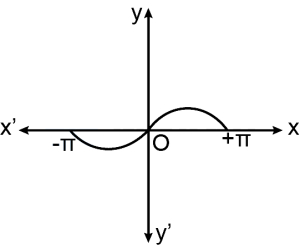
(D) Let $I = \int_{-\frac{\pi}{2}}^{\frac{\pi}{2}} [\sin x \cos x] dx = \int_{-\frac{\pi}{2}}^{\frac{\pi}{2}} [\frac{1}{2} \sin 2x] dx$.
Substitute $\theta = 2x$,so $d\theta = 2dx$ or $dx = \frac{1}{2} d\theta$.
When $x = -\frac{\pi}{2}$,$\theta = -\pi$. When $x = \frac{\pi}{2}$,$\theta = \pi$.
Thus,$I = \frac{1}{2} \int_{-\pi}^{\pi} [\frac{1}{2} \sin \theta] d\theta$.
Since $[\frac{1}{2} \sin \theta]$ is an odd function,we check the intervals:
For $\theta \in [-\pi, 0]$,$\sin \theta \in [-1, 0]$,so $\frac{1}{2} \sin \theta \in [-\frac{1}{2}, 0]$,hence $[\frac{1}{2} \sin \theta] = -1$ for $\theta \in [-\pi, 0)$.
For $\theta \in [0, \pi]$,$\sin \theta \in [0, 1]$,so $\frac{1}{2} \sin \theta \in [0, \frac{1}{2}]$,hence $[\frac{1}{2} \sin \theta] = 0$ for $\theta \in [0, \pi]$.
Therefore,$I = \frac{1}{2} [\int_{-\pi}^{0} (-1) d\theta + \int_{0}^{\pi} (0) d\theta] = \frac{1}{2} [-\theta]_{-\pi}^{0} = \frac{1}{2} [0 - (\pi)] = -\frac{\pi}{2}$.
Substitute $\theta = 2x$,so $d\theta = 2dx$ or $dx = \frac{1}{2} d\theta$.
When $x = -\frac{\pi}{2}$,$\theta = -\pi$. When $x = \frac{\pi}{2}$,$\theta = \pi$.
Thus,$I = \frac{1}{2} \int_{-\pi}^{\pi} [\frac{1}{2} \sin \theta] d\theta$.
Since $[\frac{1}{2} \sin \theta]$ is an odd function,we check the intervals:
For $\theta \in [-\pi, 0]$,$\sin \theta \in [-1, 0]$,so $\frac{1}{2} \sin \theta \in [-\frac{1}{2}, 0]$,hence $[\frac{1}{2} \sin \theta] = -1$ for $\theta \in [-\pi, 0)$.
For $\theta \in [0, \pi]$,$\sin \theta \in [0, 1]$,so $\frac{1}{2} \sin \theta \in [0, \frac{1}{2}]$,hence $[\frac{1}{2} \sin \theta] = 0$ for $\theta \in [0, \pi]$.
Therefore,$I = \frac{1}{2} [\int_{-\pi}^{0} (-1) d\theta + \int_{0}^{\pi} (0) d\theta] = \frac{1}{2} [-\theta]_{-\pi}^{0} = \frac{1}{2} [0 - (\pi)] = -\frac{\pi}{2}$.
0 likes
View Solution687
EasyMCQ
The value of the integral $\int_{-2}^{2}(1+2 \sin x) e^{|x|} d x$ is equal to
A
$0$
B
$e^{2}-1$
C
$2(e^{2}-1)$
D
$1$
Solution
(C) Let $I = \int_{-2}^{2}(1+2 \sin x) e^{|x|} d x$.
We can split the integral as:
$I = \int_{-2}^{2} e^{|x|} d x + 2 \int_{-2}^{2} \sin x e^{|x|} d x$.
Consider the first part: $f(x) = e^{|x|}$. Since $f(-x) = e^{|-x|} = e^{|x|} = f(x)$,$f(x)$ is an even function.
Thus,$\int_{-2}^{2} e^{|x|} d x = 2 \int_{0}^{2} e^{x} d x = 2[e^{x}]_{0}^{2} = 2(e^{2}-1)$.
Consider the second part: $g(x) = \sin x e^{|x|}$. Since $g(-x) = \sin(-x) e^{|-x|} = -\sin x e^{|x|} = -g(x)$,$g(x)$ is an odd function.
Thus,$\int_{-2}^{2} \sin x e^{|x|} d x = 0$.
Therefore,$I = 2(e^{2}-1) + 2(0) = 2(e^{2}-1)$.
We can split the integral as:
$I = \int_{-2}^{2} e^{|x|} d x + 2 \int_{-2}^{2} \sin x e^{|x|} d x$.
Consider the first part: $f(x) = e^{|x|}$. Since $f(-x) = e^{|-x|} = e^{|x|} = f(x)$,$f(x)$ is an even function.
Thus,$\int_{-2}^{2} e^{|x|} d x = 2 \int_{0}^{2} e^{x} d x = 2[e^{x}]_{0}^{2} = 2(e^{2}-1)$.
Consider the second part: $g(x) = \sin x e^{|x|}$. Since $g(-x) = \sin(-x) e^{|-x|} = -\sin x e^{|x|} = -g(x)$,$g(x)$ is an odd function.
Thus,$\int_{-2}^{2} \sin x e^{|x|} d x = 0$.
Therefore,$I = 2(e^{2}-1) + 2(0) = 2(e^{2}-1)$.
0 likes
View Solution688
EasyMCQ
The value of $\int_{-2}^2(x \cos x+\sin x+1) d x$ is
A
$2$
B
$0$
C
-$2$
D
$4$
Solution
(D) Let $I = \int_{-2}^2(x \cos x+\sin x+1) d x$.
We can split the integral as $I = \int_{-2}^2 x \cos x d x + \int_{-2}^2 \sin x d x + \int_{-2}^2 1 d x$.
Recall the property of definite integrals: $\int_{-a}^a f(x) d x = 0$ if $f(x)$ is an odd function,and $2 \int_0^a f(x) d x$ if $f(x)$ is an even function.
Let $f_1(x) = x \cos x$. Since $f_1(-x) = (-x) \cos(-x) = -x \cos x = -f_1(x)$,$f_1(x)$ is an odd function. Thus,$\int_{-2}^2 x \cos x d x = 0$.
Let $f_2(x) = \sin x$. Since $f_2(-x) = \sin(-x) = -\sin x = -f_2(x)$,$f_2(x)$ is an odd function. Thus,$\int_{-2}^2 \sin x d x = 0$.
Therefore,$I = 0 + 0 + \int_{-2}^2 1 d x = [x]_{-2}^2 = 2 - (-2) = 4$.
We can split the integral as $I = \int_{-2}^2 x \cos x d x + \int_{-2}^2 \sin x d x + \int_{-2}^2 1 d x$.
Recall the property of definite integrals: $\int_{-a}^a f(x) d x = 0$ if $f(x)$ is an odd function,and $2 \int_0^a f(x) d x$ if $f(x)$ is an even function.
Let $f_1(x) = x \cos x$. Since $f_1(-x) = (-x) \cos(-x) = -x \cos x = -f_1(x)$,$f_1(x)$ is an odd function. Thus,$\int_{-2}^2 x \cos x d x = 0$.
Let $f_2(x) = \sin x$. Since $f_2(-x) = \sin(-x) = -\sin x = -f_2(x)$,$f_2(x)$ is an odd function. Thus,$\int_{-2}^2 \sin x d x = 0$.
Therefore,$I = 0 + 0 + \int_{-2}^2 1 d x = [x]_{-2}^2 = 2 - (-2) = 4$.
0 likes
View Solution689
EasyMCQ
The value of $\int_0^\pi \sin^{50} x \cos^{49} x \, dx$ is
A
$0$
B
$\pi / 4$
C
$\pi / 2$
D
$1$
Solution
(A) Let $I = \int_0^\pi \sin^{50} x \cos^{49} x \, dx$.
Using the property $\int_0^a f(x) \, dx = \int_0^a f(a-x) \, dx$,we have:
$I = \int_0^\pi \sin^{50}(\pi - x) \cos^{49}(\pi - x) \, dx$.
Since $\sin(\pi - x) = \sin x$ and $\cos(\pi - x) = -\cos x$,we get:
$I = \int_0^\pi \sin^{50} x (-\cos x)^{49} \, dx$.
$I = -\int_0^\pi \sin^{50} x \cos^{49} x \, dx$.
$I = -I$.
Adding $I$ to both sides,we get $2I = 0$,which implies $I = 0$.
Using the property $\int_0^a f(x) \, dx = \int_0^a f(a-x) \, dx$,we have:
$I = \int_0^\pi \sin^{50}(\pi - x) \cos^{49}(\pi - x) \, dx$.
Since $\sin(\pi - x) = \sin x$ and $\cos(\pi - x) = -\cos x$,we get:
$I = \int_0^\pi \sin^{50} x (-\cos x)^{49} \, dx$.
$I = -\int_0^\pi \sin^{50} x \cos^{49} x \, dx$.
$I = -I$.
Adding $I$ to both sides,we get $2I = 0$,which implies $I = 0$.
0 likes
View Solution690
EasyMCQ
The value of $I = \int_{-\pi / 2}^{\pi / 2} |\sin x| \, dx$ is
A
$0$
B
$2$
C
$-2$
D
$-2 < I < 2$
Solution
(B) Given the integral $I = \int_{-\pi / 2}^{\pi / 2} |\sin x| \, dx$.
Since $|\sin x|$ is an even function,we can use the property $\int_{-a}^{a} f(x) \, dx = 2 \int_{0}^{a} f(x) \, dx$.
Thus,$I = 2 \int_{0}^{\pi / 2} |\sin x| \, dx$.
In the interval $[0, \pi / 2]$,$\sin x \geq 0$,so $|\sin x| = \sin x$.
Therefore,$I = 2 \int_{0}^{\pi / 2} \sin x \, dx$.
Evaluating the integral: $I = 2 [-\cos x]_{0}^{\pi / 2}$.
$I = 2 [-\cos(\pi / 2) - (-\cos(0))]$.
$I = 2 [0 - (-1)] = 2(1) = 2$.
Since $|\sin x|$ is an even function,we can use the property $\int_{-a}^{a} f(x) \, dx = 2 \int_{0}^{a} f(x) \, dx$.
Thus,$I = 2 \int_{0}^{\pi / 2} |\sin x| \, dx$.
In the interval $[0, \pi / 2]$,$\sin x \geq 0$,so $|\sin x| = \sin x$.
Therefore,$I = 2 \int_{0}^{\pi / 2} \sin x \, dx$.
Evaluating the integral: $I = 2 [-\cos x]_{0}^{\pi / 2}$.
$I = 2 [-\cos(\pi / 2) - (-\cos(0))]$.
$I = 2 [0 - (-1)] = 2(1) = 2$.
0 likes
View Solution691
EasyMCQ
If $f(x) = f(a-x)$,then $\int_0^a x f(x) dx$ is equal to
A
$\int_0^a f(x) dx$
B
$\frac{a^2}{2} \int_0^a f(x) dx$
C
$\frac{a}{2} \int_0^a f(x) dx$
D
$-\frac{a}{2} \int_0^a f(x) dx$
Solution
(C) Let $I = \int_0^a x f(x) dx$.
Using the property $\int_0^a g(x) dx = \int_0^a g(a-x) dx$,we get:
$I = \int_0^a (a-x) f(a-x) dx$.
Since $f(a-x) = f(x)$,this becomes:
$I = \int_0^a (a-x) f(x) dx = \int_0^a a f(x) dx - \int_0^a x f(x) dx$.
$I = a \int_0^a f(x) dx - I$.
Adding $I$ to both sides,we get:
$2I = a \int_0^a f(x) dx$.
Therefore,$I = \frac{a}{2} \int_0^a f(x) dx$.
Using the property $\int_0^a g(x) dx = \int_0^a g(a-x) dx$,we get:
$I = \int_0^a (a-x) f(a-x) dx$.
Since $f(a-x) = f(x)$,this becomes:
$I = \int_0^a (a-x) f(x) dx = \int_0^a a f(x) dx - \int_0^a x f(x) dx$.
$I = a \int_0^a f(x) dx - I$.
Adding $I$ to both sides,we get:
$2I = a \int_0^a f(x) dx$.
Therefore,$I = \frac{a}{2} \int_0^a f(x) dx$.
0 likes
View Solution692
EasyMCQ
If $\int_{-1}^4 f(x) dx = 4$ and $\int_2^4 \{3 - f(x)\} dx = 7$,then find the value of $\int_{-1}^2 f(x) dx$.
A
-$2$
B
$3$
C
$4$
D
$5$
Solution
(D) Given that $\int_{-1}^4 f(x) dx = 4$ and $\int_2^4 \{3 - f(x)\} dx = 7$.
First,solve the second integral:
$\int_2^4 3 dx - \int_2^4 f(x) dx = 7$
$[3x]_2^4 - \int_2^4 f(x) dx = 7$
$3(4 - 2) - \int_2^4 f(x) dx = 7$
$6 - \int_2^4 f(x) dx = 7$
$\int_2^4 f(x) dx = 6 - 7 = -1$.
Now,use the property of definite integrals:
$\int_{-1}^4 f(x) dx = \int_{-1}^2 f(x) dx + \int_2^4 f(x) dx$
$4 = \int_{-1}^2 f(x) dx + (-1)$
$\int_{-1}^2 f(x) dx = 4 + 1 = 5$.
First,solve the second integral:
$\int_2^4 3 dx - \int_2^4 f(x) dx = 7$
$[3x]_2^4 - \int_2^4 f(x) dx = 7$
$3(4 - 2) - \int_2^4 f(x) dx = 7$
$6 - \int_2^4 f(x) dx = 7$
$\int_2^4 f(x) dx = 6 - 7 = -1$.
Now,use the property of definite integrals:
$\int_{-1}^4 f(x) dx = \int_{-1}^2 f(x) dx + \int_2^4 f(x) dx$
$4 = \int_{-1}^2 f(x) dx + (-1)$
$\int_{-1}^2 f(x) dx = 4 + 1 = 5$.
0 likes
View Solution693
EasyMCQ
Which of the following statements are true?
A
If $f(x)$ is continuous and periodic with period $T$,then $I = \int_a^{a+T} f(x) dx$ depends on $a$.
B
If $f(x)$ is continuous and periodic with period $T$,then $I = \int_a^{a+T} f(x) dx$ does not depend on $a$.
C
Let $f(x) = \begin{cases} 1, & \text{if } x \in \mathbb{Q} \\ 0, & \text{if } x \notin \mathbb{Q} \end{cases}$,then $f$ is periodic with period $T$ only if $T$ is rational.
D
$f$ defined in $(C)$ is periodic for all $T \in \mathbb{Q} \setminus \{0\}$.
Solution
(B, D) For a periodic function $f(x)$ with period $T$,the integral over any interval of length $T$ is constant,i.e.,$\int_a^{a+T} f(x) dx = \int_0^T f(x) dx$. Thus,statement $(B)$ is true and $(A)$ is false.
For the Dirichlet function $f(x) = \begin{cases} 1, & x \in \mathbb{Q} \\ 0, & x \notin \mathbb{Q} \end{cases}$,$f(x+T) = f(x)$ holds for any rational $T$ because if $x$ is rational,$x+T$ is rational,and if $x$ is irrational,$x+T$ is irrational. Thus,$f$ is periodic for all rational $T$. Statement $(D)$ is true.
For the Dirichlet function $f(x) = \begin{cases} 1, & x \in \mathbb{Q} \\ 0, & x \notin \mathbb{Q} \end{cases}$,$f(x+T) = f(x)$ holds for any rational $T$ because if $x$ is rational,$x+T$ is rational,and if $x$ is irrational,$x+T$ is irrational. Thus,$f$ is periodic for all rational $T$. Statement $(D)$ is true.
0 likes
View Solution694
EasyMCQ
Let $f(x)$ be a continuous periodic function with period $T$. Let $I = \int_{a}^{a+T} f(x) \, dx$. Then
A
$I$ is a linear function in $a$
B
$I$ does not depend on $a$
C
$0 < I < a^{2}+1$ where $I$ depends on $a$
D
$I$ is a quadratic function in $a$
Solution
(B) For a periodic function $f(x)$ with period $T$,the integral over any interval of length $T$ is constant.
Let $I(a) = \int_{a}^{a+T} f(x) \, dx$.
Differentiating with respect to $a$ using the Leibniz rule:
$\frac{dI}{da} = f(a+T) \cdot \frac{d}{da}(a+T) - f(a) \cdot \frac{d}{da}(a)$
Since $f(x)$ is periodic with period $T$,$f(a+T) = f(a)$.
Thus,$\frac{dI}{da} = f(a) - f(a) = 0$.
Since the derivative is $0$,$I$ is independent of $a$ and $I = \int_{0}^{T} f(x) \, dx$.
Let $I(a) = \int_{a}^{a+T} f(x) \, dx$.
Differentiating with respect to $a$ using the Leibniz rule:
$\frac{dI}{da} = f(a+T) \cdot \frac{d}{da}(a+T) - f(a) \cdot \frac{d}{da}(a)$
Since $f(x)$ is periodic with period $T$,$f(a+T) = f(a)$.
Thus,$\frac{dI}{da} = f(a) - f(a) = 0$.
Since the derivative is $0$,$I$ is independent of $a$ and $I = \int_{0}^{T} f(x) \, dx$.
0 likes
View Solution695
MediumMCQ
$\int_{0}^{100} e^{x-[x]} d x$ is equal to
A
$\frac{e^{100}-1}{100}$
B
$\frac{e^{100}-1}{e-1}$
C
$100(e-1)$
D
$\frac{e-1}{100}$
Solution
(C) Let $I = \int_{0}^{100} e^{x-[x]} d x$.
Since $f(x) = x - [x]$ is a periodic function with period $T = 1$,we can use the property $\int_{0}^{nT} f(x) d x = n \int_{0}^{T} f(x) d x$.
Here,$n = 100$ and $T = 1$,so $I = 100 \int_{0}^{1} e^{x-[x]} d x$.
For $0 < x < 1$,the greatest integer function $[x] = 0$,so $x - [x] = x$.
Thus,$I = 100 \int_{0}^{1} e^{x} d x$.
Evaluating the integral,we get $I = 100 [e^{x}]_{0}^{1}$.
$I = 100 (e^{1} - e^{0}) = 100 (e - 1)$.
Since $f(x) = x - [x]$ is a periodic function with period $T = 1$,we can use the property $\int_{0}^{nT} f(x) d x = n \int_{0}^{T} f(x) d x$.
Here,$n = 100$ and $T = 1$,so $I = 100 \int_{0}^{1} e^{x-[x]} d x$.
For $0 < x < 1$,the greatest integer function $[x] = 0$,so $x - [x] = x$.
Thus,$I = 100 \int_{0}^{1} e^{x} d x$.
Evaluating the integral,we get $I = 100 [e^{x}]_{0}^{1}$.
$I = 100 (e^{1} - e^{0}) = 100 (e - 1)$.
0 likes
View Solution696
MediumMCQ
Let $I = \int_{0}^{100 \pi} \sqrt{1 - \cos 2x} \, dx$,then
A
$I = 0$
B
$I = 200 \sqrt{2}$
C
$I = \pi \sqrt{2}$
D
$I = 100$
Solution
(B) Given $I = \int_{0}^{100 \pi} \sqrt{1 - \cos 2x} \, dx$.
Using the identity $1 - \cos 2x = 2 \sin^2 x$,we have $I = \int_{0}^{100 \pi} \sqrt{2 \sin^2 x} \, dx$.
$I = \sqrt{2} \int_{0}^{100 \pi} |\sin x| \, dx$.
Since $|\sin x|$ is a periodic function with period $\pi$,we can write $I = \sqrt{2} \times 100 \int_{0}^{\pi} |\sin x| \, dx$.
In the interval $[0, \pi]$,$\sin x \geq 0$,so $|\sin x| = \sin x$.
$I = 100 \sqrt{2} \int_{0}^{\pi} \sin x \, dx$.
$I = 100 \sqrt{2} [-\cos x]_{0}^{\pi}$.
$I = 100 \sqrt{2} [-\cos \pi - (-\cos 0)]$.
$I = 100 \sqrt{2} [-(-1) - (-1)]$.
$I = 100 \sqrt{2} [1 + 1] = 100 \sqrt{2} \times 2 = 200 \sqrt{2}$.
Using the identity $1 - \cos 2x = 2 \sin^2 x$,we have $I = \int_{0}^{100 \pi} \sqrt{2 \sin^2 x} \, dx$.
$I = \sqrt{2} \int_{0}^{100 \pi} |\sin x| \, dx$.
Since $|\sin x|$ is a periodic function with period $\pi$,we can write $I = \sqrt{2} \times 100 \int_{0}^{\pi} |\sin x| \, dx$.
In the interval $[0, \pi]$,$\sin x \geq 0$,so $|\sin x| = \sin x$.
$I = 100 \sqrt{2} \int_{0}^{\pi} \sin x \, dx$.
$I = 100 \sqrt{2} [-\cos x]_{0}^{\pi}$.
$I = 100 \sqrt{2} [-\cos \pi - (-\cos 0)]$.
$I = 100 \sqrt{2} [-(-1) - (-1)]$.
$I = 100 \sqrt{2} [1 + 1] = 100 \sqrt{2} \times 2 = 200 \sqrt{2}$.
0 likes
View Solution697
EasyMCQ
$\int_{\pi}^{16\pi} |\sin x| dx = $
A
$0$
B
$32$
C
$30$
D
$28$
Solution
(C) The function $f(x) = |\sin x|$ is a periodic function with a period of $\pi$.
We know that $\int_{a}^{a+nT} f(x) dx = n \int_{0}^{T} f(x) dx$ for a periodic function with period $T$.
Here,the interval length is $16\pi - \pi = 15\pi$.
Thus,$\int_{\pi}^{16\pi} |\sin x| dx = 15 \int_{0}^{\pi} |\sin x| dx$.
Since $\sin x \ge 0$ for $x \in [0, \pi]$,we have $|\sin x| = \sin x$.
Therefore,$15 \int_{0}^{\pi} \sin x dx = 15 [-\cos x]_{0}^{\pi}$.
$= 15 [-\cos(\pi) - (-\cos(0))] = 15 [-(-1) - (-1)] = 15 [1 + 1] = 15 \times 2 = 30$.
We know that $\int_{a}^{a+nT} f(x) dx = n \int_{0}^{T} f(x) dx$ for a periodic function with period $T$.
Here,the interval length is $16\pi - \pi = 15\pi$.
Thus,$\int_{\pi}^{16\pi} |\sin x| dx = 15 \int_{0}^{\pi} |\sin x| dx$.
Since $\sin x \ge 0$ for $x \in [0, \pi]$,we have $|\sin x| = \sin x$.
Therefore,$15 \int_{0}^{\pi} \sin x dx = 15 [-\cos x]_{0}^{\pi}$.
$= 15 [-\cos(\pi) - (-\cos(0))] = 15 [-(-1) - (-1)] = 15 [1 + 1] = 15 \times 2 = 30$.
0 likes
View Solution698
EasyMCQ
If $I_1 = \int_0^{3 \pi} f(\cos^2 x) dx$ and $I_2 = \int_0^\pi f(\cos^2 x) dx$,then
A
$I_1 = I_2$
B
$3 I_1 = I_2$
C
$I_1 = 3 I_2$
D
$I_1 = 5 I_2$
Solution
(C) Let $g(x) = f(\cos^2 x)$.
Since $\cos^2(x + \pi) = (-\cos x)^2 = \cos^2 x$,the function $g(x)$ is periodic with period $\pi$.
Using the property of definite integrals for periodic functions,$\int_0^{n T} g(x) dx = n \int_0^T g(x) dx$,where $T$ is the period.
Here,$T = \pi$ and $n = 3$.
Therefore,$I_1 = \int_0^{3 \pi} f(\cos^2 x) dx = 3 \int_0^\pi f(\cos^2 x) dx$.
Since $I_2 = \int_0^\pi f(\cos^2 x) dx$,we have $I_1 = 3 I_2$.
Since $\cos^2(x + \pi) = (-\cos x)^2 = \cos^2 x$,the function $g(x)$ is periodic with period $\pi$.
Using the property of definite integrals for periodic functions,$\int_0^{n T} g(x) dx = n \int_0^T g(x) dx$,where $T$ is the period.
Here,$T = \pi$ and $n = 3$.
Therefore,$I_1 = \int_0^{3 \pi} f(\cos^2 x) dx = 3 \int_0^\pi f(\cos^2 x) dx$.
Since $I_2 = \int_0^\pi f(\cos^2 x) dx$,we have $I_1 = 3 I_2$.
0 likes
View Solution7-2.Definite Integral — Properties of definite integration · Frequently Asked Questions
1Are these 7-2.Definite Integral questions useful for JEE and NEET?
Yes. All questions in this section are mapped to JEE Main and NEET exam patterns. Previous year questions from JEE Main, NEET, GUJCET and state-level exams are included with full solutions.
2Can I switch to Hindi or Gujarati for these questions?
Yes. Use the language tabs in the hero section or the sidebar to view the same questions and solutions in English, Hindi or Gujarati.
3How do I generate a question paper from this subtopic?
Use the Vedclass Exam Paper Generator — select the chapter and subtopic, set difficulty, and generate Sets A, B, C, D automatically. First 3 chapters of every subject are free.
Vedclass Products
For Students
Vedclass Test Series
Mock tests in real JEE/NEET style with performance analysis. 5-day free trial.
Start Free TrialFor Teachers
Exam Paper Generator
Generate Set A/B/C/D papers from this chapter in 2 minutes. 3 chapters free.
Try FreeFor Institutes
Online Exam Module
Live online exams with unlimited students, 360° analytics & white-label branding.
See DemoFor Teachers & Institutes
Generate a 7-2.Definite Integral Exam Paper in 2 Minutes
Select subtopic & difficulty — Sets A, B, C, D auto-generated with No Repeat logic.
First 3 chapters of every subject are free — no payment required.