
A English
Types of matrices, Algebra of matrices Questions in English
Class 12 Mathematics · 3 and 4 .Determinants and Matrices · Types of matrices, Algebra of matrices
391+
Questions
English
Language
100%
With Solutions
Showing 50 of 391 questions in English
201
MediumMCQ
For the matrix $A = \begin{bmatrix} 3 & 2 \\ 1 & 1 \end{bmatrix}$,find the values of $a$ and $b$ such that $A^{2} + aA + bI = 0$.
A
$a = -4, b = -1$
B
$a = 4, b = 1$
C
$a = 4, b = -1$
D
$a = -4, b = 1$
Solution
(D) Given $A = \begin{bmatrix} 3 & 2 \\ 1 & 1 \end{bmatrix}$.
First,calculate $A^{2} = A \times A = \begin{bmatrix} 3 & 2 \\ 1 & 1 \end{bmatrix} \begin{bmatrix} 3 & 2 \\ 1 & 1 \end{bmatrix} = \begin{bmatrix} 9+2 & 6+2 \\ 3+1 & 2+1 \end{bmatrix} = \begin{bmatrix} 11 & 8 \\ 4 & 3 \end{bmatrix}$.
Substitute $A^{2}$,$A$,and $I = \begin{bmatrix} 1 & 0 \\ 0 & 1 \end{bmatrix}$ into the equation $A^{2} + aA + bI = 0$:
$\begin{bmatrix} 11 & 8 \\ 4 & 3 \end{bmatrix} + a \begin{bmatrix} 3 & 2 \\ 1 & 1 \end{bmatrix} + b \begin{bmatrix} 1 & 0 \\ 0 & 1 \end{bmatrix} = \begin{bmatrix} 0 & 0 \\ 0 & 0 \end{bmatrix}$.
This gives the matrix equation:
$\begin{bmatrix} 11 + 3a + b & 8 + 2a \\ 4 + a & 3 + a + b \end{bmatrix} = \begin{bmatrix} 0 & 0 \\ 0 & 0 \end{bmatrix}$.
Comparing the elements:
$8 + 2a = 0 \Rightarrow 2a = -8 \Rightarrow a = -4$.
$4 + a = 0 \Rightarrow 4 + (-4) = 0$ (Consistent).
$11 + 3a + b = 0 \Rightarrow 11 + 3(-4) + b = 0 \Rightarrow 11 - 12 + b = 0 \Rightarrow -1 + b = 0 \Rightarrow b = 1$.
Thus,$a = -4$ and $b = 1$.
First,calculate $A^{2} = A \times A = \begin{bmatrix} 3 & 2 \\ 1 & 1 \end{bmatrix} \begin{bmatrix} 3 & 2 \\ 1 & 1 \end{bmatrix} = \begin{bmatrix} 9+2 & 6+2 \\ 3+1 & 2+1 \end{bmatrix} = \begin{bmatrix} 11 & 8 \\ 4 & 3 \end{bmatrix}$.
Substitute $A^{2}$,$A$,and $I = \begin{bmatrix} 1 & 0 \\ 0 & 1 \end{bmatrix}$ into the equation $A^{2} + aA + bI = 0$:
$\begin{bmatrix} 11 & 8 \\ 4 & 3 \end{bmatrix} + a \begin{bmatrix} 3 & 2 \\ 1 & 1 \end{bmatrix} + b \begin{bmatrix} 1 & 0 \\ 0 & 1 \end{bmatrix} = \begin{bmatrix} 0 & 0 \\ 0 & 0 \end{bmatrix}$.
This gives the matrix equation:
$\begin{bmatrix} 11 + 3a + b & 8 + 2a \\ 4 + a & 3 + a + b \end{bmatrix} = \begin{bmatrix} 0 & 0 \\ 0 & 0 \end{bmatrix}$.
Comparing the elements:
$8 + 2a = 0 \Rightarrow 2a = -8 \Rightarrow a = -4$.
$4 + a = 0 \Rightarrow 4 + (-4) = 0$ (Consistent).
$11 + 3a + b = 0 \Rightarrow 11 + 3(-4) + b = 0 \Rightarrow 11 - 12 + b = 0 \Rightarrow -1 + b = 0 \Rightarrow b = 1$.
Thus,$a = -4$ and $b = 1$.
0 likes
View Solution202
MediumMCQ
If $A^{\prime}=\begin{bmatrix}-2 & 3 \\ 1 & 2\end{bmatrix}$ and $B=\begin{bmatrix}-1 & 0 \\ 1 & 2\end{bmatrix},$ then find $(A+2B)^{\prime}$.
A
$\begin{bmatrix}-4 & 5 \\ 1 & 6\end{bmatrix}$
B
$\begin{bmatrix}-4 & 1 \\ 5 & 6\end{bmatrix}$
C
$\begin{bmatrix}-4 & 3 \\ 2 & 6\end{bmatrix}$
D
$\begin{bmatrix}-4 & 2 \\ 3 & 6\end{bmatrix}$
Solution
(A) We know that $A = (A^{\prime})^{\prime}$.
Therefore,$A = \begin{bmatrix}-2 & 1 \\ 3 & 2\end{bmatrix}$.
Now,$A + 2B = \begin{bmatrix}-2 & 1 \\ 3 & 2\end{bmatrix} + 2\begin{bmatrix}-1 & 0 \\ 1 & 2\end{bmatrix}$.
$A + 2B = \begin{bmatrix}-2 & 1 \\ 3 & 2\end{bmatrix} + \begin{bmatrix}-2 & 0 \\ 2 & 4\end{bmatrix} = \begin{bmatrix}-4 & 1 \\ 5 & 6\end{bmatrix}$.
Finally,$(A + 2B)^{\prime} = \begin{bmatrix}-4 & 5 \\ 1 & 6\end{bmatrix}$.
Therefore,$A = \begin{bmatrix}-2 & 1 \\ 3 & 2\end{bmatrix}$.
Now,$A + 2B = \begin{bmatrix}-2 & 1 \\ 3 & 2\end{bmatrix} + 2\begin{bmatrix}-1 & 0 \\ 1 & 2\end{bmatrix}$.
$A + 2B = \begin{bmatrix}-2 & 1 \\ 3 & 2\end{bmatrix} + \begin{bmatrix}-2 & 0 \\ 2 & 4\end{bmatrix} = \begin{bmatrix}-4 & 1 \\ 5 & 6\end{bmatrix}$.
Finally,$(A + 2B)^{\prime} = \begin{bmatrix}-4 & 5 \\ 1 & 6\end{bmatrix}$.
0 likes
View Solution203
Medium
For the matrices $A$ and $B$,verify that $(AB)^{\prime} = B^{\prime}A^{\prime}$ where $A = \begin{bmatrix} 1 \\ -4 \\ 3 \end{bmatrix}$ and $B = \begin{bmatrix} -1 & 2 & 1 \end{bmatrix}$.
Solution
(A) First,calculate the product $AB$:
$AB = \begin{bmatrix} 1 \\ -4 \\ 3 \end{bmatrix} \begin{bmatrix} -1 & 2 & 1 \end{bmatrix} = \begin{bmatrix} -1 & 2 & 1 \\ 4 & -8 & -4 \\ -3 & 6 & 3 \end{bmatrix}$
Now,find the transpose $(AB)^{\prime}$:
$(AB)^{\prime} = \begin{bmatrix} -1 & 4 & -3 \\ 2 & -8 & 6 \\ 1 & -4 & 3 \end{bmatrix}$
Next,find $A^{\prime}$ and $B^{\prime}$:
$A^{\prime} = \begin{bmatrix} 1 & -4 & 3 \end{bmatrix}$
$B^{\prime} = \begin{bmatrix} -1 \\ 2 \\ 1 \end{bmatrix}$
Now,calculate the product $B^{\prime}A^{\prime}$:
$B^{\prime}A^{\prime} = \begin{bmatrix} -1 \\ 2 \\ 1 \end{bmatrix} \begin{bmatrix} 1 & -4 & 3 \end{bmatrix} = \begin{bmatrix} -1 & 4 & -3 \\ 2 & -8 & 6 \\ 1 & -4 & 3 \end{bmatrix}$
Since $(AB)^{\prime} = B^{\prime}A^{\prime}$,the property is verified.
$AB = \begin{bmatrix} 1 \\ -4 \\ 3 \end{bmatrix} \begin{bmatrix} -1 & 2 & 1 \end{bmatrix} = \begin{bmatrix} -1 & 2 & 1 \\ 4 & -8 & -4 \\ -3 & 6 & 3 \end{bmatrix}$
Now,find the transpose $(AB)^{\prime}$:
$(AB)^{\prime} = \begin{bmatrix} -1 & 4 & -3 \\ 2 & -8 & 6 \\ 1 & -4 & 3 \end{bmatrix}$
Next,find $A^{\prime}$ and $B^{\prime}$:
$A^{\prime} = \begin{bmatrix} 1 & -4 & 3 \end{bmatrix}$
$B^{\prime} = \begin{bmatrix} -1 \\ 2 \\ 1 \end{bmatrix}$
Now,calculate the product $B^{\prime}A^{\prime}$:
$B^{\prime}A^{\prime} = \begin{bmatrix} -1 \\ 2 \\ 1 \end{bmatrix} \begin{bmatrix} 1 & -4 & 3 \end{bmatrix} = \begin{bmatrix} -1 & 4 & -3 \\ 2 & -8 & 6 \\ 1 & -4 & 3 \end{bmatrix}$
Since $(AB)^{\prime} = B^{\prime}A^{\prime}$,the property is verified.
0 likes
View Solution204
Medium
If $A = \begin{bmatrix} \sin \alpha & \cos \alpha \\ -\cos \alpha & \sin \alpha \end{bmatrix}$,then verify that $A^{\prime} A = I$.
Solution
(A) Given $A = \begin{bmatrix} \sin \alpha & \cos \alpha \\ -\cos \alpha & \sin \alpha \end{bmatrix}$.
The transpose of matrix $A$,denoted by $A^{\prime}$,is obtained by interchanging its rows and columns:
$A^{\prime} = \begin{bmatrix} \sin \alpha & -\cos \alpha \\ \cos \alpha & \sin \alpha \end{bmatrix}$.
Now,calculate the product $A^{\prime} A$:
$A^{\prime} A = \begin{bmatrix} \sin \alpha & -\cos \alpha \\ \cos \alpha & \sin \alpha \end{bmatrix} \begin{bmatrix} \sin \alpha & \cos \alpha \\ -\cos \alpha & \sin \alpha \end{bmatrix}$.
Performing matrix multiplication:
$A^{\prime} A = \begin{bmatrix} (\sin \alpha)(\sin \alpha) + (-\cos \alpha)(-\cos \alpha) & (\sin \alpha)(\cos \alpha) + (-\cos \alpha)(\sin \alpha) \\ (\cos \alpha)(\sin \alpha) + (\sin \alpha)(-\cos \alpha) & (\cos \alpha)(\cos \alpha) + (\sin \alpha)(\sin \alpha) \end{bmatrix}$.
Simplifying the terms using trigonometric identities $\sin^2 \alpha + \cos^2 \alpha = 1$:
$A^{\prime} A = \begin{bmatrix} \sin^2 \alpha + \cos^2 \alpha & \sin \alpha \cos \alpha - \sin \alpha \cos \alpha \\ \sin \alpha \cos \alpha - \sin \alpha \cos \alpha & \cos^2 \alpha + \sin^2 \alpha \end{bmatrix}$.
$A^{\prime} A = \begin{bmatrix} 1 & 0 \\ 0 & 1 \end{bmatrix} = I$.
Thus,it is verified that $A^{\prime} A = I$.
The transpose of matrix $A$,denoted by $A^{\prime}$,is obtained by interchanging its rows and columns:
$A^{\prime} = \begin{bmatrix} \sin \alpha & -\cos \alpha \\ \cos \alpha & \sin \alpha \end{bmatrix}$.
Now,calculate the product $A^{\prime} A$:
$A^{\prime} A = \begin{bmatrix} \sin \alpha & -\cos \alpha \\ \cos \alpha & \sin \alpha \end{bmatrix} \begin{bmatrix} \sin \alpha & \cos \alpha \\ -\cos \alpha & \sin \alpha \end{bmatrix}$.
Performing matrix multiplication:
$A^{\prime} A = \begin{bmatrix} (\sin \alpha)(\sin \alpha) + (-\cos \alpha)(-\cos \alpha) & (\sin \alpha)(\cos \alpha) + (-\cos \alpha)(\sin \alpha) \\ (\cos \alpha)(\sin \alpha) + (\sin \alpha)(-\cos \alpha) & (\cos \alpha)(\cos \alpha) + (\sin \alpha)(\sin \alpha) \end{bmatrix}$.
Simplifying the terms using trigonometric identities $\sin^2 \alpha + \cos^2 \alpha = 1$:
$A^{\prime} A = \begin{bmatrix} \sin^2 \alpha + \cos^2 \alpha & \sin \alpha \cos \alpha - \sin \alpha \cos \alpha \\ \sin \alpha \cos \alpha - \sin \alpha \cos \alpha & \cos^2 \alpha + \sin^2 \alpha \end{bmatrix}$.
$A^{\prime} A = \begin{bmatrix} 1 & 0 \\ 0 & 1 \end{bmatrix} = I$.
Thus,it is verified that $A^{\prime} A = I$.
0 likes
View Solution205
Medium
Express the following matrix as the sum of a symmetric and a skew-symmetric matrix: $\left[\begin{array}{cc}3 & 5 \\ 1 & -1\end{array}\right]$
Solution
Let $A = \left[\begin{array}{cc}3 & 5 \\ 1 & -1\end{array}\right]$.
Then,the transpose $A^{\prime} = \left[\begin{array}{cc}3 & 1 \\ 5 & -1\end{array}\right]$.
Any square matrix $A$ can be written as $A = P + Q$,where $P = \frac{1}{2}(A + A^{\prime})$ is a symmetric matrix and $Q = \frac{1}{2}(A - A^{\prime})$ is a skew-symmetric matrix.
First,calculate $P = \frac{1}{2}(A + A^{\prime})$:
$A + A^{\prime} = \left[\begin{array}{cc}3+3 & 5+1 \\ 1+5 & -1-1\end{array}\right] = \left[\begin{array}{cc}6 & 6 \\ 6 & -2\end{array}\right]$
$P = \frac{1}{2} \left[\begin{array}{cc}6 & 6 \\ 6 & -2\end{array}\right] = \left[\begin{array}{cc}3 & 3 \\ 3 & -1\end{array}\right]$
Since $P^{\prime} = P$,$P$ is symmetric.
Next,calculate $Q = \frac{1}{2}(A - A^{\prime})$:
$A - A^{\prime} = \left[\begin{array}{cc}3-3 & 5-1 \\ 1-5 & -1-(-1)\end{array}\right] = \left[\begin{array}{cc}0 & 4 \\ -4 & 0\end{array}\right]$
$Q = \frac{1}{2} \left[\begin{array}{cc}0 & 4 \\ -4 & 0\end{array}\right] = \left[\begin{array}{cc}0 & 2 \\ -2 & 0\end{array}\right]$
Since $Q^{\prime} = -Q$,$Q$ is skew-symmetric.
Thus,$A = P + Q = \left[\begin{array}{cc}3 & 3 \\ 3 & -1\end{array}\right] + \left[\begin{array}{cc}0 & 2 \\ -2 & 0\end{array}\right]$.
Then,the transpose $A^{\prime} = \left[\begin{array}{cc}3 & 1 \\ 5 & -1\end{array}\right]$.
Any square matrix $A$ can be written as $A = P + Q$,where $P = \frac{1}{2}(A + A^{\prime})$ is a symmetric matrix and $Q = \frac{1}{2}(A - A^{\prime})$ is a skew-symmetric matrix.
First,calculate $P = \frac{1}{2}(A + A^{\prime})$:
$A + A^{\prime} = \left[\begin{array}{cc}3+3 & 5+1 \\ 1+5 & -1-1\end{array}\right] = \left[\begin{array}{cc}6 & 6 \\ 6 & -2\end{array}\right]$
$P = \frac{1}{2} \left[\begin{array}{cc}6 & 6 \\ 6 & -2\end{array}\right] = \left[\begin{array}{cc}3 & 3 \\ 3 & -1\end{array}\right]$
Since $P^{\prime} = P$,$P$ is symmetric.
Next,calculate $Q = \frac{1}{2}(A - A^{\prime})$:
$A - A^{\prime} = \left[\begin{array}{cc}3-3 & 5-1 \\ 1-5 & -1-(-1)\end{array}\right] = \left[\begin{array}{cc}0 & 4 \\ -4 & 0\end{array}\right]$
$Q = \frac{1}{2} \left[\begin{array}{cc}0 & 4 \\ -4 & 0\end{array}\right] = \left[\begin{array}{cc}0 & 2 \\ -2 & 0\end{array}\right]$
Since $Q^{\prime} = -Q$,$Q$ is skew-symmetric.
Thus,$A = P + Q = \left[\begin{array}{cc}3 & 3 \\ 3 & -1\end{array}\right] + \left[\begin{array}{cc}0 & 2 \\ -2 & 0\end{array}\right]$.
0 likes
View Solution206
Medium
Express the following matrix as the sum of a symmetric and a skew-symmetric matrix: $\left[\begin{array}{ccc}3 & 3 & -1 \\ -2 & -2 & 1 \\ -4 & -5 & 2\end{array}\right]$
Solution
Let $A = \left[\begin{array}{ccc}3 & 3 & -1 \\ -2 & -2 & 1 \\ -4 & -5 & 2\end{array}\right]$. Then,the transpose $A^{\prime} = \left[\begin{array}{ccc}3 & -2 & -4 \\ 3 & -2 & -5 \\ -1 & 1 & 2\end{array}\right]$.
To express $A$ as the sum of a symmetric and a skew-symmetric matrix,we use the formula $A = P + Q$,where $P = \frac{1}{2}(A + A^{\prime})$ is symmetric and $Q = \frac{1}{2}(A - A^{\prime})$ is skew-symmetric.
First,calculate $A + A^{\prime} = \left[\begin{array}{ccc}3+3 & 3-2 & -1-4 \\ -2+3 & -2-2 & 1-5 \\ -4-1 & -5+1 & 2+2\end{array}\right] = \left[\begin{array}{ccc}6 & 1 & -5 \\ 1 & -4 & -4 \\ -5 & -4 & 4\end{array}\right]$.
Thus,$P = \frac{1}{2}(A + A^{\prime}) = \left[\begin{array}{ccc}3 & \frac{1}{2} & -\frac{5}{2} \\ \frac{1}{2} & -2 & -2 \\ -\frac{5}{2} & -2 & 2\end{array}\right]$. Since $P^{\prime} = P$,$P$ is symmetric.
Next,calculate $A - A^{\prime} = \left[\begin{array}{ccc}3-3 & 3-(-2) & -1-(-4) \\ -2-3 & -2-(-2) & 1-(-5) \\ -4-(-1) & -5-1 & 2-2\end{array}\right] = \left[\begin{array}{ccc}0 & 5 & 3 \\ -5 & 0 & 6 \\ -3 & -6 & 0\end{array}\right]$.
Thus,$Q = \frac{1}{2}(A - A^{\prime}) = \left[\begin{array}{ccc}0 & \frac{5}{2} & \frac{3}{2} \\ -\frac{5}{2} & 0 & 3 \\ -\frac{3}{2} & -3 & 0\end{array}\right]$. Since $Q^{\prime} = -Q$,$Q$ is skew-symmetric.
Therefore,$A = \left[\begin{array}{ccc}3 & \frac{1}{2} & -\frac{5}{2} \\ \frac{1}{2} & -2 & -2 \\ -\frac{5}{2} & -2 & 2\end{array}\right] + \left[\begin{array}{ccc}0 & \frac{5}{2} & \frac{3}{2} \\ -\frac{5}{2} & 0 & 3 \\ -\frac{3}{2} & -3 & 0\end{array}\right]$.
To express $A$ as the sum of a symmetric and a skew-symmetric matrix,we use the formula $A = P + Q$,where $P = \frac{1}{2}(A + A^{\prime})$ is symmetric and $Q = \frac{1}{2}(A - A^{\prime})$ is skew-symmetric.
First,calculate $A + A^{\prime} = \left[\begin{array}{ccc}3+3 & 3-2 & -1-4 \\ -2+3 & -2-2 & 1-5 \\ -4-1 & -5+1 & 2+2\end{array}\right] = \left[\begin{array}{ccc}6 & 1 & -5 \\ 1 & -4 & -4 \\ -5 & -4 & 4\end{array}\right]$.
Thus,$P = \frac{1}{2}(A + A^{\prime}) = \left[\begin{array}{ccc}3 & \frac{1}{2} & -\frac{5}{2} \\ \frac{1}{2} & -2 & -2 \\ -\frac{5}{2} & -2 & 2\end{array}\right]$. Since $P^{\prime} = P$,$P$ is symmetric.
Next,calculate $A - A^{\prime} = \left[\begin{array}{ccc}3-3 & 3-(-2) & -1-(-4) \\ -2-3 & -2-(-2) & 1-(-5) \\ -4-(-1) & -5-1 & 2-2\end{array}\right] = \left[\begin{array}{ccc}0 & 5 & 3 \\ -5 & 0 & 6 \\ -3 & -6 & 0\end{array}\right]$.
Thus,$Q = \frac{1}{2}(A - A^{\prime}) = \left[\begin{array}{ccc}0 & \frac{5}{2} & \frac{3}{2} \\ -\frac{5}{2} & 0 & 3 \\ -\frac{3}{2} & -3 & 0\end{array}\right]$. Since $Q^{\prime} = -Q$,$Q$ is skew-symmetric.
Therefore,$A = \left[\begin{array}{ccc}3 & \frac{1}{2} & -\frac{5}{2} \\ \frac{1}{2} & -2 & -2 \\ -\frac{5}{2} & -2 & 2\end{array}\right] + \left[\begin{array}{ccc}0 & \frac{5}{2} & \frac{3}{2} \\ -\frac{5}{2} & 0 & 3 \\ -\frac{3}{2} & -3 & 0\end{array}\right]$.
0 likes
View Solution207
EasyMCQ
If $A$ and $B$ are symmetric matrices of the same order,then $AB - BA$ is a
A
Zero matrix
B
Symmetric matrix
C
Skew-symmetric matrix
D
Identity matrix
Solution
(C) Given that $A$ and $B$ are symmetric matrices,we have:
$A^{\prime} = A$ and $B^{\prime} = B$ .......... $(1)$
Consider the transpose of the matrix $(AB - BA)$:
$(AB - BA)^{\prime} = (AB)^{\prime} - (BA)^{\prime}$
Using the property $(XY)^{\prime} = Y^{\prime}X^{\prime}$,we get:
$(AB - BA)^{\prime} = B^{\prime}A^{\prime} - A^{\prime}B^{\prime}$
Substituting the values from $(1)$:
$(AB - BA)^{\prime} = BA - AB$
Factoring out the negative sign:
$(AB - BA)^{\prime} = -(AB - BA)$
Since the transpose of $(AB - BA)$ is equal to its negative,$(AB - BA)$ is a skew-symmetric matrix.
$A^{\prime} = A$ and $B^{\prime} = B$ .......... $(1)$
Consider the transpose of the matrix $(AB - BA)$:
$(AB - BA)^{\prime} = (AB)^{\prime} - (BA)^{\prime}$
Using the property $(XY)^{\prime} = Y^{\prime}X^{\prime}$,we get:
$(AB - BA)^{\prime} = B^{\prime}A^{\prime} - A^{\prime}B^{\prime}$
Substituting the values from $(1)$:
$(AB - BA)^{\prime} = BA - AB$
Factoring out the negative sign:
$(AB - BA)^{\prime} = -(AB - BA)$
Since the transpose of $(AB - BA)$ is equal to its negative,$(AB - BA)$ is a skew-symmetric matrix.
0 likes
View Solution208
Difficult
If $A = \begin{bmatrix} \cos \theta & \sin \theta \\ -\sin \theta & \cos \theta \end{bmatrix}$,then prove that $A^{n} = \begin{bmatrix} \cos n \theta & \sin n \theta \\ -\sin n \theta & \cos n \theta \end{bmatrix}$ for all $n \in N$.
Solution
(A) We shall prove the result by using the principle of mathematical induction.
Let $P(n)$ be the statement: If $A = \begin{bmatrix} \cos \theta & \sin \theta \\ -\sin \theta & \cos \theta \end{bmatrix}$,then $A^{n} = \begin{bmatrix} \cos n \theta & \sin n \theta \\ -\sin n \theta & \cos n \theta \end{bmatrix}$ for $n \in N$.
Step $1$: For $n = 1$,$A^{1} = \begin{bmatrix} \cos \theta & \sin \theta \\ -\sin \theta & \cos \theta \end{bmatrix}$. This is true.
Step $2$: Assume the result is true for $n = k$. That is,$A^{k} = \begin{bmatrix} \cos k \theta & \sin k \theta \\ -\sin k \theta & \cos k \theta \end{bmatrix}$.
Step $3$: We prove the result for $n = k + 1$.
$A^{k+1} = A \cdot A^{k} = \begin{bmatrix} \cos \theta & \sin \theta \\ -\sin \theta & \cos \theta \end{bmatrix} \begin{bmatrix} \cos k \theta & \sin k \theta \\ -\sin k \theta & \cos k \theta \end{bmatrix}$
$= \begin{bmatrix} \cos \theta \cos k \theta - \sin \theta \sin k \theta & \cos \theta \sin k \theta + \sin \theta \cos k \theta \\ -\sin \theta \cos k \theta - \cos \theta \sin k \theta & -\sin \theta \sin k \theta + \cos \theta \cos k \theta \end{bmatrix}$
Using trigonometric identities $\cos(A+B) = \cos A \cos B - \sin A \sin B$ and $\sin(A+B) = \sin A \cos B + \cos A \sin B$:
$A^{k+1} = \begin{bmatrix} \cos(k+1)\theta & \sin(k+1)\theta \\ -\sin(k+1)\theta & \cos(k+1)\theta \end{bmatrix}$.
Thus,the result holds for $n = k+1$. By the principle of mathematical induction,the statement is true for all $n \in N$.
Let $P(n)$ be the statement: If $A = \begin{bmatrix} \cos \theta & \sin \theta \\ -\sin \theta & \cos \theta \end{bmatrix}$,then $A^{n} = \begin{bmatrix} \cos n \theta & \sin n \theta \\ -\sin n \theta & \cos n \theta \end{bmatrix}$ for $n \in N$.
Step $1$: For $n = 1$,$A^{1} = \begin{bmatrix} \cos \theta & \sin \theta \\ -\sin \theta & \cos \theta \end{bmatrix}$. This is true.
Step $2$: Assume the result is true for $n = k$. That is,$A^{k} = \begin{bmatrix} \cos k \theta & \sin k \theta \\ -\sin k \theta & \cos k \theta \end{bmatrix}$.
Step $3$: We prove the result for $n = k + 1$.
$A^{k+1} = A \cdot A^{k} = \begin{bmatrix} \cos \theta & \sin \theta \\ -\sin \theta & \cos \theta \end{bmatrix} \begin{bmatrix} \cos k \theta & \sin k \theta \\ -\sin k \theta & \cos k \theta \end{bmatrix}$
$= \begin{bmatrix} \cos \theta \cos k \theta - \sin \theta \sin k \theta & \cos \theta \sin k \theta + \sin \theta \cos k \theta \\ -\sin \theta \cos k \theta - \cos \theta \sin k \theta & -\sin \theta \sin k \theta + \cos \theta \cos k \theta \end{bmatrix}$
Using trigonometric identities $\cos(A+B) = \cos A \cos B - \sin A \sin B$ and $\sin(A+B) = \sin A \cos B + \cos A \sin B$:
$A^{k+1} = \begin{bmatrix} \cos(k+1)\theta & \sin(k+1)\theta \\ -\sin(k+1)\theta & \cos(k+1)\theta \end{bmatrix}$.
Thus,the result holds for $n = k+1$. By the principle of mathematical induction,the statement is true for all $n \in N$.
0 likes
View Solution209
Medium
If $A = \begin{bmatrix} 3 & -4 \\ 1 & -1 \end{bmatrix}$,then prove that $A^n = \begin{bmatrix} 1+2n & -4n \\ n & 1-2n \end{bmatrix}$,where $n$ is any positive integer.
Solution
(N/A) It is given that $A = \begin{bmatrix} 3 & -4 \\ 1 & -1 \end{bmatrix}$.
To prove: $P(n): A^n = \begin{bmatrix} 1+2n & -4n \\ n & 1-2n \end{bmatrix}$ for all $n \in \mathbb{N}$.
We shall prove the result by using the principle of mathematical induction.
For $n=1$,we have:
$P(1): A^1 = \begin{bmatrix} 1+2(1) & -4(1) \\ 1 & 1-2(1) \end{bmatrix} = \begin{bmatrix} 3 & -4 \\ 1 & -1 \end{bmatrix} = A$.
Therefore,the result is true for $n=1$.
Assume the result is true for $n=k$:
$P(k): A^k = \begin{bmatrix} 1+2k & -4k \\ k & 1-2k \end{bmatrix}$.
Now,we prove that the result is true for $n=k+1$:
$A^{k+1} = A^k \cdot A = \begin{bmatrix} 1+2k & -4k \\ k & 1-2k \end{bmatrix} \begin{bmatrix} 3 & -4 \\ 1 & -1 \end{bmatrix}$.
$A^{k+1} = \begin{bmatrix} 3(1+2k) - 4k & -4(1+2k) + 4k \\ 3k + 1 - 2k & -4k - (1-2k) \end{bmatrix}$.
$A^{k+1} = \begin{bmatrix} 3 + 6k - 4k & -4 - 8k + 4k \\ k + 1 & -4k - 1 + 2k \end{bmatrix}$.
$A^{k+1} = \begin{bmatrix} 3 + 2k & -4 - 4k \\ k + 1 & -1 - 2k \end{bmatrix}$.
$A^{k+1} = \begin{bmatrix} 1 + 2(k+1) & -4(k+1) \\ k+1 & 1 - 2(k+1) \end{bmatrix}$.
Therefore,the result is true for $n=k+1$.
Thus,by the principle of mathematical induction,the result holds for all $n \in \mathbb{N}$.
To prove: $P(n): A^n = \begin{bmatrix} 1+2n & -4n \\ n & 1-2n \end{bmatrix}$ for all $n \in \mathbb{N}$.
We shall prove the result by using the principle of mathematical induction.
For $n=1$,we have:
$P(1): A^1 = \begin{bmatrix} 1+2(1) & -4(1) \\ 1 & 1-2(1) \end{bmatrix} = \begin{bmatrix} 3 & -4 \\ 1 & -1 \end{bmatrix} = A$.
Therefore,the result is true for $n=1$.
Assume the result is true for $n=k$:
$P(k): A^k = \begin{bmatrix} 1+2k & -4k \\ k & 1-2k \end{bmatrix}$.
Now,we prove that the result is true for $n=k+1$:
$A^{k+1} = A^k \cdot A = \begin{bmatrix} 1+2k & -4k \\ k & 1-2k \end{bmatrix} \begin{bmatrix} 3 & -4 \\ 1 & -1 \end{bmatrix}$.
$A^{k+1} = \begin{bmatrix} 3(1+2k) - 4k & -4(1+2k) + 4k \\ 3k + 1 - 2k & -4k - (1-2k) \end{bmatrix}$.
$A^{k+1} = \begin{bmatrix} 3 + 6k - 4k & -4 - 8k + 4k \\ k + 1 & -4k - 1 + 2k \end{bmatrix}$.
$A^{k+1} = \begin{bmatrix} 3 + 2k & -4 - 4k \\ k + 1 & -1 - 2k \end{bmatrix}$.
$A^{k+1} = \begin{bmatrix} 1 + 2(k+1) & -4(k+1) \\ k+1 & 1 - 2(k+1) \end{bmatrix}$.
Therefore,the result is true for $n=k+1$.
Thus,by the principle of mathematical induction,the result holds for all $n \in \mathbb{N}$.
0 likes
View Solution210
Difficult
Find the values of $x, y, z$ if the matrix $A = \begin{bmatrix} 0 & 2y & z \\ x & y & -z \\ x & -y & z \end{bmatrix}$ satisfies the equation $A^{\prime} A = I$.
Solution
(A) Given $A = \begin{bmatrix} 0 & 2y & z \\ x & y & -z \\ x & -y & z \end{bmatrix}$.
The transpose $A^{\prime} = \begin{bmatrix} 0 & x & x \\ 2y & y & -y \\ z & -z & z \end{bmatrix}$.
Given $A^{\prime} A = I$,where $I = \begin{bmatrix} 1 & 0 & 0 \\ 0 & 1 & 0 \\ 0 & 0 & 1 \end{bmatrix}$.
Calculating $A^{\prime} A$:
$\begin{bmatrix} 0 & x & x \\ 2y & y & -y \\ z & -z & z \end{bmatrix} \begin{bmatrix} 0 & 2y & z \\ x & y & -z \\ x & -y & z \end{bmatrix} = \begin{bmatrix} 1 & 0 & 0 \\ 0 & 1 & 0 \\ 0 & 0 & 1 \end{bmatrix}$
Performing matrix multiplication:
$\begin{bmatrix} 0+x^2+x^2 & 0+xy-xy & 0-xz+xz \\ 0+xy-xy & 4y^2+y^2+y^2 & 2zy-zy-zy \\ 0-xz+xz & 2zy-zy-zy & z^2+z^2+z^2 \end{bmatrix} = \begin{bmatrix} 1 & 0 & 0 \\ 0 & 1 & 0 \\ 0 & 0 & 1 \end{bmatrix}$
Simplifying the matrix:
$\begin{bmatrix} 2x^2 & 0 & 0 \\ 0 & 6y^2 & 0 \\ 0 & 0 & 3z^2 \end{bmatrix} = \begin{bmatrix} 1 & 0 & 0 \\ 0 & 1 & 0 \\ 0 & 0 & 1 \end{bmatrix}$
Equating corresponding elements:
$2x^2 = 1 \implies x^2 = \frac{1}{2} \implies x = \pm \frac{1}{\sqrt{2}}$
$6y^2 = 1 \implies y^2 = \frac{1}{6} \implies y = \pm \frac{1}{\sqrt{6}}$
$3z^2 = 1 \implies z^2 = \frac{1}{3} \implies z = \pm \frac{1}{\sqrt{3}}$
Thus,$x = \pm \frac{1}{\sqrt{2}}, y = \pm \frac{1}{\sqrt{6}}, z = \pm \frac{1}{\sqrt{3}}$.
The transpose $A^{\prime} = \begin{bmatrix} 0 & x & x \\ 2y & y & -y \\ z & -z & z \end{bmatrix}$.
Given $A^{\prime} A = I$,where $I = \begin{bmatrix} 1 & 0 & 0 \\ 0 & 1 & 0 \\ 0 & 0 & 1 \end{bmatrix}$.
Calculating $A^{\prime} A$:
$\begin{bmatrix} 0 & x & x \\ 2y & y & -y \\ z & -z & z \end{bmatrix} \begin{bmatrix} 0 & 2y & z \\ x & y & -z \\ x & -y & z \end{bmatrix} = \begin{bmatrix} 1 & 0 & 0 \\ 0 & 1 & 0 \\ 0 & 0 & 1 \end{bmatrix}$
Performing matrix multiplication:
$\begin{bmatrix} 0+x^2+x^2 & 0+xy-xy & 0-xz+xz \\ 0+xy-xy & 4y^2+y^2+y^2 & 2zy-zy-zy \\ 0-xz+xz & 2zy-zy-zy & z^2+z^2+z^2 \end{bmatrix} = \begin{bmatrix} 1 & 0 & 0 \\ 0 & 1 & 0 \\ 0 & 0 & 1 \end{bmatrix}$
Simplifying the matrix:
$\begin{bmatrix} 2x^2 & 0 & 0 \\ 0 & 6y^2 & 0 \\ 0 & 0 & 3z^2 \end{bmatrix} = \begin{bmatrix} 1 & 0 & 0 \\ 0 & 1 & 0 \\ 0 & 0 & 1 \end{bmatrix}$
Equating corresponding elements:
$2x^2 = 1 \implies x^2 = \frac{1}{2} \implies x = \pm \frac{1}{\sqrt{2}}$
$6y^2 = 1 \implies y^2 = \frac{1}{6} \implies y = \pm \frac{1}{\sqrt{6}}$
$3z^2 = 1 \implies z^2 = \frac{1}{3} \implies z = \pm \frac{1}{\sqrt{3}}$
Thus,$x = \pm \frac{1}{\sqrt{2}}, y = \pm \frac{1}{\sqrt{6}}, z = \pm \frac{1}{\sqrt{3}}$.
0 likes
View Solution211
MediumMCQ
For what values of $x$: $\left[\begin{array}{lll}1 & 2 & 1\end{array}\right]\left[\begin{array}{lll}1 & 2 & 0 \\ 2 & 0 & 1 \\ 1 & 0 & 2\end{array}\right]\left[\begin{array}{l}0 \\ 2 \\ x\end{array}\right]=O$?
A
$-1$
B
$0$
C
$1$
D
$2$
Solution
(A) We have $\left[\begin{array}{lll}1 & 2 & 1\end{array}\right]\left[\begin{array}{lll}1 & 2 & 0 \\ 2 & 0 & 1 \\ 1 & 0 & 2\end{array}\right]\left[\begin{array}{l}0 \\ 2 \\ x\end{array}\right]=0$.
First,multiply the first two matrices:
$\left[\begin{array}{lll}1 & 2 & 1\end{array}\right]\left[\begin{array}{lll}1 & 2 & 0 \\ 2 & 0 & 1 \\ 1 & 0 & 2\end{array}\right] = \left[\begin{array}{lll}1(1)+2(2)+1(1) & 1(2)+2(0)+1(0) & 1(0)+2(1)+1(2)\end{array}\right] = \left[\begin{array}{lll}6 & 2 & 4\end{array}\right]$.
Now,multiply the result by the third matrix:
$\left[\begin{array}{lll}6 & 2 & 4\end{array}\right]\left[\begin{array}{l}0 \\ 2 \\ x\end{array}\right] = 6(0) + 2(2) + 4(x) = 0 + 4 + 4x = 4 + 4x$.
Setting the result to $0$:
$4 + 4x = 0
\Rightarrow 4x = -4
\Rightarrow x = -1$.
Thus,the required value of $x$ is $-1$.
First,multiply the first two matrices:
$\left[\begin{array}{lll}1 & 2 & 1\end{array}\right]\left[\begin{array}{lll}1 & 2 & 0 \\ 2 & 0 & 1 \\ 1 & 0 & 2\end{array}\right] = \left[\begin{array}{lll}1(1)+2(2)+1(1) & 1(2)+2(0)+1(0) & 1(0)+2(1)+1(2)\end{array}\right] = \left[\begin{array}{lll}6 & 2 & 4\end{array}\right]$.
Now,multiply the result by the third matrix:
$\left[\begin{array}{lll}6 & 2 & 4\end{array}\right]\left[\begin{array}{l}0 \\ 2 \\ x\end{array}\right] = 6(0) + 2(2) + 4(x) = 0 + 4 + 4x = 4 + 4x$.
Setting the result to $0$:
$4 + 4x = 0
\Rightarrow 4x = -4
\Rightarrow x = -1$.
Thus,the required value of $x$ is $-1$.
0 likes
View Solution212
Medium
If $A = \begin{bmatrix} 3 & 1 \\ -1 & 2 \end{bmatrix}$,show that $A^{2} - 5A + 7I = 0$.
Solution
(A) Given $A = \begin{bmatrix} 3 & 1 \\ -1 & 2 \end{bmatrix}$.
First,calculate $A^{2} = A \cdot A = \begin{bmatrix} 3 & 1 \\ -1 & 2 \end{bmatrix} \begin{bmatrix} 3 & 1 \\ -1 & 2 \end{bmatrix}$.
$A^{2} = \begin{bmatrix} 3(3) + 1(-1) & 3(1) + 1(2) \\ -1(3) + 2(-1) & -1(1) + 2(2) \end{bmatrix} = \begin{bmatrix} 9-1 & 3+2 \\ -3-2 & -1+4 \end{bmatrix} = \begin{bmatrix} 8 & 5 \\ -5 & 3 \end{bmatrix}$.
Now,evaluate the expression $L.H.S. = A^{2} - 5A + 7I$.
$L.H.S. = \begin{bmatrix} 8 & 5 \\ -5 & 3 \end{bmatrix} - 5 \begin{bmatrix} 3 & 1 \\ -1 & 2 \end{bmatrix} + 7 \begin{bmatrix} 1 & 0 \\ 0 & 1 \end{bmatrix}$.
$L.H.S. = \begin{bmatrix} 8 & 5 \\ -5 & 3 \end{bmatrix} - \begin{bmatrix} 15 & 5 \\ -5 & 10 \end{bmatrix} + \begin{bmatrix} 7 & 0 \\ 0 & 7 \end{bmatrix}$.
$L.H.S. = \begin{bmatrix} 8-15+7 & 5-5+0 \\ -5-(-5)+0 & 3-10+7 \end{bmatrix} = \begin{bmatrix} 0 & 0 \\ 0 & 0 \end{bmatrix} = 0$.
Thus,$A^{2} - 5A + 7I = 0$ is proved.
First,calculate $A^{2} = A \cdot A = \begin{bmatrix} 3 & 1 \\ -1 & 2 \end{bmatrix} \begin{bmatrix} 3 & 1 \\ -1 & 2 \end{bmatrix}$.
$A^{2} = \begin{bmatrix} 3(3) + 1(-1) & 3(1) + 1(2) \\ -1(3) + 2(-1) & -1(1) + 2(2) \end{bmatrix} = \begin{bmatrix} 9-1 & 3+2 \\ -3-2 & -1+4 \end{bmatrix} = \begin{bmatrix} 8 & 5 \\ -5 & 3 \end{bmatrix}$.
Now,evaluate the expression $L.H.S. = A^{2} - 5A + 7I$.
$L.H.S. = \begin{bmatrix} 8 & 5 \\ -5 & 3 \end{bmatrix} - 5 \begin{bmatrix} 3 & 1 \\ -1 & 2 \end{bmatrix} + 7 \begin{bmatrix} 1 & 0 \\ 0 & 1 \end{bmatrix}$.
$L.H.S. = \begin{bmatrix} 8 & 5 \\ -5 & 3 \end{bmatrix} - \begin{bmatrix} 15 & 5 \\ -5 & 10 \end{bmatrix} + \begin{bmatrix} 7 & 0 \\ 0 & 7 \end{bmatrix}$.
$L.H.S. = \begin{bmatrix} 8-15+7 & 5-5+0 \\ -5-(-5)+0 & 3-10+7 \end{bmatrix} = \begin{bmatrix} 0 & 0 \\ 0 & 0 \end{bmatrix} = 0$.
Thus,$A^{2} - 5A + 7I = 0$ is proved.
0 likes
View Solution213
DifficultMCQ
$A$ manufacturer produces three products $x, y, z$ which he sells in two markets. Annual sales are indicated below:
If the unit sale prices of the above three commodities are $Rs. 2.50, Rs. 1.50$ and $Rs. 1.00$ respectively,and unit costs are $Rs. 2.00, Rs. 1.00$ and $50$ paise respectively,find the total gross profit.
| Market | $x$ | $y$ | $z$ |
| $I$ | $10,000$ | $2,000$ | $18,000$ |
| $II$ | $6,000$ | $20,000$ | $8,000$ |
If the unit sale prices of the above three commodities are $Rs. 2.50, Rs. 1.50$ and $Rs. 1.00$ respectively,and unit costs are $Rs. 2.00, Rs. 1.00$ and $50$ paise respectively,find the total gross profit.
A
$32000$
B
$35000$
C
$38000$
D
$40000$
Solution
(A) Let the sales matrix be $A = \begin{bmatrix} 10000 & 2000 & 18000 \\ 6000 & 20000 & 8000 \end{bmatrix}$.
Let the unit sale price matrix be $S = \begin{bmatrix} 2.50 \\ 1.50 \\ 1.00 \end{bmatrix}$ and unit cost price matrix be $C = \begin{bmatrix} 2.00 \\ 1.00 \\ 0.50 \end{bmatrix}$.
Profit per unit is $P = S - C = \begin{bmatrix} 2.50-2.00 \\ 1.50-1.00 \\ 1.00-0.50 \end{bmatrix} = \begin{bmatrix} 0.50 \\ 0.50 \\ 0.50 \end{bmatrix}$.
Total profit is given by the matrix product $A \times P$:
$\begin{bmatrix} 10000 & 2000 & 18000 \\ 6000 & 20000 & 8000 \end{bmatrix} \begin{bmatrix} 0.50 \\ 0.50 \\ 0.50 \end{bmatrix} = \begin{bmatrix} 10000(0.50) + 2000(0.50) + 18000(0.50) \\ 6000(0.50) + 20000(0.50) + 8000(0.50) \end{bmatrix}$
$= \begin{bmatrix} 5000 + 1000 + 9000 \\ 3000 + 10000 + 4000 \end{bmatrix} = \begin{bmatrix} 15000 \\ 17000 \end{bmatrix}$.
Total gross profit = $15000 + 17000 = 32000$.
Let the unit sale price matrix be $S = \begin{bmatrix} 2.50 \\ 1.50 \\ 1.00 \end{bmatrix}$ and unit cost price matrix be $C = \begin{bmatrix} 2.00 \\ 1.00 \\ 0.50 \end{bmatrix}$.
Profit per unit is $P = S - C = \begin{bmatrix} 2.50-2.00 \\ 1.50-1.00 \\ 1.00-0.50 \end{bmatrix} = \begin{bmatrix} 0.50 \\ 0.50 \\ 0.50 \end{bmatrix}$.
Total profit is given by the matrix product $A \times P$:
$\begin{bmatrix} 10000 & 2000 & 18000 \\ 6000 & 20000 & 8000 \end{bmatrix} \begin{bmatrix} 0.50 \\ 0.50 \\ 0.50 \end{bmatrix} = \begin{bmatrix} 10000(0.50) + 2000(0.50) + 18000(0.50) \\ 6000(0.50) + 20000(0.50) + 8000(0.50) \end{bmatrix}$
$= \begin{bmatrix} 5000 + 1000 + 9000 \\ 3000 + 10000 + 4000 \end{bmatrix} = \begin{bmatrix} 15000 \\ 17000 \end{bmatrix}$.
Total gross profit = $15000 + 17000 = 32000$.
0 likes
View Solution214
Difficult
If $A$ and $B$ are square matrices of the same order such that $AB = BA$,then prove by induction that $AB^{n} = B^{n}A$. Further,prove that $(AB)^{n} = A^{n}B^{n}$ for all $n \in N$.
Solution
(N/A) Given that $A$ and $B$ are square matrices of the same order such that $AB = BA$.
Part $1$: To prove $P(n): AB^{n} = B^{n}A$ for all $n \in N$ by induction.
For $n = 1$,$AB^{1} = B^{1}A$,which is true as $AB = BA$ is given.
Assume the result is true for $n = k$,i.e.,$AB^{k} = B^{k}A$ $(1)$.
For $n = k + 1$,we have $AB^{k+1} = (AB^{k})B = (B^{k}A)B = B^{k}(AB) = B^{k}(BA) = (B^{k}B)A = B^{k+1}A$.
Thus,by the principle of mathematical induction,$AB^{n} = B^{n}A$ for all $n \in N$.
Part $2$: To prove $Q(n): (AB)^{n} = A^{n}B^{n}$ for all $n \in N$ by induction.
For $n = 1$,$(AB)^{1} = A^{1}B^{1} = AB$,which is true.
Assume the result is true for $n = k$,i.e.,$(AB)^{k} = A^{k}B^{k}$ $(2)$.
For $n = k + 1$,we have $(AB)^{k+1} = (AB)^{k}(AB) = (A^{k}B^{k})(AB) = A^{k}(B^{k}A)B$.
Using the result from Part $1$,$B^{k}A = AB^{k}$,so $(AB)^{k+1} = A^{k}(AB^{k})B = (A^{k}A)(B^{k}B) = A^{k+1}B^{k+1}$.
Thus,by the principle of mathematical induction,$(AB)^{n} = A^{n}B^{n}$ for all $n \in N$.
Part $1$: To prove $P(n): AB^{n} = B^{n}A$ for all $n \in N$ by induction.
For $n = 1$,$AB^{1} = B^{1}A$,which is true as $AB = BA$ is given.
Assume the result is true for $n = k$,i.e.,$AB^{k} = B^{k}A$ $(1)$.
For $n = k + 1$,we have $AB^{k+1} = (AB^{k})B = (B^{k}A)B = B^{k}(AB) = B^{k}(BA) = (B^{k}B)A = B^{k+1}A$.
Thus,by the principle of mathematical induction,$AB^{n} = B^{n}A$ for all $n \in N$.
Part $2$: To prove $Q(n): (AB)^{n} = A^{n}B^{n}$ for all $n \in N$ by induction.
For $n = 1$,$(AB)^{1} = A^{1}B^{1} = AB$,which is true.
Assume the result is true for $n = k$,i.e.,$(AB)^{k} = A^{k}B^{k}$ $(2)$.
For $n = k + 1$,we have $(AB)^{k+1} = (AB)^{k}(AB) = (A^{k}B^{k})(AB) = A^{k}(B^{k}A)B$.
Using the result from Part $1$,$B^{k}A = AB^{k}$,so $(AB)^{k+1} = A^{k}(AB^{k})B = (A^{k}A)(B^{k}B) = A^{k+1}B^{k+1}$.
Thus,by the principle of mathematical induction,$(AB)^{n} = A^{n}B^{n}$ for all $n \in N$.
0 likes
View Solution215
MediumMCQ
If $A = \begin{bmatrix} \alpha & \beta \\ \gamma & -\alpha \end{bmatrix}$ is such that $A^{2} = I$,then
A
$1 + \alpha^{2} + \beta \gamma = 0$
B
$1 - \alpha^{2} - \beta \gamma = 0$
C
$1 - \alpha^{2} + \beta \gamma = 0$
D
$1 + \alpha^{2} - \beta \gamma = 0$
Solution
(B) Given: $A = \begin{bmatrix} \alpha & \beta \\ \gamma & -\alpha \end{bmatrix}$.
Then,$A^{2} = A \cdot A = \begin{bmatrix} \alpha & \beta \\ \gamma & -\alpha \end{bmatrix} \begin{bmatrix} \alpha & \beta \\ \gamma & -\alpha \end{bmatrix}$.
Calculating the product:
$A^{2} = \begin{bmatrix} \alpha^{2} + \beta \gamma & \alpha \beta - \alpha \beta \\ \alpha \gamma - \alpha \gamma & \beta \gamma + \alpha^{2} \end{bmatrix} = \begin{bmatrix} \alpha^{2} + \beta \gamma & 0 \\ 0 & \alpha^{2} + \beta \gamma \end{bmatrix}$.
Given $A^{2} = I$,where $I = \begin{bmatrix} 1 & 0 \\ 0 & 1 \end{bmatrix}$,we have:
$\begin{bmatrix} \alpha^{2} + \beta \gamma & 0 \\ 0 & \alpha^{2} + \beta \gamma \end{bmatrix} = \begin{bmatrix} 1 & 0 \\ 0 & 1 \end{bmatrix}$.
Comparing the corresponding elements:
$\alpha^{2} + \beta \gamma = 1$.
Rearranging the equation:
$1 - \alpha^{2} - \beta \gamma = 0$.
Thus,the correct option is $B$.
Then,$A^{2} = A \cdot A = \begin{bmatrix} \alpha & \beta \\ \gamma & -\alpha \end{bmatrix} \begin{bmatrix} \alpha & \beta \\ \gamma & -\alpha \end{bmatrix}$.
Calculating the product:
$A^{2} = \begin{bmatrix} \alpha^{2} + \beta \gamma & \alpha \beta - \alpha \beta \\ \alpha \gamma - \alpha \gamma & \beta \gamma + \alpha^{2} \end{bmatrix} = \begin{bmatrix} \alpha^{2} + \beta \gamma & 0 \\ 0 & \alpha^{2} + \beta \gamma \end{bmatrix}$.
Given $A^{2} = I$,where $I = \begin{bmatrix} 1 & 0 \\ 0 & 1 \end{bmatrix}$,we have:
$\begin{bmatrix} \alpha^{2} + \beta \gamma & 0 \\ 0 & \alpha^{2} + \beta \gamma \end{bmatrix} = \begin{bmatrix} 1 & 0 \\ 0 & 1 \end{bmatrix}$.
Comparing the corresponding elements:
$\alpha^{2} + \beta \gamma = 1$.
Rearranging the equation:
$1 - \alpha^{2} - \beta \gamma = 0$.
Thus,the correct option is $B$.
0 likes
View Solution216
Medium
Construct a $2 \times 2$ matrix,$A = [a_{ij}]$,whose elements are given by: $a_{ij} = \frac{(i+j)^2}{2}$
Solution
(A) Since it is a $2 \times 2$ matrix,it has $2$ rows and $2$ columns.
Let the matrix be $A = \begin{bmatrix} a_{11} & a_{12} \\ a_{21} & a_{22} \end{bmatrix}$.
Given $a_{ij} = \frac{(i+j)^2}{2}$,we calculate each element:
Thus,the required matrix $A$ is $A = \begin{bmatrix} 2 & \frac{9}{2} \\ \frac{9}{2} & 8 \end{bmatrix}$.
Let the matrix be $A = \begin{bmatrix} a_{11} & a_{12} \\ a_{21} & a_{22} \end{bmatrix}$.
Given $a_{ij} = \frac{(i+j)^2}{2}$,we calculate each element:
| $a_{11} = \frac{(1+1)^2}{2} = \frac{4}{2} = 2$ | $a_{12} = \frac{(1+2)^2}{2} = \frac{9}{2}$ |
| $a_{21} = \frac{(2+1)^2}{2} = \frac{9}{2}$ | $a_{22} = \frac{(2+2)^2}{2} = \frac{16}{2} = 8$ |
Thus,the required matrix $A$ is $A = \begin{bmatrix} 2 & \frac{9}{2} \\ \frac{9}{2} & 8 \end{bmatrix}$.
0 likes
View Solution217
MediumMCQ
Construct a $2 \times 2$ matrix,$A = [a_{ij}]$,whose elements are given by $a_{ij} = \frac{i}{j}$.
A
$A = \begin{bmatrix} 1 & 1/2 \\ 2 & 1 \end{bmatrix}$
B
$A = \begin{bmatrix} 1 & 2 \\ 1/2 & 1 \end{bmatrix}$
C
$A = \begin{bmatrix} 1 & 1 \\ 2 & 2 \end{bmatrix}$
D
$A = \begin{bmatrix} 1/2 & 1 \\ 1 & 2 \end{bmatrix}$
Solution
(A) $2 \times 2$ matrix has $2$ rows and $2$ columns.
Let the matrix be $A = \begin{bmatrix} a_{11} & a_{12} \\ a_{21} & a_{22} \end{bmatrix}$.
Given $a_{ij} = \frac{i}{j}$,we calculate each element:
Thus,the required matrix is $A = \begin{bmatrix} 1 & \frac{1}{2} \\ 2 & 1 \end{bmatrix}$.
Let the matrix be $A = \begin{bmatrix} a_{11} & a_{12} \\ a_{21} & a_{22} \end{bmatrix}$.
Given $a_{ij} = \frac{i}{j}$,we calculate each element:
| $a_{11} = \frac{1}{1} = 1$ | $a_{12} = \frac{1}{2}$ |
| $a_{21} = \frac{2}{1} = 2$ | $a_{22} = \frac{2}{2} = 1$ |
Thus,the required matrix is $A = \begin{bmatrix} 1 & \frac{1}{2} \\ 2 & 1 \end{bmatrix}$.
0 likes
View Solution218
Medium
Construct a $2 \times 2$ matrix,$A = [a_{ij}]$,whose elements are given by: $a_{ij} = \frac{(i + 2j)^2}{2}$
Solution
(N/A) Since it is a $2 \times 2$ matrix,it has $2$ rows and $2$ columns. Let the matrix be $A$.
Where $A = \begin{bmatrix} a_{11} & a_{12} \\ a_{21} & a_{22} \end{bmatrix}$.
Now,it is given that $a_{ij} = \frac{(i + 2j)^2}{2}$.
Hence,the required matrix $A$ is:
$A = \begin{bmatrix} \frac{9}{2} & \frac{25}{2} \\ 8 & 18 \end{bmatrix}$
Where $A = \begin{bmatrix} a_{11} & a_{12} \\ a_{21} & a_{22} \end{bmatrix}$.
Now,it is given that $a_{ij} = \frac{(i + 2j)^2}{2}$.
| Element | Calculation |
| $a_{11}$ | $a_{11} = \frac{(1 + 2(1))^2}{2} = \frac{(1 + 2)^2}{2} = \frac{3^2}{2} = \frac{9}{2}$ |
| $a_{12}$ | $a_{12} = \frac{(1 + 2(2))^2}{2} = \frac{(1 + 4)^2}{2} = \frac{5^2}{2} = \frac{25}{2}$ |
| $a_{21}$ | $a_{21} = \frac{(2 + 2(1))^2}{2} = \frac{(2 + 2)^2}{2} = \frac{4^2}{2} = \frac{16}{2} = 8$ |
| $a_{22}$ | $a_{22} = \frac{(2 + 2(2))^2}{2} = \frac{(2 + 4)^2}{2} = \frac{6^2}{2} = \frac{36}{2} = 18$ |
Hence,the required matrix $A$ is:
$A = \begin{bmatrix} \frac{9}{2} & \frac{25}{2} \\ 8 & 18 \end{bmatrix}$
0 likes
View Solution219
DifficultMCQ
Let $A$ be a $2 \times 2$ real matrix with entries from $\{0, 1\}$ and $|A| \neq 0$. Consider the following two statements:
$(P)$ If $A \neq I_{2}$,then $|A| = -1$
$(Q)$ If $|A| = 1$,then $\operatorname{tr}(A) = 2$
where $I_{2}$ denotes the $2 \times 2$ identity matrix and $\operatorname{tr}(A)$ denotes the sum of the diagonal entries of $A$. Then:
$(P)$ If $A \neq I_{2}$,then $|A| = -1$
$(Q)$ If $|A| = 1$,then $\operatorname{tr}(A) = 2$
where $I_{2}$ denotes the $2 \times 2$ identity matrix and $\operatorname{tr}(A)$ denotes the sum of the diagonal entries of $A$. Then:
A
$(P)$ is true and $(Q)$ is false
B
Both $(P)$ and $(Q)$ are false
C
Both $(P)$ and $(Q)$ are true
D
$(P)$ is false and $(Q)$ is true
Solution
(D) Given $A$ is a $2 \times 2$ matrix with entries from $\{0, 1\}$ and $|A| \neq 0$.
For statement $(P)$: If $A \neq I_{2}$,then $|A| = -1$.
Consider $A = \begin{bmatrix} 1 & 1 \\ 0 & 1 \end{bmatrix}$. Here $A \neq I_{2}$ and $|A| = (1)(1) - (1)(0) = 1$.
Since we found a case where $A \neq I_{2}$ but $|A| = 1$,statement $(P)$ is false.
For statement $(Q)$: If $|A| = 1$,then $\operatorname{tr}(A) = 2$.
The possible $2 \times 2$ matrices with entries from $\{0, 1\}$ such that $|A| = 1$ are:
$A_1 = \begin{bmatrix} 1 & 0 \\ 0 & 1 \end{bmatrix} \implies \operatorname{tr}(A_1) = 1+1 = 2$
$A_2 = \begin{bmatrix} 1 & 1 \\ 0 & 1 \end{bmatrix} \implies \operatorname{tr}(A_2) = 1+1 = 2$
$A_3 = \begin{bmatrix} 1 & 0 \\ 1 & 1 \end{bmatrix} \implies \operatorname{tr}(A_3) = 1+1 = 2$
In all cases where $|A| = 1$,the trace is $2$. Thus,statement $(Q)$ is true.
Therefore,$(P)$ is false and $(Q)$ is true.
For statement $(P)$: If $A \neq I_{2}$,then $|A| = -1$.
Consider $A = \begin{bmatrix} 1 & 1 \\ 0 & 1 \end{bmatrix}$. Here $A \neq I_{2}$ and $|A| = (1)(1) - (1)(0) = 1$.
Since we found a case where $A \neq I_{2}$ but $|A| = 1$,statement $(P)$ is false.
For statement $(Q)$: If $|A| = 1$,then $\operatorname{tr}(A) = 2$.
The possible $2 \times 2$ matrices with entries from $\{0, 1\}$ such that $|A| = 1$ are:
$A_1 = \begin{bmatrix} 1 & 0 \\ 0 & 1 \end{bmatrix} \implies \operatorname{tr}(A_1) = 1+1 = 2$
$A_2 = \begin{bmatrix} 1 & 1 \\ 0 & 1 \end{bmatrix} \implies \operatorname{tr}(A_2) = 1+1 = 2$
$A_3 = \begin{bmatrix} 1 & 0 \\ 1 & 1 \end{bmatrix} \implies \operatorname{tr}(A_3) = 1+1 = 2$
In all cases where $|A| = 1$,the trace is $2$. Thus,statement $(Q)$ is true.
Therefore,$(P)$ is false and $(Q)$ is true.
0 likes
View Solution220
DifficultMCQ
Let $A = \begin{bmatrix} x & 1 \\ 1 & 0 \end{bmatrix}$,$x \in \mathbb{R}$ and $A^{4} = [a_{ij}]$. If $a_{11} = 109$,then $a_{22}$ is equal to
A
$10$
B
$-8$
C
$-10$
D
$8$
Solution
(A) Given $A = \begin{bmatrix} x & 1 \\ 1 & 0 \end{bmatrix}$.
First,calculate $A^{2}$:
$A^{2} = \begin{bmatrix} x & 1 \\ 1 & 0 \end{bmatrix} \begin{bmatrix} x & 1 \\ 1 & 0 \end{bmatrix} = \begin{bmatrix} x^{2} + 1 & x \\ x & 1 \end{bmatrix}$.
Next,calculate $A^{4} = A^{2} \times A^{2}$:
$A^{4} = \begin{bmatrix} x^{2} + 1 & x \\ x & 1 \end{bmatrix} \begin{bmatrix} x^{2} + 1 & x \\ x & 1 \end{bmatrix} = \begin{bmatrix} (x^{2} + 1)^{2} + x^{2} & x(x^{2} + 1) + x \\ x(x^{2} + 1) + x & x^{2} + 1 \end{bmatrix}$.
We are given $a_{11} = 109$,so:
$(x^{2} + 1)^{2} + x^{2} = 109$.
Let $y = x^{2}$. Then $(y + 1)^{2} + y = 109$.
$y^{2} + 2y + 1 + y = 109 \Rightarrow y^{2} + 3y - 108 = 0$.
$(y + 12)(y - 9) = 0$.
Since $y = x^{2} \geq 0$,we have $y = 9$,so $x^{2} = 9$.
Now,find $a_{22}$:
From the matrix $A^{4}$,$a_{22} = x^{2} + 1$.
Substituting $x^{2} = 9$,we get $a_{22} = 9 + 1 = 10$.
First,calculate $A^{2}$:
$A^{2} = \begin{bmatrix} x & 1 \\ 1 & 0 \end{bmatrix} \begin{bmatrix} x & 1 \\ 1 & 0 \end{bmatrix} = \begin{bmatrix} x^{2} + 1 & x \\ x & 1 \end{bmatrix}$.
Next,calculate $A^{4} = A^{2} \times A^{2}$:
$A^{4} = \begin{bmatrix} x^{2} + 1 & x \\ x & 1 \end{bmatrix} \begin{bmatrix} x^{2} + 1 & x \\ x & 1 \end{bmatrix} = \begin{bmatrix} (x^{2} + 1)^{2} + x^{2} & x(x^{2} + 1) + x \\ x(x^{2} + 1) + x & x^{2} + 1 \end{bmatrix}$.
We are given $a_{11} = 109$,so:
$(x^{2} + 1)^{2} + x^{2} = 109$.
Let $y = x^{2}$. Then $(y + 1)^{2} + y = 109$.
$y^{2} + 2y + 1 + y = 109 \Rightarrow y^{2} + 3y - 108 = 0$.
$(y + 12)(y - 9) = 0$.
Since $y = x^{2} \geq 0$,we have $y = 9$,so $x^{2} = 9$.
Now,find $a_{22}$:
From the matrix $A^{4}$,$a_{22} = x^{2} + 1$.
Substituting $x^{2} = 9$,we get $a_{22} = 9 + 1 = 10$.
0 likes
View Solution221
MediumMCQ
If $A = \begin{bmatrix} 0 & -\tan(\frac{\theta}{2}) \\ \tan(\frac{\theta}{2}) & 0 \end{bmatrix}$ and $(I_{2} + A)(I_{2} - A)^{-1} = \begin{bmatrix} a & -b \\ b & a \end{bmatrix}$,then $13(a^{2} + b^{2})$ is equal to ...........
A
$9$
B
$13$
C
$16$
D
$17$
Solution
(B) Let $t = \tan(\frac{\theta}{2})$. Then $A = \begin{bmatrix} 0 & -t \\ t & 0 \end{bmatrix}$.
$I_{2} + A = \begin{bmatrix} 1 & -t \\ t & 1 \end{bmatrix}$ and $I_{2} - A = \begin{bmatrix} 1 & t \\ -t & 1 \end{bmatrix}$.
$(I_{2} - A)^{-1} = \frac{1}{1 + t^{2}} \begin{bmatrix} 1 & -t \\ t & 1 \end{bmatrix}$.
$(I_{2} + A)(I_{2} - A)^{-1} = \frac{1}{1 + t^{2}} \begin{bmatrix} 1 & -t \\ t & 1 \end{bmatrix} \begin{bmatrix} 1 & -t \\ t & 1 \end{bmatrix} = \frac{1}{1 + t^{2}} \begin{bmatrix} 1 - t^{2} & -2t \\ 2t & 1 - t^{2} \end{bmatrix} = \begin{bmatrix} \frac{1 - t^{2}}{1 + t^{2}} & -\frac{2t}{1 + t^{2}} \\ \frac{2t}{1 + t^{2}} & \frac{1 - t^{2}}{1 + t^{2}} \end{bmatrix}$.
Comparing with $\begin{bmatrix} a & -b \\ b & a \end{bmatrix}$,we get $a = \frac{1 - t^{2}}{1 + t^{2}} = \cos \theta$ and $b = \frac{2t}{1 + t^{2}} = \sin \theta$.
Thus,$a^{2} + b^{2} = \cos^{2} \theta + \sin^{2} \theta = 1$.
Therefore,$13(a^{2} + b^{2}) = 13(1) = 13$.
$I_{2} + A = \begin{bmatrix} 1 & -t \\ t & 1 \end{bmatrix}$ and $I_{2} - A = \begin{bmatrix} 1 & t \\ -t & 1 \end{bmatrix}$.
$(I_{2} - A)^{-1} = \frac{1}{1 + t^{2}} \begin{bmatrix} 1 & -t \\ t & 1 \end{bmatrix}$.
$(I_{2} + A)(I_{2} - A)^{-1} = \frac{1}{1 + t^{2}} \begin{bmatrix} 1 & -t \\ t & 1 \end{bmatrix} \begin{bmatrix} 1 & -t \\ t & 1 \end{bmatrix} = \frac{1}{1 + t^{2}} \begin{bmatrix} 1 - t^{2} & -2t \\ 2t & 1 - t^{2} \end{bmatrix} = \begin{bmatrix} \frac{1 - t^{2}}{1 + t^{2}} & -\frac{2t}{1 + t^{2}} \\ \frac{2t}{1 + t^{2}} & \frac{1 - t^{2}}{1 + t^{2}} \end{bmatrix}$.
Comparing with $\begin{bmatrix} a & -b \\ b & a \end{bmatrix}$,we get $a = \frac{1 - t^{2}}{1 + t^{2}} = \cos \theta$ and $b = \frac{2t}{1 + t^{2}} = \sin \theta$.
Thus,$a^{2} + b^{2} = \cos^{2} \theta + \sin^{2} \theta = 1$.
Therefore,$13(a^{2} + b^{2}) = 13(1) = 13$.
0 likes
View Solution222
MediumMCQ
Let $A$ be a symmetric matrix of order $2$ with integer entries. If the sum of the diagonal elements of $A^{2}$ is $1,$ then the possible number of such matrices is
A
$4$
B
$1$
C
$6$
D
$12$
Solution
(A) Let $A = \begin{bmatrix} a & b \\ b & c \end{bmatrix}$,where $a, b, c \in \mathbb{Z}$.
Then $A^{2} = \begin{bmatrix} a & b \\ b & c \end{bmatrix} \begin{bmatrix} a & b \\ b & c \end{bmatrix} = \begin{bmatrix} a^{2} + b^{2} & ab + bc \\ ab + bc & b^{2} + c^{2} \end{bmatrix}$.
The sum of the diagonal elements of $A^{2}$ is given by $\text{tr}(A^{2}) = a^{2} + b^{2} + b^{2} + c^{2} = a^{2} + 2b^{2} + c^{2}$.
We are given that $a^{2} + 2b^{2} + c^{2} = 1$,where $a, b, c \in \mathbb{Z}$.
Since $a^{2}, b^{2}, c^{2} \ge 0$,for the sum to be $1$,we must have $b^{2} = 0$,which implies $b = 0$.
Then the equation reduces to $a^{2} + c^{2} = 1$.
Since $a, c \in \mathbb{Z}$,the possible integer solutions for $(a, c)$ are:
$1$. If $a = 0$,then $c^{2} = 1 \Rightarrow c = \pm 1$. This gives two matrices: $\begin{bmatrix} 0 & 0 \\ 0 & 1 \end{bmatrix}$ and $\begin{bmatrix} 0 & 0 \\ 0 & -1 \end{bmatrix}$.
$2$. If $c = 0$,then $a^{2} = 1 \Rightarrow a = \pm 1$. This gives two matrices: $\begin{bmatrix} 1 & 0 \\ 0 & 0 \end{bmatrix}$ and $\begin{bmatrix} -1 & 0 \\ 0 & 0 \end{bmatrix}$.
Thus,the total number of such matrices is $2 + 2 = 4$.
Then $A^{2} = \begin{bmatrix} a & b \\ b & c \end{bmatrix} \begin{bmatrix} a & b \\ b & c \end{bmatrix} = \begin{bmatrix} a^{2} + b^{2} & ab + bc \\ ab + bc & b^{2} + c^{2} \end{bmatrix}$.
The sum of the diagonal elements of $A^{2}$ is given by $\text{tr}(A^{2}) = a^{2} + b^{2} + b^{2} + c^{2} = a^{2} + 2b^{2} + c^{2}$.
We are given that $a^{2} + 2b^{2} + c^{2} = 1$,where $a, b, c \in \mathbb{Z}$.
Since $a^{2}, b^{2}, c^{2} \ge 0$,for the sum to be $1$,we must have $b^{2} = 0$,which implies $b = 0$.
Then the equation reduces to $a^{2} + c^{2} = 1$.
Since $a, c \in \mathbb{Z}$,the possible integer solutions for $(a, c)$ are:
$1$. If $a = 0$,then $c^{2} = 1 \Rightarrow c = \pm 1$. This gives two matrices: $\begin{bmatrix} 0 & 0 \\ 0 & 1 \end{bmatrix}$ and $\begin{bmatrix} 0 & 0 \\ 0 & -1 \end{bmatrix}$.
$2$. If $c = 0$,then $a^{2} = 1 \Rightarrow a = \pm 1$. This gives two matrices: $\begin{bmatrix} 1 & 0 \\ 0 & 0 \end{bmatrix}$ and $\begin{bmatrix} -1 & 0 \\ 0 & 0 \end{bmatrix}$.
Thus,the total number of such matrices is $2 + 2 = 4$.
0 likes
View Solution223
DifficultMCQ
Let $A = \begin{bmatrix} 1 & -1 & 0 \\ 0 & 1 & -1 \\ 0 & 0 & 1 \end{bmatrix}$ and $B = 7A^{20} - 20A^{7} + 2I$,where $I$ is an identity matrix of order $3 \times 3$. If $B = [b_{ij}]$,then $b_{13}$ is equal to $....$
A
$810$
B
$910$
C
$485$
D
$353$
Solution
(B) Given $A = I + C$,where $I = \begin{bmatrix} 1 & 0 & 0 \\ 0 & 1 & 0 \\ 0 & 0 & 1 \end{bmatrix}$ and $C = \begin{bmatrix} 0 & -1 & 0 \\ 0 & 0 & -1 \\ 0 & 0 & 0 \end{bmatrix}$.
Since $I$ and $C$ commute,we use the binomial expansion $(I+C)^n = I + nC + \frac{n(n-1)}{2}C^2$.
Note that $C^2 = \begin{bmatrix} 0 & 0 & 1 \\ 0 & 0 & 0 \\ 0 & 0 & 0 \end{bmatrix}$ and $C^3 = O$.
Thus,$A^n = (I+C)^n = I + nC + \frac{n(n-1)}{2}C^2$.
The element $b_{13}$ is the entry in the first row and third column of $B = 7A^{20} - 20A^7 + 2I$.
The $(1,3)$ entry of $I$ is $0$,the $(1,3)$ entry of $C$ is $0$,and the $(1,3)$ entry of $C^2$ is $1$.
Therefore,the $(1,3)$ entry of $A^n$ is $\frac{n(n-1)}{2}$.
$b_{13} = 7 \times \left( \frac{20 \times 19}{2} \right) - 20 \times \left( \frac{7 \times 6}{2} \right) + 2(0)$.
$b_{13} = 7 \times 190 - 20 \times 21 = 1330 - 420 = 910$.
Since $I$ and $C$ commute,we use the binomial expansion $(I+C)^n = I + nC + \frac{n(n-1)}{2}C^2$.
Note that $C^2 = \begin{bmatrix} 0 & 0 & 1 \\ 0 & 0 & 0 \\ 0 & 0 & 0 \end{bmatrix}$ and $C^3 = O$.
Thus,$A^n = (I+C)^n = I + nC + \frac{n(n-1)}{2}C^2$.
The element $b_{13}$ is the entry in the first row and third column of $B = 7A^{20} - 20A^7 + 2I$.
The $(1,3)$ entry of $I$ is $0$,the $(1,3)$ entry of $C$ is $0$,and the $(1,3)$ entry of $C^2$ is $1$.
Therefore,the $(1,3)$ entry of $A^n$ is $\frac{n(n-1)}{2}$.
$b_{13} = 7 \times \left( \frac{20 \times 19}{2} \right) - 20 \times \left( \frac{7 \times 6}{2} \right) + 2(0)$.
$b_{13} = 7 \times 190 - 20 \times 21 = 1330 - 420 = 910$.
0 likes
View Solution224
MediumMCQ
Let $A = [a_{ij}]$ be a real matrix of order $3 \times 3$,such that $a_{i1} + a_{i2} + a_{i3} = 1$,for $i = 1, 2, 3$. Then,the sum of all the entries of the matrix $A^3$ is equal to:
A
$1$
B
$2$
C
$3$
D
$9$
Solution
(C) Given $A = [a_{ij}]$ is a $3 \times 3$ matrix such that the sum of elements in each row is $1$.
Let $X = \begin{bmatrix} 1 \\ 1 \\ 1 \end{bmatrix}$.
Then $AX = \begin{bmatrix} a_{11} + a_{12} + a_{13} \\ a_{21} + a_{22} + a_{23} \\ a_{31} + a_{32} + a_{33} \end{bmatrix} = \begin{bmatrix} 1 \\ 1 \\ 1 \end{bmatrix} = X$.
Thus,$AX = X$.
Multiplying both sides by $A$,we get $A^2X = A(AX) = AX = X$.
Multiplying by $A$ again,we get $A^3X = A(A^2X) = AX = X$.
Let $A^3 = [b_{ij}]$. Then $A^3X = \begin{bmatrix} b_{11} + b_{12} + b_{13} \\ b_{21} + b_{22} + b_{23} \\ b_{31} + b_{32} + b_{33} \end{bmatrix} = \begin{bmatrix} 1 \\ 1 \\ 1 \end{bmatrix}$.
The sum of all entries of $A^3$ is $(b_{11} + b_{12} + b_{13}) + (b_{21} + b_{22} + b_{23}) + (b_{31} + b_{32} + b_{33}) = 1 + 1 + 1 = 3$.
Let $X = \begin{bmatrix} 1 \\ 1 \\ 1 \end{bmatrix}$.
Then $AX = \begin{bmatrix} a_{11} + a_{12} + a_{13} \\ a_{21} + a_{22} + a_{23} \\ a_{31} + a_{32} + a_{33} \end{bmatrix} = \begin{bmatrix} 1 \\ 1 \\ 1 \end{bmatrix} = X$.
Thus,$AX = X$.
Multiplying both sides by $A$,we get $A^2X = A(AX) = AX = X$.
Multiplying by $A$ again,we get $A^3X = A(A^2X) = AX = X$.
Let $A^3 = [b_{ij}]$. Then $A^3X = \begin{bmatrix} b_{11} + b_{12} + b_{13} \\ b_{21} + b_{22} + b_{23} \\ b_{31} + b_{32} + b_{33} \end{bmatrix} = \begin{bmatrix} 1 \\ 1 \\ 1 \end{bmatrix}$.
The sum of all entries of $A^3$ is $(b_{11} + b_{12} + b_{13}) + (b_{21} + b_{22} + b_{23}) + (b_{31} + b_{32} + b_{33}) = 1 + 1 + 1 = 3$.
0 likes
View Solution225
DifficultMCQ
Let $A = \begin{bmatrix} 0 & 1 & 0 \\ 1 & 0 & 0 \\ 0 & 0 & 1 \end{bmatrix}$. Then the number of $3 \times 3$ matrices $B$ with entries from the set $\{1, 2, 3, 4, 5\}$ and satisfying $AB = BA$ is $....$
A
$3500$
B
$3125$
C
$4500$
D
$6000$
Solution
(B) Let matrix $B = \begin{bmatrix} a & b & c \\ d & e & f \\ g & h & i \end{bmatrix}$.
Given $AB = BA$,we have:
$\begin{bmatrix} 0 & 1 & 0 \\ 1 & 0 & 0 \\ 0 & 0 & 1 \end{bmatrix} \begin{bmatrix} a & b & c \\ d & e & f \\ g & h & i \end{bmatrix} = \begin{bmatrix} a & b & c \\ d & e & f \\ g & h & i \end{bmatrix} \begin{bmatrix} 0 & 1 & 0 \\ 1 & 0 & 0 \\ 0 & 0 & 1 \end{bmatrix}$
Performing matrix multiplication:
$\begin{bmatrix} d & e & f \\ a & b & c \\ g & h & i \end{bmatrix} = \begin{bmatrix} b & a & c \\ e & d & f \\ h & g & i \end{bmatrix}$
Comparing the corresponding elements:
$d = b, e = a, f = c, g = h$
Thus,matrix $B$ takes the form:
$B = \begin{bmatrix} a & b & c \\ b & a & c \\ g & g & i \end{bmatrix}$
Since each entry $a, b, c, g, i$ can be chosen from the set $\{1, 2, 3, 4, 5\}$,there are $5$ choices for each of the $5$ independent variables.
Total number of matrices $B = 5 \times 5 \times 5 \times 5 \times 5 = 5^5 = 3125$.
Given $AB = BA$,we have:
$\begin{bmatrix} 0 & 1 & 0 \\ 1 & 0 & 0 \\ 0 & 0 & 1 \end{bmatrix} \begin{bmatrix} a & b & c \\ d & e & f \\ g & h & i \end{bmatrix} = \begin{bmatrix} a & b & c \\ d & e & f \\ g & h & i \end{bmatrix} \begin{bmatrix} 0 & 1 & 0 \\ 1 & 0 & 0 \\ 0 & 0 & 1 \end{bmatrix}$
Performing matrix multiplication:
$\begin{bmatrix} d & e & f \\ a & b & c \\ g & h & i \end{bmatrix} = \begin{bmatrix} b & a & c \\ e & d & f \\ h & g & i \end{bmatrix}$
Comparing the corresponding elements:
$d = b, e = a, f = c, g = h$
Thus,matrix $B$ takes the form:
$B = \begin{bmatrix} a & b & c \\ b & a & c \\ g & g & i \end{bmatrix}$
Since each entry $a, b, c, g, i$ can be chosen from the set $\{1, 2, 3, 4, 5\}$,there are $5$ choices for each of the $5$ independent variables.
Total number of matrices $B = 5 \times 5 \times 5 \times 5 \times 5 = 5^5 = 3125$.
0 likes
View Solution226
MediumMCQ
If $P = \begin{bmatrix} 1 & 0 \\ 1/2 & 1 \end{bmatrix}$,then $P^{50}$ is:
A
$\begin{bmatrix} 1 & 25 \\ 0 & 1 \end{bmatrix}$
B
$\begin{bmatrix} 1 & 0 \\ 25 & 1 \end{bmatrix}$
C
$\begin{bmatrix} 1 & 0 \\ 50 & 1 \end{bmatrix}$
D
$\begin{bmatrix} 1 & 50 \\ 0 & 1 \end{bmatrix}$
Solution
(B) Given $P = \begin{bmatrix} 1 & 0 \\ 1/2 & 1 \end{bmatrix}$.
Calculate $P^2 = P \times P = \begin{bmatrix} 1 & 0 \\ 1/2 & 1 \end{bmatrix} \begin{bmatrix} 1 & 0 \\ 1/2 & 1 \end{bmatrix} = \begin{bmatrix} 1 & 0 \\ 1/2 + 1/2 & 1 \end{bmatrix} = \begin{bmatrix} 1 & 0 \\ 1 & 1 \end{bmatrix}$.
Calculate $P^3 = P^2 \times P = \begin{bmatrix} 1 & 0 \\ 1 & 1 \end{bmatrix} \begin{bmatrix} 1 & 0 \\ 1/2 & 1 \end{bmatrix} = \begin{bmatrix} 1 & 0 \\ 1 + 1/2 & 1 \end{bmatrix} = \begin{bmatrix} 1 & 0 \\ 3/2 & 1 \end{bmatrix}$.
Calculate $P^4 = P^2 \times P^2 = \begin{bmatrix} 1 & 0 \\ 1 & 1 \end{bmatrix} \begin{bmatrix} 1 & 0 \\ 1 & 1 \end{bmatrix} = \begin{bmatrix} 1 & 0 \\ 1 + 1 & 1 \end{bmatrix} = \begin{bmatrix} 1 & 0 \\ 2 & 1 \end{bmatrix}$.
Observing the pattern,$P^n = \begin{bmatrix} 1 & 0 \\ n/2 & 1 \end{bmatrix}$.
Therefore,for $n = 50$,$P^{50} = \begin{bmatrix} 1 & 0 \\ 50/2 & 1 \end{bmatrix} = \begin{bmatrix} 1 & 0 \\ 25 & 1 \end{bmatrix}$.
Calculate $P^2 = P \times P = \begin{bmatrix} 1 & 0 \\ 1/2 & 1 \end{bmatrix} \begin{bmatrix} 1 & 0 \\ 1/2 & 1 \end{bmatrix} = \begin{bmatrix} 1 & 0 \\ 1/2 + 1/2 & 1 \end{bmatrix} = \begin{bmatrix} 1 & 0 \\ 1 & 1 \end{bmatrix}$.
Calculate $P^3 = P^2 \times P = \begin{bmatrix} 1 & 0 \\ 1 & 1 \end{bmatrix} \begin{bmatrix} 1 & 0 \\ 1/2 & 1 \end{bmatrix} = \begin{bmatrix} 1 & 0 \\ 1 + 1/2 & 1 \end{bmatrix} = \begin{bmatrix} 1 & 0 \\ 3/2 & 1 \end{bmatrix}$.
Calculate $P^4 = P^2 \times P^2 = \begin{bmatrix} 1 & 0 \\ 1 & 1 \end{bmatrix} \begin{bmatrix} 1 & 0 \\ 1 & 1 \end{bmatrix} = \begin{bmatrix} 1 & 0 \\ 1 + 1 & 1 \end{bmatrix} = \begin{bmatrix} 1 & 0 \\ 2 & 1 \end{bmatrix}$.
Observing the pattern,$P^n = \begin{bmatrix} 1 & 0 \\ n/2 & 1 \end{bmatrix}$.
Therefore,for $n = 50$,$P^{50} = \begin{bmatrix} 1 & 0 \\ 50/2 & 1 \end{bmatrix} = \begin{bmatrix} 1 & 0 \\ 25 & 1 \end{bmatrix}$.
0 likes
View Solution227
MediumMCQ
Let $A = \begin{bmatrix} 2 & -2 \\ 1 & -1 \end{bmatrix}$ and $B = \begin{bmatrix} -1 & 2 \\ -1 & 2 \end{bmatrix}$. Then the number of elements in the set $\{(n, m) : n, m \in \{1, 2, \ldots, 10\} \text{ and } nA^n + mB^m = I\}$ is
A
$1$
B
$3$
C
$5$
D
$8$
Solution
(A) First,calculate $A^2$:
$A^2 = \begin{bmatrix} 2 & -2 \\ 1 & -1 \end{bmatrix} \begin{bmatrix} 2 & -2 \\ 1 & -1 \end{bmatrix} = \begin{bmatrix} 4-2 & -4+2 \\ 2-1 & -2+1 \end{bmatrix} = \begin{bmatrix} 2 & -2 \\ 1 & -1 \end{bmatrix} = A$.
Since $A^2 = A$,it follows that $A^n = A$ for all $n \geq 1$.
Next,calculate $B^2$:
$B^2 = \begin{bmatrix} -1 & 2 \\ -1 & 2 \end{bmatrix} \begin{bmatrix} -1 & 2 \\ -1 & 2 \end{bmatrix} = \begin{bmatrix} 1-2 & -2+4 \\ 1-2 & -2+4 \end{bmatrix} = \begin{bmatrix} -1 & 2 \\ -1 & 2 \end{bmatrix} = B$.
Since $B^2 = B$,it follows that $B^m = B$ for all $m \geq 1$.
The given equation $nA^n + mB^m = I$ becomes $nA + mB = I$.
Substituting the matrices:
$n \begin{bmatrix} 2 & -2 \\ 1 & -1 \end{bmatrix} + m \begin{bmatrix} -1 & 2 \\ -1 & 2 \end{bmatrix} = \begin{bmatrix} 1 & 0 \\ 0 & 1 \end{bmatrix}$.
This results in the system of equations:
$2n - m = 1$
$-2n + 2m = 0 \implies n = m$.
Substituting $n = m$ into $2n - m = 1$,we get $2n - n = 1$,so $n = 1$.
Thus,$n = 1$ and $m = 1$.
The only pair $(n, m)$ is $(1, 1)$,so there is $1$ element in the set.
$A^2 = \begin{bmatrix} 2 & -2 \\ 1 & -1 \end{bmatrix} \begin{bmatrix} 2 & -2 \\ 1 & -1 \end{bmatrix} = \begin{bmatrix} 4-2 & -4+2 \\ 2-1 & -2+1 \end{bmatrix} = \begin{bmatrix} 2 & -2 \\ 1 & -1 \end{bmatrix} = A$.
Since $A^2 = A$,it follows that $A^n = A$ for all $n \geq 1$.
Next,calculate $B^2$:
$B^2 = \begin{bmatrix} -1 & 2 \\ -1 & 2 \end{bmatrix} \begin{bmatrix} -1 & 2 \\ -1 & 2 \end{bmatrix} = \begin{bmatrix} 1-2 & -2+4 \\ 1-2 & -2+4 \end{bmatrix} = \begin{bmatrix} -1 & 2 \\ -1 & 2 \end{bmatrix} = B$.
Since $B^2 = B$,it follows that $B^m = B$ for all $m \geq 1$.
The given equation $nA^n + mB^m = I$ becomes $nA + mB = I$.
Substituting the matrices:
$n \begin{bmatrix} 2 & -2 \\ 1 & -1 \end{bmatrix} + m \begin{bmatrix} -1 & 2 \\ -1 & 2 \end{bmatrix} = \begin{bmatrix} 1 & 0 \\ 0 & 1 \end{bmatrix}$.
This results in the system of equations:
$2n - m = 1$
$-2n + 2m = 0 \implies n = m$.
Substituting $n = m$ into $2n - m = 1$,we get $2n - n = 1$,so $n = 1$.
Thus,$n = 1$ and $m = 1$.
The only pair $(n, m)$ is $(1, 1)$,so there is $1$ element in the set.
0 likes
View Solution228
DifficultMCQ
Let $A$ be a $3 \times 3$ matrix having entries from the set $\{-1, 0, 1\}$. The number of all such matrices $A$ having the sum of all the entries equal to $5$ is:
A
$478$
B
$414$
C
$456$
D
$421$
Solution
(B) Let the number of $1$s be $x$,the number of $-1$s be $y$,and the number of $0$s be $z$. Since the matrix is $3 \times 3$,we have $x + y + z = 9$.
The sum of entries is $1(x) + (-1)(y) + 0(z) = 5$,which simplifies to $x - y = 5$,or $x = y + 5$.
Substituting $x$ in the first equation: $(y + 5) + y + z = 9 \implies 2y + z = 4$.
We analyze the possible non-negative integer solutions for $(x, y, z)$:
Case-$I$: If $y = 0$,then $z = 4$ and $x = 5$. Number of matrices $= \frac{9!}{5!0!4!} = \frac{9 \times 8 \times 7 \times 6}{4 \times 3 \times 2 \times 1} = 126$.
Case-$II$: If $y = 1$,then $z = 2$ and $x = 6$. Number of matrices $= \frac{9!}{6!1!2!} = \frac{9 \times 8 \times 7}{2 \times 1} = 252$.
Case-$III$: If $y = 2$,then $z = 0$ and $x = 7$. Number of matrices $= \frac{9!}{7!2!0!} = \frac{9 \times 8}{2 \times 1} = 36$.
Total number of matrices $= 126 + 252 + 36 = 414$.
The sum of entries is $1(x) + (-1)(y) + 0(z) = 5$,which simplifies to $x - y = 5$,or $x = y + 5$.
Substituting $x$ in the first equation: $(y + 5) + y + z = 9 \implies 2y + z = 4$.
We analyze the possible non-negative integer solutions for $(x, y, z)$:
Case-$I$: If $y = 0$,then $z = 4$ and $x = 5$. Number of matrices $= \frac{9!}{5!0!4!} = \frac{9 \times 8 \times 7 \times 6}{4 \times 3 \times 2 \times 1} = 126$.
Case-$II$: If $y = 1$,then $z = 2$ and $x = 6$. Number of matrices $= \frac{9!}{6!1!2!} = \frac{9 \times 8 \times 7}{2 \times 1} = 252$.
Case-$III$: If $y = 2$,then $z = 0$ and $x = 7$. Number of matrices $= \frac{9!}{7!2!0!} = \frac{9 \times 8}{2 \times 1} = 36$.
Total number of matrices $= 126 + 252 + 36 = 414$.
0 likes
View Solution229
DifficultMCQ
Let $A = [a_{ij}]$ be a square matrix of order $3$ such that $a_{ij} = 2^{j-i}$,for all $i, j = 1, 2, 3$. Then,the matrix $A^{2} + A^{3} + \ldots + A^{10}$ is equal to
A
$\left(\frac{3^{10}-3}{2}\right) A$
B
$\left(\frac{3^{10}-1}{2}\right) A$
C
$\left(\frac{3^{10}+1}{2}\right) A$
D
$\left(\frac{3^{10}+3}{2}\right) A$
Solution
(A) Given $A = [a_{ij}]$ of order $3 \times 3$ with $a_{ij} = 2^{j-i}$.
$A = \begin{bmatrix} 2^{1-1} & 2^{2-1} & 2^{3-1} \\ 2^{1-2} & 2^{2-2} & 2^{3-2} \\ 2^{1-3} & 2^{2-3} & 2^{3-3} \end{bmatrix} = \begin{bmatrix} 1 & 2 & 4 \\ 1/2 & 1 & 2 \\ 1/4 & 1/2 & 1 \end{bmatrix}$.
Calculate $A^2$:
$A^2 = \begin{bmatrix} 1 & 2 & 4 \\ 1/2 & 1 & 2 \\ 1/4 & 1/2 & 1 \end{bmatrix} \begin{bmatrix} 1 & 2 & 4 \\ 1/2 & 1 & 2 \\ 1/4 & 1/2 & 1 \end{bmatrix} = \begin{bmatrix} 1+1+1 & 2+2+2 & 4+4+4 \\ 1/2+1/2+1/2 & 1+1+1 & 2+2+2 \\ 1/4+1/4+1/4 & 1/2+1/2+1/2 & 1+1+1 \end{bmatrix} = \begin{bmatrix} 3 & 6 & 12 \\ 3/2 & 3 & 6 \\ 3/4 & 3/2 & 3 \end{bmatrix} = 3A$.
Since $A^2 = 3A$,we have $A^3 = A^2 \cdot A = (3A) \cdot A = 3A^2 = 3(3A) = 3^2 A$.
By induction,$A^n = 3^{n-1} A$.
We need to find $S = A^2 + A^3 + \ldots + A^{10}$.
$S = 3A + 3^2 A + \ldots + 3^9 A = (3 + 3^2 + \ldots + 3^9) A$.
This is a geometric progression with $n=9$ terms,first term $a=3$,and common ratio $r=3$.
Sum $= \frac{a(r^n - 1)}{r - 1} = \frac{3(3^9 - 1)}{3 - 1} = \frac{3^{10} - 3}{2}$.
Thus,$S = \left(\frac{3^{10} - 3}{2}\right) A$.
$A = \begin{bmatrix} 2^{1-1} & 2^{2-1} & 2^{3-1} \\ 2^{1-2} & 2^{2-2} & 2^{3-2} \\ 2^{1-3} & 2^{2-3} & 2^{3-3} \end{bmatrix} = \begin{bmatrix} 1 & 2 & 4 \\ 1/2 & 1 & 2 \\ 1/4 & 1/2 & 1 \end{bmatrix}$.
Calculate $A^2$:
$A^2 = \begin{bmatrix} 1 & 2 & 4 \\ 1/2 & 1 & 2 \\ 1/4 & 1/2 & 1 \end{bmatrix} \begin{bmatrix} 1 & 2 & 4 \\ 1/2 & 1 & 2 \\ 1/4 & 1/2 & 1 \end{bmatrix} = \begin{bmatrix} 1+1+1 & 2+2+2 & 4+4+4 \\ 1/2+1/2+1/2 & 1+1+1 & 2+2+2 \\ 1/4+1/4+1/4 & 1/2+1/2+1/2 & 1+1+1 \end{bmatrix} = \begin{bmatrix} 3 & 6 & 12 \\ 3/2 & 3 & 6 \\ 3/4 & 3/2 & 3 \end{bmatrix} = 3A$.
Since $A^2 = 3A$,we have $A^3 = A^2 \cdot A = (3A) \cdot A = 3A^2 = 3(3A) = 3^2 A$.
By induction,$A^n = 3^{n-1} A$.
We need to find $S = A^2 + A^3 + \ldots + A^{10}$.
$S = 3A + 3^2 A + \ldots + 3^9 A = (3 + 3^2 + \ldots + 3^9) A$.
This is a geometric progression with $n=9$ terms,first term $a=3$,and common ratio $r=3$.
Sum $= \frac{a(r^n - 1)}{r - 1} = \frac{3(3^9 - 1)}{3 - 1} = \frac{3^{10} - 3}{2}$.
Thus,$S = \left(\frac{3^{10} - 3}{2}\right) A$.
0 likes
View Solution230
MediumMCQ
Let $A = \begin{bmatrix} 1 \\ 1 \\ 1 \end{bmatrix}$ and $B = \begin{bmatrix} 9^2 & -10^2 & 11^2 \\ 12^2 & 13^2 & -14^2 \\ -15^2 & 16^2 & 17^2 \end{bmatrix}$,then the value of $A^{\prime} BA$ is.
A
$1224$
B
$1042$
C
$540$
D
$539$
Solution
(D) Given $A = \begin{bmatrix} 1 \\ 1 \\ 1 \end{bmatrix}$,so $A^{\prime} = \begin{bmatrix} 1 & 1 & 1 \end{bmatrix}$.
We need to calculate $A^{\prime} BA = \begin{bmatrix} 1 & 1 & 1 \end{bmatrix} \begin{bmatrix} 9^2 & -10^2 & 11^2 \\ 12^2 & 13^2 & -14^2 \\ -15^2 & 16^2 & 17^2 \end{bmatrix} \begin{bmatrix} 1 \\ 1 \\ 1 \end{bmatrix}$.
First,compute $A^{\prime} B = \begin{bmatrix} 1 & 1 & 1 \end{bmatrix} \begin{bmatrix} 9^2 & -10^2 & 11^2 \\ 12^2 & 13^2 & -14^2 \\ -15^2 & 16^2 & 17^2 \end{bmatrix} = \begin{bmatrix} 9^2+12^2-15^2 & -10^2+13^2+16^2 & 11^2-14^2+17^2 \end{bmatrix}$.
Calculating the values:
$9^2+12^2-15^2 = 81+144-225 = 0$.
$-10^2+13^2+16^2 = -100+169+256 = 325$.
$11^2-14^2+17^2 = 121-196+289 = 214$.
So,$A^{\prime} B = \begin{bmatrix} 0 & 325 & 214 \end{bmatrix}$.
Now,$(A^{\prime} B) A = \begin{bmatrix} 0 & 325 & 214 \end{bmatrix} \begin{bmatrix} 1 \\ 1 \\ 1 \end{bmatrix} = 0(1) + 325(1) + 214(1) = 539$.
We need to calculate $A^{\prime} BA = \begin{bmatrix} 1 & 1 & 1 \end{bmatrix} \begin{bmatrix} 9^2 & -10^2 & 11^2 \\ 12^2 & 13^2 & -14^2 \\ -15^2 & 16^2 & 17^2 \end{bmatrix} \begin{bmatrix} 1 \\ 1 \\ 1 \end{bmatrix}$.
First,compute $A^{\prime} B = \begin{bmatrix} 1 & 1 & 1 \end{bmatrix} \begin{bmatrix} 9^2 & -10^2 & 11^2 \\ 12^2 & 13^2 & -14^2 \\ -15^2 & 16^2 & 17^2 \end{bmatrix} = \begin{bmatrix} 9^2+12^2-15^2 & -10^2+13^2+16^2 & 11^2-14^2+17^2 \end{bmatrix}$.
Calculating the values:
$9^2+12^2-15^2 = 81+144-225 = 0$.
$-10^2+13^2+16^2 = -100+169+256 = 325$.
$11^2-14^2+17^2 = 121-196+289 = 214$.
So,$A^{\prime} B = \begin{bmatrix} 0 & 325 & 214 \end{bmatrix}$.
Now,$(A^{\prime} B) A = \begin{bmatrix} 0 & 325 & 214 \end{bmatrix} \begin{bmatrix} 1 \\ 1 \\ 1 \end{bmatrix} = 0(1) + 325(1) + 214(1) = 539$.
0 likes
View Solution231
MediumMCQ
Let $A$ and $B$ be any two $3 \times 3$ symmetric and skew-symmetric matrices respectively. Then which of the following is $NOT$ true?
A
$A^{4} - B^{4}$ is a symmetric matrix
B
$AB - BA$ is a symmetric matrix
C
$B^{5} - A^{5}$ is a skew-symmetric matrix
D
$AB + BA$ is a skew-symmetric matrix
Solution
(C) Given that $A^{T} = A$ and $B^{T} = -B$.
For option $A$: Let $C = A^{4} - B^{4}$.
$C^{T} = (A^{4} - B^{4})^{T} = (A^{T})^{4} - (B^{T})^{4} = A^{4} - (-B)^{4} = A^{4} - B^{4} = C$. Thus,$A^{4} - B^{4}$ is symmetric.
For option $B$: Let $C = AB - BA$.
$C^{T} = (AB - BA)^{T} = (AB)^{T} - (BA)^{T} = B^{T}A^{T} - A^{T}B^{T} = (-B)(A) - (A)(-B) = -BA + AB = AB - BA = C$. Thus,$AB - BA$ is symmetric.
For option $C$: Let $C = B^{5} - A^{5}$.
$C^{T} = (B^{5} - A^{5})^{T} = (B^{T})^{5} - (A^{T})^{5} = (-B)^{5} - A^{5} = -B^{5} - A^{5} = -(B^{5} + A^{5})$. This is not necessarily equal to $-C = -(B^{5} - A^{5})$. Thus,this statement is not true.
For option $D$: Let $C = AB + BA$.
$C^{T} = (AB + BA)^{T} = (AB)^{T} + (BA)^{T} = B^{T}A^{T} + A^{T}B^{T} = (-B)(A) + (A)(-B) = -BA - AB = -(AB + BA) = -C$. Thus,$AB + BA$ is skew-symmetric.
Therefore,option $C$ is not true.
For option $A$: Let $C = A^{4} - B^{4}$.
$C^{T} = (A^{4} - B^{4})^{T} = (A^{T})^{4} - (B^{T})^{4} = A^{4} - (-B)^{4} = A^{4} - B^{4} = C$. Thus,$A^{4} - B^{4}$ is symmetric.
For option $B$: Let $C = AB - BA$.
$C^{T} = (AB - BA)^{T} = (AB)^{T} - (BA)^{T} = B^{T}A^{T} - A^{T}B^{T} = (-B)(A) - (A)(-B) = -BA + AB = AB - BA = C$. Thus,$AB - BA$ is symmetric.
For option $C$: Let $C = B^{5} - A^{5}$.
$C^{T} = (B^{5} - A^{5})^{T} = (B^{T})^{5} - (A^{T})^{5} = (-B)^{5} - A^{5} = -B^{5} - A^{5} = -(B^{5} + A^{5})$. This is not necessarily equal to $-C = -(B^{5} - A^{5})$. Thus,this statement is not true.
For option $D$: Let $C = AB + BA$.
$C^{T} = (AB + BA)^{T} = (AB)^{T} + (BA)^{T} = B^{T}A^{T} + A^{T}B^{T} = (-B)(A) + (A)(-B) = -BA - AB = -(AB + BA) = -C$. Thus,$AB + BA$ is skew-symmetric.
Therefore,option $C$ is not true.
0 likes
View Solution232
EasyMCQ
Which of the following matrices can $NOT$ be obtained from the matrix $\left[\begin{array}{cc}-1 & 2 \\ 1 & -1\end{array}\right]$ by a single elementary row operation?
A
$\left[\begin{array}{cc}0 & 1 \\ 1 & -1\end{array}\right]$
B
$\left[\begin{array}{cc}1 & -1 \\ -1 & 2\end{array}\right]$
C
$\left[\begin{array}{cc}-1 & 2 \\ -2 & 7\end{array}\right]$
D
$\left[\begin{array}{cc}-1 & 2 \\ -1 & 3\end{array}\right]$
Solution
(C) Let $A = \left[\begin{array}{cc}-1 & 2 \\ 1 & -1\end{array}\right]$.
$1$. For option $A$: Applying $R_1 \rightarrow R_1 + R_2$,we get $\left[\begin{array}{cc}-1+1 & 2-1 \\ 1 & -1\end{array}\right] = \left[\begin{array}{cc}0 & 1 \\ 1 & -1\end{array}\right]$. This is possible.
$2$. For option $B$: Applying $R_1 \leftrightarrow R_2$,we get $\left[\begin{array}{cc}1 & -1 \\ -1 & 2\end{array}\right]$. This is possible.
$3$. For option $C$: To get $\left[\begin{array}{cc}-1 & 2 \\ -2 & 7\end{array}\right]$,we would need $R_2 \rightarrow R_2 + k R_1$. Here,$-1 + k(-1) = -2 \implies k=1$,but then $2 + k(2) = 2 + 1(2) = 4 \neq 7$. Thus,this is not possible.
$4$. For option $D$: Applying $R_2 \rightarrow R_2 + 2R_1$,we get $\left[\begin{array}{cc}-1 & 2 \\ 1+2(-1) & -1+2(2)\end{array}\right] = \left[\begin{array}{cc}-1 & 2 \\ -1 & 3\end{array}\right]$. This is possible.
Therefore,the matrix in option $C$ cannot be obtained by a single elementary row operation.
$1$. For option $A$: Applying $R_1 \rightarrow R_1 + R_2$,we get $\left[\begin{array}{cc}-1+1 & 2-1 \\ 1 & -1\end{array}\right] = \left[\begin{array}{cc}0 & 1 \\ 1 & -1\end{array}\right]$. This is possible.
$2$. For option $B$: Applying $R_1 \leftrightarrow R_2$,we get $\left[\begin{array}{cc}1 & -1 \\ -1 & 2\end{array}\right]$. This is possible.
$3$. For option $C$: To get $\left[\begin{array}{cc}-1 & 2 \\ -2 & 7\end{array}\right]$,we would need $R_2 \rightarrow R_2 + k R_1$. Here,$-1 + k(-1) = -2 \implies k=1$,but then $2 + k(2) = 2 + 1(2) = 4 \neq 7$. Thus,this is not possible.
$4$. For option $D$: Applying $R_2 \rightarrow R_2 + 2R_1$,we get $\left[\begin{array}{cc}-1 & 2 \\ 1+2(-1) & -1+2(2)\end{array}\right] = \left[\begin{array}{cc}-1 & 2 \\ -1 & 3\end{array}\right]$. This is possible.
Therefore,the matrix in option $C$ cannot be obtained by a single elementary row operation.
0 likes
View Solution233
DifficultMCQ
The number of matrices of order $3 \times 3$,whose entries are either $0$ or $1$ and the sum of all the entries is a prime number,is:
A
$282$
B
$283$
C
$284$
D
$281$
Solution
(A) matrix $A$ of order $3 \times 3$ has $9$ entries,where each entry $a_{ij} \in \{0, 1\}$.
The sum of all entries $S = \sum_{i=1}^{3} \sum_{j=1}^{3} a_{ij}$ can range from $0$ to $9$.
Since the sum must be a prime number,the possible values for the sum are $2, 3, 5, 7$ (as $0$ and $1$ are not prime,and $9$ is not prime).
The number of ways to choose $k$ entries to be $1$ (and the rest $0$) is given by the combination formula $\binom{9}{k}$.
Total number of matrices = $\binom{9}{2} + \binom{9}{3} + \binom{9}{5} + \binom{9}{7}$.
Calculating each term:
$\binom{9}{2} = \frac{9 \times 8}{2} = 36$
$\binom{9}{3} = \frac{9 \times 8 \times 7}{3 \times 2 \times 1} = 84$
$\binom{9}{5} = \binom{9}{4} = \frac{9 \times 8 \times 7 \times 6}{4 \times 3 \times 2 \times 1} = 126$
$\binom{9}{7} = \binom{9}{2} = 36$
Total = $36 + 84 + 126 + 36 = 282$.
The sum of all entries $S = \sum_{i=1}^{3} \sum_{j=1}^{3} a_{ij}$ can range from $0$ to $9$.
Since the sum must be a prime number,the possible values for the sum are $2, 3, 5, 7$ (as $0$ and $1$ are not prime,and $9$ is not prime).
The number of ways to choose $k$ entries to be $1$ (and the rest $0$) is given by the combination formula $\binom{9}{k}$.
Total number of matrices = $\binom{9}{2} + \binom{9}{3} + \binom{9}{5} + \binom{9}{7}$.
Calculating each term:
$\binom{9}{2} = \frac{9 \times 8}{2} = 36$
$\binom{9}{3} = \frac{9 \times 8 \times 7}{3 \times 2 \times 1} = 84$
$\binom{9}{5} = \binom{9}{4} = \frac{9 \times 8 \times 7 \times 6}{4 \times 3 \times 2 \times 1} = 126$
$\binom{9}{7} = \binom{9}{2} = 36$
Total = $36 + 84 + 126 + 36 = 282$.
0 likes
View Solution234
DifficultMCQ
Suppose $A = \begin{bmatrix} a & b \\ c & d \end{bmatrix}$ is a real matrix with non-zero entries,$ad - bc = 0$ and $A^2 = A$. Then,$a + d$ equals
A
$1$
B
$2$
C
$3$
D
$4$
Solution
(A) Given $A = \begin{bmatrix} a & b \\ c & d \end{bmatrix}$ and $A^2 = A$.
Calculating $A^2$:
$A^2 = \begin{bmatrix} a & b \\ c & d \end{bmatrix} \begin{bmatrix} a & b \\ c & d \end{bmatrix} = \begin{bmatrix} a^2 + bc & ab + bd \\ ac + cd & bc + d^2 \end{bmatrix}$.
Since $A^2 = A$,we have:
$\begin{bmatrix} a^2 + bc & ab + bd \\ ac + cd & bc + d^2 \end{bmatrix} = \begin{bmatrix} a & b \\ c & d \end{bmatrix}$.
Comparing the elements,we get $ab + bd = b$,which implies $b(a + d) = b$.
Since the entries are non-zero,$b \neq 0$,so we can divide by $b$ to get $a + d = 1$.
Calculating $A^2$:
$A^2 = \begin{bmatrix} a & b \\ c & d \end{bmatrix} \begin{bmatrix} a & b \\ c & d \end{bmatrix} = \begin{bmatrix} a^2 + bc & ab + bd \\ ac + cd & bc + d^2 \end{bmatrix}$.
Since $A^2 = A$,we have:
$\begin{bmatrix} a^2 + bc & ab + bd \\ ac + cd & bc + d^2 \end{bmatrix} = \begin{bmatrix} a & b \\ c & d \end{bmatrix}$.
Comparing the elements,we get $ab + bd = b$,which implies $b(a + d) = b$.
Since the entries are non-zero,$b \neq 0$,so we can divide by $b$ to get $a + d = 1$.
0 likes
View Solution235
DifficultMCQ
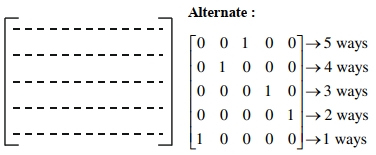
The number of square matrices of order $5$ with entries from the set $\{0, 1\}$,such that the sum of all the elements in each row is $1$ and the sum of all the elements in each column is also $1$,is
A
$225$
B
$120$
C
$150$
D
$125$
Solution
(B) square matrix of order $5$ where each row sum is $1$ and each column sum is $1$ with entries from $\{0, 1\}$ is a permutation matrix.
In the first row,there are $5$ possible positions to place the $1$.
In the second row,there are $4$ remaining positions available to place the $1$ (since the column used in the first row cannot be used again).
In the third row,there are $3$ remaining positions.
In the fourth row,there are $2$ remaining positions.
In the fifth row,there is only $1$ remaining position.
Therefore,the total number of such matrices is $5 \times 4 \times 3 \times 2 \times 1 = 5! = 120$.
In the first row,there are $5$ possible positions to place the $1$.
In the second row,there are $4$ remaining positions available to place the $1$ (since the column used in the first row cannot be used again).
In the third row,there are $3$ remaining positions.
In the fourth row,there are $2$ remaining positions.
In the fifth row,there is only $1$ remaining position.
Therefore,the total number of such matrices is $5 \times 4 \times 3 \times 2 \times 1 = 5! = 120$.
0 likes
View Solution236
DifficultMCQ
If $A = \frac{1}{2} \begin{bmatrix} 1 & \sqrt{3} \\ -\sqrt{3} & 1 \end{bmatrix}$,then :
A
$A^{30} - A^{25} = 2I$
B
$A^{30} + A^{25} + A = I$
C
$A^{30} + A^{25} - A = I$
D
$A^{30} = A^{25}$
Solution
(C) Given $A = \begin{bmatrix} \cos 60^{\circ} & \sin 60^{\circ} \\ -\sin 60^{\circ} & \cos 60^{\circ} \end{bmatrix}$.
Let $\alpha = 60^{\circ} = \frac{\pi}{3}$.
Then $A = \begin{bmatrix} \cos \alpha & \sin \alpha \\ -\sin \alpha & \cos \alpha \end{bmatrix}$.
By the property of rotation matrices,$A^n = \begin{bmatrix} \cos(n\alpha) & \sin(n\alpha) \\ -\sin(n\alpha) & \cos(n\alpha) \end{bmatrix}$.
For $A^{30}$,$n = 30$,so $n\alpha = 30 \times \frac{\pi}{3} = 10\pi$.
$A^{30} = \begin{bmatrix} \cos(10\pi) & \sin(10\pi) \\ -\sin(10\pi) & \cos(10\pi) \end{bmatrix} = \begin{bmatrix} 1 & 0 \\ 0 & 1 \end{bmatrix} = I$.
For $A^{25}$,$n = 25$,so $n\alpha = 25 \times \frac{\pi}{3} = 8\pi + \frac{\pi}{3}$.
$A^{25} = \begin{bmatrix} \cos(8\pi + \frac{\pi}{3}) & \sin(8\pi + \frac{\pi}{3}) \\ -\sin(8\pi + \frac{\pi}{3}) & \cos(8\pi + \frac{\pi}{3}) \end{bmatrix} = \begin{bmatrix} \cos(\frac{\pi}{3}) & \sin(\frac{\pi}{3}) \\ -\sin(\frac{\pi}{3}) & \cos(\frac{\pi}{3}) \end{bmatrix} = A$.
Thus,$A^{30} = I$ and $A^{25} = A$.
Checking the options: $A^{30} + A^{25} - A = I + A - A = I$. Therefore,option $C$ is correct.
Let $\alpha = 60^{\circ} = \frac{\pi}{3}$.
Then $A = \begin{bmatrix} \cos \alpha & \sin \alpha \\ -\sin \alpha & \cos \alpha \end{bmatrix}$.
By the property of rotation matrices,$A^n = \begin{bmatrix} \cos(n\alpha) & \sin(n\alpha) \\ -\sin(n\alpha) & \cos(n\alpha) \end{bmatrix}$.
For $A^{30}$,$n = 30$,so $n\alpha = 30 \times \frac{\pi}{3} = 10\pi$.
$A^{30} = \begin{bmatrix} \cos(10\pi) & \sin(10\pi) \\ -\sin(10\pi) & \cos(10\pi) \end{bmatrix} = \begin{bmatrix} 1 & 0 \\ 0 & 1 \end{bmatrix} = I$.
For $A^{25}$,$n = 25$,so $n\alpha = 25 \times \frac{\pi}{3} = 8\pi + \frac{\pi}{3}$.
$A^{25} = \begin{bmatrix} \cos(8\pi + \frac{\pi}{3}) & \sin(8\pi + \frac{\pi}{3}) \\ -\sin(8\pi + \frac{\pi}{3}) & \cos(8\pi + \frac{\pi}{3}) \end{bmatrix} = \begin{bmatrix} \cos(\frac{\pi}{3}) & \sin(\frac{\pi}{3}) \\ -\sin(\frac{\pi}{3}) & \cos(\frac{\pi}{3}) \end{bmatrix} = A$.
Thus,$A^{30} = I$ and $A^{25} = A$.
Checking the options: $A^{30} + A^{25} - A = I + A - A = I$. Therefore,option $C$ is correct.
0 likes
View Solution237
MediumMCQ
The number of symmetric matrices of order $3 \times 3$,with all the entries from the set $\{0, 1, 2, 3, 4, 5, 6, 7, 8, 9\}$,is:
A
$6^{10}$
B
$9^{10}$
C
$10^9$
D
$10^6$
Solution
(D) symmetric matrix $A$ of order $3 \times 3$ is defined as $A = A^T$.
For a $3 \times 3$ matrix,it takes the form:
$A = \begin{bmatrix} a & b & c \\ b & d & e \\ c & e & f \end{bmatrix}$
Here,the independent entries are $a, b, c, d, e,$ and $f$.
There are $6$ independent positions in the matrix that can be filled.
Each of these $6$ positions can be filled by any of the $10$ digits from the set $\{0, 1, 2, 3, 4, 5, 6, 7, 8, 9\}$.
Therefore,the total number of such symmetric matrices is $10 \times 10 \times 10 \times 10 \times 10 \times 10 = 10^6$.
For a $3 \times 3$ matrix,it takes the form:
$A = \begin{bmatrix} a & b & c \\ b & d & e \\ c & e & f \end{bmatrix}$
Here,the independent entries are $a, b, c, d, e,$ and $f$.
There are $6$ independent positions in the matrix that can be filled.
Each of these $6$ positions can be filled by any of the $10$ digits from the set $\{0, 1, 2, 3, 4, 5, 6, 7, 8, 9\}$.
Therefore,the total number of such symmetric matrices is $10 \times 10 \times 10 \times 10 \times 10 \times 10 = 10^6$.
0 likes
View Solution238
DifficultMCQ
Let $A=\begin{bmatrix} 2 & -1 \\ 1 & 1 \end{bmatrix}$. If the sum of the diagonal elements of $A^{13}$ is $3^{n}$,then $n$ is equal to ..........
A
$7$
B
$9$
C
$6$
D
$13$
Solution
(A) Given $A = \begin{bmatrix} 2 & -1 \\ 1 & 1 \end{bmatrix}$.
Calculate the characteristic equation of $A$: $|A - \lambda I| = 0$.
$\begin{vmatrix} 2-\lambda & -1 \\ 1 & 1-\lambda \end{vmatrix} = (2-\lambda)(1-\lambda) + 1 = \lambda^2 - 3\lambda + 3 = 0$.
By Cayley-Hamilton theorem,$A^2 - 3A + 3I = 0$,so $A^2 = 3A - 3I$.
We observe $A^6 = -27I = -3^3 I$.
Then $A^{12} = (A^6)^2 = (-3^3 I)^2 = 3^6 I$.
$A^{13} = A^{12} \cdot A = 3^6 A = 3^6 \begin{bmatrix} 2 & -1 \\ 1 & 1 \end{bmatrix} = \begin{bmatrix} 2 \cdot 3^6 & -3^6 \\ 3^6 & 3^6 \end{bmatrix}$.
The sum of the diagonal elements (trace) of $A^{13}$ is $2 \cdot 3^6 + 3^6 = 3 \cdot 3^6 = 3^7$.
Given the sum is $3^n$,we have $3^n = 3^7$,which implies $n = 7$.
Calculate the characteristic equation of $A$: $|A - \lambda I| = 0$.
$\begin{vmatrix} 2-\lambda & -1 \\ 1 & 1-\lambda \end{vmatrix} = (2-\lambda)(1-\lambda) + 1 = \lambda^2 - 3\lambda + 3 = 0$.
By Cayley-Hamilton theorem,$A^2 - 3A + 3I = 0$,so $A^2 = 3A - 3I$.
We observe $A^6 = -27I = -3^3 I$.
Then $A^{12} = (A^6)^2 = (-3^3 I)^2 = 3^6 I$.
$A^{13} = A^{12} \cdot A = 3^6 A = 3^6 \begin{bmatrix} 2 & -1 \\ 1 & 1 \end{bmatrix} = \begin{bmatrix} 2 \cdot 3^6 & -3^6 \\ 3^6 & 3^6 \end{bmatrix}$.
The sum of the diagonal elements (trace) of $A^{13}$ is $2 \cdot 3^6 + 3^6 = 3 \cdot 3^6 = 3^7$.
Given the sum is $3^n$,we have $3^n = 3^7$,which implies $n = 7$.
0 likes
View Solution239
DifficultMCQ
Let $M$ be a $3 \times 3$ matrix satisfying $M\begin{bmatrix} 0 \\ 1 \\ 0 \end{bmatrix} = \begin{bmatrix} -1 \\ 2 \\ 3 \end{bmatrix}$,$M\begin{bmatrix} 1 \\ -1 \\ 0 \end{bmatrix} = \begin{bmatrix} 1 \\ 1 \\ -1 \end{bmatrix}$,and $M\begin{bmatrix} 1 \\ 1 \\ 1 \end{bmatrix} = \begin{bmatrix} 0 \\ 0 \\ 12 \end{bmatrix}$. Then the sum of the diagonal entries of $M$ is
A
$9$
B
$8$
C
$7$
D
$6$
Solution
(A) Let $M = \begin{bmatrix} a & b & c \\ d & e & f \\ g & h & i \end{bmatrix}$.
From the first condition,$\begin{bmatrix} a & b & c \\ d & e & f \\ g & h & i \end{bmatrix} \begin{bmatrix} 0 \\ 1 \\ 0 \end{bmatrix} = \begin{bmatrix} b \\ e \\ h \end{bmatrix} = \begin{bmatrix} -1 \\ 2 \\ 3 \end{bmatrix}$. Thus,$b = -1, e = 2, h = 3$.
Now,$M = \begin{bmatrix} a & -1 & c \\ d & 2 & f \\ g & 3 & i \end{bmatrix}$.
From the second condition,$\begin{bmatrix} a & -1 & c \\ d & 2 & f \\ g & 3 & i \end{bmatrix} \begin{bmatrix} 1 \\ -1 \\ 0 \end{bmatrix} = \begin{bmatrix} a+1 \\ d-2 \\ g-3 \end{bmatrix} = \begin{bmatrix} 1 \\ 1 \\ -1 \end{bmatrix}$.
Solving these,we get $a+1 = 1 \Rightarrow a = 0$,$d-2 = 1 \Rightarrow d = 3$,and $g-3 = -1 \Rightarrow g = 2$.
Now,$M = \begin{bmatrix} 0 & -1 & c \\ 3 & 2 & f \\ 2 & 3 & i \end{bmatrix}$.
From the third condition,$\begin{bmatrix} 0 & -1 & c \\ 3 & 2 & f \\ 2 & 3 & i \end{bmatrix} \begin{bmatrix} 1 \\ 1 \\ 1 \end{bmatrix} = \begin{bmatrix} -1+c \\ 5+f \\ 5+i \end{bmatrix} = \begin{bmatrix} 0 \\ 0 \\ 12 \end{bmatrix}$.
From the third row,$5+i = 12 \Rightarrow i = 7$.
The sum of the diagonal entries is $a + e + i = 0 + 2 + 7 = 9$.
From the first condition,$\begin{bmatrix} a & b & c \\ d & e & f \\ g & h & i \end{bmatrix} \begin{bmatrix} 0 \\ 1 \\ 0 \end{bmatrix} = \begin{bmatrix} b \\ e \\ h \end{bmatrix} = \begin{bmatrix} -1 \\ 2 \\ 3 \end{bmatrix}$. Thus,$b = -1, e = 2, h = 3$.
Now,$M = \begin{bmatrix} a & -1 & c \\ d & 2 & f \\ g & 3 & i \end{bmatrix}$.
From the second condition,$\begin{bmatrix} a & -1 & c \\ d & 2 & f \\ g & 3 & i \end{bmatrix} \begin{bmatrix} 1 \\ -1 \\ 0 \end{bmatrix} = \begin{bmatrix} a+1 \\ d-2 \\ g-3 \end{bmatrix} = \begin{bmatrix} 1 \\ 1 \\ -1 \end{bmatrix}$.
Solving these,we get $a+1 = 1 \Rightarrow a = 0$,$d-2 = 1 \Rightarrow d = 3$,and $g-3 = -1 \Rightarrow g = 2$.
Now,$M = \begin{bmatrix} 0 & -1 & c \\ 3 & 2 & f \\ 2 & 3 & i \end{bmatrix}$.
From the third condition,$\begin{bmatrix} 0 & -1 & c \\ 3 & 2 & f \\ 2 & 3 & i \end{bmatrix} \begin{bmatrix} 1 \\ 1 \\ 1 \end{bmatrix} = \begin{bmatrix} -1+c \\ 5+f \\ 5+i \end{bmatrix} = \begin{bmatrix} 0 \\ 0 \\ 12 \end{bmatrix}$.
From the third row,$5+i = 12 \Rightarrow i = 7$.
The sum of the diagonal entries is $a + e + i = 0 + 2 + 7 = 9$.
0 likes
View Solution240
MediumMCQ
If $M = \begin{bmatrix} \frac{5}{2} & \frac{3}{2} \\ -\frac{3}{2} & -\frac{1}{2} \end{bmatrix}$,then which of the following matrices is equal to $M^{2022}$?
A
$\begin{bmatrix} 3034 & 3033 \\ -3033 & -3032 \end{bmatrix}$
B
$\begin{bmatrix} 3034 & -3033 \\ 3033 & -3032 \end{bmatrix}$
C
$\begin{bmatrix} 3033 & 3032 \\ -3032 & -3031 \end{bmatrix}$
D
$\begin{bmatrix} 3032 & 3031 \\ -3031 & -3030 \end{bmatrix}$
Solution
(A) Given $M = \begin{bmatrix} \frac{5}{2} & \frac{3}{2} \\ -\frac{3}{2} & -\frac{1}{2} \end{bmatrix}$.
We can write $M$ as $M = I + \frac{3}{2} A$,where $I = \begin{bmatrix} 1 & 0 \\ 0 & 1 \end{bmatrix}$ and $A = \begin{bmatrix} 1 & 1 \\ -1 & -1 \end{bmatrix}$.
First,calculate $A^2$:
$A^2 = \begin{bmatrix} 1 & 1 \\ -1 & -1 \end{bmatrix} \begin{bmatrix} 1 & 1 \\ -1 & -1 \end{bmatrix} = \begin{bmatrix} 1-1 & 1-1 \\ -1+1 & -1+1 \end{bmatrix} = \begin{bmatrix} 0 & 0 \\ 0 & 0 \end{bmatrix} = O$.
Since $A^2 = O$,we can use the binomial expansion for $(I + \frac{3}{2} A)^n$:
$M^n = (I + \frac{3}{2} A)^n = I^n + n(I^{n-1})(\frac{3}{2} A) + \frac{n(n-1)}{2} I^{n-2} (\frac{3}{2} A)^2 + \dots$
Since $A^2 = O$,all terms involving $A^k$ for $k \ge 2$ are zero.
Thus,$M^n = I + n \cdot \frac{3}{2} A$.
For $n = 2022$:
$M^{2022} = I + 2022 \cdot \frac{3}{2} A = I + 3033 A$.
$M^{2022} = \begin{bmatrix} 1 & 0 \\ 0 & 1 \end{bmatrix} + 3033 \begin{bmatrix} 1 & 1 \\ -1 & -1 \end{bmatrix} = \begin{bmatrix} 1+3033 & 0+3033 \\ 0-3033 & 1-3033 \end{bmatrix} = \begin{bmatrix} 3034 & 3033 \\ -3033 & -3032 \end{bmatrix}$.
We can write $M$ as $M = I + \frac{3}{2} A$,where $I = \begin{bmatrix} 1 & 0 \\ 0 & 1 \end{bmatrix}$ and $A = \begin{bmatrix} 1 & 1 \\ -1 & -1 \end{bmatrix}$.
First,calculate $A^2$:
$A^2 = \begin{bmatrix} 1 & 1 \\ -1 & -1 \end{bmatrix} \begin{bmatrix} 1 & 1 \\ -1 & -1 \end{bmatrix} = \begin{bmatrix} 1-1 & 1-1 \\ -1+1 & -1+1 \end{bmatrix} = \begin{bmatrix} 0 & 0 \\ 0 & 0 \end{bmatrix} = O$.
Since $A^2 = O$,we can use the binomial expansion for $(I + \frac{3}{2} A)^n$:
$M^n = (I + \frac{3}{2} A)^n = I^n + n(I^{n-1})(\frac{3}{2} A) + \frac{n(n-1)}{2} I^{n-2} (\frac{3}{2} A)^2 + \dots$
Since $A^2 = O$,all terms involving $A^k$ for $k \ge 2$ are zero.
Thus,$M^n = I + n \cdot \frac{3}{2} A$.
For $n = 2022$:
$M^{2022} = I + 2022 \cdot \frac{3}{2} A = I + 3033 A$.
$M^{2022} = \begin{bmatrix} 1 & 0 \\ 0 & 1 \end{bmatrix} + 3033 \begin{bmatrix} 1 & 1 \\ -1 & -1 \end{bmatrix} = \begin{bmatrix} 1+3033 & 0+3033 \\ 0-3033 & 1-3033 \end{bmatrix} = \begin{bmatrix} 3034 & 3033 \\ -3033 & -3032 \end{bmatrix}$.
0 likes
View Solution241
DifficultMCQ
Let $A = [a_{ij}]$ be a $3 \times 3$ matrix such that $A \begin{bmatrix} 0 \\ 1 \\ 0 \end{bmatrix} = \begin{bmatrix} 0 \\ 0 \\ 1 \end{bmatrix}$,$A \begin{bmatrix} 4 \\ 1 \\ 3 \end{bmatrix} = \begin{bmatrix} 0 \\ 1 \\ 0 \end{bmatrix}$,and $A \begin{bmatrix} 2 \\ 1 \\ 2 \end{bmatrix} = \begin{bmatrix} 1 \\ 0 \\ 0 \end{bmatrix}$. Then $a_{23}$ equals:
A
$-1$
B
$0$
C
$2$
D
$1$
Solution
(A) Let $A = \begin{bmatrix} a_{11} & a_{12} & a_{13} \\ a_{21} & a_{22} & a_{23} \\ a_{31} & a_{32} & a_{33} \end{bmatrix}$.
From $A \begin{bmatrix} 0 \\ 1 \\ 0 \end{bmatrix} = \begin{bmatrix} 0 \\ 0 \\ 1 \end{bmatrix}$,we get the second column of $A$ as $\begin{bmatrix} a_{12} \\ a_{22} \\ a_{32} \end{bmatrix} = \begin{bmatrix} 0 \\ 0 \\ 1 \end{bmatrix}$. Thus,$a_{12} = 0, a_{22} = 0, a_{32} = 1$.
From $A \begin{bmatrix} 4 \\ 1 \\ 3 \end{bmatrix} = \begin{bmatrix} 0 \\ 1 \\ 0 \end{bmatrix}$,the second row equation is $4a_{21} + a_{22} + 3a_{23} = 1$. Since $a_{22} = 0$,we have $4a_{21} + 3a_{23} = 1$ (Equation $1$).
From $A \begin{bmatrix} 2 \\ 1 \\ 2 \end{bmatrix} = \begin{bmatrix} 1 \\ 0 \\ 0 \end{bmatrix}$,the second row equation is $2a_{21} + a_{22} + 2a_{23} = 0$. Since $a_{22} = 0$,we have $2a_{21} + 2a_{23} = 0$,which implies $a_{21} = -a_{23}$ (Equation $2$).
Substituting Equation $2$ into Equation $1$: $4(-a_{23}) + 3a_{23} = 1 \Rightarrow -4a_{23} + 3a_{23} = 1 \Rightarrow -a_{23} = 1 \Rightarrow a_{23} = -1$.
From $A \begin{bmatrix} 0 \\ 1 \\ 0 \end{bmatrix} = \begin{bmatrix} 0 \\ 0 \\ 1 \end{bmatrix}$,we get the second column of $A$ as $\begin{bmatrix} a_{12} \\ a_{22} \\ a_{32} \end{bmatrix} = \begin{bmatrix} 0 \\ 0 \\ 1 \end{bmatrix}$. Thus,$a_{12} = 0, a_{22} = 0, a_{32} = 1$.
From $A \begin{bmatrix} 4 \\ 1 \\ 3 \end{bmatrix} = \begin{bmatrix} 0 \\ 1 \\ 0 \end{bmatrix}$,the second row equation is $4a_{21} + a_{22} + 3a_{23} = 1$. Since $a_{22} = 0$,we have $4a_{21} + 3a_{23} = 1$ (Equation $1$).
From $A \begin{bmatrix} 2 \\ 1 \\ 2 \end{bmatrix} = \begin{bmatrix} 1 \\ 0 \\ 0 \end{bmatrix}$,the second row equation is $2a_{21} + a_{22} + 2a_{23} = 0$. Since $a_{22} = 0$,we have $2a_{21} + 2a_{23} = 0$,which implies $a_{21} = -a_{23}$ (Equation $2$).
Substituting Equation $2$ into Equation $1$: $4(-a_{23}) + 3a_{23} = 1 \Rightarrow -4a_{23} + 3a_{23} = 1 \Rightarrow -a_{23} = 1 \Rightarrow a_{23} = -1$.
0 likes
View Solution242
DifficultMCQ
Let the matrix $A = \begin{bmatrix} 1 & 0 & 0 \\ 1 & 0 & 1 \\ 0 & 1 & 0 \end{bmatrix}$ satisfy $A^n = A^{n-2} + A^2 - I$ for $n \geq 3$. Then the sum of all the elements of $A^{50}$ is:
A
$53$
B
$52$
C
$39$
D
$44$
Solution
(A) Given $A^n = A^{n-2} + A^2 - I$. For $n=50$,we have $A^{50} = A^{48} + A^2 - I$.
By repeating this recurrence relation,we get $A^{50} = A^{48} + (A^2 - I) = A^{46} + 2(A^2 - I) = A^{44} + 3(A^2 - I) = \dots = A^2 + 24(A^2 - I) = 25A^2 - 24I$.
First,calculate $A^2$: $A^2 = \begin{bmatrix} 1 & 0 & 0 \\ 1 & 0 & 1 \\ 0 & 1 & 0 \end{bmatrix} \begin{bmatrix} 1 & 0 & 0 \\ 1 & 0 & 1 \\ 0 & 1 & 0 \end{bmatrix} = \begin{bmatrix} 1 & 0 & 0 \\ 1 & 1 & 0 \\ 1 & 0 & 1 \end{bmatrix}$.
Now,$A^{50} = 25 \begin{bmatrix} 1 & 0 & 0 \\ 1 & 1 & 0 \\ 1 & 0 & 1 \end{bmatrix} - 24 \begin{bmatrix} 1 & 0 & 0 \\ 0 & 1 & 0 \\ 0 & 0 & 1 \end{bmatrix} = \begin{bmatrix} 25-24 & 0 & 0 \\ 25 & 25-24 & 0 \\ 25 & 0 & 25-24 \end{bmatrix} = \begin{bmatrix} 1 & 0 & 0 \\ 25 & 1 & 0 \\ 25 & 0 & 1 \end{bmatrix}$.
The sum of all elements is $1 + 0 + 0 + 25 + 1 + 0 + 25 + 0 + 1 = 53$.
By repeating this recurrence relation,we get $A^{50} = A^{48} + (A^2 - I) = A^{46} + 2(A^2 - I) = A^{44} + 3(A^2 - I) = \dots = A^2 + 24(A^2 - I) = 25A^2 - 24I$.
First,calculate $A^2$: $A^2 = \begin{bmatrix} 1 & 0 & 0 \\ 1 & 0 & 1 \\ 0 & 1 & 0 \end{bmatrix} \begin{bmatrix} 1 & 0 & 0 \\ 1 & 0 & 1 \\ 0 & 1 & 0 \end{bmatrix} = \begin{bmatrix} 1 & 0 & 0 \\ 1 & 1 & 0 \\ 1 & 0 & 1 \end{bmatrix}$.
Now,$A^{50} = 25 \begin{bmatrix} 1 & 0 & 0 \\ 1 & 1 & 0 \\ 1 & 0 & 1 \end{bmatrix} - 24 \begin{bmatrix} 1 & 0 & 0 \\ 0 & 1 & 0 \\ 0 & 0 & 1 \end{bmatrix} = \begin{bmatrix} 25-24 & 0 & 0 \\ 25 & 25-24 & 0 \\ 25 & 0 & 25-24 \end{bmatrix} = \begin{bmatrix} 1 & 0 & 0 \\ 25 & 1 & 0 \\ 25 & 0 & 1 \end{bmatrix}$.
The sum of all elements is $1 + 0 + 0 + 25 + 1 + 0 + 25 + 0 + 1 = 53$.
0 likes
View Solution243
EasyMCQ
If $A = \begin{bmatrix} 1 & 0 \\ -1 & 7 \end{bmatrix}$,$I = \begin{bmatrix} 1 & 0 \\ 0 & 1 \end{bmatrix}$ and $A^{2} = 8A + kI$,then the value of $k$ is
A
$1/7$
B
$-1/7$
C
$-7$
D
$7$
Solution
(C) First,we calculate $A^{2}$:
$A^{2} = A \times A = \begin{bmatrix} 1 & 0 \\ -1 & 7 \end{bmatrix} \begin{bmatrix} 1 & 0 \\ -1 & 7 \end{bmatrix} = \begin{bmatrix} (1)(1) + (0)(-1) & (1)(0) + (0)(7) \\ (-1)(1) + (7)(-1) & (-1)(0) + (7)(7) \end{bmatrix} = \begin{bmatrix} 1 & 0 \\ -8 & 49 \end{bmatrix}$
Given the equation $A^{2} = 8A + kI$,we substitute the matrices:
$\begin{bmatrix} 1 & 0 \\ -8 & 49 \end{bmatrix} = 8 \begin{bmatrix} 1 & 0 \\ -1 & 7 \end{bmatrix} + k \begin{bmatrix} 1 & 0 \\ 0 & 1 \end{bmatrix}$
$\begin{bmatrix} 1 & 0 \\ -8 & 49 \end{bmatrix} = \begin{bmatrix} 8 & 0 \\ -8 & 56 \end{bmatrix} + \begin{bmatrix} k & 0 \\ 0 & k \end{bmatrix}$
$\begin{bmatrix} 1 & 0 \\ -8 & 49 \end{bmatrix} = \begin{bmatrix} 8 + k & 0 \\ -8 & 56 + k \end{bmatrix}$
By comparing the corresponding elements,we get:
$8 + k = 1 \Rightarrow k = 1 - 8 = -7$
Also,$56 + k = 49 \Rightarrow k = 49 - 56 = -7$
Thus,the value of $k$ is $-7$.
$A^{2} = A \times A = \begin{bmatrix} 1 & 0 \\ -1 & 7 \end{bmatrix} \begin{bmatrix} 1 & 0 \\ -1 & 7 \end{bmatrix} = \begin{bmatrix} (1)(1) + (0)(-1) & (1)(0) + (0)(7) \\ (-1)(1) + (7)(-1) & (-1)(0) + (7)(7) \end{bmatrix} = \begin{bmatrix} 1 & 0 \\ -8 & 49 \end{bmatrix}$
Given the equation $A^{2} = 8A + kI$,we substitute the matrices:
$\begin{bmatrix} 1 & 0 \\ -8 & 49 \end{bmatrix} = 8 \begin{bmatrix} 1 & 0 \\ -1 & 7 \end{bmatrix} + k \begin{bmatrix} 1 & 0 \\ 0 & 1 \end{bmatrix}$
$\begin{bmatrix} 1 & 0 \\ -8 & 49 \end{bmatrix} = \begin{bmatrix} 8 & 0 \\ -8 & 56 \end{bmatrix} + \begin{bmatrix} k & 0 \\ 0 & k \end{bmatrix}$
$\begin{bmatrix} 1 & 0 \\ -8 & 49 \end{bmatrix} = \begin{bmatrix} 8 + k & 0 \\ -8 & 56 + k \end{bmatrix}$
By comparing the corresponding elements,we get:
$8 + k = 1 \Rightarrow k = 1 - 8 = -7$
Also,$56 + k = 49 \Rightarrow k = 49 - 56 = -7$
Thus,the value of $k$ is $-7$.
0 likes
View Solution244
EasyMCQ
If $A = \begin{bmatrix} 2 & 0 & 0 \\ 0 & -2 & 0 \\ 0 & 0 & -1 \end{bmatrix}$,then $A^4 A^{-1} = $
A
$\begin{bmatrix} 8 & 0 & 0 \\ 0 & -8 & 0 \\ 0 & 0 & -1 \end{bmatrix}$
B
$\begin{bmatrix} 8 & 0 & 0 \\ 0 & 8 & 0 \\ 0 & 0 & 1 \end{bmatrix}$
C
$\begin{bmatrix} \frac{1}{2} & 0 & 0 \\ 0 & -\frac{1}{2} & 0 \\ 0 & 0 & -1 \end{bmatrix}$
D
$\begin{bmatrix} -4 & 0 & 0 \\ 0 & 4 & 0 \\ 0 & 0 & -1 \end{bmatrix}$
Solution
(A) We know that $A^4 A^{-1} = A^{4-1} = A^3$.
Since $A$ is a diagonal matrix,$A^n = \begin{bmatrix} a_{11}^n & 0 & 0 \\ 0 & a_{22}^n & 0 \\ 0 & 0 & a_{33}^n \end{bmatrix}$.
Given $A = \begin{bmatrix} 2 & 0 & 0 \\ 0 & -2 & 0 \\ 0 & 0 & -1 \end{bmatrix}$,we calculate $A^3$:
$A^3 = \begin{bmatrix} 2^3 & 0 & 0 \\ 0 & (-2)^3 & 0 \\ 0 & 0 & (-1)^3 \end{bmatrix} = \begin{bmatrix} 8 & 0 & 0 \\ 0 & -8 & 0 \\ 0 & 0 & -1 \end{bmatrix}$.
Thus,$A^4 A^{-1} = \begin{bmatrix} 8 & 0 & 0 \\ 0 & -8 & 0 \\ 0 & 0 & -1 \end{bmatrix}$.
Since $A$ is a diagonal matrix,$A^n = \begin{bmatrix} a_{11}^n & 0 & 0 \\ 0 & a_{22}^n & 0 \\ 0 & 0 & a_{33}^n \end{bmatrix}$.
Given $A = \begin{bmatrix} 2 & 0 & 0 \\ 0 & -2 & 0 \\ 0 & 0 & -1 \end{bmatrix}$,we calculate $A^3$:
$A^3 = \begin{bmatrix} 2^3 & 0 & 0 \\ 0 & (-2)^3 & 0 \\ 0 & 0 & (-1)^3 \end{bmatrix} = \begin{bmatrix} 8 & 0 & 0 \\ 0 & -8 & 0 \\ 0 & 0 & -1 \end{bmatrix}$.
Thus,$A^4 A^{-1} = \begin{bmatrix} 8 & 0 & 0 \\ 0 & -8 & 0 \\ 0 & 0 & -1 \end{bmatrix}$.
0 likes
View Solution245
EasyMCQ
If $A^2 = A$ is a square matrix such that $(I - A)^n = I - A$ for $n \geq 1$,then what is the value of $(I + A)^2 - 3A$?
A
$I + 2A$
B
$I - A$
C
$I$
D
$I + A$
Solution
(C) Given that $A^2 = A$ (idempotent matrix).
We need to evaluate $(I + A)^2 - 3A$.
Expanding the expression: $(I + A)^2 = I^2 + IA + AI + A^2 = I + A + A + A^2 = I + 2A + A^2$.
Since $A^2 = A$,we substitute it into the expression: $I + 2A + A = I + 3A$.
Now,subtract $3A$: $(I + 3A) - 3A = I$.
Therefore,the correct option is $C$.
We need to evaluate $(I + A)^2 - 3A$.
Expanding the expression: $(I + A)^2 = I^2 + IA + AI + A^2 = I + A + A + A^2 = I + 2A + A^2$.
Since $A^2 = A$,we substitute it into the expression: $I + 2A + A = I + 3A$.
Now,subtract $3A$: $(I + 3A) - 3A = I$.
Therefore,the correct option is $C$.
0 likes
View Solution246
EasyMCQ
If $A = \begin{vmatrix} 0 & 0 & -1 \\ 0 & -1 & 0 \\ -1 & 0 & 0 \end{vmatrix}$,then $1 + A^2 =$ . . . . . . .
A
$I + A$
B
$0$
C
$A$
D
$2I$
Solution
(D) Given the matrix $A = \begin{bmatrix} 0 & 0 & -1 \\ 0 & -1 & 0 \\ -1 & 0 & 0 \end{bmatrix}$.
First,we calculate $A^2 = A \times A$:
$A^2 = \begin{bmatrix} 0 & 0 & -1 \\ 0 & -1 & 0 \\ -1 & 0 & 0 \end{bmatrix} \begin{bmatrix} 0 & 0 & -1 \\ 0 & -1 & 0 \\ -1 & 0 & 0 \end{bmatrix}$
Performing matrix multiplication:
Row $1$: $(0)(0) + (0)(0) + (-1)(-1) = 1$,$(0)(0) + (0)(-1) + (-1)(0) = 0$,$(0)(-1) + (0)(0) + (-1)(0) = 0$
Row $2$: $(0)(0) + (-1)(0) + (0)(-1) = 0$,$(0)(0) + (-1)(-1) + (0)(0) = 1$,$(0)(-1) + (-1)(0) + (0)(0) = 0$
Row $3$: $(-1)(0) + (0)(0) + (0)(-1) = 0$,$(-1)(0) + (0)(-1) + (0)(0) = 0$,$(-1)(-1) + (0)(0) + (0)(0) = 1$
Thus,$A^2 = \begin{bmatrix} 1 & 0 & 0 \\ 0 & 1 & 0 \\ 0 & 0 & 1 \end{bmatrix} = I$.
Now,we calculate $I + A^2 = I + I = 2I$.
First,we calculate $A^2 = A \times A$:
$A^2 = \begin{bmatrix} 0 & 0 & -1 \\ 0 & -1 & 0 \\ -1 & 0 & 0 \end{bmatrix} \begin{bmatrix} 0 & 0 & -1 \\ 0 & -1 & 0 \\ -1 & 0 & 0 \end{bmatrix}$
Performing matrix multiplication:
Row $1$: $(0)(0) + (0)(0) + (-1)(-1) = 1$,$(0)(0) + (0)(-1) + (-1)(0) = 0$,$(0)(-1) + (0)(0) + (-1)(0) = 0$
Row $2$: $(0)(0) + (-1)(0) + (0)(-1) = 0$,$(0)(0) + (-1)(-1) + (0)(0) = 1$,$(0)(-1) + (-1)(0) + (0)(0) = 0$
Row $3$: $(-1)(0) + (0)(0) + (0)(-1) = 0$,$(-1)(0) + (0)(-1) + (0)(0) = 0$,$(-1)(-1) + (0)(0) + (0)(0) = 1$
Thus,$A^2 = \begin{bmatrix} 1 & 0 & 0 \\ 0 & 1 & 0 \\ 0 & 0 & 1 \end{bmatrix} = I$.
Now,we calculate $I + A^2 = I + I = 2I$.
0 likes
View Solution247
EasyMCQ
The value of $\cos \alpha$ is . . . . . . if $A+A^{\prime}=I$,where $A = \begin{bmatrix} \sin \alpha & -\cos \alpha \\ \cos \alpha & \sin \alpha \end{bmatrix}$.
A
$\frac{\sqrt{3}}{2}$
B
$\frac{1}{2}$
C
$-1$
D
$0$
Solution
(A) Given $A = \begin{bmatrix} \sin \alpha & -\cos \alpha \\ \cos \alpha & \sin \alpha \end{bmatrix}$.
Then,the transpose $A^{\prime} = \begin{bmatrix} \sin \alpha & \cos \alpha \\ -\cos \alpha & \sin \alpha \end{bmatrix}$.
Given the condition $A+A^{\prime} = I$,where $I = \begin{bmatrix} 1 & 0 \\ 0 & 1 \end{bmatrix}$.
Adding $A$ and $A^{\prime}$:
$A+A^{\prime} = \begin{bmatrix} \sin \alpha + \sin \alpha & -\cos \alpha + \cos \alpha \\ \cos \alpha - \cos \alpha & \sin \alpha + \sin \alpha \end{bmatrix} = \begin{bmatrix} 2\sin \alpha & 0 \\ 0 & 2\sin \alpha \end{bmatrix}$.
Equating this to the identity matrix $I$:
$\begin{bmatrix} 2\sin \alpha & 0 \\ 0 & 2\sin \alpha \end{bmatrix} = \begin{bmatrix} 1 & 0 \\ 0 & 1 \end{bmatrix}$.
This implies $2\sin \alpha = 1$,so $\sin \alpha = \frac{1}{2}$.
Since $\sin^2 \alpha + \cos^2 \alpha = 1$,we have $\cos^2 \alpha = 1 - \sin^2 \alpha = 1 - (\frac{1}{2})^2 = 1 - \frac{1}{4} = \frac{3}{4}$.
Therefore,$\cos \alpha = \pm \frac{\sqrt{3}}{2}$.
Looking at the options,$\frac{\sqrt{3}}{2}$ is provided.
Then,the transpose $A^{\prime} = \begin{bmatrix} \sin \alpha & \cos \alpha \\ -\cos \alpha & \sin \alpha \end{bmatrix}$.
Given the condition $A+A^{\prime} = I$,where $I = \begin{bmatrix} 1 & 0 \\ 0 & 1 \end{bmatrix}$.
Adding $A$ and $A^{\prime}$:
$A+A^{\prime} = \begin{bmatrix} \sin \alpha + \sin \alpha & -\cos \alpha + \cos \alpha \\ \cos \alpha - \cos \alpha & \sin \alpha + \sin \alpha \end{bmatrix} = \begin{bmatrix} 2\sin \alpha & 0 \\ 0 & 2\sin \alpha \end{bmatrix}$.
Equating this to the identity matrix $I$:
$\begin{bmatrix} 2\sin \alpha & 0 \\ 0 & 2\sin \alpha \end{bmatrix} = \begin{bmatrix} 1 & 0 \\ 0 & 1 \end{bmatrix}$.
This implies $2\sin \alpha = 1$,so $\sin \alpha = \frac{1}{2}$.
Since $\sin^2 \alpha + \cos^2 \alpha = 1$,we have $\cos^2 \alpha = 1 - \sin^2 \alpha = 1 - (\frac{1}{2})^2 = 1 - \frac{1}{4} = \frac{3}{4}$.
Therefore,$\cos \alpha = \pm \frac{\sqrt{3}}{2}$.
Looking at the options,$\frac{\sqrt{3}}{2}$ is provided.
0 likes
View Solution248
EasyMCQ
If $A = \begin{bmatrix} 0 & 0 & -5 \\ 0 & -5 & 0 \\ -5 & 0 & 0 \end{bmatrix}$,then $A^2 =$ . . . . . . .
A
$25 I$
B
$-5 I$
C
$25 A$
D
$5 A$
Solution
(A) Given $A = \begin{bmatrix} 0 & 0 & -5 \\ 0 & -5 & 0 \\ -5 & 0 & 0 \end{bmatrix}$.
We need to calculate $A^2 = A \times A$.
$A^2 = \begin{bmatrix} 0 & 0 & -5 \\ 0 & -5 & 0 \\ -5 & 0 & 0 \end{bmatrix} \begin{bmatrix} 0 & 0 & -5 \\ 0 & -5 & 0 \\ -5 & 0 & 0 \end{bmatrix}$.
Performing matrix multiplication:
Row $1$: $(0)(0) + (0)(0) + (-5)(-5) = 25$,$(0)(0) + (0)(-5) + (-5)(0) = 0$,$(0)(-5) + (0)(0) + (-5)(0) = 0$.
Row $2$: $(0)(0) + (-5)(0) + (0)(-5) = 0$,$(0)(0) + (-5)(-5) + (0)(0) = 25$,$(0)(-5) + (-5)(0) + (0)(0) = 0$.
Row $3$: $(-5)(0) + (0)(0) + (0)(-5) = 0$,$(-5)(0) + (0)(-5) + (0)(0) = 0$,$(-5)(-5) + (0)(0) + (0)(0) = 25$.
Thus,$A^2 = \begin{bmatrix} 25 & 0 & 0 \\ 0 & 25 & 0 \\ 0 & 0 & 25 \end{bmatrix} = 25 \begin{bmatrix} 1 & 0 & 0 \\ 0 & 1 & 0 \\ 0 & 0 & 1 \end{bmatrix} = 25 I$.
Therefore,the correct option is $A$.
We need to calculate $A^2 = A \times A$.
$A^2 = \begin{bmatrix} 0 & 0 & -5 \\ 0 & -5 & 0 \\ -5 & 0 & 0 \end{bmatrix} \begin{bmatrix} 0 & 0 & -5 \\ 0 & -5 & 0 \\ -5 & 0 & 0 \end{bmatrix}$.
Performing matrix multiplication:
Row $1$: $(0)(0) + (0)(0) + (-5)(-5) = 25$,$(0)(0) + (0)(-5) + (-5)(0) = 0$,$(0)(-5) + (0)(0) + (-5)(0) = 0$.
Row $2$: $(0)(0) + (-5)(0) + (0)(-5) = 0$,$(0)(0) + (-5)(-5) + (0)(0) = 25$,$(0)(-5) + (-5)(0) + (0)(0) = 0$.
Row $3$: $(-5)(0) + (0)(0) + (0)(-5) = 0$,$(-5)(0) + (0)(-5) + (0)(0) = 0$,$(-5)(-5) + (0)(0) + (0)(0) = 25$.
Thus,$A^2 = \begin{bmatrix} 25 & 0 & 0 \\ 0 & 25 & 0 \\ 0 & 0 & 25 \end{bmatrix} = 25 \begin{bmatrix} 1 & 0 & 0 \\ 0 & 1 & 0 \\ 0 & 0 & 1 \end{bmatrix} = 25 I$.
Therefore,the correct option is $A$.
0 likes
View Solution249
EasyMCQ
If $A = [2]$ and $B = \begin{bmatrix} 3 \\ 4 \end{bmatrix}$,then $(BA)' = $ . . . . . . .
A
$[3 \quad 4]$
B
$\begin{bmatrix} 3 & 6 \\ 4 & 8 \end{bmatrix}$
C
$\begin{bmatrix} 4 & 8 \\ 6 & 3 \end{bmatrix}$
D
$\begin{bmatrix} 3 & 4 \\ 6 & 8 \end{bmatrix}$
Solution
(D) Given $A = [2]$ and $B = \begin{bmatrix} 3 \\ 4 \end{bmatrix}$.
First,calculate the product $BA$:
$BA = \begin{bmatrix} 3 \\ 4 \end{bmatrix} [2] = \begin{bmatrix} 3 \times 2 \\ 4 \times 2 \end{bmatrix} = \begin{bmatrix} 6 \\ 8 \end{bmatrix}$.
Now,find the transpose $(BA)'$:
$(BA)' = \begin{bmatrix} 6 & 8 \end{bmatrix}$.
Note: Based on the provided options,there seems to be a typo in the original question's matrix $A$. If $A = [2]$,the result is $[6 \quad 8]$. If the question intended $B = \begin{bmatrix} 3 \\ 4 \end{bmatrix}$ and $A = [1 \quad 2]$,then $BA = \begin{bmatrix} 3 \\ 4 \end{bmatrix} [1 \quad 2] = \begin{bmatrix} 3 & 6 \\ 4 & 8 \end{bmatrix}$.
Then $(BA)' = \begin{bmatrix} 3 & 4 \\ 6 & 8 \end{bmatrix}$,which matches option $D$.
First,calculate the product $BA$:
$BA = \begin{bmatrix} 3 \\ 4 \end{bmatrix} [2] = \begin{bmatrix} 3 \times 2 \\ 4 \times 2 \end{bmatrix} = \begin{bmatrix} 6 \\ 8 \end{bmatrix}$.
Now,find the transpose $(BA)'$:
$(BA)' = \begin{bmatrix} 6 & 8 \end{bmatrix}$.
Note: Based on the provided options,there seems to be a typo in the original question's matrix $A$. If $A = [2]$,the result is $[6 \quad 8]$. If the question intended $B = \begin{bmatrix} 3 \\ 4 \end{bmatrix}$ and $A = [1 \quad 2]$,then $BA = \begin{bmatrix} 3 \\ 4 \end{bmatrix} [1 \quad 2] = \begin{bmatrix} 3 & 6 \\ 4 & 8 \end{bmatrix}$.
Then $(BA)' = \begin{bmatrix} 3 & 4 \\ 6 & 8 \end{bmatrix}$,which matches option $D$.
0 likes
View Solution250
EasyMCQ
If $A = \begin{bmatrix} 1 & 1 \\ 0 & 1 \end{bmatrix}$ and $B = \begin{bmatrix} x & y \\ 0 & x \end{bmatrix}$,then $AB = BA$ (given $B \neq I$). Which of the following matrices $B$ satisfies this condition?
A
$\begin{bmatrix} x & y \\ 0 & x \end{bmatrix}$
B
$\begin{bmatrix} x & y \\ 0 & y \end{bmatrix}$
C
$\begin{bmatrix} x & x \\ y & 0 \end{bmatrix}$
D
$\begin{bmatrix} x & 0 \\ y & y \end{bmatrix}$
Solution
(A) Let $A = \begin{bmatrix} 1 & 1 \\ 0 & 1 \end{bmatrix}$ and $B = \begin{bmatrix} x & y \\ 0 & x \end{bmatrix}$.
First,calculate $AB$:
$AB = \begin{bmatrix} 1 & 1 \\ 0 & 1 \end{bmatrix} \begin{bmatrix} x & y \\ 0 & x \end{bmatrix} = \begin{bmatrix} 1(x) + 1(0) & 1(y) + 1(x) \\ 0(x) + 1(0) & 0(y) + 1(x) \end{bmatrix} = \begin{bmatrix} x & x+y \\ 0 & x \end{bmatrix}$.
Next,calculate $BA$:
$BA = \begin{bmatrix} x & y \\ 0 & x \end{bmatrix} \begin{bmatrix} 1 & 1 \\ 0 & 1 \end{bmatrix} = \begin{bmatrix} x(1) + y(0) & x(1) + y(1) \\ 0(1) + x(0) & 0(1) + x(1) \end{bmatrix} = \begin{bmatrix} x & x+y \\ 0 & x \end{bmatrix}$.
Since $AB = BA$ for any $x, y$,the matrix $B$ must be of the form $\begin{bmatrix} x & y \\ 0 & x \end{bmatrix}$.
Thus,option $A$ is the correct choice.
First,calculate $AB$:
$AB = \begin{bmatrix} 1 & 1 \\ 0 & 1 \end{bmatrix} \begin{bmatrix} x & y \\ 0 & x \end{bmatrix} = \begin{bmatrix} 1(x) + 1(0) & 1(y) + 1(x) \\ 0(x) + 1(0) & 0(y) + 1(x) \end{bmatrix} = \begin{bmatrix} x & x+y \\ 0 & x \end{bmatrix}$.
Next,calculate $BA$:
$BA = \begin{bmatrix} x & y \\ 0 & x \end{bmatrix} \begin{bmatrix} 1 & 1 \\ 0 & 1 \end{bmatrix} = \begin{bmatrix} x(1) + y(0) & x(1) + y(1) \\ 0(1) + x(0) & 0(1) + x(1) \end{bmatrix} = \begin{bmatrix} x & x+y \\ 0 & x \end{bmatrix}$.
Since $AB = BA$ for any $x, y$,the matrix $B$ must be of the form $\begin{bmatrix} x & y \\ 0 & x \end{bmatrix}$.
Thus,option $A$ is the correct choice.
0 likes
View Solution3 and 4 .Determinants and Matrices — Types of matrices, Algebra of matrices · Frequently Asked Questions
1Are these 3 and 4 .Determinants and Matrices questions useful for JEE and NEET?
Yes. All questions in this section are mapped to JEE Main and NEET exam patterns. Previous year questions from JEE Main, NEET, GUJCET and state-level exams are included with full solutions.
2Can I switch to Hindi or Gujarati for these questions?
Yes. Use the language tabs in the hero section or the sidebar to view the same questions and solutions in English, Hindi or Gujarati.
3How do I generate a question paper from this subtopic?
Use the Vedclass Exam Paper Generator — select the chapter and subtopic, set difficulty, and generate Sets A, B, C, D automatically. First 3 chapters of every subject are free.
Vedclass Products
For Students
Vedclass Test Series
Mock tests in real JEE/NEET style with performance analysis. 5-day free trial.
Start Free TrialFor Teachers
Exam Paper Generator
Generate Set A/B/C/D papers from this chapter in 2 minutes. 3 chapters free.
Try FreeFor Institutes
Online Exam Module
Live online exams with unlimited students, 360° analytics & white-label branding.
See DemoFor Teachers & Institutes
Generate a 3 and 4 .Determinants and Matrices Exam Paper in 2 Minutes
Select subtopic & difficulty — Sets A, B, C, D auto-generated with No Repeat logic.
First 3 chapters of every subject are free — no payment required.