
A English
Colloids, Emulsion, Gel and Their properties with application Questions in English
Class 12 Chemistry · Surface Chemistry · Colloids, Emulsion, Gel and Their properties with application
886+
Questions
English
Language
100%
With Solutions
Showing 48 of 886 questions in English
351
EasyMCQ
Milk is an example of
A
Pure solution
B
Gel
C
Emulsion
D
Suspension
Solution
(C) Milk is an example of an emulsion,which is a colloidal system where liquid fat globules are dispersed in water.
0 likes
View Solution352
MediumMCQ
The coagulation values in millimoles per litre of the electrolytes used for the coagulation of $As_2S_3$ are given below:
$I$. $(NaCl) = 52,$
$II$. $(BaCl_2) = 0.69,$
$III$. $(MgSO_4) = 0.22$
The correct order of their coagulating power is:
$I$. $(NaCl) = 52,$
$II$. $(BaCl_2) = 0.69,$
$III$. $(MgSO_4) = 0.22$
The correct order of their coagulating power is:
A
$I > II > III$
B
$II > I > III$
C
$III > II > I$
D
$III > I > II$
Solution
(C) Coagulation power $\propto \frac{1}{\text{Coagulation value}}$
Lower the coagulation value,higher is the coagulating power of the electrolyte.
Given values:
$I (NaCl) = 52$
$II (BaCl_2) = 0.69$
$III (MgSO_4) = 0.22$
Comparing the values: $0.22 < 0.69 < 52$
Therefore,the order of coagulating power is: $III > II > I$.
Lower the coagulation value,higher is the coagulating power of the electrolyte.
Given values:
$I (NaCl) = 52$
$II (BaCl_2) = 0.69$
$III (MgSO_4) = 0.22$
Comparing the values: $0.22 < 0.69 < 52$
Therefore,the order of coagulating power is: $III > II > I$.
0 likes
View Solution353
EasyMCQ
Fog is a colloidal solution of
A
solid in gas
B
gas in gas
C
liquid in gas
D
gas in liquid
Solution
(C) Fog is a colloidal solution of liquid in a gas,in which the liquid is the dispersed phase and the gas is the dispersion medium.
0 likes
View Solution354
EasyMCQ
Which property of colloidal solution is independent of charge on the colloidal particles?
A
Electro-osmosis
B
Tyndall effect
C
Coagulation
D
Electrophoresis
Solution
(B) The $Tyndall \ effect$ is independent of the charge on the colloidal particles.
It is an optical property that depends on the size of the colloidal particles and the wavelength of light used.
The $Tyndall \ effect$,also known as $Tyndall \ scattering$,is the scattering of light by particles in a colloid or a fine suspension.
In contrast,$electro-osmosis$,$coagulation$,and $electrophoresis$ are electrical properties that directly depend on the charge present on the colloidal particles.
It is an optical property that depends on the size of the colloidal particles and the wavelength of light used.
The $Tyndall \ effect$,also known as $Tyndall \ scattering$,is the scattering of light by particles in a colloid or a fine suspension.
In contrast,$electro-osmosis$,$coagulation$,and $electrophoresis$ are electrical properties that directly depend on the charge present on the colloidal particles.
0 likes
View Solution355
EasyMCQ
Which property of colloids is not dependent on the charge on colloidal particles?
A
Coagulation
B
Electrophoresis
C
Electro-osmosis
D
Tyndall effect
Solution
(D) The $Tyndall \ effect$ is an optical phenomenon that occurs due to the scattering of light by colloidal particles.
It depends on the size of the particles and the refractive index difference between the dispersed phase and the dispersion medium,but it is independent of the charge on the particles.
In contrast,$Coagulation$,$Electrophoresis$,and $Electro-osmosis$ are all properties that depend on the electrical charge of the colloidal particles.
It depends on the size of the particles and the refractive index difference between the dispersed phase and the dispersion medium,but it is independent of the charge on the particles.
In contrast,$Coagulation$,$Electrophoresis$,and $Electro-osmosis$ are all properties that depend on the electrical charge of the colloidal particles.
0 likes
View Solution356
MediumMCQ
The protecting power of lyophilic colloidal sol is expressed in terms of
A
coagulation value
B
gold number
C
critical micelle concentration
D
oxidation number
Solution
(B) Lyophilic sols are stabilized by adding lyophilic colloids,which protect them from precipitation. These are called protecting colloids.
Their protecting power is expressed in terms of $gold \ number$.
$Gold \ number$ is defined as the minimum amount of lyophilic colloid in milligrams that prevents the flocculation of $10 \ mL$ of gold sol by the addition of $1 \ mL$ of $10 \ \% \ NaCl$ solution.
Lesser the $gold \ number$,higher is the protecting power.
Their protecting power is expressed in terms of $gold \ number$.
$Gold \ number$ is defined as the minimum amount of lyophilic colloid in milligrams that prevents the flocculation of $10 \ mL$ of gold sol by the addition of $1 \ mL$ of $10 \ \% \ NaCl$ solution.
Lesser the $gold \ number$,higher is the protecting power.
0 likes
View Solution357
MediumMCQ
The coagulating power of electrolytes having ions $Na^{+}$,$Ba^{2+}$ and $Al^{3+}$ for arsenic sulphide sol increases in the order:
A
$Al^{3+} < Ba^{2+} < Na^{+}$
B
$Na^{+} < Ba^{2+} < Al^{3+}$
C
$Ba^{2+} < Na^{+} < Al^{3+}$
D
$Al^{3+} < Na^{+} < Ba^{2+}$
Solution
(B) According to the Hardy-Schulze rule,the coagulating power of an ion is directly proportional to the magnitude of its charge for a given sol.
Arsenic sulphide $(As_2S_3)$ sol is a negatively charged sol.
Therefore,the coagulating power depends on the charge of the cation.
The charges on the given ions are $+1$ for $Na^{+}$,$+2$ for $Ba^{2+}$,and $+3$ for $Al^{3+}$.
Thus,the increasing order of coagulating power is $Na^{+} < Ba^{2+} < Al^{3+}$.
Arsenic sulphide $(As_2S_3)$ sol is a negatively charged sol.
Therefore,the coagulating power depends on the charge of the cation.
The charges on the given ions are $+1$ for $Na^{+}$,$+2$ for $Ba^{2+}$,and $+3$ for $Al^{3+}$.
Thus,the increasing order of coagulating power is $Na^{+} < Ba^{2+} < Al^{3+}$.
0 likes
View Solution358
MediumMCQ
The Tyndall effect is observed only when the following conditions are satisfied $:$
$1$. The diameter of the dispersed particles is much smaller than the wavelength of the light used.
$2$. The diameter of the dispersed particle is not much smaller than the wavelength of the light used.
$3$. The refractive indices of the dispersed phase and dispersion medium are almost similar in magnitude.
$4$. The refractive indices of the dispersed phase and dispersion medium differ greatly in magnitude.
$1$. The diameter of the dispersed particles is much smaller than the wavelength of the light used.
$2$. The diameter of the dispersed particle is not much smaller than the wavelength of the light used.
$3$. The refractive indices of the dispersed phase and dispersion medium are almost similar in magnitude.
$4$. The refractive indices of the dispersed phase and dispersion medium differ greatly in magnitude.
A
$1$ and $4$
B
$2$ and $4$
C
$1$ and $3$
D
$2$ and $3$
Solution
(B) The Tyndall effect is an optical phenomenon observed in colloidal systems.
The two essential conditions for the observation of the Tyndall effect are:
$1$. The diameter of the dispersed particles is not much smaller than the wavelength of the light used.
$2$. The refractive indices of the dispersed phase and the dispersion medium differ greatly in magnitude.
Thus,conditions $2$ and $4$ are correct.
The two essential conditions for the observation of the Tyndall effect are:
$1$. The diameter of the dispersed particles is not much smaller than the wavelength of the light used.
$2$. The refractive indices of the dispersed phase and the dispersion medium differ greatly in magnitude.
Thus,conditions $2$ and $4$ are correct.
0 likes
View Solution359
MediumMCQ
$Fe(OH)_3$ sol is prepared by the hydrolysis of $FeCl_3$ in hot water. If the sol is electrolysed using inert electrodes,the only correct statement is -
A
Coagulation will occur near anode
B
$Cl_2$ gas may be cathode product
C
$H_2$ gas may be anode product
D
$O_2$ gas may be anode product
Solution
(D) $Fe(OH)_3$ sol particles are positively charged due to the adsorption of $Fe^{3+}$ ions.
During electrolysis,these positively charged sol particles migrate towards the cathode.
At the cathode,they lose their charge and undergo coagulation.
At the anode,the oxidation of water occurs,producing $O_2$ gas: $2H_2O \rightarrow O_2 + 4H^+ + 4e^-$.
Therefore,$O_2$ gas is the anode product.
During electrolysis,these positively charged sol particles migrate towards the cathode.
At the cathode,they lose their charge and undergo coagulation.
At the anode,the oxidation of water occurs,producing $O_2$ gas: $2H_2O \rightarrow O_2 + 4H^+ + 4e^-$.
Therefore,$O_2$ gas is the anode product.
0 likes
View Solution360
MediumMCQ
In which of the following colloidal solutions is the dispersed phase liquid while the dispersion medium is gas?
A
Cloud
B
Smoke
C
Milk
D
Dust
Solution
(A) colloidal system is classified based on the physical state of the dispersed phase and the dispersion medium.
When a liquid is dispersed in a gas,the resulting colloid is known as an aerosol (specifically fog or cloud).
- $A$: Cloud is a liquid in gas $(L/G)$ type colloid.
- $B$: Smoke is a solid in gas $(S/G)$ type colloid.
- $C$: Milk is a liquid in liquid $(L/L)$ type colloid (emulsion).
- $D$: Dust is a solid in gas $(S/G)$ type colloid.
Therefore,the correct option is $A$.
When a liquid is dispersed in a gas,the resulting colloid is known as an aerosol (specifically fog or cloud).
- $A$: Cloud is a liquid in gas $(L/G)$ type colloid.
- $B$: Smoke is a solid in gas $(S/G)$ type colloid.
- $C$: Milk is a liquid in liquid $(L/L)$ type colloid (emulsion).
- $D$: Dust is a solid in gas $(S/G)$ type colloid.
Therefore,the correct option is $A$.
0 likes
View Solution361
MediumMCQ
Which of the following ions will be most effective in coagulating the $As_2S_3$ sol?
A
$Fe^{3+}$
B
$Ba^{2+}$
C
$Cl^{-}$
D
$PO_4^{3-}$
Solution
(A) The $As_2S_3$ sol is a negatively charged sol.
According to the Hardy-Schulze rule,the coagulating power of an ion is directly proportional to the magnitude of its charge (valency) for ions carrying a charge opposite to that of the colloidal particles.
Since $As_2S_3$ is negatively charged,it is coagulated by positively charged ions (cations).
Among the given cations,$Fe^{3+}$ has the highest charge $(+3)$,followed by $Ba^{2+}$ $(+2)$.
Therefore,$Fe^{3+}$ will be the most effective in coagulating the $As_2S_3$ sol.
According to the Hardy-Schulze rule,the coagulating power of an ion is directly proportional to the magnitude of its charge (valency) for ions carrying a charge opposite to that of the colloidal particles.
Since $As_2S_3$ is negatively charged,it is coagulated by positively charged ions (cations).
Among the given cations,$Fe^{3+}$ has the highest charge $(+3)$,followed by $Ba^{2+}$ $(+2)$.
Therefore,$Fe^{3+}$ will be the most effective in coagulating the $As_2S_3$ sol.
0 likes
View Solution362
EasyMCQ
Which of the following statements is/are not true?
A
Soap solution forms associated colloids at $CMC$.
B
Lyophilic colloids are irreversible sols.
C
Blood is purified by the process of dialysis.
D
$Ca^{2+}$ and $K^{+}$ cause coagulation of blood if added in excess.
Solution
(B) $1$. Soap solutions form associated colloids (micelles) above the Critical Micelle Concentration $(CMC)$. This statement is true.
$2$. Lyophilic colloids are reversible sols,meaning they can be easily reformed by mixing the dispersed phase with the dispersion medium after evaporation. The statement that they are irreversible is false.
$3$. Blood is a colloidal system,and its purification (removal of urea and other waste products) is indeed carried out by the process of dialysis. This statement is true.
$4$. Blood is a negative sol. Addition of excess electrolytes like $Ca^{2+}$ and $K^{+}$ causes coagulation due to the neutralization of charge. This statement is true.
Therefore,the statement that is not true is $B$.
$2$. Lyophilic colloids are reversible sols,meaning they can be easily reformed by mixing the dispersed phase with the dispersion medium after evaporation. The statement that they are irreversible is false.
$3$. Blood is a colloidal system,and its purification (removal of urea and other waste products) is indeed carried out by the process of dialysis. This statement is true.
$4$. Blood is a negative sol. Addition of excess electrolytes like $Ca^{2+}$ and $K^{+}$ causes coagulation due to the neutralization of charge. This statement is true.
Therefore,the statement that is not true is $B$.
0 likes
View Solution363
MediumMCQ
Match the following:-
| List-$I$ | List-$II$ |
|---|---|
| $A$. Dialysis | $IV$. Purification of colloidal mixture |
| $B$. Peptization | $I$. Precipitate converts to colloidal mixture |
| $C$. Flocculation | $II$. Precipitation of colloidal mixture |
| $D$. Gold number | $III$. Protective power |
A
$A-I, B-III, C-II, D-IV$
B
$A-IV, B-I, C-II, D-III$
C
$A-II, B-IV, C-III, D-I$
D
$A-III, B-II, C-IV, D-I$
Solution
(B) . Dialysis is a process used for the purification of colloidal solutions by removing electrolytes through a semi-permeable membrane.
$B$. Peptization is the process of converting a freshly prepared precipitate into a colloidal sol by adding a suitable electrolyte.
$C$. Flocculation (or coagulation) is the process of aggregating colloidal particles to form a precipitate.
$D$. Gold number is a measure of the protective power of a lyophilic colloid.
Therefore,the correct matching is $A-IV, B-I, C-II, D-III$.
$B$. Peptization is the process of converting a freshly prepared precipitate into a colloidal sol by adding a suitable electrolyte.
$C$. Flocculation (or coagulation) is the process of aggregating colloidal particles to form a precipitate.
$D$. Gold number is a measure of the protective power of a lyophilic colloid.
Therefore,the correct matching is $A-IV, B-I, C-II, D-III$.
0 likes
View Solution364
EasyMCQ
Ferric chloride is applied to stop bleeding because :-
A
$Fe^{3+}$ ions coagulate negatively charged blood
B
$Fe^{3+}$ ions coagulate positively charged blood
C
$Cl^{-}$ ions coagulate positively charged blood
D
$Cl^{-}$ ions coagulate negatively charged blood
Solution
(A) Blood is a colloidal solution in which the dispersed phase particles are negatively charged.
According to the Hardy-Schulze law,the coagulating power of an ion increases with the increase in the magnitude of the charge on the ion.
$Fe^{3+}$ ions,being highly positively charged,effectively neutralize the negative charge on the blood colloids,leading to coagulation.
Therefore,ferric chloride $(FeCl_3)$ is used to stop bleeding.
According to the Hardy-Schulze law,the coagulating power of an ion increases with the increase in the magnitude of the charge on the ion.
$Fe^{3+}$ ions,being highly positively charged,effectively neutralize the negative charge on the blood colloids,leading to coagulation.
Therefore,ferric chloride $(FeCl_3)$ is used to stop bleeding.
0 likes
View Solution365
MediumMCQ
The gold numbers of gelatin,haemoglobin,and sodium acetate are $0.005$,$0.05$,and $0.7$ respectively. Their protective power will be in the order:
A
Gelatin $ < $ haemoglobin $ < $ sodium acetate
B
Sodium acetate $ < $ haemoglobin $ < $ gelatin
C
Haemoglobin $>$ gelatin $>$ sodium acetate
D
Sodium acetate $>$ gelatin $>$ haemoglobin
Solution
(B) The protective power of a lyophilic colloid is inversely proportional to its gold number.
$\text{Protective power} \propto \frac{1}{\text{Gold number}}$
Given gold numbers:
Gelatin: $0.005$
Haemoglobin: $0.05$
Sodium acetate: $0.7$
Since $0.005 < 0.05 < 0.7$,the order of protective power is:
$\text{Gelatin} > \text{Haemoglobin} > \text{Sodium acetate}$
$\text{Protective power} \propto \frac{1}{\text{Gold number}}$
Given gold numbers:
Gelatin: $0.005$
Haemoglobin: $0.05$
Sodium acetate: $0.7$
Since $0.005 < 0.05 < 0.7$,the order of protective power is:
$\text{Gelatin} > \text{Haemoglobin} > \text{Sodium acetate}$
0 likes
View Solution366
MediumMCQ
Which of the following electrolytes has the maximum coagulation power for $As_2S_3$ sol?
A
$NaCl$
B
$MgCl_2$
C
$Al_2(SO_4)_3$
D
$NH_4Cl$
Solution
(C) According to the Hardy-Schulze rule,the coagulation power of an electrolyte depends on the valency of the active ion (the ion carrying a charge opposite to that of the colloidal particles).
$As_2S_3$ sol is a negatively charged sol.
Therefore,the coagulation power depends on the valency of the cation.
The higher the valency of the cation,the greater is its coagulation power.
Comparing the cations in the given electrolytes:
$Na^+$ (from $NaCl$,valency $1$)
$Mg^{2+}$ (from $MgCl_2$,valency $2$)
$Al^{3+}$ (from $Al_2(SO_4)_3$,valency $3$)
$NH_4^+$ (from $NH_4Cl$,valency $1$)
Since $Al^{3+}$ has the highest valency $(3)$,$Al_2(SO_4)_3$ has the maximum coagulation power.
$As_2S_3$ sol is a negatively charged sol.
Therefore,the coagulation power depends on the valency of the cation.
The higher the valency of the cation,the greater is its coagulation power.
Comparing the cations in the given electrolytes:
$Na^+$ (from $NaCl$,valency $1$)
$Mg^{2+}$ (from $MgCl_2$,valency $2$)
$Al^{3+}$ (from $Al_2(SO_4)_3$,valency $3$)
$NH_4^+$ (from $NH_4Cl$,valency $1$)
Since $Al^{3+}$ has the highest valency $(3)$,$Al_2(SO_4)_3$ has the maximum coagulation power.
0 likes
View Solution367
EasyMCQ
Gold number is a measure of
A
Stability of colloidal system
B
Coagulating power of a colloid
C
Size of colloidal particles
D
Efficiency of the protective colloid
Solution
(D) The gold number of a protective colloid is defined as the minimum weight of the protective colloid in milligrams that must be added to $10 \ mL$ of a standard red gold sol so that no coagulation of the gold sol occurs when $1 \ mL$ of $10\% \ NaCl$ solution is added.
Therefore,it is a direct measure of the efficiency of the protective colloid.
Therefore,it is a direct measure of the efficiency of the protective colloid.
0 likes
View Solution368
EasyMCQ
Which of the following statements is incorrect?
A
Lyophilic sols are reversible.
B
Lyophilic sols are more stable than lyophobic sols.
C
Lyophobic sols require stabilizing agents for their preservation.
D
Lyophobic sols can be formed by direct mixing of dispersed phase and dispersion medium.
Solution
(D) Lyophilic sols are solvent-loving and are formed by direct mixing of the dispersed phase and the dispersion medium. They are inherently stable and reversible.
In contrast,lyophobic sols are solvent-hating and cannot be prepared by direct mixing. They require special methods for preparation and need stabilizing agents to prevent coagulation,making them less stable.
Therefore,the statement that lyophobic sols can be formed by direct mixing is incorrect.
In contrast,lyophobic sols are solvent-hating and cannot be prepared by direct mixing. They require special methods for preparation and need stabilizing agents to prevent coagulation,making them less stable.
Therefore,the statement that lyophobic sols can be formed by direct mixing is incorrect.
0 likes
View Solution369
MediumMCQ
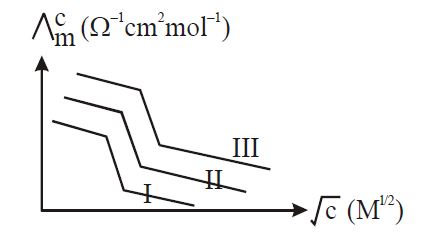
Three graphs for $R(CH_2)_nCOONa$ are shown. The correct values of '$n$' for graphs $I, II,$ and $III$ may be matched as:
A
$I-16, II-12, III-8$
B
$I-8, II-12, III-16$
C
$I-12, II-8, III-16$
D
$I-12, II-12, III-12$
Solution
(A) The given graphs represent the variation of molar conductivity $(\Lambda_m^c)$ with the square root of concentration $(\sqrt{c})$ for surfactants. The sharp decrease in conductivity corresponds to the Critical Micelle Concentration $(CMC)$.
As the length of the hydrophobic tail (represented by '$n$' in $R(CH_2)_nCOONa$) increases,the hydrophobicity increases,which facilitates micelle formation at lower concentrations.
Therefore,$CMC \propto \frac{1}{\text{Size of tail}}$.
Looking at the graphs,the $CMC$ values (the point of the sharp break) follow the order: $I < II < III$.
This implies the tail size follows the order: $I > II > III$.
Matching this with the given options,graph $I$ corresponds to the largest '$n$' $(16)$,graph $II$ to $12$,and graph $III$ to $8$.
As the length of the hydrophobic tail (represented by '$n$' in $R(CH_2)_nCOONa$) increases,the hydrophobicity increases,which facilitates micelle formation at lower concentrations.
Therefore,$CMC \propto \frac{1}{\text{Size of tail}}$.
Looking at the graphs,the $CMC$ values (the point of the sharp break) follow the order: $I < II < III$.
This implies the tail size follows the order: $I > II > III$.
Matching this with the given options,graph $I$ corresponds to the largest '$n$' $(16)$,graph $II$ to $12$,and graph $III$ to $8$.
0 likes
View Solution370
EasyMCQ
Purple of Cassius is:
A
Pure gold
B
Colloidal solution of gold
C
Gold $(I)$ hydroxide
D
Gold $(III)$ chloride
Solution
(B) Purple of Cassius is a purple pigment formed by the reaction of gold salts with $tin(II)$ chloride.
It is essentially a colloidal solution of gold particles dispersed in a medium,often used in glass coloring.
It is essentially a colloidal solution of gold particles dispersed in a medium,often used in glass coloring.
0 likes
View Solution371
MediumMCQ
Which is an incorrect statement?
A
Tyndall effect takes place in true solution.
B
Colloidal Gold can be prepared by Bredig's arc method.
C
Physical adsorption is multilayer adsorption at high pressure.
D
When excess of $AgNO_3$ is treated with $KI$ solution,then $AgI$ forms a positive charge sol.
Solution
(A) The Tyndall effect does not take place in a true solution because the particle size is too small to scatter light.
Therefore,the statement in option $A$ is incorrect.
Therefore,the statement in option $A$ is incorrect.
0 likes
View Solution372
MediumMCQ
Select the incorrect statement.
A
Acid rain is mainly because of oxides of nitrogen and sulphur.
B
Enzymes are macromolecular colloids.
C
Ozone layer does not permit infrared radiation from the sun to reach the earth.
D
Micelle can be formed above a particular temperature known as Kraft temperature.
Solution
(C) Option $C$ is incorrect.
The ozone layer prevents harmful ultraviolet $(UV)$ radiations from the sun from reaching the earth,not infrared radiations.
Other statements are correct: Acid rain is caused by $SO_x$ and $NO_x$; enzymes are indeed macromolecular colloids; and micelles form above the Kraft temperature $(T_k)$.
The ozone layer prevents harmful ultraviolet $(UV)$ radiations from the sun from reaching the earth,not infrared radiations.
Other statements are correct: Acid rain is caused by $SO_x$ and $NO_x$; enzymes are indeed macromolecular colloids; and micelles form above the Kraft temperature $(T_k)$.
0 likes
View Solution373
MediumMCQ
Which of the following is most active in coagulating $Fe(OH)_3$ sol,if the sol is made by hydrolysis of $FeCl_3$?
A
$K_4[Fe(CN)_6]$
B
$Na_2SO_4$
C
$CaCl_2$
D
$KNO_3$
Solution
(A) $Fe(OH)_3$ sol is a positively charged sol. According to the Hardy-Schulze rule,the coagulating power of an electrolyte increases with the increase in the magnitude of the charge on the oppositely charged ion (anion in this case). The anions provided by the electrolytes are: $[Fe(CN)_6]^{4-}$,$SO_4^{2-}$,$Cl^-$,and $NO_3^-$. The magnitude of the charge is highest for $[Fe(CN)_6]^{4-}$. Therefore,$K_4[Fe(CN)_6]$ is the most effective coagulating agent.
0 likes
View Solution374
MediumMCQ
Among the following electrolytes,which is the most effective coagulating agent for $Fe(OH)_3$ sol?
A
$Na_2SO_4$
B
$KCl$
C
$Mg_3(PO_4)_2$
D
$CH_3COONa$
Solution
(C) $Fe(OH)_3$ is a positively charged sol.
According to the Hardy-Schulze rule,the coagulating power of an electrolyte increases with the increase in the magnitude of the charge on the ion of opposite sign to that of the colloidal particle.
For a positively charged $Fe(OH)_3$ sol,the coagulating ion must be negatively charged (anion).
The anions provided by the electrolytes are:
$Na_2SO_4 \rightarrow SO_4^{2-}$
$KCl \rightarrow Cl^-$
$Mg_3(PO_4)_2 \rightarrow PO_4^{3-}$
$CH_3COONa \rightarrow CH_3COO^-$
Since $PO_4^{3-}$ has the highest negative charge $(-3)$,$Mg_3(PO_4)_2$ is the most effective coagulating agent.
According to the Hardy-Schulze rule,the coagulating power of an electrolyte increases with the increase in the magnitude of the charge on the ion of opposite sign to that of the colloidal particle.
For a positively charged $Fe(OH)_3$ sol,the coagulating ion must be negatively charged (anion).
The anions provided by the electrolytes are:
$Na_2SO_4 \rightarrow SO_4^{2-}$
$KCl \rightarrow Cl^-$
$Mg_3(PO_4)_2 \rightarrow PO_4^{3-}$
$CH_3COONa \rightarrow CH_3COO^-$
Since $PO_4^{3-}$ has the highest negative charge $(-3)$,$Mg_3(PO_4)_2$ is the most effective coagulating agent.
0 likes
View Solution375
MediumMCQ
Identify the option having the correct set of True $(T)$ or False $(F)$ statements with respect to colloidal solutions:
$(I)$ Lyophobic colloids are heavily solvated by the dispersion medium.
$(II)$ Multimolecular colloids are usually lyophilic.
$(III)$ Surface tension of a starch aqua sol will be lesser than that of water.
$(IV)$ Blood gets coagulated by the addition of $NaCl$.
$(I)$ Lyophobic colloids are heavily solvated by the dispersion medium.
$(II)$ Multimolecular colloids are usually lyophilic.
$(III)$ Surface tension of a starch aqua sol will be lesser than that of water.
$(IV)$ Blood gets coagulated by the addition of $NaCl$.
A
$TFTT$
B
$FFTT$
C
$FTFF$
D
$FFFF$
Solution
(B) Statement $(I)$: False. Lyophobic colloids have little affinity for the dispersion medium and are not heavily solvated.
Statement $(II)$: False. Multimolecular colloids are formed by the aggregation of a large number of atoms or smaller molecules,and they are generally lyophobic.
Statement $(III)$: True. Starch is a lyophilic colloid. Lyophilic sols decrease the surface tension of the dispersion medium (water).
Statement $(IV)$: True. Blood is a colloidal sol of albuminoid substances. Addition of an electrolyte like $NaCl$ causes coagulation due to the neutralization of charge on the colloidal particles.
Therefore,the sequence is $(F, F, T, T)$.
Statement $(II)$: False. Multimolecular colloids are formed by the aggregation of a large number of atoms or smaller molecules,and they are generally lyophobic.
Statement $(III)$: True. Starch is a lyophilic colloid. Lyophilic sols decrease the surface tension of the dispersion medium (water).
Statement $(IV)$: True. Blood is a colloidal sol of albuminoid substances. Addition of an electrolyte like $NaCl$ causes coagulation due to the neutralization of charge on the colloidal particles.
Therefore,the sequence is $(F, F, T, T)$.
0 likes
View Solution376
MediumMCQ
On addition of $1 \ mL$ of $10 \%$ $NaCl$ to $10 \ mL$ gold sol in the presence of $0.038 \ g$ of starch the coagulation is just prevented. Then the value of gold number of starch is
A
$25$
B
$38$
C
$40$
D
$19$
Solution
(B) The gold number is defined as the minimum amount of protective colloid in milligrams that prevents the coagulation of $10 \ mL$ of a gold sol when $1 \ mL$ of $10 \%$ $NaCl$ solution is added to it.
Given mass of starch = $0.038 \ g = 38 \ mg$.
Since $38 \ mg$ of starch prevents the coagulation of $10 \ mL$ of gold sol,the gold number of starch is $38$.
Given mass of starch = $0.038 \ g = 38 \ mg$.
Since $38 \ mg$ of starch prevents the coagulation of $10 \ mL$ of gold sol,the gold number of starch is $38$.
0 likes
View Solution377
DifficultMCQ
The coagulation of $200 \ mL$ of a positive colloid took place when $0.73 \ g$ of $HCl$ was added to it. The flocculation value of $HCl$ for the colloid is
A
$150$
B
$200$
C
$100$
D
$36.5$
Solution
(C) The flocculation value is defined as the minimum concentration of an electrolyte in millimoles per liter $(mmol \ L^{-1})$ required to cause the coagulation of a sol.
Given mass of $HCl = 0.73 \ g$.
Molar mass of $HCl = 36.5 \ g \ mol^{-1}$.
Number of moles of $HCl = \frac{0.73 \ g}{36.5 \ g \ mol^{-1}} = 0.02 \ mol$.
Converting to millimoles: $0.02 \ mol \times 1000 = 20 \ mmol$.
Since $20 \ mmol$ of $HCl$ causes coagulation in $200 \ mL$ of the colloid,the amount required for $1000 \ mL$ $(1 \ L)$ is:
$\text{Flocculation value} = \frac{20 \ mmol}{200 \ mL} \times 1000 \ mL = 100 \ mmol \ L^{-1}$.
Given mass of $HCl = 0.73 \ g$.
Molar mass of $HCl = 36.5 \ g \ mol^{-1}$.
Number of moles of $HCl = \frac{0.73 \ g}{36.5 \ g \ mol^{-1}} = 0.02 \ mol$.
Converting to millimoles: $0.02 \ mol \times 1000 = 20 \ mmol$.
Since $20 \ mmol$ of $HCl$ causes coagulation in $200 \ mL$ of the colloid,the amount required for $1000 \ mL$ $(1 \ L)$ is:
$\text{Flocculation value} = \frac{20 \ mmol}{200 \ mL} \times 1000 \ mL = 100 \ mmol \ L^{-1}$.
0 likes
View Solution378
EasyMCQ
Which of the following information is incorrect?
A
Lyophilic sol can be coagulated by adding a suitable solvent
B
Butter may be classified as emulsion of water in oil type ($W/O$ type)
C
When dispersed liquid is added in an emulsion it forms a separate layer
D
Milk is an example of positively charged colloid
Solution
(D) Option $A$ is correct because lyophilic sols are stabilized by solvation and can be coagulated by adding a suitable solvent (like alcohol or acetone) that removes the solvation layer.
Option $B$ is correct because butter is a classic example of a water-in-oil $(W/O)$ emulsion.
Option $C$ is correct because if you add more of the dispersed phase to an emulsion,it does not mix uniformly and often forms a separate layer.
Option $D$ is incorrect because milk is generally considered a negatively charged colloid (due to the presence of proteins like casein which carry a negative charge at the $pH$ of milk). Therefore,the statement that milk is a positively charged colloid is false.
Option $B$ is correct because butter is a classic example of a water-in-oil $(W/O)$ emulsion.
Option $C$ is correct because if you add more of the dispersed phase to an emulsion,it does not mix uniformly and often forms a separate layer.
Option $D$ is incorrect because milk is generally considered a negatively charged colloid (due to the presence of proteins like casein which carry a negative charge at the $pH$ of milk). Therefore,the statement that milk is a positively charged colloid is false.
0 likes
View Solution379
EasyMCQ
Which of the following electrolytes would be most effective in the coagulation of Arsenic sulphide sol?
A
$BaCl_2$
B
$KCl$
C
$K_4[Fe(CN)_6]$
D
$AlCl_3$
Solution
(D) The $As_2S_3$ sol is a negatively charged colloidal solution.
According to the Hardy-Schulze rule,the coagulating power of an electrolyte depends on the valency of the active ion (the ion with a charge opposite to that of the colloidal particles).
For a negatively charged sol,the coagulating power increases with the increase in the valency of the cation.
The cations provided are $Ba^{2+}$,$K^{+}$,and $Al^{3+}$.
Since $Al^{3+}$ has the highest valency $(+3)$,it will be the most effective coagulating agent for the negatively charged $As_2S_3$ sol.
According to the Hardy-Schulze rule,the coagulating power of an electrolyte depends on the valency of the active ion (the ion with a charge opposite to that of the colloidal particles).
For a negatively charged sol,the coagulating power increases with the increase in the valency of the cation.
The cations provided are $Ba^{2+}$,$K^{+}$,and $Al^{3+}$.
Since $Al^{3+}$ has the highest valency $(+3)$,it will be the most effective coagulating agent for the negatively charged $As_2S_3$ sol.
0 likes
View Solution380
EasyMCQ
When freshly precipitated $Fe(OH)_3$ is shaken with an aqueous solution of $FeCl_3$,a colloidal solution is formed. This process is known as
A
Emulsification
B
Coagulation
C
Peptization
D
Electro-osmosis
Solution
(C) The process of converting a freshly prepared precipitate into a colloidal solution by adding a suitable electrolyte is known as peptization. $FeCl_3$ acts as a peptizing agent for $Fe(OH)_3$ precipitate.
0 likes
View Solution381
MediumMCQ
From the following,which are colloids?
$(i)$ $NaCl(aq.)$
$(ii)$ Fog
$(iii)$ Paint
$(iv)$ Aerosols
$(v)$ Mud
$(vi)$ Blood
$(i)$ $NaCl(aq.)$
$(ii)$ Fog
$(iii)$ Paint
$(iv)$ Aerosols
$(v)$ Mud
$(vi)$ Blood
A
All
B
$(ii), (iii), (iv), (v), (vi)$
C
$(ii), (iii), (vi)$ only
D
$(ii), (iv), (vi)$ only
Solution
(B) colloid is a heterogeneous system in which one substance is dispersed as very fine particles in another substance.
$(i)$ $NaCl(aq.)$ is a true solution,not a colloid.
$(ii)$ Fog is an aerosol (liquid dispersed in gas),which is a colloid.
$(iii)$ Paint is a sol (solid dispersed in liquid),which is a colloid.
$(iv)$ Aerosols (general term) are colloids.
$(v)$ Mud is a suspension/colloidal mixture (solid dispersed in liquid),which is a colloid.
$(vi)$ Blood is a colloidal solution of proteins and other substances in water.
Therefore,$(ii), (iii), (iv), (v),$ and $(vi)$ are colloids.
$(i)$ $NaCl(aq.)$ is a true solution,not a colloid.
$(ii)$ Fog is an aerosol (liquid dispersed in gas),which is a colloid.
$(iii)$ Paint is a sol (solid dispersed in liquid),which is a colloid.
$(iv)$ Aerosols (general term) are colloids.
$(v)$ Mud is a suspension/colloidal mixture (solid dispersed in liquid),which is a colloid.
$(vi)$ Blood is a colloidal solution of proteins and other substances in water.
Therefore,$(ii), (iii), (iv), (v),$ and $(vi)$ are colloids.
0 likes
View Solution382
MediumMCQ
Which of the following is a $Gel$?
A
Gem stone
B
Smoke
C
Milk
D
Cheese
Solution
(D) $Gel$ is a colloidal system in which the dispersed phase is a liquid and the dispersion medium is a solid.
$Cheese$ is a classic example of a $Gel$.
$Milk$ is an example of an emulsion (liquid in liquid).
$Smoke$ is an example of an aerosol (solid in gas).
$Gem$ $stones$ are examples of solid sols (solid in solid).
$Cheese$ is a classic example of a $Gel$.
$Milk$ is an example of an emulsion (liquid in liquid).
$Smoke$ is an example of an aerosol (solid in gas).
$Gem$ $stones$ are examples of solid sols (solid in solid).
0 likes
View Solution383
MediumMCQ
Select the correct statement regarding colloidal systems.
A
Gold sol is negatively charged.
B
Peptization is a method of purification of sols.
C
Persistent dialysis is a method of coagulation.
D
Both $A$ and $C$ are correct.
Solution
(D) $1$. Gold sol is prepared by the reduction of $AuCl_3$ with formaldehyde or stannous chloride and is known to be negatively charged. Thus,statement $A$ is correct.
$2$. Peptization is the process of converting a freshly prepared precipitate into a colloidal sol by adding a suitable electrolyte,not a method of purification. Thus,statement $B$ is incorrect.
$3$. Persistent dialysis removes the electrolyte that stabilizes the sol,leading to the coagulation of the colloidal particles. Thus,statement $C$ is correct.
$4$. Since both $A$ and $C$ are correct,the correct option is $D$.
$2$. Peptization is the process of converting a freshly prepared precipitate into a colloidal sol by adding a suitable electrolyte,not a method of purification. Thus,statement $B$ is incorrect.
$3$. Persistent dialysis removes the electrolyte that stabilizes the sol,leading to the coagulation of the colloidal particles. Thus,statement $C$ is correct.
$4$. Since both $A$ and $C$ are correct,the correct option is $D$.
0 likes
View Solution384
MediumMCQ
Identify the correct option regarding surface phenomenon.
A
Colloidal solution of $As_2S_3$ can be prepared by peptization.
B
Out of $KCl, BaCl_2, AlCl_3, Na_3PO_4$; $BaCl_2$ is most effective in coagulation of sulphur sol.
C
$C_{15}H_{31}COOCH_2-C(CH_2OH)_3$ is a non-ionic detergent.
D
On increasing the concentration of soap,electrical conductance will always increase.
Solution
(C) The correct option is $(C)$.
$(A)$ $As_2S_3$ sol is a negative sol and is prepared by double decomposition,not peptization.
$(B)$ Sulphur sol is a negative sol. According to the Hardy-Schulze rule,the coagulating power of an electrolyte depends on the valency of the cation. For a negative sol,the cation with the highest valency is most effective. Here,$Al^{3+}$ (from $AlCl_3$) is most effective,not $Ba^{2+}$.
$(C)$ Non-ionic detergents do not contain any ions. The structure $C_{15}H_{31}COOCH_2-C(CH_2OH)_3$ is an ester of a fatty acid with a polyol,which lacks ionic groups,making it a non-ionic detergent.
$(D)$ Soap solutions behave as electrolytes at low concentrations,but above the Critical Micelle Concentration $(CMC)$,they form micelles,which reduces the number of free ions,causing the electrical conductance to decrease or remain constant.
$(A)$ $As_2S_3$ sol is a negative sol and is prepared by double decomposition,not peptization.
$(B)$ Sulphur sol is a negative sol. According to the Hardy-Schulze rule,the coagulating power of an electrolyte depends on the valency of the cation. For a negative sol,the cation with the highest valency is most effective. Here,$Al^{3+}$ (from $AlCl_3$) is most effective,not $Ba^{2+}$.
$(C)$ Non-ionic detergents do not contain any ions. The structure $C_{15}H_{31}COOCH_2-C(CH_2OH)_3$ is an ester of a fatty acid with a polyol,which lacks ionic groups,making it a non-ionic detergent.
$(D)$ Soap solutions behave as electrolytes at low concentrations,but above the Critical Micelle Concentration $(CMC)$,they form micelles,which reduces the number of free ions,causing the electrical conductance to decrease or remain constant.
0 likes
View Solution385
MediumMCQ
Point out the false statement:
A
Brownian movement and Tyndall effect are shown by colloidal systems.
B
Gold number is a measure of the protective power of a lyophilic colloid.
C
The colloidal mixture of a liquid in liquid is called gel.
D
Hardy-Schulze rule is related to coagulation.
Solution
(C) colloidal system where a liquid is dispersed in another liquid is called an $Emulsion$,not a $Gel$. $A$ $Gel$ is a colloidal system where a liquid is dispersed in a solid. Therefore,the statement in option $C$ is false.
0 likes
View Solution386
EasyMCQ
Smoke is a colloidal dispersion of :-
A
$A$. $A$ gas in a solid
B
$B$. $A$ solid in a gas
C
$C$. $A$ gas in a gas
D
$D$. $A$ liquid in a gas
Solution
(B) Smoke is a colloidal system where solid particles (like carbon) are dispersed in a gaseous medium (like air).
Therefore,it is a dispersion of a solid in a gas.
Therefore,it is a dispersion of a solid in a gas.
0 likes
View Solution387
EasyMCQ
$A$ fresh precipitate can be transformed into a colloidal mixture by -
A
Peptization
B
Diffusion
C
Coagulation
D
Dialysis
Solution
(A) The process of converting a freshly prepared precipitate into a colloidal sol by adding a small amount of an electrolyte is known as $Peptization$.
The electrolyte added is called a $Peptizing \text{ } agent$.
This occurs due to the preferential adsorption of ions from the electrolyte on the surface of the precipitate particles,leading to electrostatic repulsion and dispersion.
The electrolyte added is called a $Peptizing \text{ } agent$.
This occurs due to the preferential adsorption of ions from the electrolyte on the surface of the precipitate particles,leading to electrostatic repulsion and dispersion.
0 likes
View Solution388
EasyMCQ
At the critical micelle concentration $(CMC)$ the surfactant molecules
A
decompose
B
dissociate
C
associate
D
become completely soluble
Solution
(C) The micelles are formed by the association of dispersed particles above a certain concentration,which is known as the critical micelle concentration $(CMC)$.
Above the $CMC$,the surfactant molecules associate to form a larger aggregate known as a micelle.
Above the $CMC$,the surfactant molecules associate to form a larger aggregate known as a micelle.
0 likes
View Solution389
MediumMCQ
Tyndall effect is observed only when:
$(i)$ the diameter of the dispersed particles is not much smaller than the wavelength of the light used.
$(ii)$ the refractive indices of the dispersed phase and the dispersion medium differ greatly in magnitude.
$(iii)$ the size of the particles is generally between $10^{-11} \ m$ and $10^{-9} \ m$ in diameter.
$(iv)$ the dispersed phase and the dispersion medium can be seen separately in the system.
$(i)$ the diameter of the dispersed particles is not much smaller than the wavelength of the light used.
$(ii)$ the refractive indices of the dispersed phase and the dispersion medium differ greatly in magnitude.
$(iii)$ the size of the particles is generally between $10^{-11} \ m$ and $10^{-9} \ m$ in diameter.
$(iv)$ the dispersed phase and the dispersion medium can be seen separately in the system.
A
$(i)$ and $(iii)$
B
$(i)$ and $(iv)$
C
$(ii)$ and $(iii)$
D
$(i)$ and $(ii)$
Solution
(D) The Tyndall effect is the scattering of light by colloidal particles.
For the Tyndall effect to be observed,two primary conditions must be met:
$1$. The diameter of the dispersed particles should not be much smaller than the wavelength of the light used.
$2$. The refractive indices of the dispersed phase and the dispersion medium must differ significantly in magnitude.
Therefore,statements $(i)$ and $(ii)$ are correct.
For the Tyndall effect to be observed,two primary conditions must be met:
$1$. The diameter of the dispersed particles should not be much smaller than the wavelength of the light used.
$2$. The refractive indices of the dispersed phase and the dispersion medium must differ significantly in magnitude.
Therefore,statements $(i)$ and $(ii)$ are correct.
0 likes
View Solution390
EasyMCQ
Which of the following is an emulsifier?
A
Soap
B
Water
C
Sugar
D
$NaCl$
Solution
(A) An emulsifier is a substance that stabilizes an emulsion by preventing the dispersed droplets from coalescing.
Soap acts as an emulsifier because its molecules have a long hydrocarbon tail that is hydrophobic (oil-loving) and a polar head that is hydrophilic (water-loving).
When soap is added to a mixture of oil and water,the hydrocarbon tails dissolve in the oil droplets,while the polar heads remain in the water.
This creates a stable emulsion where the oil droplets are dispersed in water and prevented from merging due to electrostatic repulsion between the negatively charged heads.
Therefore,$Soap$ is the correct answer.
Soap acts as an emulsifier because its molecules have a long hydrocarbon tail that is hydrophobic (oil-loving) and a polar head that is hydrophilic (water-loving).
When soap is added to a mixture of oil and water,the hydrocarbon tails dissolve in the oil droplets,while the polar heads remain in the water.
This creates a stable emulsion where the oil droplets are dispersed in water and prevented from merging due to electrostatic repulsion between the negatively charged heads.
Therefore,$Soap$ is the correct answer.
0 likes
View Solution391
MediumMCQ
According to the Hardy-Schulze rule,the flocculating power of an ion increases with:
A
Decrease in size
B
Increase in size
C
Decrease in charge
D
Increase in charge
Solution
(D) According to the Hardy-Schulze rule,the flocculating power of an ion is directly proportional to its valency (charge).
Therefore,the greater the valency of the flocculating ion,the greater is its flocculating power.
Therefore,the greater the valency of the flocculating ion,the greater is its flocculating power.
0 likes
View Solution392
MediumMCQ
The maximum coagulating power for precipitating $As_2S_3$ sol is of
A
$0.1 \ N \ Zn(NO_3)_2$
B
$0.1 \ N \ Na_3PO_4$
C
$0.1 \ N \ ZnSO_4$
D
$0.1 \ N \ AlCl_3$
Solution
(D) The $As_2S_3$ sol is a negatively charged sol.
According to the Hardy-Schulze rule,the coagulating power of an electrolyte depends on the valency of the cation or anion that neutralizes the charge on the colloidal particles.
For a negatively charged sol,the coagulating power is determined by the cation.
The higher the valency of the cation,the greater is its coagulating power.
Comparing the cations in the given options:
$A$: $Zn^{2+}$
$B$: $Na^+$
$C$: $Zn^{2+}$
$D$: $Al^{3+}$
Since $Al^{3+}$ has the highest valency $(+3)$,it will have the maximum coagulating power for the negatively charged $As_2S_3$ sol.
According to the Hardy-Schulze rule,the coagulating power of an electrolyte depends on the valency of the cation or anion that neutralizes the charge on the colloidal particles.
For a negatively charged sol,the coagulating power is determined by the cation.
The higher the valency of the cation,the greater is its coagulating power.
Comparing the cations in the given options:
$A$: $Zn^{2+}$
$B$: $Na^+$
$C$: $Zn^{2+}$
$D$: $Al^{3+}$
Since $Al^{3+}$ has the highest valency $(+3)$,it will have the maximum coagulating power for the negatively charged $As_2S_3$ sol.
0 likes
View Solution393
MediumMCQ
Fog is a colloidal system of
A
Gas in liquid
B
Liquid in gas
C
Gas in gas
D
Gas in solid
Solution
(B) Fog is a type of colloidal system known as a liquid aerosol. In this system,a liquid (dispersed phase) is dispersed in a gas (dispersion medium).
0 likes
View Solution394
MediumMCQ
The stabilisation of a lyophobic colloid is due to
A
preferential adsorption of similar charged particles on the colloid surface
B
the large electrokinetic potential developed in the colloid
C
the formation of a covalent bond between two phases
D
the viscosity of the medium
Solution
(A) Lyophobic colloids are inherently unstable and tend to aggregate.
They are stabilised primarily by the presence of an electric charge on the colloidal particles.
Due to the preferential adsorption of ions from the dispersion medium,the particles acquire a similar charge.
This results in electrostatic repulsion between the particles,which prevents them from coming close enough to aggregate,thereby providing stability to the colloidal system.
They are stabilised primarily by the presence of an electric charge on the colloidal particles.
Due to the preferential adsorption of ions from the dispersion medium,the particles acquire a similar charge.
This results in electrostatic repulsion between the particles,which prevents them from coming close enough to aggregate,thereby providing stability to the colloidal system.
0 likes
View Solution395
MediumMCQ
$As_2S_3$ sol has a negative charge. The maximum coagulation power will be of:
A
$0.1 \, N \, Zn(NO_3)_2$
B
$0.1 \, N \, Na_3PO_4$
C
$0.1 \, N \, ZnSO_4$
D
$0.1 \, N \, AlCl_3$
Solution
(D) According to the Hardy-Schulze rule,the coagulating power of an electrolyte depends on the valency of the active ion (the ion carrying a charge opposite to that of the colloidal sol).
Since $As_2S_3$ sol is negatively charged,the coagulating power depends on the valency of the cation.
The cations present in the given options are:
$A) \, Zn^{2+}$
$B) \, Na^+$
$C) \, Zn^{2+}$
$D) \, Al^{3+}$
According to the Hardy-Schulze rule,the higher the valency of the flocculating ion,the greater is its coagulating power.
Comparing the valencies: $Al^{3+} (3) > Zn^{2+} (2) > Na^+ (1)$.
Therefore,$AlCl_3$ has the maximum coagulating power.
Since $As_2S_3$ sol is negatively charged,the coagulating power depends on the valency of the cation.
The cations present in the given options are:
$A) \, Zn^{2+}$
$B) \, Na^+$
$C) \, Zn^{2+}$
$D) \, Al^{3+}$
According to the Hardy-Schulze rule,the higher the valency of the flocculating ion,the greater is its coagulating power.
Comparing the valencies: $Al^{3+} (3) > Zn^{2+} (2) > Na^+ (1)$.
Therefore,$AlCl_3$ has the maximum coagulating power.
0 likes
View Solution396
EasyMCQ
If the dispersed phase is liquid and the dispersion medium is solid,the colloid is known as:
A
Sol
B
Gel
C
Emulsion
D
Foam
Solution
(B) When the dispersed phase is $Liquid$ and the dispersion medium is $Solid$,the resulting colloidal system is classified as a $Gel$.
Examples of $Gel$ include $Butter$,$Jelly$,and $Cheese$.
Examples of $Gel$ include $Butter$,$Jelly$,and $Cheese$.
0 likes
View Solution397
EasyMCQ
The solution of rubber is an example of
A
Liquid aerosol
B
Multimolecular colloid
C
Associated colloid
D
Macromolecular colloid
Solution
(D) Rubber is a natural polymer with a high molecular mass. When dissolved in a suitable solvent,it forms a macromolecular colloid. Therefore,the solution of rubber is an example of a macromolecular colloid.
0 likes
View Solution398
MediumMCQ
Which of the following electrolytes will have the maximum flocculation value for $Fe(OH)_3$ sol?
A
$NaCl$
B
$Na_2SO_4$
C
$Na_3PO_4$
D
$AlCl_3$
Solution
(A) $Fe(OH)_3$ sol is a positively charged sol. According to the Hardy-Schulze rule,the coagulating power of an electrolyte depends on the valency of the ion carrying a charge opposite to that of the colloidal particles.
For a positively charged sol,the coagulating power is determined by the negative ion (anion). The order of coagulating power is: $PO_4^{3-} > SO_4^{2-} > Cl^-$.
Since the flocculation value is inversely proportional to the coagulating power,the electrolyte with the lowest charge on the anion will have the maximum flocculation value.
Comparing the anions: $Cl^-$ (charge $-1$),$SO_4^{2-}$ (charge $-2$),$PO_4^{3-}$ (charge $-3$).
Therefore,$NaCl$ has the lowest coagulating power and the maximum flocculation value.
For a positively charged sol,the coagulating power is determined by the negative ion (anion). The order of coagulating power is: $PO_4^{3-} > SO_4^{2-} > Cl^-$.
Since the flocculation value is inversely proportional to the coagulating power,the electrolyte with the lowest charge on the anion will have the maximum flocculation value.
Comparing the anions: $Cl^-$ (charge $-1$),$SO_4^{2-}$ (charge $-2$),$PO_4^{3-}$ (charge $-3$).
Therefore,$NaCl$ has the lowest coagulating power and the maximum flocculation value.
0 likes
View SolutionSurface Chemistry — Colloids, Emulsion, Gel and Their properties with application · Frequently Asked Questions
1Are these Surface Chemistry questions useful for JEE and NEET?
Yes. All questions in this section are mapped to JEE Main and NEET exam patterns. Previous year questions from JEE Main, NEET, GUJCET and state-level exams are included with full solutions.
2Can I switch to Hindi or Gujarati for these questions?
Yes. Use the language tabs in the hero section or the sidebar to view the same questions and solutions in English, Hindi or Gujarati.
3How do I generate a question paper from this subtopic?
Use the Vedclass Exam Paper Generator — select the chapter and subtopic, set difficulty, and generate Sets A, B, C, D automatically. First 3 chapters of every subject are free.
Vedclass Products
For Students
Vedclass Test Series
Mock tests in real JEE/NEET style with performance analysis. 5-day free trial.
Start Free TrialFor Teachers
Exam Paper Generator
Generate Set A/B/C/D papers from this chapter in 2 minutes. 3 chapters free.
Try FreeFor Institutes
Online Exam Module
Live online exams with unlimited students, 360° analytics & white-label branding.
See DemoFor Teachers & Institutes
Generate a Surface Chemistry Exam Paper in 2 Minutes
Select subtopic & difficulty — Sets A, B, C, D auto-generated with No Repeat logic.
First 3 chapters of every subject are free — no payment required.