
A English
Titrations Questions in English
Class 12 Chemistry · Principles Related to Practical Chemistry · Titrations
67+
Questions
English
Language
100%
With Solutions
Showing 49 of 67 questions in English
1
DifficultMCQ
$A$ solution containing $Na_2CO_3$ and $NaOH$ requires $300 \ mL$ of $0.1 \ N$ $HCl$ using phenolphthalein as an indicator. Methyl orange is then added to the above titrated solution when a further $25 \ mL$ of $0.2 \ N$ $HCl$ is required. The amount of $NaOH$ present in the solution is ................. $g$ $(NaOH = 40, Na_2CO_3 = 106)$.
A
$0.6$
B
$1$
C
$1.5$
D
$2$
Solution
(B) Let the mass of $Na_2CO_3$ be $x \ g$ and $NaOH$ be $y \ g$.
Using phenolphthalein indicator,$NaOH$ is completely neutralized and $Na_2CO_3$ is converted to $NaHCO_3$ (half-neutralization).
$Meq. \ of \ NaOH + Meq. \ of \ Na_2CO_3 (half) = 300 \times 0.1 = 30$.
$\frac{y}{40} \times 1000 + \frac{x}{106} \times 1000 = 30$ ... $(1)$
When methyl orange is added,the remaining $NaHCO_3$ is neutralized.
$Meq. \ of \ Na_2CO_3 (remaining \ half) = 25 \times 0.2 = 5$.
$\frac{x}{106} \times 1000 = 5$ ... $(2)$
From $(2)$,$\frac{x}{106} \times 1000 = 5$.
Substitute this into $(1)$:
$\frac{y}{40} \times 1000 + 5 = 30$
$\frac{y}{40} \times 1000 = 25$
$y = \frac{25 \times 40}{1000} = 1 \ g$.
Using phenolphthalein indicator,$NaOH$ is completely neutralized and $Na_2CO_3$ is converted to $NaHCO_3$ (half-neutralization).
$Meq. \ of \ NaOH + Meq. \ of \ Na_2CO_3 (half) = 300 \times 0.1 = 30$.
$\frac{y}{40} \times 1000 + \frac{x}{106} \times 1000 = 30$ ... $(1)$
When methyl orange is added,the remaining $NaHCO_3$ is neutralized.
$Meq. \ of \ Na_2CO_3 (remaining \ half) = 25 \times 0.2 = 5$.
$\frac{x}{106} \times 1000 = 5$ ... $(2)$
From $(2)$,$\frac{x}{106} \times 1000 = 5$.
Substitute this into $(1)$:
$\frac{y}{40} \times 1000 + 5 = 30$
$\frac{y}{40} \times 1000 = 25$
$y = \frac{25 \times 40}{1000} = 1 \ g$.
0 likes
View Solution2
DifficultMCQ
$3.92 \, g$ of ferrous ammonium sulphate crystals are dissolved in $100 \, mL$ of water. $20 \, mL$ of this solution requires $18 \, mL$ of $KMnO_4$ during titration for complete oxidation. The weight of $KMnO_4$ present in one litre of the solution is ............. $g$.
A
$3.476$
B
$12.38$
C
$34.76$
D
$1.238$
Solution
(A) The reaction between ferrous ammonium sulphate (Mohr's salt) and $KMnO_4$ in acidic medium is:
$MnO_4^- + 8H^+ + 5Fe^{2+} \rightarrow Mn^{2+} + 5Fe^{3+} + 4H_2O$.
From the stoichiometry,$1 \, \text{mole of } KMnO_4$ reacts with $5 \, \text{moles of } Fe^{2+}$.
Number of moles of $Fe^{2+}$ in $20 \, mL$ of solution:
Total moles in $100 \, mL = \frac{3.92}{392} = 0.01 \, \text{mol}$.
Moles in $20 \, mL = 0.01 \times \frac{20}{100} = 0.002 \, \text{mol}$.
Since $5 \, \text{moles of } Fe^{2+}$ react with $1 \, \text{mole of } KMnO_4$,$0.002 \, \text{mol of } Fe^{2+}$ react with $\frac{0.002}{5} = 0.0004 \, \text{mol of } KMnO_4$.
This amount is present in $18 \, mL$ of $KMnO_4$ solution.
Concentration of $KMnO_4$ in $g/L = \frac{0.0004 \, \text{mol}}{18 \, mL} \times 1000 \, mL \times 158 \, g/mol = 3.51 \, g/L$.
Given the options provided,the closest value is $3.476 \, g$.
$MnO_4^- + 8H^+ + 5Fe^{2+} \rightarrow Mn^{2+} + 5Fe^{3+} + 4H_2O$.
From the stoichiometry,$1 \, \text{mole of } KMnO_4$ reacts with $5 \, \text{moles of } Fe^{2+}$.
Number of moles of $Fe^{2+}$ in $20 \, mL$ of solution:
Total moles in $100 \, mL = \frac{3.92}{392} = 0.01 \, \text{mol}$.
Moles in $20 \, mL = 0.01 \times \frac{20}{100} = 0.002 \, \text{mol}$.
Since $5 \, \text{moles of } Fe^{2+}$ react with $1 \, \text{mole of } KMnO_4$,$0.002 \, \text{mol of } Fe^{2+}$ react with $\frac{0.002}{5} = 0.0004 \, \text{mol of } KMnO_4$.
This amount is present in $18 \, mL$ of $KMnO_4$ solution.
Concentration of $KMnO_4$ in $g/L = \frac{0.0004 \, \text{mol}}{18 \, mL} \times 1000 \, mL \times 158 \, g/mol = 3.51 \, g/L$.
Given the options provided,the closest value is $3.476 \, g$.
0 likes
View Solution3
MediumMCQ
An organic dye,eosin,used to detect the endpoint of precipitation titration by adsorption is called:
A
Absorption indicator
B
Adsorption indicator
C
Chemical indicator
D
None of these
Solution
(B) An organic dye,such as eosin,used to detect the endpoint of a precipitation titration through the process of adsorption is known as an $Adsorption$ $indicator$.
This technique is commonly employed in $Argentometry$,which is a type of titration involving the silver$(I)$ ion.
Typically,it is used to determine the amount of chloride present in a sample by titrating it against a silver nitrate solution of known concentration.
Chloride ions react with silver$(I)$ ions to form insoluble silver chloride:
$Ag^+_{(aq)} + Cl^-_{(aq)} \rightarrow AgCl_{(s)} \ (K = 5.88 \times 10^9)$
Fluorescein and eosin are common examples of adsorption indicators used in this reaction:
$NaCl_{(aq)} + AgNO_{3(aq)} \rightarrow AgCl_{(s)} + NaNO_{3(aq)}$
This technique is commonly employed in $Argentometry$,which is a type of titration involving the silver$(I)$ ion.
Typically,it is used to determine the amount of chloride present in a sample by titrating it against a silver nitrate solution of known concentration.
Chloride ions react with silver$(I)$ ions to form insoluble silver chloride:
$Ag^+_{(aq)} + Cl^-_{(aq)} \rightarrow AgCl_{(s)} \ (K = 5.88 \times 10^9)$
Fluorescein and eosin are common examples of adsorption indicators used in this reaction:
$NaCl_{(aq)} + AgNO_{3(aq)} \rightarrow AgCl_{(s)} + NaNO_{3(aq)}$
0 likes
View Solution4
EasyMCQ
The indicator used in the titration of iodine against sodium thiosulphate is
A
Starch
B
$K_3[Fe(CN)_6]$
C
$K_2CrO_4$
D
Potassium
Solution
(A) In an iodometric titration,a starch solution is used as an indicator because it forms a blue-black complex with $I_2$.
As the titration proceeds,the $I_2$ is consumed by the sodium thiosulphate $(Na_2S_2O_3)$.
The disappearance of the blue colour marks the endpoint of the titration.
As the titration proceeds,the $I_2$ is consumed by the sodium thiosulphate $(Na_2S_2O_3)$.
The disappearance of the blue colour marks the endpoint of the titration.
0 likes
View Solution5
EasyMCQ
The indicator used in the titration of $Na_2CO_3$ with $H_2SO_4$ is
A
Phenolphthalein
B
Methyl orange
C
Potassium ferrocyanide
D
Potassium ferricyanide
Solution
(B) The titration of $Na_2CO_3$ (a weak base) with $H_2SO_4$ (a strong acid) involves the formation of $NaHCO_3$ and then $H_2CO_3$.
Methyl orange is the suitable indicator for this titration because it changes color in the $pH$ range of $3.1$ to $4.4$,which corresponds to the acidic end point of the reaction.
Methyl orange is the suitable indicator for this titration because it changes color in the $pH$ range of $3.1$ to $4.4$,which corresponds to the acidic end point of the reaction.
0 likes
View Solution6
EasyMCQ
Why are strong acids generally used as standard solutions in acid-base titrations?
A
The $pH$ at the equivalence point will always be $7$.
B
They can be used to titrate both strong and weak bases.
C
Strong acids form more stable solutions than weak acids.
D
The salts of strong acids do not hydrolyse.
Solution
(B) Strong acids are preferred as standard solutions because they react completely with both strong and weak bases,ensuring a sharp change in $pH$ near the equivalence point,which makes the detection of the endpoint easier. Thus,they can be used to titrate both strong and weak bases.
0 likes
View Solution7
MediumMCQ
$A$ $100 \ mL$ solution of $0.1 \ N \ HCl$ was titrated with $0.2 \ N \ NaOH$ solution. The titration was discontinued after adding $30 \ mL$ of $NaOH$ solution. The remaining titration was completed by adding $0.25 \ N \ KOH$ solution. The volume of $KOH$ required for completing the titration is $..... \ mL$
A
$16$
B
$32$
C
$35$
D
$70$
Solution
(A) For the neutralization of an acid and a base,the total milliequivalents $(N \times V)$ must be equal.
Total milliequivalents of $HCl = 0.1 \ N \times 100 \ mL = 10 \ meq$.
Milliequivalents of $NaOH$ added = $0.2 \ N \times 30 \ mL = 6 \ meq$.
Remaining milliequivalents of $HCl$ to be neutralized = $10 \ meq - 6 \ meq = 4 \ meq$.
Let the volume of $KOH$ required be $V \ mL$. Since the normality of $KOH$ is $0.25 \ N$,we have:
$0.25 \ N \times V \ mL = 4 \ meq$.
$V = \frac{4}{0.25} = 16 \ mL$.
Total milliequivalents of $HCl = 0.1 \ N \times 100 \ mL = 10 \ meq$.
Milliequivalents of $NaOH$ added = $0.2 \ N \times 30 \ mL = 6 \ meq$.
Remaining milliequivalents of $HCl$ to be neutralized = $10 \ meq - 6 \ meq = 4 \ meq$.
Let the volume of $KOH$ required be $V \ mL$. Since the normality of $KOH$ is $0.25 \ N$,we have:
$0.25 \ N \times V \ mL = 4 \ meq$.
$V = \frac{4}{0.25} = 16 \ mL$.
0 likes
View Solution8
MediumMCQ
$8 \ mL$ of $\frac{N}{10} \ HCl$ are required to neutralize $20 \ mL$ of $Na_2CO_3$ solution in water. The normality of the $Na_2CO_3$ solution is: (in $N$)
A
$0.40$
B
$0.040$
C
$4$
D
$1.4$
Solution
(B) According to the law of equivalence,for neutralization reactions,the number of equivalents of acid equals the number of equivalents of base.
$N_1V_1 = N_2V_2$
Here,$N_1 = \frac{1}{10} \ N$,$V_1 = 8 \ mL$,and $V_2 = 20 \ mL$.
Substituting the values:
$\frac{1}{10} \times 8 = N_2 \times 20$
$0.8 = N_2 \times 20$
$N_2 = \frac{0.8}{20} = 0.04 \ N$
Therefore,the normality of the $Na_2CO_3$ solution is $0.04 \ N$.
$N_1V_1 = N_2V_2$
Here,$N_1 = \frac{1}{10} \ N$,$V_1 = 8 \ mL$,and $V_2 = 20 \ mL$.
Substituting the values:
$\frac{1}{10} \times 8 = N_2 \times 20$
$0.8 = N_2 \times 20$
$N_2 = \frac{0.8}{20} = 0.04 \ N$
Therefore,the normality of the $Na_2CO_3$ solution is $0.04 \ N$.
0 likes
View Solution9
MediumMCQ
In the titration of a strong acid and a weak base,the indicator used is:
A
Thymol blue
B
Phenolphthalein
C
Thymolphthalein
D
Methyl orange
Solution
(D) In the titration of a strong acid and a weak base,the indicator used is Methyl orange.
Methyl orange is an indicator that is used to determine the equivalence point of an acid-base titration where the $pH$ at the equivalence point is in the acidic range (typically $3.1$ to $4.4$).
In an acidic environment,it turns red,and in a basic environment (or $pH$ of $4.4$ and higher),it turns yellow.
It is prepared by the treatment of helianthin with sodium hydroxide; helianthin is obtained by coupling diazotized sulphanilic acid with $N,N$-dimethylaniline.
Methyl orange is an indicator that is used to determine the equivalence point of an acid-base titration where the $pH$ at the equivalence point is in the acidic range (typically $3.1$ to $4.4$).
In an acidic environment,it turns red,and in a basic environment (or $pH$ of $4.4$ and higher),it turns yellow.
It is prepared by the treatment of helianthin with sodium hydroxide; helianthin is obtained by coupling diazotized sulphanilic acid with $N,N$-dimethylaniline.
0 likes
View Solution10
MediumMCQ
Eosin used to detect the end point of precipitation titration by adsorption is called:
A
Absorption indicator
B
Adsorption indicator
C
Chemical indicator
D
Normal indicator
Solution
(B) An organic dye,Eosin,used to detect the endpoint of precipitation titration by adsorption,is known as an adsorption indicator.
This process is also referred to as argentometric titration.
This process is also referred to as argentometric titration.
0 likes
View Solution11
EasyMCQ
$20 \ mL$ of $HCl$ solution requires $19.85 \ mL$ of $0.01 \ M$ $NaOH$ solution for complete neutralization. The molarity of $HCl$ solution is
A
$0.0099$
B
$0.099$
C
$0.99$
D
$9.9$
Solution
(A) The neutralization reaction is: $HCl + NaOH \rightarrow NaCl + H_2O$.
According to the stoichiometry,$1 \ mole$ of $HCl$ reacts with $1 \ mole$ of $NaOH$.
Using the titration formula $M_1V_1 = M_2V_2$:
Let $M_1$ be the molarity of $HCl$ and $V_1 = 20 \ mL$.
Let $M_2 = 0.01 \ M$ be the molarity of $NaOH$ and $V_2 = 19.85 \ mL$.
$M_1 \times 20 = 0.01 \times 19.85$
$M_1 = \frac{0.1985}{20} = 0.009925 \ M$.
Rounding to the appropriate significant figures,the molarity is $0.0099 \ M$.
According to the stoichiometry,$1 \ mole$ of $HCl$ reacts with $1 \ mole$ of $NaOH$.
Using the titration formula $M_1V_1 = M_2V_2$:
Let $M_1$ be the molarity of $HCl$ and $V_1 = 20 \ mL$.
Let $M_2 = 0.01 \ M$ be the molarity of $NaOH$ and $V_2 = 19.85 \ mL$.
$M_1 \times 20 = 0.01 \times 19.85$
$M_1 = \frac{0.1985}{20} = 0.009925 \ M$.
Rounding to the appropriate significant figures,the molarity is $0.0099 \ M$.
0 likes
View Solution12
MediumMCQ
$25 \ mL$ of a solution of barium hydroxide on titration with a $0.1 \ M$ solution of hydrochloric acid gave a titre value of $35 \ mL$. The molarity of barium hydroxide solution was (in $M$)
A
$0.07$
B
$0.14$
C
$0.28$
D
$0.35$
Solution
(A) The balanced chemical equation for the reaction is: $Ba(OH)_2 + 2HCl \rightarrow BaCl_2 + 2H_2O$.
According to the stoichiometry,$1 \ mole$ of $Ba(OH)_2$ reacts with $2 \ moles$ of $HCl$.
Using the molarity equation: $\frac{M_1 V_1}{n_1} = \frac{M_2 V_2}{n_2}$,where $M_1$ and $V_1$ are for $Ba(OH)_2$ and $M_2$ and $V_2$ are for $HCl$.
Given: $V_1 = 25 \ mL$,$M_2 = 0.1 \ M$,$V_2 = 35 \ mL$,$n_1 = 1$,$n_2 = 2$.
$\frac{M_1 \times 25}{1} = \frac{0.1 \times 35}{2}$.
$M_1 = \frac{0.1 \times 35}{25 \times 2} = \frac{3.5}{50} = 0.07 \ M$.
According to the stoichiometry,$1 \ mole$ of $Ba(OH)_2$ reacts with $2 \ moles$ of $HCl$.
Using the molarity equation: $\frac{M_1 V_1}{n_1} = \frac{M_2 V_2}{n_2}$,where $M_1$ and $V_1$ are for $Ba(OH)_2$ and $M_2$ and $V_2$ are for $HCl$.
Given: $V_1 = 25 \ mL$,$M_2 = 0.1 \ M$,$V_2 = 35 \ mL$,$n_1 = 1$,$n_2 = 2$.
$\frac{M_1 \times 25}{1} = \frac{0.1 \times 35}{2}$.
$M_1 = \frac{0.1 \times 35}{25 \times 2} = \frac{3.5}{50} = 0.07 \ M$.
1 likes
View Solution13
DifficultMCQ
$3.92 \, g$ of ferrous ammonium sulfate crystals are dissolved in $100 \, mL$ of water. During titration,$20 \, mL$ of this solution is required for complete oxidation by $18 \, mL$ of $KMnO_4$ solution. Calculate the weight of $KMnO_4$ in $1 \, L$ of the solution in grams.
A
$3.51$
B
$12.38$
C
$34.76$
D
$1.238$
Solution
(A) The equivalent weight of ferrous ammonium sulfate is $392 \, g/eq$.
The normality of the salt solution is $N_1 = \frac{3.92}{392} \times \frac{1000}{100} = 0.1 \, N$.
Using the titration formula $N_1V_1 = N_2V_2$ for $20 \, mL$ of salt solution and $18 \, mL$ of $KMnO_4$:
$0.1 \times 20 = N_2 \times 18$.
Normality of $KMnO_4$ solution $(N_2)$ $= \frac{2}{18} = \frac{1}{9} \, N$.
The equivalent weight of $KMnO_4$ in acidic medium is $31.6 \, g/eq$.
Strength of $KMnO_4$ in $g/L = \text{Normality} \times \text{Equivalent weight} = \frac{1}{9} \times 31.6 \approx 3.51 \, g/L$.
The normality of the salt solution is $N_1 = \frac{3.92}{392} \times \frac{1000}{100} = 0.1 \, N$.
Using the titration formula $N_1V_1 = N_2V_2$ for $20 \, mL$ of salt solution and $18 \, mL$ of $KMnO_4$:
$0.1 \times 20 = N_2 \times 18$.
Normality of $KMnO_4$ solution $(N_2)$ $= \frac{2}{18} = \frac{1}{9} \, N$.
The equivalent weight of $KMnO_4$ in acidic medium is $31.6 \, g/eq$.
Strength of $KMnO_4$ in $g/L = \text{Normality} \times \text{Equivalent weight} = \frac{1}{9} \times 31.6 \approx 3.51 \, g/L$.
0 likes
View Solution14
DifficultMCQ
In the titration of $Na_2CO_3$ with $HCl$ using phenolphthalein as an indicator,what will be the result?
A
No change in appearance.
B
The indicator will react with the acid.
C
The indicator will react with the base.
D
Sodium chloride and carbonic acid will be formed.
Solution
(A) Phenolphthalein is a weak organic acid. In the titration of $Na_2CO_3$ with $HCl$,phenolphthalein changes color at the first equivalence point where $Na_2CO_3$ is converted to $NaHCO_3$. At this point,the solution becomes colorless.
0 likes
View Solution15
DifficultMCQ
$10 \, mL$ of concentrated $HCl$ is diluted to $1 \, L$. If $20 \, mL$ of this diluted solution is completely neutralized by $25 \, mL$ of $0.1 \, N$ sodium hydroxide solution,then the normality of the original concentrated hydrochloric acid is:
A
$8$
B
$9.5$
C
$12.5$
D
$15$
Solution
(C) Let the normality of the diluted $HCl$ solution be $N_1$ and its volume be $V_1 = 20 \, mL$.
For $NaOH$,$N_2 = 0.1 \, N$ and $V_2 = 25 \, mL$.
Using the titration formula $N_1 V_1 = N_2 V_2$:
$N_1 \times 20 = 0.1 \times 25$
$N_1 = \frac{0.1 \times 25}{20} = 0.125 \, N$.
This $N_1$ is the normality of the diluted solution $(1 \, L)$.
To find the normality of the original $10 \, mL$ concentrated $HCl$,we use the dilution equation $N_{conc} V_{conc} = N_{dil} V_{dil}$:
$N_{conc} \times 10 \, mL = 0.125 \, N \times 1000 \, mL$
$N_{conc} = \frac{0.125 \times 1000}{10} = 12.5 \, N$.
For $NaOH$,$N_2 = 0.1 \, N$ and $V_2 = 25 \, mL$.
Using the titration formula $N_1 V_1 = N_2 V_2$:
$N_1 \times 20 = 0.1 \times 25$
$N_1 = \frac{0.1 \times 25}{20} = 0.125 \, N$.
This $N_1$ is the normality of the diluted solution $(1 \, L)$.
To find the normality of the original $10 \, mL$ concentrated $HCl$,we use the dilution equation $N_{conc} V_{conc} = N_{dil} V_{dil}$:
$N_{conc} \times 10 \, mL = 0.125 \, N \times 1000 \, mL$
$N_{conc} = \frac{0.125 \times 1000}{10} = 12.5 \, N$.
0 likes
View Solution16
EasyMCQ
Which of the following titrations is methyl orange the best indicator for?
A
$CH_3COOH + NaOH$
B
$H_2C_2O_4 + NaOH$
C
$HCl + NaOH$
D
$CH_3COOH + NH_4OH$
Solution
(C) Methyl orange is a weak base indicator with a $pH$ range of approximately $3.1$ to $4.4$.
It is best suited for titrations involving a strong acid and a weak base,or a strong acid and a strong base where the equivalence point falls within its $pH$ range.
Among the given options,$HCl$ is a strong acid and $NaOH$ is a strong base,resulting in a neutral salt where the equivalence point is at $pH = 7$. However,methyl orange is commonly used for strong acid-strong base titrations in educational contexts.
$CH_3COOH + NH_4OH$ involves a weak acid and a weak base,which is not suitable for simple indicators.
Therefore,the titration of a strong acid $(HCl)$ with a strong base $(NaOH)$ is the most appropriate choice among the options provided for the use of methyl orange.
It is best suited for titrations involving a strong acid and a weak base,or a strong acid and a strong base where the equivalence point falls within its $pH$ range.
Among the given options,$HCl$ is a strong acid and $NaOH$ is a strong base,resulting in a neutral salt where the equivalence point is at $pH = 7$. However,methyl orange is commonly used for strong acid-strong base titrations in educational contexts.
$CH_3COOH + NH_4OH$ involves a weak acid and a weak base,which is not suitable for simple indicators.
Therefore,the titration of a strong acid $(HCl)$ with a strong base $(NaOH)$ is the most appropriate choice among the options provided for the use of methyl orange.
0 likes
View Solution17
EasyMCQ
In the volumetric analysis of $HCl$,if we use phenolphthalein as an indicator,which base is unsuitable for titration?
A
$NaOH$
B
$RbOH$
C
$KOH$
D
$NH_4OH$
Solution
(D) Phenolphthalein is a weak organic acid indicator with a pH range of $8.2$ to $10.0$. It is suitable for titrations involving strong bases and strong acids,or weak acids and strong bases.
$HCl$ is a strong acid.
$NaOH$,$RbOH$,and $KOH$ are all strong bases.
$NH_4OH$ is a weak base.
Titration of a strong acid $(HCl)$ with a weak base $(NH_4OH)$ results in an equivalence point in the acidic range (pH $< 7$). Since phenolphthalein changes color in the basic range (pH $8.2-10.0$),it is unsuitable for this titration.
$HCl$ is a strong acid.
$NaOH$,$RbOH$,and $KOH$ are all strong bases.
$NH_4OH$ is a weak base.
Titration of a strong acid $(HCl)$ with a weak base $(NH_4OH)$ results in an equivalence point in the acidic range (pH $< 7$). Since phenolphthalein changes color in the basic range (pH $8.2-10.0$),it is unsuitable for this titration.
0 likes
View Solution18
DifficultMCQ
Which of the following reactions occurs during iodometric titration in the laboratory?
A
$Cr_2O_7^{2-} + 14H^+ + 6I^- \to 2Cr^{3+} + 3I_2 + 7H_2O$; $I_2 + 2S_2O_3^{2-} \to S_4O_6^{2-} + 2I^-$
B
$MnO_4^- + 8H^+ + 5I^- \to Mn^{2+} + 2.5I_2 + 4H_2O$; $I_2 + 2S_2O_3^{2-} \to S_4O_6^{2-} + 2I^-$
C
$MnO_4^{2-} + OH^- + I^- \to MnO_2 + I_2$; $I_2 + 2S_2O_3^{2-} \to S_4O_6^{2-} + 2I^-$
D
$Cr_2O_7^{2-} + OH^- + I^- \to 2Cr^{3+} + I_2$; $I_2 + 2S_2O_3^{2-} \to S_4O_6^{2-} + 2I^-$
Solution
(A) In iodometric titration,an oxidizing agent reacts with excess iodide ions $(I^-)$ in an acidic or neutral medium to liberate iodine $(I_2)$.
The liberated iodine $(I_2)$ is then titrated against a standard solution of sodium thiosulfate $(Na_2S_2O_3)$.
The reaction $Cr_2O_7^{2-} + 14H^+ + 6I^- \to 2Cr^{3+} + 3I_2 + 7H_2O$ represents the liberation of $I_2$,followed by the titration reaction $I_2 + 2S_2O_3^{2-} \to S_4O_6^{2-} + 2I^-$.
Therefore,option $A$ correctly describes the iodometric titration process.
The liberated iodine $(I_2)$ is then titrated against a standard solution of sodium thiosulfate $(Na_2S_2O_3)$.
The reaction $Cr_2O_7^{2-} + 14H^+ + 6I^- \to 2Cr^{3+} + 3I_2 + 7H_2O$ represents the liberation of $I_2$,followed by the titration reaction $I_2 + 2S_2O_3^{2-} \to S_4O_6^{2-} + 2I^-$.
Therefore,option $A$ correctly describes the iodometric titration process.
0 likes
View Solution19
MediumMCQ
The amount of oxalic acid in a solution can be determined by titration with $KMnO_4$ in the presence of $H_2SO_4$. If the titration is performed in the presence of $HCl$,the results are unsatisfactory because $HCl$ ...
A
oxidizes oxalic acid to carbon dioxide and water.
B
is oxidized by $KMnO_4$ to chlorine.
C
increases the concentration of $H^+$ ions from oxalic acid.
D
reduces $Mn^{2+}$ ions.
Solution
(B) The titration of oxalic acid with $KMnO_4$ is performed in the presence of $H_2SO_4$ because $H_2SO_4$ provides an acidic medium without interfering with the redox reaction.
If $HCl$ is used,$KMnO_4$ acts as a strong oxidizing agent and oxidizes $HCl$ to $Cl_2$ gas:
$2KMnO_4 + 16HCl \to 2KCl + 2MnCl_2 + 8H_2O + 5Cl_2$.
Due to this side reaction,the consumption of $KMnO_4$ increases,leading to an inaccurate determination of the oxalic acid concentration.
If $HCl$ is used,$KMnO_4$ acts as a strong oxidizing agent and oxidizes $HCl$ to $Cl_2$ gas:
$2KMnO_4 + 16HCl \to 2KCl + 2MnCl_2 + 8H_2O + 5Cl_2$.
Due to this side reaction,the consumption of $KMnO_4$ increases,leading to an inaccurate determination of the oxalic acid concentration.
0 likes
View Solution20
MediumMCQ
Which reagent is commonly used for the determination of water hardness by titration?
A
Oxalic acid
B
Disodium salt of $EDTA$
C
Sodium citrate
D
Sodium thiosulfate
Solution
(B) The disodium salt of $Ethylenediaminetetraacetic$ $acid$ $(EDTA)$ is used for the complexometric titration of metal ions like $Ca^{2+}$ and $Mg^{2+}$ to determine water hardness.
In this titration,an indicator $(D^{3-})$ forms a red metal-indicator complex with $M^{2+}$ ions.
$i.$ $M^{2+} + D^{3-} \rightarrow [MD]^{-}$ (Red complex)
$ii.$ $[MD]^{-} + EDTA^{4-} \rightarrow [M(EDTA)]^{2-} + D^{3-}$ (Blue free indicator)
The $EDTA$ forms a more stable complex with the metal ions,displacing the indicator and causing a color change from red to blue at the endpoint.
In this titration,an indicator $(D^{3-})$ forms a red metal-indicator complex with $M^{2+}$ ions.
$i.$ $M^{2+} + D^{3-} \rightarrow [MD]^{-}$ (Red complex)
$ii.$ $[MD]^{-} + EDTA^{4-} \rightarrow [M(EDTA)]^{2-} + D^{3-}$ (Blue free indicator)
The $EDTA$ forms a more stable complex with the metal ions,displacing the indicator and causing a color change from red to blue at the endpoint.
0 likes
View Solution21
MediumMCQ
The amount of oxalic acid present in a solution can be determined by its titration with $KMnO_4$ solution in the presence of $H_2SO_4$. The titration gives an unsatisfactory result when carried out in the presence of $HCl$,because $HCl$:
A
gets oxidised by $KMnO_4$ to chlorine
B
furnishes $H^{+}$ ions in addition to those from oxalic acid
C
reduces permanganate to $Mn^{2+}$
D
oxidises oxalic acid to carbon dioxide and water
Solution
(A) The titration of oxalic acid with $KMnO_4$ in the presence of $HCl$ gives an unsatisfactory result because $KMnO_4$ is a strong oxidizing agent and it oxidizes $HCl$ to $Cl_2$ gas along with the oxidation of oxalic acid.
This leads to an error in the titration as the volume of $KMnO_4$ consumed is higher than that required for the oxidation of oxalic acid alone.
This leads to an error in the titration as the volume of $KMnO_4$ consumed is higher than that required for the oxidation of oxalic acid alone.
0 likes
View Solution22
MediumMCQ
Which of the following statements is correct?
A
$Ce^{+4}$ acts as an oxidising as well as a reducing agent.
B
Pure $PH_3$ is produced by heating $PH_4I$ with $dil. \ CH_3COOH$.
C
Urea,sulphamic acid,and thiourea are used to destroy nitrate ions.
D
Titration of boric acid solution is not satisfactory with $NaOH$ solution.
Solution
(D) $1$. $Ce^{+4}$ is a strong oxidising agent because it easily reduces to $Ce^{+3}$. It does not act as a reducing agent.
$2$. Pure $PH_3$ is prepared by heating $PH_4I$ with a strong base like $KOH$ or $NaOH$,not $CH_3COOH$.
$3$. Urea,sulphamic acid,and thiourea are used to destroy nitrite ions $(NO_2^-)$,not nitrate ions $(NO_3^-)$.
$4$. Boric acid is a very weak acid $(K_a \approx 5.8 \times 10^{-10})$,and its titration with $NaOH$ is not satisfactory because the end point is not sharp. It requires the addition of polyols like glycerol to form a strong complex acid.
$2$. Pure $PH_3$ is prepared by heating $PH_4I$ with a strong base like $KOH$ or $NaOH$,not $CH_3COOH$.
$3$. Urea,sulphamic acid,and thiourea are used to destroy nitrite ions $(NO_2^-)$,not nitrate ions $(NO_3^-)$.
$4$. Boric acid is a very weak acid $(K_a \approx 5.8 \times 10^{-10})$,and its titration with $NaOH$ is not satisfactory because the end point is not sharp. It requires the addition of polyols like glycerol to form a strong complex acid.
0 likes
View Solution23
DifficultMCQ
Which of the graphs shown below would best represent the change in conductance $(G_{sol})$ when a solution containing $0.1 \, M$ each of $HCl$ and $HCN$ is titrated with $0.1 \, M$ $NaOH$ solution?
A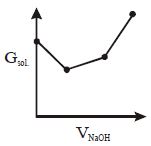
B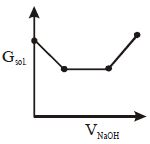
C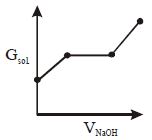
D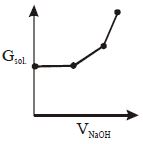
Solution
(A) The titration involves two steps:
$1$. $HCl$ is a strong acid and reacts first with $NaOH$: $H^+ + Cl^- + Na^+ + OH^- \rightarrow H_2O + Na^+ + Cl^-$. The highly mobile $H^+$ ions are replaced by $Na^+$ ions,leading to a decrease in conductance.
$2$. After $HCl$ is neutralized,$HCN$ (a weak acid) reacts with $NaOH$: $HCN + Na^+ + OH^- \rightarrow CN^- + Na^+ + H_2O$. The concentration of ions increases as $HCN$ is converted to $Na^+ + CN^-$,leading to a slight increase in conductance.
$3$. After both acids are neutralized,adding excess $NaOH$ adds $Na^+$ and $OH^-$ ions,causing a sharp increase in conductance.
Therefore,the graph shows a decrease,then a slight increase,followed by a sharp increase. This matches the pattern in Graph $A$.
$1$. $HCl$ is a strong acid and reacts first with $NaOH$: $H^+ + Cl^- + Na^+ + OH^- \rightarrow H_2O + Na^+ + Cl^-$. The highly mobile $H^+$ ions are replaced by $Na^+$ ions,leading to a decrease in conductance.
$2$. After $HCl$ is neutralized,$HCN$ (a weak acid) reacts with $NaOH$: $HCN + Na^+ + OH^- \rightarrow CN^- + Na^+ + H_2O$. The concentration of ions increases as $HCN$ is converted to $Na^+ + CN^-$,leading to a slight increase in conductance.
$3$. After both acids are neutralized,adding excess $NaOH$ adds $Na^+$ and $OH^-$ ions,causing a sharp increase in conductance.
Therefore,the graph shows a decrease,then a slight increase,followed by a sharp increase. This matches the pattern in Graph $A$.
0 likes
View Solution24
DifficultMCQ
Temporary hardness in tap water is measured in terms of parts of $CaCO_3$ per $10^6$ parts of water. If $500 \ mL$ of hard water containing $Ca(HCO_3)_2$ was titrated against $\frac{1}{20} \ M \ H_2SO_4$ solution in the presence of a methyl orange indicator,and it required $40 \ mL$ of titrant,then the temporary hardness in the tap water is .............. $ppm$.
A
$400$
B
$300$
C
$500$
D
$200$
Solution
(NONE) The reaction between $Ca(HCO_3)_2$ and $H_2SO_4$ is: $Ca(HCO_3)_2 + H_2SO_4 \rightarrow CaSO_4 + 2H_2O + 2CO_2$.
At the equivalence point,the milliequivalents of $Ca(HCO_3)_2$ equal the milliequivalents of $H_2SO_4$.
$n_{eq}(Ca(HCO_3)_2) = n_{eq}(H_2SO_4) = M \times n_{factor} \times V(L) = \frac{1}{20} \times 2 \times 0.040 = 0.004 \ eq$.
Since $1 \ mol$ of $Ca(HCO_3)_2$ is equivalent to $1 \ mol$ of $CaCO_3$ $(100 \ g/mol)$,the mass of $CaCO_3$ is $0.004 \ mol \times 100 \ g/mol = 0.4 \ g$.
Hardness in $ppm = \frac{\text{mass of } CaCO_3 \text{ in } g}{\text{volume of water in } mL} \times 10^6 = \frac{0.4}{500} \times 10^6 = 800 \ ppm$.
At the equivalence point,the milliequivalents of $Ca(HCO_3)_2$ equal the milliequivalents of $H_2SO_4$.
$n_{eq}(Ca(HCO_3)_2) = n_{eq}(H_2SO_4) = M \times n_{factor} \times V(L) = \frac{1}{20} \times 2 \times 0.040 = 0.004 \ eq$.
Since $1 \ mol$ of $Ca(HCO_3)_2$ is equivalent to $1 \ mol$ of $CaCO_3$ $(100 \ g/mol)$,the mass of $CaCO_3$ is $0.004 \ mol \times 100 \ g/mol = 0.4 \ g$.
Hardness in $ppm = \frac{\text{mass of } CaCO_3 \text{ in } g}{\text{volume of water in } mL} \times 10^6 = \frac{0.4}{500} \times 10^6 = 800 \ ppm$.
0 likes
View Solution25
DifficultMCQ
$300 \ mL$ of deci-molar solution of $Ba(OH)_{2(aq)}$ was titrated with $100 \ mL$ of $0.2 \ M \ HCl_{(aq)}$ solution. The final solution had to be titrated with $V \ mL$ of semi-molar $H_2SO_{4(aq)}$ solution for end-point. Correct option is $V = ....... \ mL$
A
$20$
B
$40$
C
$60$
D
$100$
Solution
(B) Step $1$: Calculate the initial millimoles of $Ba(OH)_2$.
$Molarity = 0.1 \ M$,$Volume = 300 \ mL$.
$Millimoles \ of \ Ba(OH)_2 = 0.1 \times 300 = 30 \ mmol$.
$Milliequivalents \ of \ Ba(OH)_2 = 30 \times 2 = 60 \ meq$.
Step $2$: Calculate the milliequivalents of $HCl$ added.
$Molarity = 0.2 \ M$,$Volume = 100 \ mL$.
$Milliequivalents \ of \ HCl = 0.2 \times 100 \times 1 = 20 \ meq$.
Step $3$: Calculate remaining $Ba(OH)_2$ after reaction with $HCl$.
$Remaining \ meq \ of \ Ba(OH)_2 = 60 - 20 = 40 \ meq$.
Step $4$: Titrate remaining $Ba(OH)_2$ with $H_2SO_4$.
$Normality \ of \ H_2SO_4 = 0.5 \ M \times 2 = 1 \ N$.
$Equivalence \ point: meq \ of \ Ba(OH)_2 = meq \ of \ H_2SO_4$.
$40 = 1 \times V$.
$V = 40 \ mL$.
$Molarity = 0.1 \ M$,$Volume = 300 \ mL$.
$Millimoles \ of \ Ba(OH)_2 = 0.1 \times 300 = 30 \ mmol$.
$Milliequivalents \ of \ Ba(OH)_2 = 30 \times 2 = 60 \ meq$.
Step $2$: Calculate the milliequivalents of $HCl$ added.
$Molarity = 0.2 \ M$,$Volume = 100 \ mL$.
$Milliequivalents \ of \ HCl = 0.2 \times 100 \times 1 = 20 \ meq$.
Step $3$: Calculate remaining $Ba(OH)_2$ after reaction with $HCl$.
$Remaining \ meq \ of \ Ba(OH)_2 = 60 - 20 = 40 \ meq$.
Step $4$: Titrate remaining $Ba(OH)_2$ with $H_2SO_4$.
$Normality \ of \ H_2SO_4 = 0.5 \ M \times 2 = 1 \ N$.
$Equivalence \ point: meq \ of \ Ba(OH)_2 = meq \ of \ H_2SO_4$.
$40 = 1 \times V$.
$V = 40 \ mL$.
0 likes
View Solution26
MediumMCQ
During the estimation of oxalic acid $V/S$ $KMnO_4$,the self-indicator is:
A
$KMnO_4$
B
Oxalic acid
C
$K_2SO_4$
D
$MnSO_4$
Solution
(A) In the titration of oxalic acid against $KMnO_4$,the reaction occurs in an acidic medium (using $H_2SO_4$).
The chemical reaction is:
$2KMnO_4 + 3H_2SO_4 + 5(COOH)_2 \rightarrow K_2SO_4 + 2MnSO_4 + 8H_2O + 10CO_2 \uparrow$
Potassium permanganate $(KMnO_4)$ acts as a strong oxidizing agent and is deep purple in color.
As the titration proceeds,the $KMnO_4$ added is consumed by the oxalic acid. Once all the oxalic acid has reacted,the very next drop of $KMnO_4$ added remains unreacted,imparting a permanent light pink color to the solution.
Therefore,$KMnO_4$ itself acts as a self-indicator.
The chemical reaction is:
$2KMnO_4 + 3H_2SO_4 + 5(COOH)_2 \rightarrow K_2SO_4 + 2MnSO_4 + 8H_2O + 10CO_2 \uparrow$
Potassium permanganate $(KMnO_4)$ acts as a strong oxidizing agent and is deep purple in color.
As the titration proceeds,the $KMnO_4$ added is consumed by the oxalic acid. Once all the oxalic acid has reacted,the very next drop of $KMnO_4$ added remains unreacted,imparting a permanent light pink color to the solution.
Therefore,$KMnO_4$ itself acts as a self-indicator.
0 likes
View Solution27
DifficultMCQ
For standardizing $NaOH$ solution,which of the following is used as a primary standard?
A
Sodium tetraborate
B
Ferrous ammonium sulfate
C
Oxalic acid
D
dil. $HCl$
Solution
(C) primary standard is a reagent that is pure,stable,and has a high molar mass.
Oxalic acid $(H_2C_2O_4 \cdot 2H_2O)$ is a solid,stable compound that meets these criteria and is commonly used to standardize $NaOH$ solutions via titration.
Oxalic acid $(H_2C_2O_4 \cdot 2H_2O)$ is a solid,stable compound that meets these criteria and is commonly used to standardize $NaOH$ solutions via titration.
0 likes
View Solution28
DifficultMCQ
An aqueous solution of oxalic acid dihydrate contains $6.3 \ g$ in $250 \ mL$. The volume of $0.1 \ N \ NaOH$ required to completely neutralize $10 \ mL$ of this solution is $.............. \ mL$.
A
$4$
B
$20$
C
$2$
D
$40$
Solution
(D) The molar mass of oxalic acid dihydrate $(H_2C_2O_4 \cdot 2H_2O)$ is $126 \ g/mol$.
Since the basicity of oxalic acid is $2$,its equivalent mass is $126 / 2 = 63 \ g/eq$.
Normality $(N)$ of the oxalic acid solution is calculated as:
$N = \frac{\text{mass}}{\text{equivalent mass} \times \text{volume in L}} = \frac{6.3}{63 \times 0.250} = 0.4 \ N$.
Using the law of equivalence $(N_1 V_1 = N_2 V_2)$ for neutralization:
$0.4 \ N \times 10 \ mL = 0.1 \ N \times V_2$.
$V_2 = \frac{0.4 \times 10}{0.1} = 40 \ mL$.
Since the basicity of oxalic acid is $2$,its equivalent mass is $126 / 2 = 63 \ g/eq$.
Normality $(N)$ of the oxalic acid solution is calculated as:
$N = \frac{\text{mass}}{\text{equivalent mass} \times \text{volume in L}} = \frac{6.3}{63 \times 0.250} = 0.4 \ N$.
Using the law of equivalence $(N_1 V_1 = N_2 V_2)$ for neutralization:
$0.4 \ N \times 10 \ mL = 0.1 \ N \times V_2$.
$V_2 = \frac{0.4 \times 10}{0.1} = 40 \ mL$.
0 likes
View Solution29
DifficultMCQ
$25 \ mL$ of the given $HCl$ solution requires $30 \ mL$ of $0.1 \ M$ sodium carbonate solution. What is the volume of this $HCl$ solution required to titrate $30 \ mL$ of $0.2 \ M$ aqueous $NaOH$ solution? .............. $mL$
A
$25$
B
$75$
C
$50$
D
$12.5$
Solution
(A) Step $1$: Determine the normality of $HCl$ using the reaction with $Na_2CO_3$.
$Na_2CO_3 + 2HCl \rightarrow 2NaCl + H_2O + CO_2$.
Using the law of equivalence: $N_1V_1 = N_2V_2$.
For $Na_2CO_3$,$N = M \times \text{valency factor} = 0.1 \times 2 = 0.2 \ N$.
$N_{HCl} \times 25 \ mL = 0.2 \ N \times 30 \ mL$.
$N_{HCl} = \frac{6}{25} = 0.24 \ N$.
Step $2$: Determine the volume of $HCl$ required for $NaOH$.
$HCl + NaOH \rightarrow NaCl + H_2O$.
Using $N_1V_1 = N_2V_2$ for $HCl$ and $NaOH$.
$0.24 \ N \times V_{HCl} = 0.2 \ M \times 1 \times 30 \ mL$.
$0.24 \times V_{HCl} = 6$.
$V_{HCl} = \frac{6}{0.24} = 25 \ mL$.
$Na_2CO_3 + 2HCl \rightarrow 2NaCl + H_2O + CO_2$.
Using the law of equivalence: $N_1V_1 = N_2V_2$.
For $Na_2CO_3$,$N = M \times \text{valency factor} = 0.1 \times 2 = 0.2 \ N$.
$N_{HCl} \times 25 \ mL = 0.2 \ N \times 30 \ mL$.
$N_{HCl} = \frac{6}{25} = 0.24 \ N$.
Step $2$: Determine the volume of $HCl$ required for $NaOH$.
$HCl + NaOH \rightarrow NaCl + H_2O$.
Using $N_1V_1 = N_2V_2$ for $HCl$ and $NaOH$.
$0.24 \ N \times V_{HCl} = 0.2 \ M \times 1 \times 30 \ mL$.
$0.24 \times V_{HCl} = 6$.
$V_{HCl} = \frac{6}{0.24} = 25 \ mL$.
0 likes
View Solution30
MediumMCQ
In an acid-base titration,$0.1 \ M \ HCl$ solution was added to the $NaOH$ solution of unknown strength. Which of the following correctly shows the change of $pH$ of the titration mixture in this experiment?
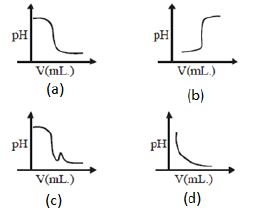
A
Graph $(a)$
B
Graph $(b)$
C
Graph $(c)$
D
Graph $(d)$
Solution
(A) In this titration,a strong acid $(HCl)$ is added to a strong base $(NaOH)$.
Initially,the solution contains $NaOH$,so the $pH$ is high (basic).
As $HCl$ is added,the $pH$ decreases gradually.
Near the equivalence point,there is a sharp drop in $pH$ because the concentration of $OH^-$ ions decreases rapidly.
After the equivalence point,the solution becomes acidic due to excess $HCl$,and the $pH$ levels off at a low value.
Graph $(a)$ correctly represents this sigmoidal decrease in $pH$ as the volume of the acid titrant increases.
Initially,the solution contains $NaOH$,so the $pH$ is high (basic).
As $HCl$ is added,the $pH$ decreases gradually.
Near the equivalence point,there is a sharp drop in $pH$ because the concentration of $OH^-$ ions decreases rapidly.
After the equivalence point,the solution becomes acidic due to excess $HCl$,and the $pH$ levels off at a low value.
Graph $(a)$ correctly represents this sigmoidal decrease in $pH$ as the volume of the acid titrant increases.
0 likes
View Solution31
MediumMCQ
During the estimation of oxalic acid $Vs$ $KMnO_4$,the self-indicator is:
A
$KMnO_4$
B
oxalic acid
C
$K_2SO_4$
D
$MnSO_4$
Solution
(A) In the titration of oxalic acid with $KMnO_4$,the reaction is a redox titration.
$KMnO_4$ acts as both the oxidizing agent and the self-indicator.
Initially,the solution is colorless due to oxalic acid.
As $KMnO_4$ is added,it reacts with oxalic acid to form colorless $Mn^{2+}$ ions.
At the equivalence point,the very first drop of excess $KMnO_4$ imparts a permanent light pink color to the solution,signaling the end point.
Therefore,$KMnO_4$ acts as a self-indicator.
$KMnO_4$ acts as both the oxidizing agent and the self-indicator.
Initially,the solution is colorless due to oxalic acid.
As $KMnO_4$ is added,it reacts with oxalic acid to form colorless $Mn^{2+}$ ions.
At the equivalence point,the very first drop of excess $KMnO_4$ imparts a permanent light pink color to the solution,signaling the end point.
Therefore,$KMnO_4$ acts as a self-indicator.
0 likes
View Solution32
MediumMCQ
$110 \, mL$ of $0.1 \, N \, HCl$ is titrated with $30 \, mL$ of $0.2 \, N \, NaOH$. The remaining titration is completed by adding $0.25 \, N \, KOH$ solution. What volume of $KOH$ in $mL$ is required?
A
$10$
B
$20$
C
$30$
D
$16$
Solution
(B) The total milliequivalents of $HCl$ must equal the sum of the milliequivalents of $NaOH$ and $KOH$ used for titration.
$N_1V_1 = N_2V_2 + N_3V_3$
Substituting the given values:
$0.1 \times 110 = (0.2 \times 30) + (0.25 \times V_{KOH})$
$11 = 6 + 0.25 \times V_{KOH}$
$11 - 6 = 0.25 \times V_{KOH}$
$5 = 0.25 \times V_{KOH}$
$V_{KOH} = \frac{5}{0.25} = 20 \, mL$
$N_1V_1 = N_2V_2 + N_3V_3$
Substituting the given values:
$0.1 \times 110 = (0.2 \times 30) + (0.25 \times V_{KOH})$
$11 = 6 + 0.25 \times V_{KOH}$
$11 - 6 = 0.25 \times V_{KOH}$
$5 = 0.25 \times V_{KOH}$
$V_{KOH} = \frac{5}{0.25} = 20 \, mL$
0 likes
View Solution33
EasyMCQ
If $25 \ mL$ of $H_2SO_4$ solution is neutralized by $32.63 \ mL$ of $0.164 \ M \ NaOH$ solution,what is the molarity of the $H_2SO_4$ solution?
A
$0.107$
B
$0.126$
C
$0.214$
D
$0.428$
Solution
(A) The neutralization reaction is: $H_2SO_4 + 2NaOH \rightarrow Na_2SO_4 + 2H_2O$.
Using the titration formula $n_1 M_1 V_1 = n_2 M_2 V_2$,where $n$ is the acidity/basicity factor.
For $H_2SO_4$,$n_1 = 2$ and for $NaOH$,$n_2 = 1$.
Substituting the values: $2 \times M_1 \times 25 \ mL = 1 \times 0.164 \ M \times 32.63 \ mL$.
$M_1 = \frac{0.164 \times 32.63}{2 \times 25} = \frac{5.35132}{50} = 0.107 \ M$.
Using the titration formula $n_1 M_1 V_1 = n_2 M_2 V_2$,where $n$ is the acidity/basicity factor.
For $H_2SO_4$,$n_1 = 2$ and for $NaOH$,$n_2 = 1$.
Substituting the values: $2 \times M_1 \times 25 \ mL = 1 \times 0.164 \ M \times 32.63 \ mL$.
$M_1 = \frac{0.164 \times 32.63}{2 \times 25} = \frac{5.35132}{50} = 0.107 \ M$.
0 likes
View Solution34
MediumMCQ
Which reagent is commonly used in titration to determine the hardness of water?
A
Oxalic acid
B
Sodium thiosulfate
C
$EDTA$ disodium salt
D
Sodium citrate
Solution
(C) The hardness of water is determined by complexometric titration using the disodium salt of $EDTA$ (Ethylenediaminetetraacetic acid).
In this process,$EDTA$ forms stable complexes with metal ions like $Ca^{2+}$ and $Mg^{2+}$ present in the water,which are responsible for water hardness.
Eriochrome Black $T$ $(EBT)$ is typically used as an indicator in this titration.
In this process,$EDTA$ forms stable complexes with metal ions like $Ca^{2+}$ and $Mg^{2+}$ present in the water,which are responsible for water hardness.
Eriochrome Black $T$ $(EBT)$ is typically used as an indicator in this titration.
0 likes
View Solution35
MediumMCQ
An aqueous solution of $6.3 \ g$ of oxalic acid dihydrate is made up to $250 \ mL$. The volume of $0.1 \ N \ NaOH$ required to completely neutralise $10 \ mL$ of this solution is.......$mL$
A
$20$
B
$40$
C
$10$
D
$4$
Solution
(B) The molar mass of oxalic acid dihydrate $(H_2C_2O_4 \cdot 2H_2O)$ is $126 \ g/mol$.
Since it is a dibasic acid,its equivalent mass is $\frac{126}{2} = 63 \ g/eq$.
Normality of the oxalic acid solution = $\frac{\text{mass}}{\text{equivalent mass} \times \text{volume in L}} = \frac{6.3}{63 \times 0.250} = 0.4 \ N$.
Using the titration formula $N_1 V_1 = N_2 V_2$ for $10 \ mL$ of the solution:
$0.4 \ N \times 10 \ mL = 0.1 \ N \times V_2$.
$V_2 = \frac{4}{0.1} = 40 \ mL$.
Since it is a dibasic acid,its equivalent mass is $\frac{126}{2} = 63 \ g/eq$.
Normality of the oxalic acid solution = $\frac{\text{mass}}{\text{equivalent mass} \times \text{volume in L}} = \frac{6.3}{63 \times 0.250} = 0.4 \ N$.
Using the titration formula $N_1 V_1 = N_2 V_2$ for $10 \ mL$ of the solution:
$0.4 \ N \times 10 \ mL = 0.1 \ N \times V_2$.
$V_2 = \frac{4}{0.1} = 40 \ mL$.
0 likes
View Solution36
DifficultMCQ
The strength of an aqueous solution of $I_2$ can be determined by titrating the solution with a standard solution of:
A
Oxalic acid
B
Sodium thiosulphate
C
Sodium hydroxide
D
Mohr’s salt
Solution
(B) The strength of an aqueous solution of $I_2$ is determined by iodometric titration.
In this process,$I_2$ reacts with sodium thiosulphate $(Na_2S_2O_3)$ to form sodium tetrathionate $(Na_2S_4O_6)$ and sodium iodide $(NaI)$.
The balanced chemical equation is:
$I_2 + 2Na_2S_2O_3 \to Na_2S_4O_6 + 2NaI$
In this process,$I_2$ reacts with sodium thiosulphate $(Na_2S_2O_3)$ to form sodium tetrathionate $(Na_2S_4O_6)$ and sodium iodide $(NaI)$.
The balanced chemical equation is:
$I_2 + 2Na_2S_2O_3 \to Na_2S_4O_6 + 2NaI$
0 likes
View Solution37
AdvancedMCQ
The strength of an aqueous $NaOH$ solution is most accurately determined by titrating it against a standard solution of oxalic acid. (Note: consider that an appropriate indicator is used)
A
Aq. $NaOH$ in a volumetric flask and concentrated $H_{2}SO_{4}$ in a conical flask
B
Aq. $NaOH$ in a pipette and aqueous oxalic acid in a burette
C
Aq. $NaOH$ in a burette and concentrated $H_{2}SO_{4}$ in a conical flask
D
Aq. $NaOH$ in a burette and aqueous oxalic acid in a conical flask
Solution
(D) The strength of a base like $NaOH$ is determined by titration against a primary standard acid.
Oxalic acid $(H_{2}C_{2}O_{4} \cdot 2H_{2}O)$ is a primary standard,meaning it can be weighed accurately to prepare a solution of known concentration.
Strong acids like $H_{2}SO_{4}$ are not primary standards because they are hygroscopic and their concentration changes over time.
In a titration,the solution with the known concentration (standard solution) is typically placed in the burette,but for $NaOH$ titration,it is standard practice to place the $NaOH$ solution in the burette and the primary standard oxalic acid solution in the conical flask.
Therefore,the correct setup is $NaOH$ in the burette and aqueous oxalic acid in the conical flask.
Oxalic acid $(H_{2}C_{2}O_{4} \cdot 2H_{2}O)$ is a primary standard,meaning it can be weighed accurately to prepare a solution of known concentration.
Strong acids like $H_{2}SO_{4}$ are not primary standards because they are hygroscopic and their concentration changes over time.
In a titration,the solution with the known concentration (standard solution) is typically placed in the burette,but for $NaOH$ titration,it is standard practice to place the $NaOH$ solution in the burette and the primary standard oxalic acid solution in the conical flask.
Therefore,the correct setup is $NaOH$ in the burette and aqueous oxalic acid in the conical flask.
0 likes
View Solution38
Easy
Can titrations with $KMnO_4$ be performed in the presence of $HCl$? Why?
Solution
(A) No,titrations with $KMnO_4$ cannot be performed in the presence of $HCl$.
$HCl$ is a reducing agent and it reacts with $KMnO_4$ to produce $Cl_2$ gas.
The reaction is: $2KMnO_4 + 16HCl \rightarrow 2KCl + 2MnCl_2 + 8H_2O + 5Cl_2$.
This reaction interferes with the titration process by consuming the titrant and producing a gas,leading to inaccurate results.
$HCl$ is a reducing agent and it reacts with $KMnO_4$ to produce $Cl_2$ gas.
The reaction is: $2KMnO_4 + 16HCl \rightarrow 2KCl + 2MnCl_2 + 8H_2O + 5Cl_2$.
This reaction interferes with the titration process by consuming the titrant and producing a gas,leading to inaccurate results.
0 likes
View Solution39
Difficult
If soap has a high alkali content,it irritates the skin. How can the amount of excess alkali be determined? What can be the source of excess alkali?
Solution
(N/A) The amount of excess alkali in soap can be determined by performing an acid-base titration using a standard acid solution with a suitable indicator.
The source of excess alkali is typically the unreacted $NaOH$ or $KOH$ that remains in the soap mixture after the saponification process (hydrolysis of fat/oil) is complete.
The source of excess alkali is typically the unreacted $NaOH$ or $KOH$ that remains in the soap mixture after the saponification process (hydrolysis of fat/oil) is complete.
0 likes
View Solution40
Easy
In the titration of $KMnO_{4}$ with $C_{2}O_{4}^{2-}$,which temperature range is not proper? Why?
Solution
(N/A) The titration of $KMnO_{4}$ and oxalate is not performed at room temperature; instead,a temperature range of $50^{\circ}C - 70^{\circ}C$ is maintained. At room temperature,the rate of reaction is extremely slow,and the reaction is autocatalyzed by the $Mn^{2+}$ ions produced during the process.
0 likes
View Solution41
EasyMCQ
Why in the redox titration of $KMnO_4$ vs oxalic acid,do we heat the oxalic acid solution before starting the titration?
A
To increase the concentration of oxalic acid.
B
To increase the rate of the reaction.
C
To decrease the activation energy of the reaction.
D
To act as a catalyst for the reaction.
Solution
(B) The reaction between $KMnO_4$ and oxalic acid is very slow at room temperature.
Heating the solution provides the necessary activation energy and increases the frequency of effective collisions,thereby increasing the rate of the reaction.
Heating the solution provides the necessary activation energy and increases the frequency of effective collisions,thereby increasing the rate of the reaction.
0 likes
View Solution42
MediumMCQ
While titrating a dilute $HCl$ solution with an aqueous $NaOH$ solution,which of the following will not be required?
A
Clamp and phenolphthalein
B
Pipette and distilled water
C
Burette and porcelain tile
D
Bunsen burner and measuring cylinder
Solution
(D) In an acid-base titration between $HCl$ and $NaOH$,the following apparatus and reagents are typically used:
$1$. $A$ $Burette$ to hold the titrant $(NaOH)$.
$2$. $A$ $Pipette$ to measure a precise volume of the analyte $(HCl)$.
$3$. $A$ $Clamp$ stand to hold the burette.
$4$. $Phenolphthalein$ as an acid-base indicator.
$5$. $Distilled water$ for rinsing and preparing solutions.
$6$. $A$ $Porcelain tile$ is often placed under the conical flask to observe the color change clearly.
$7$. $A$ $Bunsen burner$ and a $measuring cylinder$ are not required for this titration as it is performed at room temperature and requires precise volumetric glassware rather than a measuring cylinder.
$1$. $A$ $Burette$ to hold the titrant $(NaOH)$.
$2$. $A$ $Pipette$ to measure a precise volume of the analyte $(HCl)$.
$3$. $A$ $Clamp$ stand to hold the burette.
$4$. $Phenolphthalein$ as an acid-base indicator.
$5$. $Distilled water$ for rinsing and preparing solutions.
$6$. $A$ $Porcelain tile$ is often placed under the conical flask to observe the color change clearly.
$7$. $A$ $Bunsen burner$ and a $measuring cylinder$ are not required for this titration as it is performed at room temperature and requires precise volumetric glassware rather than a measuring cylinder.
0 likes
View Solution43
DifficultMCQ
$10.0 \, mL$ of $Na_{2}CO_{3}$ solution is titrated against $0.2 \, M \, HCl$ solution. The following titre values were obtained in $5$ readings.
$4.8 \, mL, 4.9 \, mL, 5.0 \, mL, 5.0 \, mL$ and $5.0 \, mL$
Based on these readings,and convention of titrimetric estimation,the concentration of $Na_{2}CO_{3}$ solution is .... $mM$.
(Round off to the nearest integer)
$4.8 \, mL, 4.9 \, mL, 5.0 \, mL, 5.0 \, mL$ and $5.0 \, mL$
Based on these readings,and convention of titrimetric estimation,the concentration of $Na_{2}CO_{3}$ solution is .... $mM$.
(Round off to the nearest integer)
A
$250$
B
$150$
C
$50$
D
$100$
Solution
(C) The most consistent and precise volume of $HCl$ obtained from the readings is $5.0 \, mL$.
At the equivalence point,the number of milliequivalents $(meq)$ of $Na_{2}CO_{3}$ equals the number of milliequivalents of $HCl$.
Let the molarity of $Na_{2}CO_{3}$ solution be $M$.
The reaction is: $Na_{2}CO_{3} + 2HCl \rightarrow 2NaCl + H_{2}O + CO_{2}$.
The n-factor for $Na_{2}CO_{3}$ is $2$ and for $HCl$ is $1$.
Using the formula: $M_{1} \times V_{1} \times n_{1} = M_{2} \times V_{2} \times n_{2}$
$M \times 10 \, mL \times 2 = 0.2 \, M \times 5.0 \, mL \times 1$
$20 \times M = 1.0$
$M = 0.05 \, mol/L$
To convert to $mM$ (millimolar),we multiply by $1000$:
$0.05 \times 1000 = 50 \, mM$.
At the equivalence point,the number of milliequivalents $(meq)$ of $Na_{2}CO_{3}$ equals the number of milliequivalents of $HCl$.
Let the molarity of $Na_{2}CO_{3}$ solution be $M$.
The reaction is: $Na_{2}CO_{3} + 2HCl \rightarrow 2NaCl + H_{2}O + CO_{2}$.
The n-factor for $Na_{2}CO_{3}$ is $2$ and for $HCl$ is $1$.
Using the formula: $M_{1} \times V_{1} \times n_{1} = M_{2} \times V_{2} \times n_{2}$
$M \times 10 \, mL \times 2 = 0.2 \, M \times 5.0 \, mL \times 1$
$20 \times M = 1.0$
$M = 0.05 \, mol/L$
To convert to $mM$ (millimolar),we multiply by $1000$:
$0.05 \times 1000 = 50 \, mM$.
0 likes
View Solution44
MediumMCQ
$0.4 \ g$ mixture of $NaOH, Na_{2}CO_{3}$ and some inert impurities was first titrated with $\frac{N}{10} \ HCl$ using phenolphthalein as an indicator,$17.5 \ mL$ of $HCl$ was required at the end point. After this,methyl orange was added and titrated. $1.5 \ mL$ of same $HCl$ was required for the next end point. The weight percentage of $Na_{2}CO_{3}$ in the mixture is .......... (Rounded-off to the nearest integer)
A
$1$
B
$2$
C
$4$
D
$3$
Solution
(B) Let $x$ be the milliequivalents of $NaOH$ and $y$ be the milliequivalents of $Na_{2}CO_{3}$.
At the first end point (phenolphthalein indicator),$NaOH$ is neutralized and $Na_{2}CO_{3}$ is converted to $NaHCO_{3}$:
$x + y = \frac{1}{10} \times 17.5 = 1.75 \text{ meq} \dots (1)$
At the second end point (methyl orange indicator),$NaHCO_{3}$ is neutralized:
$y = \frac{1}{10} \times 1.5 = 0.15 \text{ meq} \dots (2)$
Mass of $Na_{2}CO_{3} = \text{milliequivalents} \times \text{equivalent weight} \times 10^{-3}$
$= 0.15 \times 53 \times 10^{-3} = 0.00795 \ g$
Weight percentage of $Na_{2}CO_{3} = \frac{0.00795}{0.4} \times 100 = 1.9875 \%$
Rounding off to the nearest integer,we get $2 \%$.
At the first end point (phenolphthalein indicator),$NaOH$ is neutralized and $Na_{2}CO_{3}$ is converted to $NaHCO_{3}$:
$x + y = \frac{1}{10} \times 17.5 = 1.75 \text{ meq} \dots (1)$
At the second end point (methyl orange indicator),$NaHCO_{3}$ is neutralized:
$y = \frac{1}{10} \times 1.5 = 0.15 \text{ meq} \dots (2)$
Mass of $Na_{2}CO_{3} = \text{milliequivalents} \times \text{equivalent weight} \times 10^{-3}$
$= 0.15 \times 53 \times 10^{-3} = 0.00795 \ g$
Weight percentage of $Na_{2}CO_{3} = \frac{0.00795}{0.4} \times 100 = 1.9875 \%$
Rounding off to the nearest integer,we get $2 \%$.
0 likes
View Solution45
MediumMCQ
Consider the titration of $NaOH$ solution versus $1.25\, M$ oxalic acid solution. At the end point,the following burette readings were obtained:
$(i)$ $4.5\, mL$ $\quad (ii)$ $4.5\, mL$ $\quad (iii)$ $4.4\, mL$
$(iv)$ $4.4\, mL$ $\quad (v)$ $4.4\, mL$
If the volume of oxalic acid taken was $10.0\, mL$,then the molarity of the $NaOH$ solution is .... $M$ (Rounded-off to the nearest integer).
$(i)$ $4.5\, mL$ $\quad (ii)$ $4.5\, mL$ $\quad (iii)$ $4.4\, mL$
$(iv)$ $4.4\, mL$ $\quad (v)$ $4.4\, mL$
If the volume of oxalic acid taken was $10.0\, mL$,then the molarity of the $NaOH$ solution is .... $M$ (Rounded-off to the nearest integer).
A
$6$
B
$16$
C
$32$
D
$1$
Solution
(A) The concordant volume of $NaOH$ is the average of the consistent readings $(iii, iv, v)$,which is $4.4\, mL$.
Using the principle of equivalence: $\text{equivalents of } NaOH = \text{equivalents of } H_2C_2O_4$.
$M_{NaOH} \times V_{NaOH} \times n_{factor} = M_{acid} \times V_{acid} \times n_{factor}$.
For $NaOH$,$n_{factor} = 1$. For oxalic acid $(H_2C_2O_4)$,$n_{factor} = 2$.
$M \times 4.4 \times 1 = 1.25 \times 10.0 \times 2$.
$M = \frac{25}{4.4} \approx 5.68\, M$.
Rounding to the nearest integer,we get $6\, M$.
Using the principle of equivalence: $\text{equivalents of } NaOH = \text{equivalents of } H_2C_2O_4$.
$M_{NaOH} \times V_{NaOH} \times n_{factor} = M_{acid} \times V_{acid} \times n_{factor}$.
For $NaOH$,$n_{factor} = 1$. For oxalic acid $(H_2C_2O_4)$,$n_{factor} = 2$.
$M \times 4.4 \times 1 = 1.25 \times 10.0 \times 2$.
$M = \frac{25}{4.4} \approx 5.68\, M$.
Rounding to the nearest integer,we get $6\, M$.
0 likes
View Solution46
MediumMCQ
When $10 \ mL$ of an aqueous solution of $Fe^{2+}$ ions was titrated in the presence of dil $H_{2}SO_{4}$ using diphenylamine indicator,$15 \ mL$ of $0.02 \ M$ solution of $K_{2}Cr_{2}O_{7}$ was required to get the end point. The molarity of the solution containing $Fe^{2+}$ ions is $X \times 10^{-2} \ M$. The value of $x$ is $....$ (Nearest integer)
A
$20$
B
$18$
C
$36$
D
$48$
Solution
(B) The balanced redox reaction is: $6Fe^{2+} + Cr_{2}O_{7}^{2-} + 14H^{+} \rightarrow 6Fe^{3+} + 2Cr^{3+} + 7H_{2}O$.
At the equivalence point,the milli-equivalents of $Fe^{2+}$ equal the milli-equivalents of $K_{2}Cr_{2}O_{7}$.
For $Fe^{2+}$,the n-factor is $1$ $(Fe^{2+} \rightarrow Fe^{3+} + e^{-})$.
For $K_{2}Cr_{2}O_{7}$,the n-factor is $6$ $(Cr_{2}O_{7}^{2-} + 14H^{+} + 6e^{-} \rightarrow 2Cr^{3+} + 7H_{2}O)$.
Let $M$ be the molarity of $Fe^{2+}$ solution.
$M \times 10 \times 1 = 0.02 \times 15 \times 6$.
$10M = 1.8$.
$M = 0.18 \ M = 18 \times 10^{-2} \ M$.
Thus,the value of $x$ is $18$.
At the equivalence point,the milli-equivalents of $Fe^{2+}$ equal the milli-equivalents of $K_{2}Cr_{2}O_{7}$.
For $Fe^{2+}$,the n-factor is $1$ $(Fe^{2+} \rightarrow Fe^{3+} + e^{-})$.
For $K_{2}Cr_{2}O_{7}$,the n-factor is $6$ $(Cr_{2}O_{7}^{2-} + 14H^{+} + 6e^{-} \rightarrow 2Cr^{3+} + 7H_{2}O)$.
Let $M$ be the molarity of $Fe^{2+}$ solution.
$M \times 10 \times 1 = 0.02 \times 15 \times 6$.
$10M = 1.8$.
$M = 0.18 \ M = 18 \times 10^{-2} \ M$.
Thus,the value of $x$ is $18$.
0 likes
View Solution47
MediumMCQ
$10.0 \, mL$ of $0.05 \, M \, KMnO_4$ solution was consumed in a titration with $10.0 \, mL$ of given oxalic acid dihydrate solution. The strength of given oxalic acid solution is $..... \times 10^{-2} \, g / L$ (Round off to the nearest integer).
A
$1782$
B
$2152$
C
$1203$
D
$1575$
Solution
(D) The balanced chemical equation for the reaction is:
$2KMnO_4 + 5H_2C_2O_4 + 3H_2SO_4 \rightarrow K_2SO_4 + 2MnSO_4 + 10CO_2 + 8H_2O$
At equivalence point,the number of equivalents of $KMnO_4$ equals the number of equivalents of oxalic acid dihydrate $(H_2C_2O_4 \cdot 2H_2O)$:
$n_{eq} (KMnO_4) = n_{eq} (H_2C_2O_4 \cdot 2H_2O)$
Using the formula $n_{eq} = M \times V(L) \times n$-factor:
$n$-factor for $KMnO_4 = 5$ (reduction of $Mn^{+7}$ to $Mn^{+2}$)
$n$-factor for $H_2C_2O_4 \cdot 2H_2O = 2$ (oxidation of $C^{+3}$ to $C^{+4}$)
$0.05 \times 10 \times 5 = M_{oxalic} \times 10 \times 2$
$2.5 = 20 \times M_{oxalic}$
$M_{oxalic} = 0.125 \, M$
Molar mass of $H_2C_2O_4 \cdot 2H_2O = 126 \, g/mol$
Strength in $g/L = Molarity \times Molar \, mass = 0.125 \times 126 = 15.75 \, g/L$
Converting to the required form: $15.75 \, g/L = 1575 \times 10^{-2} \, g/L$.
$2KMnO_4 + 5H_2C_2O_4 + 3H_2SO_4 \rightarrow K_2SO_4 + 2MnSO_4 + 10CO_2 + 8H_2O$
At equivalence point,the number of equivalents of $KMnO_4$ equals the number of equivalents of oxalic acid dihydrate $(H_2C_2O_4 \cdot 2H_2O)$:
$n_{eq} (KMnO_4) = n_{eq} (H_2C_2O_4 \cdot 2H_2O)$
Using the formula $n_{eq} = M \times V(L) \times n$-factor:
$n$-factor for $KMnO_4 = 5$ (reduction of $Mn^{+7}$ to $Mn^{+2}$)
$n$-factor for $H_2C_2O_4 \cdot 2H_2O = 2$ (oxidation of $C^{+3}$ to $C^{+4}$)
$0.05 \times 10 \times 5 = M_{oxalic} \times 10 \times 2$
$2.5 = 20 \times M_{oxalic}$
$M_{oxalic} = 0.125 \, M$
Molar mass of $H_2C_2O_4 \cdot 2H_2O = 126 \, g/mol$
Strength in $g/L = Molarity \times Molar \, mass = 0.125 \times 126 = 15.75 \, g/L$
Converting to the required form: $15.75 \, g/L = 1575 \times 10^{-2} \, g/L$.
0 likes
View Solution48
MediumMCQ
$20 \, mL$ of $0.02 \, M$ hypo solution is used for the titration of $10 \, mL$ of copper sulphate solution,in the presence of excess of $KI$ using starch as an indicator. The molarity of $Cu^{2+}$ is found to be $\times 10^{-2} \, M$ [nearest integer]. Given: $2 Cu^{2+} + 4 I^{-} \rightarrow Cu_{2}I_{2} + I_{2}$ and $I_{2} + 2 S_{2}O_{3}^{2-} \rightarrow 2 I^{-} + S_{4}O_{6}^{2-}$.
A
$3$
B
$4$
C
$5$
D
$6$
Solution
(B) From the stoichiometry of the reactions:
$2 Cu^{2+} \equiv I_{2} \equiv 2 S_{2}O_{3}^{2-}$.
Therefore,$n_{\text{eq.}}$ of $Cu^{2+} = n_{\text{eq.}}$ of $S_{2}O_{3}^{2-}$.
$n_{\text{eq.}}$ of $S_{2}O_{3}^{2-} = M \times V \times n_{\text{factor}} = 0.02 \times 20 \times 1 = 0.4 \, \text{mmol}$.
Since $n_{\text{eq.}}$ of $Cu^{2+} = 0.4 \, \text{mmol}$ and $n_{\text{factor}}$ for $Cu^{2+}$ is $1$ (change in oxidation state from $+2$ to $+1$ in $Cu_{2}I_{2}$),we have $n_{\text{mol}}$ of $Cu^{2+} = 0.4 \, \text{mmol}$.
$[Cu^{2+}] = \frac{n_{\text{mol}}}{V_{\text{solution}}} = \frac{0.4 \, \text{mmol}}{10 \, mL} = 0.04 \, M = 4 \times 10^{-2} \, M$.
Thus,the value is $4$.
$2 Cu^{2+} \equiv I_{2} \equiv 2 S_{2}O_{3}^{2-}$.
Therefore,$n_{\text{eq.}}$ of $Cu^{2+} = n_{\text{eq.}}$ of $S_{2}O_{3}^{2-}$.
$n_{\text{eq.}}$ of $S_{2}O_{3}^{2-} = M \times V \times n_{\text{factor}} = 0.02 \times 20 \times 1 = 0.4 \, \text{mmol}$.
Since $n_{\text{eq.}}$ of $Cu^{2+} = 0.4 \, \text{mmol}$ and $n_{\text{factor}}$ for $Cu^{2+}$ is $1$ (change in oxidation state from $+2$ to $+1$ in $Cu_{2}I_{2}$),we have $n_{\text{mol}}$ of $Cu^{2+} = 0.4 \, \text{mmol}$.
$[Cu^{2+}] = \frac{n_{\text{mol}}}{V_{\text{solution}}} = \frac{0.4 \, \text{mmol}}{10 \, mL} = 0.04 \, M = 4 \times 10^{-2} \, M$.
Thus,the value is $4$.
0 likes
View Solution49
MediumMCQ
In a titration experiment,$10 \, mL$ of an $FeCl_{2}$ solution consumed $25 \, mL$ of a standard $K_{2}Cr_{2}O_{7}$ solution to reach the equivalence point. The standard $K_{2}Cr_{2}O_{7}$ solution is prepared by dissolving $1.225 \, g$ of $K_{2}Cr_{2}O_{7}$ in $250 \, mL$ water. The concentration of the $FeCl_{2}$ solution is closest to $..... \, N$
[Given : molecular weight of $K_{2}Cr_{2}O_{7} = 294 \, g \, mol^{-1}$]
[Given : molecular weight of $K_{2}Cr_{2}O_{7} = 294 \, g \, mol^{-1}$]
A
$0.25$
B
$0.50$
C
$0.10$
D
$0.04$
Solution
(A) At the equivalence point,the number of equivalents of $FeCl_{2}$ equals the number of equivalents of $K_{2}Cr_{2}O_{7}$.
$N_{1}V_{1} = N_{2}V_{2}$
First,calculate the normality of the $K_{2}Cr_{2}O_{7}$ solution:
$n$-factor of $K_{2}Cr_{2}O_{7} = 6$ (since $Cr_{2}O_{7}^{2-} + 14H^{+} + 6e^{-} \rightarrow 2Cr^{3+} + 7H_{2}O$).
Equivalent mass of $K_{2}Cr_{2}O_{7} = \frac{294}{6} = 49 \, g \, eq^{-1}$.
Normality $(N) = \frac{\text{mass}}{\text{eq. mass} \times \text{volume in } L} = \frac{1.225}{49 \times 0.250} = 0.1 \, N$.
Now,using the titration formula $N_{FeCl_{2}} \times V_{FeCl_{2}} = N_{K_{2}Cr_{2}O_{7}} \times V_{K_{2}Cr_{2}O_{7}}$:
$N_{FeCl_{2}} \times 10 \, mL = 0.1 \, N \times 25 \, mL$.
$N_{FeCl_{2}} = \frac{0.1 \times 25}{10} = 0.25 \, N$.
$N_{1}V_{1} = N_{2}V_{2}$
First,calculate the normality of the $K_{2}Cr_{2}O_{7}$ solution:
$n$-factor of $K_{2}Cr_{2}O_{7} = 6$ (since $Cr_{2}O_{7}^{2-} + 14H^{+} + 6e^{-} \rightarrow 2Cr^{3+} + 7H_{2}O$).
Equivalent mass of $K_{2}Cr_{2}O_{7} = \frac{294}{6} = 49 \, g \, eq^{-1}$.
Normality $(N) = \frac{\text{mass}}{\text{eq. mass} \times \text{volume in } L} = \frac{1.225}{49 \times 0.250} = 0.1 \, N$.
Now,using the titration formula $N_{FeCl_{2}} \times V_{FeCl_{2}} = N_{K_{2}Cr_{2}O_{7}} \times V_{K_{2}Cr_{2}O_{7}}$:
$N_{FeCl_{2}} \times 10 \, mL = 0.1 \, N \times 25 \, mL$.
$N_{FeCl_{2}} = \frac{0.1 \times 25}{10} = 0.25 \, N$.
0 likes
View SolutionPrinciples Related to Practical Chemistry — Titrations · Frequently Asked Questions
1Are these Principles Related to Practical Chemistry questions useful for JEE and NEET?
Yes. All questions in this section are mapped to JEE Main and NEET exam patterns. Previous year questions from JEE Main, NEET, GUJCET and state-level exams are included with full solutions.
2Can I switch to Hindi or Gujarati for these questions?
Yes. Use the language tabs in the hero section or the sidebar to view the same questions and solutions in English, Hindi or Gujarati.
3How do I generate a question paper from this subtopic?
Use the Vedclass Exam Paper Generator — select the chapter and subtopic, set difficulty, and generate Sets A, B, C, D automatically. First 3 chapters of every subject are free.
Vedclass Products
For Students
Vedclass Test Series
Mock tests in real JEE/NEET style with performance analysis. 5-day free trial.
Start Free TrialFor Teachers
Exam Paper Generator
Generate Set A/B/C/D papers from this chapter in 2 minutes. 3 chapters free.
Try FreeFor Institutes
Online Exam Module
Live online exams with unlimited students, 360° analytics & white-label branding.
See DemoFor Teachers & Institutes
Generate a Principles Related to Practical Chemistry Exam Paper in 2 Minutes
Select subtopic & difficulty — Sets A, B, C, D auto-generated with No Repeat logic.
First 3 chapters of every subject are free — no payment required.