
A English
Nitrogen family Questions in English
Class 12 Chemistry · p-Block Elements (Class 12) · Nitrogen family
1110+
Questions
English
Language
100%
With Solutions
Showing 49 of 1110 questions in English
901
MediumMCQ
Which element among the following forms $P \pi-P \pi$ multiple bonds?
A
Arsenic
B
Nitrogen
C
Phosphorus
D
Antimony
Solution
(B) Due to the small size of $N$,it has a unique ability to form $P \pi-P \pi$ multiple bonds.
Other elements in the group have larger atomic sizes and diffuse orbitals,which makes effective sidewise overlapping difficult,thus they prefer to form single bonds.
Other elements in the group have larger atomic sizes and diffuse orbitals,which makes effective sidewise overlapping difficult,thus they prefer to form single bonds.
0 likes
View Solution902
MediumMCQ
In which oxidation state,group $15$ elements act as Lewis base?
A
$5$
B
$4$
C
$-3$
D
$3$
Solution
(C) Group $15$ elements have a valence shell configuration of $ns^2 np^3$.
In the $-3$ oxidation state,the central atom possesses a lone pair of electrons,which can be donated to an electron-deficient species.
Therefore,they act as Lewis bases in the $-3$ oxidation state.
In the $-3$ oxidation state,the central atom possesses a lone pair of electrons,which can be donated to an electron-deficient species.
Therefore,they act as Lewis bases in the $-3$ oxidation state.
0 likes
View Solution903
EasyMCQ
Which hydride among the following is the strongest reducing agent?
A
$AsH_3$
B
$BiH_3$
C
$PH_3$
D
$SbH_3$
Solution
(B) In the hydrides of $15^{th}$ group elements,the bond dissociation enthalpy decreases down the group due to an increase in the size of the central atom.
As the bond dissociation enthalpy decreases,the ease of releasing hydrogen atoms increases.
Therefore,the reducing character increases down the group: $NH_3 < PH_3 < AsH_3 < SbH_3 < BiH_3$.
Thus,$BiH_3$ is the strongest reducing agent.
As the bond dissociation enthalpy decreases,the ease of releasing hydrogen atoms increases.
Therefore,the reducing character increases down the group: $NH_3 < PH_3 < AsH_3 < SbH_3 < BiH_3$.
Thus,$BiH_3$ is the strongest reducing agent.
0 likes
View Solution904
EasyMCQ
Which of the following is an acidic oxide?
A
$CO$
B
$NO$
C
$N_2O$
D
$N_2O_5$
Solution
(D) An acidic oxide is an oxide that reacts with water to form an acid or with a base to form a salt.
$CO$,$NO$,and $N_2O$ are neutral oxides.
$N_2O_5$ is the anhydride of nitric acid $(HNO_3)$ and reacts with water as follows:
$N_2O_5 + H_2O \rightarrow 2HNO_3$.
Therefore,$N_2O_5$ is an acidic oxide.
$CO$,$NO$,and $N_2O$ are neutral oxides.
$N_2O_5$ is the anhydride of nitric acid $(HNO_3)$ and reacts with water as follows:
$N_2O_5 + H_2O \rightarrow 2HNO_3$.
Therefore,$N_2O_5$ is an acidic oxide.
0 likes
View Solution905
EasyMCQ
What is the action of chlorine on excess ammonia?
A
Formation of nitrogen trichloride
B
Formation of nitric oxide and hydrochloric acid
C
Formation of ammonium chloride and dinitrogen
D
Formation of dinitrogen and hydrochloric acid
Solution
(C) When chlorine reacts with excess ammonia,it forms ammonium chloride and dinitrogen gas.
The chemical equation for this reaction is:
$8NH_3 + 3Cl_2 \rightarrow 6NH_4Cl + N_2$
The chemical equation for this reaction is:
$8NH_3 + 3Cl_2 \rightarrow 6NH_4Cl + N_2$
0 likes
View Solution906
MediumMCQ
Identify the product obtained when excess chlorine reacts with ammonia.
A
Nitrogen dioxide and hydrochloric acid
B
Ammonium chloride and dinitrogen
C
Dinitrogen and hydrochloric acid
D
Nitrogen trichloride and hydrochloric acid
Solution
(D) When ammonia reacts with excess chlorine,the reaction is: $NH_3 + 3Cl_2 \rightarrow NCl_3 + 3HCl$.
Thus,the products are nitrogen trichloride $(NCl_3)$ and hydrochloric acid $(HCl)$.
Thus,the products are nitrogen trichloride $(NCl_3)$ and hydrochloric acid $(HCl)$.
0 likes
View Solution907
EasyMCQ
Which among the following oxides is acidic in nature?
A
$N_2O_5$
B
$NO$
C
$Na_2O$
D
$CO$
Solution
(A) $N_2O_5$ is a non-metallic oxide of nitrogen in a high oxidation state $(+5)$,which makes it acidic in nature.
$NO$ is a neutral oxide.
$Na_2O$ is a metallic oxide,which makes it basic in nature.
$CO$ is a neutral oxide.
$NO$ is a neutral oxide.
$Na_2O$ is a metallic oxide,which makes it basic in nature.
$CO$ is a neutral oxide.
0 likes
View Solution908
EasyMCQ
Which of the following formulas represents laughing gas?
A
$N_{2}O$
B
$N_{2}O_{5}$
C
$N_{2}O_{4}$
D
$N_{2}O_{3}$
Solution
(A) Nitrous oxide,also known as dinitrogen oxide or dinitrogen monoxide,has the chemical formula $N_{2}O$.
It is commonly known as laughing gas.
Under room conditions,it is a colourless,non-flammable gas with a pleasant,slightly sweet odour.
It is commonly known as laughing gas.
Under room conditions,it is a colourless,non-flammable gas with a pleasant,slightly sweet odour.
0 likes
View Solution909
EasyMCQ
Which among the following oxides of nitrogen is a brown-coloured gas?
A
$N_2O_5$
B
$N_2O_3$
C
$NO_2$
D
$N_2O_4$
Solution
(C) Nitrogen dioxide $(NO_2)$ is a paramagnetic,dark reddish-brown gas at room temperature.
$N_2O_5$ is a white solid.
$N_2O_3$ is a blue liquid at low temperatures.
$N_2O_4$ is a colourless gas or liquid.
Therefore,$NO_2$ is the correct answer.
$N_2O_5$ is a white solid.
$N_2O_3$ is a blue liquid at low temperatures.
$N_2O_4$ is a colourless gas or liquid.
Therefore,$NO_2$ is the correct answer.
0 likes
View Solution910
EasyMCQ
Which among the following group-$15$ elements forms hydrogen bonding in its hydride compounds?
A
$Sb$
B
$P$
C
$As$
D
$N$
Solution
(D) Hydrogen bonding occurs when hydrogen is covalently bonded to a highly electronegative atom like $N$,$O$,or $F$. Among the group-$15$ hydrides ($NH_3$,$PH_3$,$AsH_3$,$SbH_3$,$BiH_3$),only $NH_3$ exhibits hydrogen bonding because $N$ has a high electronegativity and small atomic size.
0 likes
View Solution911
EasyMCQ
Which of the following oxides of nitrogen is coloured?
A
$N_2O$
B
$NO$
C
$NO_2$
D
$N_2O_4$
Solution
(C) Among the given oxides,$N_2O$ (nitrous oxide) and $NO$ (nitric oxide) are colourless gases.
$N_2O_4$ (dinitrogen tetroxide) is a colourless solid or liquid.
$NO_2$ (nitrogen dioxide) is a reddish-brown coloured gas.
Therefore,the correct option is $NO_2$.
$N_2O_4$ (dinitrogen tetroxide) is a colourless solid or liquid.
$NO_2$ (nitrogen dioxide) is a reddish-brown coloured gas.
Therefore,the correct option is $NO_2$.
0 likes
View Solution912
EasyMCQ
Which among the following group-$15$ elements does $NOT$ react with concentrated sulphuric acid?
A
Phosphorus
B
Arsenic
C
Nitrogen
D
Antimony
Solution
(C) The correct answer is $Nitrogen$ $(N)$.
Nitrogen exists as a diatomic molecule $(N_2)$ with a very strong triple bond $(N \equiv N)$.
Due to the high bond dissociation energy of this triple bond and its small atomic size,nitrogen is chemically inert under these conditions and does not react with concentrated sulphuric acid $(H_2SO_4)$.
Nitrogen exists as a diatomic molecule $(N_2)$ with a very strong triple bond $(N \equiv N)$.
Due to the high bond dissociation energy of this triple bond and its small atomic size,nitrogen is chemically inert under these conditions and does not react with concentrated sulphuric acid $(H_2SO_4)$.
0 likes
View Solution913
EasyMCQ
Which of the following is obtained by catalytic oxidation of ammonia?
A
$N_2O$
B
$NO$
C
$HNO_2$
D
$NO_2$
Solution
(B) The catalytic oxidation of ammonia produces nitric oxide $(NO)$.
This process is a key step in the Ostwald process for the manufacture of nitric acid.
Ammonia is oxidized by atmospheric oxygen in the presence of a platinum-rhodium catalyst at $800-900^{\circ}C$.
The chemical equation for this reaction is:
$4NH_3(g) + 5O_2(g) \xrightarrow[Pt/Rh]{800-900^{\circ}C} 4NO(g) + 6H_2O(g)$
This process is a key step in the Ostwald process for the manufacture of nitric acid.
Ammonia is oxidized by atmospheric oxygen in the presence of a platinum-rhodium catalyst at $800-900^{\circ}C$.
The chemical equation for this reaction is:
$4NH_3(g) + 5O_2(g) \xrightarrow[Pt/Rh]{800-900^{\circ}C} 4NO(g) + 6H_2O(g)$
0 likes
View Solution914
EasyMCQ
Which of the following elements does not react with hot concentrated sulphuric acid?
A
$Sb$
B
$N$
C
$P$
D
$As$
Solution
(B) Nitrogen $(N_2)$ does not react with hot concentrated sulphuric acid $(H_2SO_4)$.
This is because the $N \equiv N$ triple bond has a very high bond dissociation energy due to the small size of the nitrogen atom,making it chemically inert under these conditions.
In contrast,other elements like $P$,$As$,and $Sb$ can be oxidized by hot concentrated $H_2SO_4$ to their respective acids or oxides.
This is because the $N \equiv N$ triple bond has a very high bond dissociation energy due to the small size of the nitrogen atom,making it chemically inert under these conditions.
In contrast,other elements like $P$,$As$,and $Sb$ can be oxidized by hot concentrated $H_2SO_4$ to their respective acids or oxides.
0 likes
View Solution915
MediumMCQ
Which of the following is also called as nitrogen sesquioxide?
A
$NO_2$
B
$N_2O_3$
C
$N_2O_4$
D
$N_2O_5$
Solution
(B) Nitrogen sesquioxide is an oxide containing three atoms of oxygen with two atoms of nitrogen element.
Its chemical formula is $N_2O_3$.
Its chemical formula is $N_2O_3$.
0 likes
View Solution916
MediumMCQ
Which among the following oxides of nitrogen is called nitrogen sesquioxide?
A
$NO_2$
B
$N_2O_3$
C
$N_2O_4$
D
$N_2O_5$
Solution
(B) $N_2O_3$ is known as nitrogen sesquioxide because it contains three oxygen atoms for every two nitrogen atoms.
It is obtained as a blue solid when an equimolar mixture of $NO$ and $NO_2$ is cooled below $-20^{\circ}C$.
The oxidation state of nitrogen in $N_2O_3$ is $+3$.
It is obtained as a blue solid when an equimolar mixture of $NO$ and $NO_2$ is cooled below $-20^{\circ}C$.
The oxidation state of nitrogen in $N_2O_3$ is $+3$.
0 likes
View Solution917
EasyMCQ
Which among the following group $15$ elements does not exhibit allotropy?
A
$N$
B
$As$
C
$Sb$
D
$Bi$
Solution
(D) Among the group $15$ elements,$Bi$ (Bismuth) does not exhibit allotropy.
This is primarily because $Bi$ is a metal and the inert pair effect is very prominent in $Bi$,which prevents it from showing the variable oxidation states required to form different allotropic structures.
This is primarily because $Bi$ is a metal and the inert pair effect is very prominent in $Bi$,which prevents it from showing the variable oxidation states required to form different allotropic structures.
0 likes
View Solution918
EasyMCQ
Which among the group $15$ elements does $NOT$ exist as a tetra-atomic molecule?
A
Nitrogen
B
Phosphorus
C
Arsenic
D
Antimony
Solution
(A) Nitrogen differs from the rest of the members of group $15$ due to its smaller size,high electronegativity,high ionization enthalpy,and the non-availability of $d$-orbitals.
Nitrogen exists as a diatomic molecule $(N_2)$ because it has the unique ability to form $p\pi - p\pi$ multiple bonds with itself.
In contrast,heavier elements like Phosphorus $(P_4)$,Arsenic $(As_4)$,and Antimony $(Sb_4)$ exist as tetra-atomic molecules because their atomic orbitals are too large and diffuse to form effective $p\pi - p\pi$ bonds,leading them to form single bonds instead.
Nitrogen exists as a diatomic molecule $(N_2)$ because it has the unique ability to form $p\pi - p\pi$ multiple bonds with itself.
In contrast,heavier elements like Phosphorus $(P_4)$,Arsenic $(As_4)$,and Antimony $(Sb_4)$ exist as tetra-atomic molecules because their atomic orbitals are too large and diffuse to form effective $p\pi - p\pi$ bonds,leading them to form single bonds instead.
0 likes
View Solution919
MediumMCQ
Haber process is used for the production of which of the following?
A
$NH_3$
B
$HNO_3$
C
$H_2SO_4$
D
$O_3$
Solution
(A) The Haber process is an industrial method used for the large-scale production of ammonia $(NH_3)$.
In this process,nitrogen gas reacts with hydrogen gas in the presence of an iron catalyst at high temperature and pressure.
The chemical equation is: $N_{2(g)} + 3H_{2(g)} \rightleftharpoons 2NH_{3(g)}$
In this process,nitrogen gas reacts with hydrogen gas in the presence of an iron catalyst at high temperature and pressure.
The chemical equation is: $N_{2(g)} + 3H_{2(g)} \rightleftharpoons 2NH_{3(g)}$
0 likes
View Solution920
EasyMCQ
The laughing gas is
A
$N_{2}O_{4}$
B
$NO$
C
$N_{2}O$
D
$N_{2}O_{5}$
Solution
(C) Nitrous oxide,$N_{2}O$,is commonly known as laughing gas.
0 likes
View Solution921
EasyMCQ
Which of the following set of elements is present in apatite?
A
$Mg, P$ and $S$
B
$Ca, P$ and $O$
C
$Al, Mg$ and $P$
D
$Ca, S$ and $O$
Solution
(B) Apatite is a group of phosphate minerals,with the most common being fluorapatite,which has the chemical formula $Ca_5(PO_4)_3F$.
Other variations include hydroxyapatite,$Ca_5(PO_4)_3(OH)$.
In all these forms,the essential elements present are $Ca$ (calcium),$P$ (phosphorus),and $O$ (oxygen),along with $F$ or $OH$.
Therefore,the set of elements present in apatite is $Ca, P$ and $O$.
Other variations include hydroxyapatite,$Ca_5(PO_4)_3(OH)$.
In all these forms,the essential elements present are $Ca$ (calcium),$P$ (phosphorus),and $O$ (oxygen),along with $F$ or $OH$.
Therefore,the set of elements present in apatite is $Ca, P$ and $O$.
0 likes
View Solution922
MediumMCQ
What is the lowest oxidation state possessed by phosphorus in its oxyacids?
A
$+4$
B
$+2$
C
$+5$
D
$+1$
Solution
(D) The oxidation state of phosphorus $(P)$ in its oxyacids ranges from $+1$ to $+5$.
In hypophosphorous acid $(H_3PO_2)$,the oxidation state of $P$ is calculated as:
$3(+1) + x + 2(-2) = 0$
$3 + x - 4 = 0$
$x - 1 = 0$
$x = +1$.
Thus,the lowest oxidation state of phosphorus in its oxyacids is $+1$.
In hypophosphorous acid $(H_3PO_2)$,the oxidation state of $P$ is calculated as:
$3(+1) + x + 2(-2) = 0$
$3 + x - 4 = 0$
$x - 1 = 0$
$x = +1$.
Thus,the lowest oxidation state of phosphorus in its oxyacids is $+1$.
0 likes
View Solution923
EasyMCQ
The $P-P-P$ bond angle in white phosphorus is
A
$90^{\circ}$
B
$109^{\circ} 28^{\prime}$
C
$120^{\circ}$
D
$60^{\circ}$
Solution
(D) White phosphorus $(P_4)$ consists of four phosphorus atoms arranged at the corners of a regular tetrahedron.
In this structure,each phosphorus atom is bonded to three other phosphorus atoms.
Due to the geometric constraints of the tetrahedral arrangement,the $P-P-P$ bond angle is $60^{\circ}$.
This high angular strain makes white phosphorus highly reactive.
In this structure,each phosphorus atom is bonded to three other phosphorus atoms.
Due to the geometric constraints of the tetrahedral arrangement,the $P-P-P$ bond angle is $60^{\circ}$.
This high angular strain makes white phosphorus highly reactive.
0 likes
View Solution924
EasyMCQ
$P_{4}O_{10}$ reacts with water to produce
A
$H_{3}P(OH)_{3}$
B
$H_{3}PO_{3}$
C
$H_{3}PO_{4}$
D
$H_{4}P(OH)_{3}$
Solution
(C) $P_{4}O_{10}$ is the anhydride of phosphoric acid. When $P_{4}O_{10}$ reacts with water,it undergoes hydrolysis to form phosphoric acid $(H_{3}PO_{4})$.
The balanced chemical equation is:
$P_{4}O_{10} + 6H_{2}O \rightarrow 4H_{3}PO_{4}$
The balanced chemical equation is:
$P_{4}O_{10} + 6H_{2}O \rightarrow 4H_{3}PO_{4}$
0 likes
View Solution925
EasyMCQ
Which among the following is non-poisonous in nature?
A
Phosgene
B
Gaseous chlorine
C
Phosphine
D
Red phosphorus
Solution
(D) Red phosphorus is non-poisonous in nature.
Unlike white phosphorus,which is highly toxic,red phosphorus is a polymeric form that is stable and non-toxic under normal conditions.
Phosgene $(COCl_2)$,gaseous chlorine $(Cl_2)$,and phosphine $(PH_3)$ are all highly toxic substances.
Unlike white phosphorus,which is highly toxic,red phosphorus is a polymeric form that is stable and non-toxic under normal conditions.
Phosgene $(COCl_2)$,gaseous chlorine $(Cl_2)$,and phosphine $(PH_3)$ are all highly toxic substances.
0 likes
View Solution926
EasyMCQ
How many numbers of $P-OH$ and $P-O-P$ bonds are present in pyrophosphoric acid respectively?
A
$4, 1$
B
$3, 1$
C
$4, 3$
D
$3, 3$
Solution
(A) The chemical formula of pyrophosphoric acid is $H_4P_2O_7$.
By observing its structure,we can count the bonds:
$1$. Each phosphorus atom is bonded to two $OH$ groups. Since there are two phosphorus atoms,the total number of $P-OH$ bonds is $2 \times 2 = 4$.
$2$. There is one $P-O-P$ linkage connecting the two phosphorus atoms.
Therefore,the number of $P-OH$ bonds is $4$ and the number of $P-O-P$ bonds is $1$.
By observing its structure,we can count the bonds:
$1$. Each phosphorus atom is bonded to two $OH$ groups. Since there are two phosphorus atoms,the total number of $P-OH$ bonds is $2 \times 2 = 4$.
$2$. There is one $P-O-P$ linkage connecting the two phosphorus atoms.
Therefore,the number of $P-OH$ bonds is $4$ and the number of $P-O-P$ bonds is $1$.
0 likes
View Solution927
EasyMCQ
What is the highest oxidation state possessed by phosphorus in its oxyacids?
A
$+6$
B
$+4$
C
$+3$
D
$+5$
Solution
(D) The highest oxidation state possessed by phosphorus in its oxyacids is $+5$.
In oxoacids,phosphorus is tetrahedrally surrounded by other atoms.
All these acids contain at least one $P=O$ bond and one $P-OH$ bond.
The oxoacids in which phosphorus has the maximum oxidation state of $+5$ are orthophosphoric acid $(H_3PO_4)$,pyrophosphoric acid $(H_4P_2O_7)$,and metaphosphoric acid $((HPO_3)_n)$.
In oxoacids,phosphorus is tetrahedrally surrounded by other atoms.
All these acids contain at least one $P=O$ bond and one $P-OH$ bond.
The oxoacids in which phosphorus has the maximum oxidation state of $+5$ are orthophosphoric acid $(H_3PO_4)$,pyrophosphoric acid $(H_4P_2O_7)$,and metaphosphoric acid $((HPO_3)_n)$.
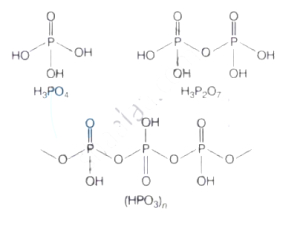
0 likes
View Solution928
EasyMCQ
What is the molecular formula of pyrophosphoric acid?
A
$H_4P_2O_7$
B
$H_3PO_4$
C
$H_4P_2O_5$
D
$H_2P_2O_5$
Solution
(A) Pyrophosphoric acid is formed by the condensation of two molecules of orthophosphoric acid $(H_3PO_4)$ with the elimination of one water molecule $(H_2O)$.
$2H_3PO_4 \rightarrow H_4P_2O_7 + H_2O$.
As shown in the structure,there are $4$ hydrogen atoms,$2$ phosphorus atoms,and $7$ oxygen atoms.
Therefore,the molecular formula is $H_4P_2O_7$.
$2H_3PO_4 \rightarrow H_4P_2O_7 + H_2O$.
As shown in the structure,there are $4$ hydrogen atoms,$2$ phosphorus atoms,and $7$ oxygen atoms.
Therefore,the molecular formula is $H_4P_2O_7$.
0 likes
View Solution929
EasyMCQ
Which of the following is $NOT$ a property of red phosphorus?
A
It is insoluble in carbon disulphide
B
It does not show chemiluminescence by the action of air
C
It forms phosphine when treated with hot sodium hydroxide solution
D
It is non-poisonous
Solution
(C) Red phosphorus is a polymeric structure and is chemically much less reactive than white phosphorus.
$1$. Red phosphorus is insoluble in carbon disulphide $(CS_2)$,whereas white phosphorus is soluble.
$2$. Red phosphorus does not show chemiluminescence.
$3$. Red phosphorus is non-poisonous.
$4$. Red phosphorus does not react with $NaOH$ to form phosphine $(PH_3)$ under normal conditions; only white phosphorus reacts with hot $NaOH$ solution to produce phosphine gas.
Therefore,the statement that it forms phosphine when treated with hot sodium hydroxide solution is incorrect for red phosphorus.
$1$. Red phosphorus is insoluble in carbon disulphide $(CS_2)$,whereas white phosphorus is soluble.
$2$. Red phosphorus does not show chemiluminescence.
$3$. Red phosphorus is non-poisonous.
$4$. Red phosphorus does not react with $NaOH$ to form phosphine $(PH_3)$ under normal conditions; only white phosphorus reacts with hot $NaOH$ solution to produce phosphine gas.
Therefore,the statement that it forms phosphine when treated with hot sodium hydroxide solution is incorrect for red phosphorus.
0 likes
View Solution930
EasyMCQ
The element that does $NOT$ exhibit allotropy is$-$
A
Phosphorus
B
Arsenic
C
Antimony
D
Bismuth
Solution
(D) Allotropy is a property shown by elements where they exist in two or more different physical forms in the same physical state. Among the elements of Group $15$,Nitrogen,Phosphorus,Arsenic,and Antimony exhibit allotropy. Bismuth is a metal and does not exhibit allotropy.
0 likes
View Solution931
MediumMCQ
Which among the following oxoacids of phosphorus shows a tendency of disproportionation?
A
Phosphinic acid $(H_3PO_2)$
B
Orthophosphoric acid $(H_3PO_4)$
C
Phosphonic acid $(H_3PO_3)$
D
Pyrophosphoric acid $(H_4P_2O_7)$
Solution
(C) The disproportionation reaction is a reaction in which an element in an intermediate oxidation state is simultaneously oxidized and reduced.
In $H_3PO_3$ (phosphonic acid),the oxidation state of phosphorus is $+3$.
It undergoes disproportionation upon heating to form $H_3PO_4$ (oxidation state $+5$) and $PH_3$ (oxidation state $-3$).
The reaction is: $4H_3PO_3 \rightarrow 3H_3PO_4 + PH_3$.
In $H_3PO_3$ (phosphonic acid),the oxidation state of phosphorus is $+3$.
It undergoes disproportionation upon heating to form $H_3PO_4$ (oxidation state $+5$) and $PH_3$ (oxidation state $-3$).
The reaction is: $4H_3PO_3 \rightarrow 3H_3PO_4 + PH_3$.
0 likes
View Solution932
EasyMCQ
Identify the compound in which phosphorus exists in the oxidation state of $+1$.
A
Phosphonic acid $(H_3PO_3)$
B
Phosphinic acid $(H_3PO_2)$
C
Pyrophosphorus acid $(H_4P_2O_5)$
D
Orthophosphoric acid $(H_3PO_4)$
Solution
(B) To find the oxidation state of phosphorus $(x)$ in $H_3PO_2$ (Phosphinic acid):
$3(+1) + x + 2(-2) = 0$
$3 + x - 4 = 0$
$x - 1 = 0$
$x = +1$
Therefore,phosphorus is in the $+1$ oxidation state in Phosphinic acid $(H_3PO_2)$.
$3(+1) + x + 2(-2) = 0$
$3 + x - 4 = 0$
$x - 1 = 0$
$x = +1$
Therefore,phosphorus is in the $+1$ oxidation state in Phosphinic acid $(H_3PO_2)$.
0 likes
View Solution933
EasyMCQ
Which of the following phosphorus oxyacids can act as a reducing agent?
A
$H_{3}PO_{3}$
B
$H_{3}PO_{4}$
C
$H_{2}P_{2}O_{6}$
D
$H_{4}P_{2}O_{7}$
Solution
(A) An oxyacid of phosphorus that contains $P-H$ bonds can act as a reducing agent.
$H_{3}PO_{3}$ (phosphorous acid) contains one $P-H$ bond,which makes it a reducing agent.
In contrast,$H_{3}PO_{4}$,$H_{2}P_{2}O_{6}$,and $H_{4}P_{2}O_{7}$ do not contain any $P-H$ bonds and therefore do not act as reducing agents.
$H_{3}PO_{3}$ (phosphorous acid) contains one $P-H$ bond,which makes it a reducing agent.
In contrast,$H_{3}PO_{4}$,$H_{2}P_{2}O_{6}$,and $H_{4}P_{2}O_{7}$ do not contain any $P-H$ bonds and therefore do not act as reducing agents.
0 likes
View Solution934
EasyMCQ
How many isotopes of nitrogen are found in nature?
A
$2$
B
$3$
C
$4$
D
$6$
Solution
(A) Nitrogen has two naturally occurring stable isotopes,namely,$^{14}N$ and $^{15}N$.
0 likes
View Solution935
EasyMCQ
On heating with concentrated $NaOH$ solution in an inert atmosphere of $CO_{2}$,white phosphorus gives a gas. Which of the following statements is incorrect about the gas?
A
It is less basic than $NH_{3}$.
B
It is more basic than $NH_{3}$.
C
It is highly poisonous and has a smell like rotten fish.
D
Its solution in water decomposes in the presence of light.
Solution
(B) The reaction of white phosphorus with concentrated $NaOH$ is: $P_{4} + 3NaOH + 3H_{2}O \xrightarrow{\Delta, CO_{2}} 3NaH_{2}PO_{2} + PH_{3}\uparrow$ (phosphine).
$PH_{3}$ is less basic than $NH_{3}$ because the lone pair of electrons on the phosphorus atom is less available for donation compared to nitrogen,due to the larger size of the phosphorus atom and the involvement of $s$-character in the bonding.
Therefore,the statement that $PH_{3}$ is more basic than $NH_{3}$ is incorrect.
$PH_{3}$ is less basic than $NH_{3}$ because the lone pair of electrons on the phosphorus atom is less available for donation compared to nitrogen,due to the larger size of the phosphorus atom and the involvement of $s$-character in the bonding.
Therefore,the statement that $PH_{3}$ is more basic than $NH_{3}$ is incorrect.
0 likes
View Solution936
EasyMCQ
$A$ metalloid is
A
$Bi$
B
$Sb$
C
$P$
D
$Se$
Solution
(B) metalloid is defined as a chemical element whose physical and chemical properties lie between those of metals and non-metals.
Among the given options,only antimony $(Sb)$ is a metalloid.
Among the given options,only antimony $(Sb)$ is a metalloid.
0 likes
View Solution937
DifficultMCQ
When a brown compound of manganese $(A)$ is treated with $HCl$,it gives a gas $(B)$. The gas $(B)$ taken in excess reacts with $NH_3$ to give an explosive compound $(C)$. The compounds $A$,$B$ and $C$ are:
A
$A=MnO_2, B=Cl_2, C=NCl_3$
B
$A=MnO, B=Cl_2, C=NH_4Cl$
C
$A=Mn_3O_4, B=Cl_2, C=NCl_3$
D
$A=MnO_3, B=Cl_2, C=NCl_2$
Solution
(A) The brown compound of manganese is $MnO_2$ $(A)$. When $MnO_2$ reacts with $HCl$,it produces chlorine gas $(B)$:
$MnO_2 (A) + 4 HCl \rightarrow MnCl_2 + 2 H_2O + Cl_2 (B)$
When excess chlorine gas $(B)$ reacts with ammonia $(NH_3)$,it forms nitrogen trichloride $(C)$,which is an explosive compound:
$3 Cl_2 (B) + NH_3 \rightarrow NCl_3 (C) + 3 HCl$
Thus,the compounds $A$,$B$,and $C$ are $MnO_2$,$Cl_2$,and $NCl_3$ respectively.
$MnO_2 (A) + 4 HCl \rightarrow MnCl_2 + 2 H_2O + Cl_2 (B)$
When excess chlorine gas $(B)$ reacts with ammonia $(NH_3)$,it forms nitrogen trichloride $(C)$,which is an explosive compound:
$3 Cl_2 (B) + NH_3 \rightarrow NCl_3 (C) + 3 HCl$
Thus,the compounds $A$,$B$,and $C$ are $MnO_2$,$Cl_2$,and $NCl_3$ respectively.
0 likes
View Solution938
MediumMCQ
The statement that is $NOT$ correct is:
A
In solid state,$PCl_{5}$ exists as $[PCl_{4}]^{+}[PCl_{6}]^{-}$.
B
Phosphorous acid on heating disproportionates to give metaphosphoric acid and phosphine.
C
Hypophosphorous acid reduces silver nitrate to silver.
D
Pure phosphine is non-inflammable.
Solution
(B) The correct statement is that phosphorous acid $(H_{3}PO_{3})$ on heating disproportionates to give orthophosphoric acid $(H_{3}PO_{4})$ and phosphine $(PH_{3})$.
$4H_{3}PO_{3} \xrightarrow{\Delta} 3H_{3}PO_{4} + PH_{3}$.
Therefore,the statement in option $B$ is incorrect because it mentions metaphosphoric acid instead of orthophosphoric acid.
$4H_{3}PO_{3} \xrightarrow{\Delta} 3H_{3}PO_{4} + PH_{3}$.
Therefore,the statement in option $B$ is incorrect because it mentions metaphosphoric acid instead of orthophosphoric acid.
0 likes
View Solution939
EasyMCQ
$NO_2$ gas is
A
colourless,neutral
B
colourless,acidic
C
brown,acidic
D
brown,neutral
Solution
(C) $NO_2$ (Nitrogen dioxide) gas is brown in colour and acidic in nature.
0 likes
View Solution940
MediumMCQ
Which of the following compounds does not give dinitrogen on heating?
A
$Ba(N_3)_2$
B
$NH_4NO_2$
C
$NH_4NO_3$
D
$(NH_4)_2Cr_2O_7$
Solution
(C) Among the given compounds,only ammonium nitrate $(NH_4NO_3)$ does not produce $N_2$ gas on decomposition; instead,it produces nitrous oxide $(N_2O)$.
$Ba(N_3)_2 \xrightarrow{\Delta} Ba + 3N_2$
$NH_4NO_2 \xrightarrow{\Delta} N_2 + 2H_2O$
$NH_4NO_3 \xrightarrow{\Delta} N_2O + 2H_2O$
$(NH_4)_2Cr_2O_7 \xrightarrow{\Delta} Cr_2O_3 + N_2 + 4H_2O$
$Ba(N_3)_2 \xrightarrow{\Delta} Ba + 3N_2$
$NH_4NO_2 \xrightarrow{\Delta} N_2 + 2H_2O$
$NH_4NO_3 \xrightarrow{\Delta} N_2O + 2H_2O$
$(NH_4)_2Cr_2O_7 \xrightarrow{\Delta} Cr_2O_3 + N_2 + 4H_2O$
0 likes
View Solution941
DifficultMCQ
Heating $(NH_4)_2Cr_2O_7$ liberates a gas. The same gas is obtained by:
A
Heating $NH_4NO_2$
B
Treating $H_2O_2$ with $NaNO_2$
C
Treating $Mg_3N_2$ with $H_2O$
D
Heating $NH_4NO_3$
Solution
(A) The thermal decomposition of ammonium dichromate $(NH_4)_2Cr_2O_7$ produces nitrogen gas $(N_2)$:
$(NH_4)_2Cr_2O_7 \stackrel{\Delta}{\longrightarrow} N_2 \uparrow + Cr_2O_3 + 4H_2O$
Similarly,ammonium nitrite $(NH_4NO_2)$ on heating also liberates nitrogen gas $(N_2)$:
$NH_4NO_2 \stackrel{\Delta}{\longrightarrow} N_2 \uparrow + 2H_2O$
Thus,the same gas is obtained by heating $NH_4NO_2$.
$(NH_4)_2Cr_2O_7 \stackrel{\Delta}{\longrightarrow} N_2 \uparrow + Cr_2O_3 + 4H_2O$
Similarly,ammonium nitrite $(NH_4NO_2)$ on heating also liberates nitrogen gas $(N_2)$:
$NH_4NO_2 \stackrel{\Delta}{\longrightarrow} N_2 \uparrow + 2H_2O$
Thus,the same gas is obtained by heating $NH_4NO_2$.
0 likes
View Solution942
EasyMCQ
Which of the following properties is true for the given sequence? $NH_{3} > PH_{3} > AsH_{3} > SbH_{3} > BiH_{3}$
A
Reducing property
B
Thermal stability
C
Bond angle
D
Acidic character
Solution
(B) The thermal stability of the hydrides of group $15$ elements decreases down the group as $NH_{3} > PH_{3} > AsH_{3} > SbH_{3} > BiH_{3}$.
As we move down the group,the atomic size of the central atom increases (from $N$ to $Bi$).
This leads to an increase in the bond length and a decrease in the bond dissociation enthalpy (bond strength).
Consequently,the thermal stability decreases.
As we move down the group,the atomic size of the central atom increases (from $N$ to $Bi$).
This leads to an increase in the bond length and a decrease in the bond dissociation enthalpy (bond strength).
Consequently,the thermal stability decreases.
0 likes
View Solution943
MediumMCQ
$A$ colourless,neutral,paramagnetic oxide of nitrogen '$P$' on oxidation gives reddish brown gas $Q$. $Q$ on cooling gives colourless gas $R$. $R$ on reaction with $P$ gives blue solid $S$. Identify $P, Q, R, S$ respectively.
A
$N_2O, NO, NO_2, N_2O_5$
B
$N_2O, NO_2, N_2O_4, N_2O_3$
C
$NO, NO_2, N_2O_4, N_2O_3$
D
$NO, NO, N_2O_4, N_2O_5$
Solution
(C) The reactions are as follows:
$1$. $2NO(g) + O_2(g) \rightarrow 2NO_2(g)$ (Reddish brown gas $Q$)
$2$. $2NO_2(g) \rightleftharpoons N_2O_4(g)$ (Colourless gas $R$ on cooling)
$3$. $NO(g) + NO_2(g) \rightarrow N_2O_3(s)$ (Blue solid $S$)
Thus,$P = NO$,$Q = NO_2$,$R = N_2O_4$,and $S = N_2O_3$.
$1$. $2NO(g) + O_2(g) \rightarrow 2NO_2(g)$ (Reddish brown gas $Q$)
$2$. $2NO_2(g) \rightleftharpoons N_2O_4(g)$ (Colourless gas $R$ on cooling)
$3$. $NO(g) + NO_2(g) \rightarrow N_2O_3(s)$ (Blue solid $S$)
Thus,$P = NO$,$Q = NO_2$,$R = N_2O_4$,and $S = N_2O_3$.
0 likes
View Solution944
MediumMCQ
Very pure $N_2$ can be obtained by
A
Thermal decomposition of ammonium dichromate
B
Treating aqueous solution of $NH_4Cl$ and $NaNO_2$
C
Liquefaction and fractional distillation of liquid air
D
Thermal decomposition of sodium azide
Solution
(D) Very pure nitrogen gas is obtained by the thermal decomposition of sodium azide $(NaN_3)$.
The chemical reaction is:
$2NaN_3 \rightarrow 2Na + 3N_2$
This method is commonly used in automobile airbags.
The chemical reaction is:
$2NaN_3 \rightarrow 2Na + 3N_2$
This method is commonly used in automobile airbags.
0 likes
View Solution945
EasyMCQ
Which of the following statements is true regarding nitrogen?
A
It is less electronegative.
B
It has low ionization enthalpy.
C
$d$-orbitals are available.
D
Ability to form $p\pi-p\pi$ bonds with itself.
Solution
(D) The electronic configuration of $N$ $(Z=7)$ is $1s^{2} 2s^{2} 2p^{3}$.
Since the principal quantum number $n=2$,it does not have $d$-orbitals available.
Due to the stable half-filled $2p$ subshell,its ionization enthalpy is very high.
Nitrogen is the third most electronegative element in the periodic table.
Due to its small size,nitrogen has a unique ability to form $p\pi-p\pi$ multiple bonds with itself (forming $N \equiv N$).
Since the principal quantum number $n=2$,it does not have $d$-orbitals available.
Due to the stable half-filled $2p$ subshell,its ionization enthalpy is very high.
Nitrogen is the third most electronegative element in the periodic table.
Due to its small size,nitrogen has a unique ability to form $p\pi-p\pi$ multiple bonds with itself (forming $N \equiv N$).
0 likes
View Solution946
EasyMCQ
The correct decreasing order of basicity of hydrides of group-$15$ elements is
A
$SbH_3 > AsH_3 > PH_3 > NH_3$
B
$PH_3 > AsH_3 > SbH_3 > NH_3$
C
$AsH_3 > SbH_3 > NH_3 > PH_3$
D
$NH_3 > PH_3 > AsH_3 > SbH_3$
Solution
(D) The basicity of group-$15$ hydrides depends on the availability of the lone pair of electrons on the central atom for donation.
As we move down the group from $N$ to $Bi$,the size of the central atom increases.
This leads to the dispersion of the lone pair over a larger volume,making it less available for donation.
Therefore,the basicity decreases down the group.
The correct decreasing order is $NH_3 > PH_3 > AsH_3 > SbH_3$.
As we move down the group from $N$ to $Bi$,the size of the central atom increases.
This leads to the dispersion of the lone pair over a larger volume,making it less available for donation.
Therefore,the basicity decreases down the group.
The correct decreasing order is $NH_3 > PH_3 > AsH_3 > SbH_3$.
0 likes
View Solution947
DifficultMCQ
Which one of the following oxoacids of phosphorus can reduce $AgNO_3$ to metallic silver?
A
$H_3PO_2$
B
$H_4P_2O_7$
C
$H_4P_2O_6$
D
$H_3PO_4$
Solution
(A) Hypophosphorus acid $(H_3PO_2)$ acts as a strong reducing agent because it contains two $P-H$ bonds.
It can effectively reduce $Ag^{+}$ ions to metallic $Ag$ and itself gets oxidized to phosphorus acid $(H_3PO_3)$.
The chemical reaction is as follows:
$3AgNO_3 + H_3PO_2 + 2H_2O \longrightarrow 3Ag + H_3PO_3 + 3HNO_3$
It can effectively reduce $Ag^{+}$ ions to metallic $Ag$ and itself gets oxidized to phosphorus acid $(H_3PO_3)$.
The chemical reaction is as follows:
$3AgNO_3 + H_3PO_2 + 2H_2O \longrightarrow 3Ag + H_3PO_3 + 3HNO_3$
0 likes
View Solution948
DifficultMCQ
The strong reducing property of hypophosphorus acid $(H_3PO_2)$ is due to
A
the positive valency of phosphorus
B
two $P-H$ bonds
C
presence of phosphorus in its highest oxidation state
D
its concentration
Solution
(B) The strong reducing property of hypophosphorus acid $(H_3PO_2)$ is due to the presence of two $P-H$ bonds. The hydrogen atoms directly bonded to the phosphorus atom are responsible for its reducing character. The structure of $H_3PO_2$ is as follows:
$O=P(H)(H)(OH)$
$O=P(H)(H)(OH)$
0 likes
View Solution949
MediumMCQ
Phosphorus pentachloride $(PCl_{5})$:
A
on hydrolysis gives an oxo-acid of phosphorus which is tribasic
B
on hydrolysis gives an oxo-acid of phosphorus which is a good reducing agent
C
has all the five equivalent bonds
D
exists as an ionic solid in which cation has octahedral structure and anion has tetrahedral structure
Solution
(A) Phosphorus pentachloride $(PCl_{5})$ on hydrolysis gives phosphoric acid $(H_{3}PO_{4})$,which is a tribasic acid.
$PCl_{5} + 4H_{2}O \longrightarrow H_{3}PO_{4} + 5HCl$
In $H_{3}PO_{4}$,there are three $P-OH$ groups,making it tribasic.
$PCl_{5} + 4H_{2}O \longrightarrow H_{3}PO_{4} + 5HCl$
In $H_{3}PO_{4}$,there are three $P-OH$ groups,making it tribasic.
0 likes
View Solutionp-Block Elements (Class 12) — Nitrogen family · Frequently Asked Questions
1Are these p-Block Elements (Class 12) questions useful for JEE and NEET?
Yes. All questions in this section are mapped to JEE Main and NEET exam patterns. Previous year questions from JEE Main, NEET, GUJCET and state-level exams are included with full solutions.
2Can I switch to Hindi or Gujarati for these questions?
Yes. Use the language tabs in the hero section or the sidebar to view the same questions and solutions in English, Hindi or Gujarati.
3How do I generate a question paper from this subtopic?
Use the Vedclass Exam Paper Generator — select the chapter and subtopic, set difficulty, and generate Sets A, B, C, D automatically. First 3 chapters of every subject are free.
Vedclass Products
For Students
Vedclass Test Series
Mock tests in real JEE/NEET style with performance analysis. 5-day free trial.
Start Free TrialFor Teachers
Exam Paper Generator
Generate Set A/B/C/D papers from this chapter in 2 minutes. 3 chapters free.
Try FreeFor Institutes
Online Exam Module
Live online exams with unlimited students, 360° analytics & white-label branding.
See DemoFor Teachers & Institutes
Generate a p-Block Elements (Class 12) Exam Paper in 2 Minutes
Select subtopic & difficulty — Sets A, B, C, D auto-generated with No Repeat logic.
First 3 chapters of every subject are free — no payment required.