
A English
Halogen family Questions in English
Class 12 Chemistry · p-Block Elements (Class 12) · Halogen family
676+
Questions
English
Language
100%
With Solutions
Showing 50 of 676 questions in English
451
Medium
Arrange the following in the order of property indicated for each set:
$(i)$ $F_{2}, Cl_{2}, Br_{2}, I_{2}$ - increasing bond dissociation enthalpy.
$(ii)$ $HF, HCl, HBr, HI$ - increasing acid strength.
$(iii)$ $NH_{3}, PH_{3}, AsH_{3}, SbH_{3}, BiH_{3}$ - increasing base strength.
$(i)$ $F_{2}, Cl_{2}, Br_{2}, I_{2}$ - increasing bond dissociation enthalpy.
$(ii)$ $HF, HCl, HBr, HI$ - increasing acid strength.
$(iii)$ $NH_{3}, PH_{3}, AsH_{3}, SbH_{3}, BiH_{3}$ - increasing base strength.
Solution
(A) $(i)$ Bond dissociation energy usually decreases on moving down a group as the atomic size increases. However,the bond dissociation energy of $F_{2}$ is lower than that of $Cl_{2}$ and $Br_{2}$ due to the small atomic size and interelectronic repulsions in fluorine. Thus,the increasing order is: $I_{2} < F_{2} < Br_{2} < Cl_{2}$.
$(ii)$ The bond dissociation energy of $H-X$ molecules decreases as the atomic size of $X$ increases. Since the $H-I$ bond is the weakest,$HI$ is the strongest acid. The increasing order is: $HF < HCl < HBr < HI$.
$(iii)$ On moving from nitrogen to bismuth,the atomic size increases and the electron density on the central atom decreases,reducing the availability of the lone pair. Thus,the basic strength decreases. The increasing order is: $BiH_{3} < SbH_{3} < AsH_{3} < PH_{3} < NH_{3}$.
$(ii)$ The bond dissociation energy of $H-X$ molecules decreases as the atomic size of $X$ increases. Since the $H-I$ bond is the weakest,$HI$ is the strongest acid. The increasing order is: $HF < HCl < HBr < HI$.
$(iii)$ On moving from nitrogen to bismuth,the atomic size increases and the electron density on the central atom decreases,reducing the availability of the lone pair. Thus,the basic strength decreases. The increasing order is: $BiH_{3} < SbH_{3} < AsH_{3} < PH_{3} < NH_{3}$.
0 likes
View Solution452
Difficult
Explain the electron gain enthalpy values of elements of the $17^{\text{th}}$ group. Give reasons and explain.
Solution
(N/A) The electron gain enthalpy values of $17^{\text{th}}$ group elements (halogens) are highly negative because they have a general electronic configuration of $ns^{2} np^{5}$. They require only one electron to achieve the stable noble gas configuration $(ns^{2} np^{6})$,making the process highly exothermic.
Although fluorine $(F)$ has the smallest size,its electron gain enthalpy is less negative than that of chlorine $(Cl)$. This is due to the strong inter-electronic repulsions in the relatively small $2p$ subshell of fluorine,which makes the addition of an electron less favorable compared to chlorine.
As we move down the group from $Cl$ to $At$,the atomic size increases,which decreases the effective nuclear attraction for the incoming electron,resulting in a decrease in the magnitude of negative electron gain enthalpy.
Although fluorine $(F)$ has the smallest size,its electron gain enthalpy is less negative than that of chlorine $(Cl)$. This is due to the strong inter-electronic repulsions in the relatively small $2p$ subshell of fluorine,which makes the addition of an electron less favorable compared to chlorine.
As we move down the group from $Cl$ to $At$,the atomic size increases,which decreases the effective nuclear attraction for the incoming electron,resulting in a decrease in the magnitude of negative electron gain enthalpy.
| Element | $F$ | $Cl$ | $Br$ | $I$ | $At$ |
| $\Delta_{eg} H \ (kJ \ mol^{-1})$ | $-328$ | $-349$ | $-325$ | $-295$ | $-279$ |
0 likes
View Solution453
Medium
Justify by giving reactions that among halogens,$F_{2}$ is the best oxidant and among hydrohalic acids,$HI$ is the best reductant.
Solution
(A) $1$. Oxidizing power of halogens: $F_{2}$ is the strongest oxidizing agent because it has the highest standard reduction potential. It can oxidize other halide ions $(Cl^{-}, Br^{-}, I^{-})$ to their respective halogens.
$F_{2(aq)} + 2Cl^{-}_{(aq)} \rightarrow 2F^{-}_{(aq)} + Cl_{2(g)}$
$F_{2(aq)} + 2Br^{-}_{(aq)} \rightarrow 2F^{-}_{(aq)} + Br_{2(l)}$
$F_{2(aq)} + 2I^{-}_{(aq)} \rightarrow 2F^{-}_{(aq)} + I_{2(s)}$
Since $Cl_{2}, Br_{2},$ and $I_{2}$ cannot oxidize $F^{-}$ to $F_{2}$,the order of oxidizing strength is $I_{2} < Br_{2} < Cl_{2} < F_{2}$.
$2$. Reducing power of hydrohalic acids: The reducing power increases as the bond dissociation enthalpy decreases down the group $(HF < HCl < HBr < HI)$. $HI$ is the strongest reducing agent.
$HI$ can reduce concentrated $H_{2}SO_{4}$ to $SO_{2}$:
$2HI + H_{2}SO_{4} \rightarrow I_{2} + SO_{2} + 2H_{2}O$
$HI$ can also reduce $Cu^{2+}$ to $Cu^{+}$:
$4I^{-} + 2Cu^{2+} \rightarrow Cu_{2}I_{2} + I_{2}$
$F_{2(aq)} + 2Cl^{-}_{(aq)} \rightarrow 2F^{-}_{(aq)} + Cl_{2(g)}$
$F_{2(aq)} + 2Br^{-}_{(aq)} \rightarrow 2F^{-}_{(aq)} + Br_{2(l)}$
$F_{2(aq)} + 2I^{-}_{(aq)} \rightarrow 2F^{-}_{(aq)} + I_{2(s)}$
Since $Cl_{2}, Br_{2},$ and $I_{2}$ cannot oxidize $F^{-}$ to $F_{2}$,the order of oxidizing strength is $I_{2} < Br_{2} < Cl_{2} < F_{2}$.
$2$. Reducing power of hydrohalic acids: The reducing power increases as the bond dissociation enthalpy decreases down the group $(HF < HCl < HBr < HI)$. $HI$ is the strongest reducing agent.
$HI$ can reduce concentrated $H_{2}SO_{4}$ to $SO_{2}$:
$2HI + H_{2}SO_{4} \rightarrow I_{2} + SO_{2} + 2H_{2}O$
$HI$ can also reduce $Cu^{2+}$ to $Cu^{+}$:
$4I^{-} + 2Cu^{2+} \rightarrow Cu_{2}I_{2} + I_{2}$
0 likes
View Solution454
EasyMCQ
The correct reactivity order of halogens with hydrogen is?
A
$F_{2} > Cl_{2} > Br_{2} > I_{2}$
B
$I_{2} > Br_{2} > Cl_{2} > F_{2}$
C
$Cl_{2} > F_{2} > Br_{2} > I_{2}$
D
$Br_{2} > Cl_{2} > F_{2} > I_{2}$
Solution
(A) The reactivity of halogens $(X_{2})$ towards hydrogen decreases down the group as the bond dissociation energy of $X-X$ bond decreases and the electronegativity of the halogen decreases.
The correct order of reactivity is $F_{2} > Cl_{2} > Br_{2} > I_{2}$.
The correct order of reactivity is $F_{2} > Cl_{2} > Br_{2} > I_{2}$.
0 likes
View Solution455
Medium
Aluminium trifluoride is insoluble in anhydrous $HF$ but dissolves on addition of $NaF$. Aluminium trifluoride precipitates out of the resulting solution when gaseous $BF_3$ is bubbled through. Give reasons.
Solution
(N/A) Hydrogen fluoride $(HF)$ is a covalent compound and exhibits strong intermolecular hydrogen bonding. Consequently,it does not provide free fluoride ions,and $AlF_3$ remains insoluble in it.
Sodium fluoride $(NaF)$ is an ionic compound. Upon adding $NaF$ to the mixture,$AlF_3$ dissolves due to the availability of free $F^-$ ions,forming a soluble complex:
$3 NaF + AlF_3 \rightarrow Na_3[AlF_6]$
When gaseous boron trifluoride $(BF_3)$ is bubbled through the solution,$AlF_3$ precipitates out. This occurs because boron has a higher tendency to form complexes with fluoride ions compared to aluminium. Thus,$BF_3$ displaces $Al$ from the complex:
$Na_3[AlF_6] + 3 BF_3 \rightarrow 3 Na[BF_4] + AlF_3$
Sodium fluoride $(NaF)$ is an ionic compound. Upon adding $NaF$ to the mixture,$AlF_3$ dissolves due to the availability of free $F^-$ ions,forming a soluble complex:
$3 NaF + AlF_3 \rightarrow Na_3[AlF_6]$
When gaseous boron trifluoride $(BF_3)$ is bubbled through the solution,$AlF_3$ precipitates out. This occurs because boron has a higher tendency to form complexes with fluoride ions compared to aluminium. Thus,$BF_3$ displaces $Al$ from the complex:
$Na_3[AlF_6] + 3 BF_3 \rightarrow 3 Na[BF_4] + AlF_3$
0 likes
View Solution456
Easy
Describe the process for the extraction of chlorine.
Solution
(N/A) Chlorine is primarily extracted by the electrolysis of brine ($NaCl$ solution) in the Chlor-alkali process.
$1$. During electrolysis,$Cl^-$ ions are oxidized at the anode to form chlorine gas: $2Cl^- (aq) \rightarrow Cl_2 (g) + 2e^-$.
$2$. At the cathode,water is reduced to form hydrogen gas and hydroxide ions: $2H_2O (l) + 2e^- \rightarrow H_2 (g) + 2OH^- (aq)$.
$3$. The overall reaction is: $2NaCl (aq) + 2H_2O (l) \rightarrow Cl_2 (g) + H_2 (g) + 2NaOH (aq)$.
$1$. During electrolysis,$Cl^-$ ions are oxidized at the anode to form chlorine gas: $2Cl^- (aq) \rightarrow Cl_2 (g) + 2e^-$.
$2$. At the cathode,water is reduced to form hydrogen gas and hydroxide ions: $2H_2O (l) + 2e^- \rightarrow H_2 (g) + 2OH^- (aq)$.
$3$. The overall reaction is: $2NaCl (aq) + 2H_2O (l) \rightarrow Cl_2 (g) + H_2 (g) + 2NaOH (aq)$.
0 likes
View Solution457
Medium
State the occurrence of group-$17$ elements.
Solution
(N/A) $(i)$ Fluorine: Fluorine is present mainly as insoluble fluorides such as fluorspar $(CaF_{2})$,cryolite $(Na_{3}AlF_{6})$,and fluoroapatite $[Ca_{9}(PO_{4})_{6} \cdot CaF_{2}]$. Small quantities are also present in soil,river water,plants,and the bones and teeth of animals.
$(ii)$ Chlorine: Sea water contains $2.5 \%$ by mass of sodium chloride. Deposits of dried-up seas contain compounds such as sodium chloride $(NaCl)$ and carnallite $(KCl \cdot MgCl_{2} \cdot 6H_{2}O)$.
$(iii)$ Bromine and Iodine: Apart from sodium chloride,sea water contains bromides and iodides of potassium,magnesium,and calcium (e.g.,$NaBr, KBr, MgBr_{2}$). Iodine is mainly obtained as iodates $(NaIO_{3})$. Certain marine life,such as various seaweeds,contain up to $0.5 \%$ iodine as sodium iodide.
$(iv)$ Tennessine: Tennessine is a synthetic radioactive element with an atomic mass of $294$. Only a small amount has been prepared due to its very short half-life in the millisecond range.
$(ii)$ Chlorine: Sea water contains $2.5 \%$ by mass of sodium chloride. Deposits of dried-up seas contain compounds such as sodium chloride $(NaCl)$ and carnallite $(KCl \cdot MgCl_{2} \cdot 6H_{2}O)$.
$(iii)$ Bromine and Iodine: Apart from sodium chloride,sea water contains bromides and iodides of potassium,magnesium,and calcium (e.g.,$NaBr, KBr, MgBr_{2}$). Iodine is mainly obtained as iodates $(NaIO_{3})$. Certain marine life,such as various seaweeds,contain up to $0.5 \%$ iodine as sodium iodide.
$(iv)$ Tennessine: Tennessine is a synthetic radioactive element with an atomic mass of $294$. Only a small amount has been prepared due to its very short half-life in the millisecond range.
0 likes
View Solution458
Medium
State the electronic configurations of Group-$17$ elements.
Solution
(N/A) The general valence shell electronic configuration of Group-$17$ elements (halogens) is $ns^{2} np^{5}$. The specific electronic configurations for each element are given below:
These elements have seven electrons in their valence shell. Halogens are highly reactive because they have a strong tendency to gain one electron to achieve a stable noble gas configuration.
| Element | Electronic Configuration |
|---|---|
| ${}_{9}F$ | $[He] 2s^{2} 2p^{5}$ |
| ${}_{17}Cl$ | $[Ne] 3s^{2} 3p^{5}$ |
| ${}_{35}Br$ | $[Ar] 3d^{10} 4s^{2} 4p^{5}$ |
| ${}_{53}I$ | $[Kr] 4d^{10} 5s^{2} 5p^{5}$ |
| ${}_{85}At$ | $[Xe] 4f^{14} 5d^{10} 6s^{2} 6p^{5}$ |
| ${}_{117}Ts$ | $[Rn] 5f^{14} 6d^{10} 7s^{2} 7p^{5}$ |
These elements have seven electrons in their valence shell. Halogens are highly reactive because they have a strong tendency to gain one electron to achieve a stable noble gas configuration.
0 likes
View Solution459
Medium
Discuss variations in atomic radii and ionization enthalpies in halogens.
Solution
(N/A) $(i)$ Atomic radii: The halogens have the smallest atomic radii in their respective periods due to maximum effective nuclear charge. The atomic radius of fluorine,like the other elements of the second period,is extremely small. Atomic radii and ionic radii increase from fluorine to iodine due to the increasing number of quantum shells.
$(ii)$ Ionization enthalpies: Halogens have very high ionization enthalpy,which indicates that they have very little tendency to lose an electron. The ionization enthalpy decreases down the group from fluorine to iodine due to the increase in atomic size. Iodine has the maximum tendency to lose an electron $(I^+)$ because of its large size and low ionization enthalpy.
$(ii)$ Ionization enthalpies: Halogens have very high ionization enthalpy,which indicates that they have very little tendency to lose an electron. The ionization enthalpy decreases down the group from fluorine to iodine due to the increase in atomic size. Iodine has the maximum tendency to lose an electron $(I^+)$ because of its large size and low ionization enthalpy.
0 likes
View Solution460
Difficult
Describe the physical and chemical properties of the elements of group $17$.
Solution
(N/A) The halogens show a regular gradation in their physical properties. Fluorine and chlorine are gases,bromine is a liquid,and iodine is a solid.
Their melting and boiling points increase regularly with an increase in atomic number.
All halogens are coloured. This is due to the absorption of radiation in the visible region,which results in the excitation of outer electrons to higher energy levels. By absorbing different quanta of radiation,they display different colours.
For example,$F_2$ is yellow,$Cl_2$ is greenish-yellow,$Br_2$ is red,and $I_2$ is violet. Fluorine and chlorine react with water. Bromine and iodine are only sparingly soluble in water but are soluble in various organic solvents such as chloroform,$CCl_4$,$CS_2$,and hydrocarbons to give coloured solutions.
Bond dissociation enthalpy of $F_2$ is lower than that of $Cl_2$,whereas the expected trend in bond dissociation enthalpy for $X-X$ bonds after chlorine is: $Cl-Cl > Br-Br > I-I$.
This anomaly is because the electron-electron repulsions among the lone pairs in $F_2$ are relatively larger than in $Cl_2$ due to the smaller size of the fluorine atom.
Chemical Properties:
Trends in oxidation states and chemical reactivity:
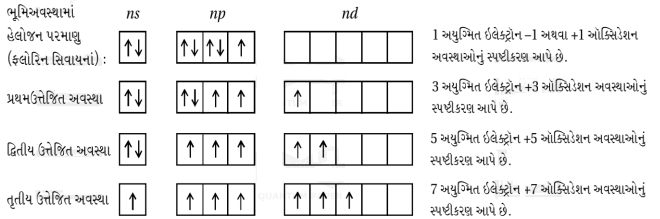
All halogens exhibit a $-1$ oxidation state. However,chlorine,bromine,and iodine also exhibit $+1, +3, +5$,and $+7$ oxidation states.
Higher oxidation states of chlorine,bromine,and iodine are realised mainly when the halogens are in combination with the small and highly electronegative fluorine and oxygen atoms.
For example,in interhalogen compounds,oxides,and oxoacids. In oxides and oxoacids of chlorine and bromine,$+4$ and $+6$ oxidation states are also observed.
Fluorine atom has no $d$-orbitals in its valence shell and therefore cannot expand its octet. Being the most electronegative,it exhibits only a $-1$ oxidation state.
All halogens are highly reactive. They react with metals and non-metals to form halides. The reactivity of halogens decreases down the group.
Due to their ability to accept electrons easily,halogens act as strong oxidising agents. $F_2$ is the strongest oxidising halogen and it oxidises other halide ions in solution or even in the solid phase.
In general,a halogen oxidises halide ions of higher atomic number.
$F_2 + 2X^- \rightarrow 2F^- + X_2$ (where $X = Cl, Br$ or $I$)
$Cl_2 + 2X^- \rightarrow 2Cl^- + X_2$ (where $X = Br$ or $I$)
$Br_2 + 2I^- \rightarrow 2Br^- + I_2$
Their melting and boiling points increase regularly with an increase in atomic number.
All halogens are coloured. This is due to the absorption of radiation in the visible region,which results in the excitation of outer electrons to higher energy levels. By absorbing different quanta of radiation,they display different colours.
For example,$F_2$ is yellow,$Cl_2$ is greenish-yellow,$Br_2$ is red,and $I_2$ is violet. Fluorine and chlorine react with water. Bromine and iodine are only sparingly soluble in water but are soluble in various organic solvents such as chloroform,$CCl_4$,$CS_2$,and hydrocarbons to give coloured solutions.
Bond dissociation enthalpy of $F_2$ is lower than that of $Cl_2$,whereas the expected trend in bond dissociation enthalpy for $X-X$ bonds after chlorine is: $Cl-Cl > Br-Br > I-I$.
This anomaly is because the electron-electron repulsions among the lone pairs in $F_2$ are relatively larger than in $Cl_2$ due to the smaller size of the fluorine atom.
Chemical Properties:
Trends in oxidation states and chemical reactivity:
All halogens exhibit a $-1$ oxidation state. However,chlorine,bromine,and iodine also exhibit $+1, +3, +5$,and $+7$ oxidation states.
Higher oxidation states of chlorine,bromine,and iodine are realised mainly when the halogens are in combination with the small and highly electronegative fluorine and oxygen atoms.
For example,in interhalogen compounds,oxides,and oxoacids. In oxides and oxoacids of chlorine and bromine,$+4$ and $+6$ oxidation states are also observed.
Fluorine atom has no $d$-orbitals in its valence shell and therefore cannot expand its octet. Being the most electronegative,it exhibits only a $-1$ oxidation state.
All halogens are highly reactive. They react with metals and non-metals to form halides. The reactivity of halogens decreases down the group.
Due to their ability to accept electrons easily,halogens act as strong oxidising agents. $F_2$ is the strongest oxidising halogen and it oxidises other halide ions in solution or even in the solid phase.
In general,a halogen oxidises halide ions of higher atomic number.
$F_2 + 2X^- \rightarrow 2F^- + X_2$ (where $X = Cl, Br$ or $I$)
$Cl_2 + 2X^- \rightarrow 2Cl^- + X_2$ (where $X = Br$ or $I$)
$Br_2 + 2I^- \rightarrow 2Br^- + I_2$
0 likes
View Solution461
Difficult
Discuss the anomalous behaviour of fluorine.
Solution
(N/A) Fluorine shows anomalous behaviour due to the following reasons:
$(i)$ Small atomic size.
$(ii)$ High ionization enthalpy.
$(iii)$ Absence of $d$-orbitals in the valence shell.
$(iv)$ High positive electrode potential.
Key points of anomalous behaviour:
$1$. Fluorine exhibits only a $(-1)$ oxidation state,whereas other halogens exhibit $(+1), (+3), (+5),$ and $(+7)$ oxidation states.
$2$. $HF$ is a liquid at room temperature due to intermolecular $H$-bonding,while $HCl, HBr,$ and $HI$ are gases.
$3$. Fluorine does not form polyhalide ions like $F_{3}^{-}$ due to the absence of $d$-orbitals in its valence shell.
$4$. Fluorine forms only one oxoacid $(HOF)$,whereas other halogens form several oxoacids.
$5$. The maximum covalency of fluorine is $1$ due to the absence of $d$-orbitals,while other halogens can show a covalency up to $7$.
$6$. Hydrofluoric acid $(HF)$ exists as a dimer $(H_{2}F_{2})$ and acts as a dibasic acid,while other hydrohalic acids are monobasic.
$7$. $F_{2}$ is highly reactive due to the low bond dissociation enthalpy of the $F-F$ bond.
$8$. Fluorine forms stable hexafluorides like $SF_{6}$ with sulfur,while other halogens do not form such stable hexahalides.
$(i)$ Small atomic size.
$(ii)$ High ionization enthalpy.
$(iii)$ Absence of $d$-orbitals in the valence shell.
$(iv)$ High positive electrode potential.
Key points of anomalous behaviour:
$1$. Fluorine exhibits only a $(-1)$ oxidation state,whereas other halogens exhibit $(+1), (+3), (+5),$ and $(+7)$ oxidation states.
$2$. $HF$ is a liquid at room temperature due to intermolecular $H$-bonding,while $HCl, HBr,$ and $HI$ are gases.
$3$. Fluorine does not form polyhalide ions like $F_{3}^{-}$ due to the absence of $d$-orbitals in its valence shell.
$4$. Fluorine forms only one oxoacid $(HOF)$,whereas other halogens form several oxoacids.
$5$. The maximum covalency of fluorine is $1$ due to the absence of $d$-orbitals,while other halogens can show a covalency up to $7$.
$6$. Hydrofluoric acid $(HF)$ exists as a dimer $(H_{2}F_{2})$ and acts as a dibasic acid,while other hydrohalic acids are monobasic.
$7$. $F_{2}$ is highly reactive due to the low bond dissociation enthalpy of the $F-F$ bond.
$8$. Fluorine forms stable hexafluorides like $SF_{6}$ with sulfur,while other halogens do not form such stable hexahalides.
0 likes
View Solution462
Medium
Write a note on hydrogen halides. Explain the reactivity of halogens with oxygen. $OR$ Write a note on oxides of halogens.
Solution
(N/A) All halogens react with hydrogen to form hydrogen halides $(HX)$,but the affinity for hydrogen decreases from fluorine to iodine. Hydrogen halides dissolve in water to form hydrohalic acids. The acidic strength increases in the order: $HF < HCl < HBr < HI$,while thermal stability decreases in the order: $HF > HCl > HBr > HI$. Except for $HF$,which is liquid due to intermolecular hydrogen bonding,all hydrogen halides are gases.
Halogens form many oxides with oxygen,but most are unstable. Fluorine does not form oxides; its compounds with oxygen are called fluorides (e.g.,$OF_2$,$O_2F_2$) because fluorine is more electronegative than oxygen. Chlorine forms $Cl_2O$,$ClO_2$,$Cl_2O_6$,and $Cl_2O_7$,which are strong oxidizing agents. $ClO_2$ is used for bleaching and water treatment. Bromine oxides ($Br_2O$,$BrO_2$,$BrO_3$) are the least stable and exist only at low temperatures. Iodine oxides ($I_2O_4$,$I_2O_5$,$I_2O_7$) are insoluble solids; $I_2O_5$ is a powerful oxidizing agent used for the estimation of carbon monoxide. The stability order of halogen oxides is $I > Cl > Br$.
Halogens form many oxides with oxygen,but most are unstable. Fluorine does not form oxides; its compounds with oxygen are called fluorides (e.g.,$OF_2$,$O_2F_2$) because fluorine is more electronegative than oxygen. Chlorine forms $Cl_2O$,$ClO_2$,$Cl_2O_6$,and $Cl_2O_7$,which are strong oxidizing agents. $ClO_2$ is used for bleaching and water treatment. Bromine oxides ($Br_2O$,$BrO_2$,$BrO_3$) are the least stable and exist only at low temperatures. Iodine oxides ($I_2O_4$,$I_2O_5$,$I_2O_7$) are insoluble solids; $I_2O_5$ is a powerful oxidizing agent used for the estimation of carbon monoxide. The stability order of halogen oxides is $I > Cl > Br$.
0 likes
View Solution463
Medium
Write a note on metal halides. Explain the reactivity of halogens with metals. Write a short note on interhalogen compounds.
Solution
(N/A) Halogens react with metals to form metal halides. For example,bromine reacts with magnesium to give magnesium bromide.
$Mg_{(s)} + Br_{2(l)} \rightarrow MgBr_{2(s)}$
The order of reactivity of halogens with metals is: $F_{2} > Cl_{2} > Br_{2} > I_{2}$.
The ionic character of the metal halides decreases in the order: $MF > MCl > MBr > MI$,where $M$ is a monovalent metal.
For example: $NaF > NaCl > NaBr > NaI$ (ionic character decreases).
If a metal exhibits more than one oxidation state,the halides in the higher oxidation state are more covalent than those in the lower oxidation state.
For example: $SnCl_{4}, PbCl_{4}, SbCl_{5}$,and $UF_{6}$ are more covalent than $SnCl_{2}, PbCl_{2}, SbCl_{3}$,and $UF_{4}$ respectively.
Halogens combine among themselves to form a number of compounds with the general formula $XX'_{n}$ (where $n = 1, 3, 5, 7$),known as interhalogen compounds.
$X'$: Smaller size halogen atom.
$X$: Larger size halogen atom.
Interhalogen compounds are formed due to the difference in electronegativities of the halogens. As the ratio between the radii of $X$ and $X'$ increases,the number of atoms per molecule also increases. Thus,iodine$(VII)$ fluoride $(IF_{7})$ has the maximum number of atoms ($8$ atoms) per molecule.
$Mg_{(s)} + Br_{2(l)} \rightarrow MgBr_{2(s)}$
The order of reactivity of halogens with metals is: $F_{2} > Cl_{2} > Br_{2} > I_{2}$.
The ionic character of the metal halides decreases in the order: $MF > MCl > MBr > MI$,where $M$ is a monovalent metal.
For example: $NaF > NaCl > NaBr > NaI$ (ionic character decreases).
If a metal exhibits more than one oxidation state,the halides in the higher oxidation state are more covalent than those in the lower oxidation state.
For example: $SnCl_{4}, PbCl_{4}, SbCl_{5}$,and $UF_{6}$ are more covalent than $SnCl_{2}, PbCl_{2}, SbCl_{3}$,and $UF_{4}$ respectively.
Halogens combine among themselves to form a number of compounds with the general formula $XX'_{n}$ (where $n = 1, 3, 5, 7$),known as interhalogen compounds.
$X'$: Smaller size halogen atom.
$X$: Larger size halogen atom.
| $X$ | $X'$ |
|---|---|
| $I, Br, Cl$ | $F, Cl, Br; F, Cl; F$ |
Interhalogen compounds are formed due to the difference in electronegativities of the halogens. As the ratio between the radii of $X$ and $X'$ increases,the number of atoms per molecule also increases. Thus,iodine$(VII)$ fluoride $(IF_{7})$ has the maximum number of atoms ($8$ atoms) per molecule.
0 likes
View Solution464
EasyMCQ
State the symbol,atomic number,and electronic configuration of Tennessine.
A
$Ts, 117, [Rn] 5f^{14} 6d^{10} 7s^2 7p^5$
B
$Tn, 118, [Rn] 5f^{14} 6d^{10} 7s^2 7p^6$
C
$Ts, 116, [Rn] 5f^{14} 6d^{10} 7s^2 7p^4$
D
$Tn, 117, [Rn] 5f^{14} 6d^{10} 7s^2 7p^5$
Solution
(A) Tennessine is a synthetic chemical element with the symbol $Ts$ and atomic number $117$.
It belongs to the halogen group $(Group \ 17)$ in the periodic table.
The electronic configuration of Tennessine is $[Rn] \ 5f^{14} \ 6d^{10} \ 7s^2 \ 7p^5$.
It belongs to the halogen group $(Group \ 17)$ in the periodic table.
The electronic configuration of Tennessine is $[Rn] \ 5f^{14} \ 6d^{10} \ 7s^2 \ 7p^5$.
0 likes
View Solution465
EasyMCQ
Which of the following elements has a half-life in milliseconds?
A
Tennessine $(Ts)$
B
Astatine $(At)$
C
Iodine $(I)$
D
Bromine $(Br)$
Solution
(A) The element Tennessine $(Ts)$,with atomic number $117$,is a synthetic superheavy element. Its most stable isotope,$^{294}Ts$,has a half-life of approximately $51 \ ms$ (milliseconds). Therefore,it is the element among the halogens that has a half-life in the millisecond range.
0 likes
View Solution466
Easy
State the electronic configurations of Group-$17$ elements.
Solution
The general valence shell electronic configuration of Group-$17$ elements (halogens) is $ns^2 np^5$,where $n$ ranges from $2$ to $6$.
The specific configurations are:
$F$ $(Z=9)$: $[He] 2s^2 2p^5$
$Cl$ $(Z=17)$: $[Ne] 3s^2 3p^5$
$Br$ $(Z=35)$: $[Ar] 3d^{10} 4s^2 4p^5$
$I$ $(Z=53)$: $[Kr] 4d^{10} 5s^2 5p^5$
$At$ $(Z=85)$: $[Xe] 4f^{14} 5d^{10} 6s^2 6p^5$
The specific configurations are:
$F$ $(Z=9)$: $[He] 2s^2 2p^5$
$Cl$ $(Z=17)$: $[Ne] 3s^2 3p^5$
$Br$ $(Z=35)$: $[Ar] 3d^{10} 4s^2 4p^5$
$I$ $(Z=53)$: $[Kr] 4d^{10} 5s^2 5p^5$
$At$ $(Z=85)$: $[Xe] 4f^{14} 5d^{10} 6s^2 6p^5$
0 likes
View Solution467
Difficult
Explain the preparation of chlorine and describe the Deacon's process and electrolytic process for its production.
Solution
(N/A) Preparation of Chlorine:
$1$. By heating manganese dioxide with concentrated $HCl$:
$MnO_2 + 4HCl \rightarrow MnCl_2 + Cl_2 + 2H_2O$
$2$. By the action of $HCl$ on potassium permanganate:
$2KMnO_4 + 16HCl \rightarrow 2KCl + 2MnCl_2 + 8H_2O + 5Cl_2$
Industrial Processes:
$i$. Deacon's process: By oxidation of hydrogen chloride gas by atmospheric oxygen in the presence of $CuCl_2$ (catalyst) at $723 \ K$:
$4HCl + O_2 \xrightarrow{CuCl_2} 2Cl_2 + 2H_2O$
$ii$. Electrolytic process: Chlorine is obtained by the electrolysis of brine (concentrated $NaCl$ solution). It is liberated at the anode. It is also obtained as a by-product in many chemical industries.
$1$. By heating manganese dioxide with concentrated $HCl$:
$MnO_2 + 4HCl \rightarrow MnCl_2 + Cl_2 + 2H_2O$
$2$. By the action of $HCl$ on potassium permanganate:
$2KMnO_4 + 16HCl \rightarrow 2KCl + 2MnCl_2 + 8H_2O + 5Cl_2$
Industrial Processes:
$i$. Deacon's process: By oxidation of hydrogen chloride gas by atmospheric oxygen in the presence of $CuCl_2$ (catalyst) at $723 \ K$:
$4HCl + O_2 \xrightarrow{CuCl_2} 2Cl_2 + 2H_2O$
$ii$. Electrolytic process: Chlorine is obtained by the electrolysis of brine (concentrated $NaCl$ solution). It is liberated at the anode. It is also obtained as a by-product in many chemical industries.
0 likes
View Solution468
Difficult
State the properties and uses of dichlorine.
Solution
(N/A) $(i)$ Physical properties: It is a greenish-yellow gas with a pungent and suffocating odour. It is about $2-5$ times heavier than air. It is soluble in water and can be liquefied easily into a yellow liquid which boils at $239 \ K$.
$(ii)$ Chemical properties:
Reaction with metals and non-metals: Chlorine reacts with all non-metals except nitrogen,oxygen,carbon,and inert gases. Chlorine forms chlorides with metals and non-metals.
$2 \ Al + 3 \ Cl_2 \rightarrow 2 \ AlCl_3$; $\quad P_4 + 6 \ Cl_2 \rightarrow 4 \ PCl_3$
$2 \ Na + Cl_2 \rightarrow 2 \ NaCl$; $\quad S_8 + 4 \ Cl_2 \rightarrow 4 \ S_2Cl_2$
$2 \ Fe + 3 \ Cl_2 \rightarrow 2 \ FeCl_3$
Affinity for hydrogen: Chlorine has a very strong affinity for hydrogen. It reacts with compounds containing hydrogen to form $HCl$.
$H_2 + Cl_2 \rightarrow 2 \ HCl$
$H_2S + Cl_2 \rightarrow S + 2 \ HCl$
$C_{10}H_{16} + 8 \ Cl_2 \rightarrow 16 \ HCl + 10 \ C$
Reaction with alkalies: With cold and dilute alkalies,chlorine produces a mixture of chloride and hypochlorite,but with hot and concentrated alkalies,it gives chloride and chlorate.
$2 \ NaOH + Cl_2 \rightarrow NaCl + NaOCl + H_2O$ (cold and dilute)
$6 \ NaOH + 3 \ Cl_2 \rightarrow 5 \ NaCl + NaClO_3 + 3 \ H_2O$ (hot and conc.)
Reaction with ammonia: With ammonia,the products obtained are ammonium chloride and dinitrogen.
$3 \ Cl_{2(g)} + 8 \ NH_{3(g)} \rightarrow N_{2(g)} + 6 \ NH_4Cl_{(s)}$ (excess ammonia)
With excess dichlorine,the product is $NCl_3$ (explosive).
$NH_{3(g)} + 3 \ Cl_{2(g)} \rightarrow NCl_3 + 3 \ HCl_{(g)}$
Bleaching and oxidizing action: Chlorine water loses its yellow colour on standing due to the formation of $HCl$ and $HOCl$. Hypochlorous acid $(HOCl)$ gives nascent oxygen $([O])$,which is responsible for the oxidizing and bleaching properties of chlorine.
$Cl_2 + H_2O \rightarrow HOCl + HCl$
$HOCl \rightarrow HCl + [O]$
$2 \ FeSO_4 + H_2SO_4 + Cl_2 \rightarrow Fe_2(SO_4)_3 + 2 \ HCl$
$Na_2SO_3 + Cl_2 + H_2O \rightarrow Na_2SO_4 + 2 \ HCl$
$SO_2 + 2 \ H_2O + Cl_2 \rightarrow H_2SO_4 + 2 \ HCl$
$I_2 + 6 \ H_2O + 5 \ Cl_2 \rightarrow 2 \ HIO_3 + 10 \ HCl$
The bleaching action of chlorine is permanent as it occurs through oxidation. It bleaches vegetable and organic matter in the presence of moisture.
$\text{Coloured matter} + [O] \rightarrow \text{colourless substance}$
$(iii)$ Uses: It is used for bleaching wood pulp,cotton,and textiles; for the extraction of gold and platinum; in the manufacture of dyes,drugs,and organic compounds like $CCl_4$,$CHCl_3$,$DDT$,and refrigerants; and for sterilizing drinking water.
$(ii)$ Chemical properties:
Reaction with metals and non-metals: Chlorine reacts with all non-metals except nitrogen,oxygen,carbon,and inert gases. Chlorine forms chlorides with metals and non-metals.
$2 \ Al + 3 \ Cl_2 \rightarrow 2 \ AlCl_3$; $\quad P_4 + 6 \ Cl_2 \rightarrow 4 \ PCl_3$
$2 \ Na + Cl_2 \rightarrow 2 \ NaCl$; $\quad S_8 + 4 \ Cl_2 \rightarrow 4 \ S_2Cl_2$
$2 \ Fe + 3 \ Cl_2 \rightarrow 2 \ FeCl_3$
Affinity for hydrogen: Chlorine has a very strong affinity for hydrogen. It reacts with compounds containing hydrogen to form $HCl$.
$H_2 + Cl_2 \rightarrow 2 \ HCl$
$H_2S + Cl_2 \rightarrow S + 2 \ HCl$
$C_{10}H_{16} + 8 \ Cl_2 \rightarrow 16 \ HCl + 10 \ C$
Reaction with alkalies: With cold and dilute alkalies,chlorine produces a mixture of chloride and hypochlorite,but with hot and concentrated alkalies,it gives chloride and chlorate.
$2 \ NaOH + Cl_2 \rightarrow NaCl + NaOCl + H_2O$ (cold and dilute)
$6 \ NaOH + 3 \ Cl_2 \rightarrow 5 \ NaCl + NaClO_3 + 3 \ H_2O$ (hot and conc.)
Reaction with ammonia: With ammonia,the products obtained are ammonium chloride and dinitrogen.
$3 \ Cl_{2(g)} + 8 \ NH_{3(g)} \rightarrow N_{2(g)} + 6 \ NH_4Cl_{(s)}$ (excess ammonia)
With excess dichlorine,the product is $NCl_3$ (explosive).
$NH_{3(g)} + 3 \ Cl_{2(g)} \rightarrow NCl_3 + 3 \ HCl_{(g)}$
Bleaching and oxidizing action: Chlorine water loses its yellow colour on standing due to the formation of $HCl$ and $HOCl$. Hypochlorous acid $(HOCl)$ gives nascent oxygen $([O])$,which is responsible for the oxidizing and bleaching properties of chlorine.
$Cl_2 + H_2O \rightarrow HOCl + HCl$
$HOCl \rightarrow HCl + [O]$
$2 \ FeSO_4 + H_2SO_4 + Cl_2 \rightarrow Fe_2(SO_4)_3 + 2 \ HCl$
$Na_2SO_3 + Cl_2 + H_2O \rightarrow Na_2SO_4 + 2 \ HCl$
$SO_2 + 2 \ H_2O + Cl_2 \rightarrow H_2SO_4 + 2 \ HCl$
$I_2 + 6 \ H_2O + 5 \ Cl_2 \rightarrow 2 \ HIO_3 + 10 \ HCl$
The bleaching action of chlorine is permanent as it occurs through oxidation. It bleaches vegetable and organic matter in the presence of moisture.
$\text{Coloured matter} + [O] \rightarrow \text{colourless substance}$
$(iii)$ Uses: It is used for bleaching wood pulp,cotton,and textiles; for the extraction of gold and platinum; in the manufacture of dyes,drugs,and organic compounds like $CCl_4$,$CHCl_3$,$DDT$,and refrigerants; and for sterilizing drinking water.
0 likes
View Solution469
EasyMCQ
On what basis was the name of chlorine derived?
A
Its smell
B
Its color
C
Its reactivity
D
Its discovery source
Solution
(B) The name chlorine is derived from the Greek word $chloros$,which means $pale \text{ } green$. This name was given based on the color of the gas.
0 likes
View Solution470
EasyMCQ
Who established the elemental nature of chlorine?
A
Carl Wilhelm Scheele
B
Humphry Davy
C
Antoine Lavoisier
D
Joseph Priestley
Solution
(B) In $1810$,$Humphry \ Davy$ established the elemental nature of chlorine. Before this,it was believed to be an oxide of an unknown element,which was termed as 'oxymuriatic acid' by $Scheele$.
0 likes
View Solution471
EasyMCQ
What is the color of chlorine gas?
A
Colorless
B
Greenish-yellow
C
Reddish-brown
D
Violet
Solution
(B) Chlorine $(Cl_2)$ is a halogen that exists as a gas at room temperature. It is characterized by its distinct $greenish-yellow$ color.
0 likes
View Solution472
Difficult
Describe the preparation,properties,and uses of $HCl$.
Solution
(N/A) Preparation: In the laboratory,$HCl$ is prepared by heating sodium chloride with concentrated $H_{2}SO_{4}$.
$NaCl + H_{2}SO_{4} \xrightarrow{420 \ K} NaHSO_{4} + HCl$
$NaHSO_{4} + NaCl \xrightarrow{823 \ K} Na_{2}SO_{4} + HCl$
$HCl$ gas can be purified by passing it through concentrated $H_{2}SO_{4}$.
Properties:
Physical Properties: It is a colorless gas with a pungent smell.
It liquefies easily to a colorless liquid (boiling point $189 \ K$) and freezes to a white crystalline solid (freezing point $159 \ K$).
It is highly soluble in water and ionizes as follows:
$HCl(g) + H_{2}O(l) \rightarrow H_{3}O^{+}(aq) + Cl^{-}(aq), \ K_{a} = 10^{7}$
Its high value of dissociation constant $(K_{a})$ indicates that it is a strong acid in water.
Chemical Properties: $HCl$ reacts with $NH_{3}$ to give white fumes of $NH_{4}Cl$.
$NH_{3} + HCl \rightarrow NH_{4}Cl$
When three parts of concentrated $HCl$ and one part of concentrated $HNO_{3}$ are mixed,aqua regia is formed,which is used to dissolve noble metals like gold and platinum.
$Au + 4H^{+} + NO_{3}^{-} + 4Cl^{-} \rightarrow AuCl_{4}^{-} + NO + 2H_{2}O$
$3Pt + 16H^{+} + 4NO_{3}^{-} + 18Cl^{-} \rightarrow 3PtCl_{6}^{2-} + 4NO + 8H_{2}O$
Hydrochloric acid decomposes salts of weaker acids,e.g.,carbonates,hydrogen carbonates,and sulphites.
$Na_{2}CO_{3} + 2HCl \rightarrow 2NaCl + H_{2}O + CO_{2}$
$NaHCO_{3} + HCl \rightarrow NaCl + H_{2}O + CO_{2}$
$Na_{2}SO_{3} + 2HCl \rightarrow 2NaCl + H_{2}O + SO_{2}$
Uses:
$(i)$ In the production of chlorine,$NH_{4}Cl$,and glucose (from corn starch).
(ii) For extracting glue from bones and for purifying bone black.
(iii) In medicines and as a laboratory reagent.
$NaCl + H_{2}SO_{4} \xrightarrow{420 \ K} NaHSO_{4} + HCl$
$NaHSO_{4} + NaCl \xrightarrow{823 \ K} Na_{2}SO_{4} + HCl$
$HCl$ gas can be purified by passing it through concentrated $H_{2}SO_{4}$.
Properties:
Physical Properties: It is a colorless gas with a pungent smell.
It liquefies easily to a colorless liquid (boiling point $189 \ K$) and freezes to a white crystalline solid (freezing point $159 \ K$).
It is highly soluble in water and ionizes as follows:
$HCl(g) + H_{2}O(l) \rightarrow H_{3}O^{+}(aq) + Cl^{-}(aq), \ K_{a} = 10^{7}$
Its high value of dissociation constant $(K_{a})$ indicates that it is a strong acid in water.
Chemical Properties: $HCl$ reacts with $NH_{3}$ to give white fumes of $NH_{4}Cl$.
$NH_{3} + HCl \rightarrow NH_{4}Cl$
When three parts of concentrated $HCl$ and one part of concentrated $HNO_{3}$ are mixed,aqua regia is formed,which is used to dissolve noble metals like gold and platinum.
$Au + 4H^{+} + NO_{3}^{-} + 4Cl^{-} \rightarrow AuCl_{4}^{-} + NO + 2H_{2}O$
$3Pt + 16H^{+} + 4NO_{3}^{-} + 18Cl^{-} \rightarrow 3PtCl_{6}^{2-} + 4NO + 8H_{2}O$
Hydrochloric acid decomposes salts of weaker acids,e.g.,carbonates,hydrogen carbonates,and sulphites.
$Na_{2}CO_{3} + 2HCl \rightarrow 2NaCl + H_{2}O + CO_{2}$
$NaHCO_{3} + HCl \rightarrow NaCl + H_{2}O + CO_{2}$
$Na_{2}SO_{3} + 2HCl \rightarrow 2NaCl + H_{2}O + SO_{2}$
Uses:
$(i)$ In the production of chlorine,$NH_{4}Cl$,and glucose (from corn starch).
(ii) For extracting glue from bones and for purifying bone black.
(iii) In medicines and as a laboratory reagent.
0 likes
View Solution473
Difficult
Write the names,molecular formulas,and structural formulas of the oxoacids of halogens.
Solution
(N/A) The oxoacids of halogens are summarized in the table below:
Due to its small size and high electronegativity,fluorine forms only one oxoacid,$HOF$ (hypofluorous acid). Most oxoacids of halogens are stable only in aqueous solution or in the form of their salts and cannot be isolated in a pure state.
| Oxidation State | Name and Formula |
|---|---|
| $Halic(I)$ acid | $HOF$ (Hypofluorous acid),$HOCl$ (Hypochlorous acid),$HOBr$ (Hypobromous acid),$HOI$ (Hypoiodous acid) |
| $Halic(III)$ acid | $HOClO$ (Chlorous acid) |
| $Halic(V)$ acid | $HOClO_2$ (Chloric acid),$HOBrO_2$ (Bromic acid),$HOIO_2$ (Iodic acid) |
| $Halic(VII)$ acid | $HOClO_3$ (Perchloric acid),$HOBrO_3$ (Perbromic acid),$HOIO_3$ (Periodic acid) |
Due to its small size and high electronegativity,fluorine forms only one oxoacid,$HOF$ (hypofluorous acid). Most oxoacids of halogens are stable only in aqueous solution or in the form of their salts and cannot be isolated in a pure state.
0 likes
View Solution474
Difficult
Write the preparation of interhalogen compounds and state their uses. Discuss the properties of interhalogen compounds.
Solution
(N/A) Preparation: The interhalogen compounds can be prepared by the direct combination or by the action of a halogen on lower interhalogen compounds.
$Cl_{2} + F_{2} \xrightarrow{437 \ K} 2 ClF$; $I_{2} + 3 Cl_{2} \rightarrow 2 ICl_{3}$
$Cl_{2} + 3 F_{2} \xrightarrow{573 \ K} 2 ClF_{3}$; $Br_{2} + 3 F_{2} \rightarrow 2 BrF_{3}$
$I_{2} + Cl_{2} \rightarrow 2 ICl$; $Br_{2} + 5 F_{2} \rightarrow 2 BrF_{5}$
Uses of interhalogen compounds: These compounds can be used as non-aqueous solvents.
They are very useful fluorinating agents.
$ClF_{3}$ and $BrF_{3}$ are used for the production of $UF_{6}$ in the enrichment of $U-235$.
$U_{(s)} + 3 ClF_{3(l)} \rightarrow UF_{6(g)} + 3 ClF_{(g)}$
$(i)$ Physical properties: These are all covalent molecules and are diamagnetic in nature.
They are volatile solids or liquids at $298 \ K$ except $ClF$ which is a gas.
Their physical properties are intermediate between those of constituent halogens except that their melting point and boiling point are slightly higher than expected.
Some Properties of Interhalogen Compounds
$a$ Very unstable; $b$ The pure solid is known at room temperature; $c$ Dimerises as $Cl$-bridged dimer $(I_{2}Cl_{6})$.
The molecular structures of interhalogen compounds can be explained by $VSEPR$ theory.
$(ii)$ Chemical properties: Interhalogen compounds are more reactive than halogens (except fluorine) because of weak $X-X^{\prime}$ bonds as compared to halogen-halogen bonds.
Interhalogens undergo hydrolysis giving a halide ion derived from the smaller halogen and a hypohalite (when $XX^{\prime}$),halite (when $XX^{\prime}_{3}$),halate (when $XX^{\prime}_{5}$) and perhalate (when $XX^{\prime}_{7}$) anion derived from the larger halogen.
$XX^{\prime} + H_{2}O \rightarrow HX^{\prime} + HOX$
$XX^{\prime}_{3} + 2 H_{2}O \rightarrow 3 HX^{\prime} + HOXO$
$XX^{\prime}_{5} + 3 H_{2}O \rightarrow 5 HX^{\prime} + HOXO_{2}$
$XX^{\prime}_{7} + 4 H_{2}O \rightarrow 7 HX^{\prime} + H_{5}IO_{6}$ (ortho periodic acid)
$Cl_{2} + F_{2} \xrightarrow{437 \ K} 2 ClF$; $I_{2} + 3 Cl_{2} \rightarrow 2 ICl_{3}$
$Cl_{2} + 3 F_{2} \xrightarrow{573 \ K} 2 ClF_{3}$; $Br_{2} + 3 F_{2} \rightarrow 2 BrF_{3}$
$I_{2} + Cl_{2} \rightarrow 2 ICl$; $Br_{2} + 5 F_{2} \rightarrow 2 BrF_{5}$
Uses of interhalogen compounds: These compounds can be used as non-aqueous solvents.
They are very useful fluorinating agents.
$ClF_{3}$ and $BrF_{3}$ are used for the production of $UF_{6}$ in the enrichment of $U-235$.
$U_{(s)} + 3 ClF_{3(l)} \rightarrow UF_{6(g)} + 3 ClF_{(g)}$
$(i)$ Physical properties: These are all covalent molecules and are diamagnetic in nature.
They are volatile solids or liquids at $298 \ K$ except $ClF$ which is a gas.
Their physical properties are intermediate between those of constituent halogens except that their melting point and boiling point are slightly higher than expected.
Some Properties of Interhalogen Compounds
| Type and Formula | Physical state,colour,and Structure |
| $XX^{\prime}$: $ClF, BrF, IF^{a}, BrCl^{b}, ICl, IBr$ | colourless gas,pale brown gas,detected spectroscopically,gas,ruby red solid ($\alpha$-form),brown red solid ($\beta$-form),black solid; Structure: Linear |
| $XX^{\prime}_{3}$: $ClF_{3}, BrF_{3}, IF_{3}, ICl_{3}^{c}$ | colourless gas,yellow green liquid,yellow powder,orange solid; Structure: Bent $T$-shaped |
| $XX^{\prime}_{5}$: $IF_{5}, BrF_{5}, ClF_{5}$ | colourless gas but solid below $77 \ K$,colourless liquid,colourless liquid; Structure: Square Pyramidal |
| $XX^{\prime}_{7}$: $IF_{7}$ | colourless gas; Structure: Pentagonal Bipyramidal |
$a$ Very unstable; $b$ The pure solid is known at room temperature; $c$ Dimerises as $Cl$-bridged dimer $(I_{2}Cl_{6})$.
The molecular structures of interhalogen compounds can be explained by $VSEPR$ theory.
$(ii)$ Chemical properties: Interhalogen compounds are more reactive than halogens (except fluorine) because of weak $X-X^{\prime}$ bonds as compared to halogen-halogen bonds.
Interhalogens undergo hydrolysis giving a halide ion derived from the smaller halogen and a hypohalite (when $XX^{\prime}$),halite (when $XX^{\prime}_{3}$),halate (when $XX^{\prime}_{5}$) and perhalate (when $XX^{\prime}_{7}$) anion derived from the larger halogen.
$XX^{\prime} + H_{2}O \rightarrow HX^{\prime} + HOX$
$XX^{\prime}_{3} + 2 H_{2}O \rightarrow 3 HX^{\prime} + HOXO$
$XX^{\prime}_{5} + 3 H_{2}O \rightarrow 5 HX^{\prime} + HOXO_{2}$
$XX^{\prime}_{7} + 4 H_{2}O \rightarrow 7 HX^{\prime} + H_{5}IO_{6}$ (ortho periodic acid)
0 likes
View Solution475
EasyMCQ
What is the molecular formula of hypochlorous acid?
A
$HClO_4$
B
$HClO_3$
C
$HClO_2$
D
$HClO$
Solution
(D) The oxoacids of chlorine are $HClO$ (hypochlorous acid),$HClO_2$ (chlorous acid),$HClO_3$ (chloric acid),and $HClO_4$ (perchloric acid).
Therefore,the molecular formula of hypochlorous acid is $HClO$.
Therefore,the molecular formula of hypochlorous acid is $HClO$.
0 likes
View Solution476
EasyMCQ
Draw the molecular formula and structure of perbromic acid.
A
$HBrO_3$
B
$HBrO_4$
C
$HBrO_2$
D
$HBrO$
Solution
(B) The molecular formula of perbromic acid is $HBrO_4$.
In this structure,the central bromine atom is bonded to one hydroxyl group $(-OH)$ and three oxygen atoms via double bonds.
The structure is represented as:
$O=Br(=O)(=O)-OH$
Here,the bromine atom is in the $+7$ oxidation state.
In this structure,the central bromine atom is bonded to one hydroxyl group $(-OH)$ and three oxygen atoms via double bonds.
The structure is represented as:
$O=Br(=O)(=O)-OH$
Here,the bromine atom is in the $+7$ oxidation state.
0 likes
View Solution477
EasyMCQ
What is the molecular formula of iodic acid?
A
$HIO_3$
B
$HIO_4$
C
$HIO$
D
$HIO_2$
Solution
(A) Iodic acid is an oxoacid of iodine with the chemical formula $HIO_3$. In this compound,the oxidation state of iodine is $+5$.
0 likes
View Solution478
Medium
Give reason to explain why $ClF_3$ exists but $FCl_3$ does not exist.
Solution
(N/A) Chlorine has vacant $3d$-orbitals in its valence shell,allowing it to expand its octet and exhibit a $(+3)$ oxidation state by promoting an electron to the $3d$ subshell. This enables the formation of $ClF_3$. In contrast,fluorine is the most electronegative element and lacks $d$-orbitals in its valence shell $(n=2)$. Therefore,it cannot exhibit positive oxidation states or expand its covalency beyond $1$,making the existence of $FCl_3$ impossible.
0 likes
View Solution479
Medium
$SF_{6}$ is known but $SCl_{6}$ is not. Why?
Solution
(N/A) This is due to $(i)$ Small size of fluorine and $(ii)$ High electronegativity of fluorine.
Fluorine,being highly electronegative,can oxidize sulphur to the $+6$ oxidation state and can be accommodated easily around the sulphur atom due to its small size.
Chlorine,on the contrary,has a larger size,which leads to significant inter-electronic repulsions between the chlorine atoms when six of them are bonded to a single sulphur atom. Thus,$SCl_{6}$ does not exist.
Fluorine,being highly electronegative,can oxidize sulphur to the $+6$ oxidation state and can be accommodated easily around the sulphur atom due to its small size.
Chlorine,on the contrary,has a larger size,which leads to significant inter-electronic repulsions between the chlorine atoms when six of them are bonded to a single sulphur atom. Thus,$SCl_{6}$ does not exist.
0 likes
View Solution480
Medium
Explain why the stability of oxoacids of chlorine increases in the order given below:
$HClO < HClO_2 < HClO_3 < HClO_4$
$HClO < HClO_2 < HClO_3 < HClO_4$
Solution
(N/A) The stability and acidic strength of oxoacids depend on the oxidation state of the central atom and the dispersal of negative charge in the conjugate base.
$(i)$ As the number of oxygen atoms increases,the oxidation state of chlorine increases ($+1, +3, +5, +7$ respectively).
$(ii)$ The conjugate base formed,such as $ClO_4^-$,has the negative charge delocalized over four oxygen atoms due to resonance,making it the most stable.
$(iii)$ In $HClO_4$,the high oxidation state of chlorine and the effective dispersal of negative charge in the $ClO_4^-$ ion make it the most stable and strongest acid,whereas $HClO$ is the least stable.
$(i)$ As the number of oxygen atoms increases,the oxidation state of chlorine increases ($+1, +3, +5, +7$ respectively).
$(ii)$ The conjugate base formed,such as $ClO_4^-$,has the negative charge delocalized over four oxygen atoms due to resonance,making it the most stable.
$(iii)$ In $HClO_4$,the high oxidation state of chlorine and the effective dispersal of negative charge in the $ClO_4^-$ ion make it the most stable and strongest acid,whereas $HClO$ is the least stable.
0 likes
View Solution481
Medium
Write the redox reaction between fluorine and water.
Solution
(N/A) $F_2$ is a strong oxidizing agent. It oxidizes $H_2O$ to either $O_2$ or $O_3$.
$2F_{2(g)} + 2H_2O(l) \rightarrow O_{2(g)} + 4H^+(aq) + 4F^-(aq)$
$3F_{2(g)} + 3H_2O(l) \rightarrow O_{3(g)} + 6H^+(aq) + 6F^-(aq)$
$2F_{2(g)} + 2H_2O(l) \rightarrow O_{2(g)} + 4H^+(aq) + 4F^-(aq)$
$3F_{2(g)} + 3H_2O(l) \rightarrow O_{3(g)} + 6H^+(aq) + 6F^-(aq)$
0 likes
View Solution482
MediumMCQ
Why does fluorine not show disproportionation reaction?
A
It is the most electronegative element.
B
It has the smallest atomic size.
C
It does not show positive oxidation states.
D
It has a high ionization enthalpy.
Solution
(C) In a disproportionation reaction,an element undergoes both oxidation and reduction simultaneously.
This requires the element to possess at least three oxidation states.
$F$ is the strongest oxidizing agent and does not exhibit any positive oxidation states.
Therefore,it cannot undergo a disproportionation reaction.
This requires the element to possess at least three oxidation states.
$F$ is the strongest oxidizing agent and does not exhibit any positive oxidation states.
Therefore,it cannot undergo a disproportionation reaction.
0 likes
View Solution483
MediumMCQ
Affinity for hydrogen decreases in the group from fluorine to iodine. Which of the halogen acids should have the highest bond dissociation enthalpy?
A
$HF$
B
$HCl$
C
$HBr$
D
$HI$
Solution
(A) As the size of the halogen atom increases from $F$ to $I$,the $H-X$ bond length in halogen acids also increases from $HF$ to $HI$.
Bond length order: $HF < HCl < HBr < HI$.
Due to the increase in bond length,the strength of the $H-X$ bond decreases from $HF$ to $HI$.
Consequently,the bond dissociation enthalpy decreases from $HF$ to $HI$.
The order of $H-X$ bond dissociation enthalpy $(kJ/mol)$ is: $HF (574.0) > HCl (428.1) > HBr (362.5) > HI (294)$.
Therefore,$HF$ has the highest bond dissociation enthalpy.
Bond length order: $HF < HCl < HBr < HI$.
Due to the increase in bond length,the strength of the $H-X$ bond decreases from $HF$ to $HI$.
Consequently,the bond dissociation enthalpy decreases from $HF$ to $HI$.
The order of $H-X$ bond dissociation enthalpy $(kJ/mol)$ is: $HF (574.0) > HCl (428.1) > HBr (362.5) > HI (294)$.
Therefore,$HF$ has the highest bond dissociation enthalpy.
0 likes
View Solution484
MediumMCQ
$A$ greenish-yellow gas reacts with an alkali metal hydroxide to form a halate which can be used in fireworks and safety matches. The gas and halate are,respectively:
A
$Br_{2}, KBrO_{3}$
B
$Cl_{2}, KClO_{3}$
C
$I_{2}, NaIO_{3}$
D
$Cl_{2}, NaClO_{3}$
Solution
(B) The greenish-yellow gas is $Cl_{2}$.
When $Cl_{2}$ reacts with a hot concentrated alkali metal hydroxide like $KOH$,it forms a chlorate (a type of halate),specifically $KClO_{3}$.
$KClO_{3}$ is widely used in the manufacturing of fireworks and safety matches.
The balanced chemical equation is:
$3Cl_{2} + 6KOH \rightarrow KClO_{3} + 5KCl + 3H_{2}O$
When $Cl_{2}$ reacts with a hot concentrated alkali metal hydroxide like $KOH$,it forms a chlorate (a type of halate),specifically $KClO_{3}$.
$KClO_{3}$ is widely used in the manufacturing of fireworks and safety matches.
The balanced chemical equation is:
$3Cl_{2} + 6KOH \rightarrow KClO_{3} + 5KCl + 3H_{2}O$
0 likes
View Solution485
MediumMCQ
What is the correct order of bond dissociation energy for the given halogens?
A
$Br_2 > Cl_2$
B
$F_2 > Cl_2$
C
$I_2 > F_2$
D
$F_2 > I_2$
Solution
(C) The correct order of bond dissociation energy for halogens is $Cl_2 > Br_2 > F_2 > I_2$.
Although fluorine is the smallest halogen,the bond dissociation energy of $F_2$ is lower than that of $Cl_2$ and $Br_2$.
This is due to the very small size of the fluorine atom,which leads to significant inter-electronic repulsion between the non-bonding electrons of the two fluorine atoms,thereby weakening the $F-F$ bond.
Although fluorine is the smallest halogen,the bond dissociation energy of $F_2$ is lower than that of $Cl_2$ and $Br_2$.
This is due to the very small size of the fluorine atom,which leads to significant inter-electronic repulsion between the non-bonding electrons of the two fluorine atoms,thereby weakening the $F-F$ bond.
0 likes
View Solution486
MediumMCQ
Which of the following is a strong oxidizing agent used in the purification of water?
A
$OF_2$
B
$NO_3^-$
C
$NO_2^-$
D
$Cl_2O$
Solution
(D) $Cl_2O$ (dichlorine monoxide) acts as a strong oxidizing agent and is used for the purification and disinfection of water.
0 likes
View Solution487
MediumMCQ
Yellow color of chlorine water fades because of:
A
$ClO_{2} + H_{2}$
B
Chlorine gas escapes
C
Formation of $HCl$ and $HOCl$
D
$Cl_{2}O$
Solution
(C) The yellow color of chlorine water fades due to the formation of $HCl$ and $HOCl$ (hypochlorous acid).
$HOCl$ is unstable and decomposes to give nascent oxygen,which acts as a bleaching agent.
The reaction is:
$Cl_{2} + H_{2}O \rightarrow HCl + HOCl$
$HOCl \rightarrow HCl + [O]$
$HOCl$ is unstable and decomposes to give nascent oxygen,which acts as a bleaching agent.
The reaction is:
$Cl_{2} + H_{2}O \rightarrow HCl + HOCl$
$HOCl \rightarrow HCl + [O]$
0 likes
View Solution488
MediumMCQ
Which of the following reacts most slowly with nitric acid?
A
Phosphorus
B
Sulphur
C
Iodine
D
Chlorine
Solution
(D) Nitric acid $(HNO_3)$ is a strong oxidizing agent. Among the given non-metals,$P$,$S$,and $I_2$ are oxidized by concentrated $HNO_3$ to their respective oxoacids ($H_3PO_4$,$H_2SO_4$,and $HIO_3$). Chlorine $(Cl_2)$ does not react with nitric acid because $HNO_3$ acts as an oxidizing agent and $Cl_2$ is already in a state where it is not easily oxidized further by $HNO_3$ under standard conditions. Thus,chlorine reacts most slowly (or effectively not at all) compared to the others.
0 likes
View Solution489
MediumMCQ
Which of the following is incorrect about cyanogen gas?
A
It has a bent structure
B
It is a pseudohalogen
C
Its behavior is similar to halides
D
Both carbons are $sp$ hybridized
Solution
(A) The molecular formula of cyanogen gas is $(CN)_{2}$.
Cyanogen gas has a linear structure with the formula $N \equiv C - C \equiv N$.
In this molecule,both carbon atoms are $sp$ hybridized.
It is classified as a pseudohalogen because its chemical behavior resembles that of halogens.
Therefore,the statement that it has a bent structure is incorrect.
Cyanogen gas has a linear structure with the formula $N \equiv C - C \equiv N$.
In this molecule,both carbon atoms are $sp$ hybridized.
It is classified as a pseudohalogen because its chemical behavior resembles that of halogens.
Therefore,the statement that it has a bent structure is incorrect.
0 likes
View Solution490
EasyMCQ
Among the following,the number of halide$(s)$ which is/are inert to hydrolysis is ..........
$(A)$ $BF_3$
$(B)$ $SiCl_4$
$(C)$ $PCl_5$
$(D)$ $SF_6$
$(A)$ $BF_3$
$(B)$ $SiCl_4$
$(C)$ $PCl_5$
$(D)$ $SF_6$
A
$7$
B
$9$
C
$4$
D
$1$
Solution
(D) $BF_3$,$SiCl_4$,and $PCl_5$ undergo hydrolysis because they have vacant orbitals or are highly reactive towards water.
$SF_6$ is inert towards hydrolysis due to steric hindrance and the fact that the sulfur atom is coordinatively saturated by six fluorine atoms,preventing the attack of water molecules.
Thus,the number of halides inert to hydrolysis is $1$.
$SF_6$ is inert towards hydrolysis due to steric hindrance and the fact that the sulfur atom is coordinatively saturated by six fluorine atoms,preventing the attack of water molecules.
Thus,the number of halides inert to hydrolysis is $1$.
0 likes
View Solution491
EasyMCQ
The correct order of bond dissociation enthalpy of halogens is:
A
$Cl_2 > F_2 > Br_2 > I_2$
B
$I_2 > Br_2 > Cl_2 > F_2$
C
$Cl_2 > Br_2 > F_2 > I_2$
D
$F_2 > Cl_2 > Br_2 > I_2$
Solution
(C) The correct order of bond dissociation enthalpy for halogens is $Cl_2 > Br_2 > F_2 > I_2$.
Due to the small size of the fluorine atom,the lone pairs of electrons on the two fluorine atoms in $F_2$ experience significant inter-electronic repulsion.
This makes the $F-F$ bond weaker than the $Cl-Cl$ and $Br-Br$ bonds,resulting in a lower bond dissociation enthalpy for $F_2$ compared to $Cl_2$ and $Br_2$.
Due to the small size of the fluorine atom,the lone pairs of electrons on the two fluorine atoms in $F_2$ experience significant inter-electronic repulsion.
This makes the $F-F$ bond weaker than the $Cl-Cl$ and $Br-Br$ bonds,resulting in a lower bond dissociation enthalpy for $F_2$ compared to $Cl_2$ and $Br_2$.
0 likes
View Solution492
MediumMCQ
The incorrect statement is:
A
$Cl_{2}$ is more reactive than $ClF$.
B
$F_{2}$ is more reactive than $ClF$.
C
On hydrolysis $ClF$ forms $HOCl$ and $HF$.
D
$F_{2}$ is a stronger oxidizing agent than $Cl_{2}$ in aqueous solution.
Solution
(A) $I$. Reactivity order of interhalogens and halogens is $F_{2} > ClF > Cl_{2}$. Thus,the statement that $Cl_{2}$ is more reactive than $ClF$ is incorrect.
$II$. The hydrolysis reaction is $ClF + H_{2}O \rightarrow HOCl + HF$,which is correct.
$III$. The oxidizing power in aqueous solution follows the order $F_{2} > Cl_{2} > Br_{2} > I_{2}$,which is correct.
$II$. The hydrolysis reaction is $ClF + H_{2}O \rightarrow HOCl + HF$,which is correct.
$III$. The oxidizing power in aqueous solution follows the order $F_{2} > Cl_{2} > Br_{2} > I_{2}$,which is correct.
0 likes
View Solution493
EasyMCQ
Which one of the following is used to remove most of plutonium from spent nuclear fuel?
A
$ClF_{3}$
B
$O_{2}F_{2}$
C
$I_{2}O_{5}$
D
$BrO_{3}$
Solution
(B) $O_{2}F_{2}$ oxidises plutonium to $PuF_{6}$ and the reaction is used in removing plutonium as $PuF_{6}$ from spent nuclear fuel.
0 likes
View Solution494
EasyMCQ
The number of halogen$(s)$ forming halic $(V)$ acid is ..... .
A
$5$
B
$1$
C
$2$
D
$3$
Solution
(D) Halic $(V)$ acids are oxoacids of halogens where the halogen is in the $+5$ oxidation state.
The halic $(V)$ acids are:
$1$. Chloric acid: $HClO_{3}$
$2$. Bromic acid: $HBrO_{3}$
$3$. Iodic acid: $HIO_{3}$
Fluorine does not form a halic $(V)$ acid because it is the most electronegative element and cannot exhibit a $+5$ oxidation state.
Thus,there are $3$ halogens that form halic $(V)$ acid.
The halic $(V)$ acids are:
$1$. Chloric acid: $HClO_{3}$
$2$. Bromic acid: $HBrO_{3}$
$3$. Iodic acid: $HIO_{3}$
Fluorine does not form a halic $(V)$ acid because it is the most electronegative element and cannot exhibit a $+5$ oxidation state.
Thus,there are $3$ halogens that form halic $(V)$ acid.
0 likes
View Solution495
EasyMCQ
Which one of the following correctly represents the order of stability of oxides,$X_{2}O$ $(X = \text{halogen})$?
A
$Br > Cl > I$
B
$Br > I > Cl$
C
$Cl > I > Br$
D
$I > Cl > Br$
Solution
(D) The stability of halogen oxides is determined by the bond dissociation energy and the electronegativity difference between the halogen and oxygen.
The order of stability for $X_{2}O$ type oxides is $I_{2}O > Cl_{2}O > Br_{2}O$.
Therefore,the correct order is $I > Cl > Br$.
The order of stability for $X_{2}O$ type oxides is $I_{2}O > Cl_{2}O > Br_{2}O$.
Therefore,the correct order is $I > Cl > Br$.
0 likes
View Solution496
MediumMCQ
Number of $Cl=O$ bonds in chlorous acid,chloric acid and perchloric acid respectively are :
A
$3, 1$ and $1$
B
$4, 1$ and $0$
C
$1, 1$ and $3$
D
$1, 2$ and $3$
Solution
(D) The structures of the oxoacids of chlorine are as follows:
$1$. Chlorous acid $(HClO_2)$: The structure is $H-O-Cl=O$. It contains $1$ $Cl=O$ bond.
$2$. Chloric acid $(HClO_3)$: The structure is $H-O-Cl(=O)_2$. It contains $2$ $Cl=O$ bonds.
$3$. Perchloric acid $(HClO_4)$: The structure is $H-O-Cl(=O)_3$. It contains $3$ $Cl=O$ bonds.
Therefore,the number of $Cl=O$ bonds in chlorous acid,chloric acid,and perchloric acid are $1, 2$ and $3$ respectively.
$1$. Chlorous acid $(HClO_2)$: The structure is $H-O-Cl=O$. It contains $1$ $Cl=O$ bond.
$2$. Chloric acid $(HClO_3)$: The structure is $H-O-Cl(=O)_2$. It contains $2$ $Cl=O$ bonds.
$3$. Perchloric acid $(HClO_4)$: The structure is $H-O-Cl(=O)_3$. It contains $3$ $Cl=O$ bonds.
Therefore,the number of $Cl=O$ bonds in chlorous acid,chloric acid,and perchloric acid are $1, 2$ and $3$ respectively.
0 likes
View Solution497
MediumMCQ
Which of the following pairs shows the highest bond dissociation enthalpy among halogens and the lowest bond dissociation enthalpy among hydrogen halides?
A
$I_{2}, HI$
B
$Cl_{2}, HCl$
C
$Br_{2}, HBr$
D
$Cl_{2}, HI$
Solution
(D) $1$. Among halogens,the bond dissociation enthalpy order is $Cl_{2} > Br_{2} > F_{2} > I_{2}$. Thus,$Cl_{2}$ has the highest bond dissociation enthalpy.
$2$. Among hydrogen halides,the bond dissociation enthalpy decreases down the group due to an increase in bond length: $HF > HCl > HBr > HI$. Thus,$HI$ has the lowest bond dissociation enthalpy.
$3$. Therefore,the correct pair is $(Cl_{2}, HI)$.
$2$. Among hydrogen halides,the bond dissociation enthalpy decreases down the group due to an increase in bond length: $HF > HCl > HBr > HI$. Thus,$HI$ has the lowest bond dissociation enthalpy.
$3$. Therefore,the correct pair is $(Cl_{2}, HI)$.
0 likes
View Solution498
MediumMCQ
Among halogens,the one which can oxidise water to oxygen is:
A
chlorine
B
bromine
C
fluorine
D
iodine
Solution
(C) Fluorine $(F_2)$ is the strongest oxidizing agent among the halogens due to its high electronegativity and high standard reduction potential. It reacts vigorously with water to oxidize it to oxygen $(O_2)$ according to the following reaction:
$2F_2(g) + 2H_2O(l) \rightarrow 4HF(aq) + O_2(g)$
$2F_2(g) + 2H_2O(l) \rightarrow 4HF(aq) + O_2(g)$
0 likes
View Solution499
Medium
When a brown compound of manganese $(A)$ is treated with $HCl$,it gives a gas $(B)$. The gas,when taken in excess,reacts with $NH_{3}$ to give an explosive compound $(C)$. Identify compounds $A$,$B$,and $C$.
Solution
(A) $A: MnO_{2}, B: Cl_{2}, C: NCl_{3}$ (explosive).
The reaction of manganese dioxide with hydrochloric acid is:
$MnO_{2} + 4HCl \rightarrow MnCl_{2} + Cl_{2} + 2H_{2}O$
The reaction of excess chlorine with ammonia is:
$NH_{3} + 3Cl_{2} \rightarrow NCl_{3} + 3HCl$
Thus,the compounds are $MnO_{2}$,$Cl_{2}$,and $NCl_{3}$.
The reaction of manganese dioxide with hydrochloric acid is:
$MnO_{2} + 4HCl \rightarrow MnCl_{2} + Cl_{2} + 2H_{2}O$
The reaction of excess chlorine with ammonia is:
$NH_{3} + 3Cl_{2} \rightarrow NCl_{3} + 3HCl$
Thus,the compounds are $MnO_{2}$,$Cl_{2}$,and $NCl_{3}$.
0 likes
View Solution500
DifficultMCQ
Given below are two statements: one is labelled as Assertion $(A)$ and the other is labelled as Reason $(R).$
Assertion $(A):$ $ICl$ is more reactive than $I_{2}.$
Reason $(R):$ $I-Cl$ bond is weaker than $I-I$ bond.
In the light of the above statements,choose the most appropriate answer from the options given below:
Assertion $(A):$ $ICl$ is more reactive than $I_{2}.$
Reason $(R):$ $I-Cl$ bond is weaker than $I-I$ bond.
In the light of the above statements,choose the most appropriate answer from the options given below:
A
Both $(A)$ and $(R)$ are correct but $(R)$ is not the correct explanation of $(A).$
B
$(A)$ is correct but $(R)$ is not correct.
C
$(A)$ is not correct but $(R)$ is correct.
D
Both $(A)$ and $(R)$ are correct and $(R)$ is the correct explanation of $(A).$
Solution
(D) Interhalogen compounds are generally more reactive than halogens because the bond between two different halogens $(X-X')$ is weaker than the bond between two similar halogens $(X-X)$,except for $F_{2}$.
Since the $I-Cl$ bond is weaker than the $I-I$ bond,$ICl$ is more reactive than $I_{2}$.
Therefore,both Assertion $(A)$ and Reason $(R)$ are correct,and $(R)$ is the correct explanation of $(A)$.
Since the $I-Cl$ bond is weaker than the $I-I$ bond,$ICl$ is more reactive than $I_{2}$.
Therefore,both Assertion $(A)$ and Reason $(R)$ are correct,and $(R)$ is the correct explanation of $(A)$.
0 likes
View Solutionp-Block Elements (Class 12) — Halogen family · Frequently Asked Questions
1Are these p-Block Elements (Class 12) questions useful for JEE and NEET?
Yes. All questions in this section are mapped to JEE Main and NEET exam patterns. Previous year questions from JEE Main, NEET, GUJCET and state-level exams are included with full solutions.
2Can I switch to Hindi or Gujarati for these questions?
Yes. Use the language tabs in the hero section or the sidebar to view the same questions and solutions in English, Hindi or Gujarati.
3How do I generate a question paper from this subtopic?
Use the Vedclass Exam Paper Generator — select the chapter and subtopic, set difficulty, and generate Sets A, B, C, D automatically. First 3 chapters of every subject are free.
Vedclass Products
For Students
Vedclass Test Series
Mock tests in real JEE/NEET style with performance analysis. 5-day free trial.
Start Free TrialFor Teachers
Exam Paper Generator
Generate Set A/B/C/D papers from this chapter in 2 minutes. 3 chapters free.
Try FreeFor Institutes
Online Exam Module
Live online exams with unlimited students, 360° analytics & white-label branding.
See DemoFor Teachers & Institutes
Generate a p-Block Elements (Class 12) Exam Paper in 2 Minutes
Select subtopic & difficulty — Sets A, B, C, D auto-generated with No Repeat logic.
First 3 chapters of every subject are free — no payment required.