
A English
Refining of crude Metal Questions in English
Class 12 Chemistry · General Principles and Processes of Isolation of Elements · Refining of crude Metal
217+
Questions
English
Language
100%
With Solutions
Showing 50 of 217 questions in English
101
EasyMCQ
Which of the following pairs is correctly matched?
A
Copper - Oxidative refining
B
Nickel - Kroll's process
C
Mercury - Distillation
D
Lead - van Arkel method
Solution
(C) The correct match is $C$. Mercury is purified by the process of distillation because it has a low boiling point.
$A$ is incorrect: Copper is refined by electrolytic refining.
$B$ is incorrect: Nickel is refined by the Mond process.
$D$ is incorrect: Lead is refined by cupellation or poling.
$A$ is incorrect: Copper is refined by electrolytic refining.
$B$ is incorrect: Nickel is refined by the Mond process.
$D$ is incorrect: Lead is refined by cupellation or poling.
0 likes
View Solution102
MediumMCQ
The formation of $Ni(CO)_4$ and its subsequent decomposition into $Ni$ and $CO$ forms the basis of the Mond process.
$Ni + 4CO$ $\xrightarrow{T_1} Ni(CO)_4$ $\xrightarrow{T_2} Ni + 4CO$
What are the values of $T_1$ and $T_2$?
$Ni + 4CO$ $\xrightarrow{T_1} Ni(CO)_4$ $\xrightarrow{T_2} Ni + 4CO$
What are the values of $T_1$ and $T_2$?
A
$100\,^{\circ}C, 50\,^{\circ}C$
B
$50\,^{\circ}C, 100\,^{\circ}C$
C
$50\,^{\circ}C, 230\,^{\circ}C$
D
$230\,^{\circ}C, 50\,^{\circ}C$
Solution
(C) The Mond process is used for the refining of nickel.
Nickel is heated with $CO$ at a lower temperature $(T_1 = 50\,^{\circ}C)$ to form highly volatile nickel tetracarbonyl,$Ni(CO)_4$.
This complex is then decomposed to pure nickel at a higher temperature $(T_2 = 230\,^{\circ}C)$.
The reaction is: $Ni + 4CO$ $\xrightarrow{50\,^{\circ}C} Ni(CO)_4$ $\xrightarrow{230\,^{\circ}C} Ni + 4CO$.
Thus,$T_1$ and $T_2$ are $50\,^{\circ}C$ and $230\,^{\circ}C$ respectively.
Nickel is heated with $CO$ at a lower temperature $(T_1 = 50\,^{\circ}C)$ to form highly volatile nickel tetracarbonyl,$Ni(CO)_4$.
This complex is then decomposed to pure nickel at a higher temperature $(T_2 = 230\,^{\circ}C)$.
The reaction is: $Ni + 4CO$ $\xrightarrow{50\,^{\circ}C} Ni(CO)_4$ $\xrightarrow{230\,^{\circ}C} Ni + 4CO$.
Thus,$T_1$ and $T_2$ are $50\,^{\circ}C$ and $230\,^{\circ}C$ respectively.
0 likes
View Solution103
EasyMCQ
In the electrolytic refining of copper,$Ag$ and $Au$ are found
A
on anode
B
in electrolyte solution
C
in anode mud
D
in cathode mud
Solution
(C) In the electrolytic refining of copper,the impurities that are less reactive than copper do not dissolve in the electrolyte.
These impurities,which include precious metals like $Ag$,$Au$,$Pt$,and others,settle down at the bottom of the anode as anode mud.
These impurities,which include precious metals like $Ag$,$Au$,$Pt$,and others,settle down at the bottom of the anode as anode mud.
0 likes
View Solution104
MediumMCQ
The electrolyte solution in the electrolytic refining of lead contains:
A
$H_2SiF_6$ only
B
$PbSiF_6$ only
C
$H_2SiF_6$ in the presence of gelatin
D
$H_2SiF_6$ and $PbSiF_6$ in the presence of gelatin
Solution
(D) In the electrolytic refining of lead (Betts process),the electrolyte used is a mixture of lead fluorosilicate $(PbSiF_6)$ and hexafluorosilicic acid $(H_2SiF_6)$.
Gelatin or glue is added to the electrolyte as an addition agent to ensure the deposition of a smooth,coherent,and dense layer of lead on the cathode.
Gelatin or glue is added to the electrolyte as an addition agent to ensure the deposition of a smooth,coherent,and dense layer of lead on the cathode.
0 likes
View Solution105
EasyMCQ
Nitriding is a process of heating steel in an atmosphere of
A
ammonia
B
oxygen
C
carbon dioxide
D
air
Solution
(A) Nitriding is a process of heating steel,typically containing alloying elements like aluminium,chromium,or molybdenum,in an atmosphere of $NH_3$ (ammonia).
At high temperatures,$NH_3$ decomposes to release nitrogen,which diffuses into the surface of the steel to form a hard layer of metal nitrides.
This process increases the surface hardness and wear resistance of the steel.
At high temperatures,$NH_3$ decomposes to release nitrogen,which diffuses into the surface of the steel to form a hard layer of metal nitrides.
This process increases the surface hardness and wear resistance of the steel.
0 likes
View Solution106
EasyMCQ
Bessemer converter is used in the refining of
A
pig iron
B
steel
C
wrought iron
D
cast iron
Solution
(B) The Bessemer converter is used for the production of $steel$.
It was the first inexpensive industrial process for the mass production of $steel$ from molten $pig \ iron$.
The key principle is the removal of impurities from the iron by oxidation with air being blown through the molten iron.
$Pig \ iron$ is extracted in a blast furnace,while $wrought \ iron$ is prepared in a special type of reverberatory furnace called a puddling furnace.
It was the first inexpensive industrial process for the mass production of $steel$ from molten $pig \ iron$.
The key principle is the removal of impurities from the iron by oxidation with air being blown through the molten iron.
$Pig \ iron$ is extracted in a blast furnace,while $wrought \ iron$ is prepared in a special type of reverberatory furnace called a puddling furnace.
0 likes
View Solution107
EasyMCQ
In van Arkel method,if $I_2$ is introduced at $1700 \ K$ over impure metal,the product will be :
A
Iodide of the metal
B
No reaction takes place
C
Impurities react with iodine
D
None of these
Solution
(B) The van Arkel method is a technique for refining metals.
In this process,the impure metal is heated with iodine at a lower temperature to form a volatile metal iodide.
However,at a very high temperature like $1700 \ K$,the metal iodide is unstable and decomposes back into the metal and iodine.
Therefore,no stable iodide product is formed at this temperature,and the reaction effectively does not proceed to form the desired iodide product.
In this process,the impure metal is heated with iodine at a lower temperature to form a volatile metal iodide.
However,at a very high temperature like $1700 \ K$,the metal iodide is unstable and decomposes back into the metal and iodine.
Therefore,no stable iodide product is formed at this temperature,and the reaction effectively does not proceed to form the desired iodide product.
0 likes
View Solution108
AdvancedMCQ
Blister copper is refined by stirring molten impure metal with green logs of wood because such wood liberates hydrocarbon gases (like $CH_4$). This process $X$ is called . . . . . . . . . and the metal contains impurities of $Y$ is . . . . . . . . .
A
$X = \text{cupellation}, Y = CuO_2$
B
$X = \text{poling}, Y = Cu_2O$
C
$X = \text{poling}, Y = CuO$
D
$X = \text{cupellation}, Y = CuO$
Solution
(B) The refining process of blister copper is known as poling.
The $Cu_2O$ (cuprous oxide) impurities are present in the blister copper metal.
In the presence of the heat of molten metal,the green logs liberate hydrocarbon gases,which reduce the copper oxide $(Cu_2O)$ into pure copper metal.
The $Cu_2O$ (cuprous oxide) impurities are present in the blister copper metal.
In the presence of the heat of molten metal,the green logs liberate hydrocarbon gases,which reduce the copper oxide $(Cu_2O)$ into pure copper metal.
0 likes
View Solution109
EasyMCQ
The anode mud in the electrolytic refining of silver contains
A
$Zn, Cu, Ag, Au$
B
$Zn, Ag, Au$
C
$Cu, Ag, Au$
D
$Au$ only
Solution
(D) In the electrolytic refining of silver,the impure silver acts as the anode.
Metals that are less reactive than silver,such as gold $(Au)$ and platinum $(Pt)$,do not dissolve in the electrolyte and settle down at the bottom of the anode as anode mud.
Metals that are more reactive than silver,such as copper $(Cu)$ and zinc $(Zn)$,dissolve in the electrolyte solution.
Therefore,the anode mud contains noble metals like $Au$ and $Pt$.
Metals that are less reactive than silver,such as gold $(Au)$ and platinum $(Pt)$,do not dissolve in the electrolyte and settle down at the bottom of the anode as anode mud.
Metals that are more reactive than silver,such as copper $(Cu)$ and zinc $(Zn)$,dissolve in the electrolyte solution.
Therefore,the anode mud contains noble metals like $Au$ and $Pt$.
0 likes
View Solution110
EasyMCQ
The method of electrolytic refining is not suitable in the extraction of
A
Aluminium
B
Copper
C
Mercury
D
Silver
Solution
(C) Electrolytic refining is typically used for metals that are solid at room temperature and can be cast into anodes.
Mercury $(Hg)$ is a liquid at room temperature,which makes it unsuitable for the standard electrolytic refining process used for solid metals like $Cu$,$Ag$,or $Al$.
Mercury $(Hg)$ is a liquid at room temperature,which makes it unsuitable for the standard electrolytic refining process used for solid metals like $Cu$,$Ag$,or $Al$.
0 likes
View Solution111
EasyMCQ
'Softening of lead' means
A
conversion of lead to $PbO$
B
conversion of lead to $Pb_3O_4$
C
removal of impurities (metallic) from lead
D
washing lead with $HNO_3$ followed by alkali solution
Solution
(C) The process of removing metallic impurities like $As$,$Sb$,and $Sn$ from lead is known as 'Softening of lead'.
This is typically achieved by oxidation,where the impurities are oxidized and removed as slag.
This is typically achieved by oxidation,where the impurities are oxidized and removed as slag.
0 likes
View Solution112
DifficultMCQ
In the purification of impure nickel by Mond's process,metal is purified by
A
Electrolytic reduction
B
Vapour phase thermal decomposition
C
Thermite reduction
D
Carbon reduction
Solution
(B) In Mond's process,impure nickel is treated with carbon monoxide to form a volatile complex,nickel tetracarbonyl,which is then thermally decomposed to obtain pure nickel.
$Ni_{(s)} + 4CO_{(g)} \xrightarrow{50^{\circ}C - 60^{\circ}C} [Ni(CO)_4]_{(g)}$
$[Ni(CO)_4]_{(g)} \xrightarrow{200^{\circ}C - 230^{\circ}C} Ni_{(s)} + 4CO_{(g)}$
This method is a type of vapour phase refining.
$Ni_{(s)} + 4CO_{(g)} \xrightarrow{50^{\circ}C - 60^{\circ}C} [Ni(CO)_4]_{(g)}$
$[Ni(CO)_4]_{(g)} \xrightarrow{200^{\circ}C - 230^{\circ}C} Ni_{(s)} + 4CO_{(g)}$
This method is a type of vapour phase refining.
0 likes
View Solution113
DifficultMCQ
Which of the following is the correct match?
A
Bayer's method $-$ $Na_2CO_3$
B
Matte $-$ $98\% \ Cu_2S + 2\% \ FeS$
C
van Arkel method $-$ $AgI$
D
Thomas slag $-$ Raw material for cement industry
Solution
(B) The roasted mass obtained from the roasting step in the metallurgy of copper is called matte. It consists of approximately $98\% \ Cu_2S$ and $2\% \ FeS$.
0 likes
View Solution114
DifficultMCQ
Copper sulphate is prepared by blowing a current of air through copper scrap and dilute $H_2SO_4$. Dilute $HNO_3$ is also added:
A
to oxidise copper to $Cu^{2+}$ which then forms $CuSO_4$ with dilute $H_2SO_4$
B
to oxidise $Fe^{2+}$ to iron $(III)$ sulphate,which remains in solution after crystallisation of $CuSO_4$
C
to speed up the ionisation of $H_2SO_4$ to give $SO_4^{2-}$ ions
D
which combines with $H_2SO_4$ to give a very strong oxidising mixture and oxidises $Cu$ to $Cu^{2+}$
Solution
(B) Copper is a metal with a positive standard reduction potential $(E^0_{Cu^{2+}/Cu} = +0.34 \ V)$,meaning it does not react with dilute $H_2SO_4$ to release hydrogen gas.
To prepare $CuSO_4$,copper scrap is treated with dilute $H_2SO_4$ in the presence of air (oxygen) or a small amount of $HNO_3$.
$HNO_3$ acts as an oxidizing agent to oxidize $Cu$ to $Cu^{2+}$ ions,which then react with $SO_4^{2-}$ ions from $H_2SO_4$ to form $CuSO_4$.
Additionally,copper scrap often contains iron impurities. $HNO_3$ oxidizes $Fe^{2+}$ to $Fe^{3+}$,which forms iron $(III)$ sulphate. This is beneficial because iron $(III)$ sulphate remains in the solution during the crystallization of $CuSO_4$,allowing for the separation of pure copper sulphate.
To prepare $CuSO_4$,copper scrap is treated with dilute $H_2SO_4$ in the presence of air (oxygen) or a small amount of $HNO_3$.
$HNO_3$ acts as an oxidizing agent to oxidize $Cu$ to $Cu^{2+}$ ions,which then react with $SO_4^{2-}$ ions from $H_2SO_4$ to form $CuSO_4$.
Additionally,copper scrap often contains iron impurities. $HNO_3$ oxidizes $Fe^{2+}$ to $Fe^{3+}$,which forms iron $(III)$ sulphate. This is beneficial because iron $(III)$ sulphate remains in the solution during the crystallization of $CuSO_4$,allowing for the separation of pure copper sulphate.
0 likes
View Solution115
EasyMCQ
In electrorefining of copper,some gold is produced as
A
Cathode mud
B
Anode mud
C
Cathode deposit
D
Anode deposit
Solution
(B) In electrolytic refining,the impure metal is made to act as an anode,while a strip of the same metal in pure form is used as the cathode.
These are placed in a suitable electrolytic bath containing a soluble salt of the same metal.
The more basic metals remain in the solution,while the less basic metals (noble metals) settle at the bottom of the anode as anode mud.
Copper is refined using this electrolytic method.
Impurities from the blister copper,such as antimony,selenium,tellurium,silver,gold,and platinum,deposit as anode mud. The recovery of these valuable elements often helps offset the cost of the refining process.
These are placed in a suitable electrolytic bath containing a soluble salt of the same metal.
The more basic metals remain in the solution,while the less basic metals (noble metals) settle at the bottom of the anode as anode mud.
Copper is refined using this electrolytic method.
Impurities from the blister copper,such as antimony,selenium,tellurium,silver,gold,and platinum,deposit as anode mud. The recovery of these valuable elements often helps offset the cost of the refining process.
0 likes
View Solution116
EasyMCQ
Blister copper is
A
Pure copper
B
Ore of copper
C
Alloy of copper
D
Impure copper
Solution
(D) Blister copper is obtained during the extraction of copper from copper matte $(Cu_2S + FeS)$.
It is called blister copper because of the formation of blisters on the surface of the solidified metal,which is caused by the evolution of $SO_2$ gas.
It contains approximately $98 \%$ copper and $2 \%$ impurities,making it an impure form of copper.
It is called blister copper because of the formation of blisters on the surface of the solidified metal,which is caused by the evolution of $SO_2$ gas.
It contains approximately $98 \%$ copper and $2 \%$ impurities,making it an impure form of copper.
0 likes
View Solution117
EasyMCQ
Aluminium is refined by
A
Hoope's process
B
Hall's process
C
Serpek process
D
Baeyer's process
Solution
(A) The $Hoopes$ process is an electrolytic refining method used to obtain $Aluminium$ metal of very high purity $(99.99\%)$.
The $Baeyer$ process is used for the extraction of alumina $(Al_2O_3)$ from bauxite ore.
The $Hall-Héroult$ process is the primary industrial method for the electrolytic reduction of alumina to produce $Aluminium$ metal.
The $Serpek$ process is used for the purification of bauxite ore containing silica $(SiO_2)$ as the main impurity.
The $Baeyer$ process is used for the extraction of alumina $(Al_2O_3)$ from bauxite ore.
The $Hall-Héroult$ process is the primary industrial method for the electrolytic reduction of alumina to produce $Aluminium$ metal.
The $Serpek$ process is used for the purification of bauxite ore containing silica $(SiO_2)$ as the main impurity.
0 likes
View Solution118
EasyMCQ
High purity copper metal is obtained by
A
Carbon reduction
B
Hydrogen reduction
C
Electrolytic refining
D
Thermite reduction
Solution
(C) In the extraction of copper,the final step involves the purification of crude copper metal.
Electrolytic refining is the process used to obtain $99.99\, \%$ pure copper metal.
Electrolytic refining is the process used to obtain $99.99\, \%$ pure copper metal.
0 likes
View Solution119
EasyMCQ
If the impurity in a metal has a greater affinity for oxygen and is more easily oxidised than the metal,then the purification of metal may be carried out by
A
Cupellation
B
Electrorefining
C
Zone refining
D
Poling
Solution
(A) In the process of $Cupellation$,the impure metal is heated in a shallow furnace (cupel).
If the impurity has a greater affinity for oxygen than the metal,it gets oxidized to its oxide and is removed as slag or volatile gas,while the pure metal remains behind.
This is commonly used for the purification of silver containing lead as an impurity.
If the impurity has a greater affinity for oxygen than the metal,it gets oxidized to its oxide and is removed as slag or volatile gas,while the pure metal remains behind.
This is commonly used for the purification of silver containing lead as an impurity.
0 likes
View Solution120
EasyMCQ
In the zone-refining method,the molten zone:
A
consists of impurities only
B
contains more impurity than the original metal
C
contains the purified metal only
D
moves to either side
Solution
(B) Zone-refining is a technique used for the purification of metals.
In this process,a narrow region of the metal ingot is melted using a circular mobile heater.
As the heater moves along the ingot,the impurities prefer to remain in the molten state rather than the solid state.
Consequently,the molten zone accumulates the impurities,making it contain a higher concentration of impurities compared to the original metal.
In this process,a narrow region of the metal ingot is melted using a circular mobile heater.
As the heater moves along the ingot,the impurities prefer to remain in the molten state rather than the solid state.
Consequently,the molten zone accumulates the impurities,making it contain a higher concentration of impurities compared to the original metal.
0 likes
View Solution121
EasyMCQ
The poling process is used when the metal contains:
A
Impurities with a low melting point
B
Easily reducible impurities
C
Volatile impurities
D
Impurity of metal oxide
Solution
(D) The poling process is a method of purification used for metals that contain their own oxides as impurities. In this process,the molten metal is stirred with green wood poles. The heat causes the wood to release hydrocarbon gases,which reduce the metal oxide impurity back to the pure metal.
0 likes
View Solution122
EasyMCQ
The zone refining of metal is based on the principle of
A
Greater mobility of pure metal than that of impurity
B
Higher melting point of the impurity than that of the pure metal
C
Greater noble character of the solid metal than that of the impurity
D
Greater solubility of the impurity in the molten state than in the solid
Solution
(D) Zone refining is based on the principle that the impurities are more soluble in the molten state of the metal than in the solid state.
$A$ circular mobile heater is fixed at one end of a rod of the impure metal.
The molten zone moves along with the heater as it is moved forward.
As the heater moves forward,the pure metal crystallises out of the melt,and the impurities pass into the adjacent molten zone,eventually reaching the end of the rod.
$A$ circular mobile heater is fixed at one end of a rod of the impure metal.
The molten zone moves along with the heater as it is moved forward.
As the heater moves forward,the pure metal crystallises out of the melt,and the impurities pass into the adjacent molten zone,eventually reaching the end of the rod.
0 likes
View Solution123
EasyMCQ
Which metal is ultrapurified by carbon monoxide?
A
$Cu$
B
$Zr$
C
$Al$
D
$Ni$
Solution
(D) The process used for the purification of $Ni$ (Nickel) is known as Mond's process.
In this process,impure nickel is heated in a stream of carbon monoxide $(CO)$ to form a volatile complex,nickel tetracarbonyl,$[Ni(CO)_4]$.
The reaction is: $Ni(s) + 4CO(g) \xrightarrow{330-350 \ K} [Ni(CO)_4](g)$.
This complex is then decomposed at a higher temperature to obtain pure nickel: $[Ni(CO)_4](g) \xrightarrow{450-470 \ K} Ni(s) + 4CO(g)$.
In this process,impure nickel is heated in a stream of carbon monoxide $(CO)$ to form a volatile complex,nickel tetracarbonyl,$[Ni(CO)_4]$.
The reaction is: $Ni(s) + 4CO(g) \xrightarrow{330-350 \ K} [Ni(CO)_4](g)$.
This complex is then decomposed at a higher temperature to obtain pure nickel: $[Ni(CO)_4](g) \xrightarrow{450-470 \ K} Ni(s) + 4CO(g)$.
0 likes
View Solution124
MediumMCQ
The zone refining method is used for which of the following?
A
Concentration of ore
B
Reduction of metal oxides
C
Purification of metals
D
Purification of ores
Solution
(C) Zone refining is a technique used to obtain metals of very high purity.
It is based on the principle that the impurities are more soluble in the molten state of the metal than in the solid state.
This method is particularly useful for producing semiconductors like $Ge$,$Si$,$B$,$Ga$,and $In$.
It is based on the principle that the impurities are more soluble in the molten state of the metal than in the solid state.
This method is particularly useful for producing semiconductors like $Ge$,$Si$,$B$,$Ga$,and $In$.
0 likes
View Solution125
MediumMCQ
The zone refining method is used for the purification of which of the following?
A
$Si$
B
$Al$
C
$Ag$
D
$Cu$
Solution
(A) Zone refining is a technique used to obtain metals of very high purity.
It is based on the principle that the impurities are more soluble in the molten state of the metal than in the solid state.
This method is particularly useful for producing semiconductors like $Si$,$Ge$,$Ga$,and $In$ in a highly pure form.
It is based on the principle that the impurities are more soluble in the molten state of the metal than in the solid state.
This method is particularly useful for producing semiconductors like $Si$,$Ge$,$Ga$,and $In$ in a highly pure form.
0 likes
View Solution126
MediumMCQ
Which method is used for the refining of silver containing lead as an impurity?
A
Poling
B
Cupellation
C
Levigation
D
Distillation
Solution
(B) The process of $Cupellation$ is used for the refining of silver when it contains lead as an impurity. In this process,the impure silver is heated in a cupel (a shallow porous vessel) in a blast of air. Lead is oxidized to lead oxide $(PbO)$,which is either absorbed by the cupel or blown away,leaving behind pure silver.
0 likes
View Solution127
EasyMCQ
The Van Arkel method for the purification of metals involves the conversion of the metal into a .........
A
volatile stable compound
B
volatile unstable compound
C
non-volatile stable compound
D
None of the above
Solution
(A) The Van Arkel method is a technique used for the refining of metals like $Zr$ and $Ti$.
In this process,the crude metal is heated in an evacuated vessel with iodine to form a volatile stable compound (e.g.,$ZrI_4$).
This volatile compound is then decomposed on a tungsten filament at a higher temperature to obtain the pure metal.
In this process,the crude metal is heated in an evacuated vessel with iodine to form a volatile stable compound (e.g.,$ZrI_4$).
This volatile compound is then decomposed on a tungsten filament at a higher temperature to obtain the pure metal.
0 likes
View Solution128
EasyMCQ
Thermal decomposition of which of the following yields nickel?
A
Hydride
B
Chloride
C
Azide
D
Carbonyl
Solution
(D) The Mond process is used for the refining of nickel. In this process,impure nickel is heated in a stream of carbon monoxide to form a volatile complex,nickel tetracarbonyl,$Ni(CO)_4$.
$Ni + 4CO \xrightarrow{330-350 \ K} Ni(CO)_4$
This complex is then subjected to higher temperatures,causing it to undergo thermal decomposition to yield pure nickel.
$Ni(CO)_4 \xrightarrow{450-470 \ K} Ni + 4CO$
$Ni + 4CO \xrightarrow{330-350 \ K} Ni(CO)_4$
This complex is then subjected to higher temperatures,causing it to undergo thermal decomposition to yield pure nickel.
$Ni(CO)_4 \xrightarrow{450-470 \ K} Ni + 4CO$
0 likes
View Solution129
MediumMCQ
The zone refining method is based on which principle?
A
Higher conductivity of pure metal than impurities
B
Higher melting point of impurities than pure metal
C
Higher noble character of pure metal than impurities
D
Greater solubility of impurities in the molten state than in the solid state
Solution
(D) The zone refining method is based on the principle that impurities are more soluble in the molten state of a metal than in its solid state.
As a circular mobile heater moves along a rod of impure metal,the metal melts in the heated zone.
As the heater moves forward,the pure metal crystallizes out of the melt,while the impurities remain in the molten zone and are carried to the end of the rod.
As a circular mobile heater moves along a rod of impure metal,the metal melts in the heated zone.
As the heater moves forward,the pure metal crystallizes out of the melt,while the impurities remain in the molten zone and are carried to the end of the rod.
0 likes
View Solution130
MediumMCQ
Which of the following metals is extracted using the cupellation process?
A
$Cu$
B
$Ag$
C
$Zn$
D
$Al$
Solution
(B) The cupellation process is a refining method used to separate noble metals like $Ag$ (silver) and $Au$ (gold) from base metals like $Pb$ (lead).
In this process,the impure metal is heated in a cupel (a shallow porous vessel) in an oxidizing atmosphere.
The base metals oxidize to form their oxides,which are absorbed by the porous cupel,while the noble metal remains behind in the metallic state.
In this process,the impure metal is heated in a cupel (a shallow porous vessel) in an oxidizing atmosphere.
The base metals oxidize to form their oxides,which are absorbed by the porous cupel,while the noble metal remains behind in the metallic state.
0 likes
View Solution131
EasyMCQ
Which of the following methods is $NOT$ used for the purification of metals?
A
Poling
B
Leaching
C
Electrolysis
D
Liquation
Solution
(B) Leaching is a process used for the concentration of ore,not for the purification of metals.
Poling,Electrolysis,and Liquation are standard methods used for the refining (purification) of crude metals.
Poling,Electrolysis,and Liquation are standard methods used for the refining (purification) of crude metals.
0 likes
View Solution132
EasyMCQ
In the electrolytic refining of an impure metal,a rod of impure metal is used as the anode and a rod of pure metal is used as the cathode,and the aqueous solution of its salt is electrolyzed. Which of the following metals cannot be refined by this method?
A
$Ag$
B
$Cu$
C
$Al$
D
$Au$
Solution
(C) Electrolytic refining is suitable for metals like $Cu$,$Ag$,$Au$,$Zn$,$Ni$,etc.
However,highly reactive metals like $Al$ (Aluminum) cannot be refined by this method because they react with water in the aqueous salt solution to form hydroxides or oxides,and they are typically extracted via the electrolytic reduction of their fused salts (e.g.,Hall-Heroult process).
Therefore,$Al$ is the correct answer.
However,highly reactive metals like $Al$ (Aluminum) cannot be refined by this method because they react with water in the aqueous salt solution to form hydroxides or oxides,and they are typically extracted via the electrolytic reduction of their fused salts (e.g.,Hall-Heroult process).
Therefore,$Al$ is the correct answer.
0 likes
View Solution133
EasyMCQ
Which metal is purified using the Mond process?
A
$Ni$
B
$Al$
C
$Fe$
D
$Cu$
Solution
(A) The Mond process is a technique used to extract and purify nickel.
In this process,impure nickel is heated in a stream of carbon monoxide $(CO)$ at $330-350 \ K$ to form a volatile complex,nickel tetracarbonyl,$Ni(CO)_4$.
The reaction is: $Ni(s) + 4CO(g) \xrightarrow{330-350 \ K} Ni(CO)_4(g)$.
This complex is then decomposed at a higher temperature $(450-470 \ K)$ to obtain pure nickel: $Ni(CO)_4(g) \xrightarrow{450-470 \ K} Ni(s) + 4CO(g)$.
In this process,impure nickel is heated in a stream of carbon monoxide $(CO)$ at $330-350 \ K$ to form a volatile complex,nickel tetracarbonyl,$Ni(CO)_4$.
The reaction is: $Ni(s) + 4CO(g) \xrightarrow{330-350 \ K} Ni(CO)_4(g)$.
This complex is then decomposed at a higher temperature $(450-470 \ K)$ to obtain pure nickel: $Ni(CO)_4(g) \xrightarrow{450-470 \ K} Ni(s) + 4CO(g)$.
0 likes
View Solution134
EasyMCQ
Choose the correct option for vapor phase refining.
$A :$ The metal should form a volatile compound with an appropriate reagent.
$R :$ The volatile compound obtained should be easily decomposable.
$A :$ The metal should form a volatile compound with an appropriate reagent.
$R :$ The volatile compound obtained should be easily decomposable.
A
$A$ and $R$ are both correct and $R$ is the correct explanation of $A$.
B
$A$ and $R$ are both correct and $R$ is not the correct explanation of $A$.
C
$A$ is correct and $R$ is incorrect.
D
$A$ is incorrect and $R$ is correct.
Solution
(A) Vapor phase refining is a method used for the purification of metals.
It involves two main steps:
$1.$ The metal is converted into a volatile compound by reacting it with a suitable reagent (Assertion $A$ is correct).
$2.$ The volatile compound is then decomposed to recover the pure metal (Reason $R$ is correct).
Since the decomposition of the volatile compound is the essential step to obtain the pure metal,$R$ provides the correct explanation for $A$.
Therefore,the correct option is $A$.
It involves two main steps:
$1.$ The metal is converted into a volatile compound by reacting it with a suitable reagent (Assertion $A$ is correct).
$2.$ The volatile compound is then decomposed to recover the pure metal (Reason $R$ is correct).
Since the decomposition of the volatile compound is the essential step to obtain the pure metal,$R$ provides the correct explanation for $A$.
Therefore,the correct option is $A$.
0 likes
View Solution135
MediumMCQ
During the refining of copper,the methane gas produced acts as a reducing agent. What is its specific role?
A
It reduces cupric oxide to cuprous oxide.
B
It reduces cuprous oxide to copper.
C
It reduces cupric oxide to copper.
D
It oxidizes cuprous oxide to cupric oxide.
Solution
(B) During the process of poling in copper refining,green wood poles are used,which release hydrocarbons like methane $(CH_4)$.
These hydrocarbons reduce the cuprous oxide $(Cu_2O)$ present as an impurity in the molten copper to metallic copper $(Cu)$.
The reaction is: $Cu_2O + CH_4 \rightarrow 2Cu + CO + 2H_2$.
These hydrocarbons reduce the cuprous oxide $(Cu_2O)$ present as an impurity in the molten copper to metallic copper $(Cu)$.
The reaction is: $Cu_2O + CH_4 \rightarrow 2Cu + CO + 2H_2$.
0 likes
View Solution136
MediumMCQ
Match the List-$I$ and List-$II$.
| List-$I$ | List-$II$ |
|---|---|
| $A$. Van Arkel method | $P$. Purification of titanium |
| $B$. Solvay process | $Q$. Manufacture of $Na_2CO_3$ |
| $C$. Bessemerisation | $R$. Reduction of copper |
| $D$. Hall-$H$éroult process | $S$. Extraction of aluminium |
A
$A-P, B-Q, C-R, D-S$
B
$A-Q, B-P, C-R, D-S$
C
$A-S, B-Q, C-P, D-R$
D
$A-R, B-P, C-Q, D-S$
Solution
(A) . Van Arkel method is used for the refining of metals like $Zr$ or $Ti$ by forming volatile iodides.
$B$. Solvay process is used for the industrial manufacture of sodium carbonate $(Na_2CO_3)$.
$C$. Bessemerisation is a process used in the metallurgy of copper to remove impurities like $FeS$ by oxidation.
$D$. Hall-$H$éroult process is used for the electrolytic extraction of aluminium from alumina $(Al_2O_3)$.
$B$. Solvay process is used for the industrial manufacture of sodium carbonate $(Na_2CO_3)$.
$C$. Bessemerisation is a process used in the metallurgy of copper to remove impurities like $FeS$ by oxidation.
$D$. Hall-$H$éroult process is used for the electrolytic extraction of aluminium from alumina $(Al_2O_3)$.
0 likes
View Solution137
EasyMCQ
What is the process of refining aluminum by the electrolytic refining method called?
A
Hoopes process
B
Serpek process
C
Bayer process
D
Hall process
Solution
(A) The electrolytic refining of aluminum is known as the $Hoopes$ process. In this process,an electrolytic cell is used where the impure aluminum acts as the anode,pure aluminum acts as the cathode,and a molten mixture of fluorides acts as the electrolyte.
0 likes
View Solution138
MediumMCQ
Assertion : Lead,tin and bismuth are purified by liquation method.
Reason : Lead,tin and bismuth have low $m.p.$ as compared to impurities.
Reason : Lead,tin and bismuth have low $m.p.$ as compared to impurities.
A
If both Assertion and Reason are correct and the Reason is a correct explanation of the Assertion.
B
If both Assertion and Reason are correct but Reason is not a correct explanation of the Assertion.
C
If the Assertion is correct but Reason is incorrect.
D
If both the Assertion and Reason are incorrect.
Solution
(A) The liquation method is used for the purification of metals that have low melting points $(m.p.)$ compared to their impurities.
Lead $(Pb)$,tin $(Sn)$,and bismuth $(Bi)$ are metals with relatively low melting points.
In this process,the crude metal is placed on a sloping hearth and heated.
The metal melts and flows down,leaving behind the infusible impurities.
Thus,both the Assertion and the Reason are correct,and the Reason correctly explains why these metals are purified by liquation.
Lead $(Pb)$,tin $(Sn)$,and bismuth $(Bi)$ are metals with relatively low melting points.
In this process,the crude metal is placed on a sloping hearth and heated.
The metal melts and flows down,leaving behind the infusible impurities.
Thus,both the Assertion and the Reason are correct,and the Reason correctly explains why these metals are purified by liquation.
0 likes
View Solution139
MediumMCQ
The refining method used when the metal and the impurities have low and high melting temperatures,respectively,is
A
zone refining
B
liquation
C
vapour phase refining
D
distillation
Solution
(B) The $Liquation$ method is used for the purification of metals that have a low melting point compared to the impurities present in them. In this process,the crude metal is placed on a sloping hearth and heated. The metal melts and flows down,leaving behind the infusible impurities.
0 likes
View Solution140
Difficult
Explain:
$(i)$ Zone refining
$(ii)$ Column chromatography.
$(i)$ Zone refining
$(ii)$ Column chromatography.
Solution
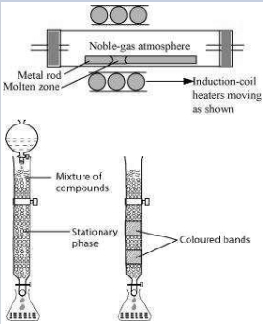
(N/A) $(i)$ Zone refining:
This method is based on the principle that impurities are more soluble in the molten state of metal (the melt) than in the solid state.
In the process of zone refining,a circular mobile heater is fixed at one end of a rod of impure metal.
As the heater moves,the molten zone of the rod also moves with it.
As a result,pure metal crystallizes out of the melt and the impurities pass onto the adjacent molten zone.
This process is repeated several times,which leads to the segregation of impurities at one end of the rod.
Then,the end with the impurities is cut off.
Silicon,boron,gallium,indium,etc.,can be purified by this process.
$(ii)$ Column chromatography:
Column chromatography is a technique used to separate different components of a mixture.
It is a very useful technique used for the purification of elements available in minute quantities.
It is also used to remove the impurities that are not very different in chemical properties from the element to be purified.
Chromatography is based on the principle that different components of a mixture are differently adsorbed on an adsorbent.
In chromatography,there are two phases: mobile phase and stationary phase.
The stationary phase is immobile and immiscible.
$Al_2O_3$ column is usually used as the stationary phase in column chromatography.
The mobile phase may be a gas,liquid,or supercritical fluid in which the sample extract is dissolved.
Then,the mobile phase is forced to move through the stationary phase.
The component that is more strongly adsorbed on the column takes a longer time to travel through it than the component that is weakly adsorbed.
The adsorbed components are then removed (eluted) using a suitable solvent (eluant).
This method is based on the principle that impurities are more soluble in the molten state of metal (the melt) than in the solid state.
In the process of zone refining,a circular mobile heater is fixed at one end of a rod of impure metal.
As the heater moves,the molten zone of the rod also moves with it.
As a result,pure metal crystallizes out of the melt and the impurities pass onto the adjacent molten zone.
This process is repeated several times,which leads to the segregation of impurities at one end of the rod.
Then,the end with the impurities is cut off.
Silicon,boron,gallium,indium,etc.,can be purified by this process.
$(ii)$ Column chromatography:
Column chromatography is a technique used to separate different components of a mixture.
It is a very useful technique used for the purification of elements available in minute quantities.
It is also used to remove the impurities that are not very different in chemical properties from the element to be purified.
Chromatography is based on the principle that different components of a mixture are differently adsorbed on an adsorbent.
In chromatography,there are two phases: mobile phase and stationary phase.
The stationary phase is immobile and immiscible.
$Al_2O_3$ column is usually used as the stationary phase in column chromatography.
The mobile phase may be a gas,liquid,or supercritical fluid in which the sample extract is dissolved.
Then,the mobile phase is forced to move through the stationary phase.
The component that is more strongly adsorbed on the column takes a longer time to travel through it than the component that is weakly adsorbed.
The adsorbed components are then removed (eluted) using a suitable solvent (eluant).
0 likes
View Solution141
Medium
Name the common elements present in the anode mud in electrolytic refining of copper. Why are they so present?
Solution
(N/A) In the electrolytic refining of copper,the common elements present in the anode mud are selenium $(Se)$,tellurium $(Te)$,silver $(Ag)$,gold $(Au)$,platinum $(Pt)$,and antimony $(Sb)$.
These elements are less reactive than copper and are not oxidized at the anode during the electrolysis process. Consequently,they do not dissolve in the electrolyte and settle down at the bottom of the electrolytic cell as anode mud.
These elements are less reactive than copper and are not oxidized at the anode during the electrolysis process. Consequently,they do not dissolve in the electrolyte and settle down at the bottom of the electrolytic cell as anode mud.
0 likes
View Solution142
Medium
Describe a method for refining nickel.
Solution
(N/A) Nickel is refined by $Mond's$ process.
In this process,impure nickel is heated in the presence of carbon monoxide $(CO)$ at $330-350 \ K$ to form nickel tetracarbonyl,which is a volatile complex:
$Ni(s) + 4CO(g) \xrightarrow{330-350 \ K} Ni(CO)_4(g)$
Then,the obtained nickel tetracarbonyl is decomposed by subjecting it to a higher temperature $(450-470 \ K)$ to obtain pure nickel metal:
$Ni(CO)_4(g) \xrightarrow{450-470 \ K} Ni(s) + 4CO(g)$
In this process,impure nickel is heated in the presence of carbon monoxide $(CO)$ at $330-350 \ K$ to form nickel tetracarbonyl,which is a volatile complex:
$Ni(s) + 4CO(g) \xrightarrow{330-350 \ K} Ni(CO)_4(g)$
Then,the obtained nickel tetracarbonyl is decomposed by subjecting it to a higher temperature $(450-470 \ K)$ to obtain pure nickel metal:
$Ni(CO)_4(g) \xrightarrow{450-470 \ K} Ni(s) + 4CO(g)$
0 likes
View Solution143
Medium
Outline the principles of refining of metals by the following methods:
$(i)$ Zone refining
$(ii)$ Electrolytic refining
$(iii)$ Vapour phase refining
$(i)$ Zone refining
$(ii)$ Electrolytic refining
$(iii)$ Vapour phase refining
Solution
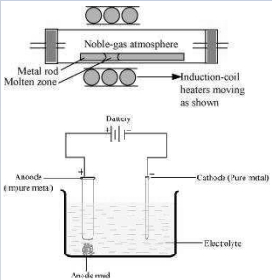
(N/A) $(i)$ Zone refining:
This method is based on the principle that impurities are more soluble in the molten state of metal (the melt) than in the solid state. In the process of zone refining,a circular mobile heater is fixed at one end of a rod of impure metal. As the heater moves,the molten zone of the rod also moves along with it. As a result,pure metal crystallizes out of the melt and the impurities pass to the adjacent molten zone. This process is repeated several times,which leads to the segregation of impurities at one end of the rod. Then,the end with the impurities is cut off. Silicon,boron,gallium,indium etc. can be purified by this process.
$(ii)$ Electrolytic refining:
Electrolytic refining is the process of refining impure metals by using electricity. In this process,impure metal is made the anode and a strip of pure metal is made the cathode.
$A$ solution of a soluble salt of the same metal is taken as the electrolyte. When an electric current is passed,metal ions from the electrolyte are deposited at the cathode as pure metal and the impure metal from the anode dissolves into the electrolyte in the form of ions. The impurities present in the impure metal get collected below the anode.
This is known as anode mud.
Anode: $M \longrightarrow M^{n+} + ne^-$
Cathode: $M^{n+} + ne^- \longrightarrow M$
$(iii)$ Vapour phase refining:
Vapour phase refining is the process of refining metal by converting it into its volatile compound and then,decomposing it to obtain a pure metal. To carry out this process:
$(i)$ the metal should form a volatile compound with an available reagent,and
$(ii)$ the volatile compound should be easily decomposable so that the metal can be easily recovered.
Nickel,zirconium,and titanium are refined using this method.
This method is based on the principle that impurities are more soluble in the molten state of metal (the melt) than in the solid state. In the process of zone refining,a circular mobile heater is fixed at one end of a rod of impure metal. As the heater moves,the molten zone of the rod also moves along with it. As a result,pure metal crystallizes out of the melt and the impurities pass to the adjacent molten zone. This process is repeated several times,which leads to the segregation of impurities at one end of the rod. Then,the end with the impurities is cut off. Silicon,boron,gallium,indium etc. can be purified by this process.
$(ii)$ Electrolytic refining:
Electrolytic refining is the process of refining impure metals by using electricity. In this process,impure metal is made the anode and a strip of pure metal is made the cathode.
$A$ solution of a soluble salt of the same metal is taken as the electrolyte. When an electric current is passed,metal ions from the electrolyte are deposited at the cathode as pure metal and the impure metal from the anode dissolves into the electrolyte in the form of ions. The impurities present in the impure metal get collected below the anode.
This is known as anode mud.
Anode: $M \longrightarrow M^{n+} + ne^-$
Cathode: $M^{n+} + ne^- \longrightarrow M$
$(iii)$ Vapour phase refining:
Vapour phase refining is the process of refining metal by converting it into its volatile compound and then,decomposing it to obtain a pure metal. To carry out this process:
$(i)$ the metal should form a volatile compound with an available reagent,and
$(ii)$ the volatile compound should be easily decomposable so that the metal can be easily recovered.
Nickel,zirconium,and titanium are refined using this method.
0 likes
View Solution144
Medium
Explain the distillation and liquation methods for the refining of metals.
Solution
(N/A) Distillation: This method is very useful for low boiling metals like $Zn$ and $Hg$. The impure metal is evaporated to obtain the pure metal as a distillate.
Liquation: In this method,a low melting metal like $Sn$ is made to flow on a sloping surface. In this way,it can be separated from impurities with higher melting points.
Liquation: In this method,a low melting metal like $Sn$ is made to flow on a sloping surface. In this way,it can be separated from impurities with higher melting points.
0 likes
View Solution145
Difficult
Explain the electrolytic refining of metals.
Solution
(N/A) Method: In this method,the impure metal is made to act as the anode. $A$ strip of the same metal in pure form is used as the cathode. They are put in a suitable electrolytic bath containing a soluble salt of the same metal. The more basic metal remains in the solution and the less basic metal goes to the anode mud.
This process can be explained on the basis of electrode potential,overpotential,and Gibbs energy concepts.
Reaction:
Anode: $M \rightarrow M^{n+} + n e^-$
Cathode: $M^{n+} + n e^- \rightarrow M$
Copper is refined using this electrolytic method.
Anode is made of impure copper. $A$ strip of pure copper is taken as the cathode.
The electrolyte is an acidic solution of copper sulfate,and the net result of electrolysis is the transfer of copper from the anode to the cathode as pure copper.
Anode: $Cu \rightarrow Cu^{2+} + 2e^-$
Cathode: $Cu^{2+} + 2e^- \rightarrow Cu$
Impurities from blister copper deposit as anode mud,which contains antimony,selenium,tellurium,silver,gold,and platinum. The recovery of these elements may meet the cost of refining.
This process can be explained on the basis of electrode potential,overpotential,and Gibbs energy concepts.
Reaction:
Anode: $M \rightarrow M^{n+} + n e^-$
Cathode: $M^{n+} + n e^- \rightarrow M$
Copper is refined using this electrolytic method.
Anode is made of impure copper. $A$ strip of pure copper is taken as the cathode.
The electrolyte is an acidic solution of copper sulfate,and the net result of electrolysis is the transfer of copper from the anode to the cathode as pure copper.
Anode: $Cu \rightarrow Cu^{2+} + 2e^-$
Cathode: $Cu^{2+} + 2e^- \rightarrow Cu$
Impurities from blister copper deposit as anode mud,which contains antimony,selenium,tellurium,silver,gold,and platinum. The recovery of these elements may meet the cost of refining.
0 likes
View Solution146
Difficult
Explain the zone refining process or explain refining by fractional crystallization.
Solution
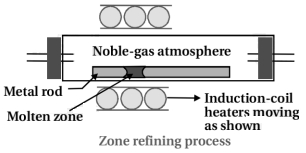
(N/A) Principle: This method is based on the difference in the solubility of impurities in the molten and solid state of the metal.
Process: As shown in the figure,a mobile heater surrounding the rod of impure metal is fixed at one end. The molten zone moves along with the heater as it is moved forward. As the heater moves forward,the pure metal crystallizes out of the melt left behind,and the impurities pass into the adjacent new molten zone created by the movement of the heater.
Repetition: The process is repeated several times,and the heater is moved in the same direction repeatedly. Impurities get concentrated at one end,and this end is cut off.
Applications: This method is very useful for producing semiconductors and other metals of very high purity,e.g.,germanium,silicon,boron,gallium,and indium.
Process: As shown in the figure,a mobile heater surrounding the rod of impure metal is fixed at one end. The molten zone moves along with the heater as it is moved forward. As the heater moves forward,the pure metal crystallizes out of the melt left behind,and the impurities pass into the adjacent new molten zone created by the movement of the heater.
Repetition: The process is repeated several times,and the heater is moved in the same direction repeatedly. Impurities get concentrated at one end,and this end is cut off.
Applications: This method is very useful for producing semiconductors and other metals of very high purity,e.g.,germanium,silicon,boron,gallium,and indium.
0 likes
View Solution147
Medium
Explain vapour phase refining.
Solution
(N/A) In this method,the metal is converted into its volatile compound,which is collected and decomposed to give pure metal. Two requirements for this process are:
$(i)$ The metal should form a volatile compound with an available reagent.
$(ii)$ The volatile compound should be easily decomposable,so that the recovery is easy.
Examples of this technique:
$(a)$ Mond's Process for Refining Nickel: Nickel is heated in a stream of carbon monoxide to form a volatile complex,nickel tetracarbonyl. This complex is decomposed at a higher temperature to obtain pure metal.
$Ni (\text{impure}) + 4 CO \xrightarrow{330-350 \ K} Ni(CO)_{4}$
$Ni(CO)_{4} \xrightarrow{450-470 \ K} Ni (\text{pure}) + 4 CO$
$(b)$ Van Arkel Method for Refining Zirconium or Titanium: This method is useful for removing oxygen and nitrogen impurities from metals like $Zr$ and $Ti$. The crude metal is heated in an evacuated vessel with iodine to form a volatile metal iodide.
$Zr + 2 I_{2} \rightarrow ZrI_{4} (\text{impure})$
The metal iodide is decomposed on a tungsten filament,electrically heated to about $1800 \ K$. The pure metal deposits on the filament.
$ZrI_{4} \rightarrow Zr (\text{pure}) + 2 I_{2}$
$(i)$ The metal should form a volatile compound with an available reagent.
$(ii)$ The volatile compound should be easily decomposable,so that the recovery is easy.
Examples of this technique:
$(a)$ Mond's Process for Refining Nickel: Nickel is heated in a stream of carbon monoxide to form a volatile complex,nickel tetracarbonyl. This complex is decomposed at a higher temperature to obtain pure metal.
$Ni (\text{impure}) + 4 CO \xrightarrow{330-350 \ K} Ni(CO)_{4}$
$Ni(CO)_{4} \xrightarrow{450-470 \ K} Ni (\text{pure}) + 4 CO$
$(b)$ Van Arkel Method for Refining Zirconium or Titanium: This method is useful for removing oxygen and nitrogen impurities from metals like $Zr$ and $Ti$. The crude metal is heated in an evacuated vessel with iodine to form a volatile metal iodide.
$Zr + 2 I_{2} \rightarrow ZrI_{4} (\text{impure})$
The metal iodide is decomposed on a tungsten filament,electrically heated to about $1800 \ K$. The pure metal deposits on the filament.
$ZrI_{4} \rightarrow Zr (\text{pure}) + 2 I_{2}$
0 likes
View Solution148
Medium
Explain the purification of metals in the vapour phase with an example.
Solution
(N/A) Principle: In this method,the metal is converted into its volatile compound and collected,which is then decomposed to give the pure metal. The two requirements for this method are:
$(i)$ The metal should form a volatile compound with an available reagent.
$(ii)$ The volatile compound should be easily decomposable to recover the metal.
Example: Mond process for refining Nickel.
$Ni + 4CO \xrightarrow{330-350 \ K} Ni(CO)_4$
$Ni(CO)_4 \xrightarrow{450-470 \ K} Ni + 4CO$
$(i)$ The metal should form a volatile compound with an available reagent.
$(ii)$ The volatile compound should be easily decomposable to recover the metal.
Example: Mond process for refining Nickel.
$Ni + 4CO \xrightarrow{330-350 \ K} Ni(CO)_4$
$Ni(CO)_4 \xrightarrow{450-470 \ K} Ni + 4CO$
0 likes
View Solution149
MediumMCQ
Explain the $Mond$ process for the refining of $Nickel$.
A
Electrolytic refining
B
Vapour phase refining
C
Zone refining
D
Cupellation
Solution
(B) In the $Mond$ process,impure $Nickel$ is heated in a stream of carbon monoxide $(CO)$ to form a volatile complex,$Nickel$ tetracarbonyl.
This complex is then decomposed at a higher temperature to obtain pure $Nickel$ metal.
The chemical reactions are:
$Ni(s) + 4CO(g) \xrightarrow{330-350 K} Ni(CO)_4(g)$
$Ni(CO)_4(g) \xrightarrow{450-470 K} Ni(s) + 4CO(g)$
This complex is then decomposed at a higher temperature to obtain pure $Nickel$ metal.
The chemical reactions are:
$Ni(s) + 4CO(g) \xrightarrow{330-350 K} Ni(CO)_4(g)$
$Ni(CO)_4(g) \xrightarrow{450-470 K} Ni(s) + 4CO(g)$
0 likes
View Solution150
Medium
Explain the Van Arkel method with an example.
Solution
(N/A) The Van Arkel method is very useful for removing all oxygen and nitrogen present as impurities in certain metals like $Zr$ and $Ti$.
The crude metal is heated in an evacuated vessel with iodine. The metal iodide,being more covalent,volatilizes.
$Zr + 2I_2 \rightarrow ZrI_4$
The metal iodide is decomposed on a tungsten filament electrically heated to about $1800 \ K$. Thus,the pure metal is deposited on the filament.
$ZrI_4 \rightarrow Zr + 2I_2$
The crude metal is heated in an evacuated vessel with iodine. The metal iodide,being more covalent,volatilizes.
$Zr + 2I_2 \rightarrow ZrI_4$
The metal iodide is decomposed on a tungsten filament electrically heated to about $1800 \ K$. Thus,the pure metal is deposited on the filament.
$ZrI_4 \rightarrow Zr + 2I_2$
0 likes
View SolutionGeneral Principles and Processes of Isolation of Elements — Refining of crude Metal · Frequently Asked Questions
1Are these General Principles and Processes of Isolation of Elements questions useful for JEE and NEET?
Yes. All questions in this section are mapped to JEE Main and NEET exam patterns. Previous year questions from JEE Main, NEET, GUJCET and state-level exams are included with full solutions.
2Can I switch to Hindi or Gujarati for these questions?
Yes. Use the language tabs in the hero section or the sidebar to view the same questions and solutions in English, Hindi or Gujarati.
3How do I generate a question paper from this subtopic?
Use the Vedclass Exam Paper Generator — select the chapter and subtopic, set difficulty, and generate Sets A, B, C, D automatically. First 3 chapters of every subject are free.
Vedclass Products
For Students
Vedclass Test Series
Mock tests in real JEE/NEET style with performance analysis. 5-day free trial.
Start Free TrialFor Teachers
Exam Paper Generator
Generate Set A/B/C/D papers from this chapter in 2 minutes. 3 chapters free.
Try FreeFor Institutes
Online Exam Module
Live online exams with unlimited students, 360° analytics & white-label branding.
See DemoFor Teachers & Institutes
Generate a General Principles and Processes of Isolation of Elements Exam Paper in 2 Minutes
Select subtopic & difficulty — Sets A, B, C, D auto-generated with No Repeat logic.
First 3 chapters of every subject are free — no payment required.