
A English
Electrode potential and ECell Questions in English
Class 12 Chemistry · Electrochemistry · Electrode potential and ECell
419+
Questions
English
Language
100%
With Solutions
Showing 50 of 419 questions in English
251
EasyMCQ
The oxidation potentials of $Zn$,$Cu$,and $Ag$ are $0.76 \ V$,$-0.34 \ V$,and $-0.80 \ V$,respectively. Write down the order of their tendency to lose $e^-$.
A
$Zn > Cu > Ag$
B
$Ag > Cu > Zn$
C
$Cu > Zn > Ag$
D
$Zn > Ag > Cu$
Solution
(A) The tendency to lose $e^-$ is directly proportional to the oxidation potential of the metal.
Given oxidation potentials are:
$Zn = 0.76 \ V$
$Cu = -0.34 \ V$
$Ag = -0.80 \ V$
Since $0.76 > -0.34 > -0.80$,the order of tendency to lose $e^-$ is $Zn > Cu > Ag$.
Given oxidation potentials are:
$Zn = 0.76 \ V$
$Cu = -0.34 \ V$
$Ag = -0.80 \ V$
Since $0.76 > -0.34 > -0.80$,the order of tendency to lose $e^-$ is $Zn > Cu > Ag$.
0 likes
View Solution252
EasyMCQ
What is the standard electrode potential of a Daniell cell (in $V$)?
A
$1.00$
B
$1.10$
C
$1.05$
D
$0.98$
Solution
(B) The Daniell cell consists of a zinc electrode in a zinc sulfate solution and a copper electrode in a copper sulfate solution.
The standard electrode potential $(E^{\circ}_{cell})$ is calculated as $E^{\circ}_{cathode} - E^{\circ}_{anode}$.
For a Daniell cell,$E^{\circ}_{Cu^{2+}/Cu} = 0.34 \ V$ and $E^{\circ}_{Zn^{2+}/Zn} = -0.76 \ V$.
Therefore,$E^{\circ}_{cell} = 0.34 \ V - (-0.76 \ V) = 1.10 \ V$.
The standard electrode potential $(E^{\circ}_{cell})$ is calculated as $E^{\circ}_{cathode} - E^{\circ}_{anode}$.
For a Daniell cell,$E^{\circ}_{Cu^{2+}/Cu} = 0.34 \ V$ and $E^{\circ}_{Zn^{2+}/Zn} = -0.76 \ V$.
Therefore,$E^{\circ}_{cell} = 0.34 \ V - (-0.76 \ V) = 1.10 \ V$.
0 likes
View Solution253
Difficult
What is electrode potential in a galvanic cell? Explain in detail.
Solution
(N/A) Definition: $A$ potential difference that develops between the electrode and the electrolyte is called electrode potential.
$(b)$ Standard electrode potential: When the concentrations of all the species involved in a half-cell are unity $(1 \ M)$,the electrode potential is known as standard electrode potential. According to $IUPAC$ convention,standard reduction potentials are now called standard electrode potentials.
$(c)$ Anode and cathode in electrode potential:
$(i)$ In a galvanic cell,the half-cell in which oxidation takes place is called the anode,and it has a negative potential with respect to the solution.
$(ii)$ The other half-cell in which reduction takes place is called the cathode,and it has a positive potential with respect to the solution.
$(b)$ Standard electrode potential: When the concentrations of all the species involved in a half-cell are unity $(1 \ M)$,the electrode potential is known as standard electrode potential. According to $IUPAC$ convention,standard reduction potentials are now called standard electrode potentials.
$(c)$ Anode and cathode in electrode potential:
$(i)$ In a galvanic cell,the half-cell in which oxidation takes place is called the anode,and it has a negative potential with respect to the solution.
$(ii)$ The other half-cell in which reduction takes place is called the cathode,and it has a positive potential with respect to the solution.
0 likes
View Solution254
Difficult
What is cell potential and $emf$? Explain with suitable examples.
Solution
(N/A) $(i)$ Cell Potential: The potential difference between the two electrodes of a galvanic cell is called the cell potential and is measured in volts.
$(ii)$ $emf$: The cell potential is the difference between the electrode potentials (reduction potentials) of the cathode and anode. It is called the cell electromotive force $(emf)$ of the cell when no current is drawn through the cell.
$(B)$ Formula and expression of cell potential:
Cell potential of a galvanic cell is positive,which can be calculated by the following formula:
$E_{cell} = E_{right} - E_{left} = E_{red(cathode)} - E_{red(anode)}$
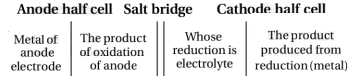
The anode is on the left and the cathode is on the right while representing the galvanic cell. $A$ galvanic cell is generally represented by putting a vertical line between metal and electrolyte solution and putting a double vertical line between the two electrolytes connected by a salt bridge.
$(C)$ Expression of Daniell cell:
Example: $Zn_{(s)} | Zn_{(aq)}^{2+} || Cu_{(aq)}^{2+} | Cu_{(s)}$
Oxidation on anode: $Zn_{(s)} \longrightarrow Zn_{(aq)}^{2+} + 2e^{-}$
Reduction on cathode: $Cu_{(aq)}^{2+} + 2e^{-} \longrightarrow Cu_{(s)}$
Total cell reaction: $Zn_{(s)} + Cu_{(aq)}^{2+} \longrightarrow Zn_{(aq)}^{2+} + Cu_{(s)}$
Where,$Zn$ electrode is the anode and copper electrode is the cathode.
Daniell cell potential:
$E_{cell} = E_{right} - E_{left}$
$E_{cell} = E_{Cu^{2+}|Cu} - E_{Zn^{2+}|Zn}$
$(ii)$ $emf$: The cell potential is the difference between the electrode potentials (reduction potentials) of the cathode and anode. It is called the cell electromotive force $(emf)$ of the cell when no current is drawn through the cell.
$(B)$ Formula and expression of cell potential:
Cell potential of a galvanic cell is positive,which can be calculated by the following formula:
$E_{cell} = E_{right} - E_{left} = E_{red(cathode)} - E_{red(anode)}$
The anode is on the left and the cathode is on the right while representing the galvanic cell. $A$ galvanic cell is generally represented by putting a vertical line between metal and electrolyte solution and putting a double vertical line between the two electrolytes connected by a salt bridge.
| Anode half cell | Salt bridge | Cathode half cell | |
|---|---|---|---|
| Metal of anode electrode | The product of oxidation of anode | Whose reduction is electrolyte | The product produced from reduction (metal) |
$(C)$ Expression of Daniell cell:
Example: $Zn_{(s)} | Zn_{(aq)}^{2+} || Cu_{(aq)}^{2+} | Cu_{(s)}$
Oxidation on anode: $Zn_{(s)} \longrightarrow Zn_{(aq)}^{2+} + 2e^{-}$
Reduction on cathode: $Cu_{(aq)}^{2+} + 2e^{-} \longrightarrow Cu_{(s)}$
Total cell reaction: $Zn_{(s)} + Cu_{(aq)}^{2+} \longrightarrow Zn_{(aq)}^{2+} + Cu_{(s)}$
Where,$Zn$ electrode is the anode and copper electrode is the cathode.
Daniell cell potential:
$E_{cell} = E_{right} - E_{left}$
$E_{cell} = E_{Cu^{2+}|Cu} - E_{Zn^{2+}|Zn}$
1 likes
View Solution255
Medium
What is the procedure to determine the cell potential?
Solution
(N/A) Selection of reference electrode: The potential of an individual half-cell cannot be measured directly. We can only measure the difference between the potentials of two half-cells,which gives the $EMF$ of the cell.
$(b)$ Use of Standard Hydrogen Electrode $(SHE)$: To determine the potential of a single half-cell,it is coupled with a reference electrode whose potential is known. By convention,the Standard Hydrogen Electrode $(SHE)$ is used as the reference,and its potential is arbitrarily assigned a value of $0.00 \ V$ at all temperatures.
$(c)$ Calculation: When the half-cell is connected to the $SHE$,the measured $EMF$ of the resulting cell corresponds to the potential of that half-cell. If the half-cell acts as the cathode,its potential is positive; if it acts as the anode,its potential is negative relative to the $SHE$.
$(b)$ Use of Standard Hydrogen Electrode $(SHE)$: To determine the potential of a single half-cell,it is coupled with a reference electrode whose potential is known. By convention,the Standard Hydrogen Electrode $(SHE)$ is used as the reference,and its potential is arbitrarily assigned a value of $0.00 \ V$ at all temperatures.
$(c)$ Calculation: When the half-cell is connected to the $SHE$,the measured $EMF$ of the resulting cell corresponds to the potential of that half-cell. If the half-cell acts as the cathode,its potential is positive; if it acts as the anode,its potential is negative relative to the $SHE$.
0 likes
View Solution256
Advanced
Write a note on the standard hydrogen electrode $(SHE)$.
Solution
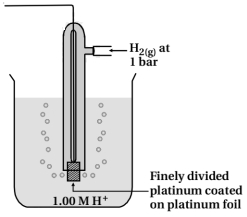
(N/A) According to the convention,a half-cell called the standard hydrogen electrode $(SHE)$,represented by $Pt_{(s)} | H_{2_{(g)}} (1 \ bar) | H^{+}_{(aq)} (1 \ M)$,is assigned a zero potential at all temperatures.
Construction of hydrogen electrode:
The standard hydrogen electrode consists of a platinum electrode coated with platinum black. The electrode is dipped in an acidic solution,and pure hydrogen gas is bubbled through it at $1 \ bar$ pressure.
The concentration of hydrogen ions in the solution is maintained at $1 \ M$.
The half-cell reactions are:
Oxidation: $\frac{1}{2} H_{2_{(g)}} \longrightarrow H^{+}_{(aq)} + e^{-}$
Reduction: $H^{+}_{(aq)} + e^{-} \longrightarrow \frac{1}{2} H_{2_{(g)}}$
Uses:
The standard hydrogen electrode is used as a reference electrode to measure the electrode potential of any other half-cell. By constructing a galvanic cell with the $SHE$ and another electrode,the measured cell potential at $298 \ K$ directly gives the potential of that half-cell,as the potential of the $SHE$ is taken as zero.
Construction of hydrogen electrode:
The standard hydrogen electrode consists of a platinum electrode coated with platinum black. The electrode is dipped in an acidic solution,and pure hydrogen gas is bubbled through it at $1 \ bar$ pressure.
The concentration of hydrogen ions in the solution is maintained at $1 \ M$.
The half-cell reactions are:
Oxidation: $\frac{1}{2} H_{2_{(g)}} \longrightarrow H^{+}_{(aq)} + e^{-}$
Reduction: $H^{+}_{(aq)} + e^{-} \longrightarrow \frac{1}{2} H_{2_{(g)}}$
Uses:
The standard hydrogen electrode is used as a reference electrode to measure the electrode potential of any other half-cell. By constructing a galvanic cell with the $SHE$ and another electrode,the measured cell potential at $298 \ K$ directly gives the potential of that half-cell,as the potential of the $SHE$ is taken as zero.
0 likes
View Solution257
Advanced
Discuss the method to determine the cell potential of any cell when a standard hydrogen electrode is considered as the anode,with a suitable example.
Solution
(N/A) Reduction potential: At $298 \ K$,the $emf$ of a cell constructed by taking the standard hydrogen electrode as the anode (reference half-cell) and the other half-cell as the cathode gives the reduction potential of the other half-cell.
Standard hydrogen electrode half-cell $\mid$ another half-cell
(anode half-cell) $\mid$ (cathode half-cell)
Cell potential $=$ (Reduction potential of other cell) $=$ $emf$ value of the other half-cell.
$(b)$ Explanation with a general example:
$(i)$ If the concentrations of the oxidized and reduced forms of the species in the right-hand half-cell are unity,the cell potential equals the standard electrode potential.
General cell: $Pt \mid H_{2(g)} (1 \ bar) \mid H^+_{(aq)} (1 \ M) \| M^{n+}_{(aq)} (1 \ M) \mid M_{(s)}$
$(ii)$ $E^{\ominus} = (E^{\ominus}_R - E^{\ominus}_L)$:
Where $E^{\ominus}$ is the standard reduction potential of the cell,$E^{\ominus}_R$ is the standard reduction potential of the right-hand electrode,and $E^{\ominus}_L$ is the standard reduction potential of the left-hand electrode.
Since $E^{\ominus}_L = 0.0 \ V$ for the standard hydrogen electrode,$\therefore E^{\ominus} = (E^{\ominus}_R - 0.0) = E^{\ominus}_R$.
$(iii)$ Hydrogen half-cell $\mid$ Copper half-cell:
$Pt \mid H_{2(g)} (1 \ bar) \mid H^+_{(aq)} (1 \ M) \| Cu^{2+}_{(aq)} (1 \ M) \mid Cu_{(s)}$
The measured $emf$ of the cell is $+0.34 \ V$,which is the standard electrode potential for the reaction:
Oxidation (left): $H_{2(g)} \rightarrow 2H^+_{(aq)} + 2e^- \ (E^{\ominus}_L = 0.0 \ V)$
Reduction (right): $Cu^{2+}_{(aq)} + 2e^- \rightarrow Cu_{(s)}$
$\therefore E^{\ominus}_{cell} = (E^{\ominus}_R - E^{\ominus}_L) = 0.34 \ V \implies E^{\ominus}_R = 0.34 \ V$.
Thus,the standard reduction potential for $Cu^{2+} \mid Cu$ is $+0.34 \ V$.
Standard hydrogen electrode half-cell $\mid$ another half-cell
(anode half-cell) $\mid$ (cathode half-cell)
Cell potential $=$ (Reduction potential of other cell) $=$ $emf$ value of the other half-cell.
$(b)$ Explanation with a general example:
$(i)$ If the concentrations of the oxidized and reduced forms of the species in the right-hand half-cell are unity,the cell potential equals the standard electrode potential.
General cell: $Pt \mid H_{2(g)} (1 \ bar) \mid H^+_{(aq)} (1 \ M) \| M^{n+}_{(aq)} (1 \ M) \mid M_{(s)}$
$(ii)$ $E^{\ominus} = (E^{\ominus}_R - E^{\ominus}_L)$:
Where $E^{\ominus}$ is the standard reduction potential of the cell,$E^{\ominus}_R$ is the standard reduction potential of the right-hand electrode,and $E^{\ominus}_L$ is the standard reduction potential of the left-hand electrode.
Since $E^{\ominus}_L = 0.0 \ V$ for the standard hydrogen electrode,$\therefore E^{\ominus} = (E^{\ominus}_R - 0.0) = E^{\ominus}_R$.
$(iii)$ Hydrogen half-cell $\mid$ Copper half-cell:
$Pt \mid H_{2(g)} (1 \ bar) \mid H^+_{(aq)} (1 \ M) \| Cu^{2+}_{(aq)} (1 \ M) \mid Cu_{(s)}$
The measured $emf$ of the cell is $+0.34 \ V$,which is the standard electrode potential for the reaction:
Oxidation (left): $H_{2(g)} \rightarrow 2H^+_{(aq)} + 2e^- \ (E^{\ominus}_L = 0.0 \ V)$
Reduction (right): $Cu^{2+}_{(aq)} + 2e^- \rightarrow Cu_{(s)}$
$\therefore E^{\ominus}_{cell} = (E^{\ominus}_R - E^{\ominus}_L) = 0.34 \ V \implies E^{\ominus}_R = 0.34 \ V$.
Thus,the standard reduction potential for $Cu^{2+} \mid Cu$ is $+0.34 \ V$.
0 likes
View Solution258
Difficult
Discuss the method to determine the cell potential of any cell when a standard hydrogen electrode is considered as the cathode with a suitable example.
Solution
(N/A) At $298 \ K$,the $EMF$ of a cell constructed by taking the standard hydrogen electrode $(SHE)$ as the cathode (reference half-cell) and the other half-cell as the anode,gives the reduction potential of the other half-cell.
General cell representation:
$M_{(s)} | M_{(aq)}^{n+} (1 \ M) || H_{(aq)}^{+} (1 \ M) | \frac{1}{2} H_{2_{(g)}} (1 \ bar) | Pt_{(s)}$
Using the formula $E^{\circ}_{cell} = E^{\circ}_{cathode} - E^{\circ}_{anode}$,since $E^{\circ}_{cathode} = E^{\circ}_{H^{+}/H_2} = 0.0 \ V$,we get $E^{\circ}_{cell} = -E^{\circ}_{anode}$.
Example: Zinc half-cell as anode and $SHE$ as cathode:
$Zn_{(s)} | Zn_{(aq)}^{2+} (1 \ M) || H_{(aq)}^{+} (1 \ M) | H_{2_{(g)}} (1 \ bar) | Pt_{(s)}$
The measured $E^{\circ}_{cell}$ is $-0.76 \ V$. Therefore,the standard reduction potential of $Zn^{2+}/Zn$ is $E^{\circ}_{Zn^{2+}/Zn} = -0.76 \ V$.
When the $SHE$ is on the right side (cathode),the other half-cell acts as the anode,and the cell potential is negative if the metal is more reactive than hydrogen.
Cathode reaction: $H^{+}_{(aq, 1 \ M)} + e^{-} \rightarrow \frac{1}{2} H_{2_{(g)}} (1 \ bar)$
Overall reaction: $Zn_{(s)} + 2H^{+}_{(aq)} \rightarrow Zn^{2+}_{(aq)} + H_{2_{(g)}}$
General cell representation:
$M_{(s)} | M_{(aq)}^{n+} (1 \ M) || H_{(aq)}^{+} (1 \ M) | \frac{1}{2} H_{2_{(g)}} (1 \ bar) | Pt_{(s)}$
Using the formula $E^{\circ}_{cell} = E^{\circ}_{cathode} - E^{\circ}_{anode}$,since $E^{\circ}_{cathode} = E^{\circ}_{H^{+}/H_2} = 0.0 \ V$,we get $E^{\circ}_{cell} = -E^{\circ}_{anode}$.
Example: Zinc half-cell as anode and $SHE$ as cathode:
$Zn_{(s)} | Zn_{(aq)}^{2+} (1 \ M) || H_{(aq)}^{+} (1 \ M) | H_{2_{(g)}} (1 \ bar) | Pt_{(s)}$
The measured $E^{\circ}_{cell}$ is $-0.76 \ V$. Therefore,the standard reduction potential of $Zn^{2+}/Zn$ is $E^{\circ}_{Zn^{2+}/Zn} = -0.76 \ V$.
When the $SHE$ is on the right side (cathode),the other half-cell acts as the anode,and the cell potential is negative if the metal is more reactive than hydrogen.
Cathode reaction: $H^{+}_{(aq, 1 \ M)} + e^{-} \rightarrow \frac{1}{2} H_{2_{(g)}} (1 \ bar)$
Overall reaction: $Zn_{(s)} + 2H^{+}_{(aq)} \rightarrow Zn^{2+}_{(aq)} + H_{2_{(g)}}$
0 likes
View Solution259
MediumMCQ
Calculate the $Zn-Cu$ cell (Daniell cell) potential. Given: $E^o_{Zn^{2+}|Zn} = -0.76 \ V$ and $E^o_{Cu^{2+}|Cu} = 0.34 \ V$. (in $V$)
A
$1.10$
B
$0.42$
C
$-1.10$
D
$-0.42$
Solution
(A) The cell potential $(E^o_{cell})$ is calculated using the formula: $E^o_{cell} = E^o_{cathode} - E^o_{anode}$.
In a Daniell cell,the $Cu$ electrode acts as the cathode and the $Zn$ electrode acts as the anode.
Given: $E^o_{Cu^{2+}|Cu} = 0.34 \ V$ and $E^o_{Zn^{2+}|Zn} = -0.76 \ V$.
Substituting the values: $E^o_{cell} = 0.34 \ V - (-0.76 \ V)$.
$E^o_{cell} = 0.34 \ V + 0.76 \ V = 1.10 \ V$.
In a Daniell cell,the $Cu$ electrode acts as the cathode and the $Zn$ electrode acts as the anode.
Given: $E^o_{Cu^{2+}|Cu} = 0.34 \ V$ and $E^o_{Zn^{2+}|Zn} = -0.76 \ V$.
Substituting the values: $E^o_{cell} = 0.34 \ V - (-0.76 \ V)$.
$E^o_{cell} = 0.34 \ V + 0.76 \ V = 1.10 \ V$.
0 likes
View Solution260
Advanced
What is the standard electrode (half-cell) potential? Give its uses.
Solution
(N/A) Standard electrode (half-cell) potential: Under standard conditions,which include a temperature of $298 \ K$,a gas pressure of $1 \ bar$,and a solution concentration of $1 \ M$,the reduction potential of an electrode (half-cell) is defined as the standard electrode potential,measured in volts $(V)$.
Uses:
$(i)$ Construction of the electrochemical series ($EMF$ series): When half-cell reactions are arranged in decreasing order of their standard reduction potential,the resulting series is known as the electrochemical series. This series helps in predicting the spontaneity of redox reactions and the relative strength of oxidizing and reducing agents.
Uses:
$(i)$ Construction of the electrochemical series ($EMF$ series): When half-cell reactions are arranged in decreasing order of their standard reduction potential,the resulting series is known as the electrochemical series. This series helps in predicting the spontaneity of redox reactions and the relative strength of oxidizing and reducing agents.
0 likes
View Solution261
MediumMCQ
What is the observation we get when a gold ring is placed in the solution of $AgNO_3$? $[E_{Ag^{+}|Ag}^o = 0.80 \ V$ and $E_{Au^{3+}|Au}^o = 1.40 \ V]$
A
$A$. $Ag$ is deposited on the gold ring
B
$B$. Gold ring dissolves
C
$C$. $Au$ is deposited on $AgNO_3$ solution
D
$D$. No reaction occurs
Solution
(D) The standard reduction potential of gold $(E^o = 1.40 \ V)$ is higher than that of silver $(E^o = 0.80 \ V)$.
This indicates that gold is a weaker reducing agent than silver and cannot displace silver ions $(Ag^+)$ from the $AgNO_3$ solution.
Therefore,no chemical reaction occurs when a gold ring is placed in $AgNO_3$ solution.
This indicates that gold is a weaker reducing agent than silver and cannot displace silver ions $(Ag^+)$ from the $AgNO_3$ solution.
Therefore,no chemical reaction occurs when a gold ring is placed in $AgNO_3$ solution.
0 likes
View Solution262
MediumMCQ
If the cell potential of the cell at $298 \ K$ is $2.36 \ V$,write the cell reaction and calculate the standard electrode potential of the $Mg^{2+} \mid Mg$ half-cell.
$Mg_{(s)} \mid Mg^{2+}_{(1 \ M)} \parallel H^{+}_{(1 \ M)} \mid H_{2(g)} (1 \ bar) \mid Pt_{(s)}$
$Mg_{(s)} \mid Mg^{2+}_{(1 \ M)} \parallel H^{+}_{(1 \ M)} \mid H_{2(g)} (1 \ bar) \mid Pt_{(s)}$
A
Anode: $Mg \rightarrow Mg^{2+} + 2e^-$,Cathode: $2H^+ + 2e^- \rightarrow H_2$,$E^\circ_{Mg^{2+}/Mg} = -2.36 \ V$
B
Anode: $Mg \rightarrow Mg^{2+} + 2e^-$,Cathode: $2H^+ + 2e^- \rightarrow H_2$,$E^\circ_{Mg^{2+}/Mg} = +2.36 \ V$
C
Anode: $Mg^{2+} + 2e^- \rightarrow Mg$,Cathode: $H_2 \rightarrow 2H^+ + 2e^-$,$E^\circ_{Mg^{2+}/Mg} = -2.36 \ V$
D
Anode: $Mg \rightarrow Mg^{2+} + 2e^-$,Cathode: $2H^+ + 2e^- \rightarrow H_2$,$E^\circ_{Mg^{2+}/Mg} = -1.18 \ V$
Solution
(A) The cell reaction is: $Mg_{(s)} + 2H^+_{(aq)} \rightarrow Mg^{2+}_{(aq)} + H_{2(g)}$.
Given $E^\circ_{cell} = 2.36 \ V$ at standard conditions ($1 \ M$ concentration and $1 \ bar$ pressure).
The cell potential is given by $E^\circ_{cell} = E^\circ_{cathode} - E^\circ_{anode}$.
Here,the cathode is the Standard Hydrogen Electrode $(SHE)$,so $E^\circ_{H^+/H_2} = 0.00 \ V$.
Therefore,$2.36 \ V = 0.00 \ V - E^\circ_{Mg^{2+}/Mg}$.
$E^\circ_{Mg^{2+}/Mg} = -2.36 \ V$.
Given $E^\circ_{cell} = 2.36 \ V$ at standard conditions ($1 \ M$ concentration and $1 \ bar$ pressure).
The cell potential is given by $E^\circ_{cell} = E^\circ_{cathode} - E^\circ_{anode}$.
Here,the cathode is the Standard Hydrogen Electrode $(SHE)$,so $E^\circ_{H^+/H_2} = 0.00 \ V$.
Therefore,$2.36 \ V = 0.00 \ V - E^\circ_{Mg^{2+}/Mg}$.
$E^\circ_{Mg^{2+}/Mg} = -2.36 \ V$.
0 likes
View Solution263
Medium
The cell potential of the given cell is $0.34 \, V$. Write the cell reaction and calculate $E^o_{Cu^{2+}|Cu}$.
$Pt_{(s)} \mid H_{2(g)} (1 \, bar) \mid H^+_{(1 \, M)} \parallel Cu^{2+}_{(1 \, M)} \mid Cu_{(s)}$
$Pt_{(s)} \mid H_{2(g)} (1 \, bar) \mid H^+_{(1 \, M)} \parallel Cu^{2+}_{(1 \, M)} \mid Cu_{(s)}$
Solution
(0.34 V) The cell reaction is as follows:
Anode (Oxidation): $H_{2(g)} \rightarrow 2H^+_{(aq)} + 2e^-$
Cathode (Reduction): $Cu^{2+}_{(aq)} + 2e^- \rightarrow Cu_{(s)}$
Overall reaction: $H_{2(g)} + Cu^{2+}_{(aq)} \rightarrow 2H^+_{(aq)} + Cu_{(s)}$
The cell potential is given by: $E^o_{cell} = E^o_{cathode} - E^o_{anode}$
Given $E^o_{cell} = 0.34 \, V$ and $E^o_{H^+|H_2} = 0.00 \, V$ (Standard Hydrogen Electrode).
$0.34 \, V = E^o_{Cu^{2+}|Cu} - 0.00 \, V$
Therefore,$E^o_{Cu^{2+}|Cu} = 0.34 \, V$.
Anode (Oxidation): $H_{2(g)} \rightarrow 2H^+_{(aq)} + 2e^-$
Cathode (Reduction): $Cu^{2+}_{(aq)} + 2e^- \rightarrow Cu_{(s)}$
Overall reaction: $H_{2(g)} + Cu^{2+}_{(aq)} \rightarrow 2H^+_{(aq)} + Cu_{(s)}$
The cell potential is given by: $E^o_{cell} = E^o_{cathode} - E^o_{anode}$
Given $E^o_{cell} = 0.34 \, V$ and $E^o_{H^+|H_2} = 0.00 \, V$ (Standard Hydrogen Electrode).
$0.34 \, V = E^o_{Cu^{2+}|Cu} - 0.00 \, V$
Therefore,$E^o_{Cu^{2+}|Cu} = 0.34 \, V$.
0 likes
View Solution264
Medium
Calculate the standard cell potential $(E_{cell}^{o})$ for the following electrochemical cells:
$(i)$ $Al_{(s)}|Al_{(1M)}^{3+}||Cu_{(1M)}^{2+}|Cu_{(s)}$
$(ii)$ $Al_{(s)}|Al_{(1M)}^{3+}||Zn_{(1M)}^{2+}|Zn_{(s)}$
$(iii)$ $Al_{(s)}|Al_{(1M)}^{3+}||Ag_{(1M)}^{+}|Ag_{(s)}$
$($ Given: $E_{Al^{3+}|Al}^{o} = -1.66 \ V$,$E_{Zn^{2+}|Zn}^{o} = -0.76 \ V$,$E_{Cu^{2+}|Cu}^{o} = 0.34 \ V$,$E_{Ag^{+}|Ag}^{o} = 0.80 \ V$ $)$
$(i)$ $Al_{(s)}|Al_{(1M)}^{3+}||Cu_{(1M)}^{2+}|Cu_{(s)}$
$(ii)$ $Al_{(s)}|Al_{(1M)}^{3+}||Zn_{(1M)}^{2+}|Zn_{(s)}$
$(iii)$ $Al_{(s)}|Al_{(1M)}^{3+}||Ag_{(1M)}^{+}|Ag_{(s)}$
$($ Given: $E_{Al^{3+}|Al}^{o} = -1.66 \ V$,$E_{Zn^{2+}|Zn}^{o} = -0.76 \ V$,$E_{Cu^{2+}|Cu}^{o} = 0.34 \ V$,$E_{Ag^{+}|Ag}^{o} = 0.80 \ V$ $)$
Solution
The standard cell potential is calculated using the formula: $E_{cell}^{o} = E_{cathode}^{o} - E_{anode}^{o}$.
$(i)$ For $Al|Al^{3+}||Cu^{2+}|Cu$:
$E_{cell}^{o} = E_{Cu^{2+}|Cu}^{o} - E_{Al^{3+}|Al}^{o} = 0.34 \ V - (-1.66 \ V) = 2.00 \ V$.
$(ii)$ For $Al|Al^{3+}||Zn^{2+}|Zn$:
$E_{cell}^{o} = E_{Zn^{2+}|Zn}^{o} - E_{Al^{3+}|Al}^{o} = -0.76 \ V - (-1.66 \ V) = 0.90 \ V$.
$(iii)$ For $Al|Al^{3+}||Ag^{+}|Ag$:
$E_{cell}^{o} = E_{Ag^{+}|Ag}^{o} - E_{Al^{3+}|Al}^{o} = 0.80 \ V - (-1.66 \ V) = 2.46 \ V$.
$(i)$ For $Al|Al^{3+}||Cu^{2+}|Cu$:
$E_{cell}^{o} = E_{Cu^{2+}|Cu}^{o} - E_{Al^{3+}|Al}^{o} = 0.34 \ V - (-1.66 \ V) = 2.00 \ V$.
$(ii)$ For $Al|Al^{3+}||Zn^{2+}|Zn$:
$E_{cell}^{o} = E_{Zn^{2+}|Zn}^{o} - E_{Al^{3+}|Al}^{o} = -0.76 \ V - (-1.66 \ V) = 0.90 \ V$.
$(iii)$ For $Al|Al^{3+}||Ag^{+}|Ag$:
$E_{cell}^{o} = E_{Ag^{+}|Ag}^{o} - E_{Al^{3+}|Al}^{o} = 0.80 \ V - (-1.66 \ V) = 2.46 \ V$.
0 likes
View Solution265
EasyMCQ
What is to be done to determine the potential of any half cell?
A
Connect it with a standard hydrogen electrode $(SHE)$.
B
Connect it with a copper electrode.
C
Connect it with a zinc electrode.
D
Connect it with a silver electrode.
Solution
(A) To determine the potential of any half cell,it must be connected to a reference electrode whose potential is known. The most commonly used reference electrode is the Standard Hydrogen Electrode $(SHE)$,which is assigned a potential of $0.00 \ V$ at all temperatures. By connecting the unknown half cell to the $SHE$,the potential difference measured by the voltmeter corresponds to the electrode potential of the unknown half cell.
0 likes
View Solution266
EasyMCQ
Give the method to determine the potential of any half-cell.
A
By connecting it to a Standard Hydrogen Electrode $(SHE)$ and measuring the cell potential.
B
By measuring the resistance of the solution.
C
By using a potentiometer directly on the half-cell.
D
By calculating the concentration of ions.
Solution
(A) The potential of a single half-cell cannot be measured in isolation.
To determine the potential of any half-cell,it is connected to a Standard Hydrogen Electrode $(SHE)$ to form a complete electrochemical cell.
The potential of the $SHE$ is arbitrarily assigned as $0.00 \ V$.
The cell potential $(E_{cell})$ is measured using a voltmeter.
Since $E_{cell} = E_{cathode} - E_{anode}$,if the half-cell acts as the cathode,$E_{half-cell} = E_{cell} + E_{SHE}$.
If it acts as the anode,$E_{half-cell} = E_{SHE} - E_{cell}$.
To determine the potential of any half-cell,it is connected to a Standard Hydrogen Electrode $(SHE)$ to form a complete electrochemical cell.
The potential of the $SHE$ is arbitrarily assigned as $0.00 \ V$.
The cell potential $(E_{cell})$ is measured using a voltmeter.
Since $E_{cell} = E_{cathode} - E_{anode}$,if the half-cell acts as the cathode,$E_{half-cell} = E_{cell} + E_{SHE}$.
If it acts as the anode,$E_{half-cell} = E_{SHE} - E_{cell}$.
0 likes
View Solution267
Easy
If in a galvanic cell,the hydrogen half-cell is the anode on the left side,what is the sign of the standard potential of such a galvanic cell? Give an example.
Solution
(N/A) In a galvanic cell,if the hydrogen half-cell $(Pt, H_{2(g)} | H^{+}_{(aq)})$ is placed on the anode (left side),its oxidation potential is $0.00 \ V$.
Since $E_{cell}^{\circ} = E_{cathode}^{\circ} - E_{anode}^{\circ}$ and $E_{anode}^{\circ} = 0 \ V$,then $E_{cell}^{\circ} = E_{cathode}^{\circ}$.
If the cathode has a positive standard reduction potential (like $Cu^{2+}/Cu$ where $E^{\circ} = +0.34 \ V$),the cell potential will be positive.
For the cell: $Pt, H_{2(g)} | H^{+}(1 \ M) || Cu^{2+}(1 \ M) | Cu_{(s)}$,the standard cell potential is $E_{cell}^{\circ} = +0.34 \ V - 0.00 \ V = +0.34 \ V$.
Since $E_{cell}^{\circ} = E_{cathode}^{\circ} - E_{anode}^{\circ}$ and $E_{anode}^{\circ} = 0 \ V$,then $E_{cell}^{\circ} = E_{cathode}^{\circ}$.
If the cathode has a positive standard reduction potential (like $Cu^{2+}/Cu$ where $E^{\circ} = +0.34 \ V$),the cell potential will be positive.
For the cell: $Pt, H_{2(g)} | H^{+}(1 \ M) || Cu^{2+}(1 \ M) | Cu_{(s)}$,the standard cell potential is $E_{cell}^{\circ} = +0.34 \ V - 0.00 \ V = +0.34 \ V$.
0 likes
View Solution268
EasyMCQ
What is the oxidation and reduction potential of standard hydrogen electrode?
A
Oxidation potential = $0.00 \ V$,Reduction potential = $0.00 \ V$
B
Oxidation potential = $1.00 \ V$,Reduction potential = $-1.00 \ V$
C
Oxidation potential = $-1.00 \ V$,Reduction potential = $1.00 \ V$
D
Oxidation potential = $0.00 \ V$,Reduction potential = $1.00 \ V$
Solution
(A) The standard hydrogen electrode $(SHE)$ is used as a reference electrode.
By convention,the standard electrode potential of $SHE$ is assigned a value of $0.00 \ V$ at all temperatures.
Since the oxidation and reduction processes are reverse of each other,the potential values are equal in magnitude but opposite in sign.
However,for $SHE$,both the standard oxidation potential and standard reduction potential are defined as $0.00 \ V$.
By convention,the standard electrode potential of $SHE$ is assigned a value of $0.00 \ V$ at all temperatures.
Since the oxidation and reduction processes are reverse of each other,the potential values are equal in magnitude but opposite in sign.
However,for $SHE$,both the standard oxidation potential and standard reduction potential are defined as $0.00 \ V$.
0 likes
View Solution269
Easy
If in a galvanic cell,the hydrogen half-cell is the cathode on the right side,what is the sign of the standard electrode potential of such a galvanic cell? Give an example.
Solution
(N/A) In a galvanic cell,the cell potential is calculated as $E^{\circ}_{cell} = E^{\circ}_{cathode} - E^{\circ}_{anode}$.
Given that the hydrogen half-cell is the cathode,$E^{\circ}_{cathode} = E^{\circ}_{H^+/H_2} = 0.00 \ V$.
Therefore,$E^{\circ}_{cell} = 0.00 \ V - E^{\circ}_{anode} = -E^{\circ}_{anode}$.
If the anode is a metal with a negative standard reduction potential (e.g.,$Zn/Zn^{2+}$ where $E^{\circ}_{Zn^{2+}/Zn} = -0.76 \ V$),then $E^{\circ}_{cell} = 0.00 \ V - (-0.76 \ V) = +0.76 \ V$,which is positive.
However,if the anode is a metal with a positive standard reduction potential (e.g.,$Cu/Cu^{2+}$ where $E^{\circ}_{Cu^{2+}/Cu} = +0.34 \ V$),then $E^{\circ}_{cell} = 0.00 \ V - (+0.34 \ V) = -0.34 \ V$,which is negative.
Thus,the sign of the standard potential depends on the standard reduction potential of the metal electrode used as the anode.
Given that the hydrogen half-cell is the cathode,$E^{\circ}_{cathode} = E^{\circ}_{H^+/H_2} = 0.00 \ V$.
Therefore,$E^{\circ}_{cell} = 0.00 \ V - E^{\circ}_{anode} = -E^{\circ}_{anode}$.
If the anode is a metal with a negative standard reduction potential (e.g.,$Zn/Zn^{2+}$ where $E^{\circ}_{Zn^{2+}/Zn} = -0.76 \ V$),then $E^{\circ}_{cell} = 0.00 \ V - (-0.76 \ V) = +0.76 \ V$,which is positive.
However,if the anode is a metal with a positive standard reduction potential (e.g.,$Cu/Cu^{2+}$ where $E^{\circ}_{Cu^{2+}/Cu} = +0.34 \ V$),then $E^{\circ}_{cell} = 0.00 \ V - (+0.34 \ V) = -0.34 \ V$,which is negative.
Thus,the sign of the standard potential depends on the standard reduction potential of the metal electrode used as the anode.
0 likes
View Solution270
Easy
If the cell potential value is negative for a cell constructed by attaching a standard hydrogen electrode to another half-cell,then the other half-cell will be:
$(i)$ Anode or cathode?
$(ii)$ Positive or negative?
$(iii)$ On left side or right side?
$(i)$ Anode or cathode?
$(ii)$ Positive or negative?
$(iii)$ On left side or right side?
Solution
(A) The cell potential $E_{cell}$ is given by $E_{cell} = E_{cathode} - E_{anode}$.
Given that the standard hydrogen electrode $(SHE)$ has a potential of $0.00 \ V$,if the cell potential is negative,it implies that the potential of the other half-cell is lower than the $SHE$.
$(i)$ Since the other half-cell has a lower potential,it acts as the $Anode$ (oxidation occurs here).
$(ii)$ The $Anode$ in a galvanic cell is the $Negative$ electrode.
$(iii)$ By convention,the $Anode$ is placed on the $Left$ side of the cell diagram.
Given that the standard hydrogen electrode $(SHE)$ has a potential of $0.00 \ V$,if the cell potential is negative,it implies that the potential of the other half-cell is lower than the $SHE$.
$(i)$ Since the other half-cell has a lower potential,it acts as the $Anode$ (oxidation occurs here).
$(ii)$ The $Anode$ in a galvanic cell is the $Negative$ electrode.
$(iii)$ By convention,the $Anode$ is placed on the $Left$ side of the cell diagram.
0 likes
View Solution271
Easy
Give the uses of the standard hydrogen electrode $(SHE)$.
Solution
(N/A) The standard hydrogen electrode $(SHE)$ is used as a reference electrode to measure the standard electrode potential of other half-cells.
$1$. It serves as a primary reference electrode with an assigned potential of $0.00 \ V$ at all temperatures.
$2$. It is used to determine the standard reduction potential of various metal/metal-ion couples by connecting them to the $SHE$ in an electrochemical cell.
$3$. It helps in constructing the electrochemical series by providing a baseline for comparison.
$1$. It serves as a primary reference electrode with an assigned potential of $0.00 \ V$ at all temperatures.
$2$. It is used to determine the standard reduction potential of various metal/metal-ion couples by connecting them to the $SHE$ in an electrochemical cell.
$3$. It helps in constructing the electrochemical series by providing a baseline for comparison.
0 likes
View Solution272
EasyMCQ
What is $emf$?
A
Electromotive force
B
Electromagnetic force
C
Electrochemical force
D
Electro-mechanical force
Solution
(A) The term $emf$ stands for $Electromotive \ force$.
It is defined as the potential difference between the two electrodes of a galvanic cell when no current is flowing through the external circuit.
It is the maximum potential difference that the cell can provide.
It is defined as the potential difference between the two electrodes of a galvanic cell when no current is flowing through the external circuit.
It is the maximum potential difference that the cell can provide.
0 likes
View Solution273
MediumMCQ
What is denoted by a negative $E^o$ and a positive $E^o$ value in electrochemistry?
A
Negative $E^o$ indicates a stronger reducing agent than $H_2$,while positive $E^o$ indicates a weaker reducing agent than $H_2$.
B
Negative $E^o$ indicates a stronger oxidizing agent than $H_2$,while positive $E^o$ indicates a weaker oxidizing agent than $H_2$.
C
Negative $E^o$ indicates a weaker reducing agent than $H_2$,while positive $E^o$ indicates a stronger reducing agent than $H_2$.
D
Both indicate the same reducing strength.
Solution
(A) In electrochemistry,the standard electrode potential $(E^o)$ is measured relative to the Standard Hydrogen Electrode $(SHE)$,which is assigned a value of $0.00 \ V$.
$1$. $A$ negative $E^o$ value indicates that the species is a stronger reducing agent than $H_2$ gas.
$2$. $A$ positive $E^o$ value indicates that the species is a weaker reducing agent than $H_2$ gas (or a stronger oxidizing agent).
$1$. $A$ negative $E^o$ value indicates that the species is a stronger reducing agent than $H_2$ gas.
$2$. $A$ positive $E^o$ value indicates that the species is a weaker reducing agent than $H_2$ gas (or a stronger oxidizing agent).
0 likes
View Solution274
EasyMCQ
Which of the following elements has the highest and lowest standard electrode potential $(E^{\circ}_{red})$ values in the electrochemical series?
A
Fluorine $(F_2)$ and Lithium $(Li)$
B
Lithium $(Li)$ and Fluorine $(F_2)$
C
Gold $(Au)$ and Sodium $(Na)$
D
Potassium $(K)$ and Fluorine $(F_2)$
Solution
(A) In the electrochemical series,the standard electrode potential $(E^{\circ}_{red})$ values are arranged based on the reduction potential of elements.
Fluorine $(F_2)$ has the highest positive standard reduction potential $(+2.87 \ V)$,making it the strongest oxidizing agent.
Lithium $(Li)$ has the lowest (most negative) standard reduction potential $(-3.05 \ V)$,making it the strongest reducing agent.
Therefore,Fluorine has the highest and Lithium has the lowest standard electrode potential.
Fluorine $(F_2)$ has the highest positive standard reduction potential $(+2.87 \ V)$,making it the strongest oxidizing agent.
Lithium $(Li)$ has the lowest (most negative) standard reduction potential $(-3.05 \ V)$,making it the strongest reducing agent.
Therefore,Fluorine has the highest and Lithium has the lowest standard electrode potential.
0 likes
View Solution275
Easy
Give the symbolic representation of the following half-cells (electrodes):
$(i)$ $Zn_{(s)} | Zn^{2+}_{(aq)} (1M)$
$(ii)$ $Cu^{2+}_{(aq)} (1M) | Cu_{(s)}$
$(iii)$ $Pt_{(s)} | H_{2(g)} (1 \text{ bar}) | H^+_{(aq)} (1M)$
$(i)$ $Zn_{(s)} | Zn^{2+}_{(aq)} (1M)$
$(ii)$ $Cu^{2+}_{(aq)} (1M) | Cu_{(s)}$
$(iii)$ $Pt_{(s)} | H_{2(g)} (1 \text{ bar}) | H^+_{(aq)} (1M)$
Solution
(N/A) The symbolic representation of half-cells follows the $IUPAC$ convention where the electrode is written on the left and the electrolyte on the right for oxidation,and vice versa for reduction.
$(i)$ $Zn_{(s)} | Zn^{2+}_{(aq)} (1M)$ represents an oxidation half-cell (Anode).
$(ii)$ $Cu^{2+}_{(aq)} (1M) | Cu_{(s)}$ represents a reduction half-cell (Cathode).
$(iii)$ $Pt_{(s)} | H_{2(g)} (1 \text{ bar}) | H^+_{(aq)} (1M)$ represents a standard hydrogen electrode $(SHE)$ acting as an oxidation half-cell.
$(i)$ $Zn_{(s)} | Zn^{2+}_{(aq)} (1M)$ represents an oxidation half-cell (Anode).
$(ii)$ $Cu^{2+}_{(aq)} (1M) | Cu_{(s)}$ represents a reduction half-cell (Cathode).
$(iii)$ $Pt_{(s)} | H_{2(g)} (1 \text{ bar}) | H^+_{(aq)} (1M)$ represents a standard hydrogen electrode $(SHE)$ acting as an oxidation half-cell.
0 likes
View Solution276
EasyMCQ
What will happen when a silver ring is placed in an acidic solution?
A
Hydrogen gas will be evolved.
B
Silver will dissolve.
C
No reaction will occur.
D
The solution will become basic.
Solution
(C) The reactivity of a metal towards an acidic solution depends on its standard reduction potential $(E^\circ)$.
For the reaction $2Ag(s) + 2H^+(aq) \rightarrow 2Ag^+(aq) + H_2(g)$,the standard cell potential $(E^\circ_{cell})$ is calculated as $E^\circ_{cathode} - E^\circ_{anode}$.
Here,$E^\circ_{H^+/H_2} = 0.00 \ V$ and $E^\circ_{Ag^+/Ag} = +0.80 \ V$.
$E^\circ_{cell} = 0.00 \ V - 0.80 \ V = -0.80 \ V$.
Since the $E^\circ_{cell}$ is negative,the reaction is non-spontaneous.
Therefore,silver does not react with acidic solutions to evolve hydrogen gas.
For the reaction $2Ag(s) + 2H^+(aq) \rightarrow 2Ag^+(aq) + H_2(g)$,the standard cell potential $(E^\circ_{cell})$ is calculated as $E^\circ_{cathode} - E^\circ_{anode}$.
Here,$E^\circ_{H^+/H_2} = 0.00 \ V$ and $E^\circ_{Ag^+/Ag} = +0.80 \ V$.
$E^\circ_{cell} = 0.00 \ V - 0.80 \ V = -0.80 \ V$.
Since the $E^\circ_{cell}$ is negative,the reaction is non-spontaneous.
Therefore,silver does not react with acidic solutions to evolve hydrogen gas.
0 likes
View Solution277
Easy
Give the cell potential formula for the Daniell cell and the Copper-Silver cell.
Solution
(N/A) The cell potential formula is given by $E^o_{cell} = E^o_{cathode} - E^o_{anode}$.
$1$. For the Daniell cell ($Zn-Cu$ cell):
$E^o_{cell} = E^o_{Cu^{2+}/Cu} - E^o_{Zn^{2+}/Zn}$
$2$. For the Copper-Silver cell ($Cu-Ag$ cell):
$E^o_{cell} = E^o_{Ag^{+}/Ag} - E^o_{Cu^{2+}/Cu}$
$1$. For the Daniell cell ($Zn-Cu$ cell):
$E^o_{cell} = E^o_{Cu^{2+}/Cu} - E^o_{Zn^{2+}/Zn}$
$2$. For the Copper-Silver cell ($Cu-Ag$ cell):
$E^o_{cell} = E^o_{Ag^{+}/Ag} - E^o_{Cu^{2+}/Cu}$
0 likes
View Solution278
Difficult
Fill in the blanks :
$1$. ...... metal is the strongest reducing agent in aqueous solution.
$2$. ...... gas is the strongest oxidizing agent.
$3$. The standard reduction potential of any electrode is measured with reference to ......
$1$. ...... metal is the strongest reducing agent in aqueous solution.
$2$. ...... gas is the strongest oxidizing agent.
$3$. The standard reduction potential of any electrode is measured with reference to ......
Solution
(N/A) $1$. The strongest reducing agent in aqueous solution is $Li$ (Lithium) due to its high hydration energy and low sublimation energy.
$2$. The strongest oxidizing agent among gases is $F_2$ (Fluorine) gas.
$3$. The standard reduction potential of any electrode is measured with reference to the Standard Hydrogen Electrode $(SHE)$,which is assigned a potential of $0.00 \ V$.
$2$. The strongest oxidizing agent among gases is $F_2$ (Fluorine) gas.
$3$. The standard reduction potential of any electrode is measured with reference to the Standard Hydrogen Electrode $(SHE)$,which is assigned a potential of $0.00 \ V$.
0 likes
View Solution279
EasyMCQ
Give the anode reaction for an electrode of any metal $M \,|\, M^{n+}$.
A
$M(s) \rightarrow M^{n+}(aq) + ne^-$
B
$M^{n+}(aq) + ne^- \rightarrow M(s)$
C
$M(s) + ne^- \rightarrow M^{n+}(aq)$
D
$M^{n+}(aq) \rightarrow M(s) + ne^-$
Solution
(A) At the anode,oxidation occurs,which involves the loss of electrons.
For a metal electrode represented as $M \,|\, M^{n+}$,the metal atom $M$ loses $n$ electrons to form the metal ion $M^{n+}$.
The half-reaction is: $M(s) \rightarrow M^{n+}(aq) + ne^-$.
For a metal electrode represented as $M \,|\, M^{n+}$,the metal atom $M$ loses $n$ electrons to form the metal ion $M^{n+}$.
The half-reaction is: $M(s) \rightarrow M^{n+}(aq) + ne^-$.
0 likes
View Solution280
EasyMCQ
Which electrode is used to measure the electrode potential of any electrode?
A
Standard Hydrogen Electrode $(SHE)$
B
Calomel Electrode
C
Glass Electrode
D
Quinhydrone Electrode
Solution
(A) The electrode potential of any electrode cannot be measured in isolation. To measure it,a reference electrode is required. The Standard Hydrogen Electrode $(SHE)$ is universally accepted as the primary reference electrode,and its potential is arbitrarily assigned a value of $0.00 \ V$ at all temperatures. By connecting the unknown electrode to the $SHE$ to form a galvanic cell,the potential difference measured corresponds to the electrode potential of the unknown electrode.
0 likes
View Solution281
EasyMCQ
Write the equation relating thermodynamics and electrochemistry.
A
$\Delta G = -nFE_{cell}$
B
$\Delta G = nFE_{cell}$
C
$\Delta G = -RT \ln K$
D
$\Delta G = RT \ln K$
Solution
(A) The relationship between the Gibbs energy change $(\Delta G)$ and the cell potential $(E_{cell})$ is given by the equation:
$\Delta G = -nFE_{cell}$
Where:
$n$ is the number of moles of electrons transferred,
$F$ is the Faraday constant $(96487 \ C \ mol^{-1})$,
$E_{cell}$ is the cell potential of the reaction.
$\Delta G = -nFE_{cell}$
Where:
$n$ is the number of moles of electrons transferred,
$F$ is the Faraday constant $(96487 \ C \ mol^{-1})$,
$E_{cell}$ is the cell potential of the reaction.
0 likes
View Solution282
MediumMCQ
The standard electrode potential $(E^o)$ of $Cu^{2+}/Cu$ is $+0.34 \, V$,while that of $Zn^{2+}/Zn$ is $-0.76 \, V$. Explain the reason for this difference.
A
Copper has a higher enthalpy of hydration.
B
Zinc has a higher enthalpy of atomization.
C
The high energy required to transform $Cu(s)$ to $Cu^{2+}(aq)$ is not compensated by its hydration enthalpy.
D
Zinc has a lower ionization enthalpy.
Solution
(C) The standard electrode potential $(E^o)$ of a metal is determined by the sum of three energy factors: enthalpy of sublimation (atomization),ionization enthalpy,and enthalpy of hydration.
For $Cu$,the sum of the enthalpy of sublimation and the first two ionization enthalpies is very high.
This high energy requirement is not fully compensated by the hydration enthalpy of $Cu^{2+}$ ions.
As a result,the overall $E^o$ value for $Cu^{2+}/Cu$ is positive $(+0.34 \, V)$.
In contrast,for $Zn$,the energy required to convert $Zn(s)$ to $Zn^{2+}(aq)$ is relatively low and is well-compensated by the high hydration enthalpy of $Zn^{2+}$,leading to a negative $E^o$ value $(-0.76 \, V)$.
For $Cu$,the sum of the enthalpy of sublimation and the first two ionization enthalpies is very high.
This high energy requirement is not fully compensated by the hydration enthalpy of $Cu^{2+}$ ions.
As a result,the overall $E^o$ value for $Cu^{2+}/Cu$ is positive $(+0.34 \, V)$.
In contrast,for $Zn$,the energy required to convert $Zn(s)$ to $Zn^{2+}(aq)$ is relatively low and is well-compensated by the high hydration enthalpy of $Zn^{2+}$,leading to a negative $E^o$ value $(-0.76 \, V)$.
0 likes
View Solution283
Medium
$E^{\circ}$ of $Cu$ is $+0.34 \ V$ while that of $Zn$ is $-0.76 \ V$. Explain.
Solution
(N/A) The standard electrode potential $(E^{\circ})$ of a metal depends on the sum of its enthalpy of sublimation,ionization enthalpy,and hydration enthalpy.
For $Cu$,the sum of sublimation and ionization enthalpies is very high,which is not compensated by the hydration enthalpy of $Cu^{2+}$. Thus,$Cu$ has a positive $E^{\circ}$ value $(+0.34 \ V)$.
For $Zn$,the second ionization enthalpy is relatively low because the removal of electrons from the $4s$-orbital leads to a stable $3d^{10}$ configuration. This low energy requirement makes the overall process favorable,resulting in a negative $E^{\circ}$ value $(-0.76 \ V)$.
For $Cu$,the sum of sublimation and ionization enthalpies is very high,which is not compensated by the hydration enthalpy of $Cu^{2+}$. Thus,$Cu$ has a positive $E^{\circ}$ value $(+0.34 \ V)$.
For $Zn$,the second ionization enthalpy is relatively low because the removal of electrons from the $4s$-orbital leads to a stable $3d^{10}$ configuration. This low energy requirement makes the overall process favorable,resulting in a negative $E^{\circ}$ value $(-0.76 \ V)$.
0 likes
View Solution284
Easy
Determine true $(T)$ and false $(F)$ for the following statements:
$(i)$ Always $E_{cell}^o = E_{cell}$
$(ii)$ In standard conditions,$E_{cell}^o = E_{cell}$
$(iii)$ $E_{cell}^o = E_{cell}$ is reached when the cell attains equilibrium.
$(iv)$ $E_{cell}^o = -\frac{\Delta_r G^o}{nF}$
$(i)$ Always $E_{cell}^o = E_{cell}$
$(ii)$ In standard conditions,$E_{cell}^o = E_{cell}$
$(iii)$ $E_{cell}^o = E_{cell}$ is reached when the cell attains equilibrium.
$(iv)$ $E_{cell}^o = -\frac{\Delta_r G^o}{nF}$
Solution
(F, T, F, F) $(i)$ False: $E_{cell}$ depends on the concentration of ions and temperature,whereas $E_{cell}^o$ is a constant for a given cell at $298 \ K$.
$(ii)$ True: Under standard conditions (concentration $= 1 \ M$,pressure $= 1 \ bar$,temperature $= 298 \ K$),the cell potential $E_{cell}$ is equal to the standard cell potential $E_{cell}^o$.
$(iii)$ False: When a cell attains equilibrium,$E_{cell} = 0$,not $E_{cell} = E_{cell}^o$.
$(iv)$ False: The correct relationship is $\Delta_r G^o = -nFE_{cell}^o$,which implies $E_{cell}^o = -\frac{\Delta_r G^o}{nF}$.
$(ii)$ True: Under standard conditions (concentration $= 1 \ M$,pressure $= 1 \ bar$,temperature $= 298 \ K$),the cell potential $E_{cell}$ is equal to the standard cell potential $E_{cell}^o$.
$(iii)$ False: When a cell attains equilibrium,$E_{cell} = 0$,not $E_{cell} = E_{cell}^o$.
$(iv)$ False: The correct relationship is $\Delta_r G^o = -nFE_{cell}^o$,which implies $E_{cell}^o = -\frac{\Delta_r G^o}{nF}$.
0 likes
View Solution285
Difficult
Explain: Reduction reaction is possible with higher $E^{\theta}$ value.
Solution
(N/A) Reduction reactions occur on the surface of the cathode. If more than one species are present near the cathode,the species with the higher $E^{\theta}$ value undergoes reduction.
For example,in an aqueous $NaCl$ solution,both $Na^{+}$ ions from $NaCl$ and $H^{+}$ ions from $H_{2}O$ are available near the cathode.
$NaCl_{(aq)} \rightarrow Na^{+}_{(aq)} + Cl^{-}_{(aq)}$
$H_{2}O_{(l)} \rightleftharpoons H^{+}_{(aq)} + OH^{-}_{(aq)}$
The reduction half-reactions are:
$(i) Na^{+}_{(aq)} + e^{-} \rightarrow Na_{(s)} \quad E^{\theta} = -2.71 \ V$
$(ii) H^{+}_{(aq)} + e^{-} \rightarrow \frac{1}{2} H_{2(g)} \quad E^{\theta} = 0.00 \ V$
Comparing the $E^{\theta}$ values,reaction $(ii)$ has a higher value than reaction $(i)$. Therefore,reaction $(ii)$ occurs preferentially at the cathode. Consequently,$H^{+}$ ions from water are reduced to produce $H_{2}$ gas. The overall reaction at the cathode during the electrolysis of aqueous $NaCl$ is:
$(iii) H_{2}O_{(l)} + e^{-} \rightarrow \frac{1}{2} H_{2(g)} + OH^{-}_{(aq)}$
The $Na^{+}$ ions remain in the solution as spectator ions,forming $NaOH$ with the produced $OH^{-}$ ions. The presence of $NaOH$ is confirmed experimentally by the pink color observed upon adding phenolphthalein indicator near the cathode.
For example,in an aqueous $NaCl$ solution,both $Na^{+}$ ions from $NaCl$ and $H^{+}$ ions from $H_{2}O$ are available near the cathode.
$NaCl_{(aq)} \rightarrow Na^{+}_{(aq)} + Cl^{-}_{(aq)}$
$H_{2}O_{(l)} \rightleftharpoons H^{+}_{(aq)} + OH^{-}_{(aq)}$
The reduction half-reactions are:
$(i) Na^{+}_{(aq)} + e^{-} \rightarrow Na_{(s)} \quad E^{\theta} = -2.71 \ V$
$(ii) H^{+}_{(aq)} + e^{-} \rightarrow \frac{1}{2} H_{2(g)} \quad E^{\theta} = 0.00 \ V$
Comparing the $E^{\theta}$ values,reaction $(ii)$ has a higher value than reaction $(i)$. Therefore,reaction $(ii)$ occurs preferentially at the cathode. Consequently,$H^{+}$ ions from water are reduced to produce $H_{2}$ gas. The overall reaction at the cathode during the electrolysis of aqueous $NaCl$ is:
$(iii) H_{2}O_{(l)} + e^{-} \rightarrow \frac{1}{2} H_{2(g)} + OH^{-}_{(aq)}$
The $Na^{+}$ ions remain in the solution as spectator ions,forming $NaOH$ with the produced $OH^{-}$ ions. The presence of $NaOH$ is confirmed experimentally by the pink color observed upon adding phenolphthalein indicator near the cathode.
0 likes
View Solution286
Difficult
Reduction of species is dependent on its reduction potential value.
Solution
(N/A) Reduction reactions occur on the surface of the cathode. If more than one species is present near the cathode,the species with the higher $E^{\ominus}$ value undergoes reduction.
For example,in an aqueous $NaCl$ solution,both $Na^{+}$ ions from $NaCl$ and $H^{+}$ ions from $H_{2}O$ are present near the cathode.
$NaCl_{(aq)} \rightarrow Na^{+}_{(aq)} + Cl^{-}_{(aq)}$
$H_{2}O_{(l)} \rightleftharpoons H^{+}_{(aq)} + OH^{-}_{(aq)}$
$(i) \ Na^{+}_{(aq)} + e^{-} \rightarrow Na_{(s)} \quad E^{\ominus} = -2.71 \ V$
$(ii) \ H^{+}_{(aq)} + e^{-} \rightarrow \frac{1}{2} H_{2(g)} \quad E^{\ominus} = 0.00 \ V$
Comparing the $E^{\ominus}$ values,reaction $(ii)$ has a higher value than reaction $(i)$. Therefore,$H^{+}$ ions from water are reduced at the cathode to produce $H_{2}$ gas.
The overall cathodic reaction is:
$H_{2}O_{(l)} + e^{-} \rightarrow \frac{1}{2} H_{2(g)} + OH^{-}_{(aq)}$
As $Na^{+}$ ions do not participate in the reaction,they remain in the solution as spectator ions,combining with $OH^{-}$ to form $NaOH$. The presence of $NaOH$ is confirmed by the pink color observed when phenolphthalein is added near the cathode.
For example,in an aqueous $NaCl$ solution,both $Na^{+}$ ions from $NaCl$ and $H^{+}$ ions from $H_{2}O$ are present near the cathode.
$NaCl_{(aq)} \rightarrow Na^{+}_{(aq)} + Cl^{-}_{(aq)}$
$H_{2}O_{(l)} \rightleftharpoons H^{+}_{(aq)} + OH^{-}_{(aq)}$
$(i) \ Na^{+}_{(aq)} + e^{-} \rightarrow Na_{(s)} \quad E^{\ominus} = -2.71 \ V$
$(ii) \ H^{+}_{(aq)} + e^{-} \rightarrow \frac{1}{2} H_{2(g)} \quad E^{\ominus} = 0.00 \ V$
Comparing the $E^{\ominus}$ values,reaction $(ii)$ has a higher value than reaction $(i)$. Therefore,$H^{+}$ ions from water are reduced at the cathode to produce $H_{2}$ gas.
The overall cathodic reaction is:
$H_{2}O_{(l)} + e^{-} \rightarrow \frac{1}{2} H_{2(g)} + OH^{-}_{(aq)}$
As $Na^{+}$ ions do not participate in the reaction,they remain in the solution as spectator ions,combining with $OH^{-}$ to form $NaOH$. The presence of $NaOH$ is confirmed by the pink color observed when phenolphthalein is added near the cathode.
0 likes
View Solution287
Easy
If more than one species is available near the cathode,which species will undergo a reduction reaction? Provide suitable examples.
Solution
(N/A) When multiple species are available for reduction at the cathode,the species with the higher (more positive) standard electrode potential $(E^\circ)$ will be reduced preferentially.
This is because a higher $E^\circ$ value indicates a greater tendency to gain electrons.
Example: In an aqueous solution of $NaCl$,both $Na^+$ ions and $H_2O$ molecules are present near the cathode.
The reduction potentials are:
$Na^+ + e^- \rightarrow Na$ $(E^\circ = -2.71 \ V)$
$2H_2O + 2e^- \rightarrow H_2(g) + 2OH^-(aq)$ $(E^\circ = -0.83 \ V)$
Since $-0.83 \ V > -2.71 \ V$,water molecules are reduced at the cathode instead of $Na^+$ ions,resulting in the evolution of $H_2$ gas.
This is because a higher $E^\circ$ value indicates a greater tendency to gain electrons.
Example: In an aqueous solution of $NaCl$,both $Na^+$ ions and $H_2O$ molecules are present near the cathode.
The reduction potentials are:
$Na^+ + e^- \rightarrow Na$ $(E^\circ = -2.71 \ V)$
$2H_2O + 2e^- \rightarrow H_2(g) + 2OH^-(aq)$ $(E^\circ = -0.83 \ V)$
Since $-0.83 \ V > -2.71 \ V$,water molecules are reduced at the cathode instead of $Na^+$ ions,resulting in the evolution of $H_2$ gas.
0 likes
View Solution288
Difficult
Give the cell reaction and $E_{cell}^o$ value for the cell constructed using the given standard electrode potentials: $E_{(H^+|O_2|H_2O)}^o = 1.23 \ V$ and $E_{(Fe^{2+}|Fe)}^o = -0.44 \ V$.
Solution
(N/A) The standard electrode potentials are given as:
$E_{(H^+|O_2|H_2O)}^o = 1.23 \ V$ (Cathode reaction: $O_2 + 4H^+ + 4e^- \rightarrow 2H_2O$)
$E_{(Fe^{2+}|Fe)}^o = -0.44 \ V$ (Anode reaction: $Fe \rightarrow Fe^{2+} + 2e^-$)
To construct the cell,the reaction with the higher reduction potential acts as the cathode and the one with the lower reduction potential acts as the anode.
Cell Reaction:
Anode: $2Fe(s) \rightarrow 2Fe^{2+}(aq) + 4e^-$
Cathode: $O_2(g) + 4H^+(aq) + 4e^- \rightarrow 2H_2O(l)$
Overall: $2Fe(s) + O_2(g) + 4H^+(aq) \rightarrow 2Fe^{2+}(aq) + 2H_2O(l)$
Calculation of $E_{cell}^o$:
$E_{cell}^o = E_{cathode}^o - E_{anode}^o$
$E_{cell}^o = 1.23 \ V - (-0.44 \ V)$
$E_{cell}^o = 1.67 \ V$
$E_{(H^+|O_2|H_2O)}^o = 1.23 \ V$ (Cathode reaction: $O_2 + 4H^+ + 4e^- \rightarrow 2H_2O$)
$E_{(Fe^{2+}|Fe)}^o = -0.44 \ V$ (Anode reaction: $Fe \rightarrow Fe^{2+} + 2e^-$)
To construct the cell,the reaction with the higher reduction potential acts as the cathode and the one with the lower reduction potential acts as the anode.
Cell Reaction:
Anode: $2Fe(s) \rightarrow 2Fe^{2+}(aq) + 4e^-$
Cathode: $O_2(g) + 4H^+(aq) + 4e^- \rightarrow 2H_2O(l)$
Overall: $2Fe(s) + O_2(g) + 4H^+(aq) \rightarrow 2Fe^{2+}(aq) + 2H_2O(l)$
Calculation of $E_{cell}^o$:
$E_{cell}^o = E_{cathode}^o - E_{anode}^o$
$E_{cell}^o = 1.23 \ V - (-0.44 \ V)$
$E_{cell}^o = 1.67 \ V$
0 likes
View Solution289
MediumMCQ
Can the absolute electrode potential of an electrode be measured?
A
Yes,it can be measured using a voltmeter.
B
No,only the difference in potential between two electrodes can be measured.
C
Yes,it can be measured using a potentiometer.
D
No,it is impossible to measure electrode potential.
Solution
(B) No,only the difference in potential between two electrodes can be measured.
Absolute electrode potential cannot be measured because a single electrode represents only half of a redox reaction (either oxidation or reduction). To complete the circuit and measure a potential difference,two different electrodes are required to form a complete electrochemical cell.
Absolute electrode potential cannot be measured because a single electrode represents only half of a redox reaction (either oxidation or reduction). To complete the circuit and measure a potential difference,two different electrodes are required to form a complete electrochemical cell.
0 likes
View Solution290
MediumMCQ
Can $E_{cell}^o$ or $\Delta_r G^o$ for a cell reaction ever be equal to zero?
A
Yes,it can be zero.
B
No,it cannot be zero.
C
It depends on the temperature.
D
It depends on the concentration.
Solution
(B) No,$E_{cell}^o$ or $\Delta_r G^o$ for a cell reaction cannot be equal to zero.
If $E_{cell}^o = 0$,then the standard Gibbs free energy change $\Delta_r G^o = -nFE_{cell}^o$ would also be zero.
This condition implies that the reaction is at equilibrium under standard conditions,meaning there is no net flow of electrons and the cell cannot perform any useful work.
Therefore,such a cell has no practical utility.
If $E_{cell}^o = 0$,then the standard Gibbs free energy change $\Delta_r G^o = -nFE_{cell}^o$ would also be zero.
This condition implies that the reaction is at equilibrium under standard conditions,meaning there is no net flow of electrons and the cell cannot perform any useful work.
Therefore,such a cell has no practical utility.
1 likes
View Solution291
MediumMCQ
What does the negative sign in the expression $E_{Zn^{2+}|Zn}^o = -0.76 \ V$ mean?
A
$Zn$ is a better reducing agent than $H_2$.
B
$Zn$ is a better oxidizing agent than $H_2$.
C
$Zn$ is a noble metal.
D
$Zn$ does not react with acids.
Solution
(A) The negative value of the standard reduction potential $(E^o)$ indicates that the metal is more reactive than hydrogen $(H_2)$.
Since $E_{Zn^{2+}|Zn}^o = -0.76 \ V$ is negative,$Zn$ has a greater tendency to lose electrons compared to $H_2$.
Therefore,$Zn$ acts as a stronger reducing agent than $H_2$ and can displace $H_2$ from acidic solutions.
In a galvanic cell,$Zn$ will act as the anode and undergo oxidation $(Zn \rightarrow Zn^{2+} + 2e^-)$.
Since $E_{Zn^{2+}|Zn}^o = -0.76 \ V$ is negative,$Zn$ has a greater tendency to lose electrons compared to $H_2$.
Therefore,$Zn$ acts as a stronger reducing agent than $H_2$ and can displace $H_2$ from acidic solutions.
In a galvanic cell,$Zn$ will act as the anode and undergo oxidation $(Zn \rightarrow Zn^{2+} + 2e^-)$.
0 likes
View Solution292
EasyMCQ
What is electrode potential?
A
The potential difference between the electrode and the electrolyte.
B
The total energy of the cell.
C
The rate of reaction at the electrode.
D
The concentration of ions in the electrolyte.
Solution
(A) The potential difference that develops between a metal electrode and its surrounding electrolyte solution is known as electrode potential.
0 likes
View Solution293
MediumMCQ
Which reference electrode is used to measure the electrode potential of other electrodes?
A
Standard Hydrogen Electrode $(SHE)$
B
Calomel Electrode
C
Silver-Silver Chloride Electrode
D
Glass Electrode
Solution
(A) The Standard Hydrogen Electrode $(SHE)$ is used as the primary reference electrode.
The reduction potential of the standard hydrogen electrode is arbitrarily assigned a value of $0.00 \ V$ at all temperatures.
Because of this defined value,it serves as the universal reference point to measure the electrode potential of any other half-cell.
The reduction potential of the standard hydrogen electrode is arbitrarily assigned a value of $0.00 \ V$ at all temperatures.
Because of this defined value,it serves as the universal reference point to measure the electrode potential of any other half-cell.
0 likes
View Solution294
Advanced
What is the relationship between Gibbs free energy of the cell reaction in a galvanic cell and the emf of the cell? When will the maximum work be obtained from a galvanic cell?
Solution
(N/A) The relationship between the Gibbs free energy change $(\Delta_{r}G)$ and the cell emf $(E_{cell})$ is given by the equation: $\Delta_{r}G = -nFE_{cell}$.
Here,$n$ is the number of moles of electrons transferred,$F$ is the Faraday constant $(96487 \ C \ mol^{-1})$,and $E_{cell}$ is the cell potential.
Under standard conditions,this is expressed as: $\Delta_{r}G^{\circ} = -nFE^{\circ}_{cell}$.
Maximum work is obtained from a galvanic cell when the cell reaction is carried out reversibly.
Here,$n$ is the number of moles of electrons transferred,$F$ is the Faraday constant $(96487 \ C \ mol^{-1})$,and $E_{cell}$ is the cell potential.
Under standard conditions,this is expressed as: $\Delta_{r}G^{\circ} = -nFE^{\circ}_{cell}$.
Maximum work is obtained from a galvanic cell when the cell reaction is carried out reversibly.
0 likes
View Solution295
Difficult
Give the symbolic representation of the following half-cells (electrodes):
$(i)$ $2H^{+}_{(aq)} + 2e^- \to H_{2_{(g)}}$
$(ii)$ $Br_{2_{(aq)}} + 2e^- \to 2Br^{-}_{(aq)}$
$(iii)$ $2Br^{-}_{(aq)} \to Br_{2_{(aq)}} + 2e^-$
$(i)$ $2H^{+}_{(aq)} + 2e^- \to H_{2_{(g)}}$
$(ii)$ $Br_{2_{(aq)}} + 2e^- \to 2Br^{-}_{(aq)}$
$(iii)$ $2Br^{-}_{(aq)} \to Br_{2_{(aq)}} + 2e^-$
Solution
The symbolic representation of a half-cell is written as $\text{Electrode} | \text{Electrolyte}$ for oxidation and $\text{Electrolyte} | \text{Electrode}$ for reduction.
$(i)$ $2H^{+}_{(aq)} + 2e^- \to H_{2_{(g)}}$ represents a reduction half-cell involving a gas electrode: $H^{+}_{(aq)} | H_{2_{(g)}} | Pt_{(s)}$.
$(ii)$ $Br_{2_{(aq)}} + 2e^- \to 2Br^{-}_{(aq)}$ represents a reduction half-cell involving a non-metal electrode: $Br_{2_{(aq)}} | Br^{-}_{(aq)} | Pt_{(s)}$.
$(iii)$ $2Br^{-}_{(aq)} \to Br_{2_{(aq)}} + 2e^-$ represents an oxidation half-cell involving a non-metal electrode: $Pt_{(s)} | Br^{-}_{(aq)} | Br_{2_{(aq)}}$.
$(i)$ $2H^{+}_{(aq)} + 2e^- \to H_{2_{(g)}}$ represents a reduction half-cell involving a gas electrode: $H^{+}_{(aq)} | H_{2_{(g)}} | Pt_{(s)}$.
$(ii)$ $Br_{2_{(aq)}} + 2e^- \to 2Br^{-}_{(aq)}$ represents a reduction half-cell involving a non-metal electrode: $Br_{2_{(aq)}} | Br^{-}_{(aq)} | Pt_{(s)}$.
$(iii)$ $2Br^{-}_{(aq)} \to Br_{2_{(aq)}} + 2e^-$ represents an oxidation half-cell involving a non-metal electrode: $Pt_{(s)} | Br^{-}_{(aq)} | Br_{2_{(aq)}}$.
0 likes
View Solution296
Difficult
Which method can be used to determine the strength of a reductant or oxidant in a solution? Explain with an example.
Solution
(N/A) The strength of a reductant or oxidant can be determined by measuring the standard electrode potential $(E^{\circ})$ of the half-cell by connecting it with a Standard Hydrogen Electrode $(SHE)$.
$1$. Construct an electrochemical cell by connecting the half-cell of interest with a $SHE$ (where $E^{\circ}_{SHE} = 0.00 \ V$).
$2$. Measure the standard cell potential $(E^{\circ}_{cell})$.
$3$. Using the formula $E^{\circ}_{cell} = E^{\circ}_{cathode} - E^{\circ}_{anode}$,calculate the standard electrode potential of the half-cell.
$4$. $A$ more negative $E^{\circ}$ value indicates a stronger reducing agent,while a more positive $E^{\circ}$ value indicates a stronger oxidizing agent.
Example: Determining the standard electrode potential of $Zn^{2+}/Zn$.
When $Zn$ electrode is connected to $SHE$ as an anode,the measured $E^{\circ}_{cell} = 0.76 \ V$.
$E^{\circ}_{cell} = E^{\circ}_{cathode} - E^{\circ}_{anode}$
$0.76 \ V = 0.00 \ V - E^{\circ}_{Zn^{2+}/Zn}$
$E^{\circ}_{Zn^{2+}/Zn} = -0.76 \ V$
Since the value is negative,$Zn$ acts as a strong reducing agent.
$1$. Construct an electrochemical cell by connecting the half-cell of interest with a $SHE$ (where $E^{\circ}_{SHE} = 0.00 \ V$).
$2$. Measure the standard cell potential $(E^{\circ}_{cell})$.
$3$. Using the formula $E^{\circ}_{cell} = E^{\circ}_{cathode} - E^{\circ}_{anode}$,calculate the standard electrode potential of the half-cell.
$4$. $A$ more negative $E^{\circ}$ value indicates a stronger reducing agent,while a more positive $E^{\circ}$ value indicates a stronger oxidizing agent.
Example: Determining the standard electrode potential of $Zn^{2+}/Zn$.
When $Zn$ electrode is connected to $SHE$ as an anode,the measured $E^{\circ}_{cell} = 0.76 \ V$.
$E^{\circ}_{cell} = E^{\circ}_{cathode} - E^{\circ}_{anode}$
$0.76 \ V = 0.00 \ V - E^{\circ}_{Zn^{2+}/Zn}$
$E^{\circ}_{Zn^{2+}/Zn} = -0.76 \ V$
Since the value is negative,$Zn$ acts as a strong reducing agent.
0 likes
View Solution297
MediumMCQ
Identify the reaction from the following that occupies the top position in the $EMF$ series (standard reduction potential) at $298 \; K$.
A
$K^{+} + 1e^{-} \rightarrow K_{(s)}$
B
$Mg^{2+} + 2e^{-} \rightarrow Mg_{(s)}$
C
$Fe^{2+} + 2e^{-} \rightarrow Fe_{(s)}$
D
$Au^{3+} + 3e^{-} \rightarrow Au_{(s)}$
Solution
(D) The standard reduction potentials $(E^{0})$ at $298 \; K$ are as follows:
$Au^{3+} + 3e^{-} \rightarrow Au_{(s)}, E^{0} = +1.40 \; V$
$Fe^{2+} + 2e^{-} \rightarrow Fe_{(s)}, E^{0} = -0.44 \; V$
$Mg^{2+} + 2e^{-} \rightarrow Mg_{(s)}, E^{0} = -2.36 \; V$
$K^{+} + 1e^{-} \rightarrow K_{(s)}, E^{0} = -2.93 \; V$
According to the electrochemical series,the species with the highest positive standard reduction potential occupies the top position. Therefore,$Au^{3+} + 3e^{-} \rightarrow Au_{(s)}$ is at the top.
$Au^{3+} + 3e^{-} \rightarrow Au_{(s)}, E^{0} = +1.40 \; V$
$Fe^{2+} + 2e^{-} \rightarrow Fe_{(s)}, E^{0} = -0.44 \; V$
$Mg^{2+} + 2e^{-} \rightarrow Mg_{(s)}, E^{0} = -2.36 \; V$
$K^{+} + 1e^{-} \rightarrow K_{(s)}, E^{0} = -2.93 \; V$
According to the electrochemical series,the species with the highest positive standard reduction potential occupies the top position. Therefore,$Au^{3+} + 3e^{-} \rightarrow Au_{(s)}$ is at the top.
0 likes
View Solution298
EasyMCQ
These are physical properties of an element:
$(A)$ Sublimation enthalpy
$(B)$ Ionisation enthalpy
$(C)$ Hydration enthalpy
$(D)$ Electron gain enthalpy
The total number of the above properties that affect the reduction potential is $......$ .
$(A)$ Sublimation enthalpy
$(B)$ Ionisation enthalpy
$(C)$ Hydration enthalpy
$(D)$ Electron gain enthalpy
The total number of the above properties that affect the reduction potential is $......$ .
A
$1$
B
$2$
C
$3$
D
$4$
Solution
(C) The reduction potential of an element in aqueous solution is determined by the energy changes involved in the conversion of a solid metal to its aqueous ion.
The process is represented by the Born-Haber cycle:
$M(s) \rightarrow M(g)$ (Sublimation enthalpy)
$M(g) \rightarrow M^+(aq) + e^-$ (Ionisation enthalpy)
$M^+(g) + H_2O \rightarrow M^+(aq)$ (Hydration enthalpy)
Therefore,sublimation enthalpy,ionisation enthalpy,and hydration enthalpy all contribute to the standard electrode potential $(E^\circ)$.
Electron gain enthalpy is not involved in the oxidation of a metal to its cation.
Thus,the total number of properties that affect the reduction potential is $3$.
The process is represented by the Born-Haber cycle:
$M(s) \rightarrow M(g)$ (Sublimation enthalpy)
$M(g) \rightarrow M^+(aq) + e^-$ (Ionisation enthalpy)
$M^+(g) + H_2O \rightarrow M^+(aq)$ (Hydration enthalpy)
Therefore,sublimation enthalpy,ionisation enthalpy,and hydration enthalpy all contribute to the standard electrode potential $(E^\circ)$.
Electron gain enthalpy is not involved in the oxidation of a metal to its cation.
Thus,the total number of properties that affect the reduction potential is $3$.
0 likes
View Solution299
Medium
Why does copper not replace hydrogen from acids?
Solution
(N/A) The standard electrode potential $(E^{\circ})$ for the reduction of $Cu^{2+}$ to $Cu$ is positive $(+0.34 \ V)$.
This indicates that $Cu$ is a weaker reducing agent than $H_{2}$.
Therefore,copper cannot reduce $H^{+}$ ions present in acids to $H_{2}$ gas.
This indicates that $Cu$ is a weaker reducing agent than $H_{2}$.
Therefore,copper cannot reduce $H^{+}$ ions present in acids to $H_{2}$ gas.
0 likes
View Solution300
MediumMCQ
Given below are half-cell reactions:
$MnO_{4}^{-} + 8H^{+} + 5e^{-} \rightarrow Mn^{2+} + 4H_{2}O$,
$E^{o}_{MnO_{4}^{-} / Mn^{2+}} = +1.510 \, V$
$\frac{1}{2} O_{2} + 2H^{+} + 2e^{-} \rightarrow H_{2}O$,
$E^{o}_{O_{2} / H_{2}O} = +1.223 \, V$
Will the permanganate ion,$MnO_{4}^{-}$,liberate $O_{2}$ from water in the presence of an acid?
$MnO_{4}^{-} + 8H^{+} + 5e^{-} \rightarrow Mn^{2+} + 4H_{2}O$,
$E^{o}_{MnO_{4}^{-} / Mn^{2+}} = +1.510 \, V$
$\frac{1}{2} O_{2} + 2H^{+} + 2e^{-} \rightarrow H_{2}O$,
$E^{o}_{O_{2} / H_{2}O} = +1.223 \, V$
Will the permanganate ion,$MnO_{4}^{-}$,liberate $O_{2}$ from water in the presence of an acid?
A
No,because $E_{cell}^{o} = -0.287 \, V$
B
Yes,because $E_{cell}^{o} = +2.733 \, V$
C
No,because $E_{cell}^{o} = -2.733 \, V$
D
Yes,because $E_{cell}^{o} = +0.287 \, V$
Solution
(D) For the reaction to be spontaneous,the cell potential $E_{cell}^{o}$ must be positive.
Reduction (Cathode): $2MnO_{4}^{-} + 16H^{+} + 10e^{-} \rightarrow 2Mn^{2+} + 8H_{2}O$ $(E^{o} = +1.510 \, V)$
Oxidation (Anode): $5H_{2}O \rightarrow \frac{5}{2} O_{2} + 10H^{+} + 10e^{-}$ $(E^{o} = +1.223 \, V)$
Overall reaction: $2MnO_{4}^{-} + 6H^{+} \rightarrow 2Mn^{2+} + \frac{5}{2} O_{2} + 3H_{2}O$
$E_{cell}^{o} = E_{cathode}^{o} - E_{anode}^{o}$
$E_{cell}^{o} = 1.510 \, V - 1.223 \, V = +0.287 \, V$
Since $E_{cell}^{o} > 0$,the reaction is spontaneous,and $MnO_{4}^{-}$ will liberate $O_{2}$ from water in the presence of an acid.
Reduction (Cathode): $2MnO_{4}^{-} + 16H^{+} + 10e^{-} \rightarrow 2Mn^{2+} + 8H_{2}O$ $(E^{o} = +1.510 \, V)$
Oxidation (Anode): $5H_{2}O \rightarrow \frac{5}{2} O_{2} + 10H^{+} + 10e^{-}$ $(E^{o} = +1.223 \, V)$
Overall reaction: $2MnO_{4}^{-} + 6H^{+} \rightarrow 2Mn^{2+} + \frac{5}{2} O_{2} + 3H_{2}O$
$E_{cell}^{o} = E_{cathode}^{o} - E_{anode}^{o}$
$E_{cell}^{o} = 1.510 \, V - 1.223 \, V = +0.287 \, V$
Since $E_{cell}^{o} > 0$,the reaction is spontaneous,and $MnO_{4}^{-}$ will liberate $O_{2}$ from water in the presence of an acid.
0 likes
View SolutionElectrochemistry — Electrode potential and ECell · Frequently Asked Questions
1Are these Electrochemistry questions useful for JEE and NEET?
Yes. All questions in this section are mapped to JEE Main and NEET exam patterns. Previous year questions from JEE Main, NEET, GUJCET and state-level exams are included with full solutions.
2Can I switch to Hindi or Gujarati for these questions?
Yes. Use the language tabs in the hero section or the sidebar to view the same questions and solutions in English, Hindi or Gujarati.
3How do I generate a question paper from this subtopic?
Use the Vedclass Exam Paper Generator — select the chapter and subtopic, set difficulty, and generate Sets A, B, C, D automatically. First 3 chapters of every subject are free.
Vedclass Products
For Students
Vedclass Test Series
Mock tests in real JEE/NEET style with performance analysis. 5-day free trial.
Start Free TrialFor Teachers
Exam Paper Generator
Generate Set A/B/C/D papers from this chapter in 2 minutes. 3 chapters free.
Try FreeFor Institutes
Online Exam Module
Live online exams with unlimited students, 360° analytics & white-label branding.
See DemoFor Teachers & Institutes
Generate a Electrochemistry Exam Paper in 2 Minutes
Select subtopic & difficulty — Sets A, B, C, D auto-generated with No Repeat logic.
First 3 chapters of every subject are free — no payment required.