
A English
Electrode potential and ECell Questions in English
Class 12 Chemistry · Electrochemistry · Electrode potential and ECell
419+
Questions
English
Language
100%
With Solutions
Showing 50 of 419 questions in English
151
EasyMCQ
The standard reduction potentials for $Al^{3+} | Al$,$Fe^{2+} | Fe$,and $Br_2 | Br^-$ are $-1.66 \ V$,$-0.45 \ V$,and $1.09 \ V$ respectively. What is the correct order of their reducing power?
A
$Al > Fe > Br^-$
B
$Br^- > Fe > Al$
C
$Al > Br^- > Fe$
D
$Fe > Al > Br^-$
Solution
(A) The reducing power of a species is inversely proportional to its standard reduction potential $(E^\circ_{red})$.
Lower the standard reduction potential,higher is the tendency to lose electrons and act as a strong reducing agent.
Given values:
$E^\circ(Al^{3+}/Al) = -1.66 \ V$
$E^\circ(Fe^{2+}/Fe) = -0.45 \ V$
$E^\circ(Br_2/Br^-) = 1.09 \ V$
Comparing the values: $-1.66 \ V < -0.45 \ V < 1.09 \ V$.
Therefore,the order of reducing power is $Al > Fe > Br^-$.
Lower the standard reduction potential,higher is the tendency to lose electrons and act as a strong reducing agent.
Given values:
$E^\circ(Al^{3+}/Al) = -1.66 \ V$
$E^\circ(Fe^{2+}/Fe) = -0.45 \ V$
$E^\circ(Br_2/Br^-) = 1.09 \ V$
Comparing the values: $-1.66 \ V < -0.45 \ V < 1.09 \ V$.
Therefore,the order of reducing power is $Al > Fe > Br^-$.
0 likes
View Solution152
EasyMCQ
Which of the following metals cannot displace $H_2$ from acids or $H_2O$ from its compounds?
A
$Hg$
B
$Al$
C
$Pb$
D
$Fe$
Solution
(A) The standard reduction potential of $Hg^{2+}/Hg$ $(+0.85 \ V)$ is higher than that of $2H^+/H_2$ $(0.00 \ V)$.
Metals with a positive reduction potential (below $H_2$ in the electrochemical series) cannot displace hydrogen from acids or water.
Therefore,$Hg$ cannot displace $H_2$.
Metals with a positive reduction potential (below $H_2$ in the electrochemical series) cannot displace hydrogen from acids or water.
Therefore,$Hg$ cannot displace $H_2$.
0 likes
View Solution153
EasyMCQ
The standard reduction potentials at $25^o C$ are given below. Which is the strongest reducing agent?
$Zn^{2+}_{(aq)} + 2e^{-} \rightleftharpoons Zn_{(s)}$,$E^o_{RP} = -0.762 \, V$
$Cr^{3+}_{(aq)} + 3e^{-} \rightleftharpoons Cr_{(s)}$,$E^o_{RP} = -0.740 \, V$
$2H^{+}_{(aq)} + 2e^{-} \rightleftharpoons H_{2(g)}$,$E^o_{RP} = 0.00 \, V$
$Fe^{3+}_{(aq)} + e^{-} \rightleftharpoons Fe^{2+}_{(aq)}$,$E^o_{RP} = 0.77 \, V$
$Zn^{2+}_{(aq)} + 2e^{-} \rightleftharpoons Zn_{(s)}$,$E^o_{RP} = -0.762 \, V$
$Cr^{3+}_{(aq)} + 3e^{-} \rightleftharpoons Cr_{(s)}$,$E^o_{RP} = -0.740 \, V$
$2H^{+}_{(aq)} + 2e^{-} \rightleftharpoons H_{2(g)}$,$E^o_{RP} = 0.00 \, V$
$Fe^{3+}_{(aq)} + e^{-} \rightleftharpoons Fe^{2+}_{(aq)}$,$E^o_{RP} = 0.77 \, V$
A
$Zn$
B
$Cr$
C
$H_{2(g)}$
D
$Fe^{2+}_{(aq)}$
Solution
(A) The strength of a reducing agent is inversely proportional to its standard reduction potential $(E^o_{RP})$.
Lower (more negative) $E^o_{RP}$ values indicate a greater tendency to undergo oxidation,making the species a stronger reducing agent.
Comparing the given values:
$Zn^{2+}/Zn: -0.762 \, V$
$Cr^{3+}/Cr: -0.740 \, V$
$H^{+}/H_2: 0.00 \, V$
$Fe^{3+}/Fe^{2+}: 0.77 \, V$
Since $-0.762 \, V$ is the most negative value,$Zn$ is the strongest reducing agent among the given options.
Lower (more negative) $E^o_{RP}$ values indicate a greater tendency to undergo oxidation,making the species a stronger reducing agent.
Comparing the given values:
$Zn^{2+}/Zn: -0.762 \, V$
$Cr^{3+}/Cr: -0.740 \, V$
$H^{+}/H_2: 0.00 \, V$
$Fe^{3+}/Fe^{2+}: 0.77 \, V$
Since $-0.762 \, V$ is the most negative value,$Zn$ is the strongest reducing agent among the given options.
0 likes
View Solution154
EasyMCQ
Which metal does not give the following reaction? $M + \text{water} \rightarrow \text{oxide or hydroxide} + H_2$
A
Iron
B
Sodium
C
Mercury
D
Magnesium
Solution
(C) Metals placed below hydrogen in the electrochemical series cannot displace $H_2$ gas from water.
Mercury $(Hg)$ is placed below hydrogen in the electrochemical series,therefore it does not react with water to release $H_2$ gas.
Mercury $(Hg)$ is placed below hydrogen in the electrochemical series,therefore it does not react with water to release $H_2$ gas.
0 likes
View Solution155
MediumMCQ
What is the standard cell potential for the cell $Zn | Zn^{2+} (1M) || Cu^{2+} (1M) | Cu$? Given $E^o$ for $Zn^{2+} | Zn = -0.76 \ V$ and $E^o$ for $Cu^{2+} | Cu = +0.34 \ V$.
A
$-0.76 + (-0.34) = -0.42 \ V$
B
$-0.34 + 0.76 = +0.42 \ V$
C
$0.34 - (-0.76) = 1.10 \ V$
D
$-0.76 - (+0.34) = -1.10 \ V$
Solution
(C) The standard cell potential is calculated using the formula: $E^o_{cell} = E^o_{cathode} - E^o_{anode}$.
In the given cell $Zn | Zn^{2+} || Cu^{2+} | Cu$,the $Cu^{2+} | Cu$ electrode acts as the cathode and $Zn^{2+} | Zn$ acts as the anode.
Given $E^o_{cathode} = E^o_{Cu^{2+} | Cu} = +0.34 \ V$ and $E^o_{anode} = E^o_{Zn^{2+} | Zn} = -0.76 \ V$.
Substituting these values: $E^o_{cell} = 0.34 \ V - (-0.76 \ V) = 0.34 + 0.76 = 1.10 \ V$.
In the given cell $Zn | Zn^{2+} || Cu^{2+} | Cu$,the $Cu^{2+} | Cu$ electrode acts as the cathode and $Zn^{2+} | Zn$ acts as the anode.
Given $E^o_{cathode} = E^o_{Cu^{2+} | Cu} = +0.34 \ V$ and $E^o_{anode} = E^o_{Zn^{2+} | Zn} = -0.76 \ V$.
Substituting these values: $E^o_{cell} = 0.34 \ V - (-0.76 \ V) = 0.34 + 0.76 = 1.10 \ V$.
0 likes
View Solution156
MediumMCQ
$A$ normal aluminium electrode coupled with a normal hydrogen electrode gives an $emf$ of $1.66 \ V$. The standard electrode potential of aluminium is ............ $V$.
A
$-1.66$
B
$+ 1.66$
C
$-0.83$
D
$+ 0.83$
Solution
(A) The standard cell potential is given by the formula: $E_{cell}^{o} = E_{cathode}^{o} - E_{anode}^{o}$.
Since the aluminium electrode is coupled with a standard hydrogen electrode $(SHE)$ and the $emf$ is $1.66 \ V$,aluminium acts as the anode because it is more reactive than hydrogen.
Therefore,$E_{cell}^{o} = E_{H^{+}/H_2}^{o} - E_{Al^{3+}/Al}^{o}$.
Substituting the values: $1.66 \ V = 0.00 \ V - E_{Al^{3+}/Al}^{o}$.
Thus,$E_{Al^{3+}/Al}^{o} = -1.66 \ V$.
Since the aluminium electrode is coupled with a standard hydrogen electrode $(SHE)$ and the $emf$ is $1.66 \ V$,aluminium acts as the anode because it is more reactive than hydrogen.
Therefore,$E_{cell}^{o} = E_{H^{+}/H_2}^{o} - E_{Al^{3+}/Al}^{o}$.
Substituting the values: $1.66 \ V = 0.00 \ V - E_{Al^{3+}/Al}^{o}$.
Thus,$E_{Al^{3+}/Al}^{o} = -1.66 \ V$.
0 likes
View Solution157
MediumMCQ
Which one among the following is the strongest reducing agent?
$Fe^{2+} + 2e^- \to Fe \ (E^\circ = -0.44 \ V)$
$Ni^{2+} + 2e^- \to Ni \ (E^\circ = -0.25 \ V)$
$Sn^{2+} + 2e^- \to Sn \ (E^\circ = -0.14 \ V)$
$Fe^{3+} + e^- \to Fe^{2+} \ (E^\circ = +0.77 \ V)$
$Fe^{2+} + 2e^- \to Fe \ (E^\circ = -0.44 \ V)$
$Ni^{2+} + 2e^- \to Ni \ (E^\circ = -0.25 \ V)$
$Sn^{2+} + 2e^- \to Sn \ (E^\circ = -0.14 \ V)$
$Fe^{3+} + e^- \to Fe^{2+} \ (E^\circ = +0.77 \ V)$
A
$Fe^{2+}$
B
$Fe$
C
$Ni$
D
$Sn$
Solution
(B) The strength of a reducing agent is inversely proportional to the standard reduction potential $(E^\circ)$.
The given reduction potentials are:
$E^\circ(Fe^{2+}/Fe) = -0.44 \ V$
$E^\circ(Ni^{2+}/Ni) = -0.25 \ V$
$E^\circ(Sn^{2+}/Sn) = -0.14 \ V$
$E^\circ(Fe^{3+}/Fe^{2+}) = +0.77 \ V$
Since $Fe$ has the lowest (most negative) standard reduction potential of $-0.44 \ V$,it is the strongest reducing agent among the given options.
The given reduction potentials are:
$E^\circ(Fe^{2+}/Fe) = -0.44 \ V$
$E^\circ(Ni^{2+}/Ni) = -0.25 \ V$
$E^\circ(Sn^{2+}/Sn) = -0.14 \ V$
$E^\circ(Fe^{3+}/Fe^{2+}) = +0.77 \ V$
Since $Fe$ has the lowest (most negative) standard reduction potential of $-0.44 \ V$,it is the strongest reducing agent among the given options.
0 likes
View Solution158
EasyMCQ
Which metal among the following has the strongest tendency to undergo oxidation?
A
$Zn$
B
$Cu$
C
$Mg$
D
$Al$
Solution
(C) The tendency to undergo oxidation is determined by the standard oxidation potential of the metal.
Metals with more negative standard reduction potentials (or more positive standard oxidation potentials) are more easily oxidized.
Comparing the standard reduction potentials $(E^\circ_{red})$:
$Mg^{2+} + 2e^- \rightarrow Mg$ $(E^\circ = -2.37 \ V)$
$Al^{3+} + 3e^- \rightarrow Al$ $(E^\circ = -1.66 \ V)$
$Zn^{2+} + 2e^- \rightarrow Zn$ $(E^\circ = -0.76 \ V)$
$Cu^{2+} + 2e^- \rightarrow Cu$ $(E^\circ = +0.34 \ V)$
Since $Mg$ has the most negative reduction potential,it has the highest tendency to lose electrons and undergo oxidation.
Therefore,the correct option is $(C)$.
Metals with more negative standard reduction potentials (or more positive standard oxidation potentials) are more easily oxidized.
Comparing the standard reduction potentials $(E^\circ_{red})$:
$Mg^{2+} + 2e^- \rightarrow Mg$ $(E^\circ = -2.37 \ V)$
$Al^{3+} + 3e^- \rightarrow Al$ $(E^\circ = -1.66 \ V)$
$Zn^{2+} + 2e^- \rightarrow Zn$ $(E^\circ = -0.76 \ V)$
$Cu^{2+} + 2e^- \rightarrow Cu$ $(E^\circ = +0.34 \ V)$
Since $Mg$ has the most negative reduction potential,it has the highest tendency to lose electrons and undergo oxidation.
Therefore,the correct option is $(C)$.
1 likes
View Solution159
MediumMCQ
Zinc can be coated on iron to produce galvanized iron,but the reverse is not possible. This is because:
A
zinc is lighter than iron
B
zinc has a lower melting point than iron
C
zinc has a lower negative electrode potential than iron
D
zinc has a higher negative electrode potential than iron
Solution
(D) $E^{0}_{Zn^{2+}/Zn} = -0.76 \ V$ and $E^{0}_{Fe^{2+}/Fe} = -0.44 \ V$.
Since $Zn$ has a more negative standard reduction potential $(SRP)$ than $Fe$,$Zn$ acts as a sacrificial anode and protects iron from corrosion by becoming the anode itself.
Since $Zn$ has a more negative standard reduction potential $(SRP)$ than $Fe$,$Zn$ acts as a sacrificial anode and protects iron from corrosion by becoming the anode itself.
0 likes
View Solution160
AdvancedMCQ
Consider the half-cell reduction reactions:
$Mn^{2+} + 2e^{-} \rightarrow Mn$,$E^{\circ} = -1.18 \ V$
$Mn^{3+} + e^{-} \rightarrow Mn^{2+}$,$E^{\circ} = +1.51 \ V$
The $E^{\circ}$ for the reaction $3Mn^{2+} \rightarrow Mn + 2Mn^{3+}$,and the possibility of the forward reaction are respectively:
$Mn^{2+} + 2e^{-} \rightarrow Mn$,$E^{\circ} = -1.18 \ V$
$Mn^{3+} + e^{-} \rightarrow Mn^{2+}$,$E^{\circ} = +1.51 \ V$
The $E^{\circ}$ for the reaction $3Mn^{2+} \rightarrow Mn + 2Mn^{3+}$,and the possibility of the forward reaction are respectively:
A
$-4.18 \ V$ and yes
B
$+0.33 \ V$ and yes
C
$+2.69 \ V$ and no
D
$-2.69 \ V$ and no
Solution
(D) The given half-cell reactions are:
$(I) \ Mn^{2+} + 2e^{-} \rightarrow Mn$,$E^{\circ}_{1} = -1.18 \ V$
$(II) \ Mn^{3+} + e^{-} \rightarrow Mn^{2+}$,$E^{\circ}_{2} = +1.51 \ V$
To obtain the reaction $3Mn^{2+} \rightarrow Mn + 2Mn^{3+}$,we perform the operation: $(I) - 2 \times (II)$.
The standard Gibbs free energy change is given by $\Delta G^{\circ} = -nFE^{\circ}$.
For reaction $(I)$,$\Delta G^{\circ}_{1} = -2 \times F \times (-1.18) = +2.36F$.
For reaction $(II)$,$\Delta G^{\circ}_{2} = -1 \times F \times (+1.51) = -1.51F$.
For the target reaction,$\Delta G^{\circ}_{net} = \Delta G^{\circ}_{1} - 2 \times \Delta G^{\circ}_{2} = +2.36F - 2 \times (-1.51F) = +2.36F + 3.02F = +5.38F$.
Since $\Delta G^{\circ}_{net} = -nFE^{\circ}_{cell}$,where $n = 2$ electrons are transferred in the balanced equation:
$5.38F = -2 \times F \times E^{\circ}_{cell}$
$E^{\circ}_{cell} = -5.38 / 2 = -2.69 \ V$.
Since $E^{\circ}_{cell}$ is negative,the reaction is non-spontaneous.
$(I) \ Mn^{2+} + 2e^{-} \rightarrow Mn$,$E^{\circ}_{1} = -1.18 \ V$
$(II) \ Mn^{3+} + e^{-} \rightarrow Mn^{2+}$,$E^{\circ}_{2} = +1.51 \ V$
To obtain the reaction $3Mn^{2+} \rightarrow Mn + 2Mn^{3+}$,we perform the operation: $(I) - 2 \times (II)$.
The standard Gibbs free energy change is given by $\Delta G^{\circ} = -nFE^{\circ}$.
For reaction $(I)$,$\Delta G^{\circ}_{1} = -2 \times F \times (-1.18) = +2.36F$.
For reaction $(II)$,$\Delta G^{\circ}_{2} = -1 \times F \times (+1.51) = -1.51F$.
For the target reaction,$\Delta G^{\circ}_{net} = \Delta G^{\circ}_{1} - 2 \times \Delta G^{\circ}_{2} = +2.36F - 2 \times (-1.51F) = +2.36F + 3.02F = +5.38F$.
Since $\Delta G^{\circ}_{net} = -nFE^{\circ}_{cell}$,where $n = 2$ electrons are transferred in the balanced equation:
$5.38F = -2 \times F \times E^{\circ}_{cell}$
$E^{\circ}_{cell} = -5.38 / 2 = -2.69 \ V$.
Since $E^{\circ}_{cell}$ is negative,the reaction is non-spontaneous.
0 likes
View Solution161
MediumMCQ
Standard reduction potentials of the half-reactions are given below:
$F_{2(g)} + 2e^- \rightarrow 2F^-_{(aq)}$; $E^o = +2.85 \ V$
$Cl_{2(g)} + 2e^- \rightarrow 2Cl^-_{(aq)}$; $E^o = +1.36 \ V$
$Br_{2(l)} + 2e^- \rightarrow 2Br^-_{(aq)}$; $E^o = +1.06 \ V$
$I_{2(s)} + 2e^- \rightarrow 2I^-_{(aq)}$; $E^o = +0.53 \ V$
The strongest oxidising and reducing agents respectively are:
$F_{2(g)} + 2e^- \rightarrow 2F^-_{(aq)}$; $E^o = +2.85 \ V$
$Cl_{2(g)} + 2e^- \rightarrow 2Cl^-_{(aq)}$; $E^o = +1.36 \ V$
$Br_{2(l)} + 2e^- \rightarrow 2Br^-_{(aq)}$; $E^o = +1.06 \ V$
$I_{2(s)} + 2e^- \rightarrow 2I^-_{(aq)}$; $E^o = +0.53 \ V$
The strongest oxidising and reducing agents respectively are:
A
$F_2$ and $I^-$
B
$Br_2$ and $Cl^-$
C
$Cl_2$ and $Br^-$
D
$Cl_2$ and $I_2$
Solution
(A) The strength of an oxidising agent is directly proportional to the standard reduction potential $(E^o)$. $A$ higher positive $E^o$ value indicates a stronger oxidising agent.
The strength of a reducing agent is inversely proportional to the standard reduction potential $(E^o)$. $A$ lower (or more negative) $E^o$ value indicates a stronger reducing agent.
Comparing the given values:
$F_2$ has the highest $E^o$ $(+2.85 \ V)$,so it is the strongest oxidising agent.
$I^-$ has the lowest $E^o$ ($+0.53 \ V$ for the corresponding $I_2/I^-$ couple),making it the strongest reducing agent among the species listed.
Therefore,the strongest oxidising and reducing agents are $F_2$ and $I^-$ respectively.
The strength of a reducing agent is inversely proportional to the standard reduction potential $(E^o)$. $A$ lower (or more negative) $E^o$ value indicates a stronger reducing agent.
Comparing the given values:
$F_2$ has the highest $E^o$ $(+2.85 \ V)$,so it is the strongest oxidising agent.
$I^-$ has the lowest $E^o$ ($+0.53 \ V$ for the corresponding $I_2/I^-$ couple),making it the strongest reducing agent among the species listed.
Therefore,the strongest oxidising and reducing agents are $F_2$ and $I^-$ respectively.
0 likes
View Solution162
MediumMCQ
Standard electrode potential of three metals $X$,$Y$ and $Z$ are $-1.2 \, V$,$+0.5 \, V$ and $-3.0 \, V$ respectively. The reducing power of these metals will be
A
$Y > Z > X$
B
$Y > X > Z$
C
$Z > X > Y$
D
$X > Y > Z$
Solution
(C) The standard reduction potentials are given as:
$E_{X}^{0} = -1.2 \, V$
$E_{Y}^{0} = +0.5 \, V$
$E_{Z}^{0} = -3.0 \, V$
Reducing power is inversely proportional to the standard reduction potential.
Therefore,the metal with the lowest (most negative) reduction potential has the highest reducing power.
Comparing the values: $-3.0 \, V < -1.2 \, V < +0.5 \, V$.
Thus,the order of reducing power is $Z > X > Y$.
$E_{X}^{0} = -1.2 \, V$
$E_{Y}^{0} = +0.5 \, V$
$E_{Z}^{0} = -3.0 \, V$
Reducing power is inversely proportional to the standard reduction potential.
Therefore,the metal with the lowest (most negative) reduction potential has the highest reducing power.
Comparing the values: $-3.0 \, V < -1.2 \, V < +0.5 \, V$.
Thus,the order of reducing power is $Z > X > Y$.
0 likes
View Solution163
AdvancedMCQ
The electrode potentials for $Cu^{2+}_{(aq)} + e^- \rightarrow Cu^{+}_{(aq)}$ and $Cu^{+}_{(aq)} + e^- \rightarrow Cu_{(s)}$ are $+0.15 \ V$ and $+0.50 \ V$ respectively. The value of $E^o_{Cu^{2+}/Cu}$ will be $........ \ V$.
A
$0.500$
B
$0.325$
C
$0.650$
D
$0.150$
Solution
(B) For the reaction $Cu^{2+} + e^- \rightarrow Cu^{+}$,$E^0_1 = 0.15 \ V$. The Gibbs free energy change is $\Delta G^0_1 = -n_1 F E^0_1 = -1 \times F \times 0.15 = -0.15 F$.
For the reaction $Cu^{+} + e^- \rightarrow Cu$,$E^0_2 = 0.50 \ V$. The Gibbs free energy change is $\Delta G^0_2 = -n_2 F E^0_2 = -1 \times F \times 0.50 = -0.50 F$.
For the overall reaction $Cu^{2+} + 2e^- \rightarrow Cu$,the total Gibbs free energy change is $\Delta G^0 = \Delta G^0_1 + \Delta G^0_2 = -0.15 F - 0.50 F = -0.65 F$.
Using the relation $\Delta G^0 = -n F E^0_{Cu^{2+}/Cu}$,where $n = 2$:
$-2 F E^0_{Cu^{2+}/Cu} = -0.65 F$.
Therefore,$E^0_{Cu^{2+}/Cu} = \frac{0.65}{2} = 0.325 \ V$.
For the reaction $Cu^{+} + e^- \rightarrow Cu$,$E^0_2 = 0.50 \ V$. The Gibbs free energy change is $\Delta G^0_2 = -n_2 F E^0_2 = -1 \times F \times 0.50 = -0.50 F$.
For the overall reaction $Cu^{2+} + 2e^- \rightarrow Cu$,the total Gibbs free energy change is $\Delta G^0 = \Delta G^0_1 + \Delta G^0_2 = -0.15 F - 0.50 F = -0.65 F$.
Using the relation $\Delta G^0 = -n F E^0_{Cu^{2+}/Cu}$,where $n = 2$:
$-2 F E^0_{Cu^{2+}/Cu} = -0.65 F$.
Therefore,$E^0_{Cu^{2+}/Cu} = \frac{0.65}{2} = 0.325 \ V$.
0 likes
View Solution164
DifficultMCQ
Standard electrode potential for $Sn^{4+}/Sn^{2+}$ couple is $+0.15 \ V$ and that for the $Cr^{3+}/Cr$ couple is $-0.74 \ V.$ These two couples in their standard state are connected to make a cell. The cell potential will be ........ $V$
A
$+1.19$
B
$+0.89$
C
$+0.18$
D
$+1.83$
Solution
(B) The standard reduction potential for the cathode $(Sn^{4+}/Sn^{2+})$ is $E_{cathode}^{0} = +0.15 \ V$.
The standard reduction potential for the anode $(Cr^{3+}/Cr)$ is $E_{anode}^{0} = -0.74 \ V$.
The standard cell potential is calculated using the formula: $E_{cell}^{0} = E_{cathode}^{0} - E_{anode}^{0}$.
Substituting the values: $E_{cell}^{0} = 0.15 \ V - (-0.74 \ V) = 0.15 + 0.74 = +0.89 \ V$.
The standard reduction potential for the anode $(Cr^{3+}/Cr)$ is $E_{anode}^{0} = -0.74 \ V$.
The standard cell potential is calculated using the formula: $E_{cell}^{0} = E_{cathode}^{0} - E_{anode}^{0}$.
Substituting the values: $E_{cell}^{0} = 0.15 \ V - (-0.74 \ V) = 0.15 + 0.74 = +0.89 \ V$.
0 likes
View Solution165
DifficultMCQ
$A$ solution contains $Fe^{2+}$,$Fe^{3+}$ and $I^{-}$ ions. This solution was treated with iodine at $35^{\circ}C$. $E^{\circ}$ for $Fe^{3+}/Fe^{2+}$ is $+0.77 \ V$ and $E^{\circ}$ for $I_2/2I^{-}$ is $+0.536 \ V$. The favourable redox reaction is
A
$I_2$ will be reduced to $I^{-}$
B
there will be no redox reaction
C
$I^{-}$ will be oxidised to $I_2$
D
$Fe^{2+}$ will be oxidised to $Fe^{3+}$
Solution
(C) The standard reduction potential $(E^{\circ})$ for $Fe^{3+}/Fe^{2+}$ is $+0.77 \ V$ and for $I_2/2I^{-}$ is $+0.536 \ V$.
Since the reduction potential of $Fe^{3+}/Fe^{2+}$ is higher than that of $I_2/2I^{-}$,$Fe^{3+}$ has a greater tendency to get reduced to $Fe^{2+}$.
Conversely,$I^{-}$ has a greater tendency to get oxidised to $I_2$.
Therefore,the spontaneous reaction is $2Fe^{3+} + 2I^{-} \rightarrow 2Fe^{2+} + I_2$.
Thus,$I^{-}$ will be oxidised to $I_2$.
Since the reduction potential of $Fe^{3+}/Fe^{2+}$ is higher than that of $I_2/2I^{-}$,$Fe^{3+}$ has a greater tendency to get reduced to $Fe^{2+}$.
Conversely,$I^{-}$ has a greater tendency to get oxidised to $I_2$.
Therefore,the spontaneous reaction is $2Fe^{3+} + 2I^{-} \rightarrow 2Fe^{2+} + I_2$.
Thus,$I^{-}$ will be oxidised to $I_2$.
0 likes
View Solution166
DifficultMCQ
Consider the following relations for $EMF$ of an electrochemical cell:
$(i)$ $EMF$ of cell = (Oxidation potential of anode) $-$ (Reduction potential of cathode)
$(ii)$ $EMF$ of cell = (Oxidation potential of anode) $+$ (Reduction potential of cathode)
$(iii)$ $EMF$ of cell = (Reduction potential of anode) $+$ (Reduction potential of cathode)
$(iv)$ $EMF$ of cell = (Oxidation potential of anode) $-$ (Oxidation potential of cathode)
Which of the above relations are correct?
$(i)$ $EMF$ of cell = (Oxidation potential of anode) $-$ (Reduction potential of cathode)
$(ii)$ $EMF$ of cell = (Oxidation potential of anode) $+$ (Reduction potential of cathode)
$(iii)$ $EMF$ of cell = (Reduction potential of anode) $+$ (Reduction potential of cathode)
$(iv)$ $EMF$ of cell = (Oxidation potential of anode) $-$ (Oxidation potential of cathode)
Which of the above relations are correct?
A
$(iii)$ and $(i)$
B
$(i)$ and $(ii)$
C
$(iii)$ and $(iv)$
D
$(ii)$ and $(iv)$
Solution
(D) The $EMF$ of a cell is defined as:
$EMF_{cell} = E_{cathode} (reduction) - E_{anode} (reduction)$
Since $E_{anode} (reduction) = -E_{anode} (oxidation)$,we can write:
$EMF_{cell} = E_{cathode} (reduction) + E_{anode} (oxidation)$
Also,since $E_{cathode} (reduction) = -E_{cathode} (oxidation)$,we can write:
$EMF_{cell} = E_{anode} (oxidation) - E_{cathode} (oxidation)$
Comparing these with the given relations:
$(ii)$ $EMF$ of cell = (Oxidation potential of anode) $+$ (Reduction potential of cathode) is correct.
$(iv)$ $EMF$ of cell = (Oxidation potential of anode) $-$ (Oxidation potential of cathode) is correct.
Therefore,the correct option is $D$.
$EMF_{cell} = E_{cathode} (reduction) - E_{anode} (reduction)$
Since $E_{anode} (reduction) = -E_{anode} (oxidation)$,we can write:
$EMF_{cell} = E_{cathode} (reduction) + E_{anode} (oxidation)$
Also,since $E_{cathode} (reduction) = -E_{cathode} (oxidation)$,we can write:
$EMF_{cell} = E_{anode} (oxidation) - E_{cathode} (oxidation)$
Comparing these with the given relations:
$(ii)$ $EMF$ of cell = (Oxidation potential of anode) $+$ (Reduction potential of cathode) is correct.
$(iv)$ $EMF$ of cell = (Oxidation potential of anode) $-$ (Oxidation potential of cathode) is correct.
Therefore,the correct option is $D$.
0 likes
View Solution167
AdvancedMCQ
Given $:$
$(i) \, Cu^{2+} + 2e^- \rightarrow Cu \,, \, E^o = 0.337 \, V$
$(ii) \, Cu^{2+} + e^- \rightarrow Cu^{+} \,, \, E^o = 0.153 \, V$
Electrode potential,$E^o$ for the reaction,
$Cu^{+} + e^- \rightarrow Cu \,,$ will be $............$ $V$.
$(i) \, Cu^{2+} + 2e^- \rightarrow Cu \,, \, E^o = 0.337 \, V$
$(ii) \, Cu^{2+} + e^- \rightarrow Cu^{+} \,, \, E^o = 0.153 \, V$
Electrode potential,$E^o$ for the reaction,
$Cu^{+} + e^- \rightarrow Cu \,,$ will be $............$ $V$.
A
$0.90$
B
$0.30$
C
$0.38$
D
$0.52$
Solution
(D) The standard Gibbs free energy change is given by $\Delta G^{o} = -nFE^{o}$.
For reaction $(i): Cu^{2+} + 2e^{-} \rightarrow Cu$,$\Delta G_{1}^{o} = -2 \times F \times 0.337 = -0.674F$.
For reaction $(ii): Cu^{2+} + e^{-} \rightarrow Cu^{+}$,$E^{o} = 0.153 \, V$. We need the reverse reaction: $Cu^{+} \rightarrow Cu^{2+} + e^{-}$,where $E^{o} = -0.153 \, V$.
Thus,for $Cu^{+} \rightarrow Cu^{2+} + e^{-}$,$\Delta G_{2}^{o} = -1 \times F \times (-0.153) = 0.153F$.
Adding the two reactions:
$(Cu^{2+} + 2e^{-}$ $\rightarrow Cu) + (Cu^{+}$ $\rightarrow Cu^{2+} + e^{-})$ $\rightarrow (Cu^{+} + e^{-}$ $\rightarrow Cu)$.
$\Delta G_{total}^{o} = \Delta G_{1}^{o} + \Delta G_{2}^{o} = -0.674F + 0.153F = -0.521F$.
For the target reaction $Cu^{+} + e^{-} \rightarrow Cu$,$n=1$,so $\Delta G^{o} = -1 \times F \times E^{o}$.
$-0.521F = -1 \times F \times E^{o} \implies E^{o} = 0.52 \, V$.
For reaction $(i): Cu^{2+} + 2e^{-} \rightarrow Cu$,$\Delta G_{1}^{o} = -2 \times F \times 0.337 = -0.674F$.
For reaction $(ii): Cu^{2+} + e^{-} \rightarrow Cu^{+}$,$E^{o} = 0.153 \, V$. We need the reverse reaction: $Cu^{+} \rightarrow Cu^{2+} + e^{-}$,where $E^{o} = -0.153 \, V$.
Thus,for $Cu^{+} \rightarrow Cu^{2+} + e^{-}$,$\Delta G_{2}^{o} = -1 \times F \times (-0.153) = 0.153F$.
Adding the two reactions:
$(Cu^{2+} + 2e^{-}$ $\rightarrow Cu) + (Cu^{+}$ $\rightarrow Cu^{2+} + e^{-})$ $\rightarrow (Cu^{+} + e^{-}$ $\rightarrow Cu)$.
$\Delta G_{total}^{o} = \Delta G_{1}^{o} + \Delta G_{2}^{o} = -0.674F + 0.153F = -0.521F$.
For the target reaction $Cu^{+} + e^{-} \rightarrow Cu$,$n=1$,so $\Delta G^{o} = -1 \times F \times E^{o}$.
$-0.521F = -1 \times F \times E^{o} \implies E^{o} = 0.52 \, V$.
0 likes
View Solution168
AdvancedMCQ
$E^{\circ}_{Fe^{2+}/Fe} = -0.441 \ V$ and $E^{\circ}_{Fe^{3+}/Fe^{2+}} = 0.771 \ V$,the standard $EMF$ of the reaction $Fe + 2Fe^{3+} \rightarrow 3Fe^{2+}$ will be $.......... \ V$.
A
$0.111$
B
$0.330$
C
$1.653$
D
$1.212$
Solution
(D) The given half-cell reactions are:
$Fe^{2+} + 2e^{-} \rightarrow Fe, E^{\circ} = -0.441 \ V$ (Anode reaction: $Fe \rightarrow Fe^{2+} + 2e^{-}, E^{\circ} = +0.441 \ V$)
$Fe^{3+} + e^{-} \rightarrow Fe^{2+}, E^{\circ} = +0.771 \ V$ (Cathode reaction: $2Fe^{3+} + 2e^{-} \rightarrow 2Fe^{2+}, E^{\circ} = +0.771 \ V$)
For the overall reaction $Fe + 2Fe^{3+} \rightarrow 3Fe^{2+}$,the standard cell potential is calculated as:
$E^{\circ}_{cell} = E^{\circ}_{cathode} - E^{\circ}_{anode}$
$E^{\circ}_{cell} = E^{\circ}_{Fe^{3+}/Fe^{2+}} - E^{\circ}_{Fe^{2+}/Fe}$
$E^{\circ}_{cell} = 0.771 \ V - (-0.441 \ V)$
$E^{\circ}_{cell} = 1.212 \ V$
$Fe^{2+} + 2e^{-} \rightarrow Fe, E^{\circ} = -0.441 \ V$ (Anode reaction: $Fe \rightarrow Fe^{2+} + 2e^{-}, E^{\circ} = +0.441 \ V$)
$Fe^{3+} + e^{-} \rightarrow Fe^{2+}, E^{\circ} = +0.771 \ V$ (Cathode reaction: $2Fe^{3+} + 2e^{-} \rightarrow 2Fe^{2+}, E^{\circ} = +0.771 \ V$)
For the overall reaction $Fe + 2Fe^{3+} \rightarrow 3Fe^{2+}$,the standard cell potential is calculated as:
$E^{\circ}_{cell} = E^{\circ}_{cathode} - E^{\circ}_{anode}$
$E^{\circ}_{cell} = E^{\circ}_{Fe^{3+}/Fe^{2+}} - E^{\circ}_{Fe^{2+}/Fe}$
$E^{\circ}_{cell} = 0.771 \ V - (-0.441 \ V)$
$E^{\circ}_{cell} = 1.212 \ V$
0 likes
View Solution169
AdvancedMCQ
Given:
$E^o_{Fe^{3+} /Fe} = -0.036 \ V, E^o_{Fe^{2+} /Fe} = -0.439 \ V$
The value of standard electrode potential for the change,
$Fe^{3+}_{(aq)} + e^- \rightarrow Fe^{2+}_{(aq)}$ will be ........ $V$.
$E^o_{Fe^{3+} /Fe} = -0.036 \ V, E^o_{Fe^{2+} /Fe} = -0.439 \ V$
The value of standard electrode potential for the change,
$Fe^{3+}_{(aq)} + e^- \rightarrow Fe^{2+}_{(aq)}$ will be ........ $V$.
A
$0.385$
B
$0.770$
C
$-0.270$
D
$-0.072$
Solution
(B) The given half-cell reactions are:
$(i) Fe^{3+} + 3e^- \rightarrow Fe, E^{\circ}_1 = -0.036 \ V, n_1 = 3$
$(ii) Fe^{2+} + 2e^- \rightarrow Fe, E^{\circ}_2 = -0.439 \ V, n_2 = 2$
We need to find $E^{\circ}$ for the reaction:
$(iii) Fe^{3+} + e^- \rightarrow Fe^{2+}, n_3 = 1$
This reaction can be obtained by $(i) - (ii)$.
Using the relation $\Delta G^{\circ} = -nFE^{\circ}$,we have:
$n_3 E^{\circ}_3 = n_1 E^{\circ}_1 - n_2 E^{\circ}_2$
$1 \times E^{\circ} = 3 \times (-0.036) - 2 \times (-0.439)$
$E^{\circ} = -0.108 + 0.878$
$E^{\circ} = 0.770 \ V$
$(i) Fe^{3+} + 3e^- \rightarrow Fe, E^{\circ}_1 = -0.036 \ V, n_1 = 3$
$(ii) Fe^{2+} + 2e^- \rightarrow Fe, E^{\circ}_2 = -0.439 \ V, n_2 = 2$
We need to find $E^{\circ}$ for the reaction:
$(iii) Fe^{3+} + e^- \rightarrow Fe^{2+}, n_3 = 1$
This reaction can be obtained by $(i) - (ii)$.
Using the relation $\Delta G^{\circ} = -nFE^{\circ}$,we have:
$n_3 E^{\circ}_3 = n_1 E^{\circ}_1 - n_2 E^{\circ}_2$
$1 \times E^{\circ} = 3 \times (-0.036) - 2 \times (-0.439)$
$E^{\circ} = -0.108 + 0.878$
$E^{\circ} = 0.770 \ V$
0 likes
View Solution170
DifficultMCQ
The standard reduction potentials for $Zn^{2+}/Zn$,$Ni^{2+}/Ni$ and $Fe^{2+}/Fe$ are $-0.76 \ V$,$-0.23 \ V$ and $-0.44 \ V$ respectively.
The reaction $X + Y^{2+} \rightarrow X^{2+} + Y$ will be spontaneous when:
The reaction $X + Y^{2+} \rightarrow X^{2+} + Y$ will be spontaneous when:
A
$X = Ni, Y = Fe$
B
$X = Ni, Y = Zn$
C
$X = Fe, Y = Zn$
D
$X = Zn, Y = Ni$
Solution
(D) For a spontaneous reaction,the standard cell potential $E^{\circ}_{cell}$ must be positive.
The reaction is $X + Y^{2+} \rightarrow X^{2+} + Y$.
$E^{\circ}_{cell} = E^{\circ}_{cathode} - E^{\circ}_{anode} = E^{\circ}_{Y^{2+}/Y} - E^{\circ}_{X^{2+}/X}$.
For $X = Zn$ and $Y = Ni$:
$E^{\circ}_{cell} = E^{\circ}_{Ni^{2+}/Ni} - E^{\circ}_{Zn^{2+}/Zn} = -0.23 \ V - (-0.76 \ V) = +0.53 \ V$.
Since $E^{\circ}_{cell} > 0$,the reaction is spontaneous.
The reaction is $X + Y^{2+} \rightarrow X^{2+} + Y$.
$E^{\circ}_{cell} = E^{\circ}_{cathode} - E^{\circ}_{anode} = E^{\circ}_{Y^{2+}/Y} - E^{\circ}_{X^{2+}/X}$.
For $X = Zn$ and $Y = Ni$:
$E^{\circ}_{cell} = E^{\circ}_{Ni^{2+}/Ni} - E^{\circ}_{Zn^{2+}/Zn} = -0.23 \ V - (-0.76 \ V) = +0.53 \ V$.
Since $E^{\circ}_{cell} > 0$,the reaction is spontaneous.
0 likes
View Solution171
DifficultMCQ
Given:
$E^o_{Cr^{3+}/Cr} = -0.74 \ V$,$E^o_{MnO_4^-/Mn^{2+}} = 1.51 \ V$
$E^o_{Cr_2O_7^{2-}/Cr^{3+}} = 1.33 \ V$,$E^o_{Cl_2/Cl^{-}} = 1.36 \ V$
Based on the data given above,the strongest oxidising agent will be:
$E^o_{Cr^{3+}/Cr} = -0.74 \ V$,$E^o_{MnO_4^-/Mn^{2+}} = 1.51 \ V$
$E^o_{Cr_2O_7^{2-}/Cr^{3+}} = 1.33 \ V$,$E^o_{Cl_2/Cl^{-}} = 1.36 \ V$
Based on the data given above,the strongest oxidising agent will be:
A
$Cl_2$
B
$Cr^{3+}$
C
$Mn^{2+}$
D
$MnO_4^-$
Solution
(D) The strength of an oxidising agent is directly proportional to its standard reduction potential $(E^o)$.
Comparing the given values:
$E^o_{Cr^{3+}/Cr} = -0.74 \ V$
$E^o_{MnO_4^-/Mn^{2+}} = 1.51 \ V$
$E^o_{Cr_2O_7^{2-}/Cr^{3+}} = 1.33 \ V$
$E^o_{Cl_2/Cl^{-}} = 1.36 \ V$
Since $MnO_4^-$ has the highest standard reduction potential $(1.51 \ V)$,it is the strongest oxidising agent.
Comparing the given values:
$E^o_{Cr^{3+}/Cr} = -0.74 \ V$
$E^o_{MnO_4^-/Mn^{2+}} = 1.51 \ V$
$E^o_{Cr_2O_7^{2-}/Cr^{3+}} = 1.33 \ V$
$E^o_{Cl_2/Cl^{-}} = 1.36 \ V$
Since $MnO_4^-$ has the highest standard reduction potential $(1.51 \ V)$,it is the strongest oxidising agent.
0 likes
View Solution172
MediumMCQ
Given
$E^o_{Cl_2/Cl^-} = 1.36 \ V,$
$E^o_{Cr^{3+}/Cr} = -0.74 \ V,$
$E^o_{Cr_2O_7^{2-}/Cr^{3+}} = 1.33 \ V,$
$E^o_{MnO_4^-/Mn^{2+}} = 1.51 \ V$
Among the following,the strongest reducing agent is:
$E^o_{Cl_2/Cl^-} = 1.36 \ V,$
$E^o_{Cr^{3+}/Cr} = -0.74 \ V,$
$E^o_{Cr_2O_7^{2-}/Cr^{3+}} = 1.33 \ V,$
$E^o_{MnO_4^-/Mn^{2+}} = 1.51 \ V$
Among the following,the strongest reducing agent is:
A
$Cr$
B
$Mn^{2+}$
C
$Cr^{3+}$
D
$Cl^-$
Solution
(A) The reducing strength of a species is inversely proportional to its standard reduction potential. $A$ lower (more negative) standard reduction potential indicates a higher tendency to undergo oxidation,making it a stronger reducing agent.
Comparing the given values:
$E^o_{Cl_2/Cl^-} = 1.36 \ V$
$E^o_{Cr^{3+}/Cr} = -0.74 \ V$
$E^o_{Cr_2O_7^{2-}/Cr^{3+}} = 1.33 \ V$
$E^o_{MnO_4^-/Mn^{2+}} = 1.51 \ V$
Among the species listed,$Cr$ has the lowest reduction potential $(-0.74 \ V)$.
Therefore,$Cr$ is the strongest reducing agent.
Comparing the given values:
$E^o_{Cl_2/Cl^-} = 1.36 \ V$
$E^o_{Cr^{3+}/Cr} = -0.74 \ V$
$E^o_{Cr_2O_7^{2-}/Cr^{3+}} = 1.33 \ V$
$E^o_{MnO_4^-/Mn^{2+}} = 1.51 \ V$
Among the species listed,$Cr$ has the lowest reduction potential $(-0.74 \ V)$.
Therefore,$Cr$ is the strongest reducing agent.
0 likes
View Solution173
DifficultMCQ
$E^o_{cell}$ for the cell: $Pt_{(s)} | H_{2(g)} | HCOOH_{(aq)} || CH_3COOH_{(aq)} | H_{2(g)} | Pt_{(s)}$ at $25^oC$ is ............ $V$. ($K_a$ of $HCOOH = 2.4 \times 10^{-4}$,$K_a$ of $CH_3COOH = 1.8 \times 10^{-5}$,$\log 2 = 0.3$,$\log 3 = 0.477$,$\frac{2.303RT}{F} = 0.059$ or $0.06$)
A
$0.0672$
B
$-0.0672$
C
$-0.1344$
D
$-0.0336$
Solution
(B) The cell reaction is: $CH_3COOH + HCOO^- \rightleftharpoons CH_3COO^- + HCOOH$.
The equilibrium constant for this reaction is $K_{eq} = \frac{K_a(CH_3COOH)}{K_a(HCOOH)} = \frac{1.8 \times 10^{-5}}{2.4 \times 10^{-4}} = 0.075$.
Using the relation $E^o_{cell} = \frac{0.059}{n} \log K_{eq}$ at $25^oC$ (where $n=1$):
$E^o_{cell} = 0.06 \times \log(0.075) = 0.06 \times \log(\frac{3}{40}) = 0.06 \times (\log 3 - \log 40) = 0.06 \times (0.477 - 1.602) = 0.06 \times (-1.125) = -0.0675 \ V$.
Given the approximation $\frac{2.303RT}{F} = 0.06$,the value is approximately $-0.0672 \ V$.
The equilibrium constant for this reaction is $K_{eq} = \frac{K_a(CH_3COOH)}{K_a(HCOOH)} = \frac{1.8 \times 10^{-5}}{2.4 \times 10^{-4}} = 0.075$.
Using the relation $E^o_{cell} = \frac{0.059}{n} \log K_{eq}$ at $25^oC$ (where $n=1$):
$E^o_{cell} = 0.06 \times \log(0.075) = 0.06 \times \log(\frac{3}{40}) = 0.06 \times (\log 3 - \log 40) = 0.06 \times (0.477 - 1.602) = 0.06 \times (-1.125) = -0.0675 \ V$.
Given the approximation $\frac{2.303RT}{F} = 0.06$,the value is approximately $-0.0672 \ V$.
0 likes
View Solution174
MediumMCQ
What is the $e.m.f.$ of the cell in $V$?
$Cr | Cr^{3+} (1.0 \ M) || Co^{2+} (1.0 \ M) | Co$
Given: $E^{o}$ for $Cr^{3+} | Cr = -0.74 \ V$ and $Co^{2+} | Co = -0.28 \ V$
$Cr | Cr^{3+} (1.0 \ M) || Co^{2+} (1.0 \ M) | Co$
Given: $E^{o}$ for $Cr^{3+} | Cr = -0.74 \ V$ and $Co^{2+} | Co = -0.28 \ V$
A
$-0.46$
B
$-1.02$
C
$+0.46$
D
$+1.02$
Solution
(C) The cell reaction is: $2Cr + 3Co^{2+} \rightarrow 2Cr^{3+} + 3Co$.
Since the concentrations are $1.0 \ M$,the reaction quotient $Q = 1$,and $\ln(Q) = 0$.
Using the formula: $E_{cell} = E_{cell}^{o} - \frac{0.0591}{n} \log(Q)$.
Since $Q = 1$,$E_{cell} = E_{cell}^{o}$.
$E_{cell}^{o} = (E_{RP}^{o})_{cathode} - (E_{RP}^{o})_{anode}$.
Here,the cathode is $Co^{2+} | Co$ and the anode is $Cr | Cr^{3+}$.
$E_{cell}^{o} = (-0.28 \ V) - (-0.74 \ V) = +0.46 \ V$.
Since the concentrations are $1.0 \ M$,the reaction quotient $Q = 1$,and $\ln(Q) = 0$.
Using the formula: $E_{cell} = E_{cell}^{o} - \frac{0.0591}{n} \log(Q)$.
Since $Q = 1$,$E_{cell} = E_{cell}^{o}$.
$E_{cell}^{o} = (E_{RP}^{o})_{cathode} - (E_{RP}^{o})_{anode}$.
Here,the cathode is $Co^{2+} | Co$ and the anode is $Cr | Cr^{3+}$.
$E_{cell}^{o} = (-0.28 \ V) - (-0.74 \ V) = +0.46 \ V$.
0 likes
View Solution175
MediumMCQ
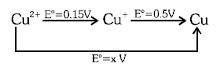
The value of $x$ from the given data is
A
$0.325$
B
$0.65$
C
$0.25$
D
None of these
Solution
(A) The given reactions are:
$(1)$ $Cu^{2+} + e^- \rightarrow Cu^+$,$E_1^{\circ} = 0.15 \ V$
$(2)$ $Cu^+ + e^- \rightarrow Cu$,$E_2^{\circ} = 0.5 \ V$
$(3)$ $Cu^{2+} + 2e^- \rightarrow Cu$,$E_3^{\circ} = x \ V$
Using the relationship $\Delta G_3^{\circ} = \Delta G_1^{\circ} + \Delta G_2^{\circ}$:
$-n_3 F E_3^{\circ} = -n_1 F E_1^{\circ} - n_2 F E_2^{\circ}$
$n_3 E_3^{\circ} = n_1 E_1^{\circ} + n_2 E_2^{\circ}$
$2 \times x = 1 \times 0.15 + 1 \times 0.5$
$2x = 0.65$
$x = 0.325 \ V$
$(1)$ $Cu^{2+} + e^- \rightarrow Cu^+$,$E_1^{\circ} = 0.15 \ V$
$(2)$ $Cu^+ + e^- \rightarrow Cu$,$E_2^{\circ} = 0.5 \ V$
$(3)$ $Cu^{2+} + 2e^- \rightarrow Cu$,$E_3^{\circ} = x \ V$
Using the relationship $\Delta G_3^{\circ} = \Delta G_1^{\circ} + \Delta G_2^{\circ}$:
$-n_3 F E_3^{\circ} = -n_1 F E_1^{\circ} - n_2 F E_2^{\circ}$
$n_3 E_3^{\circ} = n_1 E_1^{\circ} + n_2 E_2^{\circ}$
$2 \times x = 1 \times 0.15 + 1 \times 0.5$
$2x = 0.65$
$x = 0.325 \ V$
0 likes
View Solution176
EasyMCQ
The standard reduction potentials of $Cu^{2+}$,$Zn^{2+}$,$Sn^{2+}$ and $Ag^{+}$ are $0.34 \ V$,$-0.76 \ V$,$-0.14 \ V$ and $0.80 \ V$ respectively. Which of the following solutions can be stored in the given vessel without any reaction occurring (under standard conditions)?
A
$CuSO_4$ solution in a zinc vessel
B
$AgNO_3$ solution in a zinc vessel
C
$AgNO_3$ solution in a tin vessel
D
$CuSO_4$ solution in a silver vessel
Solution
(D) solution can be stored in a metal vessel if the metal of the vessel does not act as a reducing agent for the metal ions in the solution. This means the standard reduction potential of the metal vessel $(E^{o}_{vessel})$ must be greater than the standard reduction potential of the metal ion in the solution $(E^{o}_{ion})$,so that $E^{o}_{cell} = E^{o}_{cathode} - E^{o}_{anode}$ is negative,indicating a non-spontaneous reaction.
Given standard reduction potentials $(E^{o})$:
$E^{o}_{Zn^{2+}/Zn} = -0.76 \ V$
$E^{o}_{Sn^{2+}/Sn} = -0.14 \ V$
$E^{o}_{Cu^{2+}/Cu} = 0.34 \ V$
$E^{o}_{Ag^{+}/Ag} = 0.80 \ V$
Evaluating the options:
$A$. $CuSO_4$ in $Zn$: $E^{o}_{Zn} < E^{o}_{Cu}$,reaction occurs $(Zn + Cu^{2+} \rightarrow Zn^{2+} + Cu)$.
$B$. $AgNO_3$ in $Zn$: $E^{o}_{Zn} < E^{o}_{Ag}$,reaction occurs $(Zn + 2Ag^{+} \rightarrow Zn^{2+} + 2Ag)$.
$C$. $AgNO_3$ in $Sn$: $E^{o}_{Sn} < E^{o}_{Ag}$,reaction occurs $(Sn + 2Ag^{+} \rightarrow Sn^{2+} + 2Ag)$.
$D$. $CuSO_4$ in $Ag$: $E^{o}_{Ag} > E^{o}_{Cu}$,no reaction occurs ($Ag + Cu^{2+} \rightarrow$ No reaction).
Therefore,$CuSO_4$ solution can be stored in a silver vessel.
Given standard reduction potentials $(E^{o})$:
$E^{o}_{Zn^{2+}/Zn} = -0.76 \ V$
$E^{o}_{Sn^{2+}/Sn} = -0.14 \ V$
$E^{o}_{Cu^{2+}/Cu} = 0.34 \ V$
$E^{o}_{Ag^{+}/Ag} = 0.80 \ V$
Evaluating the options:
$A$. $CuSO_4$ in $Zn$: $E^{o}_{Zn} < E^{o}_{Cu}$,reaction occurs $(Zn + Cu^{2+} \rightarrow Zn^{2+} + Cu)$.
$B$. $AgNO_3$ in $Zn$: $E^{o}_{Zn} < E^{o}_{Ag}$,reaction occurs $(Zn + 2Ag^{+} \rightarrow Zn^{2+} + 2Ag)$.
$C$. $AgNO_3$ in $Sn$: $E^{o}_{Sn} < E^{o}_{Ag}$,reaction occurs $(Sn + 2Ag^{+} \rightarrow Sn^{2+} + 2Ag)$.
$D$. $CuSO_4$ in $Ag$: $E^{o}_{Ag} > E^{o}_{Cu}$,no reaction occurs ($Ag + Cu^{2+} \rightarrow$ No reaction).
Therefore,$CuSO_4$ solution can be stored in a silver vessel.
0 likes
View Solution177
MediumMCQ
Given are $E^o$ values for some half reactions:
$I_2 + 2e^- \to 2I^{-}; E^o = 0.54 \ V$
$MnO_4^- + 8H^{+} + 5e^- \to Mn^{2+} + 4H_2O; E^o = 1.52 \ V$
$Fe^{3+} + e^- \to Fe^{2+}; E^o = 0.77 \ V$
$Sn^{4+} + 2e^- \to Sn^{2+}; E^o = 0.1 \ V$
The strongest reducant and oxidant respectively are:
$I_2 + 2e^- \to 2I^{-}; E^o = 0.54 \ V$
$MnO_4^- + 8H^{+} + 5e^- \to Mn^{2+} + 4H_2O; E^o = 1.52 \ V$
$Fe^{3+} + e^- \to Fe^{2+}; E^o = 0.77 \ V$
$Sn^{4+} + 2e^- \to Sn^{2+}; E^o = 0.1 \ V$
The strongest reducant and oxidant respectively are:
A
$Sn^{4+}, MnO_4^-$
B
$Mn^{2+}, Sn^{4+}$
C
$Sn^{2+}, MnO_4^-$
D
$I_2, Sn^{2+}$
Solution
(C) The strength of an oxidant is directly proportional to its standard reduction potential $(E^o_{red})$.
Comparing the given $E^o$ values:
$MnO_4^- (1.52 \ V) > Fe^{3+} (0.77 \ V) > I_2 (0.54 \ V) > Sn^{4+} (0.1 \ V)$.
Thus,$MnO_4^-$ has the highest reduction potential and is the strongest oxidant.
The strength of a reductant is inversely proportional to the reduction potential of its corresponding oxidized form.
Looking at the reverse reactions (oxidation potentials):
$Sn^{2+} \to Sn^{4+} + 2e^-; E^o_{ox} = -0.1 \ V$
$2I^- \to I_2 + 2e^-; E^o_{ox} = -0.54 \ V$
$Fe^{2+} \to Fe^{3+} + e^-; E^o_{ox} = -0.77 \ V$
$Mn^{2+} + 4H_2O \to MnO_4^- + 8H^{+} + 5e^-; E^o_{ox} = -1.52 \ V$
$Sn^{2+}$ has the highest oxidation potential (least negative),making it the strongest reductant.
Therefore,the strongest reductant is $Sn^{2+}$ and the strongest oxidant is $MnO_4^-$.
Comparing the given $E^o$ values:
$MnO_4^- (1.52 \ V) > Fe^{3+} (0.77 \ V) > I_2 (0.54 \ V) > Sn^{4+} (0.1 \ V)$.
Thus,$MnO_4^-$ has the highest reduction potential and is the strongest oxidant.
The strength of a reductant is inversely proportional to the reduction potential of its corresponding oxidized form.
Looking at the reverse reactions (oxidation potentials):
$Sn^{2+} \to Sn^{4+} + 2e^-; E^o_{ox} = -0.1 \ V$
$2I^- \to I_2 + 2e^-; E^o_{ox} = -0.54 \ V$
$Fe^{2+} \to Fe^{3+} + e^-; E^o_{ox} = -0.77 \ V$
$Mn^{2+} + 4H_2O \to MnO_4^- + 8H^{+} + 5e^-; E^o_{ox} = -1.52 \ V$
$Sn^{2+}$ has the highest oxidation potential (least negative),making it the strongest reductant.
Therefore,the strongest reductant is $Sn^{2+}$ and the strongest oxidant is $MnO_4^-$.
0 likes
View Solution178
MediumMCQ
Given are $E^{\circ}$ values for some half reactions:
$I_2 + 2e^{-} \to 2I^{-}$ ; $E^{\circ} = 0.54 \, V$
$MnO_4^{-} + 8H^{+} + 5e^{-} \to Mn^{2+} + 4H_2O$ ; $E^{\circ} = 1.52 \, V$
$Fe^{3+} + e^{-} \to Fe^{2+}$ ; $E^{\circ} = 0.77 \, V$
$Sn^{4+} + 2e^{-} \to Sn^{2+}$ ; $E^{\circ} = 0.1 \, V$
The strongest reducant and oxidant respectively are:
$I_2 + 2e^{-} \to 2I^{-}$ ; $E^{\circ} = 0.54 \, V$
$MnO_4^{-} + 8H^{+} + 5e^{-} \to Mn^{2+} + 4H_2O$ ; $E^{\circ} = 1.52 \, V$
$Fe^{3+} + e^{-} \to Fe^{2+}$ ; $E^{\circ} = 0.77 \, V$
$Sn^{4+} + 2e^{-} \to Sn^{2+}$ ; $E^{\circ} = 0.1 \, V$
The strongest reducant and oxidant respectively are:
A
$Sn^{2+}, MnO_4^{-}$
B
$MnO_4^{-}, Sn^{4+}$
C
$I_2, Fe^{3+}$
D
$I_2, Sn^{2+}$
Solution
(A) The strength of an oxidant is directly proportional to its standard reduction potential $(E^{\circ}_{RP})$.
The strength of a reductant is inversely proportional to its standard reduction potential $(E^{\circ}_{RP})$.
Comparing the given $E^{\circ}$ values:
$1.52 \, V (MnO_4^{-}) > 0.77 \, V (Fe^{3+}) > 0.54 \, V (I_2) > 0.1 \, V (Sn^{4+})$.
Since $MnO_4^{-}$ has the highest $E^{\circ}_{RP}$,it is the strongest oxidant.
Since $Sn^{2+}$ is the conjugate reductant of the species with the lowest $E^{\circ}_{RP}$ $(Sn^{4+})$,it acts as the strongest reductant among the given species.
The strength of a reductant is inversely proportional to its standard reduction potential $(E^{\circ}_{RP})$.
Comparing the given $E^{\circ}$ values:
$1.52 \, V (MnO_4^{-}) > 0.77 \, V (Fe^{3+}) > 0.54 \, V (I_2) > 0.1 \, V (Sn^{4+})$.
Since $MnO_4^{-}$ has the highest $E^{\circ}_{RP}$,it is the strongest oxidant.
Since $Sn^{2+}$ is the conjugate reductant of the species with the lowest $E^{\circ}_{RP}$ $(Sn^{4+})$,it acts as the strongest reductant among the given species.
0 likes
View Solution179
MediumMCQ
If the standard reduction potentials for four divalent elements $X, Y, Z,$ and $W$ are $-1.46 \ V, -0.36 \ V, 0.15 \ V,$ and $-1.24 \ V$ respectively,then:
A
$X$ will displace $Z^{+2}$ from aqueous solution
B
$Y$ will displace $Z^{+2}$ from aqueous solution
C
$W$ will displace $Z^{+2}$ from aqueous solution
D
All the above statements are correct
Solution
(D) The standard reduction potentials $(SRP)$ are given as:
$E^\circ_{X^{+2}/X} = -1.46 \ V$
$E^\circ_{Y^{+2}/Y} = -0.36 \ V$
$E^\circ_{Z^{+2}/Z} = 0.15 \ V$
$E^\circ_{W^{+2}/W} = -1.24 \ V$
$A$ metal with a lower (more negative) reduction potential can displace a metal with a higher (more positive) reduction potential from its salt solution.
Since $E^\circ_{X^{+2}/X} < E^\circ_{Z^{+2}/Z}$,$X$ will displace $Z^{+2}$.
Since $E^\circ_{Y^{+2}/Y} < E^\circ_{Z^{+2}/Z}$,$Y$ will displace $Z^{+2}$.
Since $E^\circ_{W^{+2}/W} < E^\circ_{Z^{+2}/Z}$,$W$ will displace $Z^{+2}$.
Therefore,all the given statements are correct.
$E^\circ_{X^{+2}/X} = -1.46 \ V$
$E^\circ_{Y^{+2}/Y} = -0.36 \ V$
$E^\circ_{Z^{+2}/Z} = 0.15 \ V$
$E^\circ_{W^{+2}/W} = -1.24 \ V$
$A$ metal with a lower (more negative) reduction potential can displace a metal with a higher (more positive) reduction potential from its salt solution.
Since $E^\circ_{X^{+2}/X} < E^\circ_{Z^{+2}/Z}$,$X$ will displace $Z^{+2}$.
Since $E^\circ_{Y^{+2}/Y} < E^\circ_{Z^{+2}/Z}$,$Y$ will displace $Z^{+2}$.
Since $E^\circ_{W^{+2}/W} < E^\circ_{Z^{+2}/Z}$,$W$ will displace $Z^{+2}$.
Therefore,all the given statements are correct.
0 likes
View Solution180
MediumMCQ
From the following ${E^o}$ values of half cells,what combination of two half cells would result in a cell with the largest potential?
$I$. $A + e^- \to A^{-}$,${E^o} = +0.24 \ V$
$II$. $B^{-} + e^- \to B^{-2}$,${E^o} = +1.25 \ V$
$III$. $C^{-} + 2e^- \to C^{-3}$,${E^o} = +0.15 \ V$
$IV$. $D + 2e^- \to D^{-2}$,${E^o} = +0.68 \ V$
$I$. $A + e^- \to A^{-}$,${E^o} = +0.24 \ V$
$II$. $B^{-} + e^- \to B^{-2}$,${E^o} = +1.25 \ V$
$III$. $C^{-} + 2e^- \to C^{-3}$,${E^o} = +0.15 \ V$
$IV$. $D + 2e^- \to D^{-2}$,${E^o} = +0.68 \ V$
A
$II, IV$
B
$II, III$
C
$III, IV$
D
$I, II$
Solution
(B) The cell potential ${E^o}_{cell}$ is calculated as ${E^o}_{cathode} - {E^o}_{anode}$.
To obtain the largest potential,we must choose the half-cell with the highest ${E^o}$ value as the cathode and the half-cell with the lowest ${E^o}$ value as the anode.
Comparing the given values:
$I: +0.24 \ V$
$II: +1.25 \ V$
$III: +0.15 \ V$
$IV: +0.68 \ V$
The highest value is $II$ $(+1.25 \ V)$ and the lowest value is $III$ $(+0.15 \ V)$.
Therefore,the combination of $II$ and $III$ will result in the largest potential: ${E^o}_{cell} = 1.25 - 0.15 = 1.10 \ V$.
To obtain the largest potential,we must choose the half-cell with the highest ${E^o}$ value as the cathode and the half-cell with the lowest ${E^o}$ value as the anode.
Comparing the given values:
$I: +0.24 \ V$
$II: +1.25 \ V$
$III: +0.15 \ V$
$IV: +0.68 \ V$
The highest value is $II$ $(+1.25 \ V)$ and the lowest value is $III$ $(+0.15 \ V)$.
Therefore,the combination of $II$ and $III$ will result in the largest potential: ${E^o}_{cell} = 1.25 - 0.15 = 1.10 \ V$.
0 likes
View Solution181
MediumMCQ
For the reaction $H_2 (1 \, bar) + 2AgCl_{(s)} \rightleftharpoons 2Ag_{(s)} + 2H^{+} (0.1 \, M) + 2Cl^{-} (0.1 \, M)$,$\Delta G^o = -48,250 \, J$ at $25 \, ^oC$. The standard emf of cell in which the given reaction takes place is ................. $V$
A
$0.25$
B
$0.13$
C
$0.37$
D
$-0.25$
Solution
(A) The relationship between standard Gibbs free energy change $(\Delta G^o)$ and standard cell potential $(E^o_{cell})$ is given by the formula: $\Delta G^o = -nFE^o_{cell}$.
Here,the reaction is $H_2 + 2AgCl \rightarrow 2Ag + 2H^{+} + 2Cl^{-}$.
The number of electrons transferred $(n)$ is $2$.
The Faraday constant $(F)$ is approximately $96,500 \, C \, mol^{-1}$.
Given $\Delta G^o = -48,250 \, J \, mol^{-1}$.
Substituting the values: $-48,250 = -(2) \times (96,500) \times E^o_{cell}$.
$E^o_{cell} = \frac{48,250}{2 \times 96,500} = \frac{48,250}{193,000} = 0.25 \, V$.
Here,the reaction is $H_2 + 2AgCl \rightarrow 2Ag + 2H^{+} + 2Cl^{-}$.
The number of electrons transferred $(n)$ is $2$.
The Faraday constant $(F)$ is approximately $96,500 \, C \, mol^{-1}$.
Given $\Delta G^o = -48,250 \, J \, mol^{-1}$.
Substituting the values: $-48,250 = -(2) \times (96,500) \times E^o_{cell}$.
$E^o_{cell} = \frac{48,250}{2 \times 96,500} = \frac{48,250}{193,000} = 0.25 \, V$.
0 likes
View Solution182
MediumMCQ
The standard potential of a $Co^{2+}|Co$ electrode is $-0.28 \ V$ and the standard potential of the cell $Pt|Ti^{2+}_{(aq)}, Ti^{3+}_{(aq)}||Co^{2+}_{(aq)}|Co_{(s)}$ is $0.09 \ V$. What is the standard oxidation potential of the $Ti^{2+}_{(aq)}|Ti^{3+}_{(aq)}$ electrode? ............. $V$
A
$-0.37$
B
$0.37$
C
$-0.19$
D
$0.19$
Solution
(B) The cell reaction is $Ti^{2+} + Co^{2+} \rightarrow Ti^{3+} + Co$.
The standard cell potential is given by $E_{cell}^{o} = E_{cathode}^{o} - E_{anode}^{o}$.
Here,the cathode is the $Co^{2+}|Co$ electrode and the anode is the $Ti^{2+}|Ti^{3+}$ electrode.
$E_{cell}^{o} = E_{Co^{2+}|Co}^{o} - E_{Ti^{3+}|Ti^{2+}}^{o}$.
Substituting the given values: $0.09 \ V = -0.28 \ V - E_{Ti^{3+}|Ti^{2+}}^{o}$.
$E_{Ti^{3+}|Ti^{2+}}^{o} = -0.28 \ V - 0.09 \ V = -0.37 \ V$.
The standard oxidation potential is the negative of the standard reduction potential: $E_{ox}^{o} = -E_{red}^{o} = -(-0.37 \ V) = 0.37 \ V$.
The standard cell potential is given by $E_{cell}^{o} = E_{cathode}^{o} - E_{anode}^{o}$.
Here,the cathode is the $Co^{2+}|Co$ electrode and the anode is the $Ti^{2+}|Ti^{3+}$ electrode.
$E_{cell}^{o} = E_{Co^{2+}|Co}^{o} - E_{Ti^{3+}|Ti^{2+}}^{o}$.
Substituting the given values: $0.09 \ V = -0.28 \ V - E_{Ti^{3+}|Ti^{2+}}^{o}$.
$E_{Ti^{3+}|Ti^{2+}}^{o} = -0.28 \ V - 0.09 \ V = -0.37 \ V$.
The standard oxidation potential is the negative of the standard reduction potential: $E_{ox}^{o} = -E_{red}^{o} = -(-0.37 \ V) = 0.37 \ V$.
0 likes
View Solution183
MediumMCQ
Addition of powdered lead and iron to a solution which is $1.0 \, M$ in both $Pb^{2+}$ and $Fe^{2+}$ would result in [$E^{\circ}_{Fe^{2+}/Fe} = -0.44 \, V$ and $E^{\circ}_{Pb^{2+}/Pb} = -0.13 \, V$]
A
Increase in concentrations of both $Pb^{2+}$ and $Fe^{2+}$ ions
B
Decrease in concentrations of $Pb^{2+}$ and $Fe^{2+}$ ions
C
$Pb^{2+}$ concentration increases and $Fe^{2+}$ concentration decreases
D
$Fe^{2+}$ concentration increases and $Pb^{2+}$ concentration decreases
Solution
(D) The standard reduction potentials are $E^{\circ}_{Pb^{2+}/Pb} = -0.13 \, V$ and $E^{\circ}_{Fe^{2+}/Fe} = -0.44 \, V$.
Since $E^{\circ}_{Pb^{2+}/Pb} > E^{\circ}_{Fe^{2+}/Fe}$,$Pb^{2+}$ ions will act as the oxidizing agent and $Fe$ metal will act as the reducing agent.
The spontaneous cell reaction is: $Pb^{2+}(aq) + Fe(s) \rightarrow Fe^{2+}(aq) + Pb(s)$.
In this reaction,$Pb^{2+}$ ions are reduced to $Pb$ metal,so the concentration of $Pb^{2+}$ decreases.
Simultaneously,$Fe$ metal is oxidized to $Fe^{2+}$ ions,so the concentration of $Fe^{2+}$ increases.
Since $E^{\circ}_{Pb^{2+}/Pb} > E^{\circ}_{Fe^{2+}/Fe}$,$Pb^{2+}$ ions will act as the oxidizing agent and $Fe$ metal will act as the reducing agent.
The spontaneous cell reaction is: $Pb^{2+}(aq) + Fe(s) \rightarrow Fe^{2+}(aq) + Pb(s)$.
In this reaction,$Pb^{2+}$ ions are reduced to $Pb$ metal,so the concentration of $Pb^{2+}$ decreases.
Simultaneously,$Fe$ metal is oxidized to $Fe^{2+}$ ions,so the concentration of $Fe^{2+}$ increases.
0 likes
View Solution184
DifficultMCQ
Given the electrode potentials:
$Fe^{3+} + e^- \to Fe^{2+}; E^o = 0.771 \ V$
$I_2 + 2e^- \to 2I^{-}; E^o = 0.536 \ V$
The $E^o_{\text{cell}}$ for the cell reaction $2Fe^{3+} + 2I^{-} \to 2Fe^{2+} + I_2$ is:
$Fe^{3+} + e^- \to Fe^{2+}; E^o = 0.771 \ V$
$I_2 + 2e^- \to 2I^{-}; E^o = 0.536 \ V$
The $E^o_{\text{cell}}$ for the cell reaction $2Fe^{3+} + 2I^{-} \to 2Fe^{2+} + I_2$ is:
A
$(2 \times 0.771 - 0.536) = 1.006 \ V$
B
$(0.771 - 0.5 \times 0.536) = 0.503 \ V$
C
$(0.771 - 0.536) = 0.235 \ V$
D
$(0.536 - 0.771) = -0.235 \ V$
Solution
(C) The cell reaction is $2Fe^{3+} + 2I^{-} \to 2Fe^{2+} + I_2$.
Here,$Fe^{3+}$ is reduced to $Fe^{2+}$ (cathode) and $I^{-}$ is oxidized to $I_2$ (anode).
$E^o_{\text{cell}} = E^o_{\text{cathode}} - E^o_{\text{anode}}$
$E^o_{\text{cell}} = E^o_{Fe^{3+}/Fe^{2+}} - E^o_{I_2/I^{-}}$
$E^o_{\text{cell}} = 0.771 \ V - 0.536 \ V = 0.235 \ V$
Here,$Fe^{3+}$ is reduced to $Fe^{2+}$ (cathode) and $I^{-}$ is oxidized to $I_2$ (anode).
$E^o_{\text{cell}} = E^o_{\text{cathode}} - E^o_{\text{anode}}$
$E^o_{\text{cell}} = E^o_{Fe^{3+}/Fe^{2+}} - E^o_{I_2/I^{-}}$
$E^o_{\text{cell}} = 0.771 \ V - 0.536 \ V = 0.235 \ V$
0 likes
View Solution185
MediumMCQ
The standard electrode potentials $(E^o)$ for $OCl^{-}/Cl^{-}$ and $\frac{1}{2}Cl_2/Cl^{-}$ are $0.94 \ V$ and $+1.36 \ V$ respectively,the $E^o$ value for $OCl^{-}/\frac{1}{2}Cl_2$ will be ........... $V$.
A
$-0.42$
B
$-2.20$
C
$+0.52$
D
$+1.04$
Solution
(C) Given half-reactions:
$(I) \ OCl^{-} + H_2O + 2e^{-} \longrightarrow Cl^{-} + 2OH^{-}, \ E^o_1 = 0.94 \ V, \ n_1 = 2$
$\Delta G^o_1 = -n_1 F E^o_1 = -2 \times F \times 0.94 = -1.88F$
$(II) \ \frac{1}{2}Cl_2 + e^{-} \longrightarrow Cl^{-}, \ E^o_2 = 1.36 \ V, \ n_2 = 1$
To get the reaction $OCl^{-} + H_2O + e^{-} \longrightarrow \frac{1}{2}Cl_2 + 2OH^{-}$,we perform $(I) - (II)$:
$\Delta G^o_3 = \Delta G^o_1 - \Delta G^o_2 = -1.88F - (-1.36F) = -0.52F$
For the target reaction,$n_3 = 1$:
$E^o_3 = -\frac{\Delta G^o_3}{n_3 F} = -\frac{-0.52F}{1 \times F} = +0.52 \ V$.
$(I) \ OCl^{-} + H_2O + 2e^{-} \longrightarrow Cl^{-} + 2OH^{-}, \ E^o_1 = 0.94 \ V, \ n_1 = 2$
$\Delta G^o_1 = -n_1 F E^o_1 = -2 \times F \times 0.94 = -1.88F$
$(II) \ \frac{1}{2}Cl_2 + e^{-} \longrightarrow Cl^{-}, \ E^o_2 = 1.36 \ V, \ n_2 = 1$
To get the reaction $OCl^{-} + H_2O + e^{-} \longrightarrow \frac{1}{2}Cl_2 + 2OH^{-}$,we perform $(I) - (II)$:
$\Delta G^o_3 = \Delta G^o_1 - \Delta G^o_2 = -1.88F - (-1.36F) = -0.52F$
For the target reaction,$n_3 = 1$:
$E^o_3 = -\frac{\Delta G^o_3}{n_3 F} = -\frac{-0.52F}{1 \times F} = +0.52 \ V$.
0 likes
View Solution186
EasyMCQ
Calculate $E^o_{cell}$ for the following cell in $V$:
$Zn_{(s)} | Zn^{2+}_{(aq.)} || Ag^{+}_{(aq.)} | Ag_{(s)}$
Given: $E^o_{Zn^{2+}/Zn} = -0.76 \ V$ ; $E^o_{Ag^{+}/Ag} = 0.80 \ V$
$Zn_{(s)} | Zn^{2+}_{(aq.)} || Ag^{+}_{(aq.)} | Ag_{(s)}$
Given: $E^o_{Zn^{2+}/Zn} = -0.76 \ V$ ; $E^o_{Ag^{+}/Ag} = 0.80 \ V$
A
$0.04$
B
$-1.56$
C
$1.56$
D
$0.84$
Solution
(C) The standard cell potential is calculated using the formula:
$E^o_{cell} = E^o_{cathode} - E^o_{anode}$
Here,the cathode is the silver electrode $(Ag^{+}/Ag)$ and the anode is the zinc electrode $(Zn^{2+}/Zn)$.
$E^o_{cell} = E^o_{Ag^{+}/Ag} - E^o_{Zn^{2+}/Zn}$
$E^o_{cell} = 0.80 \ V - (-0.76 \ V)$
$E^o_{cell} = 0.80 + 0.76 = 1.56 \ V$
$E^o_{cell} = E^o_{cathode} - E^o_{anode}$
Here,the cathode is the silver electrode $(Ag^{+}/Ag)$ and the anode is the zinc electrode $(Zn^{2+}/Zn)$.
$E^o_{cell} = E^o_{Ag^{+}/Ag} - E^o_{Zn^{2+}/Zn}$
$E^o_{cell} = 0.80 \ V - (-0.76 \ V)$
$E^o_{cell} = 0.80 + 0.76 = 1.56 \ V$
0 likes
View Solution187
EasyMCQ
If $E^o_{A^{+2}/A} = -0.30 \ V$ and $E^o_{A^{+3}/A^{+2}} = 0.40 \ V$,the standard $EMF$ of the reaction: $A + 2A^{+3} \to 3A^{+2}$ will be ............ $V$.
A
$0.30$
B
$0.40$
C
$0.70$
D
$0.10$
Solution
(C) The given reaction is $A + 2A^{+3} \to 3A^{+2}$.
This can be split into two half-reactions:
Anode (Oxidation): $A \to A^{+2} + 2e^-$,where $E^o_{ox} = -E^o_{A^{+2}/A} = -(-0.30 \ V) = 0.30 \ V$.
Cathode (Reduction): $2A^{+3} + 2e^- \to 2A^{+2}$,where $E^o_{red} = E^o_{A^{+3}/A^{+2}} = 0.40 \ V$.
The standard $EMF$ of the cell is calculated as $E^o_{cell} = E^o_{ox} + E^o_{red}$.
$E^o_{cell} = 0.30 \ V + 0.40 \ V = 0.70 \ V$.
This can be split into two half-reactions:
Anode (Oxidation): $A \to A^{+2} + 2e^-$,where $E^o_{ox} = -E^o_{A^{+2}/A} = -(-0.30 \ V) = 0.30 \ V$.
Cathode (Reduction): $2A^{+3} + 2e^- \to 2A^{+2}$,where $E^o_{red} = E^o_{A^{+3}/A^{+2}} = 0.40 \ V$.
The standard $EMF$ of the cell is calculated as $E^o_{cell} = E^o_{ox} + E^o_{red}$.
$E^o_{cell} = 0.30 \ V + 0.40 \ V = 0.70 \ V$.
0 likes
View Solution188
MediumMCQ
$E^o$ values for the half-cell reactions are given below:
$Cu^{2+} + e^- \to Cu^{+} \quad E^o = 0.15 \ V$
$Cu^{2+} + 2e^- \to Cu \quad E^o = 0.34 \ V$
What will be the $E^o$ for the half-cell reaction:
$Cu^{+} + e^- \to Cu$ ? $\dots \ V$
$Cu^{2+} + e^- \to Cu^{+} \quad E^o = 0.15 \ V$
$Cu^{2+} + 2e^- \to Cu \quad E^o = 0.34 \ V$
What will be the $E^o$ for the half-cell reaction:
$Cu^{+} + e^- \to Cu$ ? $\dots \ V$
A
$+0.49$
B
$+0.19$
C
$+0.53$
D
$+0.30$
Solution
(C) Given:
$(1) \ Cu^{2+} + e^- \to Cu^{+} ; E_1^o = 0.15 \ V, \Delta G_1^o = -n_1 F E_1^o, n_1 = 1$
$(2) \ Cu^{2+} + 2e^- \to Cu ; E_2^o = 0.34 \ V, \Delta G_2^o = -n_2 F E_2^o, n_2 = 2$
We need to find $E_3^o$ for:
$(3) \ Cu^{+} + e^- \to Cu ; E_3^o = ?, \Delta G_3^o = -n_3 F E_3^o, n_3 = 1$
Reaction $(3)$ can be obtained by subtracting reaction $(1)$ from reaction $(2)$:
$(Cu^{2+} + 2e^- \to Cu) - (Cu^{2+} + e^- \to Cu^{+}) \implies Cu^{+} + e^- \to Cu$
Since $\Delta G^o$ is an extensive property,$\Delta G_3^o = \Delta G_2^o - \Delta G_1^o$
$-n_3 F E_3^o = -n_2 F E_2^o - (-n_1 F E_1^o)$
$-1 \times F \times E_3^o = -(2 \times F \times 0.34) + (1 \times F \times 0.15)$
$-E_3^o = -0.68 + 0.15$
$-E_3^o = -0.53$
$E_3^o = +0.53 \ V$
$(1) \ Cu^{2+} + e^- \to Cu^{+} ; E_1^o = 0.15 \ V, \Delta G_1^o = -n_1 F E_1^o, n_1 = 1$
$(2) \ Cu^{2+} + 2e^- \to Cu ; E_2^o = 0.34 \ V, \Delta G_2^o = -n_2 F E_2^o, n_2 = 2$
We need to find $E_3^o$ for:
$(3) \ Cu^{+} + e^- \to Cu ; E_3^o = ?, \Delta G_3^o = -n_3 F E_3^o, n_3 = 1$
Reaction $(3)$ can be obtained by subtracting reaction $(1)$ from reaction $(2)$:
$(Cu^{2+} + 2e^- \to Cu) - (Cu^{2+} + e^- \to Cu^{+}) \implies Cu^{+} + e^- \to Cu$
Since $\Delta G^o$ is an extensive property,$\Delta G_3^o = \Delta G_2^o - \Delta G_1^o$
$-n_3 F E_3^o = -n_2 F E_2^o - (-n_1 F E_1^o)$
$-1 \times F \times E_3^o = -(2 \times F \times 0.34) + (1 \times F \times 0.15)$
$-E_3^o = -0.68 + 0.15$
$-E_3^o = -0.53$
$E_3^o = +0.53 \ V$
0 likes
View Solution189
MediumMCQ
Given electrode potentials:
$Fe^{3+} + e^- \to Fe^{2+}$; $E^o = 0.771 \, V$
$I_2 + 2e^- \to 2I^-$; $E^o = 0.536 \, V$
$E^o_{\text{cell}}$ for the cell reaction
$2Fe^{3+} + 2I^- \to 2Fe^{2+} + I_2$ is:
$Fe^{3+} + e^- \to Fe^{2+}$; $E^o = 0.771 \, V$
$I_2 + 2e^- \to 2I^-$; $E^o = 0.536 \, V$
$E^o_{\text{cell}}$ for the cell reaction
$2Fe^{3+} + 2I^- \to 2Fe^{2+} + I_2$ is:
A
$0.771 - 0.536 = 0.235 \, V$
B
$0.536 - 0.771 = -0.235 \, V$
C
$2 \times 0.771 - 0.536 = 1.006 \, V$
D
$0.771 + 0.536 = 1.307 \, V$
Solution
(A) The cell reaction is: $2Fe^{3+} + 2I^- \to 2Fe^{2+} + I_2$.
This reaction consists of two half-reactions:
Cathode (Reduction): $2Fe^{3+} + 2e^- \to 2Fe^{2+}$; $E^o_{\text{cathode}} = 0.771 \, V$.
Anode (Oxidation): $2I^- \to I_2 + 2e^-$; $E^o_{\text{anode}} = 0.536 \, V$.
$E^o_{\text{cell}} = E^o_{\text{cathode}} - E^o_{\text{anode}}$.
$E^o_{\text{cell}} = 0.771 \, V - 0.536 \, V = 0.235 \, V$.
This reaction consists of two half-reactions:
Cathode (Reduction): $2Fe^{3+} + 2e^- \to 2Fe^{2+}$; $E^o_{\text{cathode}} = 0.771 \, V$.
Anode (Oxidation): $2I^- \to I_2 + 2e^-$; $E^o_{\text{anode}} = 0.536 \, V$.
$E^o_{\text{cell}} = E^o_{\text{cathode}} - E^o_{\text{anode}}$.
$E^o_{\text{cell}} = 0.771 \, V - 0.536 \, V = 0.235 \, V$.
0 likes
View Solution190
MediumMCQ
$E^o$ values of $Mg^{2+}/Mg$,$Zn^{2+}/Zn$ and $Fe^{2+}/Fe$ are $-2.37 \ V$,$-0.76 \ V$ and $-0.44 \ V$ respectively. Which of the following statements is correct?
A
$Zn$ will reduce $Fe^{2+}$
B
$Zn$ will reduce $Mg^{2+}$
C
$Mg$ oxidises $Fe$
D
$Zn$ oxidises $Fe$
Solution
(A) The standard reduction potentials are given as: $E^o(Mg^{2+}/Mg) = -2.37 \ V$,$E^o(Zn^{2+}/Zn) = -0.76 \ V$,and $E^o(Fe^{2+}/Fe) = -0.44 \ V$.
According to the electrochemical series,a metal with a lower (more negative) reduction potential can reduce the ion of a metal with a higher (less negative) reduction potential.
Since $E^o(Zn^{2+}/Zn) < E^o(Fe^{2+}/Fe)$ (i.e.,$-0.76 \ V < -0.44 \ V$),$Zn$ can reduce $Fe^{2+}$ to $Fe$.
Therefore,the correct statement is that $Zn$ will reduce $Fe^{2+}$.
According to the electrochemical series,a metal with a lower (more negative) reduction potential can reduce the ion of a metal with a higher (less negative) reduction potential.
Since $E^o(Zn^{2+}/Zn) < E^o(Fe^{2+}/Fe)$ (i.e.,$-0.76 \ V < -0.44 \ V$),$Zn$ can reduce $Fe^{2+}$ to $Fe$.
Therefore,the correct statement is that $Zn$ will reduce $Fe^{2+}$.
0 likes
View Solution191
MediumMCQ
Consider the cell given below:
$Ag_{(s)} | Ag^{\oplus} || Cu^{2+} | Cu_{(s)}$
Given:
$Ag^{\oplus} + e^{-} \to Ag; E^{o} = x$
$Cu^{2+} + 2e^{-} \to Cu; E^{o} = y$
The value of $E^{o}_{cell}$ is:
$Ag_{(s)} | Ag^{\oplus} || Cu^{2+} | Cu_{(s)}$
Given:
$Ag^{\oplus} + e^{-} \to Ag; E^{o} = x$
$Cu^{2+} + 2e^{-} \to Cu; E^{o} = y$
The value of $E^{o}_{cell}$ is:
A
$x + 2y$
B
$2x + y$
C
$y - x$
D
$y - 2x$
Solution
(C) The standard cell potential is calculated using the formula: $E^{o}_{cell} = (E^{o}_{red})_{cathode} - (E^{o}_{red})_{anode}$.
In the given cell $Ag_{(s)} | Ag^{\oplus} || Cu^{2+} | Cu_{(s)}$,the reduction occurs at the copper electrode (cathode) and oxidation occurs at the silver electrode (anode).
Therefore,$(E^{o}_{red})_{cathode} = y$ and $(E^{o}_{red})_{anode} = x$.
Substituting these values,we get $E^{o}_{cell} = y - x$.
In the given cell $Ag_{(s)} | Ag^{\oplus} || Cu^{2+} | Cu_{(s)}$,the reduction occurs at the copper electrode (cathode) and oxidation occurs at the silver electrode (anode).
Therefore,$(E^{o}_{red})_{cathode} = y$ and $(E^{o}_{red})_{anode} = x$.
Substituting these values,we get $E^{o}_{cell} = y - x$.
0 likes
View Solution192
MediumMCQ
$Cu^{+} + e^- \to Cu$ ; $E^o = X_1 \ V$
$Cu^{2+} + 2e^- \to Cu$ ; $E^o = X_2 \ V$
Then for $Cu^{2+} + e^- \to Cu^{+}$ ; $E^o$ will be ?
$Cu^{2+} + 2e^- \to Cu$ ; $E^o = X_2 \ V$
Then for $Cu^{2+} + e^- \to Cu^{+}$ ; $E^o$ will be ?
A
$X_1 - 2X_2$
B
$X_1 + 2X_2$
C
$X_1 - X_2$
D
$2X_2 - X_1$
Solution
(D) The reaction $Cu^{2+} + e^- \to Cu^{+}$ can be obtained by subtracting the first reaction from the second reaction:
$(Cu^{2+} + 2e^- \to Cu) - (Cu^{+} + e^- \to Cu) \implies Cu^{2+} + e^- \to Cu^{+}$
The change in Gibbs free energy is given by $\Delta G^o = -nFE^o$.
For the target reaction: $\Delta G_3^o = \Delta G_2^o - \Delta G_1^o$
$-1 \times F \times E^o = (-2 \times F \times X_2) - (-1 \times F \times X_1)$
$-F \times E^o = -2FX_2 + FX_1$
Dividing by $-F$,we get: $E^o = 2X_2 - X_1$
$(Cu^{2+} + 2e^- \to Cu) - (Cu^{+} + e^- \to Cu) \implies Cu^{2+} + e^- \to Cu^{+}$
The change in Gibbs free energy is given by $\Delta G^o = -nFE^o$.
For the target reaction: $\Delta G_3^o = \Delta G_2^o - \Delta G_1^o$
$-1 \times F \times E^o = (-2 \times F \times X_2) - (-1 \times F \times X_1)$
$-F \times E^o = -2FX_2 + FX_1$
Dividing by $-F$,we get: $E^o = 2X_2 - X_1$
0 likes
View Solution193
MediumMCQ
Four metals $A$,$B$,$C$,and $D$ have Standard Reduction Potential $(SRP)$ values of $-3.05 \ V$,$-1.66 \ V$,$-0.40 \ V$,and $0.80 \ V$ respectively. Which is the strongest reducing agent?
A
$A$
B
$B$
C
$C$
D
$D$
Solution
(A) The reducing strength of a metal is inversely proportional to its Standard Reduction Potential $(SRP)$ value.
Stronger reducing agents have more negative $SRP$ values.
Comparing the given values: $A = -3.05 \ V$,$B = -1.66 \ V$,$C = -0.40 \ V$,and $D = 0.80 \ V$.
Since $-3.05 \ V$ is the most negative value,metal $A$ has the highest tendency to lose electrons and acts as the strongest reducing agent.
Stronger reducing agents have more negative $SRP$ values.
Comparing the given values: $A = -3.05 \ V$,$B = -1.66 \ V$,$C = -0.40 \ V$,and $D = 0.80 \ V$.
Since $-3.05 \ V$ is the most negative value,metal $A$ has the highest tendency to lose electrons and acts as the strongest reducing agent.
0 likes
View Solution194
DifficultMCQ
What is the standard reduction potential $(E^o)$ for $Fe^{3+} \to Fe$ ? ............... $V$
Given that :
$Fe^{2+} + 2e^- \to Fe;$ $E^o_{Fe^{2+}/Fe} = -0.47 \ V$
$Fe^{3+} + e^- \to Fe^{2+};$ $E^o_{Fe^{3+}/Fe^{2+}} = +0.77 \ V$
Given that :
$Fe^{2+} + 2e^- \to Fe;$ $E^o_{Fe^{2+}/Fe} = -0.47 \ V$
$Fe^{3+} + e^- \to Fe^{2+};$ $E^o_{Fe^{3+}/Fe^{2+}} = +0.77 \ V$
A
$-0.057$
B
$+0.057$
C
$+0.30$
D
$-0.30$
Solution
(A) The standard Gibbs free energy change is given by $\Delta G^o = -nFE^o$.
For reaction $(i)$: $Fe^{2+} + 2e^- \to Fe$,$E^o = -0.47 \ V$,so $\Delta G^o_1 = -2 \times F \times (-0.47) = 0.94 \ F$.
For reaction $(ii)$: $Fe^{3+} + e^- \to Fe^{2+}$,$E^o = +0.77 \ V$,so $\Delta G^o_2 = -1 \times F \times (+0.77) = -0.77 \ F$.
For the overall reaction $(iii)$: $Fe^{3+} + 3e^- \to Fe$,the sum of the reactions is $(i) + (ii)$.
Therefore,$\Delta G^o_3 = \Delta G^o_1 + \Delta G^o_2 = 0.94 \ F - 0.77 \ F = 0.17 \ F$.
Using $\Delta G^o_3 = -nFE^o_{Fe^{3+}/Fe}$,where $n = 3$:
$0.17 \ F = -3 \times F \times E^o_{Fe^{3+}/Fe}$
$E^o_{Fe^{3+}/Fe} = \frac{0.17 \ F}{-3 \ F} = -0.057 \ V$.
For reaction $(i)$: $Fe^{2+} + 2e^- \to Fe$,$E^o = -0.47 \ V$,so $\Delta G^o_1 = -2 \times F \times (-0.47) = 0.94 \ F$.
For reaction $(ii)$: $Fe^{3+} + e^- \to Fe^{2+}$,$E^o = +0.77 \ V$,so $\Delta G^o_2 = -1 \times F \times (+0.77) = -0.77 \ F$.
For the overall reaction $(iii)$: $Fe^{3+} + 3e^- \to Fe$,the sum of the reactions is $(i) + (ii)$.
Therefore,$\Delta G^o_3 = \Delta G^o_1 + \Delta G^o_2 = 0.94 \ F - 0.77 \ F = 0.17 \ F$.
Using $\Delta G^o_3 = -nFE^o_{Fe^{3+}/Fe}$,where $n = 3$:
$0.17 \ F = -3 \times F \times E^o_{Fe^{3+}/Fe}$
$E^o_{Fe^{3+}/Fe} = \frac{0.17 \ F}{-3 \ F} = -0.057 \ V$.
0 likes
View Solution195
DifficultMCQ
The standard electrode potentials $\left( E_{M^{+}/M}^\circ \right)$ of four metals $A, B, C$ and $D$ are $-1.2 \ V, 0.6 \ V, 0.85 \ V$ and $-0.76 \ V$,respectively. The sequence of deposition of metals on applying potential is
A
$A, C, B, D$
B
$B, D, C, A$
C
$C, B, D, A$
D
$D, A, B, C$
Solution
(C) The deposition of metals during electrolysis occurs in the order of their reduction potentials,starting from the highest reduction potential to the lowest reduction potential.
Given standard reduction potentials: $E_A^\circ = -1.2 \ V$,$E_B^\circ = 0.6 \ V$,$E_C^\circ = 0.85 \ V$,and $E_D^\circ = -0.76 \ V$.
Arranging these in decreasing order: $0.85 \ V (C) > 0.6 \ V (B) > -0.76 \ V (D) > -1.2 \ V (A)$.
Thus,the sequence of deposition is $C, B, D, A$.
Given standard reduction potentials: $E_A^\circ = -1.2 \ V$,$E_B^\circ = 0.6 \ V$,$E_C^\circ = 0.85 \ V$,and $E_D^\circ = -0.76 \ V$.
Arranging these in decreasing order: $0.85 \ V (C) > 0.6 \ V (B) > -0.76 \ V (D) > -1.2 \ V (A)$.
Thus,the sequence of deposition is $C, B, D, A$.
0 likes
View Solution196
DifficultMCQ
Given:
$Fe^{3+}_{(aq)} + e^- \to Fe^{2+}_{(aq)}; E^o = +0.77 \ V$
$Al^{3+}_{(aq)} + 3e^- \to Al_{(s)}; E^o = -1.66 \ V$
$Br_{2(aq)} + 2e^- \to 2Br^-_{(aq)}; E^o = +1.09 \ V$
Considering the electrode potentials,which of the following represents the correct order of reducing power?
$Fe^{3+}_{(aq)} + e^- \to Fe^{2+}_{(aq)}; E^o = +0.77 \ V$
$Al^{3+}_{(aq)} + 3e^- \to Al_{(s)}; E^o = -1.66 \ V$
$Br_{2(aq)} + 2e^- \to 2Br^-_{(aq)}; E^o = +1.09 \ V$
Considering the electrode potentials,which of the following represents the correct order of reducing power?
A
$Fe^{2+} < Al < Br^-$
B
$Br^- < Fe^{2+} < Al$
C
$Al < Br^- < Fe^{2+}$
D
$Br^- < Fe^{2+} < Al$
Solution
(B) The reducing power of a species is inversely proportional to its standard reduction potential $(E^o)$.
The given standard reduction potentials are:
$E^o (Al^{3+}/Al) = -1.66 \ V$
$E^o (Fe^{3+}/Fe^{2+}) = +0.77 \ V$
$E^o (Br_2/Br^-) = +1.09 \ V$
$A$ more negative $E^o$ value indicates a stronger reducing agent.
Comparing the values: $-1.66 \ V < +0.77 \ V < +1.09 \ V$.
Therefore,the order of reducing power is $Br^- < Fe^{2+} < Al$.
The given standard reduction potentials are:
$E^o (Al^{3+}/Al) = -1.66 \ V$
$E^o (Fe^{3+}/Fe^{2+}) = +0.77 \ V$
$E^o (Br_2/Br^-) = +1.09 \ V$
$A$ more negative $E^o$ value indicates a stronger reducing agent.
Comparing the values: $-1.66 \ V < +0.77 \ V < +1.09 \ V$.
Therefore,the order of reducing power is $Br^- < Fe^{2+} < Al$.
0 likes
View Solution197
DifficultMCQ
Electrode potentials $(E^o)$ are given below:
$Cu^{+}/Cu = +0.52 \ V$
$Fe^{3+}/Fe^{2+} = +0.77 \ V$
$\frac{1}{2} I_{2(s)}/I^{-} = +0.54 \ V$
$Ag^{+}/Ag = +0.88 \ V$
Based on the above potentials,the strongest oxidizing agent will be:
$Cu^{+}/Cu = +0.52 \ V$
$Fe^{3+}/Fe^{2+} = +0.77 \ V$
$\frac{1}{2} I_{2(s)}/I^{-} = +0.54 \ V$
$Ag^{+}/Ag = +0.88 \ V$
Based on the above potentials,the strongest oxidizing agent will be:
A
$Cu^{+}$
B
$Fe^{3+}$
C
$Ag^{+}$
D
$I_2$
Solution
(C) The strength of an oxidizing agent is directly proportional to its standard reduction potential $(E^o)$.
Comparing the given values:
$E^o(Cu^{+}/Cu) = +0.52 \ V$
$E^o(Fe^{3+}/Fe^{2+}) = +0.77 \ V$
$E^o(\frac{1}{2} I_2/I^{-}) = +0.54 \ V$
$E^o(Ag^{+}/Ag) = +0.88 \ V$
Since $Ag^{+}$ has the highest reduction potential $(+0.88 \ V)$,it is the strongest oxidizing agent.
Comparing the given values:
$E^o(Cu^{+}/Cu) = +0.52 \ V$
$E^o(Fe^{3+}/Fe^{2+}) = +0.77 \ V$
$E^o(\frac{1}{2} I_2/I^{-}) = +0.54 \ V$
$E^o(Ag^{+}/Ag) = +0.88 \ V$
Since $Ag^{+}$ has the highest reduction potential $(+0.88 \ V)$,it is the strongest oxidizing agent.
0 likes
View Solution198
DifficultMCQ
Given
$E^o_{\frac{1}{2}Cl_2/Cl^-} = 1.36 \ V$,$E^o_{Cr^{3+}/Cr} = -0.74 \ V$
$E^o_{Cr_2O_7^{2-}/Cr^{3+}} = 1.33 \ V$,$E^o_{MnO_4^-/Mn^{2+}} = 1.51 \ V$
The correct order of reducing power of the species $(Cr, Cr^{3+}, Mn^{2+}, Cl^-)$ will be:
$E^o_{\frac{1}{2}Cl_2/Cl^-} = 1.36 \ V$,$E^o_{Cr^{3+}/Cr} = -0.74 \ V$
$E^o_{Cr_2O_7^{2-}/Cr^{3+}} = 1.33 \ V$,$E^o_{MnO_4^-/Mn^{2+}} = 1.51 \ V$
The correct order of reducing power of the species $(Cr, Cr^{3+}, Mn^{2+}, Cl^-)$ will be:
A
$Mn^{2+} < Cl^- < Cr^{3+} < Cr$
B
$Mn^{2+} < Cr^{3+} < Cl^- < Cr$
C
$Cr^{3+} < Cl^- < Mn^{2+} < Cr$
D
$Cr^{3+} < Cl^- < Cr < Mn^{2+}$
Solution
(A) The reducing power of a species is inversely proportional to its standard reduction potential $(E^o)$.
Comparing the reduction potentials of the corresponding half-reactions:
$1$. For $Cr^{3+} + 3e^- \rightarrow Cr$,$E^o = -0.74 \ V$
$2$. For $Cl_2 + 2e^- \rightarrow 2Cl^-$,$E^o = 1.36 \ V$
$3$. For $Cr_2O_7^{2-} + 14H^+ + 6e^- \rightarrow 2Cr^{3+} + 7H_2O$,$E^o = 1.33 \ V$
$4$. For $MnO_4^- + 8H^+ + 5e^- \rightarrow Mn^{2+} + 4H_2O$,$E^o = 1.51 \ V$
To determine the reducing power of the species $(Cr, Cr^{3+}, Mn^{2+}, Cl^-)$,we look at their oxidation potentials (which is $-E^o$ of the reduction reaction):
- $Cr \rightarrow Cr^{3+} + 3e^-$,$E^o_{ox} = +0.74 \ V$
- $Cl^- \rightarrow \frac{1}{2}Cl_2 + e^-$,$E^o_{ox} = -1.36 \ V$
- $Cr^{3+} \rightarrow Cr_2O_7^{2-}$,$E^o_{ox} = -1.33 \ V$
- $Mn^{2+} \rightarrow MnO_4^-$,$E^o_{ox} = -1.51 \ V$
Arranging these in increasing order of oxidation potential (reducing power): $Mn^{2+} < Cl^- < Cr^{3+} < Cr$.
Comparing the reduction potentials of the corresponding half-reactions:
$1$. For $Cr^{3+} + 3e^- \rightarrow Cr$,$E^o = -0.74 \ V$
$2$. For $Cl_2 + 2e^- \rightarrow 2Cl^-$,$E^o = 1.36 \ V$
$3$. For $Cr_2O_7^{2-} + 14H^+ + 6e^- \rightarrow 2Cr^{3+} + 7H_2O$,$E^o = 1.33 \ V$
$4$. For $MnO_4^- + 8H^+ + 5e^- \rightarrow Mn^{2+} + 4H_2O$,$E^o = 1.51 \ V$
To determine the reducing power of the species $(Cr, Cr^{3+}, Mn^{2+}, Cl^-)$,we look at their oxidation potentials (which is $-E^o$ of the reduction reaction):
- $Cr \rightarrow Cr^{3+} + 3e^-$,$E^o_{ox} = +0.74 \ V$
- $Cl^- \rightarrow \frac{1}{2}Cl_2 + e^-$,$E^o_{ox} = -1.36 \ V$
- $Cr^{3+} \rightarrow Cr_2O_7^{2-}$,$E^o_{ox} = -1.33 \ V$
- $Mn^{2+} \rightarrow MnO_4^-$,$E^o_{ox} = -1.51 \ V$
Arranging these in increasing order of oxidation potential (reducing power): $Mn^{2+} < Cl^- < Cr^{3+} < Cr$.
0 likes
View Solution199
DifficultMCQ
The standard electrode potentials of $Ag^{+}/Ag$,$Hg_2^{2+}/2Hg$,$Cu^{2+}/Cu$,and $Mg^{2+}/Mg$ are $0.80 \ V$,$0.79 \ V$,$0.34 \ V$,and $-2.37 \ V$,respectively. An aqueous solution containing $1 \ M$ concentration of each of these metal salts is electrolyzed. With increasing voltage,what is the correct sequence of deposition of the metals at the cathode?
A
$Ag, Hg, Cu, Mg$
B
$Cu, Hg, Ag$ only
C
$Ag, Hg, Cu$ only
D
$Mg, Cu, Hg, Ag$
Solution
(C) The deposition of metals at the cathode during electrolysis depends on their standard reduction potentials $(E^o)$.
Metals with higher reduction potentials are deposited more easily at the cathode.
The given standard reduction potentials are: $E^o(Ag^+/Ag) = 0.80 \ V$,$E^o(Hg_2^{2+}/2Hg) = 0.79 \ V$,$E^o(Cu^{2+}/Cu) = 0.34 \ V$,and $E^o(Mg^{2+}/Mg) = -2.37 \ V$.
In an aqueous solution,water can also be reduced at the cathode: $2H_2O + 2e^- \rightarrow H_2 + 2OH^-$,with $E^o = -0.83 \ V$.
Since $Mg^{2+}$ has a reduction potential of $-2.37 \ V$,which is much lower than that of water $(-0.83 \ V)$,$Mg$ will not deposit from an aqueous solution; instead,$H_2$ gas will be evolved.
Therefore,the metals that will deposit in the order of increasing voltage are $Ag$,$Hg$,and $Cu$.
The correct sequence is $Ag > Hg > Cu$.
Metals with higher reduction potentials are deposited more easily at the cathode.
The given standard reduction potentials are: $E^o(Ag^+/Ag) = 0.80 \ V$,$E^o(Hg_2^{2+}/2Hg) = 0.79 \ V$,$E^o(Cu^{2+}/Cu) = 0.34 \ V$,and $E^o(Mg^{2+}/Mg) = -2.37 \ V$.
In an aqueous solution,water can also be reduced at the cathode: $2H_2O + 2e^- \rightarrow H_2 + 2OH^-$,with $E^o = -0.83 \ V$.
Since $Mg^{2+}$ has a reduction potential of $-2.37 \ V$,which is much lower than that of water $(-0.83 \ V)$,$Mg$ will not deposit from an aqueous solution; instead,$H_2$ gas will be evolved.
Therefore,the metals that will deposit in the order of increasing voltage are $Ag$,$Hg$,and $Cu$.
The correct sequence is $Ag > Hg > Cu$.
0 likes
View Solution200
DifficultMCQ
Given $E_{Cu^{2+}/Cu^{+}}^o = 0.15 \, V$,$E_{Cu^{2+}/Cu}^o = 0.34 \, V$. The standard electrode potential for the half-cell $Cu^{+}/Cu$ is ............. $V$.
A
$0.38$
B
$0.53$
C
$0.19$
D
$0.49$
Solution
(B) For the reaction $Cu^{2+} + e^- \to Cu^{+}$,$\Delta G_1^o = -n_1 E_1^o F = -1 \times 0.15 \times F = -0.15F$.
For the reaction $Cu^{2+} + 2e^- \to Cu$,$\Delta G_2^o = -n_2 E_2^o F = -2 \times 0.34 \times F = -0.68F$.
To find the potential for $Cu^{+} + e^- \to Cu$,we subtract the first reaction from the second:
$(Cu^{2+} + 2e^- \to Cu) - (Cu^{2+} + e^- \to Cu^{+}) \implies Cu^{+} + e^- \to Cu$.
$\Delta G^o = \Delta G_2^o - \Delta G_1^o = -0.68F - (-0.15F) = -0.53F$.
Since $\Delta G^o = -n E^o F$,where $n=1$:
$-0.53F = -1 \times E^o \times F
\implies E^o = 0.53 \, V$.
For the reaction $Cu^{2+} + 2e^- \to Cu$,$\Delta G_2^o = -n_2 E_2^o F = -2 \times 0.34 \times F = -0.68F$.
To find the potential for $Cu^{+} + e^- \to Cu$,we subtract the first reaction from the second:
$(Cu^{2+} + 2e^- \to Cu) - (Cu^{2+} + e^- \to Cu^{+}) \implies Cu^{+} + e^- \to Cu$.
$\Delta G^o = \Delta G_2^o - \Delta G_1^o = -0.68F - (-0.15F) = -0.53F$.
Since $\Delta G^o = -n E^o F$,where $n=1$:
$-0.53F = -1 \times E^o \times F
\implies E^o = 0.53 \, V$.
0 likes
View SolutionElectrochemistry — Electrode potential and ECell · Frequently Asked Questions
1Are these Electrochemistry questions useful for JEE and NEET?
Yes. All questions in this section are mapped to JEE Main and NEET exam patterns. Previous year questions from JEE Main, NEET, GUJCET and state-level exams are included with full solutions.
2Can I switch to Hindi or Gujarati for these questions?
Yes. Use the language tabs in the hero section or the sidebar to view the same questions and solutions in English, Hindi or Gujarati.
3How do I generate a question paper from this subtopic?
Use the Vedclass Exam Paper Generator — select the chapter and subtopic, set difficulty, and generate Sets A, B, C, D automatically. First 3 chapters of every subject are free.
Vedclass Products
For Students
Vedclass Test Series
Mock tests in real JEE/NEET style with performance analysis. 5-day free trial.
Start Free TrialFor Teachers
Exam Paper Generator
Generate Set A/B/C/D papers from this chapter in 2 minutes. 3 chapters free.
Try FreeFor Institutes
Online Exam Module
Live online exams with unlimited students, 360° analytics & white-label branding.
See DemoFor Teachers & Institutes
Generate a Electrochemistry Exam Paper in 2 Minutes
Select subtopic & difficulty — Sets A, B, C, D auto-generated with No Repeat logic.
First 3 chapters of every subject are free — no payment required.