
A English
Electrochemical cells Questions in English
Class 12 Chemistry · Electrochemistry · Electrochemical cells
391+
Questions
English
Language
100%
With Solutions
Showing 50 of 391 questions in English
301
MediumMCQ
Match List-$I$ with List-$II$:
Choose the correct answer from the options given below:
| List-$I$ (Applications) | List-$II$ (Batteries/Cell) |
|---|---|
| $A$. Transistors | $I$. Anode $- Zn/Hg$; Cathode $- HgO + C$ |
| $B$. Hearing aids | $II$. Hydrogen fuel cell |
| $C$. Inverters | $III$. Anode $- Zn$; Cathode $- Carbon$ |
| $D$. Apollo space ship | $IV$. Anode $- Pb$; Cathode $- PbO_2$ |
Choose the correct answer from the options given below:
A
$A-III, B-I, C-IV, D-II$
B
$A-III, B-II, C-IV, D-I$
C
$A-IV, B-III, C-II, D-I$
D
$A-II, B-III, C-IV, D-I$
Solution
(A) The correct matches are as follows:
$A$. Transistors use Dry cells (Leclanché cell),where Anode is $Zn$ and Cathode is $Carbon$ $(A-III)$.
$B$. Hearing aids use Mercury cells,where Anode is $Zn/Hg$ and Cathode is $HgO + C$ $(B-I)$.
$C$. Inverters use Lead storage batteries,where Anode is $Pb$ and Cathode is $PbO_2$ $(C-IV)$.
$D$. Apollo space ships used Hydrogen fuel cells $(D-II)$.
Therefore,the correct sequence is $A-III, B-I, C-IV, D-II$.
$A$. Transistors use Dry cells (Leclanché cell),where Anode is $Zn$ and Cathode is $Carbon$ $(A-III)$.
$B$. Hearing aids use Mercury cells,where Anode is $Zn/Hg$ and Cathode is $HgO + C$ $(B-I)$.
$C$. Inverters use Lead storage batteries,where Anode is $Pb$ and Cathode is $PbO_2$ $(C-IV)$.
$D$. Apollo space ships used Hydrogen fuel cells $(D-II)$.
Therefore,the correct sequence is $A-III, B-I, C-IV, D-II$.
0 likes
View Solution302
DifficultMCQ
The standard cell potential $(E_{\text{cell}}^{\ominus})$ of a fuel cell based on the oxidation of methanol in air that has been used to power television relay station is measured as $1.21 \ V$. The standard half-cell reduction potential for $O_2$ $(E_{O_2 / H_2 O}^0)$ is $1.229 \ V$. Choose the correct statement:
A
The standard half-cell reduction potential for the reduction of $CO_2$ $(E_{CO_2 / CH_3OH}^0)$ is $19 \ mV$
B
Oxygen is formed at the anode.
C
Reactants are fed at one go to each electrode.
D
Reduction of methanol takes place at the cathode.
Solution
(A) The cell reaction involves the oxidation of methanol at the anode and the reduction of oxygen at the cathode.
Given: $E_{\text{cell}}^{\ominus} = 1.21 \ V$ and $E_{\text{cathode}}^{\ominus} (O_2/H_2O) = 1.229 \ V$.
Using the formula: $E_{\text{cell}}^{\ominus} = E_{\text{cathode}}^{\ominus} - E_{\text{anode}}^{\ominus}$.
$1.21 \ V = 1.229 \ V - E_{\text{anode}}^{\ominus}$.
$E_{\text{anode}}^{\ominus} = 1.229 \ V - 1.21 \ V = 0.019 \ V = 19 \ mV$.
Since the anode reaction is the oxidation of methanol $(CH_3OH + H_2O \rightarrow CO_2 + 6H^+ + 6e^-)$,the reduction potential of the $CO_2/CH_3OH$ couple is $19 \ mV$.
Thus,option $A$ is correct.
Given: $E_{\text{cell}}^{\ominus} = 1.21 \ V$ and $E_{\text{cathode}}^{\ominus} (O_2/H_2O) = 1.229 \ V$.
Using the formula: $E_{\text{cell}}^{\ominus} = E_{\text{cathode}}^{\ominus} - E_{\text{anode}}^{\ominus}$.
$1.21 \ V = 1.229 \ V - E_{\text{anode}}^{\ominus}$.
$E_{\text{anode}}^{\ominus} = 1.229 \ V - 1.21 \ V = 0.019 \ V = 19 \ mV$.
Since the anode reaction is the oxidation of methanol $(CH_3OH + H_2O \rightarrow CO_2 + 6H^+ + 6e^-)$,the reduction potential of the $CO_2/CH_3OH$ couple is $19 \ mV$.
Thus,option $A$ is correct.
0 likes
View Solution303
MediumMCQ
On charging the lead storage battery,the oxidation state of lead changes from $x_1$ to $y_1$ at the anode and from $x_2$ to $y_2$ at the cathode. The values of $x_1, y_1, x_2, y_2$ are respectively $:$
A
$+4, +2, 0, +2$
B
$+2, 0, +2, +4$
C
$0, +2, +4, +2$
D
$+2, 0, 0, +4$
Solution
(B) During the charging of a lead storage battery,the reverse reaction occurs: $2 PbSO_{4(s)} + 2 H_2 O_{(l)} \rightarrow Pb_{(s)} + PbO_{2(s)} + 2 H_2 SO_{4(aq)}$.
At the anode,$PbSO_4$ is reduced to $Pb$. The oxidation state of $Pb$ changes from $+2$ $(x_1)$ to $0$ $(y_1)$.
At the cathode,$PbSO_4$ is oxidized to $PbO_2$. The oxidation state of $Pb$ changes from $+2$ $(x_2)$ to $+4$ $(y_2)$.
Therefore,the values are $x_1 = +2, y_1 = 0, x_2 = +2, y_2 = +4$.
At the anode,$PbSO_4$ is reduced to $Pb$. The oxidation state of $Pb$ changes from $+2$ $(x_1)$ to $0$ $(y_1)$.
At the cathode,$PbSO_4$ is oxidized to $PbO_2$. The oxidation state of $Pb$ changes from $+2$ $(x_2)$ to $+4$ $(y_2)$.
Therefore,the values are $x_1 = +2, y_1 = 0, x_2 = +2, y_2 = +4$.
0 likes
View Solution304
EasyMCQ
At equilibrium,which of the following conditions is satisfied?
A
$ \Delta G = 0, E_{cell} = 0 $
B
$ \Delta G = (+), E_{cell} = (+) $
C
$ \Delta G = (-), E_{cell} = (-) $
D
$ \Delta G = (+), E_{cell} = (-) $
Solution
(A) For a spontaneous electrochemical reaction,the relationship between Gibbs free energy change $(\Delta G)$ and cell potential $(E_{cell})$ is given by the equation: $\Delta G = -nFE_{cell}$.
At equilibrium,the net reaction stops,meaning there is no further change in the concentration of reactants and products.
At this state,the Gibbs free energy change of the reaction becomes zero,i.e.,$\Delta G = 0$.
Substituting $\Delta G = 0$ into the equation $\Delta G = -nFE_{cell}$,we get $0 = -nFE_{cell}$,which implies $E_{cell} = 0$.
At equilibrium,the net reaction stops,meaning there is no further change in the concentration of reactants and products.
At this state,the Gibbs free energy change of the reaction becomes zero,i.e.,$\Delta G = 0$.
Substituting $\Delta G = 0$ into the equation $\Delta G = -nFE_{cell}$,we get $0 = -nFE_{cell}$,which implies $E_{cell} = 0$.
0 likes
View Solution305
MediumMCQ
The cells which can be recharged are:
A
Only $b, c$
B
Only $a, b$
C
Only $b, c, d$
D
Only $c, d$
Solution
(D) Cells that can be recharged are known as secondary cells.
$(c)$ Lead storage cell and $(d)$ $Ni-Cd$ cell are examples of secondary cells.
$(a)$ Mercury cell and $(b)$ Dry cell are primary cells and cannot be recharged.
$(c)$ Lead storage cell and $(d)$ $Ni-Cd$ cell are examples of secondary cells.
$(a)$ Mercury cell and $(b)$ Dry cell are primary cells and cannot be recharged.
0 likes
View Solution306
MediumMCQ
Which of the following curves represents the variation of $\lambda_{M}$ with $\sqrt{C}$ for $AgNO_{3}$?
A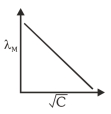
B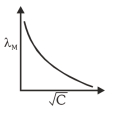
C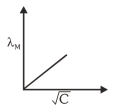
D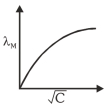
Solution
(A) $AgNO_{3}$ is a strong electrolyte. For strong electrolytes,the variation of molar conductivity $(\lambda_{M})$ with concentration $(C)$ is given by the Debye-$H$ückel-Onsager equation: $\lambda_{M} = \lambda_{M}^{\circ} - A\sqrt{C}$.
Here,$\lambda_{M}^{\circ}$ is the molar conductivity at infinite dilution and $A$ is a constant.
This equation represents a straight line with a negative slope $(-A)$ and an intercept of $\lambda_{M}^{\circ}$ on the y-axis when $\lambda_{M}$ is plotted against $\sqrt{C}$.
Therefore,the correct graph is a straight line with a negative slope.
Here,$\lambda_{M}^{\circ}$ is the molar conductivity at infinite dilution and $A$ is a constant.
This equation represents a straight line with a negative slope $(-A)$ and an intercept of $\lambda_{M}^{\circ}$ on the y-axis when $\lambda_{M}$ is plotted against $\sqrt{C}$.
Therefore,the correct graph is a straight line with a negative slope.
0 likes
View Solution307
MediumMCQ
In a fuel cell,$H_2$ and $O_2$ react to produce electricity. In this process,$H_2$ gas is oxidized at the anode and $O_2$ gas is reduced at the cathode. If $67.2 \ L$ of $H_2$ gas at $\text{STP}$ is consumed in $15 \ min$,what is the current produced (in $A$)?
A
$64.33$
B
$6.433$
C
$643.33$
D
$38.6$
Solution
(C) The oxidation reaction at the anode is: $H_2(g) \rightarrow 2H^+(aq) + 2e^-$.
Number of moles of $H_2 = \frac{67.2 \ L}{22.4 \ L/mol} = 3 \ mol$.
Since $2 \ mol$ of electrons are produced per mole of $H_2$,total moles of electrons $(n)$ = $3 \times 2 = 6 \ mol$.
Total charge $(Q)$ = $n \times F = 6 \times 96500 \ C = 579000 \ C$.
Time $(t)$ = $15 \ min = 15 \times 60 \ s = 900 \ s$.
Current $(I)$ = $\frac{Q}{t} = \frac{579000 \ C}{900 \ s} = 643.33 \ A$.
Number of moles of $H_2 = \frac{67.2 \ L}{22.4 \ L/mol} = 3 \ mol$.
Since $2 \ mol$ of electrons are produced per mole of $H_2$,total moles of electrons $(n)$ = $3 \times 2 = 6 \ mol$.
Total charge $(Q)$ = $n \times F = 6 \times 96500 \ C = 579000 \ C$.
Time $(t)$ = $15 \ min = 15 \times 60 \ s = 900 \ s$.
Current $(I)$ = $\frac{Q}{t} = \frac{579000 \ C}{900 \ s} = 643.33 \ A$.
0 likes
View Solution308
EasyMCQ
Which of the following formulae is used to obtain the value of $E_{\text{cell}}^{\circ}$ for a reaction taking place in a Dry cell?
A
$\frac{-\Delta G^{\circ}}{F}$
B
$\frac{-\Delta G^{\circ}}{2 F}$
C
$\frac{-\Delta G^{\circ}}{3 F}$
D
$\frac{-\Delta G^{\circ}}{4 F}$
Solution
(B) The relationship between the standard Gibbs free energy change $(\Delta G^{\circ})$ and the standard cell potential $(E_{\text{cell}}^{\circ})$ is given by the equation: $\Delta G^{\circ} = -nFE_{\text{cell}}^{\circ}$.
Rearranging this for $E_{\text{cell}}^{\circ}$,we get: $E_{\text{cell}}^{\circ} = \frac{-\Delta G^{\circ}}{nF}$.
In a dry cell (Leclanché cell),the overall reaction involves the reduction of $MnO_2$ and the oxidation of $Zn$. The reaction is: $Zn(s) + 2MnO_2(s) + 2NH_4^+(aq) \rightarrow Zn^{2+}(aq) + Mn_2O_3(s) + 2NH_3(g) + H_2O(l)$.
Here,the number of electrons transferred $(n)$ is $2$.
Substituting $n = 2$ into the formula,we get $E_{\text{cell}}^{\circ} = \frac{-\Delta G^{\circ}}{2F}$.
Rearranging this for $E_{\text{cell}}^{\circ}$,we get: $E_{\text{cell}}^{\circ} = \frac{-\Delta G^{\circ}}{nF}$.
In a dry cell (Leclanché cell),the overall reaction involves the reduction of $MnO_2$ and the oxidation of $Zn$. The reaction is: $Zn(s) + 2MnO_2(s) + 2NH_4^+(aq) \rightarrow Zn^{2+}(aq) + Mn_2O_3(s) + 2NH_3(g) + H_2O(l)$.
Here,the number of electrons transferred $(n)$ is $2$.
Substituting $n = 2$ into the formula,we get $E_{\text{cell}}^{\circ} = \frac{-\Delta G^{\circ}}{2F}$.
0 likes
View Solution309
MediumMCQ
If the standard $emf$ of the cell $Zn_{(s)} | Zn_{(1 \ M)}^{+2} || Ag_{(1 \ M)}^{+1} | Ag_{(s)}$ is $1.55 \ V$, what is the electrical work done under standard conditions (in $kJ$)?
A
$-144.750$
B
$-193.00$
C
$-299.150$
D
$-386.00$
Solution
(C) The cell reaction is: $Zn_{(s)} + 2Ag_{(1 \ M)}^{+1} \rightarrow Zn_{(1 \ M)}^{+2} + 2Ag_{(s)}$.
Here, the number of electrons transferred $(n)$ is $2$.
The standard $emf$ of the cell $(E_{cell}^o)$ is $1.55 \ V$.
The electrical work done under standard conditions is equal to the change in Gibbs free energy $(\Delta G^o)$.
$\Delta G^o = -nFE_{cell}^o$.
Substituting the values: $n = 2$, $F = 96500 \ C \ mol^{-1}$, $E_{cell}^o = 1.55 \ V$.
$\Delta G^o = -2 \times 96500 \times 1.55 = -299150 \ J = -299.150 \ kJ$.
Therefore, the electrical work done is $-299.150 \ kJ$.
Here, the number of electrons transferred $(n)$ is $2$.
The standard $emf$ of the cell $(E_{cell}^o)$ is $1.55 \ V$.
The electrical work done under standard conditions is equal to the change in Gibbs free energy $(\Delta G^o)$.
$\Delta G^o = -nFE_{cell}^o$.
Substituting the values: $n = 2$, $F = 96500 \ C \ mol^{-1}$, $E_{cell}^o = 1.55 \ V$.
$\Delta G^o = -2 \times 96500 \times 1.55 = -299150 \ J = -299.150 \ kJ$.
Therefore, the electrical work done is $-299.150 \ kJ$.
0 likes
View Solution310
MediumMCQ
Select the false statement from the following regarding an electrochemical cell.
A
Standard cell potential of an electrochemical cell is an intensive property.
B
Electrode potential depends on the concentration of the salt solution in contact with the electrode.
C
Standard free energy change of a cell is an intensive property.
D
Electrical work done in a galvanic cell is equal to the decrease in Gibbs energy.
Solution
(C) $1$. Standard cell potential $(E^{\circ}_{cell})$ is an intensive property because it does not depend on the amount of matter present in the system.
$2$. Electrode potential depends on the concentration of the electrolyte solution as described by the Nernst equation $(E = E^{\circ} - \frac{RT}{nF} \ln Q)$.
$3$. Standard free energy change $(\Delta G^{\circ} = -nFE^{\circ}_{cell})$ is an extensive property because it depends on the number of moles of electrons $(n)$ transferred,which is related to the amount of substance.
$4$. Electrical work done in a galvanic cell is equal to the decrease in Gibbs energy $(W_{elec} = -\Delta G)$.
$5$. Therefore,the statement that the standard free energy change is an intensive property is false.
$2$. Electrode potential depends on the concentration of the electrolyte solution as described by the Nernst equation $(E = E^{\circ} - \frac{RT}{nF} \ln Q)$.
$3$. Standard free energy change $(\Delta G^{\circ} = -nFE^{\circ}_{cell})$ is an extensive property because it depends on the number of moles of electrons $(n)$ transferred,which is related to the amount of substance.
$4$. Electrical work done in a galvanic cell is equal to the decrease in Gibbs energy $(W_{elec} = -\Delta G)$.
$5$. Therefore,the statement that the standard free energy change is an intensive property is false.
0 likes
View Solution311
MediumMCQ
Consider the galvanic cell: $A_{(s)} | A_{(aq)}^{+2} || B_{(aq)}^{+} | B_{(s)}$. If the $EMF$ of the cell is positive,identify the correct cell reaction from the following.
A
$A_{(s)} + B_{(aq)}^{+2} \rightarrow A_{(aq)}^{+2} + B_{(s)}$
B
$A_{(s)} + 2 B_{(aq)}^{+} \rightarrow A_{(aq)}^{+2} + 2 B_{(s)}$
C
$2 A_{(aq)}^{+2} + B_{(s)} \rightarrow 2 A_{(s)} + B_{(aq)}^{+}$
D
$2 A_{(s)} + B_{(aq)}^{+} \rightarrow 2 A_{(aq)}^{+2} + B_{(s)}$
Solution
(B) In a galvanic cell represented as $Anode | Anode_{electrolyte} || Cathode_{electrolyte} | Cathode$,the oxidation occurs at the anode and reduction occurs at the cathode.
For the given cell $A_{(s)} | A_{(aq)}^{+2} || B_{(aq)}^{+} | B_{(s)}$:
Anode reaction (Oxidation): $A_{(s)} \rightarrow A_{(aq)}^{+2} + 2e^-$.
Cathode reaction (Reduction): $B_{(aq)}^{+} + e^- \rightarrow B_{(s)}$.
To balance the electrons,multiply the cathode reaction by $2$: $2 B_{(aq)}^{+} + 2e^- \rightarrow 2 B_{(s)}$.
Adding both half-reactions: $A_{(s)} + 2 B_{(aq)}^{+} \rightarrow A_{(aq)}^{+2} + 2 B_{(s)}$.
Thus,the correct option is $B$.
For the given cell $A_{(s)} | A_{(aq)}^{+2} || B_{(aq)}^{+} | B_{(s)}$:
Anode reaction (Oxidation): $A_{(s)} \rightarrow A_{(aq)}^{+2} + 2e^-$.
Cathode reaction (Reduction): $B_{(aq)}^{+} + e^- \rightarrow B_{(s)}$.
To balance the electrons,multiply the cathode reaction by $2$: $2 B_{(aq)}^{+} + 2e^- \rightarrow 2 B_{(s)}$.
Adding both half-reactions: $A_{(s)} + 2 B_{(aq)}^{+} \rightarrow A_{(aq)}^{+2} + 2 B_{(s)}$.
Thus,the correct option is $B$.
0 likes
View Solution312
MediumMCQ
$A$ hypothetical galvanic cell is $A_{(s)} | A^{+}_{(1 \ M)} || B^{+2}_{(1 \ M)} | B_{(s)}$ and the $EMF$ of the cell is positive. What is the possible cell reaction?
A
$A_{(s)} + B^{+2}_{(aq)} \rightarrow A^{+}_{(aq)} + B_{(s)}$
B
$2A_{(s)} + B^{+2}_{(aq)} \rightarrow 2A^{+}_{(aq)} + B_{(s)}$
C
$A_{(s)} + 2B^{+2}_{(aq)} \rightarrow A^{+}_{(aq)} + 2B_{(s)}$
D
$2A^{+}_{(aq)} + B_{(s)} \rightarrow 2A_{(s)} + B^{+2}_{(aq)}$
Solution
(B) In a galvanic cell represented as $Anode | Anode \text{ } electrolyte || Cathode \text{ } electrolyte | Cathode$,the oxidation occurs at the anode and reduction occurs at the cathode.
Given the cell notation: $A_{(s)} | A^{+}_{(1 \ M)} || B^{+2}_{(1 \ M)} | B_{(s)}$.
At the anode (oxidation): $A_{(s)} \rightarrow A^{+}_{(aq)} + e^-$.
At the cathode (reduction): $B^{+2}_{(aq)} + 2e^- \rightarrow B_{(s)}$.
To balance the electrons,multiply the anode reaction by $2$: $2A_{(s)} \rightarrow 2A^{+}_{(aq)} + 2e^-$.
Adding the two half-reactions: $2A_{(s)} + B^{+2}_{(aq)} \rightarrow 2A^{+}_{(aq)} + B_{(s)}$.
Since the $EMF$ is positive,this reaction is spontaneous.
Given the cell notation: $A_{(s)} | A^{+}_{(1 \ M)} || B^{+2}_{(1 \ M)} | B_{(s)}$.
At the anode (oxidation): $A_{(s)} \rightarrow A^{+}_{(aq)} + e^-$.
At the cathode (reduction): $B^{+2}_{(aq)} + 2e^- \rightarrow B_{(s)}$.
To balance the electrons,multiply the anode reaction by $2$: $2A_{(s)} \rightarrow 2A^{+}_{(aq)} + 2e^-$.
Adding the two half-reactions: $2A_{(s)} + B^{+2}_{(aq)} \rightarrow 2A^{+}_{(aq)} + B_{(s)}$.
Since the $EMF$ is positive,this reaction is spontaneous.
0 likes
View Solution313
MediumMCQ
Which of the following net cell reactions takes place in a galvanic cell containing a copper electrode and a standard hydrogen electrode $(SHE)$? Given: $E^{\circ}(Cu^{2+}_{(aq)} \mid Cu_{(s)}) = +0.34 \ V$.
A
$Cu_{(s)} + 2H^{+}_{(aq)} \longrightarrow Cu^{2+}_{(aq)} + H_{2(g)}$
B
$H_{2(g)} + Cu^{2+}_{(aq)} \longrightarrow 2H^{+}_{(aq)} + Cu_{(s)}$
C
$Cu_{(s)} + H_{2(g)} \longrightarrow Cu^{2+}_{(aq)} + 2H^{+}_{(aq)}$
D
$Cu^{2+}_{(aq)} + 2H^{+}_{(aq)} \longrightarrow Cu_{(s)} + H_{2(g)}$
Solution
(B) In a galvanic cell,the electrode with the higher reduction potential acts as the cathode,and the one with the lower reduction potential acts as the anode.
Given $E^{\circ}(Cu^{2+}/Cu) = +0.34 \ V$ and $E^{\circ}(H^{+}/H_2) = 0.00 \ V$.
Since $0.34 \ V > 0.00 \ V$,the copper electrode acts as the cathode (reduction) and the standard hydrogen electrode $(SHE)$ acts as the anode (oxidation).
Anode reaction: $H_{2(g)} \longrightarrow 2H^{+}_{(aq)} + 2e^{-}$
Cathode reaction: $Cu^{2+}_{(aq)} + 2e^{-} \longrightarrow Cu_{(s)}$
Adding these two half-reactions gives the net cell reaction: $H_{2(g)} + Cu^{2+}_{(aq)} \longrightarrow 2H^{+}_{(aq)} + Cu_{(s)}$.
Given $E^{\circ}(Cu^{2+}/Cu) = +0.34 \ V$ and $E^{\circ}(H^{+}/H_2) = 0.00 \ V$.
Since $0.34 \ V > 0.00 \ V$,the copper electrode acts as the cathode (reduction) and the standard hydrogen electrode $(SHE)$ acts as the anode (oxidation).
Anode reaction: $H_{2(g)} \longrightarrow 2H^{+}_{(aq)} + 2e^{-}$
Cathode reaction: $Cu^{2+}_{(aq)} + 2e^{-} \longrightarrow Cu_{(s)}$
Adding these two half-reactions gives the net cell reaction: $H_{2(g)} + Cu^{2+}_{(aq)} \longrightarrow 2H^{+}_{(aq)} + Cu_{(s)}$.
0 likes
View Solution314
MediumMCQ
Calculate $\Delta G^{\circ}$ for the reaction $Mg_{(s)} + Sn_{(aq)}^{2+} \longrightarrow Mg_{(aq)}^{2+} + Sn_{(s)}$ if $E_{cell}^{\circ}$ is $2.23 \ V$. (in $kJ$)
A
$-430.4$
B
$215.2$
C
$645.6$
D
$-860.8$
Solution
(A) The standard Gibbs free energy change is given by the formula: $\Delta G^{\circ} = -nFE_{cell}^{\circ}$
Here,$n$ is the number of moles of electrons transferred in the balanced redox reaction. For $Mg + Sn^{2+} \longrightarrow Mg^{2+} + Sn$,$n = 2$.
$F$ is the Faraday constant,approximately $96500 \ C \ mol^{-1}$.
$E_{cell}^{\circ} = 2.23 \ V$.
Substituting the values: $\Delta G^{\circ} = -2 \times 96500 \times 2.23 \ J \ mol^{-1}$.
$\Delta G^{\circ} = -430390 \ J \ mol^{-1}$.
Converting to $kJ \ mol^{-1}$ by dividing by $1000$: $\Delta G^{\circ} = -430.39 \ kJ \ mol^{-1} \approx -430.4 \ kJ \ mol^{-1}$.
Here,$n$ is the number of moles of electrons transferred in the balanced redox reaction. For $Mg + Sn^{2+} \longrightarrow Mg^{2+} + Sn$,$n = 2$.
$F$ is the Faraday constant,approximately $96500 \ C \ mol^{-1}$.
$E_{cell}^{\circ} = 2.23 \ V$.
Substituting the values: $\Delta G^{\circ} = -2 \times 96500 \times 2.23 \ J \ mol^{-1}$.
$\Delta G^{\circ} = -430390 \ J \ mol^{-1}$.
Converting to $kJ \ mol^{-1}$ by dividing by $1000$: $\Delta G^{\circ} = -430.39 \ kJ \ mol^{-1} \approx -430.4 \ kJ \ mol^{-1}$.
0 likes
View Solution315
MediumMCQ
Which of the following cannot be considered as an application of the electrochemical series?
A
Spontaneity of redox reaction
B
Relative strength of reducing agent
C
Relative strength of oxidizing agent
D
Use of $SHE$ in automobile battery
Solution
(D) The electrochemical series is used to predict the spontaneity of redox reactions,the relative strength of oxidizing agents,and the relative strength of reducing agents.
However,the use of $SHE$ (Standard Hydrogen Electrode) in an automobile battery is not an application of the electrochemical series. $SHE$ is a reference electrode used to measure standard electrode potentials,whereas automobile batteries (like lead-acid batteries) rely on specific chemical reactions to store and release electrical energy.
However,the use of $SHE$ (Standard Hydrogen Electrode) in an automobile battery is not an application of the electrochemical series. $SHE$ is a reference electrode used to measure standard electrode potentials,whereas automobile batteries (like lead-acid batteries) rely on specific chemical reactions to store and release electrical energy.
0 likes
View Solution316
EasyMCQ
In the cell represented as $Ni_{(s)}|Ni_{(1M)}^{2+}||Ag_{(1M)}^{+}|Ag_{(s)}$,the reducing agent is
A
$Ag$
B
$Ag^{+}$
C
$Ni$
D
$Ni^{2+}$
Solution
(C) In an electrochemical cell,the species that undergoes oxidation acts as the reducing agent.
At the anode,oxidation occurs: $Ni_{(s)} \rightarrow Ni^{2+} + 2e^{-}$.
Since $Ni_{(s)}$ loses electrons,it is the reducing agent.
At the cathode,reduction occurs: $Ag^{+} + e^{-} \rightarrow Ag_{(s)}$.
At the anode,oxidation occurs: $Ni_{(s)} \rightarrow Ni^{2+} + 2e^{-}$.
Since $Ni_{(s)}$ loses electrons,it is the reducing agent.
At the cathode,reduction occurs: $Ag^{+} + e^{-} \rightarrow Ag_{(s)}$.
0 likes
View Solution317
EasyMCQ
Which of the following statements is true for an electrolytic cell?
A
Oxidation occurs at the positive electrode.
B
Oxidation occurs at the negative electrode.
C
Anode is negative and cathode is positive.
D
Reduction occurs at the positive electrode.
Solution
(A) In an electrolytic cell,the anode is the positive electrode where oxidation takes place,and the cathode is the negative electrode where reduction takes place. Therefore,oxidation occurs at the positive electrode.
0 likes
View Solution318
EasyMCQ
Standard hydrogen electrode $(SHE)$ is a
A
Primary reference electrode
B
Secondary reference electrode
C
Metal $-$ sparingly soluble salt electrode
D
Metal $-$ metal ion electrode
Solution
(A) Standard hydrogen electrode $(SHE)$ is a primary reference electrode.
$SHE$ is represented by $Pt_{(s)} | H_{2(g)} | H^{+}_{(aq)}$ and is assigned a potential of $0.00 \ V$ at all temperatures.
It serves as the fundamental standard for measuring electrode potentials of other half-cells.
The half-cell reaction is: $H^{+}_{(aq)} + e^- \rightarrow \frac{1}{2} H_{2(g)}$
$SHE$ is represented by $Pt_{(s)} | H_{2(g)} | H^{+}_{(aq)}$ and is assigned a potential of $0.00 \ V$ at all temperatures.
It serves as the fundamental standard for measuring electrode potentials of other half-cells.
The half-cell reaction is: $H^{+}_{(aq)} + e^- \rightarrow \frac{1}{2} H_{2(g)}$
0 likes
View Solution319
EasyMCQ
Which among the following equations represents the reduction taking place in a lead accumulator at the positive electrode,while it is being used as a source of electrical energy?
A
$Pb \rightarrow Pb^{2+}$
B
$Pb^{4+} \rightarrow Pb$
C
$Pb^{2+} \rightarrow Pb$
D
$Pb^{4+} \rightarrow Pb^{2+}$
Solution
(D) In a lead storage battery (lead accumulator),the positive electrode is made of $PbO_2$.
During discharge (when used as a source of electrical energy),the reduction reaction at the positive electrode is:
$PbO_{2\text{(s)}} + 4H^{+}{_{\text{(aq)}}} + SO_4^{2-}{_{\text{(aq)}}} + 2e^{-} \rightarrow PbSO_{4\text{(s)}} + 2H_2O_{\text{(l)}}$
In this reaction,the oxidation state of lead changes from $+4$ in $PbO_2$ to $+2$ in $PbSO_4$.
Therefore,the reduction process is represented by $Pb^{4+} \rightarrow Pb^{2+}$.
During discharge (when used as a source of electrical energy),the reduction reaction at the positive electrode is:
$PbO_{2\text{(s)}} + 4H^{+}{_{\text{(aq)}}} + SO_4^{2-}{_{\text{(aq)}}} + 2e^{-} \rightarrow PbSO_{4\text{(s)}} + 2H_2O_{\text{(l)}}$
In this reaction,the oxidation state of lead changes from $+4$ in $PbO_2$ to $+2$ in $PbSO_4$.
Therefore,the reduction process is represented by $Pb^{4+} \rightarrow Pb^{2+}$.
0 likes
View Solution320
EasyMCQ
In a dry cell,which element acts as the negative electrode?
A
Zinc
B
Graphite
C
Ammonium chloride
D
Manganese dioxide
Solution
(A) In a dry cell,the container made of $Zn$ acts as the negative electrode (anode),while the graphite rod acts as the positive electrode (cathode).
0 likes
View Solution321
MediumMCQ
In the cell represented $Pb_{(s)}|Pb_{(1 \ M)}^{2+} || Ag_{(1 \ M)}^{+}|Ag_{(s)}$,the reducing agent is
A
$Pb$
B
$Pb^{2+}$
C
$Ag$
D
$Ag^{+}$
Solution
(A) The cell reaction is $Pb_{(s)} + 2Ag_{(aq)}^{+} \longrightarrow Pb_{(aq)}^{2+} + 2Ag_{(s)}$.
In this reaction,$Pb$ loses electrons to form $Pb^{2+}$,which is an oxidation process.
The species that undergoes oxidation acts as the reducing agent.
Therefore,$Pb$ is the reducing agent.
In this reaction,$Pb$ loses electrons to form $Pb^{2+}$,which is an oxidation process.
The species that undergoes oxidation acts as the reducing agent.
Therefore,$Pb$ is the reducing agent.
0 likes
View Solution322
MediumMCQ
$Cu^{+}_{(aq)}$ is unstable in solution and undergoes simultaneous oxidation and reduction,according to the reaction $2 Cu^{+}_{(aq)} \rightleftharpoons Cu^{2+}_{(aq)} + Cu_{(s)}$. Choose the correct $E^{\circ}$ for the above reaction if $E^{\circ}_{Cu^{2+}/Cu} = 0.34 \ V$ and $E^{\circ}_{Cu^{2+}/Cu^{+}} = 0.15 \ V$.
A
$+0.38 \ V$
B
$+0.49 \ V$
C
$-0.38 \ V$
D
None of these
Solution
(A) The given reaction is a disproportionation reaction: $2 Cu^{+}_{(aq)} \rightarrow Cu^{2+}_{(aq)} + Cu_{(s)}$.
This can be split into two half-reactions:
$1$. Oxidation: $Cu^{+}_{(aq)} \rightarrow Cu^{2+}_{(aq)} + e^{-}$,where $E^{\circ}_{ox} = -E^{\circ}_{Cu^{2+}/Cu^{+}} = -0.15 \ V$.
$2$. Reduction: $Cu^{+}_{(aq)} + e^{-} \rightarrow Cu_{(s)}$,where $E^{\circ}_{red} = E^{\circ}_{Cu^{+}/Cu}$.
To find $E^{\circ}_{Cu^{+}/Cu}$,we use the relation: $\Delta G^{\circ}_{Cu^{2+}/Cu} = \Delta G^{\circ}_{Cu^{2+}/Cu^{+}} + \Delta G^{\circ}_{Cu^{+}/Cu}$.
$-(2)F(E^{\circ}_{Cu^{2+}/Cu}) = -(1)F(E^{\circ}_{Cu^{2+}/Cu^{+}}) + -(1)F(E^{\circ}_{Cu^{+}/Cu})$.
$2(0.34) = 0.15 + E^{\circ}_{Cu^{+}/Cu} \implies E^{\circ}_{Cu^{+}/Cu} = 0.68 - 0.15 = 0.53 \ V$.
Now,$E^{\circ}_{cell} = E^{\circ}_{ox} + E^{\circ}_{red} = -0.15 \ V + 0.53 \ V = +0.38 \ V$.
This can be split into two half-reactions:
$1$. Oxidation: $Cu^{+}_{(aq)} \rightarrow Cu^{2+}_{(aq)} + e^{-}$,where $E^{\circ}_{ox} = -E^{\circ}_{Cu^{2+}/Cu^{+}} = -0.15 \ V$.
$2$. Reduction: $Cu^{+}_{(aq)} + e^{-} \rightarrow Cu_{(s)}$,where $E^{\circ}_{red} = E^{\circ}_{Cu^{+}/Cu}$.
To find $E^{\circ}_{Cu^{+}/Cu}$,we use the relation: $\Delta G^{\circ}_{Cu^{2+}/Cu} = \Delta G^{\circ}_{Cu^{2+}/Cu^{+}} + \Delta G^{\circ}_{Cu^{+}/Cu}$.
$-(2)F(E^{\circ}_{Cu^{2+}/Cu}) = -(1)F(E^{\circ}_{Cu^{2+}/Cu^{+}}) + -(1)F(E^{\circ}_{Cu^{+}/Cu})$.
$2(0.34) = 0.15 + E^{\circ}_{Cu^{+}/Cu} \implies E^{\circ}_{Cu^{+}/Cu} = 0.68 - 0.15 = 0.53 \ V$.
Now,$E^{\circ}_{cell} = E^{\circ}_{ox} + E^{\circ}_{red} = -0.15 \ V + 0.53 \ V = +0.38 \ V$.
0 likes
View Solution323
DifficultMCQ
Which among the following is an example of a metal-metal ion electrode?
A
$Fe^{3+} (aq.), Fe^{2+} (aq.) \mid Pt$
B
$Cl^{-} (aq.) \mid AgCl (s) \mid Ag$
C
$Zn^{2+} (aq.) \mid Zn (s)$
D
$OH^{-} (aq.) \mid O_{2} (g), Pt$
Solution
(C) metal-metal ion electrode consists of a metal rod dipped in a solution containing its own ions.
In the option $Zn^{2+} (aq.) \mid Zn (s)$,a zinc metal rod is in contact with $Zn^{2+}$ ions in the solution.
Therefore,it represents a metal-metal ion electrode.
In the option $Zn^{2+} (aq.) \mid Zn (s)$,a zinc metal rod is in contact with $Zn^{2+}$ ions in the solution.
Therefore,it represents a metal-metal ion electrode.
0 likes
View Solution324
DifficultMCQ
Which among the following is an example of a metal-sparingly soluble salt electrode?
A
$OH^{-} (aq) | O_{2(g)}, Pt$
B
$Cl^{-} (aq) | AgCl_{(s)} | Ag_{(s)}$
C
$Zn^{2+} (aq) | Zn_{(s)}$
D
$Cu^{+} (aq), Cu^{2+} (aq) | Pt$
Solution
(B) metal-sparingly soluble salt electrode consists of a metal in contact with its sparingly soluble salt and a solution containing the anion of that salt.
In the electrode $Cl^{-} (aq) | AgCl_{(s)} | Ag_{(s)}$,the metal $Ag$ is in contact with its sparingly soluble salt $AgCl$ and the anion $Cl^{-}$.
The half-cell reaction is: $AgCl_{(s)} + e^{-} \rightarrow Ag_{(s)} + Cl^{-} (aq)$.
This is a classic example of a metal-sparingly soluble salt electrode,often used as a reference electrode.
In the electrode $Cl^{-} (aq) | AgCl_{(s)} | Ag_{(s)}$,the metal $Ag$ is in contact with its sparingly soluble salt $AgCl$ and the anion $Cl^{-}$.
The half-cell reaction is: $AgCl_{(s)} + e^{-} \rightarrow Ag_{(s)} + Cl^{-} (aq)$.
This is a classic example of a metal-sparingly soluble salt electrode,often used as a reference electrode.
0 likes
View Solution325
EasyMCQ
Which of the following is $NOT$ a function of a salt bridge?
A
Provide electrical contact
B
Convert electrical energy to chemical energy
C
Maintain electrical neutrality
D
Prevent mixing of solutions
Solution
(B) salt bridge is a device used in an electrochemical cell to connect its oxidation and reduction half-cells. Its primary functions are:
$1$. To complete the electrical circuit by providing electrical contact between the two solutions.
$2$. To maintain electrical neutrality in both half-cells by allowing the migration of ions.
$3$. To prevent the direct mixing of the two electrolyte solutions.
It does not convert electrical energy into chemical energy; rather,it facilitates the flow of current in a galvanic cell where chemical energy is converted into electrical energy.
$1$. To complete the electrical circuit by providing electrical contact between the two solutions.
$2$. To maintain electrical neutrality in both half-cells by allowing the migration of ions.
$3$. To prevent the direct mixing of the two electrolyte solutions.
It does not convert electrical energy into chemical energy; rather,it facilitates the flow of current in a galvanic cell where chemical energy is converted into electrical energy.
0 likes
View Solution326
EasyMCQ
Which of the following species acts as a reducing agent during the working of a hydrogen-oxygen fuel cell?
A
$H_2$
B
$O_2$
C
$H^+$
D
$NaOH$
Solution
(A) In a hydrogen-oxygen fuel cell,the following reactions occur at the electrodes:
At the anode: $2H_2(g) + 4OH^-(aq) \rightarrow 4H_2O(l) + 4e^-$
At the cathode: $O_2(g) + 2H_2O(l) + 4e^- \rightarrow 4OH^-(aq)$
In the anode reaction,$H_2$ undergoes oxidation (loss of electrons),which means it acts as a reducing agent.
Therefore,$H_2$ is the species that acts as the reducing agent.
At the anode: $2H_2(g) + 4OH^-(aq) \rightarrow 4H_2O(l) + 4e^-$
At the cathode: $O_2(g) + 2H_2O(l) + 4e^- \rightarrow 4OH^-(aq)$
In the anode reaction,$H_2$ undergoes oxidation (loss of electrons),which means it acts as a reducing agent.
Therefore,$H_2$ is the species that acts as the reducing agent.
0 likes
View Solution327
MediumMCQ
Which of the following changes takes place at the positive electrode during the working of a dry cell?
A
$Zn_{(s)}$ is oxidised to $Zn^{2+}_{(aq)}$
B
$Zn^{2+}_{(aq)}$ is reduced to $Zn_{(s)}$
C
$MnO_{2_{(s)}}$ is reduced to $Mn_2O_{3_{(s)}}$
D
$Mn_2O_{3_{(s)}}$ is oxidised to $MnO_{2_{(s)}}$
Solution
(C) In a dry cell (Leclanché cell),the anode is the zinc container,where oxidation occurs: $Zn_{(s)} \rightarrow Zn^{2+}_{(aq)} + 2e^-$.
The cathode (positive electrode) is a graphite rod surrounded by powdered $MnO_2$ and carbon.
At the cathode,the reduction reaction occurs: $MnO_{2\text{(s)}} + NH_4^+{_{\text{(aq)}}} + e^{-} \rightarrow MnO(OH)_{\text{(s)}} + NH_{3\text{(g)}}$.
This reaction involves the reduction of $Mn$ from the $+4$ oxidation state in $MnO_2$ to the $+3$ oxidation state in $MnO(OH)$,which is often represented as $Mn_2O_3$.
Thus,$MnO_{2_{(s)}}$ is reduced to $Mn_2O_{3_{(s)}}$.
The cathode (positive electrode) is a graphite rod surrounded by powdered $MnO_2$ and carbon.
At the cathode,the reduction reaction occurs: $MnO_{2\text{(s)}} + NH_4^+{_{\text{(aq)}}} + e^{-} \rightarrow MnO(OH)_{\text{(s)}} + NH_{3\text{(g)}}$.
This reaction involves the reduction of $Mn$ from the $+4$ oxidation state in $MnO_2$ to the $+3$ oxidation state in $MnO(OH)$,which is often represented as $Mn_2O_3$.
Thus,$MnO_{2_{(s)}}$ is reduced to $Mn_2O_{3_{(s)}}$.
0 likes
View Solution328
MediumMCQ
Which of the following changes takes place at the positive electrode during the recharging of a lead accumulator?
A
$Pb$ is oxidised to $PbSO_4$
B
$PbSO_4$ is oxidised to $PbO_2$
C
$PbSO_4$ is reduced to $Pb$
D
$PbO_2$ is reduced to $PbSO_4$
Solution
(B) During the discharging of a lead storage battery,the positive electrode $(PbO_2)$ is reduced to $PbSO_4$.
During the recharging process,the chemical reactions are reversed.
At the positive electrode (anode during recharging),$PbSO_4$ is oxidised to $PbO_2$ according to the following reaction:
$PbSO_4(s) + 2H_2O(l) \rightarrow PbO_2(s) + SO_4^{2-}(aq) + 4H^+(aq) + 2e^-$.
During the recharging process,the chemical reactions are reversed.
At the positive electrode (anode during recharging),$PbSO_4$ is oxidised to $PbO_2$ according to the following reaction:
$PbSO_4(s) + 2H_2O(l) \rightarrow PbO_2(s) + SO_4^{2-}(aq) + 4H^+(aq) + 2e^-$.
0 likes
View Solution329
MediumMCQ
Which of the following changes occurs during the discharging of a lead accumulator?
A
$Pb_{(s)}$ is reduced
B
$H_2 SO_4$ is consumed
C
$PbSO_4$ is consumed
D
$PbO_2$ is produced
Solution
(B) During the discharging of a lead accumulator,the following overall cell reaction occurs:
$Pb_{(s)} + PbO_{2_{(s)}} + 2 H_2 SO_{4_{(aq)}} \rightarrow 2 PbSO_{4_{(s)}} + 2 H_2 O_{(l)}$
In this process,$Pb$ is oxidized at the anode and $PbO_2$ is reduced at the cathode.
As the reaction proceeds,$H_2 SO_4$ is consumed,leading to a decrease in the concentration of the electrolyte.
$Pb_{(s)} + PbO_{2_{(s)}} + 2 H_2 SO_{4_{(aq)}} \rightarrow 2 PbSO_{4_{(s)}} + 2 H_2 O_{(l)}$
In this process,$Pb$ is oxidized at the anode and $PbO_2$ is reduced at the cathode.
As the reaction proceeds,$H_2 SO_4$ is consumed,leading to a decrease in the concentration of the electrolyte.
0 likes
View Solution330
MediumMCQ
Which of the following statements is $NOT$ correct for $H_2-O_2$ fuel cell?
A
$H_{2(g)}$ serves as fuel
B
$O_{2(g)}$ is an oxidising agent
C
Platinum wires are used as anode and cathode
D
Hot aqueous $KOH$ solution acts as an electrolyte
Solution
(C) In an $H_2-O_2$ fuel cell,the electrodes are typically porous carbon electrodes impregnated with catalysts like platinum,palladium,or nickel to facilitate the reactions.
The use of platinum wires as electrodes is not standard practice because:
$1$. Platinum is expensive,and using it as solid wires would not be cost-effective.
$2$. Porous electrodes increase the surface area for the reaction and improve efficiency.
Conclusion: The statement that platinum wires are used as anode and cathode is $NOT$ correct.
The use of platinum wires as electrodes is not standard practice because:
$1$. Platinum is expensive,and using it as solid wires would not be cost-effective.
$2$. Porous electrodes increase the surface area for the reaction and improve efficiency.
Conclusion: The statement that platinum wires are used as anode and cathode is $NOT$ correct.
0 likes
View Solution331
DifficultMCQ
Which of the following reactions occurs at the cathode during the discharging of a lead accumulator?
A
$PbSO_{4(s)} + 2 e^{-} \longrightarrow Pb_{(s)} + SO_{4(aq)}^{2-}$
B
$Pb_{(s)} + SO_{4(aq)}^{2-} \longrightarrow PbSO_{4(s)} + 2 e^{-}$
C
$PbO_{2(s)} + 4 H_{(aq)}^{+} + SO_{4(aq)}^{2-} + 2 e^{-} \longrightarrow PbSO_{4(s)} + 2 H_2 O_{(l)}$
D
$PbSO_{4(s)} + 2 H_2 O_{(l)} \longrightarrow PbO_{2(s)} + 4 H_{(aq)}^{+} + SO_{4(aq)}^{2-} + 2 e^{-}$
Solution
(C) During the discharging of a lead storage battery (lead accumulator),the cathode is made of lead dioxide $(PbO_2)$.
At the cathode,$PbO_2$ undergoes reduction by gaining electrons in the presence of sulfuric acid $(H_2SO_4)$.
The balanced chemical equation for the reduction reaction at the cathode is:
$PbO_{2(s)} + 4 H_{(aq)}^{+} + SO_{4(aq)}^{2-} + 2 e^{-} \longrightarrow PbSO_{4(s)} + 2 H_2 O_{(l)}$
Therefore,the correct option is $(C)$.
At the cathode,$PbO_2$ undergoes reduction by gaining electrons in the presence of sulfuric acid $(H_2SO_4)$.
The balanced chemical equation for the reduction reaction at the cathode is:
$PbO_{2(s)} + 4 H_{(aq)}^{+} + SO_{4(aq)}^{2-} + 2 e^{-} \longrightarrow PbSO_{4(s)} + 2 H_2 O_{(l)}$
Therefore,the correct option is $(C)$.
0 likes
View Solution332
MediumMCQ
Which of the following is used to avoid leakage of electrolyte in a dry cell?
A
Paste of $MnO_2$
B
Paste of $NH_4Cl$
C
Starch
D
Paste of $ZnCl_2$
Solution
(C) In a dry cell,the cathode is an inert graphite rod placed in the center,surrounded by an electrolyte paste.
The electrolyte consists of a moist paste of $NH_4Cl$ and $ZnCl_2$.
Starch is added to this paste to increase its viscosity,which prevents the leakage of the electrolyte from the cell.
The electrolyte consists of a moist paste of $NH_4Cl$ and $ZnCl_2$.
Starch is added to this paste to increase its viscosity,which prevents the leakage of the electrolyte from the cell.
0 likes
View Solution333
EasyMCQ
Identify the gas produced due to reduction of $NH_4^{+}$ ions at cathode during working of dry cell.
A
Ammonia
B
Hydrogen
C
Hydrogen chloride
D
Chlorine
Solution
(B) In a dry cell,at the cathode,$NH_4^{+}$ ions undergo reduction to produce ammonia and hydrogen gas.
The reaction is: $2NH_{4(aq)}^{+} + 2e^{-} \longrightarrow 2NH_{3(aq)} + H_{2(g)}$.
Thus,the gas produced at the cathode is hydrogen.
The reaction is: $2NH_{4(aq)}^{+} + 2e^{-} \longrightarrow 2NH_{3(aq)} + H_{2(g)}$.
Thus,the gas produced at the cathode is hydrogen.
0 likes
View Solution334
EasyMCQ
Identify the overall oxidation reaction that occurs in a lead storage cell during discharge.
A
$Pb_{(aq)}^{2+} + SO_{4(aq)}^{2-} \longrightarrow PbSO_{4(s)}$
B
$PbSO_{4(s)} + 2 H_2O_{(l)} \longrightarrow PbO_{2(s)} + 4 H_{(aq)}^{+} + SO_{4(aq)}^{2-} + 2 e^{-}$
C
$Pb_{(s)} + SO_{4(aq)}^{2-} \longrightarrow PbSO_{4(s)} + 2 e^{-}$
D
$PbSO_{4(s)} + 2 e^{-} \longrightarrow Pb_{(s)} + SO_{4(aq)}^{2-}$
Solution
(C) When the lead storage cell provides current (i.e.,during discharge),spongy lead $(Pb)$ is oxidized to $Pb^{2+}$ ions at the anode. The $Pb^{2+}$ ions so formed combine with $SO_4^{2-}$ ions from $H_2SO_4$ to form insoluble $PbSO_4$. The overall oxidation half-reaction is the sum of these two processes.
| $Pb_{(s)} \longrightarrow Pb_{(aq)}^{2+} + 2 e^{-}$ | (Oxidation) |
| $Pb_{(aq)}^{2+} + SO_{4(aq)}^{2-} \longrightarrow PbSO_{4(s)}$ | (Precipitation) |
| $Pb_{(s)} + SO_{4(aq)}^{2-} \longrightarrow PbSO_{4(s)} + 2 e^{-}$ | (Overall oxidation) |
0 likes
View Solution335
EasyMCQ
Which of the following is $NOT$ true about a voltaic cell?
A
The anode acts as a negative electrode.
B
The cathode acts as a positive electrode.
C
It converts electrical energy into chemical energy.
D
$A$ dry cell is an example of a voltaic cell.
Solution
(C) voltaic cell (or galvanic cell) is an electrochemical cell that converts chemical energy into electrical energy through spontaneous redox reactions.
Therefore,the statement that it converts electrical energy into chemical energy is incorrect.
In a voltaic cell,the anode is the negative electrode and the cathode is the positive electrode.
$A$ dry cell is a common type of voltaic cell.
Therefore,the statement that it converts electrical energy into chemical energy is incorrect.
In a voltaic cell,the anode is the negative electrode and the cathode is the positive electrode.
$A$ dry cell is a common type of voltaic cell.
0 likes
View Solution336
MediumMCQ
Which of the following is $NOT$ an example of a secondary voltaic cell?
A
Nickel-cadmium cell
B
Dry cell
C
Lead storage battery
D
Mercury cell
Solution
(B) secondary voltaic cell is a rechargeable battery.
$A$,$C$,and $D$ are examples of secondary cells or rechargeable systems.
$B$ (Dry cell) is a primary cell because it cannot be recharged.
$A$,$C$,and $D$ are examples of secondary cells or rechargeable systems.
$B$ (Dry cell) is a primary cell because it cannot be recharged.
0 likes
View Solution337
MediumMCQ
Which among the following statements is true for a Galvanic cell?
A
The anode is negative and cathode is positive.
B
Electrical energy is converted into chemical energy.
C
The anode is positive and cathode is negative.
D
Oxidation takes place at the positive electrode and reduction takes place at the negative electrode.
Solution
(A) In a Galvanic cell,the anode is the negative electrode where oxidation occurs,and the cathode is the positive electrode where reduction occurs.
In a Galvanic cell,chemical energy is converted into electrical energy.
In a Galvanic cell,chemical energy is converted into electrical energy.
0 likes
View Solution338
MediumMCQ
During discharging,the change taking place at the cathode in a lead accumulator is:
A
$Pb_{(s)}$ is oxidised to $Pb^{2+}_{(aq.)}$
B
$Pb^{2+}_{(aq.)}$ is oxidised to $PbO_{2_{(s)}}$
C
$PbO_{2_{(s)}}$ is reduced to $Pb^{2+}_{(aq.)}$
D
$Pb^{2+}_{(aq.)}$ is reduced to $Pb_{(s)}$
Solution
(C) In a lead accumulator (lead-acid battery),the cathode is made of lead dioxide $(PbO_{2_{(s)}})$.
During the discharging process,the reaction at the cathode is: $PbO_{2\text{(s)}} + 4H^{+}{_{\text{(aq)}}} + SO_4^{2-}{_{\text{(aq)}}} + 2e^{-} \rightarrow PbSO_{4\text{(s)}} + 2H_2O_{\text{(l)}}$.
In this reaction,the oxidation state of $Pb$ in $PbO_{2}$ changes from $+4$ to $+2$ in $PbSO_{4}$.
Since the oxidation state decreases,$PbO_{2_{(s)}}$ is reduced to $Pb^{2+}$ ions (which then form $PbSO_{4_{(s)}}$).
During the discharging process,the reaction at the cathode is: $PbO_{2\text{(s)}} + 4H^{+}{_{\text{(aq)}}} + SO_4^{2-}{_{\text{(aq)}}} + 2e^{-} \rightarrow PbSO_{4\text{(s)}} + 2H_2O_{\text{(l)}}$.
In this reaction,the oxidation state of $Pb$ in $PbO_{2}$ changes from $+4$ to $+2$ in $PbSO_{4}$.
Since the oxidation state decreases,$PbO_{2_{(s)}}$ is reduced to $Pb^{2+}$ ions (which then form $PbSO_{4_{(s)}}$).
0 likes
View Solution339
EasyMCQ
Which of the following acts as an oxidising agent in a hydrogen-oxygen fuel cell?
A
$H_2$
B
$O_2$
C
$KOH$
D
$C$
Solution
(B) hydrogen-oxygen fuel cell is an electrochemical cell that converts the chemical energy of hydrogen,which acts as a fuel,and oxygen,which acts as an oxidising agent,into electricity through a pair of redox reactions.
In this cell,the cathode reaction involves the reduction of oxygen: $O_2(g) + 2H_2O(l) + 4e^- \rightarrow 4OH^-(aq)$.
Since oxygen gains electrons,it acts as the oxidising agent.
Thus,option $B$ is correct.
In this cell,the cathode reaction involves the reduction of oxygen: $O_2(g) + 2H_2O(l) + 4e^- \rightarrow 4OH^-(aq)$.
Since oxygen gains electrons,it acts as the oxidising agent.
Thus,option $B$ is correct.
0 likes
View Solution340
EasyMCQ
Which of the following is $NOT$ a difficulty in setting up a Standard Hydrogen Electrode $(SHE)$?
A
To obtain pure hydrogen gas
B
To obtain dry hydrogen gas
C
To maintain exactly $1 \ atm$ pressure
D
To bring the reaction in reverse direction
Solution
(D) In a Standard Hydrogen Electrode $(SHE)$,a platinum plate coated with platinum black is used as the electrode.
Platinum black is highly effective at adsorbing large quantities of $H_2$ gas.
This property facilitates the reversible conversion between gaseous $H_2$ and aqueous $H^+$ ions,meaning the reaction can easily proceed in both directions.
Therefore,bringing the reaction in the reverse direction is not a difficulty.
Platinum black is highly effective at adsorbing large quantities of $H_2$ gas.
This property facilitates the reversible conversion between gaseous $H_2$ and aqueous $H^+$ ions,meaning the reaction can easily proceed in both directions.
Therefore,bringing the reaction in the reverse direction is not a difficulty.
0 likes
View Solution341
EasyMCQ
What is the density of a solution of sulphuric acid used as an electrolyte in lead accumulators (in $g \ mL^{-1}$)?
A
$1.5$
B
$1.2$
C
$1.8$
D
$2.0$
Solution
(B) In lead storage batteries (lead accumulators),the electrolyte used is an aqueous solution of sulphuric acid $(H_2SO_4)$.
Its concentration is typically maintained at approximately $38\%$ by mass.
The density of this sulphuric acid solution is approximately $1.2 \ g \ mL^{-1}$.
Its concentration is typically maintained at approximately $38\%$ by mass.
The density of this sulphuric acid solution is approximately $1.2 \ g \ mL^{-1}$.
0 likes
View Solution342
EasyMCQ
Which of the following statements is $NOT$ correct?
A
${\Delta}G^{\circ}$ is an extensive property.
B
$E^{\circ}_{cell}$ is an intensive property.
C
Electrical work is equal to $nFE_{cell}$.
D
For a chemical reaction to be spontaneous,$E^{\circ}_{cell}$ must be negative.
Solution
(D) The relationship between Gibbs free energy and cell potential is given by ${\Delta}G = -nFE_{cell}$. For a spontaneous reaction,${\Delta}G$ must be negative,which implies that $E_{cell}$ must be positive. Therefore,the statement that $E^{\circ}_{cell}$ must be negative for a spontaneous reaction is incorrect.
0 likes
View Solution343
EasyMCQ
Which substance is used as an oxidising agent in a nickel-cadmium cell?
A
$Ni(OH)_3$
B
$Cd$
C
$Ni$
D
$CdO$
Solution
(A) In a nickel-cadmium cell,the chemical reactions are as follows:
At the anode: $Cd(s) + 2OH^-(aq) \rightarrow Cd(OH)_2(s) + 2e^-$
At the cathode: $NiO_2(s) + 2H_2O(l) + 2e^- \rightarrow Ni(OH)_2(s) + 2OH^-(aq)$
In the cathode reaction,$NiO_2$ (often represented as $Ni(OH)_3$ in some contexts or hydrated nickel oxide) undergoes reduction,meaning it acts as the oxidising agent.
Therefore,the correct option is $A$.
At the anode: $Cd(s) + 2OH^-(aq) \rightarrow Cd(OH)_2(s) + 2e^-$
At the cathode: $NiO_2(s) + 2H_2O(l) + 2e^- \rightarrow Ni(OH)_2(s) + 2OH^-(aq)$
In the cathode reaction,$NiO_2$ (often represented as $Ni(OH)_3$ in some contexts or hydrated nickel oxide) undergoes reduction,meaning it acts as the oxidising agent.
Therefore,the correct option is $A$.
0 likes
View Solution344
EasyMCQ
Which is the correct symbolic representation for the following cell reaction?
$Mg_{(s)} + Cl_{2(g)} \rightarrow Mg^{2+}_{(aq)} + 2Cl^{-}_{(aq)}$
$Mg_{(s)} + Cl_{2(g)} \rightarrow Mg^{2+}_{(aq)} + 2Cl^{-}_{(aq)}$
A
$Mg_{(s)} \mid Mg^{2+}_{(aq)} \parallel Cl_{2(g)} \mid Cl^{-}_{(aq)} \mid Pt_{(s)}$
B
$Pt_{(s)} \mid Cl^{-}_{(aq)} \mid Cl_{2(g)} \parallel Mg^{2+}_{(aq)} \mid Mg_{(s)}$
C
$Mg_{(s)} \mid Mg^{2+}_{(aq)} \parallel Cl_{2(g)} \mid Cl^{-}_{(aq)} \mid Pt_{(s)}$
D
$Pt_{(s)} \mid Cl_{2(g)} \mid Cl^{-}_{(aq)} \parallel Mg^{2+}_{(aq)} \mid Mg_{(s)}$
Solution
(A) In a cell representation, the anode (oxidation) is written on the left and the cathode (reduction) on the right.
$1$. Oxidation half-reaction: $Mg_{(s)} \rightarrow Mg^{2+}_{(aq)} + 2e^-$. This occurs at the anode: $Mg_{(s)} \mid Mg^{2+}_{(aq)}$.
$2$. Reduction half-reaction: $Cl_{2(g)} + 2e^- \rightarrow 2Cl^-_{(aq)}$. This occurs at the cathode. Since $Cl_2$ is a gas, an inert electrode like $Pt$ is used: $Cl_{2(g)} \mid Cl^-_{(aq)} \mid Pt_{(s)}$.
$3$. Combining these with the salt bridge $(\parallel)$, the representation is $Mg_{(s)} \mid Mg^{2+}_{(aq)} \parallel Cl_{2(g)} \mid Cl^-_{(aq)} \mid Pt_{(s)}$.
$1$. Oxidation half-reaction: $Mg_{(s)} \rightarrow Mg^{2+}_{(aq)} + 2e^-$. This occurs at the anode: $Mg_{(s)} \mid Mg^{2+}_{(aq)}$.
$2$. Reduction half-reaction: $Cl_{2(g)} + 2e^- \rightarrow 2Cl^-_{(aq)}$. This occurs at the cathode. Since $Cl_2$ is a gas, an inert electrode like $Pt$ is used: $Cl_{2(g)} \mid Cl^-_{(aq)} \mid Pt_{(s)}$.
$3$. Combining these with the salt bridge $(\parallel)$, the representation is $Mg_{(s)} \mid Mg^{2+}_{(aq)} \parallel Cl_{2(g)} \mid Cl^-_{(aq)} \mid Pt_{(s)}$.
0 likes
View Solution345
EasyMCQ
$Zn_{(s)} | Zn_{(aq)}^{2+}(1 \ M) || Ni_{(aq)}^{2+}(1 \ M) | Ni_{(s)}$
Which is incorrect for the given cell?
Which is incorrect for the given cell?
A
Electrochemical cell
B
Voltaic cell
C
Galvanic cell
D
Daniel cell
Solution
(D) The given cell is $Zn_{(s)} | Zn_{(aq)}^{2+}(1 \ M) || Ni_{(aq)}^{2+}(1 \ M) | Ni_{(s)}$.
This is an electrochemical cell,also known as a voltaic or galvanic cell,where chemical energy is converted into electrical energy.
$A$ $Daniel$ cell is a specific type of galvanic cell that uses a $Zn|Zn^{2+}$ anode and a $Cu|Cu^{2+}$ cathode.
Since this cell uses a $Ni|Ni^{2+}$ cathode instead of $Cu|Cu^{2+}$,it is not a $Daniel$ cell.
Therefore,the incorrect statement is $D$.
This is an electrochemical cell,also known as a voltaic or galvanic cell,where chemical energy is converted into electrical energy.
$A$ $Daniel$ cell is a specific type of galvanic cell that uses a $Zn|Zn^{2+}$ anode and a $Cu|Cu^{2+}$ cathode.
Since this cell uses a $Ni|Ni^{2+}$ cathode instead of $Cu|Cu^{2+}$,it is not a $Daniel$ cell.
Therefore,the incorrect statement is $D$.
0 likes
View Solution346
EasyMCQ
Which option is incorrect for the working cell? $Pt \mid Cl_{2(g, 1 \ bar)} \mid Cl_{(C_1)}^{-} \parallel Cl_{(C_2)}^{-} \mid Cl_{2(g, 1 \ bar)} \mid Pt$
A
$\Delta G = -ve$
B
$C_2 > C_1$
C
$E_{cell}^{0} = 0$
D
$C_1 > C_2$
Solution
(B) The given cell is a concentration cell: $Pt \mid Cl_{2(g, 1 \ bar)} \mid Cl_{(C_1)}^{-} \parallel Cl_{(C_2)}^{-} \mid Cl_{2(g, 1 \ bar)} \mid Pt$.
For a concentration cell,$E_{cell}^{0} = 0$.
The cell reaction is $2Cl_{(C_1)}^{-} \longrightarrow 2Cl_{(C_2)}^{-}$.
The Nernst equation is $E_{cell} = E_{cell}^{0} - \frac{0.0591}{n} \log \frac{C_2}{C_1}$.
Since $E_{cell}^{0} = 0$ and $n = 2$,$E_{cell} = -0.0591 \log \frac{C_2}{C_1} = 0.0591 \log \frac{C_1}{C_2}$.
For the cell to be spontaneous,$E_{cell} > 0$,which implies $\log \frac{C_1}{C_2} > 0$,so $C_1 > C_2$.
If $C_1 > C_2$,then $\Delta G = -nFE_{cell} < 0$ (negative).
Therefore,the option $C_2 > C_1$ is incorrect.
For a concentration cell,$E_{cell}^{0} = 0$.
The cell reaction is $2Cl_{(C_1)}^{-} \longrightarrow 2Cl_{(C_2)}^{-}$.
The Nernst equation is $E_{cell} = E_{cell}^{0} - \frac{0.0591}{n} \log \frac{C_2}{C_1}$.
Since $E_{cell}^{0} = 0$ and $n = 2$,$E_{cell} = -0.0591 \log \frac{C_2}{C_1} = 0.0591 \log \frac{C_1}{C_2}$.
For the cell to be spontaneous,$E_{cell} > 0$,which implies $\log \frac{C_1}{C_2} > 0$,so $C_1 > C_2$.
If $C_1 > C_2$,then $\Delta G = -nFE_{cell} < 0$ (negative).
Therefore,the option $C_2 > C_1$ is incorrect.
0 likes
View Solution347
EasyMCQ
Which of the following reactions is correct for a given electrochemical cell at $25^{\circ} C$ ?
$Pt | Br_{2(g)} | Br_{(aq)}^{-} || Cl_{(aq)}^{-} | Cl_{2(g)} | Pt$
$Pt | Br_{2(g)} | Br_{(aq)}^{-} || Cl_{(aq)}^{-} | Cl_{2(g)} | Pt$
A
$2Br_{(aq)}^{-} + Cl_{2(g)} \rightarrow Br_{2(g)} + 2Cl_{(aq)}^{-}$
B
$Br_{2(g)} + 2Cl_{(aq)}^{-} \rightarrow 2Br_{(aq)}^{-} + Cl_{2(g)}$
C
$Br_{2(g)} + Cl_{2(g)} \rightarrow 2Br_{(aq)}^{-} + 2Cl_{(aq)}^{-}$
D
$2Br_{(aq)}^{-} + 2Cl_{(aq)}^{-} \rightarrow Br_{2(g)} + Cl_{2(g)}$
Solution
(A) In an electrochemical cell representation,the left side represents the anode (oxidation) and the right side represents the cathode (reduction).
Anode reaction (oxidation): $2Br_{(aq)}^{-} \rightarrow Br_{2(g)} + 2e^{-}$
Cathode reaction (reduction): $Cl_{2(g)} + 2e^{-} \rightarrow 2Cl_{(aq)}^{-}$
Adding these two half-reactions gives the overall cell reaction:
$2Br_{(aq)}^{-} + Cl_{2(g)} \rightarrow Br_{2(g)} + 2Cl_{(aq)}^{-}$
Therefore,the correct option is $A$.
Anode reaction (oxidation): $2Br_{(aq)}^{-} \rightarrow Br_{2(g)} + 2e^{-}$
Cathode reaction (reduction): $Cl_{2(g)} + 2e^{-} \rightarrow 2Cl_{(aq)}^{-}$
Adding these two half-reactions gives the overall cell reaction:
$2Br_{(aq)}^{-} + Cl_{2(g)} \rightarrow Br_{2(g)} + 2Cl_{(aq)}^{-}$
Therefore,the correct option is $A$.
0 likes
View Solution348
EasyMCQ
Which substance is reduced in a dry cell?
A
$NH_4^{+}$
B
graphite
C
$MnO_2$
D
$Zn$
Solution
(C) In a dry cell (Leclanché cell),the cathode reaction involves the reduction of manganese dioxide $(MnO_2)$.
The reaction is: $MnO_2 + NH_4^{+} + e^{-} \rightarrow MnO(OH) + NH_3$.
Here,the oxidation state of $Mn$ changes from $+4$ to $+3$,indicating reduction.
Therefore,$MnO_2$ is the substance that gets reduced.
The reaction is: $MnO_2 + NH_4^{+} + e^{-} \rightarrow MnO(OH) + NH_3$.
Here,the oxidation state of $Mn$ changes from $+4$ to $+3$,indicating reduction.
Therefore,$MnO_2$ is the substance that gets reduced.
0 likes
View Solution349
EasyMCQ
What acts as a reducing agent when a dry cell is working?
A
Graphite
B
$MnO_2$
C
$NH_4Cl$
D
$Zn$
Solution
(D) In a dry cell (Leclanché cell),the anode is made of zinc $(Zn)$ and the cathode is a carbon rod surrounded by manganese dioxide $(MnO_2)$.
At the anode,zinc undergoes oxidation: $Zn(s) \rightarrow Zn^{2+}(aq) + 2e^-$.
Since zinc loses electrons,it acts as the reducing agent.
Therefore,the correct option is $D$.
At the anode,zinc undergoes oxidation: $Zn(s) \rightarrow Zn^{2+}(aq) + 2e^-$.
Since zinc loses electrons,it acts as the reducing agent.
Therefore,the correct option is $D$.
0 likes
View Solution350
EasyMCQ
In a Mercury cell,which of the following acts as a cathode?
A
Paste of $ZnO$ and Carbon
B
Zinc and mercury amalgam
C
Paste of $HgO$ and Carbon
D
Paste of $NH_4Cl$ and $ZnCl_2$
Solution
(C) In a Mercury cell,the anode is a zinc-mercury amalgam $(Zn(Hg))$ and the cathode is a paste of mercuric oxide $(HgO)$ and carbon.
The electrolyte is a moist paste of potassium hydroxide $(KOH)$ and zinc oxide $(ZnO)$.
Therefore,the correct option is $C$.
The electrolyte is a moist paste of potassium hydroxide $(KOH)$ and zinc oxide $(ZnO)$.
Therefore,the correct option is $C$.
0 likes
View SolutionElectrochemistry — Electrochemical cells · Frequently Asked Questions
1Are these Electrochemistry questions useful for JEE and NEET?
Yes. All questions in this section are mapped to JEE Main and NEET exam patterns. Previous year questions from JEE Main, NEET, GUJCET and state-level exams are included with full solutions.
2Can I switch to Hindi or Gujarati for these questions?
Yes. Use the language tabs in the hero section or the sidebar to view the same questions and solutions in English, Hindi or Gujarati.
3How do I generate a question paper from this subtopic?
Use the Vedclass Exam Paper Generator — select the chapter and subtopic, set difficulty, and generate Sets A, B, C, D automatically. First 3 chapters of every subject are free.
Vedclass Products
For Students
Vedclass Test Series
Mock tests in real JEE/NEET style with performance analysis. 5-day free trial.
Start Free TrialFor Teachers
Exam Paper Generator
Generate Set A/B/C/D papers from this chapter in 2 minutes. 3 chapters free.
Try FreeFor Institutes
Online Exam Module
Live online exams with unlimited students, 360° analytics & white-label branding.
See DemoFor Teachers & Institutes
Generate a Electrochemistry Exam Paper in 2 Minutes
Select subtopic & difficulty — Sets A, B, C, D auto-generated with No Repeat logic.
First 3 chapters of every subject are free — no payment required.