
A English
Electrochemical cells Questions in English
Class 12 Chemistry · Electrochemistry · Electrochemical cells
391+
Questions
English
Language
100%
With Solutions
Showing 40 of 391 questions in English
351
EasyMCQ
When does an electrochemical cell behave as an electrolytic cell?
A
$E_{ext} > E_{cell}$
B
$E_{cell} > E_{ext}$
C
$E_{cell} = 0$
D
$E_{cell} = E_{ext}$
Solution
(A) An electrochemical cell functions as a galvanic cell when the external potential $(E_{ext})$ is less than the cell potential $(E_{cell})$,allowing spontaneous chemical reactions to produce electricity.
However,when an external potential $(E_{ext})$ greater than the cell potential $(E_{cell})$ is applied,the direction of the current is reversed,and the cell behaves as an electrolytic cell,where non-spontaneous reactions are driven by the external power source.
Therefore,the correct condition is $E_{ext} > E_{cell}$.
However,when an external potential $(E_{ext})$ greater than the cell potential $(E_{cell})$ is applied,the direction of the current is reversed,and the cell behaves as an electrolytic cell,where non-spontaneous reactions are driven by the external power source.
Therefore,the correct condition is $E_{ext} > E_{cell}$.
0 likes
View Solution352
EasyMCQ
Which substance is used as cathode in a mercury cell?
A
$HgO + C$
B
$ZnO + Pt$
C
$HgO + KOH$
D
$ZnO + NaOH$
Solution
(A) In a mercury cell,the anode is made of zinc amalgam $(Zn(Hg))$ and the cathode is a paste of mercury$(II)$ oxide $(HgO)$ mixed with carbon $(C)$.
Therefore,the correct option is $A$.
Therefore,the correct option is $A$.
0 likes
View Solution353
EasyMCQ
Which compound acts as an oxidising agent in a dry cell?
A
$MnO_2$
B
$Zn$
C
$Mn_2O_3$
D
$NH_4Cl$
Solution
(A) In a dry cell (Leclanché cell),the anode is made of zinc $(Zn)$ and the cathode is a carbon rod surrounded by powdered manganese dioxide $(MnO_2)$ and carbon.
During the discharge process,the $MnO_2$ acts as an oxidising agent where $Mn^{4+}$ is reduced to $Mn^{3+}$.
The reaction at the cathode is: $MnO_2 + NH_4^+ + e^- \rightarrow MnO(OH) + NH_3$.
Therefore,$MnO_2$ is the oxidising agent.
During the discharge process,the $MnO_2$ acts as an oxidising agent where $Mn^{4+}$ is reduced to $Mn^{3+}$.
The reaction at the cathode is: $MnO_2 + NH_4^+ + e^- \rightarrow MnO(OH) + NH_3$.
Therefore,$MnO_2$ is the oxidising agent.
0 likes
View Solution354
EasyMCQ
An electrochemical cell can behave like an electrolytic cell when . . . . . . .
A
$E_{cell} = E_{ext}$
B
$E_{cell} < E_{ext}$
C
$E_{cell} > E_{ext}$
D
$E_{cell} = 0$
Solution
(B) When an external opposing potential $(E_{ext})$ is applied to an electrochemical cell and increased slowly,the reaction continues to take place in the same direction until $E_{ext} = E_{cell}$.
If $E_{ext}$ is increased further such that $E_{ext} > E_{cell}$,the reaction reverses and the cell behaves as an electrolytic cell.
If $E_{ext}$ is increased further such that $E_{ext} > E_{cell}$,the reaction reverses and the cell behaves as an electrolytic cell.
0 likes
View Solution355
EasyMCQ
Which cell differs from the fundamental principle point of view?
A
$A$. Electrolytic cell
B
$B$. Leclanche cell
C
$C$. Storage cell
D
$D$. Fuel cell
Solution
(A) The correct answer is $A$.
An electrolytic cell is a device that converts electrical energy into chemical energy,which is a non-spontaneous process.
In contrast,Leclanche cells,storage cells,and fuel cells are all types of electrochemical (galvanic/voltaic) cells that convert chemical energy into electrical energy through spontaneous redox reactions.
An electrolytic cell is a device that converts electrical energy into chemical energy,which is a non-spontaneous process.
In contrast,Leclanche cells,storage cells,and fuel cells are all types of electrochemical (galvanic/voltaic) cells that convert chemical energy into electrical energy through spontaneous redox reactions.
0 likes
View Solution356
EasyMCQ
Which of the following mixtures is used as an electrolyte paste in a mercury cell?
A
$Zn(Hg) + KOH$
B
$KOH + ZnO$
C
$HgO + C$
D
$NH_4Cl + ZnCl_2$
Solution
(B) In a mercury cell,the electrolyte is a paste of potassium hydroxide $(KOH)$ and zinc oxide $(ZnO)$.
Therefore,the correct mixture used as an electrolyte paste is $KOH + ZnO$.
Therefore,the correct mixture used as an electrolyte paste is $KOH + ZnO$.
0 likes
View Solution357
EasyMCQ
What is the correct expression for $\Lambda_{m(NH_4OH)}^0$?
A
$\Lambda_{m(NH_4Cl)}^0 + \Lambda_{m(NaCl)}^0 - \Lambda_{m(NaOH)}^0$
B
$\Lambda_{m(NH_4Cl)}^0 + \Lambda_{m(NaOH)}^0 - \Lambda_{m(NaCl)}^0$
C
$\Lambda_{m(NaOH)}^0 + \Lambda_{m(NH_4Cl)}^0 - \Lambda_{m(HCl)}^0$
D
$\Lambda_{m(NaCl)}^0 + \Lambda_{m(NH_4Cl)}^0 - \Lambda_{m(NaOH)}^0$
Solution
(B) According to Kohlrausch's law of independent migration of ions,the molar conductivity at infinite dilution for a weak electrolyte like $NH_4OH$ can be calculated using strong electrolytes.
$\Lambda_{m(NH_4OH)}^0 = \lambda_{NH_4^+}^0 + \lambda_{OH^-}^0$
To obtain this,we combine the molar conductivities of $NH_4Cl$,$NaOH$,and $NaCl$ as follows:
$\Lambda_{m(NH_4Cl)}^0 = \lambda_{NH_4^+}^0 + \lambda_{Cl^-}^0$
$\Lambda_{m(NaOH)}^0 = \lambda_{Na^+}^0 + \lambda_{OH^-}^0$
$\Lambda_{m(NaCl)}^0 = \lambda_{Na^+}^0 + \lambda_{Cl^-}^0$
By performing the operation $\Lambda_{m(NH_4Cl)}^0 + \Lambda_{m(NaOH)}^0 - \Lambda_{m(NaCl)}^0$,we get:
$(\lambda_{NH_4^+}^0 + \lambda_{Cl^-}^0) + (\lambda_{Na^+}^0 + \lambda_{OH^-}^0) - (\lambda_{Na^+}^0 + \lambda_{Cl^-}^0) = \lambda_{NH_4^+}^0 + \lambda_{OH^-}^0 = \Lambda_{m(NH_4OH)}^0$
Therefore,the correct expression is $\Lambda_{m(NH_4Cl)}^0 + \Lambda_{m(NaOH)}^0 - \Lambda_{m(NaCl)}^0$.
$\Lambda_{m(NH_4OH)}^0 = \lambda_{NH_4^+}^0 + \lambda_{OH^-}^0$
To obtain this,we combine the molar conductivities of $NH_4Cl$,$NaOH$,and $NaCl$ as follows:
$\Lambda_{m(NH_4Cl)}^0 = \lambda_{NH_4^+}^0 + \lambda_{Cl^-}^0$
$\Lambda_{m(NaOH)}^0 = \lambda_{Na^+}^0 + \lambda_{OH^-}^0$
$\Lambda_{m(NaCl)}^0 = \lambda_{Na^+}^0 + \lambda_{Cl^-}^0$
By performing the operation $\Lambda_{m(NH_4Cl)}^0 + \Lambda_{m(NaOH)}^0 - \Lambda_{m(NaCl)}^0$,we get:
$(\lambda_{NH_4^+}^0 + \lambda_{Cl^-}^0) + (\lambda_{Na^+}^0 + \lambda_{OH^-}^0) - (\lambda_{Na^+}^0 + \lambda_{Cl^-}^0) = \lambda_{NH_4^+}^0 + \lambda_{OH^-}^0 = \Lambda_{m(NH_4OH)}^0$
Therefore,the correct expression is $\Lambda_{m(NH_4Cl)}^0 + \Lambda_{m(NaOH)}^0 - \Lambda_{m(NaCl)}^0$.
0 likes
View Solution358
MediumMCQ
The correct statement/s about a Galvanic cell is/are:
$(a)$ Current flows from cathode to anode
$(b)$ Anode is the positive terminal
$(c)$ If $E_{cell} < 0$,then it is a spontaneous reaction
$(d)$ Cathode is the positive terminal
$(a)$ Current flows from cathode to anode
$(b)$ Anode is the positive terminal
$(c)$ If $E_{cell} < 0$,then it is a spontaneous reaction
$(d)$ Cathode is the positive terminal
A
$a$ and $b$ only
B
$a, b$ and $c$
C
$a$ and $d$ only
D
$d$ only
Solution
(C) In a Galvanic cell:
$(a)$ Electrons flow from anode to cathode,so conventional current flows from cathode to anode. This statement is correct.
$(b)$ The anode is the negative terminal where oxidation occurs. This statement is incorrect.
$(c)$ For a spontaneous reaction,$E_{cell} > 0$ and $\Delta G < 0$. If $E_{cell} < 0$,the reaction is non-spontaneous. This statement is incorrect.
$(d)$ The cathode is the positive terminal where reduction occurs. This statement is correct.
Therefore,statements $(a)$ and $(d)$ are correct.
$(a)$ Electrons flow from anode to cathode,so conventional current flows from cathode to anode. This statement is correct.
$(b)$ The anode is the negative terminal where oxidation occurs. This statement is incorrect.
$(c)$ For a spontaneous reaction,$E_{cell} > 0$ and $\Delta G < 0$. If $E_{cell} < 0$,the reaction is non-spontaneous. This statement is incorrect.
$(d)$ The cathode is the positive terminal where reduction occurs. This statement is correct.
Therefore,statements $(a)$ and $(d)$ are correct.
0 likes
View Solution359
EasyMCQ
In which of the following cases a chemical reaction is possible?
A
$ZnSO_{4}(aq)$ is placed in a copper vessel
B
$AgNO_{3}$ solution is stirred with a copper spoon
C
Conc. $HNO_{3}$ is stored in a platinum vessel
D
gold ornaments are washed with dil. $HCl$
Solution
A chemical reaction is possible when $AgNO_{3}$ solution is stirred with copper spoon as copper has lesser positive value of standard electrode reduction potential as compared to $Ag$.
The reaction will be,
$2 AgNO_{3} + Cu \longrightarrow Cu(NO_{3})_{2} + 2 Ag$
The reaction will be,
$2 AgNO_{3} + Cu \longrightarrow Cu(NO_{3})_{2} + 2 Ag$
0 likes
View Solution360
MediumMCQ
In fuel cells,$Pt-Pd$ are used as catalysts. Identify the full names of these catalysts.
A
nickel-cadmium
B
zinc-mercury
C
lead-manganese
D
platinum-palladium
Solution
(D) In fuel cells,$Pt$ stands for platinum and $Pd$ stands for palladium. These metals are used as catalysts to increase the rate of the electrochemical reactions occurring at the electrodes.
0 likes
View Solution361
MediumMCQ
Which of the following is incorrect in a galvanic cell?
A
Oxidation occurs at anode.
B
Reduction occurs at cathode.
C
The electrode at which electrons are gained is called cathode.
D
The electrode at which electrons are lost is called cathode.
Solution
(D) In a galvanic cell,oxidation occurs at the anode,where electrons are lost. Reduction occurs at the cathode,where electrons are gained. Therefore,the statement that the electrode at which electrons are lost is called the cathode is incorrect; it is actually called the anode.
0 likes
View Solution362
EasyMCQ
$A$ secondary cell is one that:
A
can be recharged.
B
can be recharged by passing current through it in the same direction.
C
can be recharged by passing current through it in the opposite direction.
D
cannot be recharged.
Solution
(C) In secondary cells,electrode reactions can be reversed by an external electric energy source.
Therefore,these cells can be recharged by passing electric current and used again and again.
The current is passed in the direction opposite to that of the flow of current generated by the cell during discharge.
Therefore,these cells can be recharged by passing electric current and used again and again.
The current is passed in the direction opposite to that of the flow of current generated by the cell during discharge.
0 likes
View Solution363
MediumMCQ
While charging the lead storage battery,
A
$PbSO_{4}$ on anode is reduced to $Pb$
B
$PbSO_{4}$ on cathode is reduced to $Pb$
C
$PbSO_{4}$ on cathode is oxidized to $Pb$
D
$PbSO_{4}$ on anode is oxidized to $PbO_{2}$
Solution
(B) During the charging process,the lead storage battery acts as an electrolytic cell.
At the anode (positive terminal during discharge,now connected to positive terminal of external source),$PbSO_{4}$ is oxidized to $PbO_{2}$:
$PbSO_{4(s)} + 2H_{2}O_{(l)} \rightarrow PbO_{2(s)} + S{O_{4}}^{2-}_{(aq)} + 4H^{+}_{(aq)} + 2e^{-}$
At the cathode (negative terminal during discharge,now connected to negative terminal of external source),$PbSO_{4}$ is reduced to $Pb$:
$PbSO_{4(s)} + 2e^{-} \rightarrow Pb_{(s)} + S{O_{4}}^{2-}_{(aq)}$
Therefore,$PbSO_{4}$ on the cathode is reduced to $Pb$.
At the anode (positive terminal during discharge,now connected to positive terminal of external source),$PbSO_{4}$ is oxidized to $PbO_{2}$:
$PbSO_{4(s)} + 2H_{2}O_{(l)} \rightarrow PbO_{2(s)} + S{O_{4}}^{2-}_{(aq)} + 4H^{+}_{(aq)} + 2e^{-}$
At the cathode (negative terminal during discharge,now connected to negative terminal of external source),$PbSO_{4}$ is reduced to $Pb$:
$PbSO_{4(s)} + 2e^{-} \rightarrow Pb_{(s)} + S{O_{4}}^{2-}_{(aq)}$
Therefore,$PbSO_{4}$ on the cathode is reduced to $Pb$.
0 likes
View Solution364
EasyMCQ
In $H_2-O_2$ fuel cell,the reaction occurring at the cathode is:
A
$2H_{2(g)} + O_{2(g)} \rightarrow 2H_2O_{(l)}$
B
$O_{2(g)} + 2H_2O_{(l)} + 4e^- \rightarrow 4OH^{-}_{(aq)}$
C
$H^{+} + e^- \rightarrow \frac{1}{2}H_2$
D
$H^{+}_{(aq)} + OH^{-}_{(aq)} \rightarrow H_2O_{(l)}$
Solution
(B) In a hydrogen-oxygen fuel cell,the reduction of oxygen occurs at the cathode.
The reaction is:
$O_{2(g)} + 2H_2O_{(l)} + 4e^- \rightarrow 4OH^{-}_{(aq)}$
The reaction is:
$O_{2(g)} + 2H_2O_{(l)} + 4e^- \rightarrow 4OH^{-}_{(aq)}$
0 likes
View Solution365
MediumMCQ
For a hydrogen-oxygen fuel cell at $1 \text{ atm}$ and $298 \text{ K}$, the reaction is $H_{2(g)} + \frac{1}{2} O_{2(g)} \rightarrow H_{2}O_{(l)}$; $\Delta G^{\circ} = -240 \text{ kJ}$. The $E^{\circ}$ for the cell is approximately (Given $F = 96,500 \text{ C}$): (in $\text{ V}$)
A
$1.24$
B
$1.26$
C
$2.48$
D
$2.5$
Solution
(A) The cell reaction is $H_{2(g)} + \frac{1}{2} O_{2(g)} \rightarrow H_{2}O_{(l)}$.
Here, the number of electrons involved $(n)$ is $2$.
Using the relation $\Delta G^{\circ} = -n F E^{\circ}_{\text{cell}}$:
$-240,000 \text{ J} = -2 \times 96,500 \text{ C} \times E^{\circ}_{\text{cell}}$.
$E^{\circ}_{\text{cell}} = \frac{240,000}{2 \times 96,500} \approx 1.24 \text{ V}$.
Here, the number of electrons involved $(n)$ is $2$.
Using the relation $\Delta G^{\circ} = -n F E^{\circ}_{\text{cell}}$:
$-240,000 \text{ J} = -2 \times 96,500 \text{ C} \times E^{\circ}_{\text{cell}}$.
$E^{\circ}_{\text{cell}} = \frac{240,000}{2 \times 96,500} \approx 1.24 \text{ V}$.
0 likes
View Solution366
MediumMCQ
When the lead storage battery is in use (during discharge),the reaction that occurs at the anode is:
A
$PbSO_{4\text{(s)}} + 2H_2O_{\text{(l)}} \rightarrow PbO_{2\text{(s)}} + SO_4^{2-}{_{\text{(aq)}}} + 4H^{+}{_{\text{(aq)}}} + 2e^{-}$
B
$Pb_{(s)} + PbO_{2(s)} + 2H_2SO_{4(aq)} \longrightarrow 2PbSO_{4(s)} + 2H_2O(\ell)$
C
$Pb_{\text{(s)}} + SO_4^{2-}{_{\text{(aq)}}} \rightarrow PbSO_{4\text{(s)}} + 2e^{-}$
D
$PbO_{2\text{(s)}} + SO_4^{2-}{_{\text{(aq)}}} + 4H^{+}{_{\text{(aq)}}} + 2e^{-} \rightarrow PbSO_{4\text{(s)}} + 2H_2O_{\text{(l)}}$
Solution
(C) In a lead storage battery,during the discharge process,the anode is made of lead $(Pb)$.
At the anode,oxidation occurs where lead loses electrons to form lead sulfate $(PbSO_4)$.
The half-reaction at the anode is: $Pb_{\text{(s)}} + SO_4^{2-}{_{\text{(aq)}}} \rightarrow PbSO_{4\text{(s)}} + 2e^{-}$.
Therefore,option $C$ is the correct reaction occurring at the anode.
At the anode,oxidation occurs where lead loses electrons to form lead sulfate $(PbSO_4)$.
The half-reaction at the anode is: $Pb_{\text{(s)}} + SO_4^{2-}{_{\text{(aq)}}} \rightarrow PbSO_{4\text{(s)}} + 2e^{-}$.
Therefore,option $C$ is the correct reaction occurring at the anode.
0 likes
View Solution367
MediumMCQ
The standard free energy change $(\Delta G^{\circ})$ for the following reaction (in $kJ$) at $25^{\circ} C$ is $3 Ca_{(s)} + 2 Au^{3+}(aq, 1 M) \rightarrow 3 Ca^{2+}(aq, 1 M) + 2 Au_{(s)}$ (given: $E^{\circ}_{Au^{3+}/Au} = +1.50 \ V, E^{\circ}_{Ca^{2+}/Ca} = -2.87 \ V, 1 \ F = 96500 \ C \ mol^{-1}$)
A
$-2.53 \times 10^3$
B
$+2.53 \times 10^3$
C
$-2.53 \times 10^4$
D
$+2.53 \times 10^4$
Solution
(A) The cell reaction is: $3 Ca_{(s)} + 2 Au^{3+}(aq) \rightarrow 3 Ca^{2+}(aq) + 2 Au_{(s)}$
$E^{\circ}_{cell} = E^{\circ}_{cathode} - E^{\circ}_{anode}$
$E^{\circ}_{cell} = E^{\circ}_{Au^{3+}/Au} - E^{\circ}_{Ca^{2+}/Ca} = 1.50 \ V - (-2.87 \ V) = 4.37 \ V$
The number of electrons transferred $(n)$ is $6$.
Using the formula $\Delta G^{\circ} = -nFE^{\circ}_{cell}$:
$\Delta G^{\circ} = -6 \times 96500 \ C \ mol^{-1} \times 4.37 \ V$
$\Delta G^{\circ} = -2530230 \ J \ mol^{-1} = -2530.23 \ kJ \ mol^{-1}$
Rounding to three significant figures,$\Delta G^{\circ} = -2.53 \times 10^3 \ kJ \ mol^{-1}$.
$E^{\circ}_{cell} = E^{\circ}_{cathode} - E^{\circ}_{anode}$
$E^{\circ}_{cell} = E^{\circ}_{Au^{3+}/Au} - E^{\circ}_{Ca^{2+}/Ca} = 1.50 \ V - (-2.87 \ V) = 4.37 \ V$
The number of electrons transferred $(n)$ is $6$.
Using the formula $\Delta G^{\circ} = -nFE^{\circ}_{cell}$:
$\Delta G^{\circ} = -6 \times 96500 \ C \ mol^{-1} \times 4.37 \ V$
$\Delta G^{\circ} = -2530230 \ J \ mol^{-1} = -2530.23 \ kJ \ mol^{-1}$
Rounding to three significant figures,$\Delta G^{\circ} = -2.53 \times 10^3 \ kJ \ mol^{-1}$.
0 likes
View Solution368
MediumMCQ
The minimum voltage (in $V$) required to bring about the electrolysis of $1 \ M$ copper$(II)$ sulphate solution at $298 \ K$ is (Given $E^{\circ}_{Cu^{2+}/Cu} = 0.34 \ V$ and $E^{\circ}_{O_2/H_2O} = 1.23 \ V$)
A
$1.57$
B
$0.89$
C
$-0.89$
D
$-1.57$
Solution
(B) At the cathode,reduction of $Cu^{2+}$ ions occurs: $Cu^{2+}(aq) + 2e^- \rightarrow Cu(s)$; $E^{\circ}_{red} = 0.34 \ V$.
At the anode,oxidation of water occurs: $2H_2O(l) \rightarrow O_2(g) + 4H^+(aq) + 4e^-$; $E^{\circ}_{ox} = -1.23 \ V$.
The standard cell potential is $E^{\circ}_{cell} = E^{\circ}_{cathode} + E^{\circ}_{anode} = 0.34 \ V + (-1.23 \ V) = -0.89 \ V$.
Since the cell reaction is non-spontaneous $(E^{\circ}_{cell} < 0)$,the minimum external voltage required to drive the electrolysis is the magnitude of the cell potential,which is $0.89 \ V$.
At the anode,oxidation of water occurs: $2H_2O(l) \rightarrow O_2(g) + 4H^+(aq) + 4e^-$; $E^{\circ}_{ox} = -1.23 \ V$.
The standard cell potential is $E^{\circ}_{cell} = E^{\circ}_{cathode} + E^{\circ}_{anode} = 0.34 \ V + (-1.23 \ V) = -0.89 \ V$.
Since the cell reaction is non-spontaneous $(E^{\circ}_{cell} < 0)$,the minimum external voltage required to drive the electrolysis is the magnitude of the cell potential,which is $0.89 \ V$.
0 likes
View Solution369
EasyMCQ
In the Daniell cell,$Zn|Zn^{2+} || Cu^{2+}|Cu$,when an external voltage is applied such that $E_{\text{external}} > E_{\text{cell}}$,current flows from.........
A
$Zn$ to $Cu$
B
$Cu$ to $Zn$
C
no current flows
D
data insufficient
Solution
(B) In a Daniell cell,the standard cell potential is $1.1 \ V$.
When an external voltage $E_{\text{external}}$ is applied such that $E_{\text{external}} > E_{\text{cell}}$,the cell acts as an electrolytic cell.
In this state,the direction of current flow reverses,moving from the cathode $(Cu)$ to the anode $(Zn)$.
Consequently,electrons flow from $Zn$ to $Cu$,and the chemical reaction becomes $Zn^{2+} + Cu \longrightarrow Zn + Cu^{2+}$.
When an external voltage $E_{\text{external}}$ is applied such that $E_{\text{external}} > E_{\text{cell}}$,the cell acts as an electrolytic cell.
In this state,the direction of current flow reverses,moving from the cathode $(Cu)$ to the anode $(Zn)$.
Consequently,electrons flow from $Zn$ to $Cu$,and the chemical reaction becomes $Zn^{2+} + Cu \longrightarrow Zn + Cu^{2+}$.
0 likes
View Solution370
EasyMCQ
Which of the following statements is correct for the cell $Zn|Zn^{2+} \parallel Cu^{2+}|Cu$?
A
$Zn$ is the reducing agent.
B
$Cu$ is the anode.
C
$Cu$ is the oxidising agent.
D
The cell reaction is $Zn + Cu^{2+} \longrightarrow Zn^{2+} + Cu$.
Solution
(A) In the Daniell cell,$Zn$ acts as the anode and $Cu$ acts as the cathode.
At the anode,oxidation occurs: $Zn_{(s)} \longrightarrow Zn^{2+}_{(aq)} + 2e^-$.
At the cathode,reduction occurs: $Cu^{2+}_{(aq)} + 2e^- \longrightarrow Cu_{(s)}$.
Since $Zn$ undergoes oxidation,it acts as a reducing agent.
Since $Cu^{2+}$ undergoes reduction,it acts as an oxidising agent.
The overall cell reaction is $Zn_{(s)} + Cu^{2+}_{(aq)} \longrightarrow Zn^{2+}_{(aq)} + Cu_{(s)}$.
Comparing this with the given options,option $(A)$ states that $Zn$ is a reducing agent,which is correct. Note: Option $(D)$ in the original text had a typo in the reaction notation ($Zn^{+}Cu^{2+}$ instead of $Zn+Cu^{2+}$),but $(A)$ is fundamentally correct.
At the anode,oxidation occurs: $Zn_{(s)} \longrightarrow Zn^{2+}_{(aq)} + 2e^-$.
At the cathode,reduction occurs: $Cu^{2+}_{(aq)} + 2e^- \longrightarrow Cu_{(s)}$.
Since $Zn$ undergoes oxidation,it acts as a reducing agent.
Since $Cu^{2+}$ undergoes reduction,it acts as an oxidising agent.
The overall cell reaction is $Zn_{(s)} + Cu^{2+}_{(aq)} \longrightarrow Zn^{2+}_{(aq)} + Cu_{(s)}$.
Comparing this with the given options,option $(A)$ states that $Zn$ is a reducing agent,which is correct. Note: Option $(D)$ in the original text had a typo in the reaction notation ($Zn^{+}Cu^{2+}$ instead of $Zn+Cu^{2+}$),but $(A)$ is fundamentally correct.
0 likes
View Solution371
MediumMCQ
Calculate $\Delta G^{\circ}$ for the following cell reaction.
$Zn_{(s)} + Ag_2O_{(s)} + H_2O_{(l)} \longrightarrow Zn^{2+}_{(aq)} + 2Ag_{(s)} + 2OH^{-}_{(aq)}$
Given: $E^{\circ}_{Ag^{+}/Ag} = +0.80 \ V$ and $E^{\circ}_{Zn^{2+}/Zn} = -0.76 \ V$
$Zn_{(s)} + Ag_2O_{(s)} + H_2O_{(l)} \longrightarrow Zn^{2+}_{(aq)} + 2Ag_{(s)} + 2OH^{-}_{(aq)}$
Given: $E^{\circ}_{Ag^{+}/Ag} = +0.80 \ V$ and $E^{\circ}_{Zn^{2+}/Zn} = -0.76 \ V$
A
$-305 \ kJ/mol$
B
$-301 \ kJ/mol$
C
$305 \ kJ/mol$
D
$301 \ kJ/mol$
Solution
(B) The cell reaction is: $Zn_{(s)} + Ag_2O_{(s)} + H_2O_{(l)} \longrightarrow Zn^{2+}_{(aq)} + 2Ag_{(s)} + 2OH^{-}_{(aq)}$
The standard cell potential is calculated as: $E^{\circ}_{cell} = E^{\circ}_{cathode} - E^{\circ}_{anode} = 0.80 \ V - (-0.76 \ V) = 1.56 \ V$
The number of electrons transferred in the reaction is $n = 2$.
Using the formula $\Delta G^{\circ} = -nFE^{\circ}$:
$\Delta G^{\circ} = -2 \times 96500 \ C/mol \times 1.56 \ V$
$\Delta G^{\circ} = -301080 \ J/mol = -301.08 \ kJ/mol \approx -301 \ kJ/mol$
The standard cell potential is calculated as: $E^{\circ}_{cell} = E^{\circ}_{cathode} - E^{\circ}_{anode} = 0.80 \ V - (-0.76 \ V) = 1.56 \ V$
The number of electrons transferred in the reaction is $n = 2$.
Using the formula $\Delta G^{\circ} = -nFE^{\circ}$:
$\Delta G^{\circ} = -2 \times 96500 \ C/mol \times 1.56 \ V$
$\Delta G^{\circ} = -301080 \ J/mol = -301.08 \ kJ/mol \approx -301 \ kJ/mol$
0 likes
View Solution372
MediumMCQ
$A$ saturated solution of $KNO_3$ with agar-agar is used to make a 'salt-bridge' because
A
size of $K^{+}$ is greater than that of $NO_3^{-}$
B
velocity of $NO_3^{-}$ is greater than that of $K^{+}$
C
velocities of $K^{+}$ and $NO_3^{-}$ are nearly the same
D
Both velocities and sizes of $K^{+}$ and $NO_3^{-}$ are nearly the same
Solution
(C) $KNO_3$ is used in a salt bridge because the ionic mobilities (velocities) of $K^{+}$ and $NO_3^{-}$ ions are nearly the same.
This ensures that the electrical neutrality of the two half-cells is maintained effectively without creating a liquid junction potential,as the ions do not accumulate at the electrodes.
This ensures that the electrical neutrality of the two half-cells is maintained effectively without creating a liquid junction potential,as the ions do not accumulate at the electrodes.
0 likes
View Solution373
MediumMCQ
Observe the following statements about a dry cell:
$I$. It is a primary battery.
$II$. Zinc vessel acts as cathode.
$III$. $A$ paste of moist $NH_4Cl$,$MnO_2$ and $ZnCl_2$ is present between two electrodes.
$IV$. The potential of this cell is $1.5 \ V$.
The correct statements are:
$I$. It is a primary battery.
$II$. Zinc vessel acts as cathode.
$III$. $A$ paste of moist $NH_4Cl$,$MnO_2$ and $ZnCl_2$ is present between two electrodes.
$IV$. The potential of this cell is $1.5 \ V$.
The correct statements are:
A
$I, II, III, IV$
B
$I, II, III$ only
C
$I, III, IV$ only
D
$II, III, IV$ only
Solution
(C) Statement $I$ is correct because a dry cell is a primary battery that cannot be recharged.
Statement $II$ is incorrect because in a dry cell,the zinc vessel acts as the anode (negative electrode),not the cathode.
Statement $III$ is correct because the electrolyte consists of a moist paste of $NH_4Cl$,$MnO_2$,and $ZnCl_2$ placed between the electrodes.
Statement $IV$ is correct because the standard potential of a dry cell is approximately $1.5 \ V$.
Therefore,the correct statements are $I, III, IV$.
Statement $II$ is incorrect because in a dry cell,the zinc vessel acts as the anode (negative electrode),not the cathode.
Statement $III$ is correct because the electrolyte consists of a moist paste of $NH_4Cl$,$MnO_2$,and $ZnCl_2$ placed between the electrodes.
Statement $IV$ is correct because the standard potential of a dry cell is approximately $1.5 \ V$.
Therefore,the correct statements are $I, III, IV$.
0 likes
View Solution374
EasyMCQ
The electrolyte used in a mercury cell is:
A
Moist paste of $NH_4Cl$ and $ZnCl_2$
B
$38\%$ solution of $H_2SO_4$
C
Paste of $KOH$ and $ZnO$
D
Paste of $MgCl_2$ and $HgO$
Solution
(C) The mercury cell consists of a zinc-mercury amalgam as the anode and a paste of mercury$(II)$ oxide $(HgO)$ and carbon as the cathode.
The electrolyte used is a moist paste of potassium hydroxide $(KOH)$ and zinc oxide $(ZnO)$.
The electrolyte used is a moist paste of potassium hydroxide $(KOH)$ and zinc oxide $(ZnO)$.
0 likes
View Solution375
EasyMCQ
Some statements about Leclanché cell are:
$(I)$ Anode is zinc metal
$(II)$ Cathode is graphite rod surrounded by powdered $MnO_2$ and carbon
$(III)$ Electrolyte is a moist paste of $ZnO$ and $KOH$
$(IV)$ Oxidation product is $ZnO$
The correct statements are:
$(I)$ Anode is zinc metal
$(II)$ Cathode is graphite rod surrounded by powdered $MnO_2$ and carbon
$(III)$ Electrolyte is a moist paste of $ZnO$ and $KOH$
$(IV)$ Oxidation product is $ZnO$
The correct statements are:
A
$I$ & $II$ only
B
$II$ & $III$ only
C
$I$ & $IV$ only
D
$I, II$ & $III$ only
Solution
(A) In a Leclanché cell:
$1$. The anode is a zinc container $(Zn_{(s)} \rightarrow Zn^{2+} + 2e^-)$,so statement $(I)$ is correct.
$2$. The cathode is a graphite rod surrounded by powdered $MnO_2$ and carbon,so statement $(II)$ is correct.
$3$. The electrolyte is a moist paste of $NH_4Cl$ and $ZnCl_2$,not $ZnO$ and $KOH$. Thus,statement $(III)$ is incorrect.
$4$. The oxidation product involves $Zn^{2+}$ ions,not $ZnO$. Thus,statement $(IV)$ is incorrect.
Therefore,only statements $(I)$ and $(II)$ are correct.
$1$. The anode is a zinc container $(Zn_{(s)} \rightarrow Zn^{2+} + 2e^-)$,so statement $(I)$ is correct.
$2$. The cathode is a graphite rod surrounded by powdered $MnO_2$ and carbon,so statement $(II)$ is correct.
$3$. The electrolyte is a moist paste of $NH_4Cl$ and $ZnCl_2$,not $ZnO$ and $KOH$. Thus,statement $(III)$ is incorrect.
$4$. The oxidation product involves $Zn^{2+}$ ions,not $ZnO$. Thus,statement $(IV)$ is incorrect.
Therefore,only statements $(I)$ and $(II)$ are correct.
0 likes
View Solution376
EasyMCQ
The energy conversion involved in a galvanic cell is
A
chemical energy to mechanical energy.
B
chemical energy to electrical energy.
C
electrical energy to chemical energy.
D
electrical energy to thermal energy.
Solution
(B) galvanic cell (also known as a voltaic cell) is an electrochemical device that converts the energy released by a spontaneous chemical reaction into electrical energy.
0 likes
View Solution377
EasyMCQ
In which of the following cells,the space between cathode and anode is filled by a moist mixture of ammonium chloride and zinc chloride?
A
Mercury cell
B
Leclanche cell
C
Nickel-cadmium cell
D
Fuel cell
Solution
(B) The $Leclanche$ cell consists of a zinc container which acts as the anode.
The cathode is a carbon (graphite) rod surrounded by a mixture of powdered manganese dioxide $(MnO_2)$ and carbon.
The space between the cathode and anode is filled by a moist paste of ammonium chloride $(NH_4Cl)$ and zinc chloride $(ZnCl_2)$.
The cathode is a carbon (graphite) rod surrounded by a mixture of powdered manganese dioxide $(MnO_2)$ and carbon.
The space between the cathode and anode is filled by a moist paste of ammonium chloride $(NH_4Cl)$ and zinc chloride $(ZnCl_2)$.
0 likes
View Solution378
MediumMCQ
What is the molar conductivity of $CH_3-CO_2H$ at infinite dilution?
Given that,
$\wedge_{m}^{o}(CH_3-CO_2)_2Ba = x_1 \ S \ cm^2 \ mol^{-1}$
$\wedge_{m}^{o}(BaCl_2) = x_2 \ S \ cm^2 \ mol^{-1}$
$\wedge_{m}^{o}(HCl) = x_3 \ S \ cm^2 \ mol^{-1}$
Given that,
$\wedge_{m}^{o}(CH_3-CO_2)_2Ba = x_1 \ S \ cm^2 \ mol^{-1}$
$\wedge_{m}^{o}(BaCl_2) = x_2 \ S \ cm^2 \ mol^{-1}$
$\wedge_{m}^{o}(HCl) = x_3 \ S \ cm^2 \ mol^{-1}$
A
$\frac{x_1-x_2}{2} + x_3$
B
$\frac{x_1-x_3}{2} + x_2$
C
$\frac{x_2-x_3}{2} + x_1$
D
$x_1+x_3-x_2$
Solution
(A) According to Kohlrausch's law of independent migration of ions:
$(\Lambda_{m}^{\circ})_{CH_3-COOH} = (\Lambda_{m}^{\circ})_{CH_3-COO^{-}} + (\Lambda_{m}^{\circ})_{H^{+}}$
We have:
$(\Lambda_{m}^{\circ})_{(CH_3-COO)_2Ba} = 2(\Lambda_{m}^{\circ})_{CH_3-COO^{-}} + (\Lambda_{m}^{\circ})_{Ba^{2+}} = x_1$
$(\Lambda_{m}^{\circ})_{BaCl_2} = (\Lambda_{m}^{\circ})_{Ba^{2+}} + 2(\Lambda_{m}^{\circ})_{Cl^{-}} = x_2$
$(\Lambda_{m}^{\circ})_{HCl} = (\Lambda_{m}^{\circ})_{H^{+}} + (\Lambda_{m}^{\circ})_{Cl^{-}} = x_3$
To get $CH_3-COOH$,we perform the following operation:
$\frac{1}{2} [(\Lambda_{m}^{\circ})_{(CH_3-COO)_2Ba} - (\Lambda_{m}^{\circ})_{BaCl_2}] + (\Lambda_{m}^{\circ})_{HCl}$
$= \frac{1}{2} [2(\Lambda_{m}^{\circ})_{CH_3-COO^{-}} + (\Lambda_{m}^{\circ})_{Ba^{2+}} - (\Lambda_{m}^{\circ})_{Ba^{2+}} - 2(\Lambda_{m}^{\circ})_{Cl^{-}}] + (\Lambda_{m}^{\circ})_{H^{+}} + (\Lambda_{m}^{\circ})_{Cl^{-}}$
$= (\Lambda_{m}^{\circ})_{CH_3-COO^{-}} - (\Lambda_{m}^{\circ})_{Cl^{-}} + (\Lambda_{m}^{\circ})_{H^{+}} + (\Lambda_{m}^{\circ})_{Cl^{-}}$
$= (\Lambda_{m}^{\circ})_{CH_3-COO^{-}} + (\Lambda_{m}^{\circ})_{H^{+}} = (\Lambda_{m}^{\circ})_{CH_3-COOH}$
Therefore,the value is $\frac{x_1-x_2}{2} + x_3$.
$(\Lambda_{m}^{\circ})_{CH_3-COOH} = (\Lambda_{m}^{\circ})_{CH_3-COO^{-}} + (\Lambda_{m}^{\circ})_{H^{+}}$
We have:
$(\Lambda_{m}^{\circ})_{(CH_3-COO)_2Ba} = 2(\Lambda_{m}^{\circ})_{CH_3-COO^{-}} + (\Lambda_{m}^{\circ})_{Ba^{2+}} = x_1$
$(\Lambda_{m}^{\circ})_{BaCl_2} = (\Lambda_{m}^{\circ})_{Ba^{2+}} + 2(\Lambda_{m}^{\circ})_{Cl^{-}} = x_2$
$(\Lambda_{m}^{\circ})_{HCl} = (\Lambda_{m}^{\circ})_{H^{+}} + (\Lambda_{m}^{\circ})_{Cl^{-}} = x_3$
To get $CH_3-COOH$,we perform the following operation:
$\frac{1}{2} [(\Lambda_{m}^{\circ})_{(CH_3-COO)_2Ba} - (\Lambda_{m}^{\circ})_{BaCl_2}] + (\Lambda_{m}^{\circ})_{HCl}$
$= \frac{1}{2} [2(\Lambda_{m}^{\circ})_{CH_3-COO^{-}} + (\Lambda_{m}^{\circ})_{Ba^{2+}} - (\Lambda_{m}^{\circ})_{Ba^{2+}} - 2(\Lambda_{m}^{\circ})_{Cl^{-}}] + (\Lambda_{m}^{\circ})_{H^{+}} + (\Lambda_{m}^{\circ})_{Cl^{-}}$
$= (\Lambda_{m}^{\circ})_{CH_3-COO^{-}} - (\Lambda_{m}^{\circ})_{Cl^{-}} + (\Lambda_{m}^{\circ})_{H^{+}} + (\Lambda_{m}^{\circ})_{Cl^{-}}$
$= (\Lambda_{m}^{\circ})_{CH_3-COO^{-}} + (\Lambda_{m}^{\circ})_{H^{+}} = (\Lambda_{m}^{\circ})_{CH_3-COOH}$
Therefore,the value is $\frac{x_1-x_2}{2} + x_3$.
0 likes
View Solution379
MediumMCQ
Which one of the following reactions does not take place?
A
$F_2 + 2Br^- \longrightarrow 2F^- + Br_2$
B
$Br_2 + 2I^- \longrightarrow 2Br^- + I_2$
C
$Cl_2 + 2Br^- \longrightarrow 2Cl^- + Br_2$
D
$Br_2 + 2Cl^- \longrightarrow 2Br^- + Cl_2$
Solution
(D) The reaction $Br_2 + 2Cl^- \longrightarrow 2Br^- + Cl_2$ does not take place because the standard cell potential $E^{\circ}_{cell}$ is negative,making the reaction non-spontaneous.
For this reaction:
Cathode: $Br_2 + 2e^- \longrightarrow 2Br^-$; $E^{\circ} = 1.09 \ V$
Anode: $2Cl^- \longrightarrow Cl_2 + 2e^-$; $E^{\circ} = 1.36 \ V$
$E^{\circ}_{cell} = E^{\circ}_{cathode} - E^{\circ}_{anode} = 1.09 \ V - 1.36 \ V = -0.27 \ V$.
Since $E^{\circ}_{cell} < 0$,the reaction is non-spontaneous.
In contrast,$F_2$,$Cl_2$,and $Br_2$ can oxidize the halide ions below them in the group,resulting in positive $E^{\circ}_{cell}$ values for the other options.
For this reaction:
Cathode: $Br_2 + 2e^- \longrightarrow 2Br^-$; $E^{\circ} = 1.09 \ V$
Anode: $2Cl^- \longrightarrow Cl_2 + 2e^-$; $E^{\circ} = 1.36 \ V$
$E^{\circ}_{cell} = E^{\circ}_{cathode} - E^{\circ}_{anode} = 1.09 \ V - 1.36 \ V = -0.27 \ V$.
Since $E^{\circ}_{cell} < 0$,the reaction is non-spontaneous.
In contrast,$F_2$,$Cl_2$,and $Br_2$ can oxidize the halide ions below them in the group,resulting in positive $E^{\circ}_{cell}$ values for the other options.
0 likes
View Solution380
EasyMCQ
The maximum work that can be obtained from the following cell is
$X|X^{2+}_{(aq)} || Y^{+}_{(aq)}| Y$
Given,$E^{\circ}_{X^{2+}/X} = -1.7 \ V, E^{\circ}_{Y^{+}/Y} = 0.8 \ V$
$X|X^{2+}_{(aq)} || Y^{+}_{(aq)}| Y$
Given,$E^{\circ}_{X^{2+}/X} = -1.7 \ V, E^{\circ}_{Y^{+}/Y} = 0.8 \ V$
A
$579 \ kJ/mol$
B
$482.5 \ kJ/mol$
C
$289.5 \ kJ/mol$
D
$301.8 \ kJ/mol$
Solution
(B) The cell reaction is:
Anode: $X \rightarrow X^{2+} + 2e^-$
Cathode: $2Y^+ + 2e^- \rightarrow 2Y$
Overall reaction: $X + 2Y^+ \rightarrow X^{2+} + 2Y$
Here,the number of electrons involved,$n = 2$.
$E^{\circ}_{cell} = E^{\circ}_{cathode} - E^{\circ}_{anode} = 0.8 \ V - (-1.7 \ V) = 2.5 \ V$.
The maximum work done is given by $W_{max} = -\Delta G^{\circ} = nFE^{\circ}_{cell}$.
$W_{max} = 2 \times 96500 \ C/mol \times 2.5 \ V = 482500 \ J/mol$.
Converting to $kJ/mol$: $W_{max} = \frac{482500}{1000} = 482.5 \ kJ/mol$.
Anode: $X \rightarrow X^{2+} + 2e^-$
Cathode: $2Y^+ + 2e^- \rightarrow 2Y$
Overall reaction: $X + 2Y^+ \rightarrow X^{2+} + 2Y$
Here,the number of electrons involved,$n = 2$.
$E^{\circ}_{cell} = E^{\circ}_{cathode} - E^{\circ}_{anode} = 0.8 \ V - (-1.7 \ V) = 2.5 \ V$.
The maximum work done is given by $W_{max} = -\Delta G^{\circ} = nFE^{\circ}_{cell}$.
$W_{max} = 2 \times 96500 \ C/mol \times 2.5 \ V = 482500 \ J/mol$.
Converting to $kJ/mol$: $W_{max} = \frac{482500}{1000} = 482.5 \ kJ/mol$.
0 likes
View Solution381
MediumMCQ
What is the approximate standard free energy change per mole of $Zn$ (in $kJ \ mol^{-1}$) for a Daniell cell at $298 \ K$?
A
$-212.3$
B
$230$
C
$0$
D
$-1.1$
Solution
(A) For a Daniell cell,the cell reaction is: $Zn_{(s)} + Cu^{2+}_{(aq)} \longrightarrow Zn^{2+}_{(aq)} + Cu_{(s)}$
The standard Gibbs free energy change is given by the formula: $\Delta G^{\circ} = -nFE^{\circ}_{cell}$
Here,$n = 2$ (number of electrons transferred),
$F = 96500 \ C \ mol^{-1}$ (Faraday's constant),
$E^{\circ}_{cell} = 1.1 \ V$ (standard emf of the Daniell cell).
Substituting these values:
$\Delta G^{\circ} = -2 \times 96500 \ C \ mol^{-1} \times 1.1 \ V$
$\Delta G^{\circ} = -212300 \ J \ mol^{-1}$
Converting to $kJ \ mol^{-1}$:
$\Delta G^{\circ} = -212.3 \ kJ \ mol^{-1}$
The standard Gibbs free energy change is given by the formula: $\Delta G^{\circ} = -nFE^{\circ}_{cell}$
Here,$n = 2$ (number of electrons transferred),
$F = 96500 \ C \ mol^{-1}$ (Faraday's constant),
$E^{\circ}_{cell} = 1.1 \ V$ (standard emf of the Daniell cell).
Substituting these values:
$\Delta G^{\circ} = -2 \times 96500 \ C \ mol^{-1} \times 1.1 \ V$
$\Delta G^{\circ} = -212300 \ J \ mol^{-1}$
Converting to $kJ \ mol^{-1}$:
$\Delta G^{\circ} = -212.3 \ kJ \ mol^{-1}$
0 likes
View Solution382
DifficultMCQ
$A$ lead storage battery is discharged. During the charging of this battery,the reaction that occurs at the anode is:
A
$PbSO_{4(s)} + 2e^- \rightarrow Pb_{(s)} + SO_{4(aq)}^{2-}$
B
$PbSO_{4(s)} + 2H_2O_{(l)} \rightarrow PbO_{2(s)} + SO_{4(aq)}^{2-} + 4H_{(aq)}^+ + 2e^-$
C
$PbSO_{4(s)} \rightarrow Pb_{(aq)}^{2+} + SO_{4(aq)}^{2-}$
D
$PbSO_{4(s)} + 2H_2O_{(l)} + 2e^- \rightarrow PbO_{2(s)} + SO_{4(aq)}^{2-} + 2H_{(aq)}^+$
Solution
(B) During the charging of a lead storage battery,the cell functions as an electrolytic cell.
The reactions occurring are the reverse of those during discharge.
At the anode,oxidation occurs where lead sulfate $(PbSO_4)$ is converted back into lead dioxide $(PbO_2)$.
The anode reaction is:
$PbSO_{4(s)} + 2H_2O_{(l)} \rightarrow PbO_{2(s)} + SO_{4(aq)}^{2-} + 4H_{(aq)}^+ + 2e^-$
The reactions occurring are the reverse of those during discharge.
At the anode,oxidation occurs where lead sulfate $(PbSO_4)$ is converted back into lead dioxide $(PbO_2)$.
The anode reaction is:
$PbSO_{4(s)} + 2H_2O_{(l)} \rightarrow PbO_{2(s)} + SO_{4(aq)}^{2-} + 4H_{(aq)}^+ + 2e^-$
0 likes
View Solution383
MediumMCQ
The extent of charge of a lead accumulator is determined by
A
amount of $PbSO_4$ in the battery
B
amount of $PbO_2$ in the battery
C
specific gravity of $H_2SO_4$ of the battery
D
amount of $Pb$ in the battery
Solution
(C) The extent of charge of a lead accumulator is determined by the specific gravity of the $H_2SO_4$ solution.
During discharge,$H_2SO_4$ is consumed,and its density (specific gravity) decreases.
During charging,$H_2SO_4$ is regenerated,and its density increases.
$A$ fully charged battery typically has a specific gravity of about $1.25$ to $1.30$.
During discharge,$H_2SO_4$ is consumed,and its density (specific gravity) decreases.
During charging,$H_2SO_4$ is regenerated,and its density increases.
$A$ fully charged battery typically has a specific gravity of about $1.25$ to $1.30$.
0 likes
View Solution384
DifficultMCQ
Given $\lambda^{\circ}_{Mg^{2+}} = 106 \ S \ cm^2 \ mole^{-1}$ and $\lambda^{\circ}_{SO_4^{2-}} = 160 \ S \ cm^2 \ mole^{-1}$. The value of $\lambda^{\circ}_{MgSO_4}$ (in $S \ cm^2 \ mole^{-1}$) is
A
$271.6$
B
$266$
C
$390$
D
$126$
Solution
(B) This question is based on Kohlrausch's law of independent migration of ions.
According to this law,at infinite dilution,the molar conductivity of an electrolyte is the sum of the molar conductivities of its constituent ions.
$\lambda^{\circ}_{MgSO_4} = \lambda^{\circ}_{Mg^{2+}} + \lambda^{\circ}_{SO_4^{2-}}$
Substituting the given values:
$\lambda^{\circ}_{MgSO_4} = 106 \ S \ cm^2 \ mole^{-1} + 160 \ S \ cm^2 \ mole^{-1} = 266 \ S \ cm^2 \ mole^{-1}$
According to this law,at infinite dilution,the molar conductivity of an electrolyte is the sum of the molar conductivities of its constituent ions.
$\lambda^{\circ}_{MgSO_4} = \lambda^{\circ}_{Mg^{2+}} + \lambda^{\circ}_{SO_4^{2-}}$
Substituting the given values:
$\lambda^{\circ}_{MgSO_4} = 106 \ S \ cm^2 \ mole^{-1} + 160 \ S \ cm^2 \ mole^{-1} = 266 \ S \ cm^2 \ mole^{-1}$
0 likes
View Solution385
EasyMCQ
Limiting molar conductivity of $Mg^{2+}$ and $Cl^{-}$ ions in water is $106.0 \ S \ cm^2 \ mol^{-1}$ and $76.3 \ S \ cm^2 \ mol^{-1}$ respectively. The limiting molar conductivity of magnesium chloride (in $S \ cm^2 \ mol^{-1}$) in water is
A
$182.3$
B
$258.6$
C
$288.3$
D
$364.6$
Solution
(B) According to Kohlrausch's law of independent migration of ions,the limiting molar conductivity of an electrolyte is the sum of the limiting molar conductivities of its constituent ions.
For $MgCl_2$,the dissociation is $MgCl_2 \rightarrow Mg^{2+} + 2Cl^{-}$.
Therefore,$\Lambda^{\circ}_{m(MgCl_2)} = \Lambda^{\circ}_{m(Mg^{2+})} + 2 \times \Lambda^{\circ}_{m(Cl^{-})}$.
Given: $\Lambda^{\circ}_{m(Mg^{2+})} = 106.0 \ S \ cm^2 \ mol^{-1}$ and $\Lambda^{\circ}_{m(Cl^{-})} = 76.3 \ S \ cm^2 \ mol^{-1}$.
$\Lambda^{\circ}_{m(MgCl_2)} = 106.0 + 2 \times 76.3 = 106.0 + 152.6 = 258.6 \ S \ cm^2 \ mol^{-1}$.
For $MgCl_2$,the dissociation is $MgCl_2 \rightarrow Mg^{2+} + 2Cl^{-}$.
Therefore,$\Lambda^{\circ}_{m(MgCl_2)} = \Lambda^{\circ}_{m(Mg^{2+})} + 2 \times \Lambda^{\circ}_{m(Cl^{-})}$.
Given: $\Lambda^{\circ}_{m(Mg^{2+})} = 106.0 \ S \ cm^2 \ mol^{-1}$ and $\Lambda^{\circ}_{m(Cl^{-})} = 76.3 \ S \ cm^2 \ mol^{-1}$.
$\Lambda^{\circ}_{m(MgCl_2)} = 106.0 + 2 \times 76.3 = 106.0 + 152.6 = 258.6 \ S \ cm^2 \ mol^{-1}$.
0 likes
View Solution386
MediumMCQ
Which one of the following is the correct plot of $\Lambda_m$ (in $S \ cm^2 \ mol^{-1}$) and $\sqrt{C}$ (in $mol^{1/2} \ L^{-1/2}$) for a $KCl$ solution? ($y=\Lambda_m$; $x=\sqrt{C}$)
A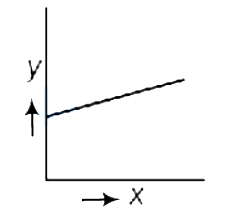
B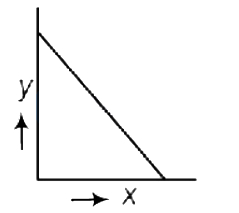
C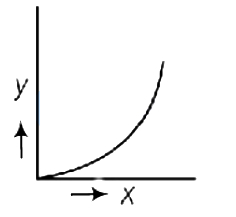
D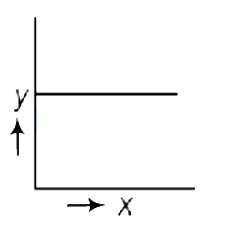
Solution
(B) The variation of molar conductivity $(\Lambda_m)$ with concentration $(C)$ for strong electrolytes like $KCl$ is given by the Kohlrausch equation: $\Lambda_m = \Lambda_m^{\circ} - A \sqrt{C}$.
Here,$\Lambda_m^{\circ}$ is the molar conductivity at infinite dilution and $A$ is a constant.
This equation follows the linear form $y = mx + c$,where $y = \Lambda_m$,$x = \sqrt{C}$,$m = -A$ (slope),and $c = \Lambda_m^{\circ}$ (intercept).
Since the slope is negative $(-A)$,the plot of $\Lambda_m$ versus $\sqrt{C}$ is a straight line with a negative slope,indicating that $\Lambda_m$ decreases as $\sqrt{C}$ increases.
Here,$\Lambda_m^{\circ}$ is the molar conductivity at infinite dilution and $A$ is a constant.
This equation follows the linear form $y = mx + c$,where $y = \Lambda_m$,$x = \sqrt{C}$,$m = -A$ (slope),and $c = \Lambda_m^{\circ}$ (intercept).
Since the slope is negative $(-A)$,the plot of $\Lambda_m$ versus $\sqrt{C}$ is a straight line with a negative slope,indicating that $\Lambda_m$ decreases as $\sqrt{C}$ increases.
0 likes
View Solution387
MediumMCQ
Which relation is correct for $\Lambda^0_{m(H_2O)}$?
A
$\Lambda^0_{m(HCl)} + \Lambda^0_{m(NH_4Cl)} - \Lambda^0_{m(NH_4OH)}$
B
$\Lambda^0_{m(HCl)} + \Lambda^0_{m(NaOH)} - \Lambda^0_{m(NaCl)}$
C
$\Lambda^0_{m(HNO_3)} + \Lambda^0_{m(NaNO_3)} - \Lambda^0_{m(NaOH)}$
D
$\Lambda^0_{m(HNO_3)} + \Lambda^0_{m(Ba(OH)_2)} - \Lambda^0_{m(Ba(NO_3)_2)}$
Solution
(B) According to Kohlrausch's law of independent migration of ions,the molar conductivity of an electrolyte at infinite dilution is the sum of the molar conductivities of its constituent ions.
For water $(H_2O)$,the dissociation is $H_2O \rightleftharpoons H^+ + OH^-$.
Therefore,$\Lambda^0_{m(H_2O)} = \lambda^0_{H^+} + \lambda^0_{OH^-}$.
We can obtain this by combining strong electrolytes:
$\Lambda^0_{m(HCl)} = \lambda^0_{H^+} + \lambda^0_{Cl^-}$
$\Lambda^0_{m(NaOH)} = \lambda^0_{Na^+} + \lambda^0_{OH^-}$
$\Lambda^0_{m(NaCl)} = \lambda^0_{Na^+} + \lambda^0_{Cl^-}$
By calculating $\Lambda^0_{m(HCl)} + \Lambda^0_{m(NaOH)} - \Lambda^0_{m(NaCl)}$,we get:
$(\lambda^0_{H^+} + \lambda^0_{Cl^-}) + (\lambda^0_{Na^+} + \lambda^0_{OH^-}) - (\lambda^0_{Na^+} + \lambda^0_{Cl^-}) = \lambda^0_{H^+} + \lambda^0_{OH^-} = \Lambda^0_{m(H_2O)}$.
Thus,option $(B)$ is correct.
For water $(H_2O)$,the dissociation is $H_2O \rightleftharpoons H^+ + OH^-$.
Therefore,$\Lambda^0_{m(H_2O)} = \lambda^0_{H^+} + \lambda^0_{OH^-}$.
We can obtain this by combining strong electrolytes:
$\Lambda^0_{m(HCl)} = \lambda^0_{H^+} + \lambda^0_{Cl^-}$
$\Lambda^0_{m(NaOH)} = \lambda^0_{Na^+} + \lambda^0_{OH^-}$
$\Lambda^0_{m(NaCl)} = \lambda^0_{Na^+} + \lambda^0_{Cl^-}$
By calculating $\Lambda^0_{m(HCl)} + \Lambda^0_{m(NaOH)} - \Lambda^0_{m(NaCl)}$,we get:
$(\lambda^0_{H^+} + \lambda^0_{Cl^-}) + (\lambda^0_{Na^+} + \lambda^0_{OH^-}) - (\lambda^0_{Na^+} + \lambda^0_{Cl^-}) = \lambda^0_{H^+} + \lambda^0_{OH^-} = \Lambda^0_{m(H_2O)}$.
Thus,option $(B)$ is correct.
0 likes
View Solution388
MediumMCQ
Which of the following statements is not true for a fuel cell?
A
Converting fuel energy directly into electrical energy.
B
Water produced during the reaction cannot be used for drinking.
C
The reaction of hydrogen with oxygen to form water.
D
They are pollution-free.
Solution
(B) Fuel cells (like the $H_2-O_2$ fuel cell) convert chemical energy directly into electrical energy.
They produce pure water as a byproduct,which is suitable for drinking,especially in space applications.
Therefore,the statement that water produced during the reaction cannot be used for drinking is incorrect.
They produce pure water as a byproduct,which is suitable for drinking,especially in space applications.
Therefore,the statement that water produced during the reaction cannot be used for drinking is incorrect.
0 likes
View Solution389
MediumMCQ
For a general redox reaction:
Anode: $Red_1 \to Ox_1^{n_1+} + n_1 e^-$
Cathode: $Ox_2^{n_2+} + n_2 e^- \to Red_2$
Which of the following statements is incorrect?
Anode: $Red_1 \to Ox_1^{n_1+} + n_1 e^-$
Cathode: $Ox_2^{n_2+} + n_2 e^- \to Red_2$
Which of the following statements is incorrect?
A
The overall reaction can be written as $n_2 Red_1 + n_1 Ox_2^{n_2+} \rightleftharpoons n_2 Ox_1^{n_1+} + n_1 Red_2$
B
The electrons do not appear in the overall reaction because electrons produced at the anode are consumed at the cathode.
C
Here $n$ is the number of electrons transferred in the redox reaction.
D
If the reaction is carried out reversibly,the electrical work done is equal to the ratio of charge and potential difference through which the charge is moved.
Solution
(D) Electrical work done is given by $W = nFE_{cell}$,where $nF$ is the charge transferred and $E_{cell}$ is the potential difference.
Work done is the product of charge and potential difference $(W = q \times V)$,not the ratio.
Therefore,the statement in option $D$ is incorrect.
Work done is the product of charge and potential difference $(W = q \times V)$,not the ratio.
Therefore,the statement in option $D$ is incorrect.
0 likes
View Solution390
DifficultMCQ
An electrochemical cell is constructed using half-cells in the direction of spontaneous change: $Fe(OH)_{2}(s) + 2e^{-} \rightarrow Fe(s) + 2OH^{-}(aq)$ $(E^{0} = -0.88 \text{ V})$ and $AgBr(s) + e^{-} \rightarrow Ag(s) + Br^{-}(aq)$ $(E^{0} = +0.07 \text{ V})$. Which of the following options is correct?
A
Overall reaction: $Fe(s) + 2OH^{-}(aq) + 2AgBr(s) \rightleftharpoons Fe(OH)_{2}(s) + 2Ag(s) + 2Br^{-}(aq)$
B
$E^{0}_{cell} = -0.95 \text{ V}$
C
$Fe$ is reduced in the electrochemical cell
D
$E^{0}_{cell}$ is an extensive property
Solution
(A) reaction is spontaneous if $E^{0}_{cell} > 0$.
Given half-reactions are:
$Fe(OH)_{2}(s) + 2e^{-} \rightarrow Fe(s) + 2OH^{-}(aq)$ $(E^{0}_{red} = -0.88 \text{ V})$
$AgBr(s) + e^{-} \rightarrow Ag(s) + Br^{-}(aq)$ $(E^{0}_{red} = +0.07 \text{ V})$
For a spontaneous reaction,the half-reaction with the higher $E^{0}_{red}$ acts as the cathode (reduction) and the one with the lower $E^{0}_{red}$ acts as the anode (oxidation).
Anode (Oxidation): $Fe(s) + 2OH^{-}(aq) \rightarrow Fe(OH)_{2}(s) + 2e^{-}$ $(E^{0}_{ox} = +0.88 \text{ V})$
Cathode (Reduction): $2AgBr(s) + 2e^{-} \rightarrow 2Ag(s) + 2Br^{-}(aq)$ $(E^{0}_{red} = +0.07 \text{ V})$
Overall reaction: $Fe(s) + 2OH^{-}(aq) + 2AgBr(s) \rightarrow Fe(OH)_{2}(s) + 2Ag(s) + 2Br^{-}(aq)$
$E^{0}_{cell} = E^{0}_{cathode} + E^{0}_{ox} = 0.07 \text{ V} + 0.88 \text{ V} = 0.95 \text{ V}$.
Since $E^{0}_{cell} > 0$,the reaction is spontaneous. Thus,option $A$ is correct.
Given half-reactions are:
$Fe(OH)_{2}(s) + 2e^{-} \rightarrow Fe(s) + 2OH^{-}(aq)$ $(E^{0}_{red} = -0.88 \text{ V})$
$AgBr(s) + e^{-} \rightarrow Ag(s) + Br^{-}(aq)$ $(E^{0}_{red} = +0.07 \text{ V})$
For a spontaneous reaction,the half-reaction with the higher $E^{0}_{red}$ acts as the cathode (reduction) and the one with the lower $E^{0}_{red}$ acts as the anode (oxidation).
Anode (Oxidation): $Fe(s) + 2OH^{-}(aq) \rightarrow Fe(OH)_{2}(s) + 2e^{-}$ $(E^{0}_{ox} = +0.88 \text{ V})$
Cathode (Reduction): $2AgBr(s) + 2e^{-} \rightarrow 2Ag(s) + 2Br^{-}(aq)$ $(E^{0}_{red} = +0.07 \text{ V})$
Overall reaction: $Fe(s) + 2OH^{-}(aq) + 2AgBr(s) \rightarrow Fe(OH)_{2}(s) + 2Ag(s) + 2Br^{-}(aq)$
$E^{0}_{cell} = E^{0}_{cathode} + E^{0}_{ox} = 0.07 \text{ V} + 0.88 \text{ V} = 0.95 \text{ V}$.
Since $E^{0}_{cell} > 0$,the reaction is spontaneous. Thus,option $A$ is correct.
0 likes
View SolutionElectrochemistry — Electrochemical cells · Frequently Asked Questions
1Are these Electrochemistry questions useful for JEE and NEET?
Yes. All questions in this section are mapped to JEE Main and NEET exam patterns. Previous year questions from JEE Main, NEET, GUJCET and state-level exams are included with full solutions.
2Can I switch to Hindi or Gujarati for these questions?
Yes. Use the language tabs in the hero section or the sidebar to view the same questions and solutions in English, Hindi or Gujarati.
3How do I generate a question paper from this subtopic?
Use the Vedclass Exam Paper Generator — select the chapter and subtopic, set difficulty, and generate Sets A, B, C, D automatically. First 3 chapters of every subject are free.
Vedclass Products
For Students
Vedclass Test Series
Mock tests in real JEE/NEET style with performance analysis. 5-day free trial.
Start Free TrialFor Teachers
Exam Paper Generator
Generate Set A/B/C/D papers from this chapter in 2 minutes. 3 chapters free.
Try FreeFor Institutes
Online Exam Module
Live online exams with unlimited students, 360° analytics & white-label branding.
See DemoFor Teachers & Institutes
Generate a Electrochemistry Exam Paper in 2 Minutes
Select subtopic & difficulty — Sets A, B, C, D auto-generated with No Repeat logic.
First 3 chapters of every subject are free — no payment required.