
A English
Electrochemical cells Questions in English
Class 12 Chemistry · Electrochemistry · Electrochemical cells
391+
Questions
English
Language
100%
With Solutions
Showing 50 of 391 questions in English
201
Difficult
Fill in the blanks :
$1$. Standard potential of Daniell cell is $\dots$ volt.
$2$. In Daniell cell,chemical energy is converted into $\dots$ energy.
$3$. In Daniell cell,$\dots$ is anode and $\dots$ is cathode.
$1$. Standard potential of Daniell cell is $\dots$ volt.
$2$. In Daniell cell,chemical energy is converted into $\dots$ energy.
$3$. In Daniell cell,$\dots$ is anode and $\dots$ is cathode.
Solution
(N/A) $1$. The standard potential of a Daniell cell is $1.1 \ V$.
$2$. In a Daniell cell,chemical energy is converted into electrical energy.
$3$. In a Daniell cell,$Zn$ (zinc) is the anode and $Cu$ (copper) is the cathode.
$2$. In a Daniell cell,chemical energy is converted into electrical energy.
$3$. In a Daniell cell,$Zn$ (zinc) is the anode and $Cu$ (copper) is the cathode.
0 likes
View Solution202
MediumMCQ
Give true $(T)$ and false $(F)$ for the following statements:
$(1)$ In a Daniell cell,$Zn$ is dissolved in the solution and $Cu$ is deposited.
$(2)$ In a Daniell cell,when an external $1.1 \ V$ potential is applied in the opposite direction,the reaction stops and no current flows.
$(1)$ In a Daniell cell,$Zn$ is dissolved in the solution and $Cu$ is deposited.
$(2)$ In a Daniell cell,when an external $1.1 \ V$ potential is applied in the opposite direction,the reaction stops and no current flows.
A
$(1) T, (2) T$
B
$(1) T, (2) F$
C
$(1) F, (2) T$
D
$(1) F, (2) F$
Solution
(A) Statement $(1)$ is true: In a Daniell cell,the anode reaction is $Zn(s) \rightarrow Zn^{2+}(aq) + 2e^-$,where $Zn$ dissolves,and the cathode reaction is $Cu^{2+}(aq) + 2e^- \rightarrow Cu(s)$,where $Cu$ is deposited.
Statement $(2)$ is true: The standard $EMF$ of a Daniell cell is $1.1 \ V$. When an external opposing potential of exactly $1.1 \ V$ is applied,the potential difference becomes zero,the cell reaction stops,and no current flows through the circuit.
Statement $(2)$ is true: The standard $EMF$ of a Daniell cell is $1.1 \ V$. When an external opposing potential of exactly $1.1 \ V$ is applied,the potential difference becomes zero,the cell reaction stops,and no current flows through the circuit.
0 likes
View Solution203
Medium
What is a galvanic cell? Give the half-cell reactions of a Daniell cell and explain a redox couple.
Solution
(N/A) Galvanic cell: It is an electrochemical cell that converts the chemical energy of a spontaneous redox reaction into electrical energy.
$(b)$ Chemical reactions in a Daniell cell:
$(i)$ $Cu^{2+}_{(aq)} + 2e^{-} \longrightarrow Cu_{(s)}$ (reduction half-reaction)
$(ii)$ $Zn_{(s)} \longrightarrow Zn^{2+}_{(aq)} + 2e^{-}$ (oxidation half-reaction)
$(iii)$ $Zn_{(s)} + Cu^{2+}_{(aq)} \longrightarrow Zn^{2+}_{(aq)} + Cu_{(s)}$ (overall redox reaction)
These reactions occur in two different portions of the Daniell cell. The reduction half-reaction occurs on the copper electrode,while the oxidation half-reaction occurs on the zinc electrode. These two portions are called half-cells. $A$ redox couple is defined as having together the oxidized and reduced forms of a substance taking part in an oxidation or reduction half-reaction. For example,$Zn^{2+}/Zn$ and $Cu^{2+}/Cu$ are redox couples.
$(b)$ Chemical reactions in a Daniell cell:
$(i)$ $Cu^{2+}_{(aq)} + 2e^{-} \longrightarrow Cu_{(s)}$ (reduction half-reaction)
$(ii)$ $Zn_{(s)} \longrightarrow Zn^{2+}_{(aq)} + 2e^{-}$ (oxidation half-reaction)
$(iii)$ $Zn_{(s)} + Cu^{2+}_{(aq)} \longrightarrow Zn^{2+}_{(aq)} + Cu_{(s)}$ (overall redox reaction)
These reactions occur in two different portions of the Daniell cell. The reduction half-reaction occurs on the copper electrode,while the oxidation half-reaction occurs on the zinc electrode. These two portions are called half-cells. $A$ redox couple is defined as having together the oxidized and reduced forms of a substance taking part in an oxidation or reduction half-reaction. For example,$Zn^{2+}/Zn$ and $Cu^{2+}/Cu$ are redox couples.
0 likes
View Solution204
Difficult
Explain the construction of a galvanic cell based on the Daniell cell. In a galvanic cell,explain the positive and negative electrodes with suitable chemical reactions.
Solution
(N/A) Construction of a galvanic cell based on the Daniell cell: We can construct various galvanic cells following the pattern of the Daniell cell by using different combinations of half-cells.
$(i)$ Each half-cell consists of a metallic electrode dipped into an electrolyte solution.
$(ii)$ The two half-cells are connected externally by a metallic wire through a voltmeter and a switch.
$(iii)$ The electrolytes of the two half-cells are connected internally through a salt bridge. In some cases,both electrodes may dip into the same electrolyte solution,in which case a salt bridge is not required.
$(b)$ Positive and negative electrodes and reactions in the Daniell cell:
Positive electrode (Cathode): At the electrode-electrolyte interface,metal ions from the solution tend to deposit on the metal electrode,making it positively charged.
$M^{n+}_{(aq)} + ne^{-} \longrightarrow M_{(s)}$ (Reduction)
In the Daniell cell,the $Cu$ electrode acts as the cathode (positive electrode),where the reduction reaction occurs.
Negative electrode (Anode): Metal atoms of the electrode tend to enter the solution as ions,leaving behind electrons on the electrode,making it negatively charged.
$M_{(s)} \longrightarrow M^{n+}_{(aq)} + ne^{-}$ (Oxidation)
In the Daniell cell,the $Zn$ electrode acts as the anode (negative electrode),where the oxidation reaction occurs.
$(i)$ Each half-cell consists of a metallic electrode dipped into an electrolyte solution.
$(ii)$ The two half-cells are connected externally by a metallic wire through a voltmeter and a switch.
$(iii)$ The electrolytes of the two half-cells are connected internally through a salt bridge. In some cases,both electrodes may dip into the same electrolyte solution,in which case a salt bridge is not required.
$(b)$ Positive and negative electrodes and reactions in the Daniell cell:
Positive electrode (Cathode): At the electrode-electrolyte interface,metal ions from the solution tend to deposit on the metal electrode,making it positively charged.
$M^{n+}_{(aq)} + ne^{-} \longrightarrow M_{(s)}$ (Reduction)
In the Daniell cell,the $Cu$ electrode acts as the cathode (positive electrode),where the reduction reaction occurs.
Negative electrode (Anode): Metal atoms of the electrode tend to enter the solution as ions,leaving behind electrons on the electrode,making it negatively charged.
$M_{(s)} \longrightarrow M^{n+}_{(aq)} + ne^{-}$ (Oxidation)
In the Daniell cell,the $Zn$ electrode acts as the anode (negative electrode),where the oxidation reaction occurs.
0 likes
View Solution205
Medium
Give the cell reaction,cell representation,and the formula for the cell potential of a copper-silver galvanic cell.
Solution
(N/A) The redox reaction for the copper-silver cell is:
$Cu_{(s)} + 2Ag_{(aq)}^{+} \rightarrow Cu_{(aq)}^{2+} + 2Ag_{(s)}$
Half-cell reactions are as follows:
Cathode (reduction): $2Ag_{(aq)}^{+} + 2e^{-} \rightarrow 2Ag_{(s)}$
Anode (oxidation): $Cu_{(s)} \rightarrow Cu_{(aq)}^{2+} + 2e^{-}$
The cell representation is:
$Cu_{(s)} | Cu_{(aq)}^{2+} \| Ag_{(aq)}^{+} | Ag_{(s)}$
The formula for the cell potential is:
$E_{cell} = E_{cathode} - E_{anode} = E_{Ag^{+}|Ag} - E_{Cu^{2+}|Cu}$
$Cu_{(s)} + 2Ag_{(aq)}^{+} \rightarrow Cu_{(aq)}^{2+} + 2Ag_{(s)}$
Half-cell reactions are as follows:
Cathode (reduction): $2Ag_{(aq)}^{+} + 2e^{-} \rightarrow 2Ag_{(s)}$
Anode (oxidation): $Cu_{(s)} \rightarrow Cu_{(aq)}^{2+} + 2e^{-}$
The cell representation is:
$Cu_{(s)} | Cu_{(aq)}^{2+} \| Ag_{(aq)}^{+} | Ag_{(s)}$
The formula for the cell potential is:
$E_{cell} = E_{cathode} - E_{anode} = E_{Ag^{+}|Ag} - E_{Cu^{2+}|Cu}$
0 likes
View Solution206
Difficult
What is an electrode and a half-cell? Explain their symbolic representation with a suitable example.
Solution
(N/A) Electrode: In a galvanic or electrolytic cell,the system formed by placing a metal rod or plate into its own salt solution is known as an electrode,where the flow of current or electrons occurs.
Half-cell: $A$ system consisting of an electrode and the solution in which it is immersed,where either an oxidation or a reduction reaction takes place,is called a half-cell.
Symbolic representation of a half-cell: $A$ vertical line is used to separate the metal and its ion. By convention,for a reduction reaction,the representation is written as $\text{metal ion} \mid \text{metal}$.
For reduction: The symbolic representation of $Zn^{2+} + 2e^{-} \rightarrow Zn$ is $Zn_{(aq)}^{2+} \mid Zn_{(s)}$.
For oxidation: The symbolic representation of $Zn_{(s)} \rightarrow Zn^{2+} + 2e^{-}$ is $Zn_{(s)} \mid Zn_{(aq)}^{2+}$.
If the reactant or product is a gas or liquid,platinum $(Pt)$ is typically used as an inert electrode. Examples:
$(i)$ Hydrogen electrode:
Anode (Oxidation): $Pt_{(s)} \mid H_{2(g)} \ (1 \ \text{bar}) \mid H_{(aq)}^{+}$
Cathode (Reduction): $H_{(aq)}^{+} \mid H_{2(g)} \ (1 \ \text{bar}) \mid Pt_{(s)}$
$(ii)$ Bromine electrode:
Cathode (Reduction): $Pt_{(s)} \mid Br_{2(aq)} \mid Br_{(aq)}^{-}$
Anode (Oxidation): $Br_{(aq)}^{-} \mid Br_{2(aq)} \mid Pt_{(s)}$
Half-cell: $A$ system consisting of an electrode and the solution in which it is immersed,where either an oxidation or a reduction reaction takes place,is called a half-cell.
Symbolic representation of a half-cell: $A$ vertical line is used to separate the metal and its ion. By convention,for a reduction reaction,the representation is written as $\text{metal ion} \mid \text{metal}$.
For reduction: The symbolic representation of $Zn^{2+} + 2e^{-} \rightarrow Zn$ is $Zn_{(aq)}^{2+} \mid Zn_{(s)}$.
For oxidation: The symbolic representation of $Zn_{(s)} \rightarrow Zn^{2+} + 2e^{-}$ is $Zn_{(s)} \mid Zn_{(aq)}^{2+}$.
If the reactant or product is a gas or liquid,platinum $(Pt)$ is typically used as an inert electrode. Examples:
$(i)$ Hydrogen electrode:
Anode (Oxidation): $Pt_{(s)} \mid H_{2(g)} \ (1 \ \text{bar}) \mid H_{(aq)}^{+}$
Cathode (Reduction): $H_{(aq)}^{+} \mid H_{2(g)} \ (1 \ \text{bar}) \mid Pt_{(s)}$
$(ii)$ Bromine electrode:
Cathode (Reduction): $Pt_{(s)} \mid Br_{2(aq)} \mid Br_{(aq)}^{-}$
Anode (Oxidation): $Br_{(aq)}^{-} \mid Br_{2(aq)} \mid Pt_{(s)}$
0 likes
View Solution207
Difficult
Explain the symbolic representation of a galvanic cell (electrochemical cell) with a suitable example.
Solution
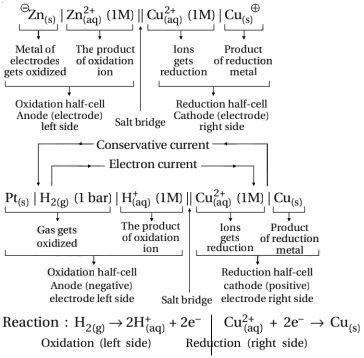
(N/A) In the symbolic representation of an electrochemical cell,the reactions of the anode (left side) and cathode (right side) half-cells are denoted by placing a single vertical line between the metal and the metal ion,or the ion and the metal,respectively.
Anode and cathode are represented on the left and right sides,respectively.
Negative $(-)$ and positive $(+)$ signs are denoted on the anode and cathode,respectively.
Two parallel vertical lines $(||)$ are placed to denote the salt bridge between these two half-cells.
If an inert electrode is used,it is denoted by symbols like $Pt$ or $C$,depending on the metal used.
Example-$1$: Symbolic representation of the Daniell cell: $Zn_{(s)} | Zn^{2+}_{(aq)} || Cu^{2+}_{(aq)} | Cu_{(s)}$
Example-$2$: Symbolic representation of a galvanic cell constructed with an inert electrode: $Pt_{(s)} | H_{2(g)} | H^{+}_{(aq)} || Cu^{2+}_{(aq)} | Cu_{(s)}$
Anode and cathode are represented on the left and right sides,respectively.
Negative $(-)$ and positive $(+)$ signs are denoted on the anode and cathode,respectively.
Two parallel vertical lines $(||)$ are placed to denote the salt bridge between these two half-cells.
If an inert electrode is used,it is denoted by symbols like $Pt$ or $C$,depending on the metal used.
Example-$1$: Symbolic representation of the Daniell cell: $Zn_{(s)} | Zn^{2+}_{(aq)} || Cu^{2+}_{(aq)} | Cu_{(s)}$
Example-$2$: Symbolic representation of a galvanic cell constructed with an inert electrode: $Pt_{(s)} | H_{2(g)} | H^{+}_{(aq)} || Cu^{2+}_{(aq)} | Cu_{(s)}$
0 likes
View Solution208
Difficult
Give the types and examples of electrodes.
Solution
(N/A) On the basis of the reaction occurring on the surface of the electrode:
In a galvanic cell,the half-cell in which oxidation takes place is called the anode,and the other half-cell in which reduction takes place is called the cathode.
$(b)$ On the basis of electric charge on the electrode:
Positive and negative electrode: More electrons are present in the negative electrode with respect to the positive electrode. $E$.g.,in a galvanic cell,the anode is negative and the cathode is positive.
$(c)$ Classification based on the nature of electrodes:
$(i)$ Active electrode: In a cell,an electrode that shows either an increase or a decrease in its weight is called an active electrode. If an active metal dissolves in the solution during the reaction,its weight is reduced. If,during the reaction,ions from the solution undergo reduction and convert into metal particles that deposit on the electrode,the weight of the metal increases. For example,$Zn$ and $Cu$ metals are active electrodes in a Daniell cell.
$Zn(s) \rightarrow Zn^{2+}(aq) + 2e^{-}$ (Oxidation)
$Cu^{2+}(aq) + 2e^{-} \rightarrow Cu(s)$ (Reduction)
Here,the weight of $Zn$ decreases and the weight of $Cu$ increases.
$(ii)$ Inert electrode: An electrode that provides only its surface for the cell reaction but does not take part in the reaction is termed an inert electrode. $E$.g.,metals like platinum,graphite,etc.,are used in half-cells having either gas or liquid reactants or products. Platinum-$H_2$ gas is an example of an inert electrode.
In a galvanic cell,the half-cell in which oxidation takes place is called the anode,and the other half-cell in which reduction takes place is called the cathode.
$(b)$ On the basis of electric charge on the electrode:
Positive and negative electrode: More electrons are present in the negative electrode with respect to the positive electrode. $E$.g.,in a galvanic cell,the anode is negative and the cathode is positive.
$(c)$ Classification based on the nature of electrodes:
$(i)$ Active electrode: In a cell,an electrode that shows either an increase or a decrease in its weight is called an active electrode. If an active metal dissolves in the solution during the reaction,its weight is reduced. If,during the reaction,ions from the solution undergo reduction and convert into metal particles that deposit on the electrode,the weight of the metal increases. For example,$Zn$ and $Cu$ metals are active electrodes in a Daniell cell.
$Zn(s) \rightarrow Zn^{2+}(aq) + 2e^{-}$ (Oxidation)
$Cu^{2+}(aq) + 2e^{-} \rightarrow Cu(s)$ (Reduction)
Here,the weight of $Zn$ decreases and the weight of $Cu$ increases.
$(ii)$ Inert electrode: An electrode that provides only its surface for the cell reaction but does not take part in the reaction is termed an inert electrode. $E$.g.,metals like platinum,graphite,etc.,are used in half-cells having either gas or liquid reactants or products. Platinum-$H_2$ gas is an example of an inert electrode.
0 likes
View Solution209
Medium
Give the symbolic representation of the galvanic cell obtained by using the following standard reduction potentials at $298 \ K$ and calculate its standard cell potential $(E^o_{cell})$.
$(i)$ $E^o_{Ag^{+}|Ag} = 0.80 \ V$
$(ii)$ $E^o_{Zn^{2+}|Zn} = -0.76 \ V$
$(i)$ $E^o_{Ag^{+}|Ag} = 0.80 \ V$
$(ii)$ $E^o_{Zn^{2+}|Zn} = -0.76 \ V$
Solution
(N/A) In a galvanic cell,the electrode with the lower reduction potential acts as the anode (oxidation) and the electrode with the higher reduction potential acts as the cathode (reduction).
Here,$E^o_{Zn^{2+}|Zn} = -0.76 \ V$ (lower) and $E^o_{Ag^{+}|Ag} = 0.80 \ V$ (higher).
Therefore,$Zn$ acts as the anode and $Ag$ acts as the cathode.
The symbolic representation of the cell is: $Zn(s) | Zn^{2+}(aq) || Ag^{+}(aq) | Ag(s)$.
The standard cell potential is calculated as:
$E^o_{cell} = E^o_{cathode} - E^o_{anode}$
$E^o_{cell} = E^o_{Ag^{+}|Ag} - E^o_{Zn^{2+}|Zn}$
$E^o_{cell} = 0.80 \ V - (-0.76 \ V)$
$E^o_{cell} = 0.80 \ V + 0.76 \ V = 1.56 \ V$.
Here,$E^o_{Zn^{2+}|Zn} = -0.76 \ V$ (lower) and $E^o_{Ag^{+}|Ag} = 0.80 \ V$ (higher).
Therefore,$Zn$ acts as the anode and $Ag$ acts as the cathode.
The symbolic representation of the cell is: $Zn(s) | Zn^{2+}(aq) || Ag^{+}(aq) | Ag(s)$.
The standard cell potential is calculated as:
$E^o_{cell} = E^o_{cathode} - E^o_{anode}$
$E^o_{cell} = E^o_{Ag^{+}|Ag} - E^o_{Zn^{2+}|Zn}$
$E^o_{cell} = 0.80 \ V - (-0.76 \ V)$
$E^o_{cell} = 0.80 \ V + 0.76 \ V = 1.56 \ V$.
0 likes
View Solution210
Medium
At $298 \ K$ temperature,if $E^o_{Mg^{2+}|Mg} = -2.37 \ V$ and $E^o_{Co^{2+}|Co} = -0.28 \ V$,construct a galvanic cell and provide its symbolic representation.
Solution
(N/A) To construct a galvanic cell,we identify the anode and cathode based on standard reduction potentials.
$E^o_{Mg^{2+}|Mg} = -2.37 \ V$ (Anode,as it is more negative)
$E^o_{Co^{2+}|Co} = -0.28 \ V$ (Cathode,as it is more positive)
In a galvanic cell,oxidation occurs at the anode and reduction occurs at the cathode.
Anode reaction: $Mg(s) \rightarrow Mg^{2+}(aq) + 2e^-$
Cathode reaction: $Co^{2+}(aq) + 2e^- \rightarrow Co(s)$
The symbolic representation of a galvanic cell is written as: $\text{Anode} | \text{Anode electrolyte} || \text{Cathode electrolyte} | \text{Cathode}$
Therefore,the representation is: $Mg(s) | Mg^{2+}(aq) || Co^{2+}(aq) | Co(s)$
$E^o_{Mg^{2+}|Mg} = -2.37 \ V$ (Anode,as it is more negative)
$E^o_{Co^{2+}|Co} = -0.28 \ V$ (Cathode,as it is more positive)
In a galvanic cell,oxidation occurs at the anode and reduction occurs at the cathode.
Anode reaction: $Mg(s) \rightarrow Mg^{2+}(aq) + 2e^-$
Cathode reaction: $Co^{2+}(aq) + 2e^- \rightarrow Co(s)$
The symbolic representation of a galvanic cell is written as: $\text{Anode} | \text{Anode electrolyte} || \text{Cathode electrolyte} | \text{Cathode}$
Therefore,the representation is: $Mg(s) | Mg^{2+}(aq) || Co^{2+}(aq) | Co(s)$
0 likes
View Solution211
Medium
Give the cell reaction and symbolic representation of the galvanic cell obtained by $E^o_{Ni^{2+}|Ni} = -0.23 \ V$ and $E^o_{Ag^{+}|Ag} = 0.80 \ V$.
Solution
(N/A) $1$. Identify the anode and cathode based on standard reduction potentials: Since $E^o_{Ag^{+}|Ag} (0.80 \ V) > E^o_{Ni^{2+}|Ni} (-0.23 \ V)$,$Ag$ acts as the cathode and $Ni$ acts as the anode.
$2$. Symbolic representation: The cell is represented as $Ni(s) | Ni^{2+}(aq) || Ag^{+}(aq) | Ag(s)$.
$3$. Cell reactions:
At anode (oxidation): $Ni(s) \rightarrow Ni^{2+}(aq) + 2e^-$
At cathode (reduction): $2Ag^{+}(aq) + 2e^- \rightarrow 2Ag(s)$
Overall cell reaction: $Ni(s) + 2Ag^{+}(aq) \rightarrow Ni^{2+}(aq) + 2Ag(s)$.
$2$. Symbolic representation: The cell is represented as $Ni(s) | Ni^{2+}(aq) || Ag^{+}(aq) | Ag(s)$.
$3$. Cell reactions:
At anode (oxidation): $Ni(s) \rightarrow Ni^{2+}(aq) + 2e^-$
At cathode (reduction): $2Ag^{+}(aq) + 2e^- \rightarrow 2Ag(s)$
Overall cell reaction: $Ni(s) + 2Ag^{+}(aq) \rightarrow Ni^{2+}(aq) + 2Ag(s)$.
0 likes
View Solution212
Medium
Draw the diagram of a galvanic cell and indicate the direction of flow of electrons and current for the cell constructed using $Al|Al^{3+}$ and $Ag^{+}|Ag$ half-cells,given $E^o_{Al^{3+}|Al} = -1.66 \ V$ and $E^o_{Ag^{+}|Ag} = 0.80 \ V$.
Solution
(N/A) $1$. Identify the anode and cathode based on standard reduction potentials: $E^o_{Al^{3+}|Al} = -1.66 \ V$ (Anode) and $E^o_{Ag^{+}|Ag} = 0.80 \ V$ (Cathode).
$2$. The cell reaction is: $Al(s) + 3Ag^+(aq) \rightarrow Al^{3+}(aq) + 3Ag(s)$.
$3$. In a galvanic cell,electrons flow from the anode ($Al$ electrode) to the cathode ($Ag$ electrode) through the external circuit.
$4$. The conventional current flows in the opposite direction,i.e.,from the cathode ($Ag$ electrode) to the anode ($Al$ electrode).
$5$. Diagram description: An $Al$ electrode is placed in an $Al(NO_3)_3$ solution and an $Ag$ electrode is placed in an $AgNO_3$ solution,connected by a salt bridge and an external wire with a voltmeter.
$2$. The cell reaction is: $Al(s) + 3Ag^+(aq) \rightarrow Al^{3+}(aq) + 3Ag(s)$.
$3$. In a galvanic cell,electrons flow from the anode ($Al$ electrode) to the cathode ($Ag$ electrode) through the external circuit.
$4$. The conventional current flows in the opposite direction,i.e.,from the cathode ($Ag$ electrode) to the anode ($Al$ electrode).
$5$. Diagram description: An $Al$ electrode is placed in an $Al(NO_3)_3$ solution and an $Ag$ electrode is placed in an $AgNO_3$ solution,connected by a salt bridge and an external wire with a voltmeter.
0 likes
View Solution213
Easy
Define inert electrode and give an example. Also,define an active electrode and give examples.
Solution
(N/A) An $inert \ electrode$ is an electrode that does not participate in the chemical reaction of the cell but provides a surface for the transfer of electrons. Example: $Platinum \ (Pt)$ or $Graphite$.
An $active \ electrode$ is an electrode that participates in the chemical reaction by either losing ions to the solution or gaining ions from the solution. Examples: $Zinc \ (Zn)$ electrode,$Copper \ (Cu)$ electrode,or $Silver \ (Ag)$ electrode.
An $active \ electrode$ is an electrode that participates in the chemical reaction by either losing ions to the solution or gaining ions from the solution. Examples: $Zinc \ (Zn)$ electrode,$Copper \ (Cu)$ electrode,or $Silver \ (Ag)$ electrode.
0 likes
View Solution214
Easy
What are anode and cathode?
Solution
(N/A) In an electrochemical cell,the electrode where oxidation occurs is called the $Anode$. It is the site where electrons are released into the external circuit.
In an electrochemical cell,the electrode where reduction occurs is called the $Cathode$. It is the site where electrons are consumed from the external circuit.
In an electrochemical cell,the electrode where reduction occurs is called the $Cathode$. It is the site where electrons are consumed from the external circuit.
0 likes
View Solution215
EasyMCQ
What is a positive and a negative electrode?
A
Positive electrode is the anode,negative electrode is the cathode.
B
Positive electrode is the cathode,negative electrode is the anode.
C
Positive electrode is the electrolyte,negative electrode is the ion.
D
Positive electrode is the salt bridge,negative electrode is the wire.
Solution
(A) In an electrochemical cell,the electrode where oxidation occurs is called the $Anode$,and the electrode where reduction occurs is called the $Cathode$.
In a $Galvanic$ cell,the $Anode$ is the negative electrode and the $Cathode$ is the positive electrode.
In an $Electrolytic$ cell,the $Anode$ is the positive electrode and the $Cathode$ is the negative electrode.
However,by standard convention in general electrochemistry,the $Anode$ is defined as the site of oxidation and the $Cathode$ as the site of reduction.
Given the options,$A$ describes the standard $Electrolytic$ cell configuration.
In a $Galvanic$ cell,the $Anode$ is the negative electrode and the $Cathode$ is the positive electrode.
In an $Electrolytic$ cell,the $Anode$ is the positive electrode and the $Cathode$ is the negative electrode.
However,by standard convention in general electrochemistry,the $Anode$ is defined as the site of oxidation and the $Cathode$ as the site of reduction.
Given the options,$A$ describes the standard $Electrolytic$ cell configuration.
0 likes
View Solution216
EasyMCQ
What is the function of a salt bridge?
A
To complete the electrical circuit.
B
To maintain electrical neutrality in both half-cells.
C
To prevent liquid junction potential.
D
All of the above.
Solution
(D) salt bridge serves multiple critical functions in an electrochemical cell:
$1$. It completes the electrical circuit by allowing the flow of ions between the two half-cells.
$2$. It maintains electrical neutrality in both half-cells by providing ions to balance the charge accumulation.
$3$. It minimizes or prevents the liquid junction potential that arises due to the unequal migration of ions at the interface of the two solutions.
$1$. It completes the electrical circuit by allowing the flow of ions between the two half-cells.
$2$. It maintains electrical neutrality in both half-cells by providing ions to balance the charge accumulation.
$3$. It minimizes or prevents the liquid junction potential that arises due to the unequal migration of ions at the interface of the two solutions.
0 likes
View Solution217
Easy
How is the complete external and internal path completed for electron flow for a galvanic cell? Clarify it.
Solution
(N/A) In a galvanic cell,the flow of electrons is completed through two paths:
$1$. External Circuit: Electrons flow from the anode to the cathode through an external metallic wire. This flow is driven by the potential difference between the two electrodes.
$2$. Internal Circuit: The internal circuit is completed by a salt bridge or a porous membrane containing an electrolyte. This allows the movement of ions ($cations$ and $anions$) to maintain electrical neutrality in the half-cells and prevents the buildup of charge,thereby allowing the continuous flow of electrons.
$1$. External Circuit: Electrons flow from the anode to the cathode through an external metallic wire. This flow is driven by the potential difference between the two electrodes.
$2$. Internal Circuit: The internal circuit is completed by a salt bridge or a porous membrane containing an electrolyte. This allows the movement of ions ($cations$ and $anions$) to maintain electrical neutrality in the half-cells and prevents the buildup of charge,thereby allowing the continuous flow of electrons.
0 likes
View Solution218
Easy
Give the reactions for the following:
$(i)$ Reactions occurring at the electrodes and the overall redox reaction of a Daniell cell.
$(ii)$ Give the redox and electrode reactions of a $Cu-Ag$ galvanic cell.
$(i)$ Reactions occurring at the electrodes and the overall redox reaction of a Daniell cell.
$(ii)$ Give the redox and electrode reactions of a $Cu-Ag$ galvanic cell.
Solution
$(i)$ For a Daniell cell $(Zn|Zn^{2+}||Cu^{2+}|Cu)$:
Anode reaction: $Zn(s) \rightarrow Zn^{2+}(aq) + 2e^-$
Cathode reaction: $Cu^{2+}(aq) + 2e^- \rightarrow Cu(s)$
Overall redox reaction: $Zn(s) + Cu^{2+}(aq) \rightarrow Zn^{2+}(aq) + Cu(s)$
$(ii)$ For a $Cu-Ag$ galvanic cell $(Cu|Cu^{2+}||Ag^+|Ag)$:
Anode reaction: $Cu(s) \rightarrow Cu^{2+}(aq) + 2e^-$
Cathode reaction: $2Ag^+(aq) + 2e^- \rightarrow 2Ag(s)$
Overall redox reaction: $Cu(s) + 2Ag^+(aq) \rightarrow Cu^{2+}(aq) + 2Ag(s)$
Anode reaction: $Zn(s) \rightarrow Zn^{2+}(aq) + 2e^-$
Cathode reaction: $Cu^{2+}(aq) + 2e^- \rightarrow Cu(s)$
Overall redox reaction: $Zn(s) + Cu^{2+}(aq) \rightarrow Zn^{2+}(aq) + Cu(s)$
$(ii)$ For a $Cu-Ag$ galvanic cell $(Cu|Cu^{2+}||Ag^+|Ag)$:
Anode reaction: $Cu(s) \rightarrow Cu^{2+}(aq) + 2e^-$
Cathode reaction: $2Ag^+(aq) + 2e^- \rightarrow 2Ag(s)$
Overall redox reaction: $Cu(s) + 2Ag^+(aq) \rightarrow Cu^{2+}(aq) + 2Ag(s)$
0 likes
View Solution219
Easy
Give the symbolic representation of the following galvanic cells:
$(i)$ Daniell cell
$(ii)$ Copper-Silver cell
$(i)$ Daniell cell
$(ii)$ Copper-Silver cell
Solution
(N/A) $(i)$ For the Daniell cell,the reaction is $Zn(s) + Cu^{2+}(aq) \rightarrow Zn^{2+}(aq) + Cu(s)$. The symbolic representation is $Zn(s) | Zn^{2+}(aq) || Cu^{2+}(aq) | Cu(s)$.
$(ii)$ For the Copper-Silver cell,the reaction is $Cu(s) + 2Ag^+(aq) \rightarrow Cu^{2+}(aq) + 2Ag(s)$. The symbolic representation is $Cu(s) | Cu^{2+}(aq) || Ag^+(aq) | Ag(s)$.
$(ii)$ For the Copper-Silver cell,the reaction is $Cu(s) + 2Ag^+(aq) \rightarrow Cu^{2+}(aq) + 2Ag(s)$. The symbolic representation is $Cu(s) | Cu^{2+}(aq) || Ag^+(aq) | Ag(s)$.
0 likes
View Solution220
EasyMCQ
Identify the anode,cathode,positive electrode,and negative electrode for the $Daniell$ cell $(Zn-Cu)$ and the $Copper-Silver$ $(Cu-Ag)$ cell.
A
$Daniell$ cell: Anode $(Zn)$,Cathode $(Cu)$,Positive $(Cu)$,Negative $(Zn)$; $Cu-Ag$ cell: Anode $(Cu)$,Cathode $(Ag)$,Positive $(Ag)$,Negative $(Cu)$
B
$Daniell$ cell: Anode $(Cu)$,Cathode $(Zn)$,Positive $(Zn)$,Negative $(Cu)$; $Cu-Ag$ cell: Anode $(Ag)$,Cathode $(Cu)$,Positive $(Cu)$,Negative $(Ag)$
C
$Daniell$ cell: Anode $(Zn)$,Cathode $(Cu)$,Positive $(Zn)$,Negative $(Cu)$; $Cu-Ag$ cell: Anode $(Cu)$,Cathode $(Ag)$,Positive $(Cu)$,Negative $(Ag)$
D
$Daniell$ cell: Anode $(Cu)$,Cathode $(Zn)$,Positive $(Cu)$,Negative $(Zn)$; $Cu-Ag$ cell: Anode $(Ag)$,Cathode $(Cu)$,Positive $(Ag)$,Negative $(Cu)$
Solution
(A) In an electrochemical cell,the anode is the electrode where oxidation occurs,and the cathode is where reduction occurs.
For the $Daniell$ cell $(Zn|Zn^{2+}||Cu^{2+}|Cu)$:
$Zn$ acts as the anode (negative electrode) and $Cu$ acts as the cathode (positive electrode).
For the $Copper-Silver$ cell $(Cu|Cu^{2+}||Ag^+|Ag)$:
$Cu$ acts as the anode (negative electrode) and $Ag$ acts as the cathode (positive electrode).
Therefore,the correct configuration is:
$Daniell$ cell: Anode $(Zn)$,Cathode $(Cu)$,Positive $(Cu)$,Negative $(Zn)$;
$Cu-Ag$ cell: Anode $(Cu)$,Cathode $(Ag)$,Positive $(Ag)$,Negative $(Cu)$.
For the $Daniell$ cell $(Zn|Zn^{2+}||Cu^{2+}|Cu)$:
$Zn$ acts as the anode (negative electrode) and $Cu$ acts as the cathode (positive electrode).
For the $Copper-Silver$ cell $(Cu|Cu^{2+}||Ag^+|Ag)$:
$Cu$ acts as the anode (negative electrode) and $Ag$ acts as the cathode (positive electrode).
Therefore,the correct configuration is:
$Daniell$ cell: Anode $(Zn)$,Cathode $(Cu)$,Positive $(Cu)$,Negative $(Zn)$;
$Cu-Ag$ cell: Anode $(Cu)$,Cathode $(Ag)$,Positive $(Ag)$,Negative $(Cu)$.
0 likes
View Solution221
Medium
Fill in the blanks :
$(1)$ In a galvanic cell,the anode and cathode possess $\dots$ and $\dots$ charge respectively.
$(2)$ According to convention,the anode and cathode in a galvanic cell are present on the $\dots$ and $\dots$ side respectively.
$(1)$ In a galvanic cell,the anode and cathode possess $\dots$ and $\dots$ charge respectively.
$(2)$ According to convention,the anode and cathode in a galvanic cell are present on the $\dots$ and $\dots$ side respectively.
Solution
(N/A) $(1)$ In a galvanic cell,the anode is the negative electrode (site of oxidation) and the cathode is the positive electrode (site of reduction). Thus,the charges are negative and positive respectively.
$(2)$ By convention,in a standard cell diagram (cell notation),the anode is written on the left side and the cathode is written on the right side.
$(2)$ By convention,in a standard cell diagram (cell notation),the anode is written on the left side and the cathode is written on the right side.
0 likes
View Solution222
MediumMCQ
The following reaction occurs in a button cell:
$(i)$ $Ag_{2}O + H_{2}O + 2e^{-} \rightarrow 2Ag + 2OH^{-}$
$(ii)$ $Zn \rightarrow Zn^{2+} + 2e^{-}$
Calculate the standard Gibbs free energy change $\Delta G^{o}$ for the overall cell reaction.
$[E^{o}_{Zn^{2+}\mid Zn} = -0.76 \ V, E^{o}_{Ag_{2}O\mid Ag} = 0.34 \ V]$
$(i)$ $Ag_{2}O + H_{2}O + 2e^{-} \rightarrow 2Ag + 2OH^{-}$
$(ii)$ $Zn \rightarrow Zn^{2+} + 2e^{-}$
Calculate the standard Gibbs free energy change $\Delta G^{o}$ for the overall cell reaction.
$[E^{o}_{Zn^{2+}\mid Zn} = -0.76 \ V, E^{o}_{Ag_{2}O\mid Ag} = 0.34 \ V]$
A
$-2.12 \times 10^{5} \ J$
B
$-1.06 \times 10^{5} \ J$
C
$2.12 \times 10^{5} \ J$
D
$-4.24 \times 10^{5} \ J$
Solution
(A) The overall cell reaction is the sum of the two half-reactions:
$Zn + Ag_{2}O + H_{2}O \rightarrow Zn^{2+} + 2Ag + 2OH^{-}$
The standard cell potential $E^{o}_{cell}$ is given by:
$E^{o}_{cell} = E^{o}_{cathode} - E^{o}_{anode}$
$E^{o}_{cell} = 0.34 \ V - (-0.76 \ V) = 1.10 \ V$
The number of electrons transferred in the balanced equation is $n = 2$.
The standard Gibbs free energy change is calculated using the formula:
$\Delta G^{o} = -nFE^{o}_{cell}$
where $F \approx 96500 \ C \ mol^{-1}$.
$\Delta G^{o} = -2 \times 96500 \ C \ mol^{-1} \times 1.10 \ V$
$\Delta G^{o} = -212300 \ J \ mol^{-1} = -2.123 \times 10^{5} \ J \ mol^{-1}$.
$Zn + Ag_{2}O + H_{2}O \rightarrow Zn^{2+} + 2Ag + 2OH^{-}$
The standard cell potential $E^{o}_{cell}$ is given by:
$E^{o}_{cell} = E^{o}_{cathode} - E^{o}_{anode}$
$E^{o}_{cell} = 0.34 \ V - (-0.76 \ V) = 1.10 \ V$
The number of electrons transferred in the balanced equation is $n = 2$.
The standard Gibbs free energy change is calculated using the formula:
$\Delta G^{o} = -nFE^{o}_{cell}$
where $F \approx 96500 \ C \ mol^{-1}$.
$\Delta G^{o} = -2 \times 96500 \ C \ mol^{-1} \times 1.10 \ V$
$\Delta G^{o} = -212300 \ J \ mol^{-1} = -2.123 \times 10^{5} \ J \ mol^{-1}$.
0 likes
View Solution223
Medium
Why is an external $emf$ of more than $2.2 \ V$ required for the extraction of $Cl_2$ from brine?
Solution
(N/A) The following reaction takes place during the extraction of $Cl_2$ from brine:
$2Cl^{-} + 2H_2O \rightarrow Cl_2 + 2OH^{-} + H_2$
The standard Gibbs free energy change for this reaction is $\Delta G^{\circ} = +422 \ kJ \ mol^{-1}$.
Using the relation $\Delta G^{\circ} = -nFE^{\circ}$,where $n = 2$ and $F = 96500 \ C \ mol^{-1}$,we calculate the standard cell potential:
$E^{\circ} = -\frac{\Delta G^{\circ}}{nF} = -\frac{422000 \ J \ mol^{-1}}{2 \times 96500 \ C \ mol^{-1}} \approx -2.2 \ V$.
Since the standard cell potential is negative,the reaction is non-spontaneous. Therefore,an external $emf$ greater than $2.2 \ V$ is required to drive the reaction.
$2Cl^{-} + 2H_2O \rightarrow Cl_2 + 2OH^{-} + H_2$
The standard Gibbs free energy change for this reaction is $\Delta G^{\circ} = +422 \ kJ \ mol^{-1}$.
Using the relation $\Delta G^{\circ} = -nFE^{\circ}$,where $n = 2$ and $F = 96500 \ C \ mol^{-1}$,we calculate the standard cell potential:
$E^{\circ} = -\frac{\Delta G^{\circ}}{nF} = -\frac{422000 \ J \ mol^{-1}}{2 \times 96500 \ C \ mol^{-1}} \approx -2.2 \ V$.
Since the standard cell potential is negative,the reaction is non-spontaneous. Therefore,an external $emf$ greater than $2.2 \ V$ is required to drive the reaction.
0 likes
View Solution224
Easy
What is the value of $n$ in the Daniell cell? Why?
Solution
(N/A) In the Daniell cell,the overall cell reaction is: $Zn(s) + Cu^{2+}(aq) \rightarrow Zn^{2+}(aq) + Cu(s)$.
Here,$Zn$ is oxidized to $Zn^{2+}$ by losing $2$ electrons,and $Cu^{2+}$ is reduced to $Cu$ by gaining $2$ electrons.
Since the number of electrons transferred in the balanced redox reaction is $2$,the value of $n$ is $2$.
Here,$Zn$ is oxidized to $Zn^{2+}$ by losing $2$ electrons,and $Cu^{2+}$ is reduced to $Cu$ by gaining $2$ electrons.
Since the number of electrons transferred in the balanced redox reaction is $2$,the value of $n$ is $2$.
0 likes
View Solution225
EasyMCQ
What is the electrical work done by a galvanic cell?
A
$W = nFE_{cell}$
B
$W = -nFE_{cell}$
C
$W = nF/E_{cell}$
D
$W = -nF/E_{cell}$
Solution
(A) The electrical work done by a galvanic cell is equal to the decrease in Gibbs energy $(-\Delta G)$.
Since $\Delta G = -nFE_{cell}$,the electrical work $(W)$ is given by $W = -\Delta G = nFE_{cell}$.
Therefore,the electrical work done by the system is $nFE_{cell}$.
Since $\Delta G = -nFE_{cell}$,the electrical work $(W)$ is given by $W = -\Delta G = nFE_{cell}$.
Therefore,the electrical work done by the system is $nFE_{cell}$.
0 likes
View Solution226
Difficult
Fill in the blanks :
$1.$ $E_{cell}^o$ of Daniell cell $= $ ........... .
$2.$ In Daniell cell,$n = $ ........... .
$3.$ For $Al + 3Ag^{+} \rightarrow Al^{3+} + 3Ag,$ $n = $ ...........
$1.$ $E_{cell}^o$ of Daniell cell $= $ ........... .
$2.$ In Daniell cell,$n = $ ........... .
$3.$ For $Al + 3Ag^{+} \rightarrow Al^{3+} + 3Ag,$ $n = $ ...........
Solution
(A) $1.$ The standard cell potential $(E_{cell}^o)$ of a Daniell cell is $1.1 \ V$.
$2.$ In a Daniell cell,the reaction is $Zn(s) + Cu^{2+}(aq) \rightarrow Zn^{2+}(aq) + Cu(s)$. Here,the number of electrons transferred $(n)$ is $2$.
$3.$ For the reaction $Al + 3Ag^{+} \rightarrow Al^{3+} + 3Ag$,the oxidation half-reaction is $Al \rightarrow Al^{3+} + 3e^-$ and the reduction half-reaction is $Ag^{+} + e^- \rightarrow Ag$. Multiplying the reduction by $3$ gives $3Ag^{+} + 3e^- \rightarrow 3Ag$. Thus,the total number of electrons transferred $(n)$ is $3$.
$2.$ In a Daniell cell,the reaction is $Zn(s) + Cu^{2+}(aq) \rightarrow Zn^{2+}(aq) + Cu(s)$. Here,the number of electrons transferred $(n)$ is $2$.
$3.$ For the reaction $Al + 3Ag^{+} \rightarrow Al^{3+} + 3Ag$,the oxidation half-reaction is $Al \rightarrow Al^{3+} + 3e^-$ and the reduction half-reaction is $Ag^{+} + e^- \rightarrow Ag$. Multiplying the reduction by $3$ gives $3Ag^{+} + 3e^- \rightarrow 3Ag$. Thus,the total number of electrons transferred $(n)$ is $3$.
0 likes
View Solution227
Medium
Derive the relation between the dissociation constant $K_a$ and the limiting molar conductivity $\Lambda_m^o$ for a solution of a weak electrolyte.
Solution
(N/A) For a weak electrolyte,the degree of dissociation $\alpha$ is related to molar conductivity $\Lambda_m$ and limiting molar conductivity $\Lambda_m^o$ by the equation: $\alpha = \frac{\Lambda_m}{\Lambda_m^o}$.
For a weak electrolyte $AB$ dissociating as $AB \rightleftharpoons A^+ + B^-$,the dissociation constant $K_a$ is given by: $K_a = \frac{c \alpha^2}{1 - \alpha}$.
Substituting $\alpha = \frac{\Lambda_m}{\Lambda_m^o}$ into the expression for $K_a$:
$K_a = \frac{c (\frac{\Lambda_m}{\Lambda_m^o})^2}{1 - \frac{\Lambda_m}{\Lambda_m^o}}$.
Simplifying the expression:
$K_a = \frac{c \Lambda_m^2}{(\Lambda_m^o)^2 (\frac{\Lambda_m^o - \Lambda_m}{\Lambda_m^o})}$.
Thus,the final relation is: $K_a = \frac{c \Lambda_m^2}{\Lambda_m^o (\Lambda_m^o - \Lambda_m)}$.
For a weak electrolyte $AB$ dissociating as $AB \rightleftharpoons A^+ + B^-$,the dissociation constant $K_a$ is given by: $K_a = \frac{c \alpha^2}{1 - \alpha}$.
Substituting $\alpha = \frac{\Lambda_m}{\Lambda_m^o}$ into the expression for $K_a$:
$K_a = \frac{c (\frac{\Lambda_m}{\Lambda_m^o})^2}{1 - \frac{\Lambda_m}{\Lambda_m^o}}$.
Simplifying the expression:
$K_a = \frac{c \Lambda_m^2}{(\Lambda_m^o)^2 (\frac{\Lambda_m^o - \Lambda_m}{\Lambda_m^o})}$.
Thus,the final relation is: $K_a = \frac{c \Lambda_m^2}{\Lambda_m^o (\Lambda_m^o - \Lambda_m)}$.
0 likes
View Solution228
MediumMCQ
If $\lambda_{m}^{o}(SO_{4}^{2-}) = 160 \ S \ cm^{2} \ mol^{-1}$ and $\Lambda_{m}^{o}(Al_{2}(SO_{4})_{3}) = 758 \ S \ cm^{2} \ mol^{-1}$,then calculate $\lambda_{m}^{o}(Al^{3+})$.
A
$139 \ S \ cm^{2} \ mol^{-1}$
B
$189 \ S \ cm^{2} \ mol^{-1}$
C
$239 \ S \ cm^{2} \ mol^{-1}$
D
$339 \ S \ cm^{2} \ mol^{-1}$
Solution
(A) According to Kohlrausch's law of independent migration of ions:
$Al_{2}(SO_{4})_{3} \rightarrow 2 Al^{3+}_{(aq)} + 3 S{O_{4}}^{2-}_{(aq)}$
$\Lambda_{m}^{o}[Al_{2}(SO_{4})_{3}] = 2 \lambda_{m}^{o}(Al^{3+}) + 3 \lambda_{m}^{o}(SO_{4}^{2-})$
Given: $\Lambda_{m}^{o}[Al_{2}(SO_{4})_{3}] = 758 \ S \ cm^{2} \ mol^{-1}$ and $\lambda_{m}^{o}(SO_{4}^{2-}) = 160 \ S \ cm^{2} \ mol^{-1}$
Let $\lambda_{m}^{o}(Al^{3+}) = x$
$758 = 2(x) + 3(160)$
$758 = 2x + 480$
$2x = 758 - 480 = 278$
$x = \frac{278}{2} = 139 \ S \ cm^{2} \ mol^{-1}$
$Al_{2}(SO_{4})_{3} \rightarrow 2 Al^{3+}_{(aq)} + 3 S{O_{4}}^{2-}_{(aq)}$
$\Lambda_{m}^{o}[Al_{2}(SO_{4})_{3}] = 2 \lambda_{m}^{o}(Al^{3+}) + 3 \lambda_{m}^{o}(SO_{4}^{2-})$
Given: $\Lambda_{m}^{o}[Al_{2}(SO_{4})_{3}] = 758 \ S \ cm^{2} \ mol^{-1}$ and $\lambda_{m}^{o}(SO_{4}^{2-}) = 160 \ S \ cm^{2} \ mol^{-1}$
Let $\lambda_{m}^{o}(Al^{3+}) = x$
$758 = 2(x) + 3(160)$
$758 = 2x + 480$
$2x = 758 - 480 = 278$
$x = \frac{278}{2} = 139 \ S \ cm^{2} \ mol^{-1}$
0 likes
View Solution229
MediumMCQ
If $\lambda_{m}^{o}(Br^{-}) = 78.1 \, S \, cm^{2} \, mol^{-1}$,calculate $\lambda_{m}^{o}(K^{+})$ using the following data:
| Electrolyte | $\Lambda_{m}^{o} \, (S \, cm^{2} \, mol^{-1})$ |
|---|---|
| $NaCl$ | $126.5$ |
| $NaBr$ | $128.2$ |
| $KCl$ | $149.5$ |
A
$71.4 \, S \, cm^{2} \, mol^{-1}$
B
$73.5 \, S \, cm^{2} \, mol^{-1}$
C
$75.2 \, S \, cm^{2} \, mol^{-1}$
D
$78.1 \, S \, cm^{2} \, mol^{-1}$
Solution
(B) According to Kohlrausch's law,the molar conductivity of an electrolyte at infinite dilution is the sum of the ionic conductivities of its constituent ions.
$1$. For $NaBr$: $\Lambda_{m}^{o}(NaBr) = \lambda_{m}^{o}(Na^{+}) + \lambda_{m}^{o}(Br^{-}) = 128.2 \, S \, cm^{2} \, mol^{-1}$.
Given $\lambda_{m}^{o}(Br^{-}) = 78.1 \, S \, cm^{2} \, mol^{-1}$,we find $\lambda_{m}^{o}(Na^{+}) = 128.2 - 78.1 = 50.1 \, S \, cm^{2} \, mol^{-1}$.
$2$. For $NaCl$: $\Lambda_{m}^{o}(NaCl) = \lambda_{m}^{o}(Na^{+}) + \lambda_{m}^{o}(Cl^{-}) = 126.5 \, S \, cm^{2} \, mol^{-1}$.
Substituting $\lambda_{m}^{o}(Na^{+}) = 50.1$,we get $\lambda_{m}^{o}(Cl^{-}) = 126.5 - 50.1 = 76.4 \, S \, cm^{2} \, mol^{-1}$.
$3$. For $KCl$: $\Lambda_{m}^{o}(KCl) = \lambda_{m}^{o}(K^{+}) + \lambda_{m}^{o}(Cl^{-}) = 149.5 \, S \, cm^{2} \, mol^{-1}$.
Substituting $\lambda_{m}^{o}(Cl^{-}) = 76.4$,we get $\lambda_{m}^{o}(K^{+}) = 149.5 - 76.4 = 73.1 \, S \, cm^{2} \, mol^{-1}$.
Alternatively,$\lambda_{m}^{o}(K^{+}) = \Lambda_{m}^{o}(KCl) - \Lambda_{m}^{o}(NaCl) + \Lambda_{m}^{o}(NaBr) - \lambda_{m}^{o}(Br^{-}) = 149.5 - 126.5 + 128.2 - 78.1 = 73.1 \, S \, cm^{2} \, mol^{-1}$.
Rounding to the nearest option,the answer is $73.5 \, S \, cm^{2} \, mol^{-1}$.
$1$. For $NaBr$: $\Lambda_{m}^{o}(NaBr) = \lambda_{m}^{o}(Na^{+}) + \lambda_{m}^{o}(Br^{-}) = 128.2 \, S \, cm^{2} \, mol^{-1}$.
Given $\lambda_{m}^{o}(Br^{-}) = 78.1 \, S \, cm^{2} \, mol^{-1}$,we find $\lambda_{m}^{o}(Na^{+}) = 128.2 - 78.1 = 50.1 \, S \, cm^{2} \, mol^{-1}$.
$2$. For $NaCl$: $\Lambda_{m}^{o}(NaCl) = \lambda_{m}^{o}(Na^{+}) + \lambda_{m}^{o}(Cl^{-}) = 126.5 \, S \, cm^{2} \, mol^{-1}$.
Substituting $\lambda_{m}^{o}(Na^{+}) = 50.1$,we get $\lambda_{m}^{o}(Cl^{-}) = 126.5 - 50.1 = 76.4 \, S \, cm^{2} \, mol^{-1}$.
$3$. For $KCl$: $\Lambda_{m}^{o}(KCl) = \lambda_{m}^{o}(K^{+}) + \lambda_{m}^{o}(Cl^{-}) = 149.5 \, S \, cm^{2} \, mol^{-1}$.
Substituting $\lambda_{m}^{o}(Cl^{-}) = 76.4$,we get $\lambda_{m}^{o}(K^{+}) = 149.5 - 76.4 = 73.1 \, S \, cm^{2} \, mol^{-1}$.
Alternatively,$\lambda_{m}^{o}(K^{+}) = \Lambda_{m}^{o}(KCl) - \Lambda_{m}^{o}(NaCl) + \Lambda_{m}^{o}(NaBr) - \lambda_{m}^{o}(Br^{-}) = 149.5 - 126.5 + 128.2 - 78.1 = 73.1 \, S \, cm^{2} \, mol^{-1}$.
Rounding to the nearest option,the answer is $73.5 \, S \, cm^{2} \, mol^{-1}$.
0 likes
View Solution230
Medium
What is an electrolytic cell? Give its uses.
Solution
(N/A) An electrolytic cell is a device in which an external source of voltage is used to drive a non-spontaneous chemical reaction. In this cell,external electrical energy is converted into chemical energy.
Uses: Electrochemical processes are widely used in laboratories and chemical industries. Some key uses are:
$(i)$ Purification of metals: For example,impure copper is refined to high-purity copper. The impure metal acts as the anode,which dissolves upon passing $DC$ current,while $Cu^{2+}$ ions from the solution are reduced and deposited on the cathode.
$(ii)$ Production of metals: Metals such as $Na, Mg,$ and $Al$ are produced by the reduction of their respective metal ions. Sodium and magnesium are obtained by the electrolysis of their molten chlorides,while $Al$ is produced by the electrolysis of aluminium oxide in the presence of cryolite.
Uses: Electrochemical processes are widely used in laboratories and chemical industries. Some key uses are:
$(i)$ Purification of metals: For example,impure copper is refined to high-purity copper. The impure metal acts as the anode,which dissolves upon passing $DC$ current,while $Cu^{2+}$ ions from the solution are reduced and deposited on the cathode.
$(ii)$ Production of metals: Metals such as $Na, Mg,$ and $Al$ are produced by the reduction of their respective metal ions. Sodium and magnesium are obtained by the electrolysis of their molten chlorides,while $Al$ is produced by the electrolysis of aluminium oxide in the presence of cryolite.
0 likes
View Solution231
Medium
What are reactive electrodes and inert electrodes? Give examples.
Solution
(N/A) $1$. Reactive Electrode: These electrodes participate in the electrochemical reaction during electrolysis or in a galvanic cell. They either get oxidized or reduced during the process. Example: $Cu$ electrode in a copper sulfate solution.
$2$. Inert Electrode: These electrodes do not participate in the chemical reaction (neither oxidized nor reduced) but only provide a surface for the transfer of electrons. Example: $Pt$ (Platinum) or Graphite electrodes.
$2$. Inert Electrode: These electrodes do not participate in the chemical reaction (neither oxidized nor reduced) but only provide a surface for the transfer of electrons. Example: $Pt$ (Platinum) or Graphite electrodes.
0 likes
View Solution232
Medium
Provide basic information on batteries.
Solution
(N/A) What is a battery?: Any battery or cell used as a source of electrical energy is essentially a galvanic cell where the chemical energy of a redox reaction is converted into electrical energy.
$(b)$ Characteristics of a battery: It should be reasonably light,compact,and its voltage should not vary appreciably during its use.
$(c)$ Types of batteries: There are mainly two types of batteries: $(i)$ primary batteries and $(ii)$ secondary batteries.
$(d)$ Examples: Dry cell,lead storage cell,$Ni-Cd$ storage cell,hydrogen fuel cell,etc.,are well-known batteries.
$(b)$ Characteristics of a battery: It should be reasonably light,compact,and its voltage should not vary appreciably during its use.
$(c)$ Types of batteries: There are mainly two types of batteries: $(i)$ primary batteries and $(ii)$ secondary batteries.
$(d)$ Examples: Dry cell,lead storage cell,$Ni-Cd$ storage cell,hydrogen fuel cell,etc.,are well-known batteries.
0 likes
View Solution233
Difficult
What is a primary battery? Provide a note on primary batteries and a note on dry cells.
Solution
(N/A) primary battery is a type of electrochemical cell in which the chemical reaction occurs only once. After use over a period of time,the reactants are consumed,the battery becomes dead,and it cannot be recharged or reused.
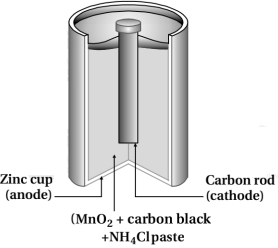
Dry Cell (Leclanché Cell):
It is the most common example of a primary battery.
Uses: It is commonly used in transistors,toys,and clocks.
Construction:
Anode: The cell consists of a zinc container that acts as the anode.
Cathode: The cathode is a carbon (graphite) rod,which is placed vertically in the center of the zinc cylinder.
Electrolyte: The space between the electrodes is filled with a moist paste of ammonium chloride $(NH_{4}Cl)$ and zinc chloride $(ZnCl_{2})$. The carbon rod is surrounded by a mixture of powdered manganese dioxide $(MnO_{2})$ and carbon.
Reactions:
Oxidation at the anode:
$Zn_{(s)} \rightarrow Zn^{2+} + 2e^{-}$
Reduction at the cathode:
$MnO_{2} + NH_{4}^{+} + e^{-} \rightarrow MnO(OH) + NH_{3}$
The $Zn^{2+}$ ions produced react with $NH_{3}$ to form a complex,$[Zn(NH_{3})_{4}]^{2+}$.
Overall cell reaction:
$Zn_{(s)} + 2MnO_{2} + 2NH_{4}^{+} \rightarrow Zn^{2+} + 2MnO(OH) + 2NH_{3}$
Cell potential: The potential of this cell is approximately $1.5 \ V$.
Dry Cell (Leclanché Cell):
It is the most common example of a primary battery.
Uses: It is commonly used in transistors,toys,and clocks.
Construction:
Anode: The cell consists of a zinc container that acts as the anode.
Cathode: The cathode is a carbon (graphite) rod,which is placed vertically in the center of the zinc cylinder.
Electrolyte: The space between the electrodes is filled with a moist paste of ammonium chloride $(NH_{4}Cl)$ and zinc chloride $(ZnCl_{2})$. The carbon rod is surrounded by a mixture of powdered manganese dioxide $(MnO_{2})$ and carbon.
Reactions:
Oxidation at the anode:
$Zn_{(s)} \rightarrow Zn^{2+} + 2e^{-}$
Reduction at the cathode:
$MnO_{2} + NH_{4}^{+} + e^{-} \rightarrow MnO(OH) + NH_{3}$
The $Zn^{2+}$ ions produced react with $NH_{3}$ to form a complex,$[Zn(NH_{3})_{4}]^{2+}$.
Overall cell reaction:
$Zn_{(s)} + 2MnO_{2} + 2NH_{4}^{+} \rightarrow Zn^{2+} + 2MnO(OH) + 2NH_{3}$
Cell potential: The potential of this cell is approximately $1.5 \ V$.
0 likes
View Solution234
Difficult
Write a note on mercury cell $(Zn-Hg)$.
Solution
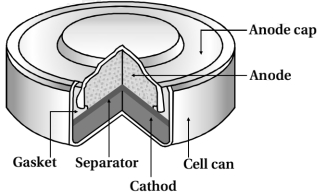
(N/A) This cell is an example of a primary cell. Its construction is as follows:
Construction: As shown in the diagram,
Anode: It consists of zinc-mercury amalgam.
Cathode: $A$ paste of $HgO$ and carbon.
Electrolyte: $A$ moist paste of $KOH$ and $ZnO$.
Reaction: The electrode reactions are given below:
Oxidation of $Zn$ in the zinc-mercury amalgam occurs at the anode:
$(i) \ Zn(Hg) + 2 OH^{-} \rightarrow ZnO_{(s)} + H_{2}O + 2 e^{-}$
Reduction of $HgO$ occurs at the cathode:
$(ii) \ HgO_{(s)} + H_{2}O + 2 e^{-} \rightarrow Hg_{(l)} + 2 OH^{-}$
The overall cell reaction is:
$(iii) \ Zn(Hg) + HgO_{(s)} \rightarrow ZnO_{(s)} + Hg_{(l)}$
In this cell,$Zn$ is oxidized and acts as a reducing agent,while $HgO$ is reduced and acts as an oxidizing agent.
Cell potential and characterization: The cell potential is approximately $1.35 \ V$ and remains constant throughout its life because the overall reaction does not involve any ions in the solution whose concentration changes during its operation.
Uses: Mercury cells are suitable for low-current devices like hearing aids,watches,etc.
Construction: As shown in the diagram,
Anode: It consists of zinc-mercury amalgam.
Cathode: $A$ paste of $HgO$ and carbon.
Electrolyte: $A$ moist paste of $KOH$ and $ZnO$.
Reaction: The electrode reactions are given below:
Oxidation of $Zn$ in the zinc-mercury amalgam occurs at the anode:
$(i) \ Zn(Hg) + 2 OH^{-} \rightarrow ZnO_{(s)} + H_{2}O + 2 e^{-}$
Reduction of $HgO$ occurs at the cathode:
$(ii) \ HgO_{(s)} + H_{2}O + 2 e^{-} \rightarrow Hg_{(l)} + 2 OH^{-}$
The overall cell reaction is:
$(iii) \ Zn(Hg) + HgO_{(s)} \rightarrow ZnO_{(s)} + Hg_{(l)}$
In this cell,$Zn$ is oxidized and acts as a reducing agent,while $HgO$ is reduced and acts as an oxidizing agent.
Cell potential and characterization: The cell potential is approximately $1.35 \ V$ and remains constant throughout its life because the overall reaction does not involve any ions in the solution whose concentration changes during its operation.
Uses: Mercury cells are suitable for low-current devices like hearing aids,watches,etc.
0 likes
View Solution235
Medium
What is a secondary cell? Give examples of it.
Solution
(N/A) secondary cell is a type of electrochemical cell that can be recharged after use by passing an electric current through it in the opposite direction,allowing it to be used again.
$(i)$ $A$ good secondary cell can undergo a large number of discharging and charging cycles.
$(ii)$ The most important examples of secondary cells are the lead storage battery and the $Ni-Cd$ cell.
$(i)$ $A$ good secondary cell can undergo a large number of discharging and charging cycles.
$(ii)$ The most important examples of secondary cells are the lead storage battery and the $Ni-Cd$ cell.
0 likes
View Solution236
Advanced
Write a note on lead storage cell (battery).
Solution
(N/A) The most important secondary cell is the lead storage battery. It can be recharged after its discharge.
Construction:
Anode: It consists of a grid of lead packed with spongy lead $(Pb)$.
Cathode: $A$ grid of lead packed with lead dioxide $(PbO_2)$.
Electrolyte: $A$ $38\%$ solution of sulphuric acid $(H_2SO_4)$ is used as an electrolyte.
(Density: initial $1.25$ to $1.30 \ g \ mL^{-1}$)
Discharging reaction of the cell:
When the cell is in working condition,the following reactions are carried out:
Anode: Oxidation of $Pb$ into $PbSO_4$.
$(i) \ Pb_{(s)} + SO_{4(aq)}^{2-} \rightarrow PbSO_{4(s)} + 2e^{-}$
Cathode: Reduction of $PbO_2$ into $PbSO_4$.
$(ii) \ PbO_{2(s)} + SO_{4(aq)}^{2-} + 4H^+_{(aq)} + 2e^- \rightarrow PbSO_{4(s)} + 2H_2O_{(l)}$
Overall reaction: Adding $(i)$ and $(ii)$ gives the overall reaction of the lead storage cell:
$(iii) \ Pb_{(s)} + PbO_{2(s)} + 2H_2SO_{4(aq)} \rightarrow 2PbSO_{4(s)} + 2H_2O_{(l)}$
Construction:
Anode: It consists of a grid of lead packed with spongy lead $(Pb)$.
Cathode: $A$ grid of lead packed with lead dioxide $(PbO_2)$.
Electrolyte: $A$ $38\%$ solution of sulphuric acid $(H_2SO_4)$ is used as an electrolyte.
(Density: initial $1.25$ to $1.30 \ g \ mL^{-1}$)
Discharging reaction of the cell:
When the cell is in working condition,the following reactions are carried out:
Anode: Oxidation of $Pb$ into $PbSO_4$.
$(i) \ Pb_{(s)} + SO_{4(aq)}^{2-} \rightarrow PbSO_{4(s)} + 2e^{-}$
Cathode: Reduction of $PbO_2$ into $PbSO_4$.
$(ii) \ PbO_{2(s)} + SO_{4(aq)}^{2-} + 4H^+_{(aq)} + 2e^- \rightarrow PbSO_{4(s)} + 2H_2O_{(l)}$
Overall reaction: Adding $(i)$ and $(ii)$ gives the overall reaction of the lead storage cell:
$(iii) \ Pb_{(s)} + PbO_{2(s)} + 2H_2SO_{4(aq)} \rightarrow 2PbSO_{4(s)} + 2H_2O_{(l)}$
0 likes
View Solution237
Difficult
Write a note on the $Ni-Cd$ cell.
Solution
(N/A) The $Ni-Cd$ cell is a secondary cell,meaning it is rechargeable.
Construction:
It consists of a cadmium anode and a metal grid containing nickel$(IV)$ oxide $(NiO_2)$ as the cathode. The electrolyte is an aqueous solution of potassium hydroxide $(KOH)$.
Cell Reactions:
The overall discharging reaction is:
$Cd_{(s)} + 2NiO(OH)_{(s)} + 2H_2O_{(l)} \rightarrow Cd(OH)_{2_{(s)}} + 2Ni(OH)_{2_{(s)}}$
During discharge,cadmium is oxidized to $Cd(OH)_2$ at the anode,and nickel$(IV)$ oxide is reduced to nickel$(II)$ hydroxide at the cathode.
Characteristics:
It has a longer life than the lead storage cell but is more expensive to manufacture.
Construction:
It consists of a cadmium anode and a metal grid containing nickel$(IV)$ oxide $(NiO_2)$ as the cathode. The electrolyte is an aqueous solution of potassium hydroxide $(KOH)$.
Cell Reactions:
The overall discharging reaction is:
$Cd_{(s)} + 2NiO(OH)_{(s)} + 2H_2O_{(l)} \rightarrow Cd(OH)_{2_{(s)}} + 2Ni(OH)_{2_{(s)}}$
During discharge,cadmium is oxidized to $Cd(OH)_2$ at the anode,and nickel$(IV)$ oxide is reduced to nickel$(II)$ hydroxide at the cathode.
Characteristics:
It has a longer life than the lead storage cell but is more expensive to manufacture.
0 likes
View Solution238
EasyMCQ
What is a battery?
A
$A$ device that converts chemical energy into electrical energy.
B
$A$ device that converts electrical energy into chemical energy.
C
$A$ device that converts mechanical energy into electrical energy.
D
$A$ device that converts thermal energy into electrical energy.
Solution
(A) battery is essentially an electrochemical cell or a combination of electrochemical cells connected in series that can be used as a source of direct electric current at a constant voltage.
It converts stored chemical energy into electrical energy through redox reactions.
It converts stored chemical energy into electrical energy through redox reactions.
0 likes
View Solution239
Medium
Write reactions for the followings :
$1.$ Anode reaction of dry cell.
$2.$ Reduction reaction of dry cell.
$1.$ Anode reaction of dry cell.
$2.$ Reduction reaction of dry cell.
Solution
(N/A) In a dry cell (Leclanché cell),the reactions are as follows:
$1.$ Anode reaction (Oxidation of zinc):
$Zn(s) \rightarrow Zn^{2+}(aq) + 2e^-$
$2.$ Cathode reaction (Reduction of manganese dioxide):
$2MnO_2(s) + 2NH_4^+(aq) + 2e^- \rightarrow Mn_2O_3(s) + 2NH_3(g) + H_2O(l)$
$1.$ Anode reaction (Oxidation of zinc):
$Zn(s) \rightarrow Zn^{2+}(aq) + 2e^-$
$2.$ Cathode reaction (Reduction of manganese dioxide):
$2MnO_2(s) + 2NH_4^+(aq) + 2e^- \rightarrow Mn_2O_3(s) + 2NH_3(g) + H_2O(l)$
0 likes
View Solution240
Difficult
Write the reactions for the following:
$1.$ Oxidation and reduction reactions of a lead storage cell.
$2.$ Cell reaction of a $Ni-Cd$ cell.
$3.$ Anode,cathode,and overall reaction of a mercury cell.
$1.$ Oxidation and reduction reactions of a lead storage cell.
$2.$ Cell reaction of a $Ni-Cd$ cell.
$3.$ Anode,cathode,and overall reaction of a mercury cell.
Solution
$1.$ Lead storage cell:
Anode (Oxidation): $Pb(s) + SO_4^{2-}(aq) \rightarrow PbSO_4(s) + 2e^-$
Cathode (Reduction): $PbO_2(s) + SO_4^{2-}(aq) + 4H^+(aq) + 2e^- \rightarrow PbSO_4(s) + 2H_2O(l)$
$2.$ $Ni-Cd$ cell:
Cell reaction: $Cd(s) + 2Ni(OH)_3(s) \rightarrow CdO(s) + 2Ni(OH)_2(s) + H_2O(l)$
$3.$ Mercury cell:
Anode (Oxidation): $Zn(Hg) + 2OH^-(aq) \rightarrow ZnO(s) + H_2O(l) + 2e^-$
Cathode (Reduction): $HgO(s) + H_2O(l) + 2e^- \rightarrow Hg(l) + 2OH^-(aq)$
Overall reaction: $Zn(Hg) + HgO(s) \rightarrow ZnO(s) + Hg(l)$
Anode (Oxidation): $Pb(s) + SO_4^{2-}(aq) \rightarrow PbSO_4(s) + 2e^-$
Cathode (Reduction): $PbO_2(s) + SO_4^{2-}(aq) + 4H^+(aq) + 2e^- \rightarrow PbSO_4(s) + 2H_2O(l)$
$2.$ $Ni-Cd$ cell:
Cell reaction: $Cd(s) + 2Ni(OH)_3(s) \rightarrow CdO(s) + 2Ni(OH)_2(s) + H_2O(l)$
$3.$ Mercury cell:
Anode (Oxidation): $Zn(Hg) + 2OH^-(aq) \rightarrow ZnO(s) + H_2O(l) + 2e^-$
Cathode (Reduction): $HgO(s) + H_2O(l) + 2e^- \rightarrow Hg(l) + 2OH^-(aq)$
Overall reaction: $Zn(Hg) + HgO(s) \rightarrow ZnO(s) + Hg(l)$
0 likes
View Solution241
MediumMCQ
What are the uses of the $Ni-Cd$ cell?
A
Used in calculators
B
Used in electronic watches
C
Used in cordless appliances and cameras
D
Used in hearing aids
Solution
(C) The $Ni-Cd$ (Nickel-Cadmium) cell is a type of rechargeable battery.
It has a longer life than the lead storage cell.
It is commonly used in cordless appliances,cameras,and various portable electronic devices.
It has a longer life than the lead storage cell.
It is commonly used in cordless appliances,cameras,and various portable electronic devices.
0 likes
View Solution242
Easy
Give the uses of the mercury cell.
Solution
(N/A) Mercury cells are primarily used in low-current devices such as hearing aids,watches,and cameras.
0 likes
View Solution243
Difficult
In which cell,construction like a galvanic cell can be observed? Explain.
Solution
(N/A) fuel cell is a device that converts chemical energy directly into electrical energy and possesses a construction similar to a galvanic cell.
Construction: In fuel cells,reactants are fed continuously to the electrodes,and products are removed continuously from the electrolyte compartment. These cells are designed to convert the energy of combustion of fuels like $H_2$,$CH_4$,or $CH_3OH$ directly into electrical energy.
Advantages of fuel cells:
$(i)$ There is no air or noise pollution.
$(ii)$ Fuel cells have high efficiency of $70 \%$ or more,whereas thermal power stations have low efficiency of $40 \%$ or less.
$(iii)$ Various types of fuels can be used in fuel cells.
Construction: In fuel cells,reactants are fed continuously to the electrodes,and products are removed continuously from the electrolyte compartment. These cells are designed to convert the energy of combustion of fuels like $H_2$,$CH_4$,or $CH_3OH$ directly into electrical energy.
Advantages of fuel cells:
$(i)$ There is no air or noise pollution.
$(ii)$ Fuel cells have high efficiency of $70 \%$ or more,whereas thermal power stations have low efficiency of $40 \%$ or less.
$(iii)$ Various types of fuels can be used in fuel cells.
0 likes
View Solution244
EasyMCQ
If $6$ batteries are connected in series in a car,and each battery has a potential of $2 \ V$,what is the total voltage of the battery system (in $V$)?
A
$6$
B
$12$
C
$24$
D
$36$
Solution
(B) In a car,lead-acid batteries are typically connected in series to achieve the required voltage.
Each lead-acid cell provides approximately $2 \ V$.
$A$ standard car battery consists of $6$ such cells connected in series.
Total voltage = $6 \times 2 \ V = 12 \ V$.
Each lead-acid cell provides approximately $2 \ V$.
$A$ standard car battery consists of $6$ such cells connected in series.
Total voltage = $6 \times 2 \ V = 12 \ V$.
0 likes
View Solution245
EasyMCQ
What is the chemical reaction that occurs during the discharging of a lead storage cell?
A
$Pb + PbO_2 + 2H_2SO_4 \rightarrow 2PbSO_4 + 2H_2O$
B
$2PbSO_4 + 2H_2O \rightarrow Pb + PbO_2 + 2H_2SO_4$
C
$Pb + PbO_2 \rightarrow 2PbO$
D
$PbSO_4 + 2H_2O \rightarrow PbO_2 + H_2SO_4$
Solution
(A) During the discharging of a lead storage cell,the lead anode $(Pb)$ and the lead dioxide cathode $(PbO_2)$ react with sulfuric acid $(H_2SO_4)$ to form lead sulfate $(PbSO_4)$ and water $(H_2O)$.
The overall cell reaction is:
$Pb_{(s)} + PbO_{2(s)} + 2H_2SO_{4(aq)} \rightarrow 2PbSO_{4(s)} + 2H_2O_{(l)}$
The overall cell reaction is:
$Pb_{(s)} + PbO_{2(s)} + 2H_2SO_{4(aq)} \rightarrow 2PbSO_{4(s)} + 2H_2O_{(l)}$
0 likes
View Solution246
EasyMCQ
What are the common uses of a dry cell?
A
Used in wall clocks and wristwatches.
B
Used in toys and remote controls.
C
Used in flashlights and portable radios.
D
All of the above.
Solution
(D) dry cell (Leclanché cell) is a primary cell that is portable and provides a steady voltage.
It is commonly used in low-drain electronic devices such as:
$1$. Wall clocks and wristwatches.
$2$. Toys and remote controls.
$3$. Flashlights and portable radios.
Therefore,all the given options are correct applications of a dry cell.
It is commonly used in low-drain electronic devices such as:
$1$. Wall clocks and wristwatches.
$2$. Toys and remote controls.
$3$. Flashlights and portable radios.
Therefore,all the given options are correct applications of a dry cell.
0 likes
View Solution247
EasyMCQ
Give the uses of the lead storage cell.
A
Used in automobiles and inverters.
B
Used in digital watches.
C
Used in hearing aids.
D
Used in pacemakers.
Solution
(A) The lead storage cell is a secondary battery. Its primary uses are:
$1$. It is widely used in automobiles (cars,trucks) to start the engine and power electrical systems.
$2$. It is used in inverters to provide backup power during electricity outages.
$1$. It is widely used in automobiles (cars,trucks) to start the engine and power electrical systems.
$2$. It is used in inverters to provide backup power during electricity outages.
0 likes
View Solution248
MediumMCQ
Determine True $(T)$ or False $(F)$ :
$1.$ In a battery,the conversion of electric energy into chemical energy is carried out.
$2.$ Batteries are current-generating instruments.
$1.$ In a battery,the conversion of electric energy into chemical energy is carried out.
$2.$ Batteries are current-generating instruments.
A
$1-T, 2-T$
B
$1-F, 2-T$
C
$1-T, 2-F$
D
$1-F, 2-F$
Solution
(B) $1.$ False: $A$ battery (galvanic or voltaic cell) converts chemical energy into electrical energy,not vice versa. The conversion of electrical energy into chemical energy occurs in an electrolytic cell.
$2.$ True: Batteries act as a source of electrical energy by converting stored chemical energy into current.
$2.$ True: Batteries act as a source of electrical energy by converting stored chemical energy into current.
0 likes
View Solution249
DifficultMCQ
Determine True $(T)$ or False $(F)$ :
$1.$ Life of Nickel-Cadmium cell is less than lead storage cell.
$2.$ Dry cell is secondary cell while nickel-cadmium cell is primary cell.
$3.$ Both dry cell and nickel-cadmium cells are primary cell.
$1.$ Life of Nickel-Cadmium cell is less than lead storage cell.
$2.$ Dry cell is secondary cell while nickel-cadmium cell is primary cell.
$3.$ Both dry cell and nickel-cadmium cells are primary cell.
A
$1-F, 2-F, 3-F$
B
$1-T, 2-T, 3-T$
C
$1-F, 2-T, 3-F$
D
$1-T, 2-F, 3-T$
Solution
(A) $1.$ False: The life of a Nickel-Cadmium cell is longer than that of a lead storage cell because it can be recharged many times.
$2.$ False: $A$ dry cell is a primary cell (non-rechargeable),while a Nickel-Cadmium cell is a secondary cell (rechargeable).
$3.$ False: $A$ dry cell is a primary cell,but a Nickel-Cadmium cell is a secondary cell.
$2.$ False: $A$ dry cell is a primary cell (non-rechargeable),while a Nickel-Cadmium cell is a secondary cell (rechargeable).
$3.$ False: $A$ dry cell is a primary cell,but a Nickel-Cadmium cell is a secondary cell.
0 likes
View Solution250
Medium
What is a fuel cell? Write a note on it.
Solution
(N/A) fuel cell is a galvanic cell that converts the chemical energy of fuels directly into electrical energy.
Construction: In fuel cells,reactants are fed continuously to the electrodes,and products are removed continuously from the electrolyte compartment. These cells are designed to convert the energy of combustion of fuels like $H_2$,$CH_4$,$CH_3OH$,etc.,directly into electrical energy.
Advantages of fuel cell:
$(i)$ There is no air or noise pollution.
(ii) Fuel cells have a high efficiency of $70 \%$ or more,whereas thermal power stations have a low efficiency of $40 \%$ or less.
(iii) Various fuels can be used in fuel cells.
Construction: In fuel cells,reactants are fed continuously to the electrodes,and products are removed continuously from the electrolyte compartment. These cells are designed to convert the energy of combustion of fuels like $H_2$,$CH_4$,$CH_3OH$,etc.,directly into electrical energy.
Advantages of fuel cell:
$(i)$ There is no air or noise pollution.
(ii) Fuel cells have a high efficiency of $70 \%$ or more,whereas thermal power stations have a low efficiency of $40 \%$ or less.
(iii) Various fuels can be used in fuel cells.
0 likes
View SolutionElectrochemistry — Electrochemical cells · Frequently Asked Questions
1Are these Electrochemistry questions useful for JEE and NEET?
Yes. All questions in this section are mapped to JEE Main and NEET exam patterns. Previous year questions from JEE Main, NEET, GUJCET and state-level exams are included with full solutions.
2Can I switch to Hindi or Gujarati for these questions?
Yes. Use the language tabs in the hero section or the sidebar to view the same questions and solutions in English, Hindi or Gujarati.
3How do I generate a question paper from this subtopic?
Use the Vedclass Exam Paper Generator — select the chapter and subtopic, set difficulty, and generate Sets A, B, C, D automatically. First 3 chapters of every subject are free.
Vedclass Products
For Students
Vedclass Test Series
Mock tests in real JEE/NEET style with performance analysis. 5-day free trial.
Start Free TrialFor Teachers
Exam Paper Generator
Generate Set A/B/C/D papers from this chapter in 2 minutes. 3 chapters free.
Try FreeFor Institutes
Online Exam Module
Live online exams with unlimited students, 360° analytics & white-label branding.
See DemoFor Teachers & Institutes
Generate a Electrochemistry Exam Paper in 2 Minutes
Select subtopic & difficulty — Sets A, B, C, D auto-generated with No Repeat logic.
First 3 chapters of every subject are free — no payment required.