
A English
Lanthanoids and Actinoids Questions in English
Class 12 Chemistry · d-and f-Block Elements · Lanthanoids and Actinoids
339+
Questions
English
Language
100%
With Solutions
Showing 50 of 339 questions in English
151
Difficult
Explain lanthanoid contraction in detail. What is lanthanoid contraction? What are its consequences?
Solution
(N/A) $1$. Definition: The steady decrease in the atomic and ionic radii of lanthanoids with an increase in atomic number is known as lanthanoid contraction.
$2$. Cause: It is due to the imperfect shielding of one $4f$ electron by another in the same subshell. As the nuclear charge increases by $1$ unit at each step,the $4f$ electrons fail to shield the outer electrons effectively from the increased nuclear attraction,leading to a contraction in size.
$3$. Consequences:
$(a)$ Similarity in properties: Elements of the second and third transition series (e.g.,$Zr$ and $Hf$) have almost identical atomic radii due to lanthanoid contraction.
$(b)$ Difficulty in separation: Due to the similarity in ionic radii and chemical properties,it is very difficult to separate lanthanoids from their mixtures.
$(c)$ Basic strength: The basic strength of lanthanoid hydroxides decreases from $La(OH)_3$ to $Lu(OH)_3$ as the size decreases and covalent character increases.
$2$. Cause: It is due to the imperfect shielding of one $4f$ electron by another in the same subshell. As the nuclear charge increases by $1$ unit at each step,the $4f$ electrons fail to shield the outer electrons effectively from the increased nuclear attraction,leading to a contraction in size.
$3$. Consequences:
$(a)$ Similarity in properties: Elements of the second and third transition series (e.g.,$Zr$ and $Hf$) have almost identical atomic radii due to lanthanoid contraction.
$(b)$ Difficulty in separation: Due to the similarity in ionic radii and chemical properties,it is very difficult to separate lanthanoids from their mixtures.
$(c)$ Basic strength: The basic strength of lanthanoid hydroxides decreases from $La(OH)_3$ to $Lu(OH)_3$ as the size decreases and covalent character increases.
0 likes
View Solution152
Easy
Explain the lanthanoid contraction.
Solution
(N/A) The steady decrease in the atomic and ionic radii of lanthanoids with an increase in atomic number from $La$ $(Z=57)$ to $Lu$ $(Z=71)$ is known as lanthanoid contraction.
This phenomenon occurs due to the imperfect shielding of one $4f$ electron by another in the same subshell.
As the atomic number increases,the nuclear charge increases by one unit at each step,while the new electron enters the $4f$ orbital.
The $4f$ orbitals have a very diffuse shape and poor shielding effect,which is unable to compensate for the increased nuclear attraction on the outer electrons.
Consequently,the effective nuclear charge increases,pulling the electron cloud closer to the nucleus,resulting in a gradual decrease in atomic and ionic sizes.
This phenomenon occurs due to the imperfect shielding of one $4f$ electron by another in the same subshell.
As the atomic number increases,the nuclear charge increases by one unit at each step,while the new electron enters the $4f$ orbital.
The $4f$ orbitals have a very diffuse shape and poor shielding effect,which is unable to compensate for the increased nuclear attraction on the outer electrons.
Consequently,the effective nuclear charge increases,pulling the electron cloud closer to the nucleus,resulting in a gradual decrease in atomic and ionic sizes.
0 likes
View Solution153
Difficult
Explain $f$-block elements of the periodic table in detail.
Solution
(N/A) The two rows of elements at the bottom of the Periodic Table,called the Lanthanoids,$Ce$ $(Z = 58)$ to $Lu$ $(Z = 71)$ and Actinoids,$Th$ $(Z = 90)$ to $Lr$ $(Z = 103)$,are characterized by the outer electronic configuration $(n-2)f^{1-14}(n-1)d^{0-1}ns^{2}$.
The last electron added to each element is filled in the $f$-orbital.
These two series of elements are hence called the Inner-Transition Elements ($f$-Block Elements).
They are all metals,and within each series,the properties of the elements are quite similar.
The chemistry of the early actinoids is more complicated than the corresponding lanthanoids due to the large number of oxidation states possible for these actinoid elements.
Actinoid elements are radioactive. Many of the actinoid elements have been synthesized only in nanogram quantities or less via nuclear reactions,and their chemistry is not fully studied.
The elements after uranium $(Z = 92)$ are called Transuranium Elements.
The last electron added to each element is filled in the $f$-orbital.
These two series of elements are hence called the Inner-Transition Elements ($f$-Block Elements).
They are all metals,and within each series,the properties of the elements are quite similar.
The chemistry of the early actinoids is more complicated than the corresponding lanthanoids due to the large number of oxidation states possible for these actinoid elements.
Actinoid elements are radioactive. Many of the actinoid elements have been synthesized only in nanogram quantities or less via nuclear reactions,and their chemistry is not fully studied.
The elements after uranium $(Z = 92)$ are called Transuranium Elements.
0 likes
View Solution154
Medium
State the general electronic configuration of lanthanoids. Why are there irregularities in the electronic configuration of lanthanoids?
Solution
(N/A) The general electronic configuration of lanthanoids is $[Xe] 4f^{1-14} 5d^{0-1} 6s^{2}$.
Reason for irregularities:
The irregularities in electronic configurations arise because the energy difference between the $4f$ and $5d$ orbitals is very small.
Consequently,the incoming electron can enter either the $4f$ or the $5d$ orbital.
In lanthanoids,$f$-orbitals are generally filled successively with an increase in atomic number.
However,in elements like Lanthanum $(La)$,Gadolinium $(Gd)$,and Lutetium $(Lu)$,one electron is present in the $5d$ orbital.
These irregularities are due to the extra stability associated with empty $(f^{0})$,half-filled $(f^{7})$,and fully-filled $(f^{14})$ $f$-orbital configurations,respectively.
As Lanthanum and Lutetium possess one $5d$ electron,they are sometimes classified as group $3$ elements.
Reason for irregularities:
The irregularities in electronic configurations arise because the energy difference between the $4f$ and $5d$ orbitals is very small.
Consequently,the incoming electron can enter either the $4f$ or the $5d$ orbital.
In lanthanoids,$f$-orbitals are generally filled successively with an increase in atomic number.
However,in elements like Lanthanum $(La)$,Gadolinium $(Gd)$,and Lutetium $(Lu)$,one electron is present in the $5d$ orbital.
These irregularities are due to the extra stability associated with empty $(f^{0})$,half-filled $(f^{7})$,and fully-filled $(f^{14})$ $f$-orbital configurations,respectively.
As Lanthanum and Lutetium possess one $5d$ electron,they are sometimes classified as group $3$ elements.
0 likes
View Solution155
Medium
Provide the primary differences (comparison) between Lanthanoids and Actinoids.
Solution
(N/A) The differences between Lanthanoids and Actinoids are as follows:
| Feature | Lanthanoids | Actinoids |
| :--- | :--- | :--- |
| $(1)$ | They are elements of the $4f$ series. | They are elements of the $5f$ series. |
| $(2)$ | Their general symbol is $Ln$. | Their general symbol is $An$. |
| $(3)$ | They consist of $14$ elements of $4f$ plus Lanthanum,totaling $15$ elements. | They consist of $14$ elements of $5f$ plus Actinium,totaling $15$ elements. |
| $(4)$ | Lanthanoids show greater similarity among themselves compared to transition elements. | Actinoids show less similarity among themselves compared to Lanthanoids. |
| $(5)$ | These elements primarily exhibit a single oxidation state $(+3)$. | These elements exhibit a wide range of oxidation states. |
| $(6)$ | The chemistry of these elements is simpler due to small changes in size and nuclear charge across the series. | The chemistry of Actinoids is much more complex due to the wide range of oxidation states and radioactivity. |
| Feature | Lanthanoids | Actinoids |
| :--- | :--- | :--- |
| $(1)$ | They are elements of the $4f$ series. | They are elements of the $5f$ series. |
| $(2)$ | Their general symbol is $Ln$. | Their general symbol is $An$. |
| $(3)$ | They consist of $14$ elements of $4f$ plus Lanthanum,totaling $15$ elements. | They consist of $14$ elements of $5f$ plus Actinium,totaling $15$ elements. |
| $(4)$ | Lanthanoids show greater similarity among themselves compared to transition elements. | Actinoids show less similarity among themselves compared to Lanthanoids. |
| $(5)$ | These elements primarily exhibit a single oxidation state $(+3)$. | These elements exhibit a wide range of oxidation states. |
| $(6)$ | The chemistry of these elements is simpler due to small changes in size and nuclear charge across the series. | The chemistry of Actinoids is much more complex due to the wide range of oxidation states and radioactivity. |
0 likes
View Solution156
Difficult
Provide the electronic configurations of lanthanoids $(4f)$ series elements $(Ln)$ and their ions $Ln^{2+}$ and $Ln^{3+}$,and state their characteristics.
Solution
(A) The electronic configurations of the $15$ elements from Lanthanum $(La, Z=57)$ to Lutetium $(Lu, Z=71)$ and their $+2$ and $+3$ ions are summarized in the table below. Only electrons outside the $[Xe]$ core are shown.
| Atomic Number | Name | Symbol | $Ln$ | $Ln^{2+}$ | $Ln^{3+}$ |
| :--- | :--- | :--- | :--- | :--- | :--- |
| $57$ | Lanthanum | $La$ | $5d^1 6s^2$ | $5d^1$ | $4f^0$ |
| $58$ | Cerium | $Ce$ | $4f^1 5d^1 6s^2$ | $4f^2$ | $4f^1$ |
| $59$ | Praseodymium | $Pr$ | $4f^3 6s^2$ | $4f^3$ | $4f^2$ |
| $60$ | Neodymium | $Nd$ | $4f^4 6s^2$ | $4f^4$ | $4f^3$ |
| $61$ | Promethium | $Pm$ | $4f^5 6s^2$ | $4f^5$ | $4f^4$ |
| $62$ | Samarium | $Sm$ | $4f^6 6s^2$ | $4f^6$ | $4f^5$ |
| $63$ | Europium | $Eu$ | $4f^7 6s^2$ | $4f^7$ | $4f^6$ |
| $64$ | Gadolinium | $Gd$ | $4f^7 5d^1 6s^2$ | $4f^7 5d^1$ | $4f^7$ |
| $65$ | Terbium | $Tb$ | $4f^9 6s^2$ | $4f^9$ | $4f^8$ |
| $66$ | Dysprosium | $Dy$ | $4f^{10} 6s^2$ | $4f^{10}$ | $4f^9$ |
| $67$ | Holmium | $Ho$ | $4f^{11} 6s^2$ | $4f^{11}$ | $4f^{10}$ |
| $68$ | Erbium | $Er$ | $4f^{12} 6s^2$ | $4f^{12}$ | $4f^{11}$ |
| $69$ | Thulium | $Tm$ | $4f^{13} 6s^2$ | $4f^{13}$ | $4f^{12}$ |
| $70$ | Ytterbium | $Yb$ | $4f^{14} 6s^2$ | $4f^{14}$ | $4f^{13}$ |
| $71$ | Lutetium | $Lu$ | $4f^{14} 5d^1 6s^2$ | $4f^{14} 5d^1$ | $4f^{14}$ |
Characteristics:
$1$. All lanthanoids have a $6s^2$ configuration in their neutral state.
$2$. $Gd$ and $Eu$ exhibit stable half-filled $4f^7$ subshells.
$3$. $Lu$ and $Yb$ exhibit stable fully-filled $4f^{14}$ subshells.
| Atomic Number | Name | Symbol | $Ln$ | $Ln^{2+}$ | $Ln^{3+}$ |
| :--- | :--- | :--- | :--- | :--- | :--- |
| $57$ | Lanthanum | $La$ | $5d^1 6s^2$ | $5d^1$ | $4f^0$ |
| $58$ | Cerium | $Ce$ | $4f^1 5d^1 6s^2$ | $4f^2$ | $4f^1$ |
| $59$ | Praseodymium | $Pr$ | $4f^3 6s^2$ | $4f^3$ | $4f^2$ |
| $60$ | Neodymium | $Nd$ | $4f^4 6s^2$ | $4f^4$ | $4f^3$ |
| $61$ | Promethium | $Pm$ | $4f^5 6s^2$ | $4f^5$ | $4f^4$ |
| $62$ | Samarium | $Sm$ | $4f^6 6s^2$ | $4f^6$ | $4f^5$ |
| $63$ | Europium | $Eu$ | $4f^7 6s^2$ | $4f^7$ | $4f^6$ |
| $64$ | Gadolinium | $Gd$ | $4f^7 5d^1 6s^2$ | $4f^7 5d^1$ | $4f^7$ |
| $65$ | Terbium | $Tb$ | $4f^9 6s^2$ | $4f^9$ | $4f^8$ |
| $66$ | Dysprosium | $Dy$ | $4f^{10} 6s^2$ | $4f^{10}$ | $4f^9$ |
| $67$ | Holmium | $Ho$ | $4f^{11} 6s^2$ | $4f^{11}$ | $4f^{10}$ |
| $68$ | Erbium | $Er$ | $4f^{12} 6s^2$ | $4f^{12}$ | $4f^{11}$ |
| $69$ | Thulium | $Tm$ | $4f^{13} 6s^2$ | $4f^{13}$ | $4f^{12}$ |
| $70$ | Ytterbium | $Yb$ | $4f^{14} 6s^2$ | $4f^{14}$ | $4f^{13}$ |
| $71$ | Lutetium | $Lu$ | $4f^{14} 5d^1 6s^2$ | $4f^{14} 5d^1$ | $4f^{14}$ |
Characteristics:
$1$. All lanthanoids have a $6s^2$ configuration in their neutral state.
$2$. $Gd$ and $Eu$ exhibit stable half-filled $4f^7$ subshells.
$3$. $Lu$ and $Yb$ exhibit stable fully-filled $4f^{14}$ subshells.
0 likes
View Solution157
Advanced
Describe the atomic and ionic radii of lanthanoids and explain lanthanoid contraction.
Solution
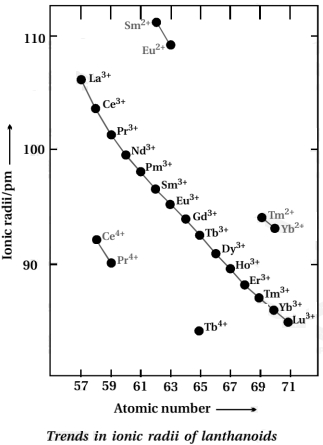
(N/A) The atomic and ionic radii of lanthanoid elements $(Ln)$ and their ions $(Ln^{3+})$ show a steady decrease from lanthanum $(La)$ to lutetium $(Lu)$.
This overall decrease in atomic and ionic radii is known as lanthanoid contraction.
It occurs because the $4f$ electrons are added one by one,and they provide poor shielding for the outer electrons from the increasing nuclear charge.
Consequently,the effective nuclear charge increases,pulling the electron cloud closer to the nucleus,resulting in a decrease in size.
This overall decrease in atomic and ionic radii is known as lanthanoid contraction.
It occurs because the $4f$ electrons are added one by one,and they provide poor shielding for the outer electrons from the increasing nuclear charge.
Consequently,the effective nuclear charge increases,pulling the electron cloud closer to the nucleus,resulting in a decrease in size.
0 likes
View Solution158
Advanced
Write a note on oxidation states shown by lanthanoids.
Solution
(N/A) In lanthanoids,$Ln(II)$ and $Ln(III)$ compounds are dominant species. However,occasionally $(+2)$ and $(+4)$ ions in solution or in solid compounds are also obtained. This irregularity is because of extra stability of $f^{0}, f^{7}$ and $f^{14}$ orbitals.
In aqueous solution,$Sm^{2+}, Yb^{2+}$ and $Eu^{2+}$ act as strong reducing agents as these ions readily get oxidized to $(+3)$ state because of higher stability in $(+3)$ oxidation state.
Elements $Pr, Nd, Tb$ and $Dy$ show $(+4)$ oxidation state but only in oxides $MO_{2}$. $Tb(IV)$ has half-filled $f$-orbitals and it is an oxidant.
$Ce(IV)$ is a very good analytical reagent. The $E^{\circ}$ value of $Ce^{4+}/Ce^{3+}$ is $+1.74 \ V$,which suggests that $Ce^{4+}$ is a very good oxidizing agent and easily gets reduced to $Ce^{3+}$. It can even oxidize water. However,the reaction rate is very slow.
In aqueous solution,$Sm^{2+}, Yb^{2+}$ and $Eu^{2+}$ act as strong reducing agents as these ions readily get oxidized to $(+3)$ state because of higher stability in $(+3)$ oxidation state.
Elements $Pr, Nd, Tb$ and $Dy$ show $(+4)$ oxidation state but only in oxides $MO_{2}$. $Tb(IV)$ has half-filled $f$-orbitals and it is an oxidant.
$Ce(IV)$ is a very good analytical reagent. The $E^{\circ}$ value of $Ce^{4+}/Ce^{3+}$ is $+1.74 \ V$,which suggests that $Ce^{4+}$ is a very good oxidizing agent and easily gets reduced to $Ce^{3+}$. It can even oxidize water. However,the reaction rate is very slow.
0 likes
View Solution159
Advanced
State the $E^o$ values of lanthanoids and provide their reactions with the following: $(i)$ $H_2$,$(ii)$ Carbon,$(iii)$ Dilute acid,$(iv)$ Halogens,$(v)$ $O_2$,and $(vi)$ $H_2O$.
Solution
(A) Similarity of lanthanoids with $Ca$ and $Al$: Generally,the early members of the lanthanoid series are highly reactive,similar to calcium,but as the atomic number increases,they behave more like aluminum.
Electrode potential of lanthanoids:
Half-reaction: $Ln^{3+}_{(aq)} + 3e^- \rightarrow Ln_{(s)}$
The $E^o_{Ln^{3+}/Ln}$ values range from $-2.2 \ V$ to $-2.24 \ V$,except for $Eu$,where $E^o_{Eu^{3+}/Eu} = -2.0 \ V$.
Chemical reactions of lanthanoids:
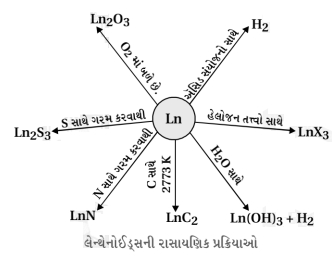
$(i)$ When lanthanoids are heated with hydrogen gas,they form hydrides: $2Ln + 3H_2 \rightarrow 2LnH_3$.
$(ii)$ Heating lanthanoids with carbon forms carbides: $Ln + C \xrightarrow{2773 \ K} Ln_3C, Ln_2C_3, LnC_2$.
$(iii)$ Lanthanoids react with dilute acids to liberate hydrogen gas: $2Ln_{(s)} + 6H^+_{(aq)} \rightarrow 2Ln^{3+}_{(aq)} + 3H_{2(g)}$.
$(iv)$ They burn in halogens $(X_2)$ to form halides: $2Ln + 3X_2 \rightarrow 2LnX_3$.
$(v)$ They burn in $O_2$ to form oxides: $4Ln + 3O_2 \rightarrow 2Ln_2O_3$.
$(vi)$ They react with water to form hydroxides: $2Ln + 6H_2O \rightarrow 2Ln(OH)_3 + 3H_2$.
Electrode potential of lanthanoids:
Half-reaction: $Ln^{3+}_{(aq)} + 3e^- \rightarrow Ln_{(s)}$
The $E^o_{Ln^{3+}/Ln}$ values range from $-2.2 \ V$ to $-2.24 \ V$,except for $Eu$,where $E^o_{Eu^{3+}/Eu} = -2.0 \ V$.
Chemical reactions of lanthanoids:
$(i)$ When lanthanoids are heated with hydrogen gas,they form hydrides: $2Ln + 3H_2 \rightarrow 2LnH_3$.
$(ii)$ Heating lanthanoids with carbon forms carbides: $Ln + C \xrightarrow{2773 \ K} Ln_3C, Ln_2C_3, LnC_2$.
$(iii)$ Lanthanoids react with dilute acids to liberate hydrogen gas: $2Ln_{(s)} + 6H^+_{(aq)} \rightarrow 2Ln^{3+}_{(aq)} + 3H_{2(g)}$.
$(iv)$ They burn in halogens $(X_2)$ to form halides: $2Ln + 3X_2 \rightarrow 2LnX_3$.
$(v)$ They burn in $O_2$ to form oxides: $4Ln + 3O_2 \rightarrow 2Ln_2O_3$.
$(vi)$ They react with water to form hydroxides: $2Ln + 6H_2O \rightarrow 2Ln(OH)_3 + 3H_2$.
0 likes
View Solution160
Difficult
Describe the general chemical reactions of lanthanoids with the help of a diagram and state their uses.
Solution
(N/A) The general chemical reactions of lanthanoids $(Ln)$ are shown in the diagram below.
$(i)$ Lanthanoids are used in the production of alloy steels for plates and pipes.
$(ii)$ Mischmetall: It is a well-known alloy consisting of about $95 \%$ lanthanoid metal and about $5 \%$ iron,along with traces of $S, C, Ca,$ and $Al$.
Uses: $A$ large quantity of Mischmetall is used in $Mg$-based alloys. It is used to produce bullets,shells,and lighter flints.
$(iii)$ Uses of mixed oxides of lanthanoids: Mixed oxides are used as catalysts in petroleum cracking. Some lanthanoid oxides are used as phosphors in television screens and in fluorescent surfaces.
$(i)$ Lanthanoids are used in the production of alloy steels for plates and pipes.
$(ii)$ Mischmetall: It is a well-known alloy consisting of about $95 \%$ lanthanoid metal and about $5 \%$ iron,along with traces of $S, C, Ca,$ and $Al$.
Uses: $A$ large quantity of Mischmetall is used in $Mg$-based alloys. It is used to produce bullets,shells,and lighter flints.
$(iii)$ Uses of mixed oxides of lanthanoids: Mixed oxides are used as catalysts in petroleum cracking. Some lanthanoid oxides are used as phosphors in television screens and in fluorescent surfaces.
0 likes
View Solution161
MediumMCQ
What are the products formed when lanthanoids $(Ln)$ react with $1$. $H_2O$ and $2$. $N_2$?
A
$1$. $Ln(OH)_3$,$2$. $LnN$
B
$1$. $LnO_2$,$2$. $Ln_3N_4$
C
$1$. $Ln_2O_3$,$2$. $LnN_2$
D
$1$. $Ln(OH)_2$,$2$. $Ln_2N_3$
Solution
(A) Lanthanoids are highly reactive metals.
$1$. When lanthanoids $(Ln)$ react with water $(H_2O)$,they liberate hydrogen gas and form hydroxides: $2Ln + 6H_2O \rightarrow 2Ln(OH)_3 + 3H_2$.
$2$. When lanthanoids react with nitrogen $(N_2)$ upon heating,they form nitrides: $2Ln + N_2 \rightarrow 2LnN$.
$1$. When lanthanoids $(Ln)$ react with water $(H_2O)$,they liberate hydrogen gas and form hydroxides: $2Ln + 6H_2O \rightarrow 2Ln(OH)_3 + 3H_2$.
$2$. When lanthanoids react with nitrogen $(N_2)$ upon heating,they form nitrides: $2Ln + N_2 \rightarrow 2LnN$.
0 likes
View Solution162
MediumMCQ
Write a reaction with lanthanoids $(Ln)$:
A
$Ln + C \rightarrow Ln_x C_y$
B
$Ln + S \rightarrow Ln_2 S_3$
C
Both $A$ and $B$
D
None of these
Solution
(C) Lanthanoids $(Ln)$ react with non-metals like carbon $(C)$ and sulfur $(S)$ upon heating to form carbides $(Ln_x C_y)$ and sulfides $(Ln_2 S_3)$.
0 likes
View Solution163
EasyMCQ
What are the elements of the $f$-block called?
A
Transition elements
B
Inner transition elements
C
Representative elements
D
Noble gases
Solution
(B) The elements in which the last electron enters the $f$-orbital are known as $f$-block elements. These elements are also referred to as inner transition elements because they are placed inside the transition series ($d$-block) in the periodic table.
0 likes
View Solution164
EasyMCQ
How many elements are there in the $4f$ series?
A
$10$
B
$14$
C
$15$
D
$7$
Solution
(B) The $4f$ series,also known as the lanthanoid series,consists of elements from atomic number $58$ $(Ce)$ to $71$ $(Lu)$.
There are $14$ elements in the $4f$ series.
There are $14$ elements in the $4f$ series.
0 likes
View Solution165
Difficult
Fill in the blanks:
$1.$ The atomic radii of the elements of the third transition series are .......... to those of the corresponding elements of the second transition series.
$2.$ Samarium melts at .......... $K$.
$3.$ The color of lanthanoid ions is due to the presence of .......... electrons.
$1.$ The atomic radii of the elements of the third transition series are .......... to those of the corresponding elements of the second transition series.
$2.$ Samarium melts at .......... $K$.
$3.$ The color of lanthanoid ions is due to the presence of .......... electrons.
Solution
(N/A) $1.$ The atomic radii of the elements of the third transition series are almost identical to those of the corresponding elements of the second transition series due to lanthanoid contraction.
$2.$ Samarium melts at $1347 \ K$.
$3.$ The color of lanthanoid ions is due to the presence of $f$-electrons (specifically $f-f$ transitions).
$2.$ Samarium melts at $1347 \ K$.
$3.$ The color of lanthanoid ions is due to the presence of $f$-electrons (specifically $f-f$ transitions).
0 likes
View Solution166
DifficultMCQ
Determine the correct $(T)$ and incorrect $(F)$ statements from the following:
$(a)$ $Lu^{3+}$ and $Yb^{2+}$ are not paramagnetic.
$(b)$ Sheets are made from mischmetal.
$(c)$ Pipes are made from mischmetal.
$(a)$ $Lu^{3+}$ and $Yb^{2+}$ are not paramagnetic.
$(b)$ Sheets are made from mischmetal.
$(c)$ Pipes are made from mischmetal.
A
$(a) T, (b) F, (c) F$
B
$(a) F, (b) T, (c) T$
C
$(a) T, (b) T, (c) T$
D
$(a) F, (b) F, (c) F$
Solution
(A) $Lu^{3+}$ $([Xe]4f^{14}5d^0)$ and $Yb^{2+}$ $([Xe]4f^{14}5d^0)$ have fully filled $4f$ orbitals,so they are diamagnetic (not paramagnetic). This statement is True $(T)$.
$(b)$ Mischmetal is an alloy of lanthanoids (about $95\%$) and iron (about $5\%$) with traces of $S, C, Ca,$ and $Al$. It is brittle and used primarily for making lighter flints and bullet tips,not for making sheets. This statement is False $(F)$.
$(c)$ Due to its brittle nature,mischmetal cannot be used to manufacture pipes. This statement is False $(F)$.
$(b)$ Mischmetal is an alloy of lanthanoids (about $95\%$) and iron (about $5\%$) with traces of $S, C, Ca,$ and $Al$. It is brittle and used primarily for making lighter flints and bullet tips,not for making sheets. This statement is False $(F)$.
$(c)$ Due to its brittle nature,mischmetal cannot be used to manufacture pipes. This statement is False $(F)$.
0 likes
View Solution167
MediumMCQ
Determine the correct $(T)$ and incorrect $(F)$ statements from the following:
$(a)$ Mischmetal contains lanthanoids and iron.
$(b)$ The symbol for Cerium is $Cs$.
$(c)$ The symbol for Cerium is $Ce$.
$(a)$ Mischmetal contains lanthanoids and iron.
$(b)$ The symbol for Cerium is $Cs$.
$(c)$ The symbol for Cerium is $Ce$.
A
$(a)-T, (b)-F, (c)-T$
B
$(a)-F, (b)-T, (c)-F$
C
$(a)-T, (b)-T, (c)-F$
D
$(a)-F, (b)-F, (c)-T$
Solution
(A) Mischmetal is an alloy consisting of a lanthanoid metal $(\approx 95\%)$,iron $(\approx 5\%)$,and traces of $S, C, Ca,$ and $Al$. Thus,statement $(a)$ is True $(T)$.
The symbol for Cerium is $Ce$,while $Cs$ is the symbol for Cesium. Thus,statement $(b)$ is False $(F)$.
The symbol for Cerium is $Ce$. Thus,statement $(c)$ is True $(T)$.
Therefore,the correct sequence is $(a)-T, (b)-F, (c)-T$.
The symbol for Cerium is $Ce$,while $Cs$ is the symbol for Cesium. Thus,statement $(b)$ is False $(F)$.
The symbol for Cerium is $Ce$. Thus,statement $(c)$ is True $(T)$.
Therefore,the correct sequence is $(a)-T, (b)-F, (c)-T$.
0 likes
View Solution168
DifficultMCQ
Determine the correct $(T)$ and incorrect $(F)$ statements from the following:
$(a)$ The symbol for Lanthanum is $La$.
$(b)$ The name of the element $Lu$ is Lanthanum.
$(c)$ The electronic configuration of $La^{3+}$ and $Ce^{4+}$ contains $4f^0$.
$(a)$ The symbol for Lanthanum is $La$.
$(b)$ The name of the element $Lu$ is Lanthanum.
$(c)$ The electronic configuration of $La^{3+}$ and $Ce^{4+}$ contains $4f^0$.
A
$T, F, T$
B
$F, T, T$
C
$T, T, F$
D
$F, F, T$
Solution
(A) Statement $(a)$ is true: The symbol for Lanthanum is $La$.
Statement $(b)$ is false: The element $Lu$ is Lutetium,not Lanthanum.
Statement $(c)$ is true: The atomic number of $La$ is $57$ $([Xe] 5d^1 6s^2)$,so $La^{3+}$ is $[Xe] 4f^0$. The atomic number of $Ce$ is $58$ $([Xe] 4f^1 5d^1 6s^2)$,so $Ce^{4+}$ is $[Xe] 4f^0$.
Therefore,the sequence is $T, F, T$.
Statement $(b)$ is false: The element $Lu$ is Lutetium,not Lanthanum.
Statement $(c)$ is true: The atomic number of $La$ is $57$ $([Xe] 5d^1 6s^2)$,so $La^{3+}$ is $[Xe] 4f^0$. The atomic number of $Ce$ is $58$ $([Xe] 4f^1 5d^1 6s^2)$,so $Ce^{4+}$ is $[Xe] 4f^0$.
Therefore,the sequence is $T, F, T$.
0 likes
View Solution169
Difficult
Write the atomic number,name,symbol,and electronic configuration of Actinium and the Actinoids.
Solution
(N/A) $(i)$ The atomic number,name,symbol,and electronic configuration of $Ac$ and $14$ Actinoids are given in the table below:
$(ii)$ It is assumed that all Actinoids have a $7s^2$ electronic configuration,and the $5f$ and $6d$ subshells are filled differently.
$14$ electrons can be filled in $5f$ orbitals.
Thorium $(Th)$,$Z=90$ has $5f^0$,but from Protactinium $(Pa)$,$Z=91$ onwards,electrons are filled in the $5f$ subshell,and finally,in Lawrencium $(Lr)$,$Z=103$,the $5f$ orbitals are completely filled with a $5f^{14}$ configuration.
| Atomic Number $(Z)$ | Symbol | Name | Electronic Configuration |
|---|---|---|---|
| $89$ | $Ac$ | Actinium | $[Rn]^{86} 6d^1 7s^2$ |
| $90$ | $Th$ | Thorium | $[Rn]^{86} 6d^2 7s^2$ |
| $91$ | $Pa$ | Protactinium | $[Rn]^{86} 5f^2 6d^1 7s^2$ |
| $92$ | $U$ | Uranium | $[Rn]^{86} 5f^3 6d^1 7s^2$ |
| $93$ | $Np$ | Neptunium | $[Rn]^{86} 5f^4 6d^1 7s^2$ |
| $94$ | $Pu$ | Plutonium | $[Rn]^{86} 5f^6 7s^2$ |
| $95$ | $Am$ | Americium | $[Rn]^{86} 5f^7 7s^2$ |
| $96$ | $Cm$ | Curium | $[Rn]^{86} 5f^7 6d^1 7s^2$ |
| $97$ | $Bk$ | Berkelium | $[Rn]^{86} 5f^9 7s^2$ |
| $98$ | $Cf$ | Californium | $[Rn]^{86} 5f^{10} 7s^2$ |
| $99$ | $Es$ | Einsteinium | $[Rn]^{86} 5f^{11} 7s^2$ |
| $100$ | $Fm$ | Fermium | $[Rn]^{86} 5f^{12} 7s^2$ |
| $101$ | $Md$ | Mendelevium | $[Rn]^{86} 5f^{13} 7s^2$ |
| $102$ | $No$ | Nobelium | $[Rn]^{86} 5f^{14} 7s^2$ |
| $103$ | $Lr$ | Lawrencium | $[Rn]^{86} 5f^{14} 6d^1 7s^2$ |
$(ii)$ It is assumed that all Actinoids have a $7s^2$ electronic configuration,and the $5f$ and $6d$ subshells are filled differently.
$14$ electrons can be filled in $5f$ orbitals.
Thorium $(Th)$,$Z=90$ has $5f^0$,but from Protactinium $(Pa)$,$Z=91$ onwards,electrons are filled in the $5f$ subshell,and finally,in Lawrencium $(Lr)$,$Z=103$,the $5f$ orbitals are completely filled with a $5f^{14}$ configuration.
0 likes
View Solution170
Advanced
Explain the size of actinoid elements and their ions.
Solution
(N/A) $(i)$ In the actinoid series, the size of atoms and $M^{3+}$ ions decreases gradually with an increase in atomic number.
$(ii)$ Actinoid Contraction: The gradual decrease in the size of atoms and ions of actinoids is known as actinoid contraction. This contraction occurs because of the poor shielding effect of $5f$ electrons, which increases from one element to the next.
$(iii)$ The radii (in $pm$) of some $M^{3+}$ and $M^{4+}$ ions are given in the table below:
$(iv)$ These elements are radioactive, making their study difficult.
$(ii)$ Actinoid Contraction: The gradual decrease in the size of atoms and ions of actinoids is known as actinoid contraction. This contraction occurs because of the poor shielding effect of $5f$ electrons, which increases from one element to the next.
$(iii)$ The radii (in $pm$) of some $M^{3+}$ and $M^{4+}$ ions are given in the table below:
| Atomic Number $(Z)$ | Name/Symbol | $M^{3+}$ $(pm)$ | $M^{4+}$ $(pm)$ |
|---|---|---|---|
| $89$ | Actinium $(Ac)$ | $111$ | - |
| $90$ | Thorium $(Th)$ | - | $99$ |
| $91$ | Protactinium $(Pa)$ | - | $96$ |
| $92$ | Uranium $(U)$ | $103$ | $93$ |
| $93$ | Neptunium $(Np)$ | $101$ | $92$ |
| $94$ | Plutonium $(Pu)$ | $100$ | $90$ |
| $95$ | Americium $(Am)$ | $99$ | $89$ |
| $96$ | Curium $(Cm)$ | $99$ | $88$ |
| $97$ | Berkelium $(Bk)$ | $98$ | $87$ |
| $98$ | Californium $(Cf)$ | $98$ | $86$ |
$(iv)$ These elements are radioactive, making their study difficult.
0 likes
View Solution171
Advanced
Discuss the trends in oxidation states shown by actinoids.
Solution
(N/A) Compared to lanthanoids,actinoids exhibit a greater range of oxidation states because the $5f$,$6d$,and $7s$ energy levels are of comparable energies.
In actinoids,the $5f$ orbitals extend further from the nucleus than the $4f$ orbitals in lanthanoids,allowing them to participate in chemical bonding,whereas $4f$ orbitals are shielded by outer electrons.
Actinoids generally show a $(+3)$ oxidation state.
The elements in the first half of the series frequently exhibit higher oxidation states. For example,the maximum oxidation state increases from $(+4)$ in $Th$ to $(+5)$,$(+6)$,and $(+7)$ in $Pa$,$U$,and $Np$ respectively,but decreases in the succeeding elements.
Actinoids resemble lanthanoids in having more compounds in the $(+3)$ state than in the $(+4)$ state. However,both $(+3)$ and $(+4)$ ions tend to hydrolyze.
| Element | Oxidation States |
| :--- | :--- |
| $Ac$ | $3$ |
| $Th$ | $3, 4$ |
| $Pa$ | $3, 4, 5$ |
| $U$ | $3, 4, 5, 6$ |
| $Np$ | $3, 4, 5, 6, 7$ |
| $Pu$ | $3, 4, 5, 6, 7$ |
| $Am$ | $3, 4, 5, 6$ |
| $Cm$ | $3, 4$ |
| $Bk$ | $3, 4$ |
| $Cf$ | $3$ |
| $Es$ | $3$ |
| $Fm$ | $3$ |
| $Md$ | $3$ |
| $No$ | $3$ |
| $Lr$ | $3$ |
In actinoids,the $5f$ orbitals extend further from the nucleus than the $4f$ orbitals in lanthanoids,allowing them to participate in chemical bonding,whereas $4f$ orbitals are shielded by outer electrons.
Actinoids generally show a $(+3)$ oxidation state.
The elements in the first half of the series frequently exhibit higher oxidation states. For example,the maximum oxidation state increases from $(+4)$ in $Th$ to $(+5)$,$(+6)$,and $(+7)$ in $Pa$,$U$,and $Np$ respectively,but decreases in the succeeding elements.
Actinoids resemble lanthanoids in having more compounds in the $(+3)$ state than in the $(+4)$ state. However,both $(+3)$ and $(+4)$ ions tend to hydrolyze.
| Element | Oxidation States |
| :--- | :--- |
| $Ac$ | $3$ |
| $Th$ | $3, 4$ |
| $Pa$ | $3, 4, 5$ |
| $U$ | $3, 4, 5, 6$ |
| $Np$ | $3, 4, 5, 6, 7$ |
| $Pu$ | $3, 4, 5, 6, 7$ |
| $Am$ | $3, 4, 5, 6$ |
| $Cm$ | $3, 4$ |
| $Bk$ | $3, 4$ |
| $Cf$ | $3$ |
| $Es$ | $3$ |
| $Fm$ | $3$ |
| $Md$ | $3$ |
| $No$ | $3$ |
| $Lr$ | $3$ |
0 likes
View Solution172
Difficult
Discuss similarities and dissimilarities in properties of lanthanoids and actinoids.
Solution
(N/A) Points of similarities:
$1$. Both show a common oxidation state of $+3$.
$2$. Both show a contraction in ionic size in the tripositive state along the series.
$3$. Both exhibit paramagnetism.
$4$. Both are electropositive and highly reactive.
$5$. Both form coloured ions.
Points of dissimilarities:
$1$. The dissimilarities arise because of: $(i)$ Lower binding energy of $5f$ electrons compared to $4f$ electrons. $(ii)$ Poorer shielding effect of $5f$ electrons compared to $4f$ electrons.
$2$. Actinoids show a large number of oxidation states (up to $+7$),while lanthanoids show a maximum oxidation state of $+4$.
$3$. All actinoids are radioactive,whereas among lanthanoids,only promethium $(Pm)$ is radioactive.
$4$. Outer electrons in actinoids are more easily available for bonding.
$5$. Actinoids form oxo-anions (e.g.,$UO_{2}^{2+}$),while lanthanoids do not form oxo-anions.
$6$. Actinoids react with non-metals at moderate temperatures,whereas lanthanoids require high temperatures.
$1$. Both show a common oxidation state of $+3$.
$2$. Both show a contraction in ionic size in the tripositive state along the series.
$3$. Both exhibit paramagnetism.
$4$. Both are electropositive and highly reactive.
$5$. Both form coloured ions.
Points of dissimilarities:
$1$. The dissimilarities arise because of: $(i)$ Lower binding energy of $5f$ electrons compared to $4f$ electrons. $(ii)$ Poorer shielding effect of $5f$ electrons compared to $4f$ electrons.
$2$. Actinoids show a large number of oxidation states (up to $+7$),while lanthanoids show a maximum oxidation state of $+4$.
$3$. All actinoids are radioactive,whereas among lanthanoids,only promethium $(Pm)$ is radioactive.
$4$. Outer electrons in actinoids are more easily available for bonding.
$5$. Actinoids form oxo-anions (e.g.,$UO_{2}^{2+}$),while lanthanoids do not form oxo-anions.
$6$. Actinoids react with non-metals at moderate temperatures,whereas lanthanoids require high temperatures.
0 likes
View Solution173
EasyMCQ
Which electronic configuration is common to all actinoid elements?
A
[Rn] $5f^{1-14} 6d^{0-1} 7s^2$
B
[Rn] $5f^{0-14} 6d^{0-2} 7s^2$
C
[Rn] $5f^{1-14} 6d^1 7s^2$
D
[Rn] $5f^{0-14} 6d^1 7s^2$
Solution
(B) The general electronic configuration of actinoids is represented as $[Rn] \ 5f^{0-14} \ 6d^{0-2} \ 7s^2$.
This configuration accounts for the filling of the $5f$ orbitals,the variable occupancy of the $6d$ orbitals,and the stable $7s^2$ shell present in all actinoid elements.
This configuration accounts for the filling of the $5f$ orbitals,the variable occupancy of the $6d$ orbitals,and the stable $7s^2$ shell present in all actinoid elements.
0 likes
View Solution174
EasyMCQ
Which actinoid elements have a $5f^{14}$ electronic configuration in their atoms?
A
$Th$ and $Pa$
B
$Am$ and $Cm$
C
$No$ and $Lr$
D
$U$ and $Np$
Solution
(C) The electronic configuration of actinoids follows the filling of the $5f$ orbital.
As we move across the actinoid series,the $5f$ orbitals are progressively filled.
The element $No$ (Nobelium,$Z=102$) has the configuration $[Rn] 5f^{14} 7s^2$.
The element $Lr$ (Lawrencium,$Z=103$) has the configuration $[Rn] 5f^{14} 6d^1 7s^2$.
Therefore,both $No$ and $Lr$ possess a $5f^{14}$ configuration.
As we move across the actinoid series,the $5f$ orbitals are progressively filled.
The element $No$ (Nobelium,$Z=102$) has the configuration $[Rn] 5f^{14} 7s^2$.
The element $Lr$ (Lawrencium,$Z=103$) has the configuration $[Rn] 5f^{14} 6d^1 7s^2$.
Therefore,both $No$ and $Lr$ possess a $5f^{14}$ configuration.
0 likes
View Solution175
EasyMCQ
Which orbitals,$4f$ or $5f$,are more capable of participating in bond formation?
A
$4f$ orbitals
B
$5f$ orbitals
C
Both $4f$ and $5f$ participate equally
D
Neither $4f$ nor $5f$ participate in bond formation
Solution
(B) The $5f$ orbitals are more capable of participating in bond formation than $4f$ orbitals.
This is because the $5f$ orbitals are less deeply buried (more extended) than the $4f$ orbitals.
As a result,the $5f$ electrons are more accessible for interaction with other atoms to form chemical bonds.
This is because the $5f$ orbitals are less deeply buried (more extended) than the $4f$ orbitals.
As a result,the $5f$ electrons are more accessible for interaction with other atoms to form chemical bonds.
0 likes
View Solution176
Easy
Discuss the trends in oxidation states shown by actinoids.
Solution
(N/A) The actinoids exhibit a greater range of oxidation states compared to the lanthanoids. This is because the $5f$,$6d$,and $7s$ energy levels are of comparable energies.
$1$. The dominant oxidation state of all actinoids is $+3$.
$2$. The early actinoids (like $Th$,$Pa$,$U$,$Np$,$Pu$) show a greater variety of oxidation states,such as $+4, +5, +6$,and even $+7$ for $Np$ and $Pu$.
$3$. As we move along the series,the $+3$ oxidation state becomes more stable due to the increasing effective nuclear charge and the contraction of the $5f$ orbitals.
$4$. The $+3$ oxidation state is the most stable state for the later actinoids.
$1$. The dominant oxidation state of all actinoids is $+3$.
$2$. The early actinoids (like $Th$,$Pa$,$U$,$Np$,$Pu$) show a greater variety of oxidation states,such as $+4, +5, +6$,and even $+7$ for $Np$ and $Pu$.
$3$. As we move along the series,the $+3$ oxidation state becomes more stable due to the increasing effective nuclear charge and the contraction of the $5f$ orbitals.
$4$. The $+3$ oxidation state is the most stable state for the later actinoids.
0 likes
View Solution177
EasyMCQ
What is the maximum oxidation state of $Th$?
A
$+2$
B
$+3$
C
$+4$
D
$+6$
Solution
(C) Thorium $(Th)$ is an actinoid element with the atomic number $90$.
Its electronic configuration is $[Rn] 6d^2 7s^2$.
It can lose all four valence electrons to achieve a stable configuration,resulting in a maximum oxidation state of $+4$.
Its electronic configuration is $[Rn] 6d^2 7s^2$.
It can lose all four valence electrons to achieve a stable configuration,resulting in a maximum oxidation state of $+4$.
0 likes
View Solution178
Difficult
Fill in the blanks:
$1.$ The size of $M^{3+}$ ions in the actinoid series ........... with an increase in atomic number.
$2.$ The common oxidation state of elements in the actinoid series is .......... .
$3.$ The appearance of elements in the actinoid series is like .......... .
$1.$ The size of $M^{3+}$ ions in the actinoid series ........... with an increase in atomic number.
$2.$ The common oxidation state of elements in the actinoid series is .......... .
$3.$ The appearance of elements in the actinoid series is like .......... .
Solution
(N/A) $1.$ The size of $M^{3+}$ ions in the actinoid series decreases with an increase in atomic number due to actinoid contraction.
$2.$ The common oxidation state of elements in the actinoid series is $+3$.
$3.$ The appearance of elements in the actinoid series is like metallic/silvery.
$2.$ The common oxidation state of elements in the actinoid series is $+3$.
$3.$ The appearance of elements in the actinoid series is like metallic/silvery.
0 likes
View Solution179
Advanced
Fill in the blanks:
$1.$ In the elements of the actinoid series,the last electron enters the ........... orbitals.
$2.$ Inner transition elements are the elements of the .......... series.
$3.$ If electrons are filled in the $5f$ series,those elements are called ....... elements.
$4.$ Many elements of the actinoid series are ......... .
$1.$ In the elements of the actinoid series,the last electron enters the ........... orbitals.
$2.$ Inner transition elements are the elements of the .......... series.
$3.$ If electrons are filled in the $5f$ series,those elements are called ....... elements.
$4.$ Many elements of the actinoid series are ......... .
Solution
(N/A) $1.$ The last electron in actinoids enters the $5f$ orbitals.
$2.$ Inner transition elements are the elements of the $f$-block series.
$3.$ Elements in which the $5f$ orbitals are being filled are called actinoids.
$4.$ Many elements of the actinoid series are radioactive.
$2.$ Inner transition elements are the elements of the $f$-block series.
$3.$ Elements in which the $5f$ orbitals are being filled are called actinoids.
$4.$ Many elements of the actinoid series are radioactive.
0 likes
View Solution180
DifficultMCQ
Determine whether the following statements are True $(T)$ or False $(F)$:
$(a)$ Actinoid contraction increases from one element to the next.
$(b)$ Actinoid contraction decreases from one element to the next.
$(c)$ Lanthanoid contraction occurs,but actinoid contraction does not occur.
$(a)$ Actinoid contraction increases from one element to the next.
$(b)$ Actinoid contraction decreases from one element to the next.
$(c)$ Lanthanoid contraction occurs,but actinoid contraction does not occur.
A
$(a) T, (b) F, (c) F$
B
$(a) F, (b) T, (c) F$
C
$(a) F, (b) F, (c) T$
D
$(a) T, (b) T, (c) T$
Solution
(A) Statement $(a)$ is True $(T)$: Actinoid contraction is the steady decrease in the atomic and ionic radii of actinoids as the atomic number increases,which becomes more pronounced from one element to the next.
Statement $(b)$ is False $(F)$: Since the contraction is cumulative,it does not decrease; it is observed consistently across the series.
Statement $(c)$ is False $(F)$: Actinoid contraction is a well-documented phenomenon,similar to lanthanoid contraction,caused by the poor shielding effect of $5f$ electrons.
Statement $(b)$ is False $(F)$: Since the contraction is cumulative,it does not decrease; it is observed consistently across the series.
Statement $(c)$ is False $(F)$: Actinoid contraction is a well-documented phenomenon,similar to lanthanoid contraction,caused by the poor shielding effect of $5f$ electrons.
0 likes
View Solution181
Difficult
Determine whether the following statements are True $(T)$ or False $(F)$:
$(a)$ Actinoid contraction is greater than lanthanoid contraction.
$(b)$ Actinoids are elements of the $4f$ series.
$(c)$ All actinoid elements have a $7s^2$ configuration.
$(a)$ Actinoid contraction is greater than lanthanoid contraction.
$(b)$ Actinoids are elements of the $4f$ series.
$(c)$ All actinoid elements have a $7s^2$ configuration.
Solution
(A) True $(T)$: The shielding effect of $5f$ electrons is poorer than that of $4f$ electrons,leading to a greater contraction in actinoids compared to lanthanoids.
$(b)$ False $(F)$: Actinoids are elements of the $5f$ series,not the $4f$ series.
$(c)$ True $(T)$: All actinoids have a $7s^2$ electronic configuration,while the $5f$ and $6d$ orbitals are progressively filled.
$(b)$ False $(F)$: Actinoids are elements of the $5f$ series,not the $4f$ series.
$(c)$ True $(T)$: All actinoids have a $7s^2$ electronic configuration,while the $5f$ and $6d$ orbitals are progressively filled.
0 likes
View Solution182
DifficultMCQ
Determine whether the following statements are True $(T)$ or False $(F)$:
$(a)$ All actinoid elements have a $7s^1$ configuration.
$(b)$ All actinoid elements have a $7s^0$ configuration.
$(c)$ There are no electrons in the $7s$ orbital of actinoids.
$(a)$ All actinoid elements have a $7s^1$ configuration.
$(b)$ All actinoid elements have a $7s^0$ configuration.
$(c)$ There are no electrons in the $7s$ orbital of actinoids.
A
$(a) T, (b) F, (c) F$
B
$(a) F, (b) F, (c) T$
C
$(a) F, (b) T, (c) F$
D
$(a) F, (b) F, (c) F$
Solution
(D) The general electronic configuration of actinoids is $(5f)^{0-14} (6d)^{0-2} (7s)^2$.
Since all actinoids have two electrons in the $7s$ orbital,statement $(a)$ is False $(F)$ because they do not have $7s^1$.
Statement $(b)$ is False $(F)$ because they do not have $7s^0$.
Statement $(c)$ is False $(F)$ because they have two electrons in the $7s$ orbital.
Therefore,the correct sequence is $(a) F, (b) F, (c) F$.
Since all actinoids have two electrons in the $7s$ orbital,statement $(a)$ is False $(F)$ because they do not have $7s^1$.
Statement $(b)$ is False $(F)$ because they do not have $7s^0$.
Statement $(c)$ is False $(F)$ because they have two electrons in the $7s$ orbital.
Therefore,the correct sequence is $(a) F, (b) F, (c) F$.
0 likes
View Solution183
Medium
Although $(+3)$ oxidation state is the characteristic oxidation state of lanthanoids,cerium shows $(+4)$ oxidation state also. Why?
Solution
(N/A) Cerium ($Ce$,atomic number $58$) has the electronic configuration $[Xe] 4f^1 5d^1 6s^2$.
By losing four electrons,it attains the stable noble gas configuration of Xenon $([Xe])$.
This configuration is highly stable because it corresponds to an empty $4f$ orbital,which is energetically favorable.
Therefore,$Ce^{4+}$ is a stable ion,allowing cerium to exhibit the $(+4)$ oxidation state.
By losing four electrons,it attains the stable noble gas configuration of Xenon $([Xe])$.
This configuration is highly stable because it corresponds to an empty $4f$ orbital,which is energetically favorable.
Therefore,$Ce^{4+}$ is a stable ion,allowing cerium to exhibit the $(+4)$ oxidation state.
0 likes
View Solution184
Medium
Match the element/compound given in List-$I$ with the uses given in List-$II$:
| List-$I$ (Element/Compound) | List-$II$ (Use) |
| $A$. Lanthanoid oxide | $1$. Production of iron alloys |
| $B$. Lanthanoid | $2$. Television screens |
| $C$. Mischmetal | $3$. Petroleum cracking |
| $D$. Magnesium based alloy | $4$. Lanthanoid metal $+$ iron |
| $E$. Mixed lanthanoid oxides | $5$. Bullet tips |
| $6$. $X$-ray screens |
Solution
(A-2, B-1, C-4, D-5, E-3) The correct matches are as follows:
$A \rightarrow 2$ (Lanthanoid oxides are used in television screens).
$B \rightarrow 1$ (Lanthanoids are used in the production of iron alloys).
$C \rightarrow 4$ (Mischmetal consists of a lanthanoid metal and iron).
$D \rightarrow 5$ (Magnesium-based alloys containing lanthanoids are used for bullet tips).
$E \rightarrow 3$ (Mixed lanthanoid oxides are used as catalysts in petroleum cracking).
Therefore,the correct sequence is: $A-2, B-1, C-4, D-5, E-3$.
$A \rightarrow 2$ (Lanthanoid oxides are used in television screens).
$B \rightarrow 1$ (Lanthanoids are used in the production of iron alloys).
$C \rightarrow 4$ (Mischmetal consists of a lanthanoid metal and iron).
$D \rightarrow 5$ (Magnesium-based alloys containing lanthanoids are used for bullet tips).
$E \rightarrow 3$ (Mixed lanthanoid oxides are used as catalysts in petroleum cracking).
Therefore,the correct sequence is: $A-2, B-1, C-4, D-5, E-3$.
0 likes
View Solution185
Medium
Match the properties given in List-$I$ with the elements given in List-$II$:
| List-$I$ (Property) | List-$II$ (Element) |
| $(A)$ Lanthanoid showing $+4$ oxidation state | $(i)$ $Pm$ |
| $(B)$ Lanthanoid showing $+2$ oxidation state | $(ii)$ $Ce$ |
| $(C)$ Radioactive lanthanoid | $(iii)$ $Lu$ |
| $(D)$ Lanthanoid with $4f^7$ configuration in $+3$ state | $(iv)$ $Eu$ |
| $(E)$ Lanthanoid with $4f^{14}$ configuration in $+3$ state | $(v)$ $Gd$ |
| - | $(vi)$ $Dy$ |
Solution
(A) $(A) \rightarrow (ii)$ ($Ce^{4+}$ is stable due to noble gas configuration).
$(B) \rightarrow (iv)$ ($Eu^{2+}$ is stable due to $4f^7$ configuration).
$(C) \rightarrow (i)$ ($Pm$ is the only radioactive lanthanoid).
$(D) \rightarrow (v)$ ($Gd^{3+}$ has $4f^7$ configuration).
$(E) \rightarrow (iii)$ ($Lu^{3+}$ has $4f^{14}$ configuration).
$(B) \rightarrow (iv)$ ($Eu^{2+}$ is stable due to $4f^7$ configuration).
$(C) \rightarrow (i)$ ($Pm$ is the only radioactive lanthanoid).
$(D) \rightarrow (v)$ ($Gd^{3+}$ has $4f^7$ configuration).
$(E) \rightarrow (iii)$ ($Lu^{3+}$ has $4f^{14}$ configuration).
0 likes
View Solution186
EasyMCQ
What are transuranic elements?
A
Elements with atomic number less than $92$
B
Elements with atomic number greater than $92$
C
Elements belonging to the lanthanoid series
D
Elements belonging to the actinoid series only
Solution
(B) Elements that have an atomic number greater than that of uranium $(Z = 92)$ are known as transuranic elements. These are synthetic elements produced by nuclear reactions.
0 likes
View Solution187
Easy
Which elements exhibit nearly identical properties?
Solution
(N/A) The elements of the $f$-block (inner transition elements) exhibit nearly identical properties because the additional electrons enter the $(n-2)f$ orbitals,which are deeply buried and shielded by the outer shells,resulting in very little variation in their chemical behavior across the series.
0 likes
View Solution188
EasyMCQ
Which series of elements are radioactive?
A
Lanthanoids
B
Actinoids
C
Transition metals
D
Alkali metals
Solution
(B) The elements of the $Actinoid$ series are radioactive.
0 likes
View Solution189
EasyMCQ
How and in what quantities are actinoid elements obtained?
A
In large quantities by natural mining.
B
In nanogram or smaller quantities via nuclear reactions.
C
In milligram quantities by chemical synthesis.
D
They are not obtained at all.
Solution
(B) Actinoid elements are obtained in nanogram or smaller quantities through nuclear reactions.
0 likes
View Solution190
Easy
Fill in the blanks given below:
$(i)$ Neptunium and Plutonium are obtained from ............ .
$(ii)$ Lanthanoid series and Actinoid series are known as ............ .
$(iii)$ The main energy level of an atom is called ............ .
$(iv)$ Elements that possess both metallic and non-metallic properties are called ............ .
$(i)$ Neptunium and Plutonium are obtained from ............ .
$(ii)$ Lanthanoid series and Actinoid series are known as ............ .
$(iii)$ The main energy level of an atom is called ............ .
$(iv)$ Elements that possess both metallic and non-metallic properties are called ............ .
Solution
(N/A) $(i)$ Pitchblende
$(ii)$ Inner transition series
$(iii)$ Shell
$(iv)$ Metalloids
$(ii)$ Inner transition series
$(iii)$ Shell
$(iv)$ Metalloids
0 likes
View Solution191
Difficult
On the basis of Lanthanoid contraction,explain the following :
$(i)$ Nature of bonding in $La_2O_3$ and $Lu_2O_3$.
$(ii)$ Trends in the stability of oxo salts of lanthanoids from $La$ to $Lu$.
$(iii)$ Stability of the complexes of lanthanoids.
$(iv)$ Radii of $4d$ and $5d$-block elements.
$(v)$ Trends in acidic character of lanthanoid oxides.
$(i)$ Nature of bonding in $La_2O_3$ and $Lu_2O_3$.
$(ii)$ Trends in the stability of oxo salts of lanthanoids from $La$ to $Lu$.
$(iii)$ Stability of the complexes of lanthanoids.
$(iv)$ Radii of $4d$ and $5d$-block elements.
$(v)$ Trends in acidic character of lanthanoid oxides.
Solution
(N/A) $(i)$ From $La$ to $Lu$,the ionic size decreases. Hence,$La_2O_3$ is more ionic,while $Lu_2O_3$ has more covalent character.
$(ii)$ Due to the decrease in ionic size from $La$ to $Lu$,the stability of oxo-salts decreases.
$(iii)$ As the ionic size decreases,the charge density increases,which leads to an increase in the stability of lanthanoid complexes.
$(iv)$ Due to lanthanoid contraction,the atomic radii of $4d$ and $5d$ transition series elements are nearly identical.
$(v)$ As the ionic size decreases from $La$ to $Lu$,the covalent character of the oxides increases,leading to an increase in their acidic character.
$(ii)$ Due to the decrease in ionic size from $La$ to $Lu$,the stability of oxo-salts decreases.
$(iii)$ As the ionic size decreases,the charge density increases,which leads to an increase in the stability of lanthanoid complexes.
$(iv)$ Due to lanthanoid contraction,the atomic radii of $4d$ and $5d$ transition series elements are nearly identical.
$(v)$ As the ionic size decreases from $La$ to $Lu$,the covalent character of the oxides increases,leading to an increase in their acidic character.
0 likes
View Solution192
Medium
Explain the lanthanoid contraction.
Solution
(N/A) In the lanthanoid series,there is an overall decrease in the atomic and ionic radii as the atomic number increases. This phenomenon is called lanthanoid contraction and is a unique feature in the chemistry of lanthanoids.
Reason for lanthanoid contraction:
As we move from cerium $(Ce)$ to lutetium $(Lu)$,the nuclear charge increases with the increase in atomic number,and electrons are added to the $4f$ orbital successively.
The shielding of one $4f$-electron by another is very poor due to the diffuse shape of $4f$-orbitals,even poorer than that of $d$-electrons.
As a result,the effective nuclear charge experienced by the $4f$-electrons increases,which causes a reduction in the size of the atom or ion.
The nuclear charge steadily increases with the atomic number,and there is a constant decrease in the size of the atom/ion because of the poor shielding effect of the $4f$-electrons. This is known as lanthanoid contraction.
The decrease in size is more pronounced in the case of tripositive ions $(Ln^{3+})$ than in neutral atoms.
Reason for lanthanoid contraction:
As we move from cerium $(Ce)$ to lutetium $(Lu)$,the nuclear charge increases with the increase in atomic number,and electrons are added to the $4f$ orbital successively.
The shielding of one $4f$-electron by another is very poor due to the diffuse shape of $4f$-orbitals,even poorer than that of $d$-electrons.
As a result,the effective nuclear charge experienced by the $4f$-electrons increases,which causes a reduction in the size of the atom or ion.
The nuclear charge steadily increases with the atomic number,and there is a constant decrease in the size of the atom/ion because of the poor shielding effect of the $4f$-electrons. This is known as lanthanoid contraction.
The decrease in size is more pronounced in the case of tripositive ions $(Ln^{3+})$ than in neutral atoms.
0 likes
View Solution193
Difficult
State the consequences of lanthanoid contraction. Explain the formation of coloured ions by lanthanoids.
Solution
(N/A) The consequences of lanthanoid contraction are as follows:
$1$. Similarity in atomic radii: The atomic radii of elements of the second and third transition series are similar (e.g.,$Zr-Hf$,$Nb-Ta$). This makes their separation difficult due to similar chemical properties.
$2$. Ionization enthalpies: The ionization enthalpies of the third transition series are generally higher than those of the second transition series.
$3$. Basic strength of hydroxides: The basic strength of lanthanoid hydroxides decreases from $La(OH)_{3}$ to $Lu(OH)_{3}$ due to the decrease in ionic size,which increases the covalent character.
$4$. Density: Elements of the third transition series exhibit abnormally high densities.
Regarding coloured ions:
Many trivalent lanthanoid ions $(M^{3+})$ are coloured in both solid and aqueous states. This is due to $f-f$ transitions. The absorption bands are narrow. Ions with $4f^{n}$ configuration have the same colour as those with $4f^{(14-n)}$ configuration (e.g.,$Nd^{3+}$ $(4f^{3})$ and $Er^{3+}$ $(4f^{11})$ are both red). Ions with $f^{0}$,$f^{7}$,and $f^{14}$ configurations (e.g.,$La^{3+}$,$Gd^{3+}$,$Lu^{3+}$) are colourless.
$1$. Similarity in atomic radii: The atomic radii of elements of the second and third transition series are similar (e.g.,$Zr-Hf$,$Nb-Ta$). This makes their separation difficult due to similar chemical properties.
$2$. Ionization enthalpies: The ionization enthalpies of the third transition series are generally higher than those of the second transition series.
$3$. Basic strength of hydroxides: The basic strength of lanthanoid hydroxides decreases from $La(OH)_{3}$ to $Lu(OH)_{3}$ due to the decrease in ionic size,which increases the covalent character.
$4$. Density: Elements of the third transition series exhibit abnormally high densities.
Regarding coloured ions:
Many trivalent lanthanoid ions $(M^{3+})$ are coloured in both solid and aqueous states. This is due to $f-f$ transitions. The absorption bands are narrow. Ions with $4f^{n}$ configuration have the same colour as those with $4f^{(14-n)}$ configuration (e.g.,$Nd^{3+}$ $(4f^{3})$ and $Er^{3+}$ $(4f^{11})$ are both red). Ions with $f^{0}$,$f^{7}$,and $f^{14}$ configurations (e.g.,$La^{3+}$,$Gd^{3+}$,$Lu^{3+}$) are colourless.
0 likes
View Solution194
Easy
Although $(+3)$ oxidation state is the characteristic oxidation state of lanthanoids,cerium shows $(+4)$ oxidation state also. Why?
Solution
(N/A) Cerium ($Ce$,atomic number $58$) has the electronic configuration $[Xe] \ 4f^{1} \ 5d^{1} \ 6s^{2}$.
By losing four electrons,it attains the stable noble gas configuration of Xenon $([Xe])$,which is $[Xe] \ 4f^{0} \ 5d^{0} \ 6s^{0}$.
This extra stability associated with the empty $4f$ subshell allows cerium to exhibit the $(+4)$ oxidation state.
By losing four electrons,it attains the stable noble gas configuration of Xenon $([Xe])$,which is $[Xe] \ 4f^{0} \ 5d^{0} \ 6s^{0}$.
This extra stability associated with the empty $4f$ subshell allows cerium to exhibit the $(+4)$ oxidation state.
0 likes
View Solution195
MediumMCQ
The elements with atomic numbers $101$ and $104$ belong to,respectively
A
Group $11$ and Group $4$
B
Actinoids and Group $4$
C
Actinoids and Group $6$
D
Group $6$ and Actinoids
Solution
(B) The element with atomic number $101$ is Mendelevium $(Md)$,which belongs to the Actinoid series (atomic numbers $89-103$).
The element with atomic number $104$ is Rutherfordium $(Rf)$,which is the first element of the $4d$ transition series,belonging to Group $4$ of the periodic table.
The element with atomic number $104$ is Rutherfordium $(Rf)$,which is the first element of the $4d$ transition series,belonging to Group $4$ of the periodic table.
0 likes
View Solution196
MediumMCQ
Mischmetal is an alloy consisting mainly of
A
lanthanoid metals
B
actinoid metals
C
actinoid and transition metals
D
lanthanoid and actinoid metals
Solution
(A) Alloys of lanthanoids with $Fe$ are called Mischmetal.
It consists of a lanthanoid metal $(\sim 95 \%)$ and iron $(\sim 5 \%)$ along with traces of $S, C, Ca$,and $Al$.
It consists of a lanthanoid metal $(\sim 95 \%)$ and iron $(\sim 5 \%)$ along with traces of $S, C, Ca$,and $Al$.
0 likes
View Solution197
MediumMCQ
The lanthanoid that does $NOT$ show $+4$ oxidation state is
A
$Dy$
B
$Eu$
C
$Ce$
D
$Tb$
Solution
(B) The lanthanoids exhibit a common oxidation state of $+3$. However,some elements show $+2$ or $+4$ oxidation states due to stable electronic configurations (like $f^0$,$f^7$,or $f^{14}$).
$Ce$ $(Z=58)$ shows $+4$ to achieve a stable $f^0$ configuration.
$Tb$ $(Z=65)$ shows $+4$ to achieve a stable $f^7$ configuration.
$Dy$ $(Z=66)$ can show $+4$ in certain compounds.
$Eu$ $(Z=63)$ shows $+2$ oxidation state to achieve a stable $f^7$ configuration,but it does not exhibit a $+4$ oxidation state.
$Ce$ $(Z=58)$ shows $+4$ to achieve a stable $f^0$ configuration.
$Tb$ $(Z=65)$ shows $+4$ to achieve a stable $f^7$ configuration.
$Dy$ $(Z=66)$ can show $+4$ in certain compounds.
$Eu$ $(Z=63)$ shows $+2$ oxidation state to achieve a stable $f^7$ configuration,but it does not exhibit a $+4$ oxidation state.
0 likes
View Solution198
MediumMCQ
Identify the incorrect statement from the following:
A
The overall decrease in atomic and ionic radii from lanthanum to lutetium is called lanthanoid contraction.
B
Zirconium and Hafnium have identical radii of $160 \; pm$ and $159 \; pm$, respectively, as a consequence of lanthanoid contraction.
C
Lanthanoids reveal only $+3$ oxidation state.
D
The lanthanoid ions other than the $f^{0}$ type and the $f^{14}$ type are all paramagnetic.
Solution
(C) Lanthanoids exhibit a primary oxidation state of $+3$. However, they can also show $+2$ or $+4$ oxidation states in certain solutions or solid compounds.
Therefore, the statement that they reveal only $+3$ oxidation state is incorrect.
Therefore, the statement that they reveal only $+3$ oxidation state is incorrect.
0 likes
View Solution199
DifficultMCQ
Given below are two statements: one is labelled as Assertion $A$ and the other is labelled as Reason $R$:
Assertion $A$: Size of $Bk^{3+}$ ion is less than $Np^{3+}$ ion.
Reason $R$: The above is a consequence of the lanthanoid contraction.
In the light of the above statements,choose the correct answer from the options given below:
Assertion $A$: Size of $Bk^{3+}$ ion is less than $Np^{3+}$ ion.
Reason $R$: The above is a consequence of the lanthanoid contraction.
In the light of the above statements,choose the correct answer from the options given below:
A
$A$ is false but $R$ is true
B
Both $A$ and $R$ are true but $R$ is not the correct explanation of $A$
C
Both $A$ and $R$ are true and $R$ is the correct explanation of $A$
D
$A$ is true but $R$ is false
Solution
(D) In the actinide series,the ionic radius decreases from left to right due to actinoid contraction,which is similar to lanthanoid contraction.
Since $Bk$ (atomic number $97$) comes after $Np$ (atomic number $93$) in the actinide series,the size of the $Bk^{3+}$ ion is smaller than that of the $Np^{3+}$ ion.
Therefore,Assertion $A$ is true.
However,the decrease in size in the actinide series is due to actinoid contraction,not lanthanoid contraction. Thus,Reason $R$ is false.
Since $Bk$ (atomic number $97$) comes after $Np$ (atomic number $93$) in the actinide series,the size of the $Bk^{3+}$ ion is smaller than that of the $Np^{3+}$ ion.
Therefore,Assertion $A$ is true.
However,the decrease in size in the actinide series is due to actinoid contraction,not lanthanoid contraction. Thus,Reason $R$ is false.
0 likes
View Solution200
MediumMCQ
Arrange the following metal complexes/compounds in the increasing order of spin-only magnetic moment. Presume all three are high-spin systems.
(Atomic numbers: $Ce = 58$,$Gd = 64$,and $Eu = 63$.)
$(a)$ $(NH_4)_2[Ce(NO_3)_6]$
$(b)$ $Gd(NO_3)_3$
$(c)$ $Eu(NO_3)_3$
Answer is:
(Atomic numbers: $Ce = 58$,$Gd = 64$,and $Eu = 63$.)
$(a)$ $(NH_4)_2[Ce(NO_3)_6]$
$(b)$ $Gd(NO_3)_3$
$(c)$ $Eu(NO_3)_3$
Answer is:
A
$(b) < (a) < (c)$
B
$(c) < (a) < (b)$
C
$(a) < (b) < (c)$
D
$(a) < (c) < (b)$
Solution
(D) $_{58}Ce \rightarrow [Xe] 4f^1 5d^1 6s^2$. In the complex,$Ce^{4+} \rightarrow [Xe] 4f^0$. There are $0$ unpaired electrons,so $\mu_m = 0 \ B.M$.
$(b)$ $_{64}Gd^{3+} \rightarrow [Xe] 4f^7$. There are $7$ unpaired electrons,so $\mu_m = \sqrt{7(7+2)} = \sqrt{63} \ B.M$.
$(c)$ $_{63}Eu^{3+} \rightarrow [Xe] 4f^6$. There are $6$ unpaired electrons,so $\mu_m = \sqrt{6(6+2)} = \sqrt{48} \ B.M$.
Comparing the magnetic moments: $0 < \sqrt{48} < \sqrt{63}$.
Thus,the increasing order is $(a) < (c) < (b)$.
$(b)$ $_{64}Gd^{3+} \rightarrow [Xe] 4f^7$. There are $7$ unpaired electrons,so $\mu_m = \sqrt{7(7+2)} = \sqrt{63} \ B.M$.
$(c)$ $_{63}Eu^{3+} \rightarrow [Xe] 4f^6$. There are $6$ unpaired electrons,so $\mu_m = \sqrt{6(6+2)} = \sqrt{48} \ B.M$.
Comparing the magnetic moments: $0 < \sqrt{48} < \sqrt{63}$.
Thus,the increasing order is $(a) < (c) < (b)$.
0 likes
View Solutiond-and f-Block Elements — Lanthanoids and Actinoids · Frequently Asked Questions
1Are these d-and f-Block Elements questions useful for JEE and NEET?
Yes. All questions in this section are mapped to JEE Main and NEET exam patterns. Previous year questions from JEE Main, NEET, GUJCET and state-level exams are included with full solutions.
2Can I switch to Hindi or Gujarati for these questions?
Yes. Use the language tabs in the hero section or the sidebar to view the same questions and solutions in English, Hindi or Gujarati.
3How do I generate a question paper from this subtopic?
Use the Vedclass Exam Paper Generator — select the chapter and subtopic, set difficulty, and generate Sets A, B, C, D automatically. First 3 chapters of every subject are free.
Vedclass Products
For Students
Vedclass Test Series
Mock tests in real JEE/NEET style with performance analysis. 5-day free trial.
Start Free TrialFor Teachers
Exam Paper Generator
Generate Set A/B/C/D papers from this chapter in 2 minutes. 3 chapters free.
Try FreeFor Institutes
Online Exam Module
Live online exams with unlimited students, 360° analytics & white-label branding.
See DemoFor Teachers & Institutes
Generate a d-and f-Block Elements Exam Paper in 2 Minutes
Select subtopic & difficulty — Sets A, B, C, D auto-generated with No Repeat logic.
First 3 chapters of every subject are free — no payment required.