
A English
Application of Co-ordination compounds Questions in English
Class 12 Chemistry · Coordination Compounds · Application of Co-ordination compounds
138+
Questions
English
Language
100%
With Solutions
Showing 49 of 138 questions in English
51
MediumMCQ
$EDTA$ is used in the estimation of
A
$Mg^{2+}$ ions
B
$Ca^{2+}$ ions
C
both $Ca^{2+}$ and $Mg^{2+}$ ions
D
$Mg^{2+}$ ions but not $Ca^{2+}$ ions
Solution
(C) $EDTA$ is used for the estimation of $Ca^{2+}$ and $Mg^{2+}$ ions.
$EDTA$ has four carboxyl groups and two amine groups that can act as electron pair donors or Lewis bases.
The ability of $EDTA$ to potentially donate its six lone pairs of electrons for the formation of coordinate covalent bonds to metal cations.
In alkaline conditions $(pH > 9)$,it forms stable complexes with the alkaline earth metal ions $Ca^{2+}$ and $Mg^{2+}$.
The $EDTA$ reagent can be used to measure the total quantity of dissolved $Ca^{2+}$ and $Mg^{2+}$ ions in a water sample.
Thus,the total hardness of a water sample can be estimated by titration with a standard solution of $EDTA$.
$EDTA$ has four carboxyl groups and two amine groups that can act as electron pair donors or Lewis bases.
The ability of $EDTA$ to potentially donate its six lone pairs of electrons for the formation of coordinate covalent bonds to metal cations.
In alkaline conditions $(pH > 9)$,it forms stable complexes with the alkaline earth metal ions $Ca^{2+}$ and $Mg^{2+}$.
The $EDTA$ reagent can be used to measure the total quantity of dissolved $Ca^{2+}$ and $Mg^{2+}$ ions in a water sample.
Thus,the total hardness of a water sample can be estimated by titration with a standard solution of $EDTA$.
0 likes
View Solution52
MediumMCQ
When conc. $H_2SO_4$ is treated with $K_4[Fe(CN)_6]$,$CO$ gas is evolved. If dilute $H_2SO_4$ is used instead of conc. $H_2SO_4$,the gas evolved is:
A
$CO$
B
$HCN$
C
$N_2$
D
$CO_2$
Solution
(B) When potassium ferrocyanide $K_4[Fe(CN)_6]$ reacts with concentrated $H_2SO_4$,carbon monoxide $(CO)$ is produced due to the dehydrating nature of concentrated $H_2SO_4$.
When it reacts with dilute $H_2SO_4$,hydrogen cyanide $(HCN)$ gas is evolved.
The chemical reaction is:
$2K_4[Fe(CN)_6] + 3H_2SO_4 \rightarrow K_2Fe[Fe(CN)_6] + 3K_2SO_4 + 6HCN \uparrow$
When it reacts with dilute $H_2SO_4$,hydrogen cyanide $(HCN)$ gas is evolved.
The chemical reaction is:
$2K_4[Fe(CN)_6] + 3H_2SO_4 \rightarrow K_2Fe[Fe(CN)_6] + 3K_2SO_4 + 6HCN \uparrow$
0 likes
View Solution53
AdvancedMCQ
Ethylenediaminetetraacetic acid $(EDTA)$ is the antidote for lead poisoning. It is administered in the form of
A
free acid
B
sodium dihydrogen salt
C
Calcium disodium salt
D
none of these
Solution
(C) $EDTA$ is a hexadentate ligand that forms stable water-soluble complexes with metal ions. In the treatment of lead poisoning,it is administered as the $Calcium$ $disodium$ salt of $EDTA$ $(CaNa_2EDTA)$. This is because if the free acid or other salts were used,they might deplete the body's essential calcium levels,leading to hypocalcemia. The $Ca^{2+}$ ions in the complex are exchanged for $Pb^{2+}$ ions in the body,forming a stable,water-soluble lead-$EDTA$ complex that is excreted through urine.
0 likes
View Solution54
EasyMCQ
The metals present in insulin and haemoglobin are respectively:
A
$Zn, Hg$
B
$Zn, Fe$
C
$Co, Fe$
D
$Mg, Fe$
Solution
(B) Insulin is a protein hormone that contains $Zn^{2+}$ ions as a cofactor for its structural stability.
Haemoglobin is a respiratory pigment in red blood cells that contains $Fe$ $(Iron)$ as the central metal ion in its heme group.
Haemoglobin is a respiratory pigment in red blood cells that contains $Fe$ $(Iron)$ as the central metal ion in its heme group.
0 likes
View Solution55
MediumMCQ
Iron salt used in blue prints is:
A
$FeC_2O_4$
B
$Fe_2(C_2O_4)_3$
C
$K_4[Fe(CN)_6]$
D
$K_3[Fe(CN)_6]$
Solution
(B) The process of blueprinting involves the use of light-sensitive iron salts.
Specifically,ferric ammonium oxalate or ferric oxalate,$Fe_2(C_2O_4)_3$,is used as the light-sensitive component.
When exposed to light,the $Fe^{3+}$ ions are reduced to $Fe^{2+}$ ions,which then react with potassium ferricyanide to form a deep blue pigment known as Prussian blue,$Fe_4[Fe(CN)_6]_3$.
Therefore,the iron salt used in blue prints is $Fe_2(C_2O_4)_3$.
Specifically,ferric ammonium oxalate or ferric oxalate,$Fe_2(C_2O_4)_3$,is used as the light-sensitive component.
When exposed to light,the $Fe^{3+}$ ions are reduced to $Fe^{2+}$ ions,which then react with potassium ferricyanide to form a deep blue pigment known as Prussian blue,$Fe_4[Fe(CN)_6]_3$.
Therefore,the iron salt used in blue prints is $Fe_2(C_2O_4)_3$.
0 likes
View Solution56
MediumMCQ
$A$ blood-red colour is obtained when $Ferric$ $Chloride$ solution reacts with
A
$KCN$
B
$KSCN$
C
$K_4[Fe(CN)_6]$
D
$K_3[Fe(CN)_6]$
Solution
(B) The reaction of $Ferric$ $Chloride$ $(FeCl_3)$ with potassium thiocyanate $(KSCN)$ produces a blood-red coloured complex,$Fe(SCN)_3$ (or $[Fe(SCN)(H_2O)_5]^{2+}$ in aqueous solution).
The chemical equation is: $FeCl_3 + 3KSCN \rightarrow Fe(SCN)_3 + 3KCl$.
The chemical equation is: $FeCl_3 + 3KSCN \rightarrow Fe(SCN)_3 + 3KCl$.
0 likes
View Solution57
MediumMCQ
When $FeCl_3$ reacts with $K_4[Fe(CN)_6]$,which of the following compounds is formed?
A
Brown ring complex
B
Sodium nitroprusside
C
Turnbull's blue
D
Prussian blue
Solution
(D) The reaction between $FeCl_3$ and $K_4[Fe(CN)_6]$ is as follows:
$4FeCl_3 + 3K_4[Fe(CN)_6] \rightarrow Fe_4[Fe(CN)_6]_3 + 12KCl$.
The product $Fe_4[Fe(CN)_6]_3$ is known as Prussian blue.
$4FeCl_3 + 3K_4[Fe(CN)_6] \rightarrow Fe_4[Fe(CN)_6]_3 + 12KCl$.
The product $Fe_4[Fe(CN)_6]_3$ is known as Prussian blue.
0 likes
View Solution58
MediumMCQ
Extraction of $Ag$ from sulphide ore and removal of unreacted silver from photographic plate involve complexes are respectively
A
$[Ag(S_2O_3)_2]^{3-}$ in both
B
$[Ag(CN)_2]^-$ in both
C
$[Ag(S_2O_3)_2]^{3-}, [Ag(CN)_2]^-$
D
$[Ag(CN)_2]^-, [Ag(S_2O_3)_2]^{3-}$
Solution
(D) The extraction of $Ag$ from its sulphide ore (argentite,$Ag_2S$) involves the formation of the dicyanoargentate$(I)$ complex,$[Ag(CN)_2]^-$.
The removal of unreacted silver bromide $(AgBr)$ from a photographic plate (fixing process) involves the formation of the thiosulphatoargentate$(I)$ complex,$[Ag(S_2O_3)_2]^{3-}$.
Therefore,the complexes involved are $[Ag(CN)_2]^-$ and $[Ag(S_2O_3)_2]^{3-}$ respectively.
The removal of unreacted silver bromide $(AgBr)$ from a photographic plate (fixing process) involves the formation of the thiosulphatoargentate$(I)$ complex,$[Ag(S_2O_3)_2]^{3-}$.
Therefore,the complexes involved are $[Ag(CN)_2]^-$ and $[Ag(S_2O_3)_2]^{3-}$ respectively.
0 likes
View Solution59
MediumMCQ
Assign the correct code for Column-$I$ and Column-$II$:
| Column-$I$ (Coordination compound) | Column-$II$ (Central metal atom) |
|---|---|
| $(a)$ Chlorophyll | $(p)$ Rhodium |
| $(b)$ Blood pigment | $(q)$ Cobalt |
| $(c)$ Wilkinson catalyst | $(r)$ Calcium |
| $(d)$ Vitamin $B_{12}$ | $(s)$ Iron |
| $(t)$ Magnesium |
A
$a-(t), b-(s), c-(p), d-(q)$
B
$a-(r), b-(s), c-(t), d-(p)$
C
$a-(s), b-(r), c-(q), d-(p)$
D
$a-(r), b-(s), c-(p), d-(q)$
Solution
(A) The correct matches are:
$(a)$ Chlorophyll contains Magnesium $(Mg)$ as the central metal atom. So,$a-(t)$.
$(b)$ Blood pigment (Hemoglobin) contains Iron $(Fe)$ as the central metal atom. So,$b-(s)$.
$(c)$ Wilkinson catalyst is $[RhCl(PPh_3)_3]$,which contains Rhodium $(Rh)$ as the central metal atom. So,$c-(p)$.
$(d)$ Vitamin $B_{12}$ (Cyanocobalamin) contains Cobalt $(Co)$ as the central metal atom. So,$d-(q)$.
Therefore,the correct sequence is $a-(t), b-(s), c-(p), d-(q)$.
$(a)$ Chlorophyll contains Magnesium $(Mg)$ as the central metal atom. So,$a-(t)$.
$(b)$ Blood pigment (Hemoglobin) contains Iron $(Fe)$ as the central metal atom. So,$b-(s)$.
$(c)$ Wilkinson catalyst is $[RhCl(PPh_3)_3]$,which contains Rhodium $(Rh)$ as the central metal atom. So,$c-(p)$.
$(d)$ Vitamin $B_{12}$ (Cyanocobalamin) contains Cobalt $(Co)$ as the central metal atom. So,$d-(q)$.
Therefore,the correct sequence is $a-(t), b-(s), c-(p), d-(q)$.
0 likes
View Solution60
EasyMCQ
Which of the following is considered as an anticancer species?
A
$cis-[Pt(NH_3)_2Cl_2]$
B
$trans-[Pt(NH_3)_2Cl_2]$
C
$[PtCl_3(C_2H_4)]^-$
D
$[PtCl_4]^{2-}$
Solution
(A) $cis-platin$,which is $cis-[Pt(NH_3)_2Cl_2]$,is a well-known chemotherapy medication used to treat a number of cancers. The $trans$ isomer is not effective as an anticancer agent.
0 likes
View Solution61
DifficultMCQ
Which statement is true for sodium nitroprusside?
A
$NO^{+}$ ligand acts as a cationic ligand.
B
$Fe$ is present in the $+2$ oxidation state.
C
It is used to test for $S^{2-}$ ions.
D
All of the above are correct.
Solution
(D) Sodium nitroprusside is $Na_2[Fe(CN)_5NO]$.
In this complex,the iron is in the $+2$ oxidation state,and the $NO$ ligand is present as $NO^{+}$.
It reacts with $S^{2-}$ ions to form a violet-colored complex,$Na_4[Fe(CN)_5(NOS)]$,which is used as a qualitative test for sulfide ions.
Therefore,all the given statements are correct.
In this complex,the iron is in the $+2$ oxidation state,and the $NO$ ligand is present as $NO^{+}$.
It reacts with $S^{2-}$ ions to form a violet-colored complex,$Na_4[Fe(CN)_5(NOS)]$,which is used as a qualitative test for sulfide ions.
Therefore,all the given statements are correct.
0 likes
View Solution62
EasyMCQ
The wrong match is:
A
Mond's process $- [Ni(CO)_4]$
B
Estimation of $Ni^{+2} - EDTA$
C
Red pigment of blood $- Fe^{+2}$
D
Cancer chemotherapy $- Cis-[Pt(NH_3)_2Cl_2]$
Solution
(B) $1$. Mond's process is used for the purification of nickel,involving the formation of volatile nickel tetracarbonyl,$[Ni(CO)_4]$. This is correct.
$2$. $Ni^{+2}$ ions are estimated using $DMG$ (Dimethylglyoxime),not $EDTA$. $EDTA$ is typically used for the estimation of $Ca^{+2}$ and $Mg^{+2}$ ions in water hardness. Thus,this is the wrong match.
$3$. The red pigment of blood is hemoglobin,which contains $Fe^{+2}$ as the central metal ion. This is correct.
$4$. $Cis-[Pt(NH_3)_2Cl_2]$ (Cisplatin) is a well-known coordination compound used in cancer chemotherapy. This is correct.
$2$. $Ni^{+2}$ ions are estimated using $DMG$ (Dimethylglyoxime),not $EDTA$. $EDTA$ is typically used for the estimation of $Ca^{+2}$ and $Mg^{+2}$ ions in water hardness. Thus,this is the wrong match.
$3$. The red pigment of blood is hemoglobin,which contains $Fe^{+2}$ as the central metal ion. This is correct.
$4$. $Cis-[Pt(NH_3)_2Cl_2]$ (Cisplatin) is a well-known coordination compound used in cancer chemotherapy. This is correct.
0 likes
View Solution63
MediumMCQ
In a complexometric titration of a metal ion with a ligand,the reaction is $M$ $(Metal-ion)$ + $L$ $(Ligand)$ $\to$ $C$ $(Complex)$. The end point is estimated spectrophotometrically (through light absorption). If '$M$' and '$C$' do not absorb light and only '$L$' absorbs,then the titration plot between absorbed light $(A)$ versus the volume of ligand '$L$' $(V)$ would look like:
A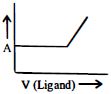
B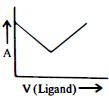
C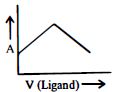
D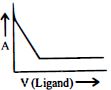
Solution
(A) Initially,the ligand is consumed by the metal ion to form the complex $(C)$. Since neither the metal ion $(M)$ nor the complex $(C)$ absorbs light,the absorbance $(A)$ remains near zero or constant during this phase.
After the equivalence point is reached,all metal ions have been converted into the complex. Any further addition of the ligand $(L)$ increases its concentration in the solution.
Since the ligand $(L)$ absorbs light,the absorbance $(A)$ starts to increase linearly with the volume of the added ligand $(V)$.
Therefore,the plot shows a horizontal line followed by an upward slope,which corresponds to the graph in option $A$.
After the equivalence point is reached,all metal ions have been converted into the complex. Any further addition of the ligand $(L)$ increases its concentration in the solution.
Since the ligand $(L)$ absorbs light,the absorbance $(A)$ starts to increase linearly with the volume of the added ligand $(V)$.
Therefore,the plot shows a horizontal line followed by an upward slope,which corresponds to the graph in option $A$.
0 likes
View Solution64
EasyMCQ
The electrolytes usually used in the electroplating of gold and silver,respectively,are
A
$[Au(CN)_2]^-$ and $[Ag(CN)_2]^-$
B
$[Au(CN)_2]^-$ and $[AgCl_2]^-$
C
$[Au(OH)_4]^-$ and $[Ag(OH)_2]^-$
D
$[Au(NH_3)_2]^+$ and $[Ag(CN)_2]^-$
Solution
(A) In the electroplating of gold and silver,cyanide complexes are used to ensure a smooth and uniform deposition of the metal.
Specifically,the dicyanoaurate$(I)$ ion,$[Au(CN)_2]^-$,is used for gold plating.
Similarly,the dicyanoargentate$(I)$ ion,$[Ag(CN)_2]^-$,is used for silver plating.
Both are stable,soluble coordination complexes that provide a low concentration of free metal ions,which is essential for high-quality electroplating.
Specifically,the dicyanoaurate$(I)$ ion,$[Au(CN)_2]^-$,is used for gold plating.
Similarly,the dicyanoargentate$(I)$ ion,$[Ag(CN)_2]^-$,is used for silver plating.
Both are stable,soluble coordination complexes that provide a low concentration of free metal ions,which is essential for high-quality electroplating.
0 likes
View Solution65
DifficultMCQ
Match the metal in column $I$ with the coordination compounds/enzymes in column $II$.
| Column $I$ (Metals) | Column $II$ (Coordination compounds) |
| $a. Co$ | $i. \text{Wilkinson catalyst}$ |
| $b. Zn$ | $ii. \text{Chlorophyll}$ |
| $c. Rh$ | $iii. \text{Vitamin } B_{12}$ |
| $d. Mg$ | $iv. \text{Carbonic anhydrase}$ |
A
$a-iii, b-iv, c-i, d-ii$
B
$a-i, b-ii, c-iii, d-iv$
C
$a-ii, b-i, c-iv, d-iii$
D
$a-iv, b-iii, c-i, d-ii$
Solution
$(A)$ $Co$ is the central metal ion in Vitamin $B_{12}$.
$Zn$ is the central metal ion in the enzyme Carbonic anhydrase.
$Rh$ is the central metal in the Wilkinson catalyst, which is $[RhCl(PPh_3)_3]$.
$Mg$ is the central metal ion in Chlorophyll.
Therefore, the correct match is $a-iii, b-iv, c-i, d-ii$.
$Zn$ is the central metal ion in the enzyme Carbonic anhydrase.
$Rh$ is the central metal in the Wilkinson catalyst, which is $[RhCl(PPh_3)_3]$.
$Mg$ is the central metal ion in Chlorophyll.
Therefore, the correct match is $a-iii, b-iv, c-i, d-ii$.
0 likes
View Solution66
DifficultMCQ
The compound that inhibits the growth of tumors is
A
$trans-[Pd(Cl)_2(NH_3)_2]$
B
$trans-[Pt(Cl)_2(NH_3)_2]$
C
$cis-[Pd(Cl)_2(NH_3)_2]$
D
$cis-[Pt(Cl)_2(NH_3)_2]$
Solution
(D) $cis-[PtCl_2(NH_3)_2]$,commonly known as cisplatin,is used in chemotherapy to inhibit the growth of tumors.
0 likes
View Solution67
DifficultMCQ
The $INCORRECT$ statement is:
A
The spin-only magnetic moments of $[Fe(H_2O)_6]^{2+}$ and $[Cr(H_2O)_6]^{2+}$ are nearly similar.
B
The spin-only magnetic moment of $[Ni(NH_3)_4(H_2O)_2]^{2+}$ is $2.83 \ BM$.
C
The gemstone,ruby,has $Cr^{3+}$ ions occupying the octahedral sites of beryl.
D
The color of $[CoCl(NH_3)_5]^{2+}$ is violet as it absorbs the yellow light.
Solution
(C) Ruby is a gemstone composed of aluminium oxide $(Al_2O_3)$ in which some $Al^{3+}$ ions are replaced by $Cr^{3+}$ ions in octahedral sites.
Statement $C$ is incorrect because ruby is a variety of corundum $(Al_2O_3)$,not beryl.
Beryl is the mineral associated with emeralds.
Therefore,the statement claiming $Cr^{3+}$ occupies sites in beryl is false.
Statement $C$ is incorrect because ruby is a variety of corundum $(Al_2O_3)$,not beryl.
Beryl is the mineral associated with emeralds.
Therefore,the statement claiming $Cr^{3+}$ occupies sites in beryl is false.
0 likes
View Solution68
DifficultMCQ
The compound used in the treatment of lead poisoning is
A
$EDTA$
B
$Cis-platin$
C
$D-penicillamine$
D
$Desferrioxime \ B$
Solution
(A) . $EDTA$ (ethylene diamine tetraacetate) is used for the treatment of lead poisoning.
$B$. $Cis-platin$ is used as an anti-cancer drug.
$C$. $D-penicillamine$ is used for copper poisoning.
$D$. $Desferrioxime \ B$ is used for iron poisoning.
$B$. $Cis-platin$ is used as an anti-cancer drug.
$C$. $D-penicillamine$ is used for copper poisoning.
$D$. $Desferrioxime \ B$ is used for iron poisoning.
0 likes
View Solution69
MediumMCQ
Which of the following is considered to be an anticancer species?
A
$[Pt(H_2O)_2Cl_2]$
B
$[Pt(NH_3)_2Cl_2]$ (cis-isomer)
C
$[PtCl_3(C_2H_4)]^-$
D
$[Pt(NH_3)_2Cl_2]$ (trans-isomer)
Solution
(B) The coordination compound cis-diamminedichloroplatinum$(II)$,commonly known as cisplatin,is widely used as an anticancer drug.
Its chemical formula is $[Pt(NH_3)_2Cl_2]$.
The cis-isomer is effective in inhibiting the growth of tumors,whereas the trans-isomer is not.
Therefore,the correct option is $B$.
Its chemical formula is $[Pt(NH_3)_2Cl_2]$.
The cis-isomer is effective in inhibiting the growth of tumors,whereas the trans-isomer is not.
Therefore,the correct option is $B$.
0 likes
View Solution70
EasyMCQ
The metal cation present in sodium nitroprusside is also present in:
A
Chlorophyll
B
Vitamin $B_{12}$
C
Cis-platin
D
Hemoglobin
Solution
(D) Sodium nitroprusside is $Na_2[Fe(CN)_5NO]$. The metal cation present in it is $Fe^{2+}$ (iron).
Chlorophyll contains $Mg^{2+}$.
Vitamin $B_{12}$ contains $Co^{3+}$.
Cis-platin is $[Pt(NH_3)_2Cl_2]$,which contains $Pt^{2+}$.
Hemoglobin contains $Fe^{2+}$ as the central metal ion.
Therefore,the metal cation present in sodium nitroprusside $(Fe^{2+})$ is also present in hemoglobin.
Chlorophyll contains $Mg^{2+}$.
Vitamin $B_{12}$ contains $Co^{3+}$.
Cis-platin is $[Pt(NH_3)_2Cl_2]$,which contains $Pt^{2+}$.
Hemoglobin contains $Fe^{2+}$ as the central metal ion.
Therefore,the metal cation present in sodium nitroprusside $(Fe^{2+})$ is also present in hemoglobin.
0 likes
View Solution71
DifficultMCQ
Which of the following is a chocolate brown complex?
A
$K_3[Cu(CN)_4]$
B
$[Cu(NH_3)_4]SO_4$
C
$Cu_2[Fe(CN)_6]$
D
$Na_3[Ag(S_2O_3)_2]$
Solution
(C) The reaction between copper$(II)$ ions and potassium ferrocyanide is a characteristic test for copper$(II)$ ions.
$2Cu^{2+} + [Fe(CN)_6]^{4-} \to Cu_2[Fe(CN)_6]$
This complex,$Cu_2[Fe(CN)_6]$,is known as copper$(II)$ hexacyanoferrate$(II)$,which forms a characteristic chocolate brown precipitate.
$2Cu^{2+} + [Fe(CN)_6]^{4-} \to Cu_2[Fe(CN)_6]$
This complex,$Cu_2[Fe(CN)_6]$,is known as copper$(II)$ hexacyanoferrate$(II)$,which forms a characteristic chocolate brown precipitate.
0 likes
View Solution72
DifficultMCQ
Which compound has electrovalent,covalent,coordinate as well as hydrogen bond?
A
$[Cu(H_2O)_4]SO_4 \cdot H_2O$
B
$[Zn(H_2O)_6]SO_4 \cdot H_2O$
C
$[Fe(H_2O)_6]SO_4 \cdot H_2O$
D
$[Fe(H_2O)_6]Cl_3$
Solution
(A) The compound $[Cu(H_2O)_4]SO_4 \cdot H_2O$ (also written as $CuSO_4 \cdot 5H_2O$) contains the following types of bonds:
$1$. Electrovalent (ionic) bond: Between the $[Cu(H_2O)_4]^{2+}$ complex cation and the $SO_4^{2-}$ anion.
$2$. Covalent bond: Present within the $H_2O$ molecules and the $SO_4^{2-}$ polyatomic ion.
$3$. Coordinate covalent bond: Formed between the $Cu^{2+}$ central metal ion and the oxygen atoms of the four $H_2O$ ligands.
$4$. Hydrogen bond: Present between the fifth water molecule (lattice water) and the sulfate ions or the coordinated water molecules,as shown in the structure.
$1$. Electrovalent (ionic) bond: Between the $[Cu(H_2O)_4]^{2+}$ complex cation and the $SO_4^{2-}$ anion.
$2$. Covalent bond: Present within the $H_2O$ molecules and the $SO_4^{2-}$ polyatomic ion.
$3$. Coordinate covalent bond: Formed between the $Cu^{2+}$ central metal ion and the oxygen atoms of the four $H_2O$ ligands.
$4$. Hydrogen bond: Present between the fifth water molecule (lattice water) and the sulfate ions or the coordinated water molecules,as shown in the structure.
0 likes
View Solution73
EasyMCQ
Which one of the following platinum complexes is used in cancer chemotherapy?
A
$cis-[PtCl_2(NH_3)_2]$
B
$trans-[PtCl_2(NH_3)_2]$
C
$[Pt(NH_3)_4]^{2+}$
D
$[PtCl_4]^{2-}$
Solution
(A) $cis-[PtCl_2(NH_3)_2]$ is known as cisplatin.
Cisplatin is a chemotherapy medication used to treat several cancers,including testicular,ovarian,cervical,breast,bladder,head and neck,oesophageal,and lung cancers. It is administered via intravenous injection.
Cisplatin is a chemotherapy medication used to treat several cancers,including testicular,ovarian,cervical,breast,bladder,head and neck,oesophageal,and lung cancers. It is administered via intravenous injection.
0 likes
View Solution74
AdvancedMCQ
Identify the complexes formed in the following processes:
$I$. Mond's process for purification of nickel
$II$. Removal of unreacted $AgBr$ from photographic plates
$III$. Removal of lead poisoning from the body
$I$. Mond's process for purification of nickel
$II$. Removal of unreacted $AgBr$ from photographic plates
$III$. Removal of lead poisoning from the body
A
$Ni(CO)_4 - [Ag(CN)_2]^- - [Pb(EDTA)]^{2-}$
B
$Ni(CO)_4 - [Ag(S_2O_3)_2]^{3-} - [Pb(EDTA)]^{2-}$
C
$Ni(CO)_6 - [Ag(S_2O_3)_2]^{3-} - [Pb(EDTA)]^{4-}$
D
$Ni(CO)_6 - [Ag(S_2O_3)]^- - [Pb(EDTA)]^{2-}$
Solution
(B) $I$. In Mond's process,nickel reacts with carbon monoxide to form the volatile complex $Ni(CO)_4$.
$II$. In photography,unreacted $AgBr$ is removed by dissolving it in sodium thiosulfate $(Na_2S_2O_3)$ to form the soluble complex $[Ag(S_2O_3)_2]^{3-}$.
$III$. Lead poisoning is treated by using $EDTA$ (ethylenediaminetetraacetate),which forms a stable,water-soluble complex $[Pb(EDTA)]^{2-}$ that can be excreted from the body.
$II$. In photography,unreacted $AgBr$ is removed by dissolving it in sodium thiosulfate $(Na_2S_2O_3)$ to form the soluble complex $[Ag(S_2O_3)_2]^{3-}$.
$III$. Lead poisoning is treated by using $EDTA$ (ethylenediaminetetraacetate),which forms a stable,water-soluble complex $[Pb(EDTA)]^{2-}$ that can be excreted from the body.
0 likes
View Solution75
MediumMCQ
The iron salt used in blue prints is
A
$FeC_2O_4$
B
$Fe_2(C_2O_4)_3$
C
$K_4[Fe(CN)_6]$
D
$FeSO_4$
Solution
(B) The process of making blue prints,known as cyanotype,involves the use of iron salts.
Specifically,ferric ammonium oxalate or ferric oxalate,$Fe_2(C_2O_4)_3$,is used as the light-sensitive compound.
When exposed to light,the $Fe^{3+}$ ions are reduced to $Fe^{2+}$ ions,which then react with potassium ferricyanide to form a deep blue pigment called Prussian blue $(Fe_4[Fe(CN)_6]_3)$.
Specifically,ferric ammonium oxalate or ferric oxalate,$Fe_2(C_2O_4)_3$,is used as the light-sensitive compound.
When exposed to light,the $Fe^{3+}$ ions are reduced to $Fe^{2+}$ ions,which then react with potassium ferricyanide to form a deep blue pigment called Prussian blue $(Fe_4[Fe(CN)_6]_3)$.
0 likes
View Solution76
EasyMCQ
$A$ blood red colour is obtained when ferric chloride solution reacts with
A
$KCN$
B
$KSCN$
C
$K_4[Fe(CN)_6]$
D
$K_3[Fe(CN)_6]$
Solution
(B) When ferric chloride $(FeCl_3)$ reacts with potassium thiocyanate $(KSCN)$,it forms a blood-red colored complex known as ferric thiocyanate.
The chemical equation for this reaction is:
$Fe^{3+} (aq) + SCN^- (aq) \rightarrow [Fe(SCN)]^{2+} (aq)$
This complex,$[Fe(SCN)]^{2+}$,is responsible for the characteristic blood-red color.
The chemical equation for this reaction is:
$Fe^{3+} (aq) + SCN^- (aq) \rightarrow [Fe(SCN)]^{2+} (aq)$
This complex,$[Fe(SCN)]^{2+}$,is responsible for the characteristic blood-red color.
0 likes
View Solution77
MediumMCQ
Copper $(II)$ ions give a reddish brown precipitate with potassium ferrocyanide. The formula of the precipitate is
A
$Cu_2[Fe(CN)_6]$
B
$Cu[Fe(CN)_6]$
C
$Cu_3[Fe(CN)_6]_2$
D
$Cu_4[Fe(CN)_6]$
Solution
(A) When $Cu^{2+}$ ions react with potassium ferrocyanide $(K_4[Fe(CN)_6])$,a reddish-brown precipitate of copper$(II)$ hexacyanoferrate$(II)$ is formed.
The chemical reaction is as follows:
$2Cu^{2+} + [Fe(CN)_6]^{4-} \rightarrow Cu_2[Fe(CN)_6]$
Thus,the formula of the reddish-brown precipitate is $Cu_2[Fe(CN)_6]$.
The chemical reaction is as follows:
$2Cu^{2+} + [Fe(CN)_6]^{4-} \rightarrow Cu_2[Fe(CN)_6]$
Thus,the formula of the reddish-brown precipitate is $Cu_2[Fe(CN)_6]$.
0 likes
View Solution78
MediumMCQ
Sodium thiosulphate,$Na_2S_2O_3 \cdot 5H_2O$ is used in photography to
A
Reduce the silver bromide to metallic silver
B
Convert the metallic silver to silver salt
C
remove undecomposed $AgBr$ as soluble silver thiosulphate complex
D
remove reduced silver
Solution
(C) In photography,sodium thiosulphate $(Na_2S_2O_3)$ is used as a 'fixing agent'.
After the development of the film,the unexposed silver bromide $(AgBr)$ remains on the film.
Sodium thiosulphate reacts with this unexposed $AgBr$ to form a soluble complex,sodium dithiosulphatoargentate$(I)$,which can be washed away.
The reaction is: $AgBr(s) + 2Na_2S_2O_3(aq) \rightarrow Na_3[Ag(S_2O_3)_2](aq) + NaBr(aq)$.
After the development of the film,the unexposed silver bromide $(AgBr)$ remains on the film.
Sodium thiosulphate reacts with this unexposed $AgBr$ to form a soluble complex,sodium dithiosulphatoargentate$(I)$,which can be washed away.
The reaction is: $AgBr(s) + 2Na_2S_2O_3(aq) \rightarrow Na_3[Ag(S_2O_3)_2](aq) + NaBr(aq)$.
0 likes
View Solution79
MediumMCQ
$A$ white precipitate of $AgCl$ dissolves in excess of
$(I)$ $NH_{3(aq)}$
$(II)$ $Na_2S_2O_3$
$(III)$ $NaCN$
$(I)$ $NH_{3(aq)}$
$(II)$ $Na_2S_2O_3$
$(III)$ $NaCN$
A
$III$ only
B
$I, II, III$
C
$I, II$
D
$I$ only
Solution
(B) $AgCl$ is a white precipitate that is insoluble in water but dissolves in excess of certain reagents due to the formation of soluble complex ions.
$(I)$ In excess $NH_{3(aq)}$,$AgCl$ forms the soluble complex $[Ag(NH_3)_2]Cl$.
$(II)$ In excess $Na_2S_2O_3$,$AgCl$ forms the soluble complex $Na_3[Ag(S_2O_3)_2]$.
$(III)$ In excess $NaCN$,$AgCl$ forms the soluble complex $Na[Ag(CN)_2]$.
Therefore,$AgCl$ dissolves in all three reagents.
$(I)$ In excess $NH_{3(aq)}$,$AgCl$ forms the soluble complex $[Ag(NH_3)_2]Cl$.
$(II)$ In excess $Na_2S_2O_3$,$AgCl$ forms the soluble complex $Na_3[Ag(S_2O_3)_2]$.
$(III)$ In excess $NaCN$,$AgCl$ forms the soluble complex $Na[Ag(CN)_2]$.
Therefore,$AgCl$ dissolves in all three reagents.
0 likes
View Solution80
AdvancedMCQ
Chlorophyll is a
A
$Magnesium$ complex
B
$Cobalt$ complex
C
$Iron$ complex
D
$Chromium$ complex
Solution
(A) Chlorophyll is a green pigment found in plants that is essential for photosynthesis.
It is a coordination complex where the central metal ion is $Magnesium$ $(Mg^{2+})$,which is coordinated to a porphyrin ring system.
Therefore,chlorophyll is a $Magnesium$ complex.
It is a coordination complex where the central metal ion is $Magnesium$ $(Mg^{2+})$,which is coordinated to a porphyrin ring system.
Therefore,chlorophyll is a $Magnesium$ complex.
0 likes
View Solution81
MediumMCQ
Assign $A$,$B$,$C$,$D$ from the given type of reaction.
$K_4[Fe(CN)_6] + ZnSO_4 \longrightarrow Zn_2[Fe(CN)_6] \downarrow + 2K_2SO_4$
$K_4[Fe(CN)_6] + ZnSO_4 \longrightarrow Zn_2[Fe(CN)_6] \downarrow + 2K_2SO_4$
A
For precipitate formation reaction
B
For precipitate dissolution reaction
C
For precipitate exchange reaction
D
For no reaction
Solution
(A) The reaction between potassium ferrocyanide $(K_4[Fe(CN)_6])$ and zinc sulfate $(ZnSO_4)$ results in the formation of a white precipitate of zinc ferrocyanide $(Zn_2[Fe(CN)_6])$.
Therefore,this is a precipitate formation reaction.
Therefore,this is a precipitate formation reaction.
0 likes
View Solution82
MediumMCQ
Assign $A, B, C, D$ from the given type of reaction.
$K_4[Fe(CN)_6] + 2CuSO_4 \longrightarrow Cu_2[Fe(CN)_6] \downarrow + 2K_2SO_4$
$K_4[Fe(CN)_6] + 2CuSO_4 \longrightarrow Cu_2[Fe(CN)_6] \downarrow + 2K_2SO_4$
A
For precipitate formation reaction
B
For precipitate dissolution reaction
C
For precipitate exchange reaction
D
For no reaction
Solution
(A) The reaction between potassium ferrocyanide $(K_4[Fe(CN)_6])$ and copper sulfate $(CuSO_4)$ results in the formation of a chocolate-brown precipitate of copper ferrocyanide $(Cu_2[Fe(CN)_6])$.
Since a solid precipitate is formed as a product,this is classified as a precipitate formation reaction.
Therefore,the correct option is $A$.
Since a solid precipitate is formed as a product,this is classified as a precipitate formation reaction.
Therefore,the correct option is $A$.
0 likes
View Solution83
MediumMCQ
Assign $A, B, C, D$ from the given type of reaction.
$NiCl_2 + 2dmg \xrightarrow{NH_4OH} Ni(dmg)_2 \downarrow$
$NiCl_2 + 2dmg \xrightarrow{NH_4OH} Ni(dmg)_2 \downarrow$
A
For precipitate formation reaction
B
For precipitate dissolution reaction
C
For precipitate exchange reaction
D
For no reaction
Solution
(A) The reaction $NiCl_2 + 2dmg \xrightarrow{NH_4OH} Ni(dmg)_2 \downarrow$ involves the formation of a red-colored precipitate of nickel dimethylglyoximate $(Ni(dmg)_2)$.
Since the product $Ni(dmg)_2$ is indicated with a downward arrow $(\downarrow)$,it signifies the formation of a precipitate.
Therefore,the reaction is a precipitate formation reaction.
Since the product $Ni(dmg)_2$ is indicated with a downward arrow $(\downarrow)$,it signifies the formation of a precipitate.
Therefore,the reaction is a precipitate formation reaction.
0 likes
View Solution84
MediumMCQ
Assign $A$,$B$,$C$,$D$ from the given type of reaction.
$[Cr(NH_3)_6]^{3+} + 6HCl \longrightarrow Cr^{3+}(aq.) + 6NH_4Cl$
$[Cr(NH_3)_6]^{3+} + 6HCl \longrightarrow Cr^{3+}(aq.) + 6NH_4Cl$
A
$A$. For coloured ppt./Black ppt.
B
$B$. For coloured solution.
C
$C$. For clear/colourless solution
D
$D$. For white ppt.
Solution
(C) The reaction is: $[Cr(NH_3)_6]^{3+} + 6HCl \longrightarrow Cr^{3+}(aq.) + 6NH_4Cl$.
In this reaction,the complex ion $[Cr(NH_3)_6]^{3+}$ is yellow/orange in color.
Upon reaction with $HCl$,it forms $Cr^{3+}(aq.)$ ions and $NH_4Cl$.
The $Cr^{3+}(aq.)$ ions in aqueous solution typically exhibit a violet or green color depending on the ligands,but the resulting solution is clear and colored.
However,in the context of qualitative analysis classification,this reaction results in a clear solution.
Therefore,it is classified as $C$ (For clear/colourless solution).
In this reaction,the complex ion $[Cr(NH_3)_6]^{3+}$ is yellow/orange in color.
Upon reaction with $HCl$,it forms $Cr^{3+}(aq.)$ ions and $NH_4Cl$.
The $Cr^{3+}(aq.)$ ions in aqueous solution typically exhibit a violet or green color depending on the ligands,but the resulting solution is clear and colored.
However,in the context of qualitative analysis classification,this reaction results in a clear solution.
Therefore,it is classified as $C$ (For clear/colourless solution).
0 likes
View Solution85
MediumMCQ
Assign $A$,$B$,$C$,$D$ from the given type of reaction.
$K_3[Fe(CN)_6] + FeCl_3 \longrightarrow Fe[Fe(CN)_6] \downarrow$
$K_3[Fe(CN)_6] + FeCl_3 \longrightarrow Fe[Fe(CN)_6] \downarrow$
A
$A$. for coloured ppt./Black ppt.
B
$B$. for coloured solution.
C
$C$. for clear/colourless solution
D
$D$. for white ppt.
Solution
(A) The reaction between potassium ferricyanide $(K_3[Fe(CN)_6])$ and ferric chloride $(FeCl_3)$ results in the formation of ferric ferricyanide,which is $Fe[Fe(CN)_6]$.
This compound is known as Prussian blue or Turnbull's blue,which appears as a dark blue precipitate.
Since the product is a precipitate,it corresponds to the category of coloured precipitate.
Therefore,the correct assignment is $A$.
This compound is known as Prussian blue or Turnbull's blue,which appears as a dark blue precipitate.
Since the product is a precipitate,it corresponds to the category of coloured precipitate.
Therefore,the correct assignment is $A$.
0 likes
View Solution86
MediumMCQ
Assign $A, B, C, D$ from the given type of reaction.
$2K_3[Fe(CN)_6] + 3FeCl_2 \longrightarrow Fe_3[Fe(CN)_6]_2 \downarrow + 6KCl$
$2K_3[Fe(CN)_6] + 3FeCl_2 \longrightarrow Fe_3[Fe(CN)_6]_2 \downarrow + 6KCl$
A
for coloured ppt.
B
for coloured solution
C
for clear/colourless solution
D
for white ppt.
Solution
(A) The reaction between potassium ferricyanide $(K_3[Fe(CN)_6])$ and ferrous chloride $(FeCl_2)$ results in the formation of ferrous ferricyanide $(Fe_3[Fe(CN)_6]_2)$,which is commonly known as Turnbull's blue.
This compound appears as a deep blue coloured precipitate.
Therefore,the correct classification for this reaction is for a coloured precipitate.
This compound appears as a deep blue coloured precipitate.
Therefore,the correct classification for this reaction is for a coloured precipitate.
0 likes
View Solution87
MediumMCQ
Select the incorrect match.
A
$Fe^{3+} + [Fe(CN)_6]^{4-} \to$ Blue colour ppt.
B
$Fe^{3+} + [Fe(CN)_6]^{3-} \to$ Red brown colouration
C
$Fe^{2+} + [Fe(CN)_6]^{3-} \to$ Blue colour ppt.
D
$Fe^{2+} + [Fe(CN)_6]^{4-} \to$ Red brown colouration
Solution
(D) The reaction $Fe^{2+} + [Fe(CN)_6]^{4-} \to$ produces a white precipitate of $K_2Fe[Fe(CN)_6]$ (in the presence of $K^+$ ions),not a red-brown colouration. Therefore,option $D$ is the incorrect match.
0 likes
View Solution88
MediumMCQ
$K_4[Fe(CN)_6] + M^{x+}(aq.) \to M_4[Fe(CN)_6]_x \downarrow$
Which of the following cations does not respond to the above reaction?
Which of the following cations does not respond to the above reaction?
A
$Cu^{2+}(aq.)$
B
$Fe^{3+}(aq.)$
C
$Zn^{2+}(aq.)$
D
None of these
Solution
(D) The reaction $K_4[Fe(CN)_6] + M^{x+}(aq.) \to M_4[Fe(CN)_6]_x \downarrow$ represents the formation of insoluble metal hexacyanoferrate$(II)$ precipitates.
$Cu^{2+}(aq.)$ reacts to form $Cu_2[Fe(CN)_6]$ (chocolate brown precipitate).
$Fe^{3+}(aq.)$ reacts to form $Fe_4[Fe(CN)_6]_3$ (Prussian blue precipitate).
$Zn^{2+}(aq.)$ reacts to form $Zn_2[Fe(CN)_6]$ (white precipitate).
Since all the given cations form precipitates with the hexacyanoferrate$(II)$ ion,none of them fail to respond to the reaction.
$Cu^{2+}(aq.)$ reacts to form $Cu_2[Fe(CN)_6]$ (chocolate brown precipitate).
$Fe^{3+}(aq.)$ reacts to form $Fe_4[Fe(CN)_6]_3$ (Prussian blue precipitate).
$Zn^{2+}(aq.)$ reacts to form $Zn_2[Fe(CN)_6]$ (white precipitate).
Since all the given cations form precipitates with the hexacyanoferrate$(II)$ ion,none of them fail to respond to the reaction.
0 likes
View Solution89
EasyMCQ
The substance used in the treatment of cancer is ........
A
$CFC$
B
Cis-platin
C
$HFC-134a$
D
Palladium
Solution
(B) Cis-platin,with the chemical formula $[Pt(NH_3)_2Cl_2]$,is a well-known chemotherapy medication used to treat various types of cancers,including testicular,ovarian,and bladder cancer. It works by binding to $DNA$ and interfering with cell division.
0 likes
View Solution90
MediumMCQ
Which of the following compounds contains ionic,covalent,and coordinate covalent bonds?
A
$NaCl$
B
$HCl$
C
$CuSO_4 \cdot 5H_2O$
D
$CaSO_4 \cdot 5H_2O$
Solution
(C) In $CuSO_4 \cdot 5H_2O$:
$1$. Ionic bonds are present between $Cu^{2+}$ and $SO_4^{2-}$ ions.
$2$. Covalent bonds are present within the $SO_4^{2-}$ ion (between $S$ and $O$ atoms) and within the $H_2O$ molecules.
$3$. Coordinate covalent bonds are present between the $Cu^{2+}$ ion and the oxygen atom of the water molecule (as $Cu^{2+}$ acts as a Lewis acid and $H_2O$ acts as a ligand).
$1$. Ionic bonds are present between $Cu^{2+}$ and $SO_4^{2-}$ ions.
$2$. Covalent bonds are present within the $SO_4^{2-}$ ion (between $S$ and $O$ atoms) and within the $H_2O$ molecules.
$3$. Coordinate covalent bonds are present between the $Cu^{2+}$ ion and the oxygen atom of the water molecule (as $Cu^{2+}$ acts as a Lewis acid and $H_2O$ acts as a ligand).
0 likes
View Solution91
MediumMCQ
The formation of a coordination compound can be detected by $............$.
A
Change in color
B
Change in solubility
C
Change in $pH$
D
All of the above
0 likes
View Solution92
DifficultMCQ
For silver plating of copper,$K[Ag(CN)_2]$ is used instead of $AgNO_3$. This is because ........
A
$A$ thin layer of $Ag$ is formed on $Cu$.
B
Higher voltage is required.
C
$Ag^+$ ions are completely removed from the solution.
D
Due to the low availability of $Ag^+$ ions,$Cu$ cannot displace $Ag$ from the $[Ag(CN)_2]^-$ ion.
0 likes
View Solution93
DifficultMCQ
The complex $[Co(NH_3)_5Br]SO_4$ will give a white precipitate with:
A
$PbCl_2$
B
$AgNO_3$
C
$KI$
D
None of these
Solution
(A) The complex $[Co(NH_3)_5Br]SO_4$ dissociates in aqueous solution as $[Co(NH_3)_5Br]SO_4 \rightarrow [Co(NH_3)_5Br]^{2+} + SO_4^{2-}$.
When $BaCl_2$ or $Pb(NO_3)_2$ is added,the $SO_4^{2-}$ ions react to form a white precipitate of $BaSO_4$ or $PbSO_4$.
Among the given options,$PbCl_2$ is not a suitable reagent for testing sulfate ions as it is sparingly soluble. However,if we consider the reaction of $SO_4^{2-}$ with $Pb^{2+}$ ions,$PbSO_4$ is a white precipitate.
Since $PbCl_2$ is often used as a source of $Pb^{2+}$ ions in specific contexts,it is the most appropriate choice among the provided options to yield a white precipitate of $PbSO_4$.
When $BaCl_2$ or $Pb(NO_3)_2$ is added,the $SO_4^{2-}$ ions react to form a white precipitate of $BaSO_4$ or $PbSO_4$.
Among the given options,$PbCl_2$ is not a suitable reagent for testing sulfate ions as it is sparingly soluble. However,if we consider the reaction of $SO_4^{2-}$ with $Pb^{2+}$ ions,$PbSO_4$ is a white precipitate.
Since $PbCl_2$ is often used as a source of $Pb^{2+}$ ions in specific contexts,it is the most appropriate choice among the provided options to yield a white precipitate of $PbSO_4$.
0 likes
View Solution94
DifficultMCQ
The addition of potassium ferrocyanide to a ferric salt gives a Prussian blue color,which is primarily due to the formation of .........
A
$K_3[Fe(CN)_6]$
B
$KFe[Fe(CN)_6]$
C
$FeSO_4 \cdot Fe(CN)_6$
D
$Fe_4[Fe(CN)_6]_3$
Solution
(D) When potassium ferrocyanide $(K_4[Fe(CN)_6])$ is added to a ferric salt (e.g.,$FeCl_3$),it reacts to form ferric ferrocyanide,commonly known as Prussian blue.
The chemical reaction is: $4Fe^{3+} + 3[Fe(CN)_6]^{4-} \rightarrow Fe_4[Fe(CN)_6]_3$.
This complex,$Fe_4[Fe(CN)_6]_3$,is responsible for the intense blue color.
The chemical reaction is: $4Fe^{3+} + 3[Fe(CN)_6]^{4-} \rightarrow Fe_4[Fe(CN)_6]_3$.
This complex,$Fe_4[Fe(CN)_6]_3$,is responsible for the intense blue color.
0 likes
View Solution95
EasyMCQ
Which of the following compounds is used as an anti-cancer agent?
A
mer $-[Co(NH_3)_3Cl_3]$
B
cis $-[PtCl_2(NH_3)_2]$
C
cis $- K_2[PtCl_2Br_2]$
D
$Na_2[CoCl_4]$
Solution
(B) The compound $cis-[PtCl_2(NH_3)_2]$,commonly known as cisplatin,is widely used as an effective anti-cancer drug in chemotherapy to treat various types of cancers.
0 likes
View Solution96
DifficultMCQ
Identify the incorrect pair.
A
$Co^{2+} - \text{Vitamin } B_{12}$
B
$Se^{2+} - \text{Krebs cycle}$
C
$Mg^{2+} - \text{Photosynthesis}$
D
$Fe^{2+} - \text{Hemoglobin}$
Solution
(B) $Co^{2+}$ is the central metal ion in Vitamin $B_{12}$.
$Mg^{2+}$ is the central metal ion in chlorophyll,which is essential for photosynthesis.
$Fe^{2+}$ is the central metal ion in hemoglobin,responsible for oxygen transport.
$Se^{2+}$ is not a central metal ion in the Krebs cycle; the Krebs cycle involves various enzymes and cofactors,but selenium is not a primary coordination center in this context. Therefore,the pair $Se^{2+} - \text{Krebs cycle}$ is incorrect.
$Mg^{2+}$ is the central metal ion in chlorophyll,which is essential for photosynthesis.
$Fe^{2+}$ is the central metal ion in hemoglobin,responsible for oxygen transport.
$Se^{2+}$ is not a central metal ion in the Krebs cycle; the Krebs cycle involves various enzymes and cofactors,but selenium is not a primary coordination center in this context. Therefore,the pair $Se^{2+} - \text{Krebs cycle}$ is incorrect.
0 likes
View Solution97
EasyMCQ
The ligands in the anti-cancer drug $cis$-platin are:
A
$NH_3, Cl^-$
B
$NH_3, H_2O$
C
$Cl^-, H_2O$
D
$NO, Cl^-$
Solution
(A) The chemical formula for $cis$-platin is $[PtCl_2(NH_3)_2]$.
In this coordination complex,the central metal ion is $Pt^{2+}$.
The ligands attached to the central metal ion are ammonia $(NH_3)$ and chloride ions $(Cl^-)$.
In this coordination complex,the central metal ion is $Pt^{2+}$.
The ligands attached to the central metal ion are ammonia $(NH_3)$ and chloride ions $(Cl^-)$.
0 likes
View Solution98
EasyMCQ
Coordination compounds have great importance in biological systems. In this context,which of the following statements is incorrect?
A
Cyanocobalamin is $B_{12}$ and contains cobalt.
B
Haemoglobin is the red pigment of blood and contains iron.
C
Chlorophylls are green pigments in plants and contain calcium.
D
Carboxypeptidase-$A$ is an enzyme and contains zinc.
Solution
(C) Chlorophyll is a green pigment found in plants that plays a crucial role in photosynthesis. It contains a porphyrin ring with a central magnesium $(Mg^{2+})$ ion,not calcium $(Ca^{2+})$. Therefore,the statement that chlorophyll contains calcium is incorrect.
0 likes
View Solution99
MediumMCQ
Assertion: $AgCl$ dissolves in $NH_4OH$ solution.
Reason: Due to formation of a complex.
Reason: Due to formation of a complex.
A
If both Assertion and Reason are correct and the Reason is a correct explanation of the Assertion.
B
If both Assertion and Reason are correct but Reason is not a correct explanation of the Assertion.
C
If the Assertion is correct but Reason is incorrect.
D
If both the Assertion and Reason are incorrect.
Solution
(A) $AgCl$ is a sparingly soluble salt in water.
When $NH_4OH$ is added,it reacts with $AgCl$ to form a soluble coordination complex,diamminesilver$(I)$ chloride,which causes the precipitate to dissolve.
The chemical reaction is: $AgCl(s) + 2NH_4OH(aq) \to [Ag(NH_3)_2]Cl(aq) + 2H_2O(l)$.
Thus,both the Assertion and the Reason are correct,and the Reason is the correct explanation for the Assertion.
When $NH_4OH$ is added,it reacts with $AgCl$ to form a soluble coordination complex,diamminesilver$(I)$ chloride,which causes the precipitate to dissolve.
The chemical reaction is: $AgCl(s) + 2NH_4OH(aq) \to [Ag(NH_3)_2]Cl(aq) + 2H_2O(l)$.
Thus,both the Assertion and the Reason are correct,and the Reason is the correct explanation for the Assertion.
0 likes
View SolutionCoordination Compounds — Application of Co-ordination compounds · Frequently Asked Questions
1Are these Coordination Compounds questions useful for JEE and NEET?
Yes. All questions in this section are mapped to JEE Main and NEET exam patterns. Previous year questions from JEE Main, NEET, GUJCET and state-level exams are included with full solutions.
2Can I switch to Hindi or Gujarati for these questions?
Yes. Use the language tabs in the hero section or the sidebar to view the same questions and solutions in English, Hindi or Gujarati.
3How do I generate a question paper from this subtopic?
Use the Vedclass Exam Paper Generator — select the chapter and subtopic, set difficulty, and generate Sets A, B, C, D automatically. First 3 chapters of every subject are free.
Vedclass Products
For Students
Vedclass Test Series
Mock tests in real JEE/NEET style with performance analysis. 5-day free trial.
Start Free TrialFor Teachers
Exam Paper Generator
Generate Set A/B/C/D papers from this chapter in 2 minutes. 3 chapters free.
Try FreeFor Institutes
Online Exam Module
Live online exams with unlimited students, 360° analytics & white-label branding.
See DemoFor Teachers & Institutes
Generate a Coordination Compounds Exam Paper in 2 Minutes
Select subtopic & difficulty — Sets A, B, C, D auto-generated with No Repeat logic.
First 3 chapters of every subject are free — no payment required.