
A English
Microbes in Sewage Treatment Questions in English
Class 12 Biology · Microbes in Human Welfare · Microbes in Sewage Treatment
184+
Questions
English
Language
100%
With Solutions
Showing 34 of 184 questions in English
151
MediumMCQ
High amount of $E. coli$ in water indicates:
A
Hardness of water
B
Industrial pollution
C
Sewage pollution
D
Pollution due to electromagnetic radiation
Solution
(C) The presence of $E. coli$ bacteria indicates possible sewage contamination of water.
$E. coli$ is found exclusively in the mammalian intestinal tract,including that of humans.
These bacteria belong to the coliform group.
Coliforms found in mammals are specifically referred to as faecal coliforms.
Since most coliforms in this context are $E. coli$,tests for $E. coli$ are widely used as a standard indicator for faecal contamination from sewage.
$E. coli$ is found exclusively in the mammalian intestinal tract,including that of humans.
These bacteria belong to the coliform group.
Coliforms found in mammals are specifically referred to as faecal coliforms.
Since most coliforms in this context are $E. coli$,tests for $E. coli$ are widely used as a standard indicator for faecal contamination from sewage.
0 likes
View Solution152
MediumMCQ
$BOD$ is concerned with
A
Microbes
B
Organic matter
C
Microbes and organic matter
D
None of the above
Solution
(C) Biochemical Oxygen Demand $(BOD)$ is a measure of the amount of dissolved oxygen required by aerobic microorganisms to break down the organic matter present in a given volume of water.
$BOD$ is directly related to the amount of organic matter in the water sample.
Microbes (aerobic bacteria) consume oxygen to decompose this organic matter.
Therefore,$BOD$ is concerned with both microbes and organic matter,as the demand for oxygen is created by the microbial decomposition of organic pollutants.
$BOD$ is directly related to the amount of organic matter in the water sample.
Microbes (aerobic bacteria) consume oxygen to decompose this organic matter.
Therefore,$BOD$ is concerned with both microbes and organic matter,as the demand for oxygen is created by the microbial decomposition of organic pollutants.
0 likes
View Solution153
EasyMCQ
Measuring Biological Oxygen Demand $(BOD)$ is a method used for
A
Measuring the activity of $Saccharomyces$ $cerevisiae$ in producing curd on a commercial scale
B
Working out the efficiency of $RBCs$ about their capacity to carry oxygen
C
Estimating the amount of organic matter in sewage water
D
Working out the efficiency of oil driven automobile engines
Solution
(C) Biological Oxygen Demand $(BOD)$ is a measure of the amount of dissolved oxygen required by aerobic microorganisms to break down the organic material present in a given water sample at a specific temperature over a specific time period.
$BOD$ is directly proportional to the amount of organic matter present in the water.
Therefore,it is primarily used to estimate the level of organic pollution in sewage water.
Higher $BOD$ values indicate higher levels of organic pollution.
$BOD$ is directly proportional to the amount of organic matter present in the water.
Therefore,it is primarily used to estimate the level of organic pollution in sewage water.
Higher $BOD$ values indicate higher levels of organic pollution.
0 likes
View Solution154
MediumMCQ
$A$ sewage treatment process,in which a portion of the decomposer bacteria present in the waste is recycled into the beginning of the process,is called
A
Cyclic treatment
B
Primary treatment
C
Activated sludge treatment
D
Tertiary treatment
Solution
(C) The 'activated sludge system' is a biological wastewater treatment process.
In this process,a portion of the sludge (which contains a high concentration of aerobic decomposer bacteria) is recycled back into the aeration tank.
This recycled sludge acts as an inoculum,providing a large population of metabolizing bacteria,yeasts,molds,and protozoa to the incoming raw sewage.
These microorganisms form flocculent masses called 'flocs' and oxidize the organic matter present in the sewage into $CO_2$ and water.
Therefore,the process of recycling these bacteria is a defining characteristic of the activated sludge treatment.
In this process,a portion of the sludge (which contains a high concentration of aerobic decomposer bacteria) is recycled back into the aeration tank.
This recycled sludge acts as an inoculum,providing a large population of metabolizing bacteria,yeasts,molds,and protozoa to the incoming raw sewage.
These microorganisms form flocculent masses called 'flocs' and oxidize the organic matter present in the sewage into $CO_2$ and water.
Therefore,the process of recycling these bacteria is a defining characteristic of the activated sludge treatment.
0 likes
View Solution155
EasyMCQ
Presence of $E. coli$ in water indicates
A
Water is clear
B
Water is fully polluted
C
Inorganic pollution
D
Faecal pollution
Solution
(D) $E. coli$ (Escherichia coli) is a bacterium commonly found in the lower intestine of warm-blooded organisms. Its presence in water samples is a standard indicator of faecal contamination,as it suggests that the water has been exposed to sewage or animal waste.
0 likes
View Solution156
MediumMCQ
What kind of process is primary treatment in sewage treatment?
A
Physical
B
Chemical
C
Biological
D
All of the above
Solution
(A) Primary treatment in sewage treatment is essentially a physical process.
It involves the physical removal of particles (large and small) from the sewage through filtration and sedimentation.
$1$. Filtration: Floating debris is removed by sequential filtration.
$2$. Sedimentation: Grit (soil and small pebbles) is removed by sedimentation.
All solids that settle form the primary sludge,and the supernatant forms the effluent.
It involves the physical removal of particles (large and small) from the sewage through filtration and sedimentation.
$1$. Filtration: Floating debris is removed by sequential filtration.
$2$. Sedimentation: Grit (soil and small pebbles) is removed by sedimentation.
All solids that settle form the primary sludge,and the supernatant forms the effluent.
0 likes
View Solution157
MediumMCQ
What kind of process is secondary treatment?
A
Physical
B
Chemical
C
Biological
D
All of the above
Solution
(C) Secondary treatment,also known as biological treatment,is a process where aerobic microbes (bacteria and fungi) are used to decompose the organic matter present in the primary effluent.
$1$. Primary treatment is a physical process involving filtration and sedimentation.
$2$. Secondary treatment is a biological process where microorganisms consume the organic waste,thereby reducing the Biological Oxygen Demand $(BOD)$ of the effluent.
$3$. Therefore,the correct answer is $C$ (Biological).
$1$. Primary treatment is a physical process involving filtration and sedimentation.
$2$. Secondary treatment is a biological process where microorganisms consume the organic waste,thereby reducing the Biological Oxygen Demand $(BOD)$ of the effluent.
$3$. Therefore,the correct answer is $C$ (Biological).
0 likes
View Solution158
MediumMCQ
What is primary sludge?
A
Solids removed by filtration
B
Solids removed by sedimentation
C
Flocs settled in the settling tank
D
Flocs settled in the anaerobic tank
Solution
(B) In the process of sewage treatment,the primary treatment involves the physical removal of particles from the sewage through filtration and sedimentation.
Initially,floating debris is removed by sequential filtration.
Then,the grit (soil and small pebbles) is removed by sedimentation.
All solids that settle down form the primary sludge,while the supernatant forms the effluent.
Initially,floating debris is removed by sequential filtration.
Then,the grit (soil and small pebbles) is removed by sedimentation.
All solids that settle down form the primary sludge,while the supernatant forms the effluent.
0 likes
View Solution159
MediumMCQ
What is activated sludge?
A
Solid matter removed by filtration
B
Solid matter removed by sedimentation
C
The sedimented flocs in the settling tank
D
The sedimented flocs in the anaerobic tank
Solution
(C) In the process of sewage treatment,the primary effluent is passed into large aeration tanks where it is constantly agitated mechanically and air is pumped into it.
This allows vigorous growth of useful aerobic microbes into flocs (masses of bacteria associated with fungal filaments to form mesh-like structures).
While growing,these microbes consume the major part of the organic matter in the effluent.
This significantly reduces the Biochemical Oxygen Demand $(BOD)$ of the effluent.
Once the $BOD$ of sewage or wastewater is reduced significantly,the effluent is then passed into a settling tank where the bacterial 'flocs' are allowed to sediment.
This sediment is called 'activated sludge'.
This allows vigorous growth of useful aerobic microbes into flocs (masses of bacteria associated with fungal filaments to form mesh-like structures).
While growing,these microbes consume the major part of the organic matter in the effluent.
This significantly reduces the Biochemical Oxygen Demand $(BOD)$ of the effluent.
Once the $BOD$ of sewage or wastewater is reduced significantly,the effluent is then passed into a settling tank where the bacterial 'flocs' are allowed to sediment.
This sediment is called 'activated sludge'.
0 likes
View Solution160
MediumMCQ
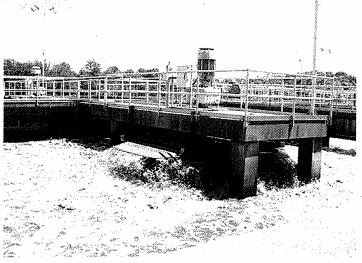
What does the image below represent?
A
Primary treatment
B
Secondary treatment
C
Anaerobic sludge process
D
Biogas production
Solution
(B) The image shows an aeration tank,which is a key component of secondary treatment (biological treatment) in a sewage treatment plant.
In this process,the primary effluent is passed into large aeration tanks where it is constantly agitated mechanically and air is pumped into it.
This allows vigorous growth of aerobic microbes into flocs (masses of bacteria associated with fungal filaments to form mesh-like structures).
These microbes consume the major part of the organic matter in the effluent,significantly reducing the Biological Oxygen Demand $(BOD)$.
In this process,the primary effluent is passed into large aeration tanks where it is constantly agitated mechanically and air is pumped into it.
This allows vigorous growth of aerobic microbes into flocs (masses of bacteria associated with fungal filaments to form mesh-like structures).
These microbes consume the major part of the organic matter in the effluent,significantly reducing the Biological Oxygen Demand $(BOD)$.
0 likes
View Solution161
MediumMCQ
Identify the sequence of processes in sewage treatment:
A
Filtration $\rightarrow$ Sedimentation $\rightarrow$ Biological treatment $\rightarrow$ Anaerobic sludge digesters
B
Sedimentation $\rightarrow$ Filtration $\rightarrow$ Biological treatment $\rightarrow$ Anaerobic sludge digesters
C
Filtration $\rightarrow$ Sedimentation $\rightarrow$ Anaerobic sludge digesters $\rightarrow$ Biological treatment
D
Sedimentation $\rightarrow$ Filtration $\rightarrow$ Anaerobic sludge digesters $\rightarrow$ Biological treatment
Solution
(A) The sewage treatment process involves several steps:
$1$. Primary treatment involves physical removal of particles through filtration and sedimentation.
$2$. The effluent from primary treatment is then taken for secondary or biological treatment,where aerobic microbes consume organic matter.
$3$. Finally,the activated sludge is sent to anaerobic sludge digesters,where anaerobic bacteria digest the remaining organic matter to produce biogas.
$1$. Primary treatment involves physical removal of particles through filtration and sedimentation.
$2$. The effluent from primary treatment is then taken for secondary or biological treatment,where aerobic microbes consume organic matter.
$3$. Finally,the activated sludge is sent to anaerobic sludge digesters,where anaerobic bacteria digest the remaining organic matter to produce biogas.
0 likes
View Solution162
MediumMCQ
Flocs = $.........$
A
Bacteria + Fungal filaments
B
Bacteria + Algal filaments
C
Viruses + Fungal filaments
D
Viruses + Algal filaments
Solution
(A) During the secondary treatment of sewage,the primary effluent is passed into large aeration tanks where it is constantly agitated mechanically and air is pumped into it. This allows vigorous growth of useful aerobic microbes into flocs. Flocs are masses of bacteria associated with fungal filaments to form mesh-like structures. These microbes consume the major part of the organic matter in the effluent,thereby reducing the Biological Oxygen Demand $(BOD)$.
0 likes
View Solution163
MediumMCQ
Which process is used to remove floating debris from sewage?
A
Sedimentation
B
Filtration
C
Biological treatment
D
Both $A$ and $B$
Solution
(D) In sewage treatment,the primary treatment involves physical removal of particles from the sewage through filtration and sedimentation.
$1$. Filtration is used to remove floating debris.
$2$. Sedimentation is used to remove grit (soil and small pebbles).
Since both processes are part of the physical removal phase,the correct answer is $D$.
$1$. Filtration is used to remove floating debris.
$2$. Sedimentation is used to remove grit (soil and small pebbles).
Since both processes are part of the physical removal phase,the correct answer is $D$.
0 likes
View Solution164
MediumMCQ
$A$ very high concentration of $E. coli$ in water indicates $.........$
A
Industrial pollution
B
Sewage pollution
C
High concentration of chlorine in water
D
All of the above
Solution
(B) $E. coli$ (Escherichia coli) is a bacterium commonly found in the lower intestine of warm-blooded organisms.
Its presence in water bodies is a standard indicator of fecal contamination.
Since sewage contains human and animal waste,a high concentration of $E. coli$ in water is a direct indicator of sewage pollution.
Therefore,the correct option is $B$.
Its presence in water bodies is a standard indicator of fecal contamination.
Since sewage contains human and animal waste,a high concentration of $E. coli$ in water is a direct indicator of sewage pollution.
Therefore,the correct option is $B$.
0 likes
View Solution165
MediumMCQ
Biological process is carried out in which type of water treatment?
A
Primary
B
Secondary
C
Tertiary
D
None of above
Solution
(B) In sewage treatment,the process is divided into two main stages:
$1$. Primary treatment: This is a physical process involving filtration and sedimentation to remove large and small particles.
$2$. Secondary treatment (Biological treatment): This process involves the use of aerobic and anaerobic microbes to digest the organic matter present in the sewage.
Therefore,the biological process is carried out during the secondary treatment phase.
$1$. Primary treatment: This is a physical process involving filtration and sedimentation to remove large and small particles.
$2$. Secondary treatment (Biological treatment): This process involves the use of aerobic and anaerobic microbes to digest the organic matter present in the sewage.
Therefore,the biological process is carried out during the secondary treatment phase.
0 likes
View Solution166
EasyMCQ
Select the correct sequence with respect to sewage treatment.
$i$. Removal of suspended solid particles by primary treatment.
$ii$. Wastewater screening
$iii$. Anaerobic bacteria digest activated sludge.
$iv$. Treatment by flocs in aeration tank.
$v$. Grit settling
$i$. Removal of suspended solid particles by primary treatment.
$ii$. Wastewater screening
$iii$. Anaerobic bacteria digest activated sludge.
$iv$. Treatment by flocs in aeration tank.
$v$. Grit settling
A
$ii \longrightarrow v \longrightarrow iv \longrightarrow i \longrightarrow iii$
B
$v \longrightarrow ii \longrightarrow i \longrightarrow iv \longrightarrow iii$
C
$ii \longrightarrow v \longrightarrow i \longrightarrow iv \longrightarrow iii$
D
$v \longrightarrow ii \longrightarrow iv \longrightarrow i \longrightarrow iii$
Solution
(C) The correct sequence of sewage treatment is as follows:
$1$. Wastewater screening $(ii)$: Large debris is removed by filtration.
$2$. Grit settling $(v)$: Grit (sand,pebbles) is removed by sedimentation.
$3$. Primary treatment $(i)$: Removal of suspended solid particles by sedimentation.
$4$. Treatment by flocs in aeration tank $(iv)$: Secondary treatment where aerobic microbes (flocs) consume organic matter.
$5$. Anaerobic digestion of activated sludge $(iii)$: Anaerobic bacteria digest the sludge produced during secondary treatment.
Therefore,the sequence is $ii \longrightarrow v \longrightarrow i \longrightarrow iv \longrightarrow iii$.
$1$. Wastewater screening $(ii)$: Large debris is removed by filtration.
$2$. Grit settling $(v)$: Grit (sand,pebbles) is removed by sedimentation.
$3$. Primary treatment $(i)$: Removal of suspended solid particles by sedimentation.
$4$. Treatment by flocs in aeration tank $(iv)$: Secondary treatment where aerobic microbes (flocs) consume organic matter.
$5$. Anaerobic digestion of activated sludge $(iii)$: Anaerobic bacteria digest the sludge produced during secondary treatment.
Therefore,the sequence is $ii \longrightarrow v \longrightarrow i \longrightarrow iv \longrightarrow iii$.
0 likes
View Solution167
EasyMCQ
Removal of suspended,floating,coarse and solid particles in sewage treatment is called . . . . . . .
A
Physical treatment
B
Preliminary treatment
C
Biological treatment
D
Tertiary treatment
Solution
(B) In sewage treatment,the removal of suspended,floating,coarse,and solid particles is primarily achieved through physical processes such as filtration and sedimentation.
This stage is known as $Preliminary$ or $Primary$ treatment.
$Preliminary$ treatment involves the removal of large debris using screens and grit chambers,while $Primary$ treatment involves the sedimentation of solid particles to form sludge.
Therefore,the correct answer is $Preliminary$ treatment.
This stage is known as $Preliminary$ or $Primary$ treatment.
$Preliminary$ treatment involves the removal of large debris using screens and grit chambers,while $Primary$ treatment involves the sedimentation of solid particles to form sludge.
Therefore,the correct answer is $Preliminary$ treatment.
0 likes
View Solution168
EasyMCQ
Given below are two statements about sewage. Based on them,select the correct option given below.
Statement $I$: The sediment in the settling tank is called floc.
Statement $II$: Sewage is first passed in the grit chamber,then it is screened.
Statement $I$: The sediment in the settling tank is called floc.
Statement $II$: Sewage is first passed in the grit chamber,then it is screened.
A
Both Statement $I$ and Statement $II$ are incorrect.
B
Statement $I$ is correct but Statement $II$ is incorrect.
C
Statement $I$ is incorrect but Statement $II$ is correct.
D
Both Statement $I$ and Statement $II$ are correct.
Solution
(A) Statement $I$ is incorrect because the sediment in the settling tank (after secondary treatment) is called activated sludge,while flocs are masses of bacteria associated with fungal filaments formed during aeration.
Statement $II$ is incorrect because sewage is first passed through screens to remove large debris,and then it is passed through the grit chamber to remove grit and small pebbles.
Statement $II$ is incorrect because sewage is first passed through screens to remove large debris,and then it is passed through the grit chamber to remove grit and small pebbles.
0 likes
View Solution169
EasyMCQ
Given below are two statements with reference to the secondary treatment of sewage.
Statement $I$: The $BOD$ of effluent increases.
Statement $II$: Flocs of bacteria consume the major part of the organic matter present in the effluent.
In the light of the above statements,choose the most appropriate answer from the options given below.
Statement $I$: The $BOD$ of effluent increases.
Statement $II$: Flocs of bacteria consume the major part of the organic matter present in the effluent.
In the light of the above statements,choose the most appropriate answer from the options given below.
A
Statement $I$ is correct and statement $II$ is incorrect.
B
Both statement $I$ and statement $II$ are incorrect.
C
Both statement $I$ and statement $II$ are correct.
D
Statement $I$ is incorrect and statement $II$ is correct.
Solution
(D) During secondary treatment (biological treatment),aerobic microbes grow into flocs and consume the major part of the organic matter present in the effluent.
As the organic matter is consumed,the $BOD$ (Biochemical Oxygen Demand) of the effluent decreases significantly.
Therefore,Statement $I$ is incorrect because the $BOD$ decreases,not increases.
Statement $II$ is correct because flocs of bacteria are responsible for the degradation of organic matter.
As the organic matter is consumed,the $BOD$ (Biochemical Oxygen Demand) of the effluent decreases significantly.
Therefore,Statement $I$ is incorrect because the $BOD$ decreases,not increases.
Statement $II$ is correct because flocs of bacteria are responsible for the degradation of organic matter.
0 likes
View Solution170
EasyMCQ
Given below are two statements: Based on them,select the correct option.
Statement $I$: Activated sludge is obtained in the grit chamber.
Statement $II$: Activated sludge is pumped into an anaerobic digester.
Statement $I$: Activated sludge is obtained in the grit chamber.
Statement $II$: Activated sludge is pumped into an anaerobic digester.
A
Statement $I$ is correct but Statement $II$ is incorrect.
B
Both Statement $I$ and Statement $II$ are incorrect.
C
Both Statement $I$ and Statement $II$ are correct.
D
Statement $I$ is incorrect but Statement $II$ is correct.
Solution
(D) Statement $I$ is incorrect because activated sludge is formed in the settling tank (secondary treatment) after aeration,not in the grit chamber.
Statement $II$ is correct because a small part of the activated sludge is pumped back into the aeration tank as an inoculum,while the major part is pumped into large tanks called anaerobic sludge digesters where anaerobic bacteria digest the organic matter.
Statement $II$ is correct because a small part of the activated sludge is pumped back into the aeration tank as an inoculum,while the major part is pumped into large tanks called anaerobic sludge digesters where anaerobic bacteria digest the organic matter.
0 likes
View Solution171
EasyMCQ
During sewage treatment,the activated sludge is present in . . . . . . .
A
settling tank.
B
aeration tank.
C
sedimentation tank.
D
grit chamber.
Solution
(A) In sewage treatment,the primary effluent is passed into large aeration tanks where it is constantly agitated mechanically and air is pumped into it. This allows vigorous growth of useful aerobic microbes into flocs (masses of bacteria associated with fungal filaments to form mesh-like structures). While growing,these microbes consume the major part of the organic matter in the effluent. This significantly reduces the $BOD$ (Biochemical Oxygen Demand) of the effluent. Once the $BOD$ of sewage or wastewater is reduced significantly,the effluent is then passed into a settling tank where the bacterial 'flocs' are allowed to sediment. This sediment is called 'activated sludge'.
0 likes
View Solution172
EasyMCQ
In the secondary treatment of $STP$,the masses of bacteria associated with fungal filaments are called . . . . . . .
A
mycelium
B
flakes
C
flocs
D
hyphae
Solution
(C) During the secondary treatment of sewage in a $STP$ (Sewage Treatment Plant),the primary effluent is passed into large aeration tanks.
Here,it is constantly agitated mechanically and air is pumped into it.
This allows vigorous growth of useful aerobic microbes into masses of bacteria associated with fungal filaments to form mesh-like structures.
These structures are known as $flocs$.
Here,it is constantly agitated mechanically and air is pumped into it.
This allows vigorous growth of useful aerobic microbes into masses of bacteria associated with fungal filaments to form mesh-like structures.
These structures are known as $flocs$.
0 likes
View Solution173
EasyMCQ
Identify the wrong statement regarding the process in sewage treatment.
A
Primary treatment is a physical process.
B
Secondary treatment is a biological process.
C
The $BOD$ of effluent increases after secondary treatment.
D
The tanks used for tertiary treatment are anaerobic sludge digesters.
Solution
(C) In sewage treatment,primary treatment involves physical removal of particles through filtration and sedimentation. Secondary treatment is a biological process where aerobic microbes consume organic matter,which significantly reduces the Biochemical Oxygen Demand $(BOD)$ of the effluent. Therefore,the statement that $BOD$ increases after secondary treatment is incorrect. Additionally,anaerobic sludge digesters are typically used for the treatment of sludge collected from primary and secondary processes,not as a standard tertiary treatment step.
0 likes
View Solution174
EasyMCQ
Measuring of $BOD$ in sewage water gives an estimation of . . . . . .
A
amount of biodegradable organic matter
B
gaseous oxygen
C
dissolved $CO_2$ level
D
amount of non-biodegradable organic matter
Solution
(A) $BOD$ stands for Biochemical Oxygen Demand.
It refers to the amount of dissolved oxygen that would be consumed if all the organic matter in one liter of water were oxidized by bacteria.
Therefore,$BOD$ is a measure of the amount of biodegradable organic matter present in a water sample.
Higher $BOD$ indicates higher pollution levels due to organic waste.
It refers to the amount of dissolved oxygen that would be consumed if all the organic matter in one liter of water were oxidized by bacteria.
Therefore,$BOD$ is a measure of the amount of biodegradable organic matter present in a water sample.
Higher $BOD$ indicates higher pollution levels due to organic waste.
0 likes
View Solution175
EasyMCQ
Choose the correct sequence for $\text{STP}$ (Sewage treatment plant).
A
Primary sludge $\rightarrow$ effluent $\rightarrow$ flocs $\rightarrow$ anaerobic sludge
B
Primary sludge $\rightarrow$ flocs $\rightarrow$ effluent $\rightarrow$ anaerobic sludge
C
Primary sludge $\rightarrow$ anaerobic sludge $\rightarrow$ flocs $\rightarrow$ effluent
D
Primary sludge $\rightarrow$ anaerobic sludge $\rightarrow$ effluent $\rightarrow$ flocs
Solution
(A) The correct sequence in a $\text{Sewage Treatment Plant}$ $(\text{STP})$ is as follows:
$1$. $\text{Primary sludge}$ is the solid waste settled during primary treatment.
$2$. The supernatant liquid is called the $\text{effluent}$,which is passed into aeration tanks.
$3$. In aeration tanks,aerobic microbes grow into masses called $\text{flocs}$.
$4$. Finally,the $\text{flocs}$ are digested by anaerobic bacteria in an $\text{anaerobic sludge digester}$,resulting in $\text{anaerobic sludge}$.
Therefore,the sequence is: $\text{Primary sludge} \rightarrow \text{effluent} \rightarrow \text{flocs} \rightarrow \text{anaerobic sludge}$.
$1$. $\text{Primary sludge}$ is the solid waste settled during primary treatment.
$2$. The supernatant liquid is called the $\text{effluent}$,which is passed into aeration tanks.
$3$. In aeration tanks,aerobic microbes grow into masses called $\text{flocs}$.
$4$. Finally,the $\text{flocs}$ are digested by anaerobic bacteria in an $\text{anaerobic sludge digester}$,resulting in $\text{anaerobic sludge}$.
Therefore,the sequence is: $\text{Primary sludge} \rightarrow \text{effluent} \rightarrow \text{flocs} \rightarrow \text{anaerobic sludge}$.
0 likes
View Solution176
EasyMCQ
. . . . . . is the first step of sewage treatment.
A
Filtration and sedimentation
B
Chlorination
C
Aeration by force
D
Formation of activated sludge
Solution
(A) The first step of sewage treatment is the primary treatment,which involves the physical removal of large and small particles from the sewage through filtration and sedimentation.
$1$. Filtration is used to remove floating debris.
$2$. Sedimentation is used to remove grit (soil and small pebbles).
Therefore,the correct option is $A$.
$1$. Filtration is used to remove floating debris.
$2$. Sedimentation is used to remove grit (soil and small pebbles).
Therefore,the correct option is $A$.
0 likes
View Solution177
EasyMCQ
The key substance between primary and secondary treatment in Sewage Treatment Plants $(STP)$ is?
A
Effluent
B
Flocs
C
Primary sludge
D
Active sludge
Solution
(A) In a Sewage Treatment Plant $(STP)$, the primary treatment involves the physical removal of particles through filtration and sedimentation.
The sediment that settles at the bottom during this process is known as primary sludge.
The supernatant liquid that remains above the primary sludge is called the primary effluent.
This primary effluent is then taken for secondary treatment (biological treatment), where it is passed into large aeration tanks.
Therefore, the primary effluent is the key substance that acts as the link between primary and secondary treatment.
The sediment that settles at the bottom during this process is known as primary sludge.
The supernatant liquid that remains above the primary sludge is called the primary effluent.
This primary effluent is then taken for secondary treatment (biological treatment), where it is passed into large aeration tanks.
Therefore, the primary effluent is the key substance that acts as the link between primary and secondary treatment.
0 likes
View Solution178
EasyMCQ
Flocs means . . . . . .
A
Activated sludge
B
Anaerobic sludge
C
Fungi mycelium and microbes
D
Primary sludge
Solution
(C) Flocs are masses of bacteria associated with fungal filaments to form mesh-like structures.
These structures are known as flocs.
They are formed during the secondary treatment of sewage,where aerobic microbes consume the organic matter in the effluent.
Therefore,flocs consist of fungi mycelium and microbes.
These structures are known as flocs.
They are formed during the secondary treatment of sewage,where aerobic microbes consume the organic matter in the effluent.
Therefore,flocs consist of fungi mycelium and microbes.
0 likes
View Solution179
EasyMCQ
Select the correct statement from the following:
A
Methanobacterium is an aerobic bacteria found in the rumen of cattle.
B
Biogas is produced by the activity of aerobic bacteria.
C
Biogas is pure methane.
D
Activated sludge in sediment tanks is a rich source of aerobic bacteria.
Solution
(D) The correct statement is $D$. Activated sludge in sediment tanks is a rich source of aerobic bacteria.
$A$ is incorrect because $Methanobacterium$ is an anaerobic bacterium.
$B$ is incorrect because biogas is produced by the activity of anaerobic bacteria,not aerobic bacteria.
$C$ is incorrect because biogas is a mixture of gases (primarily $CH_4$,$CO_2$,and $H_2S$),not pure methane.
$A$ is incorrect because $Methanobacterium$ is an anaerobic bacterium.
$B$ is incorrect because biogas is produced by the activity of anaerobic bacteria,not aerobic bacteria.
$C$ is incorrect because biogas is a mixture of gases (primarily $CH_4$,$CO_2$,and $H_2S$),not pure methane.
0 likes
View Solution180
EasyMCQ
In sewage treatment,secondary treatment is considered highly significant,because
A
it increases the organic content of sewage
B
it helps to remove debris from the sewage
C
it reduces the $BOD$ level of sewage
D
it helps in the production of biogas
Solution
(C) is the correct answer. Secondary treatment is highly significant because it reduces the $BOD$ level of sewage.
Primary treatment involves the physical removal of large and small particles through filtration and sedimentation.
The effluent from primary treatment is then passed into large aeration tanks for secondary treatment (biological treatment).
In these tanks,aerobic microbes consume the major part of the organic matter present in the effluent.
This significant reduction in organic matter leads to a decrease in the Biochemical Oxygen Demand $(BOD)$ of the sewage,making it safer to discharge into water bodies.
Primary treatment involves the physical removal of large and small particles through filtration and sedimentation.
The effluent from primary treatment is then passed into large aeration tanks for secondary treatment (biological treatment).
In these tanks,aerobic microbes consume the major part of the organic matter present in the effluent.
This significant reduction in organic matter leads to a decrease in the Biochemical Oxygen Demand $(BOD)$ of the sewage,making it safer to discharge into water bodies.
0 likes
View Solution181
EasyMCQ
The microorganisms involved in floc formation during sewage treatment are
A
anaerobic bacteria and fungus
B
aerobic bacteria and fungus
C
autotrophic bacteria and yeast
D
fungus and algae
Solution
(B) The correct answer is $B$.
During the secondary treatment of sewage,the primary effluent is passed into large aeration tanks where it is constantly agitated mechanically and air is pumped into it.
This allows vigorous growth of useful aerobic microbes into flocs.
Flocs are masses of bacteria associated with fungal filaments to form mesh-like structures.
These microorganisms consume the major part of the organic matter in the effluent,thereby significantly reducing the $BOD$ (Biochemical Oxygen Demand) of the sewage.
During the secondary treatment of sewage,the primary effluent is passed into large aeration tanks where it is constantly agitated mechanically and air is pumped into it.
This allows vigorous growth of useful aerobic microbes into flocs.
Flocs are masses of bacteria associated with fungal filaments to form mesh-like structures.
These microorganisms consume the major part of the organic matter in the effluent,thereby significantly reducing the $BOD$ (Biochemical Oxygen Demand) of the sewage.
0 likes
View Solution182
EasyMCQ
$BOD$ refers to
A
the oxygen required for bacteria to grow in $1$ Litre of effluent
B
the amount of oxygen consumed if all the organic matter in $1000 \ mL$ of water were oxidised by bacteria.
C
the amount of oxygen released if all the organic matter in $1000 \ mL$ of water were oxidised by bacteria.
D
the amount of oxygen released when all the organic matter was consumed by bacteria in $1$ litre of water
Solution
(B) $BOD$ stands for Biochemical Oxygen Demand.
It is defined as the amount of oxygen that would be consumed if all the organic matter in $1000 \ mL$ ($1$ litre) of water were oxidised by bacteria.
It is a measure of the organic matter present in the water sample; higher $BOD$ indicates higher pollution levels.
It is defined as the amount of oxygen that would be consumed if all the organic matter in $1000 \ mL$ ($1$ litre) of water were oxidised by bacteria.
It is a measure of the organic matter present in the water sample; higher $BOD$ indicates higher pollution levels.
0 likes
View Solution183
EasyMCQ
The primary treatment of sewage water involves
A
sludge digestion
B
aerobic bacterial activity
C
anaerobic bacterial activity
D
filtration and sedimentation
Solution
(D) filtration and sedimentation.
Primary sewage water treatment entails the physical removal of particles through filtration and sedimentation of solid waste present in the water.
The purpose of primary treatment is to settle down large and small particles by gravity,removing floatable debris and grit,which reduces the pollution load to ease the subsequent secondary treatment process.
Primary sewage water treatment entails the physical removal of particles through filtration and sedimentation of solid waste present in the water.
The purpose of primary treatment is to settle down large and small particles by gravity,removing floatable debris and grit,which reduces the pollution load to ease the subsequent secondary treatment process.
0 likes
View Solution184
EasyMCQ
$Floc$ is . . . . . .
A
a mesh-like structure formed by the association of bacteria and fungal filaments in sewage treatment.
B
the primary sludge produced in sewage treatment.
C
the effluent in primary treatment tank obtained during sewage treatment.
D
a type of biofortified food.
Solution
(A) is the correct answer.
In a sewage treatment plant,during secondary treatment,a large number of aerobic heterotrophic microbes grow in the aeration tank.
These microbes include bacteria and some filamentous fungi and yeasts,which form $Flocs$.
$Flocs$ are mesh-like structures formed by the interweaving of fungal filaments and bacterial cells.
In a sewage treatment plant,during secondary treatment,a large number of aerobic heterotrophic microbes grow in the aeration tank.
These microbes include bacteria and some filamentous fungi and yeasts,which form $Flocs$.
$Flocs$ are mesh-like structures formed by the interweaving of fungal filaments and bacterial cells.
0 likes
View SolutionMicrobes in Human Welfare — Microbes in Sewage Treatment · Frequently Asked Questions
1Are these Microbes in Human Welfare questions useful for JEE and NEET?
Yes. All questions in this section are mapped to JEE Main and NEET exam patterns. Previous year questions from JEE Main, NEET, GUJCET and state-level exams are included with full solutions.
2Can I switch to Hindi or Gujarati for these questions?
Yes. Use the language tabs in the hero section or the sidebar to view the same questions and solutions in English, Hindi or Gujarati.
3How do I generate a question paper from this subtopic?
Use the Vedclass Exam Paper Generator — select the chapter and subtopic, set difficulty, and generate Sets A, B, C, D automatically. First 3 chapters of every subject are free.
Vedclass Products
For Students
Vedclass Test Series
Mock tests in real JEE/NEET style with performance analysis. 5-day free trial.
Start Free TrialFor Teachers
Exam Paper Generator
Generate Set A/B/C/D papers from this chapter in 2 minutes. 3 chapters free.
Try FreeFor Institutes
Online Exam Module
Live online exams with unlimited students, 360° analytics & white-label branding.
See DemoFor Teachers & Institutes
Generate a Microbes in Human Welfare Exam Paper in 2 Minutes
Select subtopic & difficulty — Sets A, B, C, D auto-generated with No Repeat logic.
First 3 chapters of every subject are free — no payment required.