
A English
Microbes in Sewage Treatment Questions in English
Class 12 Biology · Microbes in Human Welfare · Microbes in Sewage Treatment
184+
Questions
English
Language
100%
With Solutions
Showing 50 of 184 questions in English
101
Easy
Three water samples namely river water,untreated sewage water and secondary effluent discharged from a sewage treatment plant were subjected to $BOD$ test. The samples were labelled $A, B$ and $C$; but the laboratory attendant did not note which was which. The $BOD$ values of the three samples $A, B$ and $C$ were recorded as $20\, mg/L, 8\, mg/L$ and $400\, mg/L$ respectively. Which sample of the water is most polluted? Can you assign the correct label to each assuming the river water is relatively clean?
Solution
(C) Biological oxygen demand $(BOD)$ is the method of determining the amount of oxygen required by micro-organisms to decompose the organic waste present in a water supply. If the quantity of organic waste is high,the number of decomposing bacteria increases,leading to a higher $BOD$ value.
Therefore,a higher $BOD$ value indicates higher pollution. Comparing the given values: $400\, mg/L$ (Sample $C$) > $20\, mg/L$ (Sample $A$) > $8\, mg/L$ (Sample $B$).
$1$. Sample $C$ $(400\, mg/L)$ is the most polluted,representing untreated sewage water.
$2$. Sample $A$ $(20\, mg/L)$ represents secondary effluent from a sewage treatment plant.
$3$. Sample $B$ $(8\, mg/L)$ is the cleanest,representing river water.
Therefore,a higher $BOD$ value indicates higher pollution. Comparing the given values: $400\, mg/L$ (Sample $C$) > $20\, mg/L$ (Sample $A$) > $8\, mg/L$ (Sample $B$).
$1$. Sample $C$ $(400\, mg/L)$ is the most polluted,representing untreated sewage water.
$2$. Sample $A$ $(20\, mg/L)$ represents secondary effluent from a sewage treatment plant.
$3$. Sample $B$ $(8\, mg/L)$ is the cleanest,representing river water.
| Label | Sample Type |
| $A$ | Secondary effluent $(20\, mg/L)$ |
| $B$ | River water $(8\, mg/L)$ |
| $C$ | Untreated sewage $(400\, mg/L)$ |
0 likes
View Solution102
Easy
What is sewage? Through what is sewage water passed before being disposed of?
Solution
(N/A) Large quantities of wastewater are generated every day in cities and towns. $A$ major component of this wastewater is human excreta. This municipal wastewater is called sewage.
It contains a large amount of organic matter and microbes,many of which are pathogenic.
This urban wastewater cannot be discharged directly into natural water bodies like rivers and streams.
Sewage is treated in sewage treatment plants $(STPs)$ to make it less polluting.
The treatment of wastewater is carried out by heterotrophic microbes that are naturally present in the sewage.
It contains a large amount of organic matter and microbes,many of which are pathogenic.
This urban wastewater cannot be discharged directly into natural water bodies like rivers and streams.
Sewage is treated in sewage treatment plants $(STPs)$ to make it less polluting.
The treatment of wastewater is carried out by heterotrophic microbes that are naturally present in the sewage.
0 likes
View Solution103
Easy
Explain the stages included in sewage treatment.
Solution
(N/A) Sewage treatment is carried out in two main stages:
$1$. Primary Treatment: This stage involves the physical removal of large and small particles from sewage through filtration and sedimentation.
- Initially,floating debris is removed by sequential filtration.
- Then,grit (soil and small pebbles) is removed by sedimentation.
- All solids that settle form the 'primary sludge',and the supernatant forms the 'effluent'.
$2$. Secondary Treatment or Biological Treatment: The primary effluent is passed into large aeration tanks where it is constantly agitated mechanically and air is pumped into it.
- This allows for the vigorous growth of useful aerobic microbes into 'flocs' (masses of bacteria associated with fungal filaments to form mesh-like structures).
- While growing,these microbes consume the major part of the organic matter in the effluent,which significantly reduces the $BOD$ (Biochemical Oxygen Demand) of the effluent.
- $BOD$ refers to the amount of oxygen that would be consumed if all the organic matter in one liter of water were oxidized by bacteria.
- The greater the $BOD$ of wastewater,the more is its polluting potential.
- Once the $BOD$ is reduced significantly,the effluent is passed into a settling tank where the bacterial flocs are allowed to sediment. This sediment is called 'activated sludge'.
- $A$ small part of the activated sludge is pumped back into the aeration tank to serve as an inoculum.
- The remaining major part of the sludge is pumped into large tanks called 'anaerobic sludge digesters'.
- Here,anaerobic bacteria digest the bacteria and fungi in the sludge,producing gases such as methane,hydrogen sulfide,and carbon dioxide,which form 'biogas'.
- The effluent from the secondary treatment plant is generally released into natural water bodies like rivers and streams.
$1$. Primary Treatment: This stage involves the physical removal of large and small particles from sewage through filtration and sedimentation.
- Initially,floating debris is removed by sequential filtration.
- Then,grit (soil and small pebbles) is removed by sedimentation.
- All solids that settle form the 'primary sludge',and the supernatant forms the 'effluent'.
$2$. Secondary Treatment or Biological Treatment: The primary effluent is passed into large aeration tanks where it is constantly agitated mechanically and air is pumped into it.
- This allows for the vigorous growth of useful aerobic microbes into 'flocs' (masses of bacteria associated with fungal filaments to form mesh-like structures).
- While growing,these microbes consume the major part of the organic matter in the effluent,which significantly reduces the $BOD$ (Biochemical Oxygen Demand) of the effluent.
- $BOD$ refers to the amount of oxygen that would be consumed if all the organic matter in one liter of water were oxidized by bacteria.
- The greater the $BOD$ of wastewater,the more is its polluting potential.
- Once the $BOD$ is reduced significantly,the effluent is passed into a settling tank where the bacterial flocs are allowed to sediment. This sediment is called 'activated sludge'.
- $A$ small part of the activated sludge is pumped back into the aeration tank to serve as an inoculum.
- The remaining major part of the sludge is pumped into large tanks called 'anaerobic sludge digesters'.
- Here,anaerobic bacteria digest the bacteria and fungi in the sludge,producing gases such as methane,hydrogen sulfide,and carbon dioxide,which form 'biogas'.
- The effluent from the secondary treatment plant is generally released into natural water bodies like rivers and streams.
0 likes
View Solution104
Easy
Why do we prefer to call secondary wastewater treatment as biological treatment?
Solution
(N/A) Secondary wastewater treatment is referred to as biological treatment because it primarily relies on the activity of living organisms,such as aerobic and anaerobic bacteria and fungi,to decompose and mineralize the organic matter present in the sewage. These microorganisms consume the organic waste as their food source,thereby significantly reducing the Biological Oxygen Demand $(BOD)$ of the effluent.
0 likes
View Solution105
MediumMCQ
Why are flocs important in the biological treatment of wastewater?
A
They help in the sedimentation of sludge.
B
They consume the major part of the organic matter in the effluent.
C
They produce methane gas.
D
They increase the $BOD$ of the effluent.
Solution
(B) Secondary treatment or biological treatment: The primary effluent is passed into large aeration tanks where it is constantly agitated mechanically and air is pumped into it.
This allows the vigorous growth of useful aerobic microbes into flocs (masses of bacteria associated with fungal filaments to form mesh-like structures).
While growing,these microbes consume the major part of the organic matter in the effluent.
This significantly reduces the $BOD$ (Biochemical Oxygen Demand) of the effluent,thereby cleaning the water.
This allows the vigorous growth of useful aerobic microbes into flocs (masses of bacteria associated with fungal filaments to form mesh-like structures).
While growing,these microbes consume the major part of the organic matter in the effluent.
This significantly reduces the $BOD$ (Biochemical Oxygen Demand) of the effluent,thereby cleaning the water.
0 likes
View Solution106
Easy
Why is aerobic degradation more important than anaerobic degradation for the treatment of large volumes of waste waters rich in organic matter? Discuss.
Solution
(N/A) Secondary treatment or biological treatment is essential for large volumes of wastewater because aerobic microbes are highly efficient at breaking down organic matter.
$1$. In aeration tanks,constant agitation and air supply promote the growth of aerobic microbes into 'flocs' (masses of bacteria associated with fungal filaments).
$2$. These microbes consume the major part of the organic matter,which significantly reduces the $BOD$ (Biochemical Oxygen Demand) of the effluent.
$3$. $BOD$ is a measure of the organic matter present in the water; the greater the $BOD$,the higher the polluting potential.
$4$. Aerobic degradation is faster and more effective at reducing high levels of organic pollutants compared to anaerobic processes,which are typically used later for sludge digestion.
$5$. Once $BOD$ is reduced,the effluent is passed into a settling tank where flocs sediment as 'activated sludge'.
$6$. The remaining sludge is then treated in anaerobic sludge digesters to produce biogas (methane,hydrogen sulphide,and carbon dioxide),which serves as an energy source.
$1$. In aeration tanks,constant agitation and air supply promote the growth of aerobic microbes into 'flocs' (masses of bacteria associated with fungal filaments).
$2$. These microbes consume the major part of the organic matter,which significantly reduces the $BOD$ (Biochemical Oxygen Demand) of the effluent.
$3$. $BOD$ is a measure of the organic matter present in the water; the greater the $BOD$,the higher the polluting potential.
$4$. Aerobic degradation is faster and more effective at reducing high levels of organic pollutants compared to anaerobic processes,which are typically used later for sludge digestion.
$5$. Once $BOD$ is reduced,the effluent is passed into a settling tank where flocs sediment as 'activated sludge'.
$6$. The remaining sludge is then treated in anaerobic sludge digesters to produce biogas (methane,hydrogen sulphide,and carbon dioxide),which serves as an energy source.
0 likes
View Solution107
Medium
$(a)$ What would happen if a large volume of untreated sewage is discharged into a river?
$(b)$ In what way is anaerobic sludge digestion important in sewage treatment?
$(b)$ In what way is anaerobic sludge digestion important in sewage treatment?
Solution
(N/A) Due to increasing urbanization,sewage is being produced in much larger quantities than ever before. However,the number of sewage treatment plants has not increased enough to treat such large quantities. Consequently,untreated sewage is often discharged directly into rivers,leading to severe water pollution and an increase in water-borne diseases.
$(b)$ Once the $BOD$ (Biochemical Oxygen Demand) of sewage or wastewater is reduced significantly,the effluent is passed into a settling tank where the bacterial 'flocs' are allowed to sediment. This sediment is called activated sludge. $A$ small part of the activated sludge is pumped back into the aeration tank to serve as an inoculum. The remaining major part of the sludge is pumped into large tanks called anaerobic sludge digesters. Here,anaerobic bacteria digest the bacteria and fungi present in the sludge. During this process,these bacteria produce a mixture of gases such as methane $(CH_4)$,hydrogen sulphide $(H_2S)$,and carbon dioxide $(CO_2)$. These gases form biogas,which is inflammable and can be used as a source of energy.
$(b)$ Once the $BOD$ (Biochemical Oxygen Demand) of sewage or wastewater is reduced significantly,the effluent is passed into a settling tank where the bacterial 'flocs' are allowed to sediment. This sediment is called activated sludge. $A$ small part of the activated sludge is pumped back into the aeration tank to serve as an inoculum. The remaining major part of the sludge is pumped into large tanks called anaerobic sludge digesters. Here,anaerobic bacteria digest the bacteria and fungi present in the sludge. During this process,these bacteria produce a mixture of gases such as methane $(CH_4)$,hydrogen sulphide $(H_2S)$,and carbon dioxide $(CO_2)$. These gases form biogas,which is inflammable and can be used as a source of energy.
0 likes
View Solution108
EasyMCQ
How is $BOD$ reduced in sewage treatment?
A
By adding chemicals to precipitate organic matter.
B
By constant agitation and forced aeration to promote the growth of aerobic microbes.
C
By removing all microbes from the sewage.
D
By increasing the temperature of the sewage.
Solution
(B) During secondary treatment,the sewage is constantly agitated and air is forced into it. This promotes the rapid growth of aerobic microbes into flocs (masses of bacteria associated with fungal filaments). During their growth,these microbes consume the major part of the organic matter in the effluent. This significantly reduces the $BOD$ (Biochemical Oxygen Demand) of the effluent.
0 likes
View Solution109
EasyMCQ
Which of the following is put into an anaerobic sludge digester for further sewage treatment?
A
Activated sludge
B
Primary sludge
C
Floating debris
D
Effluents of primary treatment
Solution
(A) During sewage treatment,the sediment from the primary settling tank is called primary sludge. The sediment from the secondary treatment (biological treatment) is called activated sludge. $A$ small part of the activated sludge is pumped back into the aeration tank as inoculum,while the remaining major part of the activated sludge is pumped into large tanks called anaerobic sludge digesters. In these digesters,other kinds of bacteria,which grow anaerobically,digest the bacteria and the fungi in the sludge.
0 likes
View Solution110
EasyMCQ
Which of the following is placed into anaerobic sludge digesters for further treatment of sewage?
A
Primary sludge
B
Floating debris
C
Effluent of primary treatment
D
Activated sludge
Solution
(A) In the process of sewage treatment,the primary sludge obtained from the primary settling tank is sent to anaerobic sludge digesters. In these digesters,anaerobic bacteria digest the organic matter present in the sludge,producing gases like methane,hydrogen sulfide,and carbon dioxide. Therefore,the correct option is $A$.
0 likes
View Solution111
MediumMCQ
Before discharging municipal wastewater into natural water bodies like rivers and streams,it is passed through which of the following?
A
$STPs$ (Sewage Treatment Plants)
B
$PTSs$
C
$TSPs$
D
$SPTs$
Solution
(A) Municipal wastewater,also known as sewage,contains large amounts of organic matter and pathogenic microbes.
To prevent water pollution,it is mandatory to treat this wastewater before releasing it into natural water bodies.
This treatment is carried out in $STPs$ (Sewage Treatment Plants),where microbes play a crucial role in reducing the Biological Oxygen Demand $(BOD)$ of the wastewater.
To prevent water pollution,it is mandatory to treat this wastewater before releasing it into natural water bodies.
This treatment is carried out in $STPs$ (Sewage Treatment Plants),where microbes play a crucial role in reducing the Biological Oxygen Demand $(BOD)$ of the wastewater.
0 likes
View Solution112
MediumMCQ
What is the full form of $STPs$?
A
Secretin Treatment Plants
B
Statins Treatment Plants
C
Sanitation Plants
D
Sewage Treatment Plants
Solution
(D) $STPs$ stands for $Sewage$ $Treatment$ $Plants$. These are facilities designed to treat wastewater (sewage) to remove contaminants and produce environmentally safe treated wastewater (or treated effluent) and a solid waste (sludge) suitable for disposal or reuse. Microbes play a crucial role in the secondary treatment phase of these plants.
0 likes
View Solution113
MediumMCQ
In how many stages is the sewage treatment process carried out in $STPs$?
A
One
B
Two
C
Three
D
Four
Solution
(B) Sewage treatment in $STPs$ (Sewage Treatment Plants) is carried out in two main stages:
$1$. Primary treatment: This involves physical removal of particles through filtration and sedimentation.
$2$. Secondary treatment (Biological treatment): This involves the use of aerobic and anaerobic microbes to digest the organic matter present in the effluent.
Therefore,the correct answer is $B$.
$1$. Primary treatment: This involves physical removal of particles through filtration and sedimentation.
$2$. Secondary treatment (Biological treatment): This involves the use of aerobic and anaerobic microbes to digest the organic matter present in the effluent.
Therefore,the correct answer is $B$.
0 likes
View Solution114
MediumMCQ
What does primary treatment of sewage involve?
A
Filtration and sedimentation
B
Chlorination
C
Formation of flocs
D
Mechanical continuous agitation
Solution
(A) Primary treatment of sewage involves physical removal of particles (large and small) from the sewage through filtration and sedimentation.
$1$. Filtration: Floating debris is removed by sequential filtration.
$2$. Sedimentation: Grit (soil and small pebbles) is removed by sedimentation.
All solids that settle form the primary sludge,and the supernatant forms the effluent.
$1$. Filtration: Floating debris is removed by sequential filtration.
$2$. Sedimentation: Grit (soil and small pebbles) is removed by sedimentation.
All solids that settle form the primary sludge,and the supernatant forms the effluent.
0 likes
View Solution115
MediumMCQ
What is removed during primary treatment of sewage?
A
Bacteria
B
Chemical impurities
C
Physical particles
D
Fungi
Solution
(C) Primary treatment of sewage involves the physical removal of particles from the sewage through filtration and sedimentation.
$1$. Filtration: Floating debris is removed by sequential filtration.
$2$. Sedimentation: Grit (soil and small pebbles) is removed by sedimentation.
All solids that settle form the primary sludge,and the supernatant forms the effluent.
Therefore,primary treatment is essentially a physical process that removes physical particles.
$1$. Filtration: Floating debris is removed by sequential filtration.
$2$. Sedimentation: Grit (soil and small pebbles) is removed by sedimentation.
All solids that settle form the primary sludge,and the supernatant forms the effluent.
Therefore,primary treatment is essentially a physical process that removes physical particles.
0 likes
View Solution116
MediumMCQ
In sewage treatment plants,how are floating debris and grit removed from wastewater,respectively?
A
Sedimentation and filtration
B
Filtration and chlorination
C
Filtration and sedimentation
D
Chlorination and sedimentation
Solution
(C) In sewage treatment plants,the primary treatment involves physical removal of particles from the sewage through filtration and sedimentation.
$1$. Floating debris is removed by sequential filtration (using screens).
$2$. Grit (soil and small pebbles) is removed by sedimentation (in settling tanks).
Therefore,floating debris is removed by filtration and grit is removed by sedimentation.
$1$. Floating debris is removed by sequential filtration (using screens).
$2$. Grit (soil and small pebbles) is removed by sedimentation (in settling tanks).
Therefore,floating debris is removed by filtration and grit is removed by sedimentation.
0 likes
View Solution117
MediumMCQ
By which process is sludge formed?
A
Filtration
B
Sedimentation
C
Continuous agitation
D
All of the above
Solution
(B) In the process of sewage treatment,the primary treatment involves the physical removal of particles from the sewage through filtration and sedimentation.
$1$. Filtration removes large debris.
$2$. Sedimentation allows the grit (soil and small pebbles) and all solids that settle to form the primary sludge.
Therefore,sedimentation is the key process responsible for the formation of sludge.
$1$. Filtration removes large debris.
$2$. Sedimentation allows the grit (soil and small pebbles) and all solids that settle to form the primary sludge.
Therefore,sedimentation is the key process responsible for the formation of sludge.
0 likes
View Solution118
MediumMCQ
Select the appropriate option regarding secondary treatment.
A
Biological treatment
B
Chemical treatment
C
Physical treatment
D
Both $A$ and $B$
Solution
(A) Secondary treatment of sewage is primarily a biological process.
It involves the use of aerobic and anaerobic microbes to decompose the organic matter present in the primary effluent.
Physical treatment (filtration and sedimentation) is part of primary treatment.
Therefore,secondary treatment is correctly identified as biological treatment.
It involves the use of aerobic and anaerobic microbes to decompose the organic matter present in the primary effluent.
Physical treatment (filtration and sedimentation) is part of primary treatment.
Therefore,secondary treatment is correctly identified as biological treatment.
0 likes
View Solution119
MediumMCQ
During which stage of sewage treatment is the effluent mechanically agitated continuously?
A
Primary treatment
B
Biological treatment
C
Chemical treatment
D
Tertiary treatment
Solution
(B) In the biological treatment (secondary treatment) of sewage,the primary effluent is passed into large aeration tanks.
In these tanks,the effluent is constantly agitated mechanically and air is pumped into it.
This allows vigorous growth of aerobic microbes into flocs (masses of bacteria associated with fungal filaments to form mesh-like structures).
These microbes consume the major part of the organic matter in the effluent,thereby significantly reducing the Biochemical Oxygen Demand $(BOD)$.
In these tanks,the effluent is constantly agitated mechanically and air is pumped into it.
This allows vigorous growth of aerobic microbes into flocs (masses of bacteria associated with fungal filaments to form mesh-like structures).
These microbes consume the major part of the organic matter in the effluent,thereby significantly reducing the Biochemical Oxygen Demand $(BOD)$.
0 likes
View Solution120
MediumMCQ
Select the correct option regarding flocs.
A
Anaerobic bacteria $+$ Fungi
B
Fungi $+$ Algae
C
Algae $+$ Anaerobic bacteria
D
Aerobic bacteria $+$ Fungi
Solution
(D) Flocs are masses of bacteria associated with fungal filaments to form mesh-like structures.
These are formed during the secondary treatment of sewage (biological treatment).
During this process,aerobic bacteria grow rapidly and form flocs,which consume the major part of the organic matter in the effluent,thereby significantly reducing the Biochemical Oxygen Demand $(BOD)$.
These are formed during the secondary treatment of sewage (biological treatment).
During this process,aerobic bacteria grow rapidly and form flocs,which consume the major part of the organic matter in the effluent,thereby significantly reducing the Biochemical Oxygen Demand $(BOD)$.
0 likes
View Solution121
MediumMCQ
In secondary treatment,what do bacteria remove from the primary effluent?
A
Inorganic impurities
B
Chemical impurities
C
Toxic substances
D
Organic impurities
Solution
(D) Secondary treatment is a biological process that primarily involves the use of aerobic and anaerobic microbes.
During this process,the primary effluent is passed into large aeration tanks where it is constantly agitated and air is pumped into it.
This allows vigorous growth of useful aerobic microbes into flocs (masses of bacteria associated with fungal filaments to form mesh-like structures).
While growing,these microbes consume the major part of the organic matter in the effluent.
This significantly reduces the Biochemical Oxygen Demand $(BOD)$ of the effluent.
During this process,the primary effluent is passed into large aeration tanks where it is constantly agitated and air is pumped into it.
This allows vigorous growth of useful aerobic microbes into flocs (masses of bacteria associated with fungal filaments to form mesh-like structures).
While growing,these microbes consume the major part of the organic matter in the effluent.
This significantly reduces the Biochemical Oxygen Demand $(BOD)$ of the effluent.
0 likes
View Solution122
MediumMCQ
Select the appropriate option regarding the aeration tank.
A
Biogas plant
B
Sewage treatment plant
C
Fermenters
D
Biofertilizer
Solution
(B) The aeration tank is a critical component of the secondary treatment (biological treatment) in a sewage treatment plant. In this tank,the effluent from the primary settling tank is constantly agitated mechanically and air is pumped into it. This allows vigorous growth of aerobic microbes into flocs (masses of bacteria associated with fungal filaments to form mesh-like structures). These microbes consume the major part of the organic matter in the effluent,significantly reducing the Biochemical Oxygen Demand $(BOD)$.
0 likes
View Solution123
MediumMCQ
In which of the following are flocs formed?
A
Primary settling tank
B
Aeration tank
C
Settling tank
D
Anaerobic sludge digester
Solution
(B) Flocs are masses of bacteria associated with fungal filaments to form mesh-like structures.
These flocs are formed in the $Aeration \text{ } tank$ during the secondary treatment of sewage.
In the $Aeration \text{ } tank$, the effluent is constantly agitated mechanically and air is pumped into it, which allows vigorous growth of aerobic microbes into flocs.
These microbes consume the major part of the organic matter in the effluent, thereby reducing the $BOD$ (Biochemical Oxygen Demand).
These flocs are formed in the $Aeration \text{ } tank$ during the secondary treatment of sewage.
In the $Aeration \text{ } tank$, the effluent is constantly agitated mechanically and air is pumped into it, which allows vigorous growth of aerobic microbes into flocs.
These microbes consume the major part of the organic matter in the effluent, thereby reducing the $BOD$ (Biochemical Oxygen Demand).
0 likes
View Solution124
MediumMCQ
Select the correct option regarding activated sludge.
A
Sedimented anaerobic microorganisms
B
Sedimented physical particles
C
Sedimented organic matter
D
Sedimented flocs
Solution
(D) In the process of sewage treatment,the primary effluent is passed into large aeration tanks where it is constantly agitated mechanically and air is pumped into it. This allows vigorous growth of aerobic microbes into flocs (masses of bacteria associated with fungal filaments to form mesh-like structures). When the sewage is passed into the settling tank,the bacterial flocs are allowed to sediment. This sediment is called activated sludge.
0 likes
View Solution125
MediumMCQ
Select the appropriate option regarding the anaerobic sludge digester.
A
Primary settling tank
B
Settling tank
C
Digester tank
D
All of the above
Solution
(C) In the process of sewage treatment,the activated sludge is pumped into large tanks called anaerobic sludge digesters.
In these tanks,other kinds of bacteria,which grow anaerobically,digest the bacteria and the fungi in the sludge.
During this digestion,bacteria produce a mixture of gases such as methane,hydrogen sulfide,and carbon dioxide.
These gases form biogas,which can be used as a source of energy.
Therefore,the anaerobic sludge digester is also known as a digester tank.
In these tanks,other kinds of bacteria,which grow anaerobically,digest the bacteria and the fungi in the sludge.
During this digestion,bacteria produce a mixture of gases such as methane,hydrogen sulfide,and carbon dioxide.
These gases form biogas,which can be used as a source of energy.
Therefore,the anaerobic sludge digester is also known as a digester tank.
0 likes
View Solution126
MediumMCQ
What is digested in the anaerobic sludge digester?
A
Anaerobic bacteria and fungi
B
Aerobic bacteria and fungi
C
Algae and fungi
D
Anaerobic bacteria and algae
Solution
(A) In the process of sewage treatment,the primary sludge and the supernatant from the settling tanks are passed into large tanks called anaerobic sludge digesters.
In these tanks,other kinds of bacteria,which grow anaerobically,digest the bacteria and the fungi in the sludge.
During this digestion,bacteria produce a mixture of gases such as methane,hydrogen sulphide,and carbon dioxide,which form biogas.
In these tanks,other kinds of bacteria,which grow anaerobically,digest the bacteria and the fungi in the sludge.
During this digestion,bacteria produce a mixture of gases such as methane,hydrogen sulphide,and carbon dioxide,which form biogas.
0 likes
View Solution127
MediumMCQ
Where is biogas produced during sewage treatment?
A
Anaerobic sludge digester
B
Primary settling tank
C
Settling tank
D
All of the above
Solution
(A) During sewage treatment,the activated sludge is pumped into large tanks called anaerobic sludge digesters.
In these tanks,other kinds of bacteria,which grow anaerobically,digest the bacteria and the fungi in the sludge.
During this digestion,bacteria produce a mixture of gases such as methane,hydrogen sulphide,and carbon dioxide.
These gases form biogas,which can be used as a source of energy as it is inflammable.
In these tanks,other kinds of bacteria,which grow anaerobically,digest the bacteria and the fungi in the sludge.
During this digestion,bacteria produce a mixture of gases such as methane,hydrogen sulphide,and carbon dioxide.
These gases form biogas,which can be used as a source of energy as it is inflammable.
0 likes
View Solution128
MediumMCQ
Identify the incorrect statement.
A
If the $BOD$ of a water sample is low,it contains a high amount of organic matter.
B
If the dissolved oxygen content in water is high,the $BOD$ of that water is low.
C
The process of reducing pollution in wastewater occurs in two stages.
D
Flocs are formed during biological treatment.
Solution
(A) $1$. $BOD$ (Biochemical Oxygen Demand) refers to the amount of oxygen that would be consumed if all the organic matter in one liter of water were oxidized by bacteria.
$2$. $A$ higher $BOD$ indicates a higher amount of organic matter,meaning the water is more polluted. Conversely,a low $BOD$ indicates less organic matter.
$3$. Therefore,the statement 'If the $BOD$ of a water sample is low,it contains a high amount of organic matter' is incorrect.
$4$. Dissolved oxygen is inversely proportional to $BOD$; thus,high dissolved oxygen implies low $BOD$.
$5$. Wastewater treatment involves primary (physical) and secondary (biological) treatment.
$6$. During biological treatment,aerobic microbes grow into flocs (masses of bacteria associated with fungal filaments).
$2$. $A$ higher $BOD$ indicates a higher amount of organic matter,meaning the water is more polluted. Conversely,a low $BOD$ indicates less organic matter.
$3$. Therefore,the statement 'If the $BOD$ of a water sample is low,it contains a high amount of organic matter' is incorrect.
$4$. Dissolved oxygen is inversely proportional to $BOD$; thus,high dissolved oxygen implies low $BOD$.
$5$. Wastewater treatment involves primary (physical) and secondary (biological) treatment.
$6$. During biological treatment,aerobic microbes grow into flocs (masses of bacteria associated with fungal filaments).
0 likes
View Solution129
MediumMCQ
Where are methanogens found in a sewage treatment plant?
A
Primary settling tank
B
Aerobic reactor tank
C
Settling tank
D
Anaerobic sludge digester
Solution
(D) In a sewage treatment plant,the secondary treatment involves the use of aerobic microbes to reduce the Biological Oxygen Demand $(BOD)$.
After this,the sediment is passed into a large tank called an anaerobic sludge digester.
In this tank,other kinds of bacteria,which grow anaerobically,digest the bacteria and the fungi in the sludge.
During this digestion,bacteria produce a mixture of gases such as methane,hydrogen sulfide,and carbon dioxide,which form biogas.
These bacteria are known as methanogens.
After this,the sediment is passed into a large tank called an anaerobic sludge digester.
In this tank,other kinds of bacteria,which grow anaerobically,digest the bacteria and the fungi in the sludge.
During this digestion,bacteria produce a mixture of gases such as methane,hydrogen sulfide,and carbon dioxide,which form biogas.
These bacteria are known as methanogens.
0 likes
View Solution130
MediumMCQ
The measurement of $BOD$ (Biochemical Oxygen Demand) in wastewater provides information about the amount of which of the following?
A
Nitrates
B
Phosphates
C
Biodegradable organic matter
D
Toxic metals
Solution
(C) $BOD$ stands for Biochemical Oxygen Demand. It is a measure of the amount of dissolved oxygen that would be consumed if all the biodegradable organic matter in one liter of water were oxidized by bacteria. Therefore,the greater the $BOD$ of wastewater,the more is its polluting potential.
0 likes
View Solution131
EasyMCQ
In how many stages did the biologists from Humboldt State University perform wastewater treatment?
A
One
B
Two
C
Three
D
Four
Solution
(B) The biologists from Humboldt State University,in collaboration with the city of Arcata,California,developed an integrated wastewater treatment process. This process was carried out in two main stages:
$1$. Conventional sedimentation,filtering,and chlorine treatments.
$2$. The development of a series of six connected marshes over $60$ hectares of marshland,where appropriate plants,algae,fungi,and bacteria were seeded to neutralize,absorb,and assimilate the pollutants.
$1$. Conventional sedimentation,filtering,and chlorine treatments.
$2$. The development of a series of six connected marshes over $60$ hectares of marshland,where appropriate plants,algae,fungi,and bacteria were seeded to neutralize,absorb,and assimilate the pollutants.
0 likes
View Solution132
MediumMCQ
Primary treatment is the
A
Physical removal of large and small particles from sewage
B
Biological removal of large and small particles from sewage
C
Both $(a)$ and $(b)$
D
Chemical removal of large and small particles from sewage
Solution
(A) Primary treatment is the physical removal of large and small particles from sewage through filtration and sedimentation.
These processes involve the removal of floating debris by sequential filtration and the removal of grit (soil and small pebbles) by sedimentation.
All solids that settle form the primary sludge,and the supernatant forms the effluent.
These processes involve the removal of floating debris by sequential filtration and the removal of grit (soil and small pebbles) by sedimentation.
All solids that settle form the primary sludge,and the supernatant forms the effluent.
0 likes
View Solution133
MediumMCQ
During the primary treatment of sewage,solid particles that settle down are called
A
Activated sludge
B
Secondary sludge
C
Primary sludge
D
Anaerobic sludge
Solution
(C) Primary or physical treatment of sewage involves the physical removal of large and small particles from sewage.
First,floating debris is removed by sequential filtration using wire mesh screens.
Then,grit (soil and small pebbles) is removed by sedimentation in a settling tank.
The sediment that settles down is called primary sludge,and the supernatant liquid is known as the effluent.
First,floating debris is removed by sequential filtration using wire mesh screens.
Then,grit (soil and small pebbles) is removed by sedimentation in a settling tank.
The sediment that settles down is called primary sludge,and the supernatant liquid is known as the effluent.
0 likes
View Solution134
MediumMCQ
The purpose of biological treatment of wastewater is to
A
Reduce $BOD$
B
Increase $BOD$
C
Reduce sedimentation
D
Increase sedimentation
Solution
(A) The biological treatment of wastewater involves the use of aerobic and anaerobic microbes. These microbes consume the organic matter present in the sewage. As the organic matter is broken down,the amount of oxygen required by bacteria to decompose the remaining organic waste decreases,which effectively reduces the Biochemical Oxygen Demand $(BOD)$.
0 likes
View Solution135
MediumMCQ
In the biological treatment of sewage,the masses of bacteria held together by fungal filaments to form mesh-like structures are called
A
Activated sludge
B
Aerobic process
C
Flocs
D
Anaerobic sludge
Solution
(C) During the biological treatment of sewage,useful aerobic microbes grow rapidly to form flocs.
Flocs are masses of bacteria associated with fungal filaments to form mesh-like structures.
These growing microbes consume the major part of the organic matter in the sewage,which significantly reduces the Biochemical Oxygen Demand $(BOD)$ of the effluent.
Flocs are masses of bacteria associated with fungal filaments to form mesh-like structures.
These growing microbes consume the major part of the organic matter in the sewage,which significantly reduces the Biochemical Oxygen Demand $(BOD)$ of the effluent.
0 likes
View Solution136
MediumMCQ
Physical removal of large and small stable solid particles from the sewage through filtration and sedimentation is called
A
Primary treatment
B
Secondary treatment
C
Tertiary treatment
D
Quaternary treatment
Solution
(A) Primary treatment of sewage is a physical process that involves the removal of large and small particles from sewage through filtration and sedimentation.
It is primarily a mechanical process that does not involve biological activity.
It is primarily a mechanical process that does not involve biological activity.
0 likes
View Solution137
MediumMCQ
In the sewage treatment,bacterial flocs are allowed to sediment in a settling tank. This sediment is called as
A
Activated sludge
B
Primary sludge
C
Anaerobic sludge
D
Secondary sludge
Solution
(A) In sewage treatment,once the Biochemical Oxygen Demand $(BOD)$ of the sewage is significantly reduced,the effluent is passed into a settling tank. In this tank,the bacterial flocs are allowed to settle down. This sediment is known as activated sludge.
0 likes
View Solution138
MediumMCQ
$A$ sewage treatment process in which a part of decomposer bacteria present in the wastes is recycled into the starting of the process is called:
A
Cyclic treatment
B
Activated sludge treatment
C
Primary treatment
D
Tertiary treatment
Solution
(B) The sewage treatment process in which a portion of the activated sludge (containing decomposer bacteria) is pumped back into the aeration tank to serve as an inoculum is known as the activated sludge treatment. This recycled portion is referred to as the 'activated sludge'.
0 likes
View Solution139
MediumMCQ
Sewage or municipal waste should not be directly passed into rivers,streams and other water bodies because
$I.$ it contains human excreta and other organic waste
$II.$ it contains a number of pathogenic microbes
Which of the statement given above is/are correct?
$I.$ it contains human excreta and other organic waste
$II.$ it contains a number of pathogenic microbes
Which of the statement given above is/are correct?
A
Only $I$
B
Only $II$
C
Both $I$ and $II$
D
None of the above
Solution
(C) Sewage or municipal waste should not be directly passed into rivers,streams,and other water bodies because it contains human excreta and other organic waste,as well as a large number of pathogenic microbes.
These wastes increase the Biological Oxygen Demand $(BOD)$ of the water body,leading to the death of aquatic organisms.
Therefore,it is made less polluting by passing it through Sewage Treatment Plants $(STPs)$ before discharge.
These wastes increase the Biological Oxygen Demand $(BOD)$ of the water body,leading to the death of aquatic organisms.
Therefore,it is made less polluting by passing it through Sewage Treatment Plants $(STPs)$ before discharge.
0 likes
View Solution140
MediumMCQ
Select the correct statement from the following.
A
Activated sludge sediment in settlement tanks of sewage treatment plant is a rich source of aerobic bacteria.
B
Biogas is produced by the activity of aerobic bacteria on animal wastes.
C
Methanobacterium is an aerobic bacterium found in rumen of cattle.
D
Biogas,commonly called gobar gas,is pure methane.
Solution
(A) The correct statement is that activated sludge sediment in settlement tanks of sewage treatment plants is a rich source of aerobic bacteria.
In an activated sludge system,the primary effluent is passed into an aeration tank.
Inside the aeration tank,vigorous growth of aerobic microbes (bacteria,protozoa,micro-fungi,and micro-algae) occurs,which consume a major part of the organic matter present in the sewage.
Option $B$ is incorrect because biogas is produced by anaerobic bacteria.
Option $C$ is incorrect because $Methanobacterium$ is an anaerobic bacterium.
Option $D$ is incorrect because biogas is a mixture of gases (primarily methane,$CO_2$,and $H_2S$),not pure methane.
In an activated sludge system,the primary effluent is passed into an aeration tank.
Inside the aeration tank,vigorous growth of aerobic microbes (bacteria,protozoa,micro-fungi,and micro-algae) occurs,which consume a major part of the organic matter present in the sewage.
Option $B$ is incorrect because biogas is produced by anaerobic bacteria.
Option $C$ is incorrect because $Methanobacterium$ is an anaerobic bacterium.
Option $D$ is incorrect because biogas is a mixture of gases (primarily methane,$CO_2$,and $H_2S$),not pure methane.
0 likes
View Solution141
MediumMCQ
Given below is the flowchart of sewage treatment. Identify $A, B, C, D$ and $E$ and select the correct option.
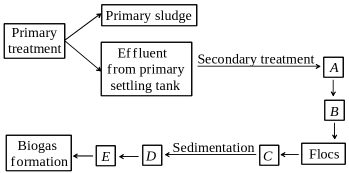
A
$A-$small aeration tank,$B-$Microbial digestion,$C-$High $BOD, D-$Activated sludge,$E-$Aerobic sludge digesters
B
$A-$Large aeration tank,$B-$Mechanical agitation,$C-$Increased $BOD, D-$Activated sludge,$E-$Aerobic sludge digesters
C
$A-$small aeration tank,$B-$Microbial digestion,$C-$Low $BOD, D-$Activated sludge,$E-$Anaerobic sludge digesters
D
$A-$Large aeration tank,$B-$Mechanical agitation,$C-$Reduced $BOD, D-$Activated sludge,$E-$Anaerobic sludge digesters
Solution
(D) In sewage treatment,the effluent from the primary settling tank is passed into large aeration tanks $(A)$ where it is constantly agitated mechanically $(B)$ and air is pumped into it.
This allows vigorous growth of aerobic microbes into flocs,which consume the major part of the organic matter in the effluent,thereby significantly reducing the $BOD$ $(C)$.
Once the $BOD$ of sewage or wastewater is reduced significantly,the effluent is passed into a settling tank where the bacterial 'flocs' are allowed to sediment. This sediment is called activated sludge $(D)$.
$A$ small part of the activated sludge is pumped back into the aeration tank to serve as the inoculum. The remaining major part of the sludge is pumped into large tanks called anaerobic sludge digesters $(E)$.
In these digesters,other kinds of bacteria,which grow anaerobically,digest the bacteria and the fungi in the sludge,producing gases like methane,hydrogen sulphide,and carbon dioxide,which form biogas.
This allows vigorous growth of aerobic microbes into flocs,which consume the major part of the organic matter in the effluent,thereby significantly reducing the $BOD$ $(C)$.
Once the $BOD$ of sewage or wastewater is reduced significantly,the effluent is passed into a settling tank where the bacterial 'flocs' are allowed to sediment. This sediment is called activated sludge $(D)$.
$A$ small part of the activated sludge is pumped back into the aeration tank to serve as the inoculum. The remaining major part of the sludge is pumped into large tanks called anaerobic sludge digesters $(E)$.
In these digesters,other kinds of bacteria,which grow anaerobically,digest the bacteria and the fungi in the sludge,producing gases like methane,hydrogen sulphide,and carbon dioxide,which form biogas.
0 likes
View Solution142
MediumMCQ
Treatment of waste-water is done by the
A
Photoautotrophic microbes,naturally present in sewage
B
Chemoautotrophic microbes,naturally present in sewage
C
Heterotrophic microbes naturally present in sewage
D
Heterotrophic microbes inoculated in the sewage from outside only
Solution
(C) The treatment of waste-water (sewage) is primarily carried out by heterotrophic microbes. These microorganisms are naturally present in the sewage and are utilized in the secondary treatment process (biological treatment). They consume the organic matter present in the sewage,thereby reducing the Biological Oxygen Demand $(BOD)$ of the effluent.
0 likes
View Solution143
MediumMCQ
In a sewage treatment plant,primary treatment is
A
Physical process which involves sedimentation only
B
Physical process which involves both filtration and sedimentation
C
Biological process which involves formation of primary sludge and effluent
D
Biological process which involves both filtration and sedimentation
Solution
(B) Primary treatment in a sewage treatment plant is a physical process. It involves two main steps:
$1$. Sequential filtration to remove floating debris.
$2$. Sedimentation to remove grit (soil and small pebbles) and other solid particles to form primary sludge.
$1$. Sequential filtration to remove floating debris.
$2$. Sedimentation to remove grit (soil and small pebbles) and other solid particles to form primary sludge.
0 likes
View Solution144
MediumMCQ
During primary treatment,all solids that settle form $A$ and the supernatant forms $B$.
A
$A$ - Primary sludge; $B$ - effluent
B
$A$ - Primary sludge; $B$ - secondary effluent
C
$A$ - Activated sludge; $B$ - clarified effluent
D
$A$ - Activated sludge; $B$ - effluent
Solution
(A) Primary treatment of sewage involves physical removal of particles through filtration and sedimentation.
All solids that settle down during this process are known as primary sludge.
The supernatant liquid that remains above the settled solids is called the effluent.
All solids that settle down during this process are known as primary sludge.
The supernatant liquid that remains above the settled solids is called the effluent.
0 likes
View Solution145
MediumMCQ
What are flocs?
A
Masses of anaerobic bacteria
B
Masses of aerobic fungi only
C
Masses of anaerobic bacteria and fungi
D
Masses of aerobic bacteria associated with fungal filaments
Solution
(D) Flocs are defined as masses of aerobic bacteria associated with fungal filaments to form mesh-like structures.
These structures play a vital role in the secondary treatment of sewage,where they consume the major part of the organic matter in the effluent,thereby significantly reducing the Biochemical Oxygen Demand $(BOD)$.
These structures play a vital role in the secondary treatment of sewage,where they consume the major part of the organic matter in the effluent,thereby significantly reducing the Biochemical Oxygen Demand $(BOD)$.
0 likes
View Solution146
MediumMCQ
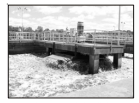
Identify the stage of sewage treatment shown below.
A
Primary treatment
B
Secondary treatment
C
Tertiary treatment
D
Filtration and sedimentation
Solution
(B) The image shows an aeration tank,which is a key component of the secondary treatment of sewage. In this stage,the primary effluent is passed into large aeration tanks where it is constantly agitated mechanically and air is pumped into it. This allows vigorous growth of aerobic microbes into flocs (masses of bacteria associated with fungal filaments to form mesh-like structures). These microbes consume the major part of the organic matter in the effluent,significantly reducing the Biochemical Oxygen Demand $(BOD)$.
0 likes
View Solution147
MediumMCQ
What happens to activated sludge?
A
It is generally released into natural water bodies like rivers and streams
B
It is completely pumped back into aeration tank to serve as inoculum
C
The major part of the sludge is pumped into large tanks called anaerobic sludge digesters
D
It undergoes sequential filtration
Solution
(C) small part of the activated sludge is pumped back into the aeration tank to serve as inoculum (seed).
The major part of the activated sludge is pumped into large tanks called anaerobic sludge digesters,where anaerobic bacteria digest the bacteria and fungi in the sludge,producing gases like methane,hydrogen sulfide,and carbon dioxide.
The major part of the activated sludge is pumped into large tanks called anaerobic sludge digesters,where anaerobic bacteria digest the bacteria and fungi in the sludge,producing gases like methane,hydrogen sulfide,and carbon dioxide.
0 likes
View Solution148
MediumMCQ
Secondary treatment of sewage
A
Removes grit and large pieces of organic matter
B
Involves shredding,churning,filtration and sedimentation
C
Does not require aeration
D
Involves microbial digestion of organic matter
Solution
(D) Secondary treatment of sewage,also known as biological treatment,involves the microbial digestion of organic matter. During this process,aerobic microbes consume the organic waste present in the sewage,significantly reducing the Biological Oxygen Demand $(BOD)$.
0 likes
View Solution149
EasyMCQ
The removal of floating and suspended solids from sewage through filtration and sedimentation is the part of
A
Primary treatment
B
Secondary treatment
C
Tertiary treatment
D
Biological treatment
Solution
(A) The removal of floating and suspended solids from sewage through filtration and sedimentation is known as primary treatment.
This process involves physical removal of particles through sequential filtration and sedimentation.
This process involves physical removal of particles through sequential filtration and sedimentation.
0 likes
View Solution150
MediumMCQ
Which of the following statements regarding sewage is correct?
A
Municipal waste water,whose major component is human excreta.
B
Contains large amounts of organic matter and non-pathogenic microbes.
C
Can be discharged directly into natural water bodies like rivers and streams.
D
It is generated in smaller quantities in cities and villages compared to towns.
Solution
(A) Sewage is defined as municipal waste water that contains large amounts of organic matter and microbes. Its major component is human excreta. It cannot be discharged directly into natural water bodies because it contains pathogenic microbes and high organic content,which would lead to pollution. Therefore,option $A$ is the most accurate description of its composition.
0 likes
View SolutionMicrobes in Human Welfare — Microbes in Sewage Treatment · Frequently Asked Questions
1Are these Microbes in Human Welfare questions useful for JEE and NEET?
Yes. All questions in this section are mapped to JEE Main and NEET exam patterns. Previous year questions from JEE Main, NEET, GUJCET and state-level exams are included with full solutions.
2Can I switch to Hindi or Gujarati for these questions?
Yes. Use the language tabs in the hero section or the sidebar to view the same questions and solutions in English, Hindi or Gujarati.
3How do I generate a question paper from this subtopic?
Use the Vedclass Exam Paper Generator — select the chapter and subtopic, set difficulty, and generate Sets A, B, C, D automatically. First 3 chapters of every subject are free.
Vedclass Products
For Students
Vedclass Test Series
Mock tests in real JEE/NEET style with performance analysis. 5-day free trial.
Start Free TrialFor Teachers
Exam Paper Generator
Generate Set A/B/C/D papers from this chapter in 2 minutes. 3 chapters free.
Try FreeFor Institutes
Online Exam Module
Live online exams with unlimited students, 360° analytics & white-label branding.
See DemoFor Teachers & Institutes
Generate a Microbes in Human Welfare Exam Paper in 2 Minutes
Select subtopic & difficulty — Sets A, B, C, D auto-generated with No Repeat logic.
First 3 chapters of every subject are free — no payment required.