
A English
Female reproductive system Questions in English
Class 12 Biology · Human Reproduction · Female reproductive system
156+
Questions
English
Language
100%
With Solutions
Showing 50 of 156 questions in English
101
EasyMCQ
Graafian follicle contains
A
Oogonial cells
B
Corpus luteum
C
Theca externa and theca interna
D
Corpus albicans
Solution
(C) The Graafian follicle is the mature ovarian follicle.
It is characterized by the presence of a secondary oocyte surrounded by the zona pellucida,the corona radiata,and the follicular cavity (antrum).
Structurally,it consists of an outermost layer known as the theca externa and an inner layer known as the theca interna.
It is characterized by the presence of a secondary oocyte surrounded by the zona pellucida,the corona radiata,and the follicular cavity (antrum).
Structurally,it consists of an outermost layer known as the theca externa and an inner layer known as the theca interna.
0 likes
View Solution102
MediumMCQ
Identify the odd one out.
A
Labia minora
B
Fimbriae
C
Infundibulum
D
Isthmus
Solution
(A) The female reproductive system consists of external and internal genitalia.
$Labia \ minora$ is a part of the external genitalia (vulva).
$Fimbriae$,$Infundibulum$,and $Isthmus$ are all parts of the fallopian tube,which is an internal reproductive organ.
Therefore,$Labia \ minora$ is the odd one out.
$Labia \ minora$ is a part of the external genitalia (vulva).
$Fimbriae$,$Infundibulum$,and $Isthmus$ are all parts of the fallopian tube,which is an internal reproductive organ.
Therefore,$Labia \ minora$ is the odd one out.
0 likes
View Solution103
EasyMCQ
Bartholin glands are also called
A
Vestibular glands
B
Lenticular glands
C
Rudimentary glands
D
Does not exist
Solution
(A) Bartholin glands are also known as the Greater vestibular glands.
These are a pair of small glands located on each side of the vaginal opening.
They are homologous to the bulbourethral glands (Cowper's glands) in males.
Their primary function is to secrete a viscous fluid that provides lubrication during sexual intercourse.
These are a pair of small glands located on each side of the vaginal opening.
They are homologous to the bulbourethral glands (Cowper's glands) in males.
Their primary function is to secrete a viscous fluid that provides lubrication during sexual intercourse.
0 likes
View Solution104
EasyMCQ
Accessory sexual characters in females are promoted by
A
Androgen
B
Progesterone
C
Oestrogen
D
Testosterone
Solution
(C) Oestrogen is secreted by the cells of the Graafian follicles. It is the principal feminizing hormone responsible for the development of secondary sexual characters and the maintenance of female reproductive organs.
0 likes
View Solution105
EasyMCQ
The female structures that are homologous to the scrotum of the male are:
A
Labia minora
B
Labia majora
C
Clitoris
D
Urethral folds
Solution
(B) In human reproductive anatomy, homologous structures are those that share a common embryonic origin. The $Labia \text{ } majora$ in females are homologous to the scrotum in males. Both structures develop from the same embryonic tissue, known as the labioscrotal swellings.
0 likes
View Solution106
EasyMCQ
Bartholin glands are situated
A
On the sides of head
B
At the reduced tail end of birds
C
On either sides of vas deferens in human
D
On either sides of vagina in human
Solution
(D) Greater vestibular glands,also known as Bartholin's glands,are paired glands situated on each side of the vaginal orifice.
These glands are homologous to the male bulbourethral (Cowper's) glands and secrete a viscous fluid that provides lubrication during sexual intercourse.
The lesser vestibular glands (paraurethral glands or Skene's glands) are numerous minute glands present on either side of the urethral orifice.
These glands are homologous to the male prostate glands and secrete mucus.
These glands are homologous to the male bulbourethral (Cowper's) glands and secrete a viscous fluid that provides lubrication during sexual intercourse.
The lesser vestibular glands (paraurethral glands or Skene's glands) are numerous minute glands present on either side of the urethral orifice.
These glands are homologous to the male prostate glands and secrete mucus.
0 likes
View Solution107
EasyMCQ
The clitoris in females is
A
Analogous to penis
B
Homologous to penis
C
Functional penis in female
D
Non-functional penis in male
Solution
(B) The clitoris is a small,sensitive,erectile organ located at the anterior junction of the labia minora in the female reproductive system.
It is embryologically derived from the same tissue as the penis in males.
Therefore,the clitoris is considered homologous to the penis because they share a common developmental origin,even though they have different functions.
It is embryologically derived from the same tissue as the penis in males.
Therefore,the clitoris is considered homologous to the penis because they share a common developmental origin,even though they have different functions.
0 likes
View Solution108
EasyMCQ
Fleshy folds of tissue which extend down the mons pubis and surround the vaginal opening are called:
A
Labia minora
B
Labia majora
C
Hymen
D
Clitoris
Solution
(B) Labia majora are two large,fleshy folds of tissue that extend down from the mons pubis and surround the vaginal opening.
They form the outer boundary of the vulva.
They are covered with pubic hair and contain numerous sebaceous (oil) glands.
In terms of embryonic development,the labia majora are considered homologous to the scrotum in males.
They form the outer boundary of the vulva.
They are covered with pubic hair and contain numerous sebaceous (oil) glands.
In terms of embryonic development,the labia majora are considered homologous to the scrotum in males.
0 likes
View Solution109
EasyMCQ
Mammary glands are modified:
A
Sweat gland
B
Sebaceous gland
C
Lacrimal gland
D
Endocrine gland
Solution
(A) Mammary glands are modified sweat glands that lie over the pectoral muscles.
They occur in all female mammals and in a rudimentary form in all male mammals.
In the human female,the mammary glands start to increase in size at puberty due to fat accumulation and reach their maximum development by approximately the age of $20$.
These undergo additional development during pregnancy.
The essential function of the mammary gland is milk production,which provides nutrition and immunological protection to the offspring.
They occur in all female mammals and in a rudimentary form in all male mammals.
In the human female,the mammary glands start to increase in size at puberty due to fat accumulation and reach their maximum development by approximately the age of $20$.
These undergo additional development during pregnancy.
The essential function of the mammary gland is milk production,which provides nutrition and immunological protection to the offspring.
0 likes
View Solution110
EasyMCQ
Vaginal orifice and urethral orifice open into the:
A
Vulval vestibule
B
Labia majora
C
Labia minora
D
Cervix
Solution
(A) The vulval vestibule (or urinogenital vestibule) is a central space located between the labia minora.
It contains the openings of both the urethra (urethral orifice) and the vagina (vaginal orifice).
Therefore,the correct answer is the vulval vestibule.
It contains the openings of both the urethra (urethral orifice) and the vagina (vaginal orifice).
Therefore,the correct answer is the vulval vestibule.
0 likes
View Solution111
EasyMCQ
In mammals,corpus luteum is found in which organ?
A
Brain
B
Ovary
C
Liver
D
Eyes
Solution
(B) The corpus luteum is a temporary endocrine structure in female mammals that is involved in the production of relatively high levels of progesterone and moderate levels of estradiol and inhibin $A$. It is formed in the ovary from the remnants of the ovarian follicle after the mature ovum has been released during ovulation.
0 likes
View Solution112
EasyMCQ
Choose the correct combination of the labelling for the following structure.
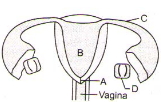
A
$A-Oviduct, B-Uterus, C-Cervix, D-Ovary$
B
$A-Cervix, B-Uterus, C-Ovary, D-Tumor$
C
$A-Uterus, B-Uterus cavity, C-Oviducal funnel, D-Ovary$
D
$A-Cervix, B-Uterine cavity, C-Fallopian tube, D-Ovary$
Solution
(D) Based on the provided diagram of the human female reproductive system:
$A$ points to the Cervix,which is the narrow neck of the uterus that opens into the vagina.
$B$ points to the Uterine cavity,which is the central space within the uterus.
$C$ points to the Fallopian tube (oviduct),which transports the ovum from the ovary to the uterus.
$D$ points to the Ovary,the primary female sex organ.
Therefore,the correct combination is $A-Cervix, B-Uterine cavity, C-Fallopian tube, D-Ovary$.
$A$ points to the Cervix,which is the narrow neck of the uterus that opens into the vagina.
$B$ points to the Uterine cavity,which is the central space within the uterus.
$C$ points to the Fallopian tube (oviduct),which transports the ovum from the ovary to the uterus.
$D$ points to the Ovary,the primary female sex organ.
Therefore,the correct combination is $A-Cervix, B-Uterine cavity, C-Fallopian tube, D-Ovary$.
0 likes
View Solution113
MediumMCQ
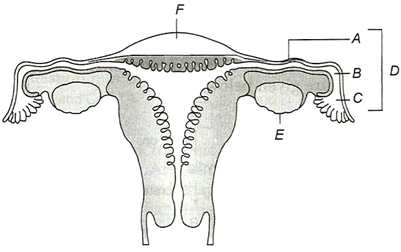
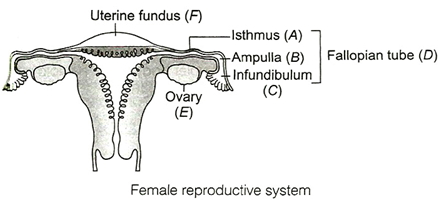
The following diagram refers to the female reproductive system of a human. Identify $A$ to $F$.
A
$A-Ampulla, B-Isthmus, C-Infundibulum, D-Fallopian tube, E-Ovary, F-Uterine fundus$
B
$A-Isthmus, B-Infundibulum, C-Ampulla, D-Fallopian tube, E-Ovary, F-Uterine fundus$
C
$A-Isthmus, B-Ampulla, C-Infundibulum, D-Fallopian tube, E-Ovary, F-Uterine fundus$
D
$A-Ampulla, B-Infundibulum, C-Isthmus, D-Fallopian tube, E-Ovary, F-Uterine fundus$
Solution
(C) Based on the anatomical structure of the human female reproductive system:
$A$ represents the Isthmus,which is the narrow part of the fallopian tube joining the uterus.
$B$ represents the Ampulla,the wider part of the fallopian tube.
$C$ represents the Infundibulum,the funnel-shaped part near the ovary.
$D$ represents the Fallopian tube (oviduct).
$E$ represents the Ovary.
$F$ represents the Uterine fundus,the upper dome-shaped part of the uterus.
Therefore,the correct sequence is $A-Isthmus, B-Ampulla, C-Infundibulum, D-Fallopian tube, E-Ovary, F-Uterine fundus$.
$A$ represents the Isthmus,which is the narrow part of the fallopian tube joining the uterus.
$B$ represents the Ampulla,the wider part of the fallopian tube.
$C$ represents the Infundibulum,the funnel-shaped part near the ovary.
$D$ represents the Fallopian tube (oviduct).
$E$ represents the Ovary.
$F$ represents the Uterine fundus,the upper dome-shaped part of the uterus.
Therefore,the correct sequence is $A-Isthmus, B-Ampulla, C-Infundibulum, D-Fallopian tube, E-Ovary, F-Uterine fundus$.
0 likes
View Solution114
MediumMCQ
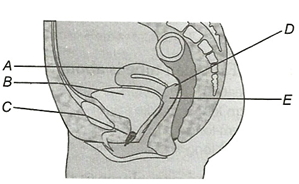
The following diagram refers to the female reproductive system of a human. Identify $A$ to $E$.
A
$A-$Uterus,$B-$Urinary bladder,$C-$Urethra,$D-$Cervix,$E-$Vagina
B
$A-$Urethra,$B-$Urinary bladder,$C-$Uterus,$D-$Vagina,$E-$Cervix
C
$A-$Urethra,$B-$Urinary bladder,$C-$Uterus,$D-$Cervix,$E-$Vagina
D
$A-$Uterus,$B-$Urinary bladder,$C-$Urethra,$D-$Cervix,$E-$Vagina
Solution
(D) Based on the anatomical structure of the human female reproductive system shown in the diagram:
$A$ points to the Uterus (womb).
$B$ points to the Urinary bladder.
$C$ points to the Urethra.
$D$ points to the Cervix,which is the lower part of the uterus.
$E$ points to the Vagina,the canal leading from the cervix to the outside of the body.
Therefore,the correct identification is $A-$Uterus,$B-$Urinary bladder,$C-$Urethra,$D-$Cervix,$E-$Vagina. This matches option $D$.
$A$ points to the Uterus (womb).
$B$ points to the Urinary bladder.
$C$ points to the Urethra.
$D$ points to the Cervix,which is the lower part of the uterus.
$E$ points to the Vagina,the canal leading from the cervix to the outside of the body.
Therefore,the correct identification is $A-$Uterus,$B-$Urinary bladder,$C-$Urethra,$D-$Cervix,$E-$Vagina. This matches option $D$.
0 likes
View Solution115
MediumMCQ
The largest part of the fallopian tube is
A
Infundibulum
B
Isthmus
C
Ampulla
D
Cervix
Solution
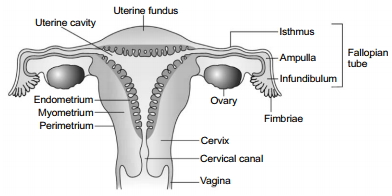
(C) The fallopian tube (oviduct) consists of three main parts: the infundibulum,the ampulla,and the isthmus.
$1$. The infundibulum is the funnel-shaped part closest to the ovary,which possesses finger-like projections called fimbriae.
$2$. The ampulla is the wider,middle,and longest part of the fallopian tube where fertilization typically occurs.
$3$. The isthmus is the narrow part that joins the uterus.
Therefore,the largest part of the fallopian tube is the ampulla.
$1$. The infundibulum is the funnel-shaped part closest to the ovary,which possesses finger-like projections called fimbriae.
$2$. The ampulla is the wider,middle,and longest part of the fallopian tube where fertilization typically occurs.
$3$. The isthmus is the narrow part that joins the uterus.
Therefore,the largest part of the fallopian tube is the ampulla.
0 likes
View Solution116
EasyMCQ
Which of the following is the last part of the oviduct,which has a narrow lumen and joins with the uterus?
A
Ampulla
B
Isthmus
C
Infundibulum
D
Fimbriae
Solution
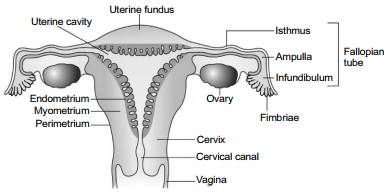
(B) The oviduct (Fallopian tube) consists of three main parts: the infundibulum,the ampulla,and the isthmus.
$1$. The infundibulum is the funnel-shaped part closest to the ovary,possessing finger-like projections called fimbriae.
$2$. The ampulla is the wider,middle part of the oviduct where fertilization typically occurs.
$3$. The isthmus is the last and final part of the oviduct. It has a narrow lumen and connects directly to the uterus.
$1$. The infundibulum is the funnel-shaped part closest to the ovary,possessing finger-like projections called fimbriae.
$2$. The ampulla is the wider,middle part of the oviduct where fertilization typically occurs.
$3$. The isthmus is the last and final part of the oviduct. It has a narrow lumen and connects directly to the uterus.
0 likes
View Solution117
MediumMCQ
Which one of the following is an incorrect match?
A
Myometrium : Exhibits strong contractions during delivery of the baby
B
Endometrium : Undergoes cyclical changes during menstrual cycle
C
Perimetrium : Serosa of uterus
D
Uterus : Birth canal
Solution
(D) The wall of the uterus consists of three layers: $Perimetrium$ (outer thin layer),$Myometrium$ (middle thick layer of smooth muscle),and $Endometrium$ (inner glandular layer).
$Myometrium$ exhibits strong contractions during the delivery of the baby.
$Endometrium$ undergoes cyclical changes during the menstrual cycle.
$Perimetrium$ is the external serosa of the uterus.
$Uterus$ is not the birth canal. The cavity of the cervix is called the cervical canal,and the cervical canal along with the vagina forms the birth canal.
$Myometrium$ exhibits strong contractions during the delivery of the baby.
$Endometrium$ undergoes cyclical changes during the menstrual cycle.
$Perimetrium$ is the external serosa of the uterus.
$Uterus$ is not the birth canal. The cavity of the cervix is called the cervical canal,and the cervical canal along with the vagina forms the birth canal.
0 likes
View Solution118
MediumMCQ
Which of the following is the correct match regarding the female external genitalia and their functions?
A
Mons pubis: Cushion of fatty tissue covered by skin and pubic hair,which cushions the pubic symphysis.
B
Labia majora: Fleshy folds of tissue that extend down from the mons pubis and surround the vaginal opening.
C
Labia minora: Paired folds of tissue under the labia majora,homologous to the scrotum in males.
D
Clitoris: $A$ tiny finger-like structure which lies at the upper junction of the two labia minora above the urethral opening. It is analogous to the penis in males.
Solution
(B) . Mons pubis is a cushion of fatty tissue covered by skin and pubic hair,not surrounding the vaginal orifice.
$B$. Labia majora are fleshy folds of tissue that extend down from the mons pubis and surround the vaginal opening. This is a correct description.
$C$. Labia minora are paired folds of tissue under the labia majora,but they are not homologous to the scrotum; the labia majora are homologous to the scrotum.
$D$. Clitoris is a tiny finger-like structure which lies at the upper junction of the two labia minora above the urethral opening. It is homologous to the penis in males. While the statement describes the structure correctly,option $B$ is the most standard anatomical description provided in the context of the female reproductive system.
$B$. Labia majora are fleshy folds of tissue that extend down from the mons pubis and surround the vaginal opening. This is a correct description.
$C$. Labia minora are paired folds of tissue under the labia majora,but they are not homologous to the scrotum; the labia majora are homologous to the scrotum.
$D$. Clitoris is a tiny finger-like structure which lies at the upper junction of the two labia minora above the urethral opening. It is homologous to the penis in males. While the statement describes the structure correctly,option $B$ is the most standard anatomical description provided in the context of the female reproductive system.
0 likes
View Solution119
MediumMCQ
The mammary glands are paired structures that contain glandular tissue and a variable amount of fat. The correct sequence of tissues involved in the synthesis and flow of milk is:
A
Mammary lobes $\rightarrow$ Mammary alveoli $\rightarrow$ Mammary ampulla $\rightarrow$ Mammary duct $\rightarrow$ Lactiferous duct
B
Mammary lobes $\rightarrow$ Mammary alveoli $\rightarrow$ Mammary duct $\rightarrow$ Mammary ampulla $\rightarrow$ Lactiferous duct
C
Mammary lobes $\rightarrow$ Mammary alveoli $\rightarrow$ Lactiferous duct $\rightarrow$ Mammary ampulla $\rightarrow$ Mammary duct
D
Mammary alveoli $\rightarrow$ Mammary lobes $\rightarrow$ Lactiferous duct $\rightarrow$ Mammary duct
Solution
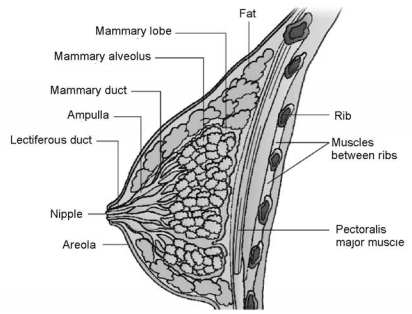
(B) The glandular tissue of each breast is divided into $15-20$ mammary lobes containing clusters of cells called alveoli.
The cells of alveoli secrete milk,which is stored in the cavities (lumens) of alveoli.
The alveoli open into mammary tubules.
The tubules of each lobe join to form a mammary duct.
Several mammary ducts join to form a wider mammary ampulla,which is connected to the lactiferous duct through which milk is sucked out.
Therefore,the correct sequence is: Mammary lobes $\rightarrow$ Mammary alveoli $\rightarrow$ Mammary duct $\rightarrow$ Mammary ampulla $\rightarrow$ Lactiferous duct.
The cells of alveoli secrete milk,which is stored in the cavities (lumens) of alveoli.
The alveoli open into mammary tubules.
The tubules of each lobe join to form a mammary duct.
Several mammary ducts join to form a wider mammary ampulla,which is connected to the lactiferous duct through which milk is sucked out.
Therefore,the correct sequence is: Mammary lobes $\rightarrow$ Mammary alveoli $\rightarrow$ Mammary duct $\rightarrow$ Mammary ampulla $\rightarrow$ Lactiferous duct.
0 likes
View Solution120
MediumMCQ
$A$: The vaginal orifice is partially covered by a membrane called the hymen.
$R$: It is made up of a thick layer of smooth muscle.
$R$: It is made up of a thick layer of smooth muscle.
A
Assertion and Reason both are correct and Reason is the correct explanation of Assertion.
B
Assertion and Reason both are correct but Reason is not the correct explanation of Assertion.
C
Assertion is correct,but Reason is incorrect.
D
Both Assertion and Reason are incorrect.
Solution
(C) The Assertion is correct: The vaginal orifice is indeed partially covered by a thin,mucous membrane known as the hymen.
The Reason is incorrect: The hymen is not made of a thick layer of smooth muscle; rather,it is a thin,vascularized,and delicate fold of mucous membrane. Therefore,the correct option is $C$.
The Reason is incorrect: The hymen is not made of a thick layer of smooth muscle; rather,it is a thin,vascularized,and delicate fold of mucous membrane. Therefore,the correct option is $C$.
0 likes
View Solution121
MediumMCQ
$A$ : Presence or absence of hymen is not a reliable indicator of virginity or sexual experience.
$R$ : It can be broken down by a sudden fall or jolt,insertion of a vaginal tampon,or active participation in some sports like horse riding.
$R$ : It can be broken down by a sudden fall or jolt,insertion of a vaginal tampon,or active participation in some sports like horse riding.
A
Assertion and Reason both are correct and Reason is the correct explanation of Assertion.
B
Assertion and Reason both are correct but Reason is not the correct explanation of Assertion.
C
Assertion is correct,but Reason is incorrect.
D
Both Assertion and Reason are incorrect.
Solution
(A) The hymen is a thin,mucous membrane that partially covers the vaginal opening.
It is a common misconception that the presence or absence of the hymen is a reliable indicator of virginity or sexual experience.
The hymen can be torn or broken not only during sexual intercourse but also due to various other factors.
These factors include a sudden fall or jolt,the insertion of a vaginal tampon,or active participation in sports such as horse riding,cycling,or gymnastics.
Therefore,the presence or absence of the hymen cannot be used as a definitive proof of virginity.
It is a common misconception that the presence or absence of the hymen is a reliable indicator of virginity or sexual experience.
The hymen can be torn or broken not only during sexual intercourse but also due to various other factors.
These factors include a sudden fall or jolt,the insertion of a vaginal tampon,or active participation in sports such as horse riding,cycling,or gymnastics.
Therefore,the presence or absence of the hymen cannot be used as a definitive proof of virginity.
0 likes
View Solution122
MediumMCQ
The following diagram shows a section of the female reproductive system. What are $P, Q,$ and $R$?
$\quad\quad\quad P \quad\quad Q \quad\quad R$
$\quad\quad\quad P \quad\quad Q \quad\quad R$
A
$P$: Myometrium,$Q$: Isthmus,$R$: Cilia
B
$P$: Myometrium,$Q$: Ampulla,$R$: Cilia
C
$P$: Endometrium,$Q$: Isthmus,$R$: Fimbriae
D
$P$: Endometrium,$Q$: Ampulla,$R$: Fimbriae
Solution
(C) $1$. The female reproductive system consists of the uterus,fallopian tubes (oviducts),and ovaries.
$2$. The uterine wall has three layers: the outer perimetrium,the middle thick muscular layer called the myometrium $(P)$,and the inner glandular layer called the endometrium.
$3$. The fallopian tube consists of three parts: the infundibulum (with finger-like projections called fimbriae $(R)$),the ampulla,and the isthmus $(Q)$.
$4$. Based on standard anatomical diagrams of the female reproductive tract,$P$ represents the myometrium,$Q$ represents the isthmus,and $R$ represents the fimbriae.
$5$. Therefore,the correct identification is $P$: Myometrium,$Q$: Isthmus,$R$: Fimbriae.
$2$. The uterine wall has three layers: the outer perimetrium,the middle thick muscular layer called the myometrium $(P)$,and the inner glandular layer called the endometrium.
$3$. The fallopian tube consists of three parts: the infundibulum (with finger-like projections called fimbriae $(R)$),the ampulla,and the isthmus $(Q)$.
$4$. Based on standard anatomical diagrams of the female reproductive tract,$P$ represents the myometrium,$Q$ represents the isthmus,and $R$ represents the fimbriae.
$5$. Therefore,the correct identification is $P$: Myometrium,$Q$: Isthmus,$R$: Fimbriae.
0 likes
View Solution123
MediumMCQ
Match the following columns regarding the layers of the uterine wall:
| Column-$I$ | Column-$II$ |
|---|---|
| $P$. Perimetrium | $I$. Thick layer |
| $Q$. Myometrium | $II$. Thin layer |
| $R$. Endometrium | $III$. Glandular layer |
A
$(P-II), (Q-I), (R-III)$
B
$(P-I), (Q-II), (R-III)$
C
$(P-III), (Q-I), (R-II)$
D
$(P-III), (Q-II), (R-I)$
Solution
(A) The uterine wall consists of three layers of tissue:
$1$. Perimetrium: The external thin membranous layer.
$2$. Myometrium: The middle thick layer of smooth muscle that exhibits strong contraction during delivery of the baby.
$3$. Endometrium: The inner glandular layer that lines the uterine cavity and undergoes cyclical changes during the menstrual cycle.
Matching these:
$P$ (Perimetrium) matches with $II$ (Thin layer).
$Q$ (Myometrium) matches with $I$ (Thick layer).
$R$ (Endometrium) matches with $III$ (Glandular layer).
Therefore,the correct sequence is $(P-II), (Q-I), (R-III)$.
$1$. Perimetrium: The external thin membranous layer.
$2$. Myometrium: The middle thick layer of smooth muscle that exhibits strong contraction during delivery of the baby.
$3$. Endometrium: The inner glandular layer that lines the uterine cavity and undergoes cyclical changes during the menstrual cycle.
Matching these:
$P$ (Perimetrium) matches with $II$ (Thin layer).
$Q$ (Myometrium) matches with $I$ (Thick layer).
$R$ (Endometrium) matches with $III$ (Glandular layer).
Therefore,the correct sequence is $(P-II), (Q-I), (R-III)$.
0 likes
View Solution124
MediumMCQ
Which of the following female reproductive structures is homologous to the male penis?
A
Clitoris
B
Hymen
C
Labia majora
D
Mons pubis
Solution
(A) The $Clitoris$ is a small,sensitive,erectile organ located at the upper junction of the two $labia$ $minora$ above the urethral opening.
It is homologous to the male $penis$ because both structures are derived from the same embryonic tissue (the genital tubercle) and possess erectile tissue that becomes engorged with blood during sexual arousal.
It is homologous to the male $penis$ because both structures are derived from the same embryonic tissue (the genital tubercle) and possess erectile tissue that becomes engorged with blood during sexual arousal.
0 likes
View Solution125
MediumMCQ
......... is a cushion-like structure of fatty tissue covered by skin and pubic hair.
A
Clitoris
B
Hymen
C
Labia majora
D
Mons pubis
Solution
(D) The $Mons$ $pubis$ is a cushion-like structure of fatty tissue covered by skin and pubic hair. It is a part of the female external genitalia. The $Labia$ $majora$ are fleshy folds of tissue, which extend down from the $Mons$ $pubis$ and surround the vaginal opening. The $Clitoris$ is a tiny finger-like structure which lies at the upper junction of the two $Labia$ $minora$ above the urethral opening. The $Hymen$ is a membrane which often partially covers the vaginal opening.
0 likes
View Solution126
MediumMCQ
The $........$ is often torn during coitus or intercourse.
A
Clitoris
B
Hymen
C
Labia majora
D
Mons pubis
Solution
(B) The $Hymen$ is a membrane that partially covers the vaginal opening. It is often torn during the first coitus or intercourse. However,it can also be broken by sudden falls,jolts,insertion of a vaginal tampon,or active participation in sports like horse riding or cycling. Therefore,the presence or absence of the $Hymen$ is not a reliable indicator of virginity or sexual experience.
0 likes
View Solution127
MediumMCQ
.......... are fleshy folds of tissue, which extend down from the mons pubis and surround the vaginal opening.
A
Clitoris
B
Hymen
C
Labia majora
D
Mons pubis
Solution
(C) The female external genitalia include the mons pubis, labia majora, labia minora, hymen, and clitoris.
$1$. The $Mons \text{ } pubis$ is a cushion of fatty tissue covered by skin and pubic hair.
$2$. The $Labia \text{ } majora$ are fleshy folds of tissue, which extend down from the mons pubis and surround the vaginal opening.
$3$. The $Labia \text{ } minora$ are paired folds of tissue under the labia majora.
$4$. The $Clitoris$ is a tiny finger-like structure which lies at the upper junction of the two labia minora above the urethral opening.
$1$. The $Mons \text{ } pubis$ is a cushion of fatty tissue covered by skin and pubic hair.
$2$. The $Labia \text{ } majora$ are fleshy folds of tissue, which extend down from the mons pubis and surround the vaginal opening.
$3$. The $Labia \text{ } minora$ are paired folds of tissue under the labia majora.
$4$. The $Clitoris$ is a tiny finger-like structure which lies at the upper junction of the two labia minora above the urethral opening.
0 likes
View Solution128
MediumMCQ
.......... is a tiny finger-like structure which lies at the upper junction of the two labia minora above the urethral opening.
A
Clitoris
B
Hymen
C
Labia majora
D
Mons pubis
Solution
(A) The clitoris is a tiny finger-like structure which lies at the upper junction of the two labia minora above the urethral opening. It is a highly sensitive organ homologous to the penis in males.
0 likes
View Solution129
MediumMCQ
The following is a diagram of a section showing the mammary gland. Identify $P$ and $Q$.
A
Mammary ampulla,Fat
B
Mammary duct,Fat
C
Mammary ampulla,Muscle
D
Mammary duct,Muscle
Solution
(A) In the structure of the mammary gland, the mammary tubules join to form the mammary duct. Several mammary ducts join to form a wider mammary ampulla, which is connected to the lactiferous duct through which milk is sucked out. The tissue surrounding these structures in the breast is primarily adipose tissue (fat). Based on standard anatomical diagrams of the mammary gland, $P$ represents the mammary ampulla and $Q$ represents the fat (adipose tissue). Therefore, the correct identification is $P = \text{Mammary ampulla}$ and $Q = \text{Fat}$.
0 likes
View Solution130
MediumMCQ
What is a vaginal tampon?
A
Vagina
B
Hymen
C
$A$ medical device used to absorb menstrual flow
D
None of the above
Solution
(C) vaginal tampon is a mass of absorbent material,typically cotton or rayon,designed to be inserted into the vagina during menstruation to absorb the menstrual flow. It is a feminine hygiene product used for managing menstrual hygiene.
0 likes
View Solution131
EasyMCQ
Identify the correct pathway for the transport of milk.
A
Alveoli $\rightarrow$ Mammary tubules $\rightarrow$ Mammary ducts $\rightarrow$ Mammary ampulla $\rightarrow$ Lactiferous duct
B
Alveoli $\rightarrow$ Mammary ducts $\rightarrow$ Mammary tubules $\rightarrow$ Mammary ampulla $\rightarrow$ Lactiferous duct
C
Alveoli $\rightarrow$ Mammary ampulla $\rightarrow$ Mammary ducts $\rightarrow$ Mammary tubules $\rightarrow$ Lactiferous duct
D
Alveoli $\rightarrow$ Mammary ampulla $\rightarrow$ Mammary tubules $\rightarrow$ Mammary ducts $\rightarrow$ Lactiferous duct
Solution
(A) The mammary glands of the female contain glandular tissue and variable amounts of fat.
Each breast contains $15-20$ lobes of mammary glands containing clusters of cells called alveoli.
The cells of alveoli secrete milk,which is stored in the cavities (lumens) of alveoli.
The alveoli open into mammary tubules.
The tubules of each lobe join to form a mammary duct.
Several mammary ducts join to form a wider mammary ampulla,which is connected to the lactiferous duct through which milk is sucked out.
Therefore,the correct sequence is: Alveoli $\rightarrow$ Mammary tubules $\rightarrow$ Mammary ducts $\rightarrow$ Mammary ampulla $\rightarrow$ Lactiferous duct.
Each breast contains $15-20$ lobes of mammary glands containing clusters of cells called alveoli.
The cells of alveoli secrete milk,which is stored in the cavities (lumens) of alveoli.
The alveoli open into mammary tubules.
The tubules of each lobe join to form a mammary duct.
Several mammary ducts join to form a wider mammary ampulla,which is connected to the lactiferous duct through which milk is sucked out.
Therefore,the correct sequence is: Alveoli $\rightarrow$ Mammary tubules $\rightarrow$ Mammary ducts $\rightarrow$ Mammary ampulla $\rightarrow$ Lactiferous duct.
0 likes
View Solution132
EasyMCQ
Select the incorrect option regarding the uterus.
A
It is also called the womb.
B
It is present in pairs.
C
Its shape is like an inverted pear.
D
It is supported by ligaments attached to the pelvic wall.
Solution
(B) The uterus is a single,muscular organ,not a paired structure. Therefore,the statement that it is present in pairs is incorrect. The uterus is also known as the womb,has an inverted pear shape,and is supported by ligaments attached to the pelvic wall.
0 likes
View Solution133
MediumMCQ
The given figure shows a lateral view of the female reproductive system. Identify $P$ and $Q$.
$\quad\quad\quad P \quad\quad Q$
$\quad\quad\quad P \quad\quad Q$
A
Urinary bladder $\quad$ Labia majora
B
Urinary bladder $\quad$ Labia minora
C
Uterus $\quad$ Labia minora
D
Uterus $\quad$ Labia majora
Solution
(B) In the lateral view of the female reproductive system,the organ located anterior to the uterus and vagina is the urinary bladder $(P)$.
The folds of tissue located internal to the labia majora,surrounding the vaginal opening,are the labia minora $(Q)$.
Therefore,$P$ represents the urinary bladder and $Q$ represents the labia minora.
The folds of tissue located internal to the labia majora,surrounding the vaginal opening,are the labia minora $(Q)$.
Therefore,$P$ represents the urinary bladder and $Q$ represents the labia minora.
0 likes
View Solution134
MediumMCQ
Match the following columns:
| Column-$I$ | Column-$II$ |
| $P$. Infundibulum | $I$. Narrow part of oviduct |
| $Q$. Ampulla | $II$. Wider part of oviduct |
| $R$. Isthmus | $III$. Funnel-shaped part of oviduct |
A
$(P-II), (Q-I), (R-III)$
B
$(P-III), (Q-I), (R-II)$
C
$(P-I), (Q-II), (R-III)$
D
$(P-III), (Q-II), (R-I)$
Solution
(D) The human female reproductive system includes a pair of oviducts (fallopian tubes). Each oviduct consists of three parts:
$1$. Infundibulum $(P)$: The part closer to the ovary is funnel-shaped $(III)$.
$2$. Ampulla $(Q)$: The wider part of the oviduct $(II)$.
$3$. Isthmus $(R)$: The last part of the oviduct which has a narrow lumen and joins the uterus $(I)$.
Therefore, the correct matching is $(P-III), (Q-II), (R-I)$.
$1$. Infundibulum $(P)$: The part closer to the ovary is funnel-shaped $(III)$.
$2$. Ampulla $(Q)$: The wider part of the oviduct $(II)$.
$3$. Isthmus $(R)$: The last part of the oviduct which has a narrow lumen and joins the uterus $(I)$.
Therefore, the correct matching is $(P-III), (Q-II), (R-I)$.
0 likes
View Solution135
EasyMCQ
The edges of the infundibulum possess finger-like projections which are called ..........
A
Cilia
B
Pili
C
Fimbriae
D
Flagella
Solution
(C) The fallopian tube consists of three parts: infundibulum,ampulla,and isthmus.
The infundibulum is the funnel-shaped part closer to the ovary.
The edges of the infundibulum possess finger-like projections called fimbriae,which help in the collection of the ovum after ovulation.
The infundibulum is the funnel-shaped part closer to the ovary.
The edges of the infundibulum possess finger-like projections called fimbriae,which help in the collection of the ovum after ovulation.
0 likes
View Solution136
MediumMCQ
Consider the following statements about the ovary and select the correct ones.
$I -$ It is the primary female sex organ that produces the ovum and ovarian hormones.
$II -$ Ovaries are located in the upper part of the thoracic cavity,one on each side.
$III -$ Each ovary is about $4$ to $6 \ cm$ in length.
$IV -$ Ovaries are connected to the pelvic wall and uterus by ligaments.
$V -$ The ovary is covered by a thin epithelium which encloses the ovarian stroma.
$VI -$ The ovarian stroma is divided into two zones: a peripheral cortex and an inner medulla.
$I -$ It is the primary female sex organ that produces the ovum and ovarian hormones.
$II -$ Ovaries are located in the upper part of the thoracic cavity,one on each side.
$III -$ Each ovary is about $4$ to $6 \ cm$ in length.
$IV -$ Ovaries are connected to the pelvic wall and uterus by ligaments.
$V -$ The ovary is covered by a thin epithelium which encloses the ovarian stroma.
$VI -$ The ovarian stroma is divided into two zones: a peripheral cortex and an inner medulla.
A
$I, II, III, IV, V$
B
$I, IV, V$
C
$I, II, III, IV, V$
D
$I, IV, V, VI$
Solution
(B) Let's analyze the statements:
$I -$ Correct: The ovary is the primary female sex organ that produces the ovum and steroid hormones (estrogen and progesterone).
$II -$ Incorrect: Ovaries are located in the pelvic region,not the thoracic cavity.
$III -$ Incorrect: The length of the ovary is typically $2$ to $4 \ cm$,not $4$ to $6 \ cm$.
$IV -$ Correct: Ovaries are attached to the pelvic wall and uterus by ligaments.
$V -$ Correct: The ovary is covered by a thin epithelium which encloses the ovarian stroma.
$VI -$ Incorrect: The ovarian stroma is divided into a peripheral cortex and an inner medulla (the statement says peripheral medulla and inner cortex,which is reversed).
Therefore,the correct statements are $I, IV,$ and $V$.
$I -$ Correct: The ovary is the primary female sex organ that produces the ovum and steroid hormones (estrogen and progesterone).
$II -$ Incorrect: Ovaries are located in the pelvic region,not the thoracic cavity.
$III -$ Incorrect: The length of the ovary is typically $2$ to $4 \ cm$,not $4$ to $6 \ cm$.
$IV -$ Correct: Ovaries are attached to the pelvic wall and uterus by ligaments.
$V -$ Correct: The ovary is covered by a thin epithelium which encloses the ovarian stroma.
$VI -$ Incorrect: The ovarian stroma is divided into a peripheral cortex and an inner medulla (the statement says peripheral medulla and inner cortex,which is reversed).
Therefore,the correct statements are $I, IV,$ and $V$.
0 likes
View Solution137
EasyMCQ
Each fallopian tube is approximately ...... cm long.
A
$18-20$ cm
B
$20-24$ cm
C
$6-8$ cm
D
$10-12$ cm
Solution
(D) The human female reproductive system includes a pair of fallopian tubes (oviducts). Each fallopian tube extends from the periphery of each ovary to the uterus. The length of each fallopian tube is approximately $10-12$ cm.
0 likes
View Solution138
MediumMCQ
The accessory ducts of the female reproductive system are $.......$
A
Oviducts
B
Oviducts $+$ Uterus
C
Oviducts $+$ Uterus $+$ Vagina
D
Uterus $+$ Vagina
Solution
(C) The female reproductive system includes a pair of ovaries,a pair of oviducts (fallopian tubes),the uterus,the cervix,the vagina,and the external genitalia.
Among these,the oviducts,the uterus,and the vagina constitute the female accessory ducts.
Therefore,the correct combination is Oviducts $+$ Uterus $+$ Vagina.
Among these,the oviducts,the uterus,and the vagina constitute the female accessory ducts.
Therefore,the correct combination is Oviducts $+$ Uterus $+$ Vagina.
0 likes
View Solution139
EasyMCQ
Which layer of the uterus is responsible for its contractions?
A
Endometrium
B
Myometrium
C
Perimetrium
D
All of the above
Solution
(B) The uterus wall consists of three layers of tissue:
$1$. The outer thin membranous layer is called the $Perimetrium$.
$2$. The middle thick layer of smooth muscle is called the $Myometrium$. This layer exhibits strong contractions during delivery of the baby $(parturition)$.
$3$. The inner glandular layer that lines the uterine cavity is called the $Endometrium$.
Therefore,the $Myometrium$ is responsible for uterine contractions.
$1$. The outer thin membranous layer is called the $Perimetrium$.
$2$. The middle thick layer of smooth muscle is called the $Myometrium$. This layer exhibits strong contractions during delivery of the baby $(parturition)$.
$3$. The inner glandular layer that lines the uterine cavity is called the $Endometrium$.
Therefore,the $Myometrium$ is responsible for uterine contractions.
0 likes
View Solution140
MediumMCQ
Arrange the components of the mammary gland from proximal to distal:
$(a)$ Mammary duct
$(b)$ Lactiferous duct
$(c)$ Alveoli
$(d)$ Mammary ampulla
$(e)$ Mammary tubules
Choose the most appropriate answer from the options given below:
$(a)$ Mammary duct
$(b)$ Lactiferous duct
$(c)$ Alveoli
$(d)$ Mammary ampulla
$(e)$ Mammary tubules
Choose the most appropriate answer from the options given below:
A
$(c) \rightarrow (a) \rightarrow (d) \rightarrow (e) \rightarrow (b)$
B
$(b) \rightarrow (c) \rightarrow (e) \rightarrow (d) \rightarrow (a)$
C
$(c) \rightarrow (e) \rightarrow (a) \rightarrow (d) \rightarrow (b)$
D
$(e) \rightarrow (c) \rightarrow (d) \rightarrow (b) \rightarrow (a)$
Solution
(C) The mammary glands are paired structures that contain glandular tissue and variable amounts of fat. The glandular tissue of each breast is divided into $15-20$ mammary lobes containing clusters of cells called alveoli.
The path of milk secretion from the alveoli to the exterior is as follows:
$1$. Alveoli $(c)$ produce milk.
$2$. The cells of alveoli secrete milk into the mammary tubules $(e)$.
$3$. The tubules of each lobe join to form a mammary duct $(a)$.
$4$. Several mammary ducts join to form a wider mammary ampulla $(d)$,which is connected to the lactiferous duct $(b)$ through which milk is sucked out.
Therefore,the correct sequence from proximal to distal is: $(c) \rightarrow (e) \rightarrow (a) \rightarrow (d) \rightarrow (b)$.
The path of milk secretion from the alveoli to the exterior is as follows:
$1$. Alveoli $(c)$ produce milk.
$2$. The cells of alveoli secrete milk into the mammary tubules $(e)$.
$3$. The tubules of each lobe join to form a mammary duct $(a)$.
$4$. Several mammary ducts join to form a wider mammary ampulla $(d)$,which is connected to the lactiferous duct $(b)$ through which milk is sucked out.
Therefore,the correct sequence from proximal to distal is: $(c) \rightarrow (e) \rightarrow (a) \rightarrow (d) \rightarrow (b)$.
0 likes
View Solution141
MediumMCQ
Given below are two statements:
Statement $I$: The presence or absence of hymen is not a reliable indicator of virginity.
Statement $II$: The hymen is torn during the first coitus only.
In the light of the above statements,choose the correct answer from the options given below:
Statement $I$: The presence or absence of hymen is not a reliable indicator of virginity.
Statement $II$: The hymen is torn during the first coitus only.
In the light of the above statements,choose the correct answer from the options given below:
A
Both Statement $I$ and Statement $II$ are false
B
Statement $I$ is true but Statement $II$ is false
C
Statement $I$ is false but Statement $II$ is true
D
Both Statement $I$ and Statement $II$ are true
Solution
(B) Statement $I$ is true because the presence or absence of the hymen is not a reliable indicator of virginity or sexual experience. The hymen is a thin mucous membrane that can be stretched or torn due to various reasons.
Statement $II$ is false because the hymen can be torn not only during the first coitus but also due to sudden falls or jolts,insertion of a vaginal tampon,active participation in sports like horse riding or cycling,and in some women,it may persist even after coitus.
Therefore,Statement $I$ is true and Statement $II$ is false.
Statement $II$ is false because the hymen can be torn not only during the first coitus but also due to sudden falls or jolts,insertion of a vaginal tampon,active participation in sports like horse riding or cycling,and in some women,it may persist even after coitus.
Therefore,Statement $I$ is true and Statement $II$ is false.
0 likes
View Solution142
MediumMCQ
Which of the following is not a component of the Fallopian tube?
A
Isthmus
B
Infundibulum
C
Ampulla
D
Uterine fundus
Solution
(D) The correct answer is option $(D)$ because the uterine fundus is the upper,dome-shaped part of the uterus,located above the opening of the Fallopian tubes.
- Option $(A)$ is incorrect because the isthmus is the last and narrow part of the oviduct that connects to the uterus.
- Option $(B)$ is incorrect because the infundibulum is the funnel-shaped part of the oviduct closest to the ovary.
- Option $(C)$ is incorrect because the ampulla is the wider,middle part of the oviduct where fertilization typically occurs.
- Option $(A)$ is incorrect because the isthmus is the last and narrow part of the oviduct that connects to the uterus.
- Option $(B)$ is incorrect because the infundibulum is the funnel-shaped part of the oviduct closest to the ovary.
- Option $(C)$ is incorrect because the ampulla is the wider,middle part of the oviduct where fertilization typically occurs.
0 likes
View Solution143
DifficultMCQ
How many of the following statements is/are not correct?
$(a)$ Presence or absence of hymen is a reliable indicator of virginity/sexual experience.
$(b)$ Vaginal orifice is completely closed by a septum of mucous membrane called hymen.
$(c)$ The uterus opens into urethra.
$(d)$ Vagina along with cervical canal forms birth canal.
$(a)$ Presence or absence of hymen is a reliable indicator of virginity/sexual experience.
$(b)$ Vaginal orifice is completely closed by a septum of mucous membrane called hymen.
$(c)$ The uterus opens into urethra.
$(d)$ Vagina along with cervical canal forms birth canal.
A
$4$
B
$3$
C
$2$
D
$1$
Solution
(B) Let us evaluate each statement:
$(a)$ The presence or absence of the hymen is not a reliable indicator of virginity or sexual experience because it can be torn by physical activities like sports,cycling,or the use of tampons. This statement is incorrect.
$(b)$ The hymen is a membrane that partially covers the vaginal opening,not completely. This statement is incorrect.
$(c)$ The uterus opens into the vagina through the cervix,not the urethra. The urethra is part of the urinary system. This statement is incorrect.
$(d)$ The cervical canal along with the vagina forms the birth canal. This statement is correct.
Therefore,statements $(a)$,$(b)$,and $(c)$ are incorrect. The total number of incorrect statements is $3$.
$(a)$ The presence or absence of the hymen is not a reliable indicator of virginity or sexual experience because it can be torn by physical activities like sports,cycling,or the use of tampons. This statement is incorrect.
$(b)$ The hymen is a membrane that partially covers the vaginal opening,not completely. This statement is incorrect.
$(c)$ The uterus opens into the vagina through the cervix,not the urethra. The urethra is part of the urinary system. This statement is incorrect.
$(d)$ The cervical canal along with the vagina forms the birth canal. This statement is correct.
Therefore,statements $(a)$,$(b)$,and $(c)$ are incorrect. The total number of incorrect statements is $3$.
0 likes
View Solution144
MediumMCQ
Which of the following statements is incorrect?
A
Female reproductive system is located in the pelvic region.
B
The wall of the uterus has three layers of tissue.
C
Each ovary is connected to the pelvic wall and uterus by ligaments.
D
The oviducts,uterus and vagina constitute the female accessory glands.
Solution
(D) The female reproductive system consists of the ovaries,a pair of oviducts (fallopian tubes),uterus,cervix,vagina,and the external genitalia.
These parts,along with the mammary glands,are integrated structurally and functionally to support the processes of ovulation,fertilization,pregnancy,birth,and child care.
The oviducts,uterus,and vagina constitute the female accessory ducts,not the accessory glands.
The accessory glands in the female reproductive system are the vestibular glands (e.g.,Bartholin's glands) and mammary glands.
Therefore,statement $D$ is incorrect.
These parts,along with the mammary glands,are integrated structurally and functionally to support the processes of ovulation,fertilization,pregnancy,birth,and child care.
The oviducts,uterus,and vagina constitute the female accessory ducts,not the accessory glands.
The accessory glands in the female reproductive system are the vestibular glands (e.g.,Bartholin's glands) and mammary glands.
Therefore,statement $D$ is incorrect.
0 likes
View Solution145
MediumMCQ
How many of the following structures of female external genitalia are paired? Mons pubis,labia majora,labia minora,clitoris,Hymen.
A
$3$
B
$4$
C
$1$
D
$2$
Solution
(D) The female external genitalia (vulva) consists of the following structures:
$1$. Mons pubis: $A$ single,fatty tissue cushion covered by pubic hair.
$2$. Labia majora: Paired,fleshy folds of tissue.
$3$. Labia minora: Paired,smaller folds of tissue under the labia majora.
$4$. Clitoris: $A$ single,tiny finger-like structure.
$5$. Hymen: $A$ single,thin membrane partially covering the vaginal opening.
Out of the given structures,only the labia majora and labia minora are paired. Therefore,there are $2$ paired structures.
$1$. Mons pubis: $A$ single,fatty tissue cushion covered by pubic hair.
$2$. Labia majora: Paired,fleshy folds of tissue.
$3$. Labia minora: Paired,smaller folds of tissue under the labia majora.
$4$. Clitoris: $A$ single,tiny finger-like structure.
$5$. Hymen: $A$ single,thin membrane partially covering the vaginal opening.
Out of the given structures,only the labia majora and labia minora are paired. Therefore,there are $2$ paired structures.
0 likes
View Solution146
MediumMCQ
Which of the following statements is correct?
A
Labia minora is a cushion of fatty tissue
B
Labia majora surrounds the vaginal opening
C
Hymen is always torn during first coitus
D
In women, the hymen is often torn during the first coitus but can also persist after puberty.
Solution
(B) $1$. The $Labia$ $majora$ is a fleshy fold of tissue which extends down from the mons pubis and surrounds the vaginal opening.
$2$. The $Labia$ $minora$ are paired folds of tissue under the $Labia$ $majora$.
$3$. The $Hymen$ is a membrane that partially covers the vaginal opening. It is often torn during the first coitus, but it can also be broken by sudden falls, jolts, insertion of a vaginal tampon, or active participation in sports like horse riding or cycling. Therefore, its presence or absence is not a reliable indicator of virginity or sexual experience.
$2$. The $Labia$ $minora$ are paired folds of tissue under the $Labia$ $majora$.
$3$. The $Hymen$ is a membrane that partially covers the vaginal opening. It is often torn during the first coitus, but it can also be broken by sudden falls, jolts, insertion of a vaginal tampon, or active participation in sports like horse riding or cycling. Therefore, its presence or absence is not a reliable indicator of virginity or sexual experience.
0 likes
View Solution147
EasyMCQ
Distal narrow part of oviduct opening into uterus is called . . . . . . .
A
ampulla
B
fimbriae
C
isthmus
D
infundibulum
Solution
(C) The human oviduct (Fallopian tube) consists of three main parts:
$1$. $Infundibulum$: The funnel-shaped part closer to the ovary,possessing finger-like projections called $fimbriae$.
$2$. $Ampulla$: The wider,middle part of the oviduct.
$3$. $Isthmus$: The last,distal,and narrow part of the oviduct that opens into the uterus.
Therefore,the correct answer is $isthmus$.
$1$. $Infundibulum$: The funnel-shaped part closer to the ovary,possessing finger-like projections called $fimbriae$.
$2$. $Ampulla$: The wider,middle part of the oviduct.
$3$. $Isthmus$: The last,distal,and narrow part of the oviduct that opens into the uterus.
Therefore,the correct answer is $isthmus$.
0 likes
View Solution148
EasyMCQ
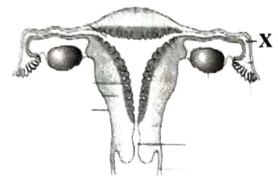
What does '$X$' represent in the given diagram of the human female reproductive system?
A
Ampulla
B
Isthmus
C
Infundibulum
D
Fimbriae
Solution
(B) In the human female reproductive system,the fallopian tube consists of three parts: infundibulum,ampulla,and isthmus.
$1$. The part closer to the ovary is the funnel-shaped infundibulum.
$2$. The wider part of the fallopian tube is the ampulla.
$3$. The last part of the fallopian tube,which has a narrow lumen and joins the uterus,is the isthmus.
In the provided diagram,'$X$' points to the narrow,distal part of the fallopian tube that connects to the uterus,which is the isthmus.
$1$. The part closer to the ovary is the funnel-shaped infundibulum.
$2$. The wider part of the fallopian tube is the ampulla.
$3$. The last part of the fallopian tube,which has a narrow lumen and joins the uterus,is the isthmus.
In the provided diagram,'$X$' points to the narrow,distal part of the fallopian tube that connects to the uterus,which is the isthmus.
0 likes
View Solution149
EasyMCQ
Which part of the oviduct joins the uterus?
A
Fimbriae
B
Isthmus
C
Ampulla
D
Infundibulum
Solution
(B) The human fallopian tube (oviduct) consists of three main parts: the infundibulum,the ampulla,and the isthmus.
$1$. The $Infundibulum$ is the funnel-shaped part closest to the ovary,possessing finger-like projections called fimbriae.
$2$. The $Ampulla$ is the wider,middle part of the oviduct where fertilization typically occurs.
$3$. The $Isthmus$ is the last and narrow part of the oviduct that connects directly to the uterus.
Therefore,the correct answer is $B$.
$1$. The $Infundibulum$ is the funnel-shaped part closest to the ovary,possessing finger-like projections called fimbriae.
$2$. The $Ampulla$ is the wider,middle part of the oviduct where fertilization typically occurs.
$3$. The $Isthmus$ is the last and narrow part of the oviduct that connects directly to the uterus.
Therefore,the correct answer is $B$.
0 likes
View Solution150
EasyMCQ
Which part of the fallopian tube is closest to the ovary?
A
Infundibulum
B
Isthmus
C
Ampulla
D
Fimbriae
Solution
(A) The fallopian tube consists of three main parts: the infundibulum,the ampulla,and the isthmus.
$1$. The $Infundibulum$ is the funnel-shaped part closest to the ovary.
$2$. The edges of the infundibulum possess finger-like projections called $Fimbriae$,which help in the collection of the ovum after ovulation.
$3$. Since the $Fimbriae$ are part of the infundibulum and are the structures directly adjacent to the ovary to catch the released egg,the $Infundibulum$ is the correct anatomical region.
$1$. The $Infundibulum$ is the funnel-shaped part closest to the ovary.
$2$. The edges of the infundibulum possess finger-like projections called $Fimbriae$,which help in the collection of the ovum after ovulation.
$3$. Since the $Fimbriae$ are part of the infundibulum and are the structures directly adjacent to the ovary to catch the released egg,the $Infundibulum$ is the correct anatomical region.
0 likes
View SolutionHuman Reproduction — Female reproductive system · Frequently Asked Questions
1Are these Human Reproduction questions useful for JEE and NEET?
Yes. All questions in this section are mapped to JEE Main and NEET exam patterns. Previous year questions from JEE Main, NEET, GUJCET and state-level exams are included with full solutions.
2Can I switch to Hindi or Gujarati for these questions?
Yes. Use the language tabs in the hero section or the sidebar to view the same questions and solutions in English, Hindi or Gujarati.
3How do I generate a question paper from this subtopic?
Use the Vedclass Exam Paper Generator — select the chapter and subtopic, set difficulty, and generate Sets A, B, C, D automatically. First 3 chapters of every subject are free.
Vedclass Products
For Students
Vedclass Test Series
Mock tests in real JEE/NEET style with performance analysis. 5-day free trial.
Start Free TrialFor Teachers
Exam Paper Generator
Generate Set A/B/C/D papers from this chapter in 2 minutes. 3 chapters free.
Try FreeFor Institutes
Online Exam Module
Live online exams with unlimited students, 360° analytics & white-label branding.
See DemoFor Teachers & Institutes
Generate a Human Reproduction Exam Paper in 2 Minutes
Select subtopic & difficulty — Sets A, B, C, D auto-generated with No Repeat logic.
First 3 chapters of every subject are free — no payment required.