
A English
Female reproductive system Questions in English
Class 12 Biology · Human Reproduction · Female reproductive system
156+
Questions
English
Language
100%
With Solutions
Showing 50 of 156 questions in English
51
MediumMCQ
What is the Mullerian duct?
A
Urinary bladder
B
Urethra
C
Vas deferens
D
Oviduct
Solution
(D) The $Mullerian$ duct (also known as the paramesonephric duct) is an embryonic structure that develops into the female reproductive tract in mammals. In females,these ducts differentiate to form the fallopian tubes (oviducts),the uterus,the cervix,and the upper part of the vagina. In males,these ducts regress due to the presence of Anti-$Mullerian$ Hormone $(AMH)$. Therefore,the correct option is $D$.
0 likes
View Solution52
MediumMCQ
Which of the following statements is incorrect?
A
The mammary gland contains a cluster of cells called alveoli.
B
The uterus is also called the womb.
C
The terminal part of the oviduct is called the ampulla.
D
The stroma of the ovary is divided into two zones.
Solution
(C) The correct answer is $C$.
$1$. The mammary gland contains clusters of cells called alveoli,which secrete milk. This statement is correct.
$2$. The uterus is also known as the womb. This statement is correct.
$3$. The oviduct (Fallopian tube) consists of three parts: infundibulum,ampulla,and isthmus. The infundibulum is the part closer to the ovary,the ampulla is the wider middle part,and the isthmus is the narrow terminal part joining the uterus. Therefore,calling the terminal part the ampulla is incorrect.
$4$. The stroma of the ovary is divided into two zones: a peripheral cortex and an inner medulla. This statement is correct.
$1$. The mammary gland contains clusters of cells called alveoli,which secrete milk. This statement is correct.
$2$. The uterus is also known as the womb. This statement is correct.
$3$. The oviduct (Fallopian tube) consists of three parts: infundibulum,ampulla,and isthmus. The infundibulum is the part closer to the ovary,the ampulla is the wider middle part,and the isthmus is the narrow terminal part joining the uterus. Therefore,calling the terminal part the ampulla is incorrect.
$4$. The stroma of the ovary is divided into two zones: a peripheral cortex and an inner medulla. This statement is correct.
0 likes
View Solution53
MediumMCQ
Which female gland is homologous to the prostate gland in males?
A
Bartholin's gland
B
Bulbourethral gland
C
Clitoris
D
None of the above
Solution
(D) In the human reproductive system,homologous organs are those that share a common embryonic origin.
The prostate gland in males is homologous to the Skene's glands (also known as paraurethral glands) in females.
Since Skene's glands are not listed among the options provided,the correct answer is $D$ (None of the above).
Note: Bartholin's glands are homologous to the bulbourethral glands in males.
The prostate gland in males is homologous to the Skene's glands (also known as paraurethral glands) in females.
Since Skene's glands are not listed among the options provided,the correct answer is $D$ (None of the above).
Note: Bartholin's glands are homologous to the bulbourethral glands in males.
0 likes
View Solution54
EasyMCQ
Hysterectomy is the surgical removal of:
A
vas deferens
B
mammary glands
C
uterus
D
prostate gland
Solution
(C) : Hysterectomy is the surgical removal of the uterus. It may also involve the removal of the cervix,ovaries,Fallopian tubes,and other surrounding structures.
0 likes
View Solution55
MediumMCQ
The part of the Fallopian tube closest to the ovary is:
A
isthmus
B
infundibulum
C
cervix
D
ampulla
Solution
(B) The correct answer is $(b)$.
Each Fallopian tube is about $10-12 \ cm$ long and extends from the periphery of each ovary to the uterus.
The part closer to the ovary is the funnel-shaped infundibulum.
The edges of the infundibulum possess finger-like projections called fimbriae,which help in the collection of the ovum after ovulation.
The infundibulum leads to a wider part of the oviduct called the ampulla.
The last part of the oviduct,the isthmus,has a narrow lumen and it joins the uterus.
Each Fallopian tube is about $10-12 \ cm$ long and extends from the periphery of each ovary to the uterus.
The part closer to the ovary is the funnel-shaped infundibulum.
The edges of the infundibulum possess finger-like projections called fimbriae,which help in the collection of the ovum after ovulation.
The infundibulum leads to a wider part of the oviduct called the ampulla.
The last part of the oviduct,the isthmus,has a narrow lumen and it joins the uterus.
0 likes
View Solution56
MediumMCQ
The $Isthmus$ is a part of which of the following?
A
Part of uterus
B
Part of fallopian tube
C
Part of vas deferens
D
Part of ejaculatory duct
Solution
(B) The $Isthmus$ is the narrow,proximal part of the fallopian tube that joins the uterus.
It is one of the four main parts of the fallopian tube,which are the infundibulum,ampulla,isthmus,and uterine part.
Therefore,the correct option is $B$.
It is one of the four main parts of the fallopian tube,which are the infundibulum,ampulla,isthmus,and uterine part.
Therefore,the correct option is $B$.
0 likes
View Solution57
MediumMCQ
$X$ - The oviducts,uterus and vagina constitute the female accessory ducts.
$Y$ - The male sex accessory ducts include vasa efferentia,epididymis and vas deferens,while the rete testis is an external genital organ.
$Y$ - The male sex accessory ducts include vasa efferentia,epididymis and vas deferens,while the rete testis is an external genital organ.
A
$X$ and $Y$ are correct.
B
$X$ and $Y$ are incorrect.
C
$X$ is correct,$Y$ is incorrect.
D
$X$ is incorrect,$Y$ is correct.
Solution
(C) Statement $X$ is correct: The female accessory ducts consist of the oviducts (fallopian tubes),uterus,and vagina.
Statement $Y$ is incorrect: The male sex accessory ducts include the rete testis,vasa efferentia,epididymis,and vas deferens. The rete testis is an internal duct system,not an external genital organ. The external genitalia in males is the penis.
Statement $Y$ is incorrect: The male sex accessory ducts include the rete testis,vasa efferentia,epididymis,and vas deferens. The rete testis is an internal duct system,not an external genital organ. The external genitalia in males is the penis.
0 likes
View Solution58
MediumMCQ
Which group represents external genitalia of human female?
A
Labium minora,labium majora,vagina
B
Labium minora,labium majora,oviduct
C
Labium minora,labium majora,cervix
D
Labium minora,labium majora,clitoris
Solution
(D) The external genitalia of the human female,collectively known as the vulva,consist of the following structures:
$1$. Mons pubis: $A$ cushion of fatty tissue covered by skin and pubic hair.
$2$. Labia majora: Fleshy folds of tissue which extend down from the mons pubis and surround the vaginal opening.
$3$. Labia minora: Paired folds of tissue under the labia majora.
$4$. Clitoris: $A$ tiny finger-like structure which lies at the upper junction of the two labia minora above the urethral opening.
$5$. Hymen: $A$ membrane that partially covers the vaginal opening.
Therefore,the group consisting of labium minora,labium majora,and clitoris represents the external genitalia.
$1$. Mons pubis: $A$ cushion of fatty tissue covered by skin and pubic hair.
$2$. Labia majora: Fleshy folds of tissue which extend down from the mons pubis and surround the vaginal opening.
$3$. Labia minora: Paired folds of tissue under the labia majora.
$4$. Clitoris: $A$ tiny finger-like structure which lies at the upper junction of the two labia minora above the urethral opening.
$5$. Hymen: $A$ membrane that partially covers the vaginal opening.
Therefore,the group consisting of labium minora,labium majora,and clitoris represents the external genitalia.
0 likes
View Solution59
MediumMCQ
What is the correct pathway of milk secretion from the mammary gland?
A
Mammary lobe $\rightarrow$ Mammary alveolus $\rightarrow$ Mammary duct $\rightarrow$ Mammary ampulla $\rightarrow$ Lactiferous duct
B
Mammary alveolus $\rightarrow$ Mammary lobe $\rightarrow$ Mammary ampulla $\rightarrow$ Mammary duct $\rightarrow$ Lactiferous duct
C
Mammary lobe $\rightarrow$ Lactiferous duct $\rightarrow$ Mammary alveolus $\rightarrow$ Mammary ampulla $\rightarrow$ Mammary duct
D
Mammary lobe $\rightarrow$ Mammary duct $\rightarrow$ Lactiferous duct $\rightarrow$ Mammary alveolus $\rightarrow$ Mammary ampulla
Solution
(A) The mammary glands are paired structures (breasts) that contain glandular tissue and variable amounts of fat.
Each breast contains $15-20$ mammary lobes containing clusters of cells called alveoli.
The cells of alveoli secrete milk,which is stored in the cavities (lumens) of alveoli.
The alveoli open into mammary tubules.
The tubules of each lobe join to form a mammary duct.
Several mammary ducts join to form a wider mammary ampulla,which is connected to the lactiferous duct through which milk is sucked out.
Therefore,the correct sequence is: Mammary lobe $\rightarrow$ Mammary alveolus $\rightarrow$ Mammary duct $\rightarrow$ Mammary ampulla $\rightarrow$ Lactiferous duct.
Each breast contains $15-20$ mammary lobes containing clusters of cells called alveoli.
The cells of alveoli secrete milk,which is stored in the cavities (lumens) of alveoli.
The alveoli open into mammary tubules.
The tubules of each lobe join to form a mammary duct.
Several mammary ducts join to form a wider mammary ampulla,which is connected to the lactiferous duct through which milk is sucked out.
Therefore,the correct sequence is: Mammary lobe $\rightarrow$ Mammary alveolus $\rightarrow$ Mammary duct $\rightarrow$ Mammary ampulla $\rightarrow$ Lactiferous duct.
0 likes
View Solution60
EasyMCQ
Endometrium is the lining of:
A
Testis
B
Urinary bladder
C
Uterus
D
Ureter
Solution
(C) The uterus is composed of three layers of tissue: the perimetrium (outer layer),the myometrium (middle layer),and the endometrium (inner layer).
The endometrium is the glandular,mucosal lining of the uterus that undergoes cyclic changes during the menstrual cycle in response to ovarian hormones.
Therefore,the correct option is $C$.
The endometrium is the glandular,mucosal lining of the uterus that undergoes cyclic changes during the menstrual cycle in response to ovarian hormones.
Therefore,the correct option is $C$.
0 likes
View Solution61
MediumMCQ
Ovary is connected to the pelvic wall by ..
A
Isthmus
B
Tendons
C
Ligaments
D
Fallopian tube
Solution
(C) The ovaries are the primary female sex organs that produce the female gamete (ovum) and several steroid hormones (ovarian hormones).
Each ovary is about $2$ to $4 \text{ cm}$ in length and is connected to the pelvic wall and uterus by ligaments.
These ligaments provide structural support and hold the ovaries in their anatomical position within the pelvic cavity.
Therefore,the correct option is $C$.
Each ovary is about $2$ to $4 \text{ cm}$ in length and is connected to the pelvic wall and uterus by ligaments.
These ligaments provide structural support and hold the ovaries in their anatomical position within the pelvic cavity.
Therefore,the correct option is $C$.
0 likes
View Solution62
EasyMCQ
The distal narrow end of the uterus is called......
A
Cervix
B
Vagina
C
Vaginal orifice
D
Fallopian tube
Solution
(A) The uterus opens into the vagina through a narrow neck called the cervix. The cavity of the cervix is called the cervical canal which,along with the vagina,forms the birth canal.
0 likes
View Solution63
EasyMCQ
The part of the fallopian tube which is closer to the ovary is............
A
Cervix
B
Uterus
C
Infundibulum
D
Fundus of uterus
Solution
(C) The fallopian tube (oviduct) consists of three main parts: the infundibulum,the ampulla,and the isthmus.
$1$. The infundibulum is the funnel-shaped part closest to the ovary.
$2$. It possesses finger-like projections called fimbriae,which help in the collection of the ovum after ovulation.
$3$. Therefore,the infundibulum is the part of the fallopian tube closest to the ovary.
$1$. The infundibulum is the funnel-shaped part closest to the ovary.
$2$. It possesses finger-like projections called fimbriae,which help in the collection of the ovum after ovulation.
$3$. Therefore,the infundibulum is the part of the fallopian tube closest to the ovary.
0 likes
View Solution64
MediumMCQ
If both ovaries are removed from a female,which hormone level will decrease?
A
Oxytocin
B
Prolactin
C
Estrogen
D
Gonadotropin-releasing hormone
Solution
(C) The ovaries are the primary female reproductive organs responsible for the production of steroid hormones,specifically estrogen and progesterone.
If both ovaries (oophorectomy) are removed,the primary source of estrogen production is eliminated.
Consequently,the circulating levels of estrogen in the blood will significantly decrease.
Oxytocin and prolactin are primarily produced by the pituitary gland,and gonadotropin-releasing hormone $(GnRH)$ is produced by the hypothalamus,so their levels are not directly dependent on the presence of the ovaries.
If both ovaries (oophorectomy) are removed,the primary source of estrogen production is eliminated.
Consequently,the circulating levels of estrogen in the blood will significantly decrease.
Oxytocin and prolactin are primarily produced by the pituitary gland,and gonadotropin-releasing hormone $(GnRH)$ is produced by the hypothalamus,so their levels are not directly dependent on the presence of the ovaries.
0 likes
View Solution65
MediumMCQ
Match the following columns:
| Column-$I$ | Column-$II$ |
|---|---|
| $(a)$ Endometrium | $(p)$ The most external layer |
| $(b)$ Myometrium | $(q)$ Help in collection of the ovum after ovulation |
| $(c)$ Fimbriae | $(r)$ Fertilised ovum is implanted here |
| $(d)$ Perimetrium | $(s)$ Thick layer of smooth muscle |
A
$a-p, b-q, c-r, d-s$
B
$a-r, b-s, c-q, d-p$
C
$a-q, b-s, c-r, d-p$
D
$a-s, b-q, c-r, d-p$
Solution
(B) The correct matching is as follows:
$(a)$ Endometrium: It is the innermost glandular layer of the uterus where the fertilised ovum is implanted $(a-r)$.
$(b)$ Myometrium: It is the middle thick layer of smooth muscle that exhibits strong contractions during delivery of the baby $(b-s)$.
$(c)$ Fimbriae: These are finger-like projections present at the edges of the infundibulum which help in the collection of the ovum after ovulation $(c-q)$.
$(d)$ Perimetrium: It is the thin,most external membranous layer of the uterus $(d-p)$.
Therefore,the correct sequence is $a-r, b-s, c-q, d-p$.
$(a)$ Endometrium: It is the innermost glandular layer of the uterus where the fertilised ovum is implanted $(a-r)$.
$(b)$ Myometrium: It is the middle thick layer of smooth muscle that exhibits strong contractions during delivery of the baby $(b-s)$.
$(c)$ Fimbriae: These are finger-like projections present at the edges of the infundibulum which help in the collection of the ovum after ovulation $(c-q)$.
$(d)$ Perimetrium: It is the thin,most external membranous layer of the uterus $(d-p)$.
Therefore,the correct sequence is $a-r, b-s, c-q, d-p$.
0 likes
View Solution66
MediumMCQ
Parts like $Isthmus$,$Ampulla$,and $fimbriae$ are of......
A
Uterus
B
Fallopian tube
C
Testis
D
Mammary gland
Solution
(B) The female reproductive system includes a pair of $Fallopian$ tubes (also known as oviducts).
Each $Fallopian$ tube is approximately $10-12 \ cm$ long and extends from the periphery of each ovary to the uterus.
The part closer to the ovary is the funnel-shaped $infundibulum$.
The edges of the $infundibulum$ possess finger-like projections called $fimbriae$,which help in the collection of the ovum after ovulation.
The $infundibulum$ leads to a wider part of the oviduct called the $ampulla$.
The last part of the $Fallopian$ tube is the $isthmus$,which has a narrow lumen and joins the uterus.
Therefore,$Isthmus$,$Ampulla$,and $fimbriae$ are parts of the $Fallopian$ tube.
Each $Fallopian$ tube is approximately $10-12 \ cm$ long and extends from the periphery of each ovary to the uterus.
The part closer to the ovary is the funnel-shaped $infundibulum$.
The edges of the $infundibulum$ possess finger-like projections called $fimbriae$,which help in the collection of the ovum after ovulation.
The $infundibulum$ leads to a wider part of the oviduct called the $ampulla$.
The last part of the $Fallopian$ tube is the $isthmus$,which has a narrow lumen and joins the uterus.
Therefore,$Isthmus$,$Ampulla$,and $fimbriae$ are parts of the $Fallopian$ tube.
0 likes
View Solution67
MediumMCQ
Isthmus : Fallopian tube :: Mammary lobe :,
A
Pituitary gland
B
Seminal vesicle
C
Epididymis
D
Mammary gland
Solution
(D) The relationship provided is an analogy based on anatomical components.
An $Isthmus$ is a specific part or region of the $Fallopian \text{ tube}$.
Similarly, a $Mammary \text{ lobe}$ is a specific structural component or region of the $Mammary \text{ gland}$.
Therefore, the correct option is $D$.
An $Isthmus$ is a specific part or region of the $Fallopian \text{ tube}$.
Similarly, a $Mammary \text{ lobe}$ is a specific structural component or region of the $Mammary \text{ gland}$.
Therefore, the correct option is $D$.
0 likes
View Solution68
EasyMCQ
Bartholin's glands are situated in ..........
A
On either side of the vagina in humans
B
On either side of the vas deferens in humans
C
On the sides of the head in some amphibians
D
At the reduced tail end of birds
Solution
(A) Bartholin's glands,also known as greater vestibular glands,are two pea-sized compound alveolar glands located slightly posterior and to the left and right of the opening of the vagina in human females. They secrete mucus to provide lubrication for the vulva.
0 likes
View Solution69
MediumMCQ
Assertion: $Clitoris$ is not a remnant of the $penis$ in females.
Reason: It also has a high blood supply and erectile tissue.
Reason: It also has a high blood supply and erectile tissue.
A
If both Assertion and Reason are correct and the Reason is a correct explanation of the Assertion.
B
If the Assertion is correct but Reason is incorrect.
C
If both Assertion and Reason are correct but Reason is not a correct explanation of the Assertion.
D
If both the Assertion and Reason are incorrect.
Solution
(C) The $Clitoris$ is a female reproductive organ that is homologous to the $penis$ in males,meaning they share a common embryonic origin.
However,the $Clitoris$ is not a 'remnant' of the $penis$; rather,both develop from the same genital tubercle.
The Assertion is correct because the $Clitoris$ is a distinct organ,not a vestigial or remnant structure of the male $penis$.
The Reason is also correct because the $Clitoris$ is composed of erectile tissue and possesses a rich blood supply,similar to the $penis$,which allows it to become engorged during sexual arousal.
Therefore,both statements are correct,but the Reason does not explain why the $Clitoris$ is not a remnant of the $penis$.
However,the $Clitoris$ is not a 'remnant' of the $penis$; rather,both develop from the same genital tubercle.
The Assertion is correct because the $Clitoris$ is a distinct organ,not a vestigial or remnant structure of the male $penis$.
The Reason is also correct because the $Clitoris$ is composed of erectile tissue and possesses a rich blood supply,similar to the $penis$,which allows it to become engorged during sexual arousal.
Therefore,both statements are correct,but the Reason does not explain why the $Clitoris$ is not a remnant of the $penis$.
0 likes
View Solution70
Easy
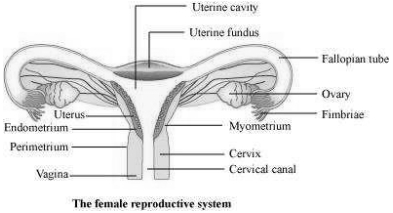
Draw a labeled diagram of the female reproductive system.
Solution
(N/A) The female reproductive system consists of the following main parts:
$1$. Ovaries: Primary female sex organs that produce the ovum and ovarian hormones.
$2$. Oviducts (Fallopian tubes): These transport the ovum from the ovary to the uterus.
$3$. Uterus: $A$ pear-shaped organ where the fetus develops.
$4$. Cervix: The narrow neck of the uterus that opens into the vagina.
$5$. Vagina: The birth canal that receives the sperm and serves as the exit for the fetus.
$6$. Uterine Wall: Composed of three layers: Perimetrium (outer),Myometrium (middle),and Endometrium (inner).
$1$. Ovaries: Primary female sex organs that produce the ovum and ovarian hormones.
$2$. Oviducts (Fallopian tubes): These transport the ovum from the ovary to the uterus.
$3$. Uterus: $A$ pear-shaped organ where the fetus develops.
$4$. Cervix: The narrow neck of the uterus that opens into the vagina.
$5$. Vagina: The birth canal that receives the sperm and serves as the exit for the fetus.
$6$. Uterine Wall: Composed of three layers: Perimetrium (outer),Myometrium (middle),and Endometrium (inner).
0 likes
View Solution71
Easy
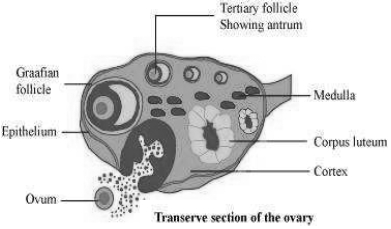
Draw a labeled diagram of a transverse section of the human ovary.
Solution
The ovary is the primary female sex organ that produces the female gamete (ovum) and several steroid hormones. $A$ transverse section of the ovary reveals various developmental stages of ovarian follicles,including primary follicles,tertiary follicles (characterized by a fluid-filled cavity called the antrum),and the mature Graafian follicle. The ovary is divided into an outer cortex and an inner medulla. After ovulation,the ruptured Graafian follicle transforms into a temporary endocrine structure called the corpus luteum,which secretes progesterone. The diagram illustrates these key components: the germinal epithelium,the developing follicles,the antrum,the ovum being released,and the corpus luteum.
0 likes
View Solution72
Difficult
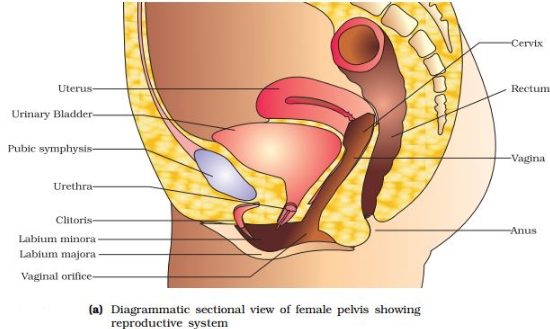
Provide a brief description of the various parts of the female reproductive system.
Solution
(N/A) The female reproductive system is located in the pelvic region. It consists of a pair of ovaries,a pair of oviducts (fallopian tubes),the uterus,the cervix,the vagina,and the external genitalia.
These components,along with a pair of mammary glands,are integrated both structurally and functionally to support the processes of ovulation,fertilization,pregnancy,childbirth,and child care.
These components,along with a pair of mammary glands,are integrated both structurally and functionally to support the processes of ovulation,fertilization,pregnancy,childbirth,and child care.
0 likes
View Solution73
Medium
Describe the location and external structure of the ovaries.
Solution
(N/A) The ovaries are located one on each side of the lower abdomen.
They are attached to the pelvic wall and uterus by ligaments.
Each ovary is a primary female sex organ,almond-shaped,and measures about $2-4 \text{ cm}$ in length,$2 \text{ cm}$ in width,and $1 \text{ cm}$ in thickness.
Each ovary possesses a $Hilus$,which serves as the point of entry for blood vessels and nerves.
Each ovary is covered by a thin epithelium that encloses the ovarian stroma.
The stroma is divided into two zones: a peripheral $Cortex$ and an inner $Medulla$.
They are attached to the pelvic wall and uterus by ligaments.
Each ovary is a primary female sex organ,almond-shaped,and measures about $2-4 \text{ cm}$ in length,$2 \text{ cm}$ in width,and $1 \text{ cm}$ in thickness.
Each ovary possesses a $Hilus$,which serves as the point of entry for blood vessels and nerves.
Each ovary is covered by a thin epithelium that encloses the ovarian stroma.
The stroma is divided into two zones: a peripheral $Cortex$ and an inner $Medulla$.
0 likes
View Solution74
Medium
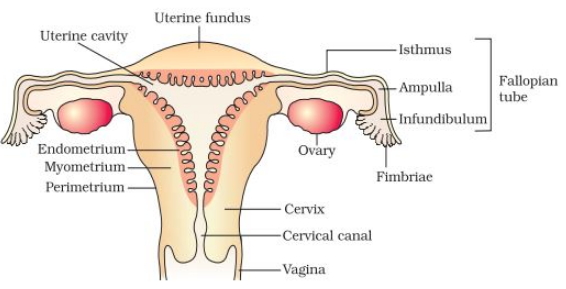
Give information about the structure and location of oviducts.
Solution
(N/A) The oviducts,uterus,and vagina constitute the female accessory ducts.
Each fallopian tube is about $10-12 \ cm$ long and extends from the periphery of each ovary to the uterus.
The part closer to the ovary is the funnel-shaped infundibulum.
The edges of the infundibulum possess finger-like projections called fimbriae,which help in the collection of the ovum after ovulation.
The infundibulum leads to a wider part of the oviduct called the ampulla.
The last part of the oviduct,the isthmus,has a narrow lumen and it joins the uterus.
Each fallopian tube is about $10-12 \ cm$ long and extends from the periphery of each ovary to the uterus.
The part closer to the ovary is the funnel-shaped infundibulum.
The edges of the infundibulum possess finger-like projections called fimbriae,which help in the collection of the ovum after ovulation.
The infundibulum leads to a wider part of the oviduct called the ampulla.
The last part of the oviduct,the isthmus,has a narrow lumen and it joins the uterus.
0 likes
View Solution75
Easy
Explain the external and internal structure of the uterus.
Solution
(N/A) $\Rightarrow$ The uterus is a single organ,also known as the womb.
$\Rightarrow$ The shape of the uterus is like an inverted pear.
- It is supported by ligaments attached to the pelvic wall.
- The uterus opens into the vagina through a narrow cervix. The cavity of the cervix is called the cervical canal,which,along with the vagina,forms the birth canal.
- Wall of the uterus: The wall of the uterus consists of three layers of tissue:
$1$. Perimetrium: The external thin membranous layer.
$2$. Myometrium: The middle thick layer of smooth muscle.
$3$. Endometrium: The inner glandular layer that lines the uterine cavity.
- The endometrium undergoes cyclical changes during the menstrual cycle,while the myometrium exhibits strong contractions during the delivery of the baby.
$\Rightarrow$ The shape of the uterus is like an inverted pear.
- It is supported by ligaments attached to the pelvic wall.
- The uterus opens into the vagina through a narrow cervix. The cavity of the cervix is called the cervical canal,which,along with the vagina,forms the birth canal.
- Wall of the uterus: The wall of the uterus consists of three layers of tissue:
$1$. Perimetrium: The external thin membranous layer.
$2$. Myometrium: The middle thick layer of smooth muscle.
$3$. Endometrium: The inner glandular layer that lines the uterine cavity.
- The endometrium undergoes cyclical changes during the menstrual cycle,while the myometrium exhibits strong contractions during the delivery of the baby.
0 likes
View Solution76
Medium
Give information about external genitalia in female.
Solution
(A) The female external genitalia includes $Mons \text{ } pubis$, $labia \text{ } majora$, $labia \text{ } minora$, $hymen$, and $clitoris$.
$1$. $Mons \text{ } pubis$ is a cushion of fatty tissue covered by skin and pubic hair.
$2$. The $labia \text{ } majora$ are fleshy folds of tissue, which extend down from the $mons \text{ } pubis$ and surround the vaginal opening.
$3$. The $labia \text{ } minora$ are paired folds of tissue under the $labia \text{ } majora$.
$4$. The opening of the vagina is often covered partially by a membrane called the $hymen$.
$5$. The $hymen$ is often torn during the first coitus. However, it can also be broken by a sudden fall or jolt, insertion of a vaginal tampon, or active participation in some sports like horseback riding, cycling, etc. In some women, the $hymen$ persists even after coitus. In fact, the presence or absence of the $hymen$ is not a reliable indicator of virginity or sexual experience.
$6$. The $clitoris$ is a tiny finger-like structure which lies at the upper junction of the two $labia \text{ } minora$ above the urethral opening.
$1$. $Mons \text{ } pubis$ is a cushion of fatty tissue covered by skin and pubic hair.
$2$. The $labia \text{ } majora$ are fleshy folds of tissue, which extend down from the $mons \text{ } pubis$ and surround the vaginal opening.
$3$. The $labia \text{ } minora$ are paired folds of tissue under the $labia \text{ } majora$.
$4$. The opening of the vagina is often covered partially by a membrane called the $hymen$.
$5$. The $hymen$ is often torn during the first coitus. However, it can also be broken by a sudden fall or jolt, insertion of a vaginal tampon, or active participation in some sports like horseback riding, cycling, etc. In some women, the $hymen$ persists even after coitus. In fact, the presence or absence of the $hymen$ is not a reliable indicator of virginity or sexual experience.
$6$. The $clitoris$ is a tiny finger-like structure which lies at the upper junction of the two $labia \text{ } minora$ above the urethral opening.
0 likes
View Solution77
Easy
Explain the difference between the following terms:
$(1)$ Prostate gland - Bulbourethral gland
$(2)$ Ovary - Ovarian follicle
$(1)$ Prostate gland - Bulbourethral gland
$(2)$ Ovary - Ovarian follicle
Solution
(N/A) $(1)$ Prostate gland: It is a single gland located at the base of the urinary bladder in males. Its secretion is alkaline and helps in the activation and nourishment of sperms.
$\Rightarrow$ Bulbourethral gland: These are paired glands located below the prostate gland on the lateral sides of the urethra. Their secretion helps in the lubrication of the penis during coitus.
$(2)$ Ovary: It is the primary female sex organ located on both sides of the uterus. It is responsible for the production of the ovum and the secretion of female sex hormones like estrogen and progesterone.
$\rightarrow$ Ovarian follicle: These are the structural and functional units of the ovary. They represent different stages of development of the tissues surrounding the oocyte (egg cell) within the ovary.
$\Rightarrow$ Bulbourethral gland: These are paired glands located below the prostate gland on the lateral sides of the urethra. Their secretion helps in the lubrication of the penis during coitus.
$(2)$ Ovary: It is the primary female sex organ located on both sides of the uterus. It is responsible for the production of the ovum and the secretion of female sex hormones like estrogen and progesterone.
$\rightarrow$ Ovarian follicle: These are the structural and functional units of the ovary. They represent different stages of development of the tissues surrounding the oocyte (egg cell) within the ovary.
0 likes
View Solution78
Medium
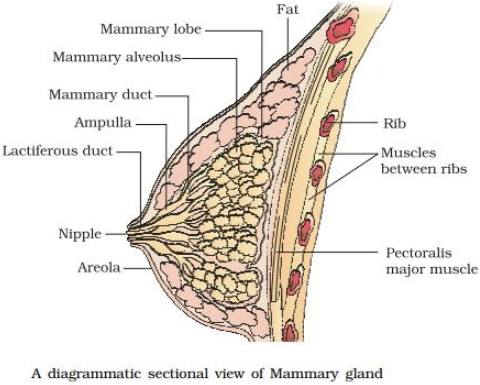
With a suitable diagram,describe the organisation of the mammary gland.
Solution
(N/A) The mammary glands are paired structures (breasts) that contain glandular tissue and variable amounts of fat.
$1$. The glandular tissue of each breast is divided into $15-20$ mammary lobes containing clusters of cells called alveoli.
$2$. The cells of alveoli secrete milk,which is stored in the cavities (lumens) of alveoli.
$3$. The alveoli open into mammary tubules. The tubules of each lobe join to form a mammary duct.
$4$. Several mammary ducts join to form a wider mammary ampulla,which is connected to the lactiferous duct through which milk is sucked out.
$5$. The pathway of milk secretion is: Alveoli $\rightarrow$ Mammary tubules $\rightarrow$ Mammary duct $\rightarrow$ Mammary ampulla $\rightarrow$ Lactiferous duct $\rightarrow$ Nipple.
$1$. The glandular tissue of each breast is divided into $15-20$ mammary lobes containing clusters of cells called alveoli.
$2$. The cells of alveoli secrete milk,which is stored in the cavities (lumens) of alveoli.
$3$. The alveoli open into mammary tubules. The tubules of each lobe join to form a mammary duct.
$4$. Several mammary ducts join to form a wider mammary ampulla,which is connected to the lactiferous duct through which milk is sucked out.
$5$. The pathway of milk secretion is: Alveoli $\rightarrow$ Mammary tubules $\rightarrow$ Mammary duct $\rightarrow$ Mammary ampulla $\rightarrow$ Lactiferous duct $\rightarrow$ Nipple.
0 likes
View Solution79
Easy
Explain the difference between the following terms:
$(1)$ Oviduct - Infundibulum
$(2)$ Endometrium - Myometrium
$(1)$ Oviduct - Infundibulum
$(2)$ Endometrium - Myometrium
Solution
(N/A) $(1)$ Oviduct (Fallopian tube): The oviduct is the tube that transports the ovum from the ovary to the uterus.
Infundibulum: It is the funnel-shaped part of the oviduct closest to the ovary,which possesses finger-like projections called fimbriae that help in the collection of the ovum after ovulation.
$(2)$ Endometrium: It is the innermost glandular layer of the uterine wall where implantation of the embryo occurs. It undergoes cyclic changes during the menstrual cycle and is shed if pregnancy does not occur.
Myometrium: It is the thick middle layer of the uterine wall,composed of smooth muscle tissue. It exhibits strong contractions during parturition (childbirth) to facilitate the delivery of the fetus.
Infundibulum: It is the funnel-shaped part of the oviduct closest to the ovary,which possesses finger-like projections called fimbriae that help in the collection of the ovum after ovulation.
$(2)$ Endometrium: It is the innermost glandular layer of the uterine wall where implantation of the embryo occurs. It undergoes cyclic changes during the menstrual cycle and is shed if pregnancy does not occur.
Myometrium: It is the thick middle layer of the uterine wall,composed of smooth muscle tissue. It exhibits strong contractions during parturition (childbirth) to facilitate the delivery of the fetus.
0 likes
View Solution80
Easy
Explain the difference between the following terms:
$(1)$ Labia - Clitoris
$(2)$ Somatic cells - Germ cells
$(1)$ Labia - Clitoris
$(2)$ Somatic cells - Germ cells
Solution
(N/A) $(1)$ Labia: These are the external female genitalia. They consist of the labia majora and labia minora,which protect the vaginal and urethral openings.
- Clitoris: It is a small,sensitive,finger-like structure located at the upper junction of the two labia minora above the urethral opening. It contains erectile tissue and is homologous to the male penis.
$(2)$ Somatic cells: These are the body cells that form the tissues and organs of an organism. They contain a diploid $(2n)$ number of chromosomes and divide by mitosis.
- Germ cells: These are specialized cells responsible for sexual reproduction. They undergo meiosis to produce haploid $(n)$ gametes,which carry hereditary information to the next generation.
- Clitoris: It is a small,sensitive,finger-like structure located at the upper junction of the two labia minora above the urethral opening. It contains erectile tissue and is homologous to the male penis.
$(2)$ Somatic cells: These are the body cells that form the tissues and organs of an organism. They contain a diploid $(2n)$ number of chromosomes and divide by mitosis.
- Germ cells: These are specialized cells responsible for sexual reproduction. They undergo meiosis to produce haploid $(n)$ gametes,which carry hereditary information to the next generation.
0 likes
View Solution81
MediumMCQ
What is the role of the cervix in the human female reproductive system?
A
It acts as the site of fertilization.
B
It produces female gametes.
C
It connects the uterus to the vagina and acts as a birth canal component.
D
It is the primary site for embryo implantation.
Solution
(C) The cervix is the lower,narrow portion of the uterus that opens into the vagina.
Its primary roles include:
$(i)$ It acts as a passage for sperm to enter the uterus.
$(ii)$ It produces cervical mucus,which changes consistency during the menstrual cycle to either facilitate or block sperm entry.
$(iii)$ During pregnancy,it remains tightly closed to protect the fetus.
$(iv)$ During childbirth,it dilates to allow the fetus to pass through the birth canal.
Its primary roles include:
$(i)$ It acts as a passage for sperm to enter the uterus.
$(ii)$ It produces cervical mucus,which changes consistency during the menstrual cycle to either facilitate or block sperm entry.
$(iii)$ During pregnancy,it remains tightly closed to protect the fetus.
$(iv)$ During childbirth,it dilates to allow the fetus to pass through the birth canal.
0 likes
View Solution82
Medium
Female reproductive organs and associated functions are given below in column-$I$ and column-$II$. Fill the blanks.
| Column-$I$ | Column-$II$ |
| $(a)$ Ovaries | $(1)$ Ovulation |
| $(b)$ Oviduct | $(2)$ $(A)$ |
| $(c)$ $(B)$ | $(3)$ Pregnancy |
| $(d)$ Vagina | $(4)$ Birth |
Solution
(A) $(A) = \text{Fertilisation}$,$(B) = \text{Uterus}$.
The female reproductive system consists of a pair of ovaries,a pair of oviducts (Fallopian tubes),the uterus,the vagina,external genitalia,and mammary glands.
Ovaries perform functions such as the production of the ovum (oogenesis) and the secretion of female sex hormones (estrogen and progesterone).
The oviduct (Fallopian tube) transports the ovum from the ovary to the uterus and serves as the site for fertilization.
The uterus is an inverted pear-shaped organ that provides the necessary environment for the development of the embryo during pregnancy.
The vagina serves as the birth canal during delivery,receives the penis during coitus,and allows for the passage of menstrual flow.
The female reproductive system consists of a pair of ovaries,a pair of oviducts (Fallopian tubes),the uterus,the vagina,external genitalia,and mammary glands.
Ovaries perform functions such as the production of the ovum (oogenesis) and the secretion of female sex hormones (estrogen and progesterone).
The oviduct (Fallopian tube) transports the ovum from the ovary to the uterus and serves as the site for fertilization.
The uterus is an inverted pear-shaped organ that provides the necessary environment for the development of the embryo during pregnancy.
The vagina serves as the birth canal during delivery,receives the penis during coitus,and allows for the passage of menstrual flow.
0 likes
View Solution83
Medium
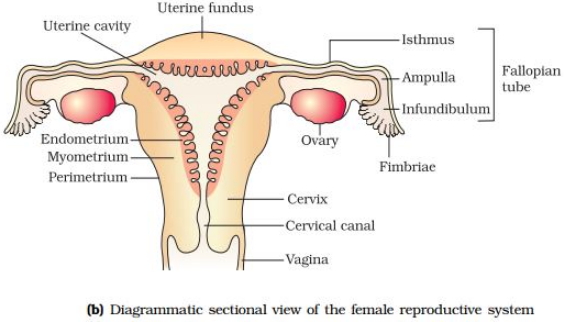
Draw a neat diagram of the female reproductive system and label the parts associated with the following:
$(a)$ production of gamete,
$(b)$ site of fertilisation,
$(c)$ site of implantation,and
$(d)$ birth canal.
$(a)$ production of gamete,
$(b)$ site of fertilisation,
$(c)$ site of implantation,and
$(d)$ birth canal.
Solution
(N/A) The female reproductive system consists of the ovaries,a pair of oviducts (Fallopian tubes),uterus,cervix,vagina,and the external genitalia.
$(a)$ Production of gamete: The ovaries are the primary female sex organs that produce the female gamete (ovum).
$(b)$ Site of fertilisation: The ampulla region of the Fallopian tube is the site where fertilisation occurs.
$(c)$ Site of implantation: The uterus (specifically the endometrium lining) is the site where the embryo gets implanted.
$(d)$ Birth canal: The birth canal is formed by the cervical canal along with the vagina.
$(a)$ Production of gamete: The ovaries are the primary female sex organs that produce the female gamete (ovum).
$(b)$ Site of fertilisation: The ampulla region of the Fallopian tube is the site where fertilisation occurs.
$(c)$ Site of implantation: The uterus (specifically the endometrium lining) is the site where the embryo gets implanted.
$(d)$ Birth canal: The birth canal is formed by the cervical canal along with the vagina.
0 likes
View Solution84
MediumMCQ
Which of the following is a structural and functional accessory reproductive gland in females?
A
Prostate
B
Seminal vesicle
C
Mammary gland
D
All of the above
Solution
(C) In the female reproductive system,the mammary glands are considered accessory reproductive glands.
They are functional structures that produce milk (lactation) to nourish the offspring,which is a critical part of the reproductive process in mammals.
Prostate and seminal vesicles are accessory reproductive glands found in the male reproductive system,not the female.
They are functional structures that produce milk (lactation) to nourish the offspring,which is a critical part of the reproductive process in mammals.
Prostate and seminal vesicles are accessory reproductive glands found in the male reproductive system,not the female.
0 likes
View Solution85
MediumMCQ
The ovaries are attached to the pelvic wall and the uterus by which structure?
A
Pelvic wall and uterine wall by muscles
B
Pelvic bone and uterus by bones
C
Pelvic wall and femur by ligaments
D
Pelvic wall and uterine wall by ligaments
Solution
(D) The ovaries are the primary female sex organs.
They are located one on each side of the lower abdomen.
Each ovary is about $2$ to $4 \text{ cm}$ in length and is connected to the pelvic wall and the uterus by ligaments.
These ligaments provide structural support and maintain the position of the ovaries within the pelvic cavity.
They are located one on each side of the lower abdomen.
Each ovary is about $2$ to $4 \text{ cm}$ in length and is connected to the pelvic wall and the uterus by ligaments.
These ligaments provide structural support and maintain the position of the ovaries within the pelvic cavity.
0 likes
View Solution86
MediumMCQ
What is the length of the fallopian tube (oviduct)?
A
$10-12 \, cm$
B
$10-14 \, cm$
C
$11-13 \, cm$
D
$10-12 \, m$
Solution
(A) The fallopian tube (oviduct) is a part of the female reproductive system.
Each fallopian tube is approximately $10-12 \, cm$ long and extends from the periphery of each ovary to the uterus.
Each fallopian tube is approximately $10-12 \, cm$ long and extends from the periphery of each ovary to the uterus.
0 likes
View Solution87
MediumMCQ
Which of the following structures collects the ovum after ovulation from the ovary?
A
Fallopian tube
B
Infundibulum
C
Ampulla
D
Isthmus
Solution
(B) The female reproductive system includes a pair of fallopian tubes.
Each fallopian tube is divided into three parts: infundibulum,ampulla,and isthmus.
The part closer to the ovary is the funnel-shaped infundibulum.
The edges of the infundibulum possess finger-like projections called fimbriae,which help in the collection of the ovum after ovulation.
Each fallopian tube is divided into three parts: infundibulum,ampulla,and isthmus.
The part closer to the ovary is the funnel-shaped infundibulum.
The edges of the infundibulum possess finger-like projections called fimbriae,which help in the collection of the ovum after ovulation.
0 likes
View Solution88
MediumMCQ
Which part of the fallopian tube is connected to the uterus?
A
Fimbriae
B
Ampulla
C
Isthmus
D
Infundibulum
Solution
(C) The fallopian tube (oviduct) consists of three main parts: the infundibulum,the ampulla,and the isthmus.
$1$. The infundibulum is the funnel-shaped part closest to the ovary,possessing finger-like projections called fimbriae.
$2$. The ampulla is the wider,middle part of the fallopian tube.
$3$. The isthmus is the last,narrow part of the fallopian tube that joins the uterus.
Therefore,the isthmus is the part that connects to the uterus.
$1$. The infundibulum is the funnel-shaped part closest to the ovary,possessing finger-like projections called fimbriae.
$2$. The ampulla is the wider,middle part of the fallopian tube.
$3$. The isthmus is the last,narrow part of the fallopian tube that joins the uterus.
Therefore,the isthmus is the part that connects to the uterus.
0 likes
View Solution89
MediumMCQ
Which layer of the uterus undergoes cyclical changes and sheds during the menstrual cycle?
A
Endometrium
B
Myometrium
C
Perimetrium
D
Capillary layer
Solution
(A) The uterus has three layers of tissue: the outer perimetrium,the middle myometrium,and the inner endometrium.
$1$. The $Perimetrium$ is the thin,outer membranous layer.
$2$. The $Myometrium$ is the thick layer of smooth muscle that exhibits strong contractions during delivery.
$3$. The $Endometrium$ is the glandular,inner lining of the uterus. This layer undergoes significant cyclical changes during the menstrual cycle,including proliferation and shedding (bleeding) if fertilization does not occur. Therefore,the endometrium is the layer that sheds.
$1$. The $Perimetrium$ is the thin,outer membranous layer.
$2$. The $Myometrium$ is the thick layer of smooth muscle that exhibits strong contractions during delivery.
$3$. The $Endometrium$ is the glandular,inner lining of the uterus. This layer undergoes significant cyclical changes during the menstrual cycle,including proliferation and shedding (bleeding) if fertilization does not occur. Therefore,the endometrium is the layer that sheds.
0 likes
View Solution90
MediumMCQ
What is the $hymen$?
A
Female external genitalia
B
Female accessory reproductive organ
C
Female accessory reproductive gland
D
$A$ reliable indicator of virginity
Solution
(A) The $hymen$ is a thin,mucous membrane that partially covers the opening of the vagina. It is considered a part of the female external genitalia. It is a common misconception that the presence or absence of the $hymen$ is a reliable indicator of virginity or sexual experience,as it can be torn or stretched due to various activities such as sports,cycling,or the use of tampons.
0 likes
View Solution91
EasyMCQ
What is a vaginal tampon?
A
Hymen
B
Vaginal wall
C
$A$ device used to absorb blood during menstruation
D
Both $A$ and $C$
Solution
(C) vaginal tampon is a mass of absorbent material,typically cotton or rayon,designed to be inserted into the vagina during menstruation to absorb menstrual flow. It is a feminine hygiene product,not a biological structure like the hymen or the vaginal wall.
0 likes
View Solution92
MediumMCQ
Identify the correct pathway of milk secretion from the mammary glands.
A
Alveoli $\rightarrow$ Mammary tubules $\rightarrow$ Mammary ducts $\rightarrow$ Mammary ampulla $\rightarrow$ Lactiferous duct $\rightarrow$ Nipple
B
Mammary lobes $\rightarrow$ Mammary tubules $\rightarrow$ Mammary ducts $\rightarrow$ Mammary ampulla $\rightarrow$ Lactiferous duct $\rightarrow$ Nipple
C
Mammary ducts $\rightarrow$ Mammary tubules $\rightarrow$ Lactiferous duct $\rightarrow$ Mammary ampulla $\rightarrow$ Nipple
D
Milk secreting cells $\rightarrow$ Milk ducts $\rightarrow$ Mammary tubules $\rightarrow$ Mammary ducts $\rightarrow$ Nipple
Solution
(A) The milk produced by the cells of alveoli of mammary glands is secreted into the lumen of alveoli.
$1$. The alveoli open into mammary tubules.
$2$. The tubules of each lobe join to form a mammary duct.
$3$. Several mammary ducts join to form a wider mammary ampulla,which is connected to the lactiferous duct through which milk is sucked out.
Therefore,the correct sequence is: Alveoli $\rightarrow$ Mammary tubules $\rightarrow$ Mammary ducts $\rightarrow$ Mammary ampulla $\rightarrow$ Lactiferous duct $\rightarrow$ Nipple.
$1$. The alveoli open into mammary tubules.
$2$. The tubules of each lobe join to form a mammary duct.
$3$. Several mammary ducts join to form a wider mammary ampulla,which is connected to the lactiferous duct through which milk is sucked out.
Therefore,the correct sequence is: Alveoli $\rightarrow$ Mammary tubules $\rightarrow$ Mammary ducts $\rightarrow$ Mammary ampulla $\rightarrow$ Lactiferous duct $\rightarrow$ Nipple.
0 likes
View Solution93
MediumMCQ
Which is the primary female reproductive organ?
A
Vagina
B
Uterus
C
Oviduct
D
Ovary
Solution
(D) The primary female reproductive organs are the ovaries.
They perform two main functions:
$1$. Production of the female gamete (ovum).
$2$. Secretion of steroid hormones (estrogen and progesterone).
Other structures like the uterus,vagina,and oviduct are considered accessory reproductive organs.
They perform two main functions:
$1$. Production of the female gamete (ovum).
$2$. Secretion of steroid hormones (estrogen and progesterone).
Other structures like the uterus,vagina,and oviduct are considered accessory reproductive organs.
0 likes
View Solution94
MediumMCQ
The mammary gland is which type of character in females?
A
Primary sexual character
B
Secondary sexual character
C
Primary reproductive organ
D
Both $A$ and $B$
Solution
(B) In humans,the primary sexual organs are the gonads (ovaries in females and testes in males) which produce gametes and sex hormones.
Secondary sexual characters are the physical features that distinguish the two sexes of a species but are not directly part of the reproductive system.
Mammary glands are considered secondary sexual characters in females as they develop during puberty and are characteristic of the female sex,although they are accessory organs for reproduction.
Secondary sexual characters are the physical features that distinguish the two sexes of a species but are not directly part of the reproductive system.
Mammary glands are considered secondary sexual characters in females as they develop during puberty and are characteristic of the female sex,although they are accessory organs for reproduction.
0 likes
View Solution95
MediumMCQ
Which of the following statements is incorrect?
A
The distal part of the fallopian tube is called the ampulla.
B
The uterus is also called the womb.
C
The stroma of the ovary is divided into two zones.
D
The mammary lobe contains clusters of cells called alveoli.
Solution
(A) The correct answer is $A$. The fallopian tube (oviduct) consists of three parts: infundibulum,ampulla,and isthmus. The infundibulum is the funnel-shaped part closer to the ovary,the ampulla is the wider middle part,and the isthmus is the narrow part that joins the uterus. Therefore,the statement that the distal part is the ampulla is incorrect; the distal part (closest to the ovary) is the infundibulum.
0 likes
View Solution96
EasyMCQ
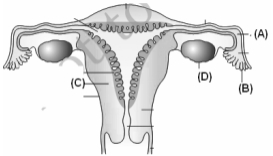
Identify the correct label from the given diagram of the female reproductive system.
A
$(A)$ Ampulla - Site of blastocyst implantation
B
$(B)$ Fimbriae - Collect ova
C
$(C)$ Myometrium - Shed during menstrual bleeding
D
$(D)$ Ovary - Secrete $HCG$
Solution
(B) In the provided diagram of the female reproductive system:
- $(A)$ represents the Ampulla,which is the site of fertilization,not implantation.
- $(B)$ represents the Fimbriae,which are finger-like projections at the end of the fallopian tube that collect the ovum after ovulation.
- $(C)$ represents the Endometrium,not the Myometrium. The Endometrium is the layer that sheds during menstrual bleeding.
- $(D)$ represents the Ovary,which produces ova and steroid hormones,not $HCG$ (which is secreted by the placenta).
Therefore,the correct statement is that Fimbriae collect ova.
- $(A)$ represents the Ampulla,which is the site of fertilization,not implantation.
- $(B)$ represents the Fimbriae,which are finger-like projections at the end of the fallopian tube that collect the ovum after ovulation.
- $(C)$ represents the Endometrium,not the Myometrium. The Endometrium is the layer that sheds during menstrual bleeding.
- $(D)$ represents the Ovary,which produces ova and steroid hormones,not $HCG$ (which is secreted by the placenta).
Therefore,the correct statement is that Fimbriae collect ova.
0 likes
View Solution97
MediumMCQ
$A$: Mammary glands are apocrine glands.
$R$: The product of secretion is shed with the whole cell leading to its destruction.
$R$: The product of secretion is shed with the whole cell leading to its destruction.
A
Assertion and Reason both are correct and Reason is the correct explanation of Assertion.
B
Assertion and Reason both are correct but Reason is not the correct explanation of Assertion.
C
Assertion is correct,but Reason is incorrect.
D
Both Assertion and Reason are incorrect.
Solution
(C) Assertion is true because mammary glands are classified as apocrine glands.
Reason is false because in apocrine glands,only the apical portion of the cytoplasm is discharged along with the secretory product,not the whole cell. The destruction of the whole cell is characteristic of holocrine glands (e.g.,sebaceous glands).
Reason is false because in apocrine glands,only the apical portion of the cytoplasm is discharged along with the secretory product,not the whole cell. The destruction of the whole cell is characteristic of holocrine glands (e.g.,sebaceous glands).
0 likes
View Solution98
MediumMCQ
The estrogen is synthesised and secreted mainly by growing ...$A$.... After ovulation the ruptured follicle is converted to a structure called ...$B$... which secretes ...$C$... Choose the correct option for $A, B$ and $C$.
A
$A$-corpus luteum,$B$-corpus callosum,$C$-progesterone
B
$A$-Graafian follicle,$B$-corpus luteum,$C$-progesterone
C
$A$-corpus callosum,$B$-corpus luteum,$C$-estrogen
D
$A$-Graafian follicle,$B$-corpus luteum,$C$-estrogen
Solution
(B) Estrogen is primarily synthesized and secreted by the growing ovarian follicles,specifically the Graafian follicle $(A)$.
After ovulation,the remaining parts of the Graafian follicle transform into a temporary endocrine structure known as the corpus luteum $(B)$.
The corpus luteum primarily secretes large amounts of progesterone $(C)$,which is essential for maintaining the endometrium for potential implantation.
After ovulation,the remaining parts of the Graafian follicle transform into a temporary endocrine structure known as the corpus luteum $(B)$.
The corpus luteum primarily secretes large amounts of progesterone $(C)$,which is essential for maintaining the endometrium for potential implantation.
0 likes
View Solution99
EasyMCQ
Which of the following is the group of external genitalia in human female?
A
Labia minora,labia majora,vagina
B
Labia minora,labia majora,clitoris
C
Labia minora,labia majora,oviduct
D
Labia minora,labia majora,cervix
Solution
(B) The external genitalia of the human female are collectively referred to as the vulva.
These structures include the labia majora (large,fleshy folds of tissue) and the labia minora (smaller folds located within the labia majora).
The clitoris is a tiny,finger-like structure that lies at the upper junction of the two labia minora above the urethral opening.
Therefore,the group consisting of labia minora,labia majora,and clitoris constitutes the external genitalia.
These structures include the labia majora (large,fleshy folds of tissue) and the labia minora (smaller folds located within the labia majora).
The clitoris is a tiny,finger-like structure that lies at the upper junction of the two labia minora above the urethral opening.
Therefore,the group consisting of labia minora,labia majora,and clitoris constitutes the external genitalia.
0 likes
View Solution100
MediumMCQ
The main function of fimbriae of the Fallopian tube is:
A
Help in the development of the ovary
B
Help in the collection of the ovum after ovulation
C
Help in the development of ova
D
Help in fertilization
Solution
(B) The part of the Fallopian tubes (oviducts) closer to the ovary is the funnel-shaped infundibulum.
The edges of the infundibulum possess finger-like projections called fimbriae.
These fimbriae help in the collection of the ovum after ovulation from the surface of the ovary.
The edges of the infundibulum possess finger-like projections called fimbriae.
These fimbriae help in the collection of the ovum after ovulation from the surface of the ovary.
0 likes
View SolutionHuman Reproduction — Female reproductive system · Frequently Asked Questions
1Are these Human Reproduction questions useful for JEE and NEET?
Yes. All questions in this section are mapped to JEE Main and NEET exam patterns. Previous year questions from JEE Main, NEET, GUJCET and state-level exams are included with full solutions.
2Can I switch to Hindi or Gujarati for these questions?
Yes. Use the language tabs in the hero section or the sidebar to view the same questions and solutions in English, Hindi or Gujarati.
3How do I generate a question paper from this subtopic?
Use the Vedclass Exam Paper Generator — select the chapter and subtopic, set difficulty, and generate Sets A, B, C, D automatically. First 3 chapters of every subject are free.
Vedclass Products
For Students
Vedclass Test Series
Mock tests in real JEE/NEET style with performance analysis. 5-day free trial.
Start Free TrialFor Teachers
Exam Paper Generator
Generate Set A/B/C/D papers from this chapter in 2 minutes. 3 chapters free.
Try FreeFor Institutes
Online Exam Module
Live online exams with unlimited students, 360° analytics & white-label branding.
See DemoFor Teachers & Institutes
Generate a Human Reproduction Exam Paper in 2 Minutes
Select subtopic & difficulty — Sets A, B, C, D auto-generated with No Repeat logic.
First 3 chapters of every subject are free — no payment required.