
A English
Diseases caused by viruses Questions in English
Class 12 Biology · Human Health and Disease · Diseases caused by viruses
131+
Questions
English
Language
100%
With Solutions
Showing 50 of 131 questions in English
51
EasyMCQ
Which of the following diseases is $100\%$ fatal and is transmitted by infected animals?
A
$AIDS$
B
Rabies
C
Tetanus
D
Hepatitis-$B$
Solution
(B) Rabies is a viral disease caused by the rabies virus $(Rhabdovirus)$.
It is a zoonotic disease,meaning it is transmitted to humans through the bite of infected animals like dogs,cats,or bats.
Once the clinical symptoms of rabies appear,the disease is almost $100\%$ fatal,as there is no effective cure for the symptomatic stage.
Therefore,the correct option is $B$.
It is a zoonotic disease,meaning it is transmitted to humans through the bite of infected animals like dogs,cats,or bats.
Once the clinical symptoms of rabies appear,the disease is almost $100\%$ fatal,as there is no effective cure for the symptomatic stage.
Therefore,the correct option is $B$.
0 likes
View Solution52
EasyMCQ
Dengue fever is transmitted by which of the following?
A
Aedes aegypti (Tiger mosquito)
B
Culex fatigans
C
Anopheles
D
Aedes donovani
Solution
(A) Dengue fever is a viral disease caused by the Dengue virus $(DENV)$.
It is transmitted to humans primarily through the bite of an infected female $Aedes$ $aegypti$ mosquito.
This mosquito is often referred to as the 'Tiger mosquito' due to the white markings on its body.
$Culex$ mosquitoes are vectors for diseases like Filariasis,while $Anopheles$ mosquitoes are vectors for Malaria.
It is transmitted to humans primarily through the bite of an infected female $Aedes$ $aegypti$ mosquito.
This mosquito is often referred to as the 'Tiger mosquito' due to the white markings on its body.
$Culex$ mosquitoes are vectors for diseases like Filariasis,while $Anopheles$ mosquitoes are vectors for Malaria.
0 likes
View Solution53
MediumMCQ
Which part of the body is affected by mumps?
A
Parotid gland
B
Thyroid gland
C
Testes
D
Both $(A)$ and $(C)$
Solution
(D) Mumps is a viral disease caused by the mumps virus (a paramyxovirus).
It primarily affects the parotid glands (salivary glands located near the ears),causing them to swell.
In some cases,especially in post-pubertal males,the virus can also cause inflammation of the testes,a condition known as orchitis.
Therefore,both the parotid glands and the testes can be affected by the mumps virus.
It primarily affects the parotid glands (salivary glands located near the ears),causing them to swell.
In some cases,especially in post-pubertal males,the virus can also cause inflammation of the testes,a condition known as orchitis.
Therefore,both the parotid glands and the testes can be affected by the mumps virus.
0 likes
View Solution54
EasyMCQ
Chickenpox is caused by which of the following?
A
Varicella virus
B
Adenovirus
C
Bacteriophage $T_2$
D
$SV40$ virus
Solution
(A) Chickenpox (varicella) is a highly contagious disease caused by the primary infection with the varicella-zoster virus $(VZV)$,which is a member of the herpesvirus family.
It is characterized by a blister-like rash,itching,fatigue,and fever.
Therefore,the correct option is $A$.
It is characterized by a blister-like rash,itching,fatigue,and fever.
Therefore,the correct option is $A$.
0 likes
View Solution55
EasyMCQ
Which virus is responsible for the appearance of dew-drop-like lesions on the body?
A
Coronavirus
B
Myxovirus
C
Varicella virus
D
Arbovirus
Solution
(C) The appearance of dew-drop-like lesions on the body is a characteristic symptom of Chickenpox.
Chickenpox is caused by the Varicella-zoster virus,commonly known as the Varicella virus.
These lesions typically start as small red spots that progress into fluid-filled blisters,resembling dew drops,before crusting over.
Chickenpox is caused by the Varicella-zoster virus,commonly known as the Varicella virus.
These lesions typically start as small red spots that progress into fluid-filled blisters,resembling dew drops,before crusting over.
0 likes
View Solution56
EasyMCQ
By what other name is Hepatitis-$B$ known?
A
Epidemic jaundice
B
Serum jaundice
C
Catarrhal jaundice
D
None of these
Solution
(B) Hepatitis-$B$ is caused by the Hepatitis-$B$ virus $(HBV)$.
It is primarily transmitted through contact with infectious body fluids,such as blood,semen,or vaginal fluids.
Because it is often transmitted via blood transfusions or contaminated needles,it is historically and clinically referred to as $Serum$ $jaundice$.
In contrast,Hepatitis-$A$ is often referred to as $Epidemic$ or $Infectious$ $jaundice$,and Hepatitis-$E$ is often associated with $Catarrhal$ $jaundice$.
It is primarily transmitted through contact with infectious body fluids,such as blood,semen,or vaginal fluids.
Because it is often transmitted via blood transfusions or contaminated needles,it is historically and clinically referred to as $Serum$ $jaundice$.
In contrast,Hepatitis-$A$ is often referred to as $Epidemic$ or $Infectious$ $jaundice$,and Hepatitis-$E$ is often associated with $Catarrhal$ $jaundice$.
0 likes
View Solution57
EasyMCQ
What causes smallpox and rabies?
A
Virus
B
Protozoa
C
Bacteria
D
Nematode
Solution
(A) Smallpox is caused by the Variola virus.
Rabies is caused by the Rabies lyssavirus.
Both diseases are viral infections.
Therefore,the correct option is $A$.
Rabies is caused by the Rabies lyssavirus.
Both diseases are viral infections.
Therefore,the correct option is $A$.
0 likes
View Solution58
EasyMCQ
Which of the following is a viral disease?
A
Tetanus
B
Diarrhea
C
Thyroid
D
None of these
Solution
(D) $1$. $Tetanus$ is a bacterial disease caused by $Clostridium$ $tetani$.
$2$. $Diarrhea$ can be caused by various pathogens including bacteria, viruses, or parasites, but it is often associated with bacterial infections like $E. coli$ or viral infections like $Rotavirus$. However, in the context of standard biology questions, it is often categorized as a symptom rather than a specific viral disease.
$3$. $Thyroid$ is an endocrine gland disorder, not an infectious disease.
$4$. Since none of the options provided are exclusively and primarily classified as a viral disease in standard textbook contexts, the correct answer is $None$ $of$ $these$.
$2$. $Diarrhea$ can be caused by various pathogens including bacteria, viruses, or parasites, but it is often associated with bacterial infections like $E. coli$ or viral infections like $Rotavirus$. However, in the context of standard biology questions, it is often categorized as a symptom rather than a specific viral disease.
$3$. $Thyroid$ is an endocrine gland disorder, not an infectious disease.
$4$. Since none of the options provided are exclusively and primarily classified as a viral disease in standard textbook contexts, the correct answer is $None$ $of$ $these$.
0 likes
View Solution59
EasyMCQ
Jaundice is a disease that affects the liver. The organism responsible for it is ......
A
Bacterium
B
Virus
C
Protozoan
D
Tapeworm
Solution
(B) Jaundice is a clinical condition characterized by the yellowing of the skin and eyes due to high levels of bilirubin in the blood.
In the context of infectious diseases,Hepatitis (specifically Hepatitis $A, B, C, D,$ and $E$) is the most common cause of jaundice.
Hepatitis is caused by viruses.
Therefore,the organism responsible for viral hepatitis,which leads to jaundice,is a virus.
In the context of infectious diseases,Hepatitis (specifically Hepatitis $A, B, C, D,$ and $E$) is the most common cause of jaundice.
Hepatitis is caused by viruses.
Therefore,the organism responsible for viral hepatitis,which leads to jaundice,is a virus.
0 likes
View Solution60
EasyMCQ
Which of the following is a viral disease?
A
Syphilis
B
Rickets
C
Measles
D
None of the above
Solution
(C) $1$. Syphilis is a bacterial disease caused by the bacterium $Treponema$ $pallidum$.
$2$. Rickets is a nutritional deficiency disease caused by a lack of Vitamin $D$, calcium, or phosphate.
$3$. Measles is a highly contagious viral disease caused by the measles virus (a member of the $Paramyxoviridae$ family).
$4$. Therefore, Measles is the correct answer as it is the only viral disease listed.
$2$. Rickets is a nutritional deficiency disease caused by a lack of Vitamin $D$, calcium, or phosphate.
$3$. Measles is a highly contagious viral disease caused by the measles virus (a member of the $Paramyxoviridae$ family).
$4$. Therefore, Measles is the correct answer as it is the only viral disease listed.
0 likes
View Solution61
EasyMCQ
Severe Acute Respiratory Syndrome $(SARS)$ is caused by:
A
Streptococcus pneumoniae.
B
Coronavirus.
C
$A$ severe form of asthma.
D
Affects non-vegetarians more rapidly than vegetarians.
Solution
(B) Severe Acute Respiratory Syndrome $(SARS)$ is a viral respiratory disease caused by the $SARS-associated$ coronavirus $(SARS-CoV)$.
It is characterized by high fever,headache,and respiratory symptoms like cough and shortness of breath.
Option $A$ is incorrect as $Streptococcus$ $pneumoniae$ causes pneumonia.
Option $C$ is incorrect as $SARS$ is an infectious disease,not a chronic respiratory condition like asthma.
Option $D$ is incorrect as the disease transmission is not linked to dietary habits.
It is characterized by high fever,headache,and respiratory symptoms like cough and shortness of breath.
Option $A$ is incorrect as $Streptococcus$ $pneumoniae$ causes pneumonia.
Option $C$ is incorrect as $SARS$ is an infectious disease,not a chronic respiratory condition like asthma.
Option $D$ is incorrect as the disease transmission is not linked to dietary habits.
0 likes
View Solution62
MediumMCQ
The $Aedes$ mosquito is responsible for the transmission of:
A
Chikungunya virus.
B
$Plasmodium$ $vivax$.
C
Filarial worms.
D
Pneumonia virus.
Solution
(A) The $Aedes$ mosquito acts as a vector for several viral diseases,including Dengue and Chikungunya.
$Plasmodium$ $vivax$ is transmitted by the female $Anopheles$ mosquito.
Filarial worms (like $Wuchereria$ $bancrofti$) are transmitted by the $Culex$ mosquito.
Pneumonia is primarily caused by bacteria like $Streptococcus$ $pneumoniae$ and is transmitted through droplets,not by mosquitoes.
Therefore,the correct option is $A$.
$Plasmodium$ $vivax$ is transmitted by the female $Anopheles$ mosquito.
Filarial worms (like $Wuchereria$ $bancrofti$) are transmitted by the $Culex$ mosquito.
Pneumonia is primarily caused by bacteria like $Streptococcus$ $pneumoniae$ and is transmitted through droplets,not by mosquitoes.
Therefore,the correct option is $A$.
0 likes
View Solution63
EasyMCQ
Which pathogen infects the nose and respiratory passage but does not infect the lungs?
A
Rhinovirus
B
Pneumococcus
C
Haemophilus influenzae
D
Tuberculosis
Solution
(A) The common cold is caused by a group of viruses known as $Rhinoviruses$. These viruses infect the nose and the respiratory passage but do not infect the lungs. In contrast,$Pneumococcus$ and $Haemophilus$ $influenzae$ are responsible for pneumonia,which infects the alveoli of the lungs. $Tuberculosis$ is caused by $Mycobacterium$ $tuberculosis$,which primarily affects the lungs.
0 likes
View Solution64
EasyMCQ
In the common cold,which of the following occurs?
A
Nasal congestion and discharge occur.
B
Fluid accumulates in the alveoli.
C
Fluid accumulates in both the alveoli and nasal passages.
D
Inflammation occurs in the intestines.
Solution
(A) The common cold is a viral infection caused by rhinoviruses. It primarily affects the nose and respiratory passage but not the lungs. Symptoms include nasal congestion and discharge,sore throat,hoarseness,cough,headache,and tiredness. Option $A$ correctly describes the symptoms of the common cold. Option $B$ and $C$ describe pneumonia,where alveoli are filled with fluid. Option $D$ is incorrect as it relates to gastrointestinal issues.
0 likes
View Solution65
EasyMCQ
For which of the following diseases has a definitive vaccine not yet been developed?
A
Diphtheria
B
Tetanus
C
Chikungunya
D
Pneumonia
Solution
(C) Vaccines are currently available for Diphtheria,Tetanus,and Pneumonia.
Chikungunya is a viral disease transmitted by the bite of infected Aedes mosquitoes.
Despite extensive research,there is currently no commercially available,$FDA$-approved vaccine for the prevention of Chikungunya virus infection in humans.
Chikungunya is a viral disease transmitted by the bite of infected Aedes mosquitoes.
Despite extensive research,there is currently no commercially available,$FDA$-approved vaccine for the prevention of Chikungunya virus infection in humans.
0 likes
View Solution66
EasyMCQ
In the common cold,which of the following organs experiences fluid discharge?
A
Alveoli
B
Lung tissues
C
Pharynx
D
Nasal chambers
Solution
(D) The common cold is a viral infection caused by rhinoviruses. It primarily affects the nose and respiratory passage but does not infect the lungs. The symptoms include nasal congestion and discharge,sore throat,hoarseness,cough,headache,and tiredness. The infection is restricted to the nasal chambers,which experience inflammation and fluid discharge.
0 likes
View Solution67
EasyMCQ
Rhinoviruses are responsible for:
A
Ringworm.
B
Common cold.
C
Typhoid.
D
Rickets.
Solution
(B) Rhinoviruses are a group of viruses that are the most common cause of the common cold in humans.
They infect the nose and upper respiratory tract.
Ringworm is caused by fungi (e.g.,Microsporum,Trichophyton).
Typhoid is caused by the bacterium Salmonella typhi.
Rickets is a nutritional disorder caused by a deficiency of Vitamin $D$,calcium,or phosphate.
They infect the nose and upper respiratory tract.
Ringworm is caused by fungi (e.g.,Microsporum,Trichophyton).
Typhoid is caused by the bacterium Salmonella typhi.
Rickets is a nutritional disorder caused by a deficiency of Vitamin $D$,calcium,or phosphate.
0 likes
View Solution68
EasyMCQ
Which of the following is a symptom of the common cold?
A
Inflammation of the alveolar walls
B
Sore throat
C
Pain during breathing
D
Stomach pain
Solution
(B) The common cold is a viral infection caused by rhinoviruses. It primarily affects the nose and respiratory passage but not the lungs. Symptoms include nasal congestion and discharge,sore throat,hoarseness,cough,headache,and tiredness,which usually last for $3-7$ days. Inflammation of the alveolar walls and pain during breathing are symptoms of pneumonia,while stomach pain is not a characteristic symptom of the common cold.
0 likes
View Solution69
EasyMCQ
The common cold is an infectious disease caused by which virus?
A
Influenza virus
B
Retrovirus
C
Rhinovirus
D
Adenovirus
Solution
(C) The common cold is one of the most infectious human diseases. It is caused by a group of viruses known as $Rhinoviruses$. These viruses infect the nose and respiratory passage but not the lungs. The infection typically lasts for $3-7$ days.
0 likes
View Solution70
EasyMCQ
Identify the mismatched pair.
A
Common cold - Nasal congestion and discharge
B
Pneumonia - Alveoli filled with fluid
C
Typhoid - Intestinal perforation
D
Common cold - Increased olfactory sensation
Solution
(D) The common cold is a viral infection of the upper respiratory tract. Its symptoms include nasal congestion,discharge,sore throat,hoarseness,cough,headache,and tiredness. It does not cause an increase in olfactory sensation; in fact,it often leads to a temporary loss or reduction of the sense of smell due to nasal congestion. Therefore,option $D$ is the mismatched pair.
0 likes
View Solution71
EasyMCQ
For how many days does the common cold typically last?
A
$10$ to $15$
B
$2$ to $12$
C
$3$ to $7$
D
$20$ to $25$
Solution
(C) The common cold is a viral infection of the upper respiratory tract,primarily caused by rhinoviruses.
According to the $NCERT$ textbook,the symptoms of the common cold typically last for $3$ to $7$ days.
It is characterized by nasal congestion,discharge,sore throat,hoarseness,cough,headache,and tiredness.
According to the $NCERT$ textbook,the symptoms of the common cold typically last for $3$ to $7$ days.
It is characterized by nasal congestion,discharge,sore throat,hoarseness,cough,headache,and tiredness.
0 likes
View Solution72
EasyMCQ
Besides the protein coat,what is present as the genetic material in $HIV$?
A
Double-stranded $RNA$
B
Single-stranded $DNA$
C
Double-stranded $DNA$
D
Single-stranded $RNA$
Solution
(D) $HIV$ (Human Immunodeficiency Virus) is a retrovirus.
It contains two identical strands of single-stranded $RNA$ as its genetic material.
These viruses also carry the enzyme reverse transcriptase,which allows them to convert their $RNA$ into $DNA$ once they infect a host cell.
Therefore,the correct option is $D$.
It contains two identical strands of single-stranded $RNA$ as its genetic material.
These viruses also carry the enzyme reverse transcriptase,which allows them to convert their $RNA$ into $DNA$ once they infect a host cell.
Therefore,the correct option is $D$.
0 likes
View Solution73
EasyMCQ
Which of the following is a group of viral diseases?
A
Typhoid-Tuberculosis
B
Common Cold-$AIDS$
C
Filariasis-Ringworm
D
Common Cold-Ringworm
Solution
(B) The correct answer is $B$.
$1$. Common Cold is caused by Rhinoviruses.
$2$. $AIDS$ (Acquired Immuno Deficiency Syndrome) is caused by the Human Immunodeficiency Virus $(HIV)$.
$3$. Typhoid is caused by the bacterium Salmonella typhi.
$4$. Tuberculosis is caused by the bacterium Mycobacterium tuberculosis.
$5$. Filariasis is caused by helminth worms (Wuchereria bancrofti).
$6$. Ringworm is a fungal infection caused by genera Microsporum,Trichophyton,and Epidermophyton.
Therefore,both Common Cold and $AIDS$ are viral diseases.
$1$. Common Cold is caused by Rhinoviruses.
$2$. $AIDS$ (Acquired Immuno Deficiency Syndrome) is caused by the Human Immunodeficiency Virus $(HIV)$.
$3$. Typhoid is caused by the bacterium Salmonella typhi.
$4$. Tuberculosis is caused by the bacterium Mycobacterium tuberculosis.
$5$. Filariasis is caused by helminth worms (Wuchereria bancrofti).
$6$. Ringworm is a fungal infection caused by genera Microsporum,Trichophyton,and Epidermophyton.
Therefore,both Common Cold and $AIDS$ are viral diseases.
0 likes
View Solution74
EasyMCQ
Identify the pair of viral diseases.
A
Common cold, $AIDS$
B
Common cold, Dysentery
C
Tuberculosis, Typhoid
D
$AIDS$, Ringworm
Solution
(A) $1$. Common cold is caused by the rhinovirus.
$2$. $AIDS$ (Acquired Immuno Deficiency Syndrome) is caused by the Human Immunodeficiency Virus $(HIV)$.
$3$. Dysentery is typically caused by bacteria $(Shigella)$ or protozoa $(Entamoeba)$.
$4$. Tuberculosis is caused by the bacterium $Mycobacterium \text{ tuberculosis}$.
$5$. Typhoid is caused by the bacterium $Salmonella \text{ typhi}$.
$6$. Ringworm is a fungal infection caused by genera like $Microsporum$, $Trichophyton$, and $Epidermophyton$.
Therefore, the correct pair of viral diseases is Common cold and $AIDS$.
$2$. $AIDS$ (Acquired Immuno Deficiency Syndrome) is caused by the Human Immunodeficiency Virus $(HIV)$.
$3$. Dysentery is typically caused by bacteria $(Shigella)$ or protozoa $(Entamoeba)$.
$4$. Tuberculosis is caused by the bacterium $Mycobacterium \text{ tuberculosis}$.
$5$. Typhoid is caused by the bacterium $Salmonella \text{ typhi}$.
$6$. Ringworm is a fungal infection caused by genera like $Microsporum$, $Trichophyton$, and $Epidermophyton$.
Therefore, the correct pair of viral diseases is Common cold and $AIDS$.
0 likes
View Solution75
EasyMCQ
Which of the following spreads diseases like Dengue and Chikungunya?
A
Worms
B
Mosquitoes
C
Viruses
D
Bacteria
Solution
(B) Dengue and Chikungunya are viral diseases transmitted to humans through the bite of infected female $Aedes$ mosquitoes. While the causative agents are viruses (Dengue virus and Chikungunya virus),the primary vector responsible for the spread of these diseases is the mosquito. Therefore,mosquitoes act as the carrier or vector for these diseases.
0 likes
View Solution76
MediumMCQ
Which of the following diseases, when occurring alongside pneumonia, leads to a significant decrease in the body's immunity?
A
Common cold
B
Malaria
C
Influenza
D
Typhoid
Solution
(C) Influenza is a viral respiratory infection that can weaken the immune system and damage the respiratory tract lining. When a patient already suffering from $Influenza$ contracts $Pneumonia$ (a bacterial infection caused by $Streptococcus \text{ } pneumoniae$ or $Haemophilus \text{ } influenzae$), the combined effect significantly compromises the body's immune response and respiratory function. Therefore, $Influenza$ is the condition that, when associated with pneumonia, leads to a severe reduction in immunity.
0 likes
View Solution77
EasyMCQ
The common cold is caused by which microorganism?
A
Haemophilus influenzae
B
Salmonella
C
Rhinoviruses
D
Retroviruses
Solution
(C) The common cold is a viral infectious disease of the upper respiratory tract. It is primarily caused by a group of viruses known as $Rhinoviruses$. These viruses infect the nose and respiratory passages but not the lungs. $Haemophilus$ $influenzae$ is a bacterium that causes pneumonia. $Salmonella$ is a genus of bacteria that causes typhoid fever. $Retroviruses$ are a family of viruses that include $HIV$. Therefore,the correct option is $C$.
0 likes
View Solution78
MediumMCQ
Which organ is infected by the rhinovirus?
A
Nose
B
Respiratory passage
C
Lungs
D
$A$ and $B$ both
Solution
(D) Rhinoviruses represent one of the most infectious groups of viruses which cause the common cold in humans.
These viruses specifically infect the nose and the respiratory passage.
However,they do not infect the lungs.
Therefore,the correct answer is that they infect both the nose and the respiratory passage.
These viruses specifically infect the nose and the respiratory passage.
However,they do not infect the lungs.
Therefore,the correct answer is that they infect both the nose and the respiratory passage.
0 likes
View Solution79
EasyMCQ
Which organ is not infected by $Rhinoviruses$?
A
Lungs
B
Nose
C
Respiratory passage
D
Both $(B)$ and $(C)$
Solution
(A) $Rhinoviruses$ are a group of viruses that cause one of the most infectious human ailments,the common cold.
These viruses infect the nose and the respiratory passage but do not infect the lungs.
The infection in the nose and respiratory passage is characterized by nasal congestion and discharge,sore throat,hoarseness,cough,headache,and tiredness,which usually last for $3-7$ days.
These viruses infect the nose and the respiratory passage but do not infect the lungs.
The infection in the nose and respiratory passage is characterized by nasal congestion and discharge,sore throat,hoarseness,cough,headache,and tiredness,which usually last for $3-7$ days.
0 likes
View Solution80
EasyMCQ
Which disease is characterized by the congestion of the nasal passages and discharge?
A
Pneumonia
B
Cancer
C
Common cold
D
Typhoid
Solution
(C) The common cold is a viral infectious disease of the upper respiratory tract.
It primarily affects the nose and the respiratory passage but not the lungs.
The symptoms of the common cold include nasal congestion and discharge,sore throat,hoarseness,cough,headache,and tiredness.
These symptoms typically last for $3-7$ days.
It primarily affects the nose and the respiratory passage but not the lungs.
The symptoms of the common cold include nasal congestion and discharge,sore throat,hoarseness,cough,headache,and tiredness.
These symptoms typically last for $3-7$ days.
0 likes
View Solution81
EasyMCQ
In which disease is the sense of smell reduced?
A
Common cold
B
Pneumonia
C
Typhoid
D
Malaria
Solution
(A) The common cold is a viral infection of the upper respiratory tract.
One of the characteristic symptoms of a common cold is nasal congestion and inflammation of the nasal mucosa,which leads to a temporary reduction or loss of the sense of smell (anosmia or hyposmia).
Therefore,the correct option is $A$.
One of the characteristic symptoms of a common cold is nasal congestion and inflammation of the nasal mucosa,which leads to a temporary reduction or loss of the sense of smell (anosmia or hyposmia).
Therefore,the correct option is $A$.
0 likes
View Solution82
EasyMCQ
For how many days does the common cold typically last?
A
$10$ to $15$ days
B
$2$ to $12$ days
C
$3$ to $7$ days
D
$20$ days
Solution
(C) The common cold is an infectious disease of the upper respiratory tract caused primarily by rhinoviruses.
It is a self-limiting infection.
The symptoms of the common cold typically last for $3$ to $7$ days.
Therefore,the correct option is $C$.
It is a self-limiting infection.
The symptoms of the common cold typically last for $3$ to $7$ days.
Therefore,the correct option is $C$.
0 likes
View Solution83
EasyMCQ
Which of the following is $NOT$ a symptom of the common cold?
A
Sore throat
B
Reduced sense of smell
C
Nasal congestion
D
Constipation
Solution
(D) The common cold is a viral infection of the upper respiratory tract.
Common symptoms include nasal congestion and discharge,sore throat,hoarseness,cough,headache,tiredness,and a reduced sense of smell.
Constipation is a digestive issue and is not a symptom associated with the common cold.
Common symptoms include nasal congestion and discharge,sore throat,hoarseness,cough,headache,tiredness,and a reduced sense of smell.
Constipation is a digestive issue and is not a symptom associated with the common cold.
0 likes
View Solution84
EasyMCQ
Which of the following is a symptom of the common cold?
A
Inflammation of the alveolar wall
B
Sore throat
C
Pain during breathing
D
Stomach ache
Solution
(B) The common cold is a viral infectious disease of the upper respiratory tract. Its characteristic symptoms include nasal congestion,discharge,sore throat,hoarseness,cough,headache,and tiredness. Inflammation of the alveolar wall and pain during breathing are symptoms of pneumonia,while stomach ache is not a primary symptom of the common cold. Therefore,the correct option is $B$.
0 likes
View Solution85
EasyMCQ
Which virus is responsible for the common cold?
A
Myxovirus
B
Rabies virus
C
Rhinovirus
D
Hepatitis virus
Solution
(C) The common cold is an infectious disease of the upper respiratory tract that primarily affects the nose. It is most commonly caused by the $Rhinovirus$. These viruses infect the lining of the nose and throat,leading to symptoms such as sneezing,sore throat,cough,and nasal congestion.
0 likes
View Solution86
EasyMCQ
Which of the following is the most infectious disease?
A
Hepatitis-$B$
B
$AIDS$
C
Common cold
D
Malaria
Solution
(C) The common cold is caused by rhinoviruses,which infect the nose and respiratory passage but not the lungs. It is highly infectious and spreads easily through droplets resulting from coughs or sneezes of an infected person,or through contaminated objects like pens,books,cups,doorknobs,keyboards,or computer mice. Because it spreads through air and contact with contaminated surfaces,it is considered the most infectious among the given options.
0 likes
View Solution87
EasyMCQ
Common influenza is caused by which of the following?
A
Virus
B
Bacteria
C
Fungi
D
Protista
Solution
(A) Influenza,commonly known as the flu,is an infectious disease caused by influenza viruses.
These viruses belong to the family $Orthomyxoviridae$.
It primarily affects the respiratory system,leading to symptoms such as fever,cough,sore throat,and muscle aches.
Therefore,the correct option is $A$.
These viruses belong to the family $Orthomyxoviridae$.
It primarily affects the respiratory system,leading to symptoms such as fever,cough,sore throat,and muscle aches.
Therefore,the correct option is $A$.
0 likes
View Solution88
MediumMCQ
In which of the following diseases are antibiotics ineffective?
A
Diphtheria
B
Leprosy
C
Hepatitis
D
Plague
Solution
(C) Antibiotics are chemical substances produced by some microbes that can kill or retard the growth of other disease-causing microbes,specifically bacteria.
$Diphtheria$,$Leprosy$,and $Plague$ are bacterial diseases,and thus can be treated with antibiotics.
$Hepatitis$ is a viral disease caused by the $Hepatitis$ virus.
Antibiotics are ineffective against viruses because viruses do not possess the metabolic pathways (like cell wall synthesis or protein synthesis machinery) that antibiotics target.
Therefore,the correct answer is $Hepatitis$.
$Diphtheria$,$Leprosy$,and $Plague$ are bacterial diseases,and thus can be treated with antibiotics.
$Hepatitis$ is a viral disease caused by the $Hepatitis$ virus.
Antibiotics are ineffective against viruses because viruses do not possess the metabolic pathways (like cell wall synthesis or protein synthesis machinery) that antibiotics target.
Therefore,the correct answer is $Hepatitis$.
0 likes
View Solution89
EasyMCQ
Polio is a:
A
Viroid disease.
B
Viral disease.
C
Bacterial disease.
D
Genetic disease.
Solution
(B) Polio,also known as poliomyelitis,is a highly infectious disease caused by the poliovirus. The virus enters the body through the mouth and multiplies in the throat and intestines. From there,it can invade the nervous system and cause paralysis. Therefore,it is classified as a viral disease.
0 likes
View Solution90
MediumMCQ
In which of the following is the 'fibrous knot disease' (or 'bunchy top'/'witches' broom' type symptoms) observed?
A
Potato
B
Pea
C
Tobacco
D
Sugarcane
Solution
(C) The term 'fibrous knot disease' or 'witches' broom' is often associated with phytoplasma infections in plants. Among the given options,tobacco plants are famously known to be affected by the 'Tobacco Mosaic Virus' $(TMV)$,but specifically,the 'witches' broom' or bushy/fibrous growth symptoms are characteristic of phytoplasma diseases in various crops. However,in the context of standard biology curriculum questions regarding plant diseases,'Tobacco' is frequently cited in relation to viral and mycoplasmal (phytoplasma) studies. Therefore,the correct answer is Tobacco.
0 likes
View Solution91
EasyMCQ
Which of the following organisms is affected by the $Polio$ virus?
A
Animals
B
Plants
C
Both animals and plants
D
Microorganisms
Solution
(A) The $Polio$ virus, also known as $Poliovirus$, is a member of the genus $Enterovirus$ within the family $Picornaviridae$. It specifically infects humans, who are the only natural hosts for this virus. Since humans are classified as animals, the correct answer is $Animals$.
0 likes
View Solution92
EasyMCQ
Which of the following is a viral disease in humans?
A
Plague
B
Cholera
C
Asthma
D
Polio
Solution
(D) $1$. Plague is a bacterial disease caused by $Yersinia \text{ } pestis$.
$2$. Cholera is a bacterial disease caused by $Vibrio \text{ } cholerae$.
$3$. Asthma is a chronic respiratory condition, often allergic in nature, not caused by a virus.
$4$. Polio (Poliomyelitis) is a highly infectious viral disease caused by the $Poliovirus$, which affects the nervous system.
$2$. Cholera is a bacterial disease caused by $Vibrio \text{ } cholerae$.
$3$. Asthma is a chronic respiratory condition, often allergic in nature, not caused by a virus.
$4$. Polio (Poliomyelitis) is a highly infectious viral disease caused by the $Poliovirus$, which affects the nervous system.
0 likes
View Solution93
MediumMCQ
Common cold is not cured by antibiotics because it is
A
caused by a virus
B
caused by a Gram-positive bacterium
C
caused by a Gram-negative bacterium
D
not an infectious disease.
Solution
(A) : Common cold is caused by approximately $100$ types of Rhinoviruses. It is one of the most common infectious diseases in humans.
Antibiotics are substances that destroy or inhibit the growth of microorganisms,particularly disease-producing bacteria and fungi.
Antibiotics are obtained from microorganisms (especially moulds) or synthesized.
Many antibiotics interfere with the pathogen's protein synthesis.
Some (e.g.,Penicillin) prevent the cross-linking of the glycan chains of peptidoglycan molecules in bacterial cell walls.
Since viruses do not possess a cell wall and lack their own protein-synthesizing apparatus,they are not affected by antibiotics.
Antibiotics are substances that destroy or inhibit the growth of microorganisms,particularly disease-producing bacteria and fungi.
Antibiotics are obtained from microorganisms (especially moulds) or synthesized.
Many antibiotics interfere with the pathogen's protein synthesis.
Some (e.g.,Penicillin) prevent the cross-linking of the glycan chains of peptidoglycan molecules in bacterial cell walls.
Since viruses do not possess a cell wall and lack their own protein-synthesizing apparatus,they are not affected by antibiotics.
0 likes
View Solution94
EasyMCQ
Which of the following is a pair of viral diseases?
A
Common cold,$AIDS$
B
Dysentery,common cold
C
Typhoid,tuberculosis
D
Ringworm,$AIDS$
Solution
(A) The correct answer is $A$.
Common cold is a viral disease caused by $Rhino$ viruses. It affects the nose,throat,and air passages,causing fever and body aches.
$AIDS$ (Acquired Immuno Deficiency Syndrome) is a disorder of the cell-mediated immune system caused by $HIV$ (Human Immunodeficiency Virus).
$HIV$ is a retrovirus that specifically attacks helper $T$-cells,weakening the body's immune response.
Other options: Dysentery is caused by bacteria or protozoa,Typhoid and Tuberculosis are bacterial diseases,and Ringworm is a fungal infection.
Common cold is a viral disease caused by $Rhino$ viruses. It affects the nose,throat,and air passages,causing fever and body aches.
$AIDS$ (Acquired Immuno Deficiency Syndrome) is a disorder of the cell-mediated immune system caused by $HIV$ (Human Immunodeficiency Virus).
$HIV$ is a retrovirus that specifically attacks helper $T$-cells,weakening the body's immune response.
Other options: Dysentery is caused by bacteria or protozoa,Typhoid and Tuberculosis are bacterial diseases,and Ringworm is a fungal infection.
0 likes
View Solution95
MediumMCQ
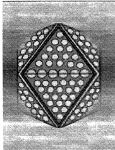
Identify the given figure and which system is affected by it?
A
Adenovirus,Digestive system
B
$TMV$,Respiratory system
C
Adenovirus,Respiratory system
D
$TMV$,Digestive system
Solution
(C) The figure shows an Adenovirus,which is a group of viruses that typically cause respiratory infections.
These viruses are known to cause illnesses such as the common cold,bronchitis,pneumonia,and other respiratory tract infections.
Therefore,the correct identification is Adenovirus,and the system affected is the respiratory system.
These viruses are known to cause illnesses such as the common cold,bronchitis,pneumonia,and other respiratory tract infections.
Therefore,the correct identification is Adenovirus,and the system affected is the respiratory system.
0 likes
View Solution96
EasyMCQ
Which of the following pairs of diseases are both caused by viruses?
A
Tetanus and Typhoid
B
Whooping cough and Sleeping sickness
C
Syphilis and $AIDS$
D
Measles and Rabies
Solution
(D) $1$. $Tetanus$ is caused by the bacterium $Clostridium$ $tetani$.
$2$. $Typhoid$ is caused by the bacterium $Salmonella$ $typhi$.
$3$. $Whooping$ $cough$ is caused by the bacterium $Bordetella$ $pertussis$.
$4$. $Sleeping$ $sickness$ is caused by the protozoan $Trypanosoma$ $brucei$.
$5$. $Syphilis$ is caused by the bacterium $Treponema$ $pallidum$.
$6$. $AIDS$ is caused by the $Human$ $Immunodeficiency$ $Virus$ $(HIV)$.
$7$. $Measles$ is caused by the $Measles$ $virus$ (a $Paramyxovirus$).
$8$. $Rabies$ is caused by the $Rabies$ $virus$ (a $Lyssavirus$).
Therefore,both $Measles$ and $Rabies$ are viral diseases.
$2$. $Typhoid$ is caused by the bacterium $Salmonella$ $typhi$.
$3$. $Whooping$ $cough$ is caused by the bacterium $Bordetella$ $pertussis$.
$4$. $Sleeping$ $sickness$ is caused by the protozoan $Trypanosoma$ $brucei$.
$5$. $Syphilis$ is caused by the bacterium $Treponema$ $pallidum$.
$6$. $AIDS$ is caused by the $Human$ $Immunodeficiency$ $Virus$ $(HIV)$.
$7$. $Measles$ is caused by the $Measles$ $virus$ (a $Paramyxovirus$).
$8$. $Rabies$ is caused by the $Rabies$ $virus$ (a $Lyssavirus$).
Therefore,both $Measles$ and $Rabies$ are viral diseases.
0 likes
View Solution97
EasyMCQ
Which of the following pairs of diseases is caused by viruses?
A
Rabies and Mumps
B
Cholera and Tuberculosis
C
Typhoid and Tetanus
D
$AIDS$ and Syphilis
Solution
(A) The correct answer is $A$.
$1$. Rabies is caused by the Rabies virus (Lyssavirus).
$2$. Mumps is caused by the Mumps virus (Paramyxovirus).
$3$. Cholera is caused by the bacterium Vibrio cholerae.
$4$. Tuberculosis is caused by the bacterium Mycobacterium tuberculosis.
$5$. Typhoid is caused by the bacterium Salmonella typhi.
$6$. Tetanus is caused by the bacterium Clostridium tetani.
$7$. $AIDS$ is caused by the Human Immunodeficiency Virus $(HIV)$,but Syphilis is caused by the bacterium Treponema pallidum.
Therefore,both diseases in option $A$ are viral.
$1$. Rabies is caused by the Rabies virus (Lyssavirus).
$2$. Mumps is caused by the Mumps virus (Paramyxovirus).
$3$. Cholera is caused by the bacterium Vibrio cholerae.
$4$. Tuberculosis is caused by the bacterium Mycobacterium tuberculosis.
$5$. Typhoid is caused by the bacterium Salmonella typhi.
$6$. Tetanus is caused by the bacterium Clostridium tetani.
$7$. $AIDS$ is caused by the Human Immunodeficiency Virus $(HIV)$,but Syphilis is caused by the bacterium Treponema pallidum.
Therefore,both diseases in option $A$ are viral.
0 likes
View Solution98
MediumMCQ
If the production of $Interferons$ is observed in the human body,then the person is likely infected with:
A
Typhoid
B
Measles
C
Tetanus
D
Malaria
Solution
(B) $Interferons$ are a group of signaling proteins made and released by host cells in response to the presence of several viruses. They are a type of cytokine that helps the immune system fight viral infections. Among the given options,$Measles$ is a viral disease,while $Typhoid$,$Tetanus$,and $Malaria$ are caused by bacteria and a protozoan,respectively. Therefore,the production of $Interferons$ indicates a viral infection like $Measles$.
0 likes
View Solution99
EasyMCQ
Which of the following is a highly infectious disease?
A
Hepatitis-$B$
B
$AIDS$
C
Common cold
D
Malaria
Solution
(C) The common cold is a highly infectious disease caused by rhinoviruses. It infects the nose and respiratory passage but not the lungs. It spreads easily through droplets resulting from coughs or sneezes of an infected person,or through contaminated objects like pens,books,cups,doorknobs,etc. Hepatitis-$B$,$AIDS$,and malaria are not transmitted through such casual contact.
0 likes
View Solution100
MediumMCQ
Assertion : Severe Acute Respiratory Syndrome $(SARS)$ originated in China.
Reason : China is the most populated country of the world.
Reason : China is the most populated country of the world.
A
If both Assertion and Reason are correct and the Reason is a correct explanation of the Assertion.
B
If both Assertion and Reason are correct but Reason is not a correct explanation of the Assertion.
C
If the Assertion is correct but Reason is incorrect.
D
If both the Assertion and Reason are incorrect.
Solution
(B) The first patient of $SARS$ was reported in February $2003$ in China. Therefore,the Assertion is correct.
Although China is a highly populated country,the population density is not the direct biological cause for the origin of the $SARS$ virus. Therefore,the Reason is a true statement but not the correct explanation for the Assertion.
Although China is a highly populated country,the population density is not the direct biological cause for the origin of the $SARS$ virus. Therefore,the Reason is a true statement but not the correct explanation for the Assertion.
0 likes
View SolutionHuman Health and Disease — Diseases caused by viruses · Frequently Asked Questions
1Are these Human Health and Disease questions useful for JEE and NEET?
Yes. All questions in this section are mapped to JEE Main and NEET exam patterns. Previous year questions from JEE Main, NEET, GUJCET and state-level exams are included with full solutions.
2Can I switch to Hindi or Gujarati for these questions?
Yes. Use the language tabs in the hero section or the sidebar to view the same questions and solutions in English, Hindi or Gujarati.
3How do I generate a question paper from this subtopic?
Use the Vedclass Exam Paper Generator — select the chapter and subtopic, set difficulty, and generate Sets A, B, C, D automatically. First 3 chapters of every subject are free.
Vedclass Products
For Students
Vedclass Test Series
Mock tests in real JEE/NEET style with performance analysis. 5-day free trial.
Start Free TrialFor Teachers
Exam Paper Generator
Generate Set A/B/C/D papers from this chapter in 2 minutes. 3 chapters free.
Try FreeFor Institutes
Online Exam Module
Live online exams with unlimited students, 360° analytics & white-label branding.
See DemoFor Teachers & Institutes
Generate a Human Health and Disease Exam Paper in 2 Minutes
Select subtopic & difficulty — Sets A, B, C, D auto-generated with No Repeat logic.
First 3 chapters of every subject are free — no payment required.