
A English
Water Pollution and Its Control Questions in English
Class 12 Biology · Environmental Issues · Water Pollution and Its Control
54+
Questions
English
Language
100%
With Solutions
Showing 50 of 54 questions in English
1
MediumMCQ
Pesticides cause
A
Noise pollution
B
Air pollution
C
Aquatic pollution
D
None of the above
Solution
(C) Pesticides are chemical substances used to control pests. Since many pesticides are soluble in water or can be washed away by rain into water bodies,they contaminate water sources. This leads to aquatic pollution,which negatively impacts the health of aquatic organisms and disrupts the ecosystem.
0 likes
View Solution2
MediumMCQ
Eutrophication is due to
A
Air pollution
B
Radiation pollution
C
Water pollution
D
Noise pollution
Solution
(C) Eutrophication is the process of nutrient enrichment in water bodies,typically caused by the excessive influx of nutrients like nitrogen and phosphorus from agricultural runoff or sewage.
This leads to an excessive growth of algae,known as algal blooms.
As these algae die and decompose,the process consumes a significant amount of dissolved oxygen in the water.
Furthermore,certain blue-green algae present in these blooms can release toxins.
The combination of severe oxygen depletion and the presence of toxins leads to the death of aquatic organisms,thereby causing water pollution.
This leads to an excessive growth of algae,known as algal blooms.
As these algae die and decompose,the process consumes a significant amount of dissolved oxygen in the water.
Furthermore,certain blue-green algae present in these blooms can release toxins.
The combination of severe oxygen depletion and the presence of toxins leads to the death of aquatic organisms,thereby causing water pollution.
0 likes
View Solution3
EasyMCQ
The carrier of fluorosis is:
A
$CO_2$
B
Chlorine
C
Nitrogen
D
Water
Solution
(D) Fluorosis is a condition caused by the excessive intake of fluoride,typically through the consumption of contaminated drinking water. When fluoride levels in water exceed the permissible limit,it leads to dental and skeletal fluorosis. Therefore,water acts as the primary carrier or medium for the transmission of fluoride into the human body.
0 likes
View Solution4
EasyMCQ
$B.O.D.$ test or biological oxygen demand test is made for measuring:
A
Air pollution
B
Water pollution
C
Noise pollution
D
Soil pollution
Solution
(B) $B.O.D.$ stands for Biochemical Oxygen Demand.
It is a measure of the amount of dissolved oxygen required by aerobic microorganisms to decompose the organic matter present in a given volume of water at a specific temperature.
Therefore,it is used as a standard indicator to measure the degree of water pollution.
It is a measure of the amount of dissolved oxygen required by aerobic microorganisms to decompose the organic matter present in a given volume of water at a specific temperature.
Therefore,it is used as a standard indicator to measure the degree of water pollution.
0 likes
View Solution5
MediumMCQ
Water pollution can be best stopped by
A
Treating effluents to remove injurious chemicals
B
Rearing more fishes
C
Cultivating useful water plants
D
Spraying with $DDT$
Solution
(A) The most effective method to control water pollution is treating industrial and domestic effluents to remove injurious chemicals before they are discharged into water bodies.
$(a)$ Treating effluents involves physical,chemical,and biological processes to remove pollutants.
$(b)$ Rearing more fishes does not remove pollutants.
$(c)$ While some plants help in phytoremediation,it is not the primary method for stopping overall water pollution.
$(d)$ Spraying with $DDT$ actually increases water pollution and causes biomagnification.
$(a)$ Treating effluents involves physical,chemical,and biological processes to remove pollutants.
$(b)$ Rearing more fishes does not remove pollutants.
$(c)$ While some plants help in phytoremediation,it is not the primary method for stopping overall water pollution.
$(d)$ Spraying with $DDT$ actually increases water pollution and causes biomagnification.
0 likes
View Solution6
MediumMCQ
Which of the following is a main factor of water pollution?
A
Commercial production
B
Windmill
C
Smoke and ammonia
D
Detergents
Solution
(D) Water pollution is caused by the discharge of domestic and industrial waste into water bodies.
Among the given options,detergents are a significant source of water pollution.
Detergents contain phosphates,which,when released into water bodies,lead to eutrophication,a process that promotes excessive algal growth and depletes dissolved oxygen,thereby harming aquatic life.
Other options like smoke and ammonia are primarily associated with air pollution,while windmills are a source of renewable energy.
Among the given options,detergents are a significant source of water pollution.
Detergents contain phosphates,which,when released into water bodies,lead to eutrophication,a process that promotes excessive algal growth and depletes dissolved oxygen,thereby harming aquatic life.
Other options like smoke and ammonia are primarily associated with air pollution,while windmills are a source of renewable energy.
0 likes
View Solution7
EasyMCQ
By which method can the quantity of organic pollutants in water be determined?
A
By $pH$ measurement
B
By transparency measurement
C
By measuring the change of colour
D
By measuring $BOD$
Solution
(D) The quantity of organic pollutants in water is determined by measuring the $BOD$ $(Biochemical Oxygen Demand)$.
$BOD$ refers to the amount of dissolved oxygen that would be consumed if all the organic matter in one liter of water were oxidized by bacteria.
Greater $BOD$ indicates a higher level of organic pollution in the water body.
$BOD$ refers to the amount of dissolved oxygen that would be consumed if all the organic matter in one liter of water were oxidized by bacteria.
Greater $BOD$ indicates a higher level of organic pollution in the water body.
0 likes
View Solution8
EasyMCQ
High coliform count in water is an indicator of
A
Industrial pollution
B
Sewage contamination
C
Hardness of water
D
Oil pollution
Solution
(B) Coliform bacteria are a group of bacteria commonly found in the intestines of warm-blooded animals,including humans.
The presence of a high coliform count in a water body indicates that the water has been contaminated with fecal matter or sewage.
Therefore,it serves as a standard indicator for sewage contamination in water sources.
The presence of a high coliform count in a water body indicates that the water has been contaminated with fecal matter or sewage.
Therefore,it serves as a standard indicator for sewage contamination in water sources.
0 likes
View Solution9
EasyMCQ
Which of the following causes an outbreak of jaundice?
A
Air pollution
B
Water pollution
C
Thermal pollution
D
Soil pollution
Solution
(B) Jaundice is primarily a water-borne disease. It is caused by the consumption of contaminated water containing the Hepatitis $A$ or $E$ virus. Therefore,water pollution is the primary cause of jaundice outbreaks.
0 likes
View Solution10
EasyMCQ
Which of the following is a water polluting factor?
A
Smoke
B
Industrial waste
C
Detergent
D
Ammonia
Solution
(B) Water pollution is primarily caused by the discharge of untreated or partially treated industrial wastes,sewage,insecticides,herbicides,and other chemical pollutants into water bodies.
While detergents and ammonia can also contribute to water pollution,industrial waste represents a major and broad category of pollutants that significantly degrade water quality on a large scale.
While detergents and ammonia can also contribute to water pollution,industrial waste represents a major and broad category of pollutants that significantly degrade water quality on a large scale.
0 likes
View Solution11
EasyMCQ
Which of the following causes water pollution?
A
$2, 4-D$ and pesticides
B
Smoke
C
Automobile exhaust
D
Aeroplanes
Solution
(A) Herbicides (e.g.,$2, 4-D$,$2, 4, 5-T$),insecticides (e.g.,$DDT$,aldrin,$BHC$),and rodenticides are chemical substances that,when washed into water bodies,cause water pollution.
These chemicals are persistent and can lead to bioaccumulation and biomagnification in aquatic ecosystems.
These chemicals are persistent and can lead to bioaccumulation and biomagnification in aquatic ecosystems.
0 likes
View Solution12
MediumMCQ
When a huge amount of sewage is dumped into a river,the $BOD$ will
A
Increase
B
Remain unchanged
C
Slightly decrease
D
Decrease
Solution
(A) The $BOD$ (Biochemical Oxygen Demand) is a measure of the amount of dissolved oxygen required by aerobic microorganisms to decompose the organic matter present in a given volume of water.
When a large amount of sewage is dumped into a river,it introduces a significant quantity of organic matter.
Microorganisms consume this organic matter,which leads to an increase in their metabolic activity and oxygen consumption.
Therefore,the $BOD$ of the water increases as the level of organic pollution rises.
When a large amount of sewage is dumped into a river,it introduces a significant quantity of organic matter.
Microorganisms consume this organic matter,which leads to an increase in their metabolic activity and oxygen consumption.
Therefore,the $BOD$ of the water increases as the level of organic pollution rises.
0 likes
View Solution13
MediumMCQ
Fishes die due to sewage pollution because:
A
Of its bad smell
B
It replaces the food material of fishes
C
It increases the competition for oxygen among fishes
D
$CO_2$ is mixed in large amounts in water
Solution
(C) Sewage contains high amounts of organic matter. When this organic matter is discharged into water bodies,microorganisms (bacteria) decompose it. This decomposition process consumes a large amount of dissolved oxygen $(DO)$ from the water. As a result,the level of dissolved oxygen decreases significantly,leading to the death of fishes due to oxygen depletion.
0 likes
View Solution14
MediumMCQ
What is the effect of water pollution on aquatic environments?
A
Increases oxygenation
B
Decreases turbidity
C
Increases turbidity and deoxygenation
D
Increases photosynthesis
Solution
(C) Water pollution,particularly due to the discharge of organic waste and industrial effluents,leads to an increase in suspended particles,which increases the turbidity of the water.
Furthermore,the decomposition of organic matter by microorganisms consumes dissolved oxygen,leading to a process called deoxygenation (or biological oxygen demand),which reduces the oxygen available for aquatic life.
Furthermore,the decomposition of organic matter by microorganisms consumes dissolved oxygen,leading to a process called deoxygenation (or biological oxygen demand),which reduces the oxygen available for aquatic life.
0 likes
View Solution15
EasyMCQ
The river 'Sone' receives wastes from
A
Refinery
B
Distillery
C
Textile mill
D
Paper mill
Solution
(B) The river 'Sone' is a major tributary of the river 'Ganga'. It is known to be heavily polluted by the discharge of effluents from the 'Distillery' industry located along its banks. These effluents contain high levels of organic matter,which significantly increase the Biological Oxygen Demand $(BOD)$ of the river water,leading to severe water pollution.
0 likes
View Solution16
EasyMCQ
Water pollution is caused due to
A
Sewage and other wastes
B
Industrial effluents
C
Agricultural discharges
D
All of these
Solution
(D) Water pollution occurs when harmful substances—often chemicals or microorganisms—contaminate a stream,river,lake,ocean,aquifer,or other body of water,degrading water quality and rendering it toxic to the environment and humans.
$1$. Sewage and other wastes: Domestic sewage contains organic matter and pathogens that deplete dissolved oxygen in water bodies.
$2$. Industrial effluents: Factories release toxic chemicals,heavy metals,and heat (thermal pollution) into water sources.
$3$. Agricultural discharges: Fertilizers (containing nitrates and phosphates) and pesticides run off from fields into water bodies,leading to eutrophication and toxicity.
Since all these factors contribute significantly to water pollution,the correct option is $D$.
$1$. Sewage and other wastes: Domestic sewage contains organic matter and pathogens that deplete dissolved oxygen in water bodies.
$2$. Industrial effluents: Factories release toxic chemicals,heavy metals,and heat (thermal pollution) into water sources.
$3$. Agricultural discharges: Fertilizers (containing nitrates and phosphates) and pesticides run off from fields into water bodies,leading to eutrophication and toxicity.
Since all these factors contribute significantly to water pollution,the correct option is $D$.
0 likes
View Solution17
EasyMCQ
Water pollution is caused by
A
Ammonia
B
Phytoplankton
C
Industrial effluents
D
Smoke
Solution
(C) Water pollution occurs when harmful substances,such as chemicals or microorganisms,contaminate a stream,river,lake,ocean,or aquifer. Industrial effluents are a major source of water pollution as they contain toxic chemicals,heavy metals,and other pollutants that are discharged directly into water bodies without proper treatment. Ammonia is also a pollutant,but industrial effluents represent a broader and more significant category of water pollution sources. Phytoplankton are natural components of aquatic ecosystems,and smoke primarily contributes to air pollution.
0 likes
View Solution18
EasyMCQ
The main cause of water pollution is
A
Soap
B
Industrial effluents
C
Smoke
D
Ammonia
Solution
(B) Water pollution is primarily caused by the discharge of untreated or partially treated industrial waste into water bodies. Industrial effluents contain various toxic chemicals,heavy metals,and organic pollutants that severely degrade water quality and harm aquatic life. While soaps,smoke,and ammonia can contribute to pollution,industrial effluents represent the most significant and widespread source of large-scale water contamination.
0 likes
View Solution19
EasyMCQ
Which one of the following is not used for the disinfection of drinking water?
A
Chlorine
B
Ozone
C
Chloramine
D
Phenyl
Solution
(D) Disinfection is the process of eliminating pathogenic microorganisms from water to make it safe for human consumption.
$A$,$B$,and $C$ (Chlorine,Ozone,and Chloramine) are widely used chemical disinfectants for treating drinking water.
$D$ (Phenyl) is a phenolic compound primarily used as a surface disinfectant or cleaner for floors and household surfaces,not for treating drinking water,as it is toxic and unsuitable for human consumption.
$A$,$B$,and $C$ (Chlorine,Ozone,and Chloramine) are widely used chemical disinfectants for treating drinking water.
$D$ (Phenyl) is a phenolic compound primarily used as a surface disinfectant or cleaner for floors and household surfaces,not for treating drinking water,as it is toxic and unsuitable for human consumption.
0 likes
View Solution20
EasyMCQ
Which of the following is an indicator of water pollution?
A
$E. coli$
B
$Chlorella$
C
$Beggiatoa$
D
$Ulothrix$
Solution
(A) The presence of $E. coli$ (Escherichia coli) in water is a standard indicator of fecal contamination and water pollution. $E. coli$ is a bacterium commonly found in the lower intestine of warm-blooded organisms. Its detection in water samples indicates that the water has been contaminated with fecal matter,which may contain other harmful pathogens.
0 likes
View Solution21
EasyMCQ
What is $B.O.D$?
A
The amount of $O_2$ consumed by aquatic organisms.
B
The amount of $O_2$ that would be consumed if all the organic matter in one liter of water were oxidized by bacteria.
C
The total amount of $O_2$ present in water.
D
All of the above.
Solution
(B) $B.O.D$ stands for Biochemical Oxygen Demand. It refers to the amount of dissolved oxygen that would be consumed if all the organic matter in one liter of water were oxidized by aerobic bacteria. It is a measure of the organic matter present in the water. The greater the $B.O.D$ of waste water,the more is its polluting potential.
0 likes
View Solution22
EasyMCQ
The common indicator organism of water pollution is ......
A
Entamoeba histolytica
B
Lemna paucicostata
C
Eichhornia crassipes
D
Escherichia coli
Solution
(D) The presence of $Escherichia \ coli$ $(E. \ coli)$ in water is a standard indicator of fecal contamination.
$E. \ coli$ is a bacterium that normally lives in the intestines of humans and other warm-blooded animals.
Its presence in water samples indicates that the water has been contaminated with fecal matter,which may contain other pathogenic microorganisms.
Therefore,it is widely used as a biological indicator to assess the quality of water and detect potential health risks.
$E. \ coli$ is a bacterium that normally lives in the intestines of humans and other warm-blooded animals.
Its presence in water samples indicates that the water has been contaminated with fecal matter,which may contain other pathogenic microorganisms.
Therefore,it is widely used as a biological indicator to assess the quality of water and detect potential health risks.
0 likes
View Solution23
EasyMCQ
Which of the following is a major factor in water pollution?
A
Smoke
B
Industrial waste
C
Detergents
D
Ammonia
Solution
(B) Water pollution is primarily caused by the discharge of untreated or partially treated industrial effluents into water bodies. Industrial waste contains various toxic chemicals,heavy metals,and organic pollutants that significantly degrade water quality,making it harmful for aquatic life and human consumption. While detergents and ammonia can contribute to pollution,industrial waste is considered a major and widespread factor in large-scale water contamination.
0 likes
View Solution24
MediumMCQ
Which of the following is more significant for water pollution?
A
Noise
B
$SO_2$
C
Arsenic salts
D
Sewage
Solution
(D) Sewage is the most significant contributor to water pollution among the given options.
Sewage contains organic matter,pathogens,and nutrients that lead to eutrophication and the depletion of dissolved oxygen in water bodies.
While arsenic salts are toxic,they are usually localized,and $SO_2$ is primarily an air pollutant.
Noise is a form of physical pollution that does not directly contaminate water quality in the same chemical or biological manner as sewage.
Sewage contains organic matter,pathogens,and nutrients that lead to eutrophication and the depletion of dissolved oxygen in water bodies.
While arsenic salts are toxic,they are usually localized,and $SO_2$ is primarily an air pollutant.
Noise is a form of physical pollution that does not directly contaminate water quality in the same chemical or biological manner as sewage.
0 likes
View Solution25
MediumMCQ
If water pollution continues at its present rate,it will eventually cause:
A
The water cycle to stop
B
Resistance to precipitation
C
Water to become unavailable for oxygen molecules
D
Water to become unavailable for nitrate molecules
Solution
(A) If water pollution continues at its present rate,it leads to the depletion of dissolved oxygen in water bodies,which is essential for aquatic life. Furthermore,large-scale pollution and the resulting ecological imbalance can disrupt the natural evaporation and transpiration processes,eventually leading to the cessation of the water cycle. Therefore,the most appropriate consequence among the given options is that the water cycle will stop. Thus,the correct option is $A$.
0 likes
View Solution26
EasyMCQ
Which method is used by municipalities in cities to treat wastewater?
A
Wet scrubbers
B
Electrostatic precipitators
C
Sewage treatment
D
Water purification process
Solution
(C) Municipalities in cities use sewage treatment plants (STPs) to treat wastewater before it is released into water bodies.
This process involves primary and secondary (biological) treatment to remove organic matter and pathogens from the sewage.
Wet scrubbers and electrostatic precipitators are used for removing particulate matter from industrial exhaust gases,not for wastewater treatment.
This process involves primary and secondary (biological) treatment to remove organic matter and pathogens from the sewage.
Wet scrubbers and electrostatic precipitators are used for removing particulate matter from industrial exhaust gases,not for wastewater treatment.
0 likes
View Solution27
EasyMCQ
How can water pollution be measured?
A
Measurement of $BOD$
B
Amount of sludge produced
C
Decreasing levels of $BOD$
D
Amount of effluent produced
Solution
(A) Water pollution,specifically organic pollution,is measured by the $BOD$ (Biochemical Oxygen Demand) test.
$BOD$ refers to the amount of oxygen that would be consumed if all the organic matter in one liter of water were oxidized by bacteria.
Greater $BOD$ indicates higher levels of organic pollution in the water body.
Therefore,measuring $BOD$ is the standard method to assess the degree of water pollution.
$BOD$ refers to the amount of oxygen that would be consumed if all the organic matter in one liter of water were oxidized by bacteria.
Greater $BOD$ indicates higher levels of organic pollution in the water body.
Therefore,measuring $BOD$ is the standard method to assess the degree of water pollution.
0 likes
View Solution28
MediumMCQ
When can it be said that the level of pollution in water is high?
A
When the amount of $CO_2$ in water is high.
B
When the amount of oxygen in water is high.
C
When the $BOD$ value in water is high.
D
When the amount of flocs in water is high.
Solution
(C) $BOD$ stands for Biochemical Oxygen Demand.
It refers to the amount of oxygen that would be consumed if all the organic matter in one liter of water were oxidized by bacteria.
Micro-organisms consume oxygen during the decomposition of organic waste.
Therefore,if the water is highly polluted with organic matter,the bacteria will consume more oxygen to break it down,leading to a higher $BOD$ value.
Thus,a high $BOD$ value is a direct indicator of high water pollution.
It refers to the amount of oxygen that would be consumed if all the organic matter in one liter of water were oxidized by bacteria.
Micro-organisms consume oxygen during the decomposition of organic waste.
Therefore,if the water is highly polluted with organic matter,the bacteria will consume more oxygen to break it down,leading to a higher $BOD$ value.
Thus,a high $BOD$ value is a direct indicator of high water pollution.
0 likes
View Solution29
MediumMCQ
Which methods can be used to prevent water pollution?
A
$SPAT$
B
$STPs$
C
$SPTS$
D
All of the above $(A), (B)$ and $(C)$
Solution
(B) Water pollution can be significantly reduced by treating sewage before it is discharged into water bodies.
$STPs$ (Sewage Treatment Plants) are facilities designed to treat municipal wastewater,containing human waste and other pollutants,through physical,chemical,and biological processes.
These plants remove contaminants from sewage to produce environmentally safe treated wastewater (or treated effluent) and a solid waste (or sludge) suitable for disposal or reuse.
Therefore,$STPs$ are the standard method used to prevent water pollution from sewage.
$STPs$ (Sewage Treatment Plants) are facilities designed to treat municipal wastewater,containing human waste and other pollutants,through physical,chemical,and biological processes.
These plants remove contaminants from sewage to produce environmentally safe treated wastewater (or treated effluent) and a solid waste (or sludge) suitable for disposal or reuse.
Therefore,$STPs$ are the standard method used to prevent water pollution from sewage.
0 likes
View Solution30
EasyMCQ
Eutrophication and Bio-magnification are effects of
A
Air pollution
B
Water pollution
C
$E-waste$
D
Soil pollution
Solution
(B) Eutrophication is the process where water bodies become enriched with nutrients,typically due to runoff from fertilizers,leading to excessive growth of algae and depletion of dissolved oxygen.
Bio-magnification refers to the increase in concentration of non-biodegradable toxic substances (like $DDT$ or mercury) at successive trophic levels in a food chain.
Both of these phenomena are direct consequences of the contamination of aquatic ecosystems,which is categorized under water pollution.
Bio-magnification refers to the increase in concentration of non-biodegradable toxic substances (like $DDT$ or mercury) at successive trophic levels in a food chain.
Both of these phenomena are direct consequences of the contamination of aquatic ecosystems,which is categorized under water pollution.
0 likes
View Solution31
EasyMCQ
$FOAM$ is concerned with
A
Control of air pollution
B
Control of noise pollution
C
Purify the waste water
D
Depletion of ozone layer
Solution
(C) $FOAM$ stands for $\text{Friends of the Old and Arcata Marsh}$.
It is a project initiated by the citizens of $\text{Arcata}$, $\text{California}$, for the integrated waste water treatment process.
In this process, the water is treated through a series of connected marshes using natural processes involving algae, fungi, bacteria, and plants to neutralize, absorb, and assimilate the pollutants.
Therefore, $FOAM$ is concerned with the purification of waste water.
It is a project initiated by the citizens of $\text{Arcata}$, $\text{California}$, for the integrated waste water treatment process.
In this process, the water is treated through a series of connected marshes using natural processes involving algae, fungi, bacteria, and plants to neutralize, absorb, and assimilate the pollutants.
Therefore, $FOAM$ is concerned with the purification of waste water.
0 likes
View Solution32
EasyMCQ
Which of the following diseases is caused by contaminated waste water?
A
Dysentery
B
Typhoid
C
Jaundice
D
All of the above
Solution
(D) Contaminated waste water often contains pathogenic microorganisms such as bacteria, viruses, and protozoa.
$1$. Dysentery is typically caused by bacteria like $Shigella$ or protozoa like $Entamoeba histolytica$ transmitted through contaminated water.
$2$. Typhoid is caused by the bacterium $Salmonella typhi$, which spreads through the fecal-oral route via contaminated water or food.
$3$. Jaundice (specifically Hepatitis $A$ and $E$) is a viral infection often transmitted through the consumption of water contaminated with sewage.
Therefore, all the listed diseases can be caused by the consumption or contact with contaminated waste water.
$1$. Dysentery is typically caused by bacteria like $Shigella$ or protozoa like $Entamoeba histolytica$ transmitted through contaminated water.
$2$. Typhoid is caused by the bacterium $Salmonella typhi$, which spreads through the fecal-oral route via contaminated water or food.
$3$. Jaundice (specifically Hepatitis $A$ and $E$) is a viral infection often transmitted through the consumption of water contaminated with sewage.
Therefore, all the listed diseases can be caused by the consumption or contact with contaminated waste water.
0 likes
View Solution33
EasyMCQ
Wastewater,including sewage,can be treated in an integrated manner by the marshland of which city in California?
A
Antarctica
B
Humboldt State
C
Arctica
D
Arcata
Solution
(D) The town of $Arcata$,located in California,created an integrated waste treatment process within a natural system.
This project was developed by biologists from Humboldt State University.
In this process,the wastewater is treated in two stages:
$1$. The conventional sedimentation,filtering,and chlorine treatments are performed.
$2$. To neutralize pollutants like heavy metals,the biologists developed a series of $60$ hectares of marshland.
These marshes absorb pollutants and assimilate them,thereby purifying the water naturally.
This project was developed by biologists from Humboldt State University.
In this process,the wastewater is treated in two stages:
$1$. The conventional sedimentation,filtering,and chlorine treatments are performed.
$2$. To neutralize pollutants like heavy metals,the biologists developed a series of $60$ hectares of marshland.
These marshes absorb pollutants and assimilate them,thereby purifying the water naturally.
0 likes
View Solution34
MediumMCQ
What is the consequence of discharging organic-rich domestic sewage into a river?
A
The population of aquatic food organisms increases.
B
The number of fish increases due to biodegradable nutrients.
C
Fish die due to the lack of oxygen.
D
The river dries up quickly due to the abundance of fish.
Solution
(C) When organic-rich domestic sewage is discharged into a river,it acts as a nutrient source for microorganisms like bacteria.
These microorganisms decompose the organic matter,a process that consumes a large amount of dissolved oxygen $(DO)$ from the water.
This leads to a sharp decline in the $BOD$ (Biochemical Oxygen Demand) levels and a significant reduction in dissolved oxygen.
As a result,aquatic organisms,especially fish,die due to the lack of oxygen (hypoxia).
These microorganisms decompose the organic matter,a process that consumes a large amount of dissolved oxygen $(DO)$ from the water.
This leads to a sharp decline in the $BOD$ (Biochemical Oxygen Demand) levels and a significant reduction in dissolved oxygen.
As a result,aquatic organisms,especially fish,die due to the lack of oxygen (hypoxia).
0 likes
View Solution35
EasyMCQ
Consumption of fish from water polluted by industrial waste causes which of the following diseases?
A
Minamata
B
Bright's
C
Hashimoto's
D
Osteosclerosis
Solution
(A) Minamata disease is a neurological syndrome caused by severe mercury poisoning. It was first discovered in Minamata city,Japan,in $1956$. The disease was caused by the release of methylmercury in the industrial wastewater from the Chisso Corporation's chemical factory,which bioaccumulated in shellfish and fish in Minamata Bay and the Shiranui Sea. When local people consumed these contaminated fish,they developed the disease.
0 likes
View Solution36
MediumMCQ
When sewage is added to water bodies,fish die because:
A
The added water contains excess $CO_2$.
B
It causes a foul smell.
C
It removes the food source for fish.
D
It leads to a depletion of dissolved oxygen in the water.
Solution
(D) When sewage is discharged into water bodies,it contains high levels of organic matter.
Microorganisms like bacteria decompose this organic matter,a process that requires a significant amount of oxygen.
This leads to a sharp decrease in the $BOD$ (Biochemical Oxygen Demand) and a corresponding depletion of dissolved oxygen in the water.
As a result,aquatic organisms like fish,which rely on dissolved oxygen for respiration,die due to suffocation.
Microorganisms like bacteria decompose this organic matter,a process that requires a significant amount of oxygen.
This leads to a sharp decrease in the $BOD$ (Biochemical Oxygen Demand) and a corresponding depletion of dissolved oxygen in the water.
As a result,aquatic organisms like fish,which rely on dissolved oxygen for respiration,die due to suffocation.
0 likes
View Solution37
MediumMCQ
What measures would you take to prevent water-borne diseases?
A
Drinking untreated water
B
Proper disposal of sewage and excreta
C
Allowing water to stagnate
D
Using open defecation
Solution
(B) Water-borne diseases such as cholera,typhoid,and hepatitis $A$ spread through the consumption of contaminated water.
To prevent these diseases,the following measures should be taken:
$1$. Ensure proper disposal of sewage and excreta to prevent water contamination.
$2$. Periodic cleaning and disinfection of community water reservoirs.
$3$. Boiling drinking water or using water purifiers to ensure it is safe for consumption.
$4$. Maintaining personal and environmental hygiene.
To prevent these diseases,the following measures should be taken:
$1$. Ensure proper disposal of sewage and excreta to prevent water contamination.
$2$. Periodic cleaning and disinfection of community water reservoirs.
$3$. Boiling drinking water or using water purifiers to ensure it is safe for consumption.
$4$. Maintaining personal and environmental hygiene.
0 likes
View Solution38
Medium
What are the various constituents of domestic sewage? Discuss the effects of sewage discharge on a river.
Solution
(N/A) Domestic sewage is the waste originating from the kitchen,toilet,laundry,and other sources. It contains impurities such as suspended solids (sand,salt,clay),colloidal materials (fecal matter,bacteria,plastic,and cloth fibers),dissolved materials (nitrates,phosphates,calcium,sodium,ammonia),and disease-causing microbes.
When organic wastes from the sewage enter water bodies,they serve as a food source for microorganisms such as algae and bacteria. As a result,the population of these microorganisms in the water body increases. They utilize most of the dissolved oxygen for their metabolism. This leads to an increase in the levels of Biological Oxygen Demand $(BOD)$ in river water,resulting in the death of aquatic organisms. Additionally,the nutrients in the water lead to the growth of planktonic algae,causing algal blooms,which cause the deterioration of water quality and fish mortality.
When organic wastes from the sewage enter water bodies,they serve as a food source for microorganisms such as algae and bacteria. As a result,the population of these microorganisms in the water body increases. They utilize most of the dissolved oxygen for their metabolism. This leads to an increase in the levels of Biological Oxygen Demand $(BOD)$ in river water,resulting in the death of aquatic organisms. Additionally,the nutrients in the water lead to the growth of planktonic algae,causing algal blooms,which cause the deterioration of water quality and fish mortality.
0 likes
View Solution39
Medium
Explain water pollution. What is the law for its control?
Solution
(N/A) Water bodies are the lifeline of human beings as well as other animals.
Due to the disposal of all kinds of waste and other anthropogenic actions,ponds,lakes,streams,rivers,estuaries,and oceans are becoming polluted in several parts of the world.
The Government of India has passed the Water (Prevention and Control of Pollution) Act,$1974$ to protect water resources.
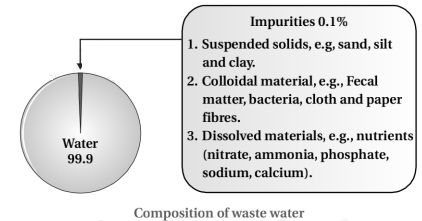
The sewage that comes out from houses and offices constitutes domestic sewage.
$A$ mere $0.1 \%$ of impurities make domestic sewage unfit for human use.
Solid wastes are relatively easy to remove,but dissolved salts such as nitrates,phosphates,and other nutrients,as well as toxic metal ions and organic compounds present in domestic wastes,are comparatively difficult to remove.
Domestic sewage mainly contains biodegradable organic matter,which can be easily decomposed by microbes like bacteria and fungi.
They use organic wastes as nutrients.
Due to the disposal of all kinds of waste and other anthropogenic actions,ponds,lakes,streams,rivers,estuaries,and oceans are becoming polluted in several parts of the world.
The Government of India has passed the Water (Prevention and Control of Pollution) Act,$1974$ to protect water resources.
The sewage that comes out from houses and offices constitutes domestic sewage.
$A$ mere $0.1 \%$ of impurities make domestic sewage unfit for human use.
Solid wastes are relatively easy to remove,but dissolved salts such as nitrates,phosphates,and other nutrients,as well as toxic metal ions and organic compounds present in domestic wastes,are comparatively difficult to remove.
Domestic sewage mainly contains biodegradable organic matter,which can be easily decomposed by microbes like bacteria and fungi.
They use organic wastes as nutrients.
0 likes
View Solution40
Medium
What do you mean by Biological Oxygen Demand $(BOD)$?
Solution
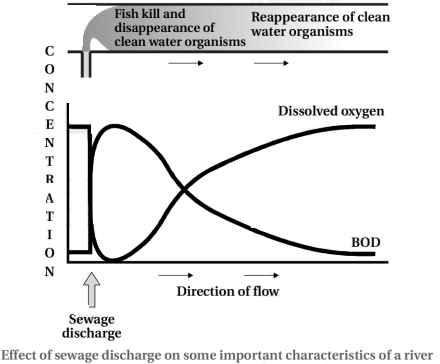
(N/A) Biological Oxygen Demand $(BOD)$ refers to the amount of oxygen that would be consumed if all the organic matter in one litre of water were oxidized by bacteria.
- Microbes that decompose organic wastes in water bodies consume a significant amount of oxygen.
- This results in a sharp decline in dissolved oxygen downstream from the point of sewage discharge.
- This depletion of oxygen causes the mortality of fish and other aquatic creatures.
- The $BOD$ test measures the rate of oxygen uptake by micro-organisms in a water sample.
- Indirectly,$BOD$ is a measure of the organic matter present in the water.
- The greater the $BOD$ of wastewater,the higher is its polluting potential.
- Microbes that decompose organic wastes in water bodies consume a significant amount of oxygen.
- This results in a sharp decline in dissolved oxygen downstream from the point of sewage discharge.
- This depletion of oxygen causes the mortality of fish and other aquatic creatures.
- The $BOD$ test measures the rate of oxygen uptake by micro-organisms in a water sample.
- Indirectly,$BOD$ is a measure of the organic matter present in the water.
- The greater the $BOD$ of wastewater,the higher is its polluting potential.
0 likes
View Solution41
Medium
What are the components of domestic sewage and industrial effluents?
Solution
(N/A) Domestic sewage, originating from homes and hospitals, contains organic waste, nutrients, and a high concentration of pathogenic microorganisms. Its disposal into water bodies without proper treatment can lead to the outbreak of serious waterborne diseases such as dysentery, typhoid, jaundice, and cholera.
In contrast, industrial effluents from sectors like petroleum, paper manufacturing, metal extraction, and chemical production contain toxic substances. These notably include heavy metals (defined as elements with density $ > 5 \,g/cm^3 $, such as mercury, cadmium, copper, and lead) and a variety of hazardous organic compounds.
In contrast, industrial effluents from sectors like petroleum, paper manufacturing, metal extraction, and chemical production contain toxic substances. These notably include heavy metals (defined as elements with density $ > 5 \,g/cm^3 $, such as mercury, cadmium, copper, and lead) and a variety of hazardous organic compounds.
0 likes
View Solution42
Easy
$(a)$ Discuss the major programs that the Ministry of Environment and Forests,Government of India,has initiated for saving major Indian rivers from pollution.
$(b)$ Ganga has recently been declared the national river. Discuss the implication with respect to pollution of this river.
$(b)$ Ganga has recently been declared the national river. Discuss the implication with respect to pollution of this river.
Solution
(A) Untreated sewage is often discharged directly into rivers,leading to pollution and an increase in water-borne diseases. The Ministry of Environment and Forests has initiated the Ganga Action Plan $(GAP)$ and Yamuna Action Plan $(YAP)$ to save these major rivers from pollution. Under these plans,it is proposed to build a large number of sewage treatment plants so that only treated sewage is discharged into the rivers.
$(b)$ The Ganga is the largest river in India with extraordinary religious importance for Hindus. Situated along its banks are some of the world's oldest inhabited cities,such as Varanasi and Patna. It provides water to about $40\%$ of India's population across $11$ states,serving an estimated population of $500$ million people or more,which is larger than any other river in the world. $A$ number of initiatives have been undertaken to clean the river but failed to deliver desired results. The National River Ganga Basin Authority $(NRGBA)$ was established by the Central Government of India on $20$ February $2009$ under Section $3(3)$ of the Environment Protection Act,$1986$. It also declared the Ganga as the National River of India to prioritize its conservation and pollution control.
$(b)$ The Ganga is the largest river in India with extraordinary religious importance for Hindus. Situated along its banks are some of the world's oldest inhabited cities,such as Varanasi and Patna. It provides water to about $40\%$ of India's population across $11$ states,serving an estimated population of $500$ million people or more,which is larger than any other river in the world. $A$ number of initiatives have been undertaken to clean the river but failed to deliver desired results. The National River Ganga Basin Authority $(NRGBA)$ was established by the Central Government of India on $20$ February $2009$ under Section $3(3)$ of the Environment Protection Act,$1986$. It also declared the Ganga as the National River of India to prioritize its conservation and pollution control.
0 likes
View Solution43
Medium
What is Integrated Waste Water Treatment?
Solution
(N/A) Integrated waste water treatment is a method where sewage and other waste waters are treated by combining artificial and natural processes.
An example of this is the town of Arcata,California,where a project was developed in collaboration with Humboldt State University.
The process occurs in two stages:
$(a)$ Conventional treatment: This involves sedimentation,filtering,and chlorine treatments.
$(b)$ Natural treatment: To remove pollutants like dissolved heavy metals,a series of six connected marshes covering $60$ hectares were created. These marshes are seeded with plants,algae,fungi,and bacteria that neutralize,absorb,and assimilate the pollutants.
As water flows through these marshes,it is purified naturally. This area also serves as a sanctuary for diverse fish,animals,and birds. The project is maintained by a citizens' group called Friends of the Arcata Marsh $(FOAM)$.
Additionally,ecological sanitation $(EcoSan)$ is a sustainable system for managing human excreta using dry composting toilets,which recycles waste into natural fertilizer.
An example of this is the town of Arcata,California,where a project was developed in collaboration with Humboldt State University.
The process occurs in two stages:
$(a)$ Conventional treatment: This involves sedimentation,filtering,and chlorine treatments.
$(b)$ Natural treatment: To remove pollutants like dissolved heavy metals,a series of six connected marshes covering $60$ hectares were created. These marshes are seeded with plants,algae,fungi,and bacteria that neutralize,absorb,and assimilate the pollutants.
As water flows through these marshes,it is purified naturally. This area also serves as a sanctuary for diverse fish,animals,and birds. The project is maintained by a citizens' group called Friends of the Arcata Marsh $(FOAM)$.
Additionally,ecological sanitation $(EcoSan)$ is a sustainable system for managing human excreta using dry composting toilets,which recycles waste into natural fertilizer.
0 likes
View Solution44
EasyMCQ
When was the Water (Prevention and Control of Pollution) Act passed?
A
$1974$
B
$1984$
C
$1884$
D
$1980$
Solution
(A) The Water (Prevention and Control of Pollution) Act was enacted by the Parliament of India in $1974$ to provide for the prevention and control of water pollution and the maintaining or restoring of wholesomeness of water.
0 likes
View Solution45
EasyMCQ
What is the percentage of impurities in domestic sewage that makes it unfit for human use (in $\%$)?
A
$0.1$
B
$99.9$
C
$10$
D
$90$
Solution
(A) Domestic sewage contains $99.9 \%$ water and only $0.1 \%$ impurities. Even this small amount of impurity (consisting of suspended solids,colloidal materials,and dissolved materials) is sufficient to make the water unfit for human use.
0 likes
View Solution46
MediumMCQ
Which of the following plans has been initiated by the Ministry of Environment and Forests to protect rivers from water pollution?
A
Ganga Action Plan
B
Yamuna Action Plan
C
Both $(a)$ and $(b)$
D
Neither $(a)$ nor $(b)$
Solution
(C) To protect the major rivers of India from sewage pollution,the Ministry of Environment and Forests has initiated the development of sewage treatment plants under the National River Conservation Authority.
Examples of such initiatives include the Ganga Action Plan $(GAP)$,Yamuna Action Plan,Sutlej Action Plan,and Gomti Action Plan.
Since both the Ganga Action Plan and the Yamuna Action Plan are initiatives under this program,the correct option is $(c)$.
Examples of such initiatives include the Ganga Action Plan $(GAP)$,Yamuna Action Plan,Sutlej Action Plan,and Gomti Action Plan.
Since both the Ganga Action Plan and the Yamuna Action Plan are initiatives under this program,the correct option is $(c)$.
0 likes
View Solution47
EasyMCQ
Common indicator organism of water pollution is
A
Lemna paucicostata
B
Eichhornia crassipes
C
Escherichia coli
D
Entamoeba histolytica
Solution
(C) Since,large populations of $Escherichia$ $coli$ are found in the human colon,the presence of $E. coli$ in water indicates that it has been contaminated with faecal matter.
Thus,$E. coli$ is commonly known as an indicator of water pollution.
Thus,$E. coli$ is commonly known as an indicator of water pollution.
0 likes
View Solution48
MediumMCQ
Water pollution is best assessed by determining
A
$DO$
B
$BOD$ and turbidity
C
$DO$ and acidity
D
Hardness and alkalinity
Solution
(B) Water pollution is best assessed by measuring the $BOD$ (Biochemical Oxygen Demand) and turbidity of the water. $BOD$ is a measure of the amount of oxygen required by aerobic microorganisms to decompose the organic matter present in a water sample. Higher $BOD$ indicates higher levels of organic pollution. Turbidity measures the cloudiness or haziness of water caused by large numbers of individual particles,which is also a key indicator of water quality.
0 likes
View Solution49
MediumMCQ
Water pollution is best assessed by determining the level of which of the following in water?
A
Biochemical Oxygen Demand $(BOD)$
B
Total dissolved solids
C
Hardness
D
Salinity
Solution
(A) Water pollution,especially organic pollution,is best assessed by determining the $BOD$ $(Biochemical Oxygen Demand)$.
$BOD$ refers to the amount of dissolved oxygen that would be consumed if all the organic matter in one liter of water were oxidized by bacteria.
Greater $BOD$ indicates higher levels of organic pollution in the water body.
$BOD$ refers to the amount of dissolved oxygen that would be consumed if all the organic matter in one liter of water were oxidized by bacteria.
Greater $BOD$ indicates higher levels of organic pollution in the water body.
0 likes
View Solution50
Medium
Define/Explain: Point sources of water pollution.
Solution
(N/A) Point sources of water pollution are specific,identifiable locations from which pollutants are discharged directly into a water body. Examples include pipes from industrial facilities,municipal sewage treatment plants,and drainage outlets from specific industrial sites.
0 likes
View SolutionEnvironmental Issues — Water Pollution and Its Control · Frequently Asked Questions
1Are these Environmental Issues questions useful for JEE and NEET?
Yes. All questions in this section are mapped to JEE Main and NEET exam patterns. Previous year questions from JEE Main, NEET, GUJCET and state-level exams are included with full solutions.
2Can I switch to Hindi or Gujarati for these questions?
Yes. Use the language tabs in the hero section or the sidebar to view the same questions and solutions in English, Hindi or Gujarati.
3How do I generate a question paper from this subtopic?
Use the Vedclass Exam Paper Generator — select the chapter and subtopic, set difficulty, and generate Sets A, B, C, D automatically. First 3 chapters of every subject are free.
Vedclass Products
For Students
Vedclass Test Series
Mock tests in real JEE/NEET style with performance analysis. 5-day free trial.
Start Free TrialFor Teachers
Exam Paper Generator
Generate Set A/B/C/D papers from this chapter in 2 minutes. 3 chapters free.
Try FreeFor Institutes
Online Exam Module
Live online exams with unlimited students, 360° analytics & white-label branding.
See DemoFor Teachers & Institutes
Generate a Environmental Issues Exam Paper in 2 Minutes
Select subtopic & difficulty — Sets A, B, C, D auto-generated with No Repeat logic.
First 3 chapters of every subject are free — no payment required.