
A English
Ozone Depletion in the Stratosphere Questions in English
Class 12 Biology · Environmental Issues · Ozone Depletion in the Stratosphere
113+
Questions
English
Language
100%
With Solutions
Showing 50 of 113 questions in English
51
EasyMCQ
In which layer of the atmosphere is the ozone layer located?
A
Ionosphere
B
Mesosphere
C
Stratosphere
D
Troposphere
Solution
(C) The ozone layer is a region of the Earth's stratosphere that absorbs most of the Sun's ultraviolet $(UV)$ radiation.
It contains a high concentration of ozone $(O_3)$ in relation to other parts of the atmosphere.
The stratosphere is located above the troposphere and extends from about $10 \ km$ to $50 \ km$ above the Earth's surface.
Therefore,the correct option is $C$.
It contains a high concentration of ozone $(O_3)$ in relation to other parts of the atmosphere.
The stratosphere is located above the troposphere and extends from about $10 \ km$ to $50 \ km$ above the Earth's surface.
Therefore,the correct option is $C$.
0 likes
View Solution52
EasyMCQ
$A$ decrease in the concentration of which gas in the atmosphere leads to an increase in the incidence of skin cancer?
A
Ozone
B
Ammonia
C
Methane
D
Nitrous oxide
Solution
(A) The ozone layer in the stratosphere acts as a shield by absorbing harmful ultraviolet $(UV)$ radiation from the sun.
Depletion of the ozone layer allows more $UV-B$ radiation to reach the Earth's surface.
Increased exposure to $UV-B$ radiation causes $DNA$ damage and mutations in skin cells,which leads to an increased incidence of skin cancer and other skin-related disorders.
Depletion of the ozone layer allows more $UV-B$ radiation to reach the Earth's surface.
Increased exposure to $UV-B$ radiation causes $DNA$ damage and mutations in skin cells,which leads to an increased incidence of skin cancer and other skin-related disorders.
0 likes
View Solution53
EasyMCQ
World Ozone Day is celebrated on
A
$22nd$ April
B
$5th$ June
C
$16th$ September
D
$21st$ April
Solution
(C) World Ozone Day is celebrated annually on $16th$ September.
This date was designated by the United Nations General Assembly to commemorate the signing of the Montreal Protocol on Substances that Deplete the Ozone Layer in $1987$.
The primary objective of this day is to raise awareness about the importance of the ozone layer and the need to protect it from ozone-depleting substances.
This date was designated by the United Nations General Assembly to commemorate the signing of the Montreal Protocol on Substances that Deplete the Ozone Layer in $1987$.
The primary objective of this day is to raise awareness about the importance of the ozone layer and the need to protect it from ozone-depleting substances.
0 likes
View Solution54
EasyMCQ
In the stratosphere,which of the following elements acts as a catalyst in the degradation of ozone and the release of molecular oxygen?
A
Oxygen
B
Carbon
C
$Fe$
D
$Cl$
Solution
(D) In the stratosphere,chlorofluorocarbons $(CFCs)$ are broken down by ultraviolet $(UV)$ radiation,which releases chlorine atoms $(Cl)$.
These chlorine atoms act as catalysts in the degradation of ozone $(O_3)$ into molecular oxygen $(O_2)$.
The reaction mechanism is as follows:
$Cl + O_3 \rightarrow ClO + O_2$
$ClO + O \rightarrow Cl + O_2$
Thus,the chlorine atom is regenerated and continues to destroy more ozone molecules.
These chlorine atoms act as catalysts in the degradation of ozone $(O_3)$ into molecular oxygen $(O_2)$.
The reaction mechanism is as follows:
$Cl + O_3 \rightarrow ClO + O_2$
$ClO + O \rightarrow Cl + O_2$
Thus,the chlorine atom is regenerated and continues to destroy more ozone molecules.
0 likes
View Solution55
EasyMCQ
Which of the following protocols aimed at reducing the emission of chlorofluorocarbons $(CFCs)$ into the atmosphere?
A
Montreal protocol
B
Kyoto protocol
C
Gothenburg Protocol
D
Geneva Protocol
Solution
(A) The $Montreal$ protocol was signed in $1987$ to control the emission of ozone-depleting substances,specifically chlorofluorocarbons $(CFCs)$.
This international treaty was designed to protect the ozone layer by phasing out the production and consumption of numerous substances that are responsible for ozone depletion.
In contrast,the $Kyoto$ protocol was focused on reducing greenhouse gas emissions to combat global warming.
This international treaty was designed to protect the ozone layer by phasing out the production and consumption of numerous substances that are responsible for ozone depletion.
In contrast,the $Kyoto$ protocol was focused on reducing greenhouse gas emissions to combat global warming.
0 likes
View Solution56
EasyMCQ
The Montreal Protocol refers to:
A
persistent organic pollutants
B
global warming and climate change
C
substances that deplete the ozone layer
D
biosafety of genetically modified organisms
Solution
(C) The Montreal Protocol $(1987)$ was a landmark international agreement designed to protect the stratospheric ozone layer.
It achieved this by establishing regulations to limit the production and consumption of ozone-depleting substances,such as chlorofluorocarbons $(CFCs)$.
It achieved this by establishing regulations to limit the production and consumption of ozone-depleting substances,such as chlorofluorocarbons $(CFCs)$.
0 likes
View Solution57
EasyMCQ
Ozone in the stratosphere extends to which altitude?
A
$10-20\, km$
B
$20-25\, km$
C
$15-30\, km$
D
$25-40\, km$
Solution
(C) The stratosphere contains the ozone layer,which is primarily located between $15\, km$ and $30\, km$ above the Earth's surface.
This layer is often referred to as the ozonosphere.
Ozone molecules in this region absorb harmful ultraviolet $(UV)$ radiation from the sun,protecting life on Earth.
The temperature in the stratosphere increases with altitude due to the absorption of $UV$ radiation by ozone.
Chemical reactions involving nitrogen oxides and hydrocarbons in the presence of $UV$ rays lead to the formation of ozone $(O_3)$ and other pollutants like peroxyacetyl nitrate $(PAN)$.
This layer is often referred to as the ozonosphere.
Ozone molecules in this region absorb harmful ultraviolet $(UV)$ radiation from the sun,protecting life on Earth.
The temperature in the stratosphere increases with altitude due to the absorption of $UV$ radiation by ozone.
Chemical reactions involving nitrogen oxides and hydrocarbons in the presence of $UV$ rays lead to the formation of ozone $(O_3)$ and other pollutants like peroxyacetyl nitrate $(PAN)$.
0 likes
View Solution58
MediumMCQ
In the environment,ozone is known for its
A
Harmful effects
B
Useful effects
C
Both $(A)$ and $(B)$
D
Inert nature
Solution
(C) In the environment,ozone is known for both its harmful and useful effects.
Ozone present in the stratosphere is useful because it acts as a shield and protects the Earth from harmful $UV$ rays.
Ozone present in the troposphere acts as a pollutant and has many deleterious effects on living organisms.
Ozone present in the stratosphere is useful because it acts as a shield and protects the Earth from harmful $UV$ rays.
Ozone present in the troposphere acts as a pollutant and has many deleterious effects on living organisms.
0 likes
View Solution59
MediumMCQ
Assertion : $UV$ radiation causes photodissociation of ozone into $O_2$ and $O$,thus causing damage to the stratospheric ozone layer.
Reason : Ozone hole is resulting in global warming and climate change
Reason : Ozone hole is resulting in global warming and climate change
A
If both Assertion and Reason are correct and the Reason is a correct explanation of the Assertion.
B
If both Assertion and Reason are correct but Reason is not a correct explanation of the Assertion.
C
If the Assertion is correct but Reason is incorrect.
D
If both the Assertion and Reason are incorrect.
Solution
(C) The Assertion is correct: In the stratosphere,$UV$ radiation causes the photodissociation of ozone $(O_3)$ into molecular oxygen $(O_2)$ and atomic oxygen $(O)$. This is a natural process,but the depletion of the ozone layer is primarily accelerated by chlorofluorocarbons $(CFCs)$.
The Reason is incorrect: The ozone hole refers to the thinning of the stratospheric ozone layer,which leads to increased $UV$ radiation reaching the Earth's surface,causing skin cancer,cataracts,and damage to $DNA$. While ozone depletion is a serious environmental issue,it is not the primary cause of global warming or climate change; global warming is primarily caused by the greenhouse effect due to the accumulation of greenhouse gases like $CO_2$,$CH_4$,and $N_2O$.
The Reason is incorrect: The ozone hole refers to the thinning of the stratospheric ozone layer,which leads to increased $UV$ radiation reaching the Earth's surface,causing skin cancer,cataracts,and damage to $DNA$. While ozone depletion is a serious environmental issue,it is not the primary cause of global warming or climate change; global warming is primarily caused by the greenhouse effect due to the accumulation of greenhouse gases like $CO_2$,$CH_4$,and $N_2O$.
0 likes
View Solution60
MediumMCQ
Assertion $(A)$: Chlorofluorocarbons are responsible for ozone depletion.
Reason $(R)$: Ozone level decreases by as much as $67\%$ every year.
Reason $(R)$: Ozone level decreases by as much as $67\%$ every year.
A
If both Assertion and Reason are correct and the Reason is a correct explanation of the Assertion.
B
If both Assertion and Reason are correct but Reason is not a correct explanation of the Assertion.
C
If the Assertion is correct but Reason is incorrect.
D
If both the Assertion and Reason are incorrect.
Solution
(C) The stratosphere of the Earth's atmosphere contains an ozone layer that protects us from harmful ultraviolet $(UV)$ radiations from the sun.
Chlorofluorocarbons $(CFCs)$,which contain chlorine,are used as coolants in air conditioners and refrigerators and are the primary chemicals responsible for ozone depletion.
After being released into the troposphere,$CFCs$ migrate to the stratosphere,where they are broken down by $UV$ radiation,releasing chlorine atoms.
In the presence of sunlight,these chlorine atoms break down $O_3$ into $O_2$.
While the Assertion is correct,the statement that the ozone level decreases by $67\%$ every year is factually incorrect,as the depletion rate is not a fixed annual percentage of $67\%$ globally.
Therefore,the Assertion is correct,but the Reason is incorrect.
Chlorofluorocarbons $(CFCs)$,which contain chlorine,are used as coolants in air conditioners and refrigerators and are the primary chemicals responsible for ozone depletion.
After being released into the troposphere,$CFCs$ migrate to the stratosphere,where they are broken down by $UV$ radiation,releasing chlorine atoms.
In the presence of sunlight,these chlorine atoms break down $O_3$ into $O_2$.
While the Assertion is correct,the statement that the ozone level decreases by $67\%$ every year is factually incorrect,as the depletion rate is not a fixed annual percentage of $67\%$ globally.
Therefore,the Assertion is correct,but the Reason is incorrect.
0 likes
View Solution61
MediumMCQ
Which of the following statements about ozone is correct?
A
Tropospheric ozone protects us from $UV$ radiations.
B
Stratospheric ozone is 'bad'.
C
Tropospheric ozone is 'good'.
D
Stratospheric ozone protects us from $UV$ radiations.
Solution
(D) Ozone is found in two layers of the atmosphere: the troposphere and the stratosphere.
$1$. Stratospheric ozone is considered 'good' ozone because it forms a layer that absorbs harmful $UV$ radiations from the sun,protecting living organisms on Earth.
$2$. Tropospheric ozone is considered 'bad' ozone because it is a pollutant at ground level,formed by the reaction of nitrogen oxides and volatile organic compounds in the presence of sunlight,and it can be harmful to human health and plants.
Therefore,the statement that stratospheric ozone protects us from $UV$ radiations is correct.
$1$. Stratospheric ozone is considered 'good' ozone because it forms a layer that absorbs harmful $UV$ radiations from the sun,protecting living organisms on Earth.
$2$. Tropospheric ozone is considered 'bad' ozone because it is a pollutant at ground level,formed by the reaction of nitrogen oxides and volatile organic compounds in the presence of sunlight,and it can be harmful to human health and plants.
Therefore,the statement that stratospheric ozone protects us from $UV$ radiations is correct.
0 likes
View Solution62
Medium
Why does the ozone hole form over Antarctica? How will enhanced ultraviolet radiations affect us?
Solution
(N/A) The ozone hole is most prominent over the Antarctica region. It is formed due to the increased concentration of chlorine in the atmosphere.
Chlorine is primarily released from chlorofluorocarbons $(CFCs)$ which are widely used as refrigerants. These $CFCs$ migrate from the troposphere to the stratosphere,where they release chlorine atoms through the action of $UV$ rays. The released chlorine atoms catalyze the conversion of ozone $(O_3)$ into molecular oxygen $(O_2)$. $A$ single atom of chlorine can destroy approximately $10,000$ molecules of ozone,leading to significant ozone depletion.
The formation of the ozone hole results in an increased intensity of $UV-B$ radiation reaching the Earth's surface. $UV-B$ radiation damages $DNA$ and accelerates skin ageing. It also causes skin darkening and increases the risk of skin cancer. Furthermore,high levels of $UV-B$ exposure can cause corneal cataracts in human beings.
Chlorine is primarily released from chlorofluorocarbons $(CFCs)$ which are widely used as refrigerants. These $CFCs$ migrate from the troposphere to the stratosphere,where they release chlorine atoms through the action of $UV$ rays. The released chlorine atoms catalyze the conversion of ozone $(O_3)$ into molecular oxygen $(O_2)$. $A$ single atom of chlorine can destroy approximately $10,000$ molecules of ozone,leading to significant ozone depletion.
The formation of the ozone hole results in an increased intensity of $UV-B$ radiation reaching the Earth's surface. $UV-B$ radiation damages $DNA$ and accelerates skin ageing. It also causes skin darkening and increases the risk of skin cancer. Furthermore,high levels of $UV-B$ exposure can cause corneal cataracts in human beings.
0 likes
View Solution63
Medium
How is the ozone hole formed? What is the Montreal Protocol? Explain.
Solution
(D) The ozone found in the lower atmosphere (troposphere) is considered 'bad' ozone as it harms plants and animals. The 'good' ozone is found in the upper atmosphere,known as the stratosphere,which acts as a shield by absorbing ultraviolet $(UV)$ radiation from the sun. $UV$ rays are highly damaging to organisms because they are absorbed by $DNA$ and proteins,causing their chemical bonds to break. The thickness of the ozone layer in a column of air from the ground to the top of the atmosphere is measured in Dobson units $(DU)$. Ozone is continuously produced by the action of $UV$ rays on molecular oxygen $(O_2)$ and simultaneously degraded into molecular oxygen in the stratosphere. There should be a balance between production and degradation of ozone in the stratosphere. However,this balance has been disrupted due to the enhancement of ozone degradation by chlorofluorocarbons (CFCs). CFCs are widely used as refrigerants. When CFCs released from the lower atmosphere reach the stratosphere,$UV$ rays act on them,releasing chlorine atoms. These chlorine atoms degrade ozone into molecular oxygen,leading to the thinning of the ozone layer,commonly referred to as the 'ozone hole'. The Montreal Protocol was signed in Montreal,Canada,in $1987$ (effective in $1989$) to control the emission of ozone-depleting substances,especially CFCs,to protect the ozone layer.
0 likes
View Solution64
Medium
Define the following terms:
$(i)$ Snow blindness
$(ii)$ Ozone hole
$(i)$ Snow blindness
$(ii)$ Ozone hole
Solution
(N/A) $(i)$ Snow blindness: It is a painful condition of the eyes caused by high exposure to ultraviolet-$B$ $(UV-B)$ radiation. The $UV-B$ radiation causes inflammation of the cornea,which leads to temporary blindness.
$(ii)$ Ozone hole: It refers to the significant thinning of the ozone layer in the stratosphere,particularly over the Antarctica region. This depletion is primarily caused by the release of chlorofluorocarbons $(CFCs)$ into the atmosphere,which react with ozone $(O_3)$ and break it down into oxygen $(O_2)$.
$(ii)$ Ozone hole: It refers to the significant thinning of the ozone layer in the stratosphere,particularly over the Antarctica region. This depletion is primarily caused by the release of chlorofluorocarbons $(CFCs)$ into the atmosphere,which react with ozone $(O_3)$ and break it down into oxygen $(O_2)$.
0 likes
View Solution65
Medium
Why is an ozone hole formed over Antarctica? How will enhanced ultraviolet radiation affect us?
Solution
(N/A) The depletion of the ozone layer in a restricted area is known as an ozone hole. It was first discovered over Antarctica. The air over Antarctica is isolated from the rest of the world by a phenomenon called the polar vortex. $CFCs$ released into the atmosphere gradually reach the stratosphere,and winds transport them toward the polar regions. The atmospheric conditions prevailing in Antarctica during winter months facilitate the formation of the ozone hole. The lack of sunlight and extremely low temperatures during winter lead to the formation of ice clouds,which provide a catalytic surface for chlorine reactions. $UV-B$ radiation is highly harmful. The cornea of the human eye absorbs $UV-B$ radiation,and a high dose of this radiation causes inflammation of the cornea,a condition called 'snow blindness' or cataract,which can lead to permanent damage to the cornea. $UV-B$ radiation also damages skin cells and causes skin cancer.
0 likes
View Solution66
EasyMCQ
The Montreal Protocol was signed in $1987$ for the control of:
A
Disposal of $e$-wastes
B
Transport of genetically modified organisms from one country to another
C
Emission of ozone-depleting substances
D
Release of greenhouse gases
Solution
(C) The Montreal Protocol is an international treaty designed to protect the ozone layer by phasing out the production and consumption of numerous substances that are responsible for ozone depletion. It was signed in $1987$ and came into force in $1989$. These substances include chlorofluorocarbons $(CFCs)$ and other ozone-depleting substances $(ODS)$.
0 likes
View Solution67
EasyMCQ
The $1987$ Montreal Protocol was signed to control the emission of:
A
Genetically modified organisms (GMOs) being transported between countries
B
Ozone-depleting substances
C
Greenhouse gases
D
$E$-waste disposal
Solution
(B) The Montreal Protocol is an international treaty designed to protect the ozone layer by phasing out the production and consumption of numerous substances that are responsible for ozone depletion. It was signed in $1987$ and came into force in $1989$. The primary substances targeted are chlorofluorocarbons $(CFCs)$ and other ozone-depleting substances $(ODS)$.
0 likes
View Solution68
EasyMCQ
Which of the following absorbs ultraviolet radiation from the sun?
A
$CO$
B
$CO_2$
C
$O_2$
D
$O_3$
Solution
(D) The ozone layer,composed of $O_3$ (ozone) molecules,is located in the stratosphere.
It acts as a protective shield by absorbing the majority of harmful ultraviolet $(UV)$ radiation emitted by the sun.
This prevents $UV$ rays from reaching the Earth's surface,thereby protecting living organisms from potential damage such as skin cancer and cataracts.
It acts as a protective shield by absorbing the majority of harmful ultraviolet $(UV)$ radiation emitted by the sun.
This prevents $UV$ rays from reaching the Earth's surface,thereby protecting living organisms from potential damage such as skin cancer and cataracts.
0 likes
View Solution69
EasyMCQ
The thickness of the ozone layer is measured in terms of:
A
Centimeters
B
Millimeters
C
Dalton units
D
Dobson units
Solution
(D) The thickness of the ozone layer in a column of air from the ground to the top of the atmosphere is measured in terms of Dobson units $(DU)$.
One Dobson unit is equivalent to a layer of pure ozone $0.01 \ mm$ thick at standard temperature and pressure $(STP)$.
One Dobson unit is equivalent to a layer of pure ozone $0.01 \ mm$ thick at standard temperature and pressure $(STP)$.
0 likes
View Solution70
EasyMCQ
In which layer of the atmosphere is ozone found that absorbs ultraviolet radiation from the Sun?
A
Troposphere
B
Stratosphere
C
Mesosphere
D
Thermosphere
Solution
(B) The atmosphere is divided into several layers based on temperature and composition.
The $O_3$ (ozone) layer is primarily located in the stratosphere,which extends from approximately $10 \ km$ to $50 \ km$ above the Earth's surface.
This layer is known as the 'good ozone' layer because it absorbs the harmful ultraviolet $(UV)$ radiation emitted by the Sun,protecting living organisms on Earth from its damaging effects.
The $O_3$ (ozone) layer is primarily located in the stratosphere,which extends from approximately $10 \ km$ to $50 \ km$ above the Earth's surface.
This layer is known as the 'good ozone' layer because it absorbs the harmful ultraviolet $(UV)$ radiation emitted by the Sun,protecting living organisms on Earth from its damaging effects.
0 likes
View Solution71
EasyMCQ
The full form of $CFCs$ is . . . . . . .
A
Chloride Fluoride Carbonic Acid
B
Caffeine Chloridrous
C
Chlorofluorocarbons
D
Chloro Fluoro Chlorines
Solution
(C) $CFCs$ stands for Chlorofluorocarbons.
These are organic compounds that contain carbon,chlorine,and fluorine.
They were widely used as refrigerants,propellants in aerosols,and solvents.
Due to their stability,they reach the stratosphere where they break down and release chlorine atoms,which deplete the ozone layer.
These are organic compounds that contain carbon,chlorine,and fluorine.
They were widely used as refrigerants,propellants in aerosols,and solvents.
Due to their stability,they reach the stratosphere where they break down and release chlorine atoms,which deplete the ozone layer.
0 likes
View Solution72
EasyMCQ
Which of the following is responsible for the depletion of the ozone layer?
A
Fluorine
B
Chlorine
C
Bromine
D
$CO_2$
Solution
(B) The depletion of the ozone layer is primarily caused by chlorofluorocarbons $(CFCs)$.
When $CFCs$ reach the stratosphere,they are broken down by ultraviolet $(UV)$ radiation,releasing chlorine atoms $(Cl)$.
These chlorine atoms act as catalysts in the breakdown of ozone $(O_3)$ into oxygen $(O_2)$,leading to the thinning of the ozone layer.
When $CFCs$ reach the stratosphere,they are broken down by ultraviolet $(UV)$ radiation,releasing chlorine atoms $(Cl)$.
These chlorine atoms act as catalysts in the breakdown of ozone $(O_3)$ into oxygen $(O_2)$,leading to the thinning of the ozone layer.
0 likes
View Solution73
MediumMCQ
What is the result of the action of ultraviolet $(UV)$ rays on molecular oxygen $(O_2)$?
A
Increase of molecular oxygen in the troposphere
B
Decrease of molecular oxygen in the troposphere
C
Decrease of molecular oxygen in the stratosphere
D
Formation of ozone in the stratosphere
Solution
(D) In the stratosphere,ultraviolet $(UV)$ rays act on molecular oxygen $(O_2)$ to split it into free oxygen atoms $(O + O)$.
These free oxygen atoms then combine with molecular oxygen $(O_2)$ to form ozone $(O_3)$.
This process is essential for the formation of the ozone layer,which protects the Earth from harmful $UV$ radiation.
Therefore,the action of $UV$ rays on molecular oxygen leads to the formation of ozone in the stratosphere.
These free oxygen atoms then combine with molecular oxygen $(O_2)$ to form ozone $(O_3)$.
This process is essential for the formation of the ozone layer,which protects the Earth from harmful $UV$ radiation.
Therefore,the action of $UV$ rays on molecular oxygen leads to the formation of ozone in the stratosphere.
0 likes
View Solution74
EasyMCQ
Which of the following is responsible for the depletion of the ozone layer?
A
Chlorofluorocarbons $(CFCs)$
B
Nitrous oxide $(N_2O)$
C
Sulfur dioxide $(SO_2)$
D
Carbon monoxide $(CO)$
Solution
(A) The depletion of the ozone layer is primarily caused by the release of chlorofluorocarbons $(CFCs)$.
$CFCs$ are used as refrigerants in air conditioners and refrigerators.
When $CFCs$ reach the stratosphere,they are broken down by ultraviolet $(UV)$ radiation,releasing chlorine atoms.
These chlorine atoms act as catalysts in the breakdown of ozone $(O_3)$ into oxygen $(O_2)$,leading to the thinning of the ozone layer.
$CFCs$ are used as refrigerants in air conditioners and refrigerators.
When $CFCs$ reach the stratosphere,they are broken down by ultraviolet $(UV)$ radiation,releasing chlorine atoms.
These chlorine atoms act as catalysts in the breakdown of ozone $(O_3)$ into oxygen $(O_2)$,leading to the thinning of the ozone layer.
0 likes
View Solution75
EasyMCQ
Select the appropriate option regarding the ozone hole.
A
Arcata
B
Antarctica
C
America
D
Asia
Solution
(B) The ozone hole is a region of exceptionally depleted ozone in the stratosphere over the Antarctic. It was first discovered in the $1980s$ by scientists. The depletion is primarily caused by the release of chlorofluorocarbons $(CFCs)$ and other ozone-depleting substances. Therefore,the correct option is $B$ (Antarctica).
0 likes
View Solution76
EasyMCQ
Select the relevant option regarding the $Montreal$ $Protocol$.
A
Ozone depletion
B
Global warming
C
Greenhouse effect
D
Biomagnification
Solution
(A) The $Montreal$ $Protocol$ was signed in $1987$ in $Montreal$,$Canada$,to control the emission of ozone-depleting substances $(ODS)$ such as chlorofluorocarbons $(CFCs)$.
Its primary objective is to protect the stratospheric ozone layer from depletion.
Therefore,the correct option is $A$.
Its primary objective is to protect the stratospheric ozone layer from depletion.
Therefore,the correct option is $A$.
0 likes
View Solution77
EasyMCQ
Which layer of the atmosphere contains the ozone that is referred to as 'bad ozone'?
A
Troposphere
B
Stratosphere
C
Mesosphere
D
Thermosphere
Solution
(A) Ozone is found in two layers of the atmosphere: the stratosphere and the troposphere.
$1$. The ozone found in the stratosphere is called 'good ozone' because it acts as a shield,absorbing harmful ultraviolet $(UV)$ radiation from the sun.
$2$. The ozone found in the troposphere is called 'bad ozone' because it is a pollutant that is harmful to plants and animals,including humans,as it triggers breathing problems and damages the respiratory system.
Therefore,the correct option is $A$.
$1$. The ozone found in the stratosphere is called 'good ozone' because it acts as a shield,absorbing harmful ultraviolet $(UV)$ radiation from the sun.
$2$. The ozone found in the troposphere is called 'bad ozone' because it is a pollutant that is harmful to plants and animals,including humans,as it triggers breathing problems and damages the respiratory system.
Therefore,the correct option is $A$.
0 likes
View Solution78
EasyMCQ
What was the purpose of the $Montreal$ $Protocol$?
A
Control of global warming
B
Control of emission of ozone-depleting substances
C
Control of radioactive waste
D
Prevention of desertification
Solution
(B) The $Montreal$ $Protocol$ was an international treaty designed to protect the ozone layer by phasing out the production and consumption of numerous substances that are responsible for ozone depletion.
It was signed in $1987$ and came into force in $1989$.
The primary substances targeted are chlorofluorocarbons $(CFCs)$ and other related chemicals.
Therefore,the correct purpose is the control of emission of ozone-depleting substances.
It was signed in $1987$ and came into force in $1989$.
The primary substances targeted are chlorofluorocarbons $(CFCs)$ and other related chemicals.
Therefore,the correct purpose is the control of emission of ozone-depleting substances.
0 likes
View Solution79
MediumMCQ
Which of the following statement$(s)$ is/are correct?
$(i)$ The Montreal Protocol was signed in $1987$ and became effective in $1989$.
$(ii)$ 'Good' ozone is found in the troposphere.
$(iii)$ Ozone is formed by the action of $UV$ rays on molecular oxygen and degrades into molecular oxygen.
$(iv)$ $CFCs$ are responsible for the imbalance between the production and degradation of ozone.
$(v)$ $DNA$ and proteins of living organisms absorb $UV$ rays.
$(i)$ The Montreal Protocol was signed in $1987$ and became effective in $1989$.
$(ii)$ 'Good' ozone is found in the troposphere.
$(iii)$ Ozone is formed by the action of $UV$ rays on molecular oxygen and degrades into molecular oxygen.
$(iv)$ $CFCs$ are responsible for the imbalance between the production and degradation of ozone.
$(v)$ $DNA$ and proteins of living organisms absorb $UV$ rays.
A
$(i), (iv)$ and $(v)$ are correct.
B
$(i), (ii), (iii)$ and $(v)$ are correct.
C
$(i), (iii)$ and $(iv)$ are correct.
D
$(i), (iv)$ and $(v)$ are correct.
Solution
(C) Let's analyze each statement:
$(i)$ The Montreal Protocol was indeed signed in $1987$ to control the emission of ozone-depleting substances and became effective in $1989$. This is correct.
$(ii)$ 'Good' ozone is found in the stratosphere,not the troposphere. The troposphere contains 'bad' ozone. This is incorrect.
$(iii)$ Ozone is formed by the action of $UV$ rays on molecular oxygen $(O_2)$ in the stratosphere,and it also degrades back into molecular oxygen. This is correct.
$(iv)$ $CFCs$ (Chlorofluorocarbons) release chlorine atoms in the stratosphere,which react with ozone,causing an imbalance between its production and degradation. This is correct.
$(v)$ $DNA$ and proteins of living organisms absorb high-energy $UV$ rays,which can cause damage to their structure. This is correct.
Therefore,statements $(i), (iii), (iv),$ and $(v)$ are correct. Since this specific combination is not explicitly listed in the options provided,we re-evaluate the standard interpretation. Given the options,$(i), (iv),$ and $(v)$ are definitely correct,and $(iii)$ is also scientifically accurate. If we must choose the most appropriate set,$(i), (iii), (iv)$ is often grouped in textbooks.
$(i)$ The Montreal Protocol was indeed signed in $1987$ to control the emission of ozone-depleting substances and became effective in $1989$. This is correct.
$(ii)$ 'Good' ozone is found in the stratosphere,not the troposphere. The troposphere contains 'bad' ozone. This is incorrect.
$(iii)$ Ozone is formed by the action of $UV$ rays on molecular oxygen $(O_2)$ in the stratosphere,and it also degrades back into molecular oxygen. This is correct.
$(iv)$ $CFCs$ (Chlorofluorocarbons) release chlorine atoms in the stratosphere,which react with ozone,causing an imbalance between its production and degradation. This is correct.
$(v)$ $DNA$ and proteins of living organisms absorb high-energy $UV$ rays,which can cause damage to their structure. This is correct.
Therefore,statements $(i), (iii), (iv),$ and $(v)$ are correct. Since this specific combination is not explicitly listed in the options provided,we re-evaluate the standard interpretation. Given the options,$(i), (iv),$ and $(v)$ are definitely correct,and $(iii)$ is also scientifically accurate. If we must choose the most appropriate set,$(i), (iii), (iv)$ is often grouped in textbooks.
0 likes
View Solution80
MediumMCQ
Identify the incorrect statement.
A
$UV-B$ is almost completely absorbed by the Earth's atmosphere.
B
$UV-B$ damages $DNA$ and can cause mutations.
C
$UV-B$ can cause skin cancer and corneal blindness.
D
$UV-B$ rays cannot be absorbed by the cornea.
Solution
(D) The correct answer is $D$. The statement '$UV-B$ rays cannot be absorbed by the cornea' is incorrect because the cornea of the human eye absorbs $UV-B$ radiation. High doses of $UV-B$ cause inflammation of the cornea,a condition known as snow-blindness,cataract,etc. $UV-A$ is mostly absorbed by the atmosphere,while $UV-B$ is partially absorbed by the ozone layer,but a significant amount reaches the Earth's surface.
0 likes
View Solution81
EasyMCQ
Which one of the following chemicals is responsible for the reduction of ozone content in the atmosphere?
A
$SO_2$
B
Chlorofluorocarbons
C
$HCl$
D
Photochemical smog
Solution
(B) Ozone protects us from the harmful $UV$ radiations from the sun. The major pollutants responsible for the depletion of the ozone layer are chlorofluorocarbons $(CFCs)$,nitrogen oxides,and hydrocarbons.
$CFCs$ are widely used as coolants in air conditioners and refrigerators,cleaning solvents,aerosol propellants,and in foam insulation. The threat to $O_3$ is mainly from $CFCs$,which are known to deplete $O_3$ by $14\%$ at the current emission rate.
$CFCs$ are widely used as coolants in air conditioners and refrigerators,cleaning solvents,aerosol propellants,and in foam insulation. The threat to $O_3$ is mainly from $CFCs$,which are known to deplete $O_3$ by $14\%$ at the current emission rate.
0 likes
View Solution82
EasyMCQ
Which form of $UV-$radiation is allowed to pass through ozone and reach the earth surface?
A
$UV-A$
B
$UV-B$
C
$UV-C$
D
None of these
Solution
(A) $UV-A$ radiation has the longest wavelength,ranging from $320-390\, nm$,and is the least harmful form of $UV$ radiation.
Because of its longer wavelength,it is not absorbed by the ozone layer and is allowed to pass through to reach the Earth's surface.
In contrast,$UV-B$ and $UV-C$ are largely absorbed by the ozone layer,with $UV-C$ being the most harmful.
Because of its longer wavelength,it is not absorbed by the ozone layer and is allowed to pass through to reach the Earth's surface.
In contrast,$UV-B$ and $UV-C$ are largely absorbed by the ozone layer,with $UV-C$ being the most harmful.
0 likes
View Solution83
EasyMCQ
Ozone depletion in the stratosphere shall result in:
A
Forest fires
B
Greenhouse effect
C
Global warming
D
Increased incidence of skin cancer
Solution
(D) Ozone depletion in the stratosphere allows more ultraviolet $(UV)$ radiation to reach the Earth's surface. Increased exposure to $UV-B$ radiation is known to cause $DNA$ damage,leading to an increased incidence of skin cancer and cataracts in humans.
0 likes
View Solution84
MediumMCQ
Ozone is used in swimming pools because
A
It acts as a disinfectant
B
To absorb $UV$ radiations
C
Ozone is easily available
D
All of the above
Solution
(A) $O_3$ (Ozone) is a powerful oxidizing agent. It effectively kills bacteria,viruses,and other microorganisms present in the water,thereby acting as an efficient disinfectant for swimming pools.
0 likes
View Solution85
EasyMCQ
$CFCs$ are not recommended to be used in refrigerators because they
A
Increase temperature
B
Deplete ozone
C
Affect environment
D
Affect human body
Solution
(B) The ozone layer is located in the stratosphere,approximately $20-26 \ km$ above sea level.
Chlorofluorocarbons $(CFCs)$ release active chlorine radicals when exposed to $UV$ radiation.
These active chlorine radicals act as catalysts to destroy the ozone layer by converting ozone $(O_3)$ into oxygen $(O_2)$.
$A$ single chlorine radical can destroy up to $1000$ ozone molecules,leading to the depletion of the ozone layer.
Chlorofluorocarbons $(CFCs)$ release active chlorine radicals when exposed to $UV$ radiation.
These active chlorine radicals act as catalysts to destroy the ozone layer by converting ozone $(O_3)$ into oxygen $(O_2)$.
$A$ single chlorine radical can destroy up to $1000$ ozone molecules,leading to the depletion of the ozone layer.
0 likes
View Solution86
EasyMCQ
When and where was the ozone hole discovered?
A
$1984, \text{Antarctica}$
B
$1985, \text{Antarctica}$
C
$1986, \text{Arctic}$
D
$1987, \text{Arctic}$
Solution
(B) The depletion of ozone is particularly marked over the Antarctic region, which was first reported in $1985$.
This phenomenon has resulted in the formation of a large area of a thinned ozone layer, which is commonly referred to as the ozone hole.
This phenomenon has resulted in the formation of a large area of a thinned ozone layer, which is commonly referred to as the ozone hole.
0 likes
View Solution87
EasyMCQ
Ozone $(O_{3})$ depletion is due to
A
$PAN$
B
$NO_{x}$
C
$CFCs$
D
Sulphates
Solution
(C) The primary cause of ozone layer depletion is the release of chlorofluorocarbons $(CFCs)$ into the atmosphere.
These compounds are released from sources such as aerosol spray cans,polyurethane foams,air conditioners,and refrigerators.
Once in the stratosphere,$CFCs$ break down under ultraviolet radiation to release chlorine atoms,which catalyze the destruction of ozone molecules.
These compounds are released from sources such as aerosol spray cans,polyurethane foams,air conditioners,and refrigerators.
Once in the stratosphere,$CFCs$ break down under ultraviolet radiation to release chlorine atoms,which catalyze the destruction of ozone molecules.
0 likes
View Solution88
MediumMCQ
Which of the following statements is not correct?
A
The ozone layer does not allow $UV-B$ radiation to reach the Earth's surface.
B
The ozone hole is an actual hole over Antarctica.
C
Halons are ozone-depleting substances.
D
Active chlorine destroys ozone and converts it into $O_2$.
Solution
(B) The ozone hole is not an actual physical hole in the atmosphere. It refers to an area of extreme reduction in ozone concentration within the ozone layer located in the stratosphere.
0 likes
View Solution89
EasyMCQ
$CFCs$ are responsible for:
A
Ozone layer depletion
B
Global warming
C
Acid rain
D
None of these
Solution
(A) $CFCs$ (Chlorofluorocarbons) are primarily responsible for ozone layer depletion.
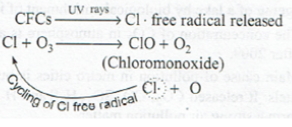
$CFCs$ are used as refrigerants in refrigerators and air conditioners,and as propellants in aerosol sprays. When these $CFCs$ reach the stratosphere,$UV$ rays break down the $CFC$ molecules,releasing chlorine $(Cl)$ atoms (free radicals).
These chlorine free radicals react with ozone $(O_3)$ to convert it into oxygen $(O_2)$,thereby reducing the ozone content in the atmosphere. The reaction is as follows:
$Cl + O_3 \rightarrow ClO + O_2$
$ClO + O \rightarrow Cl + O_2$
One chlorine free radical is sufficient to destroy a large number of ozone molecules because the chlorine radical is regenerated in the process,allowing it to continue the cycle of ozone destruction.
$CFCs$ are used as refrigerants in refrigerators and air conditioners,and as propellants in aerosol sprays. When these $CFCs$ reach the stratosphere,$UV$ rays break down the $CFC$ molecules,releasing chlorine $(Cl)$ atoms (free radicals).
These chlorine free radicals react with ozone $(O_3)$ to convert it into oxygen $(O_2)$,thereby reducing the ozone content in the atmosphere. The reaction is as follows:
$Cl + O_3 \rightarrow ClO + O_2$
$ClO + O \rightarrow Cl + O_2$
One chlorine free radical is sufficient to destroy a large number of ozone molecules because the chlorine radical is regenerated in the process,allowing it to continue the cycle of ozone destruction.
0 likes
View Solution90
MediumMCQ
Which one of the following gases can deplete the ozone layer in the upper atmosphere?
A
Ammonia
B
Methane
C
Carbon monoxide
D
Sulphur dioxide
Solution
(B) Ozone $(O_3)$ is an allotrope of oxygen. It exists at a height of about $15-60 \,km$ in the stratosphere.
Chlorofluorocarbons $(CFCs)$,nitrogen oxides,and certain hydrocarbons are primary pollutants responsible for ozone layer depletion.
Among the given options,methane $(CH_4)$ is a hydrocarbon that can contribute to ozone depletion through complex atmospheric reactions.
Therefore,methane is the correct answer.
Chlorofluorocarbons $(CFCs)$,nitrogen oxides,and certain hydrocarbons are primary pollutants responsible for ozone layer depletion.
Among the given options,methane $(CH_4)$ is a hydrocarbon that can contribute to ozone depletion through complex atmospheric reactions.
Therefore,methane is the correct answer.
0 likes
View Solution91
EasyMCQ
Recognizing the deleterious effects of ozone depletion,an international treaty known as . . . . . . was signed at . . . . . . .
A
Montreal Protocol,Canada
B
Kyoto Protocol,Brazil
C
Earth Summit,Montreal
D
World Summit,South Africa
Solution
(A) The Montreal Protocol was signed in $1987$ in Montreal,Canada,to control the emission of ozone-depleting substances $(ODS)$ such as chlorofluorocarbons $(CFCs)$. This international treaty was designed to protect the ozone layer by phasing out the production and consumption of these harmful substances. Therefore,the correct option is $A$.
0 likes
View Solution92
EasyMCQ
Which one of the following was the objective of signing the 'Montreal Protocol'?
A
Protection of wildlife
B
Protection of ozone layer
C
Control of noise pollution
D
Control the overuse of insecticides
Solution
(B) The 'Montreal Protocol' was signed in Montreal,Canada,in $1987$. The primary objective of this international treaty was to protect the ozone layer by phasing out the production and consumption of ozone-depleting substances,such as chlorofluorocarbons $(CFCs)$.
0 likes
View Solution93
EasyMCQ
Dobson units $(DU)$ are used to measure the thickness of:
A
$CFCs$
B
Stratosphere
C
Ozone
D
Troposphere
Solution
(C) The thickness of the ozone layer in a column of air from the ground to the top of the atmosphere is measured in terms of Dobson units $(DU)$.
One Dobson unit is the thickness of $0.01 \ mm$ of ozone at standard temperature and pressure $(STP)$.
Therefore,the correct option is $C$.
One Dobson unit is the thickness of $0.01 \ mm$ of ozone at standard temperature and pressure $(STP)$.
Therefore,the correct option is $C$.
0 likes
View Solution94
Medium
Explain Ozone Depletion in the Stratosphere.
Solution
(N/A) Ozone found in the upper part of the atmosphere,called the stratosphere,acts as a shield by absorbing ultraviolet $(UV)$ radiation from the sun.
$UV$ rays are highly injurious to living organisms.
The thickness of the ozone layer in a column of air from the ground to the top of the atmosphere is measured in terms of Dobson units $(DU)$.
Ozone layer absorbs the harmful $UV$-rays.
$UV$ radiation causes aging of the skin,damage to skin cells,and various types of skin cancers.
In the human eye,the cornea absorbs $UV-B$ radiation,and a high dose of $UV-B$ causes inflammation of the cornea,called snow-blindness,cataract,etc.
Such exposure may permanently damage the cornea.
Chlorofluorocarbons $(CFCs)$ deplete the ozone layer.
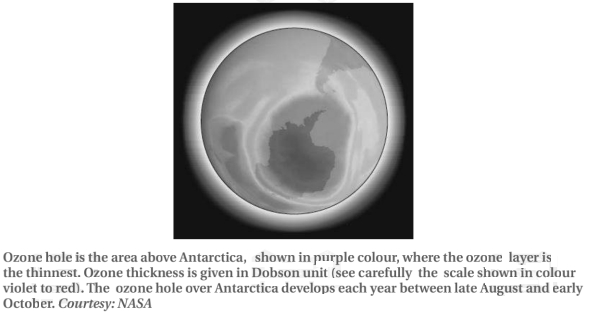
The part of the atmosphere with a lesser concentration of ozone is called an ozone hole.
Steps leading to ozone depletion:
$1$. $UV$-rays split $CFCs$ and release atomic chlorine $(Cl)$.
$2$. $UV$-rays also split ozone into oxygen.
$3$. Chlorine atoms trap oxygen atoms,and ozone is not formed again from oxygen.
This leads to the depletion of ozone in the stratosphere.
$UV$ rays are highly injurious to living organisms.
The thickness of the ozone layer in a column of air from the ground to the top of the atmosphere is measured in terms of Dobson units $(DU)$.
Ozone layer absorbs the harmful $UV$-rays.
$UV$ radiation causes aging of the skin,damage to skin cells,and various types of skin cancers.
In the human eye,the cornea absorbs $UV-B$ radiation,and a high dose of $UV-B$ causes inflammation of the cornea,called snow-blindness,cataract,etc.
Such exposure may permanently damage the cornea.
Chlorofluorocarbons $(CFCs)$ deplete the ozone layer.
The part of the atmosphere with a lesser concentration of ozone is called an ozone hole.
Steps leading to ozone depletion:
$1$. $UV$-rays split $CFCs$ and release atomic chlorine $(Cl)$.
$2$. $UV$-rays also split ozone into oxygen.
$3$. Chlorine atoms trap oxygen atoms,and ozone is not formed again from oxygen.
This leads to the depletion of ozone in the stratosphere.
0 likes
View Solution95
EasyMCQ
What is the Montreal Protocol?
A
An international treaty to control global warming.
B
An international treaty to control the emission of ozone-depleting substances.
C
An international treaty to protect endangered species.
D
An international treaty to manage forest resources.
Solution
(B) Recognizing the deleterious effects of ozone depletion,an international treaty,known as the Montreal Protocol,was signed at Montreal (Canada) in $1987$ (effective in $1989$) to control the emission of ozone-depleting substances.
Subsequently,many more efforts have been made,and protocols have laid down definite roadmaps,separately for developed and developing countries,for reducing the emission of $CFCs$ and other ozone-depleting chemicals.
Subsequently,many more efforts have been made,and protocols have laid down definite roadmaps,separately for developed and developing countries,for reducing the emission of $CFCs$ and other ozone-depleting chemicals.
0 likes
View Solution96
MediumMCQ
Why is an ozone hole formed over Antarctica?
A
High temperature
B
Extreme low temperature
C
Presence of high oxygen
D
High volcanic activity
Solution
(B) The formation of the ozone hole over Antarctica is primarily due to extreme low temperatures $(-85^{\circ}C)$.
These temperatures lead to the formation of polar stratospheric clouds (ice clouds).
These clouds provide a catalytic surface for the reactions of chlorine atoms,which deplete the ozone layer.
Additionally,a polar vortex is formed,which isolates the air over Antarctica from the rest of the world,preventing the replenishment of ozone.
These temperatures lead to the formation of polar stratospheric clouds (ice clouds).
These clouds provide a catalytic surface for the reactions of chlorine atoms,which deplete the ozone layer.
Additionally,a polar vortex is formed,which isolates the air over Antarctica from the rest of the world,preventing the replenishment of ozone.
0 likes
View Solution97
EasyMCQ
What is the significant date associated with the Montreal Protocol?
A
$1985$
B
$1987$
C
$1989$
D
$1992$
Solution
(B) The Montreal Protocol was signed in $1987$ in Montreal,Canada,to control the emission of ozone-depleting substances.
It officially became effective in $1989$.
It officially became effective in $1989$.
0 likes
View Solution98
MediumMCQ
Which radiations of the solar spectrum are harmful to living organisms?
A
Ultraviolet
B
Visible
C
Infrared
D
All of the above
Solution
(A) The solar spectrum consists of various wavelengths of electromagnetic radiation.
Ultraviolet $(UV)$ radiation,particularly $UV-B$ and $UV-C$,has high energy and can damage biological molecules such as $DNA$ and proteins,leading to mutations and cell death.
While visible light is essential for photosynthesis and infrared radiation provides heat,$UV$ radiation is specifically known for its harmful effects on living organisms,including skin cancer and cataracts in humans.
Ultraviolet $(UV)$ radiation,particularly $UV-B$ and $UV-C$,has high energy and can damage biological molecules such as $DNA$ and proteins,leading to mutations and cell death.
While visible light is essential for photosynthesis and infrared radiation provides heat,$UV$ radiation is specifically known for its harmful effects on living organisms,including skin cancer and cataracts in humans.
0 likes
View Solution99
EasyMCQ
Good ozone and bad ozone are found in $.........$ respectively.
A
Troposphere,Stratosphere
B
Stratosphere,Troposphere
C
Upper atmosphere,Lower atmosphere
D
$B$ and $C$
Solution
(D) $1$. Ozone found in the upper part of the atmosphere,specifically the $Stratosphere$,is called 'good' ozone because it acts as a shield absorbing harmful $UV$ radiation from the sun.
$2$. Ozone found in the lower part of the atmosphere,the $Troposphere$,is considered 'bad' ozone because it is a pollutant that can be harmful to plants and animals.
$3$. Therefore,good ozone is in the $Stratosphere$ and bad ozone is in the $Troposphere$.
$2$. Ozone found in the lower part of the atmosphere,the $Troposphere$,is considered 'bad' ozone because it is a pollutant that can be harmful to plants and animals.
$3$. Therefore,good ozone is in the $Stratosphere$ and bad ozone is in the $Troposphere$.
0 likes
View Solution100
EasyMCQ
Ozone prevents the entry of $..................$.
A
Ultraviolet rays
B
Infrared rays
C
$X$-rays
D
Visible rays
Solution
(A) The ozone layer is present in the stratosphere of the Earth's atmosphere.
It acts as a shield by absorbing the harmful ultraviolet $(UV)$ radiation coming from the Sun.
These $UV$ rays are highly energetic and can cause damage to living organisms,such as skin cancer,cataracts,and $DNA$ mutations.
Therefore,the ozone layer prevents the entry of $UV$ rays into the lower atmosphere.
It acts as a shield by absorbing the harmful ultraviolet $(UV)$ radiation coming from the Sun.
These $UV$ rays are highly energetic and can cause damage to living organisms,such as skin cancer,cataracts,and $DNA$ mutations.
Therefore,the ozone layer prevents the entry of $UV$ rays into the lower atmosphere.
0 likes
View SolutionEnvironmental Issues — Ozone Depletion in the Stratosphere · Frequently Asked Questions
1Are these Environmental Issues questions useful for JEE and NEET?
Yes. All questions in this section are mapped to JEE Main and NEET exam patterns. Previous year questions from JEE Main, NEET, GUJCET and state-level exams are included with full solutions.
2Can I switch to Hindi or Gujarati for these questions?
Yes. Use the language tabs in the hero section or the sidebar to view the same questions and solutions in English, Hindi or Gujarati.
3How do I generate a question paper from this subtopic?
Use the Vedclass Exam Paper Generator — select the chapter and subtopic, set difficulty, and generate Sets A, B, C, D automatically. First 3 chapters of every subject are free.
Vedclass Products
For Students
Vedclass Test Series
Mock tests in real JEE/NEET style with performance analysis. 5-day free trial.
Start Free TrialFor Teachers
Exam Paper Generator
Generate Set A/B/C/D papers from this chapter in 2 minutes. 3 chapters free.
Try FreeFor Institutes
Online Exam Module
Live online exams with unlimited students, 360° analytics & white-label branding.
See DemoFor Teachers & Institutes
Generate a Environmental Issues Exam Paper in 2 Minutes
Select subtopic & difficulty — Sets A, B, C, D auto-generated with No Repeat logic.
First 3 chapters of every subject are free — no payment required.