
A English
Transgenic Animals Questions in English
Class 12 Biology · Biotechnology and its Application · Transgenic Animals
99+
Questions
English
Language
100%
With Solutions
Showing 49 of 99 questions in English
51
MediumMCQ
How much human protein is present in one liter of milk from the transgenic cow 'Rosie'?
A
$2.2 \, gm$
B
$2.4 \, mg$
C
$2.2 \, mg$
D
$2.4 \, gm$
Solution
(D) The transgenic cow 'Rosie', produced in $1997$, was the first transgenic cow to produce human protein-enriched milk.
Her milk contained the human alpha-lactalbumin protein.
The concentration of this human protein in her milk was $2.4 \, gm$ per liter.
Therefore, the correct option is $D$.
Her milk contained the human alpha-lactalbumin protein.
The concentration of this human protein in her milk was $2.4 \, gm$ per liter.
Therefore, the correct option is $D$.
0 likes
View Solution52
MediumMCQ
Which animals were the first to be developed for vaccine safety testing?
A
Transgenic mice
B
Transgenic cows
C
Transgenic pigs
D
Transgenic sheep
Solution
(A) Transgenic mice are used to test the safety of vaccines before they are used on humans.
For example,transgenic mice are being used to test the safety of the polio vaccine.
If successful and found to be reliable,they could replace the use of monkeys to test the safety of batches of the vaccine.
For example,transgenic mice are being used to test the safety of the polio vaccine.
If successful and found to be reliable,they could replace the use of monkeys to test the safety of batches of the vaccine.
0 likes
View Solution53
MediumMCQ
Which vaccine was the first to be tested using transgenic mice?
A
Polio
B
Smallpox
C
Rubella
D
Hepatitis
Solution
(A) Transgenic mice are being used to test the safety of vaccines before they are used on humans. The first vaccine to be tested using transgenic mice was the polio vaccine. This method is considered more reliable than using monkeys,which were previously used for safety testing.
0 likes
View Solution54
EasyMCQ
After the successful testing of vaccine safety on transgenic mice,which animal is used for this testing?
A
Human
B
Monkey
C
Cow
D
Rabbit
Solution
(B) Before vaccines are administered to humans,they are tested on transgenic animals to check their safety. Transgenic mice are developed for use in testing the safety of vaccines before they are used on humans. If the testing on transgenic mice is successful,the next step involves testing on other animals,such as monkeys,to further evaluate the safety and efficacy of the vaccine before clinical trials in humans.
0 likes
View Solution55
MediumMCQ
Choose the appropriate option for chemical safety testing.
A
Testing of vaccines
B
Testing for toxicity of drugs
C
Testing of biological products
D
Study of chemical compounds of cells
Solution
(B) Chemical safety testing is a procedure used to determine the toxicity of various chemicals and drugs before they are released for human use.
Transgenic animals are specifically designed to carry foreign genes that make them more sensitive to toxic substances than non-transgenic animals.
By exposing these transgenic animals to toxic chemicals,researchers can observe the effects and assess the safety of the substances more efficiently and accurately.
Therefore,the correct option is testing for toxicity of drugs.
Transgenic animals are specifically designed to carry foreign genes that make them more sensitive to toxic substances than non-transgenic animals.
By exposing these transgenic animals to toxic chemicals,researchers can observe the effects and assess the safety of the substances more efficiently and accurately.
Therefore,the correct option is testing for toxicity of drugs.
0 likes
View Solution56
MediumMCQ
Some genes of transgenic animals are made .....$X$..... to certain .....$Y$..... substances.
A
$X-$ toxic,$Y -$ hypersensitive
B
$X-$ toxic,$Y -$ insensitive
C
$X-$ toxic,$Y -$ sensitive
D
$X -$ non-toxic,$Y -$ hypersensitive
Solution
(C) Transgenic animals are designed to study the effects of genes on the development of diseases.
Some transgenic animals are created to be sensitive to certain toxic substances.
By exposing these animals to such substances,researchers can observe the toxic effects and study the underlying biological mechanisms.
Therefore,the genes are modified to make the animals sensitive $(Y)$ to specific toxic $(X)$ substances.
Some transgenic animals are created to be sensitive to certain toxic substances.
By exposing these animals to such substances,researchers can observe the toxic effects and study the underlying biological mechanisms.
Therefore,the genes are modified to make the animals sensitive $(Y)$ to specific toxic $(X)$ substances.
0 likes
View Solution57
EasyMCQ
The name of the sheep which was cloned for the first time is:
A
Molly
B
Polly
C
Dolly
D
Holly
Solution
(C) The first mammal to be successfully cloned from an adult somatic cell was a sheep named $Dolly$.
This experiment was conducted by $Ian \text{ } Wilmut$ and his colleagues at the $Roslin \text{ } Institute$ in $Scotland$.
The cloning process involved the technique of somatic cell nuclear transfer $(SCNT)$.
This experiment was conducted by $Ian \text{ } Wilmut$ and his colleagues at the $Roslin \text{ } Institute$ in $Scotland$.
The cloning process involved the technique of somatic cell nuclear transfer $(SCNT)$.
0 likes
View Solution58
MediumMCQ
If a cattle is showing increased respiration and blood mixed foamy discharge from mouth,nose,and anus,it is likely to be suffering from
A
Rinderpest
B
Mad cow disease
C
Ranikhet
D
Anthrax
Solution
(D) Anthrax is a severe infectious bacterial disease caused by the bacterium $Bacillus$ $anthracis$.
Clinical signs of anthrax in cattle include high fever,increased respiration,and the characteristic discharge of dark,unclotted blood from natural body openings like the mouth,nose,and anus.
This condition is highly fatal and requires immediate veterinary intervention.
Clinical signs of anthrax in cattle include high fever,increased respiration,and the characteristic discharge of dark,unclotted blood from natural body openings like the mouth,nose,and anus.
This condition is highly fatal and requires immediate veterinary intervention.
0 likes
View Solution59
MediumMCQ
When scientists make an animal superior by view of genotype,by introducing some foreign genes into it,the phenomenon is called:
A
Tissue culture
B
Euphenics
C
Genetic engineering
D
Immunisation
Solution
(C) Genetic engineering is the branch of biotechnology that involves the manipulation of an organism's genome by introducing foreign genes to achieve desired traits or products.
Tissue culture refers to the large-scale propagation of tissues or organisms in vitro within a short period.
Euphenics is the science that deals with the improvement of human morphology or phenotype through environmental changes rather than genetic alteration.
Immunisation is the process by which an individual's immune system becomes fortified against an infectious agent,typically through vaccination.
Tissue culture refers to the large-scale propagation of tissues or organisms in vitro within a short period.
Euphenics is the science that deals with the improvement of human morphology or phenotype through environmental changes rather than genetic alteration.
Immunisation is the process by which an individual's immune system becomes fortified against an infectious agent,typically through vaccination.
0 likes
View Solution60
MediumMCQ
Which of the following are examples of transgenic organisms?
A
Holly sheep and Flavr Savr tomato
B
Holly sheep and Bt cotton
C
Dolly sheep and Ct cotton
D
Flavr Savr tomato and Bt cotton
Solution
(D) Transgenic organisms are those whose genetic material has been altered using genetic engineering techniques to introduce a foreign gene.
$1$. $Flavr$ $Savr$ tomato was the first genetically modified food crop,engineered to have a longer shelf life by delaying the ripening process.
$2$. $Bt$ cotton is a transgenic crop that contains a gene from the bacterium $Bacillus$ $thuringiensis$ $(Bt)$,which produces an insecticidal protein that protects the plant from bollworms.
$3$. Dolly the sheep was the first mammal to be cloned from an adult somatic cell,but she was not a transgenic organism.
Therefore,$Flavr$ $Savr$ tomato and $Bt$ cotton are examples of transgenic organisms.
$1$. $Flavr$ $Savr$ tomato was the first genetically modified food crop,engineered to have a longer shelf life by delaying the ripening process.
$2$. $Bt$ cotton is a transgenic crop that contains a gene from the bacterium $Bacillus$ $thuringiensis$ $(Bt)$,which produces an insecticidal protein that protects the plant from bollworms.
$3$. Dolly the sheep was the first mammal to be cloned from an adult somatic cell,but she was not a transgenic organism.
Therefore,$Flavr$ $Savr$ tomato and $Bt$ cotton are examples of transgenic organisms.
0 likes
View Solution61
MediumMCQ
Choose the correct statement with reference to 'Dolly':
A
She was created by taking nucleus from unfertilized eggs and cytoplasm from fertilized eggs
B
She was created by taking nucleus from udder cells and cytoplasm from unfertilized eggs
C
She was created by taking cytoplasm from udder cell and nucleus from unfertilized eggs
D
She was created by taking cytoplasm from udder cell and nucleus from fertilized eggs
Solution
(B) The donor nucleus $(2n)$ from a sheep $A$ udder cell (somatic cell) was fused with an enucleated sheep $B$ egg cell (gamete containing only cytoplasm) to form a diploid cell,which simulates a fertilized egg.
This cell was then induced to divide in vitro to form an $8$-celled embryo,which was subsequently implanted into the uterus of a foster mother.
This cell was then induced to divide in vitro to form an $8$-celled embryo,which was subsequently implanted into the uterus of a foster mother.
0 likes
View Solution62
EasyMCQ
Transgenic organisms are produced by:
A
Deleting sex chromosomes
B
Inducing gene mutations
C
Introducing foreign genes
D
Arresting spindle fibre formation
Solution
(C) Transgenic organisms,also known as genetically modified organisms $(GMOs)$,are organisms whose genetic material has been altered using genetic engineering techniques.
This process involves the introduction of a foreign gene (a transgene) from another organism into the genome of the host organism.
The introduced gene provides the host with new traits or characteristics that it did not possess naturally.
Therefore,the correct method for producing transgenic organisms is by introducing foreign genes.
This process involves the introduction of a foreign gene (a transgene) from another organism into the genome of the host organism.
The introduced gene provides the host with new traits or characteristics that it did not possess naturally.
Therefore,the correct method for producing transgenic organisms is by introducing foreign genes.
0 likes
View Solution63
MediumMCQ
Which of the following pairs is correctly matched?
A
$PCR$ - Restriction Endonuclease
B
Transgenic Animal - Rosie cow
C
Gene Therapy - Emphysema
D
Tobacco - Bacillus thuringiensis
Solution
(B) $PCR$ (Polymerase Chain Reaction) is a technique used for $DNA$ amplification,not for restriction endonucleases.
Rosie cow is a well-known example of a transgenic animal that produces human protein-enriched milk.
Gene therapy was first used to treat $ADA$ (Adenosine Deaminase) deficiency,not emphysema.
$Bt$ Cotton is the transgenic plant associated with Bacillus thuringiensis,not tobacco.
Rosie cow is a well-known example of a transgenic animal that produces human protein-enriched milk.
Gene therapy was first used to treat $ADA$ (Adenosine Deaminase) deficiency,not emphysema.
$Bt$ Cotton is the transgenic plant associated with Bacillus thuringiensis,not tobacco.
0 likes
View Solution64
MediumMCQ
Transgenic animals are those which have foreign
A
$DNA$ in some of its cells
B
$DNA$ in all its cells
C
$RNA$ in all of its cells
D
$RNA$ in some of its cells
Solution
(B) Transgenic animals are defined as animals that have had their $DNA$ manipulated to possess and express an extra (foreign) gene. This foreign $DNA$ is introduced into the germline or early embryonic cells,ensuring that it is present in all the cells of the organism's body.
0 likes
View Solution65
MediumMCQ
Which of the following transgenic human protein products has been used to treat emphysema?
A
$\alpha-1$ antitrypsin
B
$\alpha-1$ globulin
C
Cry $I$ Ab protein
D
Cry $II$ Ac protein
Solution
(A) Useful biological products can be produced by introducing into transgenic animals the portion of $DNA$ (or genes) which codes for a particular product.
For example, the human protein $\alpha-1$ antitrypsin is used to treat emphysema.
For example, the human protein $\alpha-1$ antitrypsin is used to treat emphysema.
0 likes
View Solution66
MediumMCQ
In $1997$,the first transgenic cow,Rosie,produced:
A
Human protein enriched milk $(2.4 \ g/L)$
B
Human protein enriched milk $(2.8 \ g/L)$
C
Human calcium enriched milk $(2.4 \ g/L)$
D
Human calcium enriched milk $(2.8 \ g/L)$
Solution
(A) In $1997$,the first transgenic cow,named Rosie,was produced.
Rosie produced human protein-enriched milk containing human alpha-lactalbumin.
The concentration of this protein in the milk was $2.4 \ g/L$.
This milk was nutritionally more balanced for human babies compared to natural cow milk.
Rosie produced human protein-enriched milk containing human alpha-lactalbumin.
The concentration of this protein in the milk was $2.4 \ g/L$.
This milk was nutritionally more balanced for human babies compared to natural cow milk.
0 likes
View Solution67
MediumMCQ
Which gene was introduced in the first transgenic cow?
A
Human $\alpha$-lactalbumin
B
$a-1$-antitrypsin
C
$\beta-1$-antitrypsin
D
$Cry IAc$
Solution
(A) The gene for human $\alpha$-lactalbumin was introduced into the genome of the first transgenic cow (Rosie).
This modification resulted in the production of milk that was nutritionally richer and more balanced for human infants compared to natural cow milk.
This modification resulted in the production of milk that was nutritionally richer and more balanced for human infants compared to natural cow milk.
0 likes
View Solution68
MediumMCQ
Transgenic animals are produced for which of the following purposes?
$I$. To study the normal physiology and development
$II$. To study diseases
$III$. To obtain useful biological products
$IV$. To test the vaccine safety
$V$. To test the chemical safety
Which of the above statements are correct?
$I$. To study the normal physiology and development
$II$. To study diseases
$III$. To obtain useful biological products
$IV$. To test the vaccine safety
$V$. To test the chemical safety
Which of the above statements are correct?
A
$I, II$ and $III$
B
$II, III$ and $IV$
C
$I, II, III$ and $V$
D
$I, II, III, IV$ and $V$
Solution
(D) Animals whose $DNA$ is manipulated to possess and express an extra (foreign) gene are known as transgenic animals. The common reasons for developing transgenic animals include:
$(i)$ Study of normal physiology and development: Transgenic animals are used to study how genes are regulated and how they affect the normal functions of the body and its development, e.g., study of complex growth factors like insulin-like growth factor.
$(ii)$ Study of diseases: Transgenic models have been developed for many human diseases such as cancer, cystic fibrosis, rheumatoid arthritis, and Alzheimer's disease to understand the disease mechanism.
$(iii)$ Obtaining useful biological products: Transgenic animals can be used to produce biological products, e.g., human protein ($\alpha-1$-antitrypsin) is used to treat emphysema.
$(iv)$ Vaccine safety: Transgenic mice are developed to test the safety of vaccines before they are used on humans, e.g., the polio vaccine.
$(v)$ Chemical safety testing: Transgenic animals are designed to carry genes that make them more sensitive to toxic substances than non-transgenic animals, allowing for faster toxicity testing.
Since all the statements ($I, II, III, IV,$ and $V$) are correct, the correct option is $D$.
$(i)$ Study of normal physiology and development: Transgenic animals are used to study how genes are regulated and how they affect the normal functions of the body and its development, e.g., study of complex growth factors like insulin-like growth factor.
$(ii)$ Study of diseases: Transgenic models have been developed for many human diseases such as cancer, cystic fibrosis, rheumatoid arthritis, and Alzheimer's disease to understand the disease mechanism.
$(iii)$ Obtaining useful biological products: Transgenic animals can be used to produce biological products, e.g., human protein ($\alpha-1$-antitrypsin) is used to treat emphysema.
$(iv)$ Vaccine safety: Transgenic mice are developed to test the safety of vaccines before they are used on humans, e.g., the polio vaccine.
$(v)$ Chemical safety testing: Transgenic animals are designed to carry genes that make them more sensitive to toxic substances than non-transgenic animals, allowing for faster toxicity testing.
Since all the statements ($I, II, III, IV,$ and $V$) are correct, the correct option is $D$.
0 likes
View Solution69
MediumMCQ
Today,transgenic models have been developed for many human diseases,which includes
$I$. Rheumatoid arthritis
$II$. Alzheimer's disease
$III$. Cancer
$IV$. Cystic fibrosis
Choose the correct option.
$I$. Rheumatoid arthritis
$II$. Alzheimer's disease
$III$. Cancer
$IV$. Cystic fibrosis
Choose the correct option.
A
$I$ and $II$
B
$II$ and $IV$
C
$I$,$II$ and $IV$
D
$I$,$II$,$III$ and $IV$
Solution
(D) Transgenic animals are animals that have had their $DNA$ manipulated to possess and express an extra (foreign) gene.
Transgenic models exist for many human diseases such as cancer,cystic fibrosis,rheumatoid arthritis,and Alzheimer's disease.
These models are used to study the disease,understand the role of genes in the disease,and test new treatments.
Therefore,all four listed diseases have transgenic models developed for them.
The correct option is $D$.
Transgenic models exist for many human diseases such as cancer,cystic fibrosis,rheumatoid arthritis,and Alzheimer's disease.
These models are used to study the disease,understand the role of genes in the disease,and test new treatments.
Therefore,all four listed diseases have transgenic models developed for them.
The correct option is $D$.
0 likes
View Solution70
MediumMCQ
Consider the following statements:
$I$. Transgenic animals are more sensitive to toxic substances than non-transgenic animals.
$II$. Useful biological products can be produced by introducing into transgenic animals the portion of $DNA$ which codes for a particular product.
$III$. Brazzein is a protein produced by a West African plant,$Pentadiplandra$ $brazzeana$,which is approximately $2000$ times as sweet as sugar.
Which of the statements given above are correct?
$I$. Transgenic animals are more sensitive to toxic substances than non-transgenic animals.
$II$. Useful biological products can be produced by introducing into transgenic animals the portion of $DNA$ which codes for a particular product.
$III$. Brazzein is a protein produced by a West African plant,$Pentadiplandra$ $brazzeana$,which is approximately $2000$ times as sweet as sugar.
Which of the statements given above are correct?
A
$I$,$II$ and $III$
B
$I$ and $II$
C
$I$ and $III$
D
None of these
Solution
(A) Statement $I$ is correct: Transgenic animals are specifically designed to carry genes that make them more sensitive to toxic substances,allowing for the testing of toxicity and safety of drugs.
Statement $II$ is correct: Useful biological products can be produced by introducing the specific $DNA$ sequence (gene) that codes for a desired protein into transgenic animals. For example,human protein $\alpha-1$-antitrypsin is used to treat emphysema.
Statement $III$ is correct: Brazzein is a protein produced by the West African plant $Pentadiplandra$ $brazzeana$,which is approximately $2000$ times as sweet as sugar. It is used as a low-calorie sweetener.
Therefore,all three statements are correct.
Statement $II$ is correct: Useful biological products can be produced by introducing the specific $DNA$ sequence (gene) that codes for a desired protein into transgenic animals. For example,human protein $\alpha-1$-antitrypsin is used to treat emphysema.
Statement $III$ is correct: Brazzein is a protein produced by the West African plant $Pentadiplandra$ $brazzeana$,which is approximately $2000$ times as sweet as sugar. It is used as a low-calorie sweetener.
Therefore,all three statements are correct.
0 likes
View Solution71
MediumMCQ
Consider the following statements about 'Rosie':
$I$. Rosie is the first transgenic cow.
$II$. Rosie produced human protein-enriched milk.
$III$. The milk contained the human $\alpha$-lactalbumin,and scientists believe that the milk from this cow could provide an alternative to human breast milk.
Which of the statements given above are correct?
$I$. Rosie is the first transgenic cow.
$II$. Rosie produced human protein-enriched milk.
$III$. The milk contained the human $\alpha$-lactalbumin,and scientists believe that the milk from this cow could provide an alternative to human breast milk.
Which of the statements given above are correct?
A
$I$ and $II$
B
$I$ and $III$
C
$II$ and $III$
D
$I$,$II$ and $III$
Solution
(D) In $1997$,the first transgenic cow,'Rosie',was produced.
Rosie produced human protein-enriched milk containing $2.4 \text{ g/L}$ of protein.
The milk contained the human $\alpha$-lactalbumin,which made it nutritionally more balanced for human babies compared to natural cow milk.
Therefore,all three statements ($I$,$II$,and $III$) are correct.
Rosie produced human protein-enriched milk containing $2.4 \text{ g/L}$ of protein.
The milk contained the human $\alpha$-lactalbumin,which made it nutritionally more balanced for human babies compared to natural cow milk.
Therefore,all three statements ($I$,$II$,and $III$) are correct.
0 likes
View Solution72
EasyMCQ
Animals that have had their $DNA$ manipulated to possess and express an extra gene are known as
A
Foreign animals
B
Superior animals
C
Transgenic animals
D
Elevated animals
Solution
(C) Transgenic animals are defined as organisms whose $DNA$ has been manipulated through genetic engineering techniques to possess and express an extra or foreign gene (transgene). This process allows the animal to exhibit new traits or produce specific proteins.
0 likes
View Solution73
EasyMCQ
About what percentage of all existing transgenic animals are mice?
A
$75$
B
$95$
C
$100$
D
$50$
Solution
(B) Transgenic animals are animals that have had their $DNA$ manipulated to possess and express an extra (foreign) gene.
Among all the transgenic animals produced for research and medical purposes,mice constitute the vast majority.
It is estimated that approximately $95\%$ of all existing transgenic animals are mice,as they are widely used as models for human diseases due to their genetic similarity and short reproductive cycle.
Among all the transgenic animals produced for research and medical purposes,mice constitute the vast majority.
It is estimated that approximately $95\%$ of all existing transgenic animals are mice,as they are widely used as models for human diseases due to their genetic similarity and short reproductive cycle.
0 likes
View Solution74
EasyMCQ
Which of the following protein products has been used to treat emphysema?
A
$\alpha$-lactalbumin
B
$TPA$
C
$\alpha-1$-antitrypsin
D
$C$-peptide
Solution
(C) Transgenic animals that produce useful biological products can be created by the introduction of the portion of $DNA$ which codes for a particular product.
For example,the human protein $\alpha-1$-antitrypsin is used to treat emphysema.
This protein is produced by transgenic animals,which helps in managing the condition effectively.
For example,the human protein $\alpha-1$-antitrypsin is used to treat emphysema.
This protein is produced by transgenic animals,which helps in managing the condition effectively.
0 likes
View Solution75
EasyMCQ
'Rosie',a transgenic cow,is known to produce a type of milk which has all the following characteristics,except:
A
Protein content of $2.4 \; g/L$
B
Human $\alpha$-lactalbumin
C
More balanced diet than normal cow milk for babies
D
Was produced for the first time in year $2001$
Solution
(D) Rosie is a transgenic cow that produces human protein-enriched milk.
Its milk contains human $\alpha$-lactalbumin and is nutritionally more balanced for human babies than natural cow milk.
The protein content of this milk is $2.4 \; g/L$.
Rosie was produced for the first time in the year $1997$,not $2001$.
Therefore,the statement that it was produced in $2001$ is incorrect.
Its milk contains human $\alpha$-lactalbumin and is nutritionally more balanced for human babies than natural cow milk.
The protein content of this milk is $2.4 \; g/L$.
Rosie was produced for the first time in the year $1997$,not $2001$.
Therefore,the statement that it was produced in $2001$ is incorrect.
0 likes
View Solution76
MediumMCQ
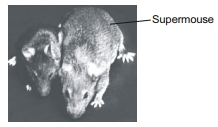
What is the difference between the two mice as shown in the figure?
A
One is normal in size,the other is twice as big supermouse because of good diet.
B
The bigger 'Supermouse' is transgenic. It is larger because of expression of the gene for human growth hormone factor that has been introduced.
C
The smaller one is a dwarf.
D
Transgenic mice are an example of gene therapy.
Solution
(B) The figure shows a normal mouse and a 'Supermouse'.
The 'Supermouse' is a transgenic organism,meaning it has had foreign $DNA$ introduced into its genome.
In this specific case,the gene for the human growth hormone $(hGH)$ was introduced into the mouse genome.
The expression of this introduced human growth hormone gene leads to increased growth,resulting in a mouse that is significantly larger than its non-transgenic counterpart.
The 'Supermouse' is a transgenic organism,meaning it has had foreign $DNA$ introduced into its genome.
In this specific case,the gene for the human growth hormone $(hGH)$ was introduced into the mouse genome.
The expression of this introduced human growth hormone gene leads to increased growth,resulting in a mouse that is significantly larger than its non-transgenic counterpart.
0 likes
View Solution77
MediumMCQ
$A$: Transgenic mice are being used to test the safety of the polio vaccine.
$R$: It could replace the use of monkeys to test the safety of batches of the vaccine.
$R$: It could replace the use of monkeys to test the safety of batches of the vaccine.
A
Assertion and Reason both are correct and Reason is the correct explanation of Assertion.
B
Assertion and Reason both are correct but Reason is not the correct explanation of Assertion.
C
Assertion is correct,but Reason is incorrect.
D
Both Assertion and Reason are incorrect.
Solution
(A) Transgenic mice have been developed to serve as models for human diseases and to test the safety of vaccines before they are used on humans.
Specifically,transgenic mice are used to test the safety of the polio vaccine.
This development is significant because it provides a reliable alternative to using monkeys,which were previously used to test the safety of vaccine batches.
Therefore,both the Assertion and the Reason are correct,and the Reason provides the correct explanation for why transgenic mice are used in this context.
Specifically,transgenic mice are used to test the safety of the polio vaccine.
This development is significant because it provides a reliable alternative to using monkeys,which were previously used to test the safety of vaccine batches.
Therefore,both the Assertion and the Reason are correct,and the Reason provides the correct explanation for why transgenic mice are used in this context.
0 likes
View Solution78
MediumMCQ
$A$ : Dolly was the first mammal to be cloned from an udder cell.
$R$ : To create Dolly,the Finn Dorset ewe,Ian Wilmut and Keith Campbell used aid from three mothers.
$R$ : To create Dolly,the Finn Dorset ewe,Ian Wilmut and Keith Campbell used aid from three mothers.
A
Assertion and Reason both are correct and Reason is the correct explanation of Assertion.
B
Assertion and Reason both are correct but Reason is not the correct explanation of Assertion.
C
Assertion is correct,but Reason is incorrect.
D
Both Assertion and Reason are incorrect.
Solution
(A) Dolly was the first mammal cloned from an adult somatic cell (udder cell) by Ian Wilmut and Keith Campbell in $1996$.
To create Dolly,three sheep were involved: one provided the nucleus from an udder cell,one provided the enucleated egg cell,and the third served as the surrogate mother.
Both the Assertion and the Reason are factually correct,and the Reason explains the process used to create the cloned mammal mentioned in the Assertion.
To create Dolly,three sheep were involved: one provided the nucleus from an udder cell,one provided the enucleated egg cell,and the third served as the surrogate mother.
Both the Assertion and the Reason are factually correct,and the Reason explains the process used to create the cloned mammal mentioned in the Assertion.
0 likes
View Solution79
EasyMCQ
Which transgenic animals have been created by scientists in the highest numbers?
A
Transgenic mice
B
Transgenic rabbits
C
Transgenic pigs
D
Transgenic cows
Solution
(A) Transgenic animals are animals that have had their $DNA$ manipulated to possess and express an extra (foreign) gene.
Among all transgenic animals,mice are the most commonly created and used in research.
This is because they are easy to handle,have a short reproductive cycle,and their genetic makeup is well-understood,making them ideal models for studying human diseases and testing new therapies.
Among all transgenic animals,mice are the most commonly created and used in research.
This is because they are easy to handle,have a short reproductive cycle,and their genetic makeup is well-understood,making them ideal models for studying human diseases and testing new therapies.
0 likes
View Solution80
MediumMCQ
Transgenic animals are used to study which of the following aspects of normal physiology and development?
A
Study of complex growth factors like insulin.
B
Study of biological effects induced by alterations in the formation of factors.
C
Study of the biological role of factors in the body.
D
All of the above.
Solution
(D) Transgenic animals are specifically designed to allow the study of how genes are regulated and how they affect the normal functions of the body and its development.
$1$. They help in studying complex growth factors like insulin-like growth factors.
$2$. They allow researchers to study the biological effects induced by alterations in the formation of these factors.
$3$. They are essential for understanding the biological role of specific factors in the body.
Therefore,all the mentioned aspects are studied using transgenic animals.
$1$. They help in studying complex growth factors like insulin-like growth factors.
$2$. They allow researchers to study the biological effects induced by alterations in the formation of these factors.
$3$. They are essential for understanding the biological role of specific factors in the body.
Therefore,all the mentioned aspects are studied using transgenic animals.
0 likes
View Solution81
DifficultMCQ
For how many of the following diseases are transgenic animal models available?
Cancer,Cystic fibrosis,Pneumonia,Rheumatoid arthritis,Typhoid,Alzheimer's,Malaria
Cancer,Cystic fibrosis,Pneumonia,Rheumatoid arthritis,Typhoid,Alzheimer's,Malaria
A
$3$
B
$4$
C
$5$
D
$6$
Solution
(B) Transgenic animals are specifically designed to allow the study of genes and how they affect the development of diseases.
They serve as models for human diseases to understand the disease pathogenesis and to test new treatments.
According to the $NCERT$ textbook,transgenic models exist for the following diseases:
$1$. Cancer
$2$. Cystic fibrosis
$3$. Rheumatoid arthritis
$4$. Alzheimer's disease
Therefore,there are $4$ such diseases listed.
Thus,the correct option is $B$.
They serve as models for human diseases to understand the disease pathogenesis and to test new treatments.
According to the $NCERT$ textbook,transgenic models exist for the following diseases:
$1$. Cancer
$2$. Cystic fibrosis
$3$. Rheumatoid arthritis
$4$. Alzheimer's disease
Therefore,there are $4$ such diseases listed.
Thus,the correct option is $B$.
0 likes
View Solution82
EasyMCQ
The first transgenic cow,'Rosie',was produced in the year .........
A
$1997$
B
$1971$
C
$1965$
D
$1960$
Solution
(A) The first transgenic cow,named 'Rosie',was produced in the year $1997$.
This cow was engineered to produce human protein-enriched milk,specifically containing human alpha-lactalbumin,which is nutritionally more balanced for human babies than natural cow milk.
This cow was engineered to produce human protein-enriched milk,specifically containing human alpha-lactalbumin,which is nutritionally more balanced for human babies than natural cow milk.
0 likes
View Solution83
EasyMCQ
The milk of the transgenic cow 'Rosie' contains $2.4 \text{ g}$ of human protein per liter. (in $\text{ g}$)
A
$1.4$
B
$14$
C
$2.4$
D
$24$
Solution
(C) The transgenic cow 'Rosie', produced in $2002$, was the first cow to produce human protein-enriched milk.
It contains the human alpha-lactalbumin protein.
The concentration of this human protein in the milk of 'Rosie' is $2.4 \text{ g/L}$.
Therefore, the correct option is $C$.
It contains the human alpha-lactalbumin protein.
The concentration of this human protein in the milk of 'Rosie' is $2.4 \text{ g/L}$.
Therefore, the correct option is $C$.
0 likes
View Solution84
EasyMCQ
Which human protein is produced by the transgenic cow 'Rosie'?
A
$\alpha-1$-antitrypsin
B
$\alpha$-lactalbumin
C
Insulin
D
Fibrin
Solution
(B) The transgenic cow named 'Rosie' was produced in $1997$.
This cow was genetically engineered to produce human protein-enriched milk.
The milk produced by 'Rosie' contained the human protein $\alpha$-lactalbumin at a concentration of $2.4 \ g/L$.
This protein is nutritionally more balanced for human babies than natural cow milk.
This cow was genetically engineered to produce human protein-enriched milk.
The milk produced by 'Rosie' contained the human protein $\alpha$-lactalbumin at a concentration of $2.4 \ g/L$.
This protein is nutritionally more balanced for human babies than natural cow milk.
0 likes
View Solution85
EasyMCQ
Which of the following is used for the safety testing of the polio vaccine?
A
Transgenic cow
B
Transgenic pig
C
Transgenic mouse
D
Transgenic monkey
Solution
(C) Transgenic mice are being developed for use in testing the safety of vaccines before they are used on humans.
Specifically,transgenic mice are used to test the safety of the polio vaccine.
This allows researchers to assess the efficacy and safety of the vaccine in a controlled environment without risking human lives during the initial testing phases.
Specifically,transgenic mice are used to test the safety of the polio vaccine.
This allows researchers to assess the efficacy and safety of the vaccine in a controlled environment without risking human lives during the initial testing phases.
0 likes
View Solution86
MediumMCQ
After the safety of a vaccine is successfully tested in $.........$,it can be used in $.........$.
A
Transgenic mice,Transgenic monkeys
B
Transgenic monkeys,Transgenic mice
C
Transgenic mice,Transgenic humans
D
Transgenic rabbits,Transgenic mice
Solution
(A) Transgenic animals are used to test the safety of vaccines before they are used on humans.
Specifically,transgenic mice are developed for use in testing the safety of vaccines.
Once the vaccine is proven safe in these transgenic models,it is then tested on larger animals like transgenic monkeys before being approved for human use.
Therefore,the correct sequence is transgenic mice followed by transgenic monkeys.
Specifically,transgenic mice are developed for use in testing the safety of vaccines.
Once the vaccine is proven safe in these transgenic models,it is then tested on larger animals like transgenic monkeys before being approved for human use.
Therefore,the correct sequence is transgenic mice followed by transgenic monkeys.
0 likes
View Solution87
MediumMCQ
Transgenic animals are used for chemical safety testing. Identify the incorrect statement from the following.
A
They are used to test the toxicity of drugs.
B
Some genes in transgenic animals are made insensitive to toxic substances.
C
The effects of toxic substances are studied after exposing transgenic animals to them.
D
Toxicity testing in transgenic animals allows us to obtain results in a shorter period.
Solution
(B) Transgenic animals are specifically designed to be more sensitive to toxic substances than non-transgenic animals. This increased sensitivity allows researchers to observe the toxic effects of chemicals or drugs more rapidly and accurately. Therefore,the statement that genes are made 'insensitive' to toxic substances is incorrect. The actual process involves introducing genes that make the animals more susceptible to the toxic effects,facilitating faster testing.
0 likes
View Solution88
EasyMCQ
Milk of transgenic cow '$Rosie$' was a nutritionally more balanced product for human babies than natural cow milk because it contained:
A
Human protein $\alpha-1$-antitrypsin
B
Human alpha-lactalbumin
C
Human insulin-like growth factor
D
Human enzyme Adenosine Deaminase $(ADA)$
Solution
(B) The transgenic cow '$Rosie$',produced in $1997$,was the first transgenic cow. Its milk contained the human protein alpha-lactalbumin. This protein makes the milk nutritionally more balanced for human babies compared to natural cow milk,as it closely mimics the composition of human breast milk.
0 likes
View Solution89
MediumMCQ
Select the incorrect statement $:-$
A
Animals that have had their $\text{DNA}$ manipulated to possess and express an extra (foreign) gene are known as transgenic animals.
B
Transgenic animals can not be specifically designed to allow the study of how genes are regulated.
C
Many transgenic animals are designed to increase our understanding of how genes contribute to the development of disease.
D
Transgenic mice are being developed for use in testing the safety of vaccines before they are used on humans.
Solution
(B) Transgenic animals are those whose $\text{DNA}$ has been manipulated to possess and express an extra (foreign) gene.
They are specifically designed to allow the study of how genes are regulated and how they affect the normal functions of the body and its development.
They are also used to study the complex factors involved in the development of diseases like cancer,cystic fibrosis,rheumatoid arthritis,and Alzheimer's.
Transgenic mice are specifically developed for use in testing the safety of vaccines before they are used on humans.
Therefore,the statement that transgenic animals cannot be designed to study gene regulation is incorrect.
They are specifically designed to allow the study of how genes are regulated and how they affect the normal functions of the body and its development.
They are also used to study the complex factors involved in the development of diseases like cancer,cystic fibrosis,rheumatoid arthritis,and Alzheimer's.
Transgenic mice are specifically developed for use in testing the safety of vaccines before they are used on humans.
Therefore,the statement that transgenic animals cannot be designed to study gene regulation is incorrect.
0 likes
View Solution90
MediumMCQ
Which of the following is not a use of transgenic animals?
A
Study of normal physiology and development
B
Testing of vaccine safety
C
Production of biological products
D
Molecular diagnosis
Solution
(D) Transgenic animals are animals that have had their $DNA$ manipulated to possess and express an extra (foreign) gene. Their uses include:
$1$. Study of normal physiology and development: Transgenic animals allow for the study of how genes are regulated and how they affect the normal functions of the body and its development.
$2$. Study of disease: Many transgenic animals are designed to increase our understanding of how genes contribute to the development of diseases.
$3$. Biological products: Transgenic animals can be used to produce biological products like medicines (e.g.,alpha$-1-$antitrypsin for emphysema) by introducing genes that code for a particular human protein.
$4$. Vaccine safety: Transgenic mice are being used to test the safety of vaccines before they are used on humans.
$5$. Chemical safety testing: This is known as toxicity/safety testing.
Molecular diagnosis (such as $PCR$,$ELISA$,or recombinant $DNA$ technology) is a technique used to detect the presence of pathogens or genetic disorders in patients,but it is not a use of transgenic animals.
$1$. Study of normal physiology and development: Transgenic animals allow for the study of how genes are regulated and how they affect the normal functions of the body and its development.
$2$. Study of disease: Many transgenic animals are designed to increase our understanding of how genes contribute to the development of diseases.
$3$. Biological products: Transgenic animals can be used to produce biological products like medicines (e.g.,alpha$-1-$antitrypsin for emphysema) by introducing genes that code for a particular human protein.
$4$. Vaccine safety: Transgenic mice are being used to test the safety of vaccines before they are used on humans.
$5$. Chemical safety testing: This is known as toxicity/safety testing.
Molecular diagnosis (such as $PCR$,$ELISA$,or recombinant $DNA$ technology) is a technique used to detect the presence of pathogens or genetic disorders in patients,but it is not a use of transgenic animals.
0 likes
View Solution91
MediumMCQ
Transgenic models exist for which of the following human diseases:
$(a)$ Cancer $(b)$ Cystic fibrosis $(c)$ Rheumatoid arthritis $(d)$ Alzheimer's disease $(e)$ Emphysema
$(a)$ Cancer $(b)$ Cystic fibrosis $(c)$ Rheumatoid arthritis $(d)$ Alzheimer's disease $(e)$ Emphysema
A
only $a, b$ and $c$
B
$a, b, c$ and $d$
C
$b, c, d$ and $e$
D
$a, b, c, d$ and $e$
Solution
(D) Transgenic animals are animals that have had their $DNA$ manipulated to possess and express an extra (foreign) gene.
These animals are specifically designed to allow the study of genes and how they affect the normal functions of the body and its development.
Transgenic models have been developed for many human diseases to serve as research tools for understanding the disease mechanism and testing new therapies.
Specifically,transgenic models exist for:
$(a)$ Cancer: Used to study oncogenes and tumor suppressors.
$(b)$ Cystic fibrosis: Used to study the genetic basis of the disease.
$(c)$ Rheumatoid arthritis: Used to study autoimmune responses.
$(d)$ Alzheimer's disease: Used to study the accumulation of amyloid plaques.
$(e)$ Emphysema: Used to study the destruction of lung tissue.
Therefore,all the listed diseases have transgenic models developed for research purposes.
These animals are specifically designed to allow the study of genes and how they affect the normal functions of the body and its development.
Transgenic models have been developed for many human diseases to serve as research tools for understanding the disease mechanism and testing new therapies.
Specifically,transgenic models exist for:
$(a)$ Cancer: Used to study oncogenes and tumor suppressors.
$(b)$ Cystic fibrosis: Used to study the genetic basis of the disease.
$(c)$ Rheumatoid arthritis: Used to study autoimmune responses.
$(d)$ Alzheimer's disease: Used to study the accumulation of amyloid plaques.
$(e)$ Emphysema: Used to study the destruction of lung tissue.
Therefore,all the listed diseases have transgenic models developed for research purposes.
0 likes
View Solution92
EasyMCQ
Assertion: Animals that have had their $\text{DNA}$ manipulated to possess and express an extra (foreign) gene are known as transgenic animals.
Reason: Transgenic animals are made that carry genes which make them less sensitive to toxic substances than non-transgenic animals.
Reason: Transgenic animals are made that carry genes which make them less sensitive to toxic substances than non-transgenic animals.
A
Both Assertion & Reason are true and the reason is the correct explanation of the assertion
B
Both Assertion & Reason are true but the reason is not the correct explanation of the assertion
C
Assertion is true statement but Reason is false
D
Both Assertion and Reason are false statements
Solution
(C) The Assertion is true because transgenic animals are defined as those whose $\text{DNA}$ has been manipulated to introduce and express an extra (foreign) gene.
The Reason is false because transgenic animals are often created to study the effects of toxic substances on human health,making them more sensitive or useful models for testing,not necessarily less sensitive. Furthermore,the primary purpose of creating transgenic animals is not limited to toxicity testing; it includes studying normal physiology,disease models,biological products,and vaccine safety.
The Reason is false because transgenic animals are often created to study the effects of toxic substances on human health,making them more sensitive or useful models for testing,not necessarily less sensitive. Furthermore,the primary purpose of creating transgenic animals is not limited to toxicity testing; it includes studying normal physiology,disease models,biological products,and vaccine safety.
0 likes
View Solution93
EasyMCQ
In the context of transgenic animals,which of the following statements is not true?
A
To check the toxicity of drugs.
B
Human protein (alpha-$1$ antitrypsin) is used for the treatment of emphysema.
C
Mice are used for the safety testing of vaccines.
D
To diagnose genetic diseases.
Solution
(D) The correct answer is $D$. Transgenic animals are primarily used for biological research,studying disease mechanisms,testing the safety of vaccines,and producing biological products like human proteins (e.g.,alpha-$1$ antitrypsin for emphysema). While they help in understanding the genetic basis of diseases,they are not used for the direct diagnosis of genetic diseases in humans.
0 likes
View Solution94
EasyMCQ
What type of protein-rich milk is found in the first transgenic cow 'Rosie'?
A
Beta-lactalbumin
B
Alpha-lactalbumin
C
Albumin
D
Immunoglobulin
Solution
(B) The first transgenic cow,named 'Rosie',was produced in $1997$.
This cow produced human protein-enriched milk.
The milk contained the human protein 'Alpha-lactalbumin',which is nutritionally more balanced for human babies than natural cow milk.
Therefore,the correct option is $B$.
This cow produced human protein-enriched milk.
The milk contained the human protein 'Alpha-lactalbumin',which is nutritionally more balanced for human babies than natural cow milk.
Therefore,the correct option is $B$.
0 likes
View Solution95
EasyMCQ
What type of protein-rich milk is found in the first transgenic cow 'Rosie'?
A
Casein
B
Paracasein
C
Alpha-lactalbumin
D
Albumin
Solution
(C) The first transgenic cow,named 'Rosie',was produced in $1997$.
This cow produced human protein-enriched milk.
The milk contained the human alpha-lactalbumin protein,which is nutritionally more balanced for human babies than natural cow milk.
Therefore,the correct option is $C$.
This cow produced human protein-enriched milk.
The milk contained the human alpha-lactalbumin protein,which is nutritionally more balanced for human babies than natural cow milk.
Therefore,the correct option is $C$.
0 likes
View Solution96
EasyMCQ
How much human protein is present in one litre of milk from the transgenic cow 'Rosie' (in $\text{ gm}$)?
A
$4.2$
B
$2.8$
C
$5.2$
D
$2.4$
Solution
(D) The transgenic cow 'Rosie', produced in $1997$, was the first transgenic cow to produce human protein-enriched milk.
Rosie's milk contained the human alpha-lactalbumin protein.
The concentration of this human protein in her milk was $2.4 \text{ gm}$ per litre.
Therefore, the correct option is $D$.
Rosie's milk contained the human alpha-lactalbumin protein.
The concentration of this human protein in her milk was $2.4 \text{ gm}$ per litre.
Therefore, the correct option is $D$.
0 likes
View Solution97
EasyMCQ
Genetic engineering is useful for the production of?
A
Transgenic mice used to test the safety of the polio vaccine before it is used in humans.
B
Transgenic models useful for studying new treatments for certain heart-related diseases.
C
Genetically modified cows giving high-fat milk useful for making ghee.
D
More powerful,axe-like animals for agricultural use.
Solution
(A) Genetic engineering,specifically the creation of transgenic animals,has significant applications in medicine and research.
$1$. Transgenic mice are used to test the safety of vaccines,such as the polio vaccine,before they are administered to humans. This ensures that the vaccine is safe and effective.
$2$. Transgenic models are also used to study human diseases,including heart-related conditions,to develop new treatments.
While options $A$ and $B$ are both scientifically valid applications,in the context of standard $NCERT$ biology curriculum,the use of transgenic mice for vaccine safety testing is a primary example cited for the application of biotechnology in medicine.
$1$. Transgenic mice are used to test the safety of vaccines,such as the polio vaccine,before they are administered to humans. This ensures that the vaccine is safe and effective.
$2$. Transgenic models are also used to study human diseases,including heart-related conditions,to develop new treatments.
While options $A$ and $B$ are both scientifically valid applications,in the context of standard $NCERT$ biology curriculum,the use of transgenic mice for vaccine safety testing is a primary example cited for the application of biotechnology in medicine.
0 likes
View Solution98
EasyMCQ
Rosie is . . . . . . .
A
Transgenic plant
B
Transgenic vaccine
C
Transgenic cow
D
Transgenic insecticidal
Solution
(C) Rosie was the first transgenic cow produced by scientists.
She was genetically engineered to produce human protein-enriched milk,specifically containing human alpha-lactalbumin.
This milk was nutritionally more balanced for human babies than natural cow milk.
She was genetically engineered to produce human protein-enriched milk,specifically containing human alpha-lactalbumin.
This milk was nutritionally more balanced for human babies than natural cow milk.
0 likes
View Solution99
EasyMCQ
The human protein $\alpha-1$ antitrypsin is obtained from
A
transformed bacteria
B
transgenic animal
C
transgenic plant
D
a plant from Western ghats
Solution
(B) The correct answer is $B$.
$\alpha-1$ antitrypsin is a human protein used to treat emphysema.
It is produced by transgenic animals,specifically transgenic sheep.
Tracy,a transgenic sheep produced in $1997$ (often cited in literature as the first transgenic farm mammal),was engineered to express this human protein in its milk,which allows for large-scale production and purification.
$\alpha-1$ antitrypsin is a human protein used to treat emphysema.
It is produced by transgenic animals,specifically transgenic sheep.
Tracy,a transgenic sheep produced in $1997$ (often cited in literature as the first transgenic farm mammal),was engineered to express this human protein in its milk,which allows for large-scale production and purification.
0 likes
View SolutionBiotechnology and its Application — Transgenic Animals · Frequently Asked Questions
1Are these Biotechnology and its Application questions useful for JEE and NEET?
Yes. All questions in this section are mapped to JEE Main and NEET exam patterns. Previous year questions from JEE Main, NEET, GUJCET and state-level exams are included with full solutions.
2Can I switch to Hindi or Gujarati for these questions?
Yes. Use the language tabs in the hero section or the sidebar to view the same questions and solutions in English, Hindi or Gujarati.
3How do I generate a question paper from this subtopic?
Use the Vedclass Exam Paper Generator — select the chapter and subtopic, set difficulty, and generate Sets A, B, C, D automatically. First 3 chapters of every subject are free.
Vedclass Products
For Students
Vedclass Test Series
Mock tests in real JEE/NEET style with performance analysis. 5-day free trial.
Start Free TrialFor Teachers
Exam Paper Generator
Generate Set A/B/C/D papers from this chapter in 2 minutes. 3 chapters free.
Try FreeFor Institutes
Online Exam Module
Live online exams with unlimited students, 360° analytics & white-label branding.
See DemoFor Teachers & Institutes
Generate a Biotechnology and its Application Exam Paper in 2 Minutes
Select subtopic & difficulty — Sets A, B, C, D auto-generated with No Repeat logic.
First 3 chapters of every subject are free — no payment required.