
A English
Tissue Culture Questions in English
Class 12 Biology · Biotechnology and its Application · Tissue Culture
291+
Questions
English
Language
100%
With Solutions
Showing 48 of 291 questions in English
151
EasyMCQ
Culturing plant tissues or organs in a laboratory is known as .......
A
Animal culture
B
Plant tissue culture
C
Animal embryo culture
D
All of the above
Solution
(B) The process of growing plant cells,tissues,or organs in a sterile,nutrient-rich medium under controlled laboratory conditions is known as $Plant \ tissue \ culture$. This technique is widely used for the micropropagation of plants,production of disease-free plants,and genetic improvement of crops. Therefore,the correct option is $B$.
0 likes
View Solution152
EasyMCQ
What are the essential requirements to be considered for tissue culture?
A
Maintaining a sterile environment
B
Providing a temperature of $24^oC$
C
Providing a suitable culture medium
D
All of the above
Solution
(D) Tissue culture is a technique of growing plant cells,tissues,or organs in a sterile,controlled environment.
$1$. Maintaining a sterile environment is crucial to prevent contamination by microorganisms like bacteria and fungi.
$2$. Providing an optimal temperature (often around $24^oC$ to $28^oC$) is necessary for proper metabolic activity and growth.
$3$. $A$ suitable culture medium containing essential nutrients,vitamins,and plant growth regulators is required to support the growth of the explant.
Therefore,all these factors are essential for successful tissue culture.
$1$. Maintaining a sterile environment is crucial to prevent contamination by microorganisms like bacteria and fungi.
$2$. Providing an optimal temperature (often around $24^oC$ to $28^oC$) is necessary for proper metabolic activity and growth.
$3$. $A$ suitable culture medium containing essential nutrients,vitamins,and plant growth regulators is required to support the growth of the explant.
Therefore,all these factors are essential for successful tissue culture.
0 likes
View Solution153
EasyMCQ
What is the use of $Agar-Agar$ gel?
A
As a culture medium
B
To sterilize the explant
C
To maintain the temperature of the culture medium
D
To control the division process
Solution
(A) $Agar-Agar$ is a polysaccharide obtained from red algae (such as $Gelidium$ and $Gracilaria$).
It is widely used in laboratories as a solidifying agent to prepare culture media for the growth of microorganisms and plant tissue culture.
It provides a stable,jelly-like surface that supports the growth of cells or microbes while allowing nutrients to remain accessible.
It is widely used in laboratories as a solidifying agent to prepare culture media for the growth of microorganisms and plant tissue culture.
It provides a stable,jelly-like surface that supports the growth of cells or microbes while allowing nutrients to remain accessible.
0 likes
View Solution154
MediumMCQ
Which statement is incorrect regarding callus culture?
A
Callus is sterilized using $UV$ light.
B
It is maintained at a temperature of $24^oC$.
C
Auxin and cytokinin growth regulators are used.
D
Small cell clusters are formed through cell division.
Solution
(A) Callus culture is a technique in plant tissue culture where an unorganized mass of cells (callus) is grown on a nutrient medium.
$1$. Callus is typically sterilized using chemical agents like sodium hypochlorite or ethanol,not $UV$ light,as $UV$ light can damage the genetic material of the cells.
$2$. The standard temperature for callus culture is generally maintained between $22^oC$ to $28^oC$,so $24^oC$ is an acceptable range.
$3$. Auxins and cytokinins are essential plant growth regulators used to induce cell division and differentiation in callus culture.
$4$. Callus is essentially an unorganized mass of cells formed by continuous cell division.
Therefore,the statement that callus is sterilized using $UV$ light is incorrect.
$1$. Callus is typically sterilized using chemical agents like sodium hypochlorite or ethanol,not $UV$ light,as $UV$ light can damage the genetic material of the cells.
$2$. The standard temperature for callus culture is generally maintained between $22^oC$ to $28^oC$,so $24^oC$ is an acceptable range.
$3$. Auxins and cytokinins are essential plant growth regulators used to induce cell division and differentiation in callus culture.
$4$. Callus is essentially an unorganized mass of cells formed by continuous cell division.
Therefore,the statement that callus is sterilized using $UV$ light is incorrect.
0 likes
View Solution155
EasyMCQ
Name the culture method that utilizes a rotary shaker.
A
Hybridization method
B
Callus culture method
C
Suspension culture method
D
Embryo culture method
Solution
(C) The suspension culture method involves growing plant cells or small cell aggregates in a liquid medium. $A$ rotary shaker is essential in this method to provide continuous agitation,which ensures proper aeration,uniform distribution of nutrients,and prevents the cells from clumping together. Therefore,the correct answer is the suspension culture method.
0 likes
View Solution156
MediumMCQ
Which of the following is $NOT$ an application of callus and suspension culture?
A
Obtaining embryos from dormant seeds
B
Production of biomass
C
Isolation of protoplasts
D
Production of transgenic plants
Solution
(A) Callus and suspension cultures are widely used in plant biotechnology for various purposes.
$1$. Production of biomass: These cultures are used to produce secondary metabolites and biomass on a large scale.
$2$. Isolation of protoplasts: Callus tissue is a common source for isolating protoplasts for somatic hybridization.
$3$. Production of transgenic plants: These cultures are used as targets for genetic transformation to create transgenic plants.
$4$. Obtaining embryos from dormant seeds is a process related to seed germination physiology and is not an application of callus or suspension culture techniques.
$1$. Production of biomass: These cultures are used to produce secondary metabolites and biomass on a large scale.
$2$. Isolation of protoplasts: Callus tissue is a common source for isolating protoplasts for somatic hybridization.
$3$. Production of transgenic plants: These cultures are used as targets for genetic transformation to create transgenic plants.
$4$. Obtaining embryos from dormant seeds is a process related to seed germination physiology and is not an application of callus or suspension culture techniques.
0 likes
View Solution157
MediumMCQ
Which type of culture is performed to obtain interspecific hybrid plants?
A
Callus culture
B
Tissue culture
C
Embryo culture
D
Suspension culture
Solution
(C) Interspecific hybridization often results in the formation of non-viable seeds or embryos due to post-fertilization barriers or endosperm failure.
To overcome this,the immature or hybrid embryo is excised from the developing seed and grown on a nutrient medium under sterile conditions.
This technique is known as embryo culture,which allows the successful development of hybrid plants that would otherwise fail to germinate.
To overcome this,the immature or hybrid embryo is excised from the developing seed and grown on a nutrient medium under sterile conditions.
This technique is known as embryo culture,which allows the successful development of hybrid plants that would otherwise fail to germinate.
0 likes
View Solution158
MediumMCQ
Which of the following processes is $NOT$ involved in the production of a new species?
A
Tissue culture
B
Cloning
C
Hybridization
D
Mutation
Solution
(B) new species is typically formed through evolutionary processes like natural selection,genetic drift,and reproductive isolation.
$A$. Tissue culture is a technique for plant propagation.
$B$. Cloning produces genetically identical copies of an organism,not a new species.
$C$. Hybridization involves crossing two different varieties or species to produce offspring with combined traits.
$D$. Mutation is a primary source of genetic variation that drives evolution and the formation of new species.
Therefore,cloning is the process that does not contribute to the formation of a new species in the evolutionary sense.
$A$. Tissue culture is a technique for plant propagation.
$B$. Cloning produces genetically identical copies of an organism,not a new species.
$C$. Hybridization involves crossing two different varieties or species to produce offspring with combined traits.
$D$. Mutation is a primary source of genetic variation that drives evolution and the formation of new species.
Therefore,cloning is the process that does not contribute to the formation of a new species in the evolutionary sense.
0 likes
View Solution159
MediumMCQ
Which method is used to develop new plant species in botanical gardens?
A
Grafting
B
Tissue culture
C
Cloning
D
All of the above
Solution
(D) Botanical gardens serve as ex-situ conservation centers and research facilities.
To develop new plant species or propagate rare and endangered varieties,various biotechnological and horticultural techniques are employed.
$A$. Grafting is a traditional horticultural technique used to combine the desirable traits of two different plants.
$B$. Tissue culture is a modern technique used for micropropagation and the development of disease-free plantlets.
$C$. Cloning is used to produce genetically identical copies of plants.
Since all these methods are utilized in botanical research and conservation,the correct answer is $D$.
To develop new plant species or propagate rare and endangered varieties,various biotechnological and horticultural techniques are employed.
$A$. Grafting is a traditional horticultural technique used to combine the desirable traits of two different plants.
$B$. Tissue culture is a modern technique used for micropropagation and the development of disease-free plantlets.
$C$. Cloning is used to produce genetically identical copies of plants.
Since all these methods are utilized in botanical research and conservation,the correct answer is $D$.
0 likes
View Solution160
EasyMCQ
Which of the following is a method used for growing rare plants?
A
Grafting
B
Fernery
C
Conservatory
D
Greenhouse
Solution
(C) $Conservatory$ is a specialized structure,often made of glass,designed to provide a controlled environment for the cultivation and protection of rare or exotic plants. Unlike a standard greenhouse,which is primarily used for commercial plant production,a conservatory is specifically maintained to house and preserve rare plant species that require specific environmental conditions to survive.
0 likes
View Solution161
MediumMCQ
Which processes are used to develop new species in a botanical garden?
A
Grafting
B
Tissue culture
C
Cloning
D
All of the above
Solution
(D) Botanical gardens serve as ex-situ conservation centers and research facilities. To develop new plant species or varieties,various biotechnological and horticultural techniques are employed.
$1$. Grafting is a traditional method used to combine desirable traits from two different plants.
$2$. Tissue culture allows for the rapid propagation of plants and the creation of genetically uniform clones or new variants under controlled conditions.
$3$. Cloning is a technique used to produce genetically identical copies of an organism.
Since all these methods are utilized in botanical research and plant breeding,the correct answer is $D$.
$1$. Grafting is a traditional method used to combine desirable traits from two different plants.
$2$. Tissue culture allows for the rapid propagation of plants and the creation of genetically uniform clones or new variants under controlled conditions.
$3$. Cloning is a technique used to produce genetically identical copies of an organism.
Since all these methods are utilized in botanical research and plant breeding,the correct answer is $D$.
0 likes
View Solution162
MediumMCQ
$A$ technique of micropropagation is
A
protoplast fusion
B
embryo rescue
C
somatic hybridisation
D
somatic embryogenesis
Solution
(D) $Micropropagation$ is a modern technique used to obtain a large number of plantlets through plant tissue culture.
It is termed $micropropagation$ due to the very small size of the propagules used.
This process involves the repeated subculturing of an explant by modifying the culture medium to induce the formation of numerous plantlets from a single explant.
$Somatic$ $embryogenesis$,which refers to the development of embryos from somatic cells,is a key technique utilized within $micropropagation$.
It is termed $micropropagation$ due to the very small size of the propagules used.
This process involves the repeated subculturing of an explant by modifying the culture medium to induce the formation of numerous plantlets from a single explant.
$Somatic$ $embryogenesis$,which refers to the development of embryos from somatic cells,is a key technique utilized within $micropropagation$.
0 likes
View Solution163
MediumMCQ
Which of the following enhances or induces fusion of protoplasts?
A
$IAA$ and kinetin
B
$IAA$ and gibberellins
C
Sodium chloride and potassium chloride
D
Polyethylene glycol and sodium nitrate
Solution
(D) The correct answer is $D$.
Somatic hybridization is a technique used to produce somatic hybrids by fusing protoplasts from two different plant varieties or species.
To achieve this,the cell walls of the plant cells are first removed using enzymes.
The resulting protoplasts are then brought into contact and induced to fuse using specific agents known as fusogens.
Commonly used chemical fusogens include Polyethylene glycol $(PEG)$ and sodium nitrate $(NaNO_3)$.
Electrofusion is another physical method used for this purpose.
Once fused,the protoplasts regenerate their cell walls and develop into somatic hybrid cells.
Somatic hybridization is a technique used to produce somatic hybrids by fusing protoplasts from two different plant varieties or species.
To achieve this,the cell walls of the plant cells are first removed using enzymes.
The resulting protoplasts are then brought into contact and induced to fuse using specific agents known as fusogens.
Commonly used chemical fusogens include Polyethylene glycol $(PEG)$ and sodium nitrate $(NaNO_3)$.
Electrofusion is another physical method used for this purpose.
Once fused,the protoplasts regenerate their cell walls and develop into somatic hybrid cells.
0 likes
View Solution164
MediumMCQ
In vitro clonal propagation in plants is characterized by
A
$PCR$ and $RAPD$
B
northern blotting
C
electrophoresis and $HPLC$
D
microscopy
Solution
(A) : Clonal propagation can be characterized by $PCR$ and $RAPD$.
The polymerase chain reaction $(PCR)$ technique generates microgram $(\mu g)$ quantities of $DNA$ copies (up to billion copies) of the desired $DNA$ (or $RNA$) segment, present even as a single copy in the initial preparation, in a matter of a few hours.
$RAPD$ stands for Random Amplification of Polymorphic $DNA$.
It is a type of $PCR$, but the segments of $DNA$ that are amplified are random.
No knowledge of the $DNA$ sequence for the targeted gene is required, as the primers will bind somewhere in the sequence, but it is not certain exactly where.
Its resolving power is much lower than targeted, species-specific $DNA$ comparison methods, such as short tandem repeats.
The polymerase chain reaction $(PCR)$ technique generates microgram $(\mu g)$ quantities of $DNA$ copies (up to billion copies) of the desired $DNA$ (or $RNA$) segment, present even as a single copy in the initial preparation, in a matter of a few hours.
$RAPD$ stands for Random Amplification of Polymorphic $DNA$.
It is a type of $PCR$, but the segments of $DNA$ that are amplified are random.
No knowledge of the $DNA$ sequence for the targeted gene is required, as the primers will bind somewhere in the sequence, but it is not certain exactly where.
Its resolving power is much lower than targeted, species-specific $DNA$ comparison methods, such as short tandem repeats.
0 likes
View Solution165
MediumMCQ
To obtain virus-free healthy plants from a diseased one by tissue culture technique,which part/parts of the diseased plant will be taken?
A
Apical meristem only
B
Palisade parenchyma
C
Both apical and axillary meristems
D
Epidermis only
Solution
(C) : Meristem is a localized group of cells,which are actively dividing and undifferentiated but ultimately give rise to permanent tissue.
Even if the plant is infected with a virus,the meristematic tissue remains free of the virus.
Therefore,the meristem can be removed and grown in vitro to obtain virus-free plants.
Cultivation of axillary or apical shoot meristems is called meristem culture.
Both apical and axillary meristems are generally free from viruses.
Even if the plant is infected with a virus,the meristematic tissue remains free of the virus.
Therefore,the meristem can be removed and grown in vitro to obtain virus-free plants.
Cultivation of axillary or apical shoot meristems is called meristem culture.
Both apical and axillary meristems are generally free from viruses.
0 likes
View Solution166
MediumMCQ
Tissue culture technique can produce an infinite number of new plants from a small parental tissue. The economic importance of the technique is in raising
A
genetically uniform population identical to the original parent
B
homozygous diploid plants
C
new species
D
variants through picking up somaclonal variations
Solution
(A) : Plant tissue culture,also called micropropagation,is the growth of plant cells outside the plant body in a suitable culture medium which contains a mixture of nutrients in solid or liquid form,under controlled environmental conditions.
Tissue culture technique is based on the totipotent nature of plant cells or the phenomenon of totipotency,$i.e.$,each and every plant cell has the inherent capacity to develop into a complete plant.
The entirely vegetatively produced descendants of somatic cells are collectively called a clone.
They are genetically identical to the parents,thus ensuring the production of a genetically uniform population.
Tissue culture technique is based on the totipotent nature of plant cells or the phenomenon of totipotency,$i.e.$,each and every plant cell has the inherent capacity to develop into a complete plant.
The entirely vegetatively produced descendants of somatic cells are collectively called a clone.
They are genetically identical to the parents,thus ensuring the production of a genetically uniform population.
0 likes
View Solution167
MediumMCQ
Which of the following statements is not true about somatic embryogenesis?
A
The pattern of development of a somatic embryo is comparable to that of a zygotic embryo.
B
Somatic embryos can develop from microspores.
C
Somatic embryo is induced usually by an auxin such as $2, 4-D$.
D
$A$ somatic embryo develops from a somatic cell.
Solution
(B) is the correct answer. Somatic embryos develop from somatic cells,not from microspores. Their development is comparable to that of a zygotic embryo. They are similar to a normal embryo except that their development is induced from a diploid somatic cell. Somatic embryo culture is typically induced by a high concentration of an auxin,such as $2, 4-D$. Microspores are haploid cells that give rise to pollen grains,not somatic embryos.
0 likes
View Solution168
MediumMCQ
Which part would be most suitable for raising virus-free plants for micropropagation?
A
Bark
B
Vascular tissue
C
Meristem
D
Node
Solution
(C) : Meristem is a localized group of cells that are actively dividing and undifferentiated, ultimately giving rise to permanent tissue.
Even if a plant is infected with a virus, the meristem remains free of the virus.
Therefore, the meristem can be removed and grown $in vitro$ to obtain virus-free plants.
The cultivation of axillary or apical shoot meristems is known as meristem culture.
The apical or axillary meristems are generally free from viruses.
Even if a plant is infected with a virus, the meristem remains free of the virus.
Therefore, the meristem can be removed and grown $in vitro$ to obtain virus-free plants.
The cultivation of axillary or apical shoot meristems is known as meristem culture.
The apical or axillary meristems are generally free from viruses.
0 likes
View Solution169
MediumMCQ
Somaclones are obtained by
A
plant breeding
B
irradiation
C
genetic engineering
D
tissue culture
Solution
(D) : Genetic variation present among plant cells during tissue culture is called somaclonal variation.
The term somaclonal variation is also used for the genetic variation present in plants regenerated from a single culture.
This variation has been used to develop several useful varieties.
The term somaclonal variation is also used for the genetic variation present in plants regenerated from a single culture.
This variation has been used to develop several useful varieties.
0 likes
View Solution170
MediumMCQ
In order to obtain virus-free plants through tissue culture, the best method is:
A
meristem culture
B
protoplast culture
C
embryo rescue
D
anther culture
Solution
(A) The correct answer is $A$.
Meristem is a localized group of cells that are actively dividing and undifferentiated, eventually giving rise to permanent tissues.
Even if a plant is infected with a virus, the meristematic tissue remains free of the virus.
Therefore, the meristem can be excised and grown $in vitro$ to obtain virus-free plants.
Cultivation of axillary or apical shoot meristems is known as meristem culture, which is the standard technique for producing virus-free plants.
Meristem is a localized group of cells that are actively dividing and undifferentiated, eventually giving rise to permanent tissues.
Even if a plant is infected with a virus, the meristematic tissue remains free of the virus.
Therefore, the meristem can be excised and grown $in vitro$ to obtain virus-free plants.
Cultivation of axillary or apical shoot meristems is known as meristem culture, which is the standard technique for producing virus-free plants.
0 likes
View Solution171
EasyMCQ
The capacity to generate a whole plant from any cell/explant is called ..........
A
Biofortification
B
Aquaculture
C
Germ plasm
D
Totipotency
Solution
(D) The capacity to generate a whole plant from any cell or explant is known as $Totipotency$.
This is a fundamental principle of plant tissue culture.
$Biofortification$ refers to breeding crops with higher levels of vitamins and minerals.
$Aquaculture$ is the farming of aquatic organisms.
$Germ \text{ } plasm$ refers to the collection of seeds or plants having diverse alleles of all the genes in a given crop.
This is a fundamental principle of plant tissue culture.
$Biofortification$ refers to breeding crops with higher levels of vitamins and minerals.
$Aquaculture$ is the farming of aquatic organisms.
$Germ \text{ } plasm$ refers to the collection of seeds or plants having diverse alleles of all the genes in a given crop.
0 likes
View Solution172
EasyMCQ
Which of the following is absent in the culture medium used for plant tissue culture?
A
Vitamins
B
Amino acids
C
$FSH$
D
Auxins
Solution
(C) Plant tissue culture medium typically contains essential nutrients such as carbon sources (e.g.,sucrose),inorganic salts,vitamins,amino acids,and plant growth regulators (like auxins and cytokinins).
$FSH$ (Follicle Stimulating Hormone) is a gonadotropic hormone found in animals,which regulates reproductive processes.
It is not a component of plant culture media,as plants do not possess the endocrine system found in animals.
$FSH$ (Follicle Stimulating Hormone) is a gonadotropic hormone found in animals,which regulates reproductive processes.
It is not a component of plant culture media,as plants do not possess the endocrine system found in animals.
0 likes
View Solution173
EasyMCQ
The part of the plant taken for tissue culture is called:
A
Micropropagation
B
Explant
C
Transplant
D
Plsciculture
Solution
(B) In plant tissue culture,any part of a plant (such as a leaf,stem,root,or meristematic tissue) that is excised and placed in a sterile nutrient medium to initiate a culture is known as an $Explant$.
$Micropropagation$ refers to the process of producing large numbers of progeny plants through tissue culture.
$Transplant$ refers to moving a plant from one location to another.
$Plsciculture$ is not a standard biological term related to plant tissue culture.
$Micropropagation$ refers to the process of producing large numbers of progeny plants through tissue culture.
$Transplant$ refers to moving a plant from one location to another.
$Plsciculture$ is not a standard biological term related to plant tissue culture.
0 likes
View Solution174
MediumMCQ
The nutrient medium for tissue culture should have:
$I.$ Sucrose
$II.$ Inorganic Salts
$III.$ Amino acids
$IV.$ Vitamins
$I.$ Sucrose
$II.$ Inorganic Salts
$III.$ Amino acids
$IV.$ Vitamins
A
$I$ and $III$ only
B
$II, III$ and $IV$ only
C
$I, III$ and $IV$ only
D
$I, II, III$ and $IV$
Solution
(D) Tissue culture is a technique of growing plant cells,tissues,or organs in a sterile,controlled environment on a nutrient medium.
The nutrient medium (often called Murashige and Skoog medium or $MS$ medium) must provide all the essential components for the growth and development of the explant.
$I.$ Sucrose acts as a carbon and energy source.
$II.$ Inorganic salts provide essential macro and micronutrients (minerals) required for plant metabolism.
$III.$ Amino acids serve as a nitrogen source for protein synthesis.
$IV.$ Vitamins (such as thiamine,nicotinic acid,and pyridoxine) are essential co-factors for enzymatic reactions.
Therefore,all these components are necessary for the successful growth of plant tissue in vitro.
The nutrient medium (often called Murashige and Skoog medium or $MS$ medium) must provide all the essential components for the growth and development of the explant.
$I.$ Sucrose acts as a carbon and energy source.
$II.$ Inorganic salts provide essential macro and micronutrients (minerals) required for plant metabolism.
$III.$ Amino acids serve as a nitrogen source for protein synthesis.
$IV.$ Vitamins (such as thiamine,nicotinic acid,and pyridoxine) are essential co-factors for enzymatic reactions.
Therefore,all these components are necessary for the successful growth of plant tissue in vitro.
0 likes
View Solution175
MediumMCQ
Which of the following plant parts is used as an explant to prepare virus-free plants?
A
Leaf
B
Stem
C
Fruit
D
Meristem
Solution
(D) The process of producing virus-free plants is known as meristem culture.
Even if a plant is infected with a virus,the apical and axillary meristems remain free of the virus.
This is because the meristematic cells divide at a rate faster than the virus can replicate and spread through the tissue.
Therefore,the meristem is excised and grown in vitro to obtain a healthy,virus-free plant.
Even if a plant is infected with a virus,the apical and axillary meristems remain free of the virus.
This is because the meristematic cells divide at a rate faster than the virus can replicate and spread through the tissue.
Therefore,the meristem is excised and grown in vitro to obtain a healthy,virus-free plant.
0 likes
View Solution176
MediumMCQ
Which statement is correct regarding $Pomato$?
A
It has all the desired combinations of characters.
B
It is a hybrid plant.
C
It is a hybrid plant in which the protoplast of tomato is fused with that of potato.
D
All of the above.
Solution
(B) $Pomato$ is a somatic hybrid produced by the fusion of protoplasts of tomato ($Solanum$ $lycopersicum$) and potato ($Solanum$ $tuberosum$).
It is created through somatic hybridization,a technique in plant tissue culture.
While it is a hybrid plant,it does not possess all the desired combinations of characters (e.g.,it did not produce both high-quality tomatoes and potatoes in a single plant as expected).
Therefore,option $B$ is the most accurate description among the choices provided,as $C$ incorrectly mentions guava.
It is created through somatic hybridization,a technique in plant tissue culture.
While it is a hybrid plant,it does not possess all the desired combinations of characters (e.g.,it did not produce both high-quality tomatoes and potatoes in a single plant as expected).
Therefore,option $B$ is the most accurate description among the choices provided,as $C$ incorrectly mentions guava.
0 likes
View Solution177
MediumMCQ
The process of achieving the propagation of a large number of plants in a very short duration is known as ............
A
Sexual reproduction
B
Somaclones
C
Micro-propagation
D
Seed production
Solution
(C) Micro-propagation is a tissue culture technique used to produce a large number of plants in a very short duration.
This method involves the propagation of plants from explants (small pieces of plant tissue) under sterile conditions in a laboratory.
Because the plants produced are genetically identical to the original plant,they are referred to as somaclones.
This technique is widely used in agriculture and horticulture for the rapid multiplication of high-quality,disease-free plants.
This method involves the propagation of plants from explants (small pieces of plant tissue) under sterile conditions in a laboratory.
Because the plants produced are genetically identical to the original plant,they are referred to as somaclones.
This technique is widely used in agriculture and horticulture for the rapid multiplication of high-quality,disease-free plants.
0 likes
View Solution178
EasyMCQ
Coconut milk is used in tissue culture because it contains:
A
Gibberellin
B
Cytokinin
C
Auxin
D
Ethylene
Solution
(B) Coconut milk is widely used in plant tissue culture media because it is a rich natural source of $Cytokinin$ (specifically $Zeatin$).
$Cytokinins$ are plant hormones that promote cell division (cytokinesis) and help in the growth and differentiation of plant tissues in vitro.
Therefore,the presence of $Cytokinin$ makes coconut milk an essential supplement for successful tissue culture.
$Cytokinins$ are plant hormones that promote cell division (cytokinesis) and help in the growth and differentiation of plant tissues in vitro.
Therefore,the presence of $Cytokinin$ makes coconut milk an essential supplement for successful tissue culture.
0 likes
View Solution179
MediumMCQ
Haploid plants are obtained from which of the following?
A
Leaves
B
Root tips
C
Pollen grains
D
Buds
Solution
(C) Haploid plants can be produced through tissue culture techniques using pollen grains (microspores).
Since pollen grains are haploid $(n)$ cells formed by meiosis,culturing them on a suitable nutrient medium allows them to develop into haploid embryos and subsequently into haploid plants.
This technique is widely used in plant breeding to obtain homozygous lines rapidly.
Since pollen grains are haploid $(n)$ cells formed by meiosis,culturing them on a suitable nutrient medium allows them to develop into haploid embryos and subsequently into haploid plants.
This technique is widely used in plant breeding to obtain homozygous lines rapidly.
0 likes
View Solution180
EasyMCQ
The best method to obtain virus-free plants through tissue culture is .....
A
Embryo culture
B
Anther culture
C
Meristem culture
D
Protoplast culture
Solution
(C) The meristem (apical and axillary) is free from viruses even in infected plants because the virus does not spread into the meristematic tissue due to the high rate of cell division and the lack of vascular connection. Therefore,meristem culture is the most effective technique to produce virus-free plants from infected stock.
0 likes
View Solution181
EasyMCQ
Somaclones can be obtained from which of the following?
A
Plant hybridization
B
Irradiation
C
Genetic engineering
D
Plant tissue culture
Solution
(D) Somaclones are genetically identical plants produced from a single explant through the process of plant tissue culture (micropropagation). Since they are derived from somatic cells without sexual reproduction,they maintain the same genetic makeup as the parent plant.
0 likes
View Solution182
MediumMCQ
In tissue culture,which part of the plant is taken to develop a new healthy plant from a diseased plant?
A
Apical meristem
B
Palisade mesophyll
C
Apical and axillary meristem
D
Epidermis only
Solution
(A) In tissue culture,the $Apical$ $meristem$ is used to obtain virus-free or disease-free plants. This is because the $Apical$ $meristem$ is the region of active cell division and is generally free from viral infections even if the rest of the plant is infected. By culturing this meristem,a healthy,disease-free plant can be regenerated.
0 likes
View Solution183
MediumMCQ
Which of the following techniques is associated with the cloning method of tissue culture performed under in vitro conditions?
A
$PCR$ and $RAPD$
B
Northern blotting
C
Electrophoresis and $HPLC$
D
Microscopy
Solution
(A) Tissue culture, specifically micropropagation, involves the production of genetically identical plants (clones) in an $in vitro$ environment.
To verify the genetic uniformity of these clones, molecular markers are used.
$PCR$ (Polymerase Chain Reaction) and $RAPD$ (Random Amplified Polymorphic $DNA$) are standard molecular techniques used to assess genetic stability and ensure that the tissue-cultured plants are true-to-type clones.
To verify the genetic uniformity of these clones, molecular markers are used.
$PCR$ (Polymerase Chain Reaction) and $RAPD$ (Random Amplified Polymorphic $DNA$) are standard molecular techniques used to assess genetic stability and ensure that the tissue-cultured plants are true-to-type clones.
0 likes
View Solution184
EasyMCQ
Explant is required to be disinfected before placing in culture. This is done by
A
autoclaving
B
ultra-violet rays
C
clorax or hypochlorite
D
$X$-rays
Solution
(C) Before transferring the explant onto the culture medium,it must be disinfected through surface sterilization. This process typically involves the use of chemical agents such as clorax water,sodium hypochlorite,calcium hypochlorite,or methiolate. Extreme care is required during this procedure to ensure that the explant cells remain viable and do not die due to the chemical treatment.
0 likes
View Solution185
MediumMCQ
Assertion : In plant tissue culture,somatic embryos can be induced from any plant cell.
Reason : Any viable plant cell can differentiate into somatic embryos.
Reason : Any viable plant cell can differentiate into somatic embryos.
A
If both Assertion and Reason are correct and the Reason is a correct explanation of the Assertion.
B
If both Assertion and Reason are correct but Reason is not a correct explanation of the Assertion.
C
If the Assertion is correct but Reason is incorrect.
D
If both the Assertion and Reason are incorrect.
Solution
(A) The concept of totipotency states that any living plant cell has the inherent capacity to generate a whole new plant.
In plant tissue culture,somatic embryos can be induced from various plant cells because of this property of totipotency.
Since any viable plant cell possesses the potential to differentiate into somatic embryos under appropriate culture conditions,the Reason correctly explains the Assertion.
Therefore,both the Assertion and Reason are correct,and the Reason is the correct explanation of the Assertion.
In plant tissue culture,somatic embryos can be induced from various plant cells because of this property of totipotency.
Since any viable plant cell possesses the potential to differentiate into somatic embryos under appropriate culture conditions,the Reason correctly explains the Assertion.
Therefore,both the Assertion and Reason are correct,and the Reason is the correct explanation of the Assertion.
0 likes
View Solution186
MediumMCQ
Assertion : Somatic embryos can be induced from any cell in plant tissue culture.
Reason : Any living plant cell is capable of differentiating into somatic embryos.
Reason : Any living plant cell is capable of differentiating into somatic embryos.
A
If both Assertion and Reason are correct and the Reason is a correct explanation of the Assertion.
B
If both Assertion and Reason are correct but Reason is not a correct explanation of the Assertion.
C
If the Assertion is correct but Reason is incorrect.
D
If both the Assertion and Reason are incorrect.
Solution
(A) The concept of $Totipotency$ states that any living plant cell has the genetic potential to differentiate and develop into a whole plant or somatic embryo under appropriate culture conditions. Somatic embryos are non-zygotic embryo-like structures that can be induced from various types of plant tissues in vitro. Since the ability to form somatic embryos is a direct consequence of the $Totipotency$ of plant cells,the Reason correctly explains the Assertion.
0 likes
View Solution187
MediumMCQ
Assertion: $A$ major advantage of tissue culture is protoplast fusion.
Reason: $A$ hybrid is formed by the fusion of naked protoplasts of two plants.
Reason: $A$ hybrid is formed by the fusion of naked protoplasts of two plants.
A
If both Assertion and Reason are correct and the Reason is a correct explanation of the Assertion.
B
If both Assertion and Reason are correct but Reason is not a correct explanation of the Assertion.
C
If the Assertion is correct but Reason is incorrect.
D
If both the Assertion and Reason are incorrect.
Solution
(A) Somatic hybridization is a significant technique in plant tissue culture that involves the fusion of protoplasts from two different plant varieties.
Protoplasts are plant cells whose cell walls have been enzymatically removed,leaving them 'naked'.
When these naked protoplasts from two different plants are fused,they form a somatic hybrid.
This process allows for the combination of desirable traits from two different species or varieties that might not be crossable through traditional sexual reproduction.
Therefore,protoplast fusion is indeed a major advantage and application of tissue culture technology,and the reason provided correctly explains the process of forming such a hybrid.
Protoplasts are plant cells whose cell walls have been enzymatically removed,leaving them 'naked'.
When these naked protoplasts from two different plants are fused,they form a somatic hybrid.
This process allows for the combination of desirable traits from two different species or varieties that might not be crossable through traditional sexual reproduction.
Therefore,protoplast fusion is indeed a major advantage and application of tissue culture technology,and the reason provided correctly explains the process of forming such a hybrid.
0 likes
View Solution188
Medium
Which part of the plant is best suited for making virus-free plants and why?
Solution
(N/A) Apical and axillary meristems of plants are best suited for making virus-free plants.
In a diseased plant,these meristematic regions remain free from viral infection even if the rest of the plant is infected.
This is because the rate of cell division in the meristem is very high,which prevents the virus from establishing itself in these tissues.
Scientists remove the apical or axillary meristems of the infected plant and grow them in vitro (tissue culture) to obtain healthy,virus-free plants.
This technique has been successfully used to produce virus-free plants of banana,sugarcane,and potato.
In a diseased plant,these meristematic regions remain free from viral infection even if the rest of the plant is infected.
This is because the rate of cell division in the meristem is very high,which prevents the virus from establishing itself in these tissues.
Scientists remove the apical or axillary meristems of the infected plant and grow them in vitro (tissue culture) to obtain healthy,virus-free plants.
This technique has been successfully used to produce virus-free plants of banana,sugarcane,and potato.
0 likes
View Solution189
EasyMCQ
What is the major advantage of producing plants by micropropagation?
A
Production of genetically diverse plants
B
Production of a large number of plants in a short duration
C
Production of plants that are resistant to all diseases
D
Production of plants that do not require soil
Solution
(B) Micropropagation is a method of producing new plants in a short duration using plant tissue culture.
Some major advantages of micropropagation are as follows:
$1$. Micropropagation helps in the propagation of a large number of plants in a short span of time.
$2$. The plants produced are genetically identical to the mother plant,known as somaclones.
$3$. It leads to the production of healthier plantlets,which often exhibit better disease-resisting powers compared to traditional methods.
Some major advantages of micropropagation are as follows:
$1$. Micropropagation helps in the propagation of a large number of plants in a short span of time.
$2$. The plants produced are genetically identical to the mother plant,known as somaclones.
$3$. It leads to the production of healthier plantlets,which often exhibit better disease-resisting powers compared to traditional methods.
0 likes
View Solution190
Medium
What are the various components of the medium used for the in vitro propagation of explants?
Solution
(N/A) The major components of the culture medium used for the in vitro propagation of explants include:
$1$. Carbon sources: Primarily sucrose,which serves as an energy source.
$2$. Inorganic salts: Essential minerals required for plant growth.
$3$. Vitamins: Necessary for metabolic processes.
$4$. Amino acids: Sources of nitrogen for protein synthesis.
$5$. Water: The solvent for all nutrients.
$6$. Agar-agar: $A$ solidifying agent used to provide a firm support for the explants.
$7$. Growth hormones: Specific plant growth regulators such as auxins and cytokinins (or gibberellins) are added to induce differentiation and growth.
$1$. Carbon sources: Primarily sucrose,which serves as an energy source.
$2$. Inorganic salts: Essential minerals required for plant growth.
$3$. Vitamins: Necessary for metabolic processes.
$4$. Amino acids: Sources of nitrogen for protein synthesis.
$5$. Water: The solvent for all nutrients.
$6$. Agar-agar: $A$ solidifying agent used to provide a firm support for the explants.
$7$. Growth hormones: Specific plant growth regulators such as auxins and cytokinins (or gibberellins) are added to induce differentiation and growth.
0 likes
View Solution191
Medium
How is tissue culture method useful for crop improvement?
Solution
(A) As traditional breeding techniques failed to keep pace with demand and to provide sufficiently fast and efficient systems for crop improvement,a technology called tissue culture was developed.
Scientists learned during the $1950s$ that a whole plant could be regenerated from explants,which is any part of a plant taken out and grown in a test tube under sterile conditions in special nutrient media.
This capacity to generate a whole plant from any cell/explant is called totipotency.
The nutrient medium must provide a carbon source such as sucrose,inorganic salts,vitamins,amino acids,and growth regulators like auxins and cytokinins.
By applying these methods,it is possible to achieve the propagation of a large number of plants in very short durations. This method of producing thousands of plants is called micropropagation.
Each of these plants will be genetically identical to the original plant,known as somaclones. Many important food plants like tomato,banana,and apple have been produced on a commercial scale using this method.
Another important application is the recovery of healthy plants from diseased ones. Even if a plant is infected with a virus,the meristem remains free of the virus. Hence,one can remove the meristem and grow it in vitro to obtain virus-free plants.
Scientists have also isolated single cells and,after digesting their cell walls,obtained naked protoplasts. Protoplasts from two different varieties can be fused to form hybrid protoplasts,which can be grown into new plants called somatic hybrids. This process is known as somatic hybridization.
Scientists learned during the $1950s$ that a whole plant could be regenerated from explants,which is any part of a plant taken out and grown in a test tube under sterile conditions in special nutrient media.
This capacity to generate a whole plant from any cell/explant is called totipotency.
The nutrient medium must provide a carbon source such as sucrose,inorganic salts,vitamins,amino acids,and growth regulators like auxins and cytokinins.
By applying these methods,it is possible to achieve the propagation of a large number of plants in very short durations. This method of producing thousands of plants is called micropropagation.
Each of these plants will be genetically identical to the original plant,known as somaclones. Many important food plants like tomato,banana,and apple have been produced on a commercial scale using this method.
Another important application is the recovery of healthy plants from diseased ones. Even if a plant is infected with a virus,the meristem remains free of the virus. Hence,one can remove the meristem and grow it in vitro to obtain virus-free plants.
Scientists have also isolated single cells and,after digesting their cell walls,obtained naked protoplasts. Protoplasts from two different varieties can be fused to form hybrid protoplasts,which can be grown into new plants called somatic hybrids. This process is known as somatic hybridization.
0 likes
View Solution192
Medium
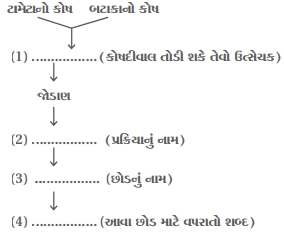
Fill in the blanks in the given flow chart:
Solution
(N/A) The process described is somatic hybridization,which involves the fusion of protoplasts from two different plant species.
$(1)$ Cellulase and pectinase are enzymes used to digest the cell wall to isolate protoplasts.
$(2)$ The process of fusing these protoplasts is called Somatic hybridization.
$(3)$ The resulting plant obtained from the fusion of tomato and potato protoplasts is known as Pomato.
$(4)$ The term used to denote such plants is Somatic hybrid.
$(1)$ Cellulase and pectinase are enzymes used to digest the cell wall to isolate protoplasts.
$(2)$ The process of fusing these protoplasts is called Somatic hybridization.
$(3)$ The resulting plant obtained from the fusion of tomato and potato protoplasts is known as Pomato.
$(4)$ The term used to denote such plants is Somatic hybrid.
0 likes
View Solution193
MediumMCQ
Why are plants obtained by protoplast culture called somatic hybrids?
A
Because they are produced through sexual reproduction.
B
Because they are obtained by the fusion of somatic cells of two different plants.
C
Because they are clones of the parent plant.
D
Because they are produced by tissue culture of gametic cells.
Solution
(B) Plants obtained by protoplast culture are called somatic hybrids because they are produced by the fusion of protoplasts derived from somatic cells of two different plant varieties or species. This process involves the removal of cell walls,followed by the fusion of the remaining protoplasts,which is a non-sexual method of hybridization.
0 likes
View Solution194
Easy
What is protoplast fusion?
Solution
(N/A) $\Rightarrow$ The process of fusing protoplasts obtained from two different varieties of plants,each having a desirable character,to form a hybrid protoplast is known as protoplast fusion. This technique is used in plant tissue culture to create somatic hybrids.
0 likes
View Solution195
Medium
Would it be wrong to call plants obtained through micropropagation as 'clones'? Comment.
Solution
(N/A) No,it is not wrong to call them 'clones'.
Micropropagation is a method of asexual reproduction (tissue culture) where plants are produced from a single parent cell or tissue.
Since the process involves mitosis and does not involve meiosis or fertilization,there is no genetic recombination.
Therefore,every plant produced through this technique is genetically identical to the parent plant and to each other.
Such genetically identical individuals are referred to as 'clones' or 'somaclones'.
Micropropagation is a method of asexual reproduction (tissue culture) where plants are produced from a single parent cell or tissue.
Since the process involves mitosis and does not involve meiosis or fertilization,there is no genetic recombination.
Therefore,every plant produced through this technique is genetically identical to the parent plant and to each other.
Such genetically identical individuals are referred to as 'clones' or 'somaclones'.
0 likes
View Solution196
MediumMCQ
How is a somatic hybrid different from a hybrid?
A
Somatic hybrids are produced by sexual hybridization.
B
Somatic hybrids are produced by the fusion of protoplasts from two different plant varieties.
C
Hybrids are produced by protoplast fusion.
D
There is no difference between a somatic hybrid and a hybrid.
Solution
(B) hybrid is typically produced through sexual hybridization,which involves the fusion of gametes from two different plant varieties.
In contrast,a somatic hybrid is produced by the fusion of isolated protoplasts from two different varieties of plants.
These fused protoplasts are then cultured to regenerate a new hybrid plant,a process known as somatic hybridization.
In contrast,a somatic hybrid is produced by the fusion of isolated protoplasts from two different varieties of plants.
These fused protoplasts are then cultured to regenerate a new hybrid plant,a process known as somatic hybridization.
0 likes
View Solution197
MediumMCQ
It is easier to culture plant cells in vitro as compared to animal cells. Why?
A
Plant cells have cell walls.
B
Plant cells possess meristematic tissue with the capacity for continuous division.
C
Animal cells require complex growth media.
D
Plant cells are smaller than animal cells.
Solution
(B) Plant cells possess meristematic tissues that retain the capacity for continuous cell division,which is essential for growth and regeneration in tissue culture.
In contrast,most animal cells are highly differentiated and have lost the capacity for indefinite division,making them more difficult to culture in vitro.
Therefore,the presence of totipotent or meristematic cells makes plant tissue culture more feasible.
In contrast,most animal cells are highly differentiated and have lost the capacity for indefinite division,making them more difficult to culture in vitro.
Therefore,the presence of totipotent or meristematic cells makes plant tissue culture more feasible.
0 likes
View Solution198
Medium
The culture medium (nutrient medium) can be referred to as a 'highly enriched laboratory soil'. Justify the statement.
Solution
(N/A) The culture medium,also known as the nutrient medium,acts as a 'highly enriched laboratory soil' because it provides all the essential components required for the growth and development of plant cells or tissues in vitro.
It contains a carbon source (typically $Sucrose$),inorganic salts,essential vitamins,amino acids,and specific growth regulators such as $Auxins$ and $Cytokinins$.
Just as natural soil provides nutrients to plants in the field,the culture medium provides a controlled,optimized,and nutrient-dense environment that supports rapid cell division and differentiation in a laboratory setting.
It contains a carbon source (typically $Sucrose$),inorganic salts,essential vitamins,amino acids,and specific growth regulators such as $Auxins$ and $Cytokinins$.
Just as natural soil provides nutrients to plants in the field,the culture medium provides a controlled,optimized,and nutrient-dense environment that supports rapid cell division and differentiation in a laboratory setting.
0 likes
View SolutionBiotechnology and its Application — Tissue Culture · Frequently Asked Questions
1Are these Biotechnology and its Application questions useful for JEE and NEET?
Yes. All questions in this section are mapped to JEE Main and NEET exam patterns. Previous year questions from JEE Main, NEET, GUJCET and state-level exams are included with full solutions.
2Can I switch to Hindi or Gujarati for these questions?
Yes. Use the language tabs in the hero section or the sidebar to view the same questions and solutions in English, Hindi or Gujarati.
3How do I generate a question paper from this subtopic?
Use the Vedclass Exam Paper Generator — select the chapter and subtopic, set difficulty, and generate Sets A, B, C, D automatically. First 3 chapters of every subject are free.
Vedclass Products
For Students
Vedclass Test Series
Mock tests in real JEE/NEET style with performance analysis. 5-day free trial.
Start Free TrialFor Teachers
Exam Paper Generator
Generate Set A/B/C/D papers from this chapter in 2 minutes. 3 chapters free.
Try FreeFor Institutes
Online Exam Module
Live online exams with unlimited students, 360° analytics & white-label branding.
See DemoFor Teachers & Institutes
Generate a Biotechnology and its Application Exam Paper in 2 Minutes
Select subtopic & difficulty — Sets A, B, C, D auto-generated with No Repeat logic.
First 3 chapters of every subject are free — no payment required.