
A English
Pattern of Biodiversity Questions in English
Class 12 Biology · Biodiversity and Conservation · Pattern of Biodiversity
58+
Questions
English
Language
100%
With Solutions
Showing 8 of 58 questions in English
51
EasyMCQ
The variety of frugivorous organisms is greater in tropical rain forests compared to temperate regions because of:
A
warmer temperature
B
higher annual rainfall
C
availability of fruit throughout the year
D
constant climate conditions
Solution
(C) Tropical rain forests are characterized by a lack of distinct seasonal changes and a stable,warm climate. This environment allows for the continuous growth and production of fruits throughout the year. In contrast,temperate regions experience distinct seasons,which limit the period during which fruits are available. Therefore,the constant availability of food resources (fruits) in tropical rain forests supports a higher diversity of frugivorous organisms.
0 likes
View Solution52
EasyMCQ
Species diversity is higher at lower altitudes than at higher altitudes because at higher altitudes:
A
there is no change in climatic conditions and no seasonal variations.
B
there is change in climatic conditions and drastic seasonal variations.
C
there is intense sunlight and warmer temperature.
D
there is higher annual rainfall and more migration.
Solution
(B) Species diversity generally decreases as we move from the equator towards the poles or from lower altitudes to higher altitudes. This is primarily due to the harsh environmental conditions found at higher altitudes. At higher altitudes,the climatic conditions are unstable,and there are drastic seasonal variations,which make it difficult for many species to survive and thrive. In contrast,lower altitudes provide more stable,warmer,and favorable conditions that support a greater variety of species.
0 likes
View Solution53
EasyMCQ
Given below are two statements.
Statement-$I$: Availability of intense sunlight,warmer temperature and higher annual rainfall in the tropics are responsible for species richness of fruit-yielding trees.
Statement-$II$: The variety of frugivorous organisms is more in the tropics as compared to the temperate regions.
In light of the above statements,choose the most appropriate answer from the options given below.
Statement-$I$: Availability of intense sunlight,warmer temperature and higher annual rainfall in the tropics are responsible for species richness of fruit-yielding trees.
Statement-$II$: The variety of frugivorous organisms is more in the tropics as compared to the temperate regions.
In light of the above statements,choose the most appropriate answer from the options given below.
A
Both Statement-$I$ and Statement-$II$ are incorrect.
B
Statement-$I$ is correct and Statement-$II$ is incorrect.
C
Statement-$I$ is incorrect and Statement-$II$ is correct.
D
Both Statement-$I$ and Statement-$II$ are correct.
Solution
(D) Statement-$I$ is correct: Tropical regions receive more solar energy,which contributes to higher productivity. This favorable climate,characterized by intense sunlight,warmer temperatures,and higher annual rainfall,supports a greater diversity of plant species,including fruit-yielding trees.
Statement-$II$ is correct: Due to the high diversity of fruit-yielding trees in the tropics,there is a corresponding increase in the variety of frugivorous (fruit-eating) organisms that depend on these resources. This diversity is significantly higher in the tropics compared to temperate regions,which have less stable and less productive climates.
Statement-$II$ is correct: Due to the high diversity of fruit-yielding trees in the tropics,there is a corresponding increase in the variety of frugivorous (fruit-eating) organisms that depend on these resources. This diversity is significantly higher in the tropics compared to temperate regions,which have less stable and less productive climates.
0 likes
View Solution54
EasyMCQ
Species diversity is bountiful in the tropics near the equator because of the following factors $EXCEPT$ . . . . . .
A
higher annual rainfall.
B
warmer temperature
C
intense sunlight
D
drastic seasonal climatic changes.
Solution
(D) The tropics near the equator exhibit high species diversity due to several favorable environmental conditions. These include:
$1$. Higher annual rainfall,which supports diverse vegetation.
$2$. Warmer temperatures,which promote metabolic activity and growth.
$3$. Intense sunlight,which provides abundant energy for primary productivity.
Conversely,drastic seasonal climatic changes are characteristic of temperate regions,not the tropics. The tropics are relatively stable,which allows for niche specialization and higher biodiversity. Therefore,the factor that does $NOT$ contribute to high species diversity in the tropics is drastic seasonal climatic changes.
$1$. Higher annual rainfall,which supports diverse vegetation.
$2$. Warmer temperatures,which promote metabolic activity and growth.
$3$. Intense sunlight,which provides abundant energy for primary productivity.
Conversely,drastic seasonal climatic changes are characteristic of temperate regions,not the tropics. The tropics are relatively stable,which allows for niche specialization and higher biodiversity. Therefore,the factor that does $NOT$ contribute to high species diversity in the tropics is drastic seasonal climatic changes.
0 likes
View Solution55
EasyMCQ
According to the hypothesis proposed by environmental biologists,a relatively constant environment in the tropics promotes:
A
Niche specialization and lesser species diversity
B
Niche specialization and greater species diversity
C
Niche diversity and lesser species specialization
D
Niche diversity and greater species specialization
Solution
(B) The correct answer is $B$.
Environmental biologists suggest that the relatively constant and stable climate in tropical regions allows for $Niche$ specialization.
Because the environment is stable and provides consistent favorable conditions along with abundant solar energy,it supports the evolution of a wider variety of species,leading to greater species diversity.
Environmental biologists suggest that the relatively constant and stable climate in tropical regions allows for $Niche$ specialization.
Because the environment is stable and provides consistent favorable conditions along with abundant solar energy,it supports the evolution of a wider variety of species,leading to greater species diversity.
0 likes
View Solution56
EasyMCQ
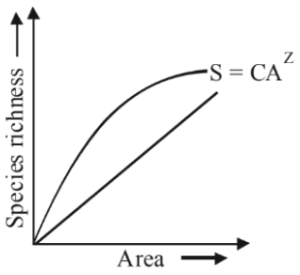
The given graph represents:
A
population growth
B
enzyme activity
C
species-area relationship
D
growth of organisms
Solution
(C) The given graph represents the species-area relationship.
Alexander von Humboldt observed that within a region,species richness increases with increasing explored area,but only up to a limit.
The relationship is described by the equation $S = CA^Z$,where:
$S$ = Species richness
$A$ = Area
$Z$ = Slope of the line (regression coefficient)
$C$ = $Y$-intercept
On a logarithmic scale,this relationship becomes a straight line described by the equation $\log S = \log C + Z \log A$.
Alexander von Humboldt observed that within a region,species richness increases with increasing explored area,but only up to a limit.
The relationship is described by the equation $S = CA^Z$,where:
$S$ = Species richness
$A$ = Area
$Z$ = Slope of the line (regression coefficient)
$C$ = $Y$-intercept
On a logarithmic scale,this relationship becomes a straight line described by the equation $\log S = \log C + Z \log A$.
0 likes
View Solution57
EasyMCQ
The correct equation depicting the species-area relationship is:
A
logS = logC + ZlogA
B
logC = logS + ZlogA
C
logA = logC + ZlogA
D
logZ = logC + ZlogA
Solution
(A) The species-area relationship was proposed by Alexander von Humboldt.
The relationship is represented by the equation $S = CA^Z$.
Taking the logarithm on both sides,we get:
$\log S = \log(CA^Z)$
$\log S = \log C + \log(A^Z)$
$\log S = \log C + Z \log A$
Therefore,the correct equation is $\log S = \log C + Z \log A$.
The relationship is represented by the equation $S = CA^Z$.
Taking the logarithm on both sides,we get:
$\log S = \log(CA^Z)$
$\log S = \log C + \log(A^Z)$
$\log S = \log C + Z \log A$
Therefore,the correct equation is $\log S = \log C + Z \log A$.
0 likes
View Solution58
EasyMCQ
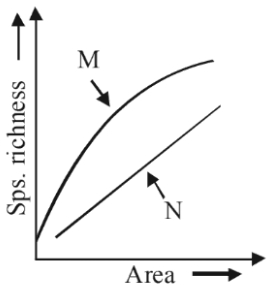
Match $M$ and $N$ with the species-area relationship shown in the graphic representation below and choose the correct option.
A
$M \rightarrow S = CA^Z, N \rightarrow \log S = \log C + Z \log A$
B
$M \rightarrow S = CZ^A, N \rightarrow \log C = \log S + Z \log A$
C
$M \rightarrow S = CA^Z, N \rightarrow \log S = \log C + A \log Z$
D
$M \rightarrow S = AZ^C, N \rightarrow \log ZA = \log C + \log S$
Solution
(A) The correct option is $A$.
In the given graph,$M$ represents the species-area relationship on a normal scale,which is a rectangular hyperbola described by the equation $S = CA^Z$.
$N$ represents the same relationship on a logarithmic scale,which results in a straight line described by the equation $\log S = \log C + Z \log A$.
Here,$S$ represents species richness,$A$ represents area,$Z$ represents the slope of the line (regression coefficient),and $C$ represents the $Y$-intercept.
In the given graph,$M$ represents the species-area relationship on a normal scale,which is a rectangular hyperbola described by the equation $S = CA^Z$.
$N$ represents the same relationship on a logarithmic scale,which results in a straight line described by the equation $\log S = \log C + Z \log A$.
Here,$S$ represents species richness,$A$ represents area,$Z$ represents the slope of the line (regression coefficient),and $C$ represents the $Y$-intercept.
0 likes
View SolutionBiodiversity and Conservation — Pattern of Biodiversity · Frequently Asked Questions
1Are these Biodiversity and Conservation questions useful for JEE and NEET?
Yes. All questions in this section are mapped to JEE Main and NEET exam patterns. Previous year questions from JEE Main, NEET, GUJCET and state-level exams are included with full solutions.
2Can I switch to Hindi or Gujarati for these questions?
Yes. Use the language tabs in the hero section or the sidebar to view the same questions and solutions in English, Hindi or Gujarati.
3How do I generate a question paper from this subtopic?
Use the Vedclass Exam Paper Generator — select the chapter and subtopic, set difficulty, and generate Sets A, B, C, D automatically. First 3 chapters of every subject are free.
Vedclass Products
For Students
Vedclass Test Series
Mock tests in real JEE/NEET style with performance analysis. 5-day free trial.
Start Free TrialFor Teachers
Exam Paper Generator
Generate Set A/B/C/D papers from this chapter in 2 minutes. 3 chapters free.
Try FreeFor Institutes
Online Exam Module
Live online exams with unlimited students, 360° analytics & white-label branding.
See DemoFor Teachers & Institutes
Generate a Biodiversity and Conservation Exam Paper in 2 Minutes
Select subtopic & difficulty — Sets A, B, C, D auto-generated with No Repeat logic.
First 3 chapters of every subject are free — no payment required.