
A English
Measurement Questions in English
Class 11 Physics · Units, Dimensions and Measurement · Measurement
61+
Questions
English
Language
100%
With Solutions
Showing 11 of 61 questions in English
51
Medium
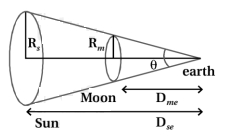
During a total solar eclipse,the moon almost entirely covers the sphere of the sun. Write the relation between the distances and sizes of the sun and moon.
Solution
(N/A) Consider the diagram provided.
Let $D_{me}$ be the distance of the moon from the earth.
Let $D_{se}$ be the distance of the sun from the earth.
Let $R_m$ be the radius of the moon and $R_s$ be the radius of the sun.
Since the moon covers the sun,the angular diameter $\theta$ subtended by both at the earth is the same.
Using the formula for angular diameter,$\theta = \frac{\text{diameter}}{\text{distance}}$,we have:
$\theta = \frac{2R_s}{D_{se}} = \frac{2R_m}{D_{me}}$
Dividing both sides by $2$,we get:
$\frac{R_s}{D_{se}} = \frac{R_m}{D_{me}}$
Therefore,the relation is:
$\frac{R_s}{R_m} = \frac{D_{se}}{D_{me}}$
This shows that the ratio of the sizes of the sun and moon is equal to the ratio of their respective distances from the earth.
Let $D_{me}$ be the distance of the moon from the earth.
Let $D_{se}$ be the distance of the sun from the earth.
Let $R_m$ be the radius of the moon and $R_s$ be the radius of the sun.
Since the moon covers the sun,the angular diameter $\theta$ subtended by both at the earth is the same.
Using the formula for angular diameter,$\theta = \frac{\text{diameter}}{\text{distance}}$,we have:
$\theta = \frac{2R_s}{D_{se}} = \frac{2R_m}{D_{me}}$
Dividing both sides by $2$,we get:
$\frac{R_s}{D_{se}} = \frac{R_m}{D_{me}}$
Therefore,the relation is:
$\frac{R_s}{R_m} = \frac{D_{se}}{D_{me}}$
This shows that the ratio of the sizes of the sun and moon is equal to the ratio of their respective distances from the earth.
0 likes
View Solution52
EasyMCQ
Calculate the solid angle subtended by the periphery of an area of $1 \, cm^2$ at a point situated symmetrically at a distance of $5 \, cm$ from the area. (in $, sr$)
A
$0.04$
B
$0.02$
C
$0.01$
D
$0.08$
Solution
(A) The solid angle $\Omega$ subtended by an area $A$ at a point at distance $r$ is given by the formula $\Omega = \frac{A}{r^2}$.
Given,the area $A = 1 \, cm^2$ and the distance $r = 5 \, cm$.
Substituting these values into the formula:
$\Omega = \frac{1 \, cm^2}{(5 \, cm)^2} = \frac{1}{25} \, sr$.
$\Omega = 0.04 \, sr$.
Thus,the solid angle subtended is $0.04 \, sr$.
Given,the area $A = 1 \, cm^2$ and the distance $r = 5 \, cm$.
Substituting these values into the formula:
$\Omega = \frac{1 \, cm^2}{(5 \, cm)^2} = \frac{1}{25} \, sr$.
$\Omega = 0.04 \, sr$.
Thus,the solid angle subtended is $0.04 \, sr$.
0 likes
View Solution53
Medium
In an experiment to estimate the size of a molecule of oleic acid,$1\, mL$ of oleic acid is dissolved in $19\, mL$ of alcohol. Then $1\, mL$ of this solution is diluted to $20\, mL$ by adding alcohol. Now,$1$ drop of this diluted solution is placed on water in a shallow trough. The solution spreads over the surface of water,forming a one-molecule-thick layer. Lycopodium powder is sprinkled evenly over the film,and its diameter is measured. Knowing the volume of the drop and the area of the film,we can calculate the thickness of the film,which gives us the size of the oleic acid molecule.
Read the passage carefully and answer the following questions.
$(a)$ Why do we dissolve oleic acid in alcohol?
$(b)$ What is the role of lycopodium powder?
$(c)$ What would be the volume of oleic acid in each $mL$ of the solution prepared?
$(d)$ How will you calculate the volume of $n$ drops of this solution of oleic acid?
$(e)$ What will be the volume of oleic acid in one drop of this solution?
Read the passage carefully and answer the following questions.
$(a)$ Why do we dissolve oleic acid in alcohol?
$(b)$ What is the role of lycopodium powder?
$(c)$ What would be the volume of oleic acid in each $mL$ of the solution prepared?
$(d)$ How will you calculate the volume of $n$ drops of this solution of oleic acid?
$(e)$ What will be the volume of oleic acid in one drop of this solution?
Solution
(C) Oleic acid is dissolved in alcohol because it does not dissolve in water,allowing it to form a distinct film on the water surface.
$(b)$ Lycopodium powder is sprinkled on the water surface to make the boundary of the oleic acid film visible. As the oleic acid spreads,it pushes the powder aside,creating a clear circular area that can be measured.
$(c)$ The concentration of the solution is: First dilution: $1\, mL$ in $20\, mL$ total. Second dilution: $1\, mL$ of the first solution in $20\, mL$ total. Thus,the volume of oleic acid per $mL$ of the final solution is $\frac{1}{20} \times \frac{1}{20} = \frac{1}{400}\, mL$.
$(d)$ The volume of $n$ drops can be calculated by using a burette or a measuring cylinder to find the total volume of a known number of drops and then dividing by $n$.
$(e)$ If $n$ drops make $1\, mL$,then the volume of one drop is $\frac{1}{n}\, mL$. Since the concentration is $\frac{1}{400}\, mL$ of oleic acid per $mL$ of solution,the volume of oleic acid in one drop is $\frac{1}{400n}\, mL$.
$(b)$ Lycopodium powder is sprinkled on the water surface to make the boundary of the oleic acid film visible. As the oleic acid spreads,it pushes the powder aside,creating a clear circular area that can be measured.
$(c)$ The concentration of the solution is: First dilution: $1\, mL$ in $20\, mL$ total. Second dilution: $1\, mL$ of the first solution in $20\, mL$ total. Thus,the volume of oleic acid per $mL$ of the final solution is $\frac{1}{20} \times \frac{1}{20} = \frac{1}{400}\, mL$.
$(d)$ The volume of $n$ drops can be calculated by using a burette or a measuring cylinder to find the total volume of a known number of drops and then dividing by $n$.
$(e)$ If $n$ drops make $1\, mL$,then the volume of one drop is $\frac{1}{n}\, mL$. Since the concentration is $\frac{1}{400}\, mL$ of oleic acid per $mL$ of solution,the volume of oleic acid in one drop is $\frac{1}{400n}\, mL$.
0 likes
View Solution54
Medium
$(a)$ How many astronomical units $(AU)$ make $1$ parsec?
$(b)$ Consider a sun-like star at a distance of $2$ parsecs. When it is seen through a telescope with $100$ magnification,what should be the angular size of the star? The Sun appears to be $(\frac{1}{2})^{\circ}$ from the Earth. Due to atmospheric fluctuations,the eye cannot resolve objects smaller than $1$ arc minute.
$(c)$ Mars has approximately half of the Earth's diameter. When it is closest to the Earth,it is at about $\frac{1}{2} AU$ from the Earth. Calculate what size it will appear when seen through the same telescope.
$(b)$ Consider a sun-like star at a distance of $2$ parsecs. When it is seen through a telescope with $100$ magnification,what should be the angular size of the star? The Sun appears to be $(\frac{1}{2})^{\circ}$ from the Earth. Due to atmospheric fluctuations,the eye cannot resolve objects smaller than $1$ arc minute.
$(c)$ Mars has approximately half of the Earth's diameter. When it is closest to the Earth,it is at about $\frac{1}{2} AU$ from the Earth. Calculate what size it will appear when seen through the same telescope.
Solution
(N/A) By definition,$1$ parsec is the distance at which an arc of length $1 AU$ subtends an angle of $1^{\prime \prime}$.
Since $1^{\circ} = 3600^{\prime \prime}$ and $1^{\circ} = \frac{\pi}{180} \text{ rad}$,we have $1^{\prime \prime} = \frac{\pi}{180 \times 3600} \text{ rad}$.
Thus,$1 \text{ parsec} = \frac{1 AU}{1^{\prime \prime}} = \frac{180 \times 3600}{\pi} AU \approx 2.06 \times 10^{5} AU$.
$(b)$ The angular diameter of the Sun is $0.5^{\circ} = 30^{\prime}$ at $1 AU$. At a distance of $2$ parsecs $(2 \times 2.06 \times 10^{5} AU)$,the angular diameter $\alpha$ of the star is $\alpha = \frac{0.5^{\circ}}{2 \times 2.06 \times 10^{5}} \approx 1.21 \times 10^{-6} \text{ degrees} \approx 0.0044^{\prime \prime}$.
With $100$ magnification,the apparent size is $100 \times 0.0044^{\prime \prime} = 0.44^{\prime \prime}$. Since $0.44^{\prime \prime} < 1^{\prime}$,the star will not be resolved and will appear as a point source due to atmospheric turbulence.
$(c)$ Mars diameter is $0.5 \times D_{Earth}$. Angular size $\theta = \frac{\text{Diameter}}{\text{Distance}}$. At $0.5 AU$,$\theta_{Mars} = \frac{0.5 \times D_{Earth}}{0.5 AU} = \frac{D_{Earth}}{1 AU} \approx 0.5^{\circ} = 30^{\prime}$.
With $100$ magnification,the apparent size is $100 \times 30^{\prime} = 3000^{\prime} = 50^{\circ}$.
Since $1^{\circ} = 3600^{\prime \prime}$ and $1^{\circ} = \frac{\pi}{180} \text{ rad}$,we have $1^{\prime \prime} = \frac{\pi}{180 \times 3600} \text{ rad}$.
Thus,$1 \text{ parsec} = \frac{1 AU}{1^{\prime \prime}} = \frac{180 \times 3600}{\pi} AU \approx 2.06 \times 10^{5} AU$.
$(b)$ The angular diameter of the Sun is $0.5^{\circ} = 30^{\prime}$ at $1 AU$. At a distance of $2$ parsecs $(2 \times 2.06 \times 10^{5} AU)$,the angular diameter $\alpha$ of the star is $\alpha = \frac{0.5^{\circ}}{2 \times 2.06 \times 10^{5}} \approx 1.21 \times 10^{-6} \text{ degrees} \approx 0.0044^{\prime \prime}$.
With $100$ magnification,the apparent size is $100 \times 0.0044^{\prime \prime} = 0.44^{\prime \prime}$. Since $0.44^{\prime \prime} < 1^{\prime}$,the star will not be resolved and will appear as a point source due to atmospheric turbulence.
$(c)$ Mars diameter is $0.5 \times D_{Earth}$. Angular size $\theta = \frac{\text{Diameter}}{\text{Distance}}$. At $0.5 AU$,$\theta_{Mars} = \frac{0.5 \times D_{Earth}}{0.5 AU} = \frac{D_{Earth}}{1 AU} \approx 0.5^{\circ} = 30^{\prime}$.
With $100$ magnification,the apparent size is $100 \times 30^{\prime} = 3000^{\prime} = 50^{\circ}$.
0 likes
View Solution55
EasyMCQ
The angle of $1^{\prime}$ (minute of arc) in radian is nearly equal to
A
$1.75 \times 10^{-2} \; rad$
B
$2.91 \times 10^{-4} \; rad$
C
$4.85 \times 10^{-4} \; rad$
D
$4.80 \times 10^{-6} \; rad$
Solution
(B) We know that $1^{\circ} = 60^{\prime}$ (minutes of arc).
Therefore,$1^{\prime} = (1/60)^{\circ}$.
To convert degrees to radians,we multiply by $\frac{\pi}{180}$.
So,$1^{\prime} = \left(\frac{1}{60}\right) \times \left(\frac{\pi}{180}\right) \text{ rad}$.
Using $\pi \approx 3.14159$,we get:
$1^{\prime} = \frac{3.14159}{10800} \text{ rad} \approx 2.9088 \times 10^{-4} \text{ rad}$.
Rounding to three significant figures,we get $2.91 \times 10^{-4} \text{ rad}$.
Therefore,$1^{\prime} = (1/60)^{\circ}$.
To convert degrees to radians,we multiply by $\frac{\pi}{180}$.
So,$1^{\prime} = \left(\frac{1}{60}\right) \times \left(\frac{\pi}{180}\right) \text{ rad}$.
Using $\pi \approx 3.14159$,we get:
$1^{\prime} = \frac{3.14159}{10800} \text{ rad} \approx 2.9088 \times 10^{-4} \text{ rad}$.
Rounding to three significant figures,we get $2.91 \times 10^{-4} \text{ rad}$.
0 likes
View Solution56
DifficultMCQ
Suppose you have taken a dilute solution of oleic acid in such a way that its concentration becomes $0.01 \, cm^3$ of oleic acid per $cm^3$ of the solution. Then you make a thin film of this solution (monomolecular thickness) of area $4 \, cm^2$ by considering $100$ spherical drops of radius $\left(\frac{3}{40 \pi}\right)^{1/3} \times 10^{-3} \, cm$. Then the thickness of the oleic acid layer will be $x \times 10^{-14} \, m$. Where $x$ is ...... .
A
$30$
B
$25$
C
$20$
D
$36$
Solution
(B) The total volume of $100$ drops is $V_{total} = 100 \times \frac{4}{3} \pi r^3$.
Given $r = \left(\frac{3}{40 \pi}\right)^{1/3} \times 10^{-3} \, cm$,so $r^3 = \frac{3}{40 \pi} \times 10^{-9} \, cm^3$.
$V_{total} = 100 \times \frac{4}{3} \pi \times \frac{3}{40 \pi} \times 10^{-9} = 10^{-8} \, cm^3$.
The thickness of the film $t_T$ is given by $Area \times t_T = V_{total}$.
$4 \, cm^2 \times t_T = 10^{-8} \, cm^3 \implies t_T = 0.25 \times 10^{-8} = 25 \times 10^{-10} \, cm$.
Converting to meters: $t_T = 25 \times 10^{-12} \, m$.
The concentration of oleic acid is $0.01$,so the thickness of the oleic acid layer $t_0 = 0.01 \times t_T$.
$t_0 = 0.01 \times 25 \times 10^{-12} \, m = 25 \times 10^{-14} \, m$.
Comparing with $x \times 10^{-14} \, m$,we get $x = 25$.
Given $r = \left(\frac{3}{40 \pi}\right)^{1/3} \times 10^{-3} \, cm$,so $r^3 = \frac{3}{40 \pi} \times 10^{-9} \, cm^3$.
$V_{total} = 100 \times \frac{4}{3} \pi \times \frac{3}{40 \pi} \times 10^{-9} = 10^{-8} \, cm^3$.
The thickness of the film $t_T$ is given by $Area \times t_T = V_{total}$.
$4 \, cm^2 \times t_T = 10^{-8} \, cm^3 \implies t_T = 0.25 \times 10^{-8} = 25 \times 10^{-10} \, cm$.
Converting to meters: $t_T = 25 \times 10^{-12} \, m$.
The concentration of oleic acid is $0.01$,so the thickness of the oleic acid layer $t_0 = 0.01 \times t_T$.
$t_0 = 0.01 \times 25 \times 10^{-12} \, m = 25 \times 10^{-14} \, m$.
Comparing with $x \times 10^{-14} \, m$,we get $x = 25$.
0 likes
View Solution57
DifficultMCQ
$A$ huge circular arc of length $4.4 \; ly$ subtends an angle of $4''$ (arcseconds) at the centre of the circle. How long would it take for a body to complete $4$ revolutions if its speed is $8 \; AU/s$?
Given: $1 \; ly = 9.46 \times 10^{15} \; m$,$1 \; AU = 1.5 \times 10^{11} \; m$.
Given: $1 \; ly = 9.46 \times 10^{15} \; m$,$1 \; AU = 1.5 \times 10^{11} \; m$.
A
$4.1 \times 10^{8} \; s$
B
$4.5 \times 10^{10} \; s$
C
$3.5 \times 10^{6} \; s$
D
$7.2 \times 10^{8} \; s$
Solution
(B) The radius $R$ of the circle is given by $R = \frac{\ell}{\theta}$,where $\ell$ is the arc length and $\theta$ is the angle in radians.
Given $\ell = 4.4 \; ly = 4.4 \times 9.46 \times 10^{15} \; m$.
The angle $\theta = 4'' = \frac{4}{3600} \times \frac{\pi}{180} \; rad$.
Substituting these,$R = \frac{4.4 \times 9.46 \times 10^{15}}{\frac{4}{3600} \times \frac{\pi}{180}} \; m$.
The circumference of the circle is $C = 2\pi R$.
For $4$ revolutions,the total distance $D = 4 \times 2\pi R = 8\pi R$.
The speed $v = 8 \; AU/s = 8 \times 1.5 \times 10^{11} \; m/s$.
The time taken $t = \frac{D}{v} = \frac{8\pi R}{v} = \frac{8\pi}{v} \times \frac{\ell}{\theta}$.
Substituting the values: $t = \frac{8 \times \pi \times 4.4 \times 9.46 \times 10^{15}}{8 \times 1.5 \times 10^{11} \times (\frac{4}{3600} \times \frac{\pi}{180})}$.
Simplifying the expression,we get $t \approx 4.5 \times 10^{10} \; s$.
Given $\ell = 4.4 \; ly = 4.4 \times 9.46 \times 10^{15} \; m$.
The angle $\theta = 4'' = \frac{4}{3600} \times \frac{\pi}{180} \; rad$.
Substituting these,$R = \frac{4.4 \times 9.46 \times 10^{15}}{\frac{4}{3600} \times \frac{\pi}{180}} \; m$.
The circumference of the circle is $C = 2\pi R$.
For $4$ revolutions,the total distance $D = 4 \times 2\pi R = 8\pi R$.
The speed $v = 8 \; AU/s = 8 \times 1.5 \times 10^{11} \; m/s$.
The time taken $t = \frac{D}{v} = \frac{8\pi R}{v} = \frac{8\pi}{v} \times \frac{\ell}{\theta}$.
Substituting the values: $t = \frac{8 \times \pi \times 4.4 \times 9.46 \times 10^{15}}{8 \times 1.5 \times 10^{11} \times (\frac{4}{3600} \times \frac{\pi}{180})}$.
Simplifying the expression,we get $t \approx 4.5 \times 10^{10} \; s$.
0 likes
View Solution58
MediumMCQ
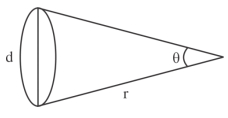
The distance of the Sun from Earth is $1.5 \times 10^{11} \,m$ and its angular diameter is $2000 \,s$ when observed from the Earth. The diameter of the Sun will be ...........
A
$2.45 \times 10^{10} \,m$
B
$1.45 \times 10^{10} \,m$
C
$1.45 \times 10^{9} \,m$
D
$0.14 \times 10^{9} \,m$
Solution
(C) The angular diameter $\theta$ is given by the formula $\theta = \frac{d}{r}$,where $d$ is the diameter of the Sun and $r$ is the distance from the Earth.
First,convert the angular diameter from seconds $(s)$ to radians:
$\theta = 2000 \,s = \frac{2000}{60 \times 60} \text{ degrees} = \frac{2000}{3600} \times \frac{\pi}{180} \text{ radians}$.
Given $r = 1.5 \times 10^{11} \,m$.
Substituting the values into the formula $d = \theta \times r$:
$d = \left( \frac{2000}{3600} \times \frac{\pi}{180} \right) \times (1.5 \times 10^{11})$
$d = \left( \frac{20}{36} \times \frac{\pi}{180} \right) \times 1.5 \times 10^{11}$
$d \approx (0.555 \times 0.01745) \times 1.5 \times 10^{11}$
$d \approx 0.00969 \times 1.5 \times 10^{11} \approx 1.45 \times 10^{9} \,m$.
First,convert the angular diameter from seconds $(s)$ to radians:
$\theta = 2000 \,s = \frac{2000}{60 \times 60} \text{ degrees} = \frac{2000}{3600} \times \frac{\pi}{180} \text{ radians}$.
Given $r = 1.5 \times 10^{11} \,m$.
Substituting the values into the formula $d = \theta \times r$:
$d = \left( \frac{2000}{3600} \times \frac{\pi}{180} \right) \times (1.5 \times 10^{11})$
$d = \left( \frac{20}{36} \times \frac{\pi}{180} \right) \times 1.5 \times 10^{11}$
$d \approx (0.555 \times 0.01745) \times 1.5 \times 10^{11}$
$d \approx 0.00969 \times 1.5 \times 10^{11} \approx 1.45 \times 10^{9} \,m$.
0 likes
View Solution59
EasyMCQ
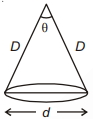
$A$ far-off planet is estimated to be at a distance $D$ from the Earth. If its diametrically opposite extremes subtend an angle $\theta$ at an observatory situated on the Earth,the approximate diameter of the planet is .............
A
$\frac{\theta}{D}$
B
$\frac{D}{\theta}$
C
$D \theta$
D
$\frac{1}{D \theta}$
Solution
(C) The distance of the planet from the Earth is $D$ and the angle subtended by the diameter $d$ of the planet at the observatory is $\theta$.
Using the definition of plane angle,we have:
$\theta = \frac{\text{Arc length}}{\text{Radius}}$
Here,the arc length is the diameter $d$ of the planet and the radius is the distance $D$.
Therefore,$\theta = \frac{d}{D}$.
Rearranging the formula to solve for the diameter $d$,we get:
$d = D \theta$.
Using the definition of plane angle,we have:
$\theta = \frac{\text{Arc length}}{\text{Radius}}$
Here,the arc length is the diameter $d$ of the planet and the radius is the distance $D$.
Therefore,$\theta = \frac{d}{D}$.
Rearranging the formula to solve for the diameter $d$,we get:
$d = D \theta$.
0 likes
View Solution60
EasyMCQ
The true length of a wire is $3.678 \,cm$. When the length of this wire is measured using instrument $A$,the length is $3.5 \,cm$. When the length of the wire is measured using instrument $B$,it is found to be $3.38 \,cm$. Then,the:
A
measurement with $A$ is more accurate and precise.
B
measurement with $A$ is more accurate while measurement with $B$ is more precise.
C
measurement with $B$ is more accurate and precise.
D
measurement with $A$ is more precise while measurement with $B$ is more constant.
Solution
(B) Given,true length of wire $l_0 = 3.678 \,cm$.
Measurement with instrument $A$ is $l_A = 3.5 \,cm$.
Measurement with instrument $B$ is $l_B = 3.38 \,cm$.
Accuracy is determined by how close the measured value is to the true value. The absolute error for $A$ is $|3.678 - 3.5| = 0.178 \,cm$,and for $B$ is $|3.678 - 3.38| = 0.298 \,cm$. Since $0.178 < 0.298$,measurement $A$ is more accurate.
Precision is determined by the resolution or the number of decimal places of the instrument. Instrument $A$ measures up to one decimal place,whereas instrument $B$ measures up to two decimal places. Therefore,instrument $B$ is more precise.
Measurement with instrument $A$ is $l_A = 3.5 \,cm$.
Measurement with instrument $B$ is $l_B = 3.38 \,cm$.
Accuracy is determined by how close the measured value is to the true value. The absolute error for $A$ is $|3.678 - 3.5| = 0.178 \,cm$,and for $B$ is $|3.678 - 3.38| = 0.298 \,cm$. Since $0.178 < 0.298$,measurement $A$ is more accurate.
Precision is determined by the resolution or the number of decimal places of the instrument. Instrument $A$ measures up to one decimal place,whereas instrument $B$ measures up to two decimal places. Therefore,instrument $B$ is more precise.
0 likes
View Solution61
MediumMCQ
In an experiment,a set of readings are obtained: $1.24 \ mm, 1.25 \ mm, 1.23 \ mm, 1.21 \ mm$. The expected least count of the instrument used in recording these readings is . . . . . . $mm$.
A
$0.01$
B
$0.001$
C
$0.1$
D
$0.05$
Solution
(A) The least count of an instrument is the smallest value that can be measured by it.
Given the readings $1.24 \ mm, 1.25 \ mm, 1.23 \ mm$,and $1.21 \ mm$,all values are recorded up to two decimal places in millimeters.
This implies that the instrument can resolve changes in the hundredths place $(0.01 \ mm)$.
Therefore,the least count of the instrument is $0.01 \ mm$.
Given the readings $1.24 \ mm, 1.25 \ mm, 1.23 \ mm$,and $1.21 \ mm$,all values are recorded up to two decimal places in millimeters.
This implies that the instrument can resolve changes in the hundredths place $(0.01 \ mm)$.
Therefore,the least count of the instrument is $0.01 \ mm$.
0 likes
View SolutionUnits, Dimensions and Measurement — Measurement · Frequently Asked Questions
1Are these Units, Dimensions and Measurement questions useful for JEE and NEET?
Yes. All questions in this section are mapped to JEE Main and NEET exam patterns. Previous year questions from JEE Main, NEET, GUJCET and state-level exams are included with full solutions.
2Can I switch to Hindi or Gujarati for these questions?
Yes. Use the language tabs in the hero section or the sidebar to view the same questions and solutions in English, Hindi or Gujarati.
3How do I generate a question paper from this subtopic?
Use the Vedclass Exam Paper Generator — select the chapter and subtopic, set difficulty, and generate Sets A, B, C, D automatically. First 3 chapters of every subject are free.
Vedclass Products
For Students
Vedclass Test Series
Mock tests in real JEE/NEET style with performance analysis. 5-day free trial.
Start Free TrialFor Teachers
Exam Paper Generator
Generate Set A/B/C/D papers from this chapter in 2 minutes. 3 chapters free.
Try FreeFor Institutes
Online Exam Module
Live online exams with unlimited students, 360° analytics & white-label branding.
See DemoFor Teachers & Institutes
Generate a Units, Dimensions and Measurement Exam Paper in 2 Minutes
Select subtopic & difficulty — Sets A, B, C, D auto-generated with No Repeat logic.
First 3 chapters of every subject are free — no payment required.