
A English
Energy consideration in Planetary and Satellite motion Questions in English
Class 11 Physics · Gravitation · Energy consideration in Planetary and Satellite motion
80+
Questions
English
Language
100%
With Solutions
Showing 29 of 80 questions in English
51
MediumMCQ
In a satellite,if the time of revolution is $T$,then the potential energy $(PE)$ is proportional to ..........
A
$T^{1/3}$
B
$T^3$
C
$T^{-2/3}$
D
$T^{-4/3}$
Solution
(C) According to Kepler's third law of planetary motion,the square of the time period $T$ is proportional to the cube of the orbital radius $r$:
$T^2 \propto r^3$
This implies $r \propto T^{2/3}$.
The potential energy $(PE)$ of a satellite of mass $m$ orbiting a planet of mass $M$ at a distance $r$ is given by:
$PE = -\frac{GMm}{r}$
Since $G, M,$ and $m$ are constants,we have $PE \propto \frac{1}{r}$.
Substituting $r \propto T^{2/3}$ into the expression for potential energy:
$PE \propto \frac{1}{T^{2/3}}$
$PE \propto T^{-2/3}$
Therefore,the potential energy is proportional to $T^{-2/3}$.
$T^2 \propto r^3$
This implies $r \propto T^{2/3}$.
The potential energy $(PE)$ of a satellite of mass $m$ orbiting a planet of mass $M$ at a distance $r$ is given by:
$PE = -\frac{GMm}{r}$
Since $G, M,$ and $m$ are constants,we have $PE \propto \frac{1}{r}$.
Substituting $r \propto T^{2/3}$ into the expression for potential energy:
$PE \propto \frac{1}{T^{2/3}}$
$PE \propto T^{-2/3}$
Therefore,the potential energy is proportional to $T^{-2/3}$.
0 likes
View Solution52
MediumMCQ
Given below are two statements:
Statement $I:$ If $E$ be the total energy of a satellite moving around the earth,then its potential energy will be $\frac{E}{2}$.
Statement $II:$ The kinetic energy of a satellite revolving in an orbit is equal to the half the magnitude of total energy $E$.
In the light of the above statements,choose the most appropriate answer from the options given below.
Statement $I:$ If $E$ be the total energy of a satellite moving around the earth,then its potential energy will be $\frac{E}{2}$.
Statement $II:$ The kinetic energy of a satellite revolving in an orbit is equal to the half the magnitude of total energy $E$.
In the light of the above statements,choose the most appropriate answer from the options given below.
A
Both Statement $I$ and Statement $II$ are correct
B
Both Statement $I$ and Statement $II$ are incorrect
C
Statement $I$ is incorrect but Statement $II$ is correct
D
Statement $I$ is correct but Statement $II$ is incorrect
Solution
(B) The total energy $E$ of a satellite in an orbit of radius $R$ is given by $E = -\frac{GMm}{2R}$.
The potential energy $U$ of the satellite is given by $U = -\frac{GMm}{R}$.
Comparing these,we see that $U = 2E$. Therefore,Statement $I$ is incorrect.
The kinetic energy $K$ of the satellite is given by $K = \frac{GMm}{2R}$.
Comparing this with the total energy $E$,we see that $K = -E$,which means the magnitude of kinetic energy $|K|$ is equal to the magnitude of total energy $|E|$.
Thus,Statement $II$ is also incorrect.
The potential energy $U$ of the satellite is given by $U = -\frac{GMm}{R}$.
Comparing these,we see that $U = 2E$. Therefore,Statement $I$ is incorrect.
The kinetic energy $K$ of the satellite is given by $K = \frac{GMm}{2R}$.
Comparing this with the total energy $E$,we see that $K = -E$,which means the magnitude of kinetic energy $|K|$ is equal to the magnitude of total energy $|E|$.
Thus,Statement $II$ is also incorrect.
0 likes
View Solution53
DifficultMCQ
An astronaut takes a ball of mass $m$ from Earth to space. He throws the ball into a circular orbit about Earth at an altitude of $318.5 \ km$. From Earth's surface to the orbit,the change in total mechanical energy of the ball is $x \frac{GM_e m}{21 R_e}$. The value of $x$ is (take $R_e = 6370 \ km$).
A
$11$
B
$9$
C
$12$
D
$10$
Solution
(A) The initial total mechanical energy of the ball on the Earth's surface is $TE_i = -\frac{GM_e m}{R_e}$.
Given the altitude $h = 318.5 \ km$ and $R_e = 6370 \ km$,we find $h = \frac{R_e}{20}$.
The final total mechanical energy of the ball in a circular orbit at altitude $h$ is $TE_f = -\frac{GM_e m}{2(R_e + h)}$.
Substituting $h = \frac{R_e}{20}$,we get $TE_f = -\frac{GM_e m}{2(R_e + R_e/20)} = -\frac{GM_e m}{2(21R_e/20)} = -\frac{10 GM_e m}{21 R_e}$.
The change in total mechanical energy is $\Delta TE = TE_f - TE_i = -\frac{10 GM_e m}{21 R_e} - (-\frac{GM_e m}{R_e})$.
$\Delta TE = \frac{GM_e m}{R_e} (1 - \frac{10}{21}) = \frac{11 GM_e m}{21 R_e}$.
Comparing this with $x \frac{GM_e m}{21 R_e}$,we get $x = 11$.
Given the altitude $h = 318.5 \ km$ and $R_e = 6370 \ km$,we find $h = \frac{R_e}{20}$.
The final total mechanical energy of the ball in a circular orbit at altitude $h$ is $TE_f = -\frac{GM_e m}{2(R_e + h)}$.
Substituting $h = \frac{R_e}{20}$,we get $TE_f = -\frac{GM_e m}{2(R_e + R_e/20)} = -\frac{GM_e m}{2(21R_e/20)} = -\frac{10 GM_e m}{21 R_e}$.
The change in total mechanical energy is $\Delta TE = TE_f - TE_i = -\frac{10 GM_e m}{21 R_e} - (-\frac{GM_e m}{R_e})$.
$\Delta TE = \frac{GM_e m}{R_e} (1 - \frac{10}{21}) = \frac{11 GM_e m}{21 R_e}$.
Comparing this with $x \frac{GM_e m}{21 R_e}$,we get $x = 11$.
0 likes
View Solution54
DifficultMCQ
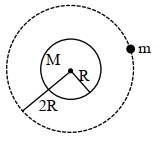
$A$ satellite of $10^3 \text{ kg}$ mass is revolving in a circular orbit of radius $2R$. If $\frac{10^4 R}{6} \text{ J}$ of energy is supplied to the satellite,it would revolve in a new circular orbit of radius: (use $g = 10 \text{ m/s}^2$,$R = \text{radius of earth}$) (in $R$)
A
$2.5$
B
$3$
C
$4$
D
$6$
Solution
(D) The total energy of a satellite in a circular orbit of radius $r$ is given by $E = -\frac{GMm}{2r}$.
Initially,the satellite is in an orbit of radius $r_1 = 2R$. Its initial energy is $E_1 = -\frac{GMm}{2(2R)} = -\frac{GMm}{4R}$.
Given that an energy $\Delta E = \frac{10^4 R}{6} \text{ J}$ is supplied to the satellite,the new total energy $E_2$ will be $E_1 + \Delta E$.
$E_2 = -\frac{GMm}{4R} + \frac{10^4 R}{6}$.
Let the new radius be $r_2$. Then $E_2 = -\frac{GMm}{2r_2}$.
Equating the two expressions for $E_2$:
$-\frac{GMm}{4R} + \frac{10^4 R}{6} = -\frac{GMm}{2r_2}$.
Using $g = \frac{GM}{R^2}$,we have $GM = gR^2$. Substituting this into the equation:
$-\frac{mgR^2}{4R} + \frac{10^4 R}{6} = -\frac{mgR^2}{2r_2}$.
Given $m = 10^3 \text{ kg}$ and $g = 10 \text{ m/s}^2$,so $mg = 10^4 \text{ N}$.
$-\frac{10^4 R}{4} + \frac{10^4 R}{6} = -\frac{10^4 R^2}{2r_2}$.
Dividing by $10^4 R$:
$-\frac{1}{4} + \frac{1}{6} = -\frac{R}{2r_2}$.
$-\frac{3-2}{12} = -\frac{R}{2r_2} \implies -\frac{1}{12} = -\frac{R}{2r_2}$.
$\frac{1}{12} = \frac{R}{2r_2} \implies 2r_2 = 12R \implies r_2 = 6R$.
Initially,the satellite is in an orbit of radius $r_1 = 2R$. Its initial energy is $E_1 = -\frac{GMm}{2(2R)} = -\frac{GMm}{4R}$.
Given that an energy $\Delta E = \frac{10^4 R}{6} \text{ J}$ is supplied to the satellite,the new total energy $E_2$ will be $E_1 + \Delta E$.
$E_2 = -\frac{GMm}{4R} + \frac{10^4 R}{6}$.
Let the new radius be $r_2$. Then $E_2 = -\frac{GMm}{2r_2}$.
Equating the two expressions for $E_2$:
$-\frac{GMm}{4R} + \frac{10^4 R}{6} = -\frac{GMm}{2r_2}$.
Using $g = \frac{GM}{R^2}$,we have $GM = gR^2$. Substituting this into the equation:
$-\frac{mgR^2}{4R} + \frac{10^4 R}{6} = -\frac{mgR^2}{2r_2}$.
Given $m = 10^3 \text{ kg}$ and $g = 10 \text{ m/s}^2$,so $mg = 10^4 \text{ N}$.
$-\frac{10^4 R}{4} + \frac{10^4 R}{6} = -\frac{10^4 R^2}{2r_2}$.
Dividing by $10^4 R$:
$-\frac{1}{4} + \frac{1}{6} = -\frac{R}{2r_2}$.
$-\frac{3-2}{12} = -\frac{R}{2r_2} \implies -\frac{1}{12} = -\frac{R}{2r_2}$.
$\frac{1}{12} = \frac{R}{2r_2} \implies 2r_2 = 12R \implies r_2 = 6R$.
0 likes
View Solution55
MediumMCQ
The minimum energy required to launch a satellite of mass $m$ from the surface of the Earth of mass $M$ and radius $R$ into a circular orbit at an altitude of $2R$ from the surface of the Earth is:
A
$\frac{2 G m M}{3 R}$
B
$\frac{G m M}{2 R}$
C
$\frac{G m M}{3 R}$
D
$\frac{5 G m M}{6 R}$
Solution
(D) The total energy of the satellite at the surface of the Earth is $E_i = K_i + U_i = K_i - \frac{G M m}{R}$.
At an altitude of $2R$ from the surface,the distance from the center of the Earth is $r = R + 2R = 3R$.
The orbital velocity $v$ at distance $r = 3R$ is given by $v = \sqrt{\frac{G M}{3R}}$.
The total energy at the orbit is $E_f = K_f + U_f = \frac{1}{2} m v^2 - \frac{G M m}{3R} = \frac{1}{2} m \left(\frac{G M}{3R}\right) - \frac{G M m}{3R} = \frac{G M m}{6R} - \frac{G M m}{3R} = -\frac{G M m}{6R}$.
By the law of conservation of energy,$E_i = E_f$:
$K_i - \frac{G M m}{R} = -\frac{G M m}{6R}$.
$K_i = \frac{G M m}{R} - \frac{G M m}{6R} = \frac{5 G M m}{6R}$.
At an altitude of $2R$ from the surface,the distance from the center of the Earth is $r = R + 2R = 3R$.
The orbital velocity $v$ at distance $r = 3R$ is given by $v = \sqrt{\frac{G M}{3R}}$.
The total energy at the orbit is $E_f = K_f + U_f = \frac{1}{2} m v^2 - \frac{G M m}{3R} = \frac{1}{2} m \left(\frac{G M}{3R}\right) - \frac{G M m}{3R} = \frac{G M m}{6R} - \frac{G M m}{3R} = -\frac{G M m}{6R}$.
By the law of conservation of energy,$E_i = E_f$:
$K_i - \frac{G M m}{R} = -\frac{G M m}{6R}$.
$K_i = \frac{G M m}{R} - \frac{G M m}{6R} = \frac{5 G M m}{6R}$.
2 likes
View Solution56
MediumMCQ
$A$ satellite of mass $m$ is orbiting the Earth (of radius $R$) at a height equal to the radius of the Earth. The total energy of the satellite in terms of $g$ (acceleration due to gravity on Earth's surface) is
A
$-\frac{mgR}{3}$
B
$-\frac{mgR}{4}$
C
$-\frac{mgR}{2}$
D
$-\frac{mgR}{5}$
Solution
(B) The total energy $E$ of a satellite orbiting at a height $h$ is given by $E = -\frac{GMm}{2(R+h)}$.
We know that the acceleration due to gravity on the Earth's surface is $g = \frac{GM}{R^2}$,which implies $GM = gR^2$.
Given that the height $h = R$,the orbital radius is $r = R + h = R + R = 2R$.
Substituting $GM = gR^2$ and $r = 2R$ into the energy formula:
$E = -\frac{(gR^2)m}{2(2R)}$
$E = -\frac{gR^2m}{4R}$
$E = -\frac{mgR}{4}$.
We know that the acceleration due to gravity on the Earth's surface is $g = \frac{GM}{R^2}$,which implies $GM = gR^2$.
Given that the height $h = R$,the orbital radius is $r = R + h = R + R = 2R$.
Substituting $GM = gR^2$ and $r = 2R$ into the energy formula:
$E = -\frac{(gR^2)m}{2(2R)}$
$E = -\frac{gR^2m}{4R}$
$E = -\frac{mgR}{4}$.
0 likes
View Solution57
MediumMCQ
For a satellite orbiting around the earth in a circular orbit,the ratio of potential energy to kinetic energy at the same height is
A
$1/\sqrt{2}$
B
$1/2$
C
$\sqrt{2}$
D
$-2$
Solution
(D) The kinetic energy $(K.E.)$ of a satellite of mass $m$ orbiting at a distance $r$ from the center of the Earth (mass $M$) is given by $K.E. = \frac{GMm}{2r}$.
The potential energy $(P.E.)$ of the satellite at the same distance $r$ is given by $P.E. = -\frac{GMm}{r}$.
We are asked to find the ratio of potential energy to kinetic energy. Note that the magnitude of potential energy is $|P.E.| = \frac{GMm}{r}$.
The ratio is $\frac{P.E.}{K.E.} = \frac{-GMm/r}{GMm/2r} = -2$.
Since the question asks for the ratio of potential energy to kinetic energy,and considering the sign,the value is $-2$. However,if the question implies the ratio of magnitudes,the answer is $2$. Given standard physics convention,the potential energy is negative,so the ratio is $-2$. If the options provided are positive,we select the magnitude $2$.
The potential energy $(P.E.)$ of the satellite at the same distance $r$ is given by $P.E. = -\frac{GMm}{r}$.
We are asked to find the ratio of potential energy to kinetic energy. Note that the magnitude of potential energy is $|P.E.| = \frac{GMm}{r}$.
The ratio is $\frac{P.E.}{K.E.} = \frac{-GMm/r}{GMm/2r} = -2$.
Since the question asks for the ratio of potential energy to kinetic energy,and considering the sign,the value is $-2$. However,if the question implies the ratio of magnitudes,the answer is $2$. Given standard physics convention,the potential energy is negative,so the ratio is $-2$. If the options provided are positive,we select the magnitude $2$.
0 likes
View Solution58
MediumMCQ
Binding energy of a revolving satellite at height $h$ is $3.5 \times 10^8 \ J$. Its potential energy is
A
$-3.5 \times 10^8 \ J$
B
$-7 \times 10^8 \ J$
C
$7 \times 10^8 \ J$
D
$3.5 \times 10^8 \ J$
Solution
(B) The binding energy $(BE)$ of a satellite is defined as the minimum energy required to remove the satellite from its orbit to infinity.
For a satellite of mass $m$ at a distance $r = R + h$ from the center of the Earth,the potential energy is $U = -\frac{GMm}{r}$.
The total energy of the satellite is $E = K + U = -\frac{GMm}{2r}$.
The binding energy is the negative of the total energy: $BE = -E = \frac{GMm}{2r}$.
Comparing $BE$ and $U$,we see that $U = -2 \times BE$.
Given $BE = 3.5 \times 10^8 \ J$,the potential energy is $U = -2 \times (3.5 \times 10^8 \ J) = -7 \times 10^8 \ J$.
For a satellite of mass $m$ at a distance $r = R + h$ from the center of the Earth,the potential energy is $U = -\frac{GMm}{r}$.
The total energy of the satellite is $E = K + U = -\frac{GMm}{2r}$.
The binding energy is the negative of the total energy: $BE = -E = \frac{GMm}{2r}$.
Comparing $BE$ and $U$,we see that $U = -2 \times BE$.
Given $BE = 3.5 \times 10^8 \ J$,the potential energy is $U = -2 \times (3.5 \times 10^8 \ J) = -7 \times 10^8 \ J$.
0 likes
View Solution59
EasyMCQ
Binding energy of a revolving satellite at height $h$ is $3.5 \times 10^{8} \,J$. Its potential energy is
A
$7.0 \times 10^{8} \,J$
B
$-7.0 \times 10^{8} \,J$
C
$-3.5 \times 10^{8} \,J$
D
$3.5 \times 10^{8} \,J$
Solution
(B) The binding energy $(BE)$ of a satellite is defined as the negative of the total mechanical energy $(E)$.
$BE = -E = - (K.E. + P.E.) = - (\frac{GMm}{2r} - \frac{GMm}{r}) = \frac{GMm}{2r}$.
The potential energy $(P.E.)$ of a satellite is given by $P.E. = -\frac{GMm}{r}$.
Comparing the two expressions, we see that $P.E. = -2 \times BE$.
Given $BE = 3.5 \times 10^{8} \,J$.
Therefore, $P.E. = -2 \times (3.5 \times 10^{8} \,J) = -7.0 \times 10^{8} \,J$.
$BE = -E = - (K.E. + P.E.) = - (\frac{GMm}{2r} - \frac{GMm}{r}) = \frac{GMm}{2r}$.
The potential energy $(P.E.)$ of a satellite is given by $P.E. = -\frac{GMm}{r}$.
Comparing the two expressions, we see that $P.E. = -2 \times BE$.
Given $BE = 3.5 \times 10^{8} \,J$.
Therefore, $P.E. = -2 \times (3.5 \times 10^{8} \,J) = -7.0 \times 10^{8} \,J$.
0 likes
View Solution60
MediumMCQ
The ratio of the binding energy of a satellite at rest on the earth's surface to the binding energy of a satellite of the same mass revolving around the earth at a height $h$ above the earth's surface is ($R=$ radius of the earth).
A
$\frac{2(R+h)}{R}$
B
$\frac{R+h}{2 R}$
C
$\frac{R+h}{R}$
D
$\frac{R}{R+h}$
Solution
(C) The binding energy of a satellite at rest on the earth's surface is given by $E_1 = \frac{GMm}{2R}$.
The binding energy of a satellite of mass $m$ revolving in a circular orbit at a height $h$ above the earth's surface is $E_2 = \frac{GMm}{2(R+h)}$.
Taking the ratio of the two energies:
$\frac{E_1}{E_2} = \frac{\frac{GMm}{2R}}{\frac{GMm}{2(R+h)}} = \frac{R+h}{R}$.
The binding energy of a satellite of mass $m$ revolving in a circular orbit at a height $h$ above the earth's surface is $E_2 = \frac{GMm}{2(R+h)}$.
Taking the ratio of the two energies:
$\frac{E_1}{E_2} = \frac{\frac{GMm}{2R}}{\frac{GMm}{2(R+h)}} = \frac{R+h}{R}$.
0 likes
View Solution61
EasyMCQ
The total energy of a circularly orbiting satellite is
A
half the kinetic energy of the satellite.
B
half the potential energy of the satellite.
C
twice the kinetic energy of the satellite.
D
twice the potential energy of the satellite.
Solution
(B) For a satellite of mass $m$ orbiting a planet of mass $M$ at a distance $r$,the potential energy is $U = -\frac{GMm}{r}$.
The kinetic energy required for a circular orbit is $K = \frac{GMm}{2r}$.
The total energy $E$ is the sum of kinetic and potential energy: $E = K + U = \frac{GMm}{2r} - \frac{GMm}{r} = -\frac{GMm}{2r}$.
Comparing $E$ with $K$: $E = -K$,which means the total energy is the negative of the kinetic energy.
Comparing $E$ with $U$: $E = \frac{1}{2} U$,which means the total energy is half the potential energy.
The kinetic energy required for a circular orbit is $K = \frac{GMm}{2r}$.
The total energy $E$ is the sum of kinetic and potential energy: $E = K + U = \frac{GMm}{2r} - \frac{GMm}{r} = -\frac{GMm}{2r}$.
Comparing $E$ with $K$: $E = -K$,which means the total energy is the negative of the kinetic energy.
Comparing $E$ with $U$: $E = \frac{1}{2} U$,which means the total energy is half the potential energy.
0 likes
View Solution62
MediumMCQ
The minimum energy required to launch a satellite of mass $m$ from the surface of a planet of mass $M$ and radius $R$ into a circular orbit at an altitude of $2R$ is
A
$\frac{5 GMm}{6 R}$
B
$\frac{2 GMm}{3 R}$
C
$\frac{GMm}{2 R}$
D
$\frac{GMm}{3 R}$
Solution
(A) The total energy of a satellite in a circular orbit at a distance $r = R + h$ from the center of the planet is given by $E_0 = -\frac{GMm}{2r}$.
Given the altitude $h = 2R$,the orbital radius is $r = R + 2R = 3R$.
Thus,the orbital energy is $E_0 = -\frac{GMm}{2(3R)} = -\frac{GMm}{6R}$.
The potential energy of the satellite on the surface of the planet is $E_i = -\frac{GMm}{R}$.
The minimum energy required to launch the satellite is the difference between the final orbital energy and the initial surface energy:
$\Delta E = E_0 - E_i = -\frac{GMm}{6R} - (-\frac{GMm}{R}) = \frac{GMm}{R} - \frac{GMm}{6R} = \frac{5GMm}{6R}$.
Given the altitude $h = 2R$,the orbital radius is $r = R + 2R = 3R$.
Thus,the orbital energy is $E_0 = -\frac{GMm}{2(3R)} = -\frac{GMm}{6R}$.
The potential energy of the satellite on the surface of the planet is $E_i = -\frac{GMm}{R}$.
The minimum energy required to launch the satellite is the difference between the final orbital energy and the initial surface energy:
$\Delta E = E_0 - E_i = -\frac{GMm}{6R} - (-\frac{GMm}{R}) = \frac{GMm}{R} - \frac{GMm}{6R} = \frac{5GMm}{6R}$.
0 likes
View Solution63
MediumMCQ
The ratio of energy required to raise a satellite to a height $h$ above the earth's surface to that required to put it into the orbit at the same height is ($R=$ radius of earth).
A
$\frac{2h}{R}$
B
$\frac{h}{R}$
C
$\frac{R}{h}$
D
$\frac{R}{2h}$
Solution
(A) The energy required to raise a satellite of mass $m$ to a height $h$ above the earth's surface is the change in potential energy:
$E_1 = U_h - U_R = -\frac{GMm}{R+h} - (-\frac{GMm}{R}) = GMm \left( \frac{1}{R} - \frac{1}{R+h} \right) = \frac{GMmh}{R(R+h)}$.
Using $GM = gR^2$,we get $E_1 = \frac{mgR^2h}{R(R+h)} = \frac{mghR}{R+h}$.
The total energy of a satellite in a circular orbit at height $h$ is $E_{orbit} = -\frac{GMm}{2(R+h)}$.
The energy required to put it into orbit at that height is the difference between the energy in orbit and the energy at the surface:
$E_2 = E_{orbit} - U_R = -\frac{GMm}{2(R+h)} + \frac{GMm}{R} = GMm \left( \frac{1}{R} - \frac{1}{2(R+h)} \right) = GMm \left( \frac{2R+2h-R}{2R(R+h)} \right) = \frac{GMm(R+2h)}{2R(R+h)}$.
Using $GM = gR^2$,we get $E_2 = \frac{mgR^2(R+2h)}{2R(R+h)} = \frac{mgR(R+2h)}{2(R+h)}$.
The ratio is $\frac{E_1}{E_2} = \frac{mghR}{R+h} \times \frac{2(R+h)}{mgR(R+2h)} = \frac{2h}{R+2h}$.
For $h \ll R$,$R+2h \approx R$,so the ratio is $\frac{2h}{R}$.
$E_1 = U_h - U_R = -\frac{GMm}{R+h} - (-\frac{GMm}{R}) = GMm \left( \frac{1}{R} - \frac{1}{R+h} \right) = \frac{GMmh}{R(R+h)}$.
Using $GM = gR^2$,we get $E_1 = \frac{mgR^2h}{R(R+h)} = \frac{mghR}{R+h}$.
The total energy of a satellite in a circular orbit at height $h$ is $E_{orbit} = -\frac{GMm}{2(R+h)}$.
The energy required to put it into orbit at that height is the difference between the energy in orbit and the energy at the surface:
$E_2 = E_{orbit} - U_R = -\frac{GMm}{2(R+h)} + \frac{GMm}{R} = GMm \left( \frac{1}{R} - \frac{1}{2(R+h)} \right) = GMm \left( \frac{2R+2h-R}{2R(R+h)} \right) = \frac{GMm(R+2h)}{2R(R+h)}$.
Using $GM = gR^2$,we get $E_2 = \frac{mgR^2(R+2h)}{2R(R+h)} = \frac{mgR(R+2h)}{2(R+h)}$.
The ratio is $\frac{E_1}{E_2} = \frac{mghR}{R+h} \times \frac{2(R+h)}{mgR(R+2h)} = \frac{2h}{R+2h}$.
For $h \ll R$,$R+2h \approx R$,so the ratio is $\frac{2h}{R}$.
0 likes
View Solution64
MediumMCQ
The ratio of energy required to raise a satellite of mass '$m$' to a height '$h$' above the Earth's surface to that required to put it into the orbit at the same height is [$R=$ radius of Earth].
A
$\frac{h}{R}$
B
$\frac{2h}{R^2}$
C
$\frac{3h}{R^2}$
D
$\frac{2h}{R}$
Solution
(D) The energy required to raise a satellite of mass '$m$' to a height '$h$' above the Earth's surface is equal to the change in its gravitational potential energy:
$W = U_f - U_i = -\frac{GMm}{R+h} - (-\frac{GMm}{R}) = GMm \left( \frac{1}{R} - \frac{1}{R+h} \right) = \frac{GMmh}{R(R+h)}$.
The total energy of a satellite of mass '$m$' in a circular orbit at height '$h$' (distance $r = R+h$ from the center) is given by:
$E = \frac{GMm}{2(R+h)}$.
Now,the ratio of the energy required to raise the satellite to the energy required to put it into orbit is:
$\frac{W}{E} = \frac{\frac{GMmh}{R(R+h)}}{\frac{GMm}{2(R+h)}} = \frac{GMmh}{R(R+h)} \times \frac{2(R+h)}{GMm} = \frac{2h}{R}$.
$W = U_f - U_i = -\frac{GMm}{R+h} - (-\frac{GMm}{R}) = GMm \left( \frac{1}{R} - \frac{1}{R+h} \right) = \frac{GMmh}{R(R+h)}$.
The total energy of a satellite of mass '$m$' in a circular orbit at height '$h$' (distance $r = R+h$ from the center) is given by:
$E = \frac{GMm}{2(R+h)}$.
Now,the ratio of the energy required to raise the satellite to the energy required to put it into orbit is:
$\frac{W}{E} = \frac{\frac{GMmh}{R(R+h)}}{\frac{GMm}{2(R+h)}} = \frac{GMmh}{R(R+h)} \times \frac{2(R+h)}{GMm} = \frac{2h}{R}$.
0 likes
View Solution65
EasyMCQ
In a satellite,if the time of revolution is $T$,then $KE$ is proportional to
A
$1/T$
B
$1/T^2$
C
$1/T^3$
D
$T^{-2/3}$
Solution
(D) The orbital velocity of a satellite is given by $v = \sqrt{\frac{GM}{r}}$.
Since kinetic energy $KE = \frac{1}{2}mv^2$,we have $KE \propto v^2 \propto \frac{1}{r}$.
According to Kepler's third law of planetary motion,the square of the time period is proportional to the cube of the orbital radius: $T^2 \propto r^3$,which implies $r \propto T^{2/3}$.
Substituting this into the proportionality for kinetic energy: $KE \propto \frac{1}{r} \propto \frac{1}{T^{2/3}} = T^{-2/3}$.
Since kinetic energy $KE = \frac{1}{2}mv^2$,we have $KE \propto v^2 \propto \frac{1}{r}$.
According to Kepler's third law of planetary motion,the square of the time period is proportional to the cube of the orbital radius: $T^2 \propto r^3$,which implies $r \propto T^{2/3}$.
Substituting this into the proportionality for kinetic energy: $KE \propto \frac{1}{r} \propto \frac{1}{T^{2/3}} = T^{-2/3}$.
0 likes
View Solution66
EasyMCQ
$A$ satellite of mass $m$,revolving around the Earth of radius $r$,has kinetic energy $E$. Its angular momentum is:
A
$(mEr^{2})^{\frac{1}{2}}$
B
$(mEr^{2})$
C
$(2mEr^{2})^{\frac{1}{2}}$
D
$(2mEr^{2})$
Solution
(C) The kinetic energy of the satellite is given by $E = \frac{1}{2}mv^{2}$.
From this,we can express the velocity $v$ as $v = \sqrt{\frac{2E}{m}}$.
The angular momentum $L$ of a particle moving in a circular orbit of radius $r$ is defined as $L = mvr$.
Substituting the expression for $v$ into the formula for $L$:
$L = m \cdot \sqrt{\frac{2E}{m}} \cdot r$
$L = \sqrt{m^{2} \cdot \frac{2E}{m} \cdot r^{2}}$
$L = \sqrt{2mEr^{2}}$
$L = (2mEr^{2})^{\frac{1}{2}}$.
From this,we can express the velocity $v$ as $v = \sqrt{\frac{2E}{m}}$.
The angular momentum $L$ of a particle moving in a circular orbit of radius $r$ is defined as $L = mvr$.
Substituting the expression for $v$ into the formula for $L$:
$L = m \cdot \sqrt{\frac{2E}{m}} \cdot r$
$L = \sqrt{m^{2} \cdot \frac{2E}{m} \cdot r^{2}}$
$L = \sqrt{2mEr^{2}}$
$L = (2mEr^{2})^{\frac{1}{2}}$.
0 likes
View Solution67
MediumMCQ
The total energy of a satellite in a circular orbit at a distance $(R+h)$ from the centre of the Earth varies as [ $R$ is the radius of the Earth and $h$ is the height of the orbit from Earth's surface].
A
$-\frac{1}{(R+h)}$
B
$\frac{1}{(R+h)^2}$
C
$-\frac{1}{(R+h)^2}$
D
$\frac{1}{(R+h)}$
Solution
(A) The total energy $(E)$ of a satellite in a circular orbit is given by the formula:
$E = -\frac{GMm}{2r}$
Where:
- $G$ is the universal gravitational constant.
- $M$ is the mass of the Earth.
- $m$ is the mass of the satellite.
- $r = R + h$ is the distance from the center of the Earth.
Substituting $r = R + h$ into the energy equation,we get:
$E = -\frac{GMm}{2(R+h)}$
Since $G, M, m,$ and $2$ are constants,the total energy $E$ is proportional to $-\frac{1}{R+h}$.
Thus,the total energy varies as $-\frac{1}{R+h}$.
$E = -\frac{GMm}{2r}$
Where:
- $G$ is the universal gravitational constant.
- $M$ is the mass of the Earth.
- $m$ is the mass of the satellite.
- $r = R + h$ is the distance from the center of the Earth.
Substituting $r = R + h$ into the energy equation,we get:
$E = -\frac{GMm}{2(R+h)}$
Since $G, M, m,$ and $2$ are constants,the total energy $E$ is proportional to $-\frac{1}{R+h}$.
Thus,the total energy varies as $-\frac{1}{R+h}$.
0 likes
View Solution68
MediumMCQ
An artificial satellite moving in a circular orbit at a distance $h$ from the centre of the Earth has a total energy $E_0$. Then,its potential energy is
A
$-E_0$
B
$1.5 E_0$
C
$E_0$
D
$2 E_0$
Solution
(D) The potential energy of a satellite at a distance $h$ from the centre of the Earth is given by $U = -\frac{GMm}{h}$.
The total energy of a satellite in a circular orbit is given by $E_0 = -\frac{GMm}{2h}$.
Comparing these two expressions,we can see that $U = 2 \times (-\frac{GMm}{2h})$.
Therefore,the potential energy $U = 2 E_0$.
The total energy of a satellite in a circular orbit is given by $E_0 = -\frac{GMm}{2h}$.
Comparing these two expressions,we can see that $U = 2 \times (-\frac{GMm}{2h})$.
Therefore,the potential energy $U = 2 E_0$.
0 likes
View Solution69
EasyMCQ
The required percentage increase in the energy of the earth's satellite to shift it from an orbit of radius $r$ to $\frac{3r}{2}$. (in $\%$)
A
$16.67$
B
$20.33$
C
$66.67$
D
$33.33$
Solution
(D) The total energy of a satellite in an orbit of radius $r$ is given by $E = -\frac{GMm}{2r}$.
Initial energy $E_1 = -\frac{GMm}{2r}$.
Final energy in an orbit of radius $r' = \frac{3r}{2}$ is $E_2 = -\frac{GMm}{2(3r/2)} = -\frac{GMm}{3r}$.
The change in energy is $\Delta E = E_2 - E_1 = -\frac{GMm}{3r} - (-\frac{GMm}{2r}) = \frac{GMm}{2r} - \frac{GMm}{3r} = \frac{GMm}{6r}$.
The percentage increase is given by $\frac{\Delta E}{|E_1|} \times 100$.
Percentage increase $= \frac{GMm/6r}{GMm/2r} \times 100 = \frac{2}{6} \times 100 = \frac{1}{3} \times 100 = 33.33 \%$.
Initial energy $E_1 = -\frac{GMm}{2r}$.
Final energy in an orbit of radius $r' = \frac{3r}{2}$ is $E_2 = -\frac{GMm}{2(3r/2)} = -\frac{GMm}{3r}$.
The change in energy is $\Delta E = E_2 - E_1 = -\frac{GMm}{3r} - (-\frac{GMm}{2r}) = \frac{GMm}{2r} - \frac{GMm}{3r} = \frac{GMm}{6r}$.
The percentage increase is given by $\frac{\Delta E}{|E_1|} \times 100$.
Percentage increase $= \frac{GMm/6r}{GMm/2r} \times 100 = \frac{2}{6} \times 100 = \frac{1}{3} \times 100 = 33.33 \%$.
0 likes
View Solution70
MediumMCQ
If the time period of revolution of a satellite is $T$,then its kinetic energy is proportional to
A
$T^{-1}$
B
$T^{-2}$
C
$T^{-3}$
D
$T^{-2/3}$
Solution
(D) The time period $T$ of a satellite revolving in a circular orbit of radius $R$ is given by Kepler's Third Law: $T = 2\pi \sqrt{\frac{R^3}{GM}}$.
Squaring both sides,we get $T^2 = \frac{4\pi^2 R^3}{GM}$,which implies $R^3 \propto T^2$,or $R \propto T^{2/3}$.
The kinetic energy $K$ of a satellite in a circular orbit is given by $K = \frac{GMm}{2R}$.
Since $G$,$M$,and $m$ are constants,$K \propto \frac{1}{R}$.
Substituting the relation $R \propto T^{2/3}$,we get $K \propto \frac{1}{T^{2/3}}$.
Therefore,$K \propto T^{-2/3}$.
Squaring both sides,we get $T^2 = \frac{4\pi^2 R^3}{GM}$,which implies $R^3 \propto T^2$,or $R \propto T^{2/3}$.
The kinetic energy $K$ of a satellite in a circular orbit is given by $K = \frac{GMm}{2R}$.
Since $G$,$M$,and $m$ are constants,$K \propto \frac{1}{R}$.
Substituting the relation $R \propto T^{2/3}$,we get $K \propto \frac{1}{T^{2/3}}$.
Therefore,$K \propto T^{-2/3}$.
0 likes
View Solution71
EasyMCQ
$A$ satellite moving around the Earth in a circular orbit has kinetic energy '$E$'. What is the minimum amount of energy to be added so that it escapes from the Earth?
A
$\frac{E}{4}$
B
$E$
C
$\frac{E}{2}$
D
$2E$
Solution
(B) For a satellite in a circular orbit of radius '$r$',the kinetic energy is given by $K = \frac{GMm}{2r}$ and the potential energy is $U = -\frac{GMm}{r}$.
Thus,the total mechanical energy is $E_{total} = K + U = \frac{GMm}{2r} - \frac{GMm}{r} = -\frac{GMm}{2r} = -K = -E$.
To escape the Earth's gravitational field,the final total energy of the satellite must be at least $0$.
Let the energy to be added be $\Delta E$.
$E_{final} = E_{initial} + \Delta E = 0$.
$-E + \Delta E = 0$.
$\Delta E = E$.
Thus,the total mechanical energy is $E_{total} = K + U = \frac{GMm}{2r} - \frac{GMm}{r} = -\frac{GMm}{2r} = -K = -E$.
To escape the Earth's gravitational field,the final total energy of the satellite must be at least $0$.
Let the energy to be added be $\Delta E$.
$E_{final} = E_{initial} + \Delta E = 0$.
$-E + \Delta E = 0$.
$\Delta E = E$.
0 likes
View Solution72
MediumMCQ
$A$ satellite is orbiting the Earth. If its orbital radius is reduced to half of its initial value,then the percentage change in its total energy is: (in $\%$)
A
$100$
B
$75$
C
$50$
D
$25$
Solution
(A) The total energy $E$ of a satellite of mass $m$ orbiting the Earth of mass $M_e$ at a distance $r$ is given by:
$E = -\frac{G M_e m}{2r}$
This shows that $E \propto \frac{1}{r}$.
Let the initial radius be $r_1$ and the initial energy be $E_1 = -\frac{G M_e m}{2r_1}$.
When the radius is reduced to half,$r_2 = \frac{r_1}{2}$.
The new energy is $E_2 = -\frac{G M_e m}{2r_2} = -\frac{G M_e m}{2(r_1/2)} = -\frac{G M_e m}{r_1} = 2 E_1$.
The change in total energy is $\Delta E = E_2 - E_1 = 2E_1 - E_1 = E_1$.
The percentage change is given by $\frac{|\Delta E|}{|E_1|} \times 100\% = \frac{|E_1|}{|E_1|} \times 100\% = 100\%$.
$E = -\frac{G M_e m}{2r}$
This shows that $E \propto \frac{1}{r}$.
Let the initial radius be $r_1$ and the initial energy be $E_1 = -\frac{G M_e m}{2r_1}$.
When the radius is reduced to half,$r_2 = \frac{r_1}{2}$.
The new energy is $E_2 = -\frac{G M_e m}{2r_2} = -\frac{G M_e m}{2(r_1/2)} = -\frac{G M_e m}{r_1} = 2 E_1$.
The change in total energy is $\Delta E = E_2 - E_1 = 2E_1 - E_1 = E_1$.
The percentage change is given by $\frac{|\Delta E|}{|E_1|} \times 100\% = \frac{|E_1|}{|E_1|} \times 100\% = 100\%$.
0 likes
View Solution73
EasyMCQ
If $R$ is the radius of orbit of a satellite,then the kinetic energy of the satellite is
A
$\propto \frac{1}{R}$
B
$\propto \frac{1}{\sqrt{R}}$
C
$\propto R$
D
$\propto \frac{1}{R^{3 / 2}}$
Solution
(A) The kinetic energy $(KE)$ of a satellite of mass $m$ revolving in a circular orbit of radius $R$ around a planet of mass $M$ is given by the formula:
$KE = \frac{G M m}{2 R}$
Here,$G$ is the universal gravitational constant,$M$ is the mass of the planet,and $m$ is the mass of the satellite.
Since $G$,$M$,and $m$ are constants for a given system,we can observe that:
$KE \propto \frac{1}{R}$
Therefore,the kinetic energy of the satellite is inversely proportional to the radius of the orbit $R$.
$KE = \frac{G M m}{2 R}$
Here,$G$ is the universal gravitational constant,$M$ is the mass of the planet,and $m$ is the mass of the satellite.
Since $G$,$M$,and $m$ are constants for a given system,we can observe that:
$KE \propto \frac{1}{R}$
Therefore,the kinetic energy of the satellite is inversely proportional to the radius of the orbit $R$.
0 likes
View Solution74
EasyMCQ
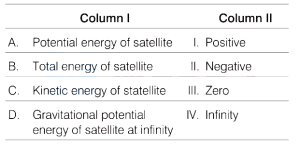
Match the following columns.
| $A$. Potential energy of satellite | $I$. Positive |
| $B$. Total energy of satellite | $II$. Negative |
| $C$. Kinetic energy of satellite | $III$. Zero |
| $D$. Gravitational potential energy of satellite at infinity | $IV$. Infinity |
A
$A-II, B-II, C-I, D-III$
B
$A-II, B-II, C-I, D-IV$
C
$A-I, B-II, C-I, D-III$
D
$A-II, B-II, C-I, D-II$
Solution
(A) The potential energy $(U)$ of a satellite at a distance $r$ from the center of the Earth is given by $U = -\frac{GMm}{r}$. Since the gravitational force is attractive,the potential energy is always negative.
The kinetic energy $(K)$ of a satellite is given by $K = \frac{GMm}{2r}$. Since $G, M, m,$ and $r$ are all positive,the kinetic energy is always positive.
The total energy $(TE)$ of the satellite is the sum of its kinetic and potential energies:
$TE = K + U = \frac{GMm}{2r} - \frac{GMm}{r} = -\frac{GMm}{2r}$.
Thus,the total energy is always negative.
The gravitational potential energy of a satellite at infinity $(r = \infty)$ is:
$U = -\frac{GMm}{\infty} = 0$.
Comparing these results with the given columns:
$A$ (Potential energy) $\rightarrow II$ (Negative)
$B$ (Total energy) $\rightarrow II$ (Negative)
$C$ (Kinetic energy) $\rightarrow I$ (Positive)
$D$ (Potential energy at infinity) $\rightarrow III$ (Zero)
The correct matching is $A-II, B-II, C-I, D-III$.
The kinetic energy $(K)$ of a satellite is given by $K = \frac{GMm}{2r}$. Since $G, M, m,$ and $r$ are all positive,the kinetic energy is always positive.
The total energy $(TE)$ of the satellite is the sum of its kinetic and potential energies:
$TE = K + U = \frac{GMm}{2r} - \frac{GMm}{r} = -\frac{GMm}{2r}$.
Thus,the total energy is always negative.
The gravitational potential energy of a satellite at infinity $(r = \infty)$ is:
$U = -\frac{GMm}{\infty} = 0$.
Comparing these results with the given columns:
$A$ (Potential energy) $\rightarrow II$ (Negative)
$B$ (Total energy) $\rightarrow II$ (Negative)
$C$ (Kinetic energy) $\rightarrow I$ (Positive)
$D$ (Potential energy at infinity) $\rightarrow III$ (Zero)
The correct matching is $A-II, B-II, C-I, D-III$.
0 likes
View Solution75
DifficultMCQ
$A$ launching vehicle carrying an artificial satellite of mass $m$ is set for launch on the surface of the earth of mass $M$ and radius $R$. If the satellite is intended to move in a circular orbit of radius $7R$,the minimum energy required to be spent by the launching vehicle on the satellite is ($G$ is the gravitational constant).
A
$\frac{GMm}{R}$
B
$\frac{13GMm}{14R}$
C
$\frac{GMm}{7R}$
D
$\frac{GMm}{14R}$
Solution
(B) The total energy of the satellite on the surface of the earth is the sum of its potential energy and kinetic energy. Since it is at rest on the surface,its kinetic energy is $0$. Thus,$E_1 = -\frac{GMm}{R}$.
When the satellite is in a circular orbit of radius $r = 7R$,its total energy is given by $E_2 = -\frac{GMm}{2r}$.
Substituting $r = 7R$,we get $E_2 = -\frac{GMm}{2(7R)} = -\frac{GMm}{14R}$.
The minimum energy required to be spent by the launching vehicle is the difference between the final energy and the initial energy: $\Delta E = E_2 - E_1$.
$\Delta E = -\frac{GMm}{14R} - (-\frac{GMm}{R}) = -\frac{GMm}{14R} + \frac{GMm}{R}$.
$\Delta E = \frac{-GMm + 14GMm}{14R} = \frac{13GMm}{14R}$.
When the satellite is in a circular orbit of radius $r = 7R$,its total energy is given by $E_2 = -\frac{GMm}{2r}$.
Substituting $r = 7R$,we get $E_2 = -\frac{GMm}{2(7R)} = -\frac{GMm}{14R}$.
The minimum energy required to be spent by the launching vehicle is the difference between the final energy and the initial energy: $\Delta E = E_2 - E_1$.
$\Delta E = -\frac{GMm}{14R} - (-\frac{GMm}{R}) = -\frac{GMm}{14R} + \frac{GMm}{R}$.
$\Delta E = \frac{-GMm + 14GMm}{14R} = \frac{13GMm}{14R}$.
0 likes
View Solution76
EasyMCQ
$A$ satellite of mass $m$ rotates around the Earth in a circular orbit of radius $R$. If the angular momentum of the satellite is $J$,then its kinetic energy $(K)$ and the total energy $(E)$ of the satellite are:
A
$K=\frac{J^2}{m R^2}, E=-\frac{J^2}{2 m R^2}$
B
$K=\frac{J^2}{2 m R^2}, E=-\frac{J^2}{2 m R^2}$
C
$K=\frac{J^2}{2 m R^2}, E=-\frac{J^2}{m R^2}$
D
$K=\frac{J^2}{2 m R^2}, E=\frac{J^2}{m R^2}$
Solution
(B) The moment of inertia of a satellite of mass $m$ at a distance $R$ from the center of the Earth is $I = m R^2$.
The kinetic energy $(K)$ of the satellite in terms of angular momentum $(J)$ is given by $K = \frac{J^2}{2 I}$.
Substituting $I = m R^2$,we get $K = \frac{J^2}{2 m R^2}$.
For a satellite in a circular orbit,the total energy $(E)$ is related to the kinetic energy $(K)$ by the relation $E = -K$.
Therefore,$E = -\frac{J^2}{2 m R^2}$.
Thus,the correct option is $B$.
The kinetic energy $(K)$ of the satellite in terms of angular momentum $(J)$ is given by $K = \frac{J^2}{2 I}$.
Substituting $I = m R^2$,we get $K = \frac{J^2}{2 m R^2}$.
For a satellite in a circular orbit,the total energy $(E)$ is related to the kinetic energy $(K)$ by the relation $E = -K$.
Therefore,$E = -\frac{J^2}{2 m R^2}$.
Thus,the correct option is $B$.
0 likes
View Solution77
EasyMCQ
$A$ satellite has kinetic energy $K$,potential energy $V$,and total energy $E$. Which of the following statements is true?
A
$K = -V / 2$
B
$K = V / 2$
C
$E = K / 2$
D
$E = -K / 2$
Solution
(A) For a satellite of mass $m$ orbiting a planet of mass $M$ at a distance $a$ (orbital radius),the energies are given by:
Kinetic energy,$K = \frac{GMm}{2a}$
Potential energy,$V = -\frac{GMm}{a}$
Total energy,$E = K + V = \frac{GMm}{2a} - \frac{GMm}{a} = -\frac{GMm}{2a}$
Comparing these expressions:
$V = -\frac{GMm}{a} = -2 \left( \frac{GMm}{2a} \right) = -2K$
Therefore,$K = -V / 2$.
Kinetic energy,$K = \frac{GMm}{2a}$
Potential energy,$V = -\frac{GMm}{a}$
Total energy,$E = K + V = \frac{GMm}{2a} - \frac{GMm}{a} = -\frac{GMm}{2a}$
Comparing these expressions:
$V = -\frac{GMm}{a} = -2 \left( \frac{GMm}{2a} \right) = -2K$
Therefore,$K = -V / 2$.
0 likes
View Solution78
EasyMCQ
An artificial satellite moves in a circular orbit around the earth. The total energy of the satellite is given by $E$. The potential energy of the satellite is
A
$-2 E$
B
$2 E$
C
$\frac{2 E}{3}$
D
$-\frac{2 E}{3}$
Solution
(B) For a satellite in a circular orbit of radius $r$ around the Earth of mass $M$,the potential energy $U$ is given by $U = -\frac{G M m}{r}$.
The kinetic energy $K$ of the satellite is given by $K = \frac{G M m}{2 r}$.
The total energy $E$ is the sum of potential and kinetic energy:
$E = U + K = -\frac{G M m}{r} + \frac{G M m}{2 r} = -\frac{G M m}{2 r}$.
Comparing the expressions for $U$ and $E$:
$U = -\frac{G M m}{r}$
$E = -\frac{G M m}{2 r}$
Therefore,$U = 2 \times (- \frac{G M m}{2 r}) = 2 E$.
Wait,let us re-evaluate: $U = -\frac{G M m}{r}$ and $E = -\frac{G M m}{2 r}$.
Thus,$U = 2 E$ is incorrect. The correct relation is $U = 2 E$ if $E$ were defined differently,but here $U = 2 E$ is not correct. Let's re-check: $U = -\frac{G M m}{r}$ and $E = -\frac{G M m}{2 r}$.
So,$U = 2 \times (-\frac{G M m}{2 r}) = 2 E$.
Actually,$U = 2 E$ is correct because $2 \times (- \frac{G M m}{2 r}) = - \frac{G M m}{r} = U$.
The kinetic energy $K$ of the satellite is given by $K = \frac{G M m}{2 r}$.
The total energy $E$ is the sum of potential and kinetic energy:
$E = U + K = -\frac{G M m}{r} + \frac{G M m}{2 r} = -\frac{G M m}{2 r}$.
Comparing the expressions for $U$ and $E$:
$U = -\frac{G M m}{r}$
$E = -\frac{G M m}{2 r}$
Therefore,$U = 2 \times (- \frac{G M m}{2 r}) = 2 E$.
Wait,let us re-evaluate: $U = -\frac{G M m}{r}$ and $E = -\frac{G M m}{2 r}$.
Thus,$U = 2 E$ is incorrect. The correct relation is $U = 2 E$ if $E$ were defined differently,but here $U = 2 E$ is not correct. Let's re-check: $U = -\frac{G M m}{r}$ and $E = -\frac{G M m}{2 r}$.
So,$U = 2 \times (-\frac{G M m}{2 r}) = 2 E$.
Actually,$U = 2 E$ is correct because $2 \times (- \frac{G M m}{2 r}) = - \frac{G M m}{r} = U$.
0 likes
View Solution79
DifficultMCQ
Initially,a satellite of $100 \ kg$ is in a circular orbit of radius $1.5 R_E$. This satellite can be moved to a circular orbit of radius $3 R_E$ by supplying $\alpha \times 10^6 \ J$ of energy. The value of $\alpha$ is . . . . . . .
(Take Radius of Earth $R_E = 6 \times 10^6 \ m$ and $g = 10 \ m/s^2$)
(Take Radius of Earth $R_E = 6 \times 10^6 \ m$ and $g = 10 \ m/s^2$)
A
$150$
B
$500$
C
$100$
D
$1000$
Solution
(D) The energy of a satellite in a circular orbit is given by $E = -\frac{GM_E m}{2r}$,where $r$ is the radius of the circular orbit.
The energy to be supplied is $\Delta E = E_f - E_i$.
$\Delta E = \left( -\frac{GM_E m}{2(3R_E)} \right) - \left( -\frac{GM_E m}{2(1.5R_E)} \right)$
$\Delta E = \frac{GM_E m}{2R_E} \left( \frac{1}{1.5} - \frac{1}{3} \right) = \frac{GM_E m}{2R_E} \left( \frac{2}{3} - \frac{1}{3} \right) = \frac{GM_E m}{6R_E}$.
Using the relation $g = \frac{GM_E}{R_E^2}$,we have $GM_E = gR_E^2$.
Substituting this into the expression for $\Delta E$:
$\Delta E = \frac{gR_E^2 m}{6R_E} = \frac{1}{6} mgR_E$.
Given $m = 100 \ kg$,$g = 10 \ m/s^2$,and $R_E = 6 \times 10^6 \ m$:
$\Delta E = \frac{1}{6} \times 100 \times 10 \times 6 \times 10^6 = 1000 \times 10^6 \ J$.
Comparing this with $\alpha \times 10^6 \ J$,we get $\alpha = 1000$.
The energy to be supplied is $\Delta E = E_f - E_i$.
$\Delta E = \left( -\frac{GM_E m}{2(3R_E)} \right) - \left( -\frac{GM_E m}{2(1.5R_E)} \right)$
$\Delta E = \frac{GM_E m}{2R_E} \left( \frac{1}{1.5} - \frac{1}{3} \right) = \frac{GM_E m}{2R_E} \left( \frac{2}{3} - \frac{1}{3} \right) = \frac{GM_E m}{6R_E}$.
Using the relation $g = \frac{GM_E}{R_E^2}$,we have $GM_E = gR_E^2$.
Substituting this into the expression for $\Delta E$:
$\Delta E = \frac{gR_E^2 m}{6R_E} = \frac{1}{6} mgR_E$.
Given $m = 100 \ kg$,$g = 10 \ m/s^2$,and $R_E = 6 \times 10^6 \ m$:
$\Delta E = \frac{1}{6} \times 100 \times 10 \times 6 \times 10^6 = 1000 \times 10^6 \ J$.
Comparing this with $\alpha \times 10^6 \ J$,we get $\alpha = 1000$.
0 likes
View SolutionGravitation — Energy consideration in Planetary and Satellite motion · Frequently Asked Questions
1Are these Gravitation questions useful for JEE and NEET?
Yes. All questions in this section are mapped to JEE Main and NEET exam patterns. Previous year questions from JEE Main, NEET, GUJCET and state-level exams are included with full solutions.
2Can I switch to Hindi or Gujarati for these questions?
Yes. Use the language tabs in the hero section or the sidebar to view the same questions and solutions in English, Hindi or Gujarati.
3How do I generate a question paper from this subtopic?
Use the Vedclass Exam Paper Generator — select the chapter and subtopic, set difficulty, and generate Sets A, B, C, D automatically. First 3 chapters of every subject are free.
Vedclass Products
For Students
Vedclass Test Series
Mock tests in real JEE/NEET style with performance analysis. 5-day free trial.
Start Free TrialFor Teachers
Exam Paper Generator
Generate Set A/B/C/D papers from this chapter in 2 minutes. 3 chapters free.
Try FreeFor Institutes
Online Exam Module
Live online exams with unlimited students, 360° analytics & white-label branding.
See DemoFor Teachers & Institutes
Generate a Gravitation Exam Paper in 2 Minutes
Select subtopic & difficulty — Sets A, B, C, D auto-generated with No Repeat logic.
First 3 chapters of every subject are free — no payment required.