
A English
Addition and Subtraction of Vectors Questions in English
Class 11 Physics · 3-1.Vectors · Addition and Subtraction of Vectors
221+
Questions
English
Language
100%
With Solutions
Showing 18 of 221 questions in English
201
EasyMCQ
Among the given pairs of vectors,the resultant of two vectors can never be $3$ units. The vectors are
A
$1$ unit and $2$ units
B
$2$ units and $5$ units
C
$3$ units and $6$ units
D
$4$ units and $8$ units
Solution
(D) The resultant $R$ of two vectors $A$ and $B$ lies in the range $|A-B| \leq R \leq |A+B|$.
For option $A$: $|1-2| \leq R \leq |1+2| \implies 1 \leq R \leq 3$. Since $3$ is in the range,the resultant can be $3$.
For option $B$: $|2-5| \leq R \leq |2+5| \implies 3 \leq R \leq 7$. Since $3$ is in the range,the resultant can be $3$.
For option $C$: $|3-6| \leq R \leq |3+6| \implies 3 \leq R \leq 9$. Since $3$ is in the range,the resultant can be $3$.
For option $D$: $|4-8| \leq R \leq |4+8| \implies 4 \leq R \leq 12$. The range is $[4, 12]$. Since $3$ is not in this range,the resultant can never be $3$ units.
For option $A$: $|1-2| \leq R \leq |1+2| \implies 1 \leq R \leq 3$. Since $3$ is in the range,the resultant can be $3$.
For option $B$: $|2-5| \leq R \leq |2+5| \implies 3 \leq R \leq 7$. Since $3$ is in the range,the resultant can be $3$.
For option $C$: $|3-6| \leq R \leq |3+6| \implies 3 \leq R \leq 9$. Since $3$ is in the range,the resultant can be $3$.
For option $D$: $|4-8| \leq R \leq |4+8| \implies 4 \leq R \leq 12$. The range is $[4, 12]$. Since $3$ is not in this range,the resultant can never be $3$ units.
0 likes
View Solution202
EasyMCQ
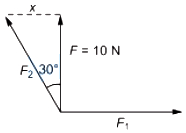
The resultant of two forces acting at an angle of $120^{\circ}$ is $10 \,kg$-wt and is perpendicular to one of the forces. That force is
A
$10 \sqrt{3} \,kg$-wt
B
$20 \sqrt{3} \,kg$-wt
C
$10 \,kg$-wt
D
$\frac{10}{\sqrt{3}} \,kg$-wt
Solution
(D) Let the two forces be $F_1$ and $F_2$. The angle between them is $\theta = 120^{\circ}$.
Let the resultant $R = 10 \,kg$-wt be perpendicular to force $F_1$.
Using the formula for the angle $\alpha$ that the resultant makes with force $F_1$:
$\tan \alpha = \frac{F_2 \sin \theta}{F_1 + F_2 \cos \theta}$
Since the resultant is perpendicular to $F_1$, $\alpha = 90^{\circ}$, so $\tan 90^{\circ} = \infty$.
This implies the denominator must be zero: $F_1 + F_2 \cos 120^{\circ} = 0$.
$F_1 + F_2 (-0.5) = 0 \implies F_1 = 0.5 F_2 \implies F_2 = 2 F_1$.
The magnitude of the resultant is given by $R^2 = F_1^2 + F_2^2 + 2 F_1 F_2 \cos 120^{\circ}$.
$10^2 = F_1^2 + (2 F_1)^2 + 2 F_1 (2 F_1) (-0.5)$.
$100 = F_1^2 + 4 F_1^2 - 2 F_1^2 = 3 F_1^2$.
$F_1^2 = \frac{100}{3} \implies F_1 = \frac{10}{\sqrt{3}} \,kg$-wt.
Thus, the force perpendicular to the resultant is $\frac{10}{\sqrt{3}} \,kg$-wt.
Let the resultant $R = 10 \,kg$-wt be perpendicular to force $F_1$.
Using the formula for the angle $\alpha$ that the resultant makes with force $F_1$:
$\tan \alpha = \frac{F_2 \sin \theta}{F_1 + F_2 \cos \theta}$
Since the resultant is perpendicular to $F_1$, $\alpha = 90^{\circ}$, so $\tan 90^{\circ} = \infty$.
This implies the denominator must be zero: $F_1 + F_2 \cos 120^{\circ} = 0$.
$F_1 + F_2 (-0.5) = 0 \implies F_1 = 0.5 F_2 \implies F_2 = 2 F_1$.
The magnitude of the resultant is given by $R^2 = F_1^2 + F_2^2 + 2 F_1 F_2 \cos 120^{\circ}$.
$10^2 = F_1^2 + (2 F_1)^2 + 2 F_1 (2 F_1) (-0.5)$.
$100 = F_1^2 + 4 F_1^2 - 2 F_1^2 = 3 F_1^2$.
$F_1^2 = \frac{100}{3} \implies F_1 = \frac{10}{\sqrt{3}} \,kg$-wt.
Thus, the force perpendicular to the resultant is $\frac{10}{\sqrt{3}} \,kg$-wt.
0 likes
View Solution203
MediumMCQ
The magnitudes of two vectors are $A$ and $B$ $(A > B)$. If the maximum resultant magnitude of the two vectors is $n$ times their minimum resultant magnitude,then $\frac{A}{B} =$
A
$\frac{n}{n-1}$
B
$\frac{n+1}{n}$
C
$\frac{n^2+1}{n-1}$
D
$\frac{n+1}{n-1}$
Solution
(D) The maximum resultant magnitude of two vectors $A$ and $B$ is given by $R_{max} = A + B$.
The minimum resultant magnitude of two vectors $A$ and $B$ is given by $R_{min} = A - B$.
According to the problem,$R_{max} = n \cdot R_{min}$.
Substituting the expressions,we get $A + B = n(A - B)$.
Expanding the equation: $A + B = nA - nB$.
Rearranging the terms to group $A$ and $B$: $A - nA = -nB - B$.
$A(1 - n) = -B(n + 1)$.
Dividing both sides by $B(1 - n)$: $\frac{A}{B} = \frac{-(n + 1)}{1 - n}$.
Multiplying the numerator and denominator by $-1$: $\frac{A}{B} = \frac{n + 1}{n - 1}$.
The minimum resultant magnitude of two vectors $A$ and $B$ is given by $R_{min} = A - B$.
According to the problem,$R_{max} = n \cdot R_{min}$.
Substituting the expressions,we get $A + B = n(A - B)$.
Expanding the equation: $A + B = nA - nB$.
Rearranging the terms to group $A$ and $B$: $A - nA = -nB - B$.
$A(1 - n) = -B(n + 1)$.
Dividing both sides by $B(1 - n)$: $\frac{A}{B} = \frac{-(n + 1)}{1 - n}$.
Multiplying the numerator and denominator by $-1$: $\frac{A}{B} = \frac{n + 1}{n - 1}$.
0 likes
View Solution204
MediumMCQ
Three vectors each of magnitude $3 \sqrt{1.5}$ units are acting at a point. If the angle between any two vectors is $\frac{\pi}{3}$,then the magnitude of the resultant vector of the three vectors is
A
$9 \sqrt{3}$ units
B
$9$ units
C
$\sqrt{6}$ units
D
$3$ units
Solution
(B) Let the three vectors be $\vec{A}$,$\vec{B}$,and $\vec{C}$. The magnitude of each vector is $A = B = C = 3 \sqrt{1.5} = 3 \sqrt{\frac{3}{2}}$.
Since the angle between any two vectors is $\frac{\pi}{3}$ $(60^\circ)$,we can place them in a 3D coordinate system.
Let $\vec{A} = A \hat{i}$.
Since the angle between $\vec{A}$ and $\vec{B}$ is $60^\circ$,$\vec{B} = A(\cos 60^\circ \hat{i} + \sin 60^\circ \hat{j}) = A(\frac{1}{2} \hat{i} + \frac{\sqrt{3}}{2} \hat{j})$.
For the third vector $\vec{C}$,it must make a $60^\circ$ angle with both $\vec{A}$ and $\vec{B}$. This implies $\vec{C}$ lies in the plane formed by $\vec{A}$ and $\vec{B}$ or out of it. However,in 3D space,three vectors with $60^\circ$ between each pair form the edges of a regular tetrahedron.
The resultant vector $\vec{R} = \vec{A} + \vec{B} + \vec{C}$.
The magnitude squared is $R^2 = A^2 + B^2 + C^2 + 2(AB \cos 60^\circ + BC \cos 60^\circ + CA \cos 60^\circ)$.
$R^2 = 3A^2 + 2(3 \cdot A^2 \cdot \frac{1}{2}) = 3A^2 + 3A^2 = 6A^2$.
Given $A = 3 \sqrt{1.5} = 3 \sqrt{\frac{3}{2}}$,then $A^2 = 9 \cdot \frac{3}{2} = 13.5$.
$R^2 = 6 \times 13.5 = 81$.
$R = \sqrt{81} = 9$ units.
Since the angle between any two vectors is $\frac{\pi}{3}$ $(60^\circ)$,we can place them in a 3D coordinate system.
Let $\vec{A} = A \hat{i}$.
Since the angle between $\vec{A}$ and $\vec{B}$ is $60^\circ$,$\vec{B} = A(\cos 60^\circ \hat{i} + \sin 60^\circ \hat{j}) = A(\frac{1}{2} \hat{i} + \frac{\sqrt{3}}{2} \hat{j})$.
For the third vector $\vec{C}$,it must make a $60^\circ$ angle with both $\vec{A}$ and $\vec{B}$. This implies $\vec{C}$ lies in the plane formed by $\vec{A}$ and $\vec{B}$ or out of it. However,in 3D space,three vectors with $60^\circ$ between each pair form the edges of a regular tetrahedron.
The resultant vector $\vec{R} = \vec{A} + \vec{B} + \vec{C}$.
The magnitude squared is $R^2 = A^2 + B^2 + C^2 + 2(AB \cos 60^\circ + BC \cos 60^\circ + CA \cos 60^\circ)$.
$R^2 = 3A^2 + 2(3 \cdot A^2 \cdot \frac{1}{2}) = 3A^2 + 3A^2 = 6A^2$.
Given $A = 3 \sqrt{1.5} = 3 \sqrt{\frac{3}{2}}$,then $A^2 = 9 \cdot \frac{3}{2} = 13.5$.
$R^2 = 6 \times 13.5 = 81$.
$R = \sqrt{81} = 9$ units.
0 likes
View Solution205
EasyMCQ
The angle made by the resultant vector of two vectors $2 \hat{i}+3 \hat{j}+4 \hat{k}$ and $2 \hat{i}-7 \hat{j}-4 \hat{k}$ with the $x$-axis is (in $^{\circ}$)
A
$60$
B
$45$
C
$90$
D
$120$
Solution
(B) Let the two vectors be $\overrightarrow{A} = 2 \hat{i} + 3 \hat{j} + 4 \hat{k}$ and $\overrightarrow{B} = 2 \hat{i} - 7 \hat{j} - 4 \hat{k}$.
The resultant vector $\overrightarrow{R} = \overrightarrow{A} + \overrightarrow{B} = (2+2) \hat{i} + (3-7) \hat{j} + (4-4) \hat{k} = 4 \hat{i} - 4 \hat{j} + 0 \hat{k}$.
The magnitude of the resultant vector is $R = \sqrt{(4)^2 + (-4)^2 + (0)^2} = \sqrt{16 + 16} = \sqrt{32} = 4\sqrt{2}$.
The angle $\theta$ made by the resultant vector with the $x$-axis is given by $\cos \theta = \frac{R_x}{R}$.
Here,$R_x = 4$.
So,$\cos \theta = \frac{4}{4\sqrt{2}} = \frac{1}{\sqrt{2}}$.
Therefore,$\theta = 45^{\circ}$.
The resultant vector $\overrightarrow{R} = \overrightarrow{A} + \overrightarrow{B} = (2+2) \hat{i} + (3-7) \hat{j} + (4-4) \hat{k} = 4 \hat{i} - 4 \hat{j} + 0 \hat{k}$.
The magnitude of the resultant vector is $R = \sqrt{(4)^2 + (-4)^2 + (0)^2} = \sqrt{16 + 16} = \sqrt{32} = 4\sqrt{2}$.
The angle $\theta$ made by the resultant vector with the $x$-axis is given by $\cos \theta = \frac{R_x}{R}$.
Here,$R_x = 4$.
So,$\cos \theta = \frac{4}{4\sqrt{2}} = \frac{1}{\sqrt{2}}$.
Therefore,$\theta = 45^{\circ}$.
0 likes
View Solution206
EasyMCQ
Two forces whose magnitudes are in the ratio $5:3$ are acting at a point at an angle $60^{\circ}$ simultaneously. If the resultant of the two forces is $35 \ N$,then the magnitudes of the two forces respectively are
A
$3 \ N, 5 \ N$
B
$25 \ N, 9 \ N$
C
$25 \ N, 15 \ N$
D
$12 \ N, 20 \ N$
Solution
(C) Let the two forces be $F_1 = 5x$ and $F_2 = 3x$.
Given the resultant $R = 35 \ N$ and the angle $\theta = 60^{\circ}$.
The formula for the resultant of two vectors is $R = \sqrt{F_1^2 + F_2^2 + 2F_1F_2 \cos \theta}$.
Substituting the values: $35 = \sqrt{(5x)^2 + (3x)^2 + 2(5x)(3x) \cos 60^{\circ}}$.
Since $\cos 60^{\circ} = 0.5$,we have $35 = \sqrt{25x^2 + 9x^2 + 30x^2(0.5)}$.
$35 = \sqrt{25x^2 + 9x^2 + 15x^2} = \sqrt{49x^2} = 7x$.
Solving for $x$: $x = 35 / 7 = 5$.
Therefore,$F_1 = 5 \times 5 = 25 \ N$ and $F_2 = 3 \times 5 = 15 \ N$.
Given the resultant $R = 35 \ N$ and the angle $\theta = 60^{\circ}$.
The formula for the resultant of two vectors is $R = \sqrt{F_1^2 + F_2^2 + 2F_1F_2 \cos \theta}$.
Substituting the values: $35 = \sqrt{(5x)^2 + (3x)^2 + 2(5x)(3x) \cos 60^{\circ}}$.
Since $\cos 60^{\circ} = 0.5$,we have $35 = \sqrt{25x^2 + 9x^2 + 30x^2(0.5)}$.
$35 = \sqrt{25x^2 + 9x^2 + 15x^2} = \sqrt{49x^2} = 7x$.
Solving for $x$: $x = 35 / 7 = 5$.
Therefore,$F_1 = 5 \times 5 = 25 \ N$ and $F_2 = 3 \times 5 = 15 \ N$.
0 likes
View Solution207
EasyMCQ
The sum of the magnitudes of two vectors acting at a point is $18$ and the magnitude of their resultant is $12$. If the resultant is at $90^{\circ}$ with the vector of smaller magnitude,then the magnitudes of the vectors are
A
$5, 13$
B
$2, 16$
C
$6, 12$
D
$8, 10$
Solution
(A) Let the two vectors be $\vec{A}$ and $\vec{B}$,where $|\vec{A}|$ is the smaller magnitude.
Given: $|\vec{A}| + |\vec{B}| = 18$ and $|\vec{R}| = 12$.
Let $|\vec{A}| = x$,then $|\vec{B}| = 18 - x$.
Since the resultant $\vec{R}$ is at $90^{\circ}$ to the smaller vector $\vec{A}$,we have the relation: $|\vec{R}|^2 + |\vec{A}|^2 = |\vec{B}|^2$.
Substituting the values: $12^2 + x^2 = (18 - x)^2$.
$144 + x^2 = 324 + x^2 - 36x$.
$36x = 324 - 144$.
$36x = 180$.
$x = 5$.
Thus,$|\vec{A}| = 5$ and $|\vec{B}| = 18 - 5 = 13$.
Given: $|\vec{A}| + |\vec{B}| = 18$ and $|\vec{R}| = 12$.
Let $|\vec{A}| = x$,then $|\vec{B}| = 18 - x$.
Since the resultant $\vec{R}$ is at $90^{\circ}$ to the smaller vector $\vec{A}$,we have the relation: $|\vec{R}|^2 + |\vec{A}|^2 = |\vec{B}|^2$.
Substituting the values: $12^2 + x^2 = (18 - x)^2$.
$144 + x^2 = 324 + x^2 - 36x$.
$36x = 324 - 144$.
$36x = 180$.
$x = 5$.
Thus,$|\vec{A}| = 5$ and $|\vec{B}| = 18 - 5 = 13$.
0 likes
View Solution208
EasyMCQ
Two vectors $\overrightarrow{a}$ and $\overrightarrow{b}$ are at an angle of $60^{\circ}$ with each other. Their resultant makes an angle of $45^{\circ}$ with $\overrightarrow{a}$. If $|\vec{b}|=2$ units,then $|\vec{a}|$ is
A
$\sqrt{3}$
B
$\sqrt{3}-1$
C
$\sqrt{3}+1$
D
$\frac{\sqrt{3}}{2}$
Solution
(B) The angle between the vectors is $\theta = 60^{\circ}$.
The angle between the resultant vector and $\vec{a}$ is $\phi = 45^{\circ}$.
According to the parallelogram law of vector addition,the angle $\phi$ that the resultant makes with vector $\vec{a}$ is given by:
$\tan(\phi) = \frac{|\vec{b}| \sin(\theta)}{|\vec{a}| + |\vec{b}| \cos(\theta)}$
Substituting the given values $|\vec{b}| = 2$,$\theta = 60^{\circ}$,and $\phi = 45^{\circ}$:
$\tan(45^{\circ}) = \frac{2 \sin(60^{\circ})}{|\vec{a}| + 2 \cos(60^{\circ})}$
Since $\tan(45^{\circ}) = 1$,$\sin(60^{\circ}) = \frac{\sqrt{3}}{2}$,and $\cos(60^{\circ}) = \frac{1}{2}$:
$1 = \frac{2 \times (\frac{\sqrt{3}}{2})}{|\vec{a}| + 2 \times (\frac{1}{2})}$
$1 = \frac{\sqrt{3}}{|\vec{a}| + 1}$
$|\vec{a}| + 1 = \sqrt{3}$
$|\vec{a}| = \sqrt{3} - 1$ units.
The angle between the resultant vector and $\vec{a}$ is $\phi = 45^{\circ}$.
According to the parallelogram law of vector addition,the angle $\phi$ that the resultant makes with vector $\vec{a}$ is given by:
$\tan(\phi) = \frac{|\vec{b}| \sin(\theta)}{|\vec{a}| + |\vec{b}| \cos(\theta)}$
Substituting the given values $|\vec{b}| = 2$,$\theta = 60^{\circ}$,and $\phi = 45^{\circ}$:
$\tan(45^{\circ}) = \frac{2 \sin(60^{\circ})}{|\vec{a}| + 2 \cos(60^{\circ})}$
Since $\tan(45^{\circ}) = 1$,$\sin(60^{\circ}) = \frac{\sqrt{3}}{2}$,and $\cos(60^{\circ}) = \frac{1}{2}$:
$1 = \frac{2 \times (\frac{\sqrt{3}}{2})}{|\vec{a}| + 2 \times (\frac{1}{2})}$
$1 = \frac{\sqrt{3}}{|\vec{a}| + 1}$
$|\vec{a}| + 1 = \sqrt{3}$
$|\vec{a}| = \sqrt{3} - 1$ units.
0 likes
View Solution209
EasyMCQ
$A$ vector $P$ directed along the $X$-axis is added to vector $Q$ which has a magnitude of $10 \ m$. The resultant vector is directed along the $Y$-axis,with a magnitude that is $2$ times that of $P$. The magnitude of $P$ is
A
$\sqrt{10} \ m$
B
$5 \sqrt{2} \ m$
C
$6 \ m$
D
$2 \sqrt{5} \ m$
Solution
(D) Let vector $P = P \hat{i}$.
Since vector $Q$ has a magnitude of $10 \ m$,let $Q = 10 \cos \theta \hat{i} + 10 \sin \theta \hat{j}$.
The resultant vector $R = P + Q = (P + 10 \cos \theta) \hat{i} + (10 \sin \theta) \hat{j}$.
Given that the resultant is directed along the $Y$-axis,the $X$-component must be zero:
$P + 10 \cos \theta = 0 \Rightarrow 10 \cos \theta = -P$.
The magnitude of the resultant is $R = 10 \sin \theta$.
We are given $R = 2P$,so $10 \sin \theta = 2P \Rightarrow 5 \sin \theta = P$.
Using the identity $\sin^2 \theta + \cos^2 \theta = 1$:
$(P/5)^2 + (-P/10)^2 = 1$.
$P^2/25 + P^2/100 = 1$.
$(4P^2 + P^2) / 100 = 1 \Rightarrow 5P^2 = 100$.
$P^2 = 20 \Rightarrow P = \sqrt{20} = 2 \sqrt{5} \ m$.
Since vector $Q$ has a magnitude of $10 \ m$,let $Q = 10 \cos \theta \hat{i} + 10 \sin \theta \hat{j}$.
The resultant vector $R = P + Q = (P + 10 \cos \theta) \hat{i} + (10 \sin \theta) \hat{j}$.
Given that the resultant is directed along the $Y$-axis,the $X$-component must be zero:
$P + 10 \cos \theta = 0 \Rightarrow 10 \cos \theta = -P$.
The magnitude of the resultant is $R = 10 \sin \theta$.
We are given $R = 2P$,so $10 \sin \theta = 2P \Rightarrow 5 \sin \theta = P$.
Using the identity $\sin^2 \theta + \cos^2 \theta = 1$:
$(P/5)^2 + (-P/10)^2 = 1$.
$P^2/25 + P^2/100 = 1$.
$(4P^2 + P^2) / 100 = 1 \Rightarrow 5P^2 = 100$.
$P^2 = 20 \Rightarrow P = \sqrt{20} = 2 \sqrt{5} \ m$.
0 likes
View Solution210
EasyMCQ
The speed of a particle changes from $\sqrt{5} \ m/s$ to $2\sqrt{5} \ m/s$ in a time $t$. If the magnitude of change in its velocity is $5 \ m/s$,the angle between the initial and final velocities of the particle is (in $^{\circ}$)
A
$30$
B
$45$
C
$60$
D
$90$
Solution
(D) Let the initial velocity be $\vec{v}_i$ and the final velocity be $\vec{v}_f$. The magnitudes are given as $|\vec{v}_i| = \sqrt{5} \ m/s$ and $|\vec{v}_f| = 2\sqrt{5} \ m/s$.
The magnitude of the change in velocity is given by $|\Delta \vec{v}| = |\vec{v}_f - \vec{v}_i| = 5 \ m/s$.
Using the law of vector subtraction,the magnitude of the change in velocity is given by:
$|\Delta \vec{v}|^2 = |\vec{v}_f|^2 + |\vec{v}_i|^2 - 2|\vec{v}_f||\vec{v}_i| \cos \theta$,where $\theta$ is the angle between $\vec{v}_i$ and $\vec{v}_f$.
Substituting the given values:
$5^2 = (2\sqrt{5})^2 + (\sqrt{5})^2 - 2(2\sqrt{5})(\sqrt{5}) \cos \theta$
$25 = 20 + 5 - 2(2 \times 5) \cos \theta$
$25 = 25 - 20 \cos \theta$
$0 = -20 \cos \theta$
$\cos \theta = 0$
$\theta = 90^{\circ}$.
Thus,the angle between the initial and final velocities is $90^{\circ}$.
The magnitude of the change in velocity is given by $|\Delta \vec{v}| = |\vec{v}_f - \vec{v}_i| = 5 \ m/s$.
Using the law of vector subtraction,the magnitude of the change in velocity is given by:
$|\Delta \vec{v}|^2 = |\vec{v}_f|^2 + |\vec{v}_i|^2 - 2|\vec{v}_f||\vec{v}_i| \cos \theta$,where $\theta$ is the angle between $\vec{v}_i$ and $\vec{v}_f$.
Substituting the given values:
$5^2 = (2\sqrt{5})^2 + (\sqrt{5})^2 - 2(2\sqrt{5})(\sqrt{5}) \cos \theta$
$25 = 20 + 5 - 2(2 \times 5) \cos \theta$
$25 = 25 - 20 \cos \theta$
$0 = -20 \cos \theta$
$\cos \theta = 0$
$\theta = 90^{\circ}$.
Thus,the angle between the initial and final velocities is $90^{\circ}$.
0 likes
View Solution211
DifficultMCQ
The vector sum of two forces is perpendicular to their vector difference. In that case,the forces
A
cannot be predicted
B
always are equal to each other
C
are equal to each other in magnitude
D
are not equal to each other in magnitude
Solution
(C) Let the two forces in vector form be $\vec{A}$ and $\vec{B}$.
Their vector sum is $(\vec{A} + \vec{B})$ and their vector difference is $(\vec{A} - \vec{B})$.
Since the vector sum and vector difference are perpendicular to each other,their dot product must be zero:
$(\vec{A} + \vec{B}) \cdot (\vec{A} - \vec{B}) = 0$
Expanding the dot product:
$\vec{A} \cdot \vec{A} - \vec{A} \cdot \vec{B} + \vec{B} \cdot \vec{A} - \vec{B} \cdot \vec{B} = 0$
Since the dot product is commutative,$\vec{A} \cdot \vec{B} = \vec{B} \cdot \vec{A}$,so the terms cancel out:
$|\vec{A}|^2 - |\vec{B}|^2 = 0$
$|\vec{A}|^2 = |\vec{B}|^2$
$|\vec{A}| = |\vec{B}|$
Therefore,the two forces are equal in magnitude.
Their vector sum is $(\vec{A} + \vec{B})$ and their vector difference is $(\vec{A} - \vec{B})$.
Since the vector sum and vector difference are perpendicular to each other,their dot product must be zero:
$(\vec{A} + \vec{B}) \cdot (\vec{A} - \vec{B}) = 0$
Expanding the dot product:
$\vec{A} \cdot \vec{A} - \vec{A} \cdot \vec{B} + \vec{B} \cdot \vec{A} - \vec{B} \cdot \vec{B} = 0$
Since the dot product is commutative,$\vec{A} \cdot \vec{B} = \vec{B} \cdot \vec{A}$,so the terms cancel out:
$|\vec{A}|^2 - |\vec{B}|^2 = 0$
$|\vec{A}|^2 = |\vec{B}|^2$
$|\vec{A}| = |\vec{B}|$
Therefore,the two forces are equal in magnitude.
0 likes
View Solution212
EasyMCQ
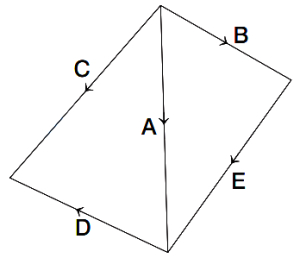
Consider the following vectors. Choose the correct statement.
A
$E=A-B$ and $A=D+C$
B
$-E=-A+B$ and $A=-D+C$
C
$E=-A-B$ and $E=-B+D+C$
D
$E=-A-B$ and $E=-B+C-D$
Solution
(B) Based on the vector addition rule (triangle law) in the provided figure:
In $\triangle PQR$,the vectors $B$ and $E$ are in sequence,and $A$ is the resultant vector closing the triangle in the opposite direction. Thus,$A = B + E$.
Rearranging this gives $E = A - B$,which implies $-E = -(A - B) = -A + B$.
In $\triangle PSR$,the vectors $A$ and $D$ are in sequence,and $C$ is the resultant vector. Thus,$C = A + D$.
Rearranging this gives $A = C - D$,which can be written as $A = -D + C$.
Comparing these results with the given options,option $(b)$ is correct.
In $\triangle PQR$,the vectors $B$ and $E$ are in sequence,and $A$ is the resultant vector closing the triangle in the opposite direction. Thus,$A = B + E$.
Rearranging this gives $E = A - B$,which implies $-E = -(A - B) = -A + B$.
In $\triangle PSR$,the vectors $A$ and $D$ are in sequence,and $C$ is the resultant vector. Thus,$C = A + D$.
Rearranging this gives $A = C - D$,which can be written as $A = -D + C$.
Comparing these results with the given options,option $(b)$ is correct.
0 likes
View Solution213
EasyMCQ
Given that $A_1+A_2=5 A_3$ and $A_1-A_2=3 A_3$,where $A_3=2 \hat{i}+4 \hat{j}$,find the value of $\frac{|A_1|}{|A_2|}$.
A
$4$
B
$8$
C
$2$
D
$6$
Solution
(A) Given equations are:
$A_1+A_2=5 A_3$ ---$(i)$
$A_1-A_2=3 A_3$ ---(ii)
Adding equations $(i)$ and (ii):
$2 A_1 = 8 A_3 \Rightarrow A_1 = 4 A_3$
Since $A_3 = 2 \hat{i} + 4 \hat{j}$,we have $A_1 = 4(2 \hat{i} + 4 \hat{j}) = 8 \hat{i} + 16 \hat{j}$.
Subtracting equation (ii) from $(i)$:
$2 A_2 = 2 A_3 \Rightarrow A_2 = A_3 = 2 \hat{i} + 4 \hat{j}$.
Now,calculating the ratio of magnitudes:
$\frac{|A_1|}{|A_2|} = \frac{|8 \hat{i} + 16 \hat{j}|}{|2 \hat{i} + 4 \hat{j}|} = \frac{\sqrt{8^2 + 16^2}}{\sqrt{2^2 + 4^2}}$
$= \frac{\sqrt{64 + 256}}{\sqrt{4 + 16}} = \frac{\sqrt{320}}{\sqrt{20}} = \sqrt{\frac{320}{20}} = \sqrt{16} = 4$.
$A_1+A_2=5 A_3$ ---$(i)$
$A_1-A_2=3 A_3$ ---(ii)
Adding equations $(i)$ and (ii):
$2 A_1 = 8 A_3 \Rightarrow A_1 = 4 A_3$
Since $A_3 = 2 \hat{i} + 4 \hat{j}$,we have $A_1 = 4(2 \hat{i} + 4 \hat{j}) = 8 \hat{i} + 16 \hat{j}$.
Subtracting equation (ii) from $(i)$:
$2 A_2 = 2 A_3 \Rightarrow A_2 = A_3 = 2 \hat{i} + 4 \hat{j}$.
Now,calculating the ratio of magnitudes:
$\frac{|A_1|}{|A_2|} = \frac{|8 \hat{i} + 16 \hat{j}|}{|2 \hat{i} + 4 \hat{j}|} = \frac{\sqrt{8^2 + 16^2}}{\sqrt{2^2 + 4^2}}$
$= \frac{\sqrt{64 + 256}}{\sqrt{4 + 16}} = \frac{\sqrt{320}}{\sqrt{20}} = \sqrt{\frac{320}{20}} = \sqrt{16} = 4$.
0 likes
View Solution214
EasyMCQ
If $r_1=2 \hat{x}$ and $r_2=2 \hat{y}$,where $\hat{x}$ and $\hat{y}$ are unit vectors along the $X$-axis and $Y$-axis respectively,then the magnitude of $r_1+r_2$ is
A
$2 \sqrt{2}$
B
$2 \sqrt{3}$
C
$3 \sqrt{2}$
D
$\sqrt{3}$
Solution
(A) Given vectors are $r_1 = 2 \hat{x}$ and $r_2 = 2 \hat{y}$.
Their sum is $r_1 + r_2 = 2 \hat{x} + 2 \hat{y}$.
The magnitude of a vector $A = a \hat{x} + b \hat{y}$ is given by $|A| = \sqrt{a^2 + b^2}$.
Therefore,$|r_1 + r_2| = \sqrt{2^2 + 2^2} = \sqrt{4 + 4} = \sqrt{8}$.
Simplifying $\sqrt{8}$,we get $\sqrt{4 \times 2} = 2 \sqrt{2}$.
Their sum is $r_1 + r_2 = 2 \hat{x} + 2 \hat{y}$.
The magnitude of a vector $A = a \hat{x} + b \hat{y}$ is given by $|A| = \sqrt{a^2 + b^2}$.
Therefore,$|r_1 + r_2| = \sqrt{2^2 + 2^2} = \sqrt{4 + 4} = \sqrt{8}$.
Simplifying $\sqrt{8}$,we get $\sqrt{4 \times 2} = 2 \sqrt{2}$.
0 likes
View Solution215
DifficultMCQ
The sum of the magnitudes of two forces is $25 \,N$. The resultant of these forces is perpendicular to the smaller force and has a magnitude of $10 \,N$. The two forces are:
A
$14.5 \,N, 10.5 \,N$
B
$16 \,N, 9 \,N$
C
$13 \,N, 12 \,N$
D
$20 \,N, 5 \,N$
Solution
(A) Let the two forces be $F_1$ and $F_2$, where $F_1$ is the smaller force.
Given: $F_1 + F_2 = 25$ (Equation $1$)
The resultant $R$ is perpendicular to $F_1$. The magnitude of the resultant is $R = 10 \,N$.
Using the triangle law of vector addition, since $R \perp F_1$, we have a right-angled triangle formed by $F_1$, $R$, and $F_2$ (as the hypotenuse).
By Pythagoras theorem: $F_2^2 = F_1^2 + R^2$
$F_2^2 - F_1^2 = 10^2 = 100$
$(F_2 - F_1)(F_2 + F_1) = 100$
Substitute $F_1 + F_2 = 25$ into the equation:
$(F_2 - F_1)(25) = 100$
$F_2 - F_1 = 4$ (Equation $2$)
Adding Equation $1$ and Equation $2$:
$2F_2 = 29 \implies F_2 = 14.5 \,N$
Subtracting Equation $2$ from Equation $1$:
$2F_1 = 21 \implies F_1 = 10.5 \,N$
Thus, the two forces are $14.5 \,N$ and $10.5 \,N$.
Given: $F_1 + F_2 = 25$ (Equation $1$)
The resultant $R$ is perpendicular to $F_1$. The magnitude of the resultant is $R = 10 \,N$.
Using the triangle law of vector addition, since $R \perp F_1$, we have a right-angled triangle formed by $F_1$, $R$, and $F_2$ (as the hypotenuse).
By Pythagoras theorem: $F_2^2 = F_1^2 + R^2$
$F_2^2 - F_1^2 = 10^2 = 100$
$(F_2 - F_1)(F_2 + F_1) = 100$
Substitute $F_1 + F_2 = 25$ into the equation:
$(F_2 - F_1)(25) = 100$
$F_2 - F_1 = 4$ (Equation $2$)
Adding Equation $1$ and Equation $2$:
$2F_2 = 29 \implies F_2 = 14.5 \,N$
Subtracting Equation $2$ from Equation $1$:
$2F_1 = 21 \implies F_1 = 10.5 \,N$
Thus, the two forces are $14.5 \,N$ and $10.5 \,N$.
0 likes
View Solution216
DifficultMCQ
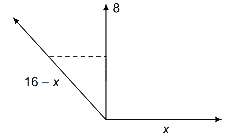
The sum of the magnitudes of two forces acting at a point is $16 \,N$. If their resultant is normal to the smaller force and has a magnitude of $8 \,N$, then the forces are:
A
$6 \,N, 10 \,N$
B
$8 \,N, 8 \,N$
C
$4 \,N, 12 \,N$
D
$2 \,N, 14 \,N$
Solution
(A) Let the two forces be $F_1$ and $F_2$, where $F_1$ is the smaller force. Let $F_1 = x$.
Given that the sum of magnitudes is $16 \,N$, so $F_2 = 16 - x$.
The resultant force $R = 8 \,N$ is normal to the smaller force $F_1$.
Using the vector triangle or the property of the resultant, we have the relation: $F_2^2 = F_1^2 + R^2$.
Substituting the values: $(16 - x)^2 = x^2 + 8^2$.
Expanding the equation: $256 + x^2 - 32x = x^2 + 64$.
Subtracting $x^2$ from both sides: $256 - 32x = 64$.
Rearranging to solve for $x$: $32x = 256 - 64 = 192$.
$x = \frac{192}{32} = 6 \,N$.
Therefore, the smaller force $F_1 = 6 \,N$ and the larger force $F_2 = 16 - 6 = 10 \,N$.
The forces are $6 \,N$ and $10 \,N$.
Given that the sum of magnitudes is $16 \,N$, so $F_2 = 16 - x$.
The resultant force $R = 8 \,N$ is normal to the smaller force $F_1$.
Using the vector triangle or the property of the resultant, we have the relation: $F_2^2 = F_1^2 + R^2$.
Substituting the values: $(16 - x)^2 = x^2 + 8^2$.
Expanding the equation: $256 + x^2 - 32x = x^2 + 64$.
Subtracting $x^2$ from both sides: $256 - 32x = 64$.
Rearranging to solve for $x$: $32x = 256 - 64 = 192$.
$x = \frac{192}{32} = 6 \,N$.
Therefore, the smaller force $F_1 = 6 \,N$ and the larger force $F_2 = 16 - 6 = 10 \,N$.
The forces are $6 \,N$ and $10 \,N$.
0 likes
View Solution217
MediumMCQ
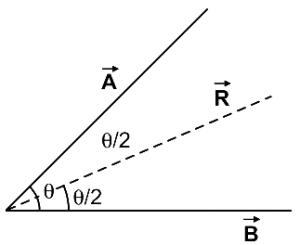
$\overrightarrow{A}$ and $\overrightarrow{B}$ are two vectors of equal magnitudes and $\theta$ is the angle between them. The angle between $\overrightarrow{A}$ or $\overrightarrow{B}$ with their resultant is
A
$\frac{\theta}{4}$
B
$\frac{\theta}{2}$
C
$2 \theta$
D
zero
Solution
(B) Let the magnitudes of the two vectors be $|\overrightarrow{A}| = |\overrightarrow{B}| = a$.
The resultant vector $\overrightarrow{R} = \overrightarrow{A} + \overrightarrow{B}$ makes an angle $\alpha$ with vector $\overrightarrow{A}$,given by the formula:
$\tan \alpha = \frac{B \sin \theta}{A + B \cos \theta}$
Since $A = B = a$,we have:
$\tan \alpha = \frac{a \sin \theta}{a + a \cos \theta} = \frac{\sin \theta}{1 + \cos \theta}$
Using trigonometric identities $\sin \theta = 2 \sin(\frac{\theta}{2}) \cos(\frac{\theta}{2})$ and $1 + \cos \theta = 2 \cos^2(\frac{\theta}{2})$:
$\tan \alpha = \frac{2 \sin(\frac{\theta}{2}) \cos(\frac{\theta}{2})}{2 \cos^2(\frac{\theta}{2})} = \tan(\frac{\theta}{2})$
Therefore,$\alpha = \frac{\theta}{2}$.
This shows that the resultant vector bisects the angle between the two vectors of equal magnitude.
The resultant vector $\overrightarrow{R} = \overrightarrow{A} + \overrightarrow{B}$ makes an angle $\alpha$ with vector $\overrightarrow{A}$,given by the formula:
$\tan \alpha = \frac{B \sin \theta}{A + B \cos \theta}$
Since $A = B = a$,we have:
$\tan \alpha = \frac{a \sin \theta}{a + a \cos \theta} = \frac{\sin \theta}{1 + \cos \theta}$
Using trigonometric identities $\sin \theta = 2 \sin(\frac{\theta}{2}) \cos(\frac{\theta}{2})$ and $1 + \cos \theta = 2 \cos^2(\frac{\theta}{2})$:
$\tan \alpha = \frac{2 \sin(\frac{\theta}{2}) \cos(\frac{\theta}{2})}{2 \cos^2(\frac{\theta}{2})} = \tan(\frac{\theta}{2})$
Therefore,$\alpha = \frac{\theta}{2}$.
This shows that the resultant vector bisects the angle between the two vectors of equal magnitude.
0 likes
View Solution218
EasyMCQ
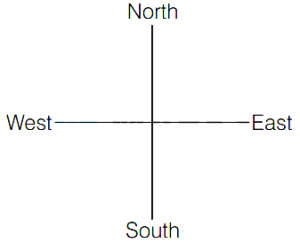
$A$ person moves $30 \,m$ North and then $20 \,m$ towards East and finally $30 \sqrt{2} \,m$ in South-West direction. The displacement of the person from the origin will be
A
$10 \,m$ along North
B
$10 \,m$ along South
C
$10 \,m$ along West
D
zero
Solution
(C) Let the origin be $O(0,0)$.
$1$. The person moves $30 \,m$ North: Position becomes $(0, 30)$.
$2$. Then moves $20 \,m$ East: Position becomes $(20, 30)$.
$3$. Finally moves $30 \sqrt{2} \,m$ in South-West direction. South-West direction makes an angle of $45^{\circ}$ with the South and West axes. The components of this displacement are:
$\Delta x = -30 \sqrt{2} \cos(45^{\circ}) = -30 \sqrt{2} \times \frac{1}{\sqrt{2}} = -30 \,m$
$\Delta y = -30 \sqrt{2} \sin(45^{\circ}) = -30 \sqrt{2} \times \frac{1}{\sqrt{2}} = -30 \,m$
New position = $(20 - 30, 30 - 30) = (-10, 0)$.
The displacement from the origin $(0, 0)$ to $(-10, 0)$ is $10 \,m$ along the West direction.
$1$. The person moves $30 \,m$ North: Position becomes $(0, 30)$.
$2$. Then moves $20 \,m$ East: Position becomes $(20, 30)$.
$3$. Finally moves $30 \sqrt{2} \,m$ in South-West direction. South-West direction makes an angle of $45^{\circ}$ with the South and West axes. The components of this displacement are:
$\Delta x = -30 \sqrt{2} \cos(45^{\circ}) = -30 \sqrt{2} \times \frac{1}{\sqrt{2}} = -30 \,m$
$\Delta y = -30 \sqrt{2} \sin(45^{\circ}) = -30 \sqrt{2} \times \frac{1}{\sqrt{2}} = -30 \,m$
New position = $(20 - 30, 30 - 30) = (-10, 0)$.
The displacement from the origin $(0, 0)$ to $(-10, 0)$ is $10 \,m$ along the West direction.
0 likes
View Solution3-1.Vectors — Addition and Subtraction of Vectors · Frequently Asked Questions
1Are these 3-1.Vectors questions useful for JEE and NEET?
Yes. All questions in this section are mapped to JEE Main and NEET exam patterns. Previous year questions from JEE Main, NEET, GUJCET and state-level exams are included with full solutions.
2Can I switch to Hindi or Gujarati for these questions?
Yes. Use the language tabs in the hero section or the sidebar to view the same questions and solutions in English, Hindi or Gujarati.
3How do I generate a question paper from this subtopic?
Use the Vedclass Exam Paper Generator — select the chapter and subtopic, set difficulty, and generate Sets A, B, C, D automatically. First 3 chapters of every subject are free.
Vedclass Products
For Students
Vedclass Test Series
Mock tests in real JEE/NEET style with performance analysis. 5-day free trial.
Start Free TrialFor Teachers
Exam Paper Generator
Generate Set A/B/C/D papers from this chapter in 2 minutes. 3 chapters free.
Try FreeFor Institutes
Online Exam Module
Live online exams with unlimited students, 360° analytics & white-label branding.
See DemoFor Teachers & Institutes
Generate a 3-1.Vectors Exam Paper in 2 Minutes
Select subtopic & difficulty — Sets A, B, C, D auto-generated with No Repeat logic.
First 3 chapters of every subject are free — no payment required.