
A English
Mix Examples-Trigonometrical Ratios, Functions and Identities Questions in English
Class 11 Mathematics · Trigonometrical Ratios, Functions and Identities · Mix Examples-Trigonometrical Ratios, Functions and Identities
670+
Questions
English
Language
100%
With Solutions
Showing 42 of 670 questions in English
601
DifficultMCQ
If $\cos x + \cos y = \frac{2}{3}$ and $\sin x - \sin y = \frac{3}{4}$,then find the value of $\sin(x - y) + \cos(x - y)$.
A
$\frac{161}{145}$
B
$\frac{127}{145}$
C
$\frac{1}{2}$
D
$\frac{8}{9}$
Solution
(B) Given: $\cos x + \cos y = \frac{2}{3}$ $(i)$
$\sin x - \sin y = \frac{3}{4}$ $(ii)$
Using sum-to-product formulas:
$2 \cos \left(\frac{x+y}{2}\right) \cos \left(\frac{x-y}{2}\right) = \frac{2}{3}$ $(iii)$
$2 \cos \left(\frac{x+y}{2}\right) \sin \left(\frac{x-y}{2}\right) = \frac{3}{4}$ $(iv)$
Dividing $(iv)$ by $(iii)$:
$\tan \left(\frac{x-y}{2}\right) = \frac{3/4}{2/3} = \frac{9}{8}$
Let $\theta = \frac{x-y}{2}$,so $\tan \theta = \frac{9}{8}$.
Then $\sin(x-y) = \sin(2\theta) = \frac{2 \tan \theta}{1 + \tan^2 \theta} = \frac{2(9/8)}{1 + (81/64)} = \frac{9/4}{145/64} = \frac{9}{4} \times \frac{64}{145} = \frac{144}{145}$.
$\cos(x-y) = \cos(2\theta) = \frac{1 - \tan^2 \theta}{1 + \tan^2 \theta} = \frac{1 - (81/64)}{1 + (81/64)} = \frac{-17/64}{145/64} = -\frac{17}{145}$.
Therefore,$\sin(x-y) + \cos(x-y) = \frac{144}{145} - \frac{17}{145} = \frac{127}{145}$.
$\sin x - \sin y = \frac{3}{4}$ $(ii)$
Using sum-to-product formulas:
$2 \cos \left(\frac{x+y}{2}\right) \cos \left(\frac{x-y}{2}\right) = \frac{2}{3}$ $(iii)$
$2 \cos \left(\frac{x+y}{2}\right) \sin \left(\frac{x-y}{2}\right) = \frac{3}{4}$ $(iv)$
Dividing $(iv)$ by $(iii)$:
$\tan \left(\frac{x-y}{2}\right) = \frac{3/4}{2/3} = \frac{9}{8}$
Let $\theta = \frac{x-y}{2}$,so $\tan \theta = \frac{9}{8}$.
Then $\sin(x-y) = \sin(2\theta) = \frac{2 \tan \theta}{1 + \tan^2 \theta} = \frac{2(9/8)}{1 + (81/64)} = \frac{9/4}{145/64} = \frac{9}{4} \times \frac{64}{145} = \frac{144}{145}$.
$\cos(x-y) = \cos(2\theta) = \frac{1 - \tan^2 \theta}{1 + \tan^2 \theta} = \frac{1 - (81/64)}{1 + (81/64)} = \frac{-17/64}{145/64} = -\frac{17}{145}$.
Therefore,$\sin(x-y) + \cos(x-y) = \frac{144}{145} - \frac{17}{145} = \frac{127}{145}$.
0 likes
View Solution602
EasyMCQ
If $\sinh x = \frac{12}{5}$,then $\sinh 3x + \cosh 3x = $
A
$125$
B
$144$
C
$169$
D
$216$
Solution
(A) We know that $\sinh x = \frac{e^x - e^{-x}}{2}$ and $\cosh x = \frac{e^x + e^{-x}}{2}$.
Given $\sinh x = \frac{12}{5}$,we have $\frac{e^x - e^{-x}}{2} = \frac{12}{5}$,which implies $e^x - e^{-x} = \frac{24}{5}$.
Let $e^x = t$. Then $t - \frac{1}{t} = \frac{24}{5}$.
Multiplying by $5t$,we get $5t^2 - 24t - 5 = 0$.
Factoring the quadratic equation: $(5t + 1)(t - 5) = 0$.
Since $e^x = t$ must be positive,$t = 5$,so $e^x = 5$.
We need to find $\sinh 3x + \cosh 3x$.
Using the definitions,$\sinh 3x + \cosh 3x = \frac{e^{3x} - e^{-3x}}{2} + \frac{e^{3x} + e^{-3x}}{2} = e^{3x}$.
Since $e^x = 5$,$e^{3x} = (e^x)^3 = 5^3 = 125$.
Given $\sinh x = \frac{12}{5}$,we have $\frac{e^x - e^{-x}}{2} = \frac{12}{5}$,which implies $e^x - e^{-x} = \frac{24}{5}$.
Let $e^x = t$. Then $t - \frac{1}{t} = \frac{24}{5}$.
Multiplying by $5t$,we get $5t^2 - 24t - 5 = 0$.
Factoring the quadratic equation: $(5t + 1)(t - 5) = 0$.
Since $e^x = t$ must be positive,$t = 5$,so $e^x = 5$.
We need to find $\sinh 3x + \cosh 3x$.
Using the definitions,$\sinh 3x + \cosh 3x = \frac{e^{3x} - e^{-3x}}{2} + \frac{e^{3x} + e^{-3x}}{2} = e^{3x}$.
Since $e^x = 5$,$e^{3x} = (e^x)^3 = 5^3 = 125$.
0 likes
View Solution603
DifficultMCQ
If $\cosh x = \frac{4}{3}$,then $3 \cosh x + 3^2 \cosh 2x + 3^3 \cosh 3x = $
A
$175$
B
$81$
C
$64$
D
$27$
Solution
(A) Given $\cosh x = \frac{4}{3}$.
We know the identity $\cosh 2x = 2 \cosh^2 x - 1$.
$\cosh 2x = 2 \left(\frac{4}{3}\right)^2 - 1 = 2 \left(\frac{16}{9}\right) - 1 = \frac{32}{9} - 1 = \frac{23}{9}$.
We know the identity $\cosh 3x = 4 \cosh^3 x - 3 \cosh x$.
$\cosh 3x = 4 \left(\frac{4}{3}\right)^3 - 3 \left(\frac{4}{3}\right) = 4 \left(\frac{64}{27}\right) - 4 = \frac{256}{27} - 4 = \frac{256 - 108}{27} = \frac{148}{27}$.
Now,substitute these values into the expression $3 \cosh x + 9 \cosh 2x + 27 \cosh 3x$:
$= 3 \left(\frac{4}{3}\right) + 9 \left(\frac{23}{9}\right) + 27 \left(\frac{148}{27}\right)$
$= 4 + 23 + 148 = 175$.
We know the identity $\cosh 2x = 2 \cosh^2 x - 1$.
$\cosh 2x = 2 \left(\frac{4}{3}\right)^2 - 1 = 2 \left(\frac{16}{9}\right) - 1 = \frac{32}{9} - 1 = \frac{23}{9}$.
We know the identity $\cosh 3x = 4 \cosh^3 x - 3 \cosh x$.
$\cosh 3x = 4 \left(\frac{4}{3}\right)^3 - 3 \left(\frac{4}{3}\right) = 4 \left(\frac{64}{27}\right) - 4 = \frac{256}{27} - 4 = \frac{256 - 108}{27} = \frac{148}{27}$.
Now,substitute these values into the expression $3 \cosh x + 9 \cosh 2x + 27 \cosh 3x$:
$= 3 \left(\frac{4}{3}\right) + 9 \left(\frac{23}{9}\right) + 27 \left(\frac{148}{27}\right)$
$= 4 + 23 + 148 = 175$.
0 likes
View Solution604
MediumMCQ
If $A+B+C+D=2 \pi$,then $\cos A-\cos B+\cos C-\cos D=$
A
$-4 \sin \frac{A+B}{2} \cos \frac{A+C}{2} \sin \frac{A+D}{2}$
B
$4 \sin \frac{A+B}{2} \sin \frac{A+C}{2} \sin \frac{A+D}{2}$
C
$-4 \sin \frac{A+B}{2} \sin \frac{A+C}{2} \sin \frac{A+D}{2}$
D
$4 \sin \frac{A+B}{2} \cos \frac{A+C}{2} \sin \frac{A+D}{2}$
Solution
(C) Given $A+B+C+D=2 \pi$.
We have $\cos A - \cos B + \cos C - \cos D = (\cos A - \cos B) + (\cos C - \cos D)$.
Using the formula $\cos X - \cos Y = -2 \sin \frac{X+Y}{2} \sin \frac{X-Y}{2}$,we get:
$= -2 \sin \frac{A+B}{2} \sin \frac{A-B}{2} - 2 \sin \frac{C+D}{2} \sin \frac{C-D}{2}$.
Since $A+B+C+D=2 \pi$,we have $\frac{C+D}{2} = \pi - \frac{A+B}{2}$,so $\sin \frac{C+D}{2} = \sin \frac{A+B}{2}$.
Also,$\frac{C-D}{2} = \frac{(2 \pi - A - B) - 2D}{2} = \pi - \frac{A+B+2D}{2}$.
Using the identity,the expression simplifies to:
$-4 \sin \frac{A+B}{2} \sin \frac{A+C}{2} \sin \frac{A+D}{2}$.
We have $\cos A - \cos B + \cos C - \cos D = (\cos A - \cos B) + (\cos C - \cos D)$.
Using the formula $\cos X - \cos Y = -2 \sin \frac{X+Y}{2} \sin \frac{X-Y}{2}$,we get:
$= -2 \sin \frac{A+B}{2} \sin \frac{A-B}{2} - 2 \sin \frac{C+D}{2} \sin \frac{C-D}{2}$.
Since $A+B+C+D=2 \pi$,we have $\frac{C+D}{2} = \pi - \frac{A+B}{2}$,so $\sin \frac{C+D}{2} = \sin \frac{A+B}{2}$.
Also,$\frac{C-D}{2} = \frac{(2 \pi - A - B) - 2D}{2} = \pi - \frac{A+B+2D}{2}$.
Using the identity,the expression simplifies to:
$-4 \sin \frac{A+B}{2} \sin \frac{A+C}{2} \sin \frac{A+D}{2}$.
0 likes
View Solution605
EasyMCQ
If $\sin x \cdot \cosh y = \cos \theta$ and $\cos x \cdot \sinh y = \sin \theta$,then $\sin^2 x + \cosh^2 y = $
A
$1$
B
$2$
C
$\frac{3}{2}$
D
$\frac{1}{2}$
Solution
(B) Given: $\sin x \cdot \cosh y = \cos \theta$ $(i)$
$\cos x \cdot \sinh y = \sin \theta$ $(ii)$
Squaring and adding $(i)$ and $(ii)$:
$(\sin x \cdot \cosh y)^2 + (\cos x \cdot \sinh y)^2 = \cos^2 \theta + \sin^2 \theta$
$\sin^2 x \cosh^2 y + \cos^2 x \sinh^2 y = 1$
Using $\cosh^2 y = 1 + \sinh^2 y$ and $\cos^2 x = 1 - \sin^2 x$:
$\sin^2 x (1 + \sinh^2 y) + (1 - \sin^2 x) \sinh^2 y = 1$
$\sin^2 x + \sin^2 x \sinh^2 y + \sinh^2 y - \sin^2 x \sinh^2 y = 1$
$\sin^2 x + \sinh^2 y = 1$
Since $\cosh^2 y = 1 + \sinh^2 y$,we have $\sinh^2 y = \cosh^2 y - 1$.
Substituting this into the equation:
$\sin^2 x + (\cosh^2 y - 1) = 1$
$\sin^2 x + \cosh^2 y = 2$
$\cos x \cdot \sinh y = \sin \theta$ $(ii)$
Squaring and adding $(i)$ and $(ii)$:
$(\sin x \cdot \cosh y)^2 + (\cos x \cdot \sinh y)^2 = \cos^2 \theta + \sin^2 \theta$
$\sin^2 x \cosh^2 y + \cos^2 x \sinh^2 y = 1$
Using $\cosh^2 y = 1 + \sinh^2 y$ and $\cos^2 x = 1 - \sin^2 x$:
$\sin^2 x (1 + \sinh^2 y) + (1 - \sin^2 x) \sinh^2 y = 1$
$\sin^2 x + \sin^2 x \sinh^2 y + \sinh^2 y - \sin^2 x \sinh^2 y = 1$
$\sin^2 x + \sinh^2 y = 1$
Since $\cosh^2 y = 1 + \sinh^2 y$,we have $\sinh^2 y = \cosh^2 y - 1$.
Substituting this into the equation:
$\sin^2 x + (\cosh^2 y - 1) = 1$
$\sin^2 x + \cosh^2 y = 2$
0 likes
View Solution606
MediumMCQ
If $\tanh x = \frac{1}{2}$,then $\sinh 2x - \text{sech } 2x = $
A
$\frac{29}{15}$
B
$\frac{11}{15}$
C
$3$
D
$\frac{-13}{15}$
Solution
(B) Given,$\tanh x = \frac{1}{2}$.
We know that $\tanh^2 x = 1 - \text{sech}^2 x$,so $\text{sech}^2 x = 1 - (\frac{1}{2})^2 = 1 - \frac{1}{4} = \frac{3}{4}$.
Thus,$\text{sech } x = \frac{\sqrt{3}}{2}$ and $\cosh x = \frac{2}{\sqrt{3}}$.
Since $\tanh x = \frac{\sinh x}{\cosh x}$,we have $\sinh x = \tanh x \cdot \cosh x = \frac{1}{2} \cdot \frac{2}{\sqrt{3}} = \frac{1}{\sqrt{3}}$.
Now,$\sinh 2x = 2 \sinh x \cosh x = 2 \cdot \frac{1}{\sqrt{3}} \cdot \frac{2}{\sqrt{3}} = \frac{4}{3}$.
And $\text{sech } 2x = \frac{1}{\cosh 2x} = \frac{1}{\cosh^2 x + \sinh^2 x} = \frac{1}{(\frac{2}{\sqrt{3}})^2 + (\frac{1}{\sqrt{3}})^2} = \frac{1}{\frac{4}{3} + \frac{1}{3}} = \frac{1}{\frac{5}{3}} = \frac{3}{5}$.
Therefore,$\sinh 2x - \text{sech } 2x = \frac{4}{3} - \frac{3}{5} = \frac{20 - 9}{15} = \frac{11}{15}$.
We know that $\tanh^2 x = 1 - \text{sech}^2 x$,so $\text{sech}^2 x = 1 - (\frac{1}{2})^2 = 1 - \frac{1}{4} = \frac{3}{4}$.
Thus,$\text{sech } x = \frac{\sqrt{3}}{2}$ and $\cosh x = \frac{2}{\sqrt{3}}$.
Since $\tanh x = \frac{\sinh x}{\cosh x}$,we have $\sinh x = \tanh x \cdot \cosh x = \frac{1}{2} \cdot \frac{2}{\sqrt{3}} = \frac{1}{\sqrt{3}}$.
Now,$\sinh 2x = 2 \sinh x \cosh x = 2 \cdot \frac{1}{\sqrt{3}} \cdot \frac{2}{\sqrt{3}} = \frac{4}{3}$.
And $\text{sech } 2x = \frac{1}{\cosh 2x} = \frac{1}{\cosh^2 x + \sinh^2 x} = \frac{1}{(\frac{2}{\sqrt{3}})^2 + (\frac{1}{\sqrt{3}})^2} = \frac{1}{\frac{4}{3} + \frac{1}{3}} = \frac{1}{\frac{5}{3}} = \frac{3}{5}$.
Therefore,$\sinh 2x - \text{sech } 2x = \frac{4}{3} - \frac{3}{5} = \frac{20 - 9}{15} = \frac{11}{15}$.
0 likes
View Solution607
MediumMCQ
$\frac{e^{4x} + e^{-4x} + 14}{4(e^x - e^{-x})^2} = \dots$
A
$\sinh^2 x + \coth^2 x$
B
$\sinh^2 x + \text{sech}^2 x$
C
$\cosh^2 x + \text{sech}^2 x$
D
$\cosh^2 x + \tanh^2 x$
Solution
(A) Given expression: $E = \frac{e^{4x} + e^{-4x} + 14}{4(e^x - e^{-x})^2}$.
We know that $\sinh x = \frac{e^x - e^{-x}}{2}$,so $(e^x - e^{-x})^2 = 4\sinh^2 x$.
Thus,the denominator is $4(4\sinh^2 x) = 16\sinh^2 x$.
Alternatively,let us evaluate option $A$: $\sinh^2 x + \coth^2 x$.
$\sinh^2 x + \coth^2 x = \left(\frac{e^x - e^{-x}}{2}\right)^2 + \left(\frac{e^x + e^{-x}}{e^x - e^{-x}}\right)^2$
$= \frac{(e^x - e^{-x})^4 + 4(e^x + e^{-x})^2}{4(e^x - e^{-x})^2}$
$= \frac{(e^{2x} + e^{-2x} - 2)^2 + 4(e^{2x} + e^{-2x} + 2)}{4(e^x - e^{-x})^2}$
$= \frac{(e^{4x} + e^{-4x} + 2 - 4e^{2x} - 4e^{-2x} + 2) + 4e^{2x} + 4e^{-2x} + 8}{4(e^x - e^{-x})^2}$
$= \frac{e^{4x} + e^{-4x} + 14}{4(e^x - e^{-x})^2}$.
This matches the given expression. Hence,the correct option is $A$.
We know that $\sinh x = \frac{e^x - e^{-x}}{2}$,so $(e^x - e^{-x})^2 = 4\sinh^2 x$.
Thus,the denominator is $4(4\sinh^2 x) = 16\sinh^2 x$.
Alternatively,let us evaluate option $A$: $\sinh^2 x + \coth^2 x$.
$\sinh^2 x + \coth^2 x = \left(\frac{e^x - e^{-x}}{2}\right)^2 + \left(\frac{e^x + e^{-x}}{e^x - e^{-x}}\right)^2$
$= \frac{(e^x - e^{-x})^4 + 4(e^x + e^{-x})^2}{4(e^x - e^{-x})^2}$
$= \frac{(e^{2x} + e^{-2x} - 2)^2 + 4(e^{2x} + e^{-2x} + 2)}{4(e^x - e^{-x})^2}$
$= \frac{(e^{4x} + e^{-4x} + 2 - 4e^{2x} - 4e^{-2x} + 2) + 4e^{2x} + 4e^{-2x} + 8}{4(e^x - e^{-x})^2}$
$= \frac{e^{4x} + e^{-4x} + 14}{4(e^x - e^{-x})^2}$.
This matches the given expression. Hence,the correct option is $A$.
0 likes
View Solution608
EasyMCQ
If $|\sin \alpha - \cos \alpha| = \frac{3}{4}$,then $|\sec 2\alpha - \tan 2\alpha| = $
A
$\frac{12}{17}$
B
$\frac{4}{\sqrt{23}}$
C
$\frac{3}{\sqrt{23}}$
D
$\frac{7}{\sqrt{23}}$
Solution
(C) Given $|\sin \alpha - \cos \alpha| = \frac{3}{4}$.
Squaring both sides,we get $(\sin \alpha - \cos \alpha)^2 = (\frac{3}{4})^2$.
$\sin^2 \alpha + \cos^2 \alpha - 2 \sin \alpha \cos \alpha = \frac{9}{16}$.
$1 - \sin 2\alpha = \frac{9}{16}$,which implies $\sin 2\alpha = 1 - \frac{9}{16} = \frac{7}{16}$.
Since $\sin 2\alpha = \frac{7}{16}$,we have the perpendicular $P = 7$ and hypotenuse $H = 16$.
The base $B = \sqrt{H^2 - P^2} = \sqrt{16^2 - 7^2} = \sqrt{256 - 49} = \sqrt{207} = 3\sqrt{23}$.
Thus,$\cos 2\alpha = \frac{B}{H} = \frac{3\sqrt{23}}{16}$.
Now,$|\sec 2\alpha - \tan 2\alpha| = |\frac{1}{\cos 2\alpha} - \frac{\sin 2\alpha}{\cos 2\alpha}| = |\frac{1 - \sin 2\alpha}{\cos 2\alpha}|$.
Substituting the values,$|\frac{1 - 7/16}{3\sqrt{23}/16}| = |\frac{9/16}{3\sqrt{23}/16}| = \frac{9}{3\sqrt{23}} = \frac{3}{\sqrt{23}}$.
Therefore,option $C$ is correct.
Squaring both sides,we get $(\sin \alpha - \cos \alpha)^2 = (\frac{3}{4})^2$.
$\sin^2 \alpha + \cos^2 \alpha - 2 \sin \alpha \cos \alpha = \frac{9}{16}$.
$1 - \sin 2\alpha = \frac{9}{16}$,which implies $\sin 2\alpha = 1 - \frac{9}{16} = \frac{7}{16}$.
Since $\sin 2\alpha = \frac{7}{16}$,we have the perpendicular $P = 7$ and hypotenuse $H = 16$.
The base $B = \sqrt{H^2 - P^2} = \sqrt{16^2 - 7^2} = \sqrt{256 - 49} = \sqrt{207} = 3\sqrt{23}$.
Thus,$\cos 2\alpha = \frac{B}{H} = \frac{3\sqrt{23}}{16}$.
Now,$|\sec 2\alpha - \tan 2\alpha| = |\frac{1}{\cos 2\alpha} - \frac{\sin 2\alpha}{\cos 2\alpha}| = |\frac{1 - \sin 2\alpha}{\cos 2\alpha}|$.
Substituting the values,$|\frac{1 - 7/16}{3\sqrt{23}/16}| = |\frac{9/16}{3\sqrt{23}/16}| = \frac{9}{3\sqrt{23}} = \frac{3}{\sqrt{23}}$.
Therefore,option $C$ is correct.
0 likes
View Solution609
DifficultMCQ
If $\sinh x = \tan A$,then $|\tanh x| =$
A
$|\sin A|$
B
$|\cos A|$
C
$|\sec A|$
D
$|\operatorname{cosec} A|$
Solution
(A) Given $\sinh x = \tan A$.
We know that $\sinh x = \frac{e^x - e^{-x}}{2} = \tan A$,so $e^x - e^{-x} = 2 \tan A$.
Let $e^x = t$. Then $t - \frac{1}{t} = 2 \tan A$,which implies $t^2 - 2 \tan A \cdot t - 1 = 0$.
Solving for $t$ using the quadratic formula: $t = \frac{2 \tan A \pm \sqrt{4 \tan^2 A + 4}}{2} = \tan A \pm \sec A$.
Since $e^x > 0$,we take $e^x = \tan A + \sec A$.
Then $e^{-x} = \frac{1}{\sec A + \tan A} = \sec A - \tan A$.
Now,$\tanh x = \frac{e^x - e^{-x}}{e^x + e^{-x}} = \frac{(\tan A + \sec A) - (\sec A - \tan A)}{(\tan A + \sec A) + (\sec A - \tan A)} = \frac{2 \tan A}{2 \sec A} = \frac{\tan A}{\sec A} = \sin A$.
Thus,$|\tanh x| = |\sin A|$.
We know that $\sinh x = \frac{e^x - e^{-x}}{2} = \tan A$,so $e^x - e^{-x} = 2 \tan A$.
Let $e^x = t$. Then $t - \frac{1}{t} = 2 \tan A$,which implies $t^2 - 2 \tan A \cdot t - 1 = 0$.
Solving for $t$ using the quadratic formula: $t = \frac{2 \tan A \pm \sqrt{4 \tan^2 A + 4}}{2} = \tan A \pm \sec A$.
Since $e^x > 0$,we take $e^x = \tan A + \sec A$.
Then $e^{-x} = \frac{1}{\sec A + \tan A} = \sec A - \tan A$.
Now,$\tanh x = \frac{e^x - e^{-x}}{e^x + e^{-x}} = \frac{(\tan A + \sec A) - (\sec A - \tan A)}{(\tan A + \sec A) + (\sec A - \tan A)} = \frac{2 \tan A}{2 \sec A} = \frac{\tan A}{\sec A} = \sin A$.
Thus,$|\tanh x| = |\sin A|$.
0 likes
View Solution610
EasyMCQ
The value of $(1-\cos \theta)(1+\cos \theta)(1+\cot^2 \theta)$,when $\theta = \frac{\pi}{15}$ is
A
$1$
B
$\frac{1}{2}$
C
$\frac{-1}{\sqrt{3}}$
D
$2$
Solution
(A) Given expression: $(1-\cos \theta)(1+\cos \theta)(1+\cot^2 \theta)$
Using the identity $(1-x)(1+x) = 1-x^2$,we get:
$(1-\cos^2 \theta)(1+\cot^2 \theta)$
Using the trigonometric identities $1-\cos^2 \theta = \sin^2 \theta$ and $1+\cot^2 \theta = \operatorname{cosec}^2 \theta$:
$= \sin^2 \theta \cdot \operatorname{cosec}^2 \theta$
$= \sin^2 \theta \cdot \frac{1}{\sin^2 \theta} = 1$
Since the expression simplifies to $1$ regardless of the value of $\theta$ (provided $\sin \theta \neq 0$),for $\theta = \frac{\pi}{15}$,the value is $1$.
Using the identity $(1-x)(1+x) = 1-x^2$,we get:
$(1-\cos^2 \theta)(1+\cot^2 \theta)$
Using the trigonometric identities $1-\cos^2 \theta = \sin^2 \theta$ and $1+\cot^2 \theta = \operatorname{cosec}^2 \theta$:
$= \sin^2 \theta \cdot \operatorname{cosec}^2 \theta$
$= \sin^2 \theta \cdot \frac{1}{\sin^2 \theta} = 1$
Since the expression simplifies to $1$ regardless of the value of $\theta$ (provided $\sin \theta \neq 0$),for $\theta = \frac{\pi}{15}$,the value is $1$.
0 likes
View Solution611
DifficultMCQ
The value of $\cos ^4 \frac{\pi}{8}+\cos ^4 \frac{2 \pi}{8}+\cos ^4 \frac{3 \pi}{8}+\cos ^4 \frac{4 \pi}{8}+\cos ^4 \frac{5 \pi}{8}+\cos ^4 \frac{6 \pi}{8}+\cos ^4 \frac{7 \pi}{8}+\cos ^4 \frac{8 \pi}{8}$ is equal to:
A
$3$
B
$-1$
C
$1$
D
$4$
Solution
(A) Let $S = \sum_{k=1}^{8} \cos^4 \frac{k\pi}{8}$.
Using the property $\cos(\pi - \theta) = -\cos \theta$,we have $\cos^4(\pi - \theta) = \cos^4 \theta$.
Thus,$\cos^4 \frac{7\pi}{8} = \cos^4 \frac{\pi}{8}$,$\cos^4 \frac{6\pi}{8} = \cos^4 \frac{2\pi}{8}$,and $\cos^4 \frac{5\pi}{8} = \cos^4 \frac{3\pi}{8}$.
Also,$\cos \frac{4\pi}{8} = \cos \frac{\pi}{2} = 0$ and $\cos \frac{8\pi}{8} = \cos \pi = -1$.
So,$S = 2(\cos^4 \frac{\pi}{8} + \cos^4 \frac{2\pi}{8} + \cos^4 \frac{3\pi}{8}) + 0^4 + (-1)^4$.
$S = 2(\cos^4 \frac{\pi}{8} + \sin^4 \frac{\pi}{8} + (\frac{1}{\sqrt{2}})^4) + 1$.
Using $\cos^4 \theta + \sin^4 \theta = 1 - 2\sin^2 \theta \cos^2 \theta = 1 - \frac{1}{2}\sin^2(2\theta)$:
$S = 2(1 - \frac{1}{2}\sin^2 \frac{\pi}{4} + \frac{1}{4}) + 1 = 2(1 - \frac{1}{2} \cdot \frac{1}{2} + \frac{1}{4}) + 1 = 2(1 - \frac{1}{4} + \frac{1}{4}) + 1 = 2(1) + 1 = 3$.
Using the property $\cos(\pi - \theta) = -\cos \theta$,we have $\cos^4(\pi - \theta) = \cos^4 \theta$.
Thus,$\cos^4 \frac{7\pi}{8} = \cos^4 \frac{\pi}{8}$,$\cos^4 \frac{6\pi}{8} = \cos^4 \frac{2\pi}{8}$,and $\cos^4 \frac{5\pi}{8} = \cos^4 \frac{3\pi}{8}$.
Also,$\cos \frac{4\pi}{8} = \cos \frac{\pi}{2} = 0$ and $\cos \frac{8\pi}{8} = \cos \pi = -1$.
So,$S = 2(\cos^4 \frac{\pi}{8} + \cos^4 \frac{2\pi}{8} + \cos^4 \frac{3\pi}{8}) + 0^4 + (-1)^4$.
$S = 2(\cos^4 \frac{\pi}{8} + \sin^4 \frac{\pi}{8} + (\frac{1}{\sqrt{2}})^4) + 1$.
Using $\cos^4 \theta + \sin^4 \theta = 1 - 2\sin^2 \theta \cos^2 \theta = 1 - \frac{1}{2}\sin^2(2\theta)$:
$S = 2(1 - \frac{1}{2}\sin^2 \frac{\pi}{4} + \frac{1}{4}) + 1 = 2(1 - \frac{1}{2} \cdot \frac{1}{2} + \frac{1}{4}) + 1 = 2(1 - \frac{1}{4} + \frac{1}{4}) + 1 = 2(1) + 1 = 3$.
0 likes
View Solution612
MediumMCQ
If $\sin 2\theta + \sin 2\phi = \frac{1}{2}$ and $\cos 2\theta + \cos 2\phi = \frac{3}{2}$,then $\cos^2(\theta - \phi) =$
A
$\frac{3}{8}$
B
$\frac{5}{8}$
C
$\frac{3}{4}$
D
$\frac{5}{4}$
Solution
(B) Given equations are:
$\sin 2\theta + \sin 2\phi = \frac{1}{2}$ $(i)$
$\cos 2\theta + \cos 2\phi = \frac{3}{2}$ $(ii)$
Squaring both equations:
$(\sin 2\theta + \sin 2\phi)^2 = \frac{1}{4}$
$\sin^2 2\theta + \sin^2 2\phi + 2\sin 2\theta \sin 2\phi = \frac{1}{4}$ $(iii)$
$(\cos 2\theta + \cos 2\phi)^2 = \frac{9}{4}$
$\cos^2 2\theta + \cos^2 2\phi + 2\cos 2\theta \cos 2\phi = \frac{9}{4}$ $(iv)$
Adding $(iii)$ and $(iv)$:
$(\sin^2 2\theta + \cos^2 2\theta) + (\sin^2 2\phi + \cos^2 2\phi) + 2(\cos 2\theta \cos 2\phi + \sin 2\theta \sin 2\phi) = \frac{1}{4} + \frac{9}{4}$
$1 + 1 + 2\cos(2\theta - 2\phi) = \frac{10}{4}$
$2 + 2\cos 2(\theta - \phi) = \frac{5}{2}$
$2\cos 2(\theta - \phi) = \frac{5}{2} - 2 = \frac{1}{2}$
$\cos 2(\theta - \phi) = \frac{1}{4}$
Using the identity $\cos 2A = 2\cos^2 A - 1$:
$2\cos^2(\theta - \phi) - 1 = \frac{1}{4}$
$2\cos^2(\theta - \phi) = 1 + \frac{1}{4} = \frac{5}{4}$
$\cos^2(\theta - \phi) = \frac{5}{8}$
$\sin 2\theta + \sin 2\phi = \frac{1}{2}$ $(i)$
$\cos 2\theta + \cos 2\phi = \frac{3}{2}$ $(ii)$
Squaring both equations:
$(\sin 2\theta + \sin 2\phi)^2 = \frac{1}{4}$
$\sin^2 2\theta + \sin^2 2\phi + 2\sin 2\theta \sin 2\phi = \frac{1}{4}$ $(iii)$
$(\cos 2\theta + \cos 2\phi)^2 = \frac{9}{4}$
$\cos^2 2\theta + \cos^2 2\phi + 2\cos 2\theta \cos 2\phi = \frac{9}{4}$ $(iv)$
Adding $(iii)$ and $(iv)$:
$(\sin^2 2\theta + \cos^2 2\theta) + (\sin^2 2\phi + \cos^2 2\phi) + 2(\cos 2\theta \cos 2\phi + \sin 2\theta \sin 2\phi) = \frac{1}{4} + \frac{9}{4}$
$1 + 1 + 2\cos(2\theta - 2\phi) = \frac{10}{4}$
$2 + 2\cos 2(\theta - \phi) = \frac{5}{2}$
$2\cos 2(\theta - \phi) = \frac{5}{2} - 2 = \frac{1}{2}$
$\cos 2(\theta - \phi) = \frac{1}{4}$
Using the identity $\cos 2A = 2\cos^2 A - 1$:
$2\cos^2(\theta - \phi) - 1 = \frac{1}{4}$
$2\cos^2(\theta - \phi) = 1 + \frac{1}{4} = \frac{5}{4}$
$\cos^2(\theta - \phi) = \frac{5}{8}$
0 likes
View Solution613
MediumMCQ
If $\cos \left(\frac{\pi}{4}-x\right) \cos 2 x+\sin x \sin 2 x \sec x = \cos x \sin 2 x \sec x+\cos \left(\frac{\pi}{4}+x\right) \cos 2 x$,then a possible value of $\sec x$ is
A
$\frac{1}{2 \sqrt{2}}$
B
$3 \sqrt{2}$
C
$\frac{1}{\sqrt{2}}$
D
$\sqrt{2}$
Solution
(D) Given equation is: $\cos \left(\frac{\pi}{4}-x\right) \cos 2 x+\sin x \sin 2 x \sec x = \cos x \sin 2 x \sec x+\cos \left(\frac{\pi}{4}+x\right) \cos 2 x$
Rearranging the terms: $\cos 2 x \left[ \cos \left(\frac{\pi}{4}-x\right) - \cos \left(\frac{\pi}{4}+x\right) \right] = \sin 2 x \sec x (\cos x - \sin x)$
Using the formula $\cos(A-B) - \cos(A+B) = 2 \sin A \sin B$:
$\cos 2 x \left[ 2 \sin \frac{\pi}{4} \sin x \right] = \sin 2 x \sec x (\cos x - \sin x)$
Since $\sin \frac{\pi}{4} = \frac{1}{\sqrt{2}}$ and $\sin 2 x = 2 \sin x \cos x$:
$\cos 2 x \left( \frac{2}{\sqrt{2}} \sin x \right) = (2 \sin x \cos x) \sec x (\cos x - \sin x)$
$\sqrt{2} \cos 2 x \sin x = 2 \sin x (\cos x - \sin x)$
Assuming $\sin x \neq 0$,we divide by $\sin x$:
$\sqrt{2} (\cos^2 x - \sin^2 x) = 2 (\cos x - \sin x)$
$\sqrt{2} (\cos x - \sin x)(\cos x + \sin x) = 2 (\cos x - \sin x)$
If $\cos x - \sin x \neq 0$,then $\sqrt{2} (\cos x + \sin x) = 2$,which implies $\cos x + \sin x = \sqrt{2}$.
Dividing by $\sqrt{2}$,we get $\frac{1}{\sqrt{2}} \cos x + \frac{1}{\sqrt{2}} \sin x = 1$,which is $\cos \left(x - \frac{\pi}{4}\right) = 1$.
Thus,$x - \frac{\pi}{4} = 0$,so $x = \frac{\pi}{4}$.
Then $\sec x = \sec \frac{\pi}{4} = \sqrt{2}$.
Rearranging the terms: $\cos 2 x \left[ \cos \left(\frac{\pi}{4}-x\right) - \cos \left(\frac{\pi}{4}+x\right) \right] = \sin 2 x \sec x (\cos x - \sin x)$
Using the formula $\cos(A-B) - \cos(A+B) = 2 \sin A \sin B$:
$\cos 2 x \left[ 2 \sin \frac{\pi}{4} \sin x \right] = \sin 2 x \sec x (\cos x - \sin x)$
Since $\sin \frac{\pi}{4} = \frac{1}{\sqrt{2}}$ and $\sin 2 x = 2 \sin x \cos x$:
$\cos 2 x \left( \frac{2}{\sqrt{2}} \sin x \right) = (2 \sin x \cos x) \sec x (\cos x - \sin x)$
$\sqrt{2} \cos 2 x \sin x = 2 \sin x (\cos x - \sin x)$
Assuming $\sin x \neq 0$,we divide by $\sin x$:
$\sqrt{2} (\cos^2 x - \sin^2 x) = 2 (\cos x - \sin x)$
$\sqrt{2} (\cos x - \sin x)(\cos x + \sin x) = 2 (\cos x - \sin x)$
If $\cos x - \sin x \neq 0$,then $\sqrt{2} (\cos x + \sin x) = 2$,which implies $\cos x + \sin x = \sqrt{2}$.
Dividing by $\sqrt{2}$,we get $\frac{1}{\sqrt{2}} \cos x + \frac{1}{\sqrt{2}} \sin x = 1$,which is $\cos \left(x - \frac{\pi}{4}\right) = 1$.
Thus,$x - \frac{\pi}{4} = 0$,so $x = \frac{\pi}{4}$.
Then $\sec x = \sec \frac{\pi}{4} = \sqrt{2}$.
0 likes
View Solution614
EasyMCQ
If $\alpha = \frac{\sin^3 x}{\cos^2 x}$,$\beta = \frac{\cos^3 x}{\sin^2 x}$ and $\sin x + \cos x = k$,then $\alpha \sin x + \beta \cos x + 3 = $
A
$\frac{2}{(k^2-1)^2}$
B
$\frac{4}{(k^2-1)^2}$
C
$\frac{k^2-1}{2}$
D
$\frac{(k^2-1)^2}{4}$
Solution
(B) Given,$\alpha = \frac{\sin^3 x}{\cos^2 x}$ and $\beta = \frac{\cos^3 x}{\sin^2 x}$.
$\alpha \sin x + \beta \cos x + 3 = \frac{\sin^4 x}{\cos^2 x} + \frac{\cos^4 x}{\sin^2 x} + 3$.
$= \frac{\sin^6 x + \cos^6 x + 3 \sin^2 x \cos^2 x}{\sin^2 x \cos^2 x}$.
Using the identity $a^3 + b^3 = (a+b)(a^2 - ab + b^2)$,where $a = \sin^2 x$ and $b = \cos^2 x$:
$= \frac{(\sin^2 x + \cos^2 x)(\sin^4 x - \sin^2 x \cos^2 x + \cos^4 x) + 3 \sin^2 x \cos^2 x}{\sin^2 x \cos^2 x}$.
$= \frac{(\sin^2 x + \cos^2 x)^2 - 3 \sin^2 x \cos^2 x + 3 \sin^2 x \cos^2 x}{\sin^2 x \cos^2 x} = \frac{1}{\sin^2 x \cos^2 x}$.
Given $\sin x + \cos x = k$,squaring both sides gives $1 + 2 \sin x \cos x = k^2$,so $\sin x \cos x = \frac{k^2 - 1}{2}$.
Thus,$\frac{1}{\sin^2 x \cos^2 x} = \frac{1}{(\frac{k^2 - 1}{2})^2} = \frac{4}{(k^2 - 1)^2}$.
$\alpha \sin x + \beta \cos x + 3 = \frac{\sin^4 x}{\cos^2 x} + \frac{\cos^4 x}{\sin^2 x} + 3$.
$= \frac{\sin^6 x + \cos^6 x + 3 \sin^2 x \cos^2 x}{\sin^2 x \cos^2 x}$.
Using the identity $a^3 + b^3 = (a+b)(a^2 - ab + b^2)$,where $a = \sin^2 x$ and $b = \cos^2 x$:
$= \frac{(\sin^2 x + \cos^2 x)(\sin^4 x - \sin^2 x \cos^2 x + \cos^4 x) + 3 \sin^2 x \cos^2 x}{\sin^2 x \cos^2 x}$.
$= \frac{(\sin^2 x + \cos^2 x)^2 - 3 \sin^2 x \cos^2 x + 3 \sin^2 x \cos^2 x}{\sin^2 x \cos^2 x} = \frac{1}{\sin^2 x \cos^2 x}$.
Given $\sin x + \cos x = k$,squaring both sides gives $1 + 2 \sin x \cos x = k^2$,so $\sin x \cos x = \frac{k^2 - 1}{2}$.
Thus,$\frac{1}{\sin^2 x \cos^2 x} = \frac{1}{(\frac{k^2 - 1}{2})^2} = \frac{4}{(k^2 - 1)^2}$.
0 likes
View Solution615
EasyMCQ
If $\sin \theta \cosh \alpha = \tan x$ and $\cos \theta \sinh \alpha = \sec x$,then find the value of $\cos 2 \theta \cosh 2 \alpha$.
A
$1$
B
$2$
C
$3$
D
$4$
Solution
(C) Given equations are: $\sin \theta \cosh \alpha = \tan x$ and $\cos \theta \sinh \alpha = \sec x$.
Squaring and subtracting the equations: $\sec^2 x - \tan^2 x = (\cos \theta \sinh \alpha)^2 - (\sin \theta \cosh \alpha)^2$.
Since $\sec^2 x - \tan^2 x = 1$,we have: $\cos^2 \theta \sinh^2 \alpha - \sin^2 \theta \cosh^2 \alpha = 1$.
Using $\sin^2 \theta = 1 - \cos^2 \theta$ and $\sinh^2 \alpha = \cosh^2 \alpha - 1$:
$\cos^2 \theta (\cosh^2 \alpha - 1) - (1 - \cos^2 \theta) \cosh^2 \alpha = 1$.
$\cos^2 \theta \cosh^2 \alpha - \cos^2 \theta - \cosh^2 \alpha + \cos^2 \theta \cosh^2 \alpha = 1$.
$2 \cos^2 \theta \cosh^2 \alpha - \cos^2 \theta - \cosh^2 \alpha = 1$.
Using the identity $\cosh 2 \alpha = 2 \cosh^2 \alpha - 1 \implies \cosh^2 \alpha = \frac{\cosh 2 \alpha + 1}{2}$ and $\cos 2 \theta = 2 \cos^2 \theta - 1 \implies \cos^2 \theta = \frac{\cos 2 \theta + 1}{2}$.
Substituting these: $2 \left( \frac{\cos 2 \theta + 1}{2} \right) \left( \frac{\cosh 2 \alpha + 1}{2} \right) - \left( \frac{\cos 2 \theta + 1}{2} \right) - \left( \frac{\cosh 2 \alpha + 1}{2} \right) = 1$.
Multiplying by $2$: $(\cos 2 \theta + 1)(\cosh 2 \alpha + 1) - (\cos 2 \theta + 1) - (\cosh 2 \alpha + 1) = 2$.
$\cos 2 \theta \cosh 2 \alpha + \cos 2 \theta + \cosh 2 \alpha + 1 - \cos 2 \theta - 1 - \cosh 2 \alpha - 1 = 2$.
$\cos 2 \theta \cosh 2 \alpha - 1 = 2$.
Therefore,$\cos 2 \theta \cosh 2 \alpha = 3$.
Squaring and subtracting the equations: $\sec^2 x - \tan^2 x = (\cos \theta \sinh \alpha)^2 - (\sin \theta \cosh \alpha)^2$.
Since $\sec^2 x - \tan^2 x = 1$,we have: $\cos^2 \theta \sinh^2 \alpha - \sin^2 \theta \cosh^2 \alpha = 1$.
Using $\sin^2 \theta = 1 - \cos^2 \theta$ and $\sinh^2 \alpha = \cosh^2 \alpha - 1$:
$\cos^2 \theta (\cosh^2 \alpha - 1) - (1 - \cos^2 \theta) \cosh^2 \alpha = 1$.
$\cos^2 \theta \cosh^2 \alpha - \cos^2 \theta - \cosh^2 \alpha + \cos^2 \theta \cosh^2 \alpha = 1$.
$2 \cos^2 \theta \cosh^2 \alpha - \cos^2 \theta - \cosh^2 \alpha = 1$.
Using the identity $\cosh 2 \alpha = 2 \cosh^2 \alpha - 1 \implies \cosh^2 \alpha = \frac{\cosh 2 \alpha + 1}{2}$ and $\cos 2 \theta = 2 \cos^2 \theta - 1 \implies \cos^2 \theta = \frac{\cos 2 \theta + 1}{2}$.
Substituting these: $2 \left( \frac{\cos 2 \theta + 1}{2} \right) \left( \frac{\cosh 2 \alpha + 1}{2} \right) - \left( \frac{\cos 2 \theta + 1}{2} \right) - \left( \frac{\cosh 2 \alpha + 1}{2} \right) = 1$.
Multiplying by $2$: $(\cos 2 \theta + 1)(\cosh 2 \alpha + 1) - (\cos 2 \theta + 1) - (\cosh 2 \alpha + 1) = 2$.
$\cos 2 \theta \cosh 2 \alpha + \cos 2 \theta + \cosh 2 \alpha + 1 - \cos 2 \theta - 1 - \cosh 2 \alpha - 1 = 2$.
$\cos 2 \theta \cosh 2 \alpha - 1 = 2$.
Therefore,$\cos 2 \theta \cosh 2 \alpha = 3$.
0 likes
View Solution616
MediumMCQ
Match the items of List-$I$ to the items of List-$II$:
| List-$I$ | List-$II$ |
| $A$. The period of $\sin^2 x$ is | $I$. $\frac{2\pi}{3}$ |
| $B$. Maximum value of $\frac{\pi}{3}(\sqrt{3}\cos 3x + \sin 3x)$ | $II$. $12\pi$ |
| $C$. The period of $\sin \frac{x}{3} + \cos \frac{x}{2}$ is | $III$. $\frac{\pi}{2}$ |
| $D$. Intersection points of $y=|\sin x|$ and $y=1$ in $(0, \pi)$ | $IV$. $\frac{3\pi}{2}$ |
| $V$. $\pi$ |
A
$A-V, B-I, C-II, D-III$
B
$A-IV, B-I, C-II, D-III$
C
$A-III, B-I, C-IV, D-V$
D
$A-IV, B-III, C-II, D-V$
Solution
(A) . The period of $\sin^2 x$ is $\pi$. Thus,$A-V$.
$B$. The maximum value of $a \cos \theta + b \sin \theta$ is $\sqrt{a^2+b^2}$. Here,$\frac{\pi}{3} \sqrt{(\sqrt{3})^2+(1)^2} = \frac{\pi}{3} \times 2 = \frac{2\pi}{3}$. Thus,$B-I$.
$C$. The period of $\sin \frac{x}{3}$ is $\frac{2\pi}{1/3} = 6\pi$ and the period of $\cos \frac{x}{2}$ is $\frac{2\pi}{1/2} = 4\pi$. The period of the sum is the $LCM(6\pi, 4\pi) = 12\pi$. Thus,$C-II$.
$D$. For $y=|\sin x|$ and $y=1$,we have $|\sin x|=1$,so $\sin x = \pm 1$. In the interval $(0, \pi)$,$\sin x = 1$ at $x = \frac{\pi}{2}$. Thus,$D-III$.
Therefore,the correct match is $A-V, B-I, C-II, D-III$.
$B$. The maximum value of $a \cos \theta + b \sin \theta$ is $\sqrt{a^2+b^2}$. Here,$\frac{\pi}{3} \sqrt{(\sqrt{3})^2+(1)^2} = \frac{\pi}{3} \times 2 = \frac{2\pi}{3}$. Thus,$B-I$.
$C$. The period of $\sin \frac{x}{3}$ is $\frac{2\pi}{1/3} = 6\pi$ and the period of $\cos \frac{x}{2}$ is $\frac{2\pi}{1/2} = 4\pi$. The period of the sum is the $LCM(6\pi, 4\pi) = 12\pi$. Thus,$C-II$.
$D$. For $y=|\sin x|$ and $y=1$,we have $|\sin x|=1$,so $\sin x = \pm 1$. In the interval $(0, \pi)$,$\sin x = 1$ at $x = \frac{\pi}{2}$. Thus,$D-III$.
Therefore,the correct match is $A-V, B-I, C-II, D-III$.
0 likes
View Solution617
EasyMCQ
If $\cos x - \sin x = \sqrt{a} \sin x$,then $a \sin x + \cos x - \sin x = $
A
$-\sqrt{a} \sin x$
B
$\sqrt{a} \cos x$
C
$(\sqrt{a} - 1) \sin x$
D
$-\sqrt{a} \cos x$
Solution
(B) Given,$\cos x - \sin x = \sqrt{a} \sin x$.
Rearranging the terms,we get $\cos x = \sin x(\sqrt{a} + 1)$.
Multiply both sides by $(\sqrt{a} - 1)$:
$(\sqrt{a} - 1) \cos x = \sin x(\sqrt{a} + 1)(\sqrt{a} - 1)$.
Using the identity $(x+y)(x-y) = x^2 - y^2$,we get:
$(\sqrt{a} - 1) \cos x = \sin x(a - 1)$.
$\sqrt{a} \cos x - \cos x = a \sin x - \sin x$.
Rearranging to solve for $a \sin x + \cos x - \sin x$:
$a \sin x + \cos x - \sin x = \sqrt{a} \cos x$.
Rearranging the terms,we get $\cos x = \sin x(\sqrt{a} + 1)$.
Multiply both sides by $(\sqrt{a} - 1)$:
$(\sqrt{a} - 1) \cos x = \sin x(\sqrt{a} + 1)(\sqrt{a} - 1)$.
Using the identity $(x+y)(x-y) = x^2 - y^2$,we get:
$(\sqrt{a} - 1) \cos x = \sin x(a - 1)$.
$\sqrt{a} \cos x - \cos x = a \sin x - \sin x$.
Rearranging to solve for $a \sin x + \cos x - \sin x$:
$a \sin x + \cos x - \sin x = \sqrt{a} \cos x$.
0 likes
View Solution618
DifficultMCQ
$\cos \frac{\pi}{7} - \cos \frac{2\pi}{7} + \cos \frac{3\pi}{7} - \cos \frac{4\pi}{7} + \cos \frac{5\pi}{7} - \cos \frac{6\pi}{7} = $
A
$\frac{1}{2}$
B
$\frac{3}{2}$
C
$\frac{3}{4}$
D
$1$
Solution
(D) Let $S = \cos \frac{\pi}{7} - \cos \frac{2\pi}{7} + \cos \frac{3\pi}{7} - \cos \frac{4\pi}{7} + \cos \frac{5\pi}{7} - \cos \frac{6\pi}{7}$.
Using the property $\cos(\pi - \theta) = -\cos \theta$,we have $\cos \frac{6\pi}{7} = -\cos \frac{\pi}{7}$,$\cos \frac{5\pi}{7} = -\cos \frac{2\pi}{7}$,and $\cos \frac{4\pi}{7} = -\cos \frac{3\pi}{7}$.
Substituting these into the expression:
$S = \cos \frac{\pi}{7} - \cos \frac{2\pi}{7} + \cos \frac{3\pi}{7} - (-\cos \frac{3\pi}{7}) + (-\cos \frac{2\pi}{7}) - (-\cos \frac{\pi}{7})$
$S = \cos \frac{\pi}{7} - \cos \frac{2\pi}{7} + \cos \frac{3\pi}{7} + \cos \frac{3\pi}{7} - \cos \frac{2\pi}{7} + \cos \frac{\pi}{7}$
$S = 2 \cos \frac{\pi}{7} - 2 \cos \frac{2\pi}{7} + 2 \cos \frac{3\pi}{7}$.
Multiply and divide by $2 \sin \frac{\pi}{7}$:
$S = \frac{2 \sin \frac{\pi}{7} \cos \frac{\pi}{7} - 2 \sin \frac{\pi}{7} \cos \frac{2\pi}{7} + 2 \sin \frac{\pi}{7} \cos \frac{3\pi}{7}}{\sin \frac{\pi}{7}}$
Using $2 \sin A \cos B = \sin(A+B) + \sin(A-B)$:
$S = \frac{\sin \frac{2\pi}{7} - (\sin \frac{3\pi}{7} - \sin \frac{\pi}{7}) + (\sin \frac{4\pi}{7} - \sin \frac{2\pi}{7})}{\sin \frac{\pi}{7}}$
$S = \frac{\sin \frac{2\pi}{7} - \sin \frac{3\pi}{7} + \sin \frac{\pi}{7} + \sin \frac{4\pi}{7} - \sin \frac{2\pi}{7}}{\sin \frac{\pi}{7}}$
Since $\sin \frac{4\pi}{7} = \sin(\pi - \frac{4\pi}{7}) = \sin \frac{3\pi}{7}$,the terms cancel out:
$S = \frac{\sin \frac{\pi}{7}}{\sin \frac{\pi}{7}} = 1$.
Using the property $\cos(\pi - \theta) = -\cos \theta$,we have $\cos \frac{6\pi}{7} = -\cos \frac{\pi}{7}$,$\cos \frac{5\pi}{7} = -\cos \frac{2\pi}{7}$,and $\cos \frac{4\pi}{7} = -\cos \frac{3\pi}{7}$.
Substituting these into the expression:
$S = \cos \frac{\pi}{7} - \cos \frac{2\pi}{7} + \cos \frac{3\pi}{7} - (-\cos \frac{3\pi}{7}) + (-\cos \frac{2\pi}{7}) - (-\cos \frac{\pi}{7})$
$S = \cos \frac{\pi}{7} - \cos \frac{2\pi}{7} + \cos \frac{3\pi}{7} + \cos \frac{3\pi}{7} - \cos \frac{2\pi}{7} + \cos \frac{\pi}{7}$
$S = 2 \cos \frac{\pi}{7} - 2 \cos \frac{2\pi}{7} + 2 \cos \frac{3\pi}{7}$.
Multiply and divide by $2 \sin \frac{\pi}{7}$:
$S = \frac{2 \sin \frac{\pi}{7} \cos \frac{\pi}{7} - 2 \sin \frac{\pi}{7} \cos \frac{2\pi}{7} + 2 \sin \frac{\pi}{7} \cos \frac{3\pi}{7}}{\sin \frac{\pi}{7}}$
Using $2 \sin A \cos B = \sin(A+B) + \sin(A-B)$:
$S = \frac{\sin \frac{2\pi}{7} - (\sin \frac{3\pi}{7} - \sin \frac{\pi}{7}) + (\sin \frac{4\pi}{7} - \sin \frac{2\pi}{7})}{\sin \frac{\pi}{7}}$
$S = \frac{\sin \frac{2\pi}{7} - \sin \frac{3\pi}{7} + \sin \frac{\pi}{7} + \sin \frac{4\pi}{7} - \sin \frac{2\pi}{7}}{\sin \frac{\pi}{7}}$
Since $\sin \frac{4\pi}{7} = \sin(\pi - \frac{4\pi}{7}) = \sin \frac{3\pi}{7}$,the terms cancel out:
$S = \frac{\sin \frac{\pi}{7}}{\sin \frac{\pi}{7}} = 1$.
0 likes
View Solution619
EasyMCQ
If $\sin x + \sin y = p$ and $\cos x + \cos y = q$,then $\sec(x + y) = $
A
$\frac{2pq}{p^2 + q^2}$
B
$\frac{p^2 + q^2}{q^2 - p^2}$
C
$\frac{2pq}{\sqrt{p^2 + q^2}}$
D
$\frac{p + q}{p^2 + q^2}$
Solution
(B) Given: $\sin x + \sin y = p$ $(i)$ and $\cos x + \cos y = q$ (ii).
Squaring and adding $(i)$ and (ii):
$(\sin x + \sin y)^2 + (\cos x + \cos y)^2 = p^2 + q^2$
$(\sin^2 x + \cos^2 x) + (\sin^2 y + \cos^2 y) + 2(\sin x \sin y + \cos x \cos y) = p^2 + q^2$
$1 + 1 + 2 \cos(x - y) = p^2 + q^2 \implies 2 + 2 \cos(x - y) = p^2 + q^2$ (iii).
Now,consider $q^2 - p^2 = (\cos x + \cos y)^2 - (\sin x + \sin y)^2$
$= (\cos^2 x - \sin^2 x) + (\cos^2 y - \sin^2 y) + 2(\cos x \cos y - \sin x \sin y)$
$= \cos 2x + \cos 2y + 2 \cos(x + y)$
$= 2 \cos(x + y) \cos(x - y) + 2 \cos(x + y) = 2 \cos(x + y) [\cos(x - y) + 1]$.
From (iii),$2 \cos(x - y) + 2 = p^2 + q^2$,so $\cos(x - y) + 1 = \frac{p^2 + q^2}{2}$.
Substituting this into the expression for $q^2 - p^2$:
$q^2 - p^2 = 2 \cos(x + y) \cdot \frac{p^2 + q^2}{2} = \cos(x + y)(p^2 + q^2)$.
Therefore,$\sec(x + y) = \frac{1}{\cos(x + y)} = \frac{p^2 + q^2}{q^2 - p^2}$.
Thus,option $B$ is correct.
Squaring and adding $(i)$ and (ii):
$(\sin x + \sin y)^2 + (\cos x + \cos y)^2 = p^2 + q^2$
$(\sin^2 x + \cos^2 x) + (\sin^2 y + \cos^2 y) + 2(\sin x \sin y + \cos x \cos y) = p^2 + q^2$
$1 + 1 + 2 \cos(x - y) = p^2 + q^2 \implies 2 + 2 \cos(x - y) = p^2 + q^2$ (iii).
Now,consider $q^2 - p^2 = (\cos x + \cos y)^2 - (\sin x + \sin y)^2$
$= (\cos^2 x - \sin^2 x) + (\cos^2 y - \sin^2 y) + 2(\cos x \cos y - \sin x \sin y)$
$= \cos 2x + \cos 2y + 2 \cos(x + y)$
$= 2 \cos(x + y) \cos(x - y) + 2 \cos(x + y) = 2 \cos(x + y) [\cos(x - y) + 1]$.
From (iii),$2 \cos(x - y) + 2 = p^2 + q^2$,so $\cos(x - y) + 1 = \frac{p^2 + q^2}{2}$.
Substituting this into the expression for $q^2 - p^2$:
$q^2 - p^2 = 2 \cos(x + y) \cdot \frac{p^2 + q^2}{2} = \cos(x + y)(p^2 + q^2)$.
Therefore,$\sec(x + y) = \frac{1}{\cos(x + y)} = \frac{p^2 + q^2}{q^2 - p^2}$.
Thus,option $B$ is correct.
0 likes
View Solution620
EasyMCQ
If $\cosh \beta = \sec \alpha \cos \theta$ and $\sinh \beta = \operatorname{cosec} \alpha \sin \theta$,then $\sinh^2 \beta =$
A
$\sin \alpha \cos \alpha$
B
$\cos^2 \alpha$
C
$\sin^2 \alpha$
D
$\sin \alpha + \cos \alpha$
Solution
(C) Given: $\cosh \beta = \sec \alpha \cos \theta$ and $\sinh \beta = \operatorname{cosec} \alpha \sin \theta$.
From the second equation,$\sin \theta = \sinh \beta \sin \alpha$.
Squaring both sides,$\sin^2 \theta = \sinh^2 \beta \sin^2 \alpha$.
We know that $\cosh^2 \beta - \sinh^2 \beta = 1$,so $\cosh^2 \beta = 1 + \sinh^2 \beta$.
Substitute $\cosh \beta = \sec \alpha \cos \theta$ into the identity:
$\sec^2 \alpha \cos^2 \theta = 1 + \sinh^2 \beta$.
$\sec^2 \alpha (1 - \sin^2 \theta) = 1 + \sinh^2 \beta$.
Substitute $\sin^2 \theta = \sinh^2 \beta \sin^2 \alpha$:
$\sec^2 \alpha (1 - \sinh^2 \beta \sin^2 \alpha) = 1 + \sinh^2 \beta$.
$\sec^2 \alpha - \sec^2 \alpha \sin^2 \alpha \sinh^2 \beta = 1 + \sinh^2 \beta$.
Since $\sec^2 \alpha \sin^2 \alpha = \tan^2 \alpha$:
$\sec^2 \alpha - \tan^2 \alpha \sinh^2 \beta = 1 + \sinh^2 \beta$.
$\sec^2 \alpha - 1 = \sinh^2 \beta (1 + \tan^2 \alpha)$.
$\tan^2 \alpha = \sinh^2 \beta \sec^2 \alpha$.
$\sinh^2 \beta = \frac{\tan^2 \alpha}{\sec^2 \alpha} = \sin^2 \alpha$.
From the second equation,$\sin \theta = \sinh \beta \sin \alpha$.
Squaring both sides,$\sin^2 \theta = \sinh^2 \beta \sin^2 \alpha$.
We know that $\cosh^2 \beta - \sinh^2 \beta = 1$,so $\cosh^2 \beta = 1 + \sinh^2 \beta$.
Substitute $\cosh \beta = \sec \alpha \cos \theta$ into the identity:
$\sec^2 \alpha \cos^2 \theta = 1 + \sinh^2 \beta$.
$\sec^2 \alpha (1 - \sin^2 \theta) = 1 + \sinh^2 \beta$.
Substitute $\sin^2 \theta = \sinh^2 \beta \sin^2 \alpha$:
$\sec^2 \alpha (1 - \sinh^2 \beta \sin^2 \alpha) = 1 + \sinh^2 \beta$.
$\sec^2 \alpha - \sec^2 \alpha \sin^2 \alpha \sinh^2 \beta = 1 + \sinh^2 \beta$.
Since $\sec^2 \alpha \sin^2 \alpha = \tan^2 \alpha$:
$\sec^2 \alpha - \tan^2 \alpha \sinh^2 \beta = 1 + \sinh^2 \beta$.
$\sec^2 \alpha - 1 = \sinh^2 \beta (1 + \tan^2 \alpha)$.
$\tan^2 \alpha = \sinh^2 \beta \sec^2 \alpha$.
$\sinh^2 \beta = \frac{\tan^2 \alpha}{\sec^2 \alpha} = \sin^2 \alpha$.
0 likes
View Solution621
MediumMCQ
If $\sin 10^{\circ} \sin 50^{\circ} \sin 60^{\circ} \sin 70^{\circ} = m$ and $\tan 20^{\circ} \tan 40^{\circ} \tan 60^{\circ} \tan 80^{\circ} = n$,then find the value of $\frac{n}{m}$.
A
$\frac{3 \sqrt{3}}{16}$
B
$16 \sqrt{3}$
C
$\frac{16}{\sqrt{3}}$
D
$8 \sqrt{3}$
Solution
(B) First,calculate $m = \sin 10^{\circ} \sin 50^{\circ} \sin 60^{\circ} \sin 70^{\circ}$.
Using the identity $\sin \theta \sin(60^{\circ}-\theta) \sin(60^{\circ}+\theta) = \frac{1}{4} \sin 3\theta$,we have $\sin 10^{\circ} \sin 50^{\circ} \sin 70^{\circ} = \frac{1}{4} \sin(3 \times 10^{\circ}) = \frac{1}{4} \sin 30^{\circ} = \frac{1}{4} \times \frac{1}{2} = \frac{1}{8}$.
Since $\sin 60^{\circ} = \frac{\sqrt{3}}{2}$,then $m = \frac{1}{8} \times \frac{\sqrt{3}}{2} = \frac{\sqrt{3}}{16}$.
Next,calculate $n = \tan 20^{\circ} \tan 40^{\circ} \tan 60^{\circ} \tan 80^{\circ}$.
Using the identity $\tan \theta \tan(60^{\circ}-\theta) \tan(60^{\circ}+\theta) = \tan 3\theta$,we have $\tan 20^{\circ} \tan 40^{\circ} \tan 80^{\circ} = \tan(3 \times 20^{\circ}) = \tan 60^{\circ} = \sqrt{3}$.
Since $\tan 60^{\circ} = \sqrt{3}$,then $n = \sqrt{3} \times \sqrt{3} = 3$.
Finally,$\frac{n}{m} = \frac{3}{\frac{\sqrt{3}}{16}} = \frac{3 \times 16}{\sqrt{3}} = 16 \sqrt{3}$.
Using the identity $\sin \theta \sin(60^{\circ}-\theta) \sin(60^{\circ}+\theta) = \frac{1}{4} \sin 3\theta$,we have $\sin 10^{\circ} \sin 50^{\circ} \sin 70^{\circ} = \frac{1}{4} \sin(3 \times 10^{\circ}) = \frac{1}{4} \sin 30^{\circ} = \frac{1}{4} \times \frac{1}{2} = \frac{1}{8}$.
Since $\sin 60^{\circ} = \frac{\sqrt{3}}{2}$,then $m = \frac{1}{8} \times \frac{\sqrt{3}}{2} = \frac{\sqrt{3}}{16}$.
Next,calculate $n = \tan 20^{\circ} \tan 40^{\circ} \tan 60^{\circ} \tan 80^{\circ}$.
Using the identity $\tan \theta \tan(60^{\circ}-\theta) \tan(60^{\circ}+\theta) = \tan 3\theta$,we have $\tan 20^{\circ} \tan 40^{\circ} \tan 80^{\circ} = \tan(3 \times 20^{\circ}) = \tan 60^{\circ} = \sqrt{3}$.
Since $\tan 60^{\circ} = \sqrt{3}$,then $n = \sqrt{3} \times \sqrt{3} = 3$.
Finally,$\frac{n}{m} = \frac{3}{\frac{\sqrt{3}}{16}} = \frac{3 \times 16}{\sqrt{3}} = 16 \sqrt{3}$.
0 likes
View Solution622
DifficultMCQ
The number of all possible integral values of $n > 2$ such that $\sin \frac{\pi}{2n} + \cos \frac{\pi}{2n} = \frac{\sqrt{n}}{2}$ is:
A
$5$
B
$4$
C
$3$
D
$\infty$
Solution
(C) Given,$\sin \frac{\pi}{2n} + \cos \frac{\pi}{2n} = \frac{\sqrt{n}}{2}$.
Squaring both sides:
$\left(\sin \frac{\pi}{2n} + \cos \frac{\pi}{2n}\right)^2 = \frac{n}{4}$
$1 + \sin \frac{\pi}{n} = \frac{n}{4}$
$\sin \frac{\pi}{n} = \frac{n-4}{4}$.
Since $n > 2$,$\frac{\pi}{n} \in (0, \frac{\pi}{2}]$,so $\sin \frac{\pi}{n} > 0$,which implies $n-4 > 0$,so $n > 4$.
Also,$\sin \frac{\pi}{2n} + \cos \frac{\pi}{2n} = \sqrt{2} \sin \left(\frac{\pi}{4} + \frac{\pi}{2n}\right) = \frac{\sqrt{n}}{2}$.
$\sin \left(\frac{\pi}{4} + \frac{\pi}{2n}\right) = \frac{\sqrt{n}}{2\sqrt{2}} = \sqrt{\frac{n}{8}}$.
Since $\sin \theta \le 1$,we have $\sqrt{\frac{n}{8}} \le 1 \Rightarrow n \le 8$.
For $n=8$,$\sin \frac{\pi}{16} = \frac{8-4}{4} = 1$,which is impossible as $\frac{\pi}{16} \neq \frac{\pi}{2}$.
Thus,$4 < n < 8$,so $n \in \{5, 6, 7\}$.
The number of integral values is $3$.
Squaring both sides:
$\left(\sin \frac{\pi}{2n} + \cos \frac{\pi}{2n}\right)^2 = \frac{n}{4}$
$1 + \sin \frac{\pi}{n} = \frac{n}{4}$
$\sin \frac{\pi}{n} = \frac{n-4}{4}$.
Since $n > 2$,$\frac{\pi}{n} \in (0, \frac{\pi}{2}]$,so $\sin \frac{\pi}{n} > 0$,which implies $n-4 > 0$,so $n > 4$.
Also,$\sin \frac{\pi}{2n} + \cos \frac{\pi}{2n} = \sqrt{2} \sin \left(\frac{\pi}{4} + \frac{\pi}{2n}\right) = \frac{\sqrt{n}}{2}$.
$\sin \left(\frac{\pi}{4} + \frac{\pi}{2n}\right) = \frac{\sqrt{n}}{2\sqrt{2}} = \sqrt{\frac{n}{8}}$.
Since $\sin \theta \le 1$,we have $\sqrt{\frac{n}{8}} \le 1 \Rightarrow n \le 8$.
For $n=8$,$\sin \frac{\pi}{16} = \frac{8-4}{4} = 1$,which is impossible as $\frac{\pi}{16} \neq \frac{\pi}{2}$.
Thus,$4 < n < 8$,so $n \in \{5, 6, 7\}$.
The number of integral values is $3$.
0 likes
View Solution623
EasyMCQ
Let $A = \{x \in R : |\sqrt{3} \cos x - \sin x| \geq 2, 0 \leq x \leq 2\pi\}$. If $x_1 \in A$ and $x_2 \in A$,then find the possible value of $\frac{x_1}{x_2}$.
A
$\frac{5}{23}$
B
$\frac{11}{17}$
C
$\frac{5}{11}$
D
$\frac{11}{23}$
Solution
(C) Given the inequality $|\sqrt{3} \cos x - \sin x| \geq 2$.
We know that the maximum value of $a \cos x + b \sin x$ is $\sqrt{a^2 + b^2}$.
Here,$a = \sqrt{3}$ and $b = -1$,so $\sqrt{(\sqrt{3})^2 + (-1)^2} = \sqrt{3 + 1} = 2$.
Thus,the expression $|\sqrt{3} \cos x - \sin x|$ can only be $\geq 2$ when it is exactly $2$.
This implies $2 \cos(x + \frac{\pi}{6}) = 2$ or $2 \cos(x + \frac{\pi}{6}) = -2$.
$\cos(x + \frac{\pi}{6}) = 1 \implies x + \frac{\pi}{6} = 0, 2\pi \implies x = \frac{11\pi}{6}$ (within $[0, 2\pi]$).
$\cos(x + \frac{\pi}{6}) = -1 \implies x + \frac{\pi}{6} = \pi \implies x = \frac{5\pi}{6}$.
So,$A = \{\frac{5\pi}{6}, \frac{11\pi}{6}\}$.
Taking $x_1 = \frac{5\pi}{6}$ and $x_2 = \frac{11\pi}{6}$,we get $\frac{x_1}{x_2} = \frac{5\pi/6}{11\pi/6} = \frac{5}{11}$.
We know that the maximum value of $a \cos x + b \sin x$ is $\sqrt{a^2 + b^2}$.
Here,$a = \sqrt{3}$ and $b = -1$,so $\sqrt{(\sqrt{3})^2 + (-1)^2} = \sqrt{3 + 1} = 2$.
Thus,the expression $|\sqrt{3} \cos x - \sin x|$ can only be $\geq 2$ when it is exactly $2$.
This implies $2 \cos(x + \frac{\pi}{6}) = 2$ or $2 \cos(x + \frac{\pi}{6}) = -2$.
$\cos(x + \frac{\pi}{6}) = 1 \implies x + \frac{\pi}{6} = 0, 2\pi \implies x = \frac{11\pi}{6}$ (within $[0, 2\pi]$).
$\cos(x + \frac{\pi}{6}) = -1 \implies x + \frac{\pi}{6} = \pi \implies x = \frac{5\pi}{6}$.
So,$A = \{\frac{5\pi}{6}, \frac{11\pi}{6}\}$.
Taking $x_1 = \frac{5\pi}{6}$ and $x_2 = \frac{11\pi}{6}$,we get $\frac{x_1}{x_2} = \frac{5\pi/6}{11\pi/6} = \frac{5}{11}$.
0 likes
View Solution624
EasyMCQ
If $\cos x+\cos y+\cos \alpha=0$ and $\sin x+\sin y+\sin \alpha=0$,then $\cot \left(\frac{x+y}{2}\right)$ is equal to
A
$\sin \alpha$
B
$\cos \alpha$
C
$\tan \alpha$
D
$\cot \alpha$
Solution
(D) Given,$\cos x+\cos y=-\cos \alpha$ $(i)$
Using the formula $\cos C + \cos D = 2 \cos \left(\frac{C+D}{2}\right) \cos \left(\frac{C-D}{2}\right)$,we get:
$2 \cos \left(\frac{x+y}{2}\right) \cos \left(\frac{x-y}{2}\right) = -\cos \alpha$
Also,$\sin x+\sin y=-\sin \alpha$ (ii)
Using the formula $\sin C + \sin D = 2 \sin \left(\frac{C+D}{2}\right) \cos \left(\frac{C-D}{2}\right)$,we get:
$2 \sin \left(\frac{x+y}{2}\right) \cos \left(\frac{x-y}{2}\right) = -\sin \alpha$
Dividing equation $(i)$ by equation (ii):
$\frac{2 \cos \left(\frac{x+y}{2}\right) \cos \left(\frac{x-y}{2}\right)}{2 \sin \left(\frac{x+y}{2}\right) \cos \left(\frac{x-y}{2}\right)} = \frac{-\cos \alpha}{-\sin \alpha}$
$\cot \left(\frac{x+y}{2}\right) = \cot \alpha$
Using the formula $\cos C + \cos D = 2 \cos \left(\frac{C+D}{2}\right) \cos \left(\frac{C-D}{2}\right)$,we get:
$2 \cos \left(\frac{x+y}{2}\right) \cos \left(\frac{x-y}{2}\right) = -\cos \alpha$
Also,$\sin x+\sin y=-\sin \alpha$ (ii)
Using the formula $\sin C + \sin D = 2 \sin \left(\frac{C+D}{2}\right) \cos \left(\frac{C-D}{2}\right)$,we get:
$2 \sin \left(\frac{x+y}{2}\right) \cos \left(\frac{x-y}{2}\right) = -\sin \alpha$
Dividing equation $(i)$ by equation (ii):
$\frac{2 \cos \left(\frac{x+y}{2}\right) \cos \left(\frac{x-y}{2}\right)}{2 \sin \left(\frac{x+y}{2}\right) \cos \left(\frac{x-y}{2}\right)} = \frac{-\cos \alpha}{-\sin \alpha}$
$\cot \left(\frac{x+y}{2}\right) = \cot \alpha$
0 likes
View Solution625
EasyMCQ
$\frac{\cos 13^{\circ}-\sin 13^{\circ}}{\cos 13^{\circ}+\sin 13^{\circ}}+\frac{1}{\cot 148^{\circ}}$ is equal to
A
$1$
B
$-1$
C
$0$
D
$\frac{1}{2}$
Solution
(C) Given expression: $\frac{\cos 13^{\circ}-\sin 13^{\circ}}{\cos 13^{\circ}+\sin 13^{\circ}}+\frac{1}{\cot 148^{\circ}}$
Divide the numerator and denominator of the first term by $\cos 13^{\circ}$:
$= \frac{1-\tan 13^{\circ}}{1+\tan 13^{\circ}} + \tan 148^{\circ}$
Using the formula $\tan(A-B) = \frac{\tan A - \tan B}{1+\tan A \tan B}$,where $A=45^{\circ}$ and $B=13^{\circ}$:
$= \tan(45^{\circ}-13^{\circ}) + \tan(180^{\circ}-32^{\circ})$
$= \tan 32^{\circ} - \tan 32^{\circ} = 0$
Divide the numerator and denominator of the first term by $\cos 13^{\circ}$:
$= \frac{1-\tan 13^{\circ}}{1+\tan 13^{\circ}} + \tan 148^{\circ}$
Using the formula $\tan(A-B) = \frac{\tan A - \tan B}{1+\tan A \tan B}$,where $A=45^{\circ}$ and $B=13^{\circ}$:
$= \tan(45^{\circ}-13^{\circ}) + \tan(180^{\circ}-32^{\circ})$
$= \tan 32^{\circ} - \tan 32^{\circ} = 0$
0 likes
View Solution626
MediumMCQ
If $a \sin^2 \theta + b \cos^2 \theta = c$,then $\tan^2 \theta$ is equal to
A
$\frac{b-c}{a-c}$
B
$\frac{c-b}{a-c}$
C
$\frac{a-c}{b-c}$
D
$\frac{a-c}{c-b}$
Solution
(B) Given: $a \sin^2 \theta + b \cos^2 \theta = c$
Divide both sides by $\cos^2 \theta$:
$a \tan^2 \theta + b = c \sec^2 \theta$
Using the identity $\sec^2 \theta = 1 + \tan^2 \theta$:
$a \tan^2 \theta + b = c(1 + \tan^2 \theta)$
$a \tan^2 \theta + b = c + c \tan^2 \theta$
Rearranging the terms to isolate $\tan^2 \theta$:
$a \tan^2 \theta - c \tan^2 \theta = c - b$
$(a - c) \tan^2 \theta = c - b$
$\tan^2 \theta = \frac{c - b}{a - c}$
Divide both sides by $\cos^2 \theta$:
$a \tan^2 \theta + b = c \sec^2 \theta$
Using the identity $\sec^2 \theta = 1 + \tan^2 \theta$:
$a \tan^2 \theta + b = c(1 + \tan^2 \theta)$
$a \tan^2 \theta + b = c + c \tan^2 \theta$
Rearranging the terms to isolate $\tan^2 \theta$:
$a \tan^2 \theta - c \tan^2 \theta = c - b$
$(a - c) \tan^2 \theta = c - b$
$\tan^2 \theta = \frac{c - b}{a - c}$
0 likes
View Solution627
EasyMCQ
The value of the series $\cos 12^{\circ} + \cos 84^{\circ} + \cos 132^{\circ} + \cos 156^{\circ}$ is
A
$\frac{1}{2}$
B
$\frac{1}{4}$
C
$\frac{-1}{4}$
D
$-\frac{1}{2}$
Solution
(D) We have,$\cos 12^{\circ} + \cos 84^{\circ} + \cos 132^{\circ} + \cos 156^{\circ}$.
Using the sum-to-product formula $\cos C + \cos D = 2 \cos \frac{C+D}{2} \cos \frac{C-D}{2}$:
$= (\cos 132^{\circ} + \cos 12^{\circ}) + (\cos 156^{\circ} + \cos 84^{\circ})$
$= 2 \cos \frac{132^{\circ}+12^{\circ}}{2} \cos \frac{132^{\circ}-12^{\circ}}{2} + 2 \cos \frac{156^{\circ}+84^{\circ}}{2} \cos \frac{156^{\circ}-84^{\circ}}{2}$
$= 2 \cos 72^{\circ} \cos 60^{\circ} + 2 \cos 120^{\circ} \cos 36^{\circ}$
$= 2 \left( \frac{\sqrt{5}-1}{4} \right) \left( \frac{1}{2} \right) + 2 \left( -\frac{1}{2} \right) \left( \frac{\sqrt{5}+1}{4} \right)$
$= \frac{\sqrt{5}-1}{4} - \frac{\sqrt{5}+1}{4}$
$= \frac{\sqrt{5}-1-\sqrt{5}-1}{4} = -\frac{2}{4} = -\frac{1}{2}$.
Using the sum-to-product formula $\cos C + \cos D = 2 \cos \frac{C+D}{2} \cos \frac{C-D}{2}$:
$= (\cos 132^{\circ} + \cos 12^{\circ}) + (\cos 156^{\circ} + \cos 84^{\circ})$
$= 2 \cos \frac{132^{\circ}+12^{\circ}}{2} \cos \frac{132^{\circ}-12^{\circ}}{2} + 2 \cos \frac{156^{\circ}+84^{\circ}}{2} \cos \frac{156^{\circ}-84^{\circ}}{2}$
$= 2 \cos 72^{\circ} \cos 60^{\circ} + 2 \cos 120^{\circ} \cos 36^{\circ}$
$= 2 \left( \frac{\sqrt{5}-1}{4} \right) \left( \frac{1}{2} \right) + 2 \left( -\frac{1}{2} \right) \left( \frac{\sqrt{5}+1}{4} \right)$
$= \frac{\sqrt{5}-1}{4} - \frac{\sqrt{5}+1}{4}$
$= \frac{\sqrt{5}-1-\sqrt{5}-1}{4} = -\frac{2}{4} = -\frac{1}{2}$.
0 likes
View Solution628
EasyMCQ
The expression $\tan 9^{\circ}-\tan 27^{\circ}-\tan 63^{\circ}+\tan 81^{\circ}$ is equal to
A
$4$
B
$3$
C
$2$
D
$1$
Solution
(A) We know that $\tan 63^{\circ} = \cot 27^{\circ}$ and $\tan 81^{\circ} = \cot 9^{\circ}$.
Substituting these into the expression:
$\tan 9^{\circ} - \tan 27^{\circ} - \cot 27^{\circ} + \cot 9^{\circ} = (\tan 9^{\circ} + \cot 9^{\circ}) - (\tan 27^{\circ} + \cot 27^{\circ})$
Using the identity $\tan \theta + \cot \theta = \frac{\sin \theta}{\cos \theta} + \frac{\cos \theta}{\sin \theta} = \frac{\sin^2 \theta + \cos^2 \theta}{\sin \theta \cos \theta} = \frac{1}{\sin \theta \cos \theta} = \frac{2}{\sin 2\theta}$:
$= \frac{2}{\sin 18^{\circ}} - \frac{2}{\sin 54^{\circ}}$
Given $\sin 18^{\circ} = \frac{\sqrt{5}-1}{4}$ and $\sin 54^{\circ} = \cos 36^{\circ} = \frac{\sqrt{5}+1}{4}$:
$= \frac{2}{(\sqrt{5}-1)/4} - \frac{2}{(\sqrt{5}+1)/4} = \frac{8}{\sqrt{5}-1} - \frac{8}{\sqrt{5}+1}$
$= 8 \left( \frac{\sqrt{5}+1 - (\sqrt{5}-1)}{(\sqrt{5}-1)(\sqrt{5}+1)} \right) = 8 \left( \frac{2}{5-1} \right) = 8 \left( \frac{2}{4} \right) = 4$.
Substituting these into the expression:
$\tan 9^{\circ} - \tan 27^{\circ} - \cot 27^{\circ} + \cot 9^{\circ} = (\tan 9^{\circ} + \cot 9^{\circ}) - (\tan 27^{\circ} + \cot 27^{\circ})$
Using the identity $\tan \theta + \cot \theta = \frac{\sin \theta}{\cos \theta} + \frac{\cos \theta}{\sin \theta} = \frac{\sin^2 \theta + \cos^2 \theta}{\sin \theta \cos \theta} = \frac{1}{\sin \theta \cos \theta} = \frac{2}{\sin 2\theta}$:
$= \frac{2}{\sin 18^{\circ}} - \frac{2}{\sin 54^{\circ}}$
Given $\sin 18^{\circ} = \frac{\sqrt{5}-1}{4}$ and $\sin 54^{\circ} = \cos 36^{\circ} = \frac{\sqrt{5}+1}{4}$:
$= \frac{2}{(\sqrt{5}-1)/4} - \frac{2}{(\sqrt{5}+1)/4} = \frac{8}{\sqrt{5}-1} - \frac{8}{\sqrt{5}+1}$
$= 8 \left( \frac{\sqrt{5}+1 - (\sqrt{5}-1)}{(\sqrt{5}-1)(\sqrt{5}+1)} \right) = 8 \left( \frac{2}{5-1} \right) = 8 \left( \frac{2}{4} \right) = 4$.
0 likes
View Solution629
DifficultMCQ
The value of $\sum_{k=1}^3 \cos ^2\left((2 k-1) \frac{\pi}{12}\right)$ is equal to
A
$0$
B
$\frac{1}{2}$
C
$\frac{3}{2}$
D
$\frac{3}{4}$
Solution
(C) We have $\sum_{k=1}^3 \cos ^2\left((2 k-1) \frac{\pi}{12}\right) = \cos ^2 \frac{\pi}{12} + \cos ^2 \frac{3 \pi}{12} + \cos ^2 \frac{5 \pi}{12}$.
Since $\frac{3 \pi}{12} = \frac{\pi}{4}$,we have $\cos ^2 \frac{\pi}{4} = (\frac{1}{\sqrt{2}})^2 = \frac{1}{2}$.
Thus,the expression becomes $\cos ^2 \frac{\pi}{12} + \frac{1}{2} + \cos ^2 \frac{5 \pi}{12}$.
Using the identity $\cos(\frac{\pi}{2} - \theta) = \sin \theta$,we have $\cos \frac{5 \pi}{12} = \cos(\frac{\pi}{2} - \frac{\pi}{12}) = \sin \frac{\pi}{12}$.
Substituting this,we get $\frac{1}{2} + \cos ^2 \frac{\pi}{12} + \sin ^2 \frac{\pi}{12}$.
Since $\cos ^2 \theta + \sin ^2 \theta = 1$,the expression simplifies to $\frac{1}{2} + 1 = \frac{3}{2}$.
Since $\frac{3 \pi}{12} = \frac{\pi}{4}$,we have $\cos ^2 \frac{\pi}{4} = (\frac{1}{\sqrt{2}})^2 = \frac{1}{2}$.
Thus,the expression becomes $\cos ^2 \frac{\pi}{12} + \frac{1}{2} + \cos ^2 \frac{5 \pi}{12}$.
Using the identity $\cos(\frac{\pi}{2} - \theta) = \sin \theta$,we have $\cos \frac{5 \pi}{12} = \cos(\frac{\pi}{2} - \frac{\pi}{12}) = \sin \frac{\pi}{12}$.
Substituting this,we get $\frac{1}{2} + \cos ^2 \frac{\pi}{12} + \sin ^2 \frac{\pi}{12}$.
Since $\cos ^2 \theta + \sin ^2 \theta = 1$,the expression simplifies to $\frac{1}{2} + 1 = \frac{3}{2}$.
0 likes
View Solution630
MediumMCQ
If $\operatorname{cosec} \theta = \frac{p+q}{p-q}$,then $\cot \left(\frac{\pi}{4} + \frac{\theta}{2}\right)$ is equal to
A
$\sqrt{\frac{q}{p}}$
B
$\sqrt{\frac{p}{q}}$
C
$\sqrt{pq}$
D
$pq$
Solution
(A) Given $\operatorname{cosec} \theta = \frac{p+q}{p-q}$.
We know that $\sin \theta = \frac{p-q}{p+q}$.
Using the formula $\sin \theta = \frac{2 \tan(\theta/2)}{1 + \tan^2(\theta/2)}$,we have:
$\frac{2 \tan(\theta/2)}{1 + \tan^2(\theta/2)} = \frac{p-q}{p+q}$
Applying componendo and dividendo:
$\frac{1 + \tan^2(\theta/2) + 2 \tan(\theta/2)}{1 + \tan^2(\theta/2) - 2 \tan(\theta/2)} = \frac{(p+q) + (p-q)}{(p+q) - (p-q)}$
$\frac{(1 + \tan(\theta/2))^2}{(1 - \tan(\theta/2))^2} = \frac{2p}{2q} = \frac{p}{q}$
Taking the square root on both sides:
$\frac{1 + \tan(\theta/2)}{1 - \tan(\theta/2)} = \sqrt{\frac{p}{q}}$
Since $\tan(\pi/4) = 1$,the expression becomes:
$\tan\left(\frac{\pi}{4} + \frac{\theta}{2}\right) = \sqrt{\frac{p}{q}}$
Therefore,$\cot\left(\frac{\pi}{4} + \frac{\theta}{2}\right) = \frac{1}{\tan(\pi/4 + \theta/2)} = \sqrt{\frac{q}{p}}$.
We know that $\sin \theta = \frac{p-q}{p+q}$.
Using the formula $\sin \theta = \frac{2 \tan(\theta/2)}{1 + \tan^2(\theta/2)}$,we have:
$\frac{2 \tan(\theta/2)}{1 + \tan^2(\theta/2)} = \frac{p-q}{p+q}$
Applying componendo and dividendo:
$\frac{1 + \tan^2(\theta/2) + 2 \tan(\theta/2)}{1 + \tan^2(\theta/2) - 2 \tan(\theta/2)} = \frac{(p+q) + (p-q)}{(p+q) - (p-q)}$
$\frac{(1 + \tan(\theta/2))^2}{(1 - \tan(\theta/2))^2} = \frac{2p}{2q} = \frac{p}{q}$
Taking the square root on both sides:
$\frac{1 + \tan(\theta/2)}{1 - \tan(\theta/2)} = \sqrt{\frac{p}{q}}$
Since $\tan(\pi/4) = 1$,the expression becomes:
$\tan\left(\frac{\pi}{4} + \frac{\theta}{2}\right) = \sqrt{\frac{p}{q}}$
Therefore,$\cot\left(\frac{\pi}{4} + \frac{\theta}{2}\right) = \frac{1}{\tan(\pi/4 + \theta/2)} = \sqrt{\frac{q}{p}}$.
0 likes
View Solution631
EasyMCQ
If $|\sin x-\cos ^2 x| \geq|3-3 \sin x+\sin ^2 x|+4|\sin x-1|$,then $x=$
A
$(4 n+1) \frac{\pi}{2}, n \in Z$
B
$2 n \pi+\frac{\pi}{3}, n \in Z$
C
$n \pi+\frac{\pi}{2}, n \in Z$
D
$2 n \pi+\frac{\pi}{6}, n \in Z$
Solution
(A) Given the inequality: $|\sin x-\cos ^2 x| \geq|3-3 \sin x+\sin ^2 x|+4|\sin x-1|$
Substitute $\cos ^2 x = 1-\sin ^2 x$:
$|\sin x-(1-\sin ^2 x)| \geq|\sin ^2 x-3 \sin x+3|+4|\sin x-1|$
$|\sin ^2 x+\sin x-1| \geq|\sin ^2 x-3 \sin x+3|+|4 \sin x-4|$
Note that $(\sin ^2 x-3 \sin x+3) + (4 \sin x-4) = \sin ^2 x+\sin x-1$.
Let $a = \sin ^2 x-3 \sin x+3$ and $b = 4 \sin x-4$. The inequality is $|a+b| \geq |a|+|b|$.
This holds if and only if $ab \geq 0$.
Since the discriminant of $a = \sin ^2 x-3 \sin x+3$ is $D = (-3)^2 - 4(1)(3) = 9-12 = -3 < 0$ and the coefficient of $\sin ^2 x$ is positive,$a > 0$ for all $x \in R$.
Thus,$b \geq 0$ $\Rightarrow 4(\sin x-1) \geq 0$ $\Rightarrow \sin x \geq 1$.
Since $\sin x \leq 1$,we must have $\sin x = 1$.
Therefore,$x = 2n\pi + \frac{\pi}{2} = (4n+1)\frac{\pi}{2}, n \in Z$.
Substitute $\cos ^2 x = 1-\sin ^2 x$:
$|\sin x-(1-\sin ^2 x)| \geq|\sin ^2 x-3 \sin x+3|+4|\sin x-1|$
$|\sin ^2 x+\sin x-1| \geq|\sin ^2 x-3 \sin x+3|+|4 \sin x-4|$
Note that $(\sin ^2 x-3 \sin x+3) + (4 \sin x-4) = \sin ^2 x+\sin x-1$.
Let $a = \sin ^2 x-3 \sin x+3$ and $b = 4 \sin x-4$. The inequality is $|a+b| \geq |a|+|b|$.
This holds if and only if $ab \geq 0$.
Since the discriminant of $a = \sin ^2 x-3 \sin x+3$ is $D = (-3)^2 - 4(1)(3) = 9-12 = -3 < 0$ and the coefficient of $\sin ^2 x$ is positive,$a > 0$ for all $x \in R$.
Thus,$b \geq 0$ $\Rightarrow 4(\sin x-1) \geq 0$ $\Rightarrow \sin x \geq 1$.
Since $\sin x \leq 1$,we must have $\sin x = 1$.
Therefore,$x = 2n\pi + \frac{\pi}{2} = (4n+1)\frac{\pi}{2}, n \in Z$.
0 likes
View Solution632
EasyMCQ
If $\sinh x = -\frac{1}{2}$,then $\tanh 2x = $
A
$-\frac{\sqrt{5}}{2}$
B
$-\sqrt{3}$
C
$-\frac{\sqrt{5}}{3}$
D
$-\frac{\sqrt{3}}{2}$
Solution
(C) Given $\sinh x = -\frac{1}{2}$.
We know the identity $\cosh^2 x - \sinh^2 x = 1$.
Substituting the value: $\cosh^2 x = 1 + (-\frac{1}{2})^2 = 1 + \frac{1}{4} = \frac{5}{4}$.
Since $\cosh x > 0$,we have $\cosh x = \frac{\sqrt{5}}{2}$.
Now,$\tanh x = \frac{\sinh x}{\cosh x} = \frac{-1/2}{\sqrt{5}/2} = -\frac{1}{\sqrt{5}}$.
Using the double angle formula $\tanh 2x = \frac{2 \tanh x}{1 + \tanh^2 x}$:
$\tanh 2x = \frac{2(-1/\sqrt{5})}{1 + (-1/\sqrt{5})^2} = \frac{-2/\sqrt{5}}{1 + 1/5} = \frac{-2/\sqrt{5}}{6/5} = -\frac{2}{\sqrt{5}} \times \frac{5}{6} = -\frac{\sqrt{5}}{3}$.
We know the identity $\cosh^2 x - \sinh^2 x = 1$.
Substituting the value: $\cosh^2 x = 1 + (-\frac{1}{2})^2 = 1 + \frac{1}{4} = \frac{5}{4}$.
Since $\cosh x > 0$,we have $\cosh x = \frac{\sqrt{5}}{2}$.
Now,$\tanh x = \frac{\sinh x}{\cosh x} = \frac{-1/2}{\sqrt{5}/2} = -\frac{1}{\sqrt{5}}$.
Using the double angle formula $\tanh 2x = \frac{2 \tanh x}{1 + \tanh^2 x}$:
$\tanh 2x = \frac{2(-1/\sqrt{5})}{1 + (-1/\sqrt{5})^2} = \frac{-2/\sqrt{5}}{1 + 1/5} = \frac{-2/\sqrt{5}}{6/5} = -\frac{2}{\sqrt{5}} \times \frac{5}{6} = -\frac{\sqrt{5}}{3}$.
0 likes
View Solution633
EasyMCQ
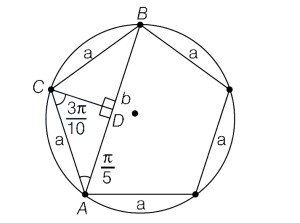
If $a$ and $b$ respectively represent the lengths of a side and a diagonal of a regular pentagon that is inscribed in a circle,then $\frac{b}{a}=$
A
$2 \sin \frac{\pi}{5}$
B
$2 \cos \frac{\pi}{5}$
C
$\cos \frac{\pi}{5}$
D
$\sin \frac{\pi}{5}$
Solution
(B) Let $a$ be the side length and $b$ be the diagonal length of a regular pentagon inscribed in a circle.
In a regular pentagon,the interior angle is $\frac{3\pi}{5}$.
Consider the triangle formed by two sides and a diagonal. By properties of a regular pentagon,the diagonal $b$ subtends an angle of $\frac{2\pi}{5}$ at the center,and the angle between a side and a diagonal is $\frac{\pi}{5}$.
Drawing a perpendicular from vertex $C$ to the diagonal $AB$ at point $D$,we form a right-angled triangle $\triangle ACD$.
In $\triangle ACD$,the angle $\angle CAD = \frac{\pi}{5}$ and the hypotenuse $AC = a$.
Thus,$\cos \frac{\pi}{5} = \frac{AD}{AC} = \frac{AD}{a}$,which implies $AD = a \cos \frac{\pi}{5}$.
Since the diagonal $b$ is bisected by the perpendicular from the opposite vertex in a regular pentagon,$b = 2AD$.
Therefore,$b = 2a \cos \frac{\pi}{5}$,which gives $\frac{b}{a} = 2 \cos \frac{\pi}{5}$.
In a regular pentagon,the interior angle is $\frac{3\pi}{5}$.
Consider the triangle formed by two sides and a diagonal. By properties of a regular pentagon,the diagonal $b$ subtends an angle of $\frac{2\pi}{5}$ at the center,and the angle between a side and a diagonal is $\frac{\pi}{5}$.
Drawing a perpendicular from vertex $C$ to the diagonal $AB$ at point $D$,we form a right-angled triangle $\triangle ACD$.
In $\triangle ACD$,the angle $\angle CAD = \frac{\pi}{5}$ and the hypotenuse $AC = a$.
Thus,$\cos \frac{\pi}{5} = \frac{AD}{AC} = \frac{AD}{a}$,which implies $AD = a \cos \frac{\pi}{5}$.
Since the diagonal $b$ is bisected by the perpendicular from the opposite vertex in a regular pentagon,$b = 2AD$.
Therefore,$b = 2a \cos \frac{\pi}{5}$,which gives $\frac{b}{a} = 2 \cos \frac{\pi}{5}$.
0 likes
View Solution634
MediumMCQ
If $\operatorname{Sinh}^{-1} x = \operatorname{Cosh}^{-1} y = \log(1+\sqrt{2})$,then $\operatorname{Tan}^{-1}(x+y) = $
A
$67 \frac{1}{2}^{\circ}$
B
$75^{\circ}$
C
$22 \frac{1}{2}^{\circ}$
D
$15^{\circ}$
Solution
(A) Given $\operatorname{Sinh}^{-1} x = \log(1+\sqrt{2})$.
Using the definition $\operatorname{Sinh}^{-1} x = \log(x + \sqrt{x^2+1})$,we have $x + \sqrt{x^2+1} = 1+\sqrt{2}$.
Comparing the terms,we get $x = 1$.
Given $\operatorname{Cosh}^{-1} y = \log(1+\sqrt{2})$.
Using the definition $\operatorname{Cosh}^{-1} y = \log(y + \sqrt{y^2-1})$,we have $y + \sqrt{y^2-1} = 1+\sqrt{2}$.
This implies $y = \sqrt{2}$.
Now,we need to find $\operatorname{Tan}^{-1}(x+y) = \operatorname{Tan}^{-1}(1+\sqrt{2})$.
We know that $\tan(67.5^{\circ}) = \tan(\frac{135^{\circ}}{2}) = \frac{1-\cos(135^{\circ})}{\sin(135^{\circ})} = \frac{1 - (-1/\sqrt{2})}{1/\sqrt{2}} = \sqrt{2}+1$.
Therefore,$\operatorname{Tan}^{-1}(1+\sqrt{2}) = 67.5^{\circ} = 67 \frac{1}{2}^{\circ}$.
Using the definition $\operatorname{Sinh}^{-1} x = \log(x + \sqrt{x^2+1})$,we have $x + \sqrt{x^2+1} = 1+\sqrt{2}$.
Comparing the terms,we get $x = 1$.
Given $\operatorname{Cosh}^{-1} y = \log(1+\sqrt{2})$.
Using the definition $\operatorname{Cosh}^{-1} y = \log(y + \sqrt{y^2-1})$,we have $y + \sqrt{y^2-1} = 1+\sqrt{2}$.
This implies $y = \sqrt{2}$.
Now,we need to find $\operatorname{Tan}^{-1}(x+y) = \operatorname{Tan}^{-1}(1+\sqrt{2})$.
We know that $\tan(67.5^{\circ}) = \tan(\frac{135^{\circ}}{2}) = \frac{1-\cos(135^{\circ})}{\sin(135^{\circ})} = \frac{1 - (-1/\sqrt{2})}{1/\sqrt{2}} = \sqrt{2}+1$.
Therefore,$\operatorname{Tan}^{-1}(1+\sqrt{2}) = 67.5^{\circ} = 67 \frac{1}{2}^{\circ}$.
0 likes
View Solution635
MediumMCQ
$\operatorname{sech}^{-1}(\sin \theta)$ is equal to
A
$\log \tan \frac{\theta}{2}$
B
$\log \sin \frac{\theta}{2}$
C
$\log \cos \frac{\theta}{2}$
D
$\log \cot \frac{\theta}{2}$
Solution
(D) Let $y = \operatorname{sech}^{-1}(\sin \theta)$.
Then,$\operatorname{sech} y = \sin \theta$.
Since $\operatorname{sech} y = \frac{1}{\cosh y}$,we have $\cosh y = \frac{1}{\sin \theta} = \operatorname{cosec} \theta$.
Thus,$y = \cosh^{-1}(\operatorname{cosec} \theta)$.
Using the logarithmic form of the inverse hyperbolic cosine function,$\cosh^{-1}(x) = \log(x + \sqrt{x^2 - 1})$,we get:
$y = \log(\operatorname{cosec} \theta + \sqrt{\operatorname{cosec}^2 \theta - 1})$.
Since $\operatorname{cosec}^2 \theta - 1 = \cot^2 \theta$,we have:
$y = \log(\operatorname{cosec} \theta + \cot \theta)$.
Using the trigonometric identities $\operatorname{cosec} \theta = \frac{1}{\sin \theta} = \frac{1}{2 \sin(\theta/2) \cos(\theta/2)}$ and $\cot \theta = \frac{\cos \theta}{\sin \theta} = \frac{\cos^2(\theta/2) - \sin^2(\theta/2)}{2 \sin(\theta/2) \cos(\theta/2)}$,we get:
$y = \log\left(\frac{1 + \cos^2(\theta/2) - \sin^2(\theta/2)}{2 \sin(\theta/2) \cos(\theta/2)}\right) = \log\left(\frac{2 \cos^2(\theta/2)}{2 \sin(\theta/2) \cos(\theta/2)}\right) = \log(\cot(\theta/2))$.
Therefore,$\operatorname{sech}^{-1}(\sin \theta) = \log \cot \frac{\theta}{2}$.
Then,$\operatorname{sech} y = \sin \theta$.
Since $\operatorname{sech} y = \frac{1}{\cosh y}$,we have $\cosh y = \frac{1}{\sin \theta} = \operatorname{cosec} \theta$.
Thus,$y = \cosh^{-1}(\operatorname{cosec} \theta)$.
Using the logarithmic form of the inverse hyperbolic cosine function,$\cosh^{-1}(x) = \log(x + \sqrt{x^2 - 1})$,we get:
$y = \log(\operatorname{cosec} \theta + \sqrt{\operatorname{cosec}^2 \theta - 1})$.
Since $\operatorname{cosec}^2 \theta - 1 = \cot^2 \theta$,we have:
$y = \log(\operatorname{cosec} \theta + \cot \theta)$.
Using the trigonometric identities $\operatorname{cosec} \theta = \frac{1}{\sin \theta} = \frac{1}{2 \sin(\theta/2) \cos(\theta/2)}$ and $\cot \theta = \frac{\cos \theta}{\sin \theta} = \frac{\cos^2(\theta/2) - \sin^2(\theta/2)}{2 \sin(\theta/2) \cos(\theta/2)}$,we get:
$y = \log\left(\frac{1 + \cos^2(\theta/2) - \sin^2(\theta/2)}{2 \sin(\theta/2) \cos(\theta/2)}\right) = \log\left(\frac{2 \cos^2(\theta/2)}{2 \sin(\theta/2) \cos(\theta/2)}\right) = \log(\cot(\theta/2))$.
Therefore,$\operatorname{sech}^{-1}(\sin \theta) = \log \cot \frac{\theta}{2}$.
0 likes
View Solution636
MediumMCQ
If $\sinh ^{-1}(\sqrt{8})+\sinh ^{-1}(\sqrt{24})=\alpha$,then $\sinh \alpha=$
A
$6 \sqrt{6}-10 \sqrt{2}$
B
$6 \sqrt{6}+10 \sqrt{2}$
C
$16 \sqrt{6}$
D
$16 \sqrt{6}+4 \sqrt{2}$
Solution
(B) We have,$\sinh ^{-1}(\sqrt{8})+\sinh ^{-1}(\sqrt{24})=\alpha$.
Let $\sinh ^{-1}(\sqrt{8})=x$,then $\sinh x = \sqrt{8}$.
Since $\cosh^2 x - \sinh^2 x = 1$,we have $\cosh x = \sqrt{1 + \sinh^2 x} = \sqrt{1 + 8} = \sqrt{9} = 3$.
Let $\sinh ^{-1}(\sqrt{24})=y$,then $\sinh y = \sqrt{24}$.
Similarly,$\cosh y = \sqrt{1 + \sinh^2 y} = \sqrt{1 + 24} = \sqrt{25} = 5$.
Using the identity $\sinh(x+y) = \sinh x \cosh y + \cosh x \sinh y$,we get:
$\sinh(x+y) = (\sqrt{8})(5) + (3)(\sqrt{24}) = 5(2\sqrt{2}) + 3(2\sqrt{6}) = 10\sqrt{2} + 6\sqrt{6}$.
Since $\alpha = x+y$,we have $\sinh \alpha = 6\sqrt{6} + 10\sqrt{2}$.
Let $\sinh ^{-1}(\sqrt{8})=x$,then $\sinh x = \sqrt{8}$.
Since $\cosh^2 x - \sinh^2 x = 1$,we have $\cosh x = \sqrt{1 + \sinh^2 x} = \sqrt{1 + 8} = \sqrt{9} = 3$.
Let $\sinh ^{-1}(\sqrt{24})=y$,then $\sinh y = \sqrt{24}$.
Similarly,$\cosh y = \sqrt{1 + \sinh^2 y} = \sqrt{1 + 24} = \sqrt{25} = 5$.
Using the identity $\sinh(x+y) = \sinh x \cosh y + \cosh x \sinh y$,we get:
$\sinh(x+y) = (\sqrt{8})(5) + (3)(\sqrt{24}) = 5(2\sqrt{2}) + 3(2\sqrt{6}) = 10\sqrt{2} + 6\sqrt{6}$.
Since $\alpha = x+y$,we have $\sinh \alpha = 6\sqrt{6} + 10\sqrt{2}$.
0 likes
View Solution637
MediumMCQ
For $0 < x \leq \pi$,$\sinh ^{-1}(\cot x)$ is equal to
A
$\log \left(\cot \frac{x}{2}\right)$
B
$\log \left(\tan \frac{x}{2}\right)$
C
$\log (1+\cot x)$
D
$\log (1+\tan x)$
Solution
(A) We know that the formula for the inverse hyperbolic sine function is $\sinh ^{-1}(y) = \log \left(y + \sqrt{1 + y^2}\right)$.
Substituting $y = \cot x$ into the formula,we get:
$\sinh ^{-1}(\cot x) = \log \left(\cot x + \sqrt{1 + \cot ^2 x}\right)$
Since $1 + \cot ^2 x = \operatorname{cosec}^2 x$,we have:
$\sinh ^{-1}(\cot x) = \log \left(\cot x + \sqrt{\operatorname{cosec}^2 x}\right) = \log (\cot x + \operatorname{cosec} x)$
Using trigonometric identities $\cot x = \frac{\cos x}{\sin x}$ and $\operatorname{cosec} x = \frac{1}{\sin x}$,we get:
$\log \left(\frac{\cos x + 1}{\sin x}\right)$
Using half-angle formulas $1 + \cos x = 2 \cos^2 \frac{x}{2}$ and $\sin x = 2 \sin \frac{x}{2} \cos \frac{x}{2}$:
$\log \left(\frac{2 \cos^2 \frac{x}{2}}{2 \sin \frac{x}{2} \cos \frac{x}{2}}\right) = \log \left(\frac{\cos \frac{x}{2}}{\sin \frac{x}{2}}\right) = \log \left(\cot \frac{x}{2}\right)$.
Substituting $y = \cot x$ into the formula,we get:
$\sinh ^{-1}(\cot x) = \log \left(\cot x + \sqrt{1 + \cot ^2 x}\right)$
Since $1 + \cot ^2 x = \operatorname{cosec}^2 x$,we have:
$\sinh ^{-1}(\cot x) = \log \left(\cot x + \sqrt{\operatorname{cosec}^2 x}\right) = \log (\cot x + \operatorname{cosec} x)$
Using trigonometric identities $\cot x = \frac{\cos x}{\sin x}$ and $\operatorname{cosec} x = \frac{1}{\sin x}$,we get:
$\log \left(\frac{\cos x + 1}{\sin x}\right)$
Using half-angle formulas $1 + \cos x = 2 \cos^2 \frac{x}{2}$ and $\sin x = 2 \sin \frac{x}{2} \cos \frac{x}{2}$:
$\log \left(\frac{2 \cos^2 \frac{x}{2}}{2 \sin \frac{x}{2} \cos \frac{x}{2}}\right) = \log \left(\frac{\cos \frac{x}{2}}{\sin \frac{x}{2}}\right) = \log \left(\cot \frac{x}{2}\right)$.
0 likes
View Solution638
EasyMCQ
If $x = \log \left[ \cot \left( \frac{\pi}{4} + \theta \right) \right]$,then the value of $\sinh x$ is
A
$\tan 2\theta$
B
$-\tan 2\theta$
C
$\cot 2\theta$
D
$-\cot 2\theta$
Solution
(B) Given that,$x = \log \left[ \cot \left( \frac{\pi}{4} + \theta \right) \right]$.
This implies $e^x = \cot \left( \frac{\pi}{4} + \theta \right)$ and $e^{-x} = \tan \left( \frac{\pi}{4} + \theta \right)$.
We know that $\sinh x = \frac{e^x - e^{-x}}{2}$.
Substituting the values,we get:
$\sinh x = \frac{\cot \left( \frac{\pi}{4} + \theta \right) - \tan \left( \frac{\pi}{4} + \theta \right)}{2}$
Using the identity $\cot A - \tan A = \frac{\cos A}{\sin A} - \frac{\sin A}{\cos A} = \frac{\cos^2 A - \sin^2 A}{\sin A \cos A} = \frac{\cos 2A}{\frac{1}{2} \sin 2A} = 2 \cot 2A$,we have:
$\sinh x = \frac{1}{2} \left[ 2 \cot \left( 2 \left( \frac{\pi}{4} + \theta \right) \right) \right]$
$\sinh x = \cot \left( \frac{\pi}{2} + 2\theta \right)$
Since $\cot \left( \frac{\pi}{2} + \alpha \right) = -\tan \alpha$,we get:
$\sinh x = -\tan 2\theta$.
This implies $e^x = \cot \left( \frac{\pi}{4} + \theta \right)$ and $e^{-x} = \tan \left( \frac{\pi}{4} + \theta \right)$.
We know that $\sinh x = \frac{e^x - e^{-x}}{2}$.
Substituting the values,we get:
$\sinh x = \frac{\cot \left( \frac{\pi}{4} + \theta \right) - \tan \left( \frac{\pi}{4} + \theta \right)}{2}$
Using the identity $\cot A - \tan A = \frac{\cos A}{\sin A} - \frac{\sin A}{\cos A} = \frac{\cos^2 A - \sin^2 A}{\sin A \cos A} = \frac{\cos 2A}{\frac{1}{2} \sin 2A} = 2 \cot 2A$,we have:
$\sinh x = \frac{1}{2} \left[ 2 \cot \left( 2 \left( \frac{\pi}{4} + \theta \right) \right) \right]$
$\sinh x = \cot \left( \frac{\pi}{2} + 2\theta \right)$
Since $\cot \left( \frac{\pi}{2} + \alpha \right) = -\tan \alpha$,we get:
$\sinh x = -\tan 2\theta$.
0 likes
View Solution639
MediumMCQ
If $e^{\sin x}-e^{-\sin x}-4=0,$ then the number of real values of $x$ is
A
$0$
B
$1$
C
$2$
D
$3$
Solution
(A) Given that,$e^{\sin x}-e^{-\sin x}-4=0$.
Let $e^{\sin x}=t$. Since $e^{\sin x} > 0$,we have $t > 0$.
The equation becomes $t - \frac{1}{t} - 4 = 0$,which simplifies to $t^2 - 4t - 1 = 0$.
Solving for $t$ using the quadratic formula: $t = \frac{4 \pm \sqrt{16 - 4(1)(-1)}}{2} = \frac{4 \pm \sqrt{20}}{2} = 2 \pm \sqrt{5}$.
Since $t > 0$,we must have $t = 2 + \sqrt{5}$ (as $2 - \sqrt{5} < 0$).
Thus,$e^{\sin x} = 2 + \sqrt{5}$.
We know that $-1 \leq \sin x \leq 1$,which implies $e^{-1} \leq e^{\sin x} \leq e^1$.
Numerically,$e \approx 2.718$ and $e^{-1} \approx 0.368$.
Also,$2 + \sqrt{5} \approx 2 + 2.236 = 4.236$.
Since $4.236 > 2.718$,the equation $e^{\sin x} = 2 + \sqrt{5}$ has no solution for $x$.
Therefore,the number of real values of $x$ is $0$.
Let $e^{\sin x}=t$. Since $e^{\sin x} > 0$,we have $t > 0$.
The equation becomes $t - \frac{1}{t} - 4 = 0$,which simplifies to $t^2 - 4t - 1 = 0$.
Solving for $t$ using the quadratic formula: $t = \frac{4 \pm \sqrt{16 - 4(1)(-1)}}{2} = \frac{4 \pm \sqrt{20}}{2} = 2 \pm \sqrt{5}$.
Since $t > 0$,we must have $t = 2 + \sqrt{5}$ (as $2 - \sqrt{5} < 0$).
Thus,$e^{\sin x} = 2 + \sqrt{5}$.
We know that $-1 \leq \sin x \leq 1$,which implies $e^{-1} \leq e^{\sin x} \leq e^1$.
Numerically,$e \approx 2.718$ and $e^{-1} \approx 0.368$.
Also,$2 + \sqrt{5} \approx 2 + 2.236 = 4.236$.
Since $4.236 > 2.718$,the equation $e^{\sin x} = 2 + \sqrt{5}$ has no solution for $x$.
Therefore,the number of real values of $x$ is $0$.
0 likes
View Solution640
MediumMCQ
For $0 \leq P, Q \leq \frac{\pi}{2},$ if $\sin P + \cos Q = 2,$ then the value of $\tan \left(\frac{P + Q}{2}\right)$ is equal to
A
$1$
B
$\frac{1}{\sqrt{2}}$
C
$\frac{1}{2}$
D
$\frac{\sqrt{3}}{2}$
Solution
(A) Given,$0 \leq P, Q \leq \frac{\pi}{2}$ and $\sin P + \cos Q = 2.$
Since the maximum value of $\sin P$ is $1$ and the maximum value of $\cos Q$ is $1,$ the equation $\sin P + \cos Q = 2$ holds only when $\sin P = 1$ and $\cos Q = 1.$
For $0 \leq P \leq \frac{\pi}{2},$ $\sin P = 1$ implies $P = \frac{\pi}{2}.$
For $0 \leq Q \leq \frac{\pi}{2},$ $\cos Q = 1$ implies $Q = 0.$
Therefore,$\tan \left(\frac{P + Q}{2}\right) = \tan \left(\frac{\frac{\pi}{2} + 0}{2}\right) = \tan \left(\frac{\pi}{4}\right) = 1.$
Since the maximum value of $\sin P$ is $1$ and the maximum value of $\cos Q$ is $1,$ the equation $\sin P + \cos Q = 2$ holds only when $\sin P = 1$ and $\cos Q = 1.$
For $0 \leq P \leq \frac{\pi}{2},$ $\sin P = 1$ implies $P = \frac{\pi}{2}.$
For $0 \leq Q \leq \frac{\pi}{2},$ $\cos Q = 1$ implies $Q = 0.$
Therefore,$\tan \left(\frac{P + Q}{2}\right) = \tan \left(\frac{\frac{\pi}{2} + 0}{2}\right) = \tan \left(\frac{\pi}{4}\right) = 1.$
0 likes
View Solution641
DifficultMCQ
If $\sin ^{2} \theta+3 \cos \theta=2,$ then $\cos ^{3} \theta+\sec ^{3} \theta$ is equal to
A
$1$
B
$4$
C
$9$
D
$18$
Solution
(D) Given,$\sin ^{2} \theta+3 \cos \theta=2$
$\Rightarrow 1-\cos ^{2} \theta+3 \cos \theta=2$
$\Rightarrow \cos ^{2} \theta-3 \cos \theta+1=0$
Using the quadratic formula,$\cos \theta = \frac{3 \pm \sqrt{9-4}}{2} = \frac{3 \pm \sqrt{5}}{2}$
Since $-1 \leq \cos \theta \leq 1$ and $\frac{3+\sqrt{5}}{2} > 1$,we must have $\cos \theta = \frac{3-\sqrt{5}}{2}$.
Then $\sec \theta = \frac{1}{\cos \theta} = \frac{2}{3-\sqrt{5}} = \frac{2(3+\sqrt{5})}{9-5} = \frac{3+\sqrt{5}}{2}$.
Now,$\cos \theta + \sec \theta = \frac{3-\sqrt{5}}{2} + \frac{3+\sqrt{5}}{2} = \frac{6}{2} = 3$.
Also,$\cos \theta \cdot \sec \theta = 1$.
We know that $\cos ^{3} \theta+\sec ^{3} \theta = (\cos \theta+\sec \theta)^{3} - 3 \cos \theta \sec \theta (\cos \theta+\sec \theta)$.
Substituting the values: $(3)^{3} - 3(1)(3) = 27 - 9 = 18$.
$\Rightarrow 1-\cos ^{2} \theta+3 \cos \theta=2$
$\Rightarrow \cos ^{2} \theta-3 \cos \theta+1=0$
Using the quadratic formula,$\cos \theta = \frac{3 \pm \sqrt{9-4}}{2} = \frac{3 \pm \sqrt{5}}{2}$
Since $-1 \leq \cos \theta \leq 1$ and $\frac{3+\sqrt{5}}{2} > 1$,we must have $\cos \theta = \frac{3-\sqrt{5}}{2}$.
Then $\sec \theta = \frac{1}{\cos \theta} = \frac{2}{3-\sqrt{5}} = \frac{2(3+\sqrt{5})}{9-5} = \frac{3+\sqrt{5}}{2}$.
Now,$\cos \theta + \sec \theta = \frac{3-\sqrt{5}}{2} + \frac{3+\sqrt{5}}{2} = \frac{6}{2} = 3$.
Also,$\cos \theta \cdot \sec \theta = 1$.
We know that $\cos ^{3} \theta+\sec ^{3} \theta = (\cos \theta+\sec \theta)^{3} - 3 \cos \theta \sec \theta (\cos \theta+\sec \theta)$.
Substituting the values: $(3)^{3} - 3(1)(3) = 27 - 9 = 18$.
0 likes
View Solution642
MediumMCQ
If $\sin \theta = \frac{2t}{1+t^2}$ and $\theta$ lies in the second quadrant,then $\cos \theta$ is equal to
A
$\frac{1-t^2}{1+t^2}$
B
$\frac{t^2-1}{1+t^2}$
C
$\frac{-\left|1-t^2\right|}{1+t^2}$
D
$\frac{1+t^2}{\left|1-t^2\right|}$
Solution
(C) Given $\sin \theta = \frac{2t}{1+t^2}$.
We know that $\cos^2 \theta = 1 - \sin^2 \theta = 1 - \left(\frac{2t}{1+t^2}\right)^2$.
$\cos^2 \theta = 1 - \frac{4t^2}{(1+t^2)^2} = \frac{(1+t^2)^2 - 4t^2}{(1+t^2)^2} = \frac{1 + 2t^2 + t^4 - 4t^2}{(1+t^2)^2} = \frac{1 - 2t^2 + t^4}{(1+t^2)^2} = \frac{(1-t^2)^2}{(1+t^2)^2}$.
Taking the square root,$|\cos \theta| = \frac{|1-t^2|}{1+t^2}$.
Since $\theta$ lies in the second quadrant,$\cos \theta$ must be negative.
Therefore,$\cos \theta = -\frac{|1-t^2|}{1+t^2}$.
We know that $\cos^2 \theta = 1 - \sin^2 \theta = 1 - \left(\frac{2t}{1+t^2}\right)^2$.
$\cos^2 \theta = 1 - \frac{4t^2}{(1+t^2)^2} = \frac{(1+t^2)^2 - 4t^2}{(1+t^2)^2} = \frac{1 + 2t^2 + t^4 - 4t^2}{(1+t^2)^2} = \frac{1 - 2t^2 + t^4}{(1+t^2)^2} = \frac{(1-t^2)^2}{(1+t^2)^2}$.
Taking the square root,$|\cos \theta| = \frac{|1-t^2|}{1+t^2}$.
Since $\theta$ lies in the second quadrant,$\cos \theta$ must be negative.
Therefore,$\cos \theta = -\frac{|1-t^2|}{1+t^2}$.
0 likes
View SolutionTrigonometrical Ratios, Functions and Identities — Mix Examples-Trigonometrical Ratios, Functions and Identities · Frequently Asked Questions
1Are these Trigonometrical Ratios, Functions and Identities questions useful for JEE and NEET?
Yes. All questions in this section are mapped to JEE Main and NEET exam patterns. Previous year questions from JEE Main, NEET, GUJCET and state-level exams are included with full solutions.
2Can I switch to Hindi or Gujarati for these questions?
Yes. Use the language tabs in the hero section or the sidebar to view the same questions and solutions in English, Hindi or Gujarati.
3How do I generate a question paper from this subtopic?
Use the Vedclass Exam Paper Generator — select the chapter and subtopic, set difficulty, and generate Sets A, B, C, D automatically. First 3 chapters of every subject are free.
Vedclass Products
For Students
Vedclass Test Series
Mock tests in real JEE/NEET style with performance analysis. 5-day free trial.
Start Free TrialFor Teachers
Exam Paper Generator
Generate Set A/B/C/D papers from this chapter in 2 minutes. 3 chapters free.
Try FreeFor Institutes
Online Exam Module
Live online exams with unlimited students, 360° analytics & white-label branding.
See DemoFor Teachers & Institutes
Generate a Trigonometrical Ratios, Functions and Identities Exam Paper in 2 Minutes
Select subtopic & difficulty — Sets A, B, C, D auto-generated with No Repeat logic.
First 3 chapters of every subject are free — no payment required.