
A English
Mix Examples-Straight Line Questions in English
Class 11 Mathematics · Straight Line · Mix Examples-Straight Line
123+
Questions
English
Language
100%
With Solutions
Showing 20 of 123 questions in English
101
DifficultMCQ
$A$ straight line $x-2y-4=0$ is shifted parallel to it by $3$ units away from the origin and then rotated by an angle of $30^{\circ}$ in the anti-clockwise direction. If the slope of the new line formed is $m$,then the integral part of $m$ is
A
$-1$
B
$0$
C
$5$
D
$2$
Solution
(C) The original line is $x-2y-4=0$. The slope of this line is $m_1 = 1/2$.
When a line is shifted parallel to itself,its slope remains unchanged. Therefore,the slope of the line after shifting remains $m_1 = 1/2 = \tan \alpha$,where $\alpha = \tan^{-1}(1/2)$.
After rotating the line by an angle of $30^{\circ}$ in the anti-clockwise direction,the new slope $m$ is given by the formula for the tangent of the sum of angles:
$m = \tan(\alpha + 30^{\circ}) = \frac{\tan \alpha + \tan 30^{\circ}}{1 - \tan \alpha \tan 30^{\circ}}$
Substituting the values $\tan \alpha = 1/2$ and $\tan 30^{\circ} = 1/\sqrt{3}$:
$m = \frac{1/2 + 1/\sqrt{3}}{1 - (1/2)(1/\sqrt{3})} = \frac{(\sqrt{3}+2)/(2\sqrt{3})}{(\sqrt{3}-1)/(2\sqrt{3})} = \frac{\sqrt{3}+2}{\sqrt{3}-1}$
Rationalizing the denominator:
$m = \frac{(\sqrt{3}+2)(\sqrt{3}+1)}{3-1} = \frac{3+\sqrt{3}+2\sqrt{3}+2}{2} = \frac{5+3\sqrt{3}}{2}$
Using $\sqrt{3} \approx 1.732$:
$m \approx \frac{5+3(1.732)}{2} = \frac{5+5.196}{2} = \frac{10.196}{2} = 5.098$
The integral part of $m$ is $5$.
When a line is shifted parallel to itself,its slope remains unchanged. Therefore,the slope of the line after shifting remains $m_1 = 1/2 = \tan \alpha$,where $\alpha = \tan^{-1}(1/2)$.
After rotating the line by an angle of $30^{\circ}$ in the anti-clockwise direction,the new slope $m$ is given by the formula for the tangent of the sum of angles:
$m = \tan(\alpha + 30^{\circ}) = \frac{\tan \alpha + \tan 30^{\circ}}{1 - \tan \alpha \tan 30^{\circ}}$
Substituting the values $\tan \alpha = 1/2$ and $\tan 30^{\circ} = 1/\sqrt{3}$:
$m = \frac{1/2 + 1/\sqrt{3}}{1 - (1/2)(1/\sqrt{3})} = \frac{(\sqrt{3}+2)/(2\sqrt{3})}{(\sqrt{3}-1)/(2\sqrt{3})} = \frac{\sqrt{3}+2}{\sqrt{3}-1}$
Rationalizing the denominator:
$m = \frac{(\sqrt{3}+2)(\sqrt{3}+1)}{3-1} = \frac{3+\sqrt{3}+2\sqrt{3}+2}{2} = \frac{5+3\sqrt{3}}{2}$
Using $\sqrt{3} \approx 1.732$:
$m \approx \frac{5+3(1.732)}{2} = \frac{5+5.196}{2} = \frac{10.196}{2} = 5.098$
The integral part of $m$ is $5$.
0 likes
View Solution102
DifficultMCQ
$A$ straight line $L \equiv 0$ passing through the point $A=(-5,-4)$ and having slope $\tan \theta$ meets the lines $x+3y+2=0$ and $2x+y+4=0$ respectively at the points $B$ and $C$. If $\frac{100}{AC^2}-\frac{225}{AB^2}=4 \cos 2\theta+\sin 2\theta$,then the slope of the line $L \equiv 0$ is
A
$\frac{2}{3}$
B
$\frac{-2}{3}$
C
$\frac{-1}{2}$
D
$\frac{1}{2}$
Solution
(C) Given $A=(-5,-4)$ and the slope of line $L$ is $\tan \theta$. The parametric form of the line is $x = -5 + r \cos \theta$ and $y = -4 + r \sin \theta$.
Point $B$ lies on $x+3y+2=0$,so $(-5+r_1 \cos \theta) + 3(-4+r_1 \sin \theta) + 2 = 0$.
$-5 + r_1 \cos \theta - 12 + 3r_1 \sin \theta + 2 = 0 \implies r_1(\cos \theta + 3 \sin \theta) = 15 \implies AB = r_1 = \frac{15}{\cos \theta + 3 \sin \theta}$.
Point $C$ lies on $2x+y+4=0$,so $2(-5+r_2 \cos \theta) + (-4+r_2 \sin \theta) + 4 = 0$.
$-10 + 2r_2 \cos \theta - 4 + r_2 \sin \theta + 4 = 0 \implies r_2(2 \cos \theta + \sin \theta) = 10 \implies AC = r_2 = \frac{10}{2 \cos \theta + \sin \theta}$.
Substituting into the given equation $\frac{100}{AC^2} - \frac{225}{AB^2} = 4 \cos 2\theta + \sin 2\theta$:
$(2 \cos \theta + \sin \theta)^2 - (\cos \theta + 3 \sin \theta)^2 = 4 \cos 2\theta + \sin 2\theta$.
$(4 \cos^2 \theta + \sin^2 \theta + 4 \sin \theta \cos \theta) - (\cos^2 \theta + 9 \sin^2 \theta + 6 \sin \theta \cos \theta) = 4(\cos^2 \theta - \sin^2 \theta) + 2 \sin \theta \cos \theta$.
$3 \cos^2 \theta - 8 \sin^2 \theta - 2 \sin \theta \cos \theta = 4 \cos^2 \theta - 4 \sin^2 \theta + 2 \sin \theta \cos \theta$.
$4 \sin^2 \theta + 4 \sin \theta \cos \theta + \cos^2 \theta = 0$.
$(2 \sin \theta + \cos \theta)^2 = 0 \implies 2 \sin \theta = -\cos \theta \implies \tan \theta = -\frac{1}{2}$.
Point $B$ lies on $x+3y+2=0$,so $(-5+r_1 \cos \theta) + 3(-4+r_1 \sin \theta) + 2 = 0$.
$-5 + r_1 \cos \theta - 12 + 3r_1 \sin \theta + 2 = 0 \implies r_1(\cos \theta + 3 \sin \theta) = 15 \implies AB = r_1 = \frac{15}{\cos \theta + 3 \sin \theta}$.
Point $C$ lies on $2x+y+4=0$,so $2(-5+r_2 \cos \theta) + (-4+r_2 \sin \theta) + 4 = 0$.
$-10 + 2r_2 \cos \theta - 4 + r_2 \sin \theta + 4 = 0 \implies r_2(2 \cos \theta + \sin \theta) = 10 \implies AC = r_2 = \frac{10}{2 \cos \theta + \sin \theta}$.
Substituting into the given equation $\frac{100}{AC^2} - \frac{225}{AB^2} = 4 \cos 2\theta + \sin 2\theta$:
$(2 \cos \theta + \sin \theta)^2 - (\cos \theta + 3 \sin \theta)^2 = 4 \cos 2\theta + \sin 2\theta$.
$(4 \cos^2 \theta + \sin^2 \theta + 4 \sin \theta \cos \theta) - (\cos^2 \theta + 9 \sin^2 \theta + 6 \sin \theta \cos \theta) = 4(\cos^2 \theta - \sin^2 \theta) + 2 \sin \theta \cos \theta$.
$3 \cos^2 \theta - 8 \sin^2 \theta - 2 \sin \theta \cos \theta = 4 \cos^2 \theta - 4 \sin^2 \theta + 2 \sin \theta \cos \theta$.
$4 \sin^2 \theta + 4 \sin \theta \cos \theta + \cos^2 \theta = 0$.
$(2 \sin \theta + \cos \theta)^2 = 0 \implies 2 \sin \theta = -\cos \theta \implies \tan \theta = -\frac{1}{2}$.
0 likes
View Solution103
EasyMCQ
If the lines drawn along the diagonals of the two squares formed by two pairs of lines $x^2-3|x|+2=0$ and $y^2-3y+2=0$ form a square $ABCD$,then the equations of two adjacent sides of the square $ABCD$ are
A
$x+y=-3, x-y=3$
B
$x+y=0, x-y=3$
C
$x+y=3, x-y=-3$
D
$x-y=0, x+y=-3$
Solution
(C) Given equations are $x^2-3|x|+2=0$ and $y^2-3y+2=0$.
Solving $x^2-3|x|+2=0$: $(|x|-2)(|x|-1)=0$,so $|x|=2$ or $|x|=1$,which gives $x=\pm 2, \pm 1$.
Solving $y^2-3y+2=0$: $(y-2)(y-1)=0$,so $y=2, 1$.
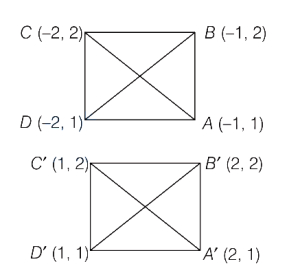
The lines form two squares with vertices:
Square $1$: $A(-1, 1), B(-1, 2), C(-2, 2), D(-2, 1)$.
Square $2$: $A'(2, 1), B'(2, 2), C'(1, 2), D'(1, 1)$.
The diagonals of these squares are lines like $x+y=k$ and $x-y=k$.
For the square $ABCD$ formed by these diagonals,the sides are parallel to the axes or at $45^\circ$.
Checking the options,the equations $x+y=3$ and $x-y=-3$ represent lines that can form the sides of such a square.
Thus,the correct option is $C$.
Solving $x^2-3|x|+2=0$: $(|x|-2)(|x|-1)=0$,so $|x|=2$ or $|x|=1$,which gives $x=\pm 2, \pm 1$.
Solving $y^2-3y+2=0$: $(y-2)(y-1)=0$,so $y=2, 1$.
The lines form two squares with vertices:
Square $1$: $A(-1, 1), B(-1, 2), C(-2, 2), D(-2, 1)$.
Square $2$: $A'(2, 1), B'(2, 2), C'(1, 2), D'(1, 1)$.
The diagonals of these squares are lines like $x+y=k$ and $x-y=k$.
For the square $ABCD$ formed by these diagonals,the sides are parallel to the axes or at $45^\circ$.
Checking the options,the equations $x+y=3$ and $x-y=-3$ represent lines that can form the sides of such a square.
Thus,the correct option is $C$.
0 likes
View Solution104
EasyMCQ
The equation of the straight line which is perpendicular to the line $5x - 2y = 7$ and passing through the point of intersection of the lines $2x + 3y - 1 = 0$ and $3x + 4y - 6 = 0$ is
A
$2x + 5y - 17 = 0$
B
$2x + 5y + 17 = 0$
C
$2x + 5y + 47 = 0$
D
$2x + 5y - 47 = 0$
Solution
(B) Given lines are:
$2x + 3y - 1 = 0$ $(i)$
$3x + 4y - 6 = 0$ $(ii)$
Multiplying $(i)$ by $3$ and $(ii)$ by $2$:
$6x + 9y - 3 = 0$
$6x + 8y - 12 = 0$
Subtracting the equations: $y + 9 = 0 \Rightarrow y = -9$.
Substituting $y = -9$ in $(i)$: $2x + 3(-9) - 1 = 0$ $\Rightarrow 2x - 27 - 1 = 0$ $\Rightarrow 2x = 28$ $\Rightarrow x = 14$.
The point of intersection is $(14, -9)$.
The line perpendicular to $5x - 2y = 7$ is of the form $2x + 5y + k = 0$.
Since it passes through $(14, -9)$:
$2(14) + 5(-9) + k = 0$
$28 - 45 + k = 0$
$-17 + k = 0 \Rightarrow k = 17$.
Thus,the equation is $2x + 5y + 17 = 0$.
$2x + 3y - 1 = 0$ $(i)$
$3x + 4y - 6 = 0$ $(ii)$
Multiplying $(i)$ by $3$ and $(ii)$ by $2$:
$6x + 9y - 3 = 0$
$6x + 8y - 12 = 0$
Subtracting the equations: $y + 9 = 0 \Rightarrow y = -9$.
Substituting $y = -9$ in $(i)$: $2x + 3(-9) - 1 = 0$ $\Rightarrow 2x - 27 - 1 = 0$ $\Rightarrow 2x = 28$ $\Rightarrow x = 14$.
The point of intersection is $(14, -9)$.
The line perpendicular to $5x - 2y = 7$ is of the form $2x + 5y + k = 0$.
Since it passes through $(14, -9)$:
$2(14) + 5(-9) + k = 0$
$28 - 45 + k = 0$
$-17 + k = 0 \Rightarrow k = 17$.
Thus,the equation is $2x + 5y + 17 = 0$.
0 likes
View Solution105
MediumMCQ
The equation of the straight line passing through the point of intersection of $5x - 6y - 1 = 0$ and $3x + 2y + 5 = 0$ and perpendicular to the line $3x - 5y + 11 = 0$ is
A
$5x + 3y + 18 = 0$
B
$-5x - 3y + 18 = 0$
C
$5x + 3y + 8 = 0$
D
$5x + 3y - 8 = 0$
Solution
(C) First,find the point of intersection of the lines $5x - 6y - 1 = 0$ and $3x + 2y + 5 = 0$.
Multiplying the second equation by $3$,we get $9x + 6y + 15 = 0$.
Adding this to the first equation: $(5x - 6y - 1) + (9x + 6y + 15) = 0$ $\Rightarrow 14x + 14 = 0$ $\Rightarrow x = -1$.
Substituting $x = -1$ into $3x + 2y + 5 = 0$: $3(-1) + 2y + 5 = 0$ $\Rightarrow -3 + 2y + 5 = 0$ $\Rightarrow 2y = -2$ $\Rightarrow y = -1$.
The point of intersection is $(-1, -1)$.
The slope of the line $3x - 5y + 11 = 0$ is $m_1 = \frac{3}{5}$.
The slope of the line perpendicular to it is $m_2 = -\frac{1}{m_1} = -\frac{5}{3}$.
The equation of the line passing through $(-1, -1)$ with slope $m_2 = -\frac{5}{3}$ is:
$(y - (-1)) = -\frac{5}{3}(x - (-1))
$ $\Rightarrow 3(y + 1) = -5(x + 1)
$ $\Rightarrow 3y + 3 = -5x - 5
$ $\Rightarrow 5x + 3y + 8 = 0$.
Multiplying the second equation by $3$,we get $9x + 6y + 15 = 0$.
Adding this to the first equation: $(5x - 6y - 1) + (9x + 6y + 15) = 0$ $\Rightarrow 14x + 14 = 0$ $\Rightarrow x = -1$.
Substituting $x = -1$ into $3x + 2y + 5 = 0$: $3(-1) + 2y + 5 = 0$ $\Rightarrow -3 + 2y + 5 = 0$ $\Rightarrow 2y = -2$ $\Rightarrow y = -1$.
The point of intersection is $(-1, -1)$.
The slope of the line $3x - 5y + 11 = 0$ is $m_1 = \frac{3}{5}$.
The slope of the line perpendicular to it is $m_2 = -\frac{1}{m_1} = -\frac{5}{3}$.
The equation of the line passing through $(-1, -1)$ with slope $m_2 = -\frac{5}{3}$ is:
$(y - (-1)) = -\frac{5}{3}(x - (-1))
$ $\Rightarrow 3(y + 1) = -5(x + 1)
$ $\Rightarrow 3y + 3 = -5x - 5
$ $\Rightarrow 5x + 3y + 8 = 0$.
0 likes
View Solution106
EasyMCQ
The equation of the straight line perpendicular to $5x - 2y = 7$ and passing through the point of intersection of the lines $2x + 3y = 1$ and $3x + 4y = 6$ is
A
$2x + 5y + 17 = 0$
B
$2x + 5y - 17 = 0$
C
$2x - 5y + 17 = 0$
D
$2x - 5y = 17$
Solution
(A) The given line is $5x - 2y = 7$. The slope of this line is $m_1 = \frac{5}{2}$.
Any line perpendicular to this line will have a slope $m_2 = -\frac{2}{5}$.
Thus,the equation of the required line is of the form $2x + 5y = \lambda$.
Now,we find the point of intersection of the lines $2x + 3y = 1$ $(i)$ and $3x + 4y = 6$ (ii).
Multiplying $(i)$ by $3$ and (ii) by $2$,we get:
$6x + 9y = 3$
$6x + 8y = 12$
Subtracting the two equations,we get $y = -9$.
Substituting $y = -9$ into $(i)$: $2x + 3(-9) = 1$ $\Rightarrow 2x - 27 = 1$ $\Rightarrow 2x = 28$ $\Rightarrow x = 14$.
The point of intersection is $(14, -9)$.
Since the required line passes through $(14, -9)$,we substitute these values into $2x + 5y = \lambda$:
$2(14) + 5(-9) = \lambda$
$28 - 45 = \lambda$
$\lambda = -17$.
Therefore,the equation of the line is $2x + 5y = -17$,which can be written as $2x + 5y + 17 = 0$.
Any line perpendicular to this line will have a slope $m_2 = -\frac{2}{5}$.
Thus,the equation of the required line is of the form $2x + 5y = \lambda$.
Now,we find the point of intersection of the lines $2x + 3y = 1$ $(i)$ and $3x + 4y = 6$ (ii).
Multiplying $(i)$ by $3$ and (ii) by $2$,we get:
$6x + 9y = 3$
$6x + 8y = 12$
Subtracting the two equations,we get $y = -9$.
Substituting $y = -9$ into $(i)$: $2x + 3(-9) = 1$ $\Rightarrow 2x - 27 = 1$ $\Rightarrow 2x = 28$ $\Rightarrow x = 14$.
The point of intersection is $(14, -9)$.
Since the required line passes through $(14, -9)$,we substitute these values into $2x + 5y = \lambda$:
$2(14) + 5(-9) = \lambda$
$28 - 45 = \lambda$
$\lambda = -17$.
Therefore,the equation of the line is $2x + 5y = -17$,which can be written as $2x + 5y + 17 = 0$.
0 likes
View Solution107
MediumMCQ
If $\alpha$ is the angle made by the perpendicular drawn from the origin to the line $3x - 4y + 5 = 0$ with the positive $X$-axis in the positive direction,and $ax + by = 1$ is the equation of a line passing through the point $(1, -1)$ with $\tan \alpha$ as its slope,then $a + ab + b =$
A
$11$
B
$13$
C
$17$
D
$19$
Solution
(D) The equation of the line is $3x - 4y + 5 = 0$,which can be written as $3x - 4y = -5$. Dividing by $-5$,we get $-\frac{3}{5}x + \frac{4}{5}y = 1$.
Comparing this with the normal form $x \cos \alpha + y \sin \alpha = p$,we have $\cos \alpha = -\frac{3}{5}$ and $\sin \alpha = \frac{4}{5}$.
Thus,$\tan \alpha = \frac{\sin \alpha}{\cos \alpha} = \frac{4/5}{-3/5} = -\frac{4}{3}$.
The line $ax + by = 1$ passes through $(1, -1)$ and has slope $m = \tan \alpha = -\frac{4}{3}$.
The equation of the line is $y - (-1) = -\frac{4}{3}(x - 1)$.
$3(y + 1) = -4(x - 1)$ $\Rightarrow 3y + 3 = -4x + 4$ $\Rightarrow 4x + 3y = 1$.
Comparing $4x + 3y = 1$ with $ax + by = 1$,we get $a = 4$ and $b = 3$.
Therefore,$a + ab + b = 4 + (4 \times 3) + 3 = 4 + 12 + 3 = 19$.
Comparing this with the normal form $x \cos \alpha + y \sin \alpha = p$,we have $\cos \alpha = -\frac{3}{5}$ and $\sin \alpha = \frac{4}{5}$.
Thus,$\tan \alpha = \frac{\sin \alpha}{\cos \alpha} = \frac{4/5}{-3/5} = -\frac{4}{3}$.
The line $ax + by = 1$ passes through $(1, -1)$ and has slope $m = \tan \alpha = -\frac{4}{3}$.
The equation of the line is $y - (-1) = -\frac{4}{3}(x - 1)$.
$3(y + 1) = -4(x - 1)$ $\Rightarrow 3y + 3 = -4x + 4$ $\Rightarrow 4x + 3y = 1$.
Comparing $4x + 3y = 1$ with $ax + by = 1$,we get $a = 4$ and $b = 3$.
Therefore,$a + ab + b = 4 + (4 \times 3) + 3 = 4 + 12 + 3 = 19$.
0 likes
View Solution108
DifficultMCQ
Let $P$ be the point of intersection of the lines $L_1 \equiv x-y-7=0$ and $L_2 \equiv x+y-5=0$. $A(x_1, y_1)$ and $B(x_2, y_2)$ are points on the lines $L_1=0$ and $L_2=0$ respectively such that $PA=3\sqrt{2}$,$PB=\sqrt{2}$,$x_1, y_1 \geq 0$,$x_2, y_2 \geq 0$. Then the angle made by the line segment $AB$ at the origin is
A
$\frac{\pi}{4}$
B
$\frac{\pi}{2}$
C
$\cos^{-1}\left(\frac{3}{4}\right)$
D
$\cos^{-1}\left(\frac{9}{\sqrt{85}}\right)$
Solution
(D) The point of intersection $P$ of lines $L_1: x-y-7=0$ and $L_2: x+y-5=0$ is $(6, -1)$.
For point $A(x_1, y_1)$ on $L_1$ with $PA=3\sqrt{2}$,the symmetric form is $\frac{x-6}{\cos \theta_1} = \frac{y+1}{\sin \theta_1} = \pm 3\sqrt{2}$,where $\tan \theta_1 = 1$ (slope of $L_1$ is $1$).
Thus,$x_1 = 6 \pm 3\sqrt{2} \cdot \frac{1}{\sqrt{2}} = 6 \pm 3$ and $y_1 = -1 \pm 3\sqrt{2} \cdot \frac{1}{\sqrt{2}} = -1 \pm 3$.
Since $x_1, y_1 \geq 0$,we choose the positive sign: $A = (9, 2)$.
For point $B(x_2, y_2)$ on $L_2$ with $PB=\sqrt{2}$,the symmetric form is $\frac{x-6}{\cos \theta_2} = \frac{y+1}{\sin \theta_2} = \pm \sqrt{2}$,where $\tan \theta_2 = -1$ (slope of $L_2$ is $-1$).
Thus,$x_2 = 6 \pm \sqrt{2} \cdot \frac{1}{\sqrt{2}} = 6 \pm 1$ and $y_2 = -1 \pm \sqrt{2} \cdot \left(-\frac{1}{\sqrt{2}}\right) = -1 \mp 1$.
Since $x_2, y_2 \geq 0$,we choose $x_2 = 6-1=5$ and $y_2 = -1+1=0$,so $B = (5, 0)$.
Let $O$ be the origin $(0, 0)$. The vectors are $\vec{OA} = (9, 2)$ and $\vec{OB} = (5, 0)$.
The angle $\theta$ at the origin is given by $\cos \theta = \frac{\vec{OA} \cdot \vec{OB}}{|\vec{OA}| |\vec{OB}|} = \frac{9 \cdot 5 + 2 \cdot 0}{\sqrt{9^2+2^2} \sqrt{5^2+0^2}} = \frac{45}{\sqrt{85} \cdot 5} = \frac{9}{\sqrt{85}}$.
Therefore,$\theta = \cos^{-1}\left(\frac{9}{\sqrt{85}}\right)$.
For point $A(x_1, y_1)$ on $L_1$ with $PA=3\sqrt{2}$,the symmetric form is $\frac{x-6}{\cos \theta_1} = \frac{y+1}{\sin \theta_1} = \pm 3\sqrt{2}$,where $\tan \theta_1 = 1$ (slope of $L_1$ is $1$).
Thus,$x_1 = 6 \pm 3\sqrt{2} \cdot \frac{1}{\sqrt{2}} = 6 \pm 3$ and $y_1 = -1 \pm 3\sqrt{2} \cdot \frac{1}{\sqrt{2}} = -1 \pm 3$.
Since $x_1, y_1 \geq 0$,we choose the positive sign: $A = (9, 2)$.
For point $B(x_2, y_2)$ on $L_2$ with $PB=\sqrt{2}$,the symmetric form is $\frac{x-6}{\cos \theta_2} = \frac{y+1}{\sin \theta_2} = \pm \sqrt{2}$,where $\tan \theta_2 = -1$ (slope of $L_2$ is $-1$).
Thus,$x_2 = 6 \pm \sqrt{2} \cdot \frac{1}{\sqrt{2}} = 6 \pm 1$ and $y_2 = -1 \pm \sqrt{2} \cdot \left(-\frac{1}{\sqrt{2}}\right) = -1 \mp 1$.
Since $x_2, y_2 \geq 0$,we choose $x_2 = 6-1=5$ and $y_2 = -1+1=0$,so $B = (5, 0)$.
Let $O$ be the origin $(0, 0)$. The vectors are $\vec{OA} = (9, 2)$ and $\vec{OB} = (5, 0)$.
The angle $\theta$ at the origin is given by $\cos \theta = \frac{\vec{OA} \cdot \vec{OB}}{|\vec{OA}| |\vec{OB}|} = \frac{9 \cdot 5 + 2 \cdot 0}{\sqrt{9^2+2^2} \sqrt{5^2+0^2}} = \frac{45}{\sqrt{85} \cdot 5} = \frac{9}{\sqrt{85}}$.
Therefore,$\theta = \cos^{-1}\left(\frac{9}{\sqrt{85}}\right)$.
0 likes
View Solution109
EasyMCQ
If $L_1$ is a line passing through the point $P(4, -3)$ and perpendicular to the line $3x - 4y + k = 0$,then the distance of $P$ from the line $5x - 3y - 2 = 0$ measured along the line $L_1$ is
A
$5$
B
$\sqrt{13}$
C
$\sqrt{41}$
D
$13$
Solution
(A) The slope of the line $3x - 4y + k = 0$ is $m = \frac{3}{4}$.
Since $L_1$ is perpendicular to this line,its slope is $m_1 = -\frac{4}{3}$.
The equation of line $L_1$ passing through $P(4, -3)$ is $y - (-3) = -\frac{4}{3}(x - 4)$,which simplifies to $3y + 9 = -4x + 16$,or $4x + 3y = 7$.
We need the distance of $P(4, -3)$ from the line $L: 5x - 3y - 2 = 0$ measured along $L_1$. This is the distance between $P(4, -3)$ and the intersection point of $L_1$ and $L$.
Solving the system:
$4x + 3y = 7$
$5x - 3y = 2$
Adding the equations: $9x = 9 \Rightarrow x = 1$.
Substituting $x = 1$ into $4x + 3y = 7$: $4(1) + 3y = 7$ $\Rightarrow 3y = 3$ $\Rightarrow y = 1$.
The intersection point is $(1, 1)$.
The distance $d$ between $P(4, -3)$ and $(1, 1)$ is $\sqrt{(4 - 1)^2 + (-3 - 1)^2} = \sqrt{3^2 + (-4)^2} = \sqrt{9 + 16} = \sqrt{25} = 5$.
Since $L_1$ is perpendicular to this line,its slope is $m_1 = -\frac{4}{3}$.
The equation of line $L_1$ passing through $P(4, -3)$ is $y - (-3) = -\frac{4}{3}(x - 4)$,which simplifies to $3y + 9 = -4x + 16$,or $4x + 3y = 7$.
We need the distance of $P(4, -3)$ from the line $L: 5x - 3y - 2 = 0$ measured along $L_1$. This is the distance between $P(4, -3)$ and the intersection point of $L_1$ and $L$.
Solving the system:
$4x + 3y = 7$
$5x - 3y = 2$
Adding the equations: $9x = 9 \Rightarrow x = 1$.
Substituting $x = 1$ into $4x + 3y = 7$: $4(1) + 3y = 7$ $\Rightarrow 3y = 3$ $\Rightarrow y = 1$.
The intersection point is $(1, 1)$.
The distance $d$ between $P(4, -3)$ and $(1, 1)$ is $\sqrt{(4 - 1)^2 + (-3 - 1)^2} = \sqrt{3^2 + (-4)^2} = \sqrt{9 + 16} = \sqrt{25} = 5$.
0 likes
View Solution110
EasyMCQ
The point on the line $4x - y - 2 = 0$ which is equidistant from the points $(-5, 6)$ and $(3, 2)$ is:
A
$(2, 6)$
B
$(4, 14)$
C
$(1, 2)$
D
$(3, 8)$
Solution
(B) Let the point on the line $4x - y - 2 = 0$ be $P(x, y)$.
Let $A = (-5, 6)$ and $B = (3, 2)$.
Since $P$ is equidistant from $A$ and $B$,we have $AP = PB$,which implies $AP^2 = PB^2$.
Using the distance formula: $(x + 5)^2 + (y - 6)^2 = (x - 3)^2 + (y - 2)^2$.
Expanding both sides: $x^2 + 10x + 25 + y^2 - 12y + 36 = x^2 - 6x + 9 + y^2 - 4y + 4$.
Simplifying: $16x - 8y + 48 = 0$,which reduces to $2x - y + 6 = 0$ (Equation $2$).
We are given the line $4x - y - 2 = 0$ (Equation $1$).
Subtracting Equation $2$ from Equation $1$: $(4x - y - 2) - (2x - y + 6) = 0$.
$2x - 8 = 0 \Rightarrow x = 4$.
Substituting $x = 4$ into $4x - y - 2 = 0$: $4(4) - y - 2 = 0$ $\Rightarrow 16 - y - 2 = 0$ $\Rightarrow y = 14$.
Thus,the required point is $(4, 14)$.
Let $A = (-5, 6)$ and $B = (3, 2)$.
Since $P$ is equidistant from $A$ and $B$,we have $AP = PB$,which implies $AP^2 = PB^2$.
Using the distance formula: $(x + 5)^2 + (y - 6)^2 = (x - 3)^2 + (y - 2)^2$.
Expanding both sides: $x^2 + 10x + 25 + y^2 - 12y + 36 = x^2 - 6x + 9 + y^2 - 4y + 4$.
Simplifying: $16x - 8y + 48 = 0$,which reduces to $2x - y + 6 = 0$ (Equation $2$).
We are given the line $4x - y - 2 = 0$ (Equation $1$).
Subtracting Equation $2$ from Equation $1$: $(4x - y - 2) - (2x - y + 6) = 0$.
$2x - 8 = 0 \Rightarrow x = 4$.
Substituting $x = 4$ into $4x - y - 2 = 0$: $4(4) - y - 2 = 0$ $\Rightarrow 16 - y - 2 = 0$ $\Rightarrow y = 14$.
Thus,the required point is $(4, 14)$.
0 likes
View Solution111
EasyMCQ
$A$ straight line passing through the origin $O$ intersects the lines $10x - 8y - 10 = 0$ and $\frac{x}{4} - \frac{y}{5} + 1 = 0$ at right angles at points $P$ and $Q$ respectively. Then the ratio in which $O$ divides the line segment $PQ$ is
A
$1 : 2$
B
$1 : 4$
C
$1 : 1$
D
$3 : 4$
Solution
(B) Let the line passing through the origin $O(0,0)$ be $L_1$. It intersects $L_2: 10x - 8y - 10 = 0$ (which simplifies to $5x - 4y - 5 = 0$) at point $P$ at right angles.
It also intersects $L_3: \frac{x}{4} - \frac{y}{5} + 1 = 0$ (which simplifies to $5x - 4y + 20 = 0$) at point $Q$ at right angles.
Since $L_2$ and $L_3$ have the same slope,they are parallel lines.
The perpendicular distance from the origin $O(0,0)$ to line $L_2$ is $OP = \frac{|5(0) - 4(0) - 5|}{\sqrt{5^2 + (-4)^2}} = \frac{5}{\sqrt{41}}$.
The perpendicular distance from the origin $O(0,0)$ to line $L_3$ is $OQ = \frac{|5(0) - 4(0) + 20|}{\sqrt{5^2 + (-4)^2}} = \frac{20}{\sqrt{41}}$.
Since $P$ and $Q$ lie on opposite sides of the origin (as the constant terms $-5$ and $+20$ have opposite signs),the origin $O$ divides the segment $PQ$ internally in the ratio $OP : OQ = \frac{5}{\sqrt{41}} : \frac{20}{\sqrt{41}} = 1 : 4$.
It also intersects $L_3: \frac{x}{4} - \frac{y}{5} + 1 = 0$ (which simplifies to $5x - 4y + 20 = 0$) at point $Q$ at right angles.
Since $L_2$ and $L_3$ have the same slope,they are parallel lines.
The perpendicular distance from the origin $O(0,0)$ to line $L_2$ is $OP = \frac{|5(0) - 4(0) - 5|}{\sqrt{5^2 + (-4)^2}} = \frac{5}{\sqrt{41}}$.
The perpendicular distance from the origin $O(0,0)$ to line $L_3$ is $OQ = \frac{|5(0) - 4(0) + 20|}{\sqrt{5^2 + (-4)^2}} = \frac{20}{\sqrt{41}}$.
Since $P$ and $Q$ lie on opposite sides of the origin (as the constant terms $-5$ and $+20$ have opposite signs),the origin $O$ divides the segment $PQ$ internally in the ratio $OP : OQ = \frac{5}{\sqrt{41}} : \frac{20}{\sqrt{41}} = 1 : 4$.
0 likes
View Solution112
MediumMCQ
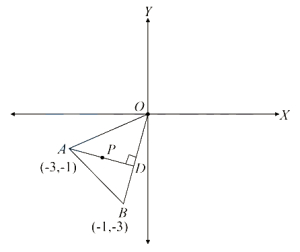
$O(0,0), A(-3,-1)$ and $B(-1,-3)$ are the vertices of a $\triangle OAB$. $P$ is a point on the perpendicular $AD$ drawn from $A$ on $OB$ such that $\frac{AP}{PD}=\frac{3}{4}$. Then the equation of the line $L$ parallel to $OB$ and passing through $P$ is:
A
$3x-y+3=0$
B
$21x-7y+32=0$
C
$15x-5y+32=0$
D
$3x-y+35=0$
Solution
(B) The vertices are $O(0,0), A(-3,-1)$,and $B(-1,-3)$.
Slope of $OB = \frac{-3-0}{-1-0} = 3$.
Equation of line $OB$ is $y = 3x$,or $3x - y = 0$.
Since $AD \perp OB$,the slope of $AD$ is $-\frac{1}{3}$.
Equation of line $AD$ passing through $A(-3,-1)$ is $y - (-1) = -\frac{1}{3}(x - (-3))$,which simplifies to $y + 1 = -\frac{1}{3}(x + 3)$,or $x + 3y + 6 = 0$.
To find $D$,the intersection of $OB$ $(y=3x)$ and $AD$ $(x+3y+6=0)$:
$x + 3(3x) + 6 = 0$ $\Rightarrow 10x = -6$ $\Rightarrow x = -\frac{3}{5}$.
$y = 3(-\frac{3}{5}) = -\frac{9}{5}$. So,$D = (-\frac{3}{5}, -\frac{9}{5})$.
Point $P$ divides $AD$ in the ratio $3:4$. Using the section formula:
$P = \left( \frac{3(-\frac{3}{5}) + 4(-3)}{3+4}, \frac{3(-\frac{9}{5}) + 4(-1)}{3+4} \right) = \left( \frac{-\frac{9}{5} - 12}{7}, \frac{-\frac{27}{5} - 4}{7} \right) = \left( \frac{-69}{35}, \frac{-47}{35} \right)$.
Line $L$ is parallel to $OB$ $(y=3x)$,so its equation is $y = 3x + k$.
Since $L$ passes through $P(-\frac{69}{35}, -\frac{47}{35})$:
$-\frac{47}{35} = 3(-\frac{69}{35}) + k \Rightarrow k = \frac{-47 + 207}{35} = \frac{160}{35} = \frac{32}{7}$.
Equation $L: y = 3x + \frac{32}{7}$ $\Rightarrow 7y = 21x + 32$ $\Rightarrow 21x - 7y + 32 = 0$.
Slope of $OB = \frac{-3-0}{-1-0} = 3$.
Equation of line $OB$ is $y = 3x$,or $3x - y = 0$.
Since $AD \perp OB$,the slope of $AD$ is $-\frac{1}{3}$.
Equation of line $AD$ passing through $A(-3,-1)$ is $y - (-1) = -\frac{1}{3}(x - (-3))$,which simplifies to $y + 1 = -\frac{1}{3}(x + 3)$,or $x + 3y + 6 = 0$.
To find $D$,the intersection of $OB$ $(y=3x)$ and $AD$ $(x+3y+6=0)$:
$x + 3(3x) + 6 = 0$ $\Rightarrow 10x = -6$ $\Rightarrow x = -\frac{3}{5}$.
$y = 3(-\frac{3}{5}) = -\frac{9}{5}$. So,$D = (-\frac{3}{5}, -\frac{9}{5})$.
Point $P$ divides $AD$ in the ratio $3:4$. Using the section formula:
$P = \left( \frac{3(-\frac{3}{5}) + 4(-3)}{3+4}, \frac{3(-\frac{9}{5}) + 4(-1)}{3+4} \right) = \left( \frac{-\frac{9}{5} - 12}{7}, \frac{-\frac{27}{5} - 4}{7} \right) = \left( \frac{-69}{35}, \frac{-47}{35} \right)$.
Line $L$ is parallel to $OB$ $(y=3x)$,so its equation is $y = 3x + k$.
Since $L$ passes through $P(-\frac{69}{35}, -\frac{47}{35})$:
$-\frac{47}{35} = 3(-\frac{69}{35}) + k \Rightarrow k = \frac{-47 + 207}{35} = \frac{160}{35} = \frac{32}{7}$.
Equation $L: y = 3x + \frac{32}{7}$ $\Rightarrow 7y = 21x + 32$ $\Rightarrow 21x - 7y + 32 = 0$.
0 likes
View Solution113
EasyMCQ
The point $(4,1)$ undergoes the following transformations successively:
$(i)$ Reflection in the line $x-y=0$
(ii) Shifting through a distance of $2$ units along the positive $X$-axis
(iii) Projection on the $X$-axis
The coordinates of the point in its final position are
$(i)$ Reflection in the line $x-y=0$
(ii) Shifting through a distance of $2$ units along the positive $X$-axis
(iii) Projection on the $X$-axis
The coordinates of the point in its final position are
A
$(3,4)$
B
$(4,3)$
C
$(3,0)$
D
$(4,0)$
Solution
(C) The point $(4,1)$ undergoes the following transformations:
$(i)$ Reflection in the line $x-y=0$: The reflection of a point $(x,y)$ in the line $y=x$ (or $x-y=0$) is $(y,x)$. Thus,the point $(4,1)$ becomes $(1,4)$.
(ii) Shifting through a distance of $2$ units along the positive $X$-axis: Adding $2$ to the $x$-coordinate,we get $(1+2, 4) = (3,4)$.
(iii) Projection on the $X$-axis: The projection of a point $(x,y)$ on the $X$-axis is $(x,0)$. Thus,the point $(3,4)$ becomes $(3,0)$.
Therefore,the final coordinates are $(3,0)$.
$(i)$ Reflection in the line $x-y=0$: The reflection of a point $(x,y)$ in the line $y=x$ (or $x-y=0$) is $(y,x)$. Thus,the point $(4,1)$ becomes $(1,4)$.
(ii) Shifting through a distance of $2$ units along the positive $X$-axis: Adding $2$ to the $x$-coordinate,we get $(1+2, 4) = (3,4)$.
(iii) Projection on the $X$-axis: The projection of a point $(x,y)$ on the $X$-axis is $(x,0)$. Thus,the point $(3,4)$ becomes $(3,0)$.
Therefore,the final coordinates are $(3,0)$.
0 likes
View Solution114
EasyMCQ
If the equation of the straight line passing through the point of intersection of $x+2y-19=0$ and $x-2y-3=0$ and which is at a perpendicular distance of $5$ units from the point $(-2,4)$ is $5x+by+c=0$,then a possible value of $5+b+c$ is
A
-$108$
B
$10$
C
$86$
D
-$14$
Solution
(D) The equation of the family of lines passing through the intersection of $x+2y-19=0$ and $x-2y-3=0$ is given by $(x+2y-19) + \lambda(x-2y-3) = 0$.
This simplifies to $(1+\lambda)x + (2-2\lambda)y - (19+3\lambda) = 0$.
The perpendicular distance from the point $(-2,4)$ to this line is $5$ units.
Using the distance formula $d = \frac{|ax_1+by_1+c|}{\sqrt{a^2+b^2}}$,we have $5 = \frac{|(1+\lambda)(-2) + (2-2\lambda)(4) - (19+3\lambda)|}{\sqrt{(1+\lambda)^2 + (2-2\lambda)^2}}$.
$5 = \frac{|-2-2\lambda + 8-8\lambda - 19-3\lambda|}{\sqrt{1+2\lambda+\lambda^2 + 4-8\lambda+4\lambda^2}}$.
$5 = \frac{|-13\lambda - 13|}{\sqrt{5\lambda^2-6\lambda+5}}$.
Squaring both sides: $25(5\lambda^2-6\lambda+5) = (-13\lambda-13)^2$.
$125\lambda^2 - 150\lambda + 125 = 169\lambda^2 + 338\lambda + 169$.
$44\lambda^2 + 488\lambda + 44 = 0 \Rightarrow 11\lambda^2 + 122\lambda + 11 = 0$.
$(11\lambda+1)(\lambda+11) = 0$,so $\lambda = -1/11$ or $\lambda = -11$.
For $\lambda = -1/11$: $(1-1/11)x + (2+2/11)y - (19-3/11) = 0$ $\Rightarrow (10/11)x + (24/11)y - (206/11) = 0$ $\Rightarrow 5x+12y-103=0$.
Here $b=12, c=-103$,so $5+b+c = 5+12-103 = -86$.
For $\lambda = -11$: $(1-11)x + (2+22)y - (19-33) = 0$ $\Rightarrow -10x+24y+14=0$ $\Rightarrow 5x-12y-7=0$.
Here $b=-12, c=-7$,so $5+b+c = 5-12-7 = -14$.
This simplifies to $(1+\lambda)x + (2-2\lambda)y - (19+3\lambda) = 0$.
The perpendicular distance from the point $(-2,4)$ to this line is $5$ units.
Using the distance formula $d = \frac{|ax_1+by_1+c|}{\sqrt{a^2+b^2}}$,we have $5 = \frac{|(1+\lambda)(-2) + (2-2\lambda)(4) - (19+3\lambda)|}{\sqrt{(1+\lambda)^2 + (2-2\lambda)^2}}$.
$5 = \frac{|-2-2\lambda + 8-8\lambda - 19-3\lambda|}{\sqrt{1+2\lambda+\lambda^2 + 4-8\lambda+4\lambda^2}}$.
$5 = \frac{|-13\lambda - 13|}{\sqrt{5\lambda^2-6\lambda+5}}$.
Squaring both sides: $25(5\lambda^2-6\lambda+5) = (-13\lambda-13)^2$.
$125\lambda^2 - 150\lambda + 125 = 169\lambda^2 + 338\lambda + 169$.
$44\lambda^2 + 488\lambda + 44 = 0 \Rightarrow 11\lambda^2 + 122\lambda + 11 = 0$.
$(11\lambda+1)(\lambda+11) = 0$,so $\lambda = -1/11$ or $\lambda = -11$.
For $\lambda = -1/11$: $(1-1/11)x + (2+2/11)y - (19-3/11) = 0$ $\Rightarrow (10/11)x + (24/11)y - (206/11) = 0$ $\Rightarrow 5x+12y-103=0$.
Here $b=12, c=-103$,so $5+b+c = 5+12-103 = -86$.
For $\lambda = -11$: $(1-11)x + (2+22)y - (19-33) = 0$ $\Rightarrow -10x+24y+14=0$ $\Rightarrow 5x-12y-7=0$.
Here $b=-12, c=-7$,so $5+b+c = 5-12-7 = -14$.
0 likes
View Solution115
MediumMCQ
The point on the line $3x + 4y = 5$ which is equidistant from $(1, 2)$ and $(3, 4)$ is
A
$(7, -4)$
B
$(15, -10)$
C
$(1/7, 8/7)$
D
$(0, 5/4)$
Solution
(B) Let the point be $P(x, y)$ on the line $3x + 4y = 5$.
Since $P$ is equidistant from $A(1, 2)$ and $B(3, 4)$,we have $PA^2 = PB^2$.
$(x - 1)^2 + (y - 2)^2 = (x - 3)^2 + (y - 4)^2$
$x^2 - 2x + 1 + y^2 - 4y + 4 = x^2 - 6x + 9 + y^2 - 8y + 16$
$-2x - 4y + 5 = -6x - 8y + 25$
$4x + 4y = 20$
$x + y = 5$
Now,solve the system of equations:
$3x + 4y = 5$
$x + y = 5 \Rightarrow x = 5 - y$
Substitute $x$ in the first equation:
$3(5 - y) + 4y = 5$
$15 - 3y + 4y = 5$
$y = -10$
$x = 5 - (-10) = 15$
Thus,the point is $(15, -10)$.
Since $P$ is equidistant from $A(1, 2)$ and $B(3, 4)$,we have $PA^2 = PB^2$.
$(x - 1)^2 + (y - 2)^2 = (x - 3)^2 + (y - 4)^2$
$x^2 - 2x + 1 + y^2 - 4y + 4 = x^2 - 6x + 9 + y^2 - 8y + 16$
$-2x - 4y + 5 = -6x - 8y + 25$
$4x + 4y = 20$
$x + y = 5$
Now,solve the system of equations:
$3x + 4y = 5$
$x + y = 5 \Rightarrow x = 5 - y$
Substitute $x$ in the first equation:
$3(5 - y) + 4y = 5$
$15 - 3y + 4y = 5$
$y = -10$
$x = 5 - (-10) = 15$
Thus,the point is $(15, -10)$.
0 likes
View Solution116
MediumMCQ
If a line $ax + 2y = k$ forms a triangle of area $3$ sq. units with the coordinate axes and is perpendicular to the line $2x - 3y + 7 = 0$,then the product of all the possible values of $k$ is
A
$-36$
B
$36$
C
$-64$
D
$64$
Solution
(A) The line $ax + 2y = k$ is perpendicular to $2x - 3y + 7 = 0$.
The slope of $ax + 2y = k$ is $m_1 = -a/2$.
The slope of $2x - 3y + 7 = 0$ is $m_2 = 2/3$.
Since they are perpendicular,$m_1 \times m_2 = -1$.
$(-a/2) \times (2/3) = -1 \implies -a/3 = -1 \implies a = 3$.
The equation of the line is $3x + 2y = k$.
Converting to intercept form: $\frac{x}{k/3} + \frac{y}{k/2} = 1$.
The area of the triangle formed with coordinate axes is $\frac{1}{2} \times |\frac{k}{3}| \times |\frac{k}{2}| = 3$.
$\frac{|k^2|}{12} = 3 \implies |k^2| = 36 \implies k^2 = 36 \implies k = \pm 6$.
The product of all possible values of $k$ is $6 \times (-6) = -36$.
The slope of $ax + 2y = k$ is $m_1 = -a/2$.
The slope of $2x - 3y + 7 = 0$ is $m_2 = 2/3$.
Since they are perpendicular,$m_1 \times m_2 = -1$.
$(-a/2) \times (2/3) = -1 \implies -a/3 = -1 \implies a = 3$.
The equation of the line is $3x + 2y = k$.
Converting to intercept form: $\frac{x}{k/3} + \frac{y}{k/2} = 1$.
The area of the triangle formed with coordinate axes is $\frac{1}{2} \times |\frac{k}{3}| \times |\frac{k}{2}| = 3$.
$\frac{|k^2|}{12} = 3 \implies |k^2| = 36 \implies k^2 = 36 \implies k = \pm 6$.
The product of all possible values of $k$ is $6 \times (-6) = -36$.
0 likes
View Solution117
DifficultMCQ
Two non-parallel sides of a rhombus are parallel to the lines $x+y-1=0$ and $7x-y-5=0$. If $(1,3)$ is the centre of the rhombus and one of its vertices $A(\alpha, \beta)$ lies on $15x-5y=6$,then one of the possible values of $(\alpha+\beta)$ is
A
$\frac{18}{5}$
B
$\frac{12}{5}$
C
$\frac{37}{5}$
D
$\frac{39}{5}$
Solution
(A) The sides of the rhombus are parallel to $x+y+c_1=0$ and $7x-y+c_2=0$.
Since the centre is $(1,3)$,the diagonals bisect the angles between the sides.
The lines passing through the centre $(1,3)$ parallel to the sides are $x+y-4=0$ and $7x-y-4=0$.
The diagonals of a rhombus are perpendicular bisectors of each other.
The slopes of the sides are $m_1 = -1$ and $m_2 = 7$.
The slopes of the diagonals are $m_d = \frac{1-m_1m_2 \pm \sqrt{(1-m_1^2)(1-m_2^2)}}{m_1+m_2}$ is not applicable here; rather,the diagonals bisect the angles between the sides.
The angle bisectors of $x+y-4=0$ and $7x-y-4=0$ are $\frac{x+y-4}{\sqrt{2}} = \pm \frac{7x-y-4}{\sqrt{50}}$.
Simplifying,$5(x+y-4) = \pm (7x-y-4)$.
Case $1$: $5x+5y-20 = 7x-y-4 \implies 2x-6y+16=0 \implies x-3y+8=0$.
Case $2$: $5x+5y-20 = -7x+y+4 \implies 12x+4y-24=0 \implies 3x+y-6=0$.
Vertex $A(\alpha, \beta)$ lies on $15x-5y=6$ and on one of the diagonals.
Solving $3x+y=6$ and $15x-5y=6$: $15x+5y=30$ and $15x-5y=6 \implies 30x=36 \implies x=1.2, y=2.4$. $\alpha+\beta = 3.6 = \frac{18}{5}$.
Solving $x-3y=-8$ and $15x-5y=6$: $5x-15y=-40$ and $45x-15y=18 \implies 40x=58 \implies x=1.45, y=3.15$. $\alpha+\beta = 4.6 = \frac{23}{5}$ (not in options).
Thus,the correct value is $\frac{18}{5}$.
Since the centre is $(1,3)$,the diagonals bisect the angles between the sides.
The lines passing through the centre $(1,3)$ parallel to the sides are $x+y-4=0$ and $7x-y-4=0$.
The diagonals of a rhombus are perpendicular bisectors of each other.
The slopes of the sides are $m_1 = -1$ and $m_2 = 7$.
The slopes of the diagonals are $m_d = \frac{1-m_1m_2 \pm \sqrt{(1-m_1^2)(1-m_2^2)}}{m_1+m_2}$ is not applicable here; rather,the diagonals bisect the angles between the sides.
The angle bisectors of $x+y-4=0$ and $7x-y-4=0$ are $\frac{x+y-4}{\sqrt{2}} = \pm \frac{7x-y-4}{\sqrt{50}}$.
Simplifying,$5(x+y-4) = \pm (7x-y-4)$.
Case $1$: $5x+5y-20 = 7x-y-4 \implies 2x-6y+16=0 \implies x-3y+8=0$.
Case $2$: $5x+5y-20 = -7x+y+4 \implies 12x+4y-24=0 \implies 3x+y-6=0$.
Vertex $A(\alpha, \beta)$ lies on $15x-5y=6$ and on one of the diagonals.
Solving $3x+y=6$ and $15x-5y=6$: $15x+5y=30$ and $15x-5y=6 \implies 30x=36 \implies x=1.2, y=2.4$. $\alpha+\beta = 3.6 = \frac{18}{5}$.
Solving $x-3y=-8$ and $15x-5y=6$: $5x-15y=-40$ and $45x-15y=18 \implies 40x=58 \implies x=1.45, y=3.15$. $\alpha+\beta = 4.6 = \frac{23}{5}$ (not in options).
Thus,the correct value is $\frac{18}{5}$.
0 likes
View Solution118
EasyMCQ
If $(1, 5)$ is the midpoint of the segment of a line between the lines $5x - y - 4 = 0$ and $3x + 4y - 4 = 0$,then the equation of the line is:
A
$83x + 35y - 92 = 0$
B
$83x - 35y + 92 = 0$
C
$83x - 35y - 92 = 0$
D
$83x + 35y + 92 = 0$
Solution
(B) Let the line pass through $A(1, 5)$ with slope $m = \tan \theta$. The equation of the line is $\frac{y-5}{x-1} = m$,or $y - 5 = m(x - 1)$.
Let the line intersect $5x - y - 4 = 0$ at $P_1(x_1, y_1)$ and $3x + 4y - 4 = 0$ at $P_2(x_2, y_2)$.
Since $(1, 5)$ is the midpoint,$P_1 = (1+r\cos\theta, 5+r\sin\theta)$ and $P_2 = (1-r\cos\theta, 5-r\sin\theta)$ for some distance $r$.
Substituting $P_1$ into $5x - y - 4 = 0$: $5(1+r\cos\theta) - (5+r\sin\theta) - 4 = 0$ $\Rightarrow 5r\cos\theta - r\sin\theta = 4$ $\Rightarrow r = \frac{4}{5\cos\theta - \sin\theta}$.
Substituting $P_2$ into $3x + 4y - 4 = 0$: $3(1-r\cos\theta) + 4(5-r\sin\theta) - 4 = 0$ $\Rightarrow 3 - 3r\cos\theta + 20 - 4r\sin\theta - 4 = 0$ $\Rightarrow 19 = r(3\cos\theta + 4\sin\theta)$ $\Rightarrow r = \frac{19}{3\cos\theta + 4\sin\theta}$.
Equating the two expressions for $r$: $\frac{4}{5\cos\theta - \sin\theta} = \frac{19}{3\cos\theta + 4\sin\theta}$.
$12\cos\theta + 16\sin\theta = 95\cos\theta - 19\sin\theta$.
$35\sin\theta = 83\cos\theta \Rightarrow \tan\theta = \frac{83}{35}$.
The equation of the line is $y - 5 = \frac{83}{35}(x - 1)$.
$35y - 175 = 83x - 83 \Rightarrow 83x - 35y + 92 = 0$.
Let the line intersect $5x - y - 4 = 0$ at $P_1(x_1, y_1)$ and $3x + 4y - 4 = 0$ at $P_2(x_2, y_2)$.
Since $(1, 5)$ is the midpoint,$P_1 = (1+r\cos\theta, 5+r\sin\theta)$ and $P_2 = (1-r\cos\theta, 5-r\sin\theta)$ for some distance $r$.
Substituting $P_1$ into $5x - y - 4 = 0$: $5(1+r\cos\theta) - (5+r\sin\theta) - 4 = 0$ $\Rightarrow 5r\cos\theta - r\sin\theta = 4$ $\Rightarrow r = \frac{4}{5\cos\theta - \sin\theta}$.
Substituting $P_2$ into $3x + 4y - 4 = 0$: $3(1-r\cos\theta) + 4(5-r\sin\theta) - 4 = 0$ $\Rightarrow 3 - 3r\cos\theta + 20 - 4r\sin\theta - 4 = 0$ $\Rightarrow 19 = r(3\cos\theta + 4\sin\theta)$ $\Rightarrow r = \frac{19}{3\cos\theta + 4\sin\theta}$.
Equating the two expressions for $r$: $\frac{4}{5\cos\theta - \sin\theta} = \frac{19}{3\cos\theta + 4\sin\theta}$.
$12\cos\theta + 16\sin\theta = 95\cos\theta - 19\sin\theta$.
$35\sin\theta = 83\cos\theta \Rightarrow \tan\theta = \frac{83}{35}$.
The equation of the line is $y - 5 = \frac{83}{35}(x - 1)$.
$35y - 175 = 83x - 83 \Rightarrow 83x - 35y + 92 = 0$.
0 likes
View Solution119
EasyMCQ
The number of points having a distance of $\sqrt{5}$ from the straight line $x-2y+1=0$ and a distance of $\sqrt{13}$ from the line $2x+3y-1=0$ is:
A
$1$
B
$2$
C
$4$
D
$5$
Solution
(C) Let the point be $P(h, k)$.
Given the distance from the line $x-2y+1=0$ is $\sqrt{5}$,we have:
$\left|\frac{h-2k+1}{\sqrt{1^2+(-2)^2}}\right| = \sqrt{5} \Rightarrow |h-2k+1| = \sqrt{5} \times \sqrt{5} = 5$.
This gives two parallel lines: $h-2k+1 = 5$ or $h-2k+1 = -5$.
Given the distance from the line $2x+3y-1=0$ is $\sqrt{13}$,we have:
$\left|\frac{2h+3k-1}{\sqrt{2^2+3^2}}\right| = \sqrt{13} \Rightarrow |2h+3k-1| = \sqrt{13} \times \sqrt{13} = 13$.
This gives two parallel lines: $2h+3k-1 = 13$ or $2h+3k-1 = -13$.
Each pair of parallel lines intersects the other pair at $2 \times 2 = 4$ distinct points.
Thus,there are $4$ such points.
Given the distance from the line $x-2y+1=0$ is $\sqrt{5}$,we have:
$\left|\frac{h-2k+1}{\sqrt{1^2+(-2)^2}}\right| = \sqrt{5} \Rightarrow |h-2k+1| = \sqrt{5} \times \sqrt{5} = 5$.
This gives two parallel lines: $h-2k+1 = 5$ or $h-2k+1 = -5$.
Given the distance from the line $2x+3y-1=0$ is $\sqrt{13}$,we have:
$\left|\frac{2h+3k-1}{\sqrt{2^2+3^2}}\right| = \sqrt{13} \Rightarrow |2h+3k-1| = \sqrt{13} \times \sqrt{13} = 13$.
This gives two parallel lines: $2h+3k-1 = 13$ or $2h+3k-1 = -13$.
Each pair of parallel lines intersects the other pair at $2 \times 2 = 4$ distinct points.
Thus,there are $4$ such points.
0 likes
View Solution120
DifficultMCQ
Among the statements:
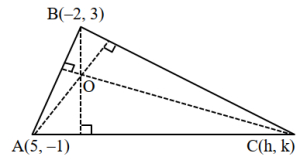
$(S1)$ : If $A(5, -1)$ and $B(-2, 3)$ are two vertices of a triangle,whose orthocentre is $(0, 0)$,then its third vertex is $(-4, -7)$ and
$(S2)$ : If positive numbers $2a, b, c$ are three consecutive terms of an $A.P.$,then the lines $ax + by + c = 0$ are concurrent at $(2, -2)$.
$(S1)$ : If $A(5, -1)$ and $B(-2, 3)$ are two vertices of a triangle,whose orthocentre is $(0, 0)$,then its third vertex is $(-4, -7)$ and
$(S2)$ : If positive numbers $2a, b, c$ are three consecutive terms of an $A.P.$,then the lines $ax + by + c = 0$ are concurrent at $(2, -2)$.
A
Only $(S1)$ is correct
B
Only $(S2)$ is correct
C
Both are incorrect
D
Both are correct
Solution
(D) Solution of statement - $1$:
Let the third vertex be $C(h, k)$.
The orthocentre $O$ is $(0, 0)$.
Since $AO \perp BC$,the slope of $AO$ is $m_{AO} = \frac{0 - (-1)}{0 - 5} = -\frac{1}{5}$.
The slope of $BC$ is $m_{BC} = \frac{k - 3}{h - (-2)} = \frac{k - 3}{h + 2}$.
Since $m_{AO} \cdot m_{BC} = -1$,we have $(-\frac{1}{5}) \cdot (\frac{k - 3}{h + 2}) = -1$ $\Rightarrow k - 3 = 5(h + 2)$ $\Rightarrow 5h - k + 13 = 0$ ....$(1)$
Since $BO \perp AC$,the slope of $BO$ is $m_{BO} = \frac{0 - 3}{0 - (-2)} = -\frac{3}{2}$.
The slope of $AC$ is $m_{AC} = \frac{k - (-1)}{h - 5} = \frac{k + 1}{h - 5}$.
Since $m_{BO} \cdot m_{AC} = -1$,we have $(-\frac{3}{2}) \cdot (\frac{k + 1}{h - 5}) = -1$ $\Rightarrow 3(k + 1) = 2(h - 5)$ $\Rightarrow 3k + 3 = 2h - 10$ $\Rightarrow 2h - 3k = 13$ ....$(2)$
Solving equations $(1)$ and $(2)$,we get $h = -4$ and $k = -7$.
So,the third vertex is $(-4, -7)$. Thus,statement $1$ is correct.
Solution of statement - $2$:
Given $2a, b, c$ are in $A.P.$,so $2b = 2a + c \Rightarrow 2a - 2b + c = 0$.
The line equation is $ax + by + c = 0$.
Comparing this with $2a - 2b + c = 0$,we can see that for $x = 2$ and $y = -2$,the equation $a(2) + b(-2) + c = 0$ holds true.
Thus,the lines $ax + by + c = 0$ are concurrent at $(2, -2)$. Thus,statement $2$ is correct.
Let the third vertex be $C(h, k)$.
The orthocentre $O$ is $(0, 0)$.
Since $AO \perp BC$,the slope of $AO$ is $m_{AO} = \frac{0 - (-1)}{0 - 5} = -\frac{1}{5}$.
The slope of $BC$ is $m_{BC} = \frac{k - 3}{h - (-2)} = \frac{k - 3}{h + 2}$.
Since $m_{AO} \cdot m_{BC} = -1$,we have $(-\frac{1}{5}) \cdot (\frac{k - 3}{h + 2}) = -1$ $\Rightarrow k - 3 = 5(h + 2)$ $\Rightarrow 5h - k + 13 = 0$ ....$(1)$
Since $BO \perp AC$,the slope of $BO$ is $m_{BO} = \frac{0 - 3}{0 - (-2)} = -\frac{3}{2}$.
The slope of $AC$ is $m_{AC} = \frac{k - (-1)}{h - 5} = \frac{k + 1}{h - 5}$.
Since $m_{BO} \cdot m_{AC} = -1$,we have $(-\frac{3}{2}) \cdot (\frac{k + 1}{h - 5}) = -1$ $\Rightarrow 3(k + 1) = 2(h - 5)$ $\Rightarrow 3k + 3 = 2h - 10$ $\Rightarrow 2h - 3k = 13$ ....$(2)$
Solving equations $(1)$ and $(2)$,we get $h = -4$ and $k = -7$.
So,the third vertex is $(-4, -7)$. Thus,statement $1$ is correct.
Solution of statement - $2$:
Given $2a, b, c$ are in $A.P.$,so $2b = 2a + c \Rightarrow 2a - 2b + c = 0$.
The line equation is $ax + by + c = 0$.
Comparing this with $2a - 2b + c = 0$,we can see that for $x = 2$ and $y = -2$,the equation $a(2) + b(-2) + c = 0$ holds true.
Thus,the lines $ax + by + c = 0$ are concurrent at $(2, -2)$. Thus,statement $2$ is correct.
0 likes
View SolutionStraight Line — Mix Examples-Straight Line · Frequently Asked Questions
1Are these Straight Line questions useful for JEE and NEET?
Yes. All questions in this section are mapped to JEE Main and NEET exam patterns. Previous year questions from JEE Main, NEET, GUJCET and state-level exams are included with full solutions.
2Can I switch to Hindi or Gujarati for these questions?
Yes. Use the language tabs in the hero section or the sidebar to view the same questions and solutions in English, Hindi or Gujarati.
3How do I generate a question paper from this subtopic?
Use the Vedclass Exam Paper Generator — select the chapter and subtopic, set difficulty, and generate Sets A, B, C, D automatically. First 3 chapters of every subject are free.
Vedclass Products
For Students
Vedclass Test Series
Mock tests in real JEE/NEET style with performance analysis. 5-day free trial.
Start Free TrialFor Teachers
Exam Paper Generator
Generate Set A/B/C/D papers from this chapter in 2 minutes. 3 chapters free.
Try FreeFor Institutes
Online Exam Module
Live online exams with unlimited students, 360° analytics & white-label branding.
See DemoFor Teachers & Institutes
Generate a Straight Line Exam Paper in 2 Minutes
Select subtopic & difficulty — Sets A, B, C, D auto-generated with No Repeat logic.
First 3 chapters of every subject are free — no payment required.