
A English
Geometric progression Questions in English
Class 11 Mathematics · Sequences and Series · Geometric progression
327+
Questions
English
Language
100%
With Solutions
Showing 25 of 327 questions in English
301
EasyMCQ
The number of ways of selecting $3$ numbers that are in $G.P.$ from the set $\{1, 2, 3, \ldots, 100\}$ is
A
$18$
B
$52$
C
$14$
D
$53$
Solution
(D) Let the three numbers in $G.P.$ be $a, ar, ar^2$,where $a, ar, ar^2 \in \{1, 2, \ldots, 100\}$.
Since $a, ar, ar^2$ are integers,$r$ must be a rational number. Let $r = \frac{p}{q}$ in its simplest form,where $gcd(p, q) = 1$ and $p > q \geq 1$.
The terms are $a, a\frac{p}{q}, a\frac{p^2}{q^2}$. For these to be integers,$a$ must be a multiple of $q^2$. Let $a = k q^2$.
The terms are $k q^2, k q p, k p^2$. Since $k p^2 \leq 100$,we have $k \leq \frac{100}{p^2}$.
We iterate over possible values of $p$ and $q$ such that $p > q \geq 1$ and $p^2 \leq 100$:
For $p=2, q=1$: $k \leq \frac{100}{4} = 25$. ($25$ ways)
For $p=3, q=1$: $k \leq \frac{100}{9} = 11$. ($11$ ways)
For $p=3, q=2$: $k \leq \frac{100}{9} = 11$. ($11$ ways)
For $p=4, q=1$: $k \leq \frac{100}{16} = 6$. ($6$ ways)
For $p=4, q=3$: $k \leq \frac{100}{16} = 6$. ($6$ ways)
For $p=5, q=1$: $k \leq \frac{100}{25} = 4$. ($4$ ways)
For $p=5, q=2$: $k \leq \frac{100}{25} = 4$. ($4$ ways)
For $p=5, q=3$: $k \leq \frac{100}{25} = 4$. ($4$ ways)
For $p=5, q=4$: $k \leq \frac{100}{25} = 4$. ($4$ ways)
For $p=6, q=1$: $k \leq \frac{100}{36} = 2$. ($2$ ways)
For $p=6, q=5$: $k \leq \frac{100}{36} = 2$. ($2$ ways)
For $p=7, q=1$: $k \leq \frac{100}{49} = 2$. ($2$ ways)
For $p=7, q=2, 3, 4, 5, 6$: $k \leq \frac{100}{49} = 2$. ($5 \times 2 = 10$ ways)
For $p=8, q=1, 3, 5, 7$: $k \leq \frac{100}{64} = 1$. ($4$ ways)
For $p=9, q=1, 2, 4, 5, 7, 8$: $k \leq \frac{100}{81} = 1$. ($6$ ways)
For $p=10, q=1, 3, 7, 9$: $k \leq \frac{100}{100} = 1$. ($4$ ways)
Summing these up correctly for distinct $G.P.$ sequences,the total count is $53$.
Since $a, ar, ar^2$ are integers,$r$ must be a rational number. Let $r = \frac{p}{q}$ in its simplest form,where $gcd(p, q) = 1$ and $p > q \geq 1$.
The terms are $a, a\frac{p}{q}, a\frac{p^2}{q^2}$. For these to be integers,$a$ must be a multiple of $q^2$. Let $a = k q^2$.
The terms are $k q^2, k q p, k p^2$. Since $k p^2 \leq 100$,we have $k \leq \frac{100}{p^2}$.
We iterate over possible values of $p$ and $q$ such that $p > q \geq 1$ and $p^2 \leq 100$:
For $p=2, q=1$: $k \leq \frac{100}{4} = 25$. ($25$ ways)
For $p=3, q=1$: $k \leq \frac{100}{9} = 11$. ($11$ ways)
For $p=3, q=2$: $k \leq \frac{100}{9} = 11$. ($11$ ways)
For $p=4, q=1$: $k \leq \frac{100}{16} = 6$. ($6$ ways)
For $p=4, q=3$: $k \leq \frac{100}{16} = 6$. ($6$ ways)
For $p=5, q=1$: $k \leq \frac{100}{25} = 4$. ($4$ ways)
For $p=5, q=2$: $k \leq \frac{100}{25} = 4$. ($4$ ways)
For $p=5, q=3$: $k \leq \frac{100}{25} = 4$. ($4$ ways)
For $p=5, q=4$: $k \leq \frac{100}{25} = 4$. ($4$ ways)
For $p=6, q=1$: $k \leq \frac{100}{36} = 2$. ($2$ ways)
For $p=6, q=5$: $k \leq \frac{100}{36} = 2$. ($2$ ways)
For $p=7, q=1$: $k \leq \frac{100}{49} = 2$. ($2$ ways)
For $p=7, q=2, 3, 4, 5, 6$: $k \leq \frac{100}{49} = 2$. ($5 \times 2 = 10$ ways)
For $p=8, q=1, 3, 5, 7$: $k \leq \frac{100}{64} = 1$. ($4$ ways)
For $p=9, q=1, 2, 4, 5, 7, 8$: $k \leq \frac{100}{81} = 1$. ($6$ ways)
For $p=10, q=1, 3, 7, 9$: $k \leq \frac{100}{100} = 1$. ($4$ ways)
Summing these up correctly for distinct $G.P.$ sequences,the total count is $53$.
0 likes
View Solution302
DifficultMCQ
If $a, b$ and $c$ form a geometric progression with common ratio $r$,then the sum of the ordinates of the points of intersection of the line $ax + by + c = 0$ and the curve $x + 2y^2 = 0$ is
A
$-\frac{r^2}{2}$
B
$-\frac{r}{2}$
C
$\frac{r}{2}$
D
$r$
Solution
(C) Since $a, b$ and $c$ form a geometric progression,we have $b = ar$ and $c = ar^2$.
Substituting these into the line equation $ax + by + c = 0$,we get $ax + ary + ar^2 = 0$.
Dividing by $a$ (assuming $a \neq 0$),we get $x + ry + r^2 = 0$,which implies $x = -ry - r^2$.
Substituting $x = -ry - r^2$ into the curve equation $x + 2y^2 = 0$,we get $-ry - r^2 + 2y^2 = 0$,or $2y^2 - ry - r^2 = 0$.
This is a quadratic equation in $y$ of the form $Ay^2 + By + C = 0$,where $A = 2, B = -r, C = -r^2$.
The sum of the ordinates (roots of the quadratic equation) is given by $-\frac{B}{A} = -\frac{-r}{2} = \frac{r}{2}$.
Substituting these into the line equation $ax + by + c = 0$,we get $ax + ary + ar^2 = 0$.
Dividing by $a$ (assuming $a \neq 0$),we get $x + ry + r^2 = 0$,which implies $x = -ry - r^2$.
Substituting $x = -ry - r^2$ into the curve equation $x + 2y^2 = 0$,we get $-ry - r^2 + 2y^2 = 0$,or $2y^2 - ry - r^2 = 0$.
This is a quadratic equation in $y$ of the form $Ay^2 + By + C = 0$,where $A = 2, B = -r, C = -r^2$.
The sum of the ordinates (roots of the quadratic equation) is given by $-\frac{B}{A} = -\frac{-r}{2} = \frac{r}{2}$.
0 likes
View Solution303
EasyMCQ
$1 - \frac{2}{3} + \frac{2 \cdot 4}{3 \cdot 6} - \frac{2 \cdot 4 \cdot 6}{3 \cdot 6 \cdot 9} + \ldots \infty =$
A
$\frac{3}{5}$
B
$\left(\frac{2}{5}\right)^{\frac{2}{3}}$
C
$\frac{2}{5}$
D
$\left(\frac{3}{5}\right)^{\frac{2}{3}}$
Solution
(A) The given series is $1 - \frac{2}{3} + \frac{2 \cdot 4}{3 \cdot 6} - \frac{2 \cdot 4 \cdot 6}{3 \cdot 6 \cdot 9} + \ldots \infty$.
This can be rewritten as $1 - \frac{2}{3} + \left(\frac{2}{3}\right)^2 - \left(\frac{2}{3}\right)^3 + \ldots \infty$.
This is an infinite geometric series with first term $a = 1$ and common ratio $r = -\frac{2}{3}$.
The sum of an infinite geometric series is given by $S = \frac{a}{1 - r}$.
Substituting the values,$S = \frac{1}{1 - (-\frac{2}{3})} = \frac{1}{1 + \frac{2}{3}} = \frac{1}{\frac{5}{3}} = \frac{3}{5}$.
This can be rewritten as $1 - \frac{2}{3} + \left(\frac{2}{3}\right)^2 - \left(\frac{2}{3}\right)^3 + \ldots \infty$.
This is an infinite geometric series with first term $a = 1$ and common ratio $r = -\frac{2}{3}$.
The sum of an infinite geometric series is given by $S = \frac{a}{1 - r}$.
Substituting the values,$S = \frac{1}{1 - (-\frac{2}{3})} = \frac{1}{1 + \frac{2}{3}} = \frac{1}{\frac{5}{3}} = \frac{3}{5}$.
0 likes
View Solution304
EasyMCQ
If $x_1, x_2, x_3$ as well as $y_1, y_2, y_3$ are in geometric progression with the same common ratio,then the points $(x_1, y_1), (x_2, y_2), (x_3, y_3)$ are
A
vertices of an equilateral triangle
B
vertices of a right angled triangle
C
vertices of a right angled isosceles triangle
D
collinear
Solution
(D) Given that $x_1, x_2, x_3$ and $y_1, y_2, y_3$ are in geometric progression $(GP)$ with the same common ratio $r$.
Let $x_1 = a, x_2 = ar, x_3 = ar^2$ and $y_1 = b, y_2 = br, y_3 = br^2$.
The points are $A(a, b), B(ar, br), C(ar^2, br^2)$.
To check if they are collinear,we calculate the area of the triangle formed by these points:
$\text{Area} = \frac{1}{2} |x_1(y_2 - y_3) + x_2(y_3 - y_1) + x_3(y_1 - y_2)|$
$= \frac{1}{2} |a(br - br^2) + ar(br^2 - b) + ar^2(b - br)|$
$= \frac{1}{2} |abr(1 - r) + abr(r^2 - 1) + abr^2(1 - r)|$
$= \frac{1}{2} |abr - abr^2 + abr^3 - abr + abr^2 - abr^3| = 0$.
Since the area of the triangle is $0$,the points are collinear.
Let $x_1 = a, x_2 = ar, x_3 = ar^2$ and $y_1 = b, y_2 = br, y_3 = br^2$.
The points are $A(a, b), B(ar, br), C(ar^2, br^2)$.
To check if they are collinear,we calculate the area of the triangle formed by these points:
$\text{Area} = \frac{1}{2} |x_1(y_2 - y_3) + x_2(y_3 - y_1) + x_3(y_1 - y_2)|$
$= \frac{1}{2} |a(br - br^2) + ar(br^2 - b) + ar^2(b - br)|$
$= \frac{1}{2} |abr(1 - r) + abr(r^2 - 1) + abr^2(1 - r)|$
$= \frac{1}{2} |abr - abr^2 + abr^3 - abr + abr^2 - abr^3| = 0$.
Since the area of the triangle is $0$,the points are collinear.
0 likes
View Solution305
MediumMCQ
If $\alpha, \beta, \gamma$ are the roots of the equation $3x^3-26x^2+52x-24=0$ such that $\alpha, \beta, \gamma$ are in geometric progression and $\alpha < \beta < \gamma$,then $3\alpha + 2\beta + \gamma =$
A
$\frac{68}{3}$
B
$\frac{56}{3}$
C
$12$
D
$24$
Solution
(C) Let the roots be $\alpha = \frac{a}{r}, \beta = a, \gamma = ar$. Since they are in geometric progression,the product of the roots is given by $\frac{a^3}{r} \cdot r = a^3 = \frac{24}{3} = 8$.
Thus,$a = 2$.
The sum of the roots is $\frac{a}{r} + a + ar = \frac{26}{3}$.
Substituting $a = 2$,we get $\frac{2}{r} + 2 + 2r = \frac{26}{3}$.
Dividing by $2$,we get $\frac{1}{r} + 1 + r = \frac{13}{3}$,which simplifies to $\frac{1}{r} + r = \frac{10}{3}$.
Multiplying by $3r$,we get $3r^2 - 10r + 3 = 0$.
Factoring gives $(3r - 1)(r - 3) = 0$,so $r = 3$ or $r = \frac{1}{3}$.
Since $\alpha < \beta < \gamma$,we must have $r > 1$,so $r = 3$.
The roots are $\alpha = \frac{2}{3}, \beta = 2, \gamma = 6$.
Finally,$3\alpha + 2\beta + \gamma = 3(\frac{2}{3}) + 2(2) + 6 = 2 + 4 + 6 = 12$.
Thus,$a = 2$.
The sum of the roots is $\frac{a}{r} + a + ar = \frac{26}{3}$.
Substituting $a = 2$,we get $\frac{2}{r} + 2 + 2r = \frac{26}{3}$.
Dividing by $2$,we get $\frac{1}{r} + 1 + r = \frac{13}{3}$,which simplifies to $\frac{1}{r} + r = \frac{10}{3}$.
Multiplying by $3r$,we get $3r^2 - 10r + 3 = 0$.
Factoring gives $(3r - 1)(r - 3) = 0$,so $r = 3$ or $r = \frac{1}{3}$.
Since $\alpha < \beta < \gamma$,we must have $r > 1$,so $r = 3$.
The roots are $\alpha = \frac{2}{3}, \beta = 2, \gamma = 6$.
Finally,$3\alpha + 2\beta + \gamma = 3(\frac{2}{3}) + 2(2) + 6 = 2 + 4 + 6 = 12$.
0 likes
View Solution306
EasyMCQ
If the roots of the equation $3x^3-26x^2+52x-24=0$ are in geometric progression,then the sum of two of its roots is
A
$\frac{8}{3}$
B
$\frac{10}{3}$
C
$9$
D
$10$
Solution
(A) Let the roots of the equation $3x^3-26x^2+52x-24=0$ be $\frac{a}{r}, a, ar$.
We know that for a cubic equation $Ax^3+Bx^2+Cx+D=0$,the product of the roots is $-\frac{D}{A}$.
Thus,$\frac{a}{r} \times a \times ar = -\frac{(-24)}{3} = 8$.
$a^3 = 8 \Rightarrow a = 2$.
Since $a=2$ is a root,it must satisfy the equation: $3(2)^3 - 26(2)^2 + 52(2) - 24 = 24 - 104 + 104 - 24 = 0$.
Now,the sum of the roots is $\frac{a}{r} + a + ar = -\frac{(-26)}{3} = \frac{26}{3}$.
Substituting $a=2$: $\frac{2}{r} + 2 + 2r = \frac{26}{3} \Rightarrow \frac{2}{r} + 2r = \frac{26}{3} - 2 = \frac{20}{3}$.
Dividing by $2$: $\frac{1}{r} + r = \frac{10}{3} \Rightarrow 3r^2 - 10r + 3 = 0$.
Solving for $r$: $(3r-1)(r-3) = 0$,so $r = 3$ or $r = \frac{1}{3}$.
The roots are $\frac{2}{3}, 2, 6$.
The possible sums of two roots are $\frac{2}{3}+2 = \frac{8}{3}$,$2+6 = 8$,and $\frac{2}{3}+6 = \frac{20}{3}$.
Comparing with the options,the correct sum is $\frac{8}{3}$.
We know that for a cubic equation $Ax^3+Bx^2+Cx+D=0$,the product of the roots is $-\frac{D}{A}$.
Thus,$\frac{a}{r} \times a \times ar = -\frac{(-24)}{3} = 8$.
$a^3 = 8 \Rightarrow a = 2$.
Since $a=2$ is a root,it must satisfy the equation: $3(2)^3 - 26(2)^2 + 52(2) - 24 = 24 - 104 + 104 - 24 = 0$.
Now,the sum of the roots is $\frac{a}{r} + a + ar = -\frac{(-26)}{3} = \frac{26}{3}$.
Substituting $a=2$: $\frac{2}{r} + 2 + 2r = \frac{26}{3} \Rightarrow \frac{2}{r} + 2r = \frac{26}{3} - 2 = \frac{20}{3}$.
Dividing by $2$: $\frac{1}{r} + r = \frac{10}{3} \Rightarrow 3r^2 - 10r + 3 = 0$.
Solving for $r$: $(3r-1)(r-3) = 0$,so $r = 3$ or $r = \frac{1}{3}$.
The roots are $\frac{2}{3}, 2, 6$.
The possible sums of two roots are $\frac{2}{3}+2 = \frac{8}{3}$,$2+6 = 8$,and $\frac{2}{3}+6 = \frac{20}{3}$.
Comparing with the options,the correct sum is $\frac{8}{3}$.
0 likes
View Solution307
MediumMCQ
Let $\alpha, \beta, \gamma$ $(\alpha < \beta < \gamma)$ be roots of $ax^3+bx^2+cx+d=0$ and $u, v, w$ $(u < v < w)$ be roots of $ak^3x^3+bk^2x^2+ckx+d=0$. If $\beta^2=\alpha \gamma$,then:
A
$v=\frac{2vw}{u+w}$
B
$2v=u+w$
C
$v^2=uw$
D
$v^2=2uw$
Solution
(C) Given that $\alpha, \beta, \gamma$ are the roots of $ax^3+bx^2+cx+d=0$ and $\beta^2=\alpha \gamma$,it implies that $\alpha, \beta, \gamma$ are in a Geometric Progression ($G$.$P$.).
Now,consider the equation $ak^3x^3+bk^2x^2+ckx+d=0$. This can be rewritten as $a(kx)^3+b(kx)^2+c(kx)+d=0$.
Let $y = kx$. Then the equation becomes $ay^3+by^2+cy+d=0$,which has roots $\alpha, \beta, \gamma$.
Therefore,$kx = \alpha, kx = \beta, kx = \gamma$,which gives $x = \frac{\alpha}{k}, x = \frac{\beta}{k}, x = \frac{\gamma}{k}$.
Thus,the roots $u, v, w$ are $\frac{\alpha}{k}, \frac{\beta}{k}, \frac{\gamma}{k}$.
Since $\alpha, \beta, \gamma$ are in $G$.$P$.,their scaled values $\frac{\alpha}{k}, \frac{\beta}{k}, \frac{\gamma}{k}$ are also in $G$.$P$.
Therefore,$u, v, w$ are in $G$.$P$.,which implies $v^2=uw$.
Now,consider the equation $ak^3x^3+bk^2x^2+ckx+d=0$. This can be rewritten as $a(kx)^3+b(kx)^2+c(kx)+d=0$.
Let $y = kx$. Then the equation becomes $ay^3+by^2+cy+d=0$,which has roots $\alpha, \beta, \gamma$.
Therefore,$kx = \alpha, kx = \beta, kx = \gamma$,which gives $x = \frac{\alpha}{k}, x = \frac{\beta}{k}, x = \frac{\gamma}{k}$.
Thus,the roots $u, v, w$ are $\frac{\alpha}{k}, \frac{\beta}{k}, \frac{\gamma}{k}$.
Since $\alpha, \beta, \gamma$ are in $G$.$P$.,their scaled values $\frac{\alpha}{k}, \frac{\beta}{k}, \frac{\gamma}{k}$ are also in $G$.$P$.
Therefore,$u, v, w$ are in $G$.$P$.,which implies $v^2=uw$.
0 likes
View Solution308
MediumMCQ
The roots of the equation $x^3-14x^2+56x-64=0$ are in
A
arithmetic-geometric progression
B
harmonic progression
C
arithmetic progression
D
geometric progression
Solution
(D) Given the cubic equation: $x^3-14x^2+56x-64=0$.
By Vieta's formulas,for roots $\alpha, \beta, \gamma$:
$\alpha+\beta+\gamma=14$
$\alpha\beta+\beta\gamma+\gamma\alpha=56$
$\alpha\beta\gamma=64$
By testing small integer values,we find that $x=2$ is a root:
$2^3-14(2^2)+56(2)-64 = 8-56+112-64 = 0$.
Dividing the polynomial by $(x-2)$,we get:
$(x-2)(x^2-12x+32)=0$
$(x-2)(x-4)(x-8)=0$
The roots are $\alpha=2, \beta=4, \gamma=8$.
Since $\frac{4}{2} = \frac{8}{4} = 2$,the roots are in Geometric Progression $(GP)$.
By Vieta's formulas,for roots $\alpha, \beta, \gamma$:
$\alpha+\beta+\gamma=14$
$\alpha\beta+\beta\gamma+\gamma\alpha=56$
$\alpha\beta\gamma=64$
By testing small integer values,we find that $x=2$ is a root:
$2^3-14(2^2)+56(2)-64 = 8-56+112-64 = 0$.
Dividing the polynomial by $(x-2)$,we get:
$(x-2)(x^2-12x+32)=0$
$(x-2)(x-4)(x-8)=0$
The roots are $\alpha=2, \beta=4, \gamma=8$.
Since $\frac{4}{2} = \frac{8}{4} = 2$,the roots are in Geometric Progression $(GP)$.
0 likes
View Solution309
EasyMCQ
The roots of the equation $x^3-14x^2+56x-64=0$ are in
A
$AGP$
B
$HP$
C
$AP$
D
$GP$
Solution
(D) Given the equation: $x^3-14x^2+56x-64=0$.
Testing for roots,at $x=2$: $2^3-14(2^2)+56(2)-64 = 8-56+112-64 = 0$.
So,$(x-2)$ is a factor.
Dividing the polynomial by $(x-2)$,we get $x^2-12x+32=0$.
Factoring the quadratic: $(x-4)(x-8)=0$.
The roots are $2, 4, 8$.
Since $\frac{4}{2} = 2$ and $\frac{8}{4} = 2$,the common ratio is $2$.
Therefore,the roots are in $GP$.
Testing for roots,at $x=2$: $2^3-14(2^2)+56(2)-64 = 8-56+112-64 = 0$.
So,$(x-2)$ is a factor.
Dividing the polynomial by $(x-2)$,we get $x^2-12x+32=0$.
Factoring the quadratic: $(x-4)(x-8)=0$.
The roots are $2, 4, 8$.
Since $\frac{4}{2} = 2$ and $\frac{8}{4} = 2$,the common ratio is $2$.
Therefore,the roots are in $GP$.
0 likes
View Solution310
EasyMCQ
If the roots of the equation $8 x^3+6 p x^2+3 q x-27=0$ are in a geometric progression,then $q^2+9 p^2+6 p q+q/p=$
A
-$3$
B
-$10$
C
$6$
D
$0$
Solution
(A) Let the roots of the equation $8 x^3+6 p x^2+3 q x-27=0$ be $\frac{a}{r}, a, ar$.
From the relation between roots and coefficients:
Sum of roots: $\frac{a}{r}+a+ar = -\frac{6p}{8} = -\frac{3p}{4} \Rightarrow a(\frac{1}{r}+1+r) = -\frac{3p}{4} \dots (i)$
Sum of roots taken two at a time: $(\frac{a}{r} \cdot a) + (a \cdot ar) + (\frac{a}{r} \cdot ar) = \frac{3q}{8}$ $\Rightarrow a^2(\frac{1}{r}+r+1) = \frac{3q}{8} \dots (ii)$
Product of roots: $\frac{a}{r} \cdot a \cdot ar = -(\frac{-27}{8}) = \frac{27}{8}$ $\Rightarrow a^3 = \frac{27}{8}$ $\Rightarrow a = \frac{3}{2} \dots (iii)$
Dividing (ii) by $(i)$: $\frac{a^2(\frac{1}{r}+r+1)}{a(\frac{1}{r}+r+1)} = \frac{3q/8}{-3p/4}$ $\Rightarrow a = \frac{3q}{8} \cdot (-\frac{4}{3p}) = -\frac{q}{2p} \dots (iv)$
Equating (iii) and (iv): $\frac{3}{2} = -\frac{q}{2p} \Rightarrow q = -3p$.
Now,substitute $q = -3p$ into the expression $q^2+9p^2+6pq+\frac{q}{p}$:
$(-3p)^2 + 9p^2 + 6p(-3p) + \frac{-3p}{p} = 9p^2 + 9p^2 - 18p^2 - 3 = 18p^2 - 18p^2 - 3 = -3$.
From the relation between roots and coefficients:
Sum of roots: $\frac{a}{r}+a+ar = -\frac{6p}{8} = -\frac{3p}{4} \Rightarrow a(\frac{1}{r}+1+r) = -\frac{3p}{4} \dots (i)$
Sum of roots taken two at a time: $(\frac{a}{r} \cdot a) + (a \cdot ar) + (\frac{a}{r} \cdot ar) = \frac{3q}{8}$ $\Rightarrow a^2(\frac{1}{r}+r+1) = \frac{3q}{8} \dots (ii)$
Product of roots: $\frac{a}{r} \cdot a \cdot ar = -(\frac{-27}{8}) = \frac{27}{8}$ $\Rightarrow a^3 = \frac{27}{8}$ $\Rightarrow a = \frac{3}{2} \dots (iii)$
Dividing (ii) by $(i)$: $\frac{a^2(\frac{1}{r}+r+1)}{a(\frac{1}{r}+r+1)} = \frac{3q/8}{-3p/4}$ $\Rightarrow a = \frac{3q}{8} \cdot (-\frac{4}{3p}) = -\frac{q}{2p} \dots (iv)$
Equating (iii) and (iv): $\frac{3}{2} = -\frac{q}{2p} \Rightarrow q = -3p$.
Now,substitute $q = -3p$ into the expression $q^2+9p^2+6pq+\frac{q}{p}$:
$(-3p)^2 + 9p^2 + 6p(-3p) + \frac{-3p}{p} = 9p^2 + 9p^2 - 18p^2 - 3 = 18p^2 - 18p^2 - 3 = -3$.
0 likes
View Solution311
MediumMCQ
If $1+\cos x+\cos ^2 x+\cos ^3 x+\ldots \text{ to } \infty = 4+2 \sqrt{3}$,then $x=$
A
$(6n \pm 1) \frac{\pi}{6}$
B
$(4n \pm 1) \frac{\pi}{3}$
C
$(12n \pm 1) \frac{\pi}{6}$
D
$(3n \pm 1) \frac{\pi}{3}$
Solution
(C) The given series is an infinite geometric progression with first term $a = 1$ and common ratio $r = \cos x$.
For the sum to exist,$|\cos x| < 1$.
The sum of an infinite geometric series is given by $S = \frac{a}{1-r}$.
So,$\frac{1}{1-\cos x} = 4+2 \sqrt{3}$.
$1-\cos x = \frac{1}{4+2 \sqrt{3}} = \frac{4-2 \sqrt{3}}{(4+2 \sqrt{3})(4-2 \sqrt{3})} = \frac{4-2 \sqrt{3}}{16-12} = \frac{4-2 \sqrt{3}}{4} = 1 - \frac{\sqrt{3}}{2}$.
Therefore,$\cos x = \frac{\sqrt{3}}{2}$.
The general solution for $\cos x = \cos \theta$ is $x = 2n\pi \pm \theta$.
Here,$\cos x = \cos \frac{\pi}{6}$,so $x = 2n\pi \pm \frac{\pi}{6} = (12n \pm 1) \frac{\pi}{6}$.
For the sum to exist,$|\cos x| < 1$.
The sum of an infinite geometric series is given by $S = \frac{a}{1-r}$.
So,$\frac{1}{1-\cos x} = 4+2 \sqrt{3}$.
$1-\cos x = \frac{1}{4+2 \sqrt{3}} = \frac{4-2 \sqrt{3}}{(4+2 \sqrt{3})(4-2 \sqrt{3})} = \frac{4-2 \sqrt{3}}{16-12} = \frac{4-2 \sqrt{3}}{4} = 1 - \frac{\sqrt{3}}{2}$.
Therefore,$\cos x = \frac{\sqrt{3}}{2}$.
The general solution for $\cos x = \cos \theta$ is $x = 2n\pi \pm \theta$.
Here,$\cos x = \cos \frac{\pi}{6}$,so $x = 2n\pi \pm \frac{\pi}{6} = (12n \pm 1) \frac{\pi}{6}$.
0 likes
View Solution312
DifficultMCQ
In a certain test,there are $n$ questions. In this test,$2^{n-i}$ students gave wrong answers to at least $i$ questions,where $i = 1, 2, \ldots, n$. If the total number of wrong answers given is $2047$,then $n$ is equal to:
A
$10$
B
$11$
C
$12$
D
$13$
Solution
(B) Let $S_i$ be the number of students who gave wrong answers to at least $i$ questions. We are given $S_i = 2^{n-i}$.
The total number of wrong answers is the sum of the number of students who gave wrong answers to at least $i$ questions for all $i$ from $1$ to $n$.
Total wrong answers $= \sum_{i=1}^{n} S_i = \sum_{i=1}^{n} 2^{n-i}$.
This is a geometric series: $2^{n-1} + 2^{n-2} + \ldots + 2^0$.
Using the sum formula for a geometric series $\sum_{k=0}^{n-1} 2^k = \frac{2^n - 1}{2 - 1} = 2^n - 1$.
Given that the total number of wrong answers is $2047$,we have $2^n - 1 = 2047$.
$2^n = 2048$.
Since $2048 = 2^{11}$,we get $n = 11$.
The total number of wrong answers is the sum of the number of students who gave wrong answers to at least $i$ questions for all $i$ from $1$ to $n$.
Total wrong answers $= \sum_{i=1}^{n} S_i = \sum_{i=1}^{n} 2^{n-i}$.
This is a geometric series: $2^{n-1} + 2^{n-2} + \ldots + 2^0$.
Using the sum formula for a geometric series $\sum_{k=0}^{n-1} 2^k = \frac{2^n - 1}{2 - 1} = 2^n - 1$.
Given that the total number of wrong answers is $2047$,we have $2^n - 1 = 2047$.
$2^n = 2048$.
Since $2048 = 2^{11}$,we get $n = 11$.
0 likes
View Solution313
EasyMCQ
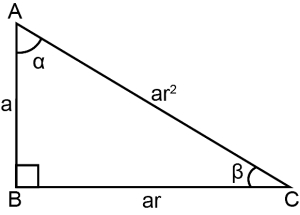
The three sides of a right-angled triangle are in $GP$ (geometric progression). If the two acute angles are $\alpha$ and $\beta$,then $\tan \alpha$ and $\tan \beta$ are
A
$\frac{\sqrt{5}+1}{2}$ and $\frac{\sqrt{5}-1}{2}$
B
$\sqrt{\frac{\sqrt{5}+1}{2}}$ and $\sqrt{\frac{\sqrt{5}-1}{2}}$
C
$\sqrt{5}$ and $\frac{1}{\sqrt{5}}$
D
$\frac{\sqrt{5}}{2}$ and $\frac{2}{\sqrt{5}}$
Solution
(B) Let the sides of the right-angled triangle be $a, ar, ar^2$ where $ar^2$ is the hypotenuse.
By Pythagoras theorem,$(ar^2)^2 = a^2 + (ar)^2$.
Dividing by $a^2$ (assuming $a \neq 0$),we get $r^4 = 1 + r^2$,which implies $r^4 - r^2 - 1 = 0$.
Solving for $r^2$ using the quadratic formula,$r^2 = \frac{1 \pm \sqrt{1 - 4(1)(-1)}}{2} = \frac{1 + \sqrt{5}}{2}$ (since $r^2 > 0$).
Thus,$r = \sqrt{\frac{\sqrt{5}+1}{2}}$.
In the triangle,$\tan \alpha = \frac{\text{opposite}}{\text{adjacent}} = \frac{ar}{a} = r = \sqrt{\frac{\sqrt{5}+1}{2}}$.
Similarly,$\tan \beta = \frac{a}{ar} = \frac{1}{r} = \frac{1}{\sqrt{\frac{\sqrt{5}+1}{2}}} = \sqrt{\frac{2}{\sqrt{5}+1}} = \sqrt{\frac{2(\sqrt{5}-1)}{5-1}} = \sqrt{\frac{\sqrt{5}-1}{2}}$.
Therefore,the values are $\sqrt{\frac{\sqrt{5}+1}{2}}$ and $\sqrt{\frac{\sqrt{5}-1}{2}}$.
By Pythagoras theorem,$(ar^2)^2 = a^2 + (ar)^2$.
Dividing by $a^2$ (assuming $a \neq 0$),we get $r^4 = 1 + r^2$,which implies $r^4 - r^2 - 1 = 0$.
Solving for $r^2$ using the quadratic formula,$r^2 = \frac{1 \pm \sqrt{1 - 4(1)(-1)}}{2} = \frac{1 + \sqrt{5}}{2}$ (since $r^2 > 0$).
Thus,$r = \sqrt{\frac{\sqrt{5}+1}{2}}$.
In the triangle,$\tan \alpha = \frac{\text{opposite}}{\text{adjacent}} = \frac{ar}{a} = r = \sqrt{\frac{\sqrt{5}+1}{2}}$.
Similarly,$\tan \beta = \frac{a}{ar} = \frac{1}{r} = \frac{1}{\sqrt{\frac{\sqrt{5}+1}{2}}} = \sqrt{\frac{2}{\sqrt{5}+1}} = \sqrt{\frac{2(\sqrt{5}-1)}{5-1}} = \sqrt{\frac{\sqrt{5}-1}{2}}$.
Therefore,the values are $\sqrt{\frac{\sqrt{5}+1}{2}}$ and $\sqrt{\frac{\sqrt{5}-1}{2}}$.
0 likes
View Solution314
MediumMCQ
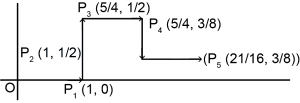
$A$ particle starts at the origin and moves $1$ unit horizontally to the right and reaches $P_{1}$,then it moves $\frac{1}{2}$ unit vertically up and reaches $P_{2}$,then it moves $\frac{1}{4}$ unit horizontally to the right and reaches $P_{3}$,then it moves $\frac{1}{8}$ unit vertically down and reaches $P_{4}$,then it moves $\frac{1}{16}$ unit horizontally to the right and reaches $P_{5}$ and so on. Let $P_{n} = (x_{n}, y_{n})$ and $\lim_{n \rightarrow \infty} x_{n} = \alpha$ and $\lim_{n \rightarrow \infty} y_{n} = \beta$. Then,$(\alpha, \beta)$ is
A
$(2, 3)$
B
$(\frac{4}{3}, \frac{2}{5})$
C
$(\frac{2}{5}, 1)$
D
$(\frac{4}{3}, 3)$
Solution
(B) The particle moves in a sequence of steps. The $x$-coordinates and $y$-coordinates change as follows:
$x$-coordinates: $1, 1, 1 + \frac{1}{4}, 1 + \frac{1}{4}, 1 + \frac{1}{4} + \frac{1}{16}, \dots$
This is a geometric series for the horizontal movements: $x_{\infty} = 1 + \frac{1}{4} + \frac{1}{16} + \dots = \frac{1}{1 - 1/4} = \frac{1}{3/4} = \frac{4}{3}$.
$y$-coordinates: $0, \frac{1}{2}, \frac{1}{2}, \frac{1}{2} - \frac{1}{8}, \frac{1}{2} - \frac{1}{8}, \dots$
This is a geometric series for the vertical movements: $y_{\infty} = \frac{1}{2} - \frac{1}{8} + \frac{1}{32} - \dots = \frac{1/2}{1 - (-1/4)} = \frac{1/2}{5/4} = \frac{2}{5}$.
Thus,$(\alpha, \beta) = (\frac{4}{3}, \frac{2}{5})$.
$x$-coordinates: $1, 1, 1 + \frac{1}{4}, 1 + \frac{1}{4}, 1 + \frac{1}{4} + \frac{1}{16}, \dots$
This is a geometric series for the horizontal movements: $x_{\infty} = 1 + \frac{1}{4} + \frac{1}{16} + \dots = \frac{1}{1 - 1/4} = \frac{1}{3/4} = \frac{4}{3}$.
$y$-coordinates: $0, \frac{1}{2}, \frac{1}{2}, \frac{1}{2} - \frac{1}{8}, \frac{1}{2} - \frac{1}{8}, \dots$
This is a geometric series for the vertical movements: $y_{\infty} = \frac{1}{2} - \frac{1}{8} + \frac{1}{32} - \dots = \frac{1/2}{1 - (-1/4)} = \frac{1/2}{5/4} = \frac{2}{5}$.
Thus,$(\alpha, \beta) = (\frac{4}{3}, \frac{2}{5})$.
0 likes
View Solution315
EasyMCQ
In a $GP$ series consisting of positive terms,each term is equal to the sum of the next two terms. Then,the common ratio of this $GP$ series is
A
$\sqrt{5}$
B
$\frac{\sqrt{5}-1}{2}$
C
$\frac{\sqrt{5}}{2}$
D
$\frac{\sqrt{5}+1}{2}$
Solution
(B) Let $a_{n}$ be the general term of a $GP$ whose first term is $a$ and common ratio is $r$.
According to the problem,each term is equal to the sum of the next two terms:
$a_{n} = a_{n+1} + a_{n+2}$
$a r^{n-1} = a r^{n} + a r^{n+1}$
Since the terms are positive,$a \neq 0$ and $r > 0$. Dividing by $a r^{n-1}$:
$1 = r + r^{2}$
$r^{2} + r - 1 = 0$
Using the quadratic formula $r = \frac{-b \pm \sqrt{b^{2}-4ac}}{2a}$:
$r = \frac{-1 \pm \sqrt{1^{2} - 4(1)(-1)}}{2(1)} = \frac{-1 \pm \sqrt{5}}{2}$
Since the $GP$ consists of positive terms,the common ratio $r$ must be positive.
Therefore,$r = \frac{\sqrt{5}-1}{2}$.
According to the problem,each term is equal to the sum of the next two terms:
$a_{n} = a_{n+1} + a_{n+2}$
$a r^{n-1} = a r^{n} + a r^{n+1}$
Since the terms are positive,$a \neq 0$ and $r > 0$. Dividing by $a r^{n-1}$:
$1 = r + r^{2}$
$r^{2} + r - 1 = 0$
Using the quadratic formula $r = \frac{-b \pm \sqrt{b^{2}-4ac}}{2a}$:
$r = \frac{-1 \pm \sqrt{1^{2} - 4(1)(-1)}}{2(1)} = \frac{-1 \pm \sqrt{5}}{2}$
Since the $GP$ consists of positive terms,the common ratio $r$ must be positive.
Therefore,$r = \frac{\sqrt{5}-1}{2}$.
0 likes
View Solution316
MediumMCQ
Six positive numbers are in $GP$,such that their product is $1000$. If the fourth term is $1$,then the last term is
A
$1000$
B
$100$
C
$\frac{1}{100}$
D
$\frac{1}{1000}$
Solution
(C) Let the six terms of the $GP$ be $\frac{a}{r^5}, \frac{a}{r^3}, \frac{a}{r}, ar, ar^3, ar^5$.
Given that the product of these terms is $1000$:
$\frac{a}{r^5} \cdot \frac{a}{r^3} \cdot \frac{a}{r} \cdot ar \cdot ar^3 \cdot ar^5 = 1000$
$a^6 = 1000 = 10^3$
$a^2 = (10^3)^{1/3} = 10$.
Given the fourth term is $1$:
$ar = 1 \Rightarrow a^2r^2 = 1$.
Substituting $a^2 = 10$:
$10r^2 = 1 \Rightarrow r^2 = \frac{1}{10}$.
The last term is $ar^5 = \sqrt{a^2(r^2)^5} = \sqrt{10 \cdot (\frac{1}{10})^5} = \sqrt{\frac{1}{10^4}} = \frac{1}{100}$.
Given that the product of these terms is $1000$:
$\frac{a}{r^5} \cdot \frac{a}{r^3} \cdot \frac{a}{r} \cdot ar \cdot ar^3 \cdot ar^5 = 1000$
$a^6 = 1000 = 10^3$
$a^2 = (10^3)^{1/3} = 10$.
Given the fourth term is $1$:
$ar = 1 \Rightarrow a^2r^2 = 1$.
Substituting $a^2 = 10$:
$10r^2 = 1 \Rightarrow r^2 = \frac{1}{10}$.
The last term is $ar^5 = \sqrt{a^2(r^2)^5} = \sqrt{10 \cdot (\frac{1}{10})^5} = \sqrt{\frac{1}{10^4}} = \frac{1}{100}$.
0 likes
View Solution317
EasyMCQ
If $64, 27, 36$ are the $P^{\text{th}}$,$Q^{\text{th}}$,and $R^{\text{th}}$ terms of a $GP$,then $P+2Q$ is equal to
A
$R$
B
$2R$
C
$3R$
D
$4R$
Solution
(C) Let $a$ be the first term and $r$ be the common ratio of a $GP$. The $P^{\text{th}}$,$Q^{\text{th}}$,and $R^{\text{th}}$ terms are $ar^{P-1}$,$ar^{Q-1}$,and $ar^{R-1}$ respectively.
According to the question:
$ar^{P-1} = 64$ $(i)$
$ar^{Q-1} = 27$ (ii)
$ar^{R-1} = 36$ (iii)
Dividing $(i)$ by (ii):
$r^{P-Q} = \frac{64}{27} = \left(\frac{4}{3}\right)^3$ (iv)
Dividing (ii) by (iii):
$r^{Q-R} = \frac{27}{36} = \frac{3}{4}$
Raising to the power of $3$:
$r^{3(Q-R)} = \left(\frac{3}{4}\right)^3 = \left(\frac{4}{3}\right)^{-3}$ $(v)$
Multiplying (iv) and $(v)$:
$r^{P-Q} \times r^{3Q-3R} = \left(\frac{4}{3}\right)^3 \times \left(\frac{4}{3}\right)^{-3} = 1$
$r^{P+2Q-3R} = r^0$
Therefore,$P+2Q-3R = 0$,which implies $P+2Q = 3R$.
According to the question:
$ar^{P-1} = 64$ $(i)$
$ar^{Q-1} = 27$ (ii)
$ar^{R-1} = 36$ (iii)
Dividing $(i)$ by (ii):
$r^{P-Q} = \frac{64}{27} = \left(\frac{4}{3}\right)^3$ (iv)
Dividing (ii) by (iii):
$r^{Q-R} = \frac{27}{36} = \frac{3}{4}$
Raising to the power of $3$:
$r^{3(Q-R)} = \left(\frac{3}{4}\right)^3 = \left(\frac{4}{3}\right)^{-3}$ $(v)$
Multiplying (iv) and $(v)$:
$r^{P-Q} \times r^{3Q-3R} = \left(\frac{4}{3}\right)^3 \times \left(\frac{4}{3}\right)^{-3} = 1$
$r^{P+2Q-3R} = r^0$
Therefore,$P+2Q-3R = 0$,which implies $P+2Q = 3R$.
0 likes
View Solution318
MediumMCQ
If the sum of an infinite geometric series is $\frac{4}{5}$ and its $1^{st}$ term is $\frac{3}{4}$,then its common ratio is
A
$\frac{7}{16}$
B
$\frac{9}{16}$
C
$\frac{1}{9}$
D
$\frac{1}{16}$
Solution
(D) The sum of an infinite geometric series is given by the formula $S = \frac{a}{1-r}$,where $a$ is the first term and $r$ is the common ratio.
Given $S = \frac{4}{5}$ and $a = \frac{3}{4}$.
Substituting the values into the formula: $\frac{4}{5} = \frac{\frac{3}{4}}{1-r}$.
Multiplying both sides by $(1-r)$,we get $\frac{4}{5}(1-r) = \frac{3}{4}$.
$1-r = \frac{3}{4} \times \frac{5}{4} = \frac{15}{16}$.
$r = 1 - \frac{15}{16} = \frac{1}{16}$.
Given $S = \frac{4}{5}$ and $a = \frac{3}{4}$.
Substituting the values into the formula: $\frac{4}{5} = \frac{\frac{3}{4}}{1-r}$.
Multiplying both sides by $(1-r)$,we get $\frac{4}{5}(1-r) = \frac{3}{4}$.
$1-r = \frac{3}{4} \times \frac{5}{4} = \frac{15}{16}$.
$r = 1 - \frac{15}{16} = \frac{1}{16}$.
0 likes
View Solution319
DifficultMCQ
$\frac{6}{3^{26}} + \frac{10 \cdot 1}{3^{25}} + \frac{10 \cdot 2}{3^{24}} + \frac{10 \cdot 2^2}{3^{23}} + \ldots + \frac{10 \cdot 2^{24}}{3}$ is equal to
A
$2^{25}$
B
$2^{26}$
C
$3^{25}$
D
$3^{26}$
Solution
(B) Let the given expression be $S = \frac{6}{3^{26}} + \sum_{k=0}^{24} \frac{10 \cdot 2^k}{3^{25-k}}$.
This can be rewritten as $S = \frac{6}{3^{26}} + \frac{10}{3^{25}} \sum_{k=0}^{24} \left(\frac{2}{3^{-1}}\right)^k = \frac{6}{3^{26}} + \frac{10}{3^{25}} \sum_{k=0}^{24} (6)^k$.
Using the sum formula for a geometric progression $\sum_{k=0}^{n-1} r^k = \frac{r^n - 1}{r - 1}$,we get:
$S = \frac{6}{3^{26}} + \frac{10}{3^{25}} \left[ \frac{6^{25} - 1}{6 - 1} \right] = \frac{6}{3^{26}} + \frac{10}{3^{25}} \left[ \frac{6^{25} - 1}{5} \right]$.
$S = \frac{6}{3^{26}} + \frac{2}{3^{25}} (6^{25} - 1) = \frac{6}{3^{26}} + \frac{2 \cdot 6^{25}}{3^{25}} - \frac{2}{3^{25}}$.
Since $6^{25} = 2^{25} \cdot 3^{25}$,we have $S = \frac{6}{3^{26}} + 2 \cdot 2^{25} - \frac{2}{3^{25}} = \frac{2 \cdot 3}{3^{26}} + 2^{26} - \frac{2}{3^{25}} = \frac{2}{3^{25}} + 2^{26} - \frac{2}{3^{25}} = 2^{26}$.
This can be rewritten as $S = \frac{6}{3^{26}} + \frac{10}{3^{25}} \sum_{k=0}^{24} \left(\frac{2}{3^{-1}}\right)^k = \frac{6}{3^{26}} + \frac{10}{3^{25}} \sum_{k=0}^{24} (6)^k$.
Using the sum formula for a geometric progression $\sum_{k=0}^{n-1} r^k = \frac{r^n - 1}{r - 1}$,we get:
$S = \frac{6}{3^{26}} + \frac{10}{3^{25}} \left[ \frac{6^{25} - 1}{6 - 1} \right] = \frac{6}{3^{26}} + \frac{10}{3^{25}} \left[ \frac{6^{25} - 1}{5} \right]$.
$S = \frac{6}{3^{26}} + \frac{2}{3^{25}} (6^{25} - 1) = \frac{6}{3^{26}} + \frac{2 \cdot 6^{25}}{3^{25}} - \frac{2}{3^{25}}$.
Since $6^{25} = 2^{25} \cdot 3^{25}$,we have $S = \frac{6}{3^{26}} + 2 \cdot 2^{25} - \frac{2}{3^{25}} = \frac{2 \cdot 3}{3^{26}} + 2^{26} - \frac{2}{3^{25}} = \frac{2}{3^{25}} + 2^{26} - \frac{2}{3^{25}} = 2^{26}$.
0 likes
View Solution320
DifficultMCQ
In a $G.P.$,if the product of the first three terms is $27$ and the set of all possible values for the sum of its first three terms is $\mathbb{R} - (a, b)$,then $a^{2} + b^{2}$ is equal to . . . . . . .
A
$80$
B
$90$
C
$100$
D
$110$
Solution
(B) Let the first three terms of the $G.P.$ be $\frac{A}{r}, A, Ar$.
Given their product is $27$:
$\frac{A}{r} \cdot A \cdot Ar = 27 \implies A^3 = 27 \implies A = 3$.
The sum of the first three terms is $S = \frac{3}{r} + 3 + 3r = 3 \left( r + \frac{1}{r} + 1 \right)$.
We know that for any real $r \neq 0$,$r + \frac{1}{r} \geq 2$ or $r + \frac{1}{r} \leq -2$.
If $r + \frac{1}{r} \geq 2$,then $S \geq 3(2 + 1) = 9$.
If $r + \frac{1}{r} \leq -2$,then $S \leq 3(-2 + 1) = -3$.
Thus,the set of possible values for $S$ is $(-\infty, -3] \cup [9, \infty)$,which is $\mathbb{R} - (-3, 9)$.
Comparing this with $\mathbb{R} - (a, b)$,we get $a = -3$ and $b = 9$.
Therefore,$a^2 + b^2 = (-3)^2 + 9^2 = 9 + 81 = 90$.
Given their product is $27$:
$\frac{A}{r} \cdot A \cdot Ar = 27 \implies A^3 = 27 \implies A = 3$.
The sum of the first three terms is $S = \frac{3}{r} + 3 + 3r = 3 \left( r + \frac{1}{r} + 1 \right)$.
We know that for any real $r \neq 0$,$r + \frac{1}{r} \geq 2$ or $r + \frac{1}{r} \leq -2$.
If $r + \frac{1}{r} \geq 2$,then $S \geq 3(2 + 1) = 9$.
If $r + \frac{1}{r} \leq -2$,then $S \leq 3(-2 + 1) = -3$.
Thus,the set of possible values for $S$ is $(-\infty, -3] \cup [9, \infty)$,which is $\mathbb{R} - (-3, 9)$.
Comparing this with $\mathbb{R} - (a, b)$,we get $a = -3$ and $b = 9$.
Therefore,$a^2 + b^2 = (-3)^2 + 9^2 = 9 + 81 = 90$.
0 likes
View Solution321
DifficultMCQ
Let $729, 81, 9, 1, \dots$ be a sequence and $P_{n}$ denote the product of the first $n$ terms of this sequence. If $2\sum_{n=1}^{40}(P_{n})^{\frac{1}{n}}=\frac{3^{\alpha}-1}{3^{\beta}}$ and $\gcd(\alpha,\beta)=1$,then $\alpha+\beta$ is equal to
A
$73$
B
$74$
C
$75$
D
$76$
Solution
(A) The sequence is a geometric progression with first term $a = 729 = 3^6$ and common ratio $r = \frac{1}{9} = 3^{-2}$.
$P_n$ is the product of the first $n$ terms: $P_n = a \cdot ar \cdot ar^2 \dots ar^{n-1} = a^n r^{\frac{n(n-1)}{2}}$.
$P_n = (3^6)^n \cdot (3^{-2})^{\frac{n(n-1)}{2}} = 3^{6n} \cdot 3^{-n(n-1)} = 3^{6n - n^2 + n} = 3^{7n - n^2}$.
Thus,$(P_n)^{\frac{1}{n}} = 3^{7-n}$.
We need to evaluate $2 \sum_{n=1}^{40} 3^{7-n} = 2(3^6 + 3^5 + \dots + 3^{7-40}) = 2(3^6 + 3^5 + \dots + 3^{-33})$.
This is a geometric series with $40$ terms,first term $A = 3^6$,and common ratio $R = \frac{1}{3}$.
Sum $= 2 \cdot 3^6 \left( \frac{1 - (1/3)^{40}}{1 - 1/3} \right) = 2 \cdot 3^6 \cdot \frac{3^{40}-1}{3^{40}} \cdot \frac{3}{2} = \frac{3^7(3^{40}-1)}{3^{40}} = \frac{3^{40}-1}{3^{33}}$.
Comparing with $\frac{3^{\alpha}-1}{3^{\beta}}$,we get $\alpha = 40$ and $\beta = 33$.
Since $\gcd(40, 33) = 1$,the value of $\alpha + \beta = 40 + 33 = 73$.
$P_n$ is the product of the first $n$ terms: $P_n = a \cdot ar \cdot ar^2 \dots ar^{n-1} = a^n r^{\frac{n(n-1)}{2}}$.
$P_n = (3^6)^n \cdot (3^{-2})^{\frac{n(n-1)}{2}} = 3^{6n} \cdot 3^{-n(n-1)} = 3^{6n - n^2 + n} = 3^{7n - n^2}$.
Thus,$(P_n)^{\frac{1}{n}} = 3^{7-n}$.
We need to evaluate $2 \sum_{n=1}^{40} 3^{7-n} = 2(3^6 + 3^5 + \dots + 3^{7-40}) = 2(3^6 + 3^5 + \dots + 3^{-33})$.
This is a geometric series with $40$ terms,first term $A = 3^6$,and common ratio $R = \frac{1}{3}$.
Sum $= 2 \cdot 3^6 \left( \frac{1 - (1/3)^{40}}{1 - 1/3} \right) = 2 \cdot 3^6 \cdot \frac{3^{40}-1}{3^{40}} \cdot \frac{3}{2} = \frac{3^7(3^{40}-1)}{3^{40}} = \frac{3^{40}-1}{3^{33}}$.
Comparing with $\frac{3^{\alpha}-1}{3^{\beta}}$,we get $\alpha = 40$ and $\beta = 33$.
Since $\gcd(40, 33) = 1$,the value of $\alpha + \beta = 40 + 33 = 73$.
0 likes
View Solution322
MediumMCQ
Let $a_1, \frac{a_2}{2}, \frac{a_3}{2^2}, \ldots, \frac{a_{10}}{2^9}$ be a $G$.$P$. with common ratio $r = \frac{1}{\sqrt{2}}$. If $a_1 + a_2 + \ldots + a_{10} = 62$,then $a_1$ is equal to:
A
$2(\sqrt{2}-1)$
B
$2-\sqrt{2}$
C
$\sqrt{2}-1$
D
$2(2-\sqrt{2})$
Solution
(A) The given sequence is a $G$.$P$. with common ratio $\frac{1}{\sqrt{2}}$.
Thus,$\frac{a_2/2}{a_1} = \frac{a_3/2^2}{a_2/2} = \frac{1}{\sqrt{2}}$.
This implies $\frac{a_2}{2a_1} = \frac{a_3}{2a_2} = \frac{1}{\sqrt{2}}$,so $\frac{a_2}{a_1} = \frac{2}{\sqrt{2}} = \sqrt{2}$.
Therefore,$a_1, a_2, \ldots, a_{10}$ is a $G$.$P$. with first term $a_1$ and common ratio $R = \sqrt{2}$.
The sum of the first $10$ terms is $S_{10} = a_1 \frac{R^{10}-1}{R-1} = 62$.
$a_1 \frac{(\sqrt{2})^{10}-1}{\sqrt{2}-1} = 62$.
$a_1 \frac{2^5-1}{\sqrt{2}-1} = 62$.
$a_1 \frac{31}{\sqrt{2}-1} = 62$.
$a_1 = \frac{62(\sqrt{2}-1)}{31} = 2(\sqrt{2}-1)$.
Thus,$\frac{a_2/2}{a_1} = \frac{a_3/2^2}{a_2/2} = \frac{1}{\sqrt{2}}$.
This implies $\frac{a_2}{2a_1} = \frac{a_3}{2a_2} = \frac{1}{\sqrt{2}}$,so $\frac{a_2}{a_1} = \frac{2}{\sqrt{2}} = \sqrt{2}$.
Therefore,$a_1, a_2, \ldots, a_{10}$ is a $G$.$P$. with first term $a_1$ and common ratio $R = \sqrt{2}$.
The sum of the first $10$ terms is $S_{10} = a_1 \frac{R^{10}-1}{R-1} = 62$.
$a_1 \frac{(\sqrt{2})^{10}-1}{\sqrt{2}-1} = 62$.
$a_1 \frac{2^5-1}{\sqrt{2}-1} = 62$.
$a_1 \frac{31}{\sqrt{2}-1} = 62$.
$a_1 = \frac{62(\sqrt{2}-1)}{31} = 2(\sqrt{2}-1)$.
0 likes
View Solution323
DifficultMCQ
Let $a_{1}, a_{2}, a_{3}, \dots$ be a $G$.$P$. of increasing positive terms such that $a_{2} \cdot a_{3} \cdot a_{4} = 64$ and $a_{1} + a_{3} + a_{5} = \frac{813}{7}$. Then $a_{3} + a_{5} + a_{7}$ is equal to:
A
$3256$
B
$3252$
C
$3244$
D
$3248$
Solution
(B) Let the $G$.$P$. be $a, ar, ar^2, \dots$. Given $a_2 \cdot a_3 \cdot a_4 = 64$,we have $(ar)(ar^2)(ar^3) = 64$,which implies $a^3 r^6 = 64$,so $ar^2 = 4$.
Given $a_1 + a_3 + a_5 = \frac{813}{7}$,we have $a + ar^2 + ar^4 = \frac{813}{7}$.
Substituting $a = \frac{4}{r^2}$,we get $\frac{4}{r^2} + 4 + 4r^2 = \frac{813}{7}$.
Let $x = r^2$. Then $\frac{4}{x} + 4 + 4x = \frac{813}{7}$ $\Rightarrow 4 + 4x + 4x^2 = \frac{813}{7}x$ $\Rightarrow 28 + 28x + 28x^2 = 813x$.
$28x^2 - 785x + 28 = 0$. Solving this quadratic,$x = \frac{785 \pm \sqrt{785^2 - 4(28)(28)}}{2(28)} = \frac{785 \pm 783}{56}$.
Since the terms are increasing,$r > 1$,so $x = r^2 = \frac{1568}{56} = 28$.
We need $a_3 + a_5 + a_7 = ar^2 + ar^4 + ar^6 = ar^2(1 + r^2 + r^4) = 4(1 + 28 + 28^2) = 4(1 + 28 + 784) = 4(813) = 3252$.
Given $a_1 + a_3 + a_5 = \frac{813}{7}$,we have $a + ar^2 + ar^4 = \frac{813}{7}$.
Substituting $a = \frac{4}{r^2}$,we get $\frac{4}{r^2} + 4 + 4r^2 = \frac{813}{7}$.
Let $x = r^2$. Then $\frac{4}{x} + 4 + 4x = \frac{813}{7}$ $\Rightarrow 4 + 4x + 4x^2 = \frac{813}{7}x$ $\Rightarrow 28 + 28x + 28x^2 = 813x$.
$28x^2 - 785x + 28 = 0$. Solving this quadratic,$x = \frac{785 \pm \sqrt{785^2 - 4(28)(28)}}{2(28)} = \frac{785 \pm 783}{56}$.
Since the terms are increasing,$r > 1$,so $x = r^2 = \frac{1568}{56} = 28$.
We need $a_3 + a_5 + a_7 = ar^2 + ar^4 + ar^6 = ar^2(1 + r^2 + r^4) = 4(1 + 28 + 28^2) = 4(1 + 28 + 784) = 4(813) = 3252$.
0 likes
View Solution324
DifficultMCQ
Consider the quadratic equation $(n^2 - 2n + 2)x^2 - 3x + (n^2 - 2n + 2) = 0, n \in R$. Let $\alpha$ be the minimum value of the product of its roots and $\beta$ be the maximum value of the sum of its roots. Then the sum of the first six terms of the $G$.$P$.,whose first term is $\alpha$ and the common ratio is $\frac{\alpha}{\beta}$,is:
A
$61$/$37$
B
$121$/$81$
C
$364$/$243$
D
$1093$/$729$
Solution
(C) The product of the roots $P$ of the quadratic equation $ax^2 + bx + c = 0$ is given by $P = c/a$.
Here,$P = \frac{n^2 - 2n + 2}{n^2 - 2n + 2} = 1$. Since the product is constant,its minimum value $\alpha = 1$.
The sum of the roots $S$ is given by $S = -b/a = \frac{3}{n^2 - 2n + 2}$.
To maximize $S$,we must minimize the denominator $n^2 - 2n + 2 = (n-1)^2 + 1$.
The minimum value of the denominator is $1$ (at $n=1$),so the maximum value of the sum is $\beta = 3/1 = 3$.
For the $G$.$P$.,the first term $a = \alpha = 1$ and the common ratio $r = \alpha/\beta = 1/3$.
The sum of the first $n$ terms of a $G$.$P$. is $S_n = \frac{a(1-r^n)}{1-r}$.
For $n=6$,$S_6 = \frac{1(1-(1/3)^6)}{1-1/3} = \frac{1 - 1/729}{2/3} = \frac{728/729}{2/3} = \frac{728}{729} \times \frac{3}{2} = \frac{364}{243}$.
Here,$P = \frac{n^2 - 2n + 2}{n^2 - 2n + 2} = 1$. Since the product is constant,its minimum value $\alpha = 1$.
The sum of the roots $S$ is given by $S = -b/a = \frac{3}{n^2 - 2n + 2}$.
To maximize $S$,we must minimize the denominator $n^2 - 2n + 2 = (n-1)^2 + 1$.
The minimum value of the denominator is $1$ (at $n=1$),so the maximum value of the sum is $\beta = 3/1 = 3$.
For the $G$.$P$.,the first term $a = \alpha = 1$ and the common ratio $r = \alpha/\beta = 1/3$.
The sum of the first $n$ terms of a $G$.$P$. is $S_n = \frac{a(1-r^n)}{1-r}$.
For $n=6$,$S_6 = \frac{1(1-(1/3)^6)}{1-1/3} = \frac{1 - 1/729}{2/3} = \frac{728/729}{2/3} = \frac{728}{729} \times \frac{3}{2} = \frac{364}{243}$.
0 likes
View Solution325
DifficultMCQ
For the functions $f(\theta) = \alpha \tan^2 \theta + \beta \cot^2 \theta$ and $g(\theta) = \alpha \sin^2 \theta + \beta \cos^2 \theta$,where $\alpha > \beta > 0$,let $\min_{0 < \theta < \pi/2} f(\theta) = \max_{0 < \theta < \pi} g(\theta)$. If the first term of a $G$.$P$. is $(\frac{\alpha}{2\beta})$,its common ratio is $(\frac{2\beta}{\alpha})$ and the sum of its first $10$ terms is $\frac{m}{n}$,where $\gcd(m,n)=1$,then $m+n$ is equal to . . . . . . .
A
$1023$
B
$1024$
C
$2047$
D
$3071$
Solution
(NONE) The minimum value of $f(\theta) = \alpha \tan^2 \theta + \beta \cot^2 \theta$ is found using the $AM$-$GM$ inequality: $f(\theta) \ge 2\sqrt{\alpha \tan^2 \theta \cdot \beta \cot^2 \theta} = 2\sqrt{\alpha\beta}$.
Since $\alpha > \beta > 0$,the maximum value of $g(\theta) = \alpha \sin^2 \theta + \beta \cos^2 \theta$ is $\alpha$.
Given $\min f(\theta) = \max g(\theta)$,we have $2\sqrt{\alpha\beta} = \alpha$.
Squaring both sides,$4\alpha\beta = \alpha^2$,which implies $\alpha = 4\beta$ (since $\alpha \neq 0$).
The first term $a = \frac{\alpha}{2\beta} = \frac{4\beta}{2\beta} = 2$.
The common ratio $r = \frac{2\beta}{\alpha} = \frac{2\beta}{4\beta} = \frac{1}{2}$.
The sum of the first $10$ terms of the $G$.$P$. is $S_{10} = a \frac{1-r^{10}}{1-r} = 2 \frac{1-(1/2)^{10}}{1-1/2} = 4(1 - \frac{1}{1024}) = 4 \cdot \frac{1023}{1024} = \frac{1023}{256}$.
Thus,$m = 1023$ and $n = 256$. Since $\gcd(1023, 256) = 1$,$m+n = 1023 + 256 = 1279$.
Since $\alpha > \beta > 0$,the maximum value of $g(\theta) = \alpha \sin^2 \theta + \beta \cos^2 \theta$ is $\alpha$.
Given $\min f(\theta) = \max g(\theta)$,we have $2\sqrt{\alpha\beta} = \alpha$.
Squaring both sides,$4\alpha\beta = \alpha^2$,which implies $\alpha = 4\beta$ (since $\alpha \neq 0$).
The first term $a = \frac{\alpha}{2\beta} = \frac{4\beta}{2\beta} = 2$.
The common ratio $r = \frac{2\beta}{\alpha} = \frac{2\beta}{4\beta} = \frac{1}{2}$.
The sum of the first $10$ terms of the $G$.$P$. is $S_{10} = a \frac{1-r^{10}}{1-r} = 2 \frac{1-(1/2)^{10}}{1-1/2} = 4(1 - \frac{1}{1024}) = 4 \cdot \frac{1023}{1024} = \frac{1023}{256}$.
Thus,$m = 1023$ and $n = 256$. Since $\gcd(1023, 256) = 1$,$m+n = 1023 + 256 = 1279$.
0 likes
View SolutionSequences and Series — Geometric progression · Frequently Asked Questions
1Are these Sequences and Series questions useful for JEE and NEET?
Yes. All questions in this section are mapped to JEE Main and NEET exam patterns. Previous year questions from JEE Main, NEET, GUJCET and state-level exams are included with full solutions.
2Can I switch to Hindi or Gujarati for these questions?
Yes. Use the language tabs in the hero section or the sidebar to view the same questions and solutions in English, Hindi or Gujarati.
3How do I generate a question paper from this subtopic?
Use the Vedclass Exam Paper Generator — select the chapter and subtopic, set difficulty, and generate Sets A, B, C, D automatically. First 3 chapters of every subject are free.
Vedclass Products
For Students
Vedclass Test Series
Mock tests in real JEE/NEET style with performance analysis. 5-day free trial.
Start Free TrialFor Teachers
Exam Paper Generator
Generate Set A/B/C/D papers from this chapter in 2 minutes. 3 chapters free.
Try FreeFor Institutes
Online Exam Module
Live online exams with unlimited students, 360° analytics & white-label branding.
See DemoFor Teachers & Institutes
Generate a Sequences and Series Exam Paper in 2 Minutes
Select subtopic & difficulty — Sets A, B, C, D auto-generated with No Repeat logic.
First 3 chapters of every subject are free — no payment required.