
A English
Geometrical problems Questions in English
Class 11 Mathematics · Permutation and Combination · Geometrical problems
194+
Questions
English
Language
100%
With Solutions
Showing 37 of 194 questions in English
151
MediumMCQ
The crew of an $8$-oar boat is to be chosen from $12$ men,of whom $3$ can row on the stroke side only. The number of ways in which the crew can be arranged is
A
${ }^{9}C_{4} \times { }^{8}C_{3} \times 3! \times 4!$
B
${ }^{9}C_{4} \times { }^{8}C_{4} \times 4! \times 4!$
C
${ }^{8}C_{3} \times { }^{8}C_{3} \times 4! \times 3!$
D
${ }^{9}C_{4} \times { }^{9}C_{4} \times 4! \times 4!$
Solution
(B) An $8$-oar boat requires $4$ men on the stroke side and $4$ men on the bow side.
Given $12$ men,$3$ can row only on the stroke side,and $9$ can row on either side.
To form the crew,we need $4$ men for the stroke side and $4$ for the bow side.
Case $1$: Select $4$ men for the stroke side. We must include some of the $3$ stroke-only men.
Total ways to select $4$ men for the stroke side from $12$ is ${ }^{9}C_{4}$ (choosing from the $9$ flexible men) plus cases involving the $3$ stroke-only men.
Actually,the standard approach is: Select $4$ men for the stroke side from the $3$ stroke-only and $9$ others,then $4$ for the bow side from the remaining $8$.
Total ways $= { }^{9}C_{4} \times { }^{8}C_{4} \times 4! \times 4!$.
Thus,option $(B)$ is correct.
Given $12$ men,$3$ can row only on the stroke side,and $9$ can row on either side.
To form the crew,we need $4$ men for the stroke side and $4$ for the bow side.
Case $1$: Select $4$ men for the stroke side. We must include some of the $3$ stroke-only men.
Total ways to select $4$ men for the stroke side from $12$ is ${ }^{9}C_{4}$ (choosing from the $9$ flexible men) plus cases involving the $3$ stroke-only men.
Actually,the standard approach is: Select $4$ men for the stroke side from the $3$ stroke-only and $9$ others,then $4$ for the bow side from the remaining $8$.
Total ways $= { }^{9}C_{4} \times { }^{8}C_{4} \times 4! \times 4!$.
Thus,option $(B)$ is correct.
0 likes
View Solution152
EasyMCQ
There are $10$ points in a plane,out of which $6$ are collinear. If $N$ is the total number of triangles formed by joining these points,then $N=$
A
$120$
B
$850$
C
$100$
D
$150$
Solution
(C) The total number of ways to select $3$ points out of $10$ is given by $^{10}C_3$.
$^{10}C_3 = \frac{10 \times 9 \times 8}{3 \times 2 \times 1} = 120$.
Since $6$ points are collinear,they do not form a triangle. The number of ways to select $3$ points from these $6$ collinear points is $^{6}C_3$.
$^{6}C_3 = \frac{6 \times 5 \times 4}{3 \times 2 \times 1} = 20$.
Therefore,the total number of triangles $N = 120 - 20 = 100$.
$^{10}C_3 = \frac{10 \times 9 \times 8}{3 \times 2 \times 1} = 120$.
Since $6$ points are collinear,they do not form a triangle. The number of ways to select $3$ points from these $6$ collinear points is $^{6}C_3$.
$^{6}C_3 = \frac{6 \times 5 \times 4}{3 \times 2 \times 1} = 20$.
Therefore,the total number of triangles $N = 120 - 20 = 100$.
0 likes
View Solution153
MediumMCQ
Let $T_n$ be the number of all possible triangles formed by joining vertices of an $n$-sided regular polygon. If $T_{n+1}-T_n=10$,then the value of $n$ is
A
$5$
B
$3$
C
$7$
D
$4$
Solution
(A) triangle is formed by selecting $3$ vertices out of $n$ vertices. The number of ways to choose $3$ vertices is given by ${}^nC_3$.
Given $T_{n+1} - T_n = 10$.
Using the identity ${}^{n+1}C_r - {}^nC_r = {}^nC_{r-1}$,we have:
${}^{n+1}C_3 - {}^nC_3 = {}^nC_2 = 10$.
Expanding the combination formula:
$\frac{n(n-1)}{2} = 10$
$n^2 - n = 20$
$n^2 - n - 20 = 0$
$(n-5)(n+4) = 0$
Since $n$ must be a positive integer,$n = 5$.
Given $T_{n+1} - T_n = 10$.
Using the identity ${}^{n+1}C_r - {}^nC_r = {}^nC_{r-1}$,we have:
${}^{n+1}C_3 - {}^nC_3 = {}^nC_2 = 10$.
Expanding the combination formula:
$\frac{n(n-1)}{2} = 10$
$n^2 - n = 20$
$n^2 - n - 20 = 0$
$(n-5)(n+4) = 0$
Since $n$ must be a positive integer,$n = 5$.
0 likes
View Solution154
EasyMCQ
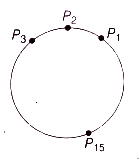
Let $P_1, P_2, \ldots, P_{15}$ be $15$ points on a circle. The number of distinct triangles formed by points $P_i, P_j, P_k$ such that $i+j+k \neq 15$ is
A
$449$
B
$419$
C
$455$
D
$443$
Solution
(D) The total number of distinct triangles that can be formed using $15$ points is given by $^{15}C_3 = \frac{15 \times 14 \times 13}{3 \times 2 \times 1} = 455$.
We need to exclude the cases where $i+j+k = 15$,where $1 \leq i < j < k \leq 15$.
The possible sets of $(i, j, k)$ such that $i+j+k = 15$ are:
$(1, 2, 12), (1, 3, 11), (1, 4, 10), (1, 5, 9), (1, 6, 8), (2, 3, 10), (2, 4, 9), (2, 5, 8), (2, 6, 7), (3, 4, 8), (3, 5, 7), (4, 5, 6)$.
Counting these,we find there are $12$ such sets.
Therefore,the number of required triangles is $455 - 12 = 443$.
We need to exclude the cases where $i+j+k = 15$,where $1 \leq i < j < k \leq 15$.
The possible sets of $(i, j, k)$ such that $i+j+k = 15$ are:
$(1, 2, 12), (1, 3, 11), (1, 4, 10), (1, 5, 9), (1, 6, 8), (2, 3, 10), (2, 4, 9), (2, 5, 8), (2, 6, 7), (3, 4, 8), (3, 5, 7), (4, 5, 6)$.
Counting these,we find there are $12$ such sets.
Therefore,the number of required triangles is $455 - 12 = 443$.
0 likes
View Solution155
MediumMCQ
In a plane,there are $37$ straight lines,of which $13$ pass through point $A$ and $11$ pass through point $B$. Moreover,no three lines (apart from the lines passing through $A$ and $B$) pass through the same point,and no two lines are parallel. What is the number of points of intersection of the straight lines?
A
$^{37}C_2$
B
$^{37}C_2 - ^{13}C_2 - ^{11}C_2$
C
$^{37}C_2 - ^{13}C_2 - ^{11}C_2 + 2$
D
$^{37}C_2 - 2$
Solution
(C) The total number of ways to select $2$ lines out of $37$ is $^{37}C_2$.
Since $13$ lines are concurrent at point $A$,they do not produce $^{13}C_2$ distinct intersection points; instead,they all intersect at $1$ point. Thus,we subtract $^{13}C_2$ and add $1$.
Similarly,since $11$ lines are concurrent at point $B$,they do not produce $^{11}C_2$ distinct intersection points; they all intersect at $1$ point. Thus,we subtract $^{11}C_2$ and add $1$.
Therefore,the total number of points of intersection is $^{37}C_2 - ^{13}C_2 + 1 - ^{11}C_2 + 1 = ^{37}C_2 - ^{13}C_2 - ^{11}C_2 + 2$.
Since $13$ lines are concurrent at point $A$,they do not produce $^{13}C_2$ distinct intersection points; instead,they all intersect at $1$ point. Thus,we subtract $^{13}C_2$ and add $1$.
Similarly,since $11$ lines are concurrent at point $B$,they do not produce $^{11}C_2$ distinct intersection points; they all intersect at $1$ point. Thus,we subtract $^{11}C_2$ and add $1$.
Therefore,the total number of points of intersection is $^{37}C_2 - ^{13}C_2 + 1 - ^{11}C_2 + 1 = ^{37}C_2 - ^{13}C_2 - ^{11}C_2 + 2$.
0 likes
View Solution156
EasyMCQ
$A$ set of $10$ parallel lines is intersected by another set of $m$ parallel lines. If the total number of parallelograms formed by these two sets of lines is $675$,then $m$ is equal to:
A
$15$
B
$10$
C
$12$
D
$6$
Solution
(D) parallelogram is formed by selecting $2$ lines from the first set of $10$ parallel lines and $2$ lines from the second set of $m$ parallel lines.
The number of ways to choose $2$ lines from $10$ is given by ${}^{10}C_2 = \frac{10 \times 9}{2} = 45$.
The number of ways to choose $2$ lines from $m$ is given by ${}^{m}C_2 = \frac{m(m-1)}{2}$.
The total number of parallelograms is the product of these two combinations:
${}^{10}C_2 \times {}^{m}C_2 = 675$
$45 \times \frac{m(m-1)}{2} = 675$
$\frac{m(m-1)}{2} = \frac{675}{45} = 15$
$m(m-1) = 30$
$m^2 - m - 30 = 0$
$(m - 6)(m + 5) = 0$
Since $m$ must be positive,$m = 6$.
The number of ways to choose $2$ lines from $10$ is given by ${}^{10}C_2 = \frac{10 \times 9}{2} = 45$.
The number of ways to choose $2$ lines from $m$ is given by ${}^{m}C_2 = \frac{m(m-1)}{2}$.
The total number of parallelograms is the product of these two combinations:
${}^{10}C_2 \times {}^{m}C_2 = 675$
$45 \times \frac{m(m-1)}{2} = 675$
$\frac{m(m-1)}{2} = \frac{675}{45} = 15$
$m(m-1) = 30$
$m^2 - m - 30 = 0$
$(m - 6)(m + 5) = 0$
Since $m$ must be positive,$m = 6$.
0 likes
View Solution157
EasyMCQ
There are $10$ points on the line segment $AB$ excluding $A$ and $B$,and $8$ points on the line segment $AC$ excluding $A$ and $C$. The number of triangles formed using these $18$ points (excluding $A, B,$ and $C$) is:
A
$^{18}C_3 - ^{10}C_3$
B
$360$
C
$640$
D
$280$
Solution
(C) Total points available excluding $A, B,$ and $C$ are $10 + 8 = 18$.
To form a triangle,we need to select $3$ points that are not collinear.
The total number of ways to select $3$ points from $18$ is $^{18}C_3$.
Points on line $AB$ are collinear,so $^{10}C_3$ combinations do not form a triangle.
Points on line $AC$ are collinear,so $^{8}C_3$ combinations do not form a triangle.
Thus,the number of triangles is $^{18}C_3 - ^{10}C_3 - ^{8}C_3$.
$^{18}C_3 = \frac{18 \times 17 \times 16}{3 \times 2 \times 1} = 816$.
$^{10}C_3 = \frac{10 \times 9 \times 8}{3 \times 2 \times 1} = 120$.
$^{8}C_3 = \frac{8 \times 7 \times 6}{3 \times 2 \times 1} = 56$.
Number of triangles $= 816 - 120 - 56 = 640$.
To form a triangle,we need to select $3$ points that are not collinear.
The total number of ways to select $3$ points from $18$ is $^{18}C_3$.
Points on line $AB$ are collinear,so $^{10}C_3$ combinations do not form a triangle.
Points on line $AC$ are collinear,so $^{8}C_3$ combinations do not form a triangle.
Thus,the number of triangles is $^{18}C_3 - ^{10}C_3 - ^{8}C_3$.
$^{18}C_3 = \frac{18 \times 17 \times 16}{3 \times 2 \times 1} = 816$.
$^{10}C_3 = \frac{10 \times 9 \times 8}{3 \times 2 \times 1} = 120$.
$^{8}C_3 = \frac{8 \times 7 \times 6}{3 \times 2 \times 1} = 56$.
Number of triangles $= 816 - 120 - 56 = 640$.
0 likes
View Solution158
MediumMCQ
$A$ polygon has $54$ diagonals. The number of sides of this polygon is
A
$12$
B
$15$
C
$16$
D
$9$
Solution
(A) Let the number of sides of the polygon be $n$. The number of diagonals in a polygon with $n$ sides is given by the formula $\frac{n(n-3)}{2}$.
Given that the number of diagonals is $54$,we have:
$\frac{n(n-3)}{2} = 54$
$n(n-3) = 108$
$n^2 - 3n - 108 = 0$
$(n-12)(n+9) = 0$
Since $n$ must be a positive integer,we have $n = 12$.
Thus,the polygon has $12$ sides.
Given that the number of diagonals is $54$,we have:
$\frac{n(n-3)}{2} = 54$
$n(n-3) = 108$
$n^2 - 3n - 108 = 0$
$(n-12)(n+9) = 0$
Since $n$ must be a positive integer,we have $n = 12$.
Thus,the polygon has $12$ sides.
0 likes
View Solution159
MediumMCQ
$A$ regular polygon has $170$ diagonals. Then the measure of the interior angle of the polygon is
A
$\frac{5 \pi}{8}$
B
$\frac{9 \pi}{10}$
C
$\frac{7 \pi}{10}$
D
$\frac{17 \pi}{20}$
Solution
(B) The number of diagonals in a polygon with $n$ sides is given by the formula $\frac{n(n-3)}{2}$.
Given that the number of diagonals is $170$,we have:
$\frac{n(n-3)}{2} = 170$
$n(n-3) = 340$
$n^2 - 3n - 340 = 0$
Solving the quadratic equation using the quadratic formula or factoring:
$(n - 20)(n + 17) = 0$
Since $n$ must be positive,$n = 20$.
The measure of each interior angle of a regular polygon with $n$ sides is given by $\frac{(n-2) \pi}{n}$.
For $n = 20$,the interior angle is $\frac{(20-2) \pi}{20} = \frac{18 \pi}{20} = \frac{9 \pi}{10}$.
Thus,the correct option is $B$.
Given that the number of diagonals is $170$,we have:
$\frac{n(n-3)}{2} = 170$
$n(n-3) = 340$
$n^2 - 3n - 340 = 0$
Solving the quadratic equation using the quadratic formula or factoring:
$(n - 20)(n + 17) = 0$
Since $n$ must be positive,$n = 20$.
The measure of each interior angle of a regular polygon with $n$ sides is given by $\frac{(n-2) \pi}{n}$.
For $n = 20$,the interior angle is $\frac{(20-2) \pi}{20} = \frac{18 \pi}{20} = \frac{9 \pi}{10}$.
Thus,the correct option is $B$.
0 likes
View Solution160
EasyMCQ
Find the number of marked points on the plane,if when connected pairwise by line segments,the total number of line segments formed is $15$.
A
$5$
B
$4$
C
$6$
D
$8$
Solution
(C) Let there be $n$ points on the plane. The number of line segments formed by connecting $n$ points pairwise is given by the combination formula ${}^nC_2$.
Given that the total number of line segments is $15$,we have:
${}^nC_2 = 15$
$\frac{n(n - 1)}{2} = 15$
$n(n - 1) = 30$
$n^2 - n - 30 = 0$
$(n - 6)(n + 5) = 0$
Since the number of points $n$ must be positive,we have $n = 6$.
Given that the total number of line segments is $15$,we have:
${}^nC_2 = 15$
$\frac{n(n - 1)}{2} = 15$
$n(n - 1) = 30$
$n^2 - n - 30 = 0$
$(n - 6)(n + 5) = 0$
Since the number of points $n$ must be positive,we have $n = 6$.
0 likes
View Solution161
EasyMCQ
Ten points are marked on a circle. The number of distinct convex polygons of three or more sides that can be drawn using some or all of the ten points as vertices is:
A
$978$
B
$1013$
C
$968$
D
$999$
Solution
(C) polygon is formed by selecting $n$ points out of $10$ points,where $n \ge 3$.
The number of ways to select $n$ points from $10$ is given by the combination formula $\binom{10}{n}$.
Since any selection of $n$ points $(n \ge 3)$ on a circle forms exactly one unique convex polygon,the total number of such polygons is the sum of combinations for $n = 3, 4, \dots, 10$.
Total polygons = $\binom{10}{3} + \binom{10}{4} + \binom{10}{5} + \binom{10}{6} + \binom{10}{7} + \binom{10}{8} + \binom{10}{9} + \binom{10}{10}$.
We know that $\sum_{n=0}^{10} \binom{10}{n} = 2^{10} = 1024$.
Therefore,$\sum_{n=3}^{10} \binom{10}{n} = 2^{10} - \binom{10}{0} - \binom{10}{1} - \binom{10}{2}$.
$= 1024 - 1 - 10 - \frac{10 \times 9}{2} = 1024 - 1 - 10 - 45 = 1024 - 56 = 968$.
The number of ways to select $n$ points from $10$ is given by the combination formula $\binom{10}{n}$.
Since any selection of $n$ points $(n \ge 3)$ on a circle forms exactly one unique convex polygon,the total number of such polygons is the sum of combinations for $n = 3, 4, \dots, 10$.
Total polygons = $\binom{10}{3} + \binom{10}{4} + \binom{10}{5} + \binom{10}{6} + \binom{10}{7} + \binom{10}{8} + \binom{10}{9} + \binom{10}{10}$.
We know that $\sum_{n=0}^{10} \binom{10}{n} = 2^{10} = 1024$.
Therefore,$\sum_{n=3}^{10} \binom{10}{n} = 2^{10} - \binom{10}{0} - \binom{10}{1} - \binom{10}{2}$.
$= 1024 - 1 - 10 - \frac{10 \times 9}{2} = 1024 - 1 - 10 - 45 = 1024 - 56 = 968$.
0 likes
View Solution162
MediumMCQ
Let $X = \{(a, b) \mid a, b \in \mathbb{Z}, 0 \leq a \leq 20, 0 \leq b \leq 15\}$. Then the number of rectangles with vertices in set $X$ is
A
$25100$
B
$25200$
C
$25300$
D
$25000$
Solution
(B) The set $X$ represents a grid of points $(a, b)$ where $a$ ranges from $0$ to $20$ ($21$ points) and $b$ ranges from $0$ to $15$ ($16$ points).
To form a rectangle with sides parallel to the axes,we need to choose $2$ distinct values for $a$ from the set $\{0, 1, 2, \dots, 20\}$ and $2$ distinct values for $b$ from the set $\{0, 1, 2, \dots, 15\}$.
The number of ways to choose $2$ values for $a$ is $\binom{21}{2} = \frac{21 \times 20}{2} = 210$.
The number of ways to choose $2$ values for $b$ is $\binom{16}{2} = \frac{16 \times 15}{2} = 120$.
The total number of such rectangles is $210 \times 120 = 25200$.
To form a rectangle with sides parallel to the axes,we need to choose $2$ distinct values for $a$ from the set $\{0, 1, 2, \dots, 20\}$ and $2$ distinct values for $b$ from the set $\{0, 1, 2, \dots, 15\}$.
The number of ways to choose $2$ values for $a$ is $\binom{21}{2} = \frac{21 \times 20}{2} = 210$.
The number of ways to choose $2$ values for $b$ is $\binom{16}{2} = \frac{16 \times 15}{2} = 120$.
The total number of such rectangles is $210 \times 120 = 25200$.
0 likes
View Solution163
DifficultMCQ
If four points are taken on each of three parallel lines in a plane,then the maximum number of triangles formed with these points is
A
$64$
B
$144$
C
$208$
D
$80$
Solution
(C) There are $3$ parallel lines,each containing $4$ points. The total number of points is $3 \times 4 = 12$.
The total number of ways to select $3$ points from $12$ is given by $C(12, 3) = \frac{12 \times 11 \times 10}{3 \times 2 \times 1} = 220$.
Triangles are not formed when the $3$ points are collinear. Collinear points occur when we select $3$ points from the same line.
Since there are $3$ lines each with $4$ points,the number of ways to choose $3$ collinear points is $3 \times C(4, 3) = 3 \times 4 = 12$.
Therefore,the number of triangles formed is $220 - 12 = 208$.
The total number of ways to select $3$ points from $12$ is given by $C(12, 3) = \frac{12 \times 11 \times 10}{3 \times 2 \times 1} = 220$.
Triangles are not formed when the $3$ points are collinear. Collinear points occur when we select $3$ points from the same line.
Since there are $3$ lines each with $4$ points,the number of ways to choose $3$ collinear points is $3 \times C(4, 3) = 3 \times 4 = 12$.
Therefore,the number of triangles formed is $220 - 12 = 208$.
0 likes
View Solution164
MediumMCQ
Suppose $t_n$ is the number of triangles formed using the vertices of a regular polygon of $n$ sides. If $t_{n+1} = t_n + 28$,then $n =$
A
$11$
B
$9$
C
$8$
D
$7$
Solution
(C) The number of triangles formed by choosing $3$ vertices from $n$ vertices of a regular polygon is given by $t_n = \binom{n}{3} = \frac{n(n-1)(n-2)}{6}$.
Given the condition $t_{n+1} = t_n + 28$,we substitute the formula:
$\binom{n+1}{3} - \binom{n}{3} = 28$.
Using the property $\binom{n+1}{3} - \binom{n}{3} = \binom{n}{2}$,we get:
$\binom{n}{2} = 28$.
$\frac{n(n-1)}{2} = 28$.
$n(n-1) = 56$.
$n^2 - n - 56 = 0$.
$(n-8)(n+7) = 0$.
Since $n$ must be positive,$n = 8$.
Given the condition $t_{n+1} = t_n + 28$,we substitute the formula:
$\binom{n+1}{3} - \binom{n}{3} = 28$.
Using the property $\binom{n+1}{3} - \binom{n}{3} = \binom{n}{2}$,we get:
$\binom{n}{2} = 28$.
$\frac{n(n-1)}{2} = 28$.
$n(n-1) = 56$.
$n^2 - n - 56 = 0$.
$(n-8)(n+7) = 0$.
Since $n$ must be positive,$n = 8$.
0 likes
View Solution165
EasyMCQ
$T_m$ denotes the number of triangles that can be formed with the vertices of a regular polygon of $m$ sides. If $T_{m+1}-T_m=15$,then $m$ is equal to
A
$3$
B
$6$
C
$9$
D
$12$
Solution
(B) The number of triangles that can be formed with the vertices of a polygon of $m$ sides is given by $T_m = {}^mC_3$.
Given that $T_{m+1} - T_m = 15$.
Substituting the formula,we get ${}^{m+1}C_3 - {}^mC_3 = 15$.
Using the identity ${}^nC_r + {}^nC_{r-1} = {}^{n+1}C_r$,we can write ${}^{m+1}C_3 = {}^mC_3 + {}^mC_2$.
Therefore,${}^mC_3 + {}^mC_2 - {}^mC_3 = 15$.
This simplifies to ${}^mC_2 = 15$.
Expanding the combination,$\frac{m(m-1)}{2} = 15$.
$m(m-1) = 30$.
$m^2 - m - 30 = 0$.
$(m-6)(m+5) = 0$.
Since $m$ must be a positive integer,$m = 6$.
Given that $T_{m+1} - T_m = 15$.
Substituting the formula,we get ${}^{m+1}C_3 - {}^mC_3 = 15$.
Using the identity ${}^nC_r + {}^nC_{r-1} = {}^{n+1}C_r$,we can write ${}^{m+1}C_3 = {}^mC_3 + {}^mC_2$.
Therefore,${}^mC_3 + {}^mC_2 - {}^mC_3 = 15$.
This simplifies to ${}^mC_2 = 15$.
Expanding the combination,$\frac{m(m-1)}{2} = 15$.
$m(m-1) = 30$.
$m^2 - m - 30 = 0$.
$(m-6)(m+5) = 0$.
Since $m$ must be a positive integer,$m = 6$.
0 likes
View Solution166
DifficultMCQ
$p$ points are chosen on each of the three coplanar lines. The maximum number of triangles formed with vertices at these points is
A
$p^3+3 p^2$
B
$\frac{1}{2}(p^3+p)$
C
$\frac{p^2}{2}(5 p-3)$
D
$p^2(4 p-3)$
Solution
(D) Total number of points is $3p$.
To form a triangle,we need to select $3$ points out of $3p$.
The total number of ways to select $3$ points is $^{3p}C_3$.
However,if $3$ points are collinear,they do not form a triangle.
There are $3$ lines,each containing $p$ points.
For each line,the number of ways to select $3$ collinear points is $^pC_3$.
Thus,the number of triangles is $^{3p}C_3 - 3 \cdot ^pC_3$.
$= \frac{3p(3p-1)(3p-2)}{6} - 3 \cdot \frac{p(p-1)(p-2)}{6}$
$= \frac{p}{2} [ (3p-1)(3p-2) - (p-1)(p-2) ]$
$= \frac{p}{2} [ (9p^2 - 9p + 2) - (p^2 - 3p + 2) ]$
$= \frac{p}{2} [ 8p^2 - 6p ]$
$= p^2(4p-3)$.
To form a triangle,we need to select $3$ points out of $3p$.
The total number of ways to select $3$ points is $^{3p}C_3$.
However,if $3$ points are collinear,they do not form a triangle.
There are $3$ lines,each containing $p$ points.
For each line,the number of ways to select $3$ collinear points is $^pC_3$.
Thus,the number of triangles is $^{3p}C_3 - 3 \cdot ^pC_3$.
$= \frac{3p(3p-1)(3p-2)}{6} - 3 \cdot \frac{p(p-1)(p-2)}{6}$
$= \frac{p}{2} [ (3p-1)(3p-2) - (p-1)(p-2) ]$
$= \frac{p}{2} [ (9p^2 - 9p + 2) - (p^2 - 3p + 2) ]$
$= \frac{p}{2} [ 8p^2 - 6p ]$
$= p^2(4p-3)$.
0 likes
View Solution167
EasyMCQ
If the number of diagonals of a regular polygon of $n$ sides is $104$,then $n=$
A
$19$
B
$16$
C
$13$
D
$11$
Solution
(B) The number of diagonals of a polygon with $n$ sides is given by the formula: $\frac{n(n-3)}{2}$.
Given that the number of diagonals is $104$,we have:
$\frac{n(n-3)}{2} = 104$
$n(n-3) = 208$
$n^2 - 3n - 208 = 0$
Solving this quadratic equation using the quadratic formula $n = \frac{-b \pm \sqrt{b^2 - 4ac}}{2a}$:
$n = \frac{3 \pm \sqrt{(-3)^2 - 4(1)(-208)}}{2(1)}$
$n = \frac{3 \pm \sqrt{9 + 832}}{2}$
$n = \frac{3 \pm \sqrt{841}}{2}$
$n = \frac{3 \pm 29}{2}$
Since $n$ must be positive,$n = \frac{3 + 29}{2} = \frac{32}{2} = 16$.
Thus,$n = 16$.
Given that the number of diagonals is $104$,we have:
$\frac{n(n-3)}{2} = 104$
$n(n-3) = 208$
$n^2 - 3n - 208 = 0$
Solving this quadratic equation using the quadratic formula $n = \frac{-b \pm \sqrt{b^2 - 4ac}}{2a}$:
$n = \frac{3 \pm \sqrt{(-3)^2 - 4(1)(-208)}}{2(1)}$
$n = \frac{3 \pm \sqrt{9 + 832}}{2}$
$n = \frac{3 \pm \sqrt{841}}{2}$
$n = \frac{3 \pm 29}{2}$
Since $n$ must be positive,$n = \frac{3 + 29}{2} = \frac{32}{2} = 16$.
Thus,$n = 16$.
0 likes
View Solution168
MediumMCQ
If $3$ squares are chosen at random from the $64$ squares of a chess board,then the probability that all of them lie along the same diagonal line is
A
$\frac{21}{764}$
B
$\frac{14}{745}$
C
$\frac{7}{744}$
D
$\frac{7}{736}$
Solution
(C) The total number of ways to choose $3$ squares from $64$ is $\binom{64}{3} = \frac{64 \times 63 \times 62}{3 \times 2 \times 1} = 41664$.
On a chess board,the diagonals have lengths $1, 2, 3, 4, 5, 6, 7, 8, 7, 6, 5, 4, 3, 2, 1$ in both directions.
For a diagonal of length $k$,the number of ways to choose $3$ squares is $\binom{k}{3}$.
We only consider diagonals with length $k \ge 3$.
The lengths are $3, 4, 5, 6, 7, 8, 7, 6, 5, 4, 3$.
There are two sets of these diagonals (one for each direction).
Sum of $\binom{k}{3}$ for one direction: $\binom{3}{3} + \binom{4}{3} + \binom{5}{3} + \binom{6}{3} + \binom{7}{3} + \binom{8}{3} + \binom{7}{3} + \binom{6}{3} + \binom{5}{3} + \binom{4}{3} + \binom{3}{3} = 1 + 4 + 10 + 20 + 35 + 56 + 35 + 20 + 10 + 4 + 1 = 196$.
Since there are two directions,the total number of favorable outcomes is $196 \times 2 = 392$.
The probability is $\frac{392}{41664} = \frac{7}{744}$.
On a chess board,the diagonals have lengths $1, 2, 3, 4, 5, 6, 7, 8, 7, 6, 5, 4, 3, 2, 1$ in both directions.
For a diagonal of length $k$,the number of ways to choose $3$ squares is $\binom{k}{3}$.
We only consider diagonals with length $k \ge 3$.
The lengths are $3, 4, 5, 6, 7, 8, 7, 6, 5, 4, 3$.
There are two sets of these diagonals (one for each direction).
Sum of $\binom{k}{3}$ for one direction: $\binom{3}{3} + \binom{4}{3} + \binom{5}{3} + \binom{6}{3} + \binom{7}{3} + \binom{8}{3} + \binom{7}{3} + \binom{6}{3} + \binom{5}{3} + \binom{4}{3} + \binom{3}{3} = 1 + 4 + 10 + 20 + 35 + 56 + 35 + 20 + 10 + 4 + 1 = 196$.
Since there are two directions,the total number of favorable outcomes is $196 \times 2 = 392$.
The probability is $\frac{392}{41664} = \frac{7}{744}$.
0 likes
View Solution169
MediumMCQ
If three distinct vertices are chosen at random from the vertices of a cube,then the probability that they form the vertices of an equilateral triangle is:
A
$1/7$
B
$2/7$
C
$1/2$
D
$1/8$
Solution
(A) cube has $8$ vertices. The total number of ways to choose $3$ vertices out of $8$ is given by $^8C_3 = \frac{8 \times 7 \times 6}{3 \times 2 \times 1} = 56$.
An equilateral triangle is formed by choosing $3$ vertices such that the distance between any two of them is equal to the length of the face diagonal of the cube.
Each face of the cube has $2$ diagonals,and there are $6$ faces,but each diagonal is shared by $2$ faces. The total number of face diagonals is $12$.
However,an equilateral triangle is formed by selecting $3$ vertices such that each pair is connected by a face diagonal. There are exactly $8$ such triangles in a cube (each corresponding to a set of $3$ vertices that are mutually equidistant).
Therefore,the number of favorable outcomes is $8$.
The probability is $\frac{8}{56} = \frac{1}{7}$.
An equilateral triangle is formed by choosing $3$ vertices such that the distance between any two of them is equal to the length of the face diagonal of the cube.
Each face of the cube has $2$ diagonals,and there are $6$ faces,but each diagonal is shared by $2$ faces. The total number of face diagonals is $12$.
However,an equilateral triangle is formed by selecting $3$ vertices such that each pair is connected by a face diagonal. There are exactly $8$ such triangles in a cube (each corresponding to a set of $3$ vertices that are mutually equidistant).
Therefore,the number of favorable outcomes is $8$.
The probability is $\frac{8}{56} = \frac{1}{7}$.
0 likes
View Solution170
EasyMCQ
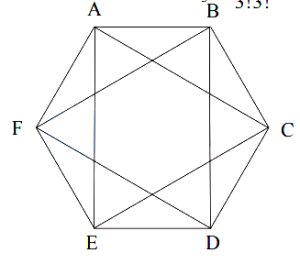
Three out of $6$ vertices of a regular hexagon are chosen at random. The probability that the triangle formed with these three vertices is an equilateral triangle is
A
$\frac{1}{2}$
B
$\frac{1}{5}$
C
$\frac{1}{10}$
D
$\frac{1}{20}$
Solution
(C) Given that $3$ out of $6$ vertices of a regular hexagon are chosen.
Total number of ways to choose $3$ vertices out of $6$ is given by $^6C_3 = \frac{6 \times 5 \times 4}{3 \times 2 \times 1} = 20$.
In a regular hexagon,only two equilateral triangles can be formed by joining its vertices,which are $\triangle ACE$ and $\triangle BDF$.
Thus,the number of favorable outcomes is $2$.
Therefore,the probability is $\frac{\text{Number of favorable outcomes}}{\text{Total number of outcomes}} = \frac{2}{20} = \frac{1}{10}$.
Total number of ways to choose $3$ vertices out of $6$ is given by $^6C_3 = \frac{6 \times 5 \times 4}{3 \times 2 \times 1} = 20$.
In a regular hexagon,only two equilateral triangles can be formed by joining its vertices,which are $\triangle ACE$ and $\triangle BDF$.
Thus,the number of favorable outcomes is $2$.
Therefore,the probability is $\frac{\text{Number of favorable outcomes}}{\text{Total number of outcomes}} = \frac{2}{20} = \frac{1}{10}$.
0 likes
View Solution171
DifficultMCQ
The number of triangles whose vertices are the points $(x, y)$ in the $XY$-plane with integer coordinates satisfying $0 \leq x \leq 4$ and $0 \leq y \leq 4$ is:
A
$2300$
B
$2260$
C
$2160$
D
$2230$
Solution
(C) The total number of points $(x, y)$ such that $0 \leq x \leq 4$ and $0 \leq y \leq 4$ is $(4+1) \times (4+1) = 25$ points.
To form a triangle,we need to select $3$ non-collinear points from these $25$ points.
The total number of ways to select $3$ points from $25$ is $\binom{25}{3} = \frac{25 \times 24 \times 23}{3 \times 2 \times 1} = 2300$.
Now,we must subtract the number of sets of $3$ collinear points.
Points are collinear if they lie on the same row,column,or diagonal.
$1$. Rows: There are $5$ rows,each with $5$ points. Number of ways to choose $3$ points from a row is $5 \times \binom{5}{3} = 5 \times 10 = 50$.
$2$. Columns: There are $5$ columns,each with $5$ points. Number of ways to choose $3$ points from a column is $5 \times \binom{5}{3} = 5 \times 10 = 50$.
$3$. Diagonals:
- Main diagonals: $2$ diagonals of length $5$ $(\binom{5}{3} \times 2 = 20)$.
- Other diagonals of length $4$: $4$ diagonals $(\binom{4}{3} \times 4 = 16)$.
- Other diagonals of length $3$: $4$ diagonals $(\binom{3}{3} \times 4 = 4)$.
Total collinear sets = $50 + 50 + 20 + 16 + 4 = 140$.
Number of triangles = $2300 - 140 = 2160$.
To form a triangle,we need to select $3$ non-collinear points from these $25$ points.
The total number of ways to select $3$ points from $25$ is $\binom{25}{3} = \frac{25 \times 24 \times 23}{3 \times 2 \times 1} = 2300$.
Now,we must subtract the number of sets of $3$ collinear points.
Points are collinear if they lie on the same row,column,or diagonal.
$1$. Rows: There are $5$ rows,each with $5$ points. Number of ways to choose $3$ points from a row is $5 \times \binom{5}{3} = 5 \times 10 = 50$.
$2$. Columns: There are $5$ columns,each with $5$ points. Number of ways to choose $3$ points from a column is $5 \times \binom{5}{3} = 5 \times 10 = 50$.
$3$. Diagonals:
- Main diagonals: $2$ diagonals of length $5$ $(\binom{5}{3} \times 2 = 20)$.
- Other diagonals of length $4$: $4$ diagonals $(\binom{4}{3} \times 4 = 16)$.
- Other diagonals of length $3$: $4$ diagonals $(\binom{3}{3} \times 4 = 4)$.
Total collinear sets = $50 + 50 + 20 + 16 + 4 = 140$.
Number of triangles = $2300 - 140 = 2160$.
0 likes
View Solution172
MediumMCQ
There are $10$ points in a plane,of which no three points are collinear except $4$. Then,the number of distinct triangles that can be formed by joining any three points of these ten points,such that at least one of the vertices of every triangle formed is from the given $4$ collinear points is
A
$80$
B
$100$
C
$96$
D
$116$
Solution
(C) Total points = $10$. Points that are collinear = $4$. Points that are non-collinear = $10 - 4 = 6$.
To form a triangle with at least one vertex from the $4$ collinear points,we consider the following cases:
Case $1$: Select $1$ point from $4$ collinear points and $2$ points from $6$ non-collinear points.
Number of ways = $\binom{4}{1} \times \binom{6}{2} = 4 \times 15 = 60$.
Case $2$: Select $2$ points from $4$ collinear points and $1$ point from $6$ non-collinear points.
Number of ways = $\binom{4}{2} \times \binom{6}{1} = 6 \times 6 = 36$.
Note: We cannot select $3$ points from the $4$ collinear points because they are collinear and will not form a triangle.
Total number of triangles = $60 + 36 = 96$.
To form a triangle with at least one vertex from the $4$ collinear points,we consider the following cases:
Case $1$: Select $1$ point from $4$ collinear points and $2$ points from $6$ non-collinear points.
Number of ways = $\binom{4}{1} \times \binom{6}{2} = 4 \times 15 = 60$.
Case $2$: Select $2$ points from $4$ collinear points and $1$ point from $6$ non-collinear points.
Number of ways = $\binom{4}{2} \times \binom{6}{1} = 6 \times 6 = 36$.
Note: We cannot select $3$ points from the $4$ collinear points because they are collinear and will not form a triangle.
Total number of triangles = $60 + 36 = 96$.
0 likes
View Solution173
EasyMCQ
The number of diagonals of a polygon is $35$. If $A$ and $B$ are two distinct vertices of this polygon,then the number of all those triangles formed by joining three vertices of the polygon having $AB$ as one of its sides is:
A
$1$
B
$8$
C
$10$
D
$12$
Solution
(B) The number of diagonals of a polygon with $n$ vertices is given by $\frac{n(n-1)}{2} - n = 35$.
Solving for $n$:
$n^2 - n - 2n = 70$
$n^2 - 3n - 70 = 0$
$(n - 10)(n + 7) = 0$
Since $n$ must be positive,$n = 10$.
To form a triangle with $AB$ as one of its sides,we must choose $A$,$B$,and one other vertex from the remaining $n - 2$ vertices.
Number of remaining vertices $= 10 - 2 = 8$.
Therefore,the number of such triangles is $8$.
Solving for $n$:
$n^2 - n - 2n = 70$
$n^2 - 3n - 70 = 0$
$(n - 10)(n + 7) = 0$
Since $n$ must be positive,$n = 10$.
To form a triangle with $AB$ as one of its sides,we must choose $A$,$B$,and one other vertex from the remaining $n - 2$ vertices.
Number of remaining vertices $= 10 - 2 = 8$.
Therefore,the number of such triangles is $8$.
0 likes
View Solution174
DifficultMCQ
Out of $30$ points in a plane,$8$ of them are collinear. The number of straight lines that can be formed by joining these points is:
A
$296$
B
$540$
C
$408$
D
$348$
Solution
(C) The total number of points in a plane is $n = 30$.
Since $8$ points are collinear,they do not form distinct lines when joined in pairs,except for the single line they all lie on.
The formula for the number of lines formed by $n$ points where $m$ points are collinear is given by:
$\text{Number of lines} = {}^{n}C_{2} - {}^{m}C_{2} + 1$
Substituting the values $n = 30$ and $m = 8$:
$\text{Number of lines} = {}^{30}C_{2} - {}^{8}C_{2} + 1$
$= \frac{30 \times 29}{2} - \frac{8 \times 7}{2} + 1$
$= 435 - 28 + 1$
$= 408$
Since $8$ points are collinear,they do not form distinct lines when joined in pairs,except for the single line they all lie on.
The formula for the number of lines formed by $n$ points where $m$ points are collinear is given by:
$\text{Number of lines} = {}^{n}C_{2} - {}^{m}C_{2} + 1$
Substituting the values $n = 30$ and $m = 8$:
$\text{Number of lines} = {}^{30}C_{2} - {}^{8}C_{2} + 1$
$= \frac{30 \times 29}{2} - \frac{8 \times 7}{2} + 1$
$= 435 - 28 + 1$
$= 408$
0 likes
View Solution175
EasyMCQ
$A$ regular polygon of $n$ sides has $170$ diagonals,then $n$ is equal to
A
$12$
B
$17$
C
$20$
D
$25$
Solution
(C) We know that the number of diagonals in a polygon of $n$ sides is given by the formula: $\frac{n(n-3)}{2}$.
Given that the number of diagonals is $170$,we have:
$\frac{n(n-3)}{2} = 170$
$n(n-3) = 340$
$n^2 - 3n - 340 = 0$
Solving the quadratic equation by factoring:
$n^2 - 20n + 17n - 340 = 0$
$n(n - 20) + 17(n - 20) = 0$
$(n - 20)(n + 17) = 0$
Since $n$ must be positive,$n = 20$.
Given that the number of diagonals is $170$,we have:
$\frac{n(n-3)}{2} = 170$
$n(n-3) = 340$
$n^2 - 3n - 340 = 0$
Solving the quadratic equation by factoring:
$n^2 - 20n + 17n - 340 = 0$
$n(n - 20) + 17(n - 20) = 0$
$(n - 20)(n + 17) = 0$
Since $n$ must be positive,$n = 20$.
0 likes
View Solution176
DifficultMCQ
Let $l_1$ and $l_2$ be two lines intersecting at $P$. If $A_1, B_1, C_1$ are points on $l_1$,and $A_2, B_2, C_2, D_2, E_2$ are points on $l_2$,and if none of these points coincides with $P$,then the number of triangles formed by these eight points is:
A
$56$
B
$55$
C
$46$
D
$60$
Solution
(D) The total number of points is $8$ (excluding $P$). Including $P$,we have $9$ points in total.
To form a triangle,we need to select $3$ non-collinear points.
The total number of ways to select $3$ points from $9$ points is ${^9C_3} = \frac{9 \times 8 \times 7}{3 \times 2 \times 1} = 84$.
However,points on the same line cannot form a triangle.
Points on $l_1$ (including $P$) are $4$ $(A_1, B_1, C_1, P)$. The number of ways to choose $3$ collinear points from these is ${^4C_3} = 4$.
Points on $l_2$ (including $P$) are $6$ $(A_2, B_2, C_2, D_2, E_2, P)$. The number of ways to choose $3$ collinear points from these is ${^6C_3} = \frac{6 \times 5 \times 4}{3 \times 2 \times 1} = 20$.
Total triangles = (Total ways to choose $3$ points) - (Collinear sets on $l_1$) - (Collinear sets on $l_2$)
Total triangles = $84 - 4 - 20 = 60$.
To form a triangle,we need to select $3$ non-collinear points.
The total number of ways to select $3$ points from $9$ points is ${^9C_3} = \frac{9 \times 8 \times 7}{3 \times 2 \times 1} = 84$.
However,points on the same line cannot form a triangle.
Points on $l_1$ (including $P$) are $4$ $(A_1, B_1, C_1, P)$. The number of ways to choose $3$ collinear points from these is ${^4C_3} = 4$.
Points on $l_2$ (including $P$) are $6$ $(A_2, B_2, C_2, D_2, E_2, P)$. The number of ways to choose $3$ collinear points from these is ${^6C_3} = \frac{6 \times 5 \times 4}{3 \times 2 \times 1} = 20$.
Total triangles = (Total ways to choose $3$ points) - (Collinear sets on $l_1$) - (Collinear sets on $l_2$)
Total triangles = $84 - 4 - 20 = 60$.
0 likes
View Solution177
MediumMCQ
$15$ girls are seated at a round table. The number of ways of selecting three girls such that all the three are not seated together is
A
$450$
B
$345$
C
$390$
D
$440$
Solution
(D) The total number of ways to select $3$ girls from $15$ girls seated around a round table is given by the combination formula ${}^{15}C_3$.
First,we calculate the total number of ways to select $3$ girls: ${}^{15}C_3 = \frac{15 \times 14 \times 13}{3 \times 2 \times 1} = 5 \times 7 \times 13 = 455$.
Next,we find the number of ways to select $3$ girls such that they are all seated together. In a circular arrangement of $15$ girls,there are $15$ possible sets of $3$ consecutive girls.
So,the number of ways to select $3$ girls sitting together is $15$.
Therefore,the required number of ways where all three are not seated together is $455 - 15 = 440$.
First,we calculate the total number of ways to select $3$ girls: ${}^{15}C_3 = \frac{15 \times 14 \times 13}{3 \times 2 \times 1} = 5 \times 7 \times 13 = 455$.
Next,we find the number of ways to select $3$ girls such that they are all seated together. In a circular arrangement of $15$ girls,there are $15$ possible sets of $3$ consecutive girls.
So,the number of ways to select $3$ girls sitting together is $15$.
Therefore,the required number of ways where all three are not seated together is $455 - 15 = 440$.
0 likes
View Solution178
EasyMCQ
$15$ lines are concurrent at a point $P$. $A$ line $L$ not passing through $P$ intersects all the $15$ lines and forms triangles with them. Then the number of triangles having $L$ as one of its sides is
A
$310$
B
$91$
C
$182$
D
$105$
Solution
(D) triangle is formed by selecting any $2$ lines out of the $15$ concurrent lines and the line $L$ acting as the third side.
Since the $15$ lines are concurrent at point $P$,any pair of these lines will intersect at $P$.
When these $2$ lines intersect the line $L$ at two distinct points,a triangle is formed with $L$ as one of its sides.
The number of ways to choose $2$ lines out of $15$ is given by the combination formula ${}^{n}C_{r} = \frac{n!}{r!(n-r)!}$.
Thus,the number of triangles is ${}^{15}C_{2} = \frac{15 \times 14}{2 \times 1} = 105$.
Since the $15$ lines are concurrent at point $P$,any pair of these lines will intersect at $P$.
When these $2$ lines intersect the line $L$ at two distinct points,a triangle is formed with $L$ as one of its sides.
The number of ways to choose $2$ lines out of $15$ is given by the combination formula ${}^{n}C_{r} = \frac{n!}{r!(n-r)!}$.
Thus,the number of triangles is ${}^{15}C_{2} = \frac{15 \times 14}{2 \times 1} = 105$.
0 likes
View Solution179
EasyMCQ
There are $10$ points in a plane of which no three points are collinear except $4$ points. The number of distinct triangles that can be formed by joining these points such that at least one of the vertices of every triangle formed is from the given $4$ collinear points is:
A
$116$
B
$96$
C
$120$
D
$100$
Solution
(B) Total points = $10$. Points that are collinear = $4$. Points that are non-collinear = $6$.
To form a triangle with at least one vertex from the $4$ collinear points,we consider two cases:
Case $1$: One vertex from the $4$ collinear points and two vertices from the $6$ non-collinear points.
Number of triangles = $^4C_1 \times ^6C_2 = 4 \times 15 = 60$.
Case $2$: Two vertices from the $4$ collinear points and one vertex from the $6$ non-collinear points.
Number of triangles = $^4C_2 \times ^6C_1 = 6 \times 6 = 36$.
Total number of triangles = $60 + 36 = 96$.
To form a triangle with at least one vertex from the $4$ collinear points,we consider two cases:
Case $1$: One vertex from the $4$ collinear points and two vertices from the $6$ non-collinear points.
Number of triangles = $^4C_1 \times ^6C_2 = 4 \times 15 = 60$.
Case $2$: Two vertices from the $4$ collinear points and one vertex from the $6$ non-collinear points.
Number of triangles = $^4C_2 \times ^6C_1 = 6 \times 6 = 36$.
Total number of triangles = $60 + 36 = 96$.
0 likes
View Solution180
MediumMCQ
If the number of diagonals of a regular polygon is $35$,then the number of sides of the polygon is
A
$12$
B
$9$
C
$10$
D
$11$
Solution
(C) The number of diagonals of a regular polygon having $n$ sides is given by $\frac{n(n-3)}{2}$.
$\therefore \frac{n(n-3)}{2} = 35$
$\Rightarrow n(n-3) = 70$
$\Rightarrow n^2 - 3n - 70 = 0$
$\Rightarrow n^2 - 10n + 7n - 70 = 0$
$\Rightarrow n(n - 10) + 7(n - 10) = 0$
$\Rightarrow (n - 10)(n + 7) = 0$
Since the number of sides $n$ must be positive,we have $n = 10$.
$\therefore \frac{n(n-3)}{2} = 35$
$\Rightarrow n(n-3) = 70$
$\Rightarrow n^2 - 3n - 70 = 0$
$\Rightarrow n^2 - 10n + 7n - 70 = 0$
$\Rightarrow n(n - 10) + 7(n - 10) = 0$
$\Rightarrow (n - 10)(n + 7) = 0$
Since the number of sides $n$ must be positive,we have $n = 10$.
0 likes
View Solution181
EasyMCQ
$A$ polygon has $54$ diagonals. Then,the number of its sides is
A
$7$
B
$9$
C
$10$
D
$12$
Solution
(D) The number of diagonals in a polygon with $n$ sides is given by the formula $\frac{n(n-3)}{2}$.
Given that the number of diagonals is $54$,we have:
$\frac{n(n-3)}{2} = 54$
$n(n-3) = 108$
$n^2 - 3n - 108 = 0$
Factoring the quadratic equation:
$n^2 - 12n + 9n - 108 = 0$
$n(n - 12) + 9(n - 12) = 0$
$(n + 9)(n - 12) = 0$
This gives $n = -9$ or $n = 12$.
Since the number of sides $n$ must be a positive integer,we have $n = 12$.
Given that the number of diagonals is $54$,we have:
$\frac{n(n-3)}{2} = 54$
$n(n-3) = 108$
$n^2 - 3n - 108 = 0$
Factoring the quadratic equation:
$n^2 - 12n + 9n - 108 = 0$
$n(n - 12) + 9(n - 12) = 0$
$(n + 9)(n - 12) = 0$
This gives $n = -9$ or $n = 12$.
Since the number of sides $n$ must be a positive integer,we have $n = 12$.
0 likes
View Solution182
MediumMCQ
If a group of six students including two particular students $A$ and $B$ stand in a row,then the probability of getting an arrangement in which $A$ and $B$ are separated by exactly one student in between them is
A
$\frac{2}{15}$
B
$\frac{4}{15}$
C
$\frac{6}{15}$
D
$\frac{8}{15}$
Solution
(B) Total number of ways to arrange $6$ students in a row $= 6! = 720$.
To find the number of favorable arrangements,consider $A$ and $B$ with one student between them as a single block. There are $4$ remaining students. We choose $1$ student out of $4$ to place between $A$ and $B$ in $^4C_1$ ways.
Now,treat the block $(A, \text{student}, B)$ as one unit. Along with the remaining $3$ students,we have $4$ units to arrange,which can be done in $4!$ ways.
Within the block,$A$ and $B$ can be arranged in $2!$ ways (i.e.,$A, \text{student}, B$ or $B, \text{student}, A$).
Number of favorable arrangements $= ^4C_1 \times 4! \times 2! = 4 \times 24 \times 2 = 192$.
Probability $= \frac{192}{720} = \frac{4}{15}$.
To find the number of favorable arrangements,consider $A$ and $B$ with one student between them as a single block. There are $4$ remaining students. We choose $1$ student out of $4$ to place between $A$ and $B$ in $^4C_1$ ways.
Now,treat the block $(A, \text{student}, B)$ as one unit. Along with the remaining $3$ students,we have $4$ units to arrange,which can be done in $4!$ ways.
Within the block,$A$ and $B$ can be arranged in $2!$ ways (i.e.,$A, \text{student}, B$ or $B, \text{student}, A$).
Number of favorable arrangements $= ^4C_1 \times 4! \times 2! = 4 \times 24 \times 2 = 192$.
Probability $= \frac{192}{720} = \frac{4}{15}$.
0 likes
View Solution183
EasyMCQ
The number of diagonals in a regular polygon of $100$ sides is
A
$4950$
B
$4850$
C
$4750$
D
$4650$
Solution
(B) The number of diagonals in a regular polygon of $n$ sides is given by the formula $\frac{n(n-3)}{2}$ or ${ }^{n} C_{2}-n$.
For a polygon with $n = 100$ sides:
Number of diagonals $= { }^{100} C_{2} - 100$
$= \frac{100 \times 99}{2} - 100$
$= 50 \times 99 - 100$
$= 4950 - 100$
$= 4850$
For a polygon with $n = 100$ sides:
Number of diagonals $= { }^{100} C_{2} - 100$
$= \frac{100 \times 99}{2} - 100$
$= 50 \times 99 - 100$
$= 4950 - 100$
$= 4850$
0 likes
View Solution184
MediumMCQ
The number of diagonals in a polygon is $20$. The number of sides of the polygon is:
A
$5$
B
$6$
C
$8$
D
$10$
Solution
(C) The number of diagonals in a polygon with $n$ sides is given by the formula: $\frac{n(n-3)}{2} = 20$.
Multiplying by $2$,we get $n(n-3) = 40$.
$n^2 - 3n - 40 = 0$.
Factoring the quadratic equation: $(n-8)(n+5) = 0$.
Since the number of sides $n$ must be positive,we have $n = 8$.
Multiplying by $2$,we get $n(n-3) = 40$.
$n^2 - 3n - 40 = 0$.
Factoring the quadratic equation: $(n-8)(n+5) = 0$.
Since the number of sides $n$ must be positive,we have $n = 8$.
0 likes
View Solution185
MediumMCQ
$A$ polygon has $44$ diagonals. The number of its sides is
A
$10$
B
$11$
C
$12$
D
$13$
Solution
(B) The number of diagonals in a polygon with $n$ sides is given by the formula $\frac{n(n-3)}{2}$.
Given that the number of diagonals is $44$,we have:
$\frac{n(n-3)}{2} = 44$
$n(n-3) = 88$
$n^2 - 3n - 88 = 0$
$(n - 11)(n + 8) = 0$
Since the number of sides $n$ must be positive,we have $n = 11$.
Given that the number of diagonals is $44$,we have:
$\frac{n(n-3)}{2} = 44$
$n(n-3) = 88$
$n^2 - 3n - 88 = 0$
$(n - 11)(n + 8) = 0$
Since the number of sides $n$ must be positive,we have $n = 11$.
0 likes
View Solution186
DifficultMCQ
Let $ABC$ be a triangle. Consider four points $p_1, p_2, p_3, p_4$ on the side $AB$,five points $p_5, p_6, p_7, p_8, p_9$ on the side $BC$,and four points $p_{10}, p_{11}, p_{12}, p_{13}$ on the side $AC$. None of these points is a vertex of the triangle $ABC$. The total number of pentagons that can be formed by taking all the vertices from the points $p_1, p_2, \ldots, p_{13}$ is . . . . . . .
A
$640$
B
$650$
C
$660$
D
$670$
Solution
(C) To form a pentagon using the given points,we must select $5$ points such that no three points are collinear. Since the points are on the sides of a triangle,we can select points from the sides $AB$,$BC$,and $AC$.
Case $1$: $2$ points from $AB$,$2$ points from $BC$,and $1$ point from $AC$.
Number of ways = $\binom{4}{2} \times \binom{5}{2} \times \binom{4}{1} = 6 \times 10 \times 4 = 240$.
Case $2$: $2$ points from $AB$,$1$ point from $BC$,and $2$ points from $AC$.
Number of ways = $\binom{4}{2} \times \binom{5}{1} \times \binom{4}{2} = 6 \times 5 \times 6 = 180$.
Case $3$: $1$ point from $AB$,$2$ points from $BC$,and $2$ points from $AC$.
Number of ways = $\binom{4}{1} \times \binom{5}{2} \times \binom{4}{2} = 4 \times 10 \times 6 = 240$.
Total number of pentagons = $240 + 180 + 240 = 660$.
Case $1$: $2$ points from $AB$,$2$ points from $BC$,and $1$ point from $AC$.
Number of ways = $\binom{4}{2} \times \binom{5}{2} \times \binom{4}{1} = 6 \times 10 \times 4 = 240$.
Case $2$: $2$ points from $AB$,$1$ point from $BC$,and $2$ points from $AC$.
Number of ways = $\binom{4}{2} \times \binom{5}{1} \times \binom{4}{2} = 6 \times 5 \times 6 = 180$.
Case $3$: $1$ point from $AB$,$2$ points from $BC$,and $2$ points from $AC$.
Number of ways = $\binom{4}{1} \times \binom{5}{2} \times \binom{4}{2} = 4 \times 10 \times 6 = 240$.
Total number of pentagons = $240 + 180 + 240 = 660$.
0 likes
View Solution187
DifficultMCQ
Let $p_n$ denote the total number of triangles formed by joining the vertices of an $n$-sided regular polygon. If $p_{n+1} - p_n = 66$,then the sum of all distinct prime divisors of $n$ is:
A
$7$
B
$8$
C
$5$
D
$6$
Solution
(C) The number of triangles $p_n$ formed by joining the vertices of an $n$-sided polygon is given by the combination formula $\binom{n}{3}$.
Given the relation $p_{n+1} - p_n = 66$,we substitute the formula: $\binom{n+1}{3} - \binom{n}{3} = 66$.
Using the property $\binom{n+1}{k} - \binom{n}{k} = \binom{n}{k-1}$,we get $\binom{n}{2} = 66$.
Expanding the combination: $\frac{n(n-1)}{2} = 66$,which simplifies to $n^2 - n = 132$.
Rearranging gives the quadratic equation $n^2 - n - 132 = 0$.
Factoring the equation: $(n - 12)(n + 11) = 0$.
Since $n$ must be positive,$n = 12$.
The prime factorization of $12$ is $2^2 \times 3^1$.
The distinct prime divisors of $12$ are $2$ and $3$.
The sum of these prime divisors is $2 + 3 = 5$.
Given the relation $p_{n+1} - p_n = 66$,we substitute the formula: $\binom{n+1}{3} - \binom{n}{3} = 66$.
Using the property $\binom{n+1}{k} - \binom{n}{k} = \binom{n}{k-1}$,we get $\binom{n}{2} = 66$.
Expanding the combination: $\frac{n(n-1)}{2} = 66$,which simplifies to $n^2 - n = 132$.
Rearranging gives the quadratic equation $n^2 - n - 132 = 0$.
Factoring the equation: $(n - 12)(n + 11) = 0$.
Since $n$ must be positive,$n = 12$.
The prime factorization of $12$ is $2^2 \times 3^1$.
The distinct prime divisors of $12$ are $2$ and $3$.
The sum of these prime divisors is $2 + 3 = 5$.
0 likes
View SolutionPermutation and Combination — Geometrical problems · Frequently Asked Questions
1Are these Permutation and Combination questions useful for JEE and NEET?
Yes. All questions in this section are mapped to JEE Main and NEET exam patterns. Previous year questions from JEE Main, NEET, GUJCET and state-level exams are included with full solutions.
2Can I switch to Hindi or Gujarati for these questions?
Yes. Use the language tabs in the hero section or the sidebar to view the same questions and solutions in English, Hindi or Gujarati.
3How do I generate a question paper from this subtopic?
Use the Vedclass Exam Paper Generator — select the chapter and subtopic, set difficulty, and generate Sets A, B, C, D automatically. First 3 chapters of every subject are free.
Vedclass Products
For Students
Vedclass Test Series
Mock tests in real JEE/NEET style with performance analysis. 5-day free trial.
Start Free TrialFor Teachers
Exam Paper Generator
Generate Set A/B/C/D papers from this chapter in 2 minutes. 3 chapters free.
Try FreeFor Institutes
Online Exam Module
Live online exams with unlimited students, 360° analytics & white-label branding.
See DemoFor Teachers & Institutes
Generate a Permutation and Combination Exam Paper in 2 Minutes
Select subtopic & difficulty — Sets A, B, C, D auto-generated with No Repeat logic.
First 3 chapters of every subject are free — no payment required.