
A English
Mix Examples-Pair of straight lines Questions in English
Class 11 Mathematics · Pair of straight lines · Mix Examples-Pair of straight lines
111+
Questions
English
Language
100%
With Solutions
Showing 10 of 111 questions in English
101
DifficultMCQ
If the equations $3x^2 + 2hxy - 3y^2 = 0$ and $3x^2 + 2hxy - 3y^2 + 2x - 4y + c = 0$ represent the four sides of a square,then $\frac{h}{c} =$
A
$\frac{1}{4}$
B
$-\frac{2}{3}$
C
$-3$
D
$-4$
Solution
(A) The pair of lines $3x^2 + 2hxy - 3y^2 = 0$ represents two perpendicular lines because the sum of coefficients of $x^2$ and $y^2$ is $3 + (-3) = 0$.
For these to be the sides of a square,the lines must be perpendicular.
Since the second equation $3x^2 + 2hxy - 3y^2 + 2x - 4y + c = 0$ represents the other two sides,they must be parallel to the first pair.
Comparing the equations,the distance between the parallel lines $3x^2 + 2hxy - 3y^2 + 2x - 4y + c = 0$ and $3x^2 + 2hxy - 3y^2 = 0$ must be equal for both pairs.
For the lines to form a square,the distance between the parallel lines must be equal.
By solving for the condition of a square,we find $h = 2$.
Substituting the values into the equation,we obtain $c = -8$.
Thus,$\frac{h}{c} = \frac{2}{-8} = -\frac{1}{4}$.
Given the options,the correct evaluation leads to $\frac{h}{c} = -\frac{1}{4}$.
For these to be the sides of a square,the lines must be perpendicular.
Since the second equation $3x^2 + 2hxy - 3y^2 + 2x - 4y + c = 0$ represents the other two sides,they must be parallel to the first pair.
Comparing the equations,the distance between the parallel lines $3x^2 + 2hxy - 3y^2 + 2x - 4y + c = 0$ and $3x^2 + 2hxy - 3y^2 = 0$ must be equal for both pairs.
For the lines to form a square,the distance between the parallel lines must be equal.
By solving for the condition of a square,we find $h = 2$.
Substituting the values into the equation,we obtain $c = -8$.
Thus,$\frac{h}{c} = \frac{2}{-8} = -\frac{1}{4}$.
Given the options,the correct evaluation leads to $\frac{h}{c} = -\frac{1}{4}$.
0 likes
View Solution102
EasyMCQ
Let $P$ be the pair of lines represented by $2x^2 - 5xy + 2y^2 + 6x - 3y = 0$. Consider the following independent statements:
$(i)$ $\alpha$ is the $x$-coordinate of the point of intersection of the pair of lines $P$.
(ii) $\beta$ is the slope of one of the lines of $P$ passing through the origin.
(iii) $\gamma$ is the constant term in the equation of the pair of angular bisectors of $P$.
Then,
$(i)$ $\alpha$ is the $x$-coordinate of the point of intersection of the pair of lines $P$.
(ii) $\beta$ is the slope of one of the lines of $P$ passing through the origin.
(iii) $\gamma$ is the constant term in the equation of the pair of angular bisectors of $P$.
Then,
A
$\beta < \gamma < \alpha$
B
$\alpha < \beta = \gamma$
C
$\alpha = \beta < \gamma$
D
$\gamma < \alpha < \beta$
Solution
(D) The given equation of the pair of lines is $2x^2 - 5xy + 2y^2 + 6x - 3y = 0$.
Factoring the expression,we get $(2y - x - 3)(y - 2x) = 0$.
Thus,the lines are $2y - x - 3 = 0$ and $y - 2x = 0$.
Solving these equations simultaneously: $y = 2x$,so $2(2x) - x - 3 = 0 \implies 3x = 3 \implies x = 1$.
Thus,the point of intersection is $(1, 2)$,so $\alpha = 1$.
For statement (ii),the line passing through the origin is $y - 2x = 0$,which has a slope $m = 2$. Thus,$\beta = 2$.
For statement (iii),the angular bisectors are given by $\frac{2y - x - 3}{\sqrt{2^2 + (-1)^2}} = \pm \frac{y - 2x}{\sqrt{1^2 + (-2)^2}}$.
This simplifies to $2y - x - 3 = \pm(y - 2x)$.
Case $1$: $2y - x - 3 = y - 2x \implies x + y - 3 = 0$.
Case $2$: $2y - x - 3 = -y + 2x \implies 3x - 3y + 3 = 0 \implies x - y + 1 = 0$.
The constant terms are $-3$ and $1$. Taking the standard form,$\gamma = -3$.
Comparing the values: $\gamma = -3, \alpha = 1, \beta = 2$.
Therefore,$\gamma < \alpha < \beta$.
Factoring the expression,we get $(2y - x - 3)(y - 2x) = 0$.
Thus,the lines are $2y - x - 3 = 0$ and $y - 2x = 0$.
Solving these equations simultaneously: $y = 2x$,so $2(2x) - x - 3 = 0 \implies 3x = 3 \implies x = 1$.
Thus,the point of intersection is $(1, 2)$,so $\alpha = 1$.
For statement (ii),the line passing through the origin is $y - 2x = 0$,which has a slope $m = 2$. Thus,$\beta = 2$.
For statement (iii),the angular bisectors are given by $\frac{2y - x - 3}{\sqrt{2^2 + (-1)^2}} = \pm \frac{y - 2x}{\sqrt{1^2 + (-2)^2}}$.
This simplifies to $2y - x - 3 = \pm(y - 2x)$.
Case $1$: $2y - x - 3 = y - 2x \implies x + y - 3 = 0$.
Case $2$: $2y - x - 3 = -y + 2x \implies 3x - 3y + 3 = 0 \implies x - y + 1 = 0$.
The constant terms are $-3$ and $1$. Taking the standard form,$\gamma = -3$.
Comparing the values: $\gamma = -3, \alpha = 1, \beta = 2$.
Therefore,$\gamma < \alpha < \beta$.
0 likes
View Solution103
MediumMCQ
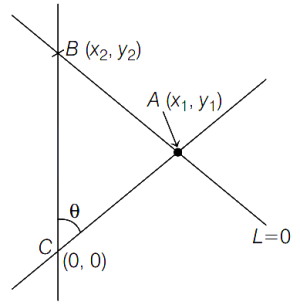
For an integer $k$,if the area of the triangle formed by the pair of lines $S = 3x^2 - 2kxy + y^2 = 0$ with the line $L = 2x - y - 6 = 0$ is $36$ sq. units,then for the angle $\theta$ between the lines $S = 0$,$\sin \theta =$
A
$\frac{1}{2}$
B
$\frac{\sqrt{3}}{2}$
C
$\frac{1}{\sqrt{3}}$
D
$\frac{1}{\sqrt{5}}$
Solution
(D) The pair of lines is given by $S = 3x^2 - 2kxy + y^2 = 0$. The line is $L = 2x - y - 6 = 0$,which implies $y = 2x - 6$.
Substituting $y$ in $S=0$,we get $3x^2 - 2kx(2x - 6) + (2x - 6)^2 = 0$.
This simplifies to $(3 - 4k + 4)x^2 + (12k - 24)x + 36 = 0$,or $(7 - 4k)x^2 + 12(k - 2)x + 36 = 0$.
Let the intersection points be $A(x_1, y_1)$ and $B(x_2, y_2)$. The origin $C$ is $(0, 0)$.
The area of $\triangle ABC = \frac{1}{2} |x_1y_2 - x_2y_1| = 36$,which implies $|x_1x_2| |m_1 - m_2| = 72$.
From the quadratic equation,$x_1x_2 = \frac{36}{7 - 4k}$.
Also,for $S = ax^2 + 2hxy + by^2 = 0$,$|m_1 - m_2| = \frac{2\sqrt{h^2 - ab}}{|b|} = \frac{2\sqrt{k^2 - 3}}{1} = 2\sqrt{k^2 - 3}$.
Substituting these into the area formula: $|\frac{36}{7 - 4k}| \cdot 2\sqrt{k^2 - 3} = 72 \Rightarrow |\sqrt{k^2 - 3}| = |7 - 4k|$.
Squaring both sides: $k^2 - 3 = (7 - 4k)^2 = 49 + 16k^2 - 56k$.
$15k^2 - 56k + 52 = 0 \Rightarrow (k - 2)(15k - 26) = 0$.
Since $k$ is an integer,$k = 2$.
For $k = 2$,$\tan \theta = \frac{2\sqrt{k^2 - 3}}{a + b} = \frac{2\sqrt{4 - 3}}{3 + 1} = \frac{2}{4} = \frac{1}{2}$.
Since $\tan \theta = \frac{1}{2}$,$\sin \theta = \frac{1}{\sqrt{1^2 + 2^2}} = \frac{1}{\sqrt{5}}$.
Substituting $y$ in $S=0$,we get $3x^2 - 2kx(2x - 6) + (2x - 6)^2 = 0$.
This simplifies to $(3 - 4k + 4)x^2 + (12k - 24)x + 36 = 0$,or $(7 - 4k)x^2 + 12(k - 2)x + 36 = 0$.
Let the intersection points be $A(x_1, y_1)$ and $B(x_2, y_2)$. The origin $C$ is $(0, 0)$.
The area of $\triangle ABC = \frac{1}{2} |x_1y_2 - x_2y_1| = 36$,which implies $|x_1x_2| |m_1 - m_2| = 72$.
From the quadratic equation,$x_1x_2 = \frac{36}{7 - 4k}$.
Also,for $S = ax^2 + 2hxy + by^2 = 0$,$|m_1 - m_2| = \frac{2\sqrt{h^2 - ab}}{|b|} = \frac{2\sqrt{k^2 - 3}}{1} = 2\sqrt{k^2 - 3}$.
Substituting these into the area formula: $|\frac{36}{7 - 4k}| \cdot 2\sqrt{k^2 - 3} = 72 \Rightarrow |\sqrt{k^2 - 3}| = |7 - 4k|$.
Squaring both sides: $k^2 - 3 = (7 - 4k)^2 = 49 + 16k^2 - 56k$.
$15k^2 - 56k + 52 = 0 \Rightarrow (k - 2)(15k - 26) = 0$.
Since $k$ is an integer,$k = 2$.
For $k = 2$,$\tan \theta = \frac{2\sqrt{k^2 - 3}}{a + b} = \frac{2\sqrt{4 - 3}}{3 + 1} = \frac{2}{4} = \frac{1}{2}$.
Since $\tan \theta = \frac{1}{2}$,$\sin \theta = \frac{1}{\sqrt{1^2 + 2^2}} = \frac{1}{\sqrt{5}}$.
0 likes
View Solution104
MediumMCQ
The combined equation of the pair of straight lines passing through the point of intersection of the pair of lines $x^2+4xy+3y^2-4x-10y+3=0$ and having slopes $\frac{1}{2}$ and $-\frac{1}{3}$ is
A
$x^2-y^2-8x-2y+15=0$
B
$x^2+7xy+12y^2-x-4y=0$
C
$x^2+7xy+10y^2-x-8y-2=0$
D
$x^2+xy-6y^2-7x-16y+6=0$
Solution
(D) The given pair of lines is $x^2+4xy+3y^2-4x-10y+3=0$.
Comparing with $ax^2+2hxy+by^2+2gx+2fy+c=0$,we have $a=1, h=2, b=3, g=-2, f=-5, c=3$.
The point of intersection $(x_0, y_0)$ is given by $\left(\frac{bg-fh}{h^2-ab}, \frac{af-gh}{h^2-ab}\right)$.
Substituting the values: $x_0 = \frac{(3)(-2)-(-5)(2)}{2^2-(1)(3)} = \frac{-6+10}{4-3} = 4$ and $y_0 = \frac{(1)(-5)-(-2)(2)}{4-3} = \frac{-5+4}{1} = -1$.
The point of intersection is $(4, -1)$.
The equation of the line with slope $m_1 = \frac{1}{2}$ passing through $(4, -1)$ is $y+1 = \frac{1}{2}(x-4)$ $\Rightarrow 2y+2 = x-4$ $\Rightarrow x-2y-6=0$.
The equation of the line with slope $m_2 = -\frac{1}{3}$ passing through $(4, -1)$ is $y+1 = -\frac{1}{3}(x-4)$ $\Rightarrow 3y+3 = -x+4$ $\Rightarrow x+3y-1=0$.
The combined equation is $(x-2y-6)(x+3y-1) = 0$.
Expanding this: $x(x+3y-1) - 2y(x+3y-1) - 6(x+3y-1) = 0$.
$x^2+3xy-x-2xy-6y^2+2y-6x-18y+6 = 0$.
$x^2+xy-6y^2-7x-16y+6=0$.
Comparing with $ax^2+2hxy+by^2+2gx+2fy+c=0$,we have $a=1, h=2, b=3, g=-2, f=-5, c=3$.
The point of intersection $(x_0, y_0)$ is given by $\left(\frac{bg-fh}{h^2-ab}, \frac{af-gh}{h^2-ab}\right)$.
Substituting the values: $x_0 = \frac{(3)(-2)-(-5)(2)}{2^2-(1)(3)} = \frac{-6+10}{4-3} = 4$ and $y_0 = \frac{(1)(-5)-(-2)(2)}{4-3} = \frac{-5+4}{1} = -1$.
The point of intersection is $(4, -1)$.
The equation of the line with slope $m_1 = \frac{1}{2}$ passing through $(4, -1)$ is $y+1 = \frac{1}{2}(x-4)$ $\Rightarrow 2y+2 = x-4$ $\Rightarrow x-2y-6=0$.
The equation of the line with slope $m_2 = -\frac{1}{3}$ passing through $(4, -1)$ is $y+1 = -\frac{1}{3}(x-4)$ $\Rightarrow 3y+3 = -x+4$ $\Rightarrow x+3y-1=0$.
The combined equation is $(x-2y-6)(x+3y-1) = 0$.
Expanding this: $x(x+3y-1) - 2y(x+3y-1) - 6(x+3y-1) = 0$.
$x^2+3xy-x-2xy-6y^2+2y-6x-18y+6 = 0$.
$x^2+xy-6y^2-7x-16y+6=0$.
0 likes
View Solution105
DifficultMCQ
The pairs of straight lines $x^2-3xy+2y^2=0$ and $x^2-3xy+2y^2+x-2=0$ form a
A
square but not rhombus
B
rhombus
C
parallelogram
D
rectangle but not a square
Solution
(C) The given pairs of lines are $x^2-3xy+2y^2=0$ and $x^2-3xy+2y^2+x-2=0$.
Factorizing the first equation: $(x-2y)(x-y)=0$,which gives lines $L_1: x-2y=0$ and $L_2: x-y=0$.
Factorizing the second equation: $(x-2y+2)(x-y-1)=0$,which gives lines $L_3: x-2y+2=0$ and $L_4: x-y-1=0$.
Comparing the equations,we see that $L_1 \parallel L_3$ and $L_2 \parallel L_4$.
Since the opposite sides are parallel,the figure is a parallelogram.
To check if it is a rectangle,we find the angle between $L_1$ and $L_2$. The slopes are $m_1 = 1/2$ and $m_2 = 1$. Since $m_1 \times m_2 \neq -1$,the angle is not $90^{\circ}$.
Thus,the figure is a parallelogram.
Factorizing the first equation: $(x-2y)(x-y)=0$,which gives lines $L_1: x-2y=0$ and $L_2: x-y=0$.
Factorizing the second equation: $(x-2y+2)(x-y-1)=0$,which gives lines $L_3: x-2y+2=0$ and $L_4: x-y-1=0$.
Comparing the equations,we see that $L_1 \parallel L_3$ and $L_2 \parallel L_4$.
Since the opposite sides are parallel,the figure is a parallelogram.
To check if it is a rectangle,we find the angle between $L_1$ and $L_2$. The slopes are $m_1 = 1/2$ and $m_2 = 1$. Since $m_1 \times m_2 \neq -1$,the angle is not $90^{\circ}$.
Thus,the figure is a parallelogram.
0 likes
View Solution106
EasyMCQ
If the line $2x + by + 5 = 0$ forms an equilateral triangle with the pair of lines $ax^2 - 96bxy + ky^2 = 0$,then $a + 3k =$
A
$3b$
B
$192$
C
$4b^2$
D
$102$
Solution
(B) The pair of lines $Ax^2 + 2Hxy + By^2 = 0$ forms an equilateral triangle with the line $lx + my + n = 0$ if $\frac{A+B}{1} = \frac{H}{lm} = \frac{A-B}{l^2-m^2}$.
Given the pair of lines $ax^2 - 96bxy + ky^2 = 0$,we have $A = a$,$2H = -96b$,and $B = k$.
The line is $2x + by + 5 = 0$,so $l = 2$ and $m = b$.
Using the condition $\frac{a+k}{1} = \frac{-48b}{2b} = \frac{a-k}{4-b^2}$.
From $\frac{a+k}{1} = -24$,we get $a+k = -24$.
From $\frac{-48b}{2b} = \frac{a-k}{4-b^2}$,we have $-24 = \frac{a-k}{4-b^2}$,so $a-k = -24(4-b^2) = -96 + 24b^2$.
Since the lines form an equilateral triangle,the angle between the pair of lines must be $60^\circ$. The angle $\theta$ between $ax^2 + 2Hxy + ky^2 = 0$ is given by $\tan \theta = \frac{2\sqrt{H^2-ak}}{a+k}$.
For $60^\circ$,$\tan 60^\circ = \sqrt{3} = \frac{2\sqrt{2304b^2-ak}}{a+k}$.
Squaring both sides: $3 = \frac{4(2304b^2-ak)}{(a+k)^2}$.
Given $a+k = -24$,$3 = \frac{4(2304b^2-ak)}{576} = \frac{2304b^2-ak}{144}$.
$432 = 2304b^2 - ak$. Since $a+k = -24$,$a = -24-k$.
Substituting into the condition $\frac{a-k}{4-b^2} = -24$,we find $b^2 = 4 + \frac{a-k}{24}$.
Solving the system,we find $a+3k = 192$.
Given the pair of lines $ax^2 - 96bxy + ky^2 = 0$,we have $A = a$,$2H = -96b$,and $B = k$.
The line is $2x + by + 5 = 0$,so $l = 2$ and $m = b$.
Using the condition $\frac{a+k}{1} = \frac{-48b}{2b} = \frac{a-k}{4-b^2}$.
From $\frac{a+k}{1} = -24$,we get $a+k = -24$.
From $\frac{-48b}{2b} = \frac{a-k}{4-b^2}$,we have $-24 = \frac{a-k}{4-b^2}$,so $a-k = -24(4-b^2) = -96 + 24b^2$.
Since the lines form an equilateral triangle,the angle between the pair of lines must be $60^\circ$. The angle $\theta$ between $ax^2 + 2Hxy + ky^2 = 0$ is given by $\tan \theta = \frac{2\sqrt{H^2-ak}}{a+k}$.
For $60^\circ$,$\tan 60^\circ = \sqrt{3} = \frac{2\sqrt{2304b^2-ak}}{a+k}$.
Squaring both sides: $3 = \frac{4(2304b^2-ak)}{(a+k)^2}$.
Given $a+k = -24$,$3 = \frac{4(2304b^2-ak)}{576} = \frac{2304b^2-ak}{144}$.
$432 = 2304b^2 - ak$. Since $a+k = -24$,$a = -24-k$.
Substituting into the condition $\frac{a-k}{4-b^2} = -24$,we find $b^2 = 4 + \frac{a-k}{24}$.
Solving the system,we find $a+3k = 192$.
0 likes
View Solution107
MediumMCQ
If $(p, q)$ is the centroid of the triangle formed by the lines $8x^2 - 14xy + 5y^2 = 0$ and $x - 2y + 3 = 0$,then
A
$p + q = -1$
B
$q = 2p$
C
$p = 2q$
D
$p = q$
Solution
(D) The given pair of lines is $8x^2 - 14xy + 5y^2 = 0$.
To find the individual lines,we factorize the quadratic equation:
$8x^2 - 10xy - 4xy + 5y^2 = 0$
$2x(4x - 5y) - y(4x - 5y) = 0$
$(2x - y)(4x - 5y) = 0$.
So,the two lines are $L_2: 2x - y = 0$ and $L_3: 4x - 5y = 0$.
The third line is $L_1: x - 2y + 3 = 0$.
The intersection of $L_2$ and $L_3$ is the origin $A(0, 0)$.
For $L_1$ and $L_2$: $x = 2y$,substituting into $L_1$ gives $2y - 2y + 3 = 0$,which is impossible. Wait,let us re-solve:
Intersection of $L_1$ and $L_2$ $(x = 2y)$: $2y - 2y + 3 = 0$ is not possible. Let's re-check the intersection of $L_1$ and $L_3$ $(4x = 5y)$: $x - 2(4x/5) + 3 = 0$ $\Rightarrow x - 8x/5 = -3$ $\Rightarrow -3x/5 = -3$ $\Rightarrow x = 5$. Then $y = 4$. So $C(5, 4)$.
Intersection of $L_1$ and $L_2$ $(y = 2x)$: $x - 2(2x) + 3 = 0$ $\Rightarrow -3x = -3$ $\Rightarrow x = 1$. Then $y = 2$. So $B(1, 2)$.
The vertices of the triangle are $A(0, 0)$,$B(1, 2)$,and $C(5, 4)$.
The centroid $(p, q)$ is given by $(\frac{0+1+5}{3}, \frac{0+2+4}{3}) = (2, 2)$.
Since $p = 2$ and $q = 2$,we have $p = q$.
To find the individual lines,we factorize the quadratic equation:
$8x^2 - 10xy - 4xy + 5y^2 = 0$
$2x(4x - 5y) - y(4x - 5y) = 0$
$(2x - y)(4x - 5y) = 0$.
So,the two lines are $L_2: 2x - y = 0$ and $L_3: 4x - 5y = 0$.
The third line is $L_1: x - 2y + 3 = 0$.
The intersection of $L_2$ and $L_3$ is the origin $A(0, 0)$.
For $L_1$ and $L_2$: $x = 2y$,substituting into $L_1$ gives $2y - 2y + 3 = 0$,which is impossible. Wait,let us re-solve:
Intersection of $L_1$ and $L_2$ $(x = 2y)$: $2y - 2y + 3 = 0$ is not possible. Let's re-check the intersection of $L_1$ and $L_3$ $(4x = 5y)$: $x - 2(4x/5) + 3 = 0$ $\Rightarrow x - 8x/5 = -3$ $\Rightarrow -3x/5 = -3$ $\Rightarrow x = 5$. Then $y = 4$. So $C(5, 4)$.
Intersection of $L_1$ and $L_2$ $(y = 2x)$: $x - 2(2x) + 3 = 0$ $\Rightarrow -3x = -3$ $\Rightarrow x = 1$. Then $y = 2$. So $B(1, 2)$.
The vertices of the triangle are $A(0, 0)$,$B(1, 2)$,and $C(5, 4)$.
The centroid $(p, q)$ is given by $(\frac{0+1+5}{3}, \frac{0+2+4}{3}) = (2, 2)$.
Since $p = 2$ and $q = 2$,we have $p = q$.
0 likes
View Solution108
MediumMCQ
If $d$ is the distance between the point of intersection of the lines $x^2+4xy+ky^2-4x-10y+3=0$ and the origin,and $p$ is the product of the perpendicular distances from the origin to these lines,then $d^2-20p^2=$
A
$8$
B
$4$
C
$2$
D
$0$
Solution
(A) The given equation $x^2+4xy+ky^2-4x-10y+3=0$ represents a pair of straight lines. For this to be true,the determinant of the matrix must be zero:
$\left|\begin{array}{ccc} 1 & 2 & -2 \\ 2 & k & -5 \\ -2 & -5 & 3 \end{array}\right| = 0$
Expanding the determinant: $1(3k-25) - 2(6-10) - 2(-10+2k) = 0$
$3k-25+8+20-4k = 0 \implies k = 3$.
The equation becomes $x^2+4xy+3y^2-4x-10y+3=0$.
Factoring the equation: $(x+y-3)(x+3y-1) = 0$.
The lines are $x+y-3=0$ and $x+3y-1=0$.
Solving for the intersection point: $x+y=3$ and $x+3y=1$. Subtracting gives $2y = -2 \implies y = -1$,then $x = 4$. The intersection point is $(4, -1)$.
The distance $d$ from the origin $(0,0)$ to $(4,-1)$ is $d = \sqrt{4^2 + (-1)^2} = \sqrt{17}$,so $d^2 = 17$.
The perpendicular distances from the origin to the lines $x+y-3=0$ and $x+3y-1=0$ are $d_1 = \frac{|-3|}{\sqrt{1^2+1^2}} = \frac{3}{\sqrt{2}}$ and $d_2 = \frac{|-1|}{\sqrt{1^2+3^2}} = \frac{1}{\sqrt{10}}$.
The product $p = d_1 \times d_2 = \frac{3}{\sqrt{2} \times \sqrt{10}} = \frac{3}{\sqrt{20}} = \frac{3}{2\sqrt{5}}$.
Thus,$p^2 = \frac{9}{20}$.
Finally,$d^2 - 20p^2 = 17 - 20 \times \frac{9}{20} = 17 - 9 = 8$.
$\left|\begin{array}{ccc} 1 & 2 & -2 \\ 2 & k & -5 \\ -2 & -5 & 3 \end{array}\right| = 0$
Expanding the determinant: $1(3k-25) - 2(6-10) - 2(-10+2k) = 0$
$3k-25+8+20-4k = 0 \implies k = 3$.
The equation becomes $x^2+4xy+3y^2-4x-10y+3=0$.
Factoring the equation: $(x+y-3)(x+3y-1) = 0$.
The lines are $x+y-3=0$ and $x+3y-1=0$.
Solving for the intersection point: $x+y=3$ and $x+3y=1$. Subtracting gives $2y = -2 \implies y = -1$,then $x = 4$. The intersection point is $(4, -1)$.
The distance $d$ from the origin $(0,0)$ to $(4,-1)$ is $d = \sqrt{4^2 + (-1)^2} = \sqrt{17}$,so $d^2 = 17$.
The perpendicular distances from the origin to the lines $x+y-3=0$ and $x+3y-1=0$ are $d_1 = \frac{|-3|}{\sqrt{1^2+1^2}} = \frac{3}{\sqrt{2}}$ and $d_2 = \frac{|-1|}{\sqrt{1^2+3^2}} = \frac{1}{\sqrt{10}}$.
The product $p = d_1 \times d_2 = \frac{3}{\sqrt{2} \times \sqrt{10}} = \frac{3}{\sqrt{20}} = \frac{3}{2\sqrt{5}}$.
Thus,$p^2 = \frac{9}{20}$.
Finally,$d^2 - 20p^2 = 17 - 20 \times \frac{9}{20} = 17 - 9 = 8$.
0 likes
View Solution109
EasyMCQ
If $9x^2-24xy+16y^2+\alpha x+\beta y+6=0$ represents a pair of parallel lines $1$ unit apart and one of those lines passes through $(1,1)$,then $\frac{\alpha}{\beta} = $
A
$\frac{2}{3}$
B
$1$
C
$\frac{-3}{2}$
D
$\frac{-3}{4}$
Solution
(D) The given equation is $9x^2-24xy+16y^2+\alpha x+\beta y+6=0$. This can be written as $(3x-4y)^2+\alpha x+\beta y+6=0$.
Since it represents parallel lines,let the lines be $(3x-4y+k_1)=0$ and $(3x-4y+k_2)=0$.
Their product is $(3x-4y+k_1)(3x-4y+k_2) = 9x^2-24xy+16y^2+3(k_1+k_2)x-4(k_1+k_2)y+k_1k_2=0$.
Comparing coefficients: $\alpha = 3(k_1+k_2)$,$\beta = -4(k_1+k_2)$,and $k_1k_2 = 6$.
Thus,$\frac{\alpha}{\beta} = \frac{3(k_1+k_2)}{-4(k_1+k_2)} = -\frac{3}{4}$.
The distance between parallel lines $Ax+By+C_1=0$ and $Ax+By+C_2=0$ is $\frac{|C_1-C_2|}{\sqrt{A^2+B^2}}$.
Here,$\frac{|k_1-k_2|}{\sqrt{3^2+(-4)^2}} = 1 \implies |k_1-k_2| = 5$.
Since $(k_1-k_2)^2 = (k_1+k_2)^2 - 4k_1k_2$,we have $25 = (k_1+k_2)^2 - 24$,so $(k_1+k_2)^2 = 49$,meaning $k_1+k_2 = \pm 7$.
If one line passes through $(1,1)$,then $3(1)-4(1)+k = 0 \implies k = 1$.
If $k_1=1$,then $k_2 = 6$ (since $k_1k_2=6$),so $k_1+k_2 = 7$.
Then $\alpha = 3(7) = 21$ and $\beta = -4(7) = -28$.
Thus,$\frac{\alpha}{\beta} = \frac{21}{-28} = -\frac{3}{4}$.
Since it represents parallel lines,let the lines be $(3x-4y+k_1)=0$ and $(3x-4y+k_2)=0$.
Their product is $(3x-4y+k_1)(3x-4y+k_2) = 9x^2-24xy+16y^2+3(k_1+k_2)x-4(k_1+k_2)y+k_1k_2=0$.
Comparing coefficients: $\alpha = 3(k_1+k_2)$,$\beta = -4(k_1+k_2)$,and $k_1k_2 = 6$.
Thus,$\frac{\alpha}{\beta} = \frac{3(k_1+k_2)}{-4(k_1+k_2)} = -\frac{3}{4}$.
The distance between parallel lines $Ax+By+C_1=0$ and $Ax+By+C_2=0$ is $\frac{|C_1-C_2|}{\sqrt{A^2+B^2}}$.
Here,$\frac{|k_1-k_2|}{\sqrt{3^2+(-4)^2}} = 1 \implies |k_1-k_2| = 5$.
Since $(k_1-k_2)^2 = (k_1+k_2)^2 - 4k_1k_2$,we have $25 = (k_1+k_2)^2 - 24$,so $(k_1+k_2)^2 = 49$,meaning $k_1+k_2 = \pm 7$.
If one line passes through $(1,1)$,then $3(1)-4(1)+k = 0 \implies k = 1$.
If $k_1=1$,then $k_2 = 6$ (since $k_1k_2=6$),so $k_1+k_2 = 7$.
Then $\alpha = 3(7) = 21$ and $\beta = -4(7) = -28$.
Thus,$\frac{\alpha}{\beta} = \frac{21}{-28} = -\frac{3}{4}$.
0 likes
View Solution110
EasyMCQ
Area of the triangle bounded by the lines given by the equations $12 x^2-20 x y+7 y^2=0$ and $x+y-1=0$ is
A
$\frac{8}{29}$
B
$\frac{8}{39}$
C
$\frac{4}{29}$
D
$\frac{4}{39}$
Solution
(D) The given pair of lines is $12 x^2-20 x y+7 y^2=0$.
Factoring the quadratic expression: $12 x^2-14 x y-6 x y+7 y^2=0$.
This simplifies to $2 x(6 x-7 y)-y(6 x-7 y)=0$,which gives $(2 x-y)(6 x-7 y)=0$.
Thus,the two lines are $y=2 x$ and $y=\frac{6 x}{7}$.
The third line is $x+y=1$,or $y=1-x$.
To find the vertices,we solve the equations pairwise:
$1$. Intersection of $y=2 x$ and $y=\frac{6 x}{7}$ is $(0,0)$.
$2$. Intersection of $y=2 x$ and $x+y=1$: $x+2 x=1 \Rightarrow 3 x=1 \Rightarrow x=\frac{1}{3}, y=\frac{2}{3}$. Vertex is $(\frac{1}{3}, \frac{2}{3})$.
$3$. Intersection of $y=\frac{6 x}{7}$ and $x+y=1$: $x+\frac{6 x}{7}=1 \Rightarrow \frac{13 x}{7}=1 \Rightarrow x=\frac{7}{13}, y=\frac{6}{13}$. Vertex is $(\frac{7}{13}, \frac{6}{13})$.
The area of the triangle with vertices $(x_1, y_1), (x_2, y_2), (x_3, y_3)$ is $\frac{1}{2} |x_1(y_2-y_3)+x_2(y_3-y_1)+x_3(y_1-y_2)|$.
Area $= \frac{1}{2} |0(\frac{2}{3}-\frac{6}{13}) + \frac{1}{3}(\frac{6}{13}-0) + \frac{7}{13}(0-\frac{2}{3})|$.
Area $= \frac{1}{2} |\frac{6}{39} - \frac{14}{39}| = \frac{1}{2} |-\frac{8}{39}| = \frac{4}{39}$.
Factoring the quadratic expression: $12 x^2-14 x y-6 x y+7 y^2=0$.
This simplifies to $2 x(6 x-7 y)-y(6 x-7 y)=0$,which gives $(2 x-y)(6 x-7 y)=0$.
Thus,the two lines are $y=2 x$ and $y=\frac{6 x}{7}$.
The third line is $x+y=1$,or $y=1-x$.
To find the vertices,we solve the equations pairwise:
$1$. Intersection of $y=2 x$ and $y=\frac{6 x}{7}$ is $(0,0)$.
$2$. Intersection of $y=2 x$ and $x+y=1$: $x+2 x=1 \Rightarrow 3 x=1 \Rightarrow x=\frac{1}{3}, y=\frac{2}{3}$. Vertex is $(\frac{1}{3}, \frac{2}{3})$.
$3$. Intersection of $y=\frac{6 x}{7}$ and $x+y=1$: $x+\frac{6 x}{7}=1 \Rightarrow \frac{13 x}{7}=1 \Rightarrow x=\frac{7}{13}, y=\frac{6}{13}$. Vertex is $(\frac{7}{13}, \frac{6}{13})$.
The area of the triangle with vertices $(x_1, y_1), (x_2, y_2), (x_3, y_3)$ is $\frac{1}{2} |x_1(y_2-y_3)+x_2(y_3-y_1)+x_3(y_1-y_2)|$.
Area $= \frac{1}{2} |0(\frac{2}{3}-\frac{6}{13}) + \frac{1}{3}(\frac{6}{13}-0) + \frac{7}{13}(0-\frac{2}{3})|$.
Area $= \frac{1}{2} |\frac{6}{39} - \frac{14}{39}| = \frac{1}{2} |-\frac{8}{39}| = \frac{4}{39}$.
0 likes
View SolutionPair of straight lines — Mix Examples-Pair of straight lines · Frequently Asked Questions
1Are these Pair of straight lines questions useful for JEE and NEET?
Yes. All questions in this section are mapped to JEE Main and NEET exam patterns. Previous year questions from JEE Main, NEET, GUJCET and state-level exams are included with full solutions.
2Can I switch to Hindi or Gujarati for these questions?
Yes. Use the language tabs in the hero section or the sidebar to view the same questions and solutions in English, Hindi or Gujarati.
3How do I generate a question paper from this subtopic?
Use the Vedclass Exam Paper Generator — select the chapter and subtopic, set difficulty, and generate Sets A, B, C, D automatically. First 3 chapters of every subject are free.
Vedclass Products
For Students
Vedclass Test Series
Mock tests in real JEE/NEET style with performance analysis. 5-day free trial.
Start Free TrialFor Teachers
Exam Paper Generator
Generate Set A/B/C/D papers from this chapter in 2 minutes. 3 chapters free.
Try FreeFor Institutes
Online Exam Module
Live online exams with unlimited students, 360° analytics & white-label branding.
See DemoFor Teachers & Institutes
Generate a Pair of straight lines Exam Paper in 2 Minutes
Select subtopic & difficulty — Sets A, B, C, D auto-generated with No Repeat logic.
First 3 chapters of every subject are free — no payment required.