
A English
Tangent and normal to a circle Questions in English
Class 11 Mathematics · 10-1.Circle and System of Circles · Tangent and normal to a circle
313+
Questions
English
Language
100%
With Solutions
Showing 12 of 313 questions in English
301
EasyMCQ
The equation of the tangent to the curve $x^2+y-7=4x$ at the point $(1,10)$ is
A
$y = 2x + 8$
B
$y = x + 8$
C
$y = -2x - 14$
D
$y = x - 4$
Solution
(A) The given curve is $x^2 + y - 7 = 4x$.
To find the equation of the tangent at $(x_1, y_1) = (1, 10)$,we use the transformation rules: $x^2 \to x x_1$ and $y \to \frac{y + y_1}{2}$ and $x \to \frac{x + x_1}{2}$.
Substituting these into the equation:
$x(1) + \frac{y + 10}{2} - 7 = 4 \left( \frac{x + 1}{2} \right)$
$x + \frac{y + 10}{2} - 7 = 2(x + 1)$
Multiply the entire equation by $2$:
$2x + y + 10 - 14 = 4x + 4$
$2x + y - 4 = 4x + 4$
$y = 4x - 2x + 4 + 4$
$y = 2x + 8$
To find the equation of the tangent at $(x_1, y_1) = (1, 10)$,we use the transformation rules: $x^2 \to x x_1$ and $y \to \frac{y + y_1}{2}$ and $x \to \frac{x + x_1}{2}$.
Substituting these into the equation:
$x(1) + \frac{y + 10}{2} - 7 = 4 \left( \frac{x + 1}{2} \right)$
$x + \frac{y + 10}{2} - 7 = 2(x + 1)$
Multiply the entire equation by $2$:
$2x + y + 10 - 14 = 4x + 4$
$2x + y - 4 = 4x + 4$
$y = 4x - 2x + 4 + 4$
$y = 2x + 8$
0 likes
View Solution302
DifficultMCQ
Match the points on the curve $2y^2 = x + 1$ with the slopes of the normals at those points and choose the correct answer.
| $A. (7, 2)$ | $1. -4\sqrt{2}$ |
| $B. (0, 1/\sqrt{2})$ | $2. -8$ |
| $C. (1, -1)$ | $3. 4$ |
| $D. (3, \sqrt{2})$ | $4. 0$ |
| $5. -2\sqrt{2}$ |
A
$A-2, B-5, C-3, D-1$
B
$A-2, B-5, C-3, D-1$
C
$A-2, B-3, C-5, D-1$
D
$A-2, B-5, C-1, D-3$
Solution
(A) The given equation of the curve is $2y^2 = x + 1$.
Differentiating both sides with respect to $x$,we get:
$4y \frac{dy}{dx} = 1 \Rightarrow \frac{dy}{dx} = \frac{1}{4y}$.
The slope of the tangent at any point $(x, y)$ is $m_t = \frac{1}{4y}$.
The slope of the normal at any point $(x, y)$ is $m_n = -\frac{1}{m_t} = -4y$.
Now,we calculate the slope of the normal at each given point:
$A. (7, 2): m_n = -4(2) = -8$ (Matches $2$).
$B. (0, 1/\sqrt{2}): m_n = -4(1/\sqrt{2}) = -2\sqrt{2}$ (Matches $5$).
$C. (1, -1): m_n = -4(-1) = 4$ (Matches $3$).
$D. (3, \sqrt{2}): m_n = -4(\sqrt{2}) = -4\sqrt{2}$ (Matches $1$).
Thus,the correct matching is $A-2, B-5, C-3, D-1$.
Differentiating both sides with respect to $x$,we get:
$4y \frac{dy}{dx} = 1 \Rightarrow \frac{dy}{dx} = \frac{1}{4y}$.
The slope of the tangent at any point $(x, y)$ is $m_t = \frac{1}{4y}$.
The slope of the normal at any point $(x, y)$ is $m_n = -\frac{1}{m_t} = -4y$.
Now,we calculate the slope of the normal at each given point:
$A. (7, 2): m_n = -4(2) = -8$ (Matches $2$).
$B. (0, 1/\sqrt{2}): m_n = -4(1/\sqrt{2}) = -2\sqrt{2}$ (Matches $5$).
$C. (1, -1): m_n = -4(-1) = 4$ (Matches $3$).
$D. (3, \sqrt{2}): m_n = -4(\sqrt{2}) = -4\sqrt{2}$ (Matches $1$).
Thus,the correct matching is $A-2, B-5, C-3, D-1$.
0 likes
View Solution303
MediumMCQ
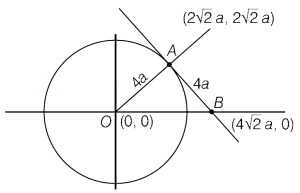
The area of the triangle formed by the positive $X$-axis,the tangent and the normal to the curve $x^2+y^2=16a^2$ at the point $(2\sqrt{2}a, 2\sqrt{2}a)$ is
A
$a^2$
B
$16a^2$
C
$4a^2$
D
$8a^2$
Solution
(D) Given curve is $x^2+y^2=16a^2$.
On differentiating the equation with respect to $x$,we get $2x + 2yy' = 0$,which implies $y' = -\frac{x}{y}$.
At the point $(2\sqrt{2}a, 2\sqrt{2}a)$,the slope of the tangent is $m_1 = -\frac{2\sqrt{2}a}{2\sqrt{2}a} = -1$.
The slope of the normal is $m_2 = -\frac{1}{m_1} = 1$.
The equation of the tangent is $y - 2\sqrt{2}a = -1(x - 2\sqrt{2}a)$,which simplifies to $x + y = 4\sqrt{2}a$.
The $X$-intercept of the tangent is found by setting $y=0$,giving $x = 4\sqrt{2}a$. Let this point be $B(4\sqrt{2}a, 0)$.
The equation of the normal is $y - 2\sqrt{2}a = 1(x - 2\sqrt{2}a)$,which simplifies to $y = x$.
The normal passes through the origin $O(0,0)$ and the point $A(2\sqrt{2}a, 2\sqrt{2}a)$.
The triangle is formed by the points $O(0,0)$,$A(2\sqrt{2}a, 2\sqrt{2}a)$,and $B(4\sqrt{2}a, 0)$.
The area of the triangle with vertices $(x_1, y_1), (x_2, y_2), (x_3, y_3)$ is $\frac{1}{2} |x_1(y_2-y_3) + x_2(y_3-y_1) + x_3(y_1-y_2)|$.
Area $= \frac{1}{2} |0(2\sqrt{2}a-0) + 2\sqrt{2}a(0-0) + 4\sqrt{2}a(0-2\sqrt{2}a)| = \frac{1}{2} |4\sqrt{2}a(-2\sqrt{2}a)| = \frac{1}{2} |-16a^2| = 8a^2$.
On differentiating the equation with respect to $x$,we get $2x + 2yy' = 0$,which implies $y' = -\frac{x}{y}$.
At the point $(2\sqrt{2}a, 2\sqrt{2}a)$,the slope of the tangent is $m_1 = -\frac{2\sqrt{2}a}{2\sqrt{2}a} = -1$.
The slope of the normal is $m_2 = -\frac{1}{m_1} = 1$.
The equation of the tangent is $y - 2\sqrt{2}a = -1(x - 2\sqrt{2}a)$,which simplifies to $x + y = 4\sqrt{2}a$.
The $X$-intercept of the tangent is found by setting $y=0$,giving $x = 4\sqrt{2}a$. Let this point be $B(4\sqrt{2}a, 0)$.
The equation of the normal is $y - 2\sqrt{2}a = 1(x - 2\sqrt{2}a)$,which simplifies to $y = x$.
The normal passes through the origin $O(0,0)$ and the point $A(2\sqrt{2}a, 2\sqrt{2}a)$.
The triangle is formed by the points $O(0,0)$,$A(2\sqrt{2}a, 2\sqrt{2}a)$,and $B(4\sqrt{2}a, 0)$.
The area of the triangle with vertices $(x_1, y_1), (x_2, y_2), (x_3, y_3)$ is $\frac{1}{2} |x_1(y_2-y_3) + x_2(y_3-y_1) + x_3(y_1-y_2)|$.
Area $= \frac{1}{2} |0(2\sqrt{2}a-0) + 2\sqrt{2}a(0-0) + 4\sqrt{2}a(0-2\sqrt{2}a)| = \frac{1}{2} |4\sqrt{2}a(-2\sqrt{2}a)| = \frac{1}{2} |-16a^2| = 8a^2$.
0 likes
View Solution304
EasyMCQ
The equation of the normal at $t=\frac{\pi}{2}$ to the curve $x=2 \sin t, y=2 \cos t$ is
A
$x=2$
B
$y=0$
C
$y=2x+3$
D
$y=3$
Solution
(B) Given the parametric equations of the curve: $x=2 \sin t$ and $y=2 \cos t$.
Squaring and adding,we get $x^2+y^2=4 \sin^2 t + 4 \cos^2 t = 4$.
This represents a circle with radius $2$.
Differentiating $x^2+y^2=4$ with respect to $x$: $2x + 2y \frac{dy}{dx} = 0$,which gives $\frac{dy}{dx} = -\frac{x}{y}$.
The slope of the tangent at any point $(x, y)$ is $m_T = -\frac{x}{y}$.
The slope of the normal $m_N$ is $-\frac{1}{m_T} = \frac{y}{x}$.
At $t = \frac{\pi}{2}$,the point is $x = 2 \sin(\frac{\pi}{2}) = 2$ and $y = 2 \cos(\frac{\pi}{2}) = 0$.
The slope of the normal at this point is $m_N = \frac{0}{2} = 0$.
The equation of the normal is $y - y_1 = m_N(x - x_1)$.
Substituting the values: $y - 0 = 0(x - 2)$,which simplifies to $y = 0$.
Squaring and adding,we get $x^2+y^2=4 \sin^2 t + 4 \cos^2 t = 4$.
This represents a circle with radius $2$.
Differentiating $x^2+y^2=4$ with respect to $x$: $2x + 2y \frac{dy}{dx} = 0$,which gives $\frac{dy}{dx} = -\frac{x}{y}$.
The slope of the tangent at any point $(x, y)$ is $m_T = -\frac{x}{y}$.
The slope of the normal $m_N$ is $-\frac{1}{m_T} = \frac{y}{x}$.
At $t = \frac{\pi}{2}$,the point is $x = 2 \sin(\frac{\pi}{2}) = 2$ and $y = 2 \cos(\frac{\pi}{2}) = 0$.
The slope of the normal at this point is $m_N = \frac{0}{2} = 0$.
The equation of the normal is $y - y_1 = m_N(x - x_1)$.
Substituting the values: $y - 0 = 0(x - 2)$,which simplifies to $y = 0$.
0 likes
View Solution305
MediumMCQ
The normal at a point $\theta$ to the curve $x=a(1+\cos \theta), y=a \sin \theta$ always passes through the fixed point
A
$(0, a)$
B
$(2 a, 0)$
C
$(a, 0)$
D
$(a, a)$
Solution
(C) Given the parametric equations of the curve are $x = a(1 + \cos \theta)$ and $y = a \sin \theta$.
First,we find the derivative $\frac{dy}{dx}$:
$\frac{dy}{d\theta} = a \cos \theta$ and $\frac{dx}{d\theta} = -a \sin \theta$.
Thus,$\frac{dy}{dx} = \frac{a \cos \theta}{-a \sin \theta} = -\cot \theta$.
The slope of the normal at point $\theta$ is $m_n = -\frac{1}{dy/dx} = \frac{1}{\cot \theta} = \tan \theta$.
The equation of the normal at point $(x_1, y_1) = (a(1 + \cos \theta), a \sin \theta)$ is given by:
$y - a \sin \theta = \tan \theta (x - a(1 + \cos \theta))$.
$y - a \sin \theta = \frac{\sin \theta}{\cos \theta} (x - a - a \cos \theta)$.
$y \cos \theta - a \sin \theta \cos \theta = x \sin \theta - a \sin \theta - a \sin \theta \cos \theta$.
$y \cos \theta = x \sin \theta - a \sin \theta$.
$y \cos \theta = (x - a) \sin \theta$.
If we check the point $(a, 0)$,we substitute $x = a$ and $y = 0$ into the equation:
$0 \cdot \cos \theta = (a - a) \sin \theta \Rightarrow 0 = 0$.
Since this holds true for all $\theta$,the normal always passes through the fixed point $(a, 0)$.
First,we find the derivative $\frac{dy}{dx}$:
$\frac{dy}{d\theta} = a \cos \theta$ and $\frac{dx}{d\theta} = -a \sin \theta$.
Thus,$\frac{dy}{dx} = \frac{a \cos \theta}{-a \sin \theta} = -\cot \theta$.
The slope of the normal at point $\theta$ is $m_n = -\frac{1}{dy/dx} = \frac{1}{\cot \theta} = \tan \theta$.
The equation of the normal at point $(x_1, y_1) = (a(1 + \cos \theta), a \sin \theta)$ is given by:
$y - a \sin \theta = \tan \theta (x - a(1 + \cos \theta))$.
$y - a \sin \theta = \frac{\sin \theta}{\cos \theta} (x - a - a \cos \theta)$.
$y \cos \theta - a \sin \theta \cos \theta = x \sin \theta - a \sin \theta - a \sin \theta \cos \theta$.
$y \cos \theta = x \sin \theta - a \sin \theta$.
$y \cos \theta = (x - a) \sin \theta$.
If we check the point $(a, 0)$,we substitute $x = a$ and $y = 0$ into the equation:
$0 \cdot \cos \theta = (a - a) \sin \theta \Rightarrow 0 = 0$.
Since this holds true for all $\theta$,the normal always passes through the fixed point $(a, 0)$.
0 likes
View Solution306
MediumMCQ
If $\theta$ is the acute angle between the curves $x^2+y^2=4$ and $y^2=3x$,then $\tan \theta=$
A
$\frac{5}{\sqrt{3}}$
B
$\frac{\sqrt{3}}{4}$
C
$\frac{4}{\sqrt{3}}$
D
$\frac{\sqrt{3}}{5}$
Solution
(A) Given curves are $x^2+y^2=4$ and $y^2=3x$. Substituting $y^2=3x$ into the first equation:
$x^2+3x-4=0$
$(x+4)(x-1)=0$
Since $x$ must be non-negative for $y^2=3x$,we have $x=1$.
For $x=1$,$y^2=3$,so $y=\sqrt{3}$ (considering the point of intersection in the first quadrant).
Now,differentiate both curves with respect to $x$:
For $x^2+y^2=4$,$2x+2y\frac{dy}{dx}=0 \Rightarrow \frac{dy}{dx} = -\frac{x}{y}$. At $(1, \sqrt{3})$,$m_1 = -\frac{1}{\sqrt{3}}$.
For $y^2=3x$,$2y\frac{dy}{dx}=3 \Rightarrow \frac{dy}{dx} = \frac{3}{2y}$. At $(1, \sqrt{3})$,$m_2 = \frac{3}{2\sqrt{3}} = \frac{\sqrt{3}}{2}$.
The angle $\theta$ between the curves is given by $\tan \theta = \left|\frac{m_1-m_2}{1+m_1m_2}\right|$.
$\tan \theta = \left|\frac{-\frac{1}{\sqrt{3}} - \frac{\sqrt{3}}{2}}{1 + (-\frac{1}{\sqrt{3}})(\frac{\sqrt{3}}{2})}\right| = \left|\frac{-\frac{2+3}{2\sqrt{3}}}{1-\frac{1}{2}}\right| = \left|\frac{-\frac{5}{2\sqrt{3}}}{\frac{1}{2}}\right| = \frac{5}{\sqrt{3}}$.
$x^2+3x-4=0$
$(x+4)(x-1)=0$
Since $x$ must be non-negative for $y^2=3x$,we have $x=1$.
For $x=1$,$y^2=3$,so $y=\sqrt{3}$ (considering the point of intersection in the first quadrant).
Now,differentiate both curves with respect to $x$:
For $x^2+y^2=4$,$2x+2y\frac{dy}{dx}=0 \Rightarrow \frac{dy}{dx} = -\frac{x}{y}$. At $(1, \sqrt{3})$,$m_1 = -\frac{1}{\sqrt{3}}$.
For $y^2=3x$,$2y\frac{dy}{dx}=3 \Rightarrow \frac{dy}{dx} = \frac{3}{2y}$. At $(1, \sqrt{3})$,$m_2 = \frac{3}{2\sqrt{3}} = \frac{\sqrt{3}}{2}$.
The angle $\theta$ between the curves is given by $\tan \theta = \left|\frac{m_1-m_2}{1+m_1m_2}\right|$.
$\tan \theta = \left|\frac{-\frac{1}{\sqrt{3}} - \frac{\sqrt{3}}{2}}{1 + (-\frac{1}{\sqrt{3}})(\frac{\sqrt{3}}{2})}\right| = \left|\frac{-\frac{2+3}{2\sqrt{3}}}{1-\frac{1}{2}}\right| = \left|\frac{-\frac{5}{2\sqrt{3}}}{\frac{1}{2}}\right| = \frac{5}{\sqrt{3}}$.
0 likes
View Solution307
EasyMCQ
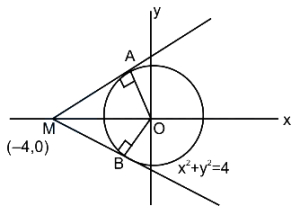
Two tangents to the circle $x^{2}+y^{2}=4$ at the points $A$ and $B$ meet at $M(-4,0)$. The area of the quadrilateral $MAOB$,where $O$ is the origin,is
A
$4 \sqrt{3}$ sq. units
B
$2 \sqrt{3}$ sq. units
C
$\sqrt{3}$ sq. units
D
$3 \sqrt{3}$ sq. units
Solution
(A) The circle is $x^{2}+y^{2}=4$,so its radius $OA = 2$ and the center $O$ is $(0,0)$.
Since $MA$ is a tangent,$\angle OAM = 90^{\circ}$.
In the right-angled triangle $\triangle OAM$,the hypotenuse $OM = 4$ and the side $OA = 2$.
Using the Pythagorean theorem,$MA = \sqrt{OM^{2} - OA^{2}} = \sqrt{4^{2} - 2^{2}} = \sqrt{16 - 4} = \sqrt{12} = 2\sqrt{3}$.
The quadrilateral $MAOB$ consists of two congruent right-angled triangles,$\triangle OAM$ and $\triangle OBM$.
Therefore,the area of quadrilateral $MAOB = 2 \times \text{Area}(\triangle OAM)$.
Area $(\triangle OAM) = \frac{1}{2} \times OA \times MA = \frac{1}{2} \times 2 \times 2\sqrt{3} = 2\sqrt{3}$.
Thus,the area of quadrilateral $MAOB = 2 \times 2\sqrt{3} = 4\sqrt{3}$ sq. units.
Since $MA$ is a tangent,$\angle OAM = 90^{\circ}$.
In the right-angled triangle $\triangle OAM$,the hypotenuse $OM = 4$ and the side $OA = 2$.
Using the Pythagorean theorem,$MA = \sqrt{OM^{2} - OA^{2}} = \sqrt{4^{2} - 2^{2}} = \sqrt{16 - 4} = \sqrt{12} = 2\sqrt{3}$.
The quadrilateral $MAOB$ consists of two congruent right-angled triangles,$\triangle OAM$ and $\triangle OBM$.
Therefore,the area of quadrilateral $MAOB = 2 \times \text{Area}(\triangle OAM)$.
Area $(\triangle OAM) = \frac{1}{2} \times OA \times MA = \frac{1}{2} \times 2 \times 2\sqrt{3} = 2\sqrt{3}$.
Thus,the area of quadrilateral $MAOB = 2 \times 2\sqrt{3} = 4\sqrt{3}$ sq. units.
0 likes
View Solution308
DifficultMCQ
The angle of intersection between the curves $y=[|\sin x|+|\cos x|]$ and $x^{2}+y^{2}=10,$ where $[x]$ denotes the greatest integer $\leq x,$ is
A
$\tan ^{-1} 3$
B
$\tan ^{-1}(-3)$
C
$\tan ^{-1} \sqrt{3}$
D
$\tan ^{-1}(1 / \sqrt{3})$
Solution
(A) Given,$y=[|\sin x|+|\cos x|]$ and $x^{2}+y^{2}=10$.
We know that $(|\sin x|+|\cos x|) \in [1, \sqrt{2}]$.
Since $[x]$ is the greatest integer function,$y = [|\sin x|+|\cos x|] = 1$.
The point of intersection of the given curves is found by substituting $y=1$ into $x^{2}+y^{2}=10$:
$x^{2}+1^{2}=10$ $\Rightarrow x^{2}=9$ $\Rightarrow x=\pm 3$.
The points of intersection are $(3, 1)$ and $(-3, 1)$.
For the circle $x^{2}+y^{2}=10$,differentiating with respect to $x$ gives $2x + 2y \frac{dy}{dx} = 0$,so $\frac{dy}{dx} = -\frac{x}{y}$.
At point $(-3, 1)$,the slope $m_{1} = -(-3)/1 = 3$.
The curve $y=1$ is a horizontal line,so its slope $m_{2} = 0$.
The angle $\theta$ between the curves is given by $\tan \theta = |\frac{m_{1}-m_{2}}{1+m_{1}m_{2}}| = |\frac{3-0}{1+3(0)}| = 3$.
Therefore,$\theta = \tan^{-1}(3)$.
We know that $(|\sin x|+|\cos x|) \in [1, \sqrt{2}]$.
Since $[x]$ is the greatest integer function,$y = [|\sin x|+|\cos x|] = 1$.
The point of intersection of the given curves is found by substituting $y=1$ into $x^{2}+y^{2}=10$:
$x^{2}+1^{2}=10$ $\Rightarrow x^{2}=9$ $\Rightarrow x=\pm 3$.
The points of intersection are $(3, 1)$ and $(-3, 1)$.
For the circle $x^{2}+y^{2}=10$,differentiating with respect to $x$ gives $2x + 2y \frac{dy}{dx} = 0$,so $\frac{dy}{dx} = -\frac{x}{y}$.
At point $(-3, 1)$,the slope $m_{1} = -(-3)/1 = 3$.
The curve $y=1$ is a horizontal line,so its slope $m_{2} = 0$.
The angle $\theta$ between the curves is given by $\tan \theta = |\frac{m_{1}-m_{2}}{1+m_{1}m_{2}}| = |\frac{3-0}{1+3(0)}| = 3$.
Therefore,$\theta = \tan^{-1}(3)$.
0 likes
View Solution309
MediumMCQ
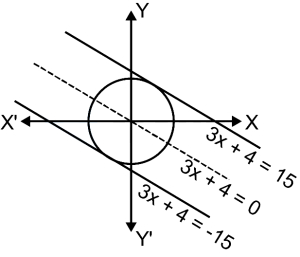
The equation of a line parallel to the line $3x + 4y = 0$ and touching the circle $x^{2} + y^{2} = 9$ in the first quadrant is:
A
$3x + 4y = 15$
B
$3x + 4y = 45$
C
$3x + 4y = 9$
D
$3x + 4y = 27$
Solution
(A) The equation of the circle is $x^{2} + y^{2} = 9$,which has center $(0, 0)$ and radius $r = 3$.
Any line parallel to $3x + 4y = 0$ is of the form $3x + 4y = k$.
The perpendicular distance from the center $(0, 0)$ to the line $3x + 4y - k = 0$ must be equal to the radius $r = 3$.
Using the formula for distance from a point to a line: $\frac{|3(0) + 4(0) - k|}{\sqrt{3^{2} + 4^{2}}} = 3$.
$\frac{|-k|}{\sqrt{9 + 16}} = 3$ $\Rightarrow \frac{|k|}{5} = 3$ $\Rightarrow |k| = 15$.
So,$k = 15$ or $k = -15$.
The lines are $3x + 4y = 15$ and $3x + 4y = -15$.
For the line to touch the circle in the first quadrant,the intercept form $\frac{x}{5} + \frac{y}{3.75} = 1$ (for $k=15$) shows positive intercepts,which lies in the first quadrant.
Thus,the required equation is $3x + 4y = 15$.
Any line parallel to $3x + 4y = 0$ is of the form $3x + 4y = k$.
The perpendicular distance from the center $(0, 0)$ to the line $3x + 4y - k = 0$ must be equal to the radius $r = 3$.
Using the formula for distance from a point to a line: $\frac{|3(0) + 4(0) - k|}{\sqrt{3^{2} + 4^{2}}} = 3$.
$\frac{|-k|}{\sqrt{9 + 16}} = 3$ $\Rightarrow \frac{|k|}{5} = 3$ $\Rightarrow |k| = 15$.
So,$k = 15$ or $k = -15$.
The lines are $3x + 4y = 15$ and $3x + 4y = -15$.
For the line to touch the circle in the first quadrant,the intercept form $\frac{x}{5} + \frac{y}{3.75} = 1$ (for $k=15$) shows positive intercepts,which lies in the first quadrant.
Thus,the required equation is $3x + 4y = 15$.
0 likes
View Solution310
MediumMCQ
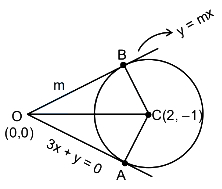
If the equation of one tangent to the circle with center at $(2, -1)$ from the origin is $3x + y = 0$,then the equation of the other tangent through the origin is
A
$3x - y = 0$
B
$x + 3y = 0$
C
$x - 3y = 0$
D
$x + 2y = 0$
Solution
(C) Let the equation of the other tangent be $y = mx$,which can be written as $mx - y = 0$.
The center of the circle is $C(2, -1)$. The radius $r$ is the perpendicular distance from $C$ to the tangent $3x + y = 0$.
$r = \frac{|3(2) + 1(-1)|}{\sqrt{3^2 + 1^2}} = \frac{|6 - 1|}{\sqrt{10}} = \frac{5}{\sqrt{10}}$.
Since the other tangent $mx - y = 0$ also touches the circle,the perpendicular distance from $C(2, -1)$ to this line must also be equal to $r$.
$\frac{|m(2) - 1(-1)|}{\sqrt{m^2 + (-1)^2}} = \frac{5}{\sqrt{10}}$
$\frac{|2m + 1|}{\sqrt{m^2 + 1}} = \frac{5}{\sqrt{10}}$
Squaring both sides:
$\frac{(2m + 1)^2}{m^2 + 1} = \frac{25}{10} = \frac{5}{2}$
$2(4m^2 + 4m + 1) = 5(m^2 + 1)$
$8m^2 + 8m + 2 = 5m^2 + 5$
$3m^2 + 8m - 3 = 0$
$(3m - 1)(m + 3) = 0$
So,$m = \frac{1}{3}$ or $m = -3$.
The given tangent is $3x + y = 0$,which has slope $m = -3$.
Therefore,the other tangent has slope $m = \frac{1}{3}$.
The equation is $y = \frac{1}{3}x$,which simplifies to $x - 3y = 0$.
The center of the circle is $C(2, -1)$. The radius $r$ is the perpendicular distance from $C$ to the tangent $3x + y = 0$.
$r = \frac{|3(2) + 1(-1)|}{\sqrt{3^2 + 1^2}} = \frac{|6 - 1|}{\sqrt{10}} = \frac{5}{\sqrt{10}}$.
Since the other tangent $mx - y = 0$ also touches the circle,the perpendicular distance from $C(2, -1)$ to this line must also be equal to $r$.
$\frac{|m(2) - 1(-1)|}{\sqrt{m^2 + (-1)^2}} = \frac{5}{\sqrt{10}}$
$\frac{|2m + 1|}{\sqrt{m^2 + 1}} = \frac{5}{\sqrt{10}}$
Squaring both sides:
$\frac{(2m + 1)^2}{m^2 + 1} = \frac{25}{10} = \frac{5}{2}$
$2(4m^2 + 4m + 1) = 5(m^2 + 1)$
$8m^2 + 8m + 2 = 5m^2 + 5$
$3m^2 + 8m - 3 = 0$
$(3m - 1)(m + 3) = 0$
So,$m = \frac{1}{3}$ or $m = -3$.
The given tangent is $3x + y = 0$,which has slope $m = -3$.
Therefore,the other tangent has slope $m = \frac{1}{3}$.
The equation is $y = \frac{1}{3}x$,which simplifies to $x - 3y = 0$.
0 likes
View Solution311
MediumMCQ
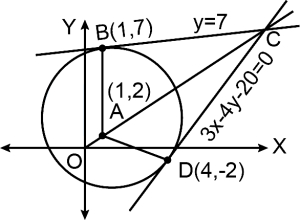
Let $A$ be the centre of the circle $x^{2}+y^{2}-2x-4y-20=0$. Let $B(1,7)$ and $D(4,-2)$ be two points on the circle such that tangents at $B$ and $D$ meet at $C$. The area of the quadrilateral $ABCD$ is
A
$150 \text{ sq units}$
B
$50 \text{ sq units}$
C
$75 \text{ sq units}$
D
$70 \text{ sq units}$
Solution
(C) The given equation of the circle is $x^{2}+y^{2}-2x-4y-20=0$.
Comparing with $x^{2}+y^{2}+2gx+2fy+c=0$,we get $g=-1, f=-2, c=-20$.
The center $A$ is $(-g, -f) = (1, 2)$ and the radius $r = \sqrt{g^{2}+f^{2}-c} = \sqrt{1+4+20} = \sqrt{25} = 5$.
The tangent at $B(1, 7)$ is $x(1) + y(7) - (x+1) - 2(y+7) - 20 = 0$,which simplifies to $y=7$.
The tangent at $D(4, -2)$ is $x(4) + y(-2) - (x+4) - 2(y-2) - 20 = 0$,which simplifies to $3x-4y-20=0$.
Solving $y=7$ and $3x-4y-20=0$,we get $3x-28-20=0 \implies 3x=48 \implies x=16$. Thus,$C$ is $(16, 7)$.
The quadrilateral $ABCD$ consists of two congruent triangles $\Delta ABC$ and $\Delta ADC$.
The length of the tangent $BC = \sqrt{(16-1)^{2} + (7-7)^{2}} = 15$.
The area of $\Delta ABC = \frac{1}{2} \times \text{base} \times \text{height} = \frac{1}{2} \times BC \times AB = \frac{1}{2} \times 15 \times 5 = 37.5$.
The area of quadrilateral $ABCD = 2 \times \text{Area}(\Delta ABC) = 2 \times 37.5 = 75 \text{ sq units}$.
Comparing with $x^{2}+y^{2}+2gx+2fy+c=0$,we get $g=-1, f=-2, c=-20$.
The center $A$ is $(-g, -f) = (1, 2)$ and the radius $r = \sqrt{g^{2}+f^{2}-c} = \sqrt{1+4+20} = \sqrt{25} = 5$.
The tangent at $B(1, 7)$ is $x(1) + y(7) - (x+1) - 2(y+7) - 20 = 0$,which simplifies to $y=7$.
The tangent at $D(4, -2)$ is $x(4) + y(-2) - (x+4) - 2(y-2) - 20 = 0$,which simplifies to $3x-4y-20=0$.
Solving $y=7$ and $3x-4y-20=0$,we get $3x-28-20=0 \implies 3x=48 \implies x=16$. Thus,$C$ is $(16, 7)$.
The quadrilateral $ABCD$ consists of two congruent triangles $\Delta ABC$ and $\Delta ADC$.
The length of the tangent $BC = \sqrt{(16-1)^{2} + (7-7)^{2}} = 15$.
The area of $\Delta ABC = \frac{1}{2} \times \text{base} \times \text{height} = \frac{1}{2} \times BC \times AB = \frac{1}{2} \times 15 \times 5 = 37.5$.
The area of quadrilateral $ABCD = 2 \times \text{Area}(\Delta ABC) = 2 \times 37.5 = 75 \text{ sq units}$.
0 likes
View Solution312
EasyMCQ
The equation of the normal to the circle $x^2+y^2-2x+4y-5=0$ at the point $(2,1)$ is:
A
$y=3x-5$
B
$2y=3x-4$
C
$y=3x+4$
D
$y=x+1$
Solution
(A) The given equation of the circle is $x^2+y^2-2x+4y-5=0$.
Comparing this with the general form $x^2+y^2+2gx+2fy+c=0$,we get $g=-1$ and $f=2$.
The center of the circle $C$ is $(-g, -f) = (1, -2)$.
The normal to a circle at any point on its circumference always passes through the center of the circle.
Therefore,the normal is the line passing through the center $C(1, -2)$ and the given point $A(2, 1)$.
The slope $m$ of the line passing through $(1, -2)$ and $(2, 1)$ is given by $m = \frac{1 - (-2)}{2 - 1} = \frac{3}{1} = 3$.
The equation of the line passing through $(2, 1)$ with slope $m=3$ is $(y - 1) = 3(x - 2)$.
Simplifying this,we get $y - 1 = 3x - 6$,which results in $y = 3x - 5$.
Comparing this with the general form $x^2+y^2+2gx+2fy+c=0$,we get $g=-1$ and $f=2$.
The center of the circle $C$ is $(-g, -f) = (1, -2)$.
The normal to a circle at any point on its circumference always passes through the center of the circle.
Therefore,the normal is the line passing through the center $C(1, -2)$ and the given point $A(2, 1)$.
The slope $m$ of the line passing through $(1, -2)$ and $(2, 1)$ is given by $m = \frac{1 - (-2)}{2 - 1} = \frac{3}{1} = 3$.
The equation of the line passing through $(2, 1)$ with slope $m=3$ is $(y - 1) = 3(x - 2)$.
Simplifying this,we get $y - 1 = 3x - 6$,which results in $y = 3x - 5$.
0 likes
View Solution10-1.Circle and System of Circles — Tangent and normal to a circle · Frequently Asked Questions
1Are these 10-1.Circle and System of Circles questions useful for JEE and NEET?
Yes. All questions in this section are mapped to JEE Main and NEET exam patterns. Previous year questions from JEE Main, NEET, GUJCET and state-level exams are included with full solutions.
2Can I switch to Hindi or Gujarati for these questions?
Yes. Use the language tabs in the hero section or the sidebar to view the same questions and solutions in English, Hindi or Gujarati.
3How do I generate a question paper from this subtopic?
Use the Vedclass Exam Paper Generator — select the chapter and subtopic, set difficulty, and generate Sets A, B, C, D automatically. First 3 chapters of every subject are free.
Vedclass Products
For Students
Vedclass Test Series
Mock tests in real JEE/NEET style with performance analysis. 5-day free trial.
Start Free TrialFor Teachers
Exam Paper Generator
Generate Set A/B/C/D papers from this chapter in 2 minutes. 3 chapters free.
Try FreeFor Institutes
Online Exam Module
Live online exams with unlimited students, 360° analytics & white-label branding.
See DemoFor Teachers & Institutes
Generate a 10-1.Circle and System of Circles Exam Paper in 2 Minutes
Select subtopic & difficulty — Sets A, B, C, D auto-generated with No Repeat logic.
First 3 chapters of every subject are free — no payment required.