
A English
Tangent and normal to a circle Questions in English
Class 11 Mathematics · 10-1.Circle and System of Circles · Tangent and normal to a circle
313+
Questions
English
Language
100%
With Solutions
Showing 48 of 313 questions in English
201
MediumMCQ
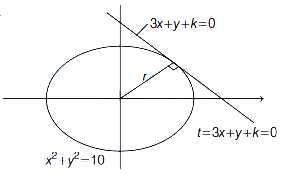
If $3x + y + k = 0$ is a tangent to the circle $x^{2} + y^{2} = 10$,the values of $k$ are
A
$\pm 7$
B
$\pm 5$
C
$\pm 10$
D
$\pm 9$
Solution
(C) The equation of the line is $3x + y + k = 0$.
The equation of the circle is $x^{2} + y^{2} = 10$,which has its center at $(0, 0)$ and radius $r = \sqrt{10}$.
If a line $Ax + By + C = 0$ is tangent to a circle with center $(x_{1}, y_{1})$ and radius $r$,then the perpendicular distance from the center to the line must equal the radius:
$\left| \frac{Ax_{1} + By_{1} + C}{\sqrt{A^{2} + B^{2}}} \right| = r$
Substituting the values:
$\left| \frac{3(0) + 1(0) + k}{\sqrt{3^{2} + 1^{2}}} \right| = \sqrt{10}$
$\left| \frac{k}{\sqrt{9 + 1}} \right| = \sqrt{10}$
$\left| \frac{k}{\sqrt{10}} \right| = \sqrt{10}$
$|k| = \sqrt{10} \times \sqrt{10}$
$|k| = 10$
Therefore,$k = \pm 10$.
The equation of the circle is $x^{2} + y^{2} = 10$,which has its center at $(0, 0)$ and radius $r = \sqrt{10}$.
If a line $Ax + By + C = 0$ is tangent to a circle with center $(x_{1}, y_{1})$ and radius $r$,then the perpendicular distance from the center to the line must equal the radius:
$\left| \frac{Ax_{1} + By_{1} + C}{\sqrt{A^{2} + B^{2}}} \right| = r$
Substituting the values:
$\left| \frac{3(0) + 1(0) + k}{\sqrt{3^{2} + 1^{2}}} \right| = \sqrt{10}$
$\left| \frac{k}{\sqrt{9 + 1}} \right| = \sqrt{10}$
$\left| \frac{k}{\sqrt{10}} \right| = \sqrt{10}$
$|k| = \sqrt{10} \times \sqrt{10}$
$|k| = 10$
Therefore,$k = \pm 10$.
0 likes
View Solution202
MediumMCQ
The slope of the normal to the circle $x^2+y^2+2gx+2fy+c=0$ at $(x_1, y_1)$ is
A
$-\frac{x_1+g}{y_1+f}$
B
$-\frac{y_1+f}{x_1+g}$
C
$\frac{x_1+g}{y_1+f}$
D
$\frac{y_1+f}{x_1+g}$
Solution
(D) The equation of the circle is $x^2+y^2+2gx+2fy+c=0$.
The center of the circle is $C(-g, -f)$.
The normal to a circle at any point $P(x_1, y_1)$ always passes through the center $C(-g, -f)$.
The slope of the normal is the slope of the line segment $CP$.
The slope $m$ is given by $\frac{y_2-y_1}{x_2-x_1} = \frac{y_1 - (-f)}{x_1 - (-g)} = \frac{y_1+f}{x_1+g}$.
Thus,the slope of the normal is $\frac{y_1+f}{x_1+g}$.
The center of the circle is $C(-g, -f)$.
The normal to a circle at any point $P(x_1, y_1)$ always passes through the center $C(-g, -f)$.
The slope of the normal is the slope of the line segment $CP$.
The slope $m$ is given by $\frac{y_2-y_1}{x_2-x_1} = \frac{y_1 - (-f)}{x_1 - (-g)} = \frac{y_1+f}{x_1+g}$.
Thus,the slope of the normal is $\frac{y_1+f}{x_1+g}$.
0 likes
View Solution203
EasyMCQ
The line $3x + y - 5 = 0$ touches a circle $S$ at $(1, 2)$. If $(h, k)$ is the centre of the circle $S$ such that $h^2 + hk + k^2 = 37$ and the radius of the circle $S$ is $\sqrt{10}$,then $k =$
A
$4$
B
$3$
C
$2$
D
$1$
Solution
(B) Given $h^2 + hk + k^2 = 37$ ... $(i)$
Radius $r = \sqrt{10}$.
The equation of the circle $S$ is $(x - h)^2 + (y - k)^2 = 10$ ... $(ii)$
Since $(1, 2)$ lies on the circle,$(1 - h)^2 + (2 - k)^2 = 10$.
Expanding this,$1 - 2h + h^2 + 4 - 4k + k^2 = 10$,which simplifies to $h^2 + k^2 - 2h - 4k = 5$.
Substituting $h^2 + k^2 = 37 - hk$ from $(i)$ into this equation:
$37 - hk - 2h - 4k = 5 \Rightarrow hk + 2h + 4k = 32$ ... $(iii)$
The perpendicular distance from the centre $(h, k)$ to the tangent line $3x + y - 5 = 0$ is equal to the radius $\sqrt{10}$:
$\frac{|3h + k - 5|}{\sqrt{3^2 + 1^2}} = \sqrt{10} \Rightarrow |3h + k - 5| = 10$.
Assuming $3h + k - 5 = 10$,we get $3h + k = 15 \Rightarrow k = 15 - 3h$.
Substituting $k = 15 - 3h$ into $(iii)$:
$h(15 - 3h) + 2h + 4(15 - 3h) = 32$
$15h - 3h^2 + 2h + 60 - 12h = 32$
$-3h^2 + 5h + 28 = 0 \Rightarrow 3h^2 - 5h - 28 = 0$.
Solving the quadratic equation $(3h + 7)(h - 4) = 0$,we get $h = 4$ or $h = -7/3$.
If $h = 4$,then $k = 15 - 3(4) = 3$.
Thus,$k = 3$.
Radius $r = \sqrt{10}$.
The equation of the circle $S$ is $(x - h)^2 + (y - k)^2 = 10$ ... $(ii)$
Since $(1, 2)$ lies on the circle,$(1 - h)^2 + (2 - k)^2 = 10$.
Expanding this,$1 - 2h + h^2 + 4 - 4k + k^2 = 10$,which simplifies to $h^2 + k^2 - 2h - 4k = 5$.
Substituting $h^2 + k^2 = 37 - hk$ from $(i)$ into this equation:
$37 - hk - 2h - 4k = 5 \Rightarrow hk + 2h + 4k = 32$ ... $(iii)$
The perpendicular distance from the centre $(h, k)$ to the tangent line $3x + y - 5 = 0$ is equal to the radius $\sqrt{10}$:
$\frac{|3h + k - 5|}{\sqrt{3^2 + 1^2}} = \sqrt{10} \Rightarrow |3h + k - 5| = 10$.
Assuming $3h + k - 5 = 10$,we get $3h + k = 15 \Rightarrow k = 15 - 3h$.
Substituting $k = 15 - 3h$ into $(iii)$:
$h(15 - 3h) + 2h + 4(15 - 3h) = 32$
$15h - 3h^2 + 2h + 60 - 12h = 32$
$-3h^2 + 5h + 28 = 0 \Rightarrow 3h^2 - 5h - 28 = 0$.
Solving the quadratic equation $(3h + 7)(h - 4) = 0$,we get $h = 4$ or $h = -7/3$.
If $h = 4$,then $k = 15 - 3(4) = 3$.
Thus,$k = 3$.
0 likes
View Solution204
MediumMCQ
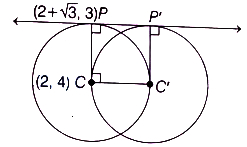
The circle $x^2+y^2-4x-8y+16=0$ rolls along the tangent drawn to it at $(2+\sqrt{3}, 3)$ by $2$ units. The equation of the circle in the new position is
A
$x^2+y^2-6x-2(4+\sqrt{3})y+(24+8\sqrt{3})=0$
B
$x^2+y^2-6x+2(4+\sqrt{3})y+(24+8\sqrt{3})=0$
C
$x^2+y^2+6x-2(4+\sqrt{3})y+(24+8\sqrt{3})=0$
D
$x^2+y^2+6x+2(4+\sqrt{3})y+(24+8\sqrt{3})=0$
Solution
(A) The given circle is $x^2+y^2-4x-8y+16=0$. Its center is $C(2, 4)$ and radius $r = \sqrt{2^2+4^2-16} = 2$.
Let $P(2+\sqrt{3}, 3)$ be the point of tangency.
The slope of the radius $CP$ is $m_{CP} = \frac{3-4}{(2+\sqrt{3})-2} = \frac{-1}{\sqrt{3}}$.
The tangent is perpendicular to the radius,so the slope of the tangent is $m_t = \sqrt{3}$.
Since the circle rolls along the tangent by $2$ units,the new center $C'$ is at a distance of $2$ units from $C$ in the direction of the tangent.
The angle of the tangent with the $x$-axis is $\theta = \tan^{-1}(\sqrt{3}) = 60^{\circ}$.
The new center $C'$ is $(2+2\cos 60^{\circ}, 4+2\sin 60^{\circ}) = (2+2(1/2), 4+2(\sqrt{3}/2)) = (3, 4+\sqrt{3})$.
The radius remains $r=2$. The equation of the new circle is $(x-3)^2 + (y-(4+\sqrt{3}))^2 = 2^2$.
Expanding this: $x^2-6x+9 + y^2-2(4+\sqrt{3})y + (4+\sqrt{3})^2 = 4$.
$x^2+y^2-6x-2(4+\sqrt{3})y + 9 + 16 + 3 + 8\sqrt{3} - 4 = 0$.
$x^2+y^2-6x-2(4+\sqrt{3})y + (24+8\sqrt{3}) = 0$.
Let $P(2+\sqrt{3}, 3)$ be the point of tangency.
The slope of the radius $CP$ is $m_{CP} = \frac{3-4}{(2+\sqrt{3})-2} = \frac{-1}{\sqrt{3}}$.
The tangent is perpendicular to the radius,so the slope of the tangent is $m_t = \sqrt{3}$.
Since the circle rolls along the tangent by $2$ units,the new center $C'$ is at a distance of $2$ units from $C$ in the direction of the tangent.
The angle of the tangent with the $x$-axis is $\theta = \tan^{-1}(\sqrt{3}) = 60^{\circ}$.
The new center $C'$ is $(2+2\cos 60^{\circ}, 4+2\sin 60^{\circ}) = (2+2(1/2), 4+2(\sqrt{3}/2)) = (3, 4+\sqrt{3})$.
The radius remains $r=2$. The equation of the new circle is $(x-3)^2 + (y-(4+\sqrt{3}))^2 = 2^2$.
Expanding this: $x^2-6x+9 + y^2-2(4+\sqrt{3})y + (4+\sqrt{3})^2 = 4$.
$x^2+y^2-6x-2(4+\sqrt{3})y + 9 + 16 + 3 + 8\sqrt{3} - 4 = 0$.
$x^2+y^2-6x-2(4+\sqrt{3})y + (24+8\sqrt{3}) = 0$.
0 likes
View Solution205
MediumMCQ
Find the equation of the circle having normals $(x-1)(y-2)=0$ and a tangent $3x+4y=6$.
A
$(x-1)^2+(y-2)^2=1$
B
$(x-2)^2+(y-1)^2=1$
C
$(x+1)^2+(y+2)^2=1$
D
$(x+2)^2+(y+1)^2=1$
Solution
(A) The normals to a circle always intersect at its center. Given the normals $(x-1)(y-2)=0$,the center of the circle is $(1, 2)$.
Since $3x+4y=6$ is a tangent to the circle,the radius $r$ is the perpendicular distance from the center $(1, 2)$ to the line $3x+4y-6=0$.
$r = \frac{|3(1) + 4(2) - 6|}{\sqrt{3^2 + 4^2}} = \frac{|3 + 8 - 6|}{\sqrt{9 + 16}} = \frac{5}{5} = 1$.
The equation of the circle with center $(h, k) = (1, 2)$ and radius $r = 1$ is $(x-h)^2 + (y-k)^2 = r^2$.
$(x-1)^2 + (y-2)^2 = 1^2$,which simplifies to $(x-1)^2 + (y-2)^2 = 1$.
Thus,option $A$ is correct.
Since $3x+4y=6$ is a tangent to the circle,the radius $r$ is the perpendicular distance from the center $(1, 2)$ to the line $3x+4y-6=0$.
$r = \frac{|3(1) + 4(2) - 6|}{\sqrt{3^2 + 4^2}} = \frac{|3 + 8 - 6|}{\sqrt{9 + 16}} = \frac{5}{5} = 1$.
The equation of the circle with center $(h, k) = (1, 2)$ and radius $r = 1$ is $(x-h)^2 + (y-k)^2 = r^2$.
$(x-1)^2 + (y-2)^2 = 1^2$,which simplifies to $(x-1)^2 + (y-2)^2 = 1$.
Thus,option $A$ is correct.
0 likes
View Solution206
MediumMCQ
$3x + 4y - 43 = 0$ is a tangent to the circle $S \equiv x^2 + y^2 - 6x + 8y + k = 0$ at a point $P$. If $C$ is the centre of the circle and $Q$ is a point which divides $CP$ in the ratio $-1:2$,then the power of the point $Q$ with respect to the circle $S = 0$ is
A
$50$
B
$21$
C
$0$
D
$5$
Solution
(C) The equation of the circle is $x^2 + y^2 - 6x + 8y + k = 0$. The centre $C$ is $(3, -4)$ and the radius $r$ is $\sqrt{3^2 + (-4)^2 - k} = \sqrt{25 - k}$.
Since $3x + 4y - 43 = 0$ is a tangent at $P$,the distance from $C(3, -4)$ to the line is equal to the radius $r$.
$r = \frac{|3(3) + 4(-4) - 43|}{\sqrt{3^2 + 4^2}} = \frac{|9 - 16 - 43|}{5} = \frac{|-50|}{5} = 10$.
Thus,$r^2 = 100$,so $25 - k = 100$,which gives $k = -75$.
The circle is $S \equiv x^2 + y^2 - 6x + 8y - 75 = 0$.
Point $Q$ divides $CP$ in the ratio $-1:2$. Let $C = (3, -4)$ and $P = (x_p, y_p)$.
$Q = \frac{-1(P) + 2(C)}{-1 + 2} = 2C - P = 2(3, -4) - P = (6 - x_p, -8 - y_p)$.
The power of point $Q$ with respect to the circle $S=0$ is $S(Q) = x_Q^2 + y_Q^2 - 6x_Q + 8y_Q - 75$.
Since $P$ lies on the circle,$x_p^2 + y_p^2 - 6x_p + 8y_p - 75 = 0$.
Substituting $Q$ into the circle equation: $(6-x_p)^2 + (-8-y_p)^2 - 6(6-x_p) + 8(-8-y_p) - 75 = 0$.
$36 - 12x_p + x_p^2 + 64 + 16y_p + y_p^2 - 36 + 6x_p - 64 - 8y_p - 75 = (x_p^2 + y_p^2 - 6x_p + 8y_p - 75) = 0$ is not correct here.
Actually,the power of point $Q$ is $CQ^2 - r^2$. Since $Q$ divides $CP$ in ratio $-1:2$,$CQ = |-1| \times CP / |2-1| = r$.
Thus $CQ^2 = r^2$,so the power of point $Q$ is $r^2 - r^2 = 0$.
Since $3x + 4y - 43 = 0$ is a tangent at $P$,the distance from $C(3, -4)$ to the line is equal to the radius $r$.
$r = \frac{|3(3) + 4(-4) - 43|}{\sqrt{3^2 + 4^2}} = \frac{|9 - 16 - 43|}{5} = \frac{|-50|}{5} = 10$.
Thus,$r^2 = 100$,so $25 - k = 100$,which gives $k = -75$.
The circle is $S \equiv x^2 + y^2 - 6x + 8y - 75 = 0$.
Point $Q$ divides $CP$ in the ratio $-1:2$. Let $C = (3, -4)$ and $P = (x_p, y_p)$.
$Q = \frac{-1(P) + 2(C)}{-1 + 2} = 2C - P = 2(3, -4) - P = (6 - x_p, -8 - y_p)$.
The power of point $Q$ with respect to the circle $S=0$ is $S(Q) = x_Q^2 + y_Q^2 - 6x_Q + 8y_Q - 75$.
Since $P$ lies on the circle,$x_p^2 + y_p^2 - 6x_p + 8y_p - 75 = 0$.
Substituting $Q$ into the circle equation: $(6-x_p)^2 + (-8-y_p)^2 - 6(6-x_p) + 8(-8-y_p) - 75 = 0$.
$36 - 12x_p + x_p^2 + 64 + 16y_p + y_p^2 - 36 + 6x_p - 64 - 8y_p - 75 = (x_p^2 + y_p^2 - 6x_p + 8y_p - 75) = 0$ is not correct here.
Actually,the power of point $Q$ is $CQ^2 - r^2$. Since $Q$ divides $CP$ in ratio $-1:2$,$CQ = |-1| \times CP / |2-1| = r$.
Thus $CQ^2 = r^2$,so the power of point $Q$ is $r^2 - r^2 = 0$.
0 likes
View Solution207
MediumMCQ
If the line $4x - 3y + 7 = 0$ touches the circle $x^2 + y^2 - 6x + 4y - 12 = 0$ at $(\alpha, \beta)$,then $\alpha + 2\beta =$
A
$3$
B
$-1$
C
$1$
D
$-3$
Solution
(C) The equation of the circle is $x^2 + y^2 - 6x + 4y - 12 = 0$. Comparing with $x^2 + y^2 + 2gx + 2fy + c = 0$,we get $g = -3, f = 2, c = -12$. The center is $(-g, -f) = (3, -2)$.
Since the line $4x - 3y + 7 = 0$ is tangent to the circle at $(\alpha, \beta)$,the radius passing through the point of contact is perpendicular to the tangent.
The slope of the tangent is $m_1 = \frac{4}{3}$.
The slope of the normal (radius) passing through $(3, -2)$ and $(\alpha, \beta)$ is $m_2 = \frac{\beta - (-2)}{\alpha - 3} = \frac{\beta + 2}{\alpha - 3}$.
Since $m_1 \times m_2 = -1$,we have $\frac{4}{3} \times \frac{\beta + 2}{\alpha - 3} = -1$,which implies $4(\beta + 2) = -3(\alpha - 3)$ $\Rightarrow 4\beta + 8 = -3\alpha + 9$ $\Rightarrow 3\alpha + 4\beta = 1$.
Also,the point $(\alpha, \beta)$ lies on the line $4\alpha - 3\beta + 7 = 0$.
Solving the system:
$3\alpha + 4\beta = 1$ $(i)$
$4\alpha - 3\beta = -7$ (ii)
Multiplying $(i)$ by $3$ and (ii) by $4$: $9\alpha + 12\beta = 3$ and $16\alpha - 12\beta = -28$.
Adding these,$25\alpha = -25 \Rightarrow \alpha = -1$.
Substituting $\alpha = -1$ into $(i)$: $3(-1) + 4\beta = 1$ $\Rightarrow 4\beta = 4$ $\Rightarrow \beta = 1$.
Thus,$\alpha + 2\beta = -1 + 2(1) = 1$.
Since the line $4x - 3y + 7 = 0$ is tangent to the circle at $(\alpha, \beta)$,the radius passing through the point of contact is perpendicular to the tangent.
The slope of the tangent is $m_1 = \frac{4}{3}$.
The slope of the normal (radius) passing through $(3, -2)$ and $(\alpha, \beta)$ is $m_2 = \frac{\beta - (-2)}{\alpha - 3} = \frac{\beta + 2}{\alpha - 3}$.
Since $m_1 \times m_2 = -1$,we have $\frac{4}{3} \times \frac{\beta + 2}{\alpha - 3} = -1$,which implies $4(\beta + 2) = -3(\alpha - 3)$ $\Rightarrow 4\beta + 8 = -3\alpha + 9$ $\Rightarrow 3\alpha + 4\beta = 1$.
Also,the point $(\alpha, \beta)$ lies on the line $4\alpha - 3\beta + 7 = 0$.
Solving the system:
$3\alpha + 4\beta = 1$ $(i)$
$4\alpha - 3\beta = -7$ (ii)
Multiplying $(i)$ by $3$ and (ii) by $4$: $9\alpha + 12\beta = 3$ and $16\alpha - 12\beta = -28$.
Adding these,$25\alpha = -25 \Rightarrow \alpha = -1$.
Substituting $\alpha = -1$ into $(i)$: $3(-1) + 4\beta = 1$ $\Rightarrow 4\beta = 4$ $\Rightarrow \beta = 1$.
Thus,$\alpha + 2\beta = -1 + 2(1) = 1$.
0 likes
View Solution208
DifficultMCQ
The equation of a tangent to the circle $x^2+y^2+2x-12y-132=0$ which is perpendicular to the line $12x+5y+k=0$ is
A
$5x-12y+92=0$
B
$5x-12y-246=0$
C
$5x-12y-169=0$
D
$5x-12y+246=0$
Solution
(D) The given equation of the circle is $x^2+y^2+2x-12y-132=0$.
Completing the square,we get $(x+1)^2+(y-6)^2 = 132+1+36 = 169 = 13^2$.
Thus,the center is $(-1, 6)$ and the radius $r = 13$.
The slope of the line $12x+5y+k=0$ is $m_1 = -\frac{12}{5}$.
The slope of the tangent perpendicular to this line is $m = \frac{5}{12}$.
The equation of the tangent can be written as $5x-12y+c = 0$.
The perpendicular distance from the center $(-1, 6)$ to the tangent is equal to the radius $13$:
$\frac{|5(-1)-12(6)+c|}{\sqrt{5^2+(-12)^2}} = 13$
$\frac{|-5-72+c|}{13} = 13$
$|c-77| = 169$
$c-77 = 169 \Rightarrow c = 246$ or $c-77 = -169 \Rightarrow c = -92$.
Thus,the equations of the tangents are $5x-12y+246=0$ and $5x-12y-92=0$.
Completing the square,we get $(x+1)^2+(y-6)^2 = 132+1+36 = 169 = 13^2$.
Thus,the center is $(-1, 6)$ and the radius $r = 13$.
The slope of the line $12x+5y+k=0$ is $m_1 = -\frac{12}{5}$.
The slope of the tangent perpendicular to this line is $m = \frac{5}{12}$.
The equation of the tangent can be written as $5x-12y+c = 0$.
The perpendicular distance from the center $(-1, 6)$ to the tangent is equal to the radius $13$:
$\frac{|5(-1)-12(6)+c|}{\sqrt{5^2+(-12)^2}} = 13$
$\frac{|-5-72+c|}{13} = 13$
$|c-77| = 169$
$c-77 = 169 \Rightarrow c = 246$ or $c-77 = -169 \Rightarrow c = -92$.
Thus,the equations of the tangents are $5x-12y+246=0$ and $5x-12y-92=0$.
0 likes
View Solution209
EasyMCQ
The line $ax + by + c = 0$ is normal to the circle $x^2 + y^2 + 2gx + 2fy + d = 0$ if
A
$ag + bf + c = 0$
B
$ag + bf - c = 0$
C
$ag - bf + c = 0$
D
$ag - bf - c = 0$
Solution
(B) The given equation of the circle is $x^2 + y^2 + 2gx + 2fy + d = 0$.
Its centre is $(-g, -f)$.
$A$ normal to a circle always passes through its centre.
The given equation of the line is $ax + by + c = 0$.
Since the line is a normal,it must pass through the centre $(-g, -f)$.
Substituting the centre $(-g, -f)$ into the line equation:
$a(-g) + b(-f) + c = 0$
$-ag - bf + c = 0$
Multiplying by $-1$,we get:
$ag + bf - c = 0$
Its centre is $(-g, -f)$.
$A$ normal to a circle always passes through its centre.
The given equation of the line is $ax + by + c = 0$.
Since the line is a normal,it must pass through the centre $(-g, -f)$.
Substituting the centre $(-g, -f)$ into the line equation:
$a(-g) + b(-f) + c = 0$
$-ag - bf + c = 0$
Multiplying by $-1$,we get:
$ag + bf - c = 0$
0 likes
View Solution210
MediumMCQ
The slope of the non-vertical tangent drawn from the point $(3, 4)$ to the circle $x^2 + y^2 = 9$ is
A
$\frac{2}{3}$
B
$\frac{3}{2}$
C
$\frac{7}{24}$
D
$\frac{24}{7}$
Solution
(C) Let the slope of the tangent be $m$. The equation of the line passing through $(3, 4)$ with slope $m$ is $y - 4 = m(x - 3)$,which simplifies to $mx - y + (4 - 3m) = 0$.
Since this line is a tangent to the circle $x^2 + y^2 = 9$ (with center $(0, 0)$ and radius $r = 3$),the perpendicular distance from the center to the line must equal the radius.
Using the formula $d = \frac{|ax_0 + by_0 + c|}{\sqrt{a^2 + b^2}}$,we have $3 = \frac{|m(0) - 1(0) + 4 - 3m|}{\sqrt{m^2 + (-1)^2}}$.
$3\sqrt{m^2 + 1} = |4 - 3m|$.
Squaring both sides: $9(m^2 + 1) = (4 - 3m)^2$.
$9m^2 + 9 = 16 - 24m + 9m^2$.
$9 = 16 - 24m$.
$24m = 7$.
$m = \frac{7}{24}$.
Since this line is a tangent to the circle $x^2 + y^2 = 9$ (with center $(0, 0)$ and radius $r = 3$),the perpendicular distance from the center to the line must equal the radius.
Using the formula $d = \frac{|ax_0 + by_0 + c|}{\sqrt{a^2 + b^2}}$,we have $3 = \frac{|m(0) - 1(0) + 4 - 3m|}{\sqrt{m^2 + (-1)^2}}$.
$3\sqrt{m^2 + 1} = |4 - 3m|$.
Squaring both sides: $9(m^2 + 1) = (4 - 3m)^2$.
$9m^2 + 9 = 16 - 24m + 9m^2$.
$9 = 16 - 24m$.
$24m = 7$.
$m = \frac{7}{24}$.
0 likes
View Solution211
DifficultMCQ
The angle between the tangents drawn from the point $(2, 2)$ to the circle $x^2 + y^2 + 4x + 4y + c = 0$ is $\cos^{-1}\left(\frac{7}{16}\right)$. If two such circles exist,then the sum of the values of $c$ is:
A
$16$
B
$20$
C
$-20$
D
$-16$
Solution
(C) Let the angle between the tangents be $2\theta = \cos^{-1}\left(\frac{7}{16}\right)$.
Then $\cos(2\theta) = \frac{7}{16}$.
Using the identity $\cos(2\theta) = 2\cos^2\theta - 1$,we get $2\cos^2\theta - 1 = \frac{7}{16}$,which implies $2\cos^2\theta = \frac{23}{16}$,so $\cos^2\theta = \frac{23}{32}$.
Thus,$\sin^2\theta = 1 - \frac{23}{32} = \frac{9}{32}$,and $\tan^2\theta = \frac{9/32}{23/32} = \frac{9}{23}$.
For a circle $x^2 + y^2 + 4x + 4y + c = 0$,the center is $O(-2, -2)$ and radius $r = \sqrt{(-2)^2 + (-2)^2 - c} = \sqrt{8 - c}$.
The distance from point $P(2, 2)$ to center $O(-2, -2)$ is $d = \sqrt{(2 - (-2))^2 + (2 - (-2))^2} = \sqrt{4^2 + 4^2} = \sqrt{32}$.
In the right-angled triangle formed by the point,center,and point of tangency,$\tan\theta = \frac{r}{\sqrt{d^2 - r^2}}$.
So,$\tan^2\theta = \frac{r^2}{d^2 - r^2} = \frac{8 - c}{32 - (8 - c)} = \frac{8 - c}{24 + c}$.
Equating the two expressions for $\tan^2\theta$: $\frac{8 - c}{24 + c} = \frac{9}{23}$.
$23(8 - c) = 9(24 + c) \implies 184 - 23c = 216 + 9c$.
$-32c = 32 \implies c = -1$.
Since the problem states two such circles exist,there might be a misinterpretation of the geometry or parameters,but based on the provided equation,the sum of values of $c$ is $-1$.
Then $\cos(2\theta) = \frac{7}{16}$.
Using the identity $\cos(2\theta) = 2\cos^2\theta - 1$,we get $2\cos^2\theta - 1 = \frac{7}{16}$,which implies $2\cos^2\theta = \frac{23}{16}$,so $\cos^2\theta = \frac{23}{32}$.
Thus,$\sin^2\theta = 1 - \frac{23}{32} = \frac{9}{32}$,and $\tan^2\theta = \frac{9/32}{23/32} = \frac{9}{23}$.
For a circle $x^2 + y^2 + 4x + 4y + c = 0$,the center is $O(-2, -2)$ and radius $r = \sqrt{(-2)^2 + (-2)^2 - c} = \sqrt{8 - c}$.
The distance from point $P(2, 2)$ to center $O(-2, -2)$ is $d = \sqrt{(2 - (-2))^2 + (2 - (-2))^2} = \sqrt{4^2 + 4^2} = \sqrt{32}$.
In the right-angled triangle formed by the point,center,and point of tangency,$\tan\theta = \frac{r}{\sqrt{d^2 - r^2}}$.
So,$\tan^2\theta = \frac{r^2}{d^2 - r^2} = \frac{8 - c}{32 - (8 - c)} = \frac{8 - c}{24 + c}$.
Equating the two expressions for $\tan^2\theta$: $\frac{8 - c}{24 + c} = \frac{9}{23}$.
$23(8 - c) = 9(24 + c) \implies 184 - 23c = 216 + 9c$.
$-32c = 32 \implies c = -1$.
Since the problem states two such circles exist,there might be a misinterpretation of the geometry or parameters,but based on the provided equation,the sum of values of $c$ is $-1$.
0 likes
View Solution212
EasyMCQ
The normal drawn at $(1,1)$ to the circle $x^2+y^2-4x+6y-4=0$ is
A
$4x+3y=7$
B
$4x+y=5$
C
$x+y=2$
D
$4x-y=3$
Solution
(B) The equation of the circle is $x^2+y^2-4x+6y-4=0$.
Comparing this with the general form $x^2+y^2+2gx+2fy+c=0$,we get $g=-2$ and $f=3$.
The center of the circle is $(-g, -f) = (2, -3)$.
The normal to a circle at any point $(x_1, y_1)$ always passes through the center of the circle.
Thus,the normal is the line passing through $(1, 1)$ and $(2, -3)$.
The slope of this line is $m = \frac{-3-1}{2-1} = \frac{-4}{1} = -4$.
The equation of the line is $(y-1) = -4(x-1)$.
$y-1 = -4x+4$.
$4x+y = 5$.
Comparing this with the general form $x^2+y^2+2gx+2fy+c=0$,we get $g=-2$ and $f=3$.
The center of the circle is $(-g, -f) = (2, -3)$.
The normal to a circle at any point $(x_1, y_1)$ always passes through the center of the circle.
Thus,the normal is the line passing through $(1, 1)$ and $(2, -3)$.
The slope of this line is $m = \frac{-3-1}{2-1} = \frac{-4}{1} = -4$.
The equation of the line is $(y-1) = -4(x-1)$.
$y-1 = -4x+4$.
$4x+y = 5$.
0 likes
View Solution213
EasyMCQ
For any two nonzero real numbers $a$ and $b$,if the line $\frac{x}{a} + \frac{y}{b} = 1$ is a tangent to the circle $x^2 + y^2 = 1$,then which of the following is true?
A
$\left(\frac{1}{a}, \frac{1}{b}\right)$ lies inside the circle
B
$(a, b)$ lies inside the circle
C
$\left(\frac{1}{a}, \frac{1}{b}\right)$ lies on the circle
D
$(a, b)$ lies on the circle
Solution
(C) The equation of the circle is $x^2 + y^2 = 1$.
The equation of the tangent to the circle $x^2 + y^2 = r^2$ at the point $(x_1, y_1)$ is given by $x x_1 + y y_1 = r^2$.
Here,$r^2 = 1$,so the tangent at $(x_1, y_1)$ is $x x_1 + y y_1 = 1$.
We are given that the line $\frac{x}{a} + \frac{y}{b} = 1$ is a tangent to the circle.
Comparing this with $x x_1 + y y_1 = 1$,we get $x_1 = \frac{1}{a}$ and $y_1 = \frac{1}{b}$.
Since $(x_1, y_1)$ is the point of tangency,it must lie on the circle $x^2 + y^2 = 1$.
Therefore,the point $\left(\frac{1}{a}, \frac{1}{b}\right)$ lies on the circle.
The equation of the tangent to the circle $x^2 + y^2 = r^2$ at the point $(x_1, y_1)$ is given by $x x_1 + y y_1 = r^2$.
Here,$r^2 = 1$,so the tangent at $(x_1, y_1)$ is $x x_1 + y y_1 = 1$.
We are given that the line $\frac{x}{a} + \frac{y}{b} = 1$ is a tangent to the circle.
Comparing this with $x x_1 + y y_1 = 1$,we get $x_1 = \frac{1}{a}$ and $y_1 = \frac{1}{b}$.
Since $(x_1, y_1)$ is the point of tangency,it must lie on the circle $x^2 + y^2 = 1$.
Therefore,the point $\left(\frac{1}{a}, \frac{1}{b}\right)$ lies on the circle.
0 likes
View Solution214
DifficultMCQ
If the tangent at the point $P$ on the circle $x^2+y^2+6x+6y=2$ meets the straight line $5x-2y+6=0$ at a point $Q$ on the $Y$-axis,then the length of $PQ$ is
A
$4$
B
$2\sqrt{5}$
C
$5$
D
$3\sqrt{5}$
Solution
(C) The equation of the circle is $S: x^2+y^2+6x+6y-2=0$.
Point $Q$ lies on the $Y$-axis and on the line $5x-2y+6=0$.
Setting $x=0$ in the line equation: $5(0)-2y+6=0$ $\Rightarrow -2y=-6$ $\Rightarrow y=3$.
So,the coordinates of $Q$ are $(0, 3)$.
The length of the tangent from a point $(x_1, y_1)$ to a circle $S=0$ is given by $\sqrt{S_1}$.
Substituting $Q(0, 3)$ into the circle equation $S(x, y) = x^2+y^2+6x+6y-2$:
$S_1 = 0^2 + 3^2 + 6(0) + 6(3) - 2 = 0 + 9 + 0 + 18 - 2 = 25$.
Therefore,the length of the tangent $PQ = \sqrt{S_1} = \sqrt{25} = 5$.
Point $Q$ lies on the $Y$-axis and on the line $5x-2y+6=0$.
Setting $x=0$ in the line equation: $5(0)-2y+6=0$ $\Rightarrow -2y=-6$ $\Rightarrow y=3$.
So,the coordinates of $Q$ are $(0, 3)$.
The length of the tangent from a point $(x_1, y_1)$ to a circle $S=0$ is given by $\sqrt{S_1}$.
Substituting $Q(0, 3)$ into the circle equation $S(x, y) = x^2+y^2+6x+6y-2$:
$S_1 = 0^2 + 3^2 + 6(0) + 6(3) - 2 = 0 + 9 + 0 + 18 - 2 = 25$.
Therefore,the length of the tangent $PQ = \sqrt{S_1} = \sqrt{25} = 5$.
0 likes
View Solution215
DifficultMCQ
Suppose two tangents $PA$ and $PB$ are drawn to the circle centered at $C(1, 2)$ from the point $P(16, 7)$. If the area of the quadrilateral $PACB$ is $75$ square units,then the radius of the circle is:
A
$5$
B
$25$
C
$225$
D
$\sqrt{5}$
Solution
(A) The distance $PC$ between the center $C(1, 2)$ and the point $P(16, 7)$ is given by:
$PC = \sqrt{(16-1)^2 + (7-2)^2} = \sqrt{15^2 + 5^2} = \sqrt{225 + 25} = \sqrt{250}$.
The quadrilateral $PACB$ consists of two congruent right-angled triangles $\triangle PAC$ and $\triangle PBC$. The area of $PACB$ is $2 \times \text{Area}(\triangle PAC) = 2 \times (\frac{1}{2} \times AP \times r) = AP \times r = 75$.
Let $AP = x$,so $x = \frac{75}{r}$.
In right-angled triangle $\triangle PAC$,by the Pythagorean theorem:
$x^2 + r^2 = PC^2$
$(\frac{75}{r})^2 + r^2 = 250$
$\frac{5625}{r^2} + r^2 = 250$
$r^4 - 250r^2 + 5625 = 0$.
Let $u = r^2$,then $u^2 - 250u + 5625 = 0$.
$(u - 225)(u - 25) = 0$.
Thus,$r^2 = 225$ or $r^2 = 25$.
If $r^2 = 225$,then $r = 15$. Then $x = \frac{75}{15} = 5$. In this case,$PC^2 = 15^2 + 5^2 = 250$,which is consistent.
If $r^2 = 25$,then $r = 5$. Then $x = \frac{75}{5} = 15$. In this case,$PC^2 = 5^2 + 15^2 = 250$,which is also consistent.
Since $5$ is an option,the radius is $5$.
$PC = \sqrt{(16-1)^2 + (7-2)^2} = \sqrt{15^2 + 5^2} = \sqrt{225 + 25} = \sqrt{250}$.
The quadrilateral $PACB$ consists of two congruent right-angled triangles $\triangle PAC$ and $\triangle PBC$. The area of $PACB$ is $2 \times \text{Area}(\triangle PAC) = 2 \times (\frac{1}{2} \times AP \times r) = AP \times r = 75$.
Let $AP = x$,so $x = \frac{75}{r}$.
In right-angled triangle $\triangle PAC$,by the Pythagorean theorem:
$x^2 + r^2 = PC^2$
$(\frac{75}{r})^2 + r^2 = 250$
$\frac{5625}{r^2} + r^2 = 250$
$r^4 - 250r^2 + 5625 = 0$.
Let $u = r^2$,then $u^2 - 250u + 5625 = 0$.
$(u - 225)(u - 25) = 0$.
Thus,$r^2 = 225$ or $r^2 = 25$.
If $r^2 = 225$,then $r = 15$. Then $x = \frac{75}{15} = 5$. In this case,$PC^2 = 15^2 + 5^2 = 250$,which is consistent.
If $r^2 = 25$,then $r = 5$. Then $x = \frac{75}{5} = 15$. In this case,$PC^2 = 5^2 + 15^2 = 250$,which is also consistent.
Since $5$ is an option,the radius is $5$.
0 likes
View Solution216
EasyMCQ
If the line $3x - 4y = 1$ touches the circle $(x - 1)^2 + (y + 2)^2 = 4$ at $(\alpha, \beta)$,the values of $\alpha$ and $\beta$ are
A
$\alpha = \frac{1}{5}, \beta = -\frac{1}{10}$
B
$\alpha = -\frac{1}{5}, \beta = -\frac{2}{5}$
C
$\alpha = -\frac{2}{5}, \beta = -\frac{11}{20}$
D
$\alpha = \frac{2}{5}, \beta = \frac{1}{20}$
Solution
(B) Since $(\alpha, \beta)$ lies on the line $3x - 4y = 1$,we have $3\alpha - 4\beta = 1$,which implies $\beta = \frac{3\alpha - 1}{4}$.
Since $(\alpha, \beta)$ also lies on the circle $(x - 1)^2 + (y + 2)^2 = 4$,we substitute $\beta$:
$(\alpha - 1)^2 + (\frac{3\alpha - 1}{4} + 2)^2 = 4$
$(\alpha - 1)^2 + (\frac{3\alpha + 7}{4})^2 = 4$
$16(\alpha - 1)^2 + (3\alpha + 7)^2 = 64$
$16(\alpha^2 - 2\alpha + 1) + (9\alpha^2 + 42\alpha + 49) = 64$
$16\alpha^2 - 32\alpha + 16 + 9\alpha^2 + 42\alpha + 49 = 64$
$25\alpha^2 + 10\alpha + 1 = 0$
$(5\alpha + 1)^2 = 0$
$\alpha = -\frac{1}{5}$.
Substituting $\alpha$ into the line equation: $\beta = \frac{3(-\frac{1}{5}) - 1}{4} = \frac{-\frac{3}{5} - 1}{4} = \frac{-\frac{8}{5}}{4} = -\frac{2}{5}$.
Thus,$(\alpha, \beta) = (-\frac{1}{5}, -\frac{2}{5})$.
Since $(\alpha, \beta)$ also lies on the circle $(x - 1)^2 + (y + 2)^2 = 4$,we substitute $\beta$:
$(\alpha - 1)^2 + (\frac{3\alpha - 1}{4} + 2)^2 = 4$
$(\alpha - 1)^2 + (\frac{3\alpha + 7}{4})^2 = 4$
$16(\alpha - 1)^2 + (3\alpha + 7)^2 = 64$
$16(\alpha^2 - 2\alpha + 1) + (9\alpha^2 + 42\alpha + 49) = 64$
$16\alpha^2 - 32\alpha + 16 + 9\alpha^2 + 42\alpha + 49 = 64$
$25\alpha^2 + 10\alpha + 1 = 0$
$(5\alpha + 1)^2 = 0$
$\alpha = -\frac{1}{5}$.
Substituting $\alpha$ into the line equation: $\beta = \frac{3(-\frac{1}{5}) - 1}{4} = \frac{-\frac{3}{5} - 1}{4} = \frac{-\frac{8}{5}}{4} = -\frac{2}{5}$.
Thus,$(\alpha, \beta) = (-\frac{1}{5}, -\frac{2}{5})$.
0 likes
View Solution217
MediumMCQ
The equation of the tangent to the circle $x^2+y^2=1$,which is perpendicular to the line $y=mx+1$,is:
A
$x+my \pm \sqrt{1+m^2}=0$
B
$mx-y \pm \sqrt{1+m^2}=0$
C
$x-my \pm \sqrt{1+m^2}=0$
D
$mx+y \pm \sqrt{1+m^2}=0$
Solution
(A) The equation of a line perpendicular to $y=mx+1$ is of the form $x+my+k=0$,or $y=-\frac{1}{m}x+c$.
For a circle $x^2+y^2=r^2$,the condition for the line $y=m_1x+c$ to be a tangent is $c^2=r^2(1+m_1^2)$.
Here,the slope of the tangent is $m_1 = -\frac{1}{m}$ and $r=1$.
Substituting these into the condition: $c^2 = 1 \cdot (1 + (-\frac{1}{m})^2) = 1 + \frac{1}{m^2} = \frac{m^2+1}{m^2}$.
Thus,$c = \pm \frac{\sqrt{m^2+1}}{m}$.
The equation of the tangent is $y = -\frac{1}{m}x \pm \frac{\sqrt{m^2+1}}{m}$.
Multiplying by $m$,we get $my = -x \pm \sqrt{m^2+1}$,which simplifies to $x+my \pm \sqrt{1+m^2}=0$.
For a circle $x^2+y^2=r^2$,the condition for the line $y=m_1x+c$ to be a tangent is $c^2=r^2(1+m_1^2)$.
Here,the slope of the tangent is $m_1 = -\frac{1}{m}$ and $r=1$.
Substituting these into the condition: $c^2 = 1 \cdot (1 + (-\frac{1}{m})^2) = 1 + \frac{1}{m^2} = \frac{m^2+1}{m^2}$.
Thus,$c = \pm \frac{\sqrt{m^2+1}}{m}$.
The equation of the tangent is $y = -\frac{1}{m}x \pm \frac{\sqrt{m^2+1}}{m}$.
Multiplying by $m$,we get $my = -x \pm \sqrt{m^2+1}$,which simplifies to $x+my \pm \sqrt{1+m^2}=0$.
0 likes
View Solution218
EasyMCQ
The equation of the tangent to the circle $x^2+y^2-9=0$ making an angle $60^{\circ}$ with the $X$-axis is
A
$\frac{1}{\sqrt{3}} x-y \pm 6=0$
B
$\sqrt{3} x-y \pm 6=0$
C
$\sqrt{3} x+y \pm 6=0$
D
$\frac{1}{\sqrt{3}} x+y \pm 6=0$
Solution
(B) The slope of the tangent $m = \tan 60^{\circ} = \sqrt{3}$.
The equation of the tangent to the circle $x^2 + y^2 = a^2$ with slope $m$ is given by $y = mx \pm a\sqrt{1+m^2}$.
Here,the radius $a = \sqrt{9} = 3$.
Substituting the values,we get $y = \sqrt{3}x \pm 3\sqrt{1+(\sqrt{3})^2}$.
$y = \sqrt{3}x \pm 3\sqrt{1+3}$.
$y = \sqrt{3}x \pm 3(2)$.
$y = \sqrt{3}x \pm 6$.
Rearranging the terms,we get $\sqrt{3}x - y \pm 6 = 0$.
The equation of the tangent to the circle $x^2 + y^2 = a^2$ with slope $m$ is given by $y = mx \pm a\sqrt{1+m^2}$.
Here,the radius $a = \sqrt{9} = 3$.
Substituting the values,we get $y = \sqrt{3}x \pm 3\sqrt{1+(\sqrt{3})^2}$.
$y = \sqrt{3}x \pm 3\sqrt{1+3}$.
$y = \sqrt{3}x \pm 3(2)$.
$y = \sqrt{3}x \pm 6$.
Rearranging the terms,we get $\sqrt{3}x - y \pm 6 = 0$.
0 likes
View Solution219
EasyMCQ
The equations of the tangents to the circle $x^2+y^2=4$ drawn from the point $(4,0)$ are
A
$y = \pm \frac{1}{\sqrt{3}}(x-4)$
B
$y = \pm \frac{2}{\sqrt{3}}(x-4)$
C
$x = \pm \frac{1}{\sqrt{3}}(y-4)$
D
$x = \pm \frac{2}{\sqrt{3}}(y-4)$
Solution
(A) line passing through the point $(4,0)$ with slope $m$ is given by $y - 0 = m(x - 4)$,which simplifies to $mx - y - 4m = 0$.
For this line to be a tangent to the circle $x^2 + y^2 = 4$ (with center $(0,0)$ and radius $r = 2$),the perpendicular distance from the center to the line must equal the radius.
Using the distance formula $d = \frac{|ax_0 + by_0 + c|}{\sqrt{a^2 + b^2}}$,we have $\frac{|m(0) - (0) - 4m|}{\sqrt{m^2 + (-1)^2}} = 2$.
$| -4m | = 2\sqrt{m^2 + 1}$.
Squaring both sides: $16m^2 = 4(m^2 + 1)$ $\Rightarrow 4m^2 = m^2 + 1$ $\Rightarrow 3m^2 = 1$ $\Rightarrow m = \pm \frac{1}{\sqrt{3}}$.
Substituting $m$ back into the line equation: $y = \pm \frac{1}{\sqrt{3}}(x - 4)$.
For this line to be a tangent to the circle $x^2 + y^2 = 4$ (with center $(0,0)$ and radius $r = 2$),the perpendicular distance from the center to the line must equal the radius.
Using the distance formula $d = \frac{|ax_0 + by_0 + c|}{\sqrt{a^2 + b^2}}$,we have $\frac{|m(0) - (0) - 4m|}{\sqrt{m^2 + (-1)^2}} = 2$.
$| -4m | = 2\sqrt{m^2 + 1}$.
Squaring both sides: $16m^2 = 4(m^2 + 1)$ $\Rightarrow 4m^2 = m^2 + 1$ $\Rightarrow 3m^2 = 1$ $\Rightarrow m = \pm \frac{1}{\sqrt{3}}$.
Substituting $m$ back into the line equation: $y = \pm \frac{1}{\sqrt{3}}(x - 4)$.
0 likes
View Solution220
MediumMCQ
If $P(-9,-1)$ is a point on the circle $x^2+y^2+4x+8y-38=0$,then find the equation of the tangent drawn at the other end of the diameter drawn through $P$.
A
$7x-3y=60$
B
$7x-3y=56$
C
$7x+3y=56$
D
$7x+3y=60$
Solution
(B) The given circle is $x^2+y^2+4x+8y-38=0$.
Completing the square,we get $(x+2)^2+(y+4)^2=58$.
The center of the circle is $C(-2,-4)$.
Let $Q(x_1, y_1)$ be the other end of the diameter passing through $P(-9,-1)$.
Since $C$ is the midpoint of $PQ$,we have $\frac{x_1-9}{2}=-2 \Rightarrow x_1=5$ and $\frac{y_1-1}{2}=-4 \Rightarrow y_1=-7$.
Thus,$Q$ is $(5,-7)$.
The tangent at $Q$ is parallel to the tangent at $P$.
The slope of the radius $CP$ is $m_{CP} = \frac{-1-(-4)}{-9-(-2)} = \frac{3}{-7} = -\frac{3}{7}$.
The slope of the tangent at $P$ (and $Q$) is the negative reciprocal of the slope of the radius,which is $m = -\frac{1}{-3/7} = \frac{7}{3}$.
The equation of the tangent at $Q(5,-7)$ is $y - (-7) = \frac{7}{3}(x - 5)$.
$3(y+7) = 7(x-5)$ $\Rightarrow 3y+21 = 7x-35$ $\Rightarrow 7x-3y=56$.
Completing the square,we get $(x+2)^2+(y+4)^2=58$.
The center of the circle is $C(-2,-4)$.
Let $Q(x_1, y_1)$ be the other end of the diameter passing through $P(-9,-1)$.
Since $C$ is the midpoint of $PQ$,we have $\frac{x_1-9}{2}=-2 \Rightarrow x_1=5$ and $\frac{y_1-1}{2}=-4 \Rightarrow y_1=-7$.
Thus,$Q$ is $(5,-7)$.
The tangent at $Q$ is parallel to the tangent at $P$.
The slope of the radius $CP$ is $m_{CP} = \frac{-1-(-4)}{-9-(-2)} = \frac{3}{-7} = -\frac{3}{7}$.
The slope of the tangent at $P$ (and $Q$) is the negative reciprocal of the slope of the radius,which is $m = -\frac{1}{-3/7} = \frac{7}{3}$.
The equation of the tangent at $Q(5,-7)$ is $y - (-7) = \frac{7}{3}(x - 5)$.
$3(y+7) = 7(x-5)$ $\Rightarrow 3y+21 = 7x-35$ $\Rightarrow 7x-3y=56$.
0 likes
View Solution221
MediumMCQ
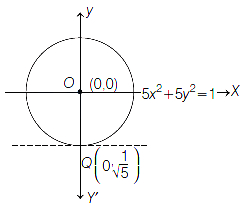
The equations of the tangent to the circle $5x^2 + 5y^2 = 1$ parallel to the line $3x + 4y = 1$ are
A
$3x + 4y = \pm 2\sqrt{5}$
B
$3x + 4y = \pm \sqrt{5}$
C
$6x + 8y = \pm \sqrt{5}$
D
$3x + 4y = \pm 3\sqrt{5}$
Solution
(B) Given,the equation of the circle is $5x^2 + 5y^2 = 1$.
Dividing by $5$,we get $x^2 + y^2 = \frac{1}{5} = \left(\frac{1}{\sqrt{5}}\right)^2$.
Thus,the center is $(0, 0)$ and the radius $r = \frac{1}{\sqrt{5}}$.
The given line is $3x + 4y = 1$,which has a slope $m = -\frac{3}{4}$.
The equation of a tangent to the circle $x^2 + y^2 = r^2$ with slope $m$ is given by $y = mx \pm r\sqrt{1 + m^2}$.
Substituting $m = -\frac{3}{4}$ and $r = \frac{1}{\sqrt{5}}$:
$y = -\frac{3}{4}x \pm \frac{1}{\sqrt{5}} \sqrt{1 + \left(-\frac{3}{4}\right)^2}$
$y = -\frac{3}{4}x \pm \frac{1}{\sqrt{5}} \sqrt{1 + \frac{9}{16}}$
$y = -\frac{3}{4}x \pm \frac{1}{\sqrt{5}} \sqrt{\frac{25}{16}}$
$y = -\frac{3}{4}x \pm \frac{1}{\sqrt{5}} \cdot \frac{5}{4}$
$y = -\frac{3}{4}x \pm \frac{\sqrt{5}}{4}$
Multiplying by $4$:
$4y = -3x \pm \sqrt{5}$
$3x + 4y = \pm \sqrt{5}$.
Dividing by $5$,we get $x^2 + y^2 = \frac{1}{5} = \left(\frac{1}{\sqrt{5}}\right)^2$.
Thus,the center is $(0, 0)$ and the radius $r = \frac{1}{\sqrt{5}}$.
The given line is $3x + 4y = 1$,which has a slope $m = -\frac{3}{4}$.
The equation of a tangent to the circle $x^2 + y^2 = r^2$ with slope $m$ is given by $y = mx \pm r\sqrt{1 + m^2}$.
Substituting $m = -\frac{3}{4}$ and $r = \frac{1}{\sqrt{5}}$:
$y = -\frac{3}{4}x \pm \frac{1}{\sqrt{5}} \sqrt{1 + \left(-\frac{3}{4}\right)^2}$
$y = -\frac{3}{4}x \pm \frac{1}{\sqrt{5}} \sqrt{1 + \frac{9}{16}}$
$y = -\frac{3}{4}x \pm \frac{1}{\sqrt{5}} \sqrt{\frac{25}{16}}$
$y = -\frac{3}{4}x \pm \frac{1}{\sqrt{5}} \cdot \frac{5}{4}$
$y = -\frac{3}{4}x \pm \frac{\sqrt{5}}{4}$
Multiplying by $4$:
$4y = -3x \pm \sqrt{5}$
$3x + 4y = \pm \sqrt{5}$.
0 likes
View Solution222
MediumMCQ
The equation of the normal at $(1, 1)$ to the circle $x^2 + y^2 - x - 3y - 4 = 0$ is
A
$x + y - 2 = 0$
B
$2x - y - 1 = 0$
C
$x - y + 2 = 0$
D
$x - y - 2 = 0$
Solution
(A) The equation of the circle is $x^2 + y^2 - x - 3y - 4 = 0$.
To find the slope of the tangent at $(1, 1)$,we differentiate the equation with respect to $x$:
$2x + 2yy' - 1 - 3y' = 0$
$y'(2y - 3) = 1 - 2x$
$y' = \frac{1 - 2x}{2y - 3}$
At the point $(1, 1)$,the slope of the tangent $m_T$ is:
$m_T = \frac{1 - 2(1)}{2(1) - 3} = \frac{-1}{-1} = 1$.
The slope of the normal $m_N$ is given by $m_N = -\frac{1}{m_T} = -\frac{1}{1} = -1$.
The equation of the normal at $(1, 1)$ is:
$y - 1 = -1(x - 1)$
$y - 1 = -x + 1$
$x + y - 2 = 0$.
To find the slope of the tangent at $(1, 1)$,we differentiate the equation with respect to $x$:
$2x + 2yy' - 1 - 3y' = 0$
$y'(2y - 3) = 1 - 2x$
$y' = \frac{1 - 2x}{2y - 3}$
At the point $(1, 1)$,the slope of the tangent $m_T$ is:
$m_T = \frac{1 - 2(1)}{2(1) - 3} = \frac{-1}{-1} = 1$.
The slope of the normal $m_N$ is given by $m_N = -\frac{1}{m_T} = -\frac{1}{1} = -1$.
The equation of the normal at $(1, 1)$ is:
$y - 1 = -1(x - 1)$
$y - 1 = -x + 1$
$x + y - 2 = 0$.
0 likes
View Solution223
EasyMCQ
If $3x + y + k = 0$ is a tangent to the circle $x^2 + y^2 = 10$,then $k = . . . . . . $.
A
$\pm 7$
B
$\pm 5$
C
$\pm 9$
D
$\pm 10$
Solution
(D) The equation of the circle is $x^2 + y^2 = 10$,so its center is $(0, 0)$ and radius $r = \sqrt{10}$.
Since the line $3x + y + k = 0$ is a tangent to the circle,the perpendicular distance from the center $(0, 0)$ to the line must be equal to the radius $r$.
The perpendicular distance from $(0, 0)$ to $3x + y + k = 0$ is given by $\left| \frac{3(0) + 1(0) + k}{\sqrt{3^2 + 1^2}} \right| = \left| \frac{k}{\sqrt{10}} \right|$.
Equating this to the radius: $\left| \frac{k}{\sqrt{10}} \right| = \sqrt{10}$.
$\Rightarrow |k| = \sqrt{10} \times \sqrt{10} = 10$.
Therefore,$k = \pm 10$.
Since the line $3x + y + k = 0$ is a tangent to the circle,the perpendicular distance from the center $(0, 0)$ to the line must be equal to the radius $r$.
The perpendicular distance from $(0, 0)$ to $3x + y + k = 0$ is given by $\left| \frac{3(0) + 1(0) + k}{\sqrt{3^2 + 1^2}} \right| = \left| \frac{k}{\sqrt{10}} \right|$.
Equating this to the radius: $\left| \frac{k}{\sqrt{10}} \right| = \sqrt{10}$.
$\Rightarrow |k| = \sqrt{10} \times \sqrt{10} = 10$.
Therefore,$k = \pm 10$.
0 likes
View Solution224
EasyMCQ
The equations of tangents to the circle $x^2+y^2=10$ from the point $(4,-2)$ are
A
$x+y=2, 3x+2y=16$
B
$5x+y=18, 3x-y=4$
C
$3x+y=10, x-3y=10$
D
$5x-y=4, x+y=0$
Solution
(C) Let the equation of the line passing through $(4, -2)$ be $y - (-2) = m(x - 4)$,which simplifies to $mx - y - (4m + 2) = 0$.
For this line to be a tangent to the circle $x^2 + y^2 = 10$,the perpendicular distance from the center $(0, 0)$ to the line must be equal to the radius $r = \sqrt{10}$.
Using the distance formula $d = \frac{|ax_0 + by_0 + c|}{\sqrt{a^2 + b^2}}$,we have $\sqrt{10} = \frac{|m(0) - 1(0) - (4m + 2)|}{\sqrt{m^2 + (-1)^2}}$.
$\sqrt{10} = \frac{|4m + 2|}{\sqrt{m^2 + 1}}$.
Squaring both sides: $10(m^2 + 1) = (4m + 2)^2$.
$10m^2 + 10 = 16m^2 + 16m + 4$.
$6m^2 + 16m - 6 = 0$,which simplifies to $3m^2 + 8m - 3 = 0$.
$(3m - 1)(m + 3) = 0$,so $m = \frac{1}{3}$ or $m = -3$.
For $m = \frac{1}{3}$,the line is $y + 2 = \frac{1}{3}(x - 4) \implies 3y + 6 = x - 4 \implies x - 3y = 10$.
For $m = -3$,the line is $y + 2 = -3(x - 4) \implies y + 2 = -3x + 12 \implies 3x + y = 10$.
Thus,the equations are $3x + y = 10$ and $x - 3y = 10$.
For this line to be a tangent to the circle $x^2 + y^2 = 10$,the perpendicular distance from the center $(0, 0)$ to the line must be equal to the radius $r = \sqrt{10}$.
Using the distance formula $d = \frac{|ax_0 + by_0 + c|}{\sqrt{a^2 + b^2}}$,we have $\sqrt{10} = \frac{|m(0) - 1(0) - (4m + 2)|}{\sqrt{m^2 + (-1)^2}}$.
$\sqrt{10} = \frac{|4m + 2|}{\sqrt{m^2 + 1}}$.
Squaring both sides: $10(m^2 + 1) = (4m + 2)^2$.
$10m^2 + 10 = 16m^2 + 16m + 4$.
$6m^2 + 16m - 6 = 0$,which simplifies to $3m^2 + 8m - 3 = 0$.
$(3m - 1)(m + 3) = 0$,so $m = \frac{1}{3}$ or $m = -3$.
For $m = \frac{1}{3}$,the line is $y + 2 = \frac{1}{3}(x - 4) \implies 3y + 6 = x - 4 \implies x - 3y = 10$.
For $m = -3$,the line is $y + 2 = -3(x - 4) \implies y + 2 = -3x + 12 \implies 3x + y = 10$.
Thus,the equations are $3x + y = 10$ and $x - 3y = 10$.
0 likes
View Solution225
EasyMCQ
The equation of the normal to the circle $x^2+y^2=16$ at the point $\left(\frac{1}{\sqrt{3}}, \frac{1}{\sqrt{3}}\right)$ is
A
$x+y=0$
B
$x-y=\frac{\sqrt{3}}{4}$
C
$x-y=0$
D
$x+y=\frac{\sqrt{3}}{4}$
Solution
(C) The equation of the circle is $x^2+y^2=16$,which has its center at $C(0,0)$.
Any normal to a circle always passes through its center.
Therefore,the normal at the point $P\left(\frac{1}{\sqrt{3}}, \frac{1}{\sqrt{3}}\right)$ is the line passing through $C(0,0)$ and $P\left(\frac{1}{\sqrt{3}}, \frac{1}{\sqrt{3}}\right)$.
The slope $m$ of the line $CP$ is given by $m = \frac{\frac{1}{\sqrt{3}} - 0}{\frac{1}{\sqrt{3}} - 0} = 1$.
The equation of the line passing through $(0,0)$ with slope $m=1$ is $y - 0 = 1(x - 0)$,which simplifies to $x - y = 0$.
Thus,option $C$ is correct.
Any normal to a circle always passes through its center.
Therefore,the normal at the point $P\left(\frac{1}{\sqrt{3}}, \frac{1}{\sqrt{3}}\right)$ is the line passing through $C(0,0)$ and $P\left(\frac{1}{\sqrt{3}}, \frac{1}{\sqrt{3}}\right)$.
The slope $m$ of the line $CP$ is given by $m = \frac{\frac{1}{\sqrt{3}} - 0}{\frac{1}{\sqrt{3}} - 0} = 1$.
The equation of the line passing through $(0,0)$ with slope $m=1$ is $y - 0 = 1(x - 0)$,which simplifies to $x - y = 0$.
Thus,option $C$ is correct.
0 likes
View Solution226
MediumMCQ
If $y=\sqrt{3}x+k_1$ and $y=\sqrt{3}x+k_2$ are two parallel tangents of a circle of radius $2 \text{ units}$,then $|k_1-k_2|$ is equal to
A
$1$
B
$8$
C
$4$
D
$2$
Solution
(B) The distance between two parallel lines $y=mx+k_1$ and $y=mx+k_2$ is given by $d = \frac{|k_1-k_2|}{\sqrt{1+m^2}}$.
Since these lines are parallel tangents to a circle of radius $r=2$,the distance between them must be equal to the diameter of the circle,which is $2r = 2 \times 2 = 4$.
Here,$m = \sqrt{3}$,so $m^2 = 3$.
Substituting these values into the distance formula:
$\frac{|k_1-k_2|}{\sqrt{1+3}} = 4$
$\frac{|k_1-k_2|}{\sqrt{4}} = 4$
$\frac{|k_1-k_2|}{2} = 4$
$|k_1-k_2| = 8$.
Thus,option $B$ is correct.
Since these lines are parallel tangents to a circle of radius $r=2$,the distance between them must be equal to the diameter of the circle,which is $2r = 2 \times 2 = 4$.
Here,$m = \sqrt{3}$,so $m^2 = 3$.
Substituting these values into the distance formula:
$\frac{|k_1-k_2|}{\sqrt{1+3}} = 4$
$\frac{|k_1-k_2|}{\sqrt{4}} = 4$
$\frac{|k_1-k_2|}{2} = 4$
$|k_1-k_2| = 8$.
Thus,option $B$ is correct.
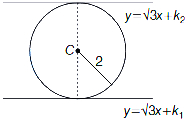
0 likes
View Solution227
MediumMCQ
The length of the tangent drawn from the mid-point of the line joining the origin and the point $(4, -4)$ to the circle $2x^2 + 2y^2 - y = 0$ is
A
$3 \sqrt{2}$
B
$\sqrt{2}$
C
$\sqrt{10}$
D
$3$
Solution
(D) The mid-point $P$ of the line joining the origin $(0, 0)$ and the point $(4, -4)$ is given by $P = (\frac{0+4}{2}, \frac{0-4}{2}) = (2, -2)$.
The equation of the circle is $2x^2 + 2y^2 - y = 0$. Dividing by $2$,we get $x^2 + y^2 - \frac{1}{2}y = 0$.
The length of the tangent from a point $(x_1, y_1)$ to a circle $x^2 + y^2 + 2gx + 2fy + c = 0$ is given by $\sqrt{x_1^2 + y_1^2 + 2gx_1 + 2fy_1 + c}$.
Substituting $x_1 = 2, y_1 = -2, g = 0, f = -\frac{1}{4}, c = 0$:
Length $= \sqrt{(2)^2 + (-2)^2 - \frac{1}{2}(-2)} = \sqrt{4 + 4 + 1} = \sqrt{9} = 3 \text{ units.}$
The equation of the circle is $2x^2 + 2y^2 - y = 0$. Dividing by $2$,we get $x^2 + y^2 - \frac{1}{2}y = 0$.
The length of the tangent from a point $(x_1, y_1)$ to a circle $x^2 + y^2 + 2gx + 2fy + c = 0$ is given by $\sqrt{x_1^2 + y_1^2 + 2gx_1 + 2fy_1 + c}$.
Substituting $x_1 = 2, y_1 = -2, g = 0, f = -\frac{1}{4}, c = 0$:
Length $= \sqrt{(2)^2 + (-2)^2 - \frac{1}{2}(-2)} = \sqrt{4 + 4 + 1} = \sqrt{9} = 3 \text{ units.}$
0 likes
View Solution228
MediumMCQ
The length of the tangent from $(6,8)$ to the circle $x^2+y^2=4$ is
A
$\sqrt{6}$
B
$2 \sqrt{6}$
C
$4 \sqrt{6}$
D
$5 \sqrt{6}$
Solution
(C) Let the point be $P = (6, 8)$ and the equation of the circle be $S: x^2 + y^2 - 4 = 0$.
The length of the tangent from a point $(x_1, y_1)$ to a circle $S = 0$ is given by $\sqrt{S_1} = \sqrt{x_1^2 + y_1^2 - 4}$.
Substituting the coordinates $(6, 8)$ into the expression:
$\text{Length} = \sqrt{6^2 + 8^2 - 4} = \sqrt{36 + 64 - 4} = \sqrt{100 - 4} = \sqrt{96}$.
Simplifying $\sqrt{96} = \sqrt{16 \times 6} = 4 \sqrt{6}$.
Hence,option $C$ is correct.
The length of the tangent from a point $(x_1, y_1)$ to a circle $S = 0$ is given by $\sqrt{S_1} = \sqrt{x_1^2 + y_1^2 - 4}$.
Substituting the coordinates $(6, 8)$ into the expression:
$\text{Length} = \sqrt{6^2 + 8^2 - 4} = \sqrt{36 + 64 - 4} = \sqrt{100 - 4} = \sqrt{96}$.
Simplifying $\sqrt{96} = \sqrt{16 \times 6} = 4 \sqrt{6}$.
Hence,option $C$ is correct.
0 likes
View Solution229
EasyMCQ
The equation of the tangent to the circle $x^2+y^2=25$ at $(-3, 4)$ is
A
$3x-4y+25=0$
B
$4x-3y+25=0$
C
$3x+4y=0$
D
$x+y-1=0$
Solution
(A) The equation of the tangent to the circle $x^2+y^2=r^2$ at the point $(x_1, y_1)$ is given by $xx_1+yy_1=r^2$.
Given the circle $x^2+y^2=25$,we have $r^2=25$.
The point of tangency is $(x_1, y_1) = (-3, 4)$.
Substituting these values into the formula:
$x(-3) + y(4) = 25$
$-3x + 4y = 25$
Rearranging the terms,we get:
$3x - 4y + 25 = 0$.
Given the circle $x^2+y^2=25$,we have $r^2=25$.
The point of tangency is $(x_1, y_1) = (-3, 4)$.
Substituting these values into the formula:
$x(-3) + y(4) = 25$
$-3x + 4y = 25$
Rearranging the terms,we get:
$3x - 4y + 25 = 0$.
0 likes
View Solution230
DifficultMCQ
If $(3,-1)$ is one end of a diameter of the circle $x^2+y^2-2x+4y=0$,then the equation of the tangent at the other end of that diameter is
A
$2x+y-5=0$
B
$2x+y+5=0$
C
$x+2y+5=0$
D
$x+2y-5=0$
Solution
(B) The given equation of the circle is $x^2+y^2-2x+4y=0$.
Comparing this with the general form $x^2+y^2+2gx+2fy+c=0$,we get $g=-1$ and $f=2$.
The center of the circle is $C(-g, -f) = (1, -2)$.
Let $A(3, -1)$ be one end of the diameter and $B(x_1, y_1)$ be the other end.
Since the center $C$ is the midpoint of the diameter $AB$,we have $(1, -2) = (\frac{3+x_1}{2}, \frac{-1+y_1}{2})$.
Solving for $B$,we get $3+x_1=2 \implies x_1=-1$ and $-1+y_1=-4 \implies y_1=-3$.
So,the other end of the diameter is $B(-1, -3)$.
The tangent at $B(-1, -3)$ is perpendicular to the radius $CB$.
The slope of the radius $CB$ is $m_{CB} = \frac{-3-(-2)}{-1-1} = \frac{-1}{-2} = \frac{1}{2}$.
The slope of the tangent at $B$ is $m = -\frac{1}{m_{CB}} = -2$.
The equation of the tangent at $B(-1, -3)$ is $y - (-3) = -2(x - (-1))$.
$y+3 = -2x-2$,which simplifies to $2x+y+5=0$.
Comparing this with the general form $x^2+y^2+2gx+2fy+c=0$,we get $g=-1$ and $f=2$.
The center of the circle is $C(-g, -f) = (1, -2)$.
Let $A(3, -1)$ be one end of the diameter and $B(x_1, y_1)$ be the other end.
Since the center $C$ is the midpoint of the diameter $AB$,we have $(1, -2) = (\frac{3+x_1}{2}, \frac{-1+y_1}{2})$.
Solving for $B$,we get $3+x_1=2 \implies x_1=-1$ and $-1+y_1=-4 \implies y_1=-3$.
So,the other end of the diameter is $B(-1, -3)$.
The tangent at $B(-1, -3)$ is perpendicular to the radius $CB$.
The slope of the radius $CB$ is $m_{CB} = \frac{-3-(-2)}{-1-1} = \frac{-1}{-2} = \frac{1}{2}$.
The slope of the tangent at $B$ is $m = -\frac{1}{m_{CB}} = -2$.
The equation of the tangent at $B(-1, -3)$ is $y - (-3) = -2(x - (-1))$.
$y+3 = -2x-2$,which simplifies to $2x+y+5=0$.
0 likes
View Solution231
DifficultMCQ
$A$ circle $S=0$ with radius $\sqrt{2}$ touches the line $x+y-2=0$ at $(1,1)$. Then,the length of the tangent drawn from the point $(1,2)$ to $S=0$ is
A
$1$
B
$\sqrt{2}$
C
$\sqrt{3}$
D
$2$
Solution
(C) The equation of the line at $(1,1)$ is $x+y-2=0$. The slope of this line is $-1$.
Since the normal is perpendicular to the tangent,the slope of the normal is $1$.
Thus,$\tan \theta = 1$,which gives $\theta = \frac{\pi}{4}$.
Let the centre of the circle be $(h, k)$. The coordinates of the centre are given by $h = 1 \pm r \cos \theta$ and $k = 1 \pm r \sin \theta$.
Given $r = \sqrt{2}$ and $\theta = \frac{\pi}{4}$,we have:
$h = 1 \pm \sqrt{2} \cos \frac{\pi}{4} = 1 \pm \sqrt{2} \cdot \frac{1}{\sqrt{2}} = 1 \pm 1$.
$k = 1 \pm \sqrt{2} \sin \frac{\pi}{4} = 1 \pm \sqrt{2} \cdot \frac{1}{\sqrt{2}} = 1 \pm 1$.
So,the possible centres are $(2, 2)$ or $(0, 0)$.
The equations of the circles are $x^2 + y^2 = 2$ or $(x-2)^2 + (y-2)^2 = 2$.
For the circle $x^2 + y^2 - 2 = 0$,the length of the tangent from $(1, 2)$ is $\sqrt{1^2 + 2^2 - 2} = \sqrt{1+4-2} = \sqrt{3}$.
For the circle $(x-2)^2 + (y-2)^2 - 2 = 0$,the length of the tangent from $(1, 2)$ is $\sqrt{(1-2)^2 + (2-2)^2 - 2} = \sqrt{(-1)^2 + 0^2 - 2} = \sqrt{1-2} = \sqrt{-1}$,which is not possible.
Thus,the length of the tangent is $\sqrt{3}$.
Since the normal is perpendicular to the tangent,the slope of the normal is $1$.
Thus,$\tan \theta = 1$,which gives $\theta = \frac{\pi}{4}$.
Let the centre of the circle be $(h, k)$. The coordinates of the centre are given by $h = 1 \pm r \cos \theta$ and $k = 1 \pm r \sin \theta$.
Given $r = \sqrt{2}$ and $\theta = \frac{\pi}{4}$,we have:
$h = 1 \pm \sqrt{2} \cos \frac{\pi}{4} = 1 \pm \sqrt{2} \cdot \frac{1}{\sqrt{2}} = 1 \pm 1$.
$k = 1 \pm \sqrt{2} \sin \frac{\pi}{4} = 1 \pm \sqrt{2} \cdot \frac{1}{\sqrt{2}} = 1 \pm 1$.
So,the possible centres are $(2, 2)$ or $(0, 0)$.
The equations of the circles are $x^2 + y^2 = 2$ or $(x-2)^2 + (y-2)^2 = 2$.
For the circle $x^2 + y^2 - 2 = 0$,the length of the tangent from $(1, 2)$ is $\sqrt{1^2 + 2^2 - 2} = \sqrt{1+4-2} = \sqrt{3}$.
For the circle $(x-2)^2 + (y-2)^2 - 2 = 0$,the length of the tangent from $(1, 2)$ is $\sqrt{(1-2)^2 + (2-2)^2 - 2} = \sqrt{(-1)^2 + 0^2 - 2} = \sqrt{1-2} = \sqrt{-1}$,which is not possible.
Thus,the length of the tangent is $\sqrt{3}$.
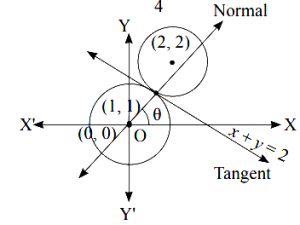
0 likes
View Solution232
MediumMCQ
The normal drawn at $P(-1, 2)$ on the circle $x^2+y^2-2x-2y-3=0$ meets the circle at another point $Q$. Then,the coordinates of $Q$ are
A
$(3, 0)$
B
$(-3, 0)$
C
$(2, 0)$
D
$(-2, 0)$
Solution
(A) The given equation of the circle is $x^2+y^2-2x-2y-3=0$.
Comparing this with the general equation $x^2+y^2+2gx+2fy+c=0$,we get $g=-1$ and $f=-1$.
The centre of the circle is $O(-g, -f) = (1, 1)$.
Since the normal at any point on a circle always passes through the centre,the line segment $PQ$ is a diameter of the circle.
Therefore,the centre $O(1, 1)$ is the midpoint of the diameter $PQ$.
Let the coordinates of $Q$ be $(x, y)$.
Using the midpoint formula,we have:
$\frac{-1+x}{2} = 1 \implies -1+x = 2 \implies x = 3$
$\frac{2+y}{2} = 1 \implies 2+y = 2 \implies y = 0$
Thus,the coordinates of $Q$ are $(3, 0)$.
Comparing this with the general equation $x^2+y^2+2gx+2fy+c=0$,we get $g=-1$ and $f=-1$.
The centre of the circle is $O(-g, -f) = (1, 1)$.
Since the normal at any point on a circle always passes through the centre,the line segment $PQ$ is a diameter of the circle.
Therefore,the centre $O(1, 1)$ is the midpoint of the diameter $PQ$.
Let the coordinates of $Q$ be $(x, y)$.
Using the midpoint formula,we have:
$\frac{-1+x}{2} = 1 \implies -1+x = 2 \implies x = 3$
$\frac{2+y}{2} = 1 \implies 2+y = 2 \implies y = 0$
Thus,the coordinates of $Q$ are $(3, 0)$.
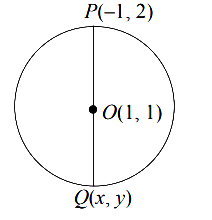
0 likes
View Solution233
MediumMCQ
The equation of the normal to the circle $x^2+y^2+6x+4y-3=0$ at $(1,-2)$ is
A
$y+1=0$
B
$y+2=0$
C
$y+3=0$
D
$y-2=0$
Solution
(B) The given circle is $x^2+y^2+6x+4y-3=0$.
Comparing this with the general equation $x^2+y^2+2gx+2fy+c=0$,we get $g=3$ and $f=2$.
The center of the circle is $(-g, -f) = (-3, -2)$.
The normal to a circle at any point always passes through the center of the circle.
The normal is a line passing through the center $(-3, -2)$ and the point $(1, -2)$.
Since the $y$-coordinates of both points are the same $(-2)$,the line is a horizontal line given by $y = -2$.
Thus,the equation of the normal is $y+2=0$.
Comparing this with the general equation $x^2+y^2+2gx+2fy+c=0$,we get $g=3$ and $f=2$.
The center of the circle is $(-g, -f) = (-3, -2)$.
The normal to a circle at any point always passes through the center of the circle.
The normal is a line passing through the center $(-3, -2)$ and the point $(1, -2)$.
Since the $y$-coordinates of both points are the same $(-2)$,the line is a horizontal line given by $y = -2$.
Thus,the equation of the normal is $y+2=0$.
0 likes
View Solution234
EasyMCQ
If $\theta$ is the angle between the tangents drawn from the point $(2,3)$ to the circle $x^2+y^2-6x+4y+12=0$,then $\theta=$
A
$\cos^{-1}\left(\frac{5}{13}\right)$
B
$\sin^{-1}\left(\frac{4}{5}\right)$
C
$2 \tan^{-1}\left(\frac{5}{12}\right)$
D
$\tan^{-1}\left(\frac{5}{12}\right)$
Solution
(D) The equation of the circle is $x^2+y^2-6x+4y+12=0$.
Completing the square,we get $(x-3)^2+(y+2)^2 = 3^2+(-2)^2-12 = 9+4-12 = 1$.
So,the center $O$ is $(3,-2)$ and the radius $r$ is $1$.
The distance $d$ from the point $A(2,3)$ to the center $O(3,-2)$ is $d = \sqrt{(3-2)^2+(-2-3)^2} = \sqrt{1^2+(-5)^2} = \sqrt{26}$.
Let $\alpha$ be the half-angle between the tangents. In the right-angled triangle formed by the point $A$,the center $O$,and the point of tangency $P$,we have $\sin(\alpha) = \frac{r}{d} = \frac{1}{\sqrt{26}}$.
Then $\cos(\alpha) = \sqrt{1-\sin^2(\alpha)} = \sqrt{1-\frac{1}{26}} = \sqrt{\frac{25}{26}} = \frac{5}{\sqrt{26}}$.
Thus,$\tan(\alpha) = \frac{\sin(\alpha)}{\cos(\alpha)} = \frac{1/\sqrt{26}}{5/\sqrt{26}} = \frac{1}{5}$.
The total angle between the tangents is $\theta = 2\alpha$.
Using the formula $\tan(2\alpha) = \frac{2\tan(\alpha)}{1-\tan^2(\alpha)}$,we get $\tan(\theta) = \frac{2(1/5)}{1-(1/5)^2} = \frac{2/5}{24/25} = \frac{2}{5} \times \frac{25}{24} = \frac{5}{12}$.
Therefore,$\theta = \tan^{-1}\left(\frac{5}{12}\right)$.
Completing the square,we get $(x-3)^2+(y+2)^2 = 3^2+(-2)^2-12 = 9+4-12 = 1$.
So,the center $O$ is $(3,-2)$ and the radius $r$ is $1$.
The distance $d$ from the point $A(2,3)$ to the center $O(3,-2)$ is $d = \sqrt{(3-2)^2+(-2-3)^2} = \sqrt{1^2+(-5)^2} = \sqrt{26}$.
Let $\alpha$ be the half-angle between the tangents. In the right-angled triangle formed by the point $A$,the center $O$,and the point of tangency $P$,we have $\sin(\alpha) = \frac{r}{d} = \frac{1}{\sqrt{26}}$.
Then $\cos(\alpha) = \sqrt{1-\sin^2(\alpha)} = \sqrt{1-\frac{1}{26}} = \sqrt{\frac{25}{26}} = \frac{5}{\sqrt{26}}$.
Thus,$\tan(\alpha) = \frac{\sin(\alpha)}{\cos(\alpha)} = \frac{1/\sqrt{26}}{5/\sqrt{26}} = \frac{1}{5}$.
The total angle between the tangents is $\theta = 2\alpha$.
Using the formula $\tan(2\alpha) = \frac{2\tan(\alpha)}{1-\tan^2(\alpha)}$,we get $\tan(\theta) = \frac{2(1/5)}{1-(1/5)^2} = \frac{2/5}{24/25} = \frac{2}{5} \times \frac{25}{24} = \frac{5}{12}$.
Therefore,$\theta = \tan^{-1}\left(\frac{5}{12}\right)$.
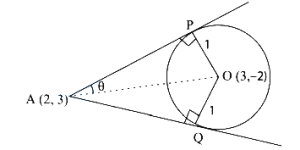
0 likes
View Solution235
EasyMCQ
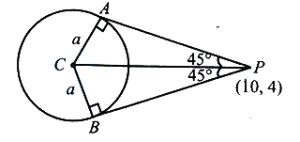
If the pair of tangents drawn to the circle $x^2+y^2=a^2$ from the point $(10,4)$ are perpendicular,then $a=$
A
$\sqrt{58}$
B
$58$
C
$2 \sqrt{63}$
D
$2 \sqrt{45}$
Solution
(A) The locus of the point of intersection of perpendicular tangents to a circle is called the director circle.
For the circle $x^2+y^2=a^2$,the equation of the director circle is $x^2+y^2=2a^2$.
Since the point $(10,4)$ lies on the director circle,we have:
$10^2+4^2 = 2a^2$
$100+16 = 2a^2$
$116 = 2a^2$
$a^2 = 58$
$a = \sqrt{58}$
For the circle $x^2+y^2=a^2$,the equation of the director circle is $x^2+y^2=2a^2$.
Since the point $(10,4)$ lies on the director circle,we have:
$10^2+4^2 = 2a^2$
$100+16 = 2a^2$
$116 = 2a^2$
$a^2 = 58$
$a = \sqrt{58}$
0 likes
View Solution236
MediumMCQ
The equation of the pair of tangents drawn from the point $(1, 1)$ to the circle $x^2 + y^2 + 2x + 2y + 1 = 0$ is:
A
$3x^2 - 8xy + 3y^2 - 2x - 2y + 6 = 0$
B
$11x^2 - 8xy + 11y^2 - 4x - 4y - 6 = 0$
C
$3x^2 - 8xy + 3y^2 + 2x + 2y - 2 = 0$
D
$x^2 - 4xy + y^2 + x + y = 0$
Solution
(C) The equation of the pair of tangents from a point $(x_1, y_1)$ to a circle $S = 0$ is given by $SS_1 = T^2$.
Given $S = x^2 + y^2 + 2x + 2y + 1 = 0$ and point $(1, 1)$.
$S_1 = 1^2 + 1^2 + 2(1) + 2(1) + 1 = 1 + 1 + 2 + 2 + 1 = 7$.
$T = x(1) + y(1) + (x + 1) + (y + 1) + 1 = 2x + 2y + 3$.
Substituting these into $SS_1 = T^2$:
$7(x^2 + y^2 + 2x + 2y + 1) = (2x + 2y + 3)^2$.
$7x^2 + 7y^2 + 14x + 14y + 7 = 4x^2 + 4y^2 + 9 + 8xy + 12x + 12y$.
Rearranging the terms:
$3x^2 - 8xy + 3y^2 + 2x + 2y - 2 = 0$.
Given $S = x^2 + y^2 + 2x + 2y + 1 = 0$ and point $(1, 1)$.
$S_1 = 1^2 + 1^2 + 2(1) + 2(1) + 1 = 1 + 1 + 2 + 2 + 1 = 7$.
$T = x(1) + y(1) + (x + 1) + (y + 1) + 1 = 2x + 2y + 3$.
Substituting these into $SS_1 = T^2$:
$7(x^2 + y^2 + 2x + 2y + 1) = (2x + 2y + 3)^2$.
$7x^2 + 7y^2 + 14x + 14y + 7 = 4x^2 + 4y^2 + 9 + 8xy + 12x + 12y$.
Rearranging the terms:
$3x^2 - 8xy + 3y^2 + 2x + 2y - 2 = 0$.
0 likes
View Solution237
MediumMCQ
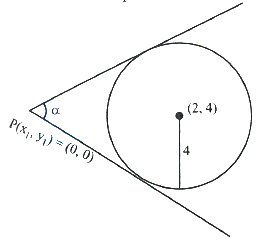
If the acute angle between the pair of tangents drawn from the origin to the circle $x^2+y^2-4x-8y+4=0$ is $\alpha$,then $\tan \alpha=$
A
$3/5$
B
$3/4$
C
$4/3$
D
$4/5$
Solution
(C) The equation of the circle is $S \equiv x^2+y^2-4x-8y+4=0$. The center is $(2, 4)$ and the radius $r = \sqrt{2^2+4^2-4} = \sqrt{16} = 4$.
Let $d$ be the distance from the origin $(0,0)$ to the center $(2,4)$,so $d = \sqrt{2^2+4^2} = \sqrt{20} = 2\sqrt{5}$.
Let the angle between the tangents be $\alpha$. Then the angle between the line joining the origin to the center and one of the tangents is $\alpha/2$.
In the right-angled triangle formed by the origin,the center,and the point of tangency,we have $\sin(\alpha/2) = r/d = 4/(2\sqrt{5}) = 2/\sqrt{5}$.
Thus,$\cos(\alpha/2) = \sqrt{1 - \sin^2(\alpha/2)} = \sqrt{1 - 4/5} = 1/\sqrt{5}$.
Therefore,$\tan(\alpha/2) = \sin(\alpha/2) / \cos(\alpha/2) = (2/\sqrt{5}) / (1/\sqrt{5}) = 2$.
Using the formula $\tan \alpha = \frac{2 \tan(\alpha/2)}{1 - \tan^2(\alpha/2)}$,we get $\tan \alpha = \frac{2(2)}{1 - 2^2} = \frac{4}{1-4} = -4/3$.
Since $\alpha$ is an acute angle,we take the magnitude,so $\tan \alpha = 4/3$.
Let $d$ be the distance from the origin $(0,0)$ to the center $(2,4)$,so $d = \sqrt{2^2+4^2} = \sqrt{20} = 2\sqrt{5}$.
Let the angle between the tangents be $\alpha$. Then the angle between the line joining the origin to the center and one of the tangents is $\alpha/2$.
In the right-angled triangle formed by the origin,the center,and the point of tangency,we have $\sin(\alpha/2) = r/d = 4/(2\sqrt{5}) = 2/\sqrt{5}$.
Thus,$\cos(\alpha/2) = \sqrt{1 - \sin^2(\alpha/2)} = \sqrt{1 - 4/5} = 1/\sqrt{5}$.
Therefore,$\tan(\alpha/2) = \sin(\alpha/2) / \cos(\alpha/2) = (2/\sqrt{5}) / (1/\sqrt{5}) = 2$.
Using the formula $\tan \alpha = \frac{2 \tan(\alpha/2)}{1 - \tan^2(\alpha/2)}$,we get $\tan \alpha = \frac{2(2)}{1 - 2^2} = \frac{4}{1-4} = -4/3$.
Since $\alpha$ is an acute angle,we take the magnitude,so $\tan \alpha = 4/3$.
0 likes
View Solution238
MediumMCQ
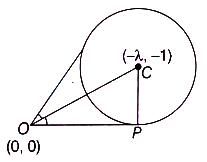
Suppose the angle between the tangents drawn from $(0,0)$ to the circle $(x+\lambda)^2+(y+1)^2=\lambda^2$ is $\frac{\pi}{2}$. Then,$\lambda$ satisfies
A
$\lambda^2=1$
B
$\lambda=0$
C
$\lambda^2=4$
D
$\lambda^2=9$
Solution
(A) The equation of the circle is $(x+\lambda)^2+(y+1)^2=\lambda^2$.
Here,the center $C$ is $(-\lambda, -1)$ and the radius $r$ is $|\lambda|$.
Let $O$ be the origin $(0,0)$ and $P$ be the point of contact of a tangent from $O$ to the circle.
The angle between the tangents is $\frac{\pi}{2}$,so the angle $\angle COP = \frac{1}{2} \times \frac{\pi}{2} = \frac{\pi}{4} = 45^{\circ}$.
In the right-angled triangle $\triangle OCP$,we have $\tan(\angle COP) = \frac{CP}{OP} = \frac{r}{OP}$.
Since $\angle COP = 45^{\circ}$,$\tan(45^{\circ}) = 1$,so $OP = CP = |\lambda|$.
Also,the distance $OC = \sqrt{(-\lambda-0)^2 + (-1-0)^2} = \sqrt{\lambda^2+1}$.
By the Pythagorean theorem in $\triangle OCP$,$OC^2 = OP^2 + CP^2$.
Substituting the values,$(\sqrt{\lambda^2+1})^2 = |\lambda|^2 + |\lambda|^2$.
$\lambda^2 + 1 = 2\lambda^2$.
Therefore,$\lambda^2 = 1$.
Here,the center $C$ is $(-\lambda, -1)$ and the radius $r$ is $|\lambda|$.
Let $O$ be the origin $(0,0)$ and $P$ be the point of contact of a tangent from $O$ to the circle.
The angle between the tangents is $\frac{\pi}{2}$,so the angle $\angle COP = \frac{1}{2} \times \frac{\pi}{2} = \frac{\pi}{4} = 45^{\circ}$.
In the right-angled triangle $\triangle OCP$,we have $\tan(\angle COP) = \frac{CP}{OP} = \frac{r}{OP}$.
Since $\angle COP = 45^{\circ}$,$\tan(45^{\circ}) = 1$,so $OP = CP = |\lambda|$.
Also,the distance $OC = \sqrt{(-\lambda-0)^2 + (-1-0)^2} = \sqrt{\lambda^2+1}$.
By the Pythagorean theorem in $\triangle OCP$,$OC^2 = OP^2 + CP^2$.
Substituting the values,$(\sqrt{\lambda^2+1})^2 = |\lambda|^2 + |\lambda|^2$.
$\lambda^2 + 1 = 2\lambda^2$.
Therefore,$\lambda^2 = 1$.
0 likes
View Solution239
EasyMCQ
Find the equations of the tangents drawn to the circle $x^2+y^2=50$ at the points where the line $x+7=0$ meets it.
A
$7x+y+50=0 \text{ and } 7x-y+50=0$
B
$x+y=0 \text{ and } x-y=0$
C
$x+7y+5=0 \text{ and } y-7x+5=0$
D
$x+7y+50=0 \text{ and } x-7y+50=0$
Solution
(A) Given the circle equation $x^2+y^2=50$ and the line $x+7=0$.
Substituting $x = -7$ into the circle equation:
$(-7)^2 + y^2 = 50$
$49 + y^2 = 50$
$y^2 = 1 \Rightarrow y = \pm 1$.
Thus,the points of intersection are $P_1(-7, 1)$ and $P_2(-7, -1)$.
The equation of the tangent to the circle $x^2+y^2=r^2$ at $(x_1, y_1)$ is given by $xx_1 + yy_1 = r^2$.
For point $(-7, 1)$: $-7x + y = 50 \Rightarrow 7x - y + 50 = 0$.
For point $(-7, -1)$: $-7x - y = 50 \Rightarrow 7x + y + 50 = 0$.
Therefore,the required equations are $7x+y+50=0$ and $7x-y+50=0$.
Substituting $x = -7$ into the circle equation:
$(-7)^2 + y^2 = 50$
$49 + y^2 = 50$
$y^2 = 1 \Rightarrow y = \pm 1$.
Thus,the points of intersection are $P_1(-7, 1)$ and $P_2(-7, -1)$.
The equation of the tangent to the circle $x^2+y^2=r^2$ at $(x_1, y_1)$ is given by $xx_1 + yy_1 = r^2$.
For point $(-7, 1)$: $-7x + y = 50 \Rightarrow 7x - y + 50 = 0$.
For point $(-7, -1)$: $-7x - y = 50 \Rightarrow 7x + y + 50 = 0$.
Therefore,the required equations are $7x+y+50=0$ and $7x-y+50=0$.
0 likes
View Solution240
EasyMCQ
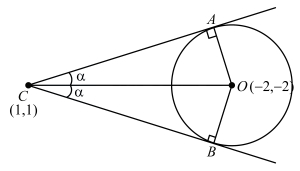
The angle between the pair of tangents drawn from $(1,1)$ to the circle $x^2+y^2+4x+4y-1=0$ is
A
$\frac{\pi}{2}$
B
$\frac{\pi}{4}$
C
$\frac{\pi}{3}$
D
$\frac{\pi}{6}$
Solution
(A) The given equation of the circle is $x^2+y^2+4x+4y-1=0$.
Comparing with $x^2+y^2+2gx+2fy+c=0$,we get $g=2, f=2, c=-1$.
The center of the circle is $O(-g, -f) = (-2, -2)$ and the radius $r = \sqrt{g^2+f^2-c} = \sqrt{4+4-(-1)} = \sqrt{9} = 3$.
Let the external point be $C(1, 1)$. The distance $OC$ is $\sqrt{(1 - (-2))^2 + (1 - (-2))^2} = \sqrt{3^2 + 3^2} = \sqrt{18} = 3\sqrt{2}$.
Let $\alpha$ be the angle between the line joining the center to the external point and the tangent. In the right-angled triangle $\triangle OAC$ (where $A$ is the point of tangency),$\sin \alpha = \frac{OA}{OC} = \frac{r}{OC} = \frac{3}{3\sqrt{2}} = \frac{1}{\sqrt{2}}$.
Thus,$\alpha = 45^\circ$ or $\frac{\pi}{4}$.
The angle between the pair of tangents is $2\alpha = 2 \times \frac{\pi}{4} = \frac{\pi}{2}$.
Comparing with $x^2+y^2+2gx+2fy+c=0$,we get $g=2, f=2, c=-1$.
The center of the circle is $O(-g, -f) = (-2, -2)$ and the radius $r = \sqrt{g^2+f^2-c} = \sqrt{4+4-(-1)} = \sqrt{9} = 3$.
Let the external point be $C(1, 1)$. The distance $OC$ is $\sqrt{(1 - (-2))^2 + (1 - (-2))^2} = \sqrt{3^2 + 3^2} = \sqrt{18} = 3\sqrt{2}$.
Let $\alpha$ be the angle between the line joining the center to the external point and the tangent. In the right-angled triangle $\triangle OAC$ (where $A$ is the point of tangency),$\sin \alpha = \frac{OA}{OC} = \frac{r}{OC} = \frac{3}{3\sqrt{2}} = \frac{1}{\sqrt{2}}$.
Thus,$\alpha = 45^\circ$ or $\frac{\pi}{4}$.
The angle between the pair of tangents is $2\alpha = 2 \times \frac{\pi}{4} = \frac{\pi}{2}$.
0 likes
View Solution241
EasyMCQ
The angle between the two tangents drawn from the origin to the circle $x^2+y^2-14x+2y+25=0$ is (in $^{\circ}$)
A
$0$
B
$45$
C
$90$
D
$60$
Solution
(C) The given equation of the circle is $x^2+y^2-14x+2y+25=0$.
Completing the square,we get $(x^2-14x+49) + (y^2+2y+1) - 49 - 1 + 25 = 0$,which simplifies to $(x-7)^2 + (y+1)^2 = 25 = 5^2$.
Thus,the radius $r = 5$ and the center $P = (7, -1)$.
The distance from the origin $O(0,0)$ to the center $P(7,-1)$ is $OP = \sqrt{7^2 + (-1)^2} = \sqrt{49+1} = \sqrt{50} = 5\sqrt{2}$.
Let the tangents from the origin touch the circle at $A$ and $B$. In the right-angled triangle $\triangle OAP$,$\sin \theta = \frac{AP}{OP} = \frac{5}{5\sqrt{2}} = \frac{1}{\sqrt{2}}$.
Therefore,$\theta = 45^{\circ}$.
Similarly,for $\triangle OBP$,$\sin \alpha = \frac{BP}{OP} = \frac{5}{5\sqrt{2}} = \frac{1}{\sqrt{2}}$,so $\alpha = 45^{\circ}$.
The total angle between the tangents is $\theta + \alpha = 45^{\circ} + 45^{\circ} = 90^{\circ}$.
Completing the square,we get $(x^2-14x+49) + (y^2+2y+1) - 49 - 1 + 25 = 0$,which simplifies to $(x-7)^2 + (y+1)^2 = 25 = 5^2$.
Thus,the radius $r = 5$ and the center $P = (7, -1)$.
The distance from the origin $O(0,0)$ to the center $P(7,-1)$ is $OP = \sqrt{7^2 + (-1)^2} = \sqrt{49+1} = \sqrt{50} = 5\sqrt{2}$.
Let the tangents from the origin touch the circle at $A$ and $B$. In the right-angled triangle $\triangle OAP$,$\sin \theta = \frac{AP}{OP} = \frac{5}{5\sqrt{2}} = \frac{1}{\sqrt{2}}$.
Therefore,$\theta = 45^{\circ}$.
Similarly,for $\triangle OBP$,$\sin \alpha = \frac{BP}{OP} = \frac{5}{5\sqrt{2}} = \frac{1}{\sqrt{2}}$,so $\alpha = 45^{\circ}$.
The total angle between the tangents is $\theta + \alpha = 45^{\circ} + 45^{\circ} = 90^{\circ}$.
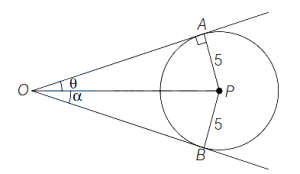
0 likes
View Solution242
MediumMCQ
The angle between the pair of tangents drawn from $(1,3)$ to the circle $x^2+y^2-2x+4y-11=0$ is
A
$\sin^{-1}\left(\frac{24}{25}\right)$
B
$\sin^{-1}\left(\frac{7}{25}\right)$
C
$\cos^{-1}\left(\frac{24}{25}\right)$
D
$\tan^{-1}\left(\frac{7}{24}\right)$
Solution
(A) The equation of the circle is $x^2+y^2-2x+4y-11=0$.
Comparing with $x^2+y^2+2gx+2fy+c=0$,we get $g=-1, f=2, c=-11$.
The radius $r = \sqrt{g^2+f^2-c} = \sqrt{(-1)^2+2^2-(-11)} = \sqrt{1+4+11} = \sqrt{16} = 4$.
The length of the tangent $L_T$ from point $(1,3)$ is $\sqrt{S_1} = \sqrt{1^2+3^2-2(1)+4(3)-11} = \sqrt{1+9-2+12-11} = \sqrt{9} = 3$.
Let the angle between the pair of tangents be $2\theta$.
In the right-angled triangle formed by the center,the point $(1,3)$,and the point of contact,$\tan\theta = \frac{r}{L_T} = \frac{4}{3}$.
We know that $\sin(2\theta) = \frac{2\tan\theta}{1+\tan^2\theta} = \frac{2(4/3)}{1+(4/3)^2} = \frac{8/3}{1+16/9} = \frac{8/3}{25/9} = \frac{8}{3} \times \frac{9}{25} = \frac{24}{25}$.
Therefore,the angle $2\theta = \sin^{-1}\left(\frac{24}{25}\right)$.
Comparing with $x^2+y^2+2gx+2fy+c=0$,we get $g=-1, f=2, c=-11$.
The radius $r = \sqrt{g^2+f^2-c} = \sqrt{(-1)^2+2^2-(-11)} = \sqrt{1+4+11} = \sqrt{16} = 4$.
The length of the tangent $L_T$ from point $(1,3)$ is $\sqrt{S_1} = \sqrt{1^2+3^2-2(1)+4(3)-11} = \sqrt{1+9-2+12-11} = \sqrt{9} = 3$.
Let the angle between the pair of tangents be $2\theta$.
In the right-angled triangle formed by the center,the point $(1,3)$,and the point of contact,$\tan\theta = \frac{r}{L_T} = \frac{4}{3}$.
We know that $\sin(2\theta) = \frac{2\tan\theta}{1+\tan^2\theta} = \frac{2(4/3)}{1+(4/3)^2} = \frac{8/3}{1+16/9} = \frac{8/3}{25/9} = \frac{8}{3} \times \frac{9}{25} = \frac{24}{25}$.
Therefore,the angle $2\theta = \sin^{-1}\left(\frac{24}{25}\right)$.
0 likes
View Solution243
MediumMCQ
$A$ is the centre of the circle $x^2+y^2-2x-4y-20=0$. If the tangents drawn at the points $B(1,7)$ and $D(4,-2)$ on the circle meet at the point $C$,then the area of the quadrilateral $ABCD$ (in square units) is
A
$75$
B
$64$
C
$56$
D
$45$
Solution
(A) The equation of the given circle is $x^2+y^2-2x-4y-20=0$ ... $(i)$.
The centre $A$ is $(1, 2)$ and the radius $r = \sqrt{1^2+2^2+20} = \sqrt{25} = 5$.
The equation of the tangent at $B(1, 7)$ is $x(1) + y(7) - (x+1) - 2(y+7) - 20 = 0$,which simplifies to $5y = 35$,or $y = 7$ ... $(ii)$.
The equation of the tangent at $D(4, -2)$ is $x(4) + y(-2) - (x+4) - 2(y-2) - 20 = 0$,which simplifies to $3x - 4y = 20$ ... $(iii)$.
Solving $(ii)$ and $(iii)$ for the intersection point $C$: Substituting $y=7$ into $(iii)$,$3x - 4(7) = 20$ $\Rightarrow 3x = 48$ $\Rightarrow x = 16$. So,$C = (16, 7)$.
The area of the quadrilateral $ABCD$ is $2 \times \text{Area}(\triangle ABC) = 2 \times (\frac{1}{2} \times r \times L)$,where $L$ is the length of the tangent from $C$ to the circle.
$L = \sqrt{S_1} = \sqrt{16^2 + 7^2 - 2(16) - 4(7) - 20} = \sqrt{256 + 49 - 32 - 28 - 20} = \sqrt{225} = 15$.
Area $= r \times L = 5 \times 15 = 75$ square units.
Thus,option $(A)$ is correct.
The centre $A$ is $(1, 2)$ and the radius $r = \sqrt{1^2+2^2+20} = \sqrt{25} = 5$.
The equation of the tangent at $B(1, 7)$ is $x(1) + y(7) - (x+1) - 2(y+7) - 20 = 0$,which simplifies to $5y = 35$,or $y = 7$ ... $(ii)$.
The equation of the tangent at $D(4, -2)$ is $x(4) + y(-2) - (x+4) - 2(y-2) - 20 = 0$,which simplifies to $3x - 4y = 20$ ... $(iii)$.
Solving $(ii)$ and $(iii)$ for the intersection point $C$: Substituting $y=7$ into $(iii)$,$3x - 4(7) = 20$ $\Rightarrow 3x = 48$ $\Rightarrow x = 16$. So,$C = (16, 7)$.
The area of the quadrilateral $ABCD$ is $2 \times \text{Area}(\triangle ABC) = 2 \times (\frac{1}{2} \times r \times L)$,where $L$ is the length of the tangent from $C$ to the circle.
$L = \sqrt{S_1} = \sqrt{16^2 + 7^2 - 2(16) - 4(7) - 20} = \sqrt{256 + 49 - 32 - 28 - 20} = \sqrt{225} = 15$.
Area $= r \times L = 5 \times 15 = 75$ square units.
Thus,option $(A)$ is correct.
0 likes
View Solution244
MediumMCQ
The angle between the tangents drawn from a point $(4,3)$ to the circle $x^2+y^2-2x-4y=0$ is
A
$\frac{\pi}{6}$
B
$\frac{\pi}{4}$
C
$\frac{\pi}{3}$
D
$\frac{\pi}{2}$
Solution
(D) The equation of the circle is $x^2+y^2-2x-4y=0$.
Comparing with $x^2+y^2+2gx+2fy+c=0$,we get $g=-1$,$f=-2$,and $c=0$.
The center of the circle is $C(-g, -f) = (1, 2)$ and the radius $r = \sqrt{g^2+f^2-c} = \sqrt{(-1)^2+(-2)^2-0} = \sqrt{1+4} = \sqrt{5}$.
Let $P$ be the point $(4,3)$. The distance $d$ from $P$ to the center $C(1,2)$ is $d = \sqrt{(4-1)^2+(3-2)^2} = \sqrt{3^2+1^2} = \sqrt{9+1} = \sqrt{10}$.
Let $\theta$ be the angle between the tangents. The angle between the radius and the tangent is $\alpha = \frac{\theta}{2}$.
In the right-angled triangle formed by the center,the point $P$,and the point of tangency,we have $\sin(\alpha) = \frac{r}{d} = \frac{\sqrt{5}}{\sqrt{10}} = \frac{1}{\sqrt{2}}$.
Thus,$\alpha = \frac{\pi}{4}$.
The angle between the tangents is $\theta = 2\alpha = 2 \times \frac{\pi}{4} = \frac{\pi}{2}$.
Comparing with $x^2+y^2+2gx+2fy+c=0$,we get $g=-1$,$f=-2$,and $c=0$.
The center of the circle is $C(-g, -f) = (1, 2)$ and the radius $r = \sqrt{g^2+f^2-c} = \sqrt{(-1)^2+(-2)^2-0} = \sqrt{1+4} = \sqrt{5}$.
Let $P$ be the point $(4,3)$. The distance $d$ from $P$ to the center $C(1,2)$ is $d = \sqrt{(4-1)^2+(3-2)^2} = \sqrt{3^2+1^2} = \sqrt{9+1} = \sqrt{10}$.
Let $\theta$ be the angle between the tangents. The angle between the radius and the tangent is $\alpha = \frac{\theta}{2}$.
In the right-angled triangle formed by the center,the point $P$,and the point of tangency,we have $\sin(\alpha) = \frac{r}{d} = \frac{\sqrt{5}}{\sqrt{10}} = \frac{1}{\sqrt{2}}$.
Thus,$\alpha = \frac{\pi}{4}$.
The angle between the tangents is $\theta = 2\alpha = 2 \times \frac{\pi}{4} = \frac{\pi}{2}$.
0 likes
View Solution245
MediumMCQ
The angle between the tangents drawn from the origin to the circle $x^2+y^2+4x-6y+4=0$ is
A
$2 \tan^{-1} \left(\frac{3}{2}\right)$
B
$2 \tan^{-1} \left(\frac{2}{3}\right)$
C
$\tan^{-1} \left(\frac{12}{5}\right)$
D
$\tan^{-1} \left(\frac{5}{12}\right)$
Solution
(A) Given circle: $x^2+y^2+4x-6y+4=0$.
Comparing with $x^2+y^2+2gx+2fy+c=0$,we get $g=2, f=-3, c=4$.
Centre $O = (-g, -f) = (-2, 3)$.
Radius $r = \sqrt{g^2+f^2-c} = \sqrt{4+9-4} = \sqrt{9} = 3$.
Distance from origin $P(0,0)$ to centre $O(-2,3)$ is $d = \sqrt{(-2-0)^2 + (3-0)^2} = \sqrt{4+9} = \sqrt{13}$.
Let $\alpha$ be the angle between the tangent and the line joining the origin to the centre.
In the right-angled triangle formed by the origin,the point of tangency,and the centre,$\sin \alpha = \frac{r}{d} = \frac{3}{\sqrt{13}}$.
Then $\cos \alpha = \sqrt{1-\sin^2 \alpha} = \sqrt{1-\frac{9}{13}} = \sqrt{\frac{4}{13}} = \frac{2}{\sqrt{13}}$.
Thus,$\tan \alpha = \frac{\sin \alpha}{\cos \alpha} = \frac{3/\sqrt{13}}{2/\sqrt{13}} = \frac{3}{2}$.
The angle between the two tangents is $2\alpha = 2 \tan^{-1} \left(\frac{3}{2}\right)$.
Comparing with $x^2+y^2+2gx+2fy+c=0$,we get $g=2, f=-3, c=4$.
Centre $O = (-g, -f) = (-2, 3)$.
Radius $r = \sqrt{g^2+f^2-c} = \sqrt{4+9-4} = \sqrt{9} = 3$.
Distance from origin $P(0,0)$ to centre $O(-2,3)$ is $d = \sqrt{(-2-0)^2 + (3-0)^2} = \sqrt{4+9} = \sqrt{13}$.
Let $\alpha$ be the angle between the tangent and the line joining the origin to the centre.
In the right-angled triangle formed by the origin,the point of tangency,and the centre,$\sin \alpha = \frac{r}{d} = \frac{3}{\sqrt{13}}$.
Then $\cos \alpha = \sqrt{1-\sin^2 \alpha} = \sqrt{1-\frac{9}{13}} = \sqrt{\frac{4}{13}} = \frac{2}{\sqrt{13}}$.
Thus,$\tan \alpha = \frac{\sin \alpha}{\cos \alpha} = \frac{3/\sqrt{13}}{2/\sqrt{13}} = \frac{3}{2}$.
The angle between the two tangents is $2\alpha = 2 \tan^{-1} \left(\frac{3}{2}\right)$.
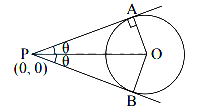
0 likes
View Solution246
MediumMCQ
The slope of the common tangent drawn to the circles $x^2+y^2-4x+12y-216=0$ and $x^2+y^2+6x-12y+36=0$ is
A
$1$
B
$-1$
C
$\frac{5}{12}$
D
$\frac{12}{7}$
Solution
(C) For the circle $C_1: x^2+y^2-4x+12y-216=0$,the center $C_1$ is $(2, -6)$ and radius $r_1 = \sqrt{2^2 + (-6)^2 - (-216)} = \sqrt{4 + 36 + 216} = \sqrt{256} = 16$.
For the circle $C_2: x^2+y^2+6x-12y+36=0$,the center $C_2$ is $(-3, 6)$ and radius $r_2 = \sqrt{(-3)^2 + 6^2 - 36} = \sqrt{9 + 36 - 36} = 3$.
The distance between centers $d = \sqrt{(2 - (-3))^2 + (-6 - 6)^2} = \sqrt{5^2 + (-12)^2} = \sqrt{25 + 144} = 13$.
Since $r_1 - r_2 = 16 - 3 = 13$,which is equal to $d$,the circles touch each other internally.
There is only one common tangent at the point of contact.
The point of contact $P$ divides the line segment $C_1C_2$ externally in the ratio $r_1 : r_2 = 16 : 3$.
$P = \left( \frac{16(-3) - 3(2)}{16 - 3}, \frac{16(6) - 3(-6)}{16 - 3} \right) = \left( \frac{-48 - 6}{13}, \frac{96 + 18}{13} \right) = \left( -\frac{54}{13}, \frac{114}{13} \right)$.
The slope of the line $C_1C_2$ is $m_{C_1C_2} = \frac{6 - (-6)}{-3 - 2} = \frac{12}{-5} = -\frac{12}{5}$.
The common tangent is perpendicular to the line joining the centers.
Therefore,the slope of the common tangent is $m = -\frac{1}{m_{C_1C_2}} = -\frac{1}{-12/5} = \frac{5}{12}$.
For the circle $C_2: x^2+y^2+6x-12y+36=0$,the center $C_2$ is $(-3, 6)$ and radius $r_2 = \sqrt{(-3)^2 + 6^2 - 36} = \sqrt{9 + 36 - 36} = 3$.
The distance between centers $d = \sqrt{(2 - (-3))^2 + (-6 - 6)^2} = \sqrt{5^2 + (-12)^2} = \sqrt{25 + 144} = 13$.
Since $r_1 - r_2 = 16 - 3 = 13$,which is equal to $d$,the circles touch each other internally.
There is only one common tangent at the point of contact.
The point of contact $P$ divides the line segment $C_1C_2$ externally in the ratio $r_1 : r_2 = 16 : 3$.
$P = \left( \frac{16(-3) - 3(2)}{16 - 3}, \frac{16(6) - 3(-6)}{16 - 3} \right) = \left( \frac{-48 - 6}{13}, \frac{96 + 18}{13} \right) = \left( -\frac{54}{13}, \frac{114}{13} \right)$.
The slope of the line $C_1C_2$ is $m_{C_1C_2} = \frac{6 - (-6)}{-3 - 2} = \frac{12}{-5} = -\frac{12}{5}$.
The common tangent is perpendicular to the line joining the centers.
Therefore,the slope of the common tangent is $m = -\frac{1}{m_{C_1C_2}} = -\frac{1}{-12/5} = \frac{5}{12}$.
0 likes
View Solution247
MediumMCQ
The product of the slopes of the common tangents drawn to the circles $x^2+y^2+2x-2y-2=0$ and $x^2+y^2-2x+2y+1=0$ is:
A
$-1$
B
$3$
C
$\frac{-8}{3}$
D
$1$
Solution
(D) Let $S_1: x^2+y^2+2x-2y-2=0$. The center $C_1 = (-1, 1)$ and radius $r_1 = \sqrt{(-1)^2 + 1^2 - (-2)} = \sqrt{4} = 2$.
Let $S_2: x^2+y^2-2x+2y+1=0$. The center $C_2 = (1, -1)$ and radius $r_2 = \sqrt{1^2 + (-1)^2 - 1} = \sqrt{1} = 1$.
Since the circles are external to each other,the common tangents intersect at a point $P$ which divides the line segment joining the centers $C_1$ and $C_2$ externally in the ratio of their radii $r_1 : r_2 = 2 : 1$.
Using the section formula for external division,the coordinates of $P$ are:
$P = \left( \frac{2(1) - 1(-1)}{2-1}, \frac{2(-1) - 1(1)}{2-1} \right) = \left( \frac{3}{1}, \frac{-3}{1} \right) = (3, -3)$.
Let the equation of the tangent line passing through $P(3, -3)$ be $y + 3 = m(x - 3)$,which simplifies to $mx - y - 3m - 3 = 0$.
The perpendicular distance from the center $C_2(1, -1)$ to this line must equal the radius $r_2 = 1$.
$\left| \frac{m(1) - (-1) - 3m - 3}{\sqrt{m^2 + (-1)^2}} \right| = 1$ $\Rightarrow \left| \frac{-2m - 2}{\sqrt{m^2 + 1}} \right| = 1$.
Squaring both sides: $\frac{4(m+1)^2}{m^2+1} = 1 \Rightarrow 4(m^2 + 2m + 1) = m^2 + 1$.
$4m^2 + 8m + 4 = m^2 + 1 \Rightarrow 3m^2 + 8m + 3 = 0$.
The product of the slopes $m_1 m_2$ is given by the constant term divided by the coefficient of $m^2$ in the quadratic equation $3m^2 + 8m + 3 = 0$.
Therefore,$m_1 m_2 = \frac{3}{3} = 1$.
Let $S_2: x^2+y^2-2x+2y+1=0$. The center $C_2 = (1, -1)$ and radius $r_2 = \sqrt{1^2 + (-1)^2 - 1} = \sqrt{1} = 1$.
Since the circles are external to each other,the common tangents intersect at a point $P$ which divides the line segment joining the centers $C_1$ and $C_2$ externally in the ratio of their radii $r_1 : r_2 = 2 : 1$.
Using the section formula for external division,the coordinates of $P$ are:
$P = \left( \frac{2(1) - 1(-1)}{2-1}, \frac{2(-1) - 1(1)}{2-1} \right) = \left( \frac{3}{1}, \frac{-3}{1} \right) = (3, -3)$.
Let the equation of the tangent line passing through $P(3, -3)$ be $y + 3 = m(x - 3)$,which simplifies to $mx - y - 3m - 3 = 0$.
The perpendicular distance from the center $C_2(1, -1)$ to this line must equal the radius $r_2 = 1$.
$\left| \frac{m(1) - (-1) - 3m - 3}{\sqrt{m^2 + (-1)^2}} \right| = 1$ $\Rightarrow \left| \frac{-2m - 2}{\sqrt{m^2 + 1}} \right| = 1$.
Squaring both sides: $\frac{4(m+1)^2}{m^2+1} = 1 \Rightarrow 4(m^2 + 2m + 1) = m^2 + 1$.
$4m^2 + 8m + 4 = m^2 + 1 \Rightarrow 3m^2 + 8m + 3 = 0$.
The product of the slopes $m_1 m_2$ is given by the constant term divided by the coefficient of $m^2$ in the quadratic equation $3m^2 + 8m + 3 = 0$.
Therefore,$m_1 m_2 = \frac{3}{3} = 1$.
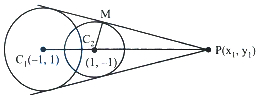
0 likes
View Solution248
EasyMCQ
$A$ circle is such that $(x-2) \cos \theta + (y-2) \sin \theta = 1$ touches it for all values of $\theta$. Then,the circle is
A
$x^2+y^2-4x-4y+7=0$
B
$x^2+y^2+4x+4y+7=0$
C
$x^2+y^2-4x-4y-7=0$
D
$x^2+y^2+4x+4y-7=0$
Solution
(A) The given equation of the line is $(x-2) \cos \theta + (y-2) \sin \theta = 1$.
This line represents a tangent to the circle for all values of $\theta$.
The distance from the center $(h, k)$ of the circle to the tangent line must be equal to the radius $r$.
Rewriting the line as $(x-2) \cos \theta + (y-2) \sin \theta - 1 = 0$,the distance from $(h, k)$ is $\frac{|(h-2) \cos \theta + (k-2) \sin \theta - 1|}{\sqrt{\cos^2 \theta + \sin^2 \theta}} = r$.
Since this holds for all $\theta$,we must have $h-2 = 0$ and $k-2 = 0$,which gives the center $(2, 2)$.
Then,the distance becomes $|-1| = r$,so $r = 1$.
The equation of the circle is $(x-2)^2 + (y-2)^2 = 1^2$.
Expanding this,we get $x^2 - 4x + 4 + y^2 - 4y + 4 = 1$.
Thus,$x^2 + y^2 - 4x - 4y + 7 = 0$.
This line represents a tangent to the circle for all values of $\theta$.
The distance from the center $(h, k)$ of the circle to the tangent line must be equal to the radius $r$.
Rewriting the line as $(x-2) \cos \theta + (y-2) \sin \theta - 1 = 0$,the distance from $(h, k)$ is $\frac{|(h-2) \cos \theta + (k-2) \sin \theta - 1|}{\sqrt{\cos^2 \theta + \sin^2 \theta}} = r$.
Since this holds for all $\theta$,we must have $h-2 = 0$ and $k-2 = 0$,which gives the center $(2, 2)$.
Then,the distance becomes $|-1| = r$,so $r = 1$.
The equation of the circle is $(x-2)^2 + (y-2)^2 = 1^2$.
Expanding this,we get $x^2 - 4x + 4 + y^2 - 4y + 4 = 1$.
Thus,$x^2 + y^2 - 4x - 4y + 7 = 0$.
0 likes
View Solution10-1.Circle and System of Circles — Tangent and normal to a circle · Frequently Asked Questions
1Are these 10-1.Circle and System of Circles questions useful for JEE and NEET?
Yes. All questions in this section are mapped to JEE Main and NEET exam patterns. Previous year questions from JEE Main, NEET, GUJCET and state-level exams are included with full solutions.
2Can I switch to Hindi or Gujarati for these questions?
Yes. Use the language tabs in the hero section or the sidebar to view the same questions and solutions in English, Hindi or Gujarati.
3How do I generate a question paper from this subtopic?
Use the Vedclass Exam Paper Generator — select the chapter and subtopic, set difficulty, and generate Sets A, B, C, D automatically. First 3 chapters of every subject are free.
Vedclass Products
For Students
Vedclass Test Series
Mock tests in real JEE/NEET style with performance analysis. 5-day free trial.
Start Free TrialFor Teachers
Exam Paper Generator
Generate Set A/B/C/D papers from this chapter in 2 minutes. 3 chapters free.
Try FreeFor Institutes
Online Exam Module
Live online exams with unlimited students, 360° analytics & white-label branding.
See DemoFor Teachers & Institutes
Generate a 10-1.Circle and System of Circles Exam Paper in 2 Minutes
Select subtopic & difficulty — Sets A, B, C, D auto-generated with No Repeat logic.
First 3 chapters of every subject are free — no payment required.