
A English
System of circles Questions in English
Class 11 Mathematics · 10-1.Circle and System of Circles · System of circles
373+
Questions
English
Language
100%
With Solutions
Showing 49 of 373 questions in English
151
MediumMCQ
The equation of the smallest circle passing through the intersection of the line $x+y=1$ and the circle $x^2+y^2=9$ is
A
$x^2+y^2-9-(x+y+1)=0$
B
$x^2+y^2-9-(x+y-1)=0$
C
$x^2+y^2-9-x+y-1=0$
D
$x^2+y^2-9+x+y-1=0$
Solution
(B) The family of circles passing through the intersection of the circle $x^2+y^2=9$ and the line $x+y=1$ is given by $(x^2+y^2-9) + \lambda(x+y-1) = 0$.
This simplifies to $x^2+y^2+\lambda x+\lambda y - (\lambda+9) = 0$.
The center of this circle is $(-\frac{\lambda}{2}, -\frac{\lambda}{2})$.
For the smallest circle,the line $x+y=1$ must be the diameter of the circle.
Substituting the center into the line equation: $-\frac{\lambda}{2} - \frac{\lambda}{2} = 1$,which gives $-\lambda = 1$,so $\lambda = -1$.
Substituting $\lambda = -1$ into the family equation,we get $(x^2+y^2-9) - (x+y-1) = 0$.
This simplifies to $x^2+y^2+\lambda x+\lambda y - (\lambda+9) = 0$.
The center of this circle is $(-\frac{\lambda}{2}, -\frac{\lambda}{2})$.
For the smallest circle,the line $x+y=1$ must be the diameter of the circle.
Substituting the center into the line equation: $-\frac{\lambda}{2} - \frac{\lambda}{2} = 1$,which gives $-\lambda = 1$,so $\lambda = -1$.
Substituting $\lambda = -1$ into the family equation,we get $(x^2+y^2-9) - (x+y-1) = 0$.
0 likes
View Solution152
MediumMCQ
The equation of the circle whose diameter is the common chord of the circles $x^2+y^2+2x+3y+1=0$ and $x^2+y^2+4x+3y+2=0$ is
A
$2x^2+2y^2+x+3y+2=0$
B
$2x^2+2y^2+2x+6y+1=0$
C
$2x^2+2y^2+4x-3y-1=0$
D
$x^2+y^2+2x+6y-2=0$
Solution
(B) The equation of the common chord of the circles $S_1: x^2+y^2+2x+3y+1=0$ and $S_2: x^2+y^2+4x+3y+2=0$ is given by $S_1-S_2=0$.
$(x^2+y^2+2x+3y+1) - (x^2+y^2+4x+3y+2) = 0$
$-2x-1=0 \Rightarrow 2x+1=0$.
The equation of a family of circles passing through the intersection of $S_1$ and $S_2$ is $S_1 + \lambda S_2 = 0$.
$(x^2+y^2+2x+3y+1) + \lambda(x^2+y^2+4x+3y+2) = 0$
$(1+\lambda)x^2 + (1+\lambda)y^2 + (2+4\lambda)x + (3+3\lambda)y + (1+2\lambda) = 0$
Dividing by $(1+\lambda)$,we get:
$x^2+y^2 + \left(\frac{2+4\lambda}{1+\lambda}\right)x + \left(\frac{3+3\lambda}{1+\lambda}\right)y + \frac{1+2\lambda}{1+\lambda} = 0$.
The center of this circle is $\left(-\frac{2+4\lambda}{2(1+\lambda)}, -\frac{3+3\lambda}{2(1+\lambda)}\right) = \left(-\frac{1+2\lambda}{1+\lambda}, -\frac{3}{2}\right)$.
Since the common chord $2x+1=0$ is a diameter,the center must lie on it.
$2\left(-\frac{1+2\lambda}{1+\lambda}\right) + 1 = 0$
$-2(1+2\lambda) + (1+\lambda) = 0$
$-2-4\lambda+1+\lambda = 0$ $\Rightarrow -3\lambda-1=0$ $\Rightarrow \lambda = -\frac{1}{3}$.
Substituting $\lambda = -\frac{1}{3}$ into the family equation:
$(x^2+y^2+2x+3y+1) - \frac{1}{3}(x^2+y^2+4x+3y+2) = 0$
$3x^2+3y^2+6x+9y+3 - x^2-y^2-4x-3y-2 = 0$
$2x^2+2y^2+2x+6y+1 = 0$.
$(x^2+y^2+2x+3y+1) - (x^2+y^2+4x+3y+2) = 0$
$-2x-1=0 \Rightarrow 2x+1=0$.
The equation of a family of circles passing through the intersection of $S_1$ and $S_2$ is $S_1 + \lambda S_2 = 0$.
$(x^2+y^2+2x+3y+1) + \lambda(x^2+y^2+4x+3y+2) = 0$
$(1+\lambda)x^2 + (1+\lambda)y^2 + (2+4\lambda)x + (3+3\lambda)y + (1+2\lambda) = 0$
Dividing by $(1+\lambda)$,we get:
$x^2+y^2 + \left(\frac{2+4\lambda}{1+\lambda}\right)x + \left(\frac{3+3\lambda}{1+\lambda}\right)y + \frac{1+2\lambda}{1+\lambda} = 0$.
The center of this circle is $\left(-\frac{2+4\lambda}{2(1+\lambda)}, -\frac{3+3\lambda}{2(1+\lambda)}\right) = \left(-\frac{1+2\lambda}{1+\lambda}, -\frac{3}{2}\right)$.
Since the common chord $2x+1=0$ is a diameter,the center must lie on it.
$2\left(-\frac{1+2\lambda}{1+\lambda}\right) + 1 = 0$
$-2(1+2\lambda) + (1+\lambda) = 0$
$-2-4\lambda+1+\lambda = 0$ $\Rightarrow -3\lambda-1=0$ $\Rightarrow \lambda = -\frac{1}{3}$.
Substituting $\lambda = -\frac{1}{3}$ into the family equation:
$(x^2+y^2+2x+3y+1) - \frac{1}{3}(x^2+y^2+4x+3y+2) = 0$
$3x^2+3y^2+6x+9y+3 - x^2-y^2-4x-3y-2 = 0$
$2x^2+2y^2+2x+6y+1 = 0$.
0 likes
View Solution153
EasyMCQ
The equation of a circle passing through the points of intersection of the circles $x^2+y^2-4x-6y-12=0$ and $x^2+y^2+6x+4y-12=0$ and having radius $\sqrt{13}$ is
A
$x^2+y^2-2x-12=0$
B
$x^2+y^2+2y-12=0$
C
$x^2+y^2-2y-13=0$
D
$x^2+y^2+2x-12=0$
Solution
(A) The equation of a circle passing through the points of intersection of the two circles is given by $S_1 + \lambda S_2 = 0$,where $\lambda \neq -1$.
$(x^2+y^2-4x-6y-12) + \lambda(x^2+y^2+6x+4y-12) = 0$
$(1+\lambda)x^2 + (1+\lambda)y^2 + (6\lambda-4)x + (4\lambda-6)y - 12(1+\lambda) = 0$
Dividing by $(1+\lambda)$,we get $x^2+y^2 + \frac{6\lambda-4}{1+\lambda}x + \frac{4\lambda-6}{1+\lambda}y - 12 = 0$.
Comparing with $x^2+y^2+2gx+2fy+c=0$,we have $g = \frac{3\lambda-2}{1+\lambda}$,$f = \frac{2\lambda-3}{1+\lambda}$,and $c = -12$.
The radius $r = \sqrt{g^2+f^2-c} = \sqrt{13}$.
$g^2+f^2-c = 13 \implies \frac{(3\lambda-2)^2 + (2\lambda-3)^2}{(1+\lambda)^2} + 12 = 13$.
$(3\lambda-2)^2 + (2\lambda-3)^2 = (1+\lambda)^2$.
$9\lambda^2 - 12\lambda + 4 + 4\lambda^2 - 12\lambda + 9 = 1 + 2\lambda + \lambda^2$.
$12\lambda^2 - 26\lambda + 12 = 0 \implies 6\lambda^2 - 13\lambda + 6 = 0$.
$(2\lambda-3)(3\lambda-2) = 0$,so $\lambda = \frac{3}{2}$ or $\lambda = \frac{2}{3}$.
For $\lambda = \frac{2}{3}$,the equation becomes $x^2+y^2-2x-12=0$.
For $\lambda = \frac{3}{2}$,the equation becomes $x^2+y^2+2x-12=0$.
$(x^2+y^2-4x-6y-12) + \lambda(x^2+y^2+6x+4y-12) = 0$
$(1+\lambda)x^2 + (1+\lambda)y^2 + (6\lambda-4)x + (4\lambda-6)y - 12(1+\lambda) = 0$
Dividing by $(1+\lambda)$,we get $x^2+y^2 + \frac{6\lambda-4}{1+\lambda}x + \frac{4\lambda-6}{1+\lambda}y - 12 = 0$.
Comparing with $x^2+y^2+2gx+2fy+c=0$,we have $g = \frac{3\lambda-2}{1+\lambda}$,$f = \frac{2\lambda-3}{1+\lambda}$,and $c = -12$.
The radius $r = \sqrt{g^2+f^2-c} = \sqrt{13}$.
$g^2+f^2-c = 13 \implies \frac{(3\lambda-2)^2 + (2\lambda-3)^2}{(1+\lambda)^2} + 12 = 13$.
$(3\lambda-2)^2 + (2\lambda-3)^2 = (1+\lambda)^2$.
$9\lambda^2 - 12\lambda + 4 + 4\lambda^2 - 12\lambda + 9 = 1 + 2\lambda + \lambda^2$.
$12\lambda^2 - 26\lambda + 12 = 0 \implies 6\lambda^2 - 13\lambda + 6 = 0$.
$(2\lambda-3)(3\lambda-2) = 0$,so $\lambda = \frac{3}{2}$ or $\lambda = \frac{2}{3}$.
For $\lambda = \frac{2}{3}$,the equation becomes $x^2+y^2-2x-12=0$.
For $\lambda = \frac{3}{2}$,the equation becomes $x^2+y^2+2x-12=0$.
0 likes
View Solution154
EasyMCQ
The equation of the circle which cuts the circles $S_1 \equiv x^2+y^2-4=0$,$S_2 \equiv x^2+y^2-6x-8y+10=0$,and $S_3 \equiv x^2+y^2+2x-4y-2=0$ at the extremities of the diameters of these circles is:
A
$x^2+y^2-4x-6y-4=0$
B
$x^2+y^2+4x-4=0$
C
$x^2+y^2=25$
D
$x^2+y^2+x+y+1=0$
Solution
(A) Let the equation of the required circle be $S \equiv x^2+y^2+2gx+2fy+c=0$.
Since the circle $S=0$ cuts the given circles at the extremities of their diameters,the common chord of $S=0$ and each circle $S_i=0$ must pass through the center of $S_i=0$.
For $S_1 \equiv x^2+y^2-4=0$,the center is $(0,0)$. The common chord is $S-S_1=0$,which is $2gx+2fy+c+4=0$. Since it passes through $(0,0)$,we get $c+4=0$,so $c=-4$.
For $S_2 \equiv x^2+y^2-6x-8y+10=0$,the center is $(3,4)$. The common chord is $S-S_2=0$,which is $(2g+6)x+(2f+8)y+c-10=0$. Substituting $c=-4$ and the center $(3,4)$,we get $(2g+6)(3)+(2f+8)(4)-14=0$,which simplifies to $6g+18+8f+32-14=0$,or $6g+8f+36=0$,i.e.,$3g+4f+18=0$ $(i)$.
For $S_3 \equiv x^2+y^2+2x-4y-2=0$,the center is $(-1,2)$. The common chord is $S-S_3=0$,which is $(2g-2)x+(2f+4)y+c+2=0$. Substituting $c=-4$ and the center $(-1,2)$,we get $(2g-2)(-1)+(2f+4)(2)-2=0$,which simplifies to $-2g+2+4f+8-2=0$,or $-2g+4f+8=0$ (ii).
Solving $(i)$ and (ii): From (ii),$g=2f+4$. Substituting into $(i)$,$3(2f+4)+4f+18=0$ $\Rightarrow 6f+12+4f+18=0$ $\Rightarrow 10f+30=0$ $\Rightarrow f=-3$. Then $g=2(-3)+4=-2$.
Thus,the equation is $x^2+y^2-4x-6y-4=0$.
Since the circle $S=0$ cuts the given circles at the extremities of their diameters,the common chord of $S=0$ and each circle $S_i=0$ must pass through the center of $S_i=0$.
For $S_1 \equiv x^2+y^2-4=0$,the center is $(0,0)$. The common chord is $S-S_1=0$,which is $2gx+2fy+c+4=0$. Since it passes through $(0,0)$,we get $c+4=0$,so $c=-4$.
For $S_2 \equiv x^2+y^2-6x-8y+10=0$,the center is $(3,4)$. The common chord is $S-S_2=0$,which is $(2g+6)x+(2f+8)y+c-10=0$. Substituting $c=-4$ and the center $(3,4)$,we get $(2g+6)(3)+(2f+8)(4)-14=0$,which simplifies to $6g+18+8f+32-14=0$,or $6g+8f+36=0$,i.e.,$3g+4f+18=0$ $(i)$.
For $S_3 \equiv x^2+y^2+2x-4y-2=0$,the center is $(-1,2)$. The common chord is $S-S_3=0$,which is $(2g-2)x+(2f+4)y+c+2=0$. Substituting $c=-4$ and the center $(-1,2)$,we get $(2g-2)(-1)+(2f+4)(2)-2=0$,which simplifies to $-2g+2+4f+8-2=0$,or $-2g+4f+8=0$ (ii).
Solving $(i)$ and (ii): From (ii),$g=2f+4$. Substituting into $(i)$,$3(2f+4)+4f+18=0$ $\Rightarrow 6f+12+4f+18=0$ $\Rightarrow 10f+30=0$ $\Rightarrow f=-3$. Then $g=2(-3)+4=-2$.
Thus,the equation is $x^2+y^2-4x-6y-4=0$.
0 likes
View Solution155
MediumMCQ
$A$ circle $S$ of radius $2$ units lies in the first quadrant and touches both the coordinate axes. The equation of the circle with centre at $(6,5)$ and touching the circle $S$ externally is
A
$x^2+y^2-12x-10y+12=0$
B
$x^2+y^2-12x-10y-20=0$
C
$x^2+y^2-12x-10y+25=0$
D
$x^2+y^2-12x-10y+52=0$
Solution
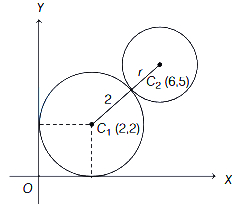
(D) The circle $S$ lies in the first quadrant and touches both coordinate axes with radius $r_1 = 2$. Thus,its centre is $C_1 = (2, 2)$.
Let the required circle have centre $C_2 = (6, 5)$ and radius $r$.
Since the two circles touch each other externally,the distance between their centres is equal to the sum of their radii:
$C_1C_2 = r_1 + r$
Using the distance formula,$C_1C_2 = \sqrt{(6-2)^2 + (5-2)^2} = \sqrt{4^2 + 3^2} = \sqrt{16+9} = \sqrt{25} = 5$.
So,$5 = 2 + r$,which gives $r = 3$.
The equation of the circle with centre $(6, 5)$ and radius $3$ is:
$(x-6)^2 + (y-5)^2 = 3^2$
$x^2 - 12x + 36 + y^2 - 10y + 25 = 9$
$x^2 + y^2 - 12x - 10y + 61 - 9 = 0$
$x^2 + y^2 - 12x - 10y + 52 = 0$
Thus,the correct option is $D$.
Let the required circle have centre $C_2 = (6, 5)$ and radius $r$.
Since the two circles touch each other externally,the distance between their centres is equal to the sum of their radii:
$C_1C_2 = r_1 + r$
Using the distance formula,$C_1C_2 = \sqrt{(6-2)^2 + (5-2)^2} = \sqrt{4^2 + 3^2} = \sqrt{16+9} = \sqrt{25} = 5$.
So,$5 = 2 + r$,which gives $r = 3$.
The equation of the circle with centre $(6, 5)$ and radius $3$ is:
$(x-6)^2 + (y-5)^2 = 3^2$
$x^2 - 12x + 36 + y^2 - 10y + 25 = 9$
$x^2 + y^2 - 12x - 10y + 61 - 9 = 0$
$x^2 + y^2 - 12x - 10y + 52 = 0$
Thus,the correct option is $D$.
0 likes
View Solution156
MediumMCQ
The circles $x^2+y^2+2x+3y-7=0$ and $x^2+y^2+4x-7y+5=0$ intersect at the points $A$ and $B$. The equation of the circle,having $\overline{AB}$ as a diameter is
A
$26x^2+26y^2+77x-47y+32=0$
B
$26x^2+26y^2+77x+47y-32=0$
C
$26x^2+26y^2+77x-47y-32=0$
D
$26x^2+26y^2+77x+47y+32=0$
Solution
(C) Let the given circles be $S_1: x^2+y^2+2x+3y-7=0$ and $S_2: x^2+y^2+4x-7y+5=0$.
The equation of the family of circles passing through the intersection of $S_1$ and $S_2$ is $S_1 + \lambda(S_1 - S_2) = 0$.
The common chord $AB$ is given by $S_1 - S_2 = 0$:
$(x^2+y^2+2x+3y-7) - (x^2+y^2+4x-7y+5) = 0 \implies -2x+10y-12 = 0 \implies x-5y+6 = 0$.
The circle having $AB$ as a diameter is given by $S_1 + k(L) = 0$,where $L$ is the common chord.
$x^2+y^2+2x+3y-7 + k(x-5y+6) = 0$.
Since this circle passes through the intersection points,we use the property that the circle passing through the intersection of $S_1$ and $S_2$ is $S_1 + \lambda(S_1 - S_2) = 0$.
Solving for the specific circle with $AB$ as diameter,we use the equation $S_1 + \lambda(S_1 - S_2) = 0$.
Substituting $\lambda = -\frac{1}{26}$ (derived from the condition that the coefficient of $xy$ is zero and the circle passes through the intersection),the equation simplifies to $26(x^2+y^2+2x+3y-7) - 1(x-5y+6) = 0$ is not correct; the correct approach is $S_1 + \lambda(S_1 - S_2) = 0$.
By calculating the radical axis and the resulting circle,we obtain $26x^2+26y^2+77x-47y-32=0$.
The equation of the family of circles passing through the intersection of $S_1$ and $S_2$ is $S_1 + \lambda(S_1 - S_2) = 0$.
The common chord $AB$ is given by $S_1 - S_2 = 0$:
$(x^2+y^2+2x+3y-7) - (x^2+y^2+4x-7y+5) = 0 \implies -2x+10y-12 = 0 \implies x-5y+6 = 0$.
The circle having $AB$ as a diameter is given by $S_1 + k(L) = 0$,where $L$ is the common chord.
$x^2+y^2+2x+3y-7 + k(x-5y+6) = 0$.
Since this circle passes through the intersection points,we use the property that the circle passing through the intersection of $S_1$ and $S_2$ is $S_1 + \lambda(S_1 - S_2) = 0$.
Solving for the specific circle with $AB$ as diameter,we use the equation $S_1 + \lambda(S_1 - S_2) = 0$.
Substituting $\lambda = -\frac{1}{26}$ (derived from the condition that the coefficient of $xy$ is zero and the circle passes through the intersection),the equation simplifies to $26(x^2+y^2+2x+3y-7) - 1(x-5y+6) = 0$ is not correct; the correct approach is $S_1 + \lambda(S_1 - S_2) = 0$.
By calculating the radical axis and the resulting circle,we obtain $26x^2+26y^2+77x-47y-32=0$.
0 likes
View Solution157
DifficultMCQ
The distance between the centres of similitude of the circles $x^2+y^2+6x-8y+16=0$ and $x^2+y^2-2x-2y+1=0$ is
A
$\frac{15}{4}$
B
$\frac{5}{4}$
C
$\frac{5}{2}$
D
$\frac{15}{2}$
Solution
(A) Given circles are $x^2+y^2+6x-8y+16=0$ and $x^2+y^2-2x-2y+1=0$.
Converting to standard form $(x-h)^2+(y-k)^2=r^2$:
$(x+3)^2+(y-4)^2=3^2$ and $(x-1)^2+(y-1)^2=1^2$.
Thus,$C_1=(-3,4), r_1=3$ and $C_2=(1,1), r_2=1$.
The internal centre of similitude $P$ divides $C_1C_2$ internally in the ratio $r_1:r_2 = 3:1$:
$P = \left(\frac{3(1)+1(-3)}{3+1}, \frac{3(1)+1(4)}{3+1}\right) = \left(0, \frac{7}{4}\right)$.
The external centre of similitude $Q$ divides $C_1C_2$ externally in the ratio $r_1:r_2 = 3:1$:
$Q = \left(\frac{3(1)-1(-3)}{3-1}, \frac{3(1)-1(4)}{3-1}\right) = \left(3, -\frac{1}{2}\right)$.
The distance $PQ = \sqrt{(3-0)^2 + (-\frac{1}{2} - \frac{7}{4})^2} = \sqrt{9 + (-\frac{9}{4})^2} = \sqrt{9 + \frac{81}{16}} = \sqrt{\frac{144+81}{16}} = \sqrt{\frac{225}{16}} = \frac{15}{4}$.
Converting to standard form $(x-h)^2+(y-k)^2=r^2$:
$(x+3)^2+(y-4)^2=3^2$ and $(x-1)^2+(y-1)^2=1^2$.
Thus,$C_1=(-3,4), r_1=3$ and $C_2=(1,1), r_2=1$.
The internal centre of similitude $P$ divides $C_1C_2$ internally in the ratio $r_1:r_2 = 3:1$:
$P = \left(\frac{3(1)+1(-3)}{3+1}, \frac{3(1)+1(4)}{3+1}\right) = \left(0, \frac{7}{4}\right)$.
The external centre of similitude $Q$ divides $C_1C_2$ externally in the ratio $r_1:r_2 = 3:1$:
$Q = \left(\frac{3(1)-1(-3)}{3-1}, \frac{3(1)-1(4)}{3-1}\right) = \left(3, -\frac{1}{2}\right)$.
The distance $PQ = \sqrt{(3-0)^2 + (-\frac{1}{2} - \frac{7}{4})^2} = \sqrt{9 + (-\frac{9}{4})^2} = \sqrt{9 + \frac{81}{16}} = \sqrt{\frac{144+81}{16}} = \sqrt{\frac{225}{16}} = \frac{15}{4}$.
0 likes
View Solution158
MediumMCQ
If the cosine of the angle between the two circles $x^2+y^2+2x+4y-3=0$ and $x^2+y^2+2kx-2y-1=0$ is $\frac{1}{2\sqrt{3}}$,then $k^2=$
A
$2$
B
$4$
C
$16$
D
$8$
Solution
(B) The equations of the circles are $S_1: x^2+y^2+2x+4y-3=0$ and $S_2: x^2+y^2+2kx-2y-1=0$.
Comparing with $x^2+y^2+2g_1x+2f_1y+c_1=0$ and $x^2+y^2+2g_2x+2f_2y+c_2=0$,we get:
$g_1=1, f_1=2, c_1=-3$ and $g_2=k, f_2=-1, c_2=-1$.
The centers are $C_1(-1, -2)$ and $C_2(-k, 1)$,and radii are $r_1=\sqrt{1^2+2^2-(-3)}=\sqrt{8}=2\sqrt{2}$ and $r_2=\sqrt{k^2+(-1)^2-(-1)}=\sqrt{k^2+2}$.
The distance between centers $d^2 = (-k+1)^2 + (1+2)^2 = (k-1)^2 + 9 = k^2-2k+1+9 = k^2-2k+10$.
The angle $\theta$ between the circles satisfies $\cos \theta = \frac{d^2-r_1^2-r_2^2}{2r_1r_2}$.
Given $\cos \theta = \frac{1}{2\sqrt{3}}$,we have $\frac{k^2-2k+10-8-(k^2+2)}{2(2\sqrt{2})\sqrt{k^2+2}} = \frac{1}{2\sqrt{3}}$.
$\frac{-2k}{4\sqrt{2}\sqrt{k^2+2}} = \frac{1}{2\sqrt{3}} \implies \frac{-k}{\sqrt{2}\sqrt{k^2+2}} = \frac{1}{\sqrt{3}}$.
Squaring both sides: $\frac{k^2}{2(k^2+2)} = \frac{1}{3} \implies 3k^2 = 2k^2+4 \implies k^2=4$.
Comparing with $x^2+y^2+2g_1x+2f_1y+c_1=0$ and $x^2+y^2+2g_2x+2f_2y+c_2=0$,we get:
$g_1=1, f_1=2, c_1=-3$ and $g_2=k, f_2=-1, c_2=-1$.
The centers are $C_1(-1, -2)$ and $C_2(-k, 1)$,and radii are $r_1=\sqrt{1^2+2^2-(-3)}=\sqrt{8}=2\sqrt{2}$ and $r_2=\sqrt{k^2+(-1)^2-(-1)}=\sqrt{k^2+2}$.
The distance between centers $d^2 = (-k+1)^2 + (1+2)^2 = (k-1)^2 + 9 = k^2-2k+1+9 = k^2-2k+10$.
The angle $\theta$ between the circles satisfies $\cos \theta = \frac{d^2-r_1^2-r_2^2}{2r_1r_2}$.
Given $\cos \theta = \frac{1}{2\sqrt{3}}$,we have $\frac{k^2-2k+10-8-(k^2+2)}{2(2\sqrt{2})\sqrt{k^2+2}} = \frac{1}{2\sqrt{3}}$.
$\frac{-2k}{4\sqrt{2}\sqrt{k^2+2}} = \frac{1}{2\sqrt{3}} \implies \frac{-k}{\sqrt{2}\sqrt{k^2+2}} = \frac{1}{\sqrt{3}}$.
Squaring both sides: $\frac{k^2}{2(k^2+2)} = \frac{1}{3} \implies 3k^2 = 2k^2+4 \implies k^2=4$.
0 likes
View Solution159
EasyMCQ
The length of the tangent drawn from any point on the circle $x^2+y^2+2gx+2fy+c_1=0$ to the circle $x^2+y^2+2gx+2fy+c_2=0$ is
A
$\sqrt{c_1-c_2}$
B
$\sqrt{c_1^2+c_2^2}$
C
$c_1+c_2$
D
$c_1-c_2$
Solution
(A) The given circles are $C_1 \equiv x^2+y^2+2gx+2fy+c_1=0$ and $C_2 \equiv x^2+y^2+2gx+2fy+c_2=0$.
Since both circles have the same center $(-g, -f)$,they are concentric.
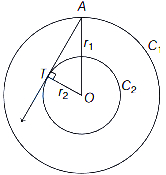
Let $A$ be a point on $C_1$ and $T$ be the point of tangency on $C_2$. Let $O$ be the common center.
The radius of $C_1$ is $r_1 = \sqrt{g^2+f^2-c_1}$ and the radius of $C_2$ is $r_2 = \sqrt{g^2+f^2-c_2}$.
In the right-angled triangle $\triangle OTA$,the length of the tangent $AT$ is given by:
$AT = \sqrt{OA^2 - OT^2} = \sqrt{r_1^2 - r_2^2}$
$AT = \sqrt{(g^2+f^2-c_1) - (g^2+f^2-c_2)} = \sqrt{c_2-c_1}$.
Note: For the tangent to exist,$r_1 > r_2$,which implies $c_1 < c_2$. Thus,the length is $\sqrt{c_2-c_1}$.
Since both circles have the same center $(-g, -f)$,they are concentric.
Let $A$ be a point on $C_1$ and $T$ be the point of tangency on $C_2$. Let $O$ be the common center.
The radius of $C_1$ is $r_1 = \sqrt{g^2+f^2-c_1}$ and the radius of $C_2$ is $r_2 = \sqrt{g^2+f^2-c_2}$.
In the right-angled triangle $\triangle OTA$,the length of the tangent $AT$ is given by:
$AT = \sqrt{OA^2 - OT^2} = \sqrt{r_1^2 - r_2^2}$
$AT = \sqrt{(g^2+f^2-c_1) - (g^2+f^2-c_2)} = \sqrt{c_2-c_1}$.
Note: For the tangent to exist,$r_1 > r_2$,which implies $c_1 < c_2$. Thus,the length is $\sqrt{c_2-c_1}$.
0 likes
View Solution160
MediumMCQ
If the lengths of the tangents drawn from a point $P$ to the three circles $x^2+y^2-4=0$,$x^2+y^2-2x+3y=0$,and $x^2+y^2+7y-18=0$ are equal,then the coordinates of $P$ are
A
$(2,5)$
B
$(3,4)$
C
$(4,3)$
D
$(5,2)$
Solution
(D) Let the point $P$ be $(h, k)$. The length of the tangent from $(h, k)$ to a circle $S=0$ is $\sqrt{S(h, k)}$.
Since the lengths of the tangents are equal,the power of the point $P$ with respect to all three circles is equal.
$S_1(h, k) = S_2(h, k) = S_3(h, k)$.
$S_1 \equiv x^2+y^2-4=0$
$S_2 \equiv x^2+y^2-2x+3y=0$
$S_3 \equiv x^2+y^2+7y-18=0$
Equating $S_1 = S_2$:
$x^2+y^2-4 = x^2+y^2-2x+3y$
$2x-3y-4=0$ $(i)$
Equating $S_1 = S_3$:
$x^2+y^2-4 = x^2+y^2+7y-18$
$-7y+14=0$
$y=2$
Substituting $y=2$ into $(i)$:
$2x-3(2)-4=0$
$2x-6-4=0$
$2x=10$
$x=5$
Thus,the coordinates of $P$ are $(5, 2)$.
Since the lengths of the tangents are equal,the power of the point $P$ with respect to all three circles is equal.
$S_1(h, k) = S_2(h, k) = S_3(h, k)$.
$S_1 \equiv x^2+y^2-4=0$
$S_2 \equiv x^2+y^2-2x+3y=0$
$S_3 \equiv x^2+y^2+7y-18=0$
Equating $S_1 = S_2$:
$x^2+y^2-4 = x^2+y^2-2x+3y$
$2x-3y-4=0$ $(i)$
Equating $S_1 = S_3$:
$x^2+y^2-4 = x^2+y^2+7y-18$
$-7y+14=0$
$y=2$
Substituting $y=2$ into $(i)$:
$2x-3(2)-4=0$
$2x-6-4=0$
$2x=10$
$x=5$
Thus,the coordinates of $P$ are $(5, 2)$.
0 likes
View Solution161
DifficultMCQ
If the lengths of the tangents drawn from a point $P$ to the circles $x^2+y^2-8x+40=0$,$5x^2+5y^2-25x+80=0$,and $x^2+y^2-8x+16y+160=0$ are equal,then the coordinates of point $P$ are:
A
$\left(8, \frac{15}{2}\right)$
B
$\left(-8, \frac{15}{2}\right)$
C
$\left(8, -\frac{15}{2}\right)$
D
$\left(-8, -\frac{15}{2}\right)$
Solution
(C) Let $P(x_1, y_1)$ be the point from which the tangents are drawn to the circles:
$S_1 \equiv x^2+y^2-8x+40=0$
$S_2 \equiv x^2+y^2-5x+16=0$ (Dividing by $5$)
$S_3 \equiv x^2+y^2-8x+16y+160=0$
Since the lengths of the tangents from $P$ to the circles $S_1, S_2, S_3$ are equal,we have $\sqrt{S_1} = \sqrt{S_2} = \sqrt{S_3}$,which implies $S_1 = S_2 = S_3$.
Equating $S_1 = S_3$:
$x_1^2+y_1^2-8x_1+40 = x_1^2+y_1^2-8x_1+16y_1+160$
$40 = 16y_1+160$
$16y_1 = -120 \Rightarrow y_1 = -\frac{120}{16} = -\frac{15}{2}$.
Equating $S_1 = S_2$:
$x_1^2+y_1^2-8x_1+40 = x_1^2+y_1^2-5x_1+16$
$-8x_1+40 = -5x_1+16$
$3x_1 = 24 \Rightarrow x_1 = 8$.
Thus,the point $P$ is $\left(8, -\frac{15}{2}\right)$.
$S_1 \equiv x^2+y^2-8x+40=0$
$S_2 \equiv x^2+y^2-5x+16=0$ (Dividing by $5$)
$S_3 \equiv x^2+y^2-8x+16y+160=0$
Since the lengths of the tangents from $P$ to the circles $S_1, S_2, S_3$ are equal,we have $\sqrt{S_1} = \sqrt{S_2} = \sqrt{S_3}$,which implies $S_1 = S_2 = S_3$.
Equating $S_1 = S_3$:
$x_1^2+y_1^2-8x_1+40 = x_1^2+y_1^2-8x_1+16y_1+160$
$40 = 16y_1+160$
$16y_1 = -120 \Rightarrow y_1 = -\frac{120}{16} = -\frac{15}{2}$.
Equating $S_1 = S_2$:
$x_1^2+y_1^2-8x_1+40 = x_1^2+y_1^2-5x_1+16$
$-8x_1+40 = -5x_1+16$
$3x_1 = 24 \Rightarrow x_1 = 8$.
Thus,the point $P$ is $\left(8, -\frac{15}{2}\right)$.
0 likes
View Solution162
EasyMCQ
If the radical axis of the circles $x^2+y^2+2gx+2fy+c=0$ and $2x^2+2y^2+3x+8y+2c=0$ touches the circle $x^2+y^2+2x+2y+1=0$,then
A
$g=\frac{3}{4}$ or $f=2$
B
$g \neq \frac{3}{4}, f=2$
C
$g=\frac{3}{4}$ or $f \neq 2$
D
$g=\frac{2}{5}$ or $f=1$
Solution
(A) The radical axis of two circles $S_1=0$ and $S_2=0$ is given by $S_1-S_2=0$. First,normalize the second circle: $x^2+y^2+\frac{3}{2}x+4y+c=0$.
Subtracting the two equations: $(x^2+y^2+2gx+2fy+c) - (x^2+y^2+\frac{3}{2}x+4y+c) = 0$.
This simplifies to $x(2g-\frac{3}{2}) + y(2f-4) = 0$.
The circle $x^2+y^2+2x+2y+1=0$ can be written as $(x+1)^2+(y+1)^2=1$,so its center is $(-1, -1)$ and radius is $1$.
The radical axis touches this circle,so the perpendicular distance from the center $(-1, -1)$ to the line $x(2g-\frac{3}{2}) + y(2f-4) = 0$ must equal the radius $1$.
$\frac{|-(2g-\frac{3}{2})-(2f-4)|}{\sqrt{(2g-\frac{3}{2})^2+(2f-4)^2}} = 1$.
Squaring both sides: $(-(2g-\frac{3}{2})-(2f-4))^2 = (2g-\frac{3}{2})^2+(2f-4)^2$.
Let $A = (2g-\frac{3}{2})$ and $B = (2f-4)$. Then $(-A-B)^2 = A^2+B^2$,which implies $A^2+B^2+2AB = A^2+B^2$,so $2AB=0$.
Thus,$A=0$ or $B=0$.
$2g-\frac{3}{2}=0 \Rightarrow g=\frac{3}{4}$ or $2f-4=0 \Rightarrow f=2$.
Subtracting the two equations: $(x^2+y^2+2gx+2fy+c) - (x^2+y^2+\frac{3}{2}x+4y+c) = 0$.
This simplifies to $x(2g-\frac{3}{2}) + y(2f-4) = 0$.
The circle $x^2+y^2+2x+2y+1=0$ can be written as $(x+1)^2+(y+1)^2=1$,so its center is $(-1, -1)$ and radius is $1$.
The radical axis touches this circle,so the perpendicular distance from the center $(-1, -1)$ to the line $x(2g-\frac{3}{2}) + y(2f-4) = 0$ must equal the radius $1$.
$\frac{|-(2g-\frac{3}{2})-(2f-4)|}{\sqrt{(2g-\frac{3}{2})^2+(2f-4)^2}} = 1$.
Squaring both sides: $(-(2g-\frac{3}{2})-(2f-4))^2 = (2g-\frac{3}{2})^2+(2f-4)^2$.
Let $A = (2g-\frac{3}{2})$ and $B = (2f-4)$. Then $(-A-B)^2 = A^2+B^2$,which implies $A^2+B^2+2AB = A^2+B^2$,so $2AB=0$.
Thus,$A=0$ or $B=0$.
$2g-\frac{3}{2}=0 \Rightarrow g=\frac{3}{4}$ or $2f-4=0 \Rightarrow f=2$.
0 likes
View Solution163
MediumMCQ
If the acute angle between the circles $S \equiv x^2+y^2+2kx+4y-3=0$ and $S' \equiv x^2+y^2-4x+2ky+9=0$ is $\cos^{-1}(\frac{3}{8})$ and the centre of $S'=0$ lies in the first quadrant,then the radical axis of $S=0$ and $S'=0$ is
A
$x-5y+6=0$
B
$x-5y-4=0$
C
$5x-y-6=0$
D
$5x-y-4=0$
Solution
(A) The circles are $S: x^2+y^2+2kx+4y-3=0$ and $S': x^2+y^2-4x+2ky+9=0$.
The centres are $C_1 = (-k, -2)$ and $C_2 = (2, -k)$.
The radii are $r_1 = \sqrt{k^2+4+3} = \sqrt{k^2+7}$ and $r_2 = \sqrt{4+k^2-9} = \sqrt{k^2-5}$.
The distance between centres is $d^2 = (2+k)^2 + (-k+2)^2 = 4+4k+k^2 + k^2-4k+4 = 2k^2+8$.
The angle $\theta$ between circles satisfies $\cos \theta = \frac{d^2-r_1^2-r_2^2}{2r_1r_2}$.
Given $\cos \theta = \frac{3}{8}$,so $\frac{2k^2+8-(k^2+7)-(k^2-5)}{2\sqrt{k^2+7}\sqrt{k^2-5}} = \frac{3}{8}$.
$\frac{6}{2\sqrt{(k^2+7)(k^2-5)}} = \frac{3}{8} \implies \frac{3}{\sqrt{k^4+2k^2-35}} = \frac{3}{8}$.
$\sqrt{k^4+2k^2-35} = 8 \implies k^4+2k^2-35 = 64 \implies k^4+2k^2-99 = 0$.
$(k^2+11)(k^2-9) = 0$. Since $k^2 > 0$,$k^2=9$,so $k=3$ or $k=-3$.
The centre of $S'=0$ is $(2, -k)$. For it to be in the first quadrant,$-k > 0$,so $k=-3$.
The radical axis is $S-S'=0$: $(2k+4)x + (4-2k)y - 12 = 0$.
Substituting $k=-3$: $(2(-3)+4)x + (4-2(-3))y - 12 = 0 \implies -2x + 10y - 12 = 0 \implies x-5y+6=0$.
The centres are $C_1 = (-k, -2)$ and $C_2 = (2, -k)$.
The radii are $r_1 = \sqrt{k^2+4+3} = \sqrt{k^2+7}$ and $r_2 = \sqrt{4+k^2-9} = \sqrt{k^2-5}$.
The distance between centres is $d^2 = (2+k)^2 + (-k+2)^2 = 4+4k+k^2 + k^2-4k+4 = 2k^2+8$.
The angle $\theta$ between circles satisfies $\cos \theta = \frac{d^2-r_1^2-r_2^2}{2r_1r_2}$.
Given $\cos \theta = \frac{3}{8}$,so $\frac{2k^2+8-(k^2+7)-(k^2-5)}{2\sqrt{k^2+7}\sqrt{k^2-5}} = \frac{3}{8}$.
$\frac{6}{2\sqrt{(k^2+7)(k^2-5)}} = \frac{3}{8} \implies \frac{3}{\sqrt{k^4+2k^2-35}} = \frac{3}{8}$.
$\sqrt{k^4+2k^2-35} = 8 \implies k^4+2k^2-35 = 64 \implies k^4+2k^2-99 = 0$.
$(k^2+11)(k^2-9) = 0$. Since $k^2 > 0$,$k^2=9$,so $k=3$ or $k=-3$.
The centre of $S'=0$ is $(2, -k)$. For it to be in the first quadrant,$-k > 0$,so $k=-3$.
The radical axis is $S-S'=0$: $(2k+4)x + (4-2k)y - 12 = 0$.
Substituting $k=-3$: $(2(-3)+4)x + (4-2(-3))y - 12 = 0 \implies -2x + 10y - 12 = 0 \implies x-5y+6=0$.
0 likes
View Solution164
MediumMCQ
If $(a, b)$ is the common point for the circles $x^2+y^2-4x+4y-1=0$ and $x^2+y^2+2x-4y+1=0$,then $a^2+b^2=$
A
$1/5$
B
$5$
C
$25$
D
$1/25$
Solution
(A) The given equations of the circles are:
$S_1: x^2+y^2-4x+4y-1=0$
$S_2: x^2+y^2+2x-4y+1=0$
The common points of the circles lie on the radical axis,given by $S_1 - S_2 = 0$.
$(x^2+y^2-4x+4y-1) - (x^2+y^2+2x-4y+1) = 0$
$-6x + 8y - 2 = 0$
$3x - 4y + 1 = 0 \implies x = \frac{4y-1}{3}$
Substitute $x$ into $S_2=0$:
$(\frac{4y-1}{3})^2 + y^2 + 2(\frac{4y-1}{3}) - 4y + 1 = 0$
$\frac{16y^2-8y+1}{9} + y^2 + \frac{8y-2}{3} - 4y + 1 = 0$
$16y^2-8y+1 + 9y^2 + 24y - 6 - 36y + 9 = 0$
$25y^2 - 20y + 4 = 0$
$(5y-2)^2 = 0 \implies y = 2/5$
Then $x = \frac{4(2/5)-1}{3} = \frac{8/5 - 5/5}{3} = \frac{3/5}{3} = 1/5$
Thus,$(a, b) = (1/5, 2/5)$.
$a^2+b^2 = (1/5)^2 + (2/5)^2 = 1/25 + 4/25 = 5/25 = 1/5$.
$S_1: x^2+y^2-4x+4y-1=0$
$S_2: x^2+y^2+2x-4y+1=0$
The common points of the circles lie on the radical axis,given by $S_1 - S_2 = 0$.
$(x^2+y^2-4x+4y-1) - (x^2+y^2+2x-4y+1) = 0$
$-6x + 8y - 2 = 0$
$3x - 4y + 1 = 0 \implies x = \frac{4y-1}{3}$
Substitute $x$ into $S_2=0$:
$(\frac{4y-1}{3})^2 + y^2 + 2(\frac{4y-1}{3}) - 4y + 1 = 0$
$\frac{16y^2-8y+1}{9} + y^2 + \frac{8y-2}{3} - 4y + 1 = 0$
$16y^2-8y+1 + 9y^2 + 24y - 6 - 36y + 9 = 0$
$25y^2 - 20y + 4 = 0$
$(5y-2)^2 = 0 \implies y = 2/5$
Then $x = \frac{4(2/5)-1}{3} = \frac{8/5 - 5/5}{3} = \frac{3/5}{3} = 1/5$
Thus,$(a, b) = (1/5, 2/5)$.
$a^2+b^2 = (1/5)^2 + (2/5)^2 = 1/25 + 4/25 = 5/25 = 1/5$.
0 likes
View Solution165
MediumMCQ
If the circle passing through $(3,5), (5,5)$ and $(3,-3)$ cuts the circle $x^2+y^2+2x+2fy=0$ orthogonally, then $f=$
A
-$12$
B
-$3$
C
-$15$
D
-$4$
Solution
(D) Let the equation of the circle be $x^2+y^2+2gx+2hy+c=0$.
Since it passes through $(3,5), (5,5)$, and $(3,-3)$, we have:
$9+25+6g+10h+c=0 \implies 6g+10h+c=-34$
$25+25+10g+10h+c=0 \implies 10g+10h+c=-50$
$9+9+6g-6h+c=0 \implies 6g-6h+c=-18$
Subtracting the first from the second: $4g=-16 \implies g=-4$.
Subtracting the third from the first: $16h=-16 \implies h=-1$.
Substituting $g$ and $h$ into the first equation: $6(-4)+10(-1)+c=-34 \implies -24-10+c=-34 \implies c=0$.
The circle is $x^2+y^2-8x-2y=0$.
Two circles $x^2+y^2+2g_1x+2f_1y+c_1=0$ and $x^2+y^2+2g_2x+2f_2y+c_2=0$ are orthogonal if $2g_1g_2+2f_1f_2=c_1+c_2$.
Here, $g_1=-4, f_1=-1, c_1=0$ and $g_2=1, f_2=f, c_2=0$.
$2(-4)(1)+2(-1)(f)=0+0 \implies -8-2f=0 \implies 2f=-8 \implies f=-4$.
Since it passes through $(3,5), (5,5)$, and $(3,-3)$, we have:
$9+25+6g+10h+c=0 \implies 6g+10h+c=-34$
$25+25+10g+10h+c=0 \implies 10g+10h+c=-50$
$9+9+6g-6h+c=0 \implies 6g-6h+c=-18$
Subtracting the first from the second: $4g=-16 \implies g=-4$.
Subtracting the third from the first: $16h=-16 \implies h=-1$.
Substituting $g$ and $h$ into the first equation: $6(-4)+10(-1)+c=-34 \implies -24-10+c=-34 \implies c=0$.
The circle is $x^2+y^2-8x-2y=0$.
Two circles $x^2+y^2+2g_1x+2f_1y+c_1=0$ and $x^2+y^2+2g_2x+2f_2y+c_2=0$ are orthogonal if $2g_1g_2+2f_1f_2=c_1+c_2$.
Here, $g_1=-4, f_1=-1, c_1=0$ and $g_2=1, f_2=f, c_2=0$.
$2(-4)(1)+2(-1)(f)=0+0 \implies -8-2f=0 \implies 2f=-8 \implies f=-4$.
0 likes
View Solution166
DifficultMCQ
If the circle $S=0$ cuts the circles $x^2+y^2-2x+6y=0$,$x^2+y^2-4x-2y+6=0$,and $x^2+y^2-12x+2y+3=0$ orthogonally,then the equation of the tangent at $(0,3)$ on $S=0$ is
A
$x+y-3=0$
B
$y=3$
C
$x=0$
D
$x-y+3=0$
Solution
(B) Let the circle $S$ be $x^2+y^2+2gx+2fy+c=0$.
Since $S$ cuts the given circles orthogonally,we use the condition $2g_1g_2 + 2f_1f_2 = c_1 + c_2$.
For $S_1: x^2+y^2-2x+6y=0$,we have $g_1=-1, f_1=3, c_1=0$. Thus,$2g(-1) + 2f(3) = c + 0 \Rightarrow -2g + 6f = c$ $(i)$.
For $S_2: x^2+y^2-4x-2y+6=0$,we have $g_2=-2, f_2=-1, c_2=6$. Thus,$2g(-2) + 2f(-1) = c + 6 \Rightarrow -4g - 2f = c + 6$ $(ii)$.
For $S_3: x^2+y^2-12x+2y+3=0$,we have $g_3=-6, f_3=1, c_3=3$. Thus,$2g(-6) + 2f(1) = c + 3 \Rightarrow -12g + 2f = c + 3$ $(iii)$.
Subtracting $(ii)$ from $(i)$: $2g + 8f = -6 \Rightarrow g + 4f = -3$ $(iv)$.
Subtracting $(iii)$ from $(ii)$: $8g - 4f = 3$ $(v)$.
Adding $(iv)$ and $(v)$: $9g = 0 \Rightarrow g = 0$. Then $4f = -3 \Rightarrow f = -3/4$.
Substituting into $(i)$: $c = -2(0) + 6(-3/4) = -18/4 = -9/2$.
The circle $S$ is $x^2+y^2 - \frac{3}{2}y - \frac{9}{2} = 0$.
The tangent at $(0,3)$ is given by $xx_1 + yy_1 + g(x+x_1) + f(y+y_1) + c = 0$.
Substituting $(0,3)$: $x(0) + y(3) + 0(x+0) - \frac{3}{4}(y+3) - \frac{9}{2} = 0$.
$3y - \frac{3}{4}y - \frac{9}{4} - \frac{18}{4} = 0 \Rightarrow \frac{9}{4}y - \frac{27}{4} = 0 \Rightarrow 9y = 27 \Rightarrow y = 3$.
Since $S$ cuts the given circles orthogonally,we use the condition $2g_1g_2 + 2f_1f_2 = c_1 + c_2$.
For $S_1: x^2+y^2-2x+6y=0$,we have $g_1=-1, f_1=3, c_1=0$. Thus,$2g(-1) + 2f(3) = c + 0 \Rightarrow -2g + 6f = c$ $(i)$.
For $S_2: x^2+y^2-4x-2y+6=0$,we have $g_2=-2, f_2=-1, c_2=6$. Thus,$2g(-2) + 2f(-1) = c + 6 \Rightarrow -4g - 2f = c + 6$ $(ii)$.
For $S_3: x^2+y^2-12x+2y+3=0$,we have $g_3=-6, f_3=1, c_3=3$. Thus,$2g(-6) + 2f(1) = c + 3 \Rightarrow -12g + 2f = c + 3$ $(iii)$.
Subtracting $(ii)$ from $(i)$: $2g + 8f = -6 \Rightarrow g + 4f = -3$ $(iv)$.
Subtracting $(iii)$ from $(ii)$: $8g - 4f = 3$ $(v)$.
Adding $(iv)$ and $(v)$: $9g = 0 \Rightarrow g = 0$. Then $4f = -3 \Rightarrow f = -3/4$.
Substituting into $(i)$: $c = -2(0) + 6(-3/4) = -18/4 = -9/2$.
The circle $S$ is $x^2+y^2 - \frac{3}{2}y - \frac{9}{2} = 0$.
The tangent at $(0,3)$ is given by $xx_1 + yy_1 + g(x+x_1) + f(y+y_1) + c = 0$.
Substituting $(0,3)$: $x(0) + y(3) + 0(x+0) - \frac{3}{4}(y+3) - \frac{9}{2} = 0$.
$3y - \frac{3}{4}y - \frac{9}{4} - \frac{18}{4} = 0 \Rightarrow \frac{9}{4}y - \frac{27}{4} = 0 \Rightarrow 9y = 27 \Rightarrow y = 3$.
0 likes
View Solution167
MediumMCQ
The radius of the circle which cuts the circles $x^2+y^2-4x-4y+7=0$,$x^2+y^2+4x-4y+6=0$,and $x^2+y^2+4x+4y+5=0$ orthogonally is
A
$\frac{\sqrt{193}}{4 \sqrt{2}}$
B
$\frac{\sqrt{193}}{8}$
C
$\frac{\sqrt{193}}{4}$
D
$\frac{\sqrt{193}}{2 \sqrt{2}}$
Solution
(A) Let the equation of the required circle be $x^2+y^2+2gx+2fy+c=0$.
Since it cuts the given circles orthogonally,we use the condition $2g_1g_2 + 2f_1f_2 = c_1 + c_2$.
For $x^2+y^2-4x-4y+7=0$: $2g(-2) + 2f(-2) = c+7$ $\Rightarrow -4g-4f-c=7$ $\Rightarrow 4g+4f+c=-7$ $(i)$.
For $x^2+y^2+4x-4y+6=0$: $2g(2) + 2f(-2) = c+6 \Rightarrow 4g-4f-c=6$ $(ii)$.
For $x^2+y^2+4x+4y+5=0$: $2g(2) + 2f(2) = c+5 \Rightarrow 4g+4f-c=5$ $(iii)$.
Subtracting $(iii)$ from $(i)$: $(4g+4f+c) - (4g+4f-c) = -7-5$ $\Rightarrow 2c = -12$ $\Rightarrow c = -6$.
Substituting $c=-6$ into $(i)$ and $(ii)$: $4g+4f = -1$ and $4g-4f = 0$.
Adding these: $8g = -1 \Rightarrow g = -\frac{1}{8}$.
Subtracting: $8f = -1 \Rightarrow f = -\frac{1}{8}$.
The radius $r = \sqrt{g^2+f^2-c} = \sqrt{(-\frac{1}{8})^2 + (-\frac{1}{8})^2 - (-6)} = \sqrt{\frac{1}{64} + \frac{1}{64} + 6} = \sqrt{\frac{2}{64} + 6} = \sqrt{\frac{1}{32} + 6} = \sqrt{\frac{193}{32}} = \frac{\sqrt{193}}{4\sqrt{2}}$.
Since it cuts the given circles orthogonally,we use the condition $2g_1g_2 + 2f_1f_2 = c_1 + c_2$.
For $x^2+y^2-4x-4y+7=0$: $2g(-2) + 2f(-2) = c+7$ $\Rightarrow -4g-4f-c=7$ $\Rightarrow 4g+4f+c=-7$ $(i)$.
For $x^2+y^2+4x-4y+6=0$: $2g(2) + 2f(-2) = c+6 \Rightarrow 4g-4f-c=6$ $(ii)$.
For $x^2+y^2+4x+4y+5=0$: $2g(2) + 2f(2) = c+5 \Rightarrow 4g+4f-c=5$ $(iii)$.
Subtracting $(iii)$ from $(i)$: $(4g+4f+c) - (4g+4f-c) = -7-5$ $\Rightarrow 2c = -12$ $\Rightarrow c = -6$.
Substituting $c=-6$ into $(i)$ and $(ii)$: $4g+4f = -1$ and $4g-4f = 0$.
Adding these: $8g = -1 \Rightarrow g = -\frac{1}{8}$.
Subtracting: $8f = -1 \Rightarrow f = -\frac{1}{8}$.
The radius $r = \sqrt{g^2+f^2-c} = \sqrt{(-\frac{1}{8})^2 + (-\frac{1}{8})^2 - (-6)} = \sqrt{\frac{1}{64} + \frac{1}{64} + 6} = \sqrt{\frac{2}{64} + 6} = \sqrt{\frac{1}{32} + 6} = \sqrt{\frac{193}{32}} = \frac{\sqrt{193}}{4\sqrt{2}}$.
0 likes
View Solution168
EasyMCQ
If the circles $x^2+y^2+2 \alpha x+2 y-8=0$ and $x^2+y^2-2 x+\alpha y-14=0$ intersect orthogonally,then the distance between their centres is
A
$\sqrt{242}$
B
$\sqrt{970}$
C
$\sqrt{629}$
D
$\sqrt{541}$
Solution
(C) The given equations of the circles are $S_1: x^2+y^2+2 \alpha x+2 y-8=0$ and $S_2: x^2+y^2-2 x+\alpha y-14=0$.
Comparing with $x^2+y^2+2gx+2fy+c=0$,we get $(g_1, f_1, c_1) = (\alpha, 1, -8)$ and $(g_2, f_2, c_2) = (-1, \frac{\alpha}{2}, -14)$.
Since the circles intersect orthogonally,the condition is $2g_1g_2 + 2f_1f_2 = c_1 + c_2$.
Substituting the values: $2(\alpha)(-1) + 2(1)(\frac{\alpha}{2}) = -8 - 14$.
$-2\alpha + \alpha = -22$,which gives $\alpha = 22$.
The centre of $S_1$ is $C_1 = (-g_1, -f_1) = (-22, -1)$.
The centre of $S_2$ is $C_2 = (-g_2, -f_2) = (1, -\frac{22}{2}) = (1, -11)$.
The distance between the centres $C_1$ and $C_2$ is $d = \sqrt{(1 - (-22))^2 + (-11 - (-1))^2} = \sqrt{(23)^2 + (-10)^2} = \sqrt{529 + 100} = \sqrt{629}$.
Comparing with $x^2+y^2+2gx+2fy+c=0$,we get $(g_1, f_1, c_1) = (\alpha, 1, -8)$ and $(g_2, f_2, c_2) = (-1, \frac{\alpha}{2}, -14)$.
Since the circles intersect orthogonally,the condition is $2g_1g_2 + 2f_1f_2 = c_1 + c_2$.
Substituting the values: $2(\alpha)(-1) + 2(1)(\frac{\alpha}{2}) = -8 - 14$.
$-2\alpha + \alpha = -22$,which gives $\alpha = 22$.
The centre of $S_1$ is $C_1 = (-g_1, -f_1) = (-22, -1)$.
The centre of $S_2$ is $C_2 = (-g_2, -f_2) = (1, -\frac{22}{2}) = (1, -11)$.
The distance between the centres $C_1$ and $C_2$ is $d = \sqrt{(1 - (-22))^2 + (-11 - (-1))^2} = \sqrt{(23)^2 + (-10)^2} = \sqrt{529 + 100} = \sqrt{629}$.
0 likes
View Solution169
DifficultMCQ
If the coordinates of the point of contact of the circles $x^2+y^2-4x+8y+4=0$ and $x^2+y^2+2x=0$ are $(a, b)$,then $a+2b=$
A
-$1$
B
-$2$
C
$0$
D
$1$
Solution
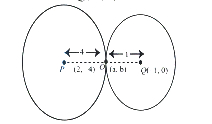
(B) The circle $x^2+y^2-4x+8y+4=0$ has center $P(2, -4)$ and radius $r_1 = \sqrt{2^2+(-4)^2-4} = \sqrt{4+16-4} = 4$.
The circle $x^2+y^2+2x=0$ has center $Q(-1, 0)$ and radius $r_2 = \sqrt{(-1)^2+0^2-0} = 1$.
Since the circles touch externally,the point of contact $O(a, b)$ divides the line segment $PQ$ internally in the ratio $r_1 : r_2 = 4 : 1$.
Using the section formula,$O(a, b) = \left( \frac{4(-1)+1(2)}{4+1}, \frac{4(0)+1(-4)}{4+1} \right)$.
$O(a, b) = \left( \frac{-4+2}{5}, \frac{0-4}{5} \right) = \left( -\frac{2}{5}, -\frac{4}{5} \right)$.
Thus,$a = -\frac{2}{5}$ and $b = -\frac{4}{5}$.
Therefore,$a+2b = -\frac{2}{5} + 2\left( -\frac{4}{5} \right) = -\frac{2}{5} - \frac{8}{5} = -\frac{10}{5} = -2$.
The circle $x^2+y^2+2x=0$ has center $Q(-1, 0)$ and radius $r_2 = \sqrt{(-1)^2+0^2-0} = 1$.
Since the circles touch externally,the point of contact $O(a, b)$ divides the line segment $PQ$ internally in the ratio $r_1 : r_2 = 4 : 1$.
Using the section formula,$O(a, b) = \left( \frac{4(-1)+1(2)}{4+1}, \frac{4(0)+1(-4)}{4+1} \right)$.
$O(a, b) = \left( \frac{-4+2}{5}, \frac{0-4}{5} \right) = \left( -\frac{2}{5}, -\frac{4}{5} \right)$.
Thus,$a = -\frac{2}{5}$ and $b = -\frac{4}{5}$.
Therefore,$a+2b = -\frac{2}{5} + 2\left( -\frac{4}{5} \right) = -\frac{2}{5} - \frac{8}{5} = -\frac{10}{5} = -2$.
0 likes
View Solution170
DifficultMCQ
Let the circle $S \equiv x^2+y^2+2gx+2fy+c=0$ cut the circles $x^2+y^2-2x+2y-2=0$ and $x^2+y^2+4x-6y+9=0$ orthogonally. If the centre of the circle $S=0$ lies on the line $2x+3y-2=0$,then $2g+f=$
A
$c$
B
$c+f$
C
$2g-c$
D
$c-f$
Solution
(D) The general equation of the circle is $S \equiv x^2+y^2+2gx+2fy+c=0$ with center $(-g, -f)$.
For two circles $x^2+y^2+2g_1x+2f_1y+c_1=0$ and $x^2+y^2+2g_2x+2f_2y+c_2=0$ to be orthogonal,the condition is $2g_1g_2+2f_1f_2=c_1+c_2$.
For the first circle $x^2+y^2-2x+2y-2=0$,we have $g_2=-1, f_2=1, c_2=-2$. Applying the condition: $2g(-1)+2f(1)=c-2 \Rightarrow -2g+2f=c-2$ (Equation $1$).
For the second circle $x^2+y^2+4x-6y+9=0$,we have $g_3=2, f_3=-3, c_3=9$. Applying the condition: $2g(2)+2f(-3)=c+9 \Rightarrow 4g-6f=c+9$ (Equation $2$).
The center $(-g, -f)$ lies on $2x+3y-2=0$,so $2(-g)+3(-f)-2=0 \Rightarrow -2g-3f=2$ (Equation $3$).
Solving the system of equations:
From $(1)$,$c = -2g+2f+2$.
Substitute into $(2)$: $4g-6f = (-2g+2f+2)+9 \Rightarrow 6g-8f = 11$.
From $(3)$,$2g = -3f-2$.
Substitute $2g$ into $6g-8f=11$: $3(-3f-2)-8f=11$ $\Rightarrow -9f-6-8f=11$ $\Rightarrow -17f=17$ $\Rightarrow f=-1$.
Then $2g = -3(-1)-2 = 1 \Rightarrow g=1/2$.
Then $c = -2(1/2)+2(-1)+2 = -1-2+2 = -1$.
We need $2g+f = 2(1/2)+(-1) = 1-1 = 0$.
Checking the options: $c-f = -1-(-1) = 0$. Thus,$2g+f = c-f$.
For two circles $x^2+y^2+2g_1x+2f_1y+c_1=0$ and $x^2+y^2+2g_2x+2f_2y+c_2=0$ to be orthogonal,the condition is $2g_1g_2+2f_1f_2=c_1+c_2$.
For the first circle $x^2+y^2-2x+2y-2=0$,we have $g_2=-1, f_2=1, c_2=-2$. Applying the condition: $2g(-1)+2f(1)=c-2 \Rightarrow -2g+2f=c-2$ (Equation $1$).
For the second circle $x^2+y^2+4x-6y+9=0$,we have $g_3=2, f_3=-3, c_3=9$. Applying the condition: $2g(2)+2f(-3)=c+9 \Rightarrow 4g-6f=c+9$ (Equation $2$).
The center $(-g, -f)$ lies on $2x+3y-2=0$,so $2(-g)+3(-f)-2=0 \Rightarrow -2g-3f=2$ (Equation $3$).
Solving the system of equations:
From $(1)$,$c = -2g+2f+2$.
Substitute into $(2)$: $4g-6f = (-2g+2f+2)+9 \Rightarrow 6g-8f = 11$.
From $(3)$,$2g = -3f-2$.
Substitute $2g$ into $6g-8f=11$: $3(-3f-2)-8f=11$ $\Rightarrow -9f-6-8f=11$ $\Rightarrow -17f=17$ $\Rightarrow f=-1$.
Then $2g = -3(-1)-2 = 1 \Rightarrow g=1/2$.
Then $c = -2(1/2)+2(-1)+2 = -1-2+2 = -1$.
We need $2g+f = 2(1/2)+(-1) = 1-1 = 0$.
Checking the options: $c-f = -1-(-1) = 0$. Thus,$2g+f = c-f$.
0 likes
View Solution171
DifficultMCQ
Let $A(1, 2)$ be the centre and $3$ be the radius of a circle $S$. Let $B(-1, -1)$ be the centre and $r$ be the radius of another circle $S^{\prime}$. If $\frac{\pi}{3}$ is the angle between the circles $S$ and $S^{\prime}$,then the number of possible values of $r$ is
A
$1$
B
$2$
C
$3$
D
$4$
Solution
(A) Let $C_1 = A(1, 2)$ and $r_1 = 3$. Let $C_2 = B(-1, -1)$ and $r_2 = r$.
The distance between the centres $d$ is given by $d^2 = (1 - (-1))^2 + (2 - (-1))^2 = 2^2 + 3^2 = 4 + 9 = 13$.
The angle $\theta$ between two circles is given by $\cos \theta = \frac{d^2 - r_1^2 - r_2^2}{2 r_1 r_2}$.
Given $\theta = \frac{\pi}{3}$,we have $\cos \frac{\pi}{3} = \frac{1}{2}$.
Substituting the values: $\frac{1}{2} = \frac{13 - 3^2 - r^2}{2 \times 3 \times r}$.
$\frac{1}{2} = \frac{13 - 9 - r^2}{6r} = \frac{4 - r^2}{6r}$.
$3r = 4 - r^2 \Rightarrow r^2 + 3r - 4 = 0$.
$(r + 4)(r - 1) = 0$.
Since $r$ is a radius,$r > 0$,so $r = 1$.
Thus,there is only $1$ possible value for $r$.
The distance between the centres $d$ is given by $d^2 = (1 - (-1))^2 + (2 - (-1))^2 = 2^2 + 3^2 = 4 + 9 = 13$.
The angle $\theta$ between two circles is given by $\cos \theta = \frac{d^2 - r_1^2 - r_2^2}{2 r_1 r_2}$.
Given $\theta = \frac{\pi}{3}$,we have $\cos \frac{\pi}{3} = \frac{1}{2}$.
Substituting the values: $\frac{1}{2} = \frac{13 - 3^2 - r^2}{2 \times 3 \times r}$.
$\frac{1}{2} = \frac{13 - 9 - r^2}{6r} = \frac{4 - r^2}{6r}$.
$3r = 4 - r^2 \Rightarrow r^2 + 3r - 4 = 0$.
$(r + 4)(r - 1) = 0$.
Since $r$ is a radius,$r > 0$,so $r = 1$.
Thus,there is only $1$ possible value for $r$.
0 likes
View Solution172
EasyMCQ
If the angle between the circles $x^2+y^2+2x-4y+1=0$ and $x^2+y^2-4x-2y+c=0$ is $\frac{\pi}{4}$,then $c=$
A
$3$
B
$-13$
C
$3$ or $-13$
D
$-31$ or $-3$
Solution
(C) For the circle $x^2+y^2+2x-4y+1=0$,we have $g_1=1, f_1=-2, c_1=1$.
For the circle $x^2+y^2-4x-2y+c=0$,we have $g_2=-2, f_2=-1, c_2=c$.
The angle $\theta$ between two circles is given by $\cos(\theta) = \frac{c_1+c_2-2(g_1g_2+f_1f_2)}{2\sqrt{g_1^2+f_1^2-c_1}\sqrt{g_2^2+f_2^2-c_2}}$.
Given $\theta = \frac{\pi}{4}$,so $\cos(\frac{\pi}{4}) = \frac{1}{\sqrt{2}}$.
Substituting the values: $\frac{1}{\sqrt{2}} = \frac{1+c-2((1)(-2)+(-2)(-1))}{2\sqrt{1^2+(-2)^2-1}\sqrt{(-2)^2+(-1)^2-c}}$.
$\frac{1}{\sqrt{2}} = \frac{1+c-2(-2+2)}{2\sqrt{4}\sqrt{5-c}} = \frac{1+c}{4\sqrt{5-c}}$.
Squaring both sides: $\frac{1}{2} = \frac{(1+c)^2}{16(5-c)}$.
$8(5-c) = (1+c)^2 \Rightarrow 40-8c = 1+2c+c^2$.
$c^2+10c-39=0$.
$(c+13)(c-3)=0$.
Thus,$c=3$ or $c=-13$.
For the circle $x^2+y^2-4x-2y+c=0$,we have $g_2=-2, f_2=-1, c_2=c$.
The angle $\theta$ between two circles is given by $\cos(\theta) = \frac{c_1+c_2-2(g_1g_2+f_1f_2)}{2\sqrt{g_1^2+f_1^2-c_1}\sqrt{g_2^2+f_2^2-c_2}}$.
Given $\theta = \frac{\pi}{4}$,so $\cos(\frac{\pi}{4}) = \frac{1}{\sqrt{2}}$.
Substituting the values: $\frac{1}{\sqrt{2}} = \frac{1+c-2((1)(-2)+(-2)(-1))}{2\sqrt{1^2+(-2)^2-1}\sqrt{(-2)^2+(-1)^2-c}}$.
$\frac{1}{\sqrt{2}} = \frac{1+c-2(-2+2)}{2\sqrt{4}\sqrt{5-c}} = \frac{1+c}{4\sqrt{5-c}}$.
Squaring both sides: $\frac{1}{2} = \frac{(1+c)^2}{16(5-c)}$.
$8(5-c) = (1+c)^2 \Rightarrow 40-8c = 1+2c+c^2$.
$c^2+10c-39=0$.
$(c+13)(c-3)=0$.
Thus,$c=3$ or $c=-13$.
0 likes
View Solution173
EasyMCQ
If the circles $x^2+y^2-4x+2fy+1=0$ and $x^2+y^2+2gx-4y-1=0$ cut orthogonally,then $r_1^2+r_2^2-8=$
A
$g^2$
B
$-f^2$
C
$2g^2$
D
$-2f^2$
Solution
(C) Given circles are $S_1: x^2+y^2-4x+2fy+1=0$ and $S_2: x^2+y^2+2gx-4y-1=0$.
Comparing with $x^2+y^2+2g_ix+2f_iy+c_i=0$,we get:
$g_1=-2, f_1=f, c_1=1$
$g_2=g, f_2=-2, c_2=-1$
Since the circles cut orthogonally,the condition is $2(g_1g_2+f_1f_2)=c_1+c_2$.
$2((-2)(g) + (f)(-2)) = 1 + (-1)$
$2(-2g-2f) = 0 \implies g+f=0 \implies f=-g$.
The radii squared are $r_1^2 = g_1^2+f_1^2-c_1 = (-2)^2+f^2-1 = 3+f^2$ and $r_2^2 = g_2^2+f_2^2-c_2 = g^2+(-2)^2-(-1) = g^2+5$.
$r_1^2+r_2^2 = 3+f^2+g^2+5 = 8+f^2+g^2$.
Since $f=-g$,$f^2=g^2$,so $r_1^2+r_2^2 = 8+2g^2$.
Therefore,$r_1^2+r_2^2-8 = 2g^2$.
Comparing with $x^2+y^2+2g_ix+2f_iy+c_i=0$,we get:
$g_1=-2, f_1=f, c_1=1$
$g_2=g, f_2=-2, c_2=-1$
Since the circles cut orthogonally,the condition is $2(g_1g_2+f_1f_2)=c_1+c_2$.
$2((-2)(g) + (f)(-2)) = 1 + (-1)$
$2(-2g-2f) = 0 \implies g+f=0 \implies f=-g$.
The radii squared are $r_1^2 = g_1^2+f_1^2-c_1 = (-2)^2+f^2-1 = 3+f^2$ and $r_2^2 = g_2^2+f_2^2-c_2 = g^2+(-2)^2-(-1) = g^2+5$.
$r_1^2+r_2^2 = 3+f^2+g^2+5 = 8+f^2+g^2$.
Since $f=-g$,$f^2=g^2$,so $r_1^2+r_2^2 = 8+2g^2$.
Therefore,$r_1^2+r_2^2-8 = 2g^2$.
0 likes
View Solution174
EasyMCQ
The equation of the circle passing through $(0,0)$ and cutting orthogonally the circles $x^2+y^2+6x-15=0$ and $x^2+y^2-8y-10=0$ is
A
$2(x^2+y^2)-10x+5y=0$
B
$2(x^2+y^2)+10x-5y=0$
C
$2(x^2-y^2)+10x+5y=0$
D
$2(x^2-y^2)-10x-5y=0$
Solution
(A) Let the equation of the circle passing through $(0,0)$ be $x^2+y^2+2gx+2fy=0$ ...$(i)$.
The given circles are $x^2+y^2+6x-15=0$ ...$(ii)$ and $x^2+y^2-8y-10=0$ ...$(iii)$.
Since circle $(i)$ cuts circle $(ii)$ orthogonally,we use the condition $2g_1g_2 + 2f_1f_2 = c_1 + c_2$:
$2(g)(3) + 2(f)(0) = 0 + (-15)$ $\Rightarrow 6g = -15$ $\Rightarrow g = -\frac{5}{2}$.
Since circle $(i)$ cuts circle $(iii)$ orthogonally:
$2(g)(0) + 2(f)(-4) = 0 + (-10)$ $\Rightarrow -8f = -10$ $\Rightarrow f = \frac{5}{4}$.
Substituting $g$ and $f$ into equation $(i)$:
$x^2+y^2+2(-\frac{5}{2})x+2(\frac{5}{4})y = 0$.
$x^2+y^2-5x+\frac{5}{2}y = 0$.
Multiplying by $2$,we get $2(x^2+y^2)-10x+5y=0$.
The given circles are $x^2+y^2+6x-15=0$ ...$(ii)$ and $x^2+y^2-8y-10=0$ ...$(iii)$.
Since circle $(i)$ cuts circle $(ii)$ orthogonally,we use the condition $2g_1g_2 + 2f_1f_2 = c_1 + c_2$:
$2(g)(3) + 2(f)(0) = 0 + (-15)$ $\Rightarrow 6g = -15$ $\Rightarrow g = -\frac{5}{2}$.
Since circle $(i)$ cuts circle $(iii)$ orthogonally:
$2(g)(0) + 2(f)(-4) = 0 + (-10)$ $\Rightarrow -8f = -10$ $\Rightarrow f = \frac{5}{4}$.
Substituting $g$ and $f$ into equation $(i)$:
$x^2+y^2+2(-\frac{5}{2})x+2(\frac{5}{4})y = 0$.
$x^2+y^2-5x+\frac{5}{2}y = 0$.
Multiplying by $2$,we get $2(x^2+y^2)-10x+5y=0$.
0 likes
View Solution175
MediumMCQ
The ratio of the areas of the greatest and the smallest circles touching $(x \pm 1)^2 + (y \pm 1)^2 = 1$ is
A
$\frac{\sqrt{3}+1}{\sqrt{3}-1}$
B
$\frac{3+\sqrt{2}}{3-\sqrt{2}}$
C
$\frac{3+2\sqrt{2}}{3-2\sqrt{2}}$
D
$4$
Solution
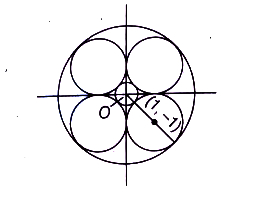
(C) The given circles are $(x-1)^2+(y-1)^2=1$,$(x+1)^2+(y-1)^2=1$,$(x-1)^2+(y+1)^2=1$,and $(x+1)^2+(y+1)^2=1$. These circles have radius $1$ and centers at $(\pm 1, \pm 1)$.
The distance of the centers from the origin $(0,0)$ is $\sqrt{1^2+1^2} = \sqrt{2}$.
The smallest circle is centered at the origin and touches these four circles. Its radius $r$ is the distance from the origin to the center of any of the given circles minus the radius of those circles: $r = \sqrt{2} - 1$.
The greatest circle is centered at the origin and encloses these four circles. Its radius $R$ is the distance from the origin to the center of any of the given circles plus the radius of those circles: $R = \sqrt{2} + 1$.
The ratio of the areas is $\frac{\pi R^2}{\pi r^2} = \frac{(\sqrt{2}+1)^2}{(\sqrt{2}-1)^2} = \frac{2+1+2\sqrt{2}}{2+1-2\sqrt{2}} = \frac{3+2\sqrt{2}}{3-2\sqrt{2}}$.
The distance of the centers from the origin $(0,0)$ is $\sqrt{1^2+1^2} = \sqrt{2}$.
The smallest circle is centered at the origin and touches these four circles. Its radius $r$ is the distance from the origin to the center of any of the given circles minus the radius of those circles: $r = \sqrt{2} - 1$.
The greatest circle is centered at the origin and encloses these four circles. Its radius $R$ is the distance from the origin to the center of any of the given circles plus the radius of those circles: $R = \sqrt{2} + 1$.
The ratio of the areas is $\frac{\pi R^2}{\pi r^2} = \frac{(\sqrt{2}+1)^2}{(\sqrt{2}-1)^2} = \frac{2+1+2\sqrt{2}}{2+1-2\sqrt{2}} = \frac{3+2\sqrt{2}}{3-2\sqrt{2}}$.
0 likes
View Solution176
MediumMCQ
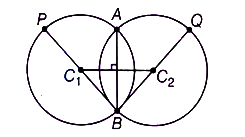
Suppose $A(2,3)$ and $B$ are the points of intersection of two circles. The points $P$ lying on one circle and $Q$ lying on the other circle are such that $BP$ and $BQ$ constitute the diameters of the circles. If the slopes of the radical axis and $PQ$ are $3/4$ and $a/b$ respectively,then the value of $3a+4b$ is
A
$1$
B
$0$
C
$2$
D
$-1$
Solution
(B) Let $C_1$ and $C_2$ be the centers of the two circles. Since $BP$ and $BQ$ are diameters,$C_1$ is the midpoint of $BP$ and $C_2$ is the midpoint of $BQ$.
In $\triangle BPQ$,$C_1$ and $C_2$ are the midpoints of sides $BP$ and $BQ$ respectively. By the midpoint theorem,$PQ \parallel C_1C_2$.
The line joining the centers $C_1C_2$ is perpendicular to the radical axis $AB$.
Therefore,$PQ$ is perpendicular to the radical axis $AB$.
If the slope of the radical axis is $m_1 = 3/4$ and the slope of $PQ$ is $m_2 = a/b$,then $m_1 \times m_2 = -1$.
$\frac{3}{4} \times \frac{a}{b} = -1$
$\frac{3a}{4b} = -1$
$3a = -4b$
$3a + 4b = 0$.
In $\triangle BPQ$,$C_1$ and $C_2$ are the midpoints of sides $BP$ and $BQ$ respectively. By the midpoint theorem,$PQ \parallel C_1C_2$.
The line joining the centers $C_1C_2$ is perpendicular to the radical axis $AB$.
Therefore,$PQ$ is perpendicular to the radical axis $AB$.
If the slope of the radical axis is $m_1 = 3/4$ and the slope of $PQ$ is $m_2 = a/b$,then $m_1 \times m_2 = -1$.
$\frac{3}{4} \times \frac{a}{b} = -1$
$\frac{3a}{4b} = -1$
$3a = -4b$
$3a + 4b = 0$.
0 likes
View Solution177
DifficultMCQ
Number of circles intersecting $x^2+y^2=4$,$x^2+y^2-2x-3=0$ and $x^2+y^2-2y-3=0$ orthogonally is
A
$0$
B
$1$
C
$2$
D
$\infty$
Solution
(A) Let the required circle be $S \equiv x^2+y^2+2gx+2fy+c=0$.
For a circle to be orthogonal to $x^2+y^2+2g_i x+2f_i y+c_i=0$,the condition is $2gg_i+2ff_i=c+c_i$.
Given circles:
$S_1: x^2+y^2-4=0 \Rightarrow g_1=0, f_1=0, c_1=-4$
$S_2: x^2+y^2-2x-3=0 \Rightarrow g_2=-1, f_2=0, c_2=-3$
$S_3: x^2+y^2-2y-3=0 \Rightarrow g_3=0, f_3=-1, c_3=-3$
Applying the condition:
$1$) For $S_1$: $2g(0)+2f(0)=c-4 \Rightarrow c=4$.
$2$) For $S_2$: $2g(-1)+2f(0)=c-3$ $\Rightarrow -2g=4-3=1$ $\Rightarrow g=-1/2$.
$3$) For $S_3$: $2g(0)+2f(-1)=c-3$ $\Rightarrow -2f=4-3=1$ $\Rightarrow f=-1/2$.
Now,check the radius $r$ of the circle $S$:
$r^2 = g^2+f^2-c = (-1/2)^2+(-1/2)^2-4 = 1/4+1/4-4 = 1/2-4 = -7/2$.
Since $r^2 < 0$,no real circle exists.
Thus,the number of such circles is $0$.
For a circle to be orthogonal to $x^2+y^2+2g_i x+2f_i y+c_i=0$,the condition is $2gg_i+2ff_i=c+c_i$.
Given circles:
$S_1: x^2+y^2-4=0 \Rightarrow g_1=0, f_1=0, c_1=-4$
$S_2: x^2+y^2-2x-3=0 \Rightarrow g_2=-1, f_2=0, c_2=-3$
$S_3: x^2+y^2-2y-3=0 \Rightarrow g_3=0, f_3=-1, c_3=-3$
Applying the condition:
$1$) For $S_1$: $2g(0)+2f(0)=c-4 \Rightarrow c=4$.
$2$) For $S_2$: $2g(-1)+2f(0)=c-3$ $\Rightarrow -2g=4-3=1$ $\Rightarrow g=-1/2$.
$3$) For $S_3$: $2g(0)+2f(-1)=c-3$ $\Rightarrow -2f=4-3=1$ $\Rightarrow f=-1/2$.
Now,check the radius $r$ of the circle $S$:
$r^2 = g^2+f^2-c = (-1/2)^2+(-1/2)^2-4 = 1/4+1/4-4 = 1/2-4 = -7/2$.
Since $r^2 < 0$,no real circle exists.
Thus,the number of such circles is $0$.
0 likes
View Solution178
MediumMCQ
The radius of the circle whose centre lies at $(1, 2)$,while cutting the circle $x^2 + y^2 + 4x + 16y - 30 = 0$ orthogonally,is (in units):
A
$\sqrt{41}$
B
$\sqrt{31}$
C
$\sqrt{21}$
D
$\sqrt{11}$
Solution
(D) The given circle equation is $x^2 + y^2 + 4x + 16y - 30 = 0$.
Comparing this with the general form $x^2 + y^2 + 2gx + 2fy + c = 0$,we get $2g = 4$,$2f = 16$,and $c = -30$.
Thus,$g = 2$,$f = 8$,and $c = -30$.
The centre of this circle is $C_1 = (-g, -f) = (-2, -8)$.
The radius of this circle is $r_1 = \sqrt{g^2 + f^2 - c} = \sqrt{2^2 + 8^2 - (-30)} = \sqrt{4 + 64 + 30} = \sqrt{98}$.
Let the other circle have centre $C_2 = (1, 2)$ and radius $r_2$.
The distance between the centres $d$ is given by $d^2 = (1 - (-2))^2 + (2 - (-8))^2 = 3^2 + 10^2 = 9 + 100 = 109$.
Since the two circles are orthogonal,they satisfy the condition $d^2 = r_1^2 + r_2^2$.
Substituting the values,$109 = 98 + r_2^2$.
$r_2^2 = 109 - 98 = 11$.
Therefore,$r_2 = \sqrt{11}$.
Comparing this with the general form $x^2 + y^2 + 2gx + 2fy + c = 0$,we get $2g = 4$,$2f = 16$,and $c = -30$.
Thus,$g = 2$,$f = 8$,and $c = -30$.
The centre of this circle is $C_1 = (-g, -f) = (-2, -8)$.
The radius of this circle is $r_1 = \sqrt{g^2 + f^2 - c} = \sqrt{2^2 + 8^2 - (-30)} = \sqrt{4 + 64 + 30} = \sqrt{98}$.
Let the other circle have centre $C_2 = (1, 2)$ and radius $r_2$.
The distance between the centres $d$ is given by $d^2 = (1 - (-2))^2 + (2 - (-8))^2 = 3^2 + 10^2 = 9 + 100 = 109$.
Since the two circles are orthogonal,they satisfy the condition $d^2 = r_1^2 + r_2^2$.
Substituting the values,$109 = 98 + r_2^2$.
$r_2^2 = 109 - 98 = 11$.
Therefore,$r_2 = \sqrt{11}$.
0 likes
View Solution179
EasyMCQ
Which circle among the following bisects the circumference of the circle $x^2+y^2-8x-6y+23=0$?
A
$x^2+y^2-6x-4y+9=0$
B
$x^2+y^2+6x+4y-9=0$
C
$x^2+y^2-6x+4y-9=0$
D
$x^2+y^2+6x-4y+9=0$
Solution
(A) Let the given circle be $S_1: x^2+y^2-8x-6y+23=0$. The center of $S_1$ is $(4, 3)$.
For a circle $S_2$ to bisect the circumference of $S_1$,the radical axis of $S_1$ and $S_2$ must pass through the center of $S_1$.
The radical axis is given by $S_1 - S_2 = 0$.
For option $A$,$S_2: x^2+y^2-6x-4y+9=0$.
The radical axis is $(x^2+y^2-8x-6y+23) - (x^2+y^2-6x-4y+9) = 0$.
This simplifies to $-2x - 2y + 14 = 0$,or $x + y - 7 = 0$.
Substituting the center $(4, 3)$ into the radical axis equation: $4 + 3 - 7 = 0$.
Since the center satisfies the equation,the circle $x^2+y^2-6x-4y+9=0$ bisects the circumference of $S_1$.
For a circle $S_2$ to bisect the circumference of $S_1$,the radical axis of $S_1$ and $S_2$ must pass through the center of $S_1$.
The radical axis is given by $S_1 - S_2 = 0$.
For option $A$,$S_2: x^2+y^2-6x-4y+9=0$.
The radical axis is $(x^2+y^2-8x-6y+23) - (x^2+y^2-6x-4y+9) = 0$.
This simplifies to $-2x - 2y + 14 = 0$,or $x + y - 7 = 0$.
Substituting the center $(4, 3)$ into the radical axis equation: $4 + 3 - 7 = 0$.
Since the center satisfies the equation,the circle $x^2+y^2-6x-4y+9=0$ bisects the circumference of $S_1$.
0 likes
View Solution180
EasyMCQ
Find the equation of a circle which cuts the circle $x^2+y^2-6x+4y-3=0$ orthogonally,while passing through $(3,0)$ and touching the $Y$-axis.
A
$x^2+y^2+6x+6y+9=0$
B
$x^2+y^2-6x-6y+9=0$
C
$x^2+y^2-6x+6y-9=0$
D
$x^2+y^2+6x-6y-9=0$
Solution
(B) Let the equation of the required circle be $(x-h)^2+(y-k)^2=r^2$. Since it touches the $Y$-axis,the radius $r = |h|$. Thus,the equation is $(x-h)^2+(y-k)^2=h^2$,which simplifies to $x^2+y^2-2hx-2ky+k^2=0$.
Since it passes through $(3,0)$,we have $(3-h)^2+(0-k)^2=h^2$,which simplifies to $9-6h+k^2=0$,or $k^2=6h-9$ ... $(i)$.
The circle $x^2+y^2-6x+4y-3=0$ has $g_2=-3, f_2=2, c_2=-3$. The required circle has $g_1=-h, f_1=-k, c_1=k^2$.
For orthogonal intersection,$2(g_1g_2+f_1f_2) = c_1+c_2$.
Substituting the values: $2((-h)(-3)+(-k)(2)) = k^2-3$,which gives $6h-4k = k^2-3$.
Substituting $k^2=6h-9$ from $(i)$ into this equation: $6h-4k = (6h-9)-3$,which simplifies to $-4k = -12$,so $k=3$.
Substituting $k=3$ into $(i)$: $9-6h+9=0$,so $6h=18$,$h=3$.
The center is $(3,3)$ and the radius is $3$.
The equation is $(x-3)^2+(y-3)^2=3^2$,which simplifies to $x^2+y^2-6x-6y+9=0$.
Since it passes through $(3,0)$,we have $(3-h)^2+(0-k)^2=h^2$,which simplifies to $9-6h+k^2=0$,or $k^2=6h-9$ ... $(i)$.
The circle $x^2+y^2-6x+4y-3=0$ has $g_2=-3, f_2=2, c_2=-3$. The required circle has $g_1=-h, f_1=-k, c_1=k^2$.
For orthogonal intersection,$2(g_1g_2+f_1f_2) = c_1+c_2$.
Substituting the values: $2((-h)(-3)+(-k)(2)) = k^2-3$,which gives $6h-4k = k^2-3$.
Substituting $k^2=6h-9$ from $(i)$ into this equation: $6h-4k = (6h-9)-3$,which simplifies to $-4k = -12$,so $k=3$.
Substituting $k=3$ into $(i)$: $9-6h+9=0$,so $6h=18$,$h=3$.
The center is $(3,3)$ and the radius is $3$.
The equation is $(x-3)^2+(y-3)^2=3^2$,which simplifies to $x^2+y^2-6x-6y+9=0$.
0 likes
View Solution181
EasyMCQ
If the circles $x^2+y^2-6x-8y-12=0$ and $x^2+y^2-4x+6y+k=0$ are orthogonal to each other,then the value of $k$ is:
A
$4$
B
$0$
C
$-2$
D
$12$
Solution
(B) The given equations of the circles are:
$C_1: x^2+y^2-6x-8y-12=0$
$C_2: x^2+y^2-4x+6y+k=0$
Comparing these with the general form $x^2+y^2+2gx+2fy+c=0$:
For $C_1$: $g_1 = -3, f_1 = -4, c_1 = -12$
For $C_2$: $g_2 = -2, f_2 = 3, c_2 = k$
Two circles are orthogonal if $2g_1g_2 + 2f_1f_2 = c_1 + c_2$.
Substituting the values:
$2(-3)(-2) + 2(-4)(3) = -12 + k$
$12 - 24 = -12 + k$
$-12 = -12 + k$
$k = 0$
$C_1: x^2+y^2-6x-8y-12=0$
$C_2: x^2+y^2-4x+6y+k=0$
Comparing these with the general form $x^2+y^2+2gx+2fy+c=0$:
For $C_1$: $g_1 = -3, f_1 = -4, c_1 = -12$
For $C_2$: $g_2 = -2, f_2 = 3, c_2 = k$
Two circles are orthogonal if $2g_1g_2 + 2f_1f_2 = c_1 + c_2$.
Substituting the values:
$2(-3)(-2) + 2(-4)(3) = -12 + k$
$12 - 24 = -12 + k$
$-12 = -12 + k$
$k = 0$
0 likes
View Solution182
EasyMCQ
The angle between circles $x^2+y^2+2x+4y+1=0$ and $x^2+y^2-2x+6y-3=0$ is
A
$\cos^{-1}\left(\frac{3}{\sqrt{13}}\right)$
B
$\cos^{-1}\left(\frac{3}{\sqrt{31}}\right)$
C
$\cos^{-1}\left(\sqrt{\frac{3}{31}}\right)$
D
$2\cos^{-1}\left(\frac{3}{\sqrt{13}}\right)$
Solution
(A) The given circles are $C_1: x^2+y^2+2x+4y+1=0$ and $C_2: x^2+y^2-2x+6y-3=0$.
Comparing with the general form $x^2+y^2+2gx+2fy+c=0$:
For $C_1$: $g_1=1, f_1=2, c_1=1$. Centre $O_1=(-1, -2)$,radius $r_1=\sqrt{1^2+2^2-1}=2$.
For $C_2$: $g_2=-1, f_2=3, c_2=-3$. Centre $O_2=(1, -3)$,radius $r_2=\sqrt{(-1)^2+3^2-(-3)}=\sqrt{1+9+3}=\sqrt{13}$.
The distance $d$ between the centres $O_1(-1, -2)$ and $O_2(1, -3)$ is $d=\sqrt{(1-(-1))^2+(-3-(-2))^2}=\sqrt{2^2+(-1)^2}=\sqrt{5}$.
The angle $\theta$ between the circles is given by $\cos \theta = \left|\frac{d^2-r_1^2-r_2^2}{2r_1r_2}\right|$.
Substituting the values: $\cos \theta = \left|\frac{5-4-13}{2 \times 2 \times \sqrt{13}}\right| = \left|\frac{-12}{4\sqrt{13}}\right| = \frac{3}{\sqrt{13}}$.
Therefore,$\theta = \cos^{-1}\left(\frac{3}{\sqrt{13}}\right)$.
Comparing with the general form $x^2+y^2+2gx+2fy+c=0$:
For $C_1$: $g_1=1, f_1=2, c_1=1$. Centre $O_1=(-1, -2)$,radius $r_1=\sqrt{1^2+2^2-1}=2$.
For $C_2$: $g_2=-1, f_2=3, c_2=-3$. Centre $O_2=(1, -3)$,radius $r_2=\sqrt{(-1)^2+3^2-(-3)}=\sqrt{1+9+3}=\sqrt{13}$.
The distance $d$ between the centres $O_1(-1, -2)$ and $O_2(1, -3)$ is $d=\sqrt{(1-(-1))^2+(-3-(-2))^2}=\sqrt{2^2+(-1)^2}=\sqrt{5}$.
The angle $\theta$ between the circles is given by $\cos \theta = \left|\frac{d^2-r_1^2-r_2^2}{2r_1r_2}\right|$.
Substituting the values: $\cos \theta = \left|\frac{5-4-13}{2 \times 2 \times \sqrt{13}}\right| = \left|\frac{-12}{4\sqrt{13}}\right| = \frac{3}{\sqrt{13}}$.
Therefore,$\theta = \cos^{-1}\left(\frac{3}{\sqrt{13}}\right)$.
0 likes
View Solution183
MediumMCQ
Find the value of $m+n$,if the circumference of the circle $x^2+y^2+8x+8y-m=0$ is bisected by the circle $x^2+y^2-2x+4y+n=0$.
A
-$56$
B
$56$
C
$50$
D
-$34$
Solution
(A) Let $S_1 \equiv x^2+y^2+8x+8y-m=0$ and $S_2 \equiv x^2+y^2-2x+4y+n=0$.
The common chord of the two circles is given by $S_1 - S_2 = 0$.
$(x^2+y^2+8x+8y-m) - (x^2+y^2-2x+4y+n) = 0$.
$10x + 4y - (m+n) = 0$.
Since the circumference of the circle $S_1$ is bisected by the circle $S_2$,the common chord must pass through the center of the circle $S_1$.
The center of $S_1$ is $(-4, -4)$.
Substituting $(-4, -4)$ into the equation of the common chord:
$10(-4) + 4(-4) = m+n$.
$-40 - 16 = m+n$.
$m+n = -56$.
The common chord of the two circles is given by $S_1 - S_2 = 0$.
$(x^2+y^2+8x+8y-m) - (x^2+y^2-2x+4y+n) = 0$.
$10x + 4y - (m+n) = 0$.
Since the circumference of the circle $S_1$ is bisected by the circle $S_2$,the common chord must pass through the center of the circle $S_1$.
The center of $S_1$ is $(-4, -4)$.
Substituting $(-4, -4)$ into the equation of the common chord:
$10(-4) + 4(-4) = m+n$.
$-40 - 16 = m+n$.
$m+n = -56$.
0 likes
View Solution184
MediumMCQ
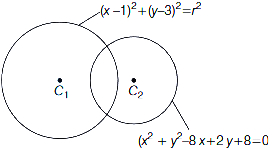
If the two circles $(x-1)^2+(y-3)^2=r^2$ and $x^2+y^2-8x+2y+8=0$ intersect in two different points,then what can we conclude about $r$?
A
$r < 2$
B
$r = 2$
C
$r > 2$
D
$2 < r < 8$
Solution
(D) For two circles to intersect at two distinct points,the distance between their centers $C_1C_2$ must satisfy the condition: $|r_1 - r_2| < C_1C_2 < r_1 + r_2$.
For the first circle $(x-1)^2+(y-3)^2=r^2$,the center $C_1 = (1, 3)$ and radius $r_1 = r$.
For the second circle $x^2+y^2-8x+2y+8=0$,the center $C_2 = (-g, -f) = (4, -1)$ and radius $r_2 = \sqrt{g^2+f^2-c} = \sqrt{(-4)^2+(1)^2-8} = \sqrt{16+1-8} = \sqrt{9} = 3$.
The distance between the centers $C_1(1, 3)$ and $C_2(4, -1)$ is $C_1C_2 = \sqrt{(4-1)^2+(-1-3)^2} = \sqrt{3^2+(-4)^2} = \sqrt{9+16} = 5$.
Substituting these values into the condition: $|r - 3| < 5 < r + 3$.
From $5 < r + 3$,we get $r > 2$.
From $|r - 3| < 5$,we get $-5 < r - 3 < 5$,which implies $-2 < r < 8$. Since $r$ must be positive,$0 < r < 8$.
Combining $r > 2$ and $0 < r < 8$,we get $2 < r < 8$.
For the first circle $(x-1)^2+(y-3)^2=r^2$,the center $C_1 = (1, 3)$ and radius $r_1 = r$.
For the second circle $x^2+y^2-8x+2y+8=0$,the center $C_2 = (-g, -f) = (4, -1)$ and radius $r_2 = \sqrt{g^2+f^2-c} = \sqrt{(-4)^2+(1)^2-8} = \sqrt{16+1-8} = \sqrt{9} = 3$.
The distance between the centers $C_1(1, 3)$ and $C_2(4, -1)$ is $C_1C_2 = \sqrt{(4-1)^2+(-1-3)^2} = \sqrt{3^2+(-4)^2} = \sqrt{9+16} = 5$.
Substituting these values into the condition: $|r - 3| < 5 < r + 3$.
From $5 < r + 3$,we get $r > 2$.
From $|r - 3| < 5$,we get $-5 < r - 3 < 5$,which implies $-2 < r < 8$. Since $r$ must be positive,$0 < r < 8$.
Combining $r > 2$ and $0 < r < 8$,we get $2 < r < 8$.
0 likes
View Solution185
MediumMCQ
Find the minimum radius of the circle which is orthogonal to both the circles $x^2+y^2+4x+3=0$ and $x^2+y^2-12x+35=0$.
A
$1$
B
$4$
C
$\sqrt{17}$
D
$\sqrt{15}$
Solution
(D) Let the required circle be $S: x^2+y^2+2gx+2fy+c=0$. Since it is orthogonal to $S_1: x^2+y^2+4x+3=0$ and $S_2: x^2+y^2-12x+35=0$,the centre $(h, k)$ of the circle must lie on the radical axis of $S_1$ and $S_2$.
Radical axis is $S_1 - S_2 = 0$,which gives $(4x+3) - (-12x+35) = 0$,so $16x - 32 = 0$,or $x = 2$.
Thus,the centre of the required circle is $(2, k)$.
Since the circle is orthogonal to $S_1$,the radius $r$ satisfies $r^2 = S_1(2, k) = 2^2 + k^2 + 4(2) + 3 = 4 + k^2 + 8 + 3 = k^2 + 15$.
The radius is minimized when $k = 0$,giving $r^2 = 15$,so $r = \sqrt{15}$.
Thus,the minimum radius is $\sqrt{15}$.
Radical axis is $S_1 - S_2 = 0$,which gives $(4x+3) - (-12x+35) = 0$,so $16x - 32 = 0$,or $x = 2$.
Thus,the centre of the required circle is $(2, k)$.
Since the circle is orthogonal to $S_1$,the radius $r$ satisfies $r^2 = S_1(2, k) = 2^2 + k^2 + 4(2) + 3 = 4 + k^2 + 8 + 3 = k^2 + 15$.
The radius is minimized when $k = 0$,giving $r^2 = 15$,so $r = \sqrt{15}$.
Thus,the minimum radius is $\sqrt{15}$.
0 likes
View Solution186
MediumMCQ
If $x^2+y^2-6x-8y+12=0$ and $x^2+y^2-4x+6y+k=0$ cut orthogonally,then $k=$
A
$-24$
B
$24$
C
$-48$
D
$-42$
Solution
(A) Two circles $x^2+y^2+2g_1x+2f_1y+c_1=0$ and $x^2+y^2+2g_2x+2f_2y+c_2=0$ cut orthogonally if $2g_1g_2+2f_1f_2=c_1+c_2$.
For the first circle $x^2+y^2-6x-8y+12=0$,we have $g_1=-3, f_1=-4, c_1=12$.
For the second circle $x^2+y^2-4x+6y+k=0$,we have $g_2=-2, f_2=3, c_2=k$.
Substituting these values into the condition:
$2(-3)(-2) + 2(-4)(3) = 12 + k$
$2(6) + 2(-12) = 12 + k$
$12 - 24 = 12 + k$
$-12 = 12 + k$
$k = -24$.
For the first circle $x^2+y^2-6x-8y+12=0$,we have $g_1=-3, f_1=-4, c_1=12$.
For the second circle $x^2+y^2-4x+6y+k=0$,we have $g_2=-2, f_2=3, c_2=k$.
Substituting these values into the condition:
$2(-3)(-2) + 2(-4)(3) = 12 + k$
$2(6) + 2(-12) = 12 + k$
$12 - 24 = 12 + k$
$-12 = 12 + k$
$k = -24$.
0 likes
View Solution187
MediumMCQ
Suppose that the circle $x^2+y^2+2gx+2fy+c=0$ has its centre on $2x+3y-7=0$ and cuts the circles $x^2+y^2-4x-6y+11=0$ and $x^2+y^2-10x-4y+21=0$ orthogonally. Then $5g-10f+3c=$
A
$0$
B
$1$
C
$3$
D
$9$
Solution
(D) The equation of the given circle is $x^2+y^2+2gx+2fy+c=0$ ...$(i)$ with centre $(-g, -f)$.
Since the centre lies on the line $2x+3y-7=0$,we have $2(-g)+3(-f)-7=0$,which implies $2g+3f+7=0$ ...(ii).
Two circles $x^2+y^2+2g_1x+2f_1y+c_1=0$ and $x^2+y^2+2g_2x+2f_2y+c_2=0$ cut orthogonally if $2g_1g_2+2f_1f_2=c_1+c_2$.
For the first circle $x^2+y^2-4x-6y+11=0$,we have $2g(-2)+2f(-3)=c+11$,which simplifies to $4g+6f+c+11=0$ ...(iii).
For the second circle $x^2+y^2-10x-4y+21=0$,we have $2g(-5)+2f(-2)=c+21$,which simplifies to $10g+4f+c+21=0$ ...(iv).
Subtracting (iii) from (iv),we get $(10g-4g)+(4f-6f)+(21-11)=0$,which is $6g-2f+10=0$,or $3g-f+5=0$ ...$(v)$.
From (ii),$2g+3f=-7$. From $(v)$,$f=3g+5$. Substituting into (ii): $2g+3(3g+5)=-7$ $\Rightarrow 11g+15=-7$ $\Rightarrow 11g=-22$ $\Rightarrow g=-2$.
Then $f=3(-2)+5=-1$. Substituting $g=-2, f=-1$ into (iii): $4(-2)+6(-1)+c+11=0$ $\Rightarrow -8-6+c+11=0$ $\Rightarrow c-3=0$ $\Rightarrow c=3$.
Finally,$5g-10f+3c = 5(-2)-10(-1)+3(3) = -10+10+9 = 9$.
Since the centre lies on the line $2x+3y-7=0$,we have $2(-g)+3(-f)-7=0$,which implies $2g+3f+7=0$ ...(ii).
Two circles $x^2+y^2+2g_1x+2f_1y+c_1=0$ and $x^2+y^2+2g_2x+2f_2y+c_2=0$ cut orthogonally if $2g_1g_2+2f_1f_2=c_1+c_2$.
For the first circle $x^2+y^2-4x-6y+11=0$,we have $2g(-2)+2f(-3)=c+11$,which simplifies to $4g+6f+c+11=0$ ...(iii).
For the second circle $x^2+y^2-10x-4y+21=0$,we have $2g(-5)+2f(-2)=c+21$,which simplifies to $10g+4f+c+21=0$ ...(iv).
Subtracting (iii) from (iv),we get $(10g-4g)+(4f-6f)+(21-11)=0$,which is $6g-2f+10=0$,or $3g-f+5=0$ ...$(v)$.
From (ii),$2g+3f=-7$. From $(v)$,$f=3g+5$. Substituting into (ii): $2g+3(3g+5)=-7$ $\Rightarrow 11g+15=-7$ $\Rightarrow 11g=-22$ $\Rightarrow g=-2$.
Then $f=3(-2)+5=-1$. Substituting $g=-2, f=-1$ into (iii): $4(-2)+6(-1)+c+11=0$ $\Rightarrow -8-6+c+11=0$ $\Rightarrow c-3=0$ $\Rightarrow c=3$.
Finally,$5g-10f+3c = 5(-2)-10(-1)+3(3) = -10+10+9 = 9$.
0 likes
View Solution188
MediumMCQ
The equation of the circle which cuts the circles $x^2+y^2+4x-7=0$,$2x^2+2y^2+3x+5y-9=0$,and $x^2+y^2+y=0$ orthogonally is
A
$x^2+y^2-4x-2y-1=0$
B
$x^2+y^2-4x-6y-3=0$
C
$x^2+y^2-4x-2y-3=0$
D
$x^2+y^2-2x-4y-1=0$
Solution
(A) Let the given circles be:
$S_1: x^2+y^2+4x-7=0$
$S_2: x^2+y^2+\frac{3}{2}x+\frac{5}{2}y-\frac{9}{2}=0$
$S_3: x^2+y^2+y=0$
The centre of the circle that cuts these circles orthogonally is the radical centre of $S_1, S_2,$ and $S_3$.
The radical axis of $S_1$ and $S_2$ is $S_1-S_2=0$:
$(4-\frac{3}{2})x - \frac{5}{2}y - 7 + \frac{9}{2} = 0$ $\Rightarrow \frac{5}{2}x - \frac{5}{2}y - \frac{5}{2} = 0$ $\Rightarrow x-y-1=0 \dots(i)$
The radical axis of $S_2$ and $S_3$ is $S_2-S_3=0$:
$\frac{3}{2}x + \frac{3}{2}y - \frac{9}{2} = 0 \Rightarrow x+y-3=0 \dots(ii)$
Solving $(i)$ and $(ii)$,we get $2x=4 \Rightarrow x=2$ and $y=1$. The radical centre is $(2,1)$.
The radius $r$ of the required circle is the length of the tangent from $(2,1)$ to $S_3$:
$r^2 = 2^2+1^2+1 = 6$.
The equation of the circle is $(x-2)^2+(y-1)^2 = 6$,which simplifies to $x^2+y^2-4x-2y-1=0$.
$S_1: x^2+y^2+4x-7=0$
$S_2: x^2+y^2+\frac{3}{2}x+\frac{5}{2}y-\frac{9}{2}=0$
$S_3: x^2+y^2+y=0$
The centre of the circle that cuts these circles orthogonally is the radical centre of $S_1, S_2,$ and $S_3$.
The radical axis of $S_1$ and $S_2$ is $S_1-S_2=0$:
$(4-\frac{3}{2})x - \frac{5}{2}y - 7 + \frac{9}{2} = 0$ $\Rightarrow \frac{5}{2}x - \frac{5}{2}y - \frac{5}{2} = 0$ $\Rightarrow x-y-1=0 \dots(i)$
The radical axis of $S_2$ and $S_3$ is $S_2-S_3=0$:
$\frac{3}{2}x + \frac{3}{2}y - \frac{9}{2} = 0 \Rightarrow x+y-3=0 \dots(ii)$
Solving $(i)$ and $(ii)$,we get $2x=4 \Rightarrow x=2$ and $y=1$. The radical centre is $(2,1)$.
The radius $r$ of the required circle is the length of the tangent from $(2,1)$ to $S_3$:
$r^2 = 2^2+1^2+1 = 6$.
The equation of the circle is $(x-2)^2+(y-1)^2 = 6$,which simplifies to $x^2+y^2-4x-2y-1=0$.
0 likes
View Solution189
EasyMCQ
If the circles $x^2+y^2+2 \lambda x+2=0$ and $x^2+y^2+4y+2=0$ touch each other,then $\lambda=$
A
$\pm 1$
B
$\pm 2$
C
$\pm 3$
D
$\pm 4$
Solution
(B) The centres of the two circles are $C_1(-\lambda, 0)$ and $C_2(0, -2)$ and their radii are $r_1 = \sqrt{\lambda^2-2}$ and $r_2 = \sqrt{2}$.
The two circles touch each other if the distance between their centres $C_1C_2$ is equal to the sum or difference of their radii: $C_1C_2 = |r_1 \pm r_2|$.
Calculating the distance $C_1C_2 = \sqrt{(-\lambda - 0)^2 + (0 - (-2))^2} = \sqrt{\lambda^2 + 4}$.
Setting $C_1C_2 = r_1 + r_2$:
$\sqrt{\lambda^2 + 4} = \sqrt{\lambda^2 - 2} + \sqrt{2}$
Squaring both sides:
$\lambda^2 + 4 = (\lambda^2 - 2) + 2 + 2\sqrt{2(\lambda^2 - 2)}$
$\lambda^2 + 4 = \lambda^2 + 2\sqrt{2(\lambda^2 - 2)}$
$4 = 2\sqrt{2(\lambda^2 - 2)}$
$2 = \sqrt{2(\lambda^2 - 2)}$
Squaring again:
$4 = 2(\lambda^2 - 2)$
$2 = \lambda^2 - 2$
$\lambda^2 = 4 \Rightarrow \lambda = \pm 2$.
The two circles touch each other if the distance between their centres $C_1C_2$ is equal to the sum or difference of their radii: $C_1C_2 = |r_1 \pm r_2|$.
Calculating the distance $C_1C_2 = \sqrt{(-\lambda - 0)^2 + (0 - (-2))^2} = \sqrt{\lambda^2 + 4}$.
Setting $C_1C_2 = r_1 + r_2$:
$\sqrt{\lambda^2 + 4} = \sqrt{\lambda^2 - 2} + \sqrt{2}$
Squaring both sides:
$\lambda^2 + 4 = (\lambda^2 - 2) + 2 + 2\sqrt{2(\lambda^2 - 2)}$
$\lambda^2 + 4 = \lambda^2 + 2\sqrt{2(\lambda^2 - 2)}$
$4 = 2\sqrt{2(\lambda^2 - 2)}$
$2 = \sqrt{2(\lambda^2 - 2)}$
Squaring again:
$4 = 2(\lambda^2 - 2)$
$2 = \lambda^2 - 2$
$\lambda^2 = 4 \Rightarrow \lambda = \pm 2$.
0 likes
View Solution190
EasyMCQ
The point of intersection of the common tangents drawn to the circles $x^2+y^2-4x-2y+1=0$ and $x^2+y^2-6x-4y+4=0$ is:
A
$\left(\frac{5}{2}, \frac{3}{2}\right)$
B
$\left(\frac{6}{5}, \frac{1}{5}\right)$
C
$(0, -1)$
D
$\left(\frac{12}{5}, \frac{7}{5}\right)$
Solution
(C) Given equations of the circles are:
$x^2+y^2-4x-2y+1=0 \quad \dots (i)$
$x^2+y^2-6x-4y+4=0 \quad \dots (ii)$
For circle $(i)$,center $C_1 = (2, 1)$ and radius $r_1 = \sqrt{2^2+1^2-1} = 2$.
For circle $(ii)$,center $C_2 = (3, 2)$ and radius $r_2 = \sqrt{3^2+2^2-4} = 3$.
The distance between centers $C_1C_2 = \sqrt{(3-2)^2+(2-1)^2} = \sqrt{1^2+1^2} = \sqrt{2}$.
Since $|r_1-r_2| < C_1C_2 < r_1+r_2$ (i.e.,$|2-3| < \sqrt{2} < 2+3$),the circles intersect at two points. The common tangents are the external tangents.
The point of intersection of external common tangents divides the line joining the centers externally in the ratio $r_1:r_2$.
Let the point be $P(x, y)$. Using the external division formula:
$x = \frac{r_1x_2 - r_2x_1}{r_1-r_2} = \frac{2(3) - 3(2)}{2-3} = \frac{6-6}{-1} = 0$
$y = \frac{r_1y_2 - r_2y_1}{r_1-r_2} = \frac{2(2) - 3(1)}{2-3} = \frac{4-3}{-1} = -1$
Thus,the point of intersection is $(0, -1)$.
$x^2+y^2-4x-2y+1=0 \quad \dots (i)$
$x^2+y^2-6x-4y+4=0 \quad \dots (ii)$
For circle $(i)$,center $C_1 = (2, 1)$ and radius $r_1 = \sqrt{2^2+1^2-1} = 2$.
For circle $(ii)$,center $C_2 = (3, 2)$ and radius $r_2 = \sqrt{3^2+2^2-4} = 3$.
The distance between centers $C_1C_2 = \sqrt{(3-2)^2+(2-1)^2} = \sqrt{1^2+1^2} = \sqrt{2}$.
Since $|r_1-r_2| < C_1C_2 < r_1+r_2$ (i.e.,$|2-3| < \sqrt{2} < 2+3$),the circles intersect at two points. The common tangents are the external tangents.
The point of intersection of external common tangents divides the line joining the centers externally in the ratio $r_1:r_2$.
Let the point be $P(x, y)$. Using the external division formula:
$x = \frac{r_1x_2 - r_2x_1}{r_1-r_2} = \frac{2(3) - 3(2)}{2-3} = \frac{6-6}{-1} = 0$
$y = \frac{r_1y_2 - r_2y_1}{r_1-r_2} = \frac{2(2) - 3(1)}{2-3} = \frac{4-3}{-1} = -1$
Thus,the point of intersection is $(0, -1)$.

0 likes
View Solution191
MediumMCQ
The circle $S=0$ cuts the circle $x^2+y^2-4x+2y-7=0$ orthogonally. If $(2,3)$ is the centre of the circle $S=0$,then its radius is
A
$2$
B
$1$
C
$3$
D
$4$
Solution
(A) Given that,the circle $S=0$ cuts the circle $x^2+y^2-4x+2y-7=0$ orthogonally and the centre of the circle $S=0$ is $(2,3)$.
Let the equation of the circle $S=0$ be $x^2+y^2+2gx+2fy+c=0$. Since the centre is $(-g, -f) = (2,3)$,we have $g=-2$ and $f=-3$.
As we know that,if two circles $x^2+y^2+2gx+2fy+c=0$ and $x^2+y^2+2g'x+2f'y+c'=0$ intersect orthogonally,then $2gg'+2ff'=c+c'$.
Here,$(g, f) = (-2, -3)$ and for the given circle $x^2+y^2-4x+2y-7=0$,$(g', f') = (-2, 1)$ and $c' = -7$.
Substituting these values into the condition:
$2(-2)(-2) + 2(-3)(1) = c + (-7)$
$8 - 6 = c - 7$
$2 = c - 7$
$c = 9$
The radius $r$ of the circle $S=0$ is given by $\sqrt{g^2+f^2-c}$.
$r = \sqrt{(-2)^2 + (-3)^2 - 9} = \sqrt{4 + 9 - 9} = \sqrt{4} = 2$.
Let the equation of the circle $S=0$ be $x^2+y^2+2gx+2fy+c=0$. Since the centre is $(-g, -f) = (2,3)$,we have $g=-2$ and $f=-3$.
As we know that,if two circles $x^2+y^2+2gx+2fy+c=0$ and $x^2+y^2+2g'x+2f'y+c'=0$ intersect orthogonally,then $2gg'+2ff'=c+c'$.
Here,$(g, f) = (-2, -3)$ and for the given circle $x^2+y^2-4x+2y-7=0$,$(g', f') = (-2, 1)$ and $c' = -7$.
Substituting these values into the condition:
$2(-2)(-2) + 2(-3)(1) = c + (-7)$
$8 - 6 = c - 7$
$2 = c - 7$
$c = 9$
The radius $r$ of the circle $S=0$ is given by $\sqrt{g^2+f^2-c}$.
$r = \sqrt{(-2)^2 + (-3)^2 - 9} = \sqrt{4 + 9 - 9} = \sqrt{4} = 2$.
0 likes
View Solution192
MediumMCQ
The equation of the circle which passes through the point $(3,2)$,bisects the circumference of the circle $x^2+y^2=15$,and cuts the circle $x^2+y^2+4x+6y+3=0$ orthogonally is
A
$x^2+y^2+6x+8y-43=0$
B
$x^2+y^2+6x-8y-15=0$
C
$x^2+y^2-6x+8y-11=0$
D
$x^2+y^2-6x-8y+21=0$
Solution
(B) Let the equation of the required circle be $x^2+y^2+2gx+2fy+c=0$ $(i)$.
Since the circle passes through $(3,2)$,we have $9+4+6g+4f+c=0$,which implies $6g+4f+c+13=0$ $(ii)$.
Since the circle bisects the circumference of $x^2+y^2=15$,the common chord is the diameter of $x^2+y^2=15$. The radical axis is $2gx+2fy+c-15=0$. Since the center $(0,0)$ lies on this line,we get $c-15=0$,so $c=15$ is incorrect; rather,the condition for bisecting the circumference is that the radical axis passes through the center $(0,0)$,so $c-15=0$ is wrong. The radical axis is $2gx+2fy+c+15=0$. Thus $c+15=0$,so $c=-15$ $(iii)$.
Since the circle cuts $x^2+y^2+4x+6y+3=0$ orthogonally,we use $2g_1g_2+2f_1f_2=c_1+c_2$. Here $g_1=g, f_1=f, c_1=c$ and $g_2=2, f_2=3, c_2=3$. So $2g(2)+2f(3)=c+3$,which gives $4g+6f=c+3$ $(iv)$.
Substituting $c=-15$ in $(iv)$,$4g+6f=-12$,so $2g+3f=-6$.
Substituting $c=-15$ in $(ii)$,$6g+4f=2$,so $3g+2f=1$.
Solving these,$g=3, f=-4$. Thus the equation is $x^2+y^2+6x-8y-15=0$.
Since the circle passes through $(3,2)$,we have $9+4+6g+4f+c=0$,which implies $6g+4f+c+13=0$ $(ii)$.
Since the circle bisects the circumference of $x^2+y^2=15$,the common chord is the diameter of $x^2+y^2=15$. The radical axis is $2gx+2fy+c-15=0$. Since the center $(0,0)$ lies on this line,we get $c-15=0$,so $c=15$ is incorrect; rather,the condition for bisecting the circumference is that the radical axis passes through the center $(0,0)$,so $c-15=0$ is wrong. The radical axis is $2gx+2fy+c+15=0$. Thus $c+15=0$,so $c=-15$ $(iii)$.
Since the circle cuts $x^2+y^2+4x+6y+3=0$ orthogonally,we use $2g_1g_2+2f_1f_2=c_1+c_2$. Here $g_1=g, f_1=f, c_1=c$ and $g_2=2, f_2=3, c_2=3$. So $2g(2)+2f(3)=c+3$,which gives $4g+6f=c+3$ $(iv)$.
Substituting $c=-15$ in $(iv)$,$4g+6f=-12$,so $2g+3f=-6$.
Substituting $c=-15$ in $(ii)$,$6g+4f=2$,so $3g+2f=1$.
Solving these,$g=3, f=-4$. Thus the equation is $x^2+y^2+6x-8y-15=0$.
0 likes
View Solution193
MediumMCQ
$x^2+y^2+2x+4y-20=0$ and $x^2+y^2+6x-8y+10=0$ are the given circles. Which one of the following is correct?
A
They intersect orthogonally and will have two common tangents. The length of their common chord is $\frac{5\sqrt{3}}{\sqrt{2}}$
B
They intersect at right angles and will have two common tangents. The length of their common chord is $2$
C
They do not intersect orthogonally and will have three common tangents. The length of their direct common tangent is $5$
D
They touch each other internally and will have only one common tangent
Solution
(A) The equations of the given circles are $x^2+y^2+2x+4y-20=0$ and $x^2+y^2+6x-8y+10=0$.
Comparing with $x^2+y^2+2g_1x+2f_1y+c_1=0$ and $x^2+y^2+2g_2x+2f_2y+c_2=0$,we get $g_1=1, f_1=2, c_1=-20$ and $g_2=3, f_2=-4, c_2=10$.
Condition for orthogonality is $2g_1g_2+2f_1f_2 = c_1+c_2$.
$2(1)(3)+2(2)(-4) = 6-16 = -10$ and $c_1+c_2 = -20+10 = -10$.
Since $2g_1g_2+2f_1f_2 = c_1+c_2$,the circles intersect orthogonally and have two common tangents.
The equation of the common chord is $(x^2+y^2+2x+4y-20) - (x^2+y^2+6x-8y+10) = 0$,which simplifies to $-4x+12y-30=0$ or $2x-6y+15=0$.
The center of the first circle is $C_1(-1, -2)$ and its radius is $r_1 = \sqrt{1^2+2^2-(-20)} = \sqrt{25} = 5$.
The length of the common chord is $2\sqrt{r_1^2-d^2}$,where $d$ is the distance from $C_1$ to the chord $2x-6y+15=0$.
$d = \frac{|2(-1)-6(-2)+15|}{\sqrt{2^2+(-6)^2}} = \frac{|-2+12+15|}{\sqrt{40}} = \frac{25}{\sqrt{40}} = \frac{25}{2\sqrt{10}}$.
Length $= 2\sqrt{25 - \frac{625}{40}} = 2\sqrt{\frac{1000-625}{40}} = 2\sqrt{\frac{375}{40}} = 2\sqrt{\frac{75}{8}} = 2 \cdot \frac{5\sqrt{3}}{2\sqrt{2}} = \frac{5\sqrt{3}}{\sqrt{2}}$.
Comparing with $x^2+y^2+2g_1x+2f_1y+c_1=0$ and $x^2+y^2+2g_2x+2f_2y+c_2=0$,we get $g_1=1, f_1=2, c_1=-20$ and $g_2=3, f_2=-4, c_2=10$.
Condition for orthogonality is $2g_1g_2+2f_1f_2 = c_1+c_2$.
$2(1)(3)+2(2)(-4) = 6-16 = -10$ and $c_1+c_2 = -20+10 = -10$.
Since $2g_1g_2+2f_1f_2 = c_1+c_2$,the circles intersect orthogonally and have two common tangents.
The equation of the common chord is $(x^2+y^2+2x+4y-20) - (x^2+y^2+6x-8y+10) = 0$,which simplifies to $-4x+12y-30=0$ or $2x-6y+15=0$.
The center of the first circle is $C_1(-1, -2)$ and its radius is $r_1 = \sqrt{1^2+2^2-(-20)} = \sqrt{25} = 5$.
The length of the common chord is $2\sqrt{r_1^2-d^2}$,where $d$ is the distance from $C_1$ to the chord $2x-6y+15=0$.
$d = \frac{|2(-1)-6(-2)+15|}{\sqrt{2^2+(-6)^2}} = \frac{|-2+12+15|}{\sqrt{40}} = \frac{25}{\sqrt{40}} = \frac{25}{2\sqrt{10}}$.
Length $= 2\sqrt{25 - \frac{625}{40}} = 2\sqrt{\frac{1000-625}{40}} = 2\sqrt{\frac{375}{40}} = 2\sqrt{\frac{75}{8}} = 2 \cdot \frac{5\sqrt{3}}{2\sqrt{2}} = \frac{5\sqrt{3}}{\sqrt{2}}$.
0 likes
View Solution194
MediumMCQ
The centre of the circle which intersects the circle $x^2+y^2-2x-2y-2=0$ orthogonally,passes through the point $(2,0)$,and touches the $X$-axis is:
A
$(4,1)$
B
$(-1,2)$
C
$(1,4)$
D
$(2,-1)$
Solution
(D) Let the equation of the circle be $x^2+y^2+2gx+2fy+c=0$. $(i)$
Since the circle touches the $X$-axis,the radius is equal to the absolute value of the $y$-coordinate of the centre,so $r^2 = f^2$. Thus,$g^2+f^2-c = f^2$,which implies $c = g^2$. $(ii)$
The circle passes through $(2,0)$,so $4+0+4g+0+c=0$,which gives $c = -4g-4$. $(iii)$
Equating $(ii)$ and $(iii)$,we get $g^2 = -4g-4$,so $g^2+4g+4=0$,which means $(g+2)^2=0$,so $g=-2$. Substituting $g=-2$ into $(ii)$,we get $c=(-2)^2=4$.
The circle $x^2+y^2-2x-2y-2=0$ has $g_1=-1, f_1=-1, c_1=-2$. The condition for orthogonality is $2g_1g_2+2f_1f_2 = c_1+c_2$.
Substituting the values: $2(-1)(-2) + 2(-1)(f) = -2 + 4$,which simplifies to $4 - 2f = 2$,so $2f = 2$,which gives $f=1$.
The centre of the circle is $(-g, -f) = (-(-2), -1) = (2, -1)$.
Since the circle touches the $X$-axis,the radius is equal to the absolute value of the $y$-coordinate of the centre,so $r^2 = f^2$. Thus,$g^2+f^2-c = f^2$,which implies $c = g^2$. $(ii)$
The circle passes through $(2,0)$,so $4+0+4g+0+c=0$,which gives $c = -4g-4$. $(iii)$
Equating $(ii)$ and $(iii)$,we get $g^2 = -4g-4$,so $g^2+4g+4=0$,which means $(g+2)^2=0$,so $g=-2$. Substituting $g=-2$ into $(ii)$,we get $c=(-2)^2=4$.
The circle $x^2+y^2-2x-2y-2=0$ has $g_1=-1, f_1=-1, c_1=-2$. The condition for orthogonality is $2g_1g_2+2f_1f_2 = c_1+c_2$.
Substituting the values: $2(-1)(-2) + 2(-1)(f) = -2 + 4$,which simplifies to $4 - 2f = 2$,so $2f = 2$,which gives $f=1$.
The centre of the circle is $(-g, -f) = (-(-2), -1) = (2, -1)$.
0 likes
View Solution195
EasyMCQ
If the angle between the circles $x^2+y^2-4x-6y-3=0$ and $x^2+y^2+8x-4y+\lambda=0$ is $60^{\circ}$,then a value of $\lambda$ is
A
$-11$
B
$29$
C
$18$
D
$-29$
Solution
(D) The given circles are $S_1: x^2+y^2-4x-6y-3=0$ and $S_2: x^2+y^2+8x-4y+\lambda=0$.
Comparing with $x^2+y^2+2g_1x+2f_1y+c_1=0$ and $x^2+y^2+2g_2x+2f_2y+c_2=0$,we get:
$g_1=-2, f_1=-3, c_1=-3$ and $g_2=4, f_2=-2, c_2=\lambda$.
The centers are $C_1(2, 3)$ and $C_2(-4, 2)$.
The radii are $r_1 = \sqrt{g_1^2+f_1^2-c_1} = \sqrt{4+9+3} = 4$ and $r_2 = \sqrt{g_2^2+f_2^2-c_2} = \sqrt{16+4-\lambda} = \sqrt{20-\lambda}$.
The distance between centers $d = \sqrt{(2-(-4))^2 + (3-2)^2} = \sqrt{6^2+1^2} = \sqrt{37}$.
The angle $\theta = 60^{\circ}$ between the circles is given by $\cos \theta = \frac{d^2-r_1^2-r_2^2}{2r_1r_2}$.
$\cos 60^{\circ} = \frac{37-16-(20-\lambda)}{2(4)(\sqrt{20-\lambda})} = \frac{1}{2}$.
$\frac{1+\lambda}{8\sqrt{20-\lambda}} = \frac{1}{2} \implies 1+\lambda = 4\sqrt{20-\lambda}$.
Squaring both sides: $(1+\lambda)^2 = 16(20-\lambda) \implies \lambda^2+2\lambda+1 = 320-16\lambda$.
$\lambda^2+18\lambda-319=0$.
Solving the quadratic equation: $\lambda = \frac{-18 \pm \sqrt{324 - 4(1)(-319)}}{2} = \frac{-18 \pm \sqrt{324+1276}}{2} = \frac{-18 \pm \sqrt{1600}}{2} = \frac{-18 \pm 40}{2}$.
Taking the positive root,$\lambda = \frac{22}{2} = 11$ (not in options).
Taking the negative root,$\lambda = \frac{-58}{2} = -29$.
Thus,the correct value is $-29$.
Comparing with $x^2+y^2+2g_1x+2f_1y+c_1=0$ and $x^2+y^2+2g_2x+2f_2y+c_2=0$,we get:
$g_1=-2, f_1=-3, c_1=-3$ and $g_2=4, f_2=-2, c_2=\lambda$.
The centers are $C_1(2, 3)$ and $C_2(-4, 2)$.
The radii are $r_1 = \sqrt{g_1^2+f_1^2-c_1} = \sqrt{4+9+3} = 4$ and $r_2 = \sqrt{g_2^2+f_2^2-c_2} = \sqrt{16+4-\lambda} = \sqrt{20-\lambda}$.
The distance between centers $d = \sqrt{(2-(-4))^2 + (3-2)^2} = \sqrt{6^2+1^2} = \sqrt{37}$.
The angle $\theta = 60^{\circ}$ between the circles is given by $\cos \theta = \frac{d^2-r_1^2-r_2^2}{2r_1r_2}$.
$\cos 60^{\circ} = \frac{37-16-(20-\lambda)}{2(4)(\sqrt{20-\lambda})} = \frac{1}{2}$.
$\frac{1+\lambda}{8\sqrt{20-\lambda}} = \frac{1}{2} \implies 1+\lambda = 4\sqrt{20-\lambda}$.
Squaring both sides: $(1+\lambda)^2 = 16(20-\lambda) \implies \lambda^2+2\lambda+1 = 320-16\lambda$.
$\lambda^2+18\lambda-319=0$.
Solving the quadratic equation: $\lambda = \frac{-18 \pm \sqrt{324 - 4(1)(-319)}}{2} = \frac{-18 \pm \sqrt{324+1276}}{2} = \frac{-18 \pm \sqrt{1600}}{2} = \frac{-18 \pm 40}{2}$.
Taking the positive root,$\lambda = \frac{22}{2} = 11$ (not in options).
Taking the negative root,$\lambda = \frac{-58}{2} = -29$.
Thus,the correct value is $-29$.
0 likes
View Solution196
EasyMCQ
If the circles $x^2+y^2+kx+4y+2=0$ and $2(x^2+y^2)-4x-3y+k=0$ cut orthogonally,then $k=$
A
$\frac{-10}{3}$
B
$\frac{10}{3}$
C
$\frac{5}{3}$
D
$\frac{-5}{3}$
Solution
(A) The given equations of the circles are:
$S_1: x^2+y^2+kx+4y+2=0$
$S_2: x^2+y^2-2x-\frac{3}{2}y+\frac{k}{2}=0$
For two circles $x^2+y^2+2g_1x+2f_1y+c_1=0$ and $x^2+y^2+2g_2x+2f_2y+c_2=0$ to cut orthogonally,the condition is $2g_1g_2+2f_1f_2=c_1+c_2$.
Here,$g_1 = \frac{k}{2}, f_1 = 2, c_1 = 2$ and $g_2 = -1, f_2 = -\frac{3}{4}, c_2 = \frac{k}{2}$.
Substituting these values into the condition:
$2(\frac{k}{2})(-1) + 2(2)(-\frac{3}{4}) = 2 + \frac{k}{2}$
$-k - 3 = 2 + \frac{k}{2}$
$-5 = k + \frac{k}{2}$
$-5 = \frac{3k}{2}$
$k = -\frac{10}{3}$.
$S_1: x^2+y^2+kx+4y+2=0$
$S_2: x^2+y^2-2x-\frac{3}{2}y+\frac{k}{2}=0$
For two circles $x^2+y^2+2g_1x+2f_1y+c_1=0$ and $x^2+y^2+2g_2x+2f_2y+c_2=0$ to cut orthogonally,the condition is $2g_1g_2+2f_1f_2=c_1+c_2$.
Here,$g_1 = \frac{k}{2}, f_1 = 2, c_1 = 2$ and $g_2 = -1, f_2 = -\frac{3}{4}, c_2 = \frac{k}{2}$.
Substituting these values into the condition:
$2(\frac{k}{2})(-1) + 2(2)(-\frac{3}{4}) = 2 + \frac{k}{2}$
$-k - 3 = 2 + \frac{k}{2}$
$-5 = k + \frac{k}{2}$
$-5 = \frac{3k}{2}$
$k = -\frac{10}{3}$.
0 likes
View Solution197
MediumMCQ
The equation of the circle passing through the points of intersection of the circles $x^2+y^2-2px=0$ and $x^2+y^2-2qy=0$ and having its centre on the line $\frac{x}{p}-\frac{y}{q}=2$ is:
A
$x^2+y^2-3px+qy=0$
B
$x^2+y^2+px-qy=0$
C
$x^2+y^2-3px-qy=0$
D
$x^2+y^2-4px+2qy=0$
Solution
(A) The equation of the family of circles passing through the intersection of $S_1: x^2+y^2-2px=0$ and $S_2: x^2+y^2-2qy=0$ is given by $S_1 + \lambda S_2 = 0$.
$(x^2+y^2-2px) + \lambda(x^2+y^2-2qy) = 0$
$(1+\lambda)x^2 + (1+\lambda)y^2 - 2px - 2\lambda qy = 0$
Dividing by $(1+\lambda)$,we get $x^2+y^2 - \frac{2p}{1+\lambda}x - \frac{2\lambda q}{1+\lambda}y = 0$.
The centre of this circle is $(\frac{p}{1+\lambda}, \frac{\lambda q}{1+\lambda})$.
Since the centre lies on $\frac{x}{p} - \frac{y}{q} = 2$,we substitute the coordinates:
$\frac{1}{p} \cdot \frac{p}{1+\lambda} - \frac{1}{q} \cdot \frac{\lambda q}{1+\lambda} = 2$
$\frac{1}{1+\lambda} - \frac{\lambda}{1+\lambda} = 2$
$\frac{1-\lambda}{1+\lambda} = 2 \implies 1-\lambda = 2+2\lambda \implies -3\lambda = 1 \implies \lambda = -\frac{1}{3}$.
Substituting $\lambda = -\frac{1}{3}$ into the family equation:
$(x^2+y^2-2px) - \frac{1}{3}(x^2+y^2-2qy) = 0$
$3x^2+3y^2-6px - x^2 - y^2 + 2qy = 0$
$2x^2+2y^2-6px+2qy = 0$
$x^2+y^2-3px+qy = 0$.
$(x^2+y^2-2px) + \lambda(x^2+y^2-2qy) = 0$
$(1+\lambda)x^2 + (1+\lambda)y^2 - 2px - 2\lambda qy = 0$
Dividing by $(1+\lambda)$,we get $x^2+y^2 - \frac{2p}{1+\lambda}x - \frac{2\lambda q}{1+\lambda}y = 0$.
The centre of this circle is $(\frac{p}{1+\lambda}, \frac{\lambda q}{1+\lambda})$.
Since the centre lies on $\frac{x}{p} - \frac{y}{q} = 2$,we substitute the coordinates:
$\frac{1}{p} \cdot \frac{p}{1+\lambda} - \frac{1}{q} \cdot \frac{\lambda q}{1+\lambda} = 2$
$\frac{1}{1+\lambda} - \frac{\lambda}{1+\lambda} = 2$
$\frac{1-\lambda}{1+\lambda} = 2 \implies 1-\lambda = 2+2\lambda \implies -3\lambda = 1 \implies \lambda = -\frac{1}{3}$.
Substituting $\lambda = -\frac{1}{3}$ into the family equation:
$(x^2+y^2-2px) - \frac{1}{3}(x^2+y^2-2qy) = 0$
$3x^2+3y^2-6px - x^2 - y^2 + 2qy = 0$
$2x^2+2y^2-6px+2qy = 0$
$x^2+y^2-3px+qy = 0$.
0 likes
View Solution198
MediumMCQ
$A$ circle $S$ cuts three circles $x^2+y^2-4x-2y+4=0$,$x^2+y^2-2x-4y+1=0$,and $x^2+y^2+4x+2y+1=0$ orthogonally. Then,the radius of $S$ is
A
$\sqrt{\frac{29}{8}}$
B
$\sqrt{\frac{28}{11}}$
C
$\sqrt{\frac{29}{7}}$
D
$\sqrt{\frac{29}{5}}$
Solution
(A) Let the circle $S$ be $x^2+y^2+2gx+2fy+c=0$.
Since $S$ cuts the given circles orthogonally,we use the condition $2g_1g_2 + 2f_1f_2 = c_1 + c_2$.
For $x^2+y^2-4x-2y+4=0$: $2g(-2) + 2f(-1) = c+4 \Rightarrow -4g-2f = c+4$ $(i)$.
For $x^2+y^2-2x-4y+1=0$: $2g(-1) + 2f(-2) = c+1 \Rightarrow -2g-4f = c+1$ $(ii)$.
For $x^2+y^2+4x+2y+1=0$: $2g(2) + 2f(1) = c+1 \Rightarrow 4g+2f = c+1$ $(iii)$.
Adding $(i)$ and $(iii)$,we get $0 = 2c+5$,so $c = -\frac{5}{2}$.
Substituting $c$ into $(iii)$: $4g+2f = -\frac{5}{2}+1 = -\frac{3}{2} \Rightarrow 8g+4f = -3$ $(iv)$.
Substituting $c$ into $(ii)$: $-2g-4f = -\frac{5}{2}+1 = -\frac{3}{2} \Rightarrow 4g+8f = 3$ $(v)$.
Adding $(iv)$ and $(v)$: $12g+12f = 0 \Rightarrow g = -f$.
Substituting $g = -f$ into $(iv)$: $-8f+4f = -3$ $\Rightarrow -4f = -3$ $\Rightarrow f = \frac{3}{4}, g = -\frac{3}{4}$.
The radius $r = \sqrt{g^2+f^2-c} = \sqrt{(-\frac{3}{4})^2 + (\frac{3}{4})^2 - (-\frac{5}{2})} = \sqrt{\frac{9}{16} + \frac{9}{16} + \frac{40}{16}} = \sqrt{\frac{58}{16}} = \sqrt{\frac{29}{8}}$.
Since $S$ cuts the given circles orthogonally,we use the condition $2g_1g_2 + 2f_1f_2 = c_1 + c_2$.
For $x^2+y^2-4x-2y+4=0$: $2g(-2) + 2f(-1) = c+4 \Rightarrow -4g-2f = c+4$ $(i)$.
For $x^2+y^2-2x-4y+1=0$: $2g(-1) + 2f(-2) = c+1 \Rightarrow -2g-4f = c+1$ $(ii)$.
For $x^2+y^2+4x+2y+1=0$: $2g(2) + 2f(1) = c+1 \Rightarrow 4g+2f = c+1$ $(iii)$.
Adding $(i)$ and $(iii)$,we get $0 = 2c+5$,so $c = -\frac{5}{2}$.
Substituting $c$ into $(iii)$: $4g+2f = -\frac{5}{2}+1 = -\frac{3}{2} \Rightarrow 8g+4f = -3$ $(iv)$.
Substituting $c$ into $(ii)$: $-2g-4f = -\frac{5}{2}+1 = -\frac{3}{2} \Rightarrow 4g+8f = 3$ $(v)$.
Adding $(iv)$ and $(v)$: $12g+12f = 0 \Rightarrow g = -f$.
Substituting $g = -f$ into $(iv)$: $-8f+4f = -3$ $\Rightarrow -4f = -3$ $\Rightarrow f = \frac{3}{4}, g = -\frac{3}{4}$.
The radius $r = \sqrt{g^2+f^2-c} = \sqrt{(-\frac{3}{4})^2 + (\frac{3}{4})^2 - (-\frac{5}{2})} = \sqrt{\frac{9}{16} + \frac{9}{16} + \frac{40}{16}} = \sqrt{\frac{58}{16}} = \sqrt{\frac{29}{8}}$.
0 likes
View Solution199
MediumMCQ
The slope of one of the direct common tangents drawn to the circles $x^2+y^2-2x+4y+1=0$ and $x^2+y^2-4x-2y+4=0$ is
A
$0$
B
$\frac{4}{3}$
C
$\frac{3}{4}$
D
$1$
Solution
(B) Given circles are $C_1: x^2+y^2-2x+4y+1=0$ and $C_2: x^2+y^2-4x-2y+4=0$.
Centers are $C_1(1, -2)$ and $C_2(2, 1)$.
Radii are $r_1 = \sqrt{1^2+(-2)^2-1} = 2$ and $r_2 = \sqrt{2^2+1^2-4} = 1$.
Let the common tangent be $y-mx-c=0$.
The distance from center to the tangent equals the radius:
$\frac{|-2-m(1)-c|}{\sqrt{1+m^2}} = 2$ and $\frac{|1-m(2)-c|}{\sqrt{1+m^2}} = 1$.
For direct common tangents,the centers lie on the same side,so $\frac{-2-m-c}{\sqrt{1+m^2}} = 2$ and $\frac{1-2m-c}{\sqrt{1+m^2}} = 1$.
Subtracting the equations: $\frac{-3+m}{\sqrt{1+m^2}} = 1$.
Squaring both sides: $m^2-6m+9 = 1+m^2$,which gives $6m = 8$,so $m = \frac{4}{3}$.
Centers are $C_1(1, -2)$ and $C_2(2, 1)$.
Radii are $r_1 = \sqrt{1^2+(-2)^2-1} = 2$ and $r_2 = \sqrt{2^2+1^2-4} = 1$.
Let the common tangent be $y-mx-c=0$.
The distance from center to the tangent equals the radius:
$\frac{|-2-m(1)-c|}{\sqrt{1+m^2}} = 2$ and $\frac{|1-m(2)-c|}{\sqrt{1+m^2}} = 1$.
For direct common tangents,the centers lie on the same side,so $\frac{-2-m-c}{\sqrt{1+m^2}} = 2$ and $\frac{1-2m-c}{\sqrt{1+m^2}} = 1$.
Subtracting the equations: $\frac{-3+m}{\sqrt{1+m^2}} = 1$.
Squaring both sides: $m^2-6m+9 = 1+m^2$,which gives $6m = 8$,so $m = \frac{4}{3}$.
0 likes
View Solution10-1.Circle and System of Circles — System of circles · Frequently Asked Questions
1Are these 10-1.Circle and System of Circles questions useful for JEE and NEET?
Yes. All questions in this section are mapped to JEE Main and NEET exam patterns. Previous year questions from JEE Main, NEET, GUJCET and state-level exams are included with full solutions.
2Can I switch to Hindi or Gujarati for these questions?
Yes. Use the language tabs in the hero section or the sidebar to view the same questions and solutions in English, Hindi or Gujarati.
3How do I generate a question paper from this subtopic?
Use the Vedclass Exam Paper Generator — select the chapter and subtopic, set difficulty, and generate Sets A, B, C, D automatically. First 3 chapters of every subject are free.
Vedclass Products
For Students
Vedclass Test Series
Mock tests in real JEE/NEET style with performance analysis. 5-day free trial.
Start Free TrialFor Teachers
Exam Paper Generator
Generate Set A/B/C/D papers from this chapter in 2 minutes. 3 chapters free.
Try FreeFor Institutes
Online Exam Module
Live online exams with unlimited students, 360° analytics & white-label branding.
See DemoFor Teachers & Institutes
Generate a 10-1.Circle and System of Circles Exam Paper in 2 Minutes
Select subtopic & difficulty — Sets A, B, C, D auto-generated with No Repeat logic.
First 3 chapters of every subject are free — no payment required.