
A English
Pole and Polar Questions in English
Class 11 Mathematics · 10-1.Circle and System of Circles · Pole and Polar
65+
Questions
English
Language
100%
With Solutions
Showing 10 of 65 questions in English
51
EasyMCQ
If the poles of the line $x-y=0$ with respect to the circles $x^2+y^2-2g_ix+c_i^2=0$ $(i=1, 2, 3)$ are $(\alpha_i, \beta_i)$,then $\sum_{i=1}^3 \frac{\alpha_i+\beta_i}{g_i}=$
A
$3$
B
$6$
C
$\frac{3}{2}$
D
$\frac{3}{4}$
Solution
(A) The equation of the polar of a point $(\alpha_i, \beta_i)$ with respect to the circle $x^2+y^2-2g_ix+c_i^2=0$ is given by $\alpha_ix + \beta_iy - g_i(x+\alpha_i) + c_i^2 = 0$.
Rearranging the terms,we get $(\alpha_i - g_i)x + \beta_iy + (c_i^2 - \alpha_ig_i) = 0$.
Comparing this with the given line $x - y = 0$,we have the ratios of coefficients equal:
$\frac{\alpha_i - g_i}{1} = \frac{\beta_i}{-1} = \frac{c_i^2 - \alpha_ig_i}{0}$.
From the third part,we get $c_i^2 - \alpha_ig_i = 0$,which implies $c_i^2 = \alpha_ig_i$.
From the first two parts,$\alpha_i - g_i = -\beta_i$,which implies $\alpha_i + \beta_i = g_i$.
Therefore,$\frac{\alpha_i + \beta_i}{g_i} = \frac{g_i}{g_i} = 1$.
Summing this for $i=1, 2, 3$,we get $\sum_{i=1}^3 \frac{\alpha_i + \beta_i}{g_i} = 1 + 1 + 1 = 3$.
Rearranging the terms,we get $(\alpha_i - g_i)x + \beta_iy + (c_i^2 - \alpha_ig_i) = 0$.
Comparing this with the given line $x - y = 0$,we have the ratios of coefficients equal:
$\frac{\alpha_i - g_i}{1} = \frac{\beta_i}{-1} = \frac{c_i^2 - \alpha_ig_i}{0}$.
From the third part,we get $c_i^2 - \alpha_ig_i = 0$,which implies $c_i^2 = \alpha_ig_i$.
From the first two parts,$\alpha_i - g_i = -\beta_i$,which implies $\alpha_i + \beta_i = g_i$.
Therefore,$\frac{\alpha_i + \beta_i}{g_i} = \frac{g_i}{g_i} = 1$.
Summing this for $i=1, 2, 3$,we get $\sum_{i=1}^3 \frac{\alpha_i + \beta_i}{g_i} = 1 + 1 + 1 = 3$.
0 likes
View Solution52
EasyMCQ
For all real values of $k$,the point which lies on the polar of $(k, k+1)$ with respect to the circle $x^2+y^2+4x-8y-5=0$ is
A
$(3, -1)$
B
$(3, 1)$
C
$(2, -2)$
D
$(2, 3)$
Solution
(A) The equation of the polar of a point $(x_1, y_1)$ with respect to the circle $x^2+y^2+2gx+2fy+c=0$ is given by $T=0$,which is $xx_1+yy_1+g(x+x_1)+f(y+y_1)+c=0$.
Given the circle $x^2+y^2+4x-8y-5=0$,we have $g=2, f=-4, c=-5$.
The polar of $(k, k+1)$ is:
$kx + (k+1)y + 2(x+k) - 4(y+k+1) - 5 = 0$
$kx + ky + y + 2x + 2k - 4y - 4k - 4 - 5 = 0$
$(k+2)x + (k-3)y - 2k - 9 = 0$
Rearranging the terms to isolate $k$:
$k(x+y-2) + (2x-3y-9) = 0$
For this to be true for all real values of $k$,both coefficients must be zero:
$x+y-2 = 0$ and $2x-3y-9 = 0$.
Solving these equations:
From the first,$y = 2-x$.
Substituting into the second: $2x - 3(2-x) - 9 = 0 \Rightarrow 2x - 6 + 3x - 9 = 0 \Rightarrow 5x = 15 \Rightarrow x = 3$.
Then $y = 2-3 = -1$.
The point is $(3, -1)$.
Given the circle $x^2+y^2+4x-8y-5=0$,we have $g=2, f=-4, c=-5$.
The polar of $(k, k+1)$ is:
$kx + (k+1)y + 2(x+k) - 4(y+k+1) - 5 = 0$
$kx + ky + y + 2x + 2k - 4y - 4k - 4 - 5 = 0$
$(k+2)x + (k-3)y - 2k - 9 = 0$
Rearranging the terms to isolate $k$:
$k(x+y-2) + (2x-3y-9) = 0$
For this to be true for all real values of $k$,both coefficients must be zero:
$x+y-2 = 0$ and $2x-3y-9 = 0$.
Solving these equations:
From the first,$y = 2-x$.
Substituting into the second: $2x - 3(2-x) - 9 = 0 \Rightarrow 2x - 6 + 3x - 9 = 0 \Rightarrow 5x = 15 \Rightarrow x = 3$.
Then $y = 2-3 = -1$.
The point is $(3, -1)$.
0 likes
View Solution53
EasyMCQ
For all real values of $k$,the polar of the point $(2k, k-4)$ with respect to the circle $x^2+y^2-4x-6y+1=0$ passes through the point:
A
$(1, 1)$
B
$(1, -1)$
C
$(-3, 1)$
D
$(3, 1)$
Solution
(D) The equation of the polar of a point $(x_1, y_1)$ with respect to the circle $x^2+y^2+2gx+2fy+c=0$ is given by $xx_1 + yy_1 + g(x+x_1) + f(y+y_1) + c = 0$.
Given the circle $x^2+y^2-4x-6y+1=0$,we have $g=-2, f=-3, c=1$.
For the point $(2k, k-4)$,the polar equation is:
$x(2k) + y(k-4) - 2(x+2k) - 3(y+k-4) + 1 = 0$
$2kx + ky - 4y - 2x - 4k - 3y - 3k + 12 + 1 = 0$
$k(2x + y - 7) - 2x - 7y + 13 = 0$
For this line to pass through a fixed point regardless of $k$,the coefficients of $k$ and the constant term must both be zero:
$2x + y - 7 = 0$
$-2x - 7y + 13 = 0$
Adding these equations: $-6y + 6 = 0 \Rightarrow y = 1$.
Substituting $y=1$ into $2x + y - 7 = 0$: $2x + 1 - 7 = 0$ $\Rightarrow 2x = 6$ $\Rightarrow x = 3$.
Thus,the polar always passes through the point $(3, 1)$.
Given the circle $x^2+y^2-4x-6y+1=0$,we have $g=-2, f=-3, c=1$.
For the point $(2k, k-4)$,the polar equation is:
$x(2k) + y(k-4) - 2(x+2k) - 3(y+k-4) + 1 = 0$
$2kx + ky - 4y - 2x - 4k - 3y - 3k + 12 + 1 = 0$
$k(2x + y - 7) - 2x - 7y + 13 = 0$
For this line to pass through a fixed point regardless of $k$,the coefficients of $k$ and the constant term must both be zero:
$2x + y - 7 = 0$
$-2x - 7y + 13 = 0$
Adding these equations: $-6y + 6 = 0 \Rightarrow y = 1$.
Substituting $y=1$ into $2x + y - 7 = 0$: $2x + 1 - 7 = 0$ $\Rightarrow 2x = 6$ $\Rightarrow x = 3$.
Thus,the polar always passes through the point $(3, 1)$.
0 likes
View Solution54
DifficultMCQ
The condition for the lines $lx + my + n = 0$ and $l_1x + m_1y + n_1 = 0$ to be conjugate with respect to the circle $x^2 + y^2 = r^2$ is:
A
$r^2(ll_1 + mm_1) = nn_1$
B
$r^2(ll_1 - mm_1) = nn_1$
C
$r^2(ll_1 + mm_1) + nn_1 = 0$
D
$r^2(lm_1 + l_1m) = nn_1$
Solution
(A) Two lines $lx + my + n = 0$ and $l_1x + m_1y + n_1 = 0$ are conjugate with respect to the circle $x^2 + y^2 = r^2$ if the pole of the first line lies on the second line.
The pole of the line $lx + my + n = 0$ with respect to the circle $x^2 + y^2 = r^2$ is given by $(x_1, y_1) = (-\frac{lr^2}{n}, -\frac{mr^2}{n})$.
Since this point lies on the line $l_1x + m_1y + n_1 = 0$,we have:
$l_1(-\frac{lr^2}{n}) + m_1(-\frac{mr^2}{n}) + n_1 = 0$
$-l_1lr^2 - m_1mr^2 + n_1n = 0$
$nn_1 = r^2(ll_1 + mm_1)$.
The pole of the line $lx + my + n = 0$ with respect to the circle $x^2 + y^2 = r^2$ is given by $(x_1, y_1) = (-\frac{lr^2}{n}, -\frac{mr^2}{n})$.
Since this point lies on the line $l_1x + m_1y + n_1 = 0$,we have:
$l_1(-\frac{lr^2}{n}) + m_1(-\frac{mr^2}{n}) + n_1 = 0$
$-l_1lr^2 - m_1mr^2 + n_1n = 0$
$nn_1 = r^2(ll_1 + mm_1)$.
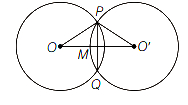
0 likes
View Solution55
DifficultMCQ
The inverse of the point $(1, 2)$ with respect to the circle $x^2 + y^2 - 4x - 6y + 9 = 0$ is
A
$(1, 1/2)$
B
$(2, 1)$
C
$(0, 1)$
D
$(1, 0)$
Solution
(C) The equation of the polar of the point $(x_1, y_1) = (1, 2)$ with respect to the circle $x^2 + y^2 - 4x - 6y + 9 = 0$ is given by $xx_1 + yy_1 - 2(x + x_1) - 3(y + y_1) + 9 = 0$.
Substituting $(1, 2)$:
$x(1) + y(2) - 2(x + 1) - 3(y + 2) + 9 = 0$
$x + 2y - 2x - 2 - 3y - 6 + 9 = 0$
$-x - y + 1 = 0 \Rightarrow x + y - 1 = 0$.
The inverse of a point $(x_1, y_1)$ is the foot of the perpendicular from the center of the circle to the polar line,but more generally,it is the point $P'$ on the line joining the center $C$ to $P$ such that $CP \cdot CP' = r^2$.
Alternatively,the inverse point $(\alpha, \beta)$ is the foot of the perpendicular from the point $(1, 2)$ to the polar line $x + y - 1 = 0$.
Using the formula $\frac{\alpha - 1}{1} = \frac{\beta - 2}{1} = -\frac{(1 + 2 - 1)}{1^2 + 1^2} = -\frac{2}{2} = -1$.
$\alpha - 1 = -1 \Rightarrow \alpha = 0$.
$\beta - 2 = -1 \Rightarrow \beta = 1$.
Thus,the inverse point is $(0, 1)$.
Substituting $(1, 2)$:
$x(1) + y(2) - 2(x + 1) - 3(y + 2) + 9 = 0$
$x + 2y - 2x - 2 - 3y - 6 + 9 = 0$
$-x - y + 1 = 0 \Rightarrow x + y - 1 = 0$.
The inverse of a point $(x_1, y_1)$ is the foot of the perpendicular from the center of the circle to the polar line,but more generally,it is the point $P'$ on the line joining the center $C$ to $P$ such that $CP \cdot CP' = r^2$.
Alternatively,the inverse point $(\alpha, \beta)$ is the foot of the perpendicular from the point $(1, 2)$ to the polar line $x + y - 1 = 0$.
Using the formula $\frac{\alpha - 1}{1} = \frac{\beta - 2}{1} = -\frac{(1 + 2 - 1)}{1^2 + 1^2} = -\frac{2}{2} = -1$.
$\alpha - 1 = -1 \Rightarrow \alpha = 0$.
$\beta - 2 = -1 \Rightarrow \beta = 1$.
Thus,the inverse point is $(0, 1)$.
0 likes
View Solution56
MediumMCQ
The inverse point of $(1, 2)$ with respect to the circle $x^2 + y^2 - 4x - 6y + 9 = 0$ is
A
$(0, 0)$
B
$(1, 0)$
C
$(0, 1)$
D
$(1, 1)$
Solution
(C) The inverse point of a point $P(x_1, y_1)$ with respect to a circle $S = 0$ is the point $P'$ such that $P'$ lies on the line joining the center of the circle to $P$,and the product of their distances from the center is equal to the square of the radius.
Alternatively,the inverse point is the foot of the perpendicular from the center of the circle to the polar of $P$ if $P$ is outside,or more generally,the point $P'$ such that the polar of $P'$ is the line passing through $P$ perpendicular to the line joining the center to $P$.
Given circle: $x^2 + y^2 - 4x - 6y + 9 = 0$. Center $C = (2, 3)$,Radius $r = \sqrt{2^2 + 3^2 - 9} = \sqrt{4 + 9 - 9} = 2$.
Polar of $P(1, 2)$ with respect to the circle is $x(1) + y(2) - 2(x + 1) - 3(y + 2) + 9 = 0$.
$x + 2y - 2x - 2 - 3y - 6 + 9 = 0$ $\Rightarrow -x - y + 1 = 0$ $\Rightarrow x + y - 1 = 0$.
The inverse point $P'(x', y')$ lies on the line passing through $C(2, 3)$ and $P(1, 2)$. The slope of $CP$ is $\frac{3-2}{2-1} = 1$. The equation of line $CP$ is $y - 2 = 1(x - 1) \Rightarrow y = x + 1$.
Intersection of $x + y - 1 = 0$ and $y = x + 1$: $x + (x + 1) - 1 = 0$ $\Rightarrow 2x = 0$ $\Rightarrow x = 0$. Then $y = 1$.
Thus,the inverse point is $(0, 1)$.
Alternatively,the inverse point is the foot of the perpendicular from the center of the circle to the polar of $P$ if $P$ is outside,or more generally,the point $P'$ such that the polar of $P'$ is the line passing through $P$ perpendicular to the line joining the center to $P$.
Given circle: $x^2 + y^2 - 4x - 6y + 9 = 0$. Center $C = (2, 3)$,Radius $r = \sqrt{2^2 + 3^2 - 9} = \sqrt{4 + 9 - 9} = 2$.
Polar of $P(1, 2)$ with respect to the circle is $x(1) + y(2) - 2(x + 1) - 3(y + 2) + 9 = 0$.
$x + 2y - 2x - 2 - 3y - 6 + 9 = 0$ $\Rightarrow -x - y + 1 = 0$ $\Rightarrow x + y - 1 = 0$.
The inverse point $P'(x', y')$ lies on the line passing through $C(2, 3)$ and $P(1, 2)$. The slope of $CP$ is $\frac{3-2}{2-1} = 1$. The equation of line $CP$ is $y - 2 = 1(x - 1) \Rightarrow y = x + 1$.
Intersection of $x + y - 1 = 0$ and $y = x + 1$: $x + (x + 1) - 1 = 0$ $\Rightarrow 2x = 0$ $\Rightarrow x = 0$. Then $y = 1$.
Thus,the inverse point is $(0, 1)$.
0 likes
View Solution57
DifficultMCQ
If the polar of a point on the circle $x^2+y^2=p^2$ with respect to the circle $x^2+y^2=q^2$ touches the circle $x^2+y^2=r^2$,then $p, q, r$ are in
A
$AP$
B
$GP$
C
$HP$
D
$AGP$
Solution
(B) Let the point on the circle $x^2+y^2=p^2$ be $(x_1, y_1)$.
Then $x_1^2+y_1^2=p^2$.
The equation of the polar of $(x_1, y_1)$ with respect to the circle $x^2+y^2=q^2$ is $x x_1+y y_1=q^2$.
This line touches the circle $x^2+y^2=r^2$.
The perpendicular distance from the center $(0, 0)$ to the line $x x_1+y y_1-q^2=0$ must be equal to the radius $r$.
So,$\frac{|0(x_1)+0(y_1)-q^2|}{\sqrt{x_1^2+y_1^2}} = r$.
$|q^2| = r \sqrt{x_1^2+y_1^2}$.
Since $x_1^2+y_1^2=p^2$,we have $q^2 = r \sqrt{p^2} = rp$.
Thus,$q^2 = pr$,which implies that $p, q, r$ are in $GP$.
Then $x_1^2+y_1^2=p^2$.
The equation of the polar of $(x_1, y_1)$ with respect to the circle $x^2+y^2=q^2$ is $x x_1+y y_1=q^2$.
This line touches the circle $x^2+y^2=r^2$.
The perpendicular distance from the center $(0, 0)$ to the line $x x_1+y y_1-q^2=0$ must be equal to the radius $r$.
So,$\frac{|0(x_1)+0(y_1)-q^2|}{\sqrt{x_1^2+y_1^2}} = r$.
$|q^2| = r \sqrt{x_1^2+y_1^2}$.
Since $x_1^2+y_1^2=p^2$,we have $q^2 = r \sqrt{p^2} = rp$.
Thus,$q^2 = pr$,which implies that $p, q, r$ are in $GP$.
0 likes
View Solution58
DifficultMCQ
The pole of the straight line $x+4y=4$ with respect to the ellipse $x^2+4y^2=4$ is
A
$(1,1)$
B
$(1,4)$
C
$(4,1)$
D
$(4,4)$
Solution
(A) The equation of the line is $x+4y-4=0$. Comparing this with $lx+my+n=0$,we get $l=1, m=4, n=-4$.
The equation of the ellipse is $x^2+4y^2=4$,which can be written as $\frac{x^2}{4}+\frac{y^2}{1}=1$.
Here,$a^2=4$ and $b^2=1$.
The formula for the pole $(x_1, y_1)$ of the line $lx+my+n=0$ with respect to the ellipse $\frac{x^2}{a^2}+\frac{y^2}{b^2}=1$ is given by:
$x_1 = -\frac{a^2l}{n}$ and $y_1 = -\frac{b^2m}{n}$.
Substituting the values:
$x_1 = -\frac{4 \times 1}{-4} = 1$
$y_1 = -\frac{1 \times 4}{-4} = 1$
Thus,the pole is $(1,1)$.
The equation of the ellipse is $x^2+4y^2=4$,which can be written as $\frac{x^2}{4}+\frac{y^2}{1}=1$.
Here,$a^2=4$ and $b^2=1$.
The formula for the pole $(x_1, y_1)$ of the line $lx+my+n=0$ with respect to the ellipse $\frac{x^2}{a^2}+\frac{y^2}{b^2}=1$ is given by:
$x_1 = -\frac{a^2l}{n}$ and $y_1 = -\frac{b^2m}{n}$.
Substituting the values:
$x_1 = -\frac{4 \times 1}{-4} = 1$
$y_1 = -\frac{1 \times 4}{-4} = 1$
Thus,the pole is $(1,1)$.
0 likes
View Solution59
MediumMCQ
If the pole of the line $3x - 16y + 48 = 0$ with respect to the hyperbola $9x^2 - 16y^2 = 144$ is $(\alpha, \beta)$,then $\alpha - \beta = $
A
$0$
B
$-3$
C
$2$
D
$-7$
Solution
(C) The equation of the polar of a point $(\alpha, \beta)$ with respect to the hyperbola $\frac{x^2}{a^2} - \frac{y^2}{b^2} = 1$ is given by $\frac{\alpha x}{a^2} - \frac{\beta y}{b^2} = 1$.
Given hyperbola is $9x^2 - 16y^2 = 144$,which can be written as $\frac{x^2}{16} - \frac{y^2}{9} = 1$.
So,the equation of the polar of $(\alpha, \beta)$ is $\frac{\alpha x}{16} - \frac{\beta y}{9} = 1$,or $9\alpha x - 16\beta y - 144 = 0$.
Comparing this with the given line $3x - 16y + 48 = 0$,we have:
$\frac{9\alpha}{3} = \frac{-16\beta}{-16} = \frac{-144}{48}$.
$3\alpha = \beta = -3$.
Thus,$\alpha = -1$ and $\beta = -3$.
Therefore,$\alpha - \beta = -1 - (-3) = -1 + 3 = 2$.
Given hyperbola is $9x^2 - 16y^2 = 144$,which can be written as $\frac{x^2}{16} - \frac{y^2}{9} = 1$.
So,the equation of the polar of $(\alpha, \beta)$ is $\frac{\alpha x}{16} - \frac{\beta y}{9} = 1$,or $9\alpha x - 16\beta y - 144 = 0$.
Comparing this with the given line $3x - 16y + 48 = 0$,we have:
$\frac{9\alpha}{3} = \frac{-16\beta}{-16} = \frac{-144}{48}$.
$3\alpha = \beta = -3$.
Thus,$\alpha = -1$ and $\beta = -3$.
Therefore,$\alpha - \beta = -1 - (-3) = -1 + 3 = 2$.
0 likes
View Solution60
DifficultMCQ
The lines $x \cos \alpha + y \sin \alpha = P, \alpha \in R$ are chords of the hyperbola $\frac{x^2}{9} - \frac{y^2}{36} = 1$ and they subtend a right angle at the centre of the hyperbola. The locus of the poles of these lines with respect to the given hyperbola is
A
$x^2 - 16y^2 = 108$
B
$16x^2 - y^2 = 108$
C
$16x^2 + y^2 = 108$
D
$x^2 + 16y^2 = 108$
Solution
(C) The equation of the straight lines joining the origin to the points of intersection of the line $x \cos \alpha + y \sin \alpha = P$ and the hyperbola $\frac{x^2}{9} - \frac{y^2}{36} = 1$ is obtained by homogenizing the hyperbola equation using the line equation: $\frac{x^2}{9} - \frac{y^2}{36} = (\frac{x \cos \alpha + y \sin \alpha}{P})^2$.
Expanding this,we get $x^2(\frac{1}{9} - \frac{\cos^2 \alpha}{P^2}) + y^2(-\frac{1}{36} - \frac{\sin^2 \alpha}{P^2}) - \frac{2xy \cos \alpha \sin \alpha}{P^2} = 0$.
Since the lines subtend a right angle at the origin,the sum of the coefficients of $x^2$ and $y^2$ must be zero: $(\frac{1}{9} - \frac{\cos^2 \alpha}{P^2}) + (-\frac{1}{36} - \frac{\sin^2 \alpha}{P^2}) = 0$.
This simplifies to $\frac{1}{12} - \frac{1}{P^2} = 0$,so $P^2 = 12$.
The polar of a point $(h, k)$ with respect to $\frac{x^2}{9} - \frac{y^2}{36} = 1$ is $\frac{xh}{9} - \frac{yk}{36} = 1$.
Comparing this with $x \cos \alpha + y \sin \alpha = P$,we have $\frac{h/9}{\cos \alpha} = \frac{-k/36}{\sin \alpha} = \frac{1}{P}$.
Thus,$\cos \alpha = \frac{Ph}{9}$ and $\sin \alpha = -\frac{Pk}{36}$.
Using $\cos^2 \alpha + \sin^2 \alpha = 1$,we get $\frac{P^2 h^2}{81} + \frac{P^2 k^2}{1296} = 1$.
Substituting $P^2 = 12$,we get $\frac{12h^2}{81} + \frac{12k^2}{1296} = 1$,which simplifies to $\frac{4h^2}{27} + \frac{k^2}{108} = 1$.
Multiplying by $108$,we get $16h^2 + k^2 = 108$.
Replacing $(h, k)$ with $(x, y)$,the locus is $16x^2 + y^2 = 108$.
Expanding this,we get $x^2(\frac{1}{9} - \frac{\cos^2 \alpha}{P^2}) + y^2(-\frac{1}{36} - \frac{\sin^2 \alpha}{P^2}) - \frac{2xy \cos \alpha \sin \alpha}{P^2} = 0$.
Since the lines subtend a right angle at the origin,the sum of the coefficients of $x^2$ and $y^2$ must be zero: $(\frac{1}{9} - \frac{\cos^2 \alpha}{P^2}) + (-\frac{1}{36} - \frac{\sin^2 \alpha}{P^2}) = 0$.
This simplifies to $\frac{1}{12} - \frac{1}{P^2} = 0$,so $P^2 = 12$.
The polar of a point $(h, k)$ with respect to $\frac{x^2}{9} - \frac{y^2}{36} = 1$ is $\frac{xh}{9} - \frac{yk}{36} = 1$.
Comparing this with $x \cos \alpha + y \sin \alpha = P$,we have $\frac{h/9}{\cos \alpha} = \frac{-k/36}{\sin \alpha} = \frac{1}{P}$.
Thus,$\cos \alpha = \frac{Ph}{9}$ and $\sin \alpha = -\frac{Pk}{36}$.
Using $\cos^2 \alpha + \sin^2 \alpha = 1$,we get $\frac{P^2 h^2}{81} + \frac{P^2 k^2}{1296} = 1$.
Substituting $P^2 = 12$,we get $\frac{12h^2}{81} + \frac{12k^2}{1296} = 1$,which simplifies to $\frac{4h^2}{27} + \frac{k^2}{108} = 1$.
Multiplying by $108$,we get $16h^2 + k^2 = 108$.
Replacing $(h, k)$ with $(x, y)$,the locus is $16x^2 + y^2 = 108$.
0 likes
View Solution10-1.Circle and System of Circles — Pole and Polar · Frequently Asked Questions
1Are these 10-1.Circle and System of Circles questions useful for JEE and NEET?
Yes. All questions in this section are mapped to JEE Main and NEET exam patterns. Previous year questions from JEE Main, NEET, GUJCET and state-level exams are included with full solutions.
2Can I switch to Hindi or Gujarati for these questions?
Yes. Use the language tabs in the hero section or the sidebar to view the same questions and solutions in English, Hindi or Gujarati.
3How do I generate a question paper from this subtopic?
Use the Vedclass Exam Paper Generator — select the chapter and subtopic, set difficulty, and generate Sets A, B, C, D automatically. First 3 chapters of every subject are free.
Vedclass Products
For Students
Vedclass Test Series
Mock tests in real JEE/NEET style with performance analysis. 5-day free trial.
Start Free TrialFor Teachers
Exam Paper Generator
Generate Set A/B/C/D papers from this chapter in 2 minutes. 3 chapters free.
Try FreeFor Institutes
Online Exam Module
Live online exams with unlimited students, 360° analytics & white-label branding.
See DemoFor Teachers & Institutes
Generate a 10-1.Circle and System of Circles Exam Paper in 2 Minutes
Select subtopic & difficulty — Sets A, B, C, D auto-generated with No Repeat logic.
First 3 chapters of every subject are free — no payment required.