
A English
Carbon family Questions in English
Class 11 Chemistry · p-Block Elements (Class 11) · Carbon family
635+
Questions
English
Language
100%
With Solutions
Showing 49 of 635 questions in English
501
MediumMCQ
Identify $(P)$ and $(Q)$ in the following reaction:
$2 CH_3 Cl + Si$ $\xrightarrow[570 \ K]{\text{Cu powder}} (P)$ $\xrightarrow{H_2 O} (Q)$ $\longrightarrow \text{Straight chain polymer}$
$2 CH_3 Cl + Si$ $\xrightarrow[570 \ K]{\text{Cu powder}} (P)$ $\xrightarrow{H_2 O} (Q)$ $\longrightarrow \text{Straight chain polymer}$
A
$P: (CH_3)_3 SiCl$
$Q: (CH_3)_3 SiOH$
$Q: (CH_3)_3 SiOH$
B
$P: (CH_3)_2 SiCl_2$
$Q: (CH_3)_2 Si(OH)_2$
$Q: (CH_3)_2 Si(OH)_2$
C
$P: (CH_3)_2 SiCl_2$
$Q: (CH_3)_2 Si(OH)Cl$
$Q: (CH_3)_2 Si(OH)Cl$
D
$P: (CH_3)_2 SiCl_2$
$Q: (CH_3)_2 SiO$
$Q: (CH_3)_2 SiO$
Solution
(B) The reaction of methyl chloride with silicon in the presence of copper catalyst at $570 \ K$ is known as the Direct Process,which produces methylchlorosilanes.
$(P)$ is dimethyl dichlorosilane,$(CH_3)_2 SiCl_2$.
Hydrolysis of $(CH_3)_2 SiCl_2$ yields dimethyl silanediol,$(CH_3)_2 Si(OH)_2$,which is $(Q)$.
$(CH_3)_2 Si(OH)_2$ undergoes condensation polymerization to form straight-chain silicone polymers.
Reaction:
$2 CH_3 Cl + Si \xrightarrow[570 \ K]{\text{Cu powder}} (CH_3)_2 SiCl_2 (P)$
$(CH_3)_2 SiCl_2 + 2 H_2 O \longrightarrow (CH_3)_2 Si(OH)_2 (Q) + 2 HCl$
$(n) (CH_3)_2 Si(OH)_2 \longrightarrow \text{Straight chain polymer} + (n) H_2 O$
$(P)$ is dimethyl dichlorosilane,$(CH_3)_2 SiCl_2$.
Hydrolysis of $(CH_3)_2 SiCl_2$ yields dimethyl silanediol,$(CH_3)_2 Si(OH)_2$,which is $(Q)$.
$(CH_3)_2 Si(OH)_2$ undergoes condensation polymerization to form straight-chain silicone polymers.
Reaction:
$2 CH_3 Cl + Si \xrightarrow[570 \ K]{\text{Cu powder}} (CH_3)_2 SiCl_2 (P)$
$(CH_3)_2 SiCl_2 + 2 H_2 O \longrightarrow (CH_3)_2 Si(OH)_2 (Q) + 2 HCl$
$(n) (CH_3)_2 Si(OH)_2 \longrightarrow \text{Straight chain polymer} + (n) H_2 O$
0 likes
View Solution502
EasyMCQ
In Buckminsterfullerene,the number of six-membered carbon rings is '$x$' and five-membered carbon rings is '$y$'. The $(x+y)$ value is
A
$30$
B
$31$
C
$32$
D
$33$
Solution
(C) Buckminsterfullerene $(C_{60})$ is an allotrope of carbon consisting of $60$ carbon atoms arranged in a soccer ball-like structure.
It contains $20$ six-membered rings $(x = 20)$ and $12$ five-membered rings $(y = 12)$.
Therefore,the value of $(x+y) = 20 + 12 = 32$.
It contains $20$ six-membered rings $(x = 20)$ and $12$ five-membered rings $(y = 12)$.
Therefore,the value of $(x+y) = 20 + 12 = 32$.
0 likes
View Solution503
MediumMCQ
Which set of elements form electron precise hydrides?
A
$B, Al, Ga$
B
$C, Si, Ge$
C
$N, P, As$
D
$B, C, N$
Solution
(B) Electron precise hydrides are formed by elements of group $14$ of the periodic table.
These elements have exactly the number of electrons required to form the necessary covalent bonds (e.g.,$CH_4$,$SiH_4$,$GeH_4$).
Among the given options,$C, Si, Ge$ belong to group $14$ and thus form electron precise hydrides.
These elements have exactly the number of electrons required to form the necessary covalent bonds (e.g.,$CH_4$,$SiH_4$,$GeH_4$).
Among the given options,$C, Si, Ge$ belong to group $14$ and thus form electron precise hydrides.
0 likes
View Solution504
MediumMCQ
The correct order of acidic character of the following is:
A
$H_2O > H_2S > H_2Se > H_2Te$
B
$H_2Se > H_2S > H_2O > H_2Te$
C
$H_2Te > H_2Se > H_2S > H_2O$
D
$H_2Te > H_2S > H_2Se > H_2O$
Solution
(C) The acidity is directly proportional to the tendency of the hydrogen donor.
It depends upon the bond dissociation enthalpy of the $H-X$ bond,where $X$ is $O, S, Se, Te$.
As we move down the group,the bond dissociation energy of hydrides decreases due to an increase in bond length,which makes the release of $H^+$ ions easier.
Therefore,the acidic strength increases down the group.
Hence,the correct order of acidic character of the given hydrides is $H_2Te > H_2Se > H_2S > H_2O$.
It depends upon the bond dissociation enthalpy of the $H-X$ bond,where $X$ is $O, S, Se, Te$.
As we move down the group,the bond dissociation energy of hydrides decreases due to an increase in bond length,which makes the release of $H^+$ ions easier.
Therefore,the acidic strength increases down the group.
Hence,the correct order of acidic character of the given hydrides is $H_2Te > H_2Se > H_2S > H_2O$.
0 likes
View Solution505
MediumMCQ
Identify the correct statements:
$I)$ $CO$ reduces the oxygen carrying ability of blood.
$II)$ Producer gas contains $CO$ and $N_2$.
$III)$ $C-O$ bond length in $CO_2$ is $115 \ pm$.
$I)$ $CO$ reduces the oxygen carrying ability of blood.
$II)$ Producer gas contains $CO$ and $N_2$.
$III)$ $C-O$ bond length in $CO_2$ is $115 \ pm$.
A
$I$ and $III$ only
B
$I, II$ and $III$
C
$I$ and $II$ only
D
$II$ and $III$ only
Solution
(B) $I)$ $CO$ binds to hemoglobin to form carboxyhemoglobin,which is about $300$ times more stable than oxyhemoglobin,thus reducing the oxygen-carrying capacity of blood. This statement is correct.
$II)$ Producer gas is a mixture of carbon monoxide $(CO)$ and nitrogen $(N_2)$,typically produced by the partial combustion of carbon in air. This statement is correct.
$III)$ The $C-O$ bond length in $CO_2$ is $115 \ pm$. This statement is correct.
$II)$ Producer gas is a mixture of carbon monoxide $(CO)$ and nitrogen $(N_2)$,typically produced by the partial combustion of carbon in air. This statement is correct.
$III)$ The $C-O$ bond length in $CO_2$ is $115 \ pm$. This statement is correct.
0 likes
View Solution506
MediumMCQ
Which of the allotropic forms of carbon is aromatic in nature?
A
Diamond
B
Graphite
C
Buckminster fullerene
D
Coke
Solution
(C) Buckminster fullerene $(C_{60})$ is an allotropic form of carbon that exhibits aromatic character due to the delocalization of $\pi$-electrons within its cage-like structure.
$(I)$ The number of five-membered rings in all fullerenes is $12$.
$(II)$ The number of six-membered rings in $C_{60}$ is $20$.
$(I)$ The number of five-membered rings in all fullerenes is $12$.
$(II)$ The number of six-membered rings in $C_{60}$ is $20$.
0 likes
View Solution507
MediumMCQ
In which of the following sets are allotropes of carbon correctly matched with their uses?
$i$. graphite - crucibles
$ii$. activated charcoal - water filters
$iii$. carbon black - fuel
The correct answer is
$i$. graphite - crucibles
$ii$. activated charcoal - water filters
$iii$. carbon black - fuel
The correct answer is
A
$i, iii$ only
B
$ii, iii$ only
C
$i, ii, iii$
D
$i, ii$ only
Solution
(D) graphite crucible is a container used for melting and casting non-ferrous metals such as gold,silver,and aluminium.
Activated charcoal is an ideal water filter because it removes toxins from water without stripping it of essential salts and minerals.
Carbon black is primarily used as a pigment and reinforcing filler in tires and rubber products,not as a fuel.
Therefore,only statements $(i)$ and $(ii)$ are correct.
Activated charcoal is an ideal water filter because it removes toxins from water without stripping it of essential salts and minerals.
Carbon black is primarily used as a pigment and reinforcing filler in tires and rubber products,not as a fuel.
Therefore,only statements $(i)$ and $(ii)$ are correct.
0 likes
View Solution508
EasyMCQ
Choose the acidic oxide from the following.
A
$CO$
B
$GeO_2$
C
$SnO$
D
$PbO$
Solution
(B) $CO$ is a neutral oxide.
$GeO_2$ is an acidic oxide (as $Ge$ is a metalloid and higher oxidation state oxides of group $14$ are acidic).
$SnO$ and $PbO$ are amphoteric oxides.
Therefore,the correct option is $B$.
$GeO_2$ is an acidic oxide (as $Ge$ is a metalloid and higher oxidation state oxides of group $14$ are acidic).
$SnO$ and $PbO$ are amphoteric oxides.
Therefore,the correct option is $B$.
0 likes
View Solution509
EasyMCQ
Among the following,the correct statements are:
$I$. Germanium exists only in traces.
$II$. $PbF_4$ molecule is tetrahedral in shape.
$III$. $GeX_2$ is more stable than $GeX_4$.
$I$. Germanium exists only in traces.
$II$. $PbF_4$ molecule is tetrahedral in shape.
$III$. $GeX_2$ is more stable than $GeX_4$.
A
$II, III$ only
B
$I, II$ only
C
$I, II, III$
D
$I, III$ only
Solution
(B) Statement $I$ is correct as $Ge$ and $Sn$ exist in the earth's crust in trace amounts $(1-2 \ ppm)$.
Statement $II$ is correct as $Pb$ belongs to group $14$ and has four valence electrons,all of which are used to form four $Pb-F$ bonds,resulting in a tetrahedral geometry.
Statement $III$ is incorrect because the stability of the $+2$ oxidation state increases down the group due to the inert pair effect,making it more stable for heavier elements like $Pb$. For $Ge$,the $+4$ oxidation state is more stable than the $+2$ state,so $GeX_4$ is more stable than $GeX_2$.
Statement $II$ is correct as $Pb$ belongs to group $14$ and has four valence electrons,all of which are used to form four $Pb-F$ bonds,resulting in a tetrahedral geometry.
Statement $III$ is incorrect because the stability of the $+2$ oxidation state increases down the group due to the inert pair effect,making it more stable for heavier elements like $Pb$. For $Ge$,the $+4$ oxidation state is more stable than the $+2$ state,so $GeX_4$ is more stable than $GeX_2$.
0 likes
View Solution510
EasyMCQ
Thermodynamically most stable allotrope of carbon is
A
Graphite
B
Diamond
C
Fullerene
D
Coke
Solution
(A) The thermodynamic stability of carbon allotropes is determined by their standard enthalpy of formation.
Graphite is the standard state of carbon,meaning its $\Delta H_f^{\circ} = 0 \ kJ \ mol^{-1}$.
Other allotropes like diamond have a positive enthalpy of formation $(\Delta H_f^{\circ} = +1.9 \ kJ \ mol^{-1})$,making them less stable than graphite.
The order of thermodynamic stability is: $\text{Graphite} > \text{Diamond} > \text{Fullerene} > \text{Coke}$.
Graphite is the standard state of carbon,meaning its $\Delta H_f^{\circ} = 0 \ kJ \ mol^{-1}$.
Other allotropes like diamond have a positive enthalpy of formation $(\Delta H_f^{\circ} = +1.9 \ kJ \ mol^{-1})$,making them less stable than graphite.
The order of thermodynamic stability is: $\text{Graphite} > \text{Diamond} > \text{Fullerene} > \text{Coke}$.
0 likes
View Solution511
EasyMCQ
Match the following:
| List-$I$ | List-$II$ |
| :--- | :--- |
| $A$. Carbon black | $I$. Electrodes in batteries |
| $B$. Graphite | $II$. Extraction of metals |
| $C$. Diamond | $III$. Abrasive |
| $D$. Activated charcoal | $IV$. Filler in automobile tyres |
| | $V$. Air conditioning system |
| List-$I$ | List-$II$ |
| :--- | :--- |
| $A$. Carbon black | $I$. Electrodes in batteries |
| $B$. Graphite | $II$. Extraction of metals |
| $C$. Diamond | $III$. Abrasive |
| $D$. Activated charcoal | $IV$. Filler in automobile tyres |
| | $V$. Air conditioning system |
A
$A-IV, B-I, C-III, D-V$
B
$A-III, B-I, C-II, D-IV$
C
$A-V, B-I, C-III, D-II$
D
$A-IV, B-I, C-III, D-II$
Solution
(A) The correct matches are as follows:
$A$. Carbon black is used as a filler in automobile tyres $(IV)$.
$B$. Graphite is used as electrodes in batteries $(I)$.
$C$. Diamond is used as an abrasive due to its extreme hardness $(III)$.
$D$. Activated charcoal is used in air conditioning systems to adsorb poisonous gases $(V)$.
Therefore,the correct sequence is $A-IV, B-I, C-III, D-V$.
$A$. Carbon black is used as a filler in automobile tyres $(IV)$.
$B$. Graphite is used as electrodes in batteries $(I)$.
$C$. Diamond is used as an abrasive due to its extreme hardness $(III)$.
$D$. Activated charcoal is used in air conditioning systems to adsorb poisonous gases $(V)$.
Therefore,the correct sequence is $A-IV, B-I, C-III, D-V$.
0 likes
View Solution512
EasyMCQ
The number of six-membered carbon rings and five-membered carbon rings present in Buckminsterfullerene are $x$ and $y$ respectively. The sum of $x$ and $y$ is:
A
$32$
B
$23$
C
$30$
D
$42$
Solution
(A) Buckminsterfullerene $(C_{60})$ consists of $20$ six-membered rings and $12$ five-membered rings.
Therefore,$x = 20$ and $y = 12$.
The sum $x + y = 20 + 12 = 32$.
Therefore,$x = 20$ and $y = 12$.
The sum $x + y = 20 + 12 = 32$.
0 likes
View Solution513
EasyMCQ
The hybridisation of elements present in fullerene and graphite are respectively.
A
$sp^3, sp^2$
B
$sp^2, sp^2$
C
$sp, sp^2$
D
$sp^2, sp$
Solution
(B) Fullerene and graphite are crystalline allotropes of carbon.
In fullerene $(C_{60})$,each carbon atom is bonded to three other carbon atoms,resulting in $sp^2$ hybridisation.
Similarly,in graphite,each carbon atom is bonded to three other carbon atoms in a hexagonal planar structure,which also results in $sp^2$ hybridisation.
In fullerene $(C_{60})$,each carbon atom is bonded to three other carbon atoms,resulting in $sp^2$ hybridisation.
Similarly,in graphite,each carbon atom is bonded to three other carbon atoms in a hexagonal planar structure,which also results in $sp^2$ hybridisation.
0 likes
View Solution514
EasyMCQ
Carbon and germanium belong to the $14^{th}$ group. The maximum coordination number of carbon is less than germanium,because of
A
larger size of germanium
B
electronegativity difference
C
availability of low-lying $d$-orbitals in germanium
D
electrical conductivity
Solution
(C) The coordination number of an element depends on the availability of vacant orbitals in the valence shell.
Carbon is in the $2^{nd}$ period with the electronic configuration $1s^2 2s^2 2p^2$. It lacks vacant $d$-orbitals,limiting its maximum covalency to $4$.
Germanium is in the $4^{th}$ period with the electronic configuration $[Ar] 3d^{10} 4s^2 4p^2$.
Due to the presence of vacant $d$-orbitals,germanium can expand its coordination number beyond $4$.
Carbon is in the $2^{nd}$ period with the electronic configuration $1s^2 2s^2 2p^2$. It lacks vacant $d$-orbitals,limiting its maximum covalency to $4$.
Germanium is in the $4^{th}$ period with the electronic configuration $[Ar] 3d^{10} 4s^2 4p^2$.
Due to the presence of vacant $d$-orbitals,germanium can expand its coordination number beyond $4$.
0 likes
View Solution515
MediumMCQ
When graphite is subjected to an electric arc in the presence of an inert atmosphere,it gives:
A
$C_{70}$ as main product and $C_{80}$ in small quantities
B
$C_{60}$ as main product and $C_{70}$ in small quantities
C
$C_{50}$ as main product and $C_{60}$ in small quantities
D
equal amounts of $C_{60}$ and $C_{70}$
Solution
(B) Fullerenes are allotropes of carbon consisting of clusters of carbon atoms,such as $C_{60}$,$C_{70}$,$C_{76}$,and $C_{84}$.
Fullerenes are synthesized by heating graphite in an electric arc in the presence of an inert gas like helium or argon at low pressure.
During this process,the carbon vaporizes and condenses to form a soot containing various fullerenes.
$C_{60}$ (Buckminsterfullerene) is the most abundant product,while $C_{70}$ is obtained in smaller quantities.
Fullerenes are synthesized by heating graphite in an electric arc in the presence of an inert gas like helium or argon at low pressure.
During this process,the carbon vaporizes and condenses to form a soot containing various fullerenes.
$C_{60}$ (Buckminsterfullerene) is the most abundant product,while $C_{70}$ is obtained in smaller quantities.
0 likes
View Solution516
DifficultMCQ
How many compounds can be formed when carbon combines with oxygen?
A
$4$
B
$1$
C
$2$
D
$3$
Solution
(A) When carbon combines with oxygen,it can form four distinct oxides or oxocarbons:
$1$. Carbon monoxide: $CO$
$2$. Carbon dioxide: $CO_2$
$3$. Carbon suboxide: $C_3O_2$
$4$. Mellitic anhydride: $C_{12}O_9$
Thus,there are $4$ such compounds.
$1$. Carbon monoxide: $CO$
$2$. Carbon dioxide: $CO_2$
$3$. Carbon suboxide: $C_3O_2$
$4$. Mellitic anhydride: $C_{12}O_9$
Thus,there are $4$ such compounds.
0 likes
View Solution517
EasyMCQ
Which among the following does not undergo hydrolysis?
A
$CCl_4$
B
$SiCl_4$
C
$VCl_4$
D
$TiCl_4$
Solution
(A) $CCl_4$ cannot undergo hydrolysis because the $C$ atom,being a member of the second period,does not have vacant $d$-orbitals in its valence shell.
Therefore,it cannot accommodate the lone pair donated by the oxygen atom of the water molecule.
In contrast,$SiCl_4$,$VCl_4$,and $TiCl_4$ possess vacant $d$-orbitals,allowing them to undergo hydrolysis.
Hence,the correct option is $A$.
Therefore,it cannot accommodate the lone pair donated by the oxygen atom of the water molecule.
In contrast,$SiCl_4$,$VCl_4$,and $TiCl_4$ possess vacant $d$-orbitals,allowing them to undergo hydrolysis.
Hence,the correct option is $A$.
0 likes
View Solution518
EasyMCQ
The tendency of catenation in group-$14$ elements follows the order:
A
$C >> Si > Ge > Sn$
B
$C >> Si > Ge \approx Sn$
C
$Si > C > Sn > Ge$
D
$Ge \approx Sn > Si > C$
Solution
(B) In group $14$,as we move down the group,the atomic size increases and the bond energy of the element-element bond decreases.
This leads to a decrease in the tendency to show catenation.
The order of catenation is: $C >> Si > Ge \approx Sn$.
Lead $(Pb)$ does not show catenation due to its large size and weak bond strength.
Thus,the correct option is $B$.
This leads to a decrease in the tendency to show catenation.
The order of catenation is: $C >> Si > Ge \approx Sn$.
Lead $(Pb)$ does not show catenation due to its large size and weak bond strength.
Thus,the correct option is $B$.
0 likes
View Solution519
DifficultMCQ
Consider the following statements:
$I$. In diamond,each carbon atom is $sp^3$-hybridised.
$II$. Graphite has planar hexagonal layers of carbon atoms.
$III$. Silicones being surrounded by non-polar alkyl groups are water repelling in nature.
$IV$. The order of catenation in group $14$ elements is $Si > C > Sn > Ge > Pb$.
The correct statements are:
$I$. In diamond,each carbon atom is $sp^3$-hybridised.
$II$. Graphite has planar hexagonal layers of carbon atoms.
$III$. Silicones being surrounded by non-polar alkyl groups are water repelling in nature.
$IV$. The order of catenation in group $14$ elements is $Si > C > Sn > Ge > Pb$.
The correct statements are:
A
$I, II, III$
B
$II, III, IV$
C
$I, II, IV$
D
$I, III, IV$
Solution
(A) $(I)$ In diamond,each carbon atom is $sp^3$ hybridised. This statement is correct.
$(II)$ Graphite consists of planar hexagonal layers of carbon atoms where each carbon is $sp^2$ hybridised. This statement is correct.
$(III)$ Silicones are organosilicon polymers with the general formula $(R_2SiO)_n$. Due to the presence of non-polar alkyl groups,they are hydrophobic (water-repelling) in nature. This statement is correct.
$(IV)$ The tendency for catenation in group $14$ elements decreases down the group due to the decrease in bond dissociation energy of the element-element bond. The correct order is $C >> Si > Ge \approx Sn$. Thus,statement $(IV)$ is incorrect.
Therefore,the correct statements are $(I)$,$(II)$,and $(III)$.
$(II)$ Graphite consists of planar hexagonal layers of carbon atoms where each carbon is $sp^2$ hybridised. This statement is correct.
$(III)$ Silicones are organosilicon polymers with the general formula $(R_2SiO)_n$. Due to the presence of non-polar alkyl groups,they are hydrophobic (water-repelling) in nature. This statement is correct.
$(IV)$ The tendency for catenation in group $14$ elements decreases down the group due to the decrease in bond dissociation energy of the element-element bond. The correct order is $C >> Si > Ge \approx Sn$. Thus,statement $(IV)$ is incorrect.
Therefore,the correct statements are $(I)$,$(II)$,and $(III)$.
0 likes
View Solution520
EasyMCQ
Identify the incorrect statements from the following:
$I.$ Tin in $+2$ state acts as a reducing agent,while lead in $+4$ state acts as a strong oxidising agent.
$II.$ Silicon exists as both $[SiF_6]^{2-}$ and $[SiCl_6]^{2-}$ forms.
$III.$ The hybridisation of carbon in fullerene is $sp^3$.
$IV.$ Among $Ge$,$Sn$,and $Pb$,the lowest melting point is for $Sn$.
$I.$ Tin in $+2$ state acts as a reducing agent,while lead in $+4$ state acts as a strong oxidising agent.
$II.$ Silicon exists as both $[SiF_6]^{2-}$ and $[SiCl_6]^{2-}$ forms.
$III.$ The hybridisation of carbon in fullerene is $sp^3$.
$IV.$ Among $Ge$,$Sn$,and $Pb$,the lowest melting point is for $Sn$.
A
$I, IV$
B
$II, IV$
C
$II, III$
D
$III, IV$
Solution
(C) Statement $I$ is correct: $Sn^{2+}$ is a reducing agent and $Pb^{4+}$ is a strong oxidising agent due to the inert pair effect.
Statement $II$ is incorrect: Silicon exists as $[SiF_6]^{2-}$ but not as $[SiCl_6]^{2-}$ because the large size of $Cl^-$ ions makes the $[SiCl_6]^{2-}$ ion sterically unstable.
Statement $III$ is incorrect: The hybridisation of carbon in fullerene is $sp^2$,as each carbon atom is bonded to three other carbon atoms.
Statement $IV$ is incorrect: Among $Ge$,$Sn$,and $Pb$,the melting point order is $Ge > Sn > Pb$,so the lowest melting point is for $Pb$.
Therefore,statements $II$,$III$,and $IV$ are incorrect. However,based on the provided options,the most appropriate choice is $II$ and $III$.
Statement $II$ is incorrect: Silicon exists as $[SiF_6]^{2-}$ but not as $[SiCl_6]^{2-}$ because the large size of $Cl^-$ ions makes the $[SiCl_6]^{2-}$ ion sterically unstable.
Statement $III$ is incorrect: The hybridisation of carbon in fullerene is $sp^2$,as each carbon atom is bonded to three other carbon atoms.
Statement $IV$ is incorrect: Among $Ge$,$Sn$,and $Pb$,the melting point order is $Ge > Sn > Pb$,so the lowest melting point is for $Pb$.
Therefore,statements $II$,$III$,and $IV$ are incorrect. However,based on the provided options,the most appropriate choice is $II$ and $III$.
0 likes
View Solution521
MediumMCQ
Identify the incorrect statement.
A
$CO$ is used in the manufacture of Urea.
B
Quartz is used as a piezoelectric material.
C
Silicones are used as electrical insulators.
D
$ZSM-5$ is used to convert alcohols directly into gasoline.
Solution
(A) The statement '$CO$ is used in the manufacture of Urea' is incorrect.
In the industrial production of urea,$NH_3$ and $CO_2$ are used as raw materials,not $CO$.
The reaction is: $2NH_3 + CO_2 \rightarrow NH_2CONH_2 + H_2O$.
Quartz is indeed a piezoelectric material.
Silicones are synthetic polymers used as electrical insulators due to their high thermal stability and water-repellent nature.
$ZSM-5$ is a type of zeolite catalyst used in the petrochemical industry to convert alcohols directly into gasoline.
In the industrial production of urea,$NH_3$ and $CO_2$ are used as raw materials,not $CO$.
The reaction is: $2NH_3 + CO_2 \rightarrow NH_2CONH_2 + H_2O$.
Quartz is indeed a piezoelectric material.
Silicones are synthetic polymers used as electrical insulators due to their high thermal stability and water-repellent nature.
$ZSM-5$ is a type of zeolite catalyst used in the petrochemical industry to convert alcohols directly into gasoline.
0 likes
View Solution522
EasyMCQ
Which of the following statements is not correct regarding $CO$?
A
$CO$ is a powerful reducing agent.
B
$CO$ forms a stable complex with haemoglobin,which is $300$ times more stable than the oxygen-haemoglobin complex.
C
$CO$ reduces alkali metal oxides to alkali metals.
D
$CO$ is a neutral oxide.
Solution
(C) $CO$ (carbon monoxide) is a strong reducing agent and is used in the extraction of many metals from their oxides. However,it is not strong enough to reduce alkali metal oxides (like $Na_2O$ or $K_2O$) to their respective alkali metals because alkali metals are highly electropositive and have a very high affinity for oxygen. Thus,statement $C$ is incorrect.
0 likes
View Solution523
EasyMCQ
Identify the correct statements among the following:
$a$) $C_{60}$ molecule has $12$ five-membered rings and $20$ six-membered rings.
$b$) $H_2CO_3 / HCO_3^-$ buffer system helps to maintain $pH$ of blood between $7.26$ and $7.42$.
$c$) Graphite is used as a dry lubricant in machines running at high temperatures.
$a$) $C_{60}$ molecule has $12$ five-membered rings and $20$ six-membered rings.
$b$) $H_2CO_3 / HCO_3^-$ buffer system helps to maintain $pH$ of blood between $7.26$ and $7.42$.
$c$) Graphite is used as a dry lubricant in machines running at high temperatures.
A
$a, b, c$
B
$a, b$
C
$b, c$
D
$a, c$
Solution
(C) Statement $a$ is incorrect because $C_{60}$ (Buckminsterfullerene) consists of $20$ six-membered rings and $12$ five-membered rings,not the other way around.
Statement $b$ is correct; the $H_2CO_3 / HCO_3^-$ buffer system is essential for maintaining the blood $pH$ in the range of $7.26$ to $7.42$.
Statement $c$ is correct; graphite has a layered structure with weak van der Waals forces between layers,allowing them to slide over each other,making it an excellent dry lubricant at high temperatures.
Therefore,statements $b$ and $c$ are correct.
Statement $b$ is correct; the $H_2CO_3 / HCO_3^-$ buffer system is essential for maintaining the blood $pH$ in the range of $7.26$ to $7.42$.
Statement $c$ is correct; graphite has a layered structure with weak van der Waals forces between layers,allowing them to slide over each other,making it an excellent dry lubricant at high temperatures.
Therefore,statements $b$ and $c$ are correct.
0 likes
View Solution524
EasyMCQ
Which one of the following statements is not correct?
A
In $CO_2$ molecule,carbon hybridisation is $sp$.
B
Fullerenes are made by heating graphite in an electric arc in the presence of argon gas.
C
Both $[SiF_6]^{2-}$ and $[SiCl_6]^{2-}$ ions are known.
D
In $CO$ molecule,there are one $\sigma$ and two $\pi$ bonds.
Solution
(C) $[SiF_6]^{2-}$ is known to exist,but due to the large size of the chlorine $(Cl)$ atom and steric hindrance,$[SiCl_6]^{2-}$ ions are not known to exist. Therefore,the statement in option $C$ is incorrect.
0 likes
View Solution525
MediumMCQ
Which of the following is used in the estimation of carbon monoxide?
A
$I_2O_4$
B
$BrO_3$
C
$Cl_2O_7$
D
$I_2O_5$
Solution
(D) Carbon monoxide is estimated using iodine pentoxide $(I_2O_5)$ as per the following reaction:
$I_2O_5 + 5 CO \longrightarrow I_2 + 5 CO_2$
The liberated iodine is then titrated against a standard sodium thiosulfate solution to determine the amount of $CO$ present.
$I_2O_5 + 5 CO \longrightarrow I_2 + 5 CO_2$
The liberated iodine is then titrated against a standard sodium thiosulfate solution to determine the amount of $CO$ present.
0 likes
View Solution526
MediumMCQ
Match the following:
| List-$I$ (Compound) | List-$II$ (Use) |
|---|---|
| $A$. Kieselghur | $I$. Chromatographic material |
| $B$. Silica gel | $II$. Softening of hard water |
| $C$. $ZSM-5$ | $III$. Filtration plants |
| $D$. Hydrated zeolites | $IV$. To convert alcohol directly into gasoline |
A
$A-IV, B-III, C-II, D-I$
B
$A-IV, B-I, C-II, D-III$
C
$A-III, B-IV, C-I, D-II$
D
$A-III, B-I, C-IV, D-II$
Solution
(D) The correct matches are as follows:
$A$. Kieselghur is an amorphous form of silica used in $III$. Filtration plants.
$B$. Silica gel is used as $I$. Chromatographic material.
$C$. $ZSM-5$ is a type of zeolite catalyst used to $IV$. Convert alcohol directly into gasoline.
$D$. Hydrated zeolites are used for $II$. Softening of hard water.
Therefore,the correct matching is $A-III, B-I, C-IV, D-II$.
$A$. Kieselghur is an amorphous form of silica used in $III$. Filtration plants.
$B$. Silica gel is used as $I$. Chromatographic material.
$C$. $ZSM-5$ is a type of zeolite catalyst used to $IV$. Convert alcohol directly into gasoline.
$D$. Hydrated zeolites are used for $II$. Softening of hard water.
Therefore,the correct matching is $A-III, B-I, C-IV, D-II$.
0 likes
View Solution527
EasyMCQ
Which of the following properties is not correct for silicones?
A
Bio-compatible
B
High thermal stability
C
Low dielectric strength
D
Water repelling in nature
Solution
(C) Silicones are organosilicon polymers with the general formula $(R_2SiO)_n$.
They possess several unique properties:
$1$. They are bio-compatible and are used in surgical and dental implants.
$2$. They exhibit high thermal stability due to the strong $Si-O$ bond.
$3$. They are hydrophobic (water-repelling) in nature due to the organic side groups.
$4$. They have high dielectric strength,making them excellent electrical insulators.
Therefore,the statement that they have low dielectric strength is incorrect.
They possess several unique properties:
$1$. They are bio-compatible and are used in surgical and dental implants.
$2$. They exhibit high thermal stability due to the strong $Si-O$ bond.
$3$. They are hydrophobic (water-repelling) in nature due to the organic side groups.
$4$. They have high dielectric strength,making them excellent electrical insulators.
Therefore,the statement that they have low dielectric strength is incorrect.
0 likes
View Solution528
EasyMCQ
Identify the incorrect statement about silica $(SiO_2)$.
A
It is acidic in nature.
B
It has no reaction with most of acids except $HF$.
C
With $NaOH$ it forms sodium silicate.
D
Like graphite,it has two-dimensional structure.
Solution
(D) Silica $(SiO_2)$ is a covalent network solid with a three-dimensional tetrahedral structure,where each silicon atom is bonded to four oxygen atoms.
Option $A$ is correct because $SiO_2$ is acidic and reacts with bases.
Option $B$ is correct because $SiO_2$ is inert to most acids but reacts with hydrofluoric acid $(HF)$ to form silicon tetrafluoride $(SiF_4)$.
Option $C$ is correct because $SiO_2$ reacts with $NaOH$ to form sodium silicate $(Na_2SiO_3)$.
Option $D$ is incorrect because,unlike graphite which has a two-dimensional layered structure,silica has a three-dimensional giant covalent network structure.
Option $A$ is correct because $SiO_2$ is acidic and reacts with bases.
Option $B$ is correct because $SiO_2$ is inert to most acids but reacts with hydrofluoric acid $(HF)$ to form silicon tetrafluoride $(SiF_4)$.
Option $C$ is correct because $SiO_2$ reacts with $NaOH$ to form sodium silicate $(Na_2SiO_3)$.
Option $D$ is incorrect because,unlike graphite which has a two-dimensional layered structure,silica has a three-dimensional giant covalent network structure.
0 likes
View Solution529
MediumMCQ
Consider the following statements:
Statement-$I$: $CCl_4$ does not undergo hydrolysis,but $SiCl_4$ undergoes hydrolysis.
Statement-$II$: Thermal and chemical stability of $GeX_4$ is more than $GeX_2$.
The correct answer is:
Statement-$I$: $CCl_4$ does not undergo hydrolysis,but $SiCl_4$ undergoes hydrolysis.
Statement-$II$: Thermal and chemical stability of $GeX_4$ is more than $GeX_2$.
The correct answer is:
A
Both statement-$I$ and statement-$II$ are correct
B
Both statement-$I$ and statement-$II$ are not correct
C
Statement-$I$ is correct,but statement-$II$ is not correct
D
Statement-$I$ is not correct,but statement-$II$ is correct
Solution
(A) Statement-$I$ is correct because Carbon $(C)$ does not have vacant $d$-orbitals to accommodate the lone pair of electrons from water,whereas Silicon $(Si)$ has vacant $3d$-orbitals to accept the lone pair from water molecules,facilitating hydrolysis.
Statement-$II$ is correct because for Germanium $(Ge)$,the $+4$ oxidation state is more stable than the $+2$ oxidation state due to the relatively weaker inert pair effect compared to heavier elements like $Pb$.
Statement-$II$ is correct because for Germanium $(Ge)$,the $+4$ oxidation state is more stable than the $+2$ oxidation state due to the relatively weaker inert pair effect compared to heavier elements like $Pb$.
0 likes
View Solution530
EasyMCQ
' $X$ ' on hydrolysis gives two products. One of them is solid. What is ' $X$ '?
A
$P_4 O_{10}$
B
$F_2$
C
$SiCl_4$
D
$N_2$
Solution
(C) The correct answer is $SiCl_4$.
$1$. Hydrolysis of $P_4 O_{10}$: $P_4 O_{10} + 6 H_2 O \rightarrow 4 H_3 PO_4$. Both products are not solid under standard conditions.
$2$. Hydrolysis of $F_2$: $2 F_2 + 2 H_2 O \rightarrow 4 HF + O_2$. Both $HF$ and $O_2$ are not solids.
$3$. Hydrolysis of $SiCl_4$: $SiCl_4 + 2 H_2 O \rightarrow SiO_2 + 4 HCl$. Here,$SiO_2$ (silica) is a solid product.
$4$. $N_2$ does not undergo hydrolysis under normal conditions.
$1$. Hydrolysis of $P_4 O_{10}$: $P_4 O_{10} + 6 H_2 O \rightarrow 4 H_3 PO_4$. Both products are not solid under standard conditions.
$2$. Hydrolysis of $F_2$: $2 F_2 + 2 H_2 O \rightarrow 4 HF + O_2$. Both $HF$ and $O_2$ are not solids.
$3$. Hydrolysis of $SiCl_4$: $SiCl_4 + 2 H_2 O \rightarrow SiO_2 + 4 HCl$. Here,$SiO_2$ (silica) is a solid product.
$4$. $N_2$ does not undergo hydrolysis under normal conditions.
0 likes
View Solution531
MediumMCQ
Which of the following statements are correct?
$i$. The basic structural unit of silicates is $SiO_4^{4-}$
$ii$. Silicones are biocompatible
$iii$. Producer gas contains $CO$ and $N_2$
The correct option is
$i$. The basic structural unit of silicates is $SiO_4^{4-}$
$ii$. Silicones are biocompatible
$iii$. Producer gas contains $CO$ and $N_2$
The correct option is
A
$i, ii, iii$
B
$ii, iii$ only
C
$i, iii$ only
D
$i, ii$ only
Solution
(A) $i$. The basic structural unit of all silicates is the $SiO_4^{4-}$ tetrahedron,which is correct.
$ii$. Silicones are synthetic polymers that are chemically inert,water-repellent,and biocompatible,which is correct.
$iii$. Producer gas is a mixture of carbon monoxide $(CO)$ and nitrogen $(N_2)$,which is correct.
Therefore,all statements $i, ii,$ and $iii$ are correct.
$ii$. Silicones are synthetic polymers that are chemically inert,water-repellent,and biocompatible,which is correct.
$iii$. Producer gas is a mixture of carbon monoxide $(CO)$ and nitrogen $(N_2)$,which is correct.
Therefore,all statements $i, ii,$ and $iii$ are correct.
0 likes
View Solution532
EasyMCQ
Identify the correct statements from the following.
$i$. Melting points and boiling points of group $13$ elements are much higher than those of corresponding group $14$ elements.
$ii$. $SiO$ only exists at high temperatures.
$iii$. $PbI_4$ does not exist.
$iv$. Buckminster fullerene contains twelve $6$-membered carbon rings and twenty $5$-membered carbon rings.
$i$. Melting points and boiling points of group $13$ elements are much higher than those of corresponding group $14$ elements.
$ii$. $SiO$ only exists at high temperatures.
$iii$. $PbI_4$ does not exist.
$iv$. Buckminster fullerene contains twelve $6$-membered carbon rings and twenty $5$-membered carbon rings.
A
$i, iii$ only
B
$ii, iii, iv$ only
C
$ii, iii$ only
D
$i, iv$ only
Solution
(C) The melting and boiling points of group $13$ elements are lower than those of corresponding group $14$ elements due to the stronger metallic bonding in group $14$ elements. Thus,statement $(i)$ is incorrect.
$SiO$ is less stable than $SiO_2$ and exists only at high temperatures. Thus,statement $(ii)$ is correct.
$PbI_4$ does not exist because $Pb$ prefers the $+2$ oxidation state over the $+4$ state due to the inert pair effect. Thus,statement $(iii)$ is correct.
Buckminster fullerene $(C_{60})$ contains $20$ six-membered rings and $12$ five-membered rings. Thus,statement $(iv)$ is incorrect.
Therefore,the correct statements are $(ii)$ and $(iii)$.
$SiO$ is less stable than $SiO_2$ and exists only at high temperatures. Thus,statement $(ii)$ is correct.
$PbI_4$ does not exist because $Pb$ prefers the $+2$ oxidation state over the $+4$ state due to the inert pair effect. Thus,statement $(iii)$ is correct.
Buckminster fullerene $(C_{60})$ contains $20$ six-membered rings and $12$ five-membered rings. Thus,statement $(iv)$ is incorrect.
Therefore,the correct statements are $(ii)$ and $(iii)$.
0 likes
View Solution533
EasyMCQ
Silicon $(IV)$ chloride on hydrolysis gives an acid $X$. The number of $-OH$ groups present in $X$ is
A
$2$
B
$3$
C
$6$
D
$4$
Solution
(D) Silicon $(IV)$ chloride $(SiCl_4)$ undergoes hydrolysis to form silicic acid,which is $Si(OH)_4$ or $H_4SiO_4$.
The chemical reaction is as follows:
$SiCl_4 + 4H_2O \rightarrow Si(OH)_4 + 4HCl$
In the structure of silicic acid $(Si(OH)_4)$,the silicon atom is bonded to four $-OH$ groups.
Therefore,the number of $-OH$ groups present in $X$ is $4$.
The chemical reaction is as follows:
$SiCl_4 + 4H_2O \rightarrow Si(OH)_4 + 4HCl$
In the structure of silicic acid $(Si(OH)_4)$,the silicon atom is bonded to four $-OH$ groups.
Therefore,the number of $-OH$ groups present in $X$ is $4$.
0 likes
View Solution534
MediumMCQ
What would be the major product of the following reaction: $SiCl_4 \xrightarrow{\text{Excess of } H_2O}$?
A
$SiCl_3(OH)$
B
$Si(OH)_4$
C
$SiCl_2(OH)_2$
D
$SiCl_4$ (no reaction)
Solution
(B) When silicon tetrachloride $(SiCl_4)$ reacts with an excess of water,it undergoes complete hydrolysis.
Silicon has vacant $d$-orbitals,which allow the water molecule to attack the silicon atom,leading to the substitution of chlorine atoms by hydroxyl groups.
The reaction proceeds as follows:
$SiCl_4 + 4H_2O \rightarrow Si(OH)_4 + 4HCl$
Therefore,the major product is silicic acid,$Si(OH)_4$.
Silicon has vacant $d$-orbitals,which allow the water molecule to attack the silicon atom,leading to the substitution of chlorine atoms by hydroxyl groups.
The reaction proceeds as follows:
$SiCl_4 + 4H_2O \rightarrow Si(OH)_4 + 4HCl$
Therefore,the major product is silicic acid,$Si(OH)_4$.
0 likes
View Solution535
MediumMCQ
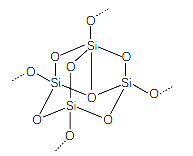
Identify the incorrect statement about $SiO_2$ (silica) from the following.
A
It is highly reactive due to low $Si-O$ bond enthalpy.
B
It is a covalent three-dimensional network solid.
C
Quartz,the crystalline form of silica,is used as a piezoelectric material.
D
An amorphous form of silica is used in filtration plants.
Solution
(A) $SiO_2$ is a covalent three-dimensional network solid.
Silica (commonly known as quartz) is $SiO_2$,which is usually used to manufacture glass,ceramics,and piezoelectric materials.
The most common use of silica is in water filtration; because of its uniform shape and size,it is an effective filtration bed that removes contaminants from water.
$SiO_2$ is less reactive due to high $Si-O$ bond enthalpy. Therefore,the statement that it is highly reactive is incorrect.
Silica (commonly known as quartz) is $SiO_2$,which is usually used to manufacture glass,ceramics,and piezoelectric materials.
The most common use of silica is in water filtration; because of its uniform shape and size,it is an effective filtration bed that removes contaminants from water.
$SiO_2$ is less reactive due to high $Si-O$ bond enthalpy. Therefore,the statement that it is highly reactive is incorrect.
0 likes
View Solution536
EasyMCQ
An inorganic compound $(A)$ made of the two most abundant elements in the Earth's crust is used in building construction. When $(A)$ reacts with carbon,it forms a poisonous gas $(B)$,which is a very stable diatomic molecule. Identify compounds $(A)$ and $(B)$.
A
$SiO_2, CO_2$
B
$SiO_2, CO$
C
$SiO_2, N_2$
D
$CaO, CO_2$
Solution
(B) The two most abundant elements in the Earth's crust are oxygen and silicon. The compound $(A)$ formed by these elements is silicon dioxide $(SiO_2)$,which is widely used in building construction (e.g.,in sand and concrete).
When silicon dioxide $(SiO_2)$ reacts with carbon at high temperatures,it undergoes a reduction reaction:
$SiO_2 + 3C \xrightarrow{\Delta} SiC + 2CO$
Here,$(B)$ is carbon monoxide $(CO)$,which is a poisonous,stable diatomic gas.
When silicon dioxide $(SiO_2)$ reacts with carbon at high temperatures,it undergoes a reduction reaction:
$SiO_2 + 3C \xrightarrow{\Delta} SiC + 2CO$
Here,$(B)$ is carbon monoxide $(CO)$,which is a poisonous,stable diatomic gas.
0 likes
View Solution537
MediumMCQ
Match the following and choose the correct code.
| Material | Application |
|---|---|
| $A$. Silicones | $i$. As a catalyst |
| $ii$. Greases | |
| $B$. Zeolites | $iii$. In surgical implants |
| $iv$. As ion exchangers |
A
$A-(ii, iii), B-(i, iv)$
B
$A-(i, iii), B-(ii, iv)$
C
$A-(ii, iv), B-(i, iii)$
D
$A-(i, iv), B-(ii, iii)$
Solution
(A) Silicones are used as greases (lubricants) and in surgical implants due to their inert nature and biocompatibility.
Zeolites are used as catalysts (e.g.,$ZSM-5$) and as ion exchangers in water softening.
Therefore,the correct matches are:
$A$ (Silicones) $\rightarrow$ $(ii)$ Greases,$(iii)$ In surgical implants.
$B$ (Zeolites) $\rightarrow$ $(i)$ As a catalyst,$(iv)$ As ion exchangers.
The correct code is $A-(ii, iii), B-(i, iv)$.
Zeolites are used as catalysts (e.g.,$ZSM-5$) and as ion exchangers in water softening.
Therefore,the correct matches are:
$A$ (Silicones) $\rightarrow$ $(ii)$ Greases,$(iii)$ In surgical implants.
$B$ (Zeolites) $\rightarrow$ $(i)$ As a catalyst,$(iv)$ As ion exchangers.
The correct code is $A-(ii, iii), B-(i, iv)$.
0 likes
View Solution538
MediumMCQ
Name the kind of silicate formed when two silicate units $(SiO_4)^{4-}$ share one oxygen atom.
A
Chain silicate
B
Cycle (ring) silicate
C
Pyrosilicate
D
Sheet silicate
Solution
(C) In pyrosilicate $(Si_2O_7)^{6-}$,two silicate units $(SiO_4)^{4-}$ share one oxygen atom. The structure is represented as $(Si_2O_7)^{6-} = O_3Si-O-SiO_3$.
0 likes
View Solution539
DifficultMCQ
$Me_3SiCl$ is used during the polymerisation of organosilicones because:
A
the chain length of organosilicone polymers can be controlled by adding $Me_3SiCl$
B
$Me_3SiCl$ improves the quality of the silicone polymer
C
$Me_3SiCl$ improves the yield of the silicone polymer
D
$Me_3SiCl$ acts as a catalyst during polymerisation
Solution
(A) $(CH_3)_3SiCl$ is used during the polymerisation of organosilicones because it acts as a chain terminator.
When added to the reaction mixture,it reacts with the terminal $-OH$ groups of the growing siloxane chain,forming a stable $(CH_3)_3Si-O-$ group at the end.
This prevents further condensation and thus allows the control of the chain length of the organosilicone polymers.
Hence,the correct option is $A$.
When added to the reaction mixture,it reacts with the terminal $-OH$ groups of the growing siloxane chain,forming a stable $(CH_3)_3Si-O-$ group at the end.
This prevents further condensation and thus allows the control of the chain length of the organosilicone polymers.
Hence,the correct option is $A$.
0 likes
View Solution540
EasyMCQ
Which among the following is not a property of silicones?
A
They are organo-silicon polymers having $R_2SiO$ as repeating unit
B
They are water repelling due to non-polar alkyl group
C
They are biocompatible
D
They are good conductors of electricity
Solution
(D) Silicones are synthetic organosilicon polymers with the general formula $(R_2SiO)_n$.
They possess a hydrophobic (water-repelling) nature due to the presence of non-polar organic groups attached to the silicon atoms.
They are widely used in medical applications because they are biocompatible.
However,silicones are excellent electrical insulators,not conductors,due to the strong $Si-O$ bonds and the absence of free electrons or ions for charge transport.
They possess a hydrophobic (water-repelling) nature due to the presence of non-polar organic groups attached to the silicon atoms.
They are widely used in medical applications because they are biocompatible.
However,silicones are excellent electrical insulators,not conductors,due to the strong $Si-O$ bonds and the absence of free electrons or ions for charge transport.
0 likes
View Solution541
MediumMCQ
Identify the correct statements:
$(I)$ Germanium exists only in traces.
$(II)$ The order of electronegativity of $Si, Ge, Sn$ is $Sn > Ge > Si$.
$(III)$ All group $14$ elements are available in solid state.
$(I)$ Germanium exists only in traces.
$(II)$ The order of electronegativity of $Si, Ge, Sn$ is $Sn > Ge > Si$.
$(III)$ All group $14$ elements are available in solid state.
A
$(I), (II)$ only
B
$(II), (III)$ only
C
$(I), (III)$ only
D
$(I), (II), (III)$
Solution
(C) Statement $(I)$ is correct: Germanium exists only in traces $(1.5 \ ppm)$ and is mainly recovered from flue dust arising from the roasting of zinc ores.
Statement $(II)$ is incorrect: The electronegativity of group $14$ elements decreases from carbon to silicon and remains approximately constant from silicon to $Sn$ $(Si \approx Ge \approx Sn)$.
Statement $(III)$ is correct: All the group $14$ elements (Carbon,Silicon,Germanium,Tin,Lead) are available in the solid state at room temperature.
Therefore,statements $(I)$ and $(III)$ are correct.
Statement $(II)$ is incorrect: The electronegativity of group $14$ elements decreases from carbon to silicon and remains approximately constant from silicon to $Sn$ $(Si \approx Ge \approx Sn)$.
Statement $(III)$ is correct: All the group $14$ elements (Carbon,Silicon,Germanium,Tin,Lead) are available in the solid state at room temperature.
Therefore,statements $(I)$ and $(III)$ are correct.
0 likes
View Solution542
MediumMCQ
Assertion $(A): [SiF_6]^{2-}$ is formed but $[SiCl_6]^{2-}$ is not.
Reason $(R):$ Electronegativity $(EN)$ of $F$ is higher than $EN$ of $Cl$.
Reason $(R):$ Electronegativity $(EN)$ of $F$ is higher than $EN$ of $Cl$.
A
Both $(A)$ and $(R)$ are correct and $(R)$ is the correct explanation of $(A)$
B
Both $(A)$ and $(R)$ are correct but $(R)$ is not the correct explanation of $(A)$
C
$(A)$ is correct but $(R)$ is not correct
D
$(A)$ is not correct but $(R)$ is correct
Solution
(B) $[SiF_6]^{2-}$ is formed but $[SiCl_6]^{2-}$ is not because the size of the $Cl^-$ ion is significantly larger than that of the $F^-$ ion.
Due to the larger size of $Cl^-$,there is significant steric hindrance around the central $Si$ atom,which prevents the formation of the $[SiCl_6]^{2-}$ complex.
While the electronegativity of $F$ is indeed higher than that of $Cl$,this property is not the primary reason for the stability of $[SiF_6]^{2-}$ over $[SiCl_6]^{2-}$.
Therefore,both $(A)$ and $(R)$ are correct statements,but $(R)$ is not the correct explanation for $(A)$.
Due to the larger size of $Cl^-$,there is significant steric hindrance around the central $Si$ atom,which prevents the formation of the $[SiCl_6]^{2-}$ complex.
While the electronegativity of $F$ is indeed higher than that of $Cl$,this property is not the primary reason for the stability of $[SiF_6]^{2-}$ over $[SiCl_6]^{2-}$.
Therefore,both $(A)$ and $(R)$ are correct statements,but $(R)$ is not the correct explanation for $(A)$.
0 likes
View Solution543
MediumMCQ
Identify $X, Y$ and $Z$ in the following reaction: $2 CH_3Cl + X \xrightarrow[570 \ K]{Y} Z$
A
$C, Ni, (CH_3)_2Si(OH)_2$
B
$Si, Zn, (CH_3)_2SiCl_2$
C
$Si, Cu, (CH_3)_2SiCl_2$
D
$H_2O, Si, (CH_3)_2Si(OH)_2$
Solution
(C) Methyl chloride reacts with silicon in the presence of copper powder as a catalyst at $570 \ K$ to form dimethyldichlorosilane as the major product. This is the first step in the synthesis of silicones.
The reaction is: $2 CH_3Cl + Si \xrightarrow[570 \ K]{Cu} (CH_3)_2SiCl_2$
Comparing this with the given reaction,we get:
$X = Si$,$Y = Cu$,and $Z = (CH_3)_2SiCl_2$.
The reaction is: $2 CH_3Cl + Si \xrightarrow[570 \ K]{Cu} (CH_3)_2SiCl_2$
Comparing this with the given reaction,we get:
$X = Si$,$Y = Cu$,and $Z = (CH_3)_2SiCl_2$.
0 likes
View Solution544
EasyMCQ
Which one of the following is used to convert sunlight into electricity in photovoltaic material?
A
Crystalline boron
B
Amorphous silicon
C
Crystalline iodine
D
Amorphous radium
Solution
(B) Photovoltaic cells are devices that convert sunlight directly into electricity. $Amorphous$ $silicon$ is widely used in the manufacturing of these solar cells because it is an effective semiconductor material that can be deposited in thin films,making it cost-effective for large-scale energy production.
0 likes
View Solution545
EasyMCQ
Assertion $(A)$: The maximum covalency of $Si$ and $Ge$ is $6$ but that of carbon is $4$.
Reason $(R)$: Due to the presence of $d$-orbitals in $Si$ and $Ge$,both these elements can undergo $sp^3d^2$ hybridisation and covalency of $6$ is possible. Carbon has no $d$-orbitals in it and hence its covalency is $4$.
The correct answer is:
Reason $(R)$: Due to the presence of $d$-orbitals in $Si$ and $Ge$,both these elements can undergo $sp^3d^2$ hybridisation and covalency of $6$ is possible. Carbon has no $d$-orbitals in it and hence its covalency is $4$.
The correct answer is:
A
$(A)$ and $(R)$ are correct and $(R)$ is the correct explanation of $(A)$
B
$(A)$ and $(R)$ are correct but $(R)$ is not the correct explanation of $(A)$
C
$(A)$ is correct but $(R)$ is not correct
D
$(A)$ is not correct but $(R)$ is correct
Solution
(A) Carbon belongs to the second period and has only $s$ and $p$ orbitals in its valence shell $(n=2)$. It lacks $d$-orbitals,so it cannot expand its octet,limiting its maximum covalency to $4$.
Silicon $(Si)$ and Germanium $(Ge)$ belong to the third and fourth periods respectively. They possess vacant $d$-orbitals in their valence shells ($n=3$ and $n=4$).
Due to the availability of these $d$-orbitals,$Si$ and $Ge$ can undergo $sp^3d^2$ hybridisation,allowing them to form $6$ bonds,thus achieving a maximum covalency of $6$.
Therefore,both the assertion and the reason are correct,and the reason correctly explains the assertion.
Silicon $(Si)$ and Germanium $(Ge)$ belong to the third and fourth periods respectively. They possess vacant $d$-orbitals in their valence shells ($n=3$ and $n=4$).
Due to the availability of these $d$-orbitals,$Si$ and $Ge$ can undergo $sp^3d^2$ hybridisation,allowing them to form $6$ bonds,thus achieving a maximum covalency of $6$.
Therefore,both the assertion and the reason are correct,and the reason correctly explains the assertion.
0 likes
View Solution546
EasyMCQ
Which one of the following statements is not correct?
A
Hydrolysis of $(CH_3)_2SiCl_2$ gives a product which undergoes condensation polymerisation to form long chain silicones.
B
$SiO_2$ is soluble in $HF$.
C
Hydrated zeolites are used as ion exchangers to reduce the hardness of hard water.
D
Water gas contains about $40 \%$ of $CO_2$.
Solution
(D) The correct answer is $D$.
Water gas is a mixture of $CO$ and $H_2$.
It does not contain $CO_2$ as a major component.
$SiO_2$ reacts with $HF$ to form $SiF_4$ and $H_2O$,making it soluble.
$(CH_3)_2SiCl_2$ undergoes hydrolysis followed by condensation to form linear silicones.
Zeolites are used for water softening by ion exchange.
Water gas is a mixture of $CO$ and $H_2$.
It does not contain $CO_2$ as a major component.
$SiO_2$ reacts with $HF$ to form $SiF_4$ and $H_2O$,making it soluble.
$(CH_3)_2SiCl_2$ undergoes hydrolysis followed by condensation to form linear silicones.
Zeolites are used for water softening by ion exchange.
0 likes
View Solution547
EasyMCQ
The catenation tendency of $C$,$Si$ and $Ge$ is in the order $Ge < Si < C$. The bond energies (in $kJ \ mol^{-1}$) of $C-C$,$Si-Si$ and $Ge-Ge$ bonds,respectively,are:
A
$348, 180, 167$
B
$180, 167, 348$
C
$348, 167, 180$
D
$180, 348, 167$
Solution
(A) The tendency for catenation is directly proportional to the bond dissociation energy of the element-element bond.
As we move down the group from $C$ to $Ge$,the atomic size increases,which leads to a decrease in the overlap of orbitals and consequently a decrease in bond strength.
The bond dissociation energies for $C-C$,$Si-Si$,and $Ge-Ge$ are approximately $348 \ kJ \ mol^{-1}$,$180 \ kJ \ mol^{-1}$,and $167 \ kJ \ mol^{-1}$ respectively.
Therefore,the correct order of bond energies matches the order of catenation tendency.
As we move down the group from $C$ to $Ge$,the atomic size increases,which leads to a decrease in the overlap of orbitals and consequently a decrease in bond strength.
The bond dissociation energies for $C-C$,$Si-Si$,and $Ge-Ge$ are approximately $348 \ kJ \ mol^{-1}$,$180 \ kJ \ mol^{-1}$,and $167 \ kJ \ mol^{-1}$ respectively.
Therefore,the correct order of bond energies matches the order of catenation tendency.
0 likes
View Solution548
MediumMCQ
Which of the following species does not exist?
A
$[SiCl_6]^{2-}$
B
$[GeCl_6]^{2-}$
C
$[SiF_6]^{2-}$
D
$[Sn(OH)_6]^{2-}$
Solution
(A) The species $[SiCl_6]^{2-}$ does not exist.
Silicon $(Si)$ has a small atomic size and cannot accommodate six large $Cl^-$ ions around it due to steric hindrance.
Additionally,the $Si-Cl$ bond is not strong enough to stabilize the hexacoordinated structure.
In contrast,$[SiF_6]^{2-}$ exists because the $F^-$ ion is small enough to fit around the $Si$ atom.
Silicon $(Si)$ has a small atomic size and cannot accommodate six large $Cl^-$ ions around it due to steric hindrance.
Additionally,the $Si-Cl$ bond is not strong enough to stabilize the hexacoordinated structure.
In contrast,$[SiF_6]^{2-}$ exists because the $F^-$ ion is small enough to fit around the $Si$ atom.
0 likes
View Solution549
MediumMCQ
Which of the following statements are correct?
$I)$ $SnF_4$ is ionic in nature.
$II)$ Stability of dihalides of group $14$ elements increases down the group.
$III)$ $GeCl_2$ is more stable than $GeCl_4$.
$I)$ $SnF_4$ is ionic in nature.
$II)$ Stability of dihalides of group $14$ elements increases down the group.
$III)$ $GeCl_2$ is more stable than $GeCl_4$.
A
$I, II \, \&$ $III$
B
$I$ & $III$ only
C
$II$ & $III$ only
D
$I$ & $II$ only
Solution
(D) $I)$ $SnF_4$ is an ionic compound due to the high electronegativity difference between $Sn$ and $F$. This statement is correct.
$II)$ Due to the inert pair effect,the stability of the $+2$ oxidation state increases down the group for group $14$ elements. Thus,the stability of dihalides increases down the group. This statement is correct.
$III)$ $Ge$ is in the $+4$ oxidation state in $GeCl_4$ and $+2$ in $GeCl_2$. Since $+4$ is more stable for $Ge$ than $+2$,$GeCl_4$ is more stable than $GeCl_2$. This statement is incorrect.
$II)$ Due to the inert pair effect,the stability of the $+2$ oxidation state increases down the group for group $14$ elements. Thus,the stability of dihalides increases down the group. This statement is correct.
$III)$ $Ge$ is in the $+4$ oxidation state in $GeCl_4$ and $+2$ in $GeCl_2$. Since $+4$ is more stable for $Ge$ than $+2$,$GeCl_4$ is more stable than $GeCl_2$. This statement is incorrect.
0 likes
View Solutionp-Block Elements (Class 11) — Carbon family · Frequently Asked Questions
1Are these p-Block Elements (Class 11) questions useful for JEE and NEET?
Yes. All questions in this section are mapped to JEE Main and NEET exam patterns. Previous year questions from JEE Main, NEET, GUJCET and state-level exams are included with full solutions.
2Can I switch to Hindi or Gujarati for these questions?
Yes. Use the language tabs in the hero section or the sidebar to view the same questions and solutions in English, Hindi or Gujarati.
3How do I generate a question paper from this subtopic?
Use the Vedclass Exam Paper Generator — select the chapter and subtopic, set difficulty, and generate Sets A, B, C, D automatically. First 3 chapters of every subject are free.
Vedclass Products
For Students
Vedclass Test Series
Mock tests in real JEE/NEET style with performance analysis. 5-day free trial.
Start Free TrialFor Teachers
Exam Paper Generator
Generate Set A/B/C/D papers from this chapter in 2 minutes. 3 chapters free.
Try FreeFor Institutes
Online Exam Module
Live online exams with unlimited students, 360° analytics & white-label branding.
See DemoFor Teachers & Institutes
Generate a p-Block Elements (Class 11) Exam Paper in 2 Minutes
Select subtopic & difficulty — Sets A, B, C, D auto-generated with No Repeat logic.
First 3 chapters of every subject are free — no payment required.