
A English
Environmental Study Questions in English
Class 11 Chemistry · Environmental Chemistry · Environmental Study
655+
Questions
English
Language
100%
With Solutions
Showing 50 of 655 questions in English
301
Difficult
What are the major causes of water pollution? Explain.
Solution
(N/A) Water pollution arises as a result of several human activities,which leads to the presence of several undesirable substances in water. Major water pollutants with their sources have been tabulated as follows:
Roles played by major pollutants are:
$1$. Pathogens: These water pollutants include bacteria and other organisms. They enter water from animal excreta and domestic sewage. Bacteria present in human excreta (for example,$Escherichia \ coli$ and $Streptococcus \ faecalis$) cause gastrointestinal diseases.
$2$. Organic wastes: These are biodegradable wastes that pollute water as a result of run off. The presence of excess organic wastes in water decreases the amount of oxygen held by water. This decrease in the amount of dissolved oxygen inhibits aquatic life.
$3$. Chemical pollutants: These are water soluble chemicals like heavy metals such as cadmium,mercury,nickel,etc. The presence of these chemicals (above the tolerance limit) can damage the kidneys,central nervous system,and liver.
| Pollutant | Source |
| Micro-organisms | Domestic sewage |
| Organic wastes | Domestic sewage,decaying animals and plants,animal excreta and waste,discharge from food processing industries |
| Plant nutrients | Chemical fertilizers |
| Toxic heavy metals | Chemical factories and industries |
| Sediments | Strip mining and soil erosion |
| Pesticides | Chemicals used for killing fungi,insects,weed |
| Radioactive substances | Mining of uranium-containing minerals |
| Heat | Water used for cooling in industries |
Roles played by major pollutants are:
$1$. Pathogens: These water pollutants include bacteria and other organisms. They enter water from animal excreta and domestic sewage. Bacteria present in human excreta (for example,$Escherichia \ coli$ and $Streptococcus \ faecalis$) cause gastrointestinal diseases.
$2$. Organic wastes: These are biodegradable wastes that pollute water as a result of run off. The presence of excess organic wastes in water decreases the amount of oxygen held by water. This decrease in the amount of dissolved oxygen inhibits aquatic life.
$3$. Chemical pollutants: These are water soluble chemicals like heavy metals such as cadmium,mercury,nickel,etc. The presence of these chemicals (above the tolerance limit) can damage the kidneys,central nervous system,and liver.
0 likes
View Solution302
Medium
Have you ever observed any water pollution in your area? What measures would you suggest to control it?
Solution
(N/A) Water pollution arises as a result of various human activities. This includes discharges from wastewater treatment plants,run-off from agricultural fields,storm-water drainage,etc. Pollutants from these sources enter the water bodies,thereby contaminating the water and rendering it impure.
Industries and chemical factories discharge toxic heavy metals such as $Fe$,$Mn$,$Al$,etc.,along with organic wastes into water. Domestic sewage and animal excreta are also responsible for pathogenic contamination of water. These pollutants make water unfit for drinking.
Therefore,all industrial and chemical discharges should be treated to remove toxic metals before being released into water bodies. The concentration of these pollutants should be checked regularly. Compost should be preferred over chemical fertilizers in gardens and agricultural fields to prevent harmful chemicals from leaching into groundwater.
Industries and chemical factories discharge toxic heavy metals such as $Fe$,$Mn$,$Al$,etc.,along with organic wastes into water. Domestic sewage and animal excreta are also responsible for pathogenic contamination of water. These pollutants make water unfit for drinking.
Therefore,all industrial and chemical discharges should be treated to remove toxic metals before being released into water bodies. The concentration of these pollutants should be checked regularly. Compost should be preferred over chemical fertilizers in gardens and agricultural fields to prevent harmful chemicals from leaching into groundwater.
0 likes
View Solution303
Easy
What do you mean by Biochemical Oxygen Demand $(BOD)$?
Solution
(N/A) Biochemical oxygen demand $(BOD)$ is the amount of dissolved oxygen required by aerobic microorganisms to decompose the organic matter present in a given volume of a water sample at a specific temperature over a specified time period.
Clean water typically has a $BOD$ value of less than $5 \ ppm$,whereas highly polluted water has a $BOD$ value of $17 \ ppm$ or more.
Clean water typically has a $BOD$ value of less than $5 \ ppm$,whereas highly polluted water has a $BOD$ value of $17 \ ppm$ or more.
0 likes
View Solution304
Difficult
Do you observe any soil pollution in your neighborhood? What efforts will you make for controlling the soil pollution?
Solution
(N/A) Major sources of soil pollution are industrial wastes and agricultural pollutants such as pesticides and fertilizers.
It is very important to maintain the quality and fertility of soil to ensure and sustain the growth of plants and food crops.
Insecticides like $DDT$ are not soluble in water. For this reason,they remain in soil for a long time,contaminating root crops. Pesticides like Aldrin and Dieldrin are non-biodegradable and highly toxic. They can enter higher trophic levels through food chains,causing metabolic and physiological disorders. The same is true for industrial wastes that comprise several toxic metals like $Pb, As, Hg, Cd,$ etc.
Hence,the best way to check soil pollution is to avoid the direct addition of pollutants to the soil. Also,wastes should undergo proper treatment. They should be recycled and only then allowed to be dumped.
It is very important to maintain the quality and fertility of soil to ensure and sustain the growth of plants and food crops.
Insecticides like $DDT$ are not soluble in water. For this reason,they remain in soil for a long time,contaminating root crops. Pesticides like Aldrin and Dieldrin are non-biodegradable and highly toxic. They can enter higher trophic levels through food chains,causing metabolic and physiological disorders. The same is true for industrial wastes that comprise several toxic metals like $Pb, As, Hg, Cd,$ etc.
Hence,the best way to check soil pollution is to avoid the direct addition of pollutants to the soil. Also,wastes should undergo proper treatment. They should be recycled and only then allowed to be dumped.
0 likes
View Solution305
Medium
What are pesticides and herbicides? Explain giving examples.
Solution
(N/A) Pesticides are chemical substances or mixtures of substances used to kill,repel,or control pests. Pests include insects,plant pathogens,weeds,and mollusks that damage crops and spread diseases. Examples include $Aldrin$ and $Dieldrin$.
Herbicides are a specific class of pesticides designed to kill or inhibit the growth of unwanted plants,known as weeds. Examples include sodium chlorate $(NaClO_3)$ and sodium arsenite $(Na_3AsO_3)$.
Herbicides are a specific class of pesticides designed to kill or inhibit the growth of unwanted plants,known as weeds. Examples include sodium chlorate $(NaClO_3)$ and sodium arsenite $(Na_3AsO_3)$.
0 likes
View Solution306
Medium
What do you mean by green chemistry? How will it help decrease environmental pollution?
Solution
(N/A) Green chemistry is a production process that aims at using the existing knowledge and principles of chemistry for developing and implementing chemical products and processes to reduce the use and generation of substances hazardous to the environment.
The release of different harmful chemicals (particulates,gases,organic and inorganic wastes) causes environmental pollution.
In green chemistry,the reactants to be used in chemical reactions are chosen in such a way that the yield of the end products is up to $100 \%$.
This prevents or limits chemical pollutants from being introduced into the environment.
Through the efforts of green chemists,$H_2O_2$ has replaced tetrachloroethene and chlorine gas in the drying and bleaching of paper.
The release of different harmful chemicals (particulates,gases,organic and inorganic wastes) causes environmental pollution.
In green chemistry,the reactants to be used in chemical reactions are chosen in such a way that the yield of the end products is up to $100 \%$.
This prevents or limits chemical pollutants from being introduced into the environment.
Through the efforts of green chemists,$H_2O_2$ has replaced tetrachloroethene and chlorine gas in the drying and bleaching of paper.
0 likes
View Solution307
Medium
What would have happened if the greenhouse gases were totally missing in the earth's atmosphere? Discuss.
Solution
(N/A) Earth's most abundant greenhouse gases are $CO_2$,$CH_4$,$O_3$,$CFCs$,and water vapour. These gases are present near the Earth's surface. They absorb solar energy that is radiated back from the surface of the Earth. The absorption of radiation results in the heating up of the atmosphere. Hence,greenhouse gases are essential for maintaining the temperature of the Earth for the sustenance of life.
In the absence of greenhouse gases,the average temperature of the Earth will decrease drastically,making it uninhabitable. As a result,life on Earth would be impossible.
In the absence of greenhouse gases,the average temperature of the Earth will decrease drastically,making it uninhabitable. As a result,life on Earth would be impossible.
0 likes
View Solution308
Medium
$A$ large number of fish are suddenly found floating dead on a lake. There is no evidence of toxic dumping,but you find an abundance of phytoplankton. Suggest a reason for the fish kill.
Solution
(N/A) The amount of dissolved oxygen present in water is limited. The abundance of phytoplankton causes depletion of this dissolved oxygen. This is because phytoplankton are degraded by bacteria present in water. For their decomposition,they require a large amount of oxygen. Hence,they consume the oxygen dissolved in water. As a result,the $BOD$ level of water drops,inhibiting the growth of fish and causing excessive fish-kill.
0 likes
View Solution309
Medium
How can domestic waste be used as manure?
Solution
(N/A) Domestic waste can be segregated into two categories: biodegradable and non-biodegradable.
Biodegradable waste,such as kitchen scraps,rotten food,and garden waste (leaves,grass),can be converted into manure through the process of composting.
This waste is collected in pits or landfills where microorganisms decompose the organic matter aerobically or anaerobically to form nutrient-rich manure.
Non-biodegradable waste,such as plastic,glass,and metal,cannot be converted into manure and should be sent for recycling.
Biodegradable waste,such as kitchen scraps,rotten food,and garden waste (leaves,grass),can be converted into manure through the process of composting.
This waste is collected in pits or landfills where microorganisms decompose the organic matter aerobically or anaerobically to form nutrient-rich manure.
Non-biodegradable waste,such as plastic,glass,and metal,cannot be converted into manure and should be sent for recycling.
0 likes
View Solution310
Easy
For your agricultural field or garden,you have developed a compost-producing pit. Discuss the process in the light of bad odour,flies,and recycling of wastes for a good produce.
Solution
(N/A) To maintain a compost-producing pit effectively and ensure good produce while minimizing environmental issues,follow these steps:
$1$. Odour and Pest Control: The pit should be kept covered with a lid or a layer of soil to minimize bad odour and prevent flies and other pests from breeding.
$2$. Waste Segregation: Only biodegradable organic waste (like vegetable peels,leaves,and food scraps) should be added to the pit. Non-biodegradable and recyclable waste (such as plastics,metals,and glass) must be strictly excluded.
$3$. Recycling: Recyclable materials should be separated and sent to industries through vendors for proper recycling,which helps in waste management and resource conservation.
$1$. Odour and Pest Control: The pit should be kept covered with a lid or a layer of soil to minimize bad odour and prevent flies and other pests from breeding.
$2$. Waste Segregation: Only biodegradable organic waste (like vegetable peels,leaves,and food scraps) should be added to the pit. Non-biodegradable and recyclable waste (such as plastics,metals,and glass) must be strictly excluded.
$3$. Recycling: Recyclable materials should be separated and sent to industries through vendors for proper recycling,which helps in waste management and resource conservation.
0 likes
View Solution311
Easy
Define environmental chemistry.
Solution
(N/A) Environmental chemistry is the study of chemical and biochemical processes occurring in nature. It deals with the study of the origin,transport,reaction,effects,and fates of various chemical species in the environment.
0 likes
View Solution312
Medium
What is meant by environmental pollution?
Solution
(N/A) Environmental pollution is the effect of undesirable changes in our surroundings that have harmful effects on plants,animals,and human beings.
$A$ substance that causes pollution is known as a pollutant. Pollutants can be solid,liquid,or gaseous substances present in concentrations greater than their natural abundance and are produced due to human activities or natural events.
Some pollutants are degradable,such as discarded vegetables. However,some pollutants are slowly degradable and remain in the environment in an unchanged form for many decades. Examples include plastic materials,heavy metals,nuclear wastes,$DDT$,and many other chemicals. These substances are difficult to remove once released into the environment as they cannot be degraded by natural processes,making them harmful to living organisms. In the process of environmental pollution,pollutants originate from a source and are transported by air or water or are dumped into the soil by human beings.
$A$ substance that causes pollution is known as a pollutant. Pollutants can be solid,liquid,or gaseous substances present in concentrations greater than their natural abundance and are produced due to human activities or natural events.
Some pollutants are degradable,such as discarded vegetables. However,some pollutants are slowly degradable and remain in the environment in an unchanged form for many decades. Examples include plastic materials,heavy metals,nuclear wastes,$DDT$,and many other chemicals. These substances are difficult to remove once released into the environment as they cannot be degraded by natural processes,making them harmful to living organisms. In the process of environmental pollution,pollutants originate from a source and are transported by air or water or are dumped into the soil by human beings.
0 likes
View Solution313
Medium
Give the details of the different layers of the atmosphere and briefly describe the substances present in them.
Solution
(N/A) The atmosphere surrounding the earth is divided into concentric layers based on density and altitude.
$1$. Troposphere: This is the lowest region where humans and other organisms live,extending up to $\sim 10 \ km$ from sea level. It is a turbulent,dusty zone containing air,water vapour,and clouds,characterized by strong air movement and cloud formation.
$2$. Stratosphere: This region lies between $10 \ km$ and $50 \ km$ above sea level. It contains dinitrogen $(N_2)$,dioxygen $(O_2)$,ozone $(O_3)$,and a small amount of water vapour. The ozone layer in the stratosphere absorbs about $99.5 \%$ of harmful ultraviolet $(UV)$ radiation from the sun,protecting life on earth.
$1$. Troposphere: This is the lowest region where humans and other organisms live,extending up to $\sim 10 \ km$ from sea level. It is a turbulent,dusty zone containing air,water vapour,and clouds,characterized by strong air movement and cloud formation.
$2$. Stratosphere: This region lies between $10 \ km$ and $50 \ km$ above sea level. It contains dinitrogen $(N_2)$,dioxygen $(O_2)$,ozone $(O_3)$,and a small amount of water vapour. The ozone layer in the stratosphere absorbs about $99.5 \%$ of harmful ultraviolet $(UV)$ radiation from the sun,protecting life on earth.
0 likes
View Solution314
Medium
Name the pollutants found in the troposphere.
Solution
(N/A) Tropospheric pollution occurs due to the presence of undesirable solid or gaseous particles in the air. The major pollutants are categorized as follows:
$i$. Gaseous air pollutants: Oxides of sulphur $(SO_x)$,nitrogen $(NO_x)$,and carbon $(CO, CO_2)$,hydrogen sulphide $(H_2S)$,hydrocarbons,ozone $(O_3)$,and other oxidants.
$ii$. Particulate pollutants: These include dust,mist,fumes,smoke,and smog.
$i$. Gaseous air pollutants: Oxides of sulphur $(SO_x)$,nitrogen $(NO_x)$,and carbon $(CO, CO_2)$,hydrogen sulphide $(H_2S)$,hydrocarbons,ozone $(O_3)$,and other oxidants.
$ii$. Particulate pollutants: These include dust,mist,fumes,smoke,and smog.
0 likes
View Solution315
Medium
Explain tropospheric pollution caused by oxides of sulphur with suitable examples.
Solution
(N/A) When sulphur-containing fossil fuels are burnt,oxides of sulphur are produced.
The most common species,sulphur dioxide $(SO_2)$,is a gas that is poisonous to both animals and plants.
$A$ low concentration of $SO_2$ causes respiratory diseases,e.g.,asthma,bronchitis,and emphysema in human beings. It also causes irritation to the eyes,resulting in tears and redness.
High concentration of $SO_2$ leads to the stiffness of flower buds,which eventually fall off from plants.
Uncatalysed oxidation of $SO_2$ is slow. However,the presence of particulate matter in polluted air catalyses the oxidation of $SO_2$ to sulphur trioxide $(SO_3)$:
$2SO_{2(g)} + O_{2(g)} \rightarrow 2SO_{3(g)}$
The reaction can also be promoted by ozone $(O_3)$ and hydrogen peroxide $(H_2O_2)$:
$SO_{2(g)} + O_{3(g)} \rightarrow SO_{3(g)} + O_{2(g)}$
$SO_{2(g)} + H_2O_{2(l)} \rightarrow H_2SO_{4(aq)}$
The most common species,sulphur dioxide $(SO_2)$,is a gas that is poisonous to both animals and plants.
$A$ low concentration of $SO_2$ causes respiratory diseases,e.g.,asthma,bronchitis,and emphysema in human beings. It also causes irritation to the eyes,resulting in tears and redness.
High concentration of $SO_2$ leads to the stiffness of flower buds,which eventually fall off from plants.
Uncatalysed oxidation of $SO_2$ is slow. However,the presence of particulate matter in polluted air catalyses the oxidation of $SO_2$ to sulphur trioxide $(SO_3)$:
$2SO_{2(g)} + O_{2(g)} \rightarrow 2SO_{3(g)}$
The reaction can also be promoted by ozone $(O_3)$ and hydrogen peroxide $(H_2O_2)$:
$SO_{2(g)} + O_{3(g)} \rightarrow SO_{3(g)} + O_{2(g)}$
$SO_{2(g)} + H_2O_{2(l)} \rightarrow H_2SO_{4(aq)}$
0 likes
View Solution316
Medium
Explain tropospheric pollution caused by oxides of nitrogen.
Solution
(N/A) Dinitrogen and dioxygen are the main constituents of air. These gases do not react with each other at a normal temperature.
At high altitudes when lightning strikes,they combine to form oxides of nitrogen. $NO_{2}$ is oxidised to nitrate ion,$NO_{3}^{-}$,which is washed into soil,where it serves as a fertilizer.
In an automobile engine,(at high temperature) when fossil fuel is burnt,dinitrogen and dioxygen combine to yield significant quantities of nitric oxide $(NO)$ and nitrogen dioxide $(NO_{2})$ as given below:
$N_{2(g)} + O_{2(g)} \xrightarrow{1405 \ K} 2 NO_{(g)}$
$NO$ reacts instantly with oxygen to give $NO_{2}$.
$2 NO_{(g)} + O_{2(g)} \rightarrow 2 NO_{2(g)}$
Rate of production of $NO_{2}$ is faster when nitric oxide reacts with ozone in the stratosphere.
$NO_{(g)} + O_{3(g)} \rightarrow NO_{2(g)} + O_{2(g)}$
The irritant red haze in the traffic and congested places is due to oxides of nitrogen.
Higher concentrations of $NO_{2}$ damage the leaves of plants and retard the rate of photosynthesis.
$NO_{2}$ is a lung irritant that can lead to an acute respiratory disease in children. It is toxic to living tissues also. Nitrogen dioxide is also harmful to various textile fibres and metals.
At high altitudes when lightning strikes,they combine to form oxides of nitrogen. $NO_{2}$ is oxidised to nitrate ion,$NO_{3}^{-}$,which is washed into soil,where it serves as a fertilizer.
In an automobile engine,(at high temperature) when fossil fuel is burnt,dinitrogen and dioxygen combine to yield significant quantities of nitric oxide $(NO)$ and nitrogen dioxide $(NO_{2})$ as given below:
$N_{2(g)} + O_{2(g)} \xrightarrow{1405 \ K} 2 NO_{(g)}$
$NO$ reacts instantly with oxygen to give $NO_{2}$.
$2 NO_{(g)} + O_{2(g)} \rightarrow 2 NO_{2(g)}$
Rate of production of $NO_{2}$ is faster when nitric oxide reacts with ozone in the stratosphere.
$NO_{(g)} + O_{3(g)} \rightarrow NO_{2(g)} + O_{2(g)}$
The irritant red haze in the traffic and congested places is due to oxides of nitrogen.
Higher concentrations of $NO_{2}$ damage the leaves of plants and retard the rate of photosynthesis.
$NO_{2}$ is a lung irritant that can lead to an acute respiratory disease in children. It is toxic to living tissues also. Nitrogen dioxide is also harmful to various textile fibres and metals.
0 likes
View Solution317
Medium
Explain in short: Pollution of the troposphere caused by hydrocarbons.
Solution
(N/A) Hydrocarbons are composed of hydrogen and carbon atoms and are primarily released into the atmosphere through the incomplete combustion of fuels used in automobiles.
Hydrocarbons are carcinogenic,meaning they have the potential to cause cancer.
They cause significant harm to plants by inducing premature ageing,the breakdown of plant tissues,and the shedding of leaves,flowers,and twigs.
Hydrocarbons are carcinogenic,meaning they have the potential to cause cancer.
They cause significant harm to plants by inducing premature ageing,the breakdown of plant tissues,and the shedding of leaves,flowers,and twigs.
0 likes
View Solution318
Difficult
How is the troposphere damaged by oxides of carbon?
Solution
(N/A) $(i)$ Effects of carbon monoxide $(CO)$:
- $CO$ is a colourless and odourless gas and a serious air pollutant.
- It binds to hemoglobin to form carboxyhemoglobin,which is $300$ times more stable than the oxygen-hemoglobin complex,thereby blocking oxygen delivery to tissues.
- Concentrations of $3-4\%$ carboxyhemoglobin in blood cause headaches,weak eyesight,and cardiovascular disorders.
$(ii)$ Effects of carbon dioxide $(CO_{2})$:
- $CO_{2}$ is released via respiration,burning of fossil fuels,and industrial processes.
- While it is a natural component of the atmosphere ($0.03\%$ by volume),excess $CO_{2}$ due to deforestation and fossil fuel combustion leads to the greenhouse effect.
- This increased concentration of $CO_{2}$ in the troposphere is the primary cause of global warming.
- $CO$ is a colourless and odourless gas and a serious air pollutant.
- It binds to hemoglobin to form carboxyhemoglobin,which is $300$ times more stable than the oxygen-hemoglobin complex,thereby blocking oxygen delivery to tissues.
- Concentrations of $3-4\%$ carboxyhemoglobin in blood cause headaches,weak eyesight,and cardiovascular disorders.
$(ii)$ Effects of carbon dioxide $(CO_{2})$:
- $CO_{2}$ is released via respiration,burning of fossil fuels,and industrial processes.
- While it is a natural component of the atmosphere ($0.03\%$ by volume),excess $CO_{2}$ due to deforestation and fossil fuel combustion leads to the greenhouse effect.
- This increased concentration of $CO_{2}$ in the troposphere is the primary cause of global warming.
0 likes
View Solution319
Difficult
Explain the damage to the troposphere caused by $CO$ and $CO_2$.
Solution
(N/A) $(i)$ Effects of carbon monoxide $(CO)$:
- Carbon monoxide $(CO)$ is a serious air pollutant. It is a colourless and odourless gas.
- It blocks the delivery of oxygen to organs and tissues,making it highly poisonous to living organisms.
- It is produced by the incomplete combustion of carbon-based fuels like coal,firewood,and petrol,as well as from automobile exhaust.
- $CO$ binds with hemoglobin to form carboxyhemoglobin,which is $300$ times more stable than the oxygen-hemoglobin complex.
- $A$ carboxyhemoglobin concentration of $3-4 \%$ reduces the oxygen-carrying capacity of blood,leading to headaches,weak eyesight,nervousness,and cardiovascular disorders.
$(ii)$ Effects of carbon dioxide $(CO_2)$:
- $CO_2$ is released through respiration,burning of fossil fuels,and industrial processes like cement manufacturing.
- It is confined to the troposphere and normally constitutes $0.03 \%$ by volume of the atmosphere.
- Increased burning of fossil fuels and deforestation lead to an excess of $CO_2$ in the atmosphere.
- Excess $CO_2$ is primarily responsible for global warming,as it traps heat in the atmosphere.
- Carbon monoxide $(CO)$ is a serious air pollutant. It is a colourless and odourless gas.
- It blocks the delivery of oxygen to organs and tissues,making it highly poisonous to living organisms.
- It is produced by the incomplete combustion of carbon-based fuels like coal,firewood,and petrol,as well as from automobile exhaust.
- $CO$ binds with hemoglobin to form carboxyhemoglobin,which is $300$ times more stable than the oxygen-hemoglobin complex.
- $A$ carboxyhemoglobin concentration of $3-4 \%$ reduces the oxygen-carrying capacity of blood,leading to headaches,weak eyesight,nervousness,and cardiovascular disorders.
$(ii)$ Effects of carbon dioxide $(CO_2)$:
- $CO_2$ is released through respiration,burning of fossil fuels,and industrial processes like cement manufacturing.
- It is confined to the troposphere and normally constitutes $0.03 \%$ by volume of the atmosphere.
- Increased burning of fossil fuels and deforestation lead to an excess of $CO_2$ in the atmosphere.
- Excess $CO_2$ is primarily responsible for global warming,as it traps heat in the atmosphere.
0 likes
View Solution320
Medium
Carbon monoxide gas is more dangerous than carbon dioxide gas. Why?
Solution
(N/A) $CO$ and $CO_{2}$ gases are released by the burning of various types of fuel. Carbon monoxide is poisonous,whereas carbon dioxide is not poisonous in its nature.
Carbon monoxide reacts with hemoglobin in the blood to produce a carboxyhemoglobin complex. This complex is more stable than the oxyhemoglobin complex.
Carboxyhemoglobin,even at a concentration of $3-4 \%$,significantly reduces the oxygen-carrying capacity of the blood.
This oxygen deficiency leads to symptoms such as headaches,weak eyesight,nervousness,and cardiovascular disorders. Due to the increase in its proportion,it can be fatal. Carbon dioxide is non-poisonous,although its high concentration in the atmosphere is harmful due to the greenhouse effect.
Carbon monoxide reacts with hemoglobin in the blood to produce a carboxyhemoglobin complex. This complex is more stable than the oxyhemoglobin complex.
Carboxyhemoglobin,even at a concentration of $3-4 \%$,significantly reduces the oxygen-carrying capacity of the blood.
This oxygen deficiency leads to symptoms such as headaches,weak eyesight,nervousness,and cardiovascular disorders. Due to the increase in its proportion,it can be fatal. Carbon dioxide is non-poisonous,although its high concentration in the atmosphere is harmful due to the greenhouse effect.
0 likes
View Solution321
Medium
Explain tropospheric pollution in $100$ words.
Solution
(N/A) Tropospheric pollution occurs due to the presence of undesirable substances in the lowest layer of the atmosphere,known as the troposphere. It is primarily caused by gaseous and particulate pollutants.
$1$. Gaseous pollutants: These include oxides of sulphur $(SO_x)$,nitrogen $(NO_x)$,carbon $(CO, CO_2)$,and various hydrocarbons.
$2$. Particulate pollutants: These consist of smoke,dust,mist,and fumes. These pollutants are hazardous to human health,often leading to severe respiratory ailments and environmental degradation.
$1$. Gaseous pollutants: These include oxides of sulphur $(SO_x)$,nitrogen $(NO_x)$,carbon $(CO, CO_2)$,and various hydrocarbons.
$2$. Particulate pollutants: These consist of smoke,dust,mist,and fumes. These pollutants are hazardous to human health,often leading to severe respiratory ailments and environmental degradation.
0 likes
View Solution322
Difficult
Write a short note on the effect of Global warming and Greenhouse effect on environment.
Solution
(N/A) About $75 \%$ of the solar energy reaching the earth is absorbed by the earth's surface,which increases its temperature. The rest of the heat radiates back to the atmosphere.
Some of the heat is trapped by gases such as carbon dioxide,methane,ozone,chlorofluorocarbon compounds $(CFCs)$ and water vapour in the atmosphere. Thus,they add to the heating of the atmosphere. This causes global warming.
In cold places,flowers,vegetables,and fruits are grown in glass-covered areas called greenhouses.
We are surrounded by a blanket of air called the atmosphere. This atmosphere keeps the temperature on earth constant. But now,slowly,it is undergoing change.
Atmosphere traps the sun's heat near the earth's surface and keeps it warm. This is called the natural greenhouse effect because it maintains the temperature and makes the earth perfect for life.
Carbon dioxide molecules also trap heat because they are transparent to sunlight but are not able to trap the heat radiation. If the amount of $CO_2$ crosses $0.03 \%$,the natural greenhouse balance may get disturbed. Thus,$CO_2$ is the major contributor to global warming. Besides carbon dioxide,other greenhouse gases are methane,water vapour,nitrous oxide,$CFCs$,and ozone.
In the absence of oxygen,if the vegetation is burnt,digested,or rotted,then methane is produced. Large amounts of methane are released in paddy fields,coal mines,from rotting garbage dumps,and by fossil fuels.
Chlorofluorocarbons $(CFCs)$ are man-made industrial chemicals used in air conditioning,etc. $CFCs$ are also damaging the ozone layer. Nitrous oxide occurs naturally in the environment. The quantities of nitrous oxide have increased due to the use of chemical fertilizers and the burning of fossil fuels.
If these trends continue,the average global temperature will increase. It may lead to the melting of polar ice caps and the flooding of low-lying areas all over the earth. An increase in the global temperature increases the incidence of infectious diseases like dengue,malaria,yellow fever,and sleeping sickness.
Some of the heat is trapped by gases such as carbon dioxide,methane,ozone,chlorofluorocarbon compounds $(CFCs)$ and water vapour in the atmosphere. Thus,they add to the heating of the atmosphere. This causes global warming.
In cold places,flowers,vegetables,and fruits are grown in glass-covered areas called greenhouses.
We are surrounded by a blanket of air called the atmosphere. This atmosphere keeps the temperature on earth constant. But now,slowly,it is undergoing change.
Atmosphere traps the sun's heat near the earth's surface and keeps it warm. This is called the natural greenhouse effect because it maintains the temperature and makes the earth perfect for life.
Carbon dioxide molecules also trap heat because they are transparent to sunlight but are not able to trap the heat radiation. If the amount of $CO_2$ crosses $0.03 \%$,the natural greenhouse balance may get disturbed. Thus,$CO_2$ is the major contributor to global warming. Besides carbon dioxide,other greenhouse gases are methane,water vapour,nitrous oxide,$CFCs$,and ozone.
In the absence of oxygen,if the vegetation is burnt,digested,or rotted,then methane is produced. Large amounts of methane are released in paddy fields,coal mines,from rotting garbage dumps,and by fossil fuels.
Chlorofluorocarbons $(CFCs)$ are man-made industrial chemicals used in air conditioning,etc. $CFCs$ are also damaging the ozone layer. Nitrous oxide occurs naturally in the environment. The quantities of nitrous oxide have increased due to the use of chemical fertilizers and the burning of fossil fuels.
If these trends continue,the average global temperature will increase. It may lead to the melting of polar ice caps and the flooding of low-lying areas all over the earth. An increase in the global temperature increases the incidence of infectious diseases like dengue,malaria,yellow fever,and sleeping sickness.
0 likes
View Solution323
Medium
What can we do to reduce the rate of global warming?
Solution
(N/A) Greenhouse gases increase in the atmosphere because of the burning of fossil fuels and deforestation. Due to these,global warming occurs. Some solutions for prevention are as follows:
$(i)$ Control the use of chemicals and substances responsible for global warming to reduce the atmospheric temperature.
$(ii)$ Minimize the use of automobiles. $e.g.$,one can use a bicycle,public transport,or carpooling.
$(iii)$ Plant more trees to increase the green cover and avoid burning dry leaves,wood,etc.
$(iv)$ Do not smoke in public places and workplaces.
$(v)$ Raise awareness about the greenhouse effect and global warming by sharing information with others.
$(i)$ Control the use of chemicals and substances responsible for global warming to reduce the atmospheric temperature.
$(ii)$ Minimize the use of automobiles. $e.g.$,one can use a bicycle,public transport,or carpooling.
$(iii)$ Plant more trees to increase the green cover and avoid burning dry leaves,wood,etc.
$(iv)$ Do not smoke in public places and workplaces.
$(v)$ Raise awareness about the greenhouse effect and global warming by sharing information with others.
0 likes
View Solution324
Medium
List gases which are responsible for the greenhouse effect.
Solution
(N/A) The gases responsible for the greenhouse effect are as follows:
$(1)$ Carbon dioxide $(CO_{2})$
$(2)$ Methane $(CH_{4})$
$(3)$ Water vapour $(H_{2}O)$
$(4)$ Nitrous oxide $(N_{2}O)$
$(5)$ Ozone $(O_{3})$
$(6)$ Chlorofluorocarbons $(CFCs)$
$(1)$ Carbon dioxide $(CO_{2})$
$(2)$ Methane $(CH_{4})$
$(3)$ Water vapour $(H_{2}O)$
$(4)$ Nitrous oxide $(N_{2}O)$
$(5)$ Ozone $(O_{3})$
$(6)$ Chlorofluorocarbons $(CFCs)$
0 likes
View Solution325
Medium
What would have happened if the greenhouse gases were totally missing in the earth's atmosphere? Discuss.
Solution
(N/A) The primary greenhouse gases in the earth's atmosphere are $CO_{2}$,$CH_{4}$,$O_{3}$,$CFCs$,and water vapor.
These gases trap heat by absorbing infrared radiation emitted from the earth's surface,which keeps the planet warm.
If greenhouse gases were totally missing,the heat absorbed from solar energy would escape back into space.
As a result,the earth's average temperature would drop significantly,potentially reaching below $0 \ ^{\circ}C$.
This extreme cooling would make the planet unfit for life as we know it,rendering the existence of living organisms impossible.
These gases trap heat by absorbing infrared radiation emitted from the earth's surface,which keeps the planet warm.
If greenhouse gases were totally missing,the heat absorbed from solar energy would escape back into space.
As a result,the earth's average temperature would drop significantly,potentially reaching below $0 \ ^{\circ}C$.
This extreme cooling would make the planet unfit for life as we know it,rendering the existence of living organisms impossible.
0 likes
View Solution326
Advanced
What is acid rain? Explain the formation of acid rain by atmospheric pollutants.
Solution
(N/A) Normally,rain water has a $pH$ of $5.6$ due to the presence of $H^{+}$ ions formed by the reaction of rain water with atmospheric $CO_{2}$:
$H_{2}O_{(l)} + CO_{2_{(g)}} \rightleftharpoons H_{2}CO_{3_{(aq)}}$
$H_{2}CO_{3_{(aq)}} \rightleftharpoons H^{+}_{(aq)} + HCO_{3_{(aq)}}^{-}$
When the $pH$ of rain water drops below $5.6$,it is called acid rain. Acid rain refers to the process by which acidic components from the atmosphere are deposited on the earth's surface.
Acid rain is primarily caused by the emission of sulphur dioxide $(SO_{2})$ and nitrogen oxides $(NO_{x})$ from the burning of fossil fuels (coal,oil,petrol,diesel) in power stations,furnaces,and motor engines.
These oxides react with water in the atmosphere in the presence of particulate matter (which acts as a catalyst) to form strong acids:
$2SO_{2_{(g)}} + O_{2_{(g)}} + 2H_{2}O_{(l)} \rightarrow 2H_{2}SO_{4_{(aq)}}$
$4NO_{2_{(g)}} + O_{2_{(g)}} + 2H_{2}O_{(l)} \rightarrow 4HNO_{3_{(aq)}}$
These acids are deposited on the earth's surface as wet deposition (rain,fog,snow) or dry deposition (solid particles/gases).
$H_{2}O_{(l)} + CO_{2_{(g)}} \rightleftharpoons H_{2}CO_{3_{(aq)}}$
$H_{2}CO_{3_{(aq)}} \rightleftharpoons H^{+}_{(aq)} + HCO_{3_{(aq)}}^{-}$
When the $pH$ of rain water drops below $5.6$,it is called acid rain. Acid rain refers to the process by which acidic components from the atmosphere are deposited on the earth's surface.
Acid rain is primarily caused by the emission of sulphur dioxide $(SO_{2})$ and nitrogen oxides $(NO_{x})$ from the burning of fossil fuels (coal,oil,petrol,diesel) in power stations,furnaces,and motor engines.
These oxides react with water in the atmosphere in the presence of particulate matter (which acts as a catalyst) to form strong acids:
$2SO_{2_{(g)}} + O_{2_{(g)}} + 2H_{2}O_{(l)} \rightarrow 2H_{2}SO_{4_{(aq)}}$
$4NO_{2_{(g)}} + O_{2_{(g)}} + 2H_{2}O_{(l)} \rightarrow 4HNO_{3_{(aq)}}$
These acids are deposited on the earth's surface as wet deposition (rain,fog,snow) or dry deposition (solid particles/gases).
0 likes
View Solution327
Medium
Mention the effects of acid rain.
Solution
(N/A) Acid rain is harmful for agriculture,trees,and plants as it dissolves and washes away nutrients needed for their growth.
It causes respiratory ailments in human beings and animals.
When acid rain falls and flows as ground water to reach rivers,lakes,etc.,it affects plants and animal life in the aquatic ecosystem.
It corrodes water pipes,resulting in the leaching of heavy metals such as iron,lead,and copper into the drinking water.
Acid rain damages buildings and other structures made of stone or metal. The $Taj \ Mahal$ in India has been affected by acid rain.
It causes respiratory ailments in human beings and animals.
When acid rain falls and flows as ground water to reach rivers,lakes,etc.,it affects plants and animal life in the aquatic ecosystem.
It corrodes water pipes,resulting in the leaching of heavy metals such as iron,lead,and copper into the drinking water.
Acid rain damages buildings and other structures made of stone or metal. The $Taj \ Mahal$ in India has been affected by acid rain.
0 likes
View Solution328
Medium
What steps should be taken to reduce the production of acid rain?
Solution
(N/A) To reduce the production of acid rain,the following steps should be taken:
$1$. Reduce the emission of $SO_2$ and $NO_x$ into the atmosphere.
$2$. Minimize the use of vehicles driven by fossil fuels.
$3$. Use fossil fuels with lower sulphur content in power plants and industries.
$4$. Prefer cleaner fuels like natural gas over coal.
$5$. Install catalytic converters in automobiles to reduce the emission of harmful exhaust gases.
$6$. Add powdered limestone to soil to neutralize the acidity caused by acid rain.
$1$. Reduce the emission of $SO_2$ and $NO_x$ into the atmosphere.
$2$. Minimize the use of vehicles driven by fossil fuels.
$3$. Use fossil fuels with lower sulphur content in power plants and industries.
$4$. Prefer cleaner fuels like natural gas over coal.
$5$. Install catalytic converters in automobiles to reduce the emission of harmful exhaust gases.
$6$. Add powdered limestone to soil to neutralize the acidity caused by acid rain.
0 likes
View Solution329
Medium
Statues and monuments in India are affected by acid rain. How?
Solution
$A$ large number of industries and power plants are located around the area of the Taj Mahal. These use poor quality coal,kerosene,and firewood,which leads to a high concentration of sulphur and nitrogen oxides in the atmosphere. These oxides react with atmospheric moisture to form acid rain,which subsequently reacts with the calcium carbonate $(CaCO_3)$ present in the marble of the Taj Mahal.
$CaCO_3 + H_2SO_4 \rightarrow CaSO_4 + H_2O + CO_2$
As a result,the marble surface is slowly disfigured,becoming discoloured and losing its natural lustre.
$CaCO_3 + H_2SO_4 \rightarrow CaSO_4 + H_2O + CO_2$
As a result,the marble surface is slowly disfigured,becoming discoloured and losing its natural lustre.
0 likes
View Solution330
Medium
Explain the effects of acid rain on the Taj Mahal.
Solution
(N/A) large number of industries and power plants are located near the area of the Taj Mahal. They use poor-quality coal,kerosene,and firewood,which causes the air around the Taj Mahal to contain a fairly high level of sulphur and nitrogen oxides. This results in acid rain,which reacts with the marble $(CaCO_{3})$ of the Taj Mahal.
$CaCO_{3} + H_{2}SO_{4} \rightarrow CaSO_{4} + H_{2}O + CO_{2}$
Thus,this wonderful monument that has attracted people from around the world is being slowly disfigured,and the marble is getting discoloured and lustreless.
$CaCO_{3} + H_{2}SO_{4} \rightarrow CaSO_{4} + H_{2}O + CO_{2}$
Thus,this wonderful monument that has attracted people from around the world is being slowly disfigured,and the marble is getting discoloured and lustreless.
0 likes
View Solution331
Medium
What efforts are being made by the government to save the Taj Mahal?
Solution
(N/A) The government of India announced an action plan named 'Taj Trapezium' in $1995$ to protect the Taj Mahal. This plan aims at clearing the air of the city and towns near the Taj Mahal. Under this plan,more than $2000$ polluting industries operating inside the Trapezium were required to switch to the use of natural gas or liquefied petroleum gas $(LPG)$ instead of coal or oil.
$A$ new natural gas pipeline was established to bring more than half a million cubic metres of natural gas per day to this area.
People living in the city are also encouraged to use $LPG$ in place of coal,kerosene,or firewood.
Vehicles plying on highways in the vicinity of the Taj are encouraged to use low-sulphur content diesel.
$A$ new natural gas pipeline was established to bring more than half a million cubic metres of natural gas per day to this area.
People living in the city are also encouraged to use $LPG$ in place of coal,kerosene,or firewood.
Vehicles plying on highways in the vicinity of the Taj are encouraged to use low-sulphur content diesel.
0 likes
View Solution332
Difficult
Explain the types of particulate pollutants.
Solution
(N/A) Particulate pollutants are minute solid particles or liquid droplets suspended in the air. These are present in vehicle emissions,smoke from fires,dust,and industrial ash. There are two main types of particulates in the atmosphere:
$a$. Viable
$b$. Non-viable
$a$. Viable Particulates: These include minute living organisms like bacteria,fungi,moulds,and algae that are dispersed in the atmosphere. Some fungi found in the air can cause allergies in humans and diseases in plants.
$b$. Non-viable Particulates: These are classified based on their nature and size:
$i$. Smoke: Consists of solid or a mixture of solid and liquid particles formed during the combustion of organic matter,such as cigarette smoke,smoke from fossil fuels,garbage,and dry leaves.
$ii$. Dust: Composed of fine solid particles produced during the crushing,grinding,and attrition of solid materials,such as sand from sandblasting,sawdust,pulverized coal,cement,and fly ash.
$iii$. Mists: Produced by particles of spray liquids and the condensation of vapours in the air,such as sulphuric acid mist,herbicides,and insecticides.
$iv$. Fumes: Generally obtained by the condensation of vapours during sublimation,distillation,boiling,and various chemical reactions,such as those involving organic solvents,metals,and metallic oxides.
$a$. Viable
$b$. Non-viable
$a$. Viable Particulates: These include minute living organisms like bacteria,fungi,moulds,and algae that are dispersed in the atmosphere. Some fungi found in the air can cause allergies in humans and diseases in plants.
$b$. Non-viable Particulates: These are classified based on their nature and size:
$i$. Smoke: Consists of solid or a mixture of solid and liquid particles formed during the combustion of organic matter,such as cigarette smoke,smoke from fossil fuels,garbage,and dry leaves.
$ii$. Dust: Composed of fine solid particles produced during the crushing,grinding,and attrition of solid materials,such as sand from sandblasting,sawdust,pulverized coal,cement,and fly ash.
$iii$. Mists: Produced by particles of spray liquids and the condensation of vapours in the air,such as sulphuric acid mist,herbicides,and insecticides.
$iv$. Fumes: Generally obtained by the condensation of vapours during sublimation,distillation,boiling,and various chemical reactions,such as those involving organic solvents,metals,and metallic oxides.
0 likes
View Solution333
Medium
Write down the effect of particulate pollutants on the environment.
Solution
(N/A) The effect of particulate pollutants is largely dependent on the particle size. Airborne particles such as dust,fumes,and mist are dangerous for human health. Particulate pollutants larger than $5 \ \mu m$ are likely to lodge in the nasal passage,whereas particles of about $1 \ \mu m$ enter into the lungs easily.
Lead was once a major air pollutant emitted by vehicles,with leaded petrol being the primary source of airborne lead emissions. This problem has been mitigated by using unleaded petrol. Lead interferes with the development and maturation of red blood cells.
Lead was once a major air pollutant emitted by vehicles,with leaded petrol being the primary source of airborne lead emissions. This problem has been mitigated by using unleaded petrol. Lead interferes with the development and maturation of red blood cells.
0 likes
View Solution334
Medium
What is smog? How is classical smog different from photochemical smog?
Solution
(N/A) The word smog is derived from smoke and fog. This is the most common example of air pollution that occurs in many cities throughout the world. There are two types of smog:
$(i)$ Classical smog: This type of smog occurs in cool,humid climates. It is a mixture of smoke,fog,and sulphur dioxide $(SO_2)$. It is also called reducing smog because it is a chemically reducing mixture.
$(ii)$ Photochemical smog: This type of smog occurs in warm,dry,and sunny climates. It is produced due to the action of sunlight on unsaturated hydrocarbons and nitrogen dioxide $(NO_2)$ produced by automobiles and factories. It is also called oxidising smog because it has a high concentration of oxidising agents.
$(i)$ Classical smog: This type of smog occurs in cool,humid climates. It is a mixture of smoke,fog,and sulphur dioxide $(SO_2)$. It is also called reducing smog because it is a chemically reducing mixture.
$(ii)$ Photochemical smog: This type of smog occurs in warm,dry,and sunny climates. It is produced due to the action of sunlight on unsaturated hydrocarbons and nitrogen dioxide $(NO_2)$ produced by automobiles and factories. It is also called oxidising smog because it has a high concentration of oxidising agents.
0 likes
View Solution335
Medium
Give brief information about the types of smog.
Solution
(N/A) The word smog is derived from smoke and fog. This is the most common example of air pollution that occurs in many cities throughout the world. There are two types of smog:
$(i)$ Classical smog: This type of smog occurs in cool,humid climates. It is a mixture of smoke,fog,and sulphur dioxide $(SO_2)$. It is also called reducing smog because it is a chemically reducing mixture.
$(ii)$ Photochemical smog: This type of smog occurs in warm,dry,and sunny climates. It is produced due to the action of sunlight on unsaturated hydrocarbons and nitrogen dioxide $(NO_2)$ emitted by automobiles and factories. It is also called oxidising smog because it contains a high concentration of oxidising agents like ozone $(O_3)$ and peroxyacetyl nitrate $(PAN)$.
$(i)$ Classical smog: This type of smog occurs in cool,humid climates. It is a mixture of smoke,fog,and sulphur dioxide $(SO_2)$. It is also called reducing smog because it is a chemically reducing mixture.
$(ii)$ Photochemical smog: This type of smog occurs in warm,dry,and sunny climates. It is produced due to the action of sunlight on unsaturated hydrocarbons and nitrogen dioxide $(NO_2)$ emitted by automobiles and factories. It is also called oxidising smog because it contains a high concentration of oxidising agents like ozone $(O_3)$ and peroxyacetyl nitrate $(PAN)$.
0 likes
View Solution336
Difficult
Write down the reactions involved during the formation of photochemical smog.
Solution
(N/A) When fossil fuels are burnt,a variety of pollutants are emitted into the earth's troposphere. Two of the most important pollutants are hydrocarbons and nitric oxide $(NO)$. When these pollutants build up to sufficiently high levels,a chain reaction occurs due to their interaction with sunlight.
$1$. $NO_2$ absorbs energy from sunlight and breaks up into nitric oxide and a free oxygen atom:
$NO_{2(g)} \stackrel{h\nu}{\longrightarrow} NO_{(g)} + O_{(g)}$
$2$. Oxygen atoms are very reactive and combine with $O_2$ in the air to produce ozone $(O_3)$:
$O_{(g)} + O_{2(g)} \rightleftharpoons O_{3(g)}$
$3$. The ozone formed in the above reaction reacts rapidly with the $NO_{(g)}$ to regenerate $NO_2$:
$NO_{(g)} + O_{3(g)} \longrightarrow NO_{2(g)} + O_{2(g)}$
$4$. Ozone is a toxic gas and both $NO_2$ and $O_3$ are strong oxidising agents. They react with the unburnt hydrocarbons in the polluted air to produce chemicals such as formaldehyde,acrolein,and peroxyacetyl nitrate $(PAN)$.
$1$. $NO_2$ absorbs energy from sunlight and breaks up into nitric oxide and a free oxygen atom:
$NO_{2(g)} \stackrel{h\nu}{\longrightarrow} NO_{(g)} + O_{(g)}$
$2$. Oxygen atoms are very reactive and combine with $O_2$ in the air to produce ozone $(O_3)$:
$O_{(g)} + O_{2(g)} \rightleftharpoons O_{3(g)}$
$3$. The ozone formed in the above reaction reacts rapidly with the $NO_{(g)}$ to regenerate $NO_2$:
$NO_{(g)} + O_{3(g)} \longrightarrow NO_{2(g)} + O_{2(g)}$
$4$. Ozone is a toxic gas and both $NO_2$ and $O_3$ are strong oxidising agents. They react with the unburnt hydrocarbons in the polluted air to produce chemicals such as formaldehyde,acrolein,and peroxyacetyl nitrate $(PAN)$.
0 likes
View Solution337
Difficult
Explain the formation of photochemical smog with reactions.
Solution
(N/A) When fossil fuels are burnt,a variety of pollutants are emitted into the earth's troposphere. Two of the primary pollutants,hydrocarbons and nitric oxide $(NO)$,build up to sufficiently high levels.
$A$ chain reaction occurs from their interaction with sunlight in which $NO$ is converted into nitrogen dioxide $(NO_2)$. This $NO_2$ in turn absorbs energy from sunlight and breaks up into nitric oxide and a free oxygen atom.
$NO_{2(g)} \stackrel{h\nu}{\longrightarrow} NO_{(g)} + O_{(g)}$ $(I)$
Oxygen atoms are very reactive and combine with the $O_2$ in air to produce ozone.
$O_{(g)} + O_{2(g)} \rightleftharpoons O_{3(g)}$ $(II)$
The ozone formed in the above reaction $(II)$ reacts rapidly with the $NO_{(g)}$ formed in the reaction $(I)$ to regenerate $NO_2$. $NO_2$ is a brown gas and at sufficiently high levels can contribute to haze.
$NO_{(g)} + O_{3(g)} \rightarrow NO_{2(g)} + O_{2(g)}$ $(III)$
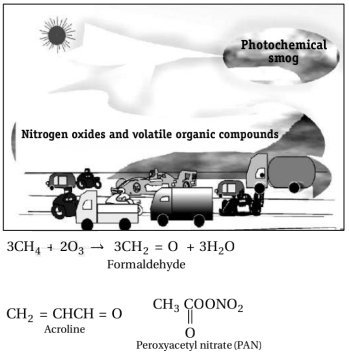
Ozone is a toxic gas and both $NO_2$ and $O_3$ are strong oxidising agents and can react with the unburnt hydrocarbons in the polluted air to produce chemicals such as formaldehyde $(HCHO)$,acrolein $(CH_2=CHCHO)$,and peroxyacetyl nitrate $(PAN)$.
$A$ chain reaction occurs from their interaction with sunlight in which $NO$ is converted into nitrogen dioxide $(NO_2)$. This $NO_2$ in turn absorbs energy from sunlight and breaks up into nitric oxide and a free oxygen atom.
$NO_{2(g)} \stackrel{h\nu}{\longrightarrow} NO_{(g)} + O_{(g)}$ $(I)$
Oxygen atoms are very reactive and combine with the $O_2$ in air to produce ozone.
$O_{(g)} + O_{2(g)} \rightleftharpoons O_{3(g)}$ $(II)$
The ozone formed in the above reaction $(II)$ reacts rapidly with the $NO_{(g)}$ formed in the reaction $(I)$ to regenerate $NO_2$. $NO_2$ is a brown gas and at sufficiently high levels can contribute to haze.
$NO_{(g)} + O_{3(g)} \rightarrow NO_{2(g)} + O_{2(g)}$ $(III)$
Ozone is a toxic gas and both $NO_2$ and $O_3$ are strong oxidising agents and can react with the unburnt hydrocarbons in the polluted air to produce chemicals such as formaldehyde $(HCHO)$,acrolein $(CH_2=CHCHO)$,and peroxyacetyl nitrate $(PAN)$.
0 likes
View Solution338
Difficult
What are the harmful effects of photochemical smog and how can they be controlled?
Solution
(N/A) The common components of photochemical smog are ozone,nitric oxide,acrolein,formaldehyde,and peroxyacetyl nitrate $(PAN)$.
Photochemical smog causes serious health problems. Both ozone and $PAN$ act as powerful eye irritants.
Ozone and nitric oxide irritate the nose and throat,and their high concentration causes headache,chest pain,dryness of the throat,cough,and difficulty in breathing.
Photochemical smog leads to the cracking of rubber and extensive damage to plant life. It also causes corrosion of metals,stones,building materials,and painted surfaces.
Many techniques are used to control the formation of photochemical smog:
$1$. If we control the primary precursors of photochemical smog,such as $NO_2$ and hydrocarbons,the secondary precursors such as ozone and $PAN$ will automatically be reduced.
$2$. Catalytic converters are used in automobiles,which prevent the release of nitrogen oxides and hydrocarbons into the atmosphere.
$3$. Certain plants,e.g.,$Pinus$,$Juniparus$,$Quercus$,$Pyrus$,and $Vitis$,can metabolize nitrogen oxides; therefore,their plantation could help in this matter.
Photochemical smog causes serious health problems. Both ozone and $PAN$ act as powerful eye irritants.
Ozone and nitric oxide irritate the nose and throat,and their high concentration causes headache,chest pain,dryness of the throat,cough,and difficulty in breathing.
Photochemical smog leads to the cracking of rubber and extensive damage to plant life. It also causes corrosion of metals,stones,building materials,and painted surfaces.
Many techniques are used to control the formation of photochemical smog:
$1$. If we control the primary precursors of photochemical smog,such as $NO_2$ and hydrocarbons,the secondary precursors such as ozone and $PAN$ will automatically be reduced.
$2$. Catalytic converters are used in automobiles,which prevent the release of nitrogen oxides and hydrocarbons into the atmosphere.
$3$. Certain plants,e.g.,$Pinus$,$Juniparus$,$Quercus$,$Pyrus$,and $Vitis$,can metabolize nitrogen oxides; therefore,their plantation could help in this matter.
0 likes
View Solution339
Medium
Mention the components of photochemical smog and its effects.
Solution
(N/A) The common components of photochemical smog are ozone $(O_3)$,nitric oxide $(NO)$,acrolein,formaldehyde,and peroxyacetyl nitrate $(PAN)$.
Photochemical smog causes serious health problems. Both ozone and $PAN$ act as powerful eye irritants.
Ozone and nitric oxide irritate the nose and throat,and their high concentration causes headache,chest pain,dryness of the throat,cough,and difficulty in breathing.
Photochemical smog leads to the cracking of rubber and extensive damage to plant life. It also causes corrosion of metals,stones,building materials,and painted surfaces.
To control the formation of photochemical smog,we must control the primary precursors such as $NO_2$ and hydrocarbons. Catalytic converters are used in automobiles to prevent the release of nitrogen oxides and hydrocarbons into the atmosphere.
Certain plants,e.g.,$Pinus$,$Juniparus$,$Quercus$,$Pyrus$,and $Vitis$,can metabolize nitrogen oxides,and therefore,their plantation could help in reducing smog.
Photochemical smog causes serious health problems. Both ozone and $PAN$ act as powerful eye irritants.
Ozone and nitric oxide irritate the nose and throat,and their high concentration causes headache,chest pain,dryness of the throat,cough,and difficulty in breathing.
Photochemical smog leads to the cracking of rubber and extensive damage to plant life. It also causes corrosion of metals,stones,building materials,and painted surfaces.
To control the formation of photochemical smog,we must control the primary precursors such as $NO_2$ and hydrocarbons. Catalytic converters are used in automobiles to prevent the release of nitrogen oxides and hydrocarbons into the atmosphere.
Certain plants,e.g.,$Pinus$,$Juniparus$,$Quercus$,$Pyrus$,and $Vitis$,can metabolize nitrogen oxides,and therefore,their plantation could help in reducing smog.
0 likes
View Solution340
MediumMCQ
Which aerosols deplete ozone?
A
Chlorofluorocarbons $(CFCs)$
B
Carbon dioxide $(CO_2)$
C
Nitrogen oxides $(NO_x)$
D
Sulfur dioxide $(SO_2)$
Solution
(A) Freons or chlorofluorocarbons $(CFCs)$ are aerosols that accelerate the depletion of ozone.
In the presence of ultraviolet radiations,molecules of $CFCs$ break down to form chlorine free radicals that combine with ozone to form oxygen.
In the presence of ultraviolet radiations,molecules of $CFCs$ break down to form chlorine free radicals that combine with ozone to form oxygen.
0 likes
View Solution341
MediumMCQ
How is $SO_2$ an air pollutant?
A
It causes global warming.
B
It causes acid rain and respiratory issues.
C
It depletes the ozone layer.
D
It causes soil erosion.
Solution
(B) $1.$ $SO_2$ combines with atmospheric water vapour to form sulphuric acid $(H_2SO_4)$,leading to acid rain,which damages soil,plants,and marble buildings.
$2.$ In low concentrations,it causes irritation in the respiratory tract,throat,and eyes,and can lead to breathlessness.
$3.$ It causes chlorosis in plants,where leaves lose their colour due to the inhibition of chlorophyll formation.
$2.$ In low concentrations,it causes irritation in the respiratory tract,throat,and eyes,and can lead to breathlessness.
$3.$ It causes chlorosis in plants,where leaves lose their colour due to the inhibition of chlorophyll formation.
0 likes
View Solution342
EasyMCQ
How is excessive content of $CO_{2}$ responsible for global warming?
A
It absorbs infrared radiation from the Earth's surface and traps heat.
B
It reacts with ozone to deplete the ozone layer.
C
It increases the acidity of rainwater.
D
It reacts with nitrogen to form toxic gases.
Solution
(A) $CO_{2}$ is a greenhouse gas. The concentration of $CO_{2}$ in the atmosphere is increasing due to the combustion of fossil fuels and the decomposition of limestone $(CaCO_{3})$ used in cement production.
$CO_{2}$ molecules absorb infrared radiation emitted by the Earth's surface and re-emit it back towards the Earth,trapping heat in the atmosphere. This phenomenon is known as the greenhouse effect,which leads to an increase in global temperature,commonly referred to as global warming.
$CO_{2}$ molecules absorb infrared radiation emitted by the Earth's surface and re-emit it back towards the Earth,trapping heat in the atmosphere. This phenomenon is known as the greenhouse effect,which leads to an increase in global temperature,commonly referred to as global warming.
0 likes
View Solution343
Difficult
What are the reactions involved for ozone layer depletion in the stratosphere?
Solution
(N/A) The main reason for ozone layer depletion is the release of chlorofluorocarbon compounds $(CFCs)$,also known as freons. These compounds are non-reactive,non-flammable,and non-toxic organic molecules.
These are used in refrigerators,air conditioners,in the production of plastic foam,and by the electronic industry for cleaning computer parts.
When $CFCs$ are released into the atmosphere,they mix with normal atmospheric gases and eventually reach the stratosphere. In the stratosphere,they are broken down by powerful $UV$ radiations,releasing chlorine free radicals.
$CF_{2}Cl_{2(g)} \xrightarrow{UV} \dot{C}l_{(g)} + \dot{C}F_{2}Cl_{(g)}$ ... $(i)$
The chlorine radical then reacts with stratospheric ozone to form chlorine monoxide radicals and molecular oxygen.
$\dot{C}l_{(g)} + O_{3(g)} \rightarrow Cl\dot{O}_{(g)} + O_{2(g)}$ ... $(ii)$
Reaction of chlorine monoxide radical with atomic oxygen produces more chlorine radicals.
$Cl\dot{O}_{(g)} + O_{(g)} \rightarrow \dot{C}l_{(g)} + O_{2(g)}$ ... $(iii)$
The chlorine radicals are continuously regenerated and cause the breakdown of ozone. Thus,$CFCs$ act as transporting agents for continuously generating chlorine radicals in the stratosphere,which damages the ozone layer.
These are used in refrigerators,air conditioners,in the production of plastic foam,and by the electronic industry for cleaning computer parts.
When $CFCs$ are released into the atmosphere,they mix with normal atmospheric gases and eventually reach the stratosphere. In the stratosphere,they are broken down by powerful $UV$ radiations,releasing chlorine free radicals.
$CF_{2}Cl_{2(g)} \xrightarrow{UV} \dot{C}l_{(g)} + \dot{C}F_{2}Cl_{(g)}$ ... $(i)$
The chlorine radical then reacts with stratospheric ozone to form chlorine monoxide radicals and molecular oxygen.
$\dot{C}l_{(g)} + O_{3(g)} \rightarrow Cl\dot{O}_{(g)} + O_{2(g)}$ ... $(ii)$
Reaction of chlorine monoxide radical with atomic oxygen produces more chlorine radicals.
$Cl\dot{O}_{(g)} + O_{(g)} \rightarrow \dot{C}l_{(g)} + O_{2(g)}$ ... $(iii)$
The chlorine radicals are continuously regenerated and cause the breakdown of ozone. Thus,$CFCs$ act as transporting agents for continuously generating chlorine radicals in the stratosphere,which damages the ozone layer.
0 likes
View Solution344
Difficult
How does the depletion of ozone layer occur by chlorofluorocarbons?
Solution
(N/A) The main reason for ozone layer depletion is the release of chlorofluorocarbon compounds $(CFCs)$,also known as freons. These compounds are non-reactive,non-flammable,and non-toxic organic molecules.
These are used in refrigerators,air conditioners,in the production of plastic foam,and by the electronic industry for cleaning computer parts.
$CFCs$ are released into the atmosphere,mix with normal atmospheric gases,and eventually reach the stratosphere. In the stratosphere,they are broken down by powerful $UV$ radiations,releasing a chlorine free radical.
$CF_{2}Cl_{2(g)} \xrightarrow{UV} \dot{Cl}_{(g)} + \dot{C}F_{2}Cl_{(g)} \quad \dots (I)$
The chlorine radical then reacts with stratospheric ozone to form chlorine monoxide radicals and molecular oxygen.
$Cl_{(g)} + O_{3(g)} \rightarrow ClO_{(g)} + O_{2(g)} \quad \dots (II)$
The reaction of chlorine monoxide radical with atomic oxygen produces more chlorine radicals.
$Cl\dot{O}_{(g)} + O_{(g)} \rightarrow \dot{Cl}_{(g)} + O_{2(g)} \quad \dots (III)$
The chlorine radicals are continuously regenerated and cause the breakdown of ozone. Thus,$CFCs$ act as transporting agents for continuously generating chlorine radicals in the stratosphere,thereby damaging the ozone layer.
These are used in refrigerators,air conditioners,in the production of plastic foam,and by the electronic industry for cleaning computer parts.
$CFCs$ are released into the atmosphere,mix with normal atmospheric gases,and eventually reach the stratosphere. In the stratosphere,they are broken down by powerful $UV$ radiations,releasing a chlorine free radical.
$CF_{2}Cl_{2(g)} \xrightarrow{UV} \dot{Cl}_{(g)} + \dot{C}F_{2}Cl_{(g)} \quad \dots (I)$
The chlorine radical then reacts with stratospheric ozone to form chlorine monoxide radicals and molecular oxygen.
$Cl_{(g)} + O_{3(g)} \rightarrow ClO_{(g)} + O_{2(g)} \quad \dots (II)$
The reaction of chlorine monoxide radical with atomic oxygen produces more chlorine radicals.
$Cl\dot{O}_{(g)} + O_{(g)} \rightarrow \dot{Cl}_{(g)} + O_{2(g)} \quad \dots (III)$
The chlorine radicals are continuously regenerated and cause the breakdown of ozone. Thus,$CFCs$ act as transporting agents for continuously generating chlorine radicals in the stratosphere,thereby damaging the ozone layer.
0 likes
View Solution345
Difficult
How is the depletion of the ozone layer created in the atmosphere over Antarctica? Explain with reactions.
Solution
(N/A) In the $1980$s,atmospheric scientists working in Antarctica reported the depletion of the ozone layer,commonly known as the ozone hole.
In the summer season,nitrogen dioxide and methane react with chlorine monoxide and chlorine atoms to form chlorine sinks,which prevent significant ozone depletion.
In winter,special types of clouds called polar stratospheric clouds are formed over Antarctica.
These clouds provide a surface on which chlorine nitrate $(ClONO_2)$ gets hydrolysed to form hypochlorous acid $(HOCl)$. It also reacts with hydrogen chloride $(HCl)$ to produce molecular chlorine $(Cl_2)$.
$ClO_{(g)} + NO_{2_{(g)}} \rightarrow ClONO_{2_{(g)}} \quad \dots (IV)$
$\dot{C}l_{(g)} + CH_{4_{(g)}} \rightarrow \dot{C}H_{3_{(g)}} + HCl_{(g)} \quad \dots (V)$
$ClONO_{2_{(g)}} + H_2O_{(g)} \rightarrow HOCl_{(g)} + HNO_{3_{(g)}} \quad \dots (VI)$
$ClONO_{2_{(g)}} + HCl_{(g)} \rightarrow Cl_{2_{(g)}} + HNO_{3_{(g)}} \quad \dots (VII)$
In spring,sunlight returns to Antarctica. The sun's warmth breaks up the clouds,and $HOCl$ and $Cl_2$ are photolysed by sunlight,as given in reactions $(VIII)$ and $(IX)$:
$HOCl_{(g)} \xrightarrow{hv} \dot{O}H_{(g)} + \dot{C}l_{(g)} \quad \dots (VIII)$
$Cl_{2_{(g)}} \xrightarrow{hv} 2\dot{C}l_{(g)} \quad \dots (IX)$
Thus,chlorine radicals are formed,which initiate the chain reaction for ozone depletion.
In the summer season,nitrogen dioxide and methane react with chlorine monoxide and chlorine atoms to form chlorine sinks,which prevent significant ozone depletion.
In winter,special types of clouds called polar stratospheric clouds are formed over Antarctica.
These clouds provide a surface on which chlorine nitrate $(ClONO_2)$ gets hydrolysed to form hypochlorous acid $(HOCl)$. It also reacts with hydrogen chloride $(HCl)$ to produce molecular chlorine $(Cl_2)$.
$ClO_{(g)} + NO_{2_{(g)}} \rightarrow ClONO_{2_{(g)}} \quad \dots (IV)$
$\dot{C}l_{(g)} + CH_{4_{(g)}} \rightarrow \dot{C}H_{3_{(g)}} + HCl_{(g)} \quad \dots (V)$
$ClONO_{2_{(g)}} + H_2O_{(g)} \rightarrow HOCl_{(g)} + HNO_{3_{(g)}} \quad \dots (VI)$
$ClONO_{2_{(g)}} + HCl_{(g)} \rightarrow Cl_{2_{(g)}} + HNO_{3_{(g)}} \quad \dots (VII)$
In spring,sunlight returns to Antarctica. The sun's warmth breaks up the clouds,and $HOCl$ and $Cl_2$ are photolysed by sunlight,as given in reactions $(VIII)$ and $(IX)$:
$HOCl_{(g)} \xrightarrow{hv} \dot{O}H_{(g)} + \dot{C}l_{(g)} \quad \dots (VIII)$
$Cl_{2_{(g)}} \xrightarrow{hv} 2\dot{C}l_{(g)} \quad \dots (IX)$
Thus,chlorine radicals are formed,which initiate the chain reaction for ozone depletion.
0 likes
View Solution346
Medium
What do you mean by ozone hole? What are its consequences?
Solution
(N/A) The ozone hole refers to the significant thinning of the stratospheric ozone layer,primarily caused by the release of chlorofluorocarbons $(CFCs)$ and other ozone-depleting substances.
Consequences of ozone depletion:
$1$. Increased $UV$ radiation reaching the troposphere leads to health issues such as skin ageing,cataracts,sunburn,and skin cancer.
$2$. It negatively impacts aquatic life by killing many phytoplanktons,which damages fish productivity.
$3$. Plant proteins are affected by $UV$ radiation,leading to harmful mutations in cells.
$4$. It increases the evaporation of surface water through the stomata of leaves,thereby decreasing the moisture content of the soil.
$5$. Increased $UV$ radiation causes damage to paints and fibers,leading to faster fading.
Consequences of ozone depletion:
$1$. Increased $UV$ radiation reaching the troposphere leads to health issues such as skin ageing,cataracts,sunburn,and skin cancer.
$2$. It negatively impacts aquatic life by killing many phytoplanktons,which damages fish productivity.
$3$. Plant proteins are affected by $UV$ radiation,leading to harmful mutations in cells.
$4$. It increases the evaporation of surface water through the stomata of leaves,thereby decreasing the moisture content of the soil.
$5$. Increased $UV$ radiation causes damage to paints and fibers,leading to faster fading.
0 likes
View Solution347
Medium
Explain in short: Effect of ozone depletion on environment.
Solution
(N/A) With the depletion of the ozone layer,more $UV$ radiation filters into the troposphere. $UV$ radiations lead to ageing of skin,cataract,sunburn,skin cancer,killing of many phytoplanktons,and damage to fish productivity.
Plant proteins get easily affected by $UV$ radiations,which leads to harmful mutations of cells. It also increases the evaporation of surface water through the stomata of the leaves and decreases the moisture content of the soil.
An increase in $UV$ radiations damages paints and fibres,causing them to fade faster.
Plant proteins get easily affected by $UV$ radiations,which leads to harmful mutations of cells. It also increases the evaporation of surface water through the stomata of the leaves and decreases the moisture content of the soil.
An increase in $UV$ radiations damages paints and fibres,causing them to fade faster.
0 likes
View Solution348
Difficult
Summarize the primary information regarding water pollution.
Solution
Water is essential for life. Without water,there would be no life. We usually take water for granted for its purity,but we must ensure the quality of water.
Pollution of water originates from human activities. Pollution reaches surface or ground water through different paths.
An easily identified source or place of pollution is called a point source,e.g.,municipal and industrial discharge pipes.
Non-point sources of pollution are those where a source of pollution cannot be easily identified,e.g.,agricultural run-off (from farms,animals,and crop-lands),acid rain,and storm-water drainage (from streets,parking lots,and lawns).
The major water pollutants and their sources are listed below:
Pollution of water originates from human activities. Pollution reaches surface or ground water through different paths.
An easily identified source or place of pollution is called a point source,e.g.,municipal and industrial discharge pipes.
Non-point sources of pollution are those where a source of pollution cannot be easily identified,e.g.,agricultural run-off (from farms,animals,and crop-lands),acid rain,and storm-water drainage (from streets,parking lots,and lawns).
The major water pollutants and their sources are listed below:
| Pollutant | Source |
| Micro-organisms | Domestic sewage |
| Organic wastes | Domestic sewage,animal excreta and waste,decaying animals and plants,discharge from food processing factories. |
| Plant nutrients | Chemical fertilizers |
| Toxic heavy metals | Industries and chemical factories. |
| Sediments | Erosion of soil by agriculture and strip mining. |
| Pesticides | Chemicals used for killing insects,fungi,and weeds. |
| Radioactive substances | Mining of uranium-containing minerals. |
| Heat | Water used for cooling in industries. |
0 likes
View Solution349
Medium
Have you ever observed any water pollution in your area? What measures would you suggest to control it?
Solution
(N/A) Water pollution occurs due to various human activities where pollutants enter water sources.
Toxic substances and heavy metals like $Fe, Al, Mn$ are released by industries. Sewage discharge and animal waste also contribute to water pollution. Water containing these substances is not suitable for drinking.
To control this,the following measures are suggested:
$1$. Industrial waste and factory effluents must be treated to remove pollutants and toxic substances before being discharged into water bodies.
$2$. The concentration of pollutants in water sources must be monitored regularly.
$3$. Use of compost fertilizers should be encouraged over synthetic ones.
$4$. Toxic chemicals must be prevented from leaching into groundwater.
Toxic substances and heavy metals like $Fe, Al, Mn$ are released by industries. Sewage discharge and animal waste also contribute to water pollution. Water containing these substances is not suitable for drinking.
To control this,the following measures are suggested:
$1$. Industrial waste and factory effluents must be treated to remove pollutants and toxic substances before being discharged into water bodies.
$2$. The concentration of pollutants in water sources must be monitored regularly.
$3$. Use of compost fertilizers should be encouraged over synthetic ones.
$4$. Toxic chemicals must be prevented from leaching into groundwater.
0 likes
View Solution350
Medium
What are the major causes of water pollution? Explain.
Solution
(N/A) Major causes of water pollution are as follows:
$(i)$ Pathogens: The most serious water pollutants are disease-causing agents called pathogens. Pathogens include bacteria and other organisms that enter water from domestic sewage and animal excreta. Human excreta contain bacteria such as $Escherichia \ coli$ and $Streptococcus \ faecalis$,which cause gastrointestinal diseases.
$(ii)$ Organic wastes: Another major water pollutant is organic matter such as leaves,grass,and trash. They pollute water as a consequence of runoff. Excessive phytoplankton growth within water is also a cause of water pollution. These wastes are biodegradable.
The large population of bacteria decomposes organic matter present in water and consumes oxygen dissolved in water. The amount of oxygen that water can hold in solution is limited.
The concentration of dissolved oxygen in cold water is up to $10 \ ppm$,whereas oxygen in air is about $200,000 \ ppm$. Because of this,a moderate amount of organic matter,when decomposed in water,can deplete the amount of dissolved oxygen.
The concentration of dissolved oxygen in water is very important for aquatic life. If the concentration of dissolved oxygen in water is below $6 \ ppm$,the growth of fish is inhibited.
Oxygen reaches water either through the atmosphere or from the process of photosynthesis carried out by aquatic green plants during daylight.
Photosynthesis stops during the night,but plants continue to respire,resulting in a reduction of dissolved oxygen.
Microorganisms also use dissolved oxygen for the oxidation of organic matter. If too much organic matter is added to water,all available oxygen is used up,causing oxygen-dependent aquatic life to die.
Anaerobic bacteria,which do not require oxygen,begin to break down organic waste and produce chemicals harmful to human health.
Aerobic bacteria,which require oxygen,degrade organic wastes and keep the water depleted of dissolved oxygen.
In a certain volume of water sample,the amount of oxygen required by bacteria to break down organic matter is called Biochemical Oxygen Demand $(BOD)$.
$(i)$ Pathogens: The most serious water pollutants are disease-causing agents called pathogens. Pathogens include bacteria and other organisms that enter water from domestic sewage and animal excreta. Human excreta contain bacteria such as $Escherichia \ coli$ and $Streptococcus \ faecalis$,which cause gastrointestinal diseases.
$(ii)$ Organic wastes: Another major water pollutant is organic matter such as leaves,grass,and trash. They pollute water as a consequence of runoff. Excessive phytoplankton growth within water is also a cause of water pollution. These wastes are biodegradable.
The large population of bacteria decomposes organic matter present in water and consumes oxygen dissolved in water. The amount of oxygen that water can hold in solution is limited.
The concentration of dissolved oxygen in cold water is up to $10 \ ppm$,whereas oxygen in air is about $200,000 \ ppm$. Because of this,a moderate amount of organic matter,when decomposed in water,can deplete the amount of dissolved oxygen.
The concentration of dissolved oxygen in water is very important for aquatic life. If the concentration of dissolved oxygen in water is below $6 \ ppm$,the growth of fish is inhibited.
Oxygen reaches water either through the atmosphere or from the process of photosynthesis carried out by aquatic green plants during daylight.
Photosynthesis stops during the night,but plants continue to respire,resulting in a reduction of dissolved oxygen.
Microorganisms also use dissolved oxygen for the oxidation of organic matter. If too much organic matter is added to water,all available oxygen is used up,causing oxygen-dependent aquatic life to die.
Anaerobic bacteria,which do not require oxygen,begin to break down organic waste and produce chemicals harmful to human health.
Aerobic bacteria,which require oxygen,degrade organic wastes and keep the water depleted of dissolved oxygen.
In a certain volume of water sample,the amount of oxygen required by bacteria to break down organic matter is called Biochemical Oxygen Demand $(BOD)$.
0 likes
View SolutionEnvironmental Chemistry — Environmental Study · Frequently Asked Questions
1Are these Environmental Chemistry questions useful for JEE and NEET?
Yes. All questions in this section are mapped to JEE Main and NEET exam patterns. Previous year questions from JEE Main, NEET, GUJCET and state-level exams are included with full solutions.
2Can I switch to Hindi or Gujarati for these questions?
Yes. Use the language tabs in the hero section or the sidebar to view the same questions and solutions in English, Hindi or Gujarati.
3How do I generate a question paper from this subtopic?
Use the Vedclass Exam Paper Generator — select the chapter and subtopic, set difficulty, and generate Sets A, B, C, D automatically. First 3 chapters of every subject are free.
Vedclass Products
For Students
Vedclass Test Series
Mock tests in real JEE/NEET style with performance analysis. 5-day free trial.
Start Free TrialFor Teachers
Exam Paper Generator
Generate Set A/B/C/D papers from this chapter in 2 minutes. 3 chapters free.
Try FreeFor Institutes
Online Exam Module
Live online exams with unlimited students, 360° analytics & white-label branding.
See DemoFor Teachers & Institutes
Generate a Environmental Chemistry Exam Paper in 2 Minutes
Select subtopic & difficulty — Sets A, B, C, D auto-generated with No Repeat logic.
First 3 chapters of every subject are free — no payment required.