
A English
Environmental Study Questions in English
Class 11 Chemistry · Environmental Chemistry · Environmental Study
655+
Questions
English
Language
100%
With Solutions
Showing 50 of 655 questions in English
351
Easy
$A$ large number of fish are suddenly found floating dead on a lake. There is no evidence of toxic dumping,but you find an abundance of phytoplankton. Suggest a reason for the fish kill.
Solution
(N/A) The abundance of phytoplankton leads to eutrophication. When these organisms die,they are decomposed by bacteria. The decomposition process consumes a large amount of dissolved oxygen from the water. This leads to a significant decrease in the dissolved oxygen levels,causing the $BOD$ (Biochemical Oxygen Demand) to increase and the dissolved oxygen to drop below the level required for fish survival,resulting in their death.
0 likes
View Solution352
Difficult
Give a brief explanation about the international standards for drinking water.
Solution
(N/A) The international standards for drinking water are as follows:
$(i)$ Fluoride: The concentration of fluoride ions should be monitored. Deficiency below $1 \ ppm$ causes tooth decay. Fluoride is added to bring concentration to $1 \ ppm$ or $1 \ mg \ dm^{-3}$. It converts hydroxyapatite,$[3(Ca_{3}(PO_{4})_{2}) \cdot Ca(OH)_{2}]$,into harder fluorapatite,$[3(Ca_{3}(PO_{4})_{2}) \cdot CaF_{2}]$. Concentrations above $2 \ ppm$ cause brown mottling of teeth,and above $10 \ ppm$ cause harmful effects to bones and teeth.
$(ii)$ Lead: Lead pipes contaminate water. The prescribed upper limit is $50 \ ppb$. Lead can damage the kidney,liver,and reproductive system.
$(iii)$ Sulphate: Excessive sulphate $(>500 \ ppm)$ causes a laxative effect.
$(iv)$ Nitrate: The maximum limit is $50 \ ppm$. Excess nitrate causes methemoglobinemia ('blue baby' syndrome).
$(v)$ Other metals: The maximum concentrations for common metals are:
$(i)$ Fluoride: The concentration of fluoride ions should be monitored. Deficiency below $1 \ ppm$ causes tooth decay. Fluoride is added to bring concentration to $1 \ ppm$ or $1 \ mg \ dm^{-3}$. It converts hydroxyapatite,$[3(Ca_{3}(PO_{4})_{2}) \cdot Ca(OH)_{2}]$,into harder fluorapatite,$[3(Ca_{3}(PO_{4})_{2}) \cdot CaF_{2}]$. Concentrations above $2 \ ppm$ cause brown mottling of teeth,and above $10 \ ppm$ cause harmful effects to bones and teeth.
$(ii)$ Lead: Lead pipes contaminate water. The prescribed upper limit is $50 \ ppb$. Lead can damage the kidney,liver,and reproductive system.
$(iii)$ Sulphate: Excessive sulphate $(>500 \ ppm)$ causes a laxative effect.
$(iv)$ Nitrate: The maximum limit is $50 \ ppm$. Excess nitrate causes methemoglobinemia ('blue baby' syndrome).
$(v)$ Other metals: The maximum concentrations for common metals are:
| Metal | Maximum concentration ($ppm$ or $mg \ dm^{-3}$) |
| $Fe$ | $0.2$ |
| $Mn$ | $0.05$ |
| $Al$ | $0.2$ |
| $Cu$ | $3.0$ |
| $Zn$ | $5.0$ |
| $Cd$ | $0.005$ |
0 likes
View Solution353
Difficult
Summarize the international standards for the concentration of various metals and ions in drinking water.
Solution
(N/A) The international standards for drinking water are summarized as follows:
$(i)$ Fluoride: The concentration of $F^-$ ions in drinking water is critical. Deficiency (below $1 \ ppm$) causes tooth decay. It is often added to reach $1 \ ppm$ or $1 \ mg \ dm^{-3}$ because it converts hydroxyapatite,$[3(Ca_3(PO_4)_2) \cdot Ca(OH)_2]$,into harder fluorapatite,$[3(Ca_3(PO_4)_2) \cdot CaF_2]$. Concentrations above $2 \ ppm$ cause brown mottling of teeth,and levels above $10 \ ppm$ are harmful to bones and teeth.
$(ii)$ Lead: Lead contamination often occurs via lead pipes. The prescribed upper limit is $50 \ ppb$. Lead exposure can damage the kidney,liver,and reproductive system.
$(iii)$ Sulphate: Excessive sulphate $(> 500 \ ppm)$ causes a laxative effect; moderate levels are generally harmless.
$(iv)$ Nitrate: The maximum limit is $50 \ ppm$. Excess nitrate can cause methemoglobinemia (blue baby syndrome).
$(v)$ Other metals: The maximum recommended concentrations for common metals are provided in the table below:
$(i)$ Fluoride: The concentration of $F^-$ ions in drinking water is critical. Deficiency (below $1 \ ppm$) causes tooth decay. It is often added to reach $1 \ ppm$ or $1 \ mg \ dm^{-3}$ because it converts hydroxyapatite,$[3(Ca_3(PO_4)_2) \cdot Ca(OH)_2]$,into harder fluorapatite,$[3(Ca_3(PO_4)_2) \cdot CaF_2]$. Concentrations above $2 \ ppm$ cause brown mottling of teeth,and levels above $10 \ ppm$ are harmful to bones and teeth.
$(ii)$ Lead: Lead contamination often occurs via lead pipes. The prescribed upper limit is $50 \ ppb$. Lead exposure can damage the kidney,liver,and reproductive system.
$(iii)$ Sulphate: Excessive sulphate $(> 500 \ ppm)$ causes a laxative effect; moderate levels are generally harmless.
$(iv)$ Nitrate: The maximum limit is $50 \ ppm$. Excess nitrate can cause methemoglobinemia (blue baby syndrome).
$(v)$ Other metals: The maximum recommended concentrations for common metals are provided in the table below:
| Metal | Maximum concentration ($ppm$ or $mg \ dm^{-3}$) |
| $Fe$ | $0.2$ |
| $Mn$ | $0.05$ |
| $Al$ | $0.2$ |
| $Cu$ | $3.0$ |
| $Zn$ | $5.0$ |
| $Cd$ | $0.005$ |
0 likes
View Solution354
Difficult
What are pesticides and herbicides? Explain giving examples.
Solution
(N/A) Pesticides are chemical substances used to destroy or control pests,such as insects,rodents,and fungi,which damage crops or spread diseases. Examples include $Aldrin$ and $Dieldrin$.
Herbicides are chemical substances used to destroy or inhibit the growth of unwanted plants,known as weeds. Examples include $Sodium \ chlorate$ $(NaClO_{3})$ and $Sodium \ arsenite$ $(Na_{3}AsO_{3})$.
Herbicides are chemical substances used to destroy or inhibit the growth of unwanted plants,known as weeds. Examples include $Sodium \ chlorate$ $(NaClO_{3})$ and $Sodium \ arsenite$ $(Na_{3}AsO_{3})$.
0 likes
View Solution355
Medium
Write a note on the effect of various pesticides on living things.
Solution
(N/A) Prior to World War $II$,many naturally occurring chemicals such as nicotine were used as pest-controlling substances for major crops in agricultural practices.
During World War $II$,$DDT$ was found to be of great use in the control of malaria and other insect-borne diseases.
Thus,after the war,$DDT$ was put to use in agriculture to control the damages caused by insects,rodents,weeds,and various crop diseases.
Therefore,as insect resistance to $DDT$ increased,other organic toxins such as Aldrin and Dieldrin were introduced in the market by the pesticide industry.
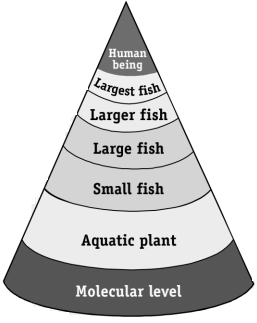
Most of the organic toxins are water-insoluble and non-biodegradable. These highly persistent toxins are,therefore,transferred from lower trophic levels to higher trophic levels through the food chain.
Over time,the concentration of toxins in higher animals reaches a level which causes serious metabolic and physiological disorders.
Organo-phosphates and carbamates are serious nerve toxins. As a result,such insecticides are responsible for the death of laborers working on the farm.
During World War $II$,$DDT$ was found to be of great use in the control of malaria and other insect-borne diseases.
Thus,after the war,$DDT$ was put to use in agriculture to control the damages caused by insects,rodents,weeds,and various crop diseases.
Therefore,as insect resistance to $DDT$ increased,other organic toxins such as Aldrin and Dieldrin were introduced in the market by the pesticide industry.
Most of the organic toxins are water-insoluble and non-biodegradable. These highly persistent toxins are,therefore,transferred from lower trophic levels to higher trophic levels through the food chain.
Over time,the concentration of toxins in higher animals reaches a level which causes serious metabolic and physiological disorders.
Organo-phosphates and carbamates are serious nerve toxins. As a result,such insecticides are responsible for the death of laborers working on the farm.
0 likes
View Solution356
Advanced
Explain the side effects of the use of herbicides on living things.
Solution
(N/A) The pesticide industry has shifted its attention to herbicides such as sodium chlorate $(NaClO_3)$,sodium arsenite $(Na_3AsO_3)$,and many others.
The shift from mechanical to chemical weed control has provided the industry with a flourishing economic market,but these chemicals are not environmentally friendly.
Most herbicides are toxic to mammals,although they are not as persistent as organochlorides. Unlike organochlorides,they are less stable and decompose within the food web.
Some herbicides are known to cause birth defects.
Corn fields sprayed with herbicides are often more prone to insect attacks and plant diseases compared to fields where weeds are removed manually.
Pesticides and herbicides represent only a small portion of widespread chemical pollution. Many other compounds used in industrial manufacturing processes are eventually released into the atmosphere in various forms.
The shift from mechanical to chemical weed control has provided the industry with a flourishing economic market,but these chemicals are not environmentally friendly.
Most herbicides are toxic to mammals,although they are not as persistent as organochlorides. Unlike organochlorides,they are less stable and decompose within the food web.
Some herbicides are known to cause birth defects.
Corn fields sprayed with herbicides are often more prone to insect attacks and plant diseases compared to fields where weeds are removed manually.
Pesticides and herbicides represent only a small portion of widespread chemical pollution. Many other compounds used in industrial manufacturing processes are eventually released into the atmosphere in various forms.
0 likes
View Solution357
Difficult
Do you observe any soil pollution in your neighbourhood? What efforts will you make for controlling the soil pollution?
Solution
(N/A) Agricultural pollutants like industrial wastewater,pesticides,and fertilizers are the main sources of soil pollution.
It is crucial to maintain soil quality and fertility to sustain vegetation. Insecticides like $DDT$ are persistent in the soil because they are not easily degraded. Pesticides such as $Aldrin$ and $Dieldrin$ are non-biodegradable and highly toxic to the environment.
These pollutants enter the food chain and cause health issues. Similarly,industrial waste contains toxic heavy metals like $Pb, Hg, Cd,$ and $As$,which contaminate the soil.
To control soil pollution,we should:
$1$. Periodically monitor soil quality.
$2$. Treat industrial wastewater using proper procedures before discharging it.
$3$. Minimize the use of synthetic pesticides and fertilizers,opting for organic alternatives.
It is crucial to maintain soil quality and fertility to sustain vegetation. Insecticides like $DDT$ are persistent in the soil because they are not easily degraded. Pesticides such as $Aldrin$ and $Dieldrin$ are non-biodegradable and highly toxic to the environment.
These pollutants enter the food chain and cause health issues. Similarly,industrial waste contains toxic heavy metals like $Pb, Hg, Cd,$ and $As$,which contaminate the soil.
To control soil pollution,we should:
$1$. Periodically monitor soil quality.
$2$. Treat industrial wastewater using proper procedures before discharging it.
$3$. Minimize the use of synthetic pesticides and fertilizers,opting for organic alternatives.
0 likes
View Solution358
Medium
For your agricultural field or garden,you have developed a compost-producing pit. Discuss the process in the light of bad odour,flies,and recycling of wastes for good produce.
Solution
(N/A) $1$. $Bad \ Odour$: To prevent bad odour,the compost pit should be properly aerated and maintained at the correct moisture level. Adding a layer of soil or dry leaves on top helps in trapping gases and preventing foul smells.
$2$. $Flies$: Keeping the pit covered with a lid or a layer of soil prevents flies from breeding and spreading diseases.
$3$. $Recycling$: Waste materials that are non-biodegradable,such as plastics,metals,or glass,should be separated and sent for industrial recycling rather than being dumped into the compost pit. This ensures that only organic waste is converted into high-quality manure for agricultural use.
$2$. $Flies$: Keeping the pit covered with a lid or a layer of soil prevents flies from breeding and spreading diseases.
$3$. $Recycling$: Waste materials that are non-biodegradable,such as plastics,metals,or glass,should be separated and sent for industrial recycling rather than being dumped into the compost pit. This ensures that only organic waste is converted into high-quality manure for agricultural use.
0 likes
View Solution359
Medium
What is biodegradable and non-biodegradable waste?
Solution
(N/A) Industrial wastes are classified into two types:
$(i)$ Biodegradable waste: These are wastes that can be decomposed by microorganisms. They are typically generated by cotton mills,food processing units,paper mills,and textile factories.
$(ii)$ Non-biodegradable waste: These are wastes that cannot be decomposed by microorganisms. They are generated by thermal power plants (fly ash),integrated iron and steel plants (blast furnace slag and steel melting slag),and industries manufacturing aluminium,zinc,and copper (mud and tailings). Fertilizer industries produce gypsum. Hazardous wastes such as inflammables,composite explosives,or highly reactive substances are produced by industries dealing in metals,chemicals,drugs,pharmaceuticals,dyes,pesticides,and rubber goods.
$(i)$ Biodegradable waste: These are wastes that can be decomposed by microorganisms. They are typically generated by cotton mills,food processing units,paper mills,and textile factories.
$(ii)$ Non-biodegradable waste: These are wastes that cannot be decomposed by microorganisms. They are generated by thermal power plants (fly ash),integrated iron and steel plants (blast furnace slag and steel melting slag),and industries manufacturing aluminium,zinc,and copper (mud and tailings). Fertilizer industries produce gypsum. Hazardous wastes such as inflammables,composite explosives,or highly reactive substances are produced by industries dealing in metals,chemicals,drugs,pharmaceuticals,dyes,pesticides,and rubber goods.
0 likes
View Solution360
MediumMCQ
How is non-degradable industrial solid waste disposed of?
A
By dumping in open fields
B
By controlled incineration and utilization in other industries
C
By throwing into water bodies
D
By burying in deep pits without treatment
Solution
(B) The disposal of non-degradable industrial solid wastes,if not done by a proper and suitable method,may cause serious threat to the environment.
Nowadays,fly ash and slag from the steel industry are utilized by the cement industry.
Large quantities of toxic wastes are usually destroyed by controlled incineration,whereas small quantities are burnt along with factory garbage in open bins.
Nowadays,fly ash and slag from the steel industry are utilized by the cement industry.
Large quantities of toxic wastes are usually destroyed by controlled incineration,whereas small quantities are burnt along with factory garbage in open bins.
0 likes
View Solution361
Medium
What is green fuel? Give information about waste recycling.
Solution
(N/A) Fuel obtained from plastic waste has a high octane rating. It contains no lead and is known as "green fuel".
Due to recent developments in chemical and textile industries,clothes are now being made from recycled plastic waste.
Technology has been developed to produce electricity from garbage. $A$ pilot plant has been set up where,after removing ferrous metals,plastic,glass,paper,etc.,from garbage,the remaining waste is mixed with water. It is then cultured with bacterial species to produce methane,which is known as biogas.
Biogas is used to generate electricity,and the remaining solid residue is used as manure.
Due to recent developments in chemical and textile industries,clothes are now being made from recycled plastic waste.
Technology has been developed to produce electricity from garbage. $A$ pilot plant has been set up where,after removing ferrous metals,plastic,glass,paper,etc.,from garbage,the remaining waste is mixed with water. It is then cultured with bacterial species to produce methane,which is known as biogas.
Biogas is used to generate electricity,and the remaining solid residue is used as manure.
0 likes
View Solution362
Medium
What kind of steps should be taken to control environmental pollution?
Solution
(N/A) Following steps should be taken to control environmental pollution:
$(i)$ Waste Management: Solid waste is not the only waste seen in household garbage. Besides household discards,there are medical,agricultural,industrial,and mining wastes. Proper disposal and management of these wastes can significantly lower environmental pollution.
$(ii)$ Collection and Disposal: Domestic wastes are collected in small bins,transferred to community bins,and then carried to disposal sites. At these sites,garbage is separated into biodegradable and non-biodegradable materials.
Non-biodegradable materials such as plastic,glass,and metal scraps are sent for recycling.
Biodegradable wastes are deposited in landfills and converted into compost.
If waste is not collected properly,it enters sewers or is consumed by cattle. Non-biodegradable wastes like polythene bags and metal scraps choke sewers and can be fatal if swallowed by cattle. Therefore,domestic waste must be properly collected and disposed of in routine life.
$(i)$ Waste Management: Solid waste is not the only waste seen in household garbage. Besides household discards,there are medical,agricultural,industrial,and mining wastes. Proper disposal and management of these wastes can significantly lower environmental pollution.
$(ii)$ Collection and Disposal: Domestic wastes are collected in small bins,transferred to community bins,and then carried to disposal sites. At these sites,garbage is separated into biodegradable and non-biodegradable materials.
Non-biodegradable materials such as plastic,glass,and metal scraps are sent for recycling.
Biodegradable wastes are deposited in landfills and converted into compost.
If waste is not collected properly,it enters sewers or is consumed by cattle. Non-biodegradable wastes like polythene bags and metal scraps choke sewers and can be fatal if swallowed by cattle. Therefore,domestic waste must be properly collected and disposed of in routine life.
0 likes
View Solution363
Medium
How can domestic waste be used as manure?
Solution
(N/A) Domestic waste is classified into two types based on its nature:
$(i)$ Biodegradable substances: These include organic waste like vegetable peels,fruit scraps,and leaves.
$(ii)$ Non-biodegradable substances: These include materials like plastic,glass,and metal scrap.
To use domestic waste as manure,biodegradable waste should be collected separately and buried in a compost pit in the soil. Over time,microorganisms decompose this organic matter,converting it into nutrient-rich manure that can be used to improve soil fertility. Non-biodegradable waste should be sent for recycling.
$(i)$ Biodegradable substances: These include organic waste like vegetable peels,fruit scraps,and leaves.
$(ii)$ Non-biodegradable substances: These include materials like plastic,glass,and metal scrap.
To use domestic waste as manure,biodegradable waste should be collected separately and buried in a compost pit in the soil. Over time,microorganisms decompose this organic matter,converting it into nutrient-rich manure that can be used to improve soil fertility. Non-biodegradable waste should be sent for recycling.
0 likes
View Solution364
Difficult
What do you mean by green chemistry? How will it help decrease environmental pollution?
Solution
(N/A) Green chemistry is a strategy that utilizes the principles of chemistry and other sciences to reduce or eliminate the use and generation of hazardous substances in the design,manufacture,and application of chemical products.
It helps decrease environmental pollution in the following ways:
$1$. It focuses on designing chemical processes that maximize the incorporation of all materials used in the process into the final product,aiming for $100\%$ atom economy.
$2$. It encourages the use of safer solvents,such as water instead of toxic organic solvents like benzene or carbon tetrachloride,which reduces the release of hazardous waste.
$3$. It optimizes reaction conditions (temperature,pressure,and catalysts) to ensure that reactants are fully converted into useful,environmentally friendly products,thereby minimizing the generation of byproducts.
$4$. By reducing waste generation at the source,it makes industrial processes more cost-effective and environmentally sustainable.
It helps decrease environmental pollution in the following ways:
$1$. It focuses on designing chemical processes that maximize the incorporation of all materials used in the process into the final product,aiming for $100\%$ atom economy.
$2$. It encourages the use of safer solvents,such as water instead of toxic organic solvents like benzene or carbon tetrachloride,which reduces the release of hazardous waste.
$3$. It optimizes reaction conditions (temperature,pressure,and catalysts) to ensure that reactants are fully converted into useful,environmentally friendly products,thereby minimizing the generation of byproducts.
$4$. By reducing waste generation at the source,it makes industrial processes more cost-effective and environmentally sustainable.
0 likes
View Solution365
Easy
What is environmental pollution?
Solution
(N/A) Environmental pollution is the effect of undesirable changes in our surroundings that create harmful effects on plants,animals,and human beings.
0 likes
View Solution366
Easy
Mention the types of pollution.
Solution
(N/A) The major types of pollution are as follows:
$(i)$ Atmospheric pollution
$(ii)$ Water pollution
$(iii)$ Soil pollution
$(iv)$ Industrial pollution
$(v)$ Noise pollution
$(i)$ Atmospheric pollution
$(ii)$ Water pollution
$(iii)$ Soil pollution
$(iv)$ Industrial pollution
$(v)$ Noise pollution
0 likes
View Solution367
Easy
Mention the types of atmospheric pollution.
Solution
(N/A) There are two types of atmospheric pollution :
$(i)$ Tropospheric pollution.
$(ii)$ Stratospheric pollution.
$(i)$ Tropospheric pollution.
$(ii)$ Stratospheric pollution.
0 likes
View Solution368
Easy
What is the troposphere,and which components are present in it?
Solution
(N/A) The region that extends up to $10 \ km$ from sea level and in which human beings and other organisms can live is called the troposphere.
The troposphere is a turbulent,dusty zone containing air,a significant amount of water vapour,and clouds.
The troposphere is a turbulent,dusty zone containing air,a significant amount of water vapour,and clouds.
0 likes
View Solution369
EasyMCQ
Which components are present in the stratosphere?
A
Dinitrogen and dioxygen
B
Ozone and water vapour
C
Dinitrogen,dioxygen,ozone and water vapour
D
Carbon dioxide and methane
Solution
(C) The stratosphere is the layer of the atmosphere that extends from $10 \ km$ to $50 \ km$ above the Earth's surface.
It contains $N_2$,$O_2$,$O_3$ (ozone),and small amounts of water vapour.
It contains $N_2$,$O_2$,$O_3$ (ozone),and small amounts of water vapour.
0 likes
View Solution370
Easy
Mention the type of pollutants of tropospheric pollution.
Solution
(N/A) Pollutants of tropospheric pollution are mainly of two types:
$(i)$ Gaseous air pollutants (e.g.,$SO_x, NO_x, CO, CO_2, O_3, \text{and hydrocarbons}$).
$(ii)$ Particulate pollutants (e.g.,dust,mist,fumes,smoke,and smog).
$(i)$ Gaseous air pollutants (e.g.,$SO_x, NO_x, CO, CO_2, O_3, \text{and hydrocarbons}$).
$(ii)$ Particulate pollutants (e.g.,dust,mist,fumes,smoke,and smog).
0 likes
View Solution371
EasyMCQ
Which of the following are considered atmospheric air pollutants?
A
Oxides of carbon $(CO, CO_2)$
B
Oxides of nitrogen $(NO, NO_2)$ and sulphur $(SO_2, SO_3)$
C
Hydrocarbons and Ozone $(O_3)$
D
All of the above
Solution
(D) Atmospheric air pollutants are broadly classified into gaseous and particulate pollutants.
Gaseous air pollutants include oxides of carbon $(CO, CO_2)$,oxides of nitrogen $(NO_x)$,oxides of sulphur $(SO_x)$,hydrogen sulphide $(H_2S)$,hydrocarbons,ozone $(O_3)$,and other oxidizing agents.
Therefore,all the listed options are correct.
Gaseous air pollutants include oxides of carbon $(CO, CO_2)$,oxides of nitrogen $(NO_x)$,oxides of sulphur $(SO_x)$,hydrogen sulphide $(H_2S)$,hydrocarbons,ozone $(O_3)$,and other oxidizing agents.
Therefore,all the listed options are correct.
0 likes
View Solution372
EasyMCQ
Give the examples of particulate pollutants.
A
Dust and mist
B
Fumes and smoke
C
Smog
D
All of the above
Solution
(D) Particulate pollutants are minute solid particles or liquid droplets suspended in the air.
Examples include:
$1$. Dust: Produced during crushing,grinding,and attribution of solid materials.
$2$. Mist: Produced by particles of spray liquids and by condensation of vapours in air.
$3$. Fumes: Obtained by condensation of vapours during sublimation,distillation,boiling,and calcination.
$4$. Smoke: Consists of solid or mixture of solid and liquid particles formed during combustion of organic matter.
$5$. Smog: $A$ combination of smoke and fog.
Therefore,all the mentioned examples are particulate pollutants.
Examples include:
$1$. Dust: Produced during crushing,grinding,and attribution of solid materials.
$2$. Mist: Produced by particles of spray liquids and by condensation of vapours in air.
$3$. Fumes: Obtained by condensation of vapours during sublimation,distillation,boiling,and calcination.
$4$. Smoke: Consists of solid or mixture of solid and liquid particles formed during combustion of organic matter.
$5$. Smog: $A$ combination of smoke and fog.
Therefore,all the mentioned examples are particulate pollutants.
0 likes
View Solution373
Easy
State the harmful effects of excessive production of sulfur oxide.
Solution
(N/A) High concentration of $SO_2$ leads to irritation to the eyes,resulting in tears and redness. It also leads to the stiffness of flower buds,which eventually fall off from plants. Furthermore,it can cause respiratory diseases like asthma,bronchitis,and emphysema in humans.
0 likes
View Solution374
Easy
How is nitrogen oxide formed in the atmosphere,and why is an excessive amount of nitrogen oxide harmful?
Solution
(N/A) At high altitudes,when lightning strikes,$N_2$ and $O_2$ combine to form nitrogen oxides ($NO$ and $NO_2$).
Excessive amounts of nitrogen oxides are harmful because:
$1$. Higher concentrations of $NO_2$ damage the leaves of plants and retard the rate of photosynthesis.
$2$. Nitrogen oxides are lung irritants that can lead to acute respiratory diseases in children.
$3$. They are toxic to living tissues and cause damage to various textile fibers and metals.
Excessive amounts of nitrogen oxides are harmful because:
$1$. Higher concentrations of $NO_2$ damage the leaves of plants and retard the rate of photosynthesis.
$2$. Nitrogen oxides are lung irritants that can lead to acute respiratory diseases in children.
$3$. They are toxic to living tissues and cause damage to various textile fibers and metals.
0 likes
View Solution375
EasyMCQ
What is the greenhouse effect?
A
The process of cooling the Earth's surface.
B
The process by which the atmosphere traps heat near the Earth's surface.
C
The depletion of the ozone layer.
D
The increase in rainfall due to global warming.
Solution
(B) The greenhouse effect is a natural process where the Earth's atmosphere traps heat from the sun near the surface,keeping the planet warm enough to support life.
Gases like $CO_2$,$CH_4$,and water vapor absorb infrared radiation emitted by the Earth and re-radiate it,preventing it from escaping into space.
Gases like $CO_2$,$CH_4$,and water vapor absorb infrared radiation emitted by the Earth and re-radiate it,preventing it from escaping into space.
0 likes
View Solution376
EasyMCQ
What are the effects of smoking habits for pregnant women?
A
Increased risk of miscarriage
B
Increased risk of spontaneous abnormalities
C
Increased risk of disorders in the baby
D
All of the above
Solution
(D) If a pregnant woman has a habit of smoking,the concentration of $CO$ (carbon monoxide) in the blood increases.
$CO$ binds to hemoglobin more strongly than $O_2$,reducing the oxygen supply to the fetus.
This leads to an increased risk of miscarriage,spontaneous abnormalities,and various developmental disorders in the baby.
$CO$ binds to hemoglobin more strongly than $O_2$,reducing the oxygen supply to the fetus.
This leads to an increased risk of miscarriage,spontaneous abnormalities,and various developmental disorders in the baby.
0 likes
View Solution377
Easy
Give the names of greenhouse gases.
Solution
(N/A) The primary greenhouse gases are carbon dioxide $(CO_2)$,methane $(CH_4)$,ozone $(O_3)$,chlorofluorocarbons $(CFCs)$,and water vapour $(H_2O)$.
0 likes
View Solution378
Easy
What is acid rain? Give the name of the gases responsible for the acid rain.
Solution
(N/A) When the $pH$ of the rain water drops below $5.6$,it is called acid rain.
Oxides of sulphur $(SO_x)$ and oxides of nitrogen $(NO_x)$ are responsible for the acid rain.
Oxides of sulphur $(SO_x)$ and oxides of nitrogen $(NO_x)$ are responsible for the acid rain.
0 likes
View Solution379
Easy
Mention two side effects caused by acid rain.
Solution
(N/A) $(i)$ Acid rain damages buildings and other structures made of stone and metal.
(ii) It causes respiratory ailments in human beings and animals.
(ii) It causes respiratory ailments in human beings and animals.
0 likes
View Solution380
Easy
Mention two ways to prevent acid rain.
Solution
(N/A) $(i)$ Reduce the use of fossil fuel-driven vehicles.
$(ii)$ Use less sulfur-containing coal in industries and electricity generation or use natural gas.
$(ii)$ Use less sulfur-containing coal in industries and electricity generation or use natural gas.
0 likes
View Solution381
Easy
Give the name of particulate pollutants with examples.
Solution
(N/A) Particulate pollutants are classified into two types:
$(i)$ Viable particulates: These are small living organisms that are dispersed in the atmosphere. Examples include bacteria,fungi,moulds,and algae.
$(ii)$ Non-viable particulates: These are formed by the breakdown of larger materials or by condensation of gases. Examples include smoke,dust,and mists.
$(i)$ Viable particulates: These are small living organisms that are dispersed in the atmosphere. Examples include bacteria,fungi,moulds,and algae.
$(ii)$ Non-viable particulates: These are formed by the breakdown of larger materials or by condensation of gases. Examples include smoke,dust,and mists.
0 likes
View Solution382
EasyMCQ
On which bases can non-viable particulates be classified?
A
Nature and size
B
Chemical composition and color
C
Density and mass
D
Source and reactivity
Solution
(A) Non-viable particulates are classified based on their nature and size. They are categorized as follows:
$(i)$ Smoke
(ii) Dust
(iii) Mists
(iv) Fumes
$(v)$ Smog
$(i)$ Smoke
(ii) Dust
(iii) Mists
(iv) Fumes
$(v)$ Smog
0 likes
View Solution383
EasyMCQ
Identify the types of smog that are oxidizing and reducing in nature.
A
Classical smog is oxidizing,Photochemical smog is reducing.
B
Classical smog is reducing,Photochemical smog is oxidizing.
C
Both are oxidizing.
D
Both are reducing.
Solution
(B) Classical smog is a reducing smog because it contains sulfur dioxide $(SO_2)$ and particulate matter.
Photochemical smog is an oxidizing smog because it contains high concentrations of oxidizing agents like ozone $(O_3)$,nitrogen oxides $(NO_x)$,and peroxyacetyl nitrate $(PAN)$.
Photochemical smog is an oxidizing smog because it contains high concentrations of oxidizing agents like ozone $(O_3)$,nitrogen oxides $(NO_x)$,and peroxyacetyl nitrate $(PAN)$.
0 likes
View Solution384
Easy
State the name of components of photochemical smog and mention two solutions to control photochemical smog.
Solution
(N/A) The general components of photochemical smog include ozone $(O_3)$,nitric oxide $(NO)$,acrolein $(CH_2=CH-CHO)$,formaldehyde $(HCHO)$,and peroxyacetyl nitrate $(PAN)$.
Two solutions to control photochemical smog are:
$(i)$ Certain plants,such as $Pinus$,$Juniparus$,$Quercus$,$Pyrus$,and $Vitis$,can metabolize nitrogen oxides; therefore,their plantation can help in reducing smog.
$(ii)$ Catalytic converters should be used in automobiles to reduce the emission of nitrogen oxides and hydrocarbons.
Two solutions to control photochemical smog are:
$(i)$ Certain plants,such as $Pinus$,$Juniparus$,$Quercus$,$Pyrus$,and $Vitis$,can metabolize nitrogen oxides; therefore,their plantation can help in reducing smog.
$(ii)$ Catalytic converters should be used in automobiles to reduce the emission of nitrogen oxides and hydrocarbons.
0 likes
View Solution385
EasyMCQ
How is ozone gas formed in the atmosphere?
A
By the reaction of oxygen with nitrogen
B
By the action of $UV$ radiation on dioxygen molecules
C
By the combustion of fossil fuels
D
By the reaction of water vapor with sunlight
Solution
(B) Ozone is formed in the upper atmosphere by the action of $UV$ radiation on dioxygen $\left( O_2 \right)$ molecules.
$1.$ The $UV$ radiations split molecular oxygen into free oxygen atoms: $O_2(g) \xrightarrow{UV} O(g) + O(g)$.
$2.$ These free oxygen atoms then combine with molecular oxygen to form ozone: $O(g) + O_2(g) \rightleftharpoons O_3(g)$.
$1.$ The $UV$ radiations split molecular oxygen into free oxygen atoms: $O_2(g) \xrightarrow{UV} O(g) + O(g)$.
$2.$ These free oxygen atoms then combine with molecular oxygen to form ozone: $O(g) + O_2(g) \rightleftharpoons O_3(g)$.
0 likes
View Solution386
Easy
Mention the harmful effect of ultra violet radiations.
Solution
(N/A) $UV$ radiations lead to ageing of skin,cataract,sunburn,skin cancer,killing of many phytoplankton,damage to fish productivity,etc.
0 likes
View Solution387
Easy
Mention the main causes for water pollution.
Solution
(N/A) The main causes of water pollution are:
$(i)$ Pathogens: These include bacteria and other organisms that enter water through domestic sewage and animal excreta.
$(ii)$ Organic wastes: These are biodegradable wastes like leaves,grass,and trash that consume dissolved oxygen in water,leading to the death of aquatic life.
$(iii)$ Chemical pollutants: These include heavy metals like $Cd$,$Hg$,$Ni$,and $Pb$,as well as fertilizers and pesticides that contaminate water bodies.
$(i)$ Pathogens: These include bacteria and other organisms that enter water through domestic sewage and animal excreta.
$(ii)$ Organic wastes: These are biodegradable wastes like leaves,grass,and trash that consume dissolved oxygen in water,leading to the death of aquatic life.
$(iii)$ Chemical pollutants: These include heavy metals like $Cd$,$Hg$,$Ni$,and $Pb$,as well as fertilizers and pesticides that contaminate water bodies.
0 likes
View Solution388
Easy
What is Biochemical Oxygen Demand $(BOD)$?
Solution
(N/A) The amount of oxygen required by bacteria to break down the organic matter present in a certain volume of a sample of water is called Biochemical Oxygen Demand $(BOD)$.
0 likes
View Solution389
Easy
Mention the effect of chemical pollutants on the human body.
Solution
(N/A) Chemical pollutants can cause severe damage to vital organs in the human body,including the kidneys,the central nervous system,and the liver.
0 likes
View Solution390
EasyMCQ
What is Eutrophication?
A
The process of water purification.
B
The process in which nutrient-enriched water bodies support a dense plant population,which kills animal life by depriving it of oxygen and results in subsequent loss of biodiversity.
C
The process of increasing oxygen levels in water bodies.
D
The process of removing pollutants from soil.
Solution
(B) The process in which nutrient-enriched water bodies support a dense plant population,which kills animal life by depriving it of oxygen and results in subsequent loss of biodiversity,is known as Eutrophication.
0 likes
View Solution391
EasyMCQ
What is responsible for soil pollution?
A
Industrial waste
B
Insecticides,pesticides,and herbicides
C
Deforestation
D
Airborne pollutants
Solution
(B) The excessive use of $ \text{insecticides} $,$ \text{pesticides} $,and $ \text{herbicides} $ in agriculture to protect crops is primarily responsible for soil pollution. These chemicals accumulate in the soil,affecting its fertility and contaminating the food chain.
0 likes
View Solution392
Easy
Give two names of herbicides.
Solution
(N/A) The two common herbicides are:
$(i)$ Sodium chlorate $(NaClO_{3})$
$(ii)$ Sodium arsinite $(Na_{3}AsO_{3})$
$(i)$ Sodium chlorate $(NaClO_{3})$
$(ii)$ Sodium arsinite $(Na_{3}AsO_{3})$
0 likes
View Solution393
EasyMCQ
From where are the biodegradable wastes generated?
A
Chemical industries
B
Food processing units and paper mills
C
Plastic manufacturing plants
D
Metal refineries
Solution
(B) Biodegradable wastes are generated by biological sources such as cotton mills,food processing units,paper mills,and textile factories. These materials can be broken down by microorganisms.
0 likes
View Solution394
EasyMCQ
What is green fuel?
A
Fuel obtained from coal
B
Fuel obtained from plastic waste
C
Fuel obtained from petroleum
D
Fuel obtained from natural gas
Solution
(B) Fuel obtained from plastic waste has a high octane rating. It contains no lead and is known as "green fuel".
0 likes
View Solution395
EasyMCQ
How is biogas produced?
A
By burning plastic and paper waste.
B
By anaerobic decomposition of organic waste in the presence of water and specific bacteria.
C
By chemical synthesis of methane from carbon dioxide.
D
By electrolysis of water mixed with organic matter.
Solution
(B) Biogas is produced through the following steps:
$1$. Organic waste (garbage) is separated from non-biodegradable materials like iron,plastic,glass,and paper.
$2$. The organic waste is mixed with water to form a slurry.
$3$. This mixture is subjected to anaerobic decomposition by specific bacteria (methanogens).
$4$. These bacteria break down the organic matter to produce methane $(CH_4)$,which is the primary component of biogas.
$1$. Organic waste (garbage) is separated from non-biodegradable materials like iron,plastic,glass,and paper.
$2$. The organic waste is mixed with water to form a slurry.
$3$. This mixture is subjected to anaerobic decomposition by specific bacteria (methanogens).
$4$. These bacteria break down the organic matter to produce methane $(CH_4)$,which is the primary component of biogas.
0 likes
View Solution396
Easy
State the measures to control environmental pollution.
Solution
(N/A) $(i)$ Proper waste management and disposal.
$(ii)$ Adoption of green chemistry and sustainable practices in daily life to reduce pollution.
$(ii)$ Adoption of green chemistry and sustainable practices in daily life to reduce pollution.
0 likes
View Solution397
Easy
What is green chemistry?
Solution
(N/A) Green chemistry is a strategy or approach that uses the principles of chemistry and other sciences to reduce or eliminate the use and generation of hazardous substances,thereby minimizing adverse effects on the environment.
0 likes
View Solution398
Difficult
Fill in the blanks:
$(1)$ The substance that spreads pollution is called .......
$(2)$ The full form of $DDT$ is .......
$(3)$ The area from $10 \ km$ to $50 \ km$ above sea level is called .........
$(4)$ Harmful ultraviolet radiation from the sun reaching the earth is blocked by .....
$(1)$ The substance that spreads pollution is called .......
$(2)$ The full form of $DDT$ is .......
$(3)$ The area from $10 \ km$ to $50 \ km$ above sea level is called .........
$(4)$ Harmful ultraviolet radiation from the sun reaching the earth is blocked by .....
Solution
(N/A) $(1)$ Pollutant
$(2)$ Dichlorodiphenyltrichloroethane
$(3)$ Stratosphere
$(4)$ Ozone $(O_3)$
$(2)$ Dichlorodiphenyltrichloroethane
$(3)$ Stratosphere
$(4)$ Ozone $(O_3)$
0 likes
View Solution399
Difficult
Fill in the blanks:
$(1)$ Hydrocarbon compounds are made from ........ and ........ .
$(2)$ ........ has a capacity to stop the flow of oxygen.
$(3)$ ........ is formed by attaching carbon monoxide with hemoglobin in blood.
$(1)$ Hydrocarbon compounds are made from ........ and ........ .
$(2)$ ........ has a capacity to stop the flow of oxygen.
$(3)$ ........ is formed by attaching carbon monoxide with hemoglobin in blood.
Solution
(N/A) $(1)$ Hydrogen and carbon.
$(2)$ Carbon monoxide $(CO)$.
$(3)$ Carboxyhemoglobin.
$(2)$ Carbon monoxide $(CO)$.
$(3)$ Carboxyhemoglobin.
0 likes
View Solution400
Advanced
Fill in the blanks:
$(1)$ Carbon dioxide is found in the ................. layer.
$(2)$ $A$ high concentration of carbon dioxide is responsible for ................. .
$(3)$ ................. gas is used in air conditioners.
$(4)$ Acid rain causes damage to the ................. monument (wonder).
$(1)$ Carbon dioxide is found in the ................. layer.
$(2)$ $A$ high concentration of carbon dioxide is responsible for ................. .
$(3)$ ................. gas is used in air conditioners.
$(4)$ Acid rain causes damage to the ................. monument (wonder).
Solution
(N/A) $(1)$ Troposphere
$(2)$ Global warming
$(3)$ Chlorofluorocarbons $(CFCs)$
$(4)$ Taj Mahal
$(2)$ Global warming
$(3)$ Chlorofluorocarbons $(CFCs)$
$(4)$ Taj Mahal
0 likes
View SolutionEnvironmental Chemistry — Environmental Study · Frequently Asked Questions
1Are these Environmental Chemistry questions useful for JEE and NEET?
Yes. All questions in this section are mapped to JEE Main and NEET exam patterns. Previous year questions from JEE Main, NEET, GUJCET and state-level exams are included with full solutions.
2Can I switch to Hindi or Gujarati for these questions?
Yes. Use the language tabs in the hero section or the sidebar to view the same questions and solutions in English, Hindi or Gujarati.
3How do I generate a question paper from this subtopic?
Use the Vedclass Exam Paper Generator — select the chapter and subtopic, set difficulty, and generate Sets A, B, C, D automatically. First 3 chapters of every subject are free.
Vedclass Products
For Students
Vedclass Test Series
Mock tests in real JEE/NEET style with performance analysis. 5-day free trial.
Start Free TrialFor Teachers
Exam Paper Generator
Generate Set A/B/C/D papers from this chapter in 2 minutes. 3 chapters free.
Try FreeFor Institutes
Online Exam Module
Live online exams with unlimited students, 360° analytics & white-label branding.
See DemoFor Teachers & Institutes
Generate a Environmental Chemistry Exam Paper in 2 Minutes
Select subtopic & difficulty — Sets A, B, C, D auto-generated with No Repeat logic.
First 3 chapters of every subject are free — no payment required.