
A English
Nomenclature of organic compounds Questions in English
Class 11 Chemistry · 8-1.Organic Chemistry : Classification and Nomenclature of Organic compounds · Nomenclature of organic compounds
796+
Questions
English
Language
100%
With Solutions
Showing 50 of 796 questions in English
501
Medium
Give condensed and bond line structural formulas and identify the functional group$(s)$ present,if any,for:
$(a)$ $2,2,4-$Trimethylpentane
$(b)$ $2-$Hydroxy$-1,2,3-$propanetricarboxylic acid
$(c)$ Hexanedial
$(a)$ $2,2,4-$Trimethylpentane
$(b)$ $2-$Hydroxy$-1,2,3-$propanetricarboxylic acid
$(c)$ Hexanedial
Solution
(N/A) $2,2,4-$Trimethylpentane
Condensed formula: $(CH_{3})_{3}CCH_{2}CH(CH_{3})_{2}$
Functional group: None (alkane)
$(b)$ $2-$Hydroxy$-1,2,3-$propanetricarboxylic acid
Condensed formula: $(HOOC)CH_{2}C(OH)(COOH)CH_{2}(COOH)$
Functional groups: Carboxylic acid $(-COOH)$ and alcoholic $(-OH)$ groups.
$(c)$ Hexanedial
Condensed formula: $OHC(CH_{2})_{4}CHO$
Functional group: Aldehyde $(-CHO)$ group.
Condensed formula: $(CH_{3})_{3}CCH_{2}CH(CH_{3})_{2}$
Functional group: None (alkane)
$(b)$ $2-$Hydroxy$-1,2,3-$propanetricarboxylic acid
Condensed formula: $(HOOC)CH_{2}C(OH)(COOH)CH_{2}(COOH)$
Functional groups: Carboxylic acid $(-COOH)$ and alcoholic $(-OH)$ groups.
$(c)$ Hexanedial
Condensed formula: $OHC(CH_{2})_{4}CHO$
Functional group: Aldehyde $(-CHO)$ group.
0 likes
View Solution502
Easy
Write $IUPAC$ names of the following compounds:
$(i)$ $[CH_3]_3 C CH_2 C(CH_3)_3$
$(ii)$ $[CH_3]_2 C(C_2 H_5)_2$
$(iii)$ tetra$-tert-$butylmethane
$(i)$ $[CH_3]_3 C CH_2 C(CH_3)_3$
$(ii)$ $[CH_3]_2 C(C_2 H_5)_2$
$(iii)$ tetra$-tert-$butylmethane
Solution
(N/A) $(i)$ The longest chain contains $5$ carbon atoms. The parent alkane is pentane. Substituents are at positions $2, 2, 4, 4$. The name is $2,2,4,4-$Tetramethylpentane.
$(ii)$ The longest chain contains $5$ carbon atoms. The parent alkane is pentane. Substituents are at position $3, 3$. The name is $3,3-$Dimethylpentane.
$(iii)$ The structure is $C[C(CH_3)_3]_4$. The longest chain contains $9$ carbon atoms. The name is $3,3,7,7-$Tetramethyl$-5,5-$bis$(1,1-$dimethylethyl$)$nonane,commonly referred to as $3,3,5,5-$tetra$-tert-$butylpentane or based on the parent chain $2,2,4,4,8,8,10,10-$octamethyl$-6-(1,1-$dimethylethyl$)$undecane. However,the standard $IUPAC$ name for tetra$-tert-$butylmethane is $3,3,5,5-$tetra$-tert-$butylpentane.
$(ii)$ The longest chain contains $5$ carbon atoms. The parent alkane is pentane. Substituents are at position $3, 3$. The name is $3,3-$Dimethylpentane.
$(iii)$ The structure is $C[C(CH_3)_3]_4$. The longest chain contains $9$ carbon atoms. The name is $3,3,7,7-$Tetramethyl$-5,5-$bis$(1,1-$dimethylethyl$)$nonane,commonly referred to as $3,3,5,5-$tetra$-tert-$butylpentane or based on the parent chain $2,2,4,4,8,8,10,10-$octamethyl$-6-(1,1-$dimethylethyl$)$undecane. However,the standard $IUPAC$ name for tetra$-tert-$butylmethane is $3,3,5,5-$tetra$-tert-$butylpentane.
0 likes
View Solution503
Medium
Write structures for each of the following compounds. Why are the given names incorrect? Write correct $IUPAC$ names.
$(i)$ $2-Ethylpentane$
$(ii)$ $5-Ethyl-3-methylheptane$
$(i)$ $2-Ethylpentane$
$(ii)$ $5-Ethyl-3-methylheptane$
Solution
(N/A) $(i)$ The structure of $2-Ethylpentane$ is $CH_3-CH(C_2H_5)-CH_2-CH_2-CH_3$. The longest chain contains $6$ carbon atoms,not $5$. Therefore,the correct $IUPAC$ name is $3-Methylhexane$.
$(ii)$ The structure of $5-Ethyl-3-methylheptane$ is $CH_3-CH_2-CH(CH_3)-CH_2-CH(C_2H_5)-CH_2-CH_3$. According to the lowest locant rule,numbering should start from the end that gives the lower number to the substituent. Therefore,the correct $IUPAC$ name is $3-Ethyl-5-methylheptane$.
$(ii)$ The structure of $5-Ethyl-3-methylheptane$ is $CH_3-CH_2-CH(CH_3)-CH_2-CH(C_2H_5)-CH_2-CH_3$. According to the lowest locant rule,numbering should start from the end that gives the lower number to the substituent. Therefore,the correct $IUPAC$ name is $3-Ethyl-5-methylheptane$.
0 likes
View Solution504
Medium
Write $IUPAC$ names of the following compounds:
$(i)$ $(CH_3)_2CH-CH=CH-CH_2-CH=C(CH_3)-CH(C_2H_5)-CH_3$
$(ii)$ The structure is shown below:
$(iii)$ $CH_2=C(CH_2CH_2CH_3)_2$
$(iv)$ $CH_3-CH(CH_3)-CH=C(C_2H_5)-CH_2-CH(CH_3)-CH_2CH_2CH_3$
$(i)$ $(CH_3)_2CH-CH=CH-CH_2-CH=C(CH_3)-CH(C_2H_5)-CH_3$
$(ii)$ The structure is shown below:
$(iii)$ $CH_2=C(CH_2CH_2CH_3)_2$
$(iv)$ $CH_3-CH(CH_3)-CH=C(C_2H_5)-CH_2-CH(CH_3)-CH_2CH_2CH_3$
Solution
(N/A) $(i)$ The longest chain containing both double bonds has $10$ carbons. Numbering from the left gives $2,8-$dimethyl$-3,6-$decadiene.
$(ii)$ The structure is $CH_2=CH-CH=CH-CH=CH-CH=CH_2$,which is $1,3,5,7-$octatetraene.
$(iii)$ The longest chain containing the double bond has $5$ carbons with a propyl group at position $2$. The name is $2-$propylpent$-1-$ene.
$(iv)$ The longest chain containing the double bond has $10$ carbons. Numbering from the left gives $4-$ethyl$-2,6-$dimethyl$-4-$decene.
$(ii)$ The structure is $CH_2=CH-CH=CH-CH=CH-CH=CH_2$,which is $1,3,5,7-$octatetraene.
$(iii)$ The longest chain containing the double bond has $5$ carbons with a propyl group at position $2$. The name is $2-$propylpent$-1-$ene.
$(iv)$ The longest chain containing the double bond has $10$ carbons. Numbering from the left gives $4-$ethyl$-2,6-$dimethyl$-4-$decene.
0 likes
View Solution505
Medium
Write $IUPAC$ names and calculate the number of $\sigma$ and $\pi$ bonds for the following compounds:
$(i)$ $CH_3-CH(CH_3)-CH=CH-CH_2-CH=C(CH_3)-CH_2-CH_3$
$(ii)$ $CH_3-CH=CH-CH_2-CH=CH-CH(C_2H_5)-CH_2-CH_3$
$(iii)$ $CH_2=C(CH_2-CH_2-CH_3)_2$
$(iv)$ $CH_3-CH(C_4H_9)-CH=C(C_2H_5)-CH_2-CH(CH_3)_2$
$(i)$ $CH_3-CH(CH_3)-CH=CH-CH_2-CH=C(CH_3)-CH_2-CH_3$
$(ii)$ $CH_3-CH=CH-CH_2-CH=CH-CH(C_2H_5)-CH_2-CH_3$
$(iii)$ $CH_2=C(CH_2-CH_2-CH_3)_2$
$(iv)$ $CH_3-CH(C_4H_9)-CH=C(C_2H_5)-CH_2-CH(CH_3)_2$
Solution
(D) The $IUPAC$ names and bond counts for the given structures are as follows:
| $(i)$ $CH_3-CH(CH_3)-CH=CH-CH_2-CH=C(CH_3)-CH_2-CH_3$ | $2,7-\text{Dimethylnona}-3,6-\text{diene}$,$30 \sigma, 2 \pi$ |
| $(ii)$ $CH_3-CH=CH-CH_2-CH=CH-CH(C_2H_5)-CH_2-CH_3$ | $5-\text{Ethyldeca}-2,6-\text{diene}$,$33 \sigma, 2 \pi$ |
| $(iii)$ $CH_2=C(CH_2-CH_2-CH_3)_2$ | $2-\text{Propylpent}-1-\text{ene}$,$26 \sigma, 1 \pi$ |
| $(iv)$ $CH_3-CH(C_4H_9)-CH=C(C_2H_5)-CH_2-CH(CH_3)_2$ | $4-\text{Ethyl}-2,6-\text{dimethyldec}-4-\text{ene}$,$41 \sigma, 1 \pi$ |
0 likes
View Solution506
Medium
Write the $IUPAC$ names of the following compounds:
$a.$ $CH_3-CH=C(CH_3)_2$
$b.$ $CH_2=CH-C \equiv C-CH_3$
$c.$ $CH_2=CH-CH=CH_2$
$d.$ $C_6H_5-CH_2-CH_2-CH=CH_2$
$e.$ $2-\text{Methylphenol}$
$f.$ $CH_3-(CH_2)_4-CH(CH_2-CH(CH_3)_2)-(CH_2)_3-CH_3$
$g.$ $CH_3-CH=CH-CH_2-CH=CH-CH(C_2H_5)-CH_2-CH=CH_2$
$a.$ $CH_3-CH=C(CH_3)_2$
$b.$ $CH_2=CH-C \equiv C-CH_3$
$c.$ $CH_2=CH-CH=CH_2$
$d.$ $C_6H_5-CH_2-CH_2-CH=CH_2$
$e.$ $2-\text{Methylphenol}$
$f.$ $CH_3-(CH_2)_4-CH(CH_2-CH(CH_3)_2)-(CH_2)_3-CH_3$
$g.$ $CH_3-CH=CH-CH_2-CH=CH-CH(C_2H_5)-CH_2-CH=CH_2$
Solution
(N/A) $a.$ $CH_3-CH=C(CH_3)_2$: The longest chain has $4$ carbons with a double bond at $C-2$ and a methyl group at $C-2$. $IUPAC$ name: $2-\text{Methylbut-}2-\text{ene}$.
$b.$ $CH_2=CH-C \equiv C-CH_3$: The chain has $5$ carbons. Double bond gets priority for numbering. $IUPAC$ name: $\text{Pent-}1-\text{en-}3-\text{yne}$.
$c.$ $CH_2=CH-CH=CH_2$: $IUPAC$ name: $\text{Buta-}1,3-\text{diene}$.
$d.$ $C_6H_5-CH_2-CH_2-CH=CH_2$: The principal chain is the alkene chain. $IUPAC$ name: $4-\text{Phenylbut-}1-\text{ene}$.
$e.$ $2-\text{Methylphenol}$: $IUPAC$ name: $2-\text{Methylphenol}$.
$f.$ $CH_3-(CH_2)_4-CH(CH_2-CH(CH_3)_2)-(CH_2)_3-CH_3$: Longest chain is $10$ carbons (decane). Substituent at $C-5$ is an isobutyl group $(2-\text{methylpropyl})$. $IUPAC$ name: $5-(2-\text{Methylpropyl})\text{decane}$.
$g.$ $CH_3-CH=CH-CH_2-CH=CH-CH(C_2H_5)-CH_2-CH=CH_2$: Longest chain with maximum double bonds is $10$ carbons. Numbering starts from the end closer to the first double bond. $IUPAC$ name: $4-\text{Ethyldeca-}1,5,8-\text{triene}$.
$b.$ $CH_2=CH-C \equiv C-CH_3$: The chain has $5$ carbons. Double bond gets priority for numbering. $IUPAC$ name: $\text{Pent-}1-\text{en-}3-\text{yne}$.
$c.$ $CH_2=CH-CH=CH_2$: $IUPAC$ name: $\text{Buta-}1,3-\text{diene}$.
$d.$ $C_6H_5-CH_2-CH_2-CH=CH_2$: The principal chain is the alkene chain. $IUPAC$ name: $4-\text{Phenylbut-}1-\text{ene}$.
$e.$ $2-\text{Methylphenol}$: $IUPAC$ name: $2-\text{Methylphenol}$.
$f.$ $CH_3-(CH_2)_4-CH(CH_2-CH(CH_3)_2)-(CH_2)_3-CH_3$: Longest chain is $10$ carbons (decane). Substituent at $C-5$ is an isobutyl group $(2-\text{methylpropyl})$. $IUPAC$ name: $5-(2-\text{Methylpropyl})\text{decane}$.
$g.$ $CH_3-CH=CH-CH_2-CH=CH-CH(C_2H_5)-CH_2-CH=CH_2$: Longest chain with maximum double bonds is $10$ carbons. Numbering starts from the end closer to the first double bond. $IUPAC$ name: $4-\text{Ethyldeca-}1,5,8-\text{triene}$.
0 likes
View Solution507
Medium
Write the $IUPAC$ names of the following structures:
$(i)$ $CH_3-CH=CH-CH(Br)-CH_3$
$(ii)$ $CH_2=C(CH_3)-CH(Br)-CH_3$
$(iii)$ $CH_3-CH=C(CH_3)-CH(Br)-CH_3$
$(iv)$ $CH_3-C(CH_3)=CH-CH_2Br$
$(v)$ $CH_3-CH=CH-CH_2Br$
$(vi)$ $CH_2=C(CH_3)-CH_2Br$
$(i)$ $CH_3-CH=CH-CH(Br)-CH_3$
$(ii)$ $CH_2=C(CH_3)-CH(Br)-CH_3$
$(iii)$ $CH_3-CH=C(CH_3)-CH(Br)-CH_3$
$(iv)$ $CH_3-C(CH_3)=CH-CH_2Br$
$(v)$ $CH_3-CH=CH-CH_2Br$
$(vi)$ $CH_2=C(CH_3)-CH_2Br$
Solution
(N/A) $(i)$ $4-$Bromopent$-2-$ene
$(ii)$ $3-$Bromo$-2-$methylbut$-1-$ene
$(iii)$ $4-$Bromo$-3-$methylpent$-2-$ene
$(iv)$ $1-$Bromo$-2-$methylbut$-2-$ene
$(v)$ $1-$Bromobut$-2-$ene
$(vi)$ $3-$Bromo$-2-$methylprop$-1-$ene
$(ii)$ $3-$Bromo$-2-$methylbut$-1-$ene
$(iii)$ $4-$Bromo$-3-$methylpent$-2-$ene
$(iv)$ $1-$Bromo$-2-$methylbut$-2-$ene
$(v)$ $1-$Bromobut$-2-$ene
$(vi)$ $3-$Bromo$-2-$methylprop$-1-$ene
0 likes
View Solution508
Medium
Give $IUPAC$ names of the following compounds:
$(i)$ $CH_3-CH(Cl)-CH(CH_3)-CH(CH_3)-CH_2OH$
$(ii)$ $CH_3-CH(OCH_2CH_3)-CH_3$
$(iii)$ Structure of $2,6-$dimethylphenol
$(iv)$ Structure of $1-$ethoxy$-2-$nitrocyclohexane
$(i)$ $CH_3-CH(Cl)-CH(CH_3)-CH(CH_3)-CH_2OH$
$(ii)$ $CH_3-CH(OCH_2CH_3)-CH_3$
$(iii)$ Structure of $2,6-$dimethylphenol
$(iv)$ Structure of $1-$ethoxy$-2-$nitrocyclohexane
Solution
(N/A) $(i)$ The longest chain containing the $-OH$ group has $5$ carbons. Numbering starts from the $-OH$ end. The name is $4-$chloro$-2,3-$dimethylpentan$-1-$ol.
$(ii)$ This is an ether. The longest chain is propane. The ethoxy group is at position $2$. The name is $2-$ethoxypropane.
$(iii)$ The structure shows a phenol ring with methyl groups at positions $2$ and $6$. The name is $2,6-$dimethylphenol.
$(iv)$ The ring is cyclohexane. The ethoxy group is at position $1$ and the nitro group is at position $2$ (alphabetical order). The name is $1-$ethoxy$-2-$nitrocyclohexane.
$(ii)$ This is an ether. The longest chain is propane. The ethoxy group is at position $2$. The name is $2-$ethoxypropane.
$(iii)$ The structure shows a phenol ring with methyl groups at positions $2$ and $6$. The name is $2,6-$dimethylphenol.
$(iv)$ The ring is cyclohexane. The ethoxy group is at position $1$ and the nitro group is at position $2$ (alphabetical order). The name is $1-$ethoxy$-2-$nitrocyclohexane.
0 likes
View Solution509
Medium
Name the following compounds according to the $IUPAC$ system:
$(i)$ $CH_3-CH(CH_2Cl)-CH(CH_2OH)-CH(CH_3)-CH_3$
$(ii)$ $CH_3-CH(CH_3)-CH_2-CH(OH)-CH(CH_2OH)-CH_3$
$(iii)$ $3-$Bromocyclohexanol (structure implied)
$(iv)$ $H_2C=CH-CH(OH)-CH_2-CH_2-CH_3$
$(v)$ $CH_3-C(CH_3)=C(Br)-CH_2OH$
$(i)$ $CH_3-CH(CH_2Cl)-CH(CH_2OH)-CH(CH_3)-CH_3$
$(ii)$ $CH_3-CH(CH_3)-CH_2-CH(OH)-CH(CH_2OH)-CH_3$
$(iii)$ $3-$Bromocyclohexanol (structure implied)
$(iv)$ $H_2C=CH-CH(OH)-CH_2-CH_2-CH_3$
$(v)$ $CH_3-C(CH_3)=C(Br)-CH_2OH$
Solution
(A) $(i)$ $2-$Isopropyl$-3-$chloromethylpentan$-1-$ol
$(ii)$ $2,5-$Dimethylhexane$-1,3-$diol
$(iii)$ $3-$Bromocyclohexan$-1-$ol
$(iv)$ $Hex-1-$en$-3-$ol
$(v)$ $2-$Bromo$-3-$methylbut$-2-$en$-1-$ol
$(ii)$ $2,5-$Dimethylhexane$-1,3-$diol
$(iii)$ $3-$Bromocyclohexan$-1-$ol
$(iv)$ $Hex-1-$en$-3-$ol
$(v)$ $2-$Bromo$-3-$methylbut$-2-$en$-1-$ol
0 likes
View Solution510
Medium
Give the $IUPAC$ names of the following compounds:
$(i)$ $Ph-CH_2-CH_2-COOH$
$(ii)$ $(CH_3)_2C=CH-COOH$
$(iii)$ Structure of $2-$Methylcyclopentanecarboxylic acid
$(iv)$ Structure of $2,4,6-$Trinitrobenzoic acid
$(i)$ $Ph-CH_2-CH_2-COOH$
$(ii)$ $(CH_3)_2C=CH-COOH$
$(iii)$ Structure of $2-$Methylcyclopentanecarboxylic acid
$(iv)$ Structure of $2,4,6-$Trinitrobenzoic acid
Solution
(N/A) $(i)$ $3-$Phenylpropanoic acid
$(ii)$ $3-$Methylbut$-2-$enoic acid
$(iii)$ $2-$Methylcyclopentanecarboxylic acid
$(iv)$ $2,4,6-$Trinitrobenzoic acid
$(ii)$ $3-$Methylbut$-2-$enoic acid
$(iii)$ $2-$Methylcyclopentanecarboxylic acid
$(iv)$ $2,4,6-$Trinitrobenzoic acid
0 likes
View Solution511
Difficult
Explain with examples: $(a)$ Complete,$(b)$ Condensed,and $(c)$ Bond-line structural formulas.
Solution
(N/A) Complete structural formula (dash formula):
$(i)$ The covalent bond is represented by a dash $(-)$ or a small line.
$(ii)$ In the structure,every dash $(-)$ represents one bonding electron pair or two bonding electrons.
$(iii)$ $A$ single dash $(-)$ represents a single bond.
$(iv)$ $A$ double bond is represented by a double dash $(=)$.
$(v)$ $A$ triple bond is represented by a triple dash $(\equiv)$.
$(vi)$ Lone pairs of electrons on heteroatoms (e.g.,$O, N, S, X$ etc.) may or may not be shown.
$(vii)$ Every two atoms are connected by a dash $(-)$ to obtain the complete structure.
Example: Ethane $(CH_3-CH_3)$,Ethene $(CH_2=CH_2)$,Ethyne $(CH\equiv CH)$.
$(b)$ Condensed structural formula:
These structural formulas can be further abbreviated by omitting some or all of the dashes representing covalent bonds and by indicating the number of identical groups attached to an atom by a subscript.
$(i)$ In the structure,all single bonds indicated by dashes are not written.
$(ii)$ These formulas can be condensed by enclosing the repetitive structural unit within a bracket and placing an integer as a subscript indicating the number of times the structural unit is repeated.
$(iii)$ The multiple bonds present between $C$ and heteroatoms are also not written.
Example: $CH_3COCH_3$ is written instead of $CH_3-CO-CH_3$.
Example: The condensed structure of $CH_3-CH_2-CH_2-CH_2-CH_2-CH_2-CH_2-CH_3$ is written as $CH_3(CH_2)_6CH_3$.
$(c)$ Bond-line structural formula:
In this representation,carbon and hydrogen atoms are not shown,and the chain of carbon-carbon bonds is drawn as a zigzag line. The terminals of the line represent methyl groups $(CH_3)$,and the intersections represent methylene $(CH_2)$ or methine $(CH)$ groups. Heteroatoms are explicitly written.
$(i)$ The covalent bond is represented by a dash $(-)$ or a small line.
$(ii)$ In the structure,every dash $(-)$ represents one bonding electron pair or two bonding electrons.
$(iii)$ $A$ single dash $(-)$ represents a single bond.
$(iv)$ $A$ double bond is represented by a double dash $(=)$.
$(v)$ $A$ triple bond is represented by a triple dash $(\equiv)$.
$(vi)$ Lone pairs of electrons on heteroatoms (e.g.,$O, N, S, X$ etc.) may or may not be shown.
$(vii)$ Every two atoms are connected by a dash $(-)$ to obtain the complete structure.
Example: Ethane $(CH_3-CH_3)$,Ethene $(CH_2=CH_2)$,Ethyne $(CH\equiv CH)$.
$(b)$ Condensed structural formula:
These structural formulas can be further abbreviated by omitting some or all of the dashes representing covalent bonds and by indicating the number of identical groups attached to an atom by a subscript.
$(i)$ In the structure,all single bonds indicated by dashes are not written.
$(ii)$ These formulas can be condensed by enclosing the repetitive structural unit within a bracket and placing an integer as a subscript indicating the number of times the structural unit is repeated.
$(iii)$ The multiple bonds present between $C$ and heteroatoms are also not written.
Example: $CH_3COCH_3$ is written instead of $CH_3-CO-CH_3$.
Example: The condensed structure of $CH_3-CH_2-CH_2-CH_2-CH_2-CH_2-CH_2-CH_3$ is written as $CH_3(CH_2)_6CH_3$.
$(c)$ Bond-line structural formula:
In this representation,carbon and hydrogen atoms are not shown,and the chain of carbon-carbon bonds is drawn as a zigzag line. The terminals of the line represent methyl groups $(CH_3)$,and the intersections represent methylene $(CH_2)$ or methine $(CH)$ groups. Heteroatoms are explicitly written.
0 likes
View Solution512
Difficult
What is $IUPAC$ (modern) and common method for nomenclature of organic compounds?
Solution
(N/A) Nomenclature by $IUPAC$ method: Organic chemistry deals with millions of compounds. In order to clearly identify them,a systematic method of naming has been developed and is known as the $IUPAC$ system of nomenclature.
- $IUPAC$ stands for International Union of Pure and Applied Chemistry.
- Sometimes $IUPAC$ names are lengthy and complicated,so common names are used.
- In this systematic nomenclature,the names are correlated with the structure such that the reader or listener can deduce the structure from the name.
$(B)$ Trivial (common) nomenclature method: Organic compounds were assigned names based on their origin or certain properties.
- e.g.,Citric acid is named so because it is found in citrus fruits.
- The acid found in red ants is named formic acid since the Latin word for ant is $formica$.
- These names are traditional and are considered as trivial or common names.
- Some common names are followed even today. For example,Buckminster fullerene is a common name given to the newly discovered $C_{60}$ cluster (a form of carbon) noting its structural similarity to the geodesic domes popularized by the famous architect $R$. Buckminster Fuller.
- $IUPAC$ stands for International Union of Pure and Applied Chemistry.
- Sometimes $IUPAC$ names are lengthy and complicated,so common names are used.
- In this systematic nomenclature,the names are correlated with the structure such that the reader or listener can deduce the structure from the name.
$(B)$ Trivial (common) nomenclature method: Organic compounds were assigned names based on their origin or certain properties.
- e.g.,Citric acid is named so because it is found in citrus fruits.
- The acid found in red ants is named formic acid since the Latin word for ant is $formica$.
- These names are traditional and are considered as trivial or common names.
- Some common names are followed even today. For example,Buckminster fullerene is a common name given to the newly discovered $C_{60}$ cluster (a form of carbon) noting its structural similarity to the geodesic domes popularized by the famous architect $R$. Buckminster Fuller.
0 likes
View Solution513
Medium
Explain the $IUPAC$ nomenclature method in short.
Solution
(N/A) The $IUPAC$ nomenclature of organic compounds involves the following key steps:
$(i)$ Identification of the longest parent carbon chain.
$(ii)$ Identification of functional groups and substituents (branches) attached to the chain.
$(iii)$ Numbering the chain such that the principal functional group gets the lowest possible locant.
$(iv)$ Naming the compound by combining prefixes (substituents/branches),the parent alkane name,and the suffix (principal functional group).
For example,in the structure $CH_3-CH(CH_3)-CH_2-CH(Br)-CH(OH)-CH_3$,the parent chain is hexane,the principal functional group is $-OH$ (suffix $-ol$),and the substituents are $-Br$ (prefix bromo) and $-CH_3$ (prefix methyl). The correct name is $4$-bromo-$3$-methylhexan-$2$-ol.
$(i)$ Identification of the longest parent carbon chain.
$(ii)$ Identification of functional groups and substituents (branches) attached to the chain.
$(iii)$ Numbering the chain such that the principal functional group gets the lowest possible locant.
$(iv)$ Naming the compound by combining prefixes (substituents/branches),the parent alkane name,and the suffix (principal functional group).
For example,in the structure $CH_3-CH(CH_3)-CH_2-CH(Br)-CH(OH)-CH_3$,the parent chain is hexane,the principal functional group is $-OH$ (suffix $-ol$),and the substituents are $-Br$ (prefix bromo) and $-CH_3$ (prefix methyl). The correct name is $4$-bromo-$3$-methylhexan-$2$-ol.
0 likes
View Solution514
Medium
Provide the number of carbon atoms and their corresponding prefixes for naming alkanes.
Solution
(N/A) Number of carbon - Prefixes: The names of such compounds are based on their carbon-carbon chain length,which is determined by the number of carbon atoms.
$(B)$ Alkanes containing $1$ to $10$ carbon atoms: The names are based on the chain structure with the suffix '-ane' and a prefix indicating the number of carbon atoms.
e.g.: If $4$ carbons are present,then 'But' + suffix 'ane' = Butane.
The general formula for alkanes is $C_{n}H_{2n+2}$.
| $C_{1}$: Meth | $C_{8}$: Oct |
| $C_{2}$: Eth | $C_{9}$: Non |
| $C_{3}$: Prop | $C_{10}$: Dec |
| $C_{4}$: But | $C_{11}$: Undec |
| $C_{5}$: Pent | $C_{12}$: Dodec |
| $C_{6}$: Hex | $C_{20}$: Icos |
| $C_{7}$: Hept | $C_{30}$: Triacont |
$(B)$ Alkanes containing $1$ to $10$ carbon atoms: The names are based on the chain structure with the suffix '-ane' and a prefix indicating the number of carbon atoms.
e.g.: If $4$ carbons are present,then 'But' + suffix 'ane' = Butane.
The general formula for alkanes is $C_{n}H_{2n+2}$.
| Molecular Formula : Name | Molecular Formula : Name |
| $CH_{4}$ : Methane | $C_{7}H_{16}$ : Heptane |
| $C_{2}H_{6}$ : Ethane | $C_{8}H_{18}$ : Octane |
| $C_{3}H_{8}$ : Propane | $C_{9}H_{20}$ : Nonane |
| $C_{4}H_{10}$ : Butane | $C_{10}H_{22}$ : Decane |
| $C_{5}H_{12}$ : Pentane | $C_{20}H_{42}$ : Icosane |
| $C_{6}H_{14}$ : Hexane | $C_{30}H_{62}$ : Triacontane |
0 likes
View Solution515
Easy
Give the different structures and names of the following alkyl groups:
$(a)$ Propyl group
$(b)$ Butyl group
$(c)$ Pentyl group
$(a)$ Propyl group
$(b)$ Butyl group
$(c)$ Pentyl group
Solution
(N/A) Propyl group:
$1$. $n$-Propyl group: $CH_3-CH_2-CH_2-$
$2$. Isopropyl group: $(CH_3)_2CH-$
$(b)$ Butyl group:
$1$. $n$-Butyl group: $CH_3-CH_2-CH_2-CH_2-$
$2$. Isobutyl group: $(CH_3)_2CH-CH_2-$
$3$. sec-Butyl group: $CH_3-CH_2-CH(CH_3)-$
$4$. tert-Butyl group: $(CH_3)_3C-$
$(c)$ Pentyl group:
$1$. $n$-Pentyl group: $CH_3-CH_2-CH_2-CH_2-CH_2-$
$2$. Isopentyl group: $(CH_3)_2CH-CH_2-CH_2-$
$3$. Neopentyl group: $(CH_3)_3C-CH_2-$
$1$. $n$-Propyl group: $CH_3-CH_2-CH_2-$
$2$. Isopropyl group: $(CH_3)_2CH-$
$(b)$ Butyl group:
$1$. $n$-Butyl group: $CH_3-CH_2-CH_2-CH_2-$
$2$. Isobutyl group: $(CH_3)_2CH-CH_2-$
$3$. sec-Butyl group: $CH_3-CH_2-CH(CH_3)-$
$4$. tert-Butyl group: $(CH_3)_3C-$
$(c)$ Pentyl group:
$1$. $n$-Pentyl group: $CH_3-CH_2-CH_2-CH_2-CH_2-$
$2$. Isopentyl group: $(CH_3)_2CH-CH_2-CH_2-$
$3$. Neopentyl group: $(CH_3)_3C-CH_2-$
0 likes
View Solution516
EasyMCQ
Write the prefix names for $1$ to $10$ carbon atoms in an organic chain.
A
$1$: Meth,$2$: Eth,$3$: Prop,$4$: But,$5$: Pent,$6$: Hex,$7$: Hept,$8$: Oct,$9$: Non,$10$: Dec
B
$1$: Meth,$2$: Eth,$3$: Prop,$4$: But,$5$: Pent,$6$: Hex,$7$: Hept,$8$: Oct,$9$: Dec,$10$: Undec
C
$1$: Form,$2$: Acet,$3$: Propion,$4$: Butyr,$5$: Valer,$6$: Capro,$7$: Enanth,$8$: Capryl,$9$: Pelargon,$10$: Caprin
D
$1$: Mono,$2$: Di,$3$: Tri,$4$: Tetra,$5$: Penta,$6$: Hexa,$7$: Hepta,$8$: Octa,$9$: Nona,$10$: Deca
Solution
(A) The $IUPAC$ nomenclature system uses specific prefixes to denote the number of carbon atoms in the longest continuous chain:
$1$ carbon: $\text{Meth}$
$2$ carbons: $\text{Eth}$
$3$ carbons: $\text{Prop}$
$4$ carbons: $\text{But}$
$5$ carbons: $\text{Pent}$
$6$ carbons: $\text{Hex}$
$7$ carbons: $\text{Hept}$
$8$ carbons: $\text{Oct}$
$9$ carbons: $\text{Non}$
$10$ carbons: $\text{Dec}$
Therefore,the correct sequence is $1$: $\text{Meth}$,$2$: $\text{Eth}$,$3$: $\text{Prop}$,$4$: $\text{But}$,$5$: $\text{Pent}$,$6$: $\text{Hex}$,$7$: $\text{Hept}$,$8$: $\text{Oct}$,$9$: $\text{Non}$,$10$: $\text{Dec}$.
$1$ carbon: $\text{Meth}$
$2$ carbons: $\text{Eth}$
$3$ carbons: $\text{Prop}$
$4$ carbons: $\text{But}$
$5$ carbons: $\text{Pent}$
$6$ carbons: $\text{Hex}$
$7$ carbons: $\text{Hept}$
$8$ carbons: $\text{Oct}$
$9$ carbons: $\text{Non}$
$10$ carbons: $\text{Dec}$
Therefore,the correct sequence is $1$: $\text{Meth}$,$2$: $\text{Eth}$,$3$: $\text{Prop}$,$4$: $\text{But}$,$5$: $\text{Pent}$,$6$: $\text{Hex}$,$7$: $\text{Hept}$,$8$: $\text{Oct}$,$9$: $\text{Non}$,$10$: $\text{Dec}$.
0 likes
View Solution517
Easy
Write the number of carbon atoms corresponding to the prefixes Meth,Prop,Pent,Hex,and Hept.
Solution
(N/A) The prefixes used in organic nomenclature represent the number of carbon atoms in the parent chain:
$1$. Meth: $1$ carbon atom
$2$. Prop: $3$ carbon atoms
$3$. Pent: $5$ carbon atoms
$4$. Hex: $6$ carbon atoms
$5$. Hept: $7$ carbon atoms
$1$. Meth: $1$ carbon atom
$2$. Prop: $3$ carbon atoms
$3$. Pent: $5$ carbon atoms
$4$. Hex: $6$ carbon atoms
$5$. Hept: $7$ carbon atoms
0 likes
View Solution518
MediumMCQ
Give the structures of the following:
$(a)$ $n$-propyl $(b)$ Isopropyl $(c)$ Isobutyl $(d)$ Isopentyl
What is common in all $Iso$ groups?
$(a)$ $n$-propyl $(b)$ Isopropyl $(c)$ Isobutyl $(d)$ Isopentyl
What is common in all $Iso$ groups?
A
$CH_3-CH_2-CH_2-$
B
$(CH_3)_2CH-$
C
$(CH_3)_2CH-CH_2-$
D
$(CH_3)_2CH-CH_2-CH_2-$
Solution
(A) $n$-propyl: $CH_3-CH_2-CH_2-$
$(b)$ Isopropyl: $(CH_3)_2CH-$
$(c)$ Isobutyl: $(CH_3)_2CH-CH_2-$
$(d)$ Isopentyl: $(CH_3)_2CH-CH_2-CH_2-$
Common feature in all $Iso$ groups: All $Iso$ groups contain a terminal $(CH_3)_2CH-$ structural unit.
$(b)$ Isopropyl: $(CH_3)_2CH-$
$(c)$ Isobutyl: $(CH_3)_2CH-CH_2-$
$(d)$ Isopentyl: $(CH_3)_2CH-CH_2-CH_2-$
Common feature in all $Iso$ groups: All $Iso$ groups contain a terminal $(CH_3)_2CH-$ structural unit.
0 likes
View Solution519
EasyMCQ
What is a $Neo$ prefix in organic nomenclature? Give an example.
A
$A$ prefix for compounds with a quaternary carbon atom.
B
$A$ prefix for compounds with a tertiary carbon atom.
C
$A$ prefix for compounds with a secondary carbon atom.
D
$A$ prefix for compounds with a primary carbon atom.
Solution
(A) The prefix $Neo$ is used in the common system of nomenclature for alkanes that contain a quaternary carbon atom bonded to four other carbon atoms,where three of these are methyl groups attached to the same carbon atom.
An example of a $Neo$ alkane is $Neopentane$,which has the structure $CH_3-C(CH_3)_2-CH_3$ or $C(CH_3)_4$.
An example of a $Neo$ alkane is $Neopentane$,which has the structure $CH_3-C(CH_3)_2-CH_3$ or $C(CH_3)_4$.
0 likes
View Solution520
EasyMCQ
Give the structure of the secondary pentyl group.
A
$CH_3-CH_2-CH_2-CH(CH_3)-$
B
$CH_3-CH_2-CH(CH_3)-CH_2-$
C
$(CH_3)_2CH-CH_2-CH_2-$
D
$CH_3-CH_2-C(CH_3)_2-$
Solution
(A) secondary pentyl group is a $C_5H_{11}$ group where the point of attachment is a secondary carbon atom.
The structure $CH_3-CH_2-CH_2-CH(CH_3)-$ represents the $1$-methylbutyl group,which is a secondary pentyl group.
The structure $CH_3-CH_2-CH(CH_3)-CH_2-$ represents the $2$-methylbutyl group,which is a primary pentyl group.
Therefore,the correct structure for a secondary pentyl group among the options is $CH_3-CH_2-CH_2-CH(CH_3)-$,which corresponds to option $A$.
The structure $CH_3-CH_2-CH_2-CH(CH_3)-$ represents the $1$-methylbutyl group,which is a secondary pentyl group.
The structure $CH_3-CH_2-CH(CH_3)-CH_2-$ represents the $2$-methylbutyl group,which is a primary pentyl group.
Therefore,the correct structure for a secondary pentyl group among the options is $CH_3-CH_2-CH_2-CH(CH_3)-$,which corresponds to option $A$.
0 likes
View Solution521
Advanced
Give the rules for $IUPAC$ nomenclature for branched alkanes. Explain with an example.
Solution
(N/A) The nomenclature of branched alkanes follows these rules:
Rule-$1$: Identify the longest carbon chain in the molecule,which is known as the 'parent chain'.
Example: In the structure $(II)$ below,the longest chain contains $9$ carbon atoms,whereas structure $(I)$ only contains $8$ carbon atoms. Thus,$(II)$ is the correct parent chain.
Rule-$2$: Number the carbon atoms of the parent chain to identify the parent alkane and locate the positions of substituents (alkyl groups). The numbering should be done such that the substituted carbon atoms get the lowest possible locants.
For example,in the structure $(a)$,numbering from left to right gives substituents at $C_2$ and $C_6$. In structure $(b)$,numbering from right to left gives substituents at $C_4$ and $C_8$. Since $2 < 4$,the numbering in $(a)$ is correct.
Rule-$3$: The names of the alkyl groups attached as branches are prefixed to the name of the parent alkane. The position of each substituent is indicated by its corresponding number. If different alkyl groups are present,they are listed in alphabetical order.
Rule-$1$: Identify the longest carbon chain in the molecule,which is known as the 'parent chain'.
Example: In the structure $(II)$ below,the longest chain contains $9$ carbon atoms,whereas structure $(I)$ only contains $8$ carbon atoms. Thus,$(II)$ is the correct parent chain.
Rule-$2$: Number the carbon atoms of the parent chain to identify the parent alkane and locate the positions of substituents (alkyl groups). The numbering should be done such that the substituted carbon atoms get the lowest possible locants.
For example,in the structure $(a)$,numbering from left to right gives substituents at $C_2$ and $C_6$. In structure $(b)$,numbering from right to left gives substituents at $C_4$ and $C_8$. Since $2 < 4$,the numbering in $(a)$ is correct.
Rule-$3$: The names of the alkyl groups attached as branches are prefixed to the name of the parent alkane. The position of each substituent is indicated by its corresponding number. If different alkyl groups are present,they are listed in alphabetical order.
0 likes
View Solution522
Difficult
Provide a table summarizing the functional groups,their structures,$IUPAC$ prefixes,$IUPAC$ suffixes,and examples of organic compounds.
Solution
(A) The following table summarizes the common functional groups,their structures,prefixes,suffixes,and examples:
| Class of Compounds | Functional group structure | $IUPAC$ group prefix | $IUPAC$ group suffix | Example |
| :--- | :--- | :--- | :--- | :--- |
| Alkanes | $-$ | $-$ | $-ane$ | Butane,$CH_3(CH_2)_2CH_3$ |
| Alkenes | $>C=C<$ | $-$ | $-ene$ | But$-1-$ene,$CH_2=CHCH_2CH_3$ |
| Alkynes | $-C \equiv C-$ | $-$ | $-yne$ | But$-1-$yne,$CH \equiv CCH_2CH_3$ |
| Arenes | $-$ | $-$ | $-$ | Benzene |
| Halides | $-X$ $(X=F, Cl, Br, I)$ | $halo-$ | $-$ | $1-Bromobutane, CH_3(CH_2)_2CH_2Br$ |
| Alcohols | $-OH$ | $hydroxy-$ | $-ol$ | $Butan-2-ol, CH_3CH_2CHOHCH_3$ |
| Aldehydes | $-CHO$ | $formyl-$ or $oxo-$ | $-al$ | $Butanal, CH_3(CH_2)_2CHO$ |
| Ketones | $>C=O$ | $oxo-$ | $-one$ | $Butan-2-one, CH_3CH_2COCH_3$ |
| Nitriles | $-C \equiv N$ | $cyano-$ | $-nitrile$ | $Pentanenitrile, CH_3CH_2CH_2CH_2CN$ |
| Ethers | $R-O-R$ | $alkoxy-$ | $-$ | $Ethoxyethane, CH_3CH_2OCH_2CH_3$ |
| Carboxylic acids | $-COOH$ | $carboxy-$ | $-oic \ acid$ | $Butanoic \ acid, CH_3(CH_2)_2CO_2H$ |
| Carboxylate Ions | $-COO^-$ | $-$ | $-oate$ | $Sodium \ butanoate, CH_3(CH_2)_2CO_2Na^+$ |
| Esters | $-COOR$ | $alkoxycarbonyl$ | $-oate$ | $Methyl \ propanoate, CH_3CH_2COOCH_3$ |
| Acyl halides | $-COX$ $(X=F, Cl, Br, I)$ | $halocarbonyl$ | $-oyl \ halide$ | $Butanoyl \ chloride, CH_3(CH_2)_2COCl$ |
| Amines | $-NH_2, >NH, >N-$ | $amino-$ | $-amine$ | $Butan-2-amine, CH_3CHNH_2CH_2CH_3$ |
| Amides | $-CONH_2, -CONHR, -CONR_2$ | $carbamoyl-$ | $-amide$ | $Butanamide, CH_3(CH_2)_2CONH_2$ |
| Nitro compounds | $-NO_2$ | $nitro-$ | $-$ | $1-Nitrobutane, CH_3(CH_2)_3NO_2$ |
| Sulphonic acid | $-SO_3H$ | $sulpho-$ | $sulphonic \ acid$ | $Methylsulphonic \ acid, CH_3SO_3H$ |
| Class of Compounds | Functional group structure | $IUPAC$ group prefix | $IUPAC$ group suffix | Example |
| :--- | :--- | :--- | :--- | :--- |
| Alkanes | $-$ | $-$ | $-ane$ | Butane,$CH_3(CH_2)_2CH_3$ |
| Alkenes | $>C=C<$ | $-$ | $-ene$ | But$-1-$ene,$CH_2=CHCH_2CH_3$ |
| Alkynes | $-C \equiv C-$ | $-$ | $-yne$ | But$-1-$yne,$CH \equiv CCH_2CH_3$ |
| Arenes | $-$ | $-$ | $-$ | Benzene |
| Halides | $-X$ $(X=F, Cl, Br, I)$ | $halo-$ | $-$ | $1-Bromobutane, CH_3(CH_2)_2CH_2Br$ |
| Alcohols | $-OH$ | $hydroxy-$ | $-ol$ | $Butan-2-ol, CH_3CH_2CHOHCH_3$ |
| Aldehydes | $-CHO$ | $formyl-$ or $oxo-$ | $-al$ | $Butanal, CH_3(CH_2)_2CHO$ |
| Ketones | $>C=O$ | $oxo-$ | $-one$ | $Butan-2-one, CH_3CH_2COCH_3$ |
| Nitriles | $-C \equiv N$ | $cyano-$ | $-nitrile$ | $Pentanenitrile, CH_3CH_2CH_2CH_2CN$ |
| Ethers | $R-O-R$ | $alkoxy-$ | $-$ | $Ethoxyethane, CH_3CH_2OCH_2CH_3$ |
| Carboxylic acids | $-COOH$ | $carboxy-$ | $-oic \ acid$ | $Butanoic \ acid, CH_3(CH_2)_2CO_2H$ |
| Carboxylate Ions | $-COO^-$ | $-$ | $-oate$ | $Sodium \ butanoate, CH_3(CH_2)_2CO_2Na^+$ |
| Esters | $-COOR$ | $alkoxycarbonyl$ | $-oate$ | $Methyl \ propanoate, CH_3CH_2COOCH_3$ |
| Acyl halides | $-COX$ $(X=F, Cl, Br, I)$ | $halocarbonyl$ | $-oyl \ halide$ | $Butanoyl \ chloride, CH_3(CH_2)_2COCl$ |
| Amines | $-NH_2, >NH, >N-$ | $amino-$ | $-amine$ | $Butan-2-amine, CH_3CHNH_2CH_2CH_3$ |
| Amides | $-CONH_2, -CONHR, -CONR_2$ | $carbamoyl-$ | $-amide$ | $Butanamide, CH_3(CH_2)_2CONH_2$ |
| Nitro compounds | $-NO_2$ | $nitro-$ | $-$ | $1-Nitrobutane, CH_3(CH_2)_3NO_2$ |
| Sulphonic acid | $-SO_3H$ | $sulpho-$ | $sulphonic \ acid$ | $Methylsulphonic \ acid, CH_3SO_3H$ |
0 likes
View Solution523
Difficult
Give rules of nomenclature of organic compounds containing one or more functional groups.
Solution
(N/A) $(i)$ First of all,the functional group present in the molecule is identified,which determines the choice of the appropriate suffix.
$(ii)$ Longest parent chain: The longest chain of carbon atoms containing the functional group is numbered in such a way that the functional group is attached to the carbon atom possessing the lowest possible number in the chain.
$(iii)$ Polyfunctional compounds: In the case of polyfunctional compounds,one of the functional groups is chosen as the principal functional group,and the compound is then named on that basis. The remaining functional groups,which are subordinate,are named as substituents using appropriate prefixes.
$(iv)$ The choice of principal functional group is made on the basis of the order of preference. The order of decreasing priority for some functional groups is:
$-COOH > -SO_3H > -COOR > -COCl > -CONH_2 > -CN > -CHO > >C=O > -OH > -NH_2 > >C=C< > -C \equiv C-$
$(v)$ $-R, -C_6H_5$,halogens $(-F, -Cl, -Br, -I), -NO_2$,and alkoxy groups $(-OR)$ are always treated as prefix substituents.
$(vi)$ $A$ compound containing both an alcohol and a keto group is named as hydroxyalkanone since the keto group is preferred to the hydroxyl group. For example,$HOCH_2(CH_2)_3CH_2COCH_3$ is named as $7$-hydroxyheptan-$2$-one.
$(vii)$ If more than one functional group of the same type is present,their number is indicated by adding $di$,$tri$,etc.,before the class suffix. In such cases,the full name of the parent alkane is written before the class suffix. For example,$CH_2(OH)CH_2(OH)$ is named as ethane-$1,2$-diol.
$(viii)$ The ending $-e$ of the parent alkane is dropped in the case of compounds having more than one double or triple bond. For example,$CH_2=CH-CH=CH_2$ is named as buta-$1,3$-diene.
$(ii)$ Longest parent chain: The longest chain of carbon atoms containing the functional group is numbered in such a way that the functional group is attached to the carbon atom possessing the lowest possible number in the chain.
$(iii)$ Polyfunctional compounds: In the case of polyfunctional compounds,one of the functional groups is chosen as the principal functional group,and the compound is then named on that basis. The remaining functional groups,which are subordinate,are named as substituents using appropriate prefixes.
$(iv)$ The choice of principal functional group is made on the basis of the order of preference. The order of decreasing priority for some functional groups is:
$-COOH > -SO_3H > -COOR > -COCl > -CONH_2 > -CN > -CHO > >C=O > -OH > -NH_2 > >C=C< > -C \equiv C-$
$(v)$ $-R, -C_6H_5$,halogens $(-F, -Cl, -Br, -I), -NO_2$,and alkoxy groups $(-OR)$ are always treated as prefix substituents.
$(vi)$ $A$ compound containing both an alcohol and a keto group is named as hydroxyalkanone since the keto group is preferred to the hydroxyl group. For example,$HOCH_2(CH_2)_3CH_2COCH_3$ is named as $7$-hydroxyheptan-$2$-one.
$(vii)$ If more than one functional group of the same type is present,their number is indicated by adding $di$,$tri$,etc.,before the class suffix. In such cases,the full name of the parent alkane is written before the class suffix. For example,$CH_2(OH)CH_2(OH)$ is named as ethane-$1,2$-diol.
$(viii)$ The ending $-e$ of the parent alkane is dropped in the case of compounds having more than one double or triple bond. For example,$CH_2=CH-CH=CH_2$ is named as buta-$1,3$-diene.
0 likes
View Solution524
Medium
Explain the nomenclature of benzene-substituted compounds.
Solution
(N/A) Rule-$1$: For $IUPAC$ nomenclature of substituted benzene compounds,the substituent is placed as a prefix to the word benzene,as shown in the following examples:
| Compound | $IUPAC$ Name | Common Name |
| :--- | :--- | :--- |
| $C_6H_5CH_3$ | Methylbenzene | Toluene |
| $C_6H_5OCH_3$ | Methoxybenzene | Anisole |
| $C_6H_5C_2H_5$ | Ethylbenzene | - |
| $C_6H_5NH_2$ | Aminobenzene | Aniline |
| $C_6H_5OH$ | Hydroxybenzene | Phenol |
| $C_6H_5NO_2$ | Nitrobenzene | - |
| $C_6H_5Br$ | Bromobenzene | - |
| $C_6H_5SO_3H$ | Benzenesulphonic acid | -
| Compound | $IUPAC$ Name | Common Name |
| :--- | :--- | :--- |
| $C_6H_5CH_3$ | Methylbenzene | Toluene |
| $C_6H_5OCH_3$ | Methoxybenzene | Anisole |
| $C_6H_5C_2H_5$ | Ethylbenzene | - |
| $C_6H_5NH_2$ | Aminobenzene | Aniline |
| $C_6H_5OH$ | Hydroxybenzene | Phenol |
| $C_6H_5NO_2$ | Nitrobenzene | - |
| $C_6H_5Br$ | Bromobenzene | - |
| $C_6H_5SO_3H$ | Benzenesulphonic acid | -
0 likes
View Solution525
EasyMCQ
What is indicated by the corners and ends in the bond-line structure method of organic compounds?
A
Corners represent carbon atoms and ends represent hydrogen atoms.
B
Corners and ends both represent carbon atoms.
C
Corners represent carbon atoms and ends represent methyl groups.
D
Corners represent hydrogen atoms and ends represent carbon atoms.
Solution
(C) $(i)$ The ends represent methyl groups $(-CH_{3})$.
$(ii)$ Each corner represents a carbon atom. The number of hydrogen atoms attached to a carbon atom at a corner is determined by subtracting the number of bonds connected to that corner from $4$.
$(ii)$ Each corner represents a carbon atom. The number of hydrogen atoms attached to a carbon atom at a corner is determined by subtracting the number of bonds connected to that corner from $4$.
0 likes
View Solution526
EasyMCQ
Determine the number of $H$ atoms attached to each terminal carbon atom in the given structure.

A
$1$ and $3$
B
$3$ and $1$
C
$2$ and $3$
D
$1$ and $2$
Solution
(A) The given structure is $CH_3-CH_2-C \equiv CH$ (but$-1-$yne).
In the skeletal structure,the left terminal carbon is involved in a triple bond $(C \equiv C)$,so it is bonded to only $1$ hydrogen atom $(CH \equiv C-)$.
The right terminal carbon is a methyl group $(-CH_3)$,so it is bonded to $3$ hydrogen atoms.
Therefore,the number of $H$ atoms attached to the terminal carbons are $1$ and $3$ respectively.
In the skeletal structure,the left terminal carbon is involved in a triple bond $(C \equiv C)$,so it is bonded to only $1$ hydrogen atom $(CH \equiv C-)$.
The right terminal carbon is a methyl group $(-CH_3)$,so it is bonded to $3$ hydrogen atoms.
Therefore,the number of $H$ atoms attached to the terminal carbons are $1$ and $3$ respectively.
0 likes
View Solution527
Easy
What is the correct $IUPAC$ name of the following structure? Explain.
$CH_3-CH_2-CH(CH_2-CH_3)-CH_2-CH_2-CH(CH_3)-CH_2-CH_3$
$(i)$ $3-$ethyl$-6-$methyloctane
$(ii)$ $3-$methyl$-6-$ethyloctane
$(iii)$ $6-$methyl$-3-$ethyloctane
$CH_3-CH_2-CH(CH_2-CH_3)-CH_2-CH_2-CH(CH_3)-CH_2-CH_3$
$(i)$ $3-$ethyl$-6-$methyloctane
$(ii)$ $3-$methyl$-6-$ethyloctane
$(iii)$ $6-$methyl$-3-$ethyloctane

Solution
(A) $1$. Identify the longest carbon chain: The longest chain contains $8$ carbon atoms,so the parent alkane is octane.
$2$. Number the chain: Numbering from left to right gives substituents at positions $3$ (ethyl) and $6$ (methyl). Numbering from right to left gives substituents at positions $3$ (methyl) and $6$ (ethyl). Both sets of locants are $(3, 6)$.
$3$. Apply alphabetical order: When locant sets are the same,the substituent that comes first alphabetically receives the lower number. Since 'ethyl' comes before 'methyl',the ethyl group is assigned position $3$ and the methyl group is assigned position $6$.
$4$. Conclusion: The correct name is $3-$ethyl$-6-$methyloctane. Therefore,option $(i)$ is correct.
$2$. Number the chain: Numbering from left to right gives substituents at positions $3$ (ethyl) and $6$ (methyl). Numbering from right to left gives substituents at positions $3$ (methyl) and $6$ (ethyl). Both sets of locants are $(3, 6)$.
$3$. Apply alphabetical order: When locant sets are the same,the substituent that comes first alphabetically receives the lower number. Since 'ethyl' comes before 'methyl',the ethyl group is assigned position $3$ and the methyl group is assigned position $6$.
$4$. Conclusion: The correct name is $3-$ethyl$-6-$methyloctane. Therefore,option $(i)$ is correct.
0 likes
View Solution528
Easy
Should $A$ or $B$ be chosen as the principal chain for nomenclature? Why?
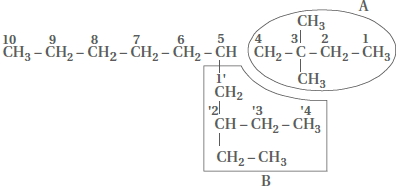
Solution
(A) The principal chain should be chosen such that it includes the substituent with more branching at the point of attachment.
Both $A$ and $B$ are alkyl groups with the same formula $C_{6}H_{13}$.
According to the $IUPAC$ rules for selecting the principal chain when two chains have equal length,the chain with more branching (or more complex branching) at the point of attachment is preferred.
In this case,the group $A$ has a quaternary carbon atom (a carbon bonded to four other carbons) at position $3$ of the substituent chain,which represents more branching compared to the structure of $B$.
Therefore,the chain containing $A$ should be selected as the principal chain.
Both $A$ and $B$ are alkyl groups with the same formula $C_{6}H_{13}$.
According to the $IUPAC$ rules for selecting the principal chain when two chains have equal length,the chain with more branching (or more complex branching) at the point of attachment is preferred.
In this case,the group $A$ has a quaternary carbon atom (a carbon bonded to four other carbons) at position $3$ of the substituent chain,which represents more branching compared to the structure of $B$.
Therefore,the chain containing $A$ should be selected as the principal chain.
0 likes
View Solution529
Easy
Give the correct $IUPAC$ name for the following structure:
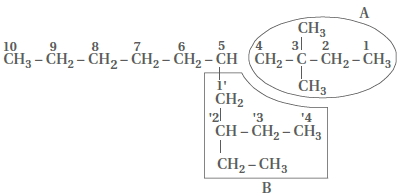
Solution
(A) $1$. Identify the longest carbon chain. The longest chain contains $12$ carbon atoms,making it a dodecane derivative.
$2$. Number the chain to give the substituents the lowest possible locants. Starting from the right,the main chain is numbered $1$ to $12$.
$3$. At position $5$,there is a $2$-ethylbutyl group.
$4$. At position $3$ and $3$,there are two methyl groups.
$5$. Combining these,the $IUPAC$ name is $5-(2'-ethylbutyl)-3,3-dimethyldodecane$.
$2$. Number the chain to give the substituents the lowest possible locants. Starting from the right,the main chain is numbered $1$ to $12$.
$3$. At position $5$,there is a $2$-ethylbutyl group.
$4$. At position $3$ and $3$,there are two methyl groups.
$5$. Combining these,the $IUPAC$ name is $5-(2'-ethylbutyl)-3,3-dimethyldodecane$.
0 likes
View Solution530
Easy
According to $IUPAC$ nomenclature,is the name $5-(2'-ethylbutyl)-3,3-dimethyldecane$ correct for the given structure? Explain why or why not.
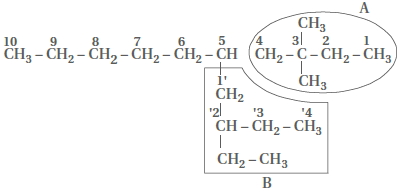
Solution
(N/A) The provided name is incorrect. According to $IUPAC$ rules,the principal chain must be the longest possible carbon chain. In the given structure,the longest chain contains $14$ carbon atoms,not $10$. The structure should be named as a derivative of tetradecane. Furthermore,when naming complex substituents,the chain attached to the main chain must be numbered starting from the point of attachment,and the longest chain within the substituent should be chosen.
0 likes
View Solution531
MediumMCQ
For the given structure,which end should be assigned the number $1$?
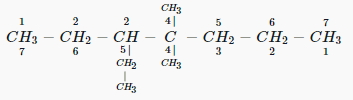
A
Left end
B
Right end
C
Either end
D
None of these
Solution
(A) The structure is $CH_3-CH_2-CH(CH_2CH_3)-C(CH_3)_2-CH_2-CH_2-CH_3$.
$(i)$ If numbering starts from the left end,the substituents are at positions $3$ (ethyl) and $4,4$ (dimethyl). The name is $3$-ethyl-$4,4$-dimethylheptane.
$(ii)$ If numbering starts from the right end,the substituents are at positions $4,4$ (dimethyl) and $5$ (ethyl). The name is $5$-ethyl-$4,4$-dimethylheptane.
According to the $IUPAC$ rules,the set of locants $(3, 4, 4)$ is preferred over $(4, 4, 5)$ because $3 < 4$. Therefore,the numbering must start from the left end.
$(i)$ If numbering starts from the left end,the substituents are at positions $3$ (ethyl) and $4,4$ (dimethyl). The name is $3$-ethyl-$4,4$-dimethylheptane.
$(ii)$ If numbering starts from the right end,the substituents are at positions $4,4$ (dimethyl) and $5$ (ethyl). The name is $5$-ethyl-$4,4$-dimethylheptane.
According to the $IUPAC$ rules,the set of locants $(3, 4, 4)$ is preferred over $(4, 4, 5)$ because $3 < 4$. Therefore,the numbering must start from the left end.
0 likes
View Solution532
Easy
How many carbon atoms are present in the longest parent chain of the given structure?

Solution
(9) To determine the longest parent chain,we identify the continuous chain of carbon atoms with the maximum number of atoms.
Looking at the structure:
$CH_3-CH(CH_3)-CH_2-CH_2-CH_2-CH(CH_2-CH_2-CH_3)-CH_2-CH_3$
If we follow the path labeled as $B$ in the image,the chain consists of $9$ carbon atoms.
Therefore,the longest parent chain contains $9$ carbon atoms.
Looking at the structure:
$CH_3-CH(CH_3)-CH_2-CH_2-CH_2-CH(CH_2-CH_2-CH_3)-CH_2-CH_3$
If we follow the path labeled as $B$ in the image,the chain consists of $9$ carbon atoms.
Therefore,the longest parent chain contains $9$ carbon atoms.
0 likes
View Solution533
EasyMCQ
Which of the following $IUPAC$ names is correct for the structure:
$CH_3-CH(CH_3)-CH_2-CH_2-CH_2-CH(CH_2-CH_2-CH_3)-CH_2-CH_3$?
$(i)$ $2-$methyl$-6-$ethylnonane
$(ii)$ $6-$ethyl$-2-$methylnonane
$(iii)$ $4-$ethyl$-8-$methylnonane
$CH_3-CH(CH_3)-CH_2-CH_2-CH_2-CH(CH_2-CH_2-CH_3)-CH_2-CH_3$?
$(i)$ $2-$methyl$-6-$ethylnonane
$(ii)$ $6-$ethyl$-2-$methylnonane
$(iii)$ $4-$ethyl$-8-$methylnonane
A
$2-$methyl$-6-$ethylnonane
B
$6-$ethyl$-2-$methylnonane
C
$4-$ethyl$-8-$methylnonane
D
None of these
Solution
(B) The given structure is $CH_3-CH(CH_3)-CH_2-CH_2-CH_2-CH(CH_2-CH_2-CH_3)-CH_2-CH_3$.
First,identify the longest carbon chain,which contains $9$ carbons (nonane).
Numbering the chain from the end that gives the lowest locants for substituents,we get substituents at positions $2$ and $6$.
The substituents are methyl $(-CH_3)$ and propyl $(-CH_2-CH_2-CH_3)$.
Wait,re-evaluating the structure: the substituent at position $6$ is a propyl group,not an ethyl group.
However,based on standard $IUPAC$ nomenclature rules,substituents must be listed in alphabetical order.
If the structure were $6-$ethyl$-2-$methylnonane,it would follow the alphabetical rule ($e$ before $m$).
Given the options,$(ii)$ is the correct choice as it follows the alphabetical ordering rule for naming substituents.
First,identify the longest carbon chain,which contains $9$ carbons (nonane).
Numbering the chain from the end that gives the lowest locants for substituents,we get substituents at positions $2$ and $6$.
The substituents are methyl $(-CH_3)$ and propyl $(-CH_2-CH_2-CH_3)$.
Wait,re-evaluating the structure: the substituent at position $6$ is a propyl group,not an ethyl group.
However,based on standard $IUPAC$ nomenclature rules,substituents must be listed in alphabetical order.
If the structure were $6-$ethyl$-2-$methylnonane,it would follow the alphabetical rule ($e$ before $m$).
Given the options,$(ii)$ is the correct choice as it follows the alphabetical ordering rule for naming substituents.
0 likes
View Solution534
MediumMCQ
Which of the following is the correct $IUPAC$ name for the compound $CH_3-CH(CH_3)-CH_2-CH(CH_3)-CH_3$?
A
$2,4-Dimethylpentane$
B
$2,4-Dimethyl-pentane$
C
$2,4-dimethylpentane$
D
$2,4-Dimethyl-Pentane$
Solution
(A) The longest carbon chain contains $5$ carbon atoms,so the parent alkane is $pentane$.
There are two methyl groups attached at the $2^{nd}$ and $4^{th}$ carbon positions.
According to $IUPAC$ nomenclature rules,commas $(,)$ are used to separate numbers,and hyphens $(-)$ are used to separate numbers from letters.
The name should be written as a single word without spaces.
Therefore,the correct name is $2,4-Dimethylpentane$.
There are two methyl groups attached at the $2^{nd}$ and $4^{th}$ carbon positions.
According to $IUPAC$ nomenclature rules,commas $(,)$ are used to separate numbers,and hyphens $(-)$ are used to separate numbers from letters.
The name should be written as a single word without spaces.
Therefore,the correct name is $2,4-Dimethylpentane$.
0 likes
View Solution535
Easy
Give the general formula of alkyl group with examples up to four carbon.
Solution
(N/A) The general formula of an alkyl group is $C_{n}H_{2n+1}$,which is denoted by $R$.
An alkyl group has one hydrogen atom less than the corresponding alkane group. Examples are shown in the table below:
An alkyl group has one hydrogen atom less than the corresponding alkane group. Examples are shown in the table below:
| Formula | Structure | Name |
|---|---|---|
| $CH_{3}-$ | $-CH_{3}$ | Methyl group |
| $C_{2}H_{5}-$ | $CH_{3}-CH_{2}-$ | Ethyl group |
| $C_{3}H_{7}-$ | $CH_{3}-CH_{2}-CH_{2}-$ | $n$-Propyl group |
| $C_{3}H_{7}-$ | $CH_{3}-CH(CH_{3})-$ | Isopropyl group |
| $C_{4}H_{9}-$ | $CH_{3}-CH_{2}-CH_{2}-CH_{2}-$ | $n$-Butyl group |
| $C_{4}H_{9}-$ | $CH_{3}-CH_{2}-CH(CH_{3})-$ | $sec$-Butyl group |
| $C_{4}H_{9}-$ | $(CH_{3})_{2}CH-CH_{2}-$ | Isobutyl group |
| $C_{4}H_{9}-$ | $(CH_{3})_{3}C-$ | $tert$-Butyl group |
0 likes
View Solution536
Medium
Write down the structure and $IUPAC$ name for neo-pentyl bromide.
Solution
(N/A) The structure of neo-pentyl bromide is:
$CH_3-C(CH_3)_2-CH_2Br$
$IUPAC$ name: $1$-Bromo-$2,2$-dimethylpropane.
$CH_3-C(CH_3)_2-CH_2Br$
$IUPAC$ name: $1$-Bromo-$2,2$-dimethylpropane.
0 likes
View Solution537
Medium
What is the structure and $IUPAC$ name of glycerol?
Solution
(N/A) The structure of glycerol is:
$CH_2OH-CHOH-CH_2OH$
The $IUPAC$ name of glycerol is $Propane-1,2,3-triol$.
$CH_2OH-CHOH-CH_2OH$
The $IUPAC$ name of glycerol is $Propane-1,2,3-triol$.
0 likes
View Solution538
Medium
What is the $IUPAC$ name of the following compounds?
$(A)$ $CH_3-CH(CH_3)-CH(OH)-CH(C_2H_5)-CH(OH)-CH_3$
$(B)$ $A$ cyclohexane ring with a $-NO_2$ group at position $1$ and a $-OCH_3$ group at position $3$.
$(A)$ $CH_3-CH(CH_3)-CH(OH)-CH(C_2H_5)-CH(OH)-CH_3$
$(B)$ $A$ cyclohexane ring with a $-NO_2$ group at position $1$ and a $-OCH_3$ group at position $3$.
Solution
(A) The longest carbon chain contains $6$ carbon atoms. The numbering starts from the right to give the lowest locants to the hydroxyl groups. The substituents are an ethyl group at position $3$ and a methyl group at position $5$. Thus,the name is $3$-ethyl-$5$-methylhexane-$2,4$-diol.
$(B)$ The structure is a cyclohexane ring. The methoxy group $(-OCH_3)$ and nitro group $(-NO_2)$ are substituents. Alphabetically,'methoxy' comes before 'nitro'. Numbering the ring to give the lowest locants,we get $1$-methoxy-$3$-nitrocyclohexane.
$(B)$ The structure is a cyclohexane ring. The methoxy group $(-OCH_3)$ and nitro group $(-NO_2)$ are substituents. Alphabetically,'methoxy' comes before 'nitro'. Numbering the ring to give the lowest locants,we get $1$-methoxy-$3$-nitrocyclohexane.
0 likes
View Solution539
MediumMCQ
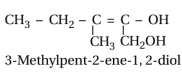
Write the $IUPAC$ name of the compound given below: $CH_3-CH_2-C(CH_3)=C(OH)-CH_2OH$
A
$2-methylpent-2-ene-1,2-diol$
B
$3-methylpent-3-ene-1,2-diol$
C
$4-methylpent-2-ene-1,2-diol$
D
$3-methylpent-2-ene-1,2-diol$
Solution
(D) $1.$ Identify the longest carbon chain containing both hydroxyl $(-OH)$ groups and the double bond. The longest chain has $5$ carbon atoms,so the parent alkane is pentane.
$2.$ Number the chain from the end that gives the $-OH$ groups the lowest possible locants. Numbering from the right gives the $-OH$ groups positions $1$ and $2$.
$3.$ $A$ methyl substituent is located at $C3$.
$4.$ The double bond starts at $C2$,making it $pent-2-ene$.
$5.$ Combining these,the $IUPAC$ name is $3-methylpent-2-ene-1,2-diol$.
$2.$ Number the chain from the end that gives the $-OH$ groups the lowest possible locants. Numbering from the right gives the $-OH$ groups positions $1$ and $2$.
$3.$ $A$ methyl substituent is located at $C3$.
$4.$ The double bond starts at $C2$,making it $pent-2-ene$.
$5.$ Combining these,the $IUPAC$ name is $3-methylpent-2-ene-1,2-diol$.
0 likes
View Solution540
Medium
Match the structures in Column-$I$ with their $\text{IUPAC}$ names in Column-$II$.
| Column-$I$ (Structure) | Column-$II$ ($\text{IUPAC}$ Name) |
|---|---|
| $A$. $3-$bromocyclohexanol | $1$. $2,5$-dimethylhexane-$1,3$-diol |
| $B$. $CH_3-C(Br)=C(CH_3)-CH_2OH$ | $2$. $3$-bromocyclohexanol |
| $C$. $CH_3-CH(CH_3)-CH_2-CH(OH)-CH(CH_2OH)-CH_3$ | $3$. hex-$1$-en-$3$-ol |
| $D$. $CH_2=CH-CH(OH)-CH_2-CH_2-CH_3$ | $4$. $2$-bromo-$3$-methylbut-$2$-en-$1$-ol |
Solution
(A-2, B-4, C-1, D-3) The matching is as follows:
$A \rightarrow 2$: The structure is $3$-bromocyclohexanol.
$B \rightarrow 4$: The structure $CH_3-C(Br)=C(CH_3)-CH_2OH$ is $2$-bromo-$3$-methylbut-$2$-en-$1$-ol.
$C \rightarrow 1$: The structure $CH_3-CH(CH_3)-CH_2-CH(OH)-CH(CH_2OH)-CH_3$ is $2,5$-dimethylhexane-$1,3$-diol.
$D \rightarrow 3$: The structure $CH_2=CH-CH(OH)-CH_2-CH_2-CH_3$ is hex-$1$-en-$3$-ol.
Therefore,the correct match is $(A-2, B-4, C-1, D-3)$.
$A \rightarrow 2$: The structure is $3$-bromocyclohexanol.
$B \rightarrow 4$: The structure $CH_3-C(Br)=C(CH_3)-CH_2OH$ is $2$-bromo-$3$-methylbut-$2$-en-$1$-ol.
$C \rightarrow 1$: The structure $CH_3-CH(CH_3)-CH_2-CH(OH)-CH(CH_2OH)-CH_3$ is $2,5$-dimethylhexane-$1,3$-diol.
$D \rightarrow 3$: The structure $CH_2=CH-CH(OH)-CH_2-CH_2-CH_3$ is hex-$1$-en-$3$-ol.
Therefore,the correct match is $(A-2, B-4, C-1, D-3)$.
0 likes
View Solution541
MediumMCQ
Match the $\text{IUPAC}$ name of the structure in Column-$I$ with the corresponding structure in Column-$II$.
A
$A$: $1$-ethoxy-$2$-nitrocyclohexane
B
$B$: $2,6$-dimethylphenol
C
$C$: $2$-ethoxypropane
D
$D$: $4$-chloro-$2,3$-dimethylpentan-$1$-ol
Solution
(A-2, B-3, C-4, D-1) The matching is as follows:
$A$ ($1$-ethoxy-$2$-nitrocyclohexane) corresponds to structure $(2)$.
$B$ ($2,6$-dimethylphenol) corresponds to structure $(3)$.
$C$ ($2$-ethoxypropane) corresponds to structure $(4)$.
$D$ ($4$-chloro-$2,3$-dimethylpentan-$1$-ol) corresponds to structure $(1)$.
Thus,the correct matching is: $A$ $\rightarrow 2, B$ $\rightarrow 3, C$ $\rightarrow 4, D$ $\rightarrow 1$.
$A$ ($1$-ethoxy-$2$-nitrocyclohexane) corresponds to structure $(2)$.
$B$ ($2,6$-dimethylphenol) corresponds to structure $(3)$.
$C$ ($2$-ethoxypropane) corresponds to structure $(4)$.
$D$ ($4$-chloro-$2,3$-dimethylpentan-$1$-ol) corresponds to structure $(1)$.
Thus,the correct matching is: $A$ $\rightarrow 2, B$ $\rightarrow 3, C$ $\rightarrow 4, D$ $\rightarrow 1$.
0 likes
View Solution542
Medium
Match the structures given in Column-$I$ with their $\text{IUPAC}$ names in Column-$II$.
| Column-$I$ (Structure) | Column-$II$ ($\text{IUPAC}$ Name) |
| :--- | :--- |
| $(A)$ Cyclohexanol | $(i)$ $2$-ethoxy-$1,1$-dimethylcyclohexane |
| $(B)$ $2$-methylcyclopentanol | (ii) $3$-methylphenol |
| $(C)$ $3$-methylphenol | (iii) Trihydroxybenzene |
| $(D)$ $1$-ethoxy-$2,2$-dimethylcyclohexane | (iv) $2$-methylcyclopentanol |
| $(E)$ Benzene-$1,2,4$-triol | $(v)$ Cyclohexanol |
| | (vi) Benzene-$1,2,4$-triol |
| Column-$I$ (Structure) | Column-$II$ ($\text{IUPAC}$ Name) |
| :--- | :--- |
| $(A)$ Cyclohexanol | $(i)$ $2$-ethoxy-$1,1$-dimethylcyclohexane |
| $(B)$ $2$-methylcyclopentanol | (ii) $3$-methylphenol |
| $(C)$ $3$-methylphenol | (iii) Trihydroxybenzene |
| $(D)$ $1$-ethoxy-$2,2$-dimethylcyclohexane | (iv) $2$-methylcyclopentanol |
| $(E)$ Benzene-$1,2,4$-triol | $(v)$ Cyclohexanol |
| | (vi) Benzene-$1,2,4$-triol |
Solution
(A-V, B-IV, C-II, D-I, E-VI) The matching is as follows:
$(A)$ Cyclohexanol corresponds to $(v)$ Cyclohexanol.
$(B)$ $2$-methylcyclopentanol corresponds to (iv) $2$-methylcyclopentanol.
$(C)$ $3$-methylphenol corresponds to (ii) $3$-methylphenol.
$(D)$ $1$-ethoxy-$2,2$-dimethylcyclohexane corresponds to $(i)$ $2$-ethoxy-$1,1$-dimethylcyclohexane (Note: Numbering starts from the ethoxy group as $1$ in the $IUPAC$ name).
$(E)$ Benzene-$1,2,4$-triol corresponds to (vi) Benzene-$1,2,4$-triol.
Therefore,the correct matching is: $(A$ $\rightarrow v), (B$ $\rightarrow iv), (C$ $\rightarrow ii), (D$ $\rightarrow i), (E$ $\rightarrow vi)$.
$(A)$ Cyclohexanol corresponds to $(v)$ Cyclohexanol.
$(B)$ $2$-methylcyclopentanol corresponds to (iv) $2$-methylcyclopentanol.
$(C)$ $3$-methylphenol corresponds to (ii) $3$-methylphenol.
$(D)$ $1$-ethoxy-$2,2$-dimethylcyclohexane corresponds to $(i)$ $2$-ethoxy-$1,1$-dimethylcyclohexane (Note: Numbering starts from the ethoxy group as $1$ in the $IUPAC$ name).
$(E)$ Benzene-$1,2,4$-triol corresponds to (vi) Benzene-$1,2,4$-triol.
Therefore,the correct matching is: $(A$ $\rightarrow v), (B$ $\rightarrow iv), (C$ $\rightarrow ii), (D$ $\rightarrow i), (E$ $\rightarrow vi)$.
0 likes
View Solution543
Difficult
Give the $IUPAC$ names of the following compounds:
$(A)$ $C_6H_5-CH=CH-CHO$
$(B)$ $C_6H_{11}-CHO$
$(C)$ $CH_3-CH_2-CO-CH_2-CHO$
$(D)$ $CH_2=CH-CH_2-CHO$
$(A)$ $C_6H_5-CH=CH-CHO$
$(B)$ $C_6H_{11}-CHO$
$(C)$ $CH_3-CH_2-CO-CH_2-CHO$
$(D)$ $CH_2=CH-CH_2-CHO$
Solution
(N/A) $3-$Phenylprop$-2-$enal
$(B)$ Cyclohexanecarbaldehyde
$(C)$ $3-$Oxopentanal
$(D)$ But$-3-$enal
$(B)$ Cyclohexanecarbaldehyde
$(C)$ $3-$Oxopentanal
$(D)$ But$-3-$enal
0 likes
View Solution544
Medium
Write $IUPAC$ names of the following structures:
$(A)$ $CHO-CHO$
$(B)$ $A$ benzene ring with two $CHO$ groups at para positions.
$(C)$ $A$ benzene ring with a $Br$ group and a $CHO$ group at meta positions.
$(A)$ $CHO-CHO$
$(B)$ $A$ benzene ring with two $CHO$ groups at para positions.
$(C)$ $A$ benzene ring with a $Br$ group and a $CHO$ group at meta positions.
Solution
(N/A) $CHO-CHO$ is Ethane$-1,2-$dial.
$(B)$ The structure is Benzene$-1,4-$dicarbaldehyde.
$(C)$ The structure is $3-$Bromobenzaldehyde.
$(B)$ The structure is Benzene$-1,4-$dicarbaldehyde.
$(C)$ The structure is $3-$Bromobenzaldehyde.
0 likes
View Solution545
MediumMCQ
What is the structure and $IUPAC$ name of the compound,allyl amine?
A
$CH_{2}=CH-CH_{2}-NH_{2}$,prop$-2-$en$-1-$amine
B
$CH_{3}-CH=CH-NH_{2}$,prop$-1-$en$-1-$amine
C
$CH_{2}=C(CH_{3})-NH_{2}$,$2$-methylprop$-1-$en$-1-$amine
D
$CH_{2}=CH-NH_{2}$,ethenamine
Solution
(A) The structure of allyl amine is $CH_{2}=CH-CH_{2}-NH_{2}$.
In the $IUPAC$ nomenclature,the parent chain is a three-carbon alkene chain.
The double bond is at position $2$ and the amino group $(-NH_{2})$ is at position $1$.
Therefore,the $IUPAC$ name is $\text{prop-2-en-1-amine}$.
In the $IUPAC$ nomenclature,the parent chain is a three-carbon alkene chain.
The double bond is at position $2$ and the amino group $(-NH_{2})$ is at position $1$.
Therefore,the $IUPAC$ name is $\text{prop-2-en-1-amine}$.
0 likes
View Solution546
Medium
Write the $IUPAC$ names of the following compounds:
$(1)$ $CH_3-CH=C(CH_3)_2$
$(2)$ $CH_2=CH-C \equiv C-CH_3$
$(1)$ $CH_3-CH=C(CH_3)_2$
$(2)$ $CH_2=CH-C \equiv C-CH_3$
Solution
(N/A) $(1)$ For $CH_3-CH=C(CH_3)_2$,the longest chain contains $4$ carbon atoms. Numbering starts from the right to give the double bond and substituent the lowest possible locants. The $IUPAC$ name is $2-Methylbut-2-ene$.
$(2)$ For $CH_2=CH-C \equiv C-CH_3$,the longest chain contains $5$ carbon atoms. Numbering starts from the left to give the double bond priority over the triple bond when locants are equivalent. The $IUPAC$ name is $Pent-1-en-3-yne$.
$(2)$ For $CH_2=CH-C \equiv C-CH_3$,the longest chain contains $5$ carbon atoms. Numbering starts from the left to give the double bond priority over the triple bond when locants are equivalent. The $IUPAC$ name is $Pent-1-en-3-yne$.
0 likes
View Solution547
Medium
Write the $IUPAC$ names of the following compounds:
$(1)$ $CH_2=CH-CH=CH_2$
$(2)$ $C_6H_5-CH_2-CH_2-CH=CH_2$
$(3)$ $2-methylphenol$ (structure provided)
$(1)$ $CH_2=CH-CH=CH_2$
$(2)$ $C_6H_5-CH_2-CH_2-CH=CH_2$
$(3)$ $2-methylphenol$ (structure provided)
Solution
(N/A) $(1)$ The compound $CH_2=CH-CH=CH_2$ is $buta-1,3-diene$.
$(2)$ The compound $C_6H_5-CH_2-CH_2-CH=CH_2$ is $4-phenylbut-1-ene$.
$(3)$ The compound with a benzene ring having $-OH$ at position $1$ and $-CH_3$ at position $2$ is $2-methylphenol$ (also known as $o-cresol$).
$(2)$ The compound $C_6H_5-CH_2-CH_2-CH=CH_2$ is $4-phenylbut-1-ene$.
$(3)$ The compound with a benzene ring having $-OH$ at position $1$ and $-CH_3$ at position $2$ is $2-methylphenol$ (also known as $o-cresol$).
0 likes
View Solution548
Medium
Write the $IUPAC$ names of the following compounds:
$(1)$ $CH_3(CH_2)_4-CH(CH_2CH(CH_3)_2)-(CH_2)_3CH_3$
$(2)$ $CH_3-CH=CH-CH_2-CH=CH-CH(C_2H_5)-CH_2-CH=CH_2$
$(1)$ $CH_3(CH_2)_4-CH(CH_2CH(CH_3)_2)-(CH_2)_3CH_3$
$(2)$ $CH_3-CH=CH-CH_2-CH=CH-CH(C_2H_5)-CH_2-CH=CH_2$
Solution
(A) $(1)$ The longest carbon chain contains $10$ carbon atoms. The substituent at position $5$ is a $2$-methylpropyl group. Thus,the $IUPAC$ name is $5-(2-methylpropyl)decane$.
$(2)$ The longest carbon chain containing the double bonds has $10$ carbon atoms. The substituent at position $4$ is an ethyl group. The double bonds are at positions $1, 5,$ and $8$. Thus,the $IUPAC$ name is $4-ethyldeca-1,5,8-triene$.
$(2)$ The longest carbon chain containing the double bonds has $10$ carbon atoms. The substituent at position $4$ is an ethyl group. The double bonds are at positions $1, 5,$ and $8$. Thus,the $IUPAC$ name is $4-ethyldeca-1,5,8-triene$.
0 likes
View Solution549
Medium
Give the structure of the $neo$-pentyl group.
Solution
(N/A) The $neo$-pentyl group has the molecular formula $C_5H_{11}$.
It consists of a quaternary carbon atom bonded to three methyl groups and one methylene group $(-CH_2-)$,which acts as the point of attachment.
The structure is: $(CH_3)_3C-CH_2-$.
It consists of a quaternary carbon atom bonded to three methyl groups and one methylene group $(-CH_2-)$,which acts as the point of attachment.
The structure is: $(CH_3)_3C-CH_2-$.
0 likes
View Solution550
Medium
Provide the structures of secondary-butyl and tertiary-butyl groups.
Solution
(N/A) $i$. Secondary-butyl group: $CH_3-CH_2-CH(CH_3)-$
$ii$. Tertiary-butyl group: $(CH_3)_3C-$
$ii$. Tertiary-butyl group: $(CH_3)_3C-$
0 likes
View Solution8-1.Organic Chemistry : Classification and Nomenclature of Organic compounds — Nomenclature of organic compounds · Frequently Asked Questions
1Are these 8-1.Organic Chemistry : Classification and Nomenclature of Organic compounds questions useful for JEE and NEET?
Yes. All questions in this section are mapped to JEE Main and NEET exam patterns. Previous year questions from JEE Main, NEET, GUJCET and state-level exams are included with full solutions.
2Can I switch to Hindi or Gujarati for these questions?
Yes. Use the language tabs in the hero section or the sidebar to view the same questions and solutions in English, Hindi or Gujarati.
3How do I generate a question paper from this subtopic?
Use the Vedclass Exam Paper Generator — select the chapter and subtopic, set difficulty, and generate Sets A, B, C, D automatically. First 3 chapters of every subject are free.
Vedclass Products
For Students
Vedclass Test Series
Mock tests in real JEE/NEET style with performance analysis. 5-day free trial.
Start Free TrialFor Teachers
Exam Paper Generator
Generate Set A/B/C/D papers from this chapter in 2 minutes. 3 chapters free.
Try FreeFor Institutes
Online Exam Module
Live online exams with unlimited students, 360° analytics & white-label branding.
See DemoFor Teachers & Institutes
Generate a 8-1.Organic Chemistry : Classification and Nomenclature of Organic compounds Exam Paper in 2 Minutes
Select subtopic & difficulty — Sets A, B, C, D auto-generated with No Repeat logic.
First 3 chapters of every subject are free — no payment required.