
A English
Classification of organic compounds Questions in English
Class 11 Chemistry · 8-1.Organic Chemistry : Classification and Nomenclature of Organic compounds · Classification of organic compounds
54+
Questions
English
Language
100%
With Solutions
Showing 50 of 54 questions in English
1
MediumMCQ
The study of organic compounds is done separately from other compounds even at present because:
A
The formation of organic compounds is not based on chemical combination
B
Organic compounds are covalent
C
Catenation is their main characteristic
D
It is the easiest method of study
Solution
(C) The study of organic compounds is treated as a separate branch of chemistry because of the unique property of carbon known as $Catenation$.
$Catenation$ is the ability of carbon atoms to form long chains and rings by bonding with other carbon atoms,which leads to the existence of a vast number of organic compounds.
This unique structural diversity makes the chemistry of carbon compounds distinct and extensive compared to inorganic compounds.
$Catenation$ is the ability of carbon atoms to form long chains and rings by bonding with other carbon atoms,which leads to the existence of a vast number of organic compounds.
This unique structural diversity makes the chemistry of carbon compounds distinct and extensive compared to inorganic compounds.
0 likes
View Solution2
MediumMCQ
Alicyclic compounds are
A
Aromatic
B
Aliphatic
C
Heterocyclic
D
Aliphatic cyclic
Solution
(D) An alicyclic compound is an organic compound that is both aliphatic and cyclic.
They contain one or more all-carbon rings which may be either saturated or unsaturated,but do not have aromatic character.
Alicyclic compounds may have one or more aliphatic side chains attached.
They contain one or more all-carbon rings which may be either saturated or unsaturated,but do not have aromatic character.
Alicyclic compounds may have one or more aliphatic side chains attached.
0 likes
View Solution3
MediumMCQ
The most appropriate statement regarding organic compounds is
A
They possess ionic and covalent bonds
B
Presence of carbon is not essential
C
They are found in a large number
D
Their reactions are fast
Solution
(C) Organic compounds are primarily composed of carbon atoms covalently bonded to hydrogen,oxygen,nitrogen,and other elements.
$1$. Organic compounds are characterized by the presence of carbon,which has a unique ability to form stable,long chains and rings (catenation).
$2$. Due to this property of catenation,carbon can form a vast variety of complex structures,leading to the existence of a very large number of organic compounds.
$3$. They typically exhibit covalent bonding,and their reactions are generally slower compared to ionic reactions.
Therefore,the most appropriate statement is that they are found in a large number.
$1$. Organic compounds are characterized by the presence of carbon,which has a unique ability to form stable,long chains and rings (catenation).
$2$. Due to this property of catenation,carbon can form a vast variety of complex structures,leading to the existence of a very large number of organic compounds.
$3$. They typically exhibit covalent bonding,and their reactions are generally slower compared to ionic reactions.
Therefore,the most appropriate statement is that they are found in a large number.
0 likes
View Solution4
EasyMCQ
In the structure $^1CH_3-^2C(CH_3)_2-^3CH_2-^4CH_3$,which one is the quaternary carbon atom?
A
$1$
B
$2$
C
$3$
D
$4$
Solution
(B) quaternary carbon atom is a carbon atom that is bonded to four other carbon atoms.
In the given structure $^1CH_3-^2C(CH_3)_2-^3CH_2-^4CH_3$,the carbon atom at position $2$ is bonded to four other carbon atoms (the $C1$ methyl group,the $C3$ methylene group,and two methyl groups attached to $C2$).
Therefore,$C2$ is the quaternary carbon atom.
In the given structure $^1CH_3-^2C(CH_3)_2-^3CH_2-^4CH_3$,the carbon atom at position $2$ is bonded to four other carbon atoms (the $C1$ methyl group,the $C3$ methylene group,and two methyl groups attached to $C2$).
Therefore,$C2$ is the quaternary carbon atom.
0 likes
View Solution5
MediumMCQ
The compound $C_6H_{12}$ is an:
A
Aliphatic saturated compound
B
Alicyclic compound
C
Aromatic compound
D
Heterocyclic compound
Solution
(B) The general formula for an alkane is $C_nH_{2n+2}$,while the general formula for a cycloalkane or an alkene is $C_nH_{2n}$.
For $n = 6$,the formula $C_6H_{12}$ corresponds to either an alkene or a cycloalkane.
Cyclohexane $(C_6H_{12})$ is a saturated cyclic hydrocarbon,which is classified as an alicyclic compound.
Therefore,the correct option is $(B)$.
For $n = 6$,the formula $C_6H_{12}$ corresponds to either an alkene or a cycloalkane.
Cyclohexane $(C_6H_{12})$ is a saturated cyclic hydrocarbon,which is classified as an alicyclic compound.
Therefore,the correct option is $(B)$.
0 likes
View Solution6
DifficultMCQ
The compound which contains all the four $1^o, 2^o, 3^o$ and $4^o$ carbon atoms is
A
$2, 3-$ dimethylpentane
B
$3-$ chloro $-2, 3-$ dimethylpentane
C
$2, 3, 4-$ trimethylpentane
D
$3, 3-$ dimethylpentane
Solution
(B) The classification of carbon atoms depends on the number of other carbon atoms to which a specific carbon is bonded:
Let us analyze $3-$ chloro $-2, 3-$ dimethylpentane: $CH_3-CH(CH_3)-C(Cl)(CH_3)-CH_2-CH_3$.
- $1^o$ carbons: The terminal $CH_3$ groups.
- $2^o$ carbon: The $-CH_2-$ group at position $4$.
- $3^o$ carbon: The $-CH-$ group at position $2$.
- $4^o$ carbon: The carbon at position $3$ is bonded to four other atoms (three carbons and one chlorine atom),satisfying the quaternary carbon definition.
| $1^o$ (Primary) | Bonded to $1$ other carbon |
| $2^o$ (Secondary) | Bonded to $2$ other carbons |
| $3^o$ (Tertiary) | Bonded to $3$ other carbons |
| $4^o$ (Quaternary) | Bonded to $4$ other carbons |
Let us analyze $3-$ chloro $-2, 3-$ dimethylpentane: $CH_3-CH(CH_3)-C(Cl)(CH_3)-CH_2-CH_3$.
- $1^o$ carbons: The terminal $CH_3$ groups.
- $2^o$ carbon: The $-CH_2-$ group at position $4$.
- $3^o$ carbon: The $-CH-$ group at position $2$.
- $4^o$ carbon: The carbon at position $3$ is bonded to four other atoms (three carbons and one chlorine atom),satisfying the quaternary carbon definition.
0 likes
View Solution7
MediumMCQ
Which of the following pairs represents a homologous series?
A
$1-$Butanol,Butanal
B
$2-$Butanol,$2-$Propanol
C
$s-$Butyl alcohol,$n-$Butyl alcohol
D
$s-$Butyl alcohol,$t-$Butyl alcohol
Solution
(B) homologous series is a group of organic compounds having the same functional group and similar chemical properties,where each successive member differs by a $CH_2$ unit.
In option $(B)$,$2-$Butanol $(CH_3CH(OH)CH_2CH_3)$ and $2-$Propanol $(CH_3CH(OH)CH_3)$ differ by a $CH_2$ group,thus they belong to the same homologous series.
In option $(B)$,$2-$Butanol $(CH_3CH(OH)CH_2CH_3)$ and $2-$Propanol $(CH_3CH(OH)CH_3)$ differ by a $CH_2$ group,thus they belong to the same homologous series.
0 likes
View Solution8
EasyMCQ
Which of the following compounds has the maximum number of hydrogen atoms?
A
Acetic acid
B
Glycerol
C
Methane
D
Methanol
Solution
(B) The chemical formulas for the given compounds are:
$1$. Acetic acid: $CH_3COOH$ (Total $4$ hydrogen atoms)
$2$. Glycerol: $C_3H_8O_3$ (Total $8$ hydrogen atoms)
$3$. Methane: $CH_4$ (Total $4$ hydrogen atoms)
$4$. Methanol: $CH_3OH$ (Total $4$ hydrogen atoms)
Comparing the total number of hydrogen atoms,Glycerol $(C_3H_8O_3)$ contains the maximum number of hydrogen atoms.
$1$. Acetic acid: $CH_3COOH$ (Total $4$ hydrogen atoms)
$2$. Glycerol: $C_3H_8O_3$ (Total $8$ hydrogen atoms)
$3$. Methane: $CH_4$ (Total $4$ hydrogen atoms)
$4$. Methanol: $CH_3OH$ (Total $4$ hydrogen atoms)
Comparing the total number of hydrogen atoms,Glycerol $(C_3H_8O_3)$ contains the maximum number of hydrogen atoms.
0 likes
View Solution9
MediumMCQ
Which of the following pairs have absence of carbocyclic ring in both compounds?
A
Pyridine,Benzene
B
Benzene,Cyclohexane
C
Cyclohexane,Furan
D
Furan,Pyridine
Solution
(D) carbocyclic ring contains only carbon atoms in the ring structure.
When one or more heteroatoms such as nitrogen,oxygen,or sulphur are present in the ring,the ring is known as a heterocyclic ring.
In the given options:
$1$. Benzene and Cyclohexane are carbocyclic compounds.
$2$. Pyridine contains a nitrogen atom in the ring,making it a heterocyclic compound.
$3$. Furan contains an oxygen atom in the ring,making it a heterocyclic compound.
Therefore,both Furan and Pyridine lack a carbocyclic ring.
When one or more heteroatoms such as nitrogen,oxygen,or sulphur are present in the ring,the ring is known as a heterocyclic ring.
In the given options:
$1$. Benzene and Cyclohexane are carbocyclic compounds.
$2$. Pyridine contains a nitrogen atom in the ring,making it a heterocyclic compound.
$3$. Furan contains an oxygen atom in the ring,making it a heterocyclic compound.
Therefore,both Furan and Pyridine lack a carbocyclic ring.
0 likes
View Solution10
MediumMCQ
How many secondary carbon atoms does $methyl$ cyclopropane have?
A
None
B
$1$
C
$2$
D
$3$
Solution
(C) $Methyl$ cyclopropane has two secondary $(2^{\circ})$ carbon atoms,one tertiary $(3^{\circ})$ carbon atom,and one primary $(1^{\circ})$ carbon atom.
$1.$ $A$ primary $(1^{\circ})$ carbon atom is attached to only one other carbon atom.
$2.$ $A$ secondary $(2^{\circ})$ carbon atom is attached to two other carbon atoms.
$3.$ $A$ tertiary $(3^{\circ})$ carbon atom is attached to three other carbon atoms.
$4.$ $A$ quaternary $(4^{\circ})$ carbon atom is attached to four other carbon atoms.
In $methyl$ cyclopropane,the two $CH_2$ groups in the ring are secondary,the $CH$ group in the ring is tertiary,and the $CH_3$ group attached to the ring is primary.
$1.$ $A$ primary $(1^{\circ})$ carbon atom is attached to only one other carbon atom.
$2.$ $A$ secondary $(2^{\circ})$ carbon atom is attached to two other carbon atoms.
$3.$ $A$ tertiary $(3^{\circ})$ carbon atom is attached to three other carbon atoms.
$4.$ $A$ quaternary $(4^{\circ})$ carbon atom is attached to four other carbon atoms.
In $methyl$ cyclopropane,the two $CH_2$ groups in the ring are secondary,the $CH$ group in the ring is tertiary,and the $CH_3$ group attached to the ring is primary.
0 likes
View Solution11
MediumMCQ
The group of heterocyclic compounds is:
A
Phenol,Furan
B
Furan,Thiophene
C
Thiophene,Phenol
D
Furan,Aniline
Solution
(B) heterocyclic compound is a cyclic compound that has atoms of at least two different elements as members of its ring.
$Phenol$ $(C_6H_5OH)$ contains a benzene ring with an external $-OH$ group.
$Aniline$ $(C_6H_5NH_2)$ contains a benzene ring with an external $-NH_2$ group.
$Furan$ $(C_4H_4O)$ contains an oxygen atom within the five-membered ring.
$Thiophene$ $(C_4H_4S)$ contains a sulfur atom within the five-membered ring.
Therefore,both $Furan$ and $Thiophene$ are heterocyclic compounds.
$Phenol$ $(C_6H_5OH)$ contains a benzene ring with an external $-OH$ group.
$Aniline$ $(C_6H_5NH_2)$ contains a benzene ring with an external $-NH_2$ group.
$Furan$ $(C_4H_4O)$ contains an oxygen atom within the five-membered ring.
$Thiophene$ $(C_4H_4S)$ contains a sulfur atom within the five-membered ring.
Therefore,both $Furan$ and $Thiophene$ are heterocyclic compounds.
0 likes
View Solution12
MediumMCQ
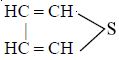
Which of the following is a heterocyclic compound?
A
Thiophene
B
$HOOC-CH=CH-COOH$
C
Cyclopentadiene
D
Cyclopentadienone
Solution
(A) Heterocyclic compounds are cyclic compounds that contain at least one atom other than carbon (heteroatom such as $S, O, N$) in the ring.
Thiophene $(C_4H_4S)$ is a heterocyclic compound containing a sulfur atom in its five-membered ring.
$HOOC-CH=CH-COOH$ (Maleic acid) is an acyclic (open-chain) compound.
Cyclopentadiene and cyclopentadienone are homocyclic (carbocyclic) compounds because their rings consist only of carbon atoms.
Thiophene $(C_4H_4S)$ is a heterocyclic compound containing a sulfur atom in its five-membered ring.
$HOOC-CH=CH-COOH$ (Maleic acid) is an acyclic (open-chain) compound.
Cyclopentadiene and cyclopentadienone are homocyclic (carbocyclic) compounds because their rings consist only of carbon atoms.
0 likes
View Solution13
DifficultMCQ
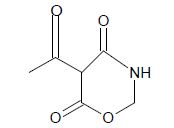
Identify which functional group is not present in the following compound?
A
Ketone
B
Ester
C
Amide
D
Ether
Solution
(D) By analyzing the structure of the given compound:
$1$. The group enclosed in box $b$ is a ketone group ($-C=O$ attached to two carbon atoms).
$2$. The group enclosed in box $a$ is an ester group ($-COO-$ linkage within the ring).
$3$. The group enclosed in box $c$ is an amide group ($-CONH-$ linkage within the ring).
$4$. There is no ether group ($-O-$ linkage between two carbon atoms) present in the molecule.
Therefore,the correct option is $D$.
$1$. The group enclosed in box $b$ is a ketone group ($-C=O$ attached to two carbon atoms).
$2$. The group enclosed in box $a$ is an ester group ($-COO-$ linkage within the ring).
$3$. The group enclosed in box $c$ is an amide group ($-CONH-$ linkage within the ring).
$4$. There is no ether group ($-O-$ linkage between two carbon atoms) present in the molecule.
Therefore,the correct option is $D$.
0 likes
View Solution14
MediumMCQ
Which of the following is a heterocyclic compound?
A
Cyclopentane
B
Cyclopentadienone
C
Pyrrole
D
Aminocyclopentadiene
Solution
(C) heterocyclic compound is a cyclic compound that has atoms of at least two different elements as members of its ring$(s)$.
$A$. Cyclopentane is a carbocyclic compound (only carbon atoms in the ring).
$B$. Cyclopentadienone is a carbocyclic compound (only carbon atoms in the ring).
$C$. Pyrrole is a heterocyclic compound because it contains a nitrogen atom within its five-membered ring.
$D$. Aminocyclopentadiene is a carbocyclic compound (the nitrogen atom is in the substituent group,not in the ring).
Therefore,the correct answer is $C$.
$A$. Cyclopentane is a carbocyclic compound (only carbon atoms in the ring).
$B$. Cyclopentadienone is a carbocyclic compound (only carbon atoms in the ring).
$C$. Pyrrole is a heterocyclic compound because it contains a nitrogen atom within its five-membered ring.
$D$. Aminocyclopentadiene is a carbocyclic compound (the nitrogen atom is in the substituent group,not in the ring).
Therefore,the correct answer is $C$.
0 likes
View Solution15
MediumMCQ
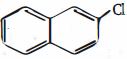
How many $2^o$ Hydrogen atoms are present in the given following compound?
A
$2$
B
$5$
C
$7$
D
$8$
Solution
(C) $2^o$ Hydrogen atom is a hydrogen atom attached to a $2^o$ carbon atom (a carbon atom bonded to two other carbon atoms).
In the given structure of $1$-chloronaphthalene,there are $10$ carbon atoms in total.
The two bridgehead carbons are $3^o$ carbons (bonded to three other carbons) and have no hydrogen atoms attached.
The carbon atom attached to the chlorine atom is a $2^o$ carbon but it has no hydrogen attached.
The remaining $7$ carbon atoms are all $2^o$ carbons,and each of these is bonded to one hydrogen atom.
Therefore,there are $7$ hydrogen atoms attached to $2^o$ carbon atoms.
Thus,the total number of $2^o$ hydrogen atoms is $7$.
In the given structure of $1$-chloronaphthalene,there are $10$ carbon atoms in total.
The two bridgehead carbons are $3^o$ carbons (bonded to three other carbons) and have no hydrogen atoms attached.
The carbon atom attached to the chlorine atom is a $2^o$ carbon but it has no hydrogen attached.
The remaining $7$ carbon atoms are all $2^o$ carbons,and each of these is bonded to one hydrogen atom.
Therefore,there are $7$ hydrogen atoms attached to $2^o$ carbon atoms.
Thus,the total number of $2^o$ hydrogen atoms is $7$.
0 likes
View Solution16
EasyMCQ
Homologous compounds have the same
A
General formula
B
Empirical formula
C
Structural formula
D
Molecular formula
Solution
(A) Homologous compounds possess the same functional group and chemical properties.
Consecutive members of a homologous series differ by a $-CH_2-$ group and a molecular mass of $14 \ u$.
Consecutive members of a homologous series differ by a $-CH_2-$ group and a molecular mass of $14 \ u$.
0 likes
View Solution17
DifficultMCQ
Which pair of compounds does not represent the same homologous series?
A
Benzyl alcohol and $o$-cresol
B
Benzylamine and $N$-methylaniline
C
Benzoic acid and Phenyl formate
D
All of these
Solution
(D) homologous series is a group of compounds that have the same functional group and similar chemical properties,with each successive member differing by a $CH_2$ group.
$A$: Benzyl alcohol $(C_6H_5CH_2OH)$ is a primary alcohol,while $o$-cresol ($2$-methylphenol,$C_6H_4(CH_3)OH$) is a phenolic compound. They have different functional groups.
$B$: Benzylamine $(C_6H_5CH_2NH_2)$ is a primary amine,while $N$-methylaniline $(C_6H_5NHCH_3)$ is a secondary amine. They belong to different classes of amines.
$C$: Benzoic acid $(C_6H_5COOH)$ is a carboxylic acid,while Phenyl formate $(HCOOC_6H_5)$ is an ester. They have different functional groups.
Since none of the pairs represent the same homologous series,the correct answer is $D$.
$A$: Benzyl alcohol $(C_6H_5CH_2OH)$ is a primary alcohol,while $o$-cresol ($2$-methylphenol,$C_6H_4(CH_3)OH$) is a phenolic compound. They have different functional groups.
$B$: Benzylamine $(C_6H_5CH_2NH_2)$ is a primary amine,while $N$-methylaniline $(C_6H_5NHCH_3)$ is a secondary amine. They belong to different classes of amines.
$C$: Benzoic acid $(C_6H_5COOH)$ is a carboxylic acid,while Phenyl formate $(HCOOC_6H_5)$ is an ester. They have different functional groups.
Since none of the pairs represent the same homologous series,the correct answer is $D$.
0 likes
View Solution18
EasyMCQ
Can homologues be isomers?
A
Yes
B
No
C
Sometimes
D
None of these
Solution
(B) Homologues are members of a homologous series that differ by a $CH_2$ group and have the same general formula. Isomers are compounds with the same molecular formula but different structural arrangements. Since homologues have different molecular formulas (differing by $CH_2$),they cannot be isomers.
0 likes
View Solution19
Medium
Draw formulas for the first five members of each homologous series beginning with the following compounds.
$(a)$ $HCOOH$ $(b)$ $CH_{3}COCH_{3}$ $(c)$ $CH_{2}=CH_{2}$
$(a)$ $HCOOH$ $(b)$ $CH_{3}COCH_{3}$ $(c)$ $CH_{2}=CH_{2}$
Solution
The first five members of each homologous series are generated by adding successive $-CH_{2}-$ units:
$(a)$ $HCOOH$ (Methanoic acid),$CH_{3}COOH$ (Ethanoic acid),$CH_{3}CH_{2}COOH$ (Propanoic acid),$CH_{3}CH_{2}CH_{2}COOH$ (Butanoic acid),$CH_{3}CH_{2}CH_{2}CH_{2}COOH$ (Pentanoic acid).
$(b)$ $CH_{3}COCH_{3}$ (Propanone),$CH_{3}COCH_{2}CH_{3}$ (Butanone),$CH_{3}COCH_{2}CH_{2}CH_{3}$ (Pentan$-2-$one),$CH_{3}COCH_{2}CH_{2}CH_{2}CH_{3}$ (Hexan$-2-$one),$CH_{3}COCH_{2}CH_{2}CH_{2}CH_{2}CH_{3}$ (Heptan$-2-$one).
$(c)$ $CH_{2}=CH_{2}$ (Ethene),$CH_{3}CH=CH_{2}$ (Propene),$CH_{3}CH_{2}CH=CH_{2}$ (But$-1-$ene),$CH_{3}CH_{2}CH_{2}CH=CH_{2}$ (Pent$-1-$ene),$CH_{3}CH_{2}CH_{2}CH_{2}CH=CH_{2}$ (Hex$-1-$ene).
$(a)$ $HCOOH$ (Methanoic acid),$CH_{3}COOH$ (Ethanoic acid),$CH_{3}CH_{2}COOH$ (Propanoic acid),$CH_{3}CH_{2}CH_{2}COOH$ (Butanoic acid),$CH_{3}CH_{2}CH_{2}CH_{2}COOH$ (Pentanoic acid).
$(b)$ $CH_{3}COCH_{3}$ (Propanone),$CH_{3}COCH_{2}CH_{3}$ (Butanone),$CH_{3}COCH_{2}CH_{2}CH_{3}$ (Pentan$-2-$one),$CH_{3}COCH_{2}CH_{2}CH_{2}CH_{3}$ (Hexan$-2-$one),$CH_{3}COCH_{2}CH_{2}CH_{2}CH_{2}CH_{3}$ (Heptan$-2-$one).
$(c)$ $CH_{2}=CH_{2}$ (Ethene),$CH_{3}CH=CH_{2}$ (Propene),$CH_{3}CH_{2}CH=CH_{2}$ (But$-1-$ene),$CH_{3}CH_{2}CH_{2}CH=CH_{2}$ (Pent$-1-$ene),$CH_{3}CH_{2}CH_{2}CH_{2}CH=CH_{2}$ (Hex$-1-$ene).
0 likes
View Solution20
Medium
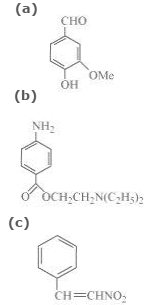
Identify the functional groups in the following compounds:
Solution
(N/A) The functional groups present in the given compounds are:
$(a)$ Aldehyde $(-CHO)$,Hydroxyl $(-OH)$,Methoxy $(-OCH_3)$,and Aromatic ring.
$(b)$ Primary amine $(-NH_2)$,Ester $(-COO-)$,and Tertiary amine $(-N(C_2H_5)_2)$.
$(c)$ Nitro group $(-NO_2)$ and Alkene $(C=C)$.
$(a)$ Aldehyde $(-CHO)$,Hydroxyl $(-OH)$,Methoxy $(-OCH_3)$,and Aromatic ring.
$(b)$ Primary amine $(-NH_2)$,Ester $(-COO-)$,and Tertiary amine $(-N(C_2H_5)_2)$.
$(c)$ Nitro group $(-NO_2)$ and Alkene $(C=C)$.
0 likes
View Solution21
Medium
Describe the history and development of organic chemistry.
Solution
(N/A) The history of organic chemistry began with the belief in $Vital \ Force \ Theory$,which suggested that organic compounds could only be produced by living organisms.
In $1828$,$Friedrich \ Wöhler$ disproved this by synthesizing urea $(NH_2CONH_2)$ from an inorganic compound,ammonium cyanate $(NH_4OCN)$,by heating it.
This discovery marked the beginning of modern organic chemistry,shifting the focus from vitalism to the study of carbon-based compounds.
Later,$Kolbe$ synthesized acetic acid and $Berthelot$ synthesized methane,further establishing that organic compounds could be prepared in the laboratory from inorganic precursors.
Today,organic chemistry is defined as the study of carbon compounds,excluding simple oxides like $CO$,$CO_2$,carbides,and carbonates.
In $1828$,$Friedrich \ Wöhler$ disproved this by synthesizing urea $(NH_2CONH_2)$ from an inorganic compound,ammonium cyanate $(NH_4OCN)$,by heating it.
This discovery marked the beginning of modern organic chemistry,shifting the focus from vitalism to the study of carbon-based compounds.
Later,$Kolbe$ synthesized acetic acid and $Berthelot$ synthesized methane,further establishing that organic compounds could be prepared in the laboratory from inorganic precursors.
Today,organic chemistry is defined as the study of carbon compounds,excluding simple oxides like $CO$,$CO_2$,carbides,and carbonates.
0 likes
View Solution22
Difficult
Provide the classification of organic compounds.
Solution
(N/A) The classification of organic compounds based on their structure is as follows:
Organic compounds are primarily divided into two categories:
$1$. Acyclic or Open chain compounds $(I)$
$2$. Cyclic or Closed chain or Ring compounds $(II)$
Cyclic compounds are further classified into:
$1$. Homocyclic or Carbocyclic compounds
$2$. Heterocyclic compounds
Homocyclic or Carbocyclic compounds are further divided into:
$1$. Alicyclic compounds
$2$. Aromatic compounds (which are further classified into Benzenoid and Non-benzenoid compounds).
Organic compounds are primarily divided into two categories:
$1$. Acyclic or Open chain compounds $(I)$
$2$. Cyclic or Closed chain or Ring compounds $(II)$
Cyclic compounds are further classified into:
$1$. Homocyclic or Carbocyclic compounds
$2$. Heterocyclic compounds
Homocyclic or Carbocyclic compounds are further divided into:
$1$. Alicyclic compounds
$2$. Aromatic compounds (which are further classified into Benzenoid and Non-benzenoid compounds).
0 likes
View Solution23
Medium
Explain acyclic or open chain compounds with examples.
Solution
(N/A) Definition: These compounds are also called aliphatic compounds and consist of straight or branched chain structures.
$(a)$ Examples of acyclic or straight chain compounds:
$(i)$ $CH_3CH_3$ (ethane)
(ii) $CH_3CH_2CH_3$ (propane)
(iii) $CH_3CH_2CH_2CH_3$ ($n$-butane)
(iv) $CH_3CHO$ (acetaldehyde)
$(v)$ $CH_3COOH$ (acetic acid)
(vi) $CH_3CH_2CH_2CH_2Cl$ ($1$-chlorobutane)
$(b)$ Acyclic or branched chain compounds:
$(i)$ $(CH_3)_2CHCH_3$ (isobutane)
(ii) $C(CH_3)_4$ (neopentane)
(iii) $CH_3CH(CH_3)CH_2CH_3$ (isopentane)
(iv) $CH_3CH(CH_3)CH_2Cl$ (isobutyl chloride)
$(a)$ Examples of acyclic or straight chain compounds:
$(i)$ $CH_3CH_3$ (ethane)
(ii) $CH_3CH_2CH_3$ (propane)
(iii) $CH_3CH_2CH_2CH_3$ ($n$-butane)
(iv) $CH_3CHO$ (acetaldehyde)
$(v)$ $CH_3COOH$ (acetic acid)
(vi) $CH_3CH_2CH_2CH_2Cl$ ($1$-chlorobutane)
$(b)$ Acyclic or branched chain compounds:
$(i)$ $(CH_3)_2CHCH_3$ (isobutane)
(ii) $C(CH_3)_4$ (neopentane)
(iii) $CH_3CH(CH_3)CH_2CH_3$ (isopentane)
(iv) $CH_3CH(CH_3)CH_2Cl$ (isobutyl chloride)
0 likes
View Solution24
Medium
What are alicyclic or closed chain or ring compounds? Give examples.
Solution
(N/A) Alicyclic (aliphatic cyclic) compounds: These are organic compounds that contain carbon atoms joined in the form of a ring. They resemble aliphatic compounds in their properties. Examples include cyclopropane,cyclohexene,and cyclohexane.
$(b)$ Heterocyclic compounds: These are cyclic compounds in which the ring contains one or more atoms other than carbon (such as $O$,$N$,or $S$). An example is tetrahydrofuran.
$(b)$ Heterocyclic compounds: These are cyclic compounds in which the ring contains one or more atoms other than carbon (such as $O$,$N$,or $S$). An example is tetrahydrofuran.
0 likes
View Solution25
Medium
What is a functional group? Give examples.
Solution
(N/A) functional group is defined as an atom or a group of atoms joined in a specific manner,which is responsible for the characteristic chemical properties of organic compounds.
Examples:
$(i)$ $(-OH)$ Hydroxyl group,e.g.,$CH_3OH$
$(ii)$ $(-CHO)$ Aldehyde group,e.g.,$CH_3CHO$
$(iii)$ $(-COOH)$ Carboxylic acid group,e.g.,$CH_3COOH$
Some important functional groups containing carbon-carbon multiple bonds are given in the table below:
Examples:
$(i)$ $(-OH)$ Hydroxyl group,e.g.,$CH_3OH$
$(ii)$ $(-CHO)$ Aldehyde group,e.g.,$CH_3CHO$
$(iii)$ $(-COOH)$ Carboxylic acid group,e.g.,$CH_3COOH$
Some important functional groups containing carbon-carbon multiple bonds are given in the table below:
| Series | Group | Characteristic |
|---|---|---|
| Alkene | $ >C=C< $ | $C-C$ double bond |
| Alkyne | $-C \equiv C-$ | $C-C$ triple bond |
| Arene | $C_6H_6$ (Benzene ring) | Six-membered ring with alternate $C=C$ and $C-C$ bonds (aromatic ring) |
0 likes
View Solution26
Medium
What is a homologous series? Give an example.
Solution
(N/A) homologous series is a group or a series of organic compounds that have the same functional group and similar chemical properties,and in which the successive members differ by a $-CH_{2}-$ unit.
$(I)$ The members of a homologous series can be represented by a general molecular formula.
$(II)$ The successive members differ from each other in molecular formula by a $-CH_{2}-$ unit.
$(III)$ All compounds of a homologous series contain the same functional group.
$(IV)$ The compounds of a homologous series are prepared by general methods and exhibit similar chemical properties.
$(V)$ The physical properties of members of a homologous series change gradually with an increase in molecular mass.
$(I)$ The members of a homologous series can be represented by a general molecular formula.
$(II)$ The successive members differ from each other in molecular formula by a $-CH_{2}-$ unit.
$(III)$ All compounds of a homologous series contain the same functional group.
$(IV)$ The compounds of a homologous series are prepared by general methods and exhibit similar chemical properties.
$(V)$ The physical properties of members of a homologous series change gradually with an increase in molecular mass.
| Homologous series / General formula | Examples |
| Alkane series: $C_{n}H_{2n+2}$ | $C_{2}H_{6}, C_{3}H_{8}, C_{4}H_{10}$ |
| Alkene series: $C_{n}H_{2n}$ | $C_{2}H_{4}, C_{3}H_{6}, C_{4}H_{8}$ |
| Alkyne series: $C_{n}H_{2n-2}$ | $C_{2}H_{2}, C_{3}H_{4}, C_{4}H_{6}$ |
| Alcohol series: $C_{n}H_{2n+1}OH$ | $CH_{3}OH, C_{2}H_{5}OH, C_{3}H_{7}OH$ |
| Acid series: $C_{n}H_{2n+1}COOH$ | $CH_{3}COOH, C_{2}H_{5}COOH$ |
0 likes
View Solution27
Medium
Define functional group and explain its general characteristics and uses.
Solution
(N/A) Definition: $A$ functional group is an atom or a group of atoms bonded together in a unique manner,which is usually the site of chemical reactivity in an organic molecule.
Characteristics: Compounds containing the same functional group undergo similar chemical reactions. For example,$CH_{3}OH$,$CH_{3}CH_{2}OH$,and $(CH_{3})_{2}CHOH$,all containing the $-OH$ functional group,liberate hydrogen gas upon reaction with sodium metal.
Uses: Functional groups allow for the systematic classification of organic compounds into different classes based on their chemical behavior and structural features.
Characteristics: Compounds containing the same functional group undergo similar chemical reactions. For example,$CH_{3}OH$,$CH_{3}CH_{2}OH$,and $(CH_{3})_{2}CHOH$,all containing the $-OH$ functional group,liberate hydrogen gas upon reaction with sodium metal.
Uses: Functional groups allow for the systematic classification of organic compounds into different classes based on their chemical behavior and structural features.
0 likes
View Solution28
Easy
What is organic chemistry?
Solution
(N/A) Organic chemistry is the branch of chemistry that deals with the study of carbon compounds. Carbon atoms form stable covalent bonds with other carbon atoms and with elements such as hydrogen,oxygen,nitrogen,sulfur,phosphorus,and halogens. The study of these compounds and their properties constitutes organic chemistry.
0 likes
View Solution29
Easy
How did the modern field of organic chemistry develop?
Solution
(N/A) Carbon atoms possess the unique ability to form stable covalent bonds with other carbon atoms (catenation) and with various other elements such as hydrogen,oxygen,nitrogen,sulfur,phosphorus,and halogens. The vast number of compounds resulting from these diverse bonding patterns necessitated the creation of a specialized branch of chemistry dedicated to their study,which is known as organic chemistry.
0 likes
View Solution30
Medium
Classify the following compounds into Acyclic,Alicyclic,Benzenoid,and Non-benzenoid: Tropolone,Propane,Benzene,Butene,Ethane,Acetic acid,Tetrahydrofuran,Cyclohexene,Naphthalene,Cyclobutane.
Solution
(N/A) The classification of the given compounds is as follows:
$1$. Acyclic (Open chain): {Acetic acid,Ethane,Butene,Propane}
$2$. Alicyclic: {Tetrahydrofuran,Cyclohexene,Cyclobutane}
$3$. Benzenoid: {Naphthalene,Benzene}
$4$. Non-benzenoid: {Tropolone}
$1$. Acyclic (Open chain): {Acetic acid,Ethane,Butene,Propane}
$2$. Alicyclic: {Tetrahydrofuran,Cyclohexene,Cyclobutane}
$3$. Benzenoid: {Naphthalene,Benzene}
$4$. Non-benzenoid: {Tropolone}
0 likes
View Solution31
Medium
Explain the following terms:
$(i)$ Alicyclic compound
$(ii)$ Heterocyclic compound
$(iii)$ Non-benzenoid compound
$(i)$ Alicyclic compound
$(ii)$ Heterocyclic compound
$(iii)$ Non-benzenoid compound
Solution
(N/A) $(i)$ Alicyclic compounds: These are cyclic organic compounds that contain carbon atoms arranged in a ring,but they do not possess aromatic character. They resemble aliphatic compounds in their properties. Example: Cyclopropane,Cyclohexane.
$(ii)$ Heterocyclic compounds: These are cyclic compounds in which the ring contains one or more atoms other than carbon (such as $N$,$O$,or $S$). These are called heteroatoms. Example: Furan,Pyridine,Thiophene.
$(iii)$ Non-benzenoid compounds: These are cyclic compounds that possess aromatic character but do not contain a benzene ring. They exhibit aromaticity due to the presence of a cyclic conjugated system following $H$ückel's rule $(4n+2) \pi$ electrons. Example: Azulene,Tropolone.
$(ii)$ Heterocyclic compounds: These are cyclic compounds in which the ring contains one or more atoms other than carbon (such as $N$,$O$,or $S$). These are called heteroatoms. Example: Furan,Pyridine,Thiophene.
$(iii)$ Non-benzenoid compounds: These are cyclic compounds that possess aromatic character but do not contain a benzene ring. They exhibit aromaticity due to the presence of a cyclic conjugated system following $H$ückel's rule $(4n+2) \pi$ electrons. Example: Azulene,Tropolone.
0 likes
View Solution32
Medium
What is primary $(1^{\circ})$,secondary $(2^{\circ})$,tertiary $(3^{\circ})$ and quaternary $(4^{\circ})$ carbon? Give its example.
Solution
(N/A) The classification of a carbon atom as primary $(1^{\circ})$,secondary $(2^{\circ})$,tertiary $(3^{\circ})$,or quaternary $(4^{\circ})$ depends on the number of other carbon atoms directly attached to it.
$1^{\circ}$ (Primary): $A$ carbon atom attached to no other carbon atom (as in methane) or only one other carbon atom (as in ethane) is called a primary carbon.
$2^{\circ}$ (Secondary): $A$ carbon atom attached to two other carbon atoms is known as a secondary carbon.
$3^{\circ}$ (Tertiary): $A$ carbon atom attached to three other carbon atoms is known as a tertiary carbon.
$4^{\circ}$ (Quaternary): $A$ carbon atom attached to four other carbon atoms is known as a quaternary carbon.
Examples:
$1^{\circ}$ (Primary): $A$ carbon atom attached to no other carbon atom (as in methane) or only one other carbon atom (as in ethane) is called a primary carbon.
$2^{\circ}$ (Secondary): $A$ carbon atom attached to two other carbon atoms is known as a secondary carbon.
$3^{\circ}$ (Tertiary): $A$ carbon atom attached to three other carbon atoms is known as a tertiary carbon.
$4^{\circ}$ (Quaternary): $A$ carbon atom attached to four other carbon atoms is known as a quaternary carbon.
Examples:
| Structure | Forms of carbon |
|---|---|
| $H_3C-CH(CH_3)-CH_2-CH_3$ ($2$-Methylbutane) | Terminal $-CH_3$ groups are $1^{\circ}$. The $CH$ carbon is $3^{\circ}$ (attached to $3$ carbons). The $-CH_2-$ carbon is $2^{\circ}$ (attached to $2$ carbons). |
| $C(CH_3)_4$ ($2$,$2$-Dimethylpropane) | The central carbon is $4^{\circ}$ (attached to $4$ carbons). The four terminal $-CH_3$ carbons are $1^{\circ}$. |
0 likes
View Solution33
Medium
Explain the different types of carbon atoms with examples.
Solution
(N/A) Based on the number of other carbon atoms attached to a specific carbon atom,it is classified as primary $(1^{\circ})$,secondary $(2^{\circ})$,tertiary $(3^{\circ})$,or quaternary $(4^{\circ})$.
$1^{\circ}$ (Primary) Carbon: $A$ carbon atom attached to no other carbon atom (as in methane) or to only one other carbon atom (as in ethane).
$2^{\circ}$ (Secondary) Carbon: $A$ carbon atom attached to two other carbon atoms.
$3^{\circ}$ (Tertiary) Carbon: $A$ carbon atom attached to three other carbon atoms.
$4^{\circ}$ (Quaternary) Carbon: $A$ carbon atom attached to four other carbon atoms.
Examples:
| Structure | Forms of Carbon |
| :--- | :--- |
| $H_3C-CH(CH_3)-CH_2-CH_3$ ($2$-Methylbutane) | Terminal $CH_3$ groups are $1^{\circ}$. The $CH$ carbon is $3^{\circ}$ as it is attached to $3$ other carbons. The $CH_2$ carbon is $2^{\circ}$ as it is attached to $2$ other carbons. |
| $C(CH_3)_4$ ($2$,$2$-Dimethylpropane) | The four terminal $CH_3$ groups are $1^{\circ}$. The central carbon is $4^{\circ}$ as it is attached to $4$ other carbon atoms. |
$1^{\circ}$ (Primary) Carbon: $A$ carbon atom attached to no other carbon atom (as in methane) or to only one other carbon atom (as in ethane).
$2^{\circ}$ (Secondary) Carbon: $A$ carbon atom attached to two other carbon atoms.
$3^{\circ}$ (Tertiary) Carbon: $A$ carbon atom attached to three other carbon atoms.
$4^{\circ}$ (Quaternary) Carbon: $A$ carbon atom attached to four other carbon atoms.
Examples:
| Structure | Forms of Carbon |
| :--- | :--- |
| $H_3C-CH(CH_3)-CH_2-CH_3$ ($2$-Methylbutane) | Terminal $CH_3$ groups are $1^{\circ}$. The $CH$ carbon is $3^{\circ}$ as it is attached to $3$ other carbons. The $CH_2$ carbon is $2^{\circ}$ as it is attached to $2$ other carbons. |
| $C(CH_3)_4$ ($2$,$2$-Dimethylpropane) | The four terminal $CH_3$ groups are $1^{\circ}$. The central carbon is $4^{\circ}$ as it is attached to $4$ other carbon atoms. |
0 likes
View Solution34
Medium
Explain why quaternary carbon is possible but quaternary hydrogen is not possible?
Solution
(N/A) quaternary carbon atom is a carbon atom that is bonded to four other carbon atoms. Since carbon has a valency of $4$,all its bonding sites are occupied by carbon atoms. Therefore,there is no space for a hydrogen atom to bond with a quaternary carbon. Consequently,the existence of a quaternary hydrogen atom is impossible.
0 likes
View Solution35
EasyMCQ
Match column $-I$ and column $-II$ with the correct relation:
| Column $-I$ | Column $-II$ |
|---|---|
| $(i)$ Aromatic | $(a)$ Tropolone |
| $(ii)$ Branched acyclic | $(b)$ Neopentane |
| $(iii)$ Alicyclic | $(c)$ Cyclohexene |
| $(iv)$ Non-benzenoid | $(d)$ Aniline |
A
$i-d, ii-b, iii-c, iv-a$
B
$i-a, ii-b, iii-c, iv-d$
C
$i-d, ii-c, iii-b, iv-a$
D
$i-b, ii-a, iii-d, iv-c$
Solution
(A) $(i)$ Aromatic compounds contain a benzene ring or satisfy $H$ückel's rule. Aniline is a benzenoid aromatic compound. So,$(i-d)$.
$(ii)$ Branched acyclic compounds are open-chain structures with branches. Neopentane is a branched alkane. So,$(ii-b)$.
$(iii)$ Alicyclic compounds are cyclic compounds that behave like aliphatic compounds. Cyclohexene is an alicyclic compound. So,$(iii-c)$.
$(iv)$ Non-benzenoid aromatic compounds are aromatic but do not contain a benzene ring. Tropolone is a non-benzenoid aromatic compound. So,$(iv-a)$.
Therefore,the correct match is $(i-d, ii-b, iii-c, iv-a)$.
$(ii)$ Branched acyclic compounds are open-chain structures with branches. Neopentane is a branched alkane. So,$(ii-b)$.
$(iii)$ Alicyclic compounds are cyclic compounds that behave like aliphatic compounds. Cyclohexene is an alicyclic compound. So,$(iii-c)$.
$(iv)$ Non-benzenoid aromatic compounds are aromatic but do not contain a benzene ring. Tropolone is a non-benzenoid aromatic compound. So,$(iv-a)$.
Therefore,the correct match is $(i-d, ii-b, iii-c, iv-a)$.
0 likes
View Solution36
DifficultMCQ
Cyclohexene is . . . . . . type of an organic compound.
A
Benzenoid aromatic
B
Benzenoid non-aromatic
C
Acyclic
D
Alicyclic
Solution
(D) Cyclohexene is a cyclic compound that does not contain a benzene ring and does not exhibit aromaticity. \\ Such cyclic compounds that resemble aliphatic compounds in their properties are classified as alicyclic compounds. \\ Therefore,cyclohexene is an alicyclic compound.
0 likes
View Solution37
DifficultMCQ
Number of compounds among the following which contain sulphur as a heteroatom is:
Furan,Thiophene,Pyridine,Pyrrole,Cysteine,Tyrosine
Furan,Thiophene,Pyridine,Pyrrole,Cysteine,Tyrosine
A
$1$
B
$2$
C
$3$
D
$4$
Solution
(B) heteroatom is any atom other than carbon or hydrogen in an organic molecule.
$1$. Furan: Contains oxygen as a heteroatom.
$2$. Thiophene: Contains sulphur as a heteroatom.
$3$. Pyridine: Contains nitrogen as a heteroatom.
$4$. Pyrrole: Contains nitrogen as a heteroatom.
$5$. Cysteine: Contains sulphur as a heteroatom.
$6$. Tyrosine: Does not contain sulphur.
The compounds containing sulphur as a heteroatom are Thiophene and Cysteine.
Therefore,the total number of such compounds is $2$.
$1$. Furan: Contains oxygen as a heteroatom.
$2$. Thiophene: Contains sulphur as a heteroatom.
$3$. Pyridine: Contains nitrogen as a heteroatom.
$4$. Pyrrole: Contains nitrogen as a heteroatom.
$5$. Cysteine: Contains sulphur as a heteroatom.
$6$. Tyrosine: Does not contain sulphur.
The compounds containing sulphur as a heteroatom are Thiophene and Cysteine.
Therefore,the total number of such compounds is $2$.
0 likes
View Solution38
MediumMCQ
Which of the following molecules does $NOT$ contain nitrogen in it?
A
Pyrrole
B
Piperidine
C
Pyridine
D
Pyran
Solution
(D) To determine which molecule does not contain nitrogen,let us examine the chemical structures of each:
$1$. Pyrrole $(C_4H_5N)$: Contains a nitrogen atom in a five-membered ring.
$2$. Piperidine $(C_5H_{11}N)$: Contains a nitrogen atom in a six-membered saturated ring.
$3$. Pyridine $(C_5H_5N)$: Contains a nitrogen atom in a six-membered aromatic ring.
$4$. Pyran $(C_5H_6O)$: Contains an oxygen atom in a six-membered ring,but no nitrogen atom.
Therefore,Pyran is the molecule that does not contain nitrogen.
$1$. Pyrrole $(C_4H_5N)$: Contains a nitrogen atom in a five-membered ring.
$2$. Piperidine $(C_5H_{11}N)$: Contains a nitrogen atom in a six-membered saturated ring.
$3$. Pyridine $(C_5H_5N)$: Contains a nitrogen atom in a six-membered aromatic ring.
$4$. Pyran $(C_5H_6O)$: Contains an oxygen atom in a six-membered ring,but no nitrogen atom.
Therefore,Pyran is the molecule that does not contain nitrogen.
0 likes
View Solution39
EasyMCQ
Which of the following compounds does $NOT$ contain oxygen as a heteroatom?
A
Furan
B
$THF$
C
$4H$-Pyran
D
Pyrrole
Solution
(D) heteroatom is any atom other than carbon or hydrogen in an organic molecule.
$Furan$ $(C_4H_4O)$ contains an oxygen atom in its ring.
$THF$ (Tetrahydrofuran,$C_4H_8O$) contains an oxygen atom in its ring.
$4H$-Pyran $(C_5H_6O)$ contains an oxygen atom in its ring.
$Pyrrole$ $(C_4H_5N)$ contains a nitrogen atom as the heteroatom,not oxygen.
Therefore,the correct answer is $D$.
$Furan$ $(C_4H_4O)$ contains an oxygen atom in its ring.
$THF$ (Tetrahydrofuran,$C_4H_8O$) contains an oxygen atom in its ring.
$4H$-Pyran $(C_5H_6O)$ contains an oxygen atom in its ring.
$Pyrrole$ $(C_4H_5N)$ contains a nitrogen atom as the heteroatom,not oxygen.
Therefore,the correct answer is $D$.
0 likes
View Solution40
EasyMCQ
Which of the following compounds does $NOT$ contain nitrogen in it?
A
Thiophene
B
Pyridine
C
Pyrrole
D
Piperidine
Solution
(A) The chemical formulas for the given compounds are as follows:
$1$. Thiophene: $C_4H_4S$ (contains sulfur,no nitrogen).
$2$. Pyridine: $C_5H_5N$ (contains nitrogen).
$3$. Pyrrole: $C_4H_5N$ (contains nitrogen).
$4$. Piperidine: $C_5H_{11}N$ (contains nitrogen).
Therefore,Thiophene is the compound that does not contain nitrogen.
$1$. Thiophene: $C_4H_4S$ (contains sulfur,no nitrogen).
$2$. Pyridine: $C_5H_5N$ (contains nitrogen).
$3$. Pyrrole: $C_4H_5N$ (contains nitrogen).
$4$. Piperidine: $C_5H_{11}N$ (contains nitrogen).
Therefore,Thiophene is the compound that does not contain nitrogen.
0 likes
View Solution41
EasyMCQ
What is the difference of molar masses expressed in $g$ of two neighbouring members of a homologous series (in $g$)?
A
$10$
B
$14$
C
$18$
D
$20$
Solution
(B) homologous series is a group of organic compounds having the same functional group and similar chemical properties,where each successive member differs by a $CH_2$ group.
The molar mass of a $CH_2$ group is calculated as:
$M(CH_2) = M(C) + 2 \times M(H) = 12 \ g/mol + 2 \times 1 \ g/mol = 14 \ g/mol$.
Therefore,the difference in molar masses of two neighbouring members of a homologous series is $14 \ g$.
The molar mass of a $CH_2$ group is calculated as:
$M(CH_2) = M(C) + 2 \times M(H) = 12 \ g/mol + 2 \times 1 \ g/mol = 14 \ g/mol$.
Therefore,the difference in molar masses of two neighbouring members of a homologous series is $14 \ g$.
0 likes
View Solution42
EasyMCQ
What is the numerical difference in molar masses of the second and third members of a homologous series?
A
$14$
B
$12$
C
$10$
D
$2$
Solution
(A) homologous series is a group of organic compounds having the same functional group and similar chemical properties,where each successive member differs by a $-CH_2$ (methylene) group.
Since the atomic mass of $C$ is $12$ and $H$ is $1$,the molar mass of a $-CH_2$ group is $12 + (2 \times 1) = 14 \ g/mol$.
Therefore,the numerical difference in the molar masses of any two successive members (such as the second and third members) is $14$.
Since the atomic mass of $C$ is $12$ and $H$ is $1$,the molar mass of a $-CH_2$ group is $12 + (2 \times 1) = 14 \ g/mol$.
Therefore,the numerical difference in the molar masses of any two successive members (such as the second and third members) is $14$.
0 likes
View Solution43
EasyMCQ
Which among the following statements is $NOT$ true about a homologous series of organic compounds?
A
Each member of a series differs by two carbon atoms and two $H$ atoms from the neighboring member.
B
All members have similar chemical properties.
C
All members of a series are represented by the same general formula.
D
None of these.
Solution
(A) homologous series is a group of organic compounds having the same functional group and similar chemical properties,in which all members can be represented by the same general formula.
Each successive member of a homologous series differs from the previous one by a $CH_2$ group,which corresponds to one carbon atom and two hydrogen atoms.
Option $A$ states that members differ by two carbon atoms,which is incorrect.
Therefore,the statement in option $A$ is not true.
Each successive member of a homologous series differs from the previous one by a $CH_2$ group,which corresponds to one carbon atom and two hydrogen atoms.
Option $A$ states that members differ by two carbon atoms,which is incorrect.
Therefore,the statement in option $A$ is not true.
0 likes
View Solution44
EasyMCQ
What is the difference in molar mass of a member of a homologous series from its neighboring members in grams per mole?
A
$14$
B
$18$
C
$30$
D
$25$
Solution
(A) Neighboring members of a homologous series differ by a $CH_2$ group.
The molar mass of $C$ is $12 \ g/mol$ and $H$ is $1 \ g/mol$.
Therefore,the difference in molar mass is $12 + (2 \times 1) = 14 \ g/mol$.
The molar mass of $C$ is $12 \ g/mol$ and $H$ is $1 \ g/mol$.
Therefore,the difference in molar mass is $12 + (2 \times 1) = 14 \ g/mol$.
0 likes
View Solution45
EasyMCQ
Which of the following compounds contains oxygen as a heteroatom?
A
Furan
B
Pyridine
C
Thiophene
D
Piperidine
Solution
(A) heteroatom is an atom other than carbon or hydrogen in an organic ring structure.
$1$. Furan contains an oxygen atom $(O)$ in its five-membered ring.
$2$. Pyridine contains a nitrogen atom $(N)$ in its six-membered ring.
$3$. Thiophene contains a sulfur atom $(S)$ in its five-membered ring.
$4$. Piperidine contains a nitrogen atom $(N)$ in its six-membered ring.
Therefore,Furan is the compound that contains oxygen as a heteroatom.
$1$. Furan contains an oxygen atom $(O)$ in its five-membered ring.
$2$. Pyridine contains a nitrogen atom $(N)$ in its six-membered ring.
$3$. Thiophene contains a sulfur atom $(S)$ in its five-membered ring.
$4$. Piperidine contains a nitrogen atom $(N)$ in its six-membered ring.
Therefore,Furan is the compound that contains oxygen as a heteroatom.
0 likes
View Solution46
MediumMCQ
Which among the following compounds is $NOT$ a carbocyclic compound?
A
Benzene
B
Naphthalene
C
Pyridine
D
Cyclopentane
Solution
(C) carbocyclic compound is one in which the ring is made up of only carbon atoms.
$Benzene$,$Naphthalene$,and $Cyclopentane$ are all carbocyclic compounds because their rings consist solely of carbon atoms.
$Pyridine$ contains a nitrogen atom within its ring structure,making it a heterocyclic compound.
$Benzene$,$Naphthalene$,and $Cyclopentane$ are all carbocyclic compounds because their rings consist solely of carbon atoms.
$Pyridine$ contains a nitrogen atom within its ring structure,making it a heterocyclic compound.
0 likes
View Solution47
EasyMCQ
Which of the following statements is true for tetrahydrofuran?
A
It is homocyclic aromatic
B
It is heterocyclic aromatic
C
It is aromatic non-benzenoid
D
It is heterocyclic nonaromatic
Solution
(D) Tetrahydrofuran $(THF)$ is a cyclic ether with the formula $(CH_2)_4O$.
It contains an oxygen atom within the ring,making it a heterocyclic compound.
It does not satisfy $H$ückel's rule for aromaticity (it lacks a continuous system of $p$-orbitals and is not planar),therefore it is non-aromatic.
Thus,it is a heterocyclic non-aromatic compound.
It contains an oxygen atom within the ring,making it a heterocyclic compound.
It does not satisfy $H$ückel's rule for aromaticity (it lacks a continuous system of $p$-orbitals and is not planar),therefore it is non-aromatic.
Thus,it is a heterocyclic non-aromatic compound.
0 likes
View Solution48
MediumMCQ
Identify the correct pair of molecule and the heteroatom present in it,respectively,from the following:
A
Furan-$S$
B
Pyrrole-$N$
C
Thiophene-$O$
D
Piperidine-$S$
Solution
(B) The structures of the given molecules are as follows:
$1$. Furan: $A$ five-membered heterocyclic ring containing an oxygen atom $(O)$.
$2$. Pyrrole: $A$ five-membered heterocyclic ring containing a nitrogen atom $(N)$.
$3$. Thiophene: $A$ five-membered heterocyclic ring containing a sulfur atom $(S)$.
$4$. Piperidine: $A$ six-membered saturated heterocyclic ring containing a nitrogen atom $(N)$.
Comparing these with the given options:
- Option $A$: Furan-$S$ (Incorrect,Furan contains $O$)
- Option $B$: Pyrrole-$N$ (Correct)
- Option $C$: Thiophene-$O$ (Incorrect,Thiophene contains $S$)
- Option $D$: Piperidine-$S$ (Incorrect,Piperidine contains $N$)
Therefore,the correct pair is Pyrrole-$N$.
$1$. Furan: $A$ five-membered heterocyclic ring containing an oxygen atom $(O)$.
$2$. Pyrrole: $A$ five-membered heterocyclic ring containing a nitrogen atom $(N)$.
$3$. Thiophene: $A$ five-membered heterocyclic ring containing a sulfur atom $(S)$.
$4$. Piperidine: $A$ six-membered saturated heterocyclic ring containing a nitrogen atom $(N)$.
Comparing these with the given options:
- Option $A$: Furan-$S$ (Incorrect,Furan contains $O$)
- Option $B$: Pyrrole-$N$ (Correct)
- Option $C$: Thiophene-$O$ (Incorrect,Thiophene contains $S$)
- Option $D$: Piperidine-$S$ (Incorrect,Piperidine contains $N$)
Therefore,the correct pair is Pyrrole-$N$.
0 likes
View Solution49
EasyMCQ
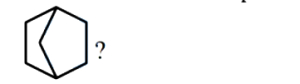
What is the number of primary carbon atoms in the compound?
A
$2$
B
Zero
C
$1$
D
$3$
Solution
(B) The given compound is bicyclo[$2.2$.$1$]heptane.
$A$ primary $(1^{\circ})$ carbon atom is a carbon atom bonded to only one other carbon atom.
In this cyclic structure,every carbon atom is bonded to at least two other carbon atoms.
Specifically,the bridgehead carbons are tertiary $(3^{\circ})$ and the other carbons are secondary $(2^{\circ})$.
Therefore,there are zero primary carbon atoms present in the compound.
$A$ primary $(1^{\circ})$ carbon atom is a carbon atom bonded to only one other carbon atom.
In this cyclic structure,every carbon atom is bonded to at least two other carbon atoms.
Specifically,the bridgehead carbons are tertiary $(3^{\circ})$ and the other carbons are secondary $(2^{\circ})$.
Therefore,there are zero primary carbon atoms present in the compound.
0 likes
View Solution50
EasyMCQ
Which of the following belongs to the homologous series of $C_5H_8O_2N$?
A
$C_6H_{10}O_3N$
B
$C_6H_8O_2N_2$
C
$C_6H_{10}O_2N_2$
D
$C_6H_{10}O_2N$
Solution
(D) homologous series is a group of organic compounds having the same functional group and similar chemical properties,where each successive member differs by a $CH_2$ unit.
For the given formula $C_5H_8O_2N$,the next member in the series is obtained by adding a $CH_2$ group.
$C_5H_8O_2N + CH_2 = C_6H_{10}O_2N$.
Therefore,$C_6H_{10}O_2N$ belongs to the same homologous series.
For the given formula $C_5H_8O_2N$,the next member in the series is obtained by adding a $CH_2$ group.
$C_5H_8O_2N + CH_2 = C_6H_{10}O_2N$.
Therefore,$C_6H_{10}O_2N$ belongs to the same homologous series.
0 likes
View Solution8-1.Organic Chemistry : Classification and Nomenclature of Organic compounds — Classification of organic compounds · Frequently Asked Questions
1Are these 8-1.Organic Chemistry : Classification and Nomenclature of Organic compounds questions useful for JEE and NEET?
Yes. All questions in this section are mapped to JEE Main and NEET exam patterns. Previous year questions from JEE Main, NEET, GUJCET and state-level exams are included with full solutions.
2Can I switch to Hindi or Gujarati for these questions?
Yes. Use the language tabs in the hero section or the sidebar to view the same questions and solutions in English, Hindi or Gujarati.
3How do I generate a question paper from this subtopic?
Use the Vedclass Exam Paper Generator — select the chapter and subtopic, set difficulty, and generate Sets A, B, C, D automatically. First 3 chapters of every subject are free.
Vedclass Products
For Students
Vedclass Test Series
Mock tests in real JEE/NEET style with performance analysis. 5-day free trial.
Start Free TrialFor Teachers
Exam Paper Generator
Generate Set A/B/C/D papers from this chapter in 2 minutes. 3 chapters free.
Try FreeFor Institutes
Online Exam Module
Live online exams with unlimited students, 360° analytics & white-label branding.
See DemoFor Teachers & Institutes
Generate a 8-1.Organic Chemistry : Classification and Nomenclature of Organic compounds Exam Paper in 2 Minutes
Select subtopic & difficulty — Sets A, B, C, D auto-generated with No Repeat logic.
First 3 chapters of every subject are free — no payment required.